For over a century and a half after his death
the memory of the greatest Englishman of
the seventeenth century was looked upon with
horror by the leaders of English thought, political
and literary; the very men who were carrying to
fruition Cromwell’s tremendous policies being
often utterly ignorant that they were following in
his footsteps. At last the scales began to drop
from the most far-seeing eyes. Macaulay, with
his eminently sane and wholesome spirit, held
Cromwell and the social forces for which he stood—Puritanic
and otherwise—at their real worth,
and his judgment about them was, in all essentials,
accurate. But the true appreciation of the
place held by the greatest soldier-statesman of the
seventeenth century began with the publication
of his life and letters by Carlyle. The gnarled
genius of the man who worshipped the heroes of
2the past as intensely as he feared and distrusted
the heroes of the present, enabled him to write
with a loftiness and intensity that befitted his subject.
But Carlyle’s singular incapacity to “see
veracity,” as he would himself have phrased it,
made him at times not merely tell half-truths, but
deliberately invert the truth. He was of that not
uncommon cloistered type which shrinks shuddering
from actual contact with whatever it, in
theory, most admires, and which, therefore, is reduced
in self-justification to misjudge and misrepresent
those facts of past history which form precedents
for what is going on before the author’s
own eyes.
Cromwell lived in an age when it was not possible
to realize a government based upon those
large principles of social, political, and religious
liberty in which—at any rate, during his earlier
years—he sincerely believed; but the movement
of which he was the head was the first of the great
movements which, marching along essentially the
same lines, have produced the English-speaking
world as we at present know it. This primary
fact Carlyle refused to see, or at least to admit.
As the central idea of his work he states that the
Puritanism of the Cromwellian epoch was the
“last glimpse of the Godlike vanishing from this
England; conviction and veracity giving place
3to hollow cant and formulism.... The last
of all our Heroisms.... We have wandered
far away from the ideas which guided us in that
century, and indeed which had guided us in all
preceding centuries, but of which that century
was the ultimate manifestation; we have wandered
very far; and must endeavor to return and
connect ourselves therewith again.... I
will advise my reader to forget the modern methods
of reform; not to remember that he has ever
heard of a modern individual called by the name
of ‘Reformer,’ if he would understand what the
old meaning of the word was. The Cromwells,
Pyms, and Hampdens, who were understood on
the Royalist side to be fire-brands of the devil,
have had still worse measure from the Dry-as-Dust
philosophies and sceptical histories of later
times. They really did resemble fire-brands of
the devil if you looked at them through spectacles
of a certain color, for fire is always fire; but
by no spectacles, only by mere blindness and
wooden-eyed spectacles, can the flame-girt
heaven’s messenger pass for a poor, mouldy
Pedant and Constitution-monger such as these
would make him out to be.”
This is good writing of its kind; but the
thought is mere “hollow cant and unveracity;”
not only far from the truth, but the direct reverse
4of the truth. It is itself the wail of the pedant
who does not know that the flame-girt heaven’s
messenger of truth is always a mere mortal to
those who see him with the actual eyes of the
flesh, although mayhap a great mortal; while to
the closet philosopher his quality of flame-girtedness
is rarely visible until a century or thereabouts
has elapsed.
So far from this great movement, of which
Puritanism was merely one manifestation, being
the last of a succession of similar heroisms, it had
practically very much less connection with what
went before than with all that has guided us in
our history since. Of course, it is impossible to
draw a line with mathematical exactness between
the different stages of history, but it is both possible
and necessary to draw it with rough efficiency;
and, speaking roughly, the epoch of the
Puritans was the beginning of the great modern
epoch of the English-speaking world—infinitely
its greatest epoch. We have not “wandered far
from the ideas that guided” the wisest and most
earnest leaders in the century that saw Cromwell;
on the contrary, these ideas were themselves very
far indeed from those which had guided the English
people in previous ages, and the ideas that
now guide us represent on the whole what was
best and truest in the thought of the Puritans.
5As for Pym and Hampden, their type had practically
no representative in England prior to their
time, while all the great legislative reformers since
then have been their followers. The Hampden
type—the purest and noblest of types—reached its
highest expression in Washington. Pym, the
man of great powers and great services, with a
tendency to believe that Parliamentary government
was the cure for all evils, followed to a line
“the modern methods of reform,” and was exactly
the man who, if he had lived in Carlyle’s day,
Carlyle would have sneered at as a “constitution-monger.”
It was men of the kind of Hampden
and Pym who, before Carlyle’s own eyes, were
striving in the British Parliament for the reforms
which were to carry one stage farther the work
of Hampden and Pym; who were endeavoring
to secure for all creeds full tolerance; to give the
people an ever-increasing share in ruling their
own destinies; to better the conditions of social
and political life. In the great American Civil
War the master spirits in the contest for union
and freedom were actuated by a fervor as intense
as, and even finer than, that which actuated the
men of the Long Parliament; while in rigid
morality and grim devotion to what he conceived
to be God’s bidding, the Southern soldier, Stonewall
Jackson, was as true a type of the “General
6of the Lord, with his Bible and his Sword,”
as Cromwell or Ireton.
The whole history of the movement which resulted
in the establishment of the Commonwealth
of England will be misread and misunderstood if
we fail to appreciate that it was the first modern,
and not the last mediæval, movement; if we fail
to understand that the men who figured in it and
the principles for which they contended, are
strictly akin to the men and the principles that
have appeared in all similar great movements
since: in the English Revolution of 1688; in the
American Revolution of 1776; and the American
Civil War of 1861. We must keep ever in
mind the essentially modern character of the
movement if we are to appreciate its true inwardness,
its true significance. Fundamentally, it was
the first struggle for religious, political, and social
freedom, as we now understand the terms. As
was inevitable in such a first struggle, there remained
even among the forces of reform much of
what properly belonged to previous generations.
In addition to the modern side there was a mediæval
side, too. Just so far as this mediæval element
obtained, the movement failed. All that
there was of good and of permanence in it was
due to the new elements.
To understand the play of the forces which
7produced Cromwell and gave him his chance, we
must briefly look at the England into which he
was born.
He saw the light at the close of the reign
of Queen Elizabeth, in the last years of the
Tudor dynasty, and he grew to manhood during
the inglorious reign of the first English king of
the inglorious House of Stuart. The struggle
between the reformed churches and the ancient
church, against which they were in revolt, was still
the leading factor in shaping European politics,
though other factors were fast assuming an equal
weight. The course of the Reformation in England
had been widely different from that which
it had followed in other European countries.
The followers of Luther and Calvin, whatever
their shortcomings—and they were many and
grievous—had been influenced by a fiery zeal for
righteousness, a fierce detestation of spiritual corruption;
but in England the Reformation had
been undertaken for widely different reasons by
Henry VIII. and his creatures, though the bulk
of their followers were as sincere as their brethren
on the Continent. Henry’s purpose had been
simple, namely, to transfer to himself the power
and revenues of the Papacy, so far as he could
seize them, and thus to add to the spiritual
supremacy against which the leaders of the
8Reformation had revolted: the absolute sovereignty
which the Tudors were seeking to
establish in England. Elizabeth stood infinitely
above her father in most respects; but in religious
views they were not far apart, and in theory they
were both believers in absolutism. They had no
standing army, and they were always in want of
money, so that in practice they never ventured
seriously to offend the influential and moneyed
classes. But under Henry the misery and suffering
of the lower classes became very great, and
the yeomen were largely driven from their lands,
while much of Elizabeth’s own administration
consisted of efforts to grapple with the vagrancy
and wretchedness which had been caused by the
degradation of those who stood lowest in the
social scale.
When the Stuarts took possession of the throne
of England they found a people which, unlike
the peoples of most of the neighboring States, had
not fought out its religious convictions. The
Reformation had deeply stirred men’s souls.
Religion had become a matter of vital and terrible
importance to Protestant and to Catholic.
Among the extremists, the men who had given
the tone to the Reformation in Germany, Switzerland,
Holland, and Scotland, religion, as they
understood it, entered into every act of their lives.
In England there were men of this stamp; but in
the English Reformation they had played a wholly
subordinate part; and indeed had been in almost
as great danger as the Catholics. Their force,
therefore, had not spent itself. It had been conserved,
in spite of their desires.
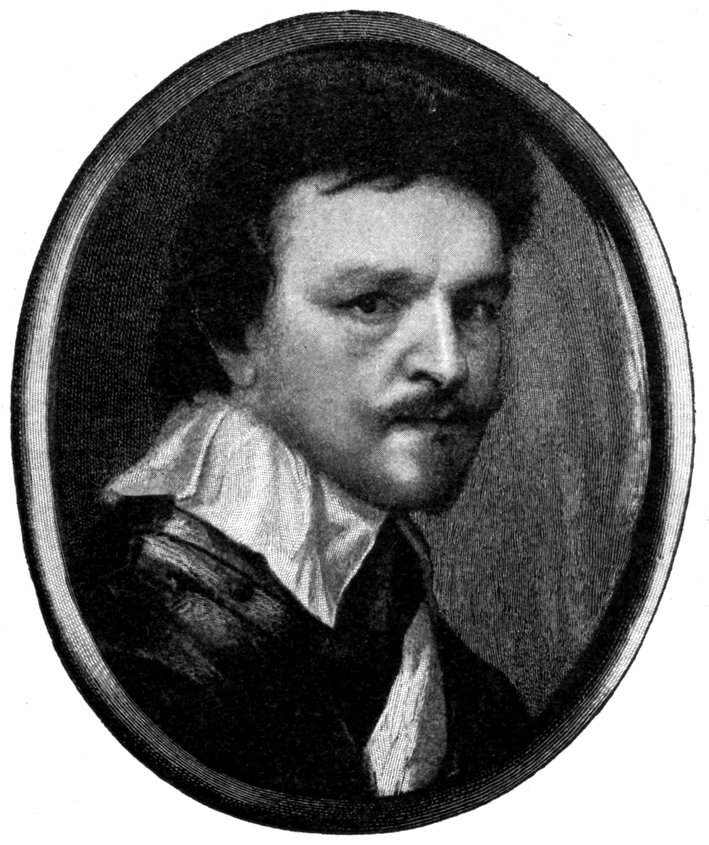
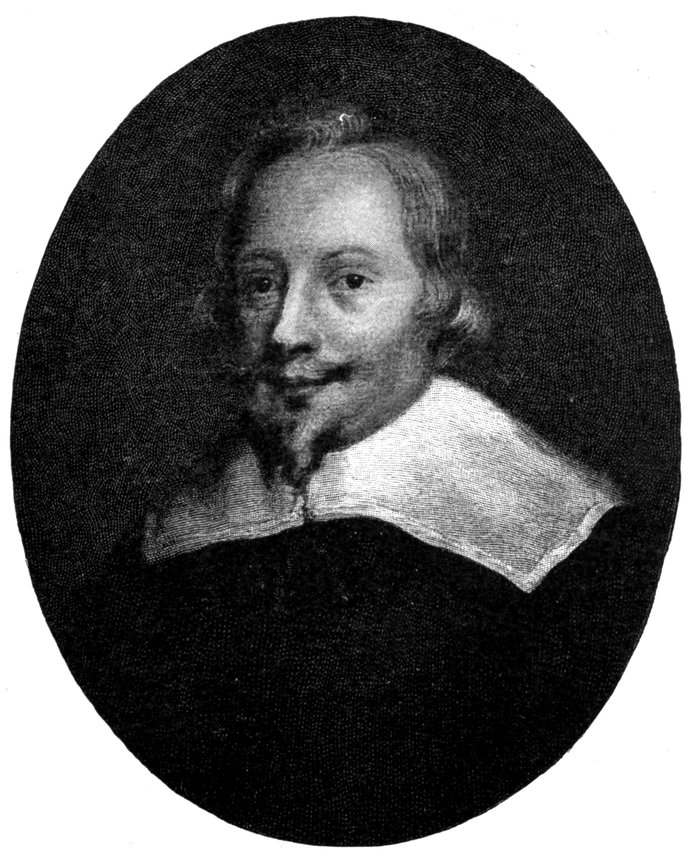
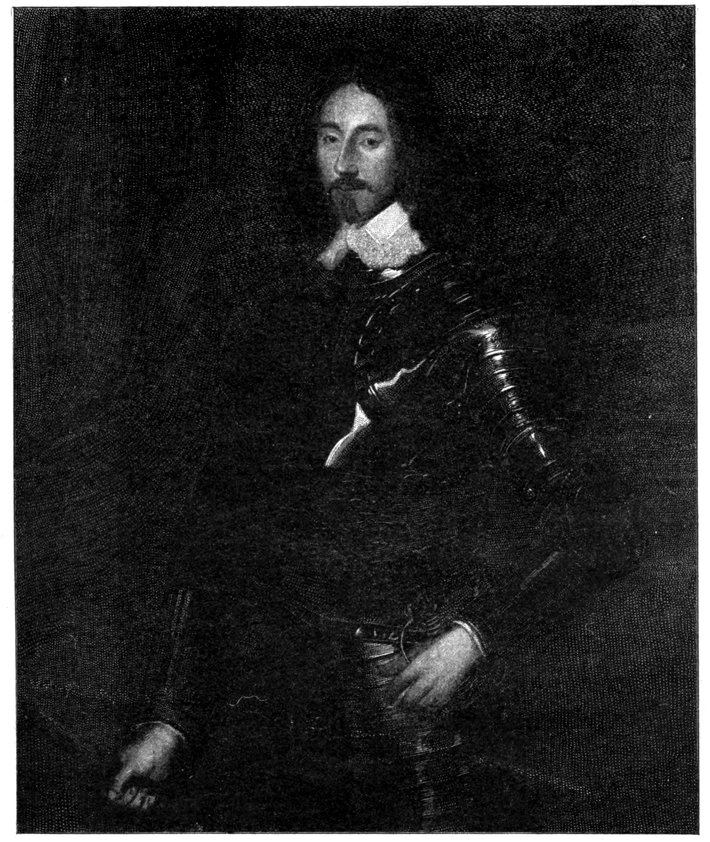
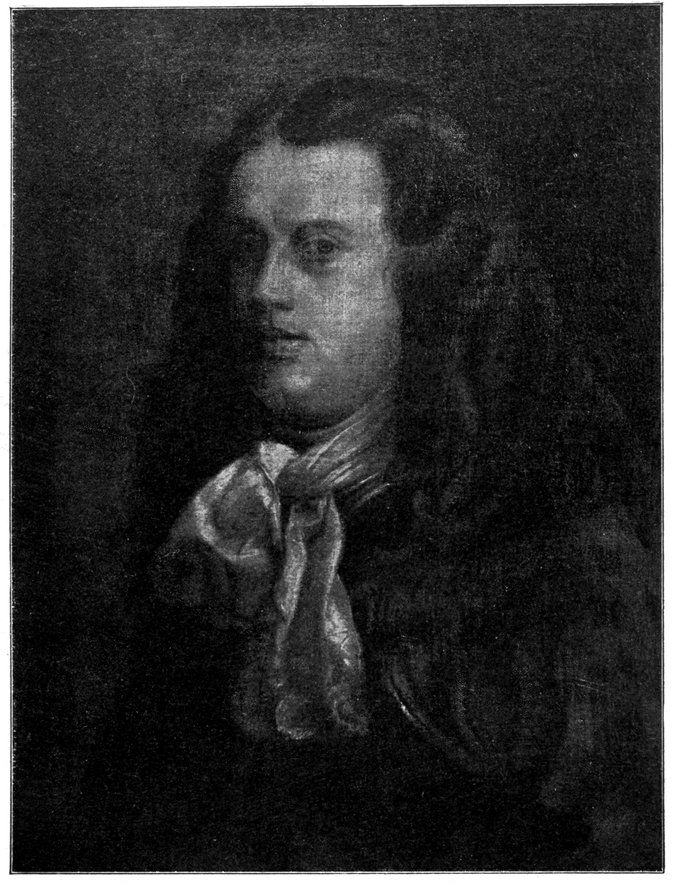
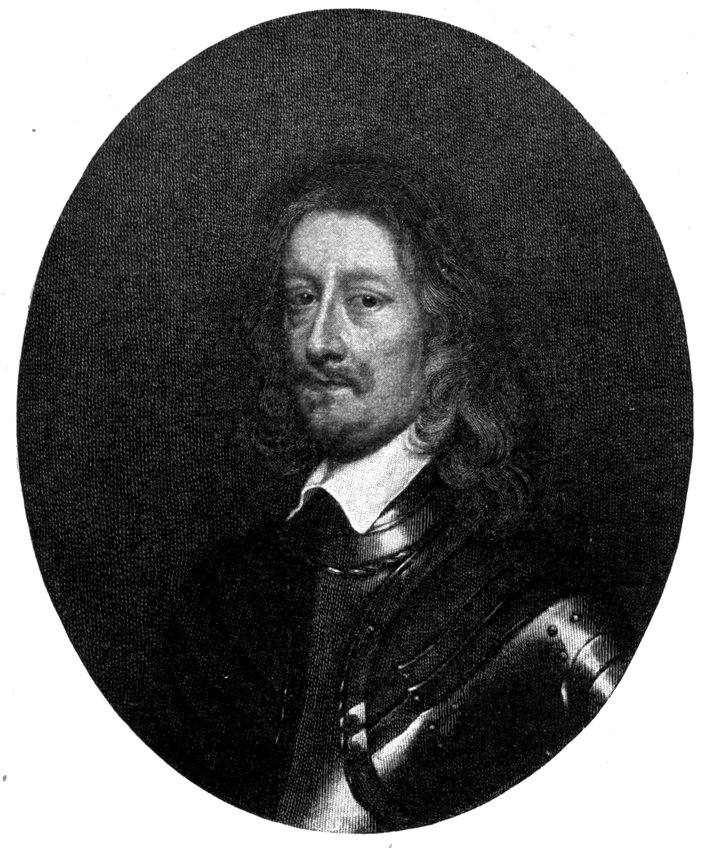
Thomas Wentworth, Earl of Strafford.
From the miniature at Devonshire House.
By permission of the Duke of Devonshire, K.G.
9Thus it happened that the high tide of extreme
Protestantism was reached in England, not as
in other Protestant countries, in the sixteenth
century, but in the seventeenth. The Stuarts
were the only Protestant kings who were not in
religious sympathy with their Protestant subjects.
In theory the Anglican Church of Henry and
Elizabeth stood for what we would now regard as
tyranny. What Henry VIII. strove to do with
the Anglican Church is what has actually been
done by the Czars with the Orthodox Church in
Russia; but that which was possible with the eastern
Slavs was not possible with the westernmost
and freest of the Teutonic peoples. Yet in the
actual event it was probably fortunate that the
English Reformation took the shape it did; for
under such conditions it was not marked by the
intense fanaticism of the reformers elsewhere.
The Stuarts not only found themselves masters
of a kingdom where, supposedly, they were spiritually
supreme, while actually their claim to supremacy
was certain to be challenged; they also
10found themselves at the head of a form of government
which was to all appearances despotic, while
the people over whom they bore sway, though
slow to object to the forms, were extremely intolerant
of the practices of despotism. The Tudors
were unarmed despots, who disliked the old feudal
nobility, and who found it for their interest to
cultivate the commercial classes, and to form a
new nobility of their own, based upon wealth.
The men at the lowest round of the social ladder—the
workingmen and farm laborers—were yet,
as they remained for a couple of centuries, so unfit
for the work of political combination that they
could be safely disregarded by the masters of England.
At times their discontent was manifested,
generally in the shape of abortive peasant insurrections;
but there was never need to consider
them as of serious and permanent importance.
The middle classes, however, had become very
powerful, and to their material interests the Tudors
always took care to defer. At the very close of
her reign, Elizabeth, who was at heart as thorough
a tyrant as ever lived, but who possessed that
shrewd good sense which, if not the noblest, is
perhaps on the whole the most useful of qualities
in the actual workaday world, found herself face
to face with her people on the question of monopolies;
and as soon as she understood that they
11were resolutely opposed to her policy, she instantly
yielded. In other words, the Tudor despotism
was conditioned upon the despot’s doing nothing
of which the influential classes of the nation—the
upper and middle classes—seriously disapproved;
and this the Stuart kings could never understand.
Moreover, apart from the fact that the Stuarts
were so much less shrewd and less able than the
Tudors, there was the further fact that Englishmen
as a whole were gradually growing more intolerant,
not only of the practice but of the pretence
of tyranny, whether in things material or in things
spiritual. There was a moral awakening which
rendered it impossible for Englishmen of the seventeenth
century to submit to the brutal wrong-doing
which marked the political and ecclesiastical
tyranny of the previous century. The career of
Henry VIII. could not have been paralleled in
any shape when once England had begun to breed
such men as went to the making of the Long
Parliament.
Much of the aspiration after higher things took
the form of spiritual unrest. It must always be
remembered that the Protestant sects which established
themselves in the northern half of Europe,
although they warred in the name of religious
liberty, had no more conception of it, as we of this
day understand it, than their Catholic foes; and
12yet it must also be remembered that the bitter
conflicts they waged prepared the way for the
wide tolerance of individual difference in matters
of religious belief which is among the greatest
blessings of our modern life. An American Catholic
and an American Protestant of to-day, whatever
the difference between their theologies, yet
in their ways of looking at real life, at its relation
to religion, and the relations of religion and the
State, are infinitely more akin to one another than
either is to the men of his religious faith who lived
three centuries ago. We now admit, as a matter
of course, that any man may, in religious matters,
profess to be guided by authority or by reason, as
suits him best; but that he must not interfere
with similar freedom of belief in others; and that
all men, whatever their religious beliefs, have exactly
the same political rights and are to be held
to the same responsibility for the way they exercise
these rights. Few indeed were the men who held
such views at the time when Cromwell was growing
to manhood. Holland was the State of all
others in which there was the nearest approach to
religious liberty; and even in Holland the bitterness
of the Calvinists toward the Arminians was
something which we can now scarcely understand.
Arminius was no more at home in Geneva than
in Rome; and his followers were prescribed by
the most religious people of England, and so far
as might be were driven from the realm. Calvinists
and Lutherans felt as little inclination as
Catholics to allow liberty of conscience to others;
and as grotesque a compromise as ever was made
in matters religious was that made in Germany,
when it was decided that the peoples of the various
German principalities should in mass accept the
faiths of their respective princes.
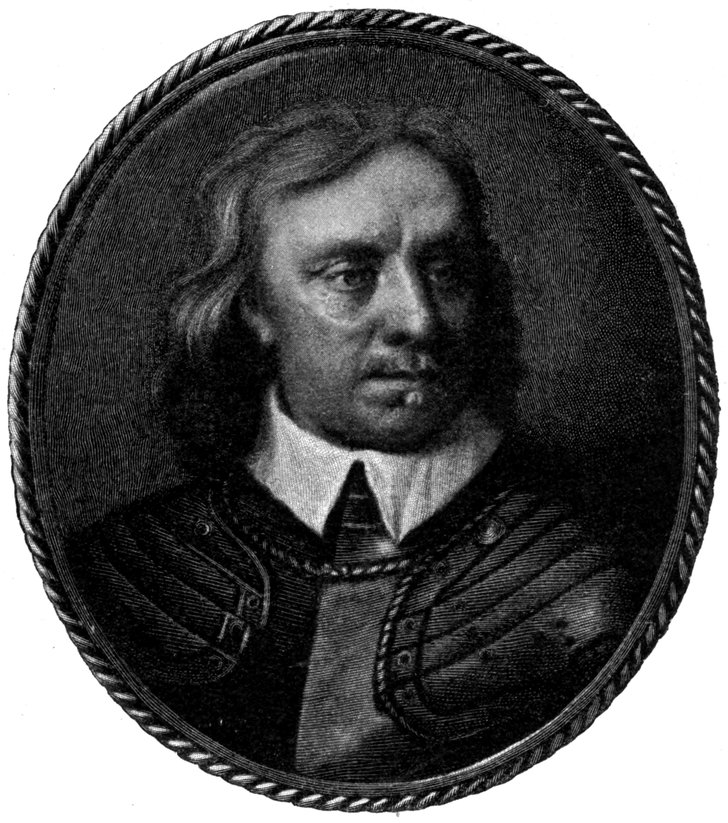
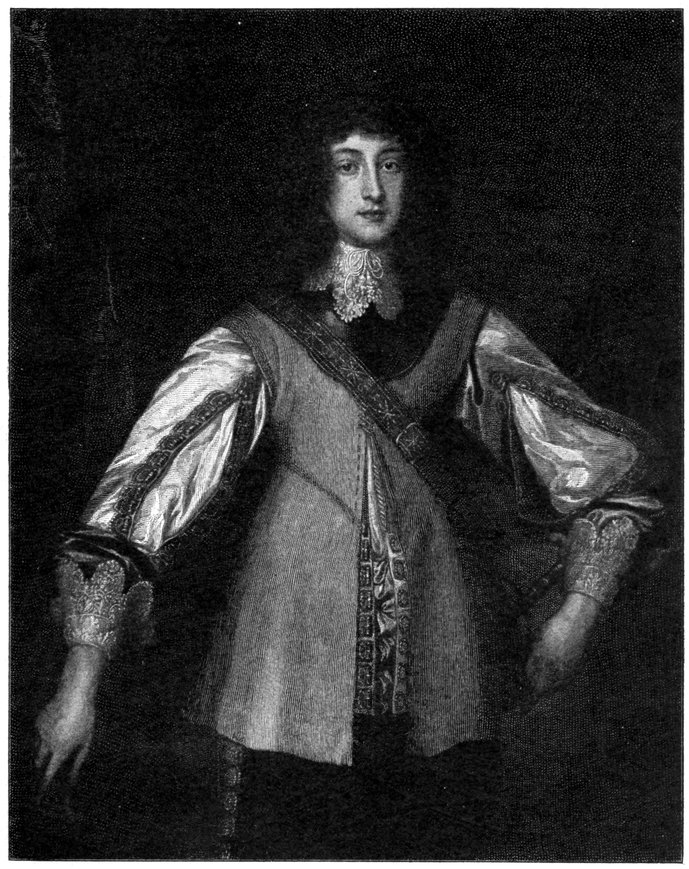
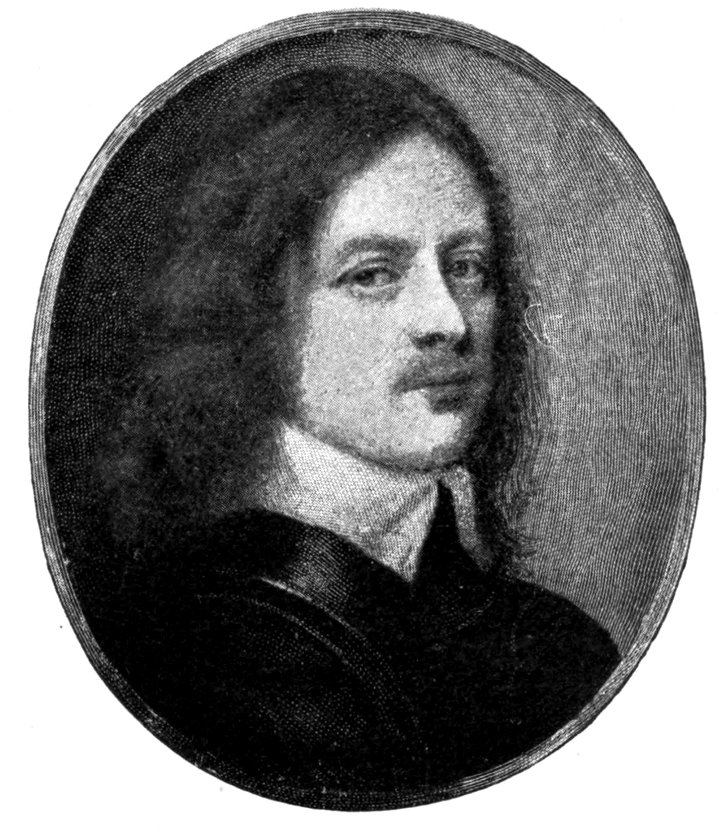
Oliver Cromwell.
From a miniature by Cooper. Here reproduced for the first time.
By permission of Sir Charles Hartopp, Bart.
13Yet though the Reformers thus strove to establish
for their own use the very religious intolerance
against which they had revolted, the mere fact of
their existence nullified their efforts. Sooner or
later people who had exercised their own judgment,
and had fought for the right to exercise it,
were sure grudgingly to admit the same right in
others. That time was as yet far distant. In
Cromwell’s youth all the leading Christian
churches were fiercely intolerant. Unless we
keep in mind that this was the general attitude,
an attitude which necessarily affected even the
greatest men, we cannot do justice to the political
and social leaders of that age when we find them,
as we so often do, adopting toward their religious
foes policies from which we, of a happier age,
turn with horror.
In England hatred of Roman Catholicism had
become almost interchangeable with hatred of
14Spain. Spain had been the one dangerous foe
which England had encountered under the Tudor
dynasty, and the only war she had ever waged
into which the religious element entered was the
war which put upon the English roll of honor the
names of her great sixteenth-century seamen,
Drake and Hawkins, Howard and Frobisher.
Throughout the sixteenth century Spain had
towered above every other power of Europe in
warlike might; and though the Dutch and English
sailors had broken the spell of her invincibility
at sea, on shore her soldiers retained their
reputation for superior prowess, in spite of the
victories of Maurice of Orange, until Gustavus
Adolphus marched his wonderful army down from
the frozen North. During Cromwell’s youth and
early manhood Spain was still the most powerful
and most dreaded of European nations. Her
government had become a mere tyranny; her religion
fanatical bigotry of a type more extreme
than any that existed elsewhere, even in an age
when all creeds tended toward fanaticism and
bigotry. It was in Spain that the Holy Inquisition
chiefly flourished—one of the most fearful
engines for the destruction of all that was highest
in mankind that the world has ever seen. Catholics
were oppressed in England and Protestants
in France; but in each country the persecuted
15sect might almost be said to enjoy liberty, and
certainly to enjoy peace, when their fate was compared
with the dreadful horrors of torture and
murder with which Spain crushed out every species
of heresy within her borders. Jew, Infidel,
and Protestant, shared the same awful doom, until
she had purchased complete religious uniformity
at the price of the loss of everything that makes
national life great and noble. The dominion of
Spain would have been the dominion of desolation;
her supremacy as baneful as that of the
Turk; and Holland and England, in withstanding
her, rendered the same service to humanity
that was rendered at that very time by those nations
of southeastern Europe who formed out of
the bodies of their citizens the bulwark which
stayed the Turkish fury.
But if in her relations to one Catholic nation
England appeared as the champion of religious
liberty, of all that makes life worth having to the
free men who live in free nations, yet in her relations
to another Catholic people she herself played
the rôle of merciless oppressor—religious, political,
and social. Ireland, utterly foreign in speech and
culture, had been ground into the dust by the
crushing weight of England’s overlordship. During
centuries chaos had reigned in the island; the
English intruders possessing sufficient power to
16prevent the development of any Celtic national
life, but not to change it into a Norman or English
national life. The English who settled and
warred in Ireland felt and acted as the most barbarous
white frontiersmen of the nineteenth century
have acted toward the alien races with whom
they have been brought in contact. There is no
language in which to paint the hideous atrocities
committed in the Irish wars of Elizabeth; and
the worst must be credited to the highest English
officials. In Ireland the antagonism was fundamentally
racial; whether the sovereign of England
were Catholic or Protestant made little difference
in the burden of wrong which the Celt
was forced to bear. The first of the so-called
plantations by which the Celts were ousted in
mass from great tracts of country to make room
for English settlers, was undertaken under the
Catholic Queen Mary, and the two counties thus
created by the wholesale expulsion of the wretched
kerne were named in honor of the Queen and
of her spouse, the Spanish Philip. Though Philip’s
bigotry made him the persecutor of heretics,
it taught him no mercy toward those of his own
faith but of a different nationality, whether Irish
or Portuguese. When England became Protestant,
Ireland stood steadfastly for the old faith;
and religious was added to race hatred. In Spain
the Holy Inquisition was the handmaid of grinding
tyranny. In Ireland the Catholic priesthood
was the sole friend, standby, and comforter of a
hunted and despairing people. In the Netherlands
and on the high seas Protestantism was the
creed of liberty. In Ireland it was one of the
masks worn by the alien oppressor.
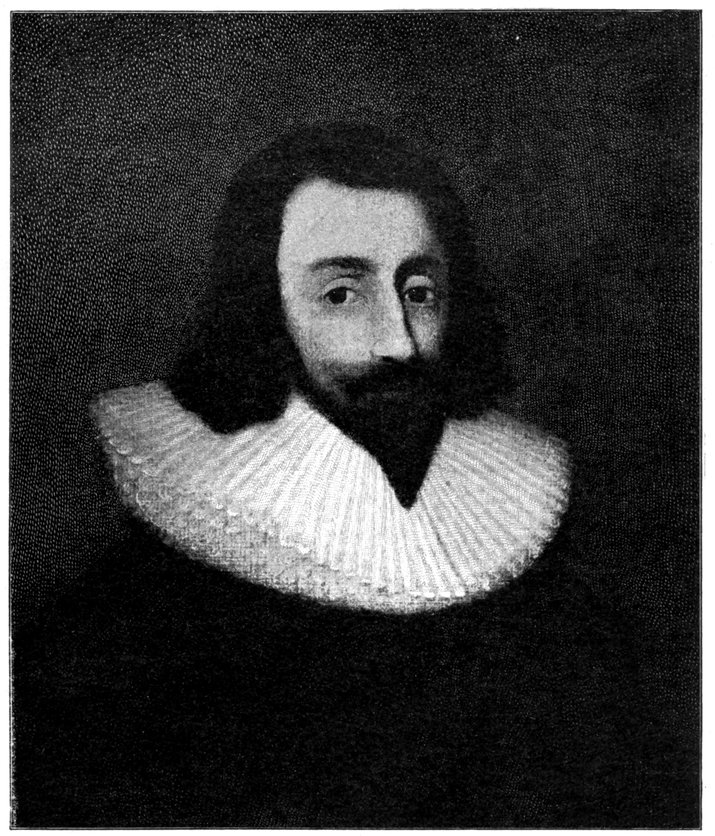
Sir John Eliot.
From the portrait by Van Somer at Port Eliot.
By permission of the Earl of St. Germans.
17France was Catholic, but her Catholicism differed
essentially from that of Spain, and during
the first part of the seventeenth century was quite
as liberal as the Protestantism of England. When
Cromwell was a child Henry of Navarre was on
the French throne, and to him all creeds were
alike. He was succeeded in the actual government
of France by the great Cardinals Richelieu
and Mazarin, who were Statesmen rather than
Churchmen; and under them the French Protestants
enjoyed rather more toleration than was
allowed the Catholics of England. The natural
foes of France were the two great Catholic powers
of Spain and Austria, ruled by the twin branches
of the House of Hapsburg; and her hostility to
them determined her attitude throughout the
Thirty Years’ War.
Meanwhile, Holland was at the height of her
power. She had a far greater colonial empire than
England, her commercial development was greater,
and the renown of her war marine higher. Drake
18and Hawkins had but singed the beard of the
Spanish king, had but plundered his vessels and
harassed his great fleets. Van Heemskirk, Piet
Hein, and the elder Tromp crushed the sea-power
of Spain by downright hard fighting in
great pitched battles, and captured her silver
fleets entire.
In Great Britain itself—it must be kept in
mind that Scotland was as yet an entirely distinct
kingdom, united to England only by the fact
that the same line of kings ruled over both—the
difference between the Scotch and the English,
though less in degree, was the same in kind as
that between the English and the Dutch. In
Scotland, outside of the Highlands, the mass of
the people were devoted with all the strength of
their intense and virile natures to the form of
Calvinism introduced by Knox. Their Church
government was Presbyterian. As both the Presbyterian
ministers and their congregations demanded
that the State should be managed in
essentials according to the wishes of the Church,
the general feeling was really in the direction of
a theocratic republic, although the name would
have frightened them. In Scotland, as in England,
no considerable body of men had yet grasped
the idea that there should be toleration of religious
differences or a divorce between the functions of
19the State and the Church. In both countries, as
elsewhere at the time through Christendom, religious
liberty meant only religious liberty for the
sect that raised the cry; but, as elsewhere, the
mere use of the name as a banner under which to
fight brought nearer the day when the thing itself
would be possible.
In England there was practically peace during
the first forty years of the century, but it was an
ignoble and therefore an evil peace. Of course,
peace should be the aim of all statesmen, and is
the aim of the greatest statesman. Nevertheless,
not only the greatest statesmen, but all men who
are truly wise and patriotic, recognize that peace
is good only when it comes honorably and is used
for honorable purposes, and that the peace of
mere sloth or incapacity is as great a curse as the
most unrighteous war. Those who doubt this
would do well to study the condition of England
during the reign of James I., and during the first
part of the reign of Charles I. England had then
no standing army and no foreign policy worthy of
the name. The chief of her colonies was growing
up almost against her wishes, and wholly
without any help or care from her. In short, she
realized the conditions, as regards her relations
with the outside world and “militarism,” which
certain philosophers advocate at the present day
20for America. The result was a gradual rotting
of the national fibre, which rendered it necessary
for her to pass through the fiery ordeal
of the Civil War in order that she might be
saved.
In every nation there is, as there has been from
time immemorial, a good deal of difficulty in
combining the policies of upholding the national
honor abroad, and of preserving a not too heavily
taxed liberty at home. Many peoples and many
rulers who have solved the problem with marked
success as regards one of the two conditions, have
failed as regards the other. It was the peculiar
privilege of the Stuart kings to fail signally in
both. They were dangerous to no one but their
own subjects. Their government was an object
of contempt to their neighbors and of contempt,
mixed with anger and terror, to their own people.
They made amends for utter weakness in the face
of a foreign foe by showing against the free men
of their own country that kind of tyranny which
finds its favorite expression in oppressing those
who resist not at all, or ineffectually. They were
held on the throne only by a mistaken but honorable
loyalty, and by an unworthy servility; by
the strong habits formed by the customs of centuries;
and, most of all, by the wise distrust of
radical innovation and preference for reform to
21revolution which gives to the English race its
greatest strength.
This last attitude, the dislike of revolution,
was entirely wholesome and praiseworthy. On
the other hand, the doctrine of the divine right
of kings, which represented the extreme form of
loyalty to the sovereign, was vicious, unworthy of
the race, and to be ranked among degrading superstitions.
It is now so dead that it is easy to
laugh at it; but it was then a real power for evil.
Moreover, the extreme zealots who represented
the opposite pole of the political and religious
world, were themselves, as is ordinarily the case
with such extremists, the allies of the forces
against which they pretended to fight. From
these dreamers of dreams, of whose “cloistered
virtue” Milton spoke with such fine contempt,
the men who possessed the capacity to do things
turned contemptuously away, seeking practical
results rather than theoretical perfection, and
being content to get the substance at some cost
of form. As always, the men who counted were
those who strove for actual achievement in the
field of practical politics, and who were not misled
merely by names. England, in the present
century, has shown how complete may be the
freedom of the individual under a nominal monarchy;
and the Dreyfus incident in France would
22be proof enough, were any needed, that despotism
of a peculiarly revolting type may grow rankly,
even in a republic, if there is not in its citizens a
firm and lofty purpose to do justice to all men
and guard the rights of the weak as well as of
the strong.
James came to the throne to rule over a people
steadily growing to think more and more seriously
of religion: to believe more and more in their
rights and liberties. But the King himself was
cursed with a fervent belief in despotism, and an
utter inability to give his belief practical shape in
deeds. For half a century the spirit of sturdy
independence had been slowly growing among
Englishmen. Elizabeth governed almost under
the forms of despotism; but a despotism which
does not carry the sword has to accommodate
itself pretty thoroughly to the desires of the subjects,
once these desires become clearly defined
and formulated. Elizabeth never ventured to do
what Henry had done. She left England, therefore,
thoroughly Royalist, devoted to the Crown,
and unable to conceive of any other form of government,
but already desirous of seeing an increase
in the power of the people as expressed
through Parliament. James, from the very outset
of his reign, pursued a course of conduct exactly
fitted both to irritate the people, with the pretensions
23of the Crown, and to convince them that
they could prevent these pretensions from being
carried out.
Besides, he offended both their political and
their religious feelings. England had been growing
more and more fanatically Protestant; that is,
more and more Puritan. Under Elizabeth there
had been more religious persecution of Puritans,
and of Dissenters generally, than of Catholics. But
this could not prevent the growth of the spirit of
Puritanism. During the reign of James there
were marked Presbyterian tendencies visible
within the Anglican Church itself, and plenty
of Puritans among her divines. Unfortunately,
both Presbyterian and Anglican were then at one
in heartily condemning that spirit of true religious
liberty, of true toleration, which we of
to-day in the United States recognize as the most
vital of religious rights. The so-called Independent
movement, from which sprang the Congregational
and indeed the Baptist Churches as
we know them to-day, had begun under Elizabeth.
Its votaries contended for what now seems
the self-evident right of each congregation, if it
so desires, to decide for itself important questions
of doctrine and of church management. Yet
Elizabeth’s ministers had actually stamped this
sect out of existence, with the hearty approval of
24the wisest men in the realm and of the enormous
majority of the people. Such an act, and, above
all, such approval, shows how long and difficult
was the road which still had to be traversed
before the goal of religious liberty was reached.
The people were relatively less advanced
toward religious than toward political liberty.
Nevertheless, they were distinctly in advance of
the King, even in matters religious. The resolute
determination to fight for one’s own liberty
of conscience, when it once becomes the characteristic
of the majority, cannot but tend toward
securing liberty of conscience for all; whereas,
for one man, who claims supremacy in the
Church as well as overlordship in the State, to
seek to impose his will upon others in matters
both spiritual and political, cannot but produce a
very aggravated form of tyranny. The Stuarts
represented an extreme, reactionary type of kingship;
a type absolutely alien to all that was highest
and most characteristic in the English character.
They possessed the will to be despots, but
neither their own powers nor the tendencies of
the times were in their favor. The tendency
was, however, very strongly in favor of hereditary
kingship; so strongly, indeed, that nothing but
the extreme folly as well as the extreme baseness
of the Stuart kings could overcome it.
Stability of government, and therefore order, depends
in the last resort upon the ability of the
people to come to a consensus as to where power
belongs. This consensus is less a matter of
volition than of long habit, of slow evolution; to
Americans of to-day, the rule of the majority
seems part of the natural order of things, whereas
to Russians it seems utterly unnatural, and they
could by no possibility be brought into sudden
acquiescence in it. To Englishmen, in the early
decades of the seventeenth century, hereditary
kingship seemed the only natural government,
and they could be severed from this belief only
by a succession of violent wrenches.
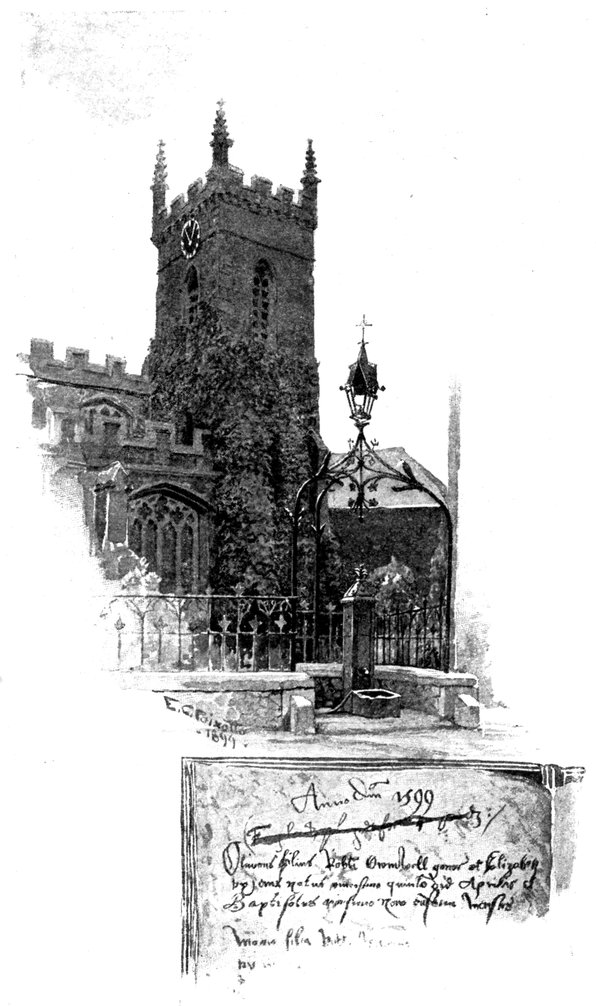
All Saints’ Church, Huntingdon.
Containing the registry of Oliver Cromwell’s birth and baptism—a fac-simile of which is here given. Above the record of his birth someone had written “England’s plague for five years;” but this is now partially obliterated.
25James I. stood for absolutism in Church and
State, and quarrelled with and annoyed his subjects
in the futile effort to realize his ideas. Charles
I., whom James had vainly sought to marry to a
Spanish princess, and succeeded in marrying to a
French princess (Henrietta Maria), took up his
father’s task. In private life he was the best of
the Stuart kings, reaching about the average level
of his subjects. In public life his treachery, mendacity,
folly, and vindictiveness: his utter inability
to learn by experience or to sympathize with
any noble ambition of his country: his readiness
to follow evil counsel, and his ingratitude toward
any sincere friend, made him as unfit as either of
26his sons to sit on the English throne; and a greater
condemnation than this it is not possible to award.
Germany was convulsed by the Thirty Years’
War: but Charles cared nothing for the struggle,
and to her humiliation England had to see Sweden
step to the front as the champion of the Reformation.
At one period Charles even started to
help the French king against the Huguenots, but
was brought to a halt by the outburst of wrath
this called forth from his subjects. Once he made
feeble war on Spain, and again he made feeble
war on France; but the expedition he sent against
Cadiz failed, and the expedition he sent to
Rochelle was beaten; and he was, in each case,
forced to make peace without gaining anything.
The renown of the English arms never stood
lower than during the reigns of the first two Stuarts.
At the outset of his reign Charles sought to
govern through Buckingham, who was entirely fit
to be his minister, and, therefore, unfit to be
trusted with the slightest governmental task on
behalf of a free and great people. Under Buckingham
the grossest corruption obtained—not
only in the public service, but in the creation of
peerages. His whole administration represented
nothing but violence and bribery; and when he
took command of the forces to be employed
27against Rochelle, he showed that the list of his
qualities included complete military incapacity.
It was after the failure at Rochelle that Charles
summoned his third Parliament. With his first
two he had failed to do more than quarrel, as they
would not grant him supplies unless they were allowed
the right to have something to say as to
how they were to be used. He had, therefore,
dissolved them, holding that their only function
was to give him what may be needed.
With his third Parliament he got on no better.
In it two great men sprang to the front—Sir
Thomas Wentworth, afterward Lord Strafford,
and Sir John Eliot, who had already shown himself
a leader of the party that stood for free representative
institutions as against the unbridled
power of the King. Eliot was a man of pure and
high character, and of dauntless resolution, though
a good deal of a doctrinaire in his belief that Parliamentary
government was the cure for all the
evils of the body politic. Wentworth, dark, able,
imperious, unscrupulous, was a born leader, but
he had no root of true principle in him. At the
moment, from jealousy of Buckingham, and from
desire to show that he would have to be placated
if the King were awake to self-interest, he threw
all the weight of his great power on the popular
side.
28Instead of giving the King the money he
wanted, Parliament formulated a Petition of
Right, demanding such elementary measures of
justice as that the King should agree never again
to raise a forced loan, or give his soldiers free
quarters on householders, or execute martial law
in time of peace, or send whom he wished to
prison without showing the cause for which it was
done. The last was the provision against which
Charles struggled hardest. The Star Chamber—a
court which sat without a jury, and which was
absolutely under the King’s jurisdiction—had
been one of his favorite instruments in working
his arbitrary will. The powers of this court were
left untouched by the Petition: yet even the service
this court could render him was far less than
what he could render himself if it lay in his power
arbitrarily to imprison men without giving the
cause. However, his need of money was so great,
and the Commons stood so firm, that he had to
yield, and on June 7th, in the year 1628, the Petition
of Right became part of the law of the land.
The first step had been taken toward cutting out
of the English Constitution the despotic powers
which the Tudor kings had bequeathed to their
Stuart successors.
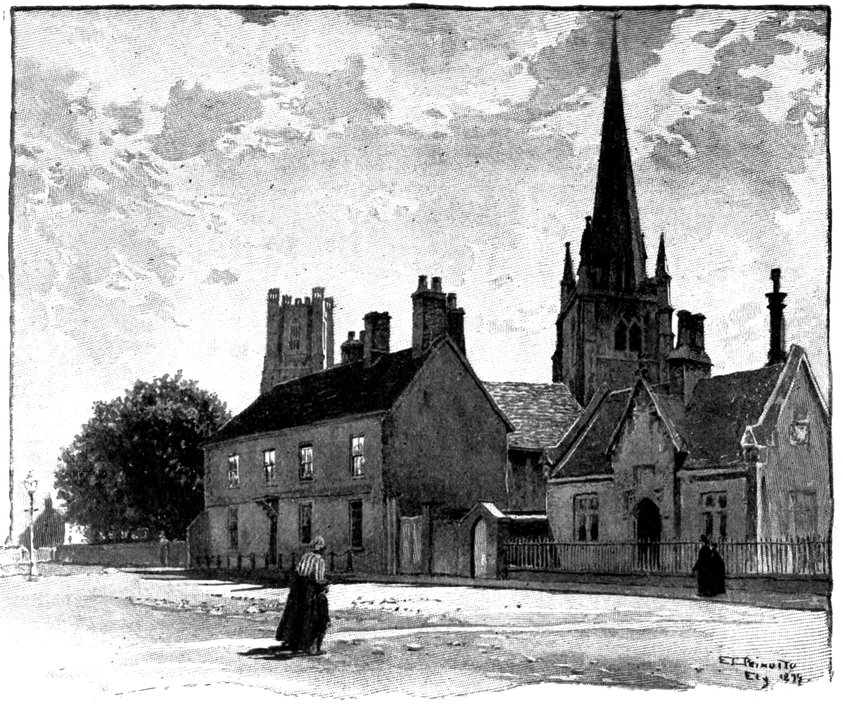
Cromwell’s House at Ely.
The tall spire is that of St. Mary’s Church, and the Cathedral tower is seen in the distance.
29Immediately afterward Buckingham was assassinated
by a soldier who had taken a violent
grudge against him, and the nation breathed freer
with this particular stumbling-block removed,
while it lessened the strain between the King and
the Commons, who were bent on his impeachment.
There were far more serious troubles ahead. If
the King could raise money without summoning
Parliament, he could rule absolutely. If Parliament
could control not only the raising, but the
expenditure of money, it would be the supreme
source of power, and the King but a figure-head;
in other words, the government would be put upon
the basis on which it has actually stood during
the present century. For many reigns the Commons
had been accustomed to vote to each king
for life, at the outset of his reign, the duties on
exports and imports, known as tonnage and
poundage; but during the years immediately past
men had been forced to think much on liberty
and self-government. Parliament was in no mood
to surrender absolute power to the King.
With the right to lay taxes and to supervise
the expenditure of money—that is, to conduct
the government—was intertwined the question of
religion. The mass of Englishmen adhered rather
loosely to the Anglican communion, and were
not extreme Puritans; on certain points, however,
they were tinged very deeply with Calvinism.
30They were greatly angered by the attitude of
those bishops, who under the lead of Laud
showed themselves more hostile to Protestant
than to Catholic dogmas. These bishops preached
not only that the views in Church matters held
by the bulk of Englishmen were wrong, but
furthermore that it was the duty of every subject
to render entire obedience to the sovereign, no
matter what the sovereign did, and they insisted
that parliaments were of right mere ciphers in the
State. Such doctrines were not only irritating
from the theological stand-point; they also struck
at the root of political freedom. The religious
antagonism was accentuated by the fact that at
this time the Protestant cause in Germany had
touched the lowest point it ever reached during
the Thirty Years’ War, and the anger and alarm
of the English Protestants, as they saw the Calvinists
and Lutherans of Denmark and North Germany
overcome, were heightened by the indifference,
if not satisfaction, with which the King and
the bishops looked at the struggle.
In 1629 the Commons, under the lead of Eliot
and Pym, took advanced ground alike on the
questions of religion and of taxation. Pym was
supplementing Eliot’s work, which was to make
the House of Commons the supreme authority in
England, by striving to associate together a majority
31of the members for the achievement of certain
common objects; in other words, he was laying
the foundation of party government. Under
the lead of these two men, the first two Parliamentary
and popular leaders in the modern sense,
the House of Commons passed resolutions demanding
uniformity in religious belief throughout
the kingdom and condemning every innovation
in religion, and declaring enemies to the kingdom
and traitors to its liberties whoever advised the
levying of tonnage and poundage without the
authority of Parliament, or whoever voluntarily
paid those duties. The first clause hit Catholics
and Dissenters alike, but was especially aimed at
the bishops and their followers, who stood closest
to the King; and the second was, of course, intended
to transfer the sovereignty from the King
to Parliament—in other words, from the King to
the people. Charles met the challenge by dissolving
Parliament. Eleven years were to pass
before another met. Meantime, the King governed
as a despot; and it must be remembered
that when he deliberately chose thus to govern as
a despot, responsible to no legal tribunal, he at
once threw his subjects back on the only remedies
which it is possible to enforce against despotism—deposition
or death.
Charles was bitterly angry at the sturdy independence
32shown by the Commons, and marked
out for vengeance those who had been foremost
in thwarting his wishes. His course was
easy. The Petition of Right formulated a principle,
but as yet it offered no safeguard against
an unscrupulous king; while the Star Chamber
court, and the other judges for that matter, held
office at his pleasure, and acted as his subservient
tools in fining and imprisoning merchants who
refused payment of the duties, or men whose acts
or words the king chose to consider seditious.
Eliot and some of his fellow-members were
thrown into prison because of the culminating
proceedings in Parliament. Eliot’s comrades
made submission and were released, but Eliot refused
to acknowledge that the King, through
his courts, had any right to meddle with what
was done in Parliament. He took his stand
firmly on the ground that the King was not the
master of Parliament, and of course this could
but mean ultimately that Parliament was master
of the King. In other words, he was one of the
earliest leaders of the movement which has produced
English freedom and English government
as we now know them. He was also its martyr.
He was kept in the Tower without air or exercise
for three years, the King vindictively refusing
to allow the slightest relaxation in his confinement,
33even when it brought on consumption.
In December, 1632, he died; and the King’s
hatred found its last expression in denying to
his kinsfolk the privilege of burying him in his
Cornish home.
Charles set eagerly to work to rule the kingdom
by himself. To the Puritan dogma of enforced
unity of religious belief—utterly mischievous,
and just as much fraught with slavery to the
soul in one sect as another—he sought, through
Laud, to oppose the only less mischievous, because
silly, doctrine of enforced uniformity in the
externals of public worship. Laud was a small
and narrow man, hating Puritanism in every form,
and persecuting bitterly every clergyman or layman
who deviated in any way from what he regarded
as proper ecclesiastical custom. His
tyranny was of that fussy kind which, without
striking terror, often irritates nearly to madness.
He was Charles’s instrument in the effort to secure
ecclesiastical absolutism.
The instrument through which the King
sought to establish the royal prerogative in political
affairs was of far more formidable temper.
Immediately after the dissolution of Parliament
Wentworth had obtained his price from the King,
and was appointed to be his right-hand man in
administering the kingdom. A man of great
34shrewdness and insight, he seems to have struggled
to govern well, according to his lights; but
he despised law and acted upon the belief that
the people should be slaves, unpermitted, as they
were unfit, to take any share in governing themselves.
After a while Laud was made archbishop;
and Wentworth was later made Lord Strafford.
Wentworth and Laud, with their associates,
when they tried to govern on such terms, were
continually clashing with the people. A government
thus carried on naturally aroused resistance,
which often itself took unjustifiable forms; and
this resistance was, in its turn, punished with revolting
brutality. Criticism of Laudian methods,
or of existing social habits, might take scurrilous
shape; and then the critic’s ears were hacked off
as he stood in the pillory, or he was imprisoned
for life.
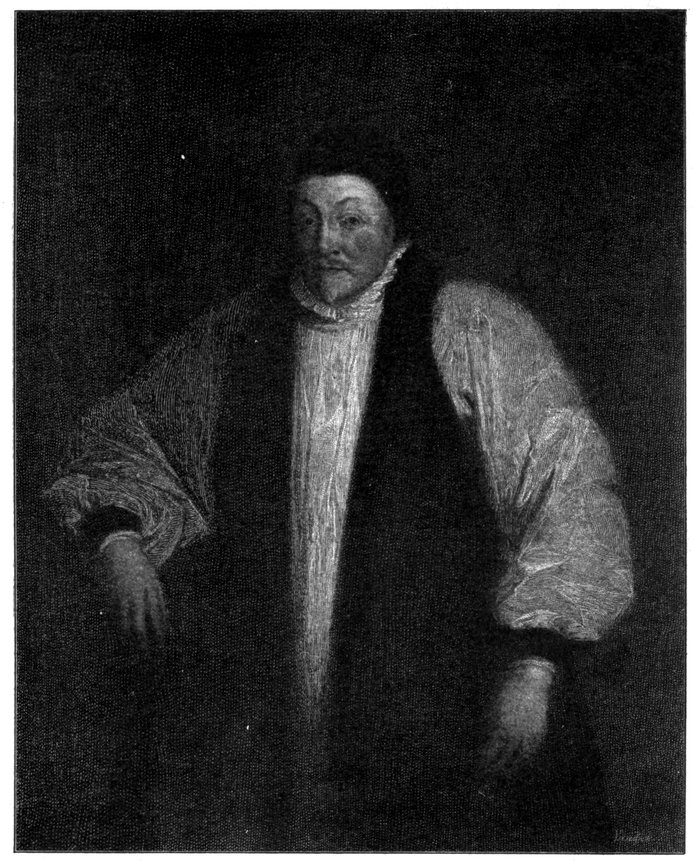
Archbishop Laud.
From the portrait at Lambeth Palace, painted by Vandyke.
By permission of the Archbishop of Canterbury.
35The great fight was made, not on a religious,
but on a purely political question—that of Ship
Money. The king wished to go to war with the
Dutch, and to raise his fleet he issued writs, first
to the maritime counties, and then to every shire
in England. He consulted his judges, who
stated that his action was legal: as well they
might, for when a judge disagreed with him on
any important point, he was promptly dismissed
from office. But there was one man in the kingdom who thought differently, John Hampden, a
Buckinghamshire ’squire, who had already once
sat as a silent member in Parliament, together with
another equally silent member of the same social
standing, his nephew, Oliver Cromwell. Hampden
was assessed at twenty shillings. The amount
was of no more importance than the value of the
tea which a century and a half later was thrown
into Boston Harbor; but in each case a vital principle—the
same vital principle—was involved.
If the King could take twenty shillings from
Hampden without authority from the representatives
of the people in Parliament assembled, then
his rule was absolute: he could do what he
pleased. On the other hand, if the House of
Commons could do as it wished in granting
money only for whatever need it chose to recognize
in the kingdom, then the House of Commons
was supreme. In Hampden’s view but
one course was possible—he was for the Parliament
and the nation against the King; and he
refused to pay the sum, facing without a murmur
the punishment for his contumacy.
The King and his ministers did not flinch from
proceeding to any length against either political
or religious opponents. Charles heartily upheld
Laud and Wentworth in carrying out their policy
of “thorough”; Laud in England; Wentworth,
36after 1633, in Ireland. “Thorough,” in their
sense of the word, meant making the State, which
was the King, paramount in every ecclesiastical
and political matter, and putting his interests
above the interests, the principles, and the prejudices
of all classes and all parties; paying heed to
nothing but to what seemed right in the eyes of
the sovereign and the sovereign’s chosen advisers.
Under Wentworth’s strong hand a certain amount
of material prosperity followed in Ireland, although
chiefly among the English settlers. There
was no such material prosperity in England; 1630,
for instance, was a famine year. The net effect
of the policy would in the long run have been to
bring down a freedom-loving people to a lower
grade of political and social development. There
was, of course, no oppression in England in any
way resembling such oppression as that which
flogged the Dutch to revolt against the Spaniards.
But it was exactly the kind of oppression which
led, in 1776, to the American Revolution. Eliot,
Hampden, and Pym, stood for the principles that
were championed by Washington, Patrick Henry,
and the Adamses. The grievances which forced
the Long Parliament to appeal to arms were like
those which made the Continental Congress throw
off the sovereignty of George III. In neither
case was there the kind of grinding tyranny which
37has led to the assassination of tyrants and the
frantic, bloodthirsty uprising of tortured slaves.
In each case the tyranny was in its first stage, not
its last; but the reason for this was simply that a
nation of vigorous freemen will always revolt by
the time the first stage has been reached. It was
not possible, either for the Stuart kings or for
George III., to go beyond a certain point, for as
soon as that point was reached the freemen were
called to arms by their leaders.
However, there was the greatest reluctance
among Englishmen to countenance rebellion, even
for the best of causes. This reluctance was eminently
justifiable. Rebellion, revolution—the
appeal to arms to redress grievances; these are
measures that can only be justified in extreme
cases. It is far better to suffer any moderate evil,
or even a very serious evil, so long as there is a
chance of its peaceable redress, than to plunge the
country into civil war; and the men who head or
instigate armed rebellions for which there is not
the most ample justification must be held as one
degree worse than any but the most evil tyrants.
Between the Scylla of despotism and the Charybdis
of anarchy there is but little to choose; and the
pilot who throws the ship upon one is as blameworthy
as he who throws it on the other. But a
point may be reached where the people have to
38assert their rights, be the peril what it may; and
in Great Britain this point was passed under
Charles I.
The first break came, not in England, but in
Scotland. The Scotch abhorred Episcopacy;
whereas the English had no objection whatever
to bishops, so long as the bishops did not outrage
the popular religious convictions. In Scotland
the spirit of Puritanism was uppermost, and was
already exhibiting both its strength and its weakness;
its sincerity and its lack of breadth; its
stern morality and its failure to discriminate
between essentials and non-essentials; its loftiness
of aim and its tendency to condemn liberality of
thought in religion, art, literature, and science,
alike as irreligious; its insistence on purity of life,
and yet its unconscious tendency to promote
hypocrisy and to drive out one form of religious
tyranny merely to erect another.
A man of any insight would not have striven
to force an alien system of ecclesiastical government
upon a people so stubborn and self-reliant,
who were wedded to their own system of religious
thought. But this was what Laud attempted, with
the full approval of Charles. In 1637 he made a
last effort to introduce the ceremonies of the English
Church at Edinburgh. No sooner was the
reading of the Prayer-Book begun than the congregation
39burst into wild uproar, execrating it as
no better than celebrating mass. It was essentially
a popular revolt. The incident of Jenny Geddes’s
stool may be mythical, but it was among the
women and men of the lower orders that the
resistance was stoutest. The whole nation responded
to the cry, and hurried to sign a national
Covenant, engaging to defend the Reformed religion,
and to do away with all “innovations”;
that is, with everything in which Episcopacy differed
from Puritanism and inclined toward the
Church of Rome.
In England and Scotland alike the Church of
Rome was still accepted by the people at large as
the most dangerous of enemies. The wonderful
career of Gustavus Adolphus had just closed.
The Thirty Years’ War—the last great religious
struggle—was still at its height. If, in France,
the Massacre of St. Bartholomew stood far in the
past, the Revocation of the Edict of Nantes yet
lay in the future. The after-glow of the fires
of Smithfield still gleamed with lurid light in each
sombre Puritan heart. The men who, in England,
were most earnest about their religion held to
their Calvinistic creed with the utmost sincerity,
high purpose, and self-devotion: but with no little
harshness. Theirs was a lofty creed, but one
which, in the revolt against levity and viciousness,
40set up a standard of gloom; and, though ready to
fight to the death for liberty for themselves, they
had as yet little idea of tolerating liberty in others.
Naturally, such men sympathized with one another,
and the action of the Scotch was heartily,
though secretly, applauded by the stoutest Presbyterians
of England. Moreover, while menaced
by the common oppressor, the Puritan independents,
who afterward split off from the Presbyterians,
made common cause with them, the irreconcilable
differences between the two bodies not yet
being evident.
Soon the Scotch held a general assembly of the
Church, composed of both clerical and lay members,
and formally abolished Episcopacy, in spite
of the angry protests of the King. Their action
amounted in effect to establishing a theocracy.
They repudiated the unlimited power of the
King and the bishops, as men would do nowadays
in like case; but they declared against liberty
of thought and conduct in religious matters,
basing their action on practically the same line of
reasoning that influenced the very men they most
denounced, hated, and feared.
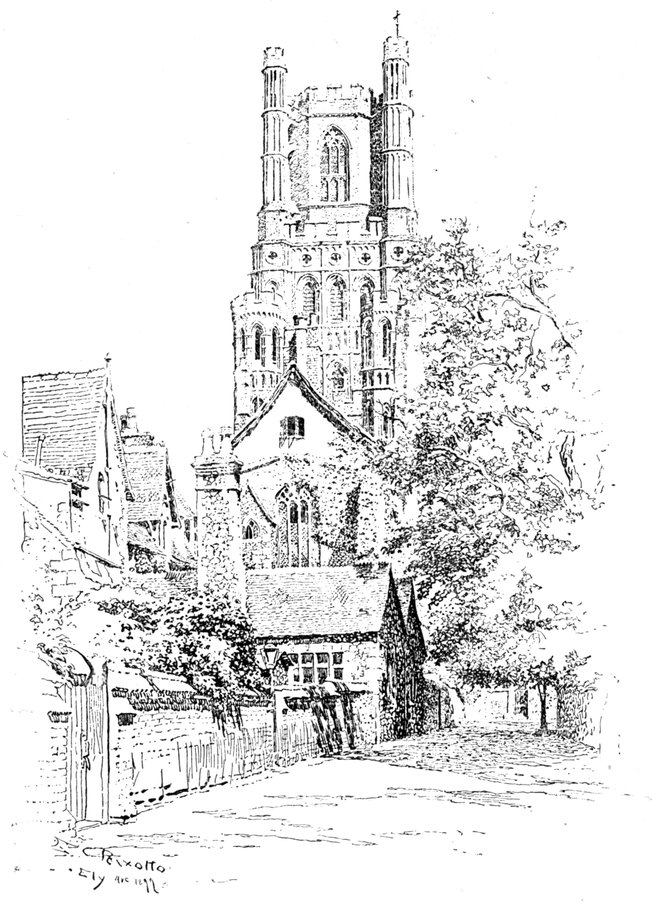
West Tower, Ely Cathedral, from Monastery Close.
41The King took up the glove which the Scotch
had thrown down. He raised an army and undertook
the first of what were derisively known
as the “Bishops’ Wars.” But his people sympathized with the Scotch rather than with him. He
got an army together on the Border, but it would
not fight, and he was forced reluctantly to treat
for peace. Then Strafford came back from Ireland
and requested Charles to summon a Parliament
so that he could get funds. In April, 1640,
the Short Parliament came together, but the English
spirit was now almost as high as the Scotch
in hostility to the King, and Parliament would
not grant anything to the King until the grievances
of the people were redressed. To this demand
Charles would not listen, and the Parliament
was promptly dissolved. Then, being
heartened by Laud, and especially by Strafford,
Charles renewed the war, only to see his army
driven in headlong panic before the Scotch at
Newburn. The result was that he had to try to
patch up a peace under the direction of Strafford.
But the Scotch would not leave the kingdom until
they were paid the expenses of the war. There
was no money to pay them, and Charles had to
summon Parliament once more. On November
3, 1640, the Long Parliament met at Westminster.
When Oliver Cromwell took his seat in the
Long Parliament he was forty-one years old. He
had been born at Huntingdon on April 25, 1599,
and by birth belonged to the lesser gentry, or upper
42middle-class. The original name of the family
had been Williams; it was of Welsh origin.
There were many Cromwells, and Oliver was a
common name among them. One of the Protector’s
uncles bore the name, and remained a
stanch Loyalist throughout the Civil War. Oliver’s
own father, Robert, was a man in very moderate
circumstances, his estate in the town of
Huntingdon bringing an income of some £300 a
year. Oliver’s mother, Elizabeth Steward of Ely,
seems to have been of much stronger character
than his father. The Stewards, like the Cromwells,
were “new people,” both families, like so
many others of the day, owing their rise to the
spoliation of the monasteries. Oliver’s father was
a brewer, and his success in the management of
the brewery was mainly due to Oliver’s mother.
No other member of Oliver’s family—neither his
wife nor his father—influenced him as did his
mother. She was devoted to him, and he, in turn,
loved her tenderly and respected her deeply. He
followed her advice when young; he established
her in the Royal Palace of Whitehall when he
came to greatness; and when she died he buried
her in Westminster Abbey. As a boy he received
his education at Huntingdon, but when seventeen
years old was sent to Cambridge University. A
strong, hearty young fellow; fond of horse-play
43and rough pranks—as indeed he showed himself
to be even when the weight of the whole kingdom
rested on his shoulders. He nevertheless
seems to have been a fair student, laying the
foundation for that knowledge of Greek literature
and the Latin language, and that fondness
for books, which afterward struck the representatives
of the foreign powers at London. In 1617
his father died, and he left Cambridge. When
twenty-one years old he was married in London,
to Elizabeth Bouchier (who was one year older
than he was), the daughter of a rich London furrier.
She was a woman of gentle and amiable
character, and though she does not appear to have
influenced Cromwell’s public career to any perceptible
extent, he always regarded her with fond
affection, and was always faithful to her.
For twenty years after his marriage he lived a
quiet life, busying himself with the management
of his farm. Nine children were born to him, of
whom three sons and five daughters lived to maturity.
About this time his soul was first deeply
turned toward religious matters, and, like the
great majority of serious thinkers of the time, he
became devoted to the Puritan theology; indeed
no other was possible to a representative of the prosperous,
independent, and religious middle-class,
from which all the greatest Puritan leaders sprang.
44While a boy Oliver had been sent to the free
school at Huntingdon, and his first training had
been received under its master, the Reverend
Thomas Beard, a zealous Puritan and Reformer,
as well as a man of wide reading and sound
scholarship, and lastly, an inflamed hater of the
Church of Rome. All his surroundings, all his
memories, were such as to make the future Dictator
of England sincerely feel that the Church of
Rome was the arch-antagonist of all, temporal and
spiritual, that he held most dear. In the first
place his ancestors were among those who had
profited by the spoliation of the monasteries; and
the only way to avoid uncomfortable feelings on
the part of the spoiler is for him to show—or if
this is not possible, to convince himself that he
has shown—the utmost iniquity on the part of the
despoiled. When Oliver was a small boy the
Gunpowder Plot shook all England. When he
was a little older Henry of Navarre was stabbed
in Paris; and though Henry was a cynical turncoat
in matters of religion, and a man of the most
revolting licentiousness in private life, he was yet
a great ruler of men, and had been one of the
props of the Protestant cause. Before Oliver
came of age the Thirty Years’ War had begun
its course. To Oliver Cromwell, warfare against
the Church of Rome, broken by truces which,
45whether long or short, were intended only to be
breathing-spells, must have seemed the normal
state of things.
In 1631 Oliver sold his paternal estate in
Huntingdon and managed a rented farm at St.
Ives for five years; then he removed to Ely, in the
fen country, and again took up farming, being
joined by his mother and sisters. He served in
the great Parliament which passed the Petition of
Right, but played no part of prominence therein:
standing stoutly, however, for Puritanism and Parliamentary
freedom. During the ensuing eleven
years of unrest, while all England was making
ready for the impending conflict, Oliver busied
himself with his farm and his family. He showed
himself one of the strongest bulwarks of the Puritan
preachers; zealous in the endeavor to further
the cause of religion in every way, and always
open to appeals from the poor and the oppressed,
of whom he was the consistent champion. When
certain rich men, headed by the Earl of Bedford,
endeavored to oust from some of their rights the
poor people of the fens, Oliver headed the latter
in their resistance. He was keenly interested in
the trial of his kinsman, John Hampden, for refusal
to pay the Ship Money; a trial which was
managed by the advocate Oliver St. John, his
cousin by marriage.
46In short, Cromwell was far more concerned in
righting specific cases of oppression than in advancing
the great principles of constitutional government
which alone make possible that orderly
liberty which is the bar to such individual acts
of wrong-doing. From the stand-point of the private
man this is a distinctly better failing than is its
opposite; but from the stand-point of the statesman
the reverse is true. Cromwell, like many a
so-called “practical” man, would have done better
work had he followed a more clearly defined theory;
for though the practical man is better than
the mere theorist, he cannot do the highest work
unless he is a theorist also. However, all Cromwell’s
close associations were with Hampden, St.
John, and the other leaders in the movement for
political freedom, and he acted at first in entire
accord with their ideas: while with the religious
side of their agitation he was in most hearty sympathy.
It is difficult for us nowadays to realize how
natural it seemed at that time for the Word of
the Lord to be quoted and appealed to on every
occasion, no matter how trivial, in the lives of
sincerely religious men. It is very possible that
quite as large a proportion of people nowadays
strive to shape their internal lives in accordance
with the Ten Commandments and the Golden
47Rule; indeed, it is probable that the proportion is
far greater; but professors of religion then carried
their religion into all the externals of their lives.
Cromwell belonged among those earnest souls
who indulged in the very honorable dream of a
world where civil government and social life alike
should be based upon the Commandments set
forth in the Bible. To endeavor to shape the
whole course of individual existence in accordance
with the hidden or half-indulged law of
perfect righteousness, has to it a very lofty side;
but if the endeavor is extended to include mankind
at large, it has also a very dangerous side: so
dangerous indeed that in practice the effort is apt
to result in harm, unless it is undertaken in a
spirit of the broadest charity and toleration; for
the more sincere the men who make it, the more
certain they are to treat, not only their own principles,
but their own passions, prejudices, vanities,
and jealousies, as representing the will, not of
themselves, but of Heaven. The constant appeal
to the Word of God in all trivial matters is, moreover,
apt to breed hypocrisy of that sanctimonious
kind which is peculiarly repellent, and which invariably
invites reaction against all religious feeling
and expression.
At that day Cromwell’s position in this matter
was, at its worst, merely that of the enormous
48majority of earnest men of all sects. Each sect
believed that it was the special repository of the
wisdom and virtue of the Most High: and the
most zealous of its members believed it to be their
duty to the Most High to make all other men
worship Him according to what they conceived
to be His wishes. This was the mediæval attitude,
and represented the mediæval side in Puritanism;
a side which was particularly prominent
at the time, and which, so far as it existed, marred
the splendor of Puritan achievement. The nobleness
of the effort to bring about the reign of God
on earth, the inspiration that such an effort was to
those engaged in it, must be acknowledged by
all; but, in practice, we must remember that, as
religious obligation was then commonly construed,
it inevitably led to the Inquisition in Spain; to
the sack of Drogheda in Ireland; to the merciless
persecution of heretics by each sect, according to
its power, and the effort to stifle freedom of
thought and stamp out freedom of action. It is
right, and greatly to be desired, that men should
come together to search after the truth: to try to
find out the true will of God; but in Cromwell’s
time they were only beginning to see that each
body of seekers must be left to work out its own
beliefs without molestation, so long as it does not
strive to interfere with the beliefs of others.
49The great merit of Cromwell, and of the party
of the Independents which he headed, and which
represented what was best in Puritanism, consists
in the fact that he and they did, dimly, but with
ever-growing clearness, perceive this principle,
and, with many haltings, strove to act up to it.
The Independent or Congregational churches,
which worked for political freedom, and held that
each congregation of Protestants should decide
for itself as to its religious doctrines, stood as the
forerunners in the movement that has culminated
in our modern political and religious liberty. How
slow the acceptance of their ideas was, how the opposition
to them battled on to the present century,
will be appreciated by anyone who turns to the
early writings of Gladstone when he was the “rising
hope of those stern Tories,” whose special antipathy
he afterward became. Even yet there are
advocates of religious intolerance, but they are
mostly of the academic kind, and there is no
chance for any political party of the least importance
to try to put their doctrines into effect.
More and more, at least here in the United States,
Catholics and Protestants, Jews and Gentiles, are
learning the grandest of all lessons—that they can
best serve their God by serving their fellow-men,
and best serve their fellow-men, not by
wrangling among themselves, but by a generous
50rivalry in working for righteousness and against
evil.
This knowledge then lay in the future. When
Cromwell grew to manhood he was a Puritan of
the best type, of the type of Hampden and Milton;
sincere, earnest, resolute to do good as he saw
it, more liberal than most of his fellow-religionists,
and saved from their worst eccentricities by his
hard common-sense, but not untouched by their
gloom, and sharing something of their narrowness.
Entering Parliament thus equipped, he could not
fail to be most drawn to the religious side of the
struggle. He soon made himself prominent;
a harsh-featured, red-faced, powerfully-built man,
whose dress appeared slovenly in the eyes of the
courtiers—who was no orator, but whose great
power soon began to impress friends and enemies
alike.
II THE LONG PARLIAMENT AND THE CIVIL WAR
51
King Charles’s theory was that Parliament
had met to grant him the money
he needed. The Parliament’s conviction was
that it had come together to hold the King and
his servants to accountability for what they had
done, and to provide safeguards against a repetition
of the tyranny of the last eleven years. Parliament
held the whip hand, for the King dared
not dissolve it until the Scots were paid, lest their
army should march at once upon London.
The King had many courtiers who hated popular
government, but he had only one great and
terrible man of the type that can upbuild tyrannies;
and, with the sure instinct of mortal fear
and mortal hate, the Commons struck at the minister
whose towering genius and unscrupulous
fearlessness might have made his master absolute
on the throne. A week after the Long Parliament
met, in November, 1640, Pym, who at once
took the lead in the House, moved the impeachment
of Strafford, in a splendid speech which set
52forth the principles for which the popular party
was contending. It was an appeal from the rule
of irresponsible will to the rule of law, for the violation
of which every man could be held accountable
before some tribunal. About the same time
Laud was thrown into the Tower; but at the moment
there was no thought of taking his life, for
the ecclesiastic was not—like the statesman—a
mighty and fearsome figure, and though he had
done as much evil as his feeble nature permitted,
he had unquestionably been far more conscientious
than the great Earl. Strafford had sinned against
the light, for he had championed liberty until
the King paid him his price and made him the
most dangerous foe of his former friends. He
now defended himself with haughty firmness, and
the King strove in every way to help him. But
the Commons passed a Bill of Attainder against
him: and then Charles committed an act of fatal
meanness and treachery. There was not one
thing that Strafford had done, save by his sovereign’s
wish and in his sovereign’s interest. By
every consideration of honor and expediency
Charles was bound to stand by him. But the
Stuart King flinched. Deeming it for his own
interest to let Strafford be sacrificed, he signed
the death-warrant. “Put not your trust in
Princes,” said the fallen Earl when the news was
brought to him, and he went to the scaffold undaunted.
John Pym.
From the portrait by Cornelius Janssen at the Victoria and Albert Museum, South Kensington.
53Cromwell showed himself to be a man of mark
in this Parliament; but he was not among the
very foremost leaders. He had no great understanding
of constitutional government, no full
appreciation of the vital importance of the reign
of law to the proper development of orderly liberty.
His fervent religious ardor made all questions
affecting faith and doctrine close to him;
and his hatred of corruption and oppression inclined
him to take the lead whenever any question
arose of dealing, either with the wrongs done by
Laud in the course of his religious persecutions,
or with the irresponsible tyranny of the Star
Chamber, and the sufferings of its victims. The
bent of Cromwell’s mind was thus shown right in
the beginning of his parliamentary career. His
desire was to remedy specific evils. He was too
impatient to found the kind of legal and constitutional
system which could alone prevent the recurrence
of such evils. This tendency, thus early
shown, explains, at least in part, why it was that
later he deviated from the path trod by Hampden,
and afterward by Washington and Washington’s
colleagues: showing himself unable to build
up free government or to establish the reign of
law, until he was finally driven to substitute his
54own personal government for the personal government
of the King whom he had helped to dethrone,
and put to death. Cromwell’s extreme
admirers treat his impatience of the delays and
shortcomings of ordinary constitutional and legal
proceedings as a sign of his greatness. It was just
the reverse. In great crises it may be necessary to
overturn constitutions and disregard statutes, just
as it may be necessary to establish a vigilance
committee, or take refuge in lynch law; but such a
remedy is always dangerous, even when absolutely
necessary; and the moment it becomes the habitual
remedy, it is a proof that society is going
backward. Of this retrogression the deeds of the
strong man who sets himself above the law may
be partly the cause and partly the consequence;
but they are always the signs of decay.
The Commons had passed a law authorizing
the election of a Parliament at least once in three
years: which at once took away the King’s power
to attempt to rule without a Parliament; and in
May they extorted from the King an act that they
should not be dissolved without their own consent.
Ship Money was declared to be illegal; the
Star Chamber was abolished; and Tonnage and
Poundage were declared illegal, unless levied by
Act of Parliament. Then the Scotch army was
paid off and returned across the Border. The best
55work of the Commons had now been done, and if
they could have trusted the King it would have
been well for them to dissolve; but the King
could not be trusted, and, moreover, the religious
question was pushed to the front. Laud’s actions—actions
taken with the full consent and by the
advice of the King—had rendered the Episcopal
form of Church government obnoxious. The
House of Commons was Presbyterian, and it
speedily became evident that it wished to establish
the Presbyterian system of Church government
in the place of Episcopacy; and, moreover,
that it intended to be just as intolerant on behalf
of Presbyterianism as the King and Laud had
been on behalf of Episcopacy. There was a strong
moderate party which the King might have rallied
about him, but his incurable bad faith made
it impossible to trust his protestations. He now
made terms with the Scotch, in accordance with
which they agreed not to interfere between himself
and his English subjects in religious matters.
He hoped thereby to deprive the Presbyterian
English of their natural allies across the Border.
This conduct, of itself, would have inflamed the
increasing religious bitterness; but it was raised
to madness by the news that came from Ireland
at this time.
Inspired by the news of the revolt in Scotland
56and the troubles in England, the Irish had risen
against their hereditary oppressors. It was the
revolt of a race which rose to avenge wrongs as
bitter as ever one people inflicted upon another;
and it was inevitable that it should be accompanied
by appalling outrages in certain places.
It was on these outrages that the English fixed
their eyes, naturally ignoring the generations of
English evil-doing which had brought them about.
A furious cry for revenge arose. Every Puritan,
from Oliver Cromwell down, regarded the massacres
as a fresh proof that Roman Catholics ought
to be treated, not as professors of another Christian
creed, but as cruel public enemies; and their
burning desire for vengeance took the form, not
merely of hostility to Roman Catholicism, but to
the Episcopacy, which they regarded as in the last
resort an ally of Catholicism.
In November, 1641, the Puritan majority in
Parliament passed the Grand Remonstrance—which
was a long indictment of Charles’s conduct.
Cromwell had now taken his place as
among the foremost of the Root and Branch
Party, who demanded the abolition of Episcopacy,
and whose action drove all those who believed
in the Episcopal form of Church government
into the party of the King. He threw himself
with eager vehemence into the Party of the
57Remonstrance, and after its bill was passed told
Falkland that if it had been rejected by Parliament
he would have sold all he had, and never
again seen England.
For a moment the Puritan violence, which culminated
in the Grand Remonstrance, provoked a
reaction in favor of the King; but the King, by
another act of violence, brought about a counter-reaction.
In January, 1642, he entered the
House of Commons, and in person ordered the
seizure and imprisonment in the Tower of the
five foremost leaders of the Puritan party, including
Pym and Hampden. Such a course
on his part could be treated only as an invitation
to civil war. London, which before had
been wavering, now rallied to the side of the
Commons; the King left Whitehall; and it was
evident to all men that the struggle between
him and the Parliament had reached a point
where it would have to be settled by the appeal
to arms.
In August, 1642, King Charles planted the
royal standard on the Castle of Nottingham, and
the Civil War began. The Parliamentary forces
were led by the Earl of Essex. They included
some 20 regiments of infantry and 75 troops of
horse, each 60 strong, raised and equipped by its
own captain. Oliver Cromwell was captain of
58the Sixty-seventh Troop, and his kinsfolk and
close friends were scattered through the cavalry
and infantry. His sons served with or under
him. One brother-in-law was quartermaster of
his own troop; a second was captain of another
troop. His future son-in-law, Henry Ireton, was
captain of yet another; a cousin and a nephew
were cornets. Another cousin, John Hampden,
was colonel of a regiment of foot; so was Cromwell’s
close friend and neighbor, the after-time
Earl of Manchester, who was much under his
influence.
It was nearly a hundred years since England
had been the scene of serious fighting, and Scotland
had witnessed nothing more than brawls
during that time. Elizabeth’s war with Spain
had been waged upon the ocean. However,
thousands of English and Scotch adventurers
had served in the Netherlands and in High
Germany under the Dutch and Swedish generals.
In both the Royal and Parliamentary
armies there was a sprinkling of men—especially
in the upper ranks of the officers—who
had had practical experience of war on a large
scale. The English people offered exceptionally
fine material for soldiers; the population was still
overwhelmingly rural and agricultural. In the
cities the hardy mechanics and craftsmen were
59accustomed to sports in which physical prowess
played a great part. The agricultural classes
were far above the peasant serfs of Germany and
France; and the gentry and yeomanry were accustomed
to the use of the horse and the fowling-piece,
and were devoted to field-sports. In
courage, in hardihood, in intelligence, the level
was high.
Although gunpowder had been in use for a
couple of centuries, progress toward the modern
arms of precision had been so slow that close-quarter
weapons were still, on the whole, superior;
and shock tactics rather than fire tactics
were decisive. Artillery, though used on the
field of battle, was never there a controlling
factor, being of chief use in the assault of fortified
places. The musketeers took so long to load
their clumsy weapons that they could be used to
best advantage only when protected, and they
played a less important part on a pitched field
than the great bodies of pikemen with which
they were mingled. In England the cavalry
had completely the upper hand of the infantry.
It was used, not merely to finish the fight, but
to smash unbroken and unshaken bodies of
foot; and so great was its value in the open
field that every effort was made by the commanders
on both sides to keep it at the largest
60possible ratio to the whole army. Every decisive
battle of the Civil War was made such
by the cavalry. The arrangement of the armies
was, invariably, with the infantry in the centre,
the pikemen and the musketeers ordinarily alternating
in clumps, while the cavalry was on
both wings. The dragoons, though mounted,
habitually fought on foot with their fire-pieces.
Lancers were rarely used. The heavy cavalry
were clad in cuirasses, and armed with long,
straight swords and pistols. The light cavalry
usually wore the buff coat, sometimes with a
breast-piece, always with a helmet; and in addition
to their sword and pistols, carried a carbine.
Throughout Europe, at this time, cavalry
trusted altogether too much to their clumsy firearms,
save when handled by some great natural
leader of horse; and, in consequence, on the Continent,
the infantry had won the upper hand. But
it happened in the English Civil War that the
only great leaders developed were cavalrymen;
and so the horse retained throughout the mastery
over the foot; although, as each arm was always
pitted against the same arm in the opposing forces,
the struggle frequently wore itself out before the
victorious horse and victorious foot, if they belonged
to different parties, could fight it out
between them.
61The Civil War opened with just such blundering
and indecisive fighting as marked the opening
of the American Civil War two centuries later.
There was no hard and fast line, whether geographically
or of caste, between the two parties;
in every portion of England, and in every rank
of society, there were to be found adherents both
of the King and of the Commons; but, as a whole,
the east and south of England were for the Parliament;
the north and west were Royalist. The
bulk of the aristocracy stood for the King; the
bulk of the lesser gentry and yeomanry were
against him. The revolutionary movement—as
in America in 1776—received its main strength
from the lesser gentry, small farmers, tradesmen,
and upper-class mechanics and handicraftsmen.
In America in 1776 there was no proletariat. So
far as there was one in England in 1642, it took
no interest in the struggle. The peasantry, the
mass of the agricultural laborers, were inclined
toward the King, though the men immediately
above them in social position, who represented
the lowest rank that had political influence, were
the other way. The townsmen were generally
for the Parliament.
In comparing the English Civil War of the
seventeenth century with the American Civil
War of the nineteenth, there are some curious
62points of similarity, no less than some very sharp
contrasts. During the two centuries there had
been a great growth in esteem for fixity of principle.
In the English Civil War nothing was
more common than for a man to change sides,
and there was treachery even on the field of battle
itself; whereas, in the American Civil War,
though many of the leaders, like Lee and Thomas,
were in great doubt as to the proper course to
follow, yet when sides had once been taken, there
was no flinching and no looking back. Moreover,
there was far greater intensity of popular feeling
in the American Civil War; even the States that
were divided in opinion at the outset held no
considerable mass of population which did not
soon throw its weight on one side or the other;
whereas, in the English Civil War there were
large bodies of men who strove to avoid declaring
for either side. At the very end of the contest,
tens of thousands of persons, mainly peasants,
organized under the title of Clubmen, with the
avowed purpose of holding the scales even between
the two sets of combatants, and of looking
out for their own interests. The American Civil
War was fought for the right of secession, and
efforts were made—in Kentucky, for instance—to
establish the right of a locality to be neutral.
The “state rights” theory reached an almost equal
63development in some of the English counties during
the Cromwellian contest. Yorkshire at one
time declared for neutrality. The trained bands
of Cornwall, when the Royalist forces were driven
back within their borders, promptly turned out
and drove off the pursuing Parliamentarians, but
refused to obey orders to leave the county in pursuit
of their foes, and disbanded to their own
homes. Later, they repeated exactly the same
course of procedure. There were at times local
truces, or agreements as to the conditions of the
contest in particular localities.
On both sides “associations” were formed,
consisting of special groups of counties banded
together intimately for the purposes of defence.
The most important of these, the Eastern Association,
included Cromwell’s own home, taking in
all of the middle East. This region was throughout
the contest the backbone of resistance to
the King. Its people were strongly Puritan in
feeling, and it was they who gave Cromwell his
strength: for they gave him his Ironsides; and
furnished the famous New Model for the Parliamentary
army which finished the war.
At the outset of the war many of the nobles
raised regiments from among their own tenants,
and the armies were of picturesque look, each
regiment having its own uniform. The Guards
64of Lord Essex adopted the buff leather coat,
which afterward became the uniform of the whole
Roundhead army. Hampden’s regiment was in
green; the London trained bands in bright scarlet.
Other regiments were clad in blue or gray. In
the Cavalier army there were foot-guards in white
and foot-guards in red; and among their horse,
the Life Guards of the King—composed of lords
and gentlemen who had no separate commands—wore
plumed casques over their long curled locks,
embroidered lace collars over their glittering cuirasses,
gay scarfs, gilded sword-belts, and great-boots
of soft leather doubled down below the
knee.
The history of the English Civil War, like the
history of the American Revolutionary War and
the American Civil War, teaches two lessons.
First, it shows that the average citizen of a civilized
community requires months of training before
he can be turned into a good soldier, and
that raw levies—no matter how patriotic—are,
under normal conditions, helpless before smaller
armies of trained and veteran troops, and cannot
strike a finishing blow even when pitted against
troops of their own stamp. In the second place
it teaches a lesson, which at first sight seems contradictory
of the first, but is in reality not in the
least so; namely, that there is nothing sacrosanct
65in the trade of the soldier. It is a trade which
can be learned without special difficulty by any
man who is brave and intelligent, who realizes
the necessity of obedience, and who is already
gifted with physical hardihood and is accustomed
to the use of the horse and of weapons, to enduring
fatigue and exposure, and to acting on his
own responsibility, taking care of himself in the
open.
Cromwell’s troops were not regulars, like the
professional soldiers of the Thirty Years’ War;
they were volunteers. After two or three years’
service they became the finest troops that Europe
could then show; just as by 1864 the volunteers
of Grant and Lee had reached a grade of perfection
which made them, for their own work,
superior to any other of the armies then in existence.
Under modern conditions, in a great civilized
state, the regular army is composed of officers
who have as a rule been carefully trained to their
work; who possess remarkably fine physique,
and who are accustomed to the command of
men and to taking the lead in emergencies; and
the enlisted men have likewise been picked out
with great care as to their bodily development;
have been drilled until they handle themselves,
their horses, and their weapons admirably, can
66cook for themselves, and are trained to the endurance
of hardship and exposure under the conditions
of march and battle. An ordinary volunteer
or militia regiment from an ordinary civilized
community, on the other hand, no matter how
enthusiastic or patriotic, or how intelligent, is officered
by lawyers, merchants, business men, or
their sons, and contains in its ranks clerks, mechanics,
or farmers’ lads of varying physique, who
have to be laboriously taught how to shoot and
how to ride, and, above all, how to cook and to
take care of themselves and make themselves
comfortable in the open, especially when tired
out by long marches, and when the weather
is bad. At the outset such a regiment is, of
course, utterly inferior to a veteran regular regiment,
but after it has been in active service in
the field for a year or two, so that its weak men
have been weeded out, and its strong men have
learned their duties—which can be learned far
more rapidly in time of war than in time of peace—it
becomes equal to any regiment. Moreover,
if a regular regiment consists of raw recruits and
is officered by men who have learned their profession
only in the barracks and the study and on
the parade ground, it may be a cause of very
disagreeable surprise to those who have grown
to regard the word “regular” as a kind of fetich.
67Again, a volunteer regiment may have the wisdom
to select officers for the highest positions who
know how to handle men, who have seen actual
soldiering, who possess natural capacity for leadership,
eagerness to learn, and the good sense to
know their own shortcomings; and the rank and
file may be men of adventurous temper, already
skilful riflemen, and of great bodily hardihood, accustomed
to exposure, accustomed to cook—that
is to say, to take care of their stomachs—to live
in the open, to endure hardship and fatigue, and
to take advantage of cover in battle. Such a
regiment, especially if raised on the frontier, may,
from the outset, prove itself equal to or better
than any ordinary regular regiment—as has recently
been shown by our troops in the Philippines, by
the Australians and Canadians in South Africa, and,
above all, by the Boers; and as was shown nearly
a century ago by Hofer’s Tyrolese and Andrew
Jackson’s backwoodsmen. Of course, no good
traits will avail in the least if men are possessed
with the belief that they cannot be taught anything,
if they are not eager to obey and to
learn; or if they do not possess a natural fighting
edge.
So it is with the men in high command. The
careful training in body and mind, and especially
in character, gained in an academy like West
68Point, and the subsequent experience in the field,
endow the regular officer with such advantages
that, in any but a long war, he cannot be overtaken
even by the best natural fighter. In the
American Civil War, for instance, the greatest
leaders were all West Pointers. Yet even there,
by the end of the contest both armies had produced
regimental, brigade, and division commanders,
who though originally from civil life,
had learned to know their business exactly as
well as the best regular officers; and there was at
least one such commander—Forrest—who, in his
own class, was unequalled. If in a war the regular
officers prove to have been trained merely to
the pedantry of their profession, and do not happen
to number men of exceptional ability in their
ranks, then sooner or later the men who are born
soldiers will come to the front, even though they
have been civilians until late in life.
None of the men on the Parliamentary side
who had received their training in the Continental
armies amounted to much. On the Royalist side
the only professional soldier who made his mark
was Rupert; and Rupert, after a year or two, was
decisively beaten by Cromwell—a great natural
military genius, who, although a civilian till after
forty, showed an astonishing aptitude in grasping
the essentials of his new profession. His only
military rival in the war was Montrose, who was
also not a professional soldier.
Prince Rupert.
From the portrait by Vandyke at Hinchingbrooke.
By permission of the Earl of Sandwich.
69In September King Charles had gathered a
force of 10,000 men at Nottingham, while Essex
was getting together a larger army not far off, at
Northampton. The wealth of the kingdom was
with the Parliament, which also possessed the
arsenal, the fleet, and the principal ports. On
the other hand, man for man, the King’s troops
were superior to the Parliament’s, especially in
the most dreaded arm of the service, the horse.
The fervid zealots who, like John Bunyan, entered
the Parliamentary army, were never in the
majority, and needed peculiar training to bring
out their remarkable soldierly qualities. The sober,
thrifty, religious middle class—which was the
backbone of the Parliamentary strength—had no
special aptitude for military service. If its members
could once be put in the army and kept
there a sufficient length of time, their qualities
made them excellent soldiers; but, as a whole,
they were not men of very adventurous temper,
and had had no such training in arms, or in the
sports akin to war, as inclined them to rush into
the army. On the other hand, the Royalist nobles
and squires, and their game-keepers, grooms, and
hard-riding kinsmen, with their taste for field-sports,
their love of adventure, and their high
70sense of warlike honor, made splendid material
out of which to organize an army, and especially
cavalry. In consequence, for the first half of the
war the Royalist cavalry was overwhelmingly superior
to the Parliamentary cavalry, composed as
it was of men bought with the money of the bourgeoisie,
who had no particular heart in their work;
who were timid horsemen and unskilled swordsmen.
The difference in favor of the Royalist
horse was as marked as the superiority of the
Confederate horse in the American Civil War,
under leaders like Stuart, Morgan, and Basil
Duke; until time was afforded, in the one case
for the growth of Cromwell, in the other for the
development of leaders like Sheridan and Wilson.
Cromwell had already shown himself very active.
He had seized the magazine of the Castle
of Cambridge, and secured the University plate,
which was being sent to the King. He had raised
volunteers and expended money freely out of his
own scanty means. His troop of horse was, from
the beginning, utterly different from most of the
Parliamentary cavalry; it was composed of his
own neighbors, yeomen and small farmers, hard,
serious men, whose grim natures were thrilled by
the intense earnestness of their leader, and whom
he steadily drilled into good horsemanship and
71swordsmanship. His chaplains always played an
important part; one of them, Hugh Peters, was
a man of mark, who joined ability to high character.
The King’s cavalry was led by Prince Rupert,
a dashing swordsman and horseman, a born cavalry
leader, who, though only twenty-three, had
already learned his trade in the wars of the Continent.
Rupert opened the real fighting, scattering
a large body of Parliamentary horse in panic
rout when he struck them near Powick, on the
Severn.
In October the King marched on London, and
at Edgehill met the army of Essex. Each side
drew up, with the infantry in the centre, the cavalry
on the flanks. On the King’s side there was
much jealousy among the different generals, and
some insubordination, but far more activity and
eagerness for fight than the Parliamentary troops
displayed. The battle was fought on the afternoon
of October 23d, and the Parliamentary army
was demoralized at the outset by the treacherous
desertion of a regiment commanded by a man
most inappropriately named Sir Faithful Fortescue.
He moved out of the ranks and joined
Rupert’s horse. Rupert charged with headlong
impetuosity, and by his fury and decision so overawed
the Parliamentary horse opposed to him
72that they did not wait the shock, but galloped
wildly off, actually dispersing the nearest infantry
regiments of their own side. Rupert then showed
the characteristic shortcoming which always impaired
the effect of his daring prowess. He never
could keep his men in hand after they had scattered
the foe; he never kept a sufficient reserve
with which to meet a counter-stroke. None but
a great master of war could withstand his first
shock; but after the first shock he was no longer
dangerous. At Edgehill his horse followed the
routed left wing of the Parliamentarians until
they became as completely scattered as their
beaten foes. He struck the Parliamentary baggage-train,
which was defended by Hampden
with a couple of infantry regiments, and his scattered
troopers were beaten back when he attempted
to take it.
Meanwhile, the Royalist horse of the left wing
had fallen with the same headlong fury on the
Parliamentary right, but had only struck a small
portion of the Parliamentary cavalry. These they
drove in rout before them, themselves following
in hot pursuit. The result was, that the bulk
of the Parliamentary foot, and a portion of the
right wing of the Parliamentary horse, including
Oliver Cromwell’s troop, were left face to face
with the Royalist foot, which was inferior in
73numbers; and falling on it, after a desperate
struggle they got the upper hand and forced it
back. Rupert at last began to gather his horse
together to face the victorious Roundhead foot;
and as night fell, the two armies were still fronting
each other. The King advanced on London in
November, but was unable to force his way into
the city, and fell back.
The war had not opened well for the Parliamentary
side, and their especial weakness was
evidently in cavalry—the arm by which decisive
battles in the open field were won. Cromwell,
with unerring eye, saw the weakness and started
to remedy it. It is about this time that his famous
conversation with Hampden took place. Said
Cromwell: “Your troops are most of them old
decayed serving-men and tapsters, and such kind
of fellows; and their troops are gentlemen’s sons,
younger sons, and persons of quality; do you
think that the spirits of such base, mean fellows
will ever be able to encounter gentlemen that
have honor and courage and resolution in them?...
You must get men of a spirit; and
take it not ill what I say—I know you will not—of
a spirit that is likely to go on as far as gentlemen
will go, or else you will be beaten still....
I raised such men as had the fear of God
before them, as made some conscience of what
74they did, and from that day forward they were
never beaten.”
The famous Presbyterian clergyman, Baxter,
who was by no means friendly to Cromwell, described
his special care to get religious men into
his troop; men of greater intelligence than common
soldiers, who enlisted, not for the money, but
from an earnest sense of public duty. Naturally,
said Baxter, these troopers “having more than
ordinary wit and resolution had more than ordinary
success.”
Fac-simile of Letter from Oliver Cromwell to Mr. Storie, written January 1, 1635; said to be the earliest extant letter in Cromwell’s handwriting.
From the original in The British Museum.
75By another writer of the time, Cromwell’s horse
are described as “freeholders and freeholders’ sons,
who upon matter of conscience engaged in this
quarrel; and thus being well-armed within by the
satisfaction of their own consciences, and without
by good iron arms, they would as one man stand
firmly and charge desperately.” Cromwell at once
distinguished himself among his contemporaries,
alike by the absolute obedience he rendered to
his superiors, and by the incessant, unwearying
activity with which he drilled his men in the use
of their weapons and horses. He was speedily
promoted to a colonelcy. In a news-letter of the
time his regiment was described as composed of
“brave men; well disciplined. No man swears
but he pays his twelvepence; if he be drunk he
is set in the stocks or worse; if one calls the
other Roundhead, he is cashiered; insomuch that
the counties where they come leap for joy of them,
and come in and join with them. How happy
were it if all the forces were thus disciplined!“
Cromwell suppressed all plundering with an iron
hand. An eminently practical man, not in the
least a theoretical democrat, but imbued with
that essence of democracy which prompts a man
to recognize his fellows for what they really are,
without regard to creed or caste, it speedily became
known that under him anyone would have
a fair show according to his merits. He realized
to the full that the quality of troops was of vastly
more consequence than their numbers; that only
the best men can be made the best soldiers; and
these best men themselves will make but poor
soldiers unless they have good training. His
troops proved what iron discipline, joined to stern
religious enthusiasm, could accomplish; just as
later their immense superiority to the forces of the
Scotch Covenanters showed that religious and
patriotic enthusiasm, by itself, is but a poor substitute
for training and discipline. In one of his
letters he writes: “I beseech you, be careful what
captains of horse you choose; what men be
mounted. A few honest men are better than
numbers. Some time they must have for exercise.
If you choose godly, honest men to be
76captains of horse, honest men will follow them,
and they will be careful to mount such. I had
rather have a plain russet-coated captain that
knows what he fights for, and loves what he
knows, than that which you call a gentleman, and
is nothing else. I honor a gentleman that is so
indeed.... It may be it provoked some
spirit to see such plain men made captains of
horse.... Better plain men than none; but
best to have men patient of work, faithful and
conscientious in employment.“
Ordinarily, Cromwell was able to get for his
leaders men who were gentlemen in the technical
sense of the term, but again and again there forged
to the front under him men like Pride, whose
natural talents had to supply the place of birth
and breeding. He writes again: “My troops increase;
I have a lovely company; you would
respect them did you know them.... They
are honest, sober Christians; they expect to be
used as men.” Again he writes, when his Presbyterian
colleagues were showing a tendency to
oppress and drive out of the army men whose
religious beliefs did not square with theirs:
“Surely, you are not well-advised thus to turn off
one so faithful to the cause, and so able to serve
you as this man (a certain colonel). Give me
leave to tell you I cannot be of your judgment.
77If a man notorious for wickedness, for oaths, for
drinking, hath as great a share in your affection
as one who fears an oath, who fears to sin....
Ay, but the man is an ‘Anabaptist’! Are you
sure of that? Admit he be, shall that render
him incapable to serve the public? Sir, the state,
in choosing men to serve it, takes no notice of
their opinions: if they be willing faithfully to
serve it, that satisfies.... Take heed of being
sharp or too easily sharpened by others, against
those to whom you can object little, but that they
square not with you in every opinion concerning
matters of religion.”
In these sentences lies the justification of genuine
democracy, of genuine religious liberty, and
toleration by the state of religious differences.
They were uttered by a man far in advance of the
temper of his age. He was not sufficiently advanced
to extend his toleration to Roman Catholics,
and even extending it as far as he did he
was completely out of touch with the majority of
his fellow-countrymen; for the great bulk—both
Episcopalians and Presbyterians—were bitterly
hostile to the toleration of even inconsiderable
differences of doctrine and ritual. The ideal after
which Cromwell strove, though lower than that to
which we of a more fortunate age have attained,
was yet too high to be reached in his day. Nevertheless,
78it was a good thing to have the standard
set up; and once the mark which he had established
was reached, it was certain that the spirit
of toleration would go much farther. As soon
as Baptists and Congregationalists, no less than
Episcopalians and Presbyterians, were tolerated
by the state for the reasons he gave, it was sure to
become impossible to refuse toleration to Catholics
and Unitarians.
We must honor Cromwell for his aspirations
toward the ideal, but we must acknowledge how
far short of reaching it he fell. At this very time
he was handling without gloves the Episcopalian
clergy. In order to secure the assistance of the
Scotch, Parliament had determined to take the
Covenant, which made the state religion of England
the same form of lofty, but intolerant, Presbyterianism
that obtained in Scotland. Under the
decision of the Government the ritual of the
Church of England was forcibly suppressed, and
there was no little harrying of Episcopal clergy
and vandal destruction of ancient art symbolism
by the Puritan zealots. “Leave off your fooling
and come down, sir!” said Cromwell, walking
into Ely Cathedral, where the clergyman had
persisted in the choir service; and there was no
choice but to obey.
In 1643 Cromwell forged to the front as almost
79the only steadily successful Parliamentary
commander. To marvellous energy, fervid zeal,
great resourcefulness, fertility of invention, and
individual initiative, he added the unerring insight
of the born cavalry leader. He soon saw
that the true weapon of the cavalryman was the
horse; and, discarding the carbines with which
his troop had first been armed, he taught them
to rely upon the shock of a charging, close-knit
mass of men and horses trained to move rapidly
as a unit.
He was ceaseless in his efforts to get his men
paid, fed, and equipped. Like his great friend,
Sir Thomas Fairfax, though he stopped all plundering,
he levied heavy fines on the estates of the
Royalists, and by these means, and by assessments
from the Association, and by voluntary loans and
contributions, he was able to keep his men well
equipped.
There was no comprehensive strategy in the
fighting this year; but the balance of the isolated
expeditions undertaken inclined in favor of the
King. Cromwell appears clearly, for the first
time, as a successful military leader in May, near
Grantham. He had under him twelve troops.
The Cavaliers much outnumbered him. Nevertheless,
when, after some preliminary firing from
the dragoons on both sides, Cromwell charged at
80a round trot, the Cavaliers, instead of meeting the
charge, received it and were broken and routed.
The fight was of great value as being the first in
which the Parliamentary horse beat a superior
number of Royalist horse. Cromwell was as yet
learning his trade. On this occasion he hesitated
a long time about charging, and only charged at
all when it became evident that his opponents
would not; and he owed his victory to the incompetence
of the Royalist commander. It was
an invaluable lesson to him.
A great deal of scrambling, confused, and
rather pointless warfare followed. Rupert and
Hampden encountered each other, and Hampden
was defeated and killed. Hampden’s great colleague,
Pym, died later in the year, just after
having brought about the league with Scotland—one
of the first-fruits of which was the trial and
execution of Laud. Presbyterianism was now
dominant, and set itself to enforce everywhere
the rigid rule of clerical orthodoxy. Against this
the Independents began to raise their voices; but
the real force which was to gain them their victory
over both Royalist and Presbyterian was as
yet hidden. Cromwell’s Ironsides—as they were
afterward termed when Rupert christened Cromwell
himself by that name—the regiments which
he raised and drilled after his own manner from
the Eastern Association, these represented the
real power of the Independents, and these were
not yet recognized as the heart and right arm of
the army.
John Hampden.
From the portrait by Robert Walker at Port Eliot.
By permission of the Earl of St. Germans.
81Cromwell held Nottingham, where the Royalists
attacked him and he beat them off. He took
Burleigh House, which was held by a strong
Royalist garrison; then, in July, 1643, he advanced
to rescue the Parliamentary general, Lord
Willoughby, who was besieged at Gainsborough
by a division of Newcastle’s army. About a
mile and a half out of town he met the cavalry
of Lord Cavendish, which was drawn up at the
top of a hill. To attack him it was necessary to
advance up steep slopes, honeycombed by rabbit
burrows; but Cromwell’s squadrons were already
remarkable alike for flexibility and steadiness,
and their leader knew both how to prepare his
forces and how to take daring advantage of every
opportunity that offered. As his leading troops
struggled to the top of the hill Cavendish’s horsemen
advanced, but the Cromwellian troopers,
closing up, charged them at once. There was a
stiff contest, but as the rest of the Parliamentary
troops came to the front, the Royalists were overthrown
and driven off in wild rout. Cavendish
himself brought up his reserve and routed a
portion of the Parliamentary forces; but Cromwell
82had neither lost his head nor let his force
get out of hand. He, too, had a reserve, and
with this he charged Cavendish and overthrew
him, Cavendish himself being slain.
This feat was succeeded by another quite as
notable. After relieving the town and giving
Lord Willoughby powder and provisions, Cromwell
advanced toward some Royalist soldiers who
still remained in view, about a mile distant. To
his astonishment, these proved to be the vanguard
of Newcastle’s whole army, and there was nothing
for it but to retreat. Cromwell’s troops were
tired, and only his excellent generalship and indomitable
courage prevented a disastrous rout.
Both the Parliamentary horse and foot were at
first shaken by the advance of the fresh Royalist
soldiery, but Cromwell speedily got them
in hand and retired by divisions, making head
against the enemy alternately with one body of
horse and then with another, while the rest of
the troops drew back behind the shield thus
afforded them. The alternating squadrons of
the rear-guard always made head against the
enemy and checked him, but always slipped
away before he could charge, and thus the tired
army was brought off in safety.
In September Cromwell joined Sir Thomas
Fairfax; and in October they met and overthrew
83a Royalist force at Winceby, the Puritan
troopers singing a psalm as they advanced to the
combat. The numbers seem to have been about
equal, perhaps 3,000 a side. The battle began
with a skirmish between the dragoons of the two
forces. It was decided by the tremendous charge
of Cromwell’s steel-clad troopers. The charge
was made at the trot, Cromwell leading his men.
The Royal dragoons fired upon them as they
came on, Cromwell’s horse was killed, and a
Cavalier knocked him down as he rose, but was
himself killed by a Puritan trooper. Cromwell
sprang to his feet, flung himself on a fresh horse,
and again joined in the fight. His troops were
heavy cavalry, cuirassiers, and the opposing Royalists,
with only buff coats, were overthrown by
the shock of his advance. Fairfax charged in
flank, and the rout was complete. The Royalist
leaders chronicled with astonishment the fact that
the Parliamentary horse showed great superiority—that
they were “very good and extraordinarily
armed.” Apparently the victory was owing to the
excellent drilling of Cromwell’s troops, which
enabled them to charge knee to knee; and when
thus charging, the weight of the horses and of the
ironclad men made them irresistible.
In 1644 the war at first dragged on as a series
of isolated expeditions and fights in which neither
84side was able to score any decided advantage.
Rupert performed two or three brilliant feats; the
Scotch crossed the border to aid the Parliamentarians;
and Charles tried to come to some understanding
with the Irish, by which they would,
if possible, furnish him troops, and if not, would
at least free the English troops in Ireland. Some
of the latter he did bring over. After one or
two successes a body of them were captured and
many subscribed to the Covenant. The most
noted man who thus changed sides was the after-time
General, George Monk.
Cromwell was looming up steadily; not only
for the discipline of his men, but for the vigilant
way in which he kept touch with the enemy and
gained information about them, making the best
possible use of pickets, outposts, and scouting
parties; all, by the way, being, as was usual in
those times, under the headship of an officer
known as the Scout-master—a far better term
than the cumbrous modern “Chief of the Bureau
of Intelligence.” Of course Cromwell’s growing
military reputation added greatly to his weight in
Parliament, of which, like most of the leading
generals, he was still a member. His first feat
during this year showed how little the duties of
the soldier and the statesman were as yet differentiated.
85Early in January he appeared in the House of
Commons, charged Lord Willoughby with misconduct,
and brought about his removal and the
naming of Manchester to the sole command in
the seven associated counties. Manchester was
little more than a figure-head. He made Cromwell
his lieutenant-general and yielded in all
things to him, until he was alienated by falling
under the control of the Scotch Covenanters, who
already hated Cromwell as a representative of the
“sectaries” whom they persecuted. The House
of Commons appointed a Committee of Both
Kingdoms to assume the supreme executive authority
for the conduct of the war. Cromwell
was made a member of this Committee, and was
also the ruling member of the Committee of the
Eastern Association, which furnished the zealously
Puritan force that was already the mainspring of
the Parliamentary army.
In June the Scotch, under the Earl of Leven,
and the English, under Lord Fairfax and Lord
Manchester, were besieging York, which was defended
by Lord Newcastle. Toward the very
last of the month Rupert marched rapidly to its
relief. The three Parliamentary generals fell back
instead of falling on him as he advanced. Newcastle
wished to leave them alone, but Rupert insisted
upon following and attacking the Parliamentary
86armies. He and Newcastle had about
20,000 men. The Parliamentarians probably
numbered some 25,000; but throughout this war
it is impossible to give either the numbers or the
losses with accuracy.
On July 2d Rupert overtook the end of the Parliamentary
column, which was saved from disaster
only by the fortunate fact that the horse of Cromwell
and Sir Thomas Fairfax formed the rear-guard.
The two latter sent on word of Rupert’s
advance, warning the Parliamentary generals that
they could not now avoid a fight; and promptly
the Scotch and English troops were turned to face
their Royalist foes on Marston Moor.
A ditch stretched across the moor, and the armies
drew up with this extending for most of its
length between them. Each side was marshalled
in the usual order—infantry in the centre, cavalry
on the flanks. The horse of the Parliamentary
right wing was commanded by Sir Thomas Fairfax,
who had under him his own English cavalry
and three Scottish regiments. The right wing of
the foot was commanded by Lord Fairfax, and
consisted of the Yorkshire troops and two brigades
of Scots. The centre, with its reserve, consisted
of Scotch troops; the left, of the infantry of
the Eastern Association. Leven was with the infantry
of the centre; Manchester on his left.
87The horse of the left wing were under Cromwell,
his Ironsides occupying the front line with three
Scotch regiments in reserve.
In the Royalist army the horse on the left wing
were under Goring; the infantry in the centre
were under Newcastle, and Rupert himself led
the horse of the right wing. At last the two
great cavalry leaders of the war—Rupert and
Cromwell—were to meet face to face. The war
had lasted nearly two years. The best troops, under
the best leaders, had reached very nearly their
limit of perfectibility; they were veterans, soldiers
in every sense.
Hour after hour passed while the armies stood
motionless, the leaders on either side anxiously
scanning the enemy, seeking to find a weak point
at which to strike. Evening drew on and no
move was made. The Royalist leaders made up
their mind that the battle would not be fought
that day. Suddenly, at seven o’clock, the whole
Parliamentary army moved forward, the Puritan
troopers chanting a psalm, according to their
wont.
On the right, Fairfax’s troopers, as they advanced,
were thrown into disorder. Goring
charged them furiously, drove them back on the
reserve of Scotch cavalry, and overthrew them all.
The rout was hopeless, and the flying horsemen
88carried away the Yorkshire foot with them. Sir
Thomas kept the ground, with a few of his troopers
and a large number of Lord Balgony’s Scotch
Lancers and the Earl of Eglinton’s Scotch Cuirassiers.
The fugitives were followed in hot pursuit
by Goring, but part of his horse were kept in
hand by their commander, Sir Charles Lucas,
who, wheeling to the right, charged the flank of
the Scotch foot, who had formed the Parliamentary
centre, and who had now crossed the ditch
and were attacking the Royalists in front. The
Scotch fought with stubborn valor, repulsing Lucas
again and again, but suffering so heavily themselves
that it became evident that they could not
long stand the combined front and flank attack.
While disaster had thus overtaken the Parliamentary
right, on the left Cromwell had completely
the upper hand. His steel-clad troopers
crashed into Rupert’s horsemen at full speed. The
fight was equal for some time, neither stubborn
Roundhead nor gallant Cavalier being able to
wrest the mastery from the other. But Rupert,
who always depended upon one smashing blow,
and put his main force into his front line, did not,
like Cromwell, understand how best to use a reserve.
Cromwell’s reserve—the Scotch cavalry—came
up and charged home, and the Royalist
horse were overthrown with the shock. “God
made them as stubble to our swords,” said Cromwell.
Cromwell’s Engagement with the Marquis of Newcastle’s Regiment of “Whitecoats” in the Battle of Marston Moor.
89Sending his leading troops in pursuit, to prevent
the enemy from rallying, Cromwell instantly
gathered the bulk of his horse and fell on the
right wing of the Royalist foot—already hard
pressed by the foot of the Eastern Association.
The King’s men fought with dogged courage,
most conspicuous among them being Newcastle’s
own Northumbrian Regiment, the famous Whitecoats,
who literally died as they stood in the ranks.
Sweeping down the line the Ironsides smashed
one regiment after another, until, in the fading
summer evening, Cromwell had almost circled
the Royalist army, and came to their left wing,
where he saw the Royalist horse charging the right
flank of the Scots and harrying the routed Yorkshire
foot. Immediately he reformed his thoroughly
trained squadrons almost on the same
ground where Goring’s horse stood at the beginning
of the battle, and fronting the same way.
The foot of the Association formed beside them,
and just before nightfall the Puritan cavalry and
infantry made their final charge. Goring’s troopers
were returning from their pursuit; Lucas’s
men were recoiling from their last charge, in
which Lucas himself had been captured. They
were scattered like chaff by the shock of the steel-clad
90Cromwellian troopers, riding boot to boot;
and the remaining Royalist foot shared the same
fate. The battle was over just as night fell, stopping
all pursuit. But there was little need of
pursuit. As at Waterloo, the very obstinacy
with which the fight had been waged made the
overthrow all the more complete when at last it
came. Night went down on a scene of wild confusion,
with thousands of fugitives from both armies
streaming off the field through the darkness; for
the disaster to the right wing of the Parliamentary
army had resulted not only in the rout of all
the Yorkshire men and half of the Scotch, but
also in the three Parliamentary commanding generals,
Leven, Manchester, and Lord Fairfax, being
swept off in the mass of fugitives. The
fight had been won by Cromwell, not only by
the valor, coolness, keen insight, and power of
control over his men, which he had showed in the
battle itself, but by the two years of careful preparation
and drill which had tempered the splendid
weapons he used so well.
This was the first great victory of the war; but
it produced no decisive effect; for there was no
one general to take advantage of it. York
fell; but little else resulted from the triumph.
Fairfax, Manchester, and Leven all separated to
pursue various unimportant objects. They left
91Rupert time to recruit his shattered forces. They
did not march south to help Essex, who was opposed
to the King in person. Essex blundered
badly, and when he marched into Cornwall was
out-manœuvred and surrounded, and finally had
to surrender all his infantry. Before this the King
had already beaten the Parliamentary general,
Waller, at Copredy Bridge, the defeat of the Parliamentarians
being turned into disaster by the conduct
of the London trained-bands, who, after two
years of battle, were still mere militia, insubordinate
and prone to desert. It was not with such stuff
that victory over the Royalists could be obtained.
Mere militia who will not submit to rigid discipline
cannot be made the equals of regulars by
no matter how many years of desultory fighting.
In the War of the American Revolution it was
the Continentals—the regulars of Washington,
Wayne, and Greene—who finally won the victory,
while even to the very end of the struggle
the ordinary militia proved utterly unable to face
the red-coats. So in the English Civil War, it
was the carefully drilled and trained horse and
foot of the Eastern Association, and not the disorderly
London trained-bands, who overthrew the
King’s men. Cromwell had developed his troops
just as Grant and Lee, Sherman and Johnston
long afterward developed theirs. It is only under
92exceptional conditions, and with wholly exceptional
populations, that it is possible to forego
such careful drilling and training.
One great reason for the failures of the Parliamentary
forces was that their leading generals
no longer greatly cared for success. They were
Presbyterians, who believed in the Parliament,
but who also believed in the throne. They hated
the Independents quite as much as they hated
the Episcopalians, and felt a growing distrust of
Cromwell, who in religious matters was the leader
of the Independents, and who had announced that
if he met the King in battle he would kill him
as quickly as he would kill anyone else. Essex
was no more capable of putting a finish to the
war than McClellan was capable of overthrowing
the Confederacy. The one, like the other, had
to make room for sterner and more resolute men.
The Committee of both Kingdoms struggled
in vain to get their generals to accomplish something.
At Newbury—where one indecisive battle
had already been fought—they got together
an army nearly double the strength of the King’s:
with no result save that another indecisive battle
was fought, on October 29, 1644. It was evident
that there had to be a complete change in the
management of the war if a victory was to be
achieved. Accordingly Cromwell once more
93turned from the field to the House of Commons.
In November he rose in Parliament and denounced
Manchester as utterly inefficient; and
then turned his onslaught from an attack on one
man into a general move against all the hitherto
leaders of the army. On December 9th he addressed
the House in one of his characteristic
speeches, rugged in form, but instinct with the
man’s eager, strong personality, fiery earnestness
and hard common-sense. He pointed out, not
all the truth—for that was not politic—but the
evident truth that it was not wise to have leaders
who both served in Parliament and also commanded
in the army. The result was the passage
of the Self-denying Ordinance, by which all
members of either of the Houses were required
to resign their commands; so that, at a stroke,
the Presbyterian and Parliamentary leaders were
removed from their control of the forces. Two
months afterward it was decreed that the forces of
the Commonwealth should be reorganized on the
“New Model.” For the short-time service and
militia levy system there was substituted the New
Model; that is, the plan under which in the Eastern
Association the Ironsides had been raised to such
a pitch of efficiency was extended to include the
whole army. Sir Thomas Fairfax was put in
94command, but so evident was it to everyone that
Cromwell was the real master-mind of the Parliamentary
armies that the Self-denying Ordinance
was not enforced as far as he was concerned, and
he was retained, nominally as second, but in reality
as chief, in command. This was not only a
victory for the radical military party, but a victory
for the Independents over the Presbyterians.
The Independent strength was in the army, and
they now had their own leaders.
During the period of reorganization of the
army the war lagged along in its usual fashion,
with Rupert as much to the fore as ever; and to
the Royalists it merely seemed that their adversaries
had gotten at odds, and that the great
noblemen, the experienced leaders, had been
driven from their leadership. Their hopes were
high, especially as in Scotland affairs had taken
a sudden and most unexpected turn in their favor.
Immediately after Marston Moor Montrose had
begun his wonderful year of crowded life. Recognizing
the extraordinary military qualities of
the Celtic clansmen of the Highlands, he had
stirred them to revolt, and had proved himself a
master of war by a succession of startling victories
which finally put almost all Scotland at his
feet. One would have to examine the campaigns
of Forrest to find any parallel for what he did.
95Because of his feats he has been compared to
Cromwell, but his fights were on so much smaller
a scale that the comparison is no more possible
than it would be possible to compare Forrest with
Grant or Lee.
It is a noteworthy fact that the two soldier
types which emerged from the English Civil
War as victorious over all others were the Cromwellian
Ironside and the Scotch Highlander.
The intense religious and patriotic fervor and
hard common-sense of the one was in the other
supplanted by a mere wild love of fighting for
fighting’s sake. It may be questioned which was
most formidable in battle, but in a campaign
there was no comparison whatsoever between
them; and once his other foes were vanquished,
the Cromwellian soldier had not the slightest difficulty
in holding down the Highlander.
The victories of Montrose, the feats of Rupert,
and the failures of the Parliamentarians since
Marston Moor gave Charles every feeling of confidence,
when, on June 14, 1645, he led his
army against the New Model at Naseby. As
usual in these battles, it is not possible to state the
exact numbers, but it would appear that, as at
Marston Moor, the Royalists troops were outnumbered,
being about 10,000 as against 14,000 in
the Parliamentary army. Fairfax commanded
96for the Parliament, and the King was present in
person. As usual, the infantry on each side was
in the centre. On the right wing of the Parliamentarians
Cromwell led his horse, while Ireton
had the horse of the left. Rupert commanded
the cavalry on the right wing of the Royalists,
and Sir Marmaduke Langdale that of the left.
Thus Rupert was not, as at Marston Moor, pitted
against Cromwell; and anyone except Cromwell
he could beat. Ireton was a stout soldier, but he
and his cavalry were completely overthrown;
then, according to their usual custom, Rupert’s
Cavaliers followed the headlong flight of their
opponents in an equally headlong pursuit.
Meanwhile, in the centre, the foot crashed together
and fought with savage obstinacy on equal
terms. As at Marston Moor, the fight was decided
solely by Cromwell. He overthrew the
Royalist horse as he always overthrew them, and
he kept his men in hand as he always kept them.
Leaving a sufficient force to watch the broken
hostile squadrons, he wheeled the remainder and
fell on the Royalist infantry in flank and rear.
For a moment, King Charles, stirred by a noble
impulse, led forward his horse guards to do or
die; but the Earl of Carnworth seized his bridle
and stopped him, saying: “Will you go upon
your death?” Had the King been indeed a
king, as ready to stake his own life for his kingdom
as he was to stake the lives of others, it
would have gone hard with the man who sought
to halt him, for in such a case no man is stopped
by another unless he himself is more than willing;
but Charles faltered, the moment passed, and his
army was overthrown in wild ruin. Rupert came
back and reformed his men, but when Cromwell
charged home with horse and foot the Royalist
troopers never waited the onslaught. There was
plenty of light for pursuit now, and Cromwell
showed yet another trait of the great commanders
by the unsparing energy with which he followed
his foe to complete the wreck. For twelve miles
the Parliamentary horse kept touch with the flying
foe. The King’s army was hopelessly shattered;
from half to two-thirds of their number
were slain or captured. The Parliamentary losses
were also heavy; a thousand of their men were
killed or wounded. Ireton had been wounded,
and Skippon, the Parliamentary major-general of
foot. Fairfax, who had behaved with his usual
gallantry, had had his helmet knocked off in the
hand-to-hand fighting. The victory was Cromwell’s.
The City Walls of York, with the Cathedral in the Distance.
97So decisive was the overthrow that it practically
ended the war. For a moment the King
had hopes of what Montrose would do; but
98when Montrose came out of the Highlands he
found that the clansmen would not march beside
him for a long campaign; at Philiphaugh he was
overwhelmed by numbers, and the Royalist party
in Scotland disappeared with his overthrow.
Fairfax whipped Goring and captured Bristol.
Cromwell took Winchester, where he dealt
severely with certain of his troopers who had
been plundering. He then stormed Basing
House, an immense fortified pile, the property
of the Catholic Marquis of Winchester. Again
and again the Parliamentary generals had attempted
to take the place, but had always been
beaten. Cromwell would not be denied; after
three days’ battering with his guns, and an
evening spent in prayer and in reading the
115th Psalm, he stormed it with a rush, and
the splendid castle, its rooms and galleries filled
with all the treasures of art, was left a blackened
and blood-stained ruin. After this it was in vain
that the Royalist troops strove to make head
against their foes. If they stood in the open
they were beaten; castle after castle, and fortified
manor-house after manor-house, were battered
down or stormed by Cromwell and his comrades;
and in the spring of 1646 the King surrendered
himself to the Scotch army.
III THE SECOND CIVIL WAR AND THE DEATH OF THE KING
99
When the stout old Royalist, Sir Jacob
Astley, was overcome and surrendered,
he exclaimed, as he gave up his sword: “Now
you have done your work and may go play, unless
you fall out among yourselves!” It very
soon became evident that the victors would fall
out among themselves. Any revolutionary movement
must be carried through by parties whose
aims are so different, or whose feelings and interests
are so divergent, that there is great difficulty
in the victors coming to a working agreement to
conserve the fruits of their victory. Not only the
leaders, but more especially their followers—that
is, the mass of the people—must possess great
moderation and good sense for this to be possible.
Otherwise, after much warfare of factions, some
strong man, a Cromwell or a Napoleon, is forced
or forces himself to the front and saves the factions
from destroying one another by laying his
iron hand on all.
100In the middle of the seventeenth century the
English people, accustomed for many generations
to look to the monarch as their real ruler, began
to tumble into chaos when they wrenched themselves
free from the ingrained hereditary habit
which had made loyalty to the King and orderly
government convertible terms. They were not
yet fit to govern themselves unaided; such fitness
is not a God-given, natural right, but comes to a
race only through the slow growth of centuries,
and then only to those races which possess an immense
reserve fund of strength, common-sense,
and morality. The English of the middle of the
seventeenth century were very much farther advanced
along the road than were the French at the
end of the eighteenth. They had no such dreadful
wrongs to avenge as had the French people,
and they indulged in no such bloodthirsty antics
among themselves. But they had by no means
attained to that power of compromise which they
showed forty years later in the Revolution of
1688, or which was displayed by their blood-kin
and political heirs, the American victors in the
struggles of 1776 and 1861. In the English
Revolution that placed William on the throne, in
the American Revolution, and in the American
Civil War, the victors passed through periods of
great danger when it seemed possible that the
101fruits of their victory might be thrown away.
They did not suffer the fate of the victors of
1648, chiefly because of the growth of the spirit
of tolerance, of the capacity for compromise,
which enabled them in part to ignore their own
differences, and in part to abide by a peaceful
settlement of them.
In England, by 1688, the Cromwellian movement
had itself educated even those who most
sincerely believed that they abhorred it; and
there was a far less servile spirit toward James II.
than toward Charles I. There was less fanatical
intolerance of one another among the elements
that had combined to put William on the throne;
and William, otherwise by no means as great a
man as Cromwell, was yet far more willing to accept
working compromises, and more content to
let Parliament go its own way, even when that
way was not the wisest. After the American
Revolution Washington’s greatness of character,
sound common-sense, and entirely disinterested
patriotism, made him a bulwark both against
anarchy and against despotism coming in the
name of a safeguard against anarchy; and the
people were fit for self-government, adding to
their fierce jealousy of tyranny a reluctant and by
no means whole-hearted, but genuine, admission
that it could be averted only by coming to an
102agreement among themselves. Washington would
not let his officers try to make him Dictator, nor
allow the Continental Army to march against the
weak Congress which distrusted it, was ungrateful
to it, and refused to provide for it. Unlike
Cromwell, he saw that the safety of the people
lay in working out their own salvation, even
though they showed much wrong-headedness and
blindness, not merely to morality, but to their
own interests; and, in the long run, the people
justified this trust.
But Cromwell never wanted the people to decide
for themselves, unless they decided in the
way that he thought right; and, on the other
hand, the difficulty with the people was even
greater; for they had neither the desire for freedom,
the moderation in using freedom, nor the
toleration of differences of opinion, which the
American colonists had developed by the end of
the following century. At the close of, and after,
the American Civil War the differences of opinion
and belief among the victors were such as
would inevitably have produced further fighting
in Cromwell’s time. The Northern Democrats
were anxious to combine politically with the defeated
Southerners, and to reinstate, as nearly as
might be, the old ante-bellum conditions—that is,
to prepare for another Civil War. The Republican
103Party itself showed signs of a deep division
between the Extremists and Moderates, while
there were all sorts of violent little factions, just
as there were Anabaptists and Fifth Monarchy
men in Cromwell’s time. The Garrison or disunion
Abolitionists, for instance, had formed just
such a faction, and had seen their cause triumph,
not through, but in spite of, their own efforts. If
the Abolitionists of the Wendell Phillips type, instead
of seeking to compass Lincoln’s defeat for
the Presidency in 1864 by peaceful means, had
threatened armed agitation; if, instead of trying
to elect McClellan or Seymour at the polls, the
Northern Democrats had taken the field with the
former at their head; if the Republicans had first
crushed them by force of arms, and then had
fought among themselves until the extreme radical
element got the upper hand, installed Grant
as perpetual President and dissolved Congress
when it became evident that the Democrats and
moderate Republicans combined would outnumber
the radicals—we should have had a very fair analogy
to what happened in the Cromwellian era.
In such a case, moreover, be it remembered
that the fault would have lain less with the perpetual
President than with the people whose defects
called him into being. Cromwell did not
stand on the lofty plane of Washington; but,
104morally, he was infinitely and beyond all comparison
above the class of utterly selfish and unscrupulous
usurpers, of whom Napoleon is the
greatest representative. At the close of the first
Civil War there is no reason to suppose that he
had any ambition inconsistent with the highest
good of his country, or any thought of making
himself paramount. To all outward seeming, his
efforts were conscientiously directed to securing
the fruits of the victory for liberty, while at the
same time securing stability in the government.
Unfortunately, in coming to an agreement among
men, no moderation or wisdom on the part of any
one man will suffice. Something of these qualities
must be possessed by all parties to the agreement.
The incurable treachery of King Charles
rendered it hopeless to work with him; and the
utter inability of Episcopalians, Presbyterians,
Roman Catholics, and indeed of all parties and
all creeds to act on the live-and-let-live principle,
rendered a really free government almost unworkable
at the moment. How little Cromwell yet
thought of striving for a kingly position is shown
by his conduct in his social relations, notably by
the marriages of his children, who at this time
sought their mates in families of his own rank.
The only one of these marriages with which we
need concern ourselves is that of his daughter,
105Bridget, to Ireton, a good soldier and able politician,
who was devoted to Cromwell, and was on
very close and intimate terms with him.
The religious element entered into everything
Cromwell did, mixing curiously with his hard common-sense
and practical appreciation of worldly
benefits. It appears in all his letters and speeches.
Such a letter as he wrote to the Speaker of the
House after the storming of Bristol, is in thought
and manner more akin to the writings of some old
Hebrew prophet than to those of any conqueror
before or after Cromwell’s time. It is saturated,
not merely with biblical phraseology, but with
biblical feeling, all the glory being ascribed to
God, and the army claiming as their sole honor
that God had vouchsafed to use them in his service,
and that by faith and prayer they had obtained
the favor of the Most High. It is impossible
for a fair-minded and earnest man to read
Cromwell’s letters and reports after action, and the
prayers he made and the psalms he chose to read
and to give out before action, and to doubt the
intensity of the man’s religious fervor. In our day
such utterances would be hypocritical. Almost
the only modern generals in whom they would
have been the sincere expression of inward belief
were Stonewall Jackson and Gordon; and the
times had changed so utterly that even they could
106not possibly give utterance to them as Cromwell
did. But in Cromwell’s time the most earnest
Puritans thought as he did, and expressed their
thoughts as he did. That such expression should
lend itself very readily to hypocrisy was inevitable;
indeed, it was perhaps inevitable that the habitual
use of such expression should breed somewhat of
hypocrisy in almost any user. The incessant employment
by Cromwell and his comrades of the
word “saints,” to distinguish themselves and those
who thought like them, is particularly objectionable
in its offensive self-consciousness.
In this letter about the taking of Bristol Cromwell
touches upon the religious differences which
were the great causes of division among the victors.
He writes:
“Presbyterians, Independents, all have here the
same spirit of faith and prayer; the same presence
and answer; they agree here; have no names of
difference; pity it is it should be otherwise anywhere....
And for brethren in things of
the mind we look for no compulsion but that of
light and reason.”
Cromwell strove earnestly to bring about harmony
between the Independents of the New
Model army and the Presbyterians, who were
dominant in Parliament. Even in that day there
were in private life men of high character and
107great intellect who believed in true religious liberty,
men who stood far ahead of Cromwell; but
Cromwell was equally far ahead of all the men
who then had any real control in public life; so
far ahead, indeed, that he could not get any considerable
body of public opinion abreast of him.
The Ironsides, the cavalry of Cromwell, stood
as the extreme representatives of the spirit which
actuated the army. The great bulk of them were
men of intense political and religious convictions.
However, many even of the cavalry, and a large
majority of the rank and file of the infantry, were
of the ordinary military type, men of no particular
convictions, a considerable number, indeed,
having been enlisted from among the captured
armies and garrisons of the King himself. Under
the ties of discipline and comradeship, such men
were sure to follow with entire fidelity the masterful
spirits among the officers and in their own
ranks; and all these masterful spirits were devoted
to Cromwell as the great leader who had given
them victory. They were even more devoted to
their conceptions of religious and political liberty,
and were resolutely bent on striking down the
King who embodied, in their minds, the principles
of religious and political oppression. These men
had broken entirely with the past, and were no
longer overawed by the name of hereditary power.
108“What,” they asked, “were the Lords of England
but William the Conqueror’s Colonels, or the
Barons but his Majors, or the Knights but his
Captains?”
They believed they were indeed the Lord’s
chosen people, and that upon them, as conquerors,
there devolved the duty of safeguarding the
interests of religion and of the Commonwealth.
They wished to strike down the Bishops as well
as the King; and though most of them were Congregationalists
or Baptists, they had already begun
to develop plenty of men whose Christianity was
of the most heterodox form, or who boldly announced
that they had a right to profess any creed,
Christian or otherwise, if they so desired. Together
with their iron discipline as an army went
wide liberty of thought and discussion on all outside
matters—religious and political alike—when
they were not in the ranks. There were preachers
who served with sombre fidelity as privates, but
who were fanatical inciters of Republican enthusiasm
in every leisure hour, haranguing and exhorting
their fellow-soldiers about every political
or religious wrong.
King Charles I.
From the replica at the Dresden Gallery, by Sir Peter Lely.
109Trouble was brewing between this army and
Parliament. The Episcopalians—the Royalists—had
left Parliament when the war broke out. The
Presbyterians were in complete command. London, which held the purse-strings of the Parliamentary
cause, was strongly Presbyterian. Now,
the Presbyterians, as the war went on, had grown
more and more afraid of their allies, and, indeed,
of too decisive a victory over the King. They
were just as much bent upon an intolerant uniformity
in Church matters as was Laud, though
they wished to substitute a different form of
Church government, which should rest upon a
broader and more popular basis. They wished to
make Parliament supreme, but they had no idea
of dispensing with the King, and they were exceedingly
distrustful of a popular movement
which would extend liberty beyond and beneath
the classes from which they drew their strength.
On the contrary, the army, which represented the
Independent movement, was strongly democratic
in its tendencies, and was filled with sullen wrath
against the King.
Cromwell himself was no theorist; in fact, he
was altogether too little of one. He wished to do
away with concrete acts of oppression and injustice;
he sought to make life easier for any who
suffered tangible wrong. Though earnestly bent
upon doing justice as he saw it, and desirous to
secure the essentials of liberty for the people as a
whole, he failed to see that questions of form—that
is, of law—in securing liberty might be themselves
110essential instead of, as they seemed to him,
non-essential. He was reluctant to enter into
general schemes of betterment, especially if they
seemed in any way visionary. But when his feelings
were greatly roused over specific cases of
wrong-doing or oppression, he sometimes became
so wrought up as to advocate reform in language
so sweeping that he seemed to commit himself,
not only to absolute religious toleration, but to
complete political equality. Thus when he broke
with Lord Manchester he told him that he hoped
“to live to see never a nobleman in England.”
In open Parliament he denounced “monarchical
government.” He advocated entire religious
freedom. In dealing with the army he declared
his readiness to maintain the doctrine that “the
foundation and the supremacy is in the people—radically
in them—and to be set down by them
in their representations”—that is, by their representatives
in Parliament.
Of course, to make his conduct square with
these various utterances, Cromwell would have
had to strive for precisely such a government as
Washington was able to inaugurate a century
and a half later; a government in which there
should be complete religious toleration, in which
all differences of rank and title should be abolished,
and in which the basis of representation in
111Parliament would have to approach more or less
closely to manhood suffrage. Doubtless, there
were times when Cromwell ardently wished for
such a Government; but it was wholly out of
the question to realize it in the middle of the
seventeenth century, even in England. Generations
had to pass before men could grasp the true
principles of religious toleration and political
equality in all their bearings; and, like every
other man who actually works out great reforms,
who actually does signal service in the world,
Cromwell had to face facts as they were, and not
as bodies of extremists—no matter how good—thought
they ought to be.
The best and most high-minded of the Puritan
party were now growing to fear lest the Presbyterians
should try to perpetuate the old religious
oppression under a new name. Milton—with
but one exception the greatest poet of the
English tongue, a man whose political and social
ideas were at least two centuries in advance of
his time, but who had the good sense to accept,
no matter with what heart-burning, the best possible
when he could not get the best—Milton expressed
the convictions of his whole party when
he said that if “Presbyter was but Priest writ
large” the people were no better off than before.
The army began to show openly its spirit of
112fierce unrest. A very considerable portion avowed
extreme republican theories. The Levellers, as
they were called, were looked upon in that day,
even by advocates of freedom like Cromwell,
with great distrust, although the principles they
advocated—such as manhood suffrage—are now
the commonplaces of American politics. Of
course, then they were not commonplaces; they
were revolutionary ideas, for the reception of
which the mind of the English people was not
ready, and therefore it was the duty of men who
sought practical reform to refuse to put these
schemes into operation.
There were much more extreme and dangerous
groups than the mere Republicans; groups of
men in whom the desire for religious, political,
and moral reform had overstepped the broad, but
not always clearly marked, border line which
divides sane and healthy fervor from fanaticism.
In such troublous times small sects and parties of
extremists swarm. Already the foundations were
laid for the Fifth Monarchy men, the men who
believed that the times were ripe for the installation
of the last great world monarchy, the monarchy
of which the Saviour himself was to be
Ruler; the men who shouted for King Jesus,
and were ferociously opposed to everybody who
would not advocate the immediate introduction
113into all mundane affairs of Heaven’s law, as the
Fifth Monarchy men chose to interpret it. Of
course, men of this type are always to be found
in every free government, and aside from their
peculiar notions, they may have excellent traits.
In peaceful times and places like the United
States at the present day, they merely join little
extreme parties, and run small, separate tickets
on election-day, thereby giving aid, comfort, and
amusement to the totally unregenerate. In times
of great political convulsion, when the appeal to
arms has been made, these harmless bodies may
draft into their ranks—as the Fifth Monarchy
men did—fierce and dangerous spirits, ever ready
to smite down with any weapons the possible
good, because it is not the impossible best.
When this occurs they need to be narrowly
watched.
There are many good people who find it difficult
to keep in mind the obvious fact that, while
extremists are sometimes men who are in advance
of their age, more often they are men who are not
in advance at all, but simply to one side or the
other of a great movement, or even lagging behind
it, or trying to pilot it in the wrong direction.
The seething unrest of the army found expression
in the creation of a regular political organization
114to oppose the organized Parliament. The
officers formed a Council, and the rank and file
chose delegates, two for each company or troop,
known as “agitators.” In short, the army became
an organized political body whose scarcely acknowledged
function was to control or supersede
the Parliament; just as, prior to the outbreak of
the American Revolution, Committees of Correspondence
were formed, in the various colonies,
out of which there sprang the Continental Congress,
which superseded the loyalist colonial legislatures.
Cromwell, like every other great leader who
rises in a period of storm and convulsion, could
partly direct the forces around him, and in part
had to be directed by them. He did not sympathize
with the extreme position of the army
about the King—the “man of blood,” as the
Puritan zealots called him, whose life they already
demanded; nor yet with their radical political
aspirations. But it was the army alone through
which he could act, which gave him his strength;
and in return he was the one man who could in
any way check or control it, for its loyalty to, and
admiration of, the great leader at whose hands it
had drained the cup of victory, were the only
emotions strong enough to offset its fierce zeal
for its own theories of Church and State.
115Cromwell was most earnestly desirous of getting
a working compromise between the King,
the Presbyterian Parliament, and the Independent
army; a compromise which would allow the King
to reign, exercising such executive powers as the
Parliament felt he should possess, and which
should leave the supreme control to Parliament,
but with sufficient guarantees for political and
religious freedom to insure justice to the Independents
and the soldiers. He strove so hard to
accomplish his purpose as to excite angry mutterings
against himself among his own followers in
the army; and the first steps of the impending
revolution were seemingly taken by him only
because he was irresistibly pushed onward by the
army itself. When, however, he had once made
up his mind that there was no other path possible,
he trod it as a leader, with all his wonted firmness
and decision.
The effort for reconciliation was hopeless,
chiefly because the King was an utterly impossible
person with whom to deal. He had many
bitter foes; but they could not prevail against
him until he convinced some of his would-be
friends that he was absolutely and utterly untrustworthy.
He never for a moment entertained the
idea of accepting his defeat, of abandoning the
effort to rule as a despot, and of acting with good
116faith toward the people. His purpose was to
play off the Presbyterians, together with the
Scotch, against the Independents; as he wrote to
a friend, he hoped to get either the one party or
the other “to side with me for extirpating one
another, and I shall be really King again.”
Meanwhile, the Presbyterian Parliament was
determined not to tolerate the “sectaries” of the
Congregationalist and Baptist Churches, and was
drawing closer and closer to the Scotch Covenanters,
who were even more intolerant; and finally
it grew ready to accept the King himself on
almost any terms, if it could overcome the army.
But the army could not be overcome. It had
perfected its political organization, and had begun
to work through Ireton—Cromwell’s other self.
The army was genuinely reluctant to break with
the Parliament, for, after all, it was deeply permeated
with the English respect for law and
order; and in the elections to fill the vacancies in
the House, very many Independents—men like
Ireton, Fairfax, and Blake, the after-time admiral—had
been returned, so that there was in the
Parliament a party which strongly sympathized
with the army.
General Sir Thomas Fairfax.
From the Portrait by Robert Walker at Althorp.
By permission of Earl Spencer, K.G.
117The majority in Parliament, however, remained
steadfast in its own views, and by its refusal to
give the soldiers their arrears of pay it added a
very tangible, material grievance to those of an
ethical character. In January, 1647, the Scottish
army delivered King Charles to the agents of the
Parliament, and quitted England, having received
part of the sum of money due them.
The most complicated and devious negotiations
followed between the King, the Parliament, and
the army. Cromwell tried to get the army in
touch with the Parliament, but found the Parliament
hopelessly obstinate. He tried to get it
in touch with the King, but found the King
hopelessly false. Yet, neither could the King
and Parliament come together. Then the army
threatened mutiny, whereupon the Parliament
began to negotiate for bringing back the Scottish
force to overawe the New Model, and attempted
the disbandment of the latter. The army struck
back with great decision and sent Cornet Joyce
to seize the person of the King and take him
away from the Presbyterians. Parliament attempted
to proceed with the disbandment of the
army, but was forced to abandon the effort when
it became evident that to pursue it meant war.
No one knew quite what the outcome would be,
or, indeed, what his own course would be.
Cromwell, like the rest, was drifting; he seriously
thought of leaving England and going to
Germany to fight for the Protestant cause, as the
118Thirty Years’ War had not yet come quite to an
end. To the French ambassador, who sounded
him on the object of his ambition, he answered:
“No one rises so high as he who knows not
whither he is going.” He was certainly at this
time making the most honest efforts to come to
an agreement, either with the King, or the Parliament,
or with both, provided only liberty of
conscience should be granted, the power of Parliament
guaranteed against the despotism of the
King, and the rights of the people guaranteed as
against the despotism of Parliament. But, when
Parliament began to negotiate with the Scots on
its account, and Charles secretly sought to enter
into a separate agreement with the Scots on his
account, to bring about an invasion of England,
while the city mob, which was rabidly Presbyterian,
forced the hand of the House of Commons
and compelled its members to defy the
army, it became evident that Oliver had to choose
his course. Reluctantly he was pushed along the
road of military revolution. The speaker and the
Independent members of Parliament, in fear of
the London mob, took refuge with the army,
whither Cromwell himself had already gone. On
June 10th the army issued a manifesto, demanding
a settlement of the difficulties upon terms
which it approved. Early in August it marched
119in formidable and orderly parade through the city,
overawing resistance by its mere appearance, and
Parliament submitted. This was the real beginning
of the military interference which terminated
in the military dictatorship of one man. If Cromwell
is to be blamed for what he did to the Long
Parliament, this is the step for which he is to be
blamed most; yet it was a step approved by
Milton, Fairfax, Ireton, and the great majority
of the best and most high-minded believers in
English liberty who were then alive. The conduct
of the King and the Parliament had been
such that it is difficult to see how any other
course was possible.
Cromwell did his best to stop the Revolution
at the point it had now reached. For months he
endeavored to make terms with the King on the
conditions outlined above; and he not only put a
stop to the extreme democratic agitation of the
Levellers and refused to further the plan for a republican
commonwealth, but, with prompt severity,
repressed a mutiny that broke out under the
cry of “England’s Freedom and Soldiers’ Rights.”
He disregarded the grumbling of the army until
he became convinced that Charles was incurably
false, incurably treacherous and untrustworthy,
and was fomenting a counter-revolution. Then
Cromwell turned from him with loathing, and
120made up his mind to trust to the sword, and to
strike down anyone, even the King himself, if the
need warranted it.
It was high time for action. In Ireland the
Royalists, the Catholics, and even the Presbyterians,
were uniting against the Parliament. The
Scotch, under the lead of Hamilton and the Presbyterian
Royalists, declared for the King; the
English Presbyterians were for him to the extent
that they were against the army; and throughout
England the Cavaliers were arming for an uprising.
Dark indeed seemed the peril. It had taken
four years for the English Presbyterians, the Scotch,
and the New Model, the army of the Independents,
to conquer the Royalists, and now the New
Model was pitted single-handed against the Scotch
and the Royalists, while the Presbyterians were at
best lukewarm. Nevertheless, exactly as in the
French Revolution, the victory lay with the
Mountain when it was brought face to face not
only with hostile parties in France but with the
rest of armed Europe, so now the fierce energy of
the New Model, with the greatest of Englishmen
at its head, was destined to prove too much for
its foes. The grim Ironsides rallied to their cause
with the devotion of fanatics, and the well-ordered
discipline of splendid soldiers. With fierce exhortations
and sermons, with internal searchings
of spirit, with outpourings of prayer, they made
ready for battle, and in each dark Puritan heart
welled the determination not only to put down
armed resistance, but to take the last great vengeance
upon the King, the cause of the blood-guiltiness.
John Milton.
From the drawing in crayon by Faithorne at Bayfordbury.
By permission of William Clinton-Baker, Esq., J.P.
121In April, 1648, the Second Civil War broke
out. The gentry of Wales were a unit for the
King, and the commonalty followed them. The
Cavaliers rose in force in the North, and the Scotch
prepared to send a formidable army across the
border to their aid; and there were Royalist outbreaks
everywhere, even in the southern and eastern
counties. Berwick, Carlyle, Chester, Pembroke,
Colchester, were seized and held for the
King. The Presbyterians of London were in
commotion; the Presbyterians in Parliament itself
were half-hearted and divided; but the Independents
and the army had no doubts. Fairfax
marched into Kent and Essex, and, after some hard
fighting, trampled under foot the insurrection.
One Parliamentary Colonel whipped the Welsh at
St. Fagan’s; another crushed out a Royalist rising
in Lancashire; General Lambert was sent to the
North, where Sir Marmaduke Langdale—Oliver’s
old foe at Naseby—had raised Yorkshire for the
King. Oliver himself marched to the siege of
Pembroke, which, owing to lack of cannon, he
122could not take until July 11th. This ended the
Welsh War. The risings in the south and centre
had been thoroughly stamped out; the fleet, which
had partially revolted, was for the most part
brought back to loyalty; and there remained only
to deal with the Northern Royalists and the Scotch
army under the Duke of Hamilton, which had by
this time crossed the border.
The composition of Hamilton’s army and the
history of events in both Scotland and Ireland at
this moment, are alike sufficient to show the tangle
in which politics then were—the kaleidoscopic
changes in the relations of factions and parties,
and the seeming minuteness of the points of difference
over which these same parties waged
ferocious and resolute war. Hamilton’s cavalry
was commanded by Munro, who had come over
from Ulster to take part in the invasion of England.
Munro and the Scotch Presbyterians of
Ulster had, during the years immediately succeeding
the great Irish uprising, been the formidable
and merciless opponents of the Irish of the
North. But when the English Civil War was
fairly on, the English Royalists in Ireland—Episcopalians
and Catholics alike—gradually lost their
animosity toward their Irish foes, in their greater
animosity toward the Puritans, and finally the
Presbyterians followed suit. This resulted in the
123release of Munro and a large part of the Presbyterian
force in Ulster, who went to the aid of
Hamilton. Hamilton’s own government was Presbyterian
and ostentatiously devoted to the Covenant.
It is very difficult for a modern observer
to see any essential point of difference, either in
their attitude toward the Covenant, toward the
King, or toward England; between the party that
at the moment controlled Scotland, and the party
which was soon to drive it out of power. Yet
the bitterness between them was intense. The
bulk of the Presbyterian ministers, and the fiercest
and most intense Presbyterian zealots, hated Hamilton
and his fellows with mortal hatred, and were
only waiting their chance to rise against them.
Cromwell advanced to the encounter with entire
confidence, and sternly anxious to get at his
foes. He was a thorough Englishman at a time
when, to the thorough Englishman, the Scotch
were classed with other aliens. Bitterly though
he hated the Royalists, he yet acknowledged them
as fellow-countrymen; but he made no such acknowledgment
in the case of the Scots. He explained
that he preferred the Cavalier interest to
the Scottish interest, just as he preferred the Scottish
to the Irish; and he now moved against enemies
whom he regarded not merely as enemies to
his cause, but as enemies to his country.
124There seemed every reason for the Scots to be
confident. Even with their help the Parliamentarians
had been able to put down the Royalists
only at the cost of four years of hard fighting;
and now the Scotch and the Royalists were to act
together. They were to be pitted against Cromwell,
the best Parliamentary commander, to be
sure; but the Scotch had done at least as well as
the average of the allies at the victory of Marston
Moor, and still had in mind the memory of their
easy successes against their English foes in the two
Bishops’ Wars.
The great victories of the Parliamentary army
had hitherto been won when the odds in numbers
were in their favor; now, they were about to fight
with the odds over two to one against them.
Hamilton’s army was about 21,000 strong, including
3,000 Yorkshire Royalists under Langdale.
Cromwell had only some 9,000 men; but the
great bulk of them were veterans, who under his
leadership had become the finest soldiers of the
age.
Hamilton moved slowly south toward Preston,
his army scattered in a long line, Langdale at the
head, and Munro bringing up the rear. Cromwell
abandoned his heavy baggage-train that it
might not encumber his movements; Lambert
joined him, and he marched with fiery speed to
125strike his foes. The Scotch, confident in their
numbers, and ignorant of the movements of their
speedy antagonist, advanced in loose order. On
August 17th Cromwell struck their army; by
which time Hamilton’s straggling march had resulted
in Langdale’s taking position to cover its
left flank. The Scotch were partially aware of
their danger and were uneasily trying to concentrate.
Langdale was left to bear the shock of the
first attack single-handed. Cromwell appreciated,
as well as any commander that ever lived, the
vital element of time; the need for taking full
advantage of what the moment brought forth.
His headlong march had resulted in some of his
soldiers lagging behind the others, but he had
gained what he wanted; he had surprised his foes
when they were unprepared to use their superiority
of force, and he dashed at them as soon as
his foremost men came up, determined to destroy
them in detail. Langdale made a stiff fight, and
owing to the character of the country—the fields
were small, and the fences strong and high—the
cavalry was not able to do much, so that the decisive
fighting was done by the infantry, which
was not usually the case in these wars. The
struggle took place about four miles from Preston,
near which town, but south of the river Ribble,
the bulk of the Scotch foot were gathered.
126For four hours Langdale’s men clung to their
hedges and buildings, regiment after regiment of
the Cromwellians fighting to dislodge them.
Says Cromwell: “Our men fought with incredible
valor and resolution ... often coming
to push of Pike, and to close Fire, and always
making the Enemy to recoil ... the Enemy
making, though he was still worsted, very stiff
and sturdy resistance. Colonel Dean’s and
Colonel Pride’s, outwinging the enemy, could not
come to so much share of the Action ...
the Enemy shogging down toward the Bridge,
and keeping almost all in reserve that so he might
bring fresh commands often to fight.”
The Scotch sent some men and ammunition to
Langdale, but made no serious effort to help him,
and continued their march. At last he was overpowered
and driven into the town. As soon as
his men were dislodged from the hedges and enclosures,
the Cromwellian horse fell furiously
upon them, utterly routing and scattering them;
at the same time, the Cromwellian foot, pushing
forward, drove back the Scotch foot, which had
been posted near the bridge to secure a passage
for Langdale across the Ribble, and cut off the
fugitives from the rest of the army.
The Ironsides thundered into the streets of
Preston at the heels of Langdale and the flying
127remnants of his forces. Hamilton led one or two
charges, and for a moment checked the pursuit,
but it was now too late to retrieve matters, and
soon afterward the whole of his army was again
in panic rout. The beaten cavalry fled north,
goaded by the Cromwellian sword, until they
reached the rear guard under Munro. Most of
the Yorkshire and Scotch infantry north of the
Ribble were killed, captured, or scattered; a few
only escaped to the Scotch army south of the
Ribble by swimming across it.
The day thus ended with the defeat of part of
the Scotch forces, who lost in killed or captured,
5,000 men, besides those who were dispersed.
Moreover, the Scotch army was cut in two;
Munro being to the north, separated from all the
rest, who, under Hamilton, were completely cut
off from their base in Scotland. Sending a few
troops to harry the flying horsemen, Cromwell
turned to deal with the Scotch main army, which
was even yet more numerous than his own.
But the Scotch were cowed by the success of
Cromwell’s utterly unexpected attack. The
soldiers had lost confidence in their leaders, and
they were cut off from their own country, and,
therefore, from all hope of supplies. A council
of war was held that night, and the retreat was
continued. The fagged-out Cromwellians followed
128and harassed them. The horse, under
Colonel Thornhaugh, rode into their rear ranks
and bothered and detained them, though at cost
of the life of the Colonel, who was shot in one of
the fierce struggles. Again and again the Scotch
stood, but each time to be beaten; the last stand
being made at Winwick church, under a “little
spark in a blue bonnet” who himself was slain.
Here they lined the hedges with musketeers, and
filled the lane with their pikemen, and hours
went by before the Puritans, under Pride, finally
pushed their charge home, and gained possession
of the place which had been held so stubbornly.
Both sides were utterly worn out, and it was impossible
to urge the pursuit as rapidly and strongly
as Cromwell hoped. Finally, leaving Lambert
to deal with the shattered fragments of Hamilton’s
command, Cromwell turned north and followed
Munro.
The Death Warrant of King Charles I.
Signed by Oliver Cromwell and other members of the council. From the original in the library of the House of Lords.
129The victory was overwhelming. Two thousand
Scotch and Royalists had been slain, and
10,000 were captured; more than Cromwell’s
whole force. Almost all the generals were taken;
Hamilton was afterward beheaded. The fate of
the captured rank and file was hard. Throughout
the First Civil War, the common soldiers,
when taken, had either been exchanged or released,
or often enough had enlisted on the side
of the victors; but the Puritan generals and
those behind them were in no mood to take a
merciful view of men whom they regarded as
wanton offenders, whether they were Scotchmen
or Englishmen. The captives of Preston battle
were sold into slavery; some being sent to the
Virginia planters, and others to the Venetian
Government, for galley slaves. When the Puritans
could act thus toward their fellow-Englishmen,
and toward the Scotch Presbyterians who
were so nearly of their own creed, there is small
cause for wonder in the treatment afterward accorded
the Irish. It was a merciless age, the age
of Tilly and Wallenstein, and we cannot judge
its great men by the canons of to-day.
This was the first time that Cromwell had
actually been in supreme command in a great
victory, and too much praise cannot be accorded
him for his hardihood, energy, and skill. The
speed of his motions and his prompt decision
had rendered it possible for him to strike home
at his adversary in the flank, and to eat him up
piecemeal. During three days of incessant marching
and fighting he halted only to do battle or to
take the rest absolutely needed; and at the end
of that time the enemy’s foot had been killed,
captured, or dispersed to the last man, and his horse
was a beaten rabble, flying toward the border.
130The battle of Preston put an end to the Second
Civil War. Colchester capitulated to Fairfax
immediately afterward. The part of the fleet
that had revolted had come back under Prince
Charles and Rupert, to coöperate with the risen
Royalists, but could do nothing; most of the
ships in time returned to their allegiance to the
Parliament. The indomitable Rupert, with seven
ships, kept the sea and made a long cruise, which
finally degenerated into mere buccaneering.
Blake, whom the Parliament made Admiral, pursued
him, captured most of his ships, and finally
forced him to take refuge in France. In Scotland,
Argyle and the Presbyterian ministers—the Kirk
party—on the news of Hamilton’s overthrow,
promptly rose in the so-called Whigamore raid.
Munro fell back, plundering right and left until
he crossed the border.
Cromwell’s exertions had been so severe that
he could not follow the flying Royalists with his
usual rapidity. The army had been long without
pay; they had not a penny with which to get
their horses shod, and so many horses had been
slain and were lamed or done out that a large
number of the troopers were on foot, and the
others could hardly spur their jaded mounts into
a trot. Munro was not only a ruthless plunderer,
but a hard fighter, and on his arrival in Scotland
131Argyle felt doubtful as to his capacity to cope
with him, and sent to Cromwell for assistance.
Cromwell promptly invaded Scotland, being careful
to pose as the ally of Argyle and the Kirk, and
therefore the true friend of the Scottish nation.
According to his custom, he rigorously suppressed
plundering. All resistance withered away
before him. He was received at Edinburgh as
a powerful and honored ally, and before he recrossed
the border the Scotch were again avowed
supporters, for the time being at least, of the Parliament.
The enemy in arms had been defeated. It remained
to deal with the Parliament and the
Presbyterian party. Some had been active for
the King; most had been lukewarm; the victory
had been a victory for the army, and therefore for
the Independents. Neither Cromwell nor the
army was of a temper to refrain from finishing
matters. Before the struggle was decided Cromwell
had written Fairfax: “I pray God teach this
nation and those that are over us ... what
the mind of God may be in all this, and what our
duty is. Surely it is not that the poor, godly
people of this Kingdom should still be made the
object of wrath and anger, nor that our God would
have our necks under a yoke of bondage. For
these things that have lately come to pass have
132been the wonderful works of God, breaking the
rod of the oppressor.”
He was not in the least a doctrinaire Republican
or Parliamentarian; he believed as little in the
divine right of majorities as in the divine right of
kings. Neither would he have admitted such a
right as existing in an army, or, as yet, in himself.
But it was impossible to stand still. He
had to act with some party, though with none was
he in entire accord; for one was hostile, another
hopelessly undecided, the third prone to extreme
measures and representing only a minority in the
nation. He could only act with the last, and yet
this meant an overturn of the recognized governmental
authorities. Whether he would or not,
he had to proceed along the path of revolution.
The Presbyterians—the men who controlled
Parliament—were halting between two burdens.
They would not push far enough against the King
to make the Revolution a success, or to put a
permanent end to despotism; and they would not
eat their past words and deeds by turning wholly
to his support. The King himself was obstinately
bent on keeping the supreme power in his hands
and setting the people under his feet, whatever he
might promise; and this was the attitude of the
large Royalist and Episcopalian party, which had
showed, in supporting him, either that it cared little
133for liberty and eagerly championed a servility
which it misnamed loyalty, or else that it feared
disorder more than tyranny.
On the other hand, the determined foes of Absolutism,
the armed Independents, were even
more cut off from the bulk of the nation by their
good qualities than by their shortcomings. Their
advocacy of toleration for every creed, their desire
for legal reform, and their strong democratic tendencies,
all put them so far in advance of the rest
of the nation as to be completely out of touch
with it; and they offended it even more than their
harshness and narrowness, and the behavior of the
bands of fantastic enthusiasts in their ranks. Moreover,
the sincerity of their convictions, at a time
when the practical application of belief in the rule
of the majority was entirely new and strange,
drove them to rely on their strong right arms, instead
of upon the votes of a people which was
mainly hostile or apathetic. When Cromwell
acted with them, heedless of what the majority
might think, he was making ready for a time
when he might choose in turn to disregard the
majority within their own ranks.
Though neither Cromwell nor the Independents
believed in the abstract in employing the army as
an instrument of government, they were face to
face with a condition of affairs in which, partly because
134of their own shortcomings, but very much
more because of the shortcomings of their antagonists,
they were driven to adopt this as the only
possible course. Doubtless Cromwell was still acting
as he sincerely believed the interests of the nation
demanded. In the complex tissue of motives
which go to determine a man’s deeds it is rarely
possible to say that there is not some, and mayhap
even a strong, element of self-interest and of desire
for personal aggrandizement; yet Cromwell’s conduct
toward the King goes to show that he would
gladly have saved him had not the behavior of
this typical Stuart been such as to render it impossible
for an upright and far-seeing friend of
English liberty longer to remain his ally.
Parliament had no sooner been relieved by the
action of the army from all danger from the
King’s adherents, than in September it proceeded
to open negotiations with the King. These negotiations
in effect aimed at the destruction of
the army by uniting Parliament and King against
it; among other things, they expressly excluded
any toleration for the sects which made up the
strength of the army. It would have been inexcusable
folly for the men who had won the victory
to submit to such action. The army, headed by
Ireton, demanded a purge of the House which
would rid it of the members so treacherous to the
135interests of the nation. Ireton and his followers
then laid before Fairfax a remonstrance, which
included a demand that the King should be
brought to justice for the “treason,” “blood,” and
“mischief” of which he had been guilty. Fairfax
opposed this and carried the army with him in
favor of a substitute which merely requested the
King to assent to a constitutional plan which
would have limited his powers precisely as those
of Queen Victoria are now limited, and would have
made the Constitution of England what it now is.
A more moderate proposal was never made by
victorious revolutionists, and it shows conclusively
that the fault was not with Cromwell and his followers
when they were forced to overturn the
King and the Parliament. But Charles promptly
rejected the proposals and thereby signed his own
death-warrant. He had just sought, in Cromwell’s
words, “to vassalize us to a foreign nation,”
and now, after having twice plunged England into
Civil War, and shown himself eager to submit
her to the power of the alien, he obstinately refused
a plan which would not merely have left
him unpunished, but would have given him all
the power of a constitutional monarch; a power
greater than that which the House of Orange at
that time enjoyed in Holland.
The House of Commons stood firm in its position,
136and against the position of the army, which
thereupon marched into London; and on December
6th, Colonel Pride carried through the famous
“Pride’s Purge.” He stood with a military guard
at the door of the House, and turned back or arrested
the members who had voted for a continuation
of the negotiations with the the King. This
was, of course, a purely revolutionary measure,
with no warrant, save as Ireton and Harrison—the
Republican generals—had said, “the height of
necessity to save the Kingdom from a new War.”
It was but the second step; the all-important one
had been taken long before, when the army first
marched into London to see that the Parliament
did its liking.
Pride’s Purge.
Colonel Pride, who commanded the guard stationed in the lobby of the House, had in his hand a list on which were the names of certain members, while Lord Grey, of Groby, himself a member of the House, stood at his side, ready to point out to him the members in question. As each one of these approached the door of the House he was turned back.
137Cromwell still strove to save the King’s life.
Through the exertions of Ireton a small majority
of the army council resolved for mercy, and made
a last effort to conclude a treaty with the King;
but the King would not listen to them, and he
thus put it out of their power any longer to delay
his fate. On January 1, 1649, the House of
Commons resolved to try him for treason to the
kingdom. The Lords refused to pass the ordinance,
whereupon the House of Commons decided
to disregard them and to act on its own
authority. On January 6th it erected a High
Court of Justice for the trial of the King, on the
ground that he had wickedly endeavored to subvert
the people’s rights, had levied war against
them, and when he had been spared had again
raised new commotions in order to enslave and
destroy the nation. Cromwell had finally thrown
his doubts to the winds, and he supported the resolution
with all his vigor. When the legality of
the action was questioned, he retorted: “I tell you
we will cut off his head with the crown upon it!”
The grim Puritan leaders were at last to have
their will on “the man of blood.” On the 27th,
sentence of death was passed upon the King, and
on January 30, 1649, he was beheaded on the
scaffold in front of Whitehall, meeting his death
with firm dignity.
Justice was certainly done, and until the death-penalty
is abolished for all malefactors, we need
waste scant sympathy on the man who so hated
the upholders of freedom that his vengeance
against Eliot could be satisfied only with Eliot’s
death; who so utterly lacked loyalty that he
signed the death-warrant of Strafford when Strafford
had merely done his bidding; who had made
the blood of Englishmen flow like water, to establish
his right to rule as he saw best over their lives
and property; and who, with incurable duplicity,
incurable double-dealing, had sought to turn the
generosity of his victorious foes to their own hurt.
138Any man who has ever had anything to do with
the infliction of the death-penalty, or indeed with
any form of punishment, knows that there are sentimental
beings so constituted that their sympathies
are always most keenly aroused on behalf of
the offender who pays the penalty for a deed of
peculiar atrocity. The explanation probably is
that the more conspicuous the crime, the more
their attention is arrested, and the more acute
their manifestations of sympathy become. At the
time when the great bulk even of civilized mankind
believed in the right of a king, not merely
to rule, but to oppress, the action of the Puritans
struck horror throughout Europe. Even Republican
Holland was stirred to condemnation, and
as the King was the symbol of the State, and as
custom dies hard, generations passed during which
the great majority of good and loyal, but not particularly
far-sighted or deep-thinking men, spoke
with intense sympathy of Charles, and with the most
sincere horror of the regicides, especially Cromwell.
This feeling was most natural then. It may
be admitted to be natural in certain Englishmen,
even at the present day. But what shall we say of
Americans who now take the same view; who erect
stained-glass windows in a Philadelphia church to
the memory of the “Royal Martyr,” or in New
York or Boston hold absurd festivals in his praise?
139The best men in England approved the execution
of the King, not only as a work of necessity,
but as right on moral grounds. Two weeks after
the execution, Milton—perhaps the loftiest soul
in the whole Puritan party, full though it was of
lofty souls—wrote his pamphlet justifying the
right of the nation to depose, or, if need be, execute,
tyrants and wicked kings. His arguments
never have been, and never can be, successfully
controverted on grounds of justice and morality.
There is room for greater question on the ground
of expediency. Some of the ablest historians and
politicians have argued that the execution was a
mistake, as making the King a martyr, and as
transferring to his son, Charles II., all the loyalty
that had been his, while the hatred and distrust
could not be transferred. Yet, it certainly seems
that even on the score of expediency, Cromwell
and the regicides were right and that the event
justified their judgment. While Charles was alive
there could have been no peace in any event; and
during Cromwell’s lifetime Charles II. could gain
no foothold in England—for there was never a
member of the House of Stuart that could stand
in battle or in council before the stern Lord of the
English Commonwealth. If in later years great
Oliver could only have managed to agree with
the bulk of liberty-loving Englishmen on some
140system of government by law, it is not probable
that the memory of the King’s death would have
prevented the perpetuation of such a government.
Carlyle’s mind is often warped; his vision often
dim; but there are times when he speaks like an
inspired seer, and never more so than when dealing
with the execution of the Stuart King: “This
action of the English Regicides did in effect strike
a damp like death through the heart of Flunkyism
universally in this world. Whereof Flunkyism,
Cant, Cloth-Worship, or whatever ugly name it
have, has gone about incurably sick ever since;
and is now at length, in these generations, very
rapidly dying. The like of which action will not
be needed for a thousand years again....
Thus ends the Second Civil War. In Regicide;
in a Commonwealth, and Keepers of the Liberties
of England. In punishment of delinquents; in
abolition of Cobwebs—if it be possible in a Government
of Heroism and Veracity; at lowest of
Anti-Flunkyism, Anti-Cant, and the endeavor after
Heroism and Veracity.”
Interior of Westminster Hall.
Where Parliament sat and where King Charles I. was tried and sentenced.
IV THE IRISH AND SCOTCH WARS
141
The successful Revolutionary party now enacted
that the people of England and of all
the dominions and territories thereunto belonging
were constituted and established as a Commonwealth,
or Free State, to be governed by the representatives
of the people in Parliament and by
whomsoever the Parliament should appoint as
officers and ministers; the King and the House
of Lords being both abolished. No provision was
at first made by which any man should lawfully
be recognized as chief in the new Commonwealth;
but, as a matter of fact, there was one man, and
one man only, who had to be acknowledged,
however unwillingly, as master and leader. There
were many upright and able civil servants; many
high-minded and fervent reformers; many grim
and good captains: but waist-high above them
all rose the mighty and strenuous figure of
Oliver Cromwell. It may well be that, hitherto,
personal ambition had played an entirely subordinate
part in all his actions. Now, in the
142turmoil of the Revolution, in the whirlpool of
currents which none but the strongest man could
breast, he became ever more and more conscious
of his own great powers—powers which he knew
were shared by no other man. With the sense
of power came the overmastering desire to seize
and wield it.
The first thing he had to do was to stop the
Revolution where it was. In every such Revolution
some of the original adherents of the movement
drop off at each stage, feeling that it has
gone too far; and at every halt the extremists insist
on further progress. As stage succeeds stage,
these extremists become a constantly diminishing
body, and the irritation and alarm of the growing
remainder increase. If the movement is not
checked at the right moment by the good sense
and moderation of the people themselves, or if
some master-spirit does not appear, the extremists
carry it ever farther forward until it provokes the
most violent reaction; and when the master-spirit
does stop it, he has to guard against both the men
who think it has gone too far, and the men who
think it has not gone far enough.
The extreme Levellers, the extreme Republicans,
and, above all, the fierce and moody fanatics
who sought after an impossible, and for the
matter of that a highly undesirable, realization of
143their ideal of God’s kingdom on this earth—all
these, together with the mere men of unsettled
minds and the believers in what we now call communism,
socialism, and nihilism, were darkly
threatening the new government.
Men arose who called themselves prophets of
new social and religious dispensations; and every
wild theory found its fanatic advocates, ready at
any moment to turn from advocacy to action. In
the name of political and social liberty, some
demanded that all men should be made free and
equal by abolishing money and houses, living in
tents, and dividing all food and clothing alike.
In the name of religious reform others took to
riding naked in the market-place, “for a sign”;
to shouting for the advent of King Jesus; or to
breaking up church services by noisy controversies
with the preachers. The extreme Anabaptist
and Quaker agitators were overshadowed by fantastic
figures whose followers hailed them as incarnations
of the Most High.
Black trouble gloomed without. The Commonwealth
had not a friend in Europe. In the
British Isles Scotland declared for Charles II. as
the King, not only of Scotland, but of Great
Britain. In Ireland but a couple of towns were
held for the Parliament.
It was to the reconquest of Ireland that the
144Commonwealth first addressed itself, and naturally
Cromwell was chosen for the work. He was
given the rank of Lieutenant-General; but before
he started he had to deal with dangerous mutinies
and uprisings in the army. The religious sectaries
and political levellers, who had given to the
army the fiery zeal that made it irresistible by
Parliament or King, English Royalists or Scotch
Covenanter, had also been infected with a spirit
peculiarly liable to catch flame from such agitations
as were going on roundabout. Here and
there, in regiment after regiment, were sudden upliftings
of the banner of revolt in the name of
every kind of human freedom, and often of some
fierce religious doctrine quite incompatible with
human freedom. Cromwell acted with his usual
terrible energy, scattered the mutineers, shot the
ringleaders, and reduced army and kingdom alike
to obedience and order. Then he made ready for
the invasion of Ireland.
The predominant motives for the various mutinies
in the army, offer sufficient proof of its utter
unlikeness to any other army. At the outset of
the civil wars the Ironsides were simply volunteers
of the very highest type; not wholly unlike, at
least in moral qualities, some of those belated
Cromwellians—the Boers of to-day. They did not
take up soldiering as a profession, but primarily to
145achieve certain definite moral objects. Of course,
as the force gradually grew into a permanent body,
it changed in some respects; but the old spirit
remained strong. The soldiers became in a sense
regulars; but they bore no resemblance to regulars
of the ordinary type—to regulars such as
served under Turenne or Marlborough, Frederick
the Great or Wellington. If in Grant’s army
a very large number of the men, including almost
all the forceful, natural leaders, had been of the
stamp of Ossawatomie Brown, we should have
had an army much like Cromwell’s. Such an
army might usually be a power for good and
sometimes a power for evil; but under all circumstances,
when controlled by a master hand, it was
certain to show itself one of the most formidable
weapons ever forged in the workshop of human
passion and purpose.
Matters in Ireland were in a perfect welter of
confusion. Eight years had elapsed since the
original rising of the native Irish. A murderous
and butcherly warfare had been carried on
throughout these years, but not along the lines of
original division. On the contrary, when Cromwell
landed, there had been a complete shifting
of the parties to the contest, every faction having
in turn fought every other faction, and, more extraordinary
still, having at some time or other
146joined its religious foes in attacking a rival faction
of its own creed. The original rising was in
Ulster, and was aimed at the English and Scotch
settlers who had been planted under James in the
lands from which the Irish had been evicted.
These “plantations” under James, not to speak of
the scourge of Wentworth under Charles, were on
a par with the whole conduct of the English toward
Ireland for generations, and gave as ample
a justification for the uprising as in the Netherlands
the Spaniards had given the Dutch. From
the stand-point of the Irish, the war was simply
the most righteous of wars—for hearthstone, for
Church, and for country.
This first uprising was one of Celtic Catholics.
In the Pale and elsewhere, here and there throughout
Ireland, were large numbers of Old-English
Catholics; these, unlike the Celts, did not wish
separation from England, but did wish complete
religious liberty for themselves, and, if possible,
Catholic supremacy. The Episcopalian and
Royalist English throughout Ireland, under the
lead of the Earl of Ormond, favored the King.
The Puritan oligarchy of Dublin favored the Parliament,
and were in touch with the Scotch Presbyterians
of Ulster. The rising began to spread
from Ulster southward. The Catholics of the
Pale were at first loyal to the King, but the Protestant
147leaders, in striking back at the insurgents,
harried friend and foe alike, until the Pale joined
with Ulster. After this, all Ireland revolted.
Only a few fortified and garrisoned towns were
held for the English.
Violent alterations of policy and of fortune
followed. Under the lead of the Roman Catholic
clergy the revolt was consolidated. Unswerving
loyalty to the King was proclaimed, war was denounced
against the Puritans, and the re-establishment
of Roman Catholicism as the State religion
of Ireland was demanded. On the Puritan side
the lords justices in Dublin nominally acknowledged
the King’s authority, but really stood for
the Parliament and hampered Ormond, who,
while a stanch Protestant, was an ardent Royalist.
Ormond gained one or two victories over the
insurgents in spite of the way in which the lords
justices interfered with him. Charles created him
marquis, and he took command of the English
interest, drove out the lords justices, and concluded
a truce for one year with the Catholic
party, in September, 1643. They gave Charles a
free contribution of £30,000, and sent over some
Irish troops to aid Montrose and the other Royalist
leaders in Scotland, besides setting Ormond
free to transfer part of his forces to the King in
England. But Munro and the Ulster Scotch refused
148to recognize the armistice, took the Covenant,
and declared against the King; while, in
the south, certain Protestant sea-coast towns,
under the lead of Lord Inchiquin, followed suit
and acknowledged the Parliament. Months of
tortuous negotiations followed, King Charles
showing the same readiness in promise, and utter
indifference in performance, while dealing with
the Irish as while dealing with the English. The
treachery of the King was made manifest by the
discovery of his secret treaty with the Irish, when
Sligo was captured.
Meanwhile, the Papal nuncio, an Italian, had
arrived, and exhorted the Irish to refuse any peace
with the King except on the basis of the complete
reinstatement of the Catholic Church. He roused
what would now be called the ultramontanes
against the moderate Catholic party which was
acting with Ormond. Their wrangles caused a
fatal delay, for by the time the moderates triumphed
the King had been made a prisoner.
Their treaty of peace with the King was not
signed till September, 1645, and it amounted to
nothing, for the adherents of the Parliament rejected
it on the one side, and the extreme Catholic
party, the utterly intolerant and fanatical Catholics,
under the nuncio, refused to be bound by it on
the other. In the north the Irish were led by
149Owen O’Neil, a member of the great Ulster house
of that name, and under him they had beaten
Munro and the Scotch. He now hurried to the
support of the nuncio. The moderate Catholic
leaders and Ormond fled to Dublin at his approach,
and he was joined, after some hesitation,
by Preston, the leader of the Irish forces in the
south. In 1647, Ormond, at his wits’ end,
handed over Dublin to the agents of the Parliament,
and joined the Royalist refugees in France.
This for a moment eliminated the Royalists,
and left the party of the nuncio, the party of the bigots
and intolerant extremists, supreme among
the Irish. But when Jones, the Puritan leader,
marched out of Dublin and defeated Preston,
while in the south Lord Inchiquin won some
butchering victories, the party of the moderates
again raised its head. Then there was a new and
bewildering turn of the kaleidoscope. Inchiquin
suddenly became offended with the Parliament,
made overtures to Preston, and then to Ormond.
A coalition was formed between the Royalist
Protestants in Munster and the moderate Catholics.
The nuncio threatened the moderates with excommunication
and interdict, and fled to O’Neil’s
camp. Preston and Inchiquin joined forces and
marched against O’Neil, so that civil war broke
out among the insurgents themselves.
150Colonel Jones, the victor over Preston, felt
doubtful of his own troops, who included a number
of Royalists, and, extraordinary to relate, he
actually made terms with the nuncio and O’Neil
as against the Protestant Royalists and moderate
Catholics—the Ultramontanes so hating the moderate
Catholics that they preferred to come to terms
with the Puritans. Ormond now came over from
France to head the moderates, the party of the
Royalist Catholics and Protestants. Peace was
declared between Ormond and the Supreme Council
of Dublin in the King’s name.
But hardly had peace been declared when news
arrived of the King’s execution. Ormond proclaimed
Charles II., at Cork; most of the Irish
outside of Ulster united under him, and Munro
and the Scotch Presbyterians joined him. The
nuncio fled the country in despair. The rupture
between the Presbyterians and Independents was
complete, and the Scotch became the open enemies
of the English. They began the siege of Derry,
which Coote held for the Parliament. At the
same time they confronted O’Neil and the Ulster
Irish, who were acting in alliance with Monk,
who held Dundalk for the Parliament by order of
Colonel Jones. Inchiquin captured Drogheda
for the Confederates. Monk’s garrison mutinied,
and he had to surrender Dundalk. Ormond began
151the siege of Dublin, but was routed by Jones,
one of the sturdiest of the many sturdy Puritan
fighters. Meanwhile, the Puritan Parliament had
disavowed the alliance with O’Neil and the Ulster
Irish, and the latter were thus forced into the arms
of Ormond, who found himself at the head of all
the Irish and English Catholics, of the Scotch
Presbyterians in Ulster, and of the Royalist Protestants
elsewhere in Ireland. It was at this time
that Cromwell landed.
The exact condition of affairs in Ireland should
be carefully borne in mind, because it is often alleged,
in excuse of Cromwell’s merciless massacres,
that he was acting with the same justification
that the English had when they put down the
Indian Mutiny with righteous and proper severity.
Without a doubt, Cromwell and most
Englishmen felt this way; and in the case of the
average Englishman, who could not be expected
to understand the faction-fighting, the feeling was
justifiable. But it was Cromwell’s business to
know what the parties had been doing. As a
matter of fact, the wrong of the original Ulster
massacre, which itself avenged prior wrongs by
the invaders, had been overlaid by countless other
massacres committed by English and Irish alike,
during the intervening years; and the very men
against whom this original wrong had been committed
152were now fighting side by side with the
wrong-doers, against Cromwell and the Puritans.
Moreover, for some time the Parliamentarians had
been in close alliance with these same wrong-doers
against the moderate Irish, who were not implicated
in the massacres in question, and against
the Royalist Protestants, some of whom had suffered
from the massacres and others of whom had
helped avenge them. The troops against whom
Cromwell was to fight were in part Protestant
and English, these being mixed in with the
Catholics and Irish; and at the moment the chief
Royalist leaders in Ireland included quite as
many English, Scotch, and Irish Protestants, as
they did Irish Catholics.
Cromwell recked but little of nice distinctions
between the different stripes of Royalists and
Catholics when, in August, 1649, he landed in
Dublin, the only place in Ireland, save Derry,
which still held out for the Parliament. He
brought with him the pick of his troops and soon
had at Dublin some 10,000 foot and 5,000 horse.
They were excellently disciplined; they included
the Ironsides, the veterans of the New Model—grim
Puritans for the most part, inflamed with
the most bitter hatred against Catholics, Irish, and
Royalists. They had been welded into one formidable
mass by Cromwell’s rigid discipline, and
153yet were all aflame with religious and political
enthusiasm. There could not be gathered in all
Ireland an army capable of meeting in the open
field that iron soldiery, under such a leader as
Cromwell; and this the Irish chiefs well knew.
Cromwell, therefore, had to deal with a numerous
and individually brave but badly disciplined
enemy, formidable in guerilla warfare, because
theirs was a wild country of mountain and bog,
and resolute in defence of their walled towns, but
not otherwise to be feared by such troops as the
Ironsides. His first care was to put an end to the
plundering and licentiousness which had hitherto
marked the English no less than the Irish armies.
He completely stopped outrages upon the peasantry
and non-combatants generally, besides protecting
all who lived quietly in their homes.
In September he marched against Drogheda,
into which Ormond had thrown 3,000 picked
men, largely English, under Sir Arthur Aston.
Cromwell had with him some 8,000 men when
he sat down to attack it. He brought up a siege-train,
beating back the sallies of the garrison with
ease, and meanwhile maintaining his strict discipline,
and putting down pillage by the summary
process of hanging the plunderers.
When his batteries were ready he summoned
the Governor to surrender, but the summons was
154refused. For two days the guns kept up their
fire, and then in the afternoon the assault was delivered.
The defenders met the stormers in the
breaches; the fight was hot and stiff; the English
were once repulsed, but came forward again and
carried the breach only to be once more driven
out by a fierce rally.
When Cromwell saw his men driven down the
breach, he placed himself at the head of the reserve,
and in person led it with the rallied men of
the broken regiments, back to the breach. This
time the stormers would not be denied. They
carried the breach, the church—which was
strongly held by the Irish—and finally the palisaded
intrenchments of Mill Mount, in which Sir
Arthur Aston had taken refuge. The horse followed
close behind the foot, and speedily cleared
the streets of the hostile cavalry and infantry.
The victorious Puritans pressed on and a terrible
slaughter followed. Cromwell forbade them to
spare any that were in arms in the town, and they
put to the sword over 2,000 men. Nearly 1,000
were killed in the great Church of St. Peter’s.
“All the priests found,” says Cromwell, “were
knocked on the head promiscuously but two,
both of whom were killed next day.” Sir Arthur
Aston, Verney, the son of the King’s standard-bearer
at Edgehill, and all the officers were
put to the sword. Two towers held out until
next day, when they submitted; their officers
were “knocked on the head,” says Cromwell.
One tower fought hard; there every tenth man
of the soldiers was killed; the rest, and all the
soldiers in the other tower, were shipped to the
white slavery of the Barbadoes. Of the assailants,
about a hundred were slain and several hundred
wounded.
Magdalen Tower, Drogheda.
On the right may be seen the ruins of St. Sunday’s Gate.
155Said Cromwell: “We put to the sword the
whole number of the defendants.... This
hath been a marvellous great mercy. I wish that
all honest hearts may give glory of this to God
alone, to whom indeed the praise of this mercy
belongs.... I am persuaded that this is a
righteous judgment of God upon these barbarous
wretches who have imbrued their hands in so
much innocent blood, and that it will tend to
prevent the effusion of blood for the future, which
are the satisfactory grounds to such actions, which
otherwise cannot but work remorse and regret.
The officers and soldiers of this garrison were
the flower of their army.”
Cromwell’s defenders say simply that he acted
from a fervent belief in the righteousness of what
he was doing, and, further, that the terrible vengeance
he took here and at Wexford upon all
who withstood him in arms cowed the Irish and
156prevented further resistance. Neither defence is
tenable. If on the ground of their sincerity the
deeds of Cromwell and his soldiers at Drogheda
and Wexford can be defended, then we cannot
refuse the same defence to Philip and Alva and
their soldiers in the Netherlands. Of course, we
must always remember that under Cromwell
there was no burning at the stake, no dreadful
torture in cold blood; and, therefore, at his worst,
he rises in degree above Philip and Alva. But
in kind, his deeds in Ireland were the same as
theirs in the Netherlands; and though the Puritan
soldiers were guiltless of the hideous licentiousness
shown by the Spaniards, or by the
armies of Tilly and Wallenstein, yet the merciless
butchery of the entire garrisons and of all the
priests—accompanied by the slaughter of other
non-combatants, in at least some cases—leave
Drogheda and Wexford as black and terrible
stains on Cromwell’s character. Nor is there any
justification for them on the ground that they put
a stop to resistance. The war lingered on for
two or three years in spite of them; and in any
event the outcome was inevitable. It does not
seem to have been hastened in any way by this
display of savagery. There had been many such
butcheries during the war, before Cromwell came
to Ireland, without in any way hastening the
157end. Cromwell and his lieutenants put down the
insurrection and established order because they
gained such sweeping victories, not because Cromwell
made merciless use of his first victories. It
was the fighting of the Puritan troops in the battle
itself which won, and not their ferocity after
the battle; and it was Cromwell who not merely
gave free rein to this ferocity, but inspired it.
Seemingly quarter would have been freely given
had it not been for his commands. Neither in
morals nor in policy were these slaughters justifiable.
Moreover, it must be remembered that the
men slaughtered were entirely guiltless of the
original massacres in Ulster.
Immediately after Drogheda, Cromwell sent
forces to Dundalk, which was held by the Irish,
and to Trim, which was held by the Scotch; but
the garrisons deserted both places at the approach
of the Cromwellians. In October, Cromwell himself
advanced on Wexford and stormed the town.
Very little resistance was made, but some 2,000
of the defenders were put to the sword. This
time the soldiers needed no order with reference
to refusing quarter; they acted of their own accord,
and many of the townspeople suffered with
the garrison. Practically, the town was depopulated,
not one in twenty of the inhabitants being
left.
158Then Cromwell moved to Ross. In spite of
the slaughter which he made in the towns he
stormed, he exercised such strict discipline over
his army in the field, and paid with such rigid
punctuality for all supplies which the country
people brought in, that they flocked to him as
they feared to do to their own armies, and in consequence
his troops were better fed and able to
march more rapidly than was the case with the
Irish. He soon took Ross, allowing the garrison
to march out with the honors of war, and gave
protection to the inhabitants. When asked to
guarantee freedom of religion he responded:
“For that which you mention concerning liberty
of conscience, I meddle not with any man’s conscience.
But, if by liberty of conscience, you
mean liberty to exercise the mass, I judge it best
to use plain dealing, and to let you know, where
the Parliament of England have power, that will
not be allowed of.”
St. Lawrence’s Gate, Drogheda.
159Three months after he landed, Cromwell had
possession of almost all the eastern coast. One
of the remarkable features of his campaign had
been the way in which he had used the army and
the fleet in combination. He used his admirals
just as he had used his generals and colonels, and
they played a very important part in the operations
against Wexford and Ross, and in securing
the surrender of both. When he moved away
from the coast his task was very difficult; there
were no roads, the country had been harried into
a wilderness, and was studded with castles and
fortified towns, every one held by an Irish garrison.
Ormond and O’Neil were in the field with
a more numerous force than his; and though they
dared not fight a pitched battle, they threatened
his detachments. The service was very wearing,
and in December Cromwell went into winter
quarters, the weather being bad, and his men
decimated by fever. The triumphs won by his
terrible soldiership rendered the conquest of the
whole island only a question of time.
Having now a little leisure, Cromwell published,
for the benefit of the Irish, a “Declaration,”
as an answer to a polemic issued in form of
a manifesto at Kilkenny by the high Irish ecclesiastics.
In this Declaration, which is very curious
reading, he exhorted the Irish to submit, and
answered at great length the arguments of their
religious leaders, with all the zeal, ingenuity, and
acrimony of an eager theological disputant, and
with an evident and burning sincerity to which
many theological disputants do not attain. The
religious side of his campaigns was always very
strong in his mind, and no Puritan preacher more
dearly loved setting forth the justification of his
160religious views, or answering the arguments of his
religious opponents, whether Catholics or Covenanters.
So far as Puritanism was based upon a literal
following of the example set in the Old Testament,
it had a very dark, as well as a very exalted
side. To take the inhuman butcheries of the
early Jews as grateful to Jehovah, and therefore
as justification for similar conduct by Christians,
could lead only to deeds of horror. When Cromwell
wrote from Cork, justifying the Puritan zeal
which he admitted could not be justified by “reason
if called before a jury,” he appealed to the
case of Phineas, who was held to have done the
work of the Lord, because he thrust through the
belly with his javelin the wretched Midianitish
woman. No such plea can be admitted on behalf
of peoples who have passed the stage of
mere barbarism.
Drogheda and Wexford could not be excused
by pointing out that the priests of the Jews of old
had held it grateful to the Lord to kill without
mercy the miserable women and children of the
tribes whom the Israelites drove from the land.
Such a position was in accord with the mediæval
side of Cromwell’s character, but was utterly out
of touch with his thoroughly modern belief in
justice and freedom for all men. Queer contradictions
161appear in the above-mentioned “Declaration,”
written, as he phrased it, “For the undeceiving
of deluded and seduced people.” He
showed that he was a leader in the modern movement
for social, political, and religious liberty,
when he wrote: “Arbitrary power men begin to
grow weary of, in Kings and Churchmen; their
juggle between them mutually to uphold civil
and ecclesiastical tyranny begins to be transparent.
Some have cast off both; and hope by the
Grace of God to keep so. Others are at it.”
But when he came to reconcile his own declarations
for religious liberty with his previous refusal
to permit the celebration of the mass, he was
forced into a purely technical justification of his
position. He announced that he would punish,
with all the severity of the law, priests “seducing
the people, or, by any overt act, violating the
laws established,” but added: “As for the people
what thoughts they have in matters of religion in
their own breasts, I cannot reach; but shall think
it my duty, if they walk honestly and peaceably,
not to cause them in the least to suffer for the
same.” In other words, Catholics could believe
what they wished, but were not allowed to profess
their beliefs in the form that they desired, or
to have their teachers among them. To our
American eyes such a position is so wholly untenable,
162so shocking to the moral sense, that it
requires an effort to remember that it was in advance
of the position taken in the next century
by the English toward the Irish through their
Penal Laws, and of the position taken in France
toward the Protestants during the latter part of
the reign of Louis XIV. and all the reign of
Louis XV., while of course it was infinitely beyond
the theory upon which the temporal and
spiritual authorities of Spain acted.
While the Irish campaign was at its height, the
Scotch, who had declared for Charles II., made
ready for war, and the English Parliament demanded
Cromwell’s return. For some months,
however, he remained in Ireland, capturing Kilkenny
and various other towns and castles and
constantly extending the area of English sway,
driving the Irish westward. His campaign was
a model for all military operations undertaken in
a difficult country, covered by a network of fortified
places, and held by masses of guerillas or
irregular levies, backed by the whole population.
After Clonmel was taken he handed over the command
to Ireton; the heavy work had been done,
and what remained to do was tedious and harassing
rather than formidable, while the Scotch business
could no longer wait.
In May, 1650, Cromwell landed in England,
163took his seat in the House of Commons, and was
made Captain-General and Commander-in-Chief
of the forces, Fairfax having refused to take part
in any offensive campaign against the Covenanters.
It is recorded that when Cromwell entered
London, greeted by surging multitudes, someone
called his attention to the way the people turned
out to do him honor for his triumph; whereupon
he dryly answered that it was nothing to the way
they would turn out to see him hanged.
The refusal of Fairfax to march against the
Scotch left Cromwell the only hope of the Commonwealth.
It cannot too often be repeated that,
whether in the end Cromwell’s ambitions did or
did not obscure the high principles with which
they certainly blended, yet he rose to supreme
power less by his own volition than by the irresistible
march of events, and because he was “a man
of the mighty days, and equal to the days.” In
this world, in the long run, the job must necessarily
fall to the man who both can and will do it
when it must be done, even though he does it
roughly or imperfectly. It is well enough to deplore
and to strive against the conditions which
make it necessary to do the job; but when once
face to face with it, the man who fails either in
power or will, the man who is half-hearted, reluctant,
or incompetent, must give way to the actual
164doer, and he must not complain because the doer
gets the credit and reward. President Buchanan
utterly disbelieved in the right of secession, but
he also felt doubts as to its being constitutional or
possible to “coerce a sovereign state,” and therefore
he and those who thought like him had to
give place to men who felt no such doubts. It
may be the highest duty to oppose a war before
it is brought on, but once the country is at war,
the man who fails to support it with all possible
heartiness comes perilously near being a traitor,
and his conduct can only be justified on grounds
which in time of peace would justify a revolution.
The whole strength of the English Commonwealth
was in the Independents. Royalists, Episcopalians,
Presbyterians, extreme Levellers, were all
against it. When the Scotch declared for Charles
II. as King, not only of Scotland but of England,
they rendered it necessary that either England or
Scotland should be conquered. Fairfax declared
that he was willing to defend the English against
the Scotch attack, but not to attack Scotland.
The position was puerile; a fact which should be
borne in mind by the excellent persons who at the
present day believe that a nation can be somehow
armed for defence without being armed for attack.
No fight was ever yet won by parrying alone; hard
hitting is the best parry; the offensive is the only
sure defensive. To refuse to attack the Scotch
was merely to give them a great initial advantage
in the inevitable struggle. Cromwell was far too
clear-sighted and resolute to suffer from oversentimental
scruples in the matter. Accordingly
he undertook the task; did it with his accustomed
thoroughness; and from that moment became,
not merely the first man in the Kingdom, but
a man without a second or a third, without a rival
of any kind.
Cromwell Leading the Assault on Drogheda.
After the batteries had made a breach in the walls an attempt was made to take the town by storm. Cromwell, seeing his men driven back, placed himself at the head of the column, and, rallying the troops, soon had complete possession of the place. His soldiers were ordered to give no quarter to those carrying arms, and it is said that more than two thousand of the defenders were put to the sword.
165Charles had landed in Scotland and been proclaimed
King, but was forced not merely to take
the Covenant but to make degrading professions
of abandonment and renunciation of his father’s
acts and principles. He was, after all, to be a
King only in name, if the dominant party in Scotland
could have its way. Dour as Dopper Boers,
the Covenanters were determined that the government
should be, though in form royal, in essence
a democratic theocracy, where the men of the
strictest Calvinistic sect should all have their say
in an administration marked by the most bitter intolerance
of every religious belief which differed
by even a shade from their own. To get real
religious liberty in those days one had to go to
Rhode Island or Maryland; but at least the English
Puritans were, in this respect, far in advance
of the men against whom they were pitted.
166There was also a Royalist party in Scotland,
which had scant sympathy with the Covenanters,
but was only allowed to exist at all by their sufferance.
When at this time Montrose landed to
help the King, the Presbyterian friends of the
King promptly overcame and slew him. The
Kirk was supreme, and in the army which it gathered
to meet Cromwell it made zeal for the Covenant
the all-important requirement for a commission.
It would not even permit places of
command to be given to the officers who had
marched with Hamilton’s army. The Royalists
around the King complained bitterly that the
commissions were most apt to go to sons of ministers,
and if not, then to men whose godliness
and religious enthusiasm were but poor substitutes
for training and skill in arms. Cromwell’s soldiers
possessed all of these qualities. Devotion to
country or to religion adds immensely to the efficiency
of a soldier, but is a broken reed by itself.
Officers whose only qualifications are religious or
patriotic zeal, are better than officers who seek
service to gratify their vanity, or who are appointed
through political favor; but until they have really
learned their business, and unless they are eager
and able to learn it, this is all that can be said of
them.
Cromwell marched north to the walls of Edinburgh,
167where David Leslie lay with the Covenanting
army of the Kirk. Leslie had fought under
Gustavus Adolphus, and beside Cromwell at
Marston Moor, where the Scotch insisted that
they had saved the Cromwellians from defeat.
Now the two sides were decisively to test the
question of supremacy. But the contest was really
utterly unequal. Cromwell had a veteran army,
one which had been kept under arms for years.
Leslie had an army which had been brought together
for this particular war. He was, therefore,
under the terrible disadvantage which rests on any
man who, with raw volunteers, confronts well-trained,
well-led veterans. There were under him
plenty of officers and men with previous military
experience—though, as the Royalist above quoted
remarked, too many of the officers were “sanctified
creatures who hardly ever saw or heard of
any sword but that of the Spirit”—yet the regiments
were all new, and the men had no regimental
pride or confidence, no knowledge of how
to act together, no trust in one another or in their
commanders; while Cromwell’s regiments were
old, and the recruits in each at once took their
tone from the veterans around them.
Although Leslie’s force was twice that of Cromwell’s,
he knew his trade too well to risk a stricken
field on equal terms, when the soldiers were of
168such unequal quality. He accordingly intrenched
in a strong position covering Edinburgh, and there
awaited the English attack. Cromwell was a born
fighter, always anxious for the trial of the sword;
a man who habitually took castles and walled
towns by storm, himself at need heading the
stormers, and who won his pitched battles by the
shock of his terrible cavalry, which he often led
in person, and which invariably ruined any foe
whom he had overthrown. He now advanced
with too much confidence and found himself in a
very ugly situation; his men sickening rapidly,
while Leslie’s army increased in numbers and discipline.
Like every great commander, Cromwell
realized that the end of all manœuvring is to fight—that
the end of strategy should be the crushing
overthrow in battle of the enemy’s forces. On
this occasion his eagerness made him forget his
caution; and all his masterly skill was needed to
extricate him from the position into which he had
been plunged by his own overbearing courage and
the wariness of his opponent.
For some time he lay before Edinburgh, unable
to get Leslie to fight, and of course unwilling to
attack him in his intrenchments. Sickness and
lack of provisions finally forced him to retreat.
He believed that this would draw Leslie out of
his works, and his belief was justified by the event.
169The English now mustered some 11,000 men;
the Scotch, 22,000. Leslie was still cautious about
fighting, but the ministers of the Kirk, who were
with him in great numbers, hurried him on. He
followed Cromwell to Dunbar, where he cut off
the English retreat to England. But his army was
on the hills and was suffering from the weather.
He thought that the discouraged English were
about to embark on their ships. The ministers
fiercely urged him to destroy the “sectaries”
whom they so hated, and in the afternoon of December
2d he crowded down toward the lower
ground, near the sea.
Cromwell saw with stern joy that at last the
Scotch had given him the longed-for chance, and
true to his instincts he at once decided to attack,
instead of waiting to be attacked. Leslie’s troops
had come down the steep slopes, and at their foot
were crowded together so that their freedom of
movement was much impaired. Cromwell believed
that if their right wing were smashed, the
left could not come in time to its support. He
pointed this out to Lambert, who commanded his
horse, and to Monk, the saturnine tobacco-chewing
colonel, now a devoted and trusted Cromwellian.
Both agreed with Cromwell, and before
dawn the English army was formed for the onslaught,
the officers and troopers praying and exhorting
170loudly. Their cry was: “The Lord of
Hosts!” that of their Presbyterian foes: “The
Covenant!” It was a strange fight, this between
the Puritan and the Covenanter, whose likeness
in the intensity of their religious zeal and in the
great features of their creeds but embittered their
antagonism over the smaller points upon which
they differed.
Day dawned, while driving gusts of rain swept
across the field, and the soldiers on both sides
stood motionless. Then the trumpets sounded
the charge, and the English horse, followed by
the English foot, spurred against the stubborn
Scottish infantry of Leslie’s right wing. The
masses of Scotch cavalry, with their lancers at the
head, fell on the English horse—disordered by the
contest with the infantry—and pushed them back
into the brook; but they rallied in a moment, as
the reserves came up, and horse and foot again
rushed forward to the attack. At this moment
the sun flamed red over the North Sea, and Cromwell
shouted aloud, with stern exultation: “Let
God arise and let His enemies be scattered,” and
a few moments later—“They run! I profess they
run!” for now the Scottish army broke in wild
confusion, though one brigade of foot held their
ground, fighting the English infantry at push of
pike and butt-end of musket, until a troop of the
171victorious horse charged from one end to the
other, through and through them.
Cromwell was as terrible in pursuit as in battle.
He never left a victory half-won, and always followed
the fleeing foe, as Sheridan followed the
Confederates before Appomattox. The English
horse pressed the fleeing Scotch, and their defeat
became the wildest rout, their cavalry riding
through their infantry. Cromwell himself rallied
and reformed his troopers, who sang as a song of
praise the hundred and seventeenth Psalm; and
then he again loosed his squadrons on the foe.
The fight had not lasted an hour, and Cromwell’s
victory cost him very little; but of the Scotch,
3,000 were put to the sword, chiefly in the pursuit,
and 10,000 were captured, with 30 guns and
200 colors. Leslie escaped by the speed of his
horse. Never had Cromwell won a greater triumph.
Like Jackson in his Valley Campaigns,
though he was greatly outnumbered, he struck
the foe at the decisive point with the numbers all
in his own favor, and by taking advantage of
their error he ruined them at a blow. Like most
great generals, Cromwell’s strategy was simple,
and in the last resort consisted in forcing the
enemy to fight on terms that rendered it possible
thoroughly to defeat him; and like all great generals,
he had an eye which enabled him to take
172advantage of the fleeting opportunities which
occur in almost every battle, but which if not
instantly grasped vanish forever.
The ruin of the Kirk brought to the front the
Cavaliers, who still surrounded Charles and were
resolute to continue the fight. Both before and
after Dunbar, Cromwell carried on a very curious
series of theological disputations with the leaders
of the Kirk party. The letters and addresses of
the two sides remind one of the times when
Byzantine Emperors exchanged obscure theological
taunts with the factions of the Circus. Yet
this correspondence reveals no little of the secret
of Cromwell’s power; of his intense religious enthusiasm—which
was both a strength and a weakness—his
longing for orderly liberty, and his half-stifled
aspirations for religious freedom.
He was on sound ground in his controversy
with the Scottish Kirk. He put the argument for
religious freedom well when he wrote to the
Governor of Edinburgh Castle, concerning his
ecclesiastical opponents:[1] “They assume to be
the infallible expositors of the Covenant (and of
the Scriptures), counting a different sense and
judgment from theirs Breach of Covenant and
Heresy—no marvel they judge of others so authoritatively
and severely. But we have not so learned
Christ. We look at Ministers as helpers of, not
Lords over, God’s people. I appeal to their consciences
whether any ‘man’ trying their doctrines
and dissenting shall not incur the censure of
Sectary? And what is this but to deny Christians
their liberty and assume the Infallible Chair?
What doth (the Pope) do more than this?“
The view is taken from the point occupied by Cromwell’s troops, looking up the glen which separated the two armies. Beyond are the fields which the Scots occupied, and on the left in the distance is Doon Hill, on which the Scots first took their stand.
173There is profitable study for many people of
to-day in the following: “Your pretended fear
lest error should step in is like the man who would
keep all the wine out of the country, lest men
should be drunk. It will be found an unjust and
unwise jealousy to deprive a man of his natural
liberty upon a supposition he may abuse it.
When he doth abuse it, judge. If a man speak
foolishly, ye suffer him gladly, because ye are wise.
Stop such a man’s mouth by sound words which
cannot be gainsayed. If he speak to the disturbance
of the public peace, let the civil magistrate
punish him.”
After Dunbar, Cromwell could afford to indulge
in such disputations, for, as he said: “The
Kirk had done their do.” All that remained was
to deal with the Cavaliers. There is, by the way,
a delightful touch of the “Trust in the Lord, and
keep your powder dry!” type in one of his
letters of this time, when he desired the Commander
at Newcastle to ship him three or four
174score masons, “for we expect that God will suddenly
put some places into our hands which we
shall have occasion to fortify.”
The fate of the prisoners taken at Dunbar was
dreadful. War had not learned any of its modern
mercifulness. Cromwell was in this, as in other
respects, ahead, and not behind, the times. He
released half of the prisoners—for the most part
half-starved, sick, and wounded—and sent the
rest under convoy southward, praying that humanity
might be exercised toward them; but no
care was taken of them, and four-fifths died from
starvation and pestilence.
Meanwhile, a new Scotch army was assembling
at Stirling, consisting for the most part of the
Lowland Cavaliers, with their retainers, and the
Royalist chiefs from the Highlands, with their
clansmen. Before acting against them, Cromwell
broke up the remaining Kirk forces, put down
the moss-troopers and plunderers, and secured the
surrender of Edinburgh. Winter came on, and
operations ceased during the severe weather.
In the spring of 1651, he resumed his work,
and by the end of summer he had the Royalists
in such plight that it was evident that their only
chance was to abide the hazard of a great effort.
Early in August Charles led his army across the
border into England, to see if he could not retrieve
175his cause there, while Cromwell was in Scotland;
but Cromwell himself promptly followed him,
while Cromwell’s lieutenants in England opposed
and hampered the march of the Royalists. There
was need of resolute action, for Charles had the
best Scotch army that had yet been gathered together.
There was no general rising of the English
to join him, but, when he reached Worcester,
the town received him with open arms. This was
the end of his successes. Cromwell came up,
and after careful preparation, delivered his attack,
on September 3d. Charles had only some 15,000
men; Cromwell, nearly 30,000, half of whom,
however, were the militia of the neighboring
counties, who were not to be compared either
with Cromwell’s own veterans, or with their
Royalist opponents. The fight was fierce, Cromwell’s
left wing gradually driving back the enemy,
in spite of stubborn resistance; while, on his
right, the Cavaliers and Highlanders themselves
vigorously attacked the troops to which they were
opposed. It was “as stiff a contest for four or
five hours as ever I have seen,” wrote Cromwell
that evening; but at last he overthrew his foes,
and, following them with his usual vigor, frightful
carnage ensued. The victory was overwhelming.
Charles himself escaped after various remarkable
adventures, but all the nobles and generals of note
176were killed or taken. Nearly 11,000 men were
captured, and practically all the remainder were
slain.
This was, as Cromwell said, “the crowning
mercy.” It was the last fight of the Civil War;
the last time that Cromwell had to lead an army
in the field. From now till his death there never
appeared in England a foe it was necessary for
him to meet in person.
The Sword used by Cromwell in his Irish Campaign.
V THE COMMONWEALTH AND PROTECTORATE
177
After the battle of Worcester, the authority
of the Commonwealth was supreme
throughout the British Islands. This authority
as yet reposed, wholly in form, largely in substance,
with the remnant of the Long Parliament.
This remnant, derisively called the “rump,” differed
as widely in power and capacity from the
Parliament led by Pym and Hampden, as the
Continental Congress that saw the outgoing of
the Revolutionary War differed from that which
saw its incoming. Defections and purgings,
exclusions first of whole-hearted Episcopalian
Royalists and then of half-hearted Presbyterian
Royalists, had reduced it to being but the representative
of a faction. It had submitted to the
supremacy of the army by submitting to the exclusion
of those members to whom the army
objected. Then it had worked for some time
hand in hand with the army; but, now that war
was over, the Parliamentary representatives or
the Independents feared more and more the
178supremacy of the military, or Cromwellian, wing
of their party. It was the army, and not the Parliament,
that had won the fight; that had killed
one king, and driven another, his son, into exile;
that had subdued Scotland and Ireland, and
stamped out the last vestige of Royalist resistance
in England. Yet it was the Parliament, and not
the army, which in theory was to fall heir to the
royal power.
Moreover, Parliament, thanks to its past history,
had become as little as the army the legal
embodiment of the power of England; and what
was more important, there was even less general
acceptance of it as the proper representative of
power, than there was general acceptance of the
army. The army, even where hated, was feared
and respected; the Parliament was beginning to
excite no emotion save an angry contempt.
There were men of honor, of note, and of ability
still left in the Parliament; but its vital force was
dying.
Conscious of its own weakness before the people,
the Parliament was most reluctant to face a
dissolution; most eager to devise means by which
its rule could be perpetuated. The army, no less
conscious of the hostility felt for it by the Parliament,
was just as determined that there should be
a dissolution and an election of a new Parliament.
In the approaching conflict the army had an immense
advantage, for, while the Parliament was
losing its grip upon the Independents, without in
any way attracting strength from the Royalists,
the great mass of the Independents still firmly
regarded Cromwell as their especial champion.
Obverse—arms of Cromwell. Reverse—representation of Oliver Cromwell on horseback.
Seal of the Protectorate.
From an impression in wax in the British Museum.
179This was the case, not only in England, but
elsewhere. One of Cromwell’s letters of about
this time is to the New England clergyman, John
Cotton, in answer to one which showed the keen
interest taken in Cromwell’s triumph by his fellow-Puritans,
who, across the Atlantic, had begun
the upbuilding of what is now the giant republic
of the New World. The letter is marked by the
continuous use of scriptural phrases and protestations
of humility, so ostentatious and overstrained
as to convey an uncomfortable feeling of hypocrisy;
yet, without doubt, there was a base of genuineness
for these expressions. Beyond question,
Cromwell felt that he was doing the Lord’s work;
and was sustained through the tremendous hours
of labor and peril by the sense of battling for justice
on this earth, and in accordance with the Eternal
Will of Heaven.
In dealing with Cromwell and the Puritan
Revolution it must ever be kept in mind, before
judging too harshly the actors, that the era saw
the overlapping of two systems, both in religion
180and in politics; and many incongruities resulted.
It was the first great stride toward the practical
achievement of civil rights and individual liberty
as we now understand them. It was also the era
in which the old theological theory of the all-importance
of dogma came into sharp conflict
with the now healthily general religious belief in
the superior importance of conduct. Of course,
as is invariably the case in real life, the issues
were not sharply drawn at all points, and at some
they were wholly obscured by the strong passions
and ambitions which belong, not to any particular
age, but to all time.
After Worcester, when Cromwell had returned
to London, he one day summoned a conference,
at Speaker Lenthall’s house, of the leaders of the
Parliamentary army to decide how the national
destiny was to be settled. He hoped that they
would be able to form a policy among themselves;
but the hope proved fruitless. Some of
the members wished an absolute republic; some
wished a setting-up of what we would now call a
limited monarchy, with one of the late king’s sons
recalled and put at the head.
Nothing came of the conference, and Parliament
went its way. It had at last waked to the
fact that it must do something positive in the
way of reform, or else that its days were numbered.
181It began with great reluctance to make a
pretence of preparing for its own dissolution, and
strove to accomplish some kind of reform in the
laws. At that time the law of England had been
for generations little more than a mass of ingenious
technicalities, and the Court of Chancery had
become the synonym for a system of interminable
delay, which worked as much injustice as outright
spoliation. Even now there is a tendency
in the law toward the deification of technicalities,
the substitution of the letter for the spirit; a tendency
which can only be offset by a Bench, and,
indeed, a Bar, possessing both courage and common-sense.
At that time, the condition of affairs
was much worse, and the best men in England
shared the popular feeling of extreme dislike for
lawyers, as men whose trade was not to secure
justice, but to weave a great web of technicalities
which completely defeated justice. However,
reform in the methods of legal procedure proved
as difficult then as it ever has proved, and all that
even Cromwell could do was to make a beginning
in the right direction. The Rump was
quite unable so much as to make this beginning.
The Parliament obtained a momentary respite
by creating a diversion in foreign affairs, and
bringing on a war with the Dutch. Throughout
the first half of the seventeenth century, the
182Dutch were the leading mercantile and naval
power of Europe, surpassing the English in trade
and in colonial possessions. Unfortunately for
them, their home authorities did not believe in
preparedness for war; and the crushing defeats
which the boldness and skill of their sailors had
enabled them to inflict on the Spaniards, lulled
them into the unwholesome faith—shared at
times by great modern mercantile communities—that,
by simple desire for peace, they could avert
war; and that if war came, they could trust to
their riches and reserve strength to win. Accordingly,
in time of peace they laid up their warships
and never built a fighting navy in advance, trusting
to the use of armed merchant-vessels and improvised
war-craft to meet the need of the hour.
England, on the contrary, had a large regular
navy, the ships being superior in size and armament
to the Dutch, and the personnel of the navy
being better disciplined, although none of the
English Admirals, save Blake, ranked with
Tromp and De Ruyter.
The cause of the quarrel was the Navigation
Act, passed by England for the express purpose
of building up the English commercial marine at
the expense of the Dutch. The latter were then
the world’s carriers on the ocean. They derived
an immense profit from carrying the goods of
183other countries, in their own bottoms, from these
other countries to England. The Navigation
Act forbade this, allowing only English bottoms
to be used to carry goods to England, unless the
goods were carried in the ships of the country
from which they came. This is the kind of
measure especially condemned by the laissez-faire
school of economists, and its good results in this
case have always puzzled them; while, on the
other hand, its success under one set of conditions
has been often ignorantly held to justify its application
under entirely different conditions. In
other words, like the system of protective tariffs,
it is one of those economic measures which may
or may not be useful to a country, according to
changes in time and circumstances. In the Cromwellian
period it benefited the English as much as
it hurt the Dutch, and laid the foundation of English
commercial supremacy. Another cause of
war was the insistance by the English upon their
right to have their flag saluted by the Dutch as
well as by other foreign powers.
There followed a bloody and obstinate struggle
for the mastery of the seas. Battle after battle
was fought between the Dutch and English fleets.
The latter were commanded by Blake, Monk,
Dean, and other officers, who had won distinction
ashore—for the process of differentiation between
184military service on land and on the sea was far
from complete. The fighting was most determined,
and the Dutch won two or three victories;
but they were defeated again and again, until
finally beaten into submission. The war was one
undertaken purely from motives of commercial
greed, against the nation which, among all the
nations of continental Europe, stood closest to
England in religious belief, in form of government,
in social ideas, and in its system of political
liberty. Cromwell hated the thought of the
two free Protestant powers battling one another
to exhaustion, while every ecclesiastical and political
tyranny looked on with a grin of approbation.
He wished the alliance, not the enmity, of
Holland; and though, when the war was once on,
he and those he represented refused in any way to
embarrass their own government, yet they were
anxious for peace. The Parliament, on the other
hand, hailed the rise of the Navy under Blake as
a counterpoise to the power of the army under
Cromwell. One effect of this Dutch War was to
postpone the question of the dissolution of Parliament;
another, to cause increased taxation, which
was met by levying on the estates of the Royalist
Delinquents, so-called.
Admiral Robert Blake.
From the portrait at Wadham College, Oxford.
By permission of the Master of Wadham.
185By March, 1653, the Dutch were evidently
beaten, and peace was in sight; but before peace
came, there was an end of the Rump Parliament.
The discontent in the army had steadily increased.
They wished a thorough reform in
governmental methods; and with the characteristic
Puritan habit of thought, wished especially
to guarantee the safety of the “Godly interests”
by a complete new election. On the other hand,
the Parliament was scheming how to yield in
name only, and not in fact, and had hit on the
device of passing a bill which should continue
all the members of the existing Parliament without
reëlection; and, moreover, should constitute
them a general committee, with full power to
pass upon the qualifications of any new members
elected. This, of course, amounted to nothing,
and the army would not accept it.
Many conferences of the leaders of the two
sides were held at Cromwell’s house, the last on
the evening of April 19, 1653, young Sir Harry
Vane, formerly one of Cromwell’s close friends,
being among the number of the Parliamentary
leaders. Cromwell, on behalf of his party,
warned them that their bill could not be accepted
or submitted to, and the Parliamentary
leaders finally agreed that it should not be
brought up again in the House, until after further
conference. But they either did not or
could not keep their agreement. The members
186of the House were obstinately resolved to keep
their places—many of them from corrupt motives,
for they had undoubtedly made much
money out of their positions, through the taxing
of delinquents and otherwise. In short, they
wished to perpetuate their government, to have
England ruled by a little self-perpetuating oligarchy.
Next morning, April 20th, Parliament
met and the leaders began to hurry the Bill
through the House.
Cromwell Dissolving the Long Parliament.
Having commanded the soldiers to clear the hall, he himself went out last, and ordering the doors to be locked, he departed to his lodgings.—Hume and Smollett’s “History.”
187They reckoned without their host. Cromwell,
sitting in his reception-room, and waiting the
return of the conferees of last evening, learned
what was going on, and just as he was clad, “in
plain black clothes and gray worsted stockings,”
followed by a few officers and twenty or thirty
stark musketeers, he walked down to the House.
There he sat and listened for some time to the
debate on the Bill, once beckoning over Harrison,
the Republican general, his devoted follower.
When the question was put as to whether the
Bill should pass, he rose and broke in with one
of his characteristic speeches. First, he enumerated
the good that had been done by Parliament,
and then began to tell them of their injustice,
their heed to their own self-interests, their delay
to do right. One among his eager listeners
called him to order, but no appeal to Parliamentary forms could save the doomed House.
“Come, come!” answered Oliver, “we have had
enough of this; I will put an end to your prating!”
With that he clapped on his hat, stamped
on the floor with his feet, and began to rate the
Commons as if they were disobedient school-boys.
“It is not fit that you should sit here any longer;
you have sat too long for any good that you have
been doing lately; you shall now give place to
better men!” And Harrison called in the musketeers.
Oliver then continued, enumerating the
sins of the members, some of whom were drunkards,
some lewd livers, some corrupt and unjust.
The house was on its feet as he lifted the mace,
saying: “What shall we do with this bauble?
Take it away!” and gave it to a musketeer; and
then, turning toward the Speaker: “Fetch him
down!” and fetched down he was. Gloomily
the members went out, while Cromwell taunted
Sir Harry Vane with breaking his promise, ending
with: “The Lord deliver me from thee, Sir
Harry Vane!” So ended the Long Parliament
and, asserted Oliver, “We did not hear a dog
bark at their going.”
Tomes have been written to prove whether
Oliver was right or wrong in what he did at this
time; but the Rump Parliament had no claim to
be, either in law or fact, the representative of the
188English people, or of any part of them that really
counted. There was no justification for its continuance,
and no good whatever could come from
permitting it to exist longer. Its actions, and especially
its obstinate determination to perpetuate
its own rule, without warrant in law, without the
even higher and more perilous warrant of justice
and national need, rendered it necessary that it
should be dissolved. At the time Cromwell, without
doubt, intended that it should be replaced by
a genuinely representative body; and if he had
possessed the temper, the self-control, the far-sighted
patriotism, and the personal disinterestedness
which would have enabled him to carry out
his intentions in good faith, without thinking of
his own interests, he would have rendered an inestimable
public service and might have advanced
by generations the movement for English liberty.
In other words, if Cromwell had been a Washington,
the Puritan Revolution might have been
made permanent. His early acts, after the dissolution
of the Long Parliament, showed a sincere
desire on his part, and on the part of those whose
leader he was, to provide some form of government
which should secure justice and order, without
leaving everything to the will of one man.
His first effort was to summon an assembly of the
Puritan notables. In the interim he appointed a
189new Council of State, with himself, as Captain-General,
at its head. The fleet, the army, and
the Independents generally, all hastened to pledge
him their support, and England undoubtedly acquiesced
in his action, being chiefly anxious to
see whether or not the new Assembly could formulate
a permanent scheme of government. If
the Assembly and Cromwell together could have
done this—that is, could have done work like that
of the great Convention which promulgated the
Constitution of the United States—all would have
gone well.
In criticising Cromwell, however, we must remember
that generally in such cases an even
greater share of blame must attach to the nation
than to the man. Free government is only for
nations that deserve it; and they lose all right to
it by licentiousness, no less than by servility. If
a nation cannot govern itself, it makes comparatively
little difference whether its inability springs
from a slavish and craven distrust of its own
powers, or from sheer incapacity on the part of its
citizens to exercise self-control and to act together.
Self-governing freemen must have the
power to accept necessary compromises, to make
necessary concessions, each sacrificing somewhat
of prejudice, and even of principle, and every
group must show the necessary subordination of
190its particular interests to the interests of the community
as a whole. When the people will not
or cannot work together; when they permit
groups of extremists to decline to accept anything
that does not coincide with their own extreme
views; or when they let power slip from their
hands through sheer supine indifference; then
they have themselves chiefly to blame if the power
is grasped by stronger hands. Yet, while keeping
all this in mind, it must not be forgotten that a
great and patriotic leader may, if the people have
any capacity for self-government whatever, help
them upwards along their hard path by his wise
leadership, his wise yielding to even what he does
not like, and his wise refusal to consider his own
selfish interests. A people thoroughly unfit for
self-government, as were the French at the end of
the eighteenth century, are the natural prey of a
conscienceless tyrant like Napoleon. A people
like the Americans of the same generation can be
led along the path of liberty and order by a Washington.
The English people, in the middle of
the seventeenth century, might have been helped
to entire self-government by Cromwell, but were
not sufficiently advanced politically to keep him
from making himself their absolute master if
he proved morally unequal to rising to the
Washington level; though doubtless they would
not have tolerated a man of the Napoleonic
type.
Oliver Cromwell.
From the painting at Althorp by Robert Walker.
By permission of Earl Spencer, K.G.
191The Assembly gathered in July, 1653. It was
called the “Barebones” Parliament in derision,
because one of its members—a Puritan leather-merchant—was
named “Praise-God Barbon.”
The members were men of high character, of intense
religious fervor, and, for the most part, of
good social standing. They were actuated by
sincere conviction, but they had no political training
whatever. They were not accustomed to
make government move; they were theorists,
rather than doers. Religious fervor, or mere fervor
for excellence in the abstract, is a great mainspring
for good work in politics as in war, but it
is no substitute for training, in either civil or military
life; and if not accompanied by sound common-sense
and a spirit of broad tolerance, it may
do as much damage as any other mighty force
which is unregulated.
On July 4th, Cromwell opened the Assembly
with a long speech, which, toward the end, became
a true Puritan sermon; a speech which had
in it a very high note of religion and morality,
but which showed a growing tendency in Oliver’s
mind to appeal from the judgment of men to
what he esteemed the judgment of Heaven,
whenever he thought men were wrong. Now, it
192is very essential that a man should have in him
the capacity to defy his fellows if he thinks that
they are doing the work of the Devil, and not the
work of the Lord; but it is even more essential
for him to remember that he must be most cautious
about mistaking his own views for those of
the Lord; and also to remember that as the
Lord’s work is accomplished through human instruments,
and as these can only be used to advantage
by remembering that they are human,
and, therefore, imperfect, in the long run a man
can do nothing of permanence, save by joining
his zeal to sound judgment, moderation, and the
desire to accomplish practical results.
The Assembly of Puritan notables was no
more competent to initiate successful self-government
in England than a Congress of Abolitionists,
in 1860, would have been competent to
govern the United States. They did not lack in
lofty devotion to their ideals, but their methods
were impractical. Cromwell professed to have
resigned his power into their hands, and they
went at their work in a spirit of high religious
enthusiasm. The “instrument,” under which
they were summoned, had provided that their
authority should be transferred to another assembly
elected under their directions; in other words,
they were to form a constitutional Convention.
193They undertook a host of reforms, largely in the
right direction. Among other things, they proposed
the abolition of the Court of Chancery, the
establishment of civil marriage, the abolition of
tithes, and of lay patronage. The clergy and the
lawyers were cast into a frenzy of alarm over these
proposals, and the landed proprietors became very
uneasy lest some of their own unjust vested interests
should suffer.
Now, all this was most excellent in point of
moral purpose, just as it would have been absolutely
right, from the abstract ethical stand-point,
if the Constitution of 1789, or the Republican
Convention of 1860, had declared for the abolition
of slavery in all the States. Of course, if the
Constitution had made such a declaration, it
would never have been adopted, and the English-speaking
people of North America would have
plunged into a condition of anarchy like that of
the after-time South American Republics; while,
if the Republican platform of 1860 had taken
such a position, Lincoln would not have been
elected, no war for the Union would have been
waged, and instead of slavery being abolished, it
would have been perpetuated in at least one of
the confederacies into which the country would
have been split. The Barebones Parliament was
too far ahead of the times, too indifferent to results,
194and too impatient of the limitations and
prejudices of its neighbors. Its members were
reformers, who lost sight of the fact that a reform
must be practicable in order to make it of value.
They excited the utmost suspicion in the community
at large, and Cromwell, whose mind was
in many respects very conservative, and who was
an administrator rather than a constructive statesman,
shared the general uneasiness. He shrank
from the acts of the Barebones Parliament just as
he had shrunk from the levelling tendencies of
the Republicans. The leaders of both had gone
too far in the direction of speculative reform.
Cromwell erred on the other side, and did not go
far enough. It is just as necessary for the practical
man to remember that his practical qualities
are useless, or worse than useless, unless he joins
with them that spirit of striving after better things
which marks the reformer, as it is for this same
reformer to remember that he cannot give effective
expression to his desire for a higher life save
by following rigidly practical ways.
Cromwell, in his opening address to the Convention,
had been carried away by his religious
enthusiasm, and in a burst of strange, rugged eloquence
had bid his hearers remember that they
must “hold themselves accountable to God
only;” must own their call to be from Him, and
195must strive to bring about God’s rule upon earth.
When they took his words literally he became
heartily uneasy, as did the great bulk of Englishmen;
for, of course, there were limitless interpretations
to be put as to the proper way of being
“owned” by God, and Oliver was not in the
least inclined to accept the interpretation adopted
by the Barebones Parliament. He wished administrative
reform in Church and State, but he
had little sympathy with what he deemed revolutionary
theories, whether good or bad.
The Convention gradually grew conscious that
it had no support in popular sympathy, and dissolved
of its own motion, after having named a
Council of State, which drew up a remarkable
Constitution under the name of the “Instrument
of Government.” This Instrument was adopted
by Cromwell and the Council of Officers, and under
it a new Parliament was convened. Even
yet, Cromwell, and at least the majority of the
army, shrank from abandoning every effort at
constitutional rule in favor of the naked power of
the sword. Nevertheless, Cromwell had even less
fondness for the rule of a Parliament elected under
any conditions he was able to devise. He
realized that the majority of the nation was against
him, and dreaded lest it might take steps toward
the rehabilitation of the monarchy. In his address
196to the Barebones Convention he had dwelt
with special emphasis upon the fact that a Parliament
elected merely by the majority might not
be nearly so suitable for doing the Lord’s work as
such an assembly as that he had convened.
In short, all his qualities, both good and bad,
tended to render the forms and the narrowly limited
powers of constitutional government irksome
to him. His strength, his intensity of conviction,
his delight in exercising powers for what he conceived
to be good ends; his dislike of speculative
reforms and his inability to appreciate the necessity
of theories to a practical man who wishes to
do good work; his hatred of both King and
oligarchy, while he utterly distrusted a popular
majority; his tendency to insist upon the superiority
of the moral law, as he saw it, to the laws of
mankind round about him—all these tendencies
worked together to unfit him for the task of helping
a liberty-loving people on the road toward
freedom.
The Instrument of Government was a very remarkable
document. It was a written constitution.
Cromwell and his soldiers desired, like
Washington and his fellow-members of the Constitutional
Convention which framed the government
of the United States, to have the fundamental
law of the land put in shape where it
197would be accessible to all men, and where its
terms would not be open to doubt. Such a
course was absolutely necessary if a free government,
in the modern sense, was to be established
on radically new lines. It has not been rendered
necessary in the free England of to-day,
because, very fortunately, England has been able
to reach her freedom by evolution, not revolution.
The Instrument of Government confided the
executive power to a Lord Protector and Council;
Cromwell was named as the first Protector.
The legislative power was assigned without restriction
to a Parliament elected by constituencies
formed on a new and equitable franchise, there
being a sweeping redistribution of seats. Parliament
could pass a Bill over the Protector’s veto,
and was to meet once in three years, for at least
five months; but it had little control over the
executive, save that with it rested the initiative in
filling vacancies in the Council. The Protector
was allotted a certain fixed sum, which made him
largely independent of the Parliament’s action.
Nevertheless, the Protector was under real constitutional
control. Religious liberty was secured
for all congregations which did not admit “papacy
or prelacy,” the Episcopalians and Roman
Catholics being excluded from this right just as
198they were excluded from the right of voting,
rather as enemies to the Commonwealth than
because of their mere religious beliefs. They
were regarded as what would now be called, in
the political terminology of continental Europe,
“irreconcilables”; and the mass and the Prayer-Book
were both prohibited. Until the first Parliament
met, which was to be on the anniversary
of the Battle of Dunbar, on September 3, 1654,
the Protector and Council were to issue ordinances
with the force of law.
The Constitution thus had very many points of
difference from that under which the United
States grew into a great nation. Yet it ranks
with it, rather than with the system of Parliamentary
supremacy which was ultimately adopted in
England. It was, of course, less popular, in the
true sense, than the government of either the
United States or Great Britain at the present moment.
Oliver, later on, insisted on what he called
the “Four Fundamentals,” which answered to
what we now style Constitutional Rights. His
position was strictly in accord with the American,
as opposed to the English, theory of embodying,
by preference in some written document,
propositions which neither the law-making body
nor the executive could modify. It was not to
be expected that he should hit on the device of a
199Supreme Court to keep guard over these propositions.
On December 16, 1653, Oliver was installed
at Westminster, as Lord Protector. The judges,
the army, the fleet, the mass of Independents, and
the bulk of well-to-do citizens, concurred in the
new departure; for the Protectorship gave stability,
and the election of the new Parliament the assurance
of liberty. There were plenty of opponents,
however. The Royalists were implacable. The
exiled House of Stuart, with a baseness of which
their great opponent was entirely incapable, sought
to compass his assassination. They could in no
other way hope to reach the man whom they
dared not look in the face on the field of battle.
Plot after plot was formed to kill the Protector,
but the plotters were invariably discovered and
brought to justice; while every attempt at open
insurrection was stamped out with the utmost
ease. To the Royalist malcontents were added
the extreme fanatics, the ultra-reformers of every
type—religious, political, and social. These were,
at the time, more dangerous than the Royalists,
for they numbered supporters in the army, including
some who had been prominent friends of
Cromwell up to this time, like General Harrison.
It was necessary, therefore, to arrest some of
the most turbulent agitators, including preachers,
200and to deprive certain officers of their commissions.
The Protector and his Council acted wisely
in their ordinances, redressing in practical shape
many grievances. The Barebones Parliament had
striven to abolish the Court of Chancery outright,
and to hand its power over to the judges of the
Common Law, which would merely have aggravated
the existing hardships by checking the
growth of the principle of equity. Oliver acted
more conservatively: in fact, altogether too conservatively;
but still he did something. In the
Church government, also, a good deal was accomplished
by the appointment of commissioners of
good character to supervise the ministers, while
allowing each to organize his congregation on any
lines he chose—Presbyterian, Congregationalist, or
Baptist. Dissenters were permitted to form separate
congregations—“gathered churches” in the
phrase of the day—if they so desired. Of course,
this was not by any means complete religious
toleration, but it was a nearer approach to it than
any government in Europe, with the possible exception
of the Dutch, had yet sanctioned, and it
was so far in advance of the general spirit of the
time that the new Parliament—a really representative
body—took sharp exception to it. In
point of religious toleration Oliver went just as
far as the people of his day would let him—farther
than any other ruler of the century was willing
to go, save only Henry IV. of France—and
Henry IV. really believed in nothing, and so could
easily be tolerant, while Cromwell’s zealous faith
was part of the very marrow of his being.
The Clock Tower, Hampton Court.
201Cromwell also concluded peace with the Dutch.
Before the Long Parliament was dissolved it had
become evident that the navy would ultimately
conquer this peace for England; but the stubborn
Dutch had to undergo several additional defeats
before they would come to terms. Blake, the
great admiral, had no particular admiration for
Cromwell, but finally threw in his lot with him
on the ground that the fleet had no concern with
politics, and should limit itself strictly to the effort
“to keep foreigners from fooling us.” Monk was
the admiral most in view in the later stages of the
Dutch War. When it was over, he was sent
back to keep the Highlands in order, which he
and his fellow-Cromwellians did, with a thoroughness
not afterward approached for a century.
Scotland was now definitely united to England.
The new Parliament consisted of 400 members
from England, 30 from Scotland, and 30 from
Ireland. They were elected by a general suffrage,
based on the possession of property to the value
£200. The Parliament thus gathered was representative
202in a very wide sense. Nearly two
hundred years were to elapse before any other as
truly representative was to sit in England. The
classes whose inclusion would certainly have made
trouble were excluded; and, while the suffrage
had been extended, and gross inequalities of representation
abolished, there had been no such revolutionary
action as suddenly to introduce masses
of men unaccustomed to the exercise of self-government.
Indeed, the house had arbitrarily erased
from its roll of membership the names of a few
ultra-Republicans. It was chiefly Cromwell’s own
fault that he failed to get along with this Parliament,
and, therefore, failed to put the government
on a permanent basis of orderly liberty.
At the beginning, everything seemed to go
well. He opened the Parliament with one of
those noteworthy speeches of which some seventeen
have been preserved; speeches in the proper
sense, unquestionably better when spoken to listeners
than when read by critics, but instinct with the
rough power of the speaker, permeated with religious
fervor and sincere striving after the right; and
even where the reasoning is most wrong-headed,
containing phrases and sentiments which show the
keenest insight into the needs of the moment, and
the needs of eternity as well. The sentences are
often very involved, it being quite evident that
203the speeches were not written out, not even deliberately
thought out, in advance; for Oliver, even
as he spoke, kept dropping and rejecting such of
his half-finished utterances as did not give sufficiently
accurate or vehement expression to his
thought. Yet they contain abundance of the loftiest
thought, expressed in language which merely
gains strength from its rude, vigorous homeliness.
For generations after Cromwell’s death, the polished
cynics and dull pedants, who abhorred and
misunderstood him, spoke of his utterances with
mixed ridicule and wrath: Hume hazarding the
opinion that if his speeches, letters, and writings,
were gathered together they would form “one of
the most nonsensical collections the world had
ever seen.” We could far better afford to lose
every line Hume ever wrote than the speeches of
Cromwell.
In his opening address he pointed out that
what the nation most needed was healing and
settling; and in a spirit of thoroughly English
conservatism, denounced any merely revolutionary
doctrines which would do away with the security
of property, or would give the tenant “as liberal
a fortune” as the landlord. In religious matters
also, he condemned those who could do nothing
but cry: “Overturn! Overturn!! Overturn!!!”
and together with his praise of what had been
204done, and of the body to which he spoke, he mingled
much advice, remarking: “I hope you will
not be unwilling to hear a little again of the sharp
as well as of the sweet.” He exhorted them to
go to work in sober earnest; to remedy in practical
shape any wrongs, and to join with him in
working for good government. Unfortunately,
he made the mental reservation that he should be
himself the ultimate judge of what good government
was.
Equally unfortunately, there was in the House
a body of vehement Republicans who at once denied
the legal existence of either Council or Protector,
on the ground that the Long Parliament
had never been dissolved. Of course such an argument
was self-destructive, as it told equally
against the legality of the new Parliament in which
they sat. Parliament contented itself with recognizing
the Instrument of Government as only of
provisional validity, and proceeded to discuss it,
clause by clause, as the groundwork of a new Constitution.
It was unanimously agreed that Cromwell
should retain his power for five years, but
Parliament showed by its actions that it did not
intend to leave him in a position of absolute supremacy.
Instantly Oliver interfered, as arbitrarily
as any hereditary King might have done.
He first appeared before the Parliament, and
205in an exceedingly able speech announced his
willingness to accept a Parliamentary constitution,
provided that it contained four fundamentals
not to be overturned by law. The fundamentals
were, first, that the country was to be
governed by a single person, by a single executive,
and a Parliament; second, that Parliaments
were not to make themselves perpetual; third,
that liberty of conscience should be respected;
fourth, that the Protector and Parliament should
have joint power over the militia.
All four propositions were sound. The first
two were agreed to at once, and the third also,
though with some reluctance, the Parliament
being less liberal than the Protector in religious
matters. Over the control of the soldiers there
was irreconcilable difference.
Cromwell was not content with arguments.
He would not permit any member to enter the
House without signing an engagement not to
alter the government as it had been settled;
that is, every member had to subscribe to the
joint government of the Protector and the Parliament.
A hundred members refused to sign.
Three-fourths of the House did sign, and went
on with their work.
Until the assembling of this Parliament, every
step that Oliver had taken could be thoroughly
206justified. He had not played the part of a
usurper. He had been a zealous patriot, working
in the interests of the people; and he had
only broken up the Long Parliament when the
Long Parliament had itself become an utterly
unrepresentative body. He had then shown his
good faith by promptly summoning a genuinely
representative body. It is possible to defend
him even for excluding the hundred members
who declined to subscribe to his theory of the
fundamentals of government. But it is not possible
to excuse him for what he now did. Parliament,
as it was left after the Extremists had
been expelled, stood as the only elective body
which it was possible to gather in England that
could in any sense be called representative, and
yet agree to work with Cromwell. Had Cromwell
not become cursed with the love of power;
had he not acquired a dictatorial habit of mind,
and the fatal incapacity to acknowledge that
there might be righteousness in other methods
than his own, he could certainly have avoided a
break with this Parliament. His splitting with
it was absolutely needless. It agreed to confirm
his powers for five years, and, as it happened, at
the end of that time he was dead. Even had he
lived there could be no possible excuse for refusing
such a lease of power, on the ground that it
was too short; for it was amply long enough to
allow him to settle whatever was necessary to
settle.
The Great Hall, Hampton Court.
In this room the state dinners were given under the Protectorate.
207Cromwell, and later his apologists, insisted that,
by delay and by refusing to grant supplies until
their grievances were considered, the Parliament
was encouraging the spirit of revolt. In reality
the spirit of revolt was tenfold increased, not by
the Parliament’s action, but by Cromwell’s, in
seizing arbitrary power. If he had shown a
tenth of the forbearance that Washington
showed in dealing with the various Continental
Congresses, he would have been readily granted
far more power than ever Washington was
given. He could easily have settled affairs on a
constitutional basis, which would have given him
all the power he had any right to ask; for his
difficulties in this particular crisis were nothing
like so great as those which Washington surmounted.
The plea that the safety of the people
and of the cause of righteousness depended upon
his unchecked control, is a plea always made in
such cases, and generally, as in this particular
case, without any basis in fact. The need was
just the other way.
Contrast Cromwell’s conduct with that of Lincoln,
just before his second election as President.
There was a time in the summer of 1864 when it
208looked as if the Democrats would win, and elect
McClellan. At that time it was infinitely more
essential to the salvation of the Union that Lincoln
should be continued in power, than it was to
the salvation of the Commonwealth, in 1654, that
Cromwell should be continued in power. Lincoln
would have been far more excusable than
Cromwell if he had insisted upon keeping control.
Yet such a thought never entered Lincoln’s
head. He prepared to abide in good faith
the decision of the people, and one of the most
touching incidents of his life is the quiet and
noble sincerity with which he made preparations,
if McClellan was elected, to advise with him
and help him in every way, and to use his own
power, during the interval between McClellan’s
election and inauguration, in such a manner as
would redound most to the advantage of the latter,
and would increase, as far as possible, the
chance for the preservation of the Union. It was
at this time of Cromwell’s life that, at the parting
of the ways, he chose the wrong way. Great
man though he was, and far though the good
that he did out-balanced the evil, yet he lost the
right to stand with men like Washington and
Lincoln of modern times, and with the very,
very few who, like Timoleon, in some measure
approached their standard in ancient times.
209As the Parliament continued in session, the
attitude of the Protector changed from sullen
to fierce hostility. It was entitled to sit five
months. By a quibble he construed this to
mean five lunar months. On January 22, 1655,
he dissolved it, after rating it in a long and angry
speech. With its dissolution it became evident
to the great mass of true liberty-lovers that all
hope of real freedom was at an end, and the
forces that told for the restoration of the King
were increased tenfold in strength. Nevertheless,
some of the purest and most ardent lovers of
liberty, like Milton, still clung despairingly to
the Protector. They recognized that, with all
his faults, and in spite of his determination to
rule in arbitrary fashion, he yet intended to secure
peace, justice, and good government, and,
alike in power and in moral grandeur, towered
above his only possible alternative, Charles II.,
as a giant towers above a pigmy.
VI PERSONAL RULE
210
When Cromwell, in January, 1655, dismissed
the first Protectorate Parliament,
he left himself nothing to do but to establish his
own personal rule; in other words, he became a
tyrant. Of course the word cannot be used in
the sense we use it in describing Ivan the Terrible,
or Agathokles. As each country must,
sooner or later, obtain exactly that measure of
political freedom to which it is entitled, so, when
it falls under a tyranny, the tyranny must be
strictly conditioned by the character of the people.
Cromwell ruled over Englishmen, not Russians
or Greeks, and no Englishman would have
tolerated for twenty-four hours what was groaningly
borne by Muscovites, who had lost every
vestige of manhood beneath the Tartar yoke, or
by Syracusans, in the days of the rapid decadence
of the Hellenistic world. Cromwell’s government
was a tyranny because it was based on his
own personal rule, his personal decision as to
what taxes should be levied, what ordinances
issued, what police measures decreed and carried
out, what foreign policy adopted or rejected.
He was influenced very much by public opinion,
when public opinion found definite expression in
the action of a body of legislators or of an assembly
of officers; but even in such cases he was
only influenced, not controlled. In other words,
he had gone back to the theory of government
professed by the man he had executed, and by
that man’s predecessors. There was, however,
the tremendous and far-reaching difference, that,
whereas the Stuart kings clung to absolute power
for the sake of rewarding favorites and of carrying
out policies that were hostile to the honor
and interest of England, Cromwell seized it with
the sincere purpose of exalting the moral law at
home and increasing the honor of England’s
name abroad. Moreover, he was in fact what
no Stuart was, in anything but name: a “king
among men,” and his mighty strength enabled
him, at least partially, to realize his purpose.
The Second Installation of Cromwell as Protector, in Westminster Hall, June 26, 1657.
211Cromwell doubtless persuaded himself that he
was endeavoring to secure what would now be
called a constitutional government: one which,
in his own words, “should avoid alike the extremes
of monarchy and democracy.” He was
desirous of paying heed to the wishes of those
whom he esteemed the wisest and most honest
212among the people. He had somewhat of that
gift for personal popularity which was so marked
a feature of Queen Elizabeth—seemingly the
only sovereign whom he admired, among all his
predecessors. To the last he kept stirring
vaguely for a constitutional system; and he sincerely
disliked merely arbitrary rule.
But by the time he became Lord Protector he
was too impatient of difference of opinion, too
doggedly convinced of his own righteousness and
wisdom, to be really fit to carry on a free government.
He had sought to introduce the reign
of the saints; but when, in the Barebones Parliament,
he gathered together the very men whom
he deemed their arch-representatives, it was only
to find, as was of course inevitable, that he and
they could not agree as to the method of realizing
the reign of the saints in this very material world.
Then he sought to secure a government by the
representatives of the people: only to find that he
got along even less well with them than with the
saints. In short, while he had kept his nobility
of purpose, his whole character had grown less
and less such as to fit him to found a government
of the kind toward which his race was dimly
striving.
He made varied experiments for the control of
England. After the first Protectorate Parliament
213had been abolished, he established the government
of the major-generals, or in other words,
purely military rule; dividing England into a
dozen districts, with a major-general over each as
the ultimate authority. The prime function of
the major-generals was to keep order, and they
crushed under their iron heels every spark of
Royalist insurrection, or of Leveller and Anabaptist
uprising. They interfered in civil matters
also, and were especially required to see to the
rigid observance of the Sabbath, and to suppress
all cock-fighting, horse-racing, and kindred sports,
as well as to shut up doubtful ale-houses. There
certainly never was a more extraordinary despotism
than this; the despotism of a man who
sought power, not to gratify himself, or those
belonging to him, in any of the methods to which
all other tyrants have been prone; but to establish
the reign of the Lord, as he saw it. Here
was a tyrant who used the overwhelming strength
of his military force to forbid what he considered
profane amusements, and to enforce on one day
of the week a system of conduct which was old-Jewish
in character. Of course the fact that he
meant well, and that his motives were high, did
not make it any the easier for the people with
whose pleasures and prejudices he thus irritatingly
interfered.
214The Puritan passion for regulating, not merely
the religion, but the morals and manners of their
neighbors, especially in the matter of Sunday observance
and of pastimes generally, was peculiarly
exasperating to men of a more easy-going nature.
Even nowadays, the effort for practical reform in
American city government is rendered immeasurably
more difficult by the fact that a considerable
number of the best citizens are prone to devote
their utmost energies, not to striving for the fundamentals
of social morality, civic honesty, and
good government, but, in accordance with their
own theory of propriety of conduct, to preventing
other men from pursuing what these latter regard
as innocent pleasures; while, on the other hand, a
large number of good citizens, in their irritation
at any interference with what they feel to be
legitimate pastimes, welcome the grossest corruption
and misrule rather than submit to what they
call “Puritanism.” When this happens, before
our eyes, we need not wonder that in Cromwell’s
day the determination of the Puritans to put down
ale-houses and prohibit every type of Sunday pastime,
irritated large bodies of the people to the
point of longing for the restoration of the Stuarts,
no matter what might be the accompanying evils
of corruption and tyranny.
The experiment of governing by the major-generals
215provoked such mutterings of discontent
that it had to be abandoned. Another parliament
was summoned, and out of this Oliver arbitrarily
kept any man whom he did not think ought to
come in. It was anything but a radical body,
and after declaring against the rule of the major-generals,
it offered Oliver the kingship, an offer to
which the army objected, and which Oliver, therefore,
refused; but even with this subservient assembly
Oliver could not get along, and it finally
shared the fate of its predecessor. The objection
of the army to the kingship, was partly due to the
presence of so many Republican zealots in its
ranks; but probably the main reason for the objection
was that the army, more or less consciously,
realized that its own overmastering importance in
the commonwealth would vanish as soon as the
man it had made supreme by the sword was
changed into a constitutional king.
One by one almost all of Oliver’s old comrades
and adherents left him, and he was driven to put
his own kinsfolk into as many of the higher
places, both in the State and the army, as possible;
less from nepotism than from the need of
having in important positions men who would do
his will, without question. Eventually he had to
abandon most of the ideas of political liberty
which he had originally championed, and, following
216the path which the Long Parliament had
already trod, he finally established a rigid censorship
of the press.
Yet, though it must be freely admitted that in
its later years the government of Cromwell was
in form and substance a tyranny, it must be no
less freely acknowledged that he used with wisdom
and grandeur the power he had usurped.
The faults he committed were the faults of the
age, rather than special to himself, while his sincerity
and honesty were peculiarly his own.
Sir William Waller.
From the Portrait by Sir Peter Lely at Goodwood.
By permission of the Duke of Richmond and Gordon, K.G.
217He fairly carried out his pledge of healing and
settling, and he put through a long series of administrative
reforms. In England and Wales his
internal administration undoubtedly told for what
was of moral and material advantage to the country;
and if there was heavy taxation, at least it
produced visible and tangible results, which was
never the case under the Stuarts, before or after
him. Yet his rule could not but produce discontent.
In the first place, the Royalists were not
well treated. In that age the beaten party was
expected to pay heavily for its lack of success,
both in purse and in body; and it was not to be
expected that the victorious Puritans should show
toward their defeated foes the generosity displayed
by Grant and his fellow-victors in the American
Civil War. In the American Revolution, the
Tories were at first followed with much the same
vindictiveness that the Royalists were followed
after King Charles had been brought to the block.
But Washington and all the leading American
statesmen disapproved of this, and after the first
heat of passion was over the American Royalists
were allowed precisely the same civil and political
rights as their neighbors. On the contrary, in
England, under the Commonwealth, the Royalists
were kept disfranchised, and taxation was arranged
so as always to fall with crushing weight upon
them, thus insuring their permanent alienation.
As regards the rest of the people, while there was
considerable interference with political and religious
liberty, it was probably only what the times
demanded, and was certainly much less than occurred
in almost any other country. Episcopalians
were denied the use of the Prayer-Book, and,
like the Catholics, were given liberty of conscience
only on condition that they should not
practise their faith in public. Irritating though
this was, and wrong though it was, it fell infinitely
short of what had been done to Protestants,
under Queen Mary, by the temporarily victorious
Catholics, or to Puritans and Catholics under
Queen Elizabeth, or of what was to be done to
the Covenanters of Scotland, under the victorious
Episcopalians; but such considerations would not
218have altered the discontent, even had the discontented
kept them in mind. When provocation is
sufficient to drive a man into revolution, it matters
little in practical politics how much beyond
this point it is carried. The breaking-point is
reached sooner in some nations than in others;
but in all strong nations persecution will cause
revolt long before it takes the terrible form given
it by Spaniards and Turks; and, once the war is
on, the men who revolt hate any persecutor so
much that there is scant room for intensification
of the feeling. Moreover, instead of the Cromwellian
government growing more, it grew less
tolerant of Catholicism and Episcopacy as time
went on.
The people at large were peculiarly irritated
by what were merely the defects inevitably incident
to the good features of Puritanism in that
age. When faith is very strong and belief very
sincere, men must possess great wisdom, broad
charity, and the ability to learn by experience, or
else they will certainly try to make others live up
to their own standards. This would be bad
enough, even were the standards absolutely right;
and it is necessarily worse in practice than in theory,
inasmuch as mixed with the right there is
invariably an element of what is wrong or foolish.
The extreme exponents and apologists of any
219fervent creed can always justify themselves, in the
realm of pure logic, for insisting that all the world
shall be made to accept and act up to their standards,
and that they must necessarily strive to
bring this about, if they really believe what they
profess to believe. Of course, in practice, the
answer is that there are hundreds of different
creeds, or shades of creeds, all of which are
believed in with equal devoutness by their followers,
and therefore in a workaday government
it is necessary to insist that none shall interfere
with any other. Where people are as far advanced
in practical good sense and in true religious
toleration as in the United States to-day, the
great majority of each creed gradually grows to
accept this position as axiomatic, and the smaller
minority is kept in check without effort, both by
law and by public opinion.
In Cromwell’s time, such law did not obtain in
any land, and public opinion was not ripe for it.
He was far in advance of his fellow-Englishmen.
He described their attitude perfectly, and indeed
the attitude of all Europe, when he remarked:
“Every sect saith, Oh, give me liberty! but,
given it and to spare, he will not yield it to anyone
else. Liberty of conscience is a natural
right, and he that would have it ought to give it.... I
desire it from my heart; I have prayed
220for it; I have watched for the day to see union
and right understanding between the Godly people—Scots,
English, Jews, Gentiles, Presbyterians,
Independents, Anabaptists, and all.”
The whole principle of religious toleration is
summed up in these brief sentences. In his
higher and better moments, and far more than
most men of his generation, Cromwell tried to
live up to them. When Mazarin, the great
French cardinal, in responding to Cromwell’s call
for toleration of the Vaudois, asked toleration for
English Catholics, Cromwell answered, truly, that
he had done all he could in face of the hostile
spirit of the people, and more than had before
been done in England. Of course the position
of the English Catholics was beyond all comparison
better than that of the Vaudois; but in such
a controversy the ugly fact was that neither side
would grant to others what it demanded for itself.
To the most persecuted of all peoples Cromwell
did render a signal service. He connived at the
settlement of Jews in London, after having in
vain sought to bring about their open toleration.
Henry Cromwell,
Son of the Protector, and Governor of Ireland.
From the miniature by S. Cooper at Palmerstown.
By permission of the Earl of Mayo.
221In Scotland, the rule of the Protector wrought
unmixed good. There was no persecution and
no interference with religious liberty, save in so
far as the restraint of persecution and intolerance
could itself be called such. Monk, and Dean,
after him, as Cromwell’s lieutenants, did excellent
work, and even cautiously endeavored to
mitigate the horrors of the persecutions for
witchcraft—for these horrible manifestations of
superstition were then in full force in Scotland,
even more than in either old or New England.
On the whole, then, England and Scotland
fared well under Oliver Cromwell—“Old Noll,”
as he was affectionately called by his mainstay,
the army. In Ireland, the case was different.
Materially, even in Ireland, the conditions greatly
improved during the Protectorate, because order
was rigidly preserved and law enforced; and any
system which secured order and law was bound
to bring about a temporary bettering of conditions
when contrasted with the frightful anarchy
which had preceded it. Anarchy always serves
simply as the handmaiden of despotism, as those
who bring it about should know. But the religious
element in the Irish problem rendered it insoluble
by the means then adopted for its solution.
Cromwell was not responsible for introducing
the methods known by his name. They
were the methods then universally in use by the
representatives of every victorious nationality or
religion, in dealing with a beaten foe. The only
difference was that Cromwell’s immense energy
222and power enabled him to apply them with
dreadful effectiveness.
In England, Cromwell stood for religious toleration,
so far as he was able. Fanatics who
thought themselves incarnations of the Saviour,
or prophets of a new dispensation, or who indulged
in indecent or seditious conduct, or who
disturbed the public peace by breaking into regular
churches, of course had to be suppressed.
Nowadays, most offenders of this type would be
ignored, and, if not, they would simply be arrested
by the police, in the course of the ordinary
exercise of the police power, just as any other
disturbers of the peace are arrested. In those
days, however, such offenders would have been
punished with death in Spain, Italy, or Austria;
and, indeed, in most continental countries. In
the England of Cromwell, they were merely temporarily
imprisoned. The attitude of mind, both
of the public generally and of the best and most
religious people, toward Unitarians, Socinians,
and those who would nowadays be called Free-Thinkers,
was purely mediæval; and even Cromwell
could only moderate the persecution to
which they were subjected. But these were minor
exceptions. For the majority of the people in
England, there was religious liberty; and for the
bulk of the minority, though there was not complete
223religious liberty, there was a nearer approach
to it than obtained in Continental Europe.
In Ireland, on the other hand, the public exercise
of the faith of the enormous majority was
prohibited, and their religious teachers expelled.
There is a popular belief that under Cromwell all
Irishmen were expelled from three-fourths of the
island, and driven into Connaught, their places
being taken by English and Scotch immigrants.
While exceedingly cruel, this would have been
an understandable policy, and would have resulted
in the substitution of one race and one creed for
another race and another creed throughout the
major part of the island. What was actually
done, however, combined cruelty with ultimate
inefficiency; it caused great immediate suffering,
while perpetuating exactly the conditions against
which it was supposed to provide. The Catholic
landholders were, speaking generally, driven into
Connaught, and the priests expelled, while the
peasants, laborers, and artisans were left as they
were, but of course deprived of all the leadership
which could give them a lift upward. In Ulster
there had been a considerable substitution of one
race for the other, among the actual tillers and occupiers
of the soil. Under Cromwell, the change
elsewhere consisted in the bringing in of alien
landlords. In other words, to the already existing
224antagonism of race, creed, and speech, was added
the antagonism of caste. The property-holder,
the landlord, the man of means, was an Englishman
by race and speech, and a Protestant by faith;
while the mass of the laborers roundabout him
were Catholic Celts who spoke Erse. Ultra admirers
of Cromwell and the Puritans have actually
spoken as if this plan, provided only that it
had been allowed to work long enough, would
have produced a Puritan Ireland. There was
never the remotest chance of its producing such
an effect. The mass of the Irish, when all their
native teachers were removed, did gradually tend
to adopt English as their tongue, but their devotion
to their own faith, and their hatred of English
rule, were merely intensified; while the course of
the governing race was such as absolutely to insure
the land troubles which have riven Ireland
up to the present day. The very unedifying intolerance
of the Protestant sects toward one another
was manifested as strongly in Cromwell’s
time as later. It must be said for him that he did
not, like his successors for generations, shape English
policy toward Ireland on the lines of Spain’s
policy toward her own colonies, and oppress the
Protestant descendants of the English in Ireland
only less than the native Irish themselves; but
the great central fact remains that his Irish policy
225was one of bitter oppression, and that the abhorrence
with which the Irish, to this day, speak of
“the curse o’ Crummle,” is historically justifiable.
It is a relief to turn from the Cromwellian policy
in Ireland to the Cromwellian policy in foreign
affairs. England never stood higher in her relations
with the outside world than she stood under
Cromwell; a height all the more noteworthy because
it lay between the two abysses marked by
the policy of the earlier and the later Stuart kings.
The French biographer of the great Turenne, du
Buisson, Major of the Regiment de Verdelin,
writing in the days of Charles II., when England
was despised rather than hated on the Continent,
spoke with a mixture of horror and fear of Cromwell,
as the man who “après l’attentat le plus énorme
dont on a jamais ouï parler, avoit trouvé le secret de se
faire craindre, non seulement des Anglois, mais encore
des Princes voisins.” This was written as expressing
the attitude of the power with which he was
in alliance, and from it may be gathered how those
felt who were opposed to him.
Cromwell’s strong religious feelings and military
instincts, alike bade him meddle in the policy
of the Continent. The era of the great religious
wars was closed. More than a century was to
pass before the era of religious persecution was to
cease, but the time had gone by when one Christian
226country would try, by force of arms, to conquer
another for the purpose of stamping out its
religious belief. Cromwell, however, did not see
this, and he naturally chose as his special opponent
the power which itself was equally blind to
the fact—that is, Spain. Beyond a question, he
was influenced partly by the commercial and
material interests of England in the policy he
pursued, but the religious motive was uppermost
in his own mind, and he never could get over the
feeling that it ought to be uppermost in the
minds of everyone else. The very able Swedish
King, Charles X., was then pursuing the fatal
policy of the Swedish kings of that century, and
was endeavoring to conquer territory at the expense
of the Danes and North Germans, instead
of establishing, to the east and southeast of the
Baltic, a dominion which could hold its own
against Russia. Cromwell selected the Swede as
the natural enemy of Antichrist, and wished to
back him in a general religious war. He was
amusingly irritated with the English, because they
would not feel as he did, and even more with the
Dutch, Danes, and Brandenburgers for declining
to let themselves be made the tools of the northern
king’s ambition.
The Last Charge of the Ironsides.
At the Battle of Dunkirk the Ironsides—as usual singing psalms—charged the Spanish Cavalry (who were in retreat) and literally cut them to pieces.
227The great European struggle of the day, however,
was that between Spain and France, and for
some time Cromwell hesitated which side to take.
He has often been blamed for not striking against
France, the rising power, whose then youthful
king was at a later day to threaten all Europe, and
only to be held in check by coalitions in which
England was the chief figure. But, though
France persecuted the Huguenots more or less,
just as England did the Irish Catholics, she was
far more advanced than Spain, which was the
most bigoted and reactionary power of Europe,
both in religion and in politics. The Spanish
empire was still very great. Though her power
on sea had gone, on land she had on the whole
held her own against the French armies, and, with
England as her ally, she might for the time being
have remained the leading power of the Continent.
This would have been a frightful calamity,
and Cromwell was right in throwing the
weight of his sword on the other side of the
scale.
His decision enabled him to do one of the
most righteous of his many righteous deeds. It
was at this time that the Duke of Savoy, under
ecclesiastical pressure, indulged in dreadful persecutions
of the humble Protestants of the Vaudois
valleys; persecutions which called forth the
noblest of Milton’s sonnets. Oliver interfered,
with fiery indignation, on behalf of the Vaudois,
228threatening that if the persecutions continued he
would not only bring the pressure of the English
arms to bear, but would hire a great force of mercenaries
among the Protestant Swiss to invade
the territory of the Duke of Savoy. Largely
through the influence of Mazarin he succeeded
in having the wrong partially undone; and later,
in the middle of the operations against the Spanish
armies, he again interfered, effectively, with
the Cardinal-Statesman on behalf of his obscure
and helpless co-religionists in the remote mountain
valleys. This action was purely disinterested;
and those who are loudest in their denunciation
of Cromwell would do well to remember
that, if the European rulers at the end of the
nineteenth century had possessed his capacity for
generous indignation on behalf of the oppressed,
the Armenian massacres either would never have
taken place, or would have been followed by
the immediate expulsion of the Turk from
Europe.
Oliver’s first contest with the Spaniards was
carried on by sea, the great Puritan Admiral,
Blake, winning renown by his victory over the
forts at Santa Cruz, as he had already won renown
by the way in which he crushed the forces
of Tunis, and for the first time taught the Moors
to respect English arms. An expedition against
229San Domingo by Penn and Venables failed, the
English leaders being treacherous and inefficient,
but it resulted in the capture of Jamaica and
the founding of English power in the West
Indies. On land, as the result of the convention
with France, the English fleet deprived the Spaniards
in the Netherlands of assistance from the
sea, while an English force of 6,000 troops, clad
in the red uniform which has since become distinctive
of the British army, was sent to serve
under Turenne. They overthrew the flower of
the Spanish infantry, and won the heartiest praise
from the great French leader. The help given
by Cromwell was decisive; the Spaniards were
beaten and forced to make peace. By this peace
France became the first power on the Continent,
but a power heartily afraid of England while
Cromwell lived, and obliged to yield him Dunkirk
as the price of his services. The possession
of Dunkirk put a complete stop to the piracy
which had ravaged British commerce, and gave
to Cromwell a foothold on the Continent which
rendered him able to enforce from his neighbors
whatever consideration the honor and interest of
England demanded.
Meanwhile, the tone of his Court was a model
of purity and honesty. Alone among the Courts
of Europe in that age, under Cromwell no man
230could rise who was profligate in private life, or
corrupt in public life. How he had risen socially
is shown by the fact that his remaining daughters
now married into the nobility. His domestic relations
were exceptionally tender and beautiful,
and his grief at the loss of his mother and his favorite
daughter—his favorite son was already dead—was
very great. His letters to and about his
sons are just what such letters should be. He
explains that he does not grudge them “laudable
recreations nor honorable carriage in them,” nor
any legitimate expense, but that he does emphatically
protest against “pleasure and self-satisfaction
being made the business of a man’s
life.”
The time had now come, however, when
Oliver was to leave alike the family for whom he
had so affectionately cared, and the nation he
had loved and ruled, and go before the God to
whom he ever felt himself accountable. When
1658 opened, peace and order obtained at home,
and the crown had been put to England’s glory
abroad by the victories in Flanders and the cession
of Dunkirk. There was not the slightest
chance of Cromwell’s hold on the nation being
shaken. So far as human eye could see, his policy
was sure to triumph, as long as he lived; but
he was weakened by his hard and strenuous life,
231and the fever, by which he had been harassed
during his later campaigns, came on him with
renewed force. Even his giant strength had
been overtaxed by the task of ruling England
alone, and, as he conscientiously believed, for
her highest interest. Supreme though his triumph
seemed to outsiders, he himself knew
that he had failed to make the effects of this
triumph lasting, though he never seems to have
suspected that his failure was due to his incapacity
to subordinate his own imperious will
so that he might work with others. He saw
clearly the chaos into which his death would
plunge England, and he did not wish to die;
but as he grew weaker he felt that his hour
was come, and surrendered himself to the inevitable.
“I would be willing to live to be further serviceable
to God and His people,” muttered the
dying ruler, showing, as ever, his strange mixture
of belief in himself and trust in the Most High;
“but my work is done! Yet God will be with
His people!”
September came in with a terrible storm, the
like of which had rarely been known in England,
and as it subsided, on September 3d, the day
which had witnessed the victories of Dunbar and
Worcester, the soul of the greatest man who has
232ruled England, since the days of the Conquest,
passed quietly away.[2]
2. In the queer little weekly paper “The Commonwealth Mercury,”
of the issue “From Thursday September 2d to Thursday September
9th, 1658,” which contains an account of Cromwell’s death and of his
son’s installation, it happens that there is also an advertisement of a
pamphlet: “A few sighs from Hell, or the Groans of a damned
Soul: By that poor servant of Jesus Christ, John Bunyan.” Cromwell,
Milton, Bunyan—what can non-Puritan England, of their day,
show to match these three names?
With his death came the chaos he had foreseen,
though he had not foreseen that it could be
averted only by the substitution of some form of
self-government by the people, for the arbitrary
rule of one man—however great and good that
man might be. For a few months his son, Richard,
ruled as Protector in his stead, but, the Protectorate
having become in effect a despotism, it
was sure to slip from any but Oliver’s iron grasp.
Richard called a Parliament, but Parliaments had
been hopelessly discredited by Oliver’s method of
dealing with them. The army revolted, forced
the dismissal of the Parliament, and then the abdication
of Richard. Richard’s abler brother,
Henry, who was governing Ireland as deputy, resigned
also, and the Cromwells passed out of
history.
Richard Cromwell.
Painter unknown.
By permission of Sir Charles Hartopp, Bart.
233For some months there was confusion worse
confounded, and the whole nation turned toward
Charles II., and the re-establishment of the Stuart
kingship. Monk, the ablest of Cromwell’s generals,
a soldier who cared little for forms of civil
government, who had already fought for the Stuarts
against the Parliament, and who would have
stood by Richard had Richard possessed the
strength to stand by himself, threw his weight
in favor of the exiled king, and thereby
prevented the slightest chance of opposition.
Charles II. returned, greeted with transports of
frantic delight by seemingly almost the whole
people.
The King and his followers then took revenge
on the dead body of the man whose living eyes
they had never dared to face. The bones of
Cromwell, of his mother, and of Ireton, were disinterred
and thrown into a lime-pit; and the head
of the great Protector was placed on a pole over
Westminster Hall, there to stand for twenty
years.
The skull of the mighty crown-grasper, before
whose untamable soul they had shuddered in terror,
was now set on high as a target for the jeering
mockery of all who sang the praises of the
line of libertines and bigots to whom the English
throne had been restored. For twenty-eight
shameful years the Restoration lasted; years of
misgovernment and persecution at home, of
weakness abroad, of oppression of the weak, and
234obsequious servility to the strong; years when
the Court of England—devoid of one spark of
true greatness of any kind—was a scene of tawdry
and obscene frivolity. Then, once again, the
principles for which, in the last analysis, Cromwell
and the Puritans stood, triumphed; the Dutch
stadtholder came over the narrow seas to ascend
the throne of England; and once more the current
of her national life set toward political,
intellectual, and religious liberty.
Cromwell and the Puritans had gone too far,
and the reaction against them had been so violent
that those who called William of Orange
into England dared not invoke the memory of
the mighty dead lest they should hurt the cause
of the living. Nevertheless, the Revolution of
1688 was in reality but the carrying on of the
work which had been done in the middle of the
century. James II. could never have been deposed
had not Charles I. been executed. The
men of the second Revolution had learned the
moderation which the men of the first had lacked.
They were careful not to kill the king of whom
they wished to rid themselves; for though, by
every principle of equity, a tyrant who has
goaded his people into Revolution—like the
leader of an unjustifiable rebellion—should suffer
the fate which he has brought on so many others,
235yet, as a matter of fact, it is often unwise to treat
him as he deserves, because he has become a
symbol to his followers, each of whom identifies
himself with the man whose cause he has been
supporting, and in whose name he has been fighting,
and resents, with passionate indignation, any
punishment visited upon his chief as a wrong in
which he personally shares. The men of 1688
were, as a whole, actuated by far less lofty motives
than the men of 1648; but they possessed
the inestimable advantages of common-sense, of
moderation, of readiness to accept compromises.
They made no attempt to realize the reign of the
saints upon earth; and therefore they were able
to work a permanent betterment in mundane
affairs, and to avoid provoking a violent reaction.
William, both by position and by temper, was
far better fitted than great Oliver to submit to interference
with his plans, to get on with representative
bodies of freemen, and to make the best
he could out of each situation as it arose, instead
of indignantly setting his own will above law and
above the will of the majority, because for the
moment the result might be better for himself
and the nation. Speaker Reed once said, that
“in the long run, the average sense of the many
is better for the many than the best sense of any
one man;” and this is undoubtedly true of all
236people sufficiently high in the scale to be fit for
self-government.
Oliver surely strove to live up to his lights as
he saw them. He never acted in levity, or from
mere motives of personal aggrandizement, and he
saw, with sad, piercing eyes, the dangers that
rolled around the path he had chosen. He acted
as he did because he conscientiously felt that only
thus could he meet the needs of the nation. He
said to the second Protectorate Parliament: “I
am a man standing in the place I am in; which
place I undertook, not so much out of hope of
doing any good, as out of a desire to prevent mischief
and evil—which I did see was imminent on
the nation (for we were running along into confusion
and disorder, and would have necessarily
run into blood).”
Exterior of Westminster Hall.
After Charles II. succeeded to the throne, the bones of Cromwell were disinterred and his head exposed upon a pole over Westminster Hall, almost on the identical spot where the Cromwell statue, shown in the right of the drawing, has just been erected.
237We are often told that the best of all possible
governments would be a benevolent despotism.
Oliver’s failure is a sufficient commentary upon
this dictum of the parlor doctrinaires. There
never has been, and probably never will be, another
despotism where the despot so sincerely
strove to do, for a people capable of some measure
of freedom, better than they themselves would
have done with that freedom. The truth is, that
a strong nation can only be saved by itself, and
not by a strong man, though it can be greatly
aided and guided by a strong man. A weak
nation may be doomed anyhow, or it may find its
sole refuge in a despot; a nation struggling out
of darkness may be able to take its first steps only
by the help of a master hand, as was true of
Russia, under Peter the Great; and if a nation,
whether free or unfree, loses the capacity for self-government,
loses the spirit of sobriety and of
orderly liberty, then it has no cause to complain
of tyranny; but a really great people, a people
really capable of freedom and of doing mighty
deeds in the world, must work out its own destiny,
and must find men who will be its leaders—not
its masters. Cromwell could, in all probability,
have been such a leader at the end as he was
during his early years of public life; and when he
permitted himself to fall from the position of a
leader among free men, to that of a master over
men for whose welfare he sincerely strove, but in
whose freedom he did not believe, he marred the
great work he had done. Nevertheless, it was a
very great work. There are dark blots on his
career—especially his Irish policy—but on the
whole he was a mighty force for good and against
evil, and the good that he did, though buried for
the moment with his bones, rose again and has
lived for ever since, while the evil has long withered,
or is now withering. The English-speaking
238peoples are free, and for good or for ill hold
their destinies in their own hands.
The effect of the attitude which not only the
Puritans, but all other Englishmen of every
creed, assumed toward Ireland from the days of
Queen Mary to the days of King George the
Fourth, was such as to steep the island in centuries
of misery, and to leave in her people a bitter
and enduring hatred against England. Yet this
attitude has produced one result of the most unforeseen
kind. Had the Irish remained a Celtic
nation, separate in speech and government from
Great Britain, they could have had no share in
the expansion of the English race, or at least
could have played only a very subordinate part.
As it is, in the great English-speaking commonwealths
that have grown up in North America
and Australasia, the descendants of the Irish now
stand on an exact equality with those of the
Scotch and English, and furnish their full proportion
of leadership in the government of the communities;
while in all these English-speaking
countries the Catholic Church has become one of
the leading churches and has had its course of
development determined by the fact that the controlling
force within it has been Irish. The English
Protestants failed to impress their creed upon
Ireland, but they did impress their language, and
239did bring Ireland under their own government
The strange outcome has been that the creed they
hated now flourishes side by side, on equal terms,
with the creeds they professed, in the distant continents
held in common by their children and by
the children of those against whom they warred.
In these new continents all, Catholics and Protestants
alike, are wedded to the principles of political
liberty for which the Puritans fought, and
have grown to extend to all creeds the principles
of religious liberty in which only the best and
most advanced Puritans believed. Let us most
earnestly hope that, while avoiding the Puritan
fanaticism and intolerance, the Puritan lack of
charity and narrowness, we may not lose the Puritan
loftiness of soul and stern energy in striving
for the right, than which no nation could ever
have more precious heritages.
With Oliver’s death his memory passed under
a cloud, through which his greatness was to be
but dimly seen until generations of men had lived
and died. He left many descendants, and there
are now in England, and also in America, and
possibly Australia, very many men and women,
in all ranks of life, who have his blood in their
veins—though in the direct line his name has
died out. Even during the present century,
when among the English upper classes it was still
240customary to speak of him with horror, his very
descendants in certain families felt keen shame
for the deeds of their great forefather. With a
childishness in no way above that of a Congo
savage, it was actually the fashion in some of
these families to make the children do penance
on the anniversary of the death of Charles II., as
a kind of atonement for the deeds of Cromwell.
The grotesque nature of this performance is
added to by the fact that in that very society a
peculiarly high place of honor was accorded to
the titled descendants of Charles II. and his mistresses.
One hardly knows whether to be most
amused or indignant at such fantastic incapacity
to appreciate what was really noble and what
really ignoble. The men among whom such
false conventions obtained could not be expected
to see in its true proportions the form of mighty
Oliver, looming ever larger across the intervening
centuries. Sooner or later, justice will be done
him; sooner or later, he will be recognized, not
only as one of the greatest of all Englishmen, and
by far the greatest ruler of England itself, but as
a man who, in times that tried men’s souls, dealt
with vast questions and solved tremendous problems;
a man who erred, who was guilty of many
shortcomings, but who strove mightily toward the
light as it was given him to see the light; a man
who had the welfare of his countrymen and the
greatness of his country very close to his heart,
and who sought to make the great laws of righteousness
living forces in the government of the
world.
Oliver Cromwell.
From the bust by Bernini, presented to the House of Commons by Charles Wertheimer, Esq.