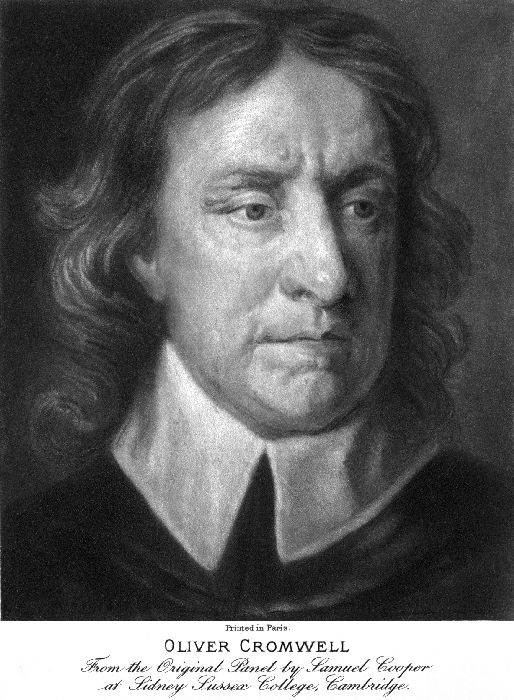
In his desire to escape from the undoubted evils of
military government, Cromwell had the best part of
the army behind him. Nor did it, at the moment,
appear very difficult to attain this object by coming
to terms with the King, especially as the army leaders
were prepared to make concessions to Charles's religious
scruples. Claiming freedom for themselves in
matters of conscience, they were ready to concede it
in return, and, for the first time since he had ridden
out of Oxford, Charles was allowed to receive the
ministrations of his own chaplains, and to join in
offering prayer and praise in the familiar language of
the Prayer Book of the Church. It was a long step
towards the settlement of that religious question which
had created so impassable a gulf between the King
and the Presbyterians.
The constitutional question remained to be discussed,
and the burden of framing terms to bind the
King fell upon Cromwell's son-in-law, Ireton, rather
than upon Cromwell himself. Cromwell indeed would
never have consented to see Charles replaced in the
old position, but he was unskilled in constitutional
niceties, and he left such details to others. The main
difficulty of the situation was not long in revealing
itself. Charles, who had been removed to Windsor,
talked as if the dispute between the Houses and the
soldiers might be referred to his decision. "Sir,"
replied Ireton, "you have an intention to be the
arbitrator between Parliament and us; and we mean
to be it between your Majesty and Parliament." It
was not that there was any definite constitutional
idea in Charles's mind. With him it was rather a
matter of feeling than of reason that he could occupy
no other place in the State than that which tradition
confirmed by his own experience had assigned to the
man who wore the crown. For him as for another as
weak for all purposes of government, as richly endowed
with the artistic temperament as himself,
Not all the waters of the salt, salt sea
Could wash the balm from an anointed King.
Under whatever forms, Parliamentary or constitutional,
he and no other was to be the supreme arbiter,
empowered to speak in due season the decisive word—always
just, always in the right. What was passing
before his eyes did but confirm him in his delusion.
There had been a quarrel between army and Parliament.
Where was it to end unless he sat in judgment
to dispense equity to both? Against that will—call
it firm or obstinate, as we please—so inaccessible to
the teaching of facts, so clinging to the ideas which
had inspired his life, the pleadings of Cromwell and
Ireton would be vain.
Of this Cromwell had no suspicion. He had never
had personal dealings with the King, and had little
insight into his peculiar character. On July 4 he saw
him at Caversham, where Charles had been established,
in order that he might be near Reading, now the head-quarters
of the army. He fell at once under the charm
of Charles's gracious manner, and fancied that a few
days would bring about an agreement. In full accord
with Fairfax, he hoped to establish the throne on
a constitutional and Parliamentary basis. Neither
Charles nor any of those who were under his influence
could understand the sincerity of this purpose. The
French Ambassador, Bellièvre, seems to have sounded
Cromwell on the object of his ambition, and to have
received the memorable reply: "No one rises so high
as he who knows not whither he is going". To Sir
John Berkeley, an ardent Royalist, Cromwell explained
that the army asked only 'to have leave to live as
subjects ought to do, and to preserve their consciences,'
thinking that no man could enjoy his estates unless
the King had his rights. Probably Cromwell, in his
conversation, had emphasised the points which the
army was willing to concede, and had minimised
those on which it expected Charles to yield. Charles,
at all events, was so convinced that the officers were
prepared, almost unconditionally, to restore him to
his former power, that he gave it as a reason for distrusting
them, that they had not asked him for personal
favours in return. There can be no doubt that Cromwell
refrained at this time from pressing the King
hardly. He was present at the meeting of Charles
with his children, now permitted to visit him for the
first time since the beginning of the civil war. Himself
a devoted father, he was touched by the affecting
scene. The King, he told Berkeley, was the 'uprightest
and most conscientious man of his three kingdoms'.
Yet he was too keen-sighted to be blind to the other
side of his character. He wished, he said, that his
Majesty would be more frank and not so strictly tied
to narrow maxims.
Already Cromwell's apparent devotion to the
King's person was not unnaturally drawing forth
harsh criticisms from those who failed to understand
the essential unity underlying divergencies in his
action. Some at least amongst the Agitators were
joining the Presbyterians in sarcasms directed against
the man who was everything by turns; who had at
one time taken the Covenant—at another time accepted
the disbandment of the army; at another time
again had made himself the instrument of the army
in its resistance of disbandment. Cromwell took no
notice of such calumnies. He was more concerned with
the eagerness of the Agitators to march upon Westminster
with the object of forcing the Houses to condemn
the eleven members who were again stirring,
and of crushing the discontent which was simmering
amongst the City population. Happily the mere threat
of force had been sufficient, and Parliament virtually
abandoned its hostile attitude by naming Fairfax
Commander-in-chief of all the forces in the country.
Would it be so easy to deal with Charles? By July
23, The Heads of the Proposals, probably drawn up
by Ireton—who, of all the officers, was the most
versed in constitutional lore—with the assistance of
Colonel Lambert, having been adopted by the Army
Council, were submitted to the King. So far as
religion was concerned, they anticipated the settlement
of the Revolution of 1688, leaving all forms of
worship—including that of the condemned Prayer
Book—to the voluntary choice of the worshipper.
So far as politics were concerned, provision was to be
made, not merely for making the King responsible to
Parliament, but for making Parliament responsible to
the people. There were to be biennial Parliaments,
elected by enlarged constituencies, and a Council of
State was to be formed, to whose consent in important
matters the King was to bow. The first Council was
to remain in office for at least seven years. How it
was to be nominated after that was left uncertain,
probably till the question had been threshed out in
discussion with the King. The army leaders had yet
to discover how little profit such a discussion would
bring. Charles was not prepared to abandon his old
position for that of constitutional King, limited, as
he had never been limited before, by opposing forces.
If he had spoken his objections clearly out it would
have been easy to criticise him as one who was blind
to the forces which were governing events: it would
have been impossible to hold him morally at fault.
The course which he took could not but lead to
disaster. Listening to the army leaders, he yet conspired
against them, still placing his hopes on the
assistance of a Scottish army, and speculating on the
chances of a breach between the army on the one
side and the Parliament and the City on the other,
which would enable him to grasp the reins of power
under the old conditions. "I shall see them glad ere
long," he told Berkeley, "to accept more equal terms."
He even went so far as to imagine that Fairfax and
Cromwell were to be bribed by offers of personal
advantage to re-establish his fallen throne on other
terms than those now offered to him. "You cannot,"
he told them, "do without me. You will fall
into ruin if I do not sustain you." He was partly
supported by his knowledge that though the City
authorities had yielded to the sway of the army, the
City apprentices were in a state of disquiet and had
broken into the House of Commons, compelling the
members to vote a series of Presbyterian resolutions
in defiance of the army. In misplaced confidence in
this movement in the City, Charles entered into communication
with Lauderdale, the ablest member of a
body of Scottish Commissioners who had recently
arrived nominally to urge the King to accept the
Parliamentary terms, but in reality to negotiate a
separate agreement between the Scots and the King.
Charles eagerly closed with their proposals and allowed
Lauderdale to send a message to Edinburgh urging
the equipment of a Scottish army for the invasion of
England. Unluckily for him, mob-violence was a
feeble reed on which to lean. The Speaker of the
two Houses, together with the Independent members,
took refuge with the army, and the army treating them
as the genuine Parliament reconducted them to Westminster.
On August 6 Fairfax was named by the
reconstituted Parliament Constable of the Tower,
which though it had hitherto been guarded by the
citizens was from henceforward to be garrisoned by a
detachment of the army, whilst another detachment
was left at Westminster as a guard to the Houses.
The remainder of the soldiers, to show their power,
tramped through the City, passing out by London
Bridge on the march to Croydon—Cromwell riding
at the head of the cavalry.
What could be the possible end of such demonstrations?
Every time they were employed, the
appeal to force was placed more clearly in evidence,
in spite of all efforts to minimise it. Scarcely had
the regiments filed out of the City when the Presbyterian
majority reasserted itself in Parliament. On
the other hand, the Agitators raised their voices for
a purge of Parliament which would thrust out those
members who had sat and voted under the influence
of the mob. Cromwell was growing impatient.
"These men," he said of the eleven members, some
of whom had returned to their seats when the House
was under the dominion of the mob, "will never leave
till the army pull them out by the ears." "I know
nothing to the contrary," he said on another occasion,
speaking of Holles and Stapleton, "but that I am
as well able to govern the kingdom as either of them."
On this, the eleven members left their seats for good
and all, six of them taking refuge on the Continent.
Yet the majority in the Commons was Presbyterian
still, and refused to vote at the dictation of the army.
Cromwell's patience was exhausted. On August 20
he brought a cavalry regiment into Hyde Park in order
to obtain a vote that the proceedings of the House, in
the absence of the Speaker, had been null and void.
Under this threat, the majority gave way, and Cromwell,
who had the whole army behind him, gained his
immediate end. Once more he was drifting forwards
in the direction of that military despotism which
neither he nor his comrades desired to establish.
The one way of escape still lay in an understanding
with the King. With the King, however, no agreement
was possible. Charles, hopelessly at fault in
his judgment of passing events, stood aloof in the
assurance that the strife amongst the opponents
would serve but to weaken both. In the negotiations
carried on with the army simultaneously with the
latest Parliamentary struggle, he fought every point
stubbornly. To extricate themselves from this difficulty,
Cromwell and Ireton joined in a vote for
resuscitating the Newcastle propositions, and allowed
Charles to be formally requested to give his consent
to those extravagant Presbyterian demands. Charles,
driven to the wall, expressed his preference for The
Heads of the Proposals. Cromwell and Ireton contrived
to persuade themselves that he was in earnest,
and gave their support to the King's demand for a
personal negotiation with Parliament on that basis.
Under these circumstances the Independent party
and the army split in two. The greater number of
the superior officers, together with the Parliamentary
leaders of the party, Vane, St. John and Fiennes,
supported Cromwell and Ireton in an attempt to
persuade Parliament to open the negotiations asked
for by the King. As was not unnatural, there were
others, Rainsborough in the army, and Marten in the
House of Commons, who gathered round them a new
Republican party, declaring it useless to enter into a
fresh discussion with Charles, and even talking of
imprisoning him in some fortress. Coalescing with
the Presbyterians, who wished merely to summon
Charles to accept a selection from the Newcastle
Propositions, they beat Cromwell on the vote, in
spite of his warning that by disowning the King they
were playing into the hands of men who 'were endeavouring
to have no other power to rule but the
sword'. Inside and outside the House Cromwell was
denounced as a mere time-server, who had no other
end in view but his own interests. Cromwell's only
answer was to urge Charles more pressingly than
before to make the concessions without which his
restoration to any kind of authority was out of the
question. Conscious of his own integrity, he still
hoped for the best, even from Charles. "Though it
may be for the present," he wrote to a friend, "a cloud
may be over our actions to those who are not acquainted
with the grounds of them, yet we doubt not God will
clear our integrity and innocence from any other ends
we aim at but His glory and the public good." Yet
September passed away, and Charles had made no
sign.
Charles's silence did but strengthen the party
amongst the soldiers which aimed at cutting the
political knot with the sword. In the Army Council
indeed Cromwell was still predominant, and on
October 6 it agreed to meet on the 14th, to formulate
terms which the King might be able to accept.
In the interval everything was done to come to a
private understanding with Charles. Charles, however,
was trusting to the probable Scottish invasion,
and saw in the events taking place more closely under
his eyes no more than a chance of discrediting Cromwell
and his associates. When the Army Council met
on the 14th, the subject of continuing the negotiations
had to be dropped. The position was well explained
in a letter from a Royalist. "The secret disposition,"
he wrote, "is that there is no manner of agreement
between the King and the army; all this negotiation
having produced no other effect but to incline some
of the chief officers not to consent to his destruction,
which I believe they will not, unless they be over-swayed;
but cannot observe that they are so truly
the King's as that they will pass the Rubicon for
him, which if they could do, considering the inclination
of the common soldiers, and generally of the people
they might do what they would; but they are cold,
and there is another faction of desperate fellows as
hot as fire."
Almost, if not altogether, in despair, Cromwell
sought a compromise with the Presbyterians on the
basis of the temporary establishment of Presbyterianism
as the national religion, with as large a toleration
as he could persuade them to grant. When the
House of Commons refused to extend toleration to
the worship authorised by the Prayer Book, it was
obvious that the scheme was not one which had a
chance of obtaining the assent of Charles. Cromwell's
hope of uniting Parliament and army in bringing
pressure upon the King was as completely frustrated
as his former hope of bringing about an understanding
between the King and the army. His impotence
could not but give encouragement to the other
'faction of desperate fellows as hot as fire' to demand
a settlement on quite another basis from that on
which Cromwell and the other army leaders had
vainly attempted to found a Government.
In all his efforts, Cromwell's aim had been to
strengthen the chances in favour of the new toleration
by intertwining it with the old constitutional pillars
of King and Parliament. His schemes, based as
they were on a thoroughly political instinct which
warned him against the danger of cutting the State
adrift from its moorings, had broken down mainly
in consequence of the resistance of the King. It was
but natural that earnest men should seek new modes
of gaining their ends when the old ones proved ineffective.
As the years of revolution passed swiftly
on, new and more drastic schemes appeared upon the
surface, not, as is often said, because in some unexplained
way revolutions tend in themselves to
strengthen the hands of extreme men, but because
the force of conservative resistance calls forth more
violent remedies. The misgovernment of Buckingham
and Laud had fostered the Parliamentary idea.
The resistance of Parliament to toleration had led to
the conception by the army leaders of the idea of
Parliamentary reform, and now the failure of those
leaders produced the plan of founding a government
not on institutions sanctified by old use and wont,
but on a totally new democratic system. Outside
the army, the main supporter of the new principles was
John Lilburne, who had been a lieutenant-colonel in
Manchester's army before the formation of the New
Model, a man litigious and impracticable, but public-spirited
and prepared to accept the consequences of
his actions on behalf of his fellow-citizens or of himself.
During the troubles he spent a great part of his life in
prison, and at the present time he had been more than
a year in the Tower. He had a large following in the
army, and early in October five regiments deposed
their Agitators, and choosing new ones, set them to
draw up a political manifesto which, under the name
of The Case of the Army Truly Stated, was laid before
Fairfax on the 18th.
The new thing in this scheme of the recently
elected Agitators was not that they proposed to fix
the institutions of the State by means of written
terms. That had been done again and again by Parliament
in various propositions submitted to Charles
since the commencement of the Civil War, and more
recently by the army leaders in The Heads of the Proposals.
What was new was that they proposed in the
first place to secure religious freedom and other rights
by the erection of a paramount law unalterable by
Parliament; and in the second place to establish a
single House of Parliament—all mention of King or
House of Lords was avoided—with full powers to call
executive ministers to account—a House which was
to be elected by manhood suffrage—an innovation
which they justified on the ground that 'all power is
originally and essentially in the whole body of the
people of this nation'. It was a complete transition
from the principles of the English Revolution to those
of the French.
Against the foundation of a government on abstract
principles, Cromwell's whole nature—consonant in this
with that of the vast majority of the English people—rose
in revolt. On the 20th he poured out his soul
in the House of Commons in a three-hours' speech
in praise of monarchy, urging the House to build up
the shattered throne, disclaiming on behalf of the
whole body of officers any part in the scheme of the
party of the new Agitators, who were now beginning
to be known as Levellers. It was to no purpose.
Monarchy without a King was itself but an abstract
principle, and Charles would accept no conditions
which would not leave him free to shake off any constitutional
shackles imposed upon him. Only four
days before the delivery of Cromwell's speech, Charles
had assured the French Ambassador that he trusted
in the divisions in the army, which would be sure to
drive one or other of the disputants to his side.
The immediate result of Charles's resolution to
play with the great questions at issue was an attempt
by Cromwell and the officers to come to terms with
the Levellers. On October 28 a meeting of the
Army Council was held in Putney Church, to which
several civilian Levellers were admitted, the most
prominent of whom was Wildman, formerly a major
in a now-disbanded regiment. Fairfax being out of
health, Cromwell took the chair. The Agitators put
the question in a common-sense form. "We sought,"
one of them said, "to satisfy all men, and it was well;
but, in going to do it, we have dissatisfied all men.
We have laboured to please the King; and, I think,
except we go about to cut all our throats, we shall
not please him; and we have gone to support a House
which will prove rotten studs.D I mean the Parliament,
which consists of a company of rotten members."
Cromwell and Ireton—they continued—had attempted
to settle the kingdom on the foundations of King and
Parliament, but it was to be hoped that they would
no longer persist in this course. Ireton could but
answer that he would never join those who refused to
'attempt all ways that are possible to preserve both,
and to make good use, and the best use that can be
of both, for the kingdom'. The practical men had
become dreamers, whilst the dreamers had become
practical men. The Levellers, at least, had a definite
proposal to make, whilst Cromwell and Ireton had
none. Since the appearance of The Case of the Army,
the Agitators had reduced its chief requirements into
a short constitution of four articles, which they called
The Agreement of the People, intending, it would seem,
to send it round the country for subscription, thus
submitting it to what, in modern days, would be called
a plebiscite, though apparently it was to be a plebiscite
in which only affirmative votes were to be
recorded. Nothing could be more logical than this
attempt to find a basis of authority in the popular
will, if the other basis of authority, the tradition of
generations, was to be of necessity abandoned.
Cromwell, of all men in the world, was reduced to
mere negative criticism. The proposal of the Agitators,
he admitted, was plausible enough. "If," he
said, "we could leap out of one condition into another
that had so precious things in it as this hath, I suppose
there would not be much dispute; though perhaps
some of these things may be well disputed; and how
do we know if, whilst we are disputing these things,
another company of men shall gather together, and
they shall put out a paper as plausible as this? I do
not know why it may not be done by that time you
have agreed upon this, or got hands to it, if that be
the way; and not only another and another, but many
of this kind; and if so, what do you think the consequence
would be? Would it not be confusion?...
But truly I think we are not only to consider what
the consequences are ... but we are to consider the
probability of the ways and means to accomplish it,
that is to say that, according to reason and judgment,
the spirits and temper of this nation are prepared to
receive and go along with it, and that those great
difficulties which lie in our way are in a likelihood to
be either overcome or removed. Truly to anything
that's good, there's no doubt on it, objections may be
made and framed, but let every honest man consider
whether or no these be not very reasonable objections
in point of difficulty; and I know a man may answer
all difficulties with faith, and faith will answer all
difficulties really where it is, as we are very apt all
of us to call faith that perhaps may be but carnal
imagination and carnal reasoning."
Not a word had Cromwell to say on behalf of any
possible understanding with the King. All that he
could do was to stave off a declaration in favour of
the establishment of a democratic Republic, by proposing
that the Army Council should reduce into
formal shape the engagements entered upon at Newmarket
and Triploe Heath. As those engagements
had been put forward as demands to Parliament—not
to the King, this suggestion at least thrust aside
for the time being the thorny question of the possibility
of coming to an understanding with Charles. Cromwell's
proposal, however, was not likely to secure
unanimity. Wildman, on behalf of the Levellers,
refused to be bound by engagements which he personally
held to be unjust. On this Cromwell asked
for the appointment of a committee to examine this
question, as well as any others upon which there was
a difference of opinion. He pleaded with his audience
not to approach the matters in controversy 'as two
contrary parties'. His hearers were in no temper to
profit by the suggestion. Wildman threw out a hint
that if Parliament were to patch up an arrangement
with the King, it would detract from natural right.
The expression at once divided the assembly into two
camps. Ireton declared that there was no such thing
as natural right. Cromwell asked for the appointment
of a committee to discuss the questions that had been
raised about the engagements of the army. A Captain
Audley sensibly urged the controversialists to remember
that it was no time for empty disputation. "If
we tarry long," he said, "the King will come and say
who will be hanged first." Neither Audley's judicious
remark, nor Cromwell's words thrown in from time
to time in favour of peace, could stop the wrangle,
which at least served to draw from Cromwell the
nearest approach he ever made to the enunciation of
a constitutional principle. Though the Council of the
Army, he declared, was not 'wedded and glued to
forms of government,' it was prepared to maintain
the doctrine that 'the foundation and the supremacy
is in the people—radically in them—and to be set
down by them in their representations,' in other words
by their representatives in Parliament. To conciliate
this doctrine with the upholding of the ancient constitution,
reformed indeed, but unaltered in its main
features, was the problem which the nation solved for
itself in 1689, but which neither the nation nor Cromwell
could contrive to solve so long as Charles I.
refused to face the teaching of events.
On the following day, after a prayer-meeting held
in compliance with a suggestion from the pious
Colonel Goffe, the Army Council met again, to resolve,
after long debate, to lay aside the consideration of the
engagements of the army and to proceed at once to
the examination of The Agreement of the People. This
determination was a check to Cromwell, who had
proposed the committee. It was not long before his
prudence was justified. A debate sprang up on the
question of manhood suffrage, claimed by the Levellers
as being in accordance with natural right, and rejected
by their opponents, to whom natural right was a mere
absurdity. After a fierce dispute, Cromwell did his
best to persuade the meeting to avoid abstract considerations,
and to content itself with the discussion
of such questions as whether the existing franchise
could be in any way improved. His characteristic
tendency to look to the preservation of ancient rights
finding no scope in any possible scheme for the
retention of the monarchy, fixed itself on the question
of the constitution of Parliament. Colonel Rainsborough,
who, on questions relating to Parliamentary
elections, was the chief speaker on the side of the
Levellers, proposed an appeal from the Army Council
to the Army at large. His proposal found no support
and the Council broke up without coming to a decision.
After this Cromwell had his way. On the 30th
the committee which he suggested, and on which
both parties were represented, met to consider the
points at issue. The constitutional scheme to which
its assent was given followed the lines of The Heads
of the Proposals more than those of The Agreement of
the People. It proposed reforms, not an entire shifting
of the basis of government. Above all, it adhered to
the view that the new constitution should come into
existence by an agreement between King and Parliament—not
by an appeal to the natural rights of man.
In the long run Cromwell was justified by the event.
On no other basis would the distressed nation find
rest. His wisdom so far as present results were concerned
was less conspicuous.
The next meeting of the Army Council was held
under discouraging circumstances. Charles, who had
for some time been established at Hampton Court,
had refused to renew the parole which he had given,
and it had been found necessary to strengthen his
guards. Though there was no accurate knowledge
at Putney of his intrigue with the Scots, enough had
leaked out to raise grave suspicion, and when, on
November 1, Cromwell again took the chair, he called
on those present to 'speak their experiences as the
issue of what God had given in answer to their prayers'.
The result was distinctly unfavourable to the King.
One said that the negative voice of the King and
Lords must be taken away; another that he could
no longer pray for the King; a third that their
liberties must be recovered by the sword. Cromwell
did his best to stem the tide. Pointing out, just as a
modern historian might do, that there had been faults
on both sides, he called on 'him that was without sin
amongst them to cast the first stone'. He then turned
to the more practical question of the difficulty of
maintaining discipline in the army, if the authority
of Parliament were shut off. "If there be no Parliament,"
he argued, "they are nothing, and we are
nothing likewise." Though Cromwell was not yet
prepared to strike at the King, he no longer regarded
his comprehension in the new constitution as absolutely
essential. He was even ready to accept the
new democratic basis of The Agreement of the People,
if there should be a wide demand for it. He must
look, he said, for 'a visible presence of the people,
either by subscriptions or numbers—for in the government
of nations that which is to be looked after is the
affections of the people'. For the present, however,
he seemed most inclined to trust in Parliament as the
source of authority. On one thing he was clear, that
the discipline of the army must not be ruined by such
an appeal to the general body of the soldiers in support
of the Agreement as Rainsborough had contemplated.
"I must confess," he said, "that I have
a commission from the General, and I understand
what I am to do by it. I shall conform to him
according to the rules and discipline of war ... and
therefore I conceive it is not in the power of any
particular men, or any particular man in the army, to
call a rendezvous of a troop, or regiment, or in the
least to disoblige the army from the commands of
the General.... Therefore I shall move what we
shall centre upon. If it have but the face of authority,
if it be but a hare swimming over the Thames I will
take hold of it rather than let it go."
It was hard, indeed, in those days, to say where
the face of authority was to be found, and Cromwell
was far from being able to solve the question. The
most innocent suggestion made by his opponents was
that the army must purge Parliament and declare the
King responsible for the ruin of the country. Goffe
declared that it had been revealed to him that the sin
of the army lay in its tampering with God's enemies,
in other words, with Charles. Cromwell struck in
with an expression of distrust in personal revelations.
He himself, he explained, was guided by God's dispensations,
that is to say, in more modern phrase, by
the requirements of the situation. He acknowledged
that danger was to be apprehended from the King
and House of Lords, and that it was not his intention
'to preserve the one or the other with a visible
danger and destruction to the people and the public
interest'. On the other hand, he refused to accept it
as certain that God had determined to destroy King
and Lords, though he thought it probable that it was
so. In the end, the constitutional discussion was
transferred to a committee.
For a right judgment of Cromwell's character and
habits of procedure no evidence exists of such importance
as that which has been thus summarised. Here
at least is laid bare before us his reluctance to abandon
an untenable position, long after it has become clear
to more impatient spirits that it has become untenable.
Yet his hesitation is not based on any timorous
reluctance to act. It arises from his keen sense of
the danger of any alternative policy, a sense which
will be overmastered as soon as action in one direction
or the other becomes a manifest necessity. On
November 8, seeing that the Levellers were bent on
pushing forward their proposal of manhood suffrage,
he obtained a vote from the Army Council directing
that both officers and Agitators should be sent back
to their regiments. There can be little doubt that
the danger was greater than was thus indicated, and
that there was truth in a story which charged the
Levellers with intending, at this time, to purge the
Parliament and to bring the King to trial. On the
11th, at all events, the brave but fanatical Colonel
Harrison was calling for the prosecution of the King,
and on the same day Cromwell sent to Whalley, who
commanded the guard at Hampton Court, to provide
against any attempt on Charles's person. Similar
warnings had reached Charles himself, and on the
evening of the same day he quietly made his escape.
On the 14th, after the failure of a scheme for the provision
of a vessel from Southampton to carry him to
France, he reached Carisbrooke, where the Governor
of the Castle was Robert Hammond, Cromwell's
cousin. Cromwell's first task was to ensure the discipline
of the army. His persistent efforts to keep up
negotiation with the King had exposed him to the
distrust of the Levellers, and it is said that some of
them had resolved to murder him in his bed. There
was no time to be lost. On the 15th a rendezvous of
a third part of the army was to be held on Corkbush
Field, not far from Ware, and there could be no doubt
that the Levellers would make desperate attempts to
seduce the regiments from their military obedience.
To meet the danger, a manifesto was issued in the
name of Fairfax and the Army Council, in which
Fairfax offered to give his support to the early dissolution
of Parliament and to a plan for making the
House of Commons 'as near as may be, an equal
representative of the people that are to elect'. For
the rest, every soldier would be expected to sign a
form of adhesion to the General and the Council.
Speaking broadly, the conflict was between the men
who knew the importance of maintaining the discipline
of the army, and those who would reduce it to an
armed mob eager to compel Parliament to adopt the
democratic system of The Agreement of the People.
On the 15th the soldiers gathered to the appointed
rendezvous on Corkbush Field, where most of the
regiments, with more or less reluctance, submitted to
their officers. Two, those of Harrison and Robert
Lilburne, both of which had been ordered elsewhere,
mutinously made their appearance with copies of The
Agreement of the People in their hats, as well as the
motto "England's Freedom! Soldiers' Rights!" A
few words from Fairfax reduced Harrison's regiment
to obedience. Cromwell, finding that Lilburne's men
defied his order to remove the papers from their hats,
rode into the ranks with his sword drawn, on which
the regiment, with one accord, did as it was bidden.
Three of the ringleaders were condemned to death
by a court-martial held on the spot, and then ordered
to throw dice for their lives. He who threw lowest
was shot in the presence of the whole force, and the
mutiny was brought to an end.
By this time the weary round of negotiation was
beginning afresh. Charles sent up new proposals to
the Parliament, proposals which, if he were in earnest,
might possibly serve as a foundation for an agreement.
It concerned Parliament and army alike to discover
whether Charles, who for many months had shown
no sign of eagerness for settlement, was now aiming
at anything more than an excuse to enable him to
gain time for an arrangement with the Scots. So
suspicious had the officers grown that Ireton was
heard to say that if peace were to be made between
King and Parliament, he hoped it would be such as
that the army 'might, with a safe conscience, fight
against both'. If we are to believe a story, told indeed
only after the Restoration, but which has inherent
probability in it, Cromwell and Ireton, having reason
to suppose that a letter from Charles to the Queen
would be carried by a man who was to stay the night
at the Blue Boar in Holborn, disguised themselves as
troopers, and waited in the inn drinking beer till the
messenger arrived. Then, ripping up his saddle, they
found the expected letter, from which they learnt that
'the King had acquainted the Queen that he was now
courted by both the factions, the Scotch Presbyterians
and the army, and which bid fairest for him should
have him, but he thought he should close with the
Scots sooner than the other'. According to another
account, the letter also assured Henrietta Maria that
she need not concern herself about any concessions
he might make, as 'he should not look upon himself
as obliged to keep any promises made so much on
compulsion whenever he had power enough to break
them'.
Whatever may be the exact truth about the intercepted
letter, it is exceedingly likely that Cromwell,
in some way or other, received intelligence which
confirmed his growing belief in Charles's untrustworthiness.
This view of the case is confirmed by
the fact that, not long after, the Parliament prepared
four Bills, not as a basis of a settlement, but as a test
to show whether Charles was in earnest or not, principally
by asking him to abandon his control over the
militia. On the other hand Charles so misconceived
his position as to send Berkeley to Fairfax with a
request that he would support him in asking for
a personal treaty unfettered by any conditions whatsoever.
When, on November 28, Berkeley arrived at
head-quarters, Fairfax briefly referred him to Parliament,
whilst neither Cromwell nor Ireton would enter
into conversation with him. To the soldiers who had
mistrusted him Cromwell professed 'that the glories
of this world had so dazzled his eyes that he could
not discern clearly the great works the Lord was
doing; that he was resolved to humble himself, and
desired the prayers of the saints, that God would be
pleased to forgive his self-seeking'. On the following
morning he sent a message to Berkeley in a more
worldly strain, bidding him 'be assured he would
serve His Majesty as long as he could do it without
his own ruin, but desired that he would not expect
that he should perish for his sake'. Such at least
was the form given to the message by Berkeley when
he wrote his Memoirs at a later date, and we may at
least take it as established that Cromwell made it
clear to Charles that, after what had happened, it was
perfectly hopeless to expect the army to bring pressure
on Parliament in his favour.
Charles turned to the Scots. There were two parties
in Scotland—the party of the ministers of the Kirk,
headed by the Marquis of Argyle, and the party of
the nobility, headed by the Duke of Hamilton, of
which the leading members were the Duke's brother,
the Earl of Lanark, and the Earl of Lauderdale, both
of whom, like many other Scottish nobles, had thrown
themselves into the Presbyterian movement so long as
it was directed against Bishops, but had rallied to the
Crown as soon as the Ministers strove to make themselves
independent of the nobility. It was this latter
party that was represented by the Scottish Commissioners
in England, and on December 26 Charles
signed an agreement with them—The Engagement,
as it was called—which gave him his own way in
England, allowing him to put an end to all toleration
of the sects, and to grant a dominant position to
Presbyterians for three years only. Against the
English Parliament and the army the Scots were to
claim for the Crown the power over the militia, the
control over the Great Seal, the bestowal of honours
and offices, the choice of Privy Councillors, and the
negative voice in Parliament. In support of this settlement,
which included a disbandment of the army and
a dissolution of Parliament, a Scottish army was to
march into England. Of all the Scotsmen embarked
in this scheme, the only man of marked ability was
Lauderdale, and though no direct evidence exists on
the subject, it seems likely enough that the Engagement
was mainly, if not altogether, his work. If the
suggestion be accepted that the picture by Janssen
in the possession of the present Duke, in which a
paper is being handed by Lauderdale to Lanark,
represents the transference of the Engagement from
the former to the latter, it would lend additional
strength to the supposition founded on the relative
intellectual powers of the two men. However this
may be, it is certain that two days after the signature
of The Engagement, Charles rejected the Four Bills
which had been laid before him by the English
Parliament, thus showing his own belief that it was
no longer needful for him to keep up even the
semblance of an understanding with the Houses at
Westminster.
That the result of a successful Scottish invasion
would be to restore Charles to the throne on the old
conditions, and to sweep away everything for which
any English party had struggled, can hardly be
doubted. It is true that The Engagement was buried
in the garden of Carisbrooke Castle, and that not a
word of its contents reached any English ears. Yet
from the rejection of the Four Bills, following on the
visit of the Scottish Commissioners to Carisbrooke,
it was evident that some dangerous project was on
foot, and even those who had welcomed a Scottish
army in 1643, when it invaded England at their
bidding, were likely to be scandalised at the intervention
of another Scottish army in opposition to
themselves. To Cromwell and to the soldiers of every
grade, the prospect of seeing those objects for which
they had shed their blood wrenched from them
by a Scottish invasion, was peculiarly offensive. In
the army all quarrels were hushed and all offences
pardoned in face of the obvious danger. What was
more, the leading officers assured Parliament that the
army might be relied upon against the invaders. The
extreme Levellers indeed continued to regard Cromwell
as a time-server and a hypocrite, and some even
of those who were ready to accept his co-operation
were somewhat suspicious. "If you prove not an
honest man," said Hazlerigg to him, "I will never
trust a fellow with a great nose for your sake."
Under the circumstances Charles's Royalist friends
were sent away from Carisbrooke, and he himself,
after a futile attempt to escape, treated as a prisoner
under lock and key. A vote that no further addresses
should be made to the King passed the Commons.
For some time the Lords refused their concurrence,
and it was only on a threat of the intervention of the
army that they gave way. After the struggle was at
an end, two regiments occupied Whitehall and the
Mews. The supremacy of the army in the State was
growing more pronounced as each political difficulty
arose. There are good reasons for believing that
before the end of January, 1648, Cromwell, to whom
the interference of the army in politics was almost as
objectionable as the establishment of a democracy on
abstract principles, proposed to transfer the Crown
from Charles to the Prince of Wales; preserving the
office whilst changing the persons. No proposal could
have been more statesmanlike; but, unhappily, it was
not possible to carry it into effect. The whole of the
Royal family was too exasperated against the enemies
of its head to lend itself to such a transaction. There
can be no doubt that Cromwell had, by this time,
abandoned all thought of looking to Charles as the
basis of the political settlement he desired. About
the end of February a letter from Charles to the
Queen was intercepted which convinced those into
whose hands it fell that the writer was preparing to
take the aggressive against his opponents. Early in
February Cromwell was found amongst the supporters
of a Parliamentary declaration intended to uphold the
vote of No Addresses, in which Charles's misdemeanours
were set forth at length, somewhat in the fashion
of the Grand Remonstrance. His attempt to bring
into England Germans, Spaniards, Frenchmen, Lorrainers,
and Danes as well as Irishmen was one of the
principal counts against him. Cromwell is even said
to have 'made a severe invective against monarchical
government,' though it is probable that his argument
was directed less against a hereditary chief-magistracy
bound by constitutional limitations than against a
system under which the King retained the ultimate
decision of all questions in his own hands. At all
events, he refused to commit himself absolutely to
Republicanism, thereby exasperating those who, like
Marten, and even his own bosom friend—the younger
Vane—had come to the conclusion that, in the England
of that day, a Republic was the only alternative
to an absolute monarchy.
It was about this time that a meeting took place,
the proceedings at which were recorded by Edmund
Ludlow, himself a Republican or Commonwealth's-man—to
use the term in use amongst contemporaries.
Anxious to bring men of different opinions into line
against Charles, Cromwell gave a dinner to the leaders
of the various parties, after which a conference was
held in which, according to Ludlow, Cromwell and
his friends 'kept themselves in the clouds, and would
not declare their judgments either for a monarchical,
aristocratical or democratical government, maintaining
that any of them might be good in themselves, or for
us according as Providence should direct us'. The
old difference of opinion between the men of practice
and the men of theory was, on this occasion, aggravated
by the fact that many theoretical upholders of
a Commonwealth drew the very practical conclusion
that not only were Charles's subjects absolved from
their allegiance, but that it was the duty of Parliament
to call the King to account for the blood that had
been shed in England in consequence of his misdeeds.
The conference begun in the interests of peace bade
fair to lead to open division, and Cromwell, to silence
angry vituperation, flung a cushion at Ludlow's head
and ran downstairs. Ludlow in his turn threw the
cushion back at Cromwell, and, as he proudly boasted,
'made him hasten down faster than he desired'. A
rough piece of horseplay, it at all events served its
purpose in quieting a strife which, every minute that
it lasted, was doing injury to the cause which Cromwell
desired to serve.
At no time did Cromwell fix beforehand the
methods by which he intended to work, though he
never had any doubt of the object against which his
energies were to be directed. He had contended first
against irresponsible monarchical power, then in turn
against military anarchy, Presbyterian tyranny, the
political supremacy of the army, and abstract theories
of government. He was ready to meet each danger
as it arose, with the help of all who, whatever their
opinions on other points might be, were ready to join
him in attacking the abuse which he wished at the
time to abate. If, like Ludlow, they persisted in
looking too far ahead, there was nothing for it but
to silence them, if it were but by flinging cushions
at their heads.
In the Spring of 1648 Cromwell and his political
allies had thus to deal with a very complicated situation.
They had to face not merely Charles's intrigue
with the Scots, but also the widely spread discontent
in England. Especially in the towns, men were weary
of military dictation, and of the increased taxation by
which the army was supported. Parliament too was
as unpopular as the army. Englishmen were no less
weary of the prolonged uncertainty which neither
army nor Parliament seemed capable of bringing to
an end. In their longing for a settled government, a
considerable part of the population turned their eyes
to the throne, as the ancient basis of authority and
order. If England had been polled, there would probably
have been a large majority in favour of Charles's
restoration to power, and yet, it was precisely amongst
those whose system was most democratic that the
most intense opposition to a restoration was to be
found.
To Cromwell, man of order and discipline as he
was, a restoration unaccompanied with security against
the old mischief was intolerable. Of his own disinterestedness
he gave at this time undeniable proof.
Parliament having granted him lands valued at £1,680
a year, proceeded to reduce his pay at the same time
that it reduced that of other officers, by the large sum
of £1,825. Far from taking umbrage at this diminution
of his income, he presented not less than £5,000 to
the public cause, and also abandoned the arrears due
to him, which at that time amounted to £1,500.
Certainly dangers were gathering thickly. An intercepted
letter from the King's agent at the Hague
disclosed Charles's expectation to be succoured not
only by an Irish army but by a Dutch one. Common
prudence taught Cromwell to do everything in his
power to conciliate any party that might stand by
his side against so extensive a combination. When
his scheme for placing the Prince of Wales on the
throne was revived about the middle of March, some
of the Episcopal clergy preferred an understanding
with the army to an understanding with the Scots.
Towards the end of the month, Cromwell was still in
negotiation with members of the Royalist party, the
purport of which it is impossible to define, but which
probably had its rise in his persistent desire to maintain
royalty in some shape or form as a basis of order.
It is at least certain that he gained much obloquy from
his own party. "I know," he wrote to a friend, "God
has been above all ill reports, and will in His own
time vindicate me. I have no cause to complain."
It was never Cromwell's way to answer calumny by
a public explanation of his conduct.
At last, however, Cromwell came to the conclusion
that nothing was to be hoped from an understanding
with the Royalists; and it therefore became more
necessary to secure the co-operation of the English
Presbyterians. An attempt to win the City Magistrates
by concessions was, however, promptly repulsed.
On April 6 it became known in London that Charles
had all but succeeded in effecting his escape, and on
the 9th a City mob was rushing westwards along the
Strand with the intention of overpowering the soldiers
at Whitehall and the Mews. A charge of cavalry
ordered by Cromwell drove them back, but it was
not till the following day that the tumult was suppressed.
All this while the Hamilton party, which
was keen for an invasion of England, was gaining
strength in Scotland. So black did the outlook become
that one more appeal was made to the King,
and there are strong reasons for believing that he was
warned that, if he persisted in refusing compliance to
the demands made upon him—whatever they may
have been—Parliament would proceed, on April 24,
to depose him, and to crown the Duke of York, who
was still in their hands, as James II. Charles replied
by sanctioning a plan for his son's escape, and before
the appointed day arrived the boy was well on his way
to the Continent.
The first resistance to Parliament came from an
unexpected quarter. As early as on February 22,
Colonel Poyer, the Governor of Pembroke Castle,
had refused to deliver up his charge till his arrears
had been paid, and on March 23 he had proceeded
to seize the town. At first no more than a local
difficulty was apprehended, and Colonel Horton was
despatched to suppress the rising. On his arrival he
wrote that he was likely to have the whole of South
Wales on his hands. Almost at the same time it
was known at Westminster that a Scottish army
was actually to be raised. Presbyterian as was the
majority of the English Parliament, it had no mind
to have even its favourite religion established by an
invading army of Scots, especially as that army
would be the army of the Scottish nobility, who
were supposed not to feel any warm attachment to
the Presbyterian cause except so far as their own
interests were connected with it. It was the hesitation
of the English Presbyterians between their political
and their ecclesiastical aims which alone could have
given a free hand to Fairfax and Cromwell. It was
Cromwell who, seconded by Vane, carried a vote in
the House for granting concessions which the City
under the pressure of the recent intelligence, was now
prepared to accept as satisfactory. A further vote
that the House would not alter the fundamental
government of the kingdom by King, Lords and
Commons, was supported by the leading Independents.
The House then proceeded to declare itself
ready to concur in a settlement on the ground of the
propositions laid before the King at Hampton Court,
that is to say, on the ground of the establishment of
Presbyterianism without any liberty of conscience
whatsoever. Whether Cromwell was in his place
when the last two votes were taken is uncertain. At
all events we can hardly be wrong in supposing that
he had no objection to the Presbyterians amusing
themselves with another hopeless negotiation whilst
the army took the field. He had had too much
experience of Charles's character as a diplomatist
to imagine that he was likely to aim at anything
more than hoodwinking his opponents till the time
came when he might deem it advisable to hoodwink
his allies.
Cromwell's presence was imperatively needed at
head-quarters, which were now established at Windsor.
He found the army in an agitated condition, and we
may well believe that his own feelings were no less
agitated. The peaceful settlement which he had so
long pursued seemed farther off than ever, and he can
have brought with him no friendly thoughts of a King
who would neither accept reasonable terms for himself,
nor abdicate in favour of those who would. On April
29 the chief men of the army held a prayer-meeting
to inquire 'into the causes of that sad dispensation,'
and in a discussion which followed on the 30th Cromwell
urged those present thoroughly to consider their
actions as an army and their conduct as private
Christians, that they might discover the cause of
'such sad rebukes' as were upon them by reason of
their iniquities. That day no definite result was
arrived at, but on the next, news having arrived that
the forces in Wales had suffered a check, Fairfax
ordered Cromwell to take the command in those
parts. Before Cromwell set out for his new command
one more meeting was held. "Presently," we are
told by one who was present, "we were led and helped
to a clear agreement amongst ourselves, not any
dissenting, that it was the duty of our day, with the
forces we had, to go out and fight against those potent
enemies which that year in all places appeared against
us, with humble confidence, in the name of the Lord
only, that we should destroy them; also enabling us
then, after serious seeking His face, to come to a very
clear and joint resolution on many grounds at large
then debated amongst us, that it was our duty, if ever
the Lord brought us back again in peace, to call
Charles Stuart, that man of blood, to an account for
the blood he had shed and mischief he had done to
his utmost against the Lord's cause and people in these
poor nations."
To what other conclusion could these men possibly
come? How were they likely to recognise the deeply
seated belief in the justice of his Church and cause
which lay behind the slippery trickiness of Charles?
and how, even if they had recognised it, could they
have counted it to him for righteousness? For many
a month Cromwell had staved off this decision. Now,
he could not reconcile it to his conscience to stave it
off any longer; his conscience in this, no doubt, concurring
with his interests. He left the Presbyterians
at Westminster to their own devices—to pass an
ordinance which imposed the bitterest penalties on
heresy, and to toy with the idea of a fresh negotiation
with Charles, content that they had been brought
into line with the army in opposition to a Cavalier
insurrection at home and a Scottish invasion from
abroad. Every indication served to convince the
Houses of the Royalist character of the insurrection.
There were tumults either actually breaking out or
threatened in Suffolk, in Essex and in Surrey, and in
every case a resolution to support the King was either
declared or implied. Such a development was no
more to the taste of the Presbyterians than to that of
the soldiers, and the army was therefore able to calculate
on the support of a Parliament which, though
it might detest the principles of the soldiers, was
unable to dispense with their services.
That army was not one to be easily defeated.
Before Cromwell reached his appointed station, he
heard that Horton had overcome the Welshmen at
St. Fagans. The political effect of the victory was
immense. "To observe the strange alteration," wrote
a London Independent to a friend in the army, "the
defeating of the Welsh hath made in all sorts is
admirable. The disaffected to the army of the religious
Presbyterians now fawn upon them—partly for fear
of you, and partly in that they think you will keep
down the Royal party which threatened them, in their
doors, in the streets, to their faces with destruction, and
put no difference between Presbyterian and Independent."
On May 19 the Common Council of the
City declared its readiness to live and die with the
Parliament, at the same time requesting that a fresh
negotiation should be opened with the King—a proposal
which was at once accepted. The Royalists
were bitterly disappointed. "How long," jibed one
of them, "halt ye between two opinions? If Mammon
be God, serve him; if the Lord be God, serve Him.
If Fairfax be King, serve him; if Charles be King,
restore him." To Fairfax and Cromwell the decision
of the City must have come as a great relief. The
work before them was hard enough, but there was no
longer reason to despair.
So far as Fairfax was concerned, it had been
intended that he should march against the Scots
whilst Cromwell marched into Wales. A rising in
Kent, followed by the defection of part of the navy,
frustrated this design. On June 1 Fairfax defeated
the Kentish Royalists at Maidstone, but a part of
their forces crossing the Thames threw themselves
into Essex in the hope of rallying the Royalists of
the eastern counties to their side. Fairfax after a
magnificently rapid march penned them into Colchester,
where they could only be reduced by a long
and tedious blockade. At the same time Cromwell,
having pushed on through South Wales, was occupied
with the siege of Pembroke Castle, which did not
surrender till July 11, thus leaving full time for the
completion of the Scottish preparations. "I pray
God," he had written to Fairfax whilst as yet the issue
was undecided, "teach this nation and those that are
over us, and your Excellency and all us that are under
you, what the mind of God may be in all this, and what
our duty is. Surely it is not that the poor godly people
of this kingdom should still be made the object of
wrath and anger, nor that our God would have our
necks under a yoke of bondage; for these things that
have lately come to pass have been the wonderful
works of God breaking the rod of the oppressor as in
the day of Midian, not with garments much rolled in
blood, but by the terror of the Lord, who will yet save
His people and confound His enemies."
What a light is thrown upon Cromwell's thoughts
by these words! No Parliamentary supremacy or
rule of the majority—not even a general toleration
after the fashion of Roger Williams or Milton was
uppermost in his mind. Security for those whom he
styled 'the poor godly people' was the main object of
his striving, though he was too large-minded not to
assign an important, if but a secondary place, to
questions relating to the fall or preservation of Kings
and Parliaments, as the institutional framework of
political order without which even 'the poor godly
people' could not enter the haven of safety.
Three days before Cromwell was released from
Pembroke the Scottish army under the Duke of
Hamilton had crossed the Border, sending before it
a declaration against toleration either for the Common
Prayer Book or for the worship of the sects. It was
unlikely that if Charles were restored by Hamilton's
means he would be required to fulfil more than that
portion of the declaration which related to the repression
of the sects. The Hamilton party, as the secular
party in Scotland, was devoid of enthusiasm, and
anxious to throw off the yoke of the clergy. Hamilton,
however, was a most incompetent general. He and
his army, in short, had no advantage but that of
numbers over the well-disciplined and fiery enthusiasts
who followed Cromwell. They neither trusted God
nor kept their powder dry.
Though the invading army entered England by
way of Carlisle, Cromwell marched against them not
through Lancashire but through Yorkshire. He had
to supply his men with shoes and stockings from
Northampton and Coventry, and to halt at Doncaster
to pick up the artillery which was forwarded him from
Hull, as well as to rejoin Lambert, who was in command
of the small force which it had been possible to
despatch to the North whilst Cromwell was detained
at Pembroke, and who had been doing his best to delay
the progress of the Scots till Cromwell was ready
to strike home. On its march through Lancashire,
Hamilton's army, some 21,000 strong, pushed slowly
forward in a long straggling column, the van and the
rear at too great distance from each other to be able
to concentrate in case of an attack. On August 17,
when Cromwell had crossed the hills into Ribblesdale
and was close at hand upon his left flank, Hamilton,
who had pushed on his cavalry to Wigan sixteen miles
in advance, sent the bulk of his infantry across the
Ribble at Preston, leaving Sir Marmaduke Langdale
with 3,600 English Royalists on the north bank, whilst
another detachment was some miles in the rear. It
did not need much generalship to overwhelm an
army under such leadership as this. Cromwell fell
upon Langdale, who had posted his small force to the
greatest advantage behind hedges, and after a hard
tussle, carried the position and captured the greater
part of the division. Then lining the steep northern
bank of the Ribble with musketeers, he drove Hamilton
from the flat southern bank and, later on, across
the Darwen which, near this point, flows into the
Ribble. What followed was little more than mere
pursuit. The Scots, half starved and discouraged,
were beaten wherever they attempted to make a
stand, and Hamilton at last surrendered at Uttoxeter,
eight days after the battle.
It was Cromwell's first victory in an independent
command, and if the Scottish leader had played into
his hands, he had been wanting in no part of an
efficient general to profit by his folly. Once more,
in the despatch in which he announced his success to
the Speaker, he harped upon the old string, the duty
of the Parliamentary Government to give protection
to the 'people of God'. "Surely, Sir," he wrote, "this
is nothing but the hand of God, and wherever anything
in this world is exalted or exalts itself, God
will put it down; for this is the day wherein He alone
will be exalted. It is not fit for me to give advice,
nor to say a word what use you should make of this;
more than to pray you and all that acknowledge God,
that they would take courage to do the work of the
Lord in fulfilling the end of your magistracy in seeking
the peace and welfare of this land; that all that will
live peaceably may have countenance from you, and
they that are incapable and will not leave troubling
the land may speedily be destroyed out of the land."
On August 27, ten days after the victory at Preston,
Colchester capitulated, and as far as England was
concerned, the second civil war was brought to an
end, only a few fortresses in the North—incapable of
prolonged resistance without succour from any army
in the field—still holding out. It remained to be
considered what policy should be adopted towards the
defeated Scots, and first of all towards the thousands
of prisoners captured at Preston and in the pursuit
which followed. Of these a division was made—those
who had been pressed into the service being set at
liberty under an engagement never again to bear arms
against the Parliament of England. Those who had
voluntarily taken service under Hamilton were transported
to Barbados or Virginia, not, as is commonly
said, as slaves, but as servants subjected for a term
of years to a master who, though he usually dealt with
them far more harshly than with his negro slaves,
was at least bound to set them at liberty at the end
of the appointed time.
The decision in this matter rested with Parliament—not
with Cromwell. It was for Cromwell to follow
up the relics of the Scottish army left behind to the
north of Preston, and which, after the defeat of their
comrades, had retreated to Scotland. Nor could it
be doubted that the word of the victorious general
would have great weight with Parliament in that
settlement of the outstanding complaints against Scotland
which was now impending. It was fortunate
that this was so, as Cromwell was just the man to turn
to the best advantage the dispute between the Scottish
parties now bursting into a flame. The defeat of
Hamilton left the way open to Argyle and that party
of the more fanatical clergy whose followers in the
strongly Presbyterian West were known as Whiggamores,
an appellation from which the later appellation
of Whig was derived. The West rose in arms, and
the Whiggamore Raid—as it was called—swept from
power those few partisans of Hamilton who were still
at liberty, and placed Scotland once more in the
hands of Argyle and the clergy. On September 21,
whilst the conflict was yet undecided, Cromwell entered
Scotland, demanding the surrender of Berwick
and Carlisle, still occupied by Scottish garrisons.
Argyle, glad of English support to strengthen his
nascent authority, gave a hearty consent; and, to
display the overwhelming strength of the English
army to the Scottish people, Lambert was sent forward
in advance, Cromwell following with the bulk
of the army and arriving in Edinburgh on October 4.
On the 7th Cromwell returned to England, leaving
Argyle under the protection of Lambert at the head
of two regiments of horse. In the meanwhile Cromwell
had come to an understanding with Argyle that
no Scotsman who had supported the Engagement
with Charles should be allowed to retain office, a stipulation
as much in accordance with Argyle's wishes as
with his own. A fanatic might have objected that it
was unfitting that a tolerationist should give his support
to the most intolerant clergy in Protestant Europe.
As a statesman, Cromwell could but remember
that unless England were to assume the direct control
over the Government of Scotland, it must leave such
matters to local decision, especially as there were
few or no Independents in Scotland to be wronged
by any action which the new Government at Edinburgh
might take. Yet there was undoubtedly a
danger for the future in the divergency of aim between
the followers of Argyle in Scotland and those of
Cromwell in England.
Cromwell transferred his forces into Yorkshire to
hasten the surrender of Pontefract and Scarborough,
which still held out. The political interest of the day
had shifted to the South. Parliament, as soon as it
was relieved from danger, had determined to reopen
the negotiation with the King, and the conference—known
as The Treaty of Newport—commenced in the
Isle of Wight on September 18. In the regiments
under Cromwell's command, as well as in Fairfax's
army, the disgust was intense, and Ireton now took
the lead in calling for a purge of the House which
would get rid of such members as supported this piece
of misplaced diplomacy. To complete the dissatisfaction
of the army, the demands of Parliament
included the establishment of Presbyterianism without
a shadow of toleration on either hand. It is unnecessary
here to follow up this negotiation in detail. The
objection taken to Charles's counter-proposals was
less that they were themselves unjust, than that it
was impossible to hinder him from slipping out of
his promise whenever he felt strong enough to do
so. Of this objection Ireton was the mouthpiece
in Fairfax's army, and on or about November 10,
he laid before the Council of officers the draft of a
Remonstrance of the Army. It touched on many constitutional
proposals, but the clause of the greatest
practical interest asked 'that the capital and grand
author of all our troubles, the person of the King,
may be speedily brought to justice for the treason,
blood and mischief he is therein guilty of'. The
suggestion was too much for Fairfax, and he carried
his officers with him in favour of a proposal that the
army should ask the King to assent to the heads of
a constitutional plan which would have reduced the
functions of the Crown to that influence which is so
beneficially exercised at the present day.
This proposal made to the King on the 16th was,
however, rejected at once. The feeling of the army
being what it was, Charles virtually signed his own
death-warrant by this action, and it might seem to a
superficial observer, as if his sufferings were due to
his refusal to anticipate two centuries of history, and
to abandon all the claims which had been handed
down to him by his predecessors. To the careful
inquirer, it is evident that the causes of the army's
demand lay far deeper. The men who made it were
no constitutional pedants. It was the deep distrust
with which Charles had inspired them that led to this
drastic mode of setting him aside from the exercise of
that authority which he had so constantly abused.
It was his avoidance of open and honourable speech
which brought Charles to the block. Those who
imagine that he was brought to the scaffold because
of his refusal to submit to the abolition of episcopacy,
forget that it had been in his power to secure the
retention of episcopacy when it was offered him in
The Heads of the Proposals, if only he had consented
to its being accompanied by a complete toleration.
The effect of the news which Cromwell from time
to time received from the army in England may be
traced in the letters written by him at this time. In
one which he sent to Hammond on November 6 he
justified his dealings with Argyle, suggesting that the
example of Scotland, where one Parliament had been
dissolved and another had been elected, might be
followed in England. In a second letter, written
on the 20th, after he had had time to consider the
rejection by Charles of the proposal of the army,
he replied bitterly to an order of the House to send
up Sir John Owen, a prisoner taken in Wales, that
he might be banished. Cromwell angrily wrote that
those who brought in the Scots had been adjudged
traitors by Parliament, 'this being a more prodigious
treason than any that had been perfected before;
because the former quarrel was that Englishmen
might rule over one another, this to vassalise us to
a foreign nation, and their fault who have appeared
in this summer's business is certainly double theirs
who were in the first, because it is the repetition of
the same offence against all the witnesses that God
has borne, by making and abetting a second war'.
"To vassalise us to a foreign nation." Here, in
political matters at least, was the head and front of
Charles's offending. It was this that finally broke
down Cromwell's reluctance to shake himself loose
from constituted authority. "God," Hammond had
written, "hath appointed authorities among the nations,
to which active or passive obedience is to be yielded.
This resides in England in the Parliament. Therefore
active or passive resistance is forbidden." To this
reasoning Cromwell replied, on the 25th, by various
arguments, closing with the daring suggestion that
the army might, after all, be 'a lawful power called
by God to oppose and fight against the King upon
some stated grounds; and, being in power to such
ends,' might not they oppose 'one name of authority
for these ends as well as another name'? Whatever
might be the worth of these considerations, no good
was to be expected from Charles. "Good," he protested,
"by this man against whom the Lord hath
witnessed, and whom thou knowest!"
Surely we have here laid bare before us Cromwellian
opinion in the making. As in other men, the
wish was father to the thought. The desire, whether
for private or for public ends, shapes the thoughts, and
in Cromwell's case, as the desires swept a wider compass
than with most men, the thoughts took a larger
scope and, to some extent, jostled with one another.
The cloudy mixture would clear itself soon enough.
Meanwhile events followed quickly on one another
in the south. Hammond, as too soft-hearted, was
removed from Carisbrooke, and on December 1 emissaries
from the army removed Charles to Hurst Castle,
where he could be more easily isolated. The foremost
men in the army talked openly of putting the King to
death, and adopted Cromwell's suggestion that Parliament
should be forcibly dissolved, and a new one
elected in its place. In this sense a Declaration was
issued on November 30, and on December 2 the army
marched into London. The Commons showed themselves
to be unaffected by threats of violence, and
voted on the 5th that the King's offers were 'a ground
for the House to proceed upon for the settlement of
the peace of the kingdom'. The scheme of a dissolution
favoured by the army was wrecked on the resistance
of the Independent members of the House.
There was to be a purge, not a dissolution followed
by a general election. The plan thus agreed on was
carried into practice on the morning of the 6th, when
Colonel Pride stood with a military guard at the door
of the House, turning back or arresting the members
who had voted for a continuance of the negotiation
with the King. When Cromwell returned to Westminster,
on the evening of the same day, he declared
that he had not 'been acquainted with the design;
yet, since it was done, he was glad of it, and would
endeavour to maintain it'. As 'Pride's purge' had
not been resolved on before the previous night it was
physically impossible that he should have been informed
of the resolution taken. There can be little
doubt that he had given his sanction to the other plan
of a dissolution, and had also concurred in the language
ascribed to Ireton and Harrison on the previous evening.
"Where," they had said of the House, "have we
either law, warrant, or commission to purge it, or can
anything justify us in doing it but the height of necessity
to save the kingdom from a new war that they,
with the conjunction of the King, will presently vote
and declare for, and to procure a new and free representative,
and so successive and free representatives,
which this present Parliament will never suffer, and
without which the freedoms of the nation are lost and
gone!" It will be worth while to remember these
words, when the continuance of the now truncated
Parliament was at last brought to an end.
It was Cromwell's habit to accept the second best,
when the best proved unattainable. As to subjecting
the King to a traitor's death, Cromwell, as on so many
other occasions, exercised a moderating influence.
Ireton, it seems, would have been satisfied if Charles
were tried and sentenced, after which he might be left
in prison till he consented 'to abandon his negative
voice, to part from Church lands' and 'to abjure the
Scots'. Cromwell even wanted the trial itself to be
deferred. By a small majority the Army Council
resolved that Charles's life should be spared. As
a last effort in this direction, Lord Denbigh was
despatched to Windsor—to which place Charles had
been removed—to lay before him conditions on which
he might yet be permitted to live. Charles, who cannot
but have known the nature of the overtures now
brought, refused even to see the messenger. Though
no direct evidence has reached us, it can hardly be
doubted that the terms offered included the renunciation
of the negative voice and the abandonment of the
Church, that is to say, of Bishops' lands; in other
words, the abandonment of control over legislation
and of episcopacy. Here at last Charles found no
possibility of evasion, and driven as he was to the wall,
the true gold which was in him overlaid by so much
ignorance and wrong-headedness revealed itself in all
its purity. For him the only question was whether
he should betray the ordinance of God in Church
and State. The incapable ruler—the shifty intriguer—was
at once revealed as the sufferer for conscience'
sake.
Neither Cromwell nor his brother-officers had an
inkling of this. To them Charles, in refusing this
final overture, had asserted his right to be the persecutor
of the godly and the obstructor of all beneficent
legislation. Their patience was at length exhausted.
On January 1, 1649, an ordinance was sent up to the
Lords creating a High Court of Justice for the trial of
the King, accompanied by a resolution that 'by the
fundamental laws of this kingdom it is treason in the
King of England for the time being to levy war against
the Parliament and Kingdom of England'. 'If any
man whatsoever,' said Cromwell when this ordinance
was under debate, 'hath carried on the design of deposing
the King, and disinheriting his posterity; or, if any
man hath yet such a design, he should be the greatest
traitor and rebel in the world; but since the Providence
of God hath cast this upon us, I cannot but
submit to Providence, though I am not yet provided
to give you advice'. In the last words were the last
symptoms of hesitation on Cromwell's part. Somehow
or other all his efforts to save Charles from destruction
had failed, and it was as much in Cromwell's
nature to attribute the failure to Providence as it was
in Charles's nature to regard himself as the earthly
champion of the laws of God.
The House of Lords having refused to pass the
ordinance, the House of Commons declared 'the people
to be, under God, the original of all just power,' and
in consequence, 'the Commons of England in Parliament
assembled' to be capable of giving the force of
law to their enactments. From this time forth the
name of an Act was given to the laws passed by a
single House. On January 6, such an Act erected a
High Court of Justice for the trial of the King, on the
ground that he had had a wicked design to subvert
his people's rights, and with this object had levied war
against them, and also, having been spared, had continued
to raise new commotions. Therefore, that no
chief officer or magistrate might hereafter presume to
contrive the enslaving or destroying of the nation,
certain persons were appointed by whom Charles
Stuart was to be tried.
Having once given his consent to the trial, Cromwell
threw himself into the support of the resolution
with all his vigour. "I tell you," he replied to some
scruples of young Algernon Sidney on the score of
legality, "we will cut off his head with the crown
upon it." When a majority of the members of the
Court refused to sit; when divisions of opinion arose
amongst those who did sit; when difficulties, in short,
of any kind arose, it was Cromwell who was ready
with exhortation and persuasion to complete the work
which they had taken in hand. His arguments appear
to have been directed not to the technical point whether
Charles had levied war against the nation or not, but
to convince all who would listen that there had been a
breach of trust in his refusal to do his utmost for the
preservation of the people. Charles, on the other hand,
maintained, as he was well entitled to do, that he was
not being tried by any known law, and that the violence
used against him would lead to the establishment of a
military despotism over the land. Nothing he could
say availed to change the determination of the grim
masters of the hour. On January 27 sentence of
death was pronounced by Bradshaw, the President of
the Court, and on the 30th this sentence was carried into
execution on a scaffold erected in front of the Banqueting
House of his own palace of Whitehall.
That Cromwell, once his mind made up, had contributed
more than any other to this result can hardly
be doubted. If we are to accept a traditional story
which has much to recommend it, we have something
of a key to his state of mind. "The night after King
Charles was beheaded," we are told, "my Lord Southhampton
and a friend of his got leave to sit up by the
body in the Banqueting House at Whitehall. As they
were sitting very melancholy there, about two o'clock
in the morning, they heard the tread of somebody
coming very slowly upstairs. By-and-by the door
opened, and a man entered very much muffled up in
his cloak, and his face quite hid in it. He approached
the body, considered it very attentively for some time,
and then shook his head—sighed out the words, 'Cruel
necessity!' He then departed in the same slow and
concealed manner as he had come. Lord Southhampton
used to say that he could not distinguish
anything of his face, but that by his voice and gait he
took him to be Oliver Cromwell."
Whether there was indeed any such necessity may
be disputed for ever, as well as that other question
whether the army had a right to force on the trial and
execution in the teeth of the positive law of the land.
The main issue was whether, whatever positive law
might say, a king was not bound by the necessities of
his position to be the representative of the nation,
acting on its behalf, merging his own interests in those
of his people, refusing to coerce them by foreign armies,
and owing to them, whenever it became prudent to
speak at all, the duty of uttering words of simple truth.
So Elizabeth had acted: so Bacon had taught. That
Charles's own conduct was moulded on far different
principles it is impossible to deny. Confidence in his
own wisdom was inherent in his nature, and there is
no reason to doubt that he soberly believed his critics
and antagonists to be so heated by faction that he
was actually unable to do his best for the nation as
well as for himself unless he called foreign armies to
his aid, and raised false expectations in the hope of
throwing off each party with whom he was treating,
as soon as a convenient opportunity arrived. Such
an attitude could not but engender resistance, and
when long persisted in, necessarily called forth an
attitude equally unbending. That which to Cromwell
was at one time a cruel necessity—at another time a
decree of Providence—was but the natural result of
the offence given by Charles to men who required
plain dealing in a ruler from whom nothing but ill-concealed
deceitfulness was to be had. The final
struggle had come to be mainly one over the King's
retention of the Negative Voice, which, if he had been
permitted to retain it, would enable him to hinder all
new legislation which did not conform to his personal
wishes. No doubt he had both law and tradition on
his side, but, on the other hand, his antagonists could
plead that the law of the land must depend on the
resolution, not of a single person, but of the nation
itself.
"Fortunately or unfortunately," I can but repeat
here what I have already said elsewhere, "such abstract
considerations seldom admit of direct application to
politics. It is at all times hard to discover what the
wishes of a nation really are, and least of all can this
be done amidst the fears and passions of a revolutionary
struggle. Only after long years does a nation make
clear its definite resolves, and, for this reason, wise
statesmen—whether monarchical or republican—watch
the currents of opinion, and submit to compromises
which will enable the national sentiment to make its
way without a succession of violent shocks. Charles's
fault lay not so much in his claim to retain the Negative
Voice, as in his absolute disregard of the conditions
of the time, and of the feelings and opinions of every
class of his subjects with which he happened to disagree.
Even if those who opposed Charles in the later stages
of his career failed to rally the majority of the people
to their side, they were undoubtedly acting in accordance
with a permanent national demand for that
government by compromise which slowly, but irresistibly,
developed itself in the course of the century.
"Nor can it be doubted that, if Charles had, under
any conditions, been permitted to reseat himself on
the throne, he would quickly have provoked a new
resistance. As long as he remained a factor in English
politics, government by compromise was impossible.
His own conception of government was that of a wise
prince, constantly interfering to check the madness of
the people. In the Isle of Wight he wrote down with
approval the lines in which Claudian, the servile poet
of the Court of Honorius, declared it to be an error to
give the name of slavery to the service of the best of
princes, and asserted that liberty never had a greater
charm than under a pious king. Even on the scaffold
he reminded his subjects that a share in government
was nothing appertaining to the people. It was the
tragedy of Charles's life that he was utterly unable to
satisfy the cravings of those who inarticulately hoped
for the establishment of a monarchy which, while it
kept up the old traditions of the country, and thus
saved England from a blind plunge into an unknown
future, would yet allow the people of the country to
be to some extent masters of their own destiny.
"Yet if Charles persistently alienated this large
and important section of his subjects, so also did his
most determined opponents. The very merits of the
Independents—their love of toleration and of legal
and political reform, together with their advocacy of
democratic change—raised opposition in a nation
which was prepared for none of these things, and
drove them step by step to rely on armed strength
rather than upon the free play of constitutional action.
But for this, it is probable that the Vote of No Addresses
would have received a practically unanimous
support in the Parliament and the nation, and that
in the beginning of 1648 Charles would have been
dethroned, and a new government of some kind or
other established with some hope of success. As it
was, in their despair of constitutional support, the
Independents were led, in spite of their better feelings,
to the employment of the army as an instrument of
government.
"The situation, complicated enough already, had
been still further complicated by Charles's duplicity.
Men who would have been willing to come to terms
with him despaired of any constitutional arrangement
in which he was to be a factor, and men who had been
long alienated from him were irritated into active
hostility. By these he was regarded with increasing
intensity as the one disturbing force with which no
understanding was possible and no settled order consistent.
To remove him out of the way appeared,
even to those who had no thought of punishing him
for past offences, to be the only possible road to peace
for the troubled nation. It seemed that, so long as
Charles lived, deluded nations and deluded parties
would be stirred up by promises never intended to be
fulfilled, to fling themselves, as they had flung themselves
in the Second Civil War, against the new order
of things which was struggling to establish itself in
England.
"Of this latter class Cromwell made himself the
mouthpiece. Himself a man of compromises, he had
been thrust, sorely against his will, into direct antagonism
with the uncompromising King. He had
striven long to mediate between the old order and the
new, first by restoring Charles as a constitutional
King, and afterwards by substituting one of his
children for him. Failing in this, and angered by the
persistence with which Charles stirred up Scottish
armies and Irish armies against England, Cromwell
finally associated himself with those who cried out
most loudly for the King's blood. No one knew
better than Cromwell that it was folly to cover the
execution of the King with the semblance of constitutional
propriety, and he may well have thought that,
though law and constitution had both broken down,
the first step to be taken towards their reconstruction
was the infliction of the penalty of death upon the
man who had shown himself so wanting in the elementary
quality of veracity upon which laws and
constitutions are built up. All that is known of
Cromwell's conduct at the trial points to his contempt
for the legal forms with which others were attempting
to cover an action essentially illegal."
A further question which has been often mooted
is whether Cromwell—whatever may be said on the
purity of his motives—did not commit a blunder in
respect of the interests of himself and his cause. If
those who have discussed this problem mean that
the attempt to establish a free government during
Cromwell's lifetime was rendered more difficult by
the execution of the King, it is hard to gainsay their
opinion, though the estrangement of the bulk of the
population from the new order, in consequence of the
execution, is probably very much exaggerated. Those
who, like the Cavaliers, had been mulcted of a portion
of their estates had an additional reason for detesting
a government which had used them so ill, and there
must have been a certain number amongst the crowds
who read the Eikon Basilike—the little book in which
Charles's vindication of his life was supposed to have
been written by his own hand—who were permanently
affected by that sentimental production of Dr. Gauden.
If, however, it is argued that Cromwell and his allies
might possibly have succeeded in establishing a government
to their taste if they had abstained from inflicting
the last penalty on the King, it can only be answered
that other causes made their success in the highest
degree improbable. Their plans for the benefit of
the people were on the one hand too far advanced to
secure popular support; and, on the other hand, too
defective in fair-play to their opponents to deserve it.
Puritanism was not, and never could be the national
religion, and though it made more enemies through
its virtues than through its defects, those who strove
to enforce its moral and social precepts needed a strong
military force at their backs. The irritation caused
by the interference of the army in religion and politics,
and by the demands on the tax-payer which the
maintenance of the army rendered necessary, would
surely have been fatal to any government resting
on such a basis, even if Charles had been suffered to
prolong his days. If there remains any interest in
Cromwell's career after the execution of the King it
arises from his constantly renewed efforts to throw off
this incubus, and his repeated failures to achieve his
purpose.