THE Council of Aeria possessed, as has already been
said, four-and-twenty stations, scattered over the
oceans of the world, which it used as depôts for
the submarine fleets, by means of which, acting
in co-operation with its aerial squadrons, it had
made any attempt at naval warfare hopeless until the disasters
described at the beginning of this book proved that an enemy,
in this respect at least, more powerful than itself, had successfully
challenged its empire of the sea.
Of these stations the most important in the Southern hemisphere
was that on Kerguelen Island, or Desolation Land,
situated at the intersection of the 49th parallel of south
latitude with the 69th meridian of east longitude. This lonely
fragment of land in the midst of the ocean, barren of surface,
and swept by the almost constant storms of long winters, had
been chosen, first, because of its situation on the southern limits
of the Indian Ocean, equidistant between Africa and Australia,
and, secondarily, because of its numerous and sheltered deep-water
harbours, so admirably adapted for vessels which were
perfectly independent of storm.
Added to this, the island contained large supplies of coal,
from which the motive-power of both the submarine vessels
and the air-ships was now derived by direct conversion of its
solar energy into electrical force through the secret processes
known only to the President and two members of the Council.
So far the Russians had not ventured to make any attack
upon this stronghold, so strongly was it defended, not only by
its submarine squadrons and systems of mines, guarding the
entrances to all the harbours, but also by the large force of
air-ships which had been stationed there since the new naval
warfare had broken out.
The warning which Alan had conveyed in his letter to his
father was based on the knowledge that a general attack was
soon to be made upon it both by air and sea, with the object of
crippling the power of the Aerians in the Southern Ocean. No
time had been lost in acting upon this warning. The aerial
squadron was increased to forty, with the Ariel as flagship,
and twenty new submarine vessels, the largest and best
possessed by the Aerians, had been despatched from Port Natal
to reinforce the fleet of thirty-five already at Kerguelen Island.
With these must of course be counted the Narwhal, under the
command of Alan and Alexis.
The strength of the attacking force could only be guessed
at, as even Alan did not know it, but it was not expected that,
however strong a force the Russians might bring up by sea,
they would be able, after the disaster of Antarctica, to muster
more than a dozen air-ships.
The Aerian headquarters was at Christmas Harbour, on the
northern shore of the island. This is an admirably-sheltered
inlet running westward into the land between Cape François
and Arch Point, and its upper and narrower half forms an oval
basin nearly a mile long by a quarter of a mile broad, walled
in by high perpendicular basaltic cliffs, and containing a depth
of water varying from two to sixteen fathoms, as compared
with twenty-five to thirty fathoms in its outer half.
North of the harbour, Table Mount rises to a height of
thirteen hundred feet, and to the south is a huge mass of basalt
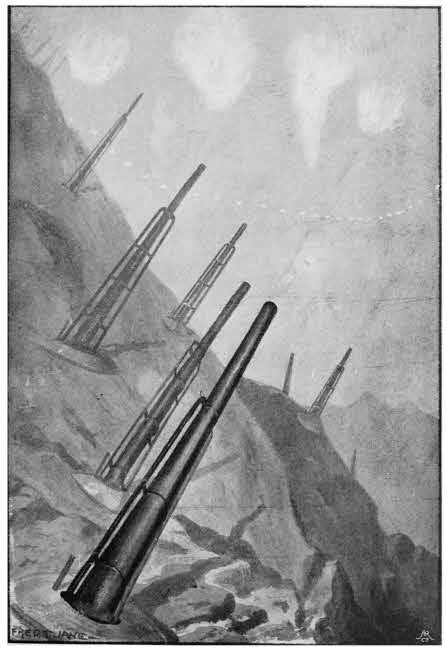
over eleven hundred feet high. On both of these elevations
were mounted batteries of guns capable of throwing projectiles
of great size and enormous explosive energy to a distance of
several miles. There were altogether twelve of these batteries
placed on various heights about the island, and the guns
composing them were mounted on swivels, which enabled them
to be trained so as to throw the projectile either into the sea or
high up into the air.
Soon after daybreak on the fourth day after Alan’s letter
had been received the outlook on Cape François, a bold mass of
basalt to the north of the outer bay, telephoned “Narwhal in
sight” to the settlement at the head of the harbour. Immediately
on this message being received the commander of
the station, named Max Ernstein, a man of about thirty-four,
and the most daring and skilful submarine navigator and
engineer in the service of the Council, went on board his own
vessel, the Cachalot, and set out to welcome the long-lost son of
the President and convey to him the commission which had
been sent out by air-ship from Aeria.
The Cachalot, which may as well be described here as elsewhere
as a type of the submarine warship of the time, was a
double-pointed cylinder, built of plates of nickelised aluminium
steel, not riveted, but electrically fused at the joints, so that
they formed a continuous mass equally impervious all over, and
presenting no seams or overlaps.
The cylinder was a hundred and fifty feet from point to
point, with a midship’s diameter of forty feet. The forward
end was armed with a sheathing of azurine, the metal peculiar
to the mines of Aeria, which would cut and pierce steel as a
diamond cuts glass. This sheathing formed a ram, which was
by no means the least formidable portion of the warship’s
armament.
The upper part of the cylinder was flattened so as to form
an oval deck forty feet long by fifteen wide. A centre section
of this deck, three feet wide, could be opened by means
of a lateral slide which allowed of the elevation of a gun
twenty-five feet long, which could be used either for discharging
torpedoes by water or for throwing projectiles through the
air.
It could be aimed and fired from below the deck without the
artillerists even seeing the objects aimed at, save in an arrangement
of mirrors, so adjusted that when the object appeared in
the centre of the lowest of them, the gun could be fired with
the certainty of the projectile reaching its mark. Four underwater
torpedo tubes, two ahead and two astern, completed the
armament of the submarine warship.
When under water the deck could be hermetically closed,
and sliding plates could be drawn over the opening of the
torpedo tubes, so that from stem to stern of the cylinder there
were no excrescences to impede the progress of the vessel
through the water with the sole exception of a dome of thick
forged glass just forward of the deck, under which stood the
helmsman, who gave place to the commander of the vessel
when she went into action. Her powerful four-bladed screw,
driven by engines almost precisely similar to those of the air-ships,
gave her a maximum speed of a hundred miles an hour.
The Cachalot ran at twenty-five miles an hour down the
harbour, and as soon as he got abreast of Cape François
Captain Ernstein, who was standing on deck, saw a small red
flag apparently rising from the waves about a mile to seaward.
A similar flag was soon flying from a movable flagstaff on
the Cachalot, and a few minutes later she was lying alongside
the Narwhal.
This vessel was a very leviathan of the deep, and as she lay
three parts submerged in the water Captain Ernstein calculated
that she could hardly be less than two hundred feet in
length and forty-five in diameter amidships. She appeared
to be built on very much the same plan as the Cachalot and of
the same materials, saving only, of course, the ram of azurine,
which was replaced by one of nickel steel.
As the Cachalot got alongside, a slide was drawn back in the
deck of the Narwhal and the head and shoulders of a man
dressed in close-fitting seal-fur appeared. It was Alan, little
changed in physical appearance since the fatal day that he
invited Olga Romanoff on board the Ithuriel, save that he had
grown a moustache and beard, which he wore trimmed somewhat
in the Elizabethan style, and that the frank, open expression
of the boy had given place to a grave, almost sad, sternness,
which marked the man who had lived and suffered.
Max Ernstein recognised him at once and saluted as though
greeting a superior officer, for, although all the Aerians were
friends and comrades, the etiquette of rank and discipline was
scrupulously observed amongst them when on active service.
“What do you salute me for?” said Alan gravely, as he
reached the deck and came to the side on which the Cachalot
lay. “Do you not see that I am no longer wearing the golden
wings? Are you the officer in command of the station?”
“Yes, Admiral Arnold,” returned the other, in the same
formal tone and at the same time presenting the letter from the
Council. “I suppose you have forgotten me. I am Max
Ernstein, in command of the naval fleet at Kerguelen. That
letter will explain why I saluted and why I have come to hand
over my command to you.”
Before he replied Alan ran his eye rapidly over the letter.
As he did so the pale bronze of his face flushed crimson for a
moment, and he turned his head away from Ernstein, brushed
his hand quickly across his eyes, and then read the letter
again more deliberately. Then he turned and said in a voice
that he vainly strove to keep steady—
“This is more than I have deserved or could expect, but
obedience is the first duty, so I accept the command. Come on
board, Ernstein; of course I recognised you, but until I knew
how I stood with the Council I looked upon myself as an outlaw,
and therefore no friend or comrade for you.”
The captain of the Cachalot had a gangway-plank brought
up and passed from one vessel to the other, and in another
moment he was standing beside Alan on the deck of the
Narwhal, and their hands were joined in a firm clasp.
“That’s the first honest hand that I have grasped for six
years, except Alexis’,” said Alan, as he returned the clasp with
a grip that showed his physical forces had been by no means
impaired by his long mental servitude. “Come down into the
cabin, we shall find him there.”
He led the way below, and as soon as Alexis had been told
the unexpected good news, which seemed to affect him even
more deeply than it had Alan, the three sat down at the table
in the saloon of the Narwhal, a plain but comfortably furnished
room, about twenty-five feet long by fifteen broad and ten high,
to discuss a plan of operations in view of the expected attack
on the station.
Alan at once assumed the authority with which he had been
invested by the Council, and made minute inquiries into the
nature and extent of the defending force at his disposal.
“I think that ought to be quite sufficient, not only to defeat,
but pretty well destroy any force that the Russians can bring
against us,” said Alan, as soon as Ernstein had finished his
description. “We have much more to fear from the air-ships
than from the submarine boats, because the Narwhal would give
a very good account of them, even by herself. Have any more
vessels of the type of the Ithuriel been built since the old
Ithuriel was lost?”
“Yes,” replied Ernstein; “but only ten, I am sorry to say.
One of them is here, as I told you just now, but we have forty
of the others, and I don’t suppose the Russians can bring more
than a dozen against us.”
“What do you mean?” said Alan. “They have fifty, every
one of them as fast and as powerful as the old Ithuriel. I
ought to know,” he continued grimly, “for they were every one
of them built under my own eyes.”
“I beg your pardon,” said Ernstein. “I ought to have told
you before now that we have already won our first victory, and
that though we lost eight vessels we destroyed twenty of the
Russians’.” And then he went on to give Alan and Alexis a
rapid description of the pursuit of the Revenge, and the havoc
wrought at the end of it by the Ithuriel and the Ariel.
“That is glorious news!” said Alan. “But they have thirty
ships at their disposal still, and I expect they will bring at
least twenty of these against us, and they are all swifter than
ours saving only the Ariel. Of course my command ends
with the shore, but I think it will be as well if the captain of
the Ariel were to come on board the Narwhal so that we could
arrange our plans of defence together—I for the sea, and he for
the air.”
“But why not come ashore and see him?” said Ernstein.
“He and all of us will be delighted to see you on the island.”
“No,” said Alan, shaking his head. “Alexis and I have
promised each other never to leave the Narwhal until the
Russian sea power is crippled. The day that we set foot on dry
land again will be the day that we give back the supremacy of
the sea to the Council, so if we two Admirals of the Sea and Air
are to meet, the commander of the Ariel must come here.”
“Very well,” said Ernstein. “I understand you. Write a
note and I will send the Cachalot back with it. She will bring
him back in under half an hour, for he was up at the settlement
when I left.”
Alan wrote the letter forthwith, and the Cachalot departed,
returning, as her captain had said, in less than half an hour,
with Edward Forrest, the commander of the Ariel. He was a
lean, wiry, active man of about forty-five, of mixed English,
Scotch, and Aerian descent, with short, crisp, curly black hair
and smooth-shaven face, rather sharp, regular features, and a
pair of keen grey eyes which seemed to look into the very
brain of the person he was talking to—a man of prompt decisions
and few words, and one of the most able aerial navigators
that Aeria could boast of.
He held the rank of admiral, and was responsible for the
station of Kerguelen, and the command of the southern seas.
He greeted Alan and Alexis courteously, but a trifle stiffly, as
though he thought that their indiscretion had been somewhat
lightly dealt with by the Council. This, however, was no
business of his, for the first law of Aeria was that the decisions
of the President and Council were not open to criticism
by any private or official citizen whatever his rank or experience.
Therefore, after reading, as a matter of form, the commission
sent to Alan and Alexis, he addressed himself at once to
the business of the moment, and before they had been discussing
the plan of defence for many minutes he was forced to
admit to himself that the President’s son, young as he was, was
more than his master both in aerial and naval tactics.
For the greater part of the morning plan after plan was
suggested, thrashed out, and either accepted or thrown aside,
and when he took his leave he shook hands with both Alan
and Alexis far more cordially than he had done in greeting, and
said with brief, blunt candour—
“This is not the first time that a woman has used a man to
upset the peace of the world, and I tell you honestly that I
once thought you had both turned traitors. I don’t think so
now, and I am heartily glad you are back. If you could only
have returned three years ago a lot of trouble might have been
saved, but I must confess that you have both learnt more in
five years than I have in twenty. I will follow your instructions
to the letter.”
“What is done is done,” said Alan, smiling, and yet with a
grave dignity that showed Admiral Forrest that, despite all that
had happened, he was standing in the presence of his master.
“The work in hand now is to regain what we have lost, and if
every man does his duty we shall do so. I think everything
is arranged now, and as we have no time to lose I will say
good-morning.”
He held out his hand as he spoke, and Admiral Forrest took
his dismissal and his leave at the same time.
Captain Ernstein took six men out of the Cachalot and
placed them at the disposal of Alan and Alexis, for the working
of the Narwhal, and then took his leave to execute his part
of the plan of defence.
It was a bitterly cold day, for the southern winter had
already set in in all its severity. The sea to the north of the
island was comparatively smooth, but swept every now and
then with violent gusts of wind from the southward. The
sky was entirely covered by thick masses of cold grey cloud,
every now and then torn up into great rolling masses by the
sudden blasts of icy wind from the pole, which drove fierce
storms of hard frozen snow across the bare and desolate
island.
But the roughness of the elements was a matter of small
concern to the crews of the air-ships and the submarine
cruisers, for both were independent alike of sea and storm.
The former could literally ride upon the wings of the fiercest
gale that ever blew. Their interiors were warm and wind-proof,
and their machinery was powerful enough to drive them
four and five times as fast as the air-currents in which they
floated, while the latter had only to sink a few feet below the
level of the waves to find perfect calm.
The days, in short, were past when men had been at the
mercy of the elements, and so the atmospheric conditions
which would have made a modern naval attack upon a rocky
and exposed coast almost impossible were not even taken into
account in preparing to meet the threatened assault on Kerguelen
Island.
No one knew when or how the first assault would be
delivered. All that was known was that, unless Olga and her
advisers had completely altered their plans, the attack would
take place either that day or the next, and consequently ceaseless
vigilance was necessary on sea and land and in the air.
In accordance with the plan arranged on board the
Narwhal, ten air-ships rose above the clouds to an altitude of
five thousand feet, and from each of these an electric thread
hung down to as many signal-stations on the island, all of
which were connected with the headquarters at the top of
Christmas Harbour.
Twenty cruisers patrolled the coast at a distance of a mile
from the land, and two miles outside these the Narwhal ran
to and fro along the northern shore. All the more important
inlets which had sufficient depth of water for submarine attack
were guarded with mines and chains of torpedoes, so disposed
that no vessel could possibly enter without firing them, and so
giving warning of the locality of the attack.
The afternoon passed without any alarm, and at nightfall
the clouds sent down a blinding storm of snow, which, added
to the intense darkness, made vision impossible both on land
and sea, although high above the clouds the ten air-ships floated
in a calm, clear atmosphere, under the brilliant constellations
of the southern hemisphere.
No attack seemed possible without warning, either by sea
or above the clouds, for the hostile air-ships could not approach
without being seen from a great distance through the clear,
starlit sky, and without their lights, which would instantly
betray their presence, it was impossible for the submarine
vessels even to find the coast.
Hour after hour passed, and still no hostile sign rewarded
the vigilance of the defenders. No one of the present day
could have guessed that all the preparations had been made
for such a battle as had never been fought before on sea or
land, or in the air.
Nothing was visible but the snow-covered earth and the
storm-swept sea, for the sentinel ships, floating far above the
clouds, were beyond the reach of vision. And yet, if the
combined fleets of the modern world had attacked Kerguelen
that night, not a ship would have escaped to tell the tale of
annihilation, so terrible were the engines of destruction which
waited but the signal of battle to strike their swift and
irresistible blows.
It was about half-past six o’clock the next morning when
Alexis, who was on watch in the conning-tower of the Narwhal,
saw a faint beam of light illuminating the water a long way
ahead. He instantly signalled to Alan—“Enemy in sight.
Back. I am going to ram.”
Alan, unwilling to leave the new crew, who were not yet
perfectly acquainted with the working of the machinery, had
taken command of the engine-room alternately with Alexis,
who was now taking his four hours’ watch in the conning-tower,
and to whom the fortune of war had given the honour of
striking the first blow. The Narwhal backed rapidly, and as she
did so Alexis turned a small wheel in the side of the conning-tower,
and the whole chamber sank into the hull of the vessel.
As soon as it stopped he pulled a lever and a heavy steel
sheet slid over the opening where the glass dome had been.
In front of him as he stood at the steering-wheel was a long,
very slender needle hung with extreme delicacy on a pivot,
up which an electric current constantly passed.
This needle was terrestrially insulated by a magnet which
always swung opposite to the magnetic pole, and when acted
upon only by the steel of the vessel’s fabric, swung indifferently
as long as there was no other vessel within a thousand yards of
the Narwhal. But the moment one came within that distance
the needle pointed towards it with unerring accuracy, as it was
doing at the present moment.
Alexis allowed the vessel to back until he saw the needle
begin to waver. Then he knew that the thousand-yard limit
had been reached, and signalled—
“Full speed ahead.”
The next moment the engines were reversed and the Narwhal
bore down on her invisible prey. The needle became
rigid again. Alexis kept it pointing dead ahead as the Narwhal
gathered way and rushed silently but with irresistible
force upon her victim.
She passed over the thousand yards in forty seconds. Then
came a dull, rending crash, a slight shiver of the mighty
fabric, and then she swept on her way as though she had
passed through a couple of inches of planking instead of the
steel hull of a submarine warship more than two-thirds her
own size.
And so in silence and darkness, without the discharge of a
gun or the flash of a shot or an audible cry of human pain, the
work of death and destruction began and ended. In the
passing of an instant a warship had been destroyed which
could have annihilated a fleet of modern battleships in detail
without once appearing above the surface of the water.
The moment that the shock told Alexis that the ram of the
Narwhal had done its work, he signalled “Stop,” and as the
vessel slowed down he watched the momentous fluctuations of
the needle in front of him. It oscillated for an instant and
then became still again, pointing to another victim hidden
away somewhere under the dark waters. He brought the
vessel round until it pointed ahead again, and then once more
the leviathan plunged forward at full speed on her errand of
destruction.
Thirty seconds later a rasping tearing sound, told him that
he had ripped the side out of a second Russian vessel; and
again he stopped, and again the fatal tell-tale needle pointed
to a mark on which he hurled his irresistible ram. So the
work went on, and vessel after vessel was torn to pieces and
sunk in the midst of the darkness and silence of the wintry
sea, without even a warning having been given either to the
consorts of the destroyed vessels or to those nearer in shore,
all of which were, of course, outside the range of the needle’s
indication. But for this fact Alexis would have been unable to
do his work, for he would not have known whether he was
ramming friend or foe.
When the ram had found its mark for the twelfth time,
the needle oscillated vaguely to and fro, showing that within
a thousand-yards radius at least there were no more victims to
be found. Then the Narwhal rose to the surface of the water,
and Alexis resumed his watch as the vessel patrolled the coast
again at a speed of fifty miles an hour.
Alan now came and relieved Alexis from his watch. As he
entered the conning-tower he said—
“How many is that you’ve settled? A dozen, isn’t it?”
“Yes,” said Alexis, “but I can hardly think they can have
been anything but scouts, and so we shall have the main fleet
to tackle yet.”
“Do you think any of them have got through?” said Alan.
“You know they may have approached from east and west as
well, and if so they are lying inside of us.”
“No,” replied Alexis, “I don’t think they would do that.
You see we have the advantage of them in this way. They
can’t see ten yards in front of them unless there is bright
sunshine on the water, or unless they turn their lights on to
the full, in which case they would betray their presence at
once.
“Then they don’t know what has become of the Narwhal,
and probably think that she has been attacked by an overwhelming
force, or blown up by some lucky torpedo. They
daren’t go inshore in force for fear of springing a mine, and
so you may depend upon it the twelve we have destroyed were
scouts, prowling about very slowly and waiting for daylight to
examine the coast and find a way into Christmas Harbour.
“They must have been in single line, and we had the luck
to catch one of the end ones first, and so we sank the lot in
the order in which they were floating. I don’t think we can
do anything more till daylight except run up and down the
coast and keep a sharp look-out to seaward and on the
needle.”
“I suppose you’re right,” said Alan. “You’d better go and
get an hour’s sleep if you can.”
“There won’t be much sleep for any of us till to-night,”
said Alexis quickly, pointing to the clouds over the island.
“Look! the row has begun in the air already.”
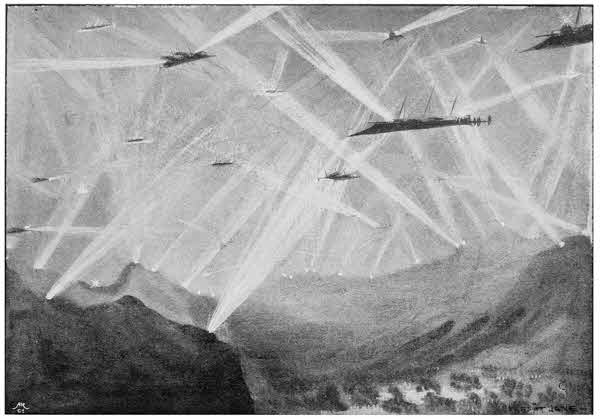
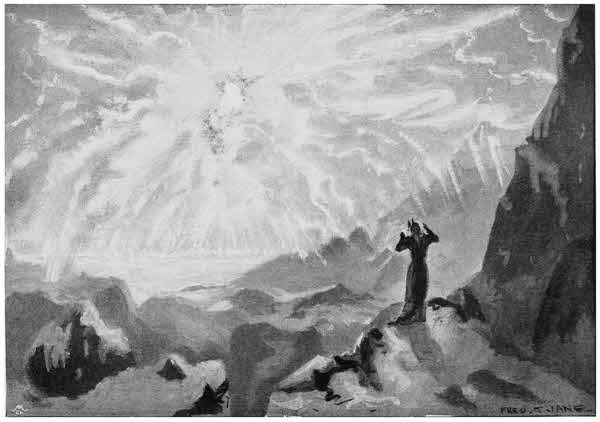
Alan glanced up and saw a series of intensely bright
flashes stream downwards through the clouds, which at the
same moment were rent and rolled up into vast shadowy
billows by some tremendous concussion of the atmosphere
above them. There could be only one explanation of this.
The attack on the island had begun from the air, and the
flashes were those of the first shots of the aerial bombardment.
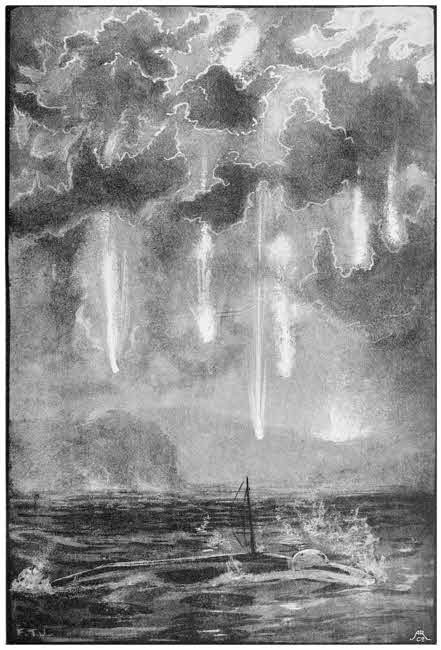
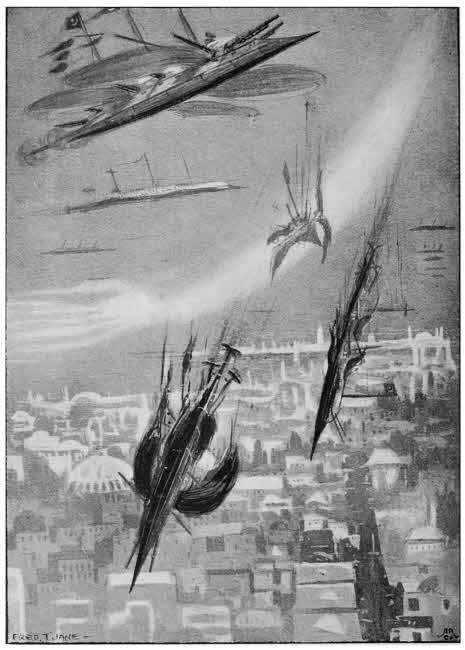
The Clouds were rent and rolled up into vast shadowy Billows.
Page 122.
What had really happened was this.
A fleet of fifty submarine warships, under the command of
Michael Lossenski, the eldest son of Orloff Lossenski, who
was now Olga Romanoff’s chief adviser in the conduct of the
war that she had commenced with the Aerians, had reached
the northern coast of Kerguelen Island about four o’clock in
the morning in order to co-operate with an aerial squadron
of fifteen vessels led by the Revenge, under the command,
nominally, of Lossenski’s second son Boris, but really of Olga
herself.
As Alexis had surmised, the twelve vessels destroyed by the
Narwhal were scouts sent out to, if possible, feel their way to
the entrance of Christmas Harbour, which was known to be
the headquarters of the station.
These were to have returned to the fleet with all the intelligence
they could get as to bearings and soundings, and the
position of mines and the defending fleet. Then at daybreak,
that is to say about eight o’clock, the whole squadron was to
have advanced to the entrance to the harbour, ramming any
of the defenders who barred their way, and then, after sending
a swarm of torpedoes into the mouth of the bay to explode the
mines and blow up any submarine defences that might exist,
to have made a rush for the inner bay at the same time that
the air-ships engaged the land defences.
The naval portion of the programme was completely frustrated
by the destruction of the scouts, while the aerial attack
was foiled by the look-outs stationed above the clouds. Soon
after seven it became light enough at their altitude for the
powerful glasses of their commanders to make out the fifteen
Russian air-ships coming up from the southward at a distance
of about twenty miles.
A few minutes later they were themselves discovered by the
Russians, and Olga, to her intense chagrin, saw at a glance
that all hope of a surprise was gone. By some means or other
the Aerians had received intelligence of the attack, and were
ready for it.
The terrible experience taught by the disaster of Antarctica
warned her and her lieutenants that any approach, now that
they were seen, must be made with the utmost caution, for
they had no precise knowledge as to the range of the Aerian
guns. All they knew was that it was very great, and that
where one of their projectiles found its mark destruction
followed instantly.
Added to this, there was another difficulty. The dense
masses of cloud completely hid both sea and land from their
view, and made accurate shooting at the land defences impossible.
Consequently there was nothing for it but to fight the
battle out in the upper regions of the air, against a force of
whose actual strength they were ignorant. They dare not
attempt to surround the ten air-ships, which hung stationary
over the island, for this meant bringing all their guns into
play, while they could only use half of their own.
While they were debating on a plan of operations, two new
factors in the coming struggle were swiftly and unexpectedly
brought into play. As soon as the news of their arrival had
been telegraphed to headquarters, the Ariel took the air and
passed under the clouds to the rear of the Russian squadron.
Ten miles behind them, she swept round sharply, and with her
wings inclined to the utmost, and her engines working at the
fullest capacity, she took a mighty upward swoop, passed
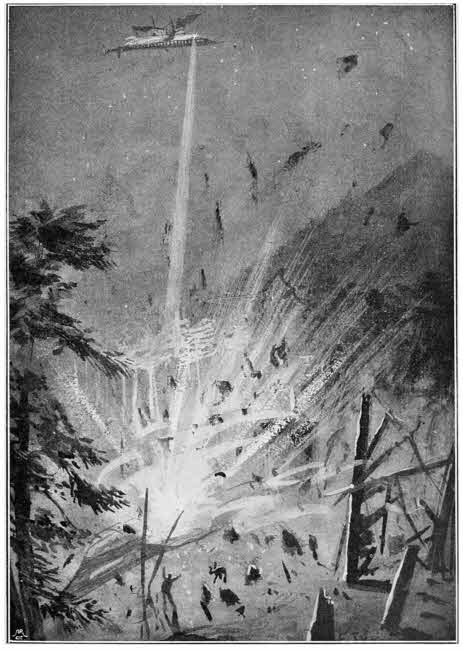
through the clouds like a flash of light, and before the
Russians knew what had happened, she was floating three
thousand feet above them, out of reach of their guns, and
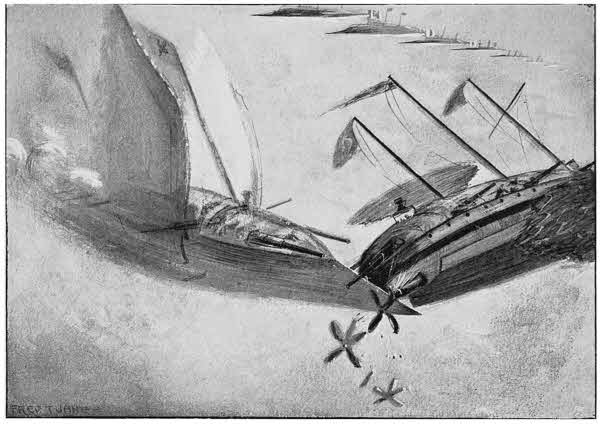
hurling projectile after projectile into their midst. Three
of their ships, struck almost simultaneously, were torn into
a thousand fragments, and vanished through the clouds.
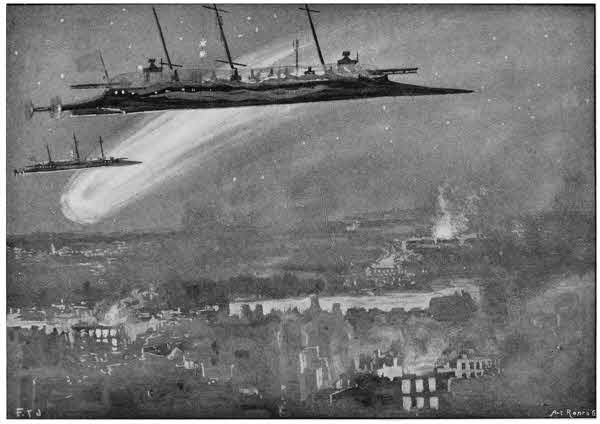
It was the glare and shock of this explosion that Alexis had
seen from the conning-tower of the Narwhal. The remaining
Russian ships instantly scattered and sank through the clouds
to seek a refuge from the foe whose deadly blows they were
completely unable to return.
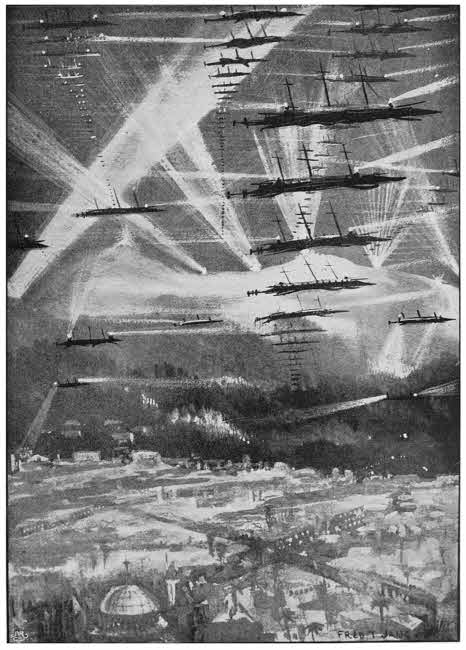
But the moment they appeared on the under-side of the
cloud-sea, all the guns of the land batteries opened fire in all
directions with time-shells, and so rapid were the discharges,
and so terrible the energy of the explosives, that the whole
firmament above the island seemed ablaze with them, while
the concussions of the nether atmosphere were so tremendous
and continuous, that it would have been madness for the
Russian air-ships to have approached within the zone of fire with
which the Aerians had covered and encircled their positions.
The clouds were torn and broken up into vast whirling
masses, which completely obscured the view of the Russians,
and rendered anything like accurate shooting in the direction
of the island impossible. Worse than this, the range of the
great land guns, fired at an elevation of forty-five degrees, was
so enormous that they were forced by the incessantly exploding
projectiles, which were hurled up into the air in all directions,
to retire to a distance which, beyond the most random
shooting, the results of which were spent upon the rocks of the
island and the sea, rendered their own guns useless.
Rise up through the clouds they dare not, for they knew
the Ariel was still there, and that the first ship that showed
herself would be an almost helpless mark for one of the ten
guns which, for the time being, commanded the heavens. There
seemed nothing for it but an ignominious retreat, for, as Boris
Lossenski said to Olga when, furious with rage and mortification,
she reproached him with a lack both of skill and courage,
an attack upon a volcano in full eruption would have been
child’s play to an assault at close quarters on Kerguelen
Island.
Their one hope of success had lain in a surprise, and that,
by some unaccountable means, had been made impossible.
They had reckoned only on the air-ships and the submarine
defences, and even these they had expected to take unawares.
The terrible power of the battery guns, which were able to
spread their seas of fire through the air and to shake the very
firmament itself with their projectiles, had been a revelation
to them.
They could not train their own guns without seeing their
mark, and neither flame nor smoke betrayed the position of
the batteries, while on the other hand the artillerists on the
island had simply to surround the station with a zone of fire
and a continuous series of atmospheric convulsions through
which no air-ship could have passed without the risk of overturning
or completely collapsing.
So Olga was at last convinced that her choice lay between
abandonment of the attack or running the gauntlet of fire
in the almost forlorn hope of engaging the land batteries and
an aerial fleet of unknown strength at close quarters.
Baffled and defeated, and yet convinced that to continue
the unequal contest under its present conditions would be
merely to court still more disastrous defeat, and even probable
destruction, Olga at last allowed Lossenski to give the signal
for retreat, and the Russian squadron withdrew to a position
twelve miles northward of the island. Its departure was seen
both from the air and the land, and the cannonade immediately
stopped.
Meanwhile Alan had run the Narwhal into the mouth of
Christmas Harbour flying his red flag. He was met by the
Cachalot, and, after telling Captain Ernstein what he had done,
and learning of the repulse of the Russians in the aerial battle,
he directed forty of the submarine vessels to follow him out to
sea to look for the Russian flotilla.
All the craft were furnished with tell-tale needles similar
to the one on board the Narwhal, for it is impossible to see a
sufficient distance under water to effectively attack an enemy
as agile as the submarine warships were, and this fact had
led to the universal employment of the needles.
As it was now quite light, the whole Aerian squadron, with
the exception of five vessels whose duty it was to act as scouts
under water, proceeded seaward on the surface of the waves,
keeping a sharp look-out for the remains of the Russian fleet,
which they soon discovered lying about five miles off the
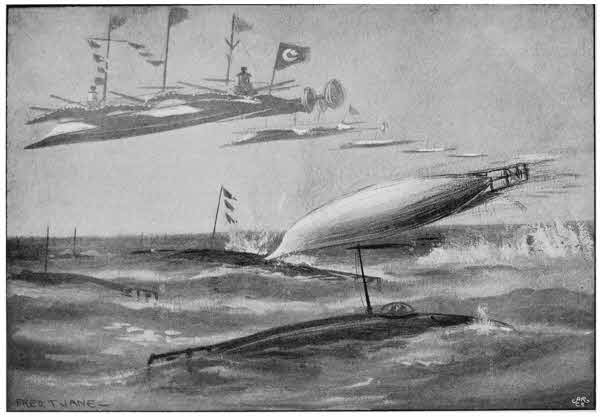
island. They could make out thirty-five of the long, black,
half-submerged hulls lying together like a school of whales
with the waves breaking over them as over sunken rocks.
Alan immediately signalled from his conning-tower in the
manual sign-language, used by the Aerians to communicate
between their air-ships, to his consorts, and ordered them to
scatter and form a wide circle round the Russian squadron at
a distance of a mile, and a depth of two fathoms, but on no
account to approach within a thousand yards of them. When
they had reached their positions they were to rise to the surface
and each was to discharge a couple of torpedoes towards
the centre of the circle. After that they were to retire and
leave the rest to him.
The moment the order had been passed through the fleet,
everyone of the vessels disappeared and proceeded to her
station. The Narwhal sank at the same time until nothing but
the glass dome of her conning-tower remained above the water.
By carefully noting the course steered by the compass, and
accurately measuring the distance travelled by the number of
revolutions of the propeller, each captain was able to place his
craft in the desired position.
So perfectly, indeed, was the manœuvre performed that
when the vessels rose to the surface they formed a circle two
miles in diameter, in the centre of which lay, within a space
of about two hundred yards square, the Russian flotilla, the
commanders of which, afraid to advance nearer to the shore
without the intelligence which they still awaited from their
scouts, and confounded by the awful spectacle presented by
the aerial battle, of the issue of which they were utterly
ignorant, were waiting in bewilderment and indecision the
issue of the events which had taken such a marvellous and
unexpected turn.
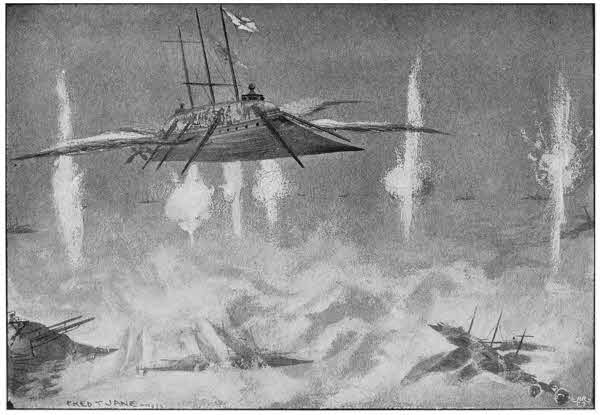
The manœuvre ordered by Alan had been executed so
promptly and secretly that the Russians were not even aware
that they were surrounded until torpedo after torpedo, coming
in from all points of the compass, began exploding in their
midst, hurling vast masses of water and foam up into the air,
tearing their plates and crippling their propellers, and disabling
half their number before they had time to recover
from the confusion into which the sudden attack had thrown
them.
To communicate signals from one vessel to another under
such circumstances was impossible, and so united action was
out of the question. All that the captains of the vessels could
see was that there were enemies upon all sides of them. The
explosion of the eighty torpedoes had churned the water up
into a mass of seething foam, in the midst of which fifteen
vessels were lying crippled and helpless on the surface, while
six more had been sent to the bottom.
This was bad enough, but while the captains of those which
had escaped were recovering from the stupefaction into which
this sudden disaster had thrown them Alan saw his chance,
and as soon as the last torpedo had exploded headed the
Narwhal full speed into the midst of them. Then followed a
scene which would have beggared all description.
The great ship, moving at a speed of nearly three miles a
minute, tore her way through the half-crippled squadron,
hurling everything she struck to the bottom of the sea. Every
Russian vessel that was able to do so after the first assault
sank out of the way of the terrible ram of the Narwhal and
headed off at full speed into the open sea.
But for those that were partially or wholly disabled there
was no escape. Alan standing in his conning-tower, his
teeth clenched and his blue eyes almost black with the fierce
passion of battle and revenge, whirled his steering-wheel this
way and that, and as the steel monster swung round in rapid
curves in obedience to the rudder, he hurled her again and
again upon his practically helpless victims, piercing them
through and through as though their plates had been cardboard
instead of steel.
When the last one had gone down he left the conning-tower,
hoisted his flagstaff, and flew a signal to his consorts
to return to harbour. What had become of the Russian
vessels that had escaped he neither knew nor, for the present,
cared.
The victory of the Aerians both at sea and in the air was
complete, and he was certain that the Russians had received
such a lesson as would convince them that Kerguelen Island
was impregnable to any assault that they could make upon it,
unless they were able to take its defenders by surprise—a contingency
which was justly considered impossible.