Not many of us remember Otterbourne before the Railroad, the
Church, or the Penny Post. It may be pleasant to some of us
to try to catch a few recollections before all those who can tell
us anything about those times are quite gone.
To begin with the first that is known about it, or rather that
is guessed. A part of a Roman road has been traced in
Otterbourne Park, and near it was found a piece of a quern, one
of the old stones of a hand mill, such as was used in ancient
times for grinding corn; so that the place must have been
inhabited at least seventeen hundred years ago. In the last
century a medallion bearing the head of a Roman Emperor was found
here, sixteen feet beneath the surface. It seems to be one
of the medallions that were placed below the Eagle on the Roman
Standards, and it is still in the possession of the family of
Fitt, of Westley.
After the Roman and British times were over, this part of the
country belonged to Wessex, the kingdom of the West Saxons, of
which Winchester was the capital. Lying so near the chief
town, which was the Bishop’s throne, this place was likely
soon to be made into a parish, when Archbishop Theodore divided
England in dioceses and parishes, just twelve hundred years ago,
for he died 690. The name no doubt means the village of the
Otters, and even now these creatures are sometimes seen in the
Itchen, so that no doubt there were once many
more of them. The shapes and sizes of most of our parishes
were fixed by those of the estates of the Lords who first built
the Church for themselves and their households, with the churls
and serfs on their manor. The first Lord of Otterbourne
must have had a very long narrow property, to judge by the form
of the parish, which is at least three miles long, and nowhere a
mile in breadth. Most likely he wanted to secure as much of
the river and meadow land as he could, with some high open heathy
ground on the hill as common land where the cattle could graze,
and some wood to supply timber and fuel. Probably all the
slopes of the hills on each side of the valley of the Otter were
covered with wood. The top of the gravelly hill to the
southward was all heather and furze, as indeed it is still, and
this reached all the way to Southampton and the Forest. The
whole district was called Itene or Itchen, like the river.
The name meant in the old English language, the Giant’s
Forest and the Giant’s Wood.
The hill to the north was, as it still remains, chalk
down. The village lay near the river and the stream that
runs into it, upon the bed of clay between the chalk and the
gravel. Most likely the Moathouse was then in existence,
though a very different building from what it is at present, and
its moat very deep and full of water, serving as a real
defence. There is nothing left but broad hedge rows of the
woods to the north-east, but one of these is called Dane Lane,
and is said to be the road by which the Danes made their way to
Winchester, being then a woodland path. It is said that
whenever the yellow cow wheat grows freely the land has never
been cultivated.
There was a hamlet at Boyatt, for both it and Otterbourne are
mentioned in Domesday Book. This is the great census that
William the Conqueror caused to be taken 1083 of all his
kingdom. From it we learn that Otterbourne had a Church
which belonged to Roger de Montgomery, a great Norman baron,
whose father had been a friend of William I.
Well for the parish that it lay at a distance from the
Giant’s Wood, where the King turned out all the inhabitants
for the sake of his “high deer,” making it the
New Forest. He and his sons could ride through down and
heath all the way to their hunting. We all know how William
Rufus was brought back from his last hunt, lying dead in the
charcoal burner Purkis’s cart, in which he was carried to
his grave in Winchester Cathedral. Part of the road between
Hursley and Otterbourne, near Silkstede, is called King’s
Lane, because it is said to have been the way by which this
strange hearse travelled.
Silkstede is a farm now—it was most likely a grange, or
outlying house belonging to some monastery—and there is a
remnant of the gardens and some fine trees, and a hollow called
China Dell, where snowdrops and double daffodils grow. But
this is in Hursley parish, as is also Merdon Castle.
The green mounds and deep trenches, and the fragments of
ruinous wall, have a story reaching far back into the ages.
There is little doubt, from their outline, that once there was
an entrenched camp of the Romans on this ground, but nothing is
known thereof. Merantune, as our Saxon ancestors called it,
first is heard of when in 755 Cynewolf, King of Wessex, was
murdered there by his kinsman Cyneheard, who was in his turn
killed by the Thanes of the victim. With this savage story
it first appears, but no more is known of its fate except that it
became the property of the Bishops of Winchester, some say by the
grant of Cynegyls, the first Christian King of Wessex, others by
a later gift. It was then a manor, to which Hurstleigh, the
woodland, was only an appendage; and the curious old manorial
rights and customs plainly go back to these ancient
præ-Norman times. To go through all the thirty
customs would be impossible, but it is worth noting that the
tenure of the lands descended by right to the youngest son in a
family instead of the eldest. Such “cradle
fiefs” exist in other parts of England, and in Switzerland,
on the principle that the elder ones go out into the world while
their father is vigorous, but the youngest is the stay of his old
age. The rents were at first paid in kind or in labour,
with a heriot, namely, the most valuable animal in stock on a
death, but these became latterly commuted for
quit rent and fines. The trees were carefully
guarded. Only one good timber tree on each holding in the
life-time of a tenant might be cut by the Lord of the Manor, and
the tenants themselves might only cut old rotten trees! But
this is as much as you will wish to hear of these old customs,
which prove that the Norman feudal system was kept out of this
Episcopal manor. It was not even mentioned in Domesday
Book, near as it was to Winchester. There it lay,
peacefully on its island of chalk down, shut in by the
well-preserved trees, till Stephen’s brother, Bishop Henry
de Blois, of Winchester, bethought him of turning the old Roman
Camp into a fortified castle. The three Norman kings had
wisely hindered the building of castles, but these sprung up like
mushrooms under the feeble rule of Stephen.
The tenants must have toiled hard, judging by the massiveness
of the small remnant, all built of the only material at hand,
chalk to make mortar, in which flints are imbedded.
This fragment still standing used to be considered as part of
the keep, but of late years better knowledge of the architecture
of castles has led to the belief that it was part of the northern
gateway tower. I borrow the description of the building
from one written immediately after the comments of a gentleman
who had studied the subject.
Henry de Blois, King Stephen’s brother, Bishop of
Winchester, probably wished for a stronghold near at hand, during
his brother’s wars with the Empress Maud. He would
have begun by having the nearly circular embankment thrown up
with a parapet along the top, and in the ditch thus formed a
stockade of sharp pointed stakes. Within the court, the
well, 300 feet deep, was dug, and round it would have been the
buildings needed by the Bishop, his household and guards, much
crowded together. The entrance would have been a
drawbridge, across the great ditch, which on this side was not
less than 60 feet wide and perhaps 25 deep, and through a great
gateway between two high square towers which must have stood
where now there is a slope leading down from the inner court,
into the southern one. This slope is probably
formed by the ruins of the gateway and tower being pitched into
the ditch.
The Castle was then very small, and did not command the
country except towards the south. The next work therefore
would be to throw out an embankment to the south, with a ditch
outside. The great gap whence Hursley House is seen, did
not then exist, but there was an unbroken semicircle of rampart
and ditch, which would protect a large number of men. In
case of an enemy forcing this place, the defenders could retreat
into the Castle by the drawbridge.
The entrance was on the eastern side, and in order to protect
this and the back (or northern side) of the Castle, an embankment
was thrown up outside the first moat, and with an outer moat of
its own. Then, as, in case of this being carried by the
enemy the defenders would be cut off from the main southern
gateway, a square tower was built on this outer embankment
exactly opposite to the ruin which yet remains, and only divided
from it by the great ditch. On either side of the tower,
cutting the embankment across therefore at right angles, was a
little ditch spanned by a drawbridge, which, if the defenders
found it necessary to retire to the tower, could at any time be
raised. The foundations of the tower and the position of
the ditch can still be distinctly traced.
Supposing farther that it became impossible to hold the tower,
the besieged could retreat into the main body of the Castle by
another drawbridge across the great ditch. This would lead
them through the arch which can still be seen in the ruin, though
it is partially blocked up. The room on the east side of
this passage was probably a guard room.
These are all the remains. The embankments to the south
and west command a great extent of country, and on the north and
northwest, we trace the precautions by the great depth of the
ditch, and steepness of the earthworks, though now overgrown with
trees. All this must have been done between the years 1138
and 1154, and great part of the defences were thrown down in the
lifetime of the founder. Merdon was not
destined to shine in sieges, in spite of its strength.
Henry II came in, and forbad the multiplication of castles and
Merdon seems to have been dismantled as quickly as it had been
built.
The Bishops of Winchester however still seem to have resided
there from time to time, though it gradually fell into decay, and
was ruinous by the end of the Plantagenet period.
After the younger Oliver’s death, his sisters
endeavoured to obtain the Hursley property to which their father
had succeeded as his son’s heir. He was past eighty
and the judge allowed him to wear his hat at the trial in court,
an act of consideration commended by Queen Anne.
After his death, in 1708, the estate was sold to the Heathcote
family. The old house, whose foundations can be traced on
the lawn, and which was approached by the two avenues of walnut
trees still standing, was then pulled down, and the present one
erected.
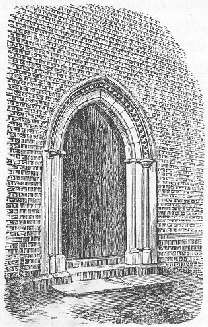
Most likely the oldest thing in Otterbourne is the arch that
forms the doorway of the Boys’ School, and which came from
the door of the Old Church. By the carving on that arch,
and the form of the little clustered columns that support it, we
can tell that it must have been put up about the time of King
Richard I or King John, somewhere about the year 1200.
There was certainly a church before this date, but most likely
this was the first time that much pains had been taken about its
beauty, and carved stone had been brought from a distance.
It was a good spot that was chosen, lying a little above
the meadows, and not far from the moated Manor House. The
east wall of the nave is still standing, but it now forms the
west wall of the small remnant that is still covered in. It
still has three arches in it, to lead to the old chancel, and
above those arches there were some paintings. They came to
light when the Old Church was pulled down. First, a great
deal of plaster and whitewash came off. Then appeared part
of the Commandments in Old English black letter, and below that,
again, were some paintings, traced out in red upon the
wall. They have been defaced so much that all that could be
found out was that there was a quatrefoil shape within a
square. The corners were filled up apparently with the
emblems of the Four Cherubim, though only the Winged Ox showed
plainly. There was a sitting figure in the centre, with the
hand raised, and it was thought to be a very rude representation
of our Blessed Lord in Judgment. In another compartment was
an outline of a man, and another in a hairy garment, so that this
last may have been intended for the Baptism of our Blessed
Lord. Unfortunately, being on the outside wall, there was
no means of protecting these curious paintings, and, sad to say,
one evening, I myself saw a party of rough boys standing in a row
throwing stones at them. There being a pathway through the
churchyard, it was not possible to keep them out, and thus these
curious remains have been destroyed.
We may think of the people who resorted to the little Old
Church as wearing long gowns both men and women, on Sunday, spun,
woven, and dyed blue at home, most likely with woad, a plant like
mignonette which still grows in the lanes. The gentry were
in gayer colours, but most likely none lived nearer than
Winchester, and it was only when they plodded into market that
the people would see the long-hanging sleeves, the pointed hoods,
and the queer long-toed shoes of the young gentlemen, or the
towers that the ladies put on their heads.
The name of Otterbourne does not come forward in history, but,
as it lies so near Winchester, it must have had some share in
what happened in the Cathedral city. The next thing we know
about it is that Bishop Edyngton joined it to
Hursley. William de Edyngton was Bishop of Winchester in
the middle part of the reign of Edward III, from 1357 to
1366. Bishop de Pontissara founded a College at Winchester
called St. Elizabeth’s, and to assist in providing for the
expenses, he decreed that the greater tithes of Hursley, those of
the corn fields, should be paid to the Dean and Chapter, and that
the rest of the tithe should go to the Vicar. Then, lest
the Vicar should be too poor, Otterbourne was to be joined with
Hursley, and held by the same parish priest, and this arrangement
lasted for five hundred years. It was made in times when
there was little heed taken to the real good of country
places. The arrangement was confirmed by his successor,
Bishop Edyngton, who lies buried in the nave of Winchester
Cathedral, not far from where lies the much greater man who
succeeded him. William of Wykeham went on with the work
Edyngton had begun, and built the pillars of the Cathedral nave
as we now see them. He also founded the two Colleges of St.
Mary, one at Winchester for 70 boys, one at Oxford to receive the
scholars as they grew older, meaning that they should be trained
up to become priests. It seems that the old name of the
field where the college stands was Otterbourne meadow, and that
it was bought of a Master Dummer. Bishop Wykeham’s
College at Oxford is still called New College, though there are
now many much newer. One small estate at Otterbourne was
given by him to help to endow Winchester College, to which it
still belongs.
Good men had come to think that founding colleges was the very
best thing they could do for the benefit of the Church, and
William of Waynflete, who was made Bishop of Winchester in 1447,
founded another college at Oxford in honour of St. Mary
Magdalen. To this College he gave large estates for its
maintenance, and in especial a very large portion of our long,
narrow parish of Otterbourne. Ever since his time, two of
the Fellows of Magdalen, if not the President himself, have come
with the Steward, on a progress through the estates every year to
hold their Court and give audit to all who hold lands of them Till quite recently the Court was always held at the
Manor House, the old Moat House, which must once have been the
principal house in the parish, though now it is so much gone to
decay. Old Dr. Plank, the President of Magdalen, used to
come thither in Farmer Colson’s time. What used to be
the principal room has a short staircase leading to it, and in
the wainscot over the fire-place is a curious old picture,
painted, I fancy, between 1600 and 1700, showing a fight between
turbaned men and European soldiers, most likely Turks and
Austrians. It is a pity that it cannot tell its
history. The moat goes all round the house, garden, and
farmyard, and no doubt used to have a drawbridge. Forty or
fifty years ago, it was clear and had fish in it, but the bridge
fell in and choked the stream, and since that it has become full
of reeds and a mere swamp. It must have been a really
useful protection in the evil times of the Wars of the Roses.
Most likely the Commandments were painted over the old fresco
on the east wall of the nave of the old Church either in the time
of Edward VI, or Elizabeth, for if they had been later, the
letters would not have been Old English. The foreigners who
meddled so much with our Church in the latter years of Edward VI
obtained that the Holy Communion should not be celebrated in the
chancels, but that the Holy Table should be spread in the body of
the Church, and many Chancels were thus disused and became
ruinous, as ours most certainly did at some time or other.
St. Elizabeth’s College was broken up and the place where
it stood given to the college of St. Mary. It is still
called Elizabeth Meadow. The presentation to the Cure of
our two parishes went with the estate of Hursley.
There was a very odd scene somewhere between Winchester and
Southampton in the year 1554. Queen Mary Tudor was waiting
at Winchester for her bridegroom, Philip of Spain. He
landed at Southampton on the morning of the 20th of July, and set
out in a black velvet dress, red cloak, and black velvet hat,
with a splendid train of gentlemen to ride to Winchester.
It was a very wet day, and the Queen sent a gentleman with a ring
from her, to beg him to come no farther in
the rain. But the gentleman knew no Spanish, and the King
no English. So Philip thought some warning of treachery was
meant, and halted in great doubt and difficulty till the
messenger recollected his French, and said in that tongue, that
the Queen was only afraid of his Grace’s getting wet.
So on went Philip, and the High Sheriff of Hampshire rode before
him with a long white wand in his hand, and his hat off, the rain
running in streams off his bare head. They went so slowly
as not to reach Winchester till six or seven o’clock in the
evening, so that the people of Otterbourne, Compton, and Twyford
must have had a good view of the Spanish Prince who was so
unwelcome to them all.
Thomas Sternhold, who together with Hopkins put the Psalms
into metre for singing, lived in the outskirts of Hursley.
When the plunder of the Monasteries was exhausted, the Tudor
Sovereigns, or perhaps their favourites, took themselves to
exacting gifts and grants from the Bishops, and thus Poynet who
was intended in the stead of Gardiner gave Merdon to Edward VI,
who presented it to Sir Philip Hobby. It was recovered by
Bishop Gardiner, but granted back again by Queen Elizabeth.
Sir Philip is believed to have first built a mansion at Hursley,
and his nephew sold the place to Sir Thomas Clarke, who was
apparently a hard lord of the manor. His tenants still had
to labour at his crops instead of paying rent, but provisions had
to be found them. About the year 1600, on the arrival of a
hogshead of porridge, unsavoury and full of worms, the reapers
struck, and their part was taken by Mr. Robert Coram, who then
owned Cranbury, so hotly that he and Mr. Pye, Sir Thomas
Clarke’s steward, rode at one another through the wheat
with drawn daggers. Lady Clarke yielded, and cooked two or
three bacon-hogs for the reapers.
The old road from Winchester to Southampton then went along
what we now call the Old Hollow, leading from Shawford Down to
Oakwood. Then it seems to have gone along towards the old
Church, its course being still marked by the long narrow meadows,
called the Jar Mead and Hundred Acres, or, more
properly, Under an Acre. Then it led down to the ford at
Brambridge, for there was then no canal to be crossed. The
only great personage who was likely to have come along this road
in the early 17th century was King James the First’s wife,
Queen Anne of Denmark, who spent a winter at the old Castle of
Winchester, and was dreadfully dull there, though the ladies
tried to amuse her by all sorts of games, among which one was
called “Rise, Pig, and Go.”
James I gave us one of the best of Bishops, Lancelot Andrewes
by name, who wrote a beautiful book of devotions. He lived
on to the time of Charles I, and did much to get the ruins made
in the bad days round Winchester Cathedral cleared and set to
rights. Most likely he saw that the orders for putting the
altars back into their right places were carried out, and very
likely the chancel was then mended, but with no attention to
architecture, for the head of the east window was built up anyhow
with broken bits of tracery from a larger and handsomer
one. The heir of the Clarkes sold the property at Hursley
to Mr. Mayor, to whose only daughter Oliver Cromwell married his
son Richard.
What happened here in the Great Rebellion we do not
know. An iron ball was once dug up in the grounds at
Otterbourne House, which may have come from Oliver’s
Battery; but it is also said to be only the knob of an old pump
handle—
“When
from the guarded down
Fierce Cromwell’s rebel soldiery kept watch o’er
Wykeham’s town.
They spoiled the tombs of valiant men, warrior, and saint, and
sage;
But at the tomb of Wykeham good angels quenched their
rage.”
Colonel Nathanael Fiennes prevented harm from being done to
the College or the monuments in the Cathedral; but there was some
talk of destroying that holy place, for I have seen a petition
from the citizens of Winchester that it might be spared. It
is said that some loyal person took out all the stained glass in
the great west window, hid it in a chest, and buried it; but when
better times came, it could not be restored to what it was
before, and was put in confusedly, as we now see it.
Stoneham had a brave old clergyman, who kept possession
of his church and rectory all through the war, and went on with
the service till he died, no man daring to meddle with him.
But Otterbourne was sure to follow the fate of Hursley. The
King’s Head Inn at Hursley is thought to have been so
called in allusion to the death of King Charles I. A
strange compliment to the Cromwells.
Richard had a large family, most of whom died young, as may be
seen on their monument in Hursley Church. It was at this
time that the customs of the Manor were put on record in
writing. The son, Oliver, lived till 1705, and was
confounded in the country people’s minds with his
grandfather.
There is an odd, wild story, that Cromwell sunk all his
treasure in the great well at Merdon Castle, in Hursley Park, 300
feet deep. It was further said, if it were drawn up again,
that no one must speak till it was safe, otherwise it would be
lost. A great chest was raised to the mouth of the well,
when one of the men said, “Here it comes!” The
rope broke, it fell back, and no one ever saw it more. Most
likely this is an old legend belonging to the Castle long before,
and only connected with Oliver Cromwell because he was an
historical person. Certain it is that when the well was
cleared out about 30 or 40 years ago nothing was found but two
curious old candlesticks, and a great number of pins, which had
been thrown down because they caused those curious reverberations
in the great depth. Another legend is that Merdon Well is
connected with the beautiful clear spring at Otterbourne called
Pole Hole or Pool Hole, so that when a couple of ducks were
thrown down the well, they came out at Pole Hole with all their
feathers scraped off.
It was in the time of the Commonwealth, in 1653, that our
first parish register begins. Some parishes have much older
ones, so, perhaps, ours may have been destroyed. The first
entry in this old parchment book is that Elizabeth, daughter of
Edward Cox, of Otterbourne, and Anne, his wife, was born
---. A large stain has made the rest of this entry
illegible. There are only three births in 1653, and
seven in 1654, one of these William, son of Mr. William Downe, of
Otterbourne Farm, and Joane, his wife, is, however, marked with
two black lines beneath the entry, as are his sisters, Elizabeth
and Jane, 1656 and 1658, apparently to do honour to the principal
inhabitant.
It is to be observed that all the entries here are of births,
not of baptisms, departing from the general rule of Church
registers, and they are all in English; but in 1663 each child is
recorded as baptized, and the Latin language is used. This
looks much as if a regular clergyman, a scholar, too, had, after
the Restoration, become curate of the parish. He does not
sign his registers, so we do not know his name. In 1653 the
banns of William Downe and Jane Newman were published September
17th and the two Lord’s Days ensuing, but their wedding is
not entered, and the first marriage recorded is that of Matthew
Dummer and Jane Burt, in 1663. The first funeral was
Emelin, wife of Robert Purser, in 1653.
Also, there was plenty of brick-making, for King Charles II
had planned to build a grand palace at Winchester on the model of
the great French palace of Versailles, and it is said that Dell
copse was formed by the digging out of bricks for the
purpose. It was to reach all over the downs, with fountains
and water playing in them, and a great tower on Oliver’s
Battery, with a light to guide the ships in the Channel.
There is a story that Charles, who was a capital walker,
sometimes walked over from Southampton to look at his
buildings. One of the gentlemen who attended him let the
people at Twyford know who was going that way. So they all
turned out to look at him, which was what the King by no means
wished. So he avoided them, and punished his indiscreet
courtier by taking a run and crossing one of the broad streams
with a flying leap, then proceeding on to Winchester, leaving his
attendant to follow as best he might.
After all only one wing of the intended palace was
built. For a long time it was called the King’s
House, but now it is only known as the Barracks. The work
must have led to an increase in the population, for more
baptisms are recorded in the register, though not more than six
or seven in each year, all carefully set down in Latin, though
with no officiating minister named. There is an Augustine
Thomas, who seems to have had a large family, and who probably
was the owner of the ground on which the vicarage now stands, the
name of which used to be Thomas’s Bargain.
There must have been a great quickening of activity in
Otterbourne soon after the Restoration, for it was then that the
Itchen canal or barge river, as it used to be called, was dug, to
convey coals from Southampton, and, of course, this much improved
the irrigation of the water meadows. This canal was one of
the first made in England, and was very valuable for nearly two
hundred years, until the time of railways.
In 1690, a larger parchment register was provided, and every
two years it appears to have been shown up to the magistrates at
the Petty Sessions, and signed by two of them.
At this time there seem to have been some repairs of the
church. Certainly, a great square board painted with the
royal arms was then erected, for it bore the date 1698, and the
initials “W. M.” for William and Mary. There it
was, on a beam, above the chancel arch, and the lion and unicorn
on either side, the first with a huge tongue hanging out at the
corner of his mouth, looking very complacent, as though he were
displaying the royal arms, the unicorn slim and dapper with a
chain hanging from his neck.
Several of our old surnames appear about this time, Cox,
Comley, Collins, Goodchild, Woods, Wareham. John Newcombe,
Rector of Otterbourne, who afterwards became Bishop of Llandaff,
signs his register carefully, but drops the Latin, as various
names may be mentioned, Scientia, or Science Olden, Philadelphia
Comley, and Dennis Winter, who married William Westgate.
Anne and Abraham were the twin children of John and Anne Didimus,
in 1741.
The first church rate book only begins in 1776, but it is
curious as showing to whom the land then belonged. The
spelling is also odd, and as the handwriting is beautiful,
so there is no doubt that it really is an account of the Church
Raiting, nor that the “rait” was
“mead.” Walter Smythe, Esquire, of Brambridge,
appears, also John Colson John Comley, and Charles Vine.
Lincolns belonged to Mr. Kentish and Gun Plot to Thilman.
The expenditure begins thus:—April 9, 1776, “Pd.
Short for 6 dozen sparw heds,” and the sparw heds are
repeated all down the page, varied with what would shock the H.
H.—3d. for foxheads. Also “expenses ad
visitation” 9s. 6d., and at the bottom of the
page, the parish is thus mentioned as creditor “out of
pockets, 5s. 1d.” In 1777 however,
though the vestry paid “Didums 1 badger’s head, 1
polecat’s head; Hary Bell for 2 marten cats, and spares
innumerable, and the clarck warges, £1. 5s., there
was £1. 3s. in hand.” The polecats and
marten cats were soon exterminated, but foxes, hedgehogs, and
sparrows continue to appear, though in improved spelling, till
April 24th, 1832, when this entry appears:—“At a
meeting called to elect new Churchwardens, present the Rev. R.
Shuckburgh, curate, and only one other person present, the
meeting is adjourned. Mr. Shuckburgh protests most strongly
against the disgraceful custom of appropriating money collected
for Church rates towards destroying vermin on the
farms.” And this put an end to the custom.
However, there were more rightful expenses. Before Easter
there is paid “for washan the surples”
4s. It would seem that the Holy Communion was
celebrated four times a year, and that the Elements were paid for
every time at 3s. 7d. In 1784, when there was
a great improvement in spelling, there were some repairs
done—“Paid for Communion cloth, 10 pence, and for
washing and marking it, 6p.” In 1786 there was a new
church bell, costing £5. 5s. 10d. Aaron
Chalk, whom some of the elder inhabitants may remember, a very
feeble old man walking with two sticks, was in that year one of
the foremost traders in sparrow heads. It gives a curious
sense of the lapse of time to think of those tottering limbs
active in bird catching.
May 2, in 1783, we find the entry “paid for the caraidge
of the old bell and the new one downe from
London, 11s. 10d. May 22—Paid William
Branding bill for hanging the new bell, £1.
13s.” Altogether, at the end of the year, it
is recorded “the book in debt” £1. 11s.,
but “the disburstments,” as they are spelt, righted
themselves in 1784, when we find “paid for musick for the
use of the Church, £1. 1s. To George Neal for
whitewashing Church, £1. 1s., George Neale, two
days’ work, 5s. 3d., for work in the gallery,
19s. 4d., bill for tiles, 3s.
4d.”
The only connection Otterbourne has with any historical person
is not a pleasant one. The family of Smythe, Roman
Catholics, long held Brambridge, and they endowed a little Roman
Catholic Chapel at Highbridge. At one time, a number of
their tenants and servants were of the same communion, and there
is a note in the parish register by the curate to say that there
were several families at Allbrook and Highbridge whose children
he had not christened, though he believed they had been baptized
by the Roman Catholic priest. One of the daughters of the
Smythe family was the beautiful Mrs. Fitz-Herbert, whom the
Prince of Wales, afterwards George IV, was well known to have
privately married. He never openly avowed this, because by
the law made in the time of William III, a marriage with a Roman
Catholic disqualifies for the succession to the crown; besides
which, under George III, members of the royal family had been
prohibited from marrying without the King’s consent, and
such marriages were declared null and void. The story is
mentioned here because an idea has gone abroad that the wedding
took place in the chapel at Highbridge, but this is quite
untrue. The ceremony was performed at Brighton, and it is
curious that the story of it having happened here only began to
get afloat after the death of Mr. Newton, the last of the old
servants who had known Mrs. Fitz-Herbert. Walter Smythe,
her brother, was one of the détenus whom Napoleon I
kept prisoners, though only English travellers, on the rupture of
the Peace of Amiens. His brother, Charles, while taking
care of the estate, had all the lime trees in the avenue
pollarded, and sold the tops to make stocks for muskets.
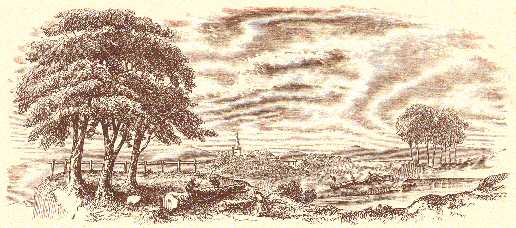
In those days there was only a foot bridge across the
Itchen at Brambridge. Carts and carriages had to ford the
river, not straight across, but making a slight curve downwards;
this led to awkward accidents. There was a gentleman dining
with Mr. Walter Smythe, who was pressed to sleep at Brambridge,
but declined, saying that he liked to have all his little
comforts about him. When daylight came, the poor man was
found seated on the top of his chaise, the water flowing through
the windows below; for the post boy had taken a wrong turn, and,
being afraid to move, had been forced to remain in the river till
the morning. A far worse disaster befel the Newton family
on their way to a funeral. It is described by one of the
bearers: “When the cart turned over, the corpse was on the
foot bridge. It was a very wet day, and the wind was
blowing furiously at the time. It had a great effect on the
cart, as it was a narrow cart with a tilt on, and there was a
long wood sill at the side of the river. That dropping of
the sill caused the accident. I think there were five
females in the cart and the driver. The water was as much
as 4ft. deep and running very sharp, so myself and others went
into the water to fetch them out, and when we got to the cart
they were all on the top of the other, with their heads just out
of the water. They could not go on to church with the
corpse, and we had a very hard job to save the horse from being
drowned, as his head was but just out of the water.”
All through the time of the long war with France there was
here, as well as everywhere else around the coast, fear of a
landing of the French. The flat-bottomed boats to bring the
French over were actually ready at Boulogne, and the troops
mustered to come across in them. On our side, volunteers
were in training in case of need, and preparations were made for
sending off the women and children inland on the first news of
the enemy landing. Not very many years ago there were still
to be seen in a barn at Hursley the planks prepared to fit as
seats into the waggons that were to carry them away. And a
family living here are said to have kept everything packed up,
even the fireirons, and to have stirred up the fire with a stick
during a whole winter. However, by
God’s blessing and our fleets and armies, the danger was
kept from our doors.
With the activity that followed upon the peace came a great
deal of road-making. The present high road between
Winchester and Southampton was then made, and the way cut through
the hills—Otterbourne Hill and Compton Hill on either
side. This led to the main part of the inhabitants settling
in the village street, instead of round the old Church as
before. Another great road was made at the same
time—that which crosses Golden Common and leads ultimately
to Portsmouth. It used to be called Cobbett’s Road,
because William Cobbett, a clever, self-taught man, had much to
do with laying it out. Cobbett had a good many theories
which he tried to put into practice, some sensible, others
mistaken. The principal traces we see of him now are in the
trees that he planted, chiefly introduced from America. He
thought the robinia, or false acacia, would make good hedges,
because of its long thorns and power of throwing up suckers, and
many people planted them, but they proved too brittle to be of
much use, though some are still growing. He was a friend of
Mr. Harley, who then owned Otterbourne House, and planted many
curious trees there, of which two long remained—a hickory
nut and a large tree in the drive. There was also an oak
with enormous leaves, but it was planted so near the house that
it had to be moved, and died in consequence.
These roads were for the coaches. Young folks, who never
saw anything nearer approaching to a stage coach than the drags
some gentlemen keep, can hardly fancy what these stage coaches
were—tall vehicles, holding four inside passengers and at
least twelve outside and quantities of luggage. They were
drawn by four of the strongest and quickest horses that could be
procured, and these were changed about every five or six miles,
so as to keep up full speed. The coachman, generally a big,
burly man, with a face reddened by exposure to the weather, and
often by a glass of ale at every stage, sat on the box in a drab
coat, with many capes one over the other. The seat next to
him was the favourite one with the passengers, and gentlemen
would sometimes bribe coachmen to let them drive;
nay, some gentlemen actually took to the trade themselves.
There was also a guard, who in mail coaches took care of the post
bags, and dropped them at the places where they were intended
for. In the days when highwaymen infested the roads the
guard had carried pistols, and still the guard of the mail wore a
red coat, and blew a horn on entering any place to warn the
people to bring out their post bags and exchange them for
others.
One or two coaches kept their horses at the White Horse, so as
to be fresh for going up the hill, others at the Cricketers,
while others changed at Compton and the New Hut. Some of
the stables still remain, converted into cottages. The
horses were fine animals, beautifully kept; but the habit of
hanging about public-houses to attend to them was not good for
the ostlers and people concerned. About fifteen coaches
came through this place in the morning, and their fellows in the
evening, each proprietor keeping two coaches, starting from the
two opposite ends at the same time. There was the Mail, the
Telegraph, the Independent, the Red Rover, the Hirondelle, all
London coaches, besides the Oxford coach and some that only ran
between Winchester and Southampton. The driver and owner of
one, Mason’s coach, was only a few years ago living
here. When people intended to go on a journey, they booked
their places a day or two beforehand, but for short journeys or
going into Winchester they would watch for a vacant space in a
coach as it passed by.
It is odd to look back at an old article in a quarterly review
describing coach travelling as something so swift and complete
that it could not be surpassed in its perfection. Yet
accidents with the spirited horses and rapid driving were not
uncommon, and a fall from an overloaded coach was a dangerous
thing.
When the mail went by coach the sending of letters and parcels
could not but be expensive. Heavy goods travelled by
waggon, barge, or ship, parcels went by carriers or by coaches,
and nothing could be posted but what was quite light. So
postage was very expensive, and it is strange to look back on the
regulations connected with it. Our readers under
forty years old will hardly believe the rates that were paid for
postage, varying according to distance. There was a company
in London that carried letters from one part of that town to
another for twopence apiece, and this was the cheapest post in
England. A letter from London to Otterbourne cost
eightpence, and one from Winchester either threepence or
fourpence, one from Devonshire elevenpence, and this was paid not
by the sender, but by the receiver. It was reckoned
impolite to prepay a letter. Moreover, the letter had to be
on a single sheet. The sheet might be of any size that
could be had, but it must be only one. A small sheet
enclosed within another, or the lightest thing, such as a lock of
hair or a feather, made it a double letter, for which double
postage had to be given. The usual custom was to write on
quarto sheets twice the size of what is used now, and, after
filling three sides, to fold the fourth, leaving a space for the
direction and the seal, and then to write on the flaps and in the
space over “My dear ---,” sometimes crossing the
writing till the whole letter was chequer work. For if the
letter was to cost the receiver so much, it seemed fair to let
him get as much as possible. Letters were almost always
sealed, and it took neat and practised hands to fold and seal
them nicely, without awkward corners sticking out.
Newspapers, if folded so as to show the red Government stamp,
went for a penny, but nothing might be put into them, and not a
word beyond the address written on them. The reason of all
this was that the cost of carriage was then so great that it
could only be made to answer by those high rates, and by
preventing everything but real letters and newspapers from being
thus taken. As Government then, as now, was at the expense
of postage, its own correspondence went free, and therefore all
Members of Parliament had the privilege of sending letters
freely. They were allowed to post eleven a day, which might
contain as much as would weigh an ounce, without charge, if they
wrote the date at the top and their name in the right hand
corner. This was called franking, and plenty of letters by
no means on public business travelled in that way.
There was no post office in Otterbourne till between
1836 and 1840; for, of course there were few letters written or
received, and thus it did not seem to many persons worth while
for village children to learn to write. If they did go into
service at a distance from home, their letters would cost more
than their friends could afford to pay. This was a sad
thing, and broke up and cut up families very much more than any
distance does now. It really is easier to keep up
intercourse with a person in America or even New Zealand now,
than it was then with one in Scotland, Northumberland, or
Cornwall; for travelling was so expensive that visits could
seldom be made, and servants could not go to their homes unless
they were within such a short distance as to be able to travel by
coach or by carrier’s cart, or even walking all the way,
getting a cast now and then by a cart.
People who did not travel by coaches, or who went where there
was no coach, hired post-chaises, close carriages something like
flies. Most inns, where the coaches kept their horses,
possessed a post-chaise, and were licensed to let out post horses
for hire. Most of the gentlefolks’ families kept a
close carriage called a chariot, and, if they did not keep horses
of their own, took a pair of post-horses, one of which was ridden
by a man, who, whatever might be his age, was always called a
post-boy. Some inns dressed their post-boys in light blue
jackets, some in yellow ones, according to their politics, but
the shape was always the same; corduroy tights, top boots, and
generally white (or rather drab-coloured) hats. It used to
be an amusement to watch whether the post-boy would be a blue or
a yellow one at each fresh stage. Hardly any one knows what
a post-boy was like now, far less an old-fashioned travelling
carriage or chariot and its boxes.
The travelling carriage was generally yellow. It had two
good seats inside, and a double one had a second seat, where two
persons sat backwards. The cushion behind lifted up and
disclosed a long narrow recess called the swordcase, because,
when there were highwaymen on the roads, people kept their
weapons there. There were sometimes
two, sometimes one seat outside, called the box and the
dickey—much the pleasantest places, for it was very easy to
feel sick and giddy inside. A curved splashboard went up
from the bottom of the chariot to a level with the window, and
within it fitted what was called the cap box, with a curved
bottom, so that when in a house it had to be set down in a frame
to hold it upright. A big flat box, called the imperial, in
which ladies put their dresses, was on the top of the carriage,
two more long, narrow ones, generally used for shoes and linen,
fitted under the seat, and another square one was hung below the
dickey at the back, and called the drop box. Such a
mischance has been known as, on an arrival, a servant coming in
with the remains of this black box between his arms,
saying—“Sir, should not this box have a bottom to
it?” The chariot thus carried plenty of goods, and
was a sort of family home on a journey. To go to Plymouth,
which now can be done in six or seven hours, then occupied two
long days, halting for the night to sleep at an inn.


