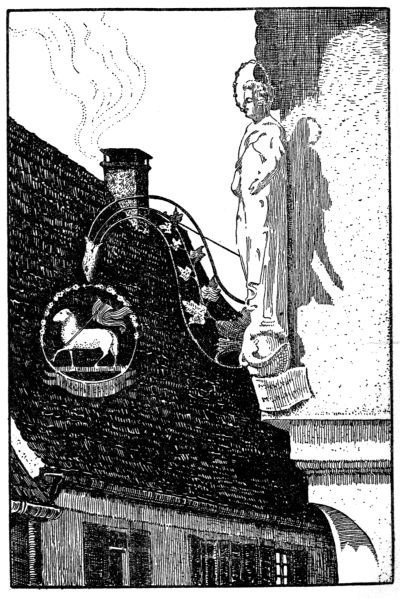
“Use hospitality one to another without grudging.”
I Peter iv, 9.
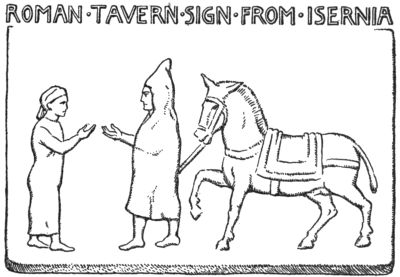
Rome was to conquer the northern Germanic world once more, not with
the sword as had been the case in the olden days of a pagan Rome, but
with the cross and its exponent, the monk. The northward surging wave
of Roman Cæsarism had been followed by the tidal wave,
southward-roaring, of Germanic barbarians. The orderly life of one
vast empire gave way to the restlessness and insecurity of the period
of migration and a shattered empire. Not individuals but whole peoples
go a-traveling with household goods and wife and children, whole towns
and countries become their inns, the standard of the conquerors are
their tavern signs. Then again flowing northward, progressing by
insensible stages, comes the silent throng of monastic brotherhoods,
the Benedictines in the van, who bring forth various orders from
their midst, the Cistercians among others, who dig and reclaim the
soil with their spades and later, as builders, dedicate it to their
God, unknown and now revealed, with high-soaring monuments of worship.
Undaunted by solitude, fearless of the wildness of desolate regions,
they enter the forest primeval to clear it and establish quiet
homesteads for themselves and their worship; their doors are open to
all those who pass their way. For had not St. Benedict, mindful of
repeated apostolic admonitions to the bishops, included hospitality in
the rules of his order? Therefore ere long there lacked not in any
convent certain rooms given over to the comfort of the wayfarer, be it
a “hospitium,” a “hospitale,” or a “receptaculum.” Witness the Hospice
of the Great St. Bernard in the Alps of the Vallais, named after the
pious founder of that earliest of Occidental orders, part of the
convent erected in the ninth century by the bishops of Lausanne, while
the shelter on Mont Cenis is said to date back to a past equally
remote. Beginning with the year 1000, convents likewise erect inns in
the villages, outside of their immediate domains, leasing these
against rental, while in the towns pilgrim inns, poor men’s taverns,
and “Seelhäuser” are endowed for the free housing of pilgrims and
wayfarers, evolving later into town inns.
To the pilgrim, then, who wended his way to the tombs of saints, and,
in the crusade times, to the holiest of graves in Jerusalem, mediæval
hospitality is mainly devoted. The crusaders were agents of especial
power in the development of hospitality, since on his lengthy journey
the pilgrim stood in need, not only of food and shelter, but also of
convoy along roads perilous everywhere. The Knights of St. John set
themselves these two tasks, to care for the pilgrims and escort them
in safety, which is implied by their name “fratres hospitales S.
Johannis.” In the rule of their order (ca. 1118) the foremost duty of
lay as well as clerical brothers was to serve the poor, “our lords.”
With like intent of safeguarding pilgrims the Order of Knights
Templars was instituted in 1119, especially for the care of German
pilgrims. We may venture to assume from their name, “Order of the
German House of our dear Lady in Jerusalem,” that a homelike Madonna
picture adorned their hospitable house as a pious welcome. Shakespeare
has inimitably described the warlike duties of these orders, duties
which went hand in hand with kindly care and hospitality, in the first
part of “Henry IV”:—
“To chase these pagans, in those holy fields
Over whose acres walk’d those blessed feet
Which, fourteen hundred years ago, were nailed
For our advantage, on the bitter cross.”
These knightly orders, whose hospitable roofs originally sheltered the
pious pilgrims bound for Jerusalem, also opened in welcome the gates
of their proud houses at home, which still adorn more than one old
German town. When Luther was summoned to Worms by the Emperor, in
1521, he stayed with the Knights of St. John. Here in this noble inn
he exclaimed to his friends, after the ordeal, with upraised arms, and
face shining with joy: “I am through, I am through.” Like an enduring
rock he had stood his ground and had expressed his unalterable will to
be a free Christian in those famous words: “Hier stehe ich, ich kann
nicht anders, Gott helfe mir! Amen.”
In like manner Luther had accepted ecclesiastical hospitality on his
journey Romeward, as a young monk, notably on the part of the Order of
St. Augustine. From the pages of that Baedeker of the fifteenth
century, the “Mirabilia Romæ,” we can realize how thoroughly a
pilgrimage to Rome was viewed in those days as a pious journey to
hallowed places, relics and tombs of the saints. The work referred to
appeared first as a block-book, with pictures and text both printed
from the same wood block. The youthful monk may well have carried such
an early copy of the “Mirabilia” in his cowl when he entered the holy
precincts of the Eternal City, which revealed itself to his great
disillusionment as an ungodly spot and the seat of Anti-Christ.
Occasionally we also see the great reformer descending at a lay
tavern, such as the famous inn of the High Lily in Erfurt, which
subsequently saw within its walls great warriors like Maurice of
Saxony and Gustavus Adolphus.
To this day there is in England a hospital founded by the Knights of
St. John, in which every wayfarer can obtain bread and ale upon
request. This is the “Hospital of St. Cross without the walls of
Winchester,” as it is called in a document in the British Museum;
ceded by the Knights Hospitallers of St. John of Jerusalem to Richard
Toclive, Bishop of Winchester, in 1185, the bishop raising the number
of poor there entertained from 113 to 213, of whom 200 were to be fed
and 13 fed and clothed. Emerson once made a pilgrimage to the
hospital, claimed and received the victuals, and triumphantly quoted
the incident as a proof of the majestic stabilities of English
institutions. In his wake numberless Americans yearly wend their way
to the Hospital of the Holy Cross, and to the beautiful Minster of
Winchester embedded in verdure. There they lodge either at the
“George,” or, more cozily yet, in the ancient “God begot House” of a
type found, perhaps, in England only.
Another American no less renowned, Mark Twain, the “New Pilgrim,” as
he styled himself, has felt on his own physical self the blessings of
clerical hospitality in Palestine, the land of ecclesiastic
foundations, which he celebrates as follows in his “Innocents Abroad”:
“I have been educated to enmity toward all that is Catholic, and
sometimes, in consequence of this, I find it much easier to discover
Catholic faults than Catholic merits. But there is one thing I feel no
disposition to overlook, and no disposition to forget: and that is,
the honest gratitude I and all pilgrims owe to the Convent Fathers in
Palestine. Their doors are always open, and there is always a welcome
for any worthy man who comes, whether he comes in rags or clad in
purple.... A pilgrim without money, whether he be a Protestant or a
Catholic, can travel the length and breadth of Palestine, and in the
midst of her desert wastes find wholesome food and a clean bed every
night, in these buildings.... Our party, pilgrims and all, will always
be ready and always willing to touch glasses and drink health,
prosperity, and long life to the Convent Fathers in Palestine.”
We may well believe that private individuals then as now bid for the
patronage of pilgrims. Shakespeare tells us of a case in point, in his
“All’s Well that Ends Well” (Act iii, Sc. v). Helena appears in
Florence in search of her husband gone to the wars, “clad in the dress
of a pilgrim,” and inquires where the palmers lodge. A kindly widow
tells her “at the Franciscans here near the port”; but knows how to
win the fair pilgrim by her words:—
“I will conduct you where you shall be lodged
The rather, for, I think, I know your hostess
As ample as myself.”
If, on the other hand, we consider how pilgrims made their long
journey more toilsome yet, as related by Helena herself,—
“Barefoot plod I the cold ground upon
With sainted vow my faults to have amended,”—
we shall appreciate how gratefully the proffer of the good widow must
have been accepted. The hospitality of the monks was not always
lavish; on the contrary, it proved scant and poor, as Germany’s
greatest troubadour, Walter von der Vogelweide, to his sorrow
experienced. Once he turned aside more than four miles from his road
in order to visit the far-famed convent of Tegernsee. The learned
monks, whose library forms to-day one of the treasures of the State
Library in Munich, may have been too deeply engrossed in the
transcription of a classic author, or in elaborate miniature
paintings; at any rate, they did not realize what noble guest sat at
their board and brought him—not the choice vintage which the thirsty
poet expected but simply water:—
“Ich schalt sie nicht, doch genade Gott uns beiden,
Ich nahm das Wasser, also nasser
Musst ich von des Mönches Tische scheiden.”
If guests were thus given cause for complaints of their treatment by
the convents, the monks on their side had no less ground for
occasional displeasure at the abuse of their hospitality. Carlyle
cites an instance of this kind in “Past and Present”; the excellent
abbot, Simon of Edmundsbury, had forbidden tournaments within his
domain. In spite of this prohibition twenty-four young nobles arranged
a knightly joust under his very nose, so to speak. Not content with
that, they rode gayly to the convent at its conclusion and demanded
supper and a night’s lodging. “Here is modesty,” says Carlyle. “Our
Lord Abbot, being instructed of it, orders the Gates to be closed; the
whole party shut in. The morrow was the vigil of the Apostles Peter
and Paul; no out-gate on the morrow. Giving their promise not to
depart without permission, those four-and-twenty young bloods dieted
all that day with the Lord Abbot waiting for trial on the morrow.”
And now Carlyle cites his own source the “Jocelini Chronica”: But
“after dinner”—mark it, posterity!—“the Lord Abbot retiring into his
Talamus, they all started up, and began carolling and singing; sending
into the Town for wine; drinking and afterwards howling
(ululantes);—totally depriving the Abbot and Convent of their
afternoon’s nap; doing all this in derision of the Lord Abbot, and
spending in such fashion the whole day till evening, nor would they
desist at the Lord Abbot’s order! Night coming on, they broke the
bolts of the Town-Gates, and went off by violence!”
Not only had convents to suffer from such exuberant guests; oftener
far they were burdened by those who forgot to depart and continue
their journey. The abbot, Herboldus Gutegotus of Murrhardt, the
convent whose romantic church still ranks among the finest
ecclesiastical monuments in Germany, used to tell such forgetful
guests the following little story: “Do you know why our Lord remained
but three days in his tomb?—Because during that time he was making a
friendly visit to the patriarchs and prophets in Paradise. So in order
not to cause them inconvenience he took timely leave and resurrected
upon the third day.” Evidently the refined abbot knew how to veil
politely the old Germanic directness which finds such clear expression
in the “Edda”:
“Go on betimes, loiter not as a guest ever in our abode;
He, though loved, becomes burdensome, who warms himself too long at hospitable fires.”
In wild and inhospitable countries, the convents long remained, even
till recent times, the only shelters for travelers. Hence, when Henry
VIII of England began to confiscate monastic property on a grand
scale, a significant revolt for their reinstallment flamed up in the
north of England,—the so-called “Pilgrimage of Grace” of the year
1536, which was suppressed with deplorable sternness. The convents
were very popular in those parts because the monks had been the only
physicians and their doors were always open to all wayfarers.
Chaucer shows us in his “Canterbury Tales” that monks could be
pleasant guests as well as good hosts, for there we read in regard to
the friar: “He knew well the tavernes in every town”; and “What should
he studie and make himself wood?”
Having thus pictured to ourselves the clerical hospitality of the
Middle Ages, we shall not wonder that, in outward signs for the
designation of the houses as inns, religious subjects and their
pictorial presentation were adopted.
Among the saints particularly revered by the pious pilgrims St.
Christopher stands foremost, since he had himself experienced so
perilous a journey. In many mediæval pictures we see him leaning on
his massive staff, carrying the Christ child across a river. The
“Golden Legend” tells us that he was nearly drowned, so heavy was the
burden of this child. “Had I carried the whole world,” he says, when
finally reaching the shore, “my burden could have been no heavier”;
whereupon the child of whose identity he was not yet aware: “for a
sign that you have carried on your shoulders not only the world but
the Creator, thrust this staff into the ground near your hut, and
behold, it will blossom and bear fruit.” Hence the partiality for huge
pictures of St. Christopher, visible afar, such as we find
occasionally to this day in and upon certain churches; for instance,
the spacious mural paintings in the church of St. Alexander at
Marbach, the birthplace of Schiller, close to the tracks on which the
modern traveler thunders past; or the gigantic sculpture on the south
side of the cathedral in Amiens, or the large fresco in the minster at
Erfurt. They give us a conception of similar presentations on Poor
Men’s Inns and ecclesiastical hospices. The belief in the efficacious
protection by the saint, especially from sudden death, is expressed in
the French mediæval saying: “Qui verra Saint Christophe le matin, rira
le soir.” The tenacity of this belief among the people is well
instanced by the fact that the jewelers of so worldly a city as Nice
sell to owners of automobiles little silver plaques, with the picture
of the saint and the inscription, “Regarde St. Christophe et puis
va-t-en rassuré.” Let us hope, in the interest of the rest of mankind,
that these motorists do not feel too reassured in consequence.
American readers might be interested to hear that in their own country
a guest-house of St. Christopher gives refuge to the modern fraternity
of tramps, charitably called the “Brother Christophers” by the Friars
of the Atonement, who founded this house at Gray Moor, near the
beautiful residential district of Garrison, in the State of New York.
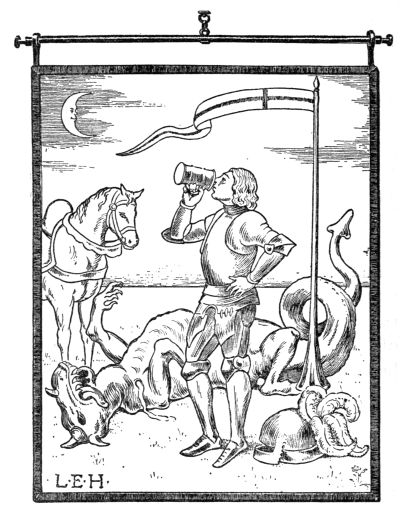
Another saint, deservedly in great favor, is St. George, who slew the
dragon, a knightly patron who smooths the traveler’s path and makes it
safe by brushing aside all its threatening dangers. Two of the finest
hostelries still existing are named after him: the “Ritter” in
Heidelberg, and the “George,” more ancient yet by a century, in the
time-hallowed town of Glastonbury. Two miracles have drawn pilgrims to
the latter place since olden times, the “Holy Thornbush,” which had
blossomed forth from the staff of Joseph of Arimathea and bloomed
every Christmas, and the “Holy Well,” in the garden of the cloister
school, now deserted, whose waters were to heal the bodily ailments of
the pious pilgrims. The throng of wayfarers to the convent, whose
gigantic abbot’s kitchen is eloquent of hospitality on a large scale,
made the establishment of a pilgrim’s inn outside the walls
imperative. First they erected the “Abbot’s Inn,” and when this proved
insufficient—at the end of the fifteenth century—the elegant Gothic
structure was erected, which bears to this day the ensign “Pilgrim’s
Inn,” but is popularly known as “The George,” from a likeness of the
saint which once adorned the handsome bracket so happily wedded to the
architecture of the house. The tourist undaunted by fearsome
reminiscences may ask to be given the choice apartment there, the
so-called “abbot’s chamber,” where Henry VIII rested on the day when
he ordered the last abbot hung on the town gate. The fine four-poster,
it is true, has been sold to a fancier of antiquities and replaced by
a new canopied bed, but despite this the room retains its mediæval
appearance.
About a hundred years later, the delightful Renaissance structure,
“Zum Ritter,” was erected in Heidelberg. Originally the house of a
wealthy Frenchman, it was subsequently changed into a hostelry and
took its name from the knight on the peak of the gable. Doubtless no
one has ever sung the praise of this noble building more worthily than
Victor Hugo, who visited Heidelberg in 1838, and passed by the house
of St. George every morning, as he said, “pour faire déjeuner mon
esprit.” Jokingly he observes that the Latin inscription (Psalm 127,
i) has protected the inn better than the little iron plate of the
insurance firm. As a matter of fact neither the great conflagration of
1635, during the Thirty Years’ War, nor the fires started under Mélac
and Maréchal de Lorges, in 1689 and 1693, could harm this inn, while
“all the other houses built without the Lord were burnt to the
ground.”
In England the good knight St. George was an especial favorite; even
in the middle of the last century there were in London alone no less
than sixty-six hostelries of that name. Truly, the pious meaning of
old associated with the sign had long been forgotten by hosts and
guests alike, so that as early as the seventeenth century these
mocking lines were penned:—
“To save a mayd St. George the Dragon slew—
A pretty tale, if all is told be true.
Most say there are no dragons, and ’tis said
There was no George; pray God there was a mayd.”
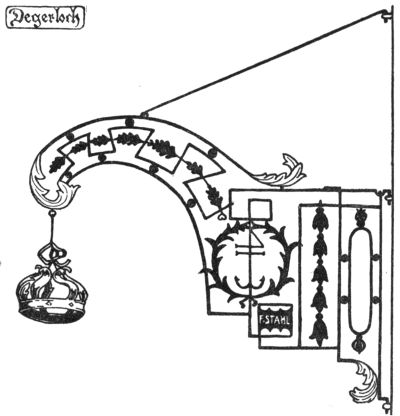
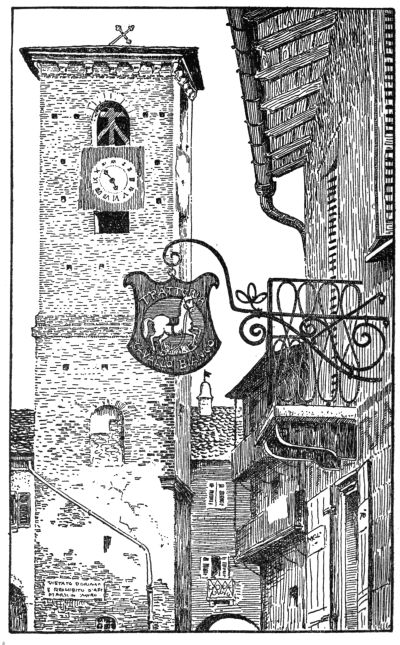
The pictures of the “valiant knight’s” mount were often so dubious
that a connoisseur of horses like Field Marshal Moltke, writing from
Kösen, Thuringia, construed it as the picture of a mad dog. On the
other hand, we have such charming conceptions of St. George as the
sign here shown, from the hamlet of Degerloch, delightfully situated
on the heights overlooking Stuttgart, a notable artistic achievement
in wrought iron, interesting, moreover, for the associations of merry
chase linked with the saint in the mind of the country folk.
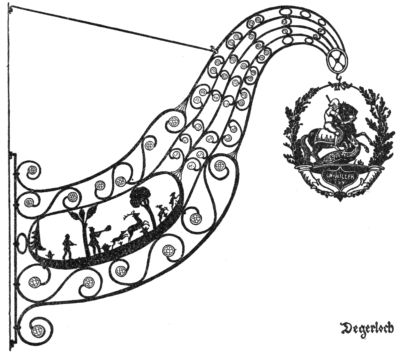
Degerloch
Among other saints frequently chosen for tavern signs, St. Martin must
be mentioned. At times he appears in like manner as does St.
Christopher; for instance, on the large reliefs decorating the façade
of the minster in Basle: a friend of the needy, dividing his cloak
with his sword, to share it with them; thus the pious saint lives on
in the minds of the people. At the season of the new wine, the 21st of
November, the Church commemorates his name: “A la saint Martin, faut
goûter le vin,” is the French saying.
At the sign of St. Dominic too, whose meaning of religious hospitality
had been utterly perverted in the course of time, stanch topers used
to congregate for joyous orgies. Proudly they called themselves
“Dominican”; and
“Bons ivrognes et grands fumeurs
Qui ne cessent jamais de boire”
is their interpretation of such strange affiliation, in a song of the
seventeenth century.
St. Urban has likewise figured on many a tavern sign. Once upon a time
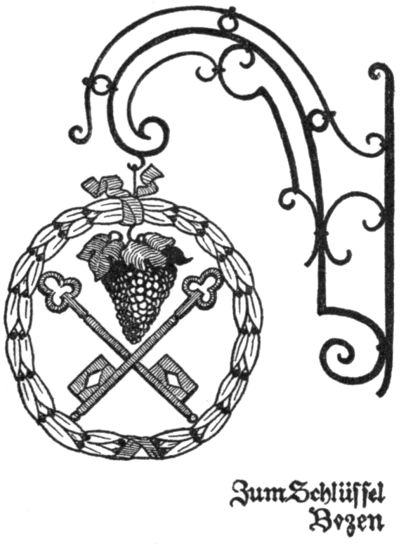
he took refuge from his pursuers behind a grapevine, and for that
reason he has become a patron saint of vintners and tavern hosts.
“Alas,” exclaims the refined Erasmus of Rotterdam, “mine host is not
always as ‘urbane’ as he should be to justify this patronage.”
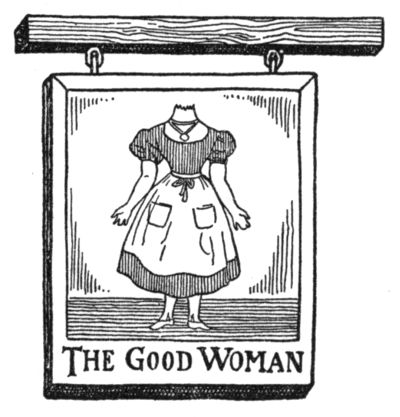
The Good Woman
There is one sign whose religious origin is not self-evident, namely,
the “Femme sans tête.” Yet the figure has its origin, no doubt, in
mediæval representations of saints after decapitation, sometimes shown
with the head in the hands. Whoever has perused the illustrated “Lives
of the Saints” with their many horrible mutilations of the martyrs
depicted in woodcuts, must have realized that their moral influence on
the popular imagination cannot have been of a beneficial nature. Even
great artists did not hesitate to celebrate such awful scenes with the
power of their genius. Among the drawings of Dürer we see the
executioner with his great sword ready to behead St. Catherine.
Nothing so disgusted Goethe in his Italian journey as all the painted
atrocities perpetrated on the martyrs. The most peculiar example of
this form of art is probably that in the Tower of London. It is a set
of horse armor presented, apparently without malice, by Emperor
Maximilian to Henry VIII of England, embellished with the most
gruesome scenes of martyrdom. In the Tower, where so much innocent
blood has flowed, one feels doubly repulsed by such excrescences of
so-called religious art: one is even tempted to accept the popular
conception of these beheaded saints as comforting symbols of
forgetfulness. In fact, the oil merchants chose the “woman without
head” as their sign, as one of the foolish virgins of the parable who
had neglected to provide themselves in good time with the necessary
oil: a warning example to delaying, unwilling customers.
A coarser interpretation of the figure styles it as the “silent
woman,” or as the “good woman,” who can no longer do mischief with her
tongue. Moreover, one finds this most gallant of signs—which should
be unmentionable in these days of woman’s emancipation—not only in
outspoken Holland, with the words: “Goede vrouw een mannen plaag” but
also in Italy; in Turin, for instance, styled as “La buona moglie.”
The most polite people on earth—I do not mean the Chinese, but the
French—have named a street in Paris the “Rue de la Femme sans Tête”
after a tavern of like appellation. Young Gavarni stayed awhile in the
“Auberge de la Femme sans Tête” in Bayonne, as the Goncourts tell us,
and waxed eloquent about the dainty charms of the “vierge du cabaret,”
the tavern-keeper’s daughter.
Ben Jonson, who loved to discuss with Shakespeare in the Siren Club
and to “anatomize the times deformity,” may have been stimulated to
write his comedy “The Silent Woman” by the tavern sign of that name.
In Jonson’s play, a Mr. Morose, an original old fellow, who holds all
noise in detestation, weds a young lady, whose barely audible voice
and scant replies have charmed him. When after the ceremony she
reveals herself a loquacious scold and he gives vent to his
disappointment, she replies with these endearing words: “Why, did you
think you had married a statue, or a motion only? one of the French
puppets, with the eyes turned with a wire? or some innocent out of the
hospital that would stand with her hands thus, and a plaise mouth,
and look upon you?”
But to comfort the feminists we should speak of a host truly gallant,
who had a great white sign made, with the inscription below, “The Good
Man.” To the universal inquiry, “Where is the good man? I can’t see
him,” he made answer, “Well, you see that is why I have left the blank
space; if only I could find him.”
Since there is a saint for every day of the calendar, we must not be
astonished to find names among those adopted for tavern signs which to
us bear no relation to sanctity; such as St. Fiacre over a drivers’
bar, which seems rather the invention of some wag.
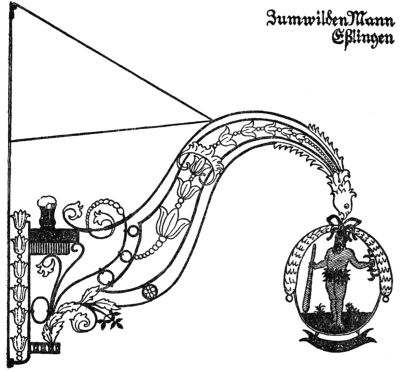
We must needs realize that all these religious signs have their origin
in a time when popular imagination was mainly filled with the
happenings of the Bible and the legends of the saints; when religion
had not yet grown to be a Sunday occupation of a couple of hours, but
was most intimately interwoven with the life of every day. Hence we
find among subjects for signs not the saints only, whose human errors
and sufferings have riveted a bond between them and the common
people, but also the Deity itself. “La Trinité” was one of the latter
in mediæval France, as evidenced by this passage in the song of a
pilgrim:—
“De la alay plus oultre encore
En un logis d’antiquité
Qui se nomme la Trinité.”
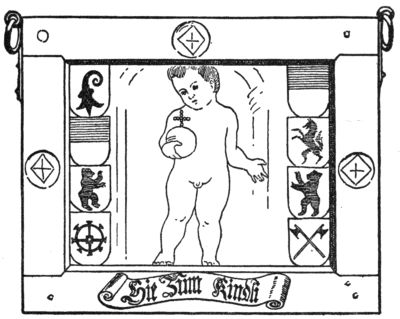
Hie Zum Kindli
Other pilgrim taverns styled themselves “A l’image du Christ.” We also
meet with such inscriptions as “L’Humanité de Jesus Christ, notre
sauveur divin”; the birth of Christ as a child, as in the charming old
Swiss sign “Hie zum Christkindli”; the Madonna and scenes of her life
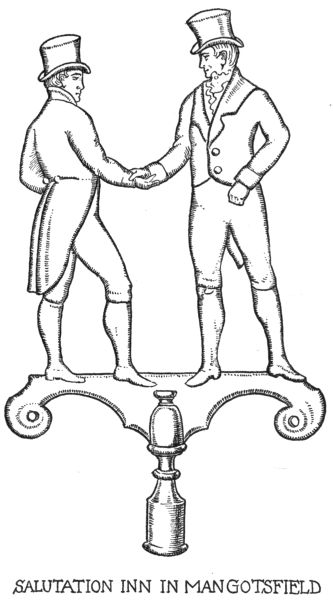
like the “Annunciation,” called Salutation in England. These and many
other signs, such as “Purgatory,” “Hell,” and “Paradise,” which have
been revived in modern Paris on fantastic cabarets, meet our eyes on
tavern signs. An old enumeration of London bars of the seventeenth
century begins with the words:—
“There has been great sale and utterance of wine
Besides beer and ale, and ipocras fine
In every country region and nation
Chefely at Billingsgate, at the Salutation....”
And when the author tires of mentioning them all by name, he concludes
with:—
“And many like places that make noses red.”
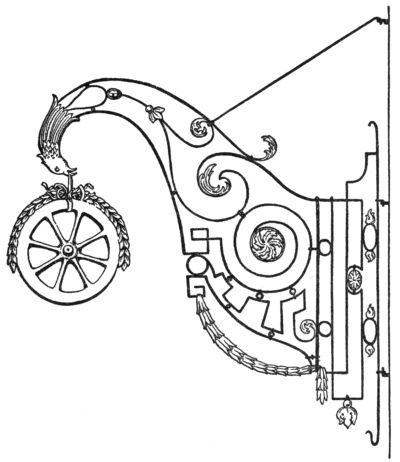
Finally, we must turn to those signs, not religious at first sight,
which may well have their origin in attributes of the saints. Thus, we
meet in Swiss towns, which have St. Gall as their local patron, with
the sign of the “Bear”; “Crown” and “Star” are the symbols of the
three magi who followed the star to the lowly tavern in Bethlehem; the
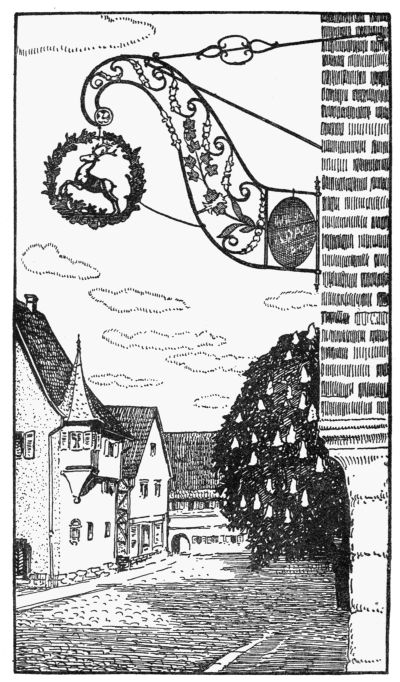
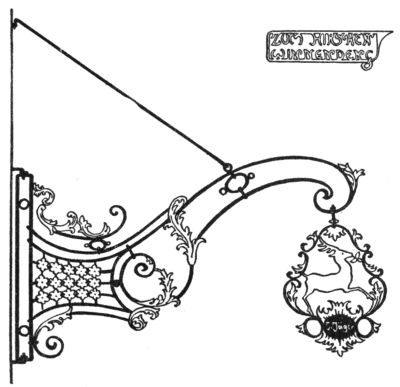
“Wheel” reminds us of the martyrdom of St. Catherine; the “Stag” may
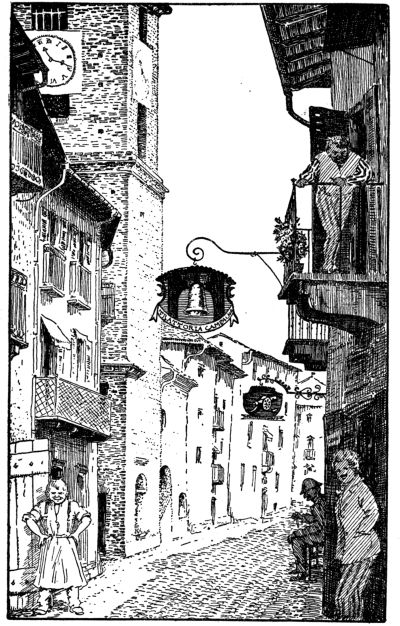
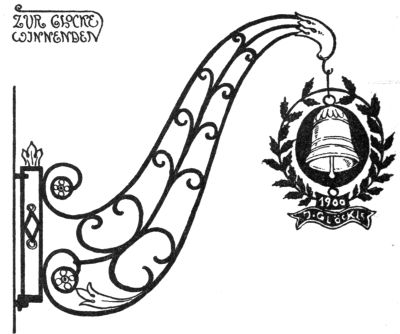
be a reminder of the legend of St. Hubert; while the “Bell,” once
used by St. Anthony to drive away the demons by its sound, was
fastened on the neck of animals to preserve them from epidemic
diseases. We often see the bell, in old woodcuts, fastened round the
neck of the little pig which accompanies the saint. The bell assumed a
very worldly meaning, when it called the tipplers to their merry
gatherings, which called forth in England the patriotic rhyme:—
“Let the King
Live Long!
Dong Ding
Ding Dong!”
The Tower of St. Barbara grew into an independent tavern sign, which,
misunderstood, occasionally changed into a cage. Even the platter on
which rested the head of the Baptist is deformed into the “Plat
d’argent” over a tavern door. Hogarth does not refrain from
introducing a sign in his engraving “Noon,” of 1738, showing the
Baptist’s head on a charger, with the cynical inscription “Good
Eating.” Whether such coarsenesses were actually perpetrated, even
under the lax régime of Charles II in England, when frivolity reigned
after the fall of Cromwell, it is hard to decide. Possibly they may be
set down as brutal outcroppings of the satirist’s truth-deforming
brain. The fact is, that even in the sixteenth century the abuse of
religious subjects for the most disreputable resorts roused the
indignation of serious, thinking men. Thus a certain Artus Désiré
indignantly laments, in a rhymed broadside, that the tavern-keepers
dare place over houses where the great hell devil himself is lodged
the images of God and the saints to advertise their vine:—
“De dieu les Sainctz sont leur crieurs de vin
Tant au citez que villes et villages,
Et vous mettront dessus les grands passages
Au lieux d’horreur et d’immondicité
Des susditz sainctz les dévotes images
En prophanant leur préciosité.”
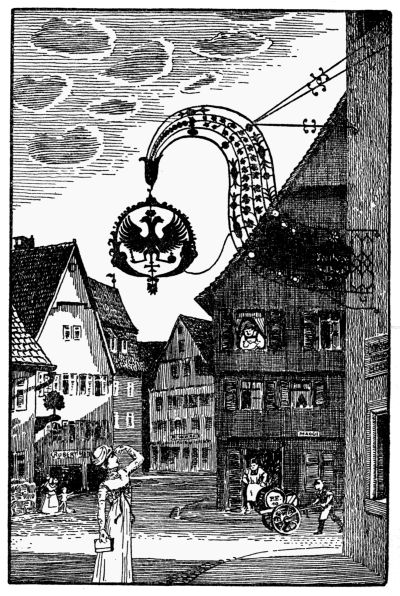
Adler Leonberg, Württemberg





 .
The Pythagoreans held this as a
talisman of health and protection. The Northern myths called the sign
a footprint of a swan-footed animal. They called it the “Drudenfuss,”
and thought it would protect men against evil spirits like the
“Trude,” a female devil-nixie which harassed sleepers. We see the sign
in the study-scene in the first part of “Faust”; and remark how evil
spirits and the devil himself could slip into human habitations if the
pentagram before the door was not fully closed at the apexes—but had
a hard time getting out again. The elfish verses are well known:—
.
The Pythagoreans held this as a
talisman of health and protection. The Northern myths called the sign
a footprint of a swan-footed animal. They called it the “Drudenfuss,”
and thought it would protect men against evil spirits like the
“Trude,” a female devil-nixie which harassed sleepers. We see the sign
in the study-scene in the first part of “Faust”; and remark how evil
spirits and the devil himself could slip into human habitations if the
pentagram before the door was not fully closed at the apexes—but had
a hard time getting out again. The elfish verses are well known:—