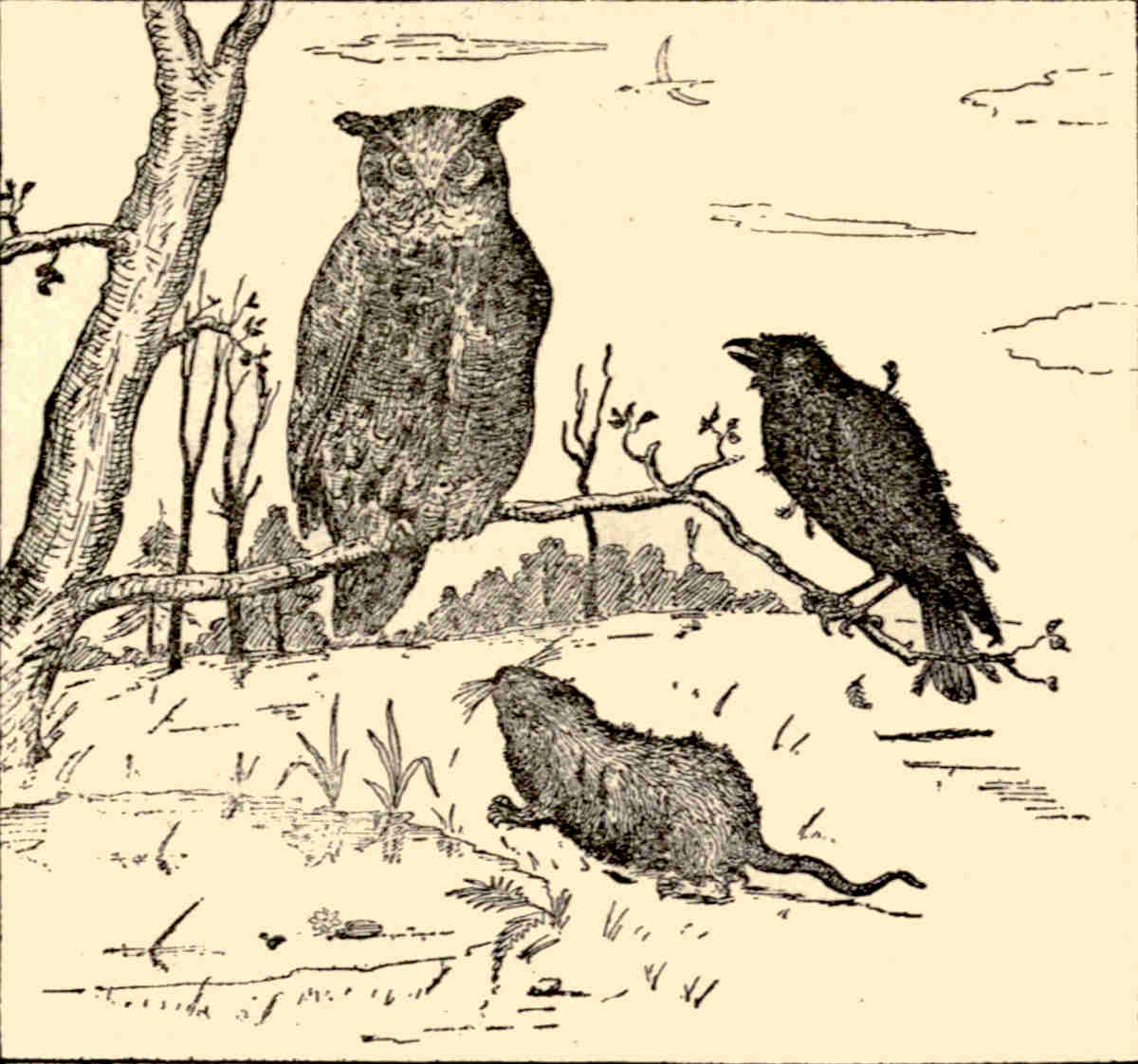
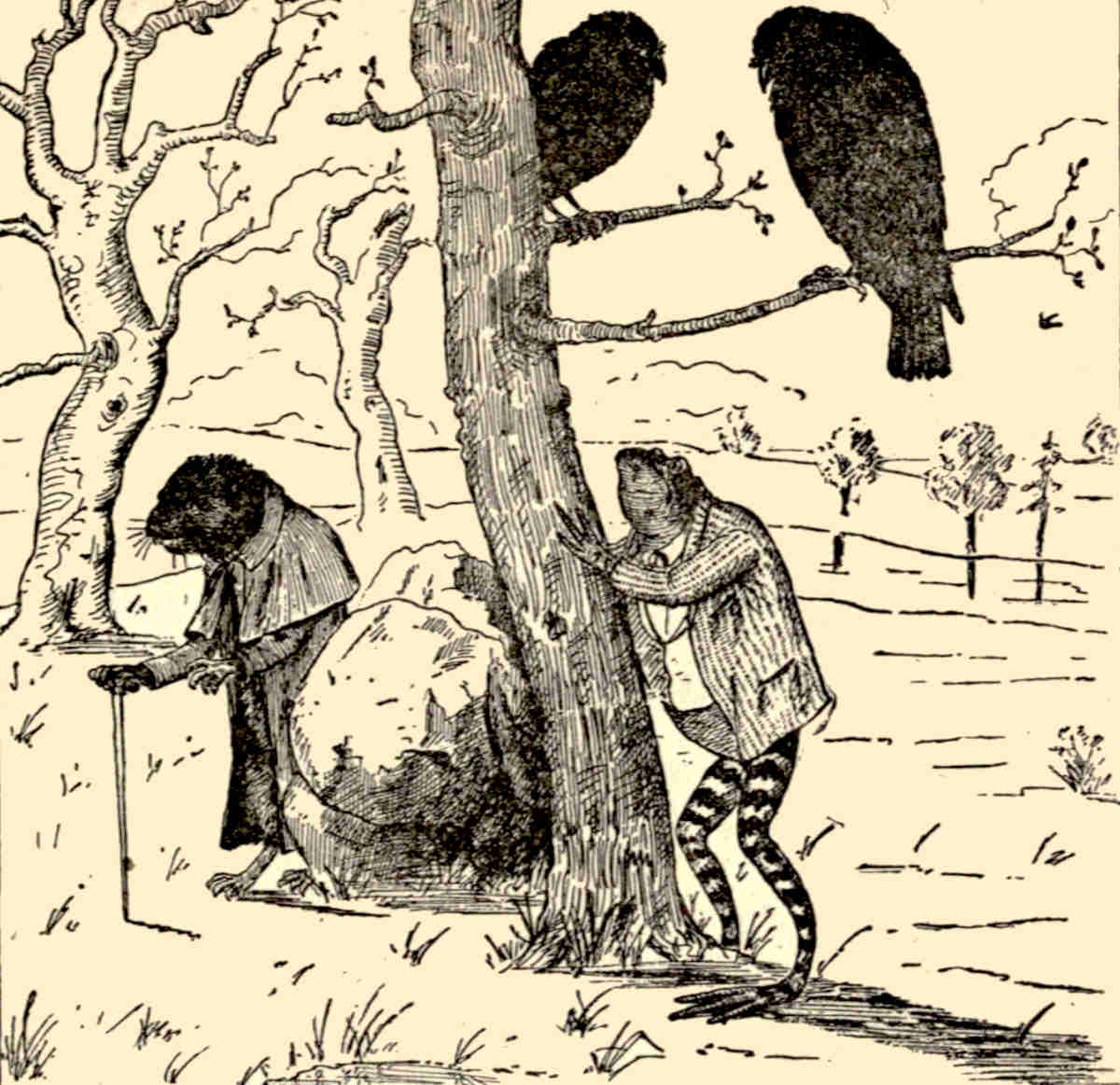
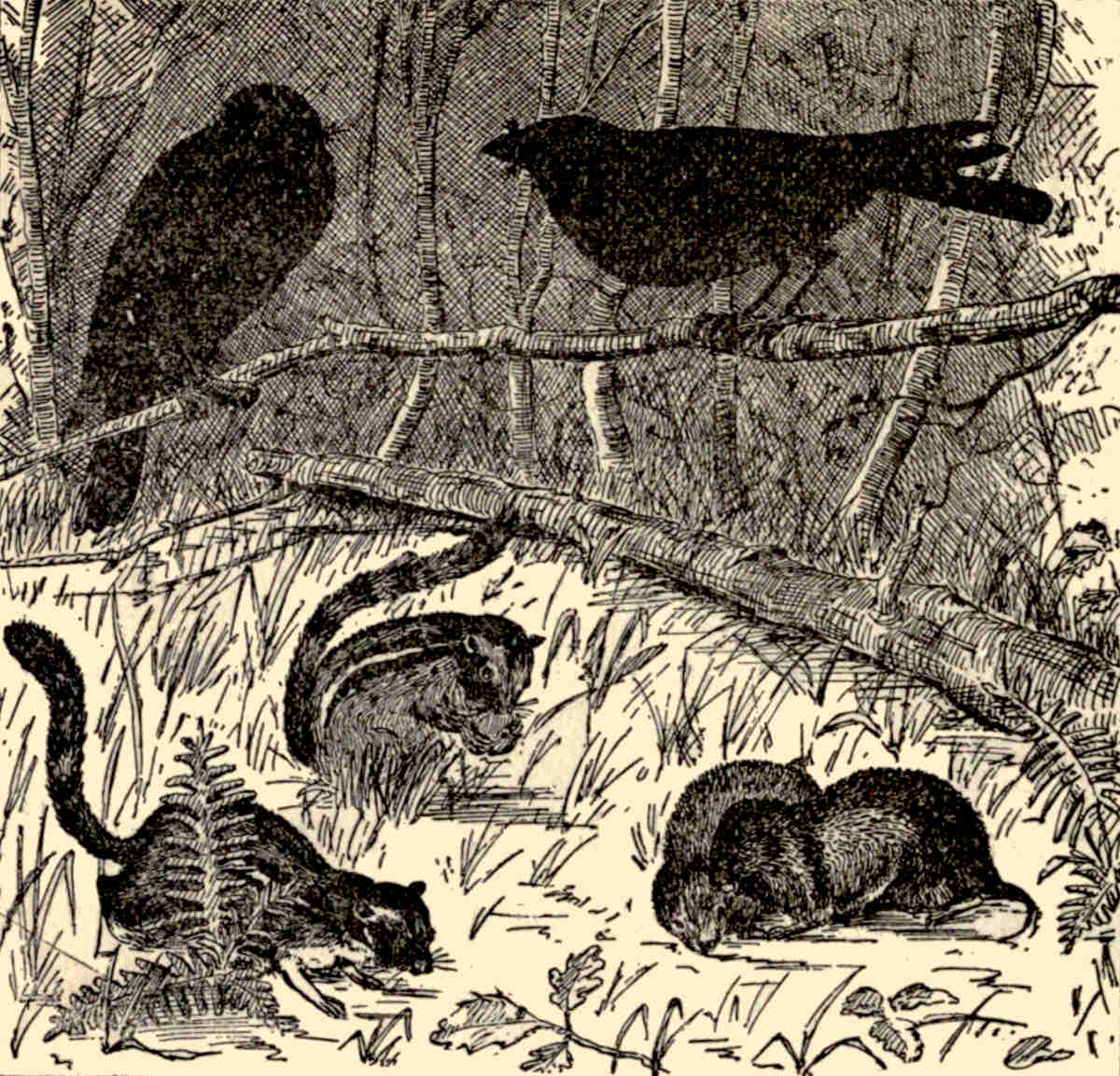
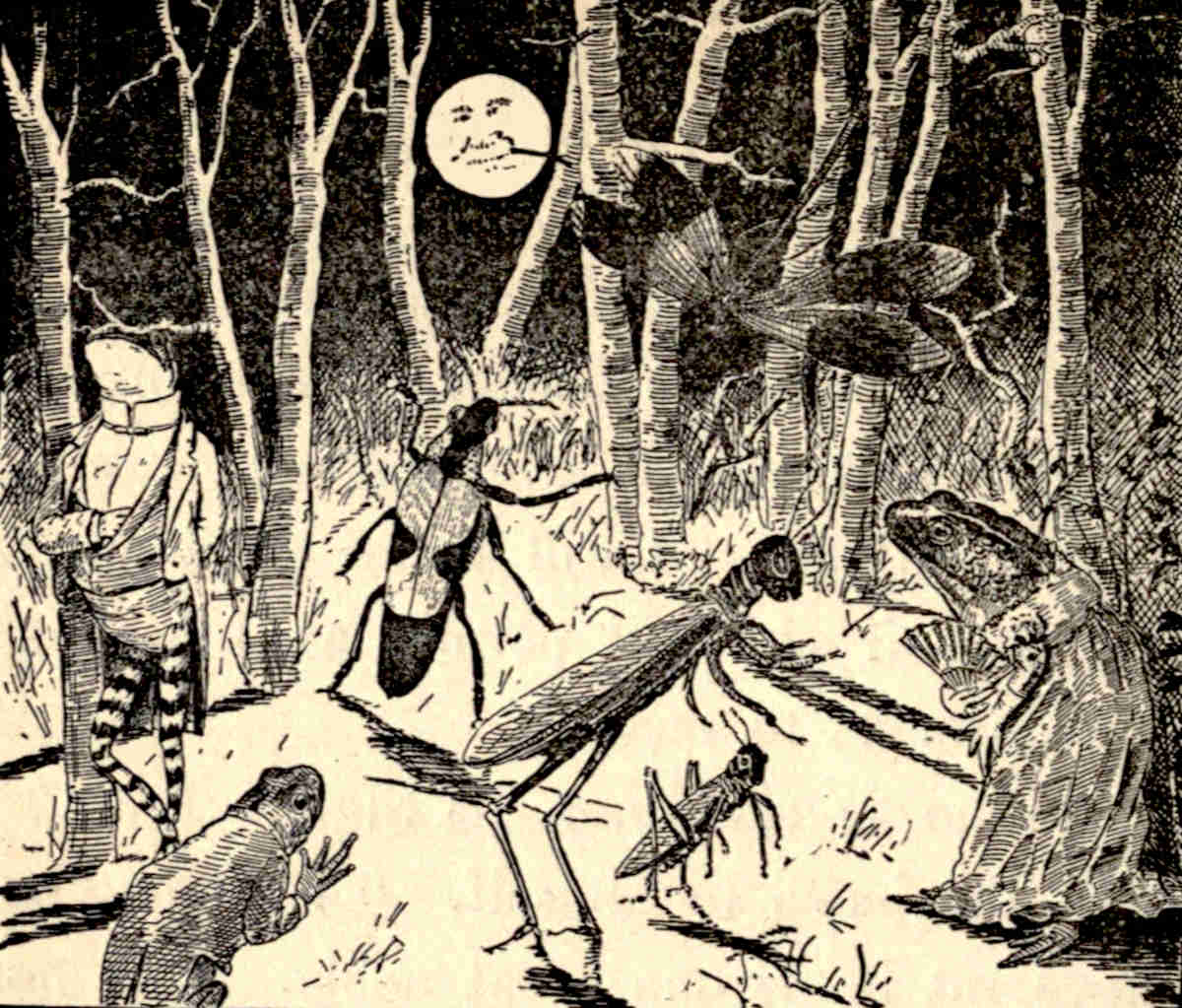
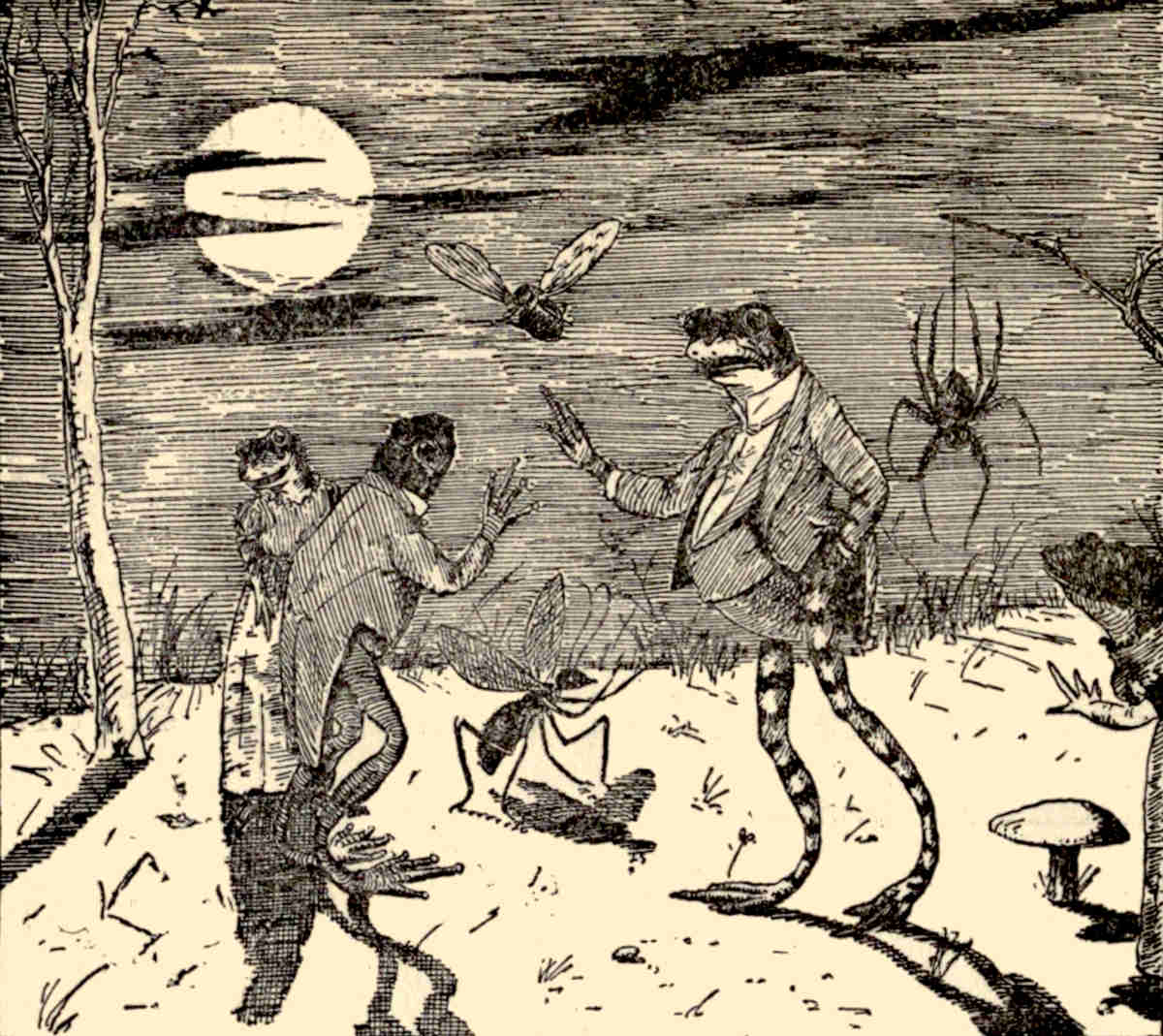
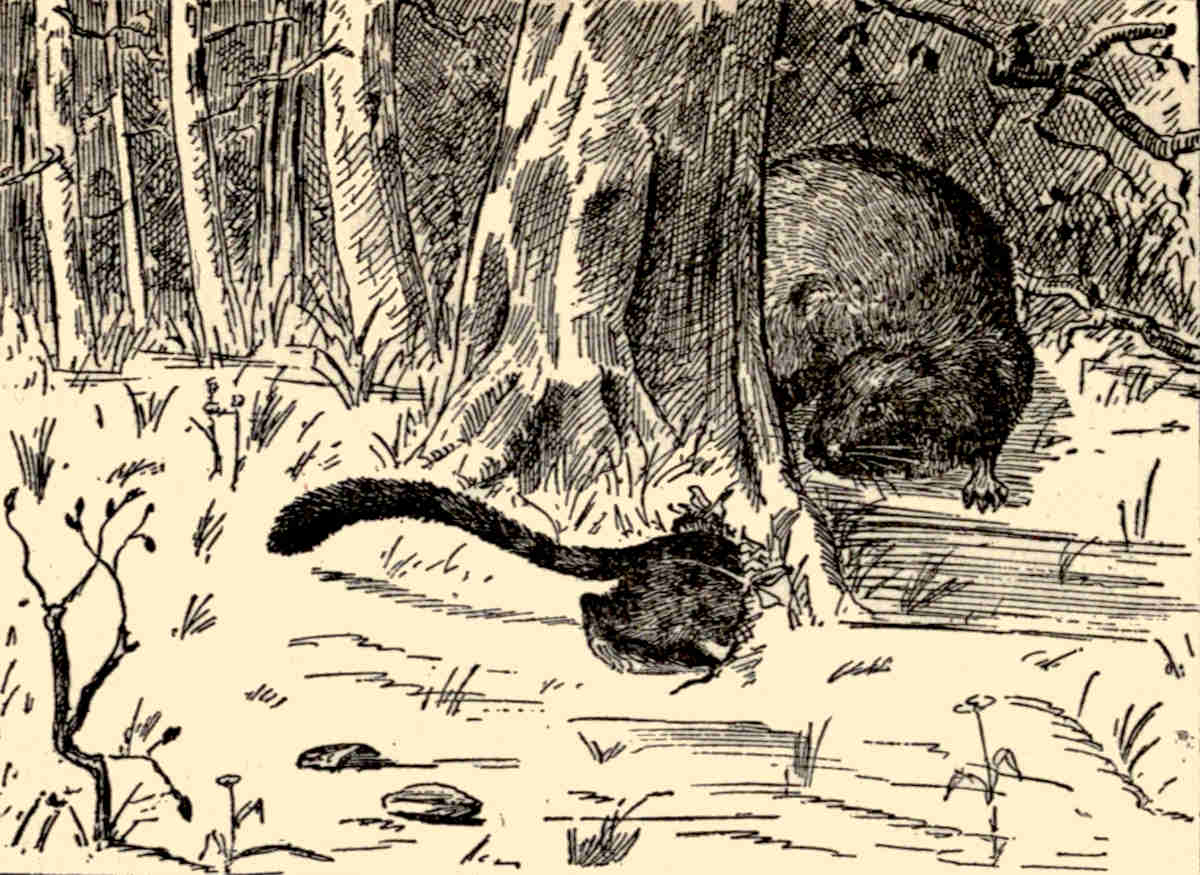
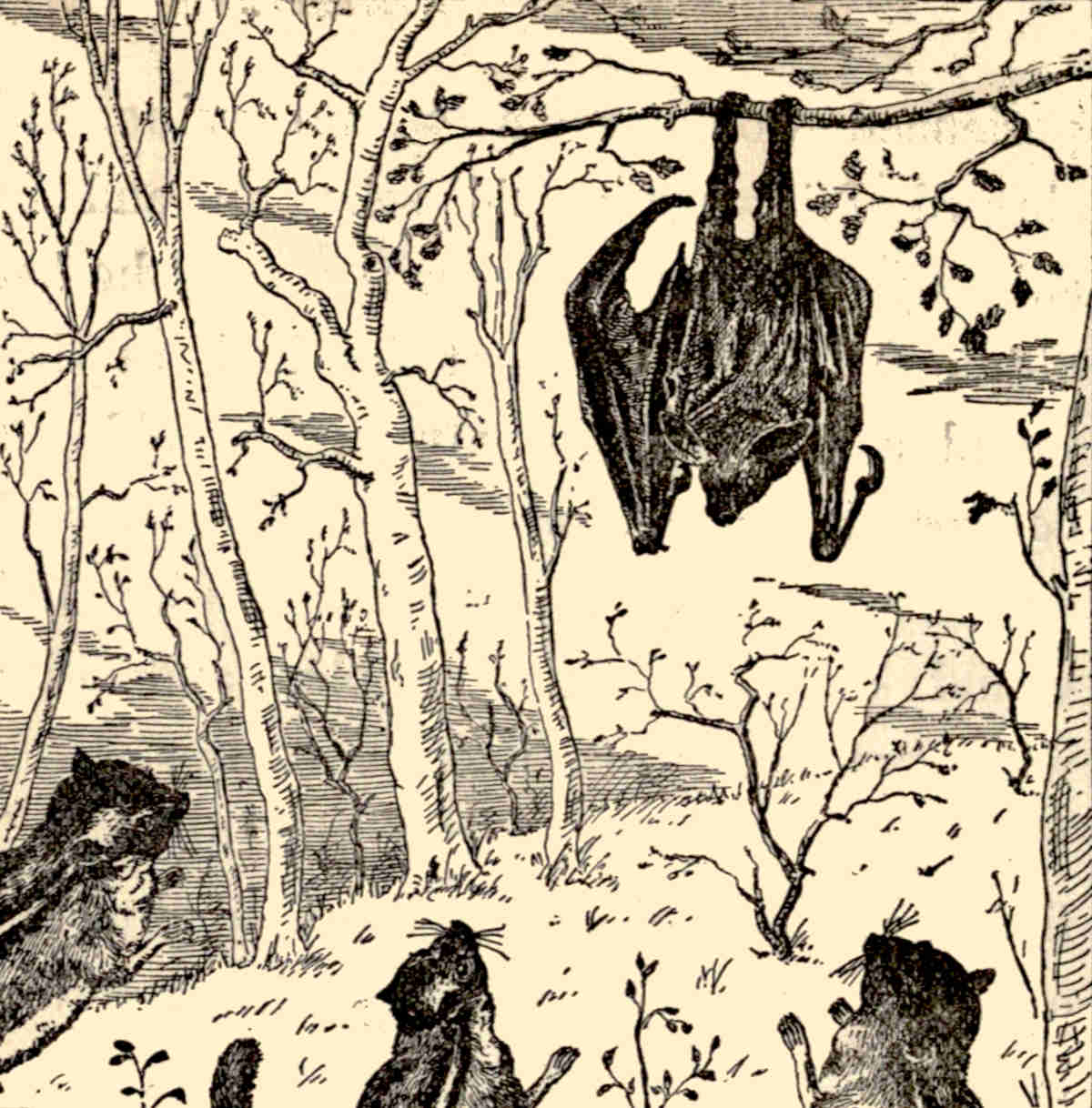
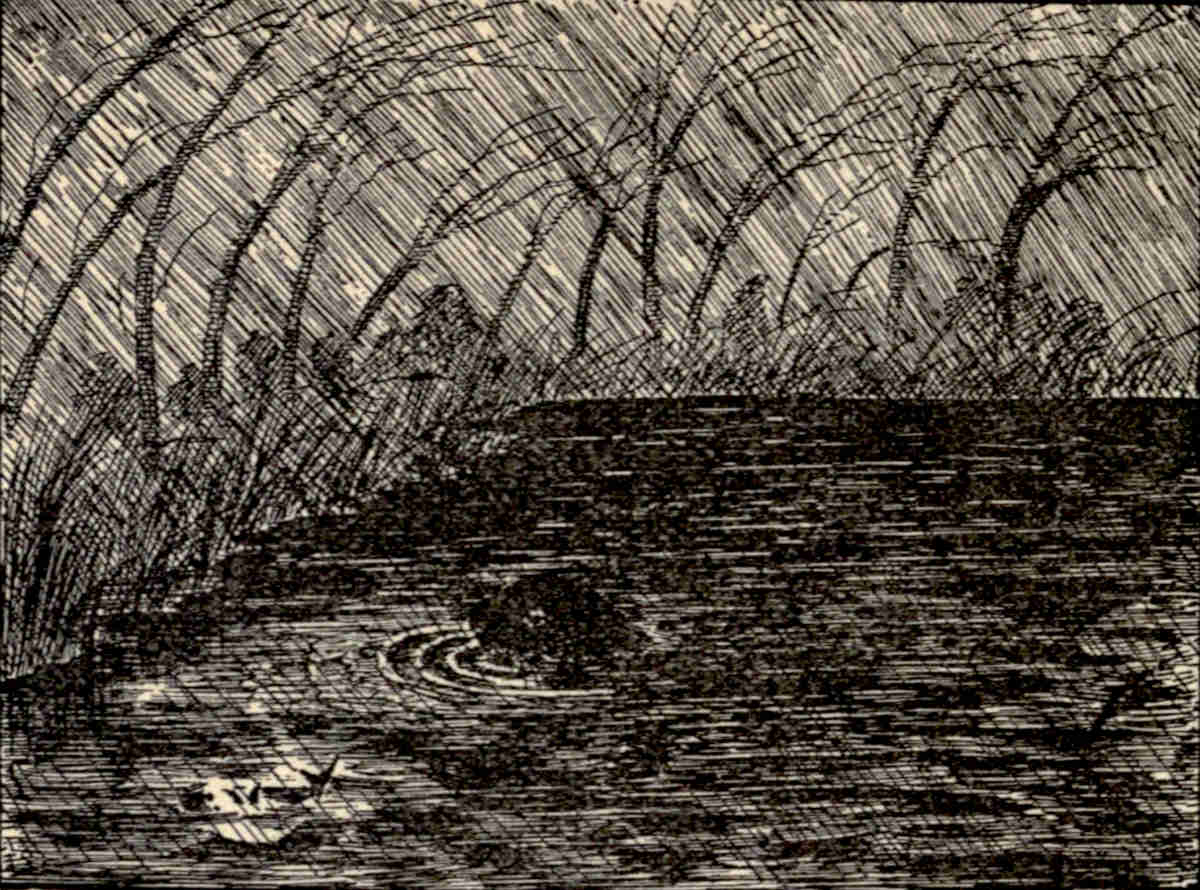
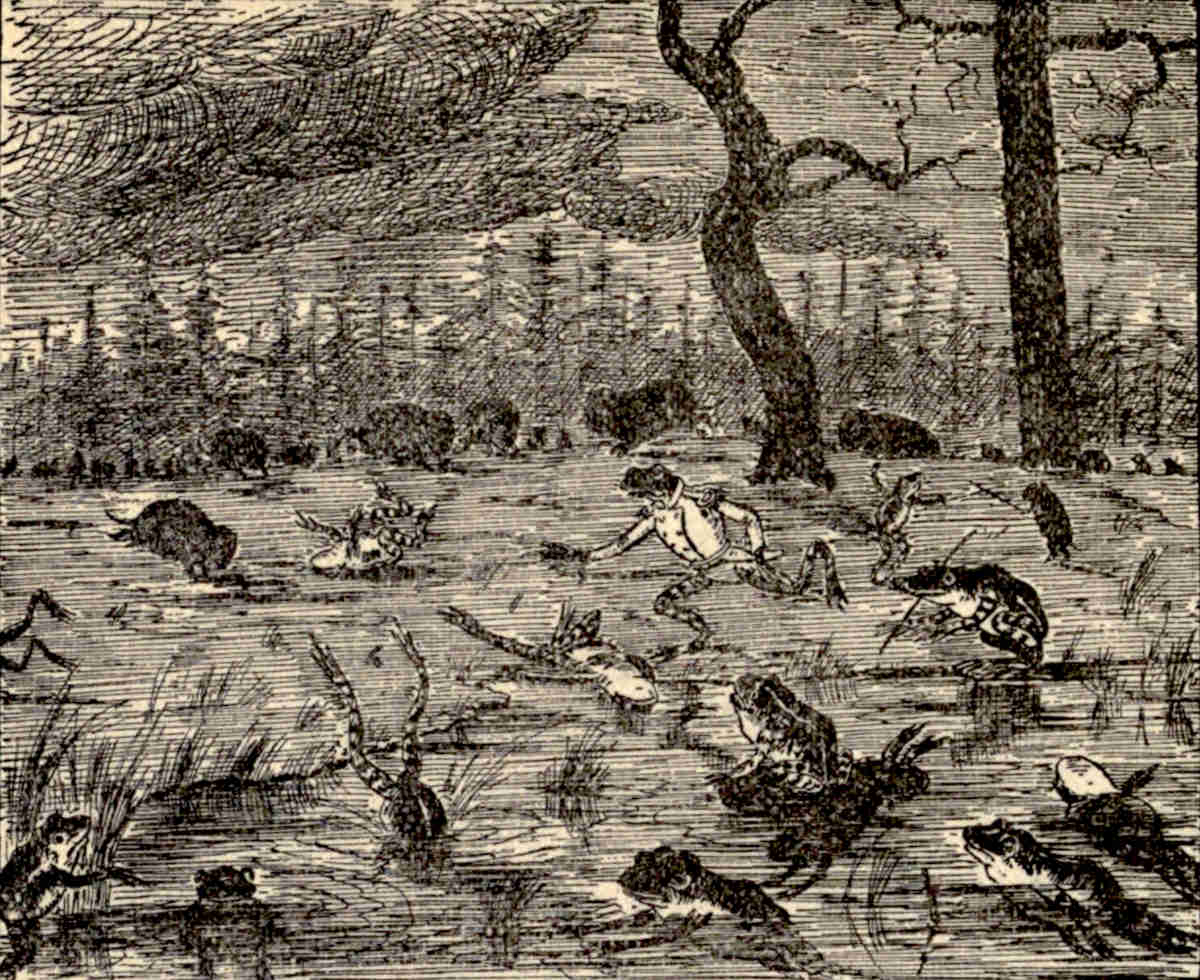
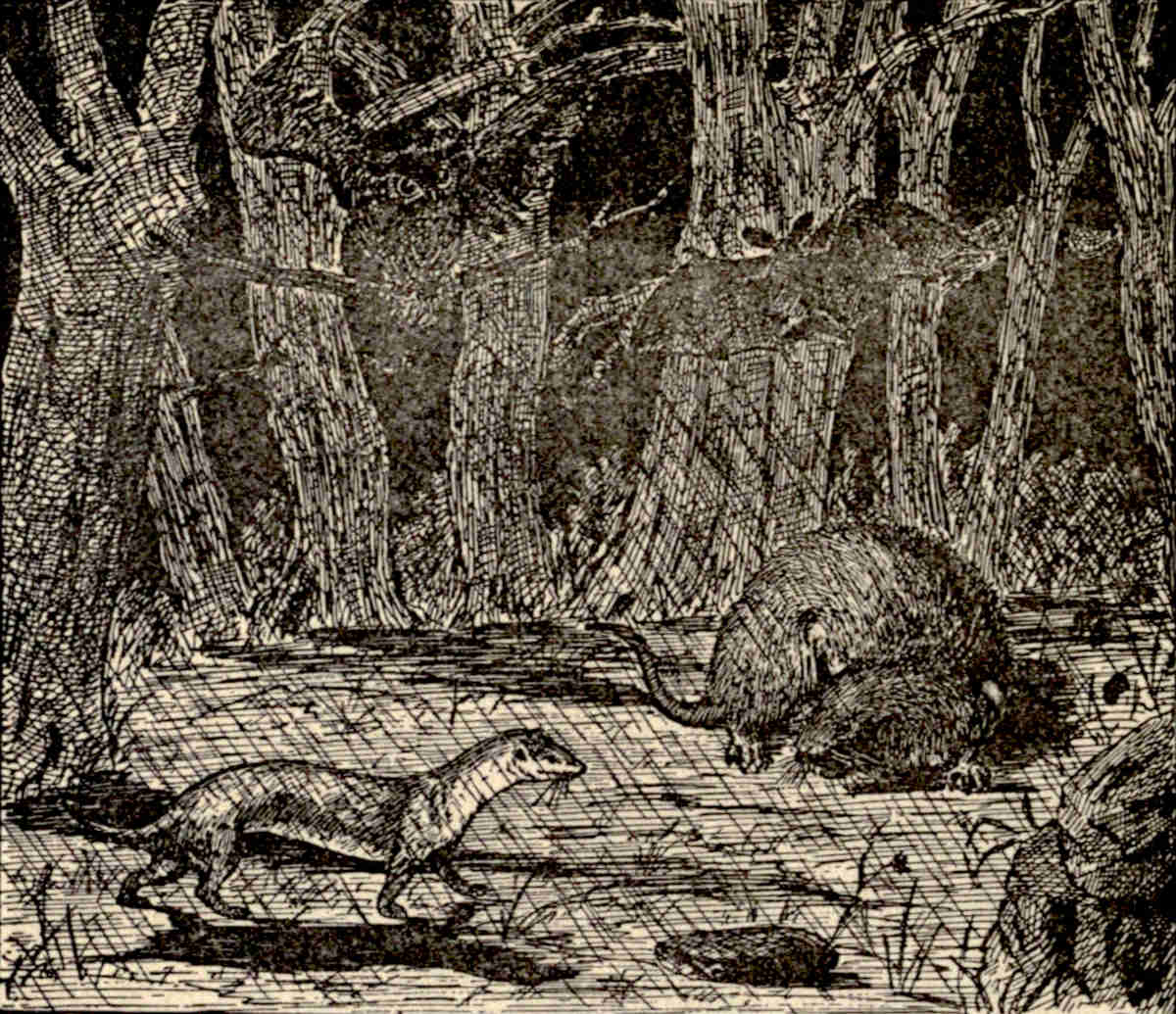
“At last, bleeding and maimed, they agreed to lay the case
before the owl.”
Once upon a time there lived on a large
farm a crow, a water-rat, an owl, a
frog, and a weasel. Large as the farm was,
with its meadows, its fields, and many acres
of woodland, it would seem as if these little
animals might have lived in harmony, without
encroaching on one another’s domains.
Such was not the case, however; and indeed
it is a well-known fact that the more one
has the more one wants, and that there are
some who wish to possess the earth.
This is how the quarrel began. The
water-rat, who lived on the edge of the
brook, claimed the right to a cornfield near
by, which the crow had always considered
his own. The quarrel ended in a fierce
fight which lasted many hours, neither being
able to conquer the other. At last, bleeding
and maimed, they agreed to lay the
case before the owl and abide by his decision,
for he had the reputation of being
very wise.
One moonlight night, the owl repaired to
a large oak-tree on the edge of the wood;
and about him assembled the crow and the
water-rat, with various friends whom they
had brought as witnesses, besides many
other interested parties.
Very solemn did Judge Owl look, as
he sat with his great yellow eyes wide open
and staring straight before him. The trial
was conducted with great formality, each
party stating his own case.
First the crow called up his witnesses,
field-mice and squirrels. All expressed the
opinion that the cornfield belonged by right
to the crow, because they had been told by
their fathers and grandfathers that the crows
had always held possession of it.
After this testimony, the water-rat stated
his case, and summoned his witnesses the
frogs. They were of opinion that the water-rat
should have the cornfield because he
had always had it, and because he couldn’t
live on the food the brook afforded him.
Much bickering went on between the witnesses
of both parties, until Judge Owl
interposed thus,—
“Come to order, and pay attention to
what I say. I have heard both sides, and
my mind is made up. The cornfield belongs
to the crow.”
Angry squeals were heard from the water-rat,
and loud croaks of disapproval from his
witnesses the frogs, who sided with him,—not
from a conviction that he was right, but
because he held control of the brook and
threatened to keep them out of it unless
they testified in his favor.
“Silence!” commanded the judge, with
an angry hoot. “The cornfield, I say,
belongs to the crow, for corn is his natural
food. What business has a water-rat with
corn? None at all. I am told it is indigestible
for him; and all I can say is, that if it
does agree with him it ought not to, and
that it is a mistake. The brook is the place
for the water-rat: let him stay there, and
live on what he can find in it. If he can’t
find anything, let him go without it,—that is
his look out. Can crows live in the water?
No. Consequently the cornfield belongs by
right to the crow.
“Another argument in favor of the crow
is that he can fly off when anybody comes.
Can a water-rat fly? Not that I ever heard
of. There is still another argument, and
one that is indisputable. Was there ever a
cornfield that didn’t have a scare-crow in
it? Did anybody ever hear of a scare-rat?
General opinion carries the day,—the cornfield
belongs to the crow.
“Now I command you to keep the peace.
As long as the water-rat persists in his
absurd claims, there will be bloodshed and
strife. I will repeat to you a verse from
‘The Laws of the Woods,’ that states the
case as clearly as daylight—I should say
moonlight.
“‘War and strife, grief and woe,
Follow you where’er you go.
Never more shall you know rest
For weary feet and aching breast,
Till body round and lithe and long
Shall vanquish body thick and strong.
Then shall dawn a day of peace,
And every strife and sorrow cease.’
“Now the matter is settled, and I must
be off, as I have another case to decide on
the farther side of the wood;” and away
flew Judge Owl.
Exulting caws from the victorious crow
and triumphant squeaks from the mice followed;
but with an angry squeal the water-rat
announced his determination to keep possession
of the cornfield. The verse from the
“Laws of the Woods” that the judge had
read, had no meaning for the assembled
party; nor indeed had it for the judge
himself, who had pondered long over it,
and perhaps this had something to do with
his hasty departure.
Consequently, the decision of the owl did
not change matters in the least,—both the
crow and the water-rat claimed the cornfield
as before. The mice and squirrels
sided with the crow, and the frogs with the
water-rat; and the water-rat hated the crow
even more than before, and vowed vengeance
on the mice and squirrels for taking part
against him.
The weasel, like the owl, had no especial
interest in the matter at stake, but kept by
himself, living under stone walls or in the
neighborhood of hen-roosts and barns,—a
deadly enemy of rats and mice, and consequently
carefully avoided by them.
In this manner things went on until our
story opens, several generations later. The
scene of action is the same farm, but the
originators of the quarrel have been long
dead and forgotten, having transmitted the
feud to their descendants.
CHAPTER II. OLD ROUGH AT HOME.
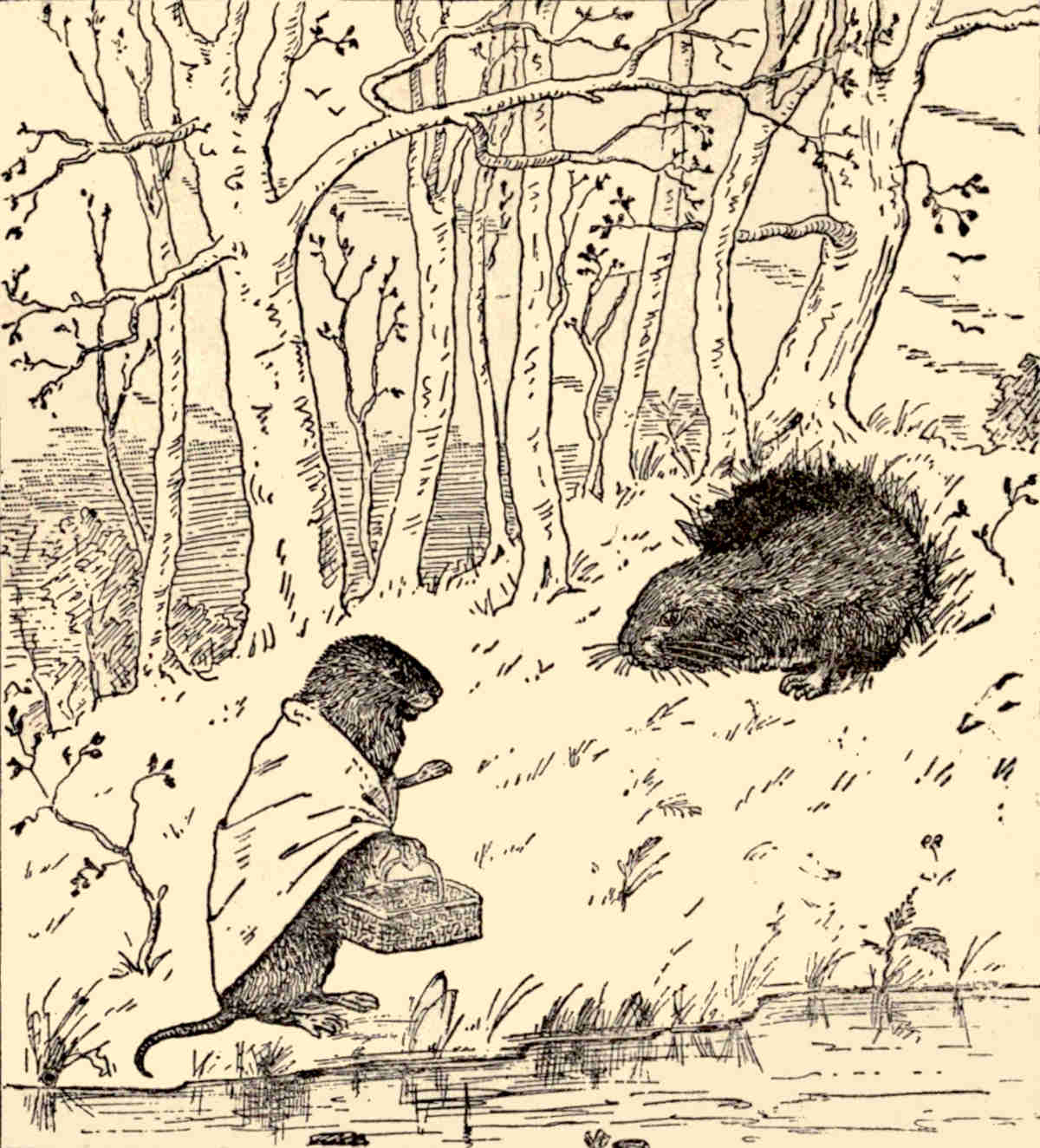
“He soon reached the opening, before which stood a little field-mouse,
who glanced timidly up.”
Our story opens on a dark day in summer,
and in a piece of woodland so far
removed from the busy life that stirs cities
and large villages, that it was seldom any
sound arose to break the stillness of Nature,
except those made by the animal creation
who dwelt there undisturbed by the depredations
of mankind.
At a first glance, it would seem as if
not even animal life were there, so profound
was the silence. A brook, or more properly
a ditch, for so sluggish a stream
hardly deserved the name of a brook,
flowed torpidly through a meadow which
was bordered by forest trees and thickly
growing underbrush.
At a first glance, as we said, no motion
was perceptible, but a keen eye on the lookout
for signs of life might have detected a
dark object creeping along the soft and
slimy banks of the ditch, often stopping to
look about him and listen. It was a large
water-rat, his long rough fur failing to
make him an agreeable object, for the cruel
expression in his keen little eyes that were
placed closely together, and the long, sharp
teeth that seemed constantly on the lookout
for something to devour, would have
deformed any face.
As the water-rat proceeded cautiously on
his way, as we said before, he stopped frequently
and looked about him, sometimes
casting his sharp eyes around to see if anybody
were approaching, and at all times on
the watch for trespassers on his domains;
for the water-rat considered himself the
proprietor of the meadow, and in a measure
also of the forest that stretched beyond it.
All at once, the old rat stopped short and
examined the ground about him, where the
prints of small feet in the mud were visible.
“I thought so!” he exclaimed to himself;
“those mischievous field-mice have been
here again, gnawing those tender young
roots that I have been keeping my eye on.
Just let me catch them at it, and their tails
will be even shorter than they are now.
They’re even worse than the crows, for
they are so small they can slink around
without being seen.”
A jeering laugh from behind startled the
water-rat, and turning quickly he descried
two young crows seated on a rock near by,
and regarding him with countenances expressive
of great amusement.
“Be off, you young thieves,” snarled the
old rat, angrily; “how dare you trespass on
my premises?”
For answer the young crows each inclined
an ear toward the water-rat in a listening
attitude, as if to catch his words, and then
burst into derisive caws.
“Don’t speak quite so loudly, sir,” remarked
one of the crows. “I knew an old
fellow of about your age who busted a
blood-vessel, and ’twould be a pity to have
you taken off so suddenly; you’d be a
great loss to the neighborhood, you’re so
sociable.”
“And he was first cousin to the fellow
who died because he tried to save expense
by living without eating,” said the other
crow.
The old water-rat was too wise to continue
a conversation in which he was sure to be
worsted; so he continued on his way, followed
by the taunts of the young crows.
“How much will you take for your skin,
old Rough?” called out one, while the other
chanted,—
“There was once an old miser, who thought
He could live upon little or nought;
But one day he died,
And his wife sold his hide
For a sum much more than she ought.”
“Young villains!” muttered old Rough to
himself, as he scurried home, “I’ll pay
them for this.”
The water-rat stopped before a hole, and
looking stealthily behind him, to make sure
that no one was in sight, noiselessly entered
his habitation. A long and narrow passage,
in which the darkness increased as he progressed,
led finally into a large apartment,
which served evidently as the living and
sleeping room of old Rough; for a pile of
dried leaves and old rags in one corner
apparently served as a bed.
Another rat sat on this bed, evidently in
the act of taking a hasty lunch, for so silent
had been her husband’s entrance that
Ruffina was not aware of his approach until
he appeared before her; then with a frightened
expression she hastily swallowed the
mouthful she was masticating, and with a
quick motion concealed something under
the leaves that formed the bed.
“Not so fast, madam,” exclaimed old
Rough, springing to the spot where his wife
had hidden her prize; and in a twinkling he
drew forth a large walnut, into which Ruffina
had had time only to drill a hole with
her sharp teeth.
“So, madam!” exclaimed the old rat in a
harsh voice, looking from the nut to his
trembling wife, whose eyes anxiously followed
all his movements, “so this is the way
you obey me, is it? How dared you touch
those nuts when you knew they were not to
be eaten?”
“But they are last year’s nuts, and most
of them are wormy and musty,” answered
Ruffina, submissively; “and I thought you
wouldn’t care.”
“You thought I wouldn’t care?” squealed
the old rat, bringing his teeth together with
a snap that made his wife shiver.
“I was so hungry,” pleaded Ruffina,
meekly, “and the nuts are really spoiled.”
“What!” shrieked old Rough, with a
spring that brought him in front of his terrified
wife, “have you lost the little sense you
ever possessed? Don’t you know that I
can mix those nuts in with this year’s, and
pass them off for fresh ones? And see
here, madam, I think you said just now that
you were hungry. Don’t let me hear any
more of such nonsense. Don’t you eat as
much as I do? We must pinch and
scrape, and starve if necessary, to get a little
forehanded, or we shall die paupers.”
“But we are not poor,” replied Ruffina,
meekly. “Look at the piles of roots and
mussels and snails over there. Every one
says you are richer than anybody about
here, and—”
Poor Ruffina ended her sentence in a cry
of pain, for her cruel husband darted suddenly
upon her and fastened his long teeth
in one of her ears.
“If you are too stupid to comprehend my
words, perhaps you can understand that!”
exclaimed the ill-natured old miser, as his
poor wife retreated to a corner, whining.
A soft voice at the door here attracted
old Rough’s attention, and entering the
passage-way, he soon reached the opening,
before which stood a little field-mouse, who
glanced timidly up at the hard face of the
old miser.
“Well, what do you want, Bobtilla?”
asked the old rat, with a grim smile at
the discomfiture of the little field-mouse.
“I came to ask if I might have one of
those tender roots down by the dam?” said
Bobtilla, timidly.
“What!” exclaimed old Rough, harshly,
“you have the audacity to ask me for one
of my tender young roots?”
“One of my children is ill,” squeaked
Bobtilla in her mild voice, “and he thought
he would relish one of them. He has so
little appetite now that he can’t eat the
scraps I manage to pick up.”
“Oh, he can’t!” growled the old rat.
“Well, what will you give me in exchange
for my tender young root? Do you know,
madam, that every one of those little roots
brings me a pile of corn?”
“I shall without doubt be able to pay
you when the crops are ripe,” answered
the little field-mouse; “but we have eaten
up all our winter store, and shall have to
scrape along as best we can till midsummer.”
“The more fool you,” snarled the old
water-rat. “Let me tell you, madam, that
I don’t indulge in luxuries; if I did, I
should probably have to go about begging
as you do. No, when you come with your
pile of corn, you shall have the tender root
that your sick child craves, not before. Now
be off. You’re a thieving set, like all the
others about here, and I want you to keep
off my premises;” and the old miser turned
and re-entered his dwelling.
Poor little Bobtilla turned sorrowfully
away from the miser’s abode, and retraced
her steps to her home. How could she go
back to her sick child and tell him that
she had returned without the tender root
he so much desired? The more Bobtilla
thought over the matter, the harder it
seemed to her, and she cast many a longing
glance toward the dam where the
tender roots grew.
“Why did the miser claim the whole
meadow?” thought Bobtilla. He had no
more right to it than she or many others.
Merely by right of his superior strength
did he claim it. Was it possible she could
gnaw off a small piece without being detected?
Bobtilla hesitated as she arrived
opposite the dam, and glanced quickly in
the direction of the tyrant’s abode. Far
off as it was, she was certain she saw the
miser sitting in the doorway, and trembling
at the thought of the terrible revenge that
would overtake her should she attempt
to touch the coveted root, she reluctantly
continued her way.
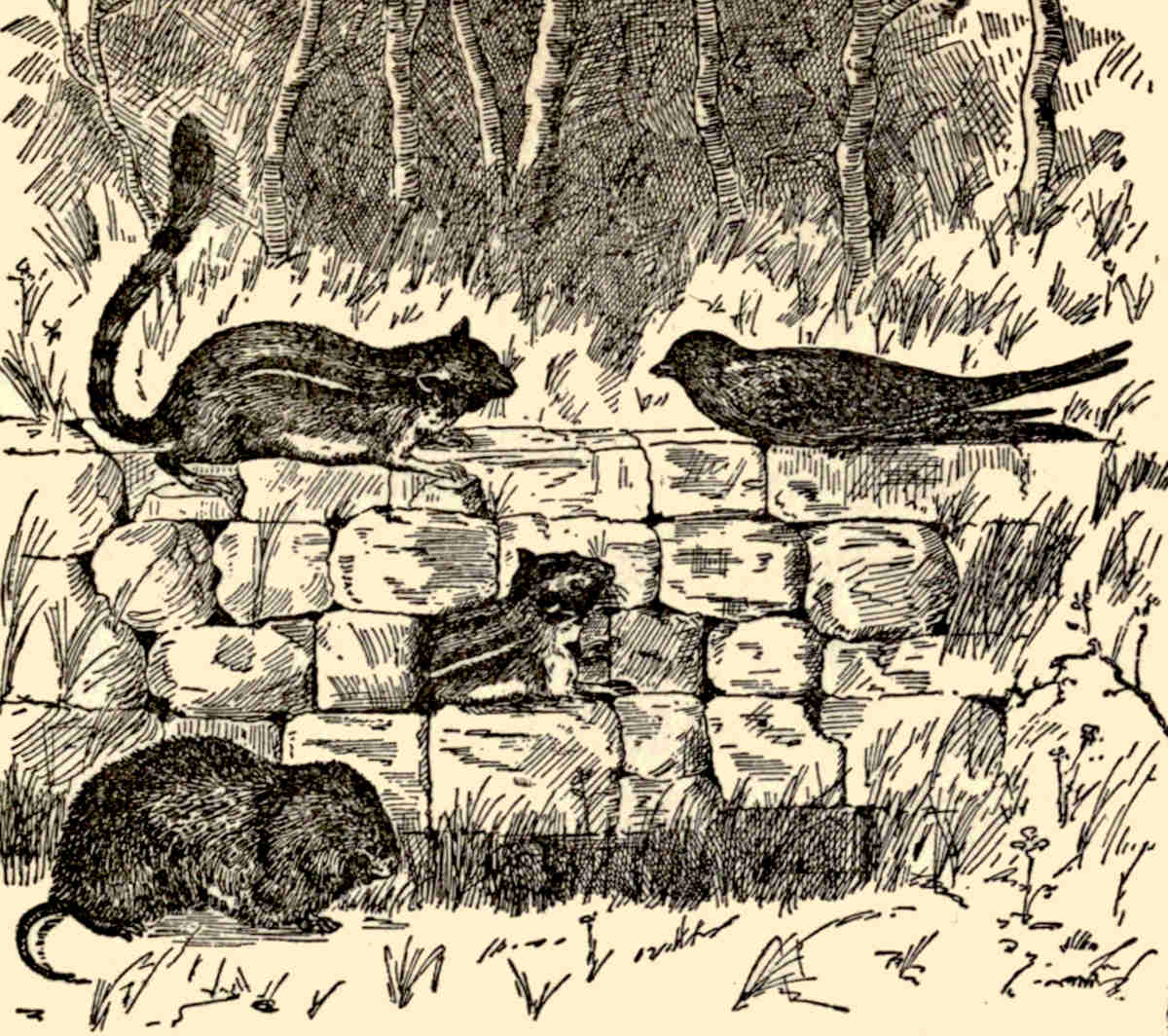
As Bobtilla passed under the wall that
led to her home, pleasant tones fell on her
ear, and the voice being a new one, she
stopped and looked about her. A chipmunk
whom she had never before seen,
sat on the top of the wall, holding in her
little forepaws a large nut, into which she
was drilling a hole, at the same time conversing
in a cheerful voice with another
chipmunk, who sat on the branch of a large
chestnut-tree above her. Bobtilla, hidden
behind a stone, paused to listen.
“So he told you they were his trees, and
that we couldn’t have any of the nuts when
they were ripe, did he?” said the squirrel
on the wall, examining the nut to see how
deep the hole had become.
“Yes, my dear,” replied the squirrel on
the tree; “but I reminded him that the
wood was a large place, and that there
was room for all in it.”
“What did he say to that?” asked the
other squirrel, whose sharp teeth had now
penetrated the hard shell of the nut.
“Oh! he still kept up his bluster; but I
think we needn’t fear him. I don’t know
who he is, that he should give himself so
many airs, but we can let him alone, and
perhaps he will not interfere with us.”
“I can tell you who he is,” squeaked
Bobtilla; “he is a disagreeable old miser,
and his name is old Rough.”
The two squirrels looked about them in
astonishment, for they had thought themselves
alone, and the little field-mouse
hopped onto the stone behind which she
had been concealed.
“I can tell you all about him,” she said.
“You must be strangers about here not to
know who old Rough is. I was at his house
just now, to beg a little root of him. There
are ever so many of them growing down by
the dam, and I thought he might let me
have one for my sick child; but he refused,
because I had no corn to give him in exchange.
You see our winter supply has
gone,” continued Bobtilla, who was encouraged
to proceed by the good-natured countenances
of her listeners, “and one of my
children is ill, and can’t eat as the rest of us
do. All we had was a grasshopper’s leg that
was hard and dry. It is of no use to try to
soften old Rough’s heart, and I suppose I
must see my child die for want of proper
food.”
The two squirrels exchanged glances,
and the mother squirrel, Squirrella, said,—
“Would your sick child relish a nut, do
you think? I am quite sure we have a few
chestnuts left, and they are quite easy to
break;” and before Bobtilla could reply,
Squirrella had disappeared in a hole in the
wall. In an instant she was back again,
carrying a chestnut in her mouth; and depositing
it at the feet of the little field-mouse,
she said in her motherly way,—
“When he has eaten that come back for
more. I know what it is to have sick
children.
“We have but just moved here,” continued
Squirrella, interrupting Bobtilla’s profuse
thanks. “We have always lived in one
place, but the woods were being thinned out
to make room for human habitations, and
we felt the necessity for a change. One
day our friend Swift the swallow told us of
this place, so we moved here.”
“This seems a very peaceful place,” said
Squirrello, the squirrel on the tree, “and I
don’t see how old Rough can hurt us if we
keep out of his way. All of your other
neighbors are harmless, aren’t they?”
“Yes,” replied Bobtilla, “I believe so,—unless
it is old Blinkeye. He is very strong
and fierce, you know,—that is at night.
Nobody is afraid of him in the daytime, for
then he can’t see a thing.”
“Old Blinkeye,—and what kind of a
creature is he?” asked Squirrello.
“A very large owl,” replied the field-mouse.
“As I said before, look out for
him at night, for then he is dangerous; but
in the daytime, why he couldn’t harm a fly,
and I wouldn’t even turn out of the way if
I met him.”
Here a slight rustling of the leaves in a
tall tree near by attracted their attention,
and, giving one hurried glance in that direction,
Bobtilla shrieked, “Old Blinkeye!”
and in spite of her assertion that he was
perfectly harmless in the daytime, seized her
chestnut, and darted off to her home with
great speed, not once stopping to look behind
her.
The two squirrels, startled by Bobtilla’s
sudden exclamation, took the alarm, and
whisked into their hole in the wall.
CHAPTER III. OLD CAW’S COUNSEL.
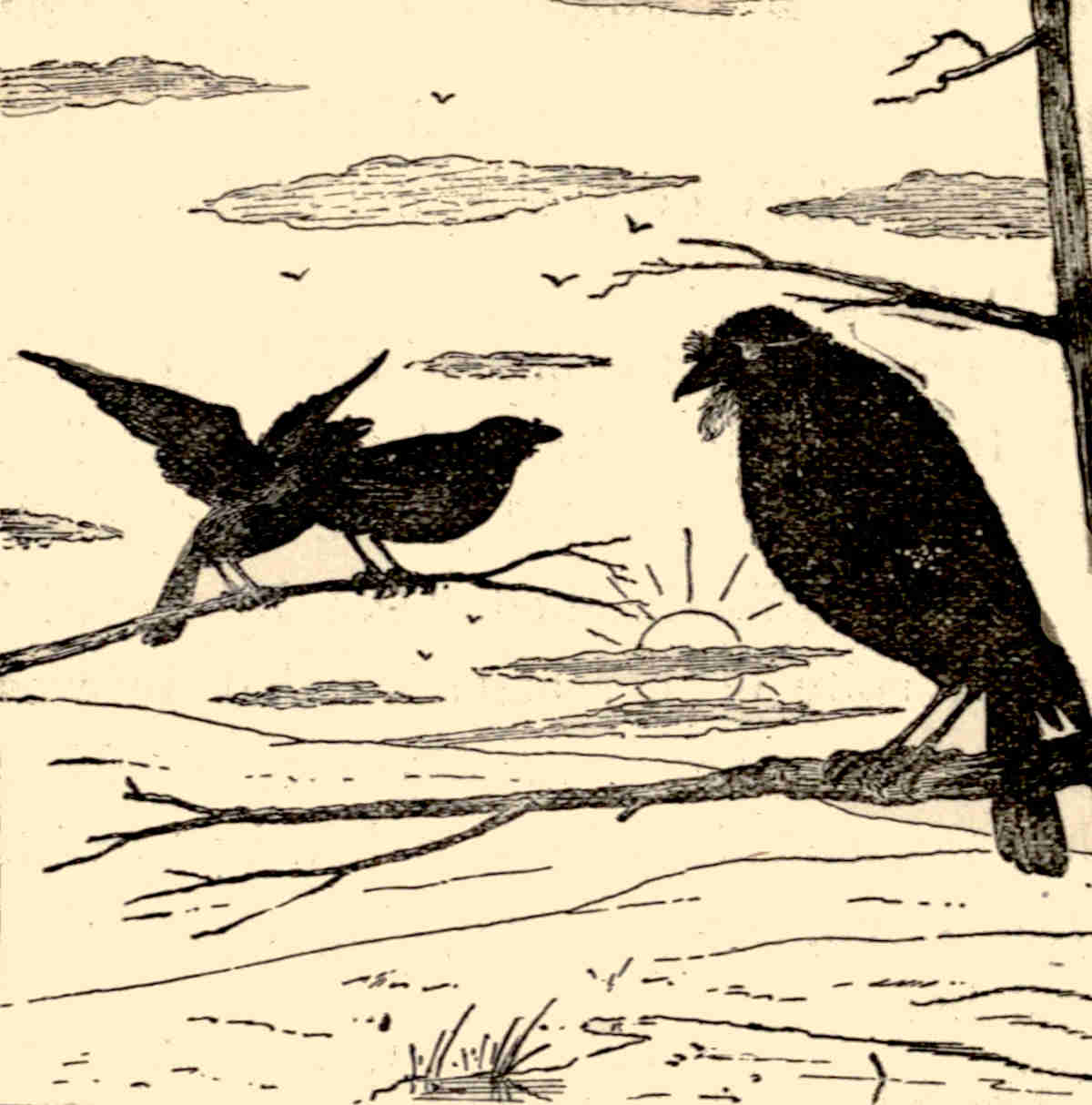
“Well, young gentlemen, he began in the high, cracked voice of
extreme age, you did well to return.”
When the two chipmunks found themselves
inside their house, they listened
in breathless silence, their little hearts beating
fast with fear; but as all was still, and
they found they were not pursued, curiosity
began to get the better of them, and they
felt a desire to obtain a glimpse of the dangerous
being that had inspired Bobtilla with
such terror.
Noiselessly approaching the opening of
their house, Squirrello put out his head and
glanced cautiously around. On the tall tree
sat a large bird, such as the squirrel, who
had hitherto lived on the outskirts of a
large town, had never seen. His strong
claws grasped tightly the bough on which
he rested, and his large yellow eyes that
gleamed through the foliage looked straight
before him. The pointed tufts on his head
and his large hooked beak gave him a vigilant
and fierce expression, and at intervals
he blinked his eyes solemnly. It was a great
grandson of Judge Owl, who, many years
before, had settled the dispute between the
crow and the water-rat.
Squirrello having made these observations
from his door, turned and addressed
his wife,—
“Come, Squirrella, and look at this
strange creature. We have certainly seen
nothing like him.”
Squirrella glanced toward a corner of
her house, where, on a soft bed of leaves
and moss, lay two young chipmunks fast
asleep.
“They are all right,” replied her husband,
reassuringly, “old Blinkeye can’t get in
here.”
“How I dread the time when they are
old enough to run about by themselves,”
said Squirrella, anxiously. “I almost wish
we had remained where we were.”
“You forget the cats there,” answered
her husband. “Evidently old Blinkeye is
the only creature we need fear besides the
water-rat, and owls are dangerous only at
night.”
“Then why did the field-mouse seem so
alarmed at sight of him?” asked Squirrella.
“Because she is afraid of everything.
Come, my dear, don’t be as foolish as she is,
but take a good look at this remarkable-looking
bird, that you may avoid him in
future.”
Thus encouraged, Squirrella took heart
and followed her husband to the door, and
after a moment, seeing how silently and
quietly the owl sat on his perch, she became
emboldened to join her husband on the top
of the wall, where they both remained,
watching the great solemn eyes of the fierce
Blinkeye.
The two chipmunks conversed in low
tones, and the owl was evidently not aware
of their presence, for he still looked straight
before him in the same solemn manner.
A laughing and cawing was heard before
long, and two noisy young crows lighted
on a tree directly opposite the silent owl.
“How are you, father Blinkeye?” asked
one of the crows, familiarly. The owl
turned his head slightly towards the voice,
but maintained the same dignified silence.
“You don’t happen to know what the
parrot died of, do you, my friend?” asked
the other crow; but as he received no
answer, he continued,—
“Well, he died of talking, and I thought
perhaps you might have symptoms of the
same disease.”
The owl continued silent as before, and
fixed his solemn yellow eyes on the impertinent
young crows, who after a while became
somewhat uneasy under his steadfast gaze.
With a show of indifference they indulged
in personal remarks intended to annoy the
silent owl, but to all their impertinence the
owl was apparently unmoved, and at last
broke silence:—
“Let me advise you, my young friends,
for you are very young in experience, to be
a little more careful in your selection of a
place to conceal your stolen treasures. I
am astonished that such shrewd young fellows
as you consider yourselves should
have shown so little judgment.”
“What do you mean?” asked both
together.
“Oh! nothing,” answered the owl, carelessly.
“I thought perhaps you might
sometime have occasion to conceal a bone
or delicate scrap of meat your old grandfather
had given you as a reward for good
behavior, and I have heard that you were
not as careful as you might be in your selection
of hiding-places.”
“So you have been spying, have you?”
exclaimed the younger crow, angrily.
“I?” asked the owl, coolly. “Oh, no, I
was merely repeating what I had heard. Old
bones and scraps of meat do not attract me;
I prefer live game.” And at the words, the
two little chipmunks suddenly darted into
their house, and remained there until the mischievous
crows had taken flight, and all was
still once more.
“You see, my young friends,” continued
the owl, “that you are better known than
you think you are. Did you ever hear that
verse about your family in ‘The Laws of
the Woods?’ I will repeat it to you, that
you may form some idea of the reputation
you bear:—
“‘Wherever you are, and wherever you go,
Beware, oh beware, of the saucy crow!
His feathers are black and his beak is long,
And he has a croak instead of a song.
His pleasure it is to hide and to steal;
No creature for him does affection feel;
I pray you avoid him, the mischievous crow,
For there’s no trick that he does not know.’”
“Capital!” exclaimed the two crows,
bursting into caws of laughter. “Give us
some more verses from ‘The Laws of the
Woods’!”
“I will,” replied the owl, severely, and still
gazing fixedly on them, he repeated in warning
notes:—
“‘War and strife, grief and woe,
Follow you where’er you go.
Never more shall you know rest
For weary feet and aching breast,
Till body round and lithe and long
Shall vanquish body thick and strong.
Then shall dawn a day of peace,
And every strife and sorrow cease.’”
“Suppose you tell us what it means?”
said the elder crow. “Who is the ‘body
round and lithe and long,’ and who the
‘body thick and strong’?”
“You will find out to your sorrow before
long,” replied the owl, solemnly; “but ‘the
day of peace’ will dawn for the rest of us.”
“In return for your compliment, I’ll recite
for your benefit a verse that is a little easier
to understand,” said the elder crow:—
“There was once an owl who said, ‘I
Really would not hurt a fly;’
And through the long day,
He sat blinking away,
But when the night came, oh my!”
As the crow finished his verse, he and his
brother flew off with great flapping of wings
and derisive jeers, cawing out the lines as
long as they were within hearing of the
owl.
When they were out of sight, the two
crows looked at each other, and the younger
said,—
“How do you suppose he found out about
that pig’s ear?”
“I’m sure I don’t know; somebody probably
watched us. One thing he said is
true,—he always wants live food himself.”
“I’ll tell you how it is,” replied the
younger brother, “Old Rough is an acquaintance
of his, and he is always prying
about, and wouldn’t hesitate to help himself
to anything he might find. Yes, we’ll have
to find a new hiding-place.”
“Hush!” said the elder brother, as they
came in sight of their home; “don’t talk so
loudly. There’s the old gentleman on the
lookout, and old as he is, he hears quicker
than any of us.”
On the top of a tall fir-tree, where the
branches grew thickest, reposed the home
of the crow family,—and a most untidy
and insecure structure it was, looking as if
the materials had been flung against the
tree and caught there; for mud and twigs,
and rags and feathers appeared to be mixed
indiscriminately, and the whole nest looked
as though it might tumble down at any
moment.
In spite, however, of the insecure appearance
of her home, the mother-crow
was seated comfortably within, and several
young crows were perched on neighboring
branches, noisily cawing.
On a tree near by, apart from the others,
as if he wished to avoid their noisy cawing,
sat a crow whose appearance indicated
that he was a person of distinction in the
crow family, and when the hilarity of the
younger crows grew unusually loud, the
mother sitting in the nest glanced uneasily
towards this solitary figure, and sharply
enjoined silence.
For awhile after her admonitions, the
voices became lower; but soon, with the
exuberant spirits of youth, the young crows
again forgot themselves, and they all cawed
together as excitedly as before.
As the two newcomers appeared, the old
crow on the tree by himself, turning his
head sideways, glanced at them out of one
eye, but otherwise bestowed no attention
on them.
“Where have you been all day?” asked
the mother-crow in a querulous voice.
“Your father has been everywhere to
hunt for you, and your grandfather is much
displeased.”
“We were looking for provisions for the
family,” replied the elder brother, winking
at the other.
“A likely story!” replied his mother.
“You have been idling away your time in
some folly, I know. You never are here
when you’re wanted.”
The young crows knew by experience
that this was the beginning of a long lecture,
and they remained silent until their
mother had ended. All this time the old
crow had not stirred; but when the mother
bird had ceased, he said briefly,—
“Come here, I have something to say to
you.”
Their mother’s scoldings the young crows
did not mind, for they were too frequent to
make a deep impression, and she told them
of so many faults at once that her reproofs
lost their force; but when old Caw their
grandfather spoke, it was always to the
point, and left them in no doubt as to his
meaning.
The two young crows at once, therefore,
obeyed the summons, and lighted on a
branch opposite the old crow, who for a
moment regarded them in silence. It was
no wonder that the countenances of these
reckless young creatures fell beneath the
gaze of that shrewd old face.
Old Caw, as he was familiarly called, the
leader of the flock, although having long
outlived his generation of crows, had still
sufficient energy of character left to enable
him to sustain the position of counsellor and
leader that he had for so many years ably
borne. One eye only remained to him, the
other having been pecked out in a quarrel
in his youth; but in that single eye was
concentrated all the shrewdness and ability
that distinguished him even among the
ablest of his kind.
“Well, young gentlemen,” he began, in
the high cracked voice of extreme old age,
“you did well to return when you did.
The expedition starts shortly, for we must
have two good hours before sunset.”
The young crows knew that it was not
to tell them this that their grandfather had
called them and eyed them so sharply, and
they looked at one another sheepishly. As
he continued silent, they turned to leave
him; but he called them back.
“See here, my fine fellows, the next
time you steal a pig’s ear from me, don’t be
so clumsy about it. There is a right and
wrong way of doing things, and you can’t
be too particular about these little matters.”
The young crows looked still more confused,
as they learned that their grandfather
had discovered their little theft.
“Did you really think old Caw was so
stupid as to hide his pig’s ear where you
could find it so easily? No, I assure you he
is too old a head for that. I purposely put
it where you would come upon it, for I
wanted to teach you a lesson, and sometime
I will show you how to do such
things neatly. Your education has really
been neglected. However, it is time to be
off, and here come our friends.”
As he spoke, several crows appeared,
flying rapidly towards them. Very little
time was spent in preparations for starting,
and when all were in their places, old Caw
placed himself at the head of the little flock,
and with much flapping of wings and discordant
cawing, they flew off in the direction
of the woods.
CHAPTER IV. THE CORNFIELD.
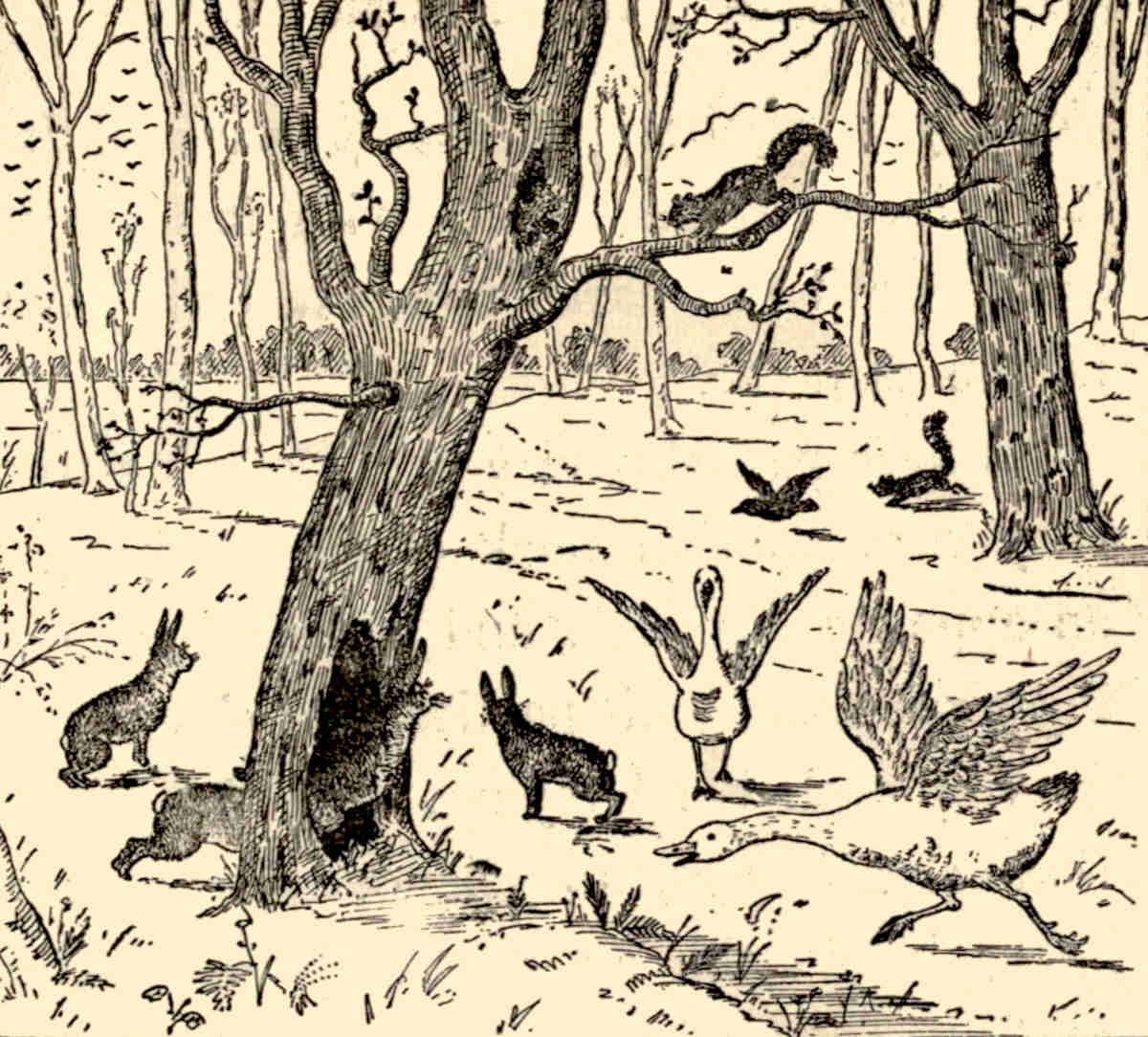
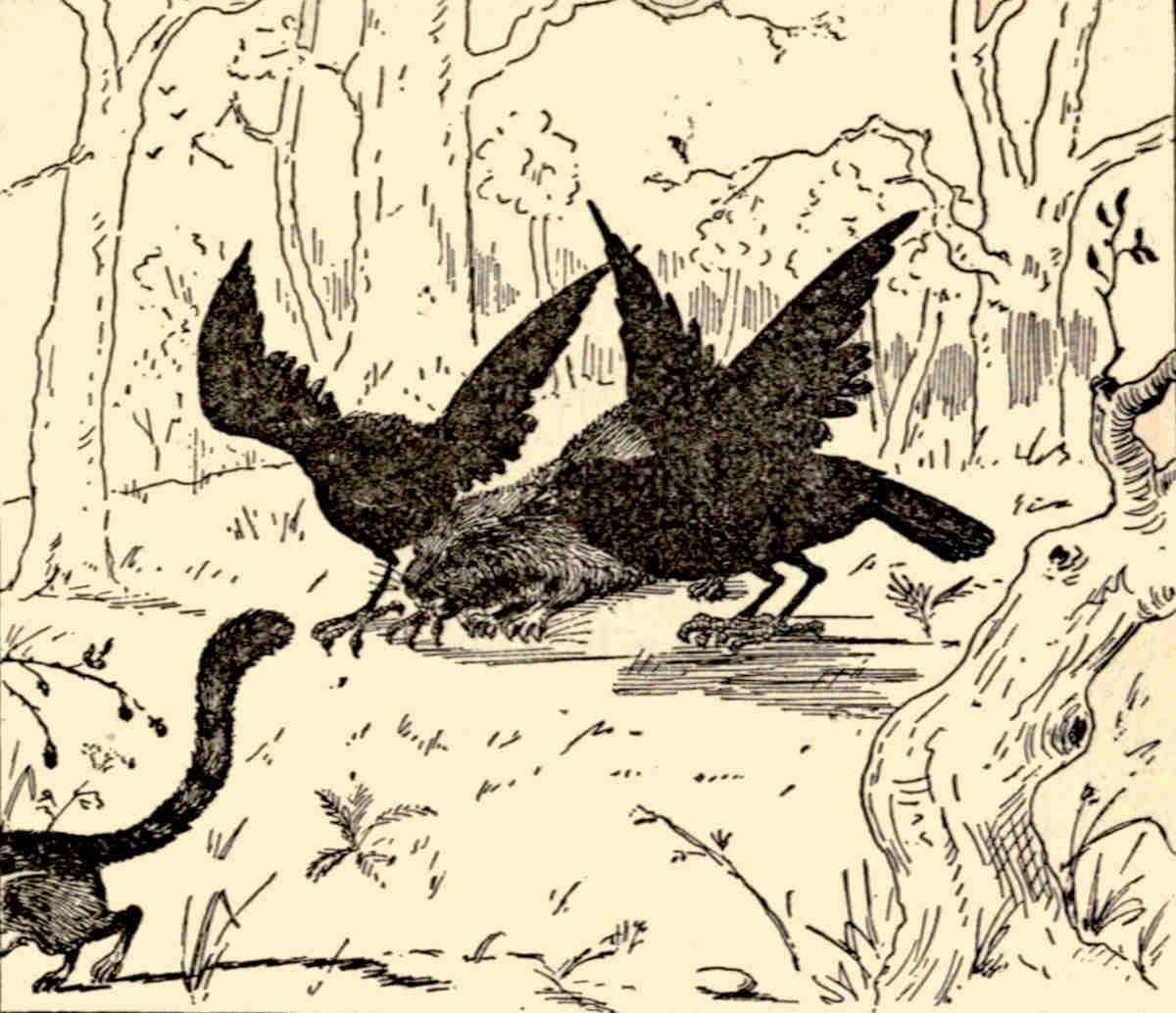
“Many a smaller bird started up in terror from its leafy retreat,
and occasionally a squirrel or rabbit scurried into its hole.”
Old Caw led his flock of crows through
the dense wood, and startled by the
constant cawing that broke the stillness of
the forest, many a smaller bird started up
in terror from its leafy retreat, and occasionally
a squirrel or rabbit scurried into
its hole, to remain there with fast-beating
hearts until the harsh noises had died away
in the distance.
As they passed over a grove of pine-trees,
they met another flock of crows flying in
an opposite direction, and a discordant cawing
arose from both parties, the elder members
of each band trying, with the wisdom
that age brings, to silence the younger
ones; but in this attempt they were unsuccessful,
and, with a few sharp words of
reprimand, old Caw started his party again,
with the exception of his two pugnacious
grandsons, who remained behind to settle
the dispute with two equally persistent
members of the opposing party. Before
long, however, they were seen rapidly flying
to join their flock, in high spirits at having
settled the matter to their satisfaction.
No other incident occurred to disturb the
progress of old Caw’s little band, and soon
they passed over cultivated fields and open
meadows, the keen eye of the veteran
leader taking in all the possibilities of the
country.
At last Caw halted his band on the edge
of a fine maple grove, and they beheld before
them a fertile field in which were
planted crops of various kinds. It was
the very cornfield about which, years before,
the quarrel had arisen between the
crow and the water-rat.
A stone wall, with a row of maple-trees
in front of it, separated the field from the
road.
“Why not light on those maple-trees,
where we can see something going on,
instead of hiding here in this out of the way
place?” asked one of the party.
“This is not Sunday,” replied old Caw,
severely.
“What has that to do with it?” asked
a youthful member of the flock, while the
one who had made the proposition retired
abashed to the rear.
“What has that to do with it?” repeated
old Caw, harshly. “A good deal, I should
say. It means that on Sunday we could
sit in a row by the side of the road from
morning till night, and not a soul would
think of harming us; but on a week day
there would be a dozen guns pointed at
us before we had been there five minutes.
I want to give you a little advice before
we begin our work. Don’t caw so much.
At the slightest provocation you set up
such a noise that the whole neighborhood
is down upon us, and as soon as they catch
sight of us there will be an end to our fun.
See if you can’t remember this, and make
up your minds to do your talking when
you get home. Now for business.
“Do you see those little mounds over
there beyond the potato patch? Well, that
is for a late crop of corn, and every one of
those mounds is full. You, Blackwing,”
continued old Caw, addressing the young
crow who had asked the question a short
time before, “remain on the top of this
tree, and look all around you, particularly
in the direction of the house and barn, and
if you see any one coming, give one caw
to warn us. And the rest of you, if you
hear Blackwing caw, fly up at once, without
a sound, taking care even not to flap
your wings loudly, for if we succeed in
escaping without being seen, we can return
and finish our work.”
Blackwing at once flew to the topmost
branch of the tree, and the other members
of the flock followed old Caw into the
field of newly planted corn. Proceeding to
one of the little mounds, the leader, with
two or three skilful movements, scratched
it open, and eagerly devoured the yellow
kernels he found there. The others followed
his example, and soon all were busy,
and making sad havoc in the cornfield.
They remembered the admonitions of old
Caw, and preserved a discreet silence, stalking
about among the little hills in their
most dignified manner.
Suddenly a loud and continued cawing
was heard from the sentinel on top of the
tree, and up flew the marauders, cawing
excitedly and flapping their long wings
noisily, not stopping to look around until
they had all lighted on various branches
of the maple-trees, when they all talked
and scolded together.
Old Caw flew to a tall tree whence all
could see him. “Stop!” he called out, as
soon as he could be heard amid the din of
excited voices; “don’t let me hear any
more of this disgraceful proceeding. Stop
this minute, I say!”
The discordant cawing gradually resolved
into a confused murmur of voices, a few of
the boldest still keeping up a low muttering
of discontent; but so great was the
excitement, that, as the last murmur died
away, one persistent young crow (and we
regret to have to acknowledge that it was
one of old Caw’s own grandsons) started a
fresh complaint, and in a second the excitable
creatures were all cawing together
louder than ever.
Old Caw was almost beside himself. His
weak, cracked voice was drowned in the
general tumult, and driven to desperation
at the insubordination of his followers, he
rushed fiercely at them and distributed
some sharp pecks indiscriminately. This
had the desired effect, and at last order was
restored.
“I am astonished at such outrageous behavior!”
he said sternly, when he had regained
his breath lost by this unusual exertion.
“No, no more of it,” he added
quickly, as the persistent young crow who
had once before started the commotion
opened his beak to speak. “It is my business
to settle this matter. In the first place,
sir,” he continued, turning to Blackwing,
“why did you not caw once, as I ordered
you, instead of raising such a hubbub?
And, indeed, why did you caw at all? For I
see no human being in sight, and I had
especial information that the men of the
family were away from home.”
Blackwing’s countenance fell under this
severe reproof of his leader, but he hastened
to defend himself.
“I kept watch as you directed,” he began,
“and saw nothing suspicious for awhile, until
suddenly I beheld old Rough scurrying
along as fast as he could come, and he
stopped directly under the tree where I was
watching. ‘This is a pretty state of
things,’ he began, ‘stealing my corn, you
pack of thieves! Be off, or I’ll know the
reason why!’ I was naturally indignant, for
I knew we had the best right to the cornfield,
and I reminded him of it, whereupon
he became vicious, and said the field belonged
to him, and he didn’t care what the
owl had decided, and that he intended to
trade with the corn. He became so abusive
that I lost my temper, and forgot orders
and called out to you.”
“Where is the old miser now?” demanded
old Caw, sternly.
“Oh, he slunk away as soon as I called
out, and in all probability is hidden in some
hole about here.”
“I should like to see him,” exclaimed old
Caw, fiercely; “it would be some time before
he meddled in my affairs again. His
cornfield indeed! The old fellow carries
things with too high a hand; and if I don’t
find a way to stop him, my name isn’t old
Caw.”
One of the flock proposed to visit the
cornfield again, and others fell in with the
proposition; but old Caw silenced them by
reminding them that it would be impossible
now, at their greatest speed, to reach home
before sunset, so much time had been spent
in useless conversation.
“What harm would there be in remaining
out a few minutes after dark?” asked one
of the number.
“Have you forgotten Blinkeye?” asked
old Caw, gravely; and at these words they
silently came into line, and followed their
discreet leader without any more discussion.
As soon as the flock of crows had left,
a grizzled, shaggy object crawled out of a
hole at the root of a tree, and the sharp
and unpleasant features of old Rough appeared,
an ugly grin displaying his long
yellow teeth.
“You’re very sharp, my friend Caw, I
admit, but you are not so sharp as your
humble servant. So you intend to stop
me, do you, my fine fellow? Well, I’m
ready for you. The first step toward it
would be to stop the mouths of your followers,
for thanks to their incessant jabbering
I know all about their plans almost
as soon as they do themselves. Now let me
see what I’ll do. As I am in the neighborhood,
I’ll take advantage of the opportunity
to evict Bobtilla. Let’s see, which is
the shortest way?” And, sitting on his
haunches, the old water-rat cast his shrewd
eyes about him. His keen sight at once
showed him the right direction, and he
started off with great speed.
Before long old Rough stopped before a
stone wall and looked about him. “It
should be here,” he said to himself. “I
remember I took that large round stone as a
landmark. Yes, here it is,” and he at once
went to a small hole that led under the
wall.
The opening was too small for old Rough’s
large body, so in his sharp voice he called
Bobtilla’s name.
“Here I am,” squeaked the little field-mouse,
mildly; and in a moment she appeared
before her dreaded landlord, and
timidly asked the cause of his unexpected
visit.
“I have come, madam,” he replied,
eying her sharply, “to give you notice to
quit these premises.”
“To quit these premises?” repeated
Bobtilla, in astonishment.
“Yes, madam, I said to quit these
premises,” replied the old miser, harshly.
“Oh! what have I done that you should
be so hard with me?” asked the little field-mouse,
imploringly. “I have never done
you or any one any harm.”
“Have you kept your bargain, madam?”
replied old Rough. “Where is the grain
I expected to receive as rent for allowing
you to remain on my premises?”
“I have been so unfortunate,” pleaded
the little mouse, in a tearful voice. “The
winter was a hard one, and our stock of
provisions was eaten up long ago. If you
will only trust me a little while longer, the
crops will then be ripe, and I will pay you
double what I owe you!”
“Don’t think to deceive me by your
professions of poverty,” said the miser, in
so loud and harsh a tone that little Bobtilla
started back terrified. “You think to make
me believe you are poor, do you? Then
please to inform me how those chestnut
shells came to be lying there, will you?”
And he pointed to some shells that were
scattered on the ground.
“Oh! those were given me for my sick
child,” exclaimed Bobtilla, eagerly. “He
has no appetite, and when you refused me
the tender root I asked you for, some kind
chipmunks who have recently moved here
took pity on me and gave me a chestnut.”
“So, you have been complaining of me
to your neighbors, have you? Very well,
madam, since they take such an interest
in you, they are welcome to the benefit of
your society. Let me see this place vacated
by to-morrow at this time.”
“Oh! have pity on me,” said the poor
little field-mouse, imploringly. “I can’t
move my sick child so soon. Do give me
a little more time, at least.”
“Not an hour!” replied the old miser.
“To-morrow at this time I shall return,
and if I find you still here,”—he finished
his sentence by a vicious snap of his long
sharp teeth, that left Bobtilla in no uncertainty
as to his intentions, and reduced
her to a state of despair at the thought
of the steps she should take to find a
home for her little ones, and above all, for
the sick one, whose condition gave her such
anxiety.
As for old Rough, he went toward his
home, happy in the thought of little Bobtilla’s
misery, and smiling to himself with
great satisfaction, as he recalled her tremulous
tones and tearful face, for never was
old Rough so happy as when he had made
others miserable.
Crossing the meadow, he went in the direction
of the brook or ditch that led to his
habitation, for he preferred the slimy and
muddy borders of the ditch to any other
path; and when he reached it, the sun had
been down for some time, and twilight was
gradually deepening.
The ditch was quite full from recent
rains, and the soft mud felt cool and moist
to his dry feet after his long journey; and
so comfortable was he, that he proceeded
very slowly, and recalled as he went the
pleasures of the afternoon,—his success in
preventing the crows from eating all the
corn they wanted, and the misery to which
he had reduced poor little Bobtilla. Before
he knew it, darkness was upon him; but
that he did not mind, for his keen eyes
could see in the darkness as well as in
the light.
So on went old Rough, with a light heart,
when suddenly a loud hoot sounded just
above him, and with a sudden start, he saw
the bold Blinkeye, who could see clearly
in the dim light, rushing fiercely toward
him.
Large as the old water-rat was, Blinkeye
was larger and stronger, and the old miser
shuddered as he thought of those strong
talons that had borne off so many prizes;
and he remembered, too, how often he had
laughed as he had seen the poor victims
struggling in that relentless grasp.
Nearer and nearer came the huge owl,
his glittering eyes fastened on his prey;
and old Rough, his quick eyes taking in
every point of the situation, in a few long
leaps reached a place where the ditch widened,
and with a vigorous bound plunged
into the dark and muddy water, diving
under the surface as his pursuer darted
down to seize him.
The water-rat was old, and not so vigorous
as in his youth; but his long life had
taught him many useful lessons, and his
experience more than compensated for the
loss of his activity.
Now began a race for life,—the old rat
diving and swimming and dodging about in
the turpid water, every inch of which he
was familiar with, and the large owl pursuing
him, and often pouncing down, only
to find his prey had escaped him; and now
came an opportunity for the old water-rat
to display one of those strategic movements
for which he was remarkable, and which
completely deceived even the wise owl.
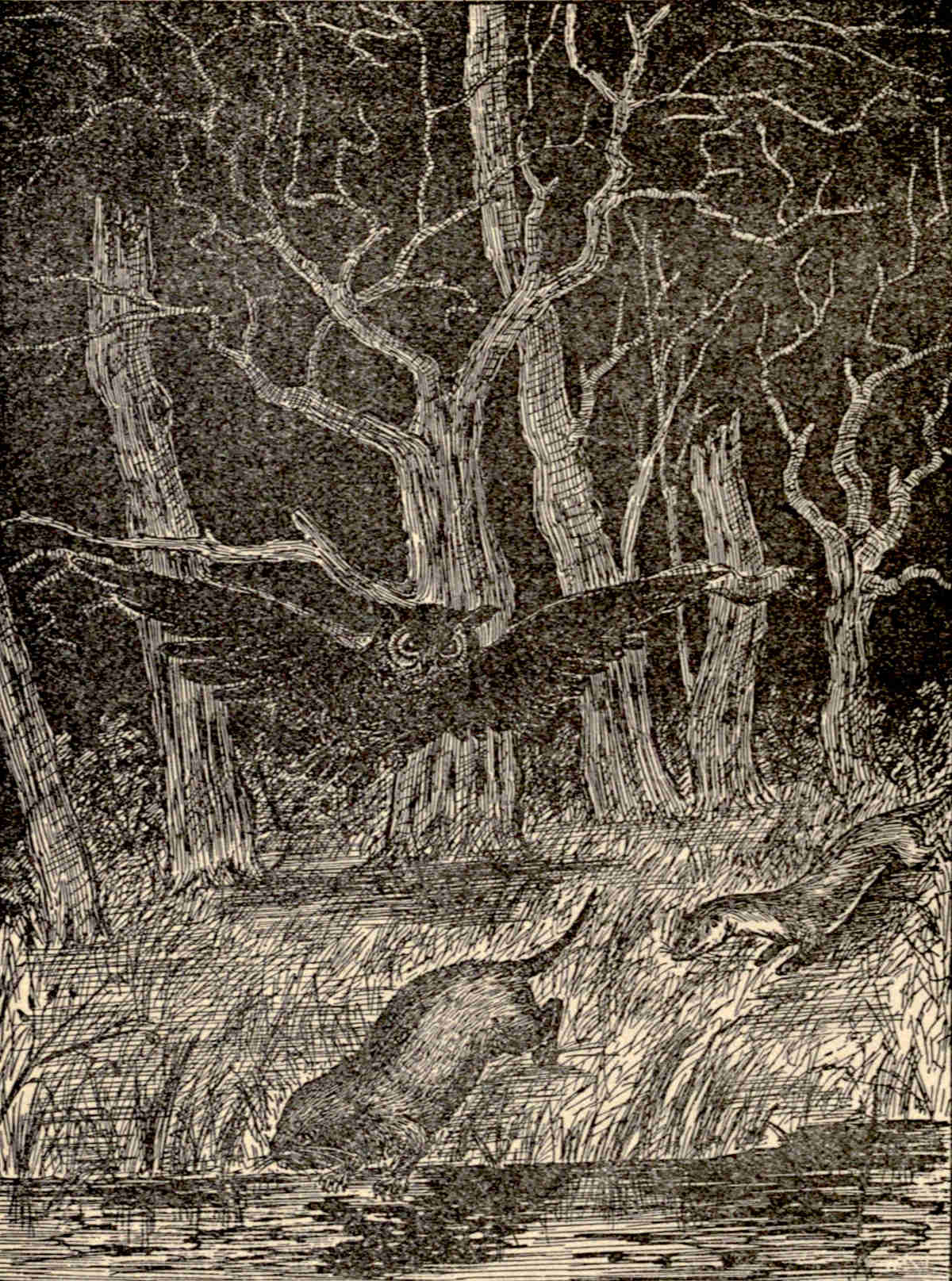
The home of the water-rat was situated
on a bank of the ditch where the water was
deepest, and the owl felt sure that when
the old miser left the water for his dwelling,
which he would be sure to do, he could
quickly seize him, and bear him away.
The owl, however, did not know the precise
spot of his victim’s abode, and the
wily rat passed it, and, turning unperceived
in the deep water, swam back and entered
his dwelling, while the discomfited owl was
still hunting for him some distance down
the stream.
CHAPTER V. THE GREAT BASSO-PROFUNDO.
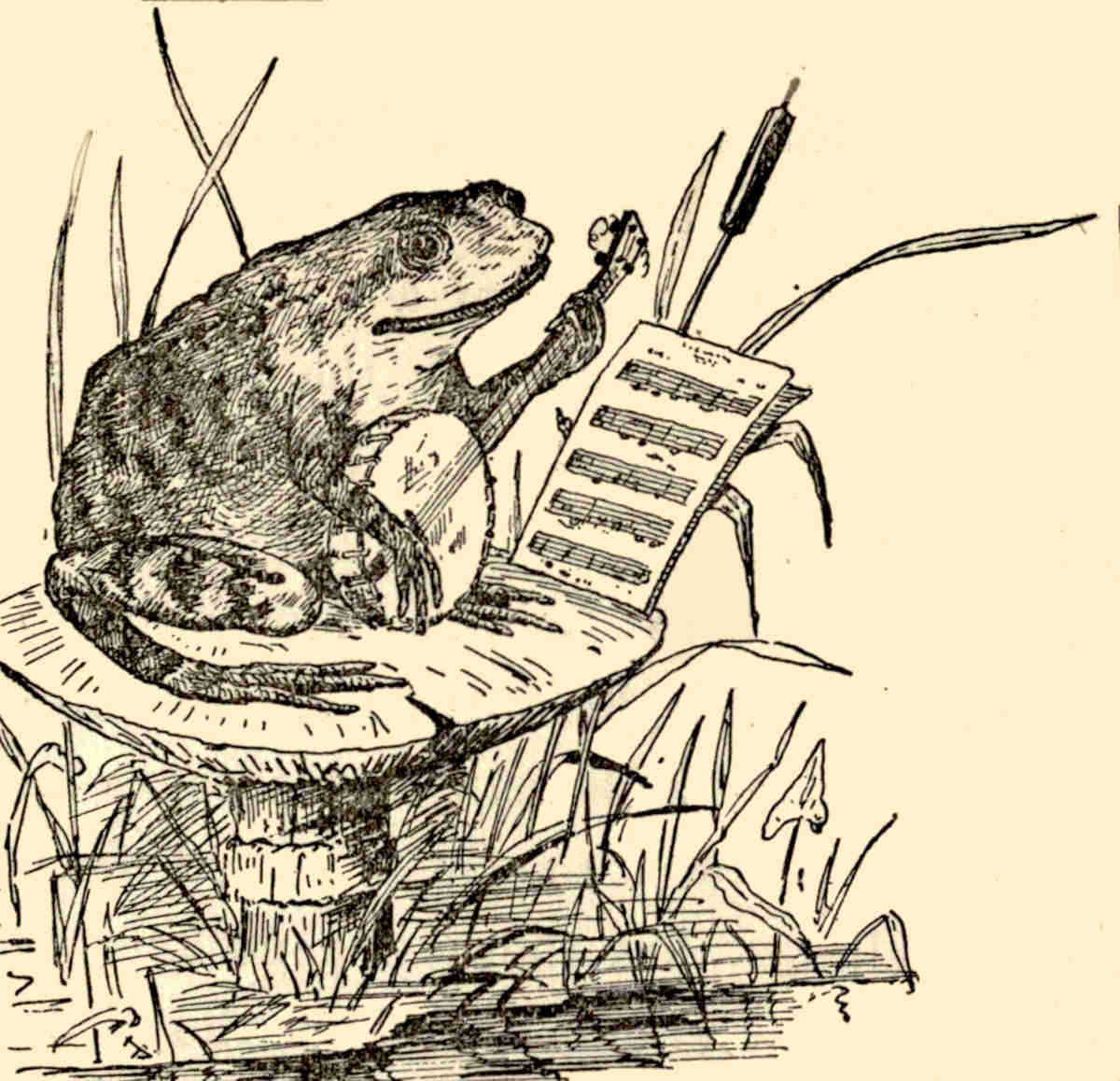
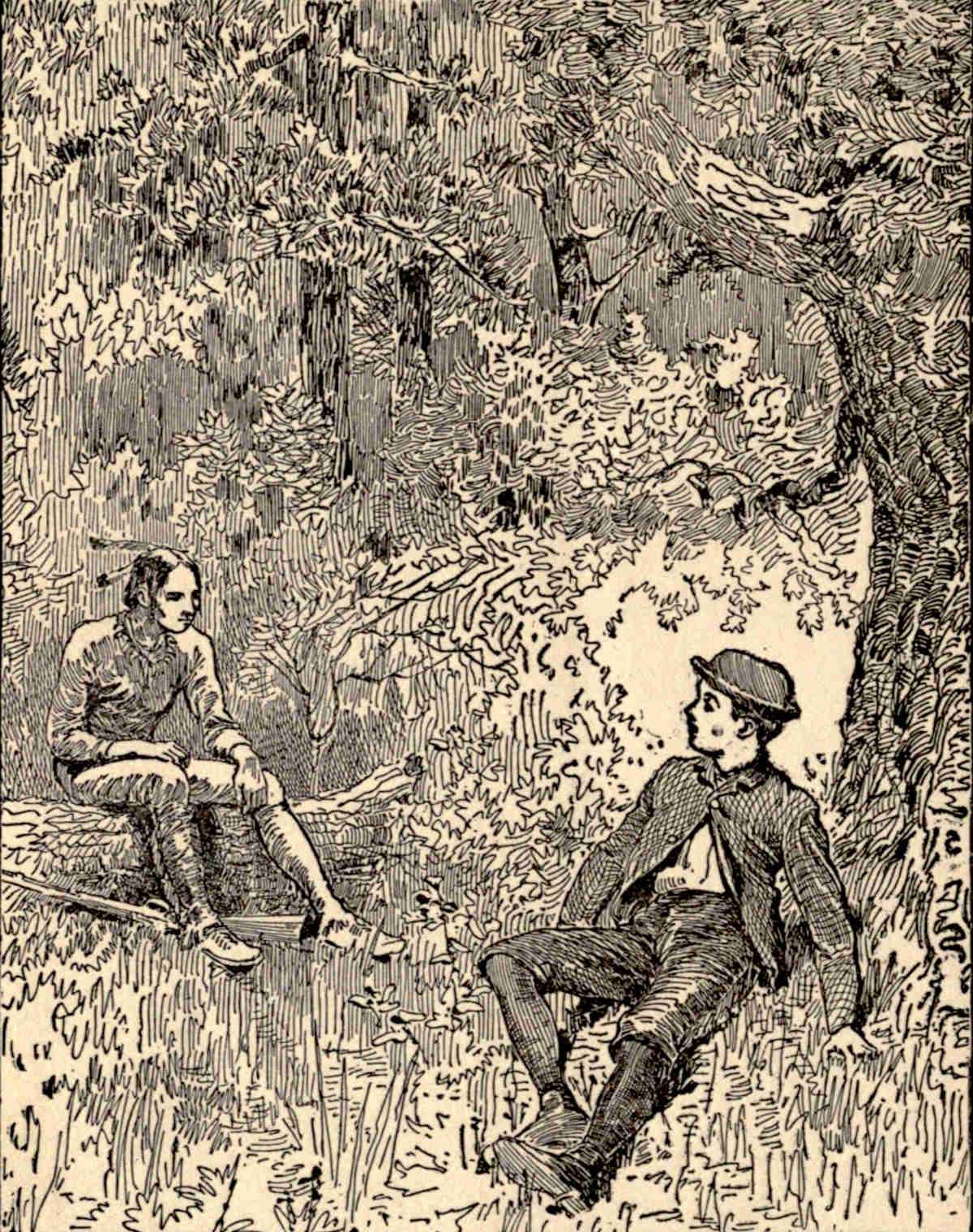
“While in a melancholy voice, and with a strong French accent,
he sang the following lines.”
Very great was Bobtilla’s distress after
she had received the notice of eviction
from her hard-hearted landlord, and
all night she lay awake, trying to form
some plan for the future; but each one
was abandoned almost as soon as it was
formed, for the making of a new home is
a matter for deep reflection, the happiness
and welfare of a family depending so entirely
upon it.
The spot where Bobtilla had hitherto
resided, and which she was so cruelly compelled
to leave, had many advantages of
situation. It was so far removed from
other dwellings that there was nothing to
be feared from enemies, and as the little
field-mouse was very particular about the
society she chose for her children, she considered
the seclusion a great advantage.
The longer Bobtilla pondered on the
subject, the stronger became her conviction
that her next move must be nearer
the habitations of others, who would protect
her in case old Rough should further
persecute her. Having satisfied her mind
on this point, she fell into a deep sleep,
from which she did not awake until the
day was well advanced. Then, perceiving
the sun shining in through the small opening
of her house, she started up hurriedly.
So deep had been the slumber of the
little mouse, that during it all sense of the
recollection of her trials had vanished, and
for a moment she forgot the misery she
had undergone before sleep came to her
relief; but by degrees the feeling that all
was not right stole over her, and gradually
a full sense of her unfortunate situation
returned.
Notwithstanding her natural timidity,
Bobtilla was not entirely without energy,
and she lost no time in useless repining;
so hastily putting her house in order, and
making her children comfortable, she set
out with all speed to consult her new
friends, the chipmunks.
The amiable couple heard with indignation
how badly the field-mouse had been
treated by the cruel miser, and they at
once tried to think of a way to help her
out of her difficulty.
“You had better come nearer to us,”
said Squirrello, when the little mouse had
ended her sad story. “You will be farther
away from old Rough, for he has not
ventured into this neighborhood.”
“Yes, and we can perhaps help you to a
little food now and then,” added Squirrella.
“You are very good to me,” replied
Bobtilla, gratefully. “I’m sure I don’t
know what I should do without you.”
“Well, and why shouldn’t we be?
What are we here for, if it is not to help
one another?” asked Squirrella.
“If everybody were of your mind, how
easily we could live,” sighed Bobtilla;
“but as a general thing, the strong prey
on the weak, and the rich on the poor.”
“Well, at all events that isn’t our way,”
replied Squirrella, cheerfully; “so now we
will decide on a new home for you. Let
me see, there is a nice place under that
large stone just behind you. I have often
thought it would be a good building-spot
for somebody. How does it strike you?”
“Capital!” exclaimed Bobtilla, joyfully.
The kind reception she had met with
raised her spirits wonderfully, for it meant
a peaceful home, where old Rough would
cease to persecute, and plenty of food for
her children until she could succeed in accumulating
another stock of provisions.
So Bobtilla set to work with a will, and
soon had a convenient house made to her
satisfaction. When all was ready, she collected
dried leaves and soft bits of moss,
and made a comfortable bed for her children,
smiling with satisfaction as she contemplated
the comfort she had succeeded
in effecting.
The praise of the two chipmunks, who
complimented her on her skill, was very
satisfactory, and she hastened to return to
her children, in order to remove them to
their new abode. Before the time set by
old Rough, the little field-mice were safely
established in their new quarters, and eating
a good supper provided by their
thoughtful friends the chipmunks.
While these events, of so much importance
to Bobtilla and her family, were taking
place, the two young crows were idling
away their time, on the constant lookout
for something with which to amuse themselves;
and as they had not succeeded in
appropriating the property of any one else
or in doing any especial mischief, they felt
that the day had not been a success, and
time hung heavily on their hands. Alighting
on a tree in the meadow, they cast
their shrewd eyes about in all directions
for any chance that might occur, and occasionally
gave a languid caw.
Sitting thus idly, the tones of a deep
bass voice struck on their ears; and seated
on the margin of the stream they beheld
a large bull-frog gazing pensively into the
water below, while in a melancholy voice,
and with a strong French accent, he sang
the following lines:—
“Not always did I feel so bad,
With eyes so heavy and heart so sad.
Since many days I do not feel
Desire to eat a hearty meal.
No longer bugs and flies I eat,
And grasshoppers with prickly feet.
Indeed it was not always so;
My feelings have received a blow.
The melting voice of her I love
Is now tuned for another cove.
That fairy form, those eyes so yellow,
Belong now to another fellow.”
As the bull-frog ceased he sighed profoundly,
and large tears rolled down his
cheeks and splashed into the sluggish
stream. The two young crows, rejoiced at
the prospect of a diversion, flew down from
the tree, and seated themselves on the bank
of the stream opposite the mournful singer.
“What’s up, Johnny?” they asked.
With a sigh that threatened to rend
his capacious bosom, Johnny the basso
replied,—
“She have deserted me. My sweetheart
have left me for anozzer. I am in despair!”
“Who, the little green frog who lives
down by the dam?”
“No!” replied the basso, indignantly;
“it was no leetle green frog. My sweetheart
is fine; she have one fine figure—Ah!
qu’elle est charmante!”
“It was the little green one last week,”
answered the younger crow, dryly.
The mourner took no notice, but continued
his lamentations.
“She have left me for anozzer. She say,
our voices they not blend well,—I, zee great
basso-profundo! She prefer a tenor, she
say. I ’ate a tenor, he squeal like one pig!”
“Who is he?” asked the elder crow.
“I know not how he call hisself, but I
will find him!” exclaimed the bull-frog,
fiercely. “I will cr-crush zat tenor! He
sall know what it is to insult zee greatest
basso-profundo on zee earth. I will make
zat tenor to tremble!”
“After you have found him,” remarked
the younger crow.
“But I will found him, I say!” exclaimed
the excited basso. “I will hunt zee earth
for zat tenor! My great talent, my vast
wealth, they sall succeed in finding zat
wr-r-etch who have deceived me,—me, zee
greatest living basso-profundo on zee earth!”
“Why don’t you consult old Blinkeye?”
asked the elder crow.
“What you say he call hisself,—Blinkeye?
I have nevare heard from him.”
“Old Blinkeye is the wisest fellow about
here,—knows all the laws of the woods
by heart. Why, even my grandfather consults
him, and my grandfather is no chicken,
I can tell you.”
“How know old Blinkeye anysing about
my sweetheart? How will he find zis
miser-rable tenor?”
“If he doesn’t know now, he will find
out. He flies about all night, and learns a
good many secrets that way. Oh, he’s
a wise old fellow, is Blinkeye, and fierce
too. Nobody knows how old he is.”
“I sink he too old. Zee mind grow
weak when old age come.”
“No, not a bit of it,” replied the elder
crow. “Then he is so strong and fierce,
the tenor had better look out when he
catches sight of him.”
“I sink perhaps your fine Blinkeye eat
me up. He say to hisself, ‘Great basso-profundo
fat and tender,—he make nice
dinner. Tenor thin,—more bones as fat.
I sink rather I eat great basso.’”
“He is only fierce at night. In the daytime
he is as blind as a bat, and sits and
thinks. Then, when night comes, he flies
about, and it is better to keep out of his
way. Come, you’d better go and see him.”
“Well, I go wiz you,” answered the
singer, after a moment’s reflection.
Accordingly off set the three, the bull-frog
hopping, and the crows walking behind
him; but the bull-frog with his long leaps
made much greater headway than the crows
with their short steps, and the latter, when
the frog was nearly out of sight, would
use their wings to reach him, and at last
adopted a gait between walking and flying.
The bull-frog was not in the habit of
taking such long trips, and was obliged to
halt occasionally; and these rests were spent
in conversation, during which the basso
recounted many valiant exploits he had
achieved.
“Zis place is not large enough for so
great a singer as I,” said the bull-frog; “my
talent is too great to rest in zis small place.
One here has no taste; one knows not what
is musique. When I lived in great meadow
far away,—ah! there it was fine! every
evening zey come, so many how zey could,
to hear zee great basso.”
“Why didn’t you stay there, Johnny?”
asked the younger crow.
“I was one fool,” replied the bull-frog.
“I say, ‘Zese peoples zey make me tired
wiz zere praise;’ so I say to myself, ‘My
friend, you sing too much, your fine voice
will ruin; better you move to some ozzer
place, where zere are not so many peoples.’
So I move here.”
“And a very wise move it was,” replied
the elder crow. “But here we are, and
there sits old Blinkeye.”
They stopped before the owl, who sat
silently on a tree, with his usual solemn
expression. He slightly turned his head
in the direction of his visitors, but it was
evident he did not see them.
“How do you find yourself to-day, Father
Blinkeye?” asked the elder crow. “We
have brought a friend to consult you on a
very important matter.”
“Who is he, and what does he want?”
demanded the owl.
The bull-frog hastened to introduce himself
thus: “I am zee greatest basso-profundo
on zee earth. Doubtless you have
heard mention my great talent. I sing so
deep,—zere is no basso who so deep sings.
My répertoire, ah! it is énorme.”
“What is your business with me?” inquired
the owl, who remained unmoved by
this announcement.
“My sweetheart she have left me,” replied
the bull-frog. “She have left me,
me, zee great artist, for one tenor! I wish
to find zat tenor! I wish to have revenge!”
and he scowled fiercely at the recollection of
his wrongs.
“What do you expect me to do about
it?” asked Blinkeye, coldly.
“I sought zat perhaps you would have
zee goodness to find zat tenor for me,
sair.”
“That isn’t in my line,” replied Blinkeye.
“My business is to expound the laws
of the woods.”
“Zen will you be so kind, sair, as to tell
me zee law zat will find zat tenor?” asked
the basso, eagerly.
“Let me see where that comes in,” said
the owl, meditatively, and remained deep
in thought, with one great yellow eye
closed, and the other staring straight before
him. This had such a solemn effect,
that the basso felt sure such vast wisdom
must procure for him the aid he desired.
“Aha!” exclaimed the owl, after awhile,
and slowly unclosing his eye, “I have it.
Now listen attentively, for I don’t take the
trouble of repeating these laws. Such a
strain on my mind tires it and makes it
dangerous for me.
“‘Tirra, rirra, high and shrill
Is heard throughout the meadow still;
And near the marshy bog is sung
The musical, deep-toned a-hung!
Take the one, and leave the other,
And end this weary strife and bother.’
“Now leave me, that my mind may rest
after such an effort,” added the owl.
“But I know not what it mean, sair,”
exclaimed the basso, in bewilderment. “I
know no more zan before, what I am to
do. Will you have zee goodness to explain
zat law to me.”
“No,” replied the owl, severely, “I will
not. My business is to recite the law, and
yours to understand it. If you don’t, that’s
your loss. Now go.”
“But, sair,—” began the basso. He
did not have time to finish his sentence,
however, for the two crows pushed and
dragged him out of the owl’s presence,
promising to explain to him on the way
home the meaning of the law of the woods
recited by the owl.
“It’s as plain as can be,” said the elder
crow, when they had succeeded in starting
the basso toward home; “don’t you see?
‘Take the one and leave the other,’ why, of
course you’ll take the one, and you’ll leave
the other when you only want the one, won’t
you?”
“But zat does not tell me where I sall
find zee tenor,” persisted the basso.
“‘Tirra, rirra, high and shrill,
Is heard throughout the meadow still,’—
that’s the tenor of course, with his high
voice, and it tells you as plainly as possible
that you’ll find him in the meadow,” explained
the younger crow.
“‘And near the marshy bog is sung
The musical, deep-toned a-hung,’—
that’s you of course, with your deep bass.
Now do you see your way clearly?”
This explanation appeared so very simple
that the basso could but acknowledge it.
“Zee meadow is one large place,” he said.
“Oh, well! now we know he is there,
we’ll find him for you, and the little brown
frog will not be far off, you may be sure,”
said the elder crow.
Thus reassured, the bull-frog hopped
briskly home, accompanied by the crows,
who walked and flew by his side.
“I sank you, Messieurs, for your kindness,”
said the basso, when he stopped before
his door, “and I sall know how to
reward you. Au revoir, Messieurs,” and,
gracefully saluting his young friends,
Johnny the basso hopped into his hole.
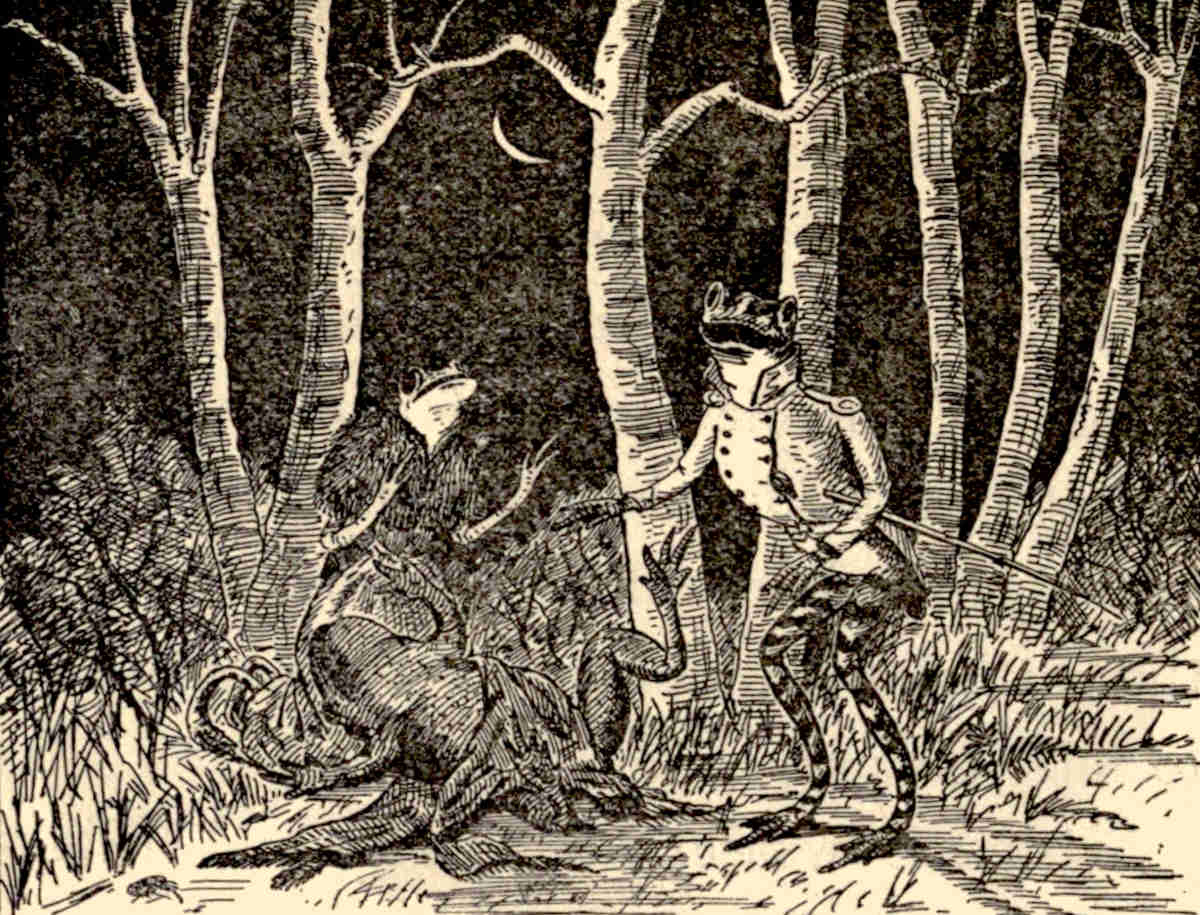
CHAPTER VI. THE YOUNG CROWS’ TRICK.
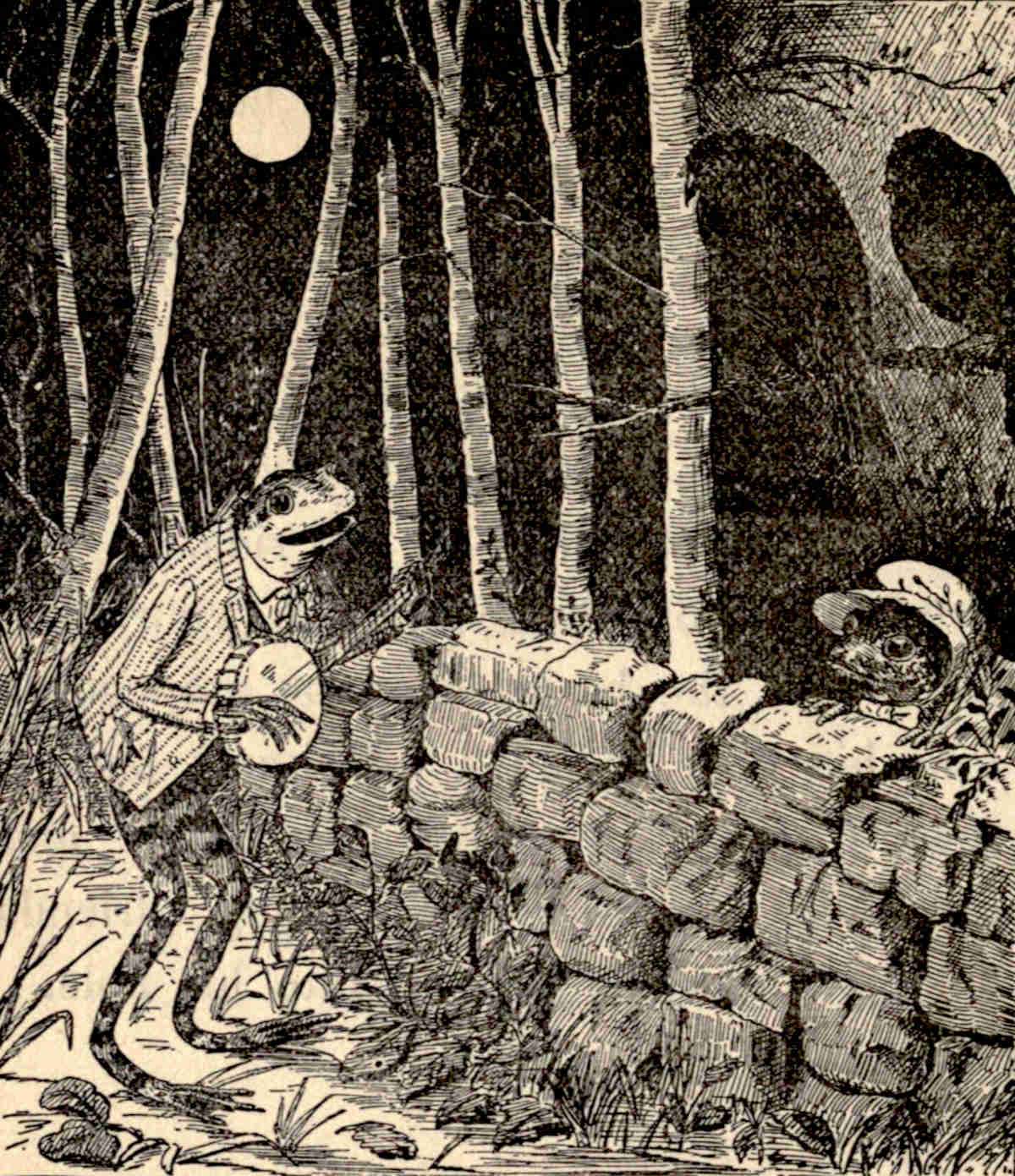
“The young crows’ trick.”
“We shall have some fun with Johnny
the basso,” said the younger crow,
as he stopped to gobble up several fat
crickets that had collected on a piece of
decaying fruit that lay by the roadside.
“An’ is it that yees would be afther
taking the food from the mouths of a poor
widder an’ her childer? Indade, an’ it’s
a long time since the poor craturs have
tasted the loike of these,” said a voice
from behind; and suddenly turning, the
crows beheld a large fat toad, who watched
with indignation their lunch off the fat
crickets.
“Who are you, pray?” asked the elder
crow, “and why haven’t we as much right
to eat these crickets as you?”
“It’s the Widow O’Warty I am, wid
rispict to yees,” replied the toad, with dignity;
“an’ if it’s the two foine wings of yees
meself possissed, it’s not craping around
I’d be, to take the food from poor widders
an’ childer.”
“How did we know you wanted these
crickets?” asked the younger crow. “You
are welcome to them for all we care. We
prefer our food well seasoned.”
The Widow O’Warty became pacified
under this partial concession, and resumed
the plausible manner for which she was
noted.
“It’s me custom,” she explained, “to
sthroll out afther the light is quinched, in
s’arch of a thrifle to ate. There do bees
foine crickets about here, an’ that’s the
troot av it.”
The elder crow whispered to his brother,
“Let’s pass her off on Johnny as the brown
frog he’s lost.”
“How can we, this great fat toad?”
replied the other brother, in the same low
tone.
“In the dark, you goose, he wouldn’t
know the difference, and we’d hide, and
have lots of fun.”
The younger crow cawed approval, the
widow meanwhile eying them shrewdly,
half suspecting that she herself was the
subject of their whispered conversation.
“See here, Widow,” began the elder
crow, “you know Johnny the basso, don’t
you?”
“Is it the swate singer down by the bog
ye mane?” asked the widow.
“Yes, I see you know him.”
“It’s the foine deep v’ice he possisses,”
replied the widow; “an’ it’s many a night
meself has listened to the swate sounds.”
“He’s mashed on you, Widow,” said the
elder crow; “he’s about as far gone as I
ever saw any one.”
“Be off wid yer nonsinse!” exclaimed
the widow, not displeased at the news.
“It’s fooling yees are.”
“Upon my honor, Widow,” replied the
elder crow, seriously; and addressing his
brother he asked, “Didn’t we hear him
singing about her beautiful brown skin and
her fine yellow eyes?”
“That we did,” answered the younger
crow, promptly; “and, my eyes! didn’t
he howl, though, when he talked about
her?”
“I’ll not bel’ave yees,” said the widow.
“It’s making game of meself yees are.”
“Not a bit of it, Widow,” asserted the
elder crow, earnestly. “True as we’re
sitting here, we heard him singing about
his sweetheart, who had a brown skin and
yellow eyes.”
“An’ did he say ’twas the Widow O’Warty
he was after m’aning?” asked the
widow.
“He didn’t exactly mention the name,”
replied the younger crow, evasively, “but
he described you so correctly that he
couldn’t have meant anybody else. We
told him we’d help him all we could.”
“The Widow O’Warty is me name, an’
me abode is opposite us; an’ if he’s the
gintilman I take him for, he will presint
himself an’ declare his intintions,” said the
widow, loftily.
“Then you’ll not be hard on him, will
you, Widow?” asked the elder crow.
“Whin he has stated his intintions, it’s
meself that will consider his proposals,”
replied the widow, majestically.
“Then we’ll ease his mind by telling him
you will allow him to call,” replied the
younger crow, as he and his brother flew
off. When they were out of sight and
hearing, they gave vent to the merriment
they had been obliged to conceal from the
watchful eyes of the widow, and their loud
caws resounded through the wood.
Twilight was now approaching rapidly,
and the two crows flew home as fast as
their wings could carry them.
Early the next morning, the brother
crows awoke, and were soon on their way
to the dwelling of Johnny the basso. They
found him sitting pensively on the border
of the stream that flowed by his door, and
abstractedly snapping at stray flies and bugs
that came within reach of his long elastic
tongue. Even these savory morsels were
swallowed without any apparent enjoyment,
but with a subdued and mournful
countenance, as if he were performing
some solemn rite.
“How are you this morning, Johnny?”
called out his two visitors, as they seated
themselves on a low bush that grew near
by.
“I am miser-r-rable, my friends,” replied
the bull-frog, sadly, his large eyes swimming
in tears. “I am not able to sleep. I sink
on zee leetle brown frog. I weep, ah! how
I weep for my sweetheart!”
“What should you say, Johnny, if we
were to tell you we had found zee leetle
brown frog?” asked the elder crow.
“What should I say?” exclaimed the
bull-frog, with a sudden change of manner.
“I should say zat it is incredible,
messieurs,—zat it is impossible zat you
should find zee leetle brown frog in so
short a time.”
“That’s just what we have done,
Johnny.”
“Where is she?” exclaimed the singer,
enthusiastically. “I fly to her, mon ange,
mon ange!”
“Don’t be in too great a hurry, Johnny,”
said the crow, cautiously. “You mustn’t
take her by surprise. Wait till night
comes, and then you can go and serenade
her.”
“It is impossible to wait until zee night
come,” replied the basso, excitedly; “now,
zis minute, I fly to see zee leetle brown
frog. But zee tenor? I forget zee miser-r-rable
tenor who have stolen her from
me. Where, I demand, is zis tenor?”
“We haven’t found him yet,” answered
the elder crow, “but we will, in time.
He is probably not far off. You remember
what the owl said,—
“‘Tirra, rirra, high and shrill,
Is heard throughout the meadow still.’
He must still be in the meadow, you see.”
“I go to fight wiz zat tenor!” exclaimed
the bull-frog, furiously. “I will cr-r-rush
zat tenor! But you have not say where
is zee leetle brown frog.”
“You see that small scrub-oak over in
the field?” asked the elder crow, nodding
his head in the direction of a small
oak that grew by a stone wall. “Well,
she lives in a hole in that wall. You
will find her easily enough.”
“I sank you, messieurs, for your kindness,”
said the basso, in his most gracious
manner. “Permit me to make my adieu
zat I may compose a song, zat zee leetle
brown frog sall find zat my voice is so fine
as before.”
“Good-by,” called out the crows, as they
flew away, “and good luck to you.” They
looked back as long as they were in sight,
and saw that the basso sat motionless before
his door, gazing silently into the depths of
the stream.
The mischievous crows waited with impatience
for the coming of night. It was
not their habit to be out after sundown, but
so eager were they to witness the result of
their practical joke, that they resolved to
pass the night in the neighborhood of the
Widow O’Warty’s abode, that they might
see and hear what would happen. Accordingly,
late in the afternoon they set out,
and reached their destination soon after the
sun had set.
A large maple-tree hung its branches
over the wall near by, and on one of these
branches the young crows perched, and
sitting motionless, with their heads sunk
between their shoulders, they awaited the
development of their plan.
The eavesdroppers dared not converse,
for fear of detection, and very hard it was
for them to remain silent for so long a
time, it being their habit to caw incessantly.
Twilight soon appeared, and settled
into darkness, and after what seemed
to the listeners a long time, the moon rose
over the tops of the forest trees, and gradually
sailed into the sky.
This was a great relief to the young mischief-loving
crows, for now they began to
discern objects, and they felt sure that the
beautiful moonlight would tempt the basso
to steal forth to his trysting-place.
As the rays of the moon lighted up the
wall under the tree on which the crows sat,
they cautiously stretched forth their mischievous
little black heads. At the door
of her dwelling, in the shadow thrown by
the scrub-oak, they discovered the matronly
form of the Widow O’Warty, her
prominent eyes shining in the moonlight.
Exchanging glances of suppressed merriment,
the two crows, barely succeeding
in smothering their laughter, again allowed
their heads to sink between their shoulders,
and resumed their former solemn
attitude. They had not much longer to
wait, for soon their shrewd eyes descried
a dark form hopping through the grass,
and rapidly approaching the scrub-oak.
When within a few feet of the widow’s
door, the new-comer stopped, and after a
few ineffectual attempts to conquer his
emotion, sang the following verses, in a
voice that at first trembled perceptibly,
but gradually increased in strength, until
the full tones of his deep bass resounded
through the still evening air.
“The moon is on the bog,
The dew is on the lea;
The voice of every frog
Is calling, love, to me.
The noisy, gathering throng
Is calling on my name;
It clamors for a song
From singer of great fame.
A-hung!
“But the applause I hear
Is nothing now to me;
I’d give it all, my dear,
For one sweet croak from thee.
All frogs, from far and wide,
They linger ’round the bog,
They pine to be the bride
Of the bull-basso-frog!
A-hung!
“In dreams thy form I spy,
And in my fond arms take;
But all those visions fly
When in the morn I wake.
Then pray no longer hide,
But let me hear thy voice;
Come to me, lovely bride,
And bid my heart rejoice.
A-hung!”
The full deep tones of the last “a-hung”
had scarcely died away on the summer air,
when the Widow O’Warty, who had, during
the song, moved restlessly about, first on one
foot and then on the other, suddenly gave
vent to her emotions by hopping up to the
singer and exclaiming in her shrill croak,—
“Faith, an’ it’s meself that will put an
ind to your suffering, me poor cratur!”
CHAPTER VII. DECLARATION OF WAR.
“Before the crows could reply, old Rough, who had listened with great
satisfaction to the conversation, and had by degrees crept unperceived
to the tree, hastened to reply.”
At the Widow O’Warty’s words, the
melancholy singer gave a sudden
start, and when the widow herself stood
before him, he gazed in astonishment at
her stout figure; but with native French
courtesy he quickly recovered his self-possession,
and bowed with great politeness to
the smiling toad.
“An’ is it so cruel ye take me to be as
to kape ye longer waiting? ’Dade, an’
I’ll come till ye,” said the widow, tenderly,
and she hopped briskly to the bull-frog’s
side, and gazed smilingly into his face.
Johnny the basso was much disconcerted
at the widow’s advances, and for a moment
he was silent. True, however, to his nature,
in which was great courtesy toward the
fair sex, he quickly suppressed the feeling
of aversion that came over him, and
answered politely,—
“Madame does me infinite honneur, but
Madame mistakes; Madame doubtless has
many suitors, and she does me the honneur
to sink me one of them.”
“Faith, an it’s not so fur out of the way
ye are,” replied the widow, slyly.
The basso found himself in an embarrassing
situation. It was evident that this
toad, whom he had never before seen,
thought the words of his song addressed to
her, and his sense of politeness made it
difficult for him to tell her that she had
made a mistake, and appropriated to herself
sentiments that were intended for
another.
“Is it that Madame does me zee honneur
to sink zat zee words of my song were addressed
to her?” asked the basso.
“Fwhat ilse, in the name of the howly
saints, would ye have me think, whin it’s
afore me door ye sthand? Av coorse I considered
the worrds addrissed to meself.”
“If it had been my good fortune to have
met Madame, I could not have found words
ardent enough to express zee grand passion
wiz which Madame would have inspired
me,” answered the basso, with great
politeness.
“Thin why in the worrld did ye station
yeself afore me door, if the worrds were
addrissed to another party?” asked the
widow, angrily.
“It is because one told me that here
lived her whom I sought,—whom I sall
always seek while I have life,” answered
the bull-frog, with intense feeling.
“Fwhat is the name av the raskill that
tould ye this was not me abode?” asked
the widow, indignantly.
“Two young crows have informed me,”
replied the bull-frog, “and zey sall give me
satisfaction. Zey sall learn what it is to
trifle wiz zee great basso.”
“An’ it’s the same as tould me ye had
lost your heart to meself, an’ apprised me
of your coming the night,” answered the
widow.
“I will seek zem in zee morning,” said
the basso, fiercely. “Zey sall answer to me
for their impertinence. Au revoir, Madame.
Believe me, I sall lose no time to avenge
zis insult;” and as he hopped away, the
two young crows, no longer able to conceal
their merriment at the success of their joke,
flew away, laughing “Caw, caw, caw.”
This naturally added to the basso’s vexation;
but the young crows were soon far
away, their “caw, caw, caw” being audible
as long as they were in sight.
It was at an early hour the next morning
that the indignant basso set off to find these
mischievous young crows who had caused
him so much annoyance; and, early as it
was when he reached their home, he found
only old Caw, who was perched on his
favorite tree in a meditative attitude, and
the mother of the young crows, who was
engaged in feeding her young family,
scolding and complaining all the while.
So engrossed was the mother-crow, that
it was some time before the bull-frog succeeded
in attracting her attention. As for
old Caw, it was impossible to tell whether
he was aware of what went on about him,
for his one eye was apparently closed, and
he seemed in that indifferent state of mind
that extreme old age produces. Those who
knew him well, however, knew that this
was a trick of his to escape observation,
and that he was never more alert than
when he was apparently in this apathetic
state.
“What do you want?” asked the crow-mother,
when the bull-frog had succeeded
in attracting her attention.
“Zere are two very mischievous young
crows whom I seek, Madame,” answered the
basso. “I wish to speak wiz zose young
crows.”
“There are not any of that description
here,” replied the crow-mother, shortly.
“Pardon me, Madame, but one has told
me zat I sall find zem here,—zat zey are
your sons.”
“They told you wrong, then, for my sons
are steady, hard-working fellows, who never
did any mischief in their lives.”
The old crow from his tree here gave
an abrupt croak, which to the bull-frog
sounded like an expression of surprise;
but when the bull-frog quickly glanced
at him, he found him with such a sleepy
and imbecile expression on his pinched
countenance that he concluded he must
have been mistaken.
“It cannot be that I have wrong,” said
the bull-frog, firmly. “Zee mischievous
young crows of whom I speak live here.
I have seen them often. It was yesterday
zat zese young crows played me a sad
trick,—I wish to speak wiz zem.”
“If it were yesterday, it couldn’t have
been my sons, for they were at home all
day,” answered the crow-mother, decidedly.
The bull-frog, happening to glance in
the direction of old Caw, caught sight of
his one eye wide open, and the bull-frog
imagined that he detected a particularly
amused look in that expressive feature; but
the eye closed again so sleepily and naturally
that he concluded he must have been
again mistaken.
The bull-frog was far from being convinced
that the mother-crow was telling the
truth about her sons, but courtesy prevented
him from pushing the matter further.
“If Madame their mother says her sons
to have been at home yesterday, zen I have
nozzing to say,” said the bull-frog, courteously.
“I have zee honneur to wish Madame
good-day;” and the discomfited singer ended
the unsatisfactory interview.
As the bull-frog hopped toward home,
he revolved in his mind the best course to
take in order to bring about a meeting
with the young crows, for he felt sure their
mother would put them on their guard
against him; when suddenly he was surprised
in his meditations by a caw overhead,
and looking quickly up, he beheld
the old crow Caw sitting on a branch above
him.
Old Caw was wide awake now, and his
one eye beamed with as much vivacity
and intelligence as that of any young
crow could have been capable.
“Stop a minute, friend Johnny,” said the
old crow; “don’t be in such a hurry.”
The bull-frog, thus addressed, stopped,
breathing fast from his exertions, and regarded
the self-possessed old crow with an
angry countenance.
“Don’t be in such a hurry; take it easy,
Johnny,” said the old crow, coolly.
“You have zee advantage of me, sair,”
said the bull-frog, haughtily; “you appear
to be familiar wiz my name. I have not
zee great honneur to be acquainted wiz zee
illustrious name of Monsieur.”
“Oh, yes, I know you well, Johnny,—I’ve
heard you croak often enough on
moonlight nights,” replied the crow, with
exasperating coolness, at the same time
bringing his one eye to bear on the indignant
bull-frog.
“You insult me, sair,” exclaimed the
basso, excitedly. “It is that you have no
soul for musique. Croak, you say! You
say zee greatest living basso on zee earth
croak!”
“Don’t get excited, Johnny, I didn’t
intend any insult,” said the old crow, persuasively.
“I came after you to be of
service.”
But the insult still rankled in the singer’s
capacious bosom, and his great throat
swelled and vibrated with wounded pride,
as he repeatedly gave expression to his
indignation.
“Oh, come, Johnny, cool down and hear
what I’ve got to tell you,” said old Caw,
soothingly. “You want to find the young
crows who played a trick on you, don’t
you?”
The bull-frog made a great effort to recover
his self-possession, and with much
difficulty swallowed his resentment.
“Yes,” he answered, after a great inward
struggle, “I wish to know where to find
zose young crows.”
“The old lady fibbed, of course,” said
old Caw. “They are her sons, and I knew
they were up to some mischief, for they
went away yesterday afternoon, after whispering
and giggling together, and didn’t
come home until this morning.”
“Can you tell me where I sall find zem?”
asked the basso, eagerly.
“Yes, I can,” replied the old crow. “I
listened when they thought I was asleep,
and overheard their plans. They intend
to hang around old Rough’s place until he
has gone out on one of his foraging expeditions;
and when he is out of the way,
they have planned to steal into his hole
and help themselves to a fine bit of pork-rind
they saw him scurrying off with yesterday.
You’ll find them somewhere in
that neighborhood.”
“I sank you, sair,” said the bull-frog,
politely, “for your very kind information.
I sall go at once to Monsieur Rough’s abode.
Adieu, Monsieur Corbeau;” and with his
usual impetuosity, the bull-frog hurried
away in the direction of the old miser’s
dwelling.
Old Caw followed the bull-frog with his
one eye as long as he was in sight, and
then gave expression to a caw of satisfaction.
“I think this will make me even
with you for stealing my pig’s ear, you
young thieves,” said the old crow to himself.
“I made you think I hid it purposely,
to teach you shrewdness in discovering
hidden treasures, but it wasn’t true. Old
Caw must be getting old indeed, when two
young fools get the better of him. Yes, I
think this last move of mine will make us
even;” and having uttered these sentiments,
old Caw slowly wended his way
homeward.
Meanwhile, the bull-frog, his heart set on
confronting the crows with their treachery,
proceeded as fast as his slow powers of
locomotion enabled him to travel. At last,
after a tedious journey, he reached the
neighborhood of old Rough, and halting
within a short distance of the miser’s abode,
glanced about him.
There was the old water-rat’s dwelling
just above the ditch, and at a short distance
behind it grew a fine tree, among whose
branches the frog detected two black motionless
objects.
“Zee old crow had right,” said the singer,
to himself, “zere are zee two mischievous
crows.”
Stopping long enough to recover his
breath, and keeping his eyes on the two
black objects in the tree, the bull-frog proceeded
toward the tree, followed at a distance
by a dark object that slid through
the tall meadow grass, that halted as he
halted, and that proceeded as he proceeded.
This dark object that followed the bull-frog,
and was so careful to escape detection,
was old Rough, the water-rat.
The bull-frog proceeded boldly to the
foot of the tree and stopped, and the water-rat
concealed himself behind a large stone
not far off, and within convenient hearing
distance. No other living creatures were
in sight, except a swallow that flew noiselessly
over the meadow, occasionally swooping
on some unfortunate insect, and then
soaring swiftly high into the air.
“Is it zat you are zere, my fine Messieurs!”
cried the bull-frog, fiercely, looking
up at the young crows perched far above
him.
“Yes, friend Johnny, it is that we are
here. How’s the little brown frog you
serenaded last night?”
“It is zat I wish to confront you wiz
your treachery, Messieurs,” exclaimed the
bull-frog, furious at this taunt. “I wish to
tell you zat you are great imposters; zat
you have deceived Madame La Warty; zat
you have deceived me,—me, zee great
singer, I say! But I have my great reputation
to avenge! I have Madame La
Warty’s honneur to defend.”
“Oh, bother! the widow doesn’t mind
that,” said the younger crow. “You don’t
mean to say she isn’t the brown frog you
were looking for?”
“Madame La Warty is one great fat toad,
Monsieur!” exclaimed the bull-frog, indignantly.
“Did you sink zat I, zee great
singer, would have one toad for his sweetheart!
No, sair, zat is not possible! Zee
young, zee beautiful are for zee great basso-profundo.”
“How did you expect us to know the
difference?” asked the elder crow. “They
look alike to us, any way.”
The singer glared fiercely on the impudent
young crow. “I sall have revenge,”
he cried in his deepest tones; “you sall
answer to me for zis insult. Mon Dieu! he
say a fat toad look like a frog!”
“Well, we didn’t know,” said the younger
crow. “We were told she was the one,
and we thought we were doing you a favor
to tell you. How could we tell you’d make
such a row about it?”
“Who is it zat told you Madame La
Warty was zee leetle brown frog?” inquired
the singer, fiercely.
Before the crows could reply, old Rough,
who had listened with great satisfaction to
the conversation, and had by degrees crept
unperceived to the tree, hastened to
reply,—
“Why don’t you tell the whole story,
boys? Why not say that it was Bobtilla
who told you? If any one is to blame it is
she. You only repeated her words, you
know.”
“Yes, it was Bobtilla who told us,” asserted
the young crows, boldly, greatly surprised
at the information, but glad to throw
the blame upon anybody’s shoulders.
“Who is Bobtilla? I have not zee
pleasure of her acquaintance,” said the bull-frog,
addressing the water-rat.
“A meddlesome field-mouse,” explained
the miser, viciously. “She looks meek
enough, but she is a mischievous creature,
and takes delight in getting honest people,
like our young friends here, into trouble.”
“I cannot demand satisfaction of a lady,”
exclaimed the bull-frog; “but I will challenge
zee whole race of field-mice. I will
exterminate zee race. Zey sall know what
it is to insult zee great singer. It sall be
war, until every field-mouse sall die.”
“Now, Bobtilla,” said old Rough to himself,
as he went toward his home, “we will
see how much help your new friends can
give you. It will not pay, my dear madam,
to stand out against old Rough; he’s more
than a match for you, my dear! War
against the field-mice, friend Johnny! Just
what I want. I couldn’t have arranged
matters better myself. Now their houses
will be destroyed, and what a harvest for
me!” And the old miser squeaked with
joy, as he slipped through the meadow
grass, and his long nose moved viciously
about, as it always did when he experienced
any strong emotion.
CHAPTER VIII. SWIFT PUTS BOBTILLA AND THE SQUIRRELS ON THEIR GUARD.
“There is no need to tell me, kind friends, said a trembling
little voice; and Bobtilla stood before them.”
Old Rough was not the only listener to
the conversation between the bull-frog
and the two young crows. The chimney-swallow
Swift, who at the time was sailing
over the meadow, apparently intent
only on securing the finest insects, had
heard every word that was said.
No sooner had the conversation ceased
and the party separated, than the swallow
with a few strong strokes of his long wings
soared high above the meadow, until he
looked like a little black speck. Soon, however,
the black speck seemed to remain
stationary, and then it grew larger and
larger, as it rapidly descended, and alighting
on the wall where the chipmunks dwelt,
sat pluming its glossy feathers in a very
skilful manner.
So engrossed was the swallow in his occupation
that he appeared to be unconscious
of everything that went on about
him. Even the loud cawing of the two
young crows, who alighted on a neighboring
tree, did not take his attention from his
task, and he was evidently unaware of the
presence of the little chipmunk Squirrello,
who first peeped timidly out of his hole,
and after a careful survey of the country,
grew bolder, and seated himself on top of
the wall.
Little Bobtilla, too, from her house under
the large stone, peeped out with her bright
eyes, thinking it more prudent to remain
in her doorway; the swallow, however,
did not notice her any more than he did
the squirrel, and continued to sit on the
tree, picking apart his thick feathers.
Before long the young crows flew away,
and no sooner were they fairly out of sight
than the swallow abruptly finished his toilet,
and flew upon the top of the wall in front of
Squirrello.
“I recognized you at once, Swift,” said
Squirrello; “but I thought by your manner
that you didn’t wish to have me notice you,
so I kept still.”
“And quite right you were,” replied
Swift. “The truth is that I have news of
importance, and didn’t want those mischievous
crows to hear it.”
Squirrello came nearer to the swallow,
and awaited with anxiety the news he had
to tell. Little Bobtilla, from her doorway
under the large stone, inclined one ear
toward the swallow, and listened with
breathless interest.
“Just now,” began Swift, “I observed
those two young crows who have just gone
sitting very still on a tree that grows just
behind old Rough’s den. They are always
so noisy and restless that I knew their
unusual silence meant mischief, so I resolved
to keep about and find out what it
meant. They hadn’t the least suspicion
that I was watching them, for I took care
to keep at a safe distance.
“Before long I saw Johnny the basso
hopping along, and he stopped under that
very tree. Old Rough crept slyly after him,
and hid where he could overhear every
word that was said. As soon as Johnny
found sufficient breath to speak, he reproached
the crows for having played a
trick on him. I lost some of the conversation,
not daring to venture too near;
but I gathered that the crows had tried to
pass the Widow O’Warty off for some one
else. Before long old Rough came forward,
and threw the whole blame on little Bobtilla,
and the crows acknowledged that it
was she who had given them their information.
Whereupon Johnny, who prides
himself on his gallantry to the fair sex,
said that since a lady was to blame, he
couldn’t call her to account, but that he
would make the whole race of field-mice
responsible, and declared war upon the spot.
This seemed to please old Rough greatly,
for he went off chuckling and muttering to
himself.”
Poor little Bobtilla’s state of mind, as
she heard these words, can be better imagined
than described. She had, since her
removal to the neighborhood of the chipmunks,
begun to know what peace of mind
was; and now all at once her hopes were
shattered, and she felt that in no place
would she be secure from the wrath of old
Rough, which pursued her, go where she
would. Shaking with fear, she remained
in her doorway, too agitated to move or
speak.
“What an outrage!” exclaimed Squirrello,
as the swallow finished his recital.
“Why, Bobtilla is the meekest and most
amiable of creatures,—she wouldn’t harm
a fly,—and I know she never spoke a
word to either of those mischievous crows.
It is a trick of old Rough, to spite poor
little Bobtilla.”
“What is a trick of old Rough; and
what has Bobtilla, of all creatures, to do
with it?” asked Squirrella, who had heard
her husband’s indignant tones, and now
appeared on the wall beside him, to learn
the cause of the excitement.
The story was told over again to Squirrella,
and her indignation was even greater
than her husband’s.
“I never heard anything so mean in all
my life!” exclaimed the kind-hearted Squirrella.
“I should think that poor little creature
had suffered enough at old Rough’s
hands, without this new persecution. However,
I don’t see what old Rough will gain
from a war between the mice and frogs;
he will not fight himself.”
“He evidently considers it for his advantage,”
answered the swallow, “for he
went off in fine spirits. If the frogs are
victorious, they will certainly destroy every
mouse-hole in the meadow and woods; and
it’s my private opinion that old Rough
will slink around during the battle, and
steal everything he can lay his paws on.”
“Fortunately we are out of the way,”
said Squirrello.
“I’m not so sure about that,” replied
Swift. “I wouldn’t risk it. If I were you,
I’d be on the safe side, and move farther
into the woods, and make your home more
secure. Bobtilla, too, must move, for old
Rough would be sure to visit her house
first of all.”
“Dear me!” sighed Squirrella, “here we
are, so comfortably settled for life I thought,
and now we must move again. I don’t see
how I can have the patience to go through
it all again. I have heard that three moves
are equal to a fire; I should say that two
were equal to an earthquake.”
“I don’t very well see what else can
be done, my dear,” replied her husband.
“You are the last one, such an anxious
mother as you are, to feel secure while war
is raging around you.”
“Yes, I suppose there is nothing else to
be done,” sighed Squirrella.
“After we have moved, and are settled
in our new home, I am sure you will think
yourself much better off, and wish you had
chosen the place before,” said Squirrello, who
always looked on the bright side of affairs.
“I forgot all about Bobtilla,” exclaimed
Squirrella. “Poor thing, she thought herself
so safe here,—how can I tell her the
bad news?”
“There is no need to tell me, kind
friends,” said a trembling little voice; and
Bobtilla stood before them. “I have heard
all, and also your kind plans for my safety,
and I can truly say that I do not feel so
badly about myself as I do to think that
out of your kindness to me, you must have
the trouble of moving again.”
“Nonsense!” answered Squirrella, briskly;
“what have you to do with it? Do you
suppose I want to live on the battle-field,
as you may say? No, indeed; I prefer to
move away where I shall not have fighting
going on before my eyes.”
“I know very well,” persisted Bobtilla,
“that I am the cause of all this trouble, for
old Rough will not let me rest as long as I
have a home to live in; and he will persecute
all those who are kind to me. I
know him so well that I feel sure he has
done me this ill turn because I have
found new and influential friends to protect
me.”
“Well, after all, it doesn’t matter,”
replied Squirrella, cheerfully. “The woods
are quieter, and the air is purer there, and
I am sure we shall be better off. So let’s
decide on a spot; and the sooner we start
about it the better.”
“I have a place in my mind,” said the
swallow, “and if one of you will come
with me, you can see what you think
about it.”
Squirrello decided to accompany the
swallow, and both set off,—the squirrel
running along the highest boughs and
jumping lightly from one tree to another,
while little Swift soared high above him,
often flying far out of sight, but always
returning to point out the way.
At last the swallow stopped before a
stately old oak-tree, whose sturdy branches
were nearly bare of leaves, but whose topmost
boughs were still clad with green
leaves, as reminders that some vitality yet
remained to the aged tree. The sturdy
roots, that had resisted many a tempest,
protruded above the soft turf, and seemed
so formed purposely, that they might serve
as homes for little animals in search of a
dwelling-place.
“There,” said the swallow, pointing out
the spot, “there is a house already built
for you; and all you have to do is to make
it soft and comfortable for your family.”
Nothing could be more desirable for a
dwelling, and Squirrello returned to his
little wife, and related to her what he had
found. Both together visited the new home,
and Squirrella was, if possible, even more
pleased with the place than her husband
had been, her motherly instincts at once
divining that no place in the whole
world could be so well suited for a young
family like hers. The protecting roots of
the old tree made it safe against the depredations
of enemies, and the long, strong
branches were just right for her children
to run about on,—so much better and safer
for them than running along the stone
wall in sight of the whole world. Also
under the roots of the old tree was a hole
that looked as if it were made expressly
for Bobtilla and her young family.
Thus the happy couple discussed their
plans, and at once busied themselves in
collecting soft, dry moss, and carrying it
into their new house. Squirrella was so
delighted with the appearance of the bed
her children were to have, that she lay
down in it, to see if it were as comfortable
as it looked; and she declared that it surpassed
her most sanguine expectations, and
that it was utterly impossible for any bed in
the universe to be as comfortable as her
children’s was.
Then Bobtilla was brought to see the
place, and the timid little creature was
greatly pleased with it, and felt that in that
peaceful wilderness she might be freed
from the persecutions of old Rough. Poor
little Bobtilla! she was fast experiencing
that the strong prey on the weak in the
struggle for life!
The little field-mouse, also, went to work,
like the conscientious mouse she was, and
dug out her house as far as she could under
the roots of the old tree, and then made it
soft and warm for her family. When this
was done, at the suggestion of her friends
the squirrels she skilfully concealed the
entrance with moss, leaving only an opening
large enough to squeeze her little body
through.
The squirrels viewed Bobtilla’s work with
great satisfaction, and concluded that even
old Rough, shrewd as he was, could never
detect it as the abode of a family; and,
indeed, all three agreed in thinking that
no living creatures had ever been so fortunate
in securing such choice locations
and in making such comfortable homes.
Then the squirrel family and the mouse
family were removed to their new quarters,
and all was peace and contentment once
more.
While these new homes were being prepared,
the news of the impending war was
spreading rapidly over the adjoining meadows
and fields, and soon all knew the fact
that the frogs had declared war against the
field-mice. Everywhere, in the meadows
and fields, groups of field-mice were collected,
discussing the exciting news; and
every evening on the borders of the ditch,
and on the edges of the bog, frogs of all
sizes and ages were heard croaking over
the same topic.
Among all the animals, old Rough the
water-rat was the one who seemed to derive
the most satisfaction from the prospect
of war. He fairly gloated over the thought
that the dwellings of the field-mice would
be destroyed, and he should reap the benefit
of the stock of provisions that the industrious
little creatures had collected with
so much pains.
More agreeable even than this was the
thought that when the war was ended, and
their homes and property destroyed, the
field-mice would come to him to trade for
provisions, and then he could make his
own terms.
Dwelling on these pleasant themes, old
Rough remembered Bobtilla, and he felt
happier still as he reflected on the misery
in store for her. So pleasant was it to
imagine what her sufferings would be, that
he resolved to make her a call, and witness
her despair as he recounted to her the misery
in store for her. Thus elated by this
generous resolve, the old miser set briskly
off for Bobtilla’s abode, and in due time
found himself before her door. Not hearing
any signs of life, he called aloud,—
“Bobtilla!”
Not a sound was heard in response, and
old Rough wondered at this, for the tones
of his harsh voice had never before failed
to bring the little field-mouse trembling before
him. Once more he called, and more
loudly; but all was silent, and he walked
up to the house and looked in.
All was so still inside that the old miser
was convinced that the house was empty,
and he fell into a great rage as he realized
that his victim had escaped. In his ungovernable
passion he tore away the earth
from before the entrance to the former
dwelling of the field-mouse, and his strong
paws soon disclosed the vacated home. Not
a vestige of Bobtilla’s family remained, save
the bed of leaves and moss where they had
so lately reposed.
“Won’t I make you speak though,
my lady!” exclaimed the old water-rat,
savagely.
“You must find her first, my friend,”
said a voice from above the wall.
CHAPTER IX. THE CROWS PLAN A SURPRISE FOR OLD ROUGH.
“So intent were they on their sport, that they did not perceive two
young crows who perched on the very tree at whose roots they lived.”
Old Rough glanced fiercely in the direction
of the speaker’s voice, and
beheld, seated unconcernedly on a tree,
the chimney-swallow, Swift.
“I intend to find her, sir,” answered old
Rough, viciously, his nose moving about
rapidly in his excitement. “I can assure
you it is not so easy to escape me as you
imagine.”
“How much will you bet that you
find Bobtilla within a week?” asked the
swallow.
“I will find her within three days,” replied
old Rough, savagely; “and let me
tell you that her friends who interest themselves
in her welfare had better look out!”
and old Rough went toward the dwelling
lately inhabited by the little chipmunks.
In vain the old water-rat peeped into the
hole, and glanced sharply around him,—not
a trace of the chipmunk family was
to be found.
“You’ll have to leave your card; they’re
evidently not at home,” said the swallow,
coolly, as the old water-rat looked about
him wrathfully.
“I’ll thank you to mind your own business,
sir,” responded old Rough. “If I
thought you were at the bottom of all
this, I’d—” he stopped, with a vicious
snap of his teeth.
“You’d what?” asked the swallow,
calmly.
“I’d take care that you never repeated
the trick,” said old Rough. “Now that I
think of it, I believe you are the swallow
that was flying about pretending to catch
insects, when my friends and I were talking
together. Eavesdropper!”
“Yes, I am the very one, just as you
are the water-rat that was squatting down
behind the big stone, you know, to overhear
what the crows and Johnny the basso
were talking about.”
“And you gave warning to Bobtilla, and
advised her to move!” said old Rough,
ignoring entirely the allusion to his own
eavesdropping.
“Just so,” replied the swallow, calmly;
“I not only advised Bobtilla and the squirrels
to move, but I selected a spot for them
where you’ll never find them if you hunt
till you’re blind.”
“I shall find them before three days have
passed,” asserted the water-rat. “I have
influence sufficient to discover them if they
are on the face of the earth, and I can
assure you that my revenge will be all
the sweeter for having to wait.”
“Yes, if time adds to the pleasure of
revenge, yours will have a chance to grow
considerably.”
“And I shall not forget the little favor
you have done me in trying to frustrate
my plans,” snarled the old rat.
“Don’t mention it; you are quite welcome,”
responded the swallow, with great
good-humor, as he rose into the air and
soared out of sight.
Old Rough remained quite still for
awhile, thinking over the best course to
pursue to recover Bobtilla, and he concluded
he could not do it without some
help. To whom should he apply? Old
Blinkeye was the first who came to his
mind as the most likely to find them out;
but he was out of the question, for if the
fierce owl discovered Bobtilla and the squirrels,
he would most surely keep them for
himself, such tender morsels as they would
make.
Next the two young crows came into the
water-rat’s mind; but how could he trust
such unreliable fellows? To be sure, it
would take cleverer young fellows than
they to dupe the wary old water-rat, but
still he didn’t dare trust them.
How about old Caw? Old as he was,
his one eye could see farther than any
other pair, and the old thief would do
anything that paid well. The longer the
miser considered the matter, the more convinced
he became that old Caw was the
one to do the business for him.
All the while the water-rat had been
forming this plan, if little Bobtilla or the
squirrels had seen him, they might well
have trembled for their safety, for a most
unpleasant spectacle he presented, as he sat
on his haunches, his small sharp eyes gleaming
with malice, and his long nose moving
incessantly.
Having come to the conclusion that old
Caw was the one to help him out of his
difficulty, the old water-rat lost no time in
seeking him. The old crow was at home;
indeed he seldom ventured away from it,
except in search of food, and then he usually
made solitary expeditions into the woods,
where he detected appetizing morsels that
the younger crows had not discovered.
Favorite haunts he frequented, where he
unearthed the delicate tidbits he had secreted,
and many a sumptuous repast he
made on some particularly dainty bit his
young grandsons had buried for their own
especial food.
To-day, however, the old crow was at
home, and sitting on his favorite perch, his
one eye closed, and his head sunk between
his high shoulders. He was apparently
unaware of the water-rat’s approach, and
old Rough contemplated him for awhile in
silence.
“The old thief is as wide awake as I
am,” said old Rough to himself, as he
watched the slumbering crow. “He is looking
at me out of one corner of his sharp
old eye, and pretends to be asleep.—Hallo,
friend Caw!” he called out, when he had
grown tired of waiting.
The old crow languidly opened his one
eye half way, and glanced about in a direction
opposite from where the water-rat
was stationed; then he drowsily closed it
again, and continued his nap.
“Hallo, old Caw, I say!” called out the
water-rat again, somewhat louder.
“What say?” slowly demanded old Caw,
again opening his eye, and inclining one
ear toward his visitor.
“Something new for the old fellow to be
deaf,” muttered the old miser to himself.
“Hallo! I said,” he shouted, as the old crow
showed symptoms of relapsing into another
nap. “Can’t you keep awake long enough
to hear what I have to say? I’ll make it
for your interest.”
At these words, the old crow’s drowsiness
and deafness disappeared together, and he
assumed an attentive attitude, while the
old water-rat began his story.
“I came to ask you to discover the
hiding-places of a certain field-mouse, one
Bobtilla by name, and a pair of chipmunks
who have gone off with her. If you’ll
find out where they are, I’ll pay you well
for it.”
“What’ll you give?” asked the old crow,
shrewdly, with his head on one side, and his
half-closed eye on the rat.
“I’ll put you in the way of getting a
fine sheep’s pluck,” replied old Rough.
“Yes, I know farmer Smith has just
killed a sheep,” answered old Caw, quietly.
“But you don’t know where the best
part of the pluck is, the tender liver, that
melts in your mouth,” added the water-rat.
The old crow in answer gave a short
caw expressive of indifference, and then
began to show symptoms of a return to the
drowsy condition in which the old rat had
found him.
“Will you trade, or not?” asked old
Rough.
“That depends upon how much you’re
willing to give. I can’t say I’m hankering
after the job,” answered old Caw.
“I’ve just told you what I’ll give,” said
old Rough, impatiently,—“a rich sheep’s
liver, that when it’s been buried a couple
of weeks will fairly make your mouth
water.”
“Not half enough,” replied Caw, calmly.
“On the whole, I don’t think I care to
undertake the job.”
“What job?” called out a voice; “if it’s
a paying one, I’m your crow,” and the two
young crows alighted on the tree beside
their grandfather.
Having failed with the old crow, the
water-rat found there was nothing to be
done but to avail himself of the assistance
of the younger crows; and after much
haggling on both sides, the young crows
decided to undertake the job, provided the
old miser would give them the sheep’s
liver and a fine piece of pork-rind which
they knew him to possess. Having thus
concluded the bargain, the old water-rat
departed, well-satisfied with his morning’s
work, and confident that he would shortly
have Bobtilla and the chipmunks in his
power.
When he was well out of sight and
hearing, old Caw addressed his grandsons
thus,—
“What induced you to undertake this
thing?”
“Why, the sheep’s liver and pork-rind,
of course,” they replied.
“When do you expect to get possession
of them?” asked old Caw.
“When we’ve found out where the
field-mouse and squirrels are, of course,”
replied his elder grandson.
“There’s no of course about it,” quietly
answered old Caw. “Don’t you know the
miser never pays his debts?”
The young crows looked rather sheepish
at this, but assured their grandfather that
they would find a way to be even with the
old miser if he didn’t pay up.
“I advise you to be cautious how you
play any tricks on the old fellow,” said
old Caw, “for he’s sharper than you are.
Don’t you suppose I’d have undertaken
the job if I had thought it would pay?”
“What would you advise us to do about
it?” asked the younger grandson.
“Well, since it’s in the family, I don’t
mind giving you some advice,” replied the
old crow. “Pretend you have found the
places he wants, and then when he has
gone there, go and help yourselves to the
sheep’s liver and pork-rind. That’s the
surest way I know of.”
Having imparted this valuable information,
old Caw was soon asleep in earnest,
and his two grandsons sat whispering over
their plans. Whatever conclusion they arrived
at was evidently very satisfactory,
for they chuckled gleefully over it.
All this time, the objects of this wicked
plotting were safe in their new homes,
enjoying the pure air of the forest, and
sporting among the trees and over the soft
turf, never dreaming but that this state of
security would last forever. Occasionally
a bird passed over the tree at whose foot
they were hidden, or stopped to rest on
one of its branches, but no one offered to
molest them.
One day, Bobtilla was out in search of
food for her family, and the squirrels were
absent on the same errand. Their young
families were left at home by themselves,
with instructions not to leave their homes.
The day was fine, and all was so quiet in
the woods that it was hard for these active
young creatures to remain cramped in their
small quarters. One of Bobtilla’s children
ventured timidly to the door, and peeped
cautiously out. At the same moment he
appeared at the opening, his bright little
eyes fell on one of the squirrel’s children,
who was likewise tempted to obtain a breath
of fresh air.
After a short conversation, they were
joined by their brothers and sisters. A
consultation ensued, in which they agreed
that it was positively injurious to the health
of all to remain longer in such close quarters,
and that a little exercise in the pure
air would be to their advantage, and the
very thing their parents would desire for
them under the circumstances.
Having arrived at this wise conclusion,
the little field-mice and their squirrel
neighbors ventured out of their dark homes,
and were soon frisking about in the liveliest
manner,—the squirrels racing over
the trees and stumps, and the little mice
running about below. So intent were they
on their sport, that they did not perceive
two young crows, who perched on the very
tree at whose roots they lived.
“Hallo!” called out the crows, and at
the sudden sound they all scampered into
their holes.
“Perhaps we can find out something
from them,” said the crows to each other;
and they remained silently on the tree.
Before long one of the young squirrels,
more venturesome than the rest, became
emboldened to peep out of his house, and
beheld the two young crows quietly seated
on the tree.
“What’s the trouble, sonny?” asked one
of the crows; “we will not hurt you. Come
out, and finish your game.”
A whispered conversation followed inside
the squirrel house, and at last they all ventured
out again, and sat in a row on their
little haunches, looking up curiously at
their black visitors.
“We are alone, and our mother told us
to stay in the house,” remarked the squirrel
who had first ventured out.
“You mind well,” said the elder crow;
“shows you’ve been well brought up.”
“You see we have not been out since
we moved,” continued the squirrel, who became
communicative as soon as he found
the newcomers were kindly disposed; “and
we were tired of staying in that dark hole.
It’s awfully hard to be so cramped up, you
know.”
“I should think so,” replied the crow.
“Why don’t your friends come out again?”
Then he added in a low tone to his brother,
“He says they have moved,—you may be
sure it’s the ones we’re looking for.”
“They are very timid,” replied the squirrel;
“and Bobtilla told them if they went
out, old Rough would be sure to catch
them.”
“So they are Bobtilla’s children, are they?”
“Yes,” replied the squirrel.
“Well, go on with your play,” said the
crows, and away they flew, having gained
all the information they wanted, without
the slightest effort on their part.
“Now for old Rough. We’ll find him
and direct him to the right spot. Won’t
he be surprised, though?” said the younger
crow; and the thought of what they were
about to do afforded them such delight that
their loud laughter caused them to fly in
a very disorderly manner, bumping against
each other, and conducting themselves very
riotously.
CHAPTER X. OLD ROUGH IN DANGER.
“The numerous barns and sheds, well stocked with horses and
cattle, gave evidence of the prosperity of the owner.”
The next day, the two young crows
started out at an early hour, and continued
their flight until they approached a
large farm, situated far back from the road.
The numerous barns and sheds, well stocked
with horses and cattle, gave evidence of
the prosperity of the owner. Casting their
sharp eyes about, the two crows selected
a large chestnut-tree that grew in the rear
of the buildings, whose dense foliage promised
a safe hiding-place whence they could
see without being seen.
Among the topmost branches of this tree
the crows perched, and their restless eyes
wandered over the landscape in all directions.
They did not lose sight, however,
of everything that occurred on the farm.
Evidently something of interest was about
to take place, for the crows were very
uneasy. For a short time they would sit
looking about them in silence, when all at
once one of them would give a sudden caw,
which the other immediately answered, and
then both cawed together excitedly.
A large hen-house stood near by, and
toward this the attention of the restless
crows was often directed. The hens, too,
were collected in groups in the hen-yard,
and incessantly cackling, the feathers
about their necks bristling with excitement,
as if some danger were impending.
Whatever it was that gave them such uneasiness
must in some way have been
connected with the hen-house itself, for the
disturbed hens cast frequent glances under
the building, as if some enemy were concealed
there.
The crows, too, looked frequently in the
same direction, as if they expected something
to occur in that quarter.
At last one of the crows, glancing across
the field, gave a sudden caw, and his companion
answered at once. Both evidently
talked it over, then suddenly became silent,
their eyes fixed intently on a dark object
moving cautiously along the border of the
stream. It was the same sluggish stream
that flowed by the abode of old Rough,
and the dark object approaching was no
other than the old miser himself.
Old Rough proceeded very cautiously as
he approached the farm building. Often
he paused, and sitting on his haunches,
looked anxiously about, as if he were in
a locality with which he was not familiar,
and where he must be on the alert. As
he sat up to take these observations, his
sharp eyes glanced suspiciously about, and
his long nose twitched nervously. Satisfied
that all was safe, he resumed his journey
in the same cautious manner, taking
care to keep on the edge of the stream, as
if to take refuge there in case of a surprise.
When opposite the out-buildings of the
farm, he left the stream, and proceeded in
the same wary manner in the direction
of the hen-house.
When the two young crows, who had
watched the old water-rat’s movements
with such interest, saw him approaching
the hen-house, they quietly left their hiding-place,
and flew off with as little noise as
possible, as if to escape the old miser’s
notice.
At first the two crows flew toward the
woods, and were soon lost among the thick
forest trees; but when out of sight of the
farm, they struck out in the direction
whence old Rough had appeared, and
before long found themselves in the neighborhood
of the old water-rat’s dwelling.
Evidently the plans of the young crows
were arranged between them, for one of
them alighted on the tall tree that grew
near by, while the other at once proceeded
to the old rat’s home. After delivering
himself of several caws of derision, he recited
the following verse:—
“There was once a crabbed old miser,
Who thought no one could be wiser;
But his wife once he told,
By two crows he’d been sold,
Which didn’t seem much to surprise her.”
No sooner had the crow ended than his
words had the desired effect of bringing
Ruffina to the door, her long nose fairly
quivering with excitement, and her eyes
glaring angrily on the impudent young
crow.
“Be off, you impertinent fellow!”
squeaked Ruffina, angrily; “you shall pay
for this when my husband returns!”
“Pray don’t tell him,” replied the crow,
pretending to shake with fear; “he might
hurt us, you know.”
“You deserve to have your neck
wrung!” retorted Ruffina; “and if Rough
doesn’t do it, I will.”
The only response from the crow was a
burst of laughter, that, as he fully intended
it should, exasperated the old rat more
than anything he could have done.
At this fresh insult, Ruffina lost the
small remnant of self-control she possessed,
and charged on the crow, who walked
rapidly off, pursued by the enraged
water-rat.
No sooner had Ruffina left her dwelling
than the crow who had remained on the
tree flew quickly down and disappeared
inside the old miser’s abode.
All this time Ruffina was pursuing the
other crow, who walked and flew along the
ground, allowing himself to be nearly
caught, and then, with a few flaps of his
strong wings, easily keeping out of the
way.
It was an easy matter for the active
young crow to elude the grasp of the old
water-rat; and exceedingly exasperating for
her was it to feel him at one moment
within reach of her paw, and the next, to
see him, with a single stroke of his wings,
pass beyond her reach. This game was
continued until the crow saw his brother
emerge from the old miser’s dwelling, with
a fine piece of pork-rind in his bill. As
soon as he saw this, he flew upon a large
stone, and flapping his wings triumphantly,
cawed out,—
“Pray give our regards to the old
gentleman, and tell him we thought we’d
save him the trouble of bringing the pork-rind
to us, so we came for it ourselves.”
With these words he rejoined his brother,
and both flew off to the woods, to enjoy
in privacy the prize they had obtained so
easily.
We will leave the young crows perched
on a tree in the midst of the woods, quarrelling
over their ill-gotten treasure, and
follow the fortunes of old Rough.
We left the old miser at the moment
when he had quitted the border of the
stream, and had started in the direction
of the farm-buildings. Directly toward the
hen-house the water-rat made his way,
stopping more frequently as he neared it,
looking anxiously about him, and evidently
prepared to run back at a moment’s
notice.
As old Rough neared the building, the
timid hens retreated to the extreme end of
their yard, their necks stretched to their
fullest extent, their feathers ruffled with
excitement, and constantly uttering cries
of terror.
When he reached the hen-house yard, the
water-rat stood on his hind legs, and resting
his forepaws on the ledge of the building,
gazed at the terrified creatures within with a
gratified expression on his wicked old features.
At this horrible apparition, the poor
hens became still more frightened, and gave
vent to their alarm in loud and shrill screams.
“Not to-day, my friends,—I have another
engagement; but I will visit you later,” said
the old rat, with an unpleasant leer on his
ugly features; and dropping to the ground,
he proceeded to the hen-house itself, and
paused before it.
“’Twas very fortunate for me that the
crows, in their stupidity, told me where
Bobtilla had moved, for I should never
have thought of looking here for her. Stupid
fellows, those crows! they don’t know
old Rough very well, or they wouldn’t
have expected to get the sheep’s pluck
and pork-rind. Very shrewd in Bobtilla
to choose this place. She never thought
of it herself, that is certain; those smart
squirrels must have put her up to it.”
The old miser peered cautiously about
the foundation of the hen-house. It was
built of large stones loosely fitted together,
which served as a support for the wooden
structure. After a careful survey, old Rough
discovered what was evidently a mouse-hole,
and he looked cautiously in. Nothing could
he see or hear, and he scraped the earth
away, in order to enlarge the opening. He
found nothing inside, however, but a mouse-nest
that had been long deserted; so he continued
his search.
Nothing could the old rat discover that
resembled the place the crows had described
as Bobtilla’s new residence. At last, when
he was becoming convinced that this must
have been a trick of the mischievous crows
to mislead him, he observed what seemed to
be a rat-hole in one corner of the wall.
“Why didn’t I see that before?” said
old Rough to himself; “they said she had
taken possession of an empty rat-hole, and
just like the shiftless creature, too, it is.
However, she shall pay for keeping me
waiting so long;” and very cautiously the
old miser approached the entrance and
looked in.
“I could probably squeeze myself in,”
thought old Rough, “but it would be rather
close quarters for one of my size to turn
around in, so I’ll make her come out.—Bobtilla,”
he called sternly, “I have something
to say to you.”
No response came to his call, and he inclined
his ear to the hole. He could distinctly
hear somebody moving about inside,
and he smiled at the thought of the treat in
store for him.
“Bobtilla, I say!” called the old miser
again; “will you come out, or do you prefer
to have me come in?”
No reply came to this second call, except
a slight rustling from within.
“I see you, madam,” called out the old
rat, looking into the dark opening; “I advise
you to come out at once, or I shall
come and fetch you. It will be all the
same to me, but perhaps not quite so agreeable
to you.”
In reply, a shrill little voice was heard
from within: “Come in! here I am.”
Enraged at this insolence, the old water-rat
began to dig away the earth from the
entrance to what he supposed was the field-mouse’s
abode; but suddenly he stopped in
his work, and gave a shrill squeal of terror;
for instead of the timid little Bobtilla whom
he intended to torture, a slender animal
with long, brownish fur came wriggling
fiercely toward him. It was the deadliest
enemy of the rat tribe, the weasel, and
never in all his life had old Rough found
himself in such a dangerous situation.
Casting a terrified glance about him for
a refuge, the old water-rat darted between
the stones that formed the foundation of
the hen-house, and found himself in the
open space under the floor of the building.
As he glanced about him in hope of discovering
some loop-hole for escape, old
Rough saw the long, flexible body of the
weasel wriggling through the same passage
by which he had come, his sharp eyes following
him with an expression of intense
ferocity.
No greater terror could the wicked old
water-rat have inspired in poor timid Bobtilla
than that he now felt for the powerful
weasel, and for one single instant old
Rough stood irresolute; but the long lithe
body of the weasel was wriggling nearer
and nearer, and the water-rat made a desperate
rush for a hole in one corner. He
was through in an instant, and stood panting
in a dark passage-way that was, or had
once been, the home of some rat. Several
smaller passageways led in different directions,
and old Rough rushed into the one
nearest him. Groping his way blindly, he
soon found himself in a large apartment.
No living creatures were to be seen, but
the dry leaves and rags and paper in one
corner evidently had recently served as a
bed for some one; and the old rat shuddered
as he descried in one corner the lifeless
body of a mouse, whose life-blood had
evidently been recently drawn.
The old rat shook with terror as the
horrible thought dawned on him that he
had hit upon the abode of the ferocious
creature from whom he was trying to escape.
Cruel and contemptible as was the
old miser’s character, he was not lacking
in physical courage; and turning his face
toward the various entrances that opened
from the cavern, he resolved to make a
bold stand for his life, and awaited breathlessly
the appearance of his enemy, for he
knew he would lose no time in following
him.
Old Rough had not long to wait; but
every moment seemed an age as his sharp
eyes glanced from one to another of the
several openings. Before long, his keen
ears detected a slight noise, and he knew
well what it meant. The weasel was approaching,—but
by which entrance? With
a fast-beating heart, old Rough waited until
the gleaming teeth of his relentless enemy
appeared, and then, with all speed, the
desperate water-rat darted into another of
the passages.
Could he have made a mistake, and
chosen a passage that had no exit at the
other end? Old Rough began to fear
that such was the case, for it seemed to
him, in his agony, as if the darkness grew
more dense; and with horror he perceived
that the passage grew more and more narrow,
until he was forced, in places, to dig
with all the desperation of despair a
space large enough for his huge body to
pass.
So slow had the old miser’s progress
become that he lost much time, and he
realized despairingly that his pursuer was
steadily gaining on him; for the weasel,
with his long and flexible body, could easily
slip through crevices too small for the bulky
form of the old water-rat.
Yes, the weasel was gaining on him!
The old rat, panting from terror and prodigious
exertions, felt that his enemy was
close behind, and every minute expected
to feel those sharp teeth fasten on his
back; but the old miser was resolved
to sell his life as dearly as possible, and
making a gigantic effort he tore away a
projection of earth that obstructed his
path, and found, to his great relief, that
the passage-way once more grew wide.
CHAPTER XI. THE COMBAT.
“And the old miser, who now felt that the decisive moment had
arrived, turned and faced his enemy.”
The path was indeed much wider, and
the old water-rat took courage, for he
knew from experience that these passageways
always grow wide as they approach
the exit. If he could but escape from this
subterranean abode, he felt there was a
chance for him, for he could when outside
at least face his enemy and make a
fight for his life.
The weasel was still close behind; but
now that the water-rat had once more a
wide passage-way, he could make more
progress, and he bounded rapidly forward.
Realizing so fully his dangerous position,
his silent enemy pursuing him relentlessly
and surely, not one pang of conscience
smote him for the many times he had
put others in the same danger the weasel
now placed him. If he had reflected
on the matter at all, he would have resolved
to make others suffer, in the future,
what he was now suffering; for not one
ray of pity was in the old miser’s heart.
Self, alone, had always been the one purpose
of his life, and always would be, as
long as life remained to him.
No such reflections, however, disturbed
the old water-rat’s mind; his sole aim
was to escape this ferocious enemy, that was
so silently pursuing him. With a bound
of his wicked old heart, he descried a faint
ray of light in the distance, and, filled with
new courage, redoubled his efforts.
His unusual exertion had told heavily on
the old water-rat, and in spite of his efforts
the steady progress of the weasel, who was
as fresh as when he started, enabled him
to gain on the exhausted rat. As the
latter emerged once more into the open
space under the floor of the hen-house,
the weasel was close upon him, and the
old miser, who now felt that the decisive
moment had arrived, turned and faced his
enemy.
The deadly contest began in earnest.
The weasel was bent on fastening his long,
sharp teeth in the old water-rat’s neck,
that he might drain his blood, and the old
rat, with his sharp teeth and strong paws,
endeavored to keep him at bay.
The old water-rat’s strength was fast giving
way, however. Almost sightless from
the weakness that came so fast upon him,
and faint from loss of blood that flowed from
the wounds inflicted by the sharp teeth of
his enemy, he knew that a few moments
must decide his fate. At last he realized
that the decisive moment had indeed come,
as his now feeble paws could no longer keep
back the strong weasel; and as he felt the
last remnant of strength depart, and saw his
enemy preparing for his final grip, squeal
after squeal of agony issued from his throat.
So penetrating were they in their shrillness
that even the fierce weasel arrested
the final blow, and paused for an instant.
During this instant a loud clamor arose
from the terrified hens assembled in the
corner of the hen-yard, and this was immediately
followed by the loud barking of a
little terrier, who at once rushed in the direction
whence the squeals of the water-rat
issued, and pushed his inquisitive nose in
between the crevices of the stones, while
with his strong little paws he set to work
to enlarge an opening. At the same instant,
too, the voice of the farmer was heard directly
behind the terrier, saying, as he dislodged
a large stone: “Go in and find ’em,
old boy,—go in and find ’em!”
Into the breach sprang the excited terrier,
and away sped the weasel back to the
same retreat from which he had first emerged;
and while the terrier was scratching and
snuffing at the opening, the wounded water-rat,
unnoticed by the eager terrier, managed
to drag his exhausted body to the wall, and
emerged on the outside of the hen-house.
Weary and wounded as the old miser was,
he succeeded in reaching a pile of boards
that stood behind the barns, and crawling
beneath them threw himself down on the
ground thoroughly exhausted, and lay motionless.
If the weasel could have discovered
him now, he might have despatched
him without any resistance on the old rat’s
part.
Long did old Rough lie under the pile of
boards, until day lengthened into twilight,
and twilight deepened into night; and then,
when all was still and dark, the old miser
arose on his stiff legs and crawled slowly
forth from his hiding-place. Before him lay
the stream which had so often risen to his
mind as he lay hot and aching under the
pile of boards, and toward it he now directed
his steps,—not with the agility and alertness
with which he had passed over the same
ground a few hours before, but slowly and
listlessly, dragging along his aching body.
At last the soft mud on the bank of the
brook was reached, and the weary old miser
slid into the turbid stream, sighing with relief
as the cool water came into contact with
his feverish body.
Refreshing and invigorating was the old
water-rat’s native element, and under its
soothing and healing influence he felt a portion
of his old strength gradually coming
back to him. At first he floated slowly
along, abandoning himself to the pleasing
sensations the cool water afforded him; by
degrees he increased his progress, swimming
with ease, and before long stopped before
his own door. Not a feeling of gratitude or
joy at having had his life so mercifully and
unexpectedly preserved did the sordid old
miser feel, but he dragged his wounded body
into his den, and with an angry squeak
aroused Ruffina from slumber.
“Dear me, Rough!” exclaimed his wife,
who was thus suddenly disturbed in her
dreams, “what a long time you’ve been
gone. I thought something must have happened
to you.”
“Much it would trouble you,” muttered
the old rat. “Come, bustle around and
bring me something to eat, for I’m precious
weak from loss of blood.”
“Good gracious!” squealed Ruffina, “what
have you been about? Why, you are bitten
all to pieces. You don’t mean to say those
horrid crows did that?”
“Stop that noise, and don’t be a fool,—if
you can help it. How do you suppose crows
could give me such wounds as these?”
“Who did, then?” asked his wife, examining
the sharp cuts about his neck and face,
from which the blood still oozed.
“No matter who it was. You just bustle
around and bring me some of that pork-rind
I brought home the other day,—that will
set me up quicker than anything else.”
“There isn’t any,” answered Ruffina, in a
faint voice.
“What!” snarled the old miser. “No
pork? What do you mean?”
“It’s been stolen,” explained his wife,
trembling under her lord’s angry glances;
“but I couldn’t help it. I wasn’t to blame.”
“You’ve eaten it up, you thief!” cried
the old miser, in a rage. “How dared you,
when I told you not so much as to look
at it?”
“Indeed, I didn’t touch it,” explained his
wife, timidly; “I put it away in one corner,
for fear I might be tempted to taste it; but
he found it and carried it off.”
“He? Whom do you mean by he, you
exasperating idiot? Why can’t you explain
yourself properly? You are at no loss for
words when you ought to keep still.”
Thus adjured, Ruffina related the visit
of the two young crows, and explained
how one had enticed her away from the
house, while the other entered it and stole
the pork-rind, and she ended by repeating
the verse the crow had addressed to her.
His wife’s account of the theft seemed
sufficiently plausible to the miser, and he
now realized the extent of the young crows’
treachery. That they had purposely led
him to the weasel’s abode, thinking he
would never return thence, he did not for
a moment doubt, and he resolved to inflict
sure and summary vengeance upon them
in return.
Long after his wife was sleeping soundly,
did the old water-rat lie awake, concocting
plans to carry out his revenge, not only on
the impudent young crows, but also on the
defenceless Bobtilla and the officious chipmunks
who had interfered in his plans.
After long thought, a scheme occurred to
him which made him smile grimly to himself,
and mutter,—“It may be long before
I can accomplish it, but I will bide
my time.”
This thought was so gratifying that the
old water-rat at once betook himself to bed,
and soon fell into a deep and refreshing
slumber.
We will leave old Rough to enjoy his
much needed rest, and follow the adventures
of other friends.
The Widow O’Warty was quite disconcerted
for a time at the trick played upon
her by the saucy crows; but she was too
good-natured to bear resentment long, and
soon laughed at the recollection of the
event.
“It’s meself that injoyed the pleasure
of a serenade that was intinded for another,”
she said to herself; “an’ afther all,
there’s no harrm done. It’s a rale gintleman
is Johnny the basso, an’ a foine
singer, an’ it’s pl’ased I should account
meself to continue his acquaintance.”
So a few days later, when the widow
met the basso in the meadow, she accosted
him graciously.
“It’s pl’ased I am to see ye; an’ it’s
proud I should account meself to see you
at me reciption the evening,” said the smiling
widow.
“You do me great honor, Madame La
Warty,” replied the basso, courteously; “at
what hour will Madame permit me to visit
her?”
“Whin the jew is on the grass and the
moon is up,” said the widow, “the company
will assimble forninst me dwilling. Is it
the swate singer Signor Trillo ye have
mit?”
“No, I have not had the plaisir to meet
him,” answered the basso, somewhat haughtily;
for the name suggested a possible rival.
“Is that the troot?” asked the widow.
“It’s surprised I am to hear the same.
The gintleman houlds a high station in
his own counthry; indade, I’m tould he’s
nixt removed from the king. It’s many
the reciptions an’ kittle-dhrums an’ shmoketalks
the ‘tin million’ have given him, an’
indade it’s surprised I am yees have niver
mit. Two such swate singers should
become known to each ither, an’ it’s
meself that will have the pl’isure of introjucing
yees. It’s foine the v’ices of yees
will blind togither, for it’s a swate tenor
the signor possesses.”
“I do not wish to sing wiz zee tenor,
Madame La Warty,” replied the basso, excitedly.
“I ’ate ze tenor voice. He squeal,
he know not what musique is. Zee great
basso-profundo will not sing wiz your
tenor, Madame.”
“Oh, no! you are mistaken,” answered the
widow, good-naturedly; “the signor does
not squeal; it is a full rich v’ice himself
has,—not sich a foine v’ice as yourself, to
be sure,” added the widow, quickly, who saw
the effect of her injudicious praise of the
tenor, and who wished to retain the favor
of the sensitive basso, “but a swate v’ice
for a tenor, av coorse, I m’ane.”
The feeling of jealousy that had taken
possession of the basso’s breast during the
widow’s praise of the tenor, made his throat
swell and vibrate with the strength of the
emotion that raged within him; but the
effect of her last words caused the tumult
within him to subside, and with an effort
he regained his usual composure.
“I sail have zee honneur to wait on Madame
La Warty zis evening,” replied the
basso, politely. “I will make my adieu to
Madame if she will permit, as I have an
appointment to meet.”
“Who is zis tenor, zis Signor Trillo?”
said the basso to himself. “I do not believe
zat he is one great noble. I do not
believe zat he can sing; but I will see
him,—I will laugh at zis tenor when he
goes to sing! I, zee great basso-profundo,
will sing so loud zat zey sail not hear one
tone from zis squealing pig.”
CHAPTER XII. THE WIDOW O’WARTY’S RECEPTION.
“The Widow O’Warty’s reception.”
The hour for the Widow O’Warty’s reception
was approaching, and everything
seemed favorable for a happy evening.
The sun disappeared in the west, and the
golden and red-tinted clouds reflected his
parting rays. These deepened into a violet
hue, as twilight stole gradually on, and
then a soft gray light fell over all.
This is the hour dear to all the little
animals that inhabit the woods and fields.
They seem to fear the brilliant daylight,
and their timid natures grow bolder as
night steals on.
At this hour the cheerful crickets sing
out more cheerfully and boldly, the shy
tree-toads pipe their shrill song, and from
every ditch and pond arise the melancholy
tones of the emotional frog, the far-reaching
tenor and the resounding bass.
In the depths of the wood rings out
more often the cheerful chirrup of the shy
squirrel; the hedge-hog squeaks, and the
little mice scurry along the ground. All
of these sounds were heard on the evening
of the Widow O’Warty’s reception, and as
night came on these voices increased.
Then, when the twilight disappeared and
all grew dark, out came the fireflies, floating
over the meadow, and often soaring
over the tallest trees, every motion of their
gauzy wings displaying the brilliant strips
of greenish light on their little bodies.
The glow-worms, too, wriggled their
shining bodies through the grass, doing
their best to light on their way the Widow
O’Warty’s guests.
The hostess herself sat in front of her
dwelling, her affable countenance wreathed
in smiles, as she welcomed each guest.
A lawn-party it must be, for the widow’s
house was too dark and cramped to contain
the hosts of friends her hospitality included.
Johnny the basso was one of the first to
arrive, and, as he sat beside the hostess,
she found time, between the arrivals, to
acquaint him with the characters of her
guests.
“It’s a furriner ye are, an’ it’s meself
that will acquaint ye wid the ways of me
fri’nds,” she explained.
A light green katydid, accompanied by
her pale and delicate looking son, were
seen approaching.
“Sure, an’ if me two eyes do not dec’ave
me, that swate cratur Katrina Diddo an’
her remarkable son are appearing to me
view. Good evening, Ma’arm,” continued
the hostess, as the two approached. “It’s
proud I account meself to rec’ave yees.”
“Thanks,” murmured the katydid, with
her head poised on one side, and her full
eyes gazing with a rapt expression far
over the Widow O’Warty’s head into vacancy.
“How extremely kind of you to
draw us out this marvellous evening, when
each slender blade of grass and each tiny
leaflet is bathed in translucent dew, and the
spirit of inspiration hovers above us, earth
creatures as we are;” and the speaker
heaved a sigh as she closed her eyes
dreamily.
“It’s intinse Katrina is,” whispered the
widow to the basso; “an’ how is the swate
b’y, ma’am,” she added, to the poetic katydid,
whose dreamy eyes still looked far
away into space.
“Well, my dear Widow. Excelsior is as
well as one can be, who hears the voice of
genius forever calling him to higher things,
and to deeds where we, poor earth-worms
as we are, cannot follow him,—that ceaseless
call, as the ocean beats his great heart
out against a giant wall. Ah me! what is
life!”
“Ye may well remark it,” answered the
widow; “it’s a mystery, is life, an’ that’s
the troot.”
“You know it? You feel it too?” exclaimed
Katrina, with a sudden burst of
intensity. “Oh! the crushing weight of
that thought to a soaring human soul!”
With a deep sigh the poetess passed on,
followed closely by her talented son.
“Zis grande poetess, I perceive she have
one foreign name; I taught she was American,”
remarked the basso, as the pair
disappeared.
“It’s American hersilf is,” replied the
widow, confidentially, “an’ it’s Katy Did
her name is; but whin it’s famous she became,
she changed the name of her, Katy
did, as was r’asonable. It’s one of the
‘tin million’ Katy is,” added the widow, in
a whisper.
The poetess’s son, Excelsior, had not spoken
a word, but had gazed about him in an abstracted
manner during the conversation between
his mother and the Widow O’Warty,
not evincing by a look or sign that he had
understood the conversation.
“What’s zee matter wiz zat garçon?”
asked the basso, who had been a silent
observer.
“Ye may will ask fwhat’s the matter
wid the gossoon; an’ it’s mesilf that’s not
able to acquaint you wid his complaint,”
replied the widow; “but I suspicion that
it’s on account of the head of him being
too large for the body of him.”
“What does he do, this spirituel garçon?
Does he make poetry like his talented
mamma?”
“Indade an’ he does no sich a thing,”
replied the widow, in a tone that expressed
resentment at the question. “There is not
body enough to contain the brain av him in
the furst place; an’ thin it’s such a d’ale
of thinking the cratur kapes up that there’s
no vint for the same, an’ the thoughts they
kape revolving trou’ the brain av him,
till I’m tauld there’s great danger av an
ixplosion.”
“I am sorry for zis pauvre garçon,” replied
the basso; and he once more watched
with interest the poetess and her remarkable
son, who was unable to give expression
to the great thoughts that seethed through
his gigantic brain.
“Della bella Wartyo,” cried a high tenor
voice, as a tree-toad appeared.
“Is it yourself, Signor Trillo?” answered
the widow, cordially. “It’s rej’iced to see
ye I am. I was afeard we should lose the
pl’isure of your company this evening.”
“A million thanks,” replied the tenor,
effusively; “Madame is too gracious.”
“I take pl’isure, Signor, in presinting to
ye Johnny the basso, the swatest of singers,
yourself ixcipted,” said the widow, graciously.
Johnny the basso darted a scrutinizing
glance at the tenor, for a secret misgiving
seized him. Could this tenor be the identical
one who had stolen from him the affection
of the little brown frog? It might be
so,—that this foreigner, said to be of noble
birth, so much courted and feted by the “ten
million” on account of the high position he
was supposed to hold in his native land, had
won the fancy of the fair brown frog. But
he would not be precipitate, he would watch
this tenor; and if his suspicions were verified,
then let the tenor look to his safety!
The tenor evidently was not disturbed
by any such emotions as agitated the great
basso, and he greeted the latter in so unembarrassed
a manner, that the basso felt
obliged to conceal his suspicions as well as
possible, and wait for future developments.
“It’s a po’me Katrina Diddo will be afther
reciting to us,” said the widow, as the
poetess came forward, and fixing her eyes
on the full moon that stood overhead, gazed
at it awhile in silence. Then, while the
other guests waited breathlessly for the inspiration
that she seemed invoking from
that brilliant orb, Katrina, still gazing upward,
recited the following lines:—
“Sunflower of the sky,
Oh! why
Floatest thou
On high?
“The lily lovest thou?
Now, now,
To her descends
Thy vow.
“Clothed in celestial light,
Bright, bright,
Into her flower-heart,
It flows at night.”
“How exquisite!” murmured an ecstatic
young grasshopper, who had gazed enraptured
on the ardent poetess; “methinks I
faint with the sweet oppression.”
“Ye may will faint, that’s a fact!” replied
the Widow O’Warty. “Will ye recite
that iligant thing, ‘Among the Daffodils’?
I’m tauld it’s accounted the finest po’me
ye’ve proju’ced yit.”
Whereupon the poetess, fixing her eyes
on vacancy, recited the following verses:—
“Among the daffodils,
Ah me! so lonesome!
Bending toward flowing rills,
Ah me! so lonesome!
Heart, cease thy beating,
Ah me! so lonesome!
Hear lambkin bleating,
Ah me! so lonesome!
“Lambkin and daffodils,
Lonesome, so lonesome!
Ye flowerets, ye wandering rills,
Lonesome, so lonesome!
Lamb, to thy mother flee,
No longer lonesome,
Mated my heart shall be,
No longer lonesome.”
“An’ now will ye give us the pl’isure of
a song, Signor Trillo?” asked the hostess,
when the enthusiasm that followed the poem
had died away.
The tenor, in his high voice, responded
with the following ditty:—
“Oh! say, have you heard,
From yonder bog,
The merry refrain
Of the little brown frog?
“When the moon shineth down
On streamlet and rill,
You may hear in the fields,
The brown frog’s trill.
“And all the night long.
And through the day,
The little brown frog
Is singing away.
“Till my heart has grown sad
From the love I bring her,
And all for the sake
Of the little brown singer.”
During the song, the basso felt his emotion
overpowering him, and at its conclusion
he hopped up to the singer and exclaimed
fiercely,—
“I wish to know, sair, who is zis leetle
brown frog of whom you sing?”
The tenor turned, and gazed in astonishment
on the excited countenance of the
disturbed basso.
CHAPTER XIII. THE RIVALS.
“I don’t fancy fat bassos, replied the saucy Brownella, hopping
to the tenor’s side.”
“I did not mention the name of the
little brown frog,” answered Signor
Trillo, haughtily.
“But I desire to know zee name of zee
leetle brown frog, Monsieur,” persisted the
excited basso. “I myself know one leetle
brown frog, and I wish to know zee name
of her of whom you sing.”
“That is my concern alone,” replied the
tenor, in the same haughty manner. “The
name of her whose beauty I sing shall
remain deeply written on my heart, and
the wealth of the world would not tempt
me to disclose it.”
“What depth of soul!” softly murmured
Katrina, “what delicacy of feeling!” and
all the assembled guests gazed admiringly
on the noble-spirited tenor.
“But you sall disclose zee name of zee
leetle brown frog!” exclaimed the basso,
fiercely. “I seek one leetle brown frog,
and I suspect, Monsieur, zat zis is zee one.
On your honneur, I demand zee name of
zee leetle brown frog.”
“The honor of the fair sex is dearer to
me than my own,” answered the tenor,
“and I refuse to disclose the name of her
whose praises I sing.”
A murmur ran through the assembly at
these chivalrous words,—the crickets and
grasshoppers boldly sang out their admiration,
the frogs and toads croaked approval,
the fireflies rushed excitedly about, while
the susceptible Katrina gave utterance to
several sighs, as she murmured,—
“What nobility of thought! what tenacity
of purpose! Happy little brown frog,
to inspire such wealth of affection in so
intense a nature!”
As the admiration of the tenor increased,
disapproval of the basso’s conduct grew
in proportion, and severe were the indignant
glances cast upon him.
“I say to you zat you have no honneur!
I say to you zat you are no noble in your
native land! I say to you zat you are no
Italien! I say to you zat you are one
Yankee! I say to you zat you are one
coward and one imposteur!” And the
excitable basso paused, quite out of breath.
For an instant after these audacious
words there was a pause; but by degrees
the buzz of the assembled guests grew
louder and louder, until not a sound could
be heard above the angry hum. All their
indignation was centered on the bold basso,
who had dared to insult the noble signor
who held such a high position in his native
land.
“You shall retract your words, sir!”
said the signor, when the voices of his
admirers had subsided sufficiently to allow
him to be heard. “You shall not insult a
tree-toad of noble birth with impunity!
You shall answer for this insult.”
“I say to you once more zat you are
not of noble birth,—zat you are one
Yankee imposteur, sair! You know well
zat zee peoples in zis land feel zemselves
proud to make zee acquaintance of zee
great Italien noble; zat when he go to
zem and say: ‘Behold me, I have no food
to eat; it is not possible for so great a
noble as I to work for my food; will you
zee goodness have to give me from your
abundance till I hear from my noble friends
in Italy?’ zen all zee peoples feel theirselves
proud to give to zee noble foreigner.
Zat is how it is, I know it; and I say zat
you are one imposteur, sair, and I challenge
you to deny it, sair!”
“What’s the use of all this quarrelling?”
cried a gay voice, and a sprightly
young brown frog hopped between the
two disputants, and looked pertly about
her.
“Brownella!” exclaimed the basso in
astonishment. “Do I see you at last?”
“I suppose you do, if you look this way,”
answered Brownella, saucily.
“The lady shall decide the matter,”
said Signor Trillo.
“Brownella, have you forgotten the
vows we plighted, the sonnets I have sung
beneath your window?” asked the basso,
tenderly.
“Oh, bother!” ejaculated Brownella, with
a coquettish toss of the head.
“Have you forgotten how I, zee greatest
basso-profundo on zee earth, have sat night
after night in zee cold, wet bog, chanting
your praises? Have you no remembrance
of zis, I ask?”
“I told you our voices didn’t blend well,”
replied Brownella, pertly. “How absurd for
a soprano and basso-profundo to try to sing
together! We should only make a spectacle
of ourselves.”
“If zee hearts blend, what matter about
zee voices?” asked the basso, fondly.
“I never yet made an object of myself,
and I don’t intend to begin now,” answered
Brownella, saucily.
“Will you choose, Brownella, between
this basso and me?” asked the tenor, who
had manifested great satisfaction in the
brown frog’s replies to the basso. “Which
shall it be, this fat basso, or the tenor with
the noble pedigree?”
“I don’t fancy fat bassos,” replied the
saucy Brownella, hopping to the tenor’s
side, while all the assembled guests sent
up a hum of approval.
There was nothing left for the basso but
to accept his disappointment as he best
could, and with great ferocity he said to the
tenor, “You sall have occasion to show if
you are one coward. I sall have zee pleasure
to meet you, Monsieur, to-morrow
evening in zee meadow by zee bog.”
“I shall be there without fail,” replied
the tenor, haughtily; and abruptly saluting
the hostess, the basso hopped angrily away.
The next night, as soon as the moon
appeared, the basso proceeded to the bog
in the meadow, to meet, in mortal combat,
the tenor who had so deeply insulted him.
Toward the faithless Brownella, he seemed
to bear no resentment, concentrating all his
wrath on the foreign singer who had stolen
from him the affections of the little brown
frog.
Not long did the basso sit on the moist
edge of the bog before the guests who had
assembled the evening before at the Widow
O’Warty’s reception began to arrive, all
eager to witness the contest between the
two great singers.
The poetical Katrina and the talented
Excelsior were among the early arrivals,
the poetess improving the time that elapsed
before the arrival of the tenor in composing
a sonnet to the genius of her remarkable
son.
Why did not the tenor appear? What
could his absence mean? The guests were
beginning to ask themselves these questions,
as time went on and the tenor failed to
appear.
Groups of frogs were earnestly discussing
the merits of the two combatants, some
offering wagers as to the result of the contest;
here and there bands of crickets
and grasshoppers were talking over the
quarrel of the evening before in their shrill
voices; and the fireflies darted about impetuously,
often soaring far out of sight,
and always returning with the information
that the tenor was nowhere to be seen.
At last whispers were heard suggesting
that perhaps after all the tenor would not
appear; that he was purposely keeping
away.
All this time the basso sat silently on
the margin of the bog, glaring fiercely
about him in every direction, hoping to
catch sight of his adversary,—silent except
for an occasional deep-voiced croak expressive
of wrath.
As the moon rose higher into the sky,
and star after star came out, and still the
tenor did not appear, the hum of voices
grew louder, and took on an angry tone;
and as is often the case with impulsive
natures, the very ones who had the evening
before been the most enthusiastic over the
Italian tenor, now were the first to suspect
him of intentionally staying away, and to
accuse him of cowardice.
The boldness of the bull-frog, as he sat
silently and ferociously awaiting his rival’s
coming, began to make an impression in
his favor; and before long, audible remarks
disparaging the tenor were heard.
At this point, a fine large fire-fly was
seen flying rapidly toward the company,
and when he reached them, he sank exhausted
on the moist grass that surrounded
the bog. All looked eagerly toward him,
for they knew he had news to tell them.
As soon as he recovered his breath sufficiently
to speak, he said,—
“It’s of no use waiting any longer; he
isn’t coming.”
“Where is he?” was asked on all sides.
“Taken himself off, nobody knows where,”
answered the fire-fly, as well as he could
for want of breath.
“To think of the times I’ve hunted
food for the lazy thing!” exclaimed a toad,
angrily.
“And I too!” was heard from many
voices.
“An’ think on the iligant reciption meself
gave in his honor!” exclaimed the Widow
O’Warty.
“And the sonnets I’ve dedicated to
him!” murmured Katrina Diddo, dejectedly.
“It’s meself that always suspected he
was dec’aving us,” said the widow.
“So I have always said,” remarked a
stout frog, who had shortly before been
one of the tenor’s most ardent admirers.
“I’ve always said he’d turn out to be a
fraud, and now I hope you’ll believe me.”
“The airs the cratur put on!” said the
Widow O’Warty. “It’s aisy to spake
about the foine relations of him whin it’s
so far removed they are.”
“And to think of the poor little brown
frog!” exclaimed another; “how he has
deceived her!”
All the company, who so short a time
before were enthusiastic on the subject
of the noble foreigner, were now just as
ready to denounce him.
All this time the bull-frog, who had
been so imposed upon, had remained too
deeply absorbed in his own wrongs to
attend to the remarks of the company.
“Faith, an’ it’s sorry for ye I am,
Johnny,” said the good-hearted widow, as
the basso was about to take his departure.
“He’s a villain, is Trillo, an’ that’s the
troot.”
“I knew it would turn out this way,”
remarked to the basso the stout frog who
had before spoken. “It won’t do to trust
these foreigners too far. I knew you were
right, when you exposed him yesterday.”
“So did I,” said another of Signor Trillo’s
former admirers.
“I sank you for your very kind opinions,”
responded the basso, politely; “but
you will pardon me if I say zat it is razer
late to express zese good opinions. If I do
not deceive myself, it was quite otherwise
yesterday;” and with a courteous but
frigid salutation, Johnny the basso dived
into the pool, and was not seen until he
reappeared on the other side, when he
uttered a loud and agonizing “a-hung!”
The company looked at one another in
astonishment at the cool reception their
expressions of sympathy had met with from
the great singer, and several murmured
disapproval. The Widow O’Warty, whose
good-nature always asserted itself, was the
first to recover herself.
“It’s disapp’inted he is, an’ no wonder.
An’ his thrubbles are not over yet, I’m
thinking, for a dec’ateful cratur is that
Brownella; an’ now that Trillo has taken
his departure, it’s once more sthriving to
obtain the affections of poor Johnny she’ll
be.”
“It’s my opinion she’ll not succeed,”
observed a young frog. “I think he’s
tired of her long ago, and I’m sure there
are plenty more attractive than that little
dark-skinned Brownella.”
“She was always a saucy thing,” said
the stout frog. “I always told my daughters
to have nothing to do with her.”
“She had betther kape her spickled face
to home, or it’s a warm reception the saucy
cratur will find here,” remarked the widow.
“But what in the world is the matter,
that ye must needs frighten a body like
that?” she continued, as a bat flew so
closely to her, and with so little noise, that
she started back in alarm. “Oh! it’s
yourself, is it, Misther Flipwing? An’ fwhat
in the world’s name is the matther?”
“Have you heard the news?” Flipwing
asked, as he clung to the trunk of a tree
in his favorite position, head downward.
“What news do ye m’ane? Is it that
the raskill Trillo has absconded, afther recaving
the attintions of the ‘tin million?’
Yis, we’ve heard it; an’ it’s small astonishment
the news gave meself, for it’s meself
that suspicted from the first that he was a
dec’aver.”
“No, I don’t mean that,” replied the bat.
“I mean about Squirrello’s youngster, you
know.”
“No, I do not know,” said the widow,
eagerly. “Will ye pl’ase to ixplain yourself,
and acquaint us wid the news!”
“Well, then,” responded Flipwing, “Squirrello’s
youngest has disappeared; either
strayed away and got lost, or been entrapped.
I’m in favor of the latter
theory.”
“The purty little thing, wid the soft and
bushy tail of him!” exclaimed the widow;
“it’s sorry for him I am.”
“How did it happen?” demanded many
voices.
Flipwing could not satisfy their curiosity.
He could only tell them that the little
squirrel had suddenly disappeared; that
his parents had searched everywhere in
vain for him, and that they were almost
distracted with grief at their loss.
This news all heard with regret, and each
determined to do his best to discover the
fate of the lost squirrel.
“Yees have all heard of the sarvices
Misther Flipwing has rendered on former
occasions,” observed the widow; “an’ wid
his hilp we’ll find the poor b’y.”
CHAPTER XIV. FLUFF IS LOST.
“So it was with some inward satisfaction that they saw him enter
the passage-way that led into the dark cave.”
The news brought by the bat Flipwing
was correct,—the youngest of the
squirrel family, little Fluff, was indeed missing,
and great was the distress of his family
in consequence. The first day of freedom,—that
on which the two young crows had
discovered the new dwellings of the field-mouse
and squirrels, when the young
squirrels had ventured out alone for the
first time in their lives,—proved to be a
most disastrous event, for it awoke in their
young natures a taste for adventure that
was most dangerous.
So delightful was this new experience,
that it became the custom of the young
squirrels daily, in the absence of their parents,
to venture out boldly, and enjoy the
freedom of the woods. Bobtilla’s children,
possessing more timid natures, dared not
join their neighbors in their adventures,
but remained quietly at home; while their
fearless playmates, made confident by the
seclusion and solitude about them, became
constantly bolder, and each day ventured
farther out.
Such a vigilant old fellow as the miser
Rough, who was now bent on discovering
the new retreat of his enemies, as he chose
to consider the harmless little field-mouse
and squirrels, could not fail before long to
find them out.
One day, hidden behind a moss-covered
stump, old Rough discovered the young
squirrels frisking merrily about among the
trees and over the rocks; and he soon
learned that it was the habit of these active
young creatures to venture out daily,
as soon as their parents had departed in
search of food, and pursue their innocent
gambols.
Then did the old water-rat set his wicked
mind to work, and he soon formed a plan of
revenge that afforded him perfect satisfaction.
Beneath the very stump that had served
as a hiding-place whence he could watch
his unsuspecting victims, he dug a long and
deep den, and skilfully concealed the opening
with moss and leaves. To this cavern
he conducted his wife, giving her minute
directions as to her part of the programme.
Ruffina promised to obey in every particular;
and indeed a much bolder nature than
the water-rat’s submissive wife’s might have
quailed under the direful consequences which
the old miser vowed would follow the slightest
disregard of his directions.
Thus was Ruffina installed within the den,
and before the opening was placed a fine
acorn, while just within lay several more of
unusually fine size and quality.
Meanwhile the young squirrels frisked
and gambolled in their beautiful playground
among the trees with not a suspicion of the
plot laid for their destruction. A very
venturesome squirrel was little Fluff, the
youngest and most promising of the family,
and his bold spirit led him into places where
his more cautious brothers and sister dared
not follow. His bright eyes were always
spying out objects they never thought of
finding, and his inquisitive little nose was
constantly poking itself where it had no
business to go.
The time for which old Rough had long
waited at last arrived. Fluff’s curious eyes
espied the tempting acorn that the old miser
had placed to entrap him, and in a moment
he had it in his little forepaws, and his sharp
teeth soon penetrated the thin shell. Selfishness
was not one of Fluff’s faults, and he
generously divided the delicate morsel with
his companions.
The acorn did not go very far, to be sure,
and when the small share that fell to each
was eaten, they looked at each other wistfully.
“What a pity there are no more!” said
one.
“Ah, that was good,” replied another,
carefully examining the empty shells, in
the hope that some crumbs might have
been overlooked.
“There must be more,” asserted Fluff,
positively. “It isn’t likely just one nut
would be left here. It was dropped by
mistake, and the rest, probably a big pile,
must be near;” and Fluff’s inquisitive nose
and bright eyes began their investigations.
It was not long before the opening so
ingeniously concealed by old Rough was
brought to light, and in went Master Fluff.
“See here!” he soon called out, “what
did I tell you? Here are some more of
them, and you may be sure that that dark
den beyond is full. Come on, and help
yourselves!”
The more cautious brothers and sister,
however, did not think it prudent to venture
into the dark entrance to the cavern,
but looked longingly in, while the bolder
Fluff brought them some of the fine acorns,
which, if possible, were even larger and of
finer flavor than the one found outside.
These, too, were soon eaten, and then
came the natural desire for more. The
first peep into the dark cavern, however,
had been sufficient to keep all but
Fluff at a safe distance; but this venturesome
young squirrel soon decided on
the course he intended to pursue.
“I’ve made up my mind,” said Fluff,
boldly, “that there are plenty more acorns
in that dark hole, and I’m going in.”
“Going in!” exclaimed his horrified
companions.
“Yes; what is there so strange in that?”
laughed Fluff. “It’s evident to me that
that dark cave is the hiding-place of some
old miser, and on the way he dropped a
few of his nuts. There must be a pile of
them, or he wouldn’t have let such fine
nuts lie there.”
“Oh, don’t go in!” pleaded little Flossie.
“Suppose some great horrid creature
with long, sharp teeth and claws lives
there!”
“If I find any such thing there, I shall
come right back, of course. Do you think
I am so foolish as to allow myself to be
nabbed?”
But Flossie’s gentle little heart was not
satisfied, and she continued to plead with
her venturesome brother. The others, it
must be confessed, did not oppose so many
objections to Fluff’s plans as did his tender-hearted
little sister, for they greatly desired
the savory nuts, and Fluff had always come
off with such flying colors from the many
risks he had run, that they had great confidence
in his powers; so it was with some
inward satisfaction that they saw him enter
the passage-way that led into the dark
cave.
For an instant all was still, and the little
squirrels waiting outside huddled together,
listening breathlessly for some signal from
their brother; but all at once arose in Fluff’s
well-known voice a sharp cry of pain, and
then followed immediately repeated calls
for help.
The timid creatures, terrified, scampered
off as fast as they could go, leaving their
courageous brother to his fate. When at
a safe distance, they stopped, their hearts
beating wildly and their sides palpitating,
and looked timidly back at the dark cavern
into which poor Fluff had disappeared.
Nothing was to be seen, and all was still;
and soon came the dreadful thought,—how
should they account to their parents for
Fluff’s absence?
Too cowardly to tell the truth, which
would reveal their own disobedience, they
resolved to assert boldly that Fluff had
disappeared suddenly when they were at
play, and they could find no traces of him.
In vain did gentle Flossie plead with
them to allow her to tell the whole truth;
but she was threatened with the most
dreadful consequences if she did not do as
they wished.
“I’ll set ‘Old Dead’ after you, Floss,
if you tell,” said her oldest brother, when
all other arguments had failed.
Who “Old Dead” was, Flossie hadn’t
the least idea; but she knew he must be
somebody to be dreaded, for the name
alone struck terror to her gentle soul; and
even Fluff, bold as he was, had often submitted
to his older brothers, when they
threatened to summon “Old Dead.”
Thus, much against her will, Flossie
yielded, and promised to help her brothers
deceive their kind parents in regard to her
poor lost brother; and when Squirrella and
Squirrello returned, the sad story was told
them that Fluff had suddenly disappeared,
and that they thought the fierce Blinkeye
must have carried him off.
“In the daytime?” asked Squirrello.
“How can that be? He sleeps all day
long.”
“Any way, we heard a great noise, and
thought it must be Blinkeye,” asserted the
little squirrels, boldly.
But in spite of their success in deceiving
their parents, the cowardly little creatures
were far from being satisfied with
themselves; and as for little Flossie, she
mourned more and more, as day after day
passed, and no tidings came from her
favorite brother.
Poor Fluff! he was in the power of
old Rough, who was keeping him a prisoner,
in order to revenge himself on Squirrello
and Squirrella for giving assistance to
Bobtilla. Ruffina was his jailor, and heard
without pity his prayers to be released.
The old miser himself occasionally visited
his captive in order to enjoy his misery.
Poor little Fluff! One who had seen him
in his days of freedom, with his bushy tail
tilted saucily over his striped back, and
his bright eyes glancing roguishly about,
would never recognize him in the drooping
little figure with lustreless eyes that now
crouched in one corner of old Rough’s prison,
day and night under Ruffina’s sharp eyes, as
she sat ready to pounce upon him at the
first effort he made to escape.
Very meagre was poor Fluff’s fare, and
the plump sides that once bulged out under
his generous feed of nuts were now sunken
and hollow.
At first the little prisoner, relying on his
swift movements, made many attempts to
escape when he thought the attention of
his watchful jailor was withdrawn; but he
was soon undeceived, and her strong paws
reminded him that she was as vigilant as
ever.
Courageous as was Fluff’s spirit, it was
fast becoming subdued from imprisonment
and starvation; but through it all came the
thought that his loving parents would find
some means to release him, and this thought
cheered him through many a lonely hour.
Little did Fluff dream, frank and fearless
as he was, to what base methods cowardly
natures can be led; and shut up in this
dark cavern, his mind pictured his brothers
and sister lurking near his prison, watching
for an opportunity to defend him, and
his parents laying plans for his release.
Every sound made his heart beat fast with
expectation, but each time it fell with disappointment
as his hopes deceived him.
While poor Fluff waited and watched for
his release, his friends outside were busily
employed in discovering traces of him. In
vain did Squirrello and Squirrella search
for some trace of their lost child, and
Bobtilla joined in the search.
That shrewd fellow, the swallow Swift,
flew hither and thither, looking into hollow
trees and dark holes; but not a clew to the
missing Fluff did he discover.
That experienced detective, Flipwing, was
on the watch, too, and at night prowled
silently about, hoping to gain some clew
to the whereabouts of Fluff. At times
some slight information, that to the inexperienced
would seem of no value, the
shrewd Flipwing would seize on, and by
skilfully weaving together the news he had
obtained, the hope that he had at last
found a clew to the mystery would encourage
him; but when the chain of evidence
was nearly complete, a missing link
would overthrow the whole, and Flipwing’s
patient work become useless.
At last, however, when the detective’s
final hope had disappeared, an unexpected
event set his heart beating with renewed
courage.
CHAPTER XV. FLIPWING MAKES AN IMPORTANT DISCOVERY.
“The squirrels looked as they were directed, and discovered
the bat.”
The circumstance that so much encouraged
the bat Flipwing was the following:
One morning, after an unusually
tedious night had been spent in trying to
discover some information concerning the
missing Fluff, Flipwing had alighted on a
tree in the depths of the wood, and clinging
head downward to the rough bark had
fallen instantly asleep.
The sun’s rays sifting through the forest trees
did not wake the exhausted bat, and
he slept soundly until the sun stood directly
overhead. Then his heavy slumber changed
to a lighter one, interspersed with dreams
in which the scenes of the previous night
were enacted. At last Flipwing dreamed
that his diligent search was rewarded, and
the fate of the lost squirrel decided.
So vivid was the dream that Flipwing
could hardly believe it was not reality, and
that he did not actually hear the voice of
the little squirrel, when suddenly a particularly
bright ray of sunlight fell on him,
and he awoke.
At first so deep had been his slumber,
and so very natural his dream, that the bat
could not at once understand whether he
were awake or asleep. He looked about
him, however, and soon realized that he
had been asleep on the tree where he had
alighted a few hours before. The atmosphere
of his dream hung about him, and
he still seemed to hear the little squirrel’s
high tones.
It was true that Flipwing did hear a squirrel’s
voice; but it was not the voice of Fluff,
and in an instant the bat’s sharp senses were
wide awake and on the alert. Three young
squirrels were seated on a neighboring tree,
so eager in conversation that they did not
observe the small, dark outline of the bat
clinging to the tree. Flossie and her two
older brothers were talking together very
eagerly, and after hearing a few words Flipwing
did not allow a single sentence of the
conversation to escape him.
“Do let me tell what became of him,”
pleaded Flossie; “he may be alive, and
waiting for us to release him.”
“Remember your promise, you little
sneak!” answered her brother Bob; “you
needn’t think you can go back on that.”
“Fluff wouldn’t have served you so, you
know he wouldn’t,” said Flossie, earnestly.
“He’d have come right into the hole and
tried to get you out.”
“Well, we’re not quite so foolish as all
that,” said Chippie, the other brother. “It
wouldn’t have helped Fluff any to have us
caught and eaten up too.”
“Oh dear!” exclaimed Flossie, “then
you think poor Fluff is killed? Oh, how
wicked we have been not to tell!”
“I don’t believe he’s killed,” replied Bob;
“most likely he’s alive and well, and they’re
only keeping him there in prison.”
“Then there’s all the more reason for
our telling,” said Flossie. “Just think of
his waiting for some one to come and help
him, while we are such cowards we don’t
dare tell what happened to him!”
“If you do tell, Floss, ‘old Dead’ will get
you sure, and I’ll call him,” threatened
Bob, for Flossie was becoming so earnest
that her brother felt extreme measures
were needed.
“I don’t care for ‘old Dead’! You can
call him, for all I care. I’m going to tell
just where poor Fluff is,” and off started
Flossie with more energy than she had ever
before displayed.
So unexpected was their gentle little sister’s
revolt that her brothers at first were
too much astonished to move; but they recovered
themselves before she had gone very
far, and soon overtook her, handling her so
roughly that the poor little creature gave
a cry of pain.
“Let her alone! Do you hear?” called
out a voice, sharply.
All three of the squirrels looked about
them in astonishment; but not a trace of
the speaker did they discover, and a horrible
thought began to dawn in Chippie’s mind,
that perhaps “old Dead,” on whose name
they had so often called, had become tired
of these appeals, and had at last come to
call them to account.
“Let her alone, I say!” repeated the
voice; “and stop where you are, or it will
be the worse for you.”
Too terrified to move, the three young
squirrels waited breathlessly for the possessor
of the voice to disclose himself. In
vain their eyes glanced anxiously about,—not
a sign of any living creature did they
discover.
“Look up here, on this oak-tree,” called
out the same voice. “There’s nothing to
be afraid of. All I want of you is to
answer a question or two, and then you
shall go.”
The squirrels looked as they were directed,
and discovered the bat. The discovery
was a great relief to them, particularly
to Chippie, whose imagination had become
quite active on the subject of “old Dead.”
“Now tell me where your brother is.
I promise you that nobody shall harm you
if you tell the truth.”
The two brothers were silent, and looked
at each other inquiringly, as if they were
deliberating whether they should tell all
they knew. The bat was very quick to see
what was going on in their minds.
“If you tell me all,” said Flipwing, “I
will not betray you; but unless you do, I
shall go at once to your parents and repeat
to them the conversation I have
overheard.”
Thus warned, Bob recited the same story
he had repeated to his parents about Fluff’s
sudden disappearance.
“You are not telling me the truth,” said
Flipwing, severely; “remember, I overheard
you just now when you thought yourselves
alone.”
“I will tell you all about it,” said Flossie,
boldly. “Fluff went into a dark hole after
some acorns, and he didn’t come back; and
he gave an awfully loud screech, and I know
something must have hurt him very badly,
for Fluff doesn’t make a fuss about trifles.”
“Where is the hole into which your
brother went, little one?” asked Flipwing,
kindly.
“Do you see that big stump over by
that tall hemlock-tree?” asked Flossie.
“I can’t see very well in the daytime,
little one; but if you describe it, I can find
it when night comes.”
“There’s a big stump right over there,”
said Flossie, with a nod of her head in the
direction indicated. “It’s a very big stump,
and you may know it by the lots of moss
growing on top of it. Well, under it is a
hole. You don’t notice it at first, because
it’s almost covered over with leaves and
moss, but Fluff pushed them aside, and it’s
very large indeed inside.”
“And so Fluff disappeared inside, and
that’s the last you’ve seen of him, is it?”
“Yes,” answered Flossie, “and I should
not be surprised if an awfully cross creature
with long claws lived there.”
“We’ll find out all about that, little one,”
said Flipwing; “but why didn’t you tell
all this before?”
Flossie hung down her head, and the
two brothers looked heartily ashamed of
themselves.
“I see how it is,” said the acute Flipwing;
“you wanted to tell, and your brothers
wouldn’t allow you to. Well, I promised
not to betray you if you told me all; but
such cowardly actions deserve to be punished,
and I should think your consciences
would keep you uneasy. I wouldn’t want
my conscience burdened with the thought
that I had left a brother of mine in the
lurch.”
The two cowardly brothers did indeed
look as if their consciences were beginning
to work, for they hung their heads in a
very shamefaced manner, and made no
reply.
“Now you can go,” said Flipwing, “for
I wish to be alone to think;” and off ran
the squirrels, delighted to be released.
Even the two cowardly brothers were
greatly relieved to know that the bat had
taken it upon himself to find their lost
brother.
All through the day Flipwing remained
silently hanging to his tree, and when night
came he suddenly unfolded his long wings
and floated noiselessly away.
That same evening old Rough visited
his prisoner, and found everything going
on most satisfactorily. The little squirrel
was as pitiful an object as even he could
desire, his former animation gone, and his
once plump body grown very meagre under
his scanty fare. All this made the old
miser particularly happy, and he emerged
from his den with a repulsive grin on his
grim countenance. Ruffina cautiously followed
him; and as he emerged from the
den, he turned and saw her behind him.
“What are you here for? Go back to
your charge,” said the old miser, angrily.
“Do please allow me a little more to
eat;” said Ruffina, meekly; “it is so very
little that I grow weaker every day, and
I often have a dreadful pain inside.”
“More to eat!” snarled the old rat.
“Are you crazy? What do you suppose
will become of us unless we are very saving?
Yes, old lady, we must pinch and
save, unless we wish to die of want.”
“I shall die of starvation unless I have
more to eat,” answered Ruffina, made bold
by sheer desperation. “You don’t allow
me enough to keep body and soul together,
and I don’t dare leave your prisoner there
long enough to go to seek any.”
“You’d better not, madam,” said the old
rat, with a savage snap of his teeth that
caused his wife to start back. “You’d
better not! I allow you all you need to
keep alive. A nice state of affairs there
would be if you had your own way!”
“But why not make ourselves comfortable,
when you have so much stored
away?” pleaded Ruffina.
A sudden spring toward her by the old
miser caused Ruffina to give a terrified
squeak, and rush back into the den. Her
husband looked after her for a moment,
and then with a leer of satisfaction he
departed.
When he was out of sight, a little dark
object emerged from a neighboring tree,
and alighted on a bush that grew near the
entrance to the den; it was Flipwing the
spy, who from his place of concealment
had overheard the conversation between
the old miser and his wife.
“Ruffina!” called Flipwing.
The summons was repeated several times
before the long, sharp nose of the wary
Ruffina was seen emerging from the entrance
of the den.
“Oh, there you are!” said Flipwing.
“I want to have a few words with you.”
When she heard her name called, Ruffina
poked her long nose farther out, and cast
a sharp glance about her. Nobody was in
sight; and she was about to retreat when
she once more heard the same voice, and
following the direction of the sound discovered
the little bat.
Now Ruffina was very timid and submissive
in the presence of her lord and master,
but when out of his presence was as bold as
anybody; and so she answered gruffly,—
“What do you want at this time of
night?”
“I want a little talk with you,” answered
Flipwing.
“Well, talk away,” said Ruffina.
It was not easy for Flipwing to begin, for
having seen Ruffina so timid with her husband,
he was quite unprepared for this
change of manner.
“I say, it’s a shame the old man is so
hard on you,” began Flipwing, after a moment’s
pause.
“What’s that to you, pray?” asked Ruffina,
shortly.
“I don’t like to see it,” replied Flipwing,
determined not to be bluffed by this cool
reception. “The old fellow ought to be
more considerate of you; there are plenty
of younger fellows who would gladly stand
in his shoes.”
“Nonsense!” responded Ruffina, bruskly,
but in a tone that showed she was not displeased
with this broad flattery.
“Fact,” said Flipwing, “and you know it!”
“I don’t know any such thing,” replied
Ruffina.
“You’ll not make me believe that,” said
Flipwing. “Didn’t you ever see yourself
reflected in a brook or pool?”
“Well, suppose I have,—what then?”
Flipwing was rather discomfited to find
he had made so little headway in the good
graces of the miser’s wife; he had imagined
that a little flattery would make a favorable
impression.
“I was going to say,” remarked the bat,
“that it is a pity old Rough keeps you so
short, for a little more food would make
your coat shine till you could see your face
in it,—not but that it is handsome as it is,
but better fare would make it more so.”
“Well, what of it?” asked Ruffina.
“I was about to add that I could show
you where you could eat to your heart’s
content, and take away all you could carry
besides. It is but a short distance from
here.”
“No, you don’t!” exclaimed Ruffina, with
a shrewd grin.
“What do you mean?” asked Flipwing,
innocently.
“I mean, what do you expect me to do in
return?”
“Why, nothing,” answered the bat;
“can’t you give me credit for being a little
disinterested? I hear you complaining to
your husband that you have not enough to
eat, and he harshly refuses to grant you a
larger allowance; what more natural than
that I should tell you where you can find
what you want? It doesn’t cost me anything,—I
don’t eat acorns.”
“Acorns!” exclaimed Ruffina, her mouth
fairly watering at the mention of the rich,
juicy nuts. “Well, where are they?”
“Do you know the two big chestnut-trees
in Farmer Smith’s pasture? The lightning
struck one of them last summer and split it.
Well, under that one you will find a hole
with some large acorns in it. I saw some
squirrels hiding them there. You just go
and help yourself.”
“I can’t!” answered Ruffina. “Rough
would kill me if he knew I left the den.”
“He will not know any thing about it,”
said Flipwing.
“He knows everything,” replied Ruffina;
“and then I couldn’t leave—” She stopped
abruptly, for in her eagerness for the food
for which she was suffering she had nearly
allowed the secret of the prison to escape
her.
“Well, no matter,” replied Flipwing, “do
as you like about it; the nuts are there and
will keep.”
“It’s of no use,” said Ruffina, decidedly;
“Rough would be sure to come home the
very moment I had left, and then—” A
shiver which was more expressive than words
ran through her emaciated frame.
“I’m sorry,” replied the bat, good-naturedly,
“for I don’t know when I’ve
seen such fine specimens; they were evidently
picked expressly.”
“It’s very kind of you to tell me about
them,” said Ruffina, “but it is impossible
for me to go so far;” and with a shake of
her head she slowly re-entered the den.
“She’ll go,” said Flipwing to himself,
“and before long too. The poor creature
is nearly starved to death, and can’t resist
the temptation. Well, I will watch my
chance, and rescue poor Fluff, if he does
not die of grief and starvation before;”
and away flew Flipwing, well-satisfied with
the result of his expedition.
CHAPTER XVI. OLD ROUGH EXPOUNDS A LAW OF THE WOODS, AND OLD CAW FORMS A PLAN.
“And then swam quietly home.”
After old Rough had left his little prisoner,
instead of going in the direction
of his home he entered deeper into the
woods. There was no moon, and the stars
were obscured by dark clouds that drifted
rapidly across the sky, while a stiff breeze
swayed the tree-tops until they jostled one
another roughly, and groaned and creaked.
Occasionally a low muttering that resounded
through the forest and died away in a faint
wail was heard from the dark clouds overhead.
All the small inhabitants of the woods,
with the exception of a solitary bat that
crossed and recrossed old Rough’s path, were
safe within their snug homes, and the old
water-rat went on through the darkness
with more confidence than if the way were
lighted for him. Occasionally he stopped
and sniffed about with his long, sharp nose;
but it was evident that important business
was afoot, for he proceeded with as much
haste as his bulky body and the uneven
forest roads permitted.
Darker grew the clouds, and more violently
the tree-tops crashed against one
another, while the heavy rolls of thunder
seemed to shake the earth.
The louder, however, the thunder growled,
and the denser the darkness, the better
pleased was old Rough as he scurried along
among the underbrush, unmoved by the
commotion about him. After a time he
stopped and gazed at the tall trees.
“It should be near here,” remarked the
old rat to himself. “I am sure he said the
big oak in front of the ledge of rocks.
He’ll be sure to be at home on such
a night as this, so I shall not have had
my journey for nothing. Yes, there’s
the ledge, and the big oak too; and unless
I’m much mistaken, there’s the old fellow
himself on the lookout as usual. He’s a
fine looking fellow, is Blinkeye, that’s a
fact; but I prefer to keep at a safe distance.”
About half way up the old oak, where
once a sturdy limb had been torn away by
the lightning, the wood had become decayed
and crumbled, and in the natural
hollow thus formed, the owl had made his
nest. There he sat, protected from the
weather, the pointed tufts on his head
erect, and his vigilant yellow eyes on the
watch for any prey that might fall to him.
As the water-rat neared the oak-tree, the
slight rustling he made as he dragged his
body over the leaves and grass was detected
by the quick ears of the watchful owl.
“A bad night to be out in, friend Rough,”
observed the owl, as the rat paused under
the oak-tree.
“I don’t find it so,” answered Rough.
“I prefer having the road to myself; and a
little rain would suit me to a T.”
There was a short pause, during which
the branches crashed fiercely together, and
a loud report from the black clouds reverberated
through the dark forest, and in the
momentary silence that followed this explosion
of the elements was heard the
pattering of large rain-drops. Faster and
faster came the drops, and soon down came
the rain in sheets.
The owl drew farther within his retreat,
and sat with his wings drawn closely to
his sides, and his head held stiffly back,
to avoid the drops that at times splashed
against him. Not so the water-rat; exposed
to the full force of the shower, in a
few moments his heavy fur was drenched;
but an expression of enjoyment stole over
his countenance as the rain ran in little
rivers down his sides, and trickled off his
long nose.
“I suppose you strolled out to enjoy this
fine evening,” said Blinkeye, with a shrug
of his shoulders, as a shower of rain-drops
dashed against his face.
“No,” answered the water-rat, frankly,
“I came to see you on business.”
“I’m at your service,” replied Blinkeye.
“You know, of course, how that Italian
fellow Trillo turned out?” said Rough.
“Yes, I have heard he disappeared, after
he had made use of his friends. It is just
as I expected it would be.”
“It served them right for being such
toadies,” sneered the water-rat. “That
cracked Katy Did (for that’s her real name,
though she doesn’t consider it fine enough
since she’s made poetry) I’m told sat up
nights making verses about him. I’m glad
he went off without paying his debts, to
teach them a lesson.”
“Teach them a lesson!” repeated Blinkeye,
with a cynical laugh.
“You’re right,” said the old miser, with
an approving nod; “I see you understand
animal nature. But I must come to business,
for it’s getting late and I am some distance
from home. You know the war between
the frogs and mice that’s to take place,—you
must have heard it talked over.”
“Yes,” replied Blinkeye; “and if it’s
ever to come off, I should say it was time
to begin.”
“It will begin at once now. Since Johnny
the basso was so put out by Trillo leaving
him in the lurch, he’s turned his attention
to the war.”
“What is he up to?” asked the owl.
“He’s putting things into shape. He’s
been canvassing all the bogs about, and
they say he’s got a big army together.
He’s smart, is Johnny, and I wouldn’t
give much for the mice’s chances.”
“Think not?” asked Blinkeye.
“No, sir,” replied old Rough, confidently.
“Why, the frogs are ten to one of them;
and a fine set of fellows they are, I can tell
you. I’ve seen them drilling nights down
by our bog. No, indeed, the mice haven’t
a shadow of a chance.”
“Frogs are not to my taste, but sleek,
tender young mice—” said Blinkeye, with
a snap of his strong beak that was
very expressive.
“That’s just it,” said old Rough, eagerly.
“It’s for your interest and mine to
have Johnny’s army win, and I’ve promised
to help him all I can (in the way of
advice, you know); and if I find an opportunity
to do the mice an ill turn, I shall
take advantage of it, you may be sure.”
“I don’t see exactly how it is for your
and my interest to have the frogs victorious,”
said Blinkeye.
“Don’t you see? Why, the mice will
be obliged to retreat in confusion, and you
will have a chance to take your pick of
them.”
“Oh, yes, I understand,” replied the owl,
who in spite of his wise expression and
reputation for wisdom was not nearly so
acute as the old water-rat. “And you,
what will you gain?”
“I? Oh, I shall look in on their homes
while they’re fighting, and help myself,
you may be sure, to the stores I find there.
The mice, as a general thing, are thrifty
and saving; but the frogs are shiftless fellows,
and live from hand to mouth.”
“When is the battle to take place?”
asked Blinkeye.
“I don’t know exactly,” replied the
water-rat; “but as soon as Johnny is ready.
By the way, what is that law of the woods
I’ve heard you repeat?”
“You mean that prophecy my great-grandfather
recited when the crow and
your great-grandfather—”
“Yes,” interrupted the rat, hastily, “what
is it?”
The owl gravely recited,—
“‘War and strife, grief and woe,
Follow you where’er you go.
Never more shall you know rest
For weary feet and aching breast,
Till body round and lithe and long
Shall vanquish body thick and strong.
Then shall dawn a day of peace,
And every strife and sorrow cease.’
Is that what you meant?” he added.
“Yes,” replied old Rough, “that’s it. It
evidently refers to the battle that’s to come
off between the frogs and the mice. Yes,
‘body round and lithe and long’ must refer
to the frogs, for they can lengthen out to
any extent, and ‘body thick and strong’
of course means the mice, though I don’t
know about the strength. Yes, there’s
no doubt but that ‘body round and lithe
and long’ will ‘vanquish body thick and
strong.’”
“I presume,” said Blinkeye, “the mice
are preparing too?”
“By no means,” replied old Rough. “I
don’t believe they have the least notion
of what a battle is,—they are timid
creatures.”
“I know it, afraid of their own shadows,”
said Blinkeye, as a sudden streak of lightning
flashed in his face, and made him
flutter his wings nervously.
“They keep out of the way so much that
they don’t know what is going on in the
world,” said the water-rat. “Oh, ’twill be
an easy victory for the frogs! Whew! what
was that?” he exclaimed, as a dark object
rushed by him and nearly brushed against
his nose.
“Only a bat; the woods are full of them.
They’re not worth the trouble of catching,
they’re all wings,” replied the owl,
coolly.
“One passed me on the way here,” said
the old rat; “I shouldn’t be surprised if it
were the same one. Well, I must be off.
Keep a sharp lookout for the engagement,
for it may take place any night now.”
The owl retreated farther into his den,
and the old rat retraced his steps, slipping
along on the wet ground with great ease,
until he came to his native stream, when
he plunged in, and disappearing under the
turbid water, arose some distance farther
on, and then swam quietly home, his long
nose only visible, as it parted the surface of
the stream, forming ripples that spread to
either bank.
The dark object that flew so near the old
water-rat, as he was conversing with the
owl, was, as the latter had said, a bat, and
no other than our sharp friend Flipwing,
who had followed the old miser to the owl’s
abode, and had overheard the conversation
between the two. Long before the
old water-rat reached his den, the general
of the mouse-forces, a brother-in-law of
Bobtilla, and General Squeako by name,
was apprised of all that was going on
among the frogs; and a long consultation
was held between him and the bat, which
seemed to be satisfactory to both parties.
Shortly before daylight, Flipwing reached
his home, wet and tired, and instantly fell
asleep.
Not so the mouse-general. Sleep did not
visit his eyes that night; but under cover
of the darkness he made the rounds of his
soldiers, trusting to no one but himself, to
make sure that all was in readiness.
The next morning old Caw awoke even
earlier than was his usual habit, for the heavy
showers of the night before were followed
by a particularly fresh and invigorating
atmosphere. The refreshed foliage glistened
and quivered as the light breeze stirred it,
and the rays of the sun caused the dew-drops
on the grass to sparkle like crystals.
Every bird felt the influence of the freshness
that pervaded Nature, and their morning
songs rang out more blithely, until
the forest was alive with the sweet melody.
Old Caw stretched himself, and then
hopped down to the bough beneath him.
The other members of the crow family were
just beginning to stir, and were cawing
sleepily to one another.
“The early bird catches the worm,” said
old Caw to himself, as he noiselessly spread
his wings and flew away.
The old crow reaped a fine harvest this
morning, for driven to the surface by the
heavy rain, many an earth-worm was seized
by Caw’s strong beak before he could
wriggle back to his hole. Grubs, too,
reposing unsuspecting of evil on the wet
earth, were snapped up by the voracious
Caw.
The shrewd old crow discovered before
long that something of unusual importance
was about to take place, for the field-mice,
who were usually safe at home at that hour,
were hurrying about, talking together in
low tones, all conversation ceasing and
groups dispersing as soon as he made his
appearance. All this excited old Caw’s
curiosity, and determined him to fathom
the mystery.
In the course of his morning’s wanderings,
old Caw alighted to rest near the stump beneath
which poor little Fluff was concealed.
As he sat pluming his ruffled feathers, that
in his old age required more care than in his
youth when they were glossy and flexible,
low tones fell on his ear; and in an instant
the old crow’s head was turned to one
side, with his best ear tilted toward the
opening beneath the stump, whence the
voices proceeded.
Old Caw was not long in recognizing the
voice of old Rough, and, in her occasional
submissive replies, the high, squeaking one
of Ruffina; and judging from his low tones
that the old miser was desirous that the
conversation should not be overheard, Caw
approached as near as he dared without
fear of detection, and listened with all his
might.
“When, did you say?” squeaked Ruffina.
“I didn’t say when,” replied her husband,
in the snarling tone in which he habitually
addressed his wife. “Whenever
the frogs are ready; so all you have to do
is to hold yourself in readiness, and do as I
tell you.”
“But how shall I know when the battle
has begun? I can’t hear anything in this
lonely place.”
“I shall let you know,” replied her
husband; “and mind you follow my directions
implicitly. You are certain you understand
just what is expected of you, and
will not spoil all by your stupidity?”
“Yes,” replied Ruffina, meekly; “I’m to
visit all the mouse-nests while the fight is
going on, and bring away whatever I find
there.”
“Don’t speak so loudly; you’ve got a
voice like a trumpet,” answered her husband,
sharply; “and mind you don’t waste
your time among the poor ones, but go at
once to the rich mice, who have piles of
grain stored away;” and the old rat’s
small black eyes snapped with pleasure at
the prospect, while his wife, poor hungry
creature, felt her heart leap within her.
“Remember you are not to taste of one
single grain or kernel, or it will be the
dearest morsel you ever ate,” added the old
miser, savagely.
“Yes, Rough,” answered his submissive
wife.
“I’ve heard all I want to know,” said
old Caw to himself, as he silently flew away
that he might not be detected by the two
rats. He left the woods, and flew directly
to the farm where old Rough, a short time
before, had fought so desperately with the
weasel.
The old crow perched on an apple-tree
that grew near the barnyard, and kept his
one eye roaming about in every direction.
The hens were busily engaged in eating
their breakfast, for the inhabitants of a
farm begin the day early. The horses in
their stalls were munching their feed, while
in the barnyard the cows stood placidly
chewing their cuds during the process of
milking.
Of all these things old Caw took note, as
he sat on the apple-tree, hidden by the
foliage, and careful not to attract the attention
of any of the farm-hands by the least
motion; for nobody knew better than he
the unpopularity of his race among farmers.
He waited until the milkers had carried to
the farm-house their pails of white, foaming
milk, and then, after a careful survey of the
premises, to make sure that nobody was in
sight, he silently flew down from his hiding-place,
and walking up to the hole that he
knew led to the weasel’s abode, softly called
his name.
In a few moments the head of the weasel
appeared, and an earnest conversation ensued
between the two. So low were the
voices of both pitched that not a word
could have been audible to any listener;
but the result of the interview was evidently
highly satisfactory, for the weasel looked
very happy, and the old crow flew home,
cawing exultingly.
CHAPTER XVII. THE BATTLE.
“The hitherto orderly retreat of the frogs was turned into an
ignominious stampede.”
It was a warm, sultry night in August;
the air was heavy with vapor, and the
grass wet with dew. The large meadow
through which the stream ran was seen
through a haze from the clouds of vapor
that settled down over it, and which the
still air had not power to lift. Through
this mist the outline of the forest that
surrounded the meadow was dimly seen, the
tall trees looking gaunt and ghostlike in
the faint light.
The large bog that was formed by the
widening of the stream was hardly visible
from the dense mist that stood over it, and
as the great red moon sank behind the forest trees,
darkness settled down over all,
until the meadow looked ghostly white, enveloped
in its veil of mist.
A little knoll rose on one side of the
meadow, and when the moon disappeared,
and all was dark and still, little lights were
seen flitting to and fro. Presently the
mist on the meadow seemed to be broken
by innumerable little dark objects that
emerged from the edge of the bog, intermingled
with numerous lights gleaming here
and there through the vapor. Gradually
these lines lengthened out into lines parallel
with one another, and spread out on
each side of the bog, the same little lights
scintillating among them and lighting them
on their way.
Soon the same little sparks might have
been seen darting down from the knoll, and
running thence in various directions toward
the lines forming in the meadow by the bog.
The little knoll served as the headquarters
of the frog-general, who sent out his aids-de-camp,
the fireflies, with orders for his
divisions of valiant soldiers who were issuing
from the bog, armed with sharp spears of
grass, wherewith to attack the wily enemy.
Gradually the dark lines spread out in
a semicircle across the meadow, brilliantly
illuminated from time to time by the glinting
of the fireflies, who at intervals, as if
by command, emitted brilliant light, while
answering signals flashed from the reeds
in the bog to show that the reserves were
holding themselves in readiness.
As the general on the knoll directs his
gaze toward the opposite wood, he beholds
tiny blue lights, their steady glow contrasting
with the scintillating lights of his fireflies,—the
steady glow rising and falling
and moving among the grass where the
meadow merges from the wood.
The frog-general finds his expectations
verified; his preparations, though secretly
and carefully undertaken, have been discovered
by the enemy, the field-mice,
under command of that able soldier, General
Squeako. He had pressed the glow-worms
into his service, and they were aiding
him by their steady, phosphorescent
light.
Regiment after regiment of well-drilled
field-mice does the frog-general see mustering
for the fray, silently taking their
positions, endeavoring to extend their flank,
lengthening out their lines, which he fears
will overlap his own.
Fearing that his forces will be outflanked,
like the cunning tactician that he is, the
frog-general determines on a ruse. Accordingly
he gives the order to his most valiant
regiment to advance a company of soldiers,
accompanied by torch-bearers, beyond
the extreme left wing of the enemy, in
order to make General Squeako think that
there is to be the attack.
The mouse-general, however, being aware
of his old friend Johnny’s wily tricks, understands
that this is only a ruse, and determining
to frustrate the attempt, immediately
issues the order,—
“Glow-worms, shut lanterns, and columns
advance upon the enemy under cover
of darkness.”
The order is obeyed with military promptness,
and not a mouse in the ranks quails.
At the same time his pickets return, confirming
the mouse-general’s opinion that
the brilliancy and hubbub raised by the
frogs on the left wing is only a harmless
band of fireflies and a company of soldiers,
and not an attacking division supported by
soldiers.
In the mean time the pickets of the advancing
mouse-columns hit upon those of
the frogs, who, being brilliantly illuminated,
afford the mice an opportunity to make an
attack—which under cover of darkness
on their side is accomplished with great
energy and dash—upon the centre of the
unsuspecting frog-army.
The battle, now beginning in the centre,
rages in earnest,—mouse grapples frog,
and frog grapples mouse in deadly contest;
biting and wrestling, kicking and scratching,
the valiant combatants mingle in terrible
groups.
The orderly lines are broken; the agonized
squeaking of the mice, and the dying
“a-hungs” of the frogs, make night hideous.
Both generals urge on their forces from
either wing, and the carnage becomes
universal. The orderly lines of fireflies
change into disorderly clouds of sparks;
while the rear columns of the mice, taking
advantage of the confusion, advance to the
battle-field, lighted by orderly bands of
steady glow-worms, driving back stragglers
and deserters, to strengthen the lines in
front.
For a time the fortunes of war tremble
in the balance. The frogs, forced to give
way, are driven by the valiant mice to the
edge of the bog, and the more timid ones
in the rear, thinking the battle lost, spring
into the water; but at that moment a
deep-booming “a-hung!” is heard amid
the bull-rushes, where the valiant frog-general
has removed his staff; a million of
lights illumine the swamp, and lo! as if by
magic, the reserves are seen issuing from
the bog, swimming toward the shore, and
reinforcing the yielding lines. They repulse
by renewed attack the mouse-centre,
through which they threaten to break.
It was the water-rat who had by his
advice aided the frog-reserves; and during
the engagement the shrewd old fellow had
squatted behind the bog, and taken in every
movement of both parties. Confident that
owing to the secrecy employed by the frogs
the field-mice would be taken unawares and
unprepared, great was his astonishment to
find General Squeako’s division so well organized
and generalled. Not a little uneasiness
did he feel, as the contest progressed,
and the field-mice forced the frog-army back
to the bog.
The mouse-forces also had their reserves
waiting for the word of command to advance;
and the word was given at the
proper moment by the astute Squeako, the
columns moving in double-quick time to the
edge of the bog, where the battle was
raging indecisively. The hitherto orderly
retreat of the frogs was turned into an
ignominious stampede. Leaping and plunging
into the bog by thousands, the water
fairly foamed. Those in the rear, in their
frantic efforts to reach the water’s edge,
jumped upon the struggling mass in front,
crushing many, and tumbling them about in
confusion. All those who were not incapacitated,
safely dived into the water out of
reach of the mice, who stood squeaking
with joy and exultation on the edge of the
bog.
Thus ended the great battle between the
mice and the frogs. Those of the frogs that
remained alive having escaped in safety,
General Squeako ordered a retreat, and
dismissed his troops at the edge of the
wood.
While this terrible battle was raging,
Ruffina, being apprised by her husband that
the frogs were in readiness to move on the
enemy, made her preparations accordingly.
With great anxiety she waited until the
decisive hour arrived, bustling about nervously
meanwhile inside her den, and
making frequent excursions to the entrance,
where she turned her sharp eyes anxiously
on the large red moon that was slowly settling
down to the tops of the forest trees.
As soon as the last spot of red disappeared,
and the woods were enveloped in darkness,
after carefully inspecting little Fluff,
who lay curled up in his corner fast asleep,
and making sure that his slumber was deep,
Ruffina issued cautiously forth.
The sharp-witted little bat Flipwing you
may be sure was aware of everything that
took place in the neighborhood of the
little prisoner, whom he had pledged himself
to rescue. From his hiding-place near
by he saw the old miser’s wife depart,
and, watching her movements until she
disappeared into the woods, he at once flew
down to the entrance of the old rat’s den,
and putting his head inside the opening,
gently called the squirrel’s name.
Poor little Fluff, weakened by grief and
hardships, was sleeping soundly, and dreaming
of the happy home that was once his.
In his dreams he was again at play with
his brothers and sister, frisking over the
tall trees, and jumping from bough to
bough. It was no wonder that when he
heard his name called, he considered it as a
part of his dream, for Flipwing’s pleasant
voice was a striking contrast to Ruffina’s
shrill, scolding tones, and the miser’s harsh
voice. So little Fluff slept on until the call
was repeated several times.
Gradually the little prisoner awoke to the
reality that he was in the old rat’s den, and
that a voice very unlike Ruffina’s or her
husband’s was calling him.
“Fluff, wake up!” he now distinctly
heard; and starting to his feet, he was wide
awake in an instant.
“Who calls me?” asked the little squirrel,
timidly, for the voice was a new one,
and the hope he had at first entertained of
friends coming to his relief had long since
deserted him.
“No matter who I am; you don’t know
me, but I come from your friends. Ruffina
is away, and if you are ever to escape, now
is the time. So hurry and come out.”
Fluff looked anxiously toward the place
where Ruffina usually slept, and it was
indeed empty. So severe, however, had
been the little prisoner’s experiences since
his capture, that he had lost faith in everybody;
and now how could he tell but that
this was a ruse of Ruffina to try him?
And if he were retaken, what frightful
consequences would ensue!
Thus reasoned Fluff; and meanwhile the
stranger outside was entreating him to
come out.
“You will never have another such
chance,” urged the voice, “and our time
is short; so make haste, if you value your
freedom.”
Although reduced to a condition of misery
and despair by his imprisonment, as
Fluff heard these words some of his old
energy returned to him.
“Nothing can be worse than my present
condition,” reasoned the poor little squirrel,
“and now that I have the chance offered
me, I will take it;” and he crawled to the
opening of the den. Although he had
never seen the little bat before, after one
look at his honest face he unhesitatingly
followed him.
The fresh air, of which he had been so
long deprived, infused hope and courage
into the little captive’s heart, and he exerted
himself to the utmost to keep pace with his
guide; but so cramped had been the quarters
in the den that the legs once so strong
and active were now weak and tremulous,
and progress was slow and uncertain. How
different was it from the bounds and leaps
Fluff made when in imagination he found
himself once more free!
“Have patience, and we’ll soon be there,”
said Flipwing, kindly, as he noticed the
squirrel’s efforts. “We are safe now,—all
the water-rats in the world couldn’t get
you; but let me advise you not to venture
so far from home in future.”
“You may be sure of that,” replied Fluff,
decidedly; “once let me reach home, that’s
all!”
Now familiar landmarks began to present
themselves to the little squirrel,—trees
over which he had run, and stumps beneath
which he had hidden; and his tired feet
grew lighter at the sight.
There it was at last, the dear old tree,
beneath which was the warm nest he never
expected to see again; and giving a loud
chirrup of joy, in sprang the lost Fluff, and
in an instant was nestling against his
mother’s soft breast.
To return to Ruffina. As has been
stated, she left the den, and entered the
forest. The darkness that followed the
setting of the moon was just what she desired
for her expedition, and she chuckled
to herself as she proceeded.
The families of the mice-soldiers had all
repaired to the edge of the wood, that they
might watch the contest going on in the
meadow, and their homes were deserted.
This, however, made little difference to Ruffina,
for the large water-rat was more than a
match for a whole family of little field-mice.
How Ruffina’s eyes glistened, as in the
first home she entered, her eyes fell on
stores of grain laid by for the next winter’s
use!
“First of all, I’ll fill myself just as full
as I can,” said Ruffina, “for Rough will not
give me anything of what I bring home,—he’ll
keep it all to trade with;” and the
half-famished creature helped herself to the
rich food before her until she had made a
heartier meal than had fallen to her lot
since she united her fortunes to those of
the old miser.
When she could eat no more, Ruffina
stopped, and was startled to find how little
remained of the former piles of grain.
“No matter,” said the water-rat to herself;
“there are many more places as good
as this, and now that I’ve had a good
supper I can work all the faster. I’ll go
next to Squeako’s,—they say he’s got more
stored away than all the rest put together.
I mustn’t forget, though, to do as Rough
told me;” and she tore apart with her
strong paws the carefully made beds, scattering
the contents about.
Very near was the den where the mouse-general
lived, and that, too, was deserted.
Quite grand and spacious were the long
passageways leading to the main dwelling-room.
Ruffina was familiar with the plan
adopted by both rats and mice in the construction
of their dwellings, and the home of
the wealthy General Squeako did not differ
from the rest, except that the passageways
diverging from the main entrance were
more spacious and numerous than in the
homes of the poorer mice.
Ruffina entered one of these passages, and
proceeded at once to the interior of the den.
Very large and high was this room; and the
water-rat’s sharp eyes at once detected piles
of grain recently stored, and scraps of meat
and pork so tempting, that in spite of her
recent hearty repast, she could not resist
the temptation of nibbling. She knew,
however, that her time was short; so she
began at once to carry out the stores and
deposit them in a place of safety, until the
old miser should find time to remove them.
While busily engaged in her work, Ruffina
heard a slight rustling at the entrance
of the cave. This did not disturb her,
however, for she knew she was more than a
match for the mouse-general himself, so she
carelessly turned her head in the direction
of the sound.
In an instant Ruffina’s whole manner
changed, and a violent trembling seized her.
The new-comer was no timid mouse; the
wary water-rat knew, before his head appeared,
that the deadliest enemy of her
tribe, the weasel, was before her.
Completely paralyzed with fear, Ruffina
stood as if in a nightmare, her shaking limbs
rooted to the ground, as her pursuer came
wriggling silently toward her. As if bound
by a spell did the old rat stand, her eyes
riveted on the long, flexible body and
pitiless eyes of her enemy,—without
power to stir, until he approached near
enough to give the final spring. Then, and
not till then, did the terrified water-rat give
vent to a squeal of terror, and with a gigantic
effort, leap toward the opening of the
cavern.
Directly behind the old water-rat was the
weasel. She felt his presence, although
she dared not look behind, and she knew
his steady progress would enable him to
keep pace with, or perhaps overreach, her
nervous leaps. Once outside the cave, she
stopped but for a second, to observe the
situation, and then, true to the instinct of
self-preservation implanted in every one of
God’s creatures, she started for her native
element, the stream!
Thanks to the hearty meal she had just
eaten, Ruffina was enabled to make a great
effort. Through the white mist that enveloped
the meadow, the irregularly gleaming
sparks of the fireflies and the steady
lights of the glow-worms, that she descried
in the neighborhood of the bog, convinced
her that the battle was raging in that
quarter; and as she came nearer, the squeaks
of wounded field-mice, and mournful “a-hungs”
of disabled frogs, fell on her ears.
All at once a loud hoot was heard, and she
beheld the fierce Blinkeye hovering over
the battle-field, watching for an opportunity
to seize his prey.
With the weasel in the rear and Blinkeye
above, Ruffina felt her chances of escape
lessening; and driven to desperation, she
gathered together all her strength, and
with a few prodigious leaps gained the
stream, into which she sprang, and was
hidden from view beneath its protecting
waters.
CHAPTER XVIII. THE CHAPERON.
“As the officer spoke, the Widow O’Warty, who had been sitting
erect, gave a loud croak, and rolled once more upon her back.”
While the battle was tumultuously
raging, besides old Rough the miser
there was another interested spectator, a
very humble and timid one,—the little
brown frog Brownella. Since the faithless
tenor had departed, her life had been a
lonely one, for she was deserted by her
former friends, who so short a time before
had professed such admiration for the distinguished
foreigner; and worse than all,
her former admirer, Johnny the basso,
treated her with marked indifference.
In vain did Brownella sing her most melodious
songs until her voice was hoarse,
and use all her arts to please the recreant
basso; but the admiration she once scorned
was not to be regained at will, and her
former friend treated her advances with
stony indifference.
With the perverseness which is said by
some to characterize her sex, what she had
once despised, now that it was not to be
had, became very desirable, and Brownella
determined to win back the affections she
had lost.
Very imposing and grand was the military
appearance of General Johnny, as he prepared
for the coming battle; and as Brownella
watched the frog-forces gathering in the
meadow on the eventful night, such a
longing to witness the conflict seized her,
that she resolved to follow them and secrete
herself where she could overlook the battle-field,
and indulge in a stolen view of the
valiant frog-general.
Speeding toward the place of rendezvous,
the little brown frog, passing the abode of
the Widow O’Warty, found that personage
seated, as was her custom, in her doorway,
and watching with great interest the frog-soldiers
hurrying by.
“And phere is it yourself is afther
going?” asked the good-natured widow, as
the little brown frog was passing.
“For a little stroll this fine warm night,”
answered Brownella, evasively.
“It’s a sthroll in the direction av the bog,
I suspicion,” replied the widow, slyly, “to
view the military.”
“Well, and what if it is?” asked Brownella.
“I don’t know as there is any law to
prevent me from going there if I like.”
“It’s the law of dacency that should
prevint ye,” answered the widow, in a reproving
tone. “The scane of war an’
bloodshed is not intinded for a young cratur
like yourself. It’s bould an’ forward ye
would be accounted.”
“Oh, bother!” replied Brownella, impatiently;
“who cares what it’s accounted!
I’m going, and that settles the matter;”
and off she started once more.
“Sthop!” cried the widow. “It’s meself
that cannot see a young cratur laying herself
open to cinsure in this way. Is it a
stidy, sinsible fri’nd ye possess, who would
be willing to accompany ye?”
The little brown frog reflected a moment.
After all it would be pleasanter to have a
friend with her; and who so desirable a
chaperon as the good-natured widow, who
would wish to see whatever was going on?
So she replied that if the Widow O’Warty
would go with her in that capacity, it would
be very satisfactory.
“Sich was not me intintion,” replied the
widow. “Bloodshed and war have no charms
for meself; but since it’s detarmined to go
ye are, I conc’ave it me juty to accompany
ye, an’ it’s willin’ to make a sacrifice I
am;” and casting a glance about to see
that all was right in her home, the chaperon
hopped willingly away with her
young charge.
In fact, the widow was not making the
sacrifice she pretended, but was secretly
glad of an excuse to witness the battle,
about which her curiosity was greatly
excited.
In due time the two friends arrived on
the scene of action, the widow somewhat
out of breath and heated, but otherwise in
good condition; and the pair chose a position
midway between the knoll which was
the headquarters of the frog-general and
the bog where he had stationed his
reinforcements.
With her little heart beating with pride
and affection, Brownella watched the martial
figure on the knoll giving his orders to
his aids-de-camp, the fireflies; and she followed
them with her eyes as the shining
sparks flew back and forth on their commissions.
Quite excited too did the widow
become, as her eyes roamed about in all
directions.
Then came the mouse party, moving
silently in a solid phalanx from the outskirts
of the wood, the steady lights of the
glow-worms scintillating among the tall
meadow grass and lighting up the dusky
forms of the mouse-soldiers.
“He’s a foine gineral, is Squeako, an’ it’s
an iligant appearance they presint,” exclaimed
the widow, enthusiastically.
“They are not half so nice as our soldiers,”
replied Brownella, warmly,—“great
brown awkward things, with those tiresome
glow-worms. Our fireflies are ever so
much finer, flashing about like so many
diamonds. The horrid things won’t stand
a shadow of a chance against our well-trained
soldiers.”
“Me sympathies are wid the frog-forces;
but me judgemint tells me that the throops
of Gineral Squeako are will conducted, an’
we’ll know whin the ind comes which side
is the sthrongest,” replied the widow,
majestically.
“We shall know long before then,” replied
Brownella, impetuously. “Oh, the
horrid, creeping things! how disgusting
they are!”
In their eagerness not to lose sight of any
of the events happening about them, the
two spectators pressed eagerly forward, forgetting
in their excitement the dangers
attending a battle-field; and when the
conflict was at its height, their prudence
completely forsook them; and as the dying
groans of the wounded fell on their ears,
they pressed still nearer, to ascertain if any
friends were among the slain or wounded.
At this moment, on came the frog-reinforcements
from the bog, steadily and
surely, like the well disciplined soldiers
they were, right toward the spot where the
little brown frog and her chaperon were
anxiously scanning the features of the
wounded heroes; when, all at once, came
the order to charge, and on went the valiant
frog-soldiers, their blood coursing hotly
through their veins with the warlike spirit
that was within them, and ferocity gleaming
from every feature.
Not until late did Brownella and her
chaperon perceive the solid force bearing
down upon them; and Brownella, aided by
her youth and agility, in a few dexterous
leaps gained a place of safety, as the troops
swept by.
Not so the chaperon. Too late did she
become aware of the danger that threatened
her, and seeing the ferocious expression of
the thousands of eyes coming toward her,
her presence of mind completely deserted
her, and she sank on the spot, transfixed
with terror. She opened her mouth to give
vent to the pent-up anguish of her soul, but
no sound escaped her; and even before the
phalanx was upon her, the terrified chaperon
rolled helplessly upon her back, where
she lay convulsively kicking, while the feet
of the charging soldiers passed over her
ample form.
When the troops had passed, Brownella
looked anxiously about for her missing
chaperon, and soon discovered her lying
on her back, the convulsive motions of her
legs alone showing that life remained to her.
“Speak to me, dear Widow O’Warty,”
cried Brownella, distractedly. “Tell me
you are not injured!”
Renewed convulsions on the widow’s
part was the only answer.
Placing her forepaws under the stout
body of her chaperon, Brownella with great
effort managed to roll her upon one side,
where she lay kicking; but the widow was
heavy and Brownella was slender, and with
no amount of pushing could the little
brown frog roll the solid mass any farther.
The instant Brownella, from sheer exhaustion,
removed the support of her
slender paws, the chaperon rolled once
more upon her broad back, where she lay
convulsed as before.
“It’s all my fault! she came here
against her will to please me,” groaned
Brownella, with great self-reproach. “Oh,
never in the world shall I forgive myself!
Do speak, dearest Widow O’Warty, if only
to reproach me with my thoughtlessness!”
“It’s kilt entirely I am!” moaned the
widow, faintly. “Oh, me poor bones!”
“Where are you injured?” asked the
distressed Brownella. “In what place do
you feel the most pain?”
“It’s crushed from the crown of me h’id
to the sowls of me f’ate I am,” groaned the
widow, as she struggled to a sitting posture;
“niver agin shall I be the cratur I
was afore!”
“What’s the matter?” croaked a voice
from behind, and an officer of the frog-army
appeared.
As the officer spoke, the Widow O’Warty,
who had been sitting erect, gave a loud
croak, and rolled once more over upon her
back, the convulsions returning with renewed
energy.
“She’s dead, and I’ve killed her!”
shrieked the weeping Brownella.
“Oh, if it was something to soostain me
I had, if ’twas only a dhrop of wather!”
moaned the widow.
“Is this the old toad we ran over just
now?” asked the soldier.
“Yes, and you’ve killed her!” answered
Brownella, distractedly.
“Don’t you believe it,” said the soldier,
cheerfully. “She isn’t hurt; she’s overcome
by fright, that’s all.”
“Fright is it?” exclaimed the widow,
suddenly reviving and assuming a sitting
posture. “Fright is it ye mane? Indade,
an’ it’s a foine way to be talking to
a body that’s kilt;” and her large eyes
glared at the audacious new-comer with
indignation.
“Oh, come, come, old lady, you’re not
killed, that’s evident; but perhaps you are
a little stunned.”
“Auld lady! stunned!” repeated the
widow, hysterically. “It’s not so auld I am
but that I know an auld fool whin I see
him.”
The valiant officer, who had been through
many a battle without flinching, quailed
before the indignant countenance of the
exasperated widow, and without casting a
glance behind him, turned and actually fled!
As for the widow, her wounded pride
tended to infuse energy into her listless
frame; and under its reviving influence,
she forgot her injuries, and betook herself
homeward, giving expression at intervals
to her indignation.
We will return to Ruffina, whom we left
concealed from her enemy by the dark
waters of her native stream. On she swam,
until she reached a spot parallel with the
den in which she had left her charge, little
Fluff. Casting searching glances about her,
to discover if her pursuer were in sight,
and satisfying herself that all was safe,
she left the water, and approached her
abode.
Entering the den, the old water-rat
looked about her, to assure herself that all
was right; but the corner in which the
little squirrel’s form usually lay at night
was empty. Ruffina passed a paw over her
eyes to clear her vision, and looked again.
No, she was not mistaken, the corner was
indeed empty.
With feverish haste Ruffina tore apart
the dried leaves that had formed little
Fluff’s bed, as if she expected to find concealed
beneath them him whom she sought.
In vain was her search, for at that very
moment little Fluff was curled up by his
mother’s side, fast asleep.
Not a nook or cranny did Ruffina fail to
search, and at last gave up the attempt as
useless. Emerging from the den, she stationed
herself before the entrance, and
gazed frantically around her for some trace
of the missing Fluff; but not a sign of him
did she discern. Almost crazed at the
thought of the swift vengeance that would
follow the old miser’s knowledge of the
defeat of his plans for robbing the mice,
and the disappearance of his prisoner, she
tried to form some plan for her safety.
Ruffina well knew that her husband
would vent on her the disappointment these
losses would cause him, for such was his
amiable custom. What could she say, and
what could she do? As she sat trying to
bring her bewildered thoughts into order,
troops of returning mouse-soldiers passed
her door on their way to their homes.
They were eagerly discussing the events
of the battle; and by degrees it dawned
on her dull senses that the fate of the conflict
was decided, and that the frogs were
defeated. And Rough wanted them to
beat!
This thought, on top of the two other
misfortunes, was the last straw to poor Ruffina’s
already heavy burden; and with a loud
squeal of despair she rushed wildly away,
intent only on escaping from the vengeance
of the hard old miser; and never more was
she heard from. Let us hope that she found
a safe retreat, where, far from the old
miser’s influence, she may lead a more useful
and better life.
We will not dwell on such an unpleasant
subject as the rage of old Rough when he
discovered the true state of affairs. With
his propensity for thinking the worst of
everybody, he concluded that his wife had
run off with the stores she had obtained
from the mice, and was living on them in
some safe retreat luxuriously and happily.
For a time he searched for his missing wife;
but as day after day passed and no Ruffina
appeared, he gave up the search.
These bitter disappointments did not tend
to sweeten the temper of the old water-rat.
Harder than ever did he press upon the
little field-mice, who he considered owed
him a bounty for living on his premises;
more than ever did he exact from them,
and many were the depredations he committed
upon his neighbors of the woods and
meadow.
He seemed to feel that he must make
these innocent creatures responsible for his
losses, and he was more dreaded than ever
before.
CHAPTER XIX. THE CHARM.
“Each seized an ear of the old water-rat and held him fast with
his strong beak.”
For a short time after her mishap on the
battle-field, the Widow O’Warty was not
in her usual good-humor; but anger with
one of her sanguine temperament is short
lived; so before long the recollection of
her wrongs faded away, and she regained
her usual amiability.
The widow recalled the little brown
frog’s devotion to her at the time she was
trampled upon by those thousands of feet,
the recollection of which would always
cause a cold shiver to run down her spine;
she also remembered Brownella’s frantic
appeals to her for some sign that she still
lived. All this was very soothing to the
widow’s feelings, and pleasant to dwell
upon.
“An’ the poor little thing has throuble
enough of her own,” said the widow to
herself; “and it’s mesilf that will aid her
wid me own ixparience.”
So, acting on this resolution, the widow
sought the little brown frog, whom she
found in a most dejected condition.
“It’s mesilf that will be afther giving
ye the good advice,” said the good-natured
widow, “for it’s throuble of the same kind
mesilf has had. It’s the gineral ye want,
me dear, ye can’t conc’ale it.”
“But he doesn’t want me,” sobbed Brownella.
“Once he couldn’t think enough of
me; and now, although I try with all my
might to please him, he takes every occasion
to show how he despises me.”
“That’s jist it,” replied the widow, seriously;
and in her eagerness she hopped
closer to the little brown frog. “Ye’re
afther thrying too much to pl’ase him.”
“How can that be?” asked Brownella;
“isn’t it natural to try to please those we
like?”
“Av coorse it is,” answered the widow;
“but whin it’s more ixparience ye have,
ye’ll find that the ither sex place no value
on what they obtain without pains. What
they have throuble to get is swate to
thim.”
“That seems strange,” said Brownella.
“I can’t understand it; but I believe there
is truth in what you say, for when I was
rude and avoided him, Johnny the basso
followed me everywhere.”
“I tould ye so,” replied the widow,
triumphantly. “Now listen, till I relate
the charrm I used with O’Warty. ’Twas
tould to me by an auld toad who was wan
of the wisest craturs that iver lived, an’
me own grandmither, askin’ your pardin.”
“Oh! do tell me,” cried Brownella,
eagerly. “I will do anything you say.”
“Well,” began the widow in a low and
mysterious tone, “come near till me, for
not to a living sowl have I iver afore
bra’thed the charrm. It’s a dark night ye
must choose, whin neither moon nor stars
are in the heavens; and whin ye approach
the gineral’s dwilling it’s backwards ye
must hop, and repate a charrm for the
spirit of the woods:—
“‘Spirit of the wood and dell,
Weave for me a fairy spell.
Weave it strong, and weave it true,
Grain of sand and drop of dew,
Till it change my true love cold,
Make him love me as of old.’
“Thin whin ye have arrived forninst the
dwilling, it’s on the big toe of the right
hind foot ye must sthand, an’ wid the lift
front foot (mind it’s the lift), schrape up a
thrifle of wather an’ mud from the brook,
an’ throw it into the countenance of the
gineral, rep’ating at the same time the
following verse:—
“‘Splisher, splasher, on one toe,
Fairy spell o’er thee I throw.
Be once more my own true love,
Never more from me to rove.
Splisher, splasher, on one toe,
Fairy spell o’er thee I throw.’
If ye follow the directions the charrm
will work; an’ it’s good luck I wishes ye,”
added the widow.
The little brown frog was profuse in her
thanks for this valuable secret; and while
she is waiting for a dark night to carry out
the widow’s instructions, we will follow the
fortunes of other friends.
Little Fluff was so happy to be at home
again that you may be sure he did not
venture far away; and the fear that old
Rough would seek him out and again imprison
him was so strong, that for some time
he imagined every rustling of the leaves,
or sighing of the wind through the trees,
to be the old miser coming in search of him.
Gradually this feeling wore away, as day after
day passed and old Rough did not appear,
for Fluff was by nature bold and fearless.
For some time after the little squirrel’s
return, he and his brothers and sister did
not venture off the tree beneath which their
house stood; but by degrees they extended
their playground, and raced over the neighboring
trees, and hid among the rocks and
stumps as before, taking care, however, not
to go out of sight of home. It is hardly
necessary to add that the old squirrels were
as apprehensive as the younger ones, and
since the dreadful day when Fluff was captured,
never left their home unguarded, one
always remaining to watch the little brood.
One warm, sunny afternoon, Squirrella
sat in her doorway watching her little ones
at play, thinking, as they raced about, that
nowhere in the world could four other little
squirrels be found with such bright eyes
and such bushy tails. Up and down the
tallest trees ran the happy little ones,
jumping from bough to bough and from
tree to tree, an occasional shrill chirrup
from Squirrella warning them when the
leap was too venturesome. Every thought
of old Rough was forgotten by the frolicsome
little creatures.
No one could have seen the innocent
things sporting among the green leaves, or
sitting on their little haunches, with their
bright eyes shining with merriment and
their bushy tails tilted over their striped
backs, without thinking it would be difficult
to find a more pleasing picture. Their
brisk little chirrups, too, rang through the
still woods in response to Squirrella’s
anxious calls; and timid little Bobtilla,
with her young family about her, appeared
at her door, and watched the frolics with
great interest.
The excitement of the game was at its
height, and Fluff’s old venturesome spirit
returned in full force, when a sudden impulse
seized him to play a trick upon his companions;
so he quickly slipped behind an old
stump, where he waited, hoping soon to
hear them calling to him, and laughing to
himself all the while.
Fluffs absence was soon discovered, and
loudly and eagerly did his name resound
from the shrill voices of his playmates.
This was great fun for the mischief-loving
Fluff, who kept as still as a mouse, for
fear his hiding-place would be discovered.
Before long, however, he heard his mother’s
anxious call, and his merriment suddenly
ceased; for at the sound of her distressed
chirrup came the recollection of those dreary
days of imprisonment in the old miser’s
dark den, and he hastened to assure her of
his safety.
Fluff turned quickly to leave his hiding-place,
and was about to utter a shrill cry of
joy, when a dark shadow suddenly stood
between him and the light, and the huge
form and savage countenance of old Rough,
with his long, sharp teeth and cruel black
eyes was before him. The cry that was on
Fluff’s lips died away; and trembling from
head to foot, he stood transfixed by the
power of that cruel face.
“Aha!” squeaked the old rat, with a
vicious grin. “I’ve caught you at last,
have I? I haven’t watched you for
nothing all these days, I can tell you. I
knew a heedless little fool like you would
venture off before long. This time, my
young friend, you will not get away so
easily; old Rough isn’t caught in the
same trap twice, let me tell you. Come
along, youngster!”
As the old rat approached, Fluff found
voice, and his terrified cries rang through
the silent wood, to be answered immediately
by the agitated calls of his anxious
family, and the fainter squeaks of Bobtilla’s
sympathetic children.
“Come along, I say,” repeated old Rough,
approaching the poor little squirrel.
“I won’t!” screamed Fluff, boldly, for the
answering cries came nearer and nearer,
and what child does not believe that its
mother’s love is capable of saving it from
the most powerful enemy? Fluff had the
utmost confidence in his mother’s power;
and as her sharp cries came nearer and
nearer, all his boldness returned, and he
fearlessly faced his enemy.
“Go away, I tell you!” cried Fluff,
valiantly, “or it will be the worse for you
when my mother catches you! Here I am,
Mother, right behind this old stump!”
“Little idiot!” snarled the old rat, “do
you suppose a dozen such feeble creatures
as your mother could intimidate me? Take
that for your insolence in daring to oppose
me!”
A piercing cry rang out as the old rat’s
sharp teeth penetrated Fluff’s tender skin.
The cry was immediately answered not
only by the shrill tones of the squirrel
family, and the distressed squeaks of Bobtilla,
but by loud and harsh caws, and the
two young crows lighted behind the old
water-rat.
“Come, let the youngster alone!” demanded
the elder of the crows. “Run
home, Sonny,” he added to Fluff.
“He’d better not,” snarled old Rough,
savagely, “he’d better not. As for you,
you impudent fellows, I advise you to mind
your own business, and not interfere in
what doesn’t concern you. Be off, I say!”
“We’re in no hurry, thank you,” pertly
answered the younger crow; “and as for
attending to our own business, why, we
haven’t any on hand just now, and we have
plenty of time to settle this matter,—so
don’t make yourself uneasy on our account.
Come, Sonny, hurry home; your anxious
mamma is looking for you.”
Fluff needed no second bidding, but made
a sudden rush by old Rough; the latter,
however, was on the alert, and as the little
squirrel was in the act of passing him, fastened
his sharp, strong paws in Fluff’s furry
back. In another moment his long teeth
would have buried themselves in Fluff’s
neck, had not the crows with a sudden
movement come up behind, each seizing
an ear of the old water-rat, and holding
him fast with his strong beak.
At the same moment a flock of crows,
attracted by the loud squeals of the old
water-rat, flew down and fiercely attacked
him, until the old miser wriggled himself
free of his persecutors, and darting away,
followed by the loudly-cawing crows, he
slipped into an empty hole, where he secreted
himself until the noisy band had
departed. For once in their lives, the two
young crows had made themselves useful.
This attempt to recapture the little squirrel
was the absorbing topic of conversation
among the inhabitants of the meadow and
surrounding woods for some time to come.
Indignation meetings were held, and many
were the complaints made against the
disagreeable old miser. The veteran Caw
presided, for all felt great confidence in his
sagacity if they did not in his honesty.
These meetings grew more and more frequent
as time wore on, and old Rough grew
bolder after every success.
“This state of affairs must end,” exclaimed
an excited field-mouse. “We are
tired of seeing our homes laid waste and
our families houseless.”
“Houseless!” cackled a motherly looking
hen from Farmer Smith’s poultry-yard; “is
that the worst he has done to you? What
would you say to having your children
carried off before your very eyes, as he has
done with mine?”
“And to be driven off when you are
looking for food for your starving families?”
squeaked Bobtilla’s high voice.
“Talking and complaining will not mend
the matter,” croaked old Caw, who had listened
with his head shrewdly turned to one
side, taking in every word that had been
uttered, “While you have been wasting
time in talking, I’ve been making up my
mind as to the best means of stopping it.”
“How? Tell us how!” cried many eager
voices.
“Since old Rough is so powerful, and
carries things with such a high hand, meet
him on his own ground, and confront him
with an enemy who inspires him with the
same terror he does you.”
“Who is there he is afraid of?” asked
the hen who had before made her complaint.
“Who but Blinkeye is old Rough afraid of?
And he is harmless by daylight, and Rough
knows enough to keep out of his way at
night.”
“Have you forgotten the terrible fight
Rough had with the weasel, who would
have finished him, had not the farmer made
his appearance when he did?” asked old
Caw in his deepest croak.
“Oh!” cackled the hen, whose feathers
stood up stiff with fright at the remembrance
of that dreadful scene; “but old
Rough has not ventured near the premises
since,—he is too shrewd for that.”
“The weasel can go to him, can’t he?”
croaked Caw.
“To be sure,” assented all. “What a
bright idea!”
“The weasel can make his headquarters
under the wall, not far from old Rough’s
den, and take his own time about the
matter,” said Caw.
This easy solution of the question was so
satisfactory that the spirits of the assembly
rose suddenly, and all talked together in
their excitement. The cackling of the hen,
the shrill squeaking of the mice, and the
croaks of the frogs and toads became so
loud, that old Caw interposed.
“If you want to give old Rough notice
of what is going to be done, keep on talking,
that is all; but if you want the plan to
succeed, make less noise about it,” he
said briefly.
Dead silence followed these words, the
truth of which was so apparent; and soon
the friends separated, returning quietly to
their homes, secretly satisfied that old Caw
was the wisest counsellor that ever lived,
and would prove more than a match for
even old Rough.
A few nights later, when the moon was
hidden behind dark clouds, and a heavy
fog had settled over the meadow, a lithe
form might have been seen emerging from
the direction of Farmer Smith’s barn, and
under cover of darkness gliding noiselessly
toward old Rough’s abode. After critically
examining the stone wall that commanded
a fine view of the old miser’s den, it carefully
selected a suitable opening, and in the
same noiseless manner wriggled out of
sight. It was the weasel, to whom old Caw
had given instructions.
CHAPTER XX. THE SPELL IS BROKEN.
“He trembled with terror, and gave a shrill squeak of agony, as
the long lithe body of his enemy the weasel came into view.”
On the same night that the weasel took
possession of his new quarters under
the stone wall, a very different scene was
being enacted in the neighborhood of the
basso’s dwelling. Ever since the Widow
O’Warty had given her instructions how to
win back the affection of her former devoted
friend, Brownella had watched eagerly for a
night dark enough to carry out her design.
Never, it seemed to the impulsive Brownella,
did the moon night after night shine
brighter and more persistently, and in her
impatience she began to think that it would
always be thus. After long waiting, however,
to her great joy one night she perceived
light clouds drifting across the sky,
for a few moments obscuring the brilliant
moon; but there she was again, shining
brighter than ever, and it seemed to Brownella’s
excited imagination as if her usually
placid countenance wore a mocking expression,
as if it would say, “I know you
want me to keep out of sight, but I am determined
not to,”—and then on she sailed
again into the clearer sky, lighting up
every corner and cranny of the meadow.
However, Brownella was not doomed to
disappointment this time, for before long
up came cloud after cloud; and as fast as
the moon emerged from one, into another
she went, until the whole heavens were
suffused, and not even a star was visible.
Then did Brownella’s heart beat fast with
joy, and also with some fear; for now that
the moment for which she had so long
waited had arrived, many doubts arose in
her mind. What if the charm shouldn’t
work? And what if she should neglect
to follow in every respect the Widow
O’Warty’s instructions?
Agitated by her hopes and fears, Brownella
hopped rapidly in the direction of the
basso’s dwelling. When within a short distance,
she stopped and listened. All was
still; the rich bass notes that were so musical
to her ear were hushed; for the sensitive
nature of the great singer sympathized
with Mother Nature, and when her face was
shrouded in darkness, his own spirits were
affected likewise, and he remained at home
silent and sad.
All the courage she possessed did Brownella
summon to her aid, and carefully did
she repeat to herself the lines on which her
future happiness depended. When assured
that she knew them accurately, Brownella
turned her back upon the abode of the
singer, and hopping backwards, repeated
the following lines,—
“Spirit of the wood and dell,
Weave for me a fairy spell.
Weave it strong, and weave it true,
Grain of sand and drop of dew,
Till it change my true love cold,
Till he loves me as of old.”
These lines did Brownella keep repeating
until she reached the brook that flowed in
front of the basso’s dwelling, and where he
was now sitting; then, approaching him,
and standing on the big toe of her right
hind foot, with the left fore foot she scraped
up some of the mud and water from the
stream, and threw it into the face of the
astonished basso, saying,—
“Splisher, splasher, on one toe,
Fairy spell o’er thee I throw.
Be once more my own true love,
Never more from me to rove.
Splisher, splasher, on one toe,
Fairy spell o’er thee I throw.”
This verse was answered by a resounding
“a-hung!” uttered in the deepest
and tenderest tones of the basso-profundo’s
voice, and Brownella knew that the charm
had done its work, and that the singer’s
heart was hers once more.
Leaving this happy pair, we will return
to other scenes.
Old Rough grew more miserly and ill-natured
day by day. Everybody avoided
him, and he lived alone in his den, slinking
around by himself, adding constantly
to the stores he had collected, and tyrannizing
over all with whom he came in
contact. His countenance, never agreeable,
became every day more repulsive; his
eyes seemed to grow smaller and nearer
together, and his nose longer and sharper,
while his wrinkled lips receded from the
long, sharp teeth.
Not a living creature approached the old
miser, and he crouched in his den, gloating
over the vast wealth he possessed, and concocting
plans for gaining more. No longing
for the companionship of his fellow creatures
ever stole over him in his solitude,
and still less a regret that he had done
nothing to gain the respect and affection of
any of his neighbors. Not even a desire
that Ruffina, who had served him so faithfully,
would return, did the sordid old
fellow feel; his only wish in regard to her
was that he might obtain possession of the
provisions he supposed her to have carried
off, and also to wreak vengeance on her
for his various disappointments.
One night old Rough was out on one of
his foraging expeditions, for he always chose
darkness for his depredations. A raw east
wind was blowing, and a drizzling rain was
falling. Not a star was to be seen, and
only a dark mass against the sky showed
in which direction the woods lay. This
was just the weather the old water-rat
enjoyed, and he was in particularly good
spirits, for he had the day before overheard
a conversation between the two young
crows, in which they spoke of some very rare
morsels they had concealed under a certain
stone in the woods. So accurately did they
describe the spot that Rough could have
gone to it blindfolded; and he chuckled to
himself with satisfaction as he thought how
shrewd he was, and how inexperienced the
young crows were.
Shrewd as was the old water-rat, he little
knew that the crows were acting under the
advice of one much shrewder and slyer than
he,—none other than the old crow Caw,—and
that this conversation was merely a
trap, into which he readily fell.
“The young thieves! I should like to
watch their countenances when they find
that the treasure they hid with such care
has been discovered,” squeaked the old rat
to himself, as he slid over the meadow
toward the wood. “This will help pay
for the trick they played me in leading me
into that rascally weasel’s hole; but I’ve
a nice little plan of my own, youngsters, to
make us even on that score. You’ll find it
out in due time.”
Thus communing with himself, old Rough
proceeded on his way, often sitting upright
and looking about him to see if all were
safe, and frequently poking his long nose
about, in hope of finding something that he
could turn to account. In this manner he
reached the wood, where the darkness was
even denser than outside; but this was all
the better for his purposes, and his spirits
rose as he neared his destination.
On by the homes of the squirrels and
Bobtilla, and of many other little inhabitants
of the forest, did the old rat go, and at his
approach many a mouse out in search of
food ran trembling into its hole, hardly
daring to breathe, until the dreadful figure
had passed. Only the bats flitted fearlessly
between the dense forest trees; but they
had no terrors for him.
At last the old rat paused, and poked his
long nose anxiously about. Had he lost his
way,—he who knew every bit of woodland
and meadow about? Or had those thievish
young crows deceived him? This last
thought was not an agreeable one, and
made his small black eyes twinkle with
malice, and his long teeth snap viciously
together.
As he squatted on his haunches, glancing
through the darkness for some landmark, a
slight rustling of leaves attracted his attention.
“Some hedge-hog returning from
Farmer Smith’s poultry-yard, or a clumsy
woodchuck,” muttered old Rough.
He was mistaken; it was neither of the
two; he trembled with terror, and gave a
shrill squeak of agony, as the long lithe
body of his enemy the weasel came into
view.
The next day there was great rejoicing
in the meadow and woods. The crickets
chirped their loudest; the katydids and
locusts sang shriller than ever before; the
little mice ran squeaking about fearlessly in
the tall grass; the squirrels ran heedlessly
over walls and trees, loudly chirruping their
joy,—all small creatures were doing their
best to express their delight that old Rough
the miser would no longer persecute
them,—for the weasel had at last vanquished
the dreaded tyrant, and no more
would they fear him. In the midst of this
rejoicing, a flock of crows perched on the
tree that grew behind old Rough’s former
abode, and old Caw repeated with great
solemnity,—
“‘War and strife, grief and woe,
Follow you where’er you go.
Never more shall you know rest
For weary feet and aching breast,
Till body round and lithe and long
Shall vanquish body thick and strong.
Then shall dawn a day of peace,
Then shall strife and sorrow cease.’”
“Friends,” added old Caw, “the spell
that has hung over the inhabitants of this
meadow and wood for so long a time is now
broken. The ‘body round and lithe and
long’ has at last ‘vanquished body thick
and strong,’ and no more need you dread
the old miser’s power.”
That evening when the moon rose over the
woodland, and shone down on the meadow,
a gay throng came from bog and stream and
wood. Choruses of frogs and crickets and
locusts filled the air, while the little mice
squeaked an accompaniment; hundreds of
lively bats flitted in and out, and fireflies
and glow-worms lighted up the gay scene;
for old Rough the miser had disappeared
forever, and the spell that had for so long
hung over them was at last broken.
THE END.
THE WINDS, THE WOODS, AND THE WANDERER.
A FABLE FOR CHILDREN. By Lily F. Wesselhoeft, author of
“Sparrow the Tramp,” and “Flipwing the Spy.” With Illustrations.
16mo. Cloth. Price, $1.25.
SPECIMEN CUT.
In the story of “The Winds, the Woods, and the Wanderer,” the author has endeavored
to depict an artistic temperament that is misunderstood by the practical natures by
which it is surrounded,—one that hears the voice of the “dear Lord God,” as the Germans
have it, speaking through the rustling of the forest trees. This same artistic
temperament the untutored Indian youth possessed; and the two natures were drawn
together by the love of the beautiful that was implanted in the soul of each, and that
interpreted to them the voices of Nature which to others are as a sealed book.
ROBERTS BROTHERS, Boston.
Transcriber’s note
Spelling and punctuation errors have been corrected.