THE big polo match came off the next day. It was the first of the
season, and, taking respectful note of the fact, the barometer, after a
night of showers, jumped back to Fair.
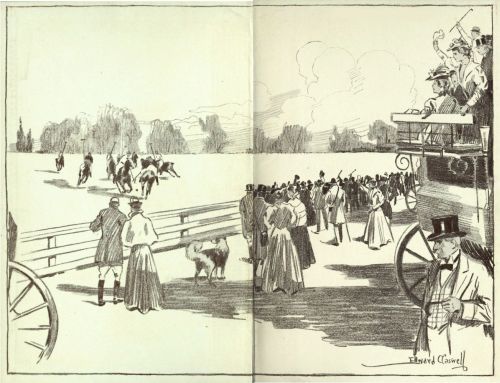
All Fifth Avenue had poured down to see New York versus Hempstead. The
beautifully rolled lawns and freshly painted club stand were sprinkled
with spring dresses and abloom with sunshades, and coaches and other
vehicles without number enclosed the farther side of the field.
Hayley Delane still played polo, though he had grown so heavy that the
cost of providing himself with mounts must have been considerable. He
was, of course, no longer regarded as in the first rank; indeed, in
these later days, when the game has become an exact science, I hardly
know to what use such a weighty body as his could be put. But in that
far-off dawn of the sport his sureness and swiftness of stroke caused
him to be still regarded as a useful back, besides being esteemed for
the part he had taken in introducing and establishing the game.
I remember little of the beginning of the game, which resembled many
others I had seen. I never played myself, and I had no money on: for me
the principal interest of the scene lay in the May weather, the ripple
of spring dresses over the turf, the sense of youth, fun, gaiety, of
young manhood and womanhood weaving their eternal pattern under the
conniving sky. Now and then they were interrupted for a moment by a
quick “Oh” which turned all those tangled glances the same way, as two
glittering streaks of men and horses dashed across the green, locked,
swayed, rayed outward into starry figures, and rolled back. But it was
for a moment only—then eyes wandered again, chatter began, and youth
and sex had it their own way till the next charge shook them from their
trance.
I was of the number of these divided watchers. Polo as a spectacle did
not amuse me for long, and I saw about as little of it as the pretty
girls perched beside their swains on coach-tops and club stand. But by
chance my vague wanderings brought me to the white palings enclosing the
field, and there, in a cluster of spectators, I caught sight of Leila
Delane.
As I approached I was surprised to notice a familiar figure shouldering
away from her. One still saw old Bill Gracy often enough in the outer
purlieus of the big race-courses; but I wondered how he had got into the
enclosure of a fashionable Polo Club. There he was, though,
unmistakably; who could forget that swelling chest under the
shabby-smart racing-coat, the gray top-hat always pushed back from his
thin auburn curls, and the mixture of furtiveness and swagger which made
his liquid glance so pitiful? Among the figures that rose here and there
like warning ruins from the dead-level of old New York’s respectability,
none was more typical than Bill Gracy’s; my gaze followed him curiously
as he shuffled away from his daughter. “Trying to get more money out of
her,” I concluded; and remembered what Alstrop had said of Delane’s
generosity.
“Well, if I were Delane,” I thought, “I’d pay a good deal to keep that
old ruffian out of sight.”
Mrs. Delane, turning to watch her father’s retreat, saw me and nodded.
At the same moment Delane, on a tall deep-chested poney, ambled across
the field, stick on shoulder. As he rode thus, heavily yet mightily, in
his red-and-black shirt and white breeches, his head standing out like a
bronze against the turf, I whimsically recalled the figure of
Guidoriccio da Foligno, the famous mercenary, riding at a slow powerful
pace across the fortressed fresco of the Town Hall of Siena. Why a New
York banker of excessive weight and more than middle age, jogging on a
poney across a Long Island polo field, should have reminded me of a
martial figure on an armoured war-horse, I find it hard to explain. As
far as I knew there were no turreted fortresses in Delane’s background;
and his too juvenile polo cap and gaudy shirt were a poor substitute for
Guidoriccio’s coat of mail. But it was the kind of trick the man was
always playing; reminding me, in his lazy torpid way, of times and
scenes and people greater than he could know. That was why he kept on
interesting me.
It was this interest which caused me to pause by Mrs. Delane, whom I
generally avoided. After a vague smile she had already turned her gaze
on the field.
“You’re admiring your husband?” I suggested, as Delane’s trot carried
him across our line of vision.
She glanced at me dubiously. “You think he’s too fat to play, I
suppose?” she retorted, a little snappishly.
“I think he’s the finest figure in sight. He looks like a great general,
a great soldier of fortune—in an old fresco, I mean.”
She stared, perhaps suspecting irony, as she always did beneath the
unintelligible.
“Ah, he can pay anything he likes for his mounts!” she murmured; and
added, with a wandering laugh: “Do you mean it as a compliment? Shall I
tell him what you say?”
“I wish you would.”
But her eyes were off again, this time to the opposite end of the field.
Of course—Bolton Byrne was playing on the other side! The fool of a
woman was always like that—absorbed in her latest adventure. Yet there
had been so many, and she must by this time have been so radiantly sure
there would be more! But at every one the girl was born anew in her:
she blushed, palpitated, “sat out” dances, plotted for tête-à-têtes,
pressed flowers (I’ll wager) in her copy of “Omar Khayyám,” and was all
white muslin and wild roses while it lasted. And the Byrne fever was
then at its height.
It did not seem polite to leave her immediately, and I continued to
watch the field at her side. “It’s their last chance to score,” she
flung at me, leaving me to apply the ambiguous pronoun; and after that
we remained silent.
The game had been a close one; the two sides were five each, and the
crowd about the rails hung breathless on the last minutes. The struggle
was short and swift, and dramatic enough to hold even the philanderers
on the coach-tops. Once I stole a glance at Mrs. Delane, and saw the
colour rush to her cheek. Byrne was hurling himself across the field,
crouched on the neck of his somewhat weedy mount, his stick swung like a
lance—a pretty enough sight, for he was young and supple, and light in
the saddle.
“They’re going to win!” she gasped with a happy cry.
But just then Byrne’s poney, unequal to the pace, stumbled, faltered,
and came down. His rider dropped from the saddle, hauled the animal to
his feet, and stood for a minute half-dazed before he scrambled up
again. That minute made the difference. It gave the other side their
chance. The knot of men and horses tightened, wavered, grew loose, broke
up in arrowing flights; and suddenly a ball—Delane’s—sped through the
enemy’s goal, victorious. A roar of delight went up; “Good for old
Hayley!” voices shouted. Mrs. Delane gave a little sour laugh.
“That—that beastly poney; I warned him it was no good—and the ground
still so slippery,” she broke out.
“The poney? Why, he’s a ripper. It’s not every mount that will carry
Delane’s weight,” I said. She stared at me unseeingly and turned away
with twitching lips. I saw her speeding off toward the enclosure.
I followed hastily, wanting to see Delane in the moment of his triumph.
I knew he took all these little sporting successes with an absurd
seriousness, as if, mysteriously, they were the shadow of more
substantial achievements, dreamed of, or accomplished, in some previous
life. And perhaps the elderly man’s vanity in holding his own with the
youngsters was also an element of his satisfaction; how could one tell,
in a mind of such monumental simplicity?
When I reached the saddling enclosure I did not at once discover him; an
unpleasant sight met my eyes instead. Bolton Byrne, livid and
withered—his face like an old woman’s, I thought—rode across the empty
field, angrily lashing his poney’s flanks. He slipped to the ground, and
as he did so, struck the shivering animal a last blow clean across the
head. An unpleasant sight—
But retribution fell. It came like a black-and-red thunderbolt
descending on the wretch out of the heaven. Delane had him by the
collar, had struck him with his whip across the shoulders, and then
flung him off like a thing too mean for human handling. It was over in
the taking of a breath—then, while the crowd hummed and closed in,
leaving Byrne to slink away as if he had become invisible, I saw my big
Delane, grown calm and apathetic, turn to the poney and lay a soothing
hand on its neck.
I was pushing forward, moved by the impulse to press that hand, when his
wife went up to him. Though I was not far off I could not hear what she
said; people did not speak loud in those days, or “make scenes,” and the
two or three words which issued from Mrs. Delane’s lips must have been
inaudible to everyone but her husband. On his dark face they raised a
sudden redness; he made a motion of his free arm (the other hand still
on the poney’s neck), as if to wave aside an importunate child; then he
felt in his pocket, drew out a cigarette, and lit it. Mrs. Delane, white
as a ghost, was hurrying back to Alstrop’s coach.
I was turning away too when I saw her husband hailed again. This time it
was Bill Gracy, shoving and yet effacing himself, as his manner was,
who came up, a facile tear on his lashes, his smile half tremulous, half
defiant, a yellow-gloved hand held out.
“God bless you for it, Hayley—God bless you, my dear boy!”
Delane’s hand reluctantly left the poney’s neck. It wavered for an
instant, just touched the other’s palm, and was instantly engulfed in
it. Then Delane, without speaking, turned toward the shed where his
mounts were being rubbed down, while his father-in-law swaggered from
the scene.
I had promised, on the way home, to stop for tea at a friend’s house
half-way between the Polo Club and Alstrop’s. Another friend, who was
also going there, offered me a lift, and carried me on to Alstrop’s
afterward.
During our drive, and about the tea-table, the talk of course dwelt
mainly on the awkward incident of Bolton Byrne’s thrashing. The women
were horrified or admiring, as their humour moved them; but the men all
agreed that it was natural enough. In such a case any pretext was
permissible, they said; though it was stupid of Hayley to air his
grievance on a public occasion. But then he was stupid—that was the
consensus of opinion. If there was a blundering way of doing a thing
that needed to be done, trust him to hit on it! For the rest, everyone
spoke of him affectionately, and agreed that Leila was a fool ... and
nobody particularly liked Byrne, an “outsider” who had pushed himself
into society by means of cheek and showy horsemanship. But Leila, it was
agreed, had always had a weakness for “outsiders,” perhaps because
their admiration flattered her extreme desire to be thought “in.”
“Wonder how many of the party you’ll find left—this affair must have
caused a good deal of a shake-up,” my friend said, as I got down at
Alstrop’s door; and the same thought was in my own mind. Byrne would be
gone, of course; and no doubt, in another direction, Delane and Leila. I
wished I had a chance to shake that blundering hand of Hayley’s....
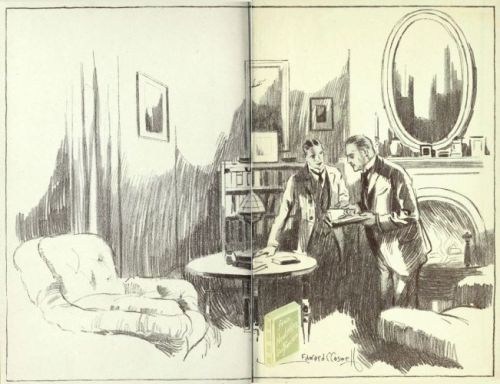
Hall and drawing-room were empty; the dressing-bell must have sounded
its discreet appeal more than once, and I was relieved to find it had
been heeded. I didn’t want to stumble on any of my fellow-guests till I
had seen our host. As I was dashing upstairs I heard him call me from
the library, and turned back.
“No hurry—dinner put off till nine,” he said cheerfully; and added, on
a note of inexpressible relief: “We’ve had a tough job of it—ouf!”
The room looked as if they had: the card tables stood untouched, and the
deep armchairs, gathered into confidential groups, seemed still
deliberating on the knotty problem. I noticed that a good deal of
whiskey and soda had gone toward its solution.
“What happened? Has Byrne left?”
“Byrne? No—thank goodness!” Alstrop looked at me almost reproachfully.
“Why should he? That was just what we wanted to avoid.”
“I don’t understand. You don’t mean that he’s stayed and the Delanes
have gone?”
“Lord forbid! Why should they, either? Hayley’s apologized!”
My jaw fell, and I returned my host’s stare.
“Apologized? To that hound? For what?”
Alstrop gave an impatient shrug. “Oh, for God’s sake don’t reopen the
cursèd question,” it seemed to say. Aloud he echoed: “For what? Why,
after all, a man’s got a right to thrash his own poney, hasn’t he? It
was beastly unsportsmanlike, of course—but it’s nobody’s business if
Byrne chooses to be that kind of a cad. That’s what Hayley saw—when he
cooled down.”
“Then I’m sorry he cooled down.”
Alstrop looked distinctly annoyed. “I don’t follow you. We had a hard
enough job. You said you wanted to see him in a rage just once; but you
don’t want him to go on making an ass of himself, do you?”
“I don’t call it making an ass of himself to thrash Byrne.”
“And to advertise his conjugal difficulties all over Long Island, with
twenty newspaper reporters at his heels?”
I stood silent, baffled but incredulous. “I don’t believe he ever gave
that a thought. I wonder who put it to him first in that way?”
Alstrop twisted his unlit cigarette about in his fingers. “We all
did—as delicately as we could. But it was Leila who finally convinced
him. I must say Leila was very game.”
I still pondered: the scene in the paddock rose again before me, the
quivering agonized animal, and the way Delane’s big hand had been laid
reassuringly on its neck.
“Nonsense! I don’t believe a word of it!” I declared.
“A word of what I’ve been telling you?”
“Well, of the official version of the case.”
To my surprise, Alstrop met my glance with an eye neither puzzled nor
resentful. A shadow seemed to be lifted from his honest face.
“What do you believe?” he asked.
“Why, that Delane thrashed that cur for ill-treating the poney, and not
in the least for being too attentive to Mrs. Delane. I was there, I tell
you—I saw him.”
Alstrop’s brow cleared completely. “There’s something to be said for
that theory,” he agreed, smiling over the match he was holding to his
cigarette.
“Well, then—what was there to apologize for?”
“Why, for that—butting in between Byrne and his horse. Don’t you see,
you young idiot? If Hayley hadn’t apologized, the mud was bound to
stick to his wife. Everybody would have said the row was on her account.
It’s as plain as the knob on the door—there wasn’t anything else for
him to do. He saw it well enough after she’d said a dozen words to
him—”
“I wonder what those words were,” I muttered.
“Don’t know. He and she came downstairs together. He looked a hundred
years old, poor old chap. ‘It’s the cruelty, it’s the cruelty,’ he kept
saying; ‘I hate cruelty.’ I rather think he knows we’re all on his side.
Anyhow, it’s all patched up and well patched up; and I’ve ordered my
last ’eighty-four Georges Goulet brought up for dinner. Meant to keep it
for my own wedding-breakfast; but since this afternoon I’ve rather lost
interest in that festivity,” Alstrop concluded with a celibate grin.
“Well,” I repeated, as though it were a relief to say, “I could swear he
did it for the poney.”
“Oh, so could I,” my host acquiesced as we went upstairs together.
On my threshold, he took me by the arm and followed me in. I saw there
was still something on his mind.
“Look here, old chap—you say you were in there when it happened?”
“Yes. Close by—”
“Well,” he interrupted, “for the Lord’s sake don’t allude to the subject
tonight, will you?”
“Of course not.”
“Thanks a lot. Truth is, it was a narrow squeak, and I couldn’t help
admiring the way Leila played up. She was in a fury with Hayley; but she
got herself in hand in no time, and behaved very decently. She told me
privately he was often like that—flaring out all of a sudden like a
madman. You wouldn’t imagine it, would you, with that quiet way of his?
She says she thinks it’s his old wound.”
“What old wound?”
“Didn’t you know he was wounded—where was it? Bull Run, I believe. In
the head—”
No, I hadn’t known; hadn’t even heard, or remembered, that Delane had
been in the Civil War. I stood and stared in my astonishment.
“Hayley Delane? In the war?”
“Why, of course. All through it.”
“But Bull Run—Bull Run was at the very beginning.” I broke off to go
through a rapid mental calculation. “Look here, Jack, it can’t be; he’s
not over fifty-five. You told me so yourself. If he was in it from the
beginning he must have gone into it as a schoolboy.”
“Well, that’s just what he did: ran away from school to volunteer. His
family didn’t know what had become of him till he was wounded. I
remember hearing my people talk about it. Great old sport, Hayley. I’d
have given a lot not to have this thing happen; not at my place anyhow;
but it has, and there’s no help for it. Look here, you swear you won’t
make a sign, will you? I’ve got all the others into line, and if you’ll
back us up we’ll have a regular Happy Family Evening. Jump into your
clothes—it’s nearly nine.”