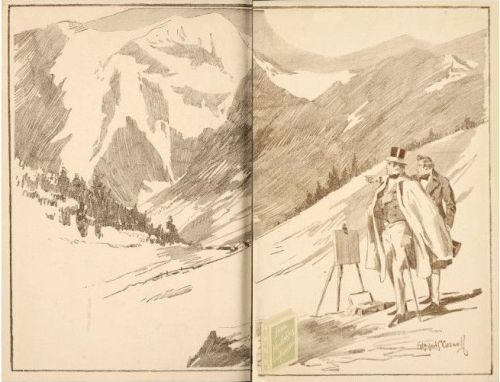
LEWIS RAYCIE stood on a projecting rock and surveyed the sublime
spectacle of Mont Blanc.
It was a brilliant August day, and the air, at that height, was already
so sharp that he had had to put on his fur-lined pelisse. Behind him, at
a respectful distance, was the travelling servant who, at a signal, had
brought it up to him; below, in the bend of the mountain road, stood the
light and elegant carriage which had carried him thus far on his
travels.
Scarcely more than a year had passed since he had waved a farewell to
New York from the deck of the packet-ship headed down the bay; yet, to
the young man confidently facing Mont Blanc, nothing seemed left in him
of that fluid and insubstantial being, the former Lewis Raycie, save a
lurking and abeyant fear of Mr. Raycie senior. Even that, however, was
so attenuated by distance and time, so far sunk below the horizon, and
anchored on the far side of the globe, that it stirred in its sleep only
when a handsomely folded and wafered letter in his parent’s writing was
handed out across the desk of some continental counting-house. Mr.
Raycie senior did not write often, and when he did it was in a bland and
stilted strain. He felt at a disadvantage on paper, and his natural
sarcasm was swamped in the rolling periods which it cost him hours of
labour to bring forth; so that the dreaded quality lurked for his son
only in the curve of certain letters, and in a positively awful way of
writing out, at full length, the word Esquire.
It was not that Lewis had broken with all the memories of his past of a
year ago. Many still lingered in him, or rather had been transferred to
the new man he had become—as for instance his tenderness for Treeshy
Kent, which, somewhat to his surprise, had obstinately resisted all the
assaults of English keepsake beauties and almond-eyed houris of the
East. It startled him, at times, to find Treeshy’s short dusky face,
with its round forehead, the widely spaced eyes and the high
cheek-bones, starting out at him suddenly in the street of some
legendary town, or in a landscape of languid beauty, just as he had now
and again been arrested in an exotic garden by the very scent of the
verbena under the verandah at home. His travels had confirmed rather
than weakened the family view of Treeshy’s plainness; she could not be
made to fit into any of the patterns of female beauty so far submitted
to him; yet there she was, ensconced in his new heart and mind as deeply
as in the old, though her kisses seemed less vivid, and the peculiar
rough notes of her voice hardly reached him. Sometimes, half irritably,
he said to himself that with an effort he could disperse her once for
all; yet she lived on in him, unseen yet ineffaceable, like the image on
a daguerreotype plate, no less there because so often invisible.
To the new Lewis, however, the whole business was less important than he
had once thought it. His suddenly acquired maturity made Treeshy seem a
petted child rather than the guide, the Beatrice, he had once considered
her; and he promised himself, with an elderly smile, that as soon as he
got to Italy he would write her the long letter for which he was now
considerably in her debt.
His travels had first carried him to England. There he spent some weeks
in collecting letters and recommendations for his tour, in purchasing
his travelling-carriage and its numerous appurtenances, and in driving
in it from cathedral town to storied castle, omitting nothing, from
Abbotsford to Kenilworth, which deserved the attention of a cultivated
mind. From England he crossed to Calais, moving slowly southward to the
Mediterranean; and there, taking ship for the Piræus, he plunged into
pure romance, and the tourist became a Giaour.
It was the East which had made him into a new Lewis Raycie; the East, so
squalid and splendid, so pestilent and so poetic, so full of knavery
and romance and fleas and nightingales, and so different, alike in its
glories and its dirt, from what his studious youth had dreamed. After
Smyrna and the bazaars, after Damascus and Palmyra, the Acropolis,
Mytilene and Sunium, what could be left in his mind of Canal Street and
the lawn above the Sound? Even the mosquitoes, which seemed at first the
only connecting link, were different, because he fought with them in
scenes so different; and a young gentleman who had journeyed across the
desert in Arabian dress, slept under goats’-hair tents, been attacked by
robbers in the Peloponnesus and despoiled by his own escort at Baalbek,
and by customs’ officials everywhere, could not but look with a smile on
the terrors that walk New York and the Hudson river. Encased in security
and monotony, that other Lewis Raycie, when his little figure bobbed up
to the surface, seemed like a new-born babe preserved in alcohol. Even
Mr. Raycie senior’s thunders were now no more than the far-off murmur of
summer lightning on a perfect evening. Had Mr. Raycie ever really
frightened Lewis? Why, now he was not even frightened by Mont Blanc!
He was still gazing with a sense of easy equality at its awful pinnacles
when another travelling-carriage paused near his own, and a young man,
eagerly jumping from it, and also followed by a servant with a cloak,
began to mount the slope. Lewis at once recognized the carriage, and the
light springing figure of the young man, his blue coat and swelling
stock, and the scar slightly distorting his handsome and eloquent mouth.
It was the Englishman who had arrived at the Montanvert inn the night
before with a valet, a guide, and such a cargo of books, maps and
sketching-materials as threatened to overshadow even Lewis’s outfit.
Lewis, at first, had not been greatly drawn to the newcomer, who, seated
aloof in the dining-room, seemed not to see his fellow-traveller. The
truth was that Lewis was dying for a little conversation. His
astonishing experiences were so tightly packed in him (with no outlet
save the meagre trickle of his nightly diary) that he felt they would
soon melt into the vague blur of other people’s travels unless he could
give them fresh reality by talking them over. And the stranger with the
deep-blue eyes that matched his coat, the scarred cheek and eloquent
lip, seemed to Lewis a worthy listener. The Englishman appeared to think
otherwise. He preserved an air of moody abstraction, which Lewis’s
vanity imagined him to have put on as the gods becloud themselves for
their secret errands; and the curtness of his goodnight was (Lewis
flattered himself) surpassed only by the young New Yorker’s.
But today all was different. The stranger advanced affably, raised his
hat from his tossed statue-like hair, and enquired with a smile: “Are
you by any chance interested in the forms of cirrous clouds?”
His voice was as sweet as his smile, and the two were reinforced by a
glance so winning that it made the odd question seem not only pertinent
but natural. Lewis, though surprised, was not disconcerted. He merely
coloured with the unwonted sense of his ignorance, and replied
ingenuously: “I believe, sir, I am interested in everything.”
“A noble answer!” cried the other, and held out his hand.
“But I must add,” Lewis continued with courageous honesty, “that I have
never as yet had occasion to occupy myself particularly with the forms
of cirrous clouds.”
His companion looked at him merrily. “That,” said he, “is no reason why
you shouldn’t begin to do so now!” To which Lewis as merrily agreed.
“For in order to be interested in things,” the other continued more
gravely, “it is only necessary to see them; and I believe I am not wrong
in saying that you are one of the privileged beings to whom the seeing
eye has been given.”
Lewis blushed his agreement, and his interlocutor continued: “You are
one of those who have been on the road to Damascus.”
“On the road? I’ve been to the place itself!” the wanderer exclaimed,
bursting with the particulars of his travels; and then blushed more
deeply at the perception that the other’s use of the name had of course
been figurative.
The young Englishman’s face lit up. “You’ve been to Damascus—literally
been there yourself? But that may be almost as interesting, in its quite
different way, as the formation of clouds or lichens. For the present,”
he continued with a gesture toward the mountain, “I must devote myself
to the extremely inadequate rendering of some of these delicate
aiguilles; a bit of drudgery not likely to interest you in the face of
so sublime a scene. But perhaps this evening—if, as I think, we are
staying in the same inn—you will give me a few minutes of your society,
and tell me something of your travels. My father,” he added with his
engaging smile, “has had packed with my paint-brushes a few bottles of a
wholly trustworthy Madeira; and if you will favour me with your company
at dinner....”
He signed to his servant to undo the sketching materials, spread his
cloak on the rock, and was already lost in his task as Lewis descended
to the carriage.
The Madeira proved as trustworthy as his host had promised. Perhaps it
was its exceptional quality which threw such a golden lustre over the
dinner; unless it were rather the conversation of the blue-eyed
Englishman which made Lewis Raycie, always a small drinker, feel that in
his company every drop was nectar.
When Lewis joined his host it had been with the secret hope of at last
being able to talk; but when the evening was over (and they kept it up
to the small hours) he perceived that he had chiefly listened. Yet there
had been no sense of suppression, of thwarted volubility; he had been
given all the openings he wanted. Only, whenever he produced a little
fact it was instantly overflowed by the other’s imagination till it
burned like a dull pebble tossed into a rushing stream. For whatever
Lewis said was seen by his companion from a new angle, and suggested a
new train of thought; each commonplace item of experience became a
many-faceted crystal flashing with unexpected fires. The young
Englishman’s mind moved in a world of associations and references far
more richly peopled than Lewis’s; but his eager communicativeness, his
directness of speech and manner, instantly opened its gates to the
simpler youth. It was certainly not the Madeira which sped the hours
and flooded them with magic; but the magic gave the Madeira—excellent,
and reputed of its kind, as Lewis afterward learned—a taste no other
vintage was to have for him.
“Oh, but we must meet again in Italy—there are many things there that I
could perhaps help you to see,” the young Englishman declared as they
swore eternal friendship on the stairs of the sleeping inn.
IT was in a tiny Venetian church, no more than a chapel, that Lewis
Raycie’s eyes had been unsealed—in a dull-looking little church not
even mentioned in the guide-books. But for his chance encounter with the
young Englishman in the shadow of Mont Blanc, Lewis would never have
heard of the place; but then what else that was worth knowing would he
ever have heard of, he wondered?
He had stood a long time looking at the frescoes, put off at first—he
could admit it now—by a certain stiffness in the attitudes of the
people, by the childish elaboration of their dress (so different from
the noble draperies which Sir Joshua’s Discourses on Art had taught him
to admire in the great painters), and by the innocent inexpressive look
in their young faces—for even the gray-beards seemed young. And then
suddenly his gaze had lit on one of these faces in particular: that of a
girl with round cheeks, high cheek-bones and widely set eyes under an
intricate head-dress of pearl-woven braids. Why, it was Treeshy—Treeshy
Kent to the life! And so far from being thought “plain,” the young lady
was no other than the peerless princess about whom the tale revolved.
And what a fairy-land she lived in—full of lithe youths and round-faced
pouting maidens, rosy old men and burnished blackamoors, pretty birds
and cats and nibbling rabbits—and all involved and enclosed in golden
balustrades, in colonnades of pink and blue, laurel-garlands festooned
from ivory balconies, and domes and minarets against summer seas!
Lewis’s imagination lost itself in the scene; he forgot to regret the
noble draperies, the exalted sentiments, the fuliginous backgrounds, of
the artists he had come to Italy to admire—forgot Sassoferrato, Guido
Reni, Carlo Dolce, Lo Spagnoletto, the Carracci, and even the
Transfiguration of Raphael, though he knew it to be the greatest picture
in the world.
After that he had seen almost everything else that Italian art had to
offer; had been to Florence, Naples, Rome; to Bologna to study the
Eclectic School, to Parma to examine the Correggios and the Giulio
Romanos. But that first vision had laid a magic seed between his lips;
the seed that makes you hear what the birds say and the grasses whisper.
Even if his English friend had not continued at his side, pointing out,
explaining, inspiring, Lewis Raycie flattered himself that the round
face of the little Saint Ursula would have led him safely and
confidently past all her rivals. She had become his touchstone, his
star: how insipid seemed to him all the sheep-faced Virgins draped in
red and blue paint after he had looked into her wondering girlish eyes
and traced the elaborate pattern of her brocades! He could remember now,
quite distinctly, the day when he had given up even Beatrice Cenci ...
and as for that fat naked Magdalen of Carlo Dolce’s, lolling over the
book she was not reading, and ogling the spectator in the good old way
... faugh! Saint Ursula did not need to rescue him from her....
His eyes had been opened to a new world of art. And this world it was
his mission to reveal to others—he, the insignificant and ignorant
Lewis Raycie, as “but for the grace of God,” and that chance encounter
on Mont Blanc, he might have gone on being to the end! He shuddered to
think of the army of Neapolitan beggar-boys, bituminous monks, whirling
prophets, languishing Madonnas and pink-rumped amorini who might have
been travelling home with him in the hold of the fast new steam-packet.
His excitement had something of the apostle’s ecstasy. He was not only,
in a few hours, to embrace Treeshy, and be reunited to his honoured
parents; he was also to go forth and preach the new gospel to them that
sat in the darkness of Salvator Rosa and Lo Spagnoletto....
The first thing that struck Lewis was the smallness of the house on the
Sound, and the largeness of Mr. Raycie.
He had expected to receive the opposite impression. In his recollection
the varnished Tuscan villa had retained something of its impressiveness,
even when compared to its supposed originals. Perhaps the very contrast
between their draughty distances and naked floors, and the expensive
carpets and bright fires of High Point, magnified his memory of the
latter—there were moments when the thought of its groaning board
certainly added to the effect. But the image of Mr. Raycie had meanwhile
dwindled. Everything about him, as his son looked back, seemed narrow,
juvenile, almost childish. His bluster about Edgar Poe, for
instance—true poet still to Lewis, though he had since heard richer
notes; his fussy tyranny of his womenkind; his unconscious but total
ignorance of most of the things, books, people, ideas, that now filled
his son’s mind; above all, the arrogance and incompetence of his
artistic judgments. Beyond a narrow range of reading—mostly, Lewis
suspected, culled in drowsy after-dinner snatches from Knight’s
“Half-hours with the Best Authors”—Mr. Raycie made no pretence to
book-learning; left that, as he handsomely said, “to the professors.”
But on matters of art he was dogmatic and explicit, prepared to justify
his opinions by the citing of eminent authorities and of market-prices,
and quite clear, as his farewell talk with his son had shown, as to
which Old Masters should be privileged to figure in the Raycie
collection.
The young man felt no impatience of these judgments. America was a long
way from Europe, and it was many years since Mr. Raycie had travelled.
He could hardly be blamed for not knowing that the things he admired
were no longer admirable, still less for not knowing why. The pictures
before which Lewis had knelt in spirit had been virtually undiscovered,
even by art-students and critics, in his father’s youth. How was an
American gentleman, filled with his own self-importance, and paying his
courier the highest salary to show him the accredited
“Masterpieces”—how was he to guess that whenever he stood rapt before a
Sassoferrato or a Carlo Dolce one of those unknown treasures lurked near
by under dust and cobwebs?
No; Lewis felt only tolerance and understanding. Such a view was not one
to magnify the paternal image; but when the young man entered the study
where Mr. Raycie sat immobilized by gout, the swathed leg stretched
along his sofa seemed only another reason for indulgence....
Perhaps, Lewis thought afterward, it was his father’s prone position,
the way his great bulk billowed over the sofa, and the lame leg reached
out like a mountain-ridge, that made him suddenly seem to fill the room;
or else the sound of his voice booming irritably across the threshold,
and scattering Mrs. Raycie and the girls with a fierce: “And now,
ladies, if the hugging and kissing are over, I should be glad of a
moment with my son.” But it was odd that, after mother and daughters had
withdrawn with all their hoops and flounces, the study seemed to grow
even smaller, and Lewis himself to feel more like a David without the
pebble.
“Well, my boy,” his father cried, crimson and puffing, “here you are at
home again, with many adventures to relate, no doubt; and a few
masterpieces to show me, as I gather from the drafts on my exchequer.”
“Oh, as to the masterpieces, sir, certainly,” Lewis simpered, wondering
why his voice sounded so fluty, and his smile was produced with such a
conscious muscular effort.
“Good—good,” Mr. Raycie approved, waving a violet hand which seemed to
be ripening for a bandage. “Reedy carried out my orders, I presume? Saw
to it that the paintings were deposited with the bulk of your luggage in
Canal Street?”
“Oh, yes, sir; Mr. Reedy was on the dock with precise instructions. You
know he always carries out your orders,” Lewis ventured with a faint
irony.
Mr. Raycie stared. “Mr. Reedy,” he said, “does what I tell him, if
that’s what you mean; otherwise he would hardly have been in my employ
for over thirty years.”
Lewis was silent, and his father examined him critically. “You appear to
have filled out; your health is satisfactory? Well ... well.... Mr.
Robert Huzzard and his daughters are dining here this evening, by the
way, and will no doubt be expecting to see the latest French novelties
in stocks and waistcoats. Malvina has become a very elegant figure, your
sisters tell me.” Mr. Raycie chuckled, and Lewis thought: “I knew it
was the oldest Huzzard girl!” while a slight chill ran down his spine.
“As to the pictures,” Mr. Raycie pursued with growing animation, “I am
laid low, as you see, by this cursèd affliction, and till the doctors
get me up again, here must I lie and try to imagine how your treasures
will look in the new gallery. And meanwhile, my dear boy, I need hardly
say that no one is to be admitted to see them till they have been
inspected by me and suitably hung. Reedy shall begin unpacking at once;
and when we move to town next month Mrs. Raycie, God willing, shall give
the handsomest evening party New York has yet seen, to show my son’s
collection, and perhaps ... eh, well?... to celebrate another
interesting event in his history.”
Lewis met this with a faint but respectful gurgle, and before his
blurred eyes rose the wistful face of Treeshy Kent.
“Ah, well, I shall see her tomorrow,” he thought, taking heart again as
soon as he was out of his father’s presence.
MR. RAYCIE stood silent for a long time after making the round of the
room in the Canal Street house where the unpacked pictures had been set
out.
He had driven to town alone with Lewis, sternly rebuffing his daughters’
timid hints, and Mrs. Raycie’s mute but visible yearning to accompany
him. Though the gout was over he was still weak and irritable, and Mrs.
Raycie, fluttered at the thought of “crossing him,” had swept the girls
away at his first frown.
Lewis’s hopes rose as he followed his parent’s limping progress. The
pictures, though standing on chairs and tables, and set clumsily askew
to catch the light, bloomed out of the half-dusk of the empty house
with a new and persuasive beauty. Ah, how right he had been—how
inevitable that his father should own it!
Mr. Raycie halted in the middle of the room. He was still silent, and
his face, so quick to frown and glare, wore the calm, almost
expressionless look known to Lewis as the mask of inward perplexity.
“Oh, of course it will take a little time,” the son thought, tingling
with the eagerness of youth.
At last, Mr. Raycie woke the echoes by clearing his throat; but the
voice which issued from it was as inexpressive as his face. “It is
singular,” he said, “how little the best copies of the Old Masters
resemble the originals. For these are Originals?” he questioned,
suddenly swinging about on Lewis.
“Oh, absolutely, sir! Besides—” The young man was about to add: “No
one would ever have taken the trouble to copy them”—but hastily checked
himself.
“Besides——?”
“I meant, I had the most competent advice obtainable.”
“So I assume; since it was the express condition on which I authorized
your purchases.”
Lewis felt himself shrinking and his father expanding; but he sent a
glance along the wall, and beauty shed her reviving beam on him.
Mr. Raycie’s brows projected ominously; but his face remained smooth and
dubious. Once more he cast a slow glance about him.
“Let us,” he said pleasantly, “begin with the Raphael.” And it was
evident that he did not know which way to turn.
“Oh, sir, a Raphael nowadays—I warned you it would be far beyond my
budget.”
Mr. Raycie’s face fell slightly. “I had hoped nevertheless ... for an
inferior specimen....” Then, with an effort: “The Sassoferrato, then.”
Lewis felt more at his ease; he even ventured a respectful smile.
“Sassoferrato is all inferior, isn’t he? The fact is, he no longer
stands ... quite as he used to....”
Mr. Raycie stood motionless: his eyes were vacuously fixed on the
nearest picture.
“Sassoferrato ... no longer ...?”
“Well, sir, no; not for a collection of this quality.”
Lewis saw that he had at last struck the right note. Something large and
uncomfortable appeared to struggle in Mr. Raycie’s throat; then he gave
a cough which might almost have been said to cast out Sassoferrato.
There was another pause before he pointed with his stick to a small
picture representing a snub-nosed young woman with a high forehead and
jewelled coif, against a background of delicately interwoven columbines.
“Is that,” he questioned, “your Carlo Dolce? The style is much the
same, I see; but it seems to me lacking in his peculiar sentiment.”
“Oh, but it’s not a Carlo Dolce: it’s a Piero della Francesca, sir!”
burst in triumph from the trembling Lewis.
His father sternly faced him. “It’s a copy, you mean? I thought so!”
“No, no; not a copy; it’s by a great painter ... a much greater....”
Mr. Raycie had reddened sharply at his mistake. To conceal his natural
annoyance he assumed a still more silken manner. “In that case,” he
said, “I think I should like to see the inferior painters first. Where
is the Carlo Dolce?”
“There is no Carlo Dolce,” said Lewis, white to the lips.
The young man’s next distinct recollection was of standing, he knew not
how long afterward, before the armchair in which his father had sunk
down, almost as white and shaken as himself.
“This,” stammered Mr. Raycie, “this is going to bring back my gout....”
But when Lewis entreated: “Oh, sir, do let us drive back quietly to the
country, and give me a chance later to explain ... to put my case” ...
the old gentleman had struck through the pleading with a furious wave of
his stick.
“Explain later? Put your case later? It’s just what I insist upon your
doing here and now!” And Mr. Raycie added hoarsely, and as if in actual
physical anguish: “I understand that young John Huzzard returned from
Rome last week with a Raphael.”
After that, Lewis heard himself—as if with the icy detachment of a
spectator—marshalling his arguments, pleading the cause he hoped his
pictures would have pleaded for him, dethroning the old Powers and
Principalities, and setting up these new names in their place. It was
first of all the names that stuck in Mr. Raycie’s throat: after spending
a life-time in committing to memory the correct pronunciation of words
like Lo Spagnoletto and Giulio Romano, it was bad enough, his wrathful
eyes seemed to say, to have to begin a new set of verbal gymnastics
before you could be sure of saying to a friend with careless accuracy:
“And this is my Giotto da Bondone.”
But that was only the first shock, soon forgotten in the rush of greater
tribulation. For one might conceivably learn how to pronounce Giotto da
Bondone, and even enjoy doing so, provided the friend in question
recognized the name and bowed to its authority. But to have your effort
received by a blank stare, and the playful request: “You’ll have to say
that over again, please”—to know that, in going the round of the
gallery (the Raycie Gallery!) the same stare and the same request were
likely to be repeated before each picture; the bitterness of this was so
great that Mr. Raycie, without exaggeration, might have likened his case
to that of Agag.
“God! God! God! Carpatcher, you say this other fellow’s called? Kept
him back till the last because it’s the gem of the collection, did you?
Carpatcher—well, he’d have done better to stick to his trade. Something
to do with those new European steam-cars, I suppose, eh?” Mr. Raycie was
so incensed that his irony was less subtle than usual. “And Angelico you
say did that kind of Noah’s Ark soldier in pink armour on gold-leaf?
Well, there I’ve caught you tripping, my boy. Not Angelico,
Angelica; Angelica Kauffman was a lady. And the damned swindler who
foisted that barbarous daub on you as a picture of hers deserves to be
drawn and quartered—and shall be, sir, by God, if the law can reach
him! He shall disgorge every penny he’s rooked you out of, or my name’s
not Halston Raycie! A bargain ... you say the thing was a bargain?
Why, the price of a clean postage stamp would be too dear for it!
God—my son; do you realize you had a trust to carry out?”
“Yes, sir, yes; and it’s just because—”
“You might have written; you might at least have placed your views
before me....”
How could Lewis say: “If I had, I knew you’d have refused to let me buy
the pictures?” He could only stammer: “I did allude to the revolution
in taste ... new names coming up ... you may remember....”
“Revolution! New names! Who says so? I had a letter last week from the
London dealers to whom I especially recommended you, telling me that an
undoubted Guido Reni was coming into the market this summer.”
“Oh, the dealers—they don’t know!”
“The dealers ... don’t?... Who does ... except yourself?” Mr. Raycie
pronounced in a white sneer.
Lewis, as white, still held his ground. “I wrote you, sir, about my
friends; in Italy, and afterward in England.”
“Well, God damn it, I never heard of one of their names before,
either; no more’n of these painters of yours here. I supplied you with
the names of all the advisers you needed, and all the painters, too; I
all but made the collection for you myself, before you started.... I was
explicit enough, in all conscience, wasn’t I?”
Lewis smiled faintly. “That’s what I hoped the pictures would be....”
“What? Be what? What’d you mean?”
“Be explicit.... Speak for themselves ... make you see that their
painters are already superseding some of the better-known....”
Mr. Raycie gave an awful laugh. “They are, are they? In whose
estimation? Your friends’, I suppose. What’s the name, again, of that
fellow you met in Italy, who picked ’em out for you?”
“Ruskin—John Ruskin,” said Lewis.
Mr. Raycie’s laugh, prolonged, gathered up into itself a fresh shower of
expletives. “Ruskin—Ruskin—just plain John Ruskin, eh? And who is
this great John Ruskin, who sets God A’mighty right in his judgments?
Who’d you say John Ruskin’s father was, now?”
“A respected wine-merchant in London, sir.”
Mr. Raycie ceased to laugh: he looked at his son with an expression of
unutterable disgust.
“Retail?”
“I ... believe so....”
“Faugh!” said Mr. Raycie.
“It wasn’t only Ruskin, father.... I told you of those other friends in
London, whom I met on the way home. They inspected the pictures, and
all of them agreed that ... that the collection would some day be very
valuable.”
“Some day—did they give you a date ... the month and the year? Ah,
those other friends; yes. You said there was a Mr. Brown and a Mr. Hunt
and a Mr. Rossiter, was it? Well, I never heard of any of those names,
either—except perhaps in a trades’ directory.”
“It’s not Rossiter, father: Dante Rossetti.”
“Excuse me: Rossetti. And what does Mr. Dante Rossetti’s father do? Sell
macaroni, I presume?”
Lewis was silent, and Mr. Raycie went on, speaking now with a deadly
steadiness: “The friends I sent you to were judges of art, sir; men who
know what a picture’s worth; not one of ’em but could pick out a
genuine Raphael. Couldn’t you find ’em when you got to England? Or
hadn’t they the time to spare for you? You’d better not,” Mr. Raycie
added, “tell me that, for I know how they’d have received your
father’s son.”
“Oh, most kindly ... they did indeed, sir....”
“Ay; but that didn’t suit you. You didn’t want to be advised. You
wanted to show off before a lot of ignoramuses like yourself. You
wanted—how’d I know what you wanted? It’s as if I’d never given you an
instruction or laid a charge on you! And the money—God! Where’d it go
to? Buying this? Nonsense—.” Mr. Raycie raised himself heavily on his
stick and fixed his angry eyes on his son. “Own up, Lewis; tell me they
got it out of you at cards. Professional gamblers the lot, I make no
doubt; your Ruskin and your Morris and your Rossiter. Make a business to
pick up young American greenhorns on their travels, I daresay.... No?
Not that, you say? Then—women?... God A’mighty, Lewis,” gasped Mr.
Raycie, tottering toward his son with outstretched stick, “I’m no
blue-nosed Puritan, sir, and I’d a damn sight rather you told me you’d
spent it on a woman, every penny of it, than let yourself be fleeced
like a simpleton, buying these things that look more like cuts out o’
Foxe’s Book of Martyrs than Originals of the Old Masters for a
Gentleman’s Gallery.... Youth’s youth.... Gad, sir, I’ve been young
myself ... a fellow’s got to go through his apprenticeship.... Own up
now: women?”
“Oh, not women——”
“Not even!” Mr. Raycie groaned. “All in pictures, then? Well, say no
more to me now.... I’ll get home, I’ll get home....” He cast a last
apoplectic glance about the room. “The Raycie Gallery! That pack of
bones and mummers’ finery!... Why, let alone the rest, there’s not a
full-bodied female among ’em.... Do you know what those Madonnas of
yours are like, my son? Why, there ain’t one of ’em that don’t remind me
of a bad likeness of poor Treeshy Kent.... I should say you’d hired half
the sign-painters of Europe to do her portrait for you—if I could
imagine your wanting it.... No, sir! I don’t need your arm,” Mr. Raycie
snarled, heaving his great bulk painfully across the hall. He withered
Lewis with a last look from the doorstep. “And to buy that you
overdrew your account?—No, I’ll drive home alone.”
MR. RAYCIE did not die till nearly a year later; but New York agreed it
was the affair of the pictures that had killed him.
The day after his first and only sight of them he sent for his lawyer,
and it became known that he had made a new will. Then he took to his bed
with a return of the gout, and grew so rapidly worse that it was thought
“only proper” to postpone the party Mrs. Raycie was to have given that
autumn to inaugurate the gallery. This enabled the family to pass over
in silence the question of the works of art themselves; but outside of
the Raycie house, where they were never mentioned, they formed, that
winter, a frequent and fruitful topic of discussion.
Only two persons besides Mr. Raycie were known to have seen them. One
was Mr. Donaldson Kent, who owed the privilege to the fact of having
once been to Italy; the other, Mr. Reedy, the agent, who had unpacked
the pictures. Mr. Reedy, beset by Raycie cousins and old family friends,
had replied with genuine humility: “Why, the truth is, I never was
taught to see any difference between one picture and another, except as
regards the size of them; and these struck me as smallish ... on the
small side, I would say....”
Mr. Kent was known to have unbosomed himself to Mr. Raycie with
considerable frankness—he went so far, it was rumoured, as to declare
that he had never seen any pictures in Italy like those brought back by
Lewis, and begged to doubt if they really came from there. But in public
he maintained that noncommittal attitude which passed for prudence, but
proceeded only from timidity; no one ever got anything from him but the
guarded statement: “The subjects are wholly inoffensive.”
It was believed that Mr. Raycie dared not consult the Huzzards. Young
John Huzzard had just brought home a Raphael; it would have been hard
not to avoid comparisons which would have been too galling. Neither to
them, nor to any one else, did Mr. Raycie ever again allude to the
Raycie Gallery. But when his will was opened it was found that he had
bequeathed the pictures to his son. The rest of his property was left
absolutely to his two daughters. The bulk of the estate was Mrs.
Raycie’s; but it was known that Mrs. Raycie had had her instructions,
and among them, perhaps, was the order to fade away in her turn after
six months of widowhood. When she had been laid beside her husband in
Trinity church-yard her will (made in the same week as Mr. Raycie’s, and
obviously at his dictation) was found to allow five thousand dollars a
year to Lewis during his life-time; the residue of the fortune, which
Mr. Raycie’s thrift and good management had made into one of the largest
in New York, was divided between the daughters. Of these, the one
promptly married a Kent and the other a Huzzard; and the latter, Sarah
Ann (who had never been Lewis’s favourite), was wont to say in later
years: “Oh, no, I never grudged my poor brother those funny old
pictures. You see, we have a Raphael.”
The house stood on the corner of Third Avenue and Tenth Street. It had
lately come to Lewis Raycie as his share in the property of a distant
cousin, who had made an “old New York will” under which all his kin
benefited in proportion to their consanguinity. The neighbourhood was
unfashionable, and the house in bad repair; but Mr. and Mrs. Lewis
Raycie, who, since their marriage, had been living in retirement at
Tarrytown, immediately moved into it.
Their arrival excited small attention. Within a year of his father’s
death, Lewis had married Treeshy Kent. The alliance had not been
encouraged by Mr. and Mrs. Kent, who went so far as to say that their
niece might have done better; but as that one of their sons who was
still unmarried had always shown a lively sympathy for Treeshy, they
yielded to the prudent thought that, after all, it was better than
having her entangle Bill.
The Lewis Raycies had been four years married, and during that time had
dropped out of the memory of New York as completely as if their exile
had covered half a century. Neither of them had ever cut a great figure
there. Treeshy had been nothing but the Kents’ Cinderella, and Lewis’s
ephemeral importance, as heir to the Raycie millions, had been effaced
by the painful episode which resulted in his being deprived of them.
So secluded was their way of living, and so much had it come to be a
habit, that when Lewis announced that he had inherited Uncle Ebenezer’s
house his wife hardly looked up from the baby-blanket she was
embroidering.
“Uncle Ebenezer’s house in New York?”
He drew a deep breath. “Now I shall be able to show the pictures.”
“Oh, Lewis—” She dropped the blanket. “Are we going to live there?”
“Certainly. But the house is so large that I shall turn the two corner
rooms on the ground floor into a gallery. They are very suitably
lighted. It was there that Cousin Ebenezer was laid out.”
“Oh, Lewis——”
If anything could have made Lewis Raycie believe in his own strength of
will it was his wife’s attitude. Merely to hear that unquestioning
murmur of submission was to feel something of his father’s tyrannous
strength arise in him; but with the wish to use it more humanely.
“You’ll like that, Treeshy? It’s been dull for you here, I know.”
She flushed up. “Dull? With you, darling? Besides, I like the
country. But I shall like Tenth Street too. Only—you said there were
repairs?”
He nodded sternly. “I shall borrow money to make them. If necessary—”
he lowered his voice—“I shall mortgage the pictures.”
He saw her eyes fill. “Oh, but it won’t be! There are so many ways still
in which I can economize.”
He laid his hand on hers and turned his profile toward her, because he
knew it was so much stronger than his full face. He did not feel sure
that she quite grasped his intention about the pictures; was not even
certain that he wished her to. He went in to New York every week now,
occupying himself mysteriously and importantly with plans,
specifications and other business transactions with long names; while
Treeshy, through the hot summer months, sat in Tarrytown and waited for
the baby.
A little girl was born at the end of the summer and christened Louisa;
and when she was a few weeks old the Lewis Raycies left the country for
New York.
“Now!” thought Lewis, as they bumped over the cobblestones of Tenth
Street in the direction of Cousin Ebenezer’s house.
The carriage stopped, he handed out his wife, the nurse followed with
the baby, and they all stood and looked up at the house-front.
“Oh, Lewis—” Treeshy gasped; and even little Louisa set up a
sympathetic wail.
Over the door—over Cousin Ebenezer’s respectable, conservative and
intensely private front-door—hung a large sign-board bearing, in gold
letters on a black ground, the inscription:
GALLERY OF CHRISTIAN ART
Open on Week-Days from 2 to 4
Admission 25 Cents. Children 10 Cents.
Lewis saw his wife turn pale, and pressed her arm in his. “Believe me,
it’s the only way to make the pictures known. And they must be made
known,” he said with a thrill of his old ardour.
“Yes, dear, of course. But ... to every one? Publicly?”
“If we showed them only to our friends, of what use would it be? Their
opinion is already formed.”
She sighed her acknowledgment. “But the ... the entrance fee....”
“If we can afford it later, the gallery will be free. But
meanwhile——”
“Oh, Lewis, I quite understand!” And clinging to him, the
still-protesting baby in her wake, she passed with a dauntless step
under the awful sign-board.
“At last I shall see the pictures properly lighted!” she exclaimed, and
turned in the hall to fling her arms about her husband.
“It’s all they need ... to be appreciated,” he answered, aglow with her
encouragement.
Since his withdrawal from the world it had been a part of Lewis’s system
never to read the daily papers. His wife eagerly conformed to his
example, and they lived in a little air-tight circle of aloofness, as if
the cottage at Tarrytown had been situated in another and happier
planet.
Lewis, nevertheless, the day after the opening of the Gallery of
Christian Art, deemed it his duty to derogate from this attitude, and
sallied forth secretly to buy the principal journals. When he re-entered
his house he went straight up to the nursery where he knew that, at that
hour, Treeshy would be giving the little girl her bath. But it was later
than he supposed. The rite was over, the baby lay asleep in its modest
cot, and the mother sat crouched by the fire, her face hidden in her
hands. Lewis instantly guessed that she too had seen the papers.
“Treeshy—you mustn’t ... consider this of any consequence ...,” he
stammered.
She lifted a tear-stained face. “Oh, my darling! I thought you never
read the papers.”
“Not usually. But I thought it my duty——”
“Yes; I see. But, as you say, what earthly consequence——?”
“None whatever; we must just be patient and persist.”
She hesitated, and then, her arms about him, her head on his breast:
“Only, dearest, I’ve been counting up again, ever so carefully; and even
if we give up fires everywhere but in the nursery, I’m afraid the wages
of the door-keeper and the guardian ... especially if the gallery’s open
to the public every day....”
“I’ve thought of that already, too; and I myself shall hereafter act as
door-keeper and guardian.”
He kept his eyes on hers as he spoke. “This is the test,” he thought.
Her face paled under its brown glow, and the eyes dilated in her effort
to check her tears. Then she said gaily: “That will be ... very
interesting, won’t it, Lewis? Hearing what the people say.... Because,
as they begin to know the pictures better, and to understand them, they
can’t fail to say very interesting things ... can they?” She turned and
caught up the sleeping Louisa. “Can they ... oh, you darling—darling?”
Lewis turned away too. Not another woman in New York would have been
capable of that. He could hear all the town echoing with this new
scandal of his showing the pictures himself—and she, so much more
sensitive to ridicule, so much less carried away by apostolic ardour,
how much louder must that mocking echo ring in her ears! But his pang
was only momentary. The one thought that possessed him for any length of
time was that of vindicating himself by making the pictures known; he
could no longer fix his attention on lesser matters. The derision of
illiterate journalists was not a thing to wince at; once let the
pictures be seen by educated and intelligent people, and they would
speak for themselves—especially if he were at hand to interpret them.
FOR a week or two a great many people came to the gallery; but, even
with Lewis as interpreter, the pictures failed to make themselves heard.
During the first days, indeed, owing to the unprecedented idea of
holding a paying exhibition in a private house, and to the mockery of
the newspapers, the Gallery of Christian Art was thronged with noisy
curiosity-seekers; once the astonished metropolitan police had to be
invited in to calm their comments and control their movements. But the
name of “Christian Art” soon chilled this class of sightseer, and before
long they were replaced by a dumb and respectable throng, who roamed
vacantly through the rooms and out again, grumbling that it wasn’t worth
the money. Then these too diminished; and once the tide had turned, the
ebb was rapid. Every day from two to four Lewis still sat shivering
among his treasures, or patiently measured the length of the deserted
gallery: as long as there was a chance of any one coming he would not
admit that he was beaten. For the next visitor might always be the one
who understood.
One snowy February day he had thus paced the rooms in unbroken solitude
for above an hour when carriage-wheels stopped at the door. He hastened
to open it, and in a great noise of silks his sister Sarah Anne Huzzard
entered.
Lewis felt for a moment as he used to under his father’s glance.
Marriage and millions had given the moon-faced Sarah something of the
Raycie awfulness; but her brother looked into her empty eyes, and his
own kept their level.
“Well, Lewis,” said Mrs. Huzzard with a simpering sternness, and caught
her breath.
“Well, Sarah Anne—I’m happy that you’ve come to take a look at my
pictures.”
“I’ve come to see you and your wife.” She gave another nervous gasp,
shook out her flounces, and added in a rush: “And to ask you how much
longer this ... this spectacle is to continue....”
“The exhibition?” Lewis smiled. She signed a flushed assent.
“Well, there has been a considerable falling-off lately in the number of
visitors——”
“Thank heaven!” she interjected.
“But as long as I feel that any one wishes to come ... I shall be here
... to open the door, as you see.”
She sent a shuddering glance about her. “Lewis—I wonder if you realize
...?”
“Oh, fully.”
“Then why do you go on? Isn’t it enough—aren’t you satisfied?”
“With the effect they have produced?”
“With the effect you have produced—on your family and on the whole of
New York. With the slur on poor Papa’s memory.”
“Papa left me the pictures, Sarah Anne.”
“Yes. But not to make yourself a mountebank about them.”
Lewis considered this impartially. “Are you sure? Perhaps, on the
contrary, he did it for that very reason.”
“Oh, don’t heap more insults on our father’s memory! Things are bad
enough without that. How your wife can allow it I can’t see. Do you
ever consider the humiliation to her?”
Lewis gave another dry smile. “She’s used to being humiliated. The Kents
accustomed her to that.”
Sarah Anne reddened. “I don’t know why I should stay to be spoken to in
this way. But I came with my husband’s approval.”
“Do you need that to come and see your brother?”
“I need it to—to make the offer I am about to make; and which he
authorizes.”
Lewis looked at her in surprise, and she purpled up to the lace ruffles
inside her satin bonnet.
“Have you come to make an offer for my collection?” he asked her,
humorously.
“You seem to take pleasure in insinuating preposterous things. But
anything is better than this public slight on our name.” Again she ran
a shuddering glance over the pictures. “John and I,” she announced, “are
prepared to double the allowance mother left you on condition that this
... this ends ... for good. That that horrible sign is taken down
tonight.”
Lewis seemed mildly to weigh the proposal. “Thank you very much, Sarah
Anne,” he said at length. “I’m touched ... touched and ... and surprised
... that you and John should have made this offer. But perhaps, before I
decline it, you will accept mine: simply to show you my pictures. When
once you’ve looked at them I think you’ll understand——”
Mrs. Huzzard drew back hastily, her air of majesty collapsing. “Look at
the pictures? Oh, thank you ... but I can see them very well from here.
And besides, I don’t pretend to be a judge....”
“Then come up and see Treeshy and the baby,” said Lewis quietly.
She stared at him, embarrassed. “Oh, thank you,” she stammered again;
and as she prepared to follow him: “Then it’s no, really no, Lewis? Do
consider, my dear! You say yourself that hardly any one comes. What harm
can there be in closing the place?”
“What—when tomorrow the man may come who understands?”
Mrs. Huzzard tossed her plumes despairingly and followed him in silence.
“What—Mary Adeline?” she exclaimed, pausing abruptly on the threshold
of the nursery. Treeshy, as usual, sat holding her baby by the fire; and
from a low seat opposite her rose a lady as richly furred and feathered
as Mrs. Huzzard, but with far less assurance to carry off her
furbelows. Mrs. Kent ran to Lewis and laid her plump cheek against his,
while Treeshy greeted Sarah Anne.
“I had no idea you were here, Mary Adeline,” Mrs. Huzzard murmured. It
was clear that she had not imparted her philanthropic project to her
sister, and was disturbed at the idea that Lewis might be about to do
so. “I just dropped in for a minute,” she continued, “to see that
darling little pet of an angel child—” and she enveloped the astonished
baby in her ample rustlings and flutterings.
“I’m very glad to see you here, Sarah Anne,” Mary Adeline answered with
simplicity.
“Ah, it’s not for want of wishing that I haven’t come before! Treeshy
knows that, I hope. But the cares of a household like mine....”
“Yes; and it’s been so difficult to get about in the bad weather,”
Treeshy suggested sympathetically.
Mrs. Huzzard lifted the Raycie eyebrows. “Has it really? With two pairs
of horses one hardly notices the weather.... Oh, the pretty, pretty,
pretty baby!... Mary Adeline,” Sarah Anne continued, turning severely
to her sister, “I shall be happy to offer you a seat in my carriage if
you’re thinking of leaving.”
But Mary Adeline was a married woman too. She raised her mild head and
her glance crossed her sister’s quietly. “My own carriage is at the
door, thank you kindly, Sarah Anne,” she said; and the baffled Sarah
Anne withdrew on Lewis’s arm. But a moment later the old habit of
subordination reasserted itself. Mary Adeline’s gentle countenance grew
as timorous as a child’s, and she gathered up her cloak in haste.
“Perhaps I was too quick.... I’m sure she meant it kindly,” she
exclaimed, overtaking Lewis as he turned to come up the stairs; and with
a smile he stood watching his two sisters drive off together in the
Huzzard coach.
He returned to the nursery, where Treeshy was still crooning over her
daughter.
“Well, my dear,” he said, “what do you suppose Sarah Anne came for?”
And, in reply to her wondering gaze: “To buy me off from showing the
pictures!”
His wife’s indignation took just the form he could have wished. She
simply went on with her rich cooing laugh and hugged the baby tighter.
But Lewis felt the perverse desire to lay a still greater strain upon
her loyalty.
“Offered to double my allowance, she and John, if only I’ll take down
the sign!”
“No one shall touch the sign!” Treeshy flamed.
“Not till I do,” said her husband grimly.
She turned about and scanned him with anxious eyes. “Lewis ... you?”
“Oh, my dear ... they’re right.... It can’t go on forever....” He went
up to her, and put his arm about her and the child. “You’ve been braver
than an army of heroes; but it won’t do. The expenses have been a good
deal heavier than I was led to expect. And I ... I can’t raise a
mortgage on the pictures. Nobody will touch them.”
She met this quickly. “No; I know. That was what Mary Adeline came
about.”
The blood rushed angrily to Lewis’s temples. “Mary Adeline—how the
devil did she hear of it?”
“Through Mr. Reedy, I suppose. But you must not be angry. She was
kindness itself: she doesn’t want you to close the gallery, Lewis ...
that is, not as long as you really continue to believe in it.... She and
Donald Kent will lend us enough to go on with for a year longer. That is
what she came to say.”
For the first time since the struggle had begun, Lewis Raycie’s throat
was choked with tears. His faithful Mary Adeline! He had a sudden vision
of her, stealing out of the house at High Point before daylight to carry
a basket of scraps to the poor Mrs. Edgar Poe who was dying of a decline
down the lane.... He laughed aloud in his joy.
“Dear old Mary Adeline! How magnificent of her! Enough to give me a
whole year more....” He pressed his wet cheek against his wife’s in a
long silence. “Well, dear,” he said at length, “it’s for you to say—do
we accept?”
He held her off, questioningly, at arm’s length, and her wan little
smile met his own and mingled with it.
“Of course we accept!”
OF the Raycie family, which prevailed so powerfully in the New York of
the ’forties, only one of the name survived in my boyhood, half a
century later. Like so many of the descendants of the proud little
Colonial society, the Raycies had totally vanished, forgotten by
everyone but a few old ladies, one or two genealogists and the sexton of
Trinity Church, who kept the record of their graves.
The Raycie blood was of course still to be traced in various allied
families: Kents, Huzzards, Cosbys and many others, proud to claim
cousinship with a “Signer,” but already indifferent or incurious as to
the fate of his progeny. These old New Yorkers, who lived so well and
spent their money so liberally, vanished like a pinch of dust when they
disappeared from their pews and their dinner-tables.
If I happen to have been familiar with the name since my youth, it is
chiefly because its one survivor was a distant cousin of my mother’s,
whom she sometimes took me to see on days when she thought I was likely
to be good because I had been promised a treat for the morrow.
Old Miss Alethea Raycie lived in a house I had always heard spoken of as
“Cousin Ebenezer’s.” It had evidently, in its day, been an admired
specimen of domestic architecture; but was now regarded as the hideous
though venerable relic of a bygone age. Miss Raycie, being crippled by
rheumatism, sat above stairs in a large cold room, meagrely furnished
with beadwork tables, rosewood étagères and portraits of pale
sad-looking people in odd clothes. She herself was large and saturnine,
with a battlemented black lace cap, and so deaf that she seemed a
survival of forgotten days, a Rosetta Stone to which the clue was lost.
Even to my mother, nursed in that vanished tradition, and knowing
instinctively to whom Miss Raycie alluded when she spoke of Mary
Adeline, Sarah Anne or Uncle Doctor, intercourse with her was difficult
and languishing, and my juvenile interruptions were oftener encouraged
than reproved.
In the course of one of these visits my eye, listlessly roaming, singled
out among the pallid portraits a three-crayon drawing of a little girl
with a large forehead and dark eyes, dressed in a plaid frock and
embroidered pantalettes, and sitting on a grass-bank. I pulled my
mother’s sleeve to ask who she was, and my mother answered: “Ah, that
was poor little Louisa Raycie, who died of a decline. How old was little
Louisa when she died, Cousin Alethea?”
To batter this simple question into Cousin Alethea’s brain was the
affair of ten laborious minutes; and when the job was done, and Miss
Raycie, with an air of mysterious displeasure, had dropped a deep
“Eleven,” my mother was too exhausted to continue. So she turned to me
to add, with one of the private smiles we kept for each other: “It was
the poor child who would have inherited the Raycie Gallery.” But to a
little boy of my age this item of information lacked interest, nor did I
understand my mother’s surreptitious amusement.
This far-off scene suddenly came back to me last year, when, on one of
my infrequent visits to New York, I went to dine with my old friend,
the banker, John Selwyn, and came to an astonished stand before the
mantelpiece in his new library.
“Hallo!” I said, looking up at the picture above the chimney.
My host squared his shoulders, thrust his hands into his pockets, and
affected the air of modesty which people think it proper to assume when
their possessions are admired. “The Macrino d’Alba? Y—yes ... it was
the only thing I managed to capture out of the Raycie collection.”
“The only thing? Well——”
“Ah, but you should have seen the Mantegna; and the Giotto; and the
Piero della Francesca—hang it, one of the most beautiful Piero della
Francescas in the world.... A girl in profile, with her hair in a pearl
net, against a background of columbines; that went back to
Europe—the National Gallery, I believe. And the Carpaccio, the most
exquisite little St. George ... that went to California ... Lord!” He
sat down with the sigh of a hungry man turned away from a groaning
board. “Well, it nearly broke me buying this!” he murmured, as if at
least that fact were some consolation.
I was turning over my early memories in quest of a clue to what he spoke
of as the Raycie collection, in a tone which implied that he was
alluding to objects familiar to all art-lovers.
Suddenly: “They weren’t poor little Louisa’s pictures, by any chance?” I
asked, remembering my mother’s cryptic smile.
Selwyn looked at me perplexedly. “Who the deuce is poor little Louisa?”
And, without waiting for my answer, he went on: “They were that fool
Netta Cosby’s until a year ago—and she never even knew it.”
We looked at each other interrogatively, my friend perplexed at my
ignorance, and I now absorbed in trying to run down the genealogy of
Netta Cosby. I did so finally. “Netta Cosby—you don’t mean Netta Kent,
the one who married Jim Cosby?”
“That’s it. They were cousins of the Raycies’, and she inherited the
pictures.”
I continued to ponder. “I wanted awfully to marry her, the year I left
Harvard,” I said presently, more to myself than to my hearer.
“Well, if you had you’d have annexed a prize fool; and one of the most
beautiful collections of Italian Primitives in the world.”
“In the world?”
“Well—you wait till you see them; if you haven’t already. And I seem to
make out that you haven’t—that you can’t have. How long have you been
in Japan? Four years? I thought so. Well, it was only last winter that
Netta found out.”
“Found out what?”
“What there was in old Alethea Raycie’s attic. You must remember the old
Miss Raycie who lived in that hideous house in Tenth Street when we were
children. She was a cousin of your mother’s, wasn’t she? Well, the old
fool lived there for nearly half a century, with five millions’ worth of
pictures shut up in the attic over her head. It seems they’d been there
ever since the death of a poor young Raycie who collected them in Italy
years and years ago. I don’t know much about the story; I never was
strong on genealogy, and the Raycies have always been rather dim to me.
They were everybody’s cousins, of course; but as far as one can make
out that seems to have been their principal if not their only function.
Oh—and I suppose the Raycie Building was called after them; only they
didn’t build it!
“But there was this one young fellow—I wish I could find out more about
him. All that Netta seems to know (or to care, for that matter) is that
when he was very young—barely out of college—he was sent to Italy by
his father to buy Old Masters—in the ’forties, it must have been—and
came back with this extraordinary, this unbelievable collection ... a
boy of that age!... and was disinherited by the old gentleman for
bringing home such rubbish. The young fellow and his wife died ever so
many years ago, both of them. It seems he was so laughed at for buying
such pictures that they went away and lived like hermits in the depths
of the country. There were some funny spectral portraits of them that
old Alethea had up in her bedroom. Netta showed me one of them the last
time I went to see her: a pathetic drawing of the only child, an anæmic
little girl with a big forehead. Jove, but that must have been your
little Louisa!”
I nodded. “In a plaid frock and embroidered pantalettes?”
“Yes, something of the sort. Well, when Louisa and her parents died, I
suppose the pictures went to old Miss Raycie. At any rate, at some time
or other—and it must have been longer ago than you or I can
remember—the old lady inherited them with the Tenth Street house; and
when she died, three or four years ago, her relations found she’d
never even been upstairs to look at them.”
“Well——?”
“Well, she died intestate, and Netta Kent—Netta Cosby—turned out to
be the next of kin. There wasn’t much to be got out of the estate (or so
they thought) and, as the Cosbys are always hard up, the house in Tenth
Street had to be sold, and the pictures were very nearly sent off to the
auction room with all the rest of the stuff. But nobody supposed they
would bring anything, and the auctioneer said that if you tried to sell
pictures with carpets and bedding and kitchen furniture it always
depreciated the whole thing; and so, as the Cosbys had some bare walls
to cover, they sent for the lot—there were about thirty—and decided to
have them cleaned and hang them up. ‘After all,’ Netta said, ‘as well as
I can make out through the cobwebs, some of them look like rather jolly
copies of early Italian things.’ But as she was short of cash she
decided to clean them at home instead of sending them to an expert; and
one day, while she was operating on this very one before you, with her
sleeves rolled up, the man called who always does call on such
occasions; the man who knows. In the given case, it was a quiet fellow
connected with the Louvre, who’d brought her a letter from Paris, and
whom she’d invited to one of her stupid dinners. He was announced, and
she thought it would be a joke to let him see what she was doing; she
has pretty arms, you may remember. So he was asked into the dining-room,
where he found her with a pail of hot water and soap-suds, and this
laid out on the table; and the first thing he did was to grab her pretty
arm so tight that it was black and blue, while he shouted out: ‘God in
heaven! Not hot water!’”
My friend leaned back with a sigh of mingled resentment and
satisfaction, and we sat silently looking up at the lovely “Adoration”
above the mantelpiece.
“That’s how I got it a little cheaper—most of the old varnish was gone
for good. But luckily for her it was the first picture she had attacked;
and as for the others—you must see them, that’s all I can say.... Wait;
I’ve got the catalogue somewhere about....”
He began to rummage for it, and I asked, remembering how nearly I had
married Netta Kent: “Do you mean to say she didn’t keep a single one of
them?”
“Oh, yes—in the shape of pearls and Rolls-Royces. And you’ve seen their
new house in Fifth Avenue?” He ended with a grin of irony: “The best of
the joke is that Jim was just thinking of divorcing her when the
pictures were discovered.”
“Poor little Louisa!” I sighed.
THE END