DATES, unless in the form of the luscious fruit of Smyrna, are generally
dry. It is enough therefore to state that the earliest mention of London
Cries is found in a quaint old ballad entitled “London Lyckpenny,” or
Lack penny, by that prolific writer, John Lydgate, a Benedictine monk of
Bury St. Edmunds, who flourished about the middle of the fifteenth
century.
These cries are particularly quaint, and especially valuable as a record
of the daily life of the time.
* * * * * * *
Then unto London I dyd me hye,
Of all the land it beareth the pryse:
Hot pescodes, one began to crye,
Strabery rype, and cherryes in the ryse;[1]
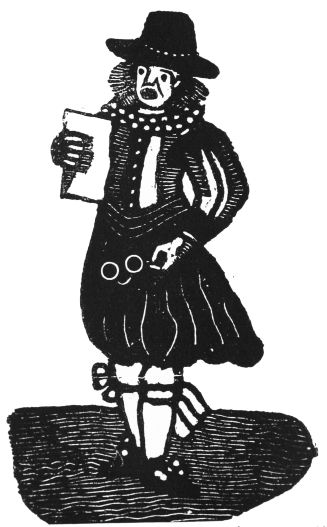
“I love a Ballad in print, a’life; for then we are sure
they are true.”—Winter’s Tale, Act. iv., Sc. iv.
One bad me come nere and by some spyce,
Peper and safforne they gan me bede,
But for lack of money I myght not spede.
Then to the Chepe I began me drawne,
Where mutch people I saw for to stande;
One spred me velvet, sylke, and lawne,
Another he taketh me by the hande,
“Here is Parys thred, the fynest in the land;”
I never was used to such thyngs indede,
And wantyng money I myght not spede.
Then went I forth by London stone,
Throughout all Canwyke[2] Streete;
Drapers mutch cloth me offred anone,
Then comes me one cryed hot shepes feete;
One cryde makerell, ryster[3] grene, an other gan greete
On bad me by a hood to cover my head,
But for want of mony I myght not be sped.
Then I hyed me into Est-Chepe;
One cryes rybbs of befe, and many a pye;
* * * * * * *
Since Lydgate’s time the cries of London have been a stock subject for
ballads and children’s books, of which, in various forms, some hundreds
must have appeared within the last two centuries. The cuts, unless from
the hand of a Rowlandson or a Cruikshank, are usually of the mechanical
order; and one finds copies of the same illustrations, though
differently treated, constantly reappearing.
In the books there is usually a cut on each page, with a cry printed
above or underneath, and in addition a verse of descriptive poetry,
which, if not of the highest order, serves its purpose.
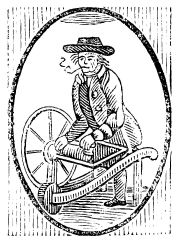
With his machine and ass to help
To draw the frame along,
Pray mark the razor-grinder’s yelp
The burden of his song.
His patched umbrella quick aloft
He mounts if skies should lower,
Then laughing whirls his wheel full oft,
Nor heeds the falling shower.
A well-known collection is that entitled “Habits & Cryes of the City of
London, drawne after the Life; P. [Pearce] Tempest, excudit,” containing
seventy-four plates, drawn by Marcellus Laroon [Lauron], and republished
in 1711. The first edition, with only fifty illustrations, had appeared
some three-and-twenty years earlier; and many of the copper-plates in
the later issue were so altered as to bring the costume into the
fashion of the time of republication. The hats had their high crowns cut
down into low; and shoe-buckles were substituted for laces. Otherwise
the plates,—with the exception of some of the faces, which were
entirely re-engraved,—were left in their original condition.[4] The
letter-press descriptions are in English, French, and Italian. The
engraver, Marcellus Lauron, or Captain Laroon, who was born in London,
has left on record that his family name was Lauron, but being always
called Laroon, he adopted that spelling in early life. Of the
seventy-four plates, those representing eccentric characters, etc., are
omitted from the list that follows:—
Any Card Matches or Save Alls?
Pretty Maids, Pretty Pins, Pretty Women!
“I remember,” says Hone, “that pins were disposed of in this
manner, in the streets by women. Their cry was a musical distich:—
‘Three Rows a Penny pins,
Short, Whites, and Mid-dl-ings!’”
Ripe Strawberryes!
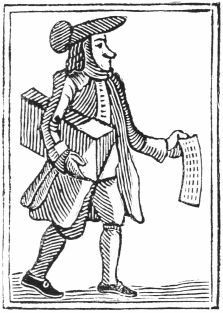
“Three Rows a Penny pins!”
A Bed Matt [mat] or a Door Matt!
Buy a fine Table Basket?
Ha, ha, Poor Jack!
Can hardly be called a London cry: the call of a well-known
character, who, accompanied by his wife, sold fish.
Buy my Dish of great Eeles?
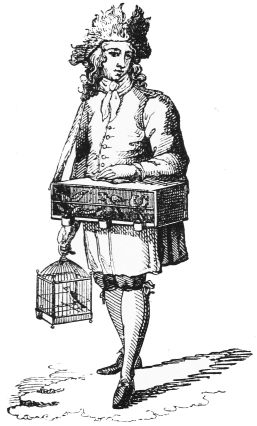
“Buy a fine Singing Bird?”
Buy a fine singing Bird?
Buy any wax or wafers?
Fine Writeing Ink!
A Right Merry Song!
Old Shoes for some Broomes!
Hott baked Wardens [stewed pears] Hott!
Small Coale!
Swift mentions this cry in his “Morning in Town.”
“The Small Coal Man was heard with cadence deep
Till drowned in shriller notes of ‘Chimney Sweep.’”
Maids, any Coonie [rabbit] Skinns?
Buy a Rabbit, a Rabbit?
Chimney Sweep!
Crab, Crab, any Crab?
Oh, Rare Shoe!
Lilly White Vinegar!
Buy any Dutch Biskets?
Ripe Speregas! [asparagus]
Buy a Fork or a Fire Shovel? [See p. 13.]
Maids, buy a Mapp? [mop]
Buy my fat Chickens?
Buy my Flounders?
Old Cloaks, Suits, or Coats?
[Succeeding Old Doublets, the cry of a slightly earlier period.]
Old Chaires to Mend?
Twelve Pence a Peck, Oysters!
Troope every one! [See p. 17.]
The man blowing a trumpet—troope every one!—was a street seller
of toy hobby-horses. He carried his wares in a sort of cage; and to
each rudely represented horse’s head was attached a small flag. The
toy hobby-horse has long since disappeared, and nowadays we give a
little boy a stick to thrust between his legs as a Bucephalus. Hone
opines that our forefathers were better natured, for they presented
him with something of the semblance of the genuine animal.
Old Satten, Old Taffety, or Velvet!
Buy a new Almanack!
Buy my Singing Glasses!
These were long bell-mouthed glass tubes. The writer recollects
that when a boy he purchased, for a copper or two, fragile glass
trumpets of a similar description.
Any Kitchen Stuffe have you, Maids?
Knives, Combs, or Inkhorns!
Four for Six Pence, Mackrell!
Any work for the Cooper?
Four Paire for a Shilling, Holland Socks!
Colly Molly Puffe!
The cry of a noted seller of pastry. He is mentioned in the
Spectator, No. xxv.

“Buy a Fork or a Fire Shovel?”
Knives or Cisers to Grinde!
Long thread Laces, long and strong!
Remember the poor Prisoners!
In a series of early prints in the Bridgewater library, from copper
plates, by an unknown artist, probably engraved between 1650 and
1680, there is one thus titled: “Some broken Breade and meate for
ye poore prisoners: for the Lorde’s sake pittey the poore.” Within
the memory of our fathers a tin box was put out from a grated
window in the Fleet prison, a prisoner meanwhile imploring the
public to remember the poor debtors. In the “Cries of York, for the
amusement of young children,” undated, but published probably
towards the end of the last century, are the following lines:—
Of prisoners in the Castle drear
Come buy a Kalendar,
Their crimes and names are set down here
’Tis Truth I do declare.
A brass Pott or an Iron Pott to mend!
Buy my four ropes of Hard Onyons!
London’s Gazette here!
The London Gazette, established in 1665.
Buy a White Line or a Jack Line, or a Cloathes Line.
Any old Iron take money for?
Delicate Cowcumbers to pickle!
Any Bakeing Peares?
New River Water!
The cry of “Marking Stones,” which marked black or red, and preceded the
daintier cedar-encased lead pencil of our own time, is not mentioned by
Laroon. J. T. Smith,[5] says that the colour of the red marking-stone
was due to “Ruddle,” a colour not to be washed out, and that fifty years
ago (he wrote in 1839) it was the custom at cheap lodging-houses to mark
with it on linen the words, “Stop thief!”
The following lines are from a sheet of London Cries, twelve in number,
undated, but probably of James the Second’s time:—
Buy marking-stones, marking-stones buy,
Much profit in their use doth lie;
I’ve marking-stones of colour red,
Passing good, or else black lead.
In the British Museum is a folio volume containing another curious
little collection, on three sheets, of early London cries; also undated
and of foreign
workmanship, but attributable to the time of Charles II. The first sheet
has a principal representation of a rat-catcher with a banner emblazoned
with rats; he is attended by an assistant boy, and underneath are these
lines:—
He that will have neither
Ratt nor mousse,
Lett him pluck of the tilles
And set fire of his hows.
Then come the following cries:
Cooper.
En of golde!
Olde Dublets!
Blackinge man.
Tinker.
Pippins!
Bui a matte!
Coales!
Chimney swepes.
Bui brumes!
Camphires! [Samphire]
Cherrie ripe!
Alminake!
Coonie skine!
Mussels! |
Cabeches!
Kitchen stuff!
Glasses!
Cockels!
Hartti Chaks!
Mackrill!
Oranges, Lemens!
Lettice!
Place!
Olde Iron!
Aqua vitæ!
Pens and Ink!
Olde bellows!
Herrings!
Bui any milke? |
Piepin pys!
Osters!
Shades! |
Turneps!
Rossmarie Baie!
Onions.
|
The principal figure on the second sheet is the “Belman,” with halberd,
lanthorn, and dog.
Mayds in your Smocks, Loocke
Wel to your locke—
Your fire
And your light,
& God
Give you good-night.
At
One o’Clock.
This is followed by:
Buy any shrimps?
Buy some figs?
Buy a tosting iron?
Lantorne Candellyht.
Buy any maydes?
The Water Bearer.
Buy a whyt pot?
Bread and Meate!
Buy a candelsticke?
Buy any prunes?
Buy a washing ball?
|
Good sasages!
Buy a purs?
Buy a dish a flounders?
Buy a footestoole?
Buy a fine bowpot?
Buy a pair a shoes?
Buy any garters?
Featherbeds to dryue?
Buy any bottens?
Buy any whiting maps?
Buy any tape?
|
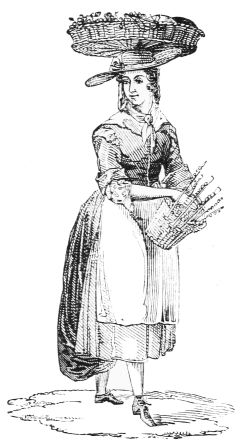
“Sixpence a pound, Fair Cherryes!”
Worcestershyr salt!
Ripe damsons!
Buy any marking stoēs?
The Bear bayting.
Buy any blew starch?
Buy any points?v
New Hadog!
|
Yards and Ells!
Buy a fyne brush?
Hote mutton poys!
New sprats new!
New cod new!
Buy any reasons?
P. and glasses to mend
|
The public “Cryer” on the third sheet, who bears a staff and keys,
humorously speaks as follows:
“O yis, any man or woman that
Can tell any tydings of a little
Mayden childe of the age of 24
Yeares. Bring worde to the Cryer
And you shal be pleased for
Your labor,
And God’s blessinge.”
Then follow:
Buy any wheat?
Buy al my smelts?
Quick periwinckels!
Rype chesnuts!
Payres fyn!
White redish whyt!
Buy any whyting?
Buy any bone lays? |
I ha rype straberies!
Buy a case for a hat?
Birds and hens!
Hote podding pyes!
Buy a hair line?
Buy any pompcons?
Whyt scalions!
Rype walnuts!
|
Fyne potatos fyn!
Hote eele pyes!
Fresh cheese and creame?
Buy any garlick?
Buy a longe brush?
Whyt carots whyt!
Fyne pomgranats!
Buy any Russes?
Hats or caps to dress?
Wood to cleave? |
Pins of the Maker!
Any sciruy gras?
Any cornes to pick?
Buy any parsnips?
Hot codlinges hot!
Buy all my soales?
Good morrow m.
Buy any cocumber?
New thornebacke!
Fyne oate cakes!
|
From all this it will be seen that merchandise of almost every
description was formerly “carried and cried” in the streets. When shops
were little more than open shanties, the apprentice’s cry of “What d’ye
lack, what d’ye lack, my masters?” was often accompanied by a running
description of the goods on sale, together with personal remarks,
complimentary or otherwise, to likely and unlikely buyers.
A very puzzling London Cry, yet at one time a very common one, was “A
tormentor for your fleas!”[6] What the instrument so heralded could have
been, one can but dimly guess. A contributor to Fraser’s Magazine,
tells us that in a collection of London Cries appended to Thomas
Heywood’s Rape of Lucrece (1608), he gives us this one: “Buy a very
fine mouse-trap, or a tormentor for your fleaes;” and the cry of the
mouse-trap man in Ben Jonson’s Bartholomew Fair (1614), is, “Buy a
mouse-trap, a mouse-trap, or a tormentor for a flea.” The flea-trap is
also alluded to in The Bonduca of Beaumont and Fletcher, and in
Travels of Twelve-Pence, by Taylor, the Water Poet; and it reappears
in a broadside in the Roxburgh Collection of Ballads, “The Common Cries
of London” [dated 1662, but probably written a hundred years earlier]:
“Buy a trap, a mouse-trap, a torment for the fleas!” When the great Bard
of the Lake School was on a tour, he made a call at an inn where Shelley
happened to be; but the conversation, which the young man would fain
have turned to philosophy and poetry and art, was almost confined to the
elder poet’s prosaic description of his dog as “an excellent flea-trap.”
It may be assumed that fleas were plentiful when this cry was in vogue;
and it may have been that the trap was part of the (undressed?) skin of
an animal with the hair left on, in which fleas would naturally take
refuge, drowning, perhaps, being their ultimate fate. But all this is
mere conjecture.
It was unlikely that so close an observer of London life as Addison
should leave unnoticed the Cries of London; and the Spectator is
interspersed with occasional allusions to them. In No. ccli. we read:
“There is nothing which more astonishes a Foreigner, and frights a
Country Squire, than the Cries of London. My good Friend Sir Roger often
declares that he cannot get them out of His Head, or go to sleep for
them, the first Week that he is in Town. On the contrary, Will Honeycomb
calls them the Ramage de la Ville, and prefers them to the Sounds of
Larks and Nightingales, with all the Musick of the Fields and Woods.”
In Steele’s comedy of The Funeral, Trim tells some ragged soldiers,
“There’s a thousand things you might do to help out about this town, as
to cry Puff-Puff Pyes; have you any Knives or Scissors to grind? or late
in an evening, whip from Grub Street strange and bloody News from
Flanders; Votes from the House of Commons; Buns, rare Buns; Old Silver
Lace, Cloaks, Sutes or Coats; Old Shoes, Boots or Hats.”
Gay, too, who, in his microscopic lyric of the streets, Trivia,
omitted little, thus sings of various street cries:—
Now Industry awakes her busy sons;
Full charged with News the breathless hawker runs;
Shops open, coaches roll, carts shake the ground,
And all the streets with passing cries resound.
* * * * * * *
When all the Mall in leafy ruin lies,
And damsels first renew their Oyster cries.
* * * * * * *
When small coal murmurs in the hoarser throat,
From smutty dangers guard thy threatn’d coat.
* * * * * * *
What though the gathering mire thy feet besmear,
The voice of Industry is always near.
Hark! the boy calls thee to his destined stand,
And the shoe shines beneath his oily hand.
Sadly he tells the tale of a poor Apple girl who lost her life on the
frozen Thames:—
Doll every day had walk’d these treacherous roads;
Her neck grew warpt beneath autumnal loads
Of various fruit: she now a basket bore;
That head, alas! shall basket bear no more.
Each booth she frequent past, in quest of gain,
And boys with pleasure heard her shrilling strain.
Ah, Doll! all mortals must resign their breath,
And industry itself submit to death!
The cracking crystal yields; she sinks, she dies,
Her head chopt off from her lost shoulders flies;
Pippins she cry’d; but death her voice confounds;
And pip, pip, pip, along the ice resounds.
Street cries have, before now, been made the vehicle for Political
Caricature, notably in The Pedlars, or Scotch Merchants of London
(1763) attributed to the Marquis Townshend, which has particular
reference to Lord Bute. Eliminating the political satire, we get a long
list of street cries. The pedlars march two and two, carrying, of
course, their wares with them. The vendors of food are numerous. One
calls out “Dumplings, ho!” another, who carries a large can, wishes to
know “Who’l have a dip and a wallop for a bawbee?”[A] Then come “Hogs
Puddings;” “Wall Fleet Oysters;” “New Mackrel;” “Sevil Oranges and
Lemons;” “Barcelona Philberts;” “Spanish Chestnuts;” “Ripe Turkey Figs;”
“Heart Cakes;” “Fine Potatoes;” “New-born Eggs, 8 a groat;” “Bolognia
Sausages.” Miscellaneous wants are met with “Weather Cocks for little
Scotch Courtiers;” “Bonnets for to fit English heads;” “Laces all a
halfpenny a piece;” “Ribbons a groat a yard;” “Fine Pomatum;” “Buy my
Wash Balls, Gemmen and Ladies;” “Fine Black Balls” (Blacking); “Buy a
Flesh Brush;” “Buy my Brooms;” “Buy any Saveall or Oeconomy Pans,
Ladies;” “Water for the Buggs;”[7] “Buy my pack-thread;” “Hair or
Combings” (for the manufacture of Wigs); “Any Kitchen Stuff;” “Buy my
Matches.”
Addison accuses the London street criers of cultivating the
accomplishment of crying their wares so as not to be understood; and in
that curious medley of bons-mots and biographical sketches, “The
Olio,” by Francis Grose,—dated 1796, but written probably some twenty
years earlier,—the author says, “The variety of cries uttered by the
retailers of different articles in the streets of London make no
inconsiderable part in its novelty to strangers and foreigners. An
endeavour to guess at the goods they deal in through the medium of
language would be a vain attempt, as few of them convey any articulate
sound. It is by their tune and the time of day that the modern cries of
London are to be discriminated.”
J. T. Smith says that the no longer heard cry of “Holloway Cheese-Cakes”
was pronounced “All my Teeth Ache;” and an old woman who sold mutton
dumplings in the neighbourhood of Gravel Lane called, “Hot Mutton
Trumpery;” while a third crier, an old man who dealt in brick-dust,
used to shout something that sounded exactly like “Do you want a lick
on the head?” Another man—a vendor of chickweed—brayed like an ass;
while a stentorian bawler, who was described as a great nuisance,
shouted “Cat’s Meat,” though he sold cabbages.
Indeed, some of the cries in our own day would appear to be just as
difficult to distinguish. A lady tells me that in a poor district she
regularly visits, the coal-cart man cries: “I’m on the woolsack!” but
what he means is, “Fine Wallsend Coal!” The philologist will find the
pronunciation of the peripatetic Cockney vendor of useful and amusing
trifles—almost invariably penn’orths, by the way—worthy of careful
study. Here are a couple of phonetically rendered examples: “Bettnooks,
a penny fer two, two frer penny.” [Button hooks, a penny for two, two
for a penny.] “En endy shoo-awn frer penny.” [A handy shoe-horn for a
penny.]
Amongst the twelve etched London Cries “done from the life” by Paul
Sandby, in 1766, and now scarce, are the following curious examples:—
My pretty little gimy [smart] tarter for a halfpenny stick, or a penny
stick, or a stick to beat your Wives or Dust your cloths!
Memorandum books a penny a-piece of the poor blind. God bless you. Pity
the blind!
Do you want any spoons—hard metal spoons? Have you any old brass or
pewter to sell or change?
All fire and no smoke. A very good flint or a very good steel. Do you
want a good flint or steel?
Any tripe, or neat’s foot or calf’s-foot, or trotters, ho! Hearts, Liver
or Lights!
The simplers, or herb-gatherers, who were at one time numerous, supplied
the herb-shops in Covent Garden, Fleet, and Newgate Markets. They culled
from the hedges and brooks not only watercresses, of which London now
annually consumes about £15,000 worth, but dandelions, scurvy grass,
nettles, bittersweet, red valerian, cough-grass, feverfew, hedge
mustard, and a variety of other simples. Notwithstanding the greater
pungency of the wild variety, preferred on that account, of late years
watercress-growing has been profitably followed as a branch of market
gardening. In third-rate “genteel” neighbourhoods, where the family
purse is seldom too well filled, “Creeses, young watercreeses,” varied
by shrimps or an occasional bloater, would appear to form the chief
afternoon solace. Towards the end of the last century scurvy-grass was
highly esteemed; and the best scurvy-grass ale is said to have been sold
in Covent Garden at the public-house at the corner of Henrietta Street.
The modern dealer in simples, who for a few pence supplies pills and
potions of a more or less harmless character, calculated for the cure of
every bodily ailment that afflicts humanity, flourishes in the poorer
districts of London, and calls himself a herbalist. During the progress
of an all too short acquaintanceship struck up with a simpler in an
Essex country lane through the medium of a particularly fragrant and
soothing herb, the conversation happened on depression of spirits, and
dandelion tea was declared to be an unfailing specific. “You know, sir,
bad spirits means that the liver is out of order. The doctors gives you
a deadly mineral pizen, which they calls blue pill, and it certainly do
pizen ’em, but then you run the chance of being pizened yerself.” A look
of astonishment caused him to continue. “You’ve noticed the ’oles in a
sheep’s liver after it’s cut up, ’aven’t you? Well, them ’oles is caused
by slugs, and ’uman bein’s is infested just the same. So is awsiz
(horses), but they don’t never take no blue pill. Catch ’em! The doctors
knows all about it, bless yer, but they don’t talk so plain as me. I
calls out-of-sort-ishness ‘slugs in the liver,’ and pizens ’em with
three penn’rth of dandelion tea, for which I charges thrippence. They
calls it ‘sluggishness of the liver,’ and pizens ’em with a penn’rth of
blue pill, for which they charges a guinea, and as often as not they
pizens the patient too.” What a mine of “copy” that simple simpler would
have proved to a James Payn or a Walter Besant!
The following at one time popular and often reprinted lines, to the tune
of “The Merry Christ Church Bells,” are from the Roxburgh Collection of
Ballads:
Here’s fine rosemary, sage and thyme.
Come and buy my ground ivy.
Here’s fetherfew, gilliflowers, and rue.
Come buy my knotted marjorum ho!
Come buy my mint, my fine green mint.
Here’s lavender for your cloaths,
Here’s parsley and winter savory,
And heartsease which all do choose.
Here’s balm and hissop and cinquefoil,
All fine herbs, it is well known.
Let none despise the merry, merry wives
Of famous London town.
Here’s pennyroyal and marygolds,
Come buy my nettle-tops.
Here’s watercresses and scurvy grass.
Come buy my sage of virtue, ho!
Come buy my wormwood and mugwort.
Here’s all fine herbs of every sort,
And southernwood that’s very good,
Dandelion and horseleek.
Here’s dragon’s tongue and horehound.
Let none despise the merry, merry wives
Of famous London town.
Less characteristic is an old undated penny ballad from which we cull
the following lines:—
Wood, three bundles a penny, all dried deal;
Now, who’ll buy a good flint or steel?
Buy a walking stick, a good ash stump;
Hearthstone, pretty maids, a penny a lump.
Fine mackrel; penny a plateful sprats;
Dog’s meat, marm, to feed your cats?
The cry of Saloop, a favourite drink of the young bloods of a hundred
and fifty years back, conveys no meaning to the present generation.
Considered as a sovereign cure for drunkenness, and pleasant withal,
saloop, first sold at street corners, where it was consumed principally
about the hour of midnight, eventually found its way into the coffee
houses. The ingredients used in the preparation of this beverage were of
several kinds—sassafras, and plants of the genus known by the simplers
as cuckoo-flowers, being the principal among them. Saloop finally
disappeared some five and twenty years ago.
The watchman cried the time every half hour. In addition to a lantern
and rattle, he was armed with a stout stick. T. L. Busby, who in 1819
illustrated “The Costumes of the Lower Orders of London,” tells us that
in March the watchman began his rounds at eight in the evening, and
finished them at six in the morning. From April to September his hours
were from ten till five; and from November to the end of February,
twelve till seven. During the darkest months there was an extra watch
from six to twelve, and extra patrols of sergeants walked over the beats
at intervals.
One of London’s best known characters, the Waterman, does not appear to
have adopted a cry; or, if he did, no mention of it can be found. But a
correspondent of Notes and Queries (5th S. I. May 2, 1874) says: “I
heard this verse of a very old (waterman’s) song from a very old
gentleman on the occasion of the last overflow of the Thames:—
“‘Twopence to London Bridge, threepence to the Strand,
Fourpence, Sir, to Whitehall Stairs, or else you’ll go by land.’”
The point of departure, however, is not given.
“Fine Tie or a fine Bob, Sir!” According to Hone,
this was the cry in vogue at a time when everybody, old and young, wore
wigs.[8] The price of a common one was a guinea, and every journeyman
had a new
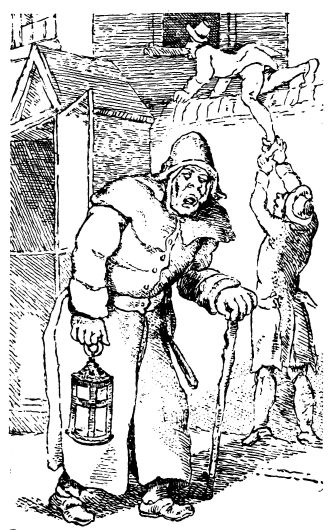
“Past one o’clock, an’ a fine morning!”
one every year; each apprentice’s indenture stipulating, in the language
of the officials who are still wig-wearers, that his master should find
him in “one good and sufficient wig, yearly, and every year, for, and
during, and unto, the expiration of the full end and term of his
apprenticeship.” A verse of the time tells us:—
Full many a year in Middle Row has this old barber been,
Which those who often that way go have full as often seen;
Bucks, jemmies, coxcombs, bloods and beaux, the lawyer, the divine,
Each to this reverend tonsor goes to purchase wigs so fine.
“Buy my rumps and burrs!” is a cry requiring a word of explanation.
Before the skins of the newly flayed oxen were consigned to the tanner,
the inside of the ear, called the burr, and the fleshy part of the tail
were removed, and when seasoned and baked are said to have formed a
cheap and appetising dish.
Ned Ward, the author of that curious work, “The London Spy” (1703),
alludes to the melancholy ditty of “Hot baked Wardens [pears], and
Pippins;” and, in describing the amusements of Bartholomew Fair, states
that in leaving a booth he was assailed with “Will you buy a Mouse Trap
or a Rat Trap? Will you buy a Cloath Brush, or Hat Brush, or a Comb
Brush?” The writer possesses a very curious old scenic aquatint print in
the form of a fan mount, representing Bartholomew Fair in 1721. The
following descriptive matter is printed in the semicircular space under
the fan:—
“BARTHOLOMEW FAIR, 1721.
This fair was granted by Henry the 1st, to one Rahere, a witty and
pleasant gentleman of his Court, in aid and for the support of an
Hospital, Priory, and Church, dedicated to St. Bartholomew, which
he built in repentance of his former profligacy and folly. The
succeeding Priors claimed, by certain Charters, to have a Fair
every year, during three days: viz., on the Eve, the Day, and on
the Morrow of St. Bartholomew. At this period the Clothiers of
England, and drapers of London, kept their Booths and Standings
there, and a Court of Piepouder was held daily for the settlement
of all Debts and Contracts. About the year 1721, when the present
interesting View of this popular Fair was taken, the Drama was
considered of some importance, and a series of minor although
regular Pieces were acted in its various Booths. At Lee and
Harper’s the Siege of Berthulia is performing, in which is
introduced the Tragedy of Holifernis. Persons of Rank were also its
occasional visitors, and the figure on the right is supposed to be
that of Sir Robert Walpole, then Prime Minister. Fawkes, the famous
conjuror, forms a conspicuous feature, and is the only portrait of
him known to exist. The remaining amusements are not unlike those
of our day, except in the articles of Hollands and Gin, with which
the lower orders were then accustomed to indulge, unfettered by
licence or excise.”
Amongst the numerous figures represented on the fan mount, but not
mentioned by its publisher, Mr. Setchel, is that of the crier of apples,
whose basket is piled high with tempting fruit. Another woman has charge
of a barrow laden with pears as big as pumpkins; and a couple of
oyster-women, whose wares are on the same gigantic scale, are evidently
engaged in a hot wrangle. Although foreign to our subject, it may be
mentioned that the statement as to the portrait of Fawkes the conjuror
being the only one known, is incorrect.
Let not the ballad singer’s shrilling strain
Amid the swarm thy listening ear detain:
Guard well thy pocket, for these syrens stand
To aid the labours of the diving hand;
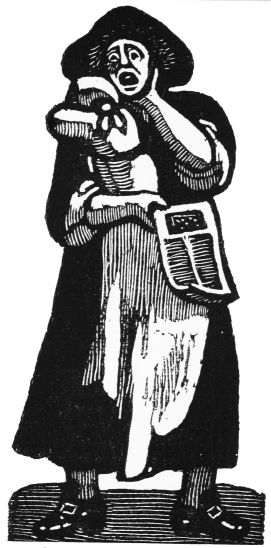
“Ye maidens and men, come for what you lack,
And buy the fair Ballads I have in my pack.”
—Pedlar’s Lamentation.
Confederate in the cheat, they draw the throng,
And Cambric handkerchiefs reward the song.
A state of things very graphically delineated in another print of
“Barthelemew Fair” (1739), where a ballad singer is roaring out a
caveat against cut purses whilst a pick-pocket is operating on one of
his audience.
The old cry of “Marking Irons” has died out. The letters were cast in
iron, and sets of initials were made up and securely fixed in
long-handled iron boxes. The marking irons were heated and impressed as
a proof of ownership.
Hence ladders, bellows, tubs, and pails,
Brooms, benches, and what not,
Just as the owner’s taste prevails,
Have his initials got.
“My name and your name, your father’s name and mother’s name.”
Hone says: “I well remember to have heard this cry when a boy. The
type-seller composed my own name for me, which I was thereby enabled to
imprint on paper with common writing-ink. I think it has become wholly
extinct within the last ten years.”
Amongst later prints of the London Cries, none are at present so highly
prized as the folio set engraved in the early part of this century by
Schiavonetti and others after Wheatley. Treated in the sentimentally
pretty style of the period, they make, when framed, wall decorations
which accord well with the prevailing old-fashioned furniture. If in
good condition, the set of twelve will now readily fetch £20 at
Christie’s; and if coloured, £30 would not be considered too high a
price, though five-and-twenty years ago they might easily have been
picked up for as many shillings. Their titles are as follows:—
Knives, scissors, and razors to grind!
Old chairs to mend!
Milk below, maids!
Strawberrys, scarlet strawberrys!
Two bundles a penny, primroses, two bundles a penny!
Do you want any matches?
Round and sound, fivepence a pound, Duke cherries!
Sweet China oranges!
Hot spiced gingerbread, smoking hot!
Fresh gathered peas, young Hastings!
A new love song, only a halfpenny apiece!
Turnips and carrots, oh!
In connection with the last cry, here is Dr. Johnson’s humorous
reference thereto:—
If the man who turnips cries,
Cry not when his father dies,
’Tis a proof that he had rather
Have a turnip than a father!
The modern bootblack with his “Clean yer boots, shine ’em, sir?” is the
successor of the obsolete shoeblack, whose stock-in-trade consisted of
liquid blacking, an old wig for removing dust or wet, a knife for use on
very muddy days, and brushes. Towards the end of the last century,
Finsbury Square—then an open field—was a favourite place for
shoeblacks, who intercepted the city merchants and their clerks in their
daily walks to and from their residences in the villages of Islington
and Hoxton. At that time tight breeches and shoes were worn; and the
shoeblack was careful not to smear the buckles or soil the fine white
stockings of his patrons. In a print of this period the cry is “Japan
your shoes, your honour?” Cake blacking, introduced by that famous, but,
as regards the last mentioned, somewhat antagonistic trio, Day, Martin,
and Warren, “the most poetical of blacking makers and most transparent
of poets,” which was quickly taken into general use, snuffed out the
shoeblack; and from about 1820 until the time of the first Exhibition in
1851, when the shoeblack brigade in connection
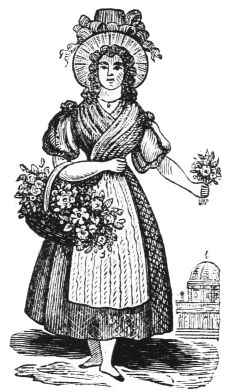
with ragged schools was started, London may be said to have blacked its
own boots.
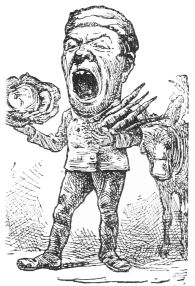
Bill Sykes the costermonger, or “costard”-monger, as he was originally
called from his trade of selling apples, now flourishes under
difficulties. What with the envious complaints of the small shopkeepers
whom he undersells, and the supercilious rebuffs of the policeman who
keeps him dodging about and always “on the move,” Bill has a hard time
of it indeed. Yet he is distinctly a benefactor to the poorer portion of
humanity. He changes his cry with the stock on his barrow. He will
invest one day in pine-apples, when there is a glut of them—perhaps a
little over-ripe—in Pudding Lane; and in stentorian voice will then
make known his willingness to exchange slices for a halfpenny each, or
a whole one for sixpence. On other days it may be apples, or oranges,
fish, vegetables, photographs, or even tortoises; the latter being
popularly supposed to earn a free, if uncomfortable, passage to this
country in homeward-bound ships as wedges to keep the cargo from
shifting in the hold. It is not often that goods intended for the
thriving shopkeeper find their way to the barrow of the costermonger.
Some time ago amber-tipped cherry or briar-wood pipes were freely
offered and as freely bought in the streets at a penny each. Suddenly
the supply stopped; for the unfortunate wholesale dealer in Houndsditch,
who might have known better, had mistaken “dozen” for “gross” in his
advice; and at 6s. 6d. per gross the pipes could readily be retailed
for a penny each; whereas at the cost price of 6s. 6d. a dozen, one
shilling ought to have been asked. It seems that not only did the
importer imagine that the amber mouthpieces were imitation, but Bill
Sykes also thought he was “doing” the public when he announced them as
real.
In the present race of street criers there are tricksters in a small
way; as, for instance, the well known character who picks up a living by
selling a bulky-looking volume of songs. His long-drawn and never varied
cry of “Three un-derd an’ fif-ty songs for a penny!” is really “Three
under fifty songs for a penny.” The book is purposely folded very
loosely so as to bulk well; but a little squeezing reduces it to the
thickness of an ordinary tract. Street criers are honest enough,
however, in the main. If vegetables are sometimes a little stale, or
fruit is suspiciously over-ripe, they do not perhaps feel absolutely
called upon to mention these facts; but they give bouncing penn’orths,
and their clients are generally shrewd enough to take good care of
themselves. Petty thieves of the area-sneak type use well-known cries as
a blind while pursuing their real calling,—match-selling often serving
as an opportunity for pilfering. Blacker sheep than these there are; but
fortunately one does not often come across them. Walking one foggy
afternoon towards dusk along the Bayswater Road, I was accosted by a
shivering and coatless vagabond who offered a tract. Wishing to shake
off so unsavoury a companion, I attempted to cross the road, but a few
yards from the kerb he barred farther progress “Sixpence, Sir, only
sixpence; I must have sixpence!” and as he spoke he bared a huge arm
knotted like a blacksmith’s. Raising a fist to match, he more than once
shot it out unpleasantly near, exhibiting every time he did so an
eruption of biceps perfectly appalling in its magnitude. That tract is
at home somewhere.
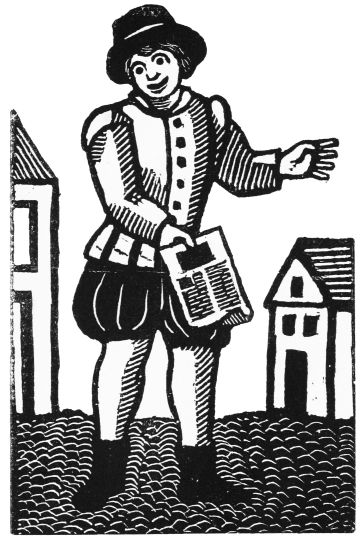
“Antique Ballads, sung to crowds of old,
Now cheaply bought at thrice their weight in gold.”
There are persons in London who get their living by manufacturing
amusing or useful penny articles, with which they supply the wholesale
houses in Houndsditch, who in turn find their customers in the hawkers
and street criers. The principal supply, however, is imported from the
Continent at prices against which English labour cannot compete. Soon
forgotten, each novelty has its day, and is cried in a different manner.
Until the law stepped in and put a stop to the sale, the greatest
favourite on public holidays was the flexible metal tube containing
scented water, which was squirted into the faces of passers-by with
strict impartiality and sometimes with blinding effect.
“All the fun of the fair,”—a wooden toy which, when drawn smartly down
the back or across the shoulders, emits a sound as if the garment were
being rent—ranks perhaps second in the estimation of ’Arry and Emma
Ann—she generally gets called Emma Ran—when out for a holiday. “The
Fun of the Fair” is always about on public holidays, illuminations, Lord
Mayor’s day, and in fact whenever people are drawn out of doors in, such
multitudes that the pathways are insufficient to hold the slowly moving
and densely packed human stream, which perforce slops over and amicably
disputes possession of the road with the confused and struggling mass
of vehicles composed of everything that goes on wheels. A real Malacca
cane, the smallest Bible in the world, a Punch and Judy squeaker, a bird
warbler, a gold watch and chain, and Scotch bagpipes, are, with numerous
others, at present popular and tempting penn’orths; while the cry of “A
penny for shillin’ ’lusterated magazine”—the epitaph on countless
unsuccessful literary ventures—seems to many an irresistible
attraction.
In connection with ’Arry, the chief producer of street noises, it may be
questioned whether London is now much better off than it was before the
passing of the Elizabethan Statutes of the Streets, by which citizens
were forbidden, under pain of imprisonment, to blow a horn in the night,
or to whistle after the hour of nine o’clock p.m. Sudden outcries in the
still of the night, and the making of any affray, or the beating of
one’s wife—the noise rather than the brutality appears to have been
objected to—were also specially forbidden. If this old Act is still on
the Statute-book, it is none the less a dead letter. Our streets are now
paraded by companies of boys or half-grown men who delight in punishing
us by means of that blatant and horribly noisy instrument of dissonant,
unchangeable chords, the German concertina. In many neighbourhoods
sleep is rendered, until the early hours, impossible by men and women
who find their principal and unmolested amusement in the shouting of
music-hall songs, with an intermittent accompaniment of shriekings.
Professional street music of all kinds requires more stringent
regulation; and that produced by perambulating amateurs might with
advantage be well-nigh prohibited altogether. The ringing of Church
bells in the grey of the morning, and the early habits of the
chanticleer, are often among the disadvantages of a closely populated
neighbourhood. Nor are these street noises the only nuisance of the
kind. London walls and partitions are nearly all thin, and a person
whose neighbour’s child is in the habit of practising scale exercises or
“pieces,” should clearly have the right to require the removal of the
piano a foot or so from the wall, which would make all the difference
between dull annoyance and distracting torment.
But we are wandering, and wandering into a dismal bye-way. Returning to
our subject, it is impossible to be melancholy in the presence of the
facetious salesman of the streets, with his unfailing native wit. Hone
tells us of a mildly humorous character, one “Doctor Randal,” an
orange-seller, who varied the description of his fruit as circumstances
and occasions

demanded; as “Oratorio oranges,” and so on. A jovial rogue whose beat
extends to numerous courts and alleys on either side of Fleet Street,
regularly and unblushingly cries, “Stinking Shrimps,” and by way of
addenda, “Lor, ’ow they do stink to-day, to be sure!” His little joke
is almost as much relished as his shrimps and bloaters, and they appear
to be always of the freshest. Were it not that insufficient clothing and
an empty stomach are hardly conducive thereto, the winter cry so
generally heard after a fall of snow, “Sweep yer door away, mum?” might
fairly be credited to an attempt at facetiousness under difficulties,
while the grave earnestness of the mirth-provoking cry of the Cockney
boot-lace man, “Lice, lice, penny a pair boot-lice!” is strong evidence
that he has no thought beyond turning the largest possible number of
honest pennies in the shortest possible space of time.
A search in our collection of books and ballads for London Cries,
humorous in themselves, discovers but two,—
“Jaw-work, up and under jaw-work, a whole pot for a halfpenny,
hazel-nuts!”
and—
“New laid eggs, eight a groat—crack ’em and try ’em!”
A somewhat ghastly form of facetiousness was a favourite one with a
curious City character, now defunct. He was a Jew who sold a nameless
toy—a dried pea loose in a pill box, which was fastened to a
horse-hair, and on being violently twirled, emitted a vibratory hum that
could be heard for some distance. Unless his unvarying cry, “On’y a
’a’penny,” brought buyers to the fore, he gave vent to frequent
explosions of strange and impious language, which never failed to
provoke the merriment of the passer-by.
Among the many living City characters is the man—from his burr
evidently a Northumbrian—who sells boot laces. His cry is, “Boot
laces—AND the boot laces.” This man also has a temper. If sales are
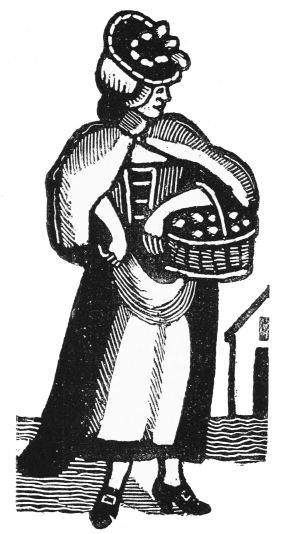
“New laid eggs, eight a groat—crack ’em and try ’em!”
slow, as they not uncommonly are, his cry culminates in a storm of
muttered abuse; after which mental refreshment he calmly proceeds as
before, “The boot laces—AND the boot laces.” Most of us know by sight
the penny Jack-in-the-box seller, whose cry, as Jack pops up, on the
spring of the lid being released, is a peculiar double squeak, emitted
without movement of the lips. The cry is supposed to belong to the
internal economy of the toy, and to be a part of the penn’orth; but,
alas! Jack, once out of the hands of his music-master, is voiceless. The
numerous street sellers of pipe and cigar lights must have a hard time
of it. Following the lucifer match, with its attendant choking
sulphurous fumes, came the evil-smelling, thick, red-tipped, brown paper
slip charged with saltpetre, so that it should smoulder without flaming.
These slips, in shape something like a row of papered pins, were divided
half through and torn off as required. Like the brimstone match which
preceded, and the Vesuvian which followed, these lights (which were sold
in the shops at a penny a box, but in the streets at two and sometimes
three boxes for the same sum) utterly spoilt the flavour of a cigar;
hence the superiority of the now dominant wax vestas. The matches of a
still earlier period were long slips of dry wood smeared at either end
with brimstone.
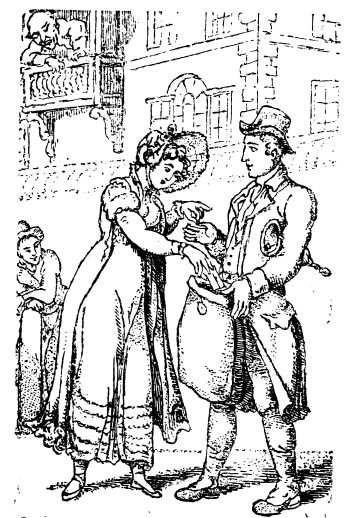
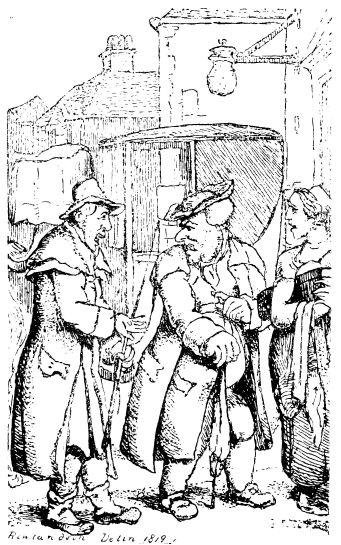
Rowlandson Delin 1819
“Letters for post?”
They would neither “light only on the box,” nor off it, unless aided by
the uncertain and always troublesome flint, steel, and tinder, or the
direct application of flame. “Clean yer pipe; pipe-cleaner, a penny for
two!” is a cry seldom absent from the streets. The pipe-cleaner is a
thin, flexible, double-twisted wire, about a foot long, with short
bristles interwoven at one end, and now, “when everybody smokes who
doesn’t,” the seller is sure of a more or less constant trade.
The buyers of the so-called penny ices sold in the London streets during
the summer months are charged only a halfpenny; and the numerous
vendors, usually Italians, need no cry; for the street gamins and
errand boys buzz around their barrows like flies about a sugar barrel.
For obvious reasons, spoons are not lent. The soft and half-frozen
delicacy is consumed by the combined aid of tongue and fingers.
Parti-coloured Neapolitan ices, vended by unmistakable natives of
Whitechapel or the New Cut, whose curious cry of “‘Okey Pokey”
originated no one knows how, have lately appeared in the streets. Hokey
Pokey is of a firmer make and probably stiffer material than the penny
ice of the Italians, which it rivals in public favour; and it is built
up of variously flavoured layers. Sold in halfpenny and also penny
paper-covered
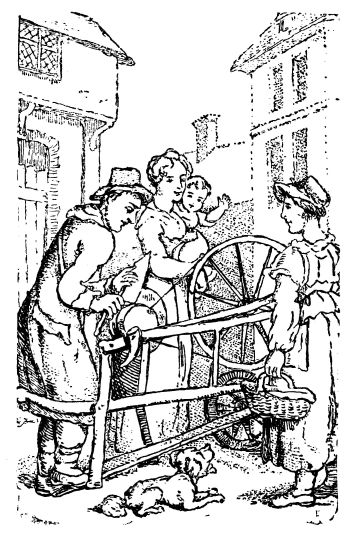
“Knives and Scissors to Grind?”
squares, kept until wanted in a circular metal refrigerating pot
surrounded by broken ice, Hokey Pokey has the advantage over its rival
eaten from glasses, inasmuch as it can be carried away by the purchaser
and consumed at leisure. Besides being variously flavoured, Hokey Pokey
is dreadfully sweet, dreadfully cold, and hard as a brick. It is
whispered that the not unwholesome Swede turnip, crushed into pulp, has
been known to form its base, in lieu of more expensive supplies from the
cow, whose complex elaboration of cream from turnips is thus
unceremoniously abridged.
Another summer cry recalls to memory a species of house decoration,
which we may hope is rapidly becoming a thing of the past. “Ornaments
for yer fire stoves,” are usually either cream-tinted willow shavings,
brightened by the interspersion of a few gold threads, or mats thickly
covered with rose-shaped bows and streamers of gaily-coloured tissue
papers. Something more ornate, and not always in better taste, is now
the fashion; the trade therefore has found its way from the streets to
the shops, and the old cry, “Ornaments for yer fire stoves,” is likely
to be seldomer heard.
Many of the old cries, dying out elsewhere, may still be familiar,
however, in the back streets of second
and third rate neighbourhoods. The noisy bell[9] of the privileged
muffin-man can hardly be counted; but “dust, O,”—the dustman’s bell is
almost a thing of the past—“knives and scissors,”—pronounced
sitthers—“to grind,” “chairs to mend,” “cat’s and dawg’s meat,” the
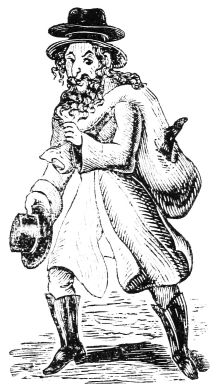
snapped-off short “o’ clo” of the Jewish dealer in left-off garments,
“fine warnuts, penny for ten, all cracked,” “chestnuts all ’ot,” “fine
ripe strawberries,” “rabbit or ’air skins,” “fine biggaroon cherries,”
“fine oranges, a penny for three,” and many others, are still shouted in
due season by leathern-lunged itinerant traders. The “O’ clo” man is
nearly always historically represented, as in the Catnach illustration,
wearing
several hats; but, though he may often be met with more than one in his
possession, he is now seldom seen with more than one on his head.
Calling the price before the quantity, though quite a recent innovation,
or more probably the revival of an old style, is almost universal. The
cry of “Fine warnuts, ten a penny,” is now “A penny for ten, fine
warnuts,” or “A penny for ’arf a score, fine warnuts.”
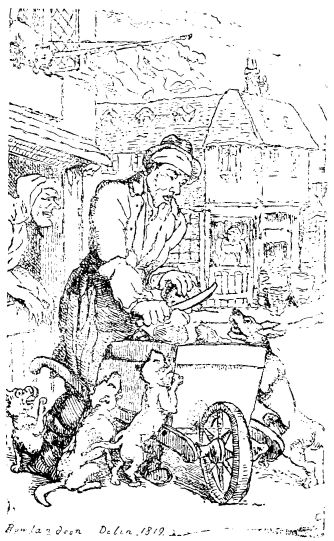
The cat’s meat man has never, like some of his colleagues, aspired to
music, but apparently confines himself to the one strident monosyllable.
It has been stated, by the way, that the London cats, of which it seems
there are at present some 350,000, annually consume £100,000 worth of
boiled horse. Daintily presented on a skewer, pussy’s meat is eaten
without salt; but, being impossible of verification, the statistics
presented in the preceding sentence may be taken with a grain.
“Soot” or “Sweep, ho!” The sweep, accompanied by two or three
thinly-clad, half-starved, and generally badly-treated apprentices, who
ascended the chimneys and acted as human brushes, turned out in old
times long before daylight. It was owing to the exertions of the
philanthropist, Mr. Jonas Hanway, and before the invention of the
jointed chimney sweeping machine, that an Act was passed at the
beginning of
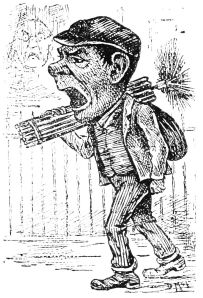
this century, providing that every chimney-sweeper’s apprentice should
wear a brass plate in front of his cap, with the name and abode of his
master engraved thereon. The boys were accustomed to beg for food and
money in the streets; but by means of the badges, the masters were
traced, and an improvement in the general condition of the apprentices
followed. But the early morning is still disturbed by the long-drawn
cry, “Sw-e-e-p.” This, and the not unmusical “ow-oo,” of the jodeling
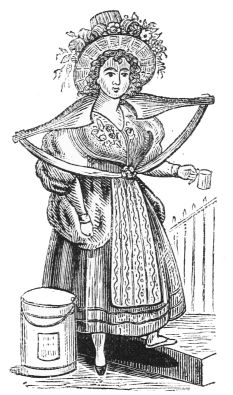
milkman—all that is left of “milk below maids,”—the London milk-maids
are usually strongly-built Irish or Welsh girls—and the tardier and
rather too infrequent “dust-o” are amongst the few unsuppressed Cries of
London-town. They are tolerated and continued because they are
convenient, and from a vague sense of prescriptive right dear to the
heart of an Englishman.
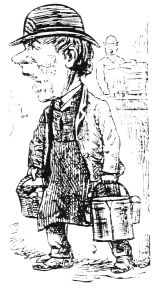
Until quite recently, the flower girls at the Royal Exchange—decent and
well-behaved Irishwomen who work hard for an honest living—were
badgered and driven about by the police. They are now allowed to collect
and pursue their calling in peace by the Wellington statue, where their
cry, “Buy a flower, sir,” is heard, whatever the weather, all the year
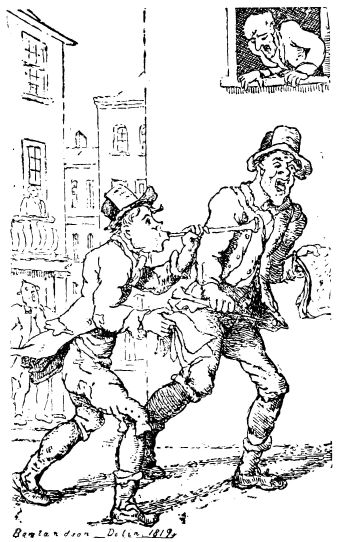
round. “Speshill ’dishun, ’orrible railway haccident,” the outcome of an
advanced civilization, is a cry that was unknown to our forefathers. Our
forebears had often to pay a shilling for a newspaper, and the newsman
made known his progress through the streets by sound of tin trumpet: as
shown in Rowlandson’s graphic illustration, a copy of the newspaper was
carried in the hatband.
“C’gar lights, ’ere y’ar, sir; ’apenny a box,” and “Taters all ’ot,”
also belong to the modern school of London Cries; while the piano-organ
is a fresh infliction in connection with the new order of street noises.
And although a sort of portable penthouse was used in remote times for
screening from heat and rain, the ribbed and collapsible descendant
thereof did not come into general use much before the opening of the
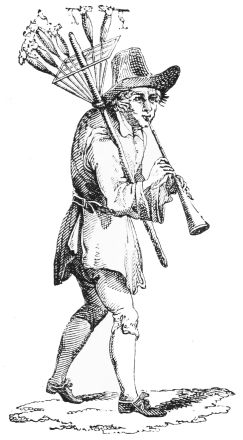
present century; hence the cry, “Any umbrellas-termend,” may properly be
classed as a modern one.
In the crowded streets of modern London the loudest and most persistent
cry is that of the omnibus conductor—“Benk,” “Chairin’ Krauss,”
“Pic’dilly”; or it may be, “Full inside,” or “’Igher up”; to which the
cabman’s low-pitched and persuasive “Keb, sir?”—he is afraid to ply too
openly for hire—plays an indifferent second. Judging from Rowlandson’s
illustration, his predecessor the hackney coachman shared cabby’s
sometimes too pointedly worded objection to a strictly legal fare.
The “under-street” Cries heard in our own time at the various stations
on the railway enveloping London, in what by courtesy is termed a
circle—the true shape would puzzle a mathematician to define—form an
interesting study. While a good many of the porters
are recruited from the country, it is a curious fact that in calling the
names of the various “sty-shuns” they mostly settle down—perhaps from
force of association “downt-tcher-now”—into one dead level of Cockney
pronunciation.
As one seldom realizes that there is anything wrong with one’s own way
of speaking, pure-bred Cockneys may be expected to quarrel with the
phonetic rendering given; however, as Dr. James Cantlie, in his
interesting and recently published “Degeneration amongst Londoners,”[10]
tells us that a pure-bred Cockney is a rara avis indeed, the
quarrelsomely inclined may not be numerous, and they may be reminded
that the writer is not alone in his ideas as to Cockney pronunciation.
Appended to Du Maurier’s wonderfully powerful picture of “The Steam
Launch in Venice” (Punch’s Almanac, 1882), is the following wording:—
’Andsome ’Arriet: “Ow my! if it ’yn’t that bloom-in’ old Temple
Bar, as they did aw’y with out o’ Fleet Street!”
Mr. Belleville (referring to Guide-book): “No, it ’yn’t! It’s
the fymous Bridge o’ Sighs, as Byron
went and stood on; ’im as wrote Our Boys, yer know!”
’Andsome ’Arriet: “Well, I NEVER! It ’yn’t much of a Size,
any’ow!”
Mr. Belleville: “’Ear! ’ear! Fustryte!”
This paragraph is from the London Globe of January 26th, 1885:
“Spelling reformers take notice. The English alphabet—diphthongs and
all—does not contain any letters which, singly or in combination, can
convey with accuracy the pronunciation given by the newsboys to the cry,
‘A-blowin’ up of the ’Ouses of Parliament!’ that rent the air on
Saturday. The word ‘blowin’’ is pronounced as if the chief vowel sound
were something like ‘ough’ in ‘bough’; and even then an ‘e’ and a ‘y’
ought to be got in somewhere.”
There are twenty-seven stations on the London Inner Circle
Railway—owned by two companies, the Metropolitan and District—and the
name of one only—Gower Street—is usually pronounced by “thet tchung
men,” the railway porter, as other people pronounce it. [“Emma
Smith,”[11] while not a main line station, may be cited here simply as a
good example of Cockney, for ’Arry and ’Arriet are quite incapable of
any other verbal rendering.] They are cried as follows:—
“South Kenzint’nn.”
“Glawster Rowd.”
(owd as in “loud.”)
“I Street, Kenzint’nn.”
“Nottin’ Ill Gite.”
(ite as in “flight.”)
“Queen’s Rowd, Bizewater.”
(ize as in “size.”)
“Pride Street, Peddinten.
”
“Edge-wer Rowd.”
(by common consent the Cockney
refrains from saying
“Hedge-wer.”)
“Biker Street.”
“Portland Rowd.”
“Gower Street.”
“King’s Krauss.”
(Often abbreviated to “’ng’s Krauss.”)
“Ferrinden Street.”
|
“Oldersgit Street.”
(no preliminary “H.”)
“Mawgit Street.”
“Bish-er-git.”
“Ol’git.”
“Mark Line.”
“Monneym’nt.”
“Kennun Street.”
“Menshun Ouse.”
“Bleckfriars.”
“Tempull.”
(“pull-pull-Tempull.”)
“Chairin’ Krauss.”
“Wes’minster.”
(One sometimes hears
“Wes’minister”: a provincialism.)
“S’n Jimes-iz Pawk.”
(ime as in “time.”)
“Victaw-ia.”
“Slown Square.”
(own as in “town.”)
|
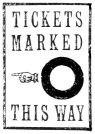
Country cousins may be reminded that the guiding letters
I or O so
boldly marked on the tickets issued on the London underground railway,
and, in the brightest vermilion, as conspicuously painted up in the
various stations, do not mean “Inner” or “Outer” Circle, but the inner
and outer lines of rails of the Inner Circle Railway. Though sanctioned
by Parliament more than twenty years ago, the so-called Outer Circle
Railway is still incomplete, its present form being that of a
horse-shoe, with termini at Broad Street and Mansion House, and some of
its principal stations at Dalston, Willesden, and Addison Road,
Kensington.
It has before been said that everything that could be carried has, at
some time or other, been sold in the streets; and it follows that an
approximately complete list of London Cries would reach a very large
total. From its mere length and sameness such a list would moreover be
apt to weary the reader; for not all cries have the interest of a
traditional phrase or intonation which gives notice of the nature of
the wares, even when the words are rendered unintelligible by the
necessity of vociferation. But a few of the most constant and curious
cries may be interesting to note.
“’Tis all hot, nice smoaking hot!”
You’ll hear his daily cry;
But if you won’t believe, you sot
You need but taste and try
Coats or preeches do you vant?
Or puckles for your shoes?
Vatches too me can supply:—
Me monies von’t refuse.
Young gentlemen attend my cry,
And bring forth all your Knives;
The barbers Razors too I grind;
Bring out your Scissars, wives.
With mutton we nice turnips eat;
Beef and carrots never cloy;
Cabbage comes up with Summer meat,
With winter nice savoy.
Holloway cheese cakes!
Large silver eels, a groat a pound, live eels!
Any New River water, water here?
Buy a rope of onions, oh?
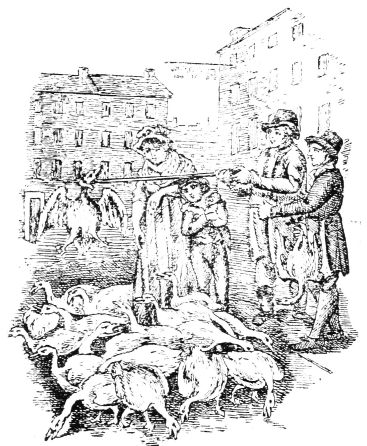
Buy a goose?
Any bellows to mend?
Who’s for a mutton pie or an eel pie?
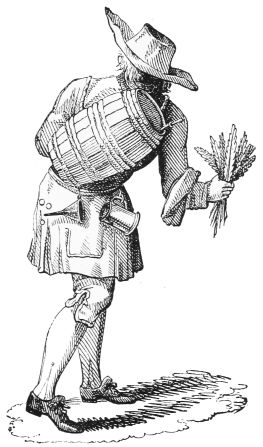
Who buys my roasting jacks?
Sand, ho! buy my nice white sand, ho!
Buy my firestone?
Roasted pippins, piping hot!
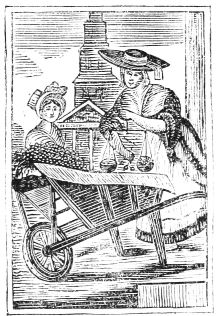
“Cherries, O! ripe cherries, O!”
A whole market hand for a halfpenny—young radishes, ho!
Sw-e-ep!
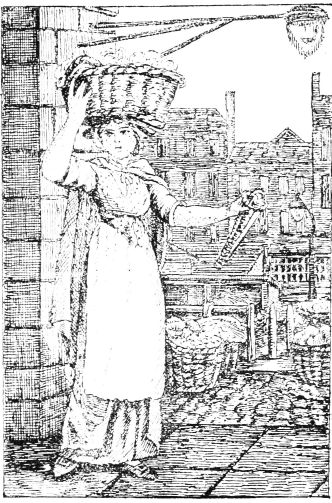
Covent Garden.
“Fine Strawberries!”
Brick dust, to-day?
Door mats, want?
Hot rolls!
Rhubarb!
Buy any clove-water?
Buy a horn-book?
Quick (living) periwinkles!
Sheep’s trotters, hot!
Songs, three yards a penny!
Southernwood that’s very good!
Cherries O! ripe cherries O!
Cat’s and dog’s meat!
Samphire!
All a-growin’, all a-blowin’.
Lilly white mussels, penny a quart!
New Yorkshire muffins!
Oysters, twelvepence a peck!
Rue, sage, and mint, farthing a bunch!
Tuppence a hundred, cockles!
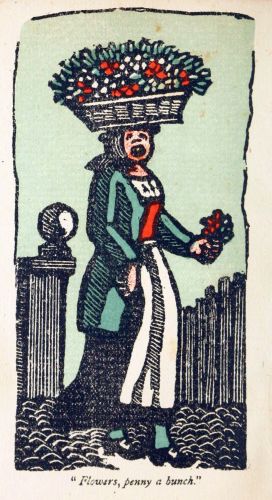
Sweet violets, a penny a bunch!
Brave Windsor beans!
Buy my mops, my good wool mops!
Buy a linnet or a goldfinch?
Knives, combs, and inkhornes!
Six bunches a penny, sweet lavender!
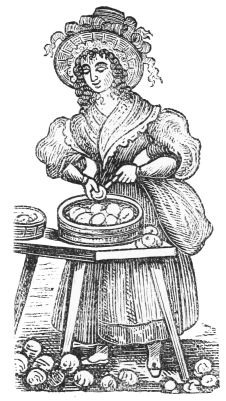
New-laid eggs, eight a groat!
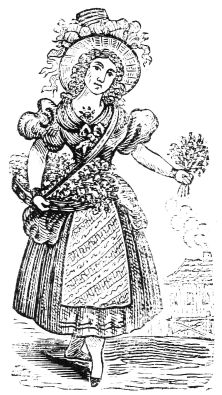
Any wood?
Hot peas!
Hot cross buns!
Buy a broom?
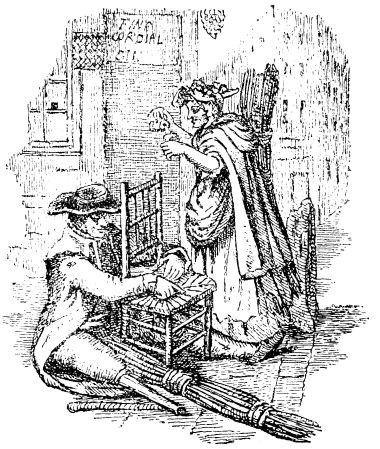
Old chairs to mend!
Young lambs to sell!
Tiddy diddy doll!
Hearth-stone!
Buy my nice drops, twenty a penny, peppermint drops!
Any earthen ware, plates, dishes, or jugs, to-day,—any clothes to exchange, Madam?
Holly O, Mistletoe!
Buy my windmills for a ha’penny a piece! [a child’s toy.]
Nice Yorkshire cakes!
Buy my matches, maids, my nice small pointed matches!
Come, buy my fine myrtles and roses!
Buy a mop or a broom?
Hot rolls!
Will you buy a Beau-pot?
Probably of Norman-French origin, the term “beau-pot” is still in use in
out-of-the-way country districts, to signify a posy or nosegay, in which
sweet-smelling herbs and flowers, as rosemary, sweet-briar, balm,
roses, carnations, violets, wall-flowers, mignonette, sweet-William, and
others that we are now pleased to designate “old fashioned,” would
naturally predominate.
Come buy my sweet-briar!
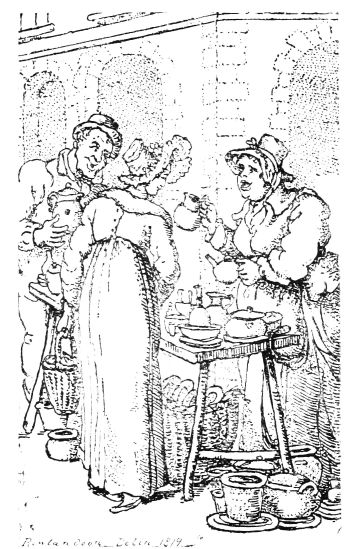
“Any Earthen Ware; buy a jug or a tea pot?”
Any old flint glass or broken bottles for a poor woman to-day?
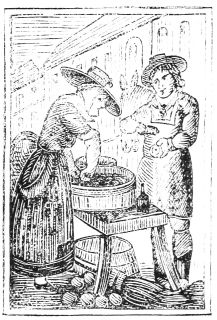
“Fresh Oysters! penny a lot!”
Sweet primroses, four bunches a penny, primroses!
Black and white heart cherries, twopence a pound, full weight, all round
and sound!
Fine ripe duke cherries, a ha’penny a stick and a penny a stick, ripe
duke cherries!
Shrimps like prawns, a ha’penny a pot!
Green hastings!
Hot pudding!
Pots and kettles to mend!
’Ere’s yer toys for girls an’ boys!
Brick-dust was carried on the backs of asses and sold for knife-cleaning
purposes at a penny a quart.
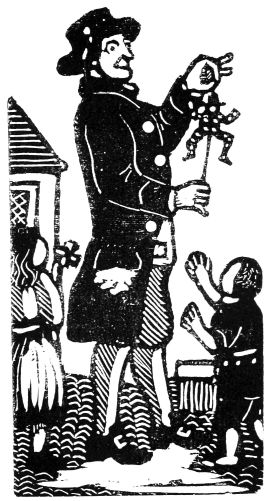
“’Ere’s yer toys for girls an’ boys!”
The bellows-mender, who sometimes also followed the trade of a tinker,
carried his tools and apparatus buckled in a leathern bag at his back,
and practised his profession in any convenient corner of the street.
Door-mats of all shapes were made of rushes or rope, and were sold at
from sixpence to several shillings each.
The earliest green pea brought to the London market—a dwarf
variety—was distinguished by the name of Hasteds, Hastens, Hastins, or
Hastings, and was succeeded by the Hotspur. The name of Hastings was,
however, indiscriminately given to all peas sold in the streets, and the
cry of “green Hastings” was heard in every street and alley until peas
went out of season.
The crier of hair brooms, who usually travelled with a cart, carried a
supply of brushes, sieves, clothes-horses, lines, and general turnery.
All cleanly folk must like my ware,
For wood is sweet and clean;
Time was when platters served Lord Mayor
And, as I’ve heard, a Queen.
His cry took the form of the traditional tune “Buy a broom,” which may
even now be occasionally heard—perhaps the last survival of a street
trade tune—taken
up separately or in fitful chorus by the men and women of a travelling
store. The Flemish “Buy a Broom” criers, whose trade is gone, generally
went in couples or threes. Their figures are described by Hone as
exactly miniatured in the unpainted wooden doll, shaped the same before
and behind, and sold in the toy shops for the amusement of the little
ones. In the comedy of “The Three Ladies of London,” printed in quarto
in Queen Elizabeth’s reign (A.D. 1584), is this passage:—
“Enter Conscience with brooms at her back, singing as follows:—
New brooms, green brooms, will you buy any?
Maydens come quickly, let me take a penny.”
Hot rolls, which were sold at one and two a penny, were carried during
the summer months between the hours of 8 and 9 in the morning, and from
4 to 6 in the afternoon.
Let Fame puff her trumpet, for muffin and crumpet,
They cannot compare with my dainty hot rolls;
When mornings are chilly, sweet Fanny, young Billy,
Your hearts they will comfort, my gay little souls.
Muffins and crumpets were then, as now, principally cried during the
winter months.
Hot pudding, sweet, heavy and indigestible, was sold in halfpenny slabs.
Who wants some pudding nice and hot!
’Tis now the time to try it;
Just taken from the smoking pot,
And taste before you buy it.
The cry “One-a-penny, two-a-penny, hot CROSS BUNS!” which,—now never
heard from the sellers on Good Friday,—is still part of a child’s game,
remains as one of the best instances of English quantitative metre,
being repeated in measured time, and not merely by the ordinary accent.
The rhubarb-selling Turk, who appeared in turban, trousers, and—what
was then almost unknown amongst civilians—moustaches, was, fifty years
ago or more, a well known character in the metropolis.
Sand was generally used in London, not only for cleaning kitchen
utensils, but for sprinkling over uncarpeted floors as a protection
against dirty footsteps. It was sold by measure—red sand, twopence
halfpenny, and white a penny farthing per peck. The very melodious
catch, “White Sand and Grey Sand, Who’ll buy my White Sand!” was
evidently harmonized on the sand-seller’s traditional tune.
“Buy a bill of the play!” In the time of our great grandfathers, there
were no scented programmes, and the peculiar odour of the play-bills was
not due to the skill of a Rimmel. Vilely printed with the stickiest of
ink, on the commonest of paper, they were disposed of both in and
outside the theatre by orange-women, who would give one to a purchaser
of half a dozen oranges or so. In Hogarth’s inimitably amusing and
characteristic print of The Laughing Audience, a couple of robustly
built orange-women are contending, with well-filled baskets, for the
favour of a bewigged beau of the period, who appears likely to become an
easy victim to their persuasions.
“Knives to grind” is still occasionally heard, and the grinder’s barrow
(vide that depicted in Rowlandson’s illustration on p. 59), is much
the same as it was a hundred years ago. At the beginning of the century
the charge for grinding and setting scissors was a penny or twopence a
pair; penknives a penny a blade, and table-knives one and sixpence and
two shillings a dozen.
Rabbits were carried about the streets suspended at either end of a pole
which rested on the shoulder.
The edible marine herb samphire, immortalized in connection with
“Shakespeare’s Cliff” at Dover, was at one time regularly culled and as
regularly eaten.
The once familiar cry of “Green rushes O!” is
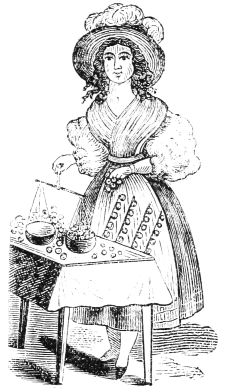
“Cherries, fourpence a pound!”
preserved only in verse. In Queen Elizabeth’s time the floors of
churches as well as private houses were carpeted with rushes, and in
Shakespeare’s day the stage was strewn with them. Rush-bearing, a
festival having its origin in connection with the annual renewal of
rushes in churches, was kept up until quite recently, and may even still
be practised in out-of-the-way villages.
The stock of the “’arthstone” woman, who is not above doing a stroke of
business in bones, bottles, and kitchen stuff, is usually on a barrow,
drawn by a meek-eyed and habitually slow-paced donkey.
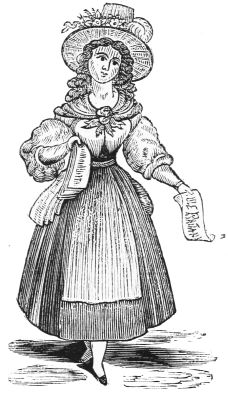
The London Barrow Woman (“Ripe Cherries”), as preserved in the cut from
the inimitable pencil of George Cruikshank, has long since disappeared.
In 1830, when this sketch was made, the artist had to rely on his
memory, for she then no longer plied her trade in the streets. Her wares
changed with the seasons; but here a small schoolboy is being tempted by
ripe cherries tied on a stick. There being no importation of foreign
fruit, the cherries were of prime quality. May dukes, White heart, Black
heart, and the Kentish cherry, succeeded each other—and, when sold by
weight, and not tied on sticks, fetched sixpence, fourpence, or
threepence per lb., which was at least twopence or threepence less than
charged at the shops.
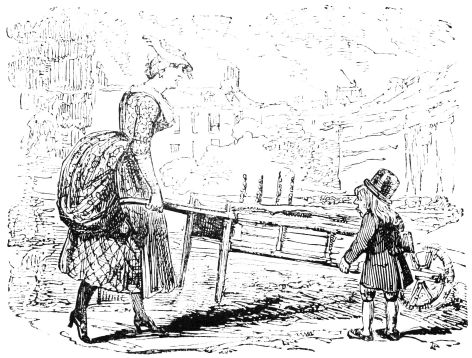
The poor Barrow Woman appears to have been treated very much in the same
manner as the modern costermonger; but was without his bulldog power of
resistance. If she stopped to rest or solicit custom, street keepers,
“authorized by orders unauthorized by law,” drove her off, or beadles
overthrew her fruit into the road. Nevertheless, if Cruikshank has not
idealized his memories, she was more wholesomely and stoutly clad than
any street seller of her sex—with the one exception of the
milkmaid—who is to be seen in our day, when the poor London woman has
lost the instinct of neatness and finish in attire.
“Hot spiced gingerbread,” still to be found in a cold state at village
fairs and junketings, used to be sold in winter time in the form of flat
oblong cakes at a halfpenny each, but it has long since disappeared from
our streets.
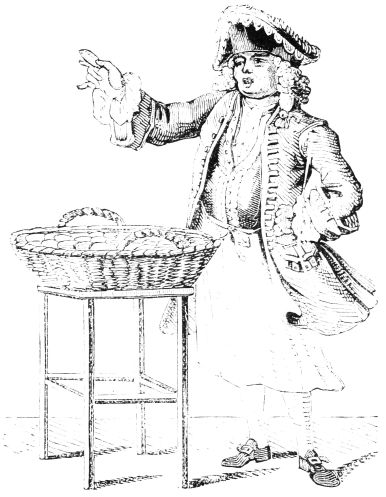
“Tiddy Diddy Doll, lol, lol, lol” was a celebrated vendor of
gingerbread, and, according to Hone, was always hailed as the king of
itinerant tradesmen. It must be more than a century since this dandified
character ceased to amuse the populace. He dressed as a person of
rank—ruffled shirt, white silk stockings, and fashionable laced suit of
clothes surmounted by a wig and cocked hat decorated with a feather. He
was sure to be found plying his trade on Lord Mayor’s
day, at open air shows, and on all public occasions. He amused the crowd
to his own profit; and some of his humorous nonsense has been preserved.
“Mary, Mary, where are you now, Mary?”
“I live two steps underground, with a wiscom riscom, and why not. Walk
in, ladies and gentlemen. My shop is on the second floor backwards, with
a brass knocker at the door. Here’s your nice gingerbread, your spiced
gingerbread, which will melt in your mouth like a red-hot brickbat, and
rumble in your inside like Punch in his wheelbarrow!” He always finished
up by singing the fag end of a song—“Tiddy Diddy Doll, lol, lol, lol;”
hence his nickname of Tiddy Doll. Hogarth has introduced this character
in his Execution scene of the Idle Apprentice at Tyburn. Tiddy Doll had
many feeble imitators; and the woman described in the lines that follow,
taken from a child’s book of the period, must have been one of them.
Tiddy Diddy Doll, lol, lol, lol,
Tiddy Diddy Doll, dumplings, oh!
Her tub she carries on her head,
Tho’ of’ener under arm.
In merry song she cries her trade,
Her customers to charm.
A halfpenny a plain can buy,
The plum ones cost a penny,
And all the naughty boys will cry
Because they can’t get any.
Fifty years ago “Young Lambs to Sell, two for a penny,” which still
lingers, was a well known cry. They were children’s toys, the fleece
made of white cotton-wool, attractively but perhaps a trifle too
unnaturally spangled with Dutch gilt. The head was of composition, the
cheeks were painted red, there were two black spots to do duty for eyes,
and the horns and legs were of tin, which latter adornment, my younger
readers may suggest, foreshadowed the insufficiently appreciated tinned
mutton of a later period. The addition of a bit of pink tape tied round
the neck by way of a collar made a graceful finish, and might be
accepted as a proof that the baby sheep was perfectly tame.
Young lambs to sell, young lambs to sell.
Two for a penny, young lambs to sell.
If I’d as much money as I could tell,
I wouldn’t cry young lambs to sell.
Dolly and Molly, Richard and Nell,
Buy my Young Lambs and I’ll use you well!
The later song—
Old chairs to mend, old chairs to mend.
If I’d as much money as I could spend,
I’d leave off crying old chairs to mend—
—is obviously copied from the original cry of “Young Lambs to Sell.” In
addition to a few tools, the stock-in-trade of the travelling
chair-mender principally consisted of rushes, which in later days gave
place to cane split into strips of uniform width—a return to more
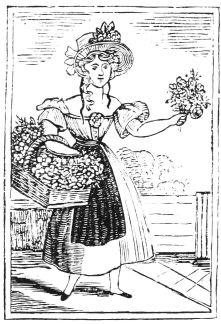
“Buy my fine Myrtles and Roses!”
ancient practice. The use of rush-bottomed chairs, which are again
coming into æsthetic fashion, cannot be traced back quite a century and
half. The chairs in Queen Anne’s time were seated and backed with cane;
and in the days of Elizabeth the seats were cushioned and the backs
stuffed. Many years ago an old chair-mender occupied a position by a
stone fixed in the wall of one of the houses in Panyer Alley, on which
is cut the following inscription:—
When y have sovghᵀ..
The City Rovnd
Yet Still this is
The HighSᵀ.. Grovnd
Avgvst the 27
1688
Being entirely unprotected and close to the ground, this curious relic
of bygone times, which is surmounted by a boldly carved figure of a nude
boy seated on a panyer pressing a bunch of grapes between his hand and
foot, is naturally much defaced; and that it has not been carried away
piecemeal by iconoclastic curiosity-hunters, is probably due to its
out-of-the-way position. Panyer Alley, the most eastern turning leading
from Paternoster Row to Newgate Street, slightly rises towards the
middle; but is not, according to Mr. Loftie, an undoubted authority on
all matters pertaining to old London, the highest point in the city,
there being higher ground both in Cornhill and Cannon Street. In
describing Panyer Alley, Stow indirectly alludes to a “signe” therein,
and it is Hone’s opinion that this stone may have been the ancient sign
let into the wall of a tavern. While the upper is in fair preservation,
the lower part of the inscription can hardly be read. When last
examined, a street urchin was renovating the figure by a
heartily-laid-on surface decoration of white chalk; and unless one of
the numerous antiquarian or other learned societies interested in old
London relics will spare a few pounds for the purchase of a protective
grating, there will shortly be nothing left worth preserving.
“New-laid eggs, eight a groat,” takes us back to a time when the best
joints and fresh country butter were both sixpence a pound.
Years ago the tin oven of the peripatetic penny pieman was found to be
too small to meet the constant and ever-increasing strain made upon its
resources; and the owner thereof has now risen to the dignity of a shop,
where, in addition to stewed eels, he dispenses what Albert Smith
happily termed “covered uncertainties,” containing messes of mutton,
beef, or seasonable fruit. Contained in a strong wicker basket with
legs, or in a sort of tin oven, the pieman’s wares were formerly kept
hot by means of a small charcoal fire. A sip of a warm stomachic liquid
of unknown but apparently acceptable constituents was sometimes offered
gratuitously by way of inducement to purchase. The cry of “Hot Pies”
still accompanies one of the first and most elementary games of the
modern baby learning to speak, who is taught by his nurse to raise his
hand to imitate a call now never heard.
The specimens of versification that follow are culled from various books
of London Cries, written for the amusement of children, towards the end
of the last century, and now in the collection of the writer:—
Large silver eels—a groat a pound, live eels!
Not the Severn’s famed stream
Could produce better fish,
Sweet and fresh as new cream,
And what more could you wish?
Pots and Kettles to mend?
Your coppers, kettles, pots, and stew pans,
Tho’ old, shall serve instead of new pans.
I’m very moderate in my charge,
For mending small as well as large.
Buy a Mop or a Broom!
My mop is so big, it might serve as a wig
For a judge if he had no objection,
And as to my brooms, they’ll sweep dirty rooms,
And make the dust fly to perfection.
Nice Yorkshire Cakes!
Nice Yorkshire cakes, come buy of me,
I have them crisp and brown;
They are very good to eat with tea,
And fit for lord or clown.
Buy my fine Myrtles and Roses!
Come buy my fine roses, my myrtles and stocks,
My sweet-smelling balsams and close-growing box.
Buy my nice Drops—twenty a penny, Peppermint drops!
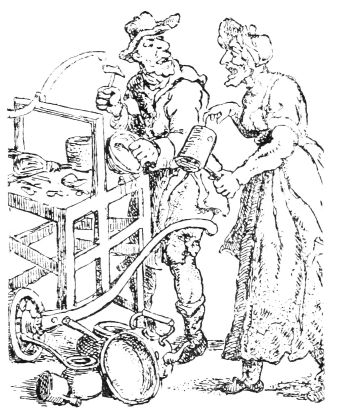
“Pots and Kettles to Mend!”
If money is plenty you may sure spare a penny,
It will purchase you twenty—and that’s a great many.
Six bunches a penny, sweet blooming Lavender!
Just put one bundle to your nose,
What rose can this excel?
Throw it among your finest clothes,
And grateful they will smell.
Buy a live Chicken or a young Fowl?
Buy a young Chicken fat and plump,
Or take two for a shilling?—
Is this poor honest tradesman’s cry;
Come buy if you are willing.
Rabbit! Rabbit!
Rabbit! a Rabbit! who will buy?
Is all you hear from him;
The rabbit you may roast or fry,
The fur your cloak will trim.
My good Sir, will you buy a Bowl?
My honest friend, will you buy a Bowl,
A Skimmer or a Platter?
Come buy of me a Rolling Pin,
Or Spoon to beat your batter.
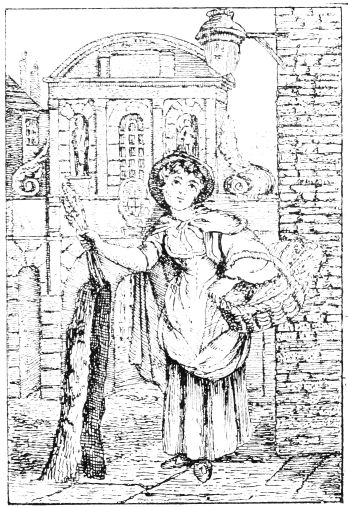
“Six bunches a penny, sweet blooming Lavender!”
Come buy my fine Writing Ink!
Through many a street and many a town
The Ink-man shapes his way;
The trusty Ass keeps plodding on,
His master to obey.
Dainty Sweet-Briar!
Sweet-Briar this Girl on one side holds,
And Flowers in the other basket;
And for the price, she that unfolds
To any one who’ll ask it.
Any Earthen Ware, Plates, Dishes, or Jugs to-day,—any Clothes to
exchange, Madam?
Come buy my Earthen Ware
Your dresser to bedeck;
Examine it with care,
There’s not a single speck.
See white with edges brown,
Others with edges blue;
Have you a left-off gown,
Old bonnet, hat, or shoe?
Do look me up some clothes
For this fine China jar;
If but a pair of shoes,
For I have travelled far.
This flowered bowl of green
Is worth a gown at least;
I am sure it might be seen
At any christening feast.
Do, Madam, look about
And see what you can find;
Whatever you bring out
I will not be behind.