I had heard a great deal about Miss Beam’s
school, but not till last week did the chance
come to visit it.
The cabman drew up at a gate in an old wall,
about a mile out of the town. I noticed as I
was waiting for him to give me change that the
Cathedral spire was visible down the road. I rang
the bell, the gate automatically opened, and I
found myself in a pleasant garden facing a square
red ample Georgian house, with the thick white
window-frames that to my eyes always suggest
warmth and welcome and stability. There was
no one in sight but a girl of about twelve, with
her eyes covered with a bandage, who was being
led carefully between the flower-beds by a little
boy of some four years her junior. She stopped,
and evidently asked who it was that had come in,
and he seemed to be describing me to her. Then
they passed on, and I entered the door which a
smiling parlour-maid—that pretty sight!—was
holding open for me.
Miss Beam was all that I had expected—middle-aged,
authoritative, kindly, and understanding.
Her hair was beginning to turn grey, and her
figure had a fulness likely to be comforting to a
homesick child.
We talked idly for a little while, and then I asked
her some questions as to her scholastic methods,
which I had heard were simple.
“Well,” she said, “we don’t as a matter of fact
do much teaching here. The children that come
to me—small girls and smaller boys—have very
few formal lessons: no more than is needful to
get application into them, and those only of the
simplest—spelling, adding, subtracting, multiplying,
writing. The rest is done by reading to them
and by illustrated discourses, during which they
have to sit still and keep their hands quiet.
Practically there are no other lessons at all.”
“But I have heard so much,” I said, “about the
originality of your system.”
Miss Beam smiled. “Ah, yes,” she said. “I
am coming to that. The real aim of this school
is not so much to instil thought as thoughtfulness—humanity,
citizenship. That is the ideal I have
always had, and happily there are parents good
enough to trust me to try and put it into execution.
Look out of the window a minute, will you?”
I went to the window, which commanded a large
garden and playground at the back.
“What do you see?” Miss Beam asked.
“I see some very beautiful grounds,” I said,
“and a lot of jolly children; but what perplexes
me, and pains me too, is to notice that they are not
all as healthy and active as I should wish. As I
came in I saw one poor little thing being led
about owing to some trouble with her eyes, and
now I can see two more in the same plight; while
there is a girl with a crutch just under the window
watching the others at play. She seems to be a
hopeless cripple.”
Miss Beam laughed. “Oh, no,” she said;
“she’s not lame, really; this is only her lame day.
Nor are those others blind; it is only their blind
day.” I must have looked very much astonished,
for she laughed again. “There you have an essential
part of our system in a nutshell. In order
to get a real appreciation and understanding of
misfortune into these young minds we make them
participants in misfortune too. In the course of
the term every child has one blind day, one lame
day, one deaf day, one maimed day, one dumb
day. During the blind day their eyes are bandaged
absolutely, and it is a point of honour not to
peep. The bandage is put on overnight; they
wake blind. This means that they need assistance
in everything, and other children are told off to
help them and lead them about. It is educative
to both of them—the blind and the helpers.
“There is no privation about it,” Miss Beam
continued. “Every one is very kind and it is
really something of a joke, although, of course, before
the day is over the reality of the affliction
must be apparent even to the least thoughtful.
The blind day is, of course, really the worst,” she
went on, “but some of the children tell me that
the dumb day is the most dreaded. There, of
course, the child must exercise will-power only,
for the mouth is not bandaged.... But come
down into the garden and see for yourself how
the children like it.”
Miss Beam led me to one of the bandaged girls,
a little merry thing, whose eyes under the folds
were, I felt sure, as black as ash-buds. “Here’s a
gentleman come to talk to you,” said Miss Beam,
and left us.
“Don’t you ever peep?” I asked, by way of an
opening.
“Oh, no,” she exclaimed; “that would be cheating.
But I’d no idea it was so awful to be blind.
You can’t see a thing. One feels one is going to
be hit by something every moment. Sitting down’s
such a relief.”
“Are your guides kind to you?” I asked.
“Pretty good. Not so careful as I shall be
when it’s my turn. Those that have been blind
already are the best. It’s perfectly ghastly not to
see. I wish you’d try!”
“Shall I lead you anywhere?” I asked.
“Oh, yes,” she said; “let’s go for a little walk.
Only you must tell me about things. I shall be
so glad when to-day’s over. The other bad days
can’t be half as bad as this. Having a leg tied
up and hopping about on a crutch is almost fun, I
guess. Having an arm tied up is a little more
troublesome, because you have to get your food
cut up for you, and so on; but it doesn’t really
matter. And as for being deaf for a day, I shan’t
mind that—at least, not much. But being blind
is so frightening. My head aches all the time,
just from dodging things that probably aren’t
there. Where are we now?”
“In the playground,” I said, “going towards the
house. Miss Beam is walking up and down the
terrace with a tall girl.”
“What has the girl got on?” my companion
asked.
“A blue serge skirt and pink blouse.”
“I think it’s Millie,” she said. “What colour
hair?”
“Very light,” I said.
“Yes, that’s Millie. She’s the head girl. She’s
awfully decent.”
“There’s an old man tying up roses,” I said.
“Yes, that’s Peter. He’s the gardener. He’s
hundreds of years old!”
“And here comes a dark girl in red, on crutches.”
“Yes,” she said; “that’s Beryl.”
And so we walked on, and in steering this little
thing about I discovered that I was ten times
more thoughtful already than I had any notion
of, and also that the necessity of describing the
surroundings to another makes them more interesting.
When Miss Beam came to release me, I was
quite sorry to go, and said so.
“Ah!” she replied; “then there is something
in my system after all!”
I walked back to the town murmuring (inaccurately
as ever) the lines:—
Can I see another’s woe
And not share their sorrow too?
O no, never can it be,
Never, never, can it be.
On the Track of Vermeer
Not long ago the papers contained a little
paragraph stating that Herr Bredius, the
curator of the Mauritshuis Gallery at the Hague,
had just returned from a journey of exploration in
Russia, bringing back with him over a hundred
valuable pictures of the Dutch School which he
had discovered there, in country and city mansions
and even in farmhouses; for the Russian
collectors of the seventeenth and eighteenth
centuries, as is well known, greatly esteemed and
desired (as who must not?) Dutch art. That was
all that the paragraph said, and since that was all
we may feel quite sure that among those hundred
and more pictures there was nothing from the
divinely gifted hand of Jan Vermeer of Delft; because
the discovery of a new picture by Jan Vermeer
of Delft is something not merely for mention
in a paragraph but among the special news—something
with which to agitate the cables of the
world.
Can you conceive of a more delightful existence
than that of Herr Bredius—to be when at home
the conservator of such masterpieces as hang in the
Mauritshuis on the banks of the Vyver, in the
beautiful and bland Dutch capital (some of which
are his own property, and only lent to the gallery),
and when in mind to travel, to leave the Hague
with a roving commission to hunt and acquire new
treasures? I can’t. And that is why, when I am
asked who I would choose to be were I not myself,
I do not say the King, or Mr. Pierpont Morgan, but
Herr Bredius of the Mauritshuis.
And yet if I had Mr. Pierpont Morgan’s wealth,
I would.... But let us consider first the life and
works of Jan Vermeer of Delft.
Jan Vermeer, or Van der Meer, was born in Delft
and baptized there on 31 October, 1632. His
father was Reymer Janszoon Vermeer, and his
mother Dingnums Balthasars. In 1653 he married,
also in Delft, Catherina Bolnes or Bolenes. How
many children they had I do not know, but eight
survived him. It is generally believed that Karel
Fabritius, himself a pupil of Rembrandt and a
painter of extraordinary distinction, was Vermeer’s
instructor; but the period of tuition must have
been very short, for Fabritius became a member of
the Delft Guild in 1652, before which he might
not teach, and he was dead in 1654, killed by a
powder explosion. A poem on the death of this
great painter by a Delft writer has a stanza to the
effect that from the ashes of that Phœnix rises Vermeer.
There is very little of the work of Fabritius
to be seen; but his exquisite “Siskin,” a small
picture of the little musical shy bird, painted with
the breadth that is commonly kept for auguster
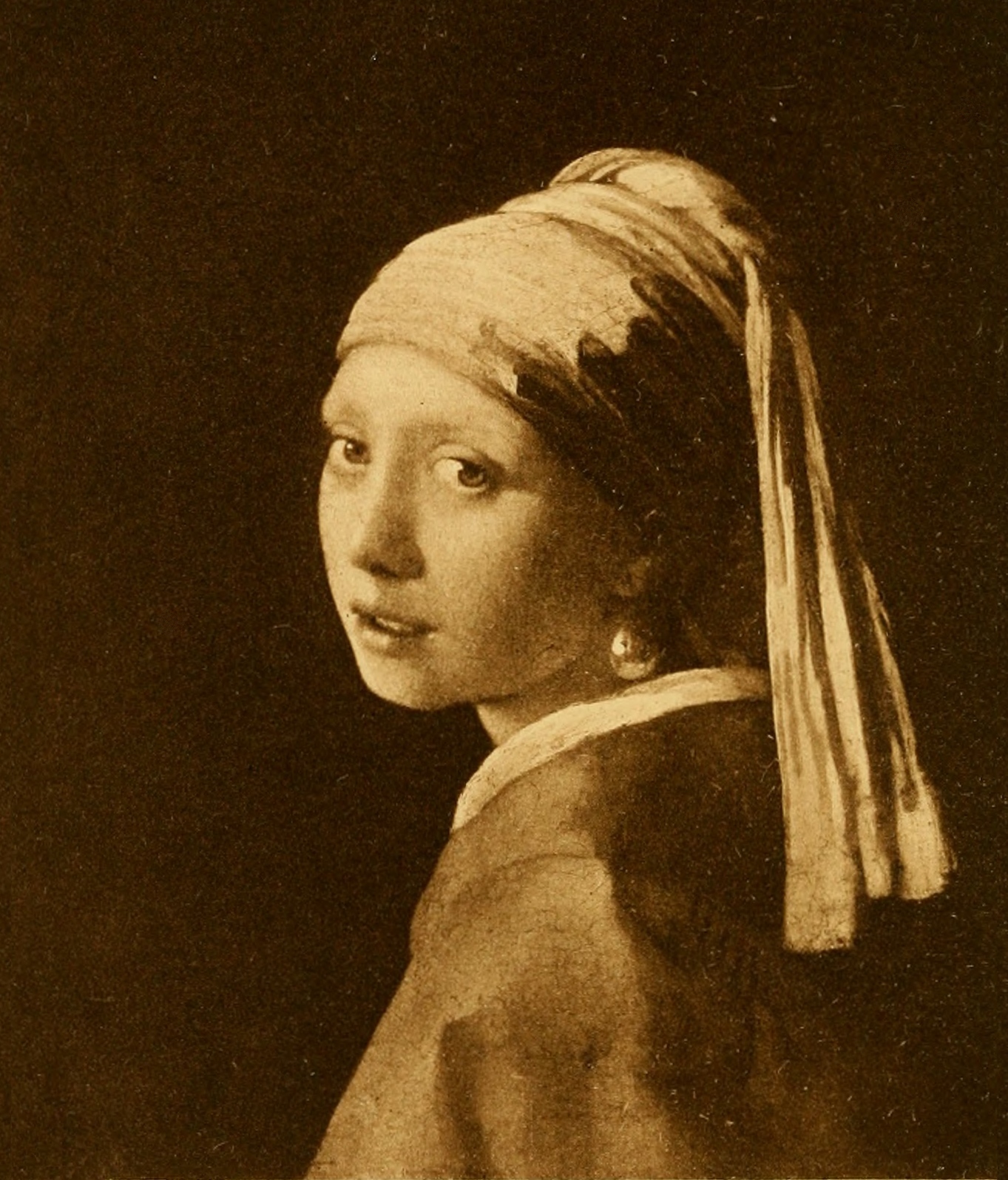
subjects, hangs next Vermeer’s “Head of a Young
Girl” (my frontispiece) at the Hague, and would
alone prove Fabritius to have possessed not only
strength but sweetness.
Dr. Hofstede de Groot, the author of a magnificent
monograph on Vermeer and Fabritius, published
in 1907 and 1908, conjectures Vermeer to
have had an Italian master as well as a Dutch, and
it is easy to believe. I had, indeed, with none of
Dr. de Groot’s knowledge, come to a similar conclusion;
and in the huddle of pictures in one of
the rooms of the Academy at Vienna I even
found a copy of an Italian picture—a Correggio, I
think—which Vermeer’s hand might easily have
made, so luminous and liquid is it. That he visited
Italy is more than unlikely—practically impossible;
but to gain that something Italianate which his
works occasionally discover there was no necessity
for him to have done so, for Italian painters settled
in Holland in some numbers. The “Diana and her
Nymphs” at the Hague, and the “Christ in the
House of Martha and Mary” (which I have seen
only in reproduction) in Scotland, have each Italian
characteristics; but I must add that in Vermeer’s
authorship of these pictures Dr. de Groot does
not absolutely believe.
The facts about Vermeer are singularly few,
considering the high opinion in which he was held
by contemporaries. Almost the only intimate
thing told of him is the story of his unpaid bread
bill, as recounted by De Monconys, the French
traveller. De Monconys visited him in 1663 and
wanted to buy a picture, but none could be found
in the artist’s house. Vermeer’s baker consented,
however, to sell one which was hanging on his wall
and for which he had allowed 300 florins. After
Vermeer’s death, it is told, the baker’s debt of
3176 florins was liquidated by two pictures. Since
Vermeer’s wife is known to have had rich relations
and to have come into money from time to time,
we may guess this gigantic account to have been
the result rather of bad management than of
poverty; for of all the painters of the world none
less suggests necessity than Jan Vermeer of Delft:
on the contrary, his work carries with it the idea
of aristocracy and prosperity, certainly a fastidiousness
rarely associated with the father of a large
family’s struggle for existence in the seventeenth
century. Moreover, we are told that his prices, even
when he was alive, were higher than those of any
painter save Gerard Dou, and such a guild as that
of Delft would not be likely to elect a starving
man as its chief four several times.
No, if Vermeer owed money to his baker it was
because he was easy-going, placid, above such
trifles, as other artists have been before and since:
indeed, occasionally still are, I am told. You can
see that Vermeer was placid: the fact shines in
every picture. He was placid, and he liked others
to be placid too. His wife was placid, his
daughters (if, as I conjecture, certain of his models
were his daughters) were placid, his sitters were
placid. His one undisputed landscape shows that
he wanted nature to be placid; his one street scene
has the dove brooding upon it.
Yet when we put in one balance the debt for
bread and in the other the very slender output of
this famous artist, to whom a collector could come
even from distant France with a heavy purse, we
are face to face with a difficulty; because even
placid men when they become chiefs of guilds do
not much care for continual reminders that they
owe money, and in such a small town as Delft
Vermeer and his baker would have had some
difficulty in not often meeting. Moreover what
of the butcher? And the vintner? The inference
therefore—especially when it is remembered that
the baker occasionally agreed to be paid in kind
and hang we know not which of the masterpieces
on his wall—the inference therefore is that Vermeer
painted, was forced by necessity to paint,
many pictures in excess of the very small number
at the present moment identifiable. Of this, more
later; but I want to bring out the point here, since
it is of the highest importance and might indeed
completely alter the life of Mr. Pierpont Morgan.
We may believe Vermeer to have been a home-keeping
man from several circumstances. One is
that he was not only born in Delft (in 1632), but
he married in Delft (in 1653) and died in Delft
(in 1675); another that the years in which he was
a chief of the Delft Guild, and therefore a resident
there, were 1662, 1663, 1670 and 1671; another
that his only famous landscape and his only known
street scene are both Delft subjects; and another
that of his thirty odd known figure pictures, thirty-one
are lighted from the left precisely in the same
way, which leads one to suppose that most of them
were painted in the same studio.
When I add that Vermeer died in December,
1675, at the early age of 43, and that his executor
was Antony van Leeuwenhoek, the inventor
of the microscope (and probably his model for
several pictures), I have said all that is known
for certain of his career.
To me it is not to Andrea del Sarto that the
title of the “Perfect Painter” belongs, but to Jan
Vermeer of Delft. Andrea with all his weakness
was in a way greater than that: he had, one can
see, finer thoughts, sweeter imaginings, a richer
nature than a perfect painter needs; the phrase
perfect painter limits him to the use of his brush,
and one thinks of him (and not wholly because
Browning was a man of genius) always as a human
being too. But of Vermeer we know nothing
save that he was a materialistic Dutchman who
applied paint to canvas with a dexterity and charm
that have never been equalled: in short, with
perfection. His pictures tell us that he was not
imaginative and not unhappy; they do not suggest
any particular richness of personality; there is
nothing in them or in his life to inspire a poet
as Andrea and Lippo Lippi inspired Browning and
Romney Tennyson. Vermeer was not like that.
But when it comes to perfection in the use of paint,
when it comes to the perfect painter—why, here
he is. His contemporary Rembrandt of the Rhine
is a giant beside him; but ruggedness was part of
his strength. His contemporary, Frans Hals of
Haarlem, could dip his brush in red and transform
the pigment into pulsating blood with one flirt of
his wrist, and yet think of his splendid carelessnesses
elsewhere. His contemporary, Jan Steen of
Leyden, had a way of kindling with a touch an eye
so that it danced with vivacity and dances still,
after all these years; but what a sloven he could
be in his backgrounds! His contemporary Peter
de Hooch could flood canvas with the light of the
sun, but how weakly drawn are some of his figures!
And so one might go on with the other great
painters—the Italians and the Spanish and the
English and the French; naming one after another,
all with more to them as personalities than Vermeer,
all doing work of greater import; and all, even
Michael Angelo and Leonardo, even Correggio,
even Raphael, even Andrea, even Chardin, falling
beneath Vermeer in the mere technical mastery of
the brush and the palette—no one having with
such accuracy and happiness adjusted the means
to the desired end. He aimed low, but at his
best—in, say, six pictures—he stands as near perfection
as is possible.
It is this joyful mastery that fascinates me and
made it so natural, when in the autumn of 1907 I
was casting about for a motive for a holiday, to say,
“Let us pursue this painter, let us see in twenty-one
days all the Vermeers that we can.”
The farthest European city containing a Vermeer
of which I then knew being Vienna (I afterwards
found that Budapest has a putative example),
we went there first; and there was a certain
propriety in doing so, for in the Vienna picture
the artist is supposed to have painted himself,
and to begin with a concept of him was interesting
and proper. The “Maler,” as it is there
called, is at Count Czernin’s, a comfortable mansion
at Number 9 Landes-gericht strasse, open to
visitors only on Mondays and Thursdays. There
are four rooms of pictures, and nothing in them
matters very much save the Vermeer. An elderly
butler is on duty; he shows you the best place to
stand in, brings a chair, and murmurs such facts
about the marvellous work as appeal most to his imagination—not
so much that it is a miracle of painting
as that it was acquired for a mere song, and
that Americans constantly walk into this room with
blank cheques in their hands and entreat the Count
to fill them up at his pleasure. But no, the Count
is too proud of his possession. Well, I admire him
for it. The picture may not have such radiance
as the “Pearl Necklace” at Berlin, or such charm
as the “Woman Reading a Letter” at the Ryks, or
such sheer beauty as the Mauritshuis “Girl’s Head,”
but it is brilliant and satisfying. It does not give
me such pleasure as certain others, to be named
later, but it is in some ways perhaps finer. Vermeer
is seated at his easel with his back to the world—a
largish man with long hair under a black velvet
cap, and the careful costume of a man who can pay
for his bread. Nor does the studio suggest poverty.
The artist is at work on the head of a demure
damsel whom he has posed near the window, with
the light falling upon her, of course from the left.
The little mousy thing has a wreath of leaves in
her hair and a large book held to her breast; in
her right hand is a long musical instrument. On
the wall is the most fascinating of the many maps
that the artist painted—with twenty little views
of Dutch towns in the border. Vermeer was the
first to see the decorative possibilities that lie in
cartography; and he was also, one conjectures, a
geographer by inclination.
The beautiful blue Danube had so little water
in it just then that the voyage to Budapest
would have taken almost twice as long as it should,
and there was not time. To make the journey
by train, just for one day, was an unbearable
thought at that moment; although I now regret
that we did not go. The Budapest Vermeer is
a portrait, a Dutch Vrouw, standing, looking full at
the world, without any accessories whatever. Not
having seen it, I can express no opinion as to its
authorship, but Dr. de Groot is doubtful, although
he reproduces the picture in his book among the
practical certainties. So also does M. Vanzype, the
most recent of our painter’s critics, whose monograph,
“Vermeer de Delft,” in the “Collection des
Grands Artistes des Pays-Bas,” was published in
1908. M. Vanzype goes farther, for he also includes
the portrait of a young man in the Brussels
gallery for which the curator, M. A. J. Wauters,
has made out so eloquent a case, but which Herr
Bredius and Dr. de Groot both repudiate. For
myself, all I can say of it is that one does not
jump to the denial of it as one did to the putative
example in our National Gallery, just completed
by the addition of its lost half. The Budapest
Vermeer is in reproduction a beautiful picture—a
youngish Dutch woman with the inevitable
placidity, but not so open and easy-going as the
personalities whom the artist chose for his own
pictures: she has folded hands and large white
cape and cuffs. M. Vanzype admits that this
portrait and that of the young man at Brussels
lend colour to the theory of Thoré and M.
Arsène Alexandre that Vermeer studied for a
while immediately under Rembrandt; but he
goes on to show that this was practically an impossibility.
Turning reluctantly away from Budapest, we
went next to Dresden, which has two Vermeers
and a light and restful hotel, the Bellevue, very
agreeable to repose in after our caravanserai at
Vienna. The Bellevue is on the bank of the river
and close to the Picture Gallery, into which one
could therefore drop again and again at off hours.
The famous Raphael is of course Dresden’s lodestar,
and next come the Correggios, and there is a
triptych by Jan Van Eyck and a man in armour
by Van Dyck; but it is Vermeer of whom we are
talking, and the range of Vermeer cannot be understood
at all unless one sees him in the capital of
Saxony. For it is here that his “Young Courtesan”
(chastely softened by the modest Baedeker
into “The Young Connoisseur”) is found. It is a
large picture, for him, nearly five feet by four, and
it represents a buxom, wanton girl, of a ripe beauty,
dressed in a lace cap and hood and a bright yellow
bodice, considering the value of the douceur which a
roystering Dutchman is offering her. Behind is an
old woman curious as to the result, and beside her
is another roysterer, whose face might easily be that
unseen one of the artist in the Czernin picture, and
who is wearing a similar cap and slashed sleeves.
The party stands on a balcony, over the railing of
which has been flung one of the heavy tapestries on
which our painter loved to spend his genius. The
picture is remarkable as being a new thing in Vermeer’s
career, and indeed a new thing in Dutch art;
and it also shows that had Vermeer liked he might
have done more with drama, for the faces of
the two women are expressive and true; although
such was his incorrigible fastidiousness, his preference
for the distinguished and radiant to the
exclusion of all else, that he cannot make them
either ugly or objectionable. The procuress is a
Vermeer among procuresses, the courtesan a Vermeer
among courtesans. The fascination of the
canvas, though totally different from that of any
other of his works, is equal in its way to any: it
has a large easy power, as well as being a beautiful
and daring adventure in colour.
The other Dresden picture is also a little off
Vermeer’s usual path. The subject is familiar:
the Dutch woman reading a letter by a table, on
which is the customary cloth and a dish of apples;
the light comes through the same window and falls
on the same white wall; but the tone of the work
is distinct, sombre green prevailing. It would be
thrilling to own this picture, but I do not rank it
for allurement or satisfaction with several of the
others. It comes with me not even fifth or sixth.
Vermeer’s best indeed is so wonderful—the “View
of Delft,” the “Girl’s Head” at the Mauritshuis,
the “Milkmaid” and “Woman Reading a Letter”
at the Ryks, the “Pearl Necklace” at Berlin, the
“Street in Delft” at the Six Gallery, and the
“Young Courtesan” at Dresden—that anything below
that standard—such is the fastidiousness which
this man’s fastidiousness engenders—quickly disappoints;
although the student working up to the
best and reaching the best last would be continually
enraptured.
Next Berlin. After the “Girl’s Head” at the
Mauritshuis, which among the figures comes always
first with me, and the “View of Delft,” it is, I
think, the Berlin “Necklace” that is Vermeer’s
most charming work. I consider the white wall
in this painting beautiful beyond the power of
words to express. It is so wonderful that if one
were to cut out a few square inches of this wall
alone and frame it one would have a joy for ever.
Franz Hals’ planes of black have never been
equalled, but Vermeer’s planes of white seem to
me quite as unapproachable. The whole picture
has radiance and light and delicacy: painters
gasp before it. It has more too: it is steeped in
a kind of white magic as the “View of Delft” is
steeped in the very radiance of the evening sun.
Berlin is to me a rude and materialistic city with
officials who have made inattention a fine art, and
food that sends one to the “Continental Bradshaw”
for trains to Paris; but this picture is leaven enough.
It lifts Berlin above serious criticism. I hope that
when we have fought Germany in the inevitable
war of which the papers are so consistently full, it
will be part of the indemnity.
The other Vermeer in the superb gallery over
which Dr. Bode presides with such dangerous enthusiasm
(dangerous, I mean, to other nations), is
not so remarkable; but it is burnt into my memory.
That white Delft jug I shall never forget. The
woman drinking, with her face seen through the
glass as Terburg would have done it (one likes to see
painters excelling now and again at each other’s
mannerisms); the rich figure of the Dutch gentleman
watching her; the room with its chequered
floor: all these I can visualize with an effort; but
the white Delft jug requires no effort: the retina
never loses it. Vermeer, true ever to his native
town and home, painted this jug several times.
Not so often as Metsu, but with a greater touch.
You find it notably again in the King’s example at
Windsor Castle.
Berlin has also a private Vermeer which I did
not see—Mr. James Simon’s “Mistress and Servant.”
Judging by the photogravure, this must
be magnificent; and it is peculiar in respect of
being almost the only picture in which the painter
has a plain table-cloth in place of the usual
heavily-patterned tapestry. The lady in ermine
and pearls is evidently ordering dinner; the placid,
pleasant maid has a hint of Maes. The whole
effect seems to be rich and warm. Two other
pictures I also ought to have seen before leaving
Germany—one at Brunswick and one at Frankfort.
In the Brunswick painting a coquettish girl
takes a glass of wine from a courteous Dutch
gentleman at the table, while a sulky Dutch gentleman
glooms in the background. On the table is
another of the white Delft jugs. The Frankfort
picture is “The Geographer at the Window,” dated
1668, which in the reproduction strikes one as a
most beautiful and dignified work, wholly satisfying.
The geographer—probably Antony van
Leeuwenhoek—leans at his lighted table over a
chart, with his compasses in his hand. All the
painter’s favourite accessories are here—the heavy
tapestry on the table, the window with its small
panes, the streaming light of day, the white wall,
the chair with its brass-headed nails. And the
kind thoughtful face of the geographer makes
the whole thing human and humane. Vermeer,
I fancy, was never more harmonious than here.
I shall certainly go to Frankfort soon to translate
this impression into fact.
At Amsterdam we went first to the grave and
noiseless mansion of the Six family at Number 511
Heerengracht, one of the most beautiful and reserved
of the canals of this city. A ring at the
bell brought a rosy and spotless maid to the door,
and she left us for a little while in a lobby from
which Vermeer might have chosen his pictures’ blue
tiles, until a butler led us upstairs to the little
gallery. I am writing of 1907, before the negotiations
for the purchase by the State of Vermeer’s
“Milkmaid” were completed, and we therefore
saw it in its natural home, where it had been for
two hundred and more years. But now, at a cost
of 500,000 florins at twelve to the pound (or at
nearly £155 a square inch) it has passed to the
Ryks. The price sounds beyond reason; but it is
not. Granted that a kind and portly Dutchwoman
at work in her kitchen is a subject for a painter,
here it is done with such mastery, sympathy, and
beauty as not only to hold one spellbound but to
be beyond appraisement. No sum is too much for
the possession of this unique work—unique not
only in Vermeer’s career (so far as we know), but
in all painting. What the artist would have asked
for it we do not know. At the sale of his works
in 1696 it brought 175 florins.
Vermeer here is at his most vigorous and powerful.
His other works are notable above everything
for charm: such a picture as the “Pearl
Necklace” at Berlin represents the ecstasy of
perfection in paint; but here we find strength
too. I never saw a woman more firmly set upon
canvas: I never saw a bodice that was so surely
filled with a broad and beating bosom. Only a
very great man could so paint that quiet capable
face. Some large pictures are very little, and some
small pictures are large. This “Milkmaid” by
Vermeer is only eighteen inches by fifteen, but it is
to all intents and purposes a full length: on no life-size
canvas could a more real and living woman be
painted. When you are at Amsterdam you cannot
give this picture too much attention; be sure
to notice also the painting of the hood and the
drawing of the still life, especially the jug and the
bowl. It was this picture, one feels, that shone
before the dear Chardin, all his life, as a star.
The other Six Vermeer is that Delft façade
which artists adore. The charm of it is not to be
communicated by words, or at any rate by words
of mine. It is as though Peter de Hooch had
known sorrow, and, emerging triumphant and
serene, had begun to paint again. And yet that
is, of course, not all; for De Hooch, with all his
radiant tenderness, had not this man’s native
aristocracy of mind, nor could any suffering have
given it to him. Like the “View of Delft,” like
the “Young Courtesan,” this picture stands alone
not only in Vermeer’s record, but in the art of
all time. Many grow the flower now—there is
a modern Dutch painter, Breitner, whose whole
career is an attempt to reproduce the spirit of this
façade—but the originator still stands alone and
apart, as indeed, by God’s sense of justice, originators
are usually permitted to. The sale of twenty-one
of Vermeer’s pictures at Amsterdam in 1696
included the “Street in Delft” which the Six
family own, and also a view of houses, a smaller
work, which fetched forty-eight florins. (That is
one of the Vermeers which have disappeared, Mr.
Pierpont Morgan, sir.)
The Vermeers at the Ryks were, in 1907, two
in number (now made three by the “Milkmaid”);
and of these one I do not like, however much I
am astounded by its dexterity, and one I could
never tire of. The picture that I do not like,
“The Love Letter,” shows, with the “New
Testament Allegory” at the Hague, the painter
in his most dashing mood of virtuosity. Neither
has charm, but both have a masterful dexterity
that not only leaves one bewildered but kills all the
other genre painters in the vicinity. Both were
painted, I conjecture, to order, to please some
foolish purchaser who frequented the studio. But
the other Ryks picture—“The Woman Reading a
Letter”—here is the essential Vermeer again in
all his delicacy and quietude. It was the first of
his best pictures that I ever saw, and I fell under
his spell instantly. What I have said of the
“Milkmaid” applies also to the “Reader”; she
becomes after a while a full length. The picture
is only twenty inches by sixteen, but the woman
also takes her place in the memory as life-size. It
is one of the simplest of all the pictures: comparable
with the “Pearl Necklace,” but a little
simpler still. The woman’s face has been injured,
but it does not matter; you don’t notice it after a
moment; her intent expression remains; her gentle
contours are unharmed. The jacket she wears is
the most beautiful blue in Holland; the map is a
yellowish brown; the wall is white. The woman,
whose condition is obviously interesting, is, I like
to think, the Vrouw Vermeer, possibly the mother
of the young girls in the pictures at the Hague,
Vienna and Brussels.
The Hague is the most comfortable city that I
know in which to see pictures. It is so light and
open, the Oude Doelen is so pleasant a hotel, and
the pictures to see are so few—just a handful of
old masterpieces at the Mauritshuis and just a
handful of the romantics at the Mesdag Museum.
That is all; no formal galleries, no headaches.
Above all there are here the two most beautiful
Vermeers that are known—the “Young Girl”—and
the “View of Delft.” Writing in another
place some years ago I ventured to call the
Mauritshuis picture of a girl’s head one of the
most beautiful things in Holland. I retract that
statement now, and instead say quite calmly that
it is the most beautiful thing in Holland. And to
me it is in many ways not only the most beautiful
thing in Holland, but the most satisfying and exquisite
product of brush and colour that I have
anywhere seen. The painting of the lower lip is
as much a miracle to me as the flower of the
cow-parsley or the wing of a Small Heath. I
said that the “Pearl Necklace” was steeped in
white magic. There is magic here too. You are
in the presence of the unaccountable. Paint—a
recognized medium—has exceeded its power.
The line of the right cheek is surely the sweetest
line ever traced. I don’t expect you to come a
stranger to this face and feel what I feel; but I
ask you to look at it quietly and steadily for a
little while, in its uncoloured photographic presentment,
until it smiles back at you again—as
surely it will. Yes, even in the photogravure
reproduction that stands as frontispiece to this
book lurk the ghosts of these smiles.
Who was this child, one wonders. One of the
painter’s, I think. One of the eight, whom it
amused him to dress in this Oriental garb that he
might play with the cool harmonies of yellow, green
and blue, and the youthful Dutch complexion. If
this is so, it is one of his latest pictures, for all his
many children were under age when he died. It
is probable that the child in the Duke of Arenberg’s
picture at Brussels, in the same costume, was
a sister. There is certainly a family likeness between
the two, and if, as one may reasonably
suppose, Vermeer’s wife was his model for certain
of the other pictures, we may easily believe that
both were her daughters, for they have her candid
forehead, her placidity.
Think of what has been happening in the world
during the years since this sweet face was set upon
canvas—the evolutions and tragedies, the lives
lived and ended, the whole passionate fretted
progress of the nations! “Monna Lisa” has smiled
a century and more longer, and she has been looked
upon every day for centuries: this child, not a whit
less wonderful as a conquest of man over pigment,
smiled unseen; for when she was bought at a Hague
auction a few years ago by Herr Des Tombes for
two florins thirty cents she was covered with grime.
Think of it—two florins thirty cents—and if she
found her way to Christie’s to-day I don’t suppose
that £50,000 would buy her. I know that I personally
would willingly live in a garret if she were on
its wall. But leaving aside the human interest of
the picture, did you ever see, even in a reproduction,
such ease as there is in this painting, such
concealment of effort? It was no small thing at
that day for a Dutchman to lay his colours like this,
so broadly and lucidly. It is as though the paints
evoked life rather than counterfeited it; as though
the child was waiting there behind the canvas to
emerge at the touch of the brushwand.
And the “View of Delft”—what is one to say
of that? Here again perfection is the only word.
And more than perfection, for perfection is cold.
This picture is warm. Its serenity is absolute;
its charm is complete. You stand before it satisfied—except
for that heightened emotion, that
choking feeling and smarting eyes, which perfection
compels. The picture is still the last word
in the painting of a town. Not all the efforts of
artists since have improved upon it; not one has
done anything so beautiful. It is indeed because
he painted these two pictures that I have for Jan
Vermeer of Delft such a feeling of gratitude and
enthusiasm. Wonderful as are many of his other
pictures that I have described, they would not
alone have subjected me to so much travelling in
continental trains by day and night. But to see
this head of a young girl and this view of Delft I
would go anywhere.
To the “New Testament Allegory” I have
referred above: it does not give me pleasure
except in its tapestry curtain. That detail is, I
suppose, among the wonders of painting. The
other Mauritshuis Vermeer is the “Diana and Her
Nymphs”—that gentle Italianate group of fair
women, the painting of which Andrea himself
might have overlooked. It is at once Vermeer
and not Vermeer. It is very rich, very satisfying;
but I for one should feel no sense of bereavement
if another name were put to it. As a matter of
fact Nicholas Maes was long held to have been its
author. A fifth Vermeer the Mauritshuis chanced
to possess when I was there, for Herr Bredius had
recently discovered in a Brussels collection a very
curious example from the magic hand—a tiny
picture of a girl with a flute, in a Chinese hat (or
something very like it), with an elaborate background:
not a very attractive work, but Vermeer
through and through, and so modern and innovating
that were it hung in a Paris or London exhibition
to-day it would look out of place only by
reason of its power. The picture is seven and a
half inches by six and three quarters, and now
belongs to Mr. Pierpont Morgan.
After Delft, where we roamed awhile to reconstruct
Vermeer’s environment, but where, I regret
to say, little is known of him, Brussels. For Vermeer
there, one must, as in Vienna, visit the home
of a nobleman—the Duke of Arenberg—and here
again one falls into the hands of a discreet and
hospitable butler. The d’Arenberg mansion is in
the Rue de la Régence, just under the crest of the
fashionable hill. It is open to the picture lover,
like that of Count Czernin, only on certain days.
The gallery is small and chiefly Dutch, with a few
good pictures in it. The Vermeer is isolated on
an easel—the most unmistakable perhaps of all, although
so cruelly treated by time, for it is a mass of
cracks. Yet through these wounds the beautiful
living light of a young girl’s face shines—not the
girl we have seen at the Hague, but one very like
her—her sister, as I conjecture—dressed in the
same Eastern trappings, a girl with a strangely
blank forehead and eyes widely divided, akin to
the type of Madonna dear to Andrea del Sarto.
The same girl I think sat for the “Player of the
Clavichord” in our National Gallery, to which we
soon come. She is a little sad, and a little strange,
this child, and only a master could have created
her. At Brussels also is one of Vermeer’s “Geographers,”
in the collection of the Vicomte du
Bus de Gisegnies; but this I did not then know.
And in the Picture Gallery is the conjectural
portrait of the young man of which I have written
above.
After Brussels, Paris—a good exchange. Paris
has one Vermeer in a private collection—Alphonse
de Rothschild’s—an astronomer, which I have not
seen, and one in the Louvre—the beautiful
“Dentellière”—before which I have stood scores
of times. This too is very small, only a few
inches square, but the serene busy head is painted
as largely as if it were in a fresco. The lighting is
from the right instead of the left—a very rare experiment
with Vermeer.
It is greatly to be regretted that our National
Vermeers are not better, because to many readers
of this essay they must necessarily be the only
pictures from his hand that they can study at all
times; and my ecstasies will appear to be foolish.
The lady standing at a spinet is a marvel of
technique; the paint is applied with all Vermeer’s
charm of touch; the room is filled with the light
of day; there are marvellous details, such as the
brass-headed nails of the chair, and the little spot
of colour on the head is fascinating; moreover
there is an agreeably ingenious scheme of blue,
beginning with the gay sky of the landscape on
the wall, passing through the delicate tippet of the
lady and ending on a soberer note with the covering
of the chair. But it is not a picture of which
I am fond; it is a tour de force; and I think I positively
hate the ugly Cupid on the wall, which
would be a blot on any man’s work, most of all on
Vermeer’s. One feels that he must have painted
this to please the husband of the sitter, who insisted
on his pictures being immortalized. Vermeer,
left to himself, would have painted a map.
The other—the seated girl at the piano—lacks
the painter’s highest radiance. It is the same girl
that we saw in the Brussels picture.
Of the other London Vermeers two (only two!)
belong to Mr. Otto Beit. One of these is a tiny
“Lady seated at a Spinet,” not in the first rank
of fascination, but a little masterpiece nevertheless,
and the other, “A Lady Writing a Letter,”
notable for the strong and beautiful painting of
the lady’s face, foreshortened as she bends over
her task. Beside her stands her blue-aproned
maid, waiting to take the missive to the door.
The table has its usual tapestry and the wall its
picture, this time an old master. But the head of
the lady is what one remembers—with her white
cap and her pearl drops and her happy prosperous
countenance.
Mr. Beit’s Vermeers are in Belgrave Square:
there is another in Hyde Park Gardens, the property
of Mrs. Joseph: “The Soldier and the
Laughing Girl” it is called. The girl sits at the
table with a bright and merry face; the soldier,
who has borrowed his red from Peter de Hooch,
is in the shade; on the wall is a splendid rugged
map of Holland and West Friesland. The picture
is paintier than is usual with Vermeer, but very
powerful and rich. Mrs. Joseph (I am told) has
been forced by the importunities of collectors
and dealers to have recourse to a printed refusal
to sell this work!
The Vermeer belonging to the King hangs in
the private apartments at Windsor, but when I
saw it, it was, by the courtesy of His Majesty’s
Surveyor of Works of Art, carried into a less
sacred room of that vast and imposing fortress for
us to look upon. The Court was absent, and
workmen were here and there, but one could have
told that this was the abode of a monarch, even
had one been blindfolded. There was a hush!
On a walk of some miles (as it seemed) through
dusky passages in which now and then one saw
dimly one’s face in a slip of a mirror at the corners,
we passed other creatures who had some of the
outward semblance of human beings; but we were
not deceived. They were marked also by a discretion,
an authority, beyond ordinary mortality;
not the rose, of course, but so near it that one
flushed. To have this new experience, for I had
never entered a royal castle before, and be on a
visit to a Vermeer, was a double privilege. The
Vermeer is very charming, but not one of the first
rank; and its coating of varnish does not improve it.
But it is from the perfect hand none the less, and
there is the white Delft jug in it for the eye to return
to, like a haven, after every voyage over the
canvas.
England also has Vermeer’s “Christ in the House
of Martha and Mary,” which, when it was exhibited
in Bond Street some few years ago, divided the
experts, but is now, although not confidently, given
to our painter by Dr. de Groot. This picture,
which I have not seen, has in the reproduction
much of the large easy confidence of the “Diana
and her Nymphs” at the Hague. It hangs now in
Skelmorlie Castle, and some day I hope to blow a
blast outside those Scottish walls and succeed in getting
the drawbridge lowered that I may look upon it.
There are nine examples in America to-day
(1911). Of these Dr. de Groot reproduces only
six, for the other three have come to light since
he published. The six which he gives are—Mr. B.
Altman’s “Woman Asleep” (from the Rodolph
Kann Collection), Mr. James G. Johnson’s “Lady
with the Mandoline,” Mrs. Jack Gardner’s “Three
Musicians,” Mr. H. C. Frick’s “Singing Lesson,”
Mr. Pierpont Morgan’s “Lady with Flute,” and
“The Woman with the Water Jug,” in the Metropolitan
Museum in New York. Of these I have
seen only Mr. Morgan’s, described above. The
three new ones are Mr. Morgan’s “Lady Writing,”
Mrs. Huntington’s “Lady with Lute,” and Mr.
Widener’s “Lady Weighing Pearls” (or gold),
which was exhibited in London early in 1911, and
which brings Dr. de Groot’s list to thirty-seven.
This new Vermeer is not absolutely his best;
it is not so great and simple and strong as
“The Milkmaid,” at the Ryks; it is not so radiant
as “The Pearl Necklace,” at the Kaiser Friedrich
Museum in Berlin; it is not so exquisite and
miraculous a counterfeit of life as the “Girl’s
Head,” at the Mauritshuis; nor so enchanting and
epoch-making as the “View of Delft,” in the same
gallery. Those I take to be the artist’s four finest
pictures. But it is well in his first dozen, and
it is vastly better than either of those in the National
Gallery.
The new picture represents a woman: one of
those placid domestic creatures to whom Vermeer’s
brush lent a radiance only a gleam of which many
a Madonna of the Southern masters would have
envied. How little can they have thought, these
Delft housewives and maidens, that they were
destined for such an immortality! She stands
beside a table, as most of Vermeer’s women do, and
she has a jacket of dark-blue velvet trimmed with
fur, and a white handkerchief over her head. The
tablecloth also is blue; the curtain is orange.
Standing there, she poises in her right hand a
pair of goldsmith’s scales. On the table is a profusion
of pearls (painted with less miraculous dexterity
than usual), and a tapestry rug has been
tossed there too. Behind her placid, comely head,
on the wall (where Vermeer usually places a map), a
picture of the Last Judgment hangs, which may or
may not be identifiable. (I should doubt if Vermeer
introduced it with any ironical intention;
that was not his way.) This picture is on a light
grey wall. The light comes, of course, from the
left, and never did this master of light paint it—or
educe it—more wonderfully. It triumphs
through the window and curtain exactly as in
“The Pearl Necklace,” past the same black mirror.
The woman’s face, however, has the greatest
lustre; from it is diffused a lambency of such
beauty that one might almost say that the rest of
the picture matters nothing; such a soft and
lovely glow were enough. The work is not signed,
except with the signature of immanent personality.
Since the discovery of this picture—No. 36—yet
another has been found—a large group of children
representing Diana and her nymphs—which Mr.
Paterson of Old Bond Street—the discoverer of
“Christ in the House of Martha and Mary”—has
in his possession. Mr. Paterson is a true Vermeer
enthusiast, and not one of those with whom the
wish is the father to the thought. His new
Vermeer is obviously an early work and is on a
larger scale than any of the others: it has weaknesses
of drawing and in more than one respect
suggests an experimental stage; but one cannot
doubt its authorship, and everywhere it is interesting,
and here and there exquisite, especially in the
figure of the child in the left-hand corner. With
this picture the list of practically unquestionable
Vermeers reaches thirty-eight.
There remain the one or two on the border-line
of authenticity at which I have glanced, and also
a signed landscape in the possession of Mr.
Newton Robinson. This, if genuine (as I do not
doubt), is Vermeer’s only woodland scene, with
the exception of those on the walls of other
of his pictures, such as that in the National
Gallery, for example. It is a soft brown landscape,
as little like Vermeer as possible in
the mass. But in the detail—particularly in one
detail—the signature is corroborated. In the
foreground is a little arbour with some young
people in it holding a musical party. The most
prominent figure is a girl crowned with flowers:
and this girl is sheer Vermeer in attitude, in
charm, and in technique. The work is, I should
guess, juvenile and experimental, but it has many
attractions and is of the deepest interest as the
thirty-ninth opus on the side of certainty.
Vermeer’s practically unquestionable output thus
totals thirty-nine pictures. Think of the smallness
of the harvest. Thirty-nine! That is to
say, hardly more for Vermeer’s whole career than
the Boningtons to be seen in a single London
collection—that at Hertford House—where there
are thirty-five of his works. And Bonington died
at the age of twenty-seven. How many pictures
by Bonington exist I know not, but hundreds, I
suppose, in all. And Vermeer has only thirty-nine
to his name, and lived nearly twice as long,
and had eight children to support.
The question that confronts us, the question to
which all these remarks of mine have been leading,
then, is, Where are the others? Because there
must have been others; indeed we know of a few,
as I will presently show; but there must have been
many others, since Vermeer began to paint when
he was young, and painted till the end, and had a
working period of, say, twenty-four years—between
1652, when he was twenty, and 1676, when
he died. At the modest rate of only four pictures
a year this would give him a total of ninety-six
pictures, or nearly sixty more than we know of.
But putting his output at a lower rate—say at two
pictures a year—that would leave us with several
still to discover. Of the existence at one time of
two if not more of these we have absolute knowledge,
gained from the catalogue of the Vermeer
sale in Amsterdam in 1696, which I copy from
M. Vanzype’s pages, together with the prices that
they made and his commentary:—
“1. A young girl weighing gold in a little
casket. 155 florins.
“2. A milkwoman. 175 fls.
“3. The portrait of the painter, in a room. 45 fls.
“4. A young woman playing the guitar. 70 fls.
“5. A nobleman in his room. 95 fls.
“6. A young woman at the harpsichord, and a
young gentleman listening. 30 fls.
“7. A young woman taking a letter from a servant.
70 fls.
“8. A drunken servant, sleeping at a table. 62 fls.
“9. A gay company in a room. 73 fls.
“10. A man and a young woman making music. 81 fls.
“11. A soldier with a young girl who is laughing. 44 fls.
“12. A young lace-maker. 28 fls.
“13. View of Delft. 200 fls.
“14. House at Delft. 72 fls.
“15. View of several houses. 48 fls.
“16. Young woman writing. 63 fls.
“17. Young woman adorning herself. 30 fls.
“18. Young woman at the harpsichord. 42 fls.
“19. A portrait in ancient costume. 36 fls.
“20. and 21. Two pendants. 34 fls.”
On the above catalogue M. Vanzype comments
as follows:—
“The greater number of these pictures seem to
have been recovered.
“The Milkwoman [No. 2] is, in all probability,
the one hanging for so long in the Six collection.
“The Young woman playing the guitar [No. 4] is
actually the picture belonging to Mr. Johnson, in
Philadelphia. It has been in the Cremer collection
at Brussels and in the H. Bischoffsheim
collection in London.
“The Young woman at a harpsichord with a
gentleman listening [No. 6] is no doubt the much-admired
picture at Windsor Castle, where it is one
of the treasures and is called The Music Lesson.
It was sold at Amsterdam at the Roos sale, in
1820, for 340 florins.
“The Young woman taking a letter from a servant
[No. 7] is at the Rijksmuseum in Amsterdam,
under the title The Letter. It was bought by the
State, through the intervention of the Rembrandt
Society and of M. Van Lennep, from M. Messcher
Van Vollenhoven for 45,000 florins.
“The Drunken servant sleeping at a table [No. 8]
is, in all probability, the picture which until just
lately belonged to the Kahn collection in Paris,
and of the authenticity of which there is no doubt.
[This was bought by Mr. Altman in 1910.] Bürger
possessed another picture, a servant sleeping in a
kitchen, and he believed that this was the work
sold in 1696. In his picture the figure is not leaning
on the table. It is now in the Widener collection
and in it the characteristic qualities of
Vermeer are not to be found.
“A man and a young woman making music [No. 10]
is probably the Singing Lesson of the Frick collection
at Pittsburg.
“A soldier with a young girl who is laughing
[No. 11] is Mrs. Joseph’s picture in London.
“The young lace-maker [No. 12] is the little chef-d’œuvre
in the Louvre sold for 84 francs at the
Muilman sale in 1813; 501 in 1817 at the
Lapeyrière sale; 265 fls. at the Nagel sale in
1851, and in 1870 bought by M. Blockhuyzen, of
Rotterdam, for 1270 frs.
“The View of Delft [No. 13], if it has no replica,
is the picture in the Museum at the Hague, for
which 2900 fls. was paid at the Stinstra sale in
1822.
“The House at Delft [No. 14] is the Ruelle of the
Six collection.
“The Young woman writing [No. 16] is without
doubt the picture in the Beit collection in London.
This was in the Héris sale at Brussels in 1857.
“The Young woman adorning herself [No. 17]
is The Pearl Necklace in the Berlin Museum.
“The Young woman at the harpsichord [No. 18]
is either the picture in the National Gallery or
that in the Beit collection, or perhaps that in the
Salting collection [now also at the National
Gallery].
“It is believed that the portrait in ancient
costume [No. 19] is the portrait of the young girl
in the Museum at the Hague [my frontispiece].
“[Nos. 20 and 21.] Finally, since at the Hendrik
Borgh sale in 1720 one Astrologer and its pendant
were sold for 160 fls.; and since two Astrologers
and a pendant were sold at the Neyman sale in
1797 for 270 and 132 fls., it may be deduced that
the pendants of the 1696 sale are either the two
Geographers which belong at the present day to
the Museum at Frankfort and to M. Du Bus de
Gisegnies at Brussels; or one only of these and
M. Alphonse de Rothschild’s Astronomer.”
To these remarks of M. Vanzype may be added
that No. 1 is the picture recently exhibited in
London and now in Mr. Widener’s collection, and
No. 3 is probably the Czernin picture. No. 9
might be the Brunswick painting. This leaves us
only with two of the Amsterdam sale pictures to
discover—No. 5, A nobleman in his room, and No.
15, View of several houses. But, of course, certain
others which M. Vanzype and I think we have
traced may be wholly different. M. Vanzype
furthermore remarks: “Other pictures have at
certain times been heard of and have since disappeared,
notably the ‘Dévideuse’ discussed in
1865 by Bürger and an English connoisseur,
which was then in England, but of which no trace
has since been found.”
Among the thirty-nine that are known, although
there are many interiors such as the painter loved,
there is, remember, only one woodland scene, only
one pure landscape, only one religious subject, only
one real portrait, only one street scene, only one
kitchen scene, only one purely classical subject,
only one family scene. The isolation of these examples
fills one with a kind of fury. No painter,
and especially no painter with such an interest in
the difficulties of his art, such a painter’s painter, so
to speak, as Vermeer, and moreover a man with
eight children and a clamorous baker—no painter
paints only one landscape, especially when the result
is so commandingly successful as the “View of
Delft.” Where are the others? (M. Vanzype
has found a replica, but it is not generally accepted.)
No painter is satisfied with one attempt
at a beautiful façade. Where are the others?
(We know there was one other.) No painter paints
only one classical subject. Where are the others?
(Mr. Paterson’s example is only half-classical:
classical with a domestic flavour: a family scene in
masquerade, to be exact.) No painter paints only
one religious subject. Where are the others? No
painter paints only one portrait pure and simple as
distinguished from portrait and genre. M. Vanzype,
it is true, claims to have found another; but that
would make only two. How indeed would he be
allowed to paint no others, when he was Vermeer
of Delft and lived in an age of Dutch prosperity
and Dutch interest in art? Where are the others?
Do you see how one feels—how maddening it is
that these bare forty are all, when one knows
that there must have been many more?
Vermeer may, of course, have himself destroyed
some, as Claude Monet recently destroyed a number
of his. But I do not think so; he could not
have afforded to, and he was not that kind. No:
they still exist somewhere. And the question
where are they brings us back to the wealth
of Mr. Pierpont Morgan, for which I was wishing
at the beginning of this essay. With it I would
furnish expeditions not to discover the Poles north
and south, because I care nothing for them; not
to conquer the air, because I love too much to
feel my feet on this green earth; not to break
banks or to finance companies; not to kill the
gentle giraffe for America’s museums; but simply
to hunt among the byways of Northern Europe
in the hope of coming upon another work by that
exquisite Delft hand. That is how I would spend
my money; and incidentally what charming adventures
one would have, and what subsidiary
treasure one would gather! That would be an
expedition worth making, even if the prime object
of the search always eluded us.
The Fool’s Paradise
There is an old picture-shop in the West-Central
district of London, notable for the
grime of its canvases, in the window of which there
is to be seen at this moment—unless a confiding
purchaser has just borne it off—a girl’s head and
bust by some very indifferent Dutch hand, under
which is printed on the frame the startling and
courageous legend, “The Coral Necklace. By Jan
Vermeer, of Delft.”
Of course the ascription is inaccurate. Were it
accurate and the picture worthy of it, this little
shop would be the Mecca of the first art experts of
Europe and America, and the dealer would be in
the way to affluence; nor does the picture’s present
owner probably believe in it. But what of some
previous possessor who did believe in it—some
simple soul who was genuinely convinced that
upon his wall hung a portrait by this rarest and
most exquisite and radiant of Dutch masters? Do
you not envy him his easy credence, his want of
fastidious taste? I do.
A little while ago there was a lawsuit—indeed
a series of lawsuits—all turning upon the collection
of porcelain left by a wealthy Regent Street merchant,
whose hobby was the acquisition of china.
As a man in the prime of life he had been a good
judge; but as he grew older and his brain weakened
his sense of discrimination left him, and it was
discovered that his later purchases, so far from being
the priceless examples of Dresden and other
ware which they were thought to be, were all-but
worthless. This naturally was a grief and disappointment
to the heirs who were to benefit from
the sale; but for us to be sorry for him is as foolish
a waste of sympathy as I know. For though there
he sat, that old amateur of ceramics, surrounded
by the mediocre, yet in that he believed it to be
the choicest he was enviable. That belief is the
heart of the case, since it is not what things really
are, but what one thinks things to be, that is the
important matter.
Truth has a slightly different expression for
every one. To this aged connoisseur with his decaying
faculties her expression was falseness itself,
could he have scrutinised it with intelligence,
but to his dim eyes it looked like the finest
candour, and therefore it was the finest candour.
He sunned himself in it, and passing his hands
lovingly over the spurious shepherdesses was
happy. The point is that he could not have been
happier had the porcelain been truly of the rarest
and most wonderful.
I hope it will never be my fortune to visit a
picture collector whose walls are hung entirely
with obvious copies which he believes to be
original, and flagrant daubs which he thinks
masterpieces—a collector in short who relies
only on the posthumous activity of artists; yet if
it is, I hope I shall know how to control myself
when he displays his treasures. But of one thing
I am certain: that no matter how I may suffer from
the concealment of my true feelings as an art lover,
I shall experience a genuine affection for my host,
and a genuine delight in his transparent, credible
nature. Surely the people who live in fool’s
paradises are the salt of the earth. The man who
says of a fine thing, “A fine thing and my own,”
I can admire, but not necessarily with warmth;
the man (he is very common) who says of a fine
thing, “A poor thing, but my own,” I have very
little use for; but the man who says of a poor
thing, “A fine thing and my own,” him I admire
cordially, and could almost embrace.
But about this Vermeer. I cannot get it out of
my head, for Vermeer is a painter of whom, as you
know, I have made some study, and the thought
of any one really sitting down excitedly with this
grotesquely misattributed picture in his room, reading
the lying label without a qualm, even with
pride, scanning the commonplace paint with no
twinge of dubiety—it is this thought which beats
me. The man who confidently had the legend
printed on the frame must indeed have been a
simpleton beyond appraisement—the very briniest
salt of the soil. For consider: the copyists, the
forgers, may do credible things with Corot, even
with Raphael. Every day they are writing David
Cox’s signature on old water-colours; false ascriptions
are the life-blood of too many firms. That
is true. But Vermeer—there is only one Vermeer!
and yet some man could know enough about
Vermeer to wish to have something by him on his
wall (modest wish—there are not, as I have been
saying, forty known Vermeer canvases in the world),
and then be satisfied with this! If ever I longed
to meet a freak it is he—not only to examine his
bumps, but to abase myself before him. For there
is a true philosopher, a really wise man, if you
like.
Meanwhile I wish some dramatist with an eye
to quaint character, if there be such a one left,
would set upon the stage for us a paradisiacal fool
such as this—a simple kind of enthusiast without
a shred of critical faculty or a drop of guile, whom
we might see amiably fondling his geese and deeming
them swans. That would give me, for one,
great pleasure. Lamb, in his Captain Jackson,
approached and skirted the type, but Vermeer’s
“Coral Necklace” would not have attracted that
engaging creature. If Anatole France were a
dramatist and would return to the gentle, smiling
mood in which he thought out and built up his
Sylvestre Bonnard, he might give us this collector.
I can think of no one else; and even he would
probably be a little too much inclined to whip
something on his back, such a castigator and ridiculer
as he is.
Consolers of Genius
I have just added another famous dog to my
list. It was a good list before, but it is now
richer. It included Matthew Arnold’s Geist and
Max and Kaiser, George Meredith’s Islet, Cowper’s
Beau, Newton’s Diamond, Mrs. Browning’s Flush,
Mr. Lehmann’s Rufus, all Dr. John Brown’s many
friends, Scott’s deerhounds, Mortimer Collins’s St.
Bernards, Pope’s spaniel. I remember only these
as I write, but of course there are many others.
And to this company enters now “Pomero.”
Landor’s “Pomero” came to him late in life—in
the early ’forties—by which time the old man—he
was then nearing seventy but had twenty
fairly stormy years left—had settled again in England,
his wife and family and most of his sympathies
being far away in Italy. At Bath he then
lived, making occasional visits to Gore House, and
varying the composition of exquisite prose and tender
felicitous verse with quarrels and tempests
and tempests and reconciliations and tempests
and lawsuits. Such then was the possessor of
“Pomero”—or, as he would probably have called
himself, the proud possession of “Pomero”—of
whom such glimpses as I have had come to me in
scraps of letters quoted by Forster in his Life of
this noble, troubled, impossible, glorious creature.
Here is one, written by Landor at Warwick,
when away from home, or what stood for home at
that period—1844. Pomero had only just arrived
from Fiesole; and it is worth remarking that had
Landor lived to-day no such fortune would ever
have been his, for never would he have survived
such explosions of rage as the modern six months’
quarantine for imported dogs would have brought
on him. (Think of him expressing his views to the
custom-house officer at Dover!) “Daily,” he wrote,
“do I think of Bath and Pomero. I fancy him
lying on the narrow window-sill, and watching the
good people go to church. He has not yet made
up his mind between the Anglican and Roman
Catholic; but I hope he will continue in the faith
of his forefathers, if it will make him happier.”
Pomero, I should say, was a Pomeranian; but let
me quote Sir Sidney Colvin’s charming sentences
upon both man and dog. “With ‘Pomero’ Landor
would prattle in English and Italian as affectionately
as a mother with a child. Pomero was his
darling, the wisest and most beautiful of his race;
Pomero had the brightest eyes and the most wonderful
yaller tail ever seen. Sometimes it was
Landor’s humour to quote Pomero in speech and
writing as a kind of sagacious elder brother whose
opinion had to be consulted on all subjects before
he would deliver his own. This creature accompanied
his master wherever he went, barking ‘not
fiercely but familiarly’ at friend and stranger, and
when they came in would either station himself
upon his master’s head to watch the people passing
in the street, or else lie curled up in his basket
until Landor, in talk with some visitor, began to
laugh, and his laugh to grow and grow, when
Pomero would spring up and leap upon and fume
about him, barking and screaming for sympathy
until the whole street resounded. The two together,
master and dog, were for years to be encountered
daily on their walks about Bath and its
vicinity, and there are many who perfectly well
remember them; the majestic old man, looking
not a whit the less impressive for his rusty and
dusty brown suit, his bulging boots, his rumpled
linen, or his battered hat; and his noisy, soft-haired,
quick-glancing, inseparable companion.”
Landseer, one feels, should have painted them:
Dignity and Fidelity, Unreason and Understanding,
Lion and Pomeranian. Since he did not, we
must go to Forster’s extracts from the letters to
fill in the picture. Another passage, also in
1844: “Pomero was on my knee when your letter
came. He is now looking out of the window; a
sad male gossip, as I often tell him. I dare not
take him with me to London. He would most
certainly be stolen, and I would rather lose Ipsley
or Llanthony. The people of the house love him
like a child, and declare he is as sensible as a
Christian. He not only is as sensible, but much
more Christian than some of those who have lately
brought strife and contention into the Church.”
Again: “Pomero is sitting in a state of contemplation,
with his nose before the fire. He
twinkles his ears and his feathery tail at your
salutation. He now licks his lips and turns round,
which means ‘Return mine.’ The easterly wind
has an evident effect upon his nerves. Last evening
I took him to hear Luisina de Sodre play and
sing. She is my friend the Countess de Molande’s
granddaughter and daughter of De Sodre, Minister
of Brazil to the Pope a few years ago. Pomero was
deeply affected, and lay close to the pedal on her
gown, singing in a great variety of tones, not always
in time. It is unfortunate that he always
will take a part where there is music, for he sings
even worse than I do.”
So far the letters have been to Forster. Here is
a passage from one to Landor’s sisters, also in
1844: “Let me congratulate you on the accident
that deprives you of your carriage-horses. Next to
servants, horses are the greatest trouble in life.
Dogs are blessings, true blessings. Pomero, who
sends his love, is the comfort of my solitude and
the delight of my life. He is quite a public
character here in Bath. Everybody knows him
and salutes him. He barks aloud at all familiarly,
not fiercely. He takes equal liberties with his
fellow-creatures, if indeed dogs are more his fellow-creatures
than I am. I think it was St. Francis
de Sales who called birds and quadrupeds his
sisters and brothers. Few saints have been so
good-tempered, and not many so wise.”
For twelve years Pomero lived to make his
master (his servant) happy or less unhappy, and then
he died. That is the tragic thing—the brief life of
these loyal devotees. It is not right, not fair, that
so much love and energy should so quickly pass
away. Many sensitive persons refuse for this
reason to keep dogs at all. That, I think, is going
too far, but I can understand it. Life at its
longest for a human being is so brief and so
fraught with disappointment and disillusion that, at
least, one feels, the span of the most faithful and
satisfying friends that man knows might have been
made commensurate.... Pomero, as I have said,
was Landor’s for twelve years, and then he died.
Writing to Forster on the 10th of March, 1856,
the old man—he was eighty-one—tells the news:
“Pomero, dear Pomero, died this evening at about
four o’clock. I have been able to think of nothing
else....”
A few days later he wrote again: “Everybody
in this house grieves for Pomero. The cat lies
day and night upon his grave, and I will not disturb
the kind creature, though I want to plant
some violets upon it, and to have his epitaph
placed around his little urn:—
O urna! nunquam sis tuo eruta hortulo:
Cor intus est fidele, nam cor est canis.
Vale, hortule! aeternumque, Pomero! vale.
Sed, si datur, nostri memor.”
Eighty-one though he was, Landor had still nine
years before him—years of trouble, and fury, and
exile. Not till 1864 did he meet Pomero again.
Pomero had been Landor’s confidant and delight
for five years when, in 1849, there came to
one of the most illustrious of his contemporaries—and
a critic of the world not less impatient than
himself, but how different!—a similar companion.
It was not, it is true, a Pomeranian, but a dog
none the less.
The news was thus broken by one of the most
remarkable women of all time to, as it happens,
the same friend who had been first told of the
arrival of Pomero. “O Lord!” she writes, wilfully,
characteristically as ever, “O Lord! I forgot
to tell you I have got a little dog, and Mr. C. has
accepted it with an amiability! To be sure, when
he comes down gloomy in the morning, or comes
in wearied from his walk, the infatuated little
beast dances round him on his hind legs as I
ought to do and can’t; and he feels flattered and
surprised by such unwonted capers to his honour
and glory.” So wrote Jane Welsh Carlyle to
John Forster, on the 11th of December, 1849.
Sixteen years later the writer of that letter
died suddenly in her carriage in Hyde Park, and
thus ended a life of heroic vivacity. Her husband,
deprived for ever of the power of sustained work,
difficult enough when he had her service and intelligence
within call, spent a few months in his
early bereavement in collecting and arranging and
annotating her marvellous correspondence; and
one does not envy him his feelings as he did it.
Coming to the note to Forster which I have quoted,
he thus introduced it: “Poor little Nero, the
dog, must have come this winter, or ‘Fall’ (1849)?
Railway guard (from Dilberoglue, Manchester)
brought him in one evening late. A little Cuban
(Maltese? and otherwise mongrel) shock, mostly
white—a most affectionate, lively little dog, otherwise
of small merit, and little or no training.
Much innocent sport there arose out of him;
much quizzical ingenuous preparation of me for
admitting of him: ‘My dear, it’s borne in upon
my mind that I’m to have a dog,’ etc., etc., and
with such a look and style! We had many walks
together, he and I, for the next ten years; a great
deal of small traffic, poor little animal, so loyal, so
loving, so naïve and true with what of dim intellect
he had! Once, perhaps in his third year
here, he came pattering upstairs to my garret;
scratched duly, was let in, and brought me (literally)
the ‘gift of a horse’ (which I had talked of
needing)! Brought me, to wit, a letter hung to
his neck, inclosing on a saddler’s card the picture
of a horse, and adjoined to it a cheque for £50—full
half of some poor legacy which had fallen to
her! Can I ever forget such a thing? I was not
slave enough to take the money; and got a horse
next year, on the common terms—but all Potosi,
and the diggings new and old, had not in them,
as I now feel, so rich a gift!”
These three volumes of Mrs. Carlyle’s indomitably
gay correspondence, laughing at her crosses,
making light of her disappointments, extracting
whatever of merriment or sunshine was possible,
and never with any trace of self-commendation or
consciousness of heroism: and a woman too who
must have known that, given a fair chance, which
she never had, she would have shone in her own way
with hardly less brilliancy than her bear; who must
have known she was worth petting, and considering,
and adoring rightly—these three volumes of
brilliant good-humour against odds, with the dour,
intolerant, solitary widower re-living the irrecoverable
past as he read them over and edited
them, counting his lost opportunities on every
page, are surely as tragic a work as literature knows.
But Nero is pawing at the desk. The note continues:
“Poor Nero’s last good days were with us
at Aberdour, in 1859. Twice or thrice I flung him
into the sea there, which he didn’t at all like;
and in consequence of which he even ceased to
follow me at bathing time, the very strongest
measure he could take—or pretend to take. For
two or three mornings accordingly I had seen
nothing of Nero, but the third or fourth morning,
on striking out to swim a few yards, I heard
gradually a kind of swashing behind me; looking
back, it was Nero out on voluntary humble partnership—ready
to swim with me to Edinburgh, or to
the world’s end, if I liked.”
Pomero, as I said, lived for twelve years with
his whirlwind adorer. Nero had a shorter life
with that strange Scotch couple only by a few
months. This is the end of Carlyle’s note: “Fife
had done his mistress, and still more him, a great
deal of good. But, alas, in Cook’s grounds here,
within a month or two a butcher’s cart (in her very
sight) ran over him neck and lungs: all winter
he wheezed and suffered; ‘Feb. 1st, 1860,’ he
died (prussic acid, and the doctor obliged at last!).
I could not have believed my grief then and since
would have been the twentieth part of what it
was—nay, that the want of him would have been
to me other than a riddance. Our last midnight
walk together (for he insisted on trying to come),
Jan. 31st, is still painful to my thought. ‘Little
dim, white speck, of Life, of Love, Fidelity, and
Feeling, girdled by the Darkness as of Night
Eternal!’ Her tears were passionate and bitter,
but repressed themselves, as was fit, I think, the
first day. Top of the garden, by her direction,
Nero was put under ground. A small stone tablet
with date she also got, which, broken by careless
servants, is still there—a little protected now.”
It is there still, but few visitors to that gloomy
Chelsea house, where two geniuses, a man and
woman, failed sufficiently to subdue and blend
their individualities for so many years, ever walk
down the garden to see it. Underneath are the
remains of one who could neither read nor write
nor frame systems, but who lived the only successful
life of the three.
An American Hero
Who was William Allen Richardson? I once
asked. Since the publication of the volume
of essays in which the problem was so tiresomely
propounded many letters have reached
me, each with its own solution. All are different;
and their differences show how important it was
that a warrior for truth should come forward and
fling the question in the world’s face. For the
growth of legend and myth that has been endangering
the fame of this noble deviser of an
orange-hearted rose was becoming too rampant.
Let me, therefore, who asked the question, now
answer it; for I know. By dint of careful pruning
I have removed the apocryphal, and the truth remains.
William Allen Richardson was—
But you must permit me first to narrate some of
the experiences of an essayist who has the temerity
to indulge in interrogation marks.
The first letter I received—almost immediately
after the publication of the book—gave so lucid an
account of William Allen Richardson that I began
to think I had made too much of the mystery.
“Do you really want to know about William Allen
Richardson?” it began; and then this story was
told: “William Allen Richardson and his wife
loved roses, and the ambition of their lives was to
raise an orange-coloured rose. At last they succeeded,
and they called the treasure ‘William
and Ellen Richardson,’ a rather cumbersome title,
but meaning much to these two. Alas, the printer
would have none of this sentiment—hence ‘William
Allen Richardson.’”
I cannot say that this narrative satisfied me;
but there was nothing in it to make one violently
sceptical. Why should not William and Ellen have
lived this idyllic rose-growing life? Why should
not their names have been thus intertwined for
ever, even if a little ungallantly? I had seen
barges on the Thames called “William and Ellen,”
I was sure; why not roses? I therefore went
about saying that I now knew the whole history of
William Allen Richardson, and the story was not
doubted.
But then arrived an anonymous post card with
the Paddington postmark: “I am of no importance
and my brother is of no importance, but
William Allen Richardson was the brother of my
brother’s handy man. (At least he said so.)”
What of William and Ellen after that? For the
time, at any rate, the narrative of their fragrant
union passed from my repertory.
That post card will give you an idea of the
lightness with which this matter can be approached.
I do not mean that the communication in itself is
frivolous, for, though easy in tone, it yet states the
case briefly and clearly; the lightness that I complain
of is in the attitude of the writer’s brother
towards this tremendous problem. Here he was,
with his brother’s handy man claiming to be the
own brother of the great William Allen Richardson,
and yet doing no more (apparently) than treating
it as a myth—never investigating—never, in short,
really caring. Now if I had a brother whose handy
man was—— But this is boasting, self-approval;
and complacent people conscious of their own rectitude
rarely get at the truth.
Other correspondents followed, all strangers to
me, and each with a pet theory. One had it that
William Allen Richardson had been gardener to a
rose-loving duke. Another, that he was a Scotchman
who had gone to France, to manage the
Ducher nursery. Another, that he was the American
editor of a horticultural journal. Then came
another more circumstantial story, from a lady in
Yorkshire. “I was taught by a dear old country
vicar (himself an enthusiastic rose-grower and close
friend of Dean Hole) that W. A. Richardson was
one of the Quaker firm of Richardson, who had a
place near Newry in the north of Ireland.” This
so chimed in with my own Quakerish suspicions,
as expressed in the original essay, that I was inclined
to think we might really be at home at
last; but meanwhile an American missive was on
its way from Louisville, Kentucky, and when it
arrived I saw at once that here was Veritas naked
and unashamed.
A certain statesman who had taken much interest
in the matter will be amused to read the
Louisville communication. “I have often,” he
wrote to me, “wondered, and occasionally asked,
who W. A. R. was, and have been at times impatient
that people should be content to live on
without knowing. Now I would almost rather not
know, having been disappointed for so long.” He
went on to say that he suspected W. A. R. to be
an American. Well, he was right. Sagacious and
far-seeing as ever, he now has another opportunity
of pointing to a fulfilled conjecture; for there is
no doubt (since I have had corroboration from another
transatlantic source) that the following letter
is gospel.
The writer, Mr. W. R. Belknap, roundly states
himself to be William Allen Richardson’s nephew.
He continues: “William Allen Richardson was
born in New Orleans, Louisiana, on February 20,
1819. When he was but two years old, his father
moved to Lexington, Kentucky, where he resided
until his death, in October, 1892. William Allen
Richardson married Miss Mary Short, daughter of
Charles Wilkins Short, the botanist, who pursued
his favourite studies of botany and horticulture at
his country place, Hayfield, some five miles south-west
of Louisville. With this congenial companionship,
Mr. W. A. Richardson established
himself in an adjoining place, Ivywood, and became
much interested in the cultivation and propagation
of roses. He imported a good many, and in this
way became acquainted by correspondence with
Madame Ducher (or she may have been called
Veuve Ducher), at Lyons, France, who was especially
interested in a rose which he sent her of a pale
yellow colour, and she wrote Mr. Richardson that
she had a sport from this rose in her own garden,
which, if successful in propagation, she would name
for him; hence the name which has interested you
as applying to the beautiful copperish-yellow rose....
Mr. Richardson lived until 1892 in his country
home near here, and would have enjoyed, if he
might have foreseen, the interest which his namesake
has aroused....”
And now we know. The secret is out, and the
rose will smell no less sweet for it, nor climb less
carelessly, nor refresh the eye less graciously.
But I adjure America to be more proud of this
feather in her cap. I do not suggest that William
Allen Richardson should have a monument, for he
has one in every right garden more beautiful than
marble and very likely more enduring than bronze;
but his name should be so deeply cut upon the roll
of honour that no one need ever have to ask my
question again.
But what a blow to that foolish romantic anecdote
about Ellen!
Mr. Hastings
Had it not been for the trenchant pen of his
cousin, Anthony Ashley Cooper, the first
Lord Shaftesbury, we should know nothing of
Mr. Hastings; but as it happens, a portrait of Mr.
Hastings being painted, the Earl was amused to
pit his pen against the brush of the artist and
append the result to the picture. So that Mr.
Hastings used to hang on the wall at Wimborne
St. Giles’s, near Cranbourn, in Dorset (one of the
Shaftesbury seats), doubly limned. Where he is
to-day I know not; but the Earl’s words remain
and are accessible. I take them in the form
which follows from the “Connoisseur” for Thursday,
14 August, 1755, and I may in passing say that
in turning over the leaves of this leisurely little
breakfast-table companion it was not a little
disquieting to think what good papers they had
in London one hundred and fifty-six years ago,
before the days of amalgamation.
As to the portrait of Mr. Hastings, I have seen
an engraving of it in one of Hutchins’s Dorsetshire
books, and it is a crude enough thing—a
little odd old man, with a pointed beard, sharp
eyes, and a long staff in his right hand—not so
much a patriarch’s staff as a surveyor’s pole.
Nothing in it to suggest that he loved spaniels, for
example, or knew the best thing to do with a disused
pulpit. Yet he did.
Now for the shrewd and cryptic statesman who
first made the admirable remark (since given to
others) that “Wise men are of but one religion,”
adding to the lady who inquired what that was,
“Wise men never tell.” He begins thus: “In the
year 1638 lived Mr. Hastings; by his quality son,
brother, and uncle to the Earls of Huntingdon. He
was ... low, very strong, and very active; of a
reddish flaxen hair. His clothes always green cloth,
and never all worth (when new) five pounds. His
house was perfectly of the old fashion, in the midst
of a large Park well stocked with deer; and near
the house rabbits to serve his kitchen; many fish-ponds;
great store of wood and timber; a bowling-green
in it, long but narrow, full of high ridges,
it being never levell’d since it was plough’d. They
used round sand bowls; and it had a banqueting
house like a stand, built in a tree.”—The mansion
no longer stands in its entirety. It was pulled down,
with the exception of two wings, at the beginning
of the last century. One of these wings, however,
contains the kitchen, and gives ample evidence
of the hospitality which, as we shall see, was
practised there.
Mr. Hastings “kept all manner of sport hounds,
that ran buck, fox, hare, otter, and badger. And
hawks, long and short winged. He had all sorts
of nets for fish. He had a walk in the New
Forest, and the manor of Christ Church. This
last supplied him with red deer, sea and river fish.
And indeed all his neighbours’ grounds and royalties
were free to him, who bestowed all his time
on these sports, but what he borrowed to caress
his neighbours’ wives and daughters; there being
not a woman in all his walks, of the degree of a
yeoman’s wife or under, and under the age of forty,
but it was extremely her fault if he was not
intimately acquainted with her. This made him
very popular; always speaking kindly to the
husband, father, or brother, who was, to boot,
very welcome to his house whenever he came.”
(“Popular” is a good word, so good, in this connexion,
that one has to pause a little to savour it.)
Thinking of him thus occupied, if ever, you would
say, an old, whimsical bachelor was portrayed,
he is portrayed here. But you would be wrong,
for Mr. Hastings was married. It was his wife
who brought him Woodlands, and she did not die
till 1638, when he was eighty-seven. They had,
moreover, a son. Lord Shaftesbury, who was
something of a cynic, suppressed this detail. It
amused him to eliminate Mrs. Hastings.
His lordship goes on to describe the free-and-easy
(and, on the face of it, wifeless) character of
Mr. Hastings’ house. “A house not so neatly
kept as to shame him or his dirty shoes: the great
hall strow’d with marrow bones, full of hawks’
perches, hounds, spaniels, and terriers; the upper
side of the hall hung with foxskins of this and
the last year’s killing; here and there a polecat
intermixt; game-keepers’ and hunters’ poles in
great abundance. The parlour was a large room
as properly furnished. On a great hearth paved
with brick lay some terriers, and the choicest
hounds and spaniels. Seldom but two of the
great chairs had litters of young cats in them,
which were not to be disturbed, he having always
three or four attending him at dinner, and a
little white stick of fourteen inches lying by his
trencher, that he might defend such meat as he
had no mind to part with to them.” (One does
not feel much room for a Mrs. Hastings here.
She kept her own quarters, I imagine.)
I should like to see a picture of old Mr. Hastings
at his meals—with all his animals about him
and his hand holding his little white stick. Steinlen,
who designed that fine poster for Nestlé’s
milk—the cats clamouring for the little girl’s
breakfast—could draw the animals; but for the
little old gentleman, with his red hair and green
clothes and great age, you would want a Dendy
Sadler or Stacy Marks.
The description of the house continues: “The
windows (which were very large) served for places
to lay his arrows, cross-bows, stone-bows, and other
such like accoutrements. The corners of the room
full of the best-chose hunting and hawking poles.
An oyster table at the lower end, which was of
constant use twice a day all the year round, for
he never failed to eat oysters, before dinner and
supper, through all seasons; the neighbouring
town of Poole supply’d him with them. The
upper part of the room had two small tables and
a desk, on the one side of which was a Church
Bible, and on the other the Book of Martyrs. On
the tables were hawks’ hoods, bells, and such
like; two or three old green hats, with their
crowns thrust in so as to hold ten or a dozen eggs,
which were of a pheasant kind of poultry, he took
much care of and fed himself. Tables, dice,
cards, and boxes were not wanting. In the hole
of the desk were store of tobacco-pipes that had
been used.”—Mr. Hastings must have been one
of the earliest of the smokers, since he was born as
far back as 1551.
“On one side of this end of the room was the
door of a closet wherein stood the strong beer and
the wine, which never came thence but in single
glasses, that being the rule of the house exactly
observ’d. For he never exceeded in drink or permitted
it.” In another account of Mr. Hastings
his iron rule with regard to liquor was suggested
to have caused much unhappiness to his guests.
And I must admit that there seems to be something
wrong in a house where you may not see the
bottle, much less handle it. But, on the other hand,
it is such unexpected whims and unreasonableness
that are the life-blood of these old originals. Any
dull creature can be reasonable.
Now comes a priceless touch: “On the other
side was the door into an old chapel, not used for
devotion. The pulpit, as the safest place, was
never wanting of a cold chine of beef, venison
pasty, gammon of bacon, or great apple pye, with
thick crust, extremely baked.” “Never wanting”
is splendid. One longs to know more of the
service of this house—of the cook who fell in so
complacently with such a master’s needs and ways.
“Never wanting!”
Like Bishop Corbet’s fairies, Mr. Hastings was
of the old profession. “His table cost him not
much, though it was good to eat at. His sports
supplied all but beef and mutton, except Fridays,
when he had the best salt fish (as well as other
fish) he could get; and was the day his neighbours
of best quality most visited him. He never wanted
a London pudding, and always sung it in with
‘My part lies therein-a.’” “He always sung it
in.” Here lies an old custom indeed, dead, I
suppose, as Mr. Hastings himself and all his
spaniels and kittens. Who sings in a pudding to-day?
And, indeed, what pudding is worth singing
in? Not the rice which I had yesterday, at any
rate.
And so we come to the end: “He was well-natured
but soon angry.... He lived to be a
hundred; never lost his eyesight, but always wrote
and read without spectacles; and got on horseback
without help. Until past four score he rode to the
death of a stag as well as any.” He was buried
in Horton church in 1650 at the age of ninety
and nine, and England will never know anything
like him again. Gone are such spacious days and
ways; gone such idiosyncrasy and humour. Only,
I imagine, on the bowling-greens are Mr. Hastings’
characteristics to be still observed; for our old
devotees of that leisurely contest, that most pacific
warfare, cannot in their attitudes, gestures and
expressions differ much from the Squire of Woodlands.
Just so did he, three hundred years ago,
contort and twist his frame, as he watched his
bowl’s career and bent every nerve and fibre to influence
it to swerve at the last dying moment on
the jack between his two rivals. These elemental
anxieties do not change.
Thoughts on Tan
In my search for the curious, which I hope that
nothing will ever satiate, I came recently
upon this advertisement at the end of a not too
respectable comic paper:—
Handsome Men are slightly sun-burnt.
“Sunbronze” gives this tint.
Harmless. Detection impossible. Makes
men really handsome. Society Lady
writes:—“Sunbronze is wonderful, charming,
and genuine.” 1s. 1½d., etc.
When I read it first I laughed. Then I cut it
out. Then I began not to laugh; and I am not
sure now that one ought not to weep....
We were considering earlier in this volume a
certain kind of fool’s paradise—the paradise which
surrounds the collector-fool who genuinely believes
his geese to be swans. That amiable simpleton
deceived no one; he was merely soothingly and
caressingly self-deceived to the top of his bent
through a heaven-sent want of true taste. Compared
with him the man who deliberately rubs a
mixture on his face in order to induce his friends
to believe that he has been much in the sun when
he has not is complex indeed—for he is deceiving
every one else without for an instant deceiving
himself at all. For that is my reading of that
advertisement. I do not accept its face value; I
do not believe that it is bought by men in order
to render themselves more attractive to the fair.
My reading is that it is bought by men (and perhaps
by women too: you observe the testimony of
the Society Lady?) in order that it may lend colour
to their assertion that they have been fashionably
or expensively holiday-making when they have not.
But why pretend? you say. Ah! you are perhaps
well-to-do. Nothing keeps you at home; or
even if it did, it would not cause you shame. But
can you not believe that there are others?...
We feel that we are greater than we know
—as Wordsworth says. That is an exalted mood.
A commoner experience would perhaps be expressed
thus:—
We hope you’ll think us greater than we are.
That aspiration, at any rate, is at the bottom of the
success of such a lotion as this; and it is prevalent.
A full inquiry into this foible of poor human
nature would need a volume; nor could I carry it
out. Something of the minute scientific method
of Professor Sully would be needed, with a considerable
infusion of Thackeray added, and a leaven
of pity, too.
Pity indeed. For though sheer brazen impudence
and a determined lady-killing may resort
to this strange bottle, this phial of mockery, yet
I seem to see it being smuggled into simpler
homes too. The poor clerk, for example, who is
forced by sheer poverty to spend his week or fortnight
in his London home, and by sheer shame
to spend it almost perdu; reading the paper in
bed, smoking his pipe in his back yard, helping
with the children, playing pool at night over his
glass in the public-house at the corner—how would
he feel when he returned to work at the end of
the period and had to confess that he had been
nowhere? That is the point to consider, for few
of us are great, and he is very small indeed.
Amid triumphant stories of Margate and Southend,
Yarmouth and Southsea, Brighton and even Guernsey,
where would he be if he told the truth? Nowhere.
And what fun is it not to be anywhere?
Don’t you see? And so do you blame him if he
spends 1s. 1½d., and anoints his countenance with
a little of this delusive fluid on the morning of his
return, and, strong in its testimony, talks vaguely
but sufficiently of Herne Bay? Do you blame
him? You must be a devil of a fellow if you
do.
In a way he is entirely justified, for there is no
doubt that he is gaining self-respect by losing it:
that is to say, he would feel almost too paltry if he
had to confess to the real squalid economy of his
fortnight. And it is not good to feel too paltry.
But the wish to be thought more fashionable
than one is, is not confined to the respectable poor—the
poor, that is, who are forced to make something
of a show: surely the least enviable class of
all; the poor, in other words, who have to forego
all the privileges of being poor. There is another
class—Major Pendennis was at the head of it—who
must intrigue a little too, if they are not to
be too miserable. I remember a little man who
had a room in Jermyn Street and lived in his
Club; it was his habit to disappear for a fortnight
or so every 11th of August, and reappear
very brown and very vocal of the moors. His colour
was genuine—no 1s. 1½d. bottle, but the Lord of
Light himself had conferred it; yet not by beams
that fell in Yorkshire or Scotland, but on Brighton’s
pier. How, then, did his narrative of triumph in
the butts carry conviction? What was his particular
“Sunbronze”? He wore in the ribbon of
his hat a little row of grouse feathers.
And that possibly is what one has to remember—that
“Sunbronze” takes many forms—more
than I know, or you know, or ever shall know,
however extensive our knowledge may be at this
moment. For we all “Sunbronze” a little; at
least if not quite all, nearly all. We nearly all
hope you’ll think us greater than we are.
On Leaving One’s Beat
When I am going for a long railway journey I
always buy a number of papers associated
with walks of life as far as possible removed from
my own. Then the time passes easily. The
ordinary papers one reads too quickly; the exorbitant
require attention—they open the door to new
worlds. I do not mean to suggest that one could
go so far as to find entertainment in the Financial
Supplement to the “Times”—that is too much;
but the organs of dog-fancying, yachting, cricket,
prize-fighting, the police, estate agents, licensed
victuallers—these are sufficiently unusual and concentrated
to be entertaining if they are really
studied. Their exclusiveness, their importance, I
particularly like: the suggestion they throw out
that in this world all is vanity save their own affairs
(as indeed it is). Such self-centredness is very
exhilarating.
But the best fun of all is to be found in the
stage and variety-hall papers. Not only are they
the most amusing, but also the most human, for
the sock and buskin have a way of forcing the
heart to the sleeve. Limelight does more than all
the sun of the tropics to bring emotion to the
surface without shame; and it thus comes about
that the periodicals of the players are full of
refreshment to the cabined and reserved. Reading
one of them the other day, I found in the
advertisement columns (which should never be
neglected) the following rich feast of opportunity,
on which I have been ruminating ever since:—
“The Angel of His Dreams.”
Wanted, to rehearse April 19th,
Summer Tour, Autumn if suitable,
Dashing Leading Lady; must have
power, pathos, intensity, and be capable
of strong character work. Emotional
Juvenile Lady, with pathos and intensity
(look 17 in first Act; state if sing).
Handsome wardrobe essential in both
cases. Clever Emotional Child Actress,
over 14, look 9; own speciality. Tall,
Robust, Aristocratic Heavy Man; Aris.
Old Man (Small Double and S.M.).
Young Char. Juv. Man (Small Double);
Bright Low Comedian (short).
References, lowest summer terms, and
photos essential.
—There is an advertisement if you like! Did you
ever hear of so many strange wants? I certainly
never did; nor ever did I hear of so many
vacancies that I could not myself do anything towards
filling. For, as a rule, one feels one could
make some kind of a show in most capacities—one
could maintain for a little while the illusion of
being a gentleman’s butler, or even a gardener, a
sleeping partner, an addresser of envelopes, a
smart traveller, an election agent, a sub-editor, or
any of the things that are so frequently advertised
for, supposing one to have applied for the post
and have been engaged. But how begin to be a
“Young Char. Juv. Man (Small Double)”? That
leaves me utterly at sea. And “S.M.,” what is
that?
It was while pondering upon these matters that
I realized what an excellent thing it would be for
many of us whose imagination is weak, and whose
sympathetic understanding is therefore apt to
break down, if we could now and then completely
change our beat. Many a hidebound, intolerant,
self-satisfied Puritan do I know who, forced into
such a touring company as this, compelled by sheer
adversity to assume the habit of a “Small Double
and S.M.,” or a “Bright Low Comedian,” would
come out of the ordeal far sweeter and fitter to
play his part in the human drama, however he may
have disappointed the promoters of “The Angel of
His Dreams.” We remain—it is largely the fault
of the shortness of life and the need of pence—too
much in our own grooves. We are too ignorant of
what we can really do.
That advertisement came from an organ of the
legitimate Stage. Obviously. In a less classic
and more intimate music-hall paper, which I
bought at the same time, I found the charming
announcement of the birth of a son to a North of
England Valentine Vox. After stating the event—“The
wife of ‘Baddow’ (ventriloquist) of a son”—it
went on thus:—“Both doing well. Baddow
takes this opportunity of thanking the managers
and agents who so kindly transferred, altered, and
rearranged dates, so that I played places near and
was able to stay in Liverpool for this event.”
There is something very engaging in the naïveté,
pride and pleasure of that statement. It contains
so much of the warm-heartedness of the variety-stage,
where money and sympathy equally come
easily and go easily. Baddow’s suppression of his
Christian name, or even initial, I like: his satisfaction
in having reached a position where both
are negligible, together with the suspicion that he
is aware that the advertisement would be of less
value if the star style were tampered with. I like
also his complacency as a parent of some importance.
And then there is in it too the new evidence of
the kindliness of those in power, all working together
to keep the properly anxious ventriloquist
near at home; and finally the really adorable
transition, indicating real emotion, from the somewhat
stilted if imposing third person to the familiar
first.
The good, affectionate Baddow! I hope mother
and son are still doing well, and that the son will
grow up to be a comfort to his parents, and as a
ventriloquist not unworthy of his father (though
never surpassing him), and a delight to audiences.
The Deer-Park
After too many years I found myself last week
once again in the first deer-park I ever saw;
and the change was only in me. The same beautiful
creatures were there, of the dappled variety,
feeding in little groups, standing motionless as a
stranger approached, and moving across the open
or amid the trees of the avenue with the silent,
timid curiousness of their kind. The sun was
golden through cracks in the heavy clouds, and the
deer’s soft dapplings shone in its light, while when
they moved in any number they twinkled, glittered,
almost smouldered.
Now and then an old stag, with antlers so broad
and branching that they seemed not his at all, but
a borrowed head-dress assumed almost as if for a
charade, would pass with dignity and extreme
deliberation from one group to another; now and
then a fawn would trot up to its mother on legs
of such slender delicacy that their serviceableness
for anything but the most exquisite decoration
seemed impossible; and twice there were royal
battles between young stags, whose horns met in
a terrifying clash and clatter like spears on shields.
These contests were interesting not only for the
attack and counter-attack, but for the conduct of
the older stags, two of which at once approached
very slowly, but full of purpose, to act as referees,
and, if necessary, to interfere. It was precisely
the same in each engagement, although they were
half a mile apart. The second was the more exciting,
for once or twice the referee had to break in,
and once with a furious rush one of the fighters
charged his opponent clean into the river, down a
steep bank, and then jumped in after him and continued
the battle. All this we saw as we sat under
one of the lime-trees in the beautiful avenue, and I
remembered, as I sat there, that just such sounds
as these—the rattling of antlers in concussion—we
had been accustomed to hear years and years ago
when we were children and lodged in a cottage by
the park gates. Certainly I had not heard it since,
but gradually it grew more and more familiar, rising
to the surface of consciousness after this so long
submersion.
What the life of a park deer is I have no notion,
nor was there anyone to ask; but since that is
thirty-five years ago at the least, it is improbable
that any of these lovely creatures, so rare and
dainty and fragile as to be almost unreal, are the
same that used to thrill us at that distant day;
yet I repeat there was no visible change whatever,
save in me. Everything else was the same—the
footpaths; the lime avenue; the oak deer-fence,
still often in need of repair; the large house, once
so awe-inspiring and now so ugly; the church by
the Scotch firs; the red sand of the road; the
curious house with the bas-relief of a hog on a
plate of Sussex iron near the church—but most of
all the deer, just as fairylike, just as thrilling, as
ever, and moving exactly in their old mysterious
ways. I was glad I had seen so few deer since,
and none dappled. I will not see these again for
some time, just to keep that emotion of surprise
and delight green and sweet.
Considering how many deer-parks England has—though
far from enough—it is remarkable that
the sight of deer should be such an epoch in the
life of the ordinary person. Yet the very word
deer-park gives me a quickening of the pulse, and,
I hope, always will. I came away wondering what
Jamrach or Cross would want for a pair; but I
have lost the wish for them. They should be
kept more extraordinary than that. They must
remain an event. I am even sorry for villagers
who live near deer-parks; while having so much,
they miss so much.
The other creature from romance that I group
with the deer as making a red-letter day for a
child, and indeed for some of us who are older, is
the peacock. Now and then, but how rarely, there
would be an excursion to some great mansion.
The passage from room to room amid gilt furniture
and ancestral portraits was an excitement, no
doubt; but the most memorable sight of all was
the blue breast of the peacock on the terrace-wall,
caught through one of the diamond panes. Until
I moved to London and contracted the Kew
Gardens Sunday habit, I suppose that I had not
seen ten peacocks in my life, and now again
I see them ordinarily not once a year; but a little
while ago I visited a poet who lives in an old
house in the very heart of the country, and there
I found many peacocks. They walked proudly and
affectedly about the garden, they sat on the walls
and on the roofs of the out-buildings, they screamed
at each other and spread their tails. The complete
skin of one that had died burned blue in the
hall.
I expressed the usual commonplace as to their
destructiveness of flowers.
“To me,” said the poet, “they are flowers.
One cannot have both, so I have peacocks.”
From this, my first and latest deer-park, which
has but a handful of cottages near it, we walked
to the market town, a mile and a half away, and
there I sought in vain for the little toy and sweet
shop where all those years ago my first bow and
arrow was bought. I know just where it stood,
but new and imposing premises occupy its place.
The bow was given me by one of those bachelor
visitors who have it in their power at extraordinarily
small cost to glorify the existence of small
boys and emparadise the world. It is among the
deeper tragedies that one can never receive one’s
first bow and arrow again.
The Rarities
I have been staying in the remote country
with an aristocrat, by which, of course, I
mean not a man with two motor-cars, or a man
with illustrious quarterings, but one through whose
garden runs a trout-stream. I used to think that
the possession of a cedar alone conferred aristocracy,
and I still think that in some measure it does; but
a stream with trout in it...! Moreover, this
friend of mine has a cedar too.
It is odd how late in life one does some of the
most desirable things. Here am I, who, ever since I
can remember, have been longing to be idle with a
book in a chair beside running water; yet not till
last week did I find the conditions perfect. The
sun was hot, yet not too hot; the book did not
matter, yet was not despicable, and once a peacock
butterfly settled upon the open page, and this
justified in an instant the existence of author,
publisher, paper-maker, printer, binder, and book-seller;
the air was filled not only with the pretty
whispering burble of the current, but also with
the plashing of a fountain in its marble basin and
the steady descent of water through a sluice;
sweet scents came and went with the gentle breeze,
and one had but to lift the eyes to see phloxes and
dahlias in all their rich glory. And once—but that
is too wonderful an experience to be mentioned
without more ceremony.
Just as one man’s meat is another man’s poison,
so is one man’s commonplace another’s phenomenon.
To an Englishman, for example, in Dieppe
it is nothing to read that a swallow-tailed butterfly
has been seen in England, because on the cliffs between
Dieppe and Le Puy swallow-tails are as
prevalent as garden-whites with us. But what a
thrill for the English schoolboy with his net to see
one in his native meadows! Again, it is nothing
to a gamekeeper to watch a family of foxes at
play in the early morning; but it would be an unforgettable
spectacle to a town dweller. And I
daresay that there are readers of these lines in
Norfolk who are as accustomed to the sight of
kingfishers as I who live far from water am to that
of rooks; but to me kingfishers have appeared so
seldom that they are like angels’ visits and mark
the years. I remember one on the Rother, near
Midhurst, in 1884; another near Abingdon in
1889; another at Burford Bridge in 1890; and a
fourth in the valley between Rievaulx and Helmsley
in 1894. That is my total—four kingfishers
in quite a long and not indolent life, which includes
at least two separate weeks on the Avon devoted
to the search for this bird—not the frequented
Avon either, but the Avon’s quieter parts such as
one finds near the Combertons and about Harington
Weir.
At least that was my total until last week. But
now I must add a fifth, for as I was sitting by this
little stream, thinking of nothing, quietly ruminative
and happily receptive, suddenly a jewel darted
through the air, and, burning bright against the
sombre depths of a yew, disappeared again. Almost
before I had realized its presence my fifth
kingfisher was gone; but the day was made perfect
by the flash.
And had I sat on I might have had even greater
luck, for a fortnight ago, while my friend was standing
motionless on his bridge, an otter climbed out
of the water close by and strolled along the bank,
bright-eyed and inquisitive. Luck is the only
word; and, as I once wrote elsewhere, it is a kind
of luck which goes entirely by favour of the gods.
I have it not. The only otter I ever saw was at
the Zoo; and incidentally I might add that the
otter is the only animal in the Zoo for which (with
the exception of the mice) one does not feel sorry.
He seems so content; and has so much of his
“native pewter” (so to speak) to revel in; and is
so continuously and rapturously alive, making the
best of both worlds—water and land. Whenever I
look at him—and he is three or four strong just
now—I again realize that one of the most satisfactory
memories I can indulge is that on the single
occasion on which I joined an otter hunt nothing
was killed.
It was seventeen years ago. The pack had come
all the way to Sussex from Wales, accompanied by
an indefatigable owner, who illustrated, curiously,
pathetically, almost tragically, the hold that the
chase can exert upon an English gentleman. For
he was a ruin: he was paralyzed below the waist,
and had the use only of one arm; but strapped
securely on a tried and faithful pony, he was able
to direct and follow the hunt. It was a strange
sight: the old placid pony tugging at the lush grass,
while its crippled rider, in the grip of the passion
of pursuit, yelled like a demon. Hour after hour
this stricken centaur patrolled the banks and urged
on his hounds with shouts and cries pouring from
his twisted lips. Not an otter-haunted stream in
England but knew him! I often think of him and
wonder.
Dipping the other day in that most agreeable
of recent autobiographies, The Reminiscences of
Albert Pell, I opened once again at his story of
Sir John Lawes’ otters, and, re-reading it, I felt
more than ever relieved that that one otter-hunt
of my youth ended without bloodshed. “An
otter,” wrote Mr. Pell, who knew most things
about English woodlands and streams, “is a delightfully
amusing pet, and extremely inquisitive.
When indoor he pries into every room, upstairs
and downstairs, but has, as a famous sportswoman
says, a bad habit of getting up early in the morning,
having a bath, if there is one in the room
handy, then going up a chimney and returning to
get into bed with his mistress. My friend Sir
John Lawes, as great a man in sport as in science,
had a pair of these animals at Rothamsted. They
retired by day to a small pool in the park. It was
his custom at one time to drive some miles to the
railway-station at St. Albans, taking the train there
for London. On his return he never failed to
bring back a basket of fresh fish for the otters.
As the carriage entered the park on the way back
to the Hall the creatures, unmoved by any other
traffic, recognized the paces of their master’s
horses, and coming out of their retreat in haste
across the grass, ran ahead of the carriage, jumping
up like dogs at the horses’ noses till they
reached the Hall, when, the basket being emptied
before them, they hurried back with their present.
Sir John took them up with him to his forest in
Scotland, where the pair enjoyed the forest as
much as he did, taking themselves off in the evening
on fishing excursions in wild Highland waters,
to return without fail before daylight. A wretch
of a gillie killed the female, whereupon the disconsolate
mate became irregular in his habits, staying
out at first for one night, then for two or three,
then a week, and finally never came back at all;
probably lured away by the enchantments of some
wild jade with whom he set up poaching and
housekeeping.”
Is not that a charming story? I think the
picture of the two creatures frisking ahead of the
horses (like porpoises around the prow of a vessel)
one of the most joyous it would be possible to conceive.
The sight of otters and kingfishers, alert and
glancing, in their native haunts confers distinction;
but there is a far more remarkable uniquity even
than that; and I recently possessed it. What do
you say to a Sunday morning walk in Sussex and
coming upon the dead body of a badger lying just
in the mouth of its burrow? On the strength of
such an adventure I claim to be for the moment a
creature enormously apart and loftily pinnacled.
That we had badgers within half a mile, we knew.
Mus Penfold often sees traces of them, although
never has a living one met his sight; and last
year, I regret to say, a party of stupid men with
eight dogs were allowed by the farmer to dig out
two of the young badgers and kill them. I did
not watch them at their vile work, but I saw their
débris afterwards, and counted the bottles.
How this badger died we shall never know; but
there he lay, just like a comfortable sleeping bear:
in fact curiously like that little Malayan “Gypsy”
whom I found at the Zoo and whom you will find
elsewhere in this book. His head, black and yellow,
was between his long-clawed paws quite naturally.
But he was dead enough, and his skin is now
in the house as a bloodless trophy and a proof that
England is not yet wholly tamed.
The Owl
To return to the kingfisher and the epoch in
one’s life made by the rare appearance of
that glancing jewel, although this house is in
owlish country, and we hear owls from dusk to
dawn, yet the sight of one is hardly less rare and
memorable. The effect is, of course, totally
different. A kingfisher entrances, thrills; one
sees it and glows. But the owl cuts deeper; one
feels that one is in the presence of a thing not
necessarily of evil but of mystery and darkness.
That is to say, an owl at night. In broad day
there can be nothing sinister about him, as I happen
to know as well as any one.
On this matter I have a true story to tell, which,
however, I shall quarrel with no one for disbelieving.
One Sunday morning in the early summer a
few years ago I was walking in a little pine-wood
on a Kentish common. Suddenly, at half-past
eleven, I was conscious that I was not alone, and
lifting my eyes I saw on a bush close by a young
owl. He was looking directly at me with such a
stare in his deep orange orbs as only an owl can
compass—steady, incurious, implacable. I stopped
and stared at him, and thought first of the strangeness
of the encounter and then of a humorous
poem by an American publisher (Why don’t English
publishers write humorous poems?) which I
had learnt at school, beginning “Who stuffed that
white owl?” This owl, it is true, was not white,
but a beautiful arrangement in soft browns; yet
he remained as motionless as that other, save that
every now and then a shutter, timed to about
three seconds exposure, covered his ’wildered
lenses and retired again into the machinery of his
head.
Seeing how young he was, and thinking it better
that he should be looked after than left to the
attentions of the Sunday afternoon villagers (who
can be very deadly), I determined to take him
home. I therefore opened a handkerchief, advanced
slowly upon him, and spreading it over
him carried him tenderly away. He made no resistance
whatever. I was the first human being
he had seen and might as easily have been friend
as foe.
So far the story makes no great call on credulity.
But the remarkable part is to come. I gave the
owl to the boys at a neighbouring cottage, who
had kept one before and understood feeding and
so on, and it was arranged that when he was a
little older he should be released. Very well.
The next Sunday came and on that morning these
boys also abstained from church and walked
through this little pine-wood on the common, and
at exactly the same time, and in what I take to be
exactly the same place, they also found a young owl
and captured it. (“You see this wet, you see this
dry.”) That’s a very odd circumstance, isn’t it, and
worthy of a place in any collection of coincidences?
Now, if I did not believe truth to be the only
really interesting thing in the world, I should go
on to state that when on the third Sunday I went
to the little pine-wood again I found a third owl;
but that is not so. Since then, indeed, except of
course at the Zoo—where they have all kinds,
although no longer any of those fascinating little
creatures from some distant land who live in holes
in the ground—I had never seen another owl near
enough to observe it with any minuteness until the
other evening in Sussex. Then, while it was still
half light, a large barn-owl emerged from a clump
of trees beside the road and flew before us and over
us, as we drove along, for two hundred yards, finally
disappearing among some ricks. It made no sound
whatever; fish swimming in a clear stream are not
less audible. Its light underpart gleamed softly
like a lamp in a fog, and, like that, seemed almost
to diffuse radiance.
This silence is very wonderful and soothing. I
would prescribe the spectacle of the flight of owls
at twilight for any disordered mind. But he
would be a bold physician who recommended for
any weak nerves the angry, screaming owls that
sweep round this house in the middle of the night,
especially when the weather is rough. Then they
are ominous indeed.
Our owls live in the belfry, and though I have
stood again and again in the gloaming, watching,
I have seen them only once. On that occasion
there had been some disagreement in the fields,
for two of them came back in full flight together,
one pursuing and one pursued, uttering terrible
cries. I saw them black against the sky for a
moment, disordered and beating, and then they
disappeared into the masonry as silently and
effectually as water into sand. No wonder, I
thought, as I stumbled away among the graves,
that some rustic minds think them not birds at all,
but disembodied spirits.
The difference between these witches of the
night returning from their quarrel and that soft
glimmering ghost that had flown down the road
was wide enough; but how much wider the gulf
between those predatory termagants and the poor
lost soul in the Kentish pine-wood. Even in his
mild countenance, however, one could easily
discern the makings of a bogey. To wake up in
the small hours and find oneself beneath the
scrutiny of such eyes in such a countenance would
be enough for many of us.
What owls really are like, we shall, I suppose,
never know: whether they are wise as legend
would have them, or merely look so; whether they
are truly sinister or only weird and carnivorous.
These things we shall probably never know, but
there is a lady in Hampshire who recently came
nearer the secret than any one else has done.
Her letter describing her experience was printed
in the “Evening Standard” in the summer of 1910.
The immediate neighbourhood of her house, she
explained, was once a favourite hunting-ground of
owls, but latterly they had steadily decreased,
until to hear one had become something of a rarity.
This she much regretted. When, therefore, one
night she was awakened by an owl’s cry she
sprang up and ran to the window in pleasure,
and while there it amused her to answer it,
mimicry of owls being a hobby of hers. But
this time she mimicked better than she knew,
for instantly out of the blackness came a crowd of
owls to her window, angry and threatening and
uttering strange sounds. She had, it seems,
stumbled on something in the owl tongue of very
serious import. Isn’t that interesting? She may
have called out some deadly insult. She may
have hit on a rally, a summons to arms. Whatever
it was, it made her for the moment almost one
of this mysterious, uncanny, nocturnal race. Her
cry, in short, opened the door on a new world,
vastly more enthralling in interest and strange
possibilities than aviation or any of our modern
inventions can make this. But it instantly shut
again.
The Unusual Morning
One is liable day by day to a great many different
kinds of surprises; but few persons
can have known two in the same morning quite
so unusual and diverse....
I was sitting in my room, writing, when a new
and mysterious sound caught the ear. It came
apparently from the heart of the wall, near the
chimney, and was such a sound as in the dead of
night would lay an icy hand on the heart. Since
it was broad day I had courage and stood by the
fireplace waiting. It grew louder and louder,
nearer and nearer, and at last culminated in a
scurry and clatter in the fireplace itself, from which
there emerged a robust, testy, and exceedingly
embarrassed starling. After looking round in dismay,
he blundered across the room and settled on
the highest row of books, where, secure in his
altitude, he stared at me and collected his wits. I,
too, collected mine and realized that my destiny
was, as ever, prosaic. For I thought instantly of
an American poet on the one hand, and on the
other an English lady, a friend of mine, both of
whom under similar conditions achieved romance.
For when a bird visited Edgar Allan Poe in his
study it was a raven, dark not alone with the sable
hue of night but with mystery and fate, and when
my friend awoke not long since in her room in
a beautiful Wiltshire manor-house, what did she
see brooding musically on the frame of an Old
Master that hung on the opposite wall but a dove—emblem
of peace and sweetness and everything
that is fortunate?
How different my luck! A starling.... Of
all the fowls of the air, would one not close one’s
house to a starling first and foremost? Yet the
only visitor from that so near yet so strange
world of birds that ever came to me was this, the
least poetical, least attractive.
That was the first surprise. For the understanding
of the second, which occurred only an
hour later, I must explain that this house is on a
road which, almost immediately the gate is passed,
ceases gradually to be a road at all, first declining
to a cart-track, and then dwindling to nothing
but a footpath or bridle-path up a South Down
of extreme steepness. This means that when, as
sometimes happens, a motor-car rushes past, we
smile in our beards and await with stoicism and
amusement the groanings and shrieks of agony
that indicate that a mistake has been made and
that a reluctant vehicle is being turned by an
angry chauffeur in a space far too narrow for it.
On the morning of which I write a car rushed by
in the usual way, but as it did not at once return
I assumed that the party were not uninstructed,
but had come here by intent for a picnic, as has
once or twice happened—lobsters’ claws and other
alien and sophisticated débris having been found
on the turf; and so thinking I forgot them. An
hour later, hearing the engine throb in the accustomed
manner, I knew that the picnic was over,
and again forgot them.
A moment after, however, I was called out into
the garden by a series of shouts and whistles, to
discover that the car had come to a stop for the very
sufficient reason that it was on fire. A motor-car
at any time is still—to me—a strange object, but
to find one in full blaze close to the gate is really
a shock. You must have seen it to appreciate it.
There it stood, enveloped in flames, while leaning
against the wall, with his head cooling at the
bricks, was its dejected owner. “What a calamity!
What a calamity!” was all that he could
say, as he surveyed first the burning wheels, and
then his blackened hands, and then me. “There’s
nothing to be done, nothing,” he added.
But I did not wait; at least it was worth the
effort of saving, and we brought water in every
variety of vessel and hurled it over the conflagration.
Here we were wrong, for by watering
flaming petrol one simply increases the area of the
fire. Having learnt this, we bent all our strength
to getting the car a little farther along the road,
away from the seat of danger, then hurling the
water over it once more. This done, it was soon
extinguished, and the owner and driver had an opportunity
to explain.
“Such a thing has never happened to me before,”
he said. “All these years and no accident.
I had just filled the tank, you see, and started
her. She backfired. Perhaps I spilt a little. In
a moment she was in flames. I did my best.
Nothing of the kind has ever happened to me before.”
Meanwhile he had been joined by his friends,
two cool and collected ladies, who, all unconscious
of the catastrophe, had been engaged in the
least incendiary of pastimes—photographing the
church—and they added their persuasions to our
invitation to him to come in and consume restoratives.
Misfortune handled him curiously. No, he said,
he would not drink, would not eat, did not want
to wash, hated the idea of resting. And all the
while, as he was thus affirming and surveying his
blistered hands, he was approaching nearer to the
table in the garden on which refreshments had
been placed. Vowing he would never sit, he sat;
declining the decanter with increased vehemence,
he tilted it into his glass; abjuring cake, he conveyed
a piece to his mouth. He then refused
to drink any more, and was actually reaching
out for the decanter as he spoke. Finally, he said
that he had not the least desire to smoke, and
took a cigarette. This was the last of his apostasies,
for to the blackness of his hands he adhered.
And all the while, at intervals, he was assuring us
that, long as he had driven a car, he had never previously
had an accident in his life. Never! “I
had just filled the tank, you see, and started her.
She backfired. Perhaps I spilt a little. In a
moment she was in flames. I did my best....
Nothing of the kind ever happened to me before....”
That is the story. They were soon gone; the
car, a scorched ruin, was pushed into a neighbouring
shed to await the repairers; and nothing remained
of the incident save a black place in the
road and a waste patch where grass had been.
Life resumed its routine.
But why, when he came to give me his card,
should I discover that he now lived in a house in
which, as a child, some of my happiest hours were
spent? No need for that added touch of coincidence.
Why? He might as easily have inhabited
every other house in the world. Here you have
the prodigality of chance.
The Embarrassed Eliminators
We were talking about Lamb.
Some one suddenly asked: “Supposing
that by some incredible chance all the Essays except
one were to be demolished, which one would
you keep?”
This kind of question is always interesting, no
matter to what author’s work or to what picture
gallery it is applied. But for the best resulting
literary talk it must be applied to Shakespeare,
Dickens or Elia.
“Why, of course,” at once said H., whose
pleasant habit it is to rush in with a final opinion
on everything at a moment’s notice, with no shame
whatever in changing it immediately afterwards,
“there’s no doubt about it at all—Mrs. Battle.
Absolutely impossible to give up Mrs. Battle. Or,
wait a minute, I’d forgotten Bo-Bo,—‘The Dissertation
on Roast Pig,’ you know. Either Mrs.
Battle or that.”
The man who had propounded the question
laughed. “I saw that second string coming,”
he said. “That’s what every one wants: one or
another. But the whole point of the thing is that
one essay and one only is to remain: everything
else goes by the board. Now? Let’s leave H.
to wrestle it out with himself. What do you say,
James?”
“It’s too difficult,” said James. “I was going
to say ‘The Old Actors’ until I remembered several
others. But I’m not sure that that is not my
choice. It stands alone in literature: it is Lamb
inimitable. His literary descendants have done
their best and worst with most of his methods,
but here, where knowledge of the world, knowledge
of the stage, love of mankind, gusto, humour, style
and imaginative understanding unite, the mimics,
the assiduous apes, are left behind. Miles. Yes,
I vote for ‘The Old Actors.’”
“But, my dear James,” said L., “think a moment.
Remember James Elia in ‘My Relations’;
remember Cousin Bridget in ‘Mackery End.’ You
are prepared deliberately to have these forever
blotted out of your consciousness? Because, as
I understand it, that is what the question means:
utter elimination.”
James groaned. “It’s too serious,” he said.
“It’s not to be thought of really. It reminds me
of terrible nights at school when I lay awake trying
to understand eternity—complete negation—until
I turned giddy with the immensity of dark nothingness.”
Our host laughed. “You were very positive
just now,” he said. “But have you forgotten a
wistful little trifle called ‘Old China?’”
“Or, more on your own lines,” said W., who hates
actors and acting, “the ‘South-Sea House’ or the
‘Old Benchers’? I will grant you the perfection—there
is no other word—of the full-lengths of
Dicky Suett and Bannister and Bensley’s Malvolio.
There is nothing like it—you are quite right. Not
even Hazlitt comes near it. One can see oneself
with a great effort doing something passably
Hazlittian in dramatic criticism, if one were put
to it; but Lamb, Lamb reconstructs life and dignifies
and enriches it as he does so. That essay
in my opinion is the justification of footlights,
grease-paint and all the tawdry business. And yet,”—W.’s
face glowed with his eloquence, as it always
does sooner or later every evening—“and yet if
I were restricted to one Elia essay—dreadful
thought!—it would not be ‘The Old Actors’ that
I should choose, but—I can’t help it—‘Captain
Jackson.’ I know there are far more beautiful
things in Elia; deeper, sweeter, rarer. But the
Captain and I are such old friends that it comes
to this, I couldn’t now do without him.”
“Of course,” cried H. “I had forgotten. You
remind me of something I simply must keep—the
Elliston.” He snatched the “Essays” from our
host’s hands and read the following passage, while
we all laughed—a double laughter—overtly with
him, and covertly at him, for if there is one man
living who might be the hero to-day of a similar
story, it is H. himself, who has a capriciousness,
an impulsiveness, a forgetfulness, and a grandiosity
that are Ellistonian or nothing.
“‘Those who knew Elliston,’” he read, “‘will
know the manner in which he pronounced the
latter sentence of the few words I am about to record.
One proud day to me he took his roast
mutton with us in the Temple, to which I had
superadded a haddock. After a rather plentiful
partaking of the meagre banquet, not unrefreshed
with the humbler sorts of liquors, I made a sort of
apology for the humility of the fare, observing that
for my own part I never ate but of one dish at
dinner. “I too never eat but one thing at dinner,”—was
his reply—then after a pause—“reckoning
fish as nothing.” The manner was all. It was as
if by one peremptory sentence he had decreed the
annihilation of all the savoury esculents which the
pleasant and nutritious-food-giving Ocean pours
forth upon poor humans from her watery bosom.
This was greatness, tempered with considerate
tenderness to the feelings of his scanty but welcoming
entertainer.’”
“Well,” said our host, reclaiming the book,
“my vote if I had one would be for ‘Mackery End
in Hertfordshire’; and I make the declaration
quite calmly, knowing that we are all safe to retain
what we will. James will of course disagree with
the choice; but then you see I am a sentimentalist,
and when Lamb writes about his sister and his
childhood I am lost. And ‘Mackery End’ delights
me in two ways, for it not only has the wonderful
picture of Bridget Elia in it, but we see Lamb
also on one of his rapturous walks in his own
county. I never see a field of wheat without
recalling his phrase of Hertfordshire as ‘that fine
corn country.’”
“All very well,” said James, “but if you talk
like this how are you going to let ‘Dream Children’
go?”
“Ah, yes,” sighed our host, “‘Dream Children’—of
course! How could I let that go? No, it’s
too difficult.”
“What about this?” said the grave incisive
voice of K., who had not yet spoken, and he began
to read:—
“In proportion as the years both lessen, and
shorten, I set more count upon their periods, and
would fain lay my ineffectual finger upon the
spoke of the great wheel. I am not content to pass
away ‘like a weaver’s shuttle.’ Those metaphors
solace me not, nor sweeten the unpalatable
draught of mortality. I care not to be carried
with the tide, that smoothly bears human life to
eternity; and reluct at the inevitable course of
destiny. I am in love with this green earth; the
face of town and country; the unspeakable rural
solitudes, and the sweet security of streets.’
“Who is going to foreswear that passage?” K.
asked sternly, fixing his eyes on us as if we were one
and all guilty of damnable heresy.
We all sighed.
K. searched the book again, and again began to
read:—
“‘In sober verity I will confess a truth to thee,
reader. I love a Fool—as naturally as if I were
of kith and kin to him. When a child, with
child-like apprehensions, that dived not below the
surface of the matter, I read those Parables—not
guessing at the involved wisdom—I had more
yearnings towards that simple architect, that built
his house upon the sand, than I entertained for
his more cautious neighbor: I grudged at the
hard censure pronounced upon the quiet soul that
kept his talent; and—prizing their simplicity
beyond the more provident, and, to my apprehension,
somewhat unfeminine wariness of their
competitors—I felt a kindliness, that almost
amounted to a tendre, for those five thoughtless
virgins.’
“Who is going to turn his back for ever on that
passage? No,” K. went on, “it won’t do. It is
not possible to name one essay and one only. But
I have an amendment to propose. Instead of
being permitted to retain only one essay, why
should we not be allowed a series of passages
equal in length to the longest essay—say ‘The
Old Actors’? Then we should not be quite so
hopeless. That, for example, would enable one to
keep the page on Bensley’s Malvolio, the description
of Bridget Elia, a portion of the ‘Mrs. Battle,’
Ralph Bigod, a portion of ‘Captain Jackson,’ the
passages I have read, and—what I personally
should insist upon including, earlier almost than
anything—the Fallacies on rising with the Lark
and retiring with the Lamb.”
“Well,” said the suggester of the original problem,
“it’s a compromise and therefore no fun.
But you may play with it if you like. The sweepingness
of the first question was of course its merit.
James is the only one of you with the courage
really to make a choice.”
“Oh, no,” said our host. “I chose one and one
only instantly—‘Old China.’”
“Nonsense!” said James; “you chose ‘Mackery
End.’”
“There you are,” said K. “That shows.”
“Well, I refuse to be deprived of ‘Old China’
anyway,” said our host, “even if I named ‘Mackery
End.’ How could one live without ‘Old China’?
Our discussion reminds me,” he added, “of a very
pretty poem—a kind of poem that is no longer
written. It is by an American who came nearer
Lamb in humour and ‘the tact of humanity’ than
perhaps any writer—the Autocrat. Let me read
it to you.”
He reached for a volume and read as follows:—
Oh for one hour of youthful joy!
Give back my twentieth spring!
I’d rather laugh, a bright-haired boy,
Than reign, a gray-beard king.
Off with the spoils of wrinkled age!
Away with Learning’s crown!
Tear out Life’s Wisdom-written page,
And dash its trophies down!
One moment let my life-blood stream
From boyhood’s fount of flame!
Give me one giddy, reeling dream
Of life all love and fame!
* * * * *
My listening angel heard the prayer,
And, calmly smiling, said,
“If I but touch thy silvered hair
Thy hasty wish hath sped.
“But is there nothing in thy track,
To bid thee fondly stay,
While the swift seasons hurry back
To find the wished-for day?”
“Ah, truest soul of womankind!
Without thee what were life?
One bliss I cannot leave behind:
I’ll take—my—precious—wife!”
The angel took a sapphire pen
And wrote in rainbow dew,
The man would be a boy again,
And be a husband too!
“And is there nothing yet unsaid,
Before the change appears?
Remember, all their gifts have fled
With those dissolving years.”
“Why, yes;” for memory would recall
My fond paternal joys;
“I could not bear to leave them all—
I’ll take—my—girl—and—boys.”
The smiling angel dropped his pen,—
“Why, this will never do;
The man would be a boy again,
And be a father too!”
* * * * *
And so I laughed,—my laughter woke
The household with its noise,—
And wrote my dream, when morning broke,
To please the grey-haired boys.
—“We,” said our host, as he closed the book and
laid it aside, “are like that: we would eliminate
most of Elia and have our Elia too.”
“Yes,” said W. “Exactly. We want them all
and we value them the more as we grow older and
they grow truer and better. For that is Lamb’s
way. He sat down—often in his employers’ time—to
amuse the readers of a new magazine and earn
a few of those extra guineas which made it possible
to write ‘Old China,’ and behold he was
shedding radiance on almost every fact of life, no
matter how spiritually recondite or remote from
his own practical experience. No one can rise from
Elia without being deepened and enriched; and
no one having read Elia can ever say either off-hand
or after a year’s thought which one essay he would
retain to the loss of all the others.”
B. hitherto had been a silent listener. Here
he spoke, and, as so often, said the final thing.
“Yes,” he said, “it is vain (but good sport) to take
any one of the essays and argue that it is the best.
Just as the best thing in a garden is not any particular
flower but the scent of all the flowers that
are there, so the best of Lamb is not any single
essay but the fragrance of them all. It is for this
that those gentle paths have been trodden by so
much good company.
“Yes,” he added meditatively. “‘The scent of
Elia’s garden’! That is the best essay, if you like,
and ‘Charles (and Mary) Lamb’ its title.”
A Friend of the Town
Londoners know much, but not all. A
few secrets are still to be learned only in the
provinces, and one of them is the true value
of the bookstall man. In London a bookstall man
is a machine; you throw pennies at him and in
return he throws papers at you. Now and then
he asks you to buy something that you don’t want
or recommends the new sevenpenny; but for the
most part he treats you as a stranger, if not as a
foe, and expects for himself treatment no better.
But in the country....
Make your home in a small country town and
see how long you can manage without becoming
friendly with the bookstall man. For in the
country he is a power. There is no longer any
casual flinging of pennies; there is the weather to
discuss, and a remark to drop on the headlines in
the contents bill. “Another all-night sitting,”
you say, from the security given by eight good
hours in bed: “ah well, if people like to be Members
of Parliament, let them!” Then you both
laugh. Or, “What’s this?—another new Peer?
Well, it will be your turn soon,” you say, and then
you both laugh again. But there is something more
important than persiflage and gossip—there is the
new novel to choose from the circulating library.
For in the country the bookstall man is also the
librarian and adviser; he not only sells papers but
he controls the reading of the neighbourhood.
His advice is sound. His instinct dictates wisely.
“Jacobs’s latest,” he says, “is splendid. I read
it on Sunday.” Not, of course, that he has any
need to read a story to know that it is splendid;
that would be too mechanical. He knows because
he possesses the sixth sense with which successful
handlers of books are gifted. “What’s new?” he
replies, “well, here’s something good. Take that.
You can’t go wrong.” Or, when in a dissuading
mood (and nowadays librarians have to dissuade
as much as recommend, poor doomed varmints),
“That one? Oh! I don’t think she would like
that. That’s a little bit—well, it’s strong, that’s
what it is. I don’t recommend that. But here’s
a charming story by the author of “Milk and
Water....” And so forth.
What some simple country people would do
without their bookstall man I can’t imagine.
Take Peter, for instance. Peter was the friend of
three old ladies who lived in a southern seaport—a
sleepy forgotten town with quiet, narrow, Georgian
streets and vast stretches of mud in its harbour
which the evening sun turned to gold. These
three old ladies—sisters and unmarried—lived
together in a tiny red brick house where their
several personalities dovetailed perfectly, different
as they were. One was the practical managing
sister, one was the humorous commentator, and
one was the kindly dreamer. All were generous
and philanthropic; indeed their benefactions of
thought and deed were the principal business of
their placid lives, while the principal recreation
was reading. And herein lay the value of Peter,
the bookstall man, for it was through his library
that all their books came to them. He too
divined the character of the books that he
circulated by the mere process of touch; and he
was rarely wrong. He knew to a grain exactly
what was to be found in every book he recommended
or did not recommend to these old ladies.
In so far as his recommendations went, Peter was
always right; and probably his dissuasions were
rightly based too, although that of course we shall
never know, since his advice was duly taken.
But it is no light matter, is it, to pick out suitable
stories for three old-fashioned old ladies with
very decided views as to what is fitting and nice,
and what not, when the books (and here is the
real difficulty) were to be read aloud? For this
meant of course that the three personalities had to
be taken into consideration. Each book had to
please, or at any rate not offend, an old lady who
was of a practical managing turn, and an old lady
who was herself a bit of a quiz (as all good
novelists must be), and an old lady who had
Utopian dreams.
Peter, you see, must have been rather remarkable.
“No,” he would say, “I don’t think Miss
Dorcas would like that ... the gambling passages....
I’d recommend this if it weren’t for Miss
Kate. But she’d never like the divorce proceedings....”
And so on.
Reading aloud was to these old ladies a kind of
ritual. They looked forward to it all day, and
then as each chapter was finished they discussed
it and approved or disapproved. When it comes
to analyzing the pleasures of life, the privilege of
approving and disapproving in conversation must
be ranked very high, and reading aloud makes it
so very harmless an amusement, since no tale-bearing
is involved. This they did, and not only
during the reading but at meals too, and often
they would come down to breakfast after a rather
wakeful night with new theories as to the conduct
of hero or heroine. Happy Peter, to set so
much gentle machinery in motion!
Of course, he was not able always to satisfy their
programme. Sometimes for weeks and weeks
together no new books (not only fiction, of course:
memoirs and travels they were very fond of)
would be published; but when he really struck
gold how happy they all were. I remember that
I found them once—it was thirteen years ago—in
a state of joyful excitement over one of Peter’s
most inspired suggestions—Miss Jewett’s “Country
of the Pointed Firs.” Never could three old ladies
of simple tastes and warm hearts have been more
delighted with a printed page. I wished Peter
could have seen them.
Is he still acting as friend to that little town, I
wonder. He was so capable that probably he
has been promoted to a wider sphere. For that
is what happens to these friends of the small
town: they are raised to positions of more importance
and better salaries, and the chances are
that the old personal intimacy goes altogether.
They may, for example, be elevated to the place of
manager at, say, London Bridge. Then is all their
kindliness and thoughtfulness over: they become
machines: very targets for pennies and half-pennies
all day long, with no time for the humaner
intercourse.
Well, the price of getting on has always been
heavy; but here it is paid not only by the friend
but by the small town too. It is hard when nice
old ladies are also penalized.
Gypsy
It is a shocking thing, after ringing the bell to
inquire after a friend, to be told that she is
dead.
That recently happened to me. I rang the bell
and waited on the step. The door was at last
opened by a man in livery, or at any rate uniform,
who knew me. I made to enter, remarking
“How is Delia?” “Delia?” he said. “Delia
is dead.”
Here was a blow! I had been thinking of Delia
all the way to Regent’s Park, seeing again in anticipation
her sad and yearning eyes, her pathetic,
dumb face, her auburn locks, feeling her confiding
hand in mine.
“Dead!” I said.
“Yes,” he replied, “pneumonia. But Annie’s
here if you’d like to see her. And Jerry too.”
“Of course,” I said, and followed him to their
abode; stopping in the kitchen on the way for some
grapes and milk.
Delia was an ourang-outang; Annie is a
chimpanzee. Delia was a red woman—“Sweet
Auburn, loveliest sample of the Plain!” one
murmured as one looked at her; Annie is a brunette.
Annie sits all day in her little basement
home, with Jerry, and now and then receives
privileged visitors, such as His Majesty, whose
hat—just as if it were mine—she seized and
hurled to the other end of the room, and the
young Princes and Princesses, and Fellows of
the Society and their friends. Annie is “that
mischievous,” but Jerry is thoughtful and low-pulsed.
Annie will snatch whatever you have
that pleases her and rush to the ceiling with it;
Jerry sits quite still and looks at you with bright
eyes filled with ten thousand sorrows.
Annie has some of Delia’s charm; but oh, how
much more had Delia! Annie also spreads her
arms for an embrace and is curious about clothes;
but Delia—no, there will never be another Delia.
It was while wandering at random regretting
Delia that I came upon Gypsy.
Now, Gypsy also is not Delia; but Gypsy’s companionableness
and merriment and candour go far
to soften the loss. A Zoo with both Delia and
Gypsy in it would be almost too fortunate—shall I
put it like that? I found her in the Small Cats’
House, that abode of bright eyes and stealthy
quicknesses, and, surely, she is out of place. For
her fellow-creatures in the surrounding cages are
subtle and swift, predatory and untrustworthy,
while she is the most transparently harmless,
blundering, foolish, faithful thing you could conceive,
without a movement that is not clumsy or
a thought that is not obvious.
She was eating chocolate when I found her,
seated firmly on the floor and picking the silver
paper off with her teeth as skilfully as a child.
Having finished the chocolate and satisfied herself
(no rapid business) that there was no more, she
turned to another visitor for entertainment and
seized his walking-stick. Whether she recognized
a compatriot—for it was a Malacca cane, and she is
a Malayan bear from the same district—or whether
all walking-sticks present equal attractions, I do
not know; but she fondled this one with the
utmost tenderness, shouldered it, hugged it, nursed
it, bit it, and did her best to poke out her insignificant
but very capable eyes with it.
Then she rose to her full but trumpery height
and flung her arms round my leg.
Then she turned to her indulgent keeper—whose
happiness at being entrusted with a straightforward
baby-bear after the monotony of complex
Small Cats is delightful to watch—and they set
to at a sparring-match with tremendous spirit.
Gypsy is not an in-fighter (like Welsh) nor an
offensive assaulter (like Johnson); her method is
to deliver two or three open-handed blows (which
are not allowed in the Ring) and then to escape
punishment, at any rate on the face or chest, by
rolling herself into a ball and squirming and revolving
on the ground. This exposes her unguarded
rotundities to attack, it is true, but blows there
she seems to enjoy, although affecting to avoid;
and then rising to her feet she again advances
to the fray and repeats the performance. She
is very gentle, and in some mysterious way softens
her claws when she hits.
The contest over, Gypsy turned to my “Pall-Mall
Gazette” and proceeded very deliberately and
scrupulously to demolish it. Whether a paper written
by gentlemen for gentlemen has ever before
been made a Malayan baby-bear’s plaything, I do
not know; but it is a very satisfying one, and
kept her busy and happy for ten minutes. And all
the while as she walked up and down the floor
among the visitors, tearing the pages into shreds,
the Small Cats in their cages were following her
with intense and glittering gaze, while the largest
of them—a young puma—flung himself once or
twice in her direction like a lovely grey missile, to
be brought up sharp against his bars.
To any one in need of a new pet I can recommend
a Malayan baby-bear. Gypsy stands about
forty-two inches, and is entirely covered with
short, strong, yet soft hair, nearer black than
brown. Her neck is a rich tawny yellow. Her
mouth is full of teeth which do not bite, and her
paws have long and very hard horn-like nails
which do not scratch. She is more like a magnified
mole than anything in the world; absurdly so, in
fact. Her obedience is instant. “Back to your
cage, Gypsy,” says her keeper, and she returns to
it; “Shut your door, Gypsy,” says her keeper,
and she shuts it. She then climbs to a lofty perch
and smiles the smile of the virtuous and uncomplaining—a
lesson to the restless ocelot and unquiet
lynx.
There are always a few babies at the Zoo for
those that think to ask for them. After I had
seen Gypsy I saw a lion of tender years and he
allowed me to ruffle his head and tickle his cheeks;
but no such liberties are possible with the infant
jaguar, which was born in January, 1911, and is anything
but the harmless pat of butter that it looks.
And then I held between my finger and thumb
a six-weeks’ old alligator while he squirmed and
raged and did everything he could to close his
fret-saw jaws over me.
But none of these privileges of course made
up for Delia’s death, and nothing can.
A Sale
The sale of the late Sir John Day’s pictures was
particularly interesting to me, since it happens
that I have the satisfaction of sharing that good
judge’s predilections. His gods are for the most
part mine. I, too, would choose for my walls (if I
had any) Corots and Daubignys, Marises and
Mauves, Millets and Bosbooms, Rousseaus and De
Wints. I, too, prefer the wistful crepuscule to the
vivid noon. Hence I entered Christie’s at a quarter
to one on 13 May, 1909, and took the place that
a boy messenger was keeping for me, with feelings
of peculiar excitement and enthusiasm.
The seated company at a big sale at Christie’s
is as unchanging as an ordinary congregation. A
few strangers may be there, looking in for the
first time, but the rest, the regular attendants, the
pew-owners, so to speak, know each other, and
are known to the auctioneer, so that the bids of
those who engage in the contest are, as at most
sales where dealers congregate, often imperceptible
to others, although to him clear as speech.
We opened modestly. Lot 1 was a seascape by
De Bock, and the first bid was five guineas. It
little thought, that bid, what a huge total would
be built upon it. The De Bock reached 160
guineas, and then made room for a Bosboom. Bosboom
is a modern Dutch painter, now dead (you
may see his palette in the Museum at the Hague),
whose ecclesiastical interiors have a grave and
sombre beauty that I suppose has never been
equalled. Among collectors he is becoming more
and more desired.
After the Bosbooms we came to the Corots, of
which there were a round dozen, and a little anticipatory
flutter was perceptible in the room.
There are better Corots in the world than Sir
John Day possessed; but this procession of twelve
of the tender, serene canvases from the Ville
d’Avray studio was very wonderful, and one lost
the bidding in the quietude of the paint. Among
them were three early works, when the artist liked
a more rarefied air than later in life. And these
one has to know in order to realize fully not only
how superb Corot was, but how bewilderingly blind
were the connoisseurs of that day to let him
languish as they did. Of course it is easy to recognize
his greatness now, when the very name
Corot carries magic with it; it is difficult to put
one’s self back into those times when it meant
nothing, and to see the pictures with eyes unassisted
by tradition; and yet I find it hard to believe
that if one of these early works had come to me
suddenly out of a clear sky, I should have failed
to be arrested by it.
Well, there we sat, packed together like excursionists,
while the giant picture-dealers of
Europe fought for these pacific landscapes—these
sweet lark songs among the light clouds of the
grey day, to quote Corot’s own description of his
ideal—until the dozen had reached a total of
nearly £12,000.
To Corot succeeded his friend Charles Daubigny,
whose vast and luminous “Harvest Moon” produced
the instant bid of 1000 guineas, to which,
after a long interval of silence, it fell. His “Bords
de l’Oise,” a great wet landscape, with Daubigny’s
stern, sincere beauty drenching it, brought 1800
guineas. Others followed, and then five rich
scenes by Diaz, also a citizen of the white village
of Barbizon, whose home you may see to-day, with
a tablet on the gate, almost opposite the rambling
house of Jean François Millet. The first of these
Diazes was an evening picture with cattle coming
down to drink beneath a stormy sky; not unlike
the superb moorland scene from the same brush
which Mr. Salting left to the National Gallery.
It began at fifty guineas and reached 850. (By
the way, the starting of safe pictures at fifty and a
hundred guineas would be a pleasant task for a
reduced gentleman of the Captain Jackson type,
who, able no longer to collect, wished still to
sun himself in the illusion of prosperity and
connoisseurship. To make in a loud voice a
bid of 100 or 500 guineas, whether one has
such a sum in the bank or not, must do something
for the spirit. It cannot leave one quite
where one was.)
After Diaz, Jules Dupré, another great and
sincere painter of landscape, a direct disciple of
Constable (who was a founder of the Barbizon
school) and the friend of Corot, Rousseau, and
their friends. It was Dupré who said beautifully of
Corot that he might—it was within the bounds of
possibility—be replaced as a painter, but never
as a man. There were five Duprés, upon the first
of which a sanguine friend of mine, unconscious
of the growing value of this master, had placed
the sum of £100, for which I was to try and get it
for him. It was too little, I had suggested; but no,
Dupré was not much considered, he fondly replied.
His face fell when I told him how the first bid had
been 200 guineas and the last 520.
It is one of the charms of Christie’s that you
never can tell. Pictures fetch every day unexpected
prices, both high and low. Good pictures
slip through, taking the room unawares, and bad
pictures occasionally reach absurd figures, for
various reasons. This Dupré, however, was fine.
I once bought at Christie’s for two guineas
two water-colour drawings attributed to Clarkson
Stanfield, and, behold, on stripping them to be
framed again, one was revealed, by a minute
history on its back, to be a David Cox worth many
times what I gave for it. Let no one despair of
a bargain, even when all the dealers from the Continent
and all the dollars from America are present.
The dealers’ idea, it must be remembered,
is to sell again, and they buy accordingly. Many
a good picture does not appeal to the commercial
eye. At this sale, for instance, five examples of
the, to me, impressive art of Georges Michel, the
rich and sombre painter of windmills, a French
Crome, brought together only a little more than
100 guineas, while on the second or water-colour
day, there were many lots that went far too
cheaply. In a sale where competition is concentrated
upon the great works, the humble collector
has often a chance.
After the Duprés came the Harpignies’, in
which Sir John Day was peculiarly rich. This
grand old man, who is still (1911) hale, at the
age of 92, has been painting all his life in oil
and water-colour, and has never put forth a meretricious
or hurried thing. He is the link between
Barbizon and the present day. Less charming,
perhaps, than the greatest men of that school, he
is more of a realist, and trees and foliage have no
closer or more inspired student. His great lack,
I suppose, is tenderness; everything else he has.
It is good to know that in this fine, sure hand
the blood still flows; that this artist, who has
loved the world of beauty so long, is still able to
enjoy it; and that he can watch himself becoming
an Old Master, and the quarry of the collector,
while he is still living.
The old age of artists was a theme on which
Hazlitt wrote one of his best essays, and just now,
were he to be still among us, he would find new
subjects for study—for not only is there Harpignies
at ninety-two in France, but Sir John Tenniel at
ninety-two in London; while it is only a year
or so since William Callow died at ninety-six,
and W. P. Frith at ninety-one. An artist—particularly
an open-air artist, like Harpignies and
Callow—has, one would say, every opportunity
of attaining to a great age. Given a strong constitution
and the absence of such harassments as,
for example, bowed prematurely the head of Haydon,
there is little to put a strain upon his faculties
or physique. By the conditions of his art he
cannot work at night. He is a daylight man: he
lives upon light and air; he is in direct rapport
with the sun; he watches the skies (and how few
of us do that!); his eye, searching for beauty
and knowing beauty when it sees it, is constantly
being rewarded in the best way—and that must
make for the content that in its turn must make
for longevity. When the painter’s temperament
has both placidity and simplicity, it must be the
happiest of all.
Harpignies’ prices at Sir John Day’s sale were
far in advance of anything he had previously made
at Christies’. The largest picture produced 1800
guineas, and the eleven 6270 guineas. A week
later, however, the old man’s English record rose
to 2000 guineas at the Cuthbertson sale.
So far all the important work had been French,
but now (the arrangement was alphabetical) came
in an illustrious Dutchman, another Nestor—Joseph
Israels, still happily active at the age of
87. Mr. Preyer, of Amsterdam, who hitherto
had been silent, began now to be busy. For the
most important picture, “Bonheur Maternel,”
1080 guineas were paid, and for five others 2470
guineas—among them “The Fisher,” which fell to
Mr. Drücker and added yet another to a collection
of Israels’ which has overflowed both into our
National Gallery and into the City Museum at
Amsterdam.
After the “Shepherdess” of Charles Jacque,
who painted sheep more brilliantly than any hand
ever before, had been sold for 1680 guineas, we
entered upon a longer Dutch interlude, filled by
the three Marises, Mauve, and Mesdag; and once
again the room fluttered, for the name of Maris
grows more powerful every year. There is, indeed,
perhaps no recent prolific painter so certain
of a great financial future as the late James Maris.
On every sale his prices rise, both for oil and
water-colour. His brother Matthew I do not set
against him in rivalry, because Matthew stands
apart. He is an exotic, the most fastidiously
select painter of our day, beyond Whistler even.
Matthew Maris is alone: a reserved, half-mystical
exile, who has always painted as little rather than
as much as possible, and has never taken his brush
in hand but to produce a masterpiece unique and
haunting. To him we come soon.
James Maris was as abundant as Matthew has
been restrained; and this makes the huge figures
that his work now commands, and will, I believe,
increasingly command, the more interesting. Sir
John Day had fifteen of his oils and thirteen of
his water-colours, all of which he bought during
the artist’s life (only recently ended) through
dealers at modest enough sums, averaging for the
oils something about £80, and for the water-colours
£40. At the sale the oils averaged
£1000 and the water-colours £400. The highest
sum paid for a single oil was 1600 guineas for a
view of Dordrecht. That was large, but the
following week, at the Cuthbertson sale, a James
Maris brought 4000 guineas.
These prices may sound absurd, but they are
not. An artist now and then becomes the fashion
and excites competition beyond his deserts; but
not so James Maris. James Maris was a great
painter of skies, a great painter of river-side towns,
a great painter of his native land. He saw things
largely and painted them largely (now and then
a little in the manner of the most beautiful landscape
in the world—Vermeer’s “View of Delft”),
and these facts are now known. His future, I
fancy, is as secure as that of Constable and Crome.
It gave me immense pleasure to see the brave,
candid painter so popular.
And then Matthew Maris, and the first thrill of
the sale. James’s rich and buoyant canvases, one
by one on the easel, and the competition of the
bidders, had set pulses agreeably beating; but we
had not broken into applause. The first applause—no
small thing at Christie’s, where impassivity is
cultivated not only as a gentlemanly English habit
but also from motives of commercial self-protection—the
first applause was won by Lot 77.
What was Lot 77? The quietest little red and
brown picture you ever saw, 8½ by 11½ inches; “a
town [in the words of the catalogue] on the
farther bank of a river; standing well above the
red roofs of the houses are seen four windmills;
a bridge crosses the river on the right; a barge
and raft lying against the bank; a peasant woman
in the foreground.” Such is “The Four Mills”
of Matthew Maris, that strange, exclusive genius,
most remarkable of the three Maris brothers.
Matthew was born in 1835, and is therefore now
an old man. He lives in lodgings in London,
far from Holland and its mills and canals and
sweeping sky: solitary and sad, with a few marvellous
classics to his name, and on the walls of his
sitting-room some dreadful oleographs which he
will not ask the landlady to remove for fear of
hurting her feelings. Here he lives, painting
a little every day,—but they are pictures for no
one to see,—and writing (I am told) some of the
best letters of our time. The old age of artists!
Hazlitt truly knew what to write about.
Matthew Maris has lived in England ever since
he left Paris after the war. He even carried a
rifle in that struggle, but it is characteristic of his
gentle nature that he refused to load it. When
he gave up painting for the public I know not.
But the latest work that I know—that exquisite
picture entitled “Butterflies”—a little blue girl
lying in the grass, which seems to make much
of both Whistler and Albert Moore insincere and
even unnecessary, is dated 1874. It was exhibited
in London again in 1909, with sixteen other of his
works, including the adorable “Enfant Couchée”
and one of the low-toned Montmartre souvenirs.
Such is the painter of Lot 77, which left his
easel in 1871 and was then sold with difficulty for
100 francs, or four English sovereigns, or twenty
American dollars, to M. Goupil, of Paris, who, it
is recorded, threw in a little friendly lecture on
the folly of painting “such unsaleable stuff.” Well,
here it was now, Lot 77, “The Four Mills,” thirty-eight
years older, and beautiful beyond description,
with an appeal to the deeper nature of the
connoisseur such as I cannot put into words.
“Why,” I asked an artist, as we stood before it on
the day before the sale, “why is it so good?”
“Partly,” he said, “because he never wanted to
show how cleverly he could paint. Everything
has its true value. It is so simple and so sincere.”
But this, of course, is not all. There is also the
curious and exquisite alchemy of the painter’s
mind; and how much of the painter is in this
particular masterpiece may be gathered from the
circumstance that (as I happen to know) it does
not represent any real Dutch town at all but was
an invention of his own. The Four Mills exist
only on this canvas and in Matthew Maris’s strange
and beautiful brain.
Lot 77. We have seen what the dealer gave the
artist for it—100 francs. It then passed to Lord
Powerscourt, and it was from his collection that
Sir John Day bought it for £120. It was now,
therefore, being sold for the third time.
“Lot 77. What shall I say for a start, gentlemen?”
“A thousand guineas? Thank you. A thousand
guineas for this picture.”
“Eleven hundred.”
“Twelve.”
“Thirteen.”
“Fourteen.”
“Fifteen.”
“Sixteen.”
“Seventeen.”
“Seventeen fifty.”
“Eighteen.”
“Eighteen fifty.”
“Nineteen.” (The red roofs are getting redder,
the brown mills browner! The peace of it all!)
“Two thousand guineas.”
“And one hundred.”
“Two hundred.”
“Three hundred.”
“Four hundred.”
“Five hundred.”
“Six hundred.”
“Seven hundred.”
“Eight hundred.”
“Nine hundred.” (How quiet and beautiful,
and above all price, all struggle, all commercialism,
the picture is!)
“Three thousand guineas.”
“And one hundred.”
“Two hundred and fifty.” (Strange reading for
old Matthew Maris in his London lodgings to-morrow
morning!)
“Three hundred.”
A pause.
“For three thousand three hundred guineas.”
A longer pause.
“For three thousand three hundred guineas.”
And the hammer falls and the room vibrates
with the tapping of sticks and clapping of hands;
and “The Four Mills” disappears, bound for the
house of a dealer, who was to sell it, in time, to
an English connoisseur, whom, upon my soul, I
envy. He is the right kind of connoisseur,
too; no Peer he, or National Gallery Trustee
enamoured of American dollars, but a simple
gentleman who has already given pictures to the
nation and intends (I am told) to give more—perhaps
this very Dutch masterpiece.
Lot 78. “Feeding Chickens.” This also is by
Matthew Maris, and was painted in 1872. “A
Girl in buff dress and blue cap, is feeding
chickens with some grain which she holds in the
fold of her white apron; foliage background.”
Such is the Christie description, and it serves to
recall the little enchanted scene to mind; but it
says nothing of the mysterious romantic feeling of
it, or the richness and delicacy and sweetness of
it, or even of the fascinating mediæval city in the
distance.
For this Sir John Day gave £300, and at the sale
it began at a thousand guineas and reached three,
falling also to a Scotch purse—and it is now, I
hear, in Canada. Two hundred and sixty-four
thousand six hundred saxpences never went bang
to better purpose. This second picture, by the way,
was painted from the same model that lends such
charm to “The Girl at the Well,” feeding pigeons,
in the McCulloch collection.
Six William Marises1 follow, and then we come
to another Dutch painter whose work is every year
more and more desired of collectors—Anton
Mauve, the pastoral poet of Holland, who did for
its cows and sheep and blue-coated peasants what
Israels has done for its fisher-folk and James Maris
for its skies. The place that Mauve’s sincere and
modest art has won in the eyes of the best connoisseurs
is a refreshing proof that honesty in
painting is ultimately the best policy, although
the honest artist may have every opportunity of
starving before the tide turns his way.
1 William Maris also is coming to his own. On June 30,
1911, one of his pastoral scenes brought £3200, at Christie’s.
Sir John Day had eight Mauves in oil and seven
in water-colour. The first oil, “Troupeau de
Moutons sous Bois,” he bought in 1888, immediately
after the artist’s death. It was a picture of
which Mauve was very fond; Sir John Day gave
£150 for it. At the sale it began at 500 guineas,
and after fierce competition it was secured by Mr.
Reinhart, of Chicago, for 2700 guineas. Pictures
with sheep in them, it has been said, always find
buyers; but when the sheep are painted as these
are, not with the brio of Jacque, but so quietly and
lovingly...!
Mauve, like all the greatest painters, took what
he found around him and made it beautiful. He
was one of the artists of whom the Creator must
be most proud, in whom He must take most delight,
for his whole life was given up to the demonstration
of how beautiful everything is—and never
with the faintest whisper of the words, “and how
skilful am I!” Never. Anton Mauve stands with
the greatest in his sincerity, his genius, and his self-effacement.
American collectors have always appreciated
him, while his village of Laren, in Holland,
has long been a settlement of American painters.
Our first thrill was with the Matthew Maris;
the next was with J. F. Millet’s “Goose Maiden”—one
of the most lovely pieces of colour that can
ever have leaned against Christie’s historic post.
The merest trifle in size—12¼ by 9½ inches—an
old master—a jewel of paint—from the moment it
was born. Millet was no less a great colourist
than a great draughtsman and a great lover of the
earth, and here, in this tiny canvas, all his virtues
meet. Sir John Day paid heavily for it in his
time, but its new owner paid more heavily still.
The bidding began at 500 guineas and mounted
by hundreds to 5000.
After the Millet the most beautiful picture was
a little landscape by Rousseau, the painter who
left his studio at Barbizon to the villagers as a
chapel. “River Scene: with a man fishing from
a punt” was the description; but that omitted
the wonder of the work—the evening light and
stillness. It literally hushed the room. This
picture is now in the National Gallery, for all to
see. A week later (observe what it is to have the
Christie habit) I saw another Rousseau with a
richer but not more beautiful afternoon light in it,
and some trees painted as only Rousseau could
paint them, which brought 4600 guineas. (If
forests can think, if villages have thoughts, what
must be the reflection of Fontainebleau and
Barbizon when they receive the news of these
Christie contests!)
And so the day finished, some £75,000 having
changed hands in three hours—a large sum for
a little paint. A little paint, do I say? That is
true; but a new world, too—a world of wistful
beauty. And that, of course, cannot be appraised:
it is dear at a five-pound note, if you do not want
it—if your taste is unlike Sir John Day’s; it is
cheap at all you have, if you desire it sufficiently.
A Georgian Town
This little town may be said to consist of
three things—a long, narrow, and not very
straight High Street, an almost equally long and
equally diverging street parallel with it, and the
quay. Both the High Street and its parallel
neighbour might as easily have been straight as
not; but it is very much to their advantage to
curve a little, for not only are curves more beautiful,
but they remind one of the street’s human
origin, since before there can be a High Street
there must be a path, and every one knows that
no one can walk straight for more than a very few
paces. Blindfold a man and tell him to walk
across a field, and he will unconsciously bear to
the left, I believe; and he will oscillate too.
Between the High Street and its neighbour there
could not well be a greater difference; for the
High Street is all bustle and business, and its
neighbour is all quietude and residential repose.
But they have this in common, that
both are Georgian and red. The High Street,
it is true, has thrown out a few plate-glass shop-fronts
in keeping with twentieth-century enterprise,
and a few new facades are there too; but
the character of the street is still Georgian none
the less. Its residential neighbour has made no
concessions; it is eighteenth century still. Old
shipowners and merchants—yes, and maybe old
smugglers too—who lived there when George III
was King would yet be quite at home were they
to revisit it under George V. Hence I like this
street the better. I like its window-frames, flush
with the wall, such as builders may no longer give
us; I like its square dormer windows, its fanlights
over the door, its steps, its knockers, its blinds;
its town-hall, with a flight of steps on each side,
which, after describing an elegant curve, meet at
the imposing door on the first floor; and, more
than anything, I like its almshouses, which are five
hundred years old.—So much for the little street,
where Miss Greenaway might have made studies.
No need for me to say that the houses no longer
harbour the class of resident for which they were
intended; you know that as well as I do. Successful
business men have ceased to live in the
hearts of towns. Either because they genuinely
want more room and air, or because a visible token
of success is a pleasant thing to have, they now
build houses on the outskirts, and the humbler
folk inhabit the old houses at a reduced rent. The
town has scores of these villas dotted about just
outside its walls. From a balloon the centuries
could be divided accurately—sixteenth, seventeenth,
and eighteenth in the centre; then a fringe
of early nineteenth, then an outer fringe of later
nineteenth; and then the latest addition of all, the
twentieth-century villas, spick-and-span, and surrounded
with greenery. Meanwhile, behind the
Kate Greenaway shutters in the town’s core the
managers and clerks and shop-assistants and their
families are happy—and long may they be so!
As for the High Street, I can tell you about that
very quickly. The best house in it, a superb red
Georgian mansion, is now the office of the Gas
Company. That gives you the High Street, does
it not? There are two book and paper shops, and
both supply “Punch” only to order. That gives
you the class of town, does it not? There are
assembly-rooms where an occasional entertainment
is given, and an electric theatre has just been
opened. (The assembly-rooms, by the way, have
a name pretty enough for a heroine in a novel by
Mr. Hardy—Amity Hall.) At night, however, in
spite of the absence of organized harmony, the High
Street is full of melody from upper windows and
tap-rooms, or from the white building at the foot,
close to the Custom House—famous in history for
a smugglers’ raid which led to the recapture of a
tremendous haul of run-goods—where the town
band practises. The little town is rich in small
inns, as maritime towns always are; and it has also
two large ones, with spacious yards, relics of the
brave days when gentlemen posted, and billiard-tables
whose cloth is yellow and whose cushions
have some of the inflexibility of a sea-wall.
Such is the High Street of my little town,
which, while always a scene of animation, rises to
its greatest social height on Saturday nights, when
the country people come in to market, and the
town-people market too, and the youths walk up
the middle four and five abreast, and the girls
walk down the middle four and five abreast, and
jokes are made, and hearts, I doubt not, are lost,
and the little tap-rooms get fuller and fuller.
And now the third thing and the best—the quay.
A little Georgian town with a quay cannot go far
wrong. In its electric theatres the cinematoscope
may buzz and dazzle; sixpenny-halfpenny bazaars
may be opened; its beautiful old mansions may
house gas clerks; the latest novelties may effloresce
in its shop-windows; but the quay will keep it
sweet. Ships and mariners will arrest the meddling
hand of Time. For there is something about
the sea that will ever refuse to come into line.
Wherever wind-tanned men with level eyes live
all day in blue jerseys, there the lover of ancient
peace may safely abide. And the quay of my little
town and the boats in her great, spreading harbour
are populous with such men. They arrest progress.
Even the arrival of petrol and the spectacle
of a fishing-boat gaining the open sea in the teeth
of a headwind at a rate of ten knots an hour has
not injured them. The sea remains the sea in
spite of petrol: still the capricious, dangerous mistress,
never the same for two minutes together,
never quite to be trusted, and so jealous that in no
other direction may the eyes of her subjects rove.
Two little tugs trot in and out of the harbour
all day long, often enough dragging in some three-master
that they have found in the bay; and at
the moment that I write a big German barque
with a green hull lies at one wharf; a Dutch tjalck
at another; and a variety of coasters thrust their
masts and spars and cordage against the evening
sky and make it more wonderful still. And in
one of the shipwrights’ yards a huge schooner into
whose way a man-of-war casually loafed in the
Channel a month ago is being fitted with a new
bowsprit and prow; and since the bowsprit that
the man-of-war left her resembles a birchbroom,
there is no doubt that she needs them.
I had a little talk with one of the blue jerseys
about smuggling. He, like myself, thought of the
past with some regret. “I’ve no quarrel with a
little smuggling,” he said, in his caressing, rich
Southern voice. “No harm in smuggling, I says.
I don’t say but what I’ve done some in my time.
I don’t say that I should have any objection to
running over to Guernsey any day and bringing
back a ton of tubs. But the difficulty is, what to
do with them? And you would look so blue if
you were caught.” “True,” I said; “but surely
there are safe landings all about there?” waving
my hand towards the southern borders of this vast
and mysterious harbour, so rich in creeks and
sandy shores. “Yes,” he said, “yes. But that’s
not it. You couldn’t do it alone: that’s the real
trouble. And in smuggling it doesn’t do to trust
any one. No,” he said, “not even your own
brother. Not in smuggling.”
Mus Penfold—and Billy
Every man, however unobservant or incapable
of correlating experiences, must learn
something in the course of his life. Some little
thing. Circumstances will force it into his intelligence.
And a truth that has just been forced into
mine is this—that it is a foolish thing to lend your
sheep-dog to a shepherd, for the simple reason that
the shepherd will at once insidiously and surely
make it his own. You may reclaim it in the
evening, fondle it, call it “Good old Bob, then!”
receive its half-hearted caresses, and feed it; but
it will be yours no longer. That is to say, its
soul will be yours no longer, however you may
cherish the husk. The cause is twofold—first, that
the sheep-dog is a noble animal, who prefers work
to sloth and a master to an owner; and, secondly,
that shepherds are clever men, hiding under a
simple exterior much shrewdness and quite a little
guile.
At any rate the shepherd to whom recently I
made the mistake of lending my sheep-dog is a
clever man, hiding under a simple exterior much
shrewdness and quite a little guile; and the
moment for which he is living I know perfectly
well is the moment when I shall say to him (as
surely I shall), “Well, shepherd, you’d better call
Bob yours after this and keep him altogether.”
He knows as well as I do that I shall say that,
although Bob has a pedigree like a duke and the
shepherd is accustomed to very plebeian assistants.
Just for fun I intend to postpone that announcement
as long as I can, because the shepherd and
I understand each other and we shall both subterraneously
enjoy the suspense. He knows that
he is a bit of a schemer, and he knows that I
know it; I know that I am a bit of an ass, and I
know that he knows it. As to bearing him any
grudge for his act of subtle alienation—that is absurd.
I like him too much, and I recognize too
that he is fulfilling Nature’s wish, Nature having
devised Bob to round up sheep, and every minute
that he spends in idleness walking at my heels
being a defiance to her.
This shepherd is the true breed. His father
was a shepherd on the same farm; his grandfather
was a shepherd on the same farm. His name is
drawn from his calling: not exactly Penfold, but
akin. He is sixty-six, and he has been out in all
weathers on the South Downs ever since he was a
child, and he has never had a cold in his life.
His crook is never out of his hand. When it rains
he carries also a faded green umbrella and an
ancient military cloak lined with red. He still
wears a smock. He has never been to London,
but knows Brighton railway station. He cannot
read or write.
The older I grow the more respect I have for
the wise people who cannot read or write. The
shepherd cannot read or write, yet conversation
with him is as natural as if he knew all the jargons.
I never find myself (who have both read
and written more than is good for any one) hunting
for words within his vocabulary. He has a sly,
glancing humour that would make the fortune of
an author, and observing eyes that would make the
fortune of two. He misses nothing; and, having
nothing to confuse and congest his mind, he has
forgotten nothing.
He describes well; but his adjectives are very
few: “tidy” and “middling” for ordinary praise,
“out-an’-out” for eulogy. His Bible at home is
“out-an’-out old”; his watch “out-an’-out big.”
Where you and I say we will consider it, he says “insider.”
He is that rare thing in a Southern county,
an independent labourer. The vicar met him not
long since, remarking that he had not seen him
lately. “No, I beänt much pestered by parsons,”
he replied. I can think of no more disconcerting reply
to a kindly question; but it was not cruelly meant.
It merely comes to this, that his attitude to the world
is defensive.
He regrets many things that are no more, not
the least being the days when wheatears were
still eaten and the shepherds had in August an
easy way of adding to their very scanty wages by
trapping these little plump birds and selling them
to the Brighton poulterers. But that is all done
with, and the only opportunity of earning a little
extra money that he now has is by stopping earths
for the hunt just before the meet; which to me
seems to be not quite playing the game.
He looks back, too, to the smuggling days with
a certain wistfulness; not that he did any himself,
but he could not help knowing what was going on,
and he remembers more than one exciting arrest;
while his grandmother, over at Lullington, near
Alfriston, was always well in with the smugglers,
and once went so far as to conceal some tubs under
her skeps, which the Revenue officer never thought
of searching, partly, no doubt, for fear of the bees.
But the shepherd has the same tale as the fisherman
in the Georgian town—the same tale, although
the fisherman represents the sea-smugglers and the
shepherd the land-smugglers. The end of smuggling,
they both say, was not so much the vigilance
of the coastguard as the prevalence of the informer.
Small village life in Sussex and along the coast in
the early years of Victoria seems to have been
ruined by the presence of informers. A good field
for a novelist here! For the most part those
writers who have dealt with smuggling, from G.
P. R. James to Mr. Meade Falkner, have confined
themselves to its perils and triumphs; but the
tale-bearer is perhaps better material—psychologically
at any rate. Anyway, it was the tale-bearer
who prevailed, and bit by bit the old, alluring,
dangerous game was dropped. “The man who
lived in the cottage next to you,” says the shepherd,
“was a rare smuggler. He did more work at
night than ever he did by day, though he had to
show up in the fields just to keep them from being
too suspicious.”
Although the shepherd has never been to
London, he has done some travelling; but that,
too, is a thing of the past. Once he used to take
his lambs to the great Sussex “ship fairs” to be
sold—to Lindfield and the “Bat and Ball” at
Chiddingly, and so forth. But now that ancient
custom also has gone, so far as he is concerned, for
the new farmer prefers to offer them by auction at
the nearest town; and the boy can drive them
there. “A foolish boy,” the shepherd finds him,
“always thinking of something else instead of the
ship. Book-learning, I suppose.”
Mus Penfold, although mostly smiling and detached,
has his anxieties too—and during the
lambing season this year (1911) he has been
bowed with care. For the weather’s hand was
against him the whole time. I saw him continually
throughout this trying period and for the first time
realized not only how sound a man he is, but how
many qualities the good shepherd needs. For he
must be good doctor, good midwife and good
nurse, apart from flock management altogether;
and he must be prepared for little sleep, and the
exercise of boundless patience and resignation.
The lambs were born just across the road; and I
was on that side almost as much as this.
“Well, shepherd, how many now?” “’Bout
sixty, I reckon.” “How many twins?” “Eight
couple o’ twins. There’s two you could put in
your waistcoat-pocket. I’ll show you.” And I
followed him through the straw of the shed, now
divided into little hurdled cubicles, like a dormitory,
with a mother and child in each, to the
barn, where he picked up by the fore-legs two
of the forlornest little objects you ever saw.
“Reckon they’ll die,” he said. “I’ve been feeding
them, but I reckon they’ll die. They’re out-an’-out
miserable.”
Owing to the cold winds far too many did die;
but there was “a big six hundred,” as the shepherd
said, by the time all were in this green world.
When a lamb died Mus Penfold removed its skin
and placed it on the back of another for whom a
foster-mother was needed. Then he put the living
one thus clad into the pen with the bereaved
mother, who, smelling its skin and finding it true,
adopted the changeling without a murmur. The
skin is fitted on rather ingeniously, with the living
lamb’s legs through holes left for them and the
neck tied with string; but it would take in no
one with any intelligence. Either sheep are very
incurious or the maternal instinct makes them
careless, for the deception almost always succeeds.
On the other hand, the maternal instinct can fail
utterly; and there were usually one or two sheep
whose heads had to be tied close to the hurdle to
prevent them butting their lambs away.
This lambing season, by the way, was the only
time when I ever saw the shepherd using his crook.
As I have said, he carries it with him all the year—in
fact, it is as inseparably his as the emblem of
a Saint; but he never ordinarily uses it except as
a staff or a gentle chastener of his dogs. But
lately it was busy. I found him dragging newborn
lambs over the straw with it, from the yard
to the maternity ward, while he carried another
by its fore-legs. The act looks, if not exactly
cruel, at any rate thoughtless; but this is not so,
for the shepherd is a tender man.
I never see a crowd of sheep without wanting
a picture of them and thinking of pictures of
others, although one can see cattle and horses
and dogs and have no such pictorial wish or association.
Why is this? Is it because sheep are
so essentially pictorial—because, in the artist’s
phrase, they always “compose”? I suppose so.
However they stand or lie they make a harmony.
That is why one so seldom sees a picture of sheep
that is wholly bad; and similarly it is why every
photograph of sheep is also a picture. An artist
who sets out to depict sheep and makes an outrage
must be crude indeed. No artist understood
sheep better than Blake, although his type was,
perhaps, a little too Eastern. But he made sheep
lie about and occur exactly as sheep do. He did
not force them into a picture, as Charles Jacque
was a little too much inclined to do, nor pose
them like Sidney Cooper. But then I have never
seen sheep in real life like Sidney Cooper’s. My
own favourite painters of sheep are Edward Calvert,
Mauve, and J. F. Millet; but I possess a
tiny drawing by Robert Hills, one of the founders
of the Old Water-colour Society, which has as
much feeling as any. I saw Millet’s most beautiful
sheep-picture quite recently—his “Bergère
gardant ses Moutons” under a full moon, and it
is wonderful. I saw also three or four Jacques in
the same collection—the new Chauchard Collection,
just opened at the Louvre—and he again
seemed to me a shade too brilliant for his subject.
Millet came to his sheep as a part of life—the
homely, melancholy, busy life that he knew—and
painted them exactly in their relation to it; Jacque
came to them rather as a heaven-sent subject for
his brush. Millet, of course, poetised them, as he
was bound to do, but never to their detriment:
they remained sheep, just as his peasants, though
poetised, remained peasants. Mauve saw sheep
also as a part of the universe, but rather as a part
of Nature than of life. Nor had Mauve Millet’s
wistful depths. But there is a flock of sheep by
Mauve, passing over the Laren dunes, that reaches,
perhaps, the highest mark of true and beautiful
animal-painting. Among the Old Masters I recall
with most pleasure the sheep of the Bassano
family, father and sons. In the gallery at Vienna
they have a room to themselves, and a more
attractive collection of warm stables and mangers
I never saw. It is when I think of such pictures
as these that my brain swoons at the idea of what
the post-impressionists would make of a scene of
sheep. There were none at the Grafton Galleries
recently. May there never be any!
One pleasant development of sheep-nature that
the lambing season brings about is accessibility.
Usually there is no intercourse possible between
man and sheep, except by the hard medium of a
crook. Why sheep are so mistrustful I have never
understood; for no one would hurt them, not even
boys on Sunday afternoons. They know too that
to man’s care they owe all their food and comfort,
and yet the sight of a strange man or a child
equally fills them with panic. How different a
little early training can make sheep the adorable
Billy proves. For Billy is as much a part of the
human family as any child or grandfather ever was.
Billy is a pet lamb in the Midlands—in a river
valley far from these austere hills. He is thick
and sturdy, with a black face. He fears no one
and nothing. His favourite resting-place is the
very middle of a frequented path. When tired of
repose he saunters about looking for mischief. If
the gate is open he strolls into the street and pursues
and butts the children. No lamb can ever have
so entertained and exhilarated so many grown-up
people. The children run and shout, Billy lowers
his head and leaps and dances, the people rush to
the doors to enjoy the fun. When there are no
children he chases the hens or explores the back-gardens.
Billy is fed with milk in an old oil can
and at this formidable vessel he plunges several
times a day, as though he had never eaten before,
although he has been picking up trifles since
dawn; and even when filled he rarely allows a
stranger to pass without groping at his knees in
an effort to derive sustenance from them.
I have never seen any other animal with more
character than this three months old lamb. He
is alive with it, as we say. His countenance is
jaunty; his movements are elvish. He is in short
an imp, as unlike, on the one hand, the timid
foolish sheep of which our flocks are composed as,
on the other, the sentimental pet lamb of Wordsworth’s
poem. Looking at him one realizes what
a waste of good spirits the ordinary method of
sheep-rearing and sheep-tending leads to. If all
lambs could be brought up by hand, one thinks,
how merrie would England be!
But I have not put this possibility before Mus
Penfold. He would smell something very treasonable.
A humourist he may be, but he is no Radical.
Theologians at the Mitre
I remember hearing an ingenious journalist
remark that if ever he were appointed editor
of a literary paper he would now and then devote
a whole number to reviews of one book only, each
review to be the work of a critic of eminence who
was unaware that his verdict was not (as is usual)
the only one that would be printed. “Thus,” he
added, “I should make an interesting number of
my paper, while the differences of opinion in the
reviews would healthily illustrate the vanity of
criticism.”
After having just read, with much entertainment,
in an old book, the record of the travels in
England of an intelligent German in the year 1782,
I am inclined to think that, were I the editor of a
general paper, I should adapt my friend’s idea,
and now and then induce several foreigners to
visit my city or country and record their impressions
in parallel columns; just to show the reader
how we strike contemporaries and strangers. But
here, of course, the differences of opinion would
rather tend to complete the picture than to bring
criticism into disrepute. The result would be like
those myriad reflections of oneself that are obtained
from the triple mirrors in hatters’ shops—all
true, all different, and some exceedingly unfamiliar
and surprising.
If one of my observers were a man as shrewd
and philosophic as Charles Moritz, the 1782
traveller, the excellence of one column at any rate
of that number would be assured, for Moritz had
both eyes and a brain.
A pastor in his native land, he sailed for England
alone in May, 1782, bent upon seeing London
and, for some unexplained reason, the Peak of
Derbyshire. He knew the language perfectly,
from books; and he brought to his adventure an
open and tolerant mind, courage, determination
and humour. As it turned out, he found himself
in need of all these qualities. Indeed, no good
traveller can be without any of them. He wrote
in German: my copy of his work was translated
“by a Lady.”
Let us disembark at Dartford on 2 June, 1782,
with Mr. Moritz, and proceed with him to London
in a postchaise, by way of Greenwich. I have
read of postchaises before, but never found them
so vividly or informingly described as by this
German pastor. It is worth while to pause a
moment before going farther and ask ourselves
what we know of postchaises in England in 1782.
It will make Mr. Moritz the more interesting.
Speaking for myself, I certainly did not know that
three persons might (by Act of Parliament) ride
for the same cost as one, and that the charge was
fixed at a shilling a mile. Had you realized that?
I had always thought of the postchaise as a luxury
for the rich only, but this brings it within reach
of much humbler purses. And now for the German:
“These carriages are very neat and lightly
built, so that you hardly perceive their motion, as
they roll along these firm smooth roads; they have
windows in front, and on both sides. The horses
are generally good, and the postilions particularly
smart and active, and always ride on a full trot.
The one we had wore his hair cut short, a round
hat, and a brown jacket, of tolerable fine cloth,
with a nosegay in his bosom. Now and then,
when he drove very hard, he looked round, and
with a smile seemed to solicit our approbation.”
This is quite a picture, is it not? Dickens could
have made the postboy look round no less brightly
and triumphantly, but he would have given him
jokes. This is Dickens without language: Dickens
on the cinematoscope.
The road to London is very prettily etched in.
“A thousand charming spots, and beautiful landscapes,
on which my eye would long have dwelt
with rapture, were now rapidly passed with the
speed of an arrow. Our road appeared to be
undulatory, and our journey, like the journey of
life, seemed to be a pretty regular alternation of
uphill and down, and here and there it was diversified
with copses and woods; the majestic
Thames every now and then, like a little forest of
masts, rising to our view, and anon losing itself
among the delightful towns and villages. The
amazing large signs which, at the entrance of
villages, hang in the middle of the street, being
fastened to large beams, which are extended across
the street from one house to another opposite it,
particularly struck me; these sign-posts have the
appearance of gates, or of gateways, for which I
first took them, but the whole apparatus, unnecessarily
large as it seems to be, is intended for
nothing more than to tell the inquisitive traveller
that there is an inn. At length, stunned as it
were by this constant rapid succession of interesting
objects to engage our attention, we arrived at
Greenwich nearly in a state of stupefaction.”
It is very much as a few years ago men wrote
of their first motor-car ride, or as Mr. Grahame
White’s passengers write now.
In London Mr. Moritz lodged with a tailor’s
widow somewhere near the Adelphi. The family
consisted “of the mistress of the house, her maid,
and her two sons, Jacky and Jerry; singular abbreviations
for John and Jeremiah. The eldest,
Jacky, about twelve years old, is a very lively boy,
and often entertains me in the most pleasing manner,
by relating to me his different employments at
school and afterwards desiring me, in my turn, to
relate to him all manner of things about Germany.
He repeats his amo, amas, amavi, in the same singing
tone as our common-school boys. As I happened
once, when he was by, to hum a lively tune, he
stared at me with surprise, and then reminded me
it was Sunday; and so, that I might not forfeit his
good opinion by any appearance of levity, I gave
him to understand that, in the hurry of my journey,
I had forgotten the day.... When the maid is
displeased with me, I hear her sometimes at the
door call me ‘the German’; otherwise in the family
I go by the name of ‘the Gentleman.’.” Quite an
Addisonian touch.
The tailor’s widow was a woman out of the common,
for a favourite author of hers was Milton,
and she told her lodger that her “late husband first
fell in love with her on this very account: because
she read Milton with such proper emphasis.”
This endeared her to her lodger too, for a pocket
Milton was his inseparable companion during his
travels. But I fear that when he proceeds to
deduce from the widow a general love of the
great authors among even the common English
people, he goes too far. He made indeed the mistake
that he might make to-day, when cheap reprints
of classics are far more numerous than they
were then: the mistake of supposing that people
read what they possess. Classics are still largely
furniture and decoration. For the most part, I
fear, the owners of the hundred best books are
reading something from the circulating library.
The widow and her servant looked after him
well, giving him bread and butter cut as thin as
“poppy leaves.” But what he liked even better
was their toast: “another kind of bread and butter
usually eaten with tea, which is toasted by the fire,
and is incomparably good. You take one slice after
the other and hold it to the fire on a fork till the
butter is melted, so that it penetrates a number
of slices at once. This is called toast.”—That
seems to be a very pleasant touch. I wonder into
how many books of travel in England toast has
found its way.
His curiosity took him everywhere, sometimes
without any introduction, and sometimes with a
letter from the German Minister, Count Lucy.
His first experience of the House of Commons,
with no influence at his back, was amusing and
illuminating. “Above there is a small staircase,
by which you go to the gallery, the place allotted
for strangers. The first time I went up this small
staircase and had reached the rails, I saw a very
genteel man in black standing there. I accosted
him without any introduction, and asked him
whether I might be allowed to go in the gallery.
He told me that I must be introduced by a
Member, or else I could not get admission there.
Now, as I had not the honour to be acquainted
with a Member, I was under the mortifying necessity
of retreating, and again going downstairs: as
I did, much chagrined. And now, as I was sullenly
marching back, I heard something said about a
bottle of wine, which seemed to be addressed to
me. I could not conceive what it could mean,
till I got home, when my obliging landlady told
me, I should have given the well-dressed man
half a crown, or a couple of shillings, for a bottle
of wine.
“Happy,” he says, “in this information, I went
again the next day; when the same man who
before had sent me away, after I had given him
only two shillings, very politely opened the door
for me, and himself recommended me to a good
seat in the gallery.”
Manners in Parliament seem to have improved
a little. Mr. Moritz says: “The Members of
the House of Commons have nothing particular in
their dress; they even come into the house in their
great-coats, and with boots and spurs. It is not
at all uncommon to see a Member lying stretched
out on one of the benches while others are debating.
Some crack nuts, others eat oranges, or
whatever else is in season. There is no end to
their going in or out; and as often as any one
wishes to go out, he places himself before the
Speaker, and makes him his bow, as if, like a
school-boy, he asked his tutor’s permission. Those
who speak, seem to deliver themselves with but
little, perhaps not always with even a decorous,
gravity. All that is necessary is to stand up in
your place, take off your hat, turn to the Speaker
(to whom all the speeches are addressed), to hold
your hat and stick in one hand, and with the other
to make any such motions as you fancy necessary
to accompany your speech.”
Mr. Moritz had good fortune, for he heard both
Fox and Burke. He writes: “Charles Fox is a
short, fat, and gross man, with a swarthy complexion,
and dark; and in general he is badly dressed.
There certainly is something Jewish in his looks.
But upon the whole, he is not an ill-made nor an
ill-looking man: and there are many strong marks
of sagacity and fire in his eyes. I have frequently
heard the people here say, that this same Mr. Fox
is as cunning as a fox. Burke is a well-made, tall,
upright man, but looks elderly and broken.”
Burke was then only fifty-three, but he had just
been excluded from the Cabinet.
A few weeks later, on his return to London,
Moritz was again in the House to hear the debate
on the death of the Marquis of Rockingham. Fox,
General Conway, and Burke were the speakers.
This is interesting: “Burke now stood up and made
a most elegant, though florid speech, in praise of the
late Marquis of Rockingham. As he did not meet
with sufficient attention, and heard much talking
and many murmurs, he said, with much vehemence,
and a sense of injured merit, ‘This is not
treatment for so old a Member of Parliament as I
am, and I will be heard!’ On which there was
immediately a most profound silence.”
Living authors seem to have had no interest for
Mr. Moritz, and therefore we get no glimpse of
Dr. Johnson; but he saw everything else. He
went to Ranelagh and Vauxhall; to many of the
churches, even preaching in one; to the British
Museum and to the theatre, where he was so much
taken with a musical farce called “The Agreeable
Surprise” that he saw it again and wished to
translate it into German. Edwin was the principal
comedian. Although the play was good, the
audience was very uncivil.
Here again it is not uninstructive to pause and
ask ourselves for our views on the London theatre-gallery
in 1782. It had not occurred to me that
the gods were quite as high-spirited and powerful
as Mr. Moritz describes them. In his seat in the
pit Mr. Moritz became at once their target; but
whether it was because he looked foreign, or because
he had the effrontery to be able to afford to
sit there, is not explained.
“Often and often, whilst I sat here, did a rotten
orange or pieces of the peel of an orange fly past
me, or past some of my neighbours, and once one
of them actually hit my hat: without my daring
to look round, for fear another might then hit me
on the face. Besides this perpetual pelting from
the gallery, which renders an English play-house so
uncomfortable, there is no end to their calling out
and knocking with their sticks, till the curtain is
drawn up. I saw a miller’s, or a baker’s boy thus,
like a huge booby, leaning over the rails and
knocking again and again on the outside, with
all his might, so that he was seen by everybody,
without being in the least ashamed or abashed.
“In the boxes, quite in a corner, sat several
servants, who were said to be placed there to keep
the seats for the families they served, till they
should arrive; they seemed to sit remarkably
close and still, the reason of which, I was told, was
their apprehension of being pelted; for if one of
them dares to look out of the box, he is immediately
saluted with a shower of orange peel from the
gallery.” And here the London experiences end.
Now for the open road. Having coached to
Richmond, Mr. Moritz set out to reach Oxford on
foot, sleeping at whatever village he came to at
nightfall. But he was not very fortunate, either
because he fell among peculiarly rude and inhospitable
folk or because his appearance was so odd
as to be irresistible. A traveller on foot in this
country, he says, “seems to be considered as a sort
of wild man, or out-of-the-way being, who is
stared at, pitied, suspected and shunned by everybody
that meets him. At least this has hitherto
been my case, on the road from Richmond to
Windsor. When I was tired, I sat down in the
shade under the hedges, and read Milton. But
this relief was soon rendered disagreeable to me;
for those who rode, or drove, past me, stared at
me with astonishment; and made many significant
gestures, as if they thought my head deranged. So
singular must it needs have appeared to them to
see a man sitting along the side of a public road,
and reading. I therefore found myself obliged,
when I wished to rest myself and read, to look out
for a retired spot in some by-lane or cross-road.
“Many of the coachmen who drove by called
out to me, ever and anon, and asked if I would
not ride on the outside; and when, every now and
then, a farmer on horseback met me, he said, and
seemingly with an air of pity for me, ‘’Tis warm
walking, sir!’ and when I passed through a village,
every old woman testified her pity by an exclamation
of ‘Good God!’”
His troubles continued, for an Eton inn refused
to admit him at all, and the servants at the
Windsor inn did all they could to make him
uncomfortable. He had his revenge, however.
“As I was going away, the waiter, who had
served me with so very ill a grace, placed himself
on the stairs, and said, ‘Pray remember the
waiter!’ I gave him three halfpence: on which
he saluted me with the heartiest ‘G—d d——n
you, sir!’ I had ever heard. At the door stood
the cross maid, who also accosted me with ‘Pray
remember the chambermaid!’—‘Yes, yes,’ said I,
‘I shall long remember your most ill-mannered
behaviour and shameful incivility’; and so I gave
her nothing. I hope she was stung and nettled
by my reproof: however, she strove to stifle her
anger by a contemptuous, loud horse-laugh.”
An adventure with a foot-pad and rebuffs from
other landlords followed, but in the little Berkshire
village of Nettlebed, five miles north-west of
Henley, he found repose. Nettlebed remained in
his mind as the most charming spot in England:
he liked the inn, he liked the people, and he liked
the church. His description of the inn actually
re-creates the past; indeed, it is not unworthy to
stand beside that description of that inn in “The
Old Curiosity Shop” in which the nature of dwarfs
and giants was so illuminatingly discussed, over
the landlord’s wonderful stew.
“‘May I stay here to-night?’ I asked with
eagerness.
“‘Why, yes, you may.’—An answer which, however
cold and surly, made me exceedingly happy.
“They showed me into the kitchen, and let me
sit down to sup at the same table with some
soldiers and the servants. I now, for the first
time, found myself in one of their kitchens which
I had so often read of in Fielding’s fine novels,
and which certainly give one, on the whole, a very
accurate idea of English manners.
“The chimney in this kitchen, where they were
roasting and boiling, seemed to be taken off from
the rest of the room and enclosed by a wooden
partition: the rest of the apartment was made use
of as a sitting and eating room. All round on the
sides were shelves with pewter dishes and plates,
and the ceiling was well stored with provisions of
various kinds, such as sugar-loaves, black-puddings,
hams, sausages, flitches of bacon, etc.
“While I was eating, a post-chaise drove up;
and in a moment both the folding-doors were
thrown open, and the whole house set in motion,
in order to receive, with all due respect, these
guests, who, no doubt, were supposed to be persons
of consequence. The gentlemen alighted, however,
only for a moment, and called for nothing but a
couple of pots of beer; and then drove away again.
Notwithstanding the people of the house behaved
to them with all possible attention, for they came
in a post-chaise.”
On at last tearing himself from Nettlebed, after
three futile efforts, Mr. Moritz walked to Dorchester,
where he hoped to sleep but was not permitted.
Late at night, therefore, he set out for
Oxford, and was joined on the way by another
traveller to the same city, a young clergyman.
They reached Oxford just before midnight, and
Mr. Moritz proposed to sleep on a stone. “No,
no,” said his companion: and here we come to the
gem of the book.
Hitherto Mr. Moritz has been now and then a
little caustic and always an alert observer, holding
himself well in hand; but in the next two pages a
very delightful satirical glint appears. I consider
the midnight theological conversation that follows
by no means unworthy to be remembered along
with Hogarth’s picture of a not dissimilar occasion.
Whether it is known at Oxford I have not
inquired; but I have several friends there who
would immensely relish it.
“‘No, no,’” said his friend, “‘come along with
me to a neighbouring ale-house, where it is possible
they mayn’t be gone to bed and we may yet find
company.’ We went on a few houses further, and
then knocked at a door. It was then nearly
twelve. They readily let us in; but how great
was my astonishment when, on being shown into
a room on the left, I saw a great number of clergymen,
all with their gowns and bands on, sitting
round a large table, each with his pot of beer before
him. My travelling companion introduced
me to them, as a German clergyman, whom he
could not sufficiently praise for my correct pronunciation
of the Latin, my orthodoxy, and my
good walking.
“I now saw myself in a moment, as it were, all
at once transported into the midst of a company,
all apparently very respectable men, but all
strangers to me. And it appeared to me very
extraordinary that I should, thus at midnight, be
in Oxford, in a large company of Oxonian clergy,
without well knowing how I had got there.
Meanwhile, however, I took all the pains in my
power to recommend myself to my company, and
in the course of conversation I gave them as good
an account as I could of our German universities,
neither denying nor concealing that, now and then,
we had riots and disturbances. ‘O, we are very
unruly here too,’ said one of the clergymen, as he
took a hearty draught out of his pot of beer, and
knocked on the table with his hand. The conversation
now became louder, more general, and a
little confused; they enquired after Mr. Bruns, at
present professor at Helmstadt, who was known
by many of them.
“Among these gentlemen there was one of the
name of Clerk, who seemed ambitious to pass for
a great wit, which he attempted by starting
sundry objections to the Bible. I should have
liked him better if he had confined himself to
punning and playing on his own name, by telling
us again and again, that he should still be at least
a Clerk, even though he should never become a
clergyman. Upon the whole, however, he was, in
his way, a man of some humour, and an agreeable
companion.
“Among other objections to the Scriptures, he
stated this one to my travelling companion, whose
name I now learnt was Maud, that it was said in
the Bible that God was a wine-bibber and a drunkard.
On this Mr. Maud fell into a violent passion,
and maintained that it was utterly impossible for
any such passage to be found in the Bible. Another
divine, a Mr. Caern, referred us to his absent
brother, who had already been forty years in the
Church, and must certainly know something of
such a passage if it were in the Bible, but he would
venture to lay any wager his brother knew nothing
of it.
“‘Waiter! fetch a Bible!’ called out Mr.
Clerk, and a great family Bible was immediately
brought in, and opened on the table among all
the beer jugs.
“Mr. Clerk turned over a few leaves, and in
the book of Judges, 9th chapter, verse 13, he
read, ‘Should I leave my wine, which cheereth
God and man?’
“Mr. Maud and Mr. Caern, who had before
been most violent, now sat as if struck dumb. A
silence of some minutes prevailed, when all at
once the spirit of revelation seemed to come on
me, and I said, ‘Why, gentlemen, you must be
sensible that it is but an allegorical expression;
and,’ I added, ‘how often in the Bible are kings
called Gods!’
“‘Why, yes, to be sure,’ said Mr. Maud and
Mr. Caern, ‘it is an allegorical expression; nothing
can be more clear; it is a metaphor, and
therefore it is absurd to understand it in a literal
sense.’ And now they, in their turn, triumphed
over poor Clerk, and drank large draughts to my
health. Mr. Clerk, however, had not yet exhausted
his quiver, and so he desired them to explain
to him a passage in the prophecy of Isaiah,
where it is said in express terms that God is a
barber. Mr. Maud was so enraged at this, that he
called Clerk an impudent fellow; and Mr. Caern
again and yet more earnestly referred us to his
brother, who had been forty years in the Church,
and who therefore, he doubted not, would also
consider Mr. Clerk as an impudent fellow, if he
maintained any such abominable notions. [This
is sheer Dickens, isn’t it?]
“Mr. Clerk all this while sat perfectly composed,
without either a smile or a frown; but
turning to a passage in Isaiah, chapter xx, verse
7, he read these words: ‘In the same day the
Lord shall shave with a razor ... the head, and
the hair of the feet: and it shall also consume the
beard.’ If Mr. Maud and Mr. Caern were before
stunned and confounded, they were much more
so now; and even Mr. Caern’s brother, who had
been forty years in the Church, seemed to have
left them in the lurch, for he was no longer referred
to. I broke silence a second time, and
said, ‘Why, gentlemen, this also is clearly metaphorical,
and it is equally just, strong and beautiful.’
‘Aye, to be sure it is,’ rejoined Mr. Maud
and Mr. Caern both in a breath; at the same
time rapping the table with their knuckles. I
went on, and said, ‘You know it was the custom
for those who were captives to have their heads
shorn; the plain import, then, of this remarkable
expression is nothing more than that God would
deliver the rebellious Jews to be prisoners to a
foreign people, who would shave their beards!’
‘Aye, to be sure it is; anybody may see it is;
why it is as clear as the day!’ ‘So it is,’ rejoined
Mr. Caern, ‘and my brother, who has been forty
years in the Church, explains it just as this gentleman
does.’
“We had now gained a second victory over Mr.
Clerk; who being perhaps ashamed either of himself
or of us, now remained quiet, and made no
further objections to the Bible. My health, however,
was again encored, and drunk in strong ale;
which, as my company seemed to like so much, I
was sorry I could not like. It either intoxicated or
stupefied me; and I do think it overpowers one
much sooner than so much wine could. The conversation
now turned on many different subjects.
At last, when morning drew near, Mr. Maud
suddenly exclaimed, ‘D——n me, I must read
prayers this morning at All-Souls!’”
The scene of that convivial disputation was the
“Mitre”; and if there are any other equally
amusing descriptions of a night in that inn I should
like to read them. It reflects credit, not only upon
the traveller, but also upon the very young lady,
his translator, whose name, according to the editorial
preface, was “fragrant with exemplary
piety.”
Mr. Maud, before he departed on his conscientious
errand, arranged to call for Mr. Moritz and
show him Oxford; but the strong ale had been too
much for the foreigner and he was not able to see
the city till the day following. He was then
taken to Corpus Christi and All Souls and other
colleges. While “going along the street, we met
the English poet laureate, Warton, now rather an
elderly man; and yet he is still the fellow of a
college. His greatest pleasure, next to poetry, is,
as Mr. Maud told me, shooting wild ducks.”
After Oxford, Mr. Moritz visited Stratford-on-Avon,
which he reached in a coach. And after
Stratford-on-Avon, he saw Birmingham and the
Peak of Derbyshire, and so returned to London
and Germany. He had other adventures and encounters,
all described with liveliness; but here I
must stop.
The ideal travel book could, I suppose, be
written only by the Wandering Jew, who, never
ceasing, as he does, to perambulate this globe, returning
periodically, as one imagines, to every
country, has it in his power in each successive
description to note not only physical but social
changes. I don’t know what intervals elapse between
his visits to London, but they must be
sufficiently lengthy to permit of very noticeable
alterations, perceptible even to a footsore and
disenchanted Hebrew of incredible age. In default
of this ancient peripatetic, no one could do it
better than Halley’s Comet, whose visits are paid
punctually every seventy-four years.
The Windmill
Chance recently made me for a while the
tenant of a windmill. Not to live in, and
unhappily not to grind corn in, but to visit as the
mood arose, and see the ships in the harbour from
the topmost window, and look down on the sheep
and the green world all around. For this mill
stands high and white—so white, indeed, that
when there is a thunder-cloud behind it, it seems
a thing of polished aluminium.
From its windows you can see four other mills,
all, like itself, idle, and one merely a ruin and one
with only two sweeps left. But just over the next
range of hills, out of sight, to the north-east, is
a windmill that still merrily goes, and about five
miles away to the north-west is another also active;
so that things are not quite so bad hereabouts as
in many parts of the country, where the good
breezes blow altogether in vain. And recently as
all the world knows there has been a boom in whole-meal
bread which was to set many a pair of derelict
mill-stones in action again.
Thinking over the losses which England has had
forced upon her by steam and the ingenuity of
the engineer, one is disposed to count the decay
of the windmill among the first. Perhaps in the
matter of pure picturesqueness the most serious
thing that ever happened to England was the
discovery of galvanized iron roofing; but, after
all, there was never anything but quiet and rich
and comfortable beauty about red roofs, whereas the
living windmill is not only beautiful but romantic
too: a willing, man-serving creature, yoked to the
elements, a whirling monster, often a thing of
terror. No one can stand very near the crashing
sweeps of a windmill in half a gale without a tightening
of the heart—a feeling comparable to that
which comes from watching the waves break over a
wall in a storm. And to be within the mill at such a
time is to know something of sound’s very sources;
it is the cave of noise itself. No doubt there are
dens of hammering energy which are more shattering,
but the noise of a windmill is largely
natural, the product of wood striving with the
good sou’-wester; it fills the ears rather than
assaults them. The effect, moreover, is by no
means lessened by the absence of the wind itself
and the silent nonchalance of the miller and his
man, who move about in the midst of this appalling
racket with the quiet efficiency of vergers.
In my mill, of course, there is no such uproar;
nothing but the occasional shaking of the cross-pieces
of the idle sails. Everything is still, and
the pity of it is that everything is in almost perfect
order for the day’s work. The mill one day—some
score years ago—was full of life; the next, and
ever after, mute and lifeless, like a stream frozen
in a night or the palace in Tennyson’s ballad of
the “Sleeping Beauty.” There is no decay—merely
inanition. One or two of the apple-wood
cogs have been broken from the great wheel; a
few floor planks have been rotted; but that is all.
A week’s overhauling would put everything right.
But it will never come, and the cheerful winds
that once were to drive a thousand English mills
so happily now bustle over the Channel in vain.
Not the least attractive thing about my mill is
its profound woodenness. There is not enough
iron in it to fill a wheelbarrow. The walls are
wood, the sweeps, the brake, the wheels, the cogs
(apple as I have said: how long were they discovering
that apple was best, I wonder). Those
fishing-smacks which from the topmost window we
see on the grey waters do not owe more to the
friendly forest.
I know a man who takes the loss of the windmill
so much to heart that he is making a windmill
map. He is beginning with Sussex only and
marking with a cross every place—so far as he
can now ascertain—where a windmill once stood.
“That will show them what they have lost!” he
says bitterly. “That will teach them to prefer
steam!” The crosses will crowd like lovers’
kisses in some parts, for Sussex was a county of
millers, and all over the Downs now one comes
upon shallow pits from which ancient mills have
been dug and dispersed. Imaginative archæologists
find a thousand fantastic explanations of
these hollows, and one even has been claimed for a
prehistoric observatory; but all the time they are
merely the foundations of windmills: nothing more
romantic than that, and nothing less romantic.
To me, at any rate, this map will be a melancholy
document. How much more so would it be
to that greatest of mill-lovers and mill-painters and
himself a miller and miller’s son, John Constable,
could he see it! The Sussex mill-map alone would
cause him to weep tears, for, though an alien, he
knew our mills well, and painted many of them.
Even at Brighton (such is the incorruptible beauty of
these structures) he found mills to paint. One or
two, indeed, still remain, but they are blackened
stumps merely—only the ruins of the radiant aerial
creatures of their prime, when the master sat before
them with those paints and brushes whose
magic secret it was to preserve and glorify English
weather for all time. You will find some of these
sketches in South Kensington Museum, particularly
that masterpiece of wind and joyousness called
“Spring,” which depicts the very mill in which
the youthful artist, when milling was still his
destiny, worked; and a favourite of mine is the
“Mill Near Brighton,” seen over the shoulder of a
poppied field, that hangs in the Salting collection
at the National Gallery. Mr. Salting showed it
to me soon after he bought it, and I longed for
enough moral courage to snatch it from his hand
and run. But one’s ordinary invertebrate easy
rectitude prevailed, and I lost it.
Constable’s grief, I say, would be deep as he
scanned this Sussex map for his lost darlings.
How much more so when the Suffolk mill-map
was laid before him! He used to say that a miller
has a better chance to study the sky than any man:
that is, on land. Certainly if he had never been
a miller his own skies would not have the living
truth that is theirs.
As to the loss of the miller, that is a matter that
does not bear thinking about. That the elimination
of this character, historically so shrewd and
so genial, from the countryside should be borne
with such equanimity proves the carelessness and
apathy of England more almost than the rise of
the dust-evolving, road-devouring car. And what
chance has the English ballad poetry of the future
with no millers to celebrate? But perhaps the
bread boom will really bring him back. Devoutly
do I hope so, for the only thing more beautiful in a
landscape than a mill that is still is a mill that is
active.
A Glimpse of Civilization
The sign of this inn, like that of so many in
the fair land of France, was “Les Quatre
Fils d’Aymon”; and who Aymon was, and what
his four sons did, I wonder how many English
people know. Aymon was the Duke of Dordogne,
and his sons were Renaud, Guiscard, Alard, and
Richard, and you may read of them in a twelfth-century
French romance and in Victor Hugo’s
Légende des Siècles. So much I can state, but no
more. There are certain things that one’s memory
will not retain, and the story of Aymon and his
four sons is one of them. I have equal difficulty
in remembering for certain whether the pen is
mightier than the sword or the sword mightier
than the pen.
But Aymon and his quartette matter nothing.
What does matter is that in a French inn you may
be as witty as you can, as intelligent as you can,
but some one there will be more intelligent, more
witty. We came to this inn, which is some three
leagues distant from Paris, about five in the afternoon
on a bitter, snowy day. We made the journey
in a motor-car through the bleakest country
I ever saw, chiefly over pavé, right from the heart
of Paris, and the sign of Aymon and his family
was the first to greet our eyes, strain them as we
might. Hence, since there are few pleasures to
compare with that of entering a warm inn while
one is on a cold journey, we were very happy when
the door closed behind us, and the rays of the
circular stove in the middle of the room drew us
to it like tentacles.
Where was the patron? (We had heard of the
patron as a character.) The patron, being also the
chef, was in the kitchen—a vast, clean kitchen,
with a glowing fire, and myriad copper pots on the
walls; but he very willingly called in a lieutenant,
and then brought certain hot cordials and
himself to our table. Consider an English innkeeper
being found at five in the afternoon in a
spotless kitchen, himself in spotless white, and
leaving it to discuss the world at large with two
guests of a few minutes! For that is what we did—we
discussed affairs. He had the “Petit Journal”
before him, and we went through the pictures,
and he dismissed men and matters with grunts and
chuckles. He knew the world. He had lived and
he knew. Napoleon III had once dined in this
very inn, and a copper pipkin was still preserved
on the kitchen wall in which part of the Imperial
meal had been cooked; but it was nothing
to our little host. President Fallières lunched
there only a few months ago—in that very chair—but
that also was nothing to him. Life is an
individual business; life comes first; and an innkeeper
has as much life to live as any one else, be
it Emperor or President.
He is a short man, between fifty and sixty, with
close-cropped, grizzled hair, a grizzled imperial,
and a fierce, grizzled moustache in perpetual
danger of being burned by his cigarette. As a
young man he was cook to his officers’ mess, chiefly
in Algiers, where he had a touch of sun, which
accounts for a certain excitability and nervousness.
(At a performance of “Biribi” at Antoine’s Theatre
he had to be led out, it was so true and he so overwrought.)
He would certainly have written poetry
had his parents been rich. Trouble also he would
as assuredly have plunged into; and indeed his
life is not too smooth as it is, for he is terribly
susceptible (those African sunstrokes!) and Madame
had to keep both eyes very wide open before
she ceased to care.
In his youth, before his Army period, he had
been a valet in London, in Half-Moon Street, and
though it was only for a few weeks and he speaks
no English, it brings him into touch with English
people a little quicker; and after a glass or two,
if he likes you and Madame is absent, he will tell
you of how the only woman he ever really loved was
the English girl that he met in London. But this
vein is not to be encouraged, since it ends in tears.
For the most part he is a mocker—laughing and
cynical—appraising everything and everybody in
modern life with a French shrug or a French
gesture, never wholly serious and never wholly
thoughtless, living in that busy, materialistic
French way that makes such contented citizens and
such an efficient nation and is yet the despair of
every moralist in Tunbridge Wells.
After a while the door opened, letting in an icy
blast and a little woman in a plaid shawl. Her
head was bare, her light brown hair being pulled
back from the forehead in the French way. She
had large diamond earrings, a pair of cold blue
eyes capable of much surface mirth, and a shrewd
calculating face. It was Madame. She sat down
at once and began to talk, and talked on, cleverly,
commandingly, till we left—cynical as her husband,
but more alert. Her readiness was amazing.
She took every point and added to it points of her
own; while with every new customer that entered
for a glass of coffee or cognac or an apéritif she had
a sentence or two of greeting and jest, flung across
to their tables—for in this land of France, where
people talk little of the conduct of life, but live it
industriously, every man who wants refreshment
may have a seat for his comfort and a table on
which to stand his glass, and may sit there as long
as he wishes.
How far (I thought as I sat there, while the
landlord and the landlady and my friend exchanged
their badinage) is this removed from the “Red
Lions” and “King’s Heads” and “White Horses”
of my native land, where landlords are plethoric
and vinous, and landladies testy and not too clean,
and barmaids vacuous and pert, and bars are
crowded by horse-laughing loafers who know
not when to stop! How different! And to what
class of society in England would one have to go
(I asked myself) for a similarly vivid banter and
shrewd criticism of life? Certainly not to licensed
victuallers, was the nearest reply I could frame.
Her Royal ’Tumnal Tintiness
She is absurdly small—a homœopathic dose
of a dog. Nothing but the folly of Western
fashions prevents her being carried in the sleeve,
as Nature and Art intended her to be. But she
is small only in figure: in all else she is as large
as a Newfoundland—in fidelity and courage and
spirit and protectiveness and appetite (proportionately),
and love of ease—while in brain power she is
larger. Although not six months old, she has the
gravity of age, she suggests complete mental maturity.
If she were ten she could not open an eye
upon a superfluous caress with more languor or disdain.
Her regality is such that one resorts to all
kinds of expedients to win her favour. She has
the more radiant merits of the cat—she eats like
a cat, with all its meticulous cleanliness and precision,
she plays with a cotton-reel like a cat, she
has a cat’s flexibility in her toilet. On your knee
she sinks into complacency like a cat. None the
less she is a true dog too, with nearly all the stigmata
of her kind—the black muzzle, the deep
stoop, the flat forehead, the plumed tail carried
high, the bowed legs, the minuteness, the nervous
fluid. Her hue is that of a beech leaf in autumn.
When she runs from room to room she beats the
floor with her fore-paws with a gallant little rocking-horse
action. When she runs over grass she
makes a russet streak like a hare, with the undulating
ripple of a sea-serpent, and her soft pads reverberate
like muffled hoofs. When she is not
running she is asleep. When she sleeps the most
comfortable place in the room is hopelessly engaged
until she wakes. However fast she may be sleeping,
she wakes directly her particular friend leaves
the room, her religion being sociability. Left
alone she screams. Put out of the house alone,
she circumnavigates it with the speed of thought,
seeking an open door or window. The sunlight
through her tongue is more than rubies.
One difficulty that seems to confront many
owners of Pekingese spaniels is the finding of a
suitable name; for it should of course be Chinese
and also easily pronounceable. But to those who
have the honour to possess Professor Giles’s
“Chinese Biographical Dictionary” the situation
is without such complications. Turning over its
pages I quickly alighted upon a choice of engaging
females whose names might fitly be conferred
upon Her Autumn Leafiness. To mention a few,
there is A-chiao, who, when a child, was shown to
the Emperor Wu Ti, also a child, and he was asked
what he thought of her as a possible wife. “Oh,”
said the boy, “if I could get A-chiao I would have
a golden house to keep her in.” There is Chao
Fei-yen, who was so graceful and light that she
was called “Flying Swallow.” There is Chao Yün,
who died with these words from the “Diamond
Sûtra” on her lips: “Like a dream, like a vision,
like a bubble, like a shadow, like dew, like lightning.”
There is Ch’i Nu, who had two lovers, one
of which lived on the right of the house and the
other on the left. Her father bade her tuck up the
sleeve which corresponded to the man whom she
preferred, and she tucked up both, saying that she
would like to live with the handsome one and eat
with the rich. (This dog is very like that.) There
is Féng Hou, one of the favourites of the Emperor
Yüan Ti, who, when a bear escaped, did not flee
with all the other ladies, but remained to face the
bear, saying: “I was afraid lest some harm should
come to Your Majesty’s person.” There is Hsi
Chih, who was never so lovely as when she knitted
her brows; and P’an Fei, the favourite of Hsiao
Pao-chüan, who said of her, “Every step makes a
lily grow!” and Pei Ch’i Kung Chu, who awakened
in the breast of her lover such a flame that it set
fire to a temple; and Tao Yün, who when her
brother likened a snow-storm to salt sprinkled in
the air, corrected the feebleness of his simile by
comparing it to willow-catkins whirled by the
wind; and Ts’ai Luan, who compiled a rhyming
dictionary and ascended to heaven with her husband,
each on a white tiger.—Here, you observe,
is a considerable range—although by no means
all—for the selecting mind to consider.
The choice fell upon Féng Hou. That is the
name to which, since it is hers and she is all caprice
and individuality, she refuses to answer.
The dog will come when he is called,
The cat will turn away,
—so wrote an old observer. It is true of dogs
and cats, but it is hopelessly amiss of Pekingese. I
would amend it thus:—
The dog will come when he is called,
The cat will turn away;
The Pekingese will please itself,
Whatever you may say.
For, to adapt an old proverb, where there’s a
Pekingese there’s a will.
I do not think that she is ever likely to be a
wonder from the point of view of the bench. At
least one of the dreaded penalizations is hers
already, and she may acquire others; nothing can
make her fit to sit beside her illustrious grandfather,
Ch. Chu’erh of Alderbourne, that Napoleon
of Pekingese, that Meredith, that Brummell, all
combined; nor has she the ingratiating pictorial
charm of Ch. Broadoak Beetle; but no one knows
what her own children may be like, and meanwhile
she is enough for her owner. She has
brought into a house hitherto unconscious of it
the adorable piquancy of Peking.
Having done all that was possible to make
Féng Hou our own, no one in the house having
any independent will left, and butcher’s-bills rising
like Grahame White: having done all this, it was
something more than a shock to be favoured with
a translation of the rhapsodical pearls of wisdom
dropped from the lips of her Imperial Majesty
Tzŭ Hsi, the late Dowager Empress of Western
China, for the guidance of the master of her
kennel. One saw at once how much was still to
do if Féng Hou was to be worthy of her race.
I quote this most delightful document, the very
flower of Chinese solicitude and fancy.
Pearls Dropped from the Lips of Her Imperial
Majesty, Tzŭ Hsi, Dowager Empress of the
Flowery Land
Let the Lion Dog be small: let it wear the swelling cape of
dignity around its neck: let it display the billowing standard of
pomp above its back.
Let its face be black: let its fore legs be shaggy: let its forehead
be straight and low, like unto the brow of an Imperial
righteous harmony boxer.
Let its eyes be large and luminous: let its ears be set like the
sails of a war-junk: let its nose be like that of the monkey god
of the Hindus.
Let its fore legs be bent, so that it shall not desire to wander
far, or leave the Imperial precincts.
Let its body be shaped like that of a hunting lion spying for
its prey.
Let its feet be tufted with plentiful hair that its footfall may
be soundless: and for its standard of pomp let it rival the whisk
of the Tibetan’s yak, which is flourished to protect the Imperial
litter from the attacks of flying insects.
Let it be lively that it may afford entertainment by its gambols;
let it be timid that it may not involve itself in danger: let it be
domestic in its habits that it may live in amity with the other
beasts, fishes, or birds that find protection in the Imperial Palace.
And for its colour, let it be that of the lion—a golden sable, to be
carried in the sleeve of a yellow robe, or the colour of a red
bear, or a black or a white bear, or striped like a dragon, so that
there may be dogs appropriate to every costume in the Imperial
wardrobe.
Let it venerate its ancestors and deposit offerings in the canine
cemetery of the Forbidden City on each new moon.
Let it comport itself with dignity; let it learn to bite the foreign
devils instantly.
Let it be dainty in its food that it shall be known for an Imperial
dog by its fastidiousness.
Sharks’ fins and curlews’ livers and the breasts of quails, on
these it may be fed; and for drink give it the tea that is brewed
from the spring buds of the shrub that groweth in the province
of the Hankow, or the milk of the antelopes that pasture in the
Imperial parks. Thus shall it preserve its integrity and self-respect;
and for the day of sickness let it be anointed with the
clarified fat of the leg of a sacred leopard, and give it to drink a
throstle’s egg-shell full of the juice of the custard-apple in which
have been dissolved three pinches of shredded rhinoceros horn,
and apply to it piebald leeches.
So shall it remain; but if it die, remember thou, too, art
mortal.
That is a very charming poem, is it not? Queen
Victoria drew up no such rules for Dandie Dinmonts,
nor did Charles I, so far as I know, thus
establish the standard of the little creatures with
whose ears he played instead of studying the signs
of the times. But it must necessarily strike some
apprehension into the breast of the owner of a
Pekingese. Is one doing rightly by the dog? is a
question that it forces upon one. In the matter of
diet alone I find that we have been all to seek.
No house could have been so free from sharks’ fins
and curlews’ livers as this, and if a quail’s breast has
chanced to enter, it was certainly not Féng Hou
who ate it. As for drink—but I wonder if any
one can recommend me a good, trustworthy antelope-milker:
one who would not object to help in
the garden when it is not milking-time? Things
would be simple then—until Féng Hou was ill.
But that does not bear thinking about.
Apropos of medicine, however, an odd thing
happened. Féng Hou at first was not always good;
indeed she was sometimes extremely naughty;
and a little castigating seemed needful. A letter
therefore was dispatched to London, to a provider
of quaint necessaries, asking that some attractive
little switch, worthy of such a creature, might be
supplied. It came at once—the most delicate and
radiant of rods, with a note saying that it was
something of a curiosity, being pure rhinoceros
horn. So we have one of the ingredients of one
of the prescriptions after all! Physic indeed.
Five Characters — I.— The Kind Red Lioness — II.— A Darling of the Gods — III.— The Nut — IV.— The Master of the New Suburb — V.— The Second Fiddle
I will admit that my head ached and I looked
tired; but I was not so depressed as all that.
None the less she thought I was, and being a good
soul she did what she could to help me, and since
I knew her to be a good soul doing all that she
could to help me, I had to acquiesce.
“Let me bring you something to cheer you up,”
she said. “Of course it’s lonely staying in a country
inn all by yourself. I know it must be. But I’ve
got something that’ll make you laugh. I’ll fetch
it in.”
I feared the worst as Mrs. Tally hastened away;
and I knew the worst when she returned bearing
the Visitors’ Book.
“There,” she said, “I often have a good laugh
over that of an evening. Such funny bits there
are in it. Some of the gentlemen we get here are
such wags. Look at this”—and she placed her
fat finger on a drawing of a young man in a
straw hat, leaning against the bar while he blew
kisses to an enormous figure behind it.
“That’s me,” she said, pointing to the enormous
figure. “I remember that young gentleman so
well. He came with two others, on bicycles, and
they stayed from Saturday to Monday. So bright
they were, and so full of jokes. See what he
wrote underneath.”
I read: “Dook Snook, Lord Bob, and the
Hon. Billy came and saw and were conquered—to
Tally!”
“Do you see the take off in that last word?” she
inquired. “Rather smart, wasn’t it? But they’re
full of fun, all of them. Here’s another amusing
one. I remember that gentleman too. He was
always full of his jokes.”
I looked and read: “I was sent to the Red
Lion by my doctor for change and rest. The
waitress got the change, and the hostess the rest.”
“Isn’t that neat?” the Red Lioness inquired.
I said it was. How could I dash this enthusiast’s
spirit by telling her its age?
“This is a bit of poetry,” said my hostess, proceeding
to read it:—
“Of all the girls that are so smart,
There’s none like Mrs. Tally,
She is the darling of my heart,
And lives in our alley.
Signed × (Bill Bailey, his mark).
“He was a jolly young fellow,” she added.
“Fancy calling himself Bill Bailey!” and she
pealed merrily. “I wonder what’s become of
him; he hasn’t been here for months,” she added.
“Here’s some more poetry:—
“There’s nothing like a Lion that’s Red
For pleasant food and comfy bed.
I mean to come and stay again,
But now must run and catch my train.
Algernon Mull,
296, Broad Walk, Ealing.
“Don’t you think it’s wonderful to be able to
make up poytry like that?” Mrs. Tally continued.
“I do. I’ve tried, but I never could do
anything worth repeating, and as for writing in
a Visitors’ Book!... Don’t you agree with
me?” she asked.
“Certainly,” I said. “It’s a real gift, there’s
no doubt about it. A gift.”
“Yes,” she said, “a gift. That’s what it is.
Here’s another funny one.”
I read: “The Ten Thirsty Tiddlers visited the
old Red Lion for the fifteenth time. Everything
A1 as usual.”
“But of course,” said Mrs. Tally, “although
these are amusing and make the book such good
reading, it’s the serious compliments we like the
best. All comic wouldn’t do at all. Some people,
indeed, actually dislike it. There were two lady
artists here not long ago who asked me to remove
the book from the room, as it was so vulgar.
Fancy that—‘remove the book!’ No, it’s the
serious things that do us the most good, of course.
Like this, for instance”—and Mrs. Tally pointed
to the following, one after the other:—
Mr. and Mrs. Wilson Flower, of Dunedin, N.Z., spent a
week here very pleasantly in July. The cooking was excellent
and everything was most comfortable. They hope to return on
their next visit to the dear old country.
Comfortable rooms, good attendance, perfect cooking and
the best of landladies. In short, a home from home.
H. A. Martin,
St. Swithin’s, Sydenham, S.E.
My daughter, Mrs. Crawley, and myself have spent a very
agreeable week-end here and hope to come again.
J. Murray Phipps,
Member of the Committee of the Royal Musical Society.
We have received every kindness from Mrs. Tally and her
very efficient staff.
Mr. and Mrs. J. Arbuthnot Gill,
Wood Dene, Pinner.
“Well,” said Mrs. Tally, “I must go now; but
I’ll leave the book with you. And there’s an
earlier volume if you like to see it. It’ll cheer you
wonderfully, and you’ll just die of laughing.”
The honest kindly soul! There are moments
when one is more ashamed of what is called culture
than any one can ever be of ignorance.
I see by the papers, with deep concern, that
my friend X has been run over by a motor-bus
and killed, at the age of only thirty-eight. I wish
I could find some one who helped to pick him up,
just to see if he said anything about his end:
because——
But I will tell you. His foible was to believe
that everything that happened was for the best—for
himself. Not for mankind; he had none of
the great Dr. Pangloss’s satisfaction that everything
that is is right, that this is the best of all
possible worlds. None at all. But he was persuaded
that his own fortunes were being vigilantly
and tirelessly watched by tutelary powers—that
he was, in short, a pet of Fate.
And in this creed he had grown very ingenious.
I remember once hurrying with him to catch a
train, which, he said, he must not lose at any
cost. Well, after seriously injuring ourselves—or
at least myself—by running with our heavy bags,
we lost it.
“Never mind,” he said calmly, “I was evidently
intended not to catch it.”
“Then why on earth did you drag me along at
that infernal pace?” I asked.
“Oh, well,” he said, “one has to try; one does
not know what the stars’ game is.”
“What do you think it is?” I inquired coldly.
“I expect the train will meet with an accident;
if so, we are well out of it.”
I took the trouble to find out, when we did at
last reach the London station, if that train had
come safely in.
“To the minute,” said the porter.
“There,” I said to my friend, “what do you
make of that?”
“Oh,” he replied, “I daresay some one with an
infectious disease had been sitting in our compartment
and we should have caught it.”
What are you to do with a man who talks like
that?
Your ordinary fatalist who thinks that, everything
being ordained and fixed, no effort of his
own can matter, is bad enough; but the fatalist
who is also an optimist and secure in the knowledge
of his own prosperity is worse. And yet it was
rather fine too. The hardest rebuffs (as I should
call them) left him smiling.
One day he lost a lot of money in an investment.
“That’s very serious,” I said.
“Not so bad as it might have been,” he replied.
“It was done to teach me not to speculate. I
am not naturally speculative; I was going against
my genius when I did it. Now I have lost £500.
But if I hadn’t I might have lost £5000 later on.”
I looked at him in amazement. A kind of inverted
Christianity was at work had he only known
it. But he prided himself on his paganism.
Well, now he is dead and can find no extenuating
circumstances; but I have no doubt he would
have explained the catastrophe perfectly, had it
been anything short of fatal.
“I was getting very cheap,” he would probably
have said, “and needed rest. I could not have
got it naturally, being far too busy; so this accident
was sent to keep me in bed for a couple of months
and pull me clean round.”
But it is hard when the protective stars suffer
from trop de zèle.
He seemed to be an old habitué of the music-hall,
for without a programme he had known all
that was coming. And then suddenly he came to
his own; for, “Watch this,” he said to those of us
who were near him, strangers though we were, as
a new number went up; “this is good. I know
a chap in this. I’ll tell you when he comes on.”
We watched and waited. It was a furious knock-about
sketch, the scene of which was a grocer’s
shop, staffed by comic grocers. Humorist after
humorist came upon the stage, fell over each other,
and went through the usual antics; but there was
no news of our friend’s friend, nor was the play
good.
And then at last a young man representing an
aristocratic customer rushed on. “That’s him,”
said the man, “that’s old Charley. He’s a nut, I
can tell you.” (A nut is what we used to call a
“dog,” with a touch more of irresponsibility and
high-spirited idiocy.)
“Isn’t he a nut?” he asked us all with a
radiant sweeping glance of inquiry. How could
we disappoint him? I caught myself nodding in
agreement. A nut, surely. “Oh, he’s a boy, I
promise you. I’ve had some rare times with old
Charley,” his friend went on. “You should see him
at Forest Gate on Sundays! I tell you he’s a nut.”
The nut continued to do his best to prove his
character. He screwed an eyeglass in his eye, he
dashed the girls under the chin, he fell over his
walking-stick, he flung his tall hat on the ground.
His friend was in ecstasies. “Good old Charley!”
he cried again; “isn’t he a nut? By Jingo, but
he’s a nut!”
I left him exulting in his intimacy with Charley,
while the youths round him glowed in the glory of
even the temporary acquaintance of a man who
knew intimately a nut on the music-hall stage.
And, after all, that is no small thing.
“The Nook.” Is Mr. Jupp in?
Mrs. Jupp. No, lady, I can’t say as he’s in just
at the moment, but I daresay I could find him.
He’s very likely at “The Limes,” or “Bellaggio,”
or up at our other garden.
“The Nook.” I want to see him very particularly.
It’s about my garden. I live at “The Nook,” you
know, and I want Mr. Jupp to come to me regularly.
Mrs. Jupp. Yes, lady; but I think you’d better
see Jupp yourself. I’ll go and find him if you’ll
take a chair.
“The Nook.” But I could go perfectly well.
Both those houses are on my way back.
Mrs. Jupp. Oh no, lady; you sit down; I’ll
fetch him.
[Mrs. JuppfetchesJuppfrom “The Green Man.”]
“The Nook.” Oh! Mr. Jupp, I want you to
come to my garden every Friday. What do you
charge for that?
Mr. Jupp. Fridays, mum, I’m engaged at “Bellyvista.”
“The Nook.” Then Wednesdays.
Mr. Jupp. Wednesdays, mum, I go to “The
Red Bungalow.”
“The Nook.” All day?
Mr. Jupp. Yes, mum, all day. By rights I
ought to be there all the week, there’s that work
to be done.
“The Nook.” Mondays, then? Are you engaged
on Mondays?
Mr. Jupp. Yes, mum; on Mondays I belongs to
“Sans Souci.”
“The Nook.” But this is Monday. Why aren’t
you there now?
Mr. Jupp. I am, mum. This is my tea-time.
“The Nook.” Couldn’t you give me your tea-times?
You shall have tea—anything you like—in
the garden, and if you gave me that hour every
evening all through the week I daresay it would
do.
Mr. Jupp. What, mum, work all through my
tea-time!
“The Nook.” I should pay you for it, of course.
And really you’re much better without tea. You’ll
enjoy your supper all the more, you know.
Wouldn’t he, Mrs. Jupp?
Mrs. Jupp. Oh! I never interfere with Jupp’s
affairs. Jupp must answer for himself.
“The Nook.” Well, then, Mr. Jupp, couldn’t
you give me an hour in the early morning before
you start at the other houses?
Mr. Jupp. What about my own garden, mum?
When am I going to do that?
“The Nook.” Of course I should pay you well
for coming then.
Mr. Jupp. What were you thinking of giving,
mum?
“The Nook.” Well, I would give you eightpence
an hour—that’s four shillings a week. Will you
come? Are there no other gardeners here?
Mr. Jupp. No, mum, no one; and even if there
was, he wouldn’t be any use. He wouldn’t understand
the soil. It’s very curious soil about here.
“The Nook.” Well, will you come?
Mr. Jupp. I’ll let you know, mum. I’ll think
about it and let you know. There’s so many after
me I have to be careful, mum. But I’ll let you
know.
“The Nook.” Can’t you decide now? I’ll give
you tenpence an hour.
Mr. Jupp. I’ll let you know, mum.
[Exit “The Nook”; enter “La Hacienda.”]
“La Hacienda.” Is Mr. Jupp in?
Mrs. Jupp. No, sir. I can’t say he’s in just at
the moment, but he’s not far away.
“La Hacienda.” Where do you think he is?
Mrs. Jupp. Well, he might be at “Sans Souci,”
and he might be at “Bellyvista,” or up at our other
garden, perhaps. You see, being the only gardener
about here, he’s so much in request. If you’ll take
a seat I’ll fetch him.
[She fetchesJuppfrom “The Green Man.”]
“La Hacienda.” Mr. Jupp, I want to arrange
with you about my garden. What day will suit
you best?
Mr. Jupp. I don’t know, sir, as I’ve got any day.
“La Hacienda.” You don’t mean to say you’re
full up? The whole week?
Mr. Jupp. I might be able to squeeze in an hour
here and there. Suppose—I only say suppose,
mind—I was to come for an hour every morning
before I started in regular at my day’s work, wherever
it might be—at “The Nook,” or “Bellyvista,”
or “Sans Souci,” or “The Red Bungalow,”
or “The Corner House,” or wherever it was?
Although, of course, I ought to be in my own
garden then, as the missus here well knows.
What would it be worth your while to give me?
“La Hacienda.” For an hour every morning
early?
Mr. Jupp. Yes, sir, time I ought to be giving to
my own garden.
“La Hacienda.” Well, as it’s important, and
you seem to be the only jobbing gardener about
here——
Mr. Jupp. No, sir, there’s no other, and even
if there was, he wouldn’t be any good. He
wouldn’t understand the soil. It’s very curious
soil about here. It’s a matter of a lifetime to
learn it.
“La Hacienda.” Well, I wouldn’t mind as much
as a shilling an hour, at any rate at first. Would
that do?
Mr. Jupp. Well, I’ll think about it, and let you
know, sir. I can’t decide anything till I’ve seen
the gentleman at “The Trossachs.” He has the
first claim on any of my spare time, such as it is;
but I’ll let you know.
[Exit “La Hacienda”; enter “The Cedars,” on a similar errand.]
“He is tall and thin; a Jew, of course. They
are always Jews. He has a large hook nose such
as I detest and a black moustache. He dresses
very carefully, but it is cheap stuff; still, it looks
smart, and women are so foolish. His hair is not
long, for he wishes to be thought a man of the
world as well as a musician. But I must confess
he plays well, so far as technique goes, though he
never feels it.
“His eyes are fat, and he has learned to roll
them and close them rapturously, and lift his eyebrows,
and now and then he sways his head and
seems to be in a dream of beauty. That’s all trick,
and very likely he practises it before the glass, for
he has no music in his soul really, and he is always
scheming. Even while his eyes appear to be
closed in ecstasy he is looking under the lids at
the women to see which is the best worth cultivating.
“I, too, adore women, although I am afraid of
them, and I am so lonely I don’t mind confessing
that once I too sat before the looking-glass and
tried to make languishing faces like his; but I
suddenly realized what I was doing and was ready
to disfigure myself for shame. Yet they are so
charming, some of the women here, and it would
be so delightful to play on their feelings as he can
and make them open their lips just a little and
look away into nothing; above all to make them
want me.
“Why one man playing a piece can do that and
another man playing the same piece much better
with real feeling cannot is a mystery. And I
would be so nice to them. They would be able
to trust me. I would give them such good advice
and take such care of them.
“Instead, the women who come here, many of
them, come only to watch him. They make their
men bring them here, and often they forget to
eat. Then the men they are with are furious. I
have heard them sometimes at the nearest tables to
the orchestra. ‘Why can’t you let that damned
fiddler alone,’ I have heard them say—every one
talks the same in our restaurant—‘and pay a
little attention to me?’ And then the women
are cross, and the meal is ruined.
“But when he goes off—as he does after every
two or three selections—to sit with a friend or
receive congratulations from the visitors who call
him to their tables, and I have to take his place
and lead the orchestra, then the men’s faces clear
again, for they know that no woman will ever look
at me or forget her food when I am playing a
solo, for I am short and fair. It is no use being
short and fair. I can play all that he does, and
I love it too, which he does not—but it is useless.
No one looks at me twice. I am short and fair,
and middle-aged too.
“But even when I was younger and better
dressed and didn’t care I never could get women
to be interested in me. It is some trick, I suppose.
He takes them all in; but I could tell them some
things about him if I were asked—how mean he
is, how vain, how jealous, how fickle.
“He is cruel too. When our poor pianist had
pneumonia through playing for him one night in a
cold hall he refused to allow him any money till
he was well enough to play again. Five weeks.
Not a penny. And the second violin, whose place
I took, was discharged only because he was applauded
too much in the solos. One who really
needed the post too. A poor man with a large
family.
“But women don’t mind about things like that.
They don’t ask a man to be kind and good, especially
if he plays well. And I confess that his playing
is wonderful—technically. But no heart at all.
“Notes are continually being brought to him
by the waiters. Sometimes they merely ask for
certain things to be played, always waltzes or love
songs, and sometimes they are more personal. And
while we are playing a piece which one of the
pretty women has asked for he is looking at her
and making his faces and closing his eyes until
she feels like a queen. Isn’t it strange? They
should see him when we rehearse. He doesn’t
smile then. He snaps and snarls.
“‘Ah!’ say I to myself as I watch it all
through my spectacles, ‘you should see his wife
waiting outside the restaurant to waylay him on
his way to his cards and get some money. He
wanted her once, before she was tired and plain.
Now he only wants new faces and new voices and
new admiration.’ That’s what I am saying behind
my spectacles, but no one knows it. There’s no
telepathy, as you call it, in me. I am short and fair.
We who are short and fair are without magnetism.
All there is for us is to be true; but women
don’t mind about that. They want magnetism.
“It is difficult for me, being in his employ and
being so unimportant, to help much, but sometimes
when I see a really nice girl—and we have a few
here—losing her head I try quite hard. I try to
catch her eye and indicate my real opinion of him
grimacing there. Of course, I can only frown and
nod. What else could I do? I couldn’t go down
and speak to her; but I try very hard with my expression.
“Once when he was making love to a new bookkeeper
girl I was able really to act. I told her
to be careful. She was a good girl, but oh so silly,
as girls can be with musicians. All musicians,
that is, but me and the fat ’cellist. She replied
that what I said might be true but she liked him all
the same. She took people as she found them, she
said, and he was always very nice and kind to her.
“‘If you want a lover,’ I said, ‘let me be your
lover. I have no one to love; he has thousands.’
But she only laughed. ‘There’s some fun in taking
a man from thousands,’ she said. That’s what
women are. I don’t want to win a girl from thousands
of men. I just want her or I don’t want
her. But women—at any rate the women who
come here—are different.
“Well, she wouldn’t listen, but she was a good
girl, and true to me, for she didn’t tell him what I
said, although I couldn’t bring myself to ask her
not to. But she was honourable and didn’t tell
him. And so it went on; he smiling and bowing
and playing to the women all day, at lunch and
dinner, and going to tea with them in between, or
playing cards with his little set of friends, and at
night the bookkeeper girl waiting for him. And
so it went on for a month, and then he grew tired
and left her, and she lost her place here; and if
she has any money now it is that which I have
lent her to get through her trouble with.
“So you see what sort of a man he is. But that
he can play I will admit. He has a wonderful
touch, and a beautiful instrument worth a great
deal of money. He could earn a large salary in any
orchestra in the world. But there is no heart in his
playing. He does not love music as one should.”
Without Souls — I.— The Builders — I — II — III — IV — II.— Bush’s Grievance — III.— A London Landmark
Mrs. Thrush. What do you think of that hawthorn?
Mr. Thrush. Oh, no, my dear, no; much too
isolated, it would attract attention at once. I can
hear the boys on a Sunday afternoon—“Hullo,
there’s a tree that’s bound to have a nest in it.”
And then where are you? You know what boys
are on a Sunday afternoon? You remember that
from last year, when we lost the finest clutch of
eggs in the county.
Mrs. Thrush. Stop, stop, dear, I can’t bear it.
Why do you remind me of it?
Mr. Thrush. There, there, compose yourself,
my pretty. What other suggestions have you?
Mrs. Thrush. One of the laurels, then, in the
shrubbery at the Great House.
Mr. Thrush. Much better. But the trouble
there is the cat.
Mrs. Thrush. Oh, dear, I wish you’d find a
place without me; I assure you (blushing) it’s time.
Mr. Thrush. Well, my notion, as I have said
all along, is that there’s nothing to beat the very
middle of a big bramble. I don’t mind whether
it’s in the hedge or whether it’s on the common.
But it must be the very middle. It doesn’t matter
very much then whether it’s seen or not, because
no one can reach it.
Mrs. Thrush. Very well, then, be it so; but do
hurry with the building, there’s a dear.
Mr. Tree-Creeper. I’ve had the most extraordinary
luck. Listen. You know that farmhouse by
the pond. Well, there’s a cow-shed with a door
that won’t shut, and even if it would, it’s got a
hole in it, and in the roof, at the very top, there’s
a hollow. It’s the most perfect place you ever
saw, because, even if the farmer twigged us, he
couldn’t get at the nest without pulling off a lot
of tiles. Do you see?
Mrs. Tree-Creeper. It sounds perfect.
Mr. Tree-Creeper. Yes, but it’s no use waiting
here. We must collar it at once. There were a
lot of prying birds all about when I was there, and
I noticed a particularly nosey flycatcher watching
me all the time. Come along quick; and
you’d better bring a piece of hay with you to look
like business.
Mr. Wren. Well, darling, what shall it be this
year—one of those boxes at “The Firs,” or the
letter-box at “Meadow View,” where the open-air
journalist lives, or shall we build for ourselves
like honest wrens?
Mrs. Wren. I leave it to you, dearest. Just as
you wish.
Mr. Wren. No, I want your help. I’ll just give
you the pros and cons.
Mrs. Wren. Yes, dear, do; you’re so clear-headed.
Mr. Wren. Listen then. If we use the nest-box
there’s nothing to do, no fag of building, but
we have to put up with visitors peeping in every
day and pawing the eggs or the kids about. If we
use the letter-box we shall have to line it, and
there will be some of the same human fussiness to
endure; but on the other hand, we shall become
famous—we shall get into the papers. Don’t you
see the heading, “Remarkable Nest in Surrey”?
And then it will go on, “A pair of wrens have
chosen a strange abode in which to rear their little
fluffy brood——” and so forth.
Mrs. Wren. That’s rather delightful, all the
same.
Mr. Wren. Finally, there is the nest which we
build ourselves, running just the ordinary risks of
boys and ornithologists, but feeling at any rate
that we are independent. What do you say?
Mrs. Wren. Well, dearest, I think I say the
last.
Mr. Wren. Good. Spoken like a brave hen.
Then let’s look about for a site at once.
Mr. Swallow. I’ve looked at every house with
decent eaves in the whole place until I’m ready
to drop.
Mrs. Swallow. What do you think about it?
Mr. Swallow. Well, it’s a puzzle. There’s the
Manor House: I began with that. There is good
holding there, but the pond is a long way off, and
carrying mud so far would be a fearful grind.
None the less it’s a well-built house, and I feel
sure we shouldn’t be disturbed.
Mrs. Swallow. What about the people?
Mr. Swallow. How funny you are about the
people always! Never mind. All I can find out
is that there’s the squire and his wife and a companion.
Mrs. Swallow. No children?
Mr. Swallow. None.
Mrs. Swallow. Then I don’t care for the Manor
House. Tell me of another.
Mr. Swallow. This is the merest sentiment; but
no matter. The Vicarage next.
Mrs. Swallow. Any children there?
Mr. Swallow. No, but it’s much nearer the pond.
Mrs. Swallow. And the next?
Mr. Swallow. The farmhouse. A beautiful place
with a pond at your very door. Everything you
require, and lots of company. Good sheltered eaves,
too.
Mrs. Swallow. Any children?
Mr. Swallow. Yes, one little girl.
Mrs. Swallow. Isn’t there any house with babies?
Mr. Swallow. Only one that could possibly be
any use to us; but it’s a miserably poor place.
No style.
Mrs. Swallow. How many babies?
Mr. Swallow. Twins, just born, and others of
one and two and three.
Mrs. Swallow. We’ll build there.
Mr. Swallow. They’ll make a horrible row all
night.
Mrs. Swallow. We’ll build there.
I am very happy for the most part. I have
perfect health and a good appetite, and They are
very good to me here: let me worry them at
meals, and toss me little bits—chiefly bread and
toast, I admit, but nice bread and nice toast; and
though He spends far too much time indoors with
books and things, and She doesn’t go for walks,
and the puppy-girl has a dog of her own, and
doesn’t want me (nor do I want her), yet I
manage pretty well, for there is a boy who often
goes to the village, through the rabbit fields, and
takes me with him, and there is a big house near
by where the servants throw away quite large
bones only half-scraped. Either they are extravagant
or they don’t make that horrid watery stuff,
the ruination of good bones, which My People
here will begin their dinner with.
So you see I don’t do badly; and, though now
and then I have to be whacked, still it doesn’t
hurt much, and He only half knows how to do it;
while as for Her (when He’s away), She’s just
useless.
But my grievance, you say? Oh, yes, I have
one grievance, and talking it over with other dogs,
particularly spaniels (like me), I find that it’s a
very common one. My grievance is the game they
will play instead of going for a walk. In winter
it’s all right, They walk then; but in summer They
will play this game. I can’t make head or tail of
it myself, but They simply adore it. It is played
with four balls—blue and red and black and yellow—and
hoops. First one of Them hits a ball, and
then the other. It goes on for ever. I do all I
can to show Them what I think of it: I lie down
just in front of the player; sometimes I even stop
the balls completely; but They don’t take the
hint: They just shout at me or prod me with the
mallet.
That’s my grievance. Of course it was pretty
bad when They got a dog for the little puppy-girl,
especially as it is not a breed I care for; but
that I can stand. It’s this wretched monopolizing
game that I can’t stand. I hate it.
I am the biggest of the elephants—the one that
keeps on nodding its head. Why I do that I’ll
tell you later. The habit began some years ago.
You see, I am getting on. I have been here ever
since 1876, and that’s a long time. I was thinking
the other day of all the things that have
happened since I moved to Regent’s Park from
Ceylon, and really it is wonderful. For I hear
what’s going on. In between remarks about how
big I am, and how restless I am, and what a wicked
little eye I’ve got, the people say all kinds of
things about the events of the day. Last Sunday
I heard all about the Suffragettes, for instance.
There wasn’t much talk about Suffragettes in 1876.
I read what’s going on too. Now and then
some one drops a paper or I borrow the keeper’s.
It took me a long time to learn to read, but I know
now. I began with the notices about pickpockets,
which are everywhere in these Gardens. That’s an
old thing, isn’t it? We four-footed creatures, whom
you all come to stare at and patronize, at any rate
have no pockets to pick, and therefore are spared
one of your weaknesses. (Except of course the
kangaroo.) I mastered the pickpocket notice first,
and then I learned the meaning of the one about
smoking in my house. And so by degrees I knew
it all, and it’s now quite simple. I can read anything.
I wish the people who came here could
read as well. It says as plain as can be on my
little door-plate thing, in front of the railings, that
I am—that I am a lady—but how many visitors
do you suppose refer to me as “she” or “her”?
Not more than three out of the hundred. I count
sometimes, just for fun. That’s really why I nod:
I’m counting. “Isn’t he enormous?” they say.
“Look at his funny little eye?” “Would you like
to give him a bun, dearie?” and so on. And all
the time, if only education were properly managed
in this country, they could read my sex. It’s on
the board all right.
I have been here longer than any one except
the hippopotamus, which was born here in 1872.
But to be born here is dull. I had six years of
Ceylon first; I am a traveller. Supposing that I
got away I should know what to do; but that old
hippo wouldn’t. Homekeeping hippos have ever
homely wits, as the proverb has it.
Do you know that in 1876 Winston was only two
years old? Think of it. He used to be brought
to see me when he was a tiny toddle with quite a
small head. I’ve given him many a ride on my
back. I often wonder what is the future of the
children who put buns in my trunk and ride on
my back, but this is the only one I can remember
who got into office so young.
It’s an old place, the Zoo. Such queer creatures
come and look at me,—lean, eager naturalists,
lovers, uncles with small nephews, funny men trying
to think of jokes about me. I like the Bank
Holidays the best. There’s some pleasure in
astonishing simple people; and I like Sundays
the least because the clever ones come then.
Schoolmasters are the worst, because they lecture
on me. My keeper hates them too, because they
ask such lots of questions and never give any tips.
There’s a fearful desire to know how heavy I am.
What does that matter? “My word, I wouldn’t
like him (him, of course) to tread on my favourite
corn!”—I wonder how often I’ve heard that joke.
The English make all their jokes again. They
say things, too, about my trunk—packing it up
and so on—till I could die of sheer ennui.
The Interviewer’s Bag — I.— The Autographer — II.— The Equalizer — III.— A Hardy Annual — IV.— Another of Our Conquerors — V.— A Case for Loyola
He was sitting forlornly on the shore at
Swanage, toying with an open knife.
Fearing that he might be about to do himself a
mischief, I stopped and spoke.
“No,” he said, “I’m not contemplating suicide.
Don’t think that. I’m merely pondering on the
illusion that England is the abode of freedom.”
“But isn’t it?” I asked.
He laughed bitterly.
“What’s wrong?” I said.
He jerked his thumb towards the stone globe
which is to Swanage what Thorwaldsen’s Lion is
to Lucerne, or the Sphinx to the desert.
“Well?” I said.
“Have you seen the tablets?” he asked.
“No,” I said.
“They’ve put up two tablets,” he explained,
“with a request that any one wishing to cut or
write his name should do it there rather than on
the globe.”
“Very sensible,” I said.
“Sensible?” he echoed. “Sensible? But what’s
the use of cutting your name on a place set
apart for the purpose? There’s no fun in that.
Things are coming to a pretty pass when Town
Councils take to sarcasm. Because that’s what it
is,” he continued. “Sarcasm. They don’t want
our names anywhere, and this is their way of saying
so. Sarcasm has been described,” he went on,
“as ‘the language of the devil’; and it’s true.”
“But why do you want to cut your name?” I
asked.
He opened his eyes to their widest. “Why?
What’s the use of going anywhere if you don’t?”
he retorted. “You’ll find my name all over England—on
trees at Burnham Beeches, on windows
at Chatsworth, on stone walls at Kenilworth, on
whitewash at Stratford-on-Avon, in the turf of
Chanctonbury. You’ll find it in belfries and on
seats. I should be ashamed of myself if I didn’t
inscribe it—and permanently, too. But this is too
much for me. I came here only because I heard
about the stone globe; and then to find those
tablets! But I haven’t wasted my time,” he continued.
“I went over to the New Forest the other
day, and to-morrow I’m going to Stonehenge.”
“That’s no good,” I said.
“No good? Why, I’ve bought a new chisel on
purpose for it. I’m told the stone’s very hard.”
“You won’t be able to do it,” I said. “It’s enclosed
now, and guarded.”
He buried his face in his hands. “Everything’s
against me,” he groaned. “The country’s going
to the dogs.”
My friend was talking about the difficulty of getting
level with life: with the people who charge
too much, and with bad management generally;
the subject having been started by a long wait
outside the junction, which made our train half
an hour late.
“How,” my friend had said, “are we ever going
to get back the value of this half-hour? My
time is worth two guineas an hour; and I have
now lost a guinea. How am I to be recouped?
The railway company takes my money for a train
which they say will do the journey between 11.15
and 12.6, and I make my plans accordingly. It
does not get in till 12.36, and all my plans are
thrown out. Is it fair that I am not recompensed?
Of course not. They have robbed me. How am
I to get equal with them?”
So he rattled on, and the little cunning eyes
opposite us became more cunning and glittering.
After my friend had left, the little man spoke
to me.
“Why didn’t he take something?” he asked.
“What do you mean?” I said.
“Something from the carriage, to help to make
up?” he said. “The window strap for a strop,
for instance? It’s not worth a guinea, of course,
but it’s something, and it would annoy the company.”
“But he wasn’t as serious as that,” I said.
“Oh, he’s one of them that talks but doesn’t
act. I’ve no patience with them. I always get
some, if not all, of my money back.”
“How?” I asked.
“Well, suppose it’s a restaurant, where I have
to wait a long time and then get only poor food.
I calculate to what extent I’ve been swindled and
act accordingly. A spoon or two, or possibly a
knife, will make it right. I am scrupulously
honest about it.” He drew himself up proudly.
“If it’s a theatre,” he went on, “and I consider
my time has been wasted, I take the opera-glasses
home with me. You know those in the
sixpenny boxes; I’ve got opera-glasses at home
from nearly every theatre in London.”
“No!” I said.
“Really,” he replied, “I’m not joking. I
never joke. You tell your friend when you see
him next. Perhaps it will make him more reasonable.”
“You look very tired,” I said.
“Yes,” he replied, with a sigh. It was at the
private view of the Academy. “But I shall get
some rest now. It is all over for a while.”
“What is over?” I asked.
“My work,” he said. “It does not begin again
with any seriousness till next February; but it
goes on then till April with terrific vigour.” He
pressed his hand to his brow.
“May I know what it is?” I inquired.
“Of course,” he said. “I name pictures for the
Exhibitions. The catalogues are full of my work.
Here, for example, is one of my most effective titles:
‘Cold flows the Winter river.’ Not bad, is it?”
I murmured something.
“Oh, I know what you’re thinking,” he replied.
“You’re thinking that it is so simple that the
artist could have done it himself without my assistance.
But there you’re mistaken. They can’t,
not artists. They can just paint a picture—some
of them—and that’s all. You’ve no idea....
Well, well.”
“Really?” I said.
“Yes,” he continued; “it’s so. Now turn on.
Here’s another of mine. ‘It was the Time of
Roses.’ That sounds easy, no doubt; but, mark
you, you have not only to know it—to have read
Hood—but—and this is the secret of my success—to
remember it at the right moment.” He
almost glittered with pride. “Turn on,” he said.
“‘East and West.’ That’s a subtle thing. Why
‘East and West’? you say. And then you see it’s
an English girl—the West—holding a Japanese fan—the
East. But I’m not often as tricky as that.
A line of poetry is always best; or a good descriptive
phrase, such as ‘Rivals,’ ‘Awaiting Spring’s
Return,’ ‘The Forest Perilous,’ ‘When Nature
Sleeps,’ ‘The Coming Storm,’ ‘Sunshine and
Shadow,’ ‘Waiting,’ ‘The Farmer’s Daughter,’
‘A Haunt of Ancient Peace.’”
He paused and looked at me.
“They all sound fairly automatic,” he went on;
“but that’s a blind. They want doing. You
know the saying, ‘Hard writing makes easy reading’;
well, it’s the same with naming titles. You
think it’s nothing; but that’s only because it
means real work. I don’t know how to explain the
gift—uncanny, no doubt. Kind friends have called
it genius. But there it is.”
“I hope the financial results are proportionate,”
I said.
“Ah,” he replied, “not always. But how could
they be? It’s not only the expense of getting to
the studios—taxis, and so forth—but the mental
wear and tear. Still, I manage to live.”
I used to think that the office-boy did those
things. But no; it seems that it is an industry,
and a very important one.
I made the discovery at a station, where the
horrible and irritating word “Phast-phix” on
the picture of a gum bottle held the reluctant
eye.
A sleek little man in a frock-coat and a tall hat,
who had evidently breakfasted on cloves, paused
beside me.
“You might not think it,” he said, “to look at
me; but that word that you are obviously admiring
so naturally—and I may say so justly—originated
with me. I invented it.”
“Why?” I asked. “Surely there are other
things to do.”
He seemed pained and perplexed.
“It is my business,” he said. “That’s what
I do. I have an office; I am well known. All
the best firms apply to me. For example,” he
went on, “suppose you were to bring out a fluid
mutton——”
“Heaven forbid!” I cried.
“Yes, but suppose you were to,” he continued,
“and you wanted a name for it, you would come
to me.”
“Why shouldn’t I think of one myself?” I
asked.
“You!” he cried. “How could you? It’s a
special equipment. Just try and you’ll see. What
would you call it?”
“Well,” I said after a moment’s thought, “I
might call it—I might call it—— Hang it, I
wouldn’t do such a thing, anyway.”
“There,” he cried triumphantly, “I knew it.
You would be lost. You would therefore come to
me. I should charge you ten guineas, but in return
you would have a name that would make your
fortune.”
“What would that be?” I ventured to ask.
“Oh, I don’t know,” he said, “for certain.
‘Sheep-O,’ perhaps. But anyway it would be a
good name. ‘Flock-vim,’ perhaps. Or even
‘Mut-force.’”
I began to long for my train.
“How do you think of such things?” I inquired.
“Tell me your processes.”
He laughed deprecatingly. “I have given the
subject an immense deal of thought,” he said.
“For many years now I have done little else; I
am always on the look-out for ideas. They come
to me at all kinds of odd times and in all
kinds of odd places. In bed—on a ’bus—in the
train.”
“This one?” I asked.
“‘Phast-phix’?” he replied. “Oh, I thought
of that instantaneously. You see, the firm came
to my office to say they were putting a new gum
or cement on the market, and they must have a
good name for it at once. I had no time. I
buried my head in my hands, for a few seconds
(my regular habit) and suddenly ‘Phast-phix’
flashed into it. They were enchanted.”
“I notice,” I said, “a tendency among advertisers
to transform ‘f’ into ‘ph.’”
“Yes,” he said, “they got it from me. I was
the first. It is far more striking, don’t you think?
To spell ‘fast-fix’ correctly wouldn’t be witty at
all.”
I agreed with him.
“Tell me some more of your special inspirations,”
I said. “Have you done anything lately
as good as ‘Phast-phix’? But no, how could
you?”
“Let me see,” he remarked. “Yes, there is
the name for the new pen. They came to me in
a great hurry for that, too. But as it happened
I had that carefully pigeon-holed, for I am always
inventing names against a rainy day. I gave it
to them at once—the ‘Ri-teezi.’ You have no
doubt seen it advertised.”
(Haven’t I?)
“That has been an immense success,” he went
on. “It’s not a bad pen, either; but the name!
Ah!”
“Anything else out of the way?” I asked.
“Yes,” he said. “I was just going to tell you.
I was approached by a firm with new blacking.
All it required was an absolutely knock-out name.
I gave them one, and only yesterday I had a visit
from the Secretary of the Company, who was
present at the Board meeting when my letter was
read out. He says that the thrill that ran through
the directors—sober business men, mind you—at
that moment was an epoch in the history of
commerce.”
“Indeed,” I remarked; “and what was the
name?”
“The name?” he said. “Ah, yes. It was one
of my best efforts, I think. Simple, forcible, instantaneous
in its message and unforgettable in
form—‘Shine-O.’”
“Yes,” I said, “that should be hard to beat.
I congratulate you.” And so we parted.
I wonder if there’s really any money in that
fluid-mutton idea.
We had no introduction save the circumstance
that we chanced both to be taking refreshment at
the same time—and, after all, is not that a bond?
He did not begin to talk at once, and very likely
would not have done so had not a little man come
hastily in, received his drink, laid his money on
the bar without a word, also without a word consumed
it, and hurried out again.
“You might guess a hundred times before you
could say what that man does,” said my neighbour.
I gave it up at once. He might have been
anything requiring no muscle, and there are so
many varieties of such professions. An insurance
agent, but he was too busy and taciturn; a commission
agent, but he was alone; a cheap oculist, but
he would not be free at this hour. I therefore
gave it up at once.
“He’s a conjurer,” said the man. “Not on the
stage; goes out to parties and smokers.”
I expressed the necessary amount of surprise
and satisfaction.
“Odd what different things men do,” he continued.
“There’s all sorts of trades, isn’t there?
I often sit for hours watching men and wondering
what they are. Sometimes you can tell easily. A
carpenter, for instance, often has a rule pocket in
his trousers that you can spot. A lawyer’s clerk
has a certain way with him. Horses always leave
their mark on men, and you can tell coachmen
even in plain clothes. But there’s many to baffle
you.”
“Yes,” I said, “it needs a Sherlock Holmes.”
“And yet there’s some to puzzle even him,”
said my man. “Now what do you think he’d
make of me?”
Upon my word I couldn’t say. He was just the
ordinary artisan, with a little thoughtfulness added.
A small, pale man, grizzled and neat, but the
clothes were old. The shininess and bagginess of
the knees suggested much kneeling; nothing else
gave me a hint.
“I give that up too,” I said.
“Well,” he replied, “I’ll tell you, because you’re
a stranger. I’m a worm-holer.”
“A worm-holer?”
“Yes, I make worm-holes in furniture to make
it seem older and fetch a better price.”
“Great heavens!” I said; “I have heard of it, of
course, but I never thought to meet a worm-holer
face to face. How do you do it?”
“It’s not difficult,” he said, “to make the actual
holes. The trick is to make ’em look real.”
“And what becomes of the furniture?”
“America chiefly,” he said. “They like old
English things there, the older the better. Guaranteed
Tudor things will fetch anything ... we
guarantee all ours.”
“And you have no conscience about it?” I
asked.
“None,” he said. “Not any more. I had a
little once, but there, the Americans are so happy
with their finds it would be a shame to disappoint
them. I look on myself as a benefactor to the
nation now. I often lie awake at nights—I sleep
badly—thinking of the collectors in U.S.A. hugging
themselves with joy to think of the treasures
I’ve made for them.”
The Letter N — I — II From “The Eastbury Herald,” 2 Sept. — III Mr. Guy Lander, Estate Agent, to the Editor of “The Eastbury Herald.” — IV The Editor of “The Eastbury Herald” to Mr. Guy Lander. — V Mrs. Michael Stirring to the Editor of “The Eastbury Herald.” — VI The Editor of “The Eastbury Herald” to Mrs. Michael Stirring. — VII Mrs. Stirring to the Editor of “The Eastbury Herald.” — VIII From “The Eastbury Herald” 9 Sept. — IX Mr. John Bridger, Baker, to the Editor of “The Eastbury Herald.” — X — XI Mrs. Stirring to the Editor of “The Eastbury Herald.” — XII Mrs. Michael Stirring to Mr. Guy Lander. — XIII The Editor of “The Eastbury Herald” to Mr. John Bridger. — XIV The Editor of “The Eastbury Herald” to Mrs. Stirring.
A Tragedy in High Life
Extract from the copy of Harold Pippett, only reporter
for “The Eastbury Herald,” as handed
to the compositor.
Inquiries which have been made by one of
our representatives yield the gratifying tidings
that Kildin Hall, the superb Tudor residence
vacated a year or so ago by Lord Glossthorpe, is
again let. The new tenant, who will be a
valued addition to the neighbourhood, is Mr.
Michael Stirring, a retired banker.
Inquiries which have been made by one of our
representatives yield the gratifying tidings that
Kildin Hall, the superb Tudor residence vacated
a year or so ago by Lord Glossthorpe, is again let.
The new tenant, who will be a valued addition to
the neighbourhood, is Mr. Michael Stirring, a retired
baker.
Dear Ted,—There’s a fearful bloomer in your
paper this week, which you must put right as soon
as you can. Mr. Stirring, who has taken Kildin, is
not a baker, but a banker.
Yours, G. L.
My Dear Guy,—Of course it’s only a misprint.
Pippett wrote “banker” right enough, and the
ass of a compositor dropped out the “n.” I’ll put
it right next week. No sensible person would
mind.
Yours, Edward Hedges.
Sir,—My attention has been called to a very
serious misstatement in your paper for Saturday last.
It is there stated that my husband, Mr. Michael
Stirring, who has taken Kildin Hall, is a retired
baker. This is absolutely false. Mr. Stirring is
a retired banker, than which nothing could be
much more different. Mr. Stirring is at this moment
too ill to read the papers, and the slander
will therefore be kept from him a little longer, but
what the consequences will be when he hears of
it I tremble to think. Kindly assure me that
you will give the denial as much publicity as the
falsehood.
Yours faithfully, Augusta Stirring.
The Editor of “The Eastbury Herald” presents
his compliments to Mrs. Stirring and begs to express
his profound regret that the misprint of
which she complains should have crept into his
paper. That it was a misprint and not an intentional
misstatement he has the reporter’s copy to
prove. He will, of course, insert in the next
issue of “The Eastbury Herald” a paragraph
correcting the error, but he would point out to
Mrs. Stirring that it was also stated in the paragraph
that Mr. Stirring would be a valued addition
to the neighbourhood.
Sir,—Whatever the cause of the slander, whether
malice or misadventure, the fact remains that you
have done a very cruel thing. I enclose a cutting
from the London Press, sent me by a friend, which
will show you that the calumny is becoming widely
spread. Mr. Stirring is so weak and dispirited
that we fear he may have got some inkling of it.
Your position if he discovers the worst will be terrible.
I am, Yours faithfully, Augusta Stirring.
(The Enclosure) From “The Morning Star” Signs of the Times
We get the new movement in a nutshell in the
report from Eastbury that Lord Glossthorpe has
let his historic house to a retired baker named
Stirring, etc., etc.
Erratum.—In our issue last week an unfortunate
misprint made us state that the new tenant of
Kildin Hall was a retired baker. The word was
of course banker.
Dear Hedges,—I was both pained and surprised
to find a man of your principles and a friend of
mine writing of bakers as you did this week. Why
should you “of course” have meant a banker?
Why cannot a retired baker take a fine house if he
wants to? I am thoroughly ashamed of you, and
wish to withdraw my advertisement from your
paper.
Dear Sir,—After the offensive slur upon bakers
in the current number of your paper we feel that
we have no other course but to withdraw our
advertisement; so please discontinue it from this
date.
Yours faithfully, Greenery & Bills.
Sir,—I fear you have not done your best to check
the progress of your slanderous paragraph, since
only this morning I received the enclosed. You
will probably not be surprised to learn that through
your efforts the old-world paradise of Kildin, in
which we had hoped to end our days, has been
rendered impossible. We could not settle in a
new neighbourhood with such an initial handicap.
Yours truly, Augusta Stirring.
(The Enclosure) From “The Daily Leader” The Triumph of Democracy
After lying empty for nearly two years Lord
Glossthorpe’s country seat has been let to a retired
baker named Stirring, etc., etc.
Dear Sir,—After the way that the good name
and fame of my husband and myself have been
poisoned both in the local and the London Press, we
cannot think further of coming to live at Kildin Hall.
Every post brings from one or other of my friends
some paragraph perpetuating the lie. Kindly
therefore consider the negotiations completely at
an end. I am, Yours faithfully,
Augusta Stirring.
Dear Bridger,—You were too hasty. A man
has to do the best he can. When I wrote “of
course,” I meant it as a stroke of irony. In other
words, I was, and am, and ever shall be, on your
side. You will be glad to hear that in consequence
of the whole thing I have got notice to leave, my
proprietor being under obligations to Lord Glossthorpe,
and you may therefore restore your patronage
to “The Herald” with a clear conscience.
Yours sincerely, Edward Hedges.
The Editor of “The Eastbury Herald” presents
his compliments to Mrs. Stirring for the last time,
and again assures her that the whole trouble grew
from the natural carelessness of an overworked
and underpaid compositor. He regrets sincerely
the unhappiness which that mistake has caused,
and looks forward to a day when retired bakers
and retired bankers will be considered as equally
valuable additions to a neighbourhood. In retirement,
as in the grave, he likes to think of all men
as equal. With renewed apologies for the foul
aspersion which he cast upon Mr. and Mrs. Stirring,
he begs to conclude.
P.S.—Mrs. Stirring will be pleased to hear that
not only the writer but the compositor are under
notice to leave.
The New Chauffeur
(An Impossible Dialogue)
Employer. And now as to wages. What do you
want?
Chauffeur. Forty pounds a year and all found.
E. And what do you expect to do for that?
C. To keep the car in good order and drive
you out in it.
E. Yes. You must excuse me asking so much,
but you see I don’t know you at all. What kind
of a temper have you?
C. Very good.
E. Yes, of course. But I mean what kind of
temper have you when you are told suddenly, late
on a wet night, to go to the station?
C. Very good.
E. Always?
C. Certainly.
E. Well, I want you to be quite sure. Is your
temper so perfect that if I were to offer you
another £5 a year to secure this point about unexpected
runs in bad weather and so forth, it would
make no difference?
C. I think it might make a difference.
E. And you would stand by the bargain? Never
for a moment go back on it?
C. No.
E. Then we will say £45. And one other
point. There are some chauffeurs so poor spirited
that on an open road with no danger they will go
at only, say, twelve miles an hour. You are not
like that, are you?
C. Certainly not.
E. You hate going slow?
C. Yes.
E. Ah, then, that settles it, for a chauffeur who
objects to go slow is no good to me. You see,
I often want to go slow: in fact, always when it
is very dusty and we are near cottage gardens.
C. Yes; but, of course, if you wished it——
E. You said you hated it. Now, an unwilling
servant is the last thing I require.
C.But——
E. You mean that you could get over your
dislike and become willing to meet my wishes?
C. Yes.
E. But willingness must be more spontaneous
than that. Suppose we were to fix it up now absolutely,
would you continue in that frame? You
would always be willing?
C. Always.
E. Then shall we say another £5 a year? That
makes £50.
C. Thank you very much.
E. Oh, no, not at all. It’s a commercial transaction.
I want what you are prepared to sell.
There is one other point. What kind of an expression
do you wear when you are told by your employer
to take out for a drive certain of his poorer
friends who cannot afford more than a small tip,
if any?
C. I am perfectly content.
E. Perfectly?
C. Well, of course, one prefers to drive one’s
own employer.
E. Ah!—but supposing I wished all your passengers
to be of equal importance and interest to
you? There is no pleasure in a drive if the driver
is sullen. Have you ever thought of that?
C. Never.
E. You see it now?
C. Yes, I see it now.
E. And if I were to add another £5 it would
guarantee the smile?
C. Absolutely.
E. Very well, then, that makes it £55. We
will leave it at that. You will begin on Monday.
The Fir-tree; Revised Version
(Too Long after Hans Andersen)
Once upon a time there grew a fir-tree in a
great Newfoundland forest.
It had a delightful life; the rain fell on it and
nourished its roots; the sun shone on it and warmed
its heart; now and then came a great jolly wind
to wrestle with it and try its strength. The peasant
children would sit at its foot and play their
games and sing their little songs, and the birds
roosted or sheltered in its branches. Often the
squirrels frolicked there.
But the tree, although everything was so happy
in its surroundings, was not satisfied. It longed
to be something else. It longed to be, as it said,
important in the world.
“Well,” said the next tree to it, “you will be
important; we all shall. Nothing is so important
as the mast of a ship.”
But the tree would not have it. “The mast
of a ship!” he said. “Pooh! I hope to be
something better than that.”
Every year the surveyors came and marked a
number of the taller trees, and then wood-cutters
arrived and cut them down and lopped off their
branches and dragged them away to the ship-builders.
The tree disdainfully watched them go.
And then one day the surveyor came and made
a mark on its bark.
“Ha! ha!” said a neighbour, “now you’re
done for.”
But the tree laughed slyly. “I know a trick
worth two of that,” he said, and he induced a
squirrel to rub off the mark with its tail, so that
when the wood-cutters came it was not felled
after all.
“Oh,” said the swallows when they came back
next year, “you here still?”
“Surely,” said the tree conceitedly. “They
tried to get me, but I was too clever for them.”
“But don’t you want to be a mast,” they said,
“and hold up the sails of a beautiful ship, and
swim grandly all about the seas of the world,
and lie in strange harbours, and hear strange
voices?”
“No,” said the tree, “I don’t. I dislike the sea.
It is monotonous. I want to assist in influencing
the world. I want to be important.”
“Don’t be so silly,” said the swallows.
And then the tree had his wish, for one day
some more wood-cutters came; but, instead of
picking out the tallest and straightest trees, as
they had been used to, they cut down hundreds
just as they came to them.
“Look out,” said the swallows. “You’ll be
cut down now whether you want it or not.”
“I want it,” said the tree. “I want to begin
to influence the world.”
“Very well,” said a wood-cutter, “you shall,”
and he gave the trunk a great blow with his axe,
and then another and another, until down it fell.
“You won’t be a mast,” he added, “never fear.
Nothing so useful! You’re going to make paper,
my friend.”
“What is paper?” asked the tree of the swallows
as they darted to and fro over its branches.
“We don’t know,” they said, “but we’ll ask
the sparrows.”
The sparrows, who knew, told the tree. “Paper,”
they said, “is the white stuff that men read from.
It used to be made from rags; but it’s made from
trees now because it’s cheaper.”
“Then will people read me?” asked the tree.
“Yes,” said the sparrows.
The tree nearly fainted with rapture.
“But only for a few minutes,” added the sparrows.
“You’re going to be newspaper paper, not
book paper.”
“All the same,” said the tree, “I might have
something worth reading on me, mightn’t I?
Something beautiful or grand.”
“You might,” said the sparrows, “but it isn’t
very likely.”
Then the men came to haul the tree away.
Poor tree, what a time it had! It was sawed into
logs, and pushed, with thousands of others, into a
pulping machine, and the sap oozed out of it, and
it screamed with agony; and then by a dozen
different processes, all extremely painful, it was
made into paper.
Oh, how it wished it was still growing on the
hillside with the sun and the rain, and the children
at its foot, and the birds and squirrels in its
branches. “I never thought the world would be
like this,” it said. And the other trees in the
paper all around it agreed that the world was an
overrated place.
And the tree went to sleep and dreamed it was
a mast, and woke up crying.
Then it was rolled into a long roll five miles
long and put down into the hold of a ship, and
there it lay all forlorn and sea-sick for a week.
A dreadful storm raged overhead—the same wind
that had once tried its strength on the hillside—and
as they heard it all the trees in the paper
groaned as they thought of the life of the forest
and the brave days that were gone.
The worst of it was that the roll in which our tree
lay was close by the foot of the mast, which came
through the hold just here, and he found that they
were old friends. The mast said he could think
of no life so pleasant as that of a mast. “One
has the sun all day,” he said, “and the stars all
night; one carries men and merchandise about the
world; one lies in strange harbours and sees
strange and entertaining sights. One is influencing
the world all the time.”
At these words the tree wept again. But he
made an effort to be comforted. “You wouldn’t
suggest,” he inquired timidly, “that a mast was
as important, say, as a newspaper?”
The mast laughed till he shook. “Well, I like
that,” he said. “Why, a newspaper—a newspaper
only lasts a day, and everything in it is contradicted
and corrected the day after! A mast goes
on for years. And another thing,” he added,
“which I forgot: sometimes the captain leans
against it. The captain! Think of that.”
But the tree was too miserable.
In the harbour it was taken out of the ship and
flung on the wharf, and then it was carried to the
warehouse, below a newspaper office in London.
What a difference from Newfoundland, where there
was air and light. Here it was dark and stuffy,
and the rolls talked to each other with tears in
their voices.
And then one night the roll in which our poor
tree found himself was carried to the printing-rooms
and fixed in the press, and down came the
heavy, messy type on it, all black and suffocating,
and when the tree came to itself in the light again
it was covered with words.
But, alas! the sparrows were right, for they
were not beautiful words or grand words, but such
words as, “Society Divorce Case,” and “Double
Suicide at Margate,” and “Will it be fine to-morrow?”
and “Breach of Promise: Comic
Letters,” and “The Progress of the Strike,” and
“Terrible Accident near Paris,” and “Grisly
Discovery at Leeds,” and “Bankruptcy of Peer’s
Cousin,” and “Burglary at Potter’s Bar,” and
“More Government Lies”; and there were offers
of a thousand pounds and smaller sums to cottagers
for the best bunch of Sweet Williams, bringing to
myriad simple homes in England, where flowers
had been loved for their own sake, the alloy of
avarice.
“Oh, dear,” sighed the tree as it realized what
it was bearing on its surface, “how I wish I had
gone to sea as I was meant to do!” And he
vowed that if ever he got out of this dreadful
life he would never be headstrong again. But
alas!—
Then, cut and folded, it was, with others like
it, carried away in the cold, grey morning to a
railway station bookstall, and a man bought it for
a halfpenny and read it all through, and said there
was nothing in it, and threw it under the seat,
and later another man found it and read it, and
blew choking tobacco over it, and then wrapped
up some fish in it, and took it home to his family.
All that night it lay scrunched up on the floor of
a squalid house, feeling very faint from the smell
of fish, and longing for Newfoundland and the sun
and the rain, and the children and the birds.
And the next morning an untidy woman lit the
fire with it. It was an unimportant fire, and
went out directly.
The Life Spherical
It was a beautiful September day, and they
floated softly over green Surrey.
“And this is England!” said the foreigner. “I
am indeed glad to be here at last, and to come in
such a way.”
“You could not,” the other replied, “have
chosen a more novel or entertaining means of
seeing the country for the first time.”
They leaned over the edge of the basket and
looked down. The earth was spread out like a
map: they could see the shape of every meadow,
penetrate every chimney.
“How beautiful,” said the foreigner. “How
orderly and precise. No wonder you conquered
the world, you English. How unresting
you must be! But what,” he went on, “is the
employment of those men there, on that great
space? Are they practising warfare? See how
they walk in couples, followed by small boys
bent beneath some burden. One stops. The boy
gives him a stick. He seems to be addressing
himself to the performance of a delicate rite. See
how he waves his hands. He has struck something.
See how they all move on together; what
purpose in their stride! It is the same all over
the place—men in pairs, pursuing or striking, and
small bent boys following. Tell me what they are
doing. Are they tacticians?”
“No,” said the other, “they are merely playing
golf. That plain is called a golf links. There are
thousands like that in England. It is a game, a
recreation. These men are resting, recreating.
You cannot see it because it is so small, but there
is a little white ball which they hit.”
“The pursuit has no other purpose?” asked
the foreigner. “It teaches nothing? It does not
lead to military skill?”
“No.”
“But don’t the boys play too?”
“Oh, no. They only carry.”
The foreigner was silent for a while, and then he
pointed again. “See,” he said, “that field with the
white figures. I have noticed so many. What are
they doing? One man runs to a spot and waves
his arm; another, some distance away, waves a club
at something. Then he runs and another runs.
They cross. They cross again. Some of the
other figures run too. What does that mean?
That surely is practice for warfare?”
“No,” said the other, “that is cricket. Cricket
is also a game. There are tens of thousands of
fields like that all over England. They are merely
playing for amusement. The man who waved his
arm bowled a ball; the man who waved his club
hit it. You cannot see the ball, but it is there.”
The stranger was silent again. A little later he
drew attention to another field. “What is that?”
he said. “There are men and girls with clubs all
running among each other. Surely that is war.
See how they smite! What Amazons! No wonder
England leads the way!”
“No,” said the other, “that is hockey. Another
game.”
“And is there a ball there too?” he asked.
“Yes,” was the reply, “a ball.”
“But see the garden of that house,” he remarked;
“that is not hockey. There are only
four, but two are women. They also leap about and
run and wave their arms. Is there a ball there?”
“Yes,” was the reply, “there is a ball there.
That is lawn tennis.”
“But the white lines,” he said. “Is not that,
perhaps, out-door mathematics? That surely may
help to serious things?”
“No,” the other replied, “only another game.
There are millions of such gardens in England
with similar lines.”
“Yes,” he said, for they were then over Surbiton,
“I see them at this moment by the hundred.”
They passed on to London. It was at that
time of September when football and cricket
overlap, and there was not only a crowded cricket
match at the Oval but an even more crowded
football match at Blackheath.
The foreigner caught sight of the Oval first.
“Ah,” he said, “you deceived me. For here
is your cricket again, played amid a vast concourse.
How can you call it a game? These
crowds would not come to see a game played, but
would play one themselves. It must be more than
you said; it must be a form of tactics that can
help to retain England’s supremacy, and these
men are here to learn.”
“No,” said the other, “no. It is just a game.
In England we not only like to play games, but
to see them played.”
It was then that the stranger noticed Blackheath.
“Ah, now I have you!” he cried. “Here
is another field and another crowd; but this is
surely a battle. See how they dash at each other.
And yes, look, one of them has had his head cut
off and the other kicks it. Splendid!”
“No,” said the other, “that is no head, that is
a ball. Just a ball. It is a game, like the others.”
He groaned. “Then I cannot see,” he said at
last, “how England won her victories and became
supreme.”
“Ah,” said the other, “at the time that England
was winning her victories and climbing into
supremacy, the ball was not her master.”
Four Fables — I.—The Stopped Clock — II.— Truth and Another — III.— The Exemplar — IV.— The Good Man and Cupid
Once upon a time there was a discredited
politician whose nostrums no longer took
any one in. And being thrown out of office he
wandered about, seeking, like many men before
him, for comfort and consolation among his inferiors.
These, however, failing him, he passed
on to the lower animals, and from them to the
inanimate, until he came one day to a clock which,
the works having been removed, consisted only of
a case, a face, and two hands.
“Ha,” said the politician, as he stood before it,
“at last I have found something beyond question
and argument more useless than myself. For you,
my friend, are done. I, at any rate, still have life
and movement. I can speak and act; I have a
function still to perform in the world; whereas
you are a mockery and a sham.”
“Kindly,” the clock replied, “refrain from
associating me with yourself. I decline the comparison.
Lifeless I may be, but not useless. For
two separate moments every day I am absolutely
right, and for some minutes approximately right;
whereas you, sir, are, have been, and will be, consistently
wrong.”
She came towards me rather dubiously, as
though not sure of her reception.
“Who are you?” I asked.
“Truth,” she said.
I apologized for not having realized it.
“Never mind,” she said wearily, “hardly anyone
knows me. I’m always having to explain who
I am, and lots of people don’t understand then.”
A little later I met her again.
“Well I shan’t make any mistake this time,” I
said. “How are you, Miss Truth?”
“You are misinformed,” she replied coldly;
“my name is Libel.”
“But you’re exactly like Truth,” I exclaimed—“exactly!”
“Hush!” she said.
Once upon a time there was a little boy who
had a fit of naughtiness. He refused to obey his
nurse and was, as she said afterwards, that obstreperous
that her life for about half an hour was
a burden. At last, just as she was in despair, a
robin fluttered to the window-sill of the nursery
and perched on it, peeping in.
“There,” said the nurse, “look at that dear
little birdie come to see what all the trouble’s
about. He’s never refused to have his face washed
and made clean, I know. I’d be ashamed to cry
and scream before a little pretty innocent like
that, that I would.”
Now this robin, as it happened, was a poisonously
wicked little bird. He was greedy and
jealous and spiteful. He continually fought other
and weaker birds and took away their food; he
pecked sparrows and tyrannized over tits. He
habitually ate too much; and quite early in life
he had assisted his brothers and sisters in putting
both their parents to death.
None the less the spectacle of his pretty red
breast and bright eye shamed and soothed the little
boy so that he became quite good again.
There was once a good and worthy man, a
minister of the gospel and an altruist of intense
activity, who was grievously distressed by the unhappy
marriages in his neighbourhood. He saw
young men who ought (as he thought) to marry
Jane and Eliza leading to the altar Violet and
Ermyntrude; and young women fitted to be wise
helpmates to John and Richard setting their caps
at Reginald and Hughie; the result being the
usual bickerings and dissatisfactions of the ill-matched.
The matter troubled him so seriously that he
joined a toxophilite club and took lessons in
archery until he could hit the gold at five hundred
yards twenty times in succession; and having
reached this state of proficiency he called on Dan
Cupid and expressed to that mischievous and uncovered
boy his disapproval of the happy-go-lucky
way in which he pulled his bow-string and directed
his arrows, almost without looking. He then offered
himself to shoot in Cupid’s stead.
“There may be something in what you say,”
Cupid replied; “at any rate you seem to be older
and graver and possibly wiser than I, and you certainly
wear more clothes. Take the bow and
try.”
The good man did so, and the next day or so he
was very busy conscientiously transfixing the hearts
of his parishioners. Such was the accuracy of his
aim that he made only one slip, and that was when,
in his endeavours to unite by puncture the cardiac
penumbras of pretty little Lizzie Porter and Mr.
Godfrey Bloom, his eye faltered, and instead Mr.
Godfrey Bloom was paired with the exceedingly
unprepossessing Dorothea Atkins, who happened
to be standing close by.
The good man did all that was possible to repair
the mischief which he felt his lapse has caused;
but it was in vain, and Miss Lizzie Porter never
regained her chance.
“Well,” said Cupid, as he strolled into the good
man’s garden a few years after, “how has your
shooting turned out? Perfectly, I suppose.”
“No,” the good man replied with a sigh, “I am
afraid not. As a matter of fact the only happy
brace in the whole bag are Godfrey and Dorothea.”
“Quite so,” said the little fellow. “I expected
it. I always felt those archery lessons were a mistake.”
“Then what is to be done?” asked the good
man. “What is to be done if neither taking aim
nor shooting at random avails?”
“Nothing,” said Cupid as he fitted an arrow to
the string. “Nothing. One just goes on shooting
and hopes for the best.”
The following pages contain advertisements
of Macmillan books by the same author
Other Books by E. V. LUCAS
Over Bemerton’s
A Novel
After seeing modern problems vividly dissected, and after the
excitement of thrilling adventure stories, it will be positively
restful to drop into the cozy lodgings over Bemerton’s second-hand
bookstore for a drifting, delightful talk with a man of
wide reading, who has travelled in unexpected places, who
has an original way of looking at life, and a happy knack of
expressing what is seen. There are few books which so perfectly
suggest without apparent effort a charmingly natural and
real personality.
Decorated cloth, $1.50
Mr. Ingleside
The author almost succeeds in making the reader believe that
he is actually mingling with the people of the story and attending
their picnics and parties. Some of them are Dickensian
and quaint, some of them splendid types of to-day, but all
of them are touched off with sympathy and skill and with that
gentle humor in which Mr. Lucas shows the intimate quality,
the underlying tender humanity, of his art.
Decorated cloth, 12mo, $1.35 net
Listener’s Lure
A Kensington Comedy
A novel, original and pleasing, whose special charm lies in its
happy phrasing of acute observations of life. For the delicacy
with which his personalities reveal themselves through their
own letters, “the book might be favorably compared,” says
the Chicago Tribune, “with much of Jane Austen’s character
work”—and the critic proceeds to justify, by quotations, what
he admits is high praise indeed.
Cloth, 12mo, $1.50
PUBLISHED BY THE MACMILLAN COMPANY Sixty-four and Sixty-six Fifth Avenue, New York
Anthologies of Varied Charm Collected by E. V. LUCAS
The Gentlest Art
A Choice of Letters by Entertaining Hands
An anthology of letter writing, so human, interesting, and amusing
from first to last, as almost to inspire one to attempt the
restoration of a lost art. “We do not believe that a more likable
book has been published this year.”—The Evening Post,
Chicago.
Cloth, 16mo, $1.25 net; by mail, $1.35
The Second Post
A Further Collection of Entertaining Letters
A more charming book of letters could hardly be desired than
Mr. Lucas’s “The Gentlest Art”; his new volume has the
same delightful savor of interesting personalities, and is equally
likable.
Cloth, 16mo, $1.25 net; by mail, $1.35
The Ladies’ Pageant
Better than any one else whose name comes to mind, Mr. Lucas
has mastered the difficult art of the compiler. There is more
individuality in “The Gentlest Art,” for instance, than in the
so-called original works of many an author. This happy knack
of assembling the best things in the world on a given subject
is given free play in the present book, the subject of which is
the Eternal Feminine. Here are all the best words of the
poets on a theme which surely offers scope for more variety
than any other within the view of the reader. Like others of
Mr. Lucas’s books, this is attractively bound and decorated.
Cloth, 16mo, $1.25 net; by mail, $1.35
Some Friends of Mine
A Rally of Men
A companion volume to “The Ladies’ Pageant,” wherein one
may meet “soldier and sailor, tinker and tailor,” and all the
kinds of men whom it takes to make a most interesting world.
Cloth, 16mo, $1.25 net; by mail, $1.35
PUBLISHED BY THE MACMILLAN COMPANY Sixty-four and Sixty-six Fifth Avenue, New York
Books of Travel by E. V. LUCAS
A Wanderer in London
With sixteen illustrations in color by Mr. Nelson Dawson
and thirty-six reproductions of great pictures
Cloth, 8vo, $1.75 net; by mail, $1.87
“Mr. Lucas describes London in a style that is always entertaining,
surprisingly like Andrew Lang’s, full of unexpected
suggestions and points of view, so that one who knows London
well will hereafter look on it with changed eyes, and one
who has only a bowing acquaintance will feel that he has suddenly
become intimate.”—The Nation.
A Wanderer in Holland
With twenty illustrations in color by Herbert Marshall
besides many reproductions of the masterpieces of Dutch painters
Cloth, 8vo, $2.00 net; by mail, $2.14
“It is not very easy to point out the merits which make this
volume immeasurably superior to nine-tenths of the books of
travel that are offered the public from time to time. Perhaps
it is to be traced to the fact that Mr. Lucas is an intellectual
loiterer, rather than a keen-eyed reporter, eager to catch a train
for the next stopping-place. It is also to be found partially in
the fact that the author is so much in love with the artistic life
of Holland.”—Globe-Democrat, St. Louis.
“It is hard to imagine a pleasanter book of its kind.”—Courier-Journal,
Louisville.
A Wanderer in Paris
With sixteen illustrations in color by Walter Dexter
and thirty-two reproductions of works of art in half-tone
Cloth, crown 8vo, $1.75 net; by mail, $1.87
In some respects it is a glorified Baedeker, a guide for the
traveller interested in French history, in pictures, and in the
distinctive qualities of the French people. There is charm in
its vivid painting of the vivacity and gayety of Paris streets,
fine analysis in the penetration that sees often a suggestion of
anxiety under the animation of face and gesture. He has a
happy faculty of creating a desire to see the scenes he describes
and a knack of expressing exactly the shade of pleasure the
cultivated traveller has felt and perhaps been unable to put
into words.
PUBLISHED BY THE MACMILLAN COMPANY Sixty-four and Sixty-six Fifth Avenue, New York
Volumes of Essays by E. V. LUCAS — Transcriber’s Notes
Character and Comedy
“Of all the readers of Charles Lamb who have striven to emulate
him, Mr. Lucas comes nearest to being worthy of him.
Perhaps it is because it is natural to him to look upon life and
letters and all things with something of Lamb’s gentleness,
sweetness, and humor.”—The Tribune.
Cloth, 16mo, $1.25 net; by mail, $1.35
One Day and Another
“The informality, intimacy, unaffected humor, of these unpretentious
papers make them delightful reading.”—The Outlook.
Cloth, 16mo, $1.25 net; by mail, $1.35
BOOKS FOR CHILDREN
Anne’s Terrible Good Nature
A book of stories delightfully lighted up with such a whimsical
strain of humor as children enjoy.
Cloth, 12mo, colored illustrations, $1.75
The Slowcoach
Mr. Lucas has a unique way of looking at life, of seeing the
humor of everyday things, which exactly suits the butterfly
fancy of a bright child.
Decorated cloth, illustrated. Just ready
Another Book of Verse for Children
Verses of the seasons, of “little fowls of the air,” and of “the
country road”; ballads of sailormen and of battle; songs of
the hearthrug, and of the joy of being alive and a child,
selected by Mr. Lucas and illustrated in black and white and
with colored plates by Mr. F. D. Bedford. The wording of
the title is an allusion to the very successful “Book of Verse
for Children” issued ten years ago. The Athenæum describes
Mr. Lucas as “the ideal editor for such a book as this.”
Cloth, 8vo, colored illustrations, $1.50 net
Three Hundred Games and Pastimes
Or, What Shall We Do Now? A book of suggestions for
the employment of young hands and minds, directions for
playing many children’s games, etc.
Decorated cloth, x + 392 pages, $2.00 net
PUBLISHED BY THE MACMILLAN COMPANY Sixty-four and Sixty-six Fifth Avenue, New York
Punctuation, hyphenation, and spelling were made
consistent when a predominant preference was found
in the original book; otherwise they were not changed.
Simple typographical errors were corrected; unbalanced
quotation marks were remedied when the change was
obvious, and otherwise left unbalanced.
Chapter headings were followed by a varying
number of small, decorative leaves. Those leaves are not
indicated in the Plain Text version of this eBook, and are
shown in different ways in the HTML and ereader versions.
Page 1: Redundant title of book has been
removed by Transcriber.