The order Diptera, or two-winged flies,
includes more species which at times serve
as food for trout and grayling, than any
other order which includes species of so-called
flies.
Though naturally many other species
than those whose imitations I describe here
will be found on the water, I have tried to
include those which are most commonly
found, without burdening my reader with
too many.
The several patterns of imitations of
small Diptera (curses) will, I believe, be
found to represent most of the commoner
species found on the water, at least sufficiently
accurately to deceive the trout
sometimes, though when the fish are feeding
upon these tiny flies, it is very probable
that they will refuse all imitations, for
many species which serve them as food are
too small to imitate.
Blue-bottle and Green-bottle
The Blue-bottle and Green-bottle, though
perhaps some of the commonest of flies, are
but little used by the fly-fisherman. The
success met with in using the natural fly
is very small. The reason for this want of
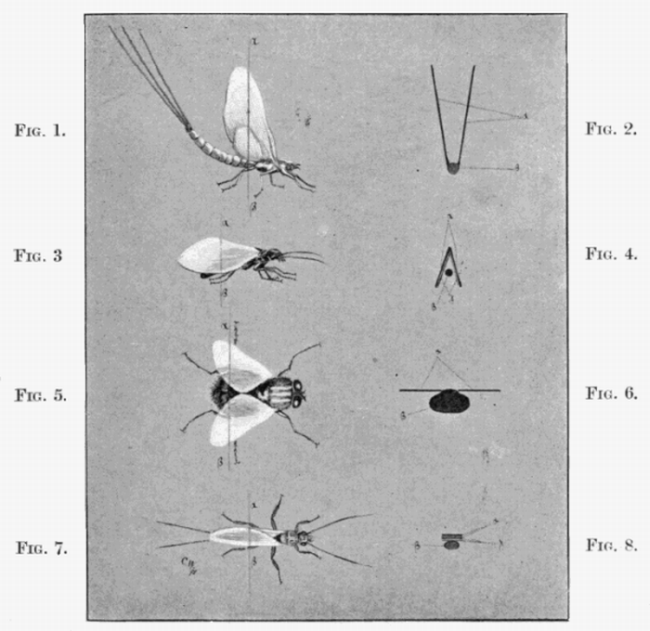
success is the position in which the wings
of the imitation are put by the fly-dresser.
In this case, like that of the Alder, the fault
does not lie with the fly-dresser, as the
writers on fly-dressing direct that the wings
should be put on in the same position as
those of every other fly—that is, in an upright
position. Any one, as I have said
before, on the most casual observation
must realise that the wings of a Blue-bottle
and the wings of a May-fly do not lie in
quite the same position in relation to the
body.
There are many Diptera which come
under the names of Blue- and Green-bottles,
but as they are very similar in
appearance it is only necessary to vary the
size, as the trout are probably not sufficiently
scientifically educated to discriminate
between the different species. The
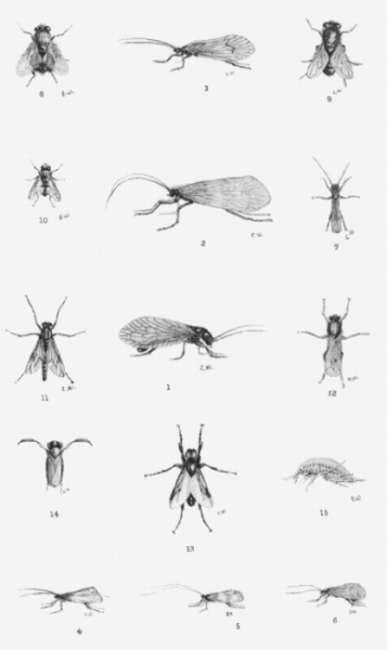
commonest species of Diptera which are
included under the popular names of Blue- and
Green-bottles, are the Calliphora
erythrocephala, Mg., and Lucilia cæsar, Linn.,
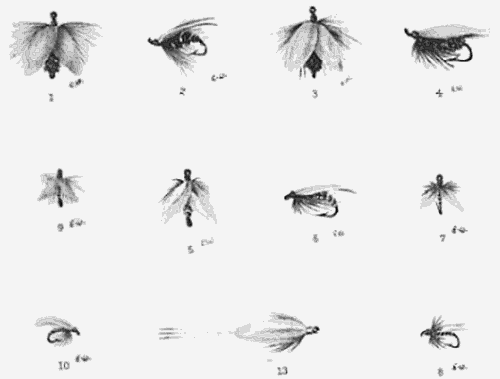
of which illustrations are given on the
Plate of Natural Flies.
August and September are the best
months for these flies, though they come
out much earlier. They seem, however, to
fall upon the water much more frequently
later in the season. They are also very
good flies for grayling in October. As I
have already said, of the many different
species which I have ventured to include
under the name Blue-bottle, the commonest
at the water side is Calliphora
erythrocephala. This fly is also found in
towns. The Green-bottle, however, which
I have chosen to represent all the others
as being the commonest at the water
side is a country fly, Lucilia Cæsar.
Some species of Lucilia, the bodies of
which are generally green, are found in
towns.
Blue-bottle—
Body. Fine dark blue chenille or dark
blue Berlin wool, ribbed with silver tinsel.
(I have found the fly very successful when
ribbed with light blue silk as well as the
tinsel.)
Hackle. Black.
Wings. Transparent wing feather of
starling.
Hook. Nos. 2—4, new size. (No. 3 best
all round.)
Green-bottle—
Body. Bright green peacock herle, ribbed
with silver tinsel.
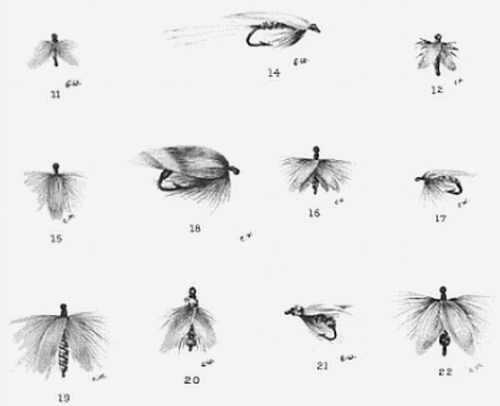
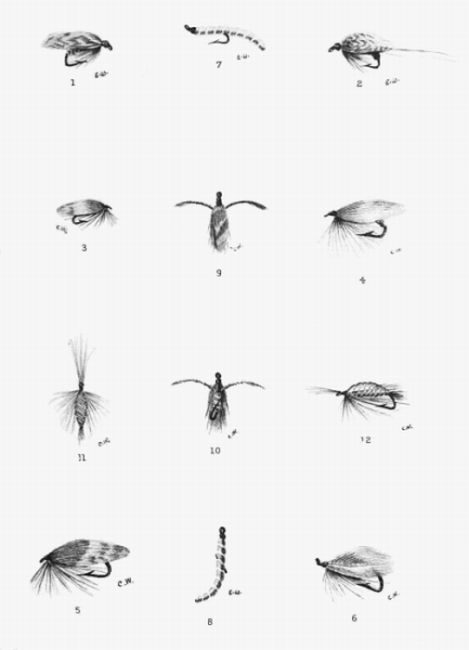
Hackle, Wings and Hook. Same as Blue-bottle.
(Illustrated Plate II.)
House-fly
There are many small Diptera which
frequent the water side, which to the ordinary
eye are apparently House-flies.
They resemble them so closely, in fact,
that many could not be discriminated from
them except by an entomologist.
I have, therefore, ventured to put them
all under the heading of “House-fly.”
The only difference which will ever have
to be made in the dressing given below
is in the body, and very rarely in the
hackle; but these modifications must be
left to the fisherman, who must judge for
himself according to the flies he finds by
the water.
I do not remember ever having met a
fisherman who had used an artificial House-fly
for trout. Trout however do feed on
them; and in this case I can bring other
evidence than my own.
Ronalds describes an experiment he
made in order to test the trout’s power
of taste; and in this experiment he used
House-flies, to which he applied various
condiments, including red pepper. Though
his object was not to prove that trout fed
readily on House-flies, I think he proved
that they did so.
Probably the commonest of these small
Diptera which is to be found by the water
is Musca corvina, Fab., which is the country
cousin of our well-known House-fly, though,
indeed, many of the flies which frequent
our houses are not the true House-fly
(Musca domestica). The male Musca corvina,
whose portrait is given on Plate I., has a
body which appears to consist of alternate
stripes of yellow and brown. The female,
however, has a uniformly dark body. Of
the other flies, very similar in appearance
to House-flies, the bodies vary in colour;
but if made of a yellowish or dull brown,
sometimes ribbed, it will generally prove
like enough to nature, to deceive the
trout.
Body. Yellow ochre-coloured Berlin wool,
spun on black silk. Ribbed with silver
tinsel and dark brown according to circumstances.
(The exact shade is easy to
see on the under surface of the natural
fly. The under surface of the fly is the
surface seen by the trout.)
Hackle. Coch-y-bondhu.
Wings. Transparent quill feather of
starling.
Hook. Nos. 00—1, new size.
(Illustrations of imitation, Plate II.)
Cow-dung Fly (Scatophaga stercoraria,
Linn.).
This fly appears as a rule in February,
but I have seen it on warm days in
January, in fairly large numbers. It lasts
all the year till the frosts set in. Those
cow-dungs which appear early in the year
are not so large as those which appear
later. The body is covered with short
hairs which gives it a velvety appearance.
The thorax is large and also has
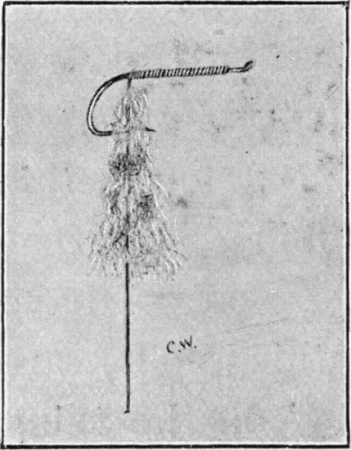
a number of hairs upon it. In order to
imitate this large thorax, it is necessary
to have more room on the hook above
the hackle and wings than in other flies
to leave room for a turn of the chenille,
of which the body is made, just below
the head of the fly. This will be seen
in the illustrations of the artificial fly on
Plate II.
The body of the male is a bright yellow
colour, that of the female is greenish. The
male is rather larger than the female.
These flies, which on windy days particularly,
frequently fall on the water, are
often taken very freely by the trout.
Though when at rest the wings are flat
upon each other, as shown in the illustration
of the natural fly in Plate I., they
often, when the fly falls on the water, are
spread out slightly; so in the imitation it
is best to put them in the position shown
in the illustration of the artificial fly.
Body. Yellow or greenish yellow chenille
ribbed with gold tinsel.
Hackle. Ginger.
Wings. Light landrail, or brownish
starling.
Hook. 0—2, new size.
Black Gnat (Bibio johannis, Linn.).
The black Gnat is found on almost all
waters. It is extremely numerous in some
places, and is taken very readily by the
trout.
These flies are not really Gnats; but as
they are commonly called Gnats by the
fishermen, I have kept to the old name.
Bibio johannis comes out in June. The
body is black in both the male and female,
the wings in the male are almost colourless,
while the wings of the female are
dark. The head of the male is also larger
than the head of the female. Both the
male and female have a dark oval-shaped
patch about the middle of the anterior
margin of the front wing.
Both these flies are taken greedily by
the trout when they fall upon the water.
I have found the following dressing the
best:—
Body. Peacock quill dyed black, or black
silk.
Hackle. Cock starling’s hackle, stripped
on one side.
Wings. (Male) From most transparent
part of quill feather of starling. (Female)
From brown tipped starling’s tail feather.
Hook. No. 000—0, new size.
An illustration of the imitation fly is
given on Plate II.
Hawthorn Fly (Bibio marci, Linn.).
Bibio marci is commonly called the Hawthorn-fly,
and was described under this
name by Ronalds. It is, speaking broadly,
first cousin to the Black Gnat, though it is
very much larger. It appears at the end of
April or the beginning of May. The body
is black, and the wings show the oval patch
in the B. johannis; but as the fly is larger,
in the B. marci it is more noticeable. As
only the male seems to rove about to any
extent, it is just as well to imitate the male
only.
Body. Black Berlin wool, ribbed with
silver tinsel.
Hackle. Black.
Wings. (Male) Transparent part of quill
feather of starling.
Hook. No. 1—3, new size.
An illustration of the natural fly is given
on Plate I., and one of the imitations on
Plate II.
Curses
There are several other small Diptera
which at times appear on the water in
swarms. These are known to the fishermen
as Curses or Smuts. They are often
so small that there is no hook made small
enough upon which to tie imitations of
them. However, as every fisherman knows,
when the trout or grayling are feeding on
these flies, it is generally impossible to
get them to take the imitation of any other
fly, it is worth while trying to imitate
them on the smallest hook made. This
is an 000, with a short shank. As it is
extremely difficult to put wings on these
flies, hackle patterns may be tried, but
the winged patterns are the best.
Once, when out fishing, I had a very
aggravating experience with some tiny
Curses. I had been fishing all the morning
and had caught nothing. At about
two o’clock I saw several good fish rising,
but they would not look at my fly. I
observed a fair number of light Olive
Duns on the water, but both the imitation
of this fly and several fancy patterns I
tried proved equally useless.
At last I seated myself on a fence close
to a clump of willows, lighted a pipe, and
began watching a fish which was rising a
few yards higher up, not far from the bank
on my side of the river. The water was
perfectly clear, and when the fish rose I
could see him distinctly. He was a
grayling of between half and three-quarters
of a pound, and rose four or five
times in the minute. There were a lot of
Smuts on the water, which from where I
was, looked very dark if not black. These
the fish rose at regularly, but he let
several Olive Duns pass by unnoticed.
The only Curses I had in my fly-box were
black; and as those he was feeding upon
appeared to be black, I put one on my cast
and floated it over him several times. But
though he once took a natural Smut floating
within an inch of my fly, my fly he would
not take.
I then went further down the bank and
caught some of the Smuts that were on the
water. They were of a mottled dun colour,
and the black effect was only produced by
their shadow or reflection (which I could
not determine) when they were on the
water.
Of the flies in my box that which came
nearest in general effect to these Curses
was a green insect (dun hackle and peacock
herle body) tied on an 000 hook. This I
put on my cast and floated over him. He
rose to it, and as he rose I could see him
distinctly. When within a few inches of
my fly, however, he stopped short, turned
aside, and took a natural Smut that was
floating past. I tried him then with an
olive quill, a Wickham, and a red tag; but
he would have none of them. I had to give
him up in despair, though I believe if I had
had a dun-coloured Smut he would have
taken it.
The dressings of Curses given here will,
I think, be sufficient to include the commoner
Curses so numerous on most waters,
especially during the hottest part of summer
and autumn.
The number of different small Diptera
which are found on the water is so great
that any attempt to classify them in a work
which is meant only for fishermen would
be out of place. I have therefore limited
myself to giving these imitations—
Curse No. 1 (Black):—
Body. Black silk or black quill, with a
turn of the narrowest silver tinsel at the
tail.
Hackle. Black.
Wings. Most transparent part of starling’s
quill feather.
Hook. 000 short shank.
(Illustrated, Plate II.)
Curse No. 2 (Dun):—
Body. Thinnest part of natural brown
ostrich.
Hackle. Dun (hen’s)
Wings and hook as No. 1.
(Illustrated, Plate II.)
Curse No. 3 (Badger):—
Body, wings and hook as No. 2.
Hackle. Cock’s badger hackle.
(Illustrated, Plate II.)
Curse No. 4 (Red):—
Body. Peacock quill dyed to a crimson
lake colour.
Hackle. Black.
Wings and hook as No. 1.
Nos. 2 and 3 should be made also without
the fluff being stripped off the quill, which
in this case should be used just as peacock
herle is used.
The Oak-fly (Leptis scolopacea, Linn.).
This fly, notwithstanding its popular
name, is found on many other trees, and I
have seen it in places where there were
no oak-trees near. It kills very well, and
is in season from April to July. The body
is long and tapered, and the segments of
the abdomen are, in the male, of a brilliant
orange colour, with black markings upon
them, as shown in the illustration of the
natural fly on Plate I. The wings are
brown.
Body. Reddish orange Berlin wool, ribbed
with black silk, and narrow gold tinsel.
Hackle. Coch-y-bondhu.
Wings. From sixth or seventh quill
feathers of landrail wings.
Hook. New size, No. 2—3.
(Imitation illustrated on Plate II., Figs. 3
and 4.)
 Swan Electric Engraving C⚬.