Charles Lamb was so paralyzed, it is said, by
Coleridge’s death, that for weeks after that event, he was
heard murmuring often to himself, “Coleridge is dead,
Coleridge is dead.” In such a mental condition at
this moment is an entire country, I think. “Tennyson
is dead! Tennyson is dead!” It will be some
time before England’s loss can really be expressed by any
words so powerful in pathos and in sorrow as these. And if
this is so with regard to English people generally, what of those
few who knew the man, and knowing him, must needs love
him—must needs love him above all others?—those, I
mean, who, when speaking of him, used to talk not so much about
the poetry as about the man who wrote it—those who now are
saying, with a tremor of the voice, and a moistening of the
eye:—
There was none like him—none.
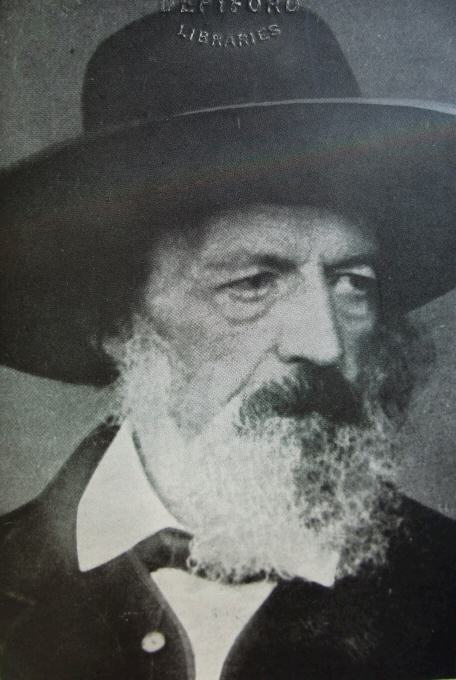
To say wherein lies the secret of the charm of anything that
lives is mostly difficult. Especially is it so
with regard to a man of poetic genius. All are agreed, for
instance, that D. G. Rossetti possessed an immense charm.
So he did, indeed. But who has been able to define that
charm? I, too, knew Rossetti well, and loved him
well. Sometimes, indeed, the egotism of a sorrowing memory
makes me think that outside his own most affectionate and
noble-tempered family, including that old friend in art at whose
feet he sat as a boy, no man loved Rossetti so deeply and so
lastingly as I did; unless, perhaps, it was the poor blind poet,
Philip Marston, who, being so deeply stricken, needed to love and
to be loved more sorely than I, to whom Fate has been kind.
And yet I should find it difficult to say wherein lay the charm
of Rossetti’s chameleon-like personality. So with
other men and women I could name. This is not so in regard
to the great man now lying dead at Aldworth. Nothing is
easier than to define the charm of Tennyson.
It lay in a great veracity of soul—in a
simple-mindedness so childlike that, unless you had known him to
be the undoubted author of his exquisitely artistic poems, you
would have supposed that even the subtleties of poetic art must
be foreign to a nature so devoid of all subtlety as his.
“Homer,” you would have said, “might have been
such a man as this, for Homer worked in a language which is
Poetry’s very voice. But Tennyson works in a language
which has to be moulded into harmony by a myriad
subtleties of art. How can this great inspired child, who
yet has the simple wisdom of Bragi, the poetry-smith of the
Northern Olympus, be the delicate-fingered artist of ‘The
Princess,’ ‘The Palace of Art,’ ‘The
Day-Dream,’ and ‘The Dream of Fair
Women’?”
As deeply as some men feel that language was given to men to
disguise their thoughts did Tennyson feel that language was given
to him to declare his thoughts without disguise. He
knew of but one justification for the thing he said, viz., that
it was the thing he thought. Arrière
pensée was with him impossible. But, it may be
asked, when a man carries out-speaking to such a pass as this, is
he not apt to become a somewhat troublesome and discordant thread
in the complex web of modern society? No doubt any other
man than Tennyson would have been so. But the honest ring
in the voice—which, by-the-by, was strengthened and
deepened by the old-fashioned Lincolnshire accent—softened
and, to a great degree, neutralized the effect of the
bluntness. Moreover, behind this uncompromising directness
was apparent a noble and a splendid courtesy; for, above all
things, Tennyson was a great and forthright English
gentleman. As he stood at the porch at Aldworth, meeting a
guest or bidding him good-bye—as he stood there, tall, far
beyond the height of average men, his naturally fair skin showing dark and tanned by the sun and
wind—as he stood there no one could mistake him for
anything but a great gentleman, who was also much more. Up
to the last a man of extraordinary presence, he showed, I think,
the beauty of old age to a degree rarely seen.
A friend of his who, visiting him on his birthday, discovered
him thus standing at the door to welcome him, has described his
unique appearance in words which are literally accurate at
least:—
A poet should be limned in youth, they say,
Or else in prime, with eyes and forehead beaming
Of manhood’s noon—the very body
seeming
To lend the spirit wings to win the bay;
But here stands he whose noontide blooms for aye,
Whose eyes, where past and future both are
gleaming
With lore beyond all youthful poets’
dreaming,
Seem lit from shores of some far-glittering day.
Our master’s prime is now—is ever now;
Our star that wastes not in the wastes of night
Holds Nature’s dower undimmed in Time’s
despite;
Those eyes seem Wisdom’s own beneath that brow,
Where every furrow Time hath dared to plough
Shines a new bar of still diviner light.
This, then, was the secret of Tennyson’s personal
charm. And if the reader is sceptical as to its magnetic
effect upon his friends, let me remind him of the amazing rarity
of these great and guileless natures; let me remind him also that
this world is comprised of two classes of people—the bores,
whose name is legion, and the interesting people, whose name is
not legion—the former being those whose
natural instinct of self-protective mimicry impels them to move
about among their fellows hiding their features behind a mask of
convention, the latter being those who move about with uncovered
faces just as Nature fashioned them. If guilelessness lends
interest to a dullard, it is still more so with the really
luminous souls. So infinite is the creative power of nature
that she makes no two individuals alike. If we only had the
power of inquiring into the matter, we should find not only that
each individual creature that once inhabited one of the minute
shells that go to the building of England’s fortress walls
of chalk was absolutely unlike all the others, but that even the
poor microbe himself, who in these days is so maligned, is also
very intensely an individual.
Some time ago the old discussion was revived in The
Athenæum as to whether the nightingale’s song was
joyful or melancholy. And, perhaps, if the poems of the
late James Thomson and the poems of Mr. Austin Dobson were
recited by their authors to a congregation of nightingales, the
question would at once be debated amongst them, “Is the
note of the human songster joyful or melancholy?” The
truth is that the humidity or the dryness of the atmosphere in
the various habitats of the nightingale modifies so greatly the
timbre of the voice that, while a nightingale chorus at
Fiesole may seem joyous, a
nightingale chorus in the moist thickets along the banks of the
Ouse may seem melancholy. Nay, more, as I once told
Tennyson at Aldworth, I, when a truant boy wandering along the
banks of the Ouse (where six nightingales’ nests have been
found in the hedge of a single meadow), got so used to these
matters that I had my own favourite individuals, and could easily
distinguish one from another. That rich climacteric swell
which is reached just before the “jug, jug, jug,”
varies amazingly, if the listener will only give the matter
attention. And if this infinite variety of individualism is
thus seen in the lower animals, what must it be in man?
There is, however, in the entire human race, a fatal instinct
for marring itself. To break down the exterior signs of
this variety of individualism in the race by mutual imitation, by
all sorts of affectations, is the object not only of the
civilization of the Western world, but of the very negroes on the
Gaboon River. No wonder, then, that whensoever we meet, as
at rarest interval we do meet, an individual who is able to
preserve his personality as Nature meant it to live, we feel an
attraction towards him such as is irresistible. Now I would
challenge those who knew him to say whether they ever knew any
other man so free from this great human infirmity as
Tennyson. The way in which his simplicity of nature would
manifest itself was, in some instances, most
remarkable. Though, of course, he had his share of that
egoism of the artist without which imaginative genius may become
sterile, it seemed impossible for him to realize what a
transcendent position he took among contemporary writers all over
the world. “Poets,” he once said to me,
“have not had the advantage of being born to the
purple.” Up to the last he felt himself to be a poet
at struggle more or less with the Wilsons and the Crokers who, in
his youth, assailed him. I, and a very dear friend of his,
a family connexion, tried in vain to make him see that when a
poet had reached a position such as he had won, no criticism
could injure him or benefit him one jot.
What has been called his exclusiveness is entirely
mythical. He was the most hospitable of men. It was
very rare, indeed, for him to part from a friend at his hall
door, or at the railway station without urging him to return as
soon as possible, and generally with the words, “Come
whenever you like.” The fact is, however, that for
many years the strangest notions seem to have got abroad as to
the claims of the public upon men of genius. There seems
now to be scarcely any one who does not look upon every man who
has passed into the purgatory of fame as his or her common
property. The unlucky victim is to be pestered by letters
upon every sort of foolish subject, and to be hunted down in his walks and insulted by senseless
adulation. Tennyson resented this, and so did Rossetti, and
so ought every man who has reached eminence and respects his own
genius. Neither fame nor life itself is worth having on
such terms as these.
One day, Tennyson when walking round his garden at
Farringford, saw perched up in the trees that surrounded it, two
men who had been refused admittance at the gate—two men
dressed like gentlemen. He very wisely gave the public to
understand that his fame was not to be taken as an abrogation of
his rights as a private English gentleman. For my part,
whenever I hear any one railing against a man of eminence with
whom he cannot possibly have been brought into contact, I know at
once what it means: the railer has been writing an idle letter to
the eminent one and received no reply.
Tennyson’s knowledge of nature—nature in every
aspect—was very great. His passion for
“star-gazing” has often been commented upon by
readers of his poetry. Since Dante no poet in any land has
so loved the stars. He had an equal delight in watching the
lightning; and I remember being at Aldworth once during a
thunderstorm, when I was alarmed at the temerity with which he
persisted, in spite of all remonstrances, in gazing at the
blinding lightning. For moonlight effects he had a passion
equally strong, and it is especially pathetic to those who know this to remember that he passed away in
the light he so loved—in a room where there was no
artificial light—nothing to quicken the darkness but the
light of the full moon (which somehow seems to shine more
brightly at Aldworth than anywhere else in England); and that on
the face of the poet, as he passed away, fell that radiance in
which he so loved to bathe it when alive.
If it is as easy to describe the personal attraction of
Tennyson as it is difficult to describe that of any one of his
great contemporaries, we do not find the same relations existing
between him and them as regards his place in the firmament of
English poetry. In a country with a composite language such
as ours, it may be affirmed with special emphasis, that there are
two kinds of poetry; one appealing to the uncultivated masses,
whose vocabulary is of the narrowest; the other appealing to the
few who, partly by temperament, and partly by education, are
sensitive to the true beauties of poetic art. While in the
one case the appeal is made through a free and popular use of
words, partly commonplace and partly steeped in that literary
sentimentalism which in certain stages of an artificial society
takes the place of the simple utterances of simple passion of
earlier and simpler times; in the other case the appeal is made
very largely through what Dante calls the “use of the sieve
for noble words.”
Of the one perhaps Byron is the type, the exemplars
being such poets as those of the Mrs. Hemans school in England,
and of the Longfellow school in America. Of the other class
of poets, the class typified by Milton, the most notable
exemplars are Keats, Shelley, and Coleridge. Wordsworth
partakes of the qualities of both classes. The methods of
the first of these two groups are so cheap—they are so
based on the wide severance between the popular taste and the
poetic temper (which, though in earlier times it inspired the
people, is now confined to the few)—that one may say of the
first group that their success in finding and holding an audience
is almost damnatory to them as poets. As compared with the
poets of Greece, however, both groups may be said to have secured
only a partial success in poetry; for not only Æschylus and
Sophocles, but Homer too, are as satisfying in the matter of
noble words as though they had never tried to win that popular
success which was their goal. In this respect—as
being, I mean, the compeer of the great poets of
Greece—Shakespeare takes his peculiar place in English
poetry. Of all poets he is the most popular, and yet in his
use of the “sieve for noble words” his skill
transcends that of even Milton, Coleridge, Shelley, and
Keats. His felicities of diction in the great passages seem
little short of miraculous, and they are so many that it is easy to understand why he is so often spoken of as
being a kind of inspired improvisatore. That he was
not an improvisatore, however, any one can see who will
take the trouble to compare the first edition of ‘Romeo and
Juliet’ with the received text, the first sketch of
‘The Merry Wives of Windsor’ with the play as we now
have it, and the ‘Hamlet’ of 1603 with the
‘Hamlet’ of 1604, and with the still further varied
version of the play given by Heminge and Condell in the Folio of
1623. If we take into account, moreover, that it is only by
the lucky chapter of accidents that we now possess the earlier
forms of the three plays mentioned above, and that most likely
the other plays were once in a like condition, we shall come to
the conclusion that there was no more vigilant worker with
Dante’s sieve than Shakespeare. Next to Shakespeare
in this great power of combining the forces of the two great
classes of English poets, appealing both to the commonplace sense
of a commonplace public and to the artistic sense of the few,
stands, perhaps, Chaucer; but since Shakespeare’s time no
one has met with anything like Tennyson’s success in
effecting a reconciliation between popular and artistic sympathy
with poetry in England.
The biography of such a poet, one who has had such an immense
influence upon the literary history of the entire Victorian
epoch—indeed, upon the nineteenth century,
for his work covers two-thirds of the century—will be a
work of incalculable importance. There is but one man who
is fully equipped for such an undertaking, and fortunately that
is his own son—a man of great ability, of admirable
critical acumen, and of quite exceptional accomplishments.
His son’s filial affection was so precious to Tennyson
that, although the poet’s powers remained undimmed to the
last day of his life, I do not believe that we should have had
all the splendid work of the last ten years without his
affectionate and unwearied aid.
All emotion—that of communities as well as that of
individuals—is largely governed by the laws of ebb and
flow. It is immediately after a national mourning for the
loss of a great man that a wave of reaction generally sets
in. But the eagerness with which these volumes [132] have been awaited shows that
Tennyson’s hold upon the British public is as strong at
this moment as it was on the day of his death. This very
popularity of his, however, has sometimes been spoken of by
critics as though it were an impeachment of him as a poet.
“The English public is commonplace,” they say,
“and hence the commonplace in poetry suits it.”
And no doubt this is true as a general saying, otherwise what
would become of certain English poetasters who are such a joy to
the many and such a source of laughter to the few? But a
hardy critic would he be who should characterize Tennyson’s
poetry as commonplace—that very poetry which, before it
became popular, was decried because it was merely “poetry
for poets.” Still that poetry so rich and so rare as
his should find its way to the heart of
a people like the English, who have “not sufficient poetic
instinct in them to give birth to vernacular poetry,” is
undoubtedly a striking fact. With regard to the mass of his
work, he belonged to those poets whose appeal is as much through
their mastery over the more subtle beauties of poetic art as
through the heat of the poetic fire; and such as these must
expect to share the fate of Coleridge, Keats, and Shelley.
Every true poet must have an individual accent of his
own—an accent which is, however, recognizable as another
variation of that large utterance of the early gods common to all
true poets in all tongues. Is it not, then, in the nature
of things that, in England at least, “the fit though
few” comprise the audience of such a poet until the voice
of recognized Authority proclaims him? But Authority moves
slowly in these matters; years have to pass before the music of
the new voice can wind its way through the convolutions of the
general ear—so many years, indeed, that unless the poet is
blessed with the sublime self-esteem of Wordsworth he generally
has to die in the belief that his is another name “written
in water.” And was it always so? Yes,
always.
England having, as we have said, no vernacular song, her
poetry is entirely artistic, even such poetry as ‘The May
Queen,’ ‘The Northern Farmer,’ and the idyls of
William Barnes. And it would be strange indeed
if, until Authority spoke out, the beauties of artistic poetry
were ever apparent to the many. Is it supposable, for
instance, that even the voice of Chaucer—is it supposable
that even the voice of Shakspeare—would have succeeded in
winning the contemporary ear had it not been for that great mass
of legendary and romantic material which each of these found
ready to his hand, waiting to be moulded into poetic form?
The fate, however, of Moore’s poetical narratives (perhaps
we might say of Byron’s too) shows that if any poetry is to
last beyond the generation that produced it, there is needed not
only the romantic material, but also the accent, new and true, of
the old poetic voice. And these volumes show why in these
late days, when the poet’s inheritance of romantic material
seemed to have been exhausted, there appeared one poet to whom
the English public gave an acceptance as wide almost as if he had
written in the vernacular like Burns or Béranger.
It is long since any book has been so eagerly looked forward
to as this. The main facts of Tennyson’s life have
been matter of familiar knowledge for so many years that we do
not propose to run over them here once more. Nor shall we
fill the space at our command with the biographer’s
interesting personal anecdotes. So fierce a light had been
beating upon Aldworth and Farringford that the relations
of the present Lord Tennyson to his father were pretty generally
known. In the story of English poetry these relations held
a place that was quite unique. What the biographer says
about the poet’s sagacity, judgment, and good
sense—especially what he says about his insight into the
characters of those with whom he was brought into
contact—will be challenged by no one who knew him.
Still, the fact remains that Tennyson’s temperament was
poetic entirely. And the more attention the poet pays to
his art, the more unfitted does he become to pay attention to
anything else. For in these days the mechanism of social
life moves on grating wheels that need no little oiling if the
poet is to bring out the very best that is within him. Not
that all poets are equally vexed by the special infirmity of the
poetic temperament. Poets like Wordsworth, for instance,
are supported against the world by love of Nature and by that
“divine arrogance” which is sometimes a
characteristic of genius. Tennyson’s case shows that
not even love of Nature and intimate communings with her are of
use in giving a man peace when he has not Wordsworth’s
temperament. No adverse criticism could disturb
Wordsworth’s sublime self-complacency.
“Your father,” writes Jowett, with his usual
wisdom, to Lord Tennyson, “was very sensitive, and had an honest hatred of being gossiped about.
He called the malignant critics and chatterers
‘mosquitos.’ He never felt any pleasure at
praise (except from his friends), but he felt a great pain at the
injustice of censure. It never occurred to him that a new
poet in the days of his youth was sure to provoke dangerous
hostilities in the ‘genus irritabile vatum’ and in
the old-fashioned public.”
It might almost be said, indeed, that had it not been for the
ministrations, first of his beloved wife, and then of his sons,
Tennyson’s life would have been one long warfare between
the attitude of his splendid intellect towards the universe and
the response of his nervous system to human criticism. From
his very childhood he seems to have had that instinct for
confronting the universe as a whole which, except in the case of
Shakespeare, is not often seen among poets. Star-gazing and
speculation as to the meaning of the stars and what was going on
in them seem to have begun in his childhood. In his first
Cambridge letter to his aunt, Mrs. Russell, written from No. 12,
Rose Crescent, he says, “I am sitting owl-like and solitary
in my room, nothing between me and the stars but a stratum of
tiles.” And his son tells us of a story current in
the family that Frederick, when an Eton schoolboy, was shy of
going to a neighbouring dinner-party to which he had been
invited. “Fred,” said his younger brother,
“think of Herschel’s great star-patches, and you will
soon get over all that.” He had Wordsworth’s
passion, too, for communing with Nature alone. He was one
of Nature’s elect who knew that even the company of a dear
and intimate friend, howsoever close, is a disturbance of the
delight that intercourse with her can afford to the true
devotee. In a letter to his future wife, written from
Mablethorpe in 1839, he says:—
“I am not so able as in old years to commune
alone with Nature . . . Dim mystic sympathies with tree
and hill reaching far back into childhood, a known landskip is to
me an old friend, that continually talks to me of my own youth
and half-forgotten things, and indeed does more for me than many
an old friend that I know. An old park is my delight, and I
could tumble about it for ever.”
Moreover, he was always speculating upon the mystery and the
wonder of the human story. “The far future,” he
says in a letter to Miss Sellwood, written from High Beech in
Epping Forest, “has been my world always.” And
yet so powerless is reason in that dire wrestle with temperament
which most poets know, that with all these causes for despising
criticism of his work, Tennyson was as sensitive to critical
strictures as Wordsworth was indifferent. “He
fancied,” says his biographer, “that
England was an unsympathetic atmosphere, and half resolved to
live abroad in Jersey, in the South of France, or in Italy.
He was so far persuaded that the English people would never care
for his poetry, that, had it not been for the intervention of his
friends, he declared it not unlikely that after the death of
Hallam he would not have continued to write.” And
again, in reference to the completion of ‘The Sleeping
Beauty,’ his son says, “He warmed to his work because
there had been a favourable review of him lately published in
far-off Calcutta.”
We dwell upon this weakness of Tennyson’s—a
weakness which, in view of his immense powers, was certainly a
source of wonder to his friends—in order to show, once for
all, that without the tender care of his son he could never in
his later years have done the work he did. This it was
which caused the relations between Tennyson and the writer of
this admirable memoir to be those of brother with brother rather
than of father with son. And those who have been eagerly
looking forward to these volumes will not be disappointed.
In writing the life of any man there are scores and scores of
facts and documents, great and small, which only some person
closely acquainted with him, either as relative or as friend, can
bring into their true light; and this it is which makes documents
so deceptive. Here is an instance of what we mean. In
writing to Thompson, Spedding says of
Tennyson on a certain occasion: “I could not get Alfred to
Rydal Mount. He would and would not (sulky one!), although
Wordsworth was hospitably minded towards him.” This
remark would inevitably have been construed into another instance
of that churlishness which is so often said (though quite
erroneously) to have been one of Tennyson’s
infirmities. But when we read the following foot-note by
the biographer, “He said he did not wish to intrude himself
on the great man at Rydal,” we accept the incident as
another proof of that “humility” which the son
alludes to in his preface as being one of his father’s
characteristics. And of such evidence that had not the
poet’s son written his biography the loss to literature
would have been incalculable the book is full. Evidence of
a fine intellect, a fine culture, and a sure judgment is afforded
by every page—afforded as much by what is left unsaid as by
what is said.
The biographer has invited a few of the poet’s friends
to furnish their impressions of him. These could not fail
to be interesting; it is pleasant to know what impression
Tennyson made upon men of such diverse characters as the Duke of
Argyll, Jowett, Tyndall, Froude, and others. But so far as
a vital portrait of the man is concerned they were not needed, so
vigorously does the man live in the portrait painted by him who
knew the poet best of all.
“For my own part,” says the biographer,
“I feel strongly that no biographer could so truly give him
as he gives himself in his own works; but this may be because,
having lived my life with him, I see him in every word which he
has written; and it is difficult for me so far to detach myself
from the home circle as to pourtray him for others. There
is also the impossibility of fathoming a great man’s mind;
his deeper thoughts are hardly ever revealed. He himself
disliked the notion of a long, formal biography, for
None can truly write his single day,
And none can write it for him upon earth.
“However, he wished that, if I deemed it better, the
incidents of his life should be given as shortly as might be
without comment, but that my notes should be final and full
enough to preclude the chance of further and unauthentic
biographies.
“For those who cared to know about his literary history
he wrote ‘Merlin and the Gleam.’ From his
boyhood he had felt the magic of Merlin—that spirit of
poetry—which bade him know his power and follow throughout
his work a pure and high ideal, with a simple and single
devotedness and a desire to ennoble the life of the world, and
which helped him through doubts and difficulties to ‘endure
as seeing Him who is invisible.’
Great the Master,
And sweet the Magic,
When over the valley,
In early summers,
Over the mountain,
On human faces,
And all around me,
Moving to melody,
Floated the Gleam.
“In his youth he sang of the brook flowing through his
upland valley, of the ‘ridged wolds’ that rose above
his home, of the mountain-glen and snowy summits of his early
dreams, and of the beings, heroes and fairies, with which his
imaginary world was peopled. Then was heard the
‘croak of the raven,’ the harsh voice of those who
were unsympathetic—
The light retreated,
The Landskip darken’d,
The melody deaden’d,
The Master whisper’d,
‘Follow the Gleam.’
“Still the inward voice told him not to be faint-hearted
but to follow his ideal. And by the delight in his own
romantic fancy, and by the harmonies of nature, ‘the warble
of water,’ and ‘cataract music of falling
torrents,’ the inspiration of the poet was renewed.
His Eclogues and English Idyls followed, when he sang the songs
of country life and the joys and griefs of country folk, which he
knew through and through,
Innocent maidens,
Garrulous children,
Homestead and harvest,
Reaper and gleaner,
And rough-ruddy faces
Of lowly labour.
“By degrees, having learnt somewhat of the real
philosophy of life and of humanity from his own experience, he
rose to a melody ‘stronger and
statelier.’ He celebrated the glory of ‘human
love and of human heroism’ and of human thought, and began
what he had already devised, his epic of King Arthur,
‘typifying above all things the life of man,’ wherein
he had intended to represent some of the great religions of the
world. He had purposed that this was to be the chief work
of his manhood. Yet the death of his friend, Arthur Hallam,
and the consequent darkening of the whole world for him made him
almost fail in this purpose; nor any longer for a while did he
rejoice in the splendour of his spiritual visions, nor in the
Gleam that had ‘waned to a wintry glimmer.’
Clouds and darkness
Closed upon Camelot;
Arthur had vanish’d
I knew not whither,
The King who loved me,
And cannot die.
“Here my father united the two Arthurs, the Arthur of
the Idylls and the Arthur ‘the man he held as half
divine.’ He himself had fought with death, and had
come out victorious to find ‘a stronger faith his
own,’ and a hope for himself, for all those in sorrow and
for universal human kind, that never forsook him through the
future years.
And broader and brighter
The Gleam flying onward,
Wed to the melody,
Sang thro’ the world.
* * *
I saw, wherever
In passing it glanced upon
Hamlet or city,
That under the Crosses
The dead man’s garden,
The mortal hillock,
Would break into blossom;
And so to the land’s
Last limit I came.
“Up to the end he faced death with the same earnest and
unfailing courage that he had always shown, but with an added
sense of the awe and the mystery of the Infinite.
I can no longer,
But die rejoicing,
For thro’ the Magic
Of Him the Mighty,
Who taught me in childhood,
There on the border
Of boundless Ocean,
And all but in Heaven
Hovers the Gleam.
“That is the reading of the poet’s riddle as he
gave it to me. He thought that ‘Merlin and the
Gleam’ would probably be enough of biography for those
friends who urged him to write about himself. However, this
has not been their verdict, and I have tried to do what he said
that I might do.”
There are many specialists in Tennysonian bibliography who
take a pride (and a worthy pride) in their knowledge of the
master’s poems. But the knowledge of all of these
specialists put together is not equal to that of him who writes
this book. Not only is every line at his fingers’
ends, but he knows, either from his own memory or from what his
father has told him, where and when and why every line was
written. He, however, shares, it is evident that
dislike—rather let us say that passionate
hatred—which his father, like so many other poets, had of
that well-intentioned but vexing being whom Rossetti
anathematized as the “literary resurrection
man.” Rossetti used to say that “of all signs
that a man was devoid of poetic instinct and poetic feeling the
impulse of the literary resurrectionist was the
surest.” Without going so far as this we may at least
affirm that all poets writing in a language requiring, as English
does, much manipulation before it can be moulded into perfect
form must needs revise in the brain before the line is set down,
or in manuscript, as Shelley did, or partly in manuscript and
partly in type, as Coleridge did. But the rakers-up of the
“chips of the workshop,” to use Tennyson’s own
phrase, seem to have been specially irritating to him, because he
belonged to those poets who cannot really revise and complete
their work till they see it in type. “Poetry,”
he said, “looks better, more convincing in
print.”
“From the volume of 1832,” says his son, “he
omitted several stanzas of ‘The Palace of Art’
because he thought that the poem was too full. ‘The
artist is known by his self-limitation’ was a favourite
adage of his. He allowed me, however, to print some of them
in my notes, otherwise I should have hesitated to quote without
his leave lines that he had excised. He ‘gave the
people of his best,’ and he usually
wished that his best should remain without variorum readings,
‘the chips of the workshop,’ as he called them.
The love of bibliomaniacs for first editions filled him with
horror, for the first editions are obviously in many cases the
worst editions, and once he said to me: ‘Why do they
treasure the rubbish I shot from my full-finish’d
cantos?’
νηπιοι
ουδε
ισασιν οσω
πλέον ημισυ
παντος.
For himself many passages in Wordsworth and other poets have
been entirely spoilt by the modern habit of giving every various
reading along with the text. Besides, in his case, very
often what is published as the latest edition has been the
original version in his first manuscript, so that there is no
possibility of really tracing the history of what may seem to be
a new word or a new passage. ‘For instance,’ he
said, ‘in “Maud” a line in the first edition
was ‘I will bury myself in my books, and the Devil
may pipe to his own,’ which was afterwards altered to
‘I will bury myself in myself, &c.’: this
was highly commended by the critics as an improvement on the
original reading—but it was actually in the first
MS. draft of the poem.”
Again, it is important to get a statement by one entitled to
speak with authority as to what Tennyson did and what he did not
believe upon religious matters. He had in ‘In
Memoriam’ and other poems touched with a hand so strong and sometimes so daring upon the teaching of
modern science, and yet he had spoken always so reverently of
what modern civilization reverences, that the most opposite
lessons were read from his utterances. To one thinker it
would seem that Tennyson had thrown himself boldly upon the very
foremost wave of scientific thought. To another it would
seem that Wordsworth (although, living and writing when he did,
before the birth of the new cosmogony, he believed himself to be
still in trammels of the old) was by temperament far more in
touch with the new cosmogony than was Tennyson, who studied
evolution more ardently than any poet since Lucretius.
While Wordsworth, notwithstanding a conventional phrase here and
there, had an apprehension of Nature without the ever-present
idea of the Power behind her, Spinosa himself was not so
“God-intoxicated” a man as Tennyson. His son
sets the question at rest in the following pregnant
words:—
“Assuredly Religion was no nebulous abstraction for
him. He consistently emphasized his own belief in what he
called the Eternal Truths; in an Omnipotent, Omnipresent, and
All-loving God, Who has revealed Himself through the human
attribute of the highest self-sacrificing love; in the freedom of
the human will; and in the immortality of the soul. But he
asserted that ‘Nothing worthy proving can be proven,’
and that even as to the great laws which are the basis of
Science, ‘We have but faith,
we cannot know.’ He dreaded the dogmatism of sects
and rash definitions of God. ‘I dare hardly name His
Name,’ he would say, and accordingly he named Him in
‘The Ancient Sage’ the ‘Nameless.’
‘But take away belief in the self-conscious personality of
God,’ he said, ‘and you take away the backbone of the
world.’ ‘On God and God-like men we build our
trust.’ A week before his death I was sitting by him,
and he talked long of the Personality and of the Love of God,
‘That God, Whose eyes consider the poor,’ ‘Who
catereth, even for the sparrow.’ ‘I
should,’ he said, ‘infinitely rather feel myself the
most miserable wretch on the face of the earth with a God above,
than the highest type of man standing alone.’ He
would allow that God is unknowable in ‘his whole
world-self, and all-in-all,’ and that, therefore, there was
some force in the objection made by some people to the word
‘Personality’ as being ‘anthropomorphic,’
and that, perhaps ‘Self-consciousness’ or
‘Mind’ might be clearer to them: but at the same time
he insisted that, although ‘man is like a thing of
nought’ in ‘the boundless plan,’ our highest
view of God must be more or less anthropomorphic: and that
‘Personality,’ as far as our intelligence goes, is
the widest definition and includes ‘Mind,’
‘Self-consciousness,’ ‘Will,’
‘Love,’ and other attributes of the Real, the
Supreme, ‘the High and Lofty One that inhabiteth Eternity,
Whose name is Holy.’”
And then Lord Tennyson quotes a manuscript note of
Jowett’s in which he says:—
“Alfred Tennyson thinks it ridiculous to believe in a God and deny his consciousness, and was
amused at some one who said of him that he had versified
Hegelianism.”
He notes also an anecdote of Edward Fitzgerald’s which
speaks of a week with Tennyson, when the poet, picking up a
daisy, and looking closely at its crimson-tipped leaves, said,
“Does not this look like a thinking Artificer, one who
wishes to ornament?”
Here is a paragraph which will be read with the deepest
interest, not only by every lover of poetry, but by every man
whose heart has been rung by the most terrible of all
bereavements—the loss of a beloved friend. Close as
the tie of blood relationship undoubtedly is, it is based upon
convention as much as upon nature. It may exist and
flourish vigorously when there is little or no community of taste
or of thought:—
“It may be as well to say here that all the letters from
my father to Arthur Hallam were destroyed by his father after
Arthur’s death: a great loss, as these particular letters
probably revealed his inner self more truly than anything outside
his poems.”
We confess to belonging to those who always read with a twinge
of remorse the private letters of a man in print. But if
there is a case where one must needs long to see the letters
between two intimate friends, it is that of Tennyson and Arthur
Hallam. They would have been only second in interest to
Shakespeare’s letters to that mysterious
“Mr. W. H.” whose identity now can never be
traced. For, notwithstanding all that has recently been
said, and ably said, to the contrary, the man to whom many of the
sonnets were addressed was he whom “T. T.” addresses
as “Mr. W. H.”
But for an intimacy to be so strong as that which existed
between Tennyson and Arthur H. Hallam there must be a kinship of
soul so close and so rare that the tie of blood relationship
seems weak beside it. It is then that friendship may
sometimes pass from a sentiment into a passion. It did so
in the case of Shakespeare and his mysterious friend, as the
sonnets in question make manifest; but we are not aware that
there is in English literature any other instance of friendship
as a passion until we get to ‘In Memoriam.’ So
profound was the effect of Hallam’s death upon Tennyson
that it was the origin, his son tells us, of ‘The Two
Voices; or, Thoughts of a Suicide.’ What was the
secret of Hallam’s influence over Tennyson can never be
guessed from anything that he has left behind either in prose or
verse. But besides the creative genius of the artist there
is that genius of personality which is irresistible. With a
very large gift of this kind of genius Arthur Hallam seems to
have been endowed.
“In the letters from Arthur Hallam’s
friends,” says Lord Tennyson, “there was a rare
unanimity of opinion about his worth.
Milnes, writing to his father, says that he had a ‘very
deep respect’ for Hallam, and that Thirlwall, in after
years the great bishop, for whom Hallam and my father had a
profound affection, was ‘actually captivated by
him.’ When at Cambridge with Hallam he had written:
‘He is the only man here of my own standing before whom I
bow in conscious inferiority in everything.’ Alford
writes: ‘Hallam was a man of wonderful mind and knowledge
on all subjects, hardly credible at his age. . . . I long
ago set him down for the most wonderful person I ever knew.
He was of the most tender, affectionate
disposition.’”
Lord Tennyson’s remarks upon the ‘Idylls of the
King,’ and upon the enormous success of the book have a
special interest, and serve to illustrate our opening remarks
upon the popularity of his father’s works. Popular as
Tennyson had become through ‘The Gardener’s
Daughter,’ ‘The Miller’s Daughter,’
‘The May Queen,’ ‘The Lord of Burleigh,’
and scores of other poems—endeared to every sorrowing heart
as he had become through ‘In Memoriam’—it was
the ‘Idylls of the King’ that secured for him his
unique place. Many explanations of the phenomenon of a true
poet securing the popular suffrages have been offered, one of
them being his acceptance of the Laureateship. But
Wordsworth, a great poet, also accepted it; and he never
was and never will be popular. The wisdom of what Goethe
says about the enormous importance of “subject” in
poetic art is illustrated by the story of Tennyson and the
‘Idylls of the King.’
For what was there in the ‘Idylls of the King’
that brought all England to Tennyson’s feet—made
English people re-read with a new seeing in their eyes the poems
which they once thought merely beautiful, but now thought half
divine? Beautiful these ‘Idylls’ are indeed,
but they are not more beautiful than work of his that went
before. The rich Klondyke of Malory and Geoffrey of
Monmouth had not escaped the eyes of previous prospectors.
All his life Milton had dreamed of the mines lying concealed in
the “misty mid-region” of King Arthur and the Round
Table, but, luckily for Tennyson, was led away from it into other
paths. With Milton’s immense power of sensuous
expression—a power that impelled him, even when dealing
with the spirit world, to flash upon our senses pictures of the
very limbs of angels and fiends at fight—we may imagine
what an epic of King Arthur he would have produced. Dryden
also contemplated working in this mine, but never did; and until
Scott came with his Lyulph’s Tale in ‘The Bridal of
Triermain,’ no one had taken up the subject but writers
like Blackmore. Then came Bulwer’s burlesque. Now no prospector on the banks of the
Yukon has a keener eye for nuggets than Tennyson had for poetic
ore, and besides ‘The Lady of Shalott’ and
‘Launcelot and Guinevere,’ he had already printed the
grandest of all his poems—the ‘Morte
d’Arthur.’ It needed only the ‘Idylls of
the King,’ where episode after episode of the Arthurian
cycle was rendered in poems which could be understood by
all—it needed only this for all England to be set reading
and re-reading all his poems, some of them more precious than any
of these ‘Idylls’—poems whose familiar beauties
shone out now with a new light.
Ever since then Tennyson’s hold upon the British public
seemed to grow stronger and stronger up to the day of his death,
when Great Britain, and, indeed, the entire English-speaking
race, went into mourning for him; nor, as we have said, has any
weakening of that hold been perceptible during the five years
that have elapsed since.
The volumes are so crammed with interesting and important
matter that to discuss them in one article is impossible.
But before concluding these remarks we must say that the good
fortune which attended Tennyson during his life did not end with
his death. Fortunate, indeed, is the famous man who escapes
the catchpenny biographer. No man so illustrious as
Tennyson ever before passed away without his death giving rise to a flood of books professing to tell the
story of his life. Yet it chanced that for a long time
before his death a monograph on Tennyson by Mr. Arthur
Waugh—which, though of course it is sometimes at fault, was
carefully prepared and well considered—had been in
preparation, as had also a second edition of another sketch of
the poet’s life by Mr. Henry Jennings, written with equal
reticence and judgment. These two books, coming out, as far
as we remember, in the very week of Tennyson’s funeral, did
the good service of filling up the gap of five years until the
appearance of this authorized biography by his son.
Otherwise there is no knowing what pseudo-biographies stuffed
with what errors and nonsense might have flooded the market and
vexed the souls of Tennysonian students. For the future
such pseudo-biographies will be impossible.
Notwithstanding the apparently fortunate circumstances by
which Tennyson was surrounded, the record of his early life
produces in the reader’s mind a sense of unhappiness.
Happiness is an affair of temperament, not of outward
circumstances. Happy, in the sense of enjoying the present
as Wordsworth enjoyed it, Tennyson could never be. Once, no
doubt, Nature’s sweetest gift to all living
things—the power of enjoying the present—was
man’s inheritance too. Some of the human family have
not lost it even yet; but poets are rarely of these. Give
Wordsworth any pittance, enough to satisfy the simplest physical
wants—enough to procure him plain living and leisure for
“high thinking”—and he would be happier than
Tennyson would have been, cracking the finest
“walnuts” and sipping the richest “wine”
amidst a circle of admiring and powerful friends. As to
opinion, as to criticism of his work—what was that to
Wordsworth? Had he not from the first the good opinion of
her of whom he was the high priest elect. Natura Benigna
herself? Nay, had he not from the first the good opinions
of Wordsworth himself and Dorothy? Without this faculty of
enjoying the present, how can a bard be
happy? For the present alone exists. The past is a
dream; the future is a dream; the present is the narrow plank
thrown for an instant from the dream of the past to the dream of
the future. And yet it is the poet (who of all men should
enjoy the raree show hurrying and scrambling along the
plank)—it is he who refuses to enjoy himself on his own
trembling little plank in order to “stare round” from
side to side.
Spedding, speaking in a letter to Thompson in 1835 of
Tennyson’s visit to the Lake country, lets fall a few words
that describe the poet in the period before his marriage more
fully than could have been done by a volume of subtle
analysis:—
“I think he took in more pleasure and inspiration than
any one would have supposed who did not know his own almost
personal dislike of the present, whatever it might be.”
This is what makes us say that by far the most important thing
in Tennyson’s life was his marriage. He began to
enjoy the present: “The peace of God came into my life
before the altar when I wedded her.” No more
beautiful words than these were ever uttered by any man
concerning any woman. And to say that the words were
Tennyson’s is to say that they expressed the simple truth,
for his definition of human speech as God meant it to be would
have been “the breath that utters truth.” It
would have been wonderful, indeed, if he,
whose capacity of loving a friend was so great had been without
an equal capacity of loving a woman.
“Although as a son,” says the biographer, “I
cannot allow myself full utterance about her whom I loved as
perfect mother and ‘very woman of very
woman’—‘such a wife’ and true helpmate
she proved herself. It was she who became my father’s
adviser in literary matters; ‘I am proud of her
intellect,’ he wrote. With her he always discussed
what he was working at; she transcribed his poems: to her and to
no one else he referred for a final criticism before
publishing. She, with her ‘tender, spiritual
nature,’ [156] and instinctive nobility of thought,
was always by his side, a ready, cheerful, courageous, wise, and
sympathetic counsellor. It was she who shielded his
sensitive spirit from the annoyances and trials of life,
answering (for example) the innumerable letters addressed to him
from all parts of the world. By her quiet sense of humour,
by her selfless devotion, by ‘her faith as clear as the
heights of the June-blue heaven,’ she helped him also to
the utmost in the hours of his depression and of his
sorrow.”
There are some few people whose natures are so noble or so
sweet that how rich soever may be their endowment of intellect,
or even of genius, we seem to remember them mainly by
what St. Gregory Nazianzen calls “the rhetoric of their
lives.” And surely the knowledge that this is so is
encouraging to him who would fain believe in the high destiny of
man—surely it is encouraging to know that, in spite of
“the inhuman dearth of noble natures,” mankind can
still so dearly love moral beauty as to hold it more precious
than any other human force. And certainly one of those
whose intellectual endowments are outdazzled by the beauty of
their qualities of heart and soul was the sweet lady whose death
I am recording.
Among those who had the privilege of knowing Lady Tennyson
(and they were many, and these many were of the best), some are
at this moment eloquent in talk about the perfect helpmate she
was to the great poet, and the perfect mother she was to his
children, and they quote those lovely lines of Tennyson which
every one knows by heart:—
Dear, near and true—no truer Time himself
Can prove you, tho’ he make you evermore
Dearer and nearer, as the rapid of life
Shoots to the fall—take this and pray that he
Who wrote it, honouring your sweet faith to him,
May trust himself;—and after praise and scorn,
As one who feels the immeasurable world,
Attain the wise indifference of the wise;
And after autumn past—if left to pass
His autumn into seeming leafless days—
Draw toward the long frost and longest night,
Wearing his wisdom lightly, like the fruit
Which in our winter woodland looks a flower.
Others dwell on the unique way in which those wistful
blue eyes of hers and that beautiful face expressed the
“tender spiritual nature” described by the
poet—expressed it, indeed, more and more eloquently with
the passage of years, and the bereavements the years had
brought. The present writer saw her within a few days of
her death. She did not seem to him then more fragile than
ordinary. For many years she whose fragile frame seemed to
be kept alive by the love and sweet movements of the soul within
had seemed as she lay upon her couch the same as she seemed when
death was so near—intensely pale, save when a flush as
slight as the pink on a wild rose told her watchful son that the
subject of conversation was interesting her more than was well
for her. As a matter of fact, however, Lady Tennyson was no
less remarkable as an intelligence than as the central heart of
love and light that illumined one of the most beautiful
households of our time.
Though her special gift was no doubt music, she had, as
Tennyson would say with affectionate pride, a “real insight
into poetical effects”; and those who knew her best shared
his opinion in this matter. Whether, had her life not been
devoted so entirely to others, she would have been a noticeable
artistic producer it is hard to guess. But there is no
doubt that she was born to hold a high place as a
conversationalist, brilliant and stimulating.
Notwithstanding the jealous watchfulness of her family lest the
dinner talk should draw too heavily upon her small stock of
physical power, the fascination of her conversation, both as to
subject-matter and manner, was so irresistible that her friends
were apt to forget how fragile she really was until warned by a
sign from her son or, daughter-in-law, who adored her, that the
conversation should be brought to a close.
Her diary, upon which her son has drawn for certain
biographical portions of his book shows how keen and how
persistent was her interest in the poetry of her husband; it also
shows how thorough was her insight into its principles. As
a rule, diaries, professing as they do to give portraitures of
eminent men, are mostly very much worse than worthless. The
points seized upon by the diarist are almost never physiognomic,
and even if the diarist does give some glimpse of the character
he professes to limn, the picture can only be partially true,
inasmuch as it can never be toned down by other aspects of the
character unseen by the diarist and unknown to him.
Very different, however, is the record kept by Lady
Tennyson. As an instance of her power of selecting really
luminous points for preservation in her diary, let me instance
this. Many a student of the ‘Idylls of the
King’ has been struck by a certain difference in the style
between ‘The Coming of Arthur’ and
‘The Passing of Arthur’ and the other idylls.
Indeed, more than once this difference has been cited as showing
Tennyson’s inability to fuse the different portions of a
long poem. This fact had not escaped the eye of the loving
wife and critic, and two days before her death she said to her
son, “He said ‘The Coming of Arthur’ and
‘The Passing of Arthur’ are purposely simpler in
style than the other idylls as dealing with the awfulness of
birth and death,” and wished this remark of the
poet’s to be put on record in the book.
It is needless to comment on the value of these few words and
the light they shed upon Tennyson’s method.
Those who saw Lady Tennyson in middle life and in advanced
age, and were struck by that spiritual beauty of hers which no
painter could ever render, will not find it difficult to imagine
what she was at seventeen, when Tennyson suddenly came upon her
in the “Fairy Wood,” and exclaimed, “Are you an
Oread or a Dryad wandering here?” And yet her beauty
was only a small part of a charm that was indescribable. An
important event for English literature was that meeting in the
“Fairy Wood.” For, from the moment of his
engagement, “the current of his mind was no longer and
constantly in the channel of mournful memories and melancholy
forebodings,” says his son. And speaking of
the year, 1838, the son tells us that, on the whole, he was happy
in his life. “When I wrote ‘The Two
Voices,’” he used to say, “I was so utterly
miserable, a burden to myself and my family, that I said,
‘Is life worth anything?’ and now that I am old, I
fear that I shall only live a year or two, for I have work still
to do.”
The hostile manner in which ‘Maud’ was received
vexed him, and would, before his marriage, have deeply disturbed
him. A right view of this fine poem seems to have been
taken by George Brimley, an admirable critic, who in the
‘Cambridge Essays,’ had already pointed out with
great acumen many of the more subtle beauties of Tennyson.
There are few more pleasant pages in this book than those
which record Tennyson’s relations with another poet who was
blessed in his wife—Browning. Although the two poets
had previously met (notably in Paris in 1851), the intimacy
between them would seem to have been cemented, if not begun,
during one of Tennyson’s visits to his and Browning’s
friends, Mr. and Mrs. Knowles at the Hollies, Clapham
Common. Here Tennyson read to Browning the
‘Grail’ (which the latter pronounced to be
Tennyson’s “best and highest”); and here
Browning came and read his own new poem ‘The Ring and the
Book,’ when Tennyson’s verdict on it was, “Full
of strange vigour and remarkable in many ways, doubtful if
it will ever be popular.”
The record of his long intimacy with Coventry Patmore and
Aubrey de Vere takes an important place in the biography, and the
reminiscences of Tennyson by the latter poet form an interesting
feature of the volumes. In George Meredith’s first
little book Tennyson was delighted by the ‘Love in a
Valley,’ and he had a full appreciation of the great
novelist all round. With the three leading poets of a
younger generation, Rossetti, William Morris, and Swinburne, he
had slight acquaintance. Here, however, is an interesting
memorandum by Tennyson recording his first meeting with
Swinburne:
“I may tell you, however, that young Swinburne called
here the other day with a college friend of his, and we asked him
to dinner, and I thought him a very modest and intelligent young
fellow. Moreover I read him what you vindicated
[‘Maud’], but what I particularly admired in him was
that he did not press upon me any verses of his own.”
Of contemporary novels he seems to have been a voracious and
indiscriminate reader. In the long list here given of
novelists whose books he read—good, bad, and
indifferent—it is curious not to find the name of Mrs.
Humphry Ward. With Thackeray he was intimate; and he was in
cordial relations with Dickens, Douglas Jerrold, and George
Eliot. Among the poets, besides Edward Fitzgerald
and Coventry Patmore, he saw much of William Allingham.
Though he admired parts of ‘Festus’ greatly,
we do not gather from these volumes that he met the author.
Dobell he saw much of at Malvern in 1846. The letter-diary
from Tennyson during his stay in Cornwall with Holman Hunt, Val.
Prinsep, Woolner, and Palgrave, shows how exhilarated he could be
by wind and sea. The death of Lionel was a sad blow to
him. ‘Demeter, and other Poems,’ was dedicated
to Lord Dufferin, “as a tribute,” says his son,
“of affection and of gratitude; for words would fail me to
tell the unremitting kindness shown by himself and Lady Dufferin
to my brother Lionel during his fatal illness.”
Tennyson’s critical insight could not fail to be good
when exercised upon poetry. Here are one or two of his
sayings about Burns, which show in what spirit he would have read
Henley’s recent utterances about that poet:—
“Burns did for the old songs of Scotland almost what
Shakespeare had done for the English drama that preceded
him.”
“Read the exquisite songs of Burns. In shape each
of them has the perfection of the berry, in light the radiance of
the dew-drop: you forget for its sake those stupid things his
serious poems.”
Among the reminiscences and impressions of the poet
which Lord Tennyson has appended to his second volume, it is only
fair to specialize the admirable paper by F. T. Palgrave, which,
long as it is, is not by one word too long. That Jowett
would write wisely and well was in the nature of things.
The only contribution, however, we can quote here is
Froude’s, for it is as brief as it is emphatic:—
“I owe to your father the first serious
reflexions upon life and the nature of it which have followed me
for more than fifty years. The same voice speaks to me now
as I come near my own end, from beyond the bar. Of the
early poems, ‘Love and Death’ had the deepest effect
upon me. The same thought is in the last lines of the last
poems which we shall ever have from him.
“Your father in my estimate, stands, and will stand far
away by the side of Shakespeare above all other English Poets,
with this relative superiority even to Shakespeare, that he
speaks the thoughts and speaks to the perplexities and
misgivings of his own age.
“He was born at the fit time, before the world had grown
inflated with the vanity of Progress, and there was still an
atmosphere in which such a soul could grow. There will be
no such others for many a long age.”
“Yours gratefully,
“J. A. Froude.”
This letter is striking evidence of the influence Tennyson had
upon his contemporaries. Comparisons, however, between
Shakespeare and other poets can hardly be
satisfactory. A kinship between him and any other poet can
only be discovered in relation to one of the many sides of the
“myriad-minded” man. Where lies
Tennyson’s kinship? Is it on the dramatic side?
In a certain sense Tennyson possessed dramatic power undoubtedly;
for he had a fine imagination of extraordinary vividness, and
could, as in ‘Rizpah,’ make a character live in an
imagined situation. But to write a vital play requires more
than this: it requires a knowledge—partly instinctive and
partly acquired—of men as well as of man, and especially of
the way in which one individual acts and reacts upon another in
the complex web of human life. To depict the workings of
the soul of man in a given situation is one thing—to depict
the impact of ego upon ego is another. When we consider
that the more poetical a poet is the more oblivious we expect him
to be of the machinery of social life, it is no wonder that
poetical dramatists are so rare. In drama, even poetic
drama, the poet must leave the “golden clime” in
which he was born, must leave those “golden stars
above” in order to learn this machinery, and not only learn
it, but take a pleasure in learning it.
In honest admiration of Tennyson’s dramatic work, where
it is admirable, we yield to none, at the time when ‘The
Foresters’ was somewhat coldly accepted by the press on
account of its “lack of virility,”
we considered that in the class to which it belonged, the scenic
pastoral plays, it held a very worthy place. That
Tennyson’s admiration for Shakespeare was unbounded is
evident enough.
“There was no one,” says Jowett in his
recollections of Tennyson, “to whom he was so absolutely
devoted, no poet of whom he had a more intimate knowledge than
Shakespeare. He said to me, and probably to many others,
that there was one intellectual process in the world of which he
could not even entertain an apprehension—that was the plays
of Shakespeare. He thought that he could instinctively
distinguish between the genuine and the spurious in them,
e.g., between those parts of ‘King Henry
VIII.,’ which are generally admitted to be spurious, and
those that are genuine. The same thought was partly working
in his mind on another occasion, when he spoke of two things,
which he conceived to be beyond the intelligence of man, and it
was certainly not repeated by him from any irreverence; the one,
the intellectual genius of Shakespeare—the other, the
religious genius of Jesus Christ.”
And in the pathetic account of Tennyson’s last moments
we find it recorded that on the Tuesday before the Wednesday on
which he died, he called out, “Where is my
Shakespeare? I must have my Shakespeare”; and again
on the day of his death, when the breath was passing out of his
body, he asked for his Shakespeare. All this,
however, makes it the more remarkable that of poets Shakespeare
had the least influence upon Tennyson’s art. There
was a fundamental unlikeness between the genius of the two
men. The only point in common between them is that each in
his own way captivated the suffrages both of the many and of the
fit though few, notwithstanding the fact that their methods of
dramatic approach in their plays are absolutely and fundamentally
different. Even their very methods of writing verse are
entirely different. Tennyson’s blank verse seems at
its best to combine the beauties of the Miltonic and the
Wordsworthian line; while nothing is so rare in his work as a
Shakespearean line. Now and then such a line as
Authority forgets a dying king
turns up, but very rarely. We agree with all Professor
Jebb says in praise of Tennyson’s blank verse.
“He has known,” says he, “how to modulate it
to every theme, and to elicit a music appropriate to each;
attuning it in turn to a tender and homely grace, as in
‘The Gardener’s Daughter ‘; to the severe and
ideal majesty of the antique, as in ‘Tithonus’; to
meditative thought, as in ‘The Ancient Sage,’ or
‘Akbar’s Dream’; to pathetic or tragic tales of
contemporary life, as in ‘Aylmer’s Field,’ or
‘Enoch Arden’; or to sustained romance narrative, as
in the ‘Idylls.’ No English poet has used blank
verse with such flexible variety, or drawn from
it so large a compass of tones; nor has any maintained it so
equably on a high level of excellence.”
But we fail to see where he touched Shakespeare on the
dramatic side of Shakespeare’s immense genius.
Tennyson had the yearning common to all English poets to write
Shakespearean plays, and the filial piety with which his son
tries to uphold his father’s claims as a dramatist is
beautiful; indeed, it is pathetic. But the greatest
injustice that can be done to a great poet is to claim for him
honours that do not belong to him. In his own line Tennyson
is supreme, and this book makes it necessary to ask once more
what that line is. Shakespeare’s stupendous fame has
for centuries been the candle into which all the various coloured
wings of later days have flown with more or less of
disaster. Though much was said in praise of
‘Harold’ by one of the most accomplished critics and
scholars of our time, Dr. Jebb, [168] the play could not
keep the stage, nor does it live as a drama as any one of
Tennyson’s lyrics can be said to live.
‘Becket,’ to be sure, was a success on the
stage. A letter to Tennyson in 1884 from so competent a
student of Shakespeare as Sir Henry Irving declares that
‘Becket’ is a finer play than ‘King
John.’ Still, the ‘Morte d’Arthur,’
‘The Lotos-Eaters,’ ‘The
Gardener’s Daughter,’ outweigh the five-act tragedy
in the world of literary art. Of acted drama Tennyson knew
nothing at all. To him, evidently, the word act in a
printed play meant chapter; the word scene meant
section. In his early days he had gone occasionally
to see a play, and in 1875 he went to see Irving in Hamlet and
liked him better than Macready, whom he had seen in the
part. Still later he went to see Lady Archibald Campbell
act when ‘Becket’ was given “among the glades
of oak and fern in the Canizzaro Wood at Wimbledon.”
But handicapped as he was by ignorance of drama as a stage
product how could he write Shakespearean plays?
But let us for a moment consider the difference between the
two men as poets. It is hard to imagine the
master-dramatist of the world—it is hard to imagine the
poet who, by setting his foot upon allegory, saved our poetry
from drying up after the invasion of gongorism, euphuism, and
allegory—it is, we say, hard to imagine Shakespeare, if he
had conceived and written such lovely episodes as those of the
‘Idylls of the King,’ so full of concrete pictures,
setting about to turn his flesh-and-blood characters into
symbolic abstractions. There is in these volumes a curious
document, a memorandum of Tennyson’s presented to Mr.
Knowles at Aldworth in 1869, in which an elaborate scheme for turning into abstract ideas the characters
of the Arthurian story is sketched:—
K.A. Religious Faith.
King Arthur’s three Guineveres.
The Lady of the Lake.
Two Guineveres, ye first prim Christianity. 2d Roman
Catholicism: ye first is put away and dwells apart, 2d Guinevere
flies. Arthur takes to the first again, but finds her
changed by lapse of Time.
Modred, the sceptical understanding. He pulls Guinevere,
Arthur’s latest wife, from the throne.
Merlin Emrys, the Enchanter. Science. Marries his
daughter to Modred.
Excalibur, War.
The Sea, the people / The Saxons, the people } the S. are a
sea-people and it is theirs and a type of them.
The Round Table: liberal institutions.
Battle of Camlan.
2d Guinevere with the enchanted book and cup.
And Mr. Knowles in a letter to the biographer says:—
“He encouraged me to write a short paper, in the form of
a letter to The Spectator, on the inner meaning of the
whole poem, which I did, simply upon the lines he himself
indicated. He often said, however, that an allegory should
never be pressed too far.” Are all the lovely
passages of human passion and human pathos in these
‘Idylls’ allegorical—that is to
say—make-believe? The reason why allegorical poetry
is always second-rate, even at its best, is that it flatters the
reader’s intellect at the expense of his heart. Fancy
“the allegorical intent” behind the parting of Hector
and Andromache, and behind the death of
Desdemona! Thank Heaven, however, Tennyson’s
allegorical intent was a destructive afterthought. For,
says the biographer, “the allegorical drift here marked out
was fundamentally changed in the later schemes in the
‘Idylls.’” According to that delicate critic,
Canon Ainger, there is a symbolical intent underlying ‘The
Lady of Shalott’:—
“The new-born love for something, for some one in the
wide world from whom she has been so long secluded, takes her out
of the region of shadows into that of realities.”
But what concerns us here is the fact that when Shakespeare
wrote, although he yielded too much now and then to the passion
for gongorism and euphuism which had spread all over Europe, it
was against the nature of his genius to be influenced by the
contemporary passion for allegory. That he had a natural
dislike of allegorical treatment of a subject is evident, not
only in his plays, but in his sonnets. At a time when the
sonnet was treated as the special vehicle for allegory,
Shakespeare’s sonnets were the direct outcome of emotion of
the most intimate and personal kind—a fact which at once
destroys the ignorant drivel about the Baconian authorship of
Shakespeare’s plays, for what Bacon had was fancy, not
imagination, and Fancy is the mother of Allegory, Imagination is
the mother of Drama. The moment that Bacon
essayed imaginative work, he passed into allegory, as we see in
the ‘New Atlantis.’
It might, perhaps, be said that there are three kinds of
poetical temperament which have never yet been found equally
combined in any one poet—not even in Shakespeare
himself. There is the lyric temperament, as exemplified in
writers like Sappho, Shelley, and others; there is the meditative
temperament—sometimes speculative, but not always
accompanied by metaphysical dreaming—as exemplified in
Lucretius, Wordsworth, and others; and there is the dramatic
temperament, as exemplified in Homer, Æschylus, Sophocles,
and Shakespeare. In a certain sense the Iliad is the most
dramatic poem in the world, for the dramatic picture lives
undisturbed by lyrism or meditation. In Æschylus and
Sophocles we find, besides the dramatic temperament, a large
amount of the lyrical temperament, and a large amount of the
meditative, but unaccompanied by metaphysical speculation.
In Shakespeare we find, besides the dramatic temperament, a large
amount of the meditative accompanied by an irresistible impulse
towards metaphysical speculation, but, on the whole, a moderate
endowment of the lyrical temperament, judging by the few
occasions on which he exercised it. For fine as are such
lyrics as “Hark, hark, the lark,” “Where the
bee sucks,” &c., other poets have written lyrics as
fine.
In a certain sense no man can be a pure and perfect
dramatist. Every ego is a central sun found which the
universe revolves, and it must needs assert itself. This is
why on a previous occasion, when speaking of the way in which
thoughts are interjected into drama by the Greek dramatists, we
said that really and truly no man can paint another, but only
himself, and what we call character-painting is at the best but a
poor mixing of painter and painted—a third something
between these two, just as what we call colour and sound are born
of the play of undulation upon organism. Very likely this
is putting the case too strongly. But be this as it may, it
is impossible to open a play of Shakespeare’s without being
struck with the way in which the meditative side of
Shakespeare’s mind strove with and sometimes nearly
strangled the dramatic. If this were confined to
‘Hamlet,’ where the play seems meant to revolve on a
philosophical pivot, it would not be so remarkable. But so
hindered with thoughts, reflections, meditations, and
metaphysical speculations was Shakespeare that he tossed them
indiscriminately into other plays, tragedies, comedies, and
histories, regardless sometimes of the character who uttered
them. With regard to metaphysical speculation, indeed, even
when he was at work on the busiest scenes of his dramas, it would
seem—as was said on the occasion before alluded
to—that Shakespeare’s instinct
for actualizing and embodying in concrete form the dreams of the
metaphysician often arose and baffled him. It would seem
that when writing a comedy he could not help putting into the
mouth of a man like Claudio those words which seem as if they
ought to have been spoken by a metaphysician of the Hamlet type,
beginning,
Ay, but to die and go we know not where.
It would seem that he could not help putting into the mouth of
Macbeth those words which also seem as if they ought to have been
spoken on the platform at Elsinore, beginning,
To-morrow and to-morrow and to-morrow.
And if it be said that Macbeth was a philosopher as well as a
murderer, and might have thought these thoughts in the terrible
strait in which he then was, surely nothing but this marvellous
peculiarity of Shakespeare’s temperament will explain his
making Macbeth stop at Duncan’s bedroom door, dagger in
hand, to say,
Now o’er the one half world Nature seems
dead, &c.
And again, though Prospero was very likely a philosopher too,
even he steals from Hamlet’s mouth such words of the
metaphysician as these:—
We are such
stuff
As dreams are made on, and our little life
Is rounded with a sleep.
That this is one of Shakespeare’s most striking
characteristics will not be denied by any competent student of
his works. Nor will any such
student deny that, exquisite as his lyrics are, they are too few
and too unimportant in subject-matter to set beside his supreme
wealth of dramatic picture, and his wide vision as a thinker and
a metaphysical dreamer.
Now on which of these sides of Shakespeare does Tennyson
touch? Is it on the lyrical side? Shakespeare’s
fine lyrics are so few that they would be lost if set beside the
marvellous wealth of Tennyson’s lyrical work. On one
side only of Shakespeare’s genius Tennyson touches,
perhaps, more closely than any subsequent poet. As a
metaphysician none comes so near Shakespeare as he who wrote
these lines:—
And more, my son! for more than
once when I
Sat all alone, revolving in myself
The word that is the symbol of myself,
The mortal limit of the Self was loosed,
And passed into the Nameless, as a cloud
Melts into Heaven. I touch’d my limbs, the limbs
Were strange not mine—and yet no shade of doubt,
But utter clearness, and thro’ loss of Self.
The gain of such large life as match’d with ours
Were Sun to spark—unshadowable in words,
Themselves but shadows of a shadow-world.
Here, then, seems to be the truth of the matter: while
Shakespeare had immense dramatic power, and immense meditative
power with moderate lyric power, Tennyson had the lyric gift and
the meditative gift without the dramatic. His poems are
more full of reflections, meditations, and generalizations upon
human life than any poet’s since Shakespeare. But
then the moment that Shakespeare descended from
those heights whether his metaphysical imagination had borne him,
he became, not a lyrist, as Tennyson became, but a
dramatist. And this divides Shakespeare as far from
Tennyson as it divides him from any other first-class
writer. We admirers of Tennyson must content ourselves with
this thought, that, wonderful as it is for Shakespeare to have
combined great metaphysical power with supreme power as a
dramatist, it is scarcely less wonderful for Tennyson to have
combined great metaphysical power with the power of a supreme
lyrist. Nay, is it not in a certain sense more wonderful
for a lyrical impulse such as Tennyson’s to be found
combined with a power of philosophical and metaphysical
abstraction such as he shows in some of his poems?


