THERE was once upon a time a Rajah named
Vicram Maharajah,[55] who had a Wuzeer named
Butti.[56] Both the Rajah and his minister were left orphans
when very young, and ever since their parents’
death they had lived together: they were educated together,
and they loved each other tenderly—like brothers.
Both were good and kind—no poor man coming to
the Rajah was ever known to have been sent away disappointed,
for it was his delight to give food and clothes
to those in need. But whilst the Wuzeer had much
judgment and discretion, as well as a brilliant fancy, the
Rajah was too apt to allow his imagination to run away
with his reason.
Under their united rule, however, the kingdom prospered
greatly. The Rajah was the spur of every noble
work, and the Wuzeer the curb to every rash or impracticable
project.
In a country some way from Rajah Vicram’s there
lived a little Queen, called Anar Ranee (the Pomegranate
Queen). Her father and mother reigned over
the Pomegranate country, and for her they had made
a beautiful garden. In the middle of the garden
was a lovely pomegranate tree, bearing three large
130]
pomegranates. They opened in the centre, and in each
was a little bed. In one of them Anar Ranee used to
sleep, and in the pomegranates on either side slept two
of her maids.
Every morning early the pomegranate tree would
gently bend its branches to the ground, and the fruit
would open, and Anar Ranee and her attendants creep
out to play under the shadow of the cool tree until the
evening; and each evening the tree again bent down to
enable them to get into their tiny, snug bed-rooms.
Many princes wished to marry Anar Ranee, for she
was said to be the fairest lady upon earth: her hair was
black as a raven’s wing, her eyes like the eyes of a gazelle,
her teeth two rows of exquisite pearls, and her
cheeks the color of the rosy pomegranate. But her
father and mother had caused her garden to be hedged
around with seven hedges made of bayonets, so that
none could go in or out; and they had published a
decree that none should marry her but he who could
enter the garden and gather the three pomegranates, in
which she and her two maids slept. To do this, kings,
princes and nobles innumerable had striven, but striven
in vain.
Some never got past the first sharp hedge of bayonets;
others, more fortunate, surmounted the second,
the third, the fourth, the fifth, or even the sixth; but
there perished miserably, being unable to climb the
seventh. None had ever succeeded in entering the
garden.
Before Vicram Maharajah’s father and mother died,
they had built, some way from their palace, a very
beautiful temple. It was of marble, and in the centre
stood an idol made of pure gold. But in course of time
131]
the jungle had grown up round it, and thick straggling
plants of prickly pear had covered it, so that it was difficult
even to find out whereabouts it was.
Then, one day, the Wuzeer Butti said to Vicram
Maharajah, “The temple your father and mother built
at so much pains and cost is almost lost in the jungle,
and will probably ere long be in ruins. It would be a
pious work to find it out and restore it.” Vicram Maharajah
agreed, and immediately sent for many workmen,
and caused the jungle to be cut down and the
temple restored. All were much astonished to find
what a beautiful place it was! The floor was white
marble, the walls exquisitely carved in bas-reliefs and
gorgeously colored, while all over the ceiling was
painted Vicram Maharajah’s father’s name, and in the
centre was a golden image of Gunputti, to whom it was
dedicated.
The Rajah Vicram was so pleased with the beauty
of the place that on that account, as well as because of
its sanctity, he and Butti used to go and sleep there
every night.
One night Vicram had a wonderful dream. He
dreamed his father appeared to him and said, “Arise,
Vicram, go to the tower for lights[57] which is in front
of this temple.”
(For there was in front of the temple a beautiful tower
or pyramid for lights, and all the way up it were projections
on which to place candles on days dedicated to
the idol; so that when the whole was lighted it looked
like a gigantic candlestick, and to guard it there were
around it seven hedges made of bayonets.)
“Arise, Vicram, therefore,” said the vision; “go to
132]
the tower for lights; below it is a vast amount of
treasure, but you can only get it in one way without incurring
the anger of Gunputti. You must first do in his
honor an act of very great devotion, which if he graciously
approve, and consent to preserve your life
therein, you may with safety remove the treasure.”
“And what is this act of devotion?” asked Vicram
Maharajah.
“It is this,” (he thought his father answered): “You
must fasten a rope to the top of the tower, and to the
other end of the rope attach a basket, into which you
must get head downward, then twist the rope by which
the basket is hung three times, and as it is untwisting,
cut it, when you will fall head downward to the
earth.
“If you fall on either of the hedges of bayonets, you
will be instantly killed; but Gunputti is merciful—do
not fear that he will allow you to be slain. If you escape
unhurt, you will know that he has accepted your
pious act, and may without danger take the treasure.”[58]
The vision faded; Vicram saw no more, and shortly
afterward he awoke.
Then, turning to the Wuzeer, he said, “Butti, I had
a strange dream. I dreamed my father counseled me
to do an act of great devotion; nothing less than fastening
a basket by a rope to the top of the tower for lights,
and getting into it head downward, then cutting the
rope and allowing myself to fall; by which having propitiated
the divinity, he promised me a vast treasure, to
be found by digging under the tower! What do you
think I had better do?”
“My advice,” answered the Wuzeer, “is, if you care
133]
to seek the treasure, to do entirely as your father commanded,
trusting in the mercy of Gunputti.”
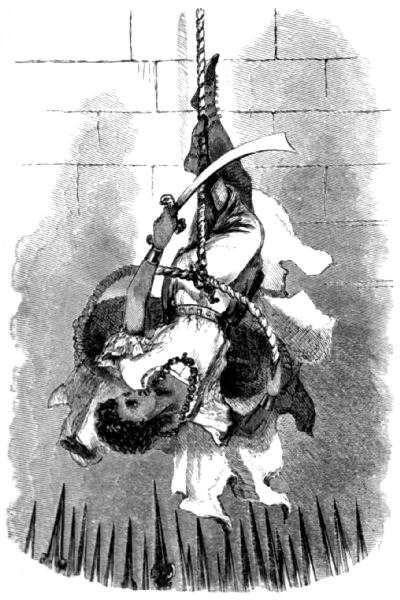
So the Rajah caused a basket to be fastened by a
rope to the top of the tower, and got into it head downward;
then he called out to Butti, “How can I cut
the rope?” “Nothing is easier,” answered he; “take
this sword in your hand. I will twist the rope three
times, and as it untwists for the first time let the sword
fall upon it.” Vicram Maharajah took the sword, and
Butti twisted the rope, and as it first began to untwist,
the Rajah cut it, and the basket immediately fell. It
would have certainly gone down among the bayonets,
and he been instantly killed, had not Gunputti, seeing
the danger of his devotee, rushed out of the temple at
that moment in the form of an old woman, who, catching
the basket in her arms before it touched the bayonets,
brought it gently and safely to the ground; having
done which she instantly returned into the temple.
None of the spectators knew she was Gunputti himself
in disguise; they only thought “What a clever old
woman!”
Vicram Maharajah then caused excavations to be
made below the tower, under which he found an immense
amount of treasure. There were mountains of
gold, there were diamonds, and rubies, and sapphires,
and emeralds, and turquoises, and pearls; but he took
none of them, causing all to be sold and the money
given to the poor, so little did he care for the riches for
which some men sell their bodies and souls.
Another day, the Rajah, when in the temple, dreamed
again. Again his father appeared to him, and this time
he said, “Vicram, come daily to this temple and Gunputti
will teach you wisdom, and you shall get
134]
understanding. You may get learning in the world, but
wisdom is the fruit of much learning and much experience,
and much love to God and man; wherefore,
come, acquire wisdom, for learning perishes, but wisdom
never dies.” When the Rajah awoke, he told his
dream to the Wuzeer, and Butti recommended him to
obey his father’s counsel, which he accordingly did.
Daily he resorted to the temple and was instructed
by Gunputti; and when he had learnt much, one day
Gunputti said to him, “I have given you as much wisdom
as is in keeping with man’s finite comprehension;
now, as a parting gift, ask of me what you will and it
shall be yours—or riches, or power, or beauty, or long
life, or health, or happiness—choose what you will
have?” The Rajah was very much puzzled, and he
begged leave to be allowed a day to think over the
matter, and decide what he would choose, to which
Gunputti assented.
Now it happened that near the palace there lived the
son of a Carpenter, who was very cunning, and when
he heard that the Rajah went to the temple to learn
wisdom, he also determined to go and see if he could
not learn it also; and each day, when Gunputti gave
Vicram Maharajah instruction, the Carpenter’s son
would hide close behind the temple, and overhear all
their conversation; so that he also became very wise.
No sooner, therefore, did he hear Gunputti’s offer to
Vicram than he determined to return again when the
Rajah did, and find out in what way he was to procure
the promised gift, whatever it was.
The Rajah consulted Butti as to what he should ask
for, saying, “I have riches more than enough; I have
also sufficient power, and for the rest I had sooner
135]
take my chance with other men, which makes me
much at a loss to know what to choose.”
The Wuzeer answered, “Is there any supernatural
power you at all desire to possess? If so, ask for that.”
“Yes,” replied the Rajah, “it has always been a great
desire of mine to have power to leave my own body
when I will, and translate my soul and sense into some
other body, either of man or animal. I would rather
be able to do that than anything else.” “Then,” said
the Wuzeer, “ask Gunputti to give you the power.”
Next morning the Rajah, having bathed and prayed,
went in great state to the temple to have his final interview
with the idol. And the Carpenter’s son went too,
in order to overhear it.
Then Gunputti said to the Rajah, “Vicram, what
gift do you choose?” “Oh, divine Power,” answered
the Rajah, “you have already given me a sufficiency
of wealth and power, in making me Rajah; neither
care I for more of beauty than I now possess; and of
long life, health and happiness I had rather take my
share with other men. But there is a power which I
would rather own than all that you have offered.”
“Name it, O good son of a good father,” said
Gunputti.
“Most Wise,” replied Vicram, “give me the power
to leave my own body when I will, and translate my
soul, and sense, and thinking powers into any other
body that I may choose, either of man, or bird, or
beast—whether for a day, or a year, or for twelve
years, or as long as I like; grant also, that however
long the term of my absence, my body may not decay,
but that, when I please to return to it again, I may find
it still as when I left it.”
136]
“Vicram,” answered Gunputti, “your prayer is
heard,” and he instructed Vicram Maharajah by what
means he should translate his soul into another body,
and also gave him something which, being placed
within his own body when he left it, would preserve it
from decay until his return.[59]
The Carpenter’s son, who had been all this time
listening outside the temple, heard and learnt the spell
whereby Gunputti gave Vicram Maharajah power to
enter into any other body; but he could not see nor find
out what was given to the Rajah to place within his
own body when he left it, to preserve it; so that he
was only master of half the secret.
Vicram Maharajah returned home, and told the
Wuzeer that he was possessed of the much-desired
secret. “Then,” said Butti, “the best use you can
put it to is to fly to the Pomegranate country, and
bring Anar Ranee here.”
“How can that be done?” asked the Rajah. “Thus,”
replied Butti; “transport yourself into the body of a
parrot, in which shape you will be able to fly over the
seven hedges of bayonets that surround her garden.
Go to the tree in the centre of it, bite off the stalks
of the pomegranates and bring them home in your
beak.”
“Very well,” said the Rajah, and he picked up a
parrot which lay dead on the ground, and placing
within his own body the beauty-preserving charm, transported
his soul into the parrot, and flew off.
On, on, on he went, over the hills and far away, until
he came to the garden. Then he flew over the seven
hedges of bayonets, and with his beak broke off the
137]
three pomegranates (in which were Anar Ranee and her
two ladies), and holding them by the stalks brought
them safely home. He then immediately left the parrot’s
body and re-entered his own body.
When Butti saw how well he had accomplished the
feat, he said, “Thank heaven! there’s some good done
already.” All who saw Anar Ranee were astonished
at her beauty, for she was fair as a lotus flower, and the
color on her cheeks was like the deep rich color of a
pomegranate, and all thought the Rajah very wise to
have chosen such a wife.
They had a magnificent wedding, and were for a
short time as happy as the day is long.
But within a little while Vicram Maharajah said to
Butti, “I have again a great desire to see the world.”
“What!” said Butti, “so soon again to leave your
home! So soon to care to go away from your young
wife!”
“I love her and my people dearly,” answered the
Rajah; “but I cannot but feel that I have this supernatural
power of taking any form I please, and longing
to use it.” “Where and how will you go?” asked the
Wuzeer. “Let it be the day after to-morrow,” answered
Vicram Maharajah. “I shall again take the
form of a parrot, and see as much of the world as possible.”
So it was settled that the Rajah should go. He left
his kingdom in the Wuzeer’s sole charge, and also his
wife, saying to her, “I don’t know for how long I may
be away; perhaps a day, perhaps a year, perhaps more.
But if, while I am gone, you should be in any difficulty,
apply to the Wuzeer. He has ever been like an elder
brother or a father to me; do you therefore also regard
138]
him as a father. I have charged him to take care of
you as he would of his own child.”
Having said these words, the Rajah caused a beautiful
parrot to be shot (it was a very handsome bird, with
a tuft of bright feathers on its head and a ring about
its neck). He then cut a small incision in his arm and
rubbed into it some of the magic preservative given
him by Gunputti to keep his body from decaying, and
transporting his soul into the parrot’s body, he flew
away.
No sooner did the Carpenter’s son hear that the Rajah
was as dead, than, knowing the power of which
Vicram Maharajah and he were alike possessed, he felt
certain that the former had made use of it, and determined
himself likewise to turn it to account. Therefore,
directly the Rajah entered the parrot’s body, the
Carpenter’s son entered the Rajah’s body, and the world
at large imagined that the Rajah had only swooned
and recovered. But the Wuzeer was wiser than they,
and immediately thought to himself, “Some one beside
Vicram Maharajah must have become acquainted with
this spell, and be now making use of it, thinking it
would be very amusing to play the part of Rajah for a
while; but I’ll soon discover if this be the case or no.”
So he called Anar Ranee and said to her, “You are
as well assured as I am that your husband left us but
now, in the form of a parrot; but scarcely had he gone
before his deserted body arose, and he now appears
walking about, and talking, and as much alive as ever;
nevertheless, my opinion is, that the spirit animating
the body is not the spirit of the Rajah, but that some
one else is possessed of the power given to him by Gunputti,
and has taken advantage of it to personate him.
139]
But this it would be better to put to the proof. Do,
therefore, as I tell you, that you may be assured of the
truth of my words. Make to-day for your husband’s
dinner some very coarse and common currie, and give
it to him. If he complains that it is not as good as
usual, I am making a mistake; but if, on the contrary,
he says nothing about it, you will know that my words
are true, and that he is not Vicram Maharajah.”
Anar Ranee did as the Wuzeer advised, and afterward
came to him and said, “Father” (for so she
always called him), “I have been much astonished at
the result of the trial. I made the currie very carelessly,
and it was as coarse and common as possible;
but the Rajah did not even complain. I feel convinced
it is as you say; but what can we do?”
“We will not,” answered the Wuzeer, “cast him
into prison, since he inhabits your husband’s body; but
neither you, nor any of the Rajah’s relations, must have
any friendship with, or so much as speak to him; and
if he speak to any of you, let whoever it be, immediately
begin to quarrel with him, whereby he will find
the life of a rajah not so agreeable as he anticipated,
and may be induced the sooner to return to his proper
form.”
Anar Ranee instructed all her husband’s relations and
friends as Butti had advised, and the Carpenter’s son began
to think the life of a rajah not at all as pleasant as
he had fancied, and would, if he could, have gladly returned
to his own body again; but, having no power to
preserve it, his spirit had no sooner left it than it began
to decay, and at the end of three days it was quite destroyed;
so that the unhappy man had no alternative but
to remain where he was.
140]
Meantime, the real Vicram Maharajah had flown, in
the form of a parrot, very far, far away, until he reached
a large banyan tree, where there were a thousand other
pretty pollies, whom he joined, making their number a
thousand and one. Every day the parrots flew away to
get food, and every night they returned to roost in the
great banyan tree.
Now it chanced that a hunter had often gone through
that part of the jungle, and noticed the banyan tree and
the parrots, and he said to himself, “If I could only
catch the thousand and one parrots that nightly roost in
that tree, I should not be so often hungry as I am now,
for they would make plenty of very nice currie.” But
he could not do it, though he often tried; for the trunks
of the tree were tall and straight, and very slippery, so
that he no sooner climbed up a little way than he slid
down again: however, he did not cease to look and
long.
One day, a heavy shower of rain drove all the parrots
back earlier than usual to their tree, and when they
got there they found a thousand crows who had come
on their homeward flight to shelter themselves there
till the storm was over.
Then Vicram Maharajah Parrot said to the other
parrots, “Do you not see these crows have all sorts of
seeds and fruits in their beaks, which they are carrying
home to their little ones? Let us quickly drive them
away, lest some of these fall down under our tree,
which, being sown there, will spring up strong plants
and twine round the trunks, and enable our enemy the
hunter to climb up with ease and kill us all.”
But the other parrots answered, “That is a very far-fetched
idea! Do not let us hunt the poor birds away
141]
from shelter in this pouring rain, they will get so wet.”
So the crows were not molested. It turned out, however,
just as Vicram Maharajah had foretold; for some
of the fruits and seeds they were taking home to their
young ones fell under the tree, and the seeds took root
and sprang up, strong creeping plants, which twined
all round the straight trunks of the banyan tree, and
made it very easy to climb.
Next time the hunter came by he noticed this, and
saying, “Ah, my fine friends, I’ve got you at last,” he,
by the help of the creepers, climbed the tree, and set
one thousand and one snares of fine thread among the
branches; having done which he went away.
That night, when the parrots flew down on the
branches as usual, they found themselves all caught
fast prisoners by the feet.
“Crick! crick! crick!” cried they, “crick! crick!
crick! Oh dear! oh dear! what shall we do? what
can we do? Oh, Vicram Maharajah, you were right
and we were wrong. Oh dear! oh dear! crick! crick!
crick!”
Then Vicram said, “Did I not tell you how it would
be? But do as I bid you, and we may yet be saved.
So soon as the hunter comes to take us away, let every
one hang his head down on one side, as if he were
dead; then, thinking us dead, he will not trouble himself
to wring our necks, or stick the heads of those he
wishes to keep alive through his belt, as he otherwise
would; but will merely release us, and throw us on
the ground. Let each one when there, remain perfectly
still, till the whole thousand and one are set free,
and the hunter begins to descend the tree; then we
will all fly up over his head and far out of sight.”
142]
The parrots agreed to do as Vicram Maharajah
Parrot proposed, and when the hunter came next
morning to take them away, every one had his eyes
shut and his head hanging down on one side, as if he
were dead. Then the hunter said, “All dead, indeed!
Then I shall have plenty of nice currie.” And so saying,
he cut the noose that held the first, and threw him
down. The parrot fell like a stone to the ground, so
did the second, the third, the fourth, the fifth, the sixth,
the seventh, the eighth, the ninth, the tenth, and so
on—up to the thousandth parrot. Now the thousandth
and first chanced to be none other than Vicram; all
were released but he. But, just as the hunter was
going to cut the noose round his feet, he let his knife
fall, and had to go down and pick it up again. When
the thousand parrots who were on the ground, heard
him coming down, they thought, “The thousand and
one are all released, and here comes the hunter; it is
time for us to be off.” And with one accord they flew
up into the air and far out of sight, leaving poor Vicram
Maharajah still a prisoner.
The hunter, seeing what had happened, was very
angry, and seizing Vicram, said to him, “You wretched
bird! it’s you that have worked all this mischief. I
know it must be, for you are a stranger here, and different
to the other parrots. I’ll strangle you, at all
events—that I will.” But to his surprise, the parrot
answered him, “Do not kill me. What good will that
do you? Rather sell me in the next town. I am very
handsome. You will get a thousand gold mohurs[60]
for me.”
“A thousand gold mohurs!” answered the hunter,
143]
much astonished. “You silly bird, who’d be so foolish
as to give a thousand gold mohurs for a parrot?”
“Never mind,” said Vicram, “only take me and
try.”
So the hunter took him into the town, crying “Who’ll
buy? who’ll buy? Come buy this pretty polly that can
talk so nicely. See how handsome he is—see what a
great red ring he has round his neck. Who’ll buy?
who’ll buy?”
Then several people asked how much he would take
for the parrot; but when he said a thousand gold mohurs,
they all laughed and went away, saying “None
but a fool would give so much for a bird.”
At last the hunter got angry, and he said to Vicram,
“I told you how it would be. I shall never be able to
sell you.” But he answered, “Oh yes, you will. See
here comes a merchant down this way; I dare say he
will buy me.” So the hunter went to the merchant
and said to him, “Pray, sir, buy my pretty parrot.”
“How much do you want for him?” asked the merchant—“two
rupees?”[61] “No, sir,” answered the
hunter; “I cannot part with him for less than a thousand
gold mohurs.” “A thousand gold mohurs!”
cried the merchant, “a thousand gold mohurs! I never
heard of such a thing in my life! A thousand gold
mohurs for one little wee polly! Why, with that sum
you might buy a house, or gardens, or horses, or ten
thousand yards of the best cloth. Who’s going to give
you such a sum for a parrot? Not I, indeed. I’ll give
you two rupees and no more.” But Vicram called
out, “Merchant, merchant, do not fear to buy me. I
am Vicram Maharajah Parrot. Pay what the hunter
144]
asks, and I will repay it to you—buy me only, and I
will keep your shop.”
“Polly,” answered the merchant, “what nonsense
you talk!” But he took a fancy to the bird, and paid
the hunter a thousand gold mohurs, and taking Vicram
Maharajah home, hung him up in his shop.
Then the Parrot took on him the duties of shopman,
and talked so much and so wisely that every one in
the town soon heard of the merchant’s wonderful bird.
Nobody cared to go to any other shop—all came to his
shop, only to hear the Parrot talk; and he sold them
what they wanted, and they did not care how much he
charged for what he sold, but gave him whatever he
asked; insomuch, that in one week the merchant had
made a thousand gold mohurs over and above his usual
weekly profits; and there Vicram Maharajah Parrot
lived for a long time, made much of by everybody, and
very happy.
It happened in the town where the merchant lived
there was a very accomplished Nautch girl,[62] named
Champa Ranee.[63] She danced so beautifully that the
people of the town used always to send for her to dance
on the occasion of any great festival.
There also lived in the town a poor wood-cutter,
who earned his living by going out far into the jungle
to cut wood, and bringing it in every day, into the
bazaar to sell.
One day he went out as usual into the jungle to cut
wood, and being tired, he fell asleep under a tree and
began to dream; and he dreamed that he was a very
145]
rich man, and that he married the beautiful Nautch
girl, and that he took her home to his house, and gave
his wife, as a wedding present, a thousand gold
mohurs!
When he went into the bazaar that evening as usual
to sell wood, he began telling his dream to his friends,
saying, “While I was in the jungle I had such an absurd
dream; I dreamed that I was a rich man, and
that I married the Champa Ranee, and gave her as a
wedding present a thousand gold mohurs!” “What
a funny dream!” they cried, and thought no more of
it.
But it happened that the house under which he was
standing whilst talking to his friends was Champa
Ranee’s house, and Champa Ranee herself was near
the window, and heard what he said, and thought to
herself, “For all that man looks so poor, he has then
a thousand gold mohurs, or he would not have dreamed
of giving them to his wife; if that is all, I’ll go to law
about it, and see if I can’t get the money.”
So she sent out her servants and ordered them to
catch the poor wood-cutter; and when they caught
him, she began crying out, “Oh husband! husband!
here have I been waiting ever so long, wondering
what has become of you; where have you been all this
time?” He answered, “I’m sure I don’t know what
you mean. You’re a great lady and I’m a poor wood-cutter;
you must mistake me for somebody else.”
But she answered, “Oh no! don’t you remember we
were married on such and such a day! Have you forgotten
what a grand wedding it was, and you took me
home to your palace, and promised to give me as a
wedding present a thousand gold mohurs? But you
146]
quite forgot to give me the money, and you went away,
and I returned to my father’s house till I could learn
tidings of you; how can you be so cruel?”
The poor wood-cutter thought he must be dreaming,
but all Champa Ranee’s friends and relations declared
that what she said was true. Then, after much quarreling,
they said they would go to law about it; but
the judge could not settle the matter, and referred it to
the Rajah himself. The Rajah was no less puzzled
than the judge. The wood-cutter protested that he
was only a poor wood-cutter; but Champa Ranee and
her friends asserted that he was, on the contrary, a rich
man, her husband, and had had much money, which
he must have squandered. She offered, however, to
give up all claim to that, if he would only give her a
thousand gold mohurs, which he had promised; and so
suggested a compromise. The wood-cutter replied
that he would gladly give the gold mohurs if he had
them; but that (as he brought witnesses to prove) he
was really and truly what he professed to be—only a
poor wood-cutter, who earned two annas[64] a day cutting
wood, and had neither palace nor riches nor wife
in the world! The whole city was interested in this
curious case, and all wondered how it would end;
some being sure one side was right, and some equally
certain of the other.
The Rajah could make nothing of the matter, and
at last he said: “I hear there is a merchant in this town
who has a very wise parrot, wiser than most men are;
let him be sent for to decide this business, for it is beyond
me; we will abide by his decision.”
So Vicram Maharajah Parrot was sent for, and
147]
placed in the court of justice, to hear and judge the
case.
First he said to the wood-cutter, “Tell me your version
of the story.” And the wood-cutter answered,
“Polly, Sahib, what I tell is true. I am a poor man.
I live in the jungle, and earn my living by cutting
wood and selling it in the bazaar. I never get more
than two annas a day. One day I fell asleep and
dreamed a silly dream—how I had become rich and
married the Champa Ranee, and had given her as a
wedding present a thousand gold mohurs; but it is no
more true that I owed her a thousand gold mohurs, or
have them to pay, than that I married her.”
“That is enough,” said Vicram Maharajah. “Now,
dancing girl, tell us your story.” And Champa
Ranee gave her version of the matter. Then the Parrot
said to her, “Tell me now where was the house of
this husband of yours, to which he took you?” “Oh!”
she answered; “very far away, I don’t know how far,
in the jungles.” “How long ago was it?” asked he.
“At such and such a time,” she replied. Then he
called credible and trustworthy witnesses, who proved
that Champa Ranee had never left the city at the time
she mentioned. After hearing whom, the Parrot said
to her, “Is it possible that you can have the folly to
think any one would believe that you would leave your
rich and costly home to go a long journey into the
jungle? It is now satisfactorily proved that you did
not do it; you had better give up all claim to the
thousand gold mohurs.”
But this the Nautch girl would not do. The Parrot
then called for a money-lender, and begged of him
the loan of a thousand gold mohurs, which he placed
148]
in a great bottle, putting the stopper in, and sealing it
securely down; he then gave it to the Nautch girl, and
said, “Get this money if you can, without breaking the
seal or breaking the bottle.” She answered, “It cannot
be done.” “No more,” replied Vicram Maharajah,
“can what you desire be done. You cannot force
a poor man, who has no money in the world, to pay
you a thousand gold mohurs.
“Let the prisoner go free! Begone, Champa Ranee.
Dancing girl! you are a liar and a thief; go rob the
rich if you will, but meddle no more with the poor.”
All applauded Vicram Maharajah Parrot’s decision,
and said, “Was ever such a wonderful bird!” But
Champa Ranee was extremely angry, and said to him,
“Very well, nasty polly; nasty, stupid polly! be assured
before long I will get you in my power, and
when I do, I will bite off your head!”
“Try your worst, madam,” answered Vicram; “but
in return, I tell you this—I will live to make you a
beggar. Your house shall be, by your own order, laid
even with the ground, and you for grief and rage shall
kill yourself.”
“Agreed,” said Champa Ranee; “we will soon see
whose words come true—mine or yours;” and so saying,
she returned home.
The merchant took Vicram Maharajah back to his
shop, and a week passed without adventure; a fortnight
passed, but still nothing particular happened.
At the end of this time the merchant’s eldest son was
married, and in honor of the occasion, the merchant
ordered that a clever dancing-girl should be sent for, to
dance before the guests. Champa Ranee came, and
danced so beautifully that every one was delighted;
149]
and the merchant was much pleased, and said to her,
“You have done your work very well, and in payment
you may choose what you like out of my shop or
house, and it shall be yours—whether jewels or rich
cloth, or whatever it is.”
She replied, “I desire nothing of the kind: of jewels
and rich stuffs I have more than enough, but you shall
give me your pretty little parrot; I like it much, and
that is the only payment I will take.”
The merchant felt very much vexed, for he had
never thought the Nautch girl would ask for the parrot
which he was so fond of, and which had been so profitable
to him; he felt he would rather have parted with
anything he possessed than that; nevertheless, having
promised, he was bound to keep his word, so, with
many tears, he went to fetch his favorite. But Polly
cried, “Don’t be vexed, master; give me to the girl; I
can take good care of myself.”
So Champa Ranee took Vicram Maharajah Parrot
home with her; and no sooner did she get there than
she sent for one of her maids, and said, “Quick, take
this parrot and boil him for my supper; but first cut
off his head and bring it to me on a plate, grilled; for
I will eat it before tasting any other dish.”
“What nonsensical idea is this of our mistress,” said
the maid to another, as she took the parrot into the
kitchen; “to think of eating a grilled parrot’s head!”
“Never mind,” said the other; “you’d better prepare
it as she bids you, or she’ll be very cross.” Then the
maid who had received the order began plucking the
long feathers out of Vicram Maharajah’s wings, he all
the time hanging down his head, so that she thought he
was dead. Then, going to fetch some water in which
150]
to boil him, she laid him down close to the place where
they washed the dishes. Now, the kitchen was on the
ground floor, and there was a hole right through the
wall, into which the water used in washing the dishes
ran, and through which all the scraps, bones, peelings
and parings were washed away after the daily cooking;
and in this hole Vicram Maharajah hid himself, quick
as thought.
“Oh dear! oh dear!” cried the maid when she returned.
“What can I do? what will my mistress say?
I only turned my back for one moment, and the parrot’s
gone.” “Very likely,” answered the other maid,
“some cat has taken it away. It could not have been
alive, and flown or run away, or I should have seen
it go; but never fear, a chicken will do very well for
her instead.”
Then they took a chicken and boiled it, and grilled
the head and took it to their mistress; and she ate it,
little bit by little bit, saying as she did so—
“Ah, pretty polly! so here’s the end of you! This
is the brain that thought so cunningly and devised my
overthrow! this is the tongue that spoke against me!
this is the throat through which came the threatening
words! Aha! who is right now, I wonder?”
Vicram, in the hole close by, heard her and felt very
much alarmed; for he thought, “If she should catch
me after all!” He could not fly away, for all his wing
feathers had been pulled out; so there he had to stay
some time, living on the scraps that were washed into
the hole in the washing of the plates, and perpetually
exposed to danger of being drowned in the streams of
water that were poured through it. At last, however,
his new feathers were sufficiently grown to bear him,
151]
and he flew away to a little temple in the jungle some
way off, where he perched behind the idol.
It happened that Champa Ranee used to go to that
temple, and he had not been there long before she came
there to worship her idol.
She fell on her knees before the image, and began to
pray. Her prayer was that the god would transport
her body and soul to heaven (for she had a horror of
dying), and she cried, “Only grant my prayer—only
let this be so, and I will do anything you wish—anything—anything.”
Vicram Maharajah was hidden behind the image and
heard her, and said—
“Champa Ranee Nautch girl, your prayer is heard!”
(She thought the idol himself was speaking to her, and
listened attentively.) “This is what you must do: sell
all you possess, and give the money to the poor; you
must also give money to all your servants and dismiss
them. Level also your house to the ground, that you
may be wholly separated from earth. Then you will
be fit for heaven. Come, having done all I command
you, on this day week to this place, and you shall be
transported thither body and soul.”
Champa Ranee believed what she heard, and forgetful
of Vicram Maharajah Parrot’s threat, hastened
to do as she was bidden. She sold her possessions,
and gave all the money to the poor; razed her house
to the ground, and dismissed her servants; which being
accomplished, on the day appointed she went to the
temple, and sat on the edge of a well outside it, explaining
to the assembled people how the idol himself
had spoken to her, and how they would shortly see her
caught up to heaven, and thus her departure from the
152]
world would be even more celebrated than her doings
whilst in it. All the people listened eagerly to her
words, for they believed her inspired, and to see her
ascension the whole city had come out, with hundreds
and hundreds of strangers and travelers, princes, merchants
and nobles, from far and near, all full of expectation
and curiosity.
Then, as they waited, a fluttering of little wings was
heard, and a parrot flew over Champa Ranee’s head,
calling out, “Nautch girl! Nautch girl! what have
you done?” Champa Ranee recognized the voice as
Vicram’s; he went on: “Will you go body and soul
to heaven? have you forgotten polly’s words?”
Champa Ranee rushed into the temple, and, falling
on her knees before the idol, cried out, “Gracious
Power, I have done all as you commanded; let your
words come true; save me; take me to heaven.”
But the Parrot above her cried, “Good-bye, Champa
Ranee, good-bye; you ate a chicken’s head, not mine.
Where is your house now? where your servants and
all your possessions? Have my words come true,
think you, or yours?”
Then the woman saw all, and in her rage and despair,
cursing her own folly, she fell violently down on
the floor of the temple, and dashing her head against
the stone, killed herself.
It was now two years since the Rajah Vicram left
his kingdom; and about six months before, Butti, in
despair of his ever returning, had set out to seek for
him. Up and down through many countries had he
gone, searching for his master, but without success.
As good fortune would have it, however, he chanced
to be one of those strangers who had come to witness
153]
the Nautch girl’s translation, and no sooner did he see
the Parrot which spoke to her than in him he recognized
Vicram. The Rajah also saw him, and flew on
to his shoulder, upon which Butti caught him, put him
in a cage and took him home.
Now was a puzzling problem to be solved. The
Rajah’s soul was in the Parrot’s body, and the Carpenter’s
son’s soul in the Rajah’s body. How was the
latter to be expelled to make way for the former?
He could not return to his own body, for that had
perished long before. The Wuzeer knew not how to
manage the matter, and determined therefore to await
the course of events.
It happened that the pretended Rajah and Butti each
had a fighting ram, and one day the Rajah said to the
Wuzeer, “Let us set our rams to fight to-day, and try
the strength of mine against yours.” “Agreed,” answered
the Wuzeer; and they set them to fight. But
there was much difference in the two rams; for when
Butti’s ram was but a lamb, and his horns were growing,
Butti had tied him to a lime tree, and his horns
had got very strong indeed by constantly rubbing
against its tender stem and butting against it; but the
Carpenter’s son had tied his ram, when a lamb, to a
young teak tree, the trunk of which was so stout and
strong that the little creature, butting against it, could
make no impression on it, but only damaged and
loosened his own horns.
The pretended Rajah soon saw, to his vexation, that
his favorite’s horns being less strong than its opponent’s,
he was getting tired, and beginning to lose
courage, would certainly be worsted in the fight; so,
quick as thought, he left his own body and transported
154]
his soul into the ram’s body, in order to give it an
increase of courage and resolution, and enable it to
win.
No sooner did Vicram Maharajah, who was hanging
up in a cage, see what had taken place, than he left the
parrot’s body and re-entered his own body. Then
Butti’s ram pushed the other down on its knees and
the Wuzeer ran and fetched a sword, and cut off its
head; thus putting an end, with the life of the ram, to
the life of the Carpenter’s son.
Great was the joy of Anar Ranee and all the household
at recovering the Rajah after his long absence;
and Anar Ranee prayed him to fly away no more as a
parrot, which he promised her he would not do.
But the taste for wandering and love of an unsettled
life did not leave him on his resuming his proper form;
and one of the things in which he most delighted was
to roam about the jungles near the palace by himself,
without attendant or guide. One very sultry day,
when he was thus out by himself, he wandered over a
rocky part of the country, which was flat and arid,
without a tree upon it to offer shelter from the burning
sun. Vicram, tired with his walk, threw himself down
by the largest piece of rock he could find to rest. As
he lay there, half asleep, a little Cobra came out of a
hole in the ground, and seeing his mouth wide open
(which looked like some shady cranny in a rock), crept
in and curled himself up in the Rajah’s throat.
Vicram Maharajah called out to the Cobra, “Get
out of my throat.” But the Cobra said, “No, I won’t
go; I like being here better then under ground;” and
there he stayed. Vicram didn’t know what to do, for
the Cobra lived in his throat and could not be got out.
155]
At times it would peep out of his mouth, but the moment
the Rajah tried to catch it, it ran back again.
“Who ever heard of a Rajah in such a miserable
plight?” sighed he to Butti—“to think of having this
Cobra in my throat!”
“Ah, my dear friend,” Butti would answer, “why
will you go roaming about the country by yourself?
Will you never be cured of it?”
“If one could only catch this Cobra, I’d be content
to wander no more,” said the Rajah, “for my wandering
has not brought me much good of late.” But to
catch the Cobra was more than any man could do. At
last, one day, Vicram, driven nearly mad in this perplexity,
ran away into the jungle. Tidings of this were
soon brought to Butti, who was much grieved to hear
it, and sighed, saying, “Alas! alas! of what avail to
Vicram Maharajah is his more than human wisdom,
when the one unlucky self-chosen gift neutralizes all the
good he might do with it! It has given him a love of
wandering hither and thither, minding everybody’s
business but his own; his kingdom is neglected, his
people uncared for, and he, that used to be the pride of
all Rajahs, the best, the noblest, has finally slunk out
of his country, like a thief escaping from jail.”
Butti sent messengers far and wide seeking Vicram
Maharajah, but they could not find him; he then determined
to go himself in search of his lost friend; and
having made proper arrangements for the government
of the country during his absence, he set off on his travels.
Meantime Vicram wandered on and on until at last,
one day, he came to the palace of a certain Rajah, who
reigned over a country very far from his own, and he
sat down with the beggars at the palace gate.
156]
Now, the Rajah at whose gate Vicram Maharajah
sat had a good and lovely daughter, named Buccoulee.[65]
Many Princes wished to marry this Princess, but she
would marry none of them. Her father and mother
said to her, “Why will you not choose a husband?
Among all these Princes who ask you in marriage
there are many rich and powerful—many handsome
and brave—many wise and good; why will you refuse
them all?” The Princess replied, “It is not my destiny
to marry any of them; continually in my dreams I see
my destined husband, and I wait for him.” “Who is
he?” they asked. “His name,” she answered, “is the
Rajah Vicram; he will come from a very far country;
he has not come yet.” They replied, “There is no
Rajah, far or near, that we know of, of this name;
give over this fancy of yours and marry some one
else.”
But she constantly refused, saying, “No, I will wait
for the Rajah Vicram.” Her parents thought, “It may
be even as she says. Who knows but perhaps some
day a great King, greater than any we know, may come
to this country and wish to marry the girl; we shall
then be glad that we had not obliged her to marry any
of her present suitors?”
No sooner had Vicram Maharajah come to the
palace gate, and sat down there with the beggars, than
the Princess Buccoulee, looking out of the window,
saw him and cried, “There is the husband I saw in my
dreams; there is the Rajah Vicram.” “Where, child,
where?” said her mother; “there’s no Rajah there;
only a parcel of beggars.”
But the Princess persisted that one of them was the
157]
Rajah Vicram. Then the Ranee sent for Vicram Maharajah
and questioned him.
He said his name was “Rajah Vicram.” But the
Rajah and Ranee did not believe him; and they were
very angry with the Princess because she persisted in
saying that he, and no other, would she marry. At last
they got so enraged with her that they said, “Well,
marry your beggar husband, if you will, but don’t think
to remain any longer our daughter after becoming his
wife; if you marry him it shall be to follow his fortunes
in the jungle; we shall soon see you repent your obstinacy.”
“I will marry him and follow him wherever he goes,”
said the Princess.
So Vicram Maharajah and the Princess Buccoulee
were married, and her parents turned her out of the
house; nevertheless, they allowed her a little money.
“For,” they said, “she will fast enough find the difference
between a king’s daughter and a beggar’s wife,
without wanting food.”
Vicram built a little hut in the jungle, and there they
lived; but the poor Princess had a sad time of it, for
she was neither accustomed to cook nor wash, and the
hard work tired her very much. Her chief grief, however,
was that Vicram should have such a hideous tormentor
as the Cobra in his throat; and often and often
of a night she sat awake, trying to devise some means
for catching it, but all in vain.
At last, one night, when she was thinking about it,
she saw close by two Cobras come out of their holes,
and as they began to talk, she listened to hear what
they would say.
“Who are these people?” said the first Cobra.
158]
“These,” said the second, “are the Rajah Vicram, and
his wife the Princess Buccoulee.” “What are they doing
here? why is the Rajah so far from his kingdom?” asked
the first Cobra.
“Oh, he ran away because he was so miserable; he
has a Cobra that lives in his throat,” answered the
second.
“Can no one get it out?” said the first.
“No,” replied the other; “because they do not
know the secret.” “What secret?” asked the first
Cobra. “Don’t you know?” said the second; “why,
if his wife only took a few marking nuts,[66] and
pounded them well, and mixed them in cocoa-nut oil,
and set the whole on fire, and hung the Rajah, her
husband, head downward up in a tree above it, the
smoke, rising upward, would instantly kill the Cobra
in his mouth, which would tumble down dead.”
“I never heard of that before,” said the first Cobra.
“Didn’t you?” exclaimed the second. “Why, if
they did the same thing at the mouth of your hole,
they’d kill you in no time; and then, perhaps, they
might find all the fine treasure you have there!”
“Don’t joke in that way,” said the first Cobra; “I
don’t like it;” and he crawled away quite offended, and
the second Cobra followed him.
No sooner had the Princess heard this than she determined
to try the experiment. So next morning she
sent for all the villagers living near (who all knew and
loved her, and would do anything she told them, because
she was the Rajah’s daughter), and bade them
take a great cauldron and fill it with cocoa-nut oil, and
pound down an immense number of marking nuts and
159]
throw them into it, and then bring the cauldron to her.
They did so, and she set the whole on fire, and caused
Vicram to be hung up in a tree overhead; and as soon
as the smoke from the cauldron rose in the air it suffocated
the Cobra in Vicram Maharajah’s throat, which
fell down quite dead. Then the Rajah Vicram said to
his wife, “O worthy Buccoulee! what a noble woman
you are! You have delivered me from this torment,
which was more than all the wise men in my kingdom
could do.”
Buccoulee then caused the cauldron of oil to be
placed close to the hole of the first Cobra, which she
had heard speaking the night before, and he was suffocated.
She then ordered the people to dig him out of his
hole, and in it they found a vast amount of treasure—gold,
silver and jewels. Then Buccoulee sent for royal
robes for herself and her husband, and bade him cut
his hair and shave him; and when they were all ready,
she took the remainder of the treasure and returned
with it to her father’s house; and her father and mother,
who had repented of their harshness, gladly welcomed
her back, and were both surprised and delighted to see
all the vast treasures she had, and what a handsome,
princely-looking man her husband was.
Then one day news was brought to Vicram that a
stranger Wuzeer had arrived in the palace as the
Rajah’s guest, and that this Wuzeer had for twelve
years been wandering round the world in search of his
master, but, not having found him, was returning to his
own home. Vicram thought to himself, “Can this
possibly be Butti?” and he ran to see.
It was indeed Butti, who cried for joy to see him,
160]
saying, “Oh Vicram, Vicram! do you know it is
twelve years since you left us all?”
Then Vicram Maharajah told Butti how the good
Princess Buccoulee had married him and succeeded in
killing the Cobra, and how he was then on the point of
returning to his own country. So they all set out together,
being given many rich presents by Buccoulee’s
father and mother. At last after a long, long journey,
they reached home. Anar Ranee was overjoyed to see
them again, for she had long mourned her husband as
dead. When Buccoulee Ranee was told who Anar
Ranee was and taken to see her, she felt very much frightened,
for she thought, “Perhaps she will be jealous of
me and hate me.” But with a gentle smile Anar Ranee
came to meet her, saying, “Sister, I hear it is to you we
owe the preservation of the Rajah, and that it was you
who killed the Cobra; I can never be sufficiently
grateful to you, nor love you enough, as long as I
live.”
From that day Vicram Maharajah stayed in his own
kingdom, ruling it wisely and well, and beloved by all.
He and Butti lived to a good old age, and their affection
for each other lasted as long as they lived. So
that it became a proverb in that country, and instead of
saying, “So-and-so love each other like brothers”
(when speaking of two who were much attached), the
people would say, “So-and-so love each other like the
Rajah and the Wuzeer.”
161]