URGOS and Valladolid never were capitals in the modern acceptation of
the word, but they were at this time the centre of court life.
URGOS and Valladolid never were capitals in the modern acceptation of
the word, but they were at this time the centre of court life.
The short lives of the illegitimate branch of the House of Castile, and
their personal insignificance, intensified rather than detracted from
the dramatic vicissitudes of their reigns.
Juan, son of Enrique de Trastamare (1390), died young by a fall from his
horse. His son, El Enfermo, who ended his life at twenty-eight,
inaugurated the romantic episode of the Regents. The infancy of Juan
II. called forth the powerful personality of the Conde de Luna, and the
vice and folly of Enrique IV. brought forward his sister Isabel, wife of
Ferdinand the Catholic, into extraordinary prominence in the politics of
Europe.
At this time Queen Catalina holds her court at Burgos—a fat, foolish
dowager, by no means inheriting the fierce passions of her
grandparents—Don Pedro el Cruel and Maria de Padilla. In close
alliance with the highly cultivated Moors, as had been her husband El
Enfermo, Catalina also favours the fine arts, and educates her son to
love those elegant cancioneros sung by her husband with such art, the
metre of which will never be surpassed.
Hundreds of these romances, current in that day, were softened and
refined into real poetry, and as such have come down to us as absolute
gems. Long stories in prose too, such as Amadis de Gaul, began now to be
written, to be followed by the Romaunt of the Rose, as also many
learned treatises on government and science, taken from the Arabic; and,
wonder of wonders, Don Pedro Ayala actually translated Livy into
Spanish!
In this literary movement the good Queen Catalina took part, and
inducted her little son into an amount of learning remarkable in that
age. He was fond of books and could speak and versify fluently in Latin.
Courage he had, and knowledge he acquired, growing up under his mother’s
care a gentle, indolent young prince like his father, but absolutely
without will, which made him a prey to the first resolute spirit who
gained his confidence.
Such a one was found in the person of Don Alvarez de Luna, Conde de
Gormaz, the last representative of the ideal Knight of Spain. Bold,
romantic, brave, his masterful individuality imposed itself on the
artistic temperament of the young king much as an eagle might foster and
protect a helpless dove.
As the descendant of a noble Biscayan family, whose ancestors had done
good service to Enrique de Trastamare in his many sudden flights and
rapid advances in the wild passes of the Pyrenees, Luna had claims on
the young king. Ever the prominent figure in court and camp, Don Juan
from his birth had been thrown into his companionship, whose handsome
person and courtly manners charmed his boyish taste and resulted in an
ascendancy so absolute as to absorb all the power of the state. Nor
could remonstrance, conspiracy, or open acts of revolt for many years
shake his position. Indeed, opposition only seemed to endear him to Don
Juan, who rapidly advanced him to the high office of Constable of
Castile and Leon and Grand Master of Santiago.
Possessed of the entire love and confidence of his master, the court was
filled with his kindred and partisans; Don Juan saw with his eyes and
regulated every action at his pleasure. Even in the matter of his
marriage, instead of uniting himself to the French Princess Fredegonde,
whom he preferred, at Luna’s desire he espoused his cousin, Doña Isabel
of Portugal.
Such an excess of favour naturally raised an immense animosity against
him. Every noble and ricohombre in Castile hated him on his own
account. The Infante of Aragon headed a party to dethrone him. All this
at length coming to the knowledge of Don Juan, caused him throes of
extreme doubt as to his conduct, overruled for a time by the masterful
will of Luna, but to bear fruit at length as the consequence of the
inherent weakness of his nature.
Young as he still was, Don Juan had been twice married. The new queen,
his cousin, was a dark-complexioned beauty, with a skin like a ripe
peach and the keen black eyes of a Zingara. No sooner had she arrived at
Burgos than she came to understand that she owed her position solely to
the favour of Luna, and that Don Juan would have preferred the French
princess. Nothing could be more galling to her pride, and Isabel was
very proud. At once she resolved upon his ruin, and steadily carried out
her plan. If Juan was to be governed by a favourite, it should be
herself.
All through his long reign she battled with his weakness, and was
destined to suffer from a series of domestic mortifications caused by
the helpless vacillation of his temper. In common with the kings his
predecessors of the Trastamare line, he was too vacillating to be
capable of much real feeling. But the young queen would tolerate no
divided sway. Arrogant and ambitious by nature, she resolved to exercise
an absolute control over his conduct. Now the Conde de Luna formed an
insuperable barrier to her scheme. He must be removed, but his fall
should be brought about by no violent action, lest Don Juan’s sensitive
nature should take alarm. Her arms must be the wily weapons of her sex;
she must work on the king’s admiration for her—as a poetic embodiment
of his fancy—and his amiable desire to gratify her in all things.
So well did she act her part that he gradually grew cold towards his
favourite. His advice, formerly so anxiously sought, was not asked; many
acts were performed without his knowledge. Even his company, up to this
time indispensable as the air he breathed, was dispensed with for days
at a time. Such a change could not but be noted by the keen eyes of
Luna, but his belief in his ascendancy and the necessity of his counsels
was too absolute to give him as yet any serious uneasiness.
Don Juan, newly married to a princess selected by himself, whose person
pleased his fickle taste, was preoccupied and in love. These changes
were but as passing clouds—the horizon beyond was clear. He would soon
tire, as he did of every one else, and return to him as before. Such was
the belief on which he acted, leaving the queen to mature her plans
unopposed.
The king is seated alone with the queen in the castle of Burgos at a
table of inlaid marble, spread with wine. Books, too, are placed near at
hand, for he is never without his favourite author, John de Menu. The
room is small and lofty, a species of closet such as is found so often
in royal palaces of that date, and was invariably chosen as a royal
retiring-room. The walls are panelled in oak, pencilled with gold, on
which is stretched rare tapestry, representing in all the flush of
silken thread the encounters of the Christians against the
Moors—Pelazzo in the cave of Cavadonga, and the triumph of the Cid.
Steel mirrors, in richly carved frames of those massive patterns
peculiar to Spain, fling back the brilliant sunshine. It is a blaze of
light and colour. Velvet hangings heavy with gold shroud the low doors
and shade the narrow windows, which are open. Bright in the pure air
stream in the branches of fragrant limes, long walnut leaves and
sycamores—within an enclosed garden, shrouded by a quaint old tower
which forms part of the city walls.
Isabel, in the first flush of her radiant youth, looks a perfect picture
for a poet, in a long white robe, brocaded with gold, her pointed shoes
just appearing from under the folds, a row of large pearls binds her
head, setting off the ebony blackness of her hair. Her sparkling eyes
bent on the king entrance him more than his favourite ballads. She might
be Egilona, or Doña Teresa, or Angelica moving before him. The day, the
soft air, the silence, create a mesmerism about her which fires his
sentimental nature and makes her for the moment paramount to all else.
Nor is she at all indifferent to the attentions of the young sovereign,
her lord, who sits smoking opposite her, so daintily apparelled in a
velvet surcoat sown with pearls and bound with dark fur, open sleeves
hanging from the shoulder displaying his delicate hands, in the mode of
the day; a white bonnet, set with a large jewel, resting on his flowing
locks. No wonder that this graceful refinement of his nature has gained
her heart, that delicate symmetry of face and form he inherits from his
father and grandfather, El Rey Caballero.
Turning his large, inexpressive eyes towards her as she speaks, he bows,
and, raising her hand to his lips, pledges her in a cup of Val de Peñas.
“How sweet is this solitude in your company,” he says, heaving a deep
sigh of relief as he sinks back on the chair. “I would fain turn a few
verses in honour of my beautiful consort, but the day is too hot.” Here
he tries to conceal a yawn but does not quite succeed; then, looking
round, “It is astonishing that for once we are left alone; but the
constable has not interrupted us with affairs of state.”
“Why do you permit these unseemly liberties, my lord?” asks the queen
sharply.
Don Juan does not reply, but kisses her jewelled hand, laying it
caressingly on his own. What a solace to have to deal with this queenly
creature instead of the imperious constable, always urging on him some
imperative command, or to be plagued by those who call themselves “the
friends of his dynasty,” constantly insisting with equal persistency on
the necessity of his banishment! Between the two his life has become a
burden, to say nothing of the freaks of his young son, the Prince of the
Asturias (the first to bear that title), who passes his whole time in a
succession of rebellions.
“It is not for me, my Reina,” he answers at last, “to abuse the
constable, I leave that to my son Henry. But for Luna, I should never
have possessed the treasure of this little hand.” Again he passes his
long white fingers over hers, turning the rings she wears to the light
and examining them one by one, as though he would fain find a pretext
for retaining them in his own.
A cloud passes over the glowing face of the queen. She suddenly
remembers that she was imposed on him by the Conde de Luna as a reason
of state.
This puts her in a rage whenever she thinks of it.
“Do you imagine, my lord, that that recommends him to me?” she answers,
in a tone which betrays her feelings. “How do I know that you do not
still prefer the French Princess Fredegonde to me?”
A blush and a faint denial is the reply, and a murmured assurance that
such perfection as she possesses makes him the envy of all the
sovereigns his neighbours. The timid Don Juan shrinks from any form of
attack; he is so tormented that he scents trouble in the air.
The queen sees her advantage, and continues: “Believe me, I, at least,
love you, if you care for that. Too much so, indeed, to bear to see you
so overshadowed as you are. Your son, too, is drawing away your
subjects from you. A great sacrifice must be made or you will never
reign.”
“A sacrifice?” answers Don Juan vaguely. He affects not to understand
her, but reddens with annoyance at this false note in the harmony of
their interview.
“Oh, Juan, how can you pretend to mistake me!” she cries, clasping her
hands; “is it the first time I have told you that while the constable
lives I shall never have a happy hour?” Her countenance saddens with
real or pretended distress; a deep sigh heaves her bosom, upon which
rests a collar of jewels and strings of Orient pearls. With her kerchief
she wipes away imaginary tears. Don Juan, who is vaguely contemplating
her as a vision of beauty, is suddenly greatly distressed, and rises to
comfort her. She puts him back with a pettish motion, and with a
troubled air he resumes his seat.
“How do I know,” she continues, in a lower voice, “that the magic arts
Luna exercises over you may not be employed against me?”
“Magic arts!” faintly ejaculates the king.
“Yes, my lord, all Spain knows it, and is weary of the wickedness of
this presumptuous man. It is by infernal arts that he sways you. He will
bring the kingdom to destruction. Did he not, like a traitor, turn back
from the walls of Granada when the Zegrins were with you, and he should
have led your victorious army into the walls of the Alhambra? Does he
not conspire with the Infante of Aragon against your life?”
So vivid is the picture she calls up of the misdeeds of Luna, that real
tears now course each other down her cheeks. She believes in what she
says, and this gives conviction to her words. She believes him to be
guilty of all of which he is accused, and she knows that he will cross
her influence with Don Juan. Above all, she dreads the mysterious action
of that occult power he is said to possess. Superstition and ignorance
go together in her mind. A Portuguese princess of the fourteenth century
is alive to all the prejudices of the time.
“What!” cries Don Juan, starting up from his chair in a burst of
generous feeling, which he is quite incapable of sustaining, “can you,
my queen, ask me seriously to dismiss from my councils and from my heart
the hero who has so faithfully upheld the glory of Castile? The tales
you accept as true are but the suggestions of envy. The constable has
ever done his duty. What do I not owe him! Was it not he who rescued me
as a boy from the strong fortress of Tordesillas, where a powerful
league, headed by my treacherous cousin, the Infante of Aragon, would
have shut me up for life? Who was it that, when the Moors, emboldened by
the weakness of Castile, refused to pay the tribute, led on our armies
against them and forced them to submission? And if he did not enter the
city of Granada the fault was not in him, but in my seditious nobles,
whose divided counsels forced him to retreat. Is this the man, the
bulwark of my throne, who alone has stood by his king against the
factious nobles, the conspiracies of his kindred, and the machinations
of his own son? Would you have me deprive him of the honours he so
well deserves? High Constable I have created him, and such, by the Holy
Mother, he shall die.”
So unexpected an outburst completely overset all the queen’s
calculations. Was her influence so small for the great task she had
undertaken? she asked herself, as she gazed in wonder at the virile
expression which sat on the king’s chiselled features, and gave such
unwonted energy to his words.
She smiled, however, as she replied: “Aye, my liege, all this may be
true, but why has Don Alvarez de Luna shown this great zeal for his
king? Because, while he defended his cause he was forwarding that
ambition for which he has sold his soul. The interests of Don Juan de
Castile are his own. Believe me in this, my dear and honoured lord,
though I risk your displeasure in saying so.”
“Such indeed are the accusations of his enemies,” answered the king,
already cooling down from his brief display of impetuosity; in fact, he
was now turning over in a helpless confusion of ideas whether indeed the
constable was in league with the devil, as Isabel represented, and if
magic really gave him the extraordinary influence he exercised over him.
“Surely you must allow, my queen,

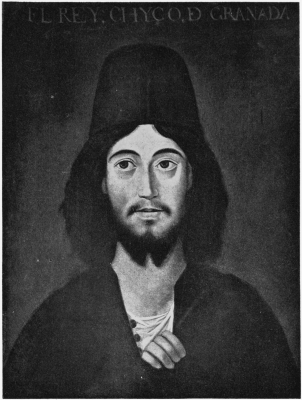 Portrait of Boabdil el Chico. The Generalife,
Granada.
Portrait of Boabdil el Chico. The Generalife,
Granada.
that it is rather Luna’s genius and courage which provoke the jealousy
of my nobles?”
“Fatal have been those qualities to the kingdom!” cried the queen, at
once seizing on the advantage his hesitation afforded her. “The whole
nation is alarmed. No one more than I,” she added, her voice deepening
into a delicious whisper as a blush overspread her face. She paused, the
colour spreading over throat and neck. “What am I, to resist this
universal charmer,” she added, “an untutored girl, when the queen, your
Highness’s first consort, is said to have yielded to his blandishments?”
“That is a base calumny!” answered Don Juan, again galvanised into a
momentary show of feeling. “I do not believe it; I never did. I had the
word of the queen. Alvarez himself denied it on the sacraments. I pray
you, Doña the Queen,” turning somewhat haughtily upon Isabel, whose
fingers were playing with the pearls upon her neck, her eyes modestly
turned down, “do not revive so painful a suspicion. The honour of a
Queen of Castile is impregnable. It is treason to doubt it.”
“It is because I am true to you, Juan, that I tremble. The dread of this
diabolical man haunts me. He may cast a spell on me also.”
Though her look was determined, she spoke in a soft voice, flashing a
look on the king out of those dark orbs of hers which seemed to catch
the rays of the outer sunshine and strike straight into his heart. Then
she extended her hand with a smile so sweet in its dignity as altogether
to melt his sensitive nature, always realising in her the heroine of his
poetic dreams.
“What rapture to be thus loved!” he murmured. “Can I deny this exquisite
creature anything she desires?” No one, he told himself, had ever been
so sweet as she. Ought he not to guard her from any chance of peril?
Might not the accusation she had recalled be true? He had never dared to
examine too closely the relations between the constable and the late
Queen Maria de Aragon. How different was Isabel! Her thoughts were all
for him. What ought he to do?
An abyss of unfathomable doubt engulfed him. Was Luna indeed an agent of
the Evil One as she said, or was he his devoted servant and friend? And
all the time these clashing thoughts were chasing each other through his
weary brain, Isabel, by a caressing movement, was drawing closer and
closer to him as he listened to the soft tones of her voice, so
different to the authoritative accents of the constable.
“Fie, fie, my dear lord,” she was saying, “is it meet that he make of
you but a painted image? A phantom in the state? With sorrow and shame
your nobles behold it. Can you wonder that the prince hates him?
Resolve, by one bold act, to rid yourself of him for ever. Banish him,
imprison him, execute him, so that you reign.”
The sound of her words still lingered like music in the warm air, when
a silver bell sounded in the ante-room, the tapestry before the door was
withdrawn, and a page entered, making a profound obeisance.
“Don Juan the King,” he said, “the most revered the Bishop of Avila
waits without on urgent business of state. He comes as the messenger of
the Conde de Luna; he has already conferred with the secretary, Don
Diego de Bavena.”
At this announcement, the queen hastily left her seat, bowed low to Don
Juan, who kissed her hand with the utmost ceremony and led her to the
door, where she again saluted him before joining her
dueñas-in-waiting.
But the words had been spoken, the impression made, and, however Isabel
might resent the intrusion of the bishop, she had almost persuaded the
king that the days of the haughty favourite were numbered.
Whatever were the faults or the misdeeds of the House of Trastamare, the
courtesy of their manners was beyond dispute.
Nothing could have been more inopportune than the entrance of the Bishop
of Avila, but Don Juan received him in so royal a fashion he could not
for a moment have imagined he was not welcome.
“To what happy chance do I owe your presence?” asked the king.
“Nothing auspicious brings me to your Highness,” was the reply, “in
place of the High Constable.”
“Is he not coming?” asked the king quickly, a look of relief spreading
over his face.
“He is not; a most base calumny prevents him. The Conde de Luna is
accused of having caused the assassination of Don Alfonso de Vivars.
Until his sovereign publicly justifies him, he prefers to retire to his
castle of Portello.”
“What! Vivars murdered!” cried Don Juan, evincing genuine emotion at the
news. “How did this come about? I know he is a violent opponent of the
constable, but what grounds are there for suspicion that he is concerned
in his death?”
“None that I know of,” answered the bishop, “except public report, which
is alien to the Conde de Luna.”
“But I can give your Grace reasons,” cried a voice from within, “if you
will listen to me, which you never do,” and the Prince of the Asturias
stormed into the room.
“Peace! Infante, or speak with more respect,” said the king, the whole
equilibrium of his gentle character overset by this turbulent onslaught.
Don Enrique was so violent and headstrong, that his father positively
dreaded the sight of him when they met, which was not often. Not one
jot, however, did this terrible son yield of his insolent bearing.
“Respect to whom respect is due, my lord,” were his words, his young
face crimson with rage and defiance. “I presume that this holy
ecclesiastic (that is the word, though it is nought in this case) is
imparting to you the news of the new crime of your favourite. He is
ready at getting rid of his enemies; but this time it is done so boldly
in the broad face of day the whole nation cries shame. Will your Grace
create him to some new honour to reward him?”
As he spoke, the prince looked so furious as he advanced close to his
father that the bishop interposed, but in vain.
“It is of no use,” he continued, fronting the king almost with menace,
“to give you proofs of the guilt of the constable in this atrocious
vengeance on an enemy; you would not believe me if I did. But I do not
intend to be silent. I shall address the nation, which has already
judged him for what he is.”
All this time the king had stood silent, contemplating his son with an
expression of contempt. He was used to his violence.
“Whatever you say will be undutiful,” he replied at last, “and unfitting
for a father’s ear to hear.”
“Yes, if you call it so,” cried the prince, not at all impressed by this
reproof, spoken with more gentleness than seemed possible. “Until you
send that arch-impostor, Luna, to the scaffold, we shall never be
friends.”
“Then let us remain enemies,” replied the king with dignity; “I will do
no man’s bidding.”
But this forbearance only angered the prince all the more.
“The traitor who sold victory over the Moors for a bribe in a basket of
figs is then to be let off? Under the walls of Granada he did it, the
villain!”
“Be silent, Infante!” cried the king; “you know that story is a lie!”
“By Santiago, I hold it for the truth,” quickly replied the prince. “How
comes he by such revenues if he takes no bribes? Not this alone, but
many. What need has he of twenty thousand freedmen at his heels when he
travels—more than your Highness requires? Has he told you, or have you,
my lord bishop, his confidant, that the King of Navarre is advancing on
Pamplona? By the living God, my father, if you do not banish this
upstart I will join with him against you! Think well of it, my lord. I
am brave in the field. I stay not at home, toying with a new wife,
singing ballads and romanceros, nor have I poets to amuse me, or Latin
books to peruse. But the people will follow me. You and your favourite
will be alone, and I shall reign over Navarre, Aragon, Leon, and Castile
before you die! Ha! ha!”
With these wild words on his lips, the Prince of the Asturias retired as
noisily as he had come, leaving the king, his father, in a state of the
deepest dejection. No suffering to him was so great as anger and
dispute. Almost rather would he have resigned the crown to his son than
endure his sneers. But Luna had always combated this idea vigorously;
and now he had married a new queen, and he would like to reign, if only
to display her beauty by his side. A feeling of relief came over him
that at least she and the prince were not joined together against him,
although both were working for the same end—the fall of the constable.
With a deep sigh he sank upon a chair; such violence unhinged him. He
could not at once collect his ideas sufficiently to resume his
conversation. Then he remembered the murder and the invasion of Navarre.
“Is what the Infante says about Navarre true?” he asked the bishop, who
stood respectfully aloof.
“Yes, my lord, they are in force before Pamplona.”
“And he will join them,” muttered the king; “he will disgrace me.” Then
aloud, “I pray you, reverend father, to furnish me with the details of
this assassination. Am I to understand that the constable is still at
Portello?”
“Yes, my lord, he is awaiting judgment.”
“Now who will command my armies?” cried Don Juan, driven to despair by
all this accumulation of trouble. “Little do they know what the
constable is, who seek his destruction! I pray you, good bishop, to
retire for to-day. I am indisposed. Go to Portello and take the
constable’s orders as to the disposal of the troops against the King of
Navarre. Summon the constable to hasten to me at once.”
“No, my lord, he cannot come before his trial.”
“By the holy Santiago! was ever a man so tormented as I?” exclaimed Don
Juan, wringing his hands. “I shall have to lead the troops against my
own son, if he carries out his rebellious intention. Adieu, my lord
bishop. Salute Luna for me. I never missed him so much as now.”
Whether the Conde de Luna was really guilty of the crimes imputed to him
will ever remain an historic problem. He offered no defence now or
before. Either he was too conscious of his innocence, or too proud to
justify himself.
At length, pressed on all sides, the half-imbecile king signed the order
for his arrest, glad at any price to rid himself of importunity. A body
of troops under Zuñiga were secretly despatched to surround the castle
of Portello, where he had remained since his accusation.
All these preparations could not altogether escape the knowledge of
Luna, but, with a fatality common to great ministers, he despised his
enemies too much to take any measures against them.
Within a darkened chamber the constable sits in the castle of Portello;
no other guards or alguazils man the walls but such as habitually attend
on his person. The magnificence of his household has been greatly
reduced, as if in deference to the accusations against him. Until lately
the cynosure of all eyes, the dispenser of all honours at court and in
the camp, he has come to lead a solitary life.
Lost in deep thought he rests his head upon his hand, sitting at a table
covered with piles of parchments and papers, under which lies a naked
sword.
The night is gathering around. All the noises of the little town have
died out. The bells of the churches have long since been silent; the
couvre-feu has tolled; the sharp click of the sereno’s metal stick
has ceased to strike on the pavement, and the voices of some late
revellers have died away in the night wind.
Still the constable sits on. That the thoughts which so absorb him are
painful the furrows upon his forehead show, and the deep sighs which
occasionally escape him. At all times indifferent to the accessories of
dress, now in the middle of life, the plainness of his attire presents a
remarkable contrast to the splendour of the court. His mantle and vest
are of black cloth of simplest fashion, and he wears none of those
jewels which constitute the habitual insignia of rank.
The beauty of his countenance is remarkable. Long black hair, bright and
glossy, curls back from his lofty brow, his features aquiline and
pointed, of the true Spanish type, give great expression to his eyes, of
a somewhat mystic expression, and the deep olive of his skin brings into
prominence the rich jet of his pointed beard and moustache. The
lightness of his figure and his slender make, not only impart to him
height, but make him appear much younger than he really is.
Nor is there any indication about him as he sits so motionless at the
table, under the light of a massive silver candelabra, of that
supercilious arrogance which has so greatly incensed his enemies.
Altogether he looks born to command men and to fascinate women. Skilled
in every accomplishment of the age, fabulously brave, a type of manly
beauty, no wonder that Mary of Aragon succumbed to his power and beauty,
in contrast to the feebleness of her husband; nor that Isabel, her
successor, believing him to exercise magic arts, shrinks from his
contact. But the magic of which they accuse him is in the man himself.
Luna is the magician, and his commanding intellect, as of a Titan among
minnows, has brought his name down from a remote period as one of the
most remarkable characters recorded in history.
The low oaken door within the keep in which the chamber of the constable
is situated opens suddenly, and an aged jefe stands before him; behind
him is his page, Morales.
Resenting any intrusion on his solitude, he looks up sharply, and his
eyes fix themselves on them with a menacing expression.
“How dare you enter uncalled for?” he asks in a stern voice, addressing
his devoted servant, Gotor, whose white face and trembling limbs
announce some extraordinary agitation. “Why are you shaking so, old
man?”
“Oh, my lord! my lord! Listen! The royal
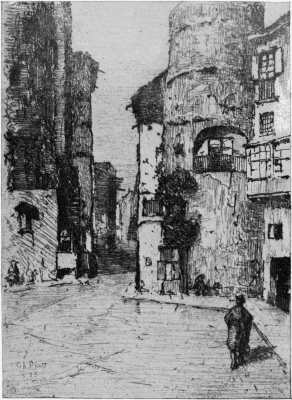 THE GATE OF BARCELONA.
From an etching by Charles A. Platt.
troops have arrived after dark; they surround the town.”
“Well! What of that?”
“You are in danger, my dear master!” cries Gotor, clasping his hands and
approaching nearer to the table at which Luna is seated. “You must
instantly conceal yourself until you can escape. I have a disguise ready
without.”
“Escape!” cries the constable, rising from his chair. “Never! I have
lived in danger of my life for the last twenty years. I care not for the
petty plots of traitors whom I will soon hang up as high as Haman.”
“But the king, my lord! The king—he has forsaken you. He sends these
troops. I know it,” put in Morales, coming to the front in spite of the
terror with which the constable inspires him. “Hearing the movement in
the town, I have been down among the alguazils who accompany the troops.
They say that their mission is to seize the High Constable and carry him
to Valladolid a prisoner. Fly, my dear master! Let us die for you!”
More eager than Gotor, the tears stream from Morales’s eyes as he dares
to advance and touch the Conde on the arm.
“No,” answers Luna, shaking him off, and with a stately step turning to
pace up and down the chamber. “It is false that Don Juan has himself
sent for me. He may be foolish, weak, deceived; but he will never betray
his faithful friend.”
“For the love of God, believe me!” pleads Morales, again pressing on
the Conde, no muscle of whose face had changed.
“That my enemies are below I do not doubt,” he replies, “but that they
are sent by the king, no voice but his own shall convince me.”
“Then, my dear master, we must defend you. Call our slender garrison
together, and man the walls with their crossbows.”
No reply comes. Gotor hastily turns towards the door, but the impetuous
Morales is before him. The heavy panels turn on their hinges, the lock
closes loudly in the silence, and Luna is again alone.
What could those devoted servants do against the strong force under
Conde de Zuniga? A few crossbows were discharged, some swords were
drawn. Morales fell wounded, Gotor was taken prisoner, and the besieged
were overpowered.
Zuniga, furious at the opposition, appeared on the platform in front of
the castle gate clad in a complete suit of dark armour greaved with
steel, wearing his visor down, preceded by a herald bearing the red and
yellow flag of Spain.
“In the name of Don Juan, King of Castile and Leon,” cries the herald.
“Oh, hear, hear him. I, Don Alfonso de Zuniga, leading the armies of the
king, command Don Alvarez de Luna, Constable of Castile and Leon,
instantly to surrender his person for trial on the charge of foul
murder, or the castle of Portello shall be consigned to the flames.
Lord High Constable, I call on you, in the king’s name, to answer.”
“I am here to reply to the Conde de Zuniga,” answers Luna, appearing
under the arch of a Gothic window over the gallery, with the same
dignity of presence as if he were receiving him as a guest. A blind
confidence in his power over the king still possesses him, and, besides,
to his haughty spirit, the humiliation of submission to his enemies is
bitterer than death.
“Answer me also. What mean you, Don Alfonso de Zuniga, by besieging my
castle?”
A tone of offended dignity is in his voice, but he does not condescend
to any other expression.
“I come on a warrant from the king,” answers Zuniga, displaying a
parchment which he hands to the herald, who holds it up extended on a
lance.
“The king!” cries Luna, with more passion than he has yet shown. “It is
a lie! This is some foul scheme to trap me into your hands.”
“Look at that document,” cries Zuniga, chafing under the insolent
bearing of the constable, and as the sun, which has now risen, shines
upon the rocky platform on which they stand before the castle, the
brilliant colours of “the castle and the lion,” are plainly displayed
emblazoned on the sheet. “If you submit,” continues Zuniga, advancing to
where Luna stands at the casement, “such respect as your rank entitles
you to is guaranteed; I swear it on the honour of a Castilian. My orders
are to conduct you to Valladolid in honourable custody, and to demand
your sword.”
“Take my life with it, if you list!” cries Luna, in a voice of bitter
anguish, “if my lord and master has in truth given me into your hands.”
The one desire of Luna was to obtain an interview with the king. Well
did he estimate his craven and helpless nature and that, if once
admitted to his presence, the long supremacy he had exercised over him
would at once return. The queen was equally determined that so dangerous
an interview should not take place. It was the influence of the moment
which always decided Don Juan, if any decision he ever had at all.
“I will not admit the Conde de Luna to my presence,” was his answer to
the messengers sent to Burgos.
“Nor has such a traitor the right to ask it,” added the queen—who now
habitually took part in the Council of State—standing behind him, her
dark eyes flashing fire.
Three long days passed within the noble hall with the artesonado
ceiling, where Luna was confined in the Casa de las Argollas (the iron
links), still entire and standing in the Plaza Viega of
Valladolid—three days of terrible suspense, yet with the absolute
assurance that Don Juan would relent. He had been guilty of no crime; he
deserved no punishment from the master he had so faithfully served. His
arrogant nature was maddened under the delay, but he suppressed the
expression of his indignation until he should stand face to face with
the king.
The long hours passed, no message came. Then, yielding to the alarm of
the friends who had gathered round him, he wrote that historic letter,
each word of which has come down to us.
“Forty-five years of my life, King Don Juan, have been passed in your
service; nor have I ever heard a word of complaint from your lips. The
favours you have showered on me were greater than my deserts, and
certainly more than my desire. To my prosperity one thing was
wanting—caution. In the days when you loved me I should have retired
from court and enjoyed in an honourable retreat the well-earned proofs
of your munificence.
“But I was either too generous or presumptuous, and I continued to lead
the state as long as I deemed my sovereign needed me. In this, O King of
Castile, I was myself deceived.”
So completely had Don Juan’s heart at this time been hardened against
him, that, resolute for once, instead of a reply, the trial of the High
Constable was decided on. The crimes of which he was accused were many.
First, the assassination of the Conde de Vivars; then vague charges of
embezzlement of the royal revenues, of having possessed himself by magic
of the will of the king and of his late queen; of being a tyrant,
without specifying any act of tyranny, and of usurping the royal
authority, without stating on what occasion.
So irregular and illegal were the conditions of the tribunal, composed
of accusers and judges, that it went far toward proving not only his
innocence, but a preconceived conclusion against him. He was condemned
to death.
Still he could not be brought to believe in his danger. When the
sentence was read to him, he bowed his grand head, covered with the
glossy curls, and was silent. A defiant smile parted his lips, as,
roused from his usual apathy, his eyes travelled slowly round from one
to the other of his judges.
Had not a fortune-teller predicted he should die in Cadahalso, the
name of one of his fiefs? And he was now in prison in Valladolid! But he
forgot that, in Spanish, Cadahalso also means scaffold, and that on
the scaffold he was condemned to die.
He was condemned, but the warrant of death had not yet been signed by
the king; at any time he might revoke it. The queen knew this and
watched him.
The fatal paper lay on a table in his retiring-room, untouched. Long Don
Juan contemplated it in silence, absorbed in more gloomy reflections
than he had ever felt before.
He imagined he was alone, but the queen, who never left him, was
concealed behind the arras.
Poor helpless, foolish sovereign! the atrocity of the act bewildered
him. A confusion of ideas troubled his spirit. As he gazed, the letters
stood out as if in characters of blood before his eyes.
What! he told himself, as he cast sad glances upon the paper, and pang
after pang of real sorrow shot from his inmost soul—the death of Luna,
whom he had loved when yet a little child, and his firm hand upheld his
tottering steps! The man in whom he had placed implicit trust and whose
genius left to him only the luxury, not the cares, of sovereignty. Luna,
the brave, the poetic knight, whose romantic career had fired his fancy
with the enthusiasm of a second Cid! Luna, his favourite, friend, the
support of his throne! The touch of his familiar hand seemed to grasp
his own! The superb majesty of his presence became tangible to him as he
paced up and down the apartment, a prey to a waking vision, called up by
the vivid image of his life. The constable! Always the constable! Where
was he? Would he answer to his call, and make his life pleasant to him
as heretofore? For a moment he forgot the existence of the queen. Her
blandishments and pleadings faded away as a mist before the sun. His
weak mind, unable to battle with such a tumult of ideas, recalled no
reason why his great minister should not be before him. There, opposite,
on the seat where he had sat so many years, and raised his sonorous
voice to comfort him. Dead! Condemned! Impossible! It was an evil dream.
His hand was already outstretched to rend the parchment, the sight of
which had caused him such agitation, and by swift messengers to recall
him to his side, when Queen Isabel stood before him.
“What! my dear lord!” she cried, in that melodious voice which she never
allowed to reach his ears but as a harmony, laying her hand upon his as
she spoke and drawing him from the table where the sentence lay, “can it
be true that you hesitate, when my safety and that of the nation are at
stake?”
In a confused silence he listened.
Attired in long robes of deepest mourning, which set off the luscious
brilliance of her complexion, she looked the ideal embodiment of woe.
Her large eyes were dull and veiled as she turned them imploringly on
the king, her whole being expressed the most poignant grief. Isabel was
perhaps the handsomest woman of her time, and, as such, bequeathed it to
her great daughter, Isabella of Aragon. She was at least the most
subtle. She knew that as long as Luna lived, the king might escape her
at any moment.
Impulsively she grasped both his hands, she laid her cheeks next to his.
Thus they stood for awhile; his arms clasped around her in a fervid
embrace. What beauty, what devotion was hers! Could he pain this
transcendent creature? These tears which lay on her eyelids like roseate
dew he could kiss off, but no further cause must be given her to shed
them.
“Oh, Juan!” she whispered, her words reaching his ears like ineffable
sighs, “why will you spare the criminal whose death I desire? Why will
you support a wretch whom every noble in your kingdom would see in his
grave? Your very crown is in danger! Your son is in revolt! Your cousin,
the Infante of Aragon, favours him; the King of Navarre——”
At the detested name of Navarre and his cousin of Aragon, who were both,
in this troubled and odious reign, continually conspiring against him,
the king gave a great start. Such energy as he possessed suddenly came
back to him.
“If you could prove that, my Reina!” he cried, every feature in his
face working with passion.
“I can! I can!” she answered; “the proofs are in my possession.” Then,
gently drawing him towards the table, on which lay the fatal document,
she placed a pen in his hand. “Sign, Juan,” she said, “for the sake of
my unborn child!”
Even at that moment his hand trembled so violently that he could
scarcely form the letters of his name.
The scaffold was erected in the Plaza Mayor, in the centre of the city
of Valladolid, where so many autos-da-fé came afterwards to be
celebrated under Philip II.
A large crucifix was placed in front of the stage, upon which was spread
a carpet of black velvet. The block and axe were there, but partially
concealed by the tall figure of the executioner, masked and robed in
scarlet.
From the moment he had received the intimation of his doom, the
fortitude and composure of the constable inspired respect even among his
enemies. With an unmoved countenance he met the high officers of state
at the door of the apartment he occupied in the Casa de las Argollas,
and listened to the sentence of death and the enumeration of the crimes
which were laid to his charge.
Not a word passed his lips. He might have been a statue of stone but for
a sad, tranquil smile, and the grave courtesy of the salute with which
he returned the reverences of the judges.
Now the trumpets sounded their shrill note, the clarion answered, and
the procession marched forward. First the parti-coloured herald with his
gay cap and tabard, rehearsing in a loud voice the reasons for which the
High Constable was to suffer. A body of men-at-arms followed in two
ranks, marching to the sound of muffled drums.
The constable himself next, mounted on a mule. He wore high-heeled shoes
with diamond buckles and an ample Castilian mantle reaching to his chin.
By his side rode his confessor.
The multitude which thronged the city to see this extraordinary sight
was immense; not only Valladolid and Burgos, but from all the burghs and
villages about for fifty miles.
As the people gazed open-eyed at the fall of the Master of Castile, much
as he was detested in life, murmurs of compassion were heard on every
side, as, with an air of dignified leisure, he dismounted, and slowly
ascended the steps of the scaffold.
Arrived at the summit, he stood for a moment lost in thought as his eyes
ranged over the sea of faces uplifted to his, surging like the troubled
action of the waves. The stone colonnade which still surrounds the Plaza
was crammed; in every window, terrace, mirador, and balcony, the eager
countenances of massed-up spectators seemed to clothe the walls.
Raising his plumed hat for a moment from his head, he scanned the
multitude come to see him die. In front of the scaffold stood his enemy,
Don Enrique, Infante of Aragon, whose efforts to depose Don Juan he had
for years successfully combated. Around him gathered a group of nobles
of the queen’s party.
“Tell my master and yours, Don Juan the the king,” he said, speaking in
a clear voice, addressing himself to the Infante, “that he may find the
crown fit better on his brow now that I am gone, who made it too heavy
for him.” Then turning to his page Morales, convulsed with grief, who
had followed him to the scaffold, bearing on his arm, neatly folded, a
scarlet cloak to cover his body after decapitation, his lofty bearing
softened and his voice trembled as he spoke: “Alas! my poor boy, you,
who owe me nothing, weep for me; and my master the king, who owes me so
much gratitude, desires nothing but my death!”
He then took off his hat, which he handed to Morales, together with a
ring, placing it on his finger. His face was perfectly serene and his
clustering curls hung upon his broad shoulders, scented and tended as
carefully as heretofore.
Standing in front of the platform, the crimson figure of the executioner
backing him, the whole multitude was moved to pity, and notable sounds
of lamentation rent the air.
That this public testimony of sympathy gratified him exceedingly, the
smile that lighted up his face plainly showed. He placed his hand on his
heart and again saluted the vast assembly. “No manner of death brings
shame,” he said, “if supported with courage. Nor can the end of life be
deemed premature when it has been passed at the head of the state with
probity and wisdom. I wish the King of Castile a happy life, and his
people the same prosperity I brought to them.”
He then examined the block on which his head was to be laid, loosened
the lace ruff about his throat, smoothed back his hair from his neck,
and took a black ribbon from his vest, which he handed to the
executioner to bind his hands.
After praying very fervently before the crucifix, repeating the words of
his confessor aloud, he stood up.
“I am ready,” he said; “begin!” And with a movement full of grandeur, he
knelt, rested his head on the block, and at one stroke it was severed
from the body.
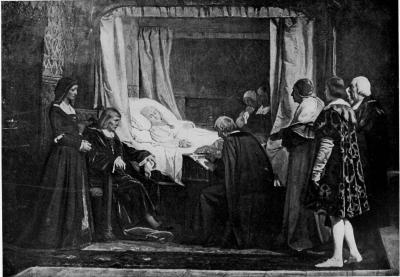 Photo by J. Laurent, Madrid.
QUEEN ISABELLA DICTATING HER WILL.
From the painting by E. Rosales in the National Museum, Madrid.
This took place early in June in the year 1453; nor have Spanish
historians ever decided whether his condemnation was justified or not.
Few instances occur which present an elevation and a fall so
extraordinary and sudden. But it must be remembered that few ministers
had up to that time displayed such high gifts for government, joined to
an arrogance and ostentation that were in themselves a crime.
Twelve months after, 1454, Don Juan II. ended his long and feeble reign
of forty-eight years. Politically, he was an odious king; the deed he
had been brought to commit failed to tranquillise the kingdom and will
ever be a blot upon his name.
Even in death, she for whose sake he did it—his beloved Isabel, the
mother of his son Alfonso and of his daughter Isabel—is beside him.
Within the Carthusian Cartuja de Miraflores they lie, two miles from
Burgos, on the plain, in one of the most magnificent alabaster monuments
of the ornate Gothic style. The variety and richness of the carving are
unique; there are nothing like it in florid Spain. The recumbent figures
are in robes of state, guarded by sixteen sculptured lions. Doña Isabel
wears a high open-worked gown under a coif. In front are the royal arms
on an escutcheon elaborately worked, and wonderful niches at the sides
are filled with subjects from the Bible. Death more superbly guarded is
nowhere else to be seen than in this record of a weak but artistic
king.