OW great is Spain! How mighty! From the rugged mountains of the
Asturias, their base washed by stormy waves, and the giddy heights of
the Pyrenean precipices—an eternal barrier between rival peoples—to
the balmy plains of the South, where summer ever reigns! A world within
itself, with a world’s variety! Quien dice España dice todo!
OW great is Spain! How mighty! From the rugged mountains of the
Asturias, their base washed by stormy waves, and the giddy heights of
the Pyrenean precipices—an eternal barrier between rival peoples—to
the balmy plains of the South, where summer ever reigns! A world within
itself, with a world’s variety! Quien dice España dice todo!
And its history is as varied as the land. First, according to the
legend, Hercules set his pillars, or “keys”—the ne plus ultra of land
and sea—on the rock of Calpe (Gibraltar) in Europe, and on Abyla
(Ceuta) in Africa. And, that no one should doubt it, he placed his
temple on the water-logged flats, half-sea, half-land, behind Cadiz,
long remembered by the Moors as the “district of Idols,” near the city
of Gades, where Geryon dwelt, from whom Hercules “lifted” that troop of
fat oxen which he was destined so long to drive wearily about the earth.
In memory of all which Charles the Fifth, the great Emperor, carried
Hercules’ pillars on his shield, with the proud motto, Ne plus ultra,
and the city of Cadiz (Gades) still bears them as its arms.
Then, tradition past, came invaders from the earliest times, Celts,
Phœnicians, and Greeks, driving the Iberians from their rightful
lands. The Carthaginians, too, crossed from Africa along the southern
coast, and settled at Cartagena, which still bears their name.
The Romans next appeared, victorious under Pompey and Cæsar, spreading
over Spain, but especially powerful at Seville, Cordoba, Toledo,
Segovia, and Tarragona, where they have left their mark in mighty
monuments.
A race of uncivilised warriors followed from the North, so powerful that
two Roman emperors perished in battle with them. Of the precise seat of
the Gothic nation it is hard to speak with certainty. It is, however,
known that they came from the extreme north, spreading to the borders of
the Black Sea, into Asia Minor in the east, and to the south of Spain in
the west. They are mentioned by Pliny, about sixty years before Christ,
and later by Tacitus, who twice refers to them as “Gothones.” There were
so many tribes, Visigoths, Astrogoths, Gepidæ, and even Vandals, that
their story is as a tangled web, mixed with that of all nations, but it
is clear that those who concern our present purpose came down into
Spain from Narbonne and Toulouse.
It is strange how soon these savage northmen discarded their wooden
idols, Woden, Thor, and Balder, the gods of thunder and of the sun—so
that when Constantine the Great christianised the world, the Gothic
chief Wulfila was ready to become a convert. Who this Wulfila was, and
how he came to be at Constantinople, is not clear. As Bishop of the
Goths he returned to missionarise his countrymen, the Dacian tribes, in
the mighty plains of Philippopolis (A.D. 310-314), and made a
translation of the Bible into Gothic. Even in our own day something of
this precious manuscript remains, beautifully written in letters of gold
on purple vellum, at the Swedish University of Upsala.
From the earliest times the Goths had a rude alphabet (Runes), which
Wulfila increased, with letters closely resembling English, in his
translation of the Scriptures.
Rude indeed! The letters were formed by staves on wooden boards, but all
the same were destined to become most ornamental. Gothic letters are
still in use for decorative purposes. Numerous Gothic manuscripts exist,
written in these picturesque characters, and the inscription over the
portal of Pedro el Cruel at the Alcazar at Seville is in Gothic. To this
day, too, in the Muzaraba Chapel, under the eastern tower of the
Cathedral of Toledo, the service is celebrated according to the
Christian rite from Gothic missals, dating from the time of King
Recaredo.
The line of Gothic rulers in Spain lasted for nearly two centuries and a
half. No less than thirty kings succeeded each other in that period,
most of whom died either by violence or in battle.
Alaric, “the scourge of God,” never came into Spain, but Eurico, his
immediate successor, did. Eurico was the greatest warrior of his time,
and so versed in Christian polemics that he insisted on the entire
nation becoming Arians like himself. Nothing but the close contact of
the Goths with that hotbed of heresy, Constantinople, can account for a
semi-barbarian indulging in a choice of divers forms of doctrine, nor
for the power the Gothic bishops arrogated to themselves after the
precedent of the Eastern prelates up to the time of Witica. Like the
Greek patriarchs they were mixed up in every political intrigue,
conspiracy, and revolution; made and unmade kings at their pleasure, and
greatly influenced the ecclesiastical world by the decrees of their
councils at Toledo. The Goths were, indeed, for ages a priest-ridden
nation, and the names of their great archbishops have come down to us as
landmarks in the land.
So high did party feeling run between Arians and Orthodox that
Leovigildô caused his only son to be executed because he had called an
Arian bishop “a servant of the devil,” and refused to “communicate” with
him. Yet Leovigildô was a great king according to his lights, sat on a
raised throne among his long-haired chiefs, and had money coined in his
name bearing an effigy of himself. Even now a dim halo of the pomp of
the Basileus seems to shine around him, as we picture him wearing the
Gothic crown, clothed in an ermine mantle, with the purple sandals of
empire on his feet.
How early is the religion of peace turned to strife! We are in the sixth
century among a new race, and already the flames of persecution are
blazing. Two parties divide the kingdom, “the bigots” and “the
Romanisers,” degenerate Goths, who aspire in dress and manners to ape
the culture of Byzantium, as opposed to the cloddish habits of the
“bigots,” content to know how to master a horse, draw the long bow,
launch the javelin, and follow their king to battle. Whether this type
of original Goth would have brought back the worship of Thor and Woden
does not appear. At least under these idols there was unity; the
sacrifice of human victims formed a convenient method of getting rid of
prisoners, and the temporary altars among migratory tribes, served by
male and female priests, were simple and convenient.
But Recaredo, on his accession, settled the question by becoming (like
the mass of his subjects) a Catholic, after a synod of sixty-seven
bishops, held at Toledo, had solemnly decided in favour of the orthodoxy
of that Church. Perhaps his religious divergences might not have been
so unquestioningly accepted, had he not defeated King Gouteran and
60,000 Franks. A Goth must know how to fight, or he was nothing; and
thus it came to pass that the theology of a commander, brave enough to
hurl destruction on his foes, was thankfully accepted.
Unlike the majority of his predecessors, Recaredo died in his bed (A.D.
601), applauded by all men for his wisdom in completing the union of the
conquered Iberians with the Goths, and forming what was destined to
become the future kingdom of Spain.
Eleven kings pass, and now (A.D. 680) Recesvinto, whom all men loved,
son of Chindavinto, lies dead upon a bed of state, raised on a dais,
draped with purple hangings; the four pillars of the canopy are plated
with sheets of gold, and a crown formed by strings of jewels, depending
from a circlet set with uncut stones, hangs over his head.
So bushy and matted is his hair—worn in the fashion of the Goths, in
long loose curls—and so thick his beard, that the sunken features of
the good old King are almost hidden. For twenty-three years Recesvinto
has reigned in peace, and now he lies in honoured death, while gathered
around him is such pomp as the nation possesses of golden crome and
kingly insignia; ermine-lined robe, and silken vest, sandals and buskins
laced with gold, the baton of command and the Gothic sceptre long borne
in battle by their kings.
The vaulted chamber in which he lies in the castle of Gerticos is lined
with planks of shining pine, on which some rude embroidery is stretched.
The hallowed roof is formed of thick beams and rafters, and huge
fireplaces flank either end, filled now with strong-smelling herbs,
rosemary and wild myrtle, lavender and thyme, loose sprigs of which,
with yew and cypress, are strewn on the rudely worked counterpane which
covers the corpse. Broadswords with huge hilts are crossed upon the
walls, along with solidly embossed shields and heavily topped lances,
the implements of the chase, and skins of wolves and deer, which have
fallen by the prowess of those royal hands, now lying white and cold in
death, crossed on his breast, clasping a crucifix! Saddles, too, and the
silver trappings of his war-horse, are there, and Runic bracelets,
collars, and buckles; all the paraphernalia of a Gothic chief, come down
from Dacian ancestors, ranged on tables full in the crimson rays of the
setting sun, streaming through the small bars of the uncurtained
casements, and illuminating each detail in flickering patches as of
flame.
On an oaken bench an altar has been raised to receive his last
confession, devoutly made, as he felt death approaching. The Eucharist
is still present in a jewelled box, the cup, platter, and crucifix,
while priests and acolytes, in stoles and copes, offer up silent prayers
for his departed soul. Clouds of incense darken the room and mount into
the lofty vaulting of the roof in huge shadowy masses, which to the
superstitious mind might shape into the outlines of dead Gothic kings,
hovering over the form of the royal brother who has joined them in the
world beyond.
Around the chamber are gathered the warriors and chiefs who have
followed him in battle, habited in the full loose garments of peace,
bound in with girdles and waistbands. Tall, strong men, with blue eyes
and fair skins, who, by their dress, might be mistaken for Roman
senators, save for the pervading colour of their abundant hair, passing
from every tint of pale straw colour to a dull red, their bare arms
circled with bracelets and amulets, on which, spite of Christian
doctrine, charms and cabalistic signs are engraved.
Chief among them stands Hilderic, Governor of Nîmes (for the south of
France up to the centre is Gothic), a massive, large-limbed man of
brutal courage, whose life has passed in feuds and battles with Franks
and Basques, never hesitating at any act of cruelty that would extend
his power. A fierce crimson hue is on his broad face from constant
exposure, and there are scars on neck and cheek, calculated to inspire
sympathy with his courage, if his ferocious expression did not turn them
rather into a cause of dread. Beside him stands Gunhild of Maguelone, a
turbulent soldier of inferior position, wanting in the authority assumed
by Hilderic.
Both these ambitious chiefs have been intriguing for the crown, as
Recesvinto grew old, hating each other bitterly while he lived, and now
that he is dead, bearing themselves with an irreverent indifference
painful to behold, talking in loud whispers to those about, and laughing
at rude jokes, especially Hilderic, who stands apart stroking the head
of a favourite wolf-dog of gigantic size.
Beside them is a Greek, Paul by name, who has made his way into favour
by extraordinary valour. Of his origin no one is certain; of polished
exterior, his superior civilisation is apparent in manners and in dress,
much more gaudy and ornate than that of the rest. A mantle of fine blue
cloth falls in ample folds about his graceful form, with a certain
Oriental amplitude easy to distinguish, and in his hand he carries a
scarlet cap.
Paul is to head a revolution by-and-by, under Hilderic; then,
unsuccessful, to be dragged by the hair of his head (more Gotico),
between two horses—friends and allies to-day, mortal enemies
to-morrow—such is the custom of these chiefs, often incited by the
rancour of the women, who appear in history as more bloodthirsty, if
possible, than the men.
Aëtius is there also, and Turismundo and Sisenanth, all mighty nobles,
and placed modestly behind a noble Goth, verging into years, noticeable
for the merciful disposition expressed in his wrinkled face; Wamba is
his name, the friend of the oppressed and of the tillers of the soil,
poor slaves whom no man heeds—even of the Jews, whom he insists upon
treating as members of the great human family; a brave, determined man
of the old Dacian type, notable among the fiery spirits around. As he
has great possessions, to which he attends himself, he is known as “the
farmer,” in derision of his simple tastes. Wamba is no kinsman to
Recesvinto, but a whisper has gone forth that he is destined to succeed
him. The Church, at this time most powerful, favours him, and he is the
only chief present whose record is free from crime. Many and many a time
he has fought shoulder to shoulder with the king who now lies dead. To
him the funeral chamber brings a genuine sorrow—not even pretended by
the rest—and as he gazes on the features of his friend, tears rise and
moisten his eyes.
Behind Wamba stands his beloved follower, Ervig, a youth whose
olive-complexioned face and clear brown eyes show alien blood. His
mother, a Gothic princess, was kinswoman to King Chindavinto, but his
father was a Greek. As yet no one reads the unscrupulous ambition of his
soul. Indeed, he hardly realises it himself. Crime often lies dormant in
seemingly innocent natures, until occasion discovers it. The evil spirit
within him is to be developed by the indulgence of his patron Wamba,
who, unknowingly, is warming a serpent in his breast.
All present fall back as Julianus, the Archbishop of Toledo, enters. He
has hurried from Toledo to be present ere the old king breathes his

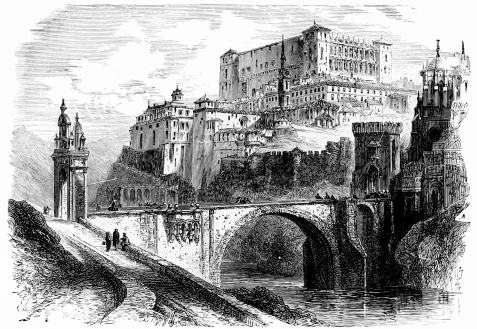 A VIEW IN TOLEDO.
last. But death waits for no man. As he enters the homely chamber of
death with an overwhelming majesty of look and manner, his cold,
impassive glance dominates them all. Nor is the dignity of costume
wanting. His monastic mantle is secured at the neck by a golden clasp,
and drapes heavily about him; the sleeves of his tunic are lined with
precious fur; on his finger is the pastoral ring, and from his neck is
suspended a jewelled cross; a dress at once simple and costly, answering
to the imperious expression of his face, looking out from the folds of a
dark silken cowl, which falls back from his head, his deeply-sunk eyes
taking in at a glance all the details around him.
Julianus is the foremost prelate in learning and power the Goths ever
had. Next, indeed, in historical importance to Isidor of Seville, though
much earlier in point of date; his influence and preponderance are at
this time supreme. Possibly he was by birth a Jew, though early attached
to the Chapter of Toledo. A churchman of great literary gifts, restless,
unscrupulous, ambitious; the very Hildebrand of those early times, who
raised the see of Toledo to a position of unparallelled supremacy,
presiding during his life at various councils most important in the
history of the mediæval church.
The archbishop is attended by his secretary, a lay brother, habited in
black, carrying papers, who (as reflecting the tyranny of his master)
stands, without daring to raise his eyes, more like an automaton than a
living man.
The only one whom the archbishop condescends to notice among the
assembly is Wamba, who holds himself somewhat apart from the rest. He at
once singles him out and salutes him with a profound obeisance which
Wamba, without evincing any surprise, returns in silence.
To look on the face of the dead is a duty among these savage races, who
believe that the soul of the departed lingers for awhile about its
tenement of clay. But there is another and more powerful incentive which
has assembled these chiefs from the far-off provinces of the kingdom.
Round the bed of the dead king they stand to choose his successor.
Absolute silence reigns. Each man is jealous of his neighbour, and
convinced that his own claims will prevail. Especially is this the case
with Hilderic, who has a secret compact with the Jews who fled from
oppression in the south of Spain to his government of Narbonne, and he
knows that they will gladly furnish him with funds to harass the
Christian nobles.
At last the voice of the archbishop is raised to break the strange hush
around.
“Chiefs and nobles of the Gothic nation,” he says, in a tone of
authority, while all eyes are fixed on him, “the king who lies here
reigned in peace according to the Gospel. I am not come to make his
funeral oration. All present know his good deeds and the moderation of
his rule. For twenty-three years the sword of the Goth has rested in
the scabbard. But this calm cannot continue. An able man must succeed
him. One”—and as he spoke the silken cowl fell altogether back,
displaying the powerful lines of his tonsured head, the broad
intellectual brow, and the erectness of command—“one, I say, alone is
worthy, and that is Wamba. He has no enemies.”
As a long-drawn breath of eager expectation looses itself with a
distinct note of relief, so did a low sound pass through the dead
chamber as Julianus spoke. On every countenance came an expression of
astonishment, but it was astonishment unmixed with opposition or anger.
A relief indeed to pent-up feelings, which finally found vent in a burst
of loud applause, each man falling back instinctively to where Wamba had
placed himself at the foot of the bed. Then, as with one voice, came the
response:
“Yes, Wamba! He shall be our king!”
“But,” cried Wamba, his wrinkled face working with emotion, as he
advanced quickly to where Julianus stood, “my consent is needful to this
proposal. Now I refuse it. I am not of an age to rule over my valorous
countrymen. I am old, I am unworthy. The strength of my arm is gone. I
am unfit to lead the dauntless Goths to battle.”
“Then rule over them at home,” is the short rejoinder of the archbishop.
“In a nation of soldiers a peaceful sovereign is best. You are great in
wisdom, O Wamba! Recesvinto was no warrior, and we are here to mourn his
loss.”
“Yes,” replies Hilderic, secretly rejoiced at the choice of Julianus, as
from the age of Wamba he will have time and occasion to complete his
treacherous plans before the new king’s probable death, for to Hilderic
Wamba appears an aged visionary, easy to be put aside when opportunity
is ripe, a convenient stop-gap for a time—“yes, Wamba, you are the only
man we will accept without bloodshed.”
“Impossible!” cries Wamba, his cheeks reddening with anger. “I will
accept nothing which I cannot righteously fulfil. I am unfit to reign.”
“No, no!” exclaims Ervig, casting his arms about his patron’s neck and
affectionately saluting him. “Goodness and wisdom are the best, and
those are yours, dear master.”
“We will have you! Speak! Consent!” come as one word from the circle
of nobles. “You dare not refuse the will of the chiefs,” cry all,
gathering round him, each more or less approving the choice on the same
grounds as did Hilderic, or as considering Wamba an easy ruler, under
whom every man would be his own master. Already the brows of some begin
to darken at his continued refusal.
“Choose some younger man,” he persists, struggling from the hands which
are now laid on him; “one better fitted for the arduous duties of your
king. Look at me,” and he raises his grey locks and bares his furrowed
forehead, “I am long past my prime.” As he speaks he is retreating as
best he can towards the door, when the fiery Hilderic, seizing him with
one hand, with the other brandishes a naked spear.
“Look you, Wamba,” says he, a dangerous fire kindling his eye, “you
shall never leave this chamber, save as a dead man, or as our king.”
“Dead, or as our king,” came as a war-cry from all the fierce Goths,
closing round him with such unseeming shouts and din, that it seemed as
if their rude clamour must disturb the last sleep of the dead whose
presence all had forgotten.
“You accept the crown in the sight of God?” demands the archbishop in a
solemn voice, stretching forth his hands towards Wamba, who, perceiving
that further opposition is useless, bows his head. “Then at this altar
let us offer up our thanksgivings. The Church is with you, Wamba.” And
Julianus turns to the oaken table on which stands the Host, and falls
upon his knees, with the priests and acolytes around, followed by all
those fierce spirits quelled for an instant by the might of his power.
“And,” says Wamba, as last of all that assembly he slowly bends his knee
in the place of honour reserved for him next to the archbishop,
“countrymen! let your prayers be for me also, that I may not be deemed
unworthy!”
Again the incense rises in shadowy clouds, filling the chamber with
strange outlines. Again the voices of the priests rise and fall, and
human interests are lulled for awhile in the presence of the dead king.
Again the chiefs remember for a brief moment his just and tranquil
reign, and many prayers are recited with apparent fervour for the repose
of his soul.
Within nineteen days after the election of his successor, Recesvinto was
buried and Wamba crowned by Julianus in the Cathedral of Toledo. All
Spain was jubilant, for he was a blameless man; indeed, a fond
remembrance yet clings to his name at Toledo. The words Tiempo del Rey
Wamba still point to some lingering impression of national prosperity
and of a time of plenty, answering to the days of the “Saxon kings” in
England. And Wamba was indeed no imbecile, or weak-handed in war, as
Hilderic and his friend the Greek Paul pretended, when, helped by the
Jews, they broke into rebellion. He was a warrior indeed, who, though
old, could lead the Goths to victory and punish his enemies by slaughter
and torture as was the habit of his nation. After which the “Farmer
King,” as he was affectionately called, to indicate his simple tastes
and care for the neglected serfs, returned to Toledo to enjoy his
triumph, descending the hill to the cathedral, through the narrow
streets, much as we see them now, followed by a long procession of
captive Basques with shaven heads, a signal mark of humiliation to the
abundant-haired Goths (the rebel Paul, in impious mockery, decorated
with a leather crown, stuck on his head with melted pitch, and a sceptre
of reeds in his hand), to be received by the Archbishop Julianus under
the sculptures of the Gate, at the head of his clergy.
But the decline of native valour had gone too far for any single man to
stem the downward tide. The free constitution of the Nomad tribes had
given place to a military despotism, alternating with, and controlled
by, a bigoted priesthood. The tremendous superiority of Julianus delayed
for a time this downward course, but could not arrest it. Even his iron
will could not stop the decadence of a nation. Each chief—or duke
(dux)—was king in his own district, and free to lead a life of
idleness and crime. If the Goths still fought well, it was only against
each other, or when pressed by necessity to arrest the inroads of the
Franks, a much more masculine nation than themselves.
In the south, the Moors were eagerly watching for some chance of
crushing out the Northmen. At home, the Jews, persecuted, ill-treated,
and numerous, were ready to join with every rebel, and to welcome any
invader, while, in spite of the efforts of the king, the freedmen, sunk
in hopeless slavery, tilled the land for their masters and lived like
the beasts of the field. All who possessed more than themselves or who
amassed riches were exposed to the envious rapacity of the nobles.
Thus the nation was threatened with destruction on all sides, yet so
short-sighted and effete had the Goths become, that, deluded with the
semblance of a false peace, they lived as they listed, unconscious of
the ruin gathering around.
For a time all went well with Wamba. The vigour of his government had
been a surprise to those who had elected him, to none more than the
archbishop himself, who little expected to find a ruler of such
determination in the modest-minded chief. No woman swayed his councils,
neither wife, daughter, nor leman. All his love was centred in Ervig,
whom he constantly advanced step by step to fresh honours and commands.
So much was Wamba beloved by the people and nation, that the erudite but
ambitious Julianus, still hoping to govern him with courtly flattery,
wrote his panegyric in the Storia Wamba, extolling him as the pattern
of a Christian hero; and Ervig, who had developed into a subtle
statesman, greatly favoured by the archbishop, helped him to turn the
elegant sentences.
When Julianus had declared on Wamba’s election that “the Church was with
him,” it was in the belief that he was dealing with a weak old man whom
he could blindly lead. He never dreamed that he would dare to touch the
privileges of his order. Perhaps Wamba thought so himself before power
imposed duties on his conscience. But when he insisted on keeping the
clergy in check, and exercised his prerogative in enacting new laws of
reform, Julianus secretly resolved on his destruction. Imbued with the
spirit of the Roman pontiffs he would permit no meddling of the secular
arm with his authority. Even the king, according to Julianus, must
submit to the decrees of the great councils which he, as archbishop, was
so fond of calling together, and which were destined to make his name
famous throughout the world.
To effect the downfall of Wamba a tool was needed, and that tool was
Ervig. Striking with a master hand on the baser chords of his nature,
vanity and ambition, the relentless archbishop crushed out of him every
spark of gratitude and love and moulded him to his hand as the potter
moulds the clay.
“It is for the salvation of the Church of God,” whispered Julianus, “a
holy deed. It is Wamba who is the Judas, not you, my son,” in answer to
Ervig’s feeble arguments. “Wamba has basely betrayed his master, and
must be cast out as a brand to the burning! You are of royal blood,
Wamba is but a hireling. Instead of standing as second to the throne, it
is your right to mount it, and prove to this backslider that the same
hand which crowned him can cast him down.”
“But you will spare his life,” pleaded Ervig, pricked sorely in his
conscience in spite of the casuistry of the archbishop.
“That will be in the hands of the Lord,” answered the arrogant priest.
“I am but the instrument of the Most High.”
Wamba did not live in the fortress over the city of Toledo, the present
Alcazar, but in a palace near the church now called Juan de los Reyes,
situated on a plateau overlooking the Tagus, and lower down in the town
among the citizens. Instinctively he was conscious of a change in Ervig.
He shunned him, he was short and reticent in his replies, assumed a
haughty indifference to his commands, and so openly opposed the new
clerical laws that Wamba severely reproved him. After which a strange
thing happened. Wamba fell into a deep sleep, sitting in the hall of his
palace, lulled by the ripple of the river far below; a stupor, rather
than a sleep, for he could not be aroused.
“The hand of God is upon him,” cried the false Ervig, whom the
attendants had summoned. “Call the archbishop. He must not die
unshriven.”
When consciousness returned, Wamba found himself habited as a monk, with
a dark cowl over his eyes, lying on a wooden trestle, more like a bier
than a resting-place for a living man. The walls around were bare and
discoloured with mildew, a dim uncertain light fell on his face from a
narrow window too high in the wall to reveal anything without. A
terrible oppression overwhelmed him; he could scarcely open his eyes,
and every limb seemed paralysed.
Whether the sleeping potion administered by Ervig had not been potent
enough to end life, or whether the strength of his constitution had
resisted its full action, no man will ever know. Gradually, as his
senses returned, he understood the treason of which he was the victim.
He was in a monk’s dress, and, according to the Gothic law, whoever once
assumes the ecclesiastical habit is dead to actual life. As far as his
kingly office was concerned they might as well have sealed him in a
tomb, and read the prayers for the dead over him!
“And Ervig had done this! Ervig!” For he dimly remembered a drink which
Ervig had at his request offered him before he fell asleep. In that
moment more than the bitterness of death passed over him. Death brings
forgetfulness. Wamba’s returning senses came with an agonised recalling
of all his former life, out of which rose the image of that one false
friend whom he had so loved and trusted. Moment by moment all became
clear; Ervig had, during his swoon, clothed him as a monk. He was
dethroned!
Suddenly the door of the cell opens, and the stately figure of the
archbishop appears. With straight swift strides he advances to where
Wamba lies; his priestly robe drooping around him with a heavy patrician
grace, his ebon hair falling over his ample brow, a veil to the
glittering eyes beneath, which burn with an evil fire. Like a phantom he
stands over the prostrate king—his form in shadow, sombrely defined
against the window, and in an instant all the cell seems to palpitate
with life; the walls animate with the expectant eyes of monks placed
there to watch the swoon of the king—a dark and sinister background
revealed by the scanty light, in which Julianus dominates like some
wicked giant about to pounce upon his prey.
Ervig was beside him, standing with averted looks that he might not meet
the gaze of Wamba, who still lay with half closed eyes, passively
watching the movements of his enemies.
Was it to be life or death? He cared not! A chill as of death curdled
his blood. The cell whirled and a mighty darkness reeled down upon him.
Wounded to the quick, he would not even condescend to expostulate.
Before such base treachery his righteous soul revolted. They had him in
their power, let them wreak their will. His life was done, his reign
ended. Against the law under which he lay there was no appeal. Shut up
in a subterranean prison how could he communicate with any who might
dare to restore him to his throne? It was subtly planned, and by a
master mind!
Wamba is, however, the first to break silence. He heaves a deep sigh and
opens his eyes, passing his hands slowly over his face, ghastly under
the effects of the poison. “You have been a false friend to me,” he
says, addressing himself, not to the archbishop, but to the muffled
figure which stands behind him. “You have returned evil for good. In
what have I injured you?” His voice is low, but he speaks with the
calmness of one who has already passed the gates of death.
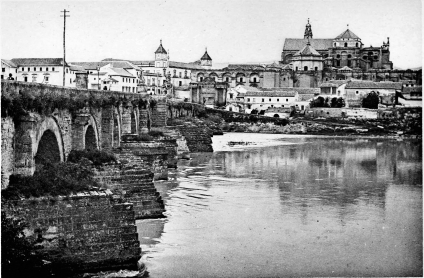 The Guadalquivir and Mosque, Cordova.
“Accuse not Ervig,” answers the archbishop, in a tone of lofty command,
placing himself before Wamba, so as to fill with his ample draperies the
narrow space of light. “It is the Holy Church in my person you have
offended. As an unfaithful son you are cast out. Ervig has but done his
duty, for you, Wamba, are a recreant unfit to reign.”
“And does the duty of Ervig lead him to succeed me?” asks Wamba, raising
himself painfully from the pallet and leaning forward, so that the
outlines of his sunken features appear under the cowl.
“It does,” answers Julianus, still shielding Ervig from the glance of
contempt which shoots from the eyes of Wamba.
“It is well,” is the answer. “You made me king, Julianus, against my
will. Now, against my will, you unmake me. Poor and wretched
instrument,” he adds, raising his hand towards Ervig, who was crouching
in the shadow near the wall, “beware how you cross Julianus. Take
example by me, and let no love for the Gothic tempt you to do justice to
the people.”
“Dare not to question the judgment of God,” exclaims the archbishop, an
expression of lofty scorn lighting up the evil brilliancy of his deeply
sunken eyes. “To Ervig you owe your life. I would have flung you into
the fires of purgatory to purify your sinful soul, but his counsels were
of mercy.”
“I thank him not,” replies Wamba. “I am old, and my time in this world
is short. I would far rather have sunk into eternal sleep, than lead the
life to which you have condemned me.”
So deeply moved was Ervig, despite the dignity which awaited him, that
he did not reply. He was a weak, unworthy nature, bad, but not wholly
depraved. He had been worked upon and warped by the sophistries of the
unscrupulous archbishop, which now, in the presence of his benefactor,
seemed to lose all their weight. Even his ambition to reign wavered for
the moment before his remorse, as one who having braced himself to
commit a crime, yet lacks the courage to carry out the measure of his
iniquity.
So evident was this, that, full of the fear of what his affection for
Wamba might prompt him to do, Julianus brought the interview to an
abrupt end. Without another word he passed out of the cell followed by
Ervig, and the army of tonsured monks, who had borne Wamba in, now
returned to watch his gradual return to active life.
The “Farmer King” had, however, many friends. The Goths loved him, and
the Jews (a powerful contingent, richer than all the rest) respected
him. So humble was he in peace, so brilliant in war, and under that calm
exterior gifted with such energy that he had inspired the State with a
new life, as the last great spirit of the old Dacian stock, that
Julianus became seriously alarmed, and hastened to call a Council of
Bishops to ratify the accession of Ervig to the throne.
The sentence which was passed upon Wamba was thus worded: “As there are
some who, being clothed in the garments of penitence when in peril of
death, after having recovered, claim that the vow is not binding—let
all such remember that they are baptised without will or knowledge, and
yet no man can remove baptism without damnation; as it is with baptism,
so with monastic vows, and we [the Council] declare that all who violate
this law are worthy of the severest punishment, and are incapable of
holding any office or civil dignity during their natural lives.”
By this it would seem that, however the nation clung to the memory of
the good old king, yet these once brave and manly warriors had sunk into
an incredibly superstitious and priest-ridden nation, fit only to be
crushed in the hands of the first bold invader, and that all this
internal strife was but as an invitation to the Moors across the
Straits, and the Basques in the mountains of the north, to take
advantage of their weakness.
Of Ervig it is said that, after a few years passed in vassalage to
Julianus, remorse overcame him, and he took to his bed and died.
Under Witica the Court of Toledo was stained with blood. He was an
ignorant, arrogant tyrant, who only understood present advantage to
himself. To prevent possible rebellion—and hostile parties were many
and ran high, as in preceding reigns—he dismantled the city walls and
fortresses, and in his mad eagerness for the security of the throne
murdered every kinsman whose life lay within his hand. Particularly was
his insane jealousy directed against his cousin Favila, Dux of
Cantabria, who was executed, and Witica had prepared the same fate for
his son Pelayo, but he escaped to become later on the saviour of his
country in driving out the Moors from the north of Spain.
Then his suspicions spent themselves on another kinsman, the Gothic
chief Theodofredo. His eyes were put out, and he was imprisoned in the
damp vault under the castle of Cordoba.
Half Mussulman, and wholly brutal, Witica ingeniously united the vices
of both nations—the Iberians and the Goths—and indulged in such a
numerous harem as put even the Moors to shame. In vain did the Church
thunder against this very peccant son. Julianus was long dead. He
laughed at the threats of the Pope, and, like his Gothic ancestor,
Alaric, threatened to lay siege to Rome.
“Why,” cried he, when presiding in the Chapter at Toledo, clothed in his
royal robes, the crown and sceptre beside him, in the midst of the
trembling canons, who knew it was at their life’s peril to venture to
contradict him—“why shall not our Gothic damsels adorn themselves with
the jewels of the Vatican, and our coffers be replenished with the
treasury of St. Peter’s?”
Incensed at the opposition of the Archbishop Sindaredo, who dared to
expostulate with him, he appointed his own brother Opas, at heart as
profligate as himself, Archbishop of Seville, to take his seat along
with Sindaredo in the episcopal chair of Toledo. (Opas was the most
unscrupulous prelate that ever wore the mitre. Even Julianus was his
inferior in secular power, for Opas was a prince, born of the old Gothic
stock.)
“Since the Church of Toledo will not yield to me, her lawful spouse,”
said Witica, with savage sarcasm, “she shall, like a harlot, have two
husbands—Sindaredo and Opas. No foreign potentate with a triple crown
shall preach to me.”
Witica, bad as he was, is yet entitled to be considered as the first
reformer. He promulgated a law freeing the clergy from the vow of
celibacy. No threats or anathemas of any mitred Julianus stopped him. No
obedience to monkish precepts governed his mind. He revelled in lawless
licentiousness, and in outraging the pietism of the time. Of Witica it
was said that “he taught all Spain to sin.” Naturally the monkish
chronicles have unmercifully vilified him. Yet there is much of the
humoristic coarseness of the Middle Ages in his character; a grotesque
setting at naught of all law and convenance, which the fashion of
politer times—not a whit less vile—softened and refined into a
quasi-elegance perhaps more repulsive.
While the churches are closed under an interdict, the altars bare, the
people disarmed, the castles and fortresses dismantled lest they might
harbour enemies, and disorder and sensuality reign unchecked throughout
the land, a youthful avenger is growing up in the person of Roderich,
son of Theodofredo, now dead, some say murdered, in the gloomy
dungeons of Cordoba.
Of royal birth, reared and educated among the cultivated Romans,
Roderich is not only a brilliant knight, but a master of all the
civilisation of the age, prompt at all martial exercise, of graceful and
polished manners, and eager to avenge the wrongs of his father and of
the Goths. Like a meteor, this young hero flashes upon Spain, defeats
Witica “the Wicked,” in a pitched battle, and imprisons him in the same
castle of Cordoba, where his father has lately died. Not a dissentient
voice is heard on the battle-field when Roderich, raised on a shield by
the soldiers, as was the custom of his ancestors, and standing erect to
face the four quarters of the world, is proclaimed King of the Western
Goths, in place of the sons of Witica.
And now we come to the history of the beautiful Moor, Egilona, daughter
of the King of Algiers, who was at this time shipwrecked on the coast of
Spain at Denia. As the royal vessel grounded on the sand (says the
chronicle), the rabble of Denia—and what a rabble, in all ages, is that
of Spain, how greedy, how rapacious—rushed into the surf, to capture
and make spoil. But the grandeur of the illustrious company assembled on
the deck somewhat awed them as they paused with greedy eyes,--men and
women, sumptuously attired, facing them with all the haughtiness of
Oriental dignity. In the stern, closely pressed within a circle of her
Moslem guards, stood a lovely princess, lightly veiled, her turban
ablaze with jewels, and as the vessel heaved in upon the swell, and the
mob found themselves close upon the strangers, scimitars flashed and
jewelled daggers gleamed. Then some of the older Moors, understanding
the helplessness of their position, leaped on shore, and falling on
their knees before the alcaide, who stood by, unable to understand the
meaning of what he saw, implored his mercy towards a royal princess.
“She whom you behold,” said one sumptuously robed African, who seemed to
lead the expedition, his brow covered by a green turban, on which
glittered an aigrette of inestimable worth, “is the only daughter of the
King of Algiers, whom we are conducting to her affianced husband, the
King of Tunis. Foul winds, as you see, have driven us on your coast. We
were compelled to make for land, or imperil the life of our inimitable
mistress. Allah has preserved her. Do you, Señor Alcaide, not prove more
cruel than the waves.”
The alcaide, a worthy man, much overcome by the magnificence of these
sea-borne guests, bowed his head in acquiescence, and called on his
alguazils to keep off the crowd. “I will myself conduct your princess to
the castle,” he replied to the noble Moor who had addressed him. “Let
her freely tread the Spanish soil. It shall be to her as safe as the
African land of her fathers.”
“The castle!” cried the same dazzling Moor who had already spoken,
stopping the alcaide short. “The castle! You would then treat this regal
bride as a captive? By the tomb of the Prophet, Señor Alcaide, you do
ill! Know that her ransom will be to you, and to your race for ever,
riches incalculable, such as the genii in dreams bear to the
faithful—if you deal well with her and let her go.”
Another and another of the circle of superbly robed strangers also
spoke.
“All we have is yours, Sir Alcaide.”
The fair captive herself held out her hands in supplication towards the
excellent magistrate, who stood perplexed, as divided between duty and
inclination.
“Will you,” she asked, in a soft voice, “imprison one whom the sea has
set free?”
In vain! The honesty of this Spanish official is a record to all time.
He was a Goth of the old school, and cared neither for jewels nor gold.
Much as it moved him to withstand the entreaties of so beautiful a
creature, his sense of duty conquered.
“Sir Moslem,” he answered, afraid at first to address himself directly
to the lady with a churlish refusal, but singling out the illustrious
Moor, whose words and presence showed him to be of exalted rank, “and
you, fair and virtuous lady, whom the storm has drifted on our shores,
greatly does it grieve me to say you nay, but my loyalty to my
sovereign, Don Roderich, leaves me no choice. This princess,”—pointing
to the lady, who had sunk back fainting in the arms of her attendants,
as soon as she was convinced of her failure to move the alcaide—“is a
royal captive, whom chance has landed within the Gothic realm. Don
Roderich can alone decide her fate. Within the castle I command let her
seek shelter and repose, more I cannot promise.”
To the court at Toledo the beautiful African journeyed, shedding many
tears. To the Eastern mind she was a slave, awaiting the will of her new
master. Yet it was refreshing to her feelings to be received in every
town and castle with royal honours, to be still surrounded by her
Moorish court, and to travel mounted on a snow-white palfrey, the wonder
and astonishment of all who beheld her. Slave though she was, her head
was carried high as one accustomed to receive homage. Her clear, dark
eyes, sparkling and mild, shone out under the strongly marked eyebrows
of the East, profuse braids of black hair hung loosely about her neck,
tinkling with golden coins; a veil of silver tissue was twined about her
head, to be drawn over the face and bosom at pleasure, under a turban,
to which a diadem was attached, decked with bright feathers; a long
tunic, woven in the looms of her country, heavy with pearls, and
trousers of a transparent fabric descended to her feet, incased in
delicate slippers, a loose mantle of changing silk covering all. Nor was
her horse unadorned; an embroidered saddle-cloth swept the ground, the
bridle and stirrup were inlaid with gems, and even the shoes were
wrought in gold.
At length, high over the wide plains which encircle Toledo, the bulk of
a lofty castle rises to her eyes; the rock on which it stands so hard
and defined in outline, it seems as if nature had planted it there as a
pedestal to receive the burden, and to guide the majestic current of the
Tagus through solemn defiles round the walls.
There, as now, the Alcazar stands, the servile city grouping at its base
in long, flat lines, granite rocks breaking out between, and giant
buttresses bordering the deep flood—a sadly tinted scene, terrible and
weird, just touched with burning flecks when the sun sets.
In a deep valley beside the Tagus Egilona rested under a silken pavilion
prepared for her, to await the coming of the king. Gloomy were her
thoughts on the banks of that rock-bound river, black with granite
boulders and rash and hasty in its course. What a country was this,
after the exotic landscapes of Algiers, the palmy groves and plantains,
the orange and lemon orchards, the ruddy pomegranates and olive grounds,
and the deep valleys of the hills! What pale, dismal tints! What stern,
sunless skies! Terror struck to Egilona’s heart as she asked herself
what kind of man this Northern king would be who dwelt in that frowning
castle. Would those walls enclose her in a life-long prison? or would
the dark flood beside her be her grave? Poor Egilona! a captive and a
slave! How could she guess the brilliant future before her, when the
aspect of nature itself heightened her fears?
Meanwhile, descending by the winding path which proudly zigzags down the
hill, a glittering cavalcade reaches the archway of the Golden Gate (a
monument formed in all ages for triumphant conquerors to pass through)
to defile upon the bridge upheld by many piers. Gothic chiefs,
magnificent in glittering armour, lances, heavy embossed casques, and
gold-inlaid corselets, riding deeply-flanked horses, champing bits of
gold—the great princes of the Northern court, the magnificent
successors of those iron-hearted warriors who well-nigh conquered the
world; mules with embroidered saddle-cloths, and gay litters and arabas
furnished with striped curtains for such attendant demoiselles as
cannot ride; gorgeous chariots, too, horsed with battle-steeds and
surrounded by archers and spearmen, flags and banners waving in the sun,
pages and attendants bright as exotic birds; and last of all, more
dazzling than the rest, Roderich himself, clad in crimson robes, active,
vigorous, and graceful, his face aglow with an excitement which
heightened the wondrous beauty of his features.
For such a reputation of comeliness to have come down to us from the
eighth century argues Roderich a royal Apollo indeed; but whether he
favoured the raven, or if his curling locks recalled the glow of the
dawn, can only be conjectured.
As he draws rein and dismounts before the silken draperies of the
pavilion, within which the peerless Egilona rests, his soul is moved
with tender expectation. He enters; their eyes meet, and he is struck
dumb! That mischievous boy, Cupid, has pierced him with his dart, and
then and there he swears a silent oath that Egilona shall be his queen.
“Come to me,” he says, in a soft voice, as he bends on her his glowing
eyes. “Come without fear. Let no sorrow cloud that royal brow. Beside
me, your path shall ever be made smooth, and a shelter found, where you
shall rest alone. As in the court of your father, so shall you be in
mine. All I crave is leave to kiss your feet, most incomparable
stranger. This favour you will not refuse.”
At which Egilona, blushing to the painted henna circles which increased
the splendour of her eyes under his ardent gaze, bows her dark head.
Then taking her hand, Roderich, kissing the delicate finger-tips
tenderly, forbade her to kneel before him as she desired. With his own
hands he mounted her on a palfrey, and accompanied her up the ascent to
the castle, where he installed her in the richest chambers facing the
sun. And, ever more and more enslaved, the handsome young Goth, amorous
by temperament and habit, became
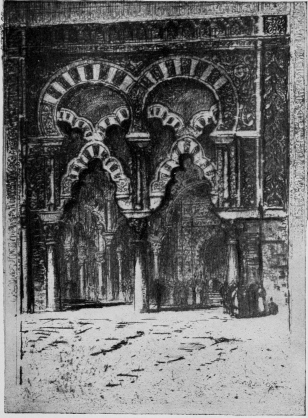 IN THE CATHEDRAL—CORDOVA.
From an etching by Samuel Colman.
IN THE CATHEDRAL—CORDOVA.
From an etching by Samuel Colman.
dearer and dearer to her, and fainter and fainter grew the remembrance
of her African home, and that Tunisian bridegroom she had never seen;
until, at last, her dainty lips opened with a “Yes,” to his entreaties,
and Egilona consented to become a Christian and his queen.
Wonderful are the ways of love! All this took place in a brief space.
Not only Egilona, but many of her Moorish damsels, wooed by Gothic
knights, eloquent with the words of passion, found their arguments so
convincing, that they also not only shared in her conversion, but
followed her example in marriage.
Happy Egilona! The shops in the Yacatin, the Jews’ quarter, and the
bales of the African merchants travelling from city to city, were
ransacked for her use. The most precious merchandise, silks, gems,
perfumes, and sweetmeats—all that Europe and the East possessed richest
and rarest to please a lady’s eye—were showered upon her, when Don
Roderich led her by the broad marble stairs of the Alcazar into the
pillared patio, followed by her African retinue, down the steep
streets to the Cathedral—very different to what we see it now, though
standing on the same spot, and in all ages a fair and stately edifice,
said to have been founded by the Virgin herself. Children, according to
ancient custom, ran before to throw flowers in her path; and bowls
filled with uncut jewels and gold coins were presented to her by noble
youths in silken robes. The wedding chorus was sung as she passed by, a
poet reciting “How the god of love had wounded the heart of the king,”
the Archbishop Opas himself meeting them at the great Puerta, and
blessing them as they knelt.
Jousts, tournaments and banquets, followed; the great chiefs appearing
resplendent in burnished armour, embossed and enamelled in the ancient
style; nothing was too costly for these delicate descendants of the
rudely armed Alaric; carpet knights, all plumes and banners and worked
scarfs, glittering in and out of silken tents; and revelry and dances
presided over by the king and queen.
For twenty days princes and knights, assembled from all parts of Spain,
kept holiday at Toledo. Every tongue declared the dark-skinned Egilona
peerless among queens, and Don Roderich the comeliest of the Gothic
race. Egilona was adored by her Christian consort. He turned no more
longing eyes upon the venal fair who hitherto had contended for his
favour, and the vessel of state glided over a crystal sea to the soft
winds of prosperity under a cloudless sky.
The old lays and ballads make Roderich, in the magnificence of his
youth, a rival of the Cid Campeador himself. Even his mortal enemies,
the Moors, glorify him in their songs sung to the cither under the
orange groves of Granada.
But already the “cloud no bigger than a man’s hand” is rising on the
horizon, by-and-by to obscure and darken the sun of his success.
A crown acquired by violence sits uneasily on the usurper’s head. Like
Witica, Don Roderich was tormented with suspicions of conspiracies and
treachery among his powerful nobles. So little did the fate of his
ill-starred predecessor teach him wisdom, that he permitted the same
fears to haunt him, of all who were allied to him by blood. Witica’s two
sons were banished from Spain, and, to avoid the chance of rebellion,
such defences in walls and castles as yet remained were thrown down, and
the carefully constructed fortifications of the Romans levelled to the
earth. Nor could a rude and warlike race be expected to maintain their
early valour in the midst of such luxury and licentiousness as
prevailed. For two hundred years the Gothic kings had held Spain by the
prowess of their arms, and the simple habits of their
forefathers—Ataulfo, Sigeric, Theodoric, Alaric, Amalaric, and his
successors up to the frugal-minded Wamba, the “Farmer King.”
Now, under Witica and Roderich, effeminacy and sloth led on to
cowardice. The Gothic soldiers who had been galvanised into a temporary
show of valour by the recent strife between Witica and Roderich, soon
sank back into the inactivity of a wanton court, feasting, dancing, and
wassailing in a style more becoming the satraps of an Eastern potentate
than the chiefs of a free and generous people. Who could have recognised
in these voluptuous youths, who hung about the person of Don Roderich,
the descendants of those stern and frugal Teutonic heroes of the North,
marching down like thunder-gods to conquer the nations?
Pomp there was, it is true, and splendour, and civilisation, and an
elegance of manners and of thought unknown before; but the heart of the
Gothic nation was cankered at the core, and the warlike Moors, ever on
the lookout to snatch from their grasp the fertile Peninsula showing out
so fair across the Straits, noted it with joy.