THE ROYAL GOVERNESS.
IT was the King's habit, when at Saint-Germain, to
hear early mass in the chapel. On his return,
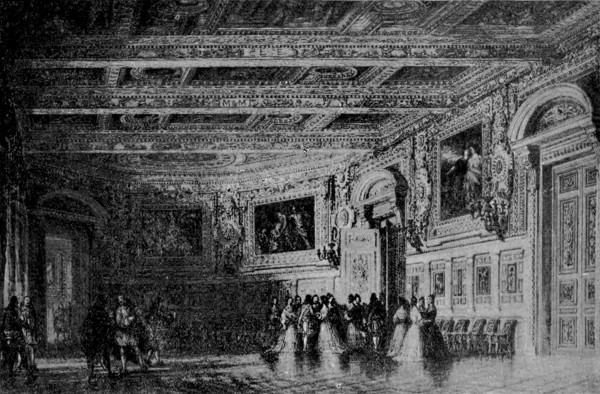
he passed through the great gallery in which the
Court was assembled, to make their morning salutations
to him. There he also received the petitions
of all who had sufficient interest to gain admittance.
A woman, tall, finely formed, and of ample proportions,
with a stealthy glance out of magnificent black
eyes, a well-curved mouth, and a composed and
dignified bearing,—quite a style to suit the royal
taste,—with a black silk scarf edged with lace
thrown over her head, and wearing a dress of common
materials, but skilfully designed to set off her
rounded figure to the best advantage, presented herself
before him. In her hand she held a petition,
at the top of which, in large letters, was written:
"The Widow Scarron most humbly prays his Majesty
to grant——"
Louis read no more; his eye was gratified by the
petitioner, not by the petition, which he put into
his pocket and forgot. But the lady appeared so
often, standing in the same place in the gallery of
Saint-Germain, that his Majesty grew weary of her
sight. At length he turned his back upon her.
Françoise d'Aubigné, of the Protestant family of
that name, had married in her youth the poet Scarron—a
dwarf, deformed and bedridden, a lover of
loose company, and a writer of looser songs—for her
bread. Scarron drew up the marriage contract without
the assistance of a notary. The dower of Françoise
was as follows. Four pounds a year, two
large black eyes, a fine bust, well-shaped hands, and
a great deal of esprit. Scarron covenanted to contribute
the hump upon his back, plenty of brains,
and a pension granted to him by the Queen-Regent,
Anne of Austria, as le malade de le Reine. He regretted
he could not offer either hands or feet, both
being paralysed. But he can assure his fiancée of a
dower which she will gladly accept—Immortality:
a prediction made in derision, which was strangely
justified by events.
In the house of her husband, this enticing daughter
of the D'Aubignés learned early "to be all things to
all men." She copied her husband's ribald songs
for him, she entertained his promiscuous circle of
friends—the gross Villarceaux, Ninon de l'Enclos,
Mademoiselle de Scudéri, a lady of the highest
virtue, but who affected Bohemian society, and many
others.
In process of time, Madame Scarron's youth,
beauty, and talents opened to her the salon of the
Maréchal d'Albert, where she made the acquaintance
of Madame de Sévigné, and Madame de Chalais, to
become the Princesse des Ursins. She also made a
much more important acquaintance in Madame de
Montespan. When Scarron died, she found herself
without a resource in the world. The King had disregarded
her petition. By her friends' interest she
obtained a place in the household of the Princess de
Nemours, affianced to the King of Portugal. Before
quitting France, she called on all she knew. Among
others, she visited Madame de Montespan. To her
she related her ill-success at Saint-Germain.
"Why did you not come to me?" asked the favourite.
"I would have protected you. I will even
now take charge of your petition. I will see that
his Majesty reads it."
"What!" cried Louis, when he saw the well-known
name, "the Widow Scarron again? Why, I
am deluged with her petitions. She is become a
Court proverb, 'as importunate as the Widow Scarron.'
What do you know of the Widow Scarron,
Athanaise?"
The petition for the pension was nevertheless
granted, and la Vueve Scarron, notwithstanding
many scandalous reports of the past, was appointed
governess to the illegitimate children born to the
King and Madame de Montespan. Her devotion to
her charges was extraordinary. The King, an attached
father, was favourably impressed. He showed
his approbation by a liberal allowance, out of which
was purchased the château and estate of Maintenon,
lying in a picturesque valley beside a river, sheltered
by hills, in a woodland district between Versailles
and Chartres. From this time the Widow Scarron
was known as the Marquise de Maintenon, and became
a devout Catholic. She had her own apartments
at Court, and cut all her disreputable friends.
She was constantly present when the King visited
Madame de Montespan.
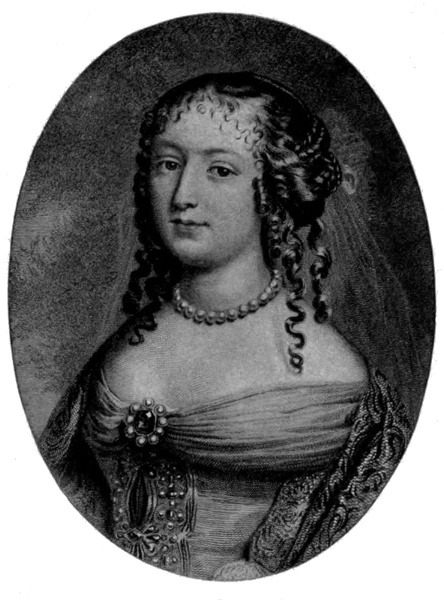
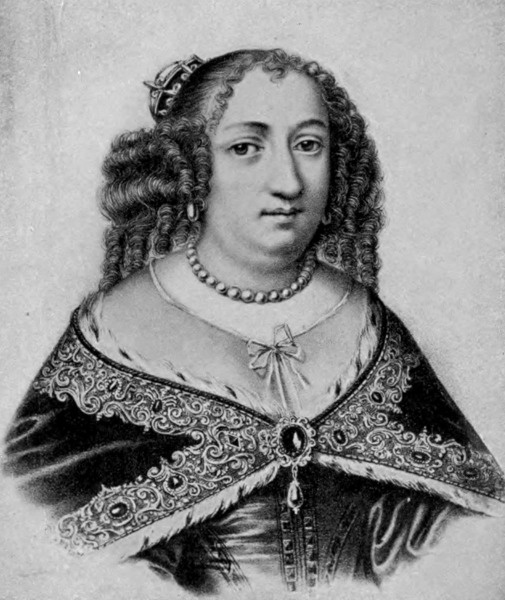
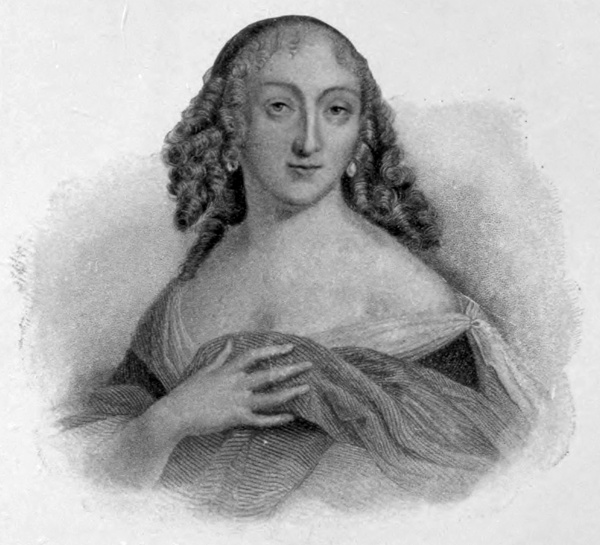
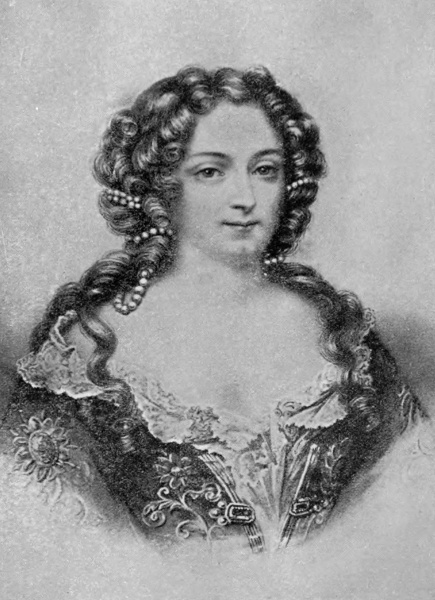
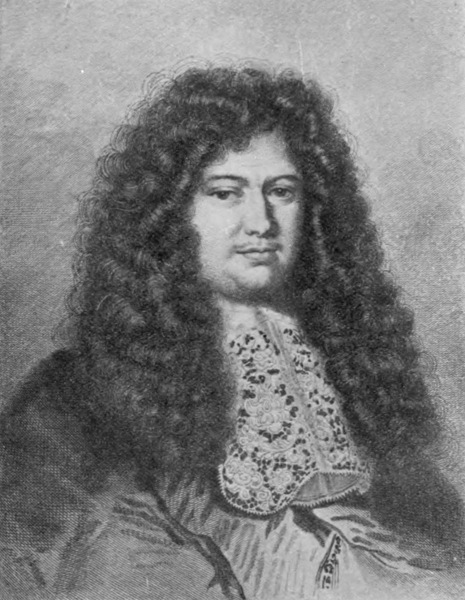
MADAME DE SÉVIGNÉ.
From an old engraving.
In the meantime, Mademoiselle de Montpensier
returned to Court. Louis XIV. could not tolerate
the absence of any of the princes and princesses of
the blood-royal, stars of the first magnitude in that
heaven where he blazed forth the centre of life and
light. Louis had sent a message to her. Mademoiselle
therefore dried her eyes, and appeared in
her usual place in the circle. Surely, she thinks, the
King will appreciate the sacrifice she is making
in being present at festivities which, by recalling so
vividly the image of Lauzun, drive her to despair!
A ballet is to take place at Versailles; the King is
to dance. Mademoiselle forces herself to be present.
She looks old, sad, and ill. She is preoccupied. Her
thoughts are with Lauzun, in the mountain-bound
fortress of Pignerol. There is but one person present
in that vast company she cares about. With
him she yearns to speak. It is D'Artagnan, Captain
of the Musketeers, who accompanied Lauzun to
Pignerol.
D'Artagnan, a Gascon, is a countryman of Lauzun.
He perfectly understands the part he has to play
with Mademoiselle; a part, indeed he had carefully
rehearsed with Lauzun while they were together.
All the time the ballet lasts, D'Artagnan, in immediate
attendance on the King, keeps his eyes fixed on
Mademoiselle with a sorrowful expression. This
agitates her extremely; she has the greatest difficulty
in keeping her seat beside the Queen.
Supper is served in the Queen's apartment, Louis
and Maria Theresa sit under a canopy of cloth of
gold. Hundreds of wax lights blaze in gilded stands,
and the King's twenty-four violins play. The
Dauphin, Mademoiselle, and all the princes and
princesses of the blood present are seated at the
table. The ushers and attendants admit the public
to gaze at their Majesties. Every well-dressed person
can enjoy this privilege, and the staircases and
passages are filled with crowds ascending and descending.
When the tedious ceremony is over, Mademoiselle
places herself near the door, and signs to D'Artagnan
to approach.
"Ah, Captain d'Artagnan, I saw you looking at
me all the time of the ballet," she says, with a sigh.
D'Artagnan, a bluff, soldierly fellow, but crafty
withal, and shrewd, a good friend and a bitter hater,
salutes her respectfully.
"D'Artagnan," continues Mademoiselle, moving
closer beside him, and dropping her voice into a
whisper, "you have something to tell me. I see it
in your face. You accompanied Monsieur de Lauzun
to Pignerol. Tell me everything you can remember."
Her manner is quick and hurried, her breath
comes fast.
"Your highness, I left the Comte de Lauzun in
good health."
"Thank God!" ejaculated Mademoiselle, clasping
her hands.
She feels so faint she is obliged to ask the Queen's
permission to open the window.
"Was he indisposed on his long journey?"
"No, Madame; he was perfectly well. I never
left him. Even at night I slept in the same chamber.
Such were my instructions."
"Did he speak to you of me?" asked Mademoiselle
in a faltering voice, blushing deeply.
"Constantly, your highness. He spoke of you with
the utmost devotion. Next to the grief Monsieur
de Lauzun felt at parting from your royal highness,
I am persuaded he suffered most from the displeasure
of his Majesty."
"Proceed, I entreat you," breaks in Mademoiselle
eagerly. "Every word you say is inexpressibly
precious to me. When did Lauzun first speak to you
of me, and what did he say?"
"I must tell you," continues the artful D'Artagnan,
watching her as a cat does a mouse—"I must tell your
highness that before these unfortunate events I had
avoided the Comte de Lauzun. I imagined he
despised every one."
Mademoiselle shakes her head.
"Proper pride—a conscious superiority," she
murmurs.
"Well, madame, when he was arrested on St. Catherine's
day, at Saint-Germain, the Comte de Rochefort
brought him into the guard-room, and consigned
him to me. I started at once with him on his journey
to Pignerol. From time to time he gazed at me, but
did not utter a single word. When we passed your
villa at Petit Bourg, he groaned, and tears gathered
in his eyes."
"Poor Lauzun!" says Mademoiselle softly, lifting
up her eyes.
"'That villa,' said the Count to me, 'belongs to
Mademoiselle. Words cannot tell what I owe her.
She is as good as she is great.'"
"Did Lauzun really say this?" asks Mademoiselle,
with melting eyes.
"He did, madame," rejoins D'Artagnan with secret
exultation at seeing how the bait is swallowed. "'I
am unhappy, Captain d'Artagnan', he went on to say,
'unhappy, but not guilty. I have served my King
faithfully. I have worshipped Mademoiselle—not
for her wealth, but for herself.'"
Mademoiselle puts her handkerchief to her eyes.
She is convulsed with suppressed sobs.
"Yes, madame; this and much more was said to
me by the Count. Indeed, his words were so touching
that, soldier as I am, I wept, your highness—I
actually wept."
"Excellent man," mutters Mademoiselle, stretching
out her hand towards him. "I shall not forget
your appreciation of so noble a gentleman."
D'Artagnan makes a profound obeisance.
("My promotion is now assured," he says to himself,
"as well as poor Lauzun's pardon. Mademoiselle
has great interest with his Majesty.")
D'Artagnan passes his hand across his eyes, as if
to brush away tears, which he does not shed.
"I have seen much since I served his Majesty,"—he
continues in broken sentences, simulating deep
grief. "I am an observer of human nature;—but
never—never did I know a man of such elevation of
mind, with feelings so warm, so genuine, as Monsieur
de Lauzun. The charms of his person, the dignity
of his manners, his fortitude and patience in adversity,
are more honourable to him than the splendour
of his position as the first nobleman in France."
Mademoiselle, unable to contain her feelings, lays
her hand upon D'Artagnan's hand, and presses it.
"Your penetration does you honour, Monsieur
d'Artagnan. Yet so mean, so base is the envy of a
Court, that it is whispered about, loud enough even
for me in my exalted position to hear, that Lauzun
cares only for my revenues—not for myself."
"Good God, what a slander!" cried D'Artagnan,
with a face of well-simulated horror.
"Yes; but I do not believe it," hastily adds Mademoiselle.
"I can pledge my honour as a soldier, your highness,
it is a lie," breaks in D'Artagnan, anxious for
his friend's prospects.
"I know it—I know it," answers Mademoiselle
with triumph.
"Ah, madame," continues D'Artagnan, shaking
with suppressed laughter, "did I not fear to offend
your delicacy, I could say more."
"Ah! did Lauzun speak often of me?" she asks,
and a fire comes into her sunken eyes. "Tell me."
"He spoke of nothing else. Day and night your
name was on his lips. My honour as a Gascon
upon it."
"Repeat this to me," cries Mademoiselle with
ecstasy.
"You little know, your highness, what tortures he
suffers at being separated from you."
"Alas! Monsieur d'Artagnan, he cannot suffer
more than I!" and Mademoiselle's sigh is almost a
groan.
"Your highness has great influence over his Majesty.
Is it possible that his imprisonment may be
shortened?"
"Can you doubt that my whole life, my influence,
my wealth, all I have, will be devoted to this object?"
exclaims Mademoiselle.
("Good," thinks D'Artagnan, "I have served my
poor friend, and I hope myself, well. What an imbecile
she is!")
At this moment there is a general move. The
Queen, who has been playing cards, rises, and Mademoiselle
is forced to accompany her.
Years pass; Lauzun still remains a prisoner at
Pignerol.
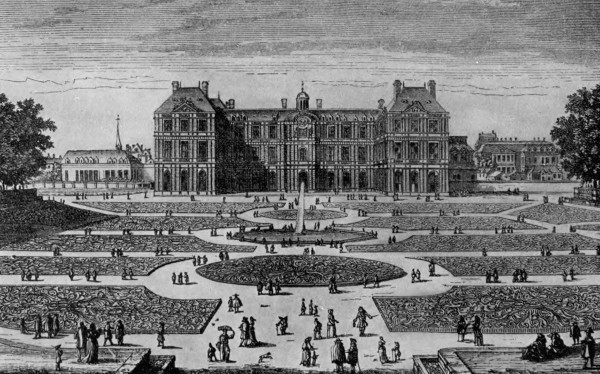
Mademoiselle is at the Luxembourg. She is sitting
in her closet writing, when a page enters, and
announces Madame de Maintenon. This lady is
now the recognised governess of the legitimatised
children of the King, the bosom friend of their
mother, the Marquise de Montespan. Already she
is scheming to supplant her in the King's affections.
Madame de Maintenon is singularly handsome. Her
face is pale; her complexion marble-like; her eyes
are large and lustrous, though somewhat fixed and
stern. Her glossy dark hair is raised high on her
head, and a mantilla of lace is thrown over it. Her
dress is of a sombre colour, but of the richest
material. It rustles along the ground, as, with
measured steps, she advances towards Mademoiselle.
The latter is conscious of the stately bearing of the
governess, who dares not, however, presume first to
address her. Mademoiselle does not rise, but bends
her head in acknowledgment of her salutation. She
signs to Madame de Maintenon to be seated.
"You are come alone, Madame," says the Princess.
"I should have rejoiced to see your little charges—those
dear children of whom I am so fond. Are they
well?"
"I am happy to inform your highness they are in
perfect health. The Duc de Maine looked lovely
this morning when he went with me to mass in the
royal chapel. I have come to bring you a little
letter he has written to your highness," and the
Marquise presents a note addressed in a schoolboy's
hand. "Ever since he has corresponded with you,
during his stay at Holland and at Barège, he finds such
pleasure in writing to you, I do not like to forbid it."
"The dear child! I love him greatly," replies
Mademoiselle, secretly wondering on what errand
Madame de Maintenon had come.
"I have the honour to inform your royal highness,"
says the Marquise after a pause, fixing her
black eyes keenly upon her, "my visit to you is
official. I come from the King."
Mademoiselle falls back in her chair; a mist
gathers before her eyes. "It must be about Lauzun
she has come!" is her first thought.
"But before I proceed to the subject of my
mission," continues Madame de Maintenon, speaking
in a clear metallic voice, all the while contemplating
Mademoiselle as if she were an object of
minute study—"but before I proceed, allow me to
offer to your highness the compliments of Madame
de Montespan, who is hunting at Clagny with the
King. She bids me pray you to think of everything
to please his Majesty, in order that he may be inclined
to grant what you have so much at heart."
Mademoiselle colours, and presses her hand to
her heart, so violently does it throb.
"Madame de Montespan," continues the Marquise,
"has the highest admiration for the constancy
and the fortitude you have shown on a
certain subject, madame. May I add my tribute of
sympathy also?"
Mademoiselle smiles, and bows graciously. She
is not ignorant of the growing power of the governess,
and her high favour with the King.
"We who live at Court," adds the Marquise loftily,
"know too well how often great princes forget those
whom they once loved. Your highness is an illustrious
exception. May I, madame, be permitted to
address you on this delicate subject? It is the
purpose of my visit."
"I entreat you to speak," cries Mademoiselle,
greatly excited. "Tell me at once. I cannot bear
suspense. Tell me, is his Majesty about to liberate
Monsieur de Lauzun after so many years of imprisonment?"
"Well," replies Madame de Maintenon, with an
air of immense importance, "you shall judge,
Princess. His Majesty thinks that it is possible,
under certain conditions——"
"Will he acknowledge Lauzun as my husband?"
"He will never sanction the marriage, your highness,"
answers the Marquise decidedly, avoiding
Mademoiselle's eager gaze.
Here is a blow! Mademoiselle is absolutely
stunned. Madame de Maintenon proceeds in the
same monotonous tone:—
"His Majesty has considered the possibility of
liberating Monsieur de Lauzun, but there are difficulties,
not perhaps insurmountable, but which at
present render his gracious intention impossible."
"Name them," cries Mademoiselle almost fiercely,
suddenly sitting upright in her chair—"name them
instantly." She has turned ashy pale; her hands,
which she extends towards the other lady in her
agitation, tremble. She is a pitiable object.
"Why, the fact is," and the wily governess hems
once or twice, gives a slight cough, then clears her
voice, "his Majesty does not choose that the principality
of Dombes and the Château and estates of
Eu, with which he is informed you have invested
Monsieur de Lauzun, should go out of the royal
family. This is the difficulty which at present weighs
with the King. Madame de Montespan uses all her
eloquence in your favour, madame."
"I am obliged to her," answers Mademoiselle
drily. "It was rumoured that she was the person
who caused his Majesty to withdraw his consent to
my marriage."
This is dangerous ground, and Madame de Maintenon
hastens to change the subject; she well knows
how true are Mademoiselle's suspicions.
"I have nothing to do with the King's reasons,"
is her cautious rejoinder. "Doubtless they are excellent."
Then she glances towards the door as if about
to go. "Even with your royal highness I must be
excused canvassing what these reasons are. I came
simply to deliver a message with which I was entrusted,
and to carry back to his Majesty your answer."
This speech, delivered with the most freezing coldness,
almost frightens Mademoiselle into a fit. She
is quite unable to argue with Madame de Maintenon,
greatly her superior in intellect and in craft, specially
now, when her excited feelings barely permit
her to understand what is passing. She has sense,
however, to make a sign to the Marquise, intimating
her pleasure that she should not depart, which she
is preparing to do.
"His Majesty observed," continues that lady,
looking steadfastly out of the window, "that it
seems strange these royal appanages should pass
away into an undistinguished family, while those
who are near and most dear to his Majesty are at
this time absolutely portionless—the Duc de Maine,
for instance."
"What!" exclaims Mademoiselle, "is it only by
enriching the Duc de Maine that the Comte de
Lauzun can be liberated?" As she puts this question
her eyes flash, and her brow darkens. Then,
seeing the stony gaze of the imperturbable Marquise
fixed upon her, she composes herself, and awaits
her reply with more calmness.
"I must again entreat your highness to remember,"
answers Madame de Maintenon, rising from her
chair, and dropping her eyes on the ground with
affected humility, "that I am here only as an ambassadress.
I beg your highness to excuse aught I
may have said to offend you. But, as I perceived
a way of accommodation open, I ventured to approach
you as an ambassadress—simply as an
ambassadress." These last words are spoken with
a kind of unctious hypocrisy peculiar to herself.
"Now, madame, if you permit, I will take my
leave. My duties call me back to my beloved
charges. I have been absent too long already."
Forthwith, every device was used to force Mademoiselle
into compliance. The little Duc de Maine
was represented as being fonder of her than of any
other creature breathing—one of those singular
attachments, in fact, that are sometimes observed in
children, and are quite unaccountable. To favour
this assertion, the worthy pupil of Madame de Maintenon
was educated in a system of deceit. Every
morning he addressed a billet-doux to Mademoiselle,
represented as the genuine effusion of a young and
innocent heart, the same billet-doux having been
indited by his governess overnight and copied by
himself. Bouquets, presents, kisses, and caresses
were lavished in the same manner. The child played
his part so well that Mademoiselle believed at last
in this simulated attachment. Madame de Montespan
failed not, also, to pay the utmost court to
Mademoiselle, and represented to her how earnestly
she used her influence in order to induce the King
to liberate Lauzun. After these manœuvres had been
continued for some time, and the two intrigantes
deemed that the mind of Mademoiselle was sufficiently
prepared, Madame de Maintenon again set
forth to pay another visit at the Luxembourg
Palace.
This time she at once announced that the King
had determined to liberate Lauzun. Mademoiselle
in transports of joy at the intelligence, so far forgot
her dignity as to embrace the cunning messenger,
and to load her with thanks.
After this ebullition had a little subsided, Madame
de Maintenon gravely begged Mademoiselle not to
thank her. She again acted merely as an ambassadress,
she said. "But," she adds, "there is one
person who does deserve her thanks; for nothing
can exceed the earnestness with which he has urged
her highness's petition. Nay, he has not feared to
encounter the King's anger, so constant, so energetic
have been his prayers. It is to him her gratitude is
due."
"Who can have been this friend—this benefactor?"
cried the Princess. "Tell me, I implore you, that I
may load him with my gratitude."
"I can quite understand your feelings," returned
Madame de Maintenon; "your wish to be informed
of the name of this unknown benefactor is most
natural; but to gratify you, I must break a promise—a
most solemn promise—I have made never to
reveal his name. He did not desire to be known he
wished to serve you in secret."
"Don't talk to me of secrecy, madame, in such a
moment. Tell me at once to whom I am so deeply
indebted."
"If I must speak," replied the inimitable De
Maintenon (rejoicing at the success of her manœuvres),
"it is the Duc de Maine, who prevailed on his
father to grant the petition he knew would so delight
his beloved friend and protectress. The affection he
feels towards you is indeed something——"
"The darling child!" exclaimed Mademoiselle,
"how I love him! Is it possible he has done this
for me! How can I reward him?—what can I do
to show him how grateful I am?"
This was precisely the point to which Madame de
Maintenon had been labouring to bring the Princess.
She now artfully observed that there was only one
way of rewarding the disinterested attachment of the
Duc de Maine in a manner worthy of Mademoiselle.
"I feel bound, however," she continued, "to warn
your highness that, after all that has been said, and
the personal interest his Majesty feels in the success
of these negotiations, he will be so incensed at any
withdrawal on your part now, that your personal
liberty—yes, madame," she repeated, seeing the
Princess's look of terror, "your personal liberty will
be in danger. You may be sent to the Bastille!"
The mention of such a possibility alarmed Mademoiselle
beyond measure, and she anxiously inquired
of Madame de Maintenon if she thought there was
any chance of such a misfortune.
"Not if by your generosity you bind his Majesty,
as it were, to fulfil the pledge he has now given,"
was the discreet reply.
Thus did Madame de Maintenon unfold her tactics
and work on the weak mind of the love-sick
Princess. She saw that the point was already gained,
and, fearing to destroy the favourable impression she
had made, left Mademoiselle to ruminate on the
approaching return of Lauzun, and all the happiness
in store for her. Hastening back to Versailles, she
communicated her success to the King and to Madame
de Montespan, who were equally delighted at
the triumph of their unworthy artifices.