THE wars of the League rage fiercer than ever. By the death of the last
Valois, Henry III., Henry IV., a Bourbon, is King of France.[19] But he
is only acknowledged by his Protestant subjects. To the Catholics he is
but a rebel, and still only King of Navarre. The Duc de Mayenne (a
Guise, brother of the Balafré), subsidised with money and troops by
Spain, is the orthodox pretender to the

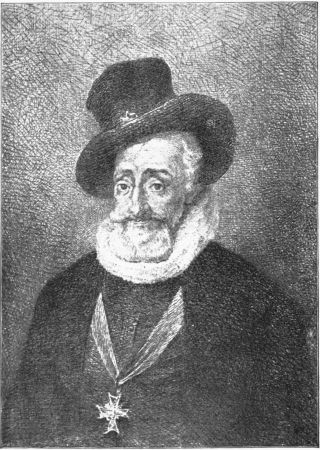 HENRY IV.
FROM A CONTEMPORARY PAINTING IN THE MUSEUM AT VERSAILLES.
throne. The capital, Paris, is with him. The two Henries, reconciled
after the death of Catherine de’ Medici, encamped with their respective
forces at Saint-Cloud, were about to invest the city. But now Henry III.
is dead. His successor, Henry of Navarre, weakened in influence, troops,
and money, is forced to raise the siege and retire. Henry IV. had at
this time but 3,000 troops, while the army of Mayenne numbered 32,000
men. Then came help from England. The victory of Ivry was gained, Henry
again invested Paris and encamped on the heights of Montmartre. It was
now he uttered that characteristic mot:—“I am like the true mother in
the judgment of Solomon,—I would rather not have Paris at all than see
it torn to pieces.”
At this time the fortune of war called the King in many places. He loved
an adventurous life. Brave to a fault, he rode hither and thither like a
knight-errant, regardless of his personal safety, accompanied only by a
few attendants.
Although a warrior and a statesman, Henry was a true child of the
mountains. Born under the shadows of the Pyrenees, he would as soon
encamp under a hedge as lie on a bed of down; would rather eat dried ham
spiced with garlic than dine sumptuously at Jarnet’s Palace, at the
Marais or at “Le Petit More,” the polite traiteur of that day; would
quaff the petit cru of his native grape with more relish than the
costliest wines from the vineyards of Champagne or Bordeaux. Henry was
not born upon the banks of the Garonne, but a more thorough Gascon never
lived,—his hand upon his sword, his foot in the stirrup, his gun slung
across his shoulder, the first in assault, the last in retreat, ready
to slay the wild boar of his native forests, or lute in hand to twang a
roundelay in honour of the first Dulcinea he encountered. Boastful,
fearless, capricious; his versatility of accomplishments suited the
changing aspects of the times. He was plain of speech, rough in
manner—with a quaint jest alike for friend or foe; irregular in his
habits, eating at no stated times, but when hungry voraciously devouring
everything that pleased him, especially fruit and oysters; negligent,
not to say dirty, in his person, and smelling strong of garlic. A man
who called a spade a spade, swore like a trooper, and hated the parade
of courts; was constant in friendship, fickle in love, promised
everything freely, especially marriage, to any beauty who caught his
eye; a boon companion among men, a libertine with women, a story-teller,
cynical in his careless epicureanism, and so profound a believer in “the
way of fate,” that reckless of the morrow he extracted all things from
the passing hour.
He is now thirty-three years old, of middle height, broad-shouldered,
and coarsely made. His swarthy skin is darkened by constant exposure; he
looks battered, wrinkled, and dissipated. His long nose overhangs his
grisly moustache, and a mocking expression lurks in the corners of his
mouth. The fire of his eyes is unquenched, and the habit of command is
stamped on every motion.
He is with his army at Mantes. It is evening; he is surrounded by a few
friends, and from talk of war the conversation turns to women. The Duc
de Bellegarde, captain of light horse, the close friend and constant
companion of the King, sits beside him. He has a noble presence, is
supple, graceful, gentle in speech and generous in nature.
Bellegarde speaks boastingly of the beauty of a certain lady whom he is
engaged to marry, Gabrielle d’Estrées, daughter of the Marquis
d’Estrées.
“Cap de Dieu!” exclaims Henry, after listening to Bellegarde in
silence; “I have heard of the lady, one of the daughters of our brave
general of artillery, Antoine d’Estrées; but I will back my bewitching
Abbess of Montmartre, Marie de Beauvilliers, against your Gabrielle.”
“Not if your Majesty saw her, believe me,” replies Bellegarde, warmly.
“You are a boaster, Bellegarde. You dare not produce your paragon.”
“On the contrary, Sire, I only desire that Mademoiselle d’Estrées should
be seen, for then alone she can be appreciated.”
“Say you so, Bellegarde? That is fair; will you bet a thousand crowns on
Gabrielle against Marie?”
“I accept, Sire; but how can we decide!”
“You see the lady. It is easily managed. Do you visit her often?”
“Your Majesty seemingly forgets I am engaged to marry her.”
“I understand. Now, Bellegarde, I forbid you, as your sovereign and
master, to see this fair lady, except in my company. Par Dieu! I will
refuse you leave of absence.”
Bellegarde’s heart misgave him. The King’s vehemence alarms him. He saw
too late the mistake that he has made.
“Now, Bellegarde, don’t look like a doctor of the Sorbonne in a fix;
Mademoiselle d’Estrées will not object if I go in your company?”
“Your Majesty must consider that I have no excuse for introducing you,”
replies he, with some hesitation. “Besides, consider, Sire, the roads
are unsafe and skirmishers are abroad.”
“Tut! tut! man; when did I ever care for that when a fair lady was in
the way? I insist upon going, or you shall not either. Both or none.
Listen how it shall be managed. I will disguise myself as—well, let me
see—a Spaniard; no one will suspect me in that character. You shall
introduce me as an Hidalgo, Don Juan, we will say”; and a wicked leer
lights up his countenance. “Don Juan, your prisoner,—taken in a
mêlée, now on parole; and my poor Chicot[20] shall go with us, too,
for company.”
Gabrielle was then living at the paternal Castle of Cœuvres, which
stood on a wooded height between Soissons and Laon, with her father and
her sisters. She was passionately attached to the seductive Bellegarde,
and anticipated their speedy union with all imaginable happiness.
One evening, while she was indulging in those agreeable musings proper
to the state called “being in love,” Bellegarde was abruptly announced.
He was accompanied by two gentlemen: one, short in stature, with a
comical expression of countenance, was introduced as Monsieur Chicot;
the other, by name “Don Juan,” neither tall nor short, but with very
broad shoulders, had greyish hair, highly coloured cheeks, a swarthy
skin, and was remarkable for a prominent nose and exceedingly audacious
eyes.
Gabrielle rose in haste and was about to fling her arms round
Bellegarde, but, on seeing his two companions, she drew back, welcoming
them all with a more formal courtesy.
Gabrielle was eighteen, tall, slim, and singularly graceful. The
severity of her aquiline features was relieved by the bluest eyes and a
most delicate pink and white complexion; webs of auburn hair flowed over
her shoulders. She cast a curious glance at her lover’s singular
companions; she was surprised and vexed that Bellegarde had not come
alone, and to find him cold and reserved. However, any shortcomings on
his part were amply made up by the cordial accolade of the Spanish Don,
who extolled her beauty to her face, and, without asking permission,
kissed her on the cheek.
Gabrielle’s delicacy was hurt at this freedom; she reproached herself
for the frankness with which she had received strangers, believing them
to be friends of her lover. Casting a helpless glance at him, she looked
down, blushed and retreated to a distant part of the room, where she
seated herself.
“Pray, madame, excuse our friend,” said Chicot, seeing the confusion of
Gabrielle at such unexpected familiarity; “he is a Spaniard, only newly
arrived in France; he is quite unacquainted with the usages of the
country.”
“By the mass!” cried Bellegarde, evidently ill at ease, and placing
himself in front of his love, “Spaniard, indeed! I, for my part, know no
country in the world where gentlemen are permitted, thus uninvited, to
salute the ladies—at least, in civilised latitudes. It is well
Mademoiselle’s father was not present.”
His annoyance was, however, quite lost on the Don, who, his eyes fixed
in bold admiration on Gabrielle, did not heed it.
“Bellegarde,” said Gabrielle, blushing to her forehead, seeing his
deeply-offended look, “excuse this stranger, I entreat, for my sake; I
am sure he meant no offence. Let not the joy I feel at seeing you be
overcast by this little occurrence.” And she rose, advanced to where he
stood, looked fondly at him, and took his hand in both of hers.
This appeal was enough. Bellegarde, though anxious, was no longer angry,
and, upon Gabrielle’s invitation, the party seated themselves, Gabrielle
placing herself beside Bellegarde.
“This gentleman, madame,” said Chicot, turning towards Gabrielle, “whose
admiration of you has led him to offend, is our prisoner; he surrendered
to us yesterday in the mêlée at Marly, and, his ransom paid, to-morrow
morning he will start to join the army of the Duke of Parma. Though
somewhat hot-headed and wilful he is an excellent soldier; he knows how
to behave in the battle-field, if his manners are otherwise too free,”
and Chicot turned round his head and winked at Don Juan, who laughed.
“At least, gentlemen, now you are here,” said Gabrielle, “by whatever
chance—and the chance must be good that brings you to me” (and her blue
eyes turned towards Bellegarde)—“you will partake of some refreshment.
I beg you to do so in the
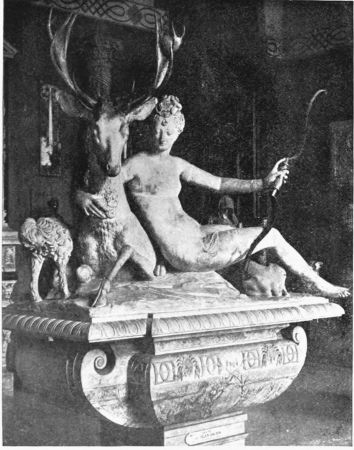 DIANA DE POITIERS, BY JEAN GOUJON.
FROM THE CHÂTEAU OF ANET, NOW IN THE LOUVRE.
(By permission of Levy, Paris.)
name of Monsieur de Bellegarde, my affianced husband, my father being
absent.”
“Fair lady,” said the Spaniard, breaking silence for the first time, and
speaking in excellent French, “I never before rejoiced so much in being
able to understand the French tongue as spoken by your dulcet voice;
this is the happiest moment of my life, for it has introduced me to the
fairest of your sex. I repeat it deliberately—the fairest of your sex;”
and he looked significantly at Bellegarde. “I accept your invitation,
readily. Were I fortunate enough to be your prisoner instead of the
Captain’s, my ransom would never be paid, I warrant.”
“Cap de Dieu!” exclaimed Chicot, grinning from ear to ear, “the
Spanish Dons well merit their reputation for gallantry, but our friend
here, Don Juan, outdoes them all, and, indeed, every one of his nation.”
“Madame,” broke in the Spaniard, very red in the face and speaking with
great vehemence, not appearing to hear this remark, and still addressing
Gabrielle, on whom his eyes were riveted, “I declare if any one, be he
noble or villein, knight or king, dare to say that any woman under God’s
sun surpasses you in beauty or grace, I declare him to be false and
disloyal, and with fitting opportunity I will prove, in more than words,
that he lies to the teeth.”
“Come, come, my good friend,” interrupted Bellegarde, much discomposed,
“do not, I beseech you, go into these heroics; you will alarm this lady.
If you heat yourself in this way, the night air will give you cold.
Besides, remember, Señor, this lady, Mademoiselle d’Estrées, is my
affianced bride, and that certain conditions were made between us before
I introduced you, which conditions you swore to observe”; and Bellegarde
looked reproachfully at him.
Don Juan felt the implied reproof, and, for the first time since he had
entered, moved his eyes to some other object than the smiling face of
Gabrielle.
Her sisters now joined them. Although they much resembled her, and would
have been comely in any other company, Gabrielle so far exceeded them as
to throw them altogether into the shade. They were both immediately
saluted with nearly equal warmth by the Spanish Don, who evidently would
not reform his manners in this particular. Like Gabrielle, they were
quite abashed and retreated to the farther side of the room.
“Let me tell you, ladies,” said Chicot, advancing towards them, “if you
were to see our friend, Don Juan, in a justaucorps of satin and
glittering with gold and precious stones, with a white panache in his
velvet cap, you would not think he looked so much amiss. But are you
going to give us nothing to eat? What has the Don done that he is to be
starved? Though he be a Spaniard, and serves against Henry of Navarre,
he is a Christian, and has a stomach like any other.”
On this hint the whole party adjourned to the eating-room. Gabrielle
carefully avoided the Don and kept close to Bellegarde, who looked the
picture of misery. Her sisters clung to her, Chicot was bursting with
ill-suppressed laughter, and the Don was fully occupied in endeavouring
to place himself beside Gabrielle, on whom his eyes were again intently
fixed. At table, spite of Bellegarde’s manœuvres, he contrived to
place himself beside her. He eat and drank voraciously; perpetually
proposed toasts in Gabrielle’s honour, and confused her to such a
degree, that she heartily repented having invited him to remain,
particularly as the annoyance of Bellegarde did not escape her. In this
state of general misunderstanding, the merry Chicot again came to the
rescue.
“Let us drink to the health of the King of France and Navarre!” cried
he. “Come, Don Juan, forget your politics and join us: here’s prosperity
and success to our gallant Henry—long may he live!”
“This is a toast we must drink standing and in chorus,” said Bellegarde,
rising.
The Spaniard smiled.
“But why,” observed Gabrielle, “does Don Juan bear arms against the King
of France if he is his partisan?”
“Fair lady, your remark is just,” replied the Don, “but the fortune of
war drives a soldier into many accidents; however, I only wish all
France was as much the King’s friend as I am.”
Chicot now took up a lute which lay near, tried the strings, and in a
somewhat cracked voice sang the following song, wagging his head and
winking at the Spaniard as he did so:—
“Vive Henri Quatre,
Vive ce roi vaillant;
Ce diable à quatre,
A le triple talent
De boire et de battre
Et d’être vert galant.”
“Long live the King! Vive Henri Quatre!” was drunk, with all the
honours, in a chorus of applause. The Spaniard wiped a tear from his
eye, and sat down without speaking.
“Cap de Dieu!” cried Chicot, “the right cause will triumph at last.”
“Yes,” replied Bellegarde, “sooner or later we shall see our brave King
enter Paris and his noble palace of the Louvre in state; but meanwhile
he must not fool away his time in follies and amours while the League is
in strength.”
“There you speak truth,” said Chicot; “he is too much given to such
games; he’s a very Sardanapalus: and,” continued he, squinting at the
Don with a most comical expression, “if report speak true, at this very
moment his Majesty is off on some adventure touching the rival beauty of
certain ladies, to the manifest neglect of his Crown and the ruin of his
affairs.”
“Ah!” exclaimed Gabrielle, her eyes sparkling with enthusiasm, “if some
second Agnes Sorel would but appear, and, making like her a noble use of
the King’s love and her influence, incite him to conquer himself, to
forsake all follies, and to devote his great talents in fighting heart
and soul against the rebels and the League!”
“Alas!” sighed Don Juan, “those were the early ages; such love as that
is not to be found now—it is a dream, a fantasy. Henry will find no
Agnes Sorel in these later days.”
“Say not so, noble Don,” replied Gabrielle; “I for my part adore the
King—I long to know him.”
The Spaniard’s eyes flashed, and Bellegarde started visibly.
“Love,” continued Gabrielle, flushing with excitement, “love is of all
times and of all seasons. True love is immortal. But I allow that it is
rare, though not impossible, to excite such a passion.”
“If it is a science to be learnt, will you teach me, fair lady?” asked
the Spaniard tenderly.
At this turn in the conversation Bellegarde again became painfully
agitated, and the subject dropped. The Don now addressed his
conversation to the sisters of Gabrielle, and at their request took up
the lute and sang an improvised song with considerable taste, in a fine
manly voice, which gained for him loud applauses all around. The words
were these:
“Charmante Gabrielle,
Percé de mille dards,
Quand la gloire m’appelle
A la suite de Mars,
Cruelle départie.
Que ne suis-je sans vie
Ou sans amour?”
Gabrielle looked, perhaps, a trifle too much pleased at the somewhat
free admiration expressed in these verses, and spite of Bellegarde,
approached the Don to thank him after he had finished.
“Lady, did my song please you?” said he softly, trying to kiss her hand.
“If it had any merit you inspired me.”
“Yes,” replied she musingly. “You wished just now you were my prisoner.
Had you been, I should long ago have freed you if you had sung to me
like that, I am sure.”
“And why?” asked he.
“Because you have something in your voice I should have feared to hear
too often,” said she in a low voice, lest Bellegarde should hear her.
“Then in that case I would always have remained your voluntary captive,
ma belle.”
How long this conversation might have continued authorities do not
state; but Bellegarde, now really displeased, approached the whispering
pair, giving an indignant glance at Gabrielle and a look full of
reproach at the Don.
“Come, come, Don Juan!” said he. “It is time to go. Where are our
horses? The day wears on, we shall scarce reach the camp ere sundown.”
“Ventre Saint Gris!” said the Spaniard, starting, “there is surely no
need for such haste.”
“Your promise,” muttered Bellegarde in his ear.
“Confound you, Bellegarde! You have introduced me into paradise, and now
you drag me away just when the breath of heaven is warming me.” Don Juan
looked broken-hearted at being obliged to leave, and cast the most
loving glances towards Gabrielle and her handsome sisters.
“I opine we ought never to have come at all,” said Chicot, winking
violently and looking at Gabrielle, who with downcast eyes evidently
regretted the necessity of the Don’s departure.
“Mère de Dieu!” muttered the latter to Bellegarde, “you are too hard
thus to bind me to my cursed promise.”
“Gabrielle,” said Bellegarde, drawing her aside, and speaking in a low
voice, “one kiss ere I go. You are my beloved—my other self, the soul
of my soul. Adieu! This has been a miserable meeting. You have grieved
me, love; but perhaps it is my own fault. I ought to have come alone.
That Spaniard is disgusting”—Gabrielle turned her head away—“But I
will soon return. In the meantime, a caution in your ear. If this same
Don Juan comes again during my absence to pay you a second visit, send
him off I charge you, by the love I know you bear me. Give him his
congé without ceremony; hold no parley, I entreat you; he is a sad
good-for-nothing, and would come with no good intentions. I could tell
you more. He is——, but next time you shall hear all. Till then,
adieu!”
“I will obey you, Bellegarde,” replied Gabrielle somewhat coldly; “but
the Spaniard seems to me an honest gentleman, and looks born to
command.”
The whole party then proceeded to the courtyard, where the three horses
were waiting.
“Adieu, most adorable Gabrielle!” cried the Spaniard, vaulting first
into the saddle. “Would to heaven I had never set eyes on you, or that,
having seen you, I might gaze to eternity on that heavenly face.”
“Well,” said Bellegarde gaily, for his spirits rose as he saw the
Spaniard ready to depart, “you need only wait until peace be made, and
then I will present you at Court, Don Juan, where Madame la Duchesse de
Bellegarde, otherwise La Belle Gabrielle, will shine fairest of the
fair.”
“You are not married yet, Duke, however,” rejoined the Spaniard, looking
back, “and remember, you must first have his Majesty’s leave and
licence—not always to be got. Ha, ha, my friend, I have you there!”
laughed the Don. “Adieu, then, once more, most beautiful ladies, adieu
to you all! Bellegarde, you have gained your bet.”