IN the morning it was announced in
the newspapers that Chief Borden
had been suspended, pending the decision
of the courts on the charges against
him, and that Moran had been appointed
acting-chief in his place.
Keighley opened his eyes wide upon
the news, and then narrowed them cunningly
as he considered it. He had expected
that Borden would be thrown out
neck and crop as a warning to all the
“Anti-Jiggers;” and there was a glimmer
of something hopeful in the half-heartedness
of a tentative suspension.
Keighley shut himself in his office with
his desk telephone to find out what had
happened.
It did not take him long to learn.
One of his political friends in the upper
circle explained that “the Boss” had
objected to a fratricidal war that
threatened to disrupt the whole fire department,
to sacrifice public faith in the
administration for no political ends,
and to weaken the “organization” by
dividing it against itself. The Fire
Commissioner had compromised by suspending
Borden instead of “breaking”
him. Keighley listened—and shook his
head. “That don’t let me out,” he said.
“It may keep ’em from comin’ after me
on Broadway with a club, but it’ll never
keep ’em from stickin’ me in the back
some night around a dark corner.”
He hung up the receiver and
scratched the back of his neck doubtfully.
It was his day off duty, but he
was reluctant to take it—and leave the
lieutenant in charge. “Moore,” he
summoned him, “get that report done,
will yuh? I’ll see to cleanin’ the boat.”
“It’s all right,” Moore replied. “I
can do both—if you want to get away.”
Keighley looked out the window at
the humid haze of heat that hung over
the water. “I guess I’ll be as cool here
as anywhere,” he said. “Go ahead
with the report.”
That Sunday was to be memorable in
the records of the Weather Bureau as
the hottest July day in forty years; and
it was to be memorable in the records
of the fire department for the most
dangerous fire that had attacked the
water front since the department had
been formed. But the fire did not break
out till sundown; and fate, while she
was setting a terrific stage for Keighley’s
next appearance, allowed him one
of those entre-acts that make the fireman’s
life such a thing of heart-breaking
spurts of action and nerve-wracking
blanks of peace.
Having given his orders for the day,
he withdrew, upstairs, to a balcony off
his bunkroom, where he sat all morning
in the shade, watching the tugs and ferries,
steamboats, floats and scows that
bustled and wallowed and staggered
past, squealing in a shrill impatience
when they whistled, and puffing short
of breath when they reversed. The
water under their bows broke and fell
back sluggishly. The swells in their
wakes reeled away with an oily roll.
The air was heavy with the drifting
belch of their funnels.
It could not be said that Keighley
really thought of anything while he sat
there. It was one of the characteristics
of his mind that it worked best under
the conditions of bewildering excitement
that make clear thought impossible to
most men. He did not even think about
the “Jiggers;” he merely snoozed, with
one eye on that matter, like a watchdog,
until the noonday sun drove him from
his balcony. Then he went sleepily to a
neighboring restaurant for his dinner,
having already telephoned that he would
not be home.
It was a blistering afternoon, with a
sun overhead that struck a quivering
refraction from the dried and warped
planks of the wharves, and a breeze that
came hot across the sparkle of the bay
where the glancing facets of small waves
shone like a million gleaming little mirrors.
The pierhouse stood at the
water’s edge, as bare as a lighthouse to
the beat and reflection of the heat,
its row of open windows gaping in the
sunlight like a line of gasping mouths.
The men idled interminably, reading the
papers, yawning for an interval and
then reading them all over again. And
Keighley dozed at his desk in his office—like
Napoleon before a battle!—waiting
for the attack of his enemy to develop
the plan of his counter-assault.
A stiff easterly breeze sprang up at
sunset. It came cool from the sea; and
the crew of the Hudson received it as
a grateful relief. But this same breeze—puffing
steadily into the smolder of a
small fire that had just broken out in
the lumber yard of a furniture factory
on the East River water front—blew the
flames back through the stacks of seasoned
boards like a blaze through kindlings;
and while the Hudson, in answer
to a delayed alarm, was rounding the
Battery and speeding up the river, the
flames spread eagerly, in spite of all the
efforts of the shore companies to check
them, till, by the time the Hudson arrived,
they covered as much ground as
a prairie fire. Under a volume of dense
smoke, they reached and writhed and
leaped together, darting up their heads
venomously, waving aloft their flickering
crests, coiling back and striking low.
When the wind lifted the pall that
covered their trail, the piles of lumber
could be seen burning like torches. In
front of them, every now and then, a
feathery stream rose white in the ruddy
glow, spitting impotently into the air as
the firemen, retreating, choked it and
dragged it back; and overhead, continually,
the triumphal sparks brightened
and soared.
At the first sight of them Keighley’s
indolence of mind disappeared with the
quick blink of an alert eye. “Aha!” he
said to himself. “There’s work for
Moran.” He shouted to the men, “Get
out ev’ry line we got, boys.”
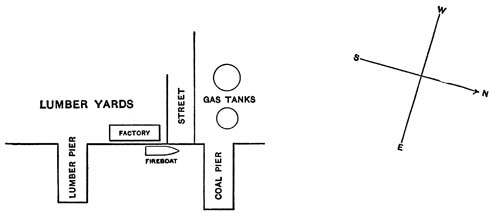
He laid the Hudson broadside on, at
the head of the slip, between two
wharves, under the dark wall of the furniture
factory; and he led up three lines
of his largest hose to take the fire in the
rear. He left the boat empty except for
the pilot, standing black in the door of
the lighted wheelhouse, and quiet except
when Dady, the engineer, came up
from the engine room, looked across the
darkness towards the struggle which he
could not see, and called out to the pilot,
“How’s she goin’, Pete?”
The pilot answered several times, indifferently,
that she was “going her own
gait all right,” that she was “chasing
the boys all round the lot,” that she had
“the bit in her teeth.” But at length
he reported that the wind had fallen.
Then, the next time, he said, “She’s
puffing in from the southeast.” And
at last he leaned his shoulder against
the door-jamb and replied, “You better
get your pumps well greased. The
wind’s come round strong from the
south.”
“South!” Dady sniffed the air.
“That’ll bring her back this way!”
“That’s what I’m telling you.”
The engineer popped into the hatch
like a frightened rabbit into its burrow;
and the silhouette in the doorway raised
the shadow of a pair of night glasses to
the black profile of a nose and stood
watching.
The scene of the fire on the piers
In a moment, out of the darkness at
the head of the slip, two figures in long
rubber coats came striding into the light
of the incandescent lamp at the stern
of the Hudson and sprang aboard.
They were Captain Keighley and Acting-Chief
Moran; and they came forward
rapidly towards the wheelhouse,
Moran waving his arm with an excited
gesture of authority.
“She’s working back over there,” he
was saying of the fire. “You’ll have to
hold her, here, at the factory, and keep
her from jumping that street to those
gas tanks. If they blow up, it’ll smash
half the ward.”
He ran up the ladder to the deck of
the wheelhouse. “We can’t get water
to hold her, back there,” he explained.
“They’re sucking air from those plugs
already.”
Keighley looked from the fire to the
black wall of the factory, from the factory
to the shadow where the street was
hidden, and from the street to the huge
gas tanks that seemed to be leaping and
falling in the wavering light of the
flames. “We got the water here all
right,” he said. He asked, “How wide
is it?”
“It’s—I don’t know,” Moran answered
impatiently. “It’s about seventy
feet from the wall to the nearest
tank. I can give you two water
towers.”
Keighley looked back over his
shoulder. The boat was lying between
the lumber wharf at her stern and the
gas company’s coal pier at her bows.
“Fire’s bound to back onto that yard
wharf,” he said. “We’ll be between
Hell an’ Purgat’ry here.” He looked
up at the factory wall above him.
“That’ll be comin’ down on top of us.”
He nodded at the gas tank. “All right.
We can keep her off them.”
Moran ran down the ladder and hurried
aft. Keighley followed him.
Suddenly the old captain said, in the
voice of a challenge, “I’ll do it if the
crew will.”
Moran asked, “What’s the matter
with the crew?”
Keighley answered, “I guess you
know as well as I do.”
Moran stepped ashore. “I’m going
around the factory,” he said curtly, and
vanished in the darkness.
Keighley stood stroking his sharp
nose and smiling under his hand. Then
he coughed a dry chuckle, turned, and
ran along the trail of hose towards the
fire.
He considered that he had “put it up”
to Moran. It was Moran’s turn, now,
to learn the danger of promoting dissension
in the place of discipline. Here
was a fire big enough to break him,
if it were badly handled; and he was
relying on a disaffected crew and a
discredited captain to handle it for
him.
Keighley smiled as he ran; and he
ran until the bitter smell of wet embers,
from the burned wood underfoot, was
wiped out of his nostrils by a puff of
smoke that came warm and dry on his
face. It sobered him. He slackened
his pace to fill his lungs against the stifle,
and proceeded carefully. A few yards
farther on, the expected blast scorched
him. When it had passed, he yelled,
“Hi, there! Moore, there!” He got no
reply. He broke into a run, stumbled
over the hose, and fell among the burned
beams and steaming ashes; and as he
sprang to his feet again, the smoke was
cut by a quivering current of heat, and
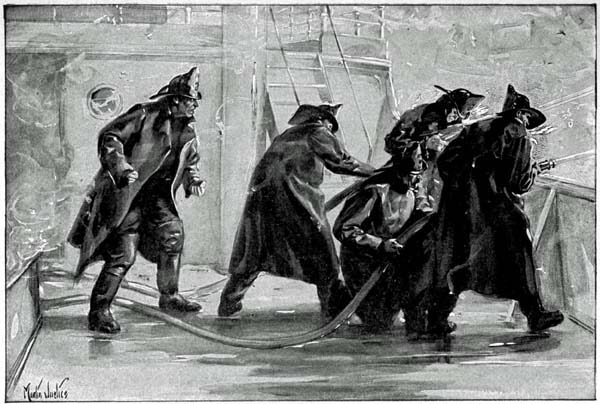
he saw his crew crouched in a line behind
their pipes, fighting in a wide semi-circle
of flames that held back before
them but reached out, roaring, on both
flanks. “Back out! Back!” he called.
“Yuh’re no good here. Get back to the
boat! We can’t stop her here. Come
along with that two-inch line! Lighten
up here, some o’ you men. Chase back
an’ shut off, Moore.”
They obeyed him in a suffocated silence,
dragging back the smaller hose.
But it was impossible to move the larger
lines as long as they were filled with the
weight of water; and the pipemen who
were directing these, blinded by the resinous
smoke of yellow pine, remained
bent double before the heat that came
licking across them like the touch of
flame.
Keighley ran to them. “Get back
an’ uncouple ’em. We’ll never get out
o’ here this way.”
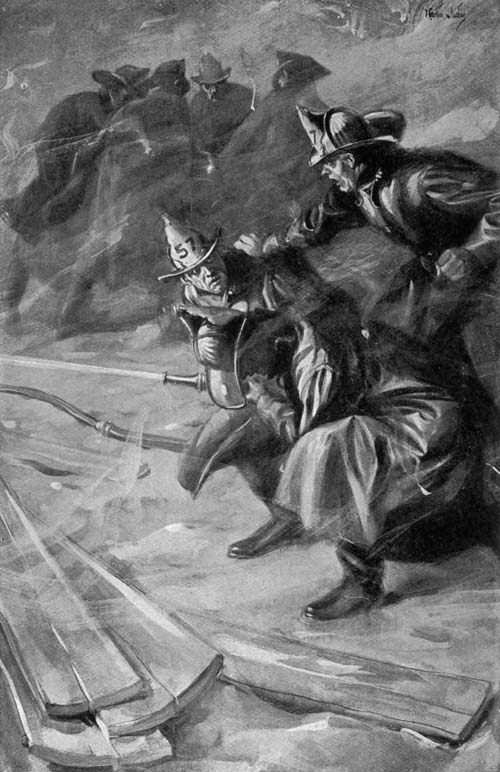
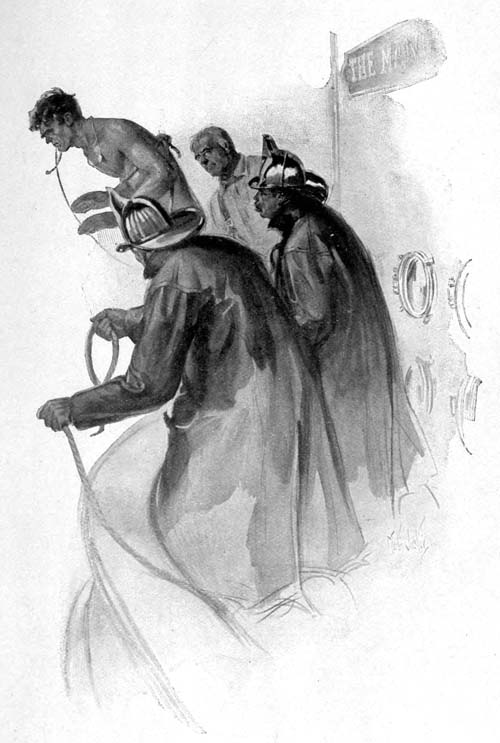
A man at the farthest pipe pitched
forward on his face and lay huddled.
His fellows left their nozzle in its pipe-stick,
caught him under arms and knees,
and stumbled back with him. Their undirected
stream threshed about like a
snake pinned down at the neck; and the
fire began to creep stealthily across the
drying debris around it.
A smoking pile of half-burned lumber
close at hand flared up in a sudden flame.
Keighley threw himself on the other
men, dragged them from their pipe, and
drove them back. “We can’t fool
here,” he cried. “We got to get around
to them gas tanks.”
They abandoned, reluctantly, the two
nozzles that were caught by the lugs in
the crotches of the pipe-sticks, and retreated
with the smaller line. But, even
so, they had to wait until the water had
been shut off before they dared break
the couplings to save the hose; and every
minute was an hour long to the
impatient Moran waiting for them
to stretch in their lines to protect
the threatened gas tanks. He was
fresh to his responsibility, and Keighley’s
cool insinuation of treachery
had put him to the edge of a new
fear.
When the men got back to the Hudson
with the first lengths of hose, he stormed
down on them angrily.
“What’re you doing? Get a move
on, will you? What the hell are you
fooling round with that hose for, Keighley?
Stretch in over there, where I
told you! Why the devil—”
Keighley, who had his own sense of
dignity, set his thin lips in a tight line
and looked back at the factory.
“Where’s yer truck comp’ny?” he
growled. “D’ yuh expect eight men to
stretch in enough o’ this boat’s hose to
feed two water towers?”
Moran’s voice rose to a hoarse curse:
“G— — you! don’t you talk back to me!
Do what you’re told. Get a hustle on,
or, by—”
Keighley obeyed without more words.
“Come along, boys,” he ordered.
“Leave yer lines there.”
They jumped aboard the boat and cast
off. The Hudson nosed her way across
the head of the slip until she lay with
her bows a few yards from the coal pier,
her side to the foot of the street that
separated the factory from the gas
tanks, and her stern in the shadow of the
factory wall. From that position, she
would flank the advance of the fire; her
supply lines, laid up the street, would
front it; and her stern pipes, trained
on the lumber wharf behind her would
check the flames there. The great
danger of the place was this: if the factory
burned, the falling of its walls
would crush the boat.
“Come along, now!” Keighley called.
“Open up that hose box.”
His men obeyed him eagerly.
“Shine” grumbled to Farley, “Moran
thinks he’s the real screw. If he gets
yappy, ol’ Clinkers’ll take an’ bite a
piece off ’m.”
Farley, having always been of the captain’s
faction, retorted jealously, “Don’t
you worry.”