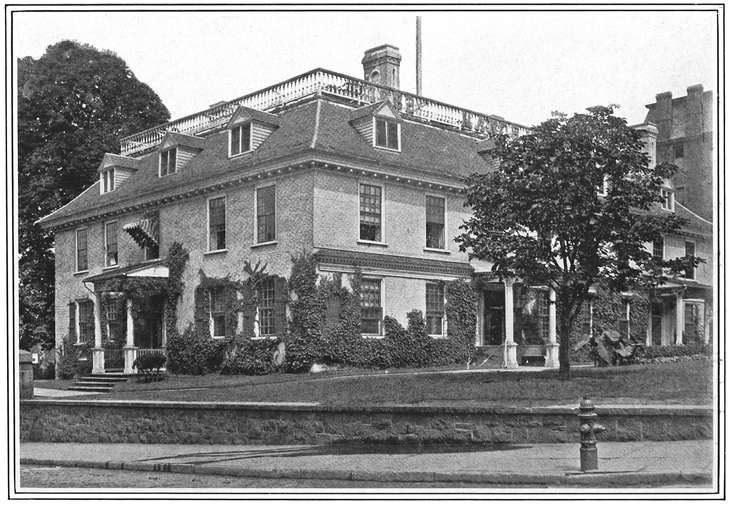
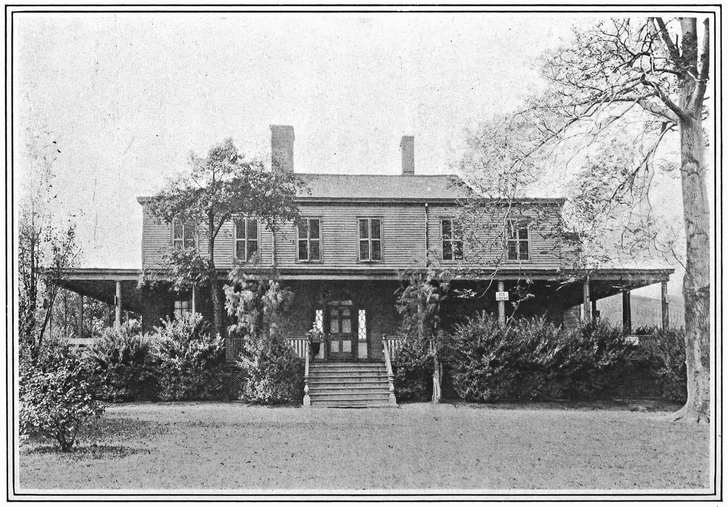
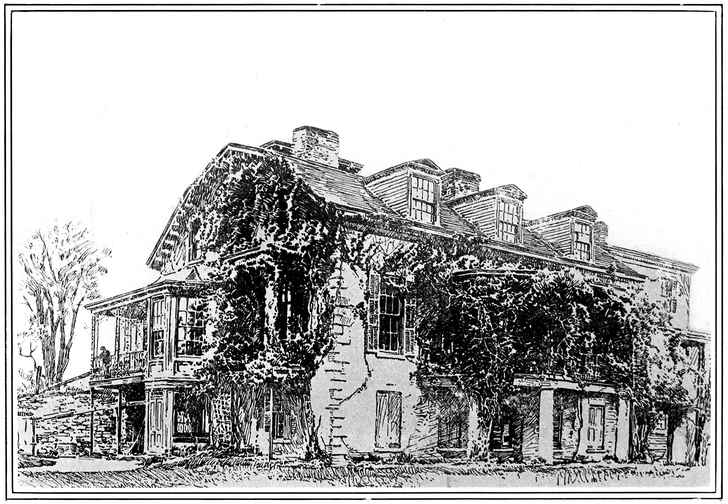
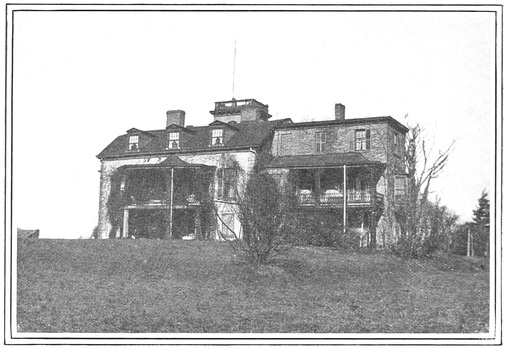
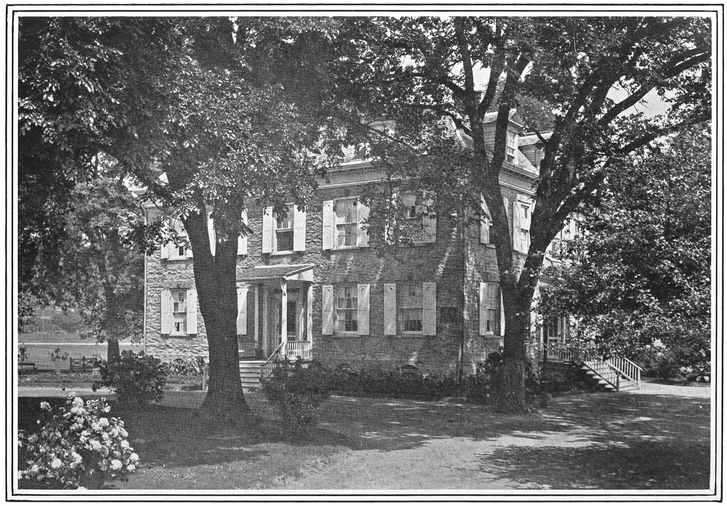
The view of the Hudson, on a fine day, to a
person looking northward from Claremont is
one of the best on the river. Being on a high
point that juts out somewhat into the stream, the spectator
appreciates the river’s breadth. In former days
the site of Claremont was remarkable for its magnificent
trees, pine, oak and tulip, of extraordinary girth,
height and spread, but the building of the railroad
(which spoiled so many country seats) sounded its death
knell in respect to its being a place of residence with
appropriate surroundings. What is now known as
Claremont appears at an early period to have been
composed of two properties, the upper or northerly
one being called “Strawberry Hill,” or “Claremont,”
and the lower or southerly, one “Monte Alto.” Some
of the early deeds were not recorded and the writer
has not ascertained when or how the division was
made.
A tract of land including that on which the house
stands was conveyed in 1774 to Nicholas de Peyster,
and in August, 1776, was sold by him to George Pollock,
an Irish linen merchant.
Pollock endeavored to improve the place by clearing
and cultivation, as is shown by the statement in a letter
mentioned below, in which he says: “I have long considered
those grounds as of my own creation, having
selected them when wild, and brought the place to its
present form.” He named the place “Strawberry
Hill.” After living there for some years and after the
loss of a child (said to have occurred by drowning) he
withdrew to England.
Almost everyone who has visited Grant’s Tomb remembers
the marble funereal monument in the form of
an urn inclosed within an iron railing near the top of
the hill. The inscription, much blurred by time, reads:
“Erected to the memory of an amiable child, St. Claire
Pollock, died 15th. July 1797 in the 5 year of his age.”
Then follow some lines of verse. In a letter written
from England by Mr. Pollock to Mrs. Gulian Verplanck,
who had become the owner of that or the adjoining
place, dated July 18, 1800, he writes: “There is
a small enclosure near your boundary fence within which
lie the remains of a favorite child, covered by a marble
monument.... The surrounding ground will fall into
the hands of I know not whom, whose prejudice or
better taste may remove the monument and lay the enclosure
open. You will confer a peculiar and interesting
favor upon me by allowing me to convey the enclosure
to you, so that you will consider it a part of your
own estate, keeping it however always enclosed and
sacred. There is a white marble funereal urn to place
on the monument which will not lessen its beauty. I
have long considered those grounds as of my own creation,
having selected them when wild, and brought the
place to its present form. Having so long and so delightfully
resided there, I feel an interest in it that I
cannot get rid of by time.”32
In July, 1803, a tract of over thirty-one acres was
conveyed by John B. Prevost, former Recorder of the
city, to Joseph Alston, of South Carolina, planter.
Alston33 seems to have held the property about three
years and then to have sold it to John Marsden Pintard.
This deed conveys the tract known as “Monte Alto.”
In November, 1808, a release was recorded, executed by
Theodosia Burr Alston in favor of Michael Hogan,
gentleman, Hogan having bought Monte Alto from
Pintard.34
There is no record of any conveyance of Claremont,
by Gulian Verplanck or his executors, to Hogan,35 but
a deed made by Robert Lenox, Jacob Stout, and John
Wells, trustees, to Michael Hogan, dated July 21, 1819,
reconveys to him all property not disposed of in the
execution of their trust, which is referred to as having
been imposed by two previous deeds of assignment or
conveyance dated July 25, 1811. It is here that it is
generally thought a vagueness and uncertainty as to
the true owner exists. It was about this time that Claremont
was occupied by a rather mysterious individual, an
Englishman named Courtenay, who, it is said, in after
years, inherited the title of the Earl of Devon.
Mr. Haswell,36 in his “Reminiscences of an Octogenarian,”
says, page 25: “West of Broadway, between
Eleventh and Twelfth avenues and One Hundred and
Twenty-third Street, there was a large country residence
occupied by an Englishman, a Mr. Courtenay,
with but one man servant and a cook. He lived so
retired as never to be seen in company with anyone
outside of his household and very rarely in public.
“There was, as a consequence, many opinions given
as to the occasion of such exclusiveness. The one generally
and finally accepted was that he had been a gay
companion of royalty in his youth, and that his leaving
England was more the result of expediency with him
than choice.” Lossing’s37 account differs somewhat
from this. He says: “When the War of 1812 broke
out he (Courtenay) returned thither (to England)
leaving his furniture and plate, which were sold at auction....
Courtenay was a great lion in New York,
for he was a handsome bachelor, with title, fortune, and
reputation—a combination of excellencies calculated to
captivate the heart desires of the opposite sex. Claremont
was the residence for a while of Joseph Bonaparte,
ex-King of Spain, when he first took refuge in the
United States, after the battle of Waterloo and the
downfall of the Napoleon dynasty. Here too Francis
James Jackson, the successor of Mr. Erskine, the British
Minister at Washington, at the opening of the War
of 1812, resided a short time.... He was politically
and socially unpopular, and presented a strong contrast
to the polished Courtenay.” Courtenay disappeared at
the time of the war between this country and Great
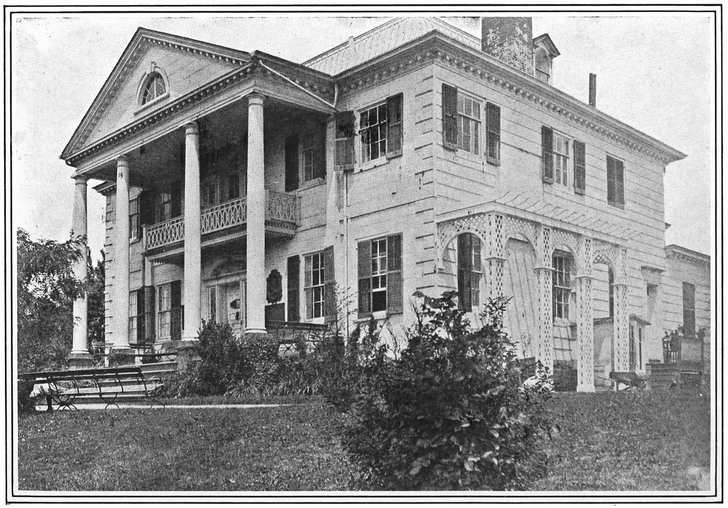
Britain, after having greatly embellished the place. It
has always been a tradition in the Post family (who
owned the property for nearly fifty years) that Courtenay
built the present house. In March, 1812, Hogan
joined with the above-named trustees in conveying the
property “commonly called Claremont” to Herman
Le Roy, William Bayard, and James McEvers, trustees.
By some it has been supposed that while the legal
title was in trustees, there may have been an unrecorded
declaration of trust, by which Courtenay became the
equitable owner. The grantees38 in the last-mentioned
deed first leased Claremont and several years later sold
it to Joel Post, February 12, 1821. Later, Mr. Post
(brother of the distinguished physician of the last century,
Dr. Wright Post, who also resided at Claremont)
purchased the property adjoining on the south, Monte
Alto, and united the ownership of the two places, although
Monte Alto was for many years occupied as a
country seat by the McEvers family.39 In 1868 the
house and a portion of the place were acquired by the
city from the heirs of Mr. Post.
It seems to have been pretty well shown that the
battle of Harlem Heights was not fought in this locality.
It is only in recent years that Morningside Heights
have been spoken of as Harlem Heights. In conveying
Claremont it is described as in Bloomingdale and according
to the map (Mrs. Lamb’s “History of the City
of New York,” vol. II, p. 129) the westerly line of
Harlem excluded all Morningside Heights except a few
feet at the base of the high ground at Manhattanville.
The high ground was known as Vandewater Heights,
and if the battle had taken place there it would have
been known by that name. It is more probable that
most of the fighting (which was widespread) took place
at the base of the Point of Rocks, south of the Convent
of the Sacred Heart, and also along the high ground
to the west and north. Day’s Tavern stood a little to
the northeast of the Point of Rocks, and there Knowlton
and the Connecticut troops were stationed.
Major Lewis Morris, Jr., wrote to his father on
September 28th: “Monday morning an advanced party,
Colonel Knowlton’s regiment, was attacked on a
height a little to the southwest of Day’s Tavern.”
Morningside Heights would have been considerably
more than “a little” to the southwest of Day’s Tavern.
The detachment sent out before daylight under Knowlton
by General Washington was not his regiment but
a small body, probably a single company, and was sent
to make a diversion upon the enemy’s rear. It is probable
that they followed the river’s edge as far south as
Ninety-fourth Street, much below Claremont and Morningside
Heights. The actual battle did not begin until
late in the day. The resolution of Congress passed
October 17, 1776, was “Resolved, That General Lee
be directed to repair to the camp on the Heights of
Harlem with leave,” etc.
Washington had no camp on Morningside Heights.
His camp was on the high ground between the Point
of Rocks and the Harlem River.
Finally “nowhere on Manhattan Island, to my
knowledge, beyond the limit of the city, have there been
found the remains of so many English and Hessian
soldiers, as shown by buttons, cross-belt buckles, bayonets,
and portions of other arms, as have been excavated,
from time to time, in the neighborhood of Trinity
Cemetery. There could have been no fight at this
point unless it was at the battle of Harlem, while the
neighborhood about Columbia University, where it is
claimed the battle was fought, has been particularly
free from all such evidence.”40 Claremont is now a
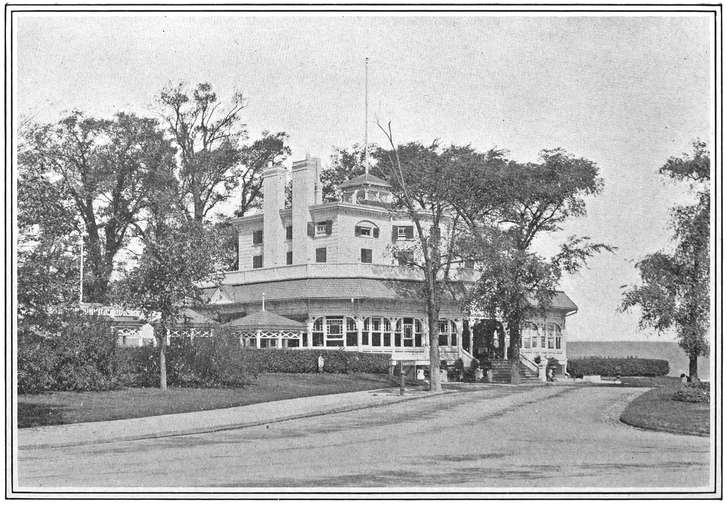
public restaurant.41 The adding of the huge inclosed
piazzas has produced an effect that is nondescript.