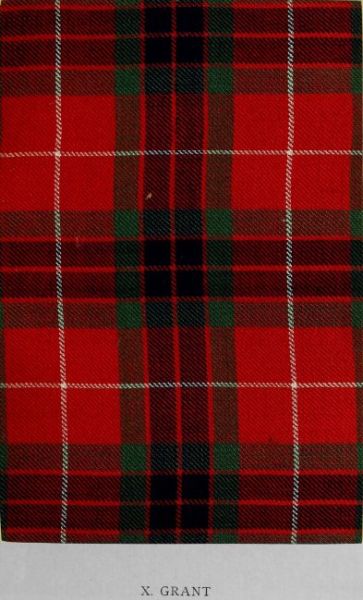
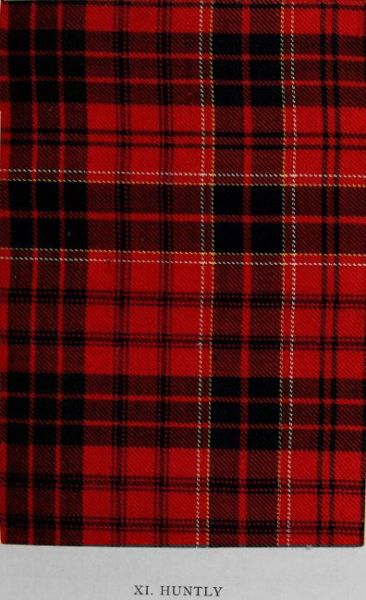
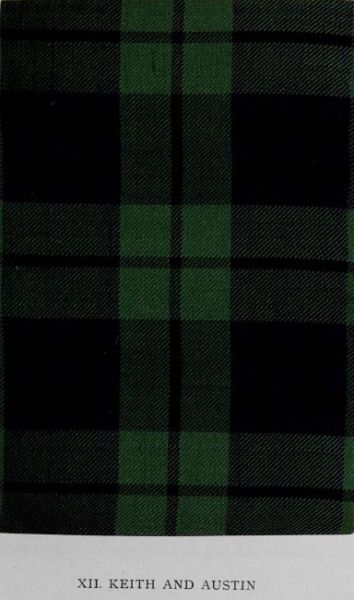
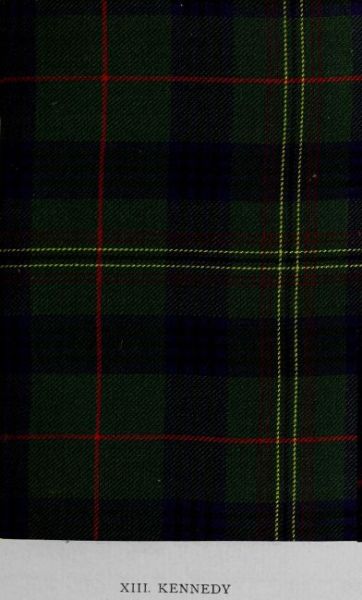
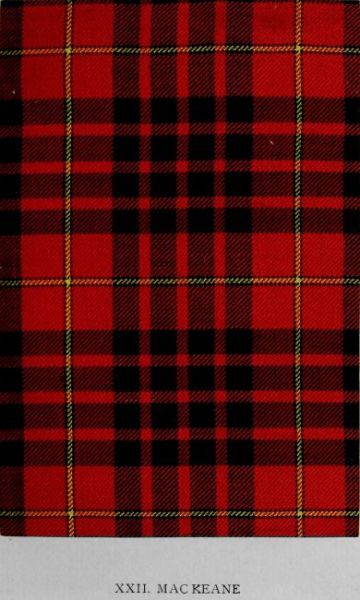
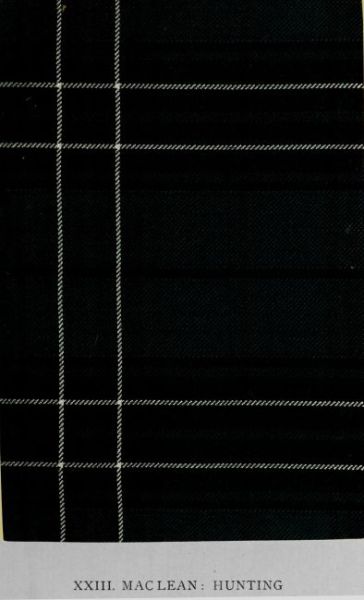
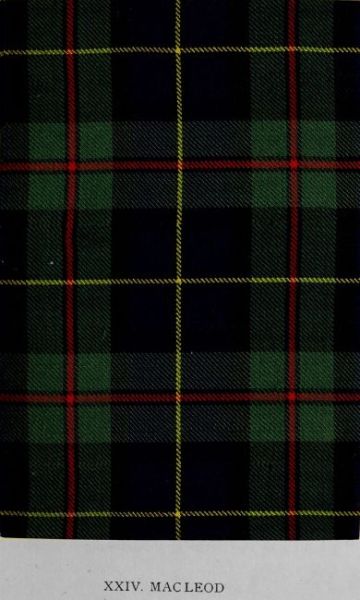
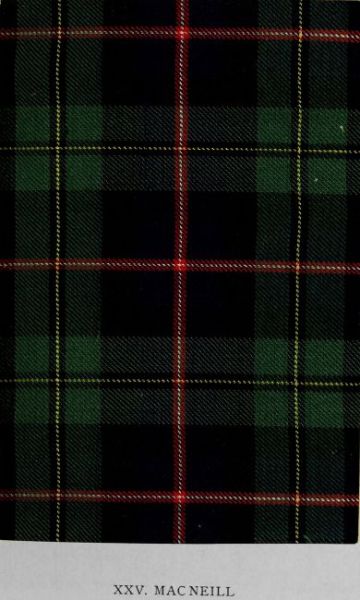
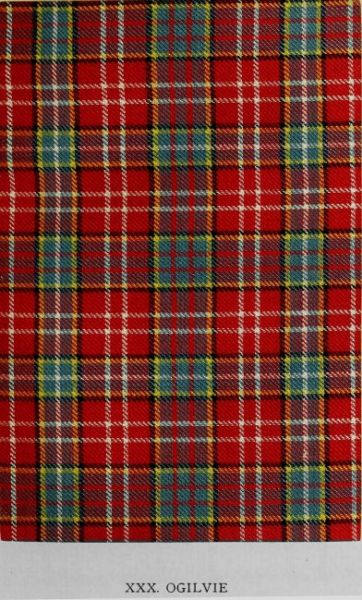
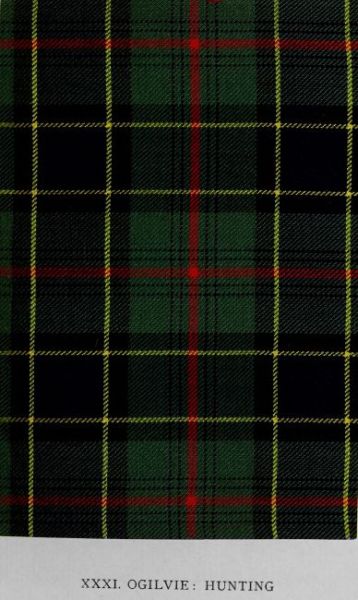
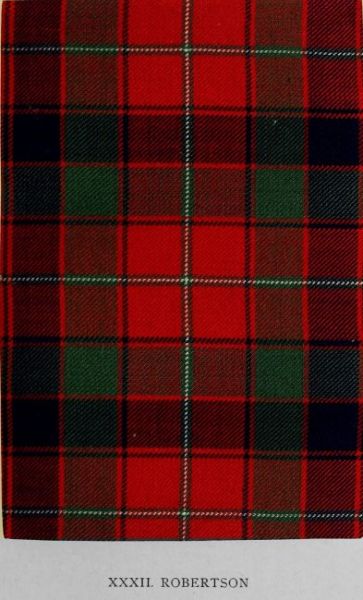
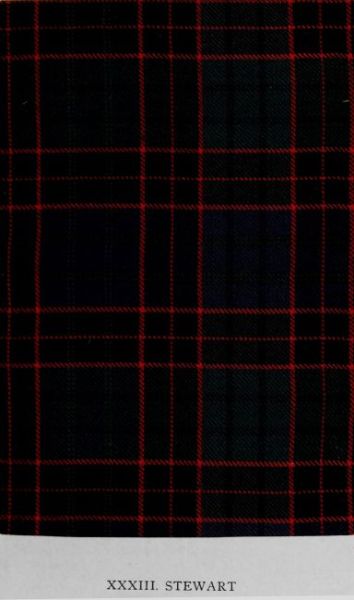
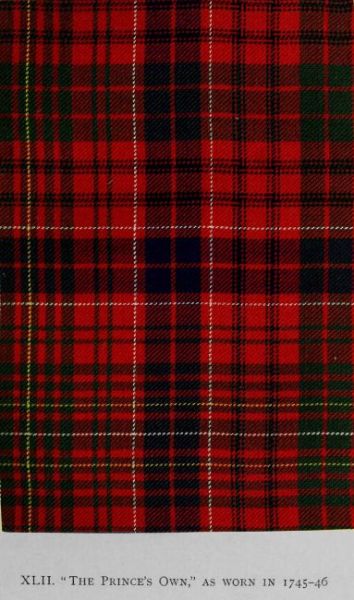
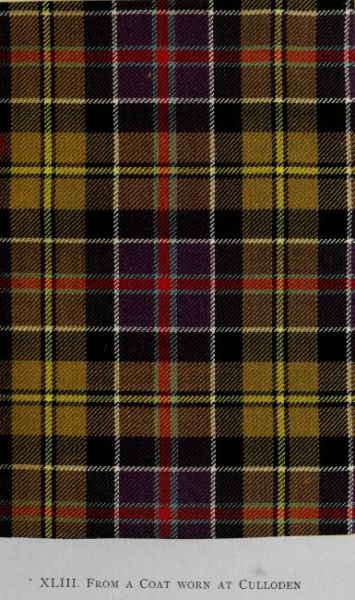
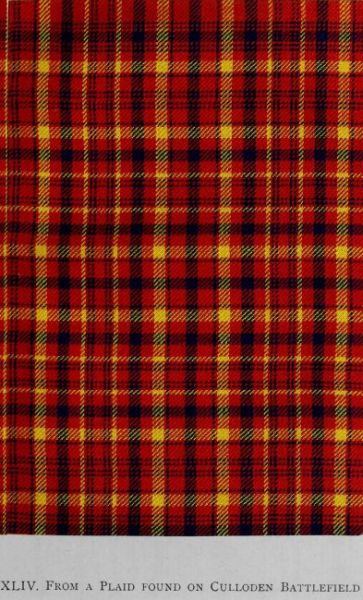
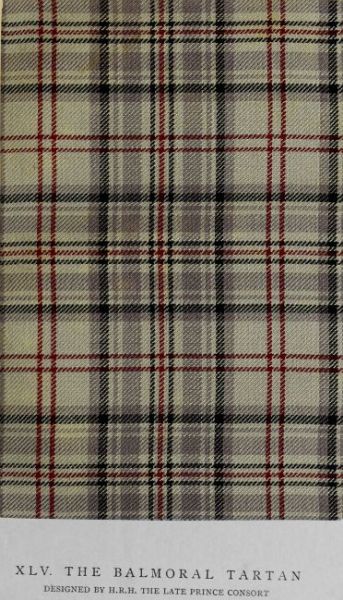
INTRODUCTION. — FOOTNOTES:
OF the dress of the Highlanders of Scotland prior to the fifteenth
century the descriptions available are few and meagre. True, there
are many references to a style of costume which consisted mainly of
a loose outer garment, but these are equally applicable to the wear
of neighbouring countries, and contain no account of the distinctive
features associated with the Highland dress. Probably the earliest
reference to the latter is to be found in the Saga of Magnus Barefoot,
King of Norway, 1093-1103, who led marauding expeditions to the west of
Scotland in the first year of his reign and subsequently. Of his return
from such a raid the historian chronicles:—
People say that when King Magnus came home from his viking cruise to
the Western countries, he and many of his people brought with them a
great deal of the habits and fashions of clothing of those Western
parts. They went about on the streets with bare legs, and had short
kirtles and over-cloaks; and therefore his men called him Magnus
Barefoot or Bareleg.[1]
The word “kyrtlu” probably indicates a garment corresponding somewhat
to the feilebeg or kilt, though it may also indicate one which covered
the upper portion of the body as well, and thus formed a species
of tunic.[2] Still, the description of the distinctive costume of
the Western Islanders at this remote period is extremely valuable,
especially as it is written by one who lived so near the time when
the incidents narrated took place. In accordance with the custom of
fosterage then prevalent in Norway, and continued in Scotland long
afterwards, Snorro Sturleson, the author of the Saga, was reared with
the children of the king’s daughter, and so had opportunity of hearing
and noting the use of the strange costume.
The chartularies of Aberdeen attest the use not merely of the style of
dress that figures in the Saga, but also of a parti-coloured cloth,
which was probably tartan. In these ancient records are notes on early
customs of the utmost importance to antiquaries. They contain, besides
the charters of the lands belonging to the See, the canons of the
Scottish Church, and the statutes of the Church of Aberdeen, framed in
the thirteenth century; it is there provided that “all ecclesiastics
are to be suitably apparelled, avoiding red, green, and striped
clothing, and their garments shall not be shorter than to the middle
of the leg.”[3] Of course, it cannot be held that this conclusively
proves the existence of breacan or tartan, but striped clothing is as
near an approach to an accurate description of it as can be expected
at so early a period. The injunctions indicate a general use of
parti-coloured garments in the northern districts of the country in the
thirteenth century.
The famous clan battle on the North Inch of Perth took place in 1396,
but only the slightest reference is made to the dress of the combatants
in any of the accounts now extant. In the narrative by Abbot Bower, the
continuator of Fordun, it is recorded that the battle was waged
By thirty men against thirty of the opposite party, armed only with
swords, bows and arrows, without mantles or other armour except
axes.[4]
The mantle is doubtless the over-cloak of Magnus Barefoot’s time, and
the prototype of the plaid often so designated by writers of later date.
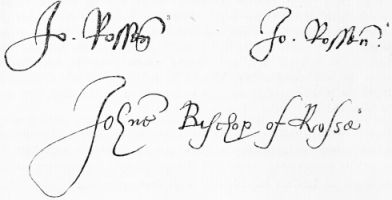
Borthwick in his Antiquities[5] prints the Accounts for 1474 of John,
Bishop of Glasgow, Treasurer to James III., which contain the entry:
“Halve ane elne of double tartan to lyne riding collars to the queen.”
Pinkerton adopts Borthwick’s reading.[6] Pitcairn cites entries, under
date October 1488, of a fabric called “tarter,”and he adds “this is
evidently tartan.”[7] Had the conclusions of these antiquaries as
to the identity of the words been correct, then these would be the
earliest specific references to tartan hitherto discovered in our
records; but that they are not is pointed out by the editor of the
Treasurer’s Accounts, who writes:—
Tartar, the name of which bespeaks its Eastern origin, though it was
no doubt imitated by the weavers of Italy and France, is described as
“single” or “double,” according to texture, and as “variant” or shot,
the warp and woof being of contrasted colours. This not uncommon word
has been frequently misread “tartan,” and examples of its occurrence
quoted from the Treasurer’s Accounts as illustrative of the early
use of that material.[8]
The opinion of such eminent antiquaries has misled all subsequent
writers of important works relating to tartans, with the exception of
John Sobieski Stuart and W. F. Skene; even works appearing many years
after the issue of the Accounts of the Lord High Treasurer continue
to perpetuate the old errors.
There is a significant passage in the old Gaelic tale of “Curio,”
describing the giant Anteus, which runs thus:—
Nibidh dono tuighi na craibheach, na pell, no brotrach, na brecan, na
crocend anmanna, fui isin leapaidh sin acht a thaoebh fri sin talmain.
Now he had not thatch, nor branches, nor hide, nor coverlet, nor
breacan [i.e., tartan, or tartan plaid], nor skin under him in that
bed, but his side to the earth.[9]
“Brecan,” literally a speckled or variegated cloth, has been employed
in the Gaelic language as synonymous with tartan and the tartan plaid
from earliest times, in evident allusion to the checked or spotted
appearance of the garment. “Breac” signifies parti-coloured or spotted.
It is a Gaelic name of the salmon and of the trout, conferred, no
doubt, on account of their speckled aspect.
A curious fifteenth century reference to “hewyt,” i.e., coloured,
striped, or variegated clothing, occurs in a sumptuary law of the Scots
Parliament:—
Item it is statut that na yeman na comonner to landwarts wer hewyt
clathes siddar na the kne na yit ragyt clathes bot allenarly centynal
yemen in lords housis at rids with gentill men thar masters the
quhilks sal haf narow slewis and litil poks.[10]
The introduction of printing naturally tended to produce and to
preserve many descriptions of the Highland dress written in the
fifteenth and sixteenth centuries by Scottish historians and by
travellers from other countries. Of the more important of these, the
earliest in chronological order is John Major (1469-1550), whose work
was originally published in Latin in 1521. He writes:—
Just as among the Scots we find two distinct tongues, so we likewise
find two different ways of life and conduct. For some are born in
the forests and mountains of the north, and these we call men of the
Highland, but the others men of the Lowland. By foreigners the former
are called Wild Scots, the latter householding Scots. The Irish tongue
is in use among the former, the English tongue among the latter. One
half of Scotland speaks Irish, and all these as well as the Islanders
we reckon to belong to the Wild Scots. In dress, in the manner of
their outward life, and in good morals, for example, these come behind
the householding Scots.... From the mid-leg to the foot they go
uncovered; their dress is, for an over garment, a loose plaid, and a
shirt saffron-dyed. They are armed with bow and arrows, a broadsword,
and a small halbert. They always carry in their belt a stout dagger,
single-edged, but of the sharpest. In time of war they cover the whole
body with a coat of mail, made of iron rings, and in it they fight.
The common folk among the Wild Scots go out to battle with the whole
body clad in a linen garment sewed together in patchwork, well daubed
with wax or with pitch, and with an over-coat of deerskin. But the
common people among our domestic Scots and the English fight in a
woollen garment.[11]
From these and other passages in Major’s work it may be inferred that
the chiefs and upper classes of the Highlands alone wore the plaid, or
any woollen clothing whatever, and that the lower orders were prevented
by poverty from obtaining luxuries of this sort. Writing of the clan
battle at Perth in 1396, Major states:—
Thirty men, naked but for a doublet that hung from one side, made
for the field of battle, armed with bow and double-axe; and these
forthwith met the encounter of a like number, armed in the same
fashion.... One of the combatants made his escape from the fight....
And there was not found any man who would take the place of the
runaway; and ’twas no marvel, since to fight for your life, naked but
for a plaid, is no trifle.[12]
In his account of the revolt of Alexander, Lord of the Isles, against
the king, describing the Wild Scots, and particularly Clan Chattan and
Clan Cameron, Major observes:—
They lead a life of blissful ease; from the poor people they take
what they want in victual; bows they have, and quivers, and they have
halberts of great sharpness, for their iron ore is good. They carry a
stout dirk in their belts; they are often naked from the knee down. In
winter for an over garment they wear a plaid.[13]
Perhaps the first indisputable reference to the Highland breacan occurs
in the Accounts of the Lord High Treasurer of Scotland in August
1538:—
The Expensis on the Kingis Persoun Deliverit to Thomas Arthure.
| Item in the first for ij elnis ane quarter elne of variant cullorit
velvet to be the Kingis Grace ane schort Heland coit price of the elne vjlib summa |
xiijlib xs. |
| Item for iij elnis quarter elne of grene taffatyis to lyne the said
coit with, price of the elne xs summa |
xxxijs vjd. |
| Item for iij elnis of Heland tertane to be hoiss to the Kingis Grace,
price of the elne iiijs iiijd summa |
xiijs. |
| Item for xv elnis of holland claith to be syde Heland sarkis to the
Kingis Grace, price of the elne viijs summa |
vjlib. |
| Item for sewing and making of the said thre sarkis |
ixs. |
| Item for twa vnce of silk to sew thame |
xs. |
| Item for iiij elnis of rubeins to the handis of thame[14] |
ijs. |
The costume thus consisted of a short “variant cullorit” Highland coat,
tartan hose—that is, trews and stockings combined—and three “syde” or
low-hanging Highland shirts (each of which, it would appear, contained
five ells), with ties of ribbons at the cuffs. The trews, described in
the extract as “hoiss,” extended from the waist to the foot, and were
tied with a garter below the knee.
Doubts have been cast, indeed, on the possibility of existence in the
rigours of a northern winter with the scanty raiment attributed to
the poorer classes, but these are dispelled by the evidence on the
point. Preserved in the British Museum is a remarkable letter written
in 1542 or 1543 by John Elder, clerk, a “Reddshancke,” to Henry VIII.,
proposing the union of Scotland with England. The following excerpt
affords positive testimony of the hardihood of the people, and of the
title “Reddshanckes” conferred upon them by the Lowlanders:—
Moreover, wherfor they call us in Scotland Reddshanckes, and in
your Graces dominion of England roghefootide Scottis, Pleas it your
Maiestie to understande, that we of all people can tolleratt, suffir,
and away best with colde, for boithe somer and wyntir, (excepte
whene the froest is mooste vehement,) goynge alwaies bair leggide
and bair footide, our delite and pleasure is not onely in huntynge
of redd deir, wolfes, foxes, and graies, wherof we abounde, and have
greate plentie, but also in rynninge, leapinge, swymynge, shootynge,
and thrawinge of dartis: therfor, in so moche as we use and delite
so to go alwaies, the tendir delicatt gentillmen of Scotland call
us Reddshanckes. And agayne in wyntir, whene the froest is mooste
vehement (as I have saide) which we can not suffir bair footide,
so weill as snow, whiche can never hurt us whene it cummes to our
girdills, we go a huntynge, and after that we have slayne redd deir,
we flaye of the skyne, bey and bey, and settinge of our bair foote
on the insyde therof, for neide of cunnynge shoemakers, by your
Graces pardon, we play the sutters; compasinge and mesuringe so moche
therof, as shall retche up to our ancklers, pryckynge the upper part
therof also with holis, that the water may repas wher it entris, and
stretchide up with a stronge thwange of the same, meitand above our
saide ancklers, so, and pleas your noble Grace, we make our schoois:
Therfor, we usinge suche maner of shoois, the roghe hairie syde
outwart, in your Graces dominion of England we be callit roghefootide
Scottis; which maner of schoois (and pleas your Highnes) in Latyne
be callid perones, wherof the poete Virgill makis mencioun, sayinge,
That the olde auncient Latyns in tyme of warrs uside suche maner of
schoos. And althoughe a greate sorte of us Reddshanckes go after this
maner in our countrethe, yeit never the les, and pleas your Grace,
whene we come to the courte (the Kinges grace our great master beinge
alyve) waitinge on our Lordes and maisters, who also, for velvettis
and silkis be right well araide, we have as good garmentis as some of
our fellowis whiche gyve attendaunce in the court every daye.[15]
That the clothing of the Highlanders at this period was parti-coloured,
or tartan, is evident from a foreign traveller’s record almost
contemporaneous with John Elder’s epistle. Jean de Beaugué, who
accompanied the expedition sent in 1548 by Henry II. of France under
Montalembert, Sieur d’Essé, to aid the Scots against the English,
wrote an account of his observations, printed in Paris in 1556. Of
the appearance of certain Islanders among the troops at the siege of
Haddington in the latter year he observes:—
Several Highlanders [or Wild Scots] followed them [the Scottish
army] and they were naked except their stained shirts, and a certain
light covering made of wool of various colours; carrying large
bows, and similar swords and bucklers to the others, i.e. to the
Lowlanders.[16]
Proof is thus supplied of the continued use of the Highland shirt,
generally saffron-dyed; and the “light covering” was doubtless the
mantle or breacan, the belted plaid, for this last is either identical
with or a development of the over-cloak of Magnus Barefoot’s time.
In 1552 the Scottish Privy Council passed an Act for the formation of
“tua ansaingyeis of fittmen,” to be raised in the Highland portion of
Lord Huntly’s lieutenancy, for service in France. The instructions laid
down for their equipment afford some idea of the dress of the Highland
soldier of the period, since the levy was to be drawn from the north
country. It is provided that the men are to be
Substantiouslie accomptirit with jack and plait, steilbonett, sword,
bucklair, new hois and new dowblett of cannvus at the lest, and slevis
of plait or splenttis, and ane speir of sax elnes lang or thairby.[17]
The trews (hois) and doublet are to be of canvas at least, presumably
as a precaution against any shortcoming of woollen stuff; while
the kilt or plaid appears to form no portion of the outfit on this
occasion.
Of the dress of the common people another description, written about
1573, is given by Lindsay of Pitscottie. It is once more obvious
that the belted plaid of latter days was then represented by a loose
garment, which was probably plaited round the body to some extent. The
chronicle sets forth:—
The other pairt [of Scotland] northerne, ar full of montaines, and
verie rud and homlie kynd of people doeth inhabite, which is called
the Reidschankis, or wyld Scottis. They be cloathed with ane mantle,
with ane schirt fachioned (or saffroned) after the Irisch maner, going
bair legged to the knie. Thair weapones ar bowis and dartes, with ane
verie broad sword and ane dagger scharp onlie at the on syd.[18]
But the most detailed notice of the dress worn by the inhabitants of
the Highlands and Islands in the sixteenth century is to be found in a
work by John Leslie, Bishop of Ross, the devoted adherent of Mary Queen
of Scots, originally published in Rome in 1578. From his conspicuous
position, alike as historian and as statesman, his notes on the apparel
of the men and women of his age are highly important. It appears that
the belted plaid had become the wear of both rich and poor, through the
extended manufacture of woollen fabrics and the increased prosperity of
the people. He writes:—
In weiris quhen thay yokit the aduersar, thay invadet athir with ane
arrow or a lance. Thay vsed ane twa edged sword lykwyse; the futmen a
lang sword, the horsmen a schort sword bot baith vset a verie braid
sword, with a scheiring sharpe edge that at the first straik, with
little force, it walde scheir a man in twa in the waste or midle. Thay
war harnest with Jacks al wouen throuch with yrne huikes, quhilkes
habbirgeounis thay cal: This vpon, or as we say, abone a lathir cote,
quhilke was na les stark than it was elegant, thay put on. Al thair
harnesse was lycht, that gif thay fel in ony danger, the lychtlier
thay mycht slip out of the handes of thair ennimies: for in swiftnes
of fute, in quhilke thay walde ouirrin the swoftest horse, quhither
the way war lang and plane, or gif it war cumirsum throuch hilis or
hopes, in sik swoftnes, I say, thay obteined gret prais, athir quhen
the ennimie flies to follow, or quhen the ennimie persues to flie,
and gif mister be to declyne from perrel.... Thair cleithing was til
necessitie, and nocht till decore, maist conuenient ay to the weiris;
for thay al vset mantilis of ane forme, baith the Nobilitie and the
commone people, excepte that the Nobilitie delyted mair in coloured
claith and sindrie hewis, and thir mantilis war baith wyd and lang,
notwithstandeng about the bosum, quhair thay walde decentlie losin. I
can weil think thir same to be the kynd of cleithing quhilke in ald
times in latin war called Brachæ. In thir only mantilis in the nyt
seasone, thay rowit thame selfes, and in thame sleipit sound: this
was thair maner, and this day the hilande men, and thay of Irland
weiris even siklyke, bot now thay use ruch couirings, ane sorte to
thair bed, another sorte to the Jornay conuenient. The rest of thair
claithis, was a schorte cote of woll, with wyde and apne sleiues
that the radier quhen thay walde thay myt schote or caste a darte, or
ane arrow, breickis thay had verie slichte, and indeid mair to hyd
thair memberis than for ony pompe or pryd, or to defend thame frome
the calde was meit. Of linnine lykwyse thay maid wyd sarkis, with
mony bosumis, and wide sleifes of negligence hinging doune evin to
thair knies. Thir sarkis the mair potent amang thame vset to smeir
with saffronne, bot vthiris with a certane fatnes, and this thay did
to keip thame cleine frome al filthines. Nathing thay thocht worthier
of counsel than to exercise thame selfes continuallie in the sueit of
the Barresse, or in siklyke ane exercise. In makeng thame, appeirit
na kair or trauel neglected athir in arte or decore: as with threid
of silke, cheiflie greine, or rid, al the partes of the sarke maist
artificiouslie thay sewit.
Bot the cleithing of the women with thame was maist decent. For thair
cotes war syd evin to the hanckleth, wyd mantilis abone, or playdes
all embroudiret artificiouslie; bracelets about thair armes, iewalis
about thair neck, broches hinging at thair halse, baith cumlie and
decent, and mekle to thair decore and outsett.[19]
The editor in his notes to Book I. observes:—
The Latin braccæ is generally understood to be equivalent to our
breeks. There are, however, traces of the Latin word being used in
a wider sense to mean a loose flowing garment. Bishop Leslie here
applies it to the plaid or tartan, and, as it would seem, on the
ground of the variegated colours expressed by the Gaelic breac. This
is felt even in the use of the Latin word. We find braccæ described
as pictæ and virgatæ, coloured and striped. Perhaps the original
braccæ, which so took the attention of the Romans when they met
the Gauls, were striped and parti-coloured, and so gave rise to the
name. In Irish breacan still means a plaid. It would seem, then,
that the Latin word is borrowed from Celtic. The modern word breeks
or breeches is a double plural, and stands for brec, plural of
Anglo-Saxon broc. This last reminds us of Celtic brog, a shoe.
Broc can hardly be derived from either breac or brog, for we
find corresponding forms in all the Teutonic dialects. Neither can
broc mean speckled, for we have freck, freckle, to represent
breac. The Teutonic words, together with brog, may thus be cognate
terms expressing the sense of cover or protect, perhaps allied to
Anglo-Saxon beorgan. Comp. bark, the covering of a tree. Brock
in modern English and Scots means a badger; but this is clearly
the Gaelic broc. The animal was so named from its colour—pie or
speckle.[20]
It has been held that this particular account, while establishing the
use of tartans by the chiefs or nobles, proves them to have been by
no means common wear. But, taken in conjunction with the writings of
Buchanan, a few years later, the interpretation seems to be that, while
the leaders preferred the more brilliantly coloured patterns, the
rank and file had quieter designs, at once more economical and more
serviceable.
George Buchanan in his History, published in 1582, furnishes a
detailed account of the dress and arms of the Highlanders. He writes:—
They delight in variegated garments, especially stripped, and their
favourite colours are purple and blue. Their ancestors wore plaids of
many different colours, and numbers still retain this custom, but the
majority, now, in their dress, prefer a dark brown, imitating nearly
the leaves of the heather, that when lying upon the heath in the day,
they may not be discovered by the appearance of their clothes; in
these, wrapped rather than covered, they brave the severest storms
in the open air, and sometimes lay themselves down to sleep even in
the midst of snow. In their houses, also, they lie upon the ground;
strewing fern, or heath, on the floor, with the roots downward and the
leaves turned up. In this manner they form a bed so pleasant, that it
may vie in softness with the finest down, while in salubrity it far
exceeds it; for heath, naturally possessing the power of absorption,
drinks up the superfluous moisture, and restores strength to the
fatigued nerves, so that those who lie down languid and weary in
the evening, arise in the morning vigorous and sprightly. They have
all, not only the greatest contempt for pillows, or blankets, but,
in general, an affectation of uncultivated roughness, and hardihood,
so that when choice, or necessity induces them to travel in other
countries, they throw aside the pillows, and blankets of their hosts,
and wrapping themselves round with their own plaids, thus go to sleep,
afraid lest these barbarian luxuries, as they term them, should
contaminate their native simple hardiness. Their defensive armour
consists of an iron headpiece and a coat of mail, formed of small
iron rings, and frequently reaching to the heels. Their weapons are,
for the most part, a bow, and arrows barbed with iron, which cannot
be extracted without widely enlarging the orifice of the wound; but
a few carry swords or Lochaber axes. Instead of a trumpet they use
a bagpipe. They are exceedingly fond of music, and employ harps of
a peculiar kind, some of which are strung with brass, and some with
catgut. In playing they strike the wires either with a quill, or with
their nails, suffered to grow long for the purpose; but their grand
ambition is to adorn their harps with great quantities of silver and
gems, those who are too poor to afford jewels substituting crystals in
their stead. Their songs are not inelegant, and, in general, celebrate
the praises of brave men; their bards seldom choosing any other
subject.[21]
In the Acts and Proceedings of the General Assembly of the Kirk of
Scotland for the year 1575 the following ordinance against the use of
sumptuous clothing by Ministers and Readers of the Church is recorded:—
The Generall Assembly haldin and begun the 6 day of August 1575, in
the Ovir Tolbuith of Edenburgh: wher ther was present the Bischops of
Galloway, Dunkeld, Brechine, Dumblane, Glasgow, and the Bischop of
the Yles, Superintendents of Angus and Lowthiane, Commissioners of
Countreyes and Townes, with the Ministers. Mr Robert Pont (Provest of
Trinity College), Moderatour.
The brether appointit to pen thair judgement anent the habite of the
Ministers and thair wyfes, presentit the same to the Assemblie, quhilk
was found good; and all the brether serving the functioun of the Kirk,
ordaynes to conforme themselves and thair wyves therto, and ordainit
effectuouslie to follow the same: Quherof the tenor followes in thir
wordes.
Forsameikle as a comely and decent apparrell is requisite in all,
namelie in the Ministers and sick as beares functioun in the Kirk:
First we think all kynd of brodering vnseimlie, all bagaries of
velvett on gownes, hoses, or coat, and all superfluous and vaine
cutting out, steiking with silks; all kynd of costlie sewing on
pasments, or sumptuous or large steiking with silks; all kynd of
costlie sewing or variant hews in sarks, all kynd of light and variant
hewes in cloathing, as red, blew, yellow, and sicklyke, quhilk
declares the lightnes of the mynd; all wearing of rings, bracelets,
buttons of silver, gold, or vther mettall; all kynd of superfluitie
of cloath in makeing of hose; all vsing of plaids in the Kirk be
Reidars or Ministers, namelie in tyme of thair ministry and vsing
thair office: all kynd of gowning, coating or doubliting, or breiches
of velvett, satine, taffettie, or sicklyke; all costlie gilting of
whingers and knyves, or sicklyke; all silk hatts, or hatts of divers
and light collours: Bot that thair haill habite be of grave collour,
as black, russet, sad gray, sad broune or searges, wirssett chamlet,
growgrame lytes wirssett, or sicklyke: and to be short, that the good
word of God be them and thair immoderatenes be not slanderit; and
thair wifes to be subiect to the same ordour.[22]
The Council Register of the Burgh of Aberdeen contains entries
prohibiting the use of plaids, which appear to have attained
considerable vogue in a district by no means Highland; and the reason
annexed to the second of these seems to indicate a praiseworthy
courtesy on the part of the city fathers:—
5th October 1576.—It is statut and ordanit be the provest,
baillies, consell, witht consent of the communitie present for the
tyme, being conuenit on the gill court day, and that na burges of
gild nor dekin of craft quhatsumeuir withtin this burght, be fund
werand ane plaid fra the feist of Sanct Martein nixt to cum in ony
time thairefter withtin the burtht, under the pain of fourtie s. to be
uptakin onforgewin fra the persouns apprehendit wering the said plaid
efter the forsaid feist of Sanct Martein, and the plaid to be gewin to
the hospitall to thair support, that ar pleset thairin.
6th June 1621.—The said day the prowest, baillies, and counsall
considdering the inciuill forme of behaweour of a great manye wemen in
this burght, of gude qualitie, quha resortis both to kirk and mercat
with thair playddis about thair headis, and be thair exampill the
meaner sort of wemen vses the samen forme of incivilitie, quhilk gewis
offence to strangeris and occasioun to thame to speik reprochefullie
of all wemen generallie within this burght; for remeid quharof, it is
statute and ordanit that na wemen within this burght of quhatsumeuir
rank, qualitie, or degrie they be of, presvme or tak vpon hand to
resort to kirk or mercat with thair playddis about their heidis, vnder
the paines following, to be exactit of the contravenar without fauour,
toties quoties: viz. xiii. sh. iiij. d. of the wyiff of ilk burges
of gild, and sex sh. aucht d. of ilk craftisman, and this act to be
intimat out of the pulpit of baith the kirkis on Sonday nixt, and
thaireftir to hawe effect and executioun in tyme comeing.[23]
In view of what the old writers point out, that the early dress of
the Irish people bore a close resemblance to that of the Scottish
Highlanders, the description given by John Derricke in 1581 is valuable
as attesting the prevalence in his time of the two forms of the
dress—the kilt and the trews. It runs thus:—
THE IRISHE KARNES APPARELL MOSTE LIUELY SET OUT.
With Jackettes long and large, which shroude simplicitie:
Though spitfull dartes which thei do beare importe iniquitie.
Their Shirts be verie straunge, not reachyng paste the thie:
With pleates on pleates thei pleated are, as thicke as pleates maie lye.
Whose sleues hang trailing doune almoste unto the Shoe:
And with a Mantell commonilie, the Irishe Karne doe goe.
Now some emongest the reste, doe use an other weede:
A coate I meane of strange device, whiche fancie first did breede.
His skirtes be verie shorte, with pleates set thicke about,
And Irishe trouzes more to put their straunge protractours out.
[24]
Sir Walter Scott, writing of the verse, makes this comment:—
This second sort of dress, namely, a short woollen jacket, with
plaited skirts, and long trowsers, made tight to the body, and
chequered with various colours, was precisely that of a Highland
gentleman, the plaid coming in place of the mantle.[25]
Of the dress and arms of the Highlanders at the close of the sixteenth
century some details are furnished by M. Nicolay d’Arfeville,
Cosmographer to the King of France, in an account of a visit to
Scotland, published at Paris in 1583. The following is a translation of
a portion of his description:—
Those who inhabit Scotland to the south of the Grampian chain, are
tolerably civilized and obedient to the laws, and speak the English
language; but those who inhabit the north are more rude, homely, and
unruly, and for this reason are called savages [or Wild Scots.] They
wear, like the Irish, a large and full shirt, coloured with saffron,
and over this a garment hanging to the knee, of thick wool, after the
manner of a cassock. They go with bare heads, and allow their hair to
grow very long, and they wear neither stockings nor shoes, except some
who have buskins made in a very old fashion, which come as high as
their knees.
Their arms are the bow and arrow, and some darts, which they throw
with great dexterity, and a large sword, with a single-edged dagger.
They are very swift of foot, and there is no horse so swift as to
outstrip them, as I have seen proved several times, both in England
and Scotland.[26]
One of the most striking and specific references to tartan is to
be found in the year 1587, and it occurs in connection with the
lands of Norraboll, in the island of Islay. In the Crown charter of
Novodamus, dated 19th March 1587-8, granted to Hector Makclene, son and
heir-apparent of Lauchlan Makclene of Dowart, the feu-duty for these
lands is specified as:-
Pro Nerrabollsadh 60 ulnas panni, albi, nigri, et grosei coloris
respective, et ulnam panni in augmentationem rentalis (vel 8 den pro
qualibet ulna).[27]
John Sobieski Stuart, who first drew attention to this entry,[28]
quotes the word “grosei” as “grisei,” and adds “in this enumeration
there appears a slight error, from a presumption that the third colour
should have been green. The word undoubtedly in each case is “grosei,”
and is so printed in the Record Issue. What was meant by “grosei”
we learn from two sources. In the signature upon which the Crown
charter above quoted proceeds, the lands and the feu-duty exigible are
thus described:—
All and haill the foirnamit fyve merk landis of Nerrabolsadh with
the pertinentis the sowme of lx ellis claith quhite blak and grene
cullouris respective or viiid vsuall money of this realme for ilk ell
at the optioun of the said Hector and his foirsaidis at the termes
foirsaidis be equal portiounis and ane el claith or viiid for the
price thereof in augmentation of the rentale mair nor euir the same
payit of befor.[29]
These lands formerly belonged to the “Abbot of the Isle of Iona.”
They were annexed to the Crown at the period of the alteration of the
State religion in Scotland in the sixteenth century, and feued out to
Makclene of Dowart on the conditions referred to, and they appear in
the Register of Temporalities belonging to the Crown in this form:—
Charge. Argile and Tarbart. Item, the comptar charges him with the
fewmaillis of the fyve merk lands of Narraboll liand within the said
shirefdome set in few to Hector McClane of Dowart extending yeirlie
in claith of quhite blak and grene cullouris respective to lx elnis.
The eln sauld be infeftment at viiid with the new augmentation of
the same extending to 1 eln of clayth sauld as said is Inde the yeir
comptit in money to xls. viiid.[30]
John Sobieski Stuart’s transcriber had failed to give him the full
reference by omitting the words “et ulnam panni in augmentationem
rentalis,” which, taken in connection with the two contemporary
vernacular readings above given, settles that the cloth was not to be
of three separate pieces, each of an individual colour, but cloth in
which the dyes specified were interwoven.
But more remains to be said about this remarkable feu-duty. About
1617 Makclene of Dowart appears to have got into difficulties. At all
events, in that year a Crown charter of the lands was granted to Rorie
M’Kenzie of Cogeauche. The reddendo is identical with that in the
charter of 1587-8 already quoted, but the signature is in these words:—
And lykewise for the foirsaid fyve merk land of Narrobolsydh with the
pertinentis thriescoir ellis of quhyte blak and gray claith respective
or viiid money foirsaid for euerie elne in the optioun of the said
Rory McKenzie his airis maill and assignais foirsaidis at the termes
abone specifiet be equall portiones as the auld meill. And lykewise
ane elne of claith or aucht penneis for the price thairof in yeirlie
augmentatioun of the rentall gif it beis askit.[31]
When the lands were restored in 1630 to Makclene of Dowart, while the
Latin charter remains unchanged, the signature is in these words:—
For the foirsaid fyve merk land of Morrabulsadtir with the
pertinentis, thriescore elnis of claith quhyte blak and gras cullour
respective or aucht penneis vsuell money of the said realme of
Scotland for ilk elne at the will of the said Lauchlane his aires male
and assignais foirsaidis at twa termes in the yeare Witsounday and
Mertinmas in winter be equall portiounis as the auld fewferme. Ane
elne of claith or aucht penneis for the price thereof in augmentatioun
of the yeirlie rent gif it beis askit.[32]
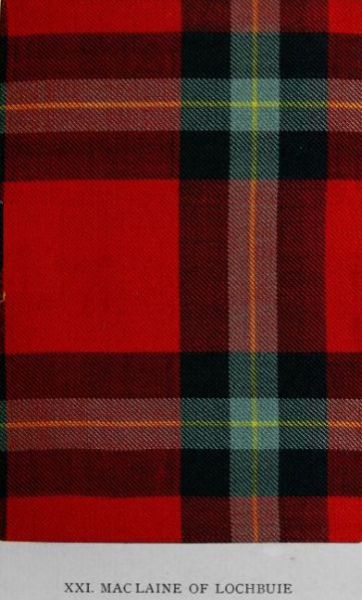
The explanation is simple enough. White and black and green are the
only colours in the oldest authenticated Mac Lean tartan.
The evidence of all accounts of the costume of the people inhabiting
the northern and western portions of Scotland in the sixteenth century
attests the use of the yellow saffron-dyed shirt, and the cloak,
cassock or plaid, reaching to about the knee, as the ordinary dress.
A reference to a yellow coat, which appears to have been a garment
distinct from the yellow shirt, is found at this period. It occurs in
a History of the Gordons, preserved in the Advocates’ Library, which
states that in 1590:—
Angus, the son of Lachlan, chiefe of the Clanchattan, with a great
party attempts to surpryze the Castle of Ruthven in Badenoch,
belonging to Huntly, in which there was but a small garrison; but
finding this attempt could neither by force nor fraude have successe,
he retires a little to consult how to compasse his intent. In the
meanetyme, one creeps out under the shelter of some old ruines, and
levells with his piece at one of the Clanchattan cloathed in a yellow
warr coat (which, amongst them, is the badge of the cheifetaines or
heads of clans). And, peircing his body with the bullet, stricks him
to the ground, and retires with gladness into the castle. The man
killed was Angus himselfe, whom his people carry away, and conceill
his death for many years, pretending he was gone beyond seas.[33]
On account of the proximity of the Western Isles of Scotland to the
northern portions of Ireland there was frequent intercourse between
the inhabitants, and aid in seasons of disturbance was a mutual
courtesy. During the last years of the sixteenth century the Red Earl
of Ulster, Hugh O’Donnell, was in arms against the English Crown; and
in 1594 a body of warriors was despatched from the Western Isles to
his assistance. Peregrine O’Clery’s description of these troops, as
translated from the Irish by Edward O’Reilly, is as follows:—
These (the auxiliaries from the isles) were afterwards mixed with
the Irish militia, with the diversity of their arms, their armour,
their mode, manners, and speech. The outward clothing they wore was a
mottled garment with numerous colours hanging in folds to the calf of
the leg, with a girdle round the loins over the garment. Some of them
with horn-hafted swords, large and military, over their shoulders.
A man when he had to strike with them was obliged to apply both
his hands to the haft. Others with bows, well polished, strong and
serviceable, with long twanging hempen strings, and sharp-pointed
arrows that whizzed in their flight.[34]
The tartan belted plaid is undoubtedly here described, since no
other garment could have been so disposed as to afford the requisite
protection.
In 1596 Sir Duncan Campbell of Glenvrquhay granted in heritage to his
third son,
John Campbell of Auchinryre, the lands of Auchynrere, Drumnavoke, and
Condolych, respectively of the old extent of six, four, and two marks,
for the yearly payment of £10 Scots at the usual terms, and one gallon
of sufficient aquavite “et optimam chlamidem coloratam, vulgo ane fyne
hewed brakane” [i.e., breacan or tartan plaid] at Martinmas.[35]
In connection with the plantation of Ulster by Scots colonists towards
the end of the sixteenth century, there is evidence that tartan was
manufactured in Ireland at that period. Concerning Lady Montgomery,
wife of Sir Hugh Montgomery of the Eglinton family, who was a daughter
of the Laird of Greenock, we read:—
She set up and encouraged linen and woollen manufactory which soon
brought down the prices of the breakens [i.e., tartans] and narrow
cloths of both sorts.[36]
Of seventeenth century writings one of the earliest to provide a notice
of the Highland dress is Camden’s Britannia, printed in 1607, which
mentions that:-
This country is inhabited by a rough, warlike, and very mischievous
sort of people, commonly called Highlandmen, who are the true
offspring of the ancient Scotch, speak Irish, call themselves
Albinnich, are set and tight moulded, of great strength and swiftness,
high spirited, bred up in war or rather robbery, and extremely prone
to revenge and deep resentment. They wear after the Irish fashion
striped mantles and thick long hair, and live by hunting, fishing, and
plunder.[37]
Doubtless there was greater intercourse between the English and their
conquered dependants in Ireland than between the English and the Scots,
and hence the dress in Ireland ranks before that in Scotland in the
comparison instituted by the writer.
Peculiar interest attaches to the description of John Taylor in The
Pennyless Pilgrimage; for his observations, carefully noted down in
1618, in view of the fact that they would come under the cognisance
of the king (James VI.), are full and important, as this extract
illustrates:—
Thus with extreme travell, ascending and descending, mounting and
alighting, I came at night to the place where I would be, in the Brea
of Marr, which is a large country, all composed of such mountaines,
that Shooter’s hill, Gads hill, Highgate hill, Hampsted hill, Birdlip
hill, or Malvernes hill, are but mole-hills in comparison, or like a
liver, or a gizzard under a capon’s wing, in respect to the altitude
of their tops, or perpendicularitie of their bottomes. There I saw
mount Benawne [Benavon in Braemar] with a furr’d mist upon his snowie
head instead of a night cap: for you must understand, that the oldest
man alive never saw but the snow was on the top of divers of those
hills, both in summer, as well as in winter. There did I finde the
truely noble and right honourable Lords John Erskin Earle of Marr,
James Stuart Earle of Murray, George Gordon Earle of Engye, sonne and
heire to the Marquesse of Huntly, James Erskin Earle of Bughan, and
John Lord Erskin, sonne and heire to the Earle of Marr, and their
Countesses, with my much honoured, and my best assured and approved
friend, Sir William Murray knight, of Abercarny, and hundred of
others knights, esquires, and their followers; all and every man
in generall in one habit, as if Licurgus had beene there, and made
lawes of equality. For once in the yeere, which is the whole moneth
of August, and sometimes part of September, many of the nobility
and gentry of the kingdome (for their pleasure) doe come into these
high-land countries to hunt, where they doe conforme themselves to the
habite of the High-land-men, who for the most part, speake nothing
but Irish; and in former time were those people which were called
the Red-shankes. Their habite is shooes with but one sole apiece;
stockings (which they call short hose) made of a warm stuffe of divers
colours, which they call Tartane: as for breeches, many of them, nor
their forefathers, never wore any, but a jerkin of the same stuffe
that their hose is of, their garters being bands or wreathes of hay or
straw, with a plead about their shoulders, which is a mantle of divers
colours, much finer and lighter stuffe than their hose, with blue
flat caps on their heads, a handkerchiefe knit with two knots about
their necke; and thus are they attyred. Now, their weapons are long
bowes and forked arrowes, swords and targets, harquebusses, muskets,
durks, and Loquhabor-axes. With these armes I found many of them armed
for the hunting. As for their attire, any man of what degree soever
that comes amongst them, must not disdaine to weare it: for if they
doe, then they will disdaine to hunt, or willingly to bring in their
dogges: but if men be kind unto them, and be in their habit; then are
they conquered with kindnesse, and the sport will be plentifull. This
was the reason that I found so many noblemen and gentlemen in those
shapes. But to proceed to the hunting.
My good Lord of Marr having put me into that shape, I rode with him
from his house, where I saw the ruines of an old castle, called the
castle of Kindroghit. It was built by King Malcolm Canmore (for a
hunting house) who raigned in Scotland when Edward the Confessor,
Harold, and Norman William raigned in England: I speak of it, because
it was the last house I saw in those parts; for I was the space
of twelve days after, before I saw either house, corne-field, or
habitation for any creature, but deere, wilde horses, wolves, and
suche like creatures, which made me doubt that I should never have
seene a house againe.[38]
The attachment of the Highlanders to their distinctive attire is
conspicuously evident in this account, which deserves careful study
in consequence of its profusion of detail. Trews (breeches) were
not worn, but in their stead was a tartan “jerkin”; and this had no
connection with the plaid, for the people had a “plead about their
shoulders, which is a mantle of divers colours, much finer and lighter
stuffe than their hose.” Being coarser and thicker than the plaid, the
“jerkin” could scarcely have been the shirt, and it was most probably
the feilebeg, or little kilt, used as a separate garment.
That the form of the feilebeg was known to the Highlanders before the
civil wars of the seventeenth century, and that the belted plaid was
thrown occasionally into the form of the feilebeg, is proved by the
following extract:—
As for their Apparel; next the skin, they wear a short linnen Shirt,
which the great Men among them sometimes dye of saffron Colour.
They use it short, that it may not incumber them, when running or
travelling. Major says the common People among them went out to
Battle, having their Body cover’d with Linnen of many Folds sewed
together and done over with Wax or Pitch, with a covering of Hart’s
Skin; but that the English and common lowland Scots fought in Clokes.
In the sharp Winter weather the Highland Men wear close trowzes, which
cover the Thighs, Legs, and Feet. To fence their feet they put on
Rullions or raw leather shoes. Above their Shirt they have a single
Coat, reaching no farther than the Navel. Their uppermost Garment is
a loose Cloke of several Ells, striped and party colour’d (the tartan
plaid), which they gird breadth-wise with a Leathern Belt so as it
scarce covers the knees, and that for the above-mention’d Reason, that
it may be no Lett to them, when on a Journey or doing any Work. Far
the greatest part of the Plaid covers the uppermost parts of the Body.
Sometimes it is all folded round the Body about the Region of the
Belt, for disengaging and leaving the Hands free; and sometimes ’tis
wrapped round all that is above the Flank. The trowzes are for Winter
use; at other Times they content themselves with short Hose, which
scarce reach to the knees. When they compose themselves to Rest and
Sleep, they loose the Belt, and roll themselves in the Plaid, lying
down on the bare Ground, or putting Heather under them nicely set
together after their Manner; or, for want of that, they use a little
Straw or Hay.[39]
It has been already noted that the Scottish auxiliaries who went
to France in 1552 were in trews (“hois”), and, similarly, when the
northern army invaded England in 1639, no reference is made to the kilt
or to the bare legs, the first peculiarity to impress strangers. It
would thus appear that the kilt did not at this time form part of the
military dress. The following description is extracted from Defoe’s
Memoirs of a Cavalier, which evinces considerable acquaintance with
military habits and equipments:—
I confess, the soldiers made a very uncouth figure, especially the
highlanders: the oddness and barbarity of their garb and arms seemed
to have something in it remarkable. They were generally tall swinging
fellows; their swords were extravagantly and I think insignificantly
broad, and they carried great wooden targets, large enough to cover
the upper part of their bodies. Their dress was as antique as the
rest; a cap on their heads, called by them a bonnet, long hanging
sleeves behind, and their doublet, breeches, and stockings, of a stuff
they called plaid, striped across red and yellow, with short cloaks
of the same. These fellows looked, when drawn out, like a regiment
of merry-andrews, ready for Bartholomew Fair. They are in companies
all of a name and therefore call one another only by their christian
names, ... and they scorn to be commanded but by one of their own clan
or family.... There were three or four thousand of these in the Scots’
army, armed only with swords and targets; and in their belts some of
them had a pistol, but no musquets at that time among them.[40]
Here again there appears to be evidence of the plaid, under the
designation of “short cloak,” as a separate garment, which, taken
in conjunction with Taylor’s description in 1618, affords a strong
presumption that its use, along with, but detached from, kilt or trews,
was quite common.
In the act and decreet in favour of Thomas M’Kenzie of Pluscardin
against a band of Highlanders who had plundered him and his tenants
in the month of June 1649, there are enumerated as among the articles
taken away or destroyed:—
Item ane whyt plaid worth eight punds With coat and trews and shoes
worth four pund scots with four pair of lining sheits worth four
pund the pair, ane pair of bed plaids worth twentie four punds tuo
coverings worth four punds the peice Ten elne of new lining worth
twentie shilling the elne. Item ten elnes of tartan at threttie
shilling the elne.[41]
In 1669 the Rev. James Brome, M.A., Rector of Cheriton in Kent, visited
Scotland, and in 1700 he published his work. His description of
Highland dress and arms is largely adapted from Buchanan, whose work
is, indeed, appropriated by many other writers. Brome’s note is as
follows:—
The Highlanders, who inhabit the West part of the Country, in their
Language Habit and Manners agree much with the Customs of the Wild
Irish, and their chief City is Elgin, in the County of Murray,
seated upon the Water of Lossy, formerly the Bishop of Murray’s
Seat, with a Church sumptuously built, but now gone to decay. They
go habited in Mantles striped, or streaked with divers colours about
their Shoulders, which they call Plodden, with a Coat girt close to
their Bodies, and commonly are naked upon their Legs, but wear Sandals
upon the Soles of their Feet, and their Women go clad much after the
same Fashion: They get their Living mostly by Hunting, Fishing, and
Fowling; and when they go to War, the Armour wherewith they cover
their Bodies, is a Morion or Bonnet of Iron, and an Habergeon, which
comes down almost to their very Heels; their Weapons against their
Enemies are Bows and Arrows, and they are generally reputed good
Marks-Men upon all occasions; their Arrows for the most part are
barbed or crooked, which once entred within the Body cannot well be
drawn out again, unless the Wound be made wider; some of them fight
with broad Swords and Axes, and in the room of a Drum make use of
a Bag-pipe. They delight much in Musick, but chiefly in Harps and
Clarishoes of their own Fashion, the strings of which are made of
Brass-Wire, and the strings of their Harps with Sinews, which strings
they strike either with their Nails growing long, or else with an
Instrument appointed for that use.[42]
Thomas Kirk, of Cookridge, Yorkshire, who made an extensive tour in
Scotland in 1677, kept a journal of his observations, and, thanks to
his minute description, it becomes possible to demonstrate that the
story of the modern invention of the feilebeg or kilt as a separate
article of dress is a fabrication. For not only does he describe the
kilt precisely, but he notes with great exactness the manner of wearing
the plaid, which corresponds in every particular with its use at the
present time. Writing at Inverness, he says:—
Here we may note the habit of a Highlander: their doublets are slashed
in the sleeves, and open on the back; their breeches and stockings
are either all on a piece, and straight to them, plaid colour; or
otherwise, a sort of breeches, not unlike a petticoat, that reaches
not so low, by far, as their knees, and their stockings are rolled up
about the calves of their legs, and tied with a garter, their knee
and thigh being naked. On their right side they wear a dagger, about
a foot or half-a-yard long, the back filed like a saw, and several
kinnes (? skeans) struck in the sheath of it; in either pocket a case
of iron or brass pistols, a sword about a handful broad, and five feet
long, on the other side, and perhaps a gun on one shoulder and a sack
of luggage on the other. Thus accoutred, with a plaid over the left
shoulder and under the right arm, and a cap a-cock, he struts like a
peacock, and rather prides in than disdains his speckled feet.[43]
It is somewhat remarkable that this testimony, which decides the vexed
question of the separate use of kilt and plaid prior to the eighteenth
century, has hitherto escaped the notice of all writers on the subject.
During the turbulent period of the wars of Montrose and Dundee many
bodies of armed Highlanders were imported into the Lowlands. One of
the largest, known as the Highland Host, consisted of ten thousand
men employed in the repression of the Western Shires. A letter in the
Wodrow MSS., Advocates’ Library, Edinburgh, written under date 1st
February 1678, states:—
We are now all quartered in and about this town [? Ayr], the
Highlanders only in free quarters. It would be truely a pleasant
sight, were it at an ordinary weaponshaw, to see this Highland crew.
You know the fashion of their wild apparel, not one of ten of them
hath breaches, yet hose and shoes are their greatest need and most
clever prey, and they spare not to take them every where: In so much
that the committee here, and the Counsel with you (as it is said) have
ordered some thousands of pairs of shoes to be made to stanch this
great spoil. As for their armes and other militarie acoutrements,
it is not possible for me to describe them in writing; here you may
see head-pieces and steel-bonnets raised like pyramides, and such as
a man would affirme they had only found in chamber-boxes; targets
and shields of the most odde and anticque forme, and pouder hornes
hung in strings, garnished with beaten nails and plates of burnished
brass. And truely I doubt not but a man, curious in our antiquities,
might in this host finde explications of the strange pieces of
armour mentioned in our old lawes, such as bosnet, iron-hat, gorget,
pesane, wambrassers, and reerbrassers, panns, leg-splents, and the
like, above what any occasion in the Lowlands would have afforded for
several hundereds of yeers. Among their ensignes also, besides other
singularities, the Glencow men were very remarkable, who had for their
ensigne a faire bush of heath, wel-spred and displayed on the head of
a staff, such as might have affrighted a Roman eagle.[44]
This letter is especially noteworthy as containing an early reference
to the badge or ensign used to distinguish particular clans. The
“Glencow” men—no doubt the Mac Ians of Glencoe, a sept of the Clan
Mac Donald—“had for their ensign a fair bush of heath,” and the badge
of the Mac Donalds is still Fraoch or heath. The writer’s description
implies that the rank and file of the Highland Host wore the kilt or
the belted plaid; those who did not being, of course, the officers,
who would wear the trews. That such was the fact is confirmed by what
follows.
A sarcastic and amusing description of the Highlanders concerned in
the expedition of 1678 was written by Lieut.-Colonel William Cleland
(1661-1689), of the Cameronian or Earl of Angus’s Regiment, who was
killed fighting the remnant of Viscount Dundee’s army. Not only does
it confirm the description in the Wodrow letter, but it furnishes
information of a detailed character as to dress and accoutrements, as
the following quotation shows:—
But to discrive them right surpasses
The art of nine Parnassus Lasses.
* * * * *
Their head, their neck, their leggs and thighs:
Are influenced by the skies,
Without a clout to interrupt them
They need not strip them when they whip them;
Nor loose their doublet, when they’re hang’d
If they be miss’d, its sure they’re wrong’d.
* * * * *
Their durks hang down between their leggs
Where they made many slopes and geggs;
By rubbing on their naked side,
And wambling from side to side.
But those who were their chief Commanders,
As such who bore the pirnie standarts,
Who led the van, and drove the rear,
Were right well mounted of their gear;
With brogues, trues, and pirnie plaides,
With good blew bonnets on their heads,
Which on the one side had a flipe
Adorn’d with a tobacco pipe.
With durk, and snap-work, and snuff-mill,
A bagg which they with onions fill,
And, as their strick observers say,
A tupe horn fill’d with usquebay;
A slasht out coat beneath her plaides,
A targe of timber, nails and hides;
With a long two handed sword,
As good’s the country can affoord;
Had they not need of bulk and bones,
Who fight with all these arms at once?
It’s marvelous how in such weather,
Ov’r hill and hop they came together;
How in such stormes they came so farr;
The reason is, they’re smear’d with tar,
Which doth defend them heel and neck,
Just as it doth their sheep protect;
But least ye doubt that this is true,
They’re just the colour of tar’d wool.
[45]
Here we have two distinct forms of dress—that of the men, the kilt or
the belted plaid, and that of the “chief Commanders,” who “were right
well mounted of their gear; with brogues, trues, and pirnie plaides.”
But perhaps the most striking evidence that two forms of dress were in
use in the Highlands at this time is that supplied by the supporters of
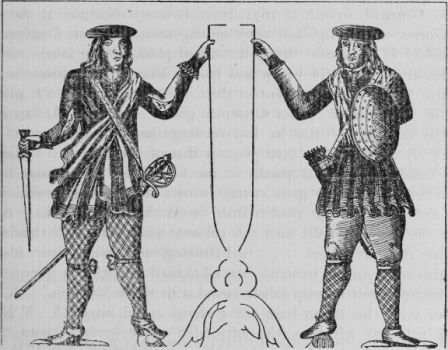
the arms of Skene of that Ilk. The blazon of the supporters in the Lyon
Register is:—
On the dexter by a highland man in his proper garb holding a skene
with his right hand in a guarding posture, and on the sinister be
another in a servill habit his target on the left arm and the darlach
by his side.[46]
In the Introduction to the Nisbet Plates,[47] the work from which the
illustration is taken, it is pointed out that in the Nisbet MS. the
description of the supporters runs as follows:—
Supported on the dexter by a highland gentleman in his proper garb,
holding a skein with his right hand in a guarding posture, and on the
sinister by another highlandman in a servill habit, with his target on
his left arme and his dorloch be his side.[48]
It is impossible to conceive of evidence of a more conclusive and
satisfactory character than that here adduced of the existence of
both modes of dress at this period and of the rank of the respective
wearers. The original illustration is the work of Robert Wood, an
Edinburgh engraver, and in Mr Ross’s Opinion was executed, and
Alexander Nisbet’s description above quoted written, 1695-1704.[49]
The Grameid, written in 1691, contains many references to the
clothing and uniforms of the Highland army serving under Viscount
Dundee. From the shoulder of Keppoch “hung the tartan plaid.” The
inhabitants of the Hebrides are clothed “in yellow and blue.” Dundee,
addressing the leaders, bids them “draw out your clans in their
saffron array upon the plain,” and speaks of “the plaided race of
Grampian giants.” General Mackay is represented as concluding “that
he had subdued the tartaned bands of ancient Albion.” A most explicit
description is that of the followers of Glengarry, “three hundred
illustrious youths in the first flower of vigorous manhood, each of
whom a tartan garb covers, woven with Phrygian skill in triple stripe,
and as a garment clothes their broad chests and flanks. A helmet
defends the temples of the men. A coloured plaid veils their shoulders,
and otherwise they are naked.... Following him closely comes his
brother Allan, the brave, with a hundred men all clothed in garments
interwoven with the red stripe, their brawny calves bound with the
red buskin.” Of Locheil, the poet says, “his tartan hose are gartered
round his calf.” M’Martin in “variegated array advances with lofty
mien”; the garter ribbons “hanging at his leg were dyed with Corycian
saffron, and with the tint of the Tyrian shell, as was his plaid.” Of
Mac Lean of Duart and his brother Alexander “the flowing plaid with
yellow stripe covers the shoulders of both the brothers.” Mac Neill of
Barra “displays as many colours woven into his plaid as the rainbow in
the clouds shows in the sunlight.” The Mac Leods of Raasay advance
“with plumed heads erect, and shoulders covered with girded plaid.” The
Dougals of Craignish “all carry the brazen-hilted sword, and wear the
girded plaid.” “The whole plaided forces of the Highland chiefs, both
horse and foot, the entire body take post.” Dundee beholds his “bands
gleaming with brass, and admires the companies in their brilliant
colours, and is refreshed by the sharp note of the pipe.” The “tartaned
host” pours itself out upon the field. In sight of their opponents the
Highland warriors “draw their swords, and, extended on the plain, they
move in ordered ranks; they cast their brogues of bull’s hide, and make
a pile of their plaids, and thus stripped, prepare for the battle.”
General Mackay takes counsel how he “will overwhelm the tartaned lines
of the target-bearing Scot”; while the poet writes of the march of
his opponents, “the whole body of the Highlanders is formed into one
column, and forthwith the cavalry mount their horses, and the whole
plaided army, with floating banners, went forth from the deserted camp
into the open plain.”[50]
It appears from various references that the trews and the belted plaid
were sometimes worn together. On a powder-horn which belonged to the
late James Drummond, R.S.A., and now in the Museum of the Society of
Antiquaries in Edinburgh, there are figures in the Highland dress,
and one of these seems to illustrate this mode. As to the age of the
relic, Mr Drummond, in a communication to the Society in April 1872,
gave various reasons for believing it to have been the property of Sir
George Mackenzie of Tarbat, who was born in 1630. Again, in an extract
from a MS. stated to have been in the possession of Dr. Mac Lean, Oban,
giving an account of the battle of Killiecrankie, it is stated that
John Macrae of Inversheil, having been struck in the thigh by a musket
shot—
The ball having carried into the wound the cloth of his belted plade,
and the trewes that he wore under them, the woolen did so wrankle the
flesh, that with his hard travail, and need of a chirurgeon, it was
long after before he got cured.[51]
In fact, so late as 1746, when Prince Charles Edward embarked on his
return to France, a letter written by Colonel Warren, and preserved
among the Stuart papers, records that he was dressed in “a threadbare
coat of coarse black frieze, tartan trews, and over them a belted
plaid.”
In 1688 William Sacheverell, Governor of the Isle of Man, visited Mull
and other Western Islands, and his account is valuable and interesting
because it is fair in its criticism and accurate in its description;
and it affords evidence of the general use of the belted plaid, to
the exclusion of the trews, among the common people. Sacheverell
superintended the efforts made to recover the guns and other fittings
of the Florida, one of the scattered vessels of the Spanish Armada,
blown up, according to the traditions of the Mac Leans, by Donald Glas,
son of Mac Lean of Morvern, in Tobermory Bay in 1588. Thus he had ample
opportunity of noting the costume and manners of the natives of Mull
and other Highlanders, of whom he writes:—
During my stay I generally observed the men to be large-bodied,
stout, subtle, active, patient of cold and hunger. There appeared in
all their actions a certain generous air of freedom, and contempt of
those trifles, luxury and ambition, which we so servilely creep after.
They bound their appetites by their necessities, and their happiness
consists, not in having much, but in coveting little. The women seem
to have the same sentiments with the men; though their habits were
mean and they had not our sort of breeding, yet in many of them there
was a natural beauty and a graceful modesty, which never fails of
attracting. The usual habit of both sexes is the pladd; the women’s
much finer, the colours more lively, and the squares larger than the
men’s, and put me in mind of the ancient Picts. This serves them for
a veil, and covers both head and body. The men wear theirs after
another manner; especially when designed for ornament, it is loose and
flowing, like the mantles our painters give their heroes. Their thighs
are bare, with brawny muscles. Nature has drawn all her strokes bold
and masterly; what is covered is only adapted to necessity; a thin
brogue on the foot, a short buskin of various colours on the legg,
tied above the calf with a striped pair of garters. What should be
concealed is hid with a large shot-pouch, on each side of which hangs
a pistol and a dagger; as if they found it necessary to keep those
parts well guarded. A round target on their backs, a blew bonnet on
their heads, in one hand a broadsword, and a musquet in the other,
perhaps no nation goes better armed; and I assure you they will handle
them with bravery and dexterity, especially the sword and target, as
our veteran regiments found to their cost at Gille Crankee.[52]
In the closing years of the seventeenth century the Western Isles of
Scotland were visited by a traveller, who has left the most complete
account of the people and their manner of life which had been written
up to that date. The author, Martin, undertook the journey with the
specific purpose of recording particulars concerning the people; and,
as his work evinces careful observation, reliance may be placed on his
description of their dress at the time of his visit. It supplies the
first indication, in any book of travel, of the use of special colours
or setts for tartans used in different localities.
The first Habit wore by Persons of Distinction in the Islands, was the
Leni-Croich, from the Irish word Leni, which signifies a Shirt,
and Croich Saffron, because their Shirt was dyed with that Herb: the
ordinary number of Ells us’d to make this Robe, was twenty four; it
was the upper Garb, reaching below the Knees, and was tied with a Belt
round the middle: but the Islanders have laid it aside about a hundred
Years ago.
They now generally use Coat, Wastcoat, and Breeches, as elsewhere;
and on their Heads wear Bonnets made of thick Cloth, some blue, some
black, and some grey.
Many of the People wear Trowis: some have them very fine woven
like Stockings of those made of Cloth; some are colour’d, and others
striped: the latter are as well shap’d as the former, lying close
to the Body from the middle downwards, and tied round with a Belt
above the Haunches. There is a square Piece of Cloth which hangs down
before. The Measure for shaping the Trowis is a Stick of Wood, whose
Length is a Cubit, and that divided into the Length of a Finger, and
half a Finger; so that it requires more Skill to make it than the
ordinary Habit.
The Shoes antiently wore, were a piece of the Hide of a Deer, Cow, or
Horse, with the Hair on, being tied behind and before with a Point of
Leather. The generality now wear Shoes, having one thin Sole only, and
shaped after the right and left Foot; so that what is for one Foot,
will not serve the other.
But Persons of Distinction wear the Garb in Fashion in the South of
Scotland.
The Plad wore only by the Men, is made of fine Wool, the Thred as
fine as can be made of that kind; it consists of divers Colours, and
there is a great deal of Ingenuity requir’d in sorting the Colours, so
as to be agreeable to the nicest Fancy. For this reason the Women are
at great pains, first to give an exact Pattern of the Plad upon a
piece of Wood, having the number of every Thred of the Stripe on it.
The Length of it is commonly seven double Ells; the one end hangs by
the Middle over the left Arm, the other going round the Body, hangs by
the end over the left Arm also; the right Hand above it is to be at
liberty to do any thing upon occasion. Every Isle differs from each
other in their Fancy of making Plads, as to the Stripes in Breadth,
and Colours. This Humour is as different thro the main Land of the
Highlands, in-so-far that they who have seen those Places, are
able, at the first View of a Man’s Plad, to guess the Place of his
Residence.
When they travel on foot, the Plad is tied on the Breast with a
Bodkin of Bone or Wood (just as the Spina wore by the Germans,
according to the Description of C. Tacitus:) the Plad is tied
round the middle with a Leather Belt; it is pleated from the Belt to
the Knee very nicely: this Dress for Footmen is found much easier and
lighter than Breeches, or Trowis.
The antient Dress wore by the Women, and which is yet wore by some of
the Vulgar, called Arisad, is a white Plad, having a few small
Stripes of black, blue, and red; it reach’d from the Neck to the
Heels, and was tied before on the Breast with a Buckle of Silver, or
Brass, according to the Quality of the Person. I have seen some of the
former of an hundred Marks value; it was broad as any ordinary Pewter
Plate, the whole curiously engraven with various Animals, &c. There
was a lesser Buckle, which was wore in the middle of the larger,
and above two Ounces weight; it had in the Center a large piece of
Chrystal, or some finer Stone, and this was set all round with several
finer Stones of a lesser size.
The Plad being pleated all round, was tied with a Belt below
the Breast; the Belt was of Leather, and several Pieces of Silver
intermix’d with the Leather like a Chain. The lower end of the Belt
has a Piece of Plate about eight Inches long, and three in breadth,
curiously engraven; the end of which was adorned with fine Stones, or
Pieces of Red Coral. They wore Sleeves of Scarlet Cloth, clos’d at the
end as Mens Vests, with Gold Lace round ’em, having Plate Buttons set
with fine Stones. The Head-dress was a fine Kerchief of Linen strait
about the Head, hanging down the Back taper-wise; a large Lock of Hair
hangs down their Cheeks above their Breast, the lower end tied with a
Knot of Ribbands....
The antient way of Fighting was by set Battles; and for Arms some had
broad two-handed Swords and Head-pieces, and others Bows and Arrows.
When all their Arrows were spent, they attack’d one another with Sword
in hand. Since the Invention of Guns, they are very early accustomed
to use them, and carry their Pieces with them where-ever they go:
They likewise learn to handle the broad Sword and Target. The Chief
of each Tribe advances with his Followers within shot of the Enemy,
having first laid aside their upper Garments; and after one general
Discharge, they attack them with Sword in hand, having their Target on
their left Hand (as they did at Kelicranky) which soon brings the
Matter to an Issue, and verifies the Observation made of ’em [by] your
Historians:
Aut Mors cito, aut Victoria læta.[53]
Certainly this is evidence of the employment of fixed designs and
special colours in the tartans, as well by the Islanders as by the
Highlanders of the mainland; and many have held it to settle the
question of their use as clan distinctions at that period. At all
events, it shows that district tartans were in use in Martin’s day, and
that their colourings furnished an indication of the localities whence
the wearers came.
It is out of the question to suppose that the tartans described by
Martin sprang into being in his day. On the contrary, all the evidence
we possess—proving, as it does, the extremely conservative character
of the inhabitants of the Western Islands—points to the conclusion
that Martin was the witness, at the end of the seventeenth century, of
habits and customs in use long previously.
Of the existence of a uniform clan pattern at the very commencement of
the eighteenth century there is a complete chain of evidence. Captain
Hamilton writes from Inverness, 23rd July 1703, to Brigadier-General
Maitland, Governor of Fort-William:—
I wrote to you Tuesday last in answer to your last letter to me, but
I neglected to acquaint you of our news here. The thing is there is a
match of Hunting to be as is said against 2nd of next month amongst
several of our great folks, particularly the Duke of Hamilton is to be
there, the Marquis of Athole, and our neighbour the Laird of Grant,
who has ordered 600 of his men in arms, in good order, with Tartane
Coats all of one colour and fashion. This is his order to his people
in Straithspey. If it be a match at Hunting only I know not, but I
think it my duty to acquaint you, whatever may fall out, of any such
body of men in arms, particularly in our Northern Parts.[54]
The following entries in the Court Books of the Regality of Grant,
1703-1710, are given in full, because they are of the utmost
importance, and have never hitherto been accurately quoted. Among
others, Sir William Fraser, in his Chiefs of Grant, refers merely to
the second entry, and that incorrectly:—
Court of the Lordship of the parochine of Duthell holden at Duthell
the 20 July 1704 be Duncan Grant of Mullochard bailie constitute be
the Right Honoll Alexr Grant of that Ilk your bailie principall
of the Regalitie of Grant David Blair notar and clerk to the said
Regalitie Court of the District of Duthell. Suites called and the
Court lawfullie fenced and affirmed.
The said day Ronald Makdonald of Gelloway and Archibald Makdonald of
Tulloch Crombie wassales of Lugan in Badzenoch to the Right Honoll
Ludovick Grant of that Ilk and the tennantes and indwellers on these
landes are ordained to have readie tartan short coates trewes and
short hose of red and grein set dyce all broad springed betuixt and
the eight of August nixt and to be readie upon 48 hours advertisement
to rendevouze when the Laird of Grant shall call them for his hosting
or hunteing under the failie of fyve pounds sterling.
(Signed) D. GRANT, B.
Court of the Landes of Tulchine and Skeiradvey, holdine at Delay upon
the 27 July 1704 be William Grant of Delay bailie of the saids lands
constitute be the Right Honoll the Laird of Grant heretor of the
saidis landis, David Blair notar and clerk; James Gedlie officer.
Suites called and the court lawfully fenced and affirmed.
The said day by ordor from the Laird of Grant younger the said
bailie ordanes and enacts that the haill tennantes cottars malenders
tradesmen and servantes within the saidis landis of Skearadvie
Tulchine and Calender that are fencible men shall provyd and have
in readiness against the eight day of August nixt ilk ane of them
Heighland coates trewes and short hoes of tartane of red and greine
sett broad springed and also with gun sword pistoll and durk, and with
these present themselves to ane rendewouze when called upone 48 hours
advertisement within the country of Strathspey, for the said Laird
of Grant or his faither their hosting and hunteing. And this under
the failie of twenty poundes Scotis ilk ane that shall faill in the
premisses. And the Master to outrig the servantes in the saids coates
trewes and hose out of their fies.[55]
A very curious and somewhat puzzling state of affairs is disclosed
by a minute examination of the fine series of family portraits
preserved at Castle Grant.[56] Of these portraits no fewer than ten
were painted by Richard Waitt, namely, Brigadier Grant of Grant and
Donald Grant of Glenbeg, in 1713; Patrick Grant of Miltown, Mungo Grant
of Mulloch-hard, —— Grant of Delbuaick, David Grant of Delbuaick,
Patrick Grant of Tullochgriban, Alister Grant “Mohr,” and the Piper
to the Laird of Grant, in 1714; and John Grant of Burnside, in 1725.
Besides these, Waitt painted other Grant portraits in tartan attire. By
permission of the Countess of Seafield, coloured drawings of these have
been made, and comparison discovers a variety of design well-nigh as
great as would be the case in an equal number of examples selected at
random from as many different families. In one particular alone do they
agree, and that is in the absence of any completely dark-coloured sett,
such as is usually designated “uaine” or green. It is not till after
the ’45 that there is an instance of any member of the clan wearing
the so-called undress Grant tartan, now the familiar “Forty-Second” or
Black Watch pattern.
Similar remarks might be made concerning other family portraits. For
example, in the Mac Donald portraits at Armadale there are at least six
distinct setts of tartan. The Campbell portraits at Loudoun Castle and
Langton House exhibit equal diversity, while differing at the same time
from any of the Campbell setts at present in use. In the same way the
pictures of the Sutherland family at Dunrobin and Barrogill, the Mac
Donell portraits at Balgownie, the Mac Leod at Dunvegan, the Drummond
at Gordon Castle and Drummond Castle, the Macpherson at Cluny, the
Frasers in Inverness-shire, show remarkable variety of arrangement and
colouring. Whatever the reason of this, it assuredly did not arise from
carelessness or ignorance on the part of the artists employed. On the
contrary, in the great majority of the pictures referred to, painful
attention has been paid to minuteness and accuracy in details of the
dress, and the sett of a tartan is reproduced in different portions of
the costume with a faithfulness which leaves no room for doubt that the
artists were studiously copying distinct patterns.
The importance of the tartan manufacture to Scotland in the beginning
of the eighteenth century is evident from the following:—
In this place it’s proper to mention their Plaids, a Manufacture
wherein they exceed all Nations, both as to Colour and Fineness.
They have of late been pretty much fancy’d in England, and are very
ornamental as well as durable for Beds, Hangings, Window-Curtains
and Night-Gowns for Men and Women; so that Attempts have been made
in England to resemble them, at Norwich and elsewhere, but they fall
much short both in Colour, Fineness, and Workmanship, as is evident
at first sight. A good improvement may be made of this manufacture
for domestick use and export, now that the prohibition is remov’d by
the Union. The stronger sort of those Plaids is the usual Cloathing
for their Men in the Highlands, where they never alter the form of
their Habit, which, to other People, seems uncouth, because not us’d
elsewhere; yet it must be own’d, that as they are us’d by those of the
better sort in the Highlands, they make a manly as well as a decent
Habit.[57]
In A Journey through Scotland, undertaken between 1716 and 1723,
occurs this description of the cattle fair at Crieff and of the dress
of the Highland gentlemen and their followers, which confirms in all
particulars the other accounts of the use of tartan at the period, and
the distinction between the dress of the upper and lower orders:—
The Highland Fair of Criff happening when I was at Stirling, I had the
Curiosity to go see it. There were at least Thirty Thousand Cattle
sold there, most of them to English Drovers; who paid down above
Thirty Thousand Guineas in ready Money to the Highlanders; a Sum they
had never seen before, and proves one good Effect of the Union. The
Highland Gentlemen were mighty civil, dress’d in their slash’d short
Wastcoats, a Trousing, (which is, Breeches and Stockings of one Piece
of strip’d Stuff) with a Plaid for a Cloak, and a blue Bonnet. They
have a Ponyard Knife and Fork in one Sheath, hanging at one side of
their Belt, their Pistol at the other, and their Snuff-Mill before;
with a great broad Sword by their side. Their Attendance [attendants]
were very numerous, all in belted Plaids, girt like Womens Petticoats
down to the Knee; their Thighs and Half of the Leg all bare. They
had also each their broad Sword and Ponyard, and spake all Irish, an
unintelligible Language to the English.[58]
It appears from the regulations issued to the retainers of the Clan
Grant anent the wearing of a uniform tartan that distinctive patterns
were in use, at least for military purposes, or on occasions of great
gatherings, early in the eighteenth century. That widespread attention
was at that period bestowed upon particular arrangements of tartan
appears from a letter quoted by Sir Walter Scott, dated from the Manse
of Comrie, 2nd July 1717:—
I give your lady hearty thanks for the highland plaid. Its good cloath
but it does not answer the sett I sent some time agoe with McArthur.
This implies, at the least, in a district on the southern border of the
Highlands, adhesion to particular patterns, just as in Martin’s account
of the Western Islands, already quoted, the existence of district setts
is proved by the use of the words “able, at the first view of a man’s
plad, to guess the place of his residence.”
Alexander Nisbet, the great herald, referring to the supporters of
Macpherson of Cluny, writes:—
The family has been in use to have their arms supported with two
Highland men with steel helmets on their heads and cut out short
doublets azure, thighs bare, their shirts tied between them, and round
targets on their arms, being the dress wherein those of this clan were
wont to fight in many battles for the crown being always loyal.[59]
That the dress thus described by Nisbet was intended by him to
represent what we know to be the usual dress of the Highlanders at
that period, viz., the belted plaid, is proved by another allusion
of his to the Cluny arms in a portion of his work not yet published,
and preserved in the Lyon Office, in which, treating generally of
supporters, he writes:—
McPherson of Clunie two highlandmen in their belted plaids with
targets.[60]
An almost contemporary example of the peculiar mode of wearing the
dress, described as “shirts tied,” is to be found in the portrait of
Sir Stuart Threipland of Fingask, by Delacour, painted about this
period.[61]
Without exception the most complete description of the Highlands
and the dress worn there, written during the eighteenth century, is
that given by Burt. The account has been frequently the subject of
criticism, but it is now generally accepted as presenting a faithful
picture of the state of the country at the period to which it relates.
As it traverses a wide field, a lengthened extract is given, for the
purpose of comparison with earlier descriptions of the costume and
manners of the people already quoted:—
The plaid is the undress of the ladies [writing of Inverness]; and to
a genteel woman, who adjusts it with a good air, is a becoming veil.
But as I am pretty sure you never saw one of them in England, I shall
employ a few words to describe it to you. It is made of silk or fine
worsted, chequered with various lively colours, two breadths wide,
and three yards in length; it is brought over the head, and may hide
or discover the face according to the wearer’s fancy or occasion; it
reaches to the waist behind; one corner falls as low as the ankle on
one side; and the other part, in folds, hangs down from the opposite
arm.
I have been told, in Edinburgh, that the ladies distinguish their
political principles, whether Whig or Tory, by the manner of wearing
their plaids;—that is, one of the parties reverses the old fashion,
but which of them it is, I do not remember, nor is it material.
As I was travelling in a very wild part of the country, and
approaching the house of one of those gentlemen, who had notice of
my coming, he met me at some distance from his dwelling, with his
Arcadian offering of milk and cream, as usual, carried before him by
his servants. He afterwards invited me to his hut, which was built
like the others, only very long, but without any partition, where
the family was at one end, and some cattle at the other. By the way
(although the weather was not warm), he was without shoes, stockings,
or breeches, in a short coat, with a shirt not much longer, which hung
between his thighs, and just hid his nakedness from two daughters,
about seventeen or eighteen years old, who sat over against him. After
some compliments on either side, and his wishing me good weather, we
entered into conversation, in which he seemed to be a man of as good
sense as he was well-proportioned. In speaking of the country, he told
me he knew I wondered how any body would undergo the inconveniences of
a Highland life.
The Highland dress consists of a bonnet made of thrum without a
brim, a short coat, a waistcoat, longer by five or six inches, short
stockings, and brogues, or pumps without heels. By the way, they cut
holes in their brogues, though new made, to let out the water, when
they have far to go and rivers to pass: this they do to preserve their
feet from galling.
Few besides gentlemen wear the trowze,—that is, the breeches and
stockings all of one piece, and drawn on together; over this habit
they wear a plaid, which is usually three yards long and two breadths
wide, and the whole garb is made of chequered tartan, or plaiding:
this, with the sword and pistol, is called a full dress, and, to a
well-proportioned man, with any tolerable air, it makes an agreeable
figure; but this you have seen in London, and it is chiefly their
mode of dressing when they are in the Lowlands, or when they make a
neighbouring visit, or go anywhere on horseback; but when those among
them who travel on foot, and have not attendants to carry them over
the waters, they vary it into the quelt [kilt], which is a manner I
am about to describe.
The common habit of the ordinary Highlanders is far from being
acceptable to the eye: with them a small part of the plaid, which
is not so large as the former, is set in folds and girt round the
waist, to make of it a short petticoat that reaches half way down
the thigh, and the rest is brought over the shoulders, and then
fastened before, below the neck, often with a fork, and sometimes
with a bodkin or sharpened piece of stick, so that they make pretty
nearly the appearance of the poor women in London when they bring
their gowns over their heads to shelter them from the rain. In this
way of wearing the plaid, they have sometimes nothing else to cover
them, and are often barefoot; but some I have seen shod with a kind
of pumps, made out of a raw cow-hide, with the hair turned outward,
which being ill made, the wearer’s foot looked something like those
of a rough-footed hen or pigeon: these are called quarrants, and
are not only offensive to the sight, but intolerable to the smell of
those who are near them. The stocking rises no higher than the thick
of the calf, and from the middle of the thigh to the middle of the leg
is a naked space, which, being exposed to all weathers, becomes tanned
and freckled, and the joint being mostly infected with the country
distemper, the whole is very disagreeable to the eye. This dress is
called the quelt; and, for the most part, they wear the petticoat
so very short, that in a windy day, going up a hill, or stooping, the
indecency of it is plainly discovered....
Various reasons are given both for and against the Highland dress. It
is urged against it, that it distinguishes the natives as a body of
people distinct and separate from the rest of the subjects of Great
Britain, and thereby is one cause of their narrow adherence among
themselves, to the exclusion of all the rest of the kingdom; but
the part of the habit chiefly objected to is the plaid (or mantle),
which, they say, is calculated for the encouragement of an idle life,
in lying about upon the heath, in the day-time, instead of following
some lawful employment; that it serves to cover them in the night
when they lie in wait among the mountains, to commit their robberies
and depredations; and is composed of such colours as altogether, in
the mass, so nearly resemble the heath on which they lie, that it is
hardly to be distinguished from it until one is so near them as to be
within their power, if they have any evil intention; that it renders
them ready, at a moment’s warning, to join in any rebellion, as they
carry continually their tents about them: and, lastly, it was thought
necessary, in Ireland, to suppress that habit by act of parliament,
for the above reasons, and no complaint for the want of it now remains
among the mountaineers of that country.
On the other hand, it is alleged, the dress is most convenient to
those who, with no ill design, are obliged to travel from one part
to another upon their lawful occasions, viz.—That they would not be
so free to skip over the rocks and bogs with breeches as they are in
the short petticoat; that it would be greatly incommodious to those
who are frequently to wade through waters, to wear breeches, which
must be taken off upon every such occurrence, or would not only gall
the wearer, but render it very unhealthful and dangerous to their
limbs, to be constantly wet in that part of the body, especially in
winter-time, when they might be frozen: and with respect to the plaid
in particular, the distance between one place of shelter and another,
is often too great to be reached before night comes on; and, being
intercepted by sudden floods, or hindered by other impediments, they
are frequently obliged to lie all night in the hills, in which case
they must perish, were it not for the covering they carry with them.
That even if they should be so fortunate as to reach some hospitable
hut, they must lie upon the ground uncovered, there being nothing to
be spared from the family for that purpose.
And to conclude, a few shillings will buy this dress for an ordinary
Highlander, who, very probably, might hardly ever be in condition to
purchase a Lowland suit, though of the coarsest cloth or stuff, fit to
keep him warm in that cold climate.
I shall determine nothing in this dispute, but leave you to judge
which of these two reasonings is the most cogent.
The whole people are fond and tenacious of the Highland clothing, as
you may believe by what is here to follow.
Being, in a wet season, upon one of my peregrinations, accompanied
by a Highland gentleman, who was one of the clan through which I was
passing, I observed the women to be in great anger with him about
something that I did not understand: at length, I asked him wherein
he had offended them? Upon this question he laughed, and told me his
great-coat was the cause of their wrath; and that their reproach was
that he could not be contented with the garb of his ancestors, but was
degenerated into a Lowlander, and condescended to follow their unmanly
fashions.[62]
To the edition of the Letters from which the above is quoted the
editor appended some notes on the Highland dress, which, though open to
criticism on many points, are sufficiently interesting to justify their
insertion here:—
The chequered stuff, commonly worn by the Highlanders, by them called
breacan (parti-coloured), and by the Lowlanders tartan (Fr.
tiretaine), is neither peculiar to Celts nor Goths, and is to be
found, at this day, although not in such general use, among many of
the Sclavonic tribes, who have no connection with either. The wife
of every Russian boor, in the north-western provinces at least, who
can make her such a present at her marriage (and it is often a sine
quâ non), has a tartan plaid, which she wears just as the Scotish
women, in our author’s time, did theirs: it is of massy silk, richly
varied, with broad cross-bars of gold and silver tissue, and makes a
very splendid appearance.
That the Lowlanders had their tartan from the French, at a time
when it was fashionable in other countries, may be presumed from
the name; and to imagine that the manufacture began among the
Highlanders would be ridiculous.
The Highland field-dress of the men was of a coarser texture, and
thickened by fulling; it was called cadda (cath da’, the war
colour), and was a tartan of such colours as were least likely to
betray the wearer, among the woods and heaths, either to the game he
was in quest of, or to his enemies. The dyes were mostly extracted
from woad, when it could be got, and from heath-tops, the bark and
tender twigs of the alder, and other vegetable substances. As to
the ancient form of the dress, nothing could be more simple: the
gentlemen, having less frequent occasion to use their full suit
as a blanket, wore a yellow shirt, a vest, trowsers, and mantle, of
the same fashion as their neighbours. In Ireland, a few centuries ago,
the lower class seldom encumbered themselves with dress of any kind
within doors; and there is every reason to suppose that this was also
the case among their brethren in Scotland. When they went out, they
threw a light blanket round their shoulders, the upper part made tight
with skewers, and the lower gathered up into folds, which they secured
under the girdle, from which the sword, dagger, purse, &c., were
suspended; this they called feile, a word of the same origin with
the Scotish fell, English, peel; Old English, pilche; German
and Northern, peltz, pels, &c.; and the Latin, pellis, all
which signified an external surface, skin, or covering of any
kind. Skins, in the modern acceptation of the term, were, no doubt,
the first covering; and the name was afterwards properly enough
applied to a covering of cloth. At night they took out the skewers,
unbuckled the girdle, and reduced the feile to its primary form of
a blanket, to sleep in. The women wore a petticoat, or trowsers, of
skin, cloth, or what they could get, and a cloth thrown round their
bodies when they went out. As civilization advanced, a shirt, with a
tunic, or short jacket, was introduced; the plaits of the feile were
rendered permanent by sewing, and the plaid, to be used either as a
mantle or blanket, was added. The kilt, feilebeg (little feile),
or petticoat, now worn, has succeeded to the folded-up ends of the
original blanket; it is all that remains of the ancient costume, and
was reduced to its present form some time in the beginning of the last
century. The bonnet, or flat, blue thrum cap, is of a very modern
date, and was introduced from the Lowlands. The gentlemen of the
Highlands wore such hats and caps as were worn by gentlemen of their
times in neighbouring countries; and, in the days of our grandfathers,
the lower class of Highlanders were, by their Lowland neighbours (in
the north-east Lowlands, at least), denominated humblies, from their
wearing no covering on their head but their hair, which, at a more
early period, they probably matted and felted, for horror and defence,
as the Irish did in Queen Elizabeth’s time. The helmet-looking bonnet,
now worn, was introduced within the memory of persons still living.
From this simple account of the Highland dress, it will be seen that
it has in itself nothing peculiar to one country more than another; as
the different improvements upon the manner of girding the loins, and
trussing up a blanket, can hardly be called a national costume. The
dress of the Romans began in the same manner, and went through nearly
the same varieties of form; but, for a long time after the Romans
left Britain, it can hardly be imagined, that the inhabitants of the
more remote Highlands had either wool or cloth of their own produce.
Scattered as their sheep, if they had any, must have been upon the
mountains, they had no means of protecting them from the wolves; and
they had not then patient industry enough to look after tame animals
that could not take care of themselves.
The names of the different parts of this dress are all conformable
to what has been said above. The feilebeg is, by the Lowlanders,
called a kilt, from its having been kilted, quilted, or trussed
up under the girdle. The meaning of the Latin toga is found in the
Gaëlic toga’; in English, to tuck up, from the same circumstance;
and a square body-cloth, still worn round the shoulders by the
Highland women, is called a tunic, or tonnac. Plaid (which is
always misapplied in England), in its primary sense, means simply
any thing broad and flat, and thence, a broad, unformed piece of
cloth, and, in its secondary and modern acceptation, a blanket;
in which last import alone it is now used by the Highlanders. The
trews, or trowsers, formerly worn only by the gentry, and by
the lower classes, after the philibeg was proscribed by act of
parliament, are so denominated, from the Gaëlic trusa’, to truss
up, as they supplied the place of the end of the feile which was
trussed under the girdle.[63]
During the period following the Union of the Kingdoms of Scotland and
England (1707), tartan plaids were worn in the Lowlands by all classes.
The significance of this universal display of a simple article of dress
consisted in the fact that its wear was regarded as a sort of sumptuary
protest against the Union and the surrender of Scottish independence.
Certain it is that up to the prohibition of the use of tartans and of
the Highland dress by the Act of 1747 the tartan plaid continued in
general use throughout Scotland. Many references to the prevalence of
the habit in the Lowlands as well as in the Highlands might be quoted.
One interesting contribution is that of Ramsay of Ochtertyre, who,
writing in 1795 of the congregation of the Rev. John Skinner’s church
at Linshart, in Buchan, observes:—
In point of mode and plainness their dress reminded me of that of our
country-people more than forty years ago, bonnets and parti-coloured
plaids being frequent.... In those days every lady in an undress wore
a plaid when she went abroad. It was sometimes of one colour, scarlet,
crimson, &c., but more commonly tartan or variegated. People fond of
finery had silk ones, others wore woollen lined with silk; whilst the
lower classes were satisfied with plain worsted.... In 1747, when I
first knew Edinburgh, nine-tenths of the ladies still wore plaids,
especially at church. By this time, however, silk or velvet cloaks of
one form or another were much in request among people of fashion. And
so rapidly did the plaid wear out, that when I returned to Edinburgh
in 1752 one could hardly see a lady in that piece of dress.[64]
Of the extensive manufacture of tartans in Scotland during the
eighteenth century some evidence may be obtained from a reference to
the newspapers of the period. For example:—
Last Saturday the Agatha and Jane, Thomas Christie [master] cleared
out from Leith for London, having on board the following Scots
manufactures, viz., 53,381 yards of Linen, 3006 yards of Tartans.[65]
Leith, Feb. 18.—The Edinburgh Merchant, John Dick, cleared out for
London with the following Scots manufactures, viz., 41,400 yards of
Linen, 6400 yards of Tartan.[66]
In the same newspaper, and side by side with the orders issued by
Prince Charles Edward, then at Holyrood, appears the following:—
Gairdner and Taylor, in their Warehouse at the Sign of the Golden
Key, opposite to Forrester’s Wynd, Lawn-Market, Edinburgh, continue
to sell, in Wholesale and Retail, at lowest Prices, all sorts of
Woollen Narrow and Broad Cloths of the Manufacture of Scotland, in
same manner as was done by the late Andrew Gairdner, who was one of
the first Introducers of an extensive Manufactory of this Kind, so
very beneficial to, and so much wanted in this Country.... At above
Warehouse to be sold at lowest Rates, great Choice of Tartans, the
newest Patterns, Cotton Checks and Sarges, of which they are also
Makers.[67]
This advertisement, it may be urged, is a stumbling-block in the way
of those who argue for the antiquity of clan patterns; for it seems
peculiar that, when the city was filled with Highlanders of all ranks
and many clans, they should be offered, not their ancient setts, but
“great choice of the newest patterns.”
A statement which points in exactly the contrary direction appears in
the Lockhart Papers to the following effect:—
It was necessary for us [i.e., the troops under the command of the
Duke of Perth and the Earl of Cromarty in the Prince’s army], in
order to come at him [i.e., Lord Louden, who commanded a detachment
in the Duke of Cumberland’s army], to go about by the head of
Tyne,[68] through Torendonel, about ten miles’ march, and accordingly
Glengary’s, Clanronald’s, Ardsheal’s, Glengyle’s, and Barisdale’s
battalions were ordered after them, under the command of the Duke
of Perth and Lord Cromarty. Those under Lord Louden’s command were
the M’Loads, Sir Alexander M’Donald’s men, the Makays and Monroes,
and the Grants—about three thousand in all.... We M’Donalds were
much perplex’d, in the event of ane ingagement, how to distinguish
ourselves from our bretheren and nighbours the M’Donalds of Sky,
seeing we were both Highlanders and both wore heather in our bonnets,
only our white cocades made some distinction.[69]
The inference from the passage is, that the opposing battalions
being of the same great family, with dress and badge alike, the sole
remaining difference between them was the cockade.
One result of the civil war of 1745-6 was the proscription by Act of
Parliament of the Highland dress:—
19 George II., Cap. 39, Sec. 17, 1746.
From and after the first day of August one thousand seven hundred
and forty-seven, no man or boy within that part of Great Britain
called Scotland, other than such as shall be employed as officers and
soldiers in his Majesty’s forces, shall, on any pretence whatsoever,
wear or put on the clothes commonly called Highland Clothes (that is
to say) the Plaid, Philibeg, or little Kilt, Trowse, Shoulder belts,
or any part whatsoever of what peculiarly belongs to the Highland
garb; and that no Tartan or party-coloured plaid or stuff shall be
used for great coats, or for upper coats; and if any such person
shall presume, after the said first day of August, to wear or put
on the aforesaid garments, or any part of them, every such person
so offending, being thereof convicted by the oath of one or more
credible witness or witnesses before any court of justiciary, or any
one or more justices of the peace for the shire or stewartry, or judge
ordinary of the place where such offence shall be committed, shall
suffer imprisonment, without bail, during the space of six months, and
no longer; and being convicted for a second offence before a court of
justiciary, or at the circuits, shall be liable to be transported to
any of his Majesty’s plantations beyond the seas, there to remain for
the space of seven years.
“It is impossible,” writes General Stewart of Garth, “to read this
latter Act without considering it rather as an ignorant wantonness of
power than the proceeding of a wise and a beneficent Legislature. To
be compelled to wear a new dress has always been found painful. So the
Highlanders found; and it certainly was not consistent with the boasted
freedom of our country to inflict on a whole people the severest
punishment short of death for wearing a particular dress. Had the
whole race been decimated, more violent grief, indignation, and shame
could not have been excited among them than by being deprived of this
long-inherited costume. This was an encroachment on the feelings of a
people whose ancient and manly garb had been worn from a period remote
beyond all history or even tradition.”[70] The spirit in which the Act
was carried out may be gathered from the following extract from the
General Orders to the Army in Scotland in 1748:—
By the act passed last session of Parliament, the time for the general
abolishing the Highland dress is enlarged to the 1st day of August
1749.
But that the wearing and use of such parts thereof as are called
the plaid, philibeg, or little kilt, is absolutely prohibited and
abolished from and after the 25th day of this instant December, and as
to these particulars the law takes place from that day.
His grace the Duke of Newcastle has therefore signified to me his
majesty’s commands, that the same be punctually observed throughout
the Highlands, and that I should give orders to all the troops
quartered in those parts to be particularly attentive to this service,
and to take all due care that the act be punctually executed and
observed, and the offenders brought to punishment according to law.
In obedience to these his majesty’s commands, you are to seize all
such persons as shall be found offending herein, by wearing the plaid,
philibeg, or little kilt, and carry them before a civil magistrate,
in the same dress, that he may be convinced with his own eyes of
their having offended, in order to their being punished for the same
according to law; in the performance of which, let no insult or abuse
be offered to the person or persons of those who shall be so taken
up and carried before the civil power, who are solely authorised to
inflict the punishment as the act directs; but in case the magistrate
before whom such offenders are carried shall refuse or neglect putting
the law in execution, in that case let me know immediately the name
of such magistrate, with the reason of his not doing it, that I
may acquaint the Duke of Newcastle with it, who will no doubt send
immediately orders to the lord advocate of this country to prosecute
him to the utmost for his contempt of the said act, by not putting it
in execution.
That the people in the Highlands might have no excuse by pleading
ignorance, the lord chief justice clerk wrote to the sheriffs depute
of the Highland counties, ordering them to give notice at every parish
church, that they must quit the plaid, philibeg, or little kilt on
Christmas-day, as the act directs, otherwise they would be carried
before the civil magistrate and punished for it accordingly.
I must likewise desire you will let me know from time to time what
obedience the people pay to this act, for they must and shall obey it,
with the names of those magistrates who are industrious in putting the
laws in execution, that I may take an opportunity of thanking them for
performing their duty, and acquainting the Duke of Newcastle with it.
You may acquaint the magistrates and justices of the peace in your
neighbourhood with the contents of this letter, since it may be the
means of inciting them the more readily to perform their duty.
P.S.—Let a copy of this letter be sent to the officers commanding
the general detachments of your regiment respectively.[71]
All manner of ingenious evasions were thought of and practised to
defeat the law. “The tight breeches,” observes General Stewart, “were
particularly obnoxious. Some who were fearful of offending, or wished
to render obedience to the law, which had not specified on what part of
the body the breeches were to be worn, satisfied themselves with having
in their possession this article of legal and loyal dress, which,
either as the signal of their submission, or more probably to suit
their own convenience when on journeys, they often suspended over their
shoulders upon their sticks; others, who were either more wary or less
submissive, sewed up the centre of the kilt with a few stitches between
the thighs, which gave it something of the form of the trowsers worn by
Dutch skippers. At first these evasions of the Act were visited with
considerable severity.”[72] It was most probably for conniving at some
such breach of the law that a young grenadier of the 20th Foot narrowly
escaped a tremendous punishment.
The court-martial has judged the crime of Rigby, the grenadier, to
be of so pernicious a nature that they have sentenced him to receive
six hundred lashes. His youth and former good behaviour are the only
considerations that could induce the lieutenant-colonel to pardon
him: but if hereafter any sergeant or corporal is known to receive a
bribe from a Highlander, or from any person whatever, found or known
to transgress the laws, and does not seize the person or report such
transgression, he, the non-commissioned officer guilty of so heinous
a crime, will be instantly broke and severely punished: and if any
private soldier ever takes money, or a reward of any kind, that may
lead him to betray his trust, such soldier will be whipped without
mercy.[73]
The harsh and bitter administration of the law continued for many
years—for a long enough period, indeed, to stamp out the use of the
dress, at least among the lower orders. In the south the wear of tartan
does not seem to have been interfered with. For instance, we read:—
There is to be sold by roup in the shop of William Watson in the front
of the New Exchange of Edinburgh upon Monday 3rd day of March next
the whole goods which belonged to the said William Watson consisting
of Tartans of all kinds poplins durants calicoes thick-sets hollands
lawns broadcloths stockings handkerchiefs ribbons worsteds and a great
variety of other goods too tedious to mention. The goods are all fresh
and in good condition and fashionable.[74]
James Baillie Merchant in Edinburgh has removed his warehouse to the
Exchange fronting the Tron where Tartans or Plaids with other goods
are sold as formerly.[75]
At length the enactment was repealed. The Marquis of Graham, afterwards
Duke of Montrose, when a Member of the House of Commons in 1782,
having brought in a Bill for the purpose, it was, according to General
Stewart, passed without a dissentient voice.[76]
22 George III., Cap. 63, 1782.
Whereas by an act made in the nineteenth year of the reign of his
late majesty King George the Second, entituled “An act for the more
effectual disarming the Highlands in Scotland and for more effectually
securing the peace of the said Highlands; and for restraining the
use of the Highland dress;” ... it was, among other things, enacted
that from and after the first day of August one thousand seven
hundred and forty-seven, no man or boy, within that part of Great
Britain called Scotland, other than such as shall be employed as
officers and soldiers in his Majesty’s forces [&c., as quoted, pp.
36-7]. And whereas it is judged expedient that so much of the acts
above mentioned as restrains the use of the Highland dress should
be repealed: Be it therefore enacted by the King’s most Excellent
Majesty, by and with the advice of the Lords Spiritual and Temporal
and Commons in this present Parliament assembled, and by the authority
of the same, That so much of the acts above mentioned, or any other
act or acts of Parliament, as restrains the use of the Highland dress,
be, and the same are hereby repealed.
The repeal of the enactment, received so joyously by the Highlanders,
was celebrated by the famous poet, Duncan Ban M’Intyre, in the
following lines, which are freely adapted from the Gaelic:—
Indulgent laws at last restore
The noble dress our fathers wore.
Exulting, let us then resume
The bonnet blue and eagle plume;
The tartan coat and jaunty vest
And belted plaid become us best.
With limbs unchained and footsteps free,
The pleated kilt just shows the knee;
In hose and brogues we’ll roam at will
O’er purple moor and heather hill.
How quickly the dress was resumed—at all events in certain portions of
the country—is shown by the following testimony. One of the Hebridean
missionaries of the Church of Scotland, whose travels among the people
extended over the eight years from 1782 to 1790, observes:—
The men wear the short coat, the feilabeg, and the short hose, with
bonnets sewed with black ribbons around their rims, and a slit behind
with the same ribbon in a knot. Their coats are commonly tartan,
striped with black, red, or some other colour, after a pattern made,
upon a stick, of the yarn, by themselves, or some other ingenious
contriver. Their waistcoats are either of the same, or some such
stuff; but the feilabegs are commonly of breacan, or fine Stirling
plaids, if their money can afford them.
At common work they use either short or long coats and breeches made
of striped cloth, and many of them very coarse, according to their
work. Their shirts are commonly made of wool; and however coarse
they may appear to strangers, they are allowed to conduce much to
the health and longevity for which this country is famous; as I have
known them eighty, ninety, and some even a hundred years old, in these
islands, and able to do their daily work.
When they go in quest of the herring, they dress something like the
sailors, but of coarser cloth, with hats over their eyes, to mark the
fish the better. They are careful about drying their nets, and other
fishing tackle.
Their brogues (shoes) are made of cow or horse leather, and often of
seals skins, that are commonly well tanned by the root of tormintile,
which they dig out from the hillocks, and uncultivated lands, about
the sea-side. This, properly pounded and prepared, without either lime
or bark, is sufficient to make the hides pliant and fit for wearing.
It answers their purpose much better than leather tanned with lime
or bark, because they seldom grow hard or shrink when dried, even
though wet all day; which is not the case with such as are burnt with
lime. They never use tan-pits, but bind the hides fast with ropes,
and hold them for several days in some remote solitary stream, until
the hair begins to come off, of its own accord; and after that, the
tormintile roots are applied for bark, as above described. Such of
the men as can afford them, wear large forest coats above their other
garb, especially on Sundays, or at the public meetings, as weddings,
burials, or fairs. Either in this or a coarse breacan (i.e. the
plaid) with their best apparel, they appear on these solemn occasions;
but many of those who are poor, and cannot afford it, often do and
must appear in their tattered clothes and dirty shirts, without either
stockings or brogues, quite bare-footed, even in frost and snow, in
distress sufficient to extort compassion from every person, but such
tyrants as are the cause of so much misery to those starved creatures,
who are often creeping along with white or striped petticoats
belonging to their wives, or daughters and sisters, about their
shoulders.
The women wear long or short gowns, with a waistcoat and two
petticoats, mostly of the stripes or tartan, as already described,
except the lower coat, which is white. The married wives wear linen
mutches, or caps, either fastened with ribbons of various colours, or
with tape straps, if they cannot afford ribbons. All of them wear a
small plaid, a yard broad, called guilechan, about their shoulders,
fastened by a large broach. The broaches are generally round, and of
silver, if the wearer be in tolerable circumstances: if poor, the
broaches, being either circular or triangular, are of baser metal and
modern date. The first kind has been worn time immemorial even by the
ladies. The arrisats are quite laid aside in all this country, by
the different ranks of women; being the most ancient dress used by
that class. It consisted of one large piece of flannel, that reached
down to the shoe, and fastened with clasps below, and the large silver
broach at the breast, while the whole arm was entirely naked. The
ladies made use of the finer, while common women used coarser kinds
of flannel, or white woollen cloths. The married women bind up their
hair with a large pin into a knot on the crown of their heads, below
their linens; and the unmarried frequently go bare-headed, with their
hair bound up with ribbons, or garters. They often wear linen caps,
called mutches, particularly on Sabbaths. Many of the more wealthy
appear at church with a profusion of ribbons and head-dresses, with
cloaks and high-heeled shoes. Those whose circumstances cannot admit
of that, must appear with one of their petticoats, either tartan,
or of one colour, around their shoulders, on Sundays, as well as on
week days. They seldom travel any where without this appendage; nay,
in the house, when at such work as will admit of it; seeing it would
be thought naked in a woman to go without it: it also defends them
from the inclemency of the weather. Most of them wear napkins, or
handkerchiefs, on their necks; and many of the richest of them use
silk ones, whether black or spotted, as suits their fancies.
Frequently the old women wear little guilechans, (small plaids)
about their shoulders, and woollen hoods about their heads, with very
coarse linen under them fastened with a pin below their chins. The
breeid, or curtah, a fine linen handkerchief fastened about married
women’s heads, with a flap hanging behind their backs, above the
guilechan, is mostly laid aside.
Most of the poorer tenants cannot afford to wear brogues in Summer,
unless they are obliged to be treading among the sharp rocks on the
shores, at their master’s kelp, when the master must supply them,
except they can afford to provide for themselves. It would be too
great a luxury for a poor one to use them, unless at the same, or
similar rugged employment. Nothing short of extreme necessity obliges
them to appear in public meetings in these humiliating garbs; for
otherwise their pride would revolt at the very thought of such shabby
dresses.[77]
Gough thus describes the dress of the Highlanders in the district of
Breadalbane about 1789:—
The dress of the men is the brechan or plaid, 12 or 13 yards of narrow
stuff wrapped round the middle and reaching to the knees, often girt
round the waist, and in cold weather covering the whole body, even
on the open hills, all night, and fastened on the shoulders with a
broche: short stockings tied below the knee; truish, a genteeler kind
of breeches, and stockings of one piece; cuoranen, a laced shoe of
skin with the hairy side out, rather disused; kelt or fillebeg, q. d.
little plaid or short petticoat, reaching to the knees, substituted of
late to the longer end of the plaid: and lastly the pouch of badger or
other skins, with tassels hanging before them. The Lochaber axe, used
now only by the town guard of Edinburgh, was a tremendous weapon. Bows
and arrows were in use in the middle of the last century, now as well
as the broadsword and target laid aside since the disarming act, but
the dirk, or ancient pugio, is still worn as a dress with the knife
and fork.... The women’s dress is the kirch, or white linen pinned
round behind like a hood, and over the foreheads of married women,
whereas maidens wear only a snood or ribbon round their heads: the
tanac or plaid fastened over their shoulders and drawn over their
heads in bad weather: a plaited long stocking, called ossan, is
their high dress.[78]
These notes bring us down to the present century, and the account of
works written on the subject which follows will give our readers some
idea of the present state of the literature relating to tartan. Before
concluding, however, it is worth while to make some special references
to one of these works, the Vestiarium Scoticum.[79] John Sobieski
Stuart’s account of the origin of the work is as follows:—
The tract now published in the following volume, is printed from a
MS. in my possession, collated with the transcript of another in the
Library of the Monastery of St Augustine in Cadiz. It is a small
black-letter quarto of the sixteenth century, containing thirty-four
pages of vellum, illuminated with small, plain, capitals, such as the
ordinary initials of inferior missals. It was once in the possession
of the historian and faithful adherent of Queen Mary, John Lesley,
bishop of Ross, as appears by his signature in the first leaf—“Jo.
Rossen.” Immediately below is noted, in his small neat hand, “Primo
Maii, 1571, I tuck my feaver and ageu at ix huris at nyt.”... Some
of the many calamities which scattered the adherents of the house of
Stuart, and brought together many of their persons and their remains
in the Catholic seclusions of the Continent, conveyed the Vestiarium
Scoticum, and many papers of the Bishop of Ross into the Library of
the Scots College at Douay. During the long incognito of the prince
Charles Edward, between the years 1749 and 1754, he visited that
seminary, for purposes which expired in the obscurity wherein they
were planned; and, during his stay, he received from the fathers many
papers which had belonged to Queen Mary, her adherents, and King James
the Seventh. Among others, of a very different nature, was found the
Bishop of Ross’s copy of the Vestiarium Scoticum. This copy, now in
my possession, being the oldest and the most perfect, has served as
the original to the present publication.
The next in value, that which belonged to the Library of the Convent
of St Augustine, is a small paper folio, bound in panel, written in
the ordinary running hand of the time of James the Sixth. By the
signature and date, it had at one time belonged to “ane honerabil man
Maister James Dunbarre wtin ye burg of Innernesse, in ye yeir of
God ain thousand sax hunder and aucht yeirs.” By a subsequent name
upon the cover—“Johan O’Neil, cleric”—it had probably passed
into the hands of one of the many expatriated Irish priests, who
were driven to the Continent, during the reigns of Elizabeth and
James the Sixth; and, in this revolution, probably found its way into
the Monastery of St Augustine. Spain was at that time the principal
sanctuary for the Irish and Island refugees; and it is not improbable
that the possessor of the volume might have been one of the followers
of the unfortunate James McDonald of Isla and the Glens, who, on his
expulsion from Ulster and the Isles, fled to the Court of Philip the
Third. Between this copy and that of the Bishop of Ross there are but
very few variations, and almost all, apparently, accidental omissions
of the copyist: wherever they occur they have been noted on the margin
of this edition.
Besides these copies, there is, also, in my possession, a third, of a
much lower character and later period, obtained from an old Ross-shire
Highlander named John Ross, one of the last of the sword-players, who
may yet be remembered by those who recollect the porters of Edinburgh
twenty years ago. It is an inferior, modern copy, bearing the stigmats
of various barbarous hands, which have inflicted upon its pages divers
attempts to transmit to posterity the names of a certain John and
Marye Inglis, who have borne testimony to their familiarity with its
leaves in the year 1721. It is written with negligence and inaccuracy,
in a very ill hand, and with several substitutions, variations, and
omissions, which, in some instances, appear to have been the result
of carelessness; in others, the attempts of an illiterate transcriber
to adapt the work to his ideas of the clans in his own time. It may,
indeed, be conjectured that it was transcribed from an original which,
in some degree, differed from the copies of the Bishop of Ross and
the Library of St Augustine, since the names of several clans and
low-country families follow in a succession different from these MSS.
This, however, might have been the result of accidental omission and
subsequent re-entry.... These last [the three preceding copies] are
the only MSS. of that work which have fallen under my observation;
but, according to a notice communicated by Lord Lovat, it appears that
another was long in possession of the Frasers of Inchberry. Since the
removal of that family it is supposed to have been taken to America,
and is described as a small quarto MS. in black letter, containing not
only a description, but illuminations, of all the clan tartans. If
this tract was not the Vestiarium Scoticum, it must have been one
containing a more elaborate illustration of tartans than the work of
Sir Richard Urquhart, and of which I have discovered no other copy.
Of the author of the Vestiarium I have discovered no illustration,
and of his period there is little evidence. In his Envoi, he intimates
that he had spent the greater part of his life in military service,
and that, at various times, he had composed some works upon heraldry,
hunting, and the use of arms; but of these productions I am not aware
of any existing notices; and I know of no one of his name who has
pursued such studies, except the genealogical knight, Sir Thomas,
who deduced the descent of his family from Adam.[80]
The contents of the Vestiarium are remarkable. In a short
introduction the author rebukes his countrymen for their adoption of
foreign modes to the neglect of those of their ancestors, and, lest
the old Scots fashions should sink into oblivion, as in the case
of other nations, “I have taken on hande to compil accordant to my
pvir habylitye, a trewe ensample off alle or the maiste parte, the
pryncyppul tartanis of Scotlonde sic as I may discerne them.” A short
treatise “of the settiss or stryppis and coullouris of terteinis”
follows. Then come in succession the tartans of the chief Highland
clans, each tartan being described with a technical minuteness which
permits of their representation, either by way of illustration or in a
fabric, with perfect ease and certainty. The tartans of the clans of
the lesser families or houses in the Highlands, and, after them, those
of the Low Country or Border clans, are detailed in a similar manner.
Short notes on the plaids worn by women, and on hose and trews, with a
list of the badges of clans and families, and a poetical conclusion,
complete the volume.
As to the dates when the three works on which the Vestiarium is based
came into his possession, the editor is explicit in reference to only
one—that obtained from John Ross, the old swordsman, of which he got
possession in 1819.[81] The two others were, however, several years in
his possession before publication, and he had apparently no intention
of giving their contents to the world until urged to do so by the late
Sir Thomas Dick Lauder. In 1829 Sir Thomas was staying at Relugas House
in Morayshire, while John Sobieski Stuart and his brother, Charles
Edward Stuart, under the name of Hay, or Hay Allan, were occupants of
Logie, about a mile from Relugas. Sir Thomas brought the MSS. under
Sir Walter Scott’s notice in a letter dated from Relugas 1st June
1829, in which he gives a general account of the only one of the three
manuscripts referred to in the introduction to the Vestiarium which
was ever in his possession—viz., John Ross’s copy[82]—from which the
transcript now in possession of Miss Dick Lauder was made.[83] It was
lent him for the purpose by John Sobieski Stuart, and it contains
those skits which it was prophesied at the time would cast ridicule on
the original.[84] He writes to Sir Walter:—
I wish to communicate to you an account of a very curious manuscript
which I have great hope may interest you as much as it has done me.
It is entitled Liber Vest[i]arium Scotia, otherwise clippit the
Garderope of Scotland, Beand ane Mirrour to shewe the true Tertaynis
of the principal Scottyshe famylies, be Schyr Richarde Urquharde
Knychte. The original belongs to Mr Allan Hay, father to the Messrs
Hay, now residing at Logie House, within a mile of this place. It is
written in beautifully clear and distinct black letter, and belonged
to Lesly, Bishop of Ross, the historian, whose autograph is on it in
the shape of a curious memorandum. To give you some idea of the style
of the manuscript I shall copy the following commencement of the
preface, in which the time when it was written is sufficiently marked
by internal evidence:—
Forasmeikle, &c. [The remainder of the quotation from the introduction
is not written into the copy of Sir Thomas’s letter retained by him.]
After this follows a dissertation on the rules for making tartan,
which is prefaced thus:—
First, for the manner of making and devising of tertennis, &c. [Here
again the quotation stops short.]
From this last quotation we are made aware of a fact of which I
confess myself to have been always very sceptical hitherto. I
mean that tartans were some centuries ago in use universally over
Scotland, and accordingly the author of the manuscript, after giving
us first descriptions of thirty-eight different tartans belonging
to the principal Highland families, and eleven of the “terteinis of
lesser famylies or houses, the quhilk be comand frae the cheff houses
and original clannes,” goes on with “Here begynnethe off the Laich
Cuntre Pairtes and Border clannes,” of which families he gives us the
description of twenty-nine tartans. Among these last you may believe
the tartan of the illustrious family of Scott is not forgotten. The
descriptions are all so very particular that it is quite impossible
to mistake them, and as I wished to possess myself of a copy of the
manuscript (which I wrote out myself), Mr Charles Stuart Hay, with
very great politeness, agreed to illuminate it for me, with drawings
of all the tartans, a work which occupied him unceasingly for above
three weeks, by which labour he has made me a most beautiful book.
There is no printed copy of the manuscript, but the Messrs Hay,
Junior, are in possession of a manuscript copy which is very old,
and I have heard of another manuscript copy of it which did exist
somewhere in Strathglass, but which has been ineffectually sought for
as yet. The original came into the family of Mr Allan Hay from the
unfortunate Prince Charles Stuart. So far as I know it is now the
oldest and best authority (perhaps I should say the only authority)
on the subject of tartans; and in these times of rage for tartans,
when the most uncouth spurious modern “coats of many colours” are
every day invented, manufactured, christened after particular names
and worn as genuine, a book of this kind containing authority so
invaluable must become extremely popular. At present a woful want
of knowledge on the subject prevails. Some of the clans are at this
moment ignorantly disputing for the right to the same tartans, which,
in fact, belongs to none of them, but are merely modern inventions for
clothing Regimental Highlanders. Hardly does one of the clans now wear
its tartan with its legitimate sets, stripes, and spranges perfect in
all their parts. The Messrs Hay have already instructed several of
the chiefs of clans who have had webs of their true tartans made; and
as one instance of this I may mention that Cluny Macpherson appeared
at the late fancy ball at Edinburgh in his beautiful and genuine
tartan as taken from the MS.: viz., “thre wyde stryppes of black
upon a white fielde, and throuchout the mydward black ain yellowe,
and upon the quite sett twa spranges of crimsoun of ten thredis;”
which excited universal admiration. Macleod has got a sketch of his
splendid tartan, “three black stryps upon ain yellow fylde,” &c. His
and MacLauchlane’s, both families of Norwegian origin, being the
only yellow fields. Comyn, who was quite ignorant of his tartan, has
now worn more than ever at the Caledonian balls in London his “twa
wyd strypis of greine upon ain scarlatt field,” &c.; and so of many
more whom the Messrs Hay have enlightened as being their particular
friends. A curious cor[r]oboration of the accuracy of the manuscript
(if cor[r]oboration had been wanting) occurred in the case of Lovat.
Talking of his tartan, he told the Messrs Hay that, although the
tartan he then wore was that which was always worn by the Clan Fraser
as their clan tartan, yet some old people of the name maintained
that there should be a white sprainge through it. The Messrs Hay, on
consulting the manuscript, found the tartan to be exactly as worn
by Lovat, with the addition of the white sprainge, and described
as follows:—“Frizzel hath fovr strippes upone ain scarlatt fyeld
quhairoff the outerward be of greine, and the innerward of blewe,
and upon the scarlatte sette ys ane sprainge of quhite of saxteine
threids,” &c., &c. I need not mention any more but that of Scott,
which is as follows:—“Scott hathe four stryppis upon ain fyeld,”
&c., &c. But to illustrate this perfectly to you I have begged of
my friend, Mr Charles Stuart Hay, to make for you the accompanying
colored drawing, on the back of which you have the different colors
accurately laid down of their proper relative breadths, and the
whole of the proper size for weaving, so that you have only to send
the sheet to Messrs Wilson, Carpet and Tartan manufacturers at
Bannockburn, who will make you any quantity of the tartan, soft, hard,
or delicately fine merino, as you may specify, and in every respect
perfectly correct as to pattern, they having already executed many
orders from similar drawings and directions by Mr Hay. So I hope
to see both you and Miss Scott doing honour to the ancient garb of
your antecessors (sic), though ladies, as you will afterwards see,
being rather difficult to fix, were left very much to their “awin
fauntasyes” in such matters. That I may complete the account of this
curious manuscript I may add that after the tartans have been gone
through we have a dissertation of “womenis quhite plaids clyppit
Arryssadis, the quhilk are not orderit after their clannes, but after
their awin conceits and as it liketh them.” Then we have a short
treatise of “Hoses and Trewsis,” and then “Hereafter followethe of
senyes of divers clannes,” &c., in the list of which I find “Scotte,
Blaeberrye,” with which I hope Miss Scott will adorn her head at the
next ball she honours with her presence, and so make war fairly under
her proper badge. The whole concludes, as most books of those times
were wont to do, with a L’Envoy in the following lines:—
Dames and Lordyngis. [Here the quotation ends in Sir Thomas’s copy. It
has been considered unnecessary to reprint the lines with which the
Vestiarium concludes.]
What Sir Richard Urquhart the author was I have not yet made out, but
presume that he was of the Cromarty family, though I confess I cannot
find one of the name corresponding to the times in the celebrated
Urquhart genealogy, which begins with Adam. I think I have now told
you enough of this curious MS. to lead you to approve of the advice I
have given to the brothers Messrs Hay, that they ought to publish it
without one moment’s delay, illustrated with minute specimens of all
the tartans described in it, with a scale attached to each, so as to
make one aware of the proper size the cloth should be wrought. This,
I am happy to say, I have prevailed on them to do, and the plan they
think of is to print it at their own expense after they shall have
got as many subscribers as will ensure their being no losers; and as
engravings would not only be deadly as to cost, but totally inadequate
to the purpose of giving specimens of the tartans, and, indeed,
useless where the effect cannot be given without colouring them with
the same trouble that is bestowed on a drawing, they have resolved to
get a given number of yards of silk ribbon woven of each pattern of
the breadth of ladies sash ribbons, whence pieces of perhaps four or
six inches in length may be cut and neatly laid down with paste on
drawing paper, which will make a cheap, novel, very beautiful, and
most satisfactory illustration to the work, and render it in every
respect a popular as it will be an elegant national work for the
drawing-room table, which cannot fail to be much in request.[85] I
mean to write to Mr Cadell and the Taits to get information for the
gentlemen as to the expense of printing and publishing the work, and
they have already written to Wilson at Bannockburn about the silk
ribbons. If you should happen to see Mr Cadell, your noticing the
work to him would be very obliging; and if you find my description
of it sufficiently interesting to induce you to talk of it to your
friends, and, above all, if you could notice it publicly at the Royal
and Antiquarian Societies, and at the Highland Society, and Celtic
Society, Border Club, &c., you would do more good in paving the way
for its success than a thousand advertisements, and would confer a
very great obligation on the Messrs Hay.[86]
Sir Walter’s reply is dated 7th June 1829. That portion of it relating
to the present subject is here transcribed:—
I need not say I have the greatest interest in the MS. which you
mention, in case it shall really prove an authentic document. There
would not be the least difficulty in getting the Bannatyne Club to
take, perhaps, 100 copies, or obtaining support enough so as at the
least to preclude the possibility of loss to the ingenious Messrs Hay
Allans. But I think it indispensable that the original MS. should be
sent for a month or so to the Register House, under the charge of the
Deputy Register, Mr Thomson, that its antiquity be closely scrutinised
by competent persons. The art of imitating ancient writing has got
to a considerable perfection, and it has been the bane of Scottish
literature and disgrace of her antiquities that we have manifested an
eager propensity to believe without inquiry and propagate the errors
which we adopt too hastily ourselves. The general proposition that
the Lowlanders ever wore plaids is difficult to swallow. They were of
twenty different races, and almost all distinctly different from the
Scoto-Irish, who are the proper Scots, from which the Royal Family
are descended. For instance, there is scarce a great family in the
Lowlands of Scotland that is not to be traced to the Normans, the
proudest as well as most civilised race in the eleventh and twelfth
centuries. Is it natural to think that, holdin[g] the Scots in the
contempt in which they did, they would have adopted their dress?...
I could shew, I think, that there is no period in Scottish history
when the manners, language, or dress of the Highlanders were adopted
in the low country. They brought them with them from Ireland, as
you will see from the very curious prints in Derricke’s picture of
Ireland, where you see the chief and followers of the wild Irish in
the ordinary Highland dress tempore Queen Elizabeth. Besides this,
where has slept this universal custom that nowhere, unless in this
MS., is it even heard of? Lesley knew it not, though the work had
been in his possession, and his attention must have been called to
it when writing concerning the three races of Scots, Highlanders,
Lowlanders, and bordermen, and treating of their dress in particular.
Andrew Borde knows nothing of [it], nor the Frenchman who published
the geographical work from which Pinkerton copied the prints of the
Highlander and Lowlander, the former in a frieze plaid or mantle,
while the Lowlander strides away in a cloak and trunk hose, like his
neighbour the Fleming. I will not state other objections, though so
many occur, that the authenticity of the MS. being proved, I would
rather suppose the author had been some tartan weaver zealous for
his craft, who wished to extend the use of tartan over the whole
kingdom. I have been told, and believe till now, that the use of
tartan was never general in Scotland (Lowlands) until the Union, when
the detestation of that measure led it to be adopted as the national
colour, and the ladies all affected tartan screens.
To this letter Sir Thomas sent a reply dated 20th July 1829:—
The Messrs Hay have shewn no backwardness to obey your wishes [i.e.,
to send the MS. for inspection]. I read to them that part of your
letter intended for their ears (keeping, of course, strictly to
myself all that was confidential) [Sir Thomas, no doubt, refers to
the second portion of Sir Walter’s letter relating to the descent of
John Sobieski Stuart and his brother Charles Edward, which, as having
no relation to the subject of this work, has not been reproduced],
when they displayed every possible readiness to get the older copy of
the MS. sent from London, where it is in their father’s possession,
to Edinburgh, as you desire; and accordingly they took an early
opportunity of writing to their father to beg he would send it without
delay. Meanwhile they immediately put into my hands the old copy of
the MS. in their possession,[87] with full powers to transmit it to
you. In the event of their father having any doubt about parting with
what he values as the apple of his eye, they suggested the alternative
of the MS. being examined in London by Meyrick, or any of the people
about the British Museum, or any one else, in short, in whose judgment
in such matters you could have confidence. I may repeat again that
there are two copies of the MS. in their family, viz., that which is
believed to be the original, which is in possession of the father in
London, and that which is presumed to be a copy (though a copy of
above a century old). The latter is in my custody at this moment,
ready to be sent you. But I very much regret that the father not only
refuses the request made to him about sending down the London MS.,[88]
but also expresses the strongest objection to its publication. I shall
copy for you what he says by-and-bye, but before doing so I shall
copy for you the description of the London or original MS., which
description was sent down some time ago at my request in a letter from
the father:—
My copy of the Vest[i]arium Scotiæ is written on vellum in the
common black letter hand of the sixteenth century, with illuminated
capitals at the heads of sections of the kind used in ordinary
missals. There are thirty-four pages in the book, which is a small
quarto, bound in white vellum, and stamped and gilt. I never heard
of any other MS. copy of the work than that in our possession, but
there was a printed copy made by order of the late prince, with an
introduction describing the book and containing facsimiles of the
capitals, and the Bishop of Ross’s date. By the former it appeared
that the original had been in the Library of the Scots College at
Douay, and from it was removed, with many other of the MSS. of that
body, and presented to His Royal Highness some time afterwards. The
printed copy was in possession of His Royal Highness the Cardinal of
York a short time before his death, and is supposed to have fallen
into the hands of the English Government, and along with what they
obtained of the Stuart papers.
In addition to this information about the MS. (which I asked for that
I might put it as a memorandum on my own copy), Mr Hay sent me a
traced facsimile of the Bishop of Ross’s name and notandum, which I
read, “Jo. Rossen, primo Maii 1571. I tuck my feaver and ageu at ix
huris at nyt.” This I now enclose for your inspection, with a request
that you will have the goodness to return it to me safely when you
have had leisure to satisfy yourself perfectly with it, as I mean to
paste it on to a blank leaf in my copy. It is not impossible that you
may know of or hear of some signatures of John Leslie’s to be found
in some of the public collections in Edinburgh. If so, it would be
curious to compare this facsimile with it. And now with regard to the
father’s letter refusing to send the original MS. I copy it verbatim
from the first half sheet of it, which his son has torn off and sent
me:—
July 5th, 1829.—My dearest Ian,—I have been reflecting
upon all which you request concerning the MS., but you know that
there are certain things about which I never consult either the
feelings or the opinions of others, but act up to previous unalterable
determinations; therefore I feel sorry that you did not consult me
before you gave any acquiescence to the purpose of publishing the
Garderope of Scotland, as you ought to have remembered the private
memorandums written on the blank leaves, and that it was impossible,
coupled with other circumstances, to subject them to common curiosity,
which neither I nor you can think of for a moment to reclaim the whole
history and use of tartan from oblivion. [As to the opinion of Sir
Walter Scott, inasmuch as I never heard it respected among antiquaries
as of the least value, it is quite indifferent to me.][89] I wish for
no connection with the public either for me or mine, or anything in my
possession; and if you had kept still more retired from observation
the relics of which I gratified you and Charles by the keeping, it
would have been a much better proof of your regard for them and
respect to the memory of those to whom they belonged. Love to all, and
believe me, my dearest Ian, your affectionate father,
J. T. Stuart Hay.
Sir Thomas Dick Lauder considered this refusal to be quixotic; but
it was absolute. He addresses himself at great length to the task of
proving the high character for veracity of the Messrs Hay, and he
adds:—
I cannot for a moment believe that the brothers Allan Hay could be
guilty of the fraud of attempting to foist a forged manuscript upon
me. And, indeed, for what purpose should they attempt so base a thing?
Not, certainly, from a thirst for publication, because they never
entertained the idea of printing it until repeatedly urged to do so by
myself and some other friends who happened to see it, not through any
ostentation of theirs, but more as matter of accident than anything
else, for they did not seem to set any great value on their old copy.
But although you may be very ready to acquit the Allan Hays of being
the impostors, yet it must be admitted that the MS. may nevertheless
be a forgery. But if the Allan Hays be acquitted and their story be
believed, we then establish that, if there be forgery at all, it must
be a forgery of some antiquity. Now, in trying this alternative I
confess I think it much more difficult to believe that any one could
have undertaken so tedious and fruitless a labour in times when MSS.
were much less cared about than they are now, than to believe that the
MS. in question really is what it pretends to be. And I do think that
the internal evidence of the manuscript itself is very strongly in
its favour, and that it is extremely unlikely that any one could have
constructed a cheat with so many genuine characters about it. With all
this, I must also own that the mere circumstance that Sir Walter Scott
doubts is enough to shake the firmest opinion.
To Sir Thomas Dick Lauder’s letter of 20th July Sir Walter Scott
replied on 19th November, and that portion of his reply which relates
to the Vestiarium is in the following terms:—
As for the Vestiarium, without pretending to know how it may have
been got up, it is not, as Audrey says, a true thing, and, allowing
the ingenuity of your arguments, one is obliged to allow so many
extremely improbable circumstances and mere possibilities, that if
any single one of them is not so weighty as to break down the whole
system, their combined influence certainly will do so.
I cannot believe there is any copy of such a work among the Cardinal
Duke of York’s papers. I am one of the commissioners for examining
these papers, which are to a certain extent already catalogued. I
will, however, keep a look out for the work of Master Urquhart,
which I think his name is. To suppose Lowlanders to be Highlanders
we must suppose that they spoke the Gaelick, and held the system of
clanship. Without this there could be no occasion for wearing clan
tartans. Now, every law or regulation concerning clanship is limited
to the Highlands and to the Borders, who seem to have it as a tie of
communion calculated to bind a tribe strongly together. But we are
now required to believe that there was none of that distinction of
dress at all, and if not of dress, why should there have been any
difference of language or laws? A nation’s dress is much more easily
changed than its manners and language; but here the dress alone
remains, the manners and language that associated with it are totally
gone. The idea of distinguishing the clans by their tartans is but a
fashion of modern date in the Highlands themselves; much less could
it be supposed to be carried to such an extent in the Lowlands as the
manuscript pretends. Tartan itself is unquestionably a Lowland word,
and the stuff “tiretain” fetched from Flanders, and I suspect the
Highlander wore a frieze mantle like the Irish chief, without what we
now call the bracken.
To this letter Sir Thomas replied on 29th November 1829. By that time
the terrible calamity, of which he gives so vivid a picture in the
Moray Floods, had happened to Relugas, and he appears to have had
little heart to write about anything else. But he makes an allusion to
the Vestiarium; and a very striking one it is. With all deference
to the very distinct expressions of opinion by his distinguished
correspondent, he observes:—
I confess I am still a believer. What do you think of the facsimile of
old Leslie’s handwriting? By-the-bye, I will thank you to send it me
in Mr Hay’s parcel,[90] to save me from sending to London for another.
I have examined the old copy of the manuscript in my possession,[91]
and find the water-mark of the paper to be ante-Union, the supporters
to the arms being two unicorns.
Here closes this remarkable correspondence, and we hear no more of the
Vestiarium until its publication by Tait in 1842, with the name of
John Sobieski Stuart on the title-page as editor. So remarkable a work
could not fail to attract attention. The most striking criticism on
the book, so far as ability and bitterness went, and the only one to
which any reply was vouchsafed, is that contained in the Quarterly
Review for June 1847.[92] This criticism the brothers Stuart believed
to have been written by the late Mr Dennistoun, but it was in reality
the work of the late Professor George Skene, of Glasgow University,
brother of the late Dr. William Forbes Skene, from materials furnished
chiefly by the late Dr. Mackintosh Mackay. One half of the criticism
consists of an unsparing attack on the alleged claims of the brothers
to Royal descent, and the other of an attack upon the authenticity of
the Vestiarium. Professor Skene first proposed to discuss the printed
text for indications of its genuineness, or the reverse. Had he done
so, the result could hardly have failed to be interesting, the language
of the work offering a fair field for criticism. He not only did not
do so, but fell into a series of very extraordinary errors regarding
facts. He wrote:—
We cannot find that the actual MS., “which belonged to the Douay
College,” and “contains the signature of the Bishop of Ross,” has
ever been exhibited to any learned society in the north, or even to
any individual scholar or antiquary unconnected with the present
publication; but about twenty years ago, a description of the MS.,
with a transcript of part, at least, if not the whole of it, was
sent to the Society of Scottish Antiquaries, with a request that they
would patronise its publication; and by their secretary the specimen
was placed in the hands of Sir Walter Scott, who kindly undertook
to examine it, and give the society the benefit of his opinion as
to its authenticity. The secretary, accompanied by our informant,
a reverend friend deeply versed in Highland lore, waited upon him
shortly afterwards to ascertain the result of the scrutiny. Sir Walter
assured them that the style and dialect of the specimen shewn him
were utterly false, a most feeble and clumsy imitation of the genuine
writing of the period, and indignantly declared his conviction that
the manuscript itself must be an absolute fabrication.[93]
To this attack the editor of the Vestiarium made the following
reply:—
The reviewer proceeds to proclaim an opinion asserted to have been
delivered by Sir Walter Scott, that the MS. was a clumsy imitation of
the genuine writing of its professed period, “and unentitled to any
credit.” The reviewer, however, has concealed that Sir Walter Scott
never saw the original MS., and that he died some years before the
publication of the printed edition—consequently that he never had any
opportunity of forming a judgment even from a careful and formal copy.
According to the acknowledgment of the reviewer himself, the asserted
opinion of Sir Walter was founded upon a “description of the MS.,
with a transcript of a part, if not the whole.” How far any critic
could presume to form a judgment upon any “transcript,” especially
an imperfect “part,” of a work, we leave to the experience of those
accustomed to the criticism of old writings. But the reviewer has
farther concealed the nature of the “transcript” said to have been
exhibited to Sir Walter Scott. After the originals of the Vestiarium
were in the possession of its editor, there never was made more than
one “transcript,” that alluded to by the reviewer as “a transcript
obtained by a gentleman in the north.” This copy, or, as admitted by
the reviewer, “a part,” was transmitted by the transcriber to some of
his friends in Edinburgh, at which time we believe, as asserted by the
reviewer, it was casually shewn to Sir Walter Scott. The reviewer,
however, has concealed the nature of this transcript, upon which Sir
Walter’s asserted opinion is so maliciously quoted. Far from being, as
might have been expected, a critical facsimile, or even matter-of-fact
copy from the original, it was a sort of “Hood’s Comic Almanack” of
tartans, neatly written, not in “clerks’,” “scriveners’,” or any other
MS. text of the sixteenth century, but in ordinary Roman letter,
consequently, exhibiting no “imitation” of the “genuine writing” of
the period, said to have been contra-distinguished in Sir Walter’s
observation, and still farther at variance with the original, or any
object of serious criticism, by being illustrated in vermilion, with
bizarre caricatures in the form of burlesque head and tail pieces,
generally graphic puns and hieroglyphics for the name of each family
whose title they adorned. Of their description, consequently, of the
serious character of the MS. of which Sir Walter Scott’s criticism is
so gravely reported, a conclusion may be formed by a few examples,
such as, for “Dundas” the sketch of a small “Dun,” and on its summit
an “ass.” For Brodie (pronounced in Scots Broadie), a large, i.e.,
a “Broad” “eye.” And for Montgomery the view of a mount, enlivened by
several dancing figures, intended to associate the idea of “go-merry,”
and the like. Such is the manuscript said to have been exhibited to
and condemned by Sir Walter Scott as “of no authority whatever.” Its
removal from authority, however, was farther extended by the fact that
it was not even a transcript of the oldest MS. on which the reviewer
sits in judgment, but of an inferior, tattered, and inaccurate copy,
no older than the year 1721, and which was the only one “in the north”
when the amiable and distinguished friend[94] of the possessor,
designated by the reviewer after that borealian locality, made the
transcript, with which he amused some idle winter days, with the
conceits which, it was then predicted, would extend to the original a
connection of misconception and ridicule.
According to this expectation, all those who became acquainted with
the tract only through the medium of the copy supposed that the
illustrations, as well as the text, were equally facsimiles of the
original MS.; and if Sir Walter Scott had no explanation to the
contrary, he, of course, entertained the same conclusion, and thus
must have supposed the tract a greater enormity of absurdity than has
even been assumed by the reviewer.[95]
Professor Skene, writing of what happened “about twenty years ago”
concerning an affair in which he took no part, may well have fallen
into casual error, but his “reverend friend deeply versed in Highland
lore” ought to have had some memory. The correspondence between Sir
Thomas Dick Lauder and Sir Walter Scott clearly shows that John Ross’s
MS. was first brought under Sir Walter’s notice in June 1829, a period
fairly enough corresponding in 1847 to “twenty years ago.” But the
only “description,” or “transcript,” of the part or whole he ever saw
was that contained in Sir Thomas’s letter of 1st June 1829, and how
far the materials there given enabled Sir Walter to form a judgment of
the style, dialect, or writing of the original may be gathered from
the fact that he made no attempt to do so. There are Sir Walter’s own
letters of 7th June and 19th November 1829 on the subject, in which
his unfavourable opinion of the authenticity of the Vestiarium is
based, not upon the appearance or language of the manuscript, which he
had no opportunity of examining, but upon its ascription of tartans to
the Lowlanders, to the lack of express notices on the subject by early
writers, and to the use of the tartans as distinguishing the clans. Sir
Walter wrote with the knowledge of his period, and how far his views
are borne out by later investigation may be gathered by a study of the
contents of the preceding pages.
Professor Skene’s statements—first, that a description of the
manuscript, with a transcript of part, if not the whole of it, was
sent to the Society of Scottish Antiquaries, with a request that they
would patronise its publication; second, that the specimen was placed
by their secretary in the hands of Sir Walter Scott, who undertook to
express an opinion upon it; and, third, that the secretary and “our
informant” afterwards waited upon Sir Walter to ascertain what his
opinion was—are unverified. All that has yet been discovered, indeed,
goes to show that nothing of the kind ever took place, and that the
“facts” stated in the Quarterly Review had their origin only in the
imagination of the learned professor’s “reverend friend.” The minutes
of the Society of Antiquaries of Scotland for that period are yet in
existence. They are kept with a careful, even a tedious minuteness; and
is it possible to suppose that the series of events detailed in the
Quarterly Review of June 1847 as having taken place “about twenty
years ago,” involving questions of such importance to antiquaries,
especially to Scottish antiquaries, could have been entirely omitted
from them? Yet they are. No mention whatever of the circumstances
stated by Professor Skene to have occurred “about twenty years ago”
appears.
John Sobieski Stuart’s position in the affair is quite plain. We
find from the correspondence that all Sir Walter really saw was the
description and extracts contained in Sir Thomas’s letter of 1st June
1829; but the editor of the Vestiarium, aware of the fact that Sir
Thomas had a transcript of the work, which he had expressly offered
to show Sir Walter, and confronted with the absolute statement by
Professor Skene, on the authority of his “reverend friend,” that Sir
Walter had seen a transcript, arrived naturally at the conclusion that
the transcript Sir Walter was asserted to have seen was the only one in
existence, that made by Sir Thomas Dick Lauder, and directed his reply
accordingly. Had he been aware of the real facts of the case, his reply
to Professor Skene might have been even more crushing than it was.
Professor Skene made an attack in another quarter. He questioned the
authenticity of the work on the ground that there were several and
serious errors in the genealogies of the clans whose tartans are
described, and he specified particularly M’Nab, Farquharson, Clan Gun,
Cluny Macpherson, and Mackintosh, the occurrence of errors in regard
to whose genealogies, he urged, demonstrated that the Vestiarium was
a forgery. To reply to these criticisms John Sobieski Stuart seriously
set himself, and with remarkable ability and success.[96]
Finally, Professor Skene fell foul of the Bishop of Ross’s signature.
It matters little to the public who was the perpetrator of the present
forgery. It may have been “the late Mr Robert Walker,”[97] who is
so ready with an entry from “the Bishop’s Diary” in its support—a
“Diary” which, like Mr Sobieski Stuart’s MS. itself, formed “part of
the Douay papers.”[98] It may have been the defunct porter of Auld
Reekie, John Ross, from whom one of the copies is said to have been
procured. And apropos of this latter possibility we would recommend
Mr Sobieski Stuart to again look at his original MS., and consider
whether what he has taken for the signature of the well-known bishop,
John of Ross, be not in fact a quaint attempt of his friend the
sword-player to write his own name in an old hand, after practising
upon the fever and ague notice which accompanies it.[99]
To this taunt John Sobieski Stuart made no reply. Possibly it was
beyond his power to give any example of the bishop’s signature beyond
the one in his possession. And yet the propriety of comparing an
authoritative example of Leslie’s handwriting with that appearing in
the Vestiarium obviously suggests itself, and did not escape Sir
Thomas Dick Lauder’s observation. He wrote on 20th July 1829,[100]
enclosing Sir Walter Scott a traced facsimile of the signature for
his satisfaction, and adding “it is not impossible you may know of or
hear of some signatures of John Leslie’s to be found in some of the
public collections in Edinburgh. If so, it would be curious to compare
this facsimile with it.” Of this request no notice appears to have
been taken by Sir Walter, and Sir Thomas again returns to the charge
on 29th November,[101] when he asked Sir Walter for his opinion of
the authenticity of the signature, and requesting him to return the
facsimile. But the day of Sir Walter’s own trouble had come, and he
contented himself with returning the facsimile to Sir Thomas without
any attempt at verification. One obvious explanation of Sir Walter’s
proceeding is that the public records were not then so accessible as
they are now, and a search must have proved both tedious and expensive.
Of Leslie’s signature as Bishop of Ross (Jo. Rossen.) not many examples
are available, but the Editor’s attention has been drawn to one in the
Lord Treasurer’s Accounts. It is submitted that the reader may be
able to form an opinion as to whether the facsimile in the Vestiarium
is more likely to represent the signature of the Bishop of Ross or the
scrawl of an Edinburgh street porter of 1819.
D. W. S.