Hôtel Carnavalet.—Hôtel Lamoignon.—Place Royale.—Boulevard
du Temple.—The Temple.—Louis XVII.—The Theatres.—Astley’s
Circus.—Attempted Assassination of Louis Philippe.—Trial of
Fieschi.—The Café Turc.—The Cafés.-The Folies Dramatiques.—Louis XVI.
and the Opera.—Murder of the Duke of Berri.
LET us return now from Vincennes to the Place de la Bastille and the
Boulevard Beaumarchais.
Perhaps the most interesting house on this boulevard is number
twenty-three, which was built by Mansard, the famous architect, for
his own occupation. One set of rooms in the house was occupied by the
celebrated Ninon de Lenclos, who died there October 17, 1703, at the
age of eighty-nine, preserving, according to tradition, her remarkable
beauty to the very last. Here Voltaire, then in his twelfth year, was
presented to her; nor did she forget to assign to him in her will 2,000
francs for the purchase of books.
Next door to the house of Mansard and Ninon de Lenclos is the little
Beaumarchais theatre, which, constructed in forty-three days, was
opened on the 3rd of December, 1835, under the style of Théâtre de la
Porte St.-Antoine. In 1842 it was re-named Théâtre Beaumarchais. Then
at different periods it bore the titles of Opéra Bouffe Français, and
Fantaisies Parisiennes, until at length, in 1888, when it was entirely
rebuilt, it became once more the Théâtre Beaumarchais.
The Government of 1830 did right in giving the name of Beaumarchais to
the boulevard on which he at one time lived, and where he possessed a
certain amount of property. During the stormy years that immediately
preceded the Revolution of 1789 Beaumarchais was an important figure;
and the effect of the “Marriage of Figaro” on the public mind was in a
good measure to prepare it for the general overthrow then imminent. The
King, the Queen, the Ministers, were all, in the first instance, afraid
of the “Marriage of Figaro”; and we have seen that to get it produced
Beaumarchais displayed as much diplomacy and energy as would suffice in
the present day to upset a Cabinet.
While living at his mansion near the Porte St.-Antoine, Beaumarchais
built close at hand the Théâtre du Marais, where, after letting it to a
manager, he brought out, in 1792, his “Mère Coupable”—the third part
of his Figaro Trilogy, in which the Count and Countess Almaviva, Figaro
and Susannah, are shown in their old age. The “guilty mother” is the
Countess herself; the charming and, as one had hoped, innocent Rosina
of the “Barber of Seville.” The male offender is Chérubin, better known
under his operatic name of Cherubino, who after saying in the French
comedy, with a mixture of timidity and audacity, “Si j’osais oser!” ends
by daring too much. “La Mère Coupable” obtained but little success, and
deserved none. Closed by Imperial order in 1807, the Théâtre du Marais
existed only for fifteen years. It must not be confounded with the
ancient theatre of the same name where in 1636 Corneille produced his
famous tragedy “Le Cid.”
The Marais or marsh, whose name recalls the early history of Paris, when
Lutetia was defended by marshes as by a broad impassable moat, has long
been known as the favourite abode of small pensioners and fundholders,
who in this remote quarter found food and shelter at inexpensive rates.
The Marais, however, has had, like most other parts of Paris, its
illustrious residents; and when about the middle of the eighteenth
century the immortal actress Mlle. Clairon lived there she was the third
famous inmate of the tenement in which she had taken up her abode. “I
was told of a small house in the Rue du Marais,” she writes in her
memoirs, “which I could have for two hundred francs, where Racine was
said to have lived forty years with his family. I was informed that it
was there he had composed his imperishable works and there that he died;
and that afterwards it had been occupied by the tender Lecouvreur, who
had ended her days in it. ‘The walls of the house,’ I reflected, ‘will
be alone sufficient to make me feel the sublimity of the author and
develop the talents of the actress. In this sanctuary then I will live
and die!’”
Close to the Rue du Marais, in the Rue de Sévigné, stands the Musée
Carnavalet, established in the former Hôtel Carnavalet, where Mme. de
Sévigné, author of the famous Letters, lived from 1677 to 1698. It was
restored in 1867 by Baron Haussmann, who converted it into a museum
for preserving various monuments, statues, inscriptions, tombstones,
ornaments, and objects of various kinds, proceeding from the wholesale
{68} demolition to which sundry streets and even whole quarters of Paris
were at that time being subjected, under the orders of Baron Haussmann
himself in his capacity of Prefect of the Seine.
Another remarkable mansion in the same street is the Hôtel Lamoignon,
now occupied by different manufacturers, especially of chemical
products, but which, in its earliest days, had highly aristocratic and
even royal occupants. Begun by Diana of France, legitimatised daughter
of Henri II., the Hôtel Lamoignon was bought and finished in 1581 for
Charles de Valois, Duke of Angoulême, natural son of Charles IX., who,
according to Tallemant des Réaux, would have been “the best fellow in
the world if he could only have got rid of his swindling propensities.”
When his servants asked him for money, he would reply to them: “My house
has three outlets into the street; take whichever of them you like
best.” The architecture of the Hôtel Lamoignon is that of an ancient
fortress, though its walls and façades are ornamented with crescents,
hunting horns, and the heads of stags and dogs; the whole in allusion to
the Diana for whom the building was originally planned.
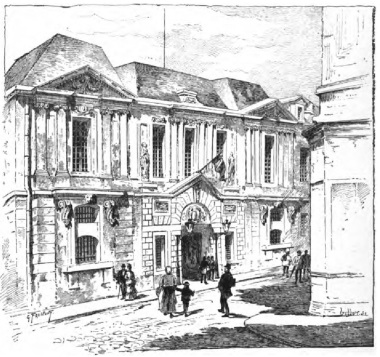
HÔTEL CARNAVALET.
Having once left the upper boulevard to enter the adjacent Marais, we
cannot but go on towards the Place des Vosges, better known as the
Place Royale, where, in 1559, Henri II. took a fancy one day for trying
his powers at tilting against Montgomery, captain in the Scotch Guard;
when the shock was so violent that a splinter from Montgomery’s lance
penetrated the king’s eye through the broken visor of his helmet. The
king was carried to the Hôtel des Tournelles, where, without having
regained consciousness, he died on the 15th of July, 1559. The hotel or
palace where the king breathed his last was thenceforth abandoned as a
fatal and accursed place. In the course of four years it fell into a
ruinous condition, and Charles IX. ordered it to be pulled down. The
{69} park belonging to the old palace was turned into a horse market, which
was the scene in 1578 of the famous encounter between the favourite
courtiers of Henri III. known as the Mignons and the partisans of the
Duke of Guise. Four combatants, Maugiron, Schomberg, Riberac, and
Quélus, lost their lives in this affair. The horse market, or Place
Royale as it afterwards became, witnessed many sanguinary duels, until
at last Richelieu determined to put an end to a fashion which was
depriving France of some of her bravest men. With this view he cut off
the head of Montmorency-Bouteville and of Count des Chapelles, his
second in the duel which cost Bussy d’Amboise his life. In 1613 the
Cardinal erected in the centre of the Place Royale an equestrian statue
of his royal master Louis XIII. The Place Royale was at that time the
favourite quarter of the French nobility, and the rendezvous of all that
was witty, gallant, and distinguished in France.
HÔTEL LAMOIGNON.
The house number six on the Place Royale is particularly interesting
as having been inhabited in Richelieu’s time by the brilliant and too
celebrated Marion de Lorme, and two centuries later by Victor Hugo, who,
in the very room that Marion de Lorme had occupied, wrote, at the age of
twenty-five, the splendid tragedy of which she is the heroine.{70}
The statue of Louis XIII. which Richelieu had raised was overturned
and broken to pieces in 1792, when the most critical period of the
Revolution was at hand. It was replaced after the Restoration, under the
reign of Charles X., by the present statue.
The Boulevard du Temple owes its name to a building which was first
occupied by the Order of Templars, and which, towards the close of the
last century, enjoyed a sad celebrity as the prison where Louis XVI.,
Marie Antoinette, and the young Dauphin were confined.
No less than forty-eight works are said to have been written on the
imprisonment of Louis XVII., and matters connected with it, including
the histories of some dozen “claimants,” asserting, in his name,
their right to the French throne. Most of these pretenders, with
Naundorff—who had been the Dauphin’s valet in the Temple—prominent
among them, had no difficulty in finding enthusiasts and dupes to
further their designs; and even in France one of them caused himself to
be described on his tombstone as “Louis de France.” The Emperor Napoleon
III. took, however, the liberty of ordering the inscription to be
effaced.
Soon after the death of the Count de Chambord, M. de Chantelauze
published in the Illustration an account of Louis XVII.’s life in the
Temple, and of his last illness, death, and post-mortem examination,
together with certificates which leave no doubt as to the young prince
having really died in his prison. Simon, the gaoler, according to M. de
Chantelauze’s view, was, like so many other bad men, not wholly bad;
while his wife was for the most part good, the appearance of badness or
roughness which she manifested when the child confided to her care was
visited by members of the Commune being assumed in order to inspire her
employers with confidence. The task assigned to Simon was not, as has
often been supposed, to reduce the young prince, by ill-treatment, to
such a point that he would at last be attacked by illness and carried
off, but simply to get from him evidence against his mother, the Queen,
with respect to her complicity in the Varennes plot, and the various
plans formed for effecting the escape of the child. The evidence having
been obtained by the simple process of first putting it into the child’s
mouth, and afterwards taking it out, the special work assigned to the
Simons was at an end, and the young prince experienced from them nothing
but kindness. If he ultimately fell ill and died, his confinement and
the bad air he breathed may well have been the cause.
The life of Louis XVII., from the departure of the Simons until his
death, can be made out continuously; and the evidence of his having
died in the Temple is quite conclusive. Nevertheless, Louis XVIII., in
view of the pretension constantly springing up, instituted for his own
satisfaction an inquiry into the whole matter; and the proofs adduced in
the course of it as to the identity of the “child in the Temple” with
the son of Louis XVI. and Marie Antoinette seem decisive.
M. Nauroy, however, author of “Les Secrets des Bourbons,” is convinced
that the true Louis XVII. was carried out of the Temple in a bundle of
linen, and that by like means the child who ultimately died there was
substituted for him. M. Nauroy finds in support of his belief abundant
evidence, positive and negative, which he derives from a variety of
sources, and sometimes discovers in the most unexpected places.
The appearance of a long succession of impostors claiming to be Louis
XVII. proves nothing, and will pass for what it is worth in the native
land of Arthur Orton. It is remarkable, however, that Royalists and
Republicans, including eminent personages on both sides, have agreed in
maintaining that the child who died in the Temple was not Louis XVII.
Louis Blanc favours this view in his “History of the Revolution.” Nor
does he do so without taking a calm, judicial survey of all the evidence
in the case. He may consciously or unconsciously have been influenced by
party spirit; and the moral he draws from the whole matter is that there
is danger in the principle of “divine right” when, through a variety of
accidents, it may be impossible to show on whom this questionable right
has devolved.
Those Royalists who deny that Louis XVII. died in the Temple, explain
the announcement of his death and the proclamation of Louis XVIII. in
the Royalist camp, first, by the inconvenience of bringing forward as
King of France a child of tender years; secondly, by the difficulty of
producing this child; and, thirdly, by the danger, when Louis XVIII. had
once gained acceptance with the party, of dividing it by a revelation of
the fact that his nephew, son of Louis XVI., was still alive.
M. Nauroy, as already hinted, sees proofs of his favourite theory where
no one else would perceive them. When, for instance, the Duke of Berri,
dying from the stroke of an assassin, had some final words to whisper
{71} to his brother, the Duke of Angoulême—“What,” asks M. Nauroy, “could
this have been but the truth in regard to Louis XVII.?” When, again,
one of the doctors who made the post-mortem examination of the supposed
Louis XVII. offered to Louis XVIII. the heart which he had concealed and
preserved, and the king declined the present—“Why,” asks M. Nauroy,
“should he have accepted the heart which he knew was not that of Louis
XVII., but that of the child by whom the young prince was replaced in
his prison?”
Meanwhile, that some of the great Royalist families believed Louis XVII.
to have been replaced in the Temple by another child and himself carried
to La Vendée is beyond doubt; and a letter on the subject, addressed,
December 4, 1838, to the Times, shows that this view of the matter was
held by at least a section (probably a very small one) of the Royalist
party.
On January 19th the cobbler Simon ceased to do duty as gaoler. At
that time there were, as M. Nauroy sets forth, only four persons in
the Temple—the Dauphin, Simon, his wife, and the Princess Elizabeth,
afterwards Duchess of Angoulême. Simon died on the scaffold six months
afterwards, on the 28th of July. The Princess Elizabeth, confined in a
room apart from her brother, never saw him again, and consequently knew
nothing of him except by hearsay. From January 19th to July 28th there
was no warder at the Temple. The child was watched by Commissaries,
who were relieved from day to day, and of whom not one could establish
his identity. When regular gaolers were appointed, not one of them had
ever seen the Dauphin. If, then, after the departure of Simon, another
child could have been substituted for Louis XVII., there was no one to
notice the change when it had once been accomplished. The Dauphin was
in perfect health at the time when Simon and his wife left him. But the
child in the Temple fell ill immediately afterwards; and on the 6th of
May, 1795, Dr. Desault, summoned to attend the “Dauphin,” declared his
little patient to be some other child. He had visited the Dauphin’s
brother in 1789, and on that occasion had seen the Dauphin himself at
the Tuileries. If, as M. Nauroy asserts, Dr. Desault drew up a report on
the subject, that report has disappeared. Indirect evidence, however,
as to Dr. Desault’s conviction that the child he attended in the Temple
could not be the Dauphin, was given fifty years afterwards in a letter
written and signed by the widow of P. A. Thouvenin, Dr. Desault’s
nephew, who claimed to remember what his uncle had frequently said on
the subject.
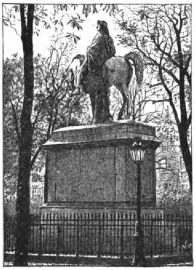
STATUE OF LOUIS XIII. IN THE PLACE DES VOSGES.
Whether or not Louis XVII. escaped to La Vendée to be cherished by the
Vendean chiefs even when, in the Royalist army which was invading France
from Germany, Louis XVIII. had been proclaimed, he is now in any case
no more. The eighteenth Louis was ten years old when the child of the
Temple is supposed to have died in prison; and according to the most
convinced, not to say credulous, of those writers who maintain that
Louis XVII. escaped, to live for years afterwards, he breathed his
last in 1872 at Saveney (Loire Inférieure), under the name of Laroche,
at the age of eighty-seven. The numerous impostors who with more or
less success personated the unhappy prince had died much earlier. But
the descendants of Naundorff, his valet, the most famous of all these
pretenders, claim still to be of the blood royal, and on the occasion of
the Count de Chambord’s death they displayed a proud consciousness of
their rights by publishing somewhere in Holland a manifesto asserting
gravely the title of the chief of the family to the throne of France.
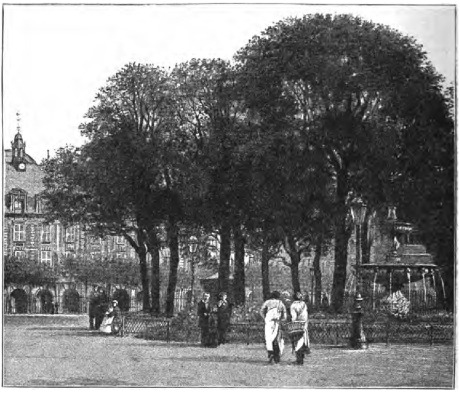
THE PLACE DES VOSGES, FORMERLY PLACE ROYALE.
Another prisoner in the Temple of whom mention must be made is Sir
{72} Sidney Smith, whose friends were making every effort for his liberation,
when a Royalist officer in the French army, named Boisgerard (who under
the Revolution had quitted military life to become ballet-master at
the Opera), effected his escape. With this view he had obtained an
impression of the seal of the Directorial Government, which he affixed
to an order, forged by his own hand, for the delivery of Sir Sidney
Smith into his care. Accompanied by a friend, disguised, like himself,
in the uniform of an officer of the revolutionary army, he did not
scruple personally to present the fictitious document to the keeper
of the Temple, who, opening a small closet, took thence some original
document, with the writing and seal of which he carefully compared the
forged order. Desiring the adventurers to wait a few minutes, he then
withdrew and locked the door after him. Giving themselves up for lost,
the confederates determined to resist, sword in hand, any attempt made
to secure them. Highly interesting is Boisgerard’s own description of
the period of horrible suspense he now passed through. Under the dread
that each successive moment might be attended by a discovery involving
the safety of his life, the acuteness of his organs of sense was
heightened to painfulness; the least noise thrilled through his brain,
and the gloomy apartment in which he sat seemed filled with strange
images. Both he and his companion, however, retained self-possession,
and after the lapse of a few minutes their anxiety was terminated by
the re-appearance of the gaoler, with his captive, who was delivered
to Boisgerard. But here a new and unexpected difficulty occurred. Sir
Sidney Smith, not knowing Boisgerard, refused for some time to quit
{73} the prison; and considerable address was required on the part of his
deliverers to overcome his scruples. At last the precincts of the Temple
were cleared. The fugitives rode a short distance in a fiacre, then
walked, then entered another carriage, and in this way so successfully
baffled pursuit that they ultimately got to Havre, where Sir Sidney was
put on board an English vessel. Boisgerard, on his return to Paris, was
a thousand times in dread of detection and had a succession of narrow
escapes until his visit to England, which took place after the peace of
Amiens. A pension had been granted to Sir Sidney Smith by the English
Government for his meritorious services; and on Boisgerard’s arrival
here a reward of a similar nature was bestowed on him through the
influence of Sir Sidney, who took every opportunity of testifying his
gratitude.
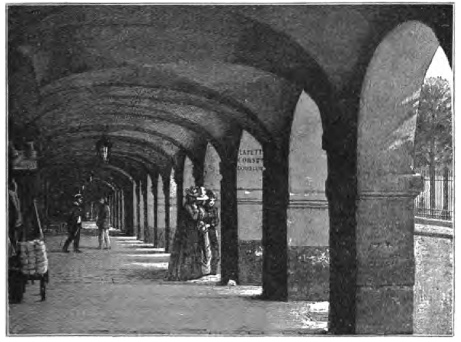
THE ARCADE IN THE PLACE DES VOSGES.
If the prison of the unfortunate king and queen who were to suffer
for the sins of their predecessors was at the eastern end of the line
of boulevards, as marked by the Boulevard du Temple, their place of
execution on the Place Louis XV., now known as Place de la Concorde, was
at the western extremity, which in due time we shall explore.
Meanwhile from one end of the boulevards to the other, from the tiny
Théâtre Beaumarchais to the magnificent Opéra, there is a long series
of playhouses. Close to the Beaumarchais Theatre stands the Cirque
d’Hiver, opened in 1852 under the title of Cirque Napoléon, which seats
3,800 persons. It occupies the site of the first circus that was ever
established in Paris. In 1785 the Astleys, father and son, came to Paris
and there opened a circus exactly like the one they had just founded
in London. Under their direction this theatre, situated at number
twenty-four Rue du Faubourg du Temple, and measuring twenty metres in
diameter, was lighted by 2,000 lamps and furnished with two rows of
boxes. The price of the seats varied from twelve sous to three francs.
Astley junior is said to have possessed a remarkably fine figure; and,
in the words of a contemporary writer, “his beauty was sculptural.”
{74} Bachaumont, in his memoirs of the time, speaks of the numerous passions
inspired by the young equestrian in too susceptible feminine hearts.
The tricks of the circus, now so familiar, that in England, at least,
no one cares to see them, were at that time new, and the sight of a
man attitudinising on the back of a horse at full gallop excited the
greatest wonder.
Astley’s Circus in Paris possessed, as so many operatic theatres have
done, a sort of international character. Engagements were made for it
by diplomatists abroad. It can be shown, indeed, that diplomatists have
long and almost from time immemorial been in the habit of doing agency
work for artists and managers of good position. Operatic celebrities
have been particularly favoured in this respect. A great Minister of
State, Cardinal Mazarin, introduced, or aided powerfully in introducing,
opera into France. The engagement of Cambert as director of music at the
Court of Charles II. was effected by diplomatic means. Gluck, more than
a century later, was induced to visit Paris through the representations
of a secretary of the French Embassy at Vienna—that M. du Rollet who
arranged for Gluck, on the basis of Racine’s Iphigénie, the libretto
of Iphigénie en Aulide; and Piccini, at the instigation of Madame
du Barry, was secured at Paris as opposition composer through the
instrumentality of Baron de Breteuil, French Ambassador at Rome, working
in co-operation with the Marquis Carraccioli, Neapolitan Ambassador at
Paris.
The great Montesquieu, moreover, when he was in England, had not thought
it unbecoming to interest himself in the welfare of the French artists
who occasionally arrived in England with recommendations addressed to
him. Nor did the illustrious Locke occupy himself so exclusively with
the “human understanding” as to have no time to bestow on the material
interests of foreign danseuses. Locke was not indeed one of those
practically Epicurean philosophers of whom M. Arsène Houssaye discourses
so agreeably in his “Philosophes et Comédiennes.” He had no general
taste either for the public performances or for the private society of
ballerines; but a certain Mlle. Subligny having come to him with a
letter of introduction from the Abbé Dubois, he is known to have made
himself useful, and therefore, no doubt, agreeable, to her during her
stay in England.
Locke, it is true, was a metaphysician, and had nothing whatever to
do with diplomacy. But his friend Montesquieu was a personage of
political importance, and in his anxiety to assist French artists
in London he even went so far as to bring to their performances as
many of the English nobility as were willing to attend. About the
same time, at the suggestion of the Regent of Orleans, a Minister of
State, M. de Maurepas, made overtures to Handel concerning a series of
representations which it was proposed that his celebrated company should
give at the Académie Royale of Paris. M. de Maurepas wished, like Mr.
Washburne at a later day, to secure for Paris the best available talent;
and he looked to Handel’s opera-house for singers, as Mr. Washburne
looked to the circuses of the United States for “bare-back riders.”
On this subject Ebers’s “Seven Years of the King’s Theatre” shows that
immediately after the peace of 1815 all the offers of engagements to
artists of the Paris opera were made through the medium of the English
Embassy to the Court of France, or by special missions with which
diplomatists of distinction were glad to be entrusted. The committee
of noblemen who aided Ebers in his management treated, through the
English Ambassador at Paris, with the Director of the Academy, or with
the Minister of Fine Arts; though, as a matter of fact, they failed to
secure by these elaborate means the services of artists who, in the
present day, would be engaged through an exchange of telegrams.
The outbreak of the Revolution was the signal for the Astleys and
their company to recross the Channel, and the Astley Circus remained
unoccupied until 1791. Then a company calling themselves “The Comedians
without a Title” (Les Comédiens sans titre) opened it as a theatre on
Thursday, March 20th, and closed it on the 23rd. Finally Franconi took
it over, and achieved a triumphal success, his management being destined
to last many years. In 1801 he moved his enterprise to the Garden of the
Capucines, which had become a public promenade in the heart of Paris,
subsequently transferring it to the theatre in the Rue du Mont-Thabor.
In 1819 he returned with his company to the circus of the Faubourg du
Temple, reconstructed by the architect Dubois, but doomed, on the night
of March 15th, 1826, to be burnt to the ground. The destruction of the
circus by fire excited much sympathy. Public subscriptions were opened,
and public representations given for the benefit of the sufferers, the
{75} result being so satisfactory that the theatre was at once reconstructed,
this time on the Boulevard du Temple, with a magnificent façade, and
Franconi once more threw open his doors, about a year after the fire,
on the 31st of March, 1827. The stage, which in the old building was
an accessory, became in the new one of the first importance. It was
now possible to perform military manœuvres on a large scale. At the
restored circus was represented during the last years of the reign of
Charles X. the Siege of Saragossa; and under Louis Philippe a number
of military pieces founded on incidents in the history of the Republic
and the Empire.
Every Government in France since the first Napoleon has had victories of
its own, important or unimportant, to celebrate. The martial triumphs
of Louis XIV. seem, by common consent, to have been forgotten, either
because French history dates for the immense majority of the population
from the time of the Revolution, or because the battles won under the
old Monarchy are now too remote to stir the national pride. The reign
of Napoleon I., however, was a series of brilliant victories. Under
the Restoration a campaign was undertaken in Spain, the incidents
of which so lent themselves to dramatic treatment that playwrights
reproduced them on the stage and in the arena of the circus. The reign
of Louis Philippe, too, had its military glories; first in Belgium,
in connection with the War of Independence undertaken in 1830 by the
Belgians, with the assistance of France and England, against the Dutch.
It was in Africa, however, and in the neighbourhood of Algiers, that
Louis Philippe’s army played for many years so active a part. The war
against the Dey of Algiers was begun by Charles X., whose consul had
been insulted by that potentate; Louis Philippe continued it, chiefly,
it was thought, in order to keep open for discontented spirits a field
of activity at a safe distance from France. Many restless adventurers
sought distinction and found it in the Algerian campaigns; and Algeria
was the principal training-ground for those generals who were afterwards
to aid Prince Louis Napoleon in executing his coup d’État. It was
under Louis Philippe that those picturesque troops, the Chasseurs
d’Orléans and Chasseurs d’Afrique, were created, not to mention the
Zouaves and the Spahis.
According to the criticisms of German officers, the laxity of discipline
in the Algerian campaigns had a considerable effect in producing, or at
least hastening, the long series of military defeats to which France was
subjected in the war of 1870. The news of victories gained in Africa
was, all the same, constantly reaching France; and each successive
triumph was made the subject of a new dramatic spectacle at the circus
or hippodrome. Abd-el-Kader became a familiar theatrical figure, and his
famous interview with General Bugeaud was represented in more than one
equestrian piece.
Abd-el-Kader had by the most violent means been prevailed upon to
make peace; and an interview was arranged at which the Arab chief
and Bugeaud, the French commander, were to ratify it by a personal
interchange of promises. Abd-el-Kader did not, however, keep his
appointment, and seems, indeed, to have studiously missed it. The French
general, in a fit of impatience, left his room, and went forward with a
small escort, military and civil, towards the quarters of the unpunctual
Arab chief, in order to stir him up. On reaching the advanced posts, the
French general called a chieftain of one of the tribes, who pointed out
to him the hill-side where the emir lay encamped. “It is unbecoming of
your chief,” said Bugeaud to this Arab, “to bring me so far, and then
make me wait so long;” whereupon he continued resolutely to advance.
The emir’s escort now appeared. The Arab chieftains, most of them young
and handsome, were magnificently mounted, and made a gallant display of
their finery. Presently from their ranks a horseman advanced dressed
in a coarse burnoose, with a camel-hair cord, and without any outward
sign of distinction, except that his black horse, which he sat most
elegantly, was surrounded by Arabs holding the bridle and the stirrups.
This was Abd-el-Kader. The French general held out his hand; the other
grasped it twice, then threw himself quickly from his horse, and sat
down. General Bugeaud took his place beside him, and the conversation
began. The emir was of small stature; his face serious and pale, with
delicate features slightly marked by time, and a keen sparkling eye.
His hands, which were beautifully formed, played with a chaplet that
hung round his neck. He spoke gently, but there was on his lips and in
the expression of countenance a certain affectation of disdain. The
conversation turned, of course, upon the peace which had just been
concluded, and Abd-el-Kader spoke of the cessation of hostilities with
elaborate and feigned indifference. When the French general, after
{76} pointing out to him that the treaty could not be put into force until it
was ratified, observed that the truce, meanwhile, was favourable to the
Arabs, since it would save their crops from destruction so long as it
lasted, the chief replied: “You may destroy the crops this moment, and I
will give you a written authority to do so, if you like. The Arabs are
not in want of corn.”
The conversation at an end, General Bugeaud stood up, and the emir
remained seated; whereupon the former, stung to the quick, seized the
emir’s hand and jerked it, saying “Come, get up.” The French were
delighted at this characteristic act of an imperious and intrepid
nature, and the Arabs could not conceal their astonishment. As for the
emir, seized with an involuntary confusion, he turned round without
uttering a word, sprang on his horse and rode back to his own people;
his return being a signal for enthusiastic cries of “God preserve the
Sultan!” which echoed from hill to hill. A violent thunder-burst added
to the effect of this strange scene, and the Arabs vanished among the
mountain gorges.
Until 1860 the Boulevard du Temple was noted for a number of little
theatres, where marionettes might be seen dancing on the tight-rope, or
where pantomimes in the Italian style were performed. Then there was
the cabinet of wax figures, together with other little shows, difficult
to class: all destined in that year to disappear. The reconstruction
of this portion of Paris caused the removal of many theatres, which
were built again at other points. The site of the former circus was now
occupied by the Imperial Theatre of the Châtelet. The circus reappeared,
for winter performances, in the Boulevard des Filles de Calvaire, for
the summer season in the Champs Élysées. In connection with the winter
circus the Popular Concerts started by the late Pasdeloup must not be
forgotten. Here the finest symphonic music of the French and other
composers, chiefly modern, was performed in admirable style. Here the
French public were familiarised with the works of Berlioz, and, in spite
of a certain opposition at the outset, with selections from some of the
operas of Wagner. Pasdeloup, who after thirty years’ unremitting work
died in poverty, used to find worthy imitators and successors in M.
Colonne and M. Lamoureux, both renowned among the musical conductors of
the period.
Number forty-two of the Boulevard du Temple marks the house, formerly
number fifty, whence the notorious Fieschi, on the 28th of July, 1835,
exploded his infernal machine which was intended to kill Louis Philippe
and his sons, and which, in fact, struck down by their side one of the
veterans of the Empire, Marshal Mortier, Duc de Trévise, and several
other superior officers.
Not even in Russia have so many sovereigns been assailed by their
subjects as in France. Since, indeed, the murder of Henri III. by
Jacques Clément, it has been the rule, rather than the exception,
with royal personages in France to be struck by the assassin or the
executioner; or, if spared in body, to be brought all the same to some
tragic end. Henri IV. fell by the hand of Ravaillac. No such fate
awaited Louis XIII., Henri IV.’s immediate successor; but Louis XV. was
stabbed by Damiens, Louis XVI. was guillotined, Louis XVII., imprisoned
in the Temple, died one scarcely knows how or where. The Duke of Enghien
was shot by order of Napoleon. Louis XVIII. had to fly from Paris at
the approach of Napoleon returning from Elba; the Duke of Berri was
assassinated by Louvel; Charles X. lost his crown by the Revolution
which brought Louis Philippe to the throne; and Louis Philippe, who was
ultimately to disappear in a hackney cab before the popular rising which
led to the establishment of the Second Republic, and soon afterwards
of the Second Empire, was meanwhile made the object of some half-dozen
murderous attacks, the most formidable being the one planned and
executed by Fieschi, otherwise Gérard. What, it may be asked, had a
quiet, peaceful, and eminently respectable monarch like Louis Philippe
done to provoke repeated attempts upon his life? The explanation is
simple. Charles X. had been driven away in 1830 by the Republicans, not
that another king might be appointed in his stead, but that the Republic
might be established. Louis Philippe was, from their point of view, an
interloper who must, at all hazards, be removed.
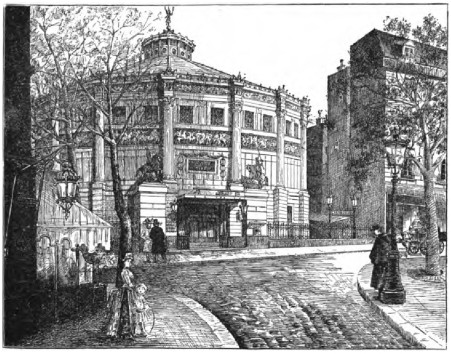
THE WINTER CIRCUS IN THE BOULEVARD DES FILLES DE
CALVAIRE.
Fieschi’s experiment with his infernal machine created a sensation
all over Europe; and the papers for some time afterwards were full of
particulars, more or less authentic, of the diabolical attempt upon
King Louis Philippe’s life. The Revolutionists, whose action against
Charles X. had led to the establishment, not of a Republic, but of a
Monarchy—hateful to them in whatever form—had evidently sworn that
he should die. It was ascertained by M. Thiers, the First Minister,
{77} that on the occasion of a journey which the King intended to make from
Neuilly to Paris certain conspirators had arranged to throw a lighted
projectile into the royal carriage; and His Majesty, therefore, was
requested to let the royal carriage proceed on its way, at the appointed
time, without him, and occupied simply by his aides-de-camp, no previous
announcement being made as to the absence of the King. Louis Philippe
having protested against this suggestion as unfair to the aides-de-camp:
“Sire,” replied M. Thiers, “it is their duty to expose themselves for
the safety of your person, and they surely will not complain when they
find the Minister of the Interior by their side in the threatened
carriage.” The King, however, rejected this proposition, declaring
that he had resolved on the journey, and, hazardous as it might be,
would undertake it. His resolution having been combated in vain by
M. Thiers, the preparations for departure were ordered. Just as the
King was about to get into the carriage, the Queen and the princesses
suddenly presented themselves in an agony of terror and of tears. “It is
impossible,” says M. Louis Blanc, “to say whether a skilful indiscretion
on the part of the Minister had initiated them into the secret of what
had taken place, or whether they had received no other intimation than
that supplied by the instincts of the heart.” However this may have
been, the Queen, finding that Louis Philippe would not abandon his
intention, insisted on accompanying him, and it was quite impossible
to prevent her from doing so. M. Thiers then begged the honour of a
seat in the threatened carriage, and the journey was risked. The attack
apprehended was not, however, on this occasion to be made; and it was
as long afterwards as the 28th of July, 1835, on the occasion when
Louis Philippe drove through Paris in memory of the “Three Days” of
July, 1830, that Fieschi put his murderous project into execution. “On
the 28th of July,” says M. Louis Blanc, “the sun rose upon the city,
{78} already perplexed with fears and doubts. The drum which summoned the
National Guards early in the morning beat for some time in vain: a heavy
apathy, in which there mingled a sort of morbid distrust, weighed upon
everyone. At ten o’clock, however, the legions of the Garde Nationale
stretched in an immense line along the boulevards, facing 40,000 of the
regular troops, horse and foot. The Boulevard du Temple having been
pointed out by rumour as the scene of the contemplated crime, the police
had orders to parade it with particular watchfulness, and to keep a
close eye upon the windows.” On the previous evening M. Thiers had a
number of houses in this quarter searched. But the remonstrances of the
inhabitants became so violent, that his original intention of examining
every building on the boulevard had to be abandoned.
The clock of the château was striking ten when the King issued from
the Tuileries on horseback. He was accompanied by his sons, the Dukes
of Orleans, Nemours, and Joinville; by Marshals Mortier and Lobau; by
his ministers; and by a numerous body of generals and other superior
officers and high functionaries. Along the whole line which he traversed
there prevailed a dead silence, broken only at intervals by the ex
officio acclamations of the soldiers. At a few minutes past twelve
the royal cortège arrived in front of the Eighth Legion, which was
stationed along the Boulevard du Temple. Here, near the end of the
Jardin Turc, as the King was leaning forward to receive a petition from
the hands of a National Guardsman, a sound was heard like the fire of
a well-sustained platoon. In an instant the ground was strewn with the
dead and dying. Marshal Mortier and General Lachasse de Verigny, wounded
in the head, fell bathed in their blood. A young captain of Artillery,
M. de Villaté, slid from his horse, his arms extended at full length, as
though they had been nailed to a cross; he had been shot in the head,
and expired ere he touched the ground. Among the other victims were the
colonel of gendarmerie, Raffé; M. Rieussec, lieutenant-colonel of the
Eighth Legion; the National Guardsmen Prudhomme, Benetter, Ricard, and
Léger; an old man upwards of seventy years of age, M. Lebrouste; a poor
fringe-maker named Langeray; and a girl of scarcely fourteen, Sophie
Remy. The king was not wounded, but in the confusion his horse reared
and he sustained a violent shock in the left arm. The Duke of Orleans
had a slight contusion on the thigh. A ball grazed the croup of the Duke
of Joinville’s horse.
Thus the odious attempt failed in its object; the royal family was
saved. No language can express the utter horror which this frightful
and cowardly attack created in the minds of the assembled multitudes.
An aide-de-camp immediately galloped off to reassure the Queen, and
the King continued his progress amidst manifestations of the deepest
sympathy and the most enthusiastic loyalty.
As a striking exemplification of the sang-froid of Louis Philippe it
has been gravely related, on the alleged authority of Marshal Maison,
that immediately after the fatal occurrence, and while all around were
overwhelmed with dismay and grief, the King’s mind rapidly glanced over
all the possible advantages which might be drawn from the event, and
that he exclaimed, “Ah, now we are sure to get the appanages!” But this
anecdote, in itself improbable, must be received with more than the
usual grain of salt.
Meantime, at the moment of the explosion, clouds of smoke were seen to
issue from a window on the third floor of the house number fifty. A man
got out of this window, and seizing a double rope which was fastened
inside, slid down it on to the roof of a lower building. He was but
half-dressed, and his face streamed with blood. A flower-pot which was
caught in the movement of the rope after he quitted hold of it fell
to the pavement, and the noise attracted the attention of an agent of
police who had been posted in the courtyard of the house. “There is the
assassin escaping on the roof!” he exclaimed; and one of the National
Guards at once called upon the fugitive to surrender, threatening to
fire if he refused. But the man, wiping away with his hand the veil of
blood which obscured his sight, dashed on and made his way through an
open window into an adjoining house. A track of blood indicated his
route, as though his own crime pursued him. He reached the courtyard too
late to escape unobserved, and was at once taken into custody.
In the room whence he had fled were found the smoking remains of his
death-dealing machine. It was raised upon a sort of scaffolding on four
square legs connected together by strong oak cross-pieces. Twenty-five
musket barrels were fastened by the breech upon the cross-piece at
the back, which was higher than the front traverse by about eight
inches. The ends of the barrels rested in notches cut in the lower
{79} traverse. The touch-holes were exactly in a line, so as to take fire
simultaneously by means of a long train of gunpowder. The guns had
been placed so as to receive the procession slantingly, embracing a
large range, and rising from the legs of the horses to the heads of the
riders. The charge in each barrel was a quadruple one. Fortunately, the
calculations of the assassin were frustrated. Two of the barrels did not
go off, four of them burst; and to these chances the King doubtless owed
his life.
Fieschi was found, on inquiry, to have lodged in the house for several
months. He stated himself to be a machinist. The porter had never been
inside Fieschi’s room since he had occupied it. There had been but
one man to see Fieschi, whom he represented as his uncle, and three
women, who, he said, were his mistresses. On the morning of the 28th
he had been noticed to go in and out, up and down, in a visible state
of agitation, and once, though habitually abstemious, he went into a
neighbouring cafe to drink a glass of brandy. At the military post where
he was taken upon his arrest, a National Guard having asked him who he
was, “What’s that to you?” he replied, “I shall answer such questions
when they are put by the proper people.” Some gunpowder having been
found upon his person, he was asked what it was for. “For glory!” he
exclaimed.
The trial of Fieschi and his accomplices took place on the 30th of
January, 1836, before the Court of Peers assembled in the palace of the
Luxembourg. In the body of the court, in front of the clerk’s table,
were displayed, among other proofs against the prisoners, a machine
supporting a number of guns in an inclined position, an extinguished
firebrand, a dagger, a shot belt with a quantity of bullets in it, an
iron gauntlet, and a bloodstained rope.
Fieschi, the chief conspirator, is described by Louis Blanc as “endowed
with an energy and shrewdness which merely served to promote the aims of
an inveterate and grovelling turpitude. Vain to a degree which almost
approached insanity, this man had stained his life with every infamy.
A Corsican by birth, he had fought bravely in the service of Napoleon.
After the peace, however, he had launched upon a career of vice and
crime. He had invented the so-called infernal machine (which was simply
a battery of guns so arranged that they could be discharged from a
window), not from any political or personal hatred of Louis Philippe,
but simply as the hireling of a band of Republican and Revolutionary
conspirators.”
Fieschi and his accomplices were duly guillotined. Other attempts had
been made and were still to be made on the life of Louis Philippe. The
ferocious exploit, however, of Fieschi remains the most notorious one of
this reign. At last the Citizen King lost his nerve; and in February,
1848, disappeared in face of a danger not more formidable, if firmly
met at the outset, than the one which he had despised thirteen years
previously, in 1835.
Fieschi was simply guillotined; and he was the first regicide or
would-be regicide in France who escaped torture. The horrible cruelties
inflicted on the assassins of French kings may make many persons less
sensitive than they otherwise would be to the misfortunes reserved
for the successors of these princes. The only possible excuse for the
diabolical punishments devised for regicides under the old French
Monarchy is that such barbarity was of the age. The torture of Damiens
was imitated in every detail from the torture of Ravaillac, which
had for precedent the torture of Gérard, the assassin of the Prince
of Orange. An ingenious French writer attempted to decide whether
Ravaillac’s torments were greater than those of Gérard. It is certain in
any case that the latter suffered with much greater constancy. Ravaillac
shrieked out in a terrible manner, whereas Balthasar Gérard never
uttered a groan.
In this connection it is curious that, from the middle of the eighteenth
century until the time of the French Revolution, the name of Damiens,
or Damian, at present venerated throughout the civilised world, was
in France, its country of origin, one of such opprobrium that nobody
ventured to bear it. No Frenchman, indeed, would have dared to do so;
for after the attempt upon the life of Louis XV. the name of Damiens,
or D’Amiens, his would-be murderer, with all names of similar sound or
spelling were, by a special edict, absolutely proscribed. To go by the
name of D’Amiens, Damiens, or Damian, was to proclaim oneself affiliated
nearly or remotely to the unspeakable being—the regicide, the
parricide—who had lifted his hand against the Lord’s anointed. Time has
its revenges. The name associated a century and a half ago with villainy
and crime is now suggestive only of heroism and virtue. Everyone knows
by what glorious acts of self-sacrifice Damien, enthusiast and martyr,
{80} has brought honour to a once unutterable name.
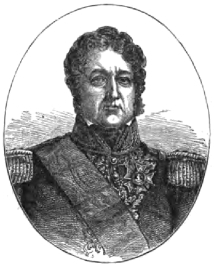
LOUIS PHILIPPE.
The French Revolution, which was separated from the torture of Damiens
by only thirty-eight years, is associated with a number of sanguinary
deeds. But it at least put an end to torture. No such horrors as had
been perpetrated under the French Monarchy were ever to take place
under the French Republic. Even in the case of ordinary criminals not
specially condemned to torture, death, under the old Monarchy, was
inflicted in the cruellest fashion. “After a prisoner has seen death
under so many forms,” says a writer of the time of Louis XVI., “when his
soul is in a manner withered, his spirit exhausted, and life is grown
a burthen, the sentence that ends his sufferings should be welcome to
him—and it would be so were not our laws more calculated to torture the
body than simply to punish the criminal. A man who pays the forfeit of
his life to the injured laws of his country has, in the eyes of reason,
more than sufficiently atoned for his crime; but here industrious
cruelty has devised the most barbarous means of avenging the wrongs done
to society; and the breaking the bones of a wretch on a cross, twisting
his mangled body round the circumference of a wheel, are inventions
worthy of the fertile brains of a Phalaris, and show to the utmost that
such inhuman laws were more levelled against the man than the crime for
which he is doomed to suffer.”
Opposite the house on the Boulevard du Temple associated with the
outrage of Fieschi stood formerly the Café Turc, which offered to the
generation of its day a shady retreat and varied amusements. Here the
celebrated Jullien, better known in London than even in Paris, gave
in the early years of Louis Philippe’s reign orchestral pieces of his
own composition adorned with fireworks and emphasized by the booming
of cannon. Little by little the Café Turc was to disappear; and now
repeated alterations have reduced it to a beer-house, or brasserie.
The Café Turc was the first of the French cafés-concerts or music
halls; for, like so many of our dramatic entertainments, the music
hall is an adaptation from the French. The English music hall differs,
however, from the French café-concert about as much as an English
farce differs from a French vaudeville. The café-concert may be looked
upon either as a café at which there is singing, or as a concert where
refreshments are served between the pieces and “consumed” during the
performance. But whether you enter the place for the sake of art or with
the view of sustaining nature, it is equally necessary that you should
“consume”; and that there may be no mistake on this point, a curtain is
at some establishments let down from time to time with “On est prié
de renouveler sa consommation,” and, at the side, in English, “One is
prayed to renew his consumption,” inscribed on it. The renewal of one’s
consumption is often a very costly proceeding.
To avoid being classed with theatres, and, as a legal consequence, taxed
for the benefit of the poor, no charge for admission is made at the
doors of the café-concert. But at those where such stars as the once
celebrated Thérèse are engaged, the proprietor finds it necessary to
attach extravagant prices to refreshments of the most ordinary kind, so
that a bottle of lemonade may be quoted in the tariff at three francs,
a cup of coffee at a franc and a half, and even the humble glass of
water at fifty centimes. In England the music hall proprietor would be
often glad to obtain a dramatic licence. He has no fear of the poor
before his eyes, and would be only too happy to combine with the profits
of musical publican those of the regular theatrical manager. Why he
should or should not be so favoured has been argued at length before
{82} the magistrates and duly reported in the columns of the newspapers.
The result has been that, as a rule, the London music hall proprietor
does not give theatrical performances, though he often ventures
upon duologues and sometimes risks a dramatic trio. The argument of
London managers against music hall proprietors may thus concisely
be stated: the manager cannot by the terms of his licence allow the
audience to smoke and drink in presence of a dramatic performance; and,
correlatively, the music hall proprietor ought not to be allowed to give
dramatic performances while smoking and drinking are going on.
{81}
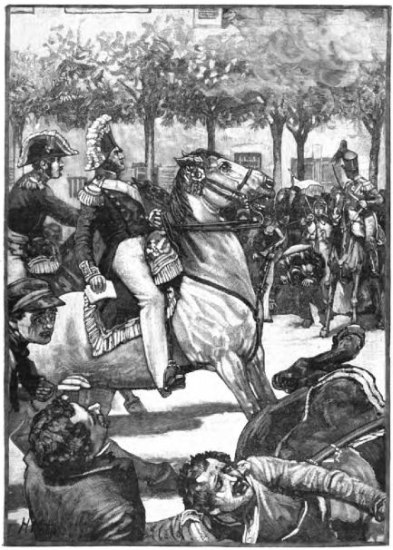
ATTEMPTED ASSASSINATION OF LOUIS PHILIPPE.
Paris is celebrated above all the capitals of Europe for its cafés; and
the beverage which gives its name to these establishments seems to have
been known earlier in France than in any other European country. Coffee
was introduced into central Europe in 1683, the year of the battle of
Vienna; and from the Austrian capital the use of coffee spread rapidly
to all parts of Germany. The circumstances under which the Austrians
first became acquainted with it were somewhat curious.
The Turks had brought with them to Vienna an imposing siege train. No
European power possessed such formidable artillery; and their stone
balls of sixty pounds each were not only the largest projectiles ever
fired, but were regarded as the largest which by any possible means
could be fired. According to the ingenious, but incorrect, view of
one of Sobieski’s biographers (the Abbé Coyer), the amount of powder
requisite for the discharge of a missile of greater weight would be
so enormous as not to give time for the whole of it to become ignited
before the ball left the cannon.
Kara Mustapha, the Turkish general, had also brought with him a number
of archers; and when a letter from Sobieski to the Duke of Lorraine was
intercepted by a Turkish patrol, the document was attached to an arrow
and shot into the town, accompanied by a note in the Latin language to
the effect that all further resistance was out of the question, and
that the Vienna garrison had now nothing to do but accept its fate.
The Turks, moreover, brought to Vienna an immense number of women,
whose throats, when the Turkish army was forced to retire in headlong
flight, they unscrupulously cut. The stone cannon balls of prodigious
weight, the arrows, and the women could all be accounted for. But the
Turks left behind them a large number of bags containing white berries,
of which nothing could be made. Of these berries, however, after duly
roasting and pounding them, an Austrian soldier, who had been a prisoner
in Turkey, made coffee; and as he had distinguished himself during the
battle, the Emperor granted him permission to open a shop in Vienna
for the sale of the Turkish beverage which he had learned under such
interesting circumstances to prepare.
According to another less authentic anecdote, the use of the mysterious
white berries found among the stores of the defeated Turks was first
pointed out by a Turkish soldier who had been working in the trenches
before the besieged city, and had so fatigued himself by his ceaseless
toil, that he fell asleep and slumbered on throughout the whole of the
battle, undisturbed by the cavalry charges, the musketry fire, and the
explosions of the artillery with its terrible sixty-pounders. When at
last, after sleep had done its restorative work, the exhausted soldier
woke up to find himself in the hands of the Christians, he was terribly
alarmed. But his life was spared, and in return for this clemency on the
part of his enemies he taught them how to make coffee.
Parisians, however, pride themselves on having known coffee fourteen
years earlier than the Viennese. It is said, indeed, that an
enterprising Levantine started a coffee-house at Paris in the very
middle of the seventeenth century, and not later than the year 1650.
The name of the stimulating beverage that he offered for sale was, as
he wrote it, cahoue. But the unhappy man had not taken the necessary
steps for getting his new importation spoken of beforehand in good
society; and, no one knowing what to make of the strange liquor he
wished to dispense—hot, black, and bitter—the founder of the first
coffee-house or café became bankrupt.
The French, however, during, the seventeenth and eighteenth centuries
were sworn friends of the Turks, whose power they played off on every
occasion against that of the hated Empire. Vienna might, indeed, on
two occasions have been captured, plundered, and burnt by the infidels
for all France cared to do towards saving it. France, on her side, was
viewed with favour by the Turks; and in 1669 an ambassador, Soliman Aga
by name, was sent by the Porte on a mission to Louis XIV., at whose
court he made known the virtues of the berry which long previously the
{83} Arabs had introduced throughout the East.
Properly presented, coffee met in Paris with a success which elsewhere
it had failed to attain, and before long it became the rage in
fashionable society. When it was at the height of its first popularity,
however, Madame de Sévigné condemned it, saying that the taste for
coffee, like the taste for Racine, would pass away. Racine, in spite of
the beauty of his at once tender and epigrammatic lines, is not much
read in the present day, and is scarcely ever acted. Coffee, on the
other hand, is as popular now as in the days when Pope wrote his couplet
on
“Coffee, which makes the politician wise,
And see through all things with his half-shut eyes.”
“There are in this capital,” wrote the author of the “Tableau de
Paris” more than a hundred years ago, “between six and seven hundred
coffee-houses, the common refuge of idleness and poverty, where
the latter is warmed without any expense for fuel, and the former
entertained by a view of the crowds who make their entrance and exit by
turns. In other countries, where liberty is more than an empty name, a
coffee-house is the rendez-vous of politicians who freely canvass the
conduct of the Minister, or debate on matters of State. Not so here!
I have already given a very good reason why the Parisians are sparing
of their political reflections. If they speak at all on State matters
it is to extol the power of their sovereign, and the wisdom of his
counsellors. A half-starved author, with all his wardrobe and movables
on his back, dining at these restaurants on a dish of coffee and a
halfpenny roll, talks big of the immense resources of France, and the
abundance she offers of every necessary of life; whilst his only supper
is the steam arising from the rich man’s kitchen, as he returns to his
empty garret.”
The writer goes on to show that the coffee-houses were haunted by
cliques of critics, literary and artistic, and his description sometimes
reminds one of Button’s, in the days of Addison and Steele. “Those,” he
says, “who have just entered the lists of literature stand in dread of
this awful tribunal, where a dozen of grim-looking judges, whilst they
sip and sip, deal out reputation by wholesale. Woe to the young poet, to
the new actor or actress! They are often sentenced here without trial.
Catcalls, destined to grate their affrighted ears, are here manufactured
over a dish of coffee.”
The writer then proceeds to lament the absence of sociability at the
coffee-house, and the gloomy countenances of its frequenters, as
contrasted with the convivial faces of those “brave ancestors” of his
generation who used to pass their leisure, not at coffee-houses, but at
taverns. One cause of the difference he finds in the change of beverage.
“Our forefathers,” he explains, “drank that mirth-inspiring liquor
with which Burgundy and Champaign supplied them. This gave life to
their meetings. Ours are more sober, no doubt, but is this sobriety the
companion of health? By no means. For generous wine we have substituted
a black beverage, bad in itself, but worse by the manner in which it is
made in all the coffee-houses of this fashionable metropolis. The good
Parisians, however, are very careless in the matter; they drink off
whatever is put before them, and swallow this baneful wash, which in its
turn is driven down by more deadly poisons, mistakenly called cordials.”
Since the above was written, coffee, far from dying out, has become more
and more popular, and musical cafés, theatrical cafés, and literary
cafés have been everywhere established in Paris. There are financial
cafés, too, chiefly, of course, in the region of the Bourse; and among
the cafés by which the Bourse is partly surrounded used to be one which
owed its notoriety to the fact that Fieschi’s mistress—in the character
of “dame du comptoir”—was exhibited there to the public.
Two days after the execution of the would-be regicide and actual maker
of the famous infernal machine, a crowd of people might have been seen
struggling towards the doors of a café on the Place de la Bourse, which
was already as full as it could hold. “Those,” says an eye-witness,
“who performed the feat of gaining admission, saw, gravely seated at
a counter, adorned with costly draperies, an ordinary-looking woman,
blind of one eye, and possessing in fact no external merit but that
of youth: It was Nina Sassave. There she was, her forehead radiant,
her lip quivering with delight, her whole expression that of unmingled
pride and pleasure at the eager homage thus offered to her celebrity.
A circumstance eminently characteristic of the epoch! Here had a
creature, only known to the world as a base and treacherous informer,
as the mistress of an assassin, been caught up for a show by a shrewd
speculator. And what is more remarkably characteristic still, the public
took it all as a perfect matter of course, and amply justified the
{84} speculator in his calculations.”
On the same side as the Café Turc, but further on towards the Rue du
Temple, stood the tennis ground of the Count d’Artois (afterwards
Charles X.), built by the architect Belanger, one of the most intimate
and faithful friends of the famous Sophie Arnould.
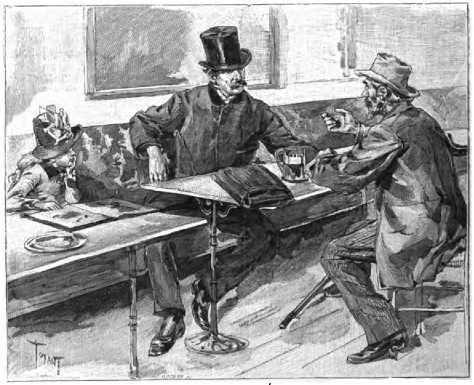
A PARISIAN CAFÉ.
On the site of the Count d’Artois’ tennis ground was erected, at the
beginning of the Second Empire, a theatre, called in the first instance
Folies-Meyer, but which, after various changes of title, became at last
the Théâtre Déjazet, under the direction of the celebrated actress of
that name, already seventy years of age, or nearly so, but still lively
and graceful. For this theatre in 1860 Victorien Sardou wrote his first
successful piece, “M. Garat,” in which Déjazet herself played the
principal part, supported by Dupuis, who was afterwards to become famous
in opera-bouffe as the associate of Mademoiselle Schneider.
The line of boulevards here presents an enormous gap, in the centre of
which, between two fountains, stands a monument to the glory of the
Republic. The rest of the open space serves twice a week as a flower
market, the largest in Paris. At the beginning of the century La Place
du Château d’Eau, as the open space in question is called, did not
exist. The fountain which gave its name to the Place was constructed
under the First Napoleon in the year 1811, but this fountain was
replaced in 1869 by a finer one inaugurated by Napoleon III. The later
fountain was itself, however, to disappear, soon afterwards to be
replaced by the aforesaid monument to the Republic. Behind one of the
large depots on the north side of the Place du Château d’Eau, looking
out upon the Rue de Malte, was constructed in 1866 the Circus of the
{85} Prince Imperial, afterwards called the Theatre of the Château d’Eau,
where at one time dramas, at another operas, have been given, never with
success. Ill-luck seems to hang over the establishment, which, with
its 2,400 seats, must be reckoned among the largest theatres in Paris.
In Paris, however, as in London, theatres have often the reputation of
being unlucky when, to succeed, all they require is a good piece with
good actors to play in it.
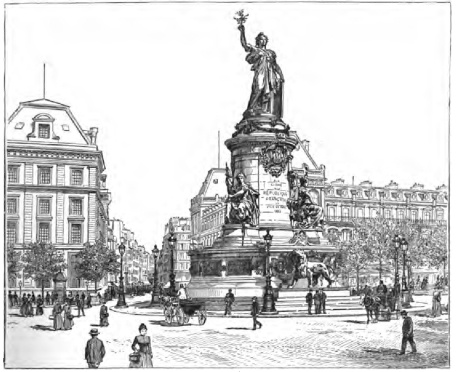
PLACE DE LA RÉPUBLIQUE.
The Boulevard du Temple had at one time its famous restaurants, like
other boulevards in the present day. Here stood the celebrated Cadran
Bleu and the equally celebrated Banquet d’Anacréon. The last of the
great restaurants on this boulevard was the one kept by Bonvalet, who,
during the siege of Paris, was generous enough to supply additional
provisions to unfortunate actors and actresses who found themselves
reduced to the limited rations distributed by the Municipal Council.
The Rue de Bondi, running out of the Boulevard Saint-Martin, brings
us once more to a group of theatres. The Folies Dramatiques stands at
number forty. This theatre was started in 1830 by M. Alaux, previously
manager of the Dramatic Parnassus on the Boulevard du Temple. It was
opened on January 22nd, 1831, under the direction of M. Léopold, who
produced at this house a long series of successful pieces. Among these
may be mentioned “Robert Macaire” with Frédéric Lemaître in the leading
part. When, amidst demolitions and reconstructions, the original Folies
Dramatiques came down, the company was transferred to the new building
which now stands in the Rue de Bondi. Here were brought out Hervé’s
“Œil Crevé” and “Petit Faust,” Lecoq’s “Fille de Madame Angot,”
Planquette’s “Cloches de Corneville,” and other works which were soon
to become known all over Europe. Vaudevilles are now played at this
theatre alternately with operettas. The house contains 1,600 seats.
{86} The Ambigu-Comique, built on a sort of promontory which dominates the
Boulevard Saint-Martin and the Rue de Bondi, was opened in 1829, in
place of the original Ambigu, burnt to the ground two years previously.
The new house, which contains 1,600 seats, was inaugurated in presence
of the Duchess of Berri, widow of the unhappy nobleman who a few years
before was stabbed by Louvois on the steps of the Opera House. In 1837
this theatre was entirely rebuilt under the direction of M. Rochart.
Untrue, like so many theatres, to its original name, the Ambigu-Comique
was to become associated with nothing in the way of ambiguity,
nothing in the way of comedy, but with melodramas, often of a most
blood-curdling kind. Here, it is true, was produced the “Auberge des
Adrêts,” which, in the hands of Frédéric Lemaître, was to be transformed
from a serious drama into a wild piece of buffoonery; so that the author
of the work, too nervous to attend the performance himself, was almost
driven mad when his trusted servant returned home and reported to him
the bursts of laughter with which the work had been received. At the
Ambigu were brought out some of the best pieces of Alexandre Dumas the
elder, Frédéric Soulié, Adolphe Dennery, and Paul Feval.
Immediately adjacent to the Ambigu stand the Porte Saint-Martin and
Renaissance Theatres, covering the triangle formed by the Boulevard
Saint-Martin, the Rue de Bondi, and the Place de la Porte Saint-Martin.
The Porte Saint-Martin Theatre has a long and interesting history,
dating from June 8, 1781, when it was opened as an Opera House after the
destruction by fire of the one in the Rue Saint-Honoré. A performance
was going on at the time, and the singers had to fly in their operatic
dresses from the stage to the street. In the midst of the general
consternation, the musical director, Rey by name, whose “Coronis” was
the opera of the night, startled those around him, already sufficiently
terrified, by exclaiming, “Save my child! Oh, Heaven, save my child!” As
Rey was not known in the character of a family man, his friends thought
he had gone mad. But it was the creature of his brain that was troubling
him; and after heroic struggles, the score of “Coronis” was rescued from
the flames. The fascinating Madeleine Guiniard had on this occasion a
narrow escape of her life. She was in her dressing-room, and had just
divested herself of her costume when inquiries were made for her, and
it was found that, like Brunhilda in the legend, she was enveloped on
all sides by flames. A Siegfried, however, was found in the person of a
stage carpenter, who, making his way through the ring of fire, reached
the unhappy valkyrie, wrapped her up in a blanket, and brought her out
in safety, though he himself, in his second passage through the flames,
was somewhat scorched.
The new house established in the Porte Saint-Martin was opened 109 days
after the destruction of the Opera House in the Rue Saint-Honoré. Here
were brought out the “OEdipus Coloneus” of Sacchini, the “Daniades”
and other works of Salieri, the “Demophon” of Cherubini, the “Re
Teodoro” of Paisiello, and a French version of Mozart’s “Marriage of
Figaro.” Many of the operas of Sacchini, Salieri, and Cherubini were
composed specially for the French theatre. Paisiello’s and Mozart’s
works were, of course, produced in translations. Mozart’s “Marriage of
Figaro” was brought out in the middle of the Reign of Terror, March 20,
1793.
Meanwhile, doubts had always been entertained as to the solidity of the
theatre, which had been run up in from fifteen to sixteen weeks; and
on April 14, 1794, the Committee of Public Safety ordered the transfer
of the opera from the Porte Saint-Martin to the Salle Montansier, in
the Rue Richelieu. M. Castil Blaze, excellent writer, but by no means
free from prejudices, insists, in his “History of the Royal Academy of
Music,” that in the removal of the Opera to the Rue Richelieu there was
a determination on the part of the Committee of Public Safety to burn
down the National Library, opposite which the Opera was now installed.
“How was it,” he asks, “that the Opera was moved to a building
exactly opposite the National Library—so precious and so combustible
a repository of human knowledge? The two establishments were only
separated by a street very much too narrow; if the theatre caught fire,
was it not sure to burn the Library? That is what a great many persons
still ask; this question has been reproduced a hundred times in our
journals. Go back to the time when the house was built by Mademoiselle
Montansier; read the Moniteur Universel, and you will see that it was
precisely in order to expose this same Library to the happy chances
of a fire that the great lyrical entertainment was transferred to its
neighbourhood. The Opera hung over it, and threatened it constantly. At
this time enlightenment abounded to such a point that the judicious
{87} Henriot, convinced in his innermost conscience that all reading was
henceforth useless, had made a motion to burn the Library. To shift the
Opera to the Rue Richelieu—that Opera which twice in eighteen years had
been a prey to the flames—to place it exactly opposite our literary
treasures was to multiply to infinity the chances of their being burnt.”
Mercier, in reference to the literary views of the Committee of Public
Safety, writes in the Nouveau Paris thus:—“The language of Omar
about the Koran was not more terrible than that by the members of the
Committee of Public Safety, when they carried this resolution:—‘Yes, we
will burn all the libraries, for nothing will be needed but the history
of the Revolution and its laws.’” If the motion of Henriot had been put
into effect, David, the great Conventional painter, was ready to propose
that the same service should be rendered to the masterpieces in the
Louvre as to the literary wealth of the National Library. Republican
subjects, according to David, were alone worthy of representation.
The Opera in the Rue Richelieu was, however, to be destroyed, as
will afterwards be seen, not by fire, but in deliberate process of
dilapidation.
Meanwhile, Louis XVI. and his family had fled from Paris on the 28th
of June, 1791. The next day, and before the king was brought back to
the Tuileries, the title of the chief lyric theatre was changed from
Académie Royale to simply the Opera. At the same time, the custom was
introduced of announcing the performers’ names, which was evidently an
advantage to the public, and which was also not without its benefit for
the inferior singers and dancers, who, when they unexpectedly appeared
in order to replace their betters, used often to get hissed to a
handsomer degree than they ever could in their usual parts.
By an order of the Committee of Public Safety, dated the 16th of the
following September, the title of the Opera was again changed to
Académie Royale de Musique. This was intended as a compliment to the
king, who had signed the Constitution on the 14th, and who was to go
to the Opera six days afterwards. On the 20th the royal visit took
place. “‘Castor and Pollux’ was played,” says M. Castil Blaze, “and not
‘Iphigénie en Aulide,’ as is asserted by some ill-informed historians,
who even go so far as to pretend that the chorus ‘Chantons, célébrons
notre reine’ was hailed with transports of enthusiasm, and that the
public called for it a second time.” The house was well filled, but
not crammed, as we see by the receipts, which amounted to 6,636 livres
15 sous. The same opera of Rameau’s, vamped by Candeille, had produced
6,857 livres on the 14th of the preceding June. On the night previous
to the royal representation a gratuitous performance of “Castor and
Pollux” had been given to the public in honour of the Constitution. The
royalists were present in great numbers on the night of state, and some
lines which could be applied to the queen were loudly applauded. Marie
Antoinette was delighted, and said to the ladies who accompanied her,
“You see that the people are really good, and wish only to love us.”
Encouraged by so flattering a reception, she determined to go the next
night to the Opéra Comique, but the king refused to accompany her. The
piece performed was “Les Événements imprévus.” In the duet of the second
act, before singing the words “Ah! comme j’aime ma maîtresse,” Mdme.
Dugazon looked towards the queen, when a number of voices cried out from
the pit, “Plus de Maîtresse!” “Plus de Maître!” “Vive la Liberté!”
This cry was answered from the boxes with “Vive la reine! Vive le
roi!” Sabres and swordsticks were drawn, and a battle began. The queen
escaped from the theatre in the midst of the tumult. Cries of “A bas
la reine!” followed her to her carriage, which went off at a gallop,
with mud and stones thrown after it. Marie Antoinette returned to the
Tuileries in despair. On the 1st of October, fourteen days afterwards,
the title of Opéra National was substituted for that of Académie Royale
de Musique. The Constitution being signed, there was no longer any
reason for being civil to Louis XVI. This was the third change of title
in less than four months.
To conclude the list of musical performances which have derived a gloomy
celebrity from their connection with the last days of Louis XVI., we may
reproduce the programme issued by the directors of the Opéra National on
the first anniversary of his execution, 1724. It ran thus:—“On behalf
of and for the people gratis. In joyful commemoration of the death of
the tyrant, the National Opera will give to-day, 6 Pluviose, year 2 of
the Republic, ‘Miltiades at Marathon,’ ‘The Siege of Thionville,’ ‘The
Offering to Liberty.’”
The Opera under the Republic was directed until 1792 by four
{88} distinguished sans-culottes—Henriot, Chaumette, Le Roux, and Hébert,
the last named of whom had once been check-taker of the Académie. The
others knew nothing whatever of operatic affairs. The management at the
theatre was afterwards transferred to Francœur, one of the former
directors associated with Cellérier, an architect; but the dethroned
impresarios, accompanied by Danton and other Republican amateurs,
constantly made their appearance behind the scenes, and very frequently
did the chief members of the company the honour of supping with them. In
these cases the invitations, as under the ancient régime, proceeded,
not from the artists, but from the artists’ patrons; with this
difference, however, that under the Republic the latter never paid the
bill.
“The chiefs of the Republic,” says M. Castil Blaze, “were very fond of
moistening their throats. Henriot, Danton, Hébert, Le Roux, Chaumette,
had hardly taken a turn in the coulisses or in the foyer before they
said to such an actor or actress, ‘We are going to your room. See that
we are properly received.’ A superb collation was brought in. When the
repast was finished and the bottles were empty, the National Convention,
the Commune of Paris, beat a retreat without troubling itself about
the expense. You think, perhaps, that the dancer or the singer paid
for the representatives of the people? Not at all; honest Maugin, who
kept the refreshment room of the theatre, knew perfectly well that the
actors of the Opera were not paid, that they had no sort of money, not
even a rag of an assignat; he made a sacrifice: from delicacy he did
not ask from the artists what he would not have dared to claim from the
sans-culottes, for fear of the guillotine.”
Sometimes the executioner, who, as a public official, was entitled to
certain entrées, made his appearance behind the scenes, and it is said
that, in a facetious mood, he would sometimes express his opinion about
the “execution” of the music.
Operatic kings and queens were suppressed by the Republic. Not only
were they forbidden to appear on the stage, but even their names were
not to be pronounced behind the scenes, and the expressions côté
du roi, côté de la reine, were changed into côté jardin, côté
cour, which, at the Theatre of the Tuileries, indicated respectively
the left and right of the stage, from the stage point of view. But
although, at first, all pieces in which kings and queens figured
were prohibited, the dramas of sans-culotte origin were so stupid
and disgusting that the Republic was absolutely obliged to return
to the old monarchical repertory. The kings, however, were turned
into chiefs; princes and dukes became representatives of the people;
seigneurs subsided into mayors; and substitutes more or less synonymous
were found for such offensive words as crown, throne, sceptre, etc.
In a new Republican version of “Le Déserteur,” as represented at the
Opera Comique, le roi, in one well-known line, was replaced by la
loi, and the vocalist had to declaim “La loi passait, et le tambour
battait aux champs!” A certain voluble executant, however, is said
to have preferred the following emendation: “Le pouvoir exécutif
passait, et le tambour battait aux champs!” The scenes of most of
the new operas were laid in Italy, Prussia, Portugal—anywhere but
in France, where it would have been indispensable from a political,
and impossible from a poetical, point of view to make the lovers
address one another as citoyen, citoyenne. On the 19th of June,
1793, the directors of the Opera having objected to give a gratuitous
performance of the “Siege of Thionville,” the Commune of Paris issued
the following edict:—“Considering that for a long time past the
aristocracy has taken refuge in the administration of various theatres;
considering that these gentlemen corrupt the public mind by the pieces
they represent; considering that they exercise a fatal influence on
the revolution: it is decreed that the ‘Siege of Thionville’ shall be
represented gratis, and solely for the amusement of the sans-culottes,
who, to this moment, have been the true defenders of liberty and
supporters of democracy.” Soon afterwards it was proposed to shut
up the Opera, but Hébert—the ferocious Hébert, better known as Le
père Duchesne—undertook its defence, on the ground that it procured
subsistence for a number of families, and “caused the agreeable arts to
flourish.”
Whatever the Opera may have been under the Reign of Terror, it was
conducted infinitely better in one important respect than under the
ancient régime.
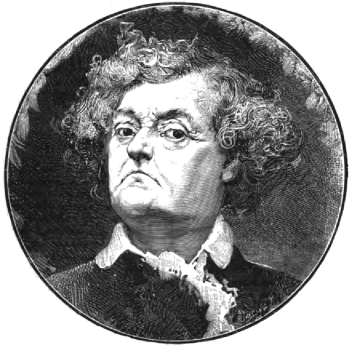
FRÉDÉRIC LEMAÎTRE.
In the days of the old monarchy, as we learn from Bachaumont, a girl
once inscribed on the books of the Opera was released from all control
on the part of her parents. She might present herself for engagement of
her own accord, or her name might be entered on the list by anyone who
had succeeded in leading her away from her parents. In neither case
{89} had her family any further power over her. Lettres de cachet were
issued, commanding the person named in the order to join the Opera,
and many young girls were thus victimised. It can scarcely be supposed
that the privileges granted to the Opera were intended, in the first
instance, to be turned to such evil account as they afterwards were.
Indeed, young men equally with young women could be seized and committed
to operatic control wherever they were found. “We wish, and it pleases
us,” says King Louis XIV., in the letters-patent granted to the Abbé
Perrin, first director of the Académie Royale de Musique (1669), “that
gentlemen (gentilshommes) and ladies may sing in the said pieces and
representations of our Royal Academy without being considered, for
that reason, to derogate from their titles of nobility, or from their
rights and immunities.” Many aristocrats of both sexes profited by this
permission to appear either as singers or as dancers at the Opera. Young
girls, amateurs, male and female, whose voices had been remarked, could
be arrested and forced to perform at the Opera; and in the case of young
girls it was evidently to the interest of the Académie Royale de Musique
that it should be able to profit by their talents without interference
on the part of parents, who might well object to see their children
condemned to such service. Besides being liberated from all parental
restraint, the pupils and associates of the Academy enjoyed the right
of setting creditors at defiance. The salaries of singers, dancers, and
musicians belonging to the Opera were explicitly liberated from all
liability to seizure for debt. Of the freedom conferred by an engagement
at the Opera, the young woman who enjoyed it would probably have been
the last to complain; for, side by side with operatic conscription, a
system of operatic privileges was in force. It was not the custom for
young ladies in good society to visit the Opera before their marriage;
but a brevet de dame could be obtained, and the fortunate holder
of such a document could without infringing any law of etiquette,
{90} attend all operatic performances. “The number of these brevets,” says
Bachaumont, in his Mémoires Secrets, “increased prodigiously under
Louis XVI., and very young persons have been known to obtain them.
Thus relieved from the modesty and retirement of the virginal state,
they gave themselves up with impunity to all sorts of scandals. Such
disorder has opened the eyes of the Government, and it is now only by
the greatest favour that one of these brevets can be obtained.”
It has been seen that, according to Mercier and, after him, Castil
Blaze, the extreme revolutionists among the Terrorist party desired that
the Opera House in the Rue Richelieu might meet with the ordinary fate
of theatres, in the hope that flames or flaming embers blown from the
conflagration might reach the National Library, just opposite. This does
not accord with the fact that the Convention did its utmost to encourage
learning, literature, and art. The free system of the University, the
College or Gymnasium at from eight to ten francs a month, and the
Conservatoire de Musique, with its endowments, its scholarships, and its
free tuition, all date from the first days of the Republic of 1789. As
to the formal demolition of the Opera House, whose destiny was supposed
to be fire, it happened in this way:—
On the 13th February, 1820, which was the last Sunday of the Carnival,
an unusually brilliant audience had assembled at the Opera House, or
Académie Royale, as it now once more was called. The Duke and Duchess of
Berri were present; and before the performance had been brought to an
end, the duke, struck by an assassin, was a dead man.
The circumstances of the murder were very dramatic, not only by their
theatrical surroundings (for the performance still went on while the
duke was expiring in the manager’s private apartments), but also by the
remarkable way in which his whole life—with his double marriage and his
two families—reproduced itself in the last few hours of his existence.
The opera or operetta of the evening was at an end, and a portion of
the ballet had been played, when the duke accompanied the duchess to
her carriage, intending to return to his box to see the remainder of
the performance. Then it was that the assassin grappled with him and
pierced him to the heart. The duke was carried to the director’s room,
and in accordance with the practice of the day, was at once bled in both
arms. The internal hemorrhage was still so great, that it was thought
necessary to widen the orifice.
“There,” says a contemporary writer, “lay the unhappy prince on a bed
hastily arranged, and already soaked with blood, surrounded by his
father, brother, sister, and wife, whose poignant anguish was from
time to time relieved by some faint ray of hope, destined soon to be
dispelled. When Dupuytren, accompanied by four of his most eminent
colleagues, arrived, it was thought for a moment that the duke might yet
be saved. But it soon became evident that the case was hopeless. The
duke’s daughter had now been brought to him, and after embracing her
several times, he expressed a desire to see the king, Louis XVIII. Then
arrived two other daughters, the children of the union he had contracted
in England. The duchess, seeing them now for the first time, received
them with the greatest kindness, and said to them: ‘Soon you will
have no father, and I shall have three daughters.’ In a neighbouring
room the assassin was being interrogated by the Ministers Decaze and
Pasquier, with the bloody dagger on the table before them; while on the
stage the ballet of ‘Don Quixote’ was being performed in presence of
an enthusiastic public. In the course of the night the king arrived,
and his nephew expired in his arms at half-past six the next morning,
begging that his murderer might be forgiven, and entreating the duchess
not to give way to despair.”
The theatre on whose steps the crime had been committed was now
demolished. The other Paris theatres were not indeed pulled down, but
they were shut up for ten days, and there was general mourning in
France, not only because a prince of the blood had been murdered, but
also because the direct line of succession had to all appearance been
brought to an end. It was not until more than seven months after the
tragic scene at the Opera that the prince who was to have saved France,
the “Enfant du Miracle,” was born.
The arrival of the two daughters born and brought up in England has
been differently regarded by writers of different political views.
Alexandre Dumas, in his Memoirs, and Castil Blaze, in his Histoire
de l’Académie de Musique, represent the incident as a purely domestic
one. M. Mauroy, in his recently published works, Les Secrets des
Bourbons and Les derniers Bourbons, lays stress on the fact that
these children were treated with a consideration not shown to other
{91} children of the duke’s, who were certainly born out of wedlock, and thus
derives an argument in support of his proposition that the Duke of Berri
contracted in England with the mother of these girls a regular marriage,
invalid only in so far as it had never been sanctioned by the head of
his house. Chateaubriand, as a royalist, would not allow the character
of legitimate children to the two girls brought to the bedside of their
dying father, and entrusted by him to the care of his wife, the duchess.
“The Duke of Berri,” writes Chateaubriand, in the Mémoires
d’outre-Tombe, “had had one of those liaisons which religion reproves,
but which human frailty excuses. It may be said of him as the historian
has said of Henri IV.: ‘He was often weak, but always faithful, and
his passions never seemed to have enfeebled his religion.’ The Duke of
Berri, seeking vainly in his conscience for something very guilty, and
finding only a few weaknesses, wished, so to say, to collect them around
his death-bed, to prove to the world the greatness of his contrition
and the severity of his penance. He had a sufficiently just opinion of
the virtue of his wife to confess to her his faults, and to fulfil,
beneath her eyes, his desire to embrace those two innocent creatures,
the daughters of his long exile. ‘Let them be sent for,’ cried the young
princess; ‘they are my children also.’ When the Viscountess de Gontaut,
who had not been told beforehand, seemed astonished, Madame (i.e. the
Countess of Artois) noticed it, and said to her: ‘She knows everything;
she has been sublime!’”
The rest of Chateaubriand’s narrative, especially as regards the Duke of
Berri’s two daughters, corresponds closely enough with the one left by
Dupuytren, whose style, somewhat expressive, somewhat emphatic for a man
of science, is less copious, and also less magniloquent than that of the
marvellous author of Le Gênie du Christianisme and of the Mémoires
d’outre-Tombe.
What the prince chiefly thought of in his last moments was his murderer,
Louvel. “Twenty times in the course of the fatal night,” says Dupuytren,
the famous physician, whose account of the scene was published not many
years ago, “he cried out, ‘Have I not injured this man? had he not
some personal vengeance to exercise against me?’ In vain did Monsieur
repeat to him, with tears in his eyes: ‘No, my son, you never injured,
you never saw this man; he had no personal animosity against you.’ The
prince returned incessantly to this groundless idea, and, without being
conscious of it, furnished by his public and repeated inquiries the best
proof that he had not provoked the frightful calamity which had befallen
him. With this first idea he constantly associated another—that of
obtaining pardon for his assassin. During his long and painful agony the
prince begged for it at least a hundred times, and did so more earnestly
in proportion as he felt his end approaching. Thus, when the increasing
gravity of the symptoms made him fear that he would not live long enough
to see the king, he called out piteously, ‘Ah! the king will not arrive.
I shall not be able to ask him to forgive the man.’ Soon afterwards he
appealed turn by turn to Monsieur and to the Duke of Augoulême, saying
to them, ‘Promise me, father, promise me, brother, that you will ask
the king to spare the man’s life.’ But when at last the king arrived,
he no sooner saw his Majesty than, summoning all his strength, he cried
out, ‘Spare his life, sir! spare the man’s life!’ ‘My nephew,’ the king
replied, ‘you are not so ill as you think, and we shall have time to
think of your request when you have recovered.’ Yet the prince continued
as before, the king being still on his guard not to grant a pardon which
was equally repugnant to the laws of nature and to those of society.
Then this generous prince exclaimed in a tone of deep regret: ‘Ah, sir!
you do not say “yes,”’ adding shortly afterwards: ‘If the man’s life
were spared, the bitterness of my last moments would be softened.’
As his end drew near, pursuing the same idea, he expressed in a low
voice, broken by grief, and with long intervals between each word, the
following thought: ‘Ah!... if only ... I could carry away ... the idea
... that the blood of a man ... would not flow on my account ... after
my death....’ This noble prayer was the last he uttered. His constantly
increasing and now atrocious pain absorbed from this moment all his
faculties.”
The heroism of the Duke of Berri and his dying prayer for the pardon of
his murderer may be contrasted with the cowardice of his grandfather,
Louis XV., taking the last sacrament twice over when he had only been
scratched; and the cruelty with which he caused his assailant, who,
murderously disposed, no doubt, had nevertheless scarcely injured him,
to be subjected to the most frightful tortures, and finally torn to
pieces by four horses.{92}
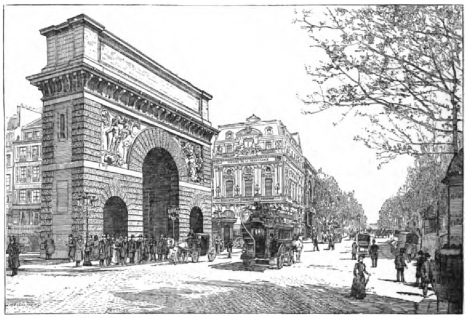
PORTE SAINT-MARTIN AND THE RENAISSANCE THEATRE.
Let us now return to the Porte Saint-Martin Theatre, which, abandoned
by the Opera, remained deserted for eight years, from 1794 to 1802. On
September 30th of this year it was re-opened under the direction of
the author and actor Du Maniaut, who brought out operas, melodramas,
comedies, and pantomimes until the publication, in 1806, of the
decree which put an end to the liberty of the stage. He afterwards,
however, obtained permission to represent pantomimes and prologues, or
vaudevilles, on condition that in each of these little pieces not more
than two actors were employed. In September, 1810, Du Maniaut produced
“The Man of Destiny”—a title indicating the Emperor Napoleon, whose
victories were represented in a series of historical and allegorical
pictures in honour of his marriage with Marie Louise. The music was by
the celebrated Piccini, attached to the private staff of his Majesty
the Emperor. The Man of Destiny was impersonated by a dancer and mimic
named Chevalier, and his career, begun in Egypt, was continued up to the
triumphal entry of the French troops into Berlin. After remaining closed
for several years, the Porte Saint-Martin Theatre was re-opened in 1814,
and thenceforward played a very important part in connection with the
dramatic literature of the country. Here Mlle. Georges, Mme. Dorval,
Frédéric Lemaître, and many other famous artistes, appeared. Here, too,
were produced with enormous success “Marion Delorme,” “Lucrèce Borgia,”
and “Marie Tudor,” from Victor Hugo’s pen; all the dramas of Alexandre
Dumas, including “Antoine,” “Angèle,” “Richard Darlington,” and “La Tour
de Nesle”: “The Mysteries of Paris” and “Mathilde” of Eugène Sue, “The
Two Locksmiths” of Félix Pyat, the “Dame de Saint-Tropez” and “Don César
de Bazan” of Adolphe d’Ennery. Here, too, the “Vautrin” of Balzac was
brought out—to be stopped, after sixteen representations, by Government
order, on the ground that Frédéric Lemaître’s make-up in the part of
the hero was intended to throw ridicule on the person of King Louis
Philippe. The house built by Le Noir, which the Committee of Public
Safety had looked upon as of doubtful solidity, enjoyed a life of ninety
years, and might have been in existence still; but on the 24th of May,
1871, without any apparent motive for so useless and stupid an act,
{93} the Communists set fire to it. The old theatre was burnt to the ground,
together with an adjoining building, which, in the days of the Republic
of Vienna, had belonged to the Venetian Ambassador.
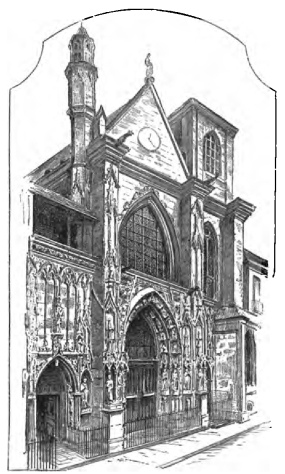 CHURCH OF ST. MÉRY, RUE ST.-MARTIN.
Rebuilt on the same site, but after a different plan, the Porte
St.-Martin Theatre was re-opened in the autumn of 1873, when Victor
Hugo’s “Marie Tudor” was revived. To this succeeded a couple of great
successes—“The Two Orphans” and “Round the World,” the former written
by that fertile inventor of new plots, M. Adolphe d’Ennery, and the
latter adapted by him from Jules Verne’s famous novel.
Close to this famous playhouse is the new Renaissance Theatre, which
first opened its doors on the 8th of March, 1873. The Porte Saint-Martin
contains 1,800 seats, the Renaissance only 1,200. Started as a dramatic
theatre, with Belot’s “Femme de Feu” and Zola’s “Thérèse Raquin” in the
bill, it was destined to obtain its chief success as an operetta theatre
with the charming works of Charles Lecoq, including ”La petite Mariée,”
“Le petit Duc,” etc. In these works Mesdames Théo, Jeanne Granier, and
Zulma Bouffar first appeared.
At the point where the Boulevards St.-Martin and St.-Denis meet stands
the Triumphal Arch known as the Porte St.-Martin, which Louis XIV.
erected in 1674 on the site of the previous Gate, which dated from the
minority of Louis XIII. The Porte St.-Martin faces on the one side the
Rue St.-Martin, and on the other the Faubourg St.-Martin: that is to
say, south and north. The low reliefs decorating the arch on all sides
represent the taking of Besançon, the taking of Limburg, and the defeat
of the Germans, in the form of an eagle repulsed by Mars. The pedestal
bears a Latin inscription, which in English would run thus:—“To Louis
the Great, for having twice taken Besançon and Franche-Comté, and for
having crushed the German, Spanish, and Dutch armies. The Provost of the
Merchants and the Citizens of Paris, 1674.”
At the end of the Rue St.-Martin, leading out of the boulevard of that
name, stands the Church of St. Méry, near which a most determined
struggle took place in that insurrection of the 6th of June, 1832,
which was one of the numerous Republican movements directed against
Louis Philippe by the disappointed revolutionists of 1830, who, aiming
at a Republic, had brought about the re-establishment of a Monarchy.
The Republicans received powerful aid from the Bonapartists: these two
parties being at this, as on so many other occasions, ready to unite
against royalty, while reserving to themselves the ultimate decision of
{94} the question whether the Empire or the Republic should be re-established.
The occasion chosen for the outbreak was the funeral of General
Lamarque—equally popular with Bonapartists and Republicans. A number
of enthusiastic young men drew the funeral car, which was followed by
exiles from all parts of Europe. Among the pall-bearers were General
Lafayette, Marshal Clausel, and M. Laffitte. Of the insurgents, some
took part in the procession, while others looked on in expectation of
events that were inevitable. The crowd broke into several gunsmiths’
shops, and finally into the arsenal. Many, too, had brought arms with
them; and after a few hours’ fighting the insurgents had gained several
important positions, and determined to attack the bank, the post-office,
and some neighbouring barracks. Their chief object at this moment was to
render inaccessible the Rue Saint-Martin and the surrounding streets.
Here they intended to establish the head-quarters of their insurrection,
without having the slightest notion that at that very instant M.M.
Thiers, Miguet, and other members of the Government were dining together
at the Rocher de Cancale, fifty yards only from the camp wherein the
Republicans were fortifying themselves with the firm resolution of
proclaiming a Republic or dying in the attempt. A remarkable example was
given towards the evening of this day of what M. Louis Blanc calls the
sympathy of the Paris National Guard for heroism, though most persons
would regard it as a proof of incapacity and cowardice.
Eight insurgents, returning from the Place Maubert, presented themselves
towards the decline of day at one of the bridges of the city which was
occupied by a battalion of the National Guard. They authoritatively
claimed their right to go over and join their friends who were fighting
on the other side of the river, and as the guards hesitated to let them
pass, they advanced resolutely towards the bridge at half charge, with
fixed bayonets. The soldiers instantly ranged themselves on either
side, and gave unimpeded passage to these eight men, whose infatuated
heroism they at once admired and, reflecting upon its inevitable result,
deplored.
The enthusiasm of the insurgents at this period is shown by many a
curious incident, such as that of their moulding bullets from lead
stripped off the roofs of houses; whilst boys, too young to bear
weapons, loaded the guns, using for wadding the police notices they had
torn off the walls, or, when that resource failed, taking the shirts off
their own backs to tear to shreds for the purpose. It was all, however,
a forlorn hope; and the rising was destined to be crushed by superior
force.
More than one reference to the defence of the Cloître St.-Méry will be
found in the novels of Balzac, and a dramatic description of it occurs
in the memoirs of Alexandre Dumas.

{95}