Bertram W. Wells.
This paper is primarily an attempt to present adequate descriptions
of the types of 30 itonid (cecidomyid) and 2 eriophyid (mite) galls,
collected by the writer on hickory leaves. It is believed to contain
sufficient new material to warrant its publication in advance of a
general survey of N. E. United States zoocecidia, of which it will form
a part. The data is based on collections made in Connecticut, Ohio and
Kansas, most of the material however, being taken in Ohio.
In addition, those forms (few in number) previously described which
have not been seen by the author, have been added, so as to give a
character of completeness to the survey of the two groups of galls.
There are three groups of zoocecidia occurring on hickory trees:
1. Galls formed by species of Eriophyes (Fam. Eriophyidæ of the Acarina
or mites), or an allied genus. Only two are known.
2. Galls induced by species of Phylloxera (Aphididæ of the Hemiptera).
Pergande[2]
has presented an excellent survey of these insects accompanied by very
satisfactory descriptions of the cecidia formed by them.
3. Galls caused by species of Caryomyia (Itonididæ of the Diptera).
Possibly other genera may be represented on the hickories, but
according to Felt[3]
“most of the hickory leaf galls are probably made by species of
Caryomyia, though other midges have been reared from these deformities.”
The genus Caryomyia, which undoubtedly occupies an important place in
relation to the majority of the galls described in the present paper,
will be given special consideration. Felt, to whom American cecidology
is heavily indebted for his extensive studies of dipterous cecidozoons,
presents the following description of the genus Caryomyia in the same
citation as that immediately above.
“Allied to Hormomyia, but differing by the thorax not being greatly
produced over the head and by the presence of but 14 antennal
segments. The males may have the flagellate antennal segments binodose
or cylindric and subsessile and invariably with three low, stout
circumfili. The antennal segments of the female are cylindric and with
two circumfili; palpi tri- or quadri-articulate; wings rather broad,
the third vein joining the costa at or near the wing apex; claws
simple, the pulvilli well developed. The ovipositor of the female is
short and with minute lobes apically. The genus appears to be confined
to hickory leaf galls.”
Adult insects not technically known are given the old generic name
“Cecidomyia.”
These galls as well as similar ones on other kinds of plants arise as
the result of some stimulus (the nature of which is still not definitely
known) applied by the very young larva to the growing tissue of the
immature leaf. Nothing has yet been done on the development of the
itonid galls of the hickories, but from studies on very similar types
we have reason to believe that the ontogeny of the itonid forms is
as follows: The egg is probably deposited superficially (for the
ovipositor of the female Caryomyia is short) on the under side of the
leaflet; on the upper side in a few cases.
Hyperplasia or excessive cell proliferation results (probably not
until after the larva has emerged from the egg) forming at first a
saucer-shaped structure, then cup-shaped and finally by the ingrowth
of the edges, the gall becomes a closed structure enveloping the larva
in a chamber. The distal growth, seldom if ever in the hickory forms,
proceeds so far as to obliterate the opening which was so prominent in
the very immature cup-shape stage. Hence in practically all galls of
this type a minute canal or pore can be demonstrated at the distal end.
In Küster’s[4]
very serviceable classification of abnormal plant parts, these fall
under his “umwallungen” cecidia, a term very succinctly describing
their mode of development.
Two of the following described galls have been studied histologically
by Cook,[5]
Caryomyia holotricha O. S. and C. tubicola O. S.
Concerning the problem of the distribution of the galls on the
different species of hickory, it is still too early to be able to make
any positive assertions. In most of the reports the species of tree has
not been given. It is very well known that certain species of galls are
found on 2 and 3 species of hickory, but whether they are developed on
all indiscriminately is not known. H. cordiformis seems to bear much
fewer species than H. ovata or H. alba. In the present list, the
report of the gall upon a particular species of tree does not at all
imply that it does not occur on others.
Having had the opportunity to give attention to gall collecting
in three rather widely separate localities, eastern Connecticut,
southern and northern Ohio and eastern Kansas, some observations on
the geographical distributions of the hickory itonids are here briefly presented.
It is sometimes stated that the distribution of gall insects is similar
to that of their host plants. In certain cases this does not seem to
be true. In that of my number 32 first found and described by Sears,
no report of this large and striking form has appeared, showing it
to occur east of the Allegheny mountain system, a region in which
H. ovata is abundant. In the cases of my numbers 5, 9, 19 and 31,
all heretofore unreported and possessing prominent distinguishing
characters, it would seem as though they were somewhat restricted in
their distribution, for while comparatively common in Ohio, they are
never seen in Connecticut or Kansas, where equally intensive collecting
was prosecuted. So few are the students of cecidia and so meager
the data in this field, that it is, however, much too early to make
positive assertions in matters of geographic distribution.
The data on the galls presented herewith was compiled for the most
part at the time of collection; the notes and drawings made from fresh
material. For later comparative work, the material was all preserved in
formalin, each collection being assigned to a vial.
The writer has refrained from attaching a specific name to his new
species of cecidia, a practice very common on the part of European
cecidologists. Even though the adult gall has no direct relation to
the adult insect, the fact, nevertheless, remains that the specificity
of the gall owes its origin to the specificity of the physiological
phenomena of the larval insect, and it is this, which in the mind of
the writer, gives pre-eminence to the insect. The adult gall and the
adult insect can be conceived as arising from the same complex, the
larva, the adult insect bearing, however, a more intimate and direct
relation to the original source of events than the gall. In many cases
the adult insects offer characters, making possible the delimitation of
species, with greater exactness, than do the galls. For these reasons
new names of cecidia should only appear with adequate descriptions of
the cecidozoons.
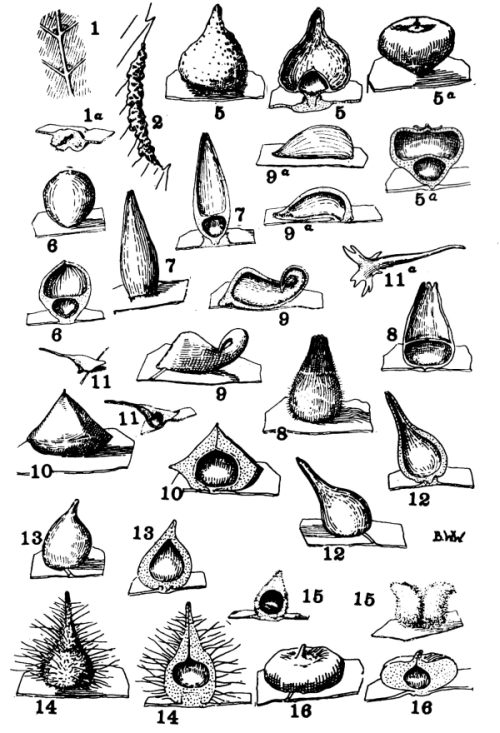
Though the galls almost uniformly occur on the under side of the
leaflet, the drawings have presented them in an inverted position, with
the gall uppermost, this being the position in which the galls would be
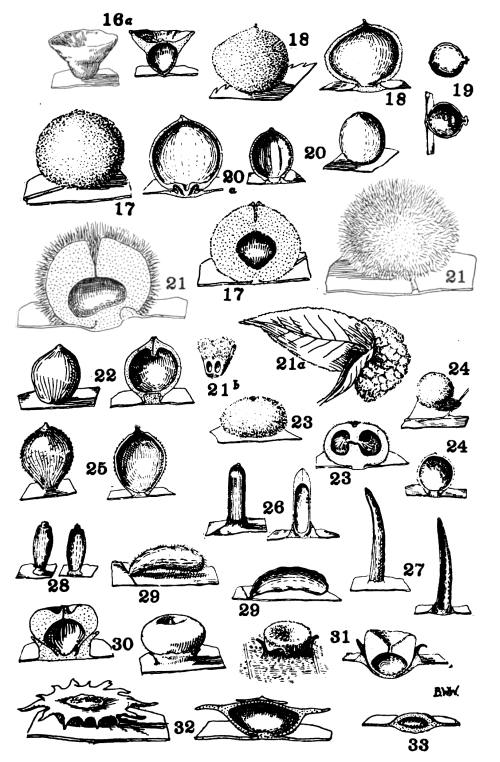
examined. In practically all cases there are two sketches of the type,
one showing the exterior aspect of the gall, the other the interior as
seen in a vertical, median section. The figure number is in all cases
the same as the list number.
The writer wishes to express his appreciation of the hospitality of
his friend, J. L. King, who, as assistant entomologist for the Ohio
Experiment Station, shared his field laboratory during some of the time
in which cecidological collecting was being carried on.
Though the writer has seen (with a few exceptions) the types herewith
detailed an amply sufficient number of times to establish them as
types, he does not claim infallibility, for the key he has worked
out to these types. It is hoped, however, that it, together with the
descriptions and illustrations will enable the student of the hickory
galls to become better acquainted with the members of the two groups treated.
Britton and Brown’s Illustrated Flora Northern U. S. and Canada, (2nd
edition), New York, 1913, has been followed in the matter of plant nomenclature.
The following two galls whose makers have been named by Felt have
probably not been seen by the writer. Felt’s descriptions are given.
They are not included in the key.
Caryomyia thompsoni Felt.
“Globose, thin-walled, long haired, melon-shaped, dia. 2-3 mm.”
See my number 23.
Caryomyia antennata Felt.
“Globose, thick-walled, yellowish green or brown. Dia. 4-5 mm.”
This description, as far as it goes, would indicate a similarity to
C. persicoides Beut.
Felt, Jour. Econ. Ent. 4:456. 1911.
The itonid group of galls herewith presented can be distinguished with
one exception (No. 33) from the very common Phylloxera galls (Aphididæ)
by the fact that the latter forms which are sufficiently small to be
comparable in size to the itonids are intercalated in the leaf blade,
i. e. the gall extends more or less prominently from both sides of
the leaf. The itonids always give the appearance of an appendicular
structure attached to the leaf.
| 1. |
Gall on nut. Caryomyia nucicola. (3) |
| 1. |
Gall on leaf. 2. |
| 2. |
An apparent elongate enlargement of vein. Cecidomyia cynipsea (?) (4). |
| 2. |
An inrolled leaf edge. (2). |
| 2. |
Galls arising from intervenal tissue between veins or immediately |
| |
adjoining veins; radially symmetric structures with principal |
|
axis more or less perpendicular to leaf blade. 3. |
| 3. |
Galls double-chambered as seen in vertical median section. 4. |
| 3. |
Galls single chambered. 7. |
| 4. |
Galls definitely depressed. (5). |
| 4. |
Galls small, sub-globular. (6). |
| 4. |
Galls definitely conic. 5. |
| 5. |
Elongate gall with rounded base in definite visible socket. (7). |
| 5. |
Shorter gall attached by pedicel from rounded base not articulating |
| |
with definite socket. 6. |
| 6. |
Proximal chamber of gall, conic. (5). |
| 6. |
Proximal chamber of gall, depressed. (8). |
| 7. |
Galls definitely conic; forms having rounded bases, the distal portion |
| |
is sufficiently drawn out to place the cecidium under this class. 8. |
| 7. |
Galls spheric, sub-spheric or depressed. 15. |
| 7. |
Galls sub-cylindric, 2½-3 times as long as wide. 22. |
| 7. |
Galls obconic, i. e., part projecting from leaf is flat topped, |
| |
constricted proximally to the pedicel embedded in the leaf. 25. |
| 7. |
Blister gall, intercalated in the leaflet, projecting on both sides. |
| |
Cecidomyia? sp. (33). |
| 8. |
Small irregular, low, masses of tissue always in axils of principal |
| |
veins of leaflet. Eriophyes sp. (1). |
| 8. |
Galls definite structures projecting prominently from leaf surface. 9. |
| 9. |
Conic gall generally with strongly recurved tip appearing as though |
| |
lying on side, decumbent. (9). |
| 9. |
Galls erect or tilted, seldom bent over, however, beyond angle of 45. 10. |
| 10. |
Gall with flattened sides, pyramid-like. (10). |
| 10. |
Galls with sides flattened. 11. |
| 11. |
Proximal half of gall conic, never sub-globular. (11). |
| 11. |
Proximal half sub-globular. 12. |
| 12. |
Galls smooth. 13. |
| 12. |
Galls pubescent. 14. |
| 13. |
Galls large, 4-7 mm. long. (12). |
| 13. |
Galls small, 1½-4 mm. long. (13). |
| 14. |
Trichomes very long coarse. (14). |
| 14. |
Pubescence short, fine. (15.) |
| 15. |
Galls attached by proximal pedicel embedded in leaf, as seen in a |
| |
median vertical section. |
| 15. |
Galls attached by structure extending from leaf into base of gall, |
| |
which remains on leaf when gall falls. 20. |
| 16. |
Walls thick, soft. 17. |
| 16. |
Walls thin, 18. |
| 17. |
Galls smooth, depressed or with upward flaring walls forming a |
| |
saucer or cup-shaped structure distal to the chamber. (16). |
| 17. |
Gall globular, finely pubescent like that of a peach. (17). |
| 18. |
Surface perfectly smooth, symmetrically sub-spherical galls. 19. |
| 18. |
Surface minutely shagreen-roughened, gall asymmetric, one side |
| |
prominently extended laterally. (18). |
| 19. |
Small galls, 2½ mm. dia., nipple expanded and flattened resembling |
| |
the end of a bottle. (19). |
| 19. |
Larger gall, 3-4 mm. dia., nipple short, pointed. (20). |
| 20. |
Thick-walled, particularly the distal end, covered with heavy |
| |
tawny pubescence. (21). |
| 20. |
Thinner walled, pubescence very short, puberulent. 21. |
| 20. |
Very smooth. (22). |
| 21. |
Depressed (not over 3 mm. high) with column extending through |
| |
center of chamber. (23). |
| 21. |
Globular, 4-5 mm. high. (24). |
| 21. |
Definitely balloon-shape. (25). |
| 22. |
Base embedded in socket. 23. |
| 22. |
Base not embedded in socket. 24. |
| 23. |
Round-conic at tip. Caryomyia tubicola. (26). |
| 23. |
Tapering to point, horn-like. (27). |
| 24. |
Small gall, 2-2½ mm. high, with flaring base, attached by minute |
| |
pedicel at center. (28). |
| 24. |
Large gall, 5-6 mm. long, gradually constricted proximally to very |
| |
narrow neck at point of attachment. (29). |
| 25. |
Distal face with fovea containing a central nipple. Leaf not |
| |
projecting on side opposite gall. (30). |
| 25. |
Distal face with fovea, leading into central pore; no central nipple. |
| |
Prominent convexity of leaf on side opposite the gall. (31). |
| 25. |
Distal face flaring out at edge into radiate bracts; these |
| |
sometimes strongly incurved. (32). |
1. Eriophyes? sp. Cecidium nov.
Small galls in the axils of the lateral veins of the leaflets. Above
marked by a light colored angular area 1-1½ mm. dia. Below a small mass
of tissue (the gall proper) fills the angle, covered by a fine close
pubescence. Chamber within of small diameter, irregular in shape. The
characteristic mites were definitely observed. They are white in color.
On some leaflets every angle made by the mid-vein branching into the
lateral ones was occupied by a gall. On H. cordiformis, in Athens
County, Ohio, August.
Type specimens at Ohio State University.
2. Eriophyes? sp.
Leaf edge gall; edge inrolled involving little more than the teeth.
Variable in length from .5-2 cm. or longer, 1 mm.-2 mm. thick. Outer
surface of affected area finely roughened; color of under side of the
leaf. Thompson states that mites live within the fold. His report is
the first one on this gall. Species of hickory on which specimens were
found not determined.
Thompson, Illus. Cat. Am. Ins. Galls. 1915. p. 57, pl. 10, Fig. 260.
3. Caryomyia nucicola, O. S.
“Irregular swelling in the husk produced by the reddish
larvæ. Reference to Caryomyia provisional.” Felt. “Contain
thick walled cells. On Carya (Hicoria) alba.” Jarvis.
- Osten Sacken, Trans. Am. Ent. Soc. 3:53. 1870.
- Felt, Jour. Econ. Ent. 4:457. 1911.
- Jarvis, 39th Ann. Rept. Ent. Soc. Ont. 1908. p. 84.
4. Cecidomyia cynipsea O. S.
“Rounded, irregular, hard swelling on the under side of the hickory
leaf, on the mid-rib near the base of the leaf about half an inch long.
In July, pale yellowish and contained in several small hollows, minute
whitish larvæ, with breast bone narrowed anteriorly and ending in a
point.” Osten Sacken.
This form is so different from the other itonid galls of the hickory
that the writer is inclined to place it here tentatively. It is very
similar to Phylloxera caryævenæ Fitch, with the exception that the
hyperplasia extends below the leaf, while in the phylloxera gall it is
developed on the upper side. The writer has observed orange colored
larvæ in the aphid galls, but they were not definitely determined to be itonid.
Since this type of gall has not since been reported as definitely
caused by itonid larvæ, it is barely possible that Osten Sacken
described the empty phylloxera gall above mentioned containing
inquilinous itonid larvæ. The writer found many of these galls deserted
by the aphids in the middle of July and Pergande states that the aphid
nymphs begin to leave the galls in July. At this time, these galls
are a “pale yellow” color as described for the “cynipsea” gall. The
writer’s observations were made in southern Ohio, while Osten Sacken’s
were made in the vicinity of Washington, D. C.
Osten Sacken, Lowe’s Monogr. Dipt. N. Am. Pt. 1. p. 193. 1862.
5. Cecidomyia sp.
Leaf, under side, double chambered conic or depressed (Fig. 5a) gall.
The latter condition is perhaps the more usual. In these forms, the
conic tip is sunken in the central fovea, the gall only measuring from
1½-2 mm. vertical diameter. The conic forms are as though the tip was
pulled out destroying the fovea. These often measure 5 mm. in height.
The width of the galls varies from 3-5 mm. Very light green, or when
older yellow to red, surface roughened with low tubercles as seen
with lens. Inner chamber sub-conic with short mucronate tip. Walls
of both chambers thin and smooth, outer wall slightly sticky. Base
of gall flat, arising from a definite pedicel, resting in a cup-like
depression, which is formed in a definite hyperplasia intercalated
in the leaf. Above, this hyperplasia is evident as a raised circular
area, 2½ mm. diameter, in the center of which is a minute light colored papilla.
Rather common on H. alba. Collected in Hocking and Athens counties, Ohio.
This double-chambered gall cannot be Caryomyia inanis Felt, for it is
neither “globose and small.” The author describes elsewhere a specimen
which fits that description and is very probably produced by the
cecidozoon just mentioned. Absolute certainty, it must be remembered,
can only be obtained by checking the reared adult insects with the
original descriptions.
Sears described this gall from Cedar Point, Ohio, under the name C. inanis.
Sears, Ohio Nat. 15:380, pl. 18, Fig. 18. 1914.
6. Caryomyia inanis Felt.
“Globose, thin-walled with a false chamber at the apex. Dia. 2-3 mm.” Felt.
In my material, the false chamber is large, occupying more than half
of the gall. The gall is slightly balloon-shape, 2½ mm. high. Surface
perfectly smooth. Collected, Hocking County, Ohio, on H. ovata.
Sears in his “Insect Galls of Cedar Point (Ohio) and Vicinity,”
described my number 5 under this species.
- Felt, Jour. Econ. Ent. 4:456. 1911.
- Felt, Bull. Brooklyn Ent. Soc. 8:99. 1913.
7. Cecidomyia sp. Cecidium nov.
On leaf, under side, elongate-conic constricted somewhat at base so as
to resemble a miniature lamp chimney. Arises from saucer-like base. 5
mm. in length. Smooth, greenish-yellow to brown. Two chambered, the
larval chamber at the proximal end, sub-spherical with a dia. about
⅓ the length of the gall. The distal false chamber large, the walls
becoming thin apically. The partition separating the chambers is firm with
a minute perforation at its center. Surface of leaf opposite gall not raised.
Collected in Hocking County, Ohio, on H. glabra, July.
Type specimens unaccountably missing. The description is nevertheless
presented inasmuch as both it and the drawing were made from fresh
material in the field.
8. Cecidomyia sp. Cecidium nov.
On leaf, under side, a gall similar to 7, perhaps a variety of it,
though its prominent and constant differences would indicate a distinct
species. Conic with rounded base and truncate tip, 4-6 mm. high, 3-4
mm. broad in widest part. The wall at the tip thin, splitting into a
fimbriate condition. Attached by a minute central pedicel, no trace of
a saucer-shaped structure developing around the base. Galls greenish
to red and purple tinted. Uniformly being covered with sparsely
distributed short hairs. Interiorly two chambered, the larval chamber
proximal and occupying nearly one-half of the gall. Walls including the
partition comparatively thin. Surface of leaf opposite gall slightly
raised with reddish tint.
Collected in Athens County, Ohio, on H. alba, August.
Type specimens at Ohio State University.
9. Cecidomyia sp. Cecidium nov.
On leaf, under side, elongate conic, asymmetric, the axis lying
horizontal or parallel with the leaf blade plane. The tip is invariably
strongly recurved upward and backward. The side of the proximal part of
the gall lying against the leaf is flattened and rests close against
the leaf and vein; the galls always spring from the side of a vein.
Size variable from 2 mm. in length to 4 mm. this measurement distally
not being made to the tip but merely to that part of the recurved
terminal portion, farthest from the base. The larger specimens measure
1½-2 mm. in width at the proximal end. Light green to nearly white, or
sometimes roseate tinged. Very smooth. Walls thin distally thickening
toward the basal end.
Not uncommon on H. alba in Hocking County, Ohio, July.
Type specimens at Ohio State University.
A gall, somewhat similar and probably a variety of the above was
collected on H. glabra, (Fig. 9a.)
Cylindric-conic, sharply bent over against the leaf, attenuate distal
part short, not recurved, 3½ mm. long. Smooth, white like ivory. Wall
rather thick, hard. Base of gall in shallow saucer-like depression
against the vein. Interiorly the distal end is choked with coarse trichomes.
10. Cecidomyia sp. Cecidium nov.
Leaf, under side, distal ⅔ of gall dome-shaped with 3-many triangular
sides, the flaring base resting on the proximal, constricted or
saucer-shaped ⅓; 2-3 mm. high, 3-4 mm. wide. Tip attenuate, not sharp
pointed, however. Light green to yellowish green, the tip darker,
reddish to black. Surface smooth under lens. Larval chamber spherical,
surrounded by sclerenchmya layer. This gall is very distinctive no other forms
having the peculiar angular structure which it possesses. Not abundant.
Collected at Gypsum, Ohio, August, on H. microcarpa.
Type specimens at Ohio State University.
11. Cecidomyia sp. Cecidium nov.
On leaf, under side, rather large conic gall, whose distal ½-⅓
constitutes a very slender apical process. Through this passes the fine
canal leading to the depressed, sub-globular chamber in the proximal
part of the gall. The galls are either erect or more generally tilted
to one side, always arising from one of the larger veins. 5-8 mm. long,
2½-3½ mm. wide at base. Outline of the flaring sessile base generally
angular. Attenuate distal portion turning dark early. Light greenish
yellow to brown when old. Smooth. Walls of chamber thick. A slender
probable variety of this is figured in 11a, pl. I.
Collected in Hocking County, Ohio, on H. alba. July.
Type specimens at Ohio State University.
12. Caryomyia caryæcola O. S.
On leaf, under side, large galls with globular basal part extending
into a point distally. Shape suggests that of a Prince Rupert’s drop.
4-7 mm. long. Surface very smooth, greenish to reddish tinged. Some
show a definite blue color over the attenuate apical end. Walls of
medium thickness, very firm. Somewhat similar to C. sanguinolenta
O. S. but differs from that gall in its larger size and much more
attenuate distal end. Common on different hickories.
- Osten Sacken, Lowe’s Mongr. Dip N. Am. Pt. 1, p. 192. 1862.
- Felt, Jour. Econ. Ent. 4:456. 1911.
13. Caryomyia sanguinolenta O. S.
On leaf, beneath, stoutly conical, varying in size from 1½ mm. to
4 mm. high. Tip erect or often bent to one side. Smooth, green to
purplish-red and finally a brown when old. Attached to smaller veins by
short pedicel, hidden from view, however, by the rounded base of the
gall. Walls medium in thickness, possessing the rather soft texture of
charcoal when dry; brown in color.
This form is often found in enormous numbers on certain trees, bringing
about early disintegration of the affected leaves. The lower leaves are
more heavily infested due to the fact that the insects are apt to reach
these first in their flight from the ground in the spring.
- Osten Sacken, Lowe’s Monogr. Dip. N. Am. Pt. 1, p. 192. 1862.
- Beutenmuller, Am. Mus. Nat. Hist. Guide Leaflet No. 16, p. 28, Fig. 59.
- Reprint from Am. Mus. Jour. Vol. 4, 1904.
14. Cecidomyia sp. Cecidium nov.
Leaf, under side, distal half conic-attenuate from the bulbous or
sub-globular proximal half. Covered with long, coarse trichomes, the
longest being half the length of the gall. Trichomes brown. Tip of
gall generally darker than rest. 3-4 mm. high, 2-3 mm. wide. Cavity
sub-spherical somewhat depressed at right angles to axis of gall. Walls
relatively thick, especially the proximal part. Apical canal evident in
median longitudinal section. Gall attached by short and broad pillar of
tissue extending from the leaf into the fleshy base.
Gypsum, Ohio, August, on H. ovata.
Type specimens at Ohio State University.
15. Cecidomyia sp. Cecidium nov.
On leaf, under side, small, conic galls, generally found in pairs
closely appressed to each other but not confluent. Distal attenuate
⅓ rather sharply constricted from the sub-globular ⅔ of the gall and
generally turned to one side. 2 mm. high, 1½-2 mm. broad at base.
Yellowish in color, definitely and constantly pubescent. Interiorly the
lining of the sub-globular larval chamber is deep blue-black in color.
Walls of medium thickness. Comparatively large region of the base
involved in the attachment of the gall.
Collected in Hocking County, Ohio, on H. alba, July.
Type specimens at Ohio State University.
16. Cecidomyia sp.
On leaf, under side, greatly depressed with central, prominent nipple,
3-5 mm. dia. 1½-2½ mm. thick (vertical dia.) not including nipple.
Light green, smooth. Firm fleshy with central sub-spherical larval
chamber whose wall is differentiated from the surrounding tissue. Apical
canal through nipple evident. This gall first reported and illustrated by Thompson.
Thompson, Illus. Cat. Am. Ins. Galls. 1915. p. 56, pl. 13, Fig. 228.
A most interesting variant of this form is illustrated in Fig. 16a.
If it were not for the large number of intermediate forms found, this
one would easily be considered distinct. The region of the chamber
surrounded by thick walls has been much reduced, so that only a
circular area about the upper part of the chamber has the thick wall
projecting from it. This new condition results in the formation of a
definite saucer-shaped structure on the distal end of the gall. In
some specimens the structure was no longer saucer-shape, but by the
ingrowth of the edges it was assuming a spherical form, developing
a two-chambered gall. It is natural to suspect that this may have
been the mode of origin of the four-double-chambered galls described
elsewhere in this paper. That, however, is entirely problematic.
17. Caryomyia periscoides Beut.
On leaf, underside, generally large, sub-globular galls. Younger
ones appear like older, both often being found on same leaflet, 4-7
mm. diameter. Galls covered with a fine short yellowish to reddish
pubescence, suggesting the texture of peach “bloom.” Walls very thick,
firm fleshy, surrounding the central spherical cavity, pierced,
however, at the distal end by the fine apical canal. Closely sessile
on leaf, generally at side of principal vein. Collected on H. alba,
glabra and ovata.
From Felt’s short description, Caryomyia antennata Felt, must have
been taken from a similar gall.
- Osten Sacken, Lowe’s Mono. Dip. N. Am. Pt. I. p. 193. 1862.
- Beutenmuller, Am. Mus. Nat. Hist. Bull. 23:393. 1907.
18. Cecidomyia sp.
On leaf, under side, sub-globular (almost uniformly asymmetric in that
one side projects laterally so as to present a parabolic outline,
rather than a semi-circular one). A short definite nipple terminates
the gall. 2-4 mm. diameter. White or light yellow to red. Walls medium
in thickness, of a soft, almost fleshy consistency. Exterior surface
almost uniformly minutely shagreen-roughened when observed with lens.
The constricted base of the gall rests in a shallow saucer-shaped structure.
This gall was described from Connecticut in citation below on H.
ovata. Rather common in Hocking County, Ohio, on H. microcarpa.
July, August.
- Felt’s “Cecidomyia sp. Globose, irregular, ovate, granulate,
a slight nipple, dia. 2-3 mm.” probably belongs here.
- Felt, Jour. Econ. Ent. 4:456. 1911.
- Wells, Ohio Nat. 14:291. 1914.
19. Cecidomyia sp. Cecidium nov.
On leaf, under side, small, smooth, spherical galls, with a peculiar
tip shaped like the end of a bottle, arising abruptly from the globular
gall, 2-2½ mm. diameter. The gall reminds one of a miniature bomb.
Green to yellowish with dark spots over the distal half. Thin-walled.
Attached by a minute obconic pedicel. The pupa in these galls is
suspended in the upper part of the chamber by a thread passing from
each end of the body to the walls of the chamber. The galls drop from
the leaves in late July. Not common.
Collected in Hocking County, Ohio, July, on H. microcarpa.
Type specimens at Ohio State University.
20. Caryomyia caryæ O. S.
On leaf, under side, sub-spherical gall with more or less prominent
apical nipple. 3-3½ mm. diameter, rarely 4 mm. Light green, turning
brown, smooth. In many, very definite meridian-like striations can be
observed marking the wall. Wall thin, very fragile and dry. Surface of
chamber smooth as though polished. Attached by conic pedicel arising
from fovea in base of gall. This pedicel with its pointed end attached
to the leaf is surrounded by or rests in a cup-like structure. In this
respect the gall differs markedly from No. 22, which it superficially
very much resembles.
Fig. 20a is a large specimen showing the peculiar interlocking base
exceptionally well developed.
Collected from H. alba and H. ovata, July and August.
Felt, Jour. Econ. Ent. 4:456. 1911.
21. Caryomyia holotricha O. S.
On leaf, under side, large tawny, long-haired galls, distributed singly
(Fig. 21) or massed (Fig. 21a) on the leaflet. When massed they form a
conspicuous brown, hairy structure, suggesting a huge caterpillar. The
isolated galls are sub-globular to round-conic with or without a small
terminal nipple. 3-5 mm. vertical diameter, 3-5 mm. wide. Interiorly
the chamber of the isolated form is depressed, this fact being
associated with that of the thick distal wall. Gall chamber surrounded
by definite sclerenchyma layer. Cortical tissue firm. Attached by
irregular process from leaf extending into base of gall. In the massed
forms, the galls are similar in structure, but are variously shaped,
due to mutual pressure, (Fig. 21b). Compactly attached to the common
central hyperplasia along the vein, which on the upper side of the leaf
is a reddish irregular, low elevation. Some of these masses are as long
as 5 cm., possessing a thickness of 10-15 mm.
Common on various hickories, particularly H. ovata.
A gall which may eventually prove to be a different species but which
here is provisionally classed as a variety of C. holotricha, was
found in numbers on the leaves of H. alba, though it is probably not
restricted to this species of hickory. Instead of an apical nipple,
it has an apical pit, which is choked with the characteristic brown
pubescence of this type of gall. Internally a tuft of coarse brown
trichomes extends inwardly from the distal side of the chamber. The
chamber occupies the proximal one-half to two-thirds of the gall, the
wall over it being uniformly very thick. This type of gall is constant,
being collected repeatedly and examined minutely.
Based on Felt’s brief description, his Caryomyia thompsoni Felt was
taken from this gall or one very similar to it.
Closely allied to the above variety is another form, with internal
tuft of trichomes, in which the apical nipple is present. The layer
of tissue lining the chamber appears very white, due probably to the
character of the tissue beneath the superficial nutritive layer. In
section the thin white chamber wall is very definitely delimited from
the adjoining darker tissues. Many of these conic-sub-spheric galls
were 6 mm. in width. Collected on H. glabra. Types of this and the
above variety are at the Ohio State University.
- Osten Sacken, Lowe’s Monogr. Dip. N. Am. Pt. I, p. 193. 1862.
- Felt, “Hormomyia holotricha” 23rd Rept. Ins. N. Y. 1907. pp. 382, 389.
- Felt, “Caryomyia holotricha” Jour. Econ. Ent. 4:456. 1911.
22. Cecidomyia sp. Cecidium nov.
On leaf, under side, sub-globular with minute apical nipple. Tip of
latter truncate with fine pore in center. 3 mm. high, 2½-3 mm. wide.
Generally wider through one axis. Smooth; light greenish yellow.
Interiorly a more or less prominent nipple projects inward from the
distal end of the chamber, traversed by the apical pore. Toward
maturity the interior wall is reddened. Gall attached by a short,
cylindric pillar, extending from the leaf into the base of the globular
structure. At the end of summer the galls fall from the leaf, leaving
this pedicel on the leaf. Galls when found are apt to occur in large
numbers, as many as 50-60 commonly being found on a single leaflet.
Collected in Hocking County, Ohio, on H. microcarpa, July.
Type specimens at Ohio State University.
23. Cecidomyia sp. Cecidium nov. (?)
Leaf, under side, depressed (door-knob-shape) closely sessile on leaf
attached by a very short stout pedicel. 3-4 mm. wide, 2-2½ mm. high.
Greenish to dull brown, covered with short, thin pubescence or smooth.
Interiorally from both the proximal and distal sides, truncated,
conic processes extend inward, meeting in the center. From the end of
the upper one numerous, very coarse trichomes radiate into the gall
chamber, which are white at first, turning brown. The central tissue
and the walls are of a firm, fleshy character. There is commonly a more
or less definite fovea, exteriorly at the distal end.
Collected in southern (Hocking County) and northern (Lake County) Ohio
on H. ovata.
Thompson briefly describes and illustrates a gall similar to the above
which Felt as editor called Caryomia thomsoni. The illustration,
however, shows the gall not be to Felt’s C. thompsoni as he has
described it, viz., “Globose, with long, erect, reddish, fuscous hairs.”
- Felt, Bull. Brooklyn Ent. Soc. 8:99. 1913.
- Thompson, Illus. Cat. Am. Ins. Galls, p. 56, pl. 12, Fig. 227.
24. Cecidomyia sp. Caryomyia similis Felt (?)
On leaf, under side, large, globular, 4-5 mm. dia. Light yellow-green
to brown, surface puberulent. A minute nipple terminates the gall.
Walls thin. Attached by a short pillar, over which the basal part of
the sphere fits like a cap. Surface of leaf not noticeably raised on
side opposite the gall.
Collected on H. microcarpa in Ohio and H. glabra in Connecticut.
This gall is very close if not identical with Caryomyia similis Felt.
It differs from his description in that it is not “depressed.”
- Felt, Jour. Econ. Ent. 4:456. 1911.
- Felt, Bull. Brooklyn Ent. Soc. 8:99. 1913.
25. Cecidomyia sp.
On leaf, generally on upper side, balloon-shaped gall, 3-5 mm. high,
3-4 mm. wide. Terminal nipple arising from slight apical depression.
Greenish-brown or sometimes varying toward a very dark purplish tinge,
its peculiar color being very constant and characteristic. The surface
is dotted over with short, swollen glandular hairs. Trichomes sometimes
projecting slightly from apical pore. Walls very thin. Galls attached
to short, stout process of the leaf, to be seen only in median,
vertical section. Surface of leaf on side opposite the gall not raised.
Never numerous on leaflet. Closely related, if not identical, with
C. caryae O. S. See No. 20.
Observed on H. glabra, in Hocking County, Ohio, July.
26. Caryomyia tubicola O. S.
On leaf, under side, cylindrical with rounded distal end standing
erect from the cup-like base embedded in the leaf blade. 4-6 mm. high,
generally very close to 5 mm. 1 mm. dia. Body of gall, yellow to brown
in color, distal end reddish to brown, at length almost black. Basal
cup, greenish yellow to dark purple. Cylindrical part of gall smooth
as though polished. Gall attached to the cup only at its central basal
part. Before the end of summer the tube-like portion breaks away with
its enclosed larva. On the side of the leaf opposite the gall its
position is indicated merely by a dark discoloration. Very common on
different kinds of hickories.
- Osten Sacken, Lowe’s Monogr. Dip N. Am. Pt. 1, p. 192, 1862.
- Felt, Rept. Ins. N. Y. 1907. pp. 382, 388, pl. 37, Fig. 5.
- Felt, “Caryomyia tubicola” Jour. Econ. Ent. 4:456. 1911.
27. Cecidomyia sp. Cecidium nov.
Leaf, under side, arising from a shallow cup-like structure. Shape of
a slender horn, slightly curved, 5-7 mm. long, 1¼ mm. wide at base.
Light green at base, changing to yellow, the distal ⅔ of the gall a
deep brown. No demonstrable opening at the end. Walls thin. Surface
smooth, under lens minute longitudinal striations evident. Very little
discoloration on the upper side of the leaf to mark the location of the
gall beneath. Resembles Caryomyia tubicola O. S. but is certainly a
different species.
Collected in Hocking County, Ohio, July, on H. alba.
Type specimens at Ohio State University.
28. Cecidomyia sp. Cecidium nov.
On leaf, generally upper side, delicate, small, sub-cylindric galls,
standing erect, 2-2½ mm. high, less than 1 mm. wide, constricted
proximally to the slightly flaring base. Distal end marked off by a
circular ridge, in the center of which is a rounded nipple. This latter
turns dark early. Gall light green, at length turning brown. Arises
from intervenal areas between the smaller veins. On the under side of
the leaf the gall above is indicated by a minute dark area. Attached to
leaf by minute central pedicel.
Collected in Hocking County, Ohio, on H. alba in July.
Type specimens at Ohio State University.
29. Cecidozoon (Type undetermined.) Cecidium nov.
On leaf, under side, rather large, pouch-like gall (5-6 mm. long)
arising from a principal vein. Shaped like a stout gourd, it is bent
over nearly recumbent against the blade of the leaf. 2-2½ mm. wide. The
proximal end is sharply constricted at the minute point of attachment.
The walls when collected were light brown in color, sparsely covered
with short white hairs. Walls very thin and when dry brittle. Interior
surface smooth. Inconspicuous on the upper side of the leaf, except for
the minute pore next the vein. Two specimens from the same leaflet.
This gall differs so markedly from all the other cecidomyidous galls
of the hickories, that I am not certain just where to place it. They
contained no occupants of any kind.
Collected in Hocking County, Ohio, on H. glabra, July.
Type specimens at Ohio State University.
30. Cecidomyia sp. Cecidium nov.
On leaf, under side, obconic gall resting in firm collar-like base.
Somewhat similar to 31, but differs in definite constant characters to
make it distinct. Proximal end not rounded but definitely conic, distal
broad end with prominent fovea in the center of which arises a well
defined nipple. Dia. across top, 2½ mm., height from leaf surface, 2
mm. Greenish to reddish brown, smooth. No prominence or convexity of
leaf surface opposite the gall, a slight discoloration only marking the
position of the cecidium.
Collected in Hocking County, Ohio, on H. microcarpa, July.
Type specimens at Ohio State University.
31. Cecidomyia sp. Cecidium nov.
On leaf, under side, small, obconic galls which in development appear
to burst through the epidermis, for gall is surrounded by the ragged
collar-like remnant. The rounded proximal end strongly sunken in the
leaf blade which is prominently convex on the opposite side. Distal
end truncate with funnel-like depression leading to the rather large
apical pore. This latter connects the depressed chamber within with the
exterior. Distal broad end 1½ mm. wide. Gall projects from leaf surface
1-1½ mm. Smooth; light greenish-yellow in color. Walls very thick
distally, very thin proximally where it is connected to the leaf at
the central region. On the upper side of the leaf the low, hemispheric
convexity is reddened, particularly toward the periphery. At first it
was thought that this gall might be a juvenile form of H. tubicola,
but later observations have shown it to grow no further in length. It
is without doubt distinct and new.
32. Cecidomyia sp.
“Leaf-gall on under surface, having the form of a much depressed
inverted cone, attached by its apex, and with the free base surrounded
by a conspicuous fringe. 3-4 mm. high, 4-5 mm. in diameter. Green to
light yellow-green. Huron, July 25. Quite rare and I believe hitherto
unreported.” Sears.
The author has collected this interesting gall at Gypsum, Ohio, in
August. Many of them measured 5 mm., not including the radiate,
bract-like processes borne on the flaring rim of the gall. The galls
bear an evanescent thin disk of tissue on the distal, central region,
which is clear brown in color and bears erect scattered trichomes. The
underlying surface of the gall or the outer convex part is perfectly
smooth. The origin of the apical, brown disk is problematical; from the
material at hand it appeared as if the rim of the gall had developed by
pushing out beneath the original apical tissue. After the disk falls,
only a minute dark spot marks the apex of the gall. The surface of the
under half of the gall, below the flaring, lacerate rim, is more or
less pubescent.
Chamber comparatively large; walls thin.
This very striking gall has thus far only been collected by Mr. Sears
and myself, both times in northern Ohio and occurring on H. ovata.
Some specimens, all occurring on the same leaf varied in that they were
not so depressed (almost sub-hemispheric) and had the rim strongly
inturned against the very convex distal half of the gall.
Sears, Ohio Nat. 15:380. 1914.
33. Cecidomyia? sp.
On leaf, blister-like, irregularly circular in outline, 2½-3½ mm.
diameter, ½ mm. thick. Extends above and below about equally. Sometimes
a slight central nipple is formed below. Greenish to brownish with
discolored margin.
Collected in Vinton County, Ohio, on H. cordiformis.
Probably same as Felt’s “Leaf blister gall, irregular, dull greenish or
black margined with small nipple. Diameter 3mm.”
This type of gall is so different from all the other cecidomyid forms
that it is doubtful if it is a member of that group. It may possibly
be an immature or small Phylloxera gall. The writer found white larvæ
within his specimens, but was unable to determine them as cecidomyid
larvæ. This gall is thus introduced here, provisionally.
Felt, Jour. Econ. Ent. 4:456. 1911.
| Plate I. |
| Fig. 1. |
Mite gall. Eriophyes? sp. × 1⅓. |
| Fig. 1a. |
Mite gall. Eriophyes? sp. × 5. |
| Fig. 2. |
Mite gall. Eriophyes? sp. × 3. |
| Fig. 5. |
Cecidomyia sp. × 4. |
| Fig. 5a. |
Cecidomyia sp. Variety. × 4. |
| Fig. 6. |
Caryomyia inanis Felt. × 5. |
| Fig. 7. |
Cecidomyia sp. New. × 5. |
| Fig. 8. |
Cecidomyia sp. New. × 4. |
| Fig. 9. |
Cecidomyia sp. New. × 5. |
| Fig. 9a. |
Cecidomyia sp. New. Variety. × 5. |
| Fig. 10. |
Cecidomyia sp. New. × 5. |
| Fig. 11. |
Cecidomyia sp. New. × 1⅓. |
| Fig. 11a. |
Cecidomyia sp. New. Variety? × 5. |
| Fig. 12. |
Caryomyia caryaecola O. S. × 3. |
| Fig. 13. |
Caryomyia sanguinolenta O. S. × 5. |
| Fig. 14. |
Cecidomyia sp. New. × 5. |
| Fig. 15. |
Cecidomyia sp. New. × 5. |
| Fig. 16. |
Cecidomyia sp. × 5. |
Plate II. |
| Fig. 16a. |
Cecidomyia sp. Variety, new. × 5. |
| Fig. 17. |
Caryomyia persicoides. Beut. × 5. |
| Fig. 18. |
Cecidomyia sp. × 4. |
| Fig. 19. |
Cecidomyia sp. New. × 4. |
| Fig. 20. |
Caryomyia caryae O. S. × 5. |
| Fig. 20a. |
Caryomyia caryae. Large specimen. × 5. |
| Fig. 21. |
Caryomyia holotricha O. S. Isolated specimen. × 5. |
| Fig. 21a. |
Caryomyia holotricha O. S. Aggregate condition × ⅔. |
| Fig. 21b. |
Caryomyia holotricha O. S. Bilocular unit of aggregate form. × 2. |
| Fig. 22. |
Cecidomyia sp. New. × 5. |
| Fig. 23. |
Cecidomyia sp. Possibly new. × 5. |
| Fig. 24. |
Caryomyia similis Felt (?) × 1. |
| Fig. 25. |
Cecidomyia sp, Caryomyia caryae O. S. (?) × 5. |
| Fig. 26. |
Caryomyia tubicola O. S. × 3. |
| Fig. 27. |
Cecidomyia sp. New. × 3. |
| Fig. 28. |
Cecidomyia sp. New. × 5. |
| Fig. 29. |
Cecidozoon (undetermined). New. × 3. |
| Fig. 30. |
Cecidomyia sp. New. × 7. |
| Fig. 31. |
Cecidomyia sp. New. × 6. |
| Fig. 32. |
Cecidomyia sp. × 5. |
| Fig. 33. |
Cecidomyia ? sp. × 5. |
Ohio Journal of Science. — Vol. XVI. Plate I.
Ohio Journal of Science. — Vol. XVI. Plate II.