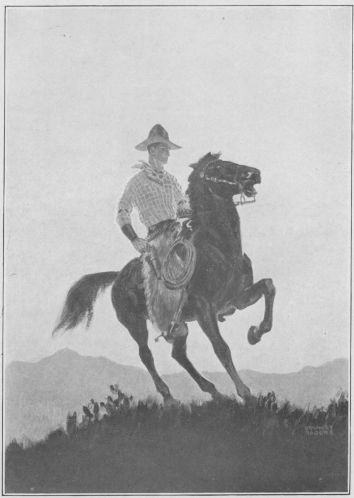
Clint Wadley, massive and powerful, slouched back in his chair with one
leg thrown over an arm of it. He puffed at a corncob pipe, and through
the smoke watched narrowly with keen eyes from under heavy grizzled
brows a young man standing on the porch steps.
"So now you know what I expect, young fellow," he said brusquely. "Take
it or leave it; but if you take it, go through."
Arthur Ridley smiled. "Thanks, I'll take it."
The boy was not so much at ease as his manner suggested. He knew that
the owner of the A T O was an exacting master. The old cattleman was
game himself. Even now he would fight at the drop of the hat if
necessary. In the phrase which he had just used, he would "go through"
anything he undertook. Men who had bucked blizzards with him in the old
days admitted that Clint would do to take along. But Ridley's awe of him
was due less to his roughness and to the big place he filled in the life
of the Panhandle than to the fact that he was the father of his
daughter. It was essential to Arthur's plans that he stand well with the
old-timer.
Though he did not happen to know it, young Ridley was a favorite of the
cattle king. He had been wished on him by an old friend, but there was
something friendly and genial about the boy that won a place for him.
His smile was modest and disarming, and his frank face was better than
any letter of recommendation.
But though Wadley was prepared to like him, his mind held its
reservations. The boy had come from the East, and the standards of that
section are not those of the West. The East asks of a man good family,
pleasant manners, a decent reputation, and energy enough to carry a man
to success along conventional lines. In those days the frontier West
demanded first that a man be game, and second that he be one to tie to.
He might be good or bad, but whichever he was, he, must be efficient to
make any mark in the turbulent country of the border. Was there a hint
of slackness in the jaw of this good-looking boy? Wadley was not sure,
but he intended to find out.
"You'll start Saturday. I'll meet you at Tascosa two weeks from to-day.
Understand?" The cattleman knocked the ashes from his pipe and rose. The
interview was at an end.
Young Ridley nodded. "I'll be there, sir—with the six thousand dollars
safe as if they were in a vault."
"H'm! I see you carry a six-shooter. Can you shoot?" Wadley flung at him
abruptly.
Arthur Ridley had always fancied himself as a shot. He had belonged to a
gun-club at home, and since coming to the Southwest he had practiced a
good deal with the revolver.
"Pretty well, sir."
"Would you—if it was up to you?"
The youngster looked into the steel-gray eyes roofed by the heavy thatch
of brow. "I think so. I never have had to yet. In the East—"
Wadley waved the East back to where it belonged. "Yes, I know. But we're
talkin' about Texas. Still, I reckon you ought not to have any trouble
on this trip. Don't let anybody know why you are at the fort. Don't
gamble or drink. Get the money from Major Ponsford and melt away
inconspicuous into the brush. Hit the trail hard. A day and a night
ought to bring you to Tascosa."
The cattleman was leading the way with long strides into an open space
back of the house. A pile of empty cans, symbol of the arid lands, lay
beside the path. He picked up one and put it on a post. Then he stepped
off fifteen paces.
"Ventilate it," he ordered.
The boy drew his revolver, took a long, steady aim, and fired. The
bullet whistled past across the prairie. His second shot scored a clean
hit. With pardonable pride he turned to the cattleman.
"Set up another can," commanded Wadley.
From the pile of empties the young man picked another and put it on the
post. Wadley, known in Texas as a two-gun man, flashed into sight a pair
of revolvers almost quicker than the eye could follow. Both shots came
instantly and together. The cattleman had fired from the hips. Before
the can had reached the ground the weapons barked again.
Ridley ran forward and picked up the can. It was torn and twisted with
jagged holes, but the evidence was written there that all four bullets
had pierced the tin. The Easterner could hardly believe his eyes. Such
shooting was almost beyond human skill.
The owner of the A T O thrust into place his two forty-fives.
"If you're goin' to wear six-shooters, learn to use 'em, son. If you
don't, some bad-man is liable to bump you off for practice."
As the two men stepped around the corner of the house a girl came down
the steps of the porch. She was dressed in summer white, but she herself
was spring. Slim and lissome, the dew of childhood was still on her
lips, and the mist of it in her eyes. But when she slanted her long
lashes toward Arthur Ridley, it was not the child that peeped shyly and
eagerly out from beneath them. Her heart was answering the world-old
call of youth to youth.
"I'm going downtown, Dad," she announced.
Ridley stepped forward and lifted his hat. "May I walk with you, Miss
Ramona?"
"Stop at the post-office and see if the buckboard driver is in with the
mail, 'Mona," her father said.
The boy and the girl made a couple to catch and hold the eye.
They went down the street together chattering gayly. One of the things
young Ridley knew how to do well was to make himself agreeable to girls.
He could talk nonsense charmingly and could hold his own in the jolly
give-and-take of repartee. His good looks were a help. So too was the
little touch of affectionate deference he used. He had the gift of being
bold without being too bold.
It was a beautiful morning and life sang in the blood of Ramona. It
seemed to her companion that the warm sun caressed the little curls at
her temples as she moved down the street light as a deer. Little jets of
laughter bubbled from her round, birdlike throat. In her freshly
starched white dress, with its broad waistband of red and purple ribbon,
the girl was sweet and lovely and full of mystery to Ridley.
A little man with a goatee, hawk-nosed and hawk-eyed, came down the
street with jingling spurs to meet them. At sight of Ramona his eyes
lighted. From his well-shaped gray head he swept in a bow a jaunty,
broad-brimmed white hat.
The young girl smiled, because there were still a million unspent smiles
in her warm and friendly heart.
"Good-morning, Captain Ellison," she called.
"Don't know you a-tall, ma'am." He shook his head with decision. "Never
met up with you before."
"Good gracious, Captain, and you've fed me candy ever since I was a
sticky little kid."
He burlesqued a business of recognizing her with much astonishment. "You
ain't little 'Mona Wadley. No! Why, you are a young lady all dressed up
in go-to-meet-him clothes. I reckon my little side-partner has gone
forever."
"No, she hasn't, Uncle Jim," the girl cried. "And I want you to know I
still like candy."
He laughed with delight and slapped his thigh with his broad-brimmed
ranger hat. "By dog, you get it, 'Mona, sure as I'm a foot high."
Chuckling, he passed down the street.
"Captain Jim Ellison of the Rangers," explained Ramona to her companion.
"He isn't really my uncle, but I've known him always. He's a good old
thing and we're great friends."
Her soft, smiling eyes met those of Arthur. He thought that it was no
merit in Ellison to be fond of her. How could he help it?
"He's in luck," was all the boy said.
A little flag of color fluttered in her cheek. She liked his
compliments, but they embarrassed her a little.
"Did you fix it all up with Dad?" she asked, by way of changing the
subject.
"Yes. I'm to go to Fort Winston to get the money for the beeves, and if
I fall down on the job I'll never get another from him."
"I believe you're afraid of Dad," she teased.
"Don't you believe it—know it. I sure enough am," he admitted promptly.
"Why? I can twist him round my little finger," she boasted.
"Yes, but I'm not his only daughter and the prettiest thing in West
Texas."
She laughed shyly. "Are you sure you're taking in enough territory?"
"I'll say south of Mason and Dixon's line, if you like."
"Really, he likes you. I can tell when Dad is for any one."
A sound had for some minutes been disturbing the calm peace of the
morning. It was the bawling of thirsty cattle. The young people turned a
corner into the main street of the town. Down it was moving toward them
a cloud of yellow dust stirred up by a bunch of Texas longhorns. The
call of the cattle for drink was insistent. Above it rose an occasional
sharp "Yip yip!" of a cowboy.
Ramona stopped, aghast. The cattle blocked the road, their moving backs
like the waves of a sea. The dust would irreparably soil the clean
frock fresh from the hands of her black mammy. She made as if to turn,
and knew with a flash of horror that it was too late.
Perhaps it was the gleam of scarlet in her sash that caught the eye of
the bull leading the van. It gave a bellow of rage, lowered its head,
and dashed at her.
Ramona gave a horror-stricken little cry of fear and stood motionless.
She could not run. The fascination of terror held her paralyzed. Her
heart died away in her while the great brute thundered toward her.
Out of the dust-cloud came a horse and rider in the wake of the bull.
Frozen in her tracks, Ramona saw with dilated eyes all that followed.
The galloping horse gained, was at the heels of the maddened animal,
drew up side by side. It seemed to the girl that in another moment she
must be trampled underfoot. Nothing but a miracle from God's blue could
save her.
For what registered as time without end to the girl's fear-numbed brain,
horse and bull raced knee to knee. Then the miracle came. The rider
leaned far out from the saddle, loosened his feet from the stirrups, and
launched himself at the crazed half-ton of charging fury.
His hands gripped the horns of the bull. He was dragged from the saddle
into the dust, but his weight deflected the course of the animal. With
every ounce of strength given by his rough life in the open the cowboy
hung on, dragging the head of the bull down with him toward the ground.
Man and beast came to a slithering halt together in a great cloud of
dust not ten feet from Ramona.
Even now terror held her a prisoner. The brute would free itself and
stamp the man to death. A haze gathered before her eyes. She swayed,
then steadied herself. Man and bull were fighting desperately, one with
sheer strength, the other with strength plus brains and skill. The
object of the animal was to free itself. The bull tossed wildly in
frantic rage to shake off this incubus that had fastened itself to its
horns. The man hung on for life. All his power and weight were centered
in an effort to twist the head of the bull sideways and back. Slowly,
inch by inch, by the steady, insistent pressure of muscles as well
packed as any in Texas, the man began to gain. The bull no longer tossed
and flung him at will. The big roan head went down, turned backward,
yielded to the pressure on the neck-muscles that never relaxed.
The man put at the decisive moment his last ounce of strength into one
last twist. The bull collapsed, went down heavily to its side.
A second cowboy rode up, roped the bull, and deftly hogtied it.
The bulldogger rose and limped forward to the girl leaning whitely
against a wall.
"Sorry, Miss Wadley. I hadn't ought to have brought the herd through
town. We was drivin' to water."
"Are you hurt?" Ramona heard her dry, faint voice ask.
"Me!" he said in surprise. "Why, no, ma'am."
He was a tall, lean youth, sunburned and tough, with a face that looked
sardonic. Ramona recognized him now as her father's new foreman, the man
she had been introduced to a few days before. Hard on that memory came
another. It was this same Jack Roberts who had taken her brother by
surprise and beaten him so cruelly only yesterday.
"It threw you around so," she murmured.
"Sho! I reckon I can curry a li'l ol' longhorn when I have it to do,
ma'am," he answered, a bit embarrassed.
"Are—are you hurt?" another voice quavered.
With a pang of pain Ramona remembered Arthur Ridley. Where had he been
when she so desperately needed help?
"No. Mr. Roberts saved me." She did not look at Ridley. A queer feeling
of shame for him made her keep her eyes averted.
"I—went to get help for you," the boy explained feebly.
"Thank you," she said.
The girl was miserably unhappy. For the boy to whom she had given the
largesse of her friendship had fled in panic; the one she hated for
bullying and mistreating her brother had flung himself in the path of
the furious bull to save her.
Captain Ellison came running up. He bristled at the trail foreman like a
bantam. "What do you mean by drivin' these wild critters through town?
Ain't you got a lick o' sense a-tall? If anything had happened to this
little girl—"
The Ranger left his threat suspended in midair. His arms were round
Ramona, who was sobbing into his coat.
The red-headed foreman shifted his weight from one foot to another. He
was acutely uncomfortable at having made this young woman weep. "I ain't
got a word to say, Captain. It was plumb thoughtless of me," he
apologized.
"You come to my office this mo'nin' at twelve o'clock, young fellow.
Hear me? I've got a word to say to you."
"Yes," agreed the bulldogger humbly. "I didn't go for to scare the young
lady. Will you tell her I'm right sorry, Captain?"
"You eat yore own humble pie. You've got a tongue, I reckon," snorted
Ellison, dragging at his goatee fiercely.
The complexion of Roberts matched his hair. "I—I—I'm turrible sorry,
miss. I'd ought to be rode on a rail."
With which the range-rider turned, swung to the saddle of his pony
without touching the stirrups, and fairly bolted down the street after
his retreating herd.
CHAPTER V — CAPTAIN ELLISON HIRES A HAND
Captain Ellison was preparing for the Adjutant-General a report of a
little affair during which one of his men had been obliged to snuff out
the lives of a couple of Mexican horsethieves and seriously damage a
third. Writing was laborious work for the Captain of Rangers, though he
told no varnished tale. His head and shoulders were hunched over the
table and his fingertips were cramped close to the point of the pen.
Each letter as it was set down had its whispered echo from his pursed
lips.
"Doggone these here reports," he commented in exasperation. "Looks like
a man hadn't ought to make out one every time he bumps off a rustler."
He tugged at his goatee and read again what he had just written:
Then this José Barela and his gang of skoundrels struck out for the
Brazos with the stolen stock. Ranger Cullom trailed them to Goose
Creek and recovered the cattle. While resisting arrest Barela and
another Mexican were killed and a third wounded. Cullom brought
back the wounded man and the rustled stock.
A short noontime shadow darkened the sunny doorway of the adobe office.
Ellison looked up quickly, his hand falling naturally to the handle of
his forty-five. Among the Rangers the price of life was vigilance. A
tall, lean, young man with a sardonic eye and a sunburned face jingled
up the steps.
"Come in," snapped the Captain. "Sit down. With you in a minute."
The cowboy lounged in, very much at his ease. Roberts had been
embarrassed before Ramona Wadley that morning, but he was not in the
least self-conscious now. In the course of a short and turbid life he
had looked too many tough characters in the eye to let any mere man
disturb his poise.
"Do you spell scoundrel with a k?" the Ranger chief fired abruptly
at him.
"Nary a k, Captain. I spell it b-a-d m-a-n."
"H'mp!" snorted the little man. "Ain't you got no education? A man's got
to use a syllogism oncet in a while, I reckon."
"Mebbeso. What kind of a gun is it?" drawled Jack Roberts.
"A syllogism is a word meanin' the same as another word, like as if I
was to say caballo for horse or six-shooter for revolver."
"I see—or tough guy for Texas ranger."
"Or durn fool for Jack Roberts," countered Ellison promptly.
"Now you're shoutin', Cap. Stomp on me proper. I certainly need to be
curried."
Again the Ranger snorted. "H'mp! Been scarin' any more young ladies to
death?"
"No more this mo'nin', Captain," answered Jack equably.
"Nor grandstandin' with any more ladino steers?"
"I exhibit only once a day."
"By dog, you give a sure-enough good show," exploded Ellison. "You got
yore nerve, boy. Wait around till the prettiest girl in Texas can see
you pull off the big play—run the risk of havin' her trampled to death,
just so's you can grin an' say, 'Pleased to meet you, ma'am.' When I
call you durn fool, I realize it's too weak a name."
"Hop to it, Captain. Use up some real language on me. Spill out a lot of
those syllogisms you got bottled up inside you. I got it comin',"
admitted Roberts genially as he rolled a cigarette.
The Captain had been a mule-skinner once, and for five glorious minutes
he did himself proud while the graceless young cowpuncher beamed on
him.
"You sure go some, Cap," applauded the young fellow. "I'd admire to have
your flow of talk."
Ellison subsided into anticlimax. "Well, don't you ever drive yore wild
hill-critters through town again. Hear me, young fellow?"
"You'll have to speak to Wadley about that. I'm not his trail boss any
longer."
"Since when?"
"Since five o'clock yesterday evenin'. I was turnin' over the herd this
mo'nin' when the little lady showed up an' I had to pull off the
bulldoggin'."
"Wadley fire you?"
"That's whatever."
"Why?"
"Didn't like the way I mussed up son Rutherford, I kind o' gathered."
"Another of yore fool plays. First you beat up Wadley's boy; then you
'most massacree his daughter. Anything more?"
"That's all up to date—except that the old man hinted I was a
brand-burner."
"The deuce he did!"
"I judge that son Rutherford had told him I was one of the Dinsmore
gang. Seems I'm all right except for bein' a rowdy an' a bully an' a
thief an' a bad egg generally."
"H'mp! Said you was a rustler, did he?" The Ranger caressed his goatee
and reflected on this before he pumped a question at the line-rider.
"Are you?"
"No more than Rutherford Wadley."
The Captain shot a swift slant look at this imperturbable young man. Was
there a hidden meaning in that answer?
"What's the matter with Wadley? Does he expect you to let Ford run it
over you? That ain't like Clint."
"He's likely listened to a pack o' lies."
"And you haven't heard from him since?"
"Yes, I have. He sent me my check an' a hundred-dollar bill."
Ellison sat up. "What for?"
"For my fancy bulldoggin'." The hard eyes of the young fellow smouldered
with resentment.
"By dog, did Clint send you money for savin' 'Mona?"
"He didn't say what it was for—so I rolled up the bill an' lit a
cigarette with it."
"You take expensive smokes, young man," chuckled the officer.
"It was on Wadley. I burned only half the bill. He can cash in the other
half, for I sent it back to him. When he got it, he sent for me."
"And you went?"
"You know damn well I didn't. When he wants me, he knows where to find
me."
"Most young hill-billies step when Clint tells 'em to."
"Do they?" asked the range-rider indifferently.
"You bet you. They jump when he whistles. What are you figurin' to do?"
"Haven't made up my mind yet. Mebbe I'll drift along the trail to the
Pecos country."
"What was Clint payin' you?"
"Sixty a month an' found."
"How'd you like to have yore wages lowered?"
"Meanin'—"
"That I'll give you a job."
Young Roberts had a capacity for silence. He asked no questions now, but
waited for Ellison to develop the situation.
"With the Rangers. Dollar a day an' furnish yore own bronc," explained
the Captain.
"The State of Texas is liberal," said the cowboy with dry sarcasm.
"That's as you look at it. If you're a money-grubber, don't join us. But
if you'd like to be one of the finest fightin' force in the world with
somethin' doin' every minute, then you'd better sign up. I'll promise
that you die young an' not in yore bed."
"Sounds right attractive," jeered the red-haired youngster with amiable
irony.
"It is, for men with red blood in 'em," retorted the gray-haired
fire-eater hotly.
"All right. I'll take your word for it, Captain. You've hired a hand."
CHAPTER VI — CLINT WADLEY'S MESSENGER
Outside the door of the commandant's office Arthur Ridley stood for a
moment and glanced nervously up and down the dirt road. In a hog-leather
belt around his waist was six thousand dollars just turned over to him
by Major Ponsford as the last payment for beef steers delivered at the
fort according to contract some weeks earlier.
Arthur had decided not to start on the return journey until next
morning, but he was not sure his judgment had been good. It was still
early afternoon. Before nightfall he might be thirty miles on his way.
The trouble with that was that he would then have to spend two nights
out, and the long hours of darkness with their flickering shadows cast
by the camp-fires would be full of torture for him. On the other hand,
if he should stay till morning, word might leak out from the officers'
quarters that he was carrying a large sum of money.
A drunken man came weaving down the street. He stopped opposite Ridley
and balanced himself with the careful dignity of the inebriate. But the
gray eyes, hard as those of a gunman, showed no trace of intoxication.
Nor did the steady voice.
"Friend, are you Clint Wadley's messenger?"
The startled face of Ridley flew a flag of confession. "Why—what do you
mean?" he stammered. Nobody was to have known that he had come to get
the money for the owner of the A T O.
"None of my business, you mean," flung back the man curtly. "Good
enough! It ain't. What's more, I don't give a damn. But listen: I was at
the Buffalo Hump when two fellows came in. Me, I was most asleep, and
they sat in the booth next to me. I didn't hear all they said, but I got
this—that they're aimin' to hold up some messenger of Clint Wadley
after he leaves town to-morrow. You're the man, I reckon. All right. Look
out for yourself. That's all."
"But—what shall I do?" asked Ridley.
"Do? I don't care. I'm tellin' you—see? Do as you please."
"What would you do?" The danger and the responsibility that had fallen
upon him out of a sky of sunshine paralyzed the young man's initiative.
The deep-set, flinty eyes narrowed to slits. "What I'd do ain't
necessarily what you'd better do. What are you, stranger—high-grade
stuff, or the run o' the pen?"
"I'm no gun-fighter, if that's what you mean."
"Then I'd make my get-away like a jackrabbit hell-poppin' for its hole.
I got one slant at these fellows in the Buffalo Hump. They're bully-puss
kind o' men, if you know what I mean."
"I don't. I'm from the East."
"They'll run it over you, bluff you off the map, take any advantage they
can."
"Will they fight?"
"They'll burn powder quick if they get the drop on you."
"What are they like?"
The Texan considered. "One is a tall, red-headed guy; the other's a
sawed-off, hammered-down little runt—but gunmen, both of 'em, or I'm a
liar."
"They would probably follow me," said the messenger, worried.
"You better believe they will, soon as they hear you've gone."
Arthur kicked a little hole in the ground with the toe of his shoe. What
had he better do? He could stay at the fort, of course, and appeal to
Major Ponsford for help. But if he did, he would probably be late for
his appointment with Wadley. It happened that the cattleman and the army
officer had had a sharp difference of opinion about the merits of the
herd that had been delivered, and it was not at all likely that Ponsford
would give him a military guard to Tascosa. Moreover, he had a feeling
that the owner of the A T O would resent any call to the soldiers for
assistance. Clint Wadley usually played his own hand, and he expected
the same of his men.
But the habit of young Ridley's life had not made for fitness to cope
with a frontier emergency. Nor was he of stiff enough clay to fight free
of his difficulty without help.
"What about you?" he asked the other man. "Can I hire you to ride with
me to Tascosa?"
"As a tenderfoot-wrangler?" sneered the Texan.
Arthur flushed. "I've never been there. I don't know the way."
"You follow a gun-barrel road from the fort. But I'll ride with you—if
the pay is right."
"What do you say to twenty dollars for the trip?"
"You've hired me."
"And if we're attacked?"
"I pack a six-shooter."
The troubled young man looked into the hard, reckless face of this
stranger who had gone out of his way to warn him of the impending
attack. No certificate was necessary to tell him that this man would
fight.
"I don't know your name," said Ridley, still hesitating.
"Any more than I know yours," returned the other. "Call me Bill Moore,
an' I'll be on hand to eat my share of the chuck."
"We'd better leave at once, don't you think?"
"You're the doc. Meet you here in an hour ready for the trail."
The man who called himself Bill Moore went his uncertain way down the
street. To the casual eye he was far gone in drink. Young Ridley went
straight to the corral where he had put up his horse. He watered and fed
the animal, and after an endless half-hour saddled the bronco.
Moore joined him in front of the officers' quarters, and together they
rode out of the post. As the Texan had said, the road to Tascosa ran
straight as a gun-barrel. At first they rode in silence, swiftly,
leaving behind them mile after mile of dusty trail. It was a brown,
level country thickly dotted with yucca. Once Moore shot a wild turkey
running in the grass. Prairie-chicken were abundant, and a flight of
pigeons numbering thousands passed at one time over their heads and
obscured the sky.
"Goin' down to the encinal to roost," explained Moore.
"A man could come pretty near living off his rifle in this country,"
Arthur remarked.
"Outside o' flour an' salt, I've done it many a time. I rode through the
Pecos Valley to Fort Sumner an' on to Denver oncet an' lived off the
land. Time an' again I've done it from the Brazos to the Canadian. If
he gets tired of game, a man can jerk the hind quarters of a beef.
Gimme a young turkey fed on sweet mast an' cooked on a hackberry bush
fire, an' I'll never ask for better chuck," the Texan promised.
In spite of Ridley's manifest desire to push on far into the night,
Moore made an early camp.
"No use gauntin' our broncs when we've got all the time there is before
us. A horse is a man's friend. He don't want to waste it into a
sorry-lookin' shadow. Besides, we're better off here than at Painted
Rock. It's nothin' but a whistlin'-post in the desert."
"Yes, but I'd like to get as far from the fort as we can. I—I'm in a
hurry to reach Tascosa," the younger man urged.
Moore opened a row of worn and stained teeth to smile. "Don't worry,
young fellow. I'm with you now."
After they had made camp and eaten, the two men sat beside the
flickering fire, and Moore told stories of the wild and turbulent life
he had known around Dodge City and in the Lincoln County War that was
still waging in New Mexico. He had freighted to the Panhandle from El
Moro, Colorado, from Wichita Falls, and even from Dodge. The consummate
confidence of the man soothed the unease of the young fellow with the
hogskin belt. This plainsman knew all that the Southwest had to offer of
danger and was equal to any of it.
Presently Arthur Ridley grew drowsy. The last that he remembered before
he fell asleep was seeing Moore light his pipe again with a live coal
from the fire. The Texan was to keep the first watch.
It was well along toward morning when the snapping of a bush awakened
Ridley. He sat upright and reached quickly for the revolver by his side.
"Don't you," called a voice sharply from the brush.
Two men, masked with slitted handkerchiefs, broke through the shin-oak
just as Arthur whipped up his gun. The hammer fell once—twice, but no
explosion followed. With two forty-fives covering him, Ridley, white to
the lips, dropped his harmless weapon.
Moore came to life with sleepy eyes, but he was taken at a disadvantage,
and with a smothered oath handed over his revolver.
"Wha-what do you want?" asked Ridley, his teeth chattering.
The shorter of the two outlaws, a stocky man with deep chest and
extraordinarily broad shoulders, growled an answer.
"We want that money of Clint Wadley's you're packin'."
The camp-fire had died to ashes, and the early-morning air was chill.
Arthur felt himself trembling so that his hands shook. A prickling of
the skin went goose-quilling down his back. In the dim light those
masked figures behind the businesslike guns were sinister with the
threat of mystery and menace.
"I—haven't any money," he quavered.
"You'd better have it, young fellow, me lad!" jeered the tall bandit.
"We're here strictly for business. Dig up."
"I don't reckon he's carryin' any money for Clint," Moore argued mildly.
"Don't look reasonable that an old-timer like Clint, who knocked the
bark off'n this country when I was still a kid, would send a tenderfoot
to pack gold 'cross country for him."
The tall man swung his revolver on Moore. "'Nuff from you," he ordered
grimly.
The heavy-set outlaw did not say a word. He moved forward and pressed
the cold rim of his forty-five against the forehead of the messenger.
The fluttering heart of the young man beat hard against his ribs. His
voice stuck in his throat, but he managed to gasp a surrender.
"It's in my belt. For God's sake, don't shoot."
"Gimme yore belt."
The boy unbuckled the ribbon of hogskin beneath his shirt and passed it
to the man behind the gun. The outlaw noticed that his fingers were cold
and clammy.
"Stand back to back," commanded the heavy man.
Deftly he swung a rope over the heads of his captives, jerked it tight,
wound it about their bodies, knotted it here and there, and finished
with a triple knot where their heels came together.
"That'll hold 'em hitched a few minutes," the lank man approved after he
had tested the rope.
"I'd like to get a lick at you fellows. I will, too, some day,"
mentioned Moore casually.
"When you meet up with us we'll be there," retorted the heavy-weight.
"Let's go, Steve."
The long man nodded. "Adiós, boys."
"See you later, and when I meet up with you, it'll be me 'n' you to a
finish," the Texan called.
The thud of the retreating, hoofs grew faint and died. Already Moore was
busy with the rope that tied them together.
"What's the matter, kid? You shakin' for the drinks? Didn't you see from
the first we weren't in any danger? If they'd wanted to harm us, they
could have shot us from the brush. How much was in that belt?"
"Six thousand dollars," the boy groaned.
"Well, it doesn't cost you a cent. Cheer up, son."
By this time Moore had both his arms free and was loosening one of the
knots.
"I was in charge of it. I'll never dare face Mr. Wadley."
"Sho! It was his own fault. How in Mexico come he to send a boy to
market for such a big stake?"
"Nobody was to have known what I came for. I don't see how it got out."
"Must 'a' been a leak somewhere. Don't you care. Play the hand that's
dealt you and let the boss worry. Take it from me, you're lucky not to
be even powder-burnt when a shot from the chaparral might have done yore
business."
"If you only hadn't fallen asleep!"
"Reckon I dozed off. I was up 'most all last night." Moore untied the
last knot and stepped out from the loop. "I'm goin' to saddle the
broncs. You ride in to Tascosa and tell Wadley. I'll take up the trail
an' follow it while it's warm. We'll see if a pair of shorthorns can run
a sandy like that on me." He fell suddenly into the violent, pungent
speech of the mule-skinner.
"I'll go with you," announced Ridley. He had no desire to face Clint
Wadley with such a lame tale.
The cold eyes of the Texan drilled into his. "No, you won't. You'll go
to town an' tell the old man what's happened. Tell him to send his posse
across the malpais toward the rim-rock. I'll meet him at Two Buck
Crossin' with any news I've got."
A quarter of an hour later the hoofs of his horse flung back faint
echoes from the distance. The boy collapsed. His head sank into his
hands and his misery found vent in sobs.
CHAPTER VII — THE DANCE
Long since the sun had slid behind the horizon edge and given place to a
desert night of shimmering moonlight and far stars. From the enchanted
mesa Rutherford Wadley descended to a valley draw in which were huddled
a score of Mexican jacals, huts built of stakes stuck in a trench,
roofed with sod and floored with mud. Beyond these was a more
pretentious house. Originally it had been a log "hogan," but a large
adobe addition had been constructed for a store. Inside this the dance
was being held.
Light filtered through the chinks in the mud. From door and windows came
the sounds of scraping fiddles and stamping feet. The singsong voice of
the caller and the occasional whoop of a cowboy punctuated the medley of
noises.
A man whose girth would have put Falstaff to shame greeted Rutherford
wheezily. "Fall off and 'light, Ford. She's in full swing and the
bridle's off."
The man was Jumbo Wilkins, line-rider for the A T O.
Young Wadley swung to the ground. He did not trouble to answer his
father's employee. It was in little ways like this that he endeared
himself to those at hand, and it was just this spirit that the
democratic West would not tolerate. While the rider was tying his horse
to the hitch-rack, Jumbo Wilkins, who was a friendly soul, made another
try at conversation.
"Glad you got an invite. Old man Cobb hadn't room for everybody, so he
didn't make his bid wide open."
The young man jingled up the steps. "That so? Well, I didn't get an
invite, as you call it. But I'm here." He contrived to say it so
offensively that Jumbo flushed with anger.
Wadley sauntered into the room and stood for a moment by the door. His
trim, graceful figure and dark good looks made him at once a focus of
eyes. Nonchalantly he sunned himself in the limelight, with that little
touch of swagger that captures the imagination of girls. No man in the
cow-country dressed like Rutherford Wadley. In the kingdom of the blind
the one-eyed are kings, and to these frontier women this young fellow
was a glass of fashion. There was about him, too, a certain dash, a
spice of the devil more desirable in a breaker of hearts than any mere
beauty.
His bold, possessive eyes ranged over the room to claim what they might
desire. He had come to the dance at Tomichi Creek to make love to Tony
Alviro's betrothed sweetheart Bonita.
She was in the far corner with her little court about her. If Bonita
was a flirt, it must be admitted she was a charming one. No girl within
a day's ride was so courted as she. Compact of fire and passion,
brimming with life and health, she drew men to her as the flame the
moth.
Presently the music started. Bonita, in the arms of Tony, floated past
Rutherford, a miracle of supple lightness. A flash of soft eyes darted
at the heir of the A T O ranch. In them was a smile adorable and
provocative.
As soon as the dance was over, Wadley made his way indolently toward
her. He claimed the next waltz.
She had promised it to Tony, the girl said—and the next.
"Tony can't close-herd you," laughed Rutherford. "His title ain't clear
yet—won't be till the priest has said so. You'll dance the second one
with me, Bonita."
"We shall see, señor," she mocked.
But the Mexican blood in the girl beat fast. In her soft, liquid eyes
lurked the hunger for sex adventure. And this man was a prince of the
blood—the son of Clint Wadley, the biggest cattleman in West Texas.
There were challenging stars of deviltry in Bonita's eyes when they met
those of Rutherford over the shoulder of Alviro while she danced, but
the color was beating warm through her dark skin. The lift of her round,
brown throat to an indifferent tilt of the chin was mere pretense. The
languorous passion of the South was her inheritance, and excitement
mounted in her while she kept time to the melodious dance.
Alviro was master of ceremonies, and Wadley found his chance while the
young Mexican was of necessity away from Bonita. Rutherford bowed to her
with elaborate mockery.
"Come. Let us walk in the moonlight, sweetheart," he said.
Bonita turned to him with slow grace. The eyes of the man and the woman
met and fought. In hers there was a kind of savage fierceness, in his an
insolent confidence.
"No," she answered.
"Ah! You're afraid of me—afraid to trust yourself with me," he boasted.
She was an untutored child of the desert, and his words were a spur to
her quick pride. She rose at once, her bosom rising and falling fast.
She would never confess that—never.
The girl walked beside him with the fluent grace of youth, beautiful as
a forest fawn. In ten years she would be fat and slovenly like her
Mexican mother, but now she carried her slender body as a queen is
supposed to but does not. Her heel sank into a little patch of mud where
some one had watered a horse. Under the cottonwoods she pulled up her
skirt a trifle and made a moue of disgust at the soiled slipper.
"See what you've done!" Small, even teeth, gleamed in a coquettish smile
from the ripe lips of the little mouth. He understood that he was being
invited to kneel and clean the mud-stained shoe.
"If you're looking for a doormat to wipe your feet on, I'll send for
Tony," he jeered.
The father of Bonita was Anglo-Saxon. She flashed anger at his
presumption.
"Don't you think it. Tony will never be a doormat to anybody. Be warned,
señor, and do not try to take what is his."
Again their eyes battled. Neither of them saw a man who had come out
from the house and was watching them from the end of the porch.
"I take what the gods give, my dear, and ask leave of no man," bragged
Wadley.
"Or woman?"
"Ah! That is different. When the woman is Bonita, muchacha, I am her
slave."
He dropped to one knee and with his handkerchief wiped the mud from the
heel of her slipper. For a moment his fingers touched lightly the trim
little ankle; then he rose quickly and caught her in his arms.
"Sometime—soon—it's going to be me and you, sweetheart," he whispered.
"Don't," she begged, struggling against herself and him. "If Tony
sees—"
His passion was too keen-edged to take warning. He kissed her lips and
throat and eyes. The eyes of the watcher never wavered. They were
narrowed to shining slits of jet.
"Why do you come and—and follow me?" the girl cried softly. "It is not
that you do not know Tony is jealous. This is not play with him. He
loves me and will fight for me. You are mad."
"For love of you!" he laughed triumphantly.
She knew he lied. The instinct that served her for a conscience had long
since told her as much. But her vanity, and perhaps something deeper,
craved satisfaction. She wanted to believe he meant it. Under his ardent
gaze the long lashes of the girl drooped to her dusky cheeks. It was
Tony she loved, but Tony offered her only happiness and not excitement.
A moment later she gave a startled little cry and pushed herself free.
Her dilated eyes were fixed on something behind the cattleman.
Rutherford, warned by her expression, whirled on his heel.
Tony Alviro, knife in hand, was close upon him. Wadley lashed out hard
with his left and caught the Mexican on the point of the chin.
The blow lifted Tony from his feet and flung him at full length to the
ground. He tried to rise, groaned—rolled over.
Bonita was beside him in an instant. From where she knelt, with Tony's
dark head in her arms pressed close to her bosom, she turned fiercely
on Wadley.
"I hate you, dog of a gringo! You are all one big lie through and
through—what they call bad egg—no good!"
Already half a dozen men were charging from the house. Jumbo pinned
Wadley's arms by the elbows to prevent him from drawing a revolver.
"What's the rumpus?" he demanded.
"The fellow tried to knife me in the back," explained Rutherford.
"Jealous, because I took his girl."
"So?" grunted Wilkins. "Well, you'd better light a shuck out o' here.
You came on yore own invite. You can go on mine."
"Why should I go? I'll see you at Tombstone first."
"Why?" Jumbo's voice was no longer amiable and ingratiating. "Because
you gave Tony a raw deal, an' he's got friends here. Have you?"
Wadley looked round and saw here and there Mexican faces filled with
sullen resentment. It came to him swiftly that this was no place for his
father's son to linger.
"I don't push my society on any one," he said haughtily. "If I ain't
welcome, I'll go. But I serve notice right here that any one who tries
to pull a knife on me will get cold lead next time."
Jumbo, with his arm tucked under that of Wadley, led the way to the
house. He untied the rein of Rutherford's horse and handed it to the
son of his boss.
"Vamos!" he said.
The young man pulled himself to the saddle. "You're a hell of a friend,"
he snarled.
"Who said anything about bein' a friend? I'm particular about when I use
that word," replied Wilkins evenly, with hard eyes.
Wadley's quirt burned the flank of the cow-pony and it leaped for the
road.
When five minutes later some one inquired for Tony he too had
disappeared.
CHAPTER VIII — RUTHERFORD MAKES A MISTAKE
Rutherford Wadley struck across country toward the rim-rock. Anger
burned high in him, and like the bully he was he took it out of his good
horse by roweling its sides savagely. He plunged into the curly
mesquite, driving forward straight as an arrow. Behind him in the
darkness followed a shadow, sinister and silent, out of sight, but
within sound of the horse's footfall. It stopped when Wadley stopped;
when he moved, it moved.
Midnight found young Wadley still moving straight forward, the moon on
his left. Painted Rock was ten miles to the west. Except for the stage
station there, and the settlement he had left, there was no other
habitation for fifty miles. It was a wilderness of silence.
Yet in that waste of empty space Rutherford "jumped up" a camper. The
man was a trader, carrying honey and pecans to Fort Worth. He was
awakened by the sound of a raucous curse, he testified later, and in the
bright moonlight saw the young cattleman beating his horse. Evidently
the young animal had been startled at sight of his white-topped wagon.
An angry sentence or two passed between the men before the cattleman
moved over the hill-brow. As the trader rolled up again in his sugun,
there came to him faintly the sound of another horse. He was not able to
explain later why this struck him as ominous, beyond the strangeness of
the fact that two men, not in each other's company, should be traveling
so close together in the desert. At any rate, he rose, crept forward to
a clump of Spanish bayonet, and from behind it saw a young Mexican pass
along the swale. He was close enough almost to have touched him, and in
the rich moonlight saw the boyish face clearly.
By the time Wadley reached the rough country of the cap-rock, the young
day was beginning to awaken. A quail piped its morning greeting from the
brush. A gleam of blue in the dun sky flashed warning of a sun soon to
rise. He had struck the rim-rock a little too far to the right, and
deflected from his course to find the pocket he was seeking. For half a
mile he traveled parallel to the ridge, then turned into a break in the
wall. At the summit of a little rise he gave a whistle.
Presently, from above a big boulder, a head appeared cautiously.
"Hello, out there! Who is it?"
"Ford."
The rider swung to the ground stiffly and led his horse forward down a
sharply descending path to a little draw. A lank, sallow man with a
rifle joined him. With his back to a flat rock, a heavy-set,
broad-shouldered fellow was lounging.
"'Lo, Ford. Didn't expect you to-night," he grumbled.
"Drifted over from the dance at Tomichi Creek. Beat up a young Mexican
and had to get out."
"You're such a sullen brute! Why can't you let folks alone?" Pete
Dinsmore wanted to know.
He was annoyed. Rutherford Wadley was not a partner in the business on
hand to-night, and he would rather the man had been a hundred miles
away.
"He got jealous and tried to knife me," explained the heir of the A T O
sulkily.
"You durn fool! Won't you ever learn sense? Who was it this time?"
"Tony Alviro. His girl's crazy about me."
The keen, hard eyes of Dinsmore took in the smug complacency of the
handsome young cad. He knew that this particular brand of fool would go
its own way, but he wasted a word of advice.
"I don't guess you want any pearls o' wisdom from me, but I'll onload
some gratis. You let Bonita Menendez alone or Tony will camp on yore
trail till he gits you."
"Sure will," agreed Gurley, setting down his rifle. "Them Mexicans hang
together, too. We need their friendship in our business. Better lay off
them."
"I don't remember askin' your advice, Gurley."
"Well, I'm givin' it. See?"
Another sharp whistle cut the air. Gurley picked up the rifle again and
climbed the lookout rock. Presently he returned with a dismounted
horseman. The man was the one who had introduced himself to Arthur
Ripley a few hours earlier as Bill Moore.
"Howdy, boys. Got the stuff all safe?" he asked cheerfully.
From behind Wadley Pete Dinsmore was making a series of facial
contortions. Unfortunately the new arrival did not happen to be looking
at him, and so missed the warning.
"Never saw anything work prettier," Moore said with a grin as he put
down his saddle on a boulder. "Ridley hadn't ought to be let out without
a nurse. He swallowed my whole yarn—gobbled down bait, sinker an' line.
Where's the gold, Pete?"
"In a sack back of the big rock." Pete was disgusted with his brother
Homer, alias Bill Moore. They would probably have to divide with young
Wadley now, to keep his mouth shut.
Rutherford jumped at the truth. His father had told him that he was
going to give Art Ridley a try-out by sending him to the fort for a
payment of gold. Probably he, Rutherford, had mentioned this to one of
the gang when he was drunk. They had held up the messenger, intending to
freeze him out of any share of the profits. All right—he would show
them whether he was a two-spot.
"Bring out the sack. Let's have a look at it," he ordered.
Gurley handed the sack to Pete Dinsmore, and the men squatted in a
circle tailor-fashion.
"Smooth work, I call it," said Homer Dinsmore. He explained to Wadley
why he was of this opinion. "Steve heard tell of a wagon-train goin' to
Tascosa to-day. If Ridley slept overnight at the fort he would hear of
it an' stay with the freight outfit till he had delivered the gold to
yore dad. We had to get him started right away. So I pulled on him a
story about hearin' the boys intended to hold him up. He hired me as a
guard to help him stand off the bad men. Whilst I was keepin' watch I
fixed up his six-shooter so's it wouldn't do any damage if it went off.
Best blamed piece of work I ever did pull off. I'd ought to get a half
of what we took off'n him instead of a third."
"A third! Who says you get a third?" asked Wadley.
"Three of us did this job, didn't we?" cut in Gurley.
"Sure. You took what belongs to me—or at least to my dad," protested
young Wadley. "Tried to slip one over on me. Guess again, boys. I won't
stand for it."
The jade eyes of the older brother narrowed. "Meanin' just what, Ford?"
"What do you take me for, Pete? Think I'm goin' to let you rob me of my
own money an' never cheep? I'll see you all in blazes first," cried
Wadley wildly.
"Yes, but—just what would you do about it?"
"Do? I'll ride to town an' tell Cap Ellison. I'll bust you up in
business, sure as hell's hot."
There was a moment of chill silence. Three of the four men present knew
that Rutherford Wadley had just passed sentence of death upon himself.
They had doubted him before, vaguely, and without any definite reason.
But after this open threat the fear that he would betray them would
never lift until he was where he could no longer tell tales.
"How much of this money do you think is comin' to you, Ford?" asked Pete
quietly.
"It's all mine, anyhow. You boys know that." Rutherford hesitated; then
his greed dominated. He had them where they had to eat out of his hand.
"Give me two thirds, an' you fellows divide the other third for your
trouble. That's fair."
"Goddlemighty, what's eatin' you?" Gurley exploded. "Think we're plumb
idjits? You 'n' me will mix bullets first, you traitor!"
The Dinsmores exchanged one long, significant look. Then Pete spoke
softly.
"Don't get on the prod, Steve. Ford sure has got us where the wool's
short, but I reckon he aims to be reasonable. Let's say half for you,
Ford, an' the other half divided among the rest of us."
Wadley had refreshed himself out of a bottle several times during the
night. Ordinarily he would have accepted the proposed compromise, but
the sullen and obstinate side of him was uppermost.
"You've heard my terms, Pete. I stand pat."
Again a significant look passed, this time between Pete Dinsmore and
Gurley.
"All right," said Homer Dinsmore shortly. "It's a raw deal you're givin'
us, but I reckon you know yore own business, Wadley."
The money was emptied from the pigskin belt and divided. Rutherford
repacked his two thirds in the belt and put it on next his shirt.
"I don't know what you fellows are goin' to do, but I'm goin' to strike
for town," he said. "I aim to get back in time to join one of the posses
in their hunt for the outlaws."
His jest did not win any smiles. The men grimly watched him saddle and
ride away. A quarter of an hour later they too were in the saddle.
CHAPTER IX — MURDER IN THE CHAPARRAL
To Jack Roberts, engaged at the Delmonico restaurant in the serious
business of demolishing a steak smothered in onions, came Pedro Menendez
with a strange story of a man lying dead in the rim-rock, a bullet-hole
in the back of his head.
The Mexican vaquero came to his news haltingly. He enveloped it in
mystery. There was a dead man lying at the foot of Battle Butte, out in
the rim-rock country, and there was this wound in the back of his head.
That was all. Pedro became vague at once as to detail. He took refuge in
shrugs and a poor memory when the Ranger pressed him in regard to the
source of his information.
Roberts knew the ways of the Mexicans. They would tell what they wanted
to tell and no more. He accepted the news given him and for the moment
did not push his questions home.
For twenty-four hours the Ranger had been in the saddle, and he was
expecting to turn in for a round-the-clock sleep. But Pedro's tale
changed his mind. Captain Ellison was at Austin, Lieutenant Hawley at
Tascosa. Regretfully Roberts gave up his overdue rest and ordered
another cup of strong coffee. Soon he was in the saddle again with a
fresh horse under him.
The Panhandle was at its best. Winter snows and spring rains had set it
blooming. The cacti were a glory of white, yellow, purple, pink, and
scarlet blossoms. The white, lilylike flowers of the Spanish bayonet
flaunted themselves everywhere. Meadowlarks chirruped gayly and
prairie-hens fluttered across the path in front of the rider.
Battle Butte had received its name from an old tradition of an Indian
fight. Here a party of braves had made a last stand against an
overwhelming force of an enemy tribe. It was a flat mesa rising sharply
as a sort of bastion from the rim-rock. The erosions of centuries had
given it an appearance very like a fort.
Jack skirted the base of the butte. At the edge of a clump of prickly
pear he found the evidence of grim tragedy which the circling buzzards
had already warned him to expect. He moved toward it very carefully, in
order not to obliterate any footprints. The body lay face down in a
huddled heap, one hand with outstretched finger reaching forth like a
sign-post. A bullet-hole in the back of the head showed how the man had
come to his death. He had been shot from behind.
The Ranger turned the body and recognized it as that of Rutherford
Wadley. The face was crushed and one of the arms broken. It was an easy
guess that the murder had been done on the butte above and the body
flung down.
Jack, on all fours, began to quarter over the ground like a bloodhound
seeking a trail. Every sense in him seemed to quicken to the hunt. His
alert eyes narrowed in concentration. His fingertips, as he crept
forward, touched the sand soft as velvet. His body was tense as a coiled
spring. No cougar stalking its prey could have been more lithely wary.
For the Ranger had found a faint boot-track, and with amazing pains he
was following this delible record of guilt. Some one had come here and
looked at the dead body. Why? To make sure that the victim was quite
dead? To identify the victim? Roberts did not know why, but he meant to
find out.
The footprint was alone. Apparently none led to it or led from it. On
that one impressionable spot alone had been written the signature of a
man's presence.
But "Tex" Roberts was not an old plainsman for nothing. He knew that if
he were patient enough he would find other marks of betrayal.
He found a second track—a third, and from them determined a course to
follow. It brought him to a stretch of soft ground at the edge of a
wash. The footprints here were sharp and distinct. They led up an arroyo
to the bluff above.
The Ranger knelt dose to the most distinct print and studied it for a
long time. All its details and peculiarities were recorded in his mind.
The broken sole, the worn heel, the beveled edge of the toe-cap—all
these fastened themselves in his memory. With a tape-line he measured
minutely the length of the whole foot, of the sole and of the heel.
These he jotted down in his notebook, together with cross-sections of
width. He duplicated this process with the best print he could find of
the left foot.
His investigation led him next to the summit of the bluff. A little
stain of blood on a rock showed him where Wadley had probably been
standing when he was shot. The murder might have been done by treachery
on the part of one of his companions. If so, probably the bullet had
been fired from a revolver. In that case the man who did it would have
made sure by standing close behind his victim. This would have left
powder-marks, and there had been none around the wound. The chances were
that the shooting had been done from ambush, and if this was a true
guess, it was a fair deduction that the assassin had hidden behind the
point of rocks just back of the bluff. For he could reach that point by
following the rim-rock without being seen by his victim.
Roberts next studied the ground just back of the point of rocks. The
soil here was of disintegrated granite, so that there were no
footprints to betray anybody who might have been hidden there. But Jack
picked up something that was in its way as decisive as what he had been
seeking. It was a cartridge that had been ejected from a '73[1] rifle.
The harmless bit of metal in his hand was the receptacle from which
death had flashed across the open toward Ford Wadley.
At the foot of the rim-rock the Ranger found signs where horses had been
left. He could not at first make sure whether there were three or four.
From that spot he back-tracked for miles along the edge of the rim-rock
till he came to the night-camp where Wadley had met the outlaws. This,
too, he studied for a long time.
He had learned a good deal, but he did not know why Ford Wadley had been
shot. The young fellow had not been in Texas more than six or eight
months, and he could not have made many enemies. If he had nothing about
him worth stealing—and in West Texas men were not in the habit of
carrying valuables—the object could not have been robbery.
He rode back to Battle Butte and carried to town with him the body of
the murdered man. There he heard two bits of news, either of which might
serve as a cause for the murder: Young Wadley had quarreled with Tony
Alviro at a dance and grossly insulted him; Arthur Ridley had been
robbed of six thousand dollars by masked men while on his way to
Tascosa.
Ranger Roberts decided that he would like to have a talk with Tony.