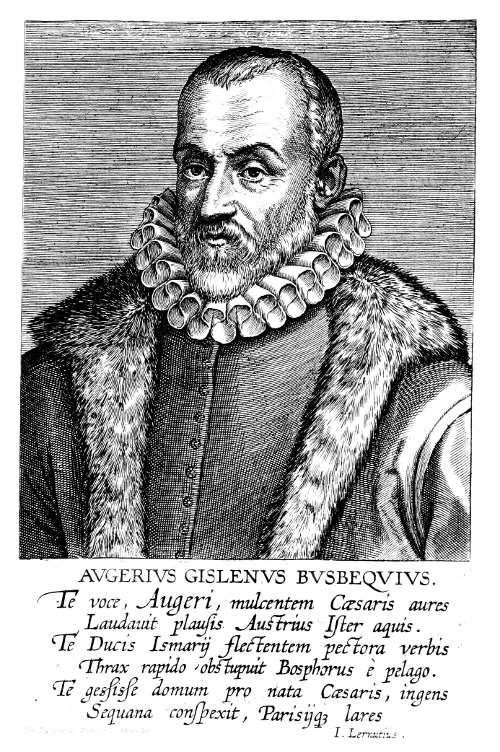
Introduction—Departure of Busbecq’s colleagues and preceding negotiations—Turkish
hawking—Busbecq summoned to Adrianople—Earthquake
there—Account of earthquake at Constantinople—Busbecq
returns to Constantinople—Hires a house there—Is forced to go
back to his former abode—Description of it—Anecdotes of animals
in it—Busbecq’s menagerie—How Busbecq’s friend availed himself of
the Turkish abhorrence of pigs—Stories of a lynx, a crane, a stag—Turkish
mendicants—Turkish slaves—Busbecq’s kite-shooting—His
tame partridges from Chios—Mode of keeping them—Artificial egg-hatching
in Egypt—Turkish horses—Camels—Their use in war—Turkish
commissariat—Turkish and Christian soldiers contrasted—Their
clothing and equipment—Illustration from Cæsar of Turkish
tactics—Turkish kindness to animals—Cats preferred to dogs—Mahomet
and his cat—Narrow escape of a Venetian who ill-treated a bird—Turkish
fondness for birds—Tame nightingales and goldfinches—Turkish
women and marriage laws—Divorces—Baths for women—Extraordinary
story of an old woman—Busbecq’s letters intercepted—Pashas
puzzled by supposed cipher—Conversations with Roostem—Hungarian
affairs—Ali Pasha appointed commander there—His character
and appearance—Besieges Szigeth unsuccessfully—Turkish
army preserved by advice of a Sanjak-bey—His subsequent treatment—Retreat
and death of Ali Pasha—Capture of Gran—Skirmishes and
raids in Croatia—Turkish and Persian dread of fire-arms—Story of
Roostem’s corps of musketeers—Turkish opinion of duelling—Arslan
bey—Account of the Mingrelians and their king—Busbecq’s life
and occupations—Turkish archery—Turkish readiness to adopt
foreign inventions and customs—Lemnian earth—Why some Turks
have their children baptised—Parthian tactics of the Turks—Busbecq’s
acquaintances of various nations—Rudeness of a Cavasse
and Busbecq’s retaliation—Story of Roostem—Turkish treatment
of ambassadors—Story of a Venetian ambassador—Emblematic
present from Roostem—Beginning of Bajazet’s rebellion—Removal
of him and Selim to new governments—Reluctance of Bajazet
to obey—Selim marches on Ghemlik—Bajazet’s remonstrances and
his father’s reply—Missions of Mehemet and Pertau Pashas to
Selim and Bajazet—Reluctance of Solyman’s troops—The Mufti consulted—Message
of Bajazet to Solyman—His preparations at Angora—Characters
of the rival brothers—Address of Bajazet to his army—His
defeat at Koniah and retreat to Amasia—Reputation he gains by
193his conduct—Solyman crosses to Asia—His motives—Busbecq a
spectator of his departure—Description of the procession—Busbecq
summoned to Solyman’s camp—Description of it—Turkish observance
of Ramazan—Impression made on a Turk by the carnival—Why
wine was forbidden by Mahomet—Turkish military punishments—Quarrel
of Busbecq’s servants with some Janissaries—Light in which
the Janissaries are regarded by the Sultan—Albert de Wyss—Bajazet’s
proceedings at Amasia—Description of Persia—Characters of
Shah Tahmasp and his son—Solyman’s policy towards Bajazet—Flight
of Bajazet to Persia—Description of the celebration of Bairam by
the army—Return of Busbecq to Constantinople—Incidents of Bajazet’s
flight—Solyman is dissuaded from marching against Persia—Disaffection
among his troops—Bajazet’s arrival in Persia—His reception
by the Shah—Duplicity of the Shah—His probable motives—Bajazet’s
troops separated and massacred in detail—He and his
family are thrown into prison—Opinions as to his probable fate—Influence
of these events on Busbecq’s negotiations—His course of
policy—Conclusion.
Of course you have heard of the last arrangements.
Well, my colleagues left me some time ago, and I am
alone at Constantinople. A strange fancy, I think I
hear you say. What on earth can have induced him
to stay among savages, an exile from his dear native
land? But while you exclaim at my choice, you do
not forget to ask for every scrap of news I have to
give, solemnly promising to accept it all—good, bad,
and indifferent—just as it comes. You have other
questions which you wish answered. What books am I
reading? What am I doing? How do I get through
the day? Do I ever go out? Come, come, what you
are plaguing me for is, I see, not a letter but a diary.
Again, you are specially anxious for information about
Bajazet’s fortunes, touching which, you say, there are
many rumours at home. You assert that I am under
an engagement to give you news of him, and you demand
heavy damages for breach of contract! I believe
you intend dragging me into court, and are already
preparing your pleadings! Pray do not be so hard!
Restrain your passion, my friend; or if nothing else194
will serve, take the full sum; I will pay interest as
well, in fact do or pay anything sooner than be brought
into court, though indeed a demurrer would probably
lie to your claim, for surely after so long an interval
I might set up the Statute of Limitations.
When my colleagues, with whom my former letters
have made you acquainted, saw that we had already
wasted three years here, and that no progress had been
made towards peace, or even towards an armistice of
any duration, and there appeared hardly any hope
of gaining anything if they stayed, they sought leave
to return. Now I must tell you that it is easy enough
to get here; the difficult thing is to get away!160 and
they had much trouble before they could obtain Solyman’s
consent. After this we had to decide whether
we should all three leave, or I should remain behind,
while my two colleagues, who had been longer at Constantinople,
returned home. For this point Solyman
had left for our decision, as he was afraid, if he kept
one of us, that people would think that he was anxious
for peace. My colleagues considered it was essential
to the Emperor’s interest that one of us should remain.
This was tolerably obvious; but, while I shared their
opinion, I thought it politic to dissemble, and so, whenever
the subject was mentioned in the presence of
Turks, I took care to express my dissatisfaction with
any arrangement which kept me at Constantinople.
‘Admitting that I had come to discharge the duties of
an ambassador in ordinary, yet such a position implied
that peace had been concluded. While this was uncertain,
I did not see how I could remain at the Sultan’s
court without disobeying my instructions, or at
any rate going beyond them. The proper course,’ I
added, ‘would be for one and all of us to receive our
passports.’
I took this line in order to make them press me to
stay, knowing that it would make a material difference
in my position whether I remained at the request of
the Turkish Government or of my own free will. I
was fully alive to the fact that if none of us remained
to represent his Majesty, there was a probability, or
rather a certainty, of war; whereas if I stayed, the prospects
of a peaceful arrangement would not be prejudiced.
While communications were being exchanged
between Vienna and Constantinople, a long time would
elapse, in which many things might occur to improve
our position. Finally, anything was better than needlessly
to plunge into the horrors of war. These considerations
did not blind me to the fact, that, as far as
my own personal interest was concerned, I was acting
imprudently in remaining behind. I foresaw the additional
responsibility I must undertake, and the risks
and dangers of the position I was to occupy, which,
great as they must be in any case, would become
extremely serious if the negotiations ended in war.
But men who take upon themselves the onerous office of
ambassador must not allow considerations of this kind
to come between them and their duty to the State.
Roostem, in his excessive anxiety to keep me,
played as it were into my hands. No doubt he understood
how much the chances of peace would be diminished
by our departure in a body, and the rupture of
the negotiations which were pending. His chief reason
for dreading an outbreak of hostilities was the effect
it would probably have on Solyman’s sons, who would
be sure to take up arms as soon as their father marched
for Hungary. However quiet Selim might be, he
knew that Bajazet would be certain to attack him;
and the deep interest which he, his wife, and his
mother-in-law took in the younger prince, made him
anxious that nothing should occur to provoke a step
on his part which he foresaw would be his destruction.
Therefore, having summoned us to his house, he communicated
at great length to my colleagues the considerations
he wished to be brought before his Majesty
to induce him to agree to the terms the Sultan offered.
But he urged me to stay at my post, and to persevere
in my efforts for the re-establishment of peace. There
was no doubt, he said, that the course he recommended
would meet with the Emperor’s approval, as he had
never shown himself averse to peace. I, on the other
hand, expressed annoyance at his proposals, and
made objections to them, as far as I could do so with
decency and safety. On this Roostem grew eager, and
begged me not to take a step which must necessarily
put an end to all prospect of peace, saying that his Emperor161
was eager to lead his army into Hungary, and
would have done so long ago, if he himself had not
through the influence of certain ladies162 (meaning his
wife and mother-in-law) prevented him. To use his
own expression, they had detained him by seizing the
hem of his garment. He implored us not to go on
teasing and provoking against ourselves the rage of a
sleeping lion. I began to be less decided in my
refusals, and to say that I would stay, did I not fear
that the Pashas would be unreasonable in their treatment
of me. I felt sure, I added, that if anything
occurred to displease them they would hold me responsible
for it, and make me the scapegoat, even for
matters totally out of my power to prevent. Roostem
told me not to be afraid, saying that whatever turn
things might take, nothing should be laid to my
charge; if I would only remain he would undertake
to protect me, and, to use his own expression, would
regard me as his brother. I replied that I would
think it over, and so we departed.
The next day we were summoned to the Divan,163
or Council of State, where almost the same scene was
enacted, except that Roostem, on account of the presence
of the other Pashas was more guarded in his
language. Before I finally agreed to remain, I deposited
a protest with the Pashas, in which I put on
record that I was remaining without knowing what my
master’s wishes might be, and therefore reserved all
questions for his decision without prejudice. I undertook
nothing, and did not engage to be responsible for
the result which God had foreordained. This protest
was afterwards of great service to me when affairs
looked gloomy, and the Pashas were inclined to treat
me harshly. I have now given you my reasons for
remaining.
The departure of my colleagues took place towards
the end of August 1557. In the following winter the
Sultan, according to his usual custom, removed to Adrianople,
with the double object of making a demonstration
against Hungary and of enjoying the good hawking
and the bracing climate, which he thought were
beneficial to his health. At the junction of the rivers
near Adrianople are wide tracts of flooded lands, on
which there are great quantities of wild ducks, geese,
herons, eagles, cranes, and buzzards. To capture these
he generally uses a small species of eagle; these birds
are trained to seek their quarry in the clouds, and bring
it down, or to seize it as it flies beneath them, and
with one swoop dash it to the ground.164 I hear he has
falcons so well trained that they can bring down a crane,
striking it under the wing in such a way as to keep
clear of its beak, on which they would otherwise be
impaled. Their boldness, however, is not always successful,
for if they make the least mistake, they immediately
suffer for it; the crane’s beak goes through
them like an arrow, and they tumble lifeless to the
ground.
For the reasons I have mentioned, the Sultan makes
a practice every year of repairing to Adrianople at the
beginning of the winter, and of not returning to Constantinople
till the frogs drive him away with their
croaking.
Shortly after the departure of the Court, I received
a letter from Roostem ordering me to follow.
Some horsemen were attached to me as an escort, and
also sixteen Janissaries, either as a mark of honour or
to prevent my escaping. As I was directed to come
with all speed, at first we travelled by long stages, but
we had scarcely commenced our third day’s journey
when the Janissaries began to grumble. It was winter,
and they had to trudge along muddy roads, so our
long marches were not at all to their liking; they declared
that when they were campaigning with the
Sultan they did not march more than half the distance,
and said they could not stand it. This troubled me,
as I did not wish to be hard on them. At last, while
I was considering with my attendants what to do for
them, one of them suggested that they were very fond
of a sort of omelette, which my cook compounded of
wine and eggs with plenty of sugar and spices. ‘Possibly,’
said he, ‘if they were served with this for
breakfast every day, they would make fewer complaints
of fatigue and be more obliging.’ Queer as the suggestion
was, I determined to try it, and the result was
a most complete success, for they were so charmed
with the omelette, and so merry with the wine with
which I plied them, that they were ready to start
before the order came, and volunteered to follow me
to Buda if I would always treat them so.
Travelling thus, I arrived at Adrianople, where I
was obliged to listen to the complaints, not to say
abuse, of Roostem about the raids and robberies of the
Hungarians. To these, however, the answer was not
far to seek, for I was able to tell him of the numerous
wrongs which our people daily received from Turkish
soldiers. He could not be surprised, I added, if the
Christians retaliated.
I was enabled to answer him thus by the arrival of
a courier with despatches from the Emperor, in which
he narrated the outrages perpetrated every day by the
Turks in our territory, in violation of the armistice
which we had made for a fixed period on the departure
of my colleagues; how they harried the miserable
peasantry with their ceaseless raids, plundered their
property, and carried off into captivity themselves,
their wives, and their children.
I must not omit to mention that on the day of the
courier’s arrival at Adrianople there was a great earthquake,
à propos of which he related, that he had felt an
earthquake, which he considered to be the same, at
Nisch and Sofia, and many other places through which
he had journeyed, so that the air enclosed in the caverns
of the earth seemed to have run a race with him and
to have travelled almost as fast as he had ridden. In
confirmation of this theory, I must tell you that a
similar earthquake was felt four days later at Constantinople;
here are the data and you can make your
own deductions.
I may remark that Constantinople is very subject
to earthquakes, and I remember that once, a little after
midnight, our lodging began to shake so violently that
we thought the house would fall. I had been sound
asleep, but when it woke me and I could see by my
night-light books and cups tumbling about, laths and
stones falling from the wall, and the whole room shaking
violently, for a moment I was dumbfoundered and
knew not what to make of it. At last, when it occurred
to me that it was an earthquake, I jumped up
and ran out, for fear the house should tumble in upon
me. The same earthquake continued for some days,
though the shocks were not so violent. All through
the city, and especially in our lodging and in St. Sophia,
even where the walls are most solid, may be seen huge
cracks caused by settlements from earthquakes.
I stayed at Adrianople about three months, and
then, after concluding a seven months’ armistice, I was
taken back to Constantinople in March. As I was
tired of being confined in the same lodging, I had
recourse to the cavasse who acted as my keeper (for
among the various duties which, as I have already
told you, are assigned to men of this profession
amongst the Turks, is the custody of ambassadors),
and asked him to allow me, like other ambassadors, to
hire a house with a little bit of garden or pleasure-ground,
at my own expense. The cavasse made no
objection, as it would be a saving for his master of 400
gold ducats a year if I took a house for myself, this
being the price which the Sultan paid for my present
lodgings; so I hired a house, or rather block of buildings,
with some land about it, where I intended to lay
out a garden, hoping by this means to divert my mind
from the cares and anxieties of my position.
When, however, my cavasse found it was impossible
to watch me in a house, which was furnished with
several means of egress and lay in its own ample
grounds, as strictly as in a caravanserai (a word with
which I think my former letters have made you familiar),
where all the windows were closely barred, and
to which there was only one entrance, he changed his
mind, and induced the Pashas, who had now returned
from Adrianople, to shut me up once more within the
walls of our old lodging. Thankful, indeed, was I that
I did not get worse treatment, for some of the Pashas
held that, now that I was alone, it was a needless extravagance
to give me such a roomy lodging. The
majority, however, of the council were more considerate,
and I was allowed to return to my old prison-house.
I will take the opportunity of giving you a description
of my abode. The house is situated on high ground
in the most populous quarter of Constantinople. From
the back windows there is a lovely view of the sea;
though we are at some distance from the shore we can
distinguish the gambols of the dolphins in the water,
while the prospect is bounded by Mount Olympus in
Asia, white with perpetual snow. On every side it is
open to the breezes, and is on this account considered
a peculiarly healthy residence. So airy a situation the
Turks appear to think too good for foreigners, as they
have not only put iron bars on our windows, to the
discomfort of our eyes, but have built up parapets
which prevent our getting fresh air or a good view.
This was done to meet the complaints of our neighbours,
who declared that their houses, which stood on
lower ground, were completely exposed to the gaze of
the Christians. In the centre there is a large open
space or court in which is a well. No one lives on the
ground-floor, but on the upper storey there is a verandah
running round the court, out of which open the
chambers which form the outer part of the building,
and which consist of a great number of small rooms,
all built after the same pattern, like the cells of a
monastery. The front windows open on the public
street leading to the palace; and from them the ambassadors
have an opportunity, nearly every Friday
(which answers to our Sunday) of seeing the Sultan on
his way to his devotions. As he passes, the cavasse
and Janissaries make their bow, or rather return his,
for among the Turks it is the custom for the man of
higher rank to bow first. In conformity with this rule,
the Sultan himself does not wait for the people in the
street to bow to him, but first bows himself, and they
return his salute amid loyal shouts and blessings. The
ground-floor of the edifice is intended for a stable.
The vaulted roofs, which are universal throughout the
building, render it safe from fire on the inside; while
on the outside it is protected by a covering of lead.
While the house has many advantages, it must
be allowed that it has corresponding inconveniences.
Everything in it is constructed for use, and nothing
for ornament or comfort; it has no beauty or novelty
of design to render it attractive. It has no garden to
take a walk in; not so much as a tree, or shrub, or patch
of grass to refresh the eye, while it swarms with different
kinds of vermin, such as weasels, snakes, lizards, and
scorpions. Sometimes when a man goes to fetch his hat
in the morning, he has the unpleasant surprise of finding
a snake coiled round it. However, to let you into the
secret of our diversions, we contrive to extract some
amusement from these creatures. Sometimes a weasel
has a battle-royal with a snake, with my whole household
standing round, and in spite of its struggles drags
it off in triumph to its hole; sometimes again a weasel
changes its abode, and moves its young elsewhere.
For instance, the other day, when my friends and I
were still at dinner, one of them jumped down on the
middle of the table from her nest in the roof with a
young one in her mouth. On our pulling her away,
she left it there, and stationed herself at the door
to see what would happen to the cub. After amusing
ourselves with the ugly little beast we placed it on the
floor, whereupon the mother darted in, caught it up, and
carried it off to its new home.
We also had an opportunity of inspecting a strange,
reptile from the stables, which had been trodden on by
the horses and killed; it was either a snake or a python.
Its stomach appeared to be very much swollen, so I
ordered my people to cut it open, and there we found
three good-sized mice. I could not make out how an
animal that crawled so slowly could catch such nimble
creatures; nor could I understand how it contrived to
swallow them whole, when its jaws were, as it seemed,
so narrow. But my difficulty was solved by my finding
another snake in the act of swallowing a toad or
poisonous frog. It had seized it by the hind legs, and
had already sucked them and a good part of its body
down its throat. The toad was still alive, and kept endeavouring
to get away from its enemy, struggling as
hard as it could with its front feet. When I first saw it
I was thoroughly puzzled. I thought the creature was
some strange abortion, for it appeared to me to be a
two-footed beast, with an enormous tail. When I saw
what it was, I began beating it with a stick, and tried
to make it release its victim. It was frightened, and
did its best to disgorge its prey in order to escape;
but it was some time before it could succeed in getting
rid of the toad, for it had sucked it in so far that
the creature stuck in its throat. At last, after much
difficulty, it managed to disgorge; but then it could
not shut its mouth, and gaped hideously with its open
jaws until we killed it. My stick, if Pliny is to be believed,
would be serviceable to women in childbirth.
Besides the creatures that breed in the building, I
keep a good many animals, which furnish my people
with employment and amusement. I am heartily glad
to have something for them to do, as otherwise they
would get terribly homesick. For what better resource
is left us in our isolation than seeking to forget our
cares in the society of animals? There is not much
amusement to be had, I warrant you, in a great stone
prison-house like ours. The chief favourites are the
monkeys, on account of their strange tricks, which are
very amusing. You may generally see round their
cage a group of admiring bystanders, who watch their
mischievous pranks with the keenest interest. I have
also wolves, bears, broad-horned stags—which are frequently
but incorrectly called fallow deer—and common
deer, likewise gazelles, lynxes, ichneumons, and of
the weasel kind the varieties called martens and
sables; also, if you care to know, a pig as well, whose
companionship I am told by my grooms is wholesome
for horses. I certainly ought to have given him a
place in my catalogue, as he attracts numbers of
Asiatics to my lodging. They come to see this unclean
animal, which the laws of their religion forbid
their tasting. The beast is all the more interesting to
them, because pigs are never kept, or even seen, in
their country. Indeed, a Turk would as lief touch one
of them as I would touch a man with the plague.
I will tell you a capital story of a friend of mine,
who took advantage of this prejudice. He wished to
send me a private parcel, so he got a little pig, and
put it with the parcel in a sack, which he then told
his servant to take to me. When he came to the door
my cavasse met him, and asked him what he had got
in the sack. The servant whispered in his ear, ‘It is
a little pig, a present from a friend.’ The cavasse
gave the sack a poke with his stick, on which the little
pig began to squeak. The moment he heard it he
made a hasty retreat, crying out, ‘Well, take your
nasty dirty present in, if you must, and be hanged to
you.’ Then, with a look of intense disgust, he turned
to his fellow Mussulmans, and said, ‘How extraordinarily
fond the Christians are of the flesh of that filthiest
of animals; they positively cannot live without
it.’ Thus the servant was admitted, and brought in
the secret parcel.
I have also many kinds of birds, such as eagles,
ravens, jackdaws, foreign kinds of ducks, Balearic
cranes, and partridges. From this you will see that
my house is full of animals, ‘A Noah’s ark, in short,’
as one of my friends observed.
Not only is the menagerie a great resource for my
people by keeping them from fretting, but I also
derive advantage from it myself, as I am able to verify
the wonderful stories I have read in various authors of
the great affection beasts are capable of entertaining
towards human beings. I never ventured to accept
these statements for facts, until I saw an Assyrian lynx
so attach himself to one of my people after only a few
days’ acquaintance, that one could only explain it by the
theory that he had fallen in love with him. When he
was present the lynx would give him many caresses
that plainly showed his affection, hugging and all but
kissing him. When he wished to go, the animal
would try to detain him by placing its claws gently on
the hem of his garment, and would cast wistful looks
after him as he went away. During his absence the
lynx was in a state of the deepest melancholy, constantly
gazing at the door till the man returned; on
which the creature, strange to say, recovered his spirits
and welcomed his friend. When I took the man away
with me to the Turkish camp across the water, the
poor beast was inconsolable, refused its food, and after
a few days pined away. I was much annoyed at this,
for I had intended to make him, with a very tame
ichneumon I had, a present to the Emperor, on account
of the remarkable beauty of his coat; it was indeed
so handsome, that if a common lynx were set
by his side you would hardly think that they both
belonged to the same species. It is in Assyria that
the handsomest lynxes are found, and their skins are
worth fifteen or sixteen golden crowns. I have no
doubt that they are the same as the Babylonian skins
considered so valuable in former days, which are mentioned
in the Digest in the chapter on Farmers of the
Revenue.165
Here is another story, which relates to a bird.
Among other cranes I have a Balearic one. This species
is distinguished from the common kinds by a
white tuft of feathers hanging down from either ear,
and also by the black feathers which cover the front of
its neck. These last the Turks are wont to stick in
their caps. It also differs in size from common cranes.
This Balearic crane I speak of showed most distinct
signs of affection for a Spanish soldier, whom I ransomed
from captivity, being so attached to him that it
used to march beside him for many hours as he walked,
to halt when he stopped, and to stay by him when he
sat down; and it allowed itself to be stroked and patted
by him, though it could not bear to be touched by any
one else. When he was away, it used to go to his
room and knock at the door with its beak. If it
was opened, it pried about to see if it could find him.
When it found itself disappointed, it used to go all
over the house and disturb us all with cries so loud
and shrill that we were obliged in self-defence to shut
it up; but when he returned, it would run to meet him
with outspread wings and queer comical gestures, as if
it were practising some outlandish jig, or preparing to
do battle with a pygmy.166 To be short, at last it made a
custom of sleeping under his bed; and one day actually
presented him with an egg.167
You have heard the marks of affection for men
displayed by two animals. I will now give you an
instance of an ungrateful beast, which proved itself
both savage and treacherous. I had a tame stag
which lived with us for many months and seemed
quite domesticated. When the rutting season arrived,
however, he suddenly became so frantic, that, forgetful
of the ties of hospitality and kindness, he as it were
declared war on us and treated us all like enemies,
attacking with his horns everyone he met, so that we
were obliged to shut him up. One night he broke out
in spite of bars and bolts, and frightened the horses,
which, after the Turkish fashion, were passing the
night in the open air in the courtyard. When the
grooms ran out to quiet the disturbance, and tried to
drive the stag back to his prison, he not only refused
to go in, but turned on the men and wounded several
of them. Excited by this they drove the foe into the
stable, which, as I said, was very spacious, and there
with my permission attacked him with lances, hunting
spears, and every weapon that came to hand. At first
he made a gallant defence, but at last, overcome by
numbers, he fell pierced with wounds in every limb;
for more than forty men were arrayed against him,
and he was all alone. Thus he atoned for his bad
conduct to his hosts. All the ambassadors at Constantinople
had a share of the fruits of that night’s
chase, for I had the stag cut up and sent them each a
present of venison.
The stag was one of very large size, like those that
are in the habit of going up from Hungary to Austria
at the beginning of autumn for the purpose of mating
with their kind. I got him from beggars who made a
profit of him. They went about collecting alms, and
before asking for money they repeated a prayer, in
which there was frequent mention of the name of God.
As often as it occurred they bowed their heads, and
they had trained the stag to do the same. By this the
lower orders were led to imagine that the animal recognised
the name of God, and gave many a penny to
its owners. As the stag was an unusually fine specimen
of its kind, I had intended bringing him to the
Emperor.
Now that we are talking of Turkish beggars, I
may as well give you some account of their ways.
They are not so numerous as with us, and for the
most part consist of religious impostors of one kind or
another, wandering from place to place. Some feign
madness or idiocy as an excuse for their begging, for
lunatics and crazy folk are considered sure of salvation
by the Turks, and therefore regarded as saints
whilst still on earth. There are Arabs too among them,
who carry about with them banners, under
which they declare their ancestors fought to extend
the Moslem religion. They do not beg indiscriminately
or from everybody, but force upon the passers-by
in the evening a tallow candle, a lemon, or a
pomegranate, for which they expect double or treble
its value, that so by a pretence of selling they may
avoid the disgrace of asking.
But the people who among us are beggars among
them are slaves, for when a slave has lost the use of
his limbs his master is still bound to maintain him;
besides, however feeble a slave may be, they manage
to get some service from him. I remember ransoming
a Spanish gentleman, who had been an officer in his
own army. Though he was completely crippled by
his wounds, yet the Turk who had bought him
managed to make some profit of him. He took him
over to Asia, where flocks of geese are kept, and hired
him out as goose-herd, by which he turned a nice
little penny.
I have my doubts as to whether the man who first
abolished slavery is to be regarded as a public benefactor.
I know that slavery brings with it various
disadvantages, but these are counterbalanced by corresponding
advantages. If a just and mild form of
slavery, such as the Roman laws ordained, especially
with the State for master, had continued, perhaps fewer
gallows and gibbets would be needed to keep those in
order who, having nothing but life and liberty, are
driven by want into every conceivable crime. Freedom
when combined with extreme poverty has made many
a man a rascal; it causes temptation such as few can
resist. Nature has denied to many the power of self-control,
and the knowledge which is indispensable for
acting aright; they need the support and guidance of
a superior as the only means of stopping them in their
career of vice. They are like savage animals, and
require chains to prevent their becoming dangerous.
In Turkey the class which is likely to go astray is
controlled by a master’s authority, while the master is
supported by the slave’s labour. Both publicly and
privately the Turks derive great advantages from this
institution. Slave labour enables them to live both
comfortably and economically; indeed they have a
proverb to the effect that no one can be considered
poor as long as he is master of a single slave. So also
in the department of public works, if there is any
building, removing, clearing, or breaking up to be done,
there is a constant supply of slave labour to execute
the work. We never attain the grandeur of the works
of antiquity. What is the reason? Hands are wanting,
or, in other words, slave labour. I need not mention
what means of acquiring every kind of knowledge
the ancients possessed in learned and educated slaves.
Well, well, you must not put down all this as my
serious opinion; it is a mere fancy which I should be
sorry you should take in sober earnest.168
Slave-hunting is the chief source of profit to the
Turkish soldier. If he brings back from a campaign
nothing except one or two slaves, he may consider
himself well repaid for his exertions, as the price of an
ordinary slave is from forty to fifty crowns, and twice
this sum may be obtained for a slave who is young or
handsome or a skilful craftsman. This will give you a
notion of the gain they make, when they carry off some
five or six thousand prisoners from a town, and will
show you how profitable their raids must be. I observe
that the Romans also did not despise gains of this
kind; nay, their own writers tell us how they sold by
public auction the populations of entire cities, numbering
25,000 or 30,000 souls. The Turks would make
of such a booty fifteen hundred thousand crowns more
or less. They abstain, however, from exercising the
rights of war over men of their own religion, and allow
them to retain the status of freemen unimpaired.
But to return from this digression. As I have
already spoken of my hunting, I must now tell you
about my fowling. Kind as the Turks are to all
animals, they are especially so to birds, and most of all
to the kites, whom they regard as useful scavengers of
their city. Accordingly these creatures, having neither
snares nor missiles to fear, are to be found in numbers
at Constantinople, and are wonderfully tame. They
come at one’s whistle, and pounce on pieces of food
which are thrown into the air. My plan is to order a
sheep to be killed; the kites are then whistled for, and
fragments of the offal are thrown into the air. In a
moment some ten, twelve, or twenty appear, and presently
they gather so thick as almost to overshadow
the house. Some are so bold that they will snatch the
meat from my people’s hands as they hold it out.
Meanwhile I post myself behind a pillar with my crossbow,169
pick out a kite, and make my clay bullets rattle
on its wings or tail, till I have brought down one or
two. I am obliged to bolt my gates before indulging
in this sport for fear of irritating the Turks.
Talking of birds, I must tell you about my partridges,
so that you may have a full account of all my
amusements, and may perhaps feel the same surprise
about the habits of these birds that I did. I had some
partridges from Chios with red beaks and red legs, so
tame that they became quite tiresome. They were continually
at my feet, beating the dust from my velvet slippers
with their beaks to dust themselves with. They got
so troublesome that I ordered them to be shut up in a
room, where they grew so fat that they died after a few
days’ confinement. At least this is the account my
servants give, and the question is whether to believe
them or Pliny, for the latter has a passage to the effect
that hares and partridges never grow fat. So far you
have no ground for surprise, but listen to the rest of
the story. Chios abounds in birds of this kind, which
live there in the houses. Almost every peasant keeps
more or less of them, according to his means or inclination.
At dawn the public herd summons them by a
whistle, and they run out in crowds, and gather on the
road. Then following their keeper, like sheep do with
us, they go into the fields, where they feed and sun
themselves all day long. Towards evening they are
recalled by the same signal, and return home in a
body to their several roosts. This habit is said to be
formed by the peasants putting the birds, as soon as
they are hatched, into their bosom inside their shirt,
and so carrying them about and nursing them for a
day or two, lifting them from time to time to their
mouth and feeding them with spittle. They become
attached to their masters by such kind treatment (for
indeed almost every animal has a more lasting feeling
of gratitude than man), and do not forget those who
nursed them. One precaution only must be taken;
they must not be allowed to pass the night in the fields,
for if this should occur once or twice they readily
return to their natural habits, and prefer a free life to
the company of man. I am doing my best to secure
one of these partridge-tamers for the Emperor, so as
to introduce the art into our country. Although I
have not seen with my own eyes this system in practice,
yet its existence is established by witnesses so
numerous and credible, that I place the same reliance
on my ears that I should on my eyes. The same may
be said of the following anecdote, which is here so commonly
reported and so universally admitted, that any
one, who ventures to throw doubt upon it, is thought
an ignoramus. Those who come hither from Egypt, as
many do every day, uniformly declare, that in that
country eggs are not put under hens to be hatched in
our fashion, but that in spring a sort of vast oven is made
out of a big dunghill by certain men who carry on the
trade. To this the whole neighbourhood far and wide
bring their eggs, which are put in and quickened by the
heat of the sun and the rotting dung. In due time the
eggs produce chickens, which are distributed by the
managers of the business to the people who brought
the eggs, not by counting, for that would be too long a
process, but by measure. I have less hesitation in
telling you this, as there is a passage in Vopiscus
quoting a letter of Adrian’s, in which he vents his wrath
on the Egyptians in the following words:—‘I wish
them nothing worse than to be fed on their own
chickens, which are bred in a way too foul to speak of.’170
I have no doubt this was an old custom among the
Egyptians, and I suspect it was on that account that
Adrian reproached them with the foulness of their food,
inasmuch as they lived on chickens hatched in dunghills.
I may, however, be mistaken, and I leave the
point for your decision.
I will now complete the catalogue of my amusements.
I keep several thoroughbred horses, both
Syrian, Cilician, Arabian, and Cappadocian, and also
baggage camels, so as always to have cattle ready for
my return journey. I do this, because I wish the
Turks to believe that, having fulfilled all my master’s
instructions, I am only waiting for the Sultan’s permission
to depart; for this I have now been pressing for a
long time past in very urgent terms, the truth being
that, in consequence of their present discords and the
civil war between the brothers, I do not despair of
negotiating a peace on fair and reasonable terms.
I am particularly fond of watching my horses, when
in the summer evenings they are led out from their
stable one by one, and picketed in the courtyard to enjoy
the night air, and take their repose in cooler quarters.
They come prancing from their stalls with their
necks arched, tossing their manes as if they appreciated
the interest we take in them. Their fore-feet are
hobbled, and one of their hind-feet is fastened by a rope
to a peg. The Turkish horse is the gentlest creature
in the world, and also the most capable of attachment
to its master or groom. These qualities are the results
of the kind treatment they receive from the Turks
during their early training. I saw, when I was travelling
to Cappadocia through Pontus or the part of
Bithynia which is deservedly called Axylos171 (woodless),
what care the peasants take of the foals while they are
still quite young and tender, how they pet them,
how they bring them into their rooms and almost to
their tables, and how they handle them and stroke
them. They seemed to regard them almost as their
children. Round their neck all have a band like a necklace
full of amulets against the evil eye, which is
greatly dreaded. The grooms in whose care they are
placed treat them with equal kindness, making them
fond of them by continually stroking them, and never
beating them cruelly with a stick unless they are absolutely
compelled to do so. Being thus used they become
extremely attached to men, and yet you will not find
one which this treatment has made a kicker or a biter
or refractory. Such vices are seldom met with in this
country. But, good heavens, how different our system
is from theirs! According to our method grooms
think it essential to use the roughest words and loudest
tones in talking to their horses, and to be for ever
thrashing them. The consequence is that the horses
quiver all over with terror on their entering the stable,
and regard them with equal hatred and fear.172
The Turks like to have them trained to kneel down
at command and so take up their rider, and to pick up
from the ground in their teeth a stick, a mace, or a
sword, and to give it to their master in the saddle.
When they have learned to do these things, as an
honour and a mark of their proficiency, they fit silver
rings in their nostrils, to show that they have been
thoroughly trained. I saw a horse who, when his
master was thrown from the saddle, would stand by
him without moving a step, and others who would go
round their groom, as he stood at a distance, and halt
at his bidding. I also saw some who, when their
master was dining with me in a room upstairs, kept
their ears pricked up to catch his voice, and neighed
when they heard it. It is a peculiarity of these
horses that they always come in at the end of their
work with stiff and outstretched necks. Again, they
cannot be pulled up or turned sharply, which I think
I may say is the fault of the bit, which is of the same
kind and shape throughout Turkey, and is not, as
among us, made more or less severe to suit the horse’s
mouth. Their horses’ shoes are not so wide open in
the middle as with us, but are almost solid and unbroken,
so as to protect the feet more thoroughly.173
Turkish horses live much longer than ours, for you
may see some twenty years old with as much spirit
and strength as eight-year-olds have with us, and
some, which for their great services were pensioned
for life in the Sultan’s stables, are said to have lasted
to their fiftieth year, and even longer. During the
hot summer nights the Turks do not keep their
horses under cover, but expose them, as I said, to the
night air with horse-cloths over them, their litter being
composed of dry dung. For this purpose all through
the year they gather the horses’ droppings, and after
drying them in the sun break them up into powder.
This forms their horses’ bedding, and is the only kind
of litter they have. They use no straw, not even
for food, but diet their horses on a moderate portion of
hay and a little barley. They prefer having them
too thin to too fat, considering that in this condition
they are fitter for travelling and work of every kind.
They cover their horses with the rugs I mentioned, in
summer just the same as in winter, but change them
according to the season. They consider these coverings
useful for producing a sleek coat, and also necessary
as a protection against cold, for their horses are
chilly and cannot stand exposure.
As I said, I enjoy looking at my horses when, towards
sunset, they are being picketed out in the court.
When I call them by their names of Arab or Caramanian,
or whatever else it may be, they neigh in reply,
and give me a look. I have taught them to know me
by sometimes going down and giving them each a
pumpkin skin. In truth I am glad of any employment
to divert my thoughts from my troubles.
I have six she camels procured, nominally for the
purpose of carrying baggage, but in reality that I may
bring them to the royal family, as I think it not impossible
that they may like to keep a stud of these useful
animals. There are two things from which, in my
opinion, the Turks derive the greatest advantage,
namely, rice among grains and the camel among beasts
of burden, both of which are exceedingly well suited
for the distant campaigns they make. The first keeps
well, affords a wholesome food for men, and a little
of it goes a long way. Camels carry the heaviest
weights, endure hunger and thirst, and require very
little care. One driver can attend to six camels. They
are, I may say, the most obedient creatures in the
world, and they need no currycomb or scraper, but are
groomed with brushes as clothes are with us. They
lie, or, more correctly speaking, kneel on the bare
ground to receive their loads. But if the load should
be excessive, they give a grunt by way of protest and
refuse to rise. If the weight be unduly heavy, it does
not take much to rupture them, especially if the road
be muddy or slippery. It is a pretty sight to see them
kneeling in a circle with their heads together, and
taking their food and drink out of the same bucket or
manger without any quarrelling or discontent, though
their fare be scanty. On an emergency, if food is
scarce, they browse on brambles and thorns, and the
more these make their mouths bleed the more they
enjoy them. The Scythians supply some camels, but
more are produced by Syria and Assyria, where they
are kept in very large herds and are bred in great numbers.
They are so cheap there, that sometimes a mare
of good pedigree is bartered for a hundred camels.
Yet in this perhaps it is not the cheapness of the camels
that is so wonderful as the price asked and given for
the mares, for such mares are valued so highly that
the owner of one considers himself a rich man. The
test of their excellence consists in their being ridden
down the side of a steep and high mountain, and those
that do not stumble in the descent are highly prized.
The Turkish monarch going to war takes with him
over 40,000 camels and nearly as many baggage mules,
of which a great part, when he is invading Persia, are
loaded with rice and other kinds of grain. These mules
and camels also serve to carry tents and armour, and
likewise tools and munitions for the campaign. The
territories, which bear the name of Persia, and are
ruled by the Sophi, or Kizilbash as the Turks call
him,174 are less fertile than our country, and even such
crops as they bear are laid waste by the inhabitants in
time of invasion in hopes of starving out the enemy,
so that it is very dangerous for an army to invade
Persia, if it be not furnished with abundant supplies.
The invading army carefully abstains from encroaching
on its magazines at the outset; as they are well
aware that, when the season for campaigning draws
to a close, they will have to retreat over districts
wasted by the enemy, or scraped as bare by countless
hordes of men and droves of baggage animals, as if
they had been devastated by locusts; accordingly they
reserve their stores as much as possible for this emergency.
Then the Sultan’s magazines are opened, and a
ration just sufficient to sustain life is daily weighed out
to the Janissaries and other troops of the royal household.175
The rest of the army are badly off, unless
they have provided some supplies at their own expense.
And this is generally the case, for the greater
number, and especially the cavalry, having from their
long experience in war already felt such inconveniences,
lead with them a sumpter horse by a halter, on which
they carry many of the necessaries of life; namely, a
small piece of canvas which they use as a tent, for
protection against sun and rain, with the addition of
some clothes and bedding; and as provisions for their
private use, a leathern bag or two of the finest flour,
with a small pot of butter, and some spices and salt,
on which they sustain life when they are hard pressed.
On such occasions they take out a few spoonfuls of
flour and put them into water, adding some butter,
and seasoning the mess with salt and spices; these ingredients
are boiled, and a large bowl of gruel is thus
obtained. Of this they eat once or twice a day, according
to the quantity they have, without any bread,
unless they have brought some biscuit with them. In
this way they are able to support themselves from
their own supplies for a month, or if necessary longer.
Some fill a bladder with beef, dried and reduced to
powder, which forms a highly nutritious food and expands
greatly in the cooking, like the flour of which I
spoke above. Sometimes too they have recourse to
horseflesh; dead horses are of course plentiful in their
great hosts, and such beasts as are in good condition
when they die furnish a meal not to be despised by
famished soldiers. I must not forget to tell you of
the men who have lost their horses. When the Sultan
moves his camp they stand in a long line by the side
of the road with their saddles on their heads, as a sign
that they have lost their steeds and need assistance
for the purchase of others. An allowance is then made
to them by the Sultan at his discretion.
From this you will see that it is the patience, self-denial,
and thrift of the Turkish soldier that enable
him to face the most trying circumstances, and come
safely out of the dangers that surround him. What a
contrast to our men! Christian soldiers on a campaign
refuse to put up with their ordinary food, and call for
thrushes, becaficos, and such like dainty dishes! If
these are not supplied they grow mutinous and work
their own ruin; and, if they are supplied, they are
ruined all the same. For each man is his own worst
enemy, and has no foe more deadly than his own
intemperance, which is sure to kill him, if the enemy
be not quick. It makes me shudder to think of what
the result of a struggle between such different systems
must be; one of us must prevail and the other be
destroyed, at any rate we cannot both exist in safety.
On their side is the vast wealth of their empire, unimpaired
resources, experience and practice in arms, a
veteran soldiery, an uninterrupted series of victories,
readiness to endure hardships, union, order, discipline,
thrift, and watchfulness. On ours are found an empty
exchequer, luxurious habits, exhausted resources,
broken spirits, a raw and insubordinate soldiery, and
greedy generals; there is no regard for discipline,
license runs riot, the men indulge in drunkenness
and debauchery, and, worst of all, the enemy are
accustomed to victory, we, to defeat. Can we doubt
what the result must be? The only obstacle is Persia,
whose position on his rear forces the invader to take
precautions. The fear of Persia gives us a respite,
but it is only for a time. When he has secured himself
in that quarter, he will fall upon us with all the
resources of the East. How ill prepared we are to
meet such an attack it is not for me to say.
I now return to the point from which I made this
digression. I mentioned that baggage animals are used
in a campaign for carrying armour and tents. These
for the most part belong to the Janissaries. The Turks
take great care to have their soldiers in good health
and protected against the inclemency of the weather.
They must defend themselves from the enemy, for
their health the State will undertake to provide. Therefore
you may see a Turk better clad than armed.
They are especially afraid of cold, and even in summer
time wear three garments, of which the innermost one,
or shirt, is woven of coarse thread and gives a great
deal of warmth. For protection against cold and rain
they are furnished with tents, in which each man is
given just room enough for his body, so that one tent
holds twenty-five or thirty Janissaries. The cloth for
the clothes I referred to is supplied by the State, and
is distributed after the following fashion. The soldiers
at nightfall are summoned by companies to the office
for the distribution of such stores, where parcels of
cloth are ready in separate packets according to the
number of men in each company. They march in, and
take their chance in the dark, so that if any soldier’s
cloth is of inferior quality to that of his comrades, he
has nought to grumble at save his own bad luck. For
the same reason their pay is not given them by tale,
but by weight, to prevent anyone accusing the paymaster
of giving him light or clipped coins. Moreover,
their pay is always given them the day before it is
actually due.
The convoy of armour, of which I spoke, is intended
chiefly for the use of the royal horse-guards,
as the Janissaries are lightly equipped, and generally
do not fight at close quarters, but at a distance with
muskets. Well, when the enemy is near, and a battle
is expected, the stock of armour is produced, consisting
for the most part of antiquated pieces picked up on
the fields which have been the scene of Turkish victories;
they are distributed to the royal horse guards,
who at other times have only their light shield to
protect them. Where so little pains is taken to provide
each man with a suit that fits him, I need hardly
tell you that they are but clumsily equipped. One
man’s cuirass is too tight, another’s helmet too big; a
third gets a coat of mail too heavy for him to bear; one
way or another no one is properly accoutred. Yet they
never grumble, holding that a man who quarrels with
his armour must needs be a cowardly fellow, and
are confident that they will make a stout fight of it
themselves whatever their equipment may be. This
feeling is the result of their great successes and military
experience. In the same spirit they do not hesitate
to turn their veteran infantry, who never have fought
on horseback, into cavalry, for they are firmly convinced
that a man who has courage and military
experience will do brave service in whatever kind of
fighting he may be engaged.
I think the Romans were of the same opinion,
especially Julius Cæsar, who they relate was wont to
say, ‘his soldiers even when perfumed would fight
well.’176 For what should we consider to have been his
intention, when, before he went to his conference with
Ariovistus, he mounted the tenth legion? In my opinion
it was that they might fight on horseback if necessary,
a kind of fighting to which they were by no
means accustomed. For we know that among the
Romans the drill of the infantry was quite different
from that of the cavalry. But if, in your opinion,
Cæsar’s design was to transport the legion on horses
and employ them on foot, we are driven to the conclusion
that Cæsar involved his troops in a most
hazardous operation. For the highly trained cavalry
of Ariovistus were so close that they could annoy the
Romans with stones; consequently, if they had suddenly
charged, the legion would have had no time to
dismount, send their horses to the rear, and form line
of battle. According to our notions, such an arrangement
would have been the height of folly. But,
whichever of these explanations is the correct one,
it was by confidence in their experience of arms,
though with a training quite different from our system,
that the Romans in ancient times brought their wars
to a triumphant conclusion, and the same reason will
account for the uniform successes of the Turks in
modern days. But enough of this.
I now return to what I mentioned, namely, that the
Turks behave kindly to every sort of animal. The dog
among them is considered a foul and unclean animal,
and therefore they keep it out of their houses; its
place is taken by the cat, a creature endowed, as they
think, with far more correct notions of propriety than
the dog. For this preference they quote the example of
Mahomet their lawgiver, who was so fond of his cat,
that when she had fallen asleep on his sleeve as he sat
at table, and the hour summoned him to the mosque to
his devotions, he preferred to cut off his sleeve rather
than disturb her sleep. Notwithstanding that such is
their feeling about dogs, and though they are public
property, not having masters, and watching special
streets and wards rather than particular houses, and
though they live on the refuse which is thrown out into
the highways, yet if there should be in the neighbourhood
a bitch with young, they go to her and pile round
her bones and scraps of cakes and porridge, and this
they think a charitable action. If, in conversation on
this topic, I accused them of giving to a brute what
they probably would not give to a rational being of
their own nation, or at any rate would refuse to a
Christian, they replied, that inasmuch as God has
endowed man with reason, a noble organ for every
purpose, so that no misfortune befalls him, which he
has not brought on himself by his own misconduct, he
therefore deserves less compassion; but that nothing
has been granted to brutes by God except certain
natural instincts and appetites, which they cannot help
following, and, therefore, they have a claim upon us
for sympathy and assistance. For this reason they are
indignant if any beast be put to death by torture, or
pleasure be sought in its slaughter, as a Venetian
goldsmith lately found to his cost. He was amusing
himself with bird-catching, and had taken among others
a bird the size of a cuckoo, and almost the same colour;
its beak was not large, but its throat could be expanded
by force so as to receive the fist of a full-grown man.
As he was naturally fond of a joke, and was struck by
the strangeness of the phenomenon, he fastened the
bird to the lintel of his door with its wings outspread
and with its throat forced open by a peg, so as to show
a huge orifice. The Turks who were passing by in
crowds kept stopping and looking up, but when they
perceived the bird was alive and moving, struck with
compassion they exclaimed, it was a shame that a
harmless bird should be so tortured, called the goldsmith
out, seized him by the neck, and dragged him
before the judge who tries capital charges, and he was
near being bastinadoed, when a messenger came from
the gentleman, who administers the law to the Venetians
at Constantinople, and is called the Venetian
Baily,177 to demand his release; the application was
favourably received by the judge, and the goldsmith
was dismissed, to the great indignation of the Turks
who were present. Thus was he preserved. This
goldsmith was a frequent visitor at my house, and
I had a hearty laugh when he told me the whole story,
and what a fright he had had. Moreover he brought
the bird for my inspection. I have described its appearance,
and it is said to fly at night and suck cows’
udders. I fancy it is the same as the goat-sucker of
the ancients. This story will show you how merciful
the Turks are to all kinds of animals, and especially
to birds.178
Opposite our lodging there is a lofty plane tree
remarkable for the extent of ground its branches cover,
and the thickness of its foliage; here bird-catchers
sometimes station themselves with a great number of
small birds. Many people go to them and ransom
their prisoners for a trifle, and then release them from
their hands one by one. They generally fly up into
the plane tree, where they clean themselves from the
dirt of their cages, chirping all the while. Then the
Turks who ransomed them say to each other: ‘Do
you hear how yon bird congratulates himself on his
freedom, and is thanking me for it?’
You will ask then, are the Turks such Pythagoreans
that every animal is considered sacred among them,
and that they eat no flesh? Far from it; on the contrary
they usually abstain from nothing that may be set
before them, whether boiled or roast. Indeed they
say that sheep were born for slaughter, but they think it
atrocious that people should seek to find pleasure in
their agonies and torments. As for the smaller birds,
who make the country places and fields resound with
their song, some of the Turks cannot be induced to
kill them, or even to keep them shut up in cages,
thinking it a shame to rob them of their liberty. There
are different opinions, however, among them on this
subject. Some at any rate keep in their houses nightingales,
that sing very sweetly, and make a profit by
hiring them out in the spring-time. I have seen people
carrying about goldfinches so well trained, that, when
a coin was shown them from a window above, they
would fly to almost any distance to get it; and, if the
holder did not let it be pulled away, they would perch
on his hand and go with him from room to room,
trying all the time to wrest the coin out of his hand;
the moment they got it, they would fly back by the
way they had come to their master, who was standing
in the street and calling them back by ringing a bell,
and would give him the coin, receiving some hemp-seed
as a reward. But I must stop, or you will think
that I wish to imitate Pliny or Ælian, and compose a
history of animals.
Passing on to other topics, I will tell you about
Turkish women and the manner in which they are
guarded. The Turks are the most careful people in
the world of the modesty of their wives, and therefore
keep them shut up at home and hide them away, so
that they scarce see the light of day.179 But if they
have to go into the streets, they are sent out so covered
and wrapt up in veils that they seem to those who
meet them mere gliding ghosts. They have the means
of seeing men through their linen or silken veils,
while no part of their own body is exposed to men’s
view. For it is a received opinion among them, that
no woman who is distinguished in the very smallest
degree by her figure or youth, can be seen by a man
without his desiring her, and therefore without her
receiving some contamination; and so it is the universal
practice to confine the women to the harem. Their
brothers are allowed to see them, but not their brothers-in-law.
Men of the richer classes, or of higher rank,
make it a condition when they marry, that their wives
shall never set foot outside the threshold, and that
no man or woman shall be admitted to see them for
any reason whatever, not even their nearest relations,
except their fathers and mothers, who are allowed
to pay a visit to their daughters at the Turkish
Easter.180
On the other hand, if the wife has a father of high
rank, or has brought a larger dowry than usual, the
husband promises on his part that he will take no concubine,
but will keep to her alone. Otherwise, the
Turks are not forbidden by any law to have as many
concubines as they please in addition to their lawful
wives. Between the children of wives and those of
concubines there is no distinction, and they are considered
to have equal rights. As for concubines they
either buy them for themselves or win them in war;
when they are tired of them there is nothing to prevent
their bringing them to market and selling them; but
they are entitled to their freedom if they have borne
children to their master. This privilege Roxolana,
Solyman’s wife, turned to her own advantage, when she
had borne him a son while still a slave. Having thus
obtained her freedom, and become her own mistress,
she refused to submit any longer to his will, unless,
contrary to the custom of the Ottoman Sultans, she
was made his lawful wife. The only distinction between
the lawful wife and the concubine is, that the
former has a dowry, while the slaves have none. A
wife who has a portion settled on her is mistress of
her husband’s house, and all the other women have
to obey her orders. The husband, however, may
choose which of them shall spend the night with him.
He makes known his wishes to the wife, and she
sends to him the slave he has selected. Hardly a
pleasant task, one would fancy, for a wife, whatever the
feelings of the other might be! Only Friday night,
which is their Sabbath, is supposed to belong to the
wife; and she grumbles if her husband deprives her
of it. On all the other nights he may do as he
pleases.
Divorces are granted among them for many reasons
which it is easy for the husbands to invent. The divorced
wife receives back her dowry, unless the divorce
has been caused by some fault on her part. There is
more difficulty in a woman’s getting a divorce from
her husband. Among the reasons which are considered
sufficient for granting a divorce are the deprivation of
the necessaries of life by the husband, and certain
kinds of ill treatment. In the latter case the woman
goes before the judge, and makes a declaration that she
is unable to remain any longer with her husband;
when the judge asks the reason, she gives no answer,
but takes off one of her shoes and turns it upside down.
This the judge accepts as sufficient evidence that her
husband has treated her improperly.
People of consideration with large harems appoint
eunuchs to guard them. They also have baths at
home, in which they and their women perform their
ablutions, while people of smaller means patronise the
public baths. They consider cleanliness of the body
as even of more importance in a religious point of view
than purity of the soul, which is the reason of their
frequent ablutions. The great mass of women use
the public baths for females, and assemble there in
large numbers. Among them are found many girls
of exquisite beauty, who have been brought together
from different quarters of the globe by various chances
of fortune; so cases occur of women falling in love
with one another at these baths, in much the same
fashion as young men fall in love with maidens in our
own country. Thus you see a Turk’s precautions are
sometimes of no avail, and when he has succeeded in
keeping his wives from a male lover, he is still in
danger from a female rival! The women become
deeply attached to each other, and the baths supply
them with opportunities of meeting. Some therefore
keep their women away from them as much as possible,
but they cannot do so altogether, as the law allows them
to go there. This evil affects only the common people;
the richer classes bathe at home, as I mentioned.
It happened that in a gathering of this kind, an
elderly woman fell in love with a girl, the daughter of
an inhabitant of Constantinople, a man of small means.
When her courtship and flatteries were not attended
with the success her mad passion demanded, she ventured
on a course, which to our notions appears almost
incredible. Changing her dress, she pretended she was
a man, and hired a house near where the girl’s father
lived, representing herself as one of the slaves of the
Sultan, belonging to the class of cavasses; and it was
not long before she took advantage of her position as a
neighbour, cultivated the father’s acquaintance, and
asked for his daughter in marriage. Need I say more?
The proposal appearing to be satisfactory, the father
readily consents, and promises a dowry proportionate
to his means. The wedding-day was fixed, and then
this charming bridegroom enters the chamber of the
bride, takes off her veil,181 and begins to chat with her.
She recognises at once her old acquaintance, screams
out, and calls back her father and mother, who discover
that they have given their daughter in marriage to a
woman instead of a man. The next day they bring
her before the Aga of the Janissaries, who was governing
the city in the Sultan’s absence. He tells her
that an old woman like her ought to know better than
to attempt so mad a freak, and asks, if she is not
ashamed of herself? She replies, ‘Tush! you know
not the might of love, and God grant that you may
never experience its power.’ At this the Aga could
not restrain his laughter; and ordered her to be carried
off at once, and drowned in the sea. Thus the strange
passion of this old woman brought her to a bad end.
The Turks do not inquire very closely into secret
vices, that they may not give an opportunity for false
charges, but they punish severely open profligacy and
crimes that are detected.
I am afraid your ears have been offended by my
account of such an instance of wickedness; but, if I
can, I will remove by a pleasanter story any disagreeable
impressions the former may have left, for I am
quite sure you will have a good laugh over what I am
going to tell you.
There came lately during the disturbances in Hungary
a courier from the Emperor. The Pashas desired
that he should not as usual be brought directly to me,
but first be taken to the Divan, their object being to
know the contents of the Emperor’s letters before they
were delivered to me, as they suspected that many
things were suppressed, and that I did not give them
a faithful account of the tenor of despatches. The
courier, however, foreseeing what was coming, concealed
the Emperor’s packet, and delivered only my
private letters. The Pashas had been previously informed
by their interpreter Ibrahim, who is by birth
a Pole, that despatches which contained confidential
instructions were not written in the usual characters,
but in a new sort of letters; namely, in what we call
cipher. As they were examining all the letters, they
chanced to come upon one from a friend of mine, the
Burgundian Secretary, which Ibrahim perceived was
written on unusually thin paper, through which the
letters could be seen when held to the light. He exclaimed,
‘I have found it,’ and told them to let the
others be, saying this was the one that contained important
matter. The Pashas, telling him to break the
seal, read it, and translate it, assumed an attitude of
attention and expectation. Ibrahim, however, declared
that he could not make out a single letter. At this
the Pashas were amazed, and asked him if he had
never learnt, or had forgotten, Christian characters? to
which Ibrahim replied, that this kind of writing was
known only to the confidential secretaries of Sovereigns.
As they did not clearly understand his answer, they
said: ‘But if so, why do you delay? why don’t you
hurry off at once to the Secretary of the Venetian or
the Florentine Baily?’ Off flew Ibrahim in hot haste.
Now the letter was written in such characters that a
boy ten years old could have read it, but both the
Secretaries, seeing it was addressed to me, after one
glance returned it, declaring that without a knowledge
of the private key it was impossible for anyone to
decipher the writing. Ibrahim returned with this reply,
and the Pashas then deliberated what was to be done.
Then some one made the following suggestion:
‘There is in the city the Patriarch, who is acquainted
with many kinds of characters; if he, being an old
man and a Christian, cannot read them no one else
can.’ They agreed to the proposal, but the Patriarch
declared that he could not make out a single jot of
them, for the characters were neither Greek, nor Latin,
nor Hebrew, nor Chaldee. So they brought the letter
back having had their trouble for nothing. Then,
Ali Pasha, though on other occasions he showed that
he was by no means a fool, turned to Roostem and
said, ‘Cardassi (which means ‘brother’ in Turkish),
I remember I had a slave, by birth an Italian, who
knew all languages and characters. Were he still alive
I feel no doubt that he could have read and interpreted
these characters; but he died some time ago.’ Not
knowing what further plan to adopt, they decided to
send me the letters as they could make no use of
them. When I had heard the whole story from Ibrahim
(for it was impossible to conceal it), I made vehement
complaints, and was very indignant at their having
thus intercepted my letters, without paying any regard
to international law, or to the Emperor from whom
they had come; and I also told him to wait and hear
some passages translated from them, that he might
communicate them to the Pashas the next day.
On the morrow, when he appeared in the Divan,
the Pashas asked him, ‘could I read those characters?’
‘As easily,’ said Ibrahim, ‘as his own name;’ and at
the same time proceeded to lay before them certain
statements which I had desired him to communicate.
Then Roostem remarked: ‘The Ambassador is a
young man, and yet he understands what the old Patriarch
cannot so much as read; he will certainly turn out
a great man, if he attains old age.’
I do not know if it was in consequence of this
occurrence, or of something else, that this same
Roostem, in the course of a conversation I had with
him some days afterwards on public business, began to
throw off his usual reserve, and finally went so far as
to ask me, ‘Whether I had any objection to be initiated
into their religion, and to become a worshipper of the
true God? If I should do so, Solyman, through his
influence, was ready to confer on me great honours
and great rewards.’ I replied that I was determined
to remain in the religion in which I was born, and
which was professed by my master. ‘Very well,’ said
Roostem; ‘but what is to become of your soul?’
‘For my soul too,’ I replied, ‘I have good hopes.’
Then, after a moment’s reflection, he said, ‘You are
right; and I myself do not dissent from the doctrine
that men who have passed this life in holiness and
innocence will be partakers of eternal bliss, whatever
religion they may have followed.’ Such views are
entertained by some Turks, but they are thought heretical,
and Roostem himself is not considered altogether
orthodox. The Turks deem it their duty and
an act of charity, to make one offer to a Christian of
whom they have a good opinion, of partaking in their
rites and religion, in the hope of saving, if they can, a
man otherwise destined to eternal perdition, and think
such an offer is to be considered the greatest possible
honour and mark of kindness they can show.
I will now give you another conversation with
Roostem, that you may understand how widely the
Persians are separated from the Turks by religion.182
He once asked me if war was still going on between
the Kings of Spain and France. On my replying that
it was, ‘What right have they,’ said he, ‘to wage war
on each other, when they are united by the ties of
religion?’ ‘The same,’ said I, ‘as you have to fight
with the Persians. There are cities, provinces, and
kingdoms about which they are at variance.’ ‘It is
quite a different case,’ said Roostem, ‘for we, you must
know, hate the Persians worse, and consider them
more impious than we do you Christians.’
I will now give you some news of events in Hungary,
where, since my return, each side has met with
chequered fortune in its enterprises. To write a full
and particular account would be tedious and out of
place.183 Isabella, the wife of King John, returned to
Transylvania with her son, after repudiating the agreement
and the treaties she had made with the Emperor
Ferdinand, and from fear of the Turkish arms, the
people of Transylvania again submitted to the old yoke.
Even these successes did not satisfy the Turks, who
appeared to be aiming at the acquisition of the whole
of Hungary. Accordingly, among other operations
they resolved to besiege the very strong position of
Szigeth,184 which derives its name from the Hungarian
word for island. For this enterprise they selected as
general a man, whose successful career was calculated
to inspire his troops with confidence and his enemies
with fear. This was Ali Pasha, an Albanian, who had
distinguished himself whilst governor of Hungary by
his successes, the chief of which was his decisive victory
over Sforzia Palavicini and the Bishop of Fünfkirchen.
He was summoned from his distant command on the
Persian frontier, and the greatest hopes were excited
by his appearance in Constantinople. My colleagues
were then still here, pressing for leave to return. The
Pashas thought it well that we should see the man who,
they considered, would be regarded by us as a very
thunderbolt of war. He received us courteously, and
addressed us at length, telling us that we ought to
endeavour to make peace, and save Hungary from
being wasted with fire and sword, by acceding to the
terms which his Emperor185 proposed. We answered
that peace was our first object, provided it was granted
on such terms as were consistent with the honour of
our Emperor; but that we were forbidden to agree
to such a peace as would be contrary to the interests
and dignity of his Majesty. So we departed, having
been first entertained by him with eau sucrée.
Ali was a eunuch, but his spirit seemed to have
gained what his body had lost. He was of short
stature, bloated person, and yellowish complexion; the
expression of his face was morose, his eyes had a fierce
look, and his shoulders were high and broad. Between
them his head was sunk and concealed. From his
mouth projected two teeth like a boar’s tusks; his voice
was discordant. To describe him in a word, he was a
regular devil.
He set out the next day with a great train, and
having reached Hungary, he spent some time in preparations;
then, marching on Szigeth, he drove away
the men who were rebuilding Babocsa—a fortress belonging
to the Emperor. But his Majesty, who had
already been informed of Ali Pasha’s designs, determined
to send one of his three sons to encounter his
onslaught, and do battle for Hungary. The young
Archduke Ferdinand, on whom his choice fell, is equal
in courage to any of the famous generals of ancient
times. He took up a position against Ali’s army with
a small body of picked cavalry. Turks who were
there told me that it was a goodly sight to behold the
splendour, discipline, and steadiness of our troops.
The Pasha, whose army was much the largest, and
who was naturally a man of fierce and haughty temper,
could not brook that Christians should dare to face
him. Some marshy ground, which could not be crossed
without danger, lay between the two armies. Ferdinand,
whose object was to relieve Szigeth and to raise
the siege, had no need to cross; but Ali Pasha, on the
contrary, was obliged to risk everything, as he had
no choice between advancing and committing himself
to an ignominious and hazardous retreat. He, therefore,
seeing to what a strait he was reduced, decided
to risk everything on the success of his movement,
and was on the point of plunging with his steed into
the marsh, when a Sanjak-bey who was among the
bystanders, whose name I have forgotten, perceiving
the greatness of the danger, leaped down from his
horse, and, laying his hand on the Pasha’s rein, said,
‘My Sultan’ (for this is the title given by the Turks
to men of high rank), ‘do you not see the peril into
which you are wilfully bringing yourself and us? You
do not sufficiently take into account the difficulty of
crossing this quagmire. The Christians are waiting for
us on the other side with stout hearts and strong lances,
and their serried squadrons will charge down on our
straggling column as soon as the vanguard has got
clear of the marsh, while the rest are still struggling
in the mud. They will take advantage of our rashness,
and fight with the certainty of defeating us. Restrain
your wrath, and recollect yourself. Preserve the lives
of your gallant soldiers and your own for our Emperor’s186
service and for better days. God will be sure to give
us an opportunity of mending this day’s work.’ At
these words Ali recovered his senses, and restrained
himself. Every Turk on the field admitted that the
army had been saved by the advice of the Sanjak-bey.
However, when news of the affair reached Constantinople,
although not even the Vizierial (that is the chief)
Pashas could deny that Ali’s army owed its safety to
the prompt interference of the Sanjak-bey, and though
they praised his loyalty and generalship in private, yet
they were unwilling that such a breach of discipline
should go unpunished, and thus become a precedent
for the future. Accordingly, they removed him from
office, recalled him to Constantinople, and they placed
him on the list of those who had been dismissed the
service, until, when they thought his fault had been
sufficiently atoned for, they promoted him to a much
better government than the one he had lost, which made
it quite plain that he had been thus punished rather to
preserve discipline than because he had done wrong.
Ali not long afterwards returned to Buda. During
his retreat his troops were so harassed by the Hungarians
that he lost a large part of his army. He
arrived at the capital of Hungary a broken and dishonoured
man, where he died shortly afterwards of
grief and shame.
On the other hand, the Archduke Ferdinand returned
to his father with well-earned laurels. His
success will not only be of immediate advantage, but it
will enhance for the future the prestige of our arms.
The Turks have now had ample proof that, if they
trouble the Emperor, he is one who has both soldiers
and generals wherewith to chastise their insolence.
This check has made the Turks on the borders a great
deal quieter.
While Ali was still encamped before Szigeth, our
soldiers took by escalade the city of Gran, with the
adjoining citadel of the same name. They carried off
some plunder, and also the inhabitants, who were
mostly women and children. The messenger who
brought the news to the Pasha came trembling, with
dismay painted on his face. ‘Is all well?’ quoth the
Pasha. ‘Why are you thus cast down?’ Thereon
the man told him of the great disaster the Turks had
sustained in the loss of Gran. ‘Disaster! loss!’
cried the Pasha. ‘Well, I know what disaster and loss
mean; I can tell you it was a disastrous loss when
they made me what I am.’ The Pasha was a eunuch,
and he intended by this coarse joke on himself to divert
the attention of the people round him from the loss
which he was unable to repair.
In Croatia, too, and in the neighbouring regions,
various forays went on upon both sides, and people,
whether Turks or Christians, who were too venturesome
and careless, were punished for their presumption.
I will tell you an instance, and as it gave me reason
to rejoice, I trust you also will find the story agreeable.
True, it occurred a little before the affair of Szigeth
which I have just related; but as it is a letter I am
writing, I feel that the order of time need not be very
strictly regarded. From those districts news was brought
to Roostem of a feat performed by a certain Turk, for
whom he professed great admiration and spoke of as
his kinsman. He had swept down on a large party of
Christians, who were celebrating a wedding without
the slightest notion that there were any Turks in the
neighbourhood. You may imagine what an unwelcome
guest he was. His troops scattered the people, killing
several, and carrying off many more as prisoners;
amongst the latter was the unfortunate bridegroom,
with her who was about to become his wife. Roostem
was greatly elated, and kept boring everybody with his
boasts of the wonderful success of his kinsman’s raid.
So far, the story is one on which we must exchange
condolences rather than congratulations. Well, it is
the fortune of war. But retribution was close at hand
to change Roostem’s merriment into tears and lamentation.
There came not long afterwards from the
same districts in hot haste a Dalmatian horseman with
news of a great defeat. (The man belonged to a class
whom the Turks call Delli, i.e. madmen, on account
of their blind and reckless daring.) He said that
several Sanjak-beys and other commanders of garrisons
had united their forces and invaded the enemy’s territory;
they had scoured the country for many miles,
and had carried off much booty, but at last, advancing
too far, they fell in with a Christian force, composed
of musketeers on horseback, by whom they were put
to flight and utterly routed with the loss of many men,
among whom was that Achilles, Roostem’s kinsman, of
whom he had just been speaking in such high terms.
Roostem was overwhelmed on hearing the disastrous
intelligence, and burst into tears. Richly did he deserve
this misfortune in retribution for his former
boastfulness.
Now listen to the rest of the story, which affords
still greater reason for rejoicing. When the Dalmatian
horseman, who brought the news of the defeat I
mentioned, was immediately afterwards asked by the
Pashas in the Divan, ‘How many of you then were
engaged?’ he replied, ‘Above 2,500.’ The Pashas
proceeded, ‘Pray, what was the number of the Christians?’
to which he said, ‘he thought they were not
above 500 that he could see, though there might have
been some more lying in ambush, and for his part
he thought there were, but he could take his oath
that there was not more than that number of Christians
actually engaged.’ Thereupon the Pashas got
angry with him for not being more ashamed at the
defeat of a regular army of Mussulmans by a handful of
Christians. They thought it foul scorn that picked
warriors, who had been deemed worthy of being numbered
amongst Solyman’s household and of eating his
bread, should thus disgrace themselves. The messenger
most unblushingly replied, ‘You do not take a
right view of the matter. Did you not hear that we
were overcome by the force of fire-arms? it was fire
that routed us, not the enemy’s valour. Far different,
by heaven, would have been the result of the fight,
had they met us like brave men. They called fire to
their aid; by the violence of fire we were conquered;
we are not ashamed; it is one of the elements and the
fiercest of them, and what mortal man has such strength
as to be able to resist the fury of the elements?’187
When he delivered this speech bombastically with
Dalmatian magniloquence, the bystanders, notwithstanding
the melancholy tidings, could with difficulty
check their laughter.
This news cheered me not a little, coming as it did
when I was still depressed by the recollection of the
previous disaster. I could thereby learn that the
Turks are much afraid of carbines and pistols, such as
are used on horseback. The same, I hear, is the case
with the Persians, on which account some one advised
Roostem, when he was setting out with the Sultan
on a campaign against them, to raise from his household
servants a troop of 200 horse and arm them with
fire-arms, as they would cause much alarm and do
great execution in the ranks of the enemy. Roostem,
in accordance with this advice, raised a troop of dragoons,
furnished them with fire-arms, and had them
drilled. But they had not completed half the journey
when their guns began to get out of order. Every
day some essential part of their weapons was lost or
broken, and it was not often that armourers could be
found capable of repairing them. So, a large part of
the fire-arms having been rendered unserviceable, the
men took a dislike to the weapon; and this prejudice
was increased by the dirt which its use entailed, the
Turks being a very cleanly people; for the dragoons
had their hands and clothes begrimed with gunpowder,
and moreover presented such a sorry appearance, with
their ugly boxes and pouches hanging about them,
that their comrades laughed at them, and called them
apothecaries. So, since with this equipment they
pleased neither themselves nor others, they gathered
round Roostem, and showing him their broken and
useless fire-arms, asked what advantage he hoped to
gain from them when they met the enemy, and demanded
that he should relieve them of them, and give
them their old arms again. Roostem, after considering
their request carefully, thought there was no reason for
refusing to comply with it, and so they got leave to
resume their bows and arrows.
The fighting on the Hungarian borders, which I
mentioned above, reminds me to tell you what the
Turks think of the practice of duelling, which we are
accustomed to regard as the greatest proof of personal
courage. There was in a part of Hungary which adjoins
our frontier, a Sanjak-bey, famous for bodily
strength, named Arslan Bey. None drew the bow
with greater strength, no one’s sword pierced deeper,
or was more formidable to the foe. Veli Bey, the
governor of the next Sanjak,188 who coveted the same
reputation, put himself forward as his rival. From
this rivalry, and possibly other differences, there arose
a deadly feud between the Sanjak-beys; they laid
plots against one another, and bloodshed was the
consequence. Whether it was for this or some other
reason that Veli Bey was summoned to Constantinople
is unknown to me; at any rate he came. The Pashas
in the Divan, after putting many other questions to him,
finally wished to hear about his feud with Arslan Bey.
(Arslan in Turkish means Lion.) Then he narrated
at great length the whole story of their quarrel, and to
improve his case, he told them how it ended in Arslan
Bey’s lying in wait for him and wounding him; there
would have been no need, he continued, for Arslan
Bey to act thus, had he chosen to show himself worthy
of his name; since for his part he had never declined
a fight with him, and indeed had many times challenged
him to a duel. The Pashas,189 in indignation at
this speech, exclaimed, ‘Did you dare to challenge your
comrade to a duel? Were there no Christians for you
to fight? Both of you live on the bread of our Emperor,
but yet you were preparing to engage in mortal
combat. By what law or precedent can you justify
such conduct? Did you not know that whichever of
you fell the Emperor would lose a soldier by his
death?’ With these words they ordered him to be
taken to prison, where he was made to do penance for
several months, and then having with great difficulty
obtained his discharge, was at last released with his
reputation much impaired. Among us many who have
never seen a public enemy are considered to be famous
and distinguished characters, because they have drawn
their swords on a fellow-citizen or fellow-soldier.
What can you do when the sense of right is so perverted
that vices usurp the place of virtues, and what
deserves punishment is accounted a glory and an
honour?
As you are eager for information of every kind, I
must not deprive you of an account of the arrival here
of the king of the Colchians.190 He reigns on the banks
of the Phasis at the corner of the Euxine, not far from
Mount Caucasus. His name is Dadian. He is a
man of dignified appearance and commanding person,
but at heart they say he is a mere savage. He was
attended by a large but ragged retinue in poor and
threadbare attire.
The Colchians are now called Mingrelians by the
Italians. They are one of the tribes settled between
the Caspian Gates, called by the Turks ‘Demit Capi,’
i.e., ‘Iron Gates,’ and the Black and Caspian Seas,
which are now called Georgians, either from the sect
of Christianity to which they belong, or because it is
their ancient name, which last seems the more probable
theory, among whom are also included the Albanians
and Iberians (Imeritians).
The reason of Dadian’s coming is uncertain. Some
suspect that he has been summoned by the Turks; for
when the Turks are at war with the Persians, the
Mingrelians and the other tribes of that region would,
if friendly, be able to render important assistance. But
the general and more probable version of the story is,
that he has come to ask for the assistance of some
galleys to help him against his neighbours the Imeritians;
and that he is prepared to pay tribute to the
Sultan in return for this favour. His father was killed
by the Imeritians, with whom the Mingrelians have an
ancient feud of long standing.
There is, however, an amusing story that, when on
a certain occasion a conference to effect a union and a
reconciliation had been arranged, and the Mingrelians
on the one part and the Imeritians on the other had
assembled in large numbers, they had a match to see
who should have the honour of drinking the most; in
which the Mingrelians were worsted, and fell dead
drunk under the table. But the Imeritians behaved
dishonourably, and putting the doughty Dadian, while
he was sound asleep and snoring, into a carriage,
carried him off as if they had taken him prisoner in
fair fight, and shut him up in a lofty tower. To avenge
this wrong and to recover their king, the Mingrelians
collected men to the number of 30,000, commanded
by the wife of the captive prince, a woman of high
spirit, who could ride a horse and wield a sword. The
chiefs of the army were equipped in cumbrous coats of
mail, and carried swords and lances tipped with iron.
There was also, you will be surprised to hear, a body
of musketeers. The rest were without any armour,
and fought with arrows, or stakes hardened in the fire,
and great clubs of wood, and rode barebacked, nor
was there any attempt at order among them. When
this raw and undisciplined army drew near to the
place where the king was confined, the enemy fired
some cannon, at which they took to their heels, and
ran away a full mile. Then they again plucked up
courage and returned to the attack: the cannons were
again discharged; off went the Mingrelians once more,
and this scene was repeated over and over again.
Dadian, however, seeing help near at hand, cut the
sheets of his bed into strips, and letting himself down
at night through a window, reached his troops in
safety; an exploit, which has made him famous in
those parts.
All the country of the Mingrelians is exceedingly
rich in every kind of grain, except wheat and barley.
The crops receive but little attention, and it is supposed
that if a little care were taken, wheat and barley
might also be grown. The people are incorrigibly
lazy. Panic191 is sown in a slovenly way, but it grows
with the greatest luxuriance, and produces such a crop
that one harvest is sufficient for two years’ consumption.
They have got accustomed to this grain, which
they eat in large quantities, and do not wish for any
better kind of corn. From vines planted at the foot
of the tallest trees, they make a great deal of fair
wine. These vines climb among the branches of the
trees to which they are trained, and last for many
years. Abundance of wax and honey may be obtained
from the wild bees that work in the forests by anyone
who will take the trouble to look for their hives. The
woods also supply plenty of game, indeed the whole
country is full of pheasants and partridges. The very
pumpkins show the fertility of the soil, as they not only
are of a delicious flavour, but are often quite three feet
long.
They have very little money. Few among them are
acquainted with silver coins, and still fewer with gold;
hardly anyone possesses them. I am not sure that
they ought not to be called fortunate on this account.
The absence of money is the absence of that which is
the chief incentive to crime; and yet, for my part, I
have my doubts whether many of our friends at home
would care for this blessing, which renders it impossible
for anyone to grow rich! Yet silver is to some
extent esteemed by them, for when any comes into the
country in the course of trade—as is necessarily the
case—they dedicate it to their churches, and it is
recast into crosses, chalices, or other church ornaments.
All these the king, when he thinks proper, melts
down, and converts the bullion to his own uses. In
dealing with each other, barter is their only form of
trade. Everyone brings to market the commodity of
which he has plenty, to exchange it for what he is in
need of. Thus they do not feel the want of money,
since its place is supplied by barter; nay, even the
king’s tribute is paid to him in the produce of the soil.
He receives an abundant supply of what is needful in
the way of food and clothing. He has enough to eat,
enough to drink, enough to clothe himself with, and
also has the means of maintaining his household and
rewarding his supporters. He has an inexhaustible
store of provisions, both from tithes and other royalties
and from the presents which he is continually
receiving; yet he is no miser, and gives as freely and
readily as he takes. His palace resembles a public
storehouse, being crammed with supplies of every kind.
From these stores rations are issued to all his subjects
who need them. Any who are in want, or have fallen
into poverty through the failure of their crops, are fed
from the royal granary.
It is the custom for merchants on landing to make
some present to the king; its value is unimportant, as
he will accept whatever is offered, and they are then
invited to a banquet. There is a vast hall with
stables at each end, in which the king’s table is laid.
It is a very long one; he sits at the head himself,
and the others at a little distance from him. The
table is loaded with game and other dishes, and wine
is liberally supplied; indeed, the hardest drinkers are
considered the most welcome guests. In the same
banqueting-hall the queen likewise dines with her train
of women, but at a separate table. I am afraid I
cannot say much for the manners of the ladies. They
behave quite as badly as the men, drinking, gesticulating,
tittering, nodding, and winking, to such an extent
as to make it plain that any of them would play the
Medea if a Jason192 appeared. After the banquet the
king with his guests goes off to the chase.
In this country you may see in the forests parties
of the common people lying under the shade of
spreading trees, and keeping holiday with wine and
dances and songs. They stretch strings to a long pole,
and strike them with a small stick in regular time.
To the accompaniment of these rude harps they sing
their love-songs and ballads in praise of heroes, among
whom, if the stories that are told are true, the name
of Roland frequently occurs.193 How it was conveyed
there I cannot conjecture, unless it came across the sea
with Godfrey de Bouillon. About this Roland they
tell many marvellous tales, even more absurd than
those of our own romances.
Where life is so easy and food so plentiful, morality
suffers. A respectable woman is not often to be met
with. A man who wishes to amuse his visitor and
make his stay agreeable, introduces him to his wife or
sister, and does not trouble himself as to how far their
intimacy may go. On the contrary, they think that
if their wives prove attractive it is a compliment to
themselves. Unmarried women are allowed the same
liberties, and behave just as badly as their married
sisters. Cases are often pointed out of girls of ten
years old who have got babies. When you express
your surprise, and refuse to believe that such diminutive
creatures can be mothers, they produce a baby not
much bigger than a large frog, which is the more
surprising, as the men and women are generally tall,
and remarkable for the symmetry of their limbs. But
they are so completely devoid of refinement and good
manners that, among other customs, they think it a
compliment to make a curious noise in the throat,
something like a hiccough.
For one thing they certainly have talents, and that
is stealing. Amongst them this art is held in high
esteem, and a successful pilferer is a great man. He
who is ignorant of the noble science of thieving is
despised as a mere blockhead; indeed, they hardly
think him worthy of life. So strong is this feeling,
that if a man has a brother or son who cannot steal,
he considers him a hopeless case and a disgrace to
his family, and gives him away or sells him for a trifle
to foreign traders to carry him to some distant land.
An Italian merchant, who had been in that country,
told me that one of their priests robbed him of his
knife in church. He perceived the theft, but pretended
not to do so, and, to show the priest he had
been discovered, made him a present of the sheath
as well, that he might have something to put the
knife in!
When they enter a church they do not care much
for the images of the Virgin, St. Peter, St. Paul, or
other saints, but look about for a picture of St. George
on horseback. Before this they prostrate themselves
in adoration, and then kiss it all over, not omitting
even the horse’s shoes. They say that St. George
was a brave soldier of great renown, who fought
several battles with the Evil Spirit on equal terms, and
always beat him, or at the worst was able to hold his
own.
I will now tell you something that will surprise you.
Kings in the East expect presents from their visitors.
Dadian brought Solyman a dish hollowed out of a ruby
of such brilliancy that it would make the road by night
as clear as if it were noonday. You will say, ‘I do
not believe it.’ For the matter of that, I do not either,
and what is more, I do not ask you to believe it. I
only tell you there are plenty who do. More knowing
people say it is a paten of garnet, and that it was
stolen from a son of the King of Persia, who was
wrecked on that coast as he was trying to escape to
Constantinople. He likewise brought twenty white
falcons, or hawks, which are said to be found in great
numbers in Mingrelia. So much for my news about
the Mingrelians and their manners.
You ask about my pursuits, and the general routine
of my life, and whether I ever go out of my house. Well, I
am not in the habit of going out, unless when despatches
are received from the Emperor for me to present to the
Sultan, or instructions come to remonstrate about the
raids made and mischief done by the Turkish garrisons,
and this happens only two or three times a year. Were
I to express a wish to take a ride occasionally through
the city with my keeper, it would in all probability be
granted; but I do not care to have this made a favour
of, as I want to make them think that my rigorous
confinement is no punishment to me. Besides, what
pleasure would it give me to ride about with Turks all
round me, making their remarks or perhaps venting
their abuse on me? The country and the fields are
what I enjoy, and not a town; least of all one that is
tumbling to pieces, and in which, with the exception
of its magnificent site, no relic of its original splendour
is left. The former rival of Rome is now crushed
beneath the yoke of the most cruel slavery. Who
could see this proud city and not pity her fall, while
musing over the changes and chances of this fleeting
world? Besides, who knows how soon her fate may
be ours?
I keep at home, where I hold converse with my
old friends, my books. They are at once my companions
and my solace. For the sake of my health I
have built a tennis-court, where I play before dinner.
After dinner I practise the Turkish bow, in the use of
which weapon people here are marvellously expert.
From the eighth, or even the seventh, year of their age
they begin to shoot at a mark, and practise archery ten
or twelve years. This constant exercise strengthens
the muscles of their arms, and gives them such skill
that they can hit the smallest marks with their arrows.
The bows they use are much stronger than ours, and
being shorter, are also much more handy; they are
made not of a single piece of wood, but of the sinews
and horns of oxen fastened together with a quantity
of glue and tow. A Turk in good practice can easily
draw the string of the very stiffest of them to his ear.
Without training, however, the strongest man could do
nothing with a Turkish bow. Indeed, if a coin be set
between the string and the bow close to the notch,
none but an adept could pull the string so far as would
suffice to liberate the coin. So sure is their aim, that
in battle they can hit a man in the eye or in any other
exposed part they choose. At the range where they
are taught, you may see them shooting with so sure
an aim that they surround the white on the target,
which is generally smaller than a thaler, with five or
six arrows, so that every arrow touches the margin of
the white, but does not break it. They seldom
use a range of more than thirty feet. On the thumb
of the right hand they wear bone rings, on which the
bowstring lies when they draw it, and the arrow is
kept in its place by holding the left thumb in an
upright position and joining it to the forefinger; so
that their way of shooting is quite different from ours.
The butt they use as a target is raised four feet more
or less from the ground, and consists of a wooden
frame filled with sand. Pashas and men with large
households exercise their servants in this sort of practice
at home, the more skilful being told off to act as
teachers. Some of them at the feast of Easter194—for
the Turks have an Easter (the feast of Bairam) like
ourselves—assemble in the great plain beyond Pera,
where, squatting on the ground in a line, with their
legs crossed in the Turkish manner like tailors, they
try who can shoot the furthest. I must mention that
the contest, after the usual Turkish fashion, is prefaced
by prayer. Great order and silence prevail throughout,
however large the number of spectators. On
these occasions they use special bows and arrows; the
former are very short and stiff, and cannot be bent except
by a man who has had a great deal of practice. An
embroidered handkerchief, such as we use for wiping
our faces, is the winner’s prize. The chief reward,
however, is the reputation which the successful archer
acquires. The range they attain with their arrows is
almost incredible. The point reached by the arrow of
the longest shot in the year is marked by a stone.
Many such stones set up in former days are still standing,
several paces beyond those which are now erected.
These they firmly believe are the marks of their
ancestors’ shots, to whose strength and skill, by their
own admission, they cannot aspire. Moreover, in
various streets and piazzas of Constantinople there
are ranges of this sort, at which there assemble not
merely boys and young men, but also those of more
advanced age. A target-keeper is appointed, who has
the charge of keeping it in order and watering the butt
every day, which otherwise would get so dry that the
blunt arrows which they use in practice would not
stick in it. It is also the keeper’s business to stand by
the target and draw out the arrows, and throw them
back to the shooters after cleaning them. In return
everyone gives him a fixed fee, which forms his salary.
The front of the target is like a small door, from which,
perhaps, originated a proverb the Greeks have; when a
man has wholly missed the mark, they say ‘he is shooting
against a door.’ For I think the Greeks formerly
used this sort of target, and the Turks adopted it from
them. I am well aware, of course, that the use of the
bow is very ancient among the Turks; but that does
not seem to me any reason why they should not
have gone on using the sort of target and butt which
they found in the Greek cities when they took them.
For no nation in the world has shown greater readiness
than the Turks to avail themselves of the useful
inventions of foreigners, as is proved by their employment
of cannons and mortars, and many other things
invented by Christians. They cannot, however, be
induced as yet to use printing, or to establish public
clocks, because they think that the scriptures—that is,
their sacred books—would no longer be scriptures if
they were printed, and that, if public clocks were
introduced, the authority of their muezzins and their
ancient rites would be thereby impaired.
Even in the case of other nations, it is their habit
to pay great respect to ancient usages. This principle
they carry so far as almost to infringe the precepts of
their own religion. Remember, in saying this, I am
speaking of the practice of the ordinary Turk. As an
example, of course everyone knows that they have not
the slightest sympathy with Christian worship, but
notwithstanding, as the Greek priests have a custom
of opening, as it were, the closed sea at a fixed time
in spring by blessing the waters, before which the
Greeks are afraid to trust themselves to the waves,
even the Turks have some superstitious regard for this
ceremony. Accordingly, as soon as they have made
their preparations for a voyage, they go to the Greeks,
and inquire if the waters have yet been blessed. It
they say no, they put off their voyage; if they are
answered in the affirmative, they embark and set sail.
It was also a custom among the Greeks that the
cave in Lemnos from which is extracted the earth they
call ‘goat’s seal,’195 should not be opened except on
August 6, the feast of the Transfiguration of our Lord.
This custom the Turks observe to this very day; and
they think it proper that a service should even now be
performed there by a priest of the Greek Church in
the same manner as it used to be, while they remain
at a distance as spectators of the sacred rites in which
they cannot join. But if one should ask why they do
so, they reply that there exist many customs ordained
of yore, the advantage of which is proved by long
experience, though the reasons for them are unknown.
The ancients, they say, knew more and saw further
than they do, and what they had approved of ought
not to be abolished. They prefer to keep such
customs rather than run the risk of changing them.
Some carry this way of thinking so far, that I have
known instances of Turks who had their children
secretly baptised; their notion being that there must
be some advantage in this rite, or otherwise it would
never have been instituted.
But, by the way, I must not fail, when speaking of
Turkish drill, to mention a very ancient manœuvre
which has been handed down from the time of the
Parthians; namely, for the cavalry to pretend to fly,
and to shoot down their unwary enemies when they
attempt to pursue. The following is the method by
which they acquire the art of rapidly executing this
manœuvre. They put a brass ball on the top of a
very high pole, erected on level ground, and galloping
past it at full speed, they then turn suddenly, and bending
back shoot an arrow at the ball, without drawing
bridle; and by practising this exercise constantly they
acquire such skill, that they can without any difficulty
shoot behind them, and send an arrow into their enemy
when he least expects it.
But it is time for me to return to our lodging, or
my keeper will be angry with me! Whatever time I
have left unoccupied by the exercises I mentioned, is
spent in reading, or talking with the citizens of Pera,
who are Genoese by origin, or with other friends;
but for this the cavasses’ leave is necessary. Their
temper is indeed somewhat uncertain, but they occasionally
have lucid intervals, during which they prove
more reasonable. Accordingly, when they are in a
good humour, Ragusans, Florentines, Venetians, and
sometimes also Greeks, and men of other nations come
in numbers, either to pay a visit or on some business.
Hither flock also men from yet more distant lands,
whose conversation has great attractions for me. A
few months ago there came an amber merchant of
Dantzic, who had bought up the whole supply of
amber. As a great quantity of this article is sent to
Turkey, he was very curious to know what it was used
for here, or if exported, to what country it was taken.
At last he ascertained that it is conveyed into Persia,
where it is highly prized, and where they ornament
their rooms, cabinets, and shrines with it. He gave
me a barrel of the beer they call Juppenbier (sprucebeer),
which is certainly capital stuff. But I had a
hearty laugh at my Greek and Italian guests, who,
having never met with such a beverage, could not
find a name for it. At last, as they heard from me
that it was good for one’s health, they thought it a
kind of medicine, and called it Sirup; and as they kept
on asking for ‘a little more of the same mixture,’ by
repeated tastings, like the lady in Terence,196 they finally
finished my barrel at one sitting.
My cavasses are changed from time to time, and
sometimes I have the good fortune to have men who
are so considerate that they not only would not object
to my going out, were I to desire it, but they actually
invite me to take a ride. But, as I said, I make a
point of refusing to leave my quarters to prevent their
thinking that they have it in their power either to
gratify or to annoy me. I excuse myself on the plea,
that by such a long stay in the house I have grown a
piece of the building, so that I can’t be torn away
without risk of its falling! I tell them I will go out
once for all, when permission shall be granted me to
return home! I am glad my household are allowed
their liberty, as it may help them to bear their long
exile more patiently. In this, however, there is again
the inconvenience that quarrels often occur when they
meet with drunken Turks, especially if they are unattended
by Janissaries; but even if they are at hand,
they cannot always prevent blows being exchanged.
All this causes me much annoyance, as I am obliged
to answer the accusations which are continually trumped
up against my people, though I must say that my
cavasses in most cases save me the trouble, they are so
particular about keeping the gates shut. Of this we
had lately an instance, which I must tell you. There
had been sent to me by the Emperor one Philip Baldi,
an Italian, a man of about sixty, who had travelled too
fast for a person of that age, and had consequently
fallen ill.197 When the apothecary brought the clyster
the doctor had ordered, the cavasse refused him admittance,
and would not allow him to take it to the
patient, treating him most uncivilly.
This cavasse had for a long while behaved kindly
and courteously towards us, but he suddenly turned
savage, and even threatened to beat my visitors with
his stick. As I was much annoyed by his conduct, I
determined to show him he was wasting his trouble in
trying to intimidate us, as if we were a set of children.
I ordered one of my servants to keep the door bolted,
and to undo it for no one except by my orders. The
cavasse came as usual in the morning to open the
gates, but, as the key proved useless, he perceived they
were bolted inside, and called out to my servant, whom
he could see through the chinks between the folding-doors,
to let him in. My servant refused, and the
cavasse thereupon got angry, and began to abuse
him and swear at him. My servant replied, ‘Bluster
to your heart’s content; but neither you, nor any of
your people shall get in here. Why should I open
the door for you any more than you do for us? As
you keep us shut in, we will keep you shut out. You
may lock the door on the outside as tight as you
please; I will take care to bolt it on the inside.’ Then
the cavasse asked, ‘Is this done by the Ambassador’s
orders?’ ‘Yes.’ ‘But let me at least put my horse
in the stable.’ ‘I won’t.’ ‘At any rate give me hay
and fodder for him.’ ‘There is plenty to be had in
the neighbourhood, if you are willing to pay for it.’
I used to invite this cavasse to dine with me, or send
him something from my table; this day, however, his
luck was changed, and he was obliged to stay before
the gate without breaking his fast, and tie up his
horse to the plane-tree which stands opposite. The
Pashas and most of the court officials pass this way
on their return home from the palace, and when they
saw the cavasse’s horse, which they knew well enough
by its trappings, munching hay at the foot of the
plane-tree, they asked him why he kept it there instead
of in the stable, as he usually did? He then
told them the whole story; viz., that because he had
shut us in, we had shut him out, and not only himself
but his horse, and that he got no food and his steed
no forage. The story reached the ears of the other
Pashas, and caused much laughter. From that time
they could no longer doubt how utterly useless it was
to lock me up, and with what contempt I treated such
petty means of annoyance. Shortly afterwards the
cavasse was removed, and the rigour of our confinement
was somewhat relaxed.
This occurrence was noticed by Roostem a few
days afterwards in a way that deserves to be recorded.
A man of reverend years and great reputation for
sanctity was paying him a visit, and asked him in the
course of their conversation, why, when the discord
between the Sultan’s sons was so apparent, and serious
disturbances were expected to arise from it, nay were
imminent, he did not make a regular peace with the
Emperor, and so relieve Solyman of all anxiety in that
quarter? Roostem replied, there was nothing he
desired better, but how could he do it? The demands
I made he could not concede; and, on the other hand,
I refused to accept what he offered. ‘Nor does he
yield,’ said he, ‘to compulsion. Have I not tried
everything to make him agree to my terms? I have
now for several years been keeping him immured,
and annoying him in many ways, and treating him
roughly. But what good am I doing? He is proof
against everything. We do our best to keep him
in the closest confinement, but not content with
our locking him up, he actually bolts himself in. Thus
all my labour is in vain; any other man, I believe,
sooner than endure these annoyances would ere now
have gone over to our religion; but he cares nothing
for them.’ This was related to me by people who
were present at the conversation.
The Turks are a suspicious nation, and have got
it into their heads, that the Ambassadors of Christian
princes have different instructions, to be produced or
suppressed according to circumstances, and that they
first attempt to get the most favourable terms they can,
and, if they fail, gradually come down and accede to
harder conditions. Consequently they think it is necessary
to intimidate them, to flaunt war in their faces,
to keep them shut up like prisoners, and to torment
them in every way, as the best means of breaking their
spirit and making them sooner produce the set of
instructions, which specify the minimum they are empowered
to accept.
Some think that this notion was much encouraged
by the conduct of a Venetian Ambassador, when there
was a dispute between the Venetians and Turks about
restoring Napoli di Romania to the Sultan.198 The
instructions he had received from the Venetian Senate
directed him to do his best to make peace without
giving up Napoli, but, if he failed, at last to agree to
surrender the town, if he found war to be the only
alternative. Now it happened that these instructions
were betrayed to the Turks by certain citizens of
Venice. The Ambassador, in total ignorance of this,
intended to open negotiations by suggesting easier
terms, and thus to sound the minds of the Pashas.
When they pressed him to disclose all his instructions,
he declared that his powers went no further; till at
last the Pashas grew furious, and told him to take care
what he was about, as their master was not accustomed
to be trifled with, and also that he knew right well
what his instructions were. Then they repeated accurately
in detail the orders he had received from the
authorities of Venice, and told him, that ‘If he did not
at once produce them all, he would find himself in no
small danger as a liar and impostor, while inevitable
destruction would await the republic he represented,
if his deceit should provoke Solyman’s wrath beyond
all appeasing, and cause him to destroy them with fire
and sword.’ They warned him that ‘he had not much
time for deliberation; if he produced all his instructions,
well and good; but if he persevered in his
attempt to trifle with them, it would be too late afterwards
to talk of peace and express his regret.’ They
concluded by saying, that ‘Solyman was no man’s suppliant;
since by God’s blessing he had the power to
compel.’ The Ambassador knew not what to do, and
thinking it useless to attempt to conceal what was perfectly
well known, made a clean breast of it, and
frankly confessed that what they stated as to his
instructions was correct. This misadventure, however,
made him very unpopular at home. From that
time the Turks seem to have become much more
suspicious, thinking it impolitic to enter into negotiations
with an ambassador until his spirit is broken
by long confinement. It was on this account that
Veltwick,199 the ambassador of the Emperor Charles,
was detained by them for eighteen months, and my
colleagues for more than three years, and then dismissed
without having accomplished anything. On
me they have been putting pressure for a long time,
as you know, and as yet I can see no prospect of my
release.
But when Baldi, whom I was speaking of, arrived,
the age of the messenger made them suspect that he
brought fresh instructions, allowing us to accept harder
conditions of peace, and these they were afraid of my
misrepresenting on account of my knowledge of their
domestic troubles. They thought it therefore politic
to treat me with greater rigour, as the best means of
making me produce forthwith the real instructions I
had last received. For the same reason Roostem tried
to intimidate me with threats of war, which he hinted
at by the following pleasantry. What does he do but
send me a very large pumpkin of the kind we call
‘Anguries,’ and the Germans ‘Wasser Blutzer’ (water-melons).
Those grown at Constantinople are of excellent
flavour, and have red seeds inside; they
are called Rhodian melons because they come from
Rhodes. They are good for allaying thirst when the
weather is very hot. A great round one was sent me
by Roostem through my interpreter, one very hot day,
with the following message: ‘He hoped I should like
a fruit which suited the season; there was no better
antidote for the heat; but he wished me also to know
that at Buda and Belgrade they had great store of such
fruit, and indeed some larger specimens of it,’ by which
he meant cannon balls. I sent back word that I was
much obliged for his present and should enjoy it, but
that I was not surprised at what he said about Buda
and Belgrade, as there were at Vienna plenty of specimens
of the fruit quite as big as the one he sent me.
I made this answer because I wished Roostem to
understand that I had noticed the point of his jest.
Now it is time I should relate the story of Bajazet,
about which you especially beg for information.200
Doubtless you remember the circumstances under
which Bajazet parted from his father a few years ago.
He was pardoned on condition that he should not again
make any movement against his brother or excite fresh
disturbances, but should remain at peace and on friendly
terms with him, as a brother ought to do.201 ‘Let him,’
said the Sultan, ‘remember the pledges he has given
me, nor further disquiet my declining years. Another
time I will not let him go unpunished.’ These warnings
influenced Bajazet for a time, but only as long as
his mother survived; indeed, he placed but little confidence
on his brother’s affection or his father’s feelings
towards him, and relied entirely on the love his mother
bore him, and being anxious not to alienate her, he
remained quiet during her lifetime. But, when she died
two years afterwards, thinking that his case was desperate,
and that he was no longer bound by any tie of
filial duty, he began to resume his former designs, and
to prosecute his old quarrel against his brother with
more bitterness than ever. At one time he plotted
secretly against his life, at another used open violence,
and often sent his troops to make forays into his
brother’s government, which bordered on his own, and
if he could catch any of his servants he sentenced them
to heavy punishments, intending thereby to insult their
master; in short, as he could not strike at his brother’s
life, he left nothing undone which he thought would
impair his prestige.
At Constantinople he had some devoted partisans,
and through them he tried to tamper with the Sultan’s
bodyguard by every means in his power, and on some
occasions he even ventured to cross over to Constantinople
himself,202 concealing himself there among his
accomplices and the men of his party.
The progress of the conspiracy was no secret to
Solyman, who, besides his other channels of information,
received accurate intelligence from Selim, who
wrote despatches from time to time, warning his father
to be on his guard against attack. ‘The Sultan was
mistaken,’ said Selim, ‘if he thought that the impious
designs which Bajazet was now rehearsing were
not ultimately aimed at his own person. Bajazet cared
neither for God nor man, provided he could reach the
throne. His father was as great a barrier as his
brother to the accomplishment of his ambitious hopes.
Attacks on himself were aimed at Solyman’s life, a
crime which Bajazet had planned long ago, and had
lately been trying to carry into execution. He begged
the Sultan to take care he did not fall a victim to these
plots, and find himself a prisoner before news of his
danger could be received or help sent to him. As
to the personal wrongs he received from Bajazet, he
could afford to disregard them, but he was troubled at
the greatness of his father’s peril.’
By such insinuations fresh fuel was continually
added to Solyman’s wrath against Bajazet. Accordingly
he wrote letters reminding him of his duty, of the
clemency with which he had treated him, and of his
promises to himself, and bade him remember what
he had said on a former occasion, viz., that he would
not always find pardon, that he ought to turn over a
new leaf, and not persist in provoking his brother and
annoying his father.203 He added that he had but a
short span of life left himself, and when he was dead
Providence would determine what their several lots
should be. In the meantime they should keep quiet,
if they had any regard for the peace of their father
and their country. But such arguments were all
thrown away upon Bajazet, who had made up his mind
to hazard everything rather than take the other alternative,
and tamely wait till the time came for him to
be butchered like a sheep, which would most assuredly
be his fate, if Selim ascended the throne.
He replied, however, to his father’s commands in
becoming terms, but his deeds did not correspond to
his words, nor did he swerve in the least from the line
of conduct he had resolved on.
When Solyman saw this, he felt that other measures
were necessary, and that he must not allow his sons to
remain so near each other. Accordingly he issued
orders that before a certain day each should leave his
government (Bajazet was Governor of Kutaiah, Selim
of Magnesia), and that Bajazet should go to Amasia
and Selim to Koniah. No fault could be found with
Selim, and his favour with his father was unimpaired,
but to prevent Bajazet from being hurried into rebellion,
Solyman wished to make it appear that they were
both being treated alike. In giving these orders he
observed that the further apart they were in actual
distance the closer they would be in spirit. Vicinity,
he added, was often prejudicial to union, many faults
being committed on both sides by mischievous officers
and servants, the effect of which was to cause great
irritation on the part of their masters. Let both of
them be obedient to his commands. If either should
hesitate to obey, he would expose himself to a charge
of treason.
Selim made no delay, inasmuch as he knew that
these orders were given chiefly in his interest. Bajazet
kept making excuses, and halted after proceeding
a short distance. He complained that he had been
given the government of Amasia, that town of evil
omen, which was still reeking with his brother’s blood,204
and said that he would be contented with any other
government whatever, in place of that, in which the
miserable end of his kinsfolk would ever be forcing
itself on his eyes, and wounding his heart with its sad
recollections. He asked that he might at least be
permitted to pass the winter where he was, or at
any rate in the place which his brother had left. To
these remonstrances Solyman paid no attention; and
Selim had already proceeded some days’ march with
the troops, which his father had given him as an escort
to protect him against any attack on the part of his
brother, while Bajazet was still delaying and hesitating,
when he suddenly turned and retraced his steps, and
then making a circuit appeared in his brother’s rear,
moving on Ghemlik, a Bithynian town, on the Asiatic
coast opposite Constantinople. For this step he had
the sanction of his father, who did not like Bajazet’s
procrastination, for both father and son were alarmed
at the thought of what might be the consequence both
to the empire and themselves, if Bajazet should win
over the Imperial guards and march on Ghemlik or
even on Constantinople. As they were both threatened,
the safest course seemed to be for Selim to take
up such a position as would enable them to support
each other. Selim had not as yet sufficient strength to
make him certain of defeating his brother, who was
now ready for any desperate step.
When Bajazet saw Selim in his rear, he felt that
the only result of his own delay had been to ensure his
brother’s succession to the throne, whenever his father
should be carried off, an event which might be expected
any day, as the Sultan’s health, which was generally
bad, was at that time worse than usual. Accordingly
he sent letters to his father, in which he accused his
brother; he told him that Selim could have given no
stronger proof of his undutiful and disloyal intentions
than his march to Ghemlik; to which no other object
could be assigned than an attempt on the throne, as it
was a place from which he would have but a short
passage to Constantinople, if he received the news
he wished for, informing him of his father’s death.
But if his father’s life should be prolonged, and the
fulfilment of his wishes thus deferred, he would not
hesitate to employ his tools for the attainment of his
object, and would ascend the throne over his father’s
murdered body. In spite of all this he could not help
seeing that Selim, villain as he was, was his father’s
darling, and was treated as if he were a pattern son;
while he on the other hand, though he had always
been a good son, and had never dreamt of such
undutiful conduct, nay, more, had always strictly observed
every indication of his father’s wishes, was
nevertheless scorned and rejected. All that he requested
was permission to decline a government, the
traditions of which boded ill to its possessor. Next he
had recourse to entreaties, and again implored his father
to consent to his being appointed to a different government,
whether it were the one his brother had left, or
any other, provided it had not the dark history of
Amasia. He concluded by saying he would wait for
an answer to his petition at the place where he had
halted, that he might not have further to return should
his wish be granted, but if he should not obtain what
he asked, he would then go wherever his father might
order.
The complaints Bajazet made about Amasia were
not altogether unreasonable, for the Turks are in the
habit of forecasting important matters from trifling
incidents. But this was not the view that Solyman
took, for he knew what value to attach to his son’s
bemoanings, and was convinced that his object was to
obtain a situation more convenient for making a
revolution, Amasia being too far from Constantinople.
Thus Bajazet, pleading one excuse after another for
delay, put off the hour for obeying his father’s wishes
as long as he could, and went on increasing his forces
by enlisting recruits, arming them, and raising money—in
short, he made every preparation for defending
himself and attacking his brother. These preparations
were regarded by Solyman as directed against himself,
but, nevertheless, he passed them over for the most
part in silence. The cautious old man did not wish to
render Bajazet desperate and thus drive him into open
rebellion. He was well aware that the eyes of the
world were fixed on the quarrel between his sons, and
he was therefore anxious that these troubles should be
left to the influence of time, and be allowed to die out as
quietly as possible. He therefore replied to Bajazet in
gentle language, saying, ‘He could make no change
about the government, his decision on that point was
final. They ought both to obey his commands and
repair to their respective posts. As to the future he
bade them be of good hope, as he would take care
that everything should be so regulated as to prevent
either of them having any ground for just complaints.’
Pertau, the fourth of the Vizierial Pashas, was
selected to convey these commands to Bajazet, and to
keep up an appearance of impartiality, Mehemet, the
third of the Vizierial Pashas, was despatched to Selim
with the same orders. Both were instructed not to
leave the Princes before they reached their respective
governments, as Solyman prudently intended to attach
these important officers to his sons in order that they
might be kept in mind of their duties. This Selim
was ready to allow, but Bajazet refused, for, as his
intention was to bring about a general revolution, he
thought there could be no greater obstacle to his
designs than to have one of his father’s counsellors
ever at his side to criticise his words and actions.
He therefore addressed Pertau courteously, and having
given him such presents as he could, compelled him to
return, in spite of his remonstrances, saying, that he
wished to employ him as his defender and advocate
with his father, as he had no one else to plead for him.
He told him that he would not prove an ungrateful
or a discreditable client. Further, he bade him tell
his father that he would always regard his commands
as law, if Selim would let him, but that he could not
bear any longer the outrages of his brother, and his
attacks upon his life.
The dismissal of Pertau in this manner made
Solyman sure of his son’s intentions. Though Bajazet,
to prevent the mission to him appearing to have been
wholly ineffectual, kept pretending that he was on his
way to Amasia, Solyman was not deceived, and continued
to make his preparations for war with undiminished
activity. He ordered the Beyler-bey of
Greece, although he was suffering from an attack of
gout, to hurry with his cavalry to Selim’s assistance,
and on Mehemet Pasha’s return from his mission he
despatched him into Asia with the most trusty of the
Imperial guard on the same service. He also made
his own preparations, and wished to make it appear
that he was about to take the field in person, but the
Imperial guard gathered to their standards with hesitation
and reluctance, loathing a war between brothers
as an accursed thing. ‘Against whom were they to
draw their swords?’ they asked; ‘Was it not against
the heir of the empire himself?’ ‘Surely,’ they argued,
‘some alternative might be found instead of plunging
into war; it could not be necessary to compel them to
dip their hands in the blood of their comrades, and to
incur the guilt of slaughtering their fellow-soldiers.
As to Bajazet’s attempts, they were, in their opinion,
justified by the emergency.’
When these speeches reached Solyman’s ears he
submitted the following questions to his Mufti, who,
as you doubtless remember, is the chief authority
among the Turks in religious matters, and like the
oak of Dodona205 is consulted in cases of difficulty.
‘First, how ought he to treat a man who in his own
lifetime raised men and money, attacked and captured
towns, and troubled the peace of the empire? Secondly,
what was his opinion of those who joined his standard,
and assisted him in such an enterprise? Finally, what
he thought of those who refused to take up arms
against him, and justified his acts?’ The Mufti
replied, ‘That such a man and his partisans, in his
judgment, merited the severest punishment; and that
those who refused to bear arms against him were
wicked men, who failed to support their religion, and
therefore deserved to be branded as infamous.’ This
reply was made public, and transmitted through the
chief of the cavasses to Bajazet.
A few days afterwards there returned to Constantinople
a cavasse, who had been sent to Selim by
Solyman, and had been captured on the way by
Bajazet. By him he sent word to his father, that he
had violated no obligation demanded by filial duty, he
had never taken up arms against him, and was ready
to obey his commands in everything. The quarrel
was one between his brother and himself, and life and
death depended on the issue of the struggle, as either
he must fall by his brother’s sword or his brother by
his. That both should survive was an impossibility.
He had determined to bring matters to a conclusion,
one way or the other, in his father’s lifetime; therefore
he called on Solyman not to interfere in their contest,
and to remain neutral. But if, as was rumoured,
he should cross the sea to go to Selim’s assistance,
he warned him not to hope that he would find it an
easy task to get him into his power, as he had secured
for himself a refuge in case of defeat. The moment
Solyman set foot on the soil of Asia, he would lay the
country waste with fire and sword as mercilessly as
Tamerlane. Such a message caused Solyman no small
anxiety. At the same time news arrived that the town
of Akschehr, which was governed by Selim’s son as
Sanjak-bey, had been taken by Bajazet, and, after a
large sum of money had been exacted, had been
ruthlessly sacked.
But when Selim, who had been afraid of his brother’s
lying in wait for him on the road, heard that he was
on his way to Amasia, and had already reached Angora,
his suspicions were relieved, and he rapidly marched
on Koniah,206 which was held for him by a garrison
which had been thrown into it. For not the least of
the anxieties which racked Solyman’s mind was, lest
Bajazet should seize Koniah, and so make his way
into Syria, and thence invade Egypt, a province which
was open to attack and of doubtful loyalty, and which,
having not yet forgotten the ancient empire of the
Circassians or Mamelukes, was eager for a revolution.207
Should Bajazet once establish himself there it would
not be an easy task to dislodge him, especially as the
neighbouring Arabs would readily adopt any cause
which held out prospects of booty. From Egypt too
if he were hard pressed, all the coasts of Christendom
were within easy reach. For this reason Solyman
took the utmost pains to bar the road which might be
expected to be Bajazet’s last resource, orders having
already been given to several of the governors in
Asia Minor to hold themselves in readiness to take
the field when Selim should give the signal. At the
time of which I am now speaking, Selim had called
them out and had encamped before the walls of Koniah,
anxiously watching his brother’s movements. He determined
to wait there for his fathers reinforcements,
and not by a premature engagement to expose his life
to the hazard of a battle.
Bajazet, on the other hand, was keenly alive to the
magnitude of the enterprise he had undertaken. He
had hired a body of Kurdish horsemen, who are,
probably, descendants of the ancient Gordiæans.208 They
have a great reputation for valour, and Bajazet felt
confident that their assistance would ensure the success
of his arms. The day they arrived at his camp they
went through a sham fight on horseback, which was so
like reality that several of them were slain, and more
were wounded. He pitched his camp in the open
country, near Angora, so as to have at his command
the ample resources of that important town. In the
citadel he placed his concubines with their children.
From the wealthier of the merchants he raised a loan,
on the terms of repaying them with interest if Providence
should crown his hopes with success. From
the same source he obtained the means of equipping
and arming his forces. He had, after the fashion of
Turkish nobles, a numerous retinue of servants; these
were reinforced by the Kurds I mentioned, and by men
whose interests had been advanced by his mother, his
sister, or Roostem. To them were added many of the
surviving retainers of Mustapha and Achmet, brave
and experienced soldiers, who burned to risk their
lives in avenging the cruel murders of their masters.
Nor was there wanting a motley following of men, who
were discontented with their actual condition, and were
eager for a change. The motive of some was compassion
for the unfortunate Bajazet, whose only remaining
hope lay in an appeal to arms. They were
attracted to the young man by his looks, which strongly
resembled his father’s; while, on the other hand, Selim
was totally unlike the Sultan, and inherited the face
and manner of his unpopular mother. In gait he was
pompous, in person he was corpulent, his cheeks were
unnaturally red and bloated; amongst the soldiers he
was nick-named ‘The stalled ox.’ He lived a lazy
life, at the same time a sluggard and a sot. In the
smaller courtesies of life he was singularly ungracious;
he never did a kindness and he never gained a friend.
He did not wish, he said, to win the favour of the
people at the expense of his father’s feelings. The
only man that loved him was his father. Everyone
else hated him, and none so much as those whose
prospects depended on the accession of a generous and
warlike Sultan. The soldiers had been wont to call
Bajazet Softi, which means a studious and quiet person,
but when they saw him take up arms and prepare to
fight to the uttermost for his own and his children’s
preservation, they respected his courage and admired
his conduct. ‘Why had the father,’ they murmured,
‘disowned a son who was the living image of himself?
Why had he preferred to him that corpulent drone,
who showed not a trace of his father’s character? To
take up arms was no crime, when nothing else would
serve the turn. ‘Twas nothing worse than what Selim,
their grandfather, had done.209 That precedent would
cover everything, as he had not only taken up arms
against his brother, but also had been compelled by
the force of circumstances to hasten his father’s end.
Dreadful as the crime was to which he had been
driven, still, by it he had won the empire for his son
and grandsons. But if Solyman stood rightfully possessed
of an empire, which had been won by such
means, why should his son be debarred from adopting
the same course? Why should that be so heavily
punished in his case which Heaven itself had sanctioned
in his grandfather’s? Nay, the conduct of Selim was
far worse than that of his grandson Bajazet; the
latter had taken up arms, but not to hurt his father;
he had no desire for his death; he would not harm
even his brother, if he would but let him live, and cease
from injuring him. It had ever been held lawful to
repel force by force. What fault could be found with a
man for endeavouring to save himself from ruin when
it stared him in the face?’
Such were the sentiments that made men daily flock
to the standard of Bajazet. When his forces had well
nigh attained the size of a regular army, Bajazet felt
that he must forthwith attack his brother, and stake
life and empire on the issue of the contest. That he
might be defeated he was well aware, but even in
defeat he felt that honour might be gained. Accordingly,
he marched directly against Selim. His object
was to effect a passage into Syria; if this should prove
successful, the rest, he was confident, would be easy.
Selim, having, with the assistance of his father, completed
his armaments, awaited his brother under the
walls of Koniah. He had large forces, and a numerous
staff of experienced officers, who had been sent by the
Sultan, and his position was strengthened by well-placed
batteries of artillery.
By all this Bajazet was not one whit dismayed; when
he came in sight of the enemy he addressed a few
words of encouragement to his men, telling them to
fight bravely. ‘This,’ he declared, ‘was the hour they
had longed for, this was the opportunity for them to
prove their valour. Courage on that day should secure
a fortune at his hands. It rested with them to win or
forfeit everything. Everyone who was discontented
with his lot had now an opening for exchanging his
former poverty for wealth and honour. They might
expect from him, if they conquered, dignities, riches,
promotion, and all the rewards that valiant men deserve.
However extravagant their hopes, let them win this
one victory, and those hopes should be satisfied. They
had abundant means of gaining it in their gallant hearts
and stout arms. Before them stood only his brother’s
following, cowards more debased than their cowardly
leader; it was through the ranks of these poltroons
his men must cleave their way. As for his father’s
troops, though in body they stood with his brother, in
heart they were on his side. If Selim were out of the
way, his safety was assured, and their fortunes were
made; let them go and avenge themselves on the common
enemy. Let them not fear,’ he repeated, ‘the
multitude of their foe. Victory was won not by numbers
but by valour. Heaven was on the side, not of the
larger, but the braver army. If they bore in mind how
cruel and how eager for their blood was the enemy
they were to encounter, victory would not be hard to
gain. Last of all’ said he, ‘I wish you to regard not
my words but my deeds. Take my word for it, the
day is yours, if you fight for my life, as you see me
fighting for your profit.’
Having addressed his troops in such terms, he
boldly ordered them to attack the enemy. He led the
charge in person, and on that day proved himself alike
a gallant soldier and a skilful leader, winning, by the
courage he displayed, as much admiration from foes as
from friends. The battle was fierce and bloody; for
a long time neither party could gain any decisive
advantage; at last victory inclined to the side which
was stronger in arms, stronger in right, and stronger
in generalship. Selim’s troops also received supernatural
assistance, if one may believe the Turkish
story, for they aver that a great blast came from the
shrine of one of their ancient heroes, which stood hard
by,210 and carried the dust into the faces of Bajazet’s
soldiers, darkening the atmosphere and blinding their
eyes. After great losses on both sides, Bajazet was
obliged to give the signal for retreat, but he retired
slowly and without disorder, as if he had won a victory
instead of having sustained a defeat. Selim made no
attempt to pursue. He was perfectly satisfied with
the success he had gained in repelling his brother’s
troops, and remained in his position as a quiet spectator
of the retreating enemy.211
Bajazet had now committed an act of direct disobedience
to his father’s orders, he had given the rein
to his own inclinations, and he had been unsuccessful.
He abandoned his project of marching into Syria, and
set out for Amasia in good earnest.
About this time Solyman crossed into Asia, having,
it is asserted, received news of the result of the battle
in a marvellously short space of time. The Pashas
held it to be impolitic for the Sultan to cross until
intelligence of Bajazet’s defeat should be received, but
at the same time were of opinion, that when news of
it arrived no time ought to be lost, lest Bajazet’s misfortunes
should provoke his secret partisans to declare
themselves, and thus greater troubles ensue. They
argued that nothing would be more effectual than the
report of his crossing for cowing Bajazet and terrifying
his friends. The victory, they urged, should be
improved, and no opportunity be given to the prince
of rallying from the blow he had received, lest he
should follow in the steps of Selim, Solyman’s father,
who became more formidable after defeat than ever
he was before, and owed his final victory, in no small
measure, to his previous failure.
The Pashas were perfectly correct in their view of
the situation. For though Bajazet had been defeated,
his conduct in the field marvellously increased his popularity
and reputation. People spoke of how he had
ventured with a handful of men to encounter the
superior forces of his brother, supported as they were
by all the resources of the Sultan. The strength of
his brother’s position, and his formidable array of
artillery, had failed to daunt him, while in this, his first
field, his conduct would not have shamed a veteran
general. Though fortune had not favoured him, yet
he was the hero of the battle. Selim might go to his
father, and vaunt his triumph, but what then? True,
he had won it, but Bajazet had deserved it. To whatever
cause Selim’s victory was due, it was certainly
not to his valour that he was indebted for his success.
Such was the common talk, the effect of which was
to increase Bajazet’s popularity, and at the same time
to make his father more anxious than ever. His
hatred was inflamed, and he began to long for his
destruction. His determination remained unaltered.
Selim was the elder, and had ever been a dutiful and
obedient son, and he and no one else should be his
heir; while Bajazet, who had been a disobedient son
and had endeavoured to supplant him on the throne,
was the object of his aversion. He was well aware
that the peril of the situation was increased by the
reputation Bajazet had gained, and the open support
which he himself had given to Selim. For these
reasons he had crossed the sea: his object was to give
moral support to Selim by his presence in Asia, but he
had no intention of marching up the country. He
could not trust his troops, and if he ventured to lead
them to the scene of action, they might at any moment
declare for Bajazet.
He left Constantinople June 5, 1559, on which
occasion, in spite of my cavasse, I managed to be
among the spectators. But why should I not tell you
of my two skirmishes after the fashion of the Miles
Gloriosus of Plautus? At any rate, I have nothing
better to do, unless worry counts for work. Under
such circumstances letter-writing is a relief.
When it became generally known that the Sultan
was about to cross the sea, and the day was fixed, I
intimated to the cavasse my wish to see the Sultan’s
departure. It was his habit to take charge of the keys
every evening, so, when the time came, I bade him
attend me early in the morning and let me out. To
this he readily agreed. My Janissaries and interpreters,
by my orders, hired for me a room commanding
a view of the street by which the Sultan was to
pass. When the day came I was awake before
daybreak, and waited for the cavasse to open the
gates. Time passed and he did not come. So I
availed myself of the services of the Janissaries who
slept at my gate and the interpreters who were waiting
to obtain admittance, and despatched messenger after
messenger to fetch the cavasse. I had, by the way,
to give my orders through the chinks of the crazy old
gates. The cavasse kept putting me off with excuses,
at one time saying he was just coming, and
at another that he had business which hindered him.
Meanwhile it was getting late, and we knew, by the
salutes fired by the Janissaries, that the Sultan had
mounted his steed. Hereupon I lost patience, for I
saw that I was being humbugged. Even the Janissaries
on guard were sorry for my disappointment, and
thought that I had been treated scurvily; so they told
me that, if my people would push from the inside while
they pulled from the outside, it would be possible to
burst the locks of the gate, which was old and weak.
I approved of the plan; my people pushed with a will,
and the gate gave way. Out we rushed, and made
for the house where I had hired a room. The cavasse
had intended to disappoint me, not that he was a bad
sort of fellow, but when he had informed the Pashas
of my wishes they had refused consent, not liking that
a Christian should be among the spectators on such
an occasion. They did not wish me to see their
Sovereign on his march against his son and at the head
of a mere handful of troops, so they recommended
him to put me off by courteous promises till the Sultan
had embarked, and then to invent some excuse, but
the trick recoiled on its author.
When we arrived at the house we found it barred
and bolted, so that we had as much difficulty in getting
in, as we had just had in getting out! When no one
answered our knocks, the Janissaries came to me again,
and promised, if I would undertake the responsibility,
either to break open the doors or climb in through a
window and let us in. I told them not to break in, but
did not object to their entering by a window. In less
time than I can tell it they were through the window,
and had unbarred the doors. When I went upstairs, I
found the house full of Jews, in fact, a regular synagogue.
At first they were dumbfoundered, and could
not make out how I had passed through bolts and bars!
When the matter was explained, a well-dressed elderly
lady, who talked Spanish, came up and took me roundly
to task for breaking into the house. I rejoined that I
was the aggrieved party, and told her that the landlady
ought to have kept her bargain, and not tried to
fool me in this way. Well, she would have none of
my excuses, and I had no time to waste on words.
I was accommodated with a window at the back of
the house, commanding a view of the street by which
the Sultan was to pass. From this I had the pleasure
of seeing the magnificent column which was marching
out. The Ghourebas and Ouloufedgis rode in double,
and the Silihdars and Spahis in single file. The cavalry
of the Imperial guard consists of these four regiments,
each of which forms a distinct body, and has separate
quarters.212 They are believed to amount to about
6,000 men, more or less. Besides these, I saw a large
force, consisting of the household slaves belonging to
the Sultan himself, the Pashas, and the other court dignitaries.
The spectacle presented by a Turkish horseman
is indeed magnificent.213 His high-bred steed
generally comes from Cappadocia or Syria, and its
trappings and saddle sparkle with gold and jewels in
silver settings. The rider himself is resplendent in
a dress of cloth of gold or silver, or else of silk or
velvet. The very lowest of them is clothed in scarlet,
violet, or blue robes of the finest cloth. Right and
left hang two handsome cases, one of which holds his
bow, and the other is full of painted arrows. Both
of these cases are curiously wrought, and come from
Babylon, as does also the targe, which is fitted to the
left arm, and is proof only against arrows or the blows
of a mace or sword. In the right hand, unless he
prefers to keep it disengaged, is a light spear, which
is generally painted green. Round his waist is girt a
jewelled scimitar, while a mace of steel hangs from his
saddle-bow. ‘What are so many weapons for?’ you
will ask. I reply for your information, that he is
trained by long practice to use them all. You will
ask again, ‘How can a man use both bow and
spear? will he seize the bow after he has cast or
broken his spear?’ Not so; he keeps the spear in
his grasp as long as he can, but when circumstances
require that it should be exchanged for the bow, he
thrusts the spear, which is light and handy, between
the saddle and his thigh, so that the point sticks out
behind, and by the pressure of his knee keeps it in this
position for any length of time he chooses. But when
he has need of the spear, he puts the bow into its
case, or slings it on his left arm across his shield. It
is not, however, my object to explain at length their
skill in arms, which is the result of long service and
constant drilling. The covering they wear on the
head is made of the whitest and lightest cotton-cloth,
in the middle of which rises a fluted peak of fine purple
silk. It is a favourite fashion to ornament this head-dress
with black plumes.
When the cavalry had ridden past, they were followed
by a long procession of Janissaries,214 but few of
whom carried any arms except their regular weapon,
the musket. They were dressed in uniforms of almost
the same shape and colour, so that you might recognise
them to be the slaves, and as it were the household, of the
same master. Among them no extraordinary or startling
dress was to be seen, and nothing slashed or pierced.215
They say their clothes wear out quite fast enough
without their tearing them themselves. There is only
one thing in which they are extravagant, viz., plumes,
head-dresses, &c., and the veterans who formed the
rear guard were specially distinguished by ornaments
of this kind. The plumes which they insert in their
frontlets might well be mistaken for a walking forest.
Then followed on horseback their captains and colonels,
distinguished by the badges of their rank. Last of all,
rode their Aga by himself. Then succeeded the chief
dignitaries of the Court, and among them the Pashas,
and then the royal body-guard, consisting of infantry,
who wore a special uniform and carried bows ready
strung, all of them being archers. Next came the
Sultan’s grooms leading a number of fine horses with
handsome trappings for their master’s use. He was
mounted himself on a noble steed; his look was stern,
and there was a frown on his brow; it was easy to see
that his anger had been aroused. Behind him came
three pages, one of whom carried a flask of water,
another a cloak, and the third a box. These were
followed by some eunuchs of the bed-chamber, and the
procession was closed by a squadron of horse about
two hundred strong.
Having had a capital view of the whole spectacle,
which I thoroughly enjoyed, my only anxiety was to
appease my hostess. For I heard that the lady,
who had addressed me in Spanish at my entrance, was
on very intimate terms with Roostem’s wife, and I
was afraid that she might tell tales about me in his
family, and create an impression that I had not behaved
as I ought. I invited my hostess to an interview,
and reminded her of her breach of contract in
bolting the door in my face, when she had for a
fixed sum agreed to leave it open; but told her that,
however little she might have deserved it, I intended
to keep my part of the engagement, though she had
neglected hers, and not only to pay her in full, but
to give her a little extra douceur as well. I had
promised seven pieces of gold, and she should receive
ten, to prevent her regretting my having forced my
way into her house. When she saw her hand filled
with more gold than she had hoped for, she suddenly
altered her tone, and overwhelmed me with thanks
and civilities, while the rest of her Hebrew friends
followed suit. The lady also, whom I mentioned as
being intimate with Roostem’s family, echoing the
praises of my hostess, thanked me profusely in her
name. Some Cretan wine and sweetmeats were then
produced for my refreshment. These I declined, and
hurried home as fast I could, followed by the good
wishes of the party, planning as I went a fresh battle
with my cavasse, to whom I should have to answer for
having broken open the doors in his absence.
I found him sitting disconsolately in the vestibule,
and he at once assailed me with a long complaint, saying,
I ought not to have gone out without his consent
or have broken the doors. He declared that it was a
breach of the law of nations, &c. I answered shortly
that had he chosen to come in time, as he had promised,
there would have been no need for me to burst
the doors; and I made him understand that it was all
his fault for not keeping his word, and for trifling with
me. I concluded by asking whether they considered
me an ambassador or a prisoner? ‘An ambassador,’
he answered. ‘If a prisoner,’ I rejoined, ‘it is useless
employing me to make peace, as a prisoner is not
a free agent; but if you consider me an ambassador,
why am I not at liberty? Why am I prevented
leaving my house when I please? It is usual,’ I repeated,
‘for prisoners to be kept shut up, but not
for ambassadors. Indeed the freedom of ambassadors
is a right recognised by the law of nations.’ I
told him also to remember that he had been attached to
me, not as a jailor or policeman, but, as he was always
saying himself, to assist me by his services, and to take
care that no injury was done to myself or my servants.
He then turned to the Janissaries, and began quarrelling
with them for giving me advice, and helping
my men to open the doors. They said that I had not
needed their advice, I had ordered them to open the
doors and they had obeyed. They told him, with
perfect truth, that in doing this but little exertion had
been required, as the bars had given way under very
slight pressure, and that nothing had been broken or
injured. Thus the cavasse’s remonstrances were stopped
whether he would or no, and nothing more was heard
of the matter.
A few days later I was summoned across the sea
myself. They considered it politic that I should pass
some time in their camp, and be treated courteously
as the ambassador of a friendly prince. Accordingly,
a very comfortable lodging was assigned me in a
village adjoining the camp. The Turks were encamped
in the neighbouring fields. As I stayed there three
months, I had opportunities of visiting their camp, and
making myself acquainted with their discipline. You
will hardly be satisfied if I do not give you a few
particulars on the subject. Having put on the dress
usually worn by Christians in those parts, I used to
sally out incognito with one or two companions. The
first thing that struck me was, that each corps had its
proper quarters, from which the soldiers composing it
were not allowed to move. Everywhere order prevailed,
there was perfect silence, no disturbances, no
quarrels, no bullying; a state of things which must
seem well nigh incredible to those, whose experience is
limited to Christian camps. You could not hear so
much as a coarse word, or a syllable of drunken abuse.
Besides, there was the greatest cleanliness, no dunghills,
no heaps of refuse, nothing to offend the eyes or
nose. Everything of the kind is either buried or
removed out of sight. Holes are dug in the ground,
as occasion requires, for the use of the men, which are
again filled in with earth. Thus the whole camp is
free from dirt. Again, no drinking parties or banquets,
and no sort of gambling, which is the great fault of
our soldiers, are to be seen. The Turks are unacquainted
with the art of losing their money at cards
and dice.
A little while ago I came across some soldiers
from the borders of Hungary, amongst whom was a
rough fellow, who, with a woe-begone face, sang or
rather howled, to the accompaniment of a melancholy
lyre, a lugubrious ditty, purporting to be the last words
of a comrade dying of his wounds in a grassy meadow
by the bank of the Danube. He called upon the
Danube, as he flowed to the country of his kinsfolk,
to remember to tell his friends and clansmen that he,
while fighting for the extension of his religion and the
honour of his tribe, had met with a death neither
inglorious nor unavenged. Groaning over this his
companions kept repeating, ‘O man, thrice happy and
thrice blessed, how gladly would we exchange our lot
for thine!’ The Turks firmly believe that no souls
ascend to heaven so quickly as those of brave heroes
who have fallen in war, and that for their safety the
Houris daily make prayers and vows to God.
I had a fancy also to be conducted through the
shambles where the sheep were slaughtered, that I
might see what meat there was for sale. I saw but
four or five sheep at most, which had been flayed
and hung up, although it was the slaughter-house of
the Janissaries, of whom I think there were no fewer
than four thousand in the camp. I expressed my
astonishment that so little meat was sufficient for such
a number of men, and was told in reply that few used it,
for a great part of them had their victuals brought over
from Constantinople. When I asked what they were,
they pointed out to me a Janissary, who was engaged
in eating his dinner; he was devouring, off a wooden
or earthen trencher, a mess of turnips, onions, garlic,
parsnips, and cucumbers, seasoned with salt and
vinegar, though, for the matter of that, I fancy that
hunger was the chief sauce that seasoned his dish, for,
to all appearance, he enjoyed his vegetables as much
as if he had been dining off pheasants and partridges.
Water, that common beverage of men and animals, is
their only drink. This abstemious diet is good both
for their health and their pockets.
I was at the camp just before their fast, or Lent216
as we should call it, and thus was still more struck with
the behaviour of the men. In Christian lands at this
season, not only camps, but even orderly cities, ring
with games and dances, songs and shouts; everywhere
are heard the sounds of revelling, drunkenness,
and delirium. In short, the world runs mad. It is
not improbable that there is some foundation for the
story, that a Turk, who happened to come to us on
a diplomatic mission at one of these seasons, related
on his return home, that the Christians, on certain
days, go raving mad, and are restored to their senses
and their health by a kind of ashes, which are sprinkled
on them in their temples. He told his friends that it
was quite remarkable to see the beneficial effects of
this remedy; the change was so great that one would
hardly imagine them to be the same people. He
referred of course to Ash Wednesday and Shrove
Tuesday. His hearers were the more astonished,
because the Turks are acquainted with several drugs
which have the power of rendering people insane,
while they know of few capable of speedily restoring
the reason.
During the days which immediately precede the
season of abstinence, they do not alter their former
mode of life, or allow themselves any extra indulgence
in the way of food and drink. Nay rather, on the
contrary, by diminishing their usual allowance they prepare
themselves for the fast, for fear they should not be
able to bear the sudden change. Their fast recurs every
twelve months; and, as twelve lunar months do not
make up a year, it annually comes some fifteen days
earlier. Hence it follows that, if the fast is at the
beginning of Spring, six years later it will be kept at the
commencement of Summer. The Turks limit their
fast to the period of one lunar month, and the most
severe fasts are those which fall in summer, on account
of the length of the days. Inasmuch as they keep it
so strictly as to touch nothing, not even water—nay,
they hold it unlawful even to wash out the mouth—till
the stars appear at even, it follows of course
that a fast which occurs when the days are longest,
hottest, and most dusty, is extremely trying, especially
to those who are obliged to earn their livelihood
by manual labour. However, they are allowed to eat
what they please before sunrise, or to speak accurately,
before the stars are dimmed by the light of
that luminary, the idea being that the Sun ought to
see no one eating during the whole of the fast. On
this account the fast, when it falls in winter, is not so
hard to bear.
On a cloudy day of course some mistake might
be made about sunset. To meet this difficulty the
priests, who act as sacristans, put lighted paper lanterns
on the pinnacles of the minarets. (It is from
these minarets that they utter the loud cry which
summons the people to prayer, and they therefore
answer to our belfries.217) These lights are intended
to remove all doubt as to the time being come when
food may be taken. Then at last, after first entering
a mosque and reciting their customary prayers, they
return to supper. On summer days I remember seeing
them making in crowds from the mosque to a tavern,
opposite our abode, where snow was kept for sale
(of which, by the way, there is an unfailing supply
from Mount Olympus, in Asia), and asking for iced
water, which they drank, sitting cross-legged, for the
Turks have a scruple about eating or drinking standing,
if they can help it. But as the evening was too
far gone for me to be able to see what they were squatting
down for, I got some of my acquaintance, who
understood Turkish customs, to enlighten me, and
found that each took a great draught of cold water
to open a passage for their food, which otherwise would
stick in their throats, parched as they were by heat
and fasting, and also that their appetite was stimulated
by the cold drink. No special kinds of food
are appointed to be eaten during the fast; nor does
their religion prescribe abstinence during that season
from anything which they are allowed to eat at other
times. Should they happen to have any illness which
prevents their observing the fast, they may disregard
it, on condition, however, of making up, when
they get well, the number of fasting days which their
health has compelled them to miss. Likewise, when
they are in an enemy’s country and an engagement is
apprehended, they are ordered to postpone their fast
to some other time, lest they should be hungry and
faint on the day of battle. If they hesitate to
do so, the Sultan himself takes food publicly at midday
before the eyes of the army, that all may be
encouraged by his example to do the same. But as at
other times of the year they are forbidden, by their
religion, to drink wine, and cannot taste it without
committing a sin, so they are most scrupulous in
observing this rule all the days of the fast, and even the
most careless and profligate people not only abstain
from wine, but shun the very smell of it.
I remember that, after I had made many enquiries
as to the reason why Mahomet had so strictly forbidden
his followers to drink wine, I was one day told this
story. Mahomet happened to be travelling to a friend,
and halted on his way at midday at a man’s house,
where a wedding feast was being celebrated. At his
host’s invitation he sat down with them, and greatly
admired the exceeding gaiety of the banqueters and
their earnest demonstrations of affection—such as shaking
of hands, embraces, and kisses. He asked his host
the reason, and was informed that such feelings were
the consequence of wine. Accordingly on his departure
he blessed that beverage as being the cause of
such affection among mankind. But on his return
the day after, when he entered the same house, a far
different sight was presented to his eyes; on all sides
were the traces of a cruel fight, the ground was stained
with gore and strewn with human limbs; here lay an
arm and there a foot; and other fragments were scattered
all about. On his asking what had been the
cause of so much mischief, he heard that the banqueters
he had seen the day before had got maddened
with wine and quarrelled, and that a fearful butchery
had been the consequence. On this account, Mahomet
changed his opinion and cursed the use of wine,
making a decree for all time that his followers should
not touch it.
So, drinking being prohibited, peace and silence
reign in a Turkish camp, and this is more especially
the case during their Lent. Such is the result produced
by military discipline, and the stern laws bequeathed
them by their ancestors. The Turks allow
no crime and no disgraceful act to go unpunished.
The penalties are degradation from office, loss of rank,
confiscation of property, the bastinado, and death. The
most usual is the bastinado, from which not even the
Janissaries themselves are exempt, though they are not
subject to capital punishment. Their lighter faults are
punished with the stick, their graver with dismissal from
the service or removal to a different corps, a penalty
they consider worse than death, by which indeed such
a sentence is almost always followed. For when the
Janissaries are stripped of their uniform, they are banished
to distant garrisons on the furthest frontiers,
where their life is one of ignominy and disgrace; or
if the crime is so atrocious as to render it necessary
to make an example of the culprit, an excuse is found
for putting him to death in the place to which he has
been banished. But the punishment of death is inflicted
on him not as a Janissary, but as a common
soldier.
The endurance of the Turks in undergoing punishment
is truly marvellous. They often receive more than
a hundred blows on their soles, ankles, and buttocks, so
that sometimes several sticks of dogwood are broken
on them, and the executioner has to say repeatedly,
‘Give me the other stick.’218 Although remedies are at
hand, yet it sometimes happens that many pounds of
gangrened flesh have to be cut off from the places
which have been beaten. They are obliged notwithstanding
to go to the officer by whose orders they
have been punished, and to kiss his hand and thank him,
and also to pay the executioner a fixed fee for every
stroke. As to the stick with which they are beaten,
they consider it a sacred thing, and are quite convinced
that the first bastinado stick fell down from the
same place from which the Romans believed their
sacred shields descended, I mean from heaven. That
they may have some consolation for such pain, they
also believe that the parts, which have been touched
by the stick, will after this life be safe from the fires of
purgatory.
In saying that the camp was free from quarrels
and tumults, it is necessary to make one exception, for
some trouble was caused by my people. A few of
them had gone out of the camp to stroll along the
shore without Janissaries, having only taken with them
some Italian renegadoes. Among the various advantages
which such renegadoes enjoy, the greatest perhaps
is the power of ransoming prisoners. They go
to the people who have possession of the captives,
and pretend that they are their relations or connections,
or at any rate their fellow-countrymen. After speaking
of the great pain it gives them to see their friends in
such a position, they ask the masters to take their value
and emancipate them, or else to make them over to
themselves. To such a request the masters make no
difficulty in agreeing; whereas, if a Christian were to
ask the same favour, they would either refuse it or
demand a much higher price. To return to my subject,
when my men had gone out they came upon
some Janissaries, who, by way of performing their ablutions,
had taken a swim in the sea. They had left
their turbans behind, and their only head-dress was a
piece of linen roughly folded. The Janissaries seeing
my men were Christians began to abuse them. For
the Turks not only consider it lawful to call Christians
by insulting names and otherwise abuse them, but even
think it meritorious, on the ground that they may
possibly be shamed into changing their religion for
the faith of the Turks, when they see what insults
they are exposed to on its account. My men, when
thus assailed, abused them in return, and at last from
words they came to blows, the Italians I mentioned
taking the side of my men. The end of it was,
that the head-wrapper of one of the Janissaries was
lost in the scuffle, how or where I cannot say. The
Janissaries, having traced my people to my quarters,
went to their commanding officer and charged them
with having caused this loss. The officer ordered
them to summon my interpreter, who had been present
at the skirmish. They seized him, as he was sitting
at the door, while I was looking down from the verandah
above. I felt that this was a very gross insult;
here was one of my people being carried off without
my permission, and not only so, but carried off, as I
knew right well, having heard of the affair from my
servants, to receive a flogging. This was certain to
be his fate, for he was a Turkish subject. I went down
and laying my hand on him told them to let him go,
which they did; but they went off to their commander
more savage than ever. He directed them to take
some more men, and bring before him the renegade
Italians I mentioned, charging them at the same time
to be careful not to use violence to me or the house
where I was staying. Accordingly they came again
making a great uproar, and standing on the road demanded
the surrender of the men with loud cries and
threats. But the Italians foreseeing what would happen,
had already crossed the Bosphorus to Constantinople.
This went on for a long time with much bad language
on both sides, till at last the cavasse I was then employing,
an old man on the brink of the grave, becoming
nervous at the uproar, thrust into their hands,
without my knowledge, some pieces of gold as the
price of the lost head-wrapper, and thus our peace was
made.
One reason for telling you this adventure is, that it
gave me an opportunity of learning from Roostem
himself the light in which the Janissaries are regarded
by the Sultan. For when he heard of this disturbance
he sent a man warning me, to use his own words,
‘to remove every cause of offence which might occasion
a quarrel with those atrocious scoundrels. Was I not
aware, that it was war time, when they were masters,
so that not even Solyman himself had control over
them, and was actually himself afraid of receiving violence
at their hands?’ These were no random words
of Roostem’s; he knew what he was talking about,
for his master’s anxieties were no secret to him. What
the Sultan dreaded most in the world was secret disaffection
among the Janissaries; disaffection which would
lie hidden for a time, and then break out at a critical
moment when he had no power to counteract it. His
alarm is certainly not without foundation; for while
there are great advantages to a Sovereign in the possession
of a standing army, there are on the other hand,
if proper precautions be not taken, considerable disadvantages.
The greatest of all is, that the soldiers
have it in their power to depose their Sovereign and
place another on the throne; and the fear of a revolution
of this kind must be ever present to the minds of
the masters. Striking instances might be quoted of
Sovereigns who were dethroned by their own troops;
but it is by no means impossible to guard against such
occurrences.
During my stay at the camp, Albert de Wyss,219 a
gentleman and a good scholar, arrived. If I am not
mistaken, he is a native of Amersfort. He brought as
presents from the Emperor to the Sultan some gilded
cups and a clock of skilful workmanship, which was
mounted like a tower on the back of an elephant, and
also some money for distribution among the Pashas.
Solyman desired me to present these gifts to him in
the camp, in the sight of the army, as a fresh proof to
his subjects that he and the Emperor were firm friends.
He was anxious that such an idea should prevail, and
also that an impression should be produced, that no
warlike movement on the part of the Christians was
likely to take place.
I now return to the point from which I began this
digression, namely to Bajazet, who had retreated from
the battle field of Koniah to Amasia, his own government,
apparently with the resolution of remaining quiet
there, if his father should allow him to do so. He had
obeyed the dictates of his passion and his youthful
ambition; now he seemed to intend for the future to
play the part of a dutiful son. He continually endeavoured
to ascertain his father’s disposition by letters
and agents. Solyman did not show himself averse to
a reconciliation. At first he made no difficulty in
giving the messengers audience, read the letters and
did not answer them harshly, so that a report was
prevalent throughout the camp that the father would
be reconciled to the son, and pardon his youthful
indiscretion, on his promising to be loyal for the future.
But in reality the crafty old man was playing a very
deep game suggested to him by the Pashas, he was
deluding Bajazet with hopes of forgiveness until the
toils should be prepared, and he should be ready to
seize his prisoner alive. For it was apprehended that,
if he was driven to despair, he would make his escape
to the territory of the King of Persia, which was his
only refuge, before the governors of the intervening
country had time to guard and watch the roads. Solyman
kept sending messenger after messenger to them,
urging them not to leave any loophole however small
for Bajazet to escape to Persia. Meanwhile anyone
suspected of a leaning towards Bajazet who fell into
the Sultan’s hands was secretly executed, after being
questioned by torture. Among them were some whom
Bajazet had sent to clear his character.
The kingdom of Persia, though Solyman has torn
away from it much territory by war, namely Babylonia
itself, Mesopotamia, and part of Media, includes at the
present time all the tribes that dwell between the
Caspian Sea and the Persian Gulf, with some portion
of Greater Armenia. The Sovereign of this country
is Shah Tahmasp, who, besides the territory I mentioned,
reigns over regions still more remote, as far as
the dominions of the Prince who is called by the Turks
Humayoum Padischah.220 The father of the present
Shah was defeated many years ago by Selim in a great
battle on the plains of Tschaldiran,221 and from that time
the fortunes of Persia have been declining, under the
powerful attacks of the Emperor Solyman, for Tahmasp
has defended himself with but little vigour and in no way
displayed the spirit of his father. At the present time
he is said to be leading the life of a mere voluptuary;
he never leaves his harem, where he divides his time
between dallying with his favourites and forecasting
the future by means of lots. Meanwhile he neglects
to enforce the laws or to administer justice, and consequently,
brigandage and outrages of every kind
prevail throughout the different tribes that are subject
to his sway, and so the poor and helpless throughout
Persia are suffering every kind of oppression at the
hands of the strong, and it is useless for innocence to
resort to the King for protection. This culpable neglect
of his duty as a ruler has so little impaired
either his influence or the superstitious veneration with
which his person is regarded, that they think that a
blessing falls on those who have kissed the doorposts
of his palace, and they keep the water in which he has
washed his hands as a sovereign cure for divers
diseases. Of his numerous offspring one son is called
Ismael after his grandfather, and on him has also
descended his grandfather’s spirit. He is extremely
handsome, and is a deadly enemy of the house of
Othman. They say that when he first entered the
world his baby hand was found to be full of blood, and
this was commonly regarded by his countrymen as a
sign that he would be a man of war. Nor did he belie
the prediction, for hardly had he grown up to manhood
when he inflicted a bloody defeat on his Turkish
enemies. One of the articles of the treaty between
his father and Solyman was, that he should not be
allowed to attack the Turks, and in accordance with
this stipulation he was sent to a distance from the
frontier and there confined in prison. He is, however,
the person marked out by the aspirations of the nation
as successor to the throne on his father’s decease.
Accordingly Solyman was afraid that the Shah, who,
by the way, is better known to us as the Sophi, would
have a keener recollection of their ancient quarrels than of
the peace which he had been recently compelled to
make, and that consequently, if his son should escape
into Persia, he would not allow him to be taken away
without a great deal of trouble, and that possibly a long
and harassing war would be the result. He therefore
took the utmost pains to apprehend Bajazet, before he
should escape thither. He remembered that the support,
which, a few years before, he himself had given
to Elkass, the brother of Tahmasp, who had taken
refuge with him,222 had been the cause of many years of
annoyance and anxiety to Tahmasp, and his conscience
told him that this would be an opportunity for the
latter to retaliate, and perhaps to make an attempt to
recover the territory which he had lost in war.
Although the designs of Solyman were kept very
secret, they were not unobserved by Bajazet’s friends,
who repeatedly warned him not to trust his father,
to be on his guard against plots, and to take betimes
the best measures in his power for his safety. A little
matter is often the immediate cause of a very serious
step, and so it was in this case. What drove him to
take his friends’ advice was, as I have heard, the circumstance
that one of his spies, who was arrested in
the camp, was by Solyman’s orders publicly executed
by impalement, on the pretext that he had been enlisted
by Bajazet after he had been strictly forbidden
to enroll any more soldiers. When informed of his
follower’s execution, Bajazet immediately felt that his
only chance was to fly for his life. Solyman, on the
other hand, thinking he had now made certain of his
not escaping, or perhaps to deceive him the more,
ordered his army to return to Constantinople the day
after the festival of Bairam.
At Amasia, on the very day of the feast, as soon
as the usual ceremonies were finished, Bajazet ordered
his baggage to be packed up and began his ill-starred
journey to Persia; he knew right well that he was
going to the ancient enemy of the house of Othman, but
he was fully resolved to throw himself on any one’s
mercy rather than fall into his father’s hands. Every
man marched out who was capable of bearing arms;
none but women and children unequal to the fatigues
of a long journey were left behind. Among the latter
was a newly born son of Bajazet, with his mother; his
father preferred to leave the innocent babe to his grand-father’s
mercy, rather than take him as a companion of
his anxious and miserable flight. This child Solyman
ordered to be taken care of at Broussa, feeling as yet
uncertain what his father’s fate might be.
I should have returned to Constantinople on the
day before the Bairam,223 had I not been detained by
my wish to see that day’s ceremonies. The Turks
were about to celebrate the rites of the festival on an
open and level plain before the tents of Solyman; and
I could hardly hope that such an occasion of seeing
them would ever present itself again. I gave my
servants orders to promise a soldier some money and
so get me a place in his tent, on a mound which commanded
a good view of Solyman’s pavilions. Thither
I repaired at sunrise. I saw assembled on the plain
a mighty multitude of turbaned heads, attentively
following, in the most profound silence, the words of
the priest who was leading their devotions. They
kept their ranks, each in his proper position; the lines
of troops looked like so many hedges or walls parting
out the wide plain, on which they were drawn up.
According to its rank in the service each corps was
posted nearer to, or farther from, the place where the
Sultan stood. The troops were dressed in brilliant
uniforms, their head-dresses rivalling snow in whiteness.
The scene which met my eyes was charming,
the different colours having a most pleasing effect.
The men were so motionless that they seemed rooted
to the ground on which they stood. There was no
coughing, no clearing the throat, and no voice to be
heard, and no one looked behind him or moved his
head. When the priest pronounced the name of Mahomet
all alike bowed their heads to their knees at
the same moment, and when he uttered the name of
God they fell on their faces in worship and kissed the
ground. The Turks join in their devotions with great
ceremony and attention, for if they even raise a finger
to scratch their head, their prayer, they think, will not
be accepted. ‘For,’ say they, ‘if you had to converse
with Pashas would you not do so with your body in a
respectful attitude? how much more are we bounden
to observe the same reverence towards God, who is so
far above the highest earthly eminence?’ Such is their
logic. When prayers were finished, the serried ranks
broke up, and the whole plain was gradually covered
with their surging masses. Presently the Sultan’s servants
appeared bringing their master’s dinner, when,
lo and behold! the Janissaries laid their hands on the
dishes, seized their contents and devoured them, amid
much merriment. This licence is allowed by ancient
custom as part of that day’s festivity, and the Sultan’s
wants are otherwise provided for. I returned to Constantinople
full of the brilliant spectacle, which I had
thoroughly enjoyed.
I have a little more news to give you about Bajazet
and then I will release you, as you are probably as
tired of reading as I am of writing. Bajazet, as you
have heard, having started from Amasia with his
escort in light marching order, travelled with such
speed that his arrival almost everywhere anticipated
the tidings of his approach, and many who had been
ordered to look out for his passage were taken by surprise,
before their preparations were completed. He
gave the Pasha of Siwas the slip by the following
stratagem. There were two roads, of which the Pasha
had occupied the one which was of importance to
Bajazet; the latter, however, sent some pretended
deserters to tell the Pasha that he had already passed
by the other road. As the Pasha thought this not
improbable, he left his position on the road he had
occupied, and hastily led his forces across to the
other road, by which he believed Bajazet to be
going, and so left him a free passage.
He likewise imposed on the Pasha of Erzeroum by
a somewhat similar stratagem. When he was not far
off and knew there was much danger awaiting him in
his passage through that Pashalik, he had recourse to
the following device; he sent messengers to salute
him, and told them to relate his misfortunes in the most
pathetic manner, in hopes of exciting his sympathy.
They were to conclude their appeal by asking permission
to get shoes for the horses, telling the Pasha,
the Prince’s troops were quite worn out by the hardships
of the march, and that he intended remaining
a day or two where there was plenty of fodder, in
order to rest his horses, and to put new shoes on
them. The Pasha courteously replied that he did not
forbid him to take what he wanted; whether he was
influenced by pity for Bajazet’s misfortunes, or by
inclination to his party, as some people thought, I
cannot say; perhaps, after all, his design was to throw
Bajazet off his guard and so take him prisoner, or
time may have been needed to concentrate his troops,
who had been surprised by Bajazet’s rapid march. He
also sent him some small presents as a compliment,
and congratulated him on his safe arrival; but Bajazet,
instead of making any halt, pressed on, allowing his
troops no rest by day and only a short one by night.
When the Pasha of Erzeroum became aware that
Bajazet was hurrying on, he quickened his movements
and joined the other Pashas who were following in
pursuit, for, as soon as it was known that Bajazet had
left Amasia, Solyman sent several Sanjak-beys and
Pashas after him, threatening them with the loss of
their heads if they did not bring him back, alive or
dead. But this was all in vain on account of Bajazet’s
hasty departure, and also because the fugitive’s speed
was greater than that of his pursuers. But after all,
Bajazet’s flight cost none more dear than the above-mentioned
Pasha of Erzeroum, who was removed from
his Pashalik by Solyman, and put to death by Selim,
with his two young sons, after they had first been
horribly ill-treated. Meanwhile, both Selim and Mehemet
Pasha and the Beyler-bey of Greece, although a
long way behind, continued their pursuit of Bajazet.
His departure came upon Solyman as a very heavy
blow, for he surmised correctly that Bajazet was
making for Persia; he could scarcely be kept from
marching, with the whole Imperial guard, both foot
and horse, and making a demonstration against the
King of Persia. But his rash impetuosity was moderated
by his counsellors, who pointed out what danger
might arise from the disaffection of the soldiery. There
was also the risk of Bajazet’s marching round by the
North of the Black Sea and the Sea of Azoff, and suddenly
making a desperate attack on Constantinople;
it would then be in his power to create an army by
offering their freedom to the slaves and the recruits
whom they call Agiamoglans,224 and to penetrate into
the deserted capital. By such warnings they induced
Solyman to abandon his design. Moreover, Bajazet
left notices on the doorposts of the mosques, wherever
he passed, promising to give double pay to any soldiers
who went over to his side. These proclamations
made the officers anxious, as they felt they could not
trust their men, and this feeling was increased by the
fact that remarks were constantly heard in the ranks,
which showed a strong tendency in Bajazet’s favour.
At last Bajazet reached the river Araxes, which
divides the Turkish territory from Persia. Even after
he had passed it he did not feel secure, and, to prevent
the Sanjak-beys, who were in pursuit, from crossing, he
placed on the bank of the river, as guards, some of his
men who had volunteered for that duty. They were,
however, easily routed by the Sanjak-beys, who
penetrated a considerable distance beyond the Persian
frontiers, till they met Persian officers with a large
body of cavalry, who demanded what they meant and
what they wanted in foreign territory. The Turks
replied that they were trying to recover the runaway
son of their Sovereign. The Persians retorted that
the Turks were violating the treaty by crossing the
frontier with arms in their hands. There was peace
and friendship, they said, between Shah Tahmasp and
their master, and this state of things ought to be respected.
The Shah’s decision about Bajazet would be
one worthy of himself, and he would loyally fulfil his
obligations. Meanwhile they would do well if they
departed from a country in which they had no right to
be. By these arguments the Turks were induced to
return.
Soon afterwards there came to Bajazet envoys sent
by the Persian King to salute him and enquire the
reason of his coming, and also to ascertain what forces
he brought with him.225 Bajazet told them that he
had been driven from his country by his brother’s
wrongful acts and his father’s partiality, and had fled
to the protection of the King of Persia, as the only
sanctuary he had left, and expressed his hope that the
Shah, remembering the uncertainties of human fortune,
would not refuse the prayers of a suppliant who had
no one else to help him. In reply to this appeal he
received a message from the Shah, saying that he had
acted but inconsiderately in coming to him, as he knew
that there was peace and friendship between himself
and his father, and also that they had agreed to hold
each other’s friends and foes as their own, which terms
he felt bound to observe. However, as circumstances
had taken this course, he bade him come in God’s
name, give him his hand and become his guest; he
promised that he would leave nothing undone to restore
him to favour with his father.
Accordingly Bajazet paid a visit to the Shah,—a
visit which was destined to be his ruin. At first everything
presented an aspect of welcome, the Shah’s
countenance wore a cheerful and friendly expression,
gifts were exchanged as between host and guest, and
they had frequent interviews and feasted at the same
table, but these courtesies only served as screens for
their secret intentions. A marriage alliance was also
spoken of, one of the daughters of the Persian King
being betrothed to Orchan, Bajazet’s son, and Bajazet’s
hopes were confirmed that the Shah would not rest
till Solyman had given him the Pashalik of Mesopotamia,
Babylonia, or Erzeroum. The Shah represented
the advantages of these governments in glowing terms,
telling him that he could live there without any fear,
since he would be at a distance from his brother and
father, while, if he was threatened with any danger, his
retreat was secured, as he could depend on the protection
of his son’s father-in-law, who would defend him
and keep him safe from every possible peril.
The object of such language on the part of the
Shah was, in all probability, to prevent Bajazet’s perceiving
the danger he was incurring. Indeed he believed
himself so sure of Tahmasp’s goodwill, that,
when the latter was sending an ambassador to Solyman
at Constantinople for the purpose, as was generally
believed, of effecting a reconciliation between him
and his son, he desired the envoy to tell Solyman, that
though he had lost one father in Turkey he had found
another in Persia. Whether, however, the Persian
King was sincere in his efforts to restore Bajazet to his
father’s favour by means of the numerous ambassadors
he sent, may be reasonably doubted. For my own
part, I consider it more probable that in all this the
Shah’s concern for Bajazet’s welfare was pretended
rather than genuine, and that his real object was to
sound Solyman’s intentions; for in the meantime there
was no pause in making all the preparations for his destruction.
When they were sufficiently advanced, it
was artfully suggested that his present quarters were
too small for such a number of men, that provisions
were getting scarce, and that it was advisable to distribute
them among the neighbouring villages; this
arrangement, it was urged, would be a more convenient
one in many ways, and especially with regard to the
supply of provisions. Shah Tahmasp, who had not his
father’s courage, was indeed dreadfully alarmed, fancying
that he was cherishing a serpent in his bosom.
This is my own opinion, though there are people who
maintain that it was not the Shah’s original intention
to destroy Bajazet, but that he was forced to do so
by the monstrous wickedness of some of the latter’s
friends, who, forgetful of the benefits they had received
and the ties of hospitality, urged Bajazet to rob him of
his kingdom; that unmistakable proofs of such intentions
were detected, nay, that an atrocious speech
made by one of Bajazet’s chief officers was brought to
the King’s ears; namely, ‘What are we about, and
why do we hesitate to kill this heretic and seize his
throne? Can any one doubt that through his treacherous
plots we are in imminent danger of destruction?’ This
it was, they say, that induced Shah Tahmasp to stoop
to an expedient dictated by necessity rather than by
honour.
Though the forces Bajazet had were not large, yet
they were warlike, and among them were many brave
men who were ready for any adventure; the Persian
King was afraid of them, and not without reason either.
He knew that his dynasty was one of recent origin,
and that it had obtained the throne under the pretence
of religion.226 Who could guarantee that among the
numerous nations which owed him allegiance there
would not be many persons who were dissatisfied, and
consequently ripe for revolution? For them nothing
more opportune could occur than Bajazet’s arrival, as
he was a bold and vigorous man in the flower of youth,
and had the most important qualification for a leader;
namely, that his position was desperate. Hitherto,
the Shah reflected, he seemed to be more in Bajazet’s
power than Bajazet in his. A change must be made,
and he must no longer treat him as a guest, but chain
him like a wild beast. Nor would this be difficult to
accomplish, if his troops were first dispersed, and he
were then surprised and seized himself, when none of
his men could help him. It was obvious that he could
not be captured in open fight without much bloodshed.
The Persian troops were enervated by a long peace, and
were not concentrated; Bajazet’s, on the other hand,
were on the spot, ready for action, and well drilled.
Accordingly it was suggested to Bajazet that he
should separate his troops, and all the arguments in
favour of such a course were pressed upon him. He
felt that the appeal was unanswerable, though some
gallant men in his service had the sagacity to see that
the proposed arrangement wore a most suspicious appearance.
But how could he refuse in his helpless
position, when he had no other hope left, when his life
was at the mercy of the Shah,—indeed he might
deem himself lucky to be alive at all,—and when to
doubt his host’s honour might be taken as a sign of
the most treacherous intentions? So the poor fellows,
who were never to meet again, were conducted to different
villages and quartered where the Persians thought
fit. After waiting a few days for a favourable opportunity,
these scattered detachments were each surrounded
by greatly superior forces, and butchered.
Their horses, arms, clothes, and all their other effects
became the booty of their murderers. At the same
time Bajazet was seized while at the Shah’s table, and
was thrown into chains. Some people think this violation
of the laws of hospitality greatly aggravated the
baseness of the act. His children likewise were placed
in confinement.
You wished to have the latest news of Bajazet, so
here it is for you. As to what is in store for him in
the future, I think no one would find it easy to predict.
Opinions vary; some people think he will be made a
Sanjak-bey, and as such will be given Babylonia or
some similar province, on the most distant frontiers of
the dominions of the two monarchs. Others place no
hope either in Tahmasp or Solyman, considering it all
over with Bajazet, who, they think, will either be
sent back here for execution, or perish miserably in
prison. They argue that the Persian King, when he
used force against Bajazet, did not do so without much
consideration, fearing no doubt that if that active and
high-spirited young man, who was a far better
soldier than his brother, should succeed his father on
the throne, much mischief would be thereby caused to
his kingdom and himself. It would be much more to
his advantage, if Selim, who is naturally inclined to
gluttony and sloth, should become Sultan, since in that
case there is good hope of peace and quiet for many
a year. They are of opinion that for these reasons
the Shah will never let Bajazet escape alive out of his
hands, but will prefer to kill him in his prison; giving
out a story, which no one could consider improbable,
that the young man’s spirit had given way under confinement,
and that he had died from mental depression.
However that may be, it is in my judgment impossible
for him to hope that one, whom he has so deeply injured,
will ever be his friend.
You see different people have different opinions; I
consider myself, that, whatever the end of the business
may be, it will be a complicated one, as indeed I wish
it may, for the success of our negotiations is closely
connected with the fortunes of Bajazet. They will not
be inclined to turn their arms against us till they see
their way out of this difficulty. Even now they are
trying to force on me for transmission to the Emperor
despatches, and I know not what proposals for
peace, which, they want me to believe, are very nearly
in accordance with his wishes, but they do not give me
any copy of them according to the usual practice, and
this omission makes me suspect that they are not
sincere. On this account I make a rule of resolutely
refusing to forward despatches to the Emperor,
without the purport of them being previously communicated
to me. But, if after presenting me with a copy
they should still deceive me, then I should be in possession
of a document, which would at once free me
from all responsibility, and convict them of dishonesty.
In this course I am determined to persevere, and so to
relieve my master from the difficulty of replying to
their quibbling despatches, for he will accept no terms
of peace that are not honourable. But you will say
that by refusing proposals of peace, whatever their
nature may be, a step towards war seems to be taken.
Well, for my part, I consider it better policy to wait
and see what will happen, without committing ourselves
to any engagements. Meanwhile I will take the blame
of not forwarding the despatches upon myself, and if the
Turkish negotiators are disappointed in their hopes
with regard to Bajazet’s speedy death, I do not think
I shall find much trouble in clearing myself of it. In
the other alternative, I shall have somewhat greater
difficulties to overcome, but I consider that I shall
have very good explanations to offer, and shall be able
to assign adequate reasons for all I have done. The
Turks are not in the habit of showing resentment
towards those who they see are taking pains to manage
their master’s affairs to the best of their ability.
Besides, the Sultan is getting old, which is another
point in my favour, as in the opinion of the Pashas
he requires rest, and ought not to be exposed unnecessarily
to the hardships of war. As regards myself,
the policy I have sketched out must of course involve
me in further trouble and vexation; but I feel that I
am right, and if matters turn out as I hope, I shall
have no reason to regret the sacrifice I am making.
Now you have got a book, not a letter. If I am to
blame for this, you are equally so; you imposed the
task; the labour bestowed on this despatch was taken
at your desire. Complaisance is the only thing I can
be blamed for, and yet this between friends is often
considered a ground for commendation. I have some
hopes however that you will find pleasure in reading
what I found pleasure in writing. After I had once
commenced my letter I was tempted to spin it out.
For whilst writing to you I found that I felt free once
more, and fancied myself to be enjoying your society
in a far-distant land; you must therefore consider any
trifling passages in my letter as the casual chit chat of
a crony by your side. A letter has always been
thought entitled to the same allowances as conversation.
Neither ought to be closely criticised. Amongst
friends you may say what first comes uppermost, and
the same rule holds good when one is writing to
intimate friends; to weigh one’s expressions would be
to abandon one’s privileges. Just as public buildings
require the perfection of workmanship, while nothing
of the sort is expected in domestic offices, so this
letter of mine does not pretend to be a work of general
public interest, but simply some unpretentious jottings
for the benefit of yourself and the friends to whom
you may care to show it. If it only pleases you, I for
my part am content. My Latin, some one might say,
would bear improvement, and also my style. Well,
I never said they would not. But what more can
you expect of a man than his best? It is my ability,
not my will, that is in fault. Besides it is absurd to
expect scholarship from this land of barbarism. In
fine, you must agree, if you do not despise my present
letter, to receive an account of my remaining adventures
till I return to Vienna, if, indeed, I ever do return;
but whether I shall or not, I will now end and trouble
you no further. Farewell.
Constantinople, June 1, 1560.