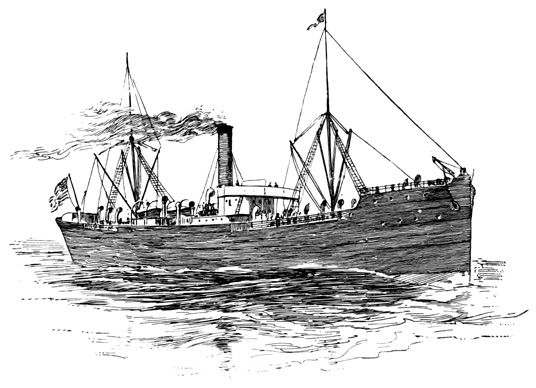
It was really wonderful how changed everything appeared
to Teddy Dunlap after his interview with Bill
Jones.
As a matter of course there had been no enlargement
of his hiding-place, and yet it seemed as if he could move
about more freely than before. He was forced to remain
in quite as cramped a position, but it no longer seemed
painful.
Although the sailor had given him no encouragement
that he might succeed in the task he had set himself,
but, on the contrary, appeared to think it a hopeless one,
Teddy felt positive that the moment was very near at
hand when he would be clasped once more in his father's
arms.
He had come out from his hiding-place weak and
despairing, choosing the most severe punishment that
could be inflicted rather than longer endure the misery
which had been his constant companion during so many
days, and now, even before partaking of the meat and tea,
all was forgotten in the belief that he would soon be with
his father.
It was as if some other boy had taken Teddy Dunlap's
place, and this second lad was strong where the other
had been weak.
He made a hearty meal, rearranged his bed so that he
might be nearer the entrance to the hiding-place in case
the sailor found it necessary to communicate with him
hurriedly, and then indulged in more refreshing sleep than
had visited his eyelids during the past forty-eight hours.
When Teddy awakened, however, much of this new
courage had vanished, and again he allowed himself to
look forward into the future, searching for trouble.
He had no means of knowing whether it was day or
night, for the sunlight never came into this hole; but,
because of the silence in the forecastle, it seemed probable
the crew were on deck.
The steamer rode on an even keel, save for a sluggish
roll which told she was sailing over calm seas, and the air
had suddenly grown stifling hot.
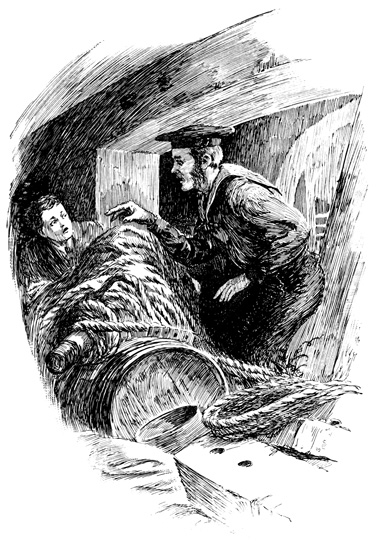
Creeping so near the entrance that there was great
danger of being discovered by such of the men as might
come that way, Teddy waited with feverish impatience for
some word from Bill Jones, and it seemed as if a full day
must have passed before the voice of the jolly little
sailor was heard.
"Well, my hearty, you're in great luck, an' no mistake.
I wouldn't have believed things could have gone
so nearly your way, if I hadn't seen 'em with my own
eyes."
Before the sailor ceased speaking, Teddy had come
out from his hiding-place regardless of possible discovery,
and appeared to be on the point of rushing up the narrow
companionway.
"Hold on, you young rascal! Do you count on
jumpin' right into the captain's arms?" and Bill Jones
seized the lad by the shirt collar, pulling him backward
with no gentle force. "Where was you headin'
for?"
"Ain't it time for me to go on deck?" Teddy asked,
speaking with difficulty because of the sailor's firm
clutch.
"Time? I reckon not, unless you're achin' for a taste
of the rope's end. Our skipper ain't any very mild
tempered man at the best of times, an' this is one of his
worst days, for everything has been goin' wrong end foremost
jest when he wants to see the ship in apple-pie
order."
"I thought you said somethin' about my bein' in luck,
an' the only thing of the kind that could come to me,
would be to know father was on deck."
"I don't reckon you'll see him aboard the Merrimac
for some time to come, though you're nearer to him this
minute than I ever allowed you'd be in this part of the
world."
"What do you mean?" and Teddy literally trembled
with the impatience of anticipation.
"Sampson's fleet is dead ahead. His vessels are the
very ones we've come to coal, an' if that ain't luck enough
for a stowaway, I'd like to know what you could call it?"
"Is the Brooklyn anywhere near?" and Teddy did his
best to speak calmly.
"Dead ahead, I tell you."
"Will we run right alongside of her?"
"I don't allow you've any claim to count on luck like
that; but we're hard by Sampson's fleet, and it'll be
strange if we can't find a chance of lettin' your father
know where you are."
"Find a chance? Why, I'll go right on deck an' yell
to him. He's bound to come out when he hears me."
There was in this remark something which struck Bill
Jones as being so comical that he burst into a hearty
laugh, and then, realising that his messmates on deck
might come down to learn the cause of such unusual
mirth, he partially checked himself, gurgling and choking
in the efforts to suppress his merriment, until it appeared
that he was on the point of being strangled.
"Go on deck an' yell to him," he muttered in the intervals
between what appeared to be spasms. "Say, lad,
it's precious lucky the weather is so hot that the crew
have been driven out, else we'd had 'em all down on us,
for I can't hold in, no matter how hard I try. So you
think it's only a case of goin' on deck an' yellin', to
bring your father right over the rail!"
"He'd come if he heard me," Teddy replied, sharply.
"I ain't so certain 'bout that, for coal-passers don't
have the choice of promenading a battle-ship's deck.
The officers generally have somethin' to say about capers
of that kind. Besides, you might yell yourself black in
the face, even if the Merrimac was layin' close alongside
the Brooklyn, an' he'd never be any the wiser. You seem
to have the idee that one of Uncle Sam's vessels is
built something after the pattern of a tugboat."
"But I've got to get at him somehow," Teddy said, in
perplexity, the new and great joy which had sprung up in
his heart dying away very suddenly.
"True for you, lad; but it ain't to be done in the way
you're figgerin' on, an', besides, havin' come along so
smooth this far, I'm not countin' on lettin' you run your
nose against such a thistle as the captain is like to be.
It ought'er be enough that we've struck into the very
fleet you wanted to find, an' a boy what can't wait a spell
after all the good fortune you've had, ain't fit to be scurryin'
'round here huntin' for his father."
"I'll go right back into the hole, an' wait till you tell
me to come out," Teddy said, meekly, understanding full
well what his plight would be should this friendly sailor
turn against him.
"Now you're talkin' sense," Bill Jones said, approvingly.
"I was countin' on cheerin' you up a bit, by tellin'
of where the Merrimac had fetched up, an' didn't allow to
set you off like a wild Injun. Hot down here, eh?"
"It's kind'er warm, an' that's a fact."
"So much the better, because the crew will stay on
deck, an' you'll have more of a chance to move around.
It's only a case of layin' low for three or four days, an'
then we'll see what your father can do toward gettin' you
out."
"How will you let him know where I am?"
"There'll be plenty of show for that if we come alongside
the Brooklyn; I can manage to send him word, I
reckon."
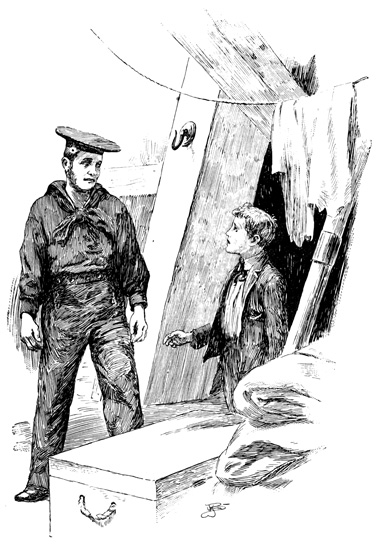
The conversation was brought to an abrupt close by the
appearance of a sailor's feet as he descended from the
deck, and Bill Jones turned quickly away, pretending to
be overhauling his sea-chest, while Teddy made all haste
to regain his "hole."
Now it was that the stowaway had every reason to
congratulate himself upon the fair prospects which were
his, when it had seemed positive that much trouble would
come before the venture was ended, and yet the moments
passed more slowly than at any time since he had voluntarily
become a prisoner.
With each hour his impatience increased, until it was
with difficulty he could force himself to remain in
hiding.
While he believed his father was very far away, there
appeared good reason for remaining hidden; but now,
with the Brooklyn close at hand, it seemed as if he must
make his whereabouts known without loss of time.
Fear as to what terrible punishment the captain of the
Merrimac might inflict, however, kept him in his proper
place, and before many hours passed Bill Jones brought
him further intelligence.
"The New York is to take on the first of the coal," he
said, leaning over the barricade of rope, and whispering
to the impatient prisoner. "I'm thinkin' we'll get around
to the Brooklyn before all the cargo is gone, an' then this
game of hide will come to an end—if your father is
a smarter man than the average of us."
The jolly little sailor had no time to say more, for one
of the petty officers interrupted the stolen interview by
calling loudly for "Bill Jones," and while obeying the
summons the sailor muttered to himself, "I wish the boy
was well clear of this steamer; it seems as if he was
under my wing, so to speak, an' I can't make out how
any man, lower in rank than a full-fledged captain, can take
him aboard one of Uncle Sam's ships."
Fortunately Teddy had no misgivings as to the future,
after his father had been made aware of his whereabouts.
He believed it would be the most natural thing in the
world for him to step on board the Brooklyn as a guest,
and the possibility that a coal-passer might not be allowed to
invite his friends to visit him never entered the lad's mind.
Bill Jones, however, was seriously troubled as to the
outcome of the affair, as has been seen.
He had promised to aid the stowaway, as he would have
promised to aid any other lad in trouble, for the jolly little
sailor was one ever ready to relieve the distress of others,
no matter how great might be the cost to himself; and
now, having taken the case in hand, his anxiety of mind
was great, because he was by no means as certain of his
ability to carry it through successfully as he would have
Teddy believe.
Within four hours after the sailor reported that the
Merrimac would speedily begin to take out her cargo,
the prisoner in the forecastle became aware that the
steamer was at a standstill.
For the first time since leaving port the screw was
motionless, and the absence of that pounding which
marked the revolutions of the shaft caused a silence
that for a few moments seemed almost painful.
Shortly afterward, when Bill Jones came to bring a
fresh supply of provisions and water, he reported that the
New York was taking on coal.
"The other ships are certain to need a supply, an' we're
bound to come alongside the Brooklyn sooner or later," he
said, cheerily, and Teddy replied, with a sigh:
"It seems like a terribly long while to wait; but I s'pose
I can stand it."
"I reckon it's a case of havin' to, lad, unless you're
willin' to take the captain's medicine, an' that's what
I wouldn't like to tackle."
"It's as if I'd been here a full month, an' accordin' to
what you say I'm mighty lucky if I have to stay only two
or three days more."
"You're lucky if you get out in a week, so don't go to
countin' the minutes, or time will be long in passin'."
Twice during the next twenty-four hours did Teddy
have an opportunity of speaking with his friend, and
then he knew that the Merrimac was alongside the
Massachusetts.
"You see we're goin' the rounds of the fleet, an' it's
only a question of the coal holdin' out, to finally bring us
to the Brooklyn," Bill Jones said, hurriedly, for there was
no opportunity of lengthy conversations while the crew
were engaged in transferring the fuel.
Another long time of waiting, and Bill Jones appeared
at the entrance to the hiding-place in a state of the
greatest excitement.
"Somethin's got to be done right away, lad, an' I'm
clean beat as to how we'll figger it out. This 'ere steamer
is goin' to be sunk!"
"Sunk!" Teddy cried in alarm, clutching Bill frantically
by the arm, as if believing the Merrimac was even
then on the point of going down.
"That's jest it, an' we're to be shifted to the other
vessels, gettin' a berth wherever one can be found."
"What will make her sink?"
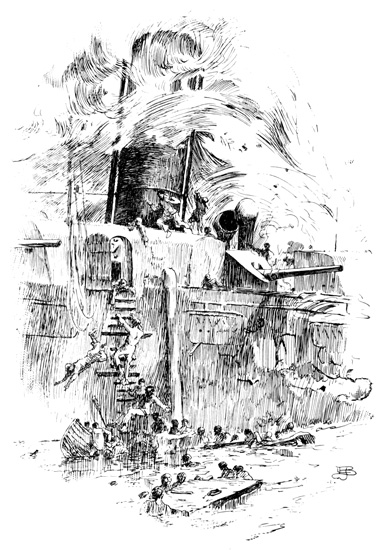
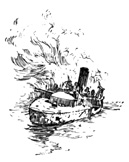
"She's to be blowed up! Wrecked in the harbour of
Santiago de Cuba, so the Spaniards who are inside can't
get out!"
Teddy looked around him in bewilderment and alarm,
understanding not one word of the brief explanation.
"You see the Spanish fleet is inside the harbour, and the
mouth of it ain't more'n three hundred feet wide. This
steamer will be blowed up right across the channel, an'
there the Spaniards are, bottled up tight till our fleet gets
ready to knock 'em into splinters."
"But what'll become of me? I'll have to face the
captain after all!"
"I reckon there's no help for it, lad, because it don't
stand to reason that you want to go down with the ship."
"How long before you'll sink her?"
"We sha'n't have anything to do with it, lad. It's what
you might call a precious fine job, an' 'cordin' to the way
everybody looks at it, them who do the work ain't likely
to come back again."
"Why not?"
"Look here, lad, if you was goin' on deck an' set off
three or four torpedoes under your very feet, what do you
think would be the show of gettin' ashore alive?"
Teddy made no effort to weigh the chances; his own
affairs were in such a precarious condition that there was
no room in his mind for anything else.
"I'd better have gone to the captain when I first made
up my mind that it had to be done, an' it would be over by
this time," he said, with a long-drawn sigh.
"It wouldn't have been over till you got ashore, because
pretty nigh every sailor thinks it his bounden duty to
make things lively for a stowaway. You've saved yourself
from bein' kicked an' thumped jest so many days as I've
been coddlin' you up, an' there's a good deal in that."
"Are we anywhere near the Brooklyn?"
"She was five or six miles away when I saw her last—"
"Five or six miles!"
"Yes; did you allow she laid within hail?"
"I thought from what you said that we was right among
the fleet."
"So we are, lad; but these big ships don't huddle very
close together, an' ten miles off is called bein' mighty near
at hand. I can't stop here chinnin' much longer, so listen
sharp. When the time comes, an' it's precious near at
hand now, you'll have walk up to the medicine-box like a
little man, so kind'er be bracin' yourself for what's sure to
happen. I'll watch till the captain appears to be in good
humour, an' out you pop."
Teddy nodded his head; there was too much sorrow
and disappointment in his heart to permit of speech, and
Bill Jones was so pressed for time that he failed to give
due heed to the boy's mental condition.
"Be ready when I come back next time!" the sailor
whispered, warningly, and then ran on deck, leaving the
stowaway in a most unenviable frame of mind.
When Teddy's mouth was parched with thirst, and his
stomach craving for food, he had brought himself to
believe that he could submit without a murmur to whatever
punishment the captain might see fit to inflict; but
now it seemed different. During a very long time he had
been cheering himself with the belief that before the close
of this hour or the next he would be with his father, and
such a sudden and startling change in affairs caused him
deepest despair.
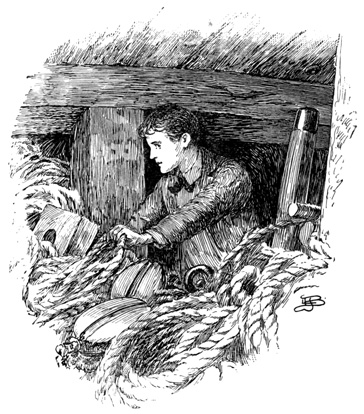
Crawling into the narrow hiding-place, he gave full sway
to the grief which had come upon him like a torrent, for
once Captain Miller knew of his having stowed away, so
he argued to himself, there would no longer be any hope
of communicating with his father.
To his mind he had not only failed in the purpose set
himself, but would be more widely separated from his
father than ever before, and it is little wonder, with such
belief in his heart, that the boy ceased longer to battle
against his sorrow.
He was lying face downward upon the canvas when Bill
Jones came to announce that the moment had arrived
when he should brave the ordeal of facing Captain Miller,
and the sailor was forced to speak several times in a loud
tone before the lad realised that his friend was near at
hand.
"Come, Teddy," the little sailor said, soothingly, "it'll
be over after awhile, an' perhaps won't be so bad as we've
figgered, for the old man ain't tearin' 'round dreadful mad.
Let's get on deck in a hurry, so's not to think about it
too long, an' I'll stand right by your side till matters are
settled one way or the other."
"I might as well stay right here, an' be sunk when the
steamer goes down," the boy wailed.
"Nonsense, lad; after havin' the pluck to come thus far
in search of your father, you mustn't lose heart now. Be
a man, Teddy, an' count on me for a friend so long as the
trouble lasts."
It was not possible for Bill Jones to arouse the boy to a
proper show of courage until after fully half an hour had
passed, and then the two came out into the sunlight, both
looking much as if having just been detected in the most
heinous of crimes.
The dazzling sunlight nearly blinded the boy, who had
been shrouded in darkness so many days, and forced him
to cover his eyes; therefore he failed to see the look of
surprise and bewilderment on Bill Jones's face immediately
they came on deck.
During several moments he was in such a daze as to be
virtually unconscious, and then he heard his companion
ask:
"Where is the Merrimac's crew?"
"They've been set aboard the New York for a spell,
seein's how this ain't likely to be a very pleasant craft to
sail in after we get through with her," a strange voice
replied, and Teddy opened his eyes.
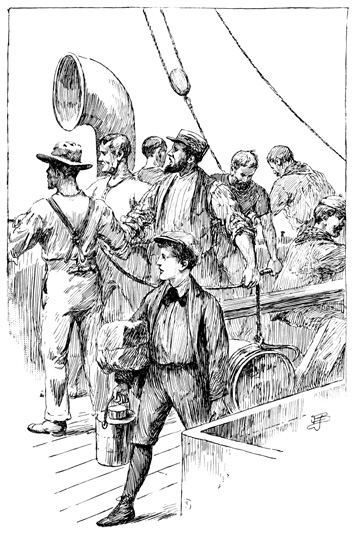
The deck of the collier appeared to be thronged with
sailors in naval costume, all of whom were apparently
bent on doing the greatest amount of destruction in the
shortest possible space of time.
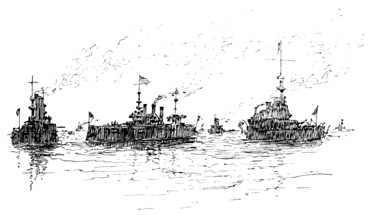
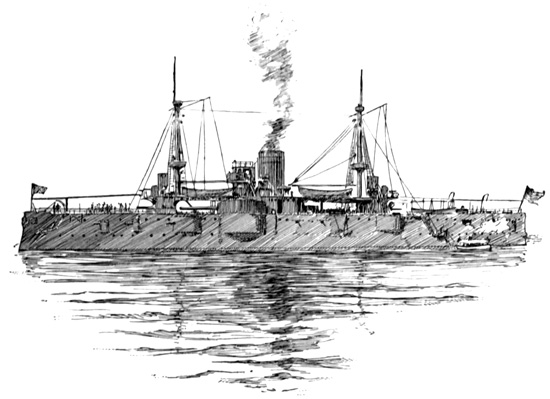
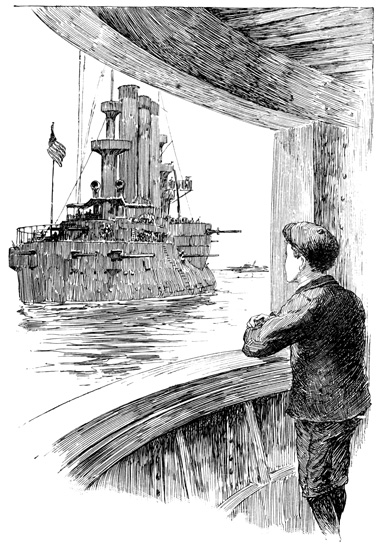
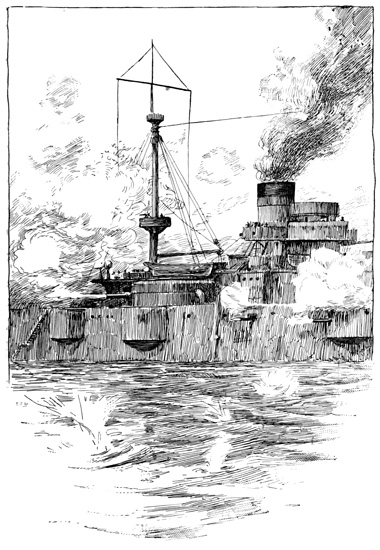
Not far away to windward was a huge war-vessel, looking
more like some submarine monster than anything built by
man, and in the distance others of the same kind, cruising
to and fro, or lying quietly upon the ocean, rising and falling
with the heavy swell.
All this picture Teddy took in with a single glance, and
then his attention was diverted by Bill Jones, who said to
the sailor with whom he had first spoken:
"Ain't we to take our dunnage out?"
"I reckon that'll be done after a spell; but just now
it's a case of hurry, an' what a few old shellbacks like
you may consider dunnage, ain't taken into account."
"Where is Captain Miller?"
"I saw him goin' toward the flag-ship. It seems he's
got the biggest kind of a bee in his bonnet because Lieutenant
Hobson is to be given the chance of killin' himself
an' his crew, when he claims the right because of havin'
been in command of this 'ere collier."
Teddy was wholly at a loss to understand the meaning
of the conversation, and he looked at the little sailor, who
now appeared perplexed rather than jolly, until the latter
said, speaking slowly, as if in a maze of bewilderment and
doubt:
"I'm all at sea, lad, about this 'ere business; but it
begins to look as if you wouldn't have any very hard time
with the old man to-day. He's got somethin' else on his
mind that's of more importance than a worthless little
stowaway like you."
"He'll come back, won't he?" Teddy asked, yet unable
to gather any clear idea of the situation.
"Unless he comes soon, there won't be anything left of
the Merrimac, an' that's a fact," Bill Jones replied, pointing
here and there to where a hundred men or more were
busily at work, seemingly trying to make a wreck of the
collier. "I s'pose they're bent on gettin' out of the old
hooker all that's of any value, before sinkin' her, an' it
looks as if they'd finish the job in a jiffy."
"Where's the Brooklyn?"
"See here, my son, we've no time to bother our heads
about her just now. It's enough for you that we can't
get speech with your father, an' unless I'm way off my
reckonin', here's the chance to pull out of what promised
to be a bad scrape for you."
Teddy remained silent, for the very good reason that
he was at a loss for words, and after a short pause, Bill
Jones exclaimed, as if a happy thought had at that instant
come into his mind:
"Hark you, lad, our men have gone over to the New
York, an' so long as we don't follow them it'll be plain
sailin'. We'll watch our chance, go aboard the nearest
ship, so it ain't the admiral's flag-ship, as bold as lions, an'
it'll be believed that you belong to our crew. Unless
Captain Miller shows himself, you'll be livin' on the fat of
the land."
"But when he comes?"
"We won't bother our heads about anything of the
kind. It's enough for us to know you've slipped out of
the smallest kind of a hole without a scratch, and we'll
take all the enjoyment that comes our way, at Uncle
Sam's expense."