Larger versions of most illustrations may be seen by right-clicking them
and selecting an option to view them separately, or by double-tapping and/or
stretching them.
An Account of the Building of Bunker Hill Monument
By E. H. CAMERON
With a Foreword by John Silsbee Lawrence
BOSTON
Bunker Hill Monument Association
1953
Copyrighted 1952 by the Alumni Association
of the Massachusetts Institute of Technology
and reprinted 1953 by their permission.
FOREWORD
Had the British bullet that went through the hat of Major Samuel Lawrence
of Groton near Bunker Hill on 17 June 1775 been aimed a bit lower,
some thousand descendants of Major Lawrence would not have been
born and I should not now have his dispatch wallet, nor his letter explaining
the battle and mentioning General Dearborn, my first wife’s ancestor.
The Bunker Hill Monument might not have been built; the Massachusetts
Hospital Life Insurance Company might not have been developed;
various charitable institutions might not have had adequate financial
support and the dams at Waltham, Lowell and Lawrence might not have
been constructed to provide the power to operate textile mills. John
Brown might not have been sent by the Emigrant Aid Society of Boston
to Kansas, where he called his camp Lawrence, now one of the flourishing
cities of Kansas. Had Major Lawrence been killed we should not have
had a Lawrence as Mayor of Lowell, or as Ambassador to the Court
of St. James. Two Bishops of the Episcopal Church, a President of Harvard
College, the present Senator Saltonstall, and many young men and
women now actively interested in the problems of our nation might never
have been born and I should not have qualified for membership in the
Society of the Cincinnati.
From reflecting upon the bullet that came so close to disposing of
Major Samuel Lawrence at Bunker Hill I was led to the history of the
monument commemorating the battle, in the building of which his son—and
my great-grandfather—Amos Lawrence took a leading part. Much
has been written about Bunker Hill Monument, but the splendid article
by Mr. E. H. Cameron in The Technology Review for May 1952 and
June 1952 summarized its history so well that I was anxious to have it
available in more permanent form. Mr. Cameron and the editors of The
Technology Review very kindly gave permission for this reprint, and
Mr. Walter Muir Whitehill, Director and Librarian of the Boston
Athenæum, has seen the pamphlet through the press. Mr. Whitehill has
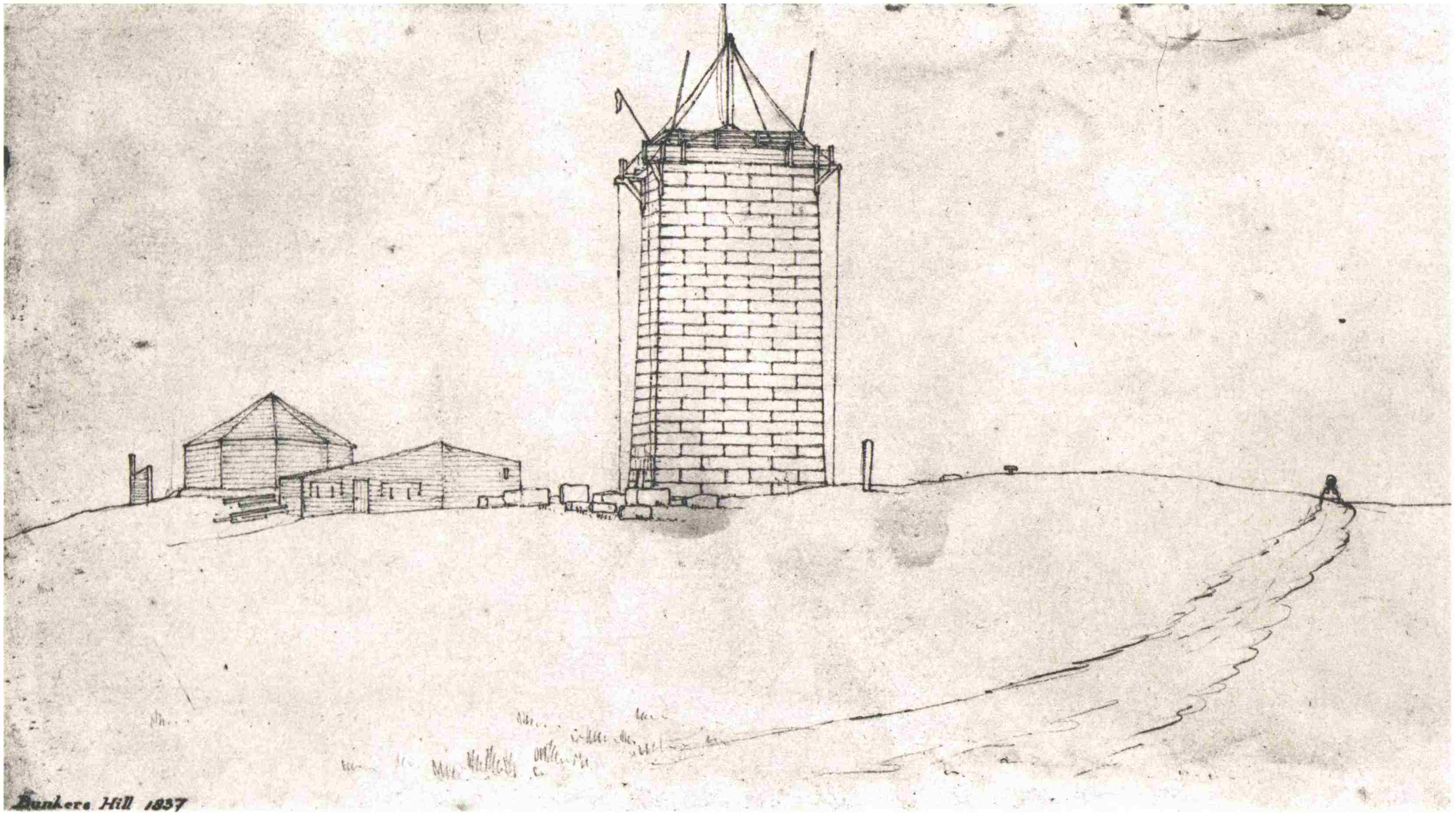
also selected the illustrations, and has included in them a hitherto unpublished
drawing, owned by the Boston Athenæum, of Bunker Hill
Monument under construction in 1837. This was obviously the source
for the somewhat inaccurate wood engraving published in The American
Magazine of Useful and Entertaining Knowledge, III (1839), 404
and subsequently reproduced in later accounts of the monument. The illustrations
include portraits of the two largest individual contributors to
the building of the monument—Amos Lawrence and Judah Touro, the
Jewish merchant of Newport, Rhode Island. I am grateful to the Massachusetts
Hospital Life Insurance Company and the Redwood Library
and Athenæum of Newport for furnishing photographs of these portraits
and permitting their reproduction, and to Mr. T. Temple Pond, President
of the Bunker Hill Monument Association, for allowing this reprint
to be published by the Association.
John S. Lawrence
OF YANKEE GRANITE — Prologue — The Obelisk — Transient Cornerstone — The Leading Character — Up-To-Date Quarry (Circa 1825–1843) — The Granite Railway — Beacon for Mariners — The Riggers — Profitable Project — High Capstone — Foucault’s Experiment — Today — Transcriber’s Notes
On Saturday, 17 June 1775, on a fortified hilltop farm near Bunker’s Hill,
Charlestown, Mass., a volunteer force of American citizens faced the professional
soldiery of the world’s strongest nation. When their scant supply of ammunition
gave out, the survivors retired in good order, to learn later that 140 of their neighbors
and other companions had been killed in the fight. Their battle is therefore
registered as an American defeat. It proved to be a striking victory, however, for
historians agree that the Battle of Bunker Hill set the pace that led to ultimate
victory in the American War of Independence. This little force of farmers, mechanics,
tradesmen, and professional men had demonstrated how Americans
should fight, when their independence is threatened.
On the field where the battle was fought, the Bunker Hill Monument has now
stood for over a century, the rugged lines of its granite masonry symbolizing the enduring
strength of the stern spirit of American independence that it commemorates.
About 40 years after the Battle of Bunker Hill, all New England was
deeply stirred by a pamphlet published by Major General Henry Dearborn
who had taken part in the engagement. The pamphlet accused
General Israel Putnam, one of the most revered of the Revolutionary heroes,
of incapacity and cowardice in the battle. Thereupon, the Battle of Bunker
Hill was fought over and over again, at the wharves, sail lofts and ropewalks
of Boston, and in all places where men gathered to work and to talk about the
events of the day. Crowded nine inside and five on top of the jolting four-in-hand
stagecoaches from Boston, friends and foes of the popular Revolutionary
hero would wrangle over his conduct at the battle. It would be a long argument,
at five miles per hour, with little room for gestures. With tankards in
hand, by the warm fireplace in the low-ceilinged tavern of the village where
the coach would stop for the night, the passengers could express their convictions
more forcefully, and the Battle of Bunker Hill would become a very
live topic indeed. The furor over the Putnam-Dearborn controversy became
secondary, however, as the bald fact was realized that, aside from a small
wooden column, no memorial existed on the site of one of the most famous
military engagements of American history.
In the good Yankee fashion a group of prominent citizens conferred over
their Madeira wine and coffee on ways to correct this humiliating situation,
and in the year 1823, these men formed the Bunker Hill Monument Association,
to solicit private contributions sufficient to build a monument on Breed’s
Hill, where the battle had been fought, in the town of Charlestown, now a
part of the city of Boston, Mass.1
1 From the start, the site of the battle seems to have been called Bunker Hill, although it was
actually fought on Breed’s Hill. The probable reason for this inaccuracy is that Bunker’s Hill
was then 110 feet high, and the adjacent 62-foot-high Breed’s Hill was considered only a spur
of the higher summit. Certainly, a contemporary British military map is entitled, “A Plan of
the Action at Bunker’s Hill.”
Unlike the Washington Monument, which had to be completed by government
funds, the Bunker Hill Monument was financed practically wholly by
private means. Our independent ancestors did not count much on government
aid in the building of a memorial to relatives or neighbors who had died in
the battle; such monuments were personal matters. Of the total collected
amount of about $134,000, only $7,000—a grant from the Commonwealth
of Massachusetts—came from other than private contributions. (The amount
raised to build the monument is roughly equivalent to $1,000,000 in modern
money.) Aside from two donations of $10,000 each, the individual gifts
ranged from a few at $1,000 to many at $0.25 each. Naturally, such a
scheme of financing took a long time, and 18 years elapsed before the monument
was dedicated. At a critical period, the Massachusetts Charitable Mechanics
Association, started by Paul Revere and others, years earlier, joined
with the Bunker Hill Monument Association to raise funds and help direct
operations. At a still more critical period, the women of New England held a
fair which brought in over $30,000, and the completion of the monument
was assured.
Surely, the record of no other national memorial provides such a true cross
section of American democracy as exhibited in the roster of the rich, those of
moderate means, and the poor but independent citizens whose contributions
made possible construction of the monument.
The magnitude of American structures of the year 1825, when the cornerstone
of the monument was laid, was largely limited by the physical strength
of those who had to build them—men, horses, and oxen. To raise the huge
stones of the monument to such dizzy heights was a tremendous undertaking
with the crude construction methods of the day. The builders of the monument
had much to inspire them to devise better methods, however, in the examples
of other enterprises in this virile period of American development.
Steam navigation had already made notable progress in America, and while
the lower courses of the monument were being laid, the first steam locomotives
began to appear on the young American railroads. Canals, waterpower
developments, and many new industries were being started in the young
democracy.
A great contribution of the builders of the monument to the record of
achievements of this period was their demand for granite in huge quantities
to build it. This demand inspired the construction of the Granite Railway at
Quincy, Mass.—America’s first railroad.
The story of the promotion, design, and construction of the monument is
therefore doubly intriguing. It gives a vivid picture of the status of construction
methods of the period, when America stood on the threshold of the age of
machinery. It also reveals the spirit of audacious determination of our construction
forebears as they developed their unprecedented processes from
which our present marvelously efficient methods of construction have sprung.
The spirit of the builders of the monument is worthy of that of the heroes of
the battle, which their masterpiece has now commemorated for over a century.
Few modern architects, engineers, or contractors are privileged to work in
such distinguished company as did architect Solomon Willard, engineers
Loammi Baldwin and Gridley Bryant, and contractor James Sullivan Savage,
who designed and built the obelisk which is called the Bunker Hill Monument.
They were associated with Daniel Webster and young Edward
Everett, both of whom later became Secretary of State; with Thomas Handasyd
Perkins (still revered in Boston as the man who endowed the Perkins Institution
for the Blind), merchant prince of Boston, with the famous artists,
Washington Allston and Gilbert Stuart; and their monument followed the
classic lines of the model submitted by Horatio Greenough, a Harvard student,
who later became a noted American sculptor.
To the amazingly talented architects and engineers of Egypt, 50 centuries
ago, the Bunker Hill Monument would have been a simple structure to design
and construct. To these ancient builders, it would have appeared to be merely
a somewhat stubby shaft, devoid of the beautiful, deeply carved hieroglyphic
record which ornamented their own obelisks from base to pyramidion (apex),
and it would be a simple thing to erect. In fact, some would say that the monument
is really not an obelisk, for it is built of many stones of a few tons weight
each, whereas a single stone composed a typical Egyptian obelisk. Such
stones sometimes weighed as much as 500 tons. They were transported hundreds
of miles and by some now unknown method were erected to the vertical
position by manual labor.
Like the Egyptians, the modern engineer would also call the monument
easy to design and build. Today’s light, thin-walled chimneys of comparable
height, pose much harder problems of stability against wind, and their designers
feel fortunate when a chimney can rest on as firm a foundation as the
glacial drumlin soil of Breed’s Hill. Why, then, was the erection of the monument
considered such an unusual feat at the time?
The answer is obvious: the monument was built in the days of hand labor
supplemented by animal power, and hand labor to the independent Boston
mechanic of over a century ago did not mean hundreds of slaves tugging in
unison to the drumbeat of an Egyptian timer, while an overseer cracked his
whip. And the builders had determined to construct their monument of one
of the hardest of building stones—New England granite—in the use of which
there was then little precedent.
When the Bunker Hill Monument Association offered a prize of $100 for
the best design of a monument, many plans, mostly of columns, were submitted.
The Board of Artists of the Association (Daniel Webster, Gilbert
Stuart, Washington Allston, Loammi Baldwin, and George Ticknor), who
had to pass upon the submitted designs, favored the Greenough model based
on an Egyptian obelisk of ancient Thebes. Although the directors had strongly
favored a column, they yielded to the judgment of the Board of Artists and
adopted the obelisk design instead.
Upon the adoption of the successful design, a committee, of which Loammi
Baldwin was chairman, was appointed to “report a design of an obelisk.”
Baldwin was a Harvard graduate, who had studied abroad under the patronage
of Count Rumford.2 He had become one of America’s most prominent
engineers. Baldwin was responsible for the construction of the dry docks at
the Charlestown and Norfolk Navy Yards; planned a canal tunnel (later built
as a railroad tunnel) through the Hoosac Mountain; and was active in surveys
for an adequate water supply for Boston, in the day when Boston people got
their water from wells. Baldwin and his associates on the committee first
went to the Boston and Roxbury Milldam (now Beacon Street), from which
the monument would be prominently visible across the Charles River. Miniature
models of different dimensions were mounted on the Milldam fence and
were viewed from a definite distance to the rear. In this highly practical manner,
the size of the most striking monument on distant Bunker Hill was determined.
2 The famous scientist, Benjamin Thompson, of Woburn, Mass., who later became an English
citizen, and who established the fact that heat is a form of motion.
The Baldwin Report on the design of the Bunker Hill Monument, described
as neatly handwritten, was one of the valuable documents in the literature
of early American engineering history. It ranks with the “Private Canal
Journal” of DeWitt Clinton,3 who promoted the Erie Canal; the report on
American railroad standards of 100 years ago by Captain (later General)
George B. McClellan of Civil War fame; Roebling’s report on the proposed
Brooklyn Bridge; and similar historical documents that describe the methods
from which the present processes of promotion and construction have sprung.
3 William W. Campbell, Life and Writings of DeWitt Clinton (New York: Baker and
Scribner, 1849).
As shown in the table of dimensions which follows, the monument, almost
exactly, is built to the dimensions of the Baldwin Report,4 which was influenced
by the Greenough model.
Height, above ground
220 ft.
Sides of monument, at ground level
30 ft.
Sides of monument, at base of apex
15 ft.
Height of apex
12 ft.
Minimum wall thickness, at base
6 ft.
Diameter of circular interior, at base
18 ft.
Height of masonry elements:
78 main courses, each with height of
2 ft., 8 in.
5 courses in apex, each with height of
1 ft., 8 in.
Height of capstone
3 ft., 6 in.
4 Measurements given above have been taken from: Baldwin Report (1825)—Loammi Baldwin;
Plans and Sections of the Obelisk on Bunker’s Hill (1843)—Solomon Willard; History of
the Battle of Bunker’s (Breed’s) Hill (1875)—George E. Ellis.
Data from old records do not always check modern measurements. For example, a modern
reference gives the height of the monument as 221 feet.
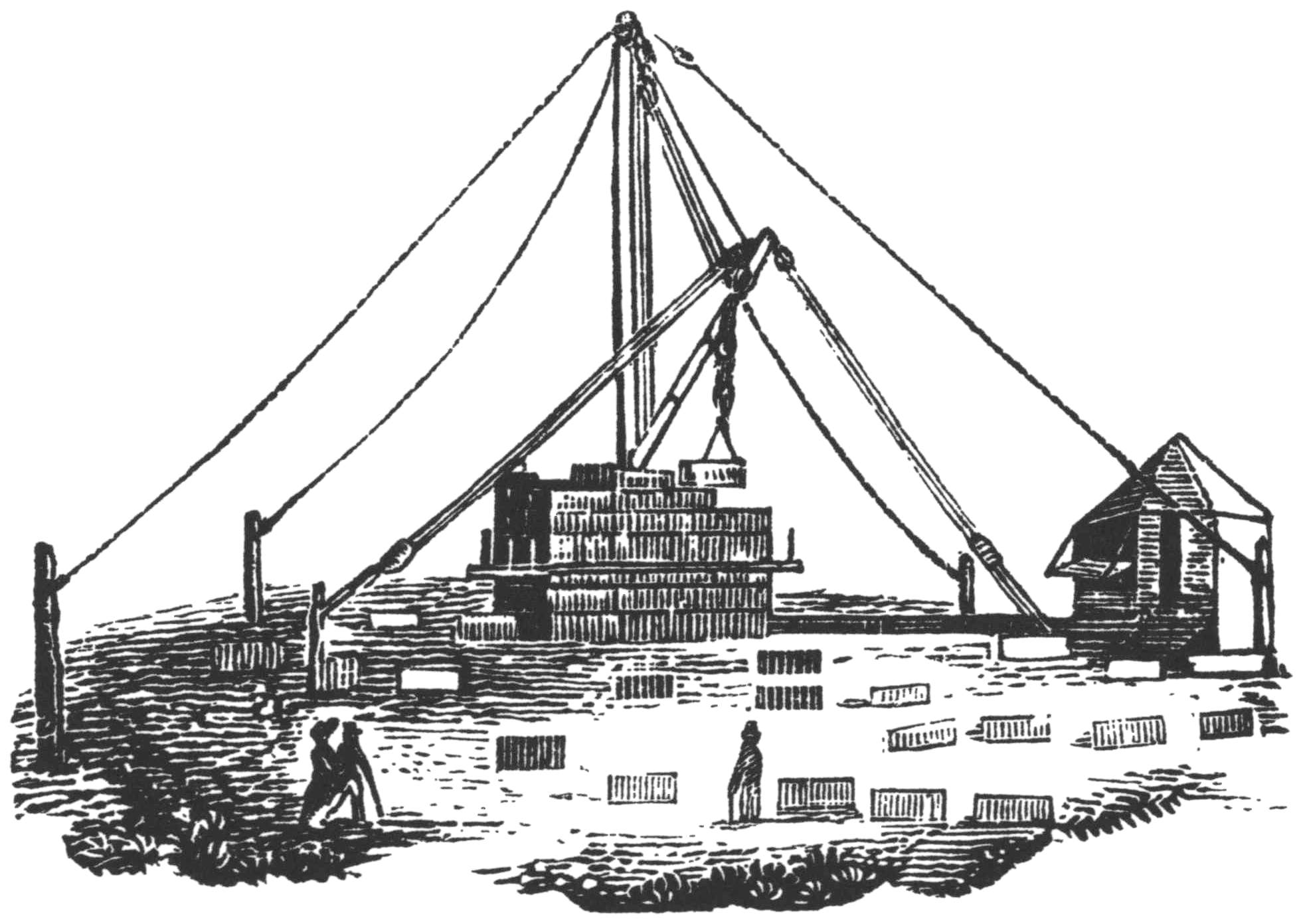
Bunker Hill Monument under construction in 1837
Reproduced from a hitherto unpublished drawing in the Boston Athenæum
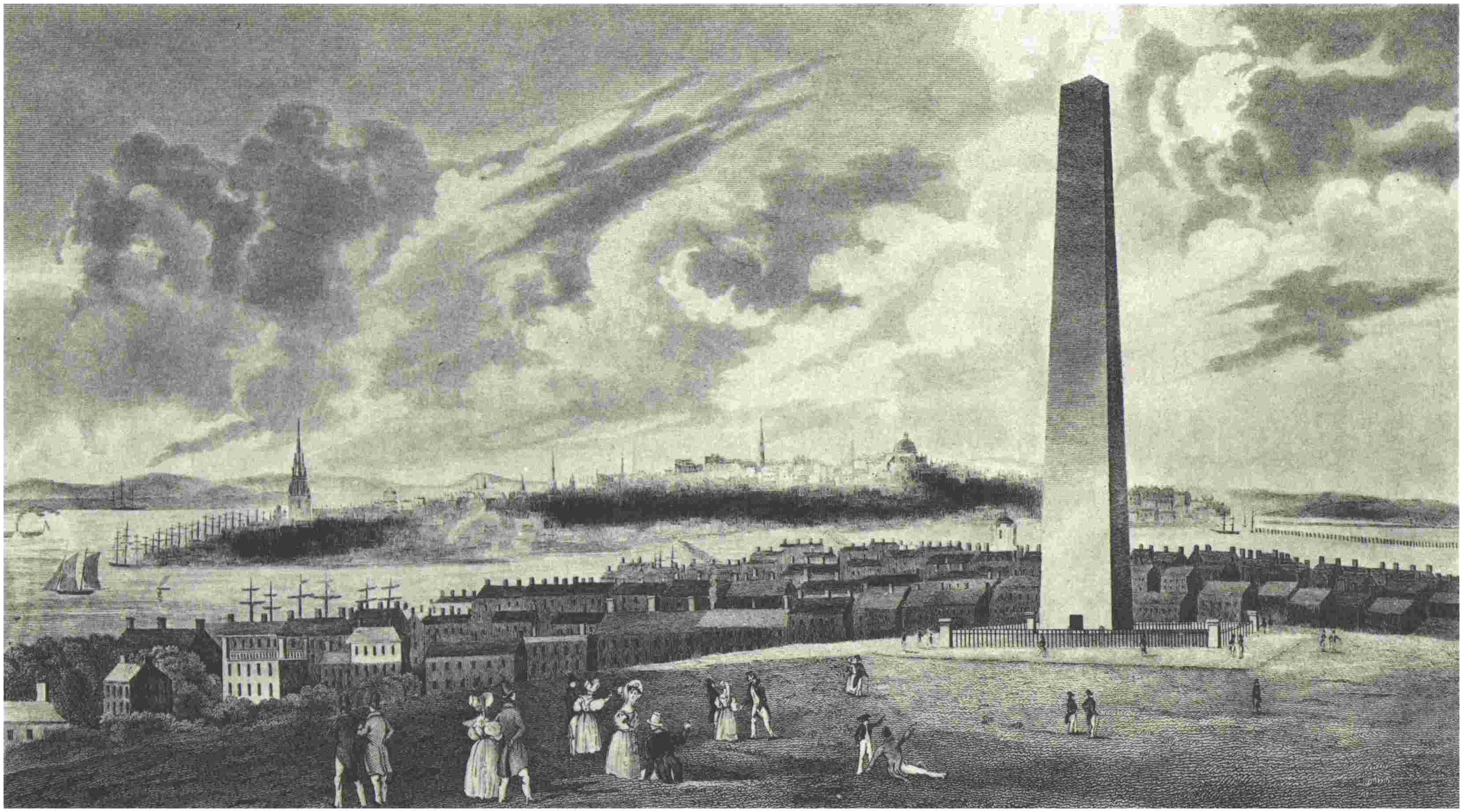
Bunker Hill Monument as proposed
Reproduced from an 1834 certificate of membership of the Bunker Hill Monument Association
in the Boston Athenæum
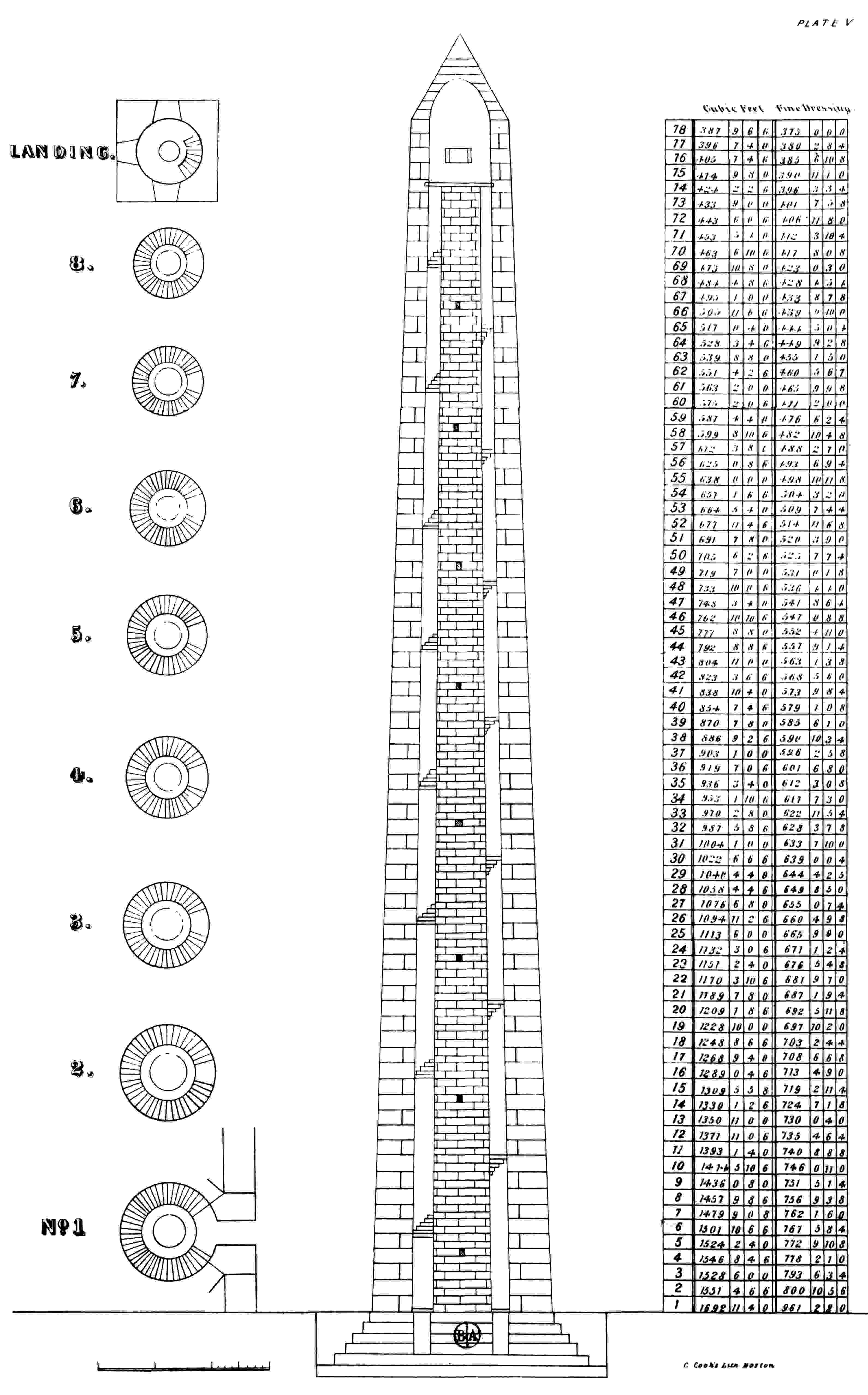
Section of Bunker Hill Monument
Reproduced from Solomon Willard, Plans and Sections of the Obelisk on Bunker’s Hill
(Boston, 1843), Plate V
As described in the Baldwin Report, the circular winding staircase is composed
of granite steps, starting with a width of about four feet and narrowing
as the ascent is made. Baldwin called for “places of repose” (landings) at
intervals. Modern architects call the part around which a circular staircase
winds, the “newel.” Baldwin’s newel is a hallow wall, 10 feet in diameter at
the base, about two feet thick.
Thus, the monument was designed by an engineer, not an architect. Baldwin
violated a common rule for the proportions of ancient Egyptian obelisks,
that the pyramidion should be as high as the base is wide, which is one reason
why the Washington Monument is so beautiful. One regrets that architect
Willard, who picked up where Baldwin left off, did not see fit to modify
the Baldwin lines. There seems never to have been any question as to the
monument’s material: granite, the native New England stone. Although we
admire the Bunker Hill Monument for its somber strength, it cannot be called
a structure of beauty, as is the lighter-tinted and finer-textured marble Washington
Monument, with its sharper apex.
We can also speculate on why Baldwin made the monument wholly of
granite. At today’s prices, the circular inner surface of the shaft and the circular
chimney, or newel, around which the stone staircase winds, would be
of tremendous cost. The dressing of the stone for a square inner area would
be much cheaper.
Before criticizing Baldwin on his ponderous stair design, which could be
replaced by a light, modern fire escape, we should look at the status of the
tiny American iron industry of his day. The ironmasters were recovering from
the decline of activity in the War of 1812, during which they had lost their
British market. Baldwin would know that certain early railroad promoters
estimated that granite tracks mounted with iron plates would be less expensive
than the English-rolled rails, which the Americans could not produce.
With masons in Massachusetts receiving about $0.18 an hour, granite was
considered cheaper than iron. Baldwin therefore designed his stairway of
granite, with a massive granite chimney “newel” to support the inner ends of
the treads. Long before the monument was completed, however, a square
staircase of either cast iron or wrought iron could have been produced, economically,
by American ironmasters. It was then too late to make the change,
however.
At about the time of the completion of the monument the first mechanical
elevator was exhibited, but there was no room for an elevator at Bunker Hill—the
newel was in the way. To climb a few score steps would be an easy task
to our sturdy forebears, and to say that one has “climbed the Bunker Hill Monument”
is a boast that hundreds of thousands of tourists to Boston have been
proud to make for over 100 years. Baldwin may have been right again, as he
usually was.
Baldwin specified that the monument should be square with the compass,
a common Egyptian practice. As built, however, it is oriented to fit the redoubt
(southeast corner) of the battle fortification. Structurally, Baldwin designed
a sound foundation, 12 feet deep, built of six courses of stone with
no small rubble that might deteriorate through the years. He specified that
the starting level of the base of the monument should be established at the
best elevation to avoid an uneconomical distribution of the excavated earth;
today we would say that he balanced cut and fill.
The modern building contractor finds the estimate that went with the report
both practical and quaint. He will find that the digging of the pit for the
foundation of the monument was figured in “squares,” at $2.00 each; and
since a square meant eight cubic yards, hand excavation was therefore priced
at $0.25 per cubic yard. This price must have included the expense of shoring;
also the pumping that such a deep pit would require. Baldwin proposed
to dig a deep well on the site (today called a test pit), which would not only
indicate the adequacy of the soil, but would also furnish water for construction
purposes. Much water would be needed to mix the lime and sand mortar
for the monument as well as for the Roman cement, for which the estimated
100 casks were figured at $7.00 each.5
5 “The use of natural cement was introduced by Mr. Parker, who first discovered the properties
of the cement-stone in the Isle of Sheppy, and took out a patent for the sale of it in 1796,
under the name of ‘Roman Cement.’”—Edward Dobson, Rudiments of the Art of Building
(London: John Weale, 1854).
Masonry was then estimated in “perches,” and by a little arithmetic, the
modern contractor will learn that a perch was then equal to 25 cubic feet, or
nearly a cubic yard. The 784 perches of masonry for the foundation were
priced at $10 per perch, including “stones, hammering, mortar, laying, etc.”
The report of Baldwin contains no computations on the structural stability
of the monument. If the modern structural designer wishes to investigate how
near the safe limit the monument has been tested by Boston’s occasional hurricane
winds, he has available the major dimensions given in the Baldwin Report,
and the drawings of Willard’s classic Plans and Sections of the Obelisk
from which to make this simple computation.
Such computation shows that the monument is so heavy that a hurricane
wind has an almost imperceptible effect on its stability. When it is subjected
to a 100-mile-per-hour wind, the resultant force is displaced only a fraction
of a foot from the center of the 50-foot-wide foundation. The maximum load
on the soil is about five tons per square foot—a safe bearing load on “the bed of
clay and gravel which composes the soil of the Hill” as described in an old
account. The same account speaks of “great pains having been used in loosening
the earth, and in puddling and ramming the stones.” Surely, our construction
ancestors would not have purposely disturbed the underlying soil, in an
attempt to improve upon the natural bearing strength of one of the firmest of
foundations: glacial hardpan. Like any good builder, they were undoubtedly
merely puddling with water the earth backfill around the completed foundation.
Baldwin knew that granite would not deteriorate when exposed to the alternately
hot and cold temperatures of Boston. Half a century later, the engineers
who transported an Egyptian obelisk (one of the Cleopatra’s Needles)
to Central Park, New York, learned that the lovely textured syenitic granite
of the Nile Valley was markedly inferior to New England granite in weather
resistance, although it had kept its surface intact for centuries in the mild
climate of Egypt. To protect Cleopatra’s Needle in New York, a paraffin coating
was found necessary.
Baldwin soon resigned from the building committee, partly because of the
press of other work, but largely in protest against a clause which made its
members, all of whom freely donated their services, financially responsible
for the estimate. Promptly after accepting his resignation, the directors revised
this clause. In reviewing the quaint old methods, the question arises:
Would modern estimates be more accurate if the consulting architects and
engineers had to pay for overruns?
On 17 June 1825, the cornerstone of the monument was laid with impressive
ceremonies. As the colorful procession marched up Bunker Hill to the
stirring rendition of “Yankee Doodle” by the drummer of Colonel William
Prescott’s regiment, who, 50 years before, had been in the battle, the rear of
the procession was just starting from distant Boston Common. The little Boston
of over a century ago was crowded with visitors who had come from
places as remote as South Carolina by stagecoach, sailing vessel, or on foot,
to hear the great speech of Daniel Webster, President of the Bunker Hill
Monument Association, and America’s first orator of the day. Years earlier,
Chaplain Joseph Thaxter had paid the last offices to dying soldiers in the
battle; now, he invoked God’s blessing on the young American republic, as
40 veterans of the battle sat in a place of honor.
The most important visitor, of course, was General Lafayette, who, as a
good Mason, spread the mortar on the stone when it was laid by Most Worshipful
Grand Master of the Grand Lodge of Massachusetts, John Abbot. As
the battle’s only monument up to this date had been erected by the Masons, it
was considered appropriate that the permanent monument should have its
cornerstone laid with the Masonic ceremony. A little later, this procedure
was sharply criticized during the Antimasonic period, which occurred before
the monument was finished.6
6 Joseph Warren, the outstanding hero of the battle, was Grand Master of Freemasons for
North America.
Many of the spectators knew that the cornerstone records would later have
to be moved, for the plans of the monument were hardly started. Now, the
box with its old newspapers, Continental currency, and other data is within
a stone at the monument’s northeast corner, and the original cornerstone
stands in the center of the foundation.
With his usual generosity, Daniel Webster presented the copyright of his
famous speech to the Bunker Hill Monument Association. The copyright was
sold for $600, which was the second largest single contribution up to that
date.
Solomon Willard, architect and superintendent of the Bunker Hill Monument,
developed the methods for the quarrying, dressing, transporting, and
erecting the huge stones of the monument that started granite on its way to
becoming a principal material for massive structures in America for half a
century, until reinforced concrete took over. (Today, granite is used extensively
as a protective facing for concrete, for highway curbing, and for memorials.)
It is impressive to note the universal respect for the integrity and ability
of this early American architect which all the records of the monument stress.
In the drama of the building of the Bunker Hill Monument, he played the
leading part, and his character resembled the sturdy structure which he designed
in detail and erected. During his 18 years of service in the construction
of his masterpiece, the Bunker Hill Monument, he would accept no recompense
except for his expenses, deeming it his duty to work without pay on
such a patriotic venture. He was also a substantial contributor to the building
fund.
A self-educated man, who had learned architecture with sufficient thoroughness
to become a teacher in the subject, he had also become proficient in
the various sciences. Starting as a carpenter, Willard had proved both his
craftsmanship and artistry by becoming an adept carver of ships’ figureheads
and models, including a model of the Capitol at Washington.
At the time the monument was begun, Willard was one of the leading
architects of Boston. Typical of an architect’s versatility, he had played an
important part in the change from the heating of buildings by wood-burning
fireplaces and Franklin stoves, to hot-air furnaces, using either wood or coal.
As an expert in furnace heat, he was called in for advice in the design of the
heating system of America’s most important building, when the President
demanded that the national Capitol should have adequate heat.
Appointed in October, 1825, to the combined position of architect and
superintendent, Willard spent the following winter on the plans, models, and
computations required to develop the construction details, from the over-all
dimensions of the Baldwin Report. During these preliminary steps, Willard
experimented with a promising machine for dressing the stones. The selection
of the Bunker Hill Quarry in Quincy, Mass., was made after Willard
had made a careful search for suitable stone, in which he was said to have
walked 300 miles. The right to quarry, at Quincy, sufficient granite for the
monument was purchased for $325. Part of the amount to be provided by
the Commonwealth of Massachusetts was to have been supplied by the cost
of the dressing of the stone (then called “hammering”) by the convicts of
nearby Charlestown State Prison. The convicts, however, were obviously not
sufficiently independent to work on this shrine of independence, so this procedure
was not adopted.
From various old American and English records of masonry construction,
it is possible to construct an account of how the stones for the Bunker Hill
Monument must have been quarried and dressed. The old names are used
for the tools and methods, and the modern mason will find many of these old
descriptions quite familiar.
The hornblende granite of the Quincy region was (and is) of very uniform
texture and varies only in color, from gray to dark gray. In Quincy, Willard
would find that both “sheet” and “boulder” quarry formations occurred: the
joints in the ledge of the sheet areas making the granite appear as if stratified,
and hence more easily removed; but the huge, rounded boulders in the other
areas, measuring up to 40 feet across, had no joints. Rows of holes were
drilled by hand (at least 25 years would elapse before practical power-rock
drills became available) and large blocks loosened from the ledge or boulder,
probably by wedges, possibly by light blasts of gunpowder. At this stage the
quarried block was called “quarry-pitched.” Stone of the smaller size for the
monument was split from these blocks along lines of holes in which wedges
were driven. These were probably of the plug-and-feather type, in which an
iron wedge with an acute angle is fitted between two semicircular iron feathers,
which taper in the opposite direction to that of the wedge, and thus fit
the hole drilled in the stone, nicely. Granite has no cleavage planes, like slate;
but a routine of smart taps on the plugs, back and forth along the line, soon
splits the stone along a fairly smooth face. Two lewises (an ancient device),
attached at about the quarter points of the top of the stone, were used to lift
it. Three members make the lewis: a flat center bar with an eye at the top,
the center bar being flanked by two wedge-shaped side pieces which are
thicker at the bottom of the hole, and these also have eyes at the top. The
wedges are inserted first, then the center bar slipped between; thereafter any
lifting pull on the three bars is bound to expand the lewis to fill the hole and
lift the stone, for the hole is drilled wider at the bottom than at the top.
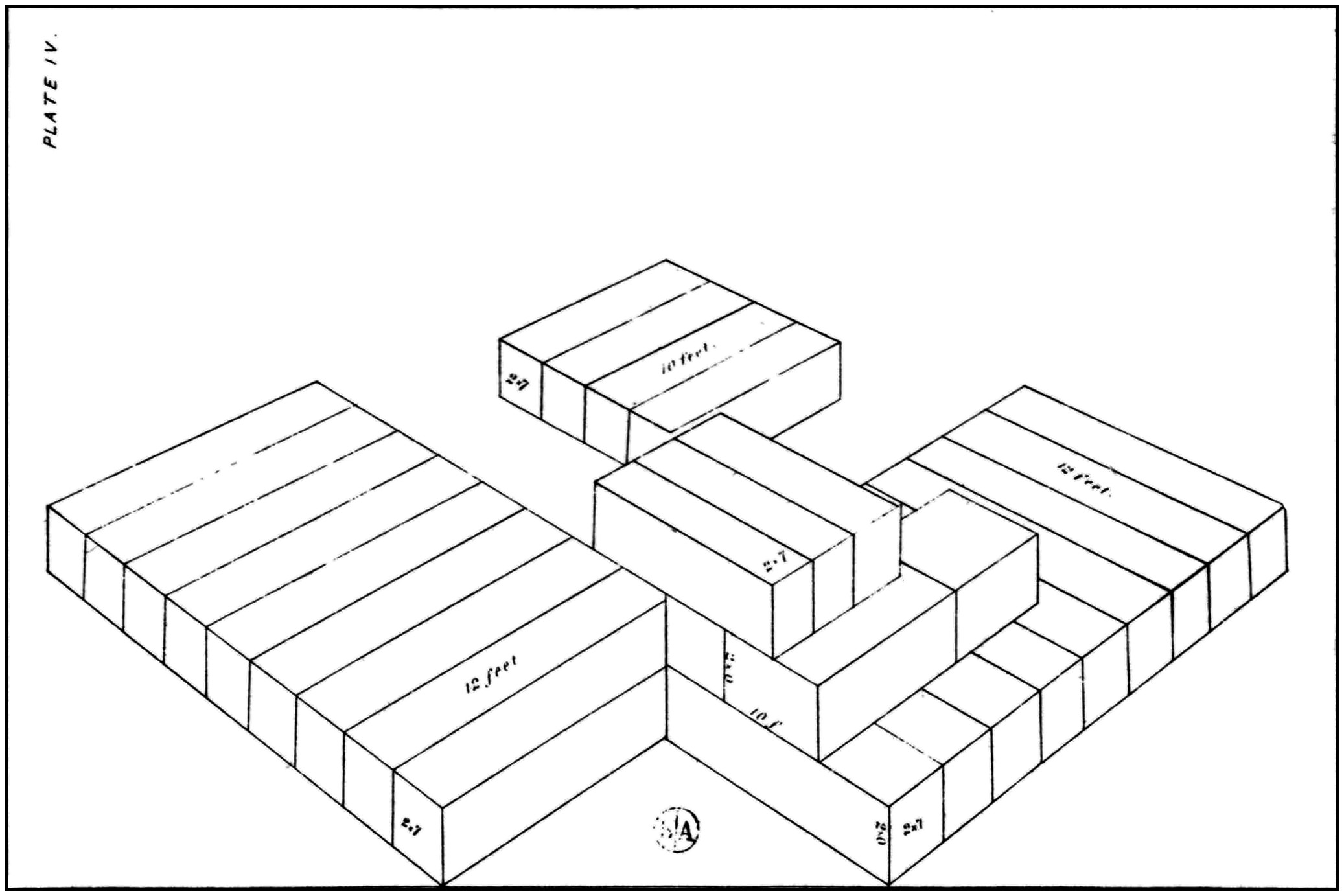
With Solomon Willard’s well-rendered isometric drawing of each stone
for a guide, the stonecutter dressed it, first selecting the best face for the
“bed” (bottom) and hammered it to a plane surface, determined by shallow
channels (chisel drafts) cut diagonally across the stone.
From this surface, the stonecutter laid out the other faces, including the
“build” (top), by his good mason’s square or template. The texture of the
visible face was “tooled,” that is, the marks of the chisel remained visible.
Quincy granite is a quality product, taking a high polish, but the builders of
the Bunker Hill Monument desired no polish on their monument. Today, the
surface of the monument shows faint, well-weathered lines, like those produced
by the modern bushhammer, which has a head made of several thin
steel plates bolted together, each sharpened to a cutting edge. In England
during the period, flat iron bars with rough edges were in use to saw softer
stone than granite, and at Quincy, Willard experimented with dressing machines.
The conclusion may be drawn, however, that the stones which we
now see on the monument were undoubtedly shaped to their present dimensions
by hand.
Today, 110 years after its capstone was put in place, the Bunker Hill
Monument stands as an impressive testimonial to the conservative judgment
of its designer, Loammi Baldwin, and the painstaking fidelity of the man who
supervised its construction, Solomon Willard. An engineer familiar with its
maintenance states that there is no evidence of settlement, and that a check
by surveyor’s transit revealed no signs of misalignment. Its joints occasionally
need pointing, the last pointing being performed about 20 years ago.
Various iron or steel members of the observation chamber have had to be replaced.
Its lightning rod has been in place for many years, but there is no
readily available record to check whether the monument has ever been struck
by lightning. With their empirical methods of design and their crude, mostly
hand-operated, construction apparatus, our forebears built a sturdy structure,
which, barring an earthquake, should last for centuries.
On 7 October 1826, the first railroad in America started operation. This
was the horse-operated Granite Railway, built to transport the stones for the
Bunker Hill Monument from the quarry in Quincy down to the Neponset
River, a distance of nearly three miles. The track and cars of the railroad
had been designed and built by a young engineer of 28, Gridley Bryant,
whose Granite Railway project started him on a long career of achievement in
the invention of equipment that played a major part in the rapid and successful
development of the American railroad system.
Ample precedent for the Granite Railway existed in England, where, since
the reign of Charles II, wooden tracks, sometimes armored with iron plates,
had been used as runways for coal cars from the pits to the nearest waterway.
Within five years of the start of the Granite Railway, similar systems are
recorded in the states of Pennsylvania, South Carolina, New York, and Maryland.
At first, the motive power for these lines was supplied by gravity, stationary
engines, or horses, but soon tiny steam locomotives were tried. Thus,
in the year 1829, Peter Cooper built the famous Tom Thumb, a successful
locomotive which used rifle barrels for flues. In the same year the Stourbridge
Lion, “the first locomotive that ever turned a driving wheel on a railroad on
the Western Continent,”7 was brought by sailing vessel from England and
started operation in Pennsylvania. The American steam railroad system was
thus well under way by the time the lower courses of the monument were being
raised.
7 Annual Report of the Smithsonian Institution, 1889.
Bryant later described his railroad as having stone sleepers laid across the
track, 8 feet apart. Upon these, were placed wooden rails, 6 inches thick and
12 inches high (replaced by stone within a few years). Spiked on top of these
were iron plates, 3 inches wide by ¼ inch thick. However, at road crossings,
stone rails were used, with 4-inch by ½-inch iron plates bolted on top. This
“permanent” construction was also used on the double-track, inclined plane
at the quarry. (Well-preserved vestiges of this “permanent” construction are
visible today at the rise to the Bunker Hill Quarry.) Here, an endless chain
allowed the loaded, descending cars to pull up the empty ascending ones.
The standard gauge of American railroads is now 4 feet, 8½ inches,
measured between railheads, a standard adopted after many years of confusion
before the present gauge dimension was adopted. Although Bryant
described his track gauge as 5 feet, this dimension was measured between
the “bearing points” of the wheels on the tracks. If the bearing points are assumed
to be the center of the treads of the wheels, his gauge is found to match
closely the present standard gauge. This track gauge agrees with that
adopted by the famous English railroad engineer, George Stephenson, at
about the same time, after he had measured scores of carts used by his farmer
neighbors. Possibly, both Stephenson and Bryant knew that their selected
gauge had a very early beginning; for some historians suggest that the English
carts were originally made to fit the ruts cut in the roads of Britain by the
Roman chariots, many centuries earlier, during the Roman occupation of
Britain.
On the day when the railroad started operation, 16 tons of granite from the
Bunker Hill Quarry, and loaded on three “wagons,” were easily pulled by one
horse, once started. Bryant’s first car had flanged wheels, 6½ feet in diameter,
from the axles of which a platform was hung to carry the granite. This
platform was lowered to receive the load and then raised by an ingenious
gearing device.
Naturally, Bryant based the design of his early railroad cars upon the
construction of the horse-drawn wagons of his day. Like the wagons, his cars
had to be flexible if they were to keep on the track when passing over the two
curves of the otherwise straight Granite Railway. In his description of another
of his cars appear the road wagon terms—bolsters, truck, and center
kingpin, to allow a swiveling motion. Rigidly bolted to cross timbers beneath
the truck were two iron axletrees, on which revolved cast-iron wheels.
(Some time would elapse in railroad progress before the wheels would be
fixed to, and revolve with, the axles in journals.)
In early American railroad development Bryant is credited with the invention
of the eight-wheel car, the turntable, switch, turnout, and many other
improvements. In 1832, he had invented and used in the building of the
United States Bank at Boston, his portable derrick, “used in every city and
village in the country wherever there was a stone building to erect.” Others
profited from Bryant’s amazing ingenuity. Although the Supreme Court of
the United States decided in his favor in his most important invention, the
eight-wheeled car, he did not collect, and he died poor.8
8 For more data on the Granite Railway and Gridley Bryant, see: Charles B. Stuart, Civil
and Military Engineers of America (New York: D. Van Nostrand Company, Inc., 1871); and
The First Railroad in America (Boston: Privately printed for Granite Railway Company, 1926).
In the fine saga of the Bunker Hill Monument, the Granite Railway plays
a prominent part. The demand of the monument for granite definitely inspired
Bryant to conceive the idea of America’s first railroad, and to design
pioneer equipment that contributed hugely to the subsequent progress of
America’s great railroad system. The accurate account of the building of the
monument, however, has to record the fact that the railroad was not so great
a benefit as anticipated. In the short distance of 12 miles there was too much
loading and unloading. Willard freely expressed his annoyance at these hindrances.
That he took action is indicated in the following quotation from an
apparently authentic source: “The stone used for the foundation and for the
first forty feet of the structure (the monument) was transported from the
quarry on a railroad to the wharf in Quincy (actually located in Milton) where
it was put into flat-bottomed boats, towed by steam-power to the wharf in
Charlestown, and then raised to the Hill by teams moving upon an inclined
plane. The repeated transfer of the stones, necessary in this mode of conveyance,
being attended with delay, liability to accident, and a defacing of
the blocks, was abandoned after the fortieth foot was laid, and the materials
were transported by teams directly from the quarry to the hill.”9 This account
fails to tell how the teams got up and down the steep hill at the quarry:
the 84-foot rise at an angle of 15 degrees. Clever Bryant must have used his
endless chain to drag the empty teams up, and to brake the loaded ones down.
9 George E. Ellis, History of the Battle of Bunker’s (Breed’s) Hill (Boston: Lockwood,
Brooks and Company, 1875).
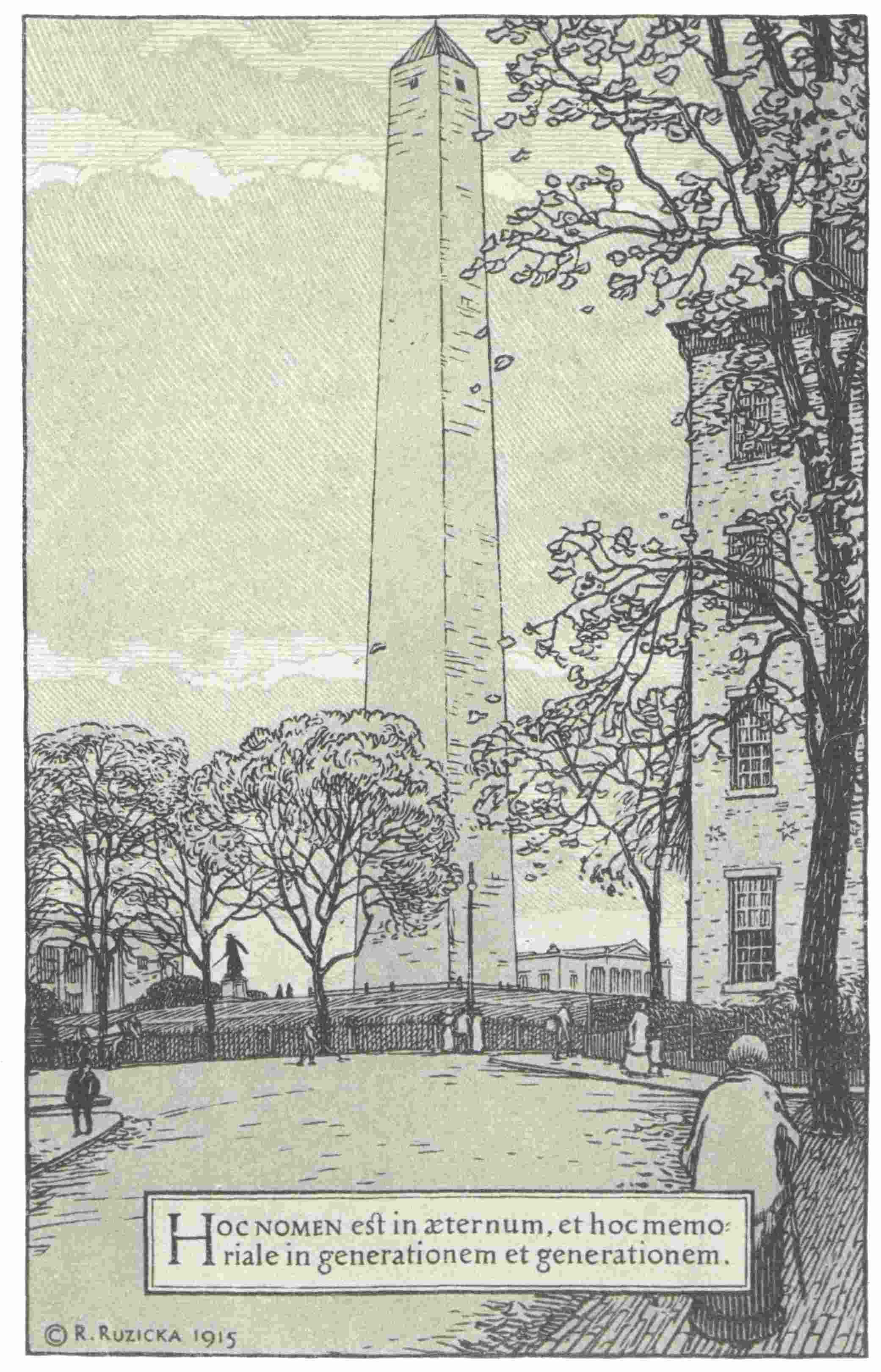
Hoc nomen est in æternum, et hoc memoriale
in generationem et generationem.
Reproduced from a wood engraving by
Rudolph Ruzicka in the Boston Athenæum
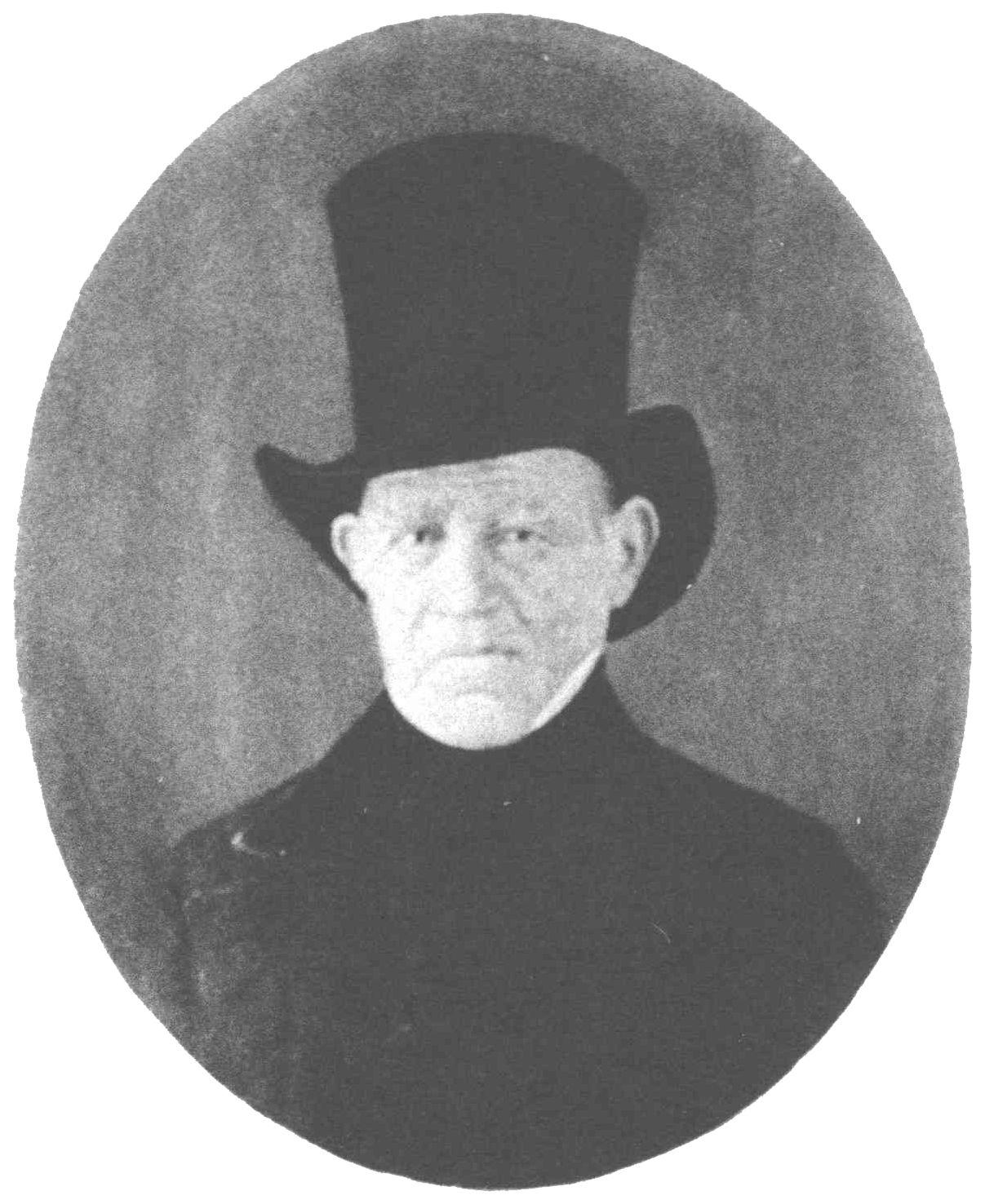
Judah Touro
Reproduced from a portrait in the
Redwood Library, Newport, R. I.
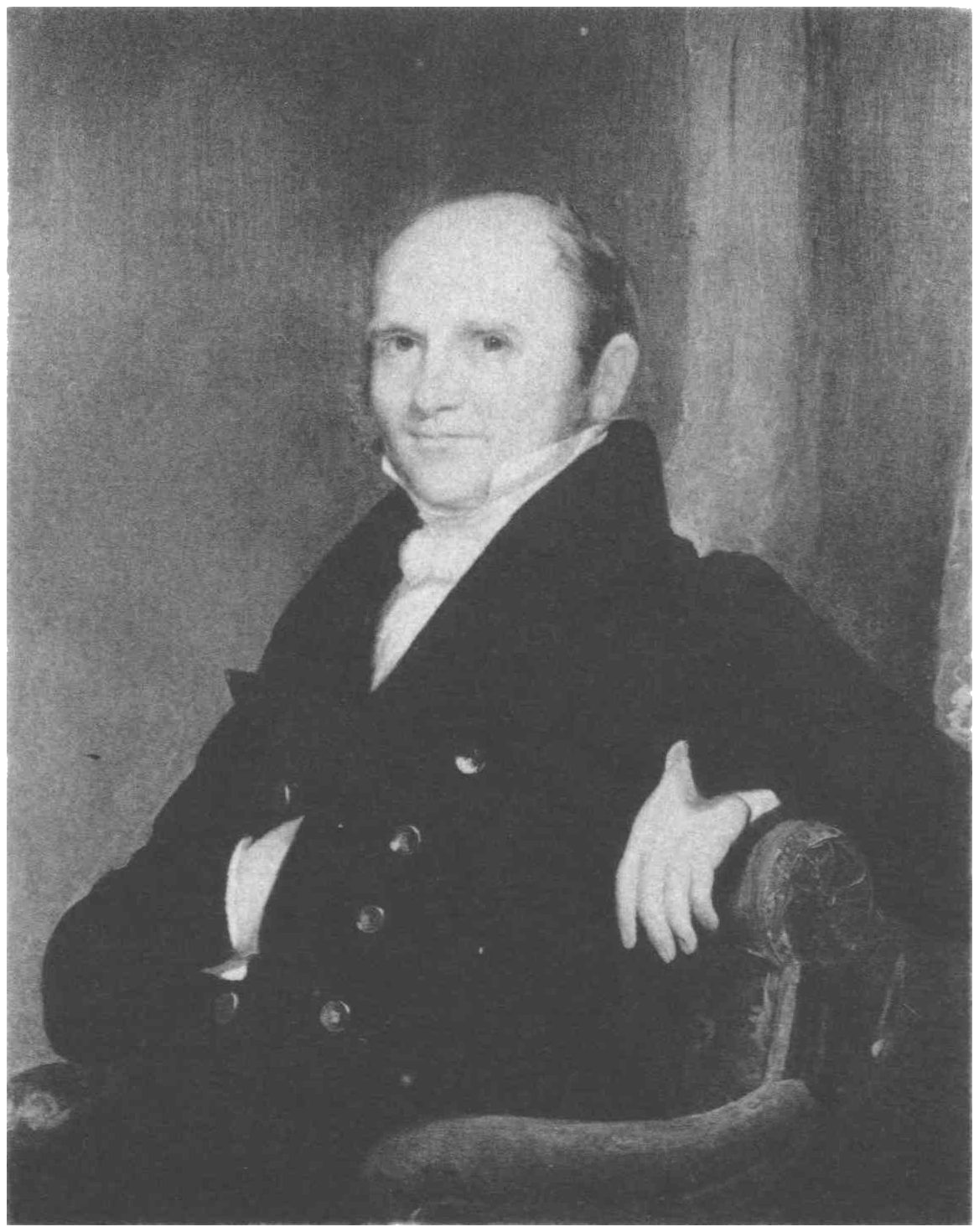
Amos Lawrence
Reproduced from a portrait by Chester Harding
owned by the Massachusetts Hospital
Life Insurance Company
Foundation of Bunker Hill Monument
Reproduced from Willard, Plans and Sections, Plate II
Construction of Bunker Hill Monument
Reproduced from Willard, Plans and Sections, Plate IV
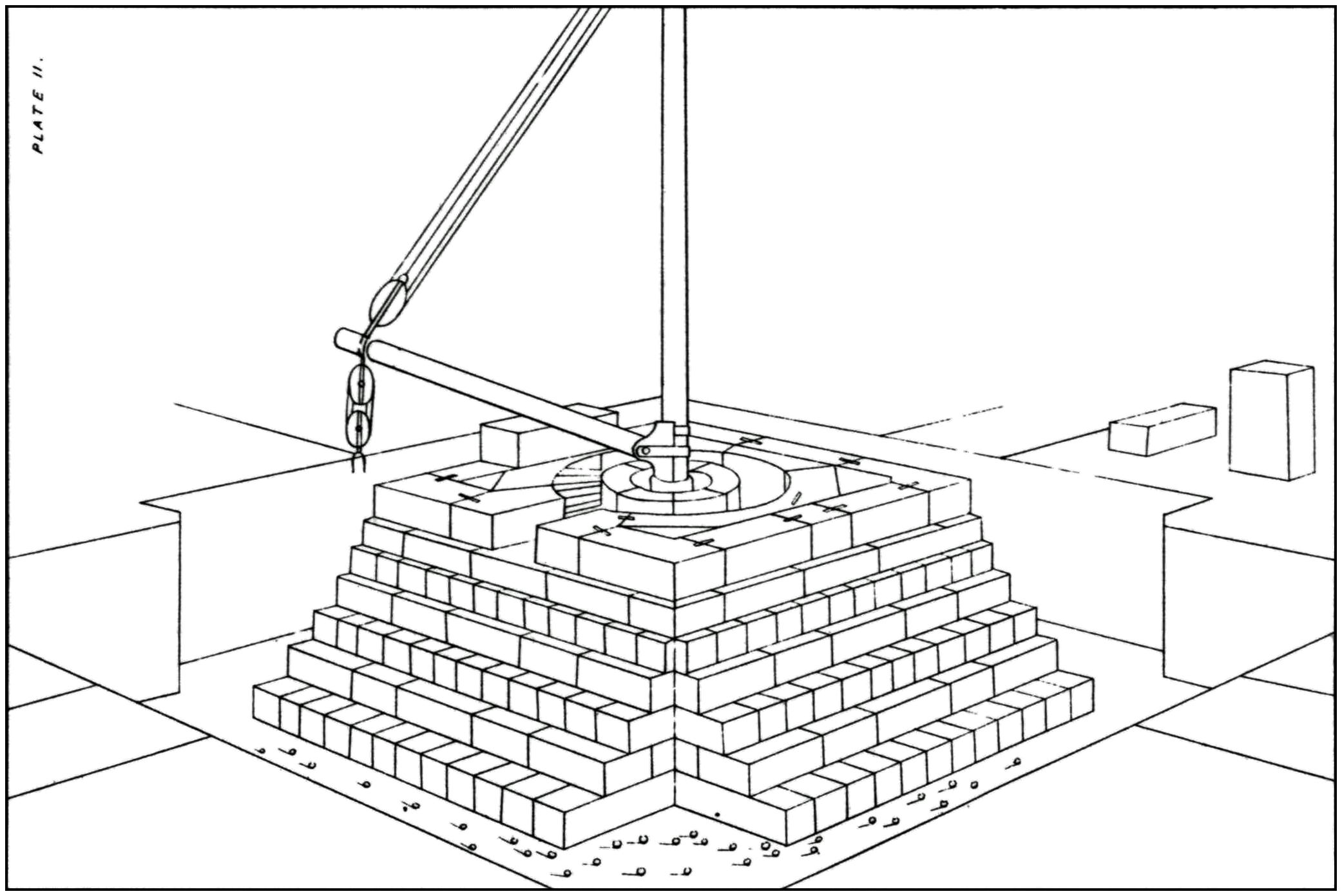
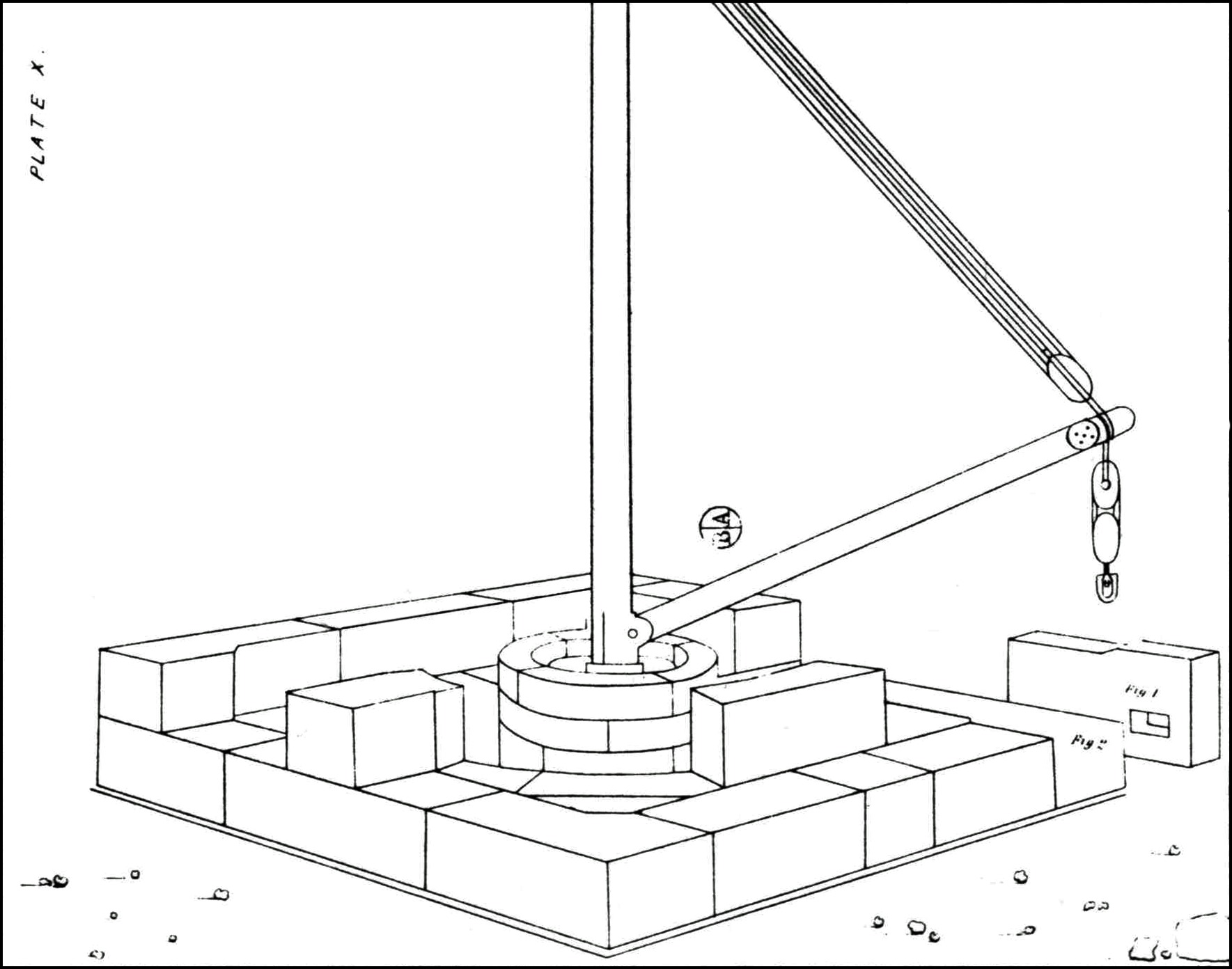
Construction of Bunker Hill Monument
Reproduced from Willard, Plans and Sections, Plate X
Bunker Hill Monument in 1830
Reproduced from C. H. Snow, A Geography of Boston
(Boston, 1830)
In the noisy grogshops on the streets leading to the Boston waterfront, in
the sail lofts on what is now Commercial Street, and at the tall desks of the
counting rooms of State Street, those who got their living from the sea eagerly
discussed the progress of the monument in Charlestown. It was to be their
beacon, and when the many frigates, packets, sloops, and schooners had
safely passed the danger spots of the lower harbor, the monument would
welcome them to the busy inner port of Boston, then much livelier than it is
today. But progress proved to be slow. Naturally the stones broken from the
Quincy ledges and boulders were not always of the dimensions planned by
Willard for the lower courses; many were of sizes needed for the upper
courses. Economical Willard dressed the stones as they came out; setting
aside those which could not be erected for some time; and the piles of such
stones grew larger at Quincy and on the ground about the monument, while
the monument itself rose at a snail’s pace. A more spectacular progress was
needed for a project that was started on a shoestring, and depended on more
and still more public contributions. The building fund dwindled to such a
low sum that in February, 1829, work had to be suspended for lack of funds
to pay the wages of quarrymen, stonecutters, derrickmen, blacksmiths, and
teamsters, and the cost of the good hay for the hard-working horses and oxen
of the project. But 14 courses had been laid—to a height of 37 feet, 4 inches.
The sailors were disappointed, and a poetess said:
But where’s the pile they said would rise,
Throwing its shadows o’er the wave,—
Lifting its forehead to the skies—
A Beacon far o’er land and sea,
Signal and Seal of Liberty.
A lottery to secure more building funds was next proposed. It was not unusual
to allow lotteries in this period—churches, turnpikes, bridges, and even
Harvard College—had received such grants. Public sentiment in Massachusetts,
however, was beginning to consider lotteries a vicious practice and the
director of the Bunker Hill Monument Association voted against one.
At this time, Amos Lawrence was a member of the building committee—a
wealthy philanthropist of Boston, whose religion seemed to be fixed on two
ideals, one of which was his charities. Unlike that of a few good ministers of
the time, who had preached against giving funds for the monument because
they felt their various charities should come first, Lawrence deemed the
completion of the Bunker Hill Monument of first importance. This project
became his other obsession. He enlisted the aid of the Massachusetts Charitable
Mechanics Association in the campaign for funds. Started in 1795 by
Paul Revere, and others, to promote a better understanding between master
mechanics and their apprentices, this society had become influential; its membership
embraced mechanics, manufacturers, and such honorary members
as Ex-President Adams, Daniel Webster, and Edward Everett. Amos Lawrence
had picked upon a well-managed organization for assistance; its executives
were shrewd financiers and they knew how to get things done. The
president of the Massachusetts Charitable Mechanics Association became in
perpetuity the first vice-president of the Bunker Hill Monument Association
(today he is still so listed). Thereafter, the Mechanics Association took an
active part in the promotion and construction of the monument. It made a
careful estimate of the cost to complete the monument and, much to Solomon
Willard’s disgust, raised his allowance for contingencies. Both associations
decided to be satisfied when the monument had reached the height of 159 feet,
6 inches—about two-thirds of the height previously determined upon.
Work was resumed on 17 June 1834, and continued until funds again
gave out, when the monument was 32 courses high, 85 feet; now imposing
enough for quite the good mariners of busy Boston harbor to take notice of. It was
the year 1835, and the country was headed for a severe financial depression—a
bad sign for those who sought contributions for any but the most practical
of objectives. In this emergency, the women of New England again became
active in the raising of funds.
In the summer of 1840, a common greeting of the women of Massachusetts
was: “What are you doing for the Fair?” Those who knit stockings,
crocheted in worsted of various colors, who were skilled in embroidered work,
or who were merely good at plain sewing strove industriously to get ready
for the Fair that was to earn money for the Bunker Hill Monument. Ten years
earlier, the women of New England had made a noble effort to secure funds
for the monument, but as the contributions from females and children had
been limited to a maximum of $1.00 each, the total was small. Now, although
the maximum sum ever raised at a Boston fair was $3,000, they felt that a
sizable sum could be realized in a fair in Quincy Hall, near Faneuil Hall. Despite
the criticism that “women were stepping out of their sphere,” Sarah J.
Hale, the leading spirit in this remarkable effort, persisted.10 Quincy Hall
was 382 feet long by 47 feet wide, and it was crowded with the 43 tables of
things to sell, when the seven-day fair started in September, 1840. A Whig
Convention, in this year of a presidential election, undoubtedly helped to increase
the attendance at this very successful fair. The price of admission on
the first day was double that of the remaining days, which was $0.25.
10 She was editor of Godey’s Lady’s Book for 30 years, and is credited with promoting the
establishment of the last Thursday in November as Thanksgiving Day.
The success of the Quincy Fair was phenomenal. The net sum of $30,035.53
was realized and turned over to the directors of the Bunker Hill
Monument Association toward the completion of the Bunker Hill Monument.
This amount was nearly one quarter its total cost. The Yankee ladies
did not know that two contributions of $10,000 each, with several smaller
donations, were available by now. The gift of $10,000 by Judah Touro was
peculiarly heartening, as an example of the expression of the gratitude of the
son of an immigrant to the country of his adoption. The father of Touro had
been rabbi of a synagogue in Holland. The younger Touro was born in Newport,
R. I., in 1776; he had sailed to New Orleans with an assortment of New
England commodities and had made money in their sale. A soldier in the
Battle of New Orleans, in the War of 1812, he had been given up for dead in
the battle. He had become a millionaire and, learning of the proposed gift of
$10,000 by Amos Lawrence, toward the completion of the monument, Touro
had matched it. Thus, in the year 1840, the success of the Bunker Hill Monument
was assured. It could now be built to the full height planned by Baldwin
and Willard—about 220 feet.
Contractor James Sullivan Savage would have no trouble finding good
men for the ticklish job of raising and setting the heavy stones of the higher
courses of the monument; able sailors, who would take a shore job for a
change. Maritime Boston was full of these good riggers, who were used to
dizzy heights, and to whom the half hitches, square knots, guys, slings, and
tag lines would be easy. Up to this time the monument had been built by day
labor, not by contract. Now, Savage had taken a contract to finish the monument
for $43,800, from the elevation of 85 feet to the top. He was well
trained in masonry, for he had worked on the job since the start under Willard,
whose rigid ideas would not let him take a contract himself for profit on
such a patriotic project, but who agreed to superintend the work of Savage
to the finish. Savage had the traits of a good contractor—energy, resourcefulness,
honesty—and the sense that knew how each detail must be executed
toward the end of producing a job to be proud of.
Savage replaced the one-horse capstan of the hoist by a six-horsepower
steam engine, an innovation that speeded up progress. The steam engine as a
prime mover in land and water transportation had become well established,
and its use to drive textile machinery had proved successful. Steam power in
the construction industry, however, was a novelty. Shouts and wigwag signals
from the setting gang at the top to the engineer on the ground were replaced
by a bell-wire signaling system. This must have been a pull bell, for
many years would pass before electric bells came into common use.11
11 Joseph Henry had developed the electromagnet at about the time of the laying of the
lower courses of the monument, and, a few months after its dedication, Morse would operate
the first telegraph line between Washington and Baltimore, but the transmission of electric
currents by insulated wires even for a few score feet was still too new to receive serious attention
on a construction job.
As its lighter stones would be easier to handle, the granite inner cone
(newel) around which the stairs wind was erected a few courses ahead of the
walls of the monument. It thus served as a support for the derrick which
raised the heavier wall stones. Through apertures in the hollow walls of the
newel, a heavy beam (wood?) was passed, upon which the derrick was set.
It is interesting to compare our modern hoisting derrick with the apparatus
used to raise the stones for the monument. The derrick of today consists of
a guyed, vertical mast, an adjustable boom hinged to the base of the mast,
with boom falls, and hoist falls, each with their cables and pulleys, or blocks.
At the base of the mast, a bull ring serves to turn the mast by power. The
whole combination is called the derrick. When we get accustomed to the old
English or American custom of calling the mast the post or derrick, and the
boom either the gaff or derrick, a little study enables us to comprehend how
the monument was built.
The lower courses were raised by the “Holmes Hoisting Apparatus,” designed
by a practical seaman of Boston. This device could command a circle
100 feet in diameter. Except that it had no bull ring to turn the mast, it appears
much like the derrick of today. With steam power available for the upper
courses, Savage seems to have modified the boom of Holmes to serve as a
nearly horizontal “lever,” on which a “wheel carriage” drew the stone inward,
to its desired position for placement. In other words, apparently, the
boom became today’s monorail. A somewhat obscure, English description of
the means used to hoist masonry 100 years ago, tells of two devices. One was
a “movable derrick crane,” with a vertical post, supported by two timber
backstays, and a movable hinged “jib or derrick,” which could be today’s
boom. This assembly, of course, corresponded to today’s stiff-leg derrick, in
which the back guys are replaced by timber members. The other English device
for raising stones was practically exactly like today’s traveling crane, and
that was the name it went by in England, 100 years ago.
Our construction forebears of over a century ago had to use ropes and
chains for all purposes; there were no wire ropes. About the time Savage
set his first stone, John A. Roebling was making the first American wire rope
cable, in a largely outdoor plant located on a level meadow on his farm in
Saxonburg, Pa. Wire rope had real advantages in construction work, because
of its superior strength and its much less stretch under load. A crude
sketch, dated 1837, shows that the derrick for the monument was guyed by
chains, which attached to the top of the mast and passed over timber brackets
at the staging level, and thence vertically down to weights at the ground. In
his long length, the stretching and shrinking of a rope under rain, load, and
temperature changes would be difficult to control.
Every four courses of the wall stones (about 11 feet) the derrick was
raised, perhaps by unshipping the boom and using it as a lesser mast to raise
the mast proper. Square timber sticks were then beginning to be used for
staging, instead of the round trunks of small trees and saplings previously
used. A sketch of the monument shows a squared timber stage for pointing
the joints. Such a stage could be much more easily erected, and was more
reliable than the round sticks, tied at the joints by cords.
On paper, Willard had performed the painstaking task of dimensioning
every stone, each with its top (the build) a little narrower than its bottom (the
bed), so that the true taper of the obelisk would be maintained. To set the
stone to line was the chore of the erecting force. On the top of the stone already
in place lime mortar was spread, enriched with hydraulic cement, and with a
sprinkling of iron filings. (A popular, modern, commercial waterproofing
compound utilizes the fact that, upon oxidizing, iron particles mixed with
the cement mortar expand, thus reducing the voids and producing a denser
mass when the mortar sets.)
Temporary wooden wedges would be placed at the corners of the stone
already in place, to support the heavy new stone until the mortar had hardened.
When the ponderous stone had been speedily raised from the ground
to a level a few inches above the mortar, the engine would be stopped; the derrick
adjusted to right or left, and in or out, until the stone was very closely in
line. Next, riggers would push on the bridle chain which attached to the two
lewises in the stone’s top surface, guiding it to its true position in its gentle
descent as the engine lowered it the few inches needed to bed it. A tiny fraction
of an inch “out-of-line” would be serious, for such errors if repeated, or if
not compensating, would visibly throw the monument out of line. On a light
stage high above the ground, bracing themselves against gusts of wind, the
riggers would be intent on the necessity for such accuracy, but not forgetting
their own safety, for no careless workman could work for Savage. They would
remember that, while laying the last stone of the 12th course, at the southwest
corner, one man had been pushed off (the only death on the project).
Happily, the good riggers raised their monument, course by course, to the
top. They were under a boss who knew his trade, and he was making money—the
sign of content on any construction project. (Savage made some more
money after the monument was finished, when he retained the steam engine
that had been used for hoisting stone, for the purpose of raising a passenger
car to the top. For the car ride he collected $0.20, as against the $0.125 for
visitors who climbed the stairs.)
The practical riggers would not be disturbed at the proposal, advanced
when the monument neared its top, that the apex be modified to form a platform
to accommodate visitors. Aesthetic Bostonians were much disturbed at
this proposal. Happily, the Bunker Hill Monument Association voted down
this architectural atrocity.
On Saturday, 23 July 1842, several hundred of our early rising Bostonian
ancestors rose earlier than usual to arrive at the monument at 6:00 A.M. On
the ground at the base, they studied the capstone; a small stone pyramid, three
feet, six inches high, stoutly lashed to the derrick hook, and with an American
flag at the top. Standing on the capstone, firmly grasping the hoisting
rope, Colonel Charles R. Carnes waited for the signal to hoist. When the
clock struck six, a signal gun was fired, and the capstone, bearing the good
colonel, started up. In 16 minutes it had reached the top; at 6:30 A.M. it
had been bedded, and a national salute announced to all Boston that the
Bunker Hill Monument was completed.
By railroad, great multitudes came to Boston for the dedication of the
Bunker Hill Monument, nearly a year later, on 17 June 1843. Unlike the
time of 18 years earlier, when the cornerstone had been laid, stagecoaches
were not the main conveyance for visitors to Boston. Indeed they were decidedly
on the way out, and would soon be but symbols of an era of traveling
discomfort, as the railroad completely took over. President Tyler and his
cabinet attended; Daniel Webster matched with sonorous eloquence his
famous speech at the laying of the cornerstone, and there were still 13 very
aged surviving veterans of the battle able to attend.
Seven years later (1850), two Harvard professors checked with elaborate
apparatus, paid for by members of the Bunker Hill Monument Association
and the Massachusetts Charitable Association, the famous experiment of
Foucault which used a long pendulum to prove the daily rotation of the earth.
Suspended in the newel by an annealed wire, 210 feet long, the oscillations
of a pointer, attached to a 31-pound British cannon ball relic of the battle,
were observed; and its plane of swing was seen to revolve during the day
from right to left of the observer. A sudden shower on a previously bright
day complicated the experiment, until Professor Eben N. Horsford discovered
the reason. Cooled by the rain the monument’s exposed face contracted;
its apex moved correspondingly and carried the point of suspension
of the pendulum with it. As observed years later on the Washington Monument,
Horsford deduced that the side of an obelisk, exposed to the hot sun,
expanded, and that its apex followed the sun in the sun’s travel from east to
west. Such motion is tiny, and the ingenuity of the apparatus to observe it was
notable. The path of the orbit of the bob, registering both the earth’s rotation
and the effect of varying heat on the monument’s sides, was described as an
irregular ellipse with major axis of one-half an inch.
Two hundred thousand persons visit Bunker Hill every year. Of these
visitors 20,000 pay their $0.10, and presumably climb the 294 granite steps
to the top.12 Very few Bostonians are among these visitors.13
They are of various
types: honeymooners and casual tourists, whose list of the sights to be
seen in historic Boston includes the monument, and historically minded
youngsters, one of whom was recently caught in a heated argument with his
father as to where the order was to “wait ’til you can see the whites of their
eyes.” Surely, the stout young man who recently lugged 25 pounds to the
top—his young daughter—was not typical.
12 Estimate of custodian from a review of his register, 1951.
13 “Those pangs of conscience he feels every June 17 are as close as the average Bostonian
ever comes to climbing Bunker Hill Monument.”—Boston Globe, 18 June 1951.
The evidence that the monument is probably the most popular of the historic
shrines of old Boston would be as pleasing to the charter members of
the Bunker Hill Monument Association as to the present members of this
venerable society, which lists among present and past members, 30 generals,
12 admirals, 12 Presidents of the United States, a score of Massachusetts
governors, 20 mayors of Boston, and 6 presidents of Harvard University. It
is a healthful society to belong to, the 1949 Proceedings say, in the mention
of 46 half-century members of whom 16 were then living.
Many years ago, the Association voted to hold patriotic exercises every
year at the monument, and this resolution has been faithfully fulfilled. The
annual ceremonies today are very different from those of the earlier years;
they have followed the varying pattern in which American citizens have
celebrated their national anniversaries during the more than a century since
the monument was dedicated in 1843. They were solemn occasions during
the earlier years. In what better spot could the Yankees of the trying days of
the Civil War compare their convictions with those who fought for similar
principles than at the monument, as they listened to the stirring eloquence
of their War Governor, John A. Andrew. In later years the holiday spirit
took over, with a fireman’s muster to please the older folk, while the youngsters
of Greater Boston made Bunker Hill Day on 17 June a parallel in firecracker
noise and casualties to fingers and eyesight, to the Fourth of July,
of which it was a preview. Today, Bunker Hill Day is a huge neighborhood
festival, with block parties and a skillfully routed parade which seems to
pass every house on the hill. They who enjoy things most are the children of
working people, not of the wealthy families that once lived in the sightly
dwellings of Bunker Hill. Each boy or girl can give a visitor the story of the
battle in detail, and recite the precise dimensions of the monument. (They
collect from tourists for this information, for it is one way by which Charlestown
youngsters get their spending money.) These children would rarely
answer to the old names: Prescott, Warren, Putnam, or similar Yankee
names. They are mostly of second or third generation European families:
proud Americans, fortunate to live near the site of one of America’s most
famous historical shrines. Their festival is a heartening occasion to witness,
for it is American democracy at its best.
Through it all the monument rises above its unadorned settings; except
that the crown of the hill has been removed, it could still be the New England
hilltop farm on which the battle was fought. The obelisk rises in the
simplicity of its straight lines and clean angles, with no curves, and with the
somber gray of its harsh-textured masonry unrelieved by any greenery of
foundation shrubbery. The rugged monument is symbolic of the stern spirit
of those who fought in the battle, and of the determination of those who solved
the problem of building this massive memorial to them, in the pioneer days
of American architecture and engineering.
Punctuation, hyphenation, and spelling were made
consistent when a predominant preference was found
in the original book; otherwise they were not changed.
Simple typographical errors were corrected; unbalanced
quotation marks were remedied when the change was
obvious, and otherwise left unbalanced.
Illustrations in this eBook have been positioned
between paragraphs and outside quotations.
Read Of Yankee Granite (1952) by Edward Herbert Cameron — Full Text Online Free | Open Old Books