Inkster House,
Inkster, Michigan,
August 4, 1876.
Having before me a lecture appointment
at Ypsilanti, which, considering the object
I had in view through Michigan, I felt
must be met, I rode out of Detroit at
three o'clock in the afternoon, somewhat
reluctantly perhaps, but within a very short
time the love of travel was again upon
me, and I found myself easily reconciled.
Paul being in the most delightful spirits,
after four days of unbroken rest, displayed quite a
little animation as I mounted him in front of the
residence of friends on Cass Avenue, and when we
had reached the open country, I gave him the rein and
allowed him to trot or gallop, as he felt inclined.
The edge of his impatience having worn off, he resumed
his habitual easy canter which made the saddle
so enjoyable, and at this pace we covered fourteen miles,
reaching our destination a few minutes after six o'clock.
There was an agreeable if not decided contrast between
the last stopping-place and the present one. A
hundred towers announced the approach to a great
city, as we neared Detroit; but here a solitary spire rose
against the sky, and while the Detroit River teems,
throughout its entire length with water-craft of all
sorts, the almost unknown little river that winds along
between Detroit and Inkster, is at this point as quiet
as one of the untravelled streams of the North. The
Michigan Central Railway follows its shore for many
miles, and as I kept to the highway in the same direction,
I could see it shining occasionally through an
opening in the trees. The waters of this river are no
doubt full of fish, as are all the streams of Michigan,
and they have besides a fine characteristic—a sparkling
clearness.
Hawkins House,
Ypsilanti, Michigan,
August Fifth.
A forbidding sky hung over Inkster as I took my
seat in the saddle at ten o'clock, but "Forward" was
the watchword, and there was moreover a charm in
variety, for sunny skies had become rather monotonous
and, under the circumstances, uncomfortable. The
dust was well laid when we had gone only a short
distance, but it rose again in a new form as Paul
quickened his pace, so that we did not present a very
dashing appearance to the Ypsilantians, after sixteen
miles of such travel.
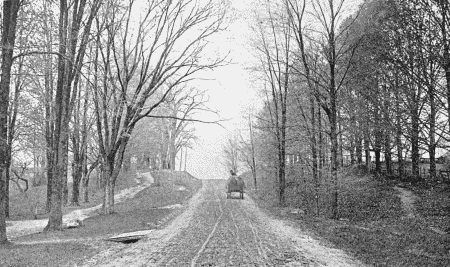
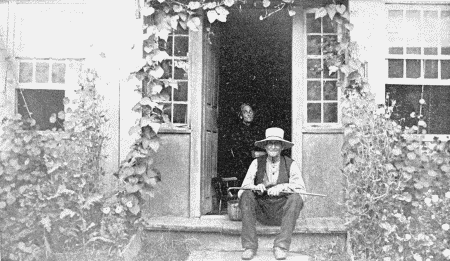 A SUMMER AFTERNOON.
Several times I was obliged to turn from the road,
once taking shelter under a tree and again in a woodshed.
There were in town, however, those who could
excuse the appearance of a bespattered traveller—brave
men who had gone from Ypsilanti in the early days
of the Rebellion, and who had learned from long campaigning
to look upon their comrades without criticism.
The brave Fourteenth Infantry started out
from here under Colonel Robert Sinclair, and joining
Sherman in Georgia took a lively part in all the movements
of his army, until the fall of Atlanta; numbering
among their proudest achievements the repulse of
the enemy at Bentonville, North Carolina, where the
hurriedly constructed works of the Federals were
charged and taken and then regained at the point of
the bayonet; and their part in the battle of Jonesboro,
Georgia, in 1864, which was the last of Sherman's
brilliant operations around Atlanta. Many of these
brave fellows perished on the field of battle, but
enough remain to keep fresh the memory of those
stirring days and to add the influence of their patriotism
to the young Ypsilanti.
Hawkins House,
Ypsilanti, Michigan,
August Sixth.
On the previous evening I met a large number of
men of the town, who gave me a hearty welcome, and
as many of them were old soldiers, they expressed
their satisfaction with the purpose of my lecture,
favoring me with considerable enthusiasm in Union
Hall.
The patriots of Michigan have many proud deeds to
tell of, and are distinguished for their gallant service.
Their military leaders were invariably zealous, and
their civil leaders unceasing in their encouragement.
"We cannot consent to have one star obliterated from
our flag" was the sentiment, and with the saving of
the Union at heart, the men went into battle.
During Wheeler's repulse at Strawberry Plains in
August, 1864, eight Michigan men were left to guard
McMillan's Ford on the Halston. One of these,
knowing the danger of his position, deserted, leaving
his seven companions to "hold the fort." This handful
kept back a brigade under the Confederate general
almost four hours, but the Rebels crossed above and
below the ford and captured the guard. One of their
number, a farrier, was wounded, and Wheeler coming
up to him began a conversation. Finally Wheeler
said, "Are all the Tenth Michigan like you fellows?"
"Oh, no," said the other, "we are mostly horse farriers
and blacksmiths and not much accustomed to fighting."
"Well," said Wheeler, "if I had three hundred such
men as you, I could march straight through h—l!"
McKune House,
Chelsea, Michigan,
August Seventh.
Left Ypsilanti bright and early in order to save
time, for although nearly the middle of August, I still
felt the intense heat, and the dry dusty roads often
made my daily journeys far from agreeable. For
several days the mercury ranged between 85° and 90°,
and as the route was at this time due west, the sun
nearly stared me out of countenance in the afternoon.
Ann Arbor was reached about ten o'clock, but I did
not take more than a passing glance at the University,
noticing, however, that women as well as men were
among the students—a recent and wise change in the
law of the institution. The people were raising a
flag over one of the buildings as I rode through, and
on it in conspicuous letters were the names of Tilden
and Hendricks.
Delhi, with no signs of a Lalla Rookh, and Scio,
modest under the dignity of its suggestive Latin name,
were quaint landmarks along my way, but I rode on
a mile beyond to have dinner at Dexter. The Huron
River has its source near here, in one of a cluster of
lakelets, bordering on Livingstone and Washtenaw
counties. All Michigan is covered with these small
bodies of water, which, with the streams, lie upon its
green surface like pearls in a network of silver.
Leaving Dexter, I had company all the way to
Chelsea. Large flocks of sparrows flew along, lighting
upon the telegraph wires, and as I approached they
would fly away and settle again farther along, keeping
up a kind of race, which was evidently fun for them,
and which greatly amused me. It seemed as though
they were tireless, and when I and my horse reached
our destination fatigued, after twenty-six miles of
travel in the sun, these strong-winged fellows were
ready for another flight. I do not doubt that they
easily accomplished the return journey, for we cannot
compute the distance they can cover in a day. They
are hardy little fellows and, despite the objections urged
against them, have many admirable qualities, not the
least among which is their tenacity of purpose.
Hurd House,
Jackson, Michigan,
August Eighth.
A few minutes after seven in the morning found me
in the saddle at Chelsea. I stopped on my way at the
Herald office and then struck off towards the main
road, along which I cantered to Grass Lake, where I
had dinner and remained until three o'clock. This
rest was thoroughly enjoyed, the more so perhaps, as I
learned before leaving Chelsea that if my advance
agents had not made arrangements for me elsewhere,
the people would have asked me to lecture here. In
that event I should not have been so familiar with
the quiet charms of Grass Lake.
Probably there are those who, if they had been in
my place, would have denied themselves these halts
along the way, but they would have been deprived of
a double gratification. In the first place they would
miss much of the character of the country through
which they passed, the real difference in the manners
and customs of the people; and they would miss the
opportunity of assuring the credulous that they were
not making a test ride across the continent within a
certain time and for a certain reward.
News often travels incredibly fast when there are no
evident means of communication, and I was often
amused by the curiosity which my advent excited
and the reasons which were whispered about in the
villages through which I passed, as to the object of
my journey. Indeed many Michiganders, from quiet
haunts in their native wilds, made short pilgrimages
"to town" in order to look at one whom they fancied
might hold a proud place for having crossed the
continent in so many days, hours and seconds. My
horse even was looked upon with awe, as "the charger
upon which General Washington rode during the war
of the Revolution!" But this anachronism belongs
to New York.
Leaving Grass Lake late in the afternoon, it was
necessary to make better time in order to cover the
remainder of the twenty three miles lying between
Chelsea and Jackson. The pace quickened. I came
into the latter city at six o'clock, and rode directly to
the hotel.
Hurd House,
Jackson, Michigan,
August Ninth.
I clipped the following notice from the Citizen of
this date, as a memento of my stay at Jackson. It
chronicled the fact that:
"Captain Willard Glazier lectured last evening in the interest of
the Custer Monument Fund. His lecture was a good historical
review delivered with graceful rhetoric and at times real eloquence.
The Captain is still in the city giving his horse a rest; a noble
Kentucky Black Hawk, whom he has ridden all the way from
Boston, and whom he expects to carry him to San Francisco. He
starts to-morrow morning for Battle Creek, where he lectures on
Saturday evening."
My advance agent, Babcock, went on to Battle Creek
in the morning, where arrangements were made with
local committees for my lecture on the twelfth. After
he had gone I made a leisurely inspection of the
city. It was impossible to do more on account of the
extreme heat.
This may no doubt be considered the centre of the
closely populated southern end of Michigan, a region
dear, in times past, to the heart of the Indian, but
which knows him no more. A Chippewa chief standing
upon this soil, once said: "These lakes, these
woods, these mountains were left to us by our ancestors;
they are our inheritance, and we will part with them
to no one." He knew not the strength of the pale
faces who listened; for within a few years they were
ready to claim, on the same grounds, those hills, and
lakes, and mountains for their own.
Compared to the peninsula, whose mineral-laden
shores are washed by Superior, Michigan and Huron,
there is the greatest contrast; and La Hontan, making
a little exploratory trip up there before anyone else,
called it "the fag end of the world." These words
might still be applied to some of the wildest northern
points, but here is the very heart of civilization.
Jackson lies in the coal fields that reach down
through several of the southern counties. This deposit
is not rich, owing to the amount of sulphur in it, and
the demand is chiefly local. The Grand River divides
the town and, with the bridge that spans it, adds much
to the picturesque effect.
Cooley House,
Parma, Michigan,
August Tenth.
Spent the forenoon in my room at the Hurd House,
Jackson, writing letters to my wife, Major Hastings
and others. In the afternoon there was a street parade
of Howe's London Circus which was a very fantastic
affair, but which seemed to be hugely enjoyed by
everybody. Later in the day the great tent was upset
by a gust of wind, accompanied by a thunder-shower,
and a droll scene followed, which caused considerable
excitement. The people were left exposed with the
rain coming down upon them in torrents. So far I
have seen nothing more amusing than the country boys
and girls rushing up town drenched, and for once at
least indifferent to the charms of the "big show."
The storm having passed, I ordered Paul after
supper, rode down to the office of the Patriot and
Citizen, and after a few minutes' conversation with
the editor, hurried on toward Parma, which was
reached late in the evening. The ride in the dark
was cool, but somewhat lonely.
It was probably on such nights as this that young
Dean, the enterprising settler of years ago, played his
nocturnal tricks upon his neighbors. He came out to
Michigan when it was a wilderness, to make his
fortune by clearing land at ten dollars an acre, and
while he was drudging he expected to have a little fun.
It was his habit to work away all day chopping trees
within an inch of the falling point, and then about ten
o'clock, when the settlers were well asleep, to go out
and give a blow to the end tree, so that it would fall
against the others and send them crashing like a row
of ninepins. How the old forests must have rung
with their thundering and how that plotter Dean must
have relished his mischief!
As I approached Parma, in the darkness I could see
nothing about the village to suggest that other Parma,
far away under an Italian sky, but there is a resemblance,
for the European duchy and its modest
American namesake both lie in a rich agricultural
region; and if I mistake not the dull white freestone
that is quarried here in such large quantities, finds a
prototype over the sea.
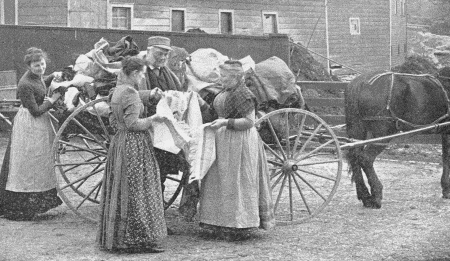 THE COUNTRY PEDDLER.
Witt House,
Marshall, Michigan,
August Eleventh.
As there was a heavy rainfall in the morning, I
waited in Parma until nearly ten o'clock, and even
then was obliged to start in a thunder-shower in
order to keep my appointment for the following
evening at Battle Creek. This required no sacrifice,
for, excepting the discomfort of wet clothes, the change
was agreeable. I reached Albion in time for dinner,
and immediately made myself comfortable at the hotel.
Rest and refreshment having the desired effect, I afterward
took a short stroll through the town, which I
found very wide awake, although the Methodist
college, the life of the place, was still closed for the
summer vacation. In the meantime the men of the
village had met, and before I remounted, came to me
and persuaded me to return by rail and deliver the
Ouster lecture on the fifteenth. Glad to do all I
could for the "Benefit Fund," I readily consented and
started away with the good wishes of the impromptu
committee. Marshall, being only twelve miles beyond,
was reached early in the evening, so that before dark I
had time to get a mental picture of the place. Calhoun
County has its capitol here, and in 1853 it was looked
upon as one of the most flourishing towns in Michigan.
It has not reached the predicted pinnacle of importance,
but it has a pleasant situation, some flourishing flour
mills, and is altogether a credit to the "Wolverines."
Potter House,
Battle Creek, Michigan,
August Twelfth.
As soon as Paul was led out in front of the Witt
House at Marshall, a large crowd gathered about us;
and when I had taken my seat in the saddle, one of
the number stepped forward in behalf of the townspeople
to invite me to return at a time which had
previously been agreed upon and lecture on the heroes
of the Revolution. Giving them the best promise I
could, I hurried away as I had a good six hours' ride
before me.
Since the day before there had been a decided change
in the weather. The sun blazed down with almost
tropical heat, drying up the roads and making my way
a veritable fiery furnace. I had a rare opportunity
for watching "Old Sol" on these solitary rides, as he appeared
unfailingly in the morning, swung through the
heavens, and vanished in the west at night. It was
now harvest time, and since that early day in May on
which I started westward, I had kept my eye on him
like a true worshipper, half understanding the pagan
with his devotion to Apollo, and half in sympathy
with the Indian who greets the Sun-god and weaves
the splendid symbol into pouch and canoe and mocassin.
Between the hours of ten and four particularly
the heat was intense, but in other respects the day was
uneventful.
Private House,
Battle Creek, Michigan,
August Thirteenth.
On the preceding evening a full house greeted me
at Stuart's Hall, where I was introduced by a comrade
of the G. A. R., Lieutenant Eugene T. Freeman.
After the lecture I met several of the leading men of
the town and later was invited to a private residence,
where I was made at home during the remainder of
my stay. The Lieutenant called for me on Sunday
morning, and I accompanied him to church, meeting
the pastor, Rev. L. D. Palmer, who spoke with animation
and warmth and made the service an effective one.
I enjoyed it all the more perhaps as I realized that before
many Sundays I would be on the Great Plains beyond
the Mississippi, where churches are known to be
very rare. Continuing his courtesies, my comrade friend
drove me out to the favorite resort, Lake Goguac, in
the afternoon and there I had several fine views of
the surrounding country. This little incident suggests
an interesting theory concerning one of the pre-historic
races who are supposed to have occupied this section
of the country. It seems that in the ancient symbolic
manuscripts of the Aztecs frequent mention is made of
a land which they called Aztelan, compounded of the
symbols A. T. S. and signifying "Lake Country," from
which also their own name is derived, making it to
mean "the people of the lake country." They refer
to their former home as a country lying towards the
north and giving further details which might be
descriptive of the Peninsular State—so the theorist
thinks. As a coincident, but advanced nevertheless
as a strong argument, the learned gentleman states
that the Wyandots have a tradition to the effect that
hundreds of years ago, the builders of the mounds
were driven southward by invaders from the northeast;
and pursuing the magic thread, he suggests that
the Aztecs were usurpers in Mexico according to their
own traditions and the corroboration of Spanish
history. If this is the case, my comrade and myself,
in visiting this pretty little lake, may have trodden
upon the same soil which had been pressed by the
feet of the mysterious builders of the mounds. I am
personally a trifle sceptical on this point, and believe
that the key to this part of ancient history is yet to be
found.
Kalamazoo House,
Kalamazoo, Michigan,
August Fourteenth.
On this day I passed a fine wheat-growing section
in the valley of the Kalamazoo, whose richest part is
probably near the Big Village—its namesake. This
river, which drains Hillsdale, Kalamazoo, Calhoun
and Allegan counties, and is navigable for forty miles
above its mouth, has, I believe, more traffic than any
one of the rivers of Michigan. Throughout its length
of two hundred miles it flows through pine and oak
forests, through the richest section of a State famed for
its agricultural products, and like the Nile, if I may so
compare the relics of a great people with those of one
comparatively unknown, is looked down upon by the
silent monuments of the past. To me the comparison
is not unreasonable, for I consider the tumuli of those
mound-builders scattered over the hills and valleys of
America, worthy of as much interest and respect
as the more splendid remnants of a higher civilization.
At this point the stream is still broad and picturesque.
As to its name I am undecided. According to some
it is a corruption of Ke-Kenemazoo, meaning "the
boiling pot," and according to others of Kik-alamazoo,
"the mirage river," because to the fanciful Indian the
stones that jutted, dark and wet, out of the river-bed
looked like otters. The village on its banks was settled
in 1829, and after being known for two years by the
name of its first settler, Bronson, became, in 1836,
Kalamazoo. It is thoroughly alive, has a population
of about 18,000, and its position as the half-way place
between Detroit and Chicago adds considerably to its
importance. I lectured here to a full house, being
introduced by Major R. F. Judson, formerly of
General Custer's staff, and bearing a high reputation
as a soldier. Intercourse with one who had known
the General so well, and who held him in such loyal
regard, gave me a new insight into the life of
"That mighty man of war,
A lion in battle, and a child by the fireside."
Albion House,
Albion, Michigan,
August Fifteenth.
I came back to this place from Kalamazoo on the
afternoon train and was met at the station by R. A.
Daniels, who went with me to the hotel. The introduction
at the Opera House where I lectured in the
evening was made by Captain Rienzi Loud. When I
concluded, I found that the good old custom of "passing
round the hat" had not yet lost favor, for two
gentlemen, having furnished the "hat," assumed the
role of collectors and the "Fund" was within a very
short time substantially increased. When this ceremony
was over a man in the audience rose and said:
"Captain Glazier! I came in after the hat was passed,
but I want to give something toward the 'Monument;'"
and suiting the action to the word he made his contribution.
The whole ceremony was so suggestive of a
certain little church up in St. Lawrence County, New
York, where the same custom prevails on Sundays,
that I came very near fancying myself the parson, and
if some of my comrades had not come up immediately
and given me a hearty greeting, I might have been
guilty of pronouncing a benediction!
As it was quite late when I reached this point, having
made twenty-five miles since ten o'clock, there
was very little time for sightseeing, but I learned that
here was the seat of Ames College, a thriving Methodist
institution admitting both men and women, and
proudly referred to by the people of Albion.
72 West Main Street,
Battle Creek, Michigan,
August Sixteenth.
Called at Captain Loud's law office at Albion in the
morning, and had a delightful chat over old times,
our topic an inexhaustible one—the battles and incidents
of the late war. As this town was only a short distance
away, I was tempted to prolong the chat into a
visit, finding the Captain a cordial comrade.
According to previous agreement I lectured in the
evening at Wayne Hall, Marshall, having an introduction
by Colonel Charles W. Dickie.
My horse was now in Michigan City, being treated
for the sore on his back by an old comrade, who since
the war had attained quite a reputation as a veterinary
surgeon. The delay was somewhat annoying as I
anticipated trouble in crossing the Rockies, if I did
not reach them before the season was too far advanced;
but there was a possibility of disabling the animal if
his affliction were neglected, and my sympathies were
with him. As the delay could not be avoided I
availed myself of the "Iron Horse" and on it made
brief tours to the neighboring towns.
At this time it was very easy to agree with the theory
of the fatalist that "whatever is, is right," for by an
accident I was enabled to meet more agreeable people,
to enjoy their hospitality, and to see more, which was
my chief purpose in crossing the continent.
A philosopher never worries about little hindrances,
for he soon learns that a delay often proves to be
an advantage. Such was my case.
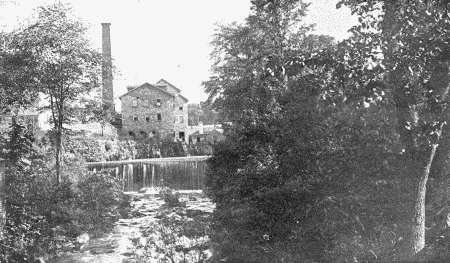
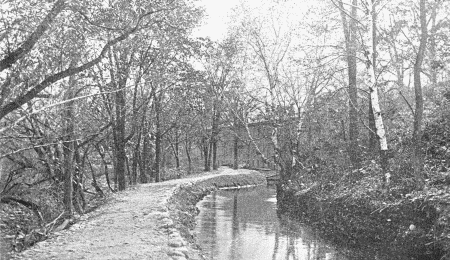 A MILL IN THE FOREST.
72 West Main Street,
Battle Creek, Michigan,
August Seventeenth.
Soon after breakfast I left Marshall for Battle Creek
on a freight train, as there were no passenger coaches
over the road until the afternoon. This mode of
travel, if not the most luxurious, was at least novel,
and we made very good time. Between the two
places the face of the country hardly changed in appearance.
There were the same fields of wheat and
corn, and at Battle Creek evidently as much business
in the flour mills as at Marshall.
The creek, uniting here with the Kalamazoo, after
a serpentine course of forty miles, supplies the water-power
and gives the necessary impetus to trade.
I have heard that the tributary won its bellicose
name through a little difficulty between the first surveyors
of public land who came to mark this section
and some Indians. The quarrel ended seriously, and,
as the tradition goes, two of the Indians were killed.
It may have been that the latter were making an
attempt to hold the ground, and that it was but one
of the many similar occurrences which were to convince
the red man that he was superfluous. Calhoun
County was certainly worth making a stand for. Its
soil was rich, providing abundantly for the simple
wants of the savage, and in the clear waters of the St.
Joseph and the Kalamazoo tributaries many a paddle
had descended with a deft stroke, upon the gleaming
back of pike and pickerel.
32 Portage Street
Kalamazoo, Michigan,
August Eighteenth.
At nine o'clock I was once more on Paul's back
possessed of a stronger sense of satisfaction than had
been mine for many days. The truth is, I had missed
my four-legged companion sorely. Reached Augusta
at noon. I had a good old-fashioned dinner; and the
horse something that was quite satisfactory, and at
four o'clock we started on again for Kalamazoo. Soon
after I left the village a thunder-shower came up, but
there was a convenient tree at hand and we were not
slow in reaching it. Thinking that all was well I
again put spur to Paul and we started forward, this
time coming in sight of the little village of Comstock,
three miles east of Kalamazoo, before our progress
was interrupted. Off in the distance the warning
whistle of an approaching train broke in upon the
stillness; the familiar rumble of wheels followed,
and in a moment more, as it was rushing by, Paul
made a leap of forty feet over the embankment.
He was good enough to leave me and the saddle behind.
It was a narrow escape and I was severely
stunned, but was soon up again getting my bearings.
I found my horse standing in the stream
stripped of everything except the bridle, and, with the
exception of a slight trace of nervousness in him, looking
as though nothing unusual had occurred. We
reached Kalamazoo a little later, and there I wrote to
Mr. Bulkley as follows:
Kalamazoo House,
Kalamazoo, Michigan,
August 18, 1876.
J. M. Bulkley, Esq.,
Secretary Custer Monument Association,
Monroe, Michigan.
Dear Sir:—I have the pleasure of transmitting to Judge Wing,
through Major R. F. Judson, the net proceeds of my lecture, delivered
in this place on the evening of the sixteenth instant. I desire
to accompany my gift with an acknowledgment of many
courtesies extended by the press and band of this patriotic village.
I resume my journey this afternoon and shall speak at Niles, South
Bend, and Laporte before the close of the present week. Hoping
that your brightest anticipations for the "Monument" may be most
fully realized, I remain
Very sincerely yours, Willard Glazier.
This letter I preserved, as I wished to have all the
correspondence upon the subject of the "Monument" for
future reference.
Dyckman House,
Paw Paw, Michigan,
August Nineteenth.
Had an early breakfast at Kalamazoo. Ordered
Paul, and mounting him rode through the Big Village
to take a last look. Before leaving I called upon Major
Judson and Colonel F. W. Curtenius. The latter of
whom has had a brilliant career. Graduating from Hamilton
College in 1823, he studied law and later went to
South America, enlisting in the cause of the Brazilians.
He served through the war with Mexico, was
appointed adjutant-general of Michigan in 1855,
holding this office until 1861, having received the
high title of Senator in 1853 and being re-elected to
the office in 1867. The Colonel's father was a general
in the war of 1812, and was for many years a member
of the New York Legislature. I am only familiar
with Major Judson's military record, but his services
as a citizen are no doubt as honorable as was his
career as a soldier.
With these gentlemen I entrusted the proceeds of
my lecture and the letter to Mr. Bulkley, with the request
that they be transmitted to the Monument Association
at Monroe. They expressed their appreciation
of my gift in warm terms and handed me the
following acknowledgments:
Kalamazoo, Michigan,
August 19, 1876.
Received of Captain Willard Glazier the net proceeds of his
lecture at this place, which sum is to be applied to the fund for the
erection of a Monument to the memory of the late General Custer at
Monroe City, Michigan. We take great pleasure in speaking of
Captain Glazier in the highest terms, not only on account of the self-devotion
he has manifested in a noble cause, but of his indomitable
perseverance and energy. We trust he will, wherever he goes, receive
the unanimous support of the citizens whom he addresses.
F. W. Curtenius,
Late Colonel U. S. Volunteers.
I take great pleasure in fully endorsing the above, and recommending
to public confidence and support Captain Willard Glazier,
in his efforts in behalf of the Custer Monument Association,
R. F. Judson,
Late Aide to General Custer.
With an exchange of salutations and good wishes
from the friends whose courtesies I considered it an
honor to receive, I left Kalamazoo for Paw Paw.
The ride between these towns was unusually trying.
Paul's back was still tender, the heat was intense, and
under these circumstances it was necessary to cover
fourteen miles before any refreshment could be had.
Dyckman House,
Paw Paw, Michigan,
August Twentieth.
This Sunday was a perfect day for rest, and I indulged
in a generous amount. Had breakfast at
eight o'clock, after which I strolled through the
streets of the Van Buren County capital, finding them
generally like all other village streets, but with enough
individuality about them to make them interesting.
The High School stood, with the usual dignity of educational
institutions, prominent among the neat cottages,
and in the business portion two or three newspaper
offices gave unfailing proof of local alertness.
The east and west branches of the Paw Paw River
meet here and hurry on to pay their tribute to the
Kalamazoo, offering their united strength to the business
concerns which man has erected on their shores.
The outlying farms thus naturally irrigated are very
rich, and give, with the extensive lumbering interests,
a very flourishing and prosperous appearance to this
section of country and a certain briskness to the trade
at Paw Paw.
On returning to my room I copied the testimonials
given me by Colonel Curtenius and Major Judson of
Kalamazoo, wrote several letters, attended to some
neglected dates in my journal, and made my plans for
the next few days. It was my intention to go to
South Bend by rail the following morning, to lecture
there in the evening and then proceed to Grand
Rapids, where I was announced for Tuesday. My
horse was in the meantime undergoing new and
vigorous treatment which I hoped would permanently
cure him.
Grand Central Hotel,
South Bend, Indiana,
August Twenty-first.
At ten o'clock I left Paw Paw, reached Decatur at
noon, registered at the Duncombe House and then
continued my journey by rail. I hardly realized that
I was out of Michigan in this town on the St. Joseph,
for the river belongs to the "Wolverines" with the
exception of the capricious South Bend, and the streets
have the breadth and abundance of shade that have
won so much admiration for the cities of Michigan.
It has, besides, the Hoosier enterprise, and began to
be an important manufacturing place fifteen years ago.
The first settlement began in 1831 with a handful of
houses and a population of a hundred souls. It has
now reached over 10,000. Prominent among the resources
to which its growth may be attributed is its
proximity to the hard-wood forests of Northern
Indiana and Michigan.
These woods have proven a bonanza to South
Bend. Enterprising manufacturers have drawn from
their unfailing source; prominent among them being
the Studebaker Brothers, who have had an enviable
career. These enterprising men started in 1852
with a cash capital of sixty-eight dollars, and a
knowledge of blacksmithing which they had acquired
at their father's forge on the Ohio. Thus equipped
they went to work, turning out two wagons the first
year. The present output makes that humble
beginning seem almost incredible. Studebaker's
wagons are famous and the firm controls capital stock
amounting to a million of dollars. The other notable
enterprise is the Oliver Chilled Plow Works, founded
in 1853 by James Oliver, a Scotchman, who came to
Indiana to follow the vocation of an iron master, and
who ultimately had the satisfaction of exporting his
manufactures to his native country.
The most distinguished citizen of South Bend at
the time of my visit, and the most prominent man in
Indiana, was Hon. Schuyler Colfax, whose career as a
statesman was a singularly brilliant one. For over a
quarter of a century he had been eminent in state and
national politics. Beginning life as an editor he
founded in 1845 the St. Joseph Valley Register,
an organ of considerable popularity and which at
the time had a strong influence in local Whig circles.
His subsequent duties as Speaker of the House of
Representatives and the friend and adviser of Lincoln,
kept him out of editorial work, and later he was
entirely engrossed with affairs of state. In 1868 he
was elected to the office of Vice-President under
General Grant as chief executive.
Sweet's Hotel,
Grand Rapids, Michigan,
August Twenty-second.
My birthday. Went by rail from South Bend to
Kalamazoo in the morning; had dinner at the latter
place, and then caught an early train for Grand
Rapids, where, finding that George had made unusually
good arrangements, I spoke in Luce's Hall to
one of the largest audiences which greeted me in
Michigan, General W. P. Innes, well known in
Grand Army circles and a mason of high rank, introducing
me. A large and strongly executed painting
of the Battle of Lookout Mountain, stretching across
the rear of the platform, made a striking effect and
gave zest to my reference to the War for the Union.
My reception at this place was so hearty that I
should have enjoyed a longer visit; but plans already
laid prevented. I knew the town itself well, for I
had previously been there. It is full of interest both
on account of its past history and its present activity.
The city lies on both sides of the Grand River and
seems to be hedged in by the great bluffs that reach
along at the water edge of the valley two miles apart.
Below is a stratum of limestone rock, forming the bed
of the river, for about a mile and a half with a descent
of eighteen feet causing the rapids and supplying
the water-power. Gypsum is quarried here in large
quantities, and this industry supplemented by manufactures
and fruit culture gives it its commercial importance.
Perhaps its most striking peculiarity is to
be found in the large proportion of Hollanders who
swell the population. Their churches, their newspapers
and their general thrift give them a high
standing in the community, and what they have ever
been accorded—a reputation for being loyal and enterprising
citizens.
In 1760 there was a very different state of things
here. The Ottawa Indians had a large village below
the rapids, and there Pontiac's voice was heard, calling
upon the chiefs to aid him in his projected siege
of Detroit. Here the fur traders had their grand depot,
and the missionaries labored in the cause of
Christianity; and when in 1834 the Indian settlement
began its metamorphosis, some bold prophet declared
that it would soon be "the brightest star in the constellation
of western villages." This prophecy has
been more than fulfilled, for Grand Rapids is the acknowledged
metropolis of Western Michigan. In the
mail that awaited me was a copy of the South Bend
Herald, containing a pleasant notice which chronicled
in true newspaper diction the fact that
"Captain Glazier delivered his lecture 'Echoes from the Revolution'
at the Academy of Music last evening. Promptly at eight o'clock
the lecturer, with Mr. J. F. Creed, appeared on the platform. Mr.
Creed in introducing the lecturer stated the object of the lecture to
be in aid of the Custer Monument Association of Monroe, Michigan.
He also read several letters introducing Captain Glazier to the public,
from well-known citizens of Michigan, and acknowledging receipts
of the proceeds of the lectures delivered in Detroit and Kalamazoo.
The theme of the lecturer afforded a fine field for the display of his
talents as a speaker. Possessing a fine imagination, good descriptive
powers and the real qualities of an orator, he could not fail to please
the really intelligent audience which greeted him last evening.
Probably one hour and a half were consumed in its delivery; but the
interest and attention did not flag nor tire, and when the speaker
took leave of his audience he was greeted with several rounds of applause."
Duncombe House,
Decatur, Michigan,
August Twenty-third.
Came down from Grand Rapids in the morning intending
to stop on the way at Lawton, but was carried
by through the carelessness of a brakeman who neglected
to announce the stations. The town is quite an
important point on the road for its size owing to the
extensive fruit orchards of the surrounding farms.
This common industry which has sprung up in all
parts of the State, but especially in the southern portion,
and which attracts more attention than anything
else, is a contradiction to the statements of those who
examined the country while it was yet a wilderness.
In 1815 the surveyor-general of Ohio made a
journey through the State and soberly reported that
not more than one acre in a thousand in Southern
Michigan would in any case admit of cultivation,
yet notwithstanding that worthy's opinion, six hundred
thousand peach trees flourished in Southwestern
Michigan in 1872! Surely that is a fact to
be proud of. On my arrival at Decatur I found the
Eagle of Grand Rapids, containing mention of my
lecture at that place as follows:
"A very large audience gathered at Luce's Hall last night to hear
Captain Willard Glazier. The speaker was earnest and impassioned,
his lecture was delivered with a force and eloquence that pleased his
hearers, and all who were in the hall went away glad that they had
been there, and ready to add to the praises that have been bestowed
on Captain Glazier as soldier, author and orator."
Such notices were gratifying—not for the leaven of
flattery which they contained, but because they helped
along the cause which was to raise a shaft to the
deserving dead. For this reason I appreciated the
comments of the press and owed much to its co-operation.
It is a pleasure to me to acknowledge my
indebtedness to this most powerful agent of modern
times.
Dyckman House,
Paw Paw, Michigan,
August Twenty-fourth.
Took the Michigan Central to Lawton, and changing
cars there continued my journey to this place by
the Paw Paw Road. Thinking that it might facilitate
matters, I had my saddle padded here, and had a talk
with the saddler besides, as the delay was becoming
serious. At this crisis, if man and horse could have
set up a partnership, like the fabled Centaurs, how
we could have flown before the wind—or even outstripped
the Michigan Central—as we galloped across
country towards the setting sun! That old myth was
an inspiration. Was it invented by some fanciful
traveller-horseman hindered on his way to Rome or
Athens, by a saddler or a veterinary surgeon?
During my forced visit, the people of Paw Paw
were very kind, making the time pass agreeably and
giving me a pleasant recollection to take away. These
small social influences carried great weight with them,
and helped to bear out the universally acknowledged
fact that associations are all powerful.
It is not strange that people, rather than their abode
or works, strongly impress themselves, nor that, realizing
this, they should be cordial in their hospitality.
If, then, I praise the beauty or enterprise of
these American towns, I bear witness at the same time,
to the kindness and courtesy of their inhabitants.
Whether East or West, these qualities were everywhere
apparent, proving the universality of generous feeling.
Private House,
Niles, Michigan,
August Twenty-fifth.
Leaving Paw Paw after breakfast I went down to
Lawton by rail, where I changed cars, taking the
Michigan Central to Niles, this for the purpose of
making use of the extra time that now hung heavily
upon my hands. A good proportion of the six thousand
inhabitants came to Kellogg Hall in the evening
to manifest their interest in the Custer Monument and
the old Revolutionary heroes, Mr. J. T. Head giving
the introduction.
Reaching Niles before noon I had ample time to
look about, and to hear from old residents something
of Berrien County and their home here on the St.
Joseph.
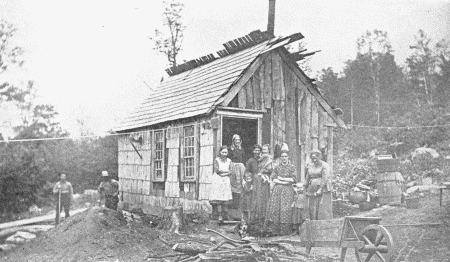 NO ROOMS TO LET.
For those who delight in searching out events from
the doubtful past, there is suggestion enough here to
keep them occupied for at least a week. Even this
small town possesses records that date back to 1669,
when Pere Allouez came along down the river on a
voyage of discovery and who may have encamped on
the very site of Niles, for all that the people who live
there now know. But putting this aside, it is certain
that in 1700 the Jesuits had a mission a short distance
south of the present city, and that there were forts
built here and there in the vicinity as a protection
against the Indians. Later, when matters were settled
and the English and French had long since withdrawn,
the Reverend Isaac McCoy came out into the wilderness
with his family and established Cary Mission,
probably in sight of where the old Jesuit Mission stood.
This was in 1820. Six years afterwards a handful of
cabins made their appearance, and out of this nucleus
the town of Niles was evolved. This is a mere outline
without the adornment of those pleasant little
fictions that cling about the sober history of every inhabited
place on earth, and which delight the ear of
most travellers, for there may be those who follow me
who echo the sentiment of the Michigan pioneer,
"From legend and romance, good Lord, deliver us!"
Private House,
La Porte, Indiana,
August Twenty-sixth.
Was compelled to avail myself of livery accommodations
in order to meet my evening engagement at
La Porte. Rode in a hack to South Bend, and finally
reached my destination by way of the Michigan Central
and Southern Indiana roads. My advance agent,
Babcock, met me at the station, and I accompanied
him to the home of a Mr. Munday, who I discovered
was the father of an old fellow-prisoner at "Libby."
I was delighted with the situation and appearance
of the town. It rises on the border of a beautiful
and fruitful prairie, its northern end bounded by a
chain of seven lakes which make an ideal resort in
summer, and is at a sufficient distance from the great
body of water which dips down into that corner of
the State, to enjoy a comparatively mild climate. Its
population is about 8,000, of which a good share is
employed in the foundries, machine shops and mills
that make up its business activity. The younger element
is provided for in good schools, and that luxury of
modern communities—the public library—is zealously
supported. On a line with it, as a free and instructive
institution, the Natural History Association, founded
in 1863, holds an honored place, and unlike most societies
of a similar character has succeeded in making
its researches of interest. In fact for its size the city
has made great progress in literary and educational
directions.
Jewell House,
Michigan City, Indiana,
August Twenty-seventh.
After my lecture of the previous evening at La
Porte, I took the first train to this city—emphatically
the City of Sand. Time and winds have raised great
hills of sand on every side, and from their crests one
can look off for miles over the lake, getting perhaps a
deeper impression of its vastness than from a less
monotonous lookout.
These sand dunes are supposed by some to be caused
by a peculiar meteorological phenomena of currents
and counter-currents acting vertically instead of horizontally.
Whatever the cause, they have made
Indiana's only port of entry a place of such striking peculiarity,
that, once seen, I doubt if it would ever be
forgotten.
In the forenoon I went out on the lake in a small
yacht; but finding the little craft unequal to the heavy
waves which were rushing in from the north, I soon
turned back, having gained by the venture a better
idea of the dunes and of their extent as they stretch
along the western shore.
The fact that they are "building upon the sand"
gives the people of Michigan City very little concern,
probably because they know there is terra firma somewhere
beneath their foundations.
Ames College occupies a site here, and the Car Shops
are important and extensive.
Duncombe House,
Decatur, Michigan,
August Twenty-eighth.
Taking an early train, I returned to this place in
the morning, where I had decided to remain for a few
days in order to allow more time for the treatment of
my horse, and to give my brother and Babcock an
opportunity to insure a full house at Farwell Hall,
Chicago, where I was announced to lecture on the
eleventh of September.
I had begun to fear that the irritation on Paul's
back would develop into that most disgusting and
painful disease of horses known as fistula; and although
he never showed any impatience, I had not
the heart to ride him while in this condition.
My quarters were quite comfortable at the only
hotel in town, and I thanked my stars that I was not
stranded in some little backwoods place with the choice
of "the softest boards on the floor for a bed," and
other accommodations to match—a state of affairs which
a waylaid journeyman once had to face, who, with the
soul of a Stoic, left on his window-pane the comforting
couplet:
"Learn hence, young man, and teach it to your sons:
The easiest way's to take it as it comes."
In fact I was doubly fortunate. No sooner had I
reached Decatur than I lost the consciousness of being
"a stranger within the gates," having been so cordially
made to feel that I was among friends, and that the
cause which I had taken up in Michigan met with
their hearty sympathy.
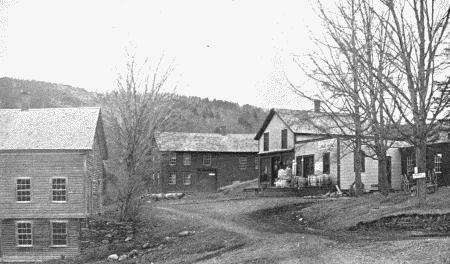
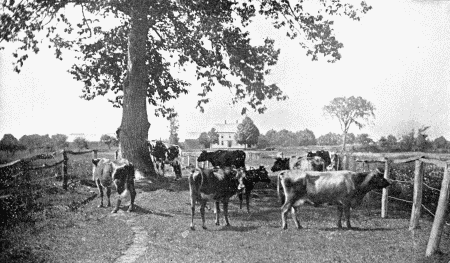
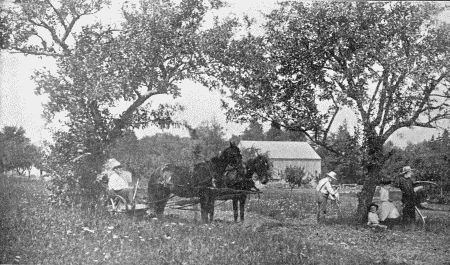
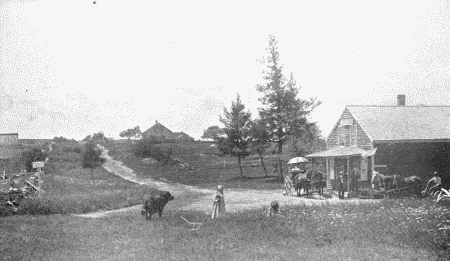
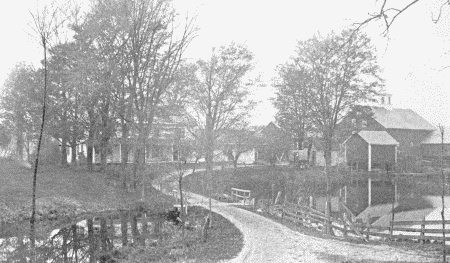
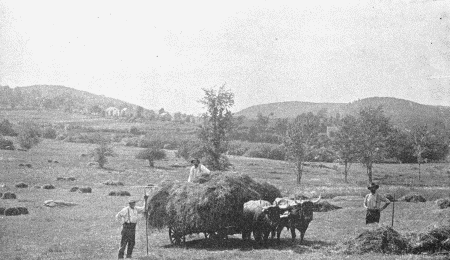 RURAL SCENE IN MICHIGAN.
Duncombe House,
Decatur, Michigan,
August Twenty-ninth.
Met George L. Darby, an old comrade of the
"Harris Light," in the afternoon. He had noticed my
signature on the hotel register, and came at once to my
room, where after the heartiest of greetings we sat
down for a long talk. Thirteen years had slipped away
since the time of our capture at New Baltimore, Virginia,
which led him to Belle Isle and me to Libby
Prison, and yet as we discussed it all, the reality of
those events seemed undiminished. Kilpatrick, Stuart,
Fitzhugh Lee—their clever manœuvring, and our
own unfortunate experiences on that day, kept us as
enthusiastically occupied as though it were not an old
story: but soldiers may be pardoned for recurring to
those events which, while they impressed themselves
upon witnesses with indelible distinctness, may yet have
lost their bitterness, when it is remembered that before
many years they and their stories will have passed
away. To those who indulge in the absurd belief that
such topics are discussed with malicious intent, no
justification need be made.
Led on from one thing to another, I found Darby
finally plying me with questions of kindly interest
about my peaceful march from Ocean to Ocean, and
anxiously asking about my horse, which I had previously
left in his care. He offered to do all he could
for the animal and with this comforting assurance took
his leave.
Duncombe House,
Decatur, Michigan,
August Thirtieth.
Early in the afternoon Darby called with fishing
tackle and proposed that we go out to Lake of the
Woods and try our luck with hook and line. The
expedition was not successful as far as fish was concerned,
but we had a delightful boat ride and plenty
of talk.
The lake, a pretty little dot lying, as its name
implies, in the heart of the woods, is an ideal spot for
rest and enjoyment, and its miniature dimensions bear
no resemblance to its famed namesake of Minnesota.
As we had such poor success with our tackle I took no
note of the kind of fish that make their home within
its sleepy borders, and my companion gave me very
little information. The truth is, we were more interested
in our concerns and the serious affairs outside the
sport which so fascinated Izak Walton.
Duncombe House,
Decatur, Michigan,
August Thirty-first.
Albert W. Rogers, to whom I had been previously
introduced, called late in the afternoon, and invited
me to drive with him, determined, he told me, that I
should see something of Decatur's surroundings. The
time was favorable for agreeable impressions. It had
been a typical summer day, with blue sky, a slight
breeze and the mercury at 70°; in short, just such
weather as I had encountered in this section of Michigan
throughout the month of August, and as evening
approached, I was prepared to enjoy to the utmost
the pleasure which my new acquaintance had provided.
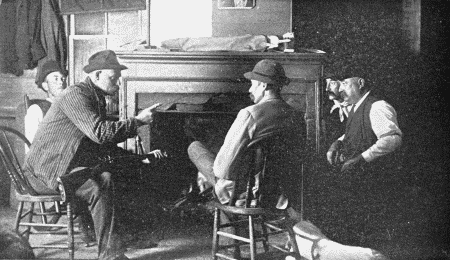 SPINNING YARNS BY A TAVERN FIRE.
On the outskirts of the town one gets a view of
gently rolling country under a splendid state of cultivation,
the yellow of the grain fields predominating,
and dotted here and there with farmhouses. Dark
outlines against the horizon suggested the forests of
oak, ash, maple, birch and elm, which stretch over
such large tracts of Van Buren County, and which
have made a little paradise for lumbermen. Wheat,
maize and hay appeared to be nourishing; but I
believe that agricultural products do their best in the
rich bottom-lands bordering the rivers. I have
dwelt so enthusiastically upon this fertile country that
to say more would seem extravagant, so I will bring
my note, the chronicle of a most delightful day, to a
close.
Duncombe House,
Decatur, Michigan,
September First.
Received and answered a large mail after breakfast,
and in the afternoon took a walk through the village.
One is, of course, reminded of the gallant Commodore
whose name, once among the greatest in America, now
honors this modest Western town, and whose deeds,
once upon every lip in the young republic, are wellnigh
forgotten. The question even suggests itself as
to how many of those who live here, where his name
is perpetuated, are familiar with his life and character.
His capture of the frigate Philadelphia, which had
been seized and held in the harbor of Tripoli in
1801, during the pacha's seizure of our merchantmen,
was said by Admiral Nelson to be "the most daring
act of the age," and his diplomacy at Algiers and
Tunis and Tripoli, where in 1812 his demands were
acceded to, received the applause of all Christendom,
especially because those demands included the release
of the Christian captives at Algiers and of the Danish
and Neapolitan prisoners at Tripoli, and ended, forever,
the pretensions of the Barbary powers.
After the trial of Commodore Barron for cowardice,
Decatur made some remarks which the former thought
should not be allowed to pass unnoticed, and accordingly
called upon his accuser to retract them. This
Decatur refused to do, but attempted to bring about a
reconciliation. Barren refused this and threw down
the gauntlet, and when shortly afterwards the two
met to settle the difficulty "with honor," both fell at
the word "Fire!"—Decatur mortally wounded. The
affair was universally deplored, for his loyal services
had endeared Decatur to his country, and when his
remains were taken to the grave, they were followed
by the largest concourse of people that had ever assembled
in Washington.
Duncombe House,
Decatur, Michigan,
September Second.
This was a great day for Decatur. With the morning
came the completion of arrangements for a Republican
mass-meeting, and a rustic band from an adjacent
village arrived at nine o'clock in a farm wagon.
The "Stars and Stripes" floated majestically over the
heads of the patriotic musicians, and the people were
drawn from every quarter to the stirring call of fife
and drum, eager to see their leaders and to listen to
their views upon the vital questions of the day. The
"Silver Cornet Band" of Dowagiac co-operated with
the "Decatur Fife and Drum Corps," in rousing the
dormant element of the place, and, as its imposing appellation
would imply, did so with dignified and classical
selections.
The political campaign which had been slumbering
since the nomination of Hayes and Tilden reached an
interesting stage of its progress at this time, and the
friends and champions of the rival candidates were
fully alive to the issues of their respective platforms.
By nightfall the place was the scene of great activity,
and to an onlooker produced a singular effect.
Men were collected in groups engaged in excited conversation,
torches flared in every direction, while at
brief intervals all voices were drowned in some lively
tune from the silver cornets or the fife and drum.
At an appointed hour the speakers of the evening
appeared, and I noticed among them Hon. Ransom
H. Nutting and Hon. Thomas W. Keightly—the
latter a candidate for Congress from this district. The
meeting closed at a late hour, after a succession of
heated addresses, and yet the politicians of Van Buren
County seemed not at all averse to continuing their
talking until sunrise.
Duncombe House,
Decatur, Michigan,
September Third.
Accepting an invitation from Albert Rogers, I accompanied
him to the Presbyterian Church in the
morning, where Rev. Mr. Hoyt, a young clergyman,
conducted the services and preached a very good sermon.
I was pleased by the courtesy extended me
when he said, in the course of his announcements. "I
take pleasure in calling attention to Captain Glazier's
lecture at Union Hall to-morrow night. I shall be
present myself, and recommend all who wish to listen
to an instructive and patriotic lecture to be at the hall
before eight o'clock." When the service was over Mr.
Rogers and I waited to have a few words with Mr.
Hoyt, who was evidently very much interested in my
journey across country and who intended to lend his
influence in behalf of the "Monument Fund." We
then returned to the hotel where I passed the remainder
of the day quietly in my room.
Duncombe House,
Decatur, Michigan,
September Fourth.
Lectured to a full house at Union Hall in the evening.
My sojourn of a week at this place and the interest
felt in the effort to perpetuate the memory of
Custer, brought about the most gratifying results.
Among those who were with me on the platform were
Hon. Ransom Nutting, Rev. Mr. Hoyt, Prof. Samuel
G. Burked and Albert W. Rogers. I was presented
by Mr. Nutting, after which testimonials from the
Monument Association were read by Prof. Burked,
and later the following pleasant acknowledgment
from these gentlemen was handed me:
Decatur, Michigan,
September 4, 1876.
Captain Willard Glazier,
My Dear Sir: We take this means of expressing to you our appreciation
of the highly instructive and very entertaining lecture
delivered by you at Union Hall this evening. Truly we admire your
plan and your generosity in giving the entire proceeds to the Custer
Monument Fund. Our endorsement is the expression of our village
people generally. You have made many friends here.
May success attend you throughout your journey.
Very respectfully,
S. Gordon Burked,
Ransom Nutting,
Albert W. Rogers.
Such greeting as this, extended to me all along my
way, gives substantial proof of the universal kindness
with which I was received, and of the spontaneous hospitality
of the American citizen.
Seymour House,
Dowagiac, Michigan,
September Fifth.
There was a large gathering in front of the Duncombe
House in the morning when I mounted Paul
and faced westward, turning my back upon the hospitable
little village in which I had spent so many
pleasant days, and where I felt that I had indeed
made many friends. Mr. Rogers and a young man
of the place, whose name I am sorry to have forgotten,
escorted me out of town intending to ride with me to
Dowagiac, but an approaching rain-storm obliged
them to turn back. As I came in sight of the village
I noticed unmistakable signs of a stream which I discovered
was the Dowagiac River, a tributary of the
St. Joseph, entering it near Niles. It has been put to
good account by the millers, who have established
themselves here, and in its small way adds to the
blessings of the Michigan husbandmen on its shores.
Private House,
Niles, Michigan,
September Sixth.
The threatening storm which led my Decatur friends
to turn back on the previous afternoon, set in soon
after my arrival at Dowagiac, and I considered myself
very fortunate, as it was accompanied by the most
violent thunder and lightning that I had yet encountered.
Notwithstanding this disturbed condition of
the elements, I was greeted by a full house at Young
Men's Hall, where I was introduced by Dr. Thomas
Rix.
I found a few familiar faces at Niles which I had
seen during my previous visit, and several new places
of interest about the town. Navigation on the St.
Joseph ends at this point, and the narrowed stream is
spanned by a railroad bridge; and the water-power increased
by a dam. There is a brisk business carried
on at the water's edge.
The mills are well supplied with grain from outlying
fields, and boats are continually plying back and
forth laden with lumber, grain, flour and fruit, which
are shipped from here in large quantities. In fact, for
its size—it claims I believe, a population of something
over 4,000—Niles is full of energy and ambition. I
found myself on this second visit very much interested
in the place and pleased that circumstances had made
necessary a second halt.
Konnard House,
Buchanan, Michigan,
September Seventh.
Resumed my journey at two o'clock in the afternoon
at a small way place between Niles and Buchanan,
where I rested at noon. The heavy rains of
the preceding days had left the roads in a most
wretched condition, and the distance was considerably
lengthened as it was necessary to avoid pools and washouts,
so that it took two hours of slow riding to reach
my destination. Darby, who had gone forward with
my advance agents, was the first to greet me at this
place and to inform me of the arrangements made for
my lecture in the evening.
As my day's journey had been undertaken leisurely,
I started out on a tour of inspection, after having first
made comfortable provision for Paul. I found a
flourishing village, having a population of something
over 2,000, and prettily situated on the St. Joseph
River. As I walked in and out through its streets
and looked for the last time upon the stream, which
for its romantic history and natural charm had forced
itself upon my notice so often, I could not avoid a
certain feeling of regret that this was to be my last
halt in the great State through which I had made such
a pleasant and profitable journey. Pictures of orchard
and meadow, of wheat field and river, passed in review
once more, and with them the recollection of the
splendid part the patriots of Michigan bore in the
War for the Union, than whom was none more loyal
than the heroic Custer, for whose memory I had spoken
and received such warm response.
Private House,
Rolling Prairie, Indiana,
September Eighth.
Called for my horse at Buchanan at nine o'clock in
the morning, intending to stop at New Buffalo, but
once on the road, I decided instead to make this
village my evening objective. A heavy rain-storm,
setting in early in the forenoon, compelled me to take
refuge at a farm house for about an hour, where I was
initiated into the home life of the Northern Indiana
"Hoosier." I am sorry to say that during this day's
ride I encountered the worst roads and the dullest
people of my journey. Many who have resided in
this part of Indiana for thirty and even forty years
are not only exceedingly illiterate, but know much
less of the topography of the country than the average
Indian—and absolutely nothing of the adjacent towns.
As a consequence I was obliged to trust to chance,
which brought me to Galion, a tiny hamlet on the
outskirts of a swamp, where I had dinner. My ride
thither was made under circumstances which suggested
the ride of the belated Tam O'Shanter, and while my
tortures could not compare with his, they were none
the less acute while they lasted. I was met on the
edge of the swamp by a swarm of mosquitoes—known
in France as petite diables—who forced their attention
upon me without cessation, in spite of the fact that I
urged my horse forward at breakneck speed, Paul's
steaming flanks and mire-covered legs attesting to the
struggle, when we drew up in front of Galion Inn.
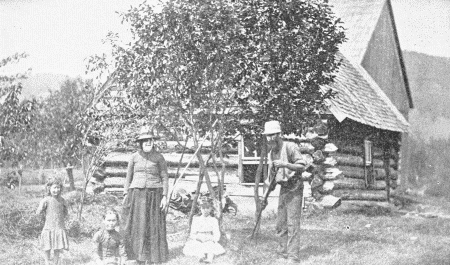
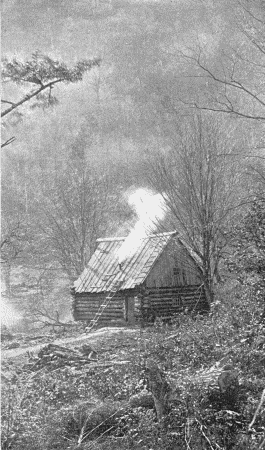 A HOOSIER CABIN.
Jewell House,
Michigan City, Indiana,
September Ninth.
I considered myself fortunate, during my ride from
Rolling Prairie to Michigan City—a distance of sixteen
miles—in having a sandy road and no rain from
the time of setting out in the morning until my arrival
here in the evening, but I was less favored
than usual in obtaining information.
The Presidential campaign was now at white heat
and very little outside of politics was discussed. I found,
however, that the ideas of many of the farmers were
confused upon the issues. The three candidates in
the field made the canvass unusually exciting. Hayes
and Tilden were, of course, the central figures, but
Peter Cooper of New York had many staunch supporters
and a few enthusiasts rallied around Blaine,
Conkling and Morton. The proprietor of the Jewell
House—a Cooper man—was at this time much more
interested in the success of his favorite than in the receipts
of his hotel, and his halls and parlors were the
rendezvous for men of all parties.
Jewell House,
Michigan City, Indiana,
September Tenth.
As it was Sunday and I had a desire to visit the
most imposing institution connected with Michigan
City—the Northern State Penitentiary, I decided to
make the two miles on foot, and be there for divine
service. I found everything admirably conducted,
and although such a place is not the most cheerful in
the world to be shown through, I was well satisfied
that I had gone, and was strongly impressed with the
effect of the stern hand of the law. In the afternoon
a heavy rain and wind storm came up, and I stayed in
my room, the greater part of the time, writing up my
journal, and arranging for my lecture tour across
Illinois and Iowa, thereby accomplishing certain
duties which fair weather might have tempted me to
neglect.
It was my intention to go by rail to Chicago on the
following morning, where I was announced to lecture
at Farwell Hall.
Darby, to whom I have previously referred in connection
with Decatur, and who was acting as advance
agent in the small towns and villages that lay along
my route, was with me during my stay at the Jewell
House, and we had frequent talks over our adventures
in the "Harris Light"—Second New York Cavalry—in
which most of our active service was passed.
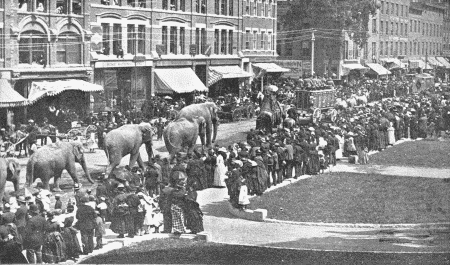 A CIRCUS IN TOWN.