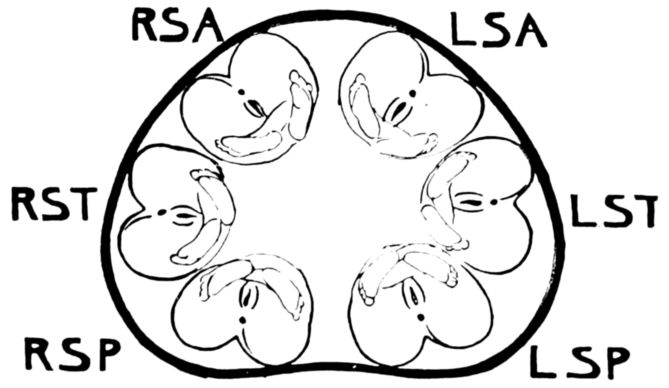
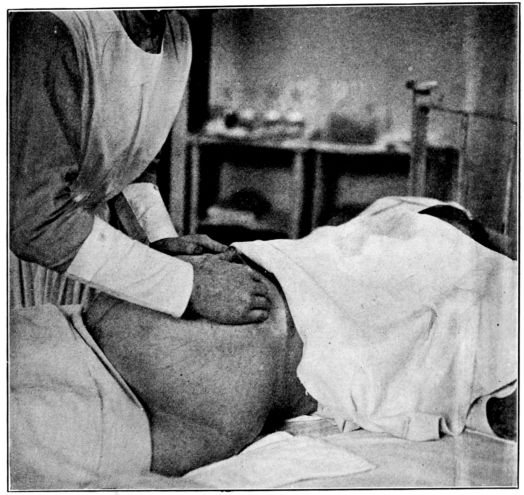
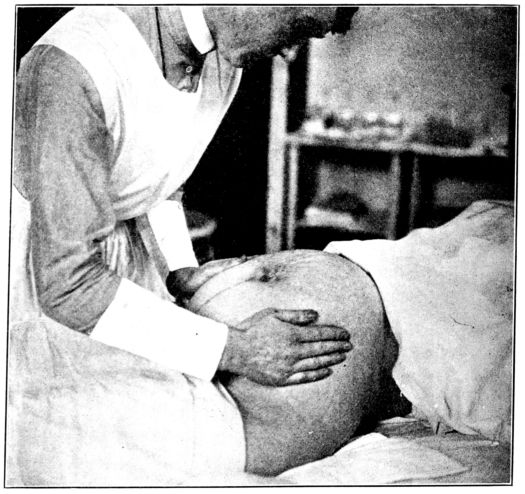
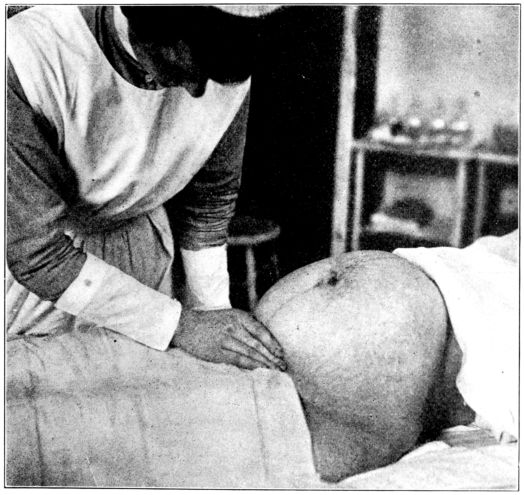
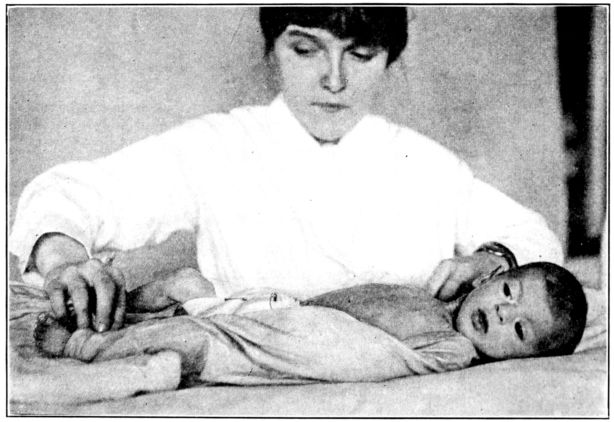
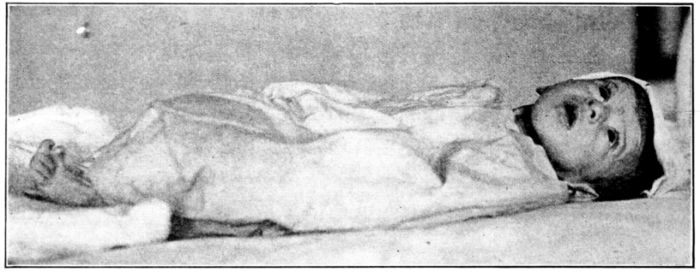
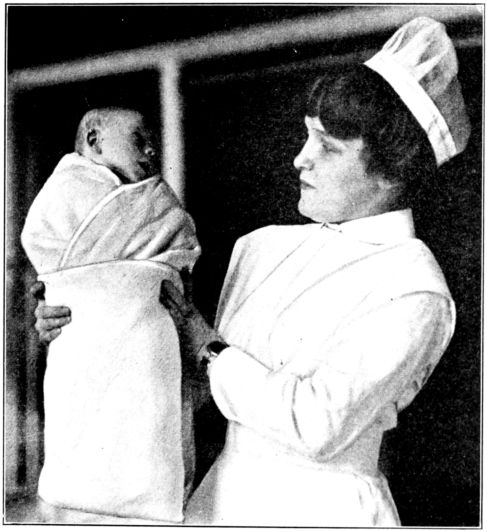
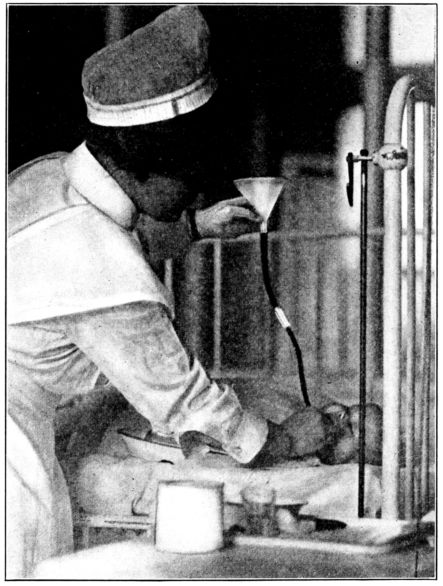
OBSTETRICAL NURSING A TEXT-BOOK ON THE NURSING CARE OF THE EXPECTANT MOTHER, THE WOMAN IN LABOR, THE YOUNG MOTHER AND HER BABY
Transcriber’s Note:
The cover image was created by the transcriber and is placed in the public domain.
OBSTETRICAL NURSING
THE MACMILLAN COMPANY
NEW YORK · BOSTON · CHICAGO · DALLAS · ATLANTA · SAN FRANCISCO
MACMILLAN & CO., Limited
LONDON · BOMBAY · CALCUTTA · MELBOURNE
THE MACMILLAN CO. OF CANADA, Ltd.
TORONTO
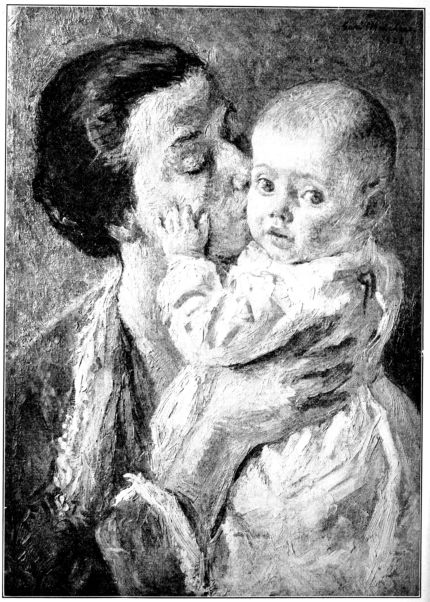
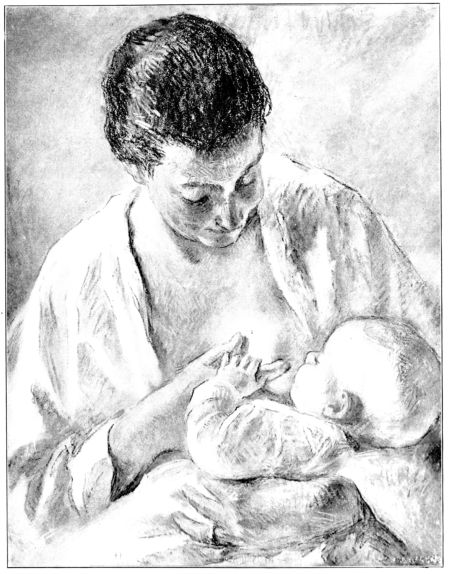
THE CARESS
From the painting by Gari Melchers
I hold you close: and I could cry
Because you seem so new and dear;
And such a helpless warder I
To keep your candle burning clear:
The curious candle of your breath,
Body’s and spirit’s throbbing breath.
Fanny Stearns Gifford.
BY
CAROLYN CONANT VAN BLARCOM, R.N.
Formerly, assistant superintendent and instructor in obstetrical nursing and the care of infants and children at the johns hopkins hospital training school for nurses
Author of
“The Midwife in England”
WITH 200 ILLUSTRATIONS AND 8 CHARTS
New York
THE MACMILLAN COMPANY
1922
All rights reserved
PRINTED IN THE UNITED STATES OF AMERICA
Copyright, 1922,
By THE MACMILLAN COMPANY.
Set up and electrotyped. Published May, 1922.
Press of
J. J. Little & Ives Company
New York, U. S. A.
THIS BOOK IS DEDICATED
TO THE
SPIRIT OF HELPFULNESS
WHICH HAS MADE ITS PREPARATION
POSSIBLE WITH THE HOPE THAT IT
MAY BE OF HELP TO THOSE NURSES
WHO TAKE YOUNG MOTHERS AND BABIES
INTO THEIR CARE.
PREFACE
xi
In writing this book on obstetrical nursing I have been influenced
by certain steadily deepening impressions which have
been received in the course of my contact with maternity work
in this country, Canada and England during the past twenty
years. It has been borne in upon me, in the first place, that
very often there is something akin to bewilderment among those
nurses who have been trained to care for patients according
to the teachings of one group of obstetricians and who later find
themselves nursing the patients of other doctors who hold different,
or even opposite views. And not infrequently I have
found in the nurses a degree of loyalty to their training which
made them sceptical, or even intolerant, of nursing methods
which differed from those which they had been taught.
I have become convinced, therefore, that a book on obstetrical
nursing which would be helpful to and widen the outlook of all
nurses, no matter where nor by whom trained, must of necessity
describe the underlying principles of obstetrical nursing and
offer a survey of the nursing methods which are employed in
maternity wards and hospitals of recognized excellence and in
the practice of acknowledged authorities upon obstetrics.
This is, I am aware, a unique attitude, for the present text
books on obstetrics for nurses reflect, in each instance, the wishes
of one doctor, almost entirely, or advocate the methods employed
in one hospital. My experience in teaching obstetrical nursing
makes me feel that a parallel description of dissimilar nursing
procedures serves to broaden the nurse’s attitude toward her
work and her grasp of the entire subject, both because she becomes
aware of the fact that methods, other than those with
which she is familiar, are employed in hospitals of high standing
and because she appreciates the fact that these unfamiliar
methods may be as efficacious as those in which she has become
expert.
xiiAccordingly I have devoted the better part of the past year
and a half to a study of the scope and methods of the present
training in maternity nursing in several hospitals, in this country
and Canada, in which the obstetrical work is of a conspicuously
high character, and have presented a composite of this
teaching in the succeeding pages.
But that there might not be apparent inconsistencies in the
different methods of maternity care described, I have given an
explanation of the purposes and general principles of the care,
including nursing, which the nurse is likely to find is given to
all obstetrical patients, the country over.
For the sake of simplicity and clarity I have divided the
book into seven parts, following an introduction which describes
the requisites and opportunities of obstetrical nursing and the
importance of the nurse’s own attitude toward her work and her
patient. The first two parts, dealing with the normal anatomy
and physiology of the female generative tract and the development
of the fetus, are designed to supply the nurse with enough
technical information to make her ministrations intelligent and
effective. In this respect, I have doubtless given less than some
nurses will wish and possibly more than others will think necessary,
but I have given about the average amount of instruction
that is found satisfactory in the training schools of high standing.
Four of the succeeding parts are devoted respectively to a
description of the nurse’s duties during pregnancy, labor, the
puerperium and early infancy. In each of these I have explained,
first, the normal physiological processes which take place; then,
the nurse’s duties under average conditions and finally, her
responsibilities in the event of complications or abnormalities. A
separate part is devoted to a description of the organized care
and instruction of the maternity patient, by public health nurses,
both before and after delivery, which have proved to be satisfactory.
While describing various hospital procedures, I have deemed
it of practical importance to explain, in each instance, how
similar results might be obtained, with improvised appliances, in
a patient’s home whether in a city or a rural community. In
xiiishort, I have endeavored to make clear the essentials of obstetrical
nursing without regard to the status or location of the
patient.
Since the patient’s state of nutrition and her frame of mind
are of vital importance throughout pregnancy, labor and the
puerperium, I have not only dwelt upon them in all descriptions
of the nurse’s duties during these periods but have devoted an
entire chapter to a simple explanation of the principles of each
of these two important subjects.
My varied contact with obstetrical nurses has convinced me
that those nurses who appreciate the never ending wonder and
beauty of this miracle of the beginning of a new life, derive
peculiar satisfaction from the care of the maternity patient.
At the same time, in many hospitals, even where the patients are
given the most conscientious care, the nurses are often so nearly
overwhelmed by the long, irregular hours and the insistent demands
of routine duties, that they do not grasp the significance
of the event in which they are participants. Accordingly, I
have made a sustained effort throughout the following pages
to give the young nurse something of a feeling of reverence for
this great mystery of birth.
In the course of my survey of the present training in obstetrical
nursing, I have met the warmest generosity on the part
of the obstetrical and nursing staffs in all of the hospitals which
I have visited. Accordingly, I find it very difficult to find adequate
expression for my sense of gratitude to the doctors and
nurses of the Montreal Maternity Hospital; the Burnside Obstetrical
Department of the Toronto General Hospital; The
Hospital of the University of Pennsylvania; Bellevue Hospital;
The Long Island College Hospital; The Brooklyn Hospital;
The Cleveland Maternity Hospital and to Dr. J. Whitridge
Williams and Miss Elsie Lawler for making available the entire
resources of the wards, clinics, laboratories and class and lecture
rooms at Johns Hopkins Hospital.
I wish to offer an expression of deepest possible appreciation
to Dr. John W. Harris for the generosity with which he has
given of his time, thought and wide experience in an effort to
xivprovide accurate and practical information, and to set a high
standard of work and ideals for those nurses who would be
influenced by this book. Having taught and lectured to nurses,
as well as medical students, for years, Dr. Harris is in a position
to give counsel and criticism of peculiar value to a book
on obstetrical nursing and he has given these throughout the
entire preparation of this book.
Because of their concern with any effort to better the state
of mothers and babies, I have been given suggestions, assistance
and inspiration with the most selfless generosity by The Reverend
Father John J. Burke; Dr. J. Clifton Edgar; Dr. Frederic
W. Rice; Dr. J. P. Crozer Griffith; Dr. Caroline F. J. Rickards;
Dr. Esther Loring Richards; Dr. E. V. McCollum; Miss Nina
Simmonds and Dr. John R. Fraser. Among the many nurses
with whom I have conferred, I have met a characteristic spirit
of helpfulness which has expressed itself in their eager readiness
to pass on to other nurses the benefits of their own training
and experience. Those to whom I am especially indebted, for
aid and suggestions, are Miss Calvin MacDonald; Mrs. Bessie
Amerman Haasis; Miss Robina Stewart; Miss Caroline V. Barrett;
Miss Katherine de Long; Miss Jean Gunn; Miss Mary E.
Robinson; Miss Sara Cooper; Miss Laura F. Keesey; Miss Chelly
Wasserberg; Miss Kate Madden; Mrs. Minnie S. Brown; Miss
Anne Stevens; Miss Madge Allison and Miss Katherine Tucker.
To Mrs. Elizabeth Porter Wyckoff I am under heavy obligation
for most discriminating editorial assistance and for her farsighted
criticisms toward increasing the clarity of the text. And
I feel sure that the tender little poem on the miracle of motherhood,
which Mrs. Elizabeth Newport Hepburn wrote expressly
for this book, will be as warmly appreciated by my readers as
it is by me.
I wish to express my deep gratitude to Mr. Max Brodel for
his invaluable counsel and guidance in planning and assembling
the illustrations to elucidate the text. And I am very grateful to
Mr. Gari Melchers for the spirit which I believe is infused into
this book through the reproduction of two of his lovely
paintings of a mother and baby, and to Mr. Russell Drake for
xvhis valuable drawings. I wish further to thank Mr. J. Norris
Myers, of The Macmillan Company, for unfailing courtesy and
helpfulness in facilitating all matters relating to the publication
of this book.
For statistical information I am indebted to Dr. Louis I.
Dublin and for authority in offering the scientific background
of the teaching I have drawn from “The Practice of Obstetrics”
by J. Clifton Edgar; “Obstetrics” by J. Whitridge Williams;
“The Diseases of Infants and Children” by J. P. Crozer Griffith
and “The Prospective Mother” by J. Morris Slemons.
The avowed purpose of care given to the maternity patient
to-day is to minimize the discomforts and perils of her pregnancy,
labor, and the puerperium, and so safeguard her and her
baby that both will emerge from the lying-in period in a satisfactory
condition and with a bright prospect of having permanently
good health.
The striking difference between obstetrics as practiced to-day,
and that of former times, is that it now lays as much stress upon
the future health of the mother and baby as it does upon their
immediate safety.
Happily, the present-day obstetrician, who assumes the care
of an expectant mother, does so with confidence and optimism
because of the available knowledge upon which he may draw
for her benefit. Progress in the various branches of medicine
and nursing is steadily pointing the way toward greater and
more effective safeguards for the maternity patient and her
baby.
The value of these safeguards is attested to by the satisfactory
results of the care which is given to the patients in well conducted
hospitals or in their homes by careful physicians; by
various out-patient departments and nursing organizations to
patients within their reach. These results are in the form of a
large proportion of mothers and babies who are well and continue
to be well.
That is one view of the matter. Looking at it from another
aspect, we discover that more than seven women still lose their
lives for each 1,000 births that occur in this country, the actual
number varying in different localities. Childbirth is still second
to tuberculosis as a cause of death among women between
fifteen and forty-five years of age, and in spite of the proved
value of care in making maternity a safe adventure, the larger
4proportion of these women die from infection or toxæmia which
are almost entirely preventable.
The incredible fact in this connection is that, while there has
been a decline in the deaths from such other controllable conditions
as typhoid fever and some of the infectious diseases of
childhood, there has been an actual increase in deaths from
preventable causes associated with child-bearing.
Dr. Dublin estimates that throughout the United States as a
whole, during 1920, the total number of deaths due to childbirth
was about 20,000.
In addition to the high death rate among mothers the mortality
among babies is even greater. Dr. Dublin estimates that
out of every 1,000 babies born during 1920, about 85 died before
they were a year old, or about 200,000 in the course of the year,
and that the large majority of these died from congenital causes,
from infection or nutritional disturbances. Another 100,000
babies perish, yearly, through still births. As all of these conditions
are preventable to a greater or lesser degree, we have to
acknowledge that many babies die whom we know how to save.
There is sound reason, therefore, for the belief that proper
care would save the lives of about two-thirds of the mothers and
half of the babies who now die and half of the babies who are
born dead.
And let it be remembered that conditions which destroy life,
also destroy or greatly impair health and resistance to disease.
Although we may count the number of mothers and babies who
fail to survive the too severe test to which they are put during
crucial periods in the lives of both, we cannot count, nor even
approximately estimate, the number of those who escape death
only to be imprisoned in frail, deformed, or diseased bodies.
Therein lies much of the tragedy which follows in the wake of
neglect—the lifelong handicaps, suffering, and inefficiency that
need not have been.
This lack of care is not due to limitations in medical knowledge,
for the efficacy of known methods is being constantly
demonstrated. And our instant and generous response, the
country over, to appeals for help in relieving various forms of
need and disaster does not suggest a national cold-bloodedness,
5or even indifference, to needless suffering. But still a legion of
mothers and babies die each year from lack of care, and almost
at our very thresholds.
Perhaps the root of the difficulty lies in the fact that childbirth,
as well as the attendant suffering and death, are so familiar
that they are regarded as being normal incidents in the
ordinary course of affairs.
One of the most dramatic of all human events, the birth of a
new being, is accepted casually, almost without concern, because
it is so frequent—so commonplace.
Moreover, we are all accustomed to hearing stressed the fact
that child-bearing is not a disease, but is a normal physiological
function.
Not so generally, however, do we hear emphasis made upon
the equally important facts that there is extreme danger of infection
while these physiological functions are in progress, and
that they subject the entire organism to such a strain that there
results a dangerously narrow margin between health and disease.
Accordingly, too much is expected, or taken for granted,
from the provisions which Nature has made to promote these
functions, and not enough assistance is given to protect the
mother, while they are in course, or to help the immature baby
in adjusting himself to the greatest change which he makes during
the entire span of his existence.
When the time comes, and it seems to be approaching, that
pregnancy, labor, the puerperium and infancy are regarded as
crucial periods in the life history, demanding all the preventives
and safeguards that all branches of medicine and nursing can
offer, these periods will cease to be so enormously destructive of
life and health.
We cannot build a strong race with sickly and maimed
mothers and babies, and we can scarcely have other than sickly
and maimed mothers and babies without care.
Apparently, then, our national health is in a large measure
dependent upon good obstetrics and good obstetrics includes
good nursing.
Good nursing implies more than the giving of bed baths and
medicines, boiling instruments and serving meals. It is more
6than going on duty at a certain time, carrying out orders for a
certain number of hours and going off duty again. It implies
care and consideration of the patient as a human being and
a determination to nurse her well and happily, no matter
what this demands.
In carrying on her work, the maternity nurse may be called
upon to aid in prenatal supervision and instruction; to prepare
for and assist with a delivery, or to give either exclusive
or visiting nursing care to a young mother and her baby. These
patients may be in a hospital or at home and the home may
be of any kind from a palace to a hut or a tenement. The
patients may be in a city, a small town, or a rural community,
and in the care of doctors whose methods vary widely.
But in spite of the diversity of conditions and the fact
that no two will be quite alike, the general need of all of
these patients will be the same.
Their need is care, which includes cleanliness in order to
prevent infection; suitable food; fresh air and exercise; regular
and sufficient rest and sleep; an equable body temperature;
early treatment of complications and correction of physical defects.
In short, each patient needs to be watched; needs clean
care and to practice the approved principles of personal hygiene
from the beginning of pregnancy. This without regard to
race, color, creed, occupation, status, or location. It means
all maternity patients and their babies the country over.
There was a time when the obstetrician first saw his patient
in labor or shortly beforehand, and when the care of the baby
began at birth or soon afterward.
We know what this tardy attention has cost in human lives
and suffering.
We know, too, that among the mothers, abortion, miscarriages,
toxæmias, difficult or impossible labors may be largely
prevented through prenatal care; while among babies, the
enormously high death rate, during the first month of life
from causes which begin to operate before birth, convinces us
that we must begin to take care of the baby nine months before
he is born, if he is to have the greatest benefits of present
available knowledge. Such early care reduces still births and
injury during labor; it reduces premature births, which is important,
7because the nearer the baby goes to term the better
his chance of survival and of good health, and prenatal care
also increases the prospects of satisfactory breast feeding.
Although we know that the ideal is to have all maternity
patients supervised and instructed entirely by a physician
from the beginning of pregnancy and then delivered in a well
conducted hospital, it is scarcely probable that this ideal will
ever be realized. There will always be patients who cannot
afford to employ a doctor for so long a period; there will always
be communities in which hospital provisions do not exist or are
inadequate. There will always be expectant mothers whom it
would be unwise to remove from home, excepting under pressing
conditions, because of the influence exerted by their mere
presence in keeping the family group intact. And so on,
through a number of deterring conditions which will probably
never cease to exist, and which will keep the patient at home.
Since patients who are supervised during pregnancy and
delivered in hospitals usually recover, the high rate of death
and injury, in this country, is to be found among women who
are unsupervised before labor and subsequently delivered at
home. Accordingly, if this widespread injury is to be reduced,
the essentials of the care which is found to be efficacious must
be made available for all patients throughout the length and
breadth of the land.
Prenatal care, clean deliveries, and intelligent motherhood
will go far toward solving the problem of a high maternal and
infant death rate, and these require not widespread care, alone,
but widespread teaching as well—impressing upon women and
their families the importance of care and precautions in connection
with childbirth. Important as it is for men to study
and inform themselves in regard to the problems of finance
and cattle raising, for example, it is still more important for
both men and women to study and appreciate the problems of
expectant and actual motherhood.
It is in this teaching that the nurse may be immeasurably
helpful, in fact is indispensable, for the carrying of approved
care into the home and the general teaching of personal hygiene
are inextricably bound up with nursing.
8The details of the care and teaching of patients are, of
course, specified by a doctor or a medical board, but the effectiveness
of the planning, whether for one or several patients, is
very largely dependent upon the nurse’s intelligence, interest
and conscientiousness, and her ability to teach.
This is borne out by the almost uniform recommendations,
made by official bodies, for provisions looking toward the reduction
of maternal and infant deaths including as they do the
following:
1. The employment of public health nurses. (To give home
care or instruction or both.)
2. The establishment of prenatal clinics and baby health centers.
(In both of these the nurse aids in supervising and
teaching the mother how to take care of herself and her
baby.)
3. Trained attendance during labor. (The nurse aids greatly
in preparing for and assisting with clean deliveries.)
4. Improved and increased hospital facilities. (There cannot
be good hospital work without good nursing.)
5. Prompt and accurate registration of births. (Here, too,
the nurse may be helpful by always making sure that the
birth has been reported.)
Here is no light task nor mean privilege which is set before
the nurse and in order to meet them fitly she must be prepared.
The indispensable requisites for nursing and teaching the maternity
patient, whether at home or in a hospital, are training,
an exacting conscience, and genuine concern for her patient as
an individual.
A certain amount of scientific knowledge is necessary, in this
as in any other field, to give the nurse an intelligent background
and a kind of definiteness and stability to her work. She should
be trained in the essentials of general nursing, of surgical nursing
and operating room technique, and in the care of babies.
She must of necessity know something of the anatomy and
physiology of the female generative organs; the physiological
adjustments during pregnancy; the development of the baby
within the uterus; the normal process, or mechanism, of labor,
and the changes which ordinarily take place during the puerperium.
9Such information will make clear to her the reasons
for the care which she gives to her patient, and accordingly her
care will be more intelligent. And she will be better able to
recognize the difference between evidences of normal physiological
changes and the symptoms of complications.
Two of the newer branches of medicine—nutrition and mental
hygiene or psychiatry—have a more and more apparent
relation to the safety and welfare of the maternity patient, and
accordingly are of moment to the maternity nurse. For, it
must be remembered, it is the purpose of obstetricians to-day to
establish future health for their patients as well as immediate
safety. The nurse should endeavor to help with all that the
doctor attempts to do toward these ends, and in order to help
she must understand.
The maternity nurse can scarcely be expected to specialize
in nutrition or in psychiatry, but she may give to her patients
the practical benefits of many valuable discoveries in these fields.
She may not be able to remember, for example, all of the sources
and purposes of lime in the diet, nor of each of the protective
substances, often referred to as vitamines, but any nurse can
remember and be guided by the fact that her patient will not
be satisfactorily nourished either before or after the birth of
the baby unless she has a varied diet containing milk, eggs, and
green vegetables. She also can explain to her patients that
faulty dietaries are responsible for the tradition that each child
costs the mother a tooth, as well as the fact there may be undernourishment
even among babies who are fed at the breast, if
the mother’s diet is inadequate.
And though the mass of nurses cannot be expected to grasp
all of the intricacies of psychiatry, they may without exception
apply one of its most important principles by adopting a warm
and sympathetic attitude toward their patients and by this
means win their trust and confidence. The restfulness of this;
the relaxation and general state of mind that this will engender
in a large proportion of patients will exert a definitely beneficial
effect upon the physical well-being of the expectant mother, the
woman in labor and the nursing mother.
These simple applications of important scientific discoveries
10that relate to the everyday life of her patient—these are things
for the maternity nurse to bear in mind. She is nursing a
human being who is passing through crucial periods and anything
that affects her as a human being affects her as a patient.
Apparently, then, the work of the obstetrical nurse necessitates
a training in general nursing and its various branches,
in addition to obstetrics, for there seems to be no aspect of nursing
which may not, under some condition, have its place in the
care of the mother or her baby. All of this training, however, will
prepare her for effective work only if she herself has a spirit of
eagerness and enthusiasm. But if she has these and even a
little training, she may do much.
Accordingly, let the nurse who has been prepared by a
general and special training, and who wants to be of the greatest
possible service to the maternity patient start by appreciating a
few general principles which will be absolutely indispensable
to the success of her work. They may be expressed somewhat
as follows:
1. Cleanliness—under all conditions, to protect both mother
and baby from infection.
2. Watchfulness—for early symptoms of complications in either
mother or baby.
3. Adaptability—to the patient, the doctor, and the surroundings.
4. Sympathy—for every mental and physical stress which the
patient may suffer.
If the nurse convinces herself of the import of these requirements
and is exacting of herself in giving them broad interpretation,
she cannot but nurse her patients well.
She will appreciate the invariable need for cleanliness and
watchfulness if she will hark back to the fact that our mothers
and babies die in distressingly large numbers from infections,
toxæmias, and nutritional disturbances, all of which are usually
amenable to preventive or early treatment.
In order to be always clean, always watchful, and always
ready to execute, both in letter and spirit, the orders of doctors
whose methods of treatment will differ, the nurse will need
to be very adaptable. She will need to keep a clear head
11and an open mind and to remember always the ends that are
being striven for: the immediate safety and the future wellbeing
of the mother and the baby. And she may rest assured
that, no matter how they vary as to details, all doctors want
all of their patients to be given clean care; watched for symptoms
of complications; and given good general nursing.
Considering the need for cleanliness in a very broad and
practical sense, the nurse will realize that the test of her ability
to protect her maternity patients from infection is not what
she is able to do in a hospital where there is every facility for
clean work. It is not the ability to maintain asepsis in a tiled
operating room that counts, where she is aided by sterilizers,
basins, and solutions of various kinds and colors, a wealth of
ingenious appliances and a corps of co-workers. It is the
understanding and imagination which will enable her, perhaps
single-handed, to carry the principles of such work into a
patient’s home; to do clean work, from the standpoint of avoiding
infection, in a mountain hut or a city tenement where
everything is dirty.
The nurse will do well to begin to develop her powers of
adaptability while she is still in training. She may greatly
increase the value of her hospital experience by trying always
to understand the purpose of the care which she is giving and
trying at the same time to imagine how, in an average home,
she would accomplish the results of this or that procedure which
is made easy of execution in the hospital by special equipment.
She should never lose sight of the fact that she is not being
trained solely to conform to any one hospital routine or to
become expert in only one method of nursing care. She is
being prepared to go out and give nursing care to any young
woman and her baby who need it, no matter where or how they
are situated or by what methods they are treated.
If conditions are such that the doctor’s orders and the
patient’s requirements seem impossible of fulfillment, then the
nurse must attempt the impossible and attempt it with confidence
of success.
It is clear that the nurse must cultivate adaptability and
resourcefulness if she is to give good care to all her patients
12under all conditions. But even the most efficient and intelligent
work will not be wholly satisfactory unless it is infused
with a spirit of sympathy for the woman as an individual.
The thing that counts in this connection is what the nurse,
herself, means to the woman who is facing a very important
and mysterious event, who, after every known aid has been
given, must still go through a great deal alone, both mentally
and physically. It is not helpful to a woman in such a situation
to be told that women have borne children since the dawn
of Creation and that they all have had pain; that she will
have to go through with it, as they have, and that the less
fuss she makes about it the better. But it does help her to
have the nurse say that she has been with so many women in
labor that she knows they suffer intensely, and because she
knows it so well she wants to do all that lies in her power to
give even a little relief. The nurse may never know just how
she has helped and reassured; how a pain was made a little easier
to bear, not only by the hand slipped under an aching back, but
also by the sympathy that the act conveyed. But she may be
sure that she has helped.
In such a connection, the nurse must guard against the
mistake of dividing her patients into well defined groups: those
who are poor and those who are more favored. If she unfailingly
looks for the human being beyond the patient she
will find some of the most sensitive and appreciative of women
among the simplest and poorest and they will be warmly responsive
to a thoughtful, considerate attitude. And at the same
time, the patient in comfortable circumstances who seems to be
surrounded by all that one could desire, is often pathetically
lonely and isolated. She, too, will be appreciative of encouragement
and an attitude of concern for her comfort.
Suffering and anxiety make no class distinctions and have
a very leveling effect, for prince and pauper, alike, need sympathy
when afflicted.
From the standpoint of the nurse herself, there might be
discouragement in this description of what is expected of
her, and what are her opportunities in this work of caring for
mothers and babies, if she did not go straight to the heart of
13the matter and see that all that is needed, after all, is good
nursing. She must realize, of course, that good nursing necessitates
training and a spirit of such eager service that she will
do for her patient all that lies in her perhaps limited power,
and then try to learn of still more that she may offer. And
she may rest assured that the value of her work will be quite
as dependent upon such a spirit as upon her training.
Obstetrical nursing may be defined, with accuracy, as the
nursing care of an obstetrical patient, but its true significance is
limited only by the nurse’s ability, resourcefulness, and vision.
And the more spirituality which pervades this work the more
effective will be the nurse’s skilled ministrations and the more
satisfying will it all be to her.
This aspect of maternity nursing—what it means to the
nurse herself—should be given full recognition, for although
the demands which are made upon her are exacting, she will
find more than compensating interest and gratification in her
work.
It provides a channel of expression for some of her most
elemental and deeply rooted impulses. The desire to create
exists within most of us, and surely the nurse tastes of the
joys of creation when she watches the beautiful baby body
grow and develop under her care. And she has a consciousness
of patriotic service, too, for while helping to secure the immediate
safety and future health of the baby citizen she is
helping to build a strong race.
But this work goes still further and offers even more than
these.
The average nurse has a deep maternal instinct. She may
not be conscious of it as such, but it is this instinct which
prompts her to select nursing from the wide range of occupations
and professions which are open to her. And it is entirely
natural that she should derive great satisfaction from this
vicarious motherhood—this giving of her knowledge and skill
in service to the woman with a baby in her arms.
The opportunities for self-expression which are open to the
nurse who gives this form of service make us wonder if she
should not be included in the enviable group of those others
14whose life work is an expression of themselves—the poets and
painters; the architects, musicians, and sculptors—those who
create and build because of an urge within them. Surely, the
spirit and the results of the work of the nurse who thus gives of
herself may be ranged with the efforts of those others whose
work is an expression of themselves.
16“The body is the crowning marvel in the world of miracles
in which we live. Fearfully and wonderfully made, it claims our
respect not only because God fashioned it, but because He fashioned
it so well—because it is a thing of beauty, a perfection of
mechanism.”
The Splendor of the Human Body—Bishop Brent.
PART I ANATOMY AND PHYSIOLOGY — CHAPTER I ANATOMY OF THE FEMALE PELVIS AND GENERATIVE ORGANS — NORMAL FEMALE PELVIS — FEMALE ORGANS OF REPRODUCTION — BREASTS — CHAPTER II PHYSIOLOGY
17
CHAPTER I. ANATOMY OF THE FEMALE PELVIS AND GENERATIVE
ORGANS. Normal Female Pelvis. Pelvimetry. Female
Organs of Reproduction. Internal Genitalia. Uterus. Fallopian
Tubes. Ovaries. Vagina. Bladder. Rectum. External Genitalia.
Mons Veneris. Labia Majora. Labia Minora. Vestibule. Vaginal
Opening. Fossa Navicularis. Bartholin Glands. Perineum. Breasts.
CHAPTER II. PHYSIOLOGY. Puberty. Ovulation. Menstruation.
Modifications of Menstruation. Menopause.
19
The present broad knowledge of the anatomy of the female
pelvis has resulted in an enormous reduction in death and injury
among obstetrical patients and their babies.
This knowledge of the pelvic anatomy, relating as it does, to
both normal and malformed pelves, has made possible a system
of taking measurements, termed pelvimetry, which gives the
obstetrician a fair idea of the size and shape of his patient’s pelvis.
Such information, coupled with observations upon the size
of the child’s head, gives a foundation upon which to base some
expectation of the ease or difficulty with which the approaching
delivery is likely to be accomplished.
Since each patient’s pelvic measurements are considered
from the standpoint of their comparison with normal dimensions,
it is manifestly important that the obstetrical nurse have a clear
idea of the structure of the normal female pelvis, and also of
its commonest variations.
Viewed in its entirety, the pelvis is an irregularly constructed,
two-storied, bony cavity, or canal, situated below and supporting
the movable parts of the spinal column, and resting upon
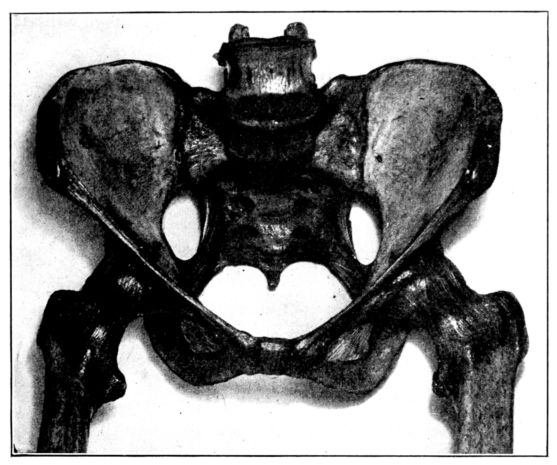
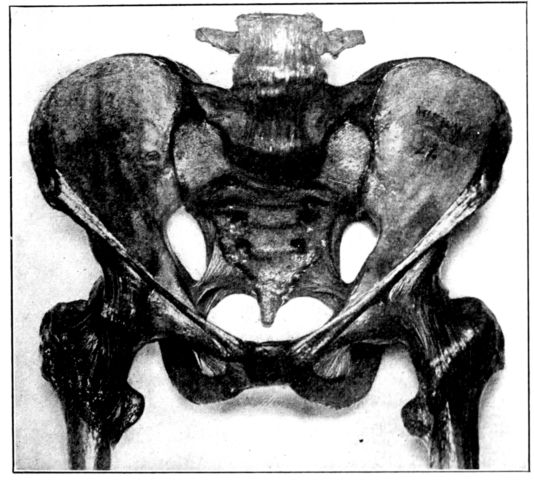
the femora or thigh bones. (Fig. 1, A. and B.).
Four bones enter into the construction of the pelvis: the two
hip bones or ossa innominata, on the sides and in front with the
sacrum and coccyx behind.
The innominate bones (ossa innominata), symmetrically
placed on each side, are broad, flaring and scoop-shaped. Each
bone consists of three main parts, which are separate bones in
early life, but firmly welded together in adults: the ilium, ischium
and pubis. The ilia are the broad, thin, plate-like sections above,
20their upper, anterior prominences, which may be felt as the hips,
are the anterior superior spinous processes used in making pelvic
measurements. The margins extending backward from these
points are termed the iliac crests.
The ischii are below and it is upon their projections, known
as the tuberosities, that the body rests when in the sitting position,
and which also serve as landmarks in pelvimetry. The
pubes form the front of the pelvic wall, the anterior rami uniting
in the median line by means of heavy cartilage and forming the
symphysis pubis.
The sacrum and coccyx behind are really the termination of
the spinal column, the sacrum consisting, usually, of five rudimentary
vertebrae which have fused into one bone. It sometimes
consists of four bones, sometimes six, but more often of
five. The sacrum completes the pelvic girdle behind by uniting
on each side with the ossa innominata by means of strong cartilages,
thus forming the sacro-iliac joints. The spinal column
rests upon the upper surface of the sacrum. The coccyx, a little
wedge-shaped, tail-like appendage, which ordinarily has but
slight obstetrical importance, extends in a downward curve from
the lower margin of the sacrum, to which it has a cartilaginous
attachment, the sacro-coccygeal joint. This joint between the
sacrum and coccyx is much more movable in the female than in
the male pelvis.
We find, therefore, that although the pelvis constitutes a
rigid, bony, ringlike structure, there are four joints: the symphysis
pubis, the sacro-coccygeal, and the two sacro-iliac articulations.
As the cartilages in these joints become somewhat softened
and thickened during pregnancy, because of the increased
blood supply, they all permit of a certain, though limited amount
of motion at the time of labor. This provision is of considerable
obstetrical importance, since the sacro-coccygeal joint allows
the child’s head to push back the forward-protruding coccyx,
as it passes down the birth canal, thus removing what otherwise
might be a serious obstruction. And when, as is sometimes
necessary, because of a constricted inlet, the pubic bone
is cut through (the operation known as pubiotomy), the hingelike
motion of the sacro-iliac joint permits of an appreciable
spreading of the two hip bones and a consequent widening of
the birth canal.
21
A. Normal female Pelvis.
B. Normal male Pelvis.
Fig. 1.—Normal Pelves. Note the broad, shallow, light construction of the female pelvis, A, as compared with the more massive male pelvis, B.
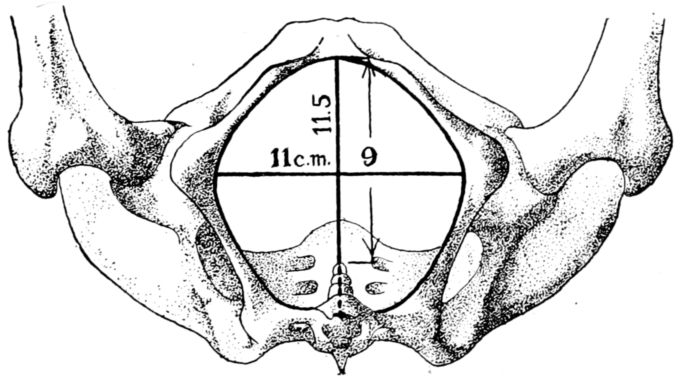
22The pelvic cavity as a whole is divided into the true and
false pelves by a constriction of the entire structure known as
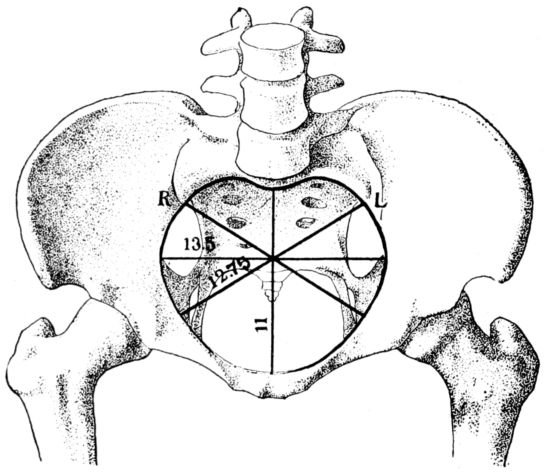
the brim or inlet. The inlet is not round, its antero-posterior
diameter being shortened by the sacro-vertebral joint which
protrudes forward and gives the opening something of a blunt,
heart-shaped outline. (Fig. 2.)
Fig. 2.—Diagram of the pelvic inlet, seen from above, with most important diameters.
As the pelvis occupies an oblique position in the body, the
plane of this brim is not horizontal, but slopes up and back from
the symphysis-pubis to the promontory of the sacrum. Being
swung upon the heads of the femora, the relation of the pelvis
to the entire body differs in the sitting and standing positions.
When a woman stands upright, her pelvis is so markedly oblique
in its position that she would tip backward but for strong tendons
attached to the pelvis and running down the front of the
thighs. Added strain upon these tendons during pregnancy
may account for some of the apparently undue fatigue experienced
by the expectant mother.
The shallow, expanded portion of the pelvis above the brim
23is the large, or false pelvis, its walls being formed by the sacrum
behind, the fan-like flares of the ilia on each side, with the incompleteness
of the bony wall in front made up by abdominal
muscles.
The false pelvis ordinarily serves simply as a support for the
abdominal viscera, which do not occupy the true pelvis unless
forced down by some such pressure as that caused by tight, or
poorly fitting corsets. The false pelvis is of little obstetrical importance,
its function during pregnancy being to support the
enlarged uterus, while at the time of labor it acts as a funnel
to direct the child’s body into the true pelvis below.
Fig. 3.—Diagram of pelvic outlet, seen from below, with most important diameters.
The true pelvis, on the other hand, is of greatest possible obstetrical
importance since the child must pass through its narrow
passage during birth. It lies below and somewhat behind
the inlet; is an irregularly shaped, bottomless basin, and contains
the generative organs, rectum and bladder. Its bony walls
are more complete than those of the false pelvis, and are formed
by the sacrum, coccyx and innominate bones. Its lower margin
constitutes the outlet, or inferior strait, and being longer in its
antero-posterior dimension than in its transverse measurement,
its long axis is at right angles to the long axis of the inlet. (Fig.
3.) A baby’s head, accordingly, must twist or rotate in making
its descent through this bony canal, for the long diameter of the
head must first conform to one of the long diameters of the inlet,
either transverse or oblique, and then turn so that the length
24of the head is lying antero-posteriorly, in conformity to the long
diameter of the outlet, through which it next passes.
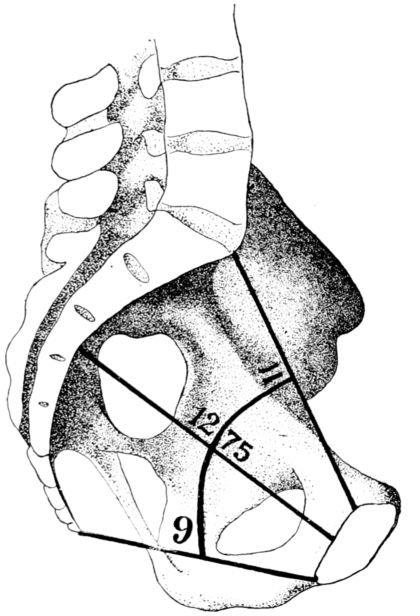
The posterior wall of the pelvis, consisting of the sacrum
and coccyx, forms a vertical curve and is about three times as
deep as the anterior wall formed by the narrow symphysis
pubis. The structure as a whole, therefore, curves upon itself,
resembling a bent tube with its concavity directed forward.
(Fig. 4.)
Fig. 4.—Diagram of sagittal section of the pelvis showing curve of the bony canal, with most important diameters.
Thus it becomes apparent that the structure of the pelvis
requires the child’s head, not only to rotate in its passage through
the birth canal, but also to describe an arc, since the part of the
head which passes down the posterior wall travels farther in a
given time than the part which passes under the pubis.
This twisting and curving of the birth canal must be appreciated
in order to understand the mechanism of labor.
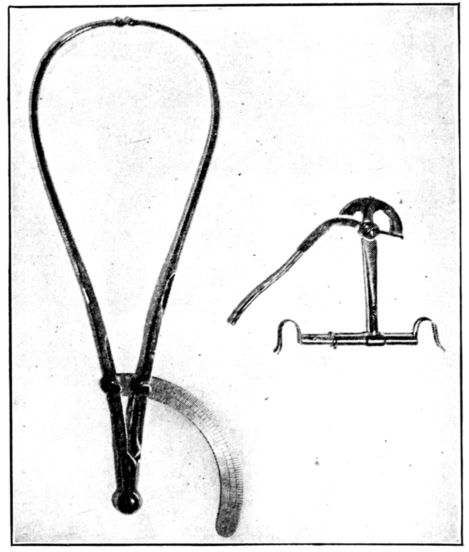
25In considering the question of pelvimetry, we find that there
are both external and internal measurements to be taken, all
for the purpose of estimating as accurately as possible the shortest
diameter of the inlet through which the baby must pass.
(Fig. 5.)
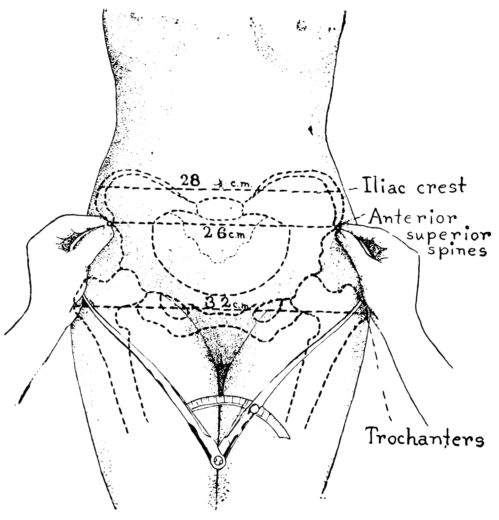
According to a common system of mensuration, the first external
measurement is the inter-spinous, the distance between
the anterior-superior spines, those bony points which are uppermost
as the patient lies on her back. This distance is normally
26 centimetres. (Fig. 6.)
Fig. 5.—Two types of pelvimeters frequently used in taking measurements of the pelvic inlet and outlet.
The second measurement is the inter-crestal, or the distance
between the iliac crests, and is normally 28 centimetres.
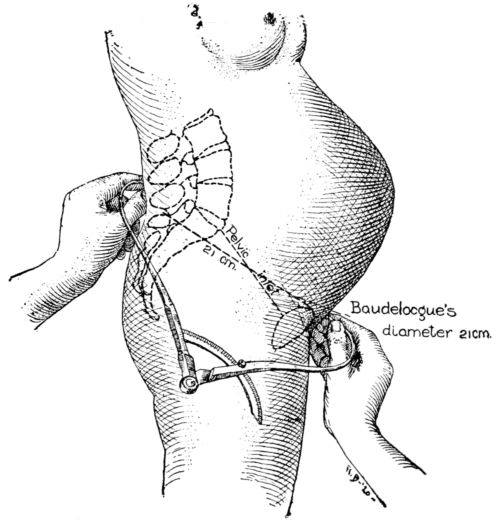
Baudelocque’s diameter is the third measurement and is
taken with the patient lying on her side. (Fig. 7.) It is the distance
from the top of the symphysis to a depression just below
the last lumbar vertebra. This depression is easily located as it
also marks the upper angle of a space just above the buttocks,
which in normal pelves is quadrilateral. In malformed pelves
this quadrangle may be so misshapen as to become almost a
triangle with the apex directed either up or down. This dimension
26is sometimes called the external conjugate and ordinarily
measures 21 centimetres.
The fourth measurement is the distance between the great
trochanters, or heads of the femora, and normally is 32 centimetres.
All of these measurements, which after all are only approximate,
relate to the top of the pelvis and are valuable in that they
help in estimating the dimensions of the inlet, which are the important
ones, and obviously cannot be measured on a live woman.
Fig. 6.—Diagram showing method of measuring distances between iliac crests and spines and the trochanters.
The inlet has four measurements of obstetrical importance:
the antero-posterior, or true conjugate, which is the distance
from the top of the symphysis pubis to the prominence of the
sacrum, and is normally 11 centimetres; the transverse diameter,
which is at right angles to the true conjugate and is the greatest
width of the inlet, measuring from a point on one side of the
brim to the corresponding point on the other, is normally 13.5
centimetres, and the two diagonal measurements, known respectively
27as the right and left oblique diameters, which are normally
12.75 centimetres.
Although it is very important to the expectant mother that
all of these dimensions be of normal length, the length of the true
conjugate, or conjugata vera, is of the gravest importance of all
because it is the shortest diameter through which the child’s head
must pass. If it is shorter than normal, the channel may be too
constricted for the full-term baby’s head to pass through comfortably,
thus making a spontaneous delivery extremely difficult,
or even impossible.
Fig. 7.—Diagram showing method of measuring Baudelocque’s diameter.
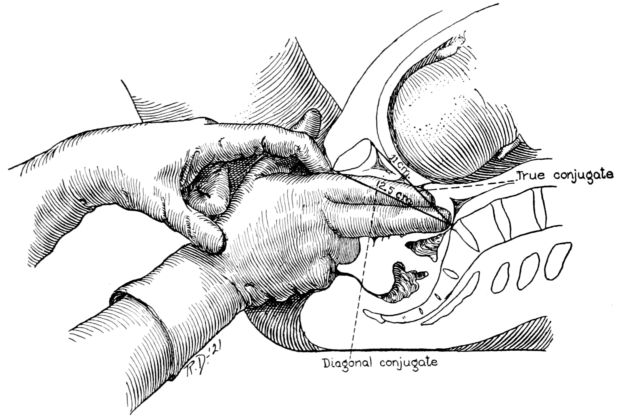
The length of the all important, true conjugate is estimated
by introducing the first two fingers of one hand into the vagina
until the tip of the second finger touches the promontory of the
sacrum. (Fig. 8.) The point at which the inner margin of
the symphysis then rests upon the forefinger is measured, thus
giving the length of the diagonal conjugate. This normally
measures 12.5 centimetres or more, and is estimated as being 1.5
centimetres longer than the true conjugate.
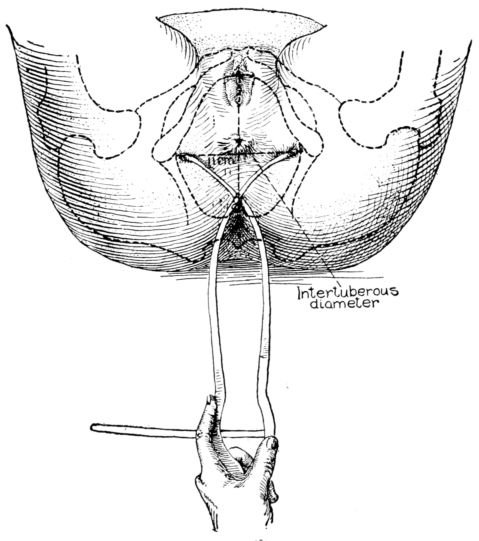
28The most important measurement of the outlet is the intertuberous
diameter, the distance between the tuberosities of the
ischii. This is the shortest diameter through which the child
must pass in the inferior strait, and normally measures something
more than 8 centimetres, usually about 11 centimetres.
(Fig. 9.)
It is possible, by studying such measurements as these, made
upon an expectant mother, and comparing them with dimensions
which have been accepted as normal, to form a reasonably accurate
estimate of the size and shape of her pelvis.
Fig. 8.—Diagram showing method of estimating the true conjugate by measuring the length of the diagonal conjugate.
A delivery may be, and frequently is, accomplished through
a pelvis which is not entirely normal in size or shape. But the
obstetrician of to-day is closely observant of the patient whose
pelvic measurements depart from the normal by more than the
accepted margin of safety, and he plans for labor in accordance
with the indications in each case.
Disproportion between the measurements of the mother’s
pelvis and the size of the child’s head must be considered in this
connection. A small pelvis may permit of the spontaneous delivery
of a small child, but be too narrow for the passage of a
29full-sized baby, while a woman with a normal pelvis may have
an extremely difficult labor because of an unusually large child.
The size and shape of the pelvis is found to vary among different
races and in different individuals. And the size and contour
of the inlet may be so altered by rickets, lack of proper
exercise during early life, or by growths upon the pelvic bones,
as to seriously interfere with normal labor.
Fig. 9.—Diagram showing method of measuring the inter-tuberous diameter.
The various kinds of malformed pelves may be loosely classified
as generally contracted or small; flat; simple funnel; generally
contracted funnel; and the rachitic pelves, both flat and
generally contracted. There may be a contracted inlet, or a contracted
outlet, or both may occur in the same pelvis.[1]
30Rachitic pelves are common among negroes and not altogether
rare among white women.
The normal male pelvis is deep, narrow, rough and massive
as compared with the female structure (see Fig. 1.), and the
angle of the pubic arch, formed by the two pubic bones, is deeper
and more acute in the male than in the female skeleton.
The normal female pelvis, on the other hand, is light, broad,
shallow, smooth and large, giving evidence of the infinite wisdom
and skill that entered into constructing it for the high purpose
it was designed to serve.
The female organs of reproduction are divided into two
groups, the internal and the external genitals. With them are
usually considered certain other structures: the ureters, bladder,
urethra, rectum and the perineum, because of their close
proximity (Fig. 10.); and the breasts, because of their functional
relation to the reproductive organs.
Internal Genitalia. The internal organs of generation are
contained in the true pelvic cavity and comprise the uterus and
vagina in the centre, an ovary and Fallopian tube on each side,
together with their various ligaments, membranes, nerves and
blood vessels and a certain amount of fat and connective tissue.
The uterus is the largest of these organs. In its nonpregnant
31state, it is a hollow, flattened, pear-shaped organ about three
inches long, one and a quarter inches wide, at its broadest point,
three-quarters of an inch thick and weighing about two ounces.
Fig. 10.—Anterior view of female generative tract, showing both external and internal organs. Drawn by Max Brodel. (Used by permission of A. J. Nystrom & Co., Chicago.)
Ordinarily it is a firm, hard mass, consisting of irregularly
disposed, involuntary (unstriped or plain) muscle fibres and
connective tissue, nerves and blood vessels. The arrangement
32of the uterine muscle fibres is unique, for they run up and down,
around and crisscross, forming a veritable network. This strange
arrangement of the fibres is favorable to the growth of the uterine
musculature during pregnancy, and a factor in preventing
hemorrhage after delivery.
The abundant blood supply to the uterus merits a word. It
is derived from the uterine arteries, arising from the internal
iliacs, and the ovarian artery from the aorta. The arteries from
the two sides of the uterus are united by a branch where the
neck and body of this organ meet, thus forming an encircling
artery. A deep cervical tear during labor may break this vessel
and a profuse hemorrhage occur as a result.
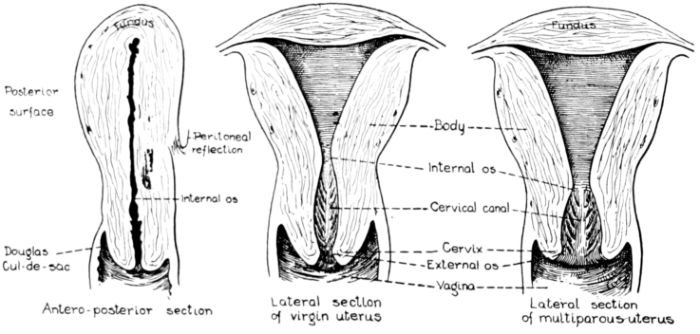
Fig. 11.—Diagrams of sections of virgin and multiparous uteri.
The uterus is covered, front and back, by a fold of the peritoneum,
except the lower part of the anterior wall where the
peritoneum is reflected up over the bladder. It is lined with a
thick, velvety, highly vascular mucous membrane, the endometrium,
the surface of which is covered by ciliated, columnar
epithelium. Embedded in the endometrium are numerous mucous
glands which dip down into the underlying, muscular wall.
The uterus as a whole is comprised of three parts: the fundus,
that firm, rounded, head-like part above; the body, or middle
portion, and the cervix, or neck, below. It is in the body and cervix
that we find the long, narrow uterine cavity, divided by a
constriction into two parts. The cavity of the body is little
more than a vertical slit, being so flattened from before backward
33that the anterior and posterior surfaces are nearly if not quite
in apposition. It is somewhat triangular in shape with an opening
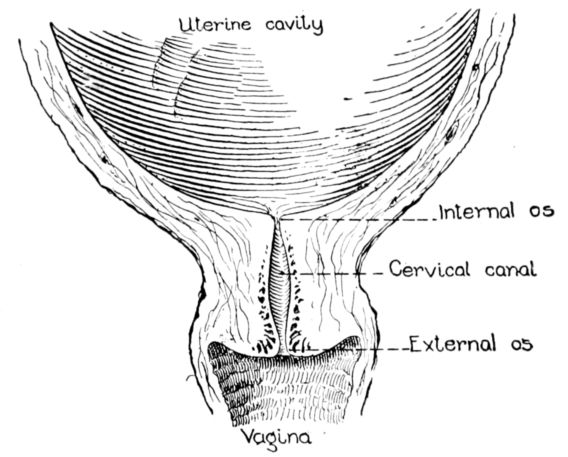
at each angle. (Fig. 11.) The lower of these openings leads
into the cavity of the cervix through a constriction termed the
internal os, while at the cornua, or two upper angles, are the
openings into the Fallopian tubes.
The cavity of the cervix is spindle-shaped, being expanded
between its two constricted openings, the internal os above and
the external os below, which opens into the vagina. The external
os in the virgin is a small round hole but has a ragged outline
in women who have borne children.
This oblong, muscular body, the uterus, is suspended obliquely
in the centre of the pelvic cavity by means of ligaments.
In its normal position the entire organ is slightly curved forward,
or ante-flexed, the fundus being directed upward and forward
and the cervix pointing down and back. This position is affected
by a distended bladder or rectum, and also by postural changes
in the body as a whole. The cervix protrudes into the anterior
wall of the vagina for about one-half inch and almost at right
angles, since the vagina slopes down and forward to the outlet.
The upper part of the uterus is held in position by means of
ligaments, the lower part being embedded in fat and connective
tissue between the bladder and rectum. This more or less of a
floating position makes possible the enormous increase in size
and upward push or extension of the uterus during pregnancy.
The pregnant uterus becomes soft and elastic as it grows. At
term it is about a foot long, eight to ten inches wide, and reaches
up into the epigastric region. This growth is due in part to the
development of new muscle fibres and in part to a growth of the
fibres already existing in the uterine wall.
After labor the uterus returns almost, but never entirely, to
its former size, shape and general condition.
The Fallopian tubes are two tortuous, muscular tubes, four
or five inches long, extending laterally in an upward curve, from
the cornua of the uterus and within the folds of the upper margin
of the broad ligament, by which they are covered. At their
juncture with the uterus, the diameter of these tubes is so small
as to admit of the introduction of only a fine bristle, but they
34gradually increase in size toward their termination in wide
trumpet-shaped orifices, which open directly into the peritoneal
cavity. Finger-like projections called fimbriæ, fringe the margins
of these openings.
The mucous lining of the tubes is covered with ciliated epithelium
and is continuous with that of the uterus. At the fimbriated
extremities of the tubes this lining merges into the peritoneum,
the serous lining of the abdominal cavity.
Just here it will be well to say a word about the peritoneum
because of the possibility of its becoming infected during labor
and the lying-in period, and the very grave consequences of such
infection. It is a delicate, highly vascular, serous membrane
which both lines the abdominal cavity and covers the abdominal
and pelvic organs, which press into its outer surface and are
covered much as one’s fingers would be covered by pushing them
into the outer surface of a child’s toy balloon. The continuity of
this membrane is broken only where it is entered by the Fallopian
tubes.
The ovary, the sex gland of the female, is a small, tough ductless
gland, about an inch long and three-quarters of an inch wide,
or about the size and shape of an almond. It is greyish pink in
color and presents a more or less irregular, dimpled surface. An
ovary is suspended on either side of the uterus, in the posterior
fold of the broad ligament, by which it is partly covered. Its
outer end is usually attached to the longest of the fimbriated
extremities of the Fallopian tube, the fimbria ovarica, which has
the form of a shallow gutter, or groove. The inner end of the
ovary is attached to the ovarian ligament, which in turn is attached
to the uterus below and behind the tubal entrance.
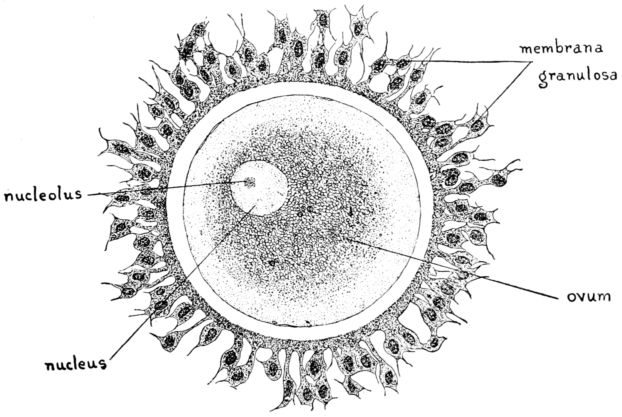
The ovary consists of two parts, the central part or medulla,
composed of connective tissue, nerves, blood and lymph vessels,
and the cortex, in which are embedded the vesicular Graafian
follicles containing the ova. At birth each ovary contains
upwards of 50,000 of these ova, which are the germ cells concerned
with reproduction and the process of menstruation.
These ovarian glands perform two vital functions, for in
addition to their prime function of producing and maturing the
germinal cell of the female, they provide an internal secretion
35which exercises an immeasurably important, though imperfectly
understood, influence upon the general well-being of the entire
organism.
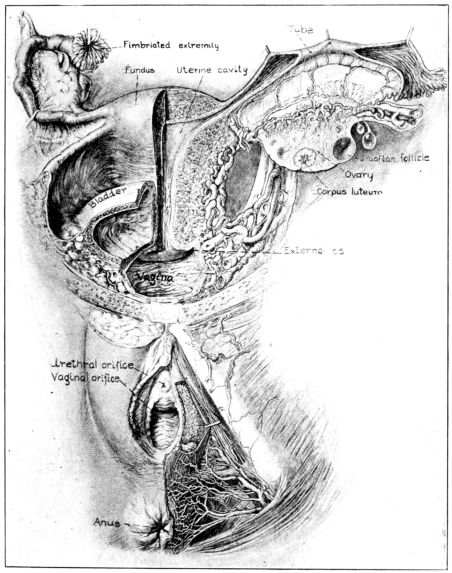
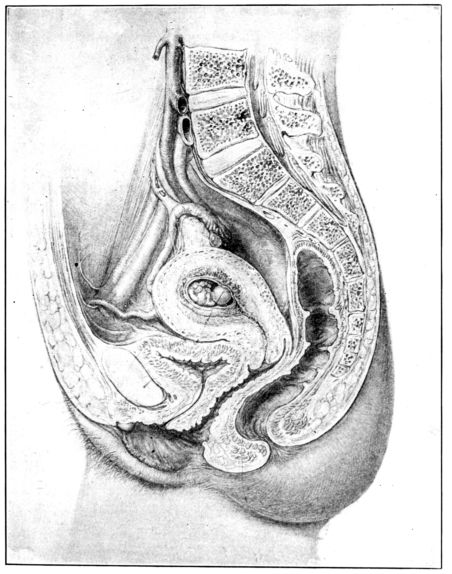
Fig. 12.—Sagittal section of female generative tract. Drawn by Max Brodel. (Used by permission of A. J. Nystrom & Co., Chicago.)
The vagina is an elastic, muscular sheath or tube, about four
inches long, lying behind the bladder and urethra and in front of
the rectum. It leads interiorly up and backward from the vulva
to the cervix, which it encases for about half an inch. The space
between the outer surface of the cervix that extends into the
vagina, and the surrounding vaginal walls, is called the fornix.
36For convenience of description, this is divided into four sections
or fornices: the anterior, posterior and lateral fornices.
Between the posterior fornix and the rectum a fold of the
peritoneum drops down and forms a blind pouch known as
Douglas’ cul-de-sac. At this point the delicate peritoneum is
separated from the vagina by only a thin, easily punctured, muscular
wall. This is a fact of grave surgical significance, for unless
instruments and nozzles introduced into the vagina are very
gently and skillfully directed, they may easily pierce this thin
partition. Septic material may thus gain entrance to the peritoneal
cavity and peritonitis result.
The bore of the vaginal canal ordinarily permits of the introduction
of one or two fingers. It is somewhat flattened from before
backward, and on cross section resembles the letter H. During
labor this canal becomes enormously dilated, being then four
or five inches in diameter, and permits the passage of the full
term child.
The vagina is lined with a thick, heavy, mucous membrane
which normally lies in transverse folds or corrugations called
rugæ. These folds are obliterated and the lining stretched into
a smooth surface as the canal dilates during labor.
Attention must be drawn to the fact that the vagina, cervix,
uterus and tubes form a continuous canal from the vulva to the
easily infected peritoneum, a fact which makes absolute surgical
cleanliness in obstetrics virtually a matter of life or death to
the patient.
This muscular tube is lined throughout its entire length with
mucous membrane, which, though continuous, changes somewhat
in character along its course. The epithelial cells of the
lining of the tubes and body of the uterus have hair-like projections,
cilia, which maintain a constant waving motion from
above downward. The effect of this sweeping current is to carry
down toward the outlet any object or secretion which may be
upon the surface of the lining of the tubes or uterine cavity.
The unfertilized ovum is thus swept down to meet the germ cell
of the male and become fertilized.
Along this variously constructed canal, at different periods
in the life of the individual, pass the matured ovum, the menstrual
37flow, the uterine secretions, the fetus, the placenta and
lochia, (the discharge which occurs during the puerperium).
Although the bladder and rectum are not organs of reproduction,
they are contained in the pelvic cavity and lie in such
close proximity to the internal genitalia that at least a passing
word must be devoted to their description.
The bladder is a sac of connective tissue which serves as a
reservoir for the urine and is situated behind the symphysis pubis
and in front of the uterus and vagina. Urine is conducted into
the bladder by the ureters, two slender tubes running down on
each side from the basin of the kidney across the pelvic brim to
the upper part of the bladder, which they enter somewhat
obliquely, at about the level of the cervix. It is thought that
pressure of the enlarged pregnant uterus upon the ureters at
this point may be one factor in the causation of pyelitis, a frequent
complication of pregnancy. The bladder empties itself
through the urethra, a short tube which terminates in the meatus
urinarius, a tiny opening in the vulva.
The rectum, the lowest segment of the intestinal tract, is
situated in the pelvic cavity behind and to the left of the uterus
and vagina. It extends downward from the sigmoid flexure of
the colon to its termination in the anal opening. The anus is
a deeply pigmented, puckered opening situated an inch and a
half or two inches behind the vagina. It is guarded by two
bands of strong circular muscles, the internal and external
sphincter ani. The skin covering the surface of the body extends
upward into the anus where it becomes highly vascular and
merges into the mucous lining of the rectum. Pressure exerted
during pregnancy by the enlarged uterus is felt in both the rectum
and bladder, frequently causing a good deal of discomfort
and almost painful desire to evacuate their contents.
The blood vessels in the anal lining just within the external
sphincter sometimes become engorged and inflamed, even bleeding
during pregnancy, as a result of the pressure exerted by the
greatly enlarged uterus. The distended blood vessels, which in
this condition are called hemorrhoids, not infrequently protrude
from the anus and become very painful.
38After having considered the structure and relative positions
of the pelvic organs one is able to picture more clearly the arrangement
and disposition of the uterine ligaments, all of which
are formed by folds of the peritoneum. They are twelve in number,
five pairs and two single ligaments, namely: two broad, two
round, two utero-sacral, two utero-vesical, two ovarian, one anterior
and one posterior ligament.
The broad ligaments are in reality one continuous structure
formed by a fold of the peritoneum, which drops down over the
uterus, investing the fundus, body, part of the cervix, and part
of the posterior wall of the vagina. It unites on each side of the
uterus to form a broad, flat membrane which extends laterally to
the pelvic wall, dividing the pelvic basin into an anterior and
posterior compartment, containing respectively the bladder and
rectum. Between the folds of the broad ligament are situated the
ovaries and ovarian ligaments, the Fallopian tubes, the round
ligaments and a certain amount of muscle and connective tissue,
blood vessels, lymphatics and nerves.
The round ligaments, one on each side, are narrow, flat bands
of connective tissue derived from the peritoneum and muscle
prolonged from the uterus, and containing blood and lymph vessels
and nerves. They pass upward and forward from their uterine
origin just below and in front of the tubal entrance, finally
merging in the mons veneris and labia majora.
The utero-sacral ligaments, of which there is one on each
side, arise in the uterus and, extending backward, serve to connect
the cervix and vagina with the sacrum.
The utero-vesical ligaments, one on each side, extend forward
and connect the uterus and bladder.
The ovarian ligaments, as previously described, are attached
to the uterine wall and to the inner end of the ovary, one on
each side.
The anterior ligament is a portion of the peritoneum which
dips down between the bladder and uterus, forming a pouch. It
is known also as the uterine-vesical pouch, or the vesico-uterine
excavation.
The posterior ligament is formed in much the same manner
by a portion of the peritoneum dipping down behind the uterus,
39in front of the rectum, and forming the recto-vaginal pouch.
This is the Douglas’ cul-de-sac previously referred to.
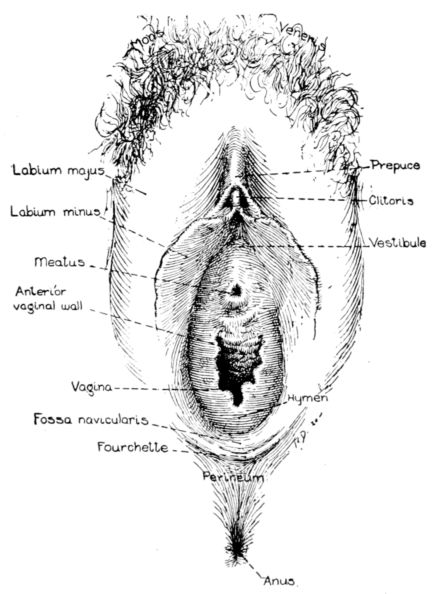
External Genitalia.—The vulva, or external genitalia, are
situated in the pudendal crease which lies between the thighs at
their junction with the torso, and extends posteriorly from the
pubis to a point well up on the sacrum. (Fig. 13.)
The mons veneris is a firm cushion of fat and connective tissue,
just over the symphysis pubis. It is covered with skin which
contains many sebaceous glands and after puberty is abundantly
covered with hair.
Fig. 13.—Diagram of external female genitalia. (Redrawn from Dickinson.)
The labia majora are heavy ridges of fat and connective tissue,
prolonged from the mons veneris and extended down and
back almost to the rectum, on each side, forming the lateral
boundaries of the groove. They are lined with mucous membrane
and covered with skin and hair, the latter growing thinner
toward the perineum until it finally disappears.
The labia minora are two small cutaneous folds lying between
the labia majora on each side of the vagina. Like the larger
40folds, they taper toward the back and practically disappear
in the vaginal wall. Their attenuated posterior ends are
joined together behind the vagina by means of a thin, flat fold
called the fourchette. The labia minora divide for a short distance
before joining at an angle in front, thus forming a double
ridge anteriorly. In the depression between these ridges is the
clitoris, a small, sensitive projection composed of erectile tissue,
nerves and blood vessels and covered with mucous membrane.
The meatus urinarius is just below the clitoris and between two
small folds of the mucous membrane.
The vestibule is the triangular space between the labia
minora, and into it open the meatus urinarius, the vagina and
the more important vulvo-vaginal glands.
The vaginal opening is below the vestibule and above the
perineum. It is partially closed by the hymen, a fold of mucous
membrane disposed irregularly around the outlet, somewhat after
the fashion of a circular curtain. The hymen is ragged or
more or less scalloped in outline, and varies greatly in size in
different women, in some instances extending so far over the
opening as nearly or quite to close it.
The fossa navicularis is a depressed space between the hymen
and fourchette, so named because of its boat-like shape.
The Bartholin glands, probably the largest and most important
of the vulvo-vaginal glands, are situated one on each side
of the vagina and open into the groove between the hymen and
labia minora. Reference is made to these glands because of the
danger of their becoming infected. A gonorrheal infection of
these glands is particularly troublesome.
The perineum is a pyramidal structure of connective tissue
and muscle which occupies the space between the rectum and
vagina, and by forming the floor of the pelvis serves as a support
for the pelvic organs. The lower and outer surface of this
mass, representing the base of the pyramid, lies between the
vaginal opening and the anus and is covered with skin. As the
anterior part of the perineum is incorporated in the posterior
wall of the vagina, the entire structure becomes stretched and
flattened when the vagina is dilated during labor by the passage
of the child’s head.
41Unless very carefully guarded at the time of delivery, and
often even then, the perineum gives way under the great tension
undergone at that time, and a tear is the result. The injury may
be only a slight nick in the mucous membrane or it may extend
to, or into the levator ani, the most important muscle of the perineal
body, or if a “complete tear” will extend all the way
through the perineum and completely through the sphincter ani.
Such a tear is lamentable, as a break in the ring-shaped sphincter
muscle guarding the anal opening robs a woman of control of her
bowels, and is repaired with difficulty.
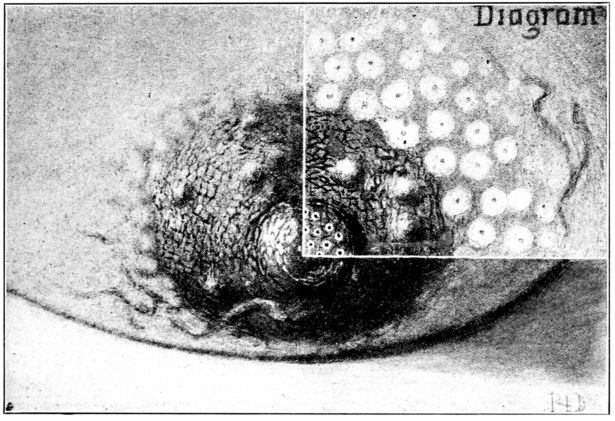
The breasts are large, specially modified skin glands of the
compound, racemose or clustering type, embedded in fat and
connective tissue and abundantly supplied with nerves and
blood vessels. They are situated quite remotely from the pelvic
organs, but because of the intimate functional relation between
the two, the breasts of the female may be regarded as accessory
glands of the generative system. They exist in the male, also, but
only in a rudimentary state.
Although the breasts sometimes contain milk during infancy,
their true function is to secrete, in the parturient woman,
suitable nourishment for the human infant during the first
few months of its life.
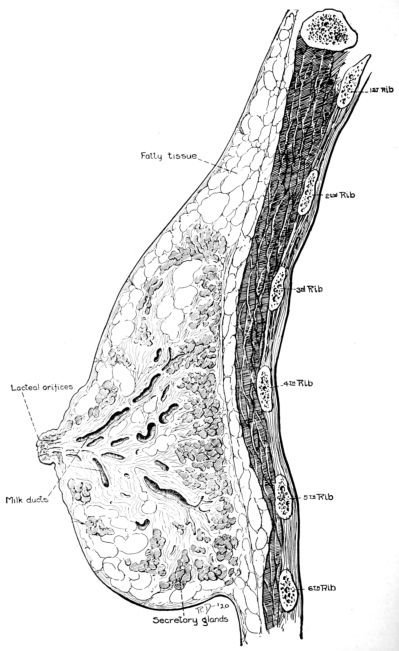
These glands are symmetrically placed, one on each side of the
chest, and occupy the space between the second and sixth ribs
extending from the margin of the sternum almost to the mid-axillary
line. A bed of connective tissue separates them from
the underlying muscles and the ribs. (Fig. 14.)
They vary in size and shape at different ages, and with different
individuals, particularly in women who have borne and
nursed children, when they tend to become pendulous. But in
general they are hemispherical or conical in shape with the nipple
protruding from one-quarter to one-half inch from the apex.
The nipples are largely composed of sensitive, erectile tissue and
become more rigid and prominent during pregnancy and at the
menstrual periods. Their surfaces are pierced by the orifices of
the milk ducts, which are fifteen or twenty in number. (Fig. 15.)
42
Fig. 14.—Sagittal section of breast showing structure of secretory apparatus.
43The breasts are covered with very delicate, smooth, white skin,
excepting for the areolæ, those circular, pigmented areas one to
four inches in diameter, which surround the nipples. The
areolæ are darker in brunettes than in blonds, and in all women
grow darker during pregnancy. The surface of the nipples and
of the areolæ is roughened by small, shot-like lumps or papillæ
known as the tubercles of Montgomery. This roughness becomes
more marked during pregnancy, since the papillæ grow larger
and sometimes even contain milk.
Fig. 15.—Front view of breast showing areola, tubercles of Montgomery and orifices of milk ducts.
The secretory apparatus of the breasts is divided into fifteen
or twenty lobes, these in turn being divided into clusters of
lobules. The lobules in turn are composed of tiny, secreting cells,
called acini, in which the milk is elaborated from the blood. The
acini are minute globules lined by a single layer of cells and enveloped
by a very delicate membrane. Tiny ducts carry the
milk from the acini to the main duct of the lobule, around which
the acini cluster. These ducts empty the milk into the larger
duct of the lobe, which runs straight to the nipple and opens
upon the surface. Just before reaching the surface, each of
these lactiferous sinuses expands into an ampulla, a minute reservoir
44for collecting the milk, which is secreted during the
periods between nursings.
These clusters of acini uniting to form lobules with tiny ducts
leading into the main duct of each lobule, closely resemble a
bunch of grapes. The separate grapes correspond to the acini,
their small stems correspond to the tiny ducts of the glands which
lead to a larger one, and the central stem of the grape cluster, to
the milk duct that opens upon the nipple.
The secretory tissue really constitutes a small part of the
breasts until they begin to function. But during lactation the
acini become enormously developed and enlarged. After lactation
ceases, the acini assume a more or less tubal form, many of
them undergoing atrophic changes.
45
Puberty is that period during which childhood develops into
sexual maturity, and the individual becomes capable of reproduction.
The age at which puberty occurs varies with climate, race,
occupation and with individuals of the same status. But the
average age for girls, in temperate climates, is from the twelfth to
the sixteenth year; for boys from the fourteenth to the seventeenth
year. Girls in southern climates sometimes mature as
early as the eighth or ninth year, while in colder regions puberty
may be delayed until the eighteenth or twentieth year.
At this time there are many physical and psychical manifestations
of the maturing changes in the internal female generative
organs. The undeveloped girl grows rapidly at this stage.
Her entire body rounds out and assumes a more graceful contour;
her breasts increase in size; her hips broaden; the external
genitalia enlarge and hair appears over the pubis and on other
parts of the body.
As this physical maturity progresses, there is a dawning sex
consciousness and the developing girl becomes shy, modest, retiring
and introspective. She is very likely to be emotional and
hysterical and to display a lack of stability and nervous control,
which are not in accord with her usual temperament. A formerly
dependable child may become capricious, erratic, and perplexingly
inconsistent. One day she may be quite her normal,
little-girl self and the next show inexplicably mature qualities.
Or she may display a bewildering number of moods and fancies
in the span of one short day.
Too much cannot be said of the importance of wise supervision
and guidance of the girl’s physical, mental and emotional
life at this critical, emotional period. Many gynecological, obstetrical
46and neurological difficulties in her later life may be
averted by her observance of sane rules of personal hygiene.
Vigorous and regular out-of-door exercise; a simple, nourishing
and well-balanced diet; adequate sleep in a well-ventilated
room; regular bathing, and correction of any discoverable physical
defects are the essentials.
But of equal, if not greater, importance is an understanding
and sympathetic oversight of the girl’s mental and emotional
life, a steadying sort of comradeship.
Her extreme sensitiveness and impressionability should be
recognized and borne in mind, and every effort made to save her
from strain and shock. Her nervous forces should be sedulously
conserved by protecting her against experiences and diversions
which would be unduly stimulating or irritating. Nor should
demands be made upon her uncertain nervous endurance which
she is able to meet only by great strain, if at all.
It is important to her future poise and health that her confidence
be courted, and when it is won, that all of her outpourings
be received with a respect and seriousness commensurate
with their great importance to her. Ridicule, and even unresponsiveness
or indifference to her interests, may, and often do,
result in a hurtful repression of one form or another. The logical
consequence of such repression is an increasingly damaging
neurosis later on in her life, capable of greatly impairing her
health, happiness and usefulness.
In short, all phases of the life of the adolescent girl should
be made as wholesome, tranquil and free from stress and strain
as is humanly possible.
These comments upon the importance of mental hygiene at
puberty may seem irrelevant to a discussion of obstetrical nursing.
But the preparation of the entire female organism for its
supreme function—that of child-bearing—is of concern to the
obstetrical nurse, and should be understood by her. Moreover,
every nurse is inevitably a health teacher, either by precept or
example, or both. An awareness on her part of the maturing
girl’s needs will fit her to help many perplexed mothers whom
she meets along the way to a happy solution of this grave and
vexing problem.
47The occurrence of puberty marks the establishment of ovulation
and menstruation. These two functions are usually performed
once a month, ovulation probably occurring about midway
during the intermenstrual period.
Ovulation, which is the prime function of the ovary, may be
defined as the formation and development of the ovum, and its
expulsion, when mature, from the ovary.
The formation of each woman’s full quota of ova is probably
complete at birth, though the process may continue until about
the second year. At this time it is variously estimated that each
of the two ovaries contains from 50,000 to 70,000 ova, but they
remain unmatured until puberty, the period at which ovulation is
most active.
Fig. 16.—Diagram of human ovum.
As the entire complex human body has its origin in this
tiny ovum, its course of development is of momentous importance
to us, and at the same time it provides a tale of intense interest.
In its unmatured state, the ovum, termed a primordial follicle,
or oöcyte, is a single cell, 1 125 inch in diameter, consisting
of clear protoplasm, the vitellus, and a surrounding vitelline
membrane composed of small, spindle-shaped epithelial cells.
The protoplasm contains a fairly large nucleus, or germinal vesicle,
48within which lies a nucleolus known as the germinal spot.
(Fig. 16.)
The primordial follicle probably lies dormant in this state
until puberty, when developmental changes take place, though it
is the belief of some authorities that follicles are in the process of
development from birth until the end of sexual life, though none
fully mature until puberty.
With the advent of puberty the cells composing the vitelline
membrane change in character and proliferate rapidly, with the
result that the ovum is surrounded by several layers of epithelial
cells. Some of the inner cells degenerate and liquify, thus surrounding
the ovum with fluid which is contained in a membrane
of vascular connective tissue, the theca folliculi; this in turn is
lined with epithelial cells, the membrana granulosa. This structure
constitutes a Graafian follicle, named for Dr. de Graaf who
first described it, and in the course of its maturation is pushed
toward the surface of the ovary, where it presents more or less
the appearance of a clear blister.
At one point in the enveloping membrana granulosa, the
cells proliferate into a mass in which the floating ovum becomes
embedded. This mass is termed the discus proligerus and the
fluid which surrounds it is the liquor folliculi.
Usually for some strange reason, one, and only one, ovum
ripens regularly each month during the years from puberty to
the menopause, excepting during pregnancy, when this function
is suspended. Occasionally, however, several ova mature at once,
a condition which may be one factor in the development of twins.
After puberty the ovary contains ova in all stages of development,
from the primordial follicle to the Graafian follicle just described.
When a Graafian follicle containing a matured ovum reaches
the ovarian surface, its membrane becomes thinner and finally
ruptures because of increased tension in the ovary, due to certain
circulatory changes. The ovum surrounded by the discus proligerus
is thus discharged into the peritoneal cavity near the
fimbriated end of the tube. Some ova enter the tube and others
float about in the peritoneal cavity, finally disintegrate and are
lost.
49The torn envelope of the follicle which remains in the cortex
of the ovary becomes filled with blood, which forms into a clot.
This clot is first surrounded, and then invaded, by cells containing
bright yellow pigment called lutein. The membrane formed
from these cells compresses the clot and brings about other
changes which speedily transform it into the corpus luteum.
If the discharged ovum becomes fertilized, the corpus luteum
remains practically unchanged for months and is termed the
corpus verum or corpus luteum of pregnancy. Its secretion is
believed to influence the implantation of the ovum and to promote
the woman’s general well-being during the period of gestation.
It continues to exist throughout pregnancy, and until
after delivery, when it is soon absorbed and replaced by normal
ovarian tissue, without the formation of scar tissue.
If fertilization does not occur, the body in the ovarian cortex,
which is then termed the corpus luteum of menstruation, or false
corpus, undergoes rapid degenerative changes and is almost
wholly absorbed within a few weeks.
By means of this rather complicated procedure the ovary is
saved from becoming a steadily enlarging mass of scar tissue, and
consequently devoid of reproductive powers, which would be the
case if the wound made by the rupturing of each Graafian follicle
were to heal by the usual formation of cicatricial tissue.
Ordinarily the ovum remains unfertilized and is propelled
down the Fallopian tube, by the cilia in its lining, to the uterine
cavity, where it is lost in the uterine secretions and ultimately
carried out in the menstrual flow.
Each time that an ovum matures, however, and is discharged
from the ovary the lining of the uterine cavity increases in vascularity
and becomes thicker and more velvety; a condition which
facilitates an attachment of the ovum in case of fertilization.
This preparation of the endometrium is termed “pre-menstrual
swelling,” or in popular language, nest-building.
Of the enormous number of ova existing in each woman,
relatively few mature and it is apparent that still fewer are
fertilized, since each impregnation results in an abortion, a premature
labor or a full term child.
Nature’s lavish provision of something more than 100,000 ova
50for each woman, who uses only about 500 in the course of her
life, excites no little wonder. But whatever the purpose of this
enormous supply, its existence makes possible the removal of all
but a small fragment of ovarian tissue in cases of disease, without
interference with the process of ovulation, which in turn permits
reproduction.
Menstruation, which is the evidence of sexual maturity, is a
monthly hemorrhage from the uterus which escapes through the
vagina, normally recurring throughout the entire child-bearing
period, except during pregnancy and lactation. The duration of
this child-bearing period, or sexual activity, is about thirty years
and continues from puberty to the menopause.
The frequency of the menstrual periods varies in different
women from twenty-one to thirty days, but the normal interval
between periods is twenty-eight days, which corresponds in point
of time to the menstrual cycle. Thus it is usually four weeks, or
a lunar month, from the beginning of one period to the beginning
of the period following, making thirteen menstrual periods during
each calendar year.
Just why menstruation occurs about every twenty-eight days
is not known, but the belief is that, although menstruation is in
some way dependent upon ovulation, its periodicity is regulated
by the corpus luteum. It is also believed that the corpus luteum
of pregnancy holds menstruation in check during the nine months
of gestation.
The menstrual cycle is divided into four stages, and though
there is not entire unanimity of opinion concerning the changes
which take place during these four stages, the preponderance of
evidence is in favor of the following processes.
The first or constructive stage lasts about seven days. It is
during this stage that the preparative changes, which have
been described, are made for the reception of the matured ovum.
The uterus becomes engorged with blood and is somewhat enlarged
and softened as a result. The endometrium grows deep
red, thick and velvety, partly because of the greatly augmented
blood supply, and partly because of an actual increase of connective
tissue in its structure. There is also an increase in the
size and activity of the uterine glands and in the amount of their
51secretions. If the ovum remains unfertilized, which is usually
the case, it does not attach itself to this elaborately prepared
lining, but passes out with the uterine discharges, and all of this
preparation and increased vascularity not only go for naught,
but must be undone.
The second stage, therefore, which lasts about five days, is
the destructive stage, during which the newly developed tissues
are broken down and the menstrual discharge occurs. During
this period the greatly increased secretions of the uterine glands
mix with the blood that oozes from the engorged endometrium
and with the disintegrated uterine tissues, and pour from the
vagina as the menstrual flow.
The third, or reparative stage, which follows, occupies about
three days. During this stage the destroyed uterine tissues are
regenerated by new growth from the deeper, uninjured tissues,
and the entire organ returns to its normal state.
The fourth, or quiescent stage, now follows, the damage having
been repaired, and lasts twelve or fourteen days. This is the
time remaining before Nature with unwearying patience begins
all over again to prepare for the reception and attachment of the
next matured ovum, in case of its possible fertilization.
It will be seen that the duration of the menstrual period,
which is coincident with the destructive stage of the menstrual
cycle, is about five days, but it is entirely within normal bounds
if it varies in length from two to seven days.
The discharge is usually scant at the beginning of the period,
increasing in amount until about the third day, after which it
diminishes steadily until its cessation. The normal odor of this
discharge, consisting as it does of blood and uterine secretions,
has been likened to that of marigolds.
The average amount of blood lost is from six to ten ounces,
but it varies greatly among women who are otherwise normal
and in good health. Some women regularly lose what seems to
be an alarming quantity of blood at each period without suffering
any apparent ill effect. Others lose so little that they are
scarcely aware of their menses.
As a rule the menstrual flow is more profuse among women
in warm climates than in cold regions. English women, for example,
52frequently menstruate profusely while in India, and upon
their return to England note a marked decrease in the amount
of the discharge. The same is often true of American women
who move from Southern to Northern states, while removal from
a low to a high altitude usually results in a more profuse flow.
The quantity of the menstrual discharge is affected also by
diet, living conditions and by any form of mental or physical
excitement or stimulation.
Accordingly, the highly strung, richly nourished women living
in luxurious circumstances are likely to menstruate more
freely than those less favored who are overworked and poorly
nourished.
A shock or great grief, or any great emotional experience; a
sea voyage or a long railroad journey may bring on a period before
it is due, while the regularity of the periods may be much
disturbed, temporarily, by a marked change of climate or altitude,
a serious illness or a decided change in one’s daily régime.
The function may be entirely suspended for several months
or a year in women who suddenly take up hard work or violent
exercise, and persist with it regularly. In such cases the periods
gradually recur and finally become normal and regular.
The menstrual period is frequently attended by evidences of
marked mental and physical disturbances. While many women
are fortunate enough to suffer little or no inconvenience during
menstruation, the vast majority are more or less wretched and
miserable at this time, although in good health in all other respects.
Many are tired, have less endurance than usual and are
likely to take cold easily. Headaches with a sense of fullness,
dizziness, and heaviness are common accompaniments. Backache
is a frequent source of discomfort, while abdominal pain,
varying from an uncomfortable sense of dragging heaviness to
almost unendurable agony, is the rule rather than the exception.
And there may be pain in the hips and thighs as well.
This state of wretchedness is sometimes increased by a loss
of appetite, nausea and even vomiting. At the same time there
are changes in the breasts which are much the same as, though
slighter than, those occurring during pregnancy. They are
firmer, may be somewhat increased in size, and many women
53experience a burning, tingling sensation, soreness and even pain.
The nipples are turgid and prominent and the pigmented areas
grow darker for the time being.
The skin over the rest of the body sometimes changes in appearance
and pimples are common; some women are pale and
others are flushed during their periods.
These physical disturbances accompanying menstruation
vary so widely in different women, and in the same women at
different times and under different conditions, that it is not possible
to draw a classical picture of the condition. But all of the
symptoms above described will persist with more or less severity
throughout the entire menstrual life of one woman, while perhaps
only one or two of them will occasionally disturb another.
Whatever discomfort there may be usually begins from one day
to a week before the discharge appears; is at its height during
the following day and from that time subsides steadily, until the
normally comfortable state is regained. In fact, many women
feel better at the end of their periods and during the days
immediately following than at any other time during the
cycle.
Heat applied to the abdomen and lumbar region during the
uncomfortable days; hot baths, rest and quiet, will usually give
great relief, as might be expected when there is local congestion
and general nervous irritability. In this connection, it is worth
mentioning that the discomfort of many women is needlessly
increased by their heeding the widespread but fallacious belief
that general bathing during menstruation is injurious. While
cold plunges and cold showers are not recommended, certainly
warm baths are innocuous and immensely satisfying.
In addition to the physical discomfort which is coincident
with menstruation, and quite as common, are the evidences of
mental and nervous instability. These often show themselves in
the form of unwarranted irritability, and in a lack of poise and
self-control. Drowsiness and mental sluggishness are not uncommon,
and many otherwise cheerful women are almost overwhelmed
by depression during menstruation.
All of these departures from what we are accustomed to regard
as the normal, or average, mental and physical state of
54women are very baffling, as they may persist after every discoverable
defect has been corrected.
But aside from all other considerations it is of obstetrical importance
for the sufferer to ascertain the cause of her discomfort
if possible. For example, a misplacement of the uterus is a
frequent cause of dysmenorrhea and, if it remains uncorrected,
may make conception impossible; or if conception perchance
does take place, the malposition of the uterus may later be the
cause of an interrupted pregnancy.
Endometritis is another cause of menstrual difficulty and if
allowed to persist may be one factor in the causation of abnormalities
in the attachment of the placenta.
There is evidently an intimate relation between the process
of menstruation and the functions of the ductless glands throughout
the body; a relation which is far from being understood.
For example, the administration of various preparations of
ductless glands for maladies which are apparently unrelated to
menstruation, results not alone in an improvement of the condition
treated, but frequently in much more comfortable menstrual
periods, as well.
It should be borne in mind, also, that the influence exerted
by a woman’s mental, or psychic, state upon her menstrual periods
is so apparent that it is being given increasingly serious
recognition. It is frequently observed that patients who are
under treatment for nervous and mental disorders, who are also
sufferers from painful menstruation, grow more comfortable during
their periods as their neurosis improves.
We have constantly before us examples of painful menstruation
being relieved coincidently with an improved mental state
among women situated at the two extremes of the social and
financial scale. Indolent, self-centred and unoccupied women
at one end often become excessively nervous and irritable, and
suffer great pain with each period, while the overworked, harassed,
poverty-stricken women at the other extreme have similarly
trying menstrual experiences. When the self-indulgent
sister can be persuaded to engage in some form of physical activity
and to interest herself in some work which requires mental
effort, and which perhaps makes an emotional appeal as well, she
55frequently finds that her menstrual difficulties become less troublesome.
In the case of the woman in poorer circumstances, an improvement
in her mode of living which approaches the normal,
and a relief from undue stress and anxiety, will very often be
followed by more comfortable menstruation.
A recognition of these rather intangible facts is of consequence
to the nurse, as it deepens her appreciation of the necessity
for nursing her patient as a complete entity, mentally, physically,
spiritually and emotionally. We are insistently reminded
at every turn that no one part of the patient, no one aspect of
her condition can be separately considered and the remainder
overlooked.
The patient can be nursed quite satisfactorily only when she
is nursed completely.
Relation Between Ovulation and Menstruation.—Menstruation
and ovulation are apparently associated and interdependent,
but the exact relation between the two is still obscure and puzzling.
It is generally accepted that complete removal of the
ovaries stops ovulation and is followed by a cessation of menstruation,
and yet cases have been recorded which suggest that
these two functions are not invariably correlative.
Evidence of this possible independence is that, although pregnancy
must be preceded by ovulation, it has occurred before
puberty or after the menopause. And not infrequently pregnancy
occurs during lactation, a period when the menstrual
function is usually suspended.
It has been claimed by some observers that menstruation has
occurred after the complete removal of both ovaries, which
would, of course, preclude the possibility of further ovulation.
It is possible, however, that in such cases either the ovaries were
not entirely removed, though believed to be, or that an accessory
ovary existed, since a very small fragment of ovarian tissue
will permit the occurrence of ovulation.
As to their chronological relation, information available at
present suggests that ovulation occurs about ten or twelve days
after the close of the preceding period, and that the corpus luteum
56formed at the site of the rupture reaches its highest development
some ten or twelve days later, and that the degenerative
changes in the corpus luteum, in case of non-fertilization of the
ovum, give rise to menstruation.
Modifications of Menstruation.Dysmenorrhea is painful
menstruation.
Menorrhagia is an abnormally copious menstrual flow.
Amenorrhea is irregularity or, to be exact, suppression of
the menses. The suppression may be due to an obliteration of
the neck of the uterus, or to an occlusion of the vaginal opening.
Vicarious menstruation is an escape of blood from other
parts of the body coincident with menstruation. Blood may ooze
through the skin covering the breasts; also from hemorrhoids or
from the surface of ulcers. Or there may be nose-bleeding, vomiting
of blood or pulmonary hemorrhage, particularly among
tuberculous patients. Vicarious menstruation usually occurs
among nervous, high-strung women and may be regarded as an
evidence of ill health. The amount of blood lost in this way is
much less than the amount of the menstrual flow.
The menopause, also termed the climacteric and the change
of life, marks the permanent cessation of menstruation and of
sexual activity. It occurs ordinarily between the ages of forty
and fifty; the majority of women stop menstruating at their
forty-sixth year. The menopause has occurred as early as the
twenty-fifth year, and as late as the eightieth or ninetieth year.
But such cases are, of course, extremely rare and their infrequent
occurrence is of interest rather than of importance in an effort
to ascertain the general average.
As the child-bearing period is normally about thirty years in
duration, the prevailing belief is that the menopause comes earlier
to women who began menstruating early, than to those who
did not reach puberty until later. Some authorities contend,
however, that early menstruation indicates extreme vitality, and
that this vitality tends to prolong the child-bearing period. According
to this theory, then, the menopause would come late to
those who matured early and vice-versa.
As the menopause approaches, menstruation occurs irregularly;
the discharge sometimes increases slightly but usually diminishes
57in amount and finally disappears altogether, while the
generative organs all undergo atrophic changes.
Bearing in mind the disquieting effect of adolescence, and of
ovulation, upon the general nervous, mental and physical state,
we may reasonably expect that a complete cessation of the ovarian
function would be attended by more or less disturbance of
the general well-being.
It is true that very many women suffer a certain amount of
nervous instability at the menopause; they tire easily; have “hot
flashes” and possibly headaches. But under ordinary conditions
the discomfort is not great, and after the function has entirely
ceased and they become physiologically adjusted to the new
order of things, these women often enjoy better health than ever
before.
Unfortunately wide currency has been given to exaggerations
concerning the symptoms of the menopause. The result is that
serious organic diseases which are in no way related to the climacteric
are not infrequently attributed to it. For this reason
excessive bleeding, heart symptoms and what not are all too often
accepted as a matter of course, and accordingly neglected until
the patient is beyond medical aid. This is particularly and tragically
true of cancer of the uterus.
It is a wise precaution, therefore, to regard with apprehension
an increase in the amount of the menstrual flow of any woman
past thirty, and not to accept it as a normal forerunner of
the menopause.
58In the dark womb where I began
My mother’s life made me a man.
Through all the months of human birth
Her beauty fed my common earth.
—John Masefield.
PART II The Development of the Baby — CHAPTER III THE DEVELOPMENT OF THE OVUM, EMBRYO, FETUS, PLACENTA, CORD AND MEMBRANES — CHAPTER IV GROWTH AND PHYSIOLOGY OF THE FETUS — CHAPTER V SIGNS, SYMPTOMS, AND PHYSIOLOGY OF PREGNANCY — PHYSIOLOGY OF PREGNANCY
59
CHAPTER III. DEVELOPMENT OF THE OVUM, EMBRYO, FETUS,
PLACENTA, CORD AND MEMBRANES. The Ovum. The Spermatozoon.
Fertilization. Heredity. Sex-determination. Most
Favorable Age for Motherhood. The Morula. Growth in the Uterus.
The Decidua. Ectoderm. Mesoderm. Entoderm. The Chorion and
Placenta. The Amnion. The Umbilical Cord. The Fetus. Growth
by Months. Factors Influencing the Size of Child. Multiple Pregnancy.
Extra-uterine Pregnancy.
CHAPTER IV. GROWTH AND PHYSIOLOGY OF THE FETUS. Circulation.
Kidneys. Bowels. Head. Fontanelles. Occipital Measurements.
CHAPTER V. SIGNS, SYMPTOMS, AND PHYSIOLOGY OF PREGNANCY.
Duration of Pregnancy. Date of Labor. Signs of Pregnancy:
Presumptive, Probable, and Positive. Physiological Changes
in the Maternal Organism: Uterus. Cervix. Vagina. Tubes and
Ovaries. Abdomen. Umbilicus. Breasts. Cardio-Vascular System.
Respiratory Organs. Digestive Tract. Urinary Apparatus. Bony
Structures. Skin. Carriage. Temperature. Mental and Emotional
Changes. Ductless Glands.
61
As we learned in the last chapter, some of the ova which are
discharged into the peritoneal cavity enter the fimbriated end
of the tube, while very many others perish. As a rule an ovum
enters the tubal opening adjacent to the ovary from which it
has been discharged, but it is possible for this tiny cell to travel
across the body and enter the tube on the opposite side.
This migration of the ovum, as it is termed, has been demonstrated
in cases in which pregnancy has followed removal of
the ovary on one side and the tube on the other.
Fig. 17.—Diagram of spermatozoa, the male cells of germination.
There are various theories as to how and why an occasional
migrating ovum, floating around in a relatively large cavity, ever
enters the tubal opening, which, after
all, is not large. The most widely
accepted belief is that the motion of
the cilia lining the tubes creates a
suction which draws the microscopical
cell into the opening, the same
cilia being the means by which the
ovum is later propelled downward
through the tube to the uterus.
This journey of the ovum through
the tube is of enormous consequence.
During its course occur the events
which decide whether the ovum shall,
like most of its fellows, be simply
swept along to no end and lost, or whether by chance it is to
receive the mysterious impulse which begins the development of
a new human being.
The amazing power which enables this cell to reproduce itself,
and to develop with unbelievable complexity, is acquired somewhere
62in the tube by meeting and fusing with a spermatozoon,
the germinal cell of the male. (Fig. 17.)
The spermatozoa look very much like microscopic tadpoles,
with their flat, oval heads, tapering bodies and long tails. As
these tails serve somewhat as propellers, the male cells are capable
of very rapid motion. But in spite of their strange appearance,
they are cells after all, and resemble the female cells in
that each one contains a nucleus, or germinal spot.
An almost inconceivably large number of spermatozoa, floating
in the seminal fluid, is deposited in the vagina at the time of
intercourse. Nature evidently supplies the male and female cells
with equal lavishness, in order to provide for the large number
of both kinds which must inevitably be lost, and still have enough
survive to accomplish the high purpose of their creation. A very
considerable number of spermatozoa enter the uterus, and are
enabled through their powers of motility, to travel up into the
tubes, in spite of the downward current created by the cilia.
And in the tube, usually in the upper end, they meet a recently
matured and discharged ovum which is being swept downward,
and are attracted to it somewhat as bits of metal are drawn to
a magnet. Although the ovum which is destined to be fertilized
is surrounded by several spermatozoa, only one actually enters
and fuses with it.
This fusion is termed impregnation, fertilization, or, in lay
parlance, conception, and the instant at which it occurs marks
the beginning of pregnancy. The establishment of this fact is
of no little importance, since it does away with any possible controversy
concerning the time at which a new life begins. The
origin of the child is exactly coincident with the fusion of the
male and female germinal cells.
And furthermore, the sex of the child and any inherited traits
and characteristics are also established at this decisive instant.
No amount of dieting, exercise nor mental effort on the part of
the expectant mother can alter or influence them in the smallest
degree, for the father has made his complete contribution toward
the creation of the new being, and after this event the mother
provides nourishment only.
All told, probably more than five hundred theories have been
63advanced to explain what it is that decides of which sex the forthcoming
child will be.
In 1907 Dr. Schenck attracted world wide attention by announcing
his belief that either sex could be produced in the expected
child through the simple expedient of regulating the
mother’s diet. Liberal feeding would result in boys, the sturdier
sex, and frugality in girls, the smaller, frailer type of baby.
But as the results of applying Schenck’s theory have scarcely
borne out his claims, it is given but scant attention to-day.
The present belief regarding the causation of sex is that although
there is but one kind of ovum, there are two kinds of
spermatozoa, one capable of producing a male, and the other a
female child. These two kinds are evidently deposited in the
vagina in about equal numbers, and the sex-determining form
that fertilizes any one ovum is a matter of the merest chance.
Statistics show, however, that more male than female babies
are born, the usual proportion being about 105 boys to 100 girls
among those that reach full term. Among abortions and premature
births there is also a larger number of boys than girls, and
in elderly primiparæ the ratio increases to about 130 boys to 100
girls. But as more boys die in infancy than girls, the two sexes
about even up in the number of those living to adult age.
Apparently, then, there is some factor operating slightly in
favor of the purposeful activities of the male-producing spermatozoa.
But so far no accurate means has ever been found whereby
it was possible to influence the development or discover the
sex of a child before its birth.
There is a wide difference of opinion concerning the time of
the month when fertilization is most likely to occur. Observations
made upon the wives of sailors and under a variety of conditions
suggest that the most favorable period is just before or
just after menstruation which represents the second stage of the
menstrual cycle.
Dr. Williams believes, however, that fertilization is most likely
to occur about midway during the intermenstrual period.
But since it is probable that spermatozoa are constantly present
in the tubes of women who are exposed to the possibility of becoming
64pregnant, it is difficult to do more than speculate about
the time of the month at which fertility is greatest.
Another moot question relates to the age of the woman at
which it is most desirable that the first child shall be born. Recent
observations made by Dr. John W. Harris upon a large number
of pregnancies occurring in very young girls indicates that
from a standpoint which considers solely the physical welfare
of the mother and her infant, sixteen years is the most satisfactory
age at which to bear the first child.
However, when motherhood is considered from all standpoints,
social, ethical, spiritual as well as physical, the consensus
of opinion seems to be that the twenty-third year is the most
favorable age for motherhood to begin. Children have been
born to little girls nine years old and to women of sixty-two, but
the extremes of the reproductive years are not favorable periods
for child-bearing.
As soon as a spermatozoon enters an ovum, it disappears and
is completely absorbed, and, as the ovum in turn is instantly
possessed of new powers, the result of this union is a cell which
was previously non-existent.
This new cell is not only capable of reproduction by means
of segmentation or cell division, but in the course of its sub-division
and proliferation, it forms groups of cells which develop
into tissues and structures widely different from each other.
The entire complex human body, in addition to the placenta,
cord, and membranes, arises from the single, extraordinary cell.
It first divides into two; these two divide into four; the four
into eight and thus the process of division and sub-division continues
until a solid mass is formed, shaped something like a mulberry
and called the morula. (Fig. 18.)
While these developmental changes are taking place, the
morula is being carried down the tube toward the uterus, by
the sweeping motion of the ciliated membrane. The time consumed
by this journey has not been definitely ascertained and
though possibly it may be made in a few hours, it probably
takes from five days to a week. Since the embryo is constantly
moving during this time, it quite evidently has no attachment
to the mother and cannot, therefore, derive any great amount
65of nourishment directly from her. The growth and development
to this point, then, must be due chiefly to inherent powers
within the mass of cells itself.
In all probability, the embryo is still in the morula stage and
is about the size of the head of a pin when it reaches the uterus,
where it finds that the endometrium has been prepared for its
reception by the premenstrual swelling. The mucosa has grown
thicker, more velvety and vascular, and its glands have increased
in number and activity. The columnar epithelium of the endometrium
is replaced by a thick layer of large, vacuolated cells,
called decidual cells, and the uterine lining from now on is
termed the decidua gravidatis. While the normal uterine mucosa
is thin, averaging from 1 to 3 millimetres (0.039 to 0.117 inch)
in thickness, it increases to a thickness of about 1 centimetre
(⅞ inch) during pregnancy.
Fig. 18.—Diagram of segmenting rabbit’s ovum.
The point at which the embryo attaches itself to this spongy
membrane is entirely a matter of chance. It usually rests somewhere
in the upper part of the uterine cavity, promptly destroys
the minute underlying area of tissue by digestive action
and burrows into the decidua. As the margins of the opening
thus made meet and fuse above the ovum, it is completely incapsulated
66in a cavity of its own that has no connection with
the uterine cavity. (Fig. 19.)
After this occurrence the decidua consists of three portions:
the hypertrophied membrane which lines the uterus as a whole,
called the decidua vera, which atrophies during the latter part
of pregnancy and is also thrown off in part with the membranes
during labor, and later in the uterine discharges; the decidua
basalis, or the decidua serotina, is that portion lying directly
beneath the embryo which later enters into the formation of the
placenta; and the decidua reflexa, which surrounds and covers
the buried embryo, consists of the developed and fused margins
of the pit in the mucosa, that have grown over the embryo.
Fig. 19.—Ovum about 13 days old, embedded in the decidua. (The Bryce-Teacher ovum from Human Embryology by Keibel and Mall.)
As the cellular activity continues within the morula, fluid
appears in the centre with the result that the cells are rearranged
and pushed toward the periphery, thus forming a sac.
At this stage the embryo is called the blastodermic vesicle.
At one point on the inner surface of this vesicle the cells
proliferate and form a mass which is sometimes called the internal
cell mass, or embryonic area, and the single layer of
cells comprising the remainder of the vesicular wall, the primitive
67chorion. The cells in the mass are at first disposed in layers,
the outer layer being termed the ectoderm; the inner layer the
entoderm, while a third layer which appears a little later is
called the mesoderm.
Although these three primitive layers of cells have all arisen
from the single cell formed by the fused spermatozoon and ovum,
they are even now very different in character. The differences
steadily increase until finally all of the complex fetal organs
and tissues, the membranes, cord and placenta, result from their
further specialization and development, as follows:
From the ectoderm arises the skin with its appendages, and
the salivary and mammary glands; the nasal passages, upper
part of the pharynx and the anus; the crystalline lens, the external
ear, the entire nervous system, the sense organs and, in
part, the fetal membranes.
From the mesoderm are derived the urinary and reproductive
organs; the muscles, bones, and connective tissues and the
circulatory systems.
From the entoderm are developed the alimentary canal, the
thymus, thyroid, liver, lungs, pancreas, bladder and the various
small glands and tubules.
It was formerly believed that the human being existed in
miniature in the first cell and that its development during pregnancy
was entirely a matter of increase in size. But the microscope
has disproved this, and we now know that embryonic development
comprises both growth and evolution.
Much of the information accepted to-day is, of course, speculative,
having been deduced from observations made upon the
reproductive processes of lower mammals, since the youngest
human ovum which has been discovered and examined was probably
two weeks old. But the evidence points quite convincingly
to the belief that the early stages of development consist
of proliferation of and alterations in the kinds of cells, their
arrangement into groups, and a differentiation of the functional
activity of these groups of cells before the mass assumes human
form and develops organs.
As to terminology, some authorities call this mass the embryo
during this stage of grouping and differentiation, which corresponds
68to the first six weeks of pregnancy, and the fetus from
then until the time of delivery. By others it is designated the
ovum during the first two weeks of pregnancy, the embryo from
the third to the fifth week, after which it is known as the fetus.
From the nurse’s standpoint these distinctions are of no
consequence, for the mass may safely be called a fetus from
the time that the expectant mother looks to the nurse for guidance
and care.
It is scarcely warrantable to take the time and space which
would be necessary to trace in detail through its various stages
the intricate development of the human body, with its attached
membranes. But the whole question is so important and so
interesting that we shall at least have a word of description as
to its size and characteristics at successive periods.
Although the exact length of time required for the maturation
of the fetus is not known, it is estimated that two hundred
and eighty days, or ten lunar months, elapse between the beginning
of the last menstrual period and the beginning of labor.
And in spite of the difference in size among the mothers, it is
found that the products of conception develop and grow at a
fairly uniform rate of speed.
A new human being is the ultimate result of conception, but
the chorion, amnion, placenta and umbilical cord must also be
created to serve as aids in building and protecting the developing
child during its uterine life. The part played by these accessory
structures is so vital, in spite of being temporary, that it will
be well for us to look into their origin and functions before considering
the fetus itself which they serve.
The Chorion and Placenta. Very early in pregnancy, probably
while the fertilized ovum is journeying down the tube, tiny,
thread-like projections, called villi, appear over the surface of
the primitive chorion, giving it the shaggy appearance of a chestnut
burr. Shortly after this shaggy ovum reaches the uterus
and is embedded in the lining, the chorion, or the outer fetal
membrane, is formed, being partly derived from the ectodermal
layer of cells growing within the blastodermal vesicle. The
chorion grows rapidly in size and thickness, and the villi upon
its surface increase in size, number and complexity by frequent
69branching. In so doing the villi push their way into the maternal
tissues surrounding them, and destroy the capillary walls
with which they come in contact. Maternal blood escapes through
the destroyed walls, forming tiny hemorrhagic areas, or “lakes
of blood.” The chorionic villi float freely in these pools of
maternal blood, which is constantly being refreshed by an inflow
of arterial and an outflow of venous blood through the
mother’s vessels.
Blood vessels soon appear in these chorionic villi, and fetal
blood then circulates through them. It becomes apparent, therefore,
that the maternal and fetal blood streams are in such close
relation that they are separated by only the thin membrane which
forms the walls of the vessels in the villi. (Fig. 20.)
Fig. 20.—Diagram of fetus, cord, membranes and placenta in utero at an early stage of their development.
This arrangement makes it possible for the steadily proliferating
villi to discharge one of their functions, which is to receive
from the maternal blood nourishment for the embryo, and give
up to the parent waste products from the growing body. This
exchange of nourishment and waste matter takes place by means
70of osmosis. But freely as the exchange of materials occurs, there
is never any contact, or mixing of maternal and fetal blood, nor
does maternal blood at any time flow through fetal vessels. It
was believed at one time that the fetus was nourished by milk
which was in some way secreted by the gravid uterus, but this
is disproved by present knowledge of the placental function.
The second function of the villi, particularly after they have
developed to the placental stage, is to assist in securely attaching
the embryo to the uterine wall.
The villi are equally distributed over the surface of the chorion
at first, but as the sac increases in size and pushes out into
the uterine cavity, they gradually atrophy and disappear, excepting
over the small area beneath the vesicle where the chorion
is in contact with the decidua basalis. At this site the villi become
much more abundant, and it is here that the placenta eventually
develops. This part of the chorion is termed the chorion
frondosum, while the remainder, which is in contact with the
decidua capsularis, is the chorion læve.
As pregnancy advances and the fetal sac enlarges, the
chorion læve covered by the decidua capsularis, or reflexa, is
pushed farther out into the uterine cavity, until finally it quite
reaches the opposite wall, meets the decidua vera and obliterates
the entire space which had existed between the two membranes.
This means that instead of a uterine cavity lined with decidua,
and a tiny capsule somewhere off to the side lined with chorion,
the latter has distended until it completely fills and really becomes
the cavity within the uterine walls, thus lining the uterus
with chorion and crowding the original lining out of existence.
The decidudae capsularis and vera fuse in time and finally the
capsularis degenerates and disappears.
The Amnion. Returning for a moment to the blastodermal
stage of the ovum, we find that the amnion, or inner membrane,
first appears as a tiny vesicle over the dorsal surface of the embryo.
Very soon, however, it invests the embryo completely, and
the membranous sac is intact, excepting where it is pierced by
the umbilical cord. The amnion, too, is derived in part from
the ectoderm, but is a stronger, denser membrane than the chorion.
At first there is an appreciable space, and some fluid, between
71the two membranes, but as the amnion increases in size
with the advance of pregnancy, it comes in contact with and is
loosely adherent to the chorion.
Very early in its development the amniotic sac contains a
pale yellow fluid known as the amniotic fluid, or liquor amnii,
in which the fetus floats. This fluid increases in amount until
the end of pregnancy and though the quantity is variable, it
usually amounts to about a quart.
The source of the liquor amnii is not definitely known, but
it is generally believed to be of maternal origin, secreted from
the amniotic membrane, though the possibility of its consisting
partly of fetal urine cannot be overlooked. It is about 99%
water, containing particles of dead skin and lanugo, a soft downy
hair cast off from the body of the fetus, traces of albumen and
both organic and inorganic salts.
Fig. 21.—Diagram showing general structure and relation of membranes, placenta and cord.
The amniotic fluid serves a variety of purposes. Since the
intestines of the fetus contain lanugo and particles of dead
skin, it is evident that the child swallows some of this fluid during
its uterine life, and possibly obtains in this way much of the
fluid necessary for its development.
The increasing bulk of the fluid serves to distend the fetal
sac and surrounding uterus, and thus provides the fetus with
room for growth and movement. It also prevents adhesions between
the child’s skin and the amnion, which are a factor, when
by mischance they do occur, in causing monstrosities and intrauterine
amputations. The fluid with which it is surrounded
72keeps the fetus at an equable temperature in spite of variations
of temperature in the mother’s environment, and minimizes the
danger of injury to the fragile little body, from pressure or
blows on the mother’s abdomen. And by acting as a water wedge,
forced down by uterine contractions at the time of labor, it dilates
the cervix sufficiently to permit the expulsion of the full
term child.
Fig. 22.—Placental blood vessels. Note their branching, tree-like arrangement. (Photographed from an injected specimen in the Obstetrical Laboratory, Johns Hopkins Hospital.)
The placenta. The placenta, in lay parlance the after-birth,
is really a thickened, amplified portion of the fetal sac, which
has developed at the site of the implantation of the ovum. It is
partly fetal and partly maternal in origin, being developed
73jointly from the chorion frondosum with its branching villi, and
the underlying decidua basalis.
The chorionic villi already referred to grow and branch in a
tree-like fashion (Fig. 22), and push their way farther and
farther into the uterine tissues creating the intervillous spaces
which fill with maternal blood. From the time that the first fetal
blood vessels appear in these floating villi, until the child is
born, there is a constant exchange of nutriment and waste matter
between the maternal and fetal blood; the arterial maternal
blood in the intervillous spaces giving to the fetal blood in the
villi the oxygen and other substances necessary to nourish and
build the growing young body, and receiving in return the
broken-down products of fetal activity. The waste is carried
by the maternal blood stream to the mother’s lungs, kidneys and
skin, by which it is excreted.
This exchange of substances is accomplished by osmosis and
also by selective powers of the cells in the villi. Thus the placenta
virtually serves the fetus as lungs, stomach, intestines and
kidneys throughout its uterine life.
In addition to the nutritive substances in the mother’s blood,
such as albumen, iron and fat which are so altered by cell action
as to be absorbable through the villi, certain protective substances
as the anti-toxines of diphtheria, tetanus, colon and typhoid
bacilli are evidently transmitted from the maternal to the
fetal circulation. It is claimed by some authorities that pathogenic
organisms, for example, anthrax, pneumonia and tubercle
bacilli, may be transmitted from mother to fetus, but the reported
cases are so rare that the accepted belief is that organisms
are seldom transmitted, if the placenta is healthy and intact.
But, according to Dr. Williams, the transmission of typhoid
occurs frequently, though malarial parasites cannot pass through
the villous membranes.
Only during comparatively recent years has accurate knowledge
of the origin and function of the placenta been available.
Many varied and interesting beliefs and superstitions gained
currency in the past, but all of them were erroneous.
The description of the circulation of the blood by William
Harvey in 1628 shed considerable light upon this puzzling question
74concerning the exchange of fuel and ash between the parent
and fetal bodies. But a mistaken belief that the maternal blood
actually entered and flowed through the fetal vessels resulted
from his valuable discovery.
Fig. 23.—Maternal surface of the placenta, surrounded by the membranes and cord. (From a photograph taken at Johns Hopkins Hospital.)
When we examine this interesting structure, the placenta,
75after it is cast off, we find it to be a flattened, fairly round,
spongy mass, eight or nine inches in diameter, about an inch
thick where the cord arises and thinning out toward the margin.
Continued from the margin are the filmy fetal membranes,
which together form a ruptured sac. The rupture in these membranes
is the opening through which the amniotic fluid escapes,
and the child passes during birth.
Fig. 24.—Fetal surface of the placenta showing origin of cord. (From photograph taken at Johns Hopkins Hospital.)
The placenta weighs about a pound and a quarter, or ⅙ as
much as the child, and accordingly varies in size and weight with
the baby. The maternal surface (Fig. 23) having been detached
from the uterine wall, is rough and bleeding and is irregularly
divided into lobes while the inner, or fetal, surface is smooth
76and glistening and covered with the amnion. The fetal surface
(Fig. 24) is traversed by a number of large blood-vessels which
converge toward the point of insertion of the umbilical cord,
from the vessels of which they really arise. These vessels branch
and divide until their termination in the innumerable chorionic
villi floating in the lakes of maternal blood.
The Umbilical Cord. The cord, or funis, is a bluish white
cord about three-quarters of an inch in diameter, twisted and
tortuous throughout its length of about twenty inches. It is the
one actual link between the mother and her unborn child, one
end being attached to the abdomen of the fetus, about midway
between the ensiform and the pubis, and the other to the inner
surface of the placenta. The cord is derived from the abdominal
pedicle and is merely an extension of the caudal or tail end of
the embryo. It is covered with a layer of ectoderm which is
continuous with the ectodermal covering of the fetus.
The cord consists of a gelatinous mass known as Wharton’s
jelly, in the centre of which are embedded three blood vessels;
two arteries through which the vitiated blood flows to the placenta,
where it gives up its ash; and one vein which carries
oxygenated, nourishment-bearing blood back to the fetus. The
life of the fetus, therefore, is absolutely contingent upon an
uninterrupted, two-way flow of blood through the cord.
The Fetus. In tracing the development of the ovum after
its implantation in the uterine lining, we begin, as previously
stated, with a shaggy-looking vesicle, containing fluid, with a
clump of cells hanging toward the centre from their point of
attachment on the inner surface of the sac. This clump develops
into the embryo.
During the first month the mass increases in size, becomes
somewhat elongated and curved upon itself with the two extremities
almost in contact. The abdominal pedicle, which later
becomes the umbilical cord, appears; the alimentary canal exists
as a straight tube and the thymus, thyroid, lungs and liver are
recognizable. The heart, eyes, nose, ears, and brain appear in
rudimentary form and the extremities begin to be evident as
tiny, bud-like projections on the surface of the embryo.
By the end of the fourth week the sac is about the size of
77a pigeon’s egg and has two walls. The outer wall, or chorion,
as we have already seen, is covered with villi, and the amnion,
or inner wall, is smooth; the contained embryo is surrounded by
amniotic fluid and measures about 10 millimetres or 4 inches in
length.
Fig. 25.—Embryo, about 5.5 centimetres long in amniotic sac; uterine wall incised, chorion split and turned back. Drawn by Max Brodel. (From The Umbilicus and Its Diseases, by Thomas R. Cullen, M.D.)
By the end of the second month, or eighth week, the head
end of the embryo has greatly increased in size and is about as
large as the rest of the body. Bone centres appear in the rudimentary
clavicles; the kidneys and supra-renal bodies are
formed; the limbs are more developed, webbed hands and feet
are formed, the external genitalia are apparent but the sex is not
distinguishable. The amnion is distended with fluid, but it is
78not yet in contact with the chorion; the chorionic villi have become
more luxuriant on that part of the chorion resting on the
decidua basalis, the future site of the placenta. The approximate
weight of the embryo is 4 grams and its length 25 millimetres
or an inch.
By the end of the third month, or twelfth week, centres of
ossification have appeared in most of the bones, the fingers and
toes are separated and bear nails in the form of fine membranes;
the umbilical cord has definite form, has increased in length and
begun to twist. The neck is longer, teeth are forming and the
eyes have lids. The amnion and chorion are now in contact, and
the villi have disappeared excepting at one point where a small,
but complete placenta has developed. The embryo is about 9
centimetres long and weighs about 30 grams.
Fig. 26.—Diagram showing appearance of fetus at different stages in its development.
By the end of the fourth month, or sixteenth week, all parts
show growth and development; lanugo appears over the body;
79the sex organs are clearly distinguishable and there is tarry fæcal
matter, called meconium, in the intestines. The placenta is
larger, the cord longer, more spiral and also thicker because of
the Whartonian jelly which is beginning to form. The fetus is
about 15 centimetres long and weighs about 120 grams.
By the end of the fifth month, or twentieth week, the fetus
has both grown and developed markedly. It is now covered with
skin on which are occasional patches of vernix caseosa, a greasy,
cheesy substance consisting largely of a secretion of the sebaceous
glands. There is some fat beneath the skin but the face
looks old and wrinkled. Hair has appeared upon the head and
the eyelids are opening. It is usually during the fifth month
that the expectant mother first feels the fetal movements which
are commonly referred to as “quickening.” The body is about
25 centimetres long and weighs about 280 grams.
By the end of the sixth month, or twenty-eighth week, the
fetus still looks thin and scrawny, the skin is reddish and is
well covered with vernix caseosa and the intestines contain an
increased amount of meconium. If born at this time the child
will move quite vigorously and cry feebly. Although it is not
likely to live for any length of time, every effort should be made
to save its life, for it may be that the high rate of mortality at
this age is due to the inadequacy of the attempts which are usually
made to save the child rather than to the frailty of the child
itself. It is about 35 centimetres long and weighs about 1200
grams.
By the end of the eighth month, or thirty-second week, the
child has grown to about 42 centimetres in length and 1900 grams
in weight, but continues to look thin and old and wrinkled. The
nails do not extend beyond the ends of the fingers but are firmer
in texture; the lanugo begins to disappear from the face but
the hair on the head is more abundant. If born at this stage, the
baby will have a fair chance to live, if given painstaking care.
This is true in spite of the ancient superstition, still widely current,
that a seven months’ baby is more viable than one born at
eight months (meaning calendar months). The fact is that after
the eighth lunar month, a little more than seven calendar months,
80the probability of the child’s living increases rapidly with the
length of its intra-uterine life.
By the end of the ninth month, or thirty-sixth week, the increased
deposit of fat under the skin has given a plumper,
rounder contour to the entire body; the aged look has passed
and the chances for life have greatly increased. The baby now
weighs about 2500 grams and is about 46 centimetres long.
The end of the tenth month, or fortieth week, usually marks
the end of pregnancy. (Fig. 27.) The average, normally developed
baby has attained a length of 50 centimetres (20 inches),
and a weight of 3250 grams, or about 7¼ pounds, boys usually
being about three ounces heavier than girls.
It must be remembered, however, that these figures merely
represent the average drawn from a large number of cases, for
there may be a variation in weight among entirely normal
healthy babies from a minimum of 2300 grams (5 pounds) to as
high as 5000 grams (11 pounds), or more. Babies actually
weighing more than 12 pounds are seldom born, in spite of
legends and rumors to the contrary.
The length of a normal baby is less variable than the weight.
In fact, it is so nearly constant in its increase during the successive
months of pregnancy, that the age of a prematurely born
fetus may be fairly accurately estimated from its length. This
fact is of no little practical importance, since it aids the obstetrician
in making a prognosis as to the child’s prospect of living,
for he can estimate its intra-uterine age from its body length.
The size of the baby is affected by race, colored babies, for
example, averaging a smaller weight than white babies. And,
as might be expected, the size of the parents is likely to be reflected
in the size of their infants, large parents tending to have
large children and vice versa.
The number of children which the mother has previously
borne is also a factor, since the first child is usually the smallest,
the size of those following showing an increase with the mother’s
age up to her twenty-eighth or thirtieth year, provided the successive
pregnancies do not occur at too frequent intervals.
The expectant mother’s general state of health, her state of
nutrition, the character of her surroundings and her mode of
81living may be expected to influence her baby’s welfare. Hence,
women who live in comfortable, or luxurious circumstances usually
have more robust babies than those who are run down, poorly
nourished or overworked. All of which hints at the great value
of prenatal care which will be taken up in detail in a later
chapter.
Fig. 27.—Full term fetus in utero. Drawn by Max Brodel. (Used by permission of A. J. Nystrom & Co., Chicago.)
82A multiple pregnancy is one in which the pregnant uterus
contains two or more embryos, these being termed twins when
there are two and triplets when there are three; quadruplets,
quintuplets and sextuplets when there are four, five and six embryos,
respectively, six being the largest accredited number on
record.
The tendency to multiple pregnancies is apparently inherited,
and it sometimes happens that several members of the same
family connection have this predisposition, as evidenced by the
number of twins and triplets to be found among relatives. It is
estimated that twins occur once in 90 pregnancies and triplets
once in about 7000 cases.
Twin pregnancies may result from the fertilization of one
or of two ova, and are designated as single ovum or double ovum
twins respectively. In single ovum twins the egg becomes divided
early in its development and two embryos are formed. In
such a case there is one placenta, one chorion and two amnions
and the babies are of the same sex.
In double ovum twins two ova are fertilized; both may come
from the same ovary or there may be one from each side. When
double ovum twins occur, there are two placentæ, as a rule,
though they may be somewhat fused; two amnions and two chorions
and the babies may be of the same sex or each of a different
sex.
Twins are often prematurely born and each one is likely to
be smaller than a baby resulting from a single pregnancy, but
their combined weight is greater than that of one normal baby.
An extra-uterine pregnancy may be defined as a pregnancy
which develops outside of the uterus, usually in a tube or ovary.
Although in the normal course of events the fertilized ovum
travels down the tube and becomes attached to the uterine lining,
it is possible for it to stop, and more or less completely develop
at any point along the way between the Graafian follicle, from
which it has been projected, and the uterus toward which it is
traveling. If the fetus develops in the ovary, it is termed an
ovarian pregnancy, and a tubal pregnancy if it occurs in the
tube, the latter being the most frequent variety of extra-uterine
pregnancy.
83In the opinion of Dr. Mall, only about 1 per cent of all extrauterine
pregnancies are capable of going to term. There may be
an abortion, when the fetus and membranes are partly or completely
extruded from the fimbriated end of the tube into the
peritoneal cavity; or a rupture of the tube, when the fetus,
with or without the membranes, may be expelled into the peritoneal
cavity, or between the folds of the broad ligament. If
the greater part of the placenta remains attached to the site of
its development, in the case of a ruptured tube, it is possible for
the fetus to live and grow and even go to term. But if the
placenta is nearly, or completely separated, the fetus perishes
and may be largely absorbed by the maternal organism, or
mummified, or putrefactive changes may take place. It is usually
customary to terminate an extra-uterine pregnancy as soon
as it is diagnosed, for only a very small number can be expected
to go to term, the majority aborting, or rupturing the tube, with
serious hemorrhage from the mother as a frequent result.
To sum up the normal pregnancy, we find that in the course
of ten lunar months, following the fertilization of an ovum, the
uterus grows from a small, flattened, pelvic organ, three inches
in length, to a large, globular, muscular sac, constituting an
abdominal tumor about fifteen inches long; it increases its weight
thirty-two times, that is from two ounces to two pounds, while
the capacity of the uterine cavity is multiplied five hundred
times. Within the cavity is a child weighing about seven and a
quarter pounds, surrounded by a quart or so of amniotic fluid.
This fluid is contained in the sac composed of the fetal membranes,
the amnion and chorion, which are excessively developed
at one point into the placenta. The placenta, in turn, is attached
to the child by means of the umbilical cord. The total
weight of the uterus and its contents at term is usually about
fifteen pounds.
Quite as mysterious and inexplicable as the development of
these complex structures from one tiny cell is the fact that when
the new human being is ready to begin life as a separate entity,
further changes occur within the mother’s body which produce
uterine contractions of such a character as to entirely empty the
uterus of its contents.
84
Although the fetus at term is in many respects simply a
diminutive, immature man, or woman, its anatomy and physiology
present certain characteristics which have adapted it to a
protected existence in a sac of fluid. Some of the fetal structures
and functions become increasingly active after birth, while
others subside and disappear.
We have seen that after the first month of pregnancy the
placenta serves the fetus as a combined respiratory and digestive
apparatus, not alone in supplying the oxygen and nourishment
requisite for life and growth, but also in excreting the
broken-down products of fetal life. It apparently acts somewhat
as a liver, too, in performing something akin to a glycogenic
function.
Obviously, then, the fetus must possess a circulatory mechanism
which is peculiar to itself alone, and not found in the independently
existing human body, in which the lungs and alimentary
tract are functioning as intended. This mechanism is
provided by means of certain structures which exist in the fetal
circulatory system and which automatically disappear shortly
after birth. The nurse must be aware of these anatomical
changes that take place, in addition to growth, if she is to have
an intelligent grasp of her tiny patient’s possible needs.
The structures which change or disappear after birth are the
foramen ovale, a direct opening between the right and left auricles,
and four blood vessels: the ductus arteriosus, ductus venosus
and the two hypogastric arteries. An understanding of the functions
of these vessels involves an understanding of the course
followed by the fetal blood currents, as indicated in Fig. 28,
page 85.
We see that there are three vessels within the umbilical cord:
the umbilical vein and two arteries. In spite of its name, the vein
85conveys arterial blood from the placenta to the fetus. After
piercing the baby’s abdominal wall, it divides into two vessels;
the larger one, called the ductus venosus, empties into the inferior
or ascending vena cava, while the smaller branch joins the
portal vein, which enters the liver. The relatively large amount
of arterial blood sent directly to the liver may in part account
for the large size of this organ in the fetus. Upon its emergence
from the liver, this blood stream flows into the inferior vena cava.
Fig. 28.—Diagram showing course of fetal circulation through hypogastric arteries, ductus venosus, ductus arteriosus and the foramen ovale. (From The American Text Book on Obstetrics.)
86The ascending vena cava, then, pours into the right auricle a
mixture of arterial blood, which has come directly from the placenta,
and venous blood returned from the liver, intestines and
lower extremities. There is a difference of opinion concerning
the course of the blood stream after reaching the right auricle.
The general teaching, however, is that the eustachian valve,
guarding the foramen ovale, deflects the current through this
opening from the right into the left auricle. It then pours into
the left ventricle, is pumped into the arch of the aorta, from
which most of the blood is sent to the head and upper extremities,
though a small part carries nourishment to other parts of the
body.
The descending, or superior, vena cava, carrying blood returning
from the head and arms also empties into the right auricle;
this stream presumably crosses the stream which is directed
toward the foramen ovale, flows into the right ventricle by which
it is pumped into the pulmonary artery. The circulation of
blood through the lungs, however, is for their own nourishment,
and not for aëration as with the adult. For this reason most of
the contents of the fetal pulmonary artery empties into the
aorta through the ductus venosus, one of the temporary fetal
structures already referred to. From the aorta the stream is
directed in part to the lower extremities and the pelvic and abdominal
viscera, but most of it flows into the hypogastric arteries.
These are also temporary arteries. They lead to the
umbilical cord and, as the umbilical arteries, carry the venous or
vitiated blood through the cord to the placenta where it is oxygenated,
freed of its waste in the chorionic villi and returned to
the fetus through the umbilical vein.
As soon as the child is born and it is obliged to obtain its
oxygen from the surrounding air, its pulmonary circulation of
necessity becomes immediately more important and is greatly
increased in volume. In fact, the entire fetal circulation is
readjusted to meet the needs of the new and independent functions
which the little body now assumes. The temporary structures
are obliterated, since they are no longer needed, and the
lungs and intestines become more active in compensation.
87
Fig. 29.—Diagram showing circulation of the blood after birth, with hypogastric arteries, ductus venosus, ductus arteriosus and foramen ovale in process of obliteration and pulmonary circulation greatly increased. (From The American Textbook on Obstetrics.)
As the ductus venosus and hypogastric arteries terminate in
blind ends and become useless as soon as the umbilical cord is
cut, they soon begin to atrophy and are obliterated within a few
days after birth. This means that less blood is poured into the
right auricle, which naturally results in relatively less tension in
the right heart and an increased pressure in the left, which tends
to close the foramen ovale. The foramen ovale does not entirely
disappear at once, however, but closes gradually, sometimes remaining
open for months. Occasionally it remains open permanently,
and though some people have gone through life comfortably
88with a patent foramen ovale, its ultimate failure to close
usually results in serious circulatory trouble. This is also true
of the ductus arteriosus, which sometimes, but not often, fails to
close.
The rule is that as the lungs expand and an increased amount
of blood is carried to them for aëration, the ductus arteriosus deflects
a steadily diminishing stream from the right ventricle to
the arch of the aorta. Thus it gradually ceases functioning in
most cases and disappears in the course of a few weeks. The
abandoned vessels may degenerate and disappear in time or
they may persist in the form of small fibrous cords. (Fig. 29.)
Although the circulatory system shows the most elaborate adjustments
to the protection afforded by intra-uterine life, there
are also other adaptations made by the fetal organism.
The baby acquires about 90 per cent of its weight during the
latter half of pregnancy, as well as a steadily increasing proportion
of solids and a decrease of fluids in its tissues, for in its early
days the embryo consists largely of water. But for all of that, its
existence and growth in utero, and the functioning of its heat
producing centre require surprisingly little oxygen and nourishment.
The amniotic fluid keeps the fetus at an equable temperature,
about 1° above that of the mother, and as space within
the uterine cavity permits of only limited movement, there is
very little combustion for the liberation of heat and energy.
The kidneys assume functional form at a very early fetal
age, probably about the seventh week, and the presence of albumen
and urea in the amniotic fluid suggest that small amounts
of urine may be voided, particularly during the latter part of
pregnancy.
The bowels, on the other hand, are normally inactive, this is
in spite of the fact that the baby evidently obtains fluid, and possibly
some nutriment by swallowing amniotic fluid. But a discharge
of meconium may be caused by pressure on the cord or
by any condition which interferes with the umbilical circulation.
For this reason, meconium stained fluid escaping during labor
in a head presentation may be taken as an evidence of imminent
asphyxiation, due to an interruption of the umbilical circulation.
The head is the most important part of the fetus, from an
89obstetrical standpoint, since the process of labor is virtually a
series of adaptations of the size, shape and position of the fetal
skull to the size and shape of the maternal pelvis. And since the
pelvis is rigid and inflexible the adjustment must all be made
by the fetal head, which is mouldable because of being incompletely
ossified at birth. If the head passes through the inlet
safely, the rest of the delivery will usually be accomplished with
comparative safety. But a marked disproportion between the
diameters of the head and pelvis, or limited mouldability of the
head, constitutes a serious complication, which will be discussed
later in connection with obstetrical operations.
A baby’s head is larger, in proportion to its body, than an
adult’s, while the face forms a relatively smaller part of the
baby’s than of the adult’s head. The major portion is the dome
or vault-like structure forming the top, sides and back of the
head, which in turn is made up of separate and as yet ununited
bones. They are the two frontal, two parietal, two temporal and
the occipital bone, with which the wings of the sphenoid bones,
though less important, may be included.
These bones are not joined in the fetal skull, but are separate
structures, with soft, membranous spaces between their margins,
called sutures; while the irregular spaces formed by the
intersection of two or more sutures are called fontanelles, possibly
so called by the early observers because the pulsation of
the soft tissues beneath these spaces suggests the spurting of a
fountain.
The sutures are named and situated as follows: The frontal
lies between the two frontal bones; the sagittal extends antero-posteriorly
between the parietal bones; the coronal between the
frontal bones and the anterior margins of the parietal, while the
lambdoidal suture separates the posterior margin of the parietal
from the upper margin of the occipital bone. There are also the
temporal sutures between the upper margins of the temporal
bones and the lower margins of the two parietals, but they are
of no obstetrical importance, as they cannot be felt on vaginal
examination. (Fig. 30.)
There are two fontanelles of obstetrical significance. The
greater, or anterior fontanelle, also called the bregma or sinciput,
90is located at the meeting of the coronal, sagittal and frontal
sutures. It is diamond or lozenge shaped, about an inch in
diameter and is not obliterated during labor.
Fig. 30.—Side and top views of fetal skull giving average length of important diameters.
The smaller or posterior fontanelle is the triangular space at
the inter-section of the sagittal and lambdoidal sutures, and may
be obliterated as the surrounding bony margins approach each
other during labor.
The coronal, frontal, lambdoid and sagittal sutures and the
anterior and posterior fontanelles are of greatest diagnostic value
as they can be felt through the vagina during labor. It is by
91recognizing and locating these sutures and fontanelles at this
time that the accoucheur is enabled to determine the exact position
and presentation of the fetus.
The fact that the skull is made up of separate bones, with
soft membranous spaces interposed between them, permits of its
being compressed or moulded to a considerable extent as it passes
through the birth canal. Opposing margins may meet, or even
overlap, to such a degree that the diameter of the head will be
appreciably diminished and permit of its passage through a relatively
narrow canal. This mouldability varies greatly, however,
and the difference in the degree of compressibility of heads of
approximately the same size may spell the difference between an
easy and a difficult, or even an impossible labor.
A new-born baby’s head may be so distorted and elongated by
the moulding process that it is unsightly and gives the young
mother great concern. But the nurse can be quite confident in
her assurances that the little head will assume its normal,
rounded outline in a very few days.
The five most important diameters of the new-born baby’s
head are:
1. The occipito-frontal (abbreviation, O.F.), measured from the
root of the nose to the occipital protuberance, is 11.75 centimetres.
2. The biparietal (B.I.P.) is the longest transverse diameter,
being the distance between the parietal protuberances, and measures
9.25 centimetres.
3. The bi-temporal (B.T.) is the greatest distance between the
temporal bones and measures 8 centimetres.
4. The occipito-mental (O.M.) is the greatest distance from the
lower margin of the chin to a point on the posterior extremity of the
sagittal suture, and measures 13.5 centimetres.
5. The sub-occipito bregmatic (S.O.B.) is measured from the
under surface of the occiput, where it joins the neck, to the centre
of the anterior fontanelle, a distance of 9.5 centimetres.
The greatest circumference of the fetal head is at the plane
of the occipito-mental and biparietal diameters and measures
38 centimetres. The smallest circumference is at the plane of
the sub-occipito-bregmatic and biparietal diameters, and measures
28 centimetres.
92These figures, however, like all of those which it is possible
to give, simply represent averages taken from a large number
of cases. Individual variations will be found among normal
babies, for boys’ heads, for example, are usually larger than girls’
while the head of the first child is likely to be smaller than the
heads of those born subsequently.
93
Signs and Symptoms of Pregnancy. Unfortunately for all
parties concerned, the exact duration of pregnancy has never
been ascertained, since there is no way of knowing when the ovum
is fertilized, the moment which marks the beginning of pregnancy.
It is obviously impossible, therefore, to foretell exactly the
date of confinement. But labor usually begins about ten lunar
months, forty weeks or from 273 to 280 days after the onset of
the last menstrual period.
Thus the approximate date of confinement may be estimated
by counting forward 280 days or backward 85 days from the first
day of the last period. Or what is perhaps simpler, and amounts
to the same thing, one may add seven days to the onset of the
last period and count back three months. For example, if the
last period began on June third, the addition of seven days gives
June tenth, while counting back three months indicates March
tenth as the approximate date upon which the confinement may
be expected.
This is probably as satisfactory as any known method of
computation, but at best it is only approximate, being accurate in
about one case in twenty. But it comes within a week of being
correct in half the cases, and within two weeks of the date in
eighty per cent of all pregnancies.
Another method sometimes employed by obstetricians is to
estimate the month to which pregnancy has advanced by measuring
the height of the fundus, and thus forecasting the probable
date of confinement. It is generally agreed that the ascent
of the fundus is fairly uniform and that at the fourth month it
is half way between the symphysis and umbilicus; at the sixth
month, on a level with the umbilicus; at the seventh month,
three fingers’ breadth above; at the eighth month, six fingers
94above the umbilicus and at the ninth month just below the
xiphoid. At the tenth month, or term, the fundus sinks downward
to about the position it occupied at the eighth month.
(Figs. 31, 32 and 33.)
This method, however, is measuring by months, not days, and
leaves a wide margin for conjecture as to the exact date.
Fig. 31.—Height of fundus at each of the ten lunar months of pregnancy.
Still another method is to count forward 20 or 22 weeks from
the day upon which the expectant mother first feels the fetus
move. As we shall see presently, this experience, termed “quickening,”
usually occurs about the 18th or 20th week, but is so
irregular that it is unreliable as a basis for computation.
The possibility of estimating the date of confinement is still
further complicated by the fact that there is evidently considerable
95variation in the length of entirely normal pregnancies.
Many healthy children are born before ten lunar months have
elapsed, while more deliveries occur after than on the expected
date. The first pregnancy is usually shorter than subsequent
ones, and women who are well nourished and well cared for have
longer pregnancies, as a rule, than those less favored.
Fig. 32.—Contour of abdomen at ninth month of pregnancy, or before the waistline drops.
Fig. 33.—Contour of abdomen at tenth month of pregnancy, or after the waistline has dropped.
Although the symptoms of pregnancy have been observed
throughout the ages by women who have borne children, and
accoucheurs of one sort and another who have attended them, a
positive diagnosis at an early stage of this condition is sometimes
still baffling to the most experienced obstetricians.
So many symptoms of pregnancy are known to women the
world over, that an expectant mother frequently recognizes her
pregnant state at a very early date. This is particularly true of
women who have previously borne children. But as these same
symptoms closely resemble those of other conditions, they are
not infrequently ascribed to impaired health, with the result that
the pregnancy is not discovered until it is well advanced, and
then sometimes only by accident. And one even hears of an occasional
96case in which a woman is entirely unaware of her condition
until she goes into labor.
The converse is also true, for women sometimes erroneously
believe themselves pregnant because of the appearance of well
recognized symptoms, which are due to other causes. This condition
is known as pseudocyesis, or spurious pregnancy, and is
usually found in women approaching the menopause or in young
women who intensely desire offspring. It is a pathetic occurrence,
and the patient is usually so tenacious of her belief in her
approaching motherhood that the obstetrician dispels it only
with great difficulty.
For all of these and other reasons it is customary to divide
the signs and symptoms of pregnancy into three groups, under
self-explanatory headings, namely: presumptive symptoms, and
probable and positive signs. Although it is never within the
province of a nurse to make a diagnosis, it is important that she
be familiar with symptoms. In obstetrics this seems to be particularly
true, and especially so if the nurse be engaged in prenatal
work or in any branch of public health nursing that brings
her in touch with possible or expectant motherhood. The wider
her grasp of obstetrical knowledge, the more helpful and reassuring
can be her relation to her patient. To this end, therefore,
we will take up the most reliable symptoms and signs of pregnancy.
The presumptive signs, which consist largely of subjective
symptoms observed by the patient herself, are as follows:
1. Cessation of menstruation. This is usually the first symptom
noticed. A period may be omitted from any one of several causes, as
has been explained in Chap. II but in a healthy woman of the childbearing
age, whose menses have previously been regular, the missing
of two successive periods after intercourse is a strong indication of
pregnancy.
2. Changes in the breasts. These also occur early. The breasts
ordinarily increase in size and firmness, and many women complain of
throbbing, tingling or pricking sensations and a feeling of tension and
fullness. The breasts may be so tender that even slight pressure is
painful. The nipples are larger and more prominent, while both they
and the surrounding areolæ grow darker. The veins under the skin
are more apparent and the glands of Montgomery larger. If in addition
97to these symptoms it is possible to express a pale yellowish fluid
from the nipples of a woman who has not had children, pregnancy may
be strongly suspected. But practically all of these symptoms may be
due to causes other than pregnancy, and, in the case of a woman who
has borne children, milk may be present in the breasts for months, or
even years, after the birth of a child.
3. “Morning sickness,” as the name suggests, is nausea, sometimes
accompanied by vomiting, from which many pregnant women
suffer immediately upon arising in the morning. It varies in severity
from a mild attack when the patient first lifts her head to repeated and
severe recurrences during the day, and even into the night. More
frequently, however, the discomfort passes off in a few hours. When
the vomiting persists, it is termed “pernicious vomiting” and is usually
accepted as a possible symptom of a reflex, toxic or neurotic condition,
all of which will be discussed with the complications of pregnancy.
Morning sickness may begin immediately after conception, but sets in
as a rule about the sixth week and continues until the third or fourth
month. It occurs in about half of all pregnancies and is particularly
common among women pregnant for the first time. But on the other
hand, it must be borne in mind that many non-pregnant women suffer
from nausea in the morning; many women go throughout the entire
period of gestation without any such disturbance, while others are entirely
comfortable in the morning and nauseated only during the latter
part of the day.
4. Frequent micturition. There is usually a desire to void urine
frequently during the first three or four months of pregnancy, after
which the tendency disappears, but recurs during the later months.
The inclination may be due in part to nervousness, but is largely caused
by pressure exerted by the enlarging uterus upon the bladder, and not
to any functional disturbance of the kidneys, as is sometimes believed.
Pressure on the outside of the bladder gives much the same sensation
as is experienced when the bladder is distended with urine. After
the uterus rises from the pelvic cavity into the abdomen, it no longer
crowds the bladder, until it drops during the last month or six weeks,
when it again presses upon this organ and cause a desire to void.
5. Increased discoloration of the pigmented areas of the skin,
and also of the mucous membranes, is another early symptom of pregnancy.
In addition to the deepened tint of the nipples and surrounding
areolæ, the so-called linea nigra appears upon the abdomen, extending
from the pubis toward the umbilicus. There are also the dark
bluish or purplish appearance of the vulval and vaginal linings; the
yellowish, irregularly shaped blotches which sometimes appear on the
face and neck, known as chloasma: dark circles under the eyes and
the striæ on the abdomen.
986. “Quickening” is the widely used term which designates the
mother’s first perception of the fetal movements. It occurs about the
eighteenth or twentieth week, and is regarded by some obstetricians as
a positive and by others as merely a strongly presumptive sign of pregnancy.
The sensation is likened to a very slight quivering or tapping,
or to the fluttering of a bird’s wings imprisoned in the hand. Beginning
very gently, these movements increase in severity as time goes
on until they become very troublesome toward the latter part of pregnancy,
amounting then to sharp kicks and blows. Women who have
had children can usually be relied upon to distinguish between quickening
and the somewhat similar sensation caused by the movement of
gas in the intestines, but a woman pregnant for the first time may be
deceived.
There are many other possible symptoms of pregnancy, but
their value is very uncertain. Even the ones described above are
not entirely dependable, but if two or more of them occur coincidently,
they probably indicate pregnancy. Dr. Slemons sums
it up by saying, “If, for example, menstruation has previously
been regular and then a period is missed, the patient has good
reason to suspect she is pregnant; if the next period is also
missed and meanwhile the breasts have enlarged, the nipples
darkened, and the secretion of colostrum has begun, it is nearly
certain that she is pregnant; whether morning sickness and the
desire to pass urine frequently are present is of no importance.”[2]
The probable signs of pregnancy are chiefly discoverable by
the physician after careful examination. They also are numerous
and uncertain, but there are four which are considered fairly
trustworthy.
1. Enlargement of the abdomen, which is first in order of importance,
is apparent about the third month. At this stage the growing
uterus may be felt through the abdominal wall as a tumor which steadily
increases in size as pregnancy advances. Rapid enlargement of the
abdomen in a woman of child-bearing age, therefore, may be taken as
fair, but not positive, evidence of pregnancy. But too much reliance
cannot be placed in this sign, as the abdomen may be enlarged by a
tumor, fluid or a rapid increase in fat.
2. Changes in the size, shape and consistency of the uterus which
take place during the first three months of pregnancy are very important
indications. These are discoverable upon vaginal examination,
which shows the uterus to be more ante-flexed than normal, considerably
99enlarged, somewhat globular in shape and of a soft, doughy consistency.
About the sixth week the so-called Hegar’s sign is perceptible through
bimanual examination, the fingers of one hand being pressed deeply
into the abdomen, just above the symphysis and two fingers of the
other hand passed through the vagina until they rest in the posterior
fornix, behind the cervix. The lower segment of the uterus, which may
be felt between the finger tips of the two hands, is extremely soft and
compressible. This sign, named for the man who first described it,
is one of the most valuable signs in early pregnancy.
3. Softening of the cervix occurs, as a rule, about the beginning
of the second month. In some cases, such as certain inflammatory
conditions and in carcinoma, this sign may not appear.
4. Painless uterine contractions, called Braxton Hicks from their
first observer, begin during the early weeks of pregnancy and recur
at intervals of five or ten minutes throughout the entire period of
gestation. The patient is not conscious of these contractions, but they
may be observed during the early months by bimanual examination,
and subsequently by placing the hand on the abdomen. One feels
the uterus growing alternately hard and soft as it contracts and relaxes.
But all of the probable signs of pregnancy, like the presumptive
symptoms, may be simulated in non-pregnant conditions;
hence the appearance of any one of them alone may not be deeply
significant. But two or more occurring coincidently constitute
strong evidence of pregnancy.
The positive signs of pregnancy, of which there are three, are
not apparent until the 18th or 20th week, and all emanate from
the fetus.
1. Hearing and counting the fetal heart beat is unmistakable
evidence of pregnancy. The sound of the fetal heart beat is usually
likened to the ticking of a watch under a pillow. The rate is from 120
to 140 per minute, being about twice as fast as the maternal pulse.
So long as its rhythm is regular, however, the rate may drop to 100
or increase to 160 beats per minute without being considered abnormal,
or indicative of trouble with the fetus.
2. Ability to palpate the outline of the fetus is also a positive
sign of pregnancy, if the head, breech, back and extremities are unmistakably
made out through the abdominal wall.
3. Perception of active and passive movements of the fetus is
accepted as a third incontrovertible sign of pregnancy. There is some
difference of opinion concerning the value of “quickening” alone as a
positive sign of pregnancy. But if the fetal movements are also perceptible
by the obstetrician through the mother’s abdominal wall or
100by vaginal examination, there can be no doubt about the diagnosis.
The movements felt by placing the hand upon the abdomen are termed
active movements, while the passive movements result from internal or
external ballottement. Ballottement is accomplished by giving a sharp
or sudden push to the head or an extremity, and feeling it rebound in
a few seconds to its original position. Passive movements may be felt
early in the fourth month, and active movements after the 18th or
20th week.
A general understanding of the physiology of pregnancy is
indispensable to an appreciation of the importance of observing
the present-day teachings about the hygiene of pregnancy. Upon
this, in turn, must rest intelligently administered prenatal care,
one of the most important branches of obstetrics.
The physiology of pregnancy really represents an adjustment
of the various functions of the maternal organism, which are
altered to meet the demands made upon the mother’s organs by
the body which is developing, growing and functioning within
hers. These adjustments are in the nature of an emergency
service, since they come into existence and operate only while
needed, which is during pregnancy, and promptly disappear
when the need for them ceases with the birth of the child. The
mother’s body then begins to return to its normal, non-pregnant
state, which, with the exception of the breasts, which function
for nine or ten months, is accomplished in a few weeks.
But in addition to the normal changes in physiology in the
course of pregnancy, there are frequently abnormal changes, too,
which may be symptoms of grave complications. The detection
of these symptoms, and the employment of treatment which
they indicate, constitute one of the most valuable aspects of
prenatal care.
Although, as might be expected, the alterations in the structure
and functions of the maternal organism are most marked
in the generative organs, there are definite changes in other and
remote parts of the body as well. And there are adjustments in
metabolism, which, though not wholly understood, are now
widely recognized as important. It is pretty generally believed
that as a direct, result of pregnancy, certain substances are created,
101possibly by the corpus luteum, which circulate in the blood
and definitely influence the maternal functions. It is possible
that a development of the present imperfect knowledge of these
substances will result ultimately in the discovery of a blood reaction
which will serve to diagnose pregnancy in an early stage.
At present, we know that, in spite of the creation of an infant
body weighing upwards of seven pounds, a placenta weighing
more than a pound, together with an increase of about two
pounds in the weight of the uterine muscle, all in the short span
of nine months, the expectant mother has to eat very little more
during this period than she ordinarily does to maintain her own
bodily functions. This suggests a highly developed economy in
the use of nutritive material by maternal cells.
We also know that the mother excretes waste materials for
the fetus and must assume that this requires an increased, or
adjusted, functional activity of her excretory organs, the skin,
lungs and kidneys. Moreover, the secretory activity of the previously
inactive mammary glands, in spite of their remoteness
from the pelvis, suggests a nervous or chemical stimulation, or
both, which occurs only during pregnancy.
The changes in the uterus itself, however, are unquestionably
the most marked that take place during the period of gestation.
Those that relate to the lining have been described in a previous
chapter. The change and growth in the muscle wall are amazing.
New muscle fibres come into existence; those already there increase
greatly in size and there is a marked development of connective
tissue.
The actual substance of the uterus is so increased that it is
converted from an organ weighing two ounces into one weighing
two pounds. From a firm, hard, thick walled, somewhat flattened
body in its non-pregnant state, the gravid uterus assumes
a globular outline and grows so soft that the fetus may be felt
through the walls.
During the first few months the uterine walls increase in
thickness, but later they grow progressively thinner, until by the
end of pregnancy they are only about 5 millimetres thick.
This early growth of the uterus is doubtless brought about
by general systemic changes rather than by the presence of the
102contained embryo. Evidence of this is found in the case of tubal
pregnancies when there is a definite enlargement of the uterus
during the early weeks. After the third month, however, the
growth of the uterus is apparently due to pressure which the
growing fetus makes on the uterine walls.
The cervix does not enlarge as a result of pregnancy, but it
loses its hard cartilaginous consistency, becoming quite soft, and
the secretion of the cervical glands is much more profuse.
The changes in the vagina are chiefly due to increased vascularity.
The blood vessels are actually larger, the products of the
glands are greatly increased and the normal pinkish tint of the
mucous lining deepens to red or even purple.
The most important changes in the tubes and ovaries is in
their position because of their being carried up from the pelvis
by the enlarging uterus into the abdominal cavity. Although
they increase in vascularity, ovulation is ordinarily suspended
during pregnancy.
The abdomen as a whole changes in contour as it steadily
enlarges, and the skin and underlying muscles are somewhat
affected as a result. The tension upon the skin is so great that
it may rupture the underlying elastic layers which later atrophy
and thus produce the familiar striæ of pregnancy, known variously
as the striæ gravidarium and the linea albicantes. Fresh
striæ are pale pink or bluish in color, but after delivery they
take on the silvery, glistening appearance of scar tissue, which
they really are.
In a woman who has borne children, therefore, we find both
new and old striæ; those resulting from former pregnancies being
silvery and shining, while the fresh tears are pink or blue.
Striæ may be found also on the breasts, hips and upper part of
the thighs, and as they are of purely mechanical origin, are not
necessarily associated with pregnancy alone. They may result
from a stretching of the skin by ascites, a marked increase in
fat or an abdominal tumor.
The same distension that causes striæ sometimes causes a
separation of the recti muscles. This separation, known as
diastasis, is sometimes slight but frequently very marked, the
space between the muscles being easily felt through the thinned
abdominal wall.
103The umbilicus is deeply indented during about the first three
months of pregnancy. But during the fourth, fifth and sixth
months the pit grows steadily shallower, and by the seventh
month it is level with the surface. After this it may protrude,
in which state it is described as a “pouting umbilicus.”
The increased pigmentation at the umbilicus and in the median
line is scarcely to be classified among the abdominal
changes, as the skin elsewhere presents the same discolored appearance.
The degree of pigmentation varies with the complexion
of the individual, as blondes may be but slightly tinted while
the discolored areas on a brunette may be dark brown, sometimes
almost black.
The changes in the breasts during pregnancy were practically
all included in the enumerated signs and symptoms of pregnancy.
They increase in size and firmness and become nodular; the nipple
is more prominent and together with the surrounding areolæ,
grows much darker; the glands of Montgomery are enlarged; the
superficial veins grow more prominent, and after the third month
a thin, yellowish fluid can be expressed from the nipples. This
fluid, called colostrum, consists largely of fat, epithelial cells and
colostrum corpuscles and differs from milk, in its yellowish color,
and in the fact that it coagulates like the white of an egg when
boiled. The previously quiescent mammary glands develop very
early in pregnancy an ability to select from the blood stream
the necessary materials to produce a secretion. Colostrum is the
product of their activity until about the third day after delivery,
when milk appears.
Changes in the cardio-vascular system are among those which
are not altogether understood, and it is still a moot question as
to whether or not there is an actual increase in the amount of
maternal blood during pregnancy. But results of the most recent
investigations suggest that there is a definite increase in
both the cells and the plasma. This increased amount circulating
through the heart subjects it to a certain amount of strain, with
the result that the organ is slightly hypertrophied and the pulse
pressure is higher.
The respiratory organs do not show any marked alterations.
The upward pressure of the enlarging uterus gradually shortens
the height of the thoracic cavity, but if it grows sufficiently wide
104in compensation, there is no decrease in the capacity of the
lungs. If this does not occur, the patient may suffer from shortness
of breath. The larynx is sometimes reddened and edematous,
a fact which explains the damaging effects which child-bearing
may have upon the voice of singers.
Changes in the digestive tract during pregnancy are the
morning sickness already described, and constipation. The latter
is suffered by at least one half of all pregnant women, and is
due chiefly to pressure of the uterus on the intestines, though
impaired tone of the stretched abdominal muscles may be a factor.
This condition is most troublesome during the latter part
of pregnancy. There also may be gastric indigestion causing
acidity, flatulence and heartburn, and intestinal indigestion giving
rise to diarrhea and cramp-like pains. The appetite may be
very capricious during the early weeks, and become almost ravenous
later on.
Changes in the urinary apparatus include frequency of
micturition mentioned among the symptoms of pregnancy.
The changes in the bony structures of the pregnant woman
are characterized by partial decalcification. This is accounted for
by the fact that the developing fetus requires a definite amount
of calcium in the formation of its osseous structures, and unless
the expectant mother absorbs an adequate quantity from her
food, it must be extracted from the bones and similar structures,
such as the teeth. Her bones and teeth accordingly grow softer,
and we have the well-known adage, “for every child a tooth,”
as well as the fact that fractures during pregnancy unite very
slowly. There are also the softened cartilages which were referred
to in connection with the anatomy of the pelvis. A part
of the softening of the pelvic cartilages, however, is due to a
temporarily increased blood supply. As will be explained in the
chapter on nutrition, this partial decalcification of the mother
is entirely unnecessary, and the newer knowledge of nutrition
points the way to its prevention.
The skin changes consist chiefly in the appearance of striæ
and the increased pigmentation to which reference has already
been made. There is also an increased activity of the sebaceous
and sweat glands and the hair follicles, the latter sometimes resulting
105in the hair becoming much more abundant during the
period of gestation. Although the pigmented areas on the
breasts and abdomen never quite return to their original hue,
the chloasmata, sometimes called the “masque des femmes enceintes,”
practically always disappear and leave no trace, a fact
that is frequently a comfort to an expectant mother.
The carriage is somewhat affected during pregnancy because
the increased size and weight of the abdominal tumor shifts the
centre of gravity. In an effort to preserve an upright position
the woman throws back her head and shoulders and finally assumes
a gait that may be described as a waddle, particularly
noticeable in short women.
Temperature changes are probably not caused by pregnancy
per se, though some authorities believe that there is normally a
slight elevation during the latter part of the day.
Mental and emotional changes are usually included among
the alterations which occur during pregnancy, but the present
status of psychiatry suggests that this may not be altogether true.
It is a fact that many pregnant women show marked mental and
emotional unbalance, but as yet there seems to be no evidence
that these states are inherently due to pregnancy, though the
same condition may recur in the same woman each time that she
is pregnant.
We shall consider this important subject more at length in
the chapter on mental hygiene, so it may be enough simply to
say at this juncture that, in a sensitively strung or uncertainly
poised woman, the state of being pregnant may be merely the
last straw, so to speak, that upsets her equilibrium; and that
some other experience, which would be an equal strain upon her
slender ability to make adjustments, would result in exactly the
same mental or emotional distortion, just as certain physical
signs in pregnancy may be produced also in the non-pregnant
state, and are not, therefore, necessarily inherent to the gravid
state.
Changes in the ductless glands are in much the same category.
Functional disturbances of these glands occurring at any
time may give rise to great irritability, excitability or to other
mental symptoms. A non-pregnant woman with even a very
106slight degree of hyperthyroidism, for example, may be noticeably
unstable mentally or emotionally. Since there is evidently an
inter-relation and inter-dependence of the functions of the ductless
glands, and since ovulation, the function of one of these
glands, is suspended during pregnancy, we can readily believe
that other glands would undergo changes as a result. Alterations
in the thyroid are particularly apparent as it becomes enlarged
and more active in the majority of pregnant women, as does also
the anterior lobe of the pituitary body. This increased activity
may tend to compensate for the suspended function of the
ovaries. But the alterations in the functions of the other glands,
compensatory though they be in part, apparently produce much
the same sort of nervous symptoms that they are capable of producing
in a non-pregnant woman.
Taking the condition as a whole, pregnancy is usually characterized
by an improved state of health. During the first few
months there may be lassitude and loss of weight, but the latter
part of the period is notable for an unusual degree of general well
being and for an increase in flesh over the entire body, which
may amount to as much as twenty-five or thirty pounds.
About fifteen pounds of the increased weight is lost at the
time of labor and a still further reduction occurs during the succeeding
weeks when the mother’s body returns approximately
to its original condition. But it sometimes happens that the
improved state of nutrition acquired during pregnancy becomes
permanent.
108There was a time when you were not,
You merry sprite, save as a strain,
The strange dull pain
Of green buds swelling
In warm, straight dwelling
That must burst to the April rain.
A little heavy I was then
And dull—and glad to rest. And when
The travail came
In searing flame ...
But, sprite, that was so long ago!—
A century!—I scarcely know.
Almost I had forgot
When you were not.
—Eunice Tietjens.
PART III The Expectant Mother — CHAPTER VI PRENATAL CARE — HYGIENE OF PREGNANCY — COMMON DISCOMFORTS DURING PREGNANCY — EARLY SIGNS OF COMPLICATIONS OF PREGNANCY — CHAPTER VII MENTAL HYGIENE OF THE EXPECTANT MOTHER — CHAPTER VIII THE PREPARATION OF ROOM, DRESSINGS AND EQUIPMENT FOR HOME DELIVERY — CHAPTER IX COMPLICATIONS AND ACCIDENTS OF PREGNANCY — PREMATURE TERMINATIONS OF PREGNANCY — ANTE-PARTUM HEMORRHAGE — TOXEMIAS OF PREGNANCY
109
CHAPTER VI. PRENATAL CARE. Instruction of the Mother, Examinations,
and Observations. Importance of Prenatal Care. The
Nurse’s Part. Personal Hygiene of Pregnancy. Excretions. Kidneys.
Urine Tests. Skin. Bowels. Clothes: corsets, binders, shoes.
Diet. Fresh Air and Exercise. Rest and Sleep. Care of the Breasts.
Teeth. Travelling. Marital Relation. Common Discomforts during
Pregnancy. Nausea and Vomiting. Heartburn. Distress. Flatulence.
Diarrhea. Pressure Symptoms. Swelling of the Feet. Varicose
Veins. Hemorrhoids. Cramps in the Legs. Shortness of Breath.
Vaginal Discharge. Itching. Early Symptoms of Complications of
Pregnancy: Toxemias, Premature Terminations, Hemorrhage.
CHAPTER VII. MENTAL HYGIENE OF THE EXPECTANT
MOTHER. Common Causes of Mental and Nervous Breakdown
during Pregnancy. Nurse’s Attitude.
CHAPTER VIII. PREPARATION OF ROOM, DRESSINGS AND
EQUIPMENT FOR HOME DELIVERY.
CHAPTER IX. COMPLICATIONS AND ACCIDENTS OF PREGNANCY.
Premature Terminations of Pregnancy. Definition of
Terms. Abortions. Causes: Abnormalities of Fetus; Abnormalities
in the Generative Tract; Acute Infectious Diseases; Mental or Emotional
Stress; Physical Shocks. Premonitory Symptoms. Prevention,
Treatment, and Nursing Care of Threatened, Incomplete, and Complete
Abortions. Missed Abortion. Therapeutic Abortion. Clerical
and Legal Aspects of Abortion. Criminal Abortion. Premature
Labor: Causes, Treatment and Nursing Care. Ante-partum Hemorrhage.
Placenta Prævia: Cause, Symptoms, Treatment and Nursing
Care. Premature Separation of a Normally Implanted Placenta:
Cause, Symptoms, Treatment and Nursing Care. Toxemias of
Pregnancy. Pernicious Vomiting of Pregnancy. Symptoms, Treatment
and Nursing Care of Reflex Vomiting, Neurotic Vomiting,
Toxemic Vomiting. Pre-eclamptic Toxemia: Symptoms, Prevention,
Treatment and Nursing Care. Eclampsia: Symptoms, Treatment
and Nursing Care. Nephritic Toxemia: Cause, Symptoms, Treatment
and Nursing Care. Acute Yellow Atrophy of the Liver:
Cause, Symptoms, Treatment and Nursing Care. Other Important
Complications of Pregnancy: Syphilis. Heart Lesions. Pulmonary
Tuberculosis. Thyroidism. Pyelitis. Gonorrhea.
111
The day is long since past when the obstetrician’s concern for
his patient began when she went into labor. The obstetrician of
to-day watches and cares for his patient throughout pregnancy,
for he knows that by so doing he greatly increases her chances
of surviving the ordeal of childbirth, and the baby’s prospect of
living through that perilous first year.
Although many conditions that result in invalidism or death
occur during labor or the puerperium, they have their beginnings
during pregnancy. Their prevention, then, or early recognition,
followed by prompt and efficient treatment, will avert
many of the dreaded complications and emergencies associated
with childbearing.
In order to prevent these disasters it is necessary to supervise
the expectant mother and care for her from early in pregnancy—from
the time of conception if possible—until the onset
of labor, and this is prenatal care. It may be divided into instruction,
examinations and observations, as follows:
1. a. Teaching the expectant mother the principles of personal
hygiene, as especially adapted to meet her needs, and helping her to
adopt them;
b. Describing to her the more apparent, normal changes of pregnancy
which she is likely to notice and perhaps not understand, and
also the common symptoms of complications which she may detect and
should report;
2. The doctor’s preliminary examination, early in pregnancy, comprising
a study of the size, shape and proportions of the pelvis, and
later their relation to the size and mouldability of the baby’s head; a
Wassermann test for syphilis; urinalysis and measuring the blood pressure.
In addition to these, a complete physical survey is made, consisting
of examinations of the heart, lungs, breasts, abdomen, a vaginal
smear for gonorrhea, and the patient’s height, weight and temperature;
3. Constant watching for early symptoms of the complications
112of pregnancy, with speedy treatment of such symptoms when they
appear, and relieving the common discomforts of pregnancy; making
observations upon the presentation and size of the fetus, later in pregnancy,
in order to plan ahead of time for the delivery, if the patient’s
condition makes this advisable.
Prenatal care of this character is essentially preventive for
both the mother and the new-born baby.
We gain a faint impression of what it may prevent when we
learn that year after year, about 17,000 young women die
in the United States from causes associated with childbirth,
which are known to be largely preventable (during 1918 the
number was 23,000); and that each year about 112,000 babies
are born dead, and 100,000 of those born alive perish during the
first month of life, also from causes which are largely controllable.
But 17,000 dead mothers and 200,000 dead babies, most of
whom might have lived, are not all that enter into the annual
erection of this national monument to neglect. There are also
the unrecorded and uncounted victims of little or no obstetrical
care who have had too much vigor to succumb completely and die,
and who, therefore, live on through years of wretched invalidism.
Sometimes, it is true, their disability is slight, so slight as to be
uninteresting, and of no statistical importance. But to the woman
herself, who must resume the functions of mother, homemaker,
wife and general utility person, the disability may be
enough to make life endlessly dreary and discouraging. And
yet, she is perhaps only just below the physical level upon which
she could live her life with joy and eagerness; and proper care
when the baby came would have left her upon that level.
The effect of the mother’s impairment reaches far beyond her
own invalidism, for such women are not as well able to rear and
care for their children satisfactorily as are fresh, buoyant
mothers. Whatever makes for good obstetrics, therefore, makes
for a better race, and, as we shall see later, measures that tend
to improve the health of the race tend to lessen the hazards of
childbearing.
Ideal prenatal care, then, would really begin during the expectant
mother’s own infancy, but we must be content here with
113a description of the care that is advisable, and desired, for expectant
mothers from the beginning of pregnancy.
There is considerable difference of opinion among physicians
concerning the stage of pregnancy at which it is desirable to see
the expectant mother for the first time, and the frequency of
subsequent observations. But the growing tendency is for the
doctor to see his patient as early as possible, for the preliminary
examination, and to follow a fairly uniform routine in the kind
and frequency of subsequent observations, and in the personal
hygiene which the patient is advised to adopt.
Thus, it has become generally customary to see the patient,
take her temperature, pulse and blood pressure and make a urinalysis
once a month during the first half of pregnancy, and then
every two weeks until the onset of labor, or possibly once a week
toward the end. These periodic examinations keep the physician
constantly informed about his patient’s condition, and frequently
disclose very early symptoms of a complication which
is easily amenable to treatment at that stage, but which might
prove serious if allowed to progress unchecked. Albumen in the
urine, for example, or an increase in the blood pressure, in a
woman who had no other symptoms, would suggest the advisability
of watching for further symptoms of toxemia; while an elevation
of temperature, even though the patient was not uncomfortable,
might lead to the early discovery of tuberculosis,
pyelitis or some other infection not otherwise apparent.
It is this stitch in time that means so much to the pregnant
woman and her expected baby.
But the most painstaking obstetrician requires the co-operation
of his patient in innumerable little ways, if she is to have
the fullest benefits of his skill; for it is not so much what the
doctor advises that counts as how the patient lives.
It is at this point that nurses are more and more being given
opportunity for immensely gratifying service. A private patient
who is in the care of an obstetrician is, of course, supervised
and instructed by her doctor. But there are other patients—women
who cannot afford this individual care, but who need
care none the less. And it is these expectant mothers that nurses
are helping the doctors to instruct in the principles of right living,
114and are watching for danger signs, through visiting nurse
societies, out-patient departments of hospitals and through prenatal
clinics.
The character and extent of the instruction and supervision
given by the nurses is, of course, decided by the medical board
of her organization, and is often affected by the conditions under
which the work is conducted. The nurses in a rural community,
for example, may take blood pressures and test urine for albumen,
while in cities, rich in doctors and medical institutions,
these observations might not be among their duties.
In addition to this definite relation to expectant mothers,
nurses are meeting them, unofficially and informally, at every
turn; women who are needing, but not receiving, care from a
doctor or an organization; women who are puzzled or troubled
over their condition, but do not know where nor how to obtain
advice; women who could employ a physician but do not appreciate
the importance of his care.
Every nurse should recognize it as her duty to advise an unsupervised,
pregnant woman to place herself under medical care,
no matter under what conditions she meets her.
In the discharge of her duties, the nurse will sometimes need
no little ingenuity to adapt the routines of prenatal care, as
prescribed by her organization, to the mentality, traditions and
varied demands of the daily lives of her patients. But this will
have to be done, for though in a general way the needs of all expectant
mothers are the same, their circumstances and personalities
are infinitely varied.
It may require undreamed-of tact and resourcefulness to convince
a patient that details of care, which seem wholly unrelated
to her or her baby’s welfare, will actually increase their chances
for life and health. For this reason, it is of almost prime importance
that the nurse win her patient’s friendship and confidence.
She will then scarcely realize that she is being taught,
but will do and continue to do as she is advised, because of an
almost insensible reliance upon the judgment and sincerity of
her counsellors.
It is not the single examination of a specimen of urine that
counts, nor the exercise taken with pleasure and enthusiasm
115during the first few days of its novelty. It is not the rest, fresh
air nor proper food, taken according to rule for a week or two,
that will keep her fit. It is the aggregate and repetition of the
infinite number of details that make up the expectant mother’s
mental and physical life during twenty-four hours in each day,
seven days a week, throughout forty long weeks, that grow
longer and more monotonous as pregnancy advances; it is the mosaic
that she makes out of the minutiae of her daily life that
counts. And paradoxical as it seems, she must shape her days
to meet her own and her baby’s needs with such steady persistence
that she finally lives them almost unconsciously of what
she is doing, and also without introspection.
Obviously, then, the expectant mother’s mental attitude is of
considerable importance.
She should in general continue the diversions, work and
amusements that she is accustomed to and enjoys, if they are
not contra-indicated; cultivate a cheerful, hopeful frame of
mind; guard against being self-centred and over watchful of
symptoms, and at the same time not adopt the dangerous habit
of uncomplainingly ascribing to pregnancy all of the discomforts
and unfamiliar conditions which may arise. In short, to forget
that she is pregnant in so far as that is consistent with the care
that she should take of herself.
She should understand that childbearing is a normal function,
but, like other normal functions, may become abnormal if
neglected; and that a sick pregnancy is not a normal one.
In connection with the patient’s mental attitude and her
anxieties, the nurse may be of great comfort in helping to dispel
superstitions and the widely credited and depressing beliefs
concerning maternal impressions.
After one has traced the development of the human body in
the uterus, and even faintly understood its growth and method
of nourishment, it is impossible to believe that the mother’s
thoughts or experiences could in any way deform or mark her
child, or alter its sex. That the mother’s “reaching up,” for example,
could slip the cord around the unborn baby’s neck is
manifestly absurd, as well as the previously mentioned superstitions
about the eight-month baby’s slender chances for survival.
116But superstitions are always fondly cherished, for, as Gibbon
tells us, “the practise of superstition is so congenial to the
multitude, that if they are forcibly awakened, they still regret
the loss of their pleasing vision.” We can scarcely wonder however
that even intelligent and educated people hold utterly improbable
beliefs about pregnancy, for the most fanciful of them
are quite as easy to believe as the thing that we know actually
occurs—the development of a human body from a single cell.
These fanciful beliefs, however, are sometimes serious matters
to the young woman who is traveling, day by day, toward a
great and mysterious event, and they should not be laughed to
scorn, but explained away seriously and with sympathy. She
may be told quite simply, that after conception she gives her baby
only nourishment; that the baby’s connection with her body is
through the cord and placenta, in neither of which are there
nerves; and that even if the blood could carry mental and
nervous impulses, which it cannot, the maternal and fetal blood
never come in actual contact with each other. A tale which she
has heard about a woman who saw something distressing and
later gave birth to a marked child may cease to worry her if
she is reminded of the innumerable babies, beautiful and unmarked,
which are born to women who have had equally shocking
experiences. It is scarcely probable that any woman lives
through the ten months of pregnancy without seeing, hearing
or thinking things that would disfigure a baby if maternal impressions
could produce such results, and yet newborn babies
are very rarely blemished. Although the ultimate causes of
marks and deformities of the fetus are not definitely known,
they are probably to be found in faulty development very early
in the embryonic life, and, therefore, are not preventable.
In coming to the expectant mother’s personal hygiene, we
find that an understanding of the physiology of pregnancy almost
of itself indicates what this hygiene should include. We
shall take it up in detail, however, and describe what is at present
considered a reasonable outline of the routine desired for the
average pregnant woman, who is found by careful examination
117to be normal and free from complications, and needing only to
keep well. But, as has been said, and must be oft repeated, the
ideal routine cannot be deposited en bloc upon all expectant
mothers. It must be adjusted to the individual and to her circumstances.
Excretions. Although, as has been explained previously, the
pregnant woman does not have to eat for two, she does have to
eliminate the waste and broken-down products from two bodies,
through her own excretory organs: the kidneys, skin, lungs and
bowels. True, the amount of the baby’s ash is not great, but is
of such a character that its elimination is important and increases
the strain upon the maternal excretory apparatus.
Kidneys. One of the most important factors in prenatal
care is promoting the function of the kidneys and watching their
output. It is probably more true of the kidneys than of any
other organs that a slight abnormality which would not give
trouble at other times may, if neglected during pregnancy, produce
very grave results. The amount of urine passed in twenty-four
hours should be measured, and a specimen prepared, once
a month during the first half of pregnancy and every two weeks
afterward. If less than three pints are passed the patient should
know, without further instruction, that she is not taking enough
water and must take more. And so it is the nurse’s duty, in this
connection, to convince her patient of the importance of drinking
an abundance of water, and periodically measuring her urine
and sending specimens to the doctor for examination.
She is very likely to follow such advice if she is told that by
so doing she will help to prevent convulsions, for most women
know of this complication and dread it.
In preparing a specimen, a covered or corked receptacle which
is large enough to hold the voidings for twenty-four hours, must
be thoroughly washed and scalded; in it should be collected the
total amount of urine voided during twenty-four hours and kept
in a place that is cool enough to prevent putrefactive changes.
The additional precaution of putting a teaspoonful of chloroform
into the receptacle is wise and does not injure the specimen.
The patient should be instructed to empty her bladder at any
designated hour, and then keep all urine voided from that time
118until the corresponding hour on the following day. The urine
should be shaken so as to mix thoroughly the different voidings,
and six or eight ounces poured into a bottle which has been
washed and scalded, carefully corked and labelled with the date,
patient’s name, address and the total amount for twenty-four
hours.
If the nurse is called upon to test for albumen, either of the
following will serve, unless the doctor specifies a test which he
prefers:
Heat and acetic acid test: Fill a test tube about half full of
urine and gently boil the upper part in a flame; add five drops of
2% to 5% acetic acid and again boil gently. The presence of
albumen is shown by a white cloud in the upper part of the urine.
Esbach’s test: Fill a test tube half full of urine; add eight
or ten drops of Esbach’s Solution. The presence of albumen is
shown by a white flocculent precipitate in the upper part of the
urine.
Skin. Under ordinary conditions, the skin serves as a protective
covering for the body, helps to regulate the body temperature
and acts constantly as an excretory organ. This last function
is performed by the sweat glands which open upon the surface
of the body, and we are told that there are some twenty-eight
miles of these minute, tube-like structures in the skin. These
glands should be, and usually are, constantly active and they
daily pour upon the surface of the body an oily substance that
lubricates the skin and something over a pint of water containing
waste matter, that is inimical to health if retained in the
body. We are not aware of this constant excretion of fluids,
which, therefore, is termed “insensible perspiration,” but it continues
even in cold weather and must not be interrupted if health
is to be preserved. If the oil, dust, particles of dead skin and
the waste material left by dried perspiration are allowed to remain
upon the surface of the body, they will clog the pores and
gland openings and thus interfere with their functions. The removal
of this material, then, is an imperative health measure.
This is done automatically, in part, for the fluid evaporates, and
much of the solid matter is rubbed off on the clothing. But the
most important aids to the skin’s activity are the drinking of
119plenty of water, deep breathing, exercise and warm baths; baths
serving the double purpose of removing waste matter already
on the surface, and stimulating the glands to increased activity
in giving off still more.
This explains the importance to the expectant mother of thorough
and regular bathing, and of keeping her body evenly warm.
Most doctors advise a warm, not hot, shower or tub bath every
day, with soap used freely over the entire body, followed by a
brisk rub. The best time for this warm, cleansing bath, as a rule,
is just before retiring, as it is soothing and restful and tends to
induce sleep. Very hot baths are fatiguing, particularly during
pregnancy, and should never be taken except with the doctor’s
permission; but cold baths usually may be continued throughout
pregnancy if the patient is accustomed to them and reacts well
afterwards. Under these conditions the morning cold plunge,
shower or sponge is beneficial, as it stimulates the circulation and
thus promotes the activity of the skin. Some doctors forbid tub
bathing of any kind after the seventh month, on the ground
that as the patient sits in the tub her vagina is filled with water,
which may contain infective material. Should labor occur
shortly afterward an infection might result. As the patient is
heavy and somewhat uncertain on her feet, there is also the
danger of her slipping and falling while getting in or out of the
tub.
Other doctors permit tub baths throughout pregnancy, up
until the onset of labor; while as to hot foot baths, there seems
to be no reason for or against them at any time during the nine
months.
Bathing in a quiet stream or lake is apparently harmless, but
sea bathing, if the surf is rough, is inadvisable because of the impact
of the waves upon the abdomen and the general violence of
the exercise.
The importance of keeping the body evenly warm throughout
pregnancy cannot be overemphasized, for a sudden chilling or
wetting may so check the excretory function of the skin as to
throw a greater burden upon the kidneys than they can meet,
in their effort to eliminate the skin’s share of the body waste.
Accordingly, a single chilling will sometimes be enough to precipitate
120an eclamptic seizure. This may be one reason why we
see eclampsia more frequently during cold weather or after a
sudden drop in the temperature after warm or mild days.
Bowels. The bowels, also, eliminate a certain amount of
toxic material and if they do not move thoroughly at least once
a day, deleterious substances are absorbed into the system and
an extra tax is placed upon the kidneys in an attempt to excrete
them.
Unhappily, a large proportion of pregnant women suffer from
constipation, particularly during the later weeks, though women
who have always had a tendency of this kind may have trouble
from the very beginning of pregnancy. Sluggish peristalsis, due
to pressure by the enlarged uterus upon the intestines, is probably
the prime cause, though impaired tone of the stretched abdominal
muscles also may be a factor.
The bowels should move regularly every day, and to this end
the patient should regularly attempt to empty them, immediately
after breakfast usually being the best time. The importance of
regularity in making the attempt cannot be overemphasized, even
though the bowels do not always move.
Exercise, the intake of an abundance of fluids, eating fresh
fruit, coarse vegetables and bulky cereals, such as bran, to stimulate
peristalsis, and drinking a glass of hot or cold water upon
retiring and arising are all laxative in their effect. As the regular
use of enemata only tends to lessen intestinal tone, they should
not be employed unless ordered by the doctor; nor should the
patient take cathartics without the doctor’s order. But she may
safely increase the amount of her fluids and the bulk of her food,
in order to regulate her bowels, and may also take senna and
prunes cooked together. A simple way of preparing prunes for
this purpose is to pour a quart of boiling water over an ounce
of senna leaves and allow it to stand for about two hours. A
pound of well washed prunes should soak over-night in this infusion,
which has been strained, and the combination cooked until
tender. They may be sweetened with two tablespoons of brown
sugar, and the flavor improved by adding a stick of cinnamon or
slice of lemon while they are cooking. Half a dozen of these
prunes, with some of the syrup, may be taken at the evening
121meal to start with, and increased or decreased in number as
necessary.
Clothes. The chief purpose of clothes under all conditions
is to aid in keeping the body warm, thus helping to preserve an
even circulation and the activity of the sweat glands. As has
been pointed out, this is of especial importance during pregnancy.
The expectant mother’s clothes should be not only sufficiently
warm, but they should be equally warm over the entire
body. They should be light and porous, and fairly loose, so as
not to interfere with the circulation or other body functions.
There must be no pressure on chest or abdomen; no tight garters,
belts, collars or shoes.
The patient’s clothes, like every other detail in her care, will
have to be adapted to her environment and mode of living. If
her house is well and evenly heated during the cold months, she
may quite safely dress lightly while indoors; if it is not, she
should be advised to wear underwear with high neck, long sleeves
and drawers, both indoors and out, except when the weather is
warm enough to induce free perspiration. At all times, however,
the warmth of her clothing must be adjusted to the temperature
of the home, the climate and to the state of the weather.
Bearing in mind the importance of diversion and amusements,
it becomes apparent that in addition to the hygienic
qualities mentioned, the expectant mother’s clothes should be
as pretty and becoming as is consistent with her circumstances.
She is much more likely to go about and mingle with her friends
if she is fortified with the consciousness that she is becomingly
and well dressed. Which, of course, is not peculiar to pregnant
women.
The expectant mother’s clothes should be so made that their
weight will hang from the shoulders instead of from the waistband.
And that brings us to the question of corsets, one of the most
discussed garments in her wardrobe. Women who have not
been accustomed to wearing corsets will scarcely feel the need
of adopting them during pregnancy, except perhaps during the
later weeks when the heavy, pendulous abdomen needs to be
supported for the sake of comfort. This is particularly true of
122women who have borne children and whose flaccid abdominal
walls give but poor support to the uterus.
Women who have been wearing comfortable, well-fitting corsets
probably will not feel the need of making a change until
the third or fourth month. By this time the uterus has pushed
up out of the pelvis into the abdomen and accordingly the corsets
must be so constructed that they will accommodate themselves
to an abdomen that is steadily increasing in size and also changing
in shape; will provide support for both abdomen and breasts
and still not compress nor disguise the figure. To be entirely
satisfactory in their adjustability, the maternity corsets must
be made of very soft material and have elastic inserts and side,
as well as front or back lacings. They should extend well down
in front and fit snugly over the hips. The upper part may be
fitted with adjustable shoulder-straps that will support the
breasts and help to suspend some of the abdominal weight from
the shoulders; but at the same time will not interfere with the
development of the breasts nor compress the nipples. Many
women find great comfort in wearing a short-waisted maternity
corset and a brassiere.
The front-lace corset is usually found to be the most satisfactory,
for the patient may lace it from below upward while lying
on her back. This enables her to draw it in snugly about the
hips, below the abdomen, and adjust the garment to the abdominal
curve so as to really support, without compressing the uterus.
Other excellent corsets lace both front and back and are capable
of very comfortable adjustments. If the nurse clearly understands
the purpose of a maternity corset, she will be able to explain
to her patient why the same style as she ordinarily wears,
no matter how large, will not be satisfactory during pregnancy,
and may be even harmful.
Even a properly fitting maternity corset may become uncomfortable
during the last few weeks of pregnancy, and have to
be replaced by an abdominal supporter of linen or rubber. And
when this stage is reached, even the woman who has worn no
corsets may be made more comfortable by adopting such a support,
particularly at night. There are many admirable binders
on the market, or the nurse and patient may fashion some such
an one as is shown in Figs. 34, 35, 36 and 37. Comfortable and
inexpensive stocking supporters, which meet all practical requirements,
may be made by the patient from tapes or strips of
muslin. (Figs. 38 and 39.)
123
Figs. 34, 35, and 36.—Front, side and back views of home-made binder for supporting heavy, pendulous abdomen during later weeks of pregnancy. It is adjusted as the patient lies down, the ends being crossed in the back and pinned to the lower margin of the front, thus giving additional support.
Also breast-binder made of a straight strip of soft cotton material, 10 or 12 inches wide and 2 yards long. This is crossed in front and held with safety pins, the ends being carried over the shoulders and pinned to the back of the binder. It should be snug below the breasts but loose over the nipples. The openings over the nipples show how this binder may be used to support the breasts of the nursing mother. (From photographs taken at the Maternity Centre Association, New York.)
124
Fig. 37.—Abdominal binder used in Figs. 34, 35 and 36, showing darts at top of front to fit it over the abdomen.
Figs. 38 and 39.—Front and back view of home-made stocking supporters made of webbing or 1–inch strips of muslin and a pair of child’s side garters. The straps are sewed together in the back, but pinned in front to permit adjustment as the abdomen enlarges. (By courtesy of the Maternity Centre Association, New York.)
The expectant mother’s shoes also merit considerable attention
125and thought. Her feet are larger than usual because they
are likely to be somewhat swollen during the latter part of pregnancy,
and the increased weight of her body tends to spread
them. This added weight also increases the strain put upon
the arch and flat foot is a not infrequent result, unless the arch
is well supported. Another reason for the need of proper shoes
is that, as pregnancy advances, the body’s centre of gravity
changes. The pregnant woman becomes unstable on her feet and
needs low, broad, firm heels. They need not necessarily be flat
at first, if the patient has been accustomed to wearing moderately
high ones, for the sudden lowering of the heels may injure her
arches. High French heels, of course, should be avoided because
they not only increase the difficulty and discomfort of walking
but cause backache, as well, by forcing a posture that adds to
the pressure on the lower part of the abdomen. They also increase
the risk of turning the ankles, tripping and falling.
The patient’s shoes should be an inch longer than those she
ordinarily wears; they should have broad toes and fit snugly over
the instep, in spite of being large. If her shoes are not comfortable
the expectant mother will tire easily and tend to take less
exercise than she should.
Diet.—It is advisable for both nurse and patient to understand,
and keep clearly in mind, the purposes which are served
by the food intake of the expectant mother, and what foods and
practices will defeat, and what will accomplish these purposes.
Her food should provide nourishment, as under ordinary conditions;
it should promote the functions of her skin, kidneys and
bowels, because of the waste from her own and her baby’s body
which she must excrete; it should be adequate to build and nourish
the baby’s body without drawing materials from the mother’s
own tissues. Moreover, proper food during pregnancy is an essential
factor in preparing the mother to nurse her baby, which
is as important as nourishing the fetus in utero.
In order to accomplish these various ends the patient must
not only eat suitable food, but she must digest and assimilate it.
This requires that she sedulously guard against overeating, constipation
and indigestion of any kind. Indigestion may be
126avoided during pregnancy exactly as it is at other times, by eating
proper food; by cultivating a happy frame of mind; by exercise,
fresh air, adequate rest and sleep.
If accustomed to a fairly simple, well-balanced, mixed diet,
the average expectant mother will need to make little or no
change, excepting to make her evening meal light if it has been
a hearty one; for she uses her nutritive material with surprising
economy and does not have to “eat for two,” as is so commonly
believed. It is a safe general principle that an amount and kind
of food that keeps the expectant mother, herself, in a state of
health and good nutrition, is favorable to satisfactory development
of the fetus until the latter part of pregnancy.
She will probably be able to understand why this is true if
it is explained that her baby gains nine-tenths of his weight after
the fifth month, and one-half of his weight during the last eight
weeks of pregnancy; also that if she takes too much food, the
excess is stored up in both her own and the baby’s tissues; if
too little, the fetus is nourished and her body deprived.
It is very unwise for the mother to diet with the idea of keeping
the child small, and thus make labor easy, unless she is so
ordered by her physician. In general, it is the size of the fetal
skull that makes labor easy or difficult, and not the amount of
fat distributed over the child’s body. And if the patient cuts
down the minerals in her diet to make the fetal bones soft, and
thus increase the compressibility of the skull, the fetus will extract
lime from her bones and teeth, so that the only effect is
upon herself.
The expectant mother’s meals should be taken with clock-like
regularity, eaten slowly and masticated thoroughly. Three meals
a day will usually suffice during at least the first half of pregnancy.
The possible need for slight additional food after that
may be supplied more satisfactorily by lunches of milk, cocoa
or broth and crackers or toast, between meals and upon retiring,
than by taking larger meals. But if the patient has a tendency
to nausea, early in pregnancy, she will often be able to control
it by taking a little food regularly five or six times daily, instead
of the usual three meals.
127In general the expectant mother should eat an abundance of
fruit and vegetables, taking at least some uncooked fruit and a
green salad, daily, and making sure that her food contains a
good deal of residue, such as is provided by fruit and coarse
vegetables. This residue increases the bulk of the intestinal contents,
which stimulates peristaltic action and thus helps to overcome
the tendency toward constipation. As fat is less easily
digested, and more likely to cause nausea during pregnancy,
than carbohydrates, it is better for the patient to eat no more
fat than usual, but to supply the additional energy needed after
about the sixth month, by taking a little more starch. But after
all, only a slight increase is needed, and this chiefly during the
last three or four weeks.
It is of the greatest importance that every pregnant woman
drink an abundance of fluid, to act as solvent for her food and
waste material, and stimulate the activity of her kidneys, skin
and bowels. She needs about three quarts daily, and most of
this should be water, the remainder consisting of milk, cocoa,
soup, and other liquids.
Alcohol should not be taken under any circumstances, except
upon a doctor’s order, while tea and coffee, if taken at all, should
be used with moderation. The patient should be advised to
avoid fried food, pastry, rich desserts, rich salad-dressings and
any other food which would ordinarily disagree with her. In
fact any article of food that disagrees with her in a non-pregnant
state should be avoided during pregnancy, no matter how
valuable it may be as nourishment to the majority of people.
On the other hand, it sometimes happens that an article of
food which is likely to disagree with other people will be easily
digested by the pregnant woman, and if it adds to the pleasure of
her meals should not be taboo, for the enjoyment of one’s meals
promotes digestion. So-called “cravings” are not as common
in fact as they are in rumor, but the expectant mother may have
a capricious appetite and display strange likes and dislikes for
certain dishes, possibly because of her tendency to be nauseated.
The average pregnant woman with no symptoms of complications
will be able to supply her needs, and at the same time
128keep within the bounds of safety if she selects her diet from such
groups as the following:
Animal Foods.—Milk and eggs are the most satisfactory, but for
the sake of variety, and to tempt her appetite, she will usually be
allowed to have fish, the various kinds of shell fish, beef, lamb, chicken
or game rather sparingly, preferably only once a day. Pork, veal,
and goose should be avoided as a rule, and particularly by women with
whom they ordinarily disagree.
Soups.—Thin soups and broths have little food value, but, because
of their appetizing flavor and aroma, are an aid to digestion, and frequently
will stimulate a flagging appetite and prompt the patient to
eat and assimilate more than she would without them. Cream soups and
purées obviously have a high food value, and, like thin soups and
broths, also supply a definite amount of fluid which the patient must
have.
Vegetables.—The group of vegetables usually designated as “leafy”
are of even greater importance to the expectant mother than they are
to the average person. Of these, she may safely eat onions, asparagus,
celery, string beans, spinach, and make a point of taking a green salad,
such as lettuce, cress, or romaine, at least once daily. Sweet potatoes,
white potatoes, rice, peas, Lima beans, tomatoes, beets and carrots
may also be eaten with safety as a rule, but cabbage, cauliflower, corn,
egg-plant, Brussels sprouts, parsnips, cucumbers, and radishes should
be taken with great caution and avoided altogether if they cause flatulence
or any kind of distress.
Fresh Fruits.—A necessary part of the diet is fresh fruit, and
among those fruits which are both beneficial and harmless are apples,
peaches, apricots, pears, oranges, figs, cherries, pineapple, grapes,
plums, strawberries, raspberries, blackberries, and grapefruit. These
are more likely to be laxative if eaten alone, as before breakfast and at
bedtime. Cooked fruits are also valuable articles of diet, but are probably
less laxative than raw fruit. Some of the citrus fruits, oranges,
grapefruit and lemons, should be taken daily because of their antiscorbutic
properties.
Cereals.—For their nourishing and laxative qualities, cereals are
important, and their food value is increased by the milk and cream
which are usually taken with them. Cooked cereals should invariably
be cooked longer than the usual directions suggest. Bran, eaten alone,
as a cereal or in combination with other grains, is an excellent laxative.
Breads.—Graham, cornmeal, whole wheat and bran bread are all
good. In general the expectant mother will be on the safe side if she
eats sparingly, if at all, of very fresh or hot breads and hot cakes.
Desserts.—Desserts are very important for they add to the attractiveness
of most people’s meals, and if wisely chosen and properly
129made, may supply a good deal of easily digested nourishment. They
may include, in addition to fresh and cooked fruits and preserves, ice-cream,
a wide variety of custards, creams and puddings made largely
of milk, eggs, and some ingredient to give substance and firmness, such
as gelatine, cornstarch, rice, tapioca, farina, arrow-root and similar
materials.
Fresh Air and Exercise. If the nurse has become aware of
the value of promoting all of the normal physiological processes
of the pregnant woman, she already realizes how important are
fresh air and exercise to the patient and her expected baby.
The average individual uses every minute the oxygen contained
in four bushels of air, and since the pregnant woman
takes in through her lungs the oxygen for both herself and the
baby, she must have an adequate quantity of constantly changing
air to supply at least this amount. She should spend at least
two hours of each day in the open air. If the weather is so
stormy or severe as to make it undesirable for her to go out from
under cover, because of the danger of getting wet or chilled, she
may wrap up well and take her airing on a protected porch or
in a room with all of the windows wide open. But this is only
a part of it, for the air in her house, or rooms, must be kept fresh
all day by being constantly changed; this requires a steady inpouring
of fresh air and outpouring of stale, vitiated air.
A very good way to accomplish this is to have one or more
windows open slightly, top and bottom, all the time. But there
must be no sudden changes of temperature, nor drafts, for fear
of chilling the patient’s skin. At night she should sleep in a
room with the windows open, taking care to be well protected by
light, warm coverings.
Each detail of the expectant mother’s daily routine seems to
be more important than the last. And so when we come to the
question of regular outdoor exercise we almost think that whatever
else may be neglected, this is indispensable, since it promotes
digestion, stimulates the functions of the skin and lungs;
steadies the nerves, quiets the mind and promotes sleep. And
more than that, walking, which is probably the most satisfactory
form of exercise, also strengthens some of the muscles that are
used during labor. But exercise is downright injurious if continued
to the point of fatigue, no matter how little has been
130taken. Each woman must be a law unto herself in this matter,
therefore, and must be impressed with the importance of stopping
before she is tired. She should start by walking only a
short distance, increasing gradually until she is able to walk
possibly as much as an hour in the morning and an hour in the
afternoon, if she can do so without fatigue.
All violent exercises and sports are of course to be avoided,
particularly swimming, horseback riding, and tennis. While
motoring and carriage riding are pleasant diversions, they cannot
be classed as exercise. They should be taken only in comfortable
vehicles and over smooth roads, so that there will be no
jarring nor jolting, and the patient should not do the driving
herself.
A certain amount of exercise, in the shape of light housework,
may be taken indoors. It is distinctly beneficial, if not
continued to the point of fatigue, both because of the exercise
which it provides, and also the diversion and interest, for these
promote mental and physical health. But this indoor exercise
must not interfere with, nor to any degree replace, the daily
exercise out of doors; nor must it include heavy work, such as
washing, sweeping, heavy lifting, running a sewing machine
by foot nor much running up and down stairs. However, the
amount and kind of work which a woman may comfortably and
safely do are so related to what she has been accustomed to, that
it is not possible to offer more than general suggestions, which
will help in the planning for each individual. All patients will
do well to moderate their activities at the time when they would
ordinarily menstruate.
There are patients to whom massage and gymnastics are beneficial
during pregnancy, when for some reason the out-of-door
activities are contra-indicated. This might be true of a patient
with heart trouble, for example, or one who is being kept in bed
to avert an abortion, and accordingly is a matter which must be
entirely in the doctor’s hands.
Rest and Sleep. When we studied the bony structures of
the female body, we found that as the abdominal tumor of pregnancy
increased in size and weight, the body’s centre of gravity
131changed and the pregnant woman was required to make a constant,
though unconscious effort to stand upright. This is probably
one reason for the fatigue which expectant mothers so often
feel without apparent cause, and for the fact that they are likely
to tire rather more easily than usual.
Accordingly, the patient may have to rest frequently during
the day, in order to avoid the ill effects of fatigue. She should
work and exercise in short periods rather than long, always lying
down when tired, and for an hour or two after the noon meal.
She must be particularly careful not to be over-active, nor to
overexert herself at the time when menstruation would occur
were she not pregnant, for fear of bringing on an abortion.
This precaution is particularly important during the first four
months, the period when abortions occur most frequently.
Since eight hours’ sleep is usually considered necessary to
keep the average person in good condition, the pregnant woman
cannot expect to progress satisfactorily with less. In fact, it is
so important to her general well-being that she should be taught
and persuaded to do everything in her power to secure it.
Fresh air during the day and open windows at night; prudent
eating; a comfortable bed furnished with warm but light
bedding; warm baths; a hot water bag to the feet and a hot drink
upon retiring are all conducive to sleep.
But in addition to these, and perhaps of even more import,
are cheerfulness and a tranquil, untroubled state of mind. It
is well for the nurse to make a mental note of that intangible
but influential fact, for she can usually exert a great deal of
influence in shaping her patient’s or patients’ moods.
Breasts.—Breast feeding is the most urgent single need of
the baby, for whose coming we are making preparation, and
practically every mother, excepting those with definite physical
disability, can supply this need of her baby’s, if she gives herself
proper care both before and after its birth. It is true, that everything
that promotes her general health helps to prepare her to
nurse the baby, but there is need also for care of the breasts and
nipples themselves, to make the nursing satisfactory, and to
prevent sore nipples and possibly even breast abscesses.
132Briefly, this local care consists of supporting heavy breasts,
but avoiding pressure; bringing out flat or retracted nipples and
toughening the skin which covers the nipples.
After they become heavy and uncomfortable the breasts may
be supported by brassieres, which are snug below the breasts,
loose over the breasts themselves and suspended from shoulder
straps; or by some such binder as is shown in Figs. 34, 35, and 36,
which answers the same purpose.
If the patient’s nipples are flat or retracted, she should begin
about the fifth month to make them more prominent in order
that the baby may grasp them easily. There are several ways
of accomplishing this, all of them in the nature of massage, but
whatever is done must be done regularly and persistently. One
simple and effective method is to grasp the nipple between the
thumb and forefinger, draw it out, hold it for a moment, then
release it and allow it to retract. This should be done over and
over, two or three times daily. Or the unstoppered opening of a
warm bottle may be placed over a flat nipple and held in place
until the nipple is drawn up into the neck of the bottle as it
cools and forms a vacuum.
The toughening of the nipples should be begun eight weeks
before the baby is expected. There are two general methods
which seem to give about equally satisfactory results; one is to
harden the skin with astringents and the other is to soften it with
ointments. In either case, the nipples should first be scrubbed
gently with a soft brush or cloth, warm water and soap, for
about five minutes night and morning. They may then be rubbed
with lanoline, cocoa-butter or vaseline and covered with a piece
of clean soft cloth or gauze, to protect the clothing; or they
may be bathed with a wash consisting of equal parts of a saturated
solution of boracic acid and 95% grain alcohol. Tannin,
benzoin and a great variety of astringents are also used, and
with satisfactory results. But the essential is to decide upon
some method of preparation, of proved value, and then persuade
the patient to employ it with faithful regularity.
Care of the Teeth. It is important that the pregnant
woman give her teeth excellent care, for in addition to the conditions
with which we all have to cope, she must combat the effect
133of her tendency to have an acid stomach. And her teeth are
prone to decay and crumble, since the fetus extracts lime salts
from her bones and teeth, unless she is careful to take in through
her food a supply which is adequate to meet the fetal needs. It
is therefore advisable for her to place herself under the care of a
dentist, as soon as she knows of her pregnancy, and have any
necessary work done at that time, as delay may be serious.
Some physicians think it advisable to have an X-ray examination
of the teeth made as a routine, in order to discover any
existing pockets of pus at the apices of devitalized teeth. They
feel, that because of the somewhat unstable condition of the pregnant
organism, these localized infections are more of a menace
to the expectant mother than to the ordinary individual, and that
in some cases they should be drained.
As to daily care of the teeth, the patient should use dental
floss and brush her teeth after each meal, and use an alkaline
mouth wash several times daily, particularly after vomiting and
before retiring. Much damage may be done by the acid secretions
in the mouth if they are allowed to bathe the teeth through
the long night stretches. Common cooking-soda, lime-water or
milk of magnesia make excellent mouth washes.
Traveling. In this day, when people travel so much and so
easily, it is common to hear discussions as to its advisability for
the prospective mother. Like many other details of prenatal
care, this point cannot be settled once for all women, nor for all
stages of pregnancy. Each patient’s general condition must be
considered; her tendency to nausea; the length of the journey
and the ease with which it may be made, and whether or not
she has ever had, or been threatened with an abortion. In general,
traveling is less hazardous for the expectant mother to-day
than it was formerly, to just the extent that it causes less strain,
discomfort and fatigue. But as a rule it is considered wise for
her to avoid traveling during the first sixteen and the last four
weeks of pregnancy, and at the times when menstruation would
ordinarily occur. Obviously, then, in the interests of prevention,
a journey should not be undertaken at any time without a physician’s
approval.
The marital relation is usually considered inadvisable in all
134cases after the eighth month of pregnancy, and among women
who have had abortions or miscarriages it is best omitted
throughout the entire period of gestation. This is particularly
true of elderly primiparæ.
There are many minor disturbances which overtake the pregnant
woman, and though not serious in themselves, her comfort
is greatly increased by having them relieved, and this promotes
her general welfare. The relief of these discomforts, when
they are slight or only temporary, sometimes resolves itself into
little more than a question of nursing. When long continued or
severe, however, they constitute complications which the doctor
treats accordingly.
Nausea and vomiting are probably the commonest disturbances
of pregnancy and vary from the slightest feeling of nausea
when the patient first raises her head in the morning, to persistent
and frequent vomiting which then assumes grave proportions
and is termed “pernicious vomiting.” Although it is possible
that even the slightest nausea is due to a mild toxemia, there
can be no doubt that in many instances the patient’s mental attitude
is an important factor.
Dr. Slemons makes the interesting observation, that women
who are unaware of their pregnancy for several months are seldom
troubled with nausea, while those who erroneously believe
themselves to be pregnant will suffer from this well-known symptom
of pregnancy, until convinced of their mistake. The nausea
then subsides.
As there is a marked tendency toward nausea during early
pregnancy, it may be brought on by slight causes which would
not produce it under ordinary conditions. Anxiety, grief,
fright, shock, incessant worrying, fits of rage, introspection,
brooding, or any great emotional stress may cause nausea when
the diet is entirely satisfactory. But indiscretions in diet, rapid
or over-eating also may cause nausea and vomiting in the expectant
mother.
We seem to get back to the principles of personal hygiene as
135preventives of nausea during pregnancy, for simple, light food,
taken in small quantities five or six times daily, eaten slowly and
masticated thoroughly; the cultivation of a happy frame of
mind; exercise and fresh air all tend to avert this very uncomfortable
condition. Its prevention is of great importance, as the
habit of vomiting is easily acquired but broken with difficulty.
The common causes of nausea, and their prevention, should therefore
be explained to the average patient, for she will then be
able to help herself in warding it off.
Should “morning sickness” occur, however, it may be relieved
in many cases, by eating two or three hard, unsweetened
crackers or pieces of toast, with nothing to drink, immediately
upon awakening and then lying still afterwards for half or three
quarters of an hour. The sufferer should then dress slowly, sitting
down as much as possible while doing so, and eat her regular
breakfast. Lying flat, without a pillow, and keeping very
quiet for a little while after meals, or whenever feeling the slightest
premonitory symptom, will frequently prevent, and also relieve
nausea, and sometimes comfort is derived from the use of
either hot or cold applications to the abdomen. Some patients are
relieved by having hot coffee or even a full breakfast before
arising.
Heartburn, so called, which is experienced by many pregnant
women, has nothing to do with the heart. It is caused solely
by an excess of hydrochloric acid in the stomach, and is usually
described as a burning sensation first in the stomach, then rising
into the throat. It may be prevented, as a rule, by taking
a tablespoonful of olive oil, or a cupful of cream or rich milk,
fifteen or twenty minutes before meals, and avoiding fat and
fried food at the meals immediately following.
This apparent inconsistency in treatment is due to the facts
that fat taken into the empty stomach tends to inhibit the secretion
of acid, while fat and fatty foods taken with meals tend
to prolong their stay in the stomach and this in turn stimulates
the secretion of hydrochloric acid, the thing to be avoided.
A patient with a tendency to heartburn will be wise, therefore,
if she generally eliminates oils, fats and fatty foods from
136her meals, and definitely avoids them when the burning occurs.
Since the painful, burning sensation is directly due to an excess
of acid in the stomach, the obvious step toward relief is to take
an alkali at once. A tablespoonful of lime-water is often satisfactory;
a teaspoonful of sodium bicarbonate in water; a small
piece of magnesium carbonate may be nibbled by itself, or any
alkaline water that the patient fancies may be taken.
Distress. There is another form of discomfort, often vague
and ill-defined, commonly called “distress” and occurring after
eating. It may be neither heartburn nor pain, but resemble
both and make the patient very miserable. It is usually seen in
women who eat rapidly, do not chew their food thoroughly or
eat more at one time than the stomach can hold comfortably.
The prevention, naturally, lies in taking small amounts of food
slowly and masticating thoroughly.
Flatulence may or may not be associated with heartburn,
but it is fairly common and rather uncomfortable. It is usually
due to bacterial action in the intestines, which results in the
formation of gas. As has been previously explained, the pressure
of the enlarged uterus upon the intestines and absence of
pressure by the abdominal muscles, retards normal peristalsis,
with the result that gas sometimes accumulates to a very uncomfortable
extent. It is clear, therefore, that a daily bowel movement
is of prime importance in preventing and relieving flatulence,
and also that foods which form gas should be carefully
excluded from the diet. The chief offenders are parsnips, beans,
corn, fried foods, sweets of all kinds, pastry and very sweet desserts.
Various intestinal disinfectants are employed, as in
non-pregnant states, and also yeast cakes, cultures of Bulgarian
bacilli and artificially fermented milk containing bacteria that
are antagonistic to the gas-producing forms.
In the opinion of some doctors, flatulence is sometimes an
early symptom of toxemia.
Diarrhea. Although diarrhea is not one of the commonest
disturbances of pregnancy, neither is it infrequent, and must be
borne in mind in connection with digestive troubles. Of course,
a pregnant woman may have an attack of diarrhea from the
same causes that produce it in any one else, and its relief would
137be obtained by the usual methods, chiefly the correction of dietetic
errors. But on the other hand, it may be due entirely to the
uterine pressure on irritable intestines. Like flatulence, it is
regarded by some doctors as a possible symptom of toxemia.
Pressure Symptoms. Under the general heading of pressure
symptoms are several forms of discomfort resulting from pressure
of the enlarged uterus on the veins returning from the lower
part of the body, thus interfering with the flow of blood back to
the heart. As both the cause and relief of these symptoms are
associated with the force of gravity, the nurse will usually know
what to do in mild cases without further explanation. In general
the heavy abdomen should be supported by a binder or properly
fitting corset, the patient should keep off her feet as much as possible
and elevate the swollen part.
The commonest pressure symptoms are swollen feet, varicose
veins, hemorrhoids, cramps in the legs and shortness of breath,
and though they may appear at any time during the last half,
of pregnancy, they grow progressively worse as pregnancy advances.
Swelling of the feet is very common, and when very slight
may not be serious nor particularly uncomfortable. The edema
may be confined to the back of the ankle, which grows white and
shining, or it may extend all the way up the legs to the thighs
and include the vulva. Sitting down, with the feet resting on a
chair, or lying down with the feet elevated on a pillow will
naturally give a certain amount of relief. If the swelling and
discomfort are extreme the patient may have to go to bed until
they subside, but very often she will secure adequate relief by
elevating her feet for even a little while, several times a day.
But while employing these harmless, and clearly indicated measures,
to make her patient comfortable, the nurse must be keenly
alive to the fact that while edema of the feet, legs and vulva
may be of solely mechanical origin, they are also symptoms of
toxemia, about the most dreaded complication of pregnancy.
And as recognition of the earliest signs of toxemia is among the
triumphs of prenatal nursing, even the slightest swelling must
be reported to the doctor and immediate steps taken to have the
urine measured and examined.
138
Fig. 40.—Right angled position, to relieve edema or varicose veins of feet and legs. (By courtesy of The Maternity Centre Association.)
Varicose veins are not peculiar to pregnancy, but are among
the pressure symptoms which frequently accompany this condition
during the later months, particularly among women who
have borne children. The superficial veins in the legs will often
be equal to the tension put upon them the first time, but will
give way as the strain is repeated during subsequent pregnancies.
The distension of the veins is not serious as a rule, but may be
very uncomfortable; this, coupled with the unsightly appearance,
sometimes has a bad mental effect. Varicose veins may occur
in the vulva, but they are usually confined to the legs, and
both legs are about equally affected. But as the position of the
child in utero may exert greater pressure on the right than on
the left side, the veins on that side may be more distended; or
the right side alone may be affected.
Relief is obtained by keeping off the feet, and particularly by
elevating them and also by the use of elastic bandages. When
a woman finds it difficult or nearly impossible to sit or lie down
for any length of time, she may accomplish a great deal in a few
moments by lying flat on the bed with her legs extended straight
139into the air, at right angles to her body, resting against the wall
or head board, as shown in Fig. 40. This right-angled position
for five minutes, three or four times a day will accomplish wonders
in reducing varicose veins.
In addition to posture, a spiral elastic bandage will give relief
and help to prevent the veins from growing larger, if applied
freshly after each time that the leg is elevated. The most
satisfactory bandages, from the standpoint of expense, comfort
and cleanliness, are of stockinette or of flannel cut on the bias,
measuring three or four inches wide and eight or nine yards
long. If made of flannel, the selvedges should be whipped together
smoothly so that there is neither ridge nor pucker at the
seam. The bandage should be applied spirally with firm, even
pressure, starting with a few turns over the foot to secure it, and
leaving the heel uncovered, carried up the leg to a point above
the highest swollen vessels. As a rule, it may be left off at night.
There are satisfactory elastic stockings on the market, but
they are expensive, often cannot be washed and seem to offer no
advantage over the bandages.
Engorged veins in the vulva may be relieved by lying flat
and elevating the hips, or by adopting the elevated Sims’ position
for a few moments, several times a day. (Fig. 41).
Fig. 41.—Elevated Sims’ position to relieve varicose veins of the vulva. (By courtesy of The Maternity Centre Association.)
Hemorrhoids are virtually varicose veins which protrude
from the rectum, but, unlike those in the legs, are extremely
painful. As it is the straining incident to constipation that
causes these engorged veins to prolapse, this condition constitutes
140one more reason for preventing constipation. A pregnant woman
whose bowels move freely every day rarely has hemorrhoids.
Should hemorrhoids appear, the first step is to have them
gently pushed back into the rectum. The patient can usually do
this for herself, quite satisfactorily, after lubricating her fingers
with vaseline or cold cream. Lying down, with the hips elevated
on a pillow; the application of an ice bag, cold cloths or witch-hazel
compresses to the anus will almost always give relief.
When the condition is severe, the physician may prescribe medicated
ointments, lotions or suppositories, but operation is seldom
resorted to during pregnancy, for fear of bringing on labor
prematurely. Sometimes the hemorrhoids are worse during the
first few days after labor, but as a rule they disappear with
the removal of the cause, which in this case is pressure made by
the enlarged uterus.
Cramps in the legs, numbness or tingling may be caused by
the pressure of the large, heavy uterus upon nerve trunks supplying
the lower extremities. The recumbent position; applying
heat and rubbing the painful areas will often give comfort.
Shortness of breath is sometimes very troublesome toward
the end of pregnancy, and, as may be easily seen, is due to the
upward, and not downward pressure of the uterus. For this
reason it is aggravated by the patient’s lying down and relieved
by her sitting up or being well propped up on pillows, or a back
rest.
Vaginal discharge. The normal vaginal discharge is greatly
increased during the latter months of pregnancy, as was pointed
out in Chapter V, so that ordinarily the moderately profuse
yellowish or white discharge at this time has no particular significance.
Its existence should be noted, however, and brought
to the doctor’s attention, for a very profuse discharge is likely
to be regarded as a possible evidence of gonorrhea. For this
reason a smear is usually made, when the discharge is excessive,
to establish or eliminate this diagnosis; if it is positive, it indicates
the necessity for treatment to safeguard both mother and
baby.
As the normal vaginal discharge has antiseptic properties, it
should not be removed by douches, which many patients are
141eager to take; but if it is irritating and causes itching or burning
the patient may be made entirely comfortable by avoiding
the use of soap and by bathing the vulva with a solution of
sodium bicarbonate or with olive oil.
Itching of the skin is a fairly common discomfort, and is
possibly a result of irritating material being excreted by the
skin glands and deposited upon the surface of the body. The
local irritation usually may be allayed, if not very severe, by
bathing the uncomfortable areas with a solution of sodium bicarbonate,
or a lotion consisting of a pint of lime-water, half an
ounce of glycerine and thirty drops of carbolic acid. It is a
good plan, also, for the patient to increase the amount of fluids
which she is taking, in order to promote the activity of the skin,
kidneys and bowels, and thus dilute the material that may be
responsible for the itching and increase its elimination through
all channels. In other words the itching may be due to a mild
toxemia.
Some women complain of discomfort caused by the stretching
of the skin over the enlarged abdomen, which becomes so tense
it feels as though it might tear apart. There is a very old and
widely current belief that this sensation may be relieved by
rubbing the abdomen with some kind of an oil or ointment. And,
moreover, that such oiling will not only increase the elasticity of
the superficial layers of the skin, but the deeper layers as well,
and that by this means striæ may be prevented. There seems
to be little foundation for the fear that the skin will tear, or
belief in the efficacy of the oiling, but if a woman fancies that she
is safer and more comfortable after oiling her abdomen, there
is certainly no reason why she should not do so.
It is evident that by teaching the principles of personal hygiene
to the expectant mother so convincingly that she will adopt
them, and sometimes, by employing simple nursing procedures
to relieve the various discomforts of pregnancy, much will be
accomplished toward promoting the welfare of both the patient
142and the expected baby. But this is not enough. The nurse must
also be on the alert to detect and report the early symptoms of
complications, for there may be times when she will be the first
one to see the patient after a symptom has developed.
The principal complications of pregnancy which are amenable
to preventive or early treatment are the toxemias, premature
terminations of pregnancy and hemorrhage.
The causes of these conditions and the details of treatment
and nursing care are so inextricably associated with each other
that they are discussed together and at some length in another
chapter. But their most conspicuous, early signs are briefly
noted here, since watching for them constitutes a part of routine
prenatal care.
The toxemias are apparently caused by disturbed metabolism
and impaired or inadequate excretory processes. Their
prevention is to be accomplished largely by observing the principles
of personal hygiene previously described, and in quickly
treating early symptoms. One of the commonest of these symptoms
is headache, sometimes persistent and very severe. Others
are disturbed vision, dizziness and more persistent or severe
vomiting than could reasonably be called “morning sickness”;
puffiness under the eyes, or elsewhere about the face, or of the
hands; anything more than very slight swelling of the feet and
ankles; high or increasing blood pressure; mental depression;
albumen in the urine, amounting to more than a trace, and
epigastric pain, are all possible symptoms of toxemia. A patient
in whom even one of these symptoms appears is usually placed
under close observation; frequently put to bed and her diet
restricted to milk, or even water, until the symptoms subside.
The common symptoms of premature termination of pregnancy,
(an abortion, miscarriage or premature labor) are
bleeding, with or without pain in the small of the back, followed
by cramp-like pains in the abdomen. Bleeding or a bloody discharge,
therefore, irrespective of pain should be regarded as a
symptom of pending labor and the patient should be put to bed
promptly, and kept quiet. Preventive treatment, after pregnancy
has begun, consists largely of rest, particularly at the time
when menstruation would ordinarily occur; avoidance of physical
143shocks and of overwork during the later weeks. Prolonged
failure on the part of the patient to feel fetal movements or
of the nurse or doctor to hear the fetal heartbeat after they
have once been manifest usually indicates the death of the child
and precedes its expulsion.
Bleeding, or a sudden increase in the size of the uterus with
a rapid pulse or general symptoms of shock, may be the symptoms
of hemorrhage caused by placenta prævia or premature
separation of a normally implanted placenta; upon the appearance
of any one of these signs the patient should be put to bed
and kept absolutely quiet.
To sum up, we find that the following symptoms may be forerunners
of serious complications, and therefore should be watched
for and reported to the doctor immediately upon their discovery:
1.
Persistent or severe vomiting.
2.
Persistent or severe headache.
3.
Dizziness.
4.
Disturbed vision or the appearance of black spots before the eyes.
5.
Puffiness under the eyes, or elsewhere about the face.
6.
Swelling of the feet, ankles or hands.
7.
Sharp pains, particularly in the epigastric region.
8.
Prolonged failure to feel fetal movements after they have once been felt.
9.
Cessation of the fetal heartbeat, or a marked change in its rate or rhythm.
10.
Bleeding, or a bloody discharge.
11.
Pain in the lumbar region, followed by cramp-like pains in the abdomen, before the
expected date of confinement.
12.
Albumen in the urine.
13.
High, or increasing blood pressure.
14.
Unwarranted mental depression, anxiety or apprehension.
These are generally accepted as the cardinal danger signs of
pregnancy, any one of which, alone or in combination with one
or more of the others, is of significance and should be reported
to the doctor at once.
When all is said and done, our wish for the expectant mother
is for little more than that she shall live a normal, wholesome
life; that she shall be willing, and also be able to weave into her
every day life the principles of personal hygiene which every one
144should adopt; that she shall be carefully watched for complications
throughout the entire period of pregnancy, and that these
complications shall be speedily treated.
Adoption of personal hygiene, then, and prevention of complications
by their early detection and treatment—these we want
for every woman who is looking forward to motherhood.
For lack of these things there are sick and blind and maimed
babies and invalid women; there are lonely, motherless children
and bereaved mothers in every corner of our land.
145
It is only once in a long time that the obstetrical nurse has a
patient who is suffering from such a marked mental disturbance
that her condition is diagnosed and treated as a psychosis. But
more often than not she has a patient who is secretly suffering a
good deal of mental stress and pain, which is not recognized and
not treated.
In fact, by virtue of the deep significance of the states of
pregnancy and motherhood, and the long period of time through
which they continue, it is scarcely possible for them not to produce
a mental effect of some sort upon the average woman.
Sometimes this effect is a very happy one; but all too often it is
quite the reverse. It is safe to say that the majority of maternity
patients are passing through deep waters, and the nurse’s usefulness
to these charges will be greatly broadened if she has at
least some understanding of the cause and character of these mental
sufferings.
In the ordinary course of events, from birth to death, we all
of us are being called upon continuously to adjust ourselves to
all sorts of experiences, situations and emotional strains peculiar
first to early childhood, then the school epoch, the period of
emancipation from home and finally to the life work. And as
we take our way, we develop habits of meeting the sorrow and
disappointments that come; the anxiety, criticism, success, failure,
illness, poverty and what not.
Some individuals habitually face the issues of life, whether
large or small, and habitually overcome difficulties for themselves
and for other people. They are described by the psychiatrists
as being grown up, or psychologically evolved.
Others follow the course of least resistance; never face their
problems; are thoughtless and inconsiderate in their demands;
146are unable to make decisions and accordingly live upon the mental
and moral strength of others. Such people are referred to as
being infantile, or psychologically undeveloped. They are not
unlike the baby who gets “what he wants when he wants it” by
the unreasoning method of screaming and pounding upon his
high chair with a spoon. He is scarcely more irresponsible than
the hysterical adult who gains her point by developing a headache
or fainting, flying into a rage or tearing her clothes and
smashing china. Such people make little or no adjustment to
unsatisfactory conditions and have poor capacity for endurance
or sacrifice.
With not a few women this poor capacity is a result of lifelong
indulgence or protection by unwise parents, and they never
reason out the question of obligation or responsibility because
they never have to. Everything is done for them. All rough
places are so consistently smoothed out that they never entertain
the idea that effort or adaptation on their part could possibly be
in order.
There are others who cherish trouble, make difficulty where
there need be none and steadfastly refuse to acknowledge good
fortune or see the silver lining. This is their method of securing
attention, much as the baby cries or screams to the same end.
Between these extreme types are ranged people who display
innumerable shadings and degrees of psychological development.
Some cope satisfactorily with their life situation because that
situation is neither difficult nor beyond their capacity for adjustment.
Others need a little bolstering up now and then to
bridge over the gap between the demands made upon them and
their ability to meet these demands. Still others have to be literally
carried when disaster overtakes them, or they break down.
As might be expected, our ability to stand the big tests or
strains that may come to us; our manner of meeting them and
their effect upon us depend very largely upon how we have
habitually met the lesser trials that have come to us previously,
how we have habitually adjusted ourselves to the experiences of
life. For after all the test of life is a measure of one’s capacity
for adaptation to these experiences and to surroundings.
The strain that measures our ability to adapt ourselves may
147be one big stroke or it may be a long drawn out trial which
would be of small consequence were it of short duration. It is
the persistency and the monotony of a lesser care that so often
wears away the rock of our endurance.
If a strain proves to be too much for our adaptive capacity,
and we break down under it, our manner of breaking will be
characteristic of us, or an accentuation of what might have been
called our bendings under lesser difficulties in the past.
The expectant mother is no exception to these general principles.
She does not develop nervous breakdowns either more
or less frequently than the non-pregnant woman who is under
an equal strain. She is merely a human being whose adaptive
capacity is being tested. But the test is severe for there is, perhaps,
no greater strain upon the adaptive capacity of a human
being than that to which a woman is subjected during pregnancy,
confinement and the months directly following the birth of a
child. She may be expected to meet this strain just as she would
meet another equally great demand upon her adaptive capacity.
Otherwise, pregnancy of itself does not affect the brain or the
mind, any more than it affects the kidneys, for example. But
like the kidneys, the brain or the mentality may have difficulty
in coping with the additional strain that is put upon it during
pregnancy, and if the strain is greater than the ability to function
in either case there is likely to be a breakdown.
It is now generally believed, therefore, that there is no psychosis
which is typical of pregnancy. But that during pregnancy
one may see all types of neuroses and psychoses which are frequently
associated with other severe strains upon the individual.
We see depressions, excitement, paranoid trends, delusional and
hallucination states, hypochondriasis, obsessive fears, anxiety attacks,
hysterical manifestations as well as the so-called “neurotic
vomiting.”
Aside from the delirium-like experiences often associated
with the toxemias of pregnancy, none of the above mentioned
conditions are referable to any disturbance of the physiologic or
metabolic functioning of the patient, so far as science can demonstrate.
They are merely accentuations of poor habits of adjustment
148to difficulties, which the patient has betrayed all her
life.
The psychoses of pregnancy and the puerperium require skilful
handling and the nurse is not called upon to care for them
except under the constant supervision of a physician.
She is, however, constantly brought face to face with facts
of fear and worry and conflicting desires which play a tremendous
rôle in the well-being of the patient during the months of
pregnancy and confinement. The chief source of happiness and
of unrest is the mother’s attitude toward the coming of the baby.
Just here it may be helpful to have a word about what is
meant by “conflict” and the “mechanism” which produces it.
As a starting point there must be a recognition of the fact that
the deepest and most influential feminine instinct is maternal—the
desire to have and care for a child. It is primal. It has
been in women since the dawn of Creation and although in many
women it is put down, stifled or complicated by other desires,
it cannot be destroyed. Not a few women deny this instinct, but
back of their denial is some reason, conscious or unconscious,
which is not harmonious with the idea of motherhood. The
woman may be selfish, for example; she may be vain and not
want to lose her grace and charm through pregnancy.
When some such feeling is strong it conflicts with the deeper
one of maternalism and there is a lack of harmony or a “conflict.”
It is just that—a conflict or struggle between two emotions
and the result is a state of mental unrest. A homely comparison
might be found in the digestive disturbance which may
follow an effort to cope with two incompatible articles of food
at the same time. The patient may have nausea, vomiting, pain
or even more severe symptoms. The severity of the symptoms
and their effect upon the patient depend somewhat upon the
average vigor or stability ordinarily displayed by the digestive
tract under a lesser strain. People with so-called delicate digestions
may be greatly upset by combinations of food which others
are able to cope with and suffer little or no inconvenience.
When a well evolved individual has a desire which results
from our culture or civilization (a wish to preserve her grace
or her luxuries, for example), that is in conflict with a deeper
149primal instinct, she will often be able to reason out the situation,
and in the case of approaching motherhood, decide that the baby
is worth any sacrifice, any inconvenience, and go joyfully
through her period of expectancy. She will glory in the consciousness
of her ability to realize the supreme purpose of a
woman’s creation. In other words she adjusts herself to the
situation, harmonizes the discordant desires and is mentally undisturbed.
A less well evolved woman, like a person with a delicate, easily
upset digestive tract, will have difficulty in making an adjustment—in
harmonizing her instinctive desire for motherhood and
her acquired desire for comfort, attention and the things demanded
by convention. The conflict may be violent enough to
greatly upset her. This is particularly true if the demands of
our cultural state make it necessary for the patient to keep this
turmoil below the surface with no safety valve to relieve the
pressure.
This problem of the mother’s attitude toward the coming of
the baby is very general and varied as well. The mothers of
families already large and poverty stricken are usually quite
frank in expressing their dismay over the expected birth and
lament the prospect of this extra burden, but at the same time
they decide to make the best of it and they succeed in making
a pretty satisfactory adjustment. Moreover, they do not feel
the necessity for concealing their feelings or do not “repress”
them, and accordingly find some relief in being candid.
The mothers of the middle and upper classes, however, are
often surrounded by an atmosphere of conventional codes that
are stifling to mental honesty. Accordingly they are less genuine
in expressing their true attitude toward the coming child.
To many of them—the selfish, self-centered type—the new baby
will bring inconvenience rather than hardship. The importance
of their ego will be dimmed. There will be a cutting down of
luxuries and of freedom for social activities, and increased responsibility
with closer confinement to the home. And while
they give utterance to joy and pleasure over the prospect of having
a baby, this does not quite reflect their inmost feelings.
Not a few women find an outlet for the tension caused by
150their conflict by being fretful and irritable or through conduct
which they would have displayed if annoyed or chagrined about
something other than the approaching birth of a child. Because
of this outlet they are not so likely to break down.
It is by no means the rôle of the nurse to pry into the affairs
of her patients, but she can often become the avenue of ventilation
for a patient suffering from a mental conflict, and with very
happy results. For one of the most helpful things that such a
person can do is to talk, and little by little bring out and put
into words the buried thoughts, dreads or shame that may be
causing the conflict. Very often the listener will say surprisingly
little and will express no definite opinions, but by a sympathetic,
responsive attitude encourage the worried person to pour
out the content of her mind.
Another source of unrest in the mind of the expectant mother,
especially during her first pregnancy, is the fear of death during
labor, or the development of complications. She is reluctant to
speak of these things to her husband, family or friends, lest they
laugh at her or regard her as a coward at the prospect of pain.
Or she may be unwilling to distress those who love her by admitting
her fear.
Fear of death and disease are very common traits and equally
common is the hesitancy we all have in acknowledging them.
And so the patient keeps these things to herself and turns them
over and over in her mind; buries them and tries to put them
out of her thoughts. But they stick. Her fear and her dread
color everything that she hears, and very often and unwittingly
her friends and relatives make matters worse by recounting the
unhappy experiences of other mothers that they have known.
At the same time these communicative friends do not tell of the
immeasurably greater number of women who have come through
safely, nor does the patient dwell upon these in her mind. She
remembers the women who had convulsions or fever or a hemorrhage,
or the one who died.
The nurse who sees the human being beyond the obstetrical
case will appreciate the pain which such a conflict causes and
by being sympathetic and responsive will try to make it easy for
her patient to talk it over. The patient should invariably find
151her nurse ready to listen and to give assurances of the proved
value of the precautions that are being taken to safeguard her
and her baby. For not a few women are torn, not alone by the
fear that things will go wrong with themselves, but with the fear
that harm may come to the baby that they long to take into their
arms and keep.
Other women are upset because of a habitual inability to make
decisions that will bring about a marked change in their lives.
They find it difficult to accept pregnancy because its consummation
will definitely alter their state. Life may prove to be
more satisfactory because of the baby, or it may be less so. But
in any event it cannot be the same and they dread making an
irrevokable change.
Still another cause of distress is the current belief as to
hereditary influence, and the possible effect upon the unborn
child of unsuccessful attempts at abortion which the patient has
made early in her pregnancy. Every family has its skeleton of
a relative who is “queer,” feeble-minded, epileptic or who has
died in a sanitarium or state hospital for the insane. The fear
that the child may “strike back” to one of these individuals, and
suffer retardation in his mental development, often amounts to
little less than an obsession.
The nurse may often dispel such an anxiety by drawing upon
even her slender knowledge of embryology and reassure her patient
that we know very little about inheritance, but that the
evidence is that environment and early training are such important
determining factors, that a child is more likely to be affected
by the example and guidance of his parents during his
first few years than through transmission from their blood.
Attempted abortions during the early months of pregnancy
are more common than is generally supposed. Of their effect
upon the offspring we know very little. We do know, however,
that an attempt to produce an abortion often gives rise to a good
deal of secret worry on the part of the expectant mother. It is
the nucleus of many a vague depression during pregnancy, not
only because of remorse over wrong-doing, but also because of
fear that the child who is coming, in spite of the attempt to
destroy him, may suffer the consequences. This is another of
152the anxieties which the patient can seldom bring herself to discuss
with her family or even with her physician. But it so occupies
her mind that she may allude to it, in a roundabout way,
to the nurse who becomes her constant companion, as though
describing the act of a friend. The nurse who reads between
the lines may often relieve a serious tension caused in this way
by discussing the matter casually and impersonally. Above all
she must not assume an attitude of disapproval, for it is not
within her province to go into the ethics or morality of the act.
Her function at this time is solely to give the patient an opportunity
to ventilate her thoughts.
Another real cause of worry during pregnancy is the patient’s
fear of her own inadequacy to care for and to rear a child
in the best possible manner. The idea of assuming the physical
care and the moral guidance of another human being is often little
less than terrifying to a young woman whose responsibilities
in the past have been shared or carried by some one else. Or to
the one who has gone through life hunting for, and exaggerating,
the difficulties in a situation, before attempting to meet it; and
perhaps to the one who is habitually conscientious in all of her
relations with other people.
Still another type, and one which presents a much simpler
situation, is the expectant or young mother who is scarcely suffering
from a mental strain, but has a little let-down in her
customary poise and self-control, such as we so often see in convalescents
and chronic invalids.
Pregnancy, labor, and the puerperium are normal physiological
processes, it is true, but they impose a physical tax and the
patient is sometimes physically tired and after labor may suffer
something akin to surgical shock.
The physical weariness may be due to an insufficiency on the
part of some one of the internal secretions. But in any event
the patient feels tired and may show the same sensitiveness or
irritability that any of us show when tired and exhausted and
she will merit considerable forbearance on the part of those who
surround her.
But when we understand, even faintly, the conflicts which
are possible in the mental life of the expectant mother—the
153incompatibility of her age-old maternal instinct and the desires
born of our culture and civilization, it is not difficult to see that
her adaptive capacity may be sorely tested.
The cause of her trouble is not apparent to the patient’s
associates but they are aware of its manifestations in the shape
of moods, temper tantrums, strange conduct and all sorts of
nervous and mental symptoms. If such a patient does not get
relief through talking things over, but continues to brood and
worry alone—to repress the cause of the conflict—she may not
be sufficiently adaptive to endure its ravaging effects, and have
a nervous or mental breakdown as a result.
It is hoped that the nurse may understand from this discussion
that the conflicting thoughts which her patient does not discuss,
but buries and keeps below the surface of her mind, are
the factor that works harm in her mental life. If the nurse can
get her patient to ventilate these thoughts, they will be robbed
of much of their power to injure. But this patient, like any one
else, will talk freely only when she talks spontaneously and she
will do this only when she senses in her nurse a sympathy and
a sincere concern over her troubles.
Accordingly, the nurse should try to so attune herself as to
be receptive to evidences of the patient’s moods and impulses,
and possibly from a chance remark get a clue to the repressed
desires which are working harm. She will then be able to meet
the patient on that ground.
It is not that the relief of the patient by means of mental
catharsis is necessarily a nurse’s function. It is simply that a
patient suffering from a conflict should talk freely to some one,
it does not matter who, and by virtue of the long hours which
they spend together, the nurse very often happens to be that
some one. People do not ordinarily find it easy to lay bare their
inmost thoughts before the members of their family and the
patient may not discuss her conflict with her physician, which
of course is the ideal, because his visits are relatively short and
do not favor the ambling, desultory conversation into which the
nurse and patient may so easily drift.
On the other hand, the nurse must not look for trouble, in
order to be useful, nor by the slightest intimation give her patient
154an idea that it is a common practice among expectant
mothers to worry, be fearful or alarmed. If the patient displays
these emotions the nurse must be ready, but she must not be
suggestive. Her attitude must be entirely passive for she is
simply a receptacle into which the patient may pour her conflicting
thoughts. But the receptacle must be always available.
The positive course which the nurse may take is to be unfailingly
hopeful and courageous and take it for granted that
her patient is filled with joy and pride over her pregnancy. The
gratification is there by instinct, but it may be so buried and
complicated by other emotions that the patient is not wholly
aware of it. It may be surprisingly clarifying for the nurse to
say quite simply, “But, after all, it is a wonderful thing to have
a baby and you are proud and glad that he is coming. He will
be worth any sacrifice.”
If the nurse will so far put herself in the patient’s place that
she is glad, sincerely glad, that the baby is coming, this attitude
will communicate itself to the expectant mother. Happiness and
enthusiasm are very infectious.
To sum it all up: The expectant mother who habitually
has not made satisfactory adjustments during her life may be
bending under a mental burden that is a little heavier than her
slender, unevolved powers can bear. The nurse’s part is to
recognize this possibility and realize that while she cannot attempt
to correct the difficulty she can be a prop by simply being
optimistic and reassuring. A patient who may be suffering from
a mental conflict is often saved from a breakdown by little more
than a ready sympathy which is born of understanding.
155
It sometimes devolves upon the nurse to give advice in selecting
and preparing the room to be used for a home confinement,
and very often to help the prospective mother in preparing
and assembling adequate equipments for the delivery and for the
care of herself and the baby afterwards.
Under such circumstances the nurse must feel under compulsion
to do all in her power to make the home delivery satisfactory,
from the standpoint of the patient’s happiness and contentment
and from the standpoint of surgical cleanliness and
efficiency as well, so that normal cases, at least, may be attended
with reasonable safety at home.
We know that the deaths, incident to childbirth, throughout
this country at large, have not declined during the past decade,
in spite of improved obstetrical methods and skill and the large
percentage of recoveries in hospitals where they are applied. In
the homes, in general, young mothers continue to die in distressingly
large numbers, chiefly from infection, which we know
is largely preventable. Apparently, then, in some important
particulars the conditions surrounding the majority of home
deliveries are still such as to be almost a menace to life and
health. And as it is manifestly impossible for all obstetrical patients
to be cared for in hospitals, home deliveries need to be
made safer, which virtually means, made cleaner.
This grave need cannot be dismissed by the nurse as something
outside of her province. She may aid greatly, and therefore
is under obligation to do so, in making home confinements
surgically clean, by being conscientious and thoughtful and
thorough in her preparations and assistance.
A relatively small percentage of obstetrical patients require
operative assistance, but without a single exception they all require
156cleanliness; cleanliness of appliances and cleanliness of
methods.
As the first labor is usually longer and more difficult than
later ones, and the percentage of lacerations and operative interference
is higher, primiparæ should be delivered in hospitals
when possible, as well as all cases presenting any complication or
abnormality. But women who are normal, particularly multiparæ,
and these constitute the vast majority of obstetrical patients,
should be able to remain at home in safety.
In most instances the patient who is to be delivered at home
will have to occupy her accustomed room and there is no alternative.
Should there be a choice of rooms, however, one should
be selected that is cool and shady, if the confinement takes place
during the summer, but bright and sunny for occupancy during
most of the year; it should be conveniently near a bathroom if
possible, and have an adjoining room for the nurse and baby
to occupy.
The arrangement and furnishings of the room will not of
necessity vary greatly from those of a room which is to be
occupied by any patient. Carpets, upholstered furniture, heavy
draperies and curtains are no more suitable in this than in any
patient’s room.
The ideal is: A room with a washable floor with small, light
rugs; freshly laundered curtains at the windows; a single, brass
or iron bedstead, about 30 inches high, with a firm mattress, and
so placed as to be accessible from both sides and with the foot in
a good light, either by day or by night; a bedside table and two
others (folding card tables are a great convenience); a bureau;
a washstand, unless there is a bathroom on the same floor; one
or two comfortable chairs, two or three straight chairs and a
couch or chaise longue, all of which should be of wood or wicker
or covered with freshly laundered chintzes.
Barrenness is not only unnecessary but is to be avoided, for
the room should be as cheerful and pretty as is compatible with
cleanliness. There is usually no objection to pictures on the wall,
but the room should be free from useless, small articles which
are dust catchers, give the nurse unnecessary work, and occupy
space needed for other things. Between such a room as this and
157the one which the nurse finds must be used, there may be a dismaying
difference, and so once more she must exercise her ingenuity
and resourcefulness; change and improve where it is
possible and make the best of conditions that cannot be altered,
for the baby is coming and the mother must be safeguarded
from infection and other disaster, no matter what the room is
like.
Much as we should like ideally to equip and prepare every
room to be used for a home confinement, we cannot overlook the
importance of having preparations made with as little disturbance
as possible to the patient and her household. Preparations
made with bustle and ostentation are suggestive of inefficiency;
are bad for the patient, frequently causing her great alarm, and
in the main had better be omitted. The nurse who is able to
go into a home quietly and unobtrusively and accept what she
finds, even carpets and draperies, and still do clean work, is
doing better nursing than the one who arranges a faultless room
but upsets her patient and disrupts the household in the process.
Common sense, judgment and tact, then, will sometimes be
as important in preparing a room for home delivery as are washable
floors, curtains and furniture.
While we do not advise nor elect to have carpets, draperies
and upholstery in a delivery room, we know that they need not
menace the patient’s welfare if all details of the work about the
patient, herself, are scrupulously clean. That is the one point
which the nurse must bear constantly in mind, the paramount
importance of clean work about the patient.
The room should be given a thorough housecleaning about
two weeks before the expected date of delivery. If there is carpet
on the floor, there should be a large canvas or rubber, or an
abundance of newspapers available to protect it, about, and
under the bed; and if the bed is of wood, the sideboards and
foot should be covered to protect them from injury by soap,
water and solutions which may be spattered or spilled during
labor. If the bed is low, there should be four solid blocks of
wood prepared, upon which to elevate it, after removing the casters,
and it is also a good plan to have a large board, or table
158leaves, in readiness to slip under the mattress to make it firm,
particularly if the bed is soft or sinks in the middle.
So much for the room.
In preparing the dressings and assembling the various articles
to be used the nurse will do well to remember that, although
it is possible to use a number of things during labor, it is also
possible to do excellent work with a meagre equipment supplemented
with a cool head and ingenuity and training and above
all, an exacting conscience. The average nurse will wish, usually,
to follow a median course in her preparations, having everything
at hand that will facilitate the work; be adequately
equipped for emergencies but not burdened with non-essentials.
As the wishes and methods of different doctors vary, the articles
needed in assisting them must of necessity vary also. But
in addition to the instruments which will be used, the following
articles will meet the ordinary requirements during a home confinement,
and many of them, or adequate substitutes, are to be
found in the average household.
For the Mother and the Delivery:
Plenty of sheets, pillow cases, towels and night gowns.
4 or 6 T. binders or sanitary belts.
1 piece rubber sheeting or oilcloth, 1 × 1½ yards.
1 piece rubber sheeting or oilcloth, 2 × 1½ yards.
Two or three dozen safety pins.
Hot water bag with flannel cover.
1 two-quart fountain syringe.
1 douche pan.
1 bed pan.
2 covered slop jars or covered pails.
3 basins, about 16, 14 and 12 inches in diameter.
2 stiff nail brushes, nail scissors and file or orange stick.
3 agate or enamel pitchers, holding at least one quart each.
Medicine glass.
Medicine dropper.
2 bent glass drinking tubes.
100 bichloride tablets.
4 oz. chloroform.
4 oz. boric acid powder.
4 oz. green soap.
1 pint grain alcohol.
Small jar of vaseline to be sterilized.
159Lard, olive oil, vaseline or albolene to oil baby.
Roll adhesive plaster 1 inch wide.
1 pkg. absorbent cotton.
1 thermometer.
In addition to these, a certain supply of sterile dressings will
be needed. Complete outfits of such dressings, sterilized and
ready for use, may be obtained from any one of a number of
firms, or the following may be prepared by the nurse or by the
patient, under the nurse’s direction:
Dressings:
1 doz. sterile towels.
5 or 6 doz. perineal pads.
2 or 4 delivery pads, made of gauze and common cotton with top layer of absorbent cotton, or newspapers covered with muslin.
5 or 6 doz. gauze sponges.
2 or 3 doz. gauze squares, 4 inches square.
4 or 5 doz. cotton pledgets.
1 pr. leggings, made of canton or outing flannel, either loose fitting hose or a yard square folded diagonally and stitched. (See Fig. 110.)
3 sheets.
6 pieces cord-tie of bobbin or narrow tape, 9 inches long.
These may be put up into packages in the usual manner,
using muslin for wrapping, and sterilized in the patient’s home
as follows: Fill a wash boiler about ¼ full of water and fashion
a hammock from a towel or strong piece of muslin, tied securely
with strings at each end and hung from the handles so that the
bottom of the hammock in about half way down in the boiler.
As the weight of the dressings makes the hammock sag low, in
the middle, it is usually necessary to place a rack, or support of
some kind, in the bottom of the boiler to hold the dressings well
above the bubbling water, at the point where they hang lowest.
Pile the dressings into the hammock, cover the boiler tightly and
keep the water boiling vigorously for one hour; dry the packages
in the sun or by placing them in the oven for a few moments, and
at the end of twenty-four hours repeat the steaming and drying
process, wrap the packages in a clean sheet or paper and put
them away in a drawer or covered box where they should remain
until time to prepare for the delivery. The brushes, douche pan,
irrigation-bag, and other articles which must be surgically clean
160may be sterilized in the same way. The gloves may be sterilized
in this way or boiled immediately before delivery. If sterilized
by steam, the gloves should be thoroughly dried, dusted with
talcum inside and out to prevent them from sticking together,
and may be wrapped in packages or placed in individual cases
(Fig. 42). A small towel or piece of soft muslin and a ball of
gauze containing talcum powder, if placed in the case and sterilized
with the gloves, are often a convenience to the doctor in
putting on the gloves.
Fig. 42.—Gloves with cuffs turned up, lying with small towel and powder puff of gauze and talcum, on double envelope case in which they may be dry-sterilized. (From photograph taken at the Brooklyn Hospital.)
The newspaper delivery pads offer excellent protection and
are made of six thicknesses of paper covered with a piece of
freshly laundered muslin, which is folded over the edges and
basted in place. (Fig. 43). These pads may be made virtually
sterile by ironing them on the muslin side with a very hot iron,
folding the ironed surface inside without touching it; again
ironing on the outside and wrapping in a clean muslin or sheet,
161also recently ironed, and putting away in a place protected from
dust.
The nurse herself should have:
A hypodermic syringe and 4 or 6 needles.
1 pr. long forceps to use as dressing forceps.
1 pr. short forceps.
1 pr. blunt pointed scissors.
2 artery clamps.
Fig. 43.—Reverse side of pad made of newspapers and old muslin to protect bed during a home confinement. If muslin is held in place with safety pins it may be removed easily, washed and used for another pad. (Courtesy of The Maternity Centre Association.)
The doctor will usually supply himself with any articles
needed beyond those which have been enumerated, but the nurse
should be sure about the following in order that she may prepare
whatever he may lack:
Instruments and sutures.
Hypodermic tablets.
Pituitrin and ergot, or ergotole.
Gauze packs.
Gloves and sterile gown.
Rubber apron.
Filtered, sterilized salt solution and infusion needles.
Chloroform inhaler.
162In planning the baby clothes, there are a few important factors
to bear in mind. The clothes should be simple; not more
than twenty-seven inches long; warm, but light in weight, and
large enough to fit loosely. Like the dressings, complete layettes
may be bought outright, but if the mother wishes to make the
little garments herself, the following list will be found to provide
an adequate supply of clothing for the new baby. (See
also Fig. 159.)
For the Baby, Layette:
2 to 4 doz. diapers, preferably 18 in. square.
3 flannel bands, 6 or 8 inches wide and 27 in. long unhemmed.
3 shirts, size No. 2, of cotton and wool, silk and wool but not all wool.
4 flannel petticoats, Gertrude style.
4 flannel nightgowns or slips.
6 white slips.
3 knitted bands with shoulder straps, to use after the cord separates.
Flannel kimono or square, one yard, to be used as extra wrap in cool room.
Cloak and cap or other wrap for out-door use.
Additional Articles Which Are Needed or Useful in the Care of the
Baby:
Bath tub, tin, enamel, agate or rubber.
Drying frames for shirts and stockings.
Rubber bath apron.
Flannel, or Turkish toweling bath apron.
Low chair without arms.
Low table.
Screen to protect baby during bath.
Rack upon which to hang clothes to warm during bath.
Scales, with beam and basket and scoop, not the spring variety.
Hot water bag and cover.
Crib, basket or box, to be used as bed.
Folded felt pad, blanket or hair pillow for mattress.
Rubber or oilcloth to cover mattress.
6 crib sheets.
1 thermometer.
2 crib blankets.
Soft towels and wash cloths.
An old blanket to be used for bath blanket.
3 or 4 dozen safety pins, assorted sizes.
Castile soap.
Boric acid powder.
163Olive oil or albolene.
Absorbent cotton pledgets, preferably sterile.
Enamel pail and cover.
The above lists of dressings and articles for the baby can be
considerably modified and still be satisfactory. The leaflet of
“Advice for Mothers” issued by the Maternity Centre Association,
New York City (see p. 429), gives a somewhat curtailed list
of equipment which proves to be adequate and within the means
of most of the patients with whom the Association works.
It is usually a good plan for the nurse to advise the patient
to have her dressings ready by about the end of the seventh
calendar month, and the layette by the end of the eighth month.
A baby born before this time would probably be so frail that it
would be wrapped in cotton and not require the clothes ordinarily
prepared for a full-term baby.
164
The prenatal care which was outlined in an earlier chapter
becomes more impressive when one considers the disasters which
it is designed to prevent. And the nurse will be more eager and
able to watch her patient intelligently, and instruct her convincingly,
if she appreciates and understands something of the
conditions which she is helping to avert. She will give more
effective nursing care, too, when complications do occur, if she
gives it understandingly. In the toxemias, particularly, the
importance of the nursing care looms large, for it is painstaking
attention to details that makes this care so nearly a matter of
life or death to the patient.
In considering the complications of pregnancy, the nurse in
training needs a reminder that hospital experience is likely to
give her an exaggerated idea of the relative frequency with which
they occur. This is due to the fact that most maternity patients
in hospitals are there because they are known to be abnormal
in some way, or because they are pregnant for the first time, and
first pregnancies are more likely to end in difficult and complicated
labors than later ones. The vast majority of cases run
practically uncomplicated courses, for pregnancy, labor and the
puerperium are normal physiological processes. It is extremely
serious, however, to allow them to become abnormal.
Watchfulness throughout pregnancy, then, in the interest of
preventing disaster, cannot be too insistently advocated.
Some complications that are watched for during pregnancy
are peculiar to that condition alone, and these may be divided
into three general groups:
1. The premature terminations of pregnancy, which are designated
as abortions, miscarriages and premature labors.
2. Ante-partum hemorrhages, due to either a placenta prævia
165or a premature separation of a normally implanted placenta, the latter
being termed “accidental hemorrhage.”
3. The toxemias, including pernicious vomiting, pre-eclamptic
toxemia, eclampsia and possibly nephritic toxemia, though this condition
is not invariably associated with pregnancy.
There are other conditions, not necessarily inherent to the
state of pregnancy, but which should be detected and treated
early, since their development coincidently with expectant
motherhood may threaten the safety of the patient or the child,
or both. Probably the most serious of these is syphilis, though
gonorrhea, impaired kidneys, heart lesions, tuberculosis or a
general state of poor nutrition also may prove to be grave.
Any chronic, organic disease is likely to be increased in severity
by the strain which pregnancy puts upon the impaired
organs, in common with the rest of the maternal body. But
acute diseases usually run about the same course in pregnant, as
in non-pregnant women, except when an infection causes an
abortion, the shock of which, in turn, reduces the patient’s resistance
against the complicating disease.
As we consider these various, dreaded complications which
may arise during pregnancy, infrequent though they be, we feel
that no amount of effort is too much to make, if we can, thereby,
save one mother or one baby from their destructive effects. We
are stirred by the urgency of preventing a premature ending of
pregnancy, for example, when we see it, not so much as simply
another obstetrical emergency, but in its true, tragic light as the
loss of an infant life and the bereavement of an expectant
mother.
The termination of pregnancy before the expected time is
termed an abortion, miscarriage, or a premature labor or birth,
according to the stage to which the pregnancy has advanced, but
there are wide variations in the accepted meanings of these
terms, among both lay and medical people.
In the lay mind, abortions are usually associated with criminal
practice and the term is seldom used, while miscarriage is a
term which is loosely applied to all deliveries occurring before
the child is viable, or before the seventh month. It is not uncommon,
166however, to hear the term abortion used to designate
the termination of a pregnancy before the end of the fourth
month; miscarriage, one which occurs between the end of the
fourth and seventh months, and premature labor as one which
takes place any time after the seventh month, but before the
expected date of confinement.
Medical people, on the other hand, seldom use the term miscarriage,
but designate as abortions all terminations of pregnancy
which occur before the end of the seventh month; and premature
labor, those occurring from that time until the estimated
date of confinement. It is these meanings which will be intended
when the terms abortion and premature labor are used in the
following pages.
Abortions. In the nature of things, it is impossible to say
how often abortions occur. They sometimes happen so early in
pregnancy that the patient is unaware of the accident; or, if
she does know of it, she may take no notice of it or regard it of
so little consequence that she does not consult a doctor; while
in many cases it is intentionally concealed because of having been
criminally induced. But such information as is available suggests
that at least one out of every five pregnancies ends in an
abortion.
Since the ovum is insecurely attached to the uterus until the
sixteenth or eighteenth week, an abortion is more likely to occur
during this time than later, while of this period, the second and
third months seem to be the most perilous.
Abortions are less likely to happen during first pregnancies
than succeeding ones; they occur more often among women
over thirty-five years old than in younger ones, and in all cases
are most likely to take place at the time when the menstrual
period would fall due were the woman not pregnant. Their
frequency probably increases with the number of pregnancies,
because of the tendency of multiparous women to have endometritis,
which, as we shall see later, is a causative factor.
Causes. There is a variety of causes of abortions and miscarriages,
some entirely unavoidable, but many which are preventable,
and it is well for the nurse to be familiar with those
which operate most frequently, as follows:
1671. Certain abnormalities of the developing fetus are inconsistent
with life, and are, therefore, a frequent cause of abortion. Dr. Mall,
of Johns Hopkins University, showed after years of investigation that
at least one-third of the embryos obtained from abortions were malformed
and would have developed into monstrosities had they lived to
term. It is often a great comfort to the expectant mother who loses
her baby early in pregnancy to realize that had she carried her baby
to term it might have been a monster, and that, therefore, she has not
lost a beautiful, normal child. Just why these abnormalities occur is
not known, nor is there any known method of preventing or correcting
them. There also may be such defects in the placental development, that
the fetus does not derive sufficient nourishment to continue its development,
and dies very early as a result.
2. Abnormalities in the generative tract may cause abortions,
the most common of these being inflammation of the uterine lining
and a malposition of the uterus itself. Gonorrheal infection is a frequent
cause of such an inflammation, which so alters the decidua that
a satisfactory implantation of the ovum is impossible, and it perishes
from lack of nourishment. Uterine misplacements, particularly retroflexion
and prolapse, are important causative factors in abortions. This
is because the malposition interferes with the blood supply and lesions
in the endometrium result. This also presents an unsatisfactory lodgement
for the ovum and it cannot survive for long.
3. Acute infectious diseases all tend to cause the death of the
fetus and thus cause abortions. Fetal death in these cases is believed
to be due to the transmission of toxic material from mother to child,
as may occur also in such poisoning as phosphorus, lead and illuminating
gas.
4. Mental or emotional stress may be the cause of an abortion,
but less importance is attached to these factors to-day than formerly.
There is an occasional case, however, which can be explained on no
other grounds.
5. Physical shocks, such as falls, blows upon the abdomen, jumping,
tripping over carpets, jars, jolting or overexertion, may be the exciting
cause of an abortion where there is a marked irritability of the
uterine muscles. This factor is largely influenced by individual stability,
however, as a slight jar will cause an abortion in one woman, and
violent experiences will have no effect upon another, at the same stage
of pregnancy.
Symptoms. For purposes of differentiation in treatment,
abortions are usually divided into three groups and designated
as threatened, complete and incomplete, but the premonitory
symptoms of all of the varieties are the same. They are bleeding,
168with pain that is usually intermittent, beginning in the small of
the back and finally felt as cramps in the lower part of the abdomen.
Since menstruation is suspended during pregnancy, it
is a safe precaution to regard any bleeding during this period,
with or without pain, as a symptom of pending delivery.
Prevention of abortions is of course more satisfactory than
remedial treatment, and a nurse may be very helpful in this respect,
by explaining the underlying causes to the patients in her
care, and winning their cooperation in preventing a deplorable
accident.
Preventive treatment really begins very early. In the chapter
on menstruation we referred to the importance of a young
woman’s ascertaining the cause of painful menses, in the interest
of good obstetrics, since inflammation of the uterine lining
or a uterine misplacement might be responsible not only for the
dysmenorrhea, but if neglected might, later, be factors in causing
interrupted pregnancies. The correction of such physical
defects, then, no matter when they are discovered, is an important
step in preventing abortions.
A misplacement may be corrected, frequently, by means of
a pessary, though suspension is done in some cases; an inflamed
lining, which provides unsatisfactory lodgement for the ovum,
may be removed by curettage. The new lining which replaces
the old one is sometimes capable of receiving and holding the
ovum.
There are also some more immediate preventive measures. A
woman who is pregnant for the first time, and who, therefore,
does not know whether or not she is likely to abort, should avoid
such risks as fatigue, sweeping, lifting or moving heavy objects,
running a sewing machine by foot, running, jumping, dancing,
traveling or any action which might jar or jolt her during the
first sixteen or eighteen weeks of pregnancy.
On the other hand, there are many groundless beliefs concerning
the causes of abortions which the nurse may well dispel.
Purgatives and other drugs have much less effect in causing
abortions under normal conditions than is generally believed.
But with a patient who has very irritable uterine muscles, such
a drug as quinine, for example, may act as the last straw in producing
169an abortion which would almost certainly have been
brought on by some other slight stimulation had the drug not
been taken. Nor can reaching up, or sleeping with the arms
over the head, possibly separate the embryo from the uterine
lining, yet many women believe that they can.
In the case of an expectant mother who has had an abortion,
even more precautions than I have suggested will have to be
taken, for she is in greater danger of aborting than is a woman
who has not had this experience. It is of prime importance
that she have the cause of her previous abortion discovered, and
if possible, corrected. In addition to this, she should be particularly
careful to observe precautionary measures as she approaches
the stage of her pregnancy at which the previous abortion
occurred. The accident is most likely to be repeated at
about the same time, or a little earlier, in each succeeding pregnancy.
The patient should remain quietly in bed for at least
a week before and after the time when an abortion is feared.
Complete rest and physical relaxation are such effective preventive
measures that patients with a tendency to have abortions,
who have been willing to stay in bed throughout practically the
entire period of gestation, have gone through pregnancy without
interruption, and been delivered of normal babies at term. As
out-of-door exercise is clearly impossible in such cases, it is imperative
that the patient keep her room particularly well-ventilated
all of the time, and, under the doctor’s direction, have
massage or bed exercises.
Since abortion seems to be due, so often, to excessively irritable
uterine muscle fibres that respond to even slight stimulation,
a patient who is known to have difficulty in carrying a child to
term is usually advised to avoid the marital relation throughout
pregnancy.
Some patients with defective uterine lining will have slight
bleeding for a long time, possibly throughout the entire period
of pregnancy, because a small area of the placenta has separated,
leaving, however, a sufficiently large attached area to nourish the
fetus. Such women should, of course, be under a doctor’s care
and sedulously avoid all shocks to the uterine musculature, for
the separated area may very easily be increased to such a size
170that the fetus will be unable to secure adequate nourishment,
and die as a result. And the mother’s life, too, may be endangered
by hemorrhage from the separated surfaces.
To sum up in a word, we may almost say that, after pregnancy
has begun, preventive treatment consists of rest and avoiding
physical shocks, particularly during the first sixteen or eighteen
weeks and at the time when menstruation would occur were
the woman not pregnant.
Treatment, in the different degrees of abortion, employed by
most physicians, is usually along some such lines as the following:
1. Threatened. A threatened abortion is one in which there is
some loss of blood, associated with pain in the back and lower abdomen,
but without expulsion of the products of conception. The treatment,
as a rule, is absolute rest in bed and the administration of powerful
sedatives.
2. Incomplete. An incomplete abortion is one in which the fetus
is expelled but the placenta and membranes remain in the uterine cavity.
The treatment is removal of the retained tissues, followed by the same
care that is given during the normal puerperium. Prompt action in
completing the delivery is important because of the hemorrhage that
usually persists until the uterus is entirely emptied of its contents.
Since the pregnant uterus is very soft, the retained membranes are
more often removed manually than instrumentally, for a curette may
be very easily pushed through the uterine wall, and peritonitis would
be likely to follow.
3. Complete. A complete abortion, as the term suggests, is one
in which all the products of conception are expelled. The treatment and
care are exactly the same as are given after a normal delivery. This
point cannot be stressed too strongly, for it is because so many women
fail to appreciate the necessity for adequate post-partum care, that
abortions are so often followed by ill health and invalidism.
Many doctors follow these various remedial measures with a
search for the cause of the abortion just past, in order that it
may be corrected if possible and recurrent abortions prevented.
A missed abortion occurs but rarely, and is one in which the
embryo, or fetus dies, and is retained within the uterine cavity
for months, or even years, sometimes without any unfavorable
results to the mother. In these cases, symptoms of abortion sometimes
appear and then subside without any part of the uterine
171contents being expelled. In other cases there are no signs except
that the abdomen stops growing. There are cases on record
in which the fetus has become mummified and others in which
it has been partly absorbed by the maternal organism.
In addition to abortions which occur spontaneously there are
also induced abortions, and these are designated as therapeutic
or criminal, according to the motive for the induction.
Therapeutic abortions are resorted to when the patient’s
condition is so grave that it is apparently necessary to empty
the uterus in order to save her life. Such a condition may exist,
for example, when pregnancy is complicated by pulmonary
tuberculosis, heart disease, toxemia, hemorrhage or some condition
which is inherent to pregnancy. An abortion induced under
these circumstances is countenanced by law, as it is performed
to prevent the loss of life from disease; but an abortion is not
legal if brought on to save the woman from suicide, because of
her unwillingness to become a mother.
The Catholic Church, however, teaches that it is never permissible
to take the life of the child in order to save the life of
the mother. It teaches that, even according to natural law, the
child is not an unjust aggressor: and that both child and mother
have an equal right to life.
There is apparently no reason why a therapeutic abortion
should be followed by ill health, for, since it is performed openly,
it is done under clean, and otherwise favorable conditions, and
the patient is given adequate after-care. It is only because the
reverse conditions frequently prevail: the unclean delivery and
subsequent neglect which go hand in hand with the secrecy of
illegal performance that abortions are followed so often by
disaster.
As to the legal aspect of the matter, the laws relating to
therapeutic abortion vary in the different states. But they are
fairly uniform in their intent, and make quite clear the difference
between this procedure and the induction of abortion for
any reason other than medical necessity.
Dr. Slemons writes of the seriousness of criminal abortion
in no uncertain terms, in “The Prospective Mother.” “At Common
Law” (an inheritance from England) he tells us, “abortion
172is punishable as homicide when the woman dies or when the
operation results fatally to the infant, after it has been born
alive. If performed for the purpose of killing the child, the
crime is murder; in the absence of such intent, it is manslaughter.
The woman who commits an abortion upon herself is likewise
guilty of the crime.”
Premature Labor is the termination of pregnancy after
the seventh month, but before term. Premature births are much
less frequent than abortions or miscarriages. They usually occur
spontaneously, but are sometimes induced for therapeutic purposes,
or from criminal motives.
The premature baby’s chances of living are directly proportionate
to the length of its uterine life. This has already been
stated, but will bear repetition in view of the widely current
fallacy that a seven-months’ baby is more likely to live than one
born after eight months of pregnancy. The facts are that as
a rule, the nearer pregnancy approaches term, the more likely is
the baby to survive, provided it weighs four pounds or more,
and is forty centimeters or more in length. A smaller baby than
this has but a slender chance to live.
We ordinarily designate as premature any baby that weighs
between 1500 and 2500 grams, or measures between thirty-six
and forty-five centimeters in length, and consider such a baby
has a favorable outlook if given special care. This special care of
premature babies will be described in connection with the care of
the baby.
Causes. Syphilis was formerly thought to be a common
cause of abortion, but although this has been disproved by recent
investigations, the disease is still regarded as a frequent cause
of spontaneous premature labor. In fact, Dr. Williams considers
syphilis the most frequent single cause of premature
births, and regards the birth of a dead, macerated fetus, or a
history of repeated premature labors, or stillbirths, as strongly
suggestive of syphilis.
“In my experience,” he says, “the recognition and treatment
of this disease is the most important matter in connection with
the prophylaxis of premature labor.... Some idea of the importance
may be gained from the fact that in a series of 334 premature
173labors, I found that syphilis was the etiological factor
in over 40 per cent., while toxemia, placenta prævia and fetal
deformity were concerned in 8.6 and 3.3 per cent., respectively.
Sentex, who studied 485 cases in Pinard’s clinic arrived at similar
conclusions and found the underlying cause to be syphilis in
42.7 per cent., albuminuria in 10.8 per cent., and abnormalities
of the fetus in 11.1 per cent.”[3]
Other causes of premature births are the toxemias of pregnancy,
chronic nephritis, diabetes, pneumonia, typhoid fever, organic
heart disease, continuous overwork during the latter part
of pregnancy, and such poisoning as lead and illuminating gas,
while of alcoholism, Dr. Ballantyne says, “prematurity of birth
is an undoubted result.”
Another important cause of premature births, of comparatively
recent recognition, is previous operation upon the cervix,
particularly high amputations; while placenta prævia and malformations
of the fetus, or monsters, are also reckoned with as
causative factors. Hydramnios sometimes brings on a premature
labor by so distending the uterus as to stimulate contractions.
Labor is sometimes induced prematurely when this procedure
may be expected to relieve an abnormality or complication which
threatens the life of the mother or baby, or both. Some of the
indications for this course are: seriously overtaxed heart or kidneys;
a marked disproportion between the size of the child’s
head and the mother’s pelvis, or a fetus that has been dead for
two weeks or more. However, the reasons for it and the methods
employed in inducing labor will be discussed more at length
in the chapter on obstetric operations.
A therapeutic induction of premature labor, like a therapeutic
abortion, is not of itself usually considered any more serious
for the mother than a normal delivery, since it can be performed
with care and cleanliness, qualities not usually associated
with the work of practitioners who are willing to do criminal
operations.
Treatment. The nursing care of the patient after a premature
labor is the same as that given after a normal delivery.
Much invalidism would be avoided if all women could be convinced
174of the importance of staying in bed just as long, and having
just as good care after a premature as after a full-term
labor. The difficulty of so convincing her is perhaps due to the
fact that the small, premature child is expelled more quickly and
less painfully than a baby at term and there is comparatively
little blood lost in the course of its birth.
Fig. 44.—Diagram of centrally implanted placenta prævia.
Ante-partum hemorrhage, which is a hemorrhage occurring
before delivery, is another serious complication of pregnancy.
During the early months, hemorrhages are usually due
to abortion, menstruation or lesions of the cervix and are not
severe as a rule. But during the last
three months hemorrhages are almost
invariably due to placenta prævia or
premature separation of a normally
implanted placenta, and are often profuse.
Placenta Prævia is one of the
most serious conditions met with in
obstetrics, the maternal mortality
being about 40 per cent. and the baby
death rate about 66 per cent. The
frequency with which it occurs is
variously estimated as from one in
250 cases to one in every 1000.
In order to understand what
is happening to the patient in this
condition, we must go back to the
question of the implantation of
the ovum. We learned that, as a
rule, after the ovum entered the uterus it attached itself
to a point in the uterine lining high up on the anterior or
posterior wall. Unhappily, the position of this point of attachment
is a mere matter of chance, and the ovum sometimes,
but not often, is implanted so far down toward the
cervix that as the placenta develops at that site it partially
or completely overlaps the internal os. It is the extent to
which the placenta grows over the cervical opening that
determines whether it is of the central, partial or marginal
variety.
175
Fig. 45.—Partial placenta prævia. Section of uterine wall and cervix showing that part of the maternal surface of the placenta which extends over the cervical opening and is exposed by dilation of the internal os, with an escape of blood from the open vessels as a result. Drawn by Max Brodel. (From “The Treatment of Placenta Praevia,” by William B. Thompson, M.D.—Johns Hopkins Hospital Bulletin, July, 1921.)
176A centrally implanted placenta prævia (Fig. 44) is one which
entirely covers the os; a partial placenta prævia (Fig. 45), as
the name suggests, only partially covers the opening, while if
it is implanted so high up that only its margin overlaps the os,
it is designated as marginal placenta prævia. (Fig. 46.)
Fig. 46.—Diagram of marginal placenta prævia.
Another classification groups all placenta prævia as complete
or incomplete, the latter comprising the partial and marginal
varieties, as well as the lateral which
is so attached that it does not quite
reach the edge of the internal os.
However, as these terms do not differ
widely and are clearly descriptive, the
differences are of no great moment to
the nurse, as the treatment is practically
the same and the nurse’s duties
quite the same for all varieties.
Cause. Not much is definitely
known about the cause of placenta
prævia, but it is evident that multiparity
is a factor, since the condition
is found about six times as frequently
among women who have borne children,
as it is among those who are
pregnant for the first time. A diseased
uterine lining is probably the fundamental cause, and this may
explain why the trouble is found more frequently among the
poorer classes, since such women as a class have less skilled
medical attention than those in better circumstance.
One theory is that an old endometritis results in a very unfertile
soil for the implantation of the ovum and as a result
the ovum migrates to other parts of the uterine cavity in its
search for a more favorable site, and comes to lodge near the
lower segment.
Symptoms. The symptom of placenta prævia is hemorrhage,
177occurring during the latter part of pregnancy or at the
onset of labor. The cause of the hemorrhage is the separation
of that part of the placenta covering the internal os, when the
latter dilates, thus presenting an exposed, bleeding surface. The
hemorrhage is usually so profuse that unless it is controlled,
both mother and child may bleed to death.
Treatment. Unhappily there is no preventive treatment for
placenta prævia, beyond that which is included in treatment for
endometritis, and good care during the preceding puerperium.
Fig. 47.—Position of Champetier de Ribes’ bag to stop hemorrhage, from placenta prævia, by pressure.
Since the great danger in this complication is from hemorrhage
the doctor’s principal effort is directed toward its control.
Infection and shock are also feared but the first step is to stop
the bleeding. A common method is to stimulate the uterus to
contract; that necessitates the removal of its contents, or the
induction of labor.
The separation of the placenta leaves open, bleeding vessels
in the uterine wall and placenta, which can only be closed by
pressure, until the uterus contracts on its own vessels. The doctor
sometimes makes pressure with tampons of gauze, by rupturing
the membranes and bringing down the presenting part of the
child to press against the bleeding surface, or by introducing a
178rubber bag into the cervix and pumping it full of sterile water.
(Fig. 47.) By means of its weight and downward traction, this
bag presses against the bleeding areas and thus checks the
hemorrhage. It also tends to dilate the cervix, after which the
baby is sometimes born spontaneously and sometimes delivered
artificially.
Premature Separation of a Normally Implanted Placenta.
A placenta prævia, as has been explained, is abnormally
situated. But it sometimes happens that a placenta that is
normally placed will separate prematurely, with hemorrhage as
the inevitable result. Such a hemorrhage is termed “accidental”
to distinguish it from the unavoidable bleeding caused
by a placenta prævia. If the blood escapes from the vagina,
the hemorrhage is called “frank,” but if it is retained within
the uterine cavity it is called a “concealed” hemorrhage.
Causes. Endometritis is probably an underlying cause,
though very little is definitely known on the subject. Previous
pregnancies are believed to be a factor, as this accident occurs
less often among women who are pregnant for the first time
than among those who have borne children, and also as the frequency
of the hemorrhages apparently increases with the number
of previous pregnancies. Nephritis is believed to be a possible
cause, as well as anemia, general ill-health, toxemia, physical
shocks, and frequently recurring pregnancies.
Symptoms. In a frank hemorrhage, the chief symptom
is an escape of blood from the vagina, occasionally accompanied
by pain. A frank accidental hemorrhage occurs once in about
every two hundred cases, according to Dr. Edgar’s estimate, but,
although more frequent than placenta prævia, it is much less
serious.
A concealed accidental hemorrhage, on the other hand, is
an extremely grave complication for both mother and child,
for according to observations made by Dr. Goodell, the death
rate is 51 per cent. among mothers and 94 per cent. among
babies.[4] The symptoms are acute anemia, abdominal pain, a
general state of shock, and usually an increased enlargement of
the uterus. The blood may be retained between the uterine wall
179and the placenta or membranes, or its escape from the vagina
may be prevented by the child’s presenting part fitting tightly
into the outlet and acting as a plug.
Treatment. The treatment of a frank hemorrhage depends
upon its severity. If the bleeding is only moderate, labor is
ordinarily allowed to proceed normally and unassisted. If the
bleeding is profuse, however, the patient is usually delivered
promptly.
The treatment for a concealed hemorrhage consists of emptying
the uterus speedily in order that the muscles may contract
and stop the bleeding by closing the uterine vessels; and of
treating the accompanying shock which may be almost, if not
quite, as serious as the hemorrhage itself.
It is very disappointing to have to realize that there is very
little that a nurse may do, before the arrival of the doctor, for
a patient who is having an ante-partum hemorrhage. As has
been explained, it is often necessary to pack the cervix or introduce
a bag, for the purpose of stopping the bleeding by pressure,
and of stimulating the uterine contractions which will expel the
child and empty the uterus. These measures are surgical operations
and quite evidently the nurse cannot attempt to perform
them. She can, however, put the patient to bed and have her
lie flat, without a pillow, and, partly for the mental effect upon
the patient, apply ice-bags or compresses to her abdomen. As
nervousness and excitement only tend to increase the bleeding,
the nurse has an excellent opportunity to try to soothe and quiet
a frightened woman, and convince her that she can help herself,
in this emergency, by quieting her mind and body.
Pending the doctor’s arrival, the nurse should have a large
receptacle of water, boiling, to sterilize the instruments and
bags that he may want to use; clean towels and sheets, a nail
brush, hot water, soap, and a basin of an antiseptic solution
for his hands.
There is probably no group of complications which prove
to be more baffling to the obstetrician than the toxemias of pregnancy.
180Certainly they are challenging the best efforts of many
earnest investigators, for it is known that the toxemias cause
some of the gravest conditions that arise during pregnancy, and
they are suspected of being the underlying cause of still others
which are as yet unaccounted for.
Comparatively little is known of the origin of the toxemias,
except that they are due to pregnancy. But happily, a good
deal is known about preventing them, and also about relieving
them, particularly in the early stages; accordingly many mothers
and babies are saved who otherwise would perish.
The entire subject of the prevention and treatment of these
disorders will be somewhat simplified for the nurse if she will
recall the general question of the adaptations of the mother’s
physiology during pregnancy. She will then remember that
there were certain alterations of function which were necessary
to keep the maternal organism normal, while it bore the strain
of supplying nourishment to the fetus from its own blood stream,
and received in turn the broken-down products of fetal activity.
If these adaptations are insufficient to meet the demands made
upon the maternal organism, a serious toxic condition may
result.
To put the matter briefly, there is in the toxemias of pregnancy
a disturbance of the mother’s metabolism, involving the
liver and kidneys, and a resulting retention within her body of
something which should be excreted. The retention of this material,
which may be of fetal or maternal origin, or both, may
give rise to symptoms which range anywhere from slight headache
or nausea to coma, convulsions and death.
Beyond these general facts, there seems to be deep obscurity
concerning the cause of this group of complications, of which
pernicious vomiting, pre-eclamptic toxemia and eclampsia are
the most widely and generally recognized.
While nephritic toxemia and acute yellow atrophy of the liver
cannot be designated, quite accurately, as toxemias due to pregnancy,
they are usually included in this group. This may be
because they are toxemias which have many features in common
with those of pregnancy, as to symptoms and treatment, and
181because of the frequency with which they appear coincidently
with pregnancy, although not always due primarily to that
state.
From the nurse’s standpoint, it will perhaps be as well to
regard all of the toxemias of pregnancy as manifestations of
the same general disturbance, which vary according to the stage
of pregnancy at which they appear, and which differ from each
other chiefly in severity, or degree, rather than in kind.
In all cases the patients need to have their toxicity lessened
by dilution, and this is accomplished by giving fluids, copiously,
and by increasing elimination by promoting the activity of the
skin, kidneys and bowels. And since the nervous system is irritated
by the toxins, sometimes slightly and sometimes profoundly,
the patient must be protected from outside irritation
and stimulation. This means quiet; a soft light, or even darkness
in the room; gentle handling; and with mildly toxic, conscious
patients, a pleasant, reassuring and encouraging manner.
With those who are unconscious, each touch must be the
lightest and gentlest possible.
These are the main features of the nursing care: forcing
fluids and keeping the patient warm and quiet. They offer
the nurse wide scope in adjustment and adaptation to each
patient, according to her immediate condition and to the methods
of the physician in charge. There is a difference of opinion
among doctors as to details of treatment, but the fundamentals
of the care are the same. In taking up, in turn, these manifestations
of disturbed metabolism during pregnancy, we find
that vomiting is the first to appear.
Pernicious Vomiting of Pregnancy usually occurs during
the first three months. We learned in the preceding chapter that
a milder form of the malady, known as “morning sickness,” is
present in about half of all pregnancies. This mild type ordinarily
consists of a feeling of nausea, possibly accompanied by
vomiting, immediately upon raising the head in the morning,
and a capricious appetite. It appears at about the fourth or
sixth week and subsides in the course of a few weeks, sometimes
after no more care than the nursing which was described, leaving
the patient none the worse as a result of the attack.
182With some women, however, the distress does not disappear
in this prompt and satisfactory manner, in which case it is
described as “pernicious vomiting.” The nausea in the morning
may then persist for hours; it may occur later in the day,
or even at night; it may come on during a meal and consist of
a single attack of vomiting, after which food is taken and retained;
or it may be so persistent that the patient will be unable
to retain anything taken by mouth at any time of the day or
night. Such a condition, is, of course, serious, and may terminate
fatally. The patient may become exhausted from lack of
food or because of the toxic condition which is responsible for
the vomiting, or both.
There seem to be three possible classifications of pernicious
vomiting: (1) One of reflex origin, (2) one of neurotic origin,
and (3) one due to a toxemia, resulting from disturbed metabolism.
Not all physicians accept the possibility of all of these
factors, however, for while some recognize both toxemia and
neuroses as causes, they question the possibility of a reflex cause.
Others believe that all nausea of pregnancy, from the mildest
to the most severe form, is of toxic origin, while still others contend
that even the severest pernicious vomiting is always neurotic.
However, as toxicity under any conditions is very likely
to give rise to nervous symptoms, and as a nervous, unstable
woman may be made very ill by a slight degree of toxicity, it
may be that both factors sometimes enter into the causation of
this disorder.
Reflex vomiting. Those who subscribe to the theory of
reflex vomiting believe that it may result from the irritation
caused by a retroverted uterus, or occasionally by an ovarian
cyst, an erosion on the cervix or by adhesions.
The treatment for reflex vomiting, quite obviously, consists
of correcting the disturbing condition, whatever it may be, after
which the nausea usually subsides in a short time. The nurse
should take care that her patient resumes a regular diet
very gradually, even after the cause of the nausea has been
removed, for the stomach has become irritable and the vomiting
habit, both mental and physical, though easily established, is
usually broken up with considerable difficulty. Breakfast in
183bed; concentrated liquid foods or easily digested solids, particularly
carbohydrates; aerated waters; cold fruit juices and
cracked ice are easy to retain and tend to allay nausea.
Neurotic vomiting. Severe vomiting which is due to
some kind of mental stress or suffering, and commonly called
“neurotic vomiting,” is not always so easily relieved. In the
opinion of many psychiatrists the vomiting frequently constitutes
a protection, or possibly a protest, which the patient has
developed subconsciously, because of some reason for fearing,
or not wanting, to become a mother.
It is difficult to outline the nursing care of such patients
with any degree of precision, as no two can be cared for in
quite the same way. While in some cases the patient is a selfish,
overindulged woman who objects to motherhood because of its
inconveniences, in others, she is tortured by fear of inability to
go through her pregnancy successfully, though sincerely wanting
to; or she may be bewildered and overwhelmed by the prospect
of the dangers of childbirth and responsibilities of motherhood,
a truly pathetic figure whose distress may often be greatly
relieved by the nurse who has enough insight to grasp the situation.
As I have discussed this subject more at length in the
chapter on mental hygiene, I shall say only a word here, as a
reminder that the nurse will need all of the tact, resourcefulness,
sympathy and understanding which she is capable of offering,
if she is to give real help to some of her patients who suffer
from neurotic vomiting.
In addition to the mental nursing, which will be necessary,
the patient also needs physical care, for though her trouble may
be of emotional origin, she is, nevertheless, physically ill. As
a rule, the best results are obtained by putting the patient to
bed and separating her from her family as completely as possible.
A daily routine should be adopted and rigidly observed, and
the patient repeatedly assured that the course being followed
will end in recovery.
It is usually considered advisable not to offer food by mouth,
in the beginning, but instead to give nourishment, as well as
large amounts of saline and sugar solutions by enemata, during
the first few days. One routine is to give 500 cubic centimetres
184very slowly, every six hours at first, gradually decreasing the
treatments to one a day as the patient improves. The rectum is
irrigated with a simple enema, once daily, immediately preceding
one of the injections, consisting of an ounce of dextrose or
glucose and one dram of salt to a pint of water.
Small amounts of liquid nourishment are finally given by
mouth, and given frequently, the quantity being increased gradually
as the patient improves. Very light and easily digestible
solid foods, chiefly carbohydrates, are added by degrees, and
in the end, five or six small meals, rather than three full ones,
are given in the course of the day.
In some cases the patient is induced to drink, daily, two or
three quarts of sugar solution (an ounce of lactose to a pint of
water), and to nibble at will on olives, walnuts, crisp crackers,
or some such articles of food, which are kept within reach on her
bedside table. These are usually retained, excepting in very
severe cases, to the patient’s great encouragement.
The duration and severity of the attacks vary widely. Some
patients are very ill and for a long time, even requiring an abortion
before showing signs of improvement, while others recover
in a few days if wisely managed. If a patient once suffers from
neurotic vomiting, she is very likely to have it in subsequent
pregnancies, particularly if the circumstances of her life remain
unaltered.
Toxemic vomiting is regarded by some doctors as a very
grave and very rare complication of pregnancy, which is usually
fatal; by others as simply a severe form of the very common
“morning sickness,” which they believe is always toxic, no
matter how mild; while still others, as already stated, doubt the
occurrence of such a condition as toxemic vomiting of pregnancy.
I mention these differences of opinion in order that
the nurse may be aware of their existence and be prepared to
adjust herself whole-heartedly to the different methods of treatment
for which they are responsible. For no matter what else
may vary, the earnestness and sincerity of the nurse’s attitude
must be a veritable Gibralter of reliability.
The chief symptoms of toxemic vomiting, in addition to
persistent vomiting, as described by those who recognize its
185occurrence, are coffee-ground vomitus; a diminished amount of
urine, possibly containing albumen, acetone bodies and casts;
coma and sometimes convulsions. The disease may run its course
swiftly and the patient die in a week or ten days, or it may
persist less acutely for weeks, in which case there is extreme
emaciation and prostration. In those cases which come to
autopsy there is a definite and characteristic, central necrosis
of the liver lobule.
The treatment and nursing care vary widely because so
little is definitely known about the cause, and because of the
varieties of theories concerning it which are held by different
obstetricians. Some believe that prompt emptying of the uterus
is about the only course which is effective, while others feel that
because of the probable toxicity of the patient it is advisable also
to stimulate all of the excretory organs. Accordingly, they give
free purges, colonic irrigations, hot packs and copious amounts
of sugar and saline solution by mouth, rectum, intravenously and
by infusion.
Corpus luteum, too, is sometimes given hypodermically two
or three times weekly. Although this treatment is not in universal
use or favor, some patients seem to be given absolute relief
by its administration.
A fairly typical method of treating toxemic vomiting, and
of which the nursing care forms a large part is somewhat as
follows: When the vomiting is only moderately severe, the
patient is put to bed and isolated from relatives and friends,
because of her nervousness resulting from the toxemia. She
is given an abundance of very cold, 5 per cent. lactose solution
by mouth in water or lemonade; from four to six ounces being
given every half hour if she is able to retain it. If she is unable
to take, by mouth, a total of about three litres of this solution, in
the course of twenty-four hours, she is sometimes given one or
two litres (of a 10 per cent. solution) by rectum by means of the
drip method. At least three hours are devoted to giving this
amount of fluid, the rectum being first washed out with a simple
enema.
It is usually considered important to persist in giving small
amounts of practically any article of food that the patient
186fancies, in order to encourage her in the belief that she can
take nourishment and also to accustom her stomach to receive
and retain food. Olives and nuts are particularly valuable for
this purpose and are often kept on the patient’s bedside table
where she can reach them and nibble on them at will. Ice cold
fruits and fruit juices are useful, while strained apple sauce, ice
cold, is very valuable as a starting point from which a more
generous diet may be gradually developed. All foods should be
very cold except broths, which should be very hot. The dietary
is gradually increased to six small meals daily from which fats
and proteids are omitted.
In more severe cases, or if the patient does not improve, an
injection of 300 cubic centimetres of fresh 5 per cent. solution
of glucose is given under each breast daily, and sometimes a
mild sweat-bath, given with blankets and lasting twenty minutes.
(See page 197 for sweat-bath.)
In very severe cases when the patient is unable to retain anything
taken by mouth; loses weight and strength; when possibly
the urine decreases in amount and contains acetone bodies and
ammonia, the situation is serious and the treatment is more
drastic. All effort to give fluid by mouth is abandoned and in
addition to the sub-mammary injection of glucose solution, a
colonic irrigation of one and a half to two gallons of sodium
bicarbonate solution (from 2% to 5%) at 110° F., is given once
daily by the drip method. The daily hot pack is continued; a
mustard leaf is applied to the abdomen if necessary to relieve the
pain and nausea; glucose solution may be given intravenously
and also a nutritive enema, three times daily, consisting of a raw
egg, four ounces of peptonized milk and one-half ounce of
whiskey.
The method employed at the Toronto General Hospital in
treating patients suffering from toxemic vomiting is outlined
as follows by Dr. J. G. Gallie: “The patient is given as much
as she is able to drink. A nutrient enema is given three or four
times daily, consisting of six ounces of a 10 per cent. solution of
glucose in saline. Bromide and chloral may have to be added
to the last nutrient in the evening. A simple enema is given
each morning. Nutrients are discontinued when the urine becomes
187free of acetone bodies. In more severe cases, where fluid
cannot be taken by mouth, it may be supplied interstitially or
intravenously, a 5 per cent. solution of glucose being used. When
vomiting ceases, and solid food can be taken, the feeding is
begun very carefully with small quantities of carbohydrates.
Lactose is added where possible to any fluid taken. Frequent
small meals are then instituted—six between 7 a.m. and 10.30
p.m., thus reducing to the smallest space of time the period of
starvation during the twenty-four hours. Protein may be added
to the diet when nausea is under control, but fat should be left
out for some time.”
Such a course of treatment, quite evidently, is designed to
relieve a toxic condition, in which increased elimination is important,
and to quiet an irritable nervous system.
As the patient with toxemic vomiting is often very uncomfortable
because of a bad taste and dryness of her mouth, some
kind of a mouth wash which she finds refreshing should be used
frequently. And since a degree of toxicity which is capable of
producing such a condition as is described above will almost
inevitably produce nervous symptoms, as well, the nurse’s attitude
toward her patient must always be one of sympathy, encouragement
and optimism.
When the patient’s condition is so desperate that pregnancy
is terminated, with the hope of saving her life, ether or nitrous
oxide gas, or both, is used as an anesthetic rather than chloroform,
which of itself tends to produce a liver necrosis.
Pre-eclamptic Toxemia is the most common of all the toxemias
of pregnancy, occurring several times in every hundred
pregnancies. It develops more frequently among women who
are pregnant for the first time than among those who have borne
children, and one attack usually confers an immunity against a
recurrence.
As pre-eclamptic toxemia usually responds to treatment, but
if neglected, frequently ends in the much more serious disease
of eclampsia, the imperative need of supervision and care during
pregnancy are once more borne in upon us.
Symptoms. Pre-eclamptic toxemia seldom appears before
the second half of pregnancy, usually not until after the sixth
188or seventh month, and the symptoms vary widely in severity.
They may range from headache and nausea, so slight as to cause
the patient little or no inconvenience, to coma and death.
The patient may be entirely normal for six or seven months
and then notice that her rings and shoes are a little tight, because
of the slight swelling of her hands and feet. Puffiness
of the eyelids may appear, and other parts of the body may
also be slightly swollen. Headache, dizziness, lassitude, drowsiness,
depression, apprehension, nausea and vomiting are all
symptoms, as also are high blood pressure and a diminished
amount of urine, containing albumen. The patient frequently
complains of visual disturbance, which may be only a slight
blurring, but in severe cases may amount to total blindness.
Other symptoms, when the condition is grave, are epigastric
pain; rapid pulse; extreme nervousness and excitement, which
may amount almost to insanity; or drowsiness, which grows
deeper and deeper until the patient sinks into a coma. Under
such conditions, she may die without recovering consciousness,
but more frequently, eclampsia ensues. The child may perish
as a result of the toxemia and a dead, premature baby be born.
Prevention is of course, the most important aspect of the
treatment and is accomplished by means of the pre-natal care
and supervision which were described in the last chapter. In
this connection must be mentioned again the danger, during
pregnancy, of overeating. It is more and more frequently observed
that toxemic seizures follow in the wake of a single, large,
heavy meal, such as one is so likely to take at Thanksgiving or
Christmas time. This is particularly true of patients who have
had nausea or who have even slightly disabled kidneys, which,
though able to meet the ordinary demands made by pregnancy,
are inadequate to cope with the sudden strain imposed by a large
meal. In such a case, toxic materials which should be excreted
are retained within the body, and the familiar symptoms of
toxemia are the result.
Much the same condition is produced by the patient’s getting
wet or chilled. The excretory function of the skin is interfered
with, under such circumstances, and the kidneys are unable to
189do enough extra work to make up for the skin’s failure, and
again toxic material is retained, instead of being excreted.
Treatment and Nursing Care. As might be expected, the details
of treatment and nursing care of a pre-eclamptic patient
vary with different doctors and with the severity of the attack.
But the essentials of treatment, the country over, may be summed
up as rest and elimination, coupled with close watching for
unfavorable symptoms.
The surest way to have the patient really rest is to put her
to bed, even in mild cases, and recovery is so hastened, thereby,
that she is well paid for the temporary inconvenience.
Since it is widely believed that the metabolic disturbance,
in toxemia, is related to the nitrogenous part of the diet, the
course usually followed in this particular is a reduction of the
nitrogen intake. This is accomplished by putting the patient on
a very low protein diet or a milk diet, consisting of two quarts
of milk daily. This amount of milk provides adequate nourishment,
for the time being, and also supplies a large part of the
fluid which is needed to promote elimination. In addition to
this, however, the patient is given one, or better still, two quarts
of water every day, and free saline purges.
Very frequently this treatment is all that is necessary. The
blood pressure falls in a few days, the albumen in the urine
gradually disappears, the patient completely recovers and in
due time has a normal labor.
But in more severe and less amenable cases it is necessary
to increase the eliminative treatment and give copious colonic
irrigations; sweat baths, in the form of hot packs or hot air baths,
and even venesection and saline infusions, in order to relieve
the symptoms. Sometimes, even these are not enough and the
high blood pressure and albumen, which are probably the most
significant symptoms, will continue. If so, and the patient grows
worse, or if she simply fails to respond to the treatment, the
usual practice is to induce labor. A daily output of five grams
of albumen to a litre of urine, and a blood pressure of 200 millimetres
are usually regarded as insistent indications that pregnancy
should be terminated. Otherwise, eclampsia, always so
190dreaded, is practically sure to follow and endanger the life of
both mother and child.
It may be mentioned here that the normal blood pressure,
during the latter part of pregnancy, is about 120 millimetres.
A gradual increase to 130, or even 140 millimetres, may not be
serious, but a sudden rise or a pressure of 150 millimetres should
be regarded with alarm, even though all other symptoms be
absent. The reason for this is that eclampsia may, and sometimes
does, occur with little or no warning except the high, or
suddenly increasing blood pressure.
Eclampsia. Pre-eclamptic toxemia, as the name suggests, is
a condition that frequently precedes eclampsia, and the importance
of the prevention, early recognition and prompt treatment
of this forerunner is due to the seriousness of eclampsia which
threatens to ensue. This disease, which may be defined as a toxemia
occurring before, during or after labor, is one of the gravest
complications which arise in obstetrics. It is usually associated
with both tonic and clonic convulsions, unconsciousness and
coma.
Patients who have a tendency to kidney trouble and to digestive
disturbances, such as so-called “biliousness,” are evidently
likely to have eclampsia; and in eclampsia there is a
peripheral necrosis of the liver which occurs in no other condition.
These facts suggest that possibly when metabolism is proceeding
normally, the liver converts certain material, whose retention
within the body is inimical to health, into a form which
the kidneys can excrete without great effort; that if the liver
fails in this function, the kidneys are unable to stand the increased
strain put upon them, as is evidenced by casts and
albumen which appear in the urine, and the retained material
gives rise to toxemia. It is possible that disturbed functions of
other glandular organs, such as the thyroid, may play a part
in causing eclampsia, but this, too, is only conjecture.
The frequency with which the disease occurs has been variously
estimated at from one in 500 to one in 100 cases, apparently
being more common in first pregnancies than subsequent
ones, but more serious when occurring among women who have
had children before. One attack is believed to confer an immunity,
191or, as Dr. Chipman puts it, “the woman with
eclampsia vaccinates herself.” The average death rate from
eclampsia is from 20 to 35 per cent. of the mothers and about 50
per cent. of the babies, except where the desired care can be
given, either at home or in a hospital, when the mortality is
greatly reduced. These figures vary, somewhat, according to
the time of the onset, as the disease is usually more fatal if the
convulsions occur before or during labor, than afterward.
Some authorities feel, however, that eclampsia is quite as fatal
after, as before, labor.
Symptoms. The symptoms, as a rule, are those of pre-eclamptic
toxemia which have persisted and grown more severe, accompanied
by convulsions and coma. The blood pressure may
be from 150 to 250 millimetres and the urine, in addition to
showing many and varied casts, contains albumen, which varies
in amount from a few grams per litre to more than a hundred in
severe cases. In those cases which prove fatal and come to
autopsy, there is always found a characteristic, peripheral necrosis
of the liver, and since it is found in no other disease it definitely
establishes the diagnosis. It is true that this is of no help
to the poor woman who died, but it is of help to those investigators
who are so earnestly studying the disease with the hope of
finding its cause and cure.
Although there are frequently pre-eclamptic symptoms which
have grown worse, with or without treatment, it sometimes happens
that the patient has no warning discomfort and the first
sign of the disease is a convulsion; or a patient who has been
treated for pre-eclamptic toxemia may apparently recover, even
to the extent of having the albumen disappear from her urine,
and suddenly have a convulsion.
Convulsions, which are both tonic and clonic in character,
occur in about 99.5 per cent. of all eclamptic cases and are very
distressing to watch. They are sometimes preceded by an aura,
but often are so unheralded that they may even occur while the
patient is asleep. They ordinarily begin with a twitching of
the eyelids; the eyes are wide open and staring and the pupils
are first contracted and then dilated. The twitching extends to
the muscles about the nose and mouth, then to the neck and arms,
192and so on until the entire body is convulsive. The patient’s face
is usually cyanotic and badly distorted, the mouth being drawn
to one side; she clenches her fists, rolls her head from side to
side and tosses violently about the bed. She is totally unconscious
and insensible to light, and during the seizure may not
breathe beyond giving one or two struggling gasps. Her head
is frequently bent backward, her neck forming a continuous
curve with her stiffened, arched back. Another distressing feature
is the protruding tongue and the frothy saliva, which is
blood stained if the patient is not prevented from biting her
tongue by the introduction of some sort of a mouth gag between
her teeth.
Such is the typical eclamptic convulsion.
The attacks vary greatly in their intensity and duration.
There may be only a few twitches, lasting ten or fifteen seconds
or violent convulsions lasting as long as two minutes, their number
and severity increasing with the seriousness of the patient’s
condition. In mild cases there may be but one or two convulsions,
particularly if the onset is either late in labor or postpartum.
But as a rule, there are several convulsions; ten, twenty
or thirty, and sometimes, though rarely, as many as a hundred.
The patient always goes into a coma after a convulsion and
this also varies in length and profundity, her condition during
the intervals being very suggestive of the probable outcome of
the disease. If the attacks recur frequently, as they usually
do in extreme cases, the patient is likely to remain unconscious
during the entire interval; but she will usually awaken between
attacks that are far apart, and this is regarded as a hopeful sign.
The respirations are labored and noisy as a rule, and the pulse
full and bounding, in which case the outlook is good. The temperature
is often normal, but may go as high as 104° F. or 105°
F., dropping rapidly as the attacks subside. But a weak, rapid
pulse together with a high temperature, and above all, a persistently
high blood pressure, no matter what the other symptoms
may be, are always unfavorable.
Concerning the varied results of eclampsia, the opinion seems
to be growing that if it develops during late pregnancy, labor
193is likely to set in and a premature child be born spontaneously;
in some cases, however, for reasons already given, labor is induced,
while in others the mother dies undelivered. The fetus
may die, after which the convulsions practically always cease
and the infant is often born later in a macerated state; or the
patient may recover, go to term and give birth to a normal,
healthy baby.
When eclampsia occurs during labor the pains usually increase
in force and frequency, thus hastening delivery, after
which the convulsions usually cease. It will be noted that death
or expulsion of the fetus is in almost all cases followed by immediate
cessation of the symptoms and by ultimate recovery.
Treatment and Nursing Care. There is so little definite information
about the cause of eclampsia that there is quite naturally
some difference of opinion as to the best methods of curative
treatment. Unquestionably, prevention is of first importance
and this is accomplished through the watchfulness and care
during the antenatal period as described.
Dr. Edgar characterizes eclampsia as a preventable disease,
and though an occasional case will develop in spite of preventive
treatment the general results achieved tend to bear out his definition.
For example, in a series of 1200 maternity cases at Bellevue
Hospital during 1920, prenatal care was given to 900 women
and not one case of eclampsia occurred among them, while among
the remaining 300 women who had not been seen during pregnancy,
there were ten eclamptics. It is but fair to bear in mind
that as some of these patients were taken into the hospital because
of their having eclampsia, the proportion is abnormally high.
The Henry Street Settlement reports through its maternity service
that there was but one case of eclampsia among 7600 women
who were given prenatal care by its nurses in 1920. These figures,
contrasted with the average of one case in about every 500
pregnancies, furnish astounding evidence of what can be done
through prenatal care in the prevention of this one disease alone.
As to curative treatment, the variations of opinion are after
all of little consequence to the nurse, for there is almost entire
unanimity concerning the general principles, and it is these that
shape the nursing care. Broadly speaking, they comprise effort
194to dilute the toxic material in the system, promote its elimination
through the various excretory channels and quiet the patient’s
nervous excitability.
Since eclampsia occurs only in connection with pregnancy,
and the convulsions usually cease if the fetus dies or is born, one
line of reasoning is that the most effective way to treat the disease
is to terminate pregnancy. Formerly this was almost always
done, and is still practised by some obstetricians. Those who do
not agree with this theory contend that the eclamptic woman is a
very ill woman whose nervous system is so irritated that the
slightest stimulation or irritation works harm. In view of this
they feel that manual or instrumental dilation of the cervix,
preparatory to delivering the child through that channel, or delivery
through an incision in either the abdominal wall or cervix,
constitutes a shock that outweighs the advantages of emptying
the uterus; therefore, that as a rule, less harm is done by noninterference,
quieting the patient and increasing her eliminative
functions, than by terminating pregnancy. This line of reasoning
also takes into consideration the fact that from 15 per cent.
to 20 per cent. of the cases of eclampsia are postpartum, indicating
that convulsions may occur even after the uterus has been
emptied.
The growing tendency is to adopt a middle course and treat
each individual case according to the conditions and indications
which it presents. Thus the same doctor will hastily induce labor
in a case where the blood pressure and albumen remain alarmingly
high, or increase, in spite of all efforts to reduce them, and
in another case will go to the extreme of conservatism, doing
nothing but quiet the patient with morphia or chloral, or both,
and stimulate all of her excretory organs with abundant fluids.
But the nurse’s duties, and I may say her opportunities, for
she is privileged to do much, are virtually the same no matter
which course is followed, except, of course, the preparation for
delivery, if this is performed.
The nurse is concerned with helping to reduce the intake of
nitrogenous food, or proteids; diluting the toxines retained in
the body; promoting the activity of the kidneys, bowels, liver,
lungs and skin; guarding the patient against all avoidable stimulation
195from without, such as noise, light, ungentle handling and
undue resistance to the patient’s convulsive movements; and
protecting her from injuring herself by biting her tongue, falling
out of bed or striking the wall or head of the bed during convulsions.
By striving to accomplish these general results for her eclamptic
patient the nurse will aid immeasurably in saving her life.
A milk diet is the means of reducing the nitrogen intake; or
in some cases even that small amount of proteid is deemed too
much, and only water is given until 24 to 48 hours after the convulsive
seizures have ceased. From three to five litres of these
fluids should be given in the course of twenty-four hours, in
order to increase elimination by way of both kidneys and skin,
and it usually taxes the nurse’s patience and ingenuity to give
this amount, for the patient will seldom take large quantities of
fluids willingly, even when quite conscious. A surprising amount
of water may be given to the sleeping or unconscious patient by
dropping it into her mouth from the point of a teaspoon, taking
care to give it only at those moments when she is lying quite
still. If the nurse attempts to hold the restless patient’s head,
or so much as places her hand upon the chin to steady it in order
to give water, the irritation, though slight, may be enough to
cause a return of the tossing and struggling.
Lithia water and cream-of-tartar lemonade (a teaspoonful of
cream of tartar to a pint of water), are frequently given because
of their diuretic and diaphoretic action; but whatever the fluid,
it must be given persistently, with greatest gentleness and with
care that the patient does not choke nor aspirate it into her
lungs and thus possibly cause pneumonia. Food even in liquid
form is not given while the patient is unconscious, because of this
danger of aspiration and subsequent pneumonia.
The bowels are stimulated to greater activity by powerful
purges, such as croton oil, in olive oil, dropped on the back of
the tongue, or salts or castor oil given by stomach tube.
Copious colonic irrigations, alternating with hot packs so
that one or the other is given every six, eight or twelve hours,
according to the seriousness of the case, are frequently given and
with excellent results. A colonic irrigation may be given by
196means of the Murphy drip method or through a rectal tube so
contrived that a two-way flow of fluid is possible. Water, normal
saline (2 drams of salt to a quart of water), or a weak solution
of sodium bicarbonate (an ounce of soda to a quart of
water), are all used for colonic irrigations, which are given at a
temperature of 110° F., very slowly, with the receptacle for the
solution placed so low that the flow is under very slight pressure.
The patient should lie on her left side, in a comfortable
position and be warmly covered. The tube should be introduced
from 12 to 18 inches, and the stop cock arranged so that it will
take from twenty to thirty minutes for each gallon of fluid to
run in and out. About two gallons are usually used for the
first irrigation, the amount being increased until five gallons are
used each time. The beneficial effects of the colonic irrigations
are two-fold, for in addition to removing the toxic material that
may be in the colon and rectum, a good deal of fluid is absorbed
through the intestinal wall.
The function of the lungs may be promoted by using oxygen
and by keeping the air in the patient’s room fresh and constantly
moving, but moving so gently that there is no perceptible
draft. The nurse must remember that the skin also is an excretory
organ whose function is being stimulated, and this necessitates
its being kept warm.
Some obstetricians feel that it is as important to increase
the excretions of the skin as of the kidneys, and that inability to
induce perspiration is an unfavorable sign. Others, who disagree
on this point, believe that the skin is of minor importance
but that the bowels are of equal consequence with the kidneys.
However, the nurse will do no harm, and will err on the safe
side if she takes care to keep her patient warm and constantly
protects her from being chilled, that is from exposure or changes
in the temperature of her surroundings. A flannel nightgown
or dressing gown will help to this end, or if neither is available,
at least the patient’s chest and arms may be protected by warm
bed jacket, or sweater, put on backwards and fastened at the
back of the neck. This protection, together with a number of
blankets, with or without hot water bags between them, will often
induce a slight but constant perspiration, particularly if fluids
197by mouth are being forced at the same time. This may be all
of the stimulation that the skin needs, and has the advantage of
not greatly disturbing the patient, a point that cannot be too
constantly borne in mind.
Fig. 48.—Patient in hot pack given with dry blankets and hot-water bags. The blankets are turned back in this picture to show their arrangement. (From photograph taken at Johns Hopkins Hospital.)
If something more is needed, the hot dry pack is a widely used
and usually efficacious method of producing a sweat and can be
given easily in the patient’s home with no more equipment than
the average family possesses or can obtain. The articles needed
are two rubber sheets or two heavy quilts; four blankets; three,
four or five hot water bags; an ice cap or a basin with ice and
two cloths for the patient’s head; a pitcher of the fluid that she
is taking, and a feeding cup, drinking tube, small pitcher or a
spoon with which to give it. One rubber sheet (or one of the
quilts), and two blankets should be slipped under the patient,
after the regular bedclothes have been loosened at the foot.
If the patient is having convulsions it is better to leave on
her a warm garment with sleeves to insure against her arms
and chest being uncovered, otherwise the nightgown may be
removed.
The patient is covered with one blanket which is tucked between
198her legs and around her body with her arms out, so that
no two surfaces of the skin come in contact. The blanket on
which she lies is brought up about her; another blanket should
be laid over this and tucked in well about the neck, shoulders
and entire body, while the fourth blanket is next wrapped around
her from below. One long or two short hot water bottles should
be placed on each side of the patient and one at her feet, all
being placed outside the four blankets. The second rubber sheet,
or quilt, is thrown over the whole and the ice cap, or cold compresses
(changed every four or five minutes) placed on her forehead.
(Fig. 48.)
A patient may usually be left in such a pack as this from half
an hour to an hour, but since any sweat bath is more or less depressing,
she must be watched constantly for evidence of exhaustion,
such as a weak, rapid, irregular pulse and increased
weakness, or the sudden relaxation of an active eclamptic patient.
In some instances the hot-water bags may be inadvisable, because
of supplying more heat than the condition of the patient
warrants; but if they are used, the nurse must remember how
easily an unconscious or ill person is burned. She must watch
the bags, move them frequently and take care that one of them
does not slip under the patient. And while the pack is in progress,
an even greater effort than ever should be made to force
the fluids.
If the blankets are wrapped snugly about the patient, alternately
from below and above as described, they will frequently
provide all of the restraint that is necessary should she have a
convulsion while in the pack. The importance of protecting her
against exposure and chilling while in the pack cannot be too
insistently stressed.
If I have seemed to dwell at surprising length upon rudimentary
nursing details, in this connection, it is because the patient’s
life literally depends upon the nurse’s conscientious and painstaking
attention to these same details. The doctor may study
the case ever so earnestly and order the treatment ever so wisely,
but if every detail of that treatment is not thoughtfully and
skilfully carried out, it may do the patient more harm than
good. And on the other hand, I can think of no circumstance
199that gives the nurse deeper gratification than the almost miraculous
improvement in an eclamptic patient, sometimes only overnight,
after she has taxed to the utmost all of her ingenuity to
make her ministrations effective.
Appliances for giving hot packs and hot-air baths are usually
found in all hospitals, and the nurse will use them as directed,
which obviates any necessity for describing them here. But in
addition to correctly adjusting and using the appliance itself,
she must watch her patient for evidence of exhaustion or shock;
protect her from burns; keep cold applications on her head and
give her as much fluid as possible. And when the hot pack is
over, the patient must be taken from it gradually; one blanket at
a time, or the heat slowly reduced, and then the greatest care
taken that she is not chilled while being put into dry clothing,
for she must be kept warm and perspire slightly even after the
sweat is finished.
Restraint during convulsions should be as mild as possible,
for resistance only increases the patient’s excitement, and sustained
effort should be made to reduce it instead. To this end
there are innumerable details to be considered. Every act must
be performed as quietly as possible. The nurse must walk lightly
and if her tread will be made softer by wearing bedroom slippers,
she should wear them. She should consciously guard
against kicking or striking the bed. All talking should be in
low tones; doors opened and closed quietly; papers should not
be rustled nor furniture scraped on the floor. The room should
be as dark as is feasible and the source of light screened from
the patient’s eyes.
She should be saved from biting her tongue by having placed
between her teeth something that will serve as a mouth gag and
still not cut nor bruise the mucous membranes. In a private
home, one will find that a cork answers admirably; or the handle
of a wooden spoon well wrapped with gauze or a clean handkerchief;
or a small roll of bandage or clean cloth tightly rolled.
Another method is to take a fresh handkerchief, or napkin, in
the fingers by opposite corners, twist it slightly into a roll and
force it between the teeth and tie the two corners firmly together
at the back of the neck.
200Venesection. The large intake of fluids tends to dilute and
eliminate the toxins which are giving so much trouble, but another
very prompt and efficacious measure is to withdraw from
500 cubic centimetres to 1000 cubic centimetres of blood by
venesection, according to the condition of the pulse. In preparing
for a venesection the nurse will slip a small rubber, covered
with a towel, under the arm that is to be opened, and scrub the
inner surface of the elbow with soap and solutions according to
the wishes of the doctor in charge, and cover the cleaned area
with a dry sterile towel or one wet with a disinfecting solution.
A sterile towel should be slipped under the patient’s arm, one
laid over the arm above and one below the cleaned area so that
the entire surrounding field is protected by sterile towels.
For the puncture there will be needed a sterile canula, or infusion
needle, with a piece of rubber tubing attached; a sterile
receptacle for the blood, usually a 1000 cubic centimetre, graduated
measuring-glass; both dry and alcohol sponges or cotton
pledgets; adhesive plaster, or a bandage to hold in place the
small dressing which is applied after the needle is withdrawn;
and a tourniquet for tight application to the upper arm to impede
the return of the venous blood and thus distend the large vein to
be seen near the surface of the inner curve of the arm. This vein
usually may be easily pierced, without incising the skin, the
canula pointed toward the hand to meet the blood stream, after
which the tourniquet is removed. Sometimes it is necessary to
incise the skin in order that the vein may be exposed and the
needle inserted into it directly. In this case the doctor will need,
in addition to the articles already mentioned, a scalpel, a pair of
tissue forceps, three or four artery clamps, a needle holder, skin
needles and sutures.
A venesection is practically always followed by a drop in the
blood pressure and a marked improvement in the general condition.
Infusions, or subcutaneous injections of saline solutions, are
also frequently given to eclamptic patients with beneficial results.
About 1000 cubic centimetres at 105° F. is introduced slowly into
the tissues, and the solution may be normal saline, consisting of
two drams of common salt to a litre of distilled water, filtered
201and sterilized; or possibly one containing five grains each of
sodium bicarbonate and sodium chloride to the litre.
The articles necessary, in addition to the soap and solutions
for cleaning up the skin, are a small rubber to protect the bed;
three or four sterile towels; a flask of the solution at 105° F.;
sterile infusion bottle, or can, with rubber tubing fitted with a
piece of glass tubing at some point in its length, through which
the flow of the solution may be watched, a stopcock, and an infusion
needle (I cannot refrain from cautioning the nurse to be
sure that the tubing does not leak; is not collapsed and stuck
together at any point along its length, and that the needle is
sharp, free from rust and contains a wire as evidence of not being
clogged); two hot water bottles about half full, with air expelled;
a pole or stand upon which to hang the bottle; a package
of gauze sponges, or squares, and narrow strips of adhesive.
The fluid is usually introduced between the breast tissues
and underlying muscles; the area to scrub up in preparation
being just below the breast, where the curve begins, and toward
the axilla. The bottle which contains the solution should be
stoppered with sterile cotton, or, if a can, covered with a sterile
towel, and hung between the hot water bottles, to keep the fluid
warm, and held in place with a towel pinned around them, top
and bottom. (Fig. 49.)
If the nurse is to give the infusion, she should grasp the end
of the needle, to which the tubing is attached, with her right
hand, pierce a piece of sterile gauze; open the stop cock and
allow the air and cold fluid to escape, leaving a drop on the point
of the needle; lift the patient’s breast with her left hand and
quickly plunge the needle in just under it. The direction of the
needle should be parallel to the chest wall to insure its running
below the breast tissue, and above, not between the ribs. The
needle, and the gauze through which it runs, may be held in
place by means of narrow strips of adhesive plaster. The stop
cock should be so adjusted that the warm fluid will flow into the
tissues very slowly, about an hour being required to introduce
1000 cubic centimetres. During this time the patient must be
kept well covered and the solution kept at about 105° F. as some
of the heat is lost in its course through the tubing. A hot water
bag placed upon the bed, over a coil of the tubing, is another
means of maintaining the desired temperature, but it must be
watched and moved from time to time, to guard against burning
the patient. In hospitals where the infusion apparatus is
equipped with a heater, hot water bags are, of course not needed,
but they are of practical service in a patient’s home.
202
Fig. 49.—Infusion being given under breast; needle held in place by strips of adhesive and the solution kept warm by hot-water bottles suspended on each side of the infusion bottle.
203Termination of pregnancy is resorted to much less frequently
than formerly, because it is believed that an eclamptic patient
is particularly susceptible to infection and also that the shock
of an induced labor is serious to so ill a woman.
The method of terminating pregnancy, when this is finally
deemed necessary, depends upon the condition of the cervix; the
size of the child; and upon the patient’s general condition. The
method may be simple induction of labor, by the introduction
of a bougie, if haste is not imperative; introduction of a bag;
manual dilation of the cervix, if it is soft and partly obliterated;
vaginal hysterectomy, or even cesarean section.
Chloroform is not used as an anesthetic, in eclampsia, nor
to relieve the labor pains nor control the convulsions because of
its tendency to increase the liver necrosis which is incidental to
the disease.
Recovery is comparatively rapid, when it occurs. The blood
pressure drops to normal; the albumen and casts disappear from
the urine and all symptoms subside in from two to four weeks.
(Chart 1.) And, happily, since one attack confers an immunity,
the patient who recovers from eclampsia need not fear a recurrence
of the disease.
Nephritic Toxemia is a serious toxemia, sometimes complicating
pregnancy, and though it may occur at any time during
the period of gestation, it usually develops during the latter
months. As a rule, it is simply an exacerbation and accentuation
of a previously existing, chronic nephritis, of which the patient
may, or may not, have been aware; though in some instances the
disability of the kidneys may arise during pregnancy. In many
cases, so far as the kidneys are concerned, the patient is entirely
normal in the non-pregnant state, and even during pregnancy, up
to a certain point; then her kidneys prove to be unequal to the
204added metabolic strain of pregnancy, and signs of renal insufficiency
appear.
Such a patient will suffer from toxemia, with each recurring
pregnancy, the symptoms almost always appearing earlier, and
with increased severity, with each pregnancy, as the permanent
damage to the kidneys is increased by each successive attack.
Chart 1.—Chart showing relatively rapid disappearance of albumen from the urine and return of blood pressure to normal, after delivery in eclampsia.
Symptoms. The symptoms in nephritic toxemia are practically
205the same as those in chronic nephritis: lassitude, headache,
visual disturbances, edema, high blood pressure and casts
and large amounts of albumen in the urine. In some instances,
the patient suffers such slight discomfort that the increased blood
pressure and urinary symptoms are the only precursors of coma,
and possibly convulsions which cannot be distinguished from an
eclamptic seizure.
As the patient may die in the coma, no matter how suddenly
it develops, the value of regular urinalyses and observations upon
the blood pressure, which are included in prenatal care, must
once more be mentioned.
In severe, chronic cases infarcts (hemorrhagic or necrotic
areas) appear in the placenta. These may be extensive enough
to interfere with the nourishment of the fetus, which, being already
weakened by the toxic effects of the disease, is unable to
survive. As a result, nephritic toxemia is second only to syphilis
in causing premature deaths. When the child dies, the symptoms
usually begin to subside in a week, or possibly two, and the dead
fetus is expelled.
Treatment and Nursing Care. The treatment and nursing
care are virtually the same as for pre-eclamptic toxemia; rest
in bed, milk diet, forced fluids, purges, and in addition, observations
upon the intake and output of fluids. The output of urine
will not equal the amount of fluid which the patient takes in,
at first, but in those patients who improve, the amount of urine
gradually increases until it equals the amount of fluid ingested.
The edema and other symptoms improve, except the high blood
pressure and the albumen in the urine, which sometimes persist
for months. (Chart 2.)
If the patient has coma or convulsions, the treatment is the
same as in eclampsia.
A patient with inadequate kidneys who has never been able
to carry a child to term may sometimes achieve this coveted end
by going to bed a few weeks before the period in her pregnancy
when the toxic symptoms have usually appeared, taking only
milk for food, drinking large amounts of water, and keeping
her bowels moving freely.
It is impossible to distinguish between eclampsia and nephritic
206toxemia during an attack, but this is of no importance at
the time, as the treatment of the two diseases is the same.
Chart 2.—Chart showing persistence of high blood pressure and of albumen in the urine, after delivery, in nephritic toxemia with convulsions.
But during the puerperium, the differential diagnosis may be
made, for in eclampsia the blood pressure falls rapidly to normal
and the casts and albumen disappear from the urine in from
two to four weeks. In nephritic toxemia, on the other hand, although
the blood pressure falls somewhat, and the albumen decreases
207in amount as the patient’s general condition improves,
by the end of the puerperium the blood pressure is still elevated
and casts and albumen are still present in the urine.
In eclamptic cases that come to autopsy, there is a typical,
peripheral necrosis of the liver, but in nephritic toxemia there
is no liver lesion.
Acute Yellow Atrophy of the Liver is one of the grave
but very rare toxemias of pregnancy and though it may occur at
any stage it usually appears during the latter part of pregnancy
or during the puerperium. This complicating condition is not
peculiar to pregnancy alone, although from forty to sixty per
cent. of the cases which occur are in pregnant women.
The symptoms, which sometimes come on suddenly in a
woman who previously has been entirely well, may suggest phosphorus
poisoning. They are abdominal pain, headache, vomiting,
and diarrhea followed in some cases by coma and convulsions, and
in others by violent delirium. With these symptoms are jaundice
and a diminished amount of urine, which contains albumen,
casts, and usually a good deal of blood. The picture is practically
that of pernicious vomiting plus jaundice and pain.
Little is known of the ultimate cause of the disease, but it
produces rapid atrophic and degenerative changes in the liver,
and though mild cases sometimes recover, the outcome is usually
fatal. It was formerly thought that the termination of pregnancy
virtually cured the condition, but the present belief is
that delivery produces little or no effect. The tendency now,
therefore, is simply to employ the same kind of eliminative treatment
that is used in eclampsia.
Among the more serious complications of pregnancy, which
are not due to that condition, but which it is important to recognize
and treat early, may be included syphilis, heart lesions,
pulmonary tuberculosis, thyroidism, gonorrhea and pyelitis.
“Syphilis is one of the most important complications of
pregnancy,” in the opinion of Dr. Williams, “as it is the most
important single cause of fetal death.”
In support of this contention, Dr. Williams reports upon a
series of 10,000 consecutive deliveries which took place under his
observation, and in which syphilis caused 26.4 per cent. of the
208deaths among 705 babies who died after the seventh month of
pregnancy or during the first two weeks after birth. Furthermore,
nearly as many more babies who were discharged alive, at
the age of two weeks, died in a short time or gave evidence of
having syphilis later on in life.
Believing in the importance of diagnosing and treating this
disease during pregnancy, Dr. Williams subsequently made observations
upon 4,000 cases in which Wassermann tests were given,
and to which 421 women gave positive reactions. In this series
of 4,000 deliveries, 302 babies died during the last two months
of uterine life, or the first two weeks of extra-uterine existence.
The relative frequency of the various causes which worked destruction
in these 302 little lives is given by Dr. Williams in the
following table:—
Syphilis
104
cases
34.44%
Dystocia
46
cases
15.20%
Toxemia
35
cases
11.55%
Prematurity
32
cases
10.59%
Cause unknown
26
cases
8.61%
Placenta prævia and premature separation
16
cases
5.28%
Deformity
11
cases
3.64%
Eleven other causes
32
cases
10.69%
Total
302
100.00%
It will be seen from these figures that syphilis caused almost
as many deaths as the three causes, next in order, combined.
The effect upon the child’s chances for life, of treating the
expectant mother for syphilis, is suggested by comparing the
results among the 421 syphilitic women who were not treated at
all; those treated insufficiently by receiving but two or three
doses of salvarsan and no after-treatment of mercury (because of
the patient’s lack of cooperation or because treatment was instituted
too late in pregnancy); and those treated satisfactorily,
which meant the administration of from four to six doses of salvarsan
followed by mercurial treatment continued sufficiently
long to result in a Wassermann reaction that was negative, and
remained so.
Among those mothers who were not treated, 52 per cent. of
the babies were born dead or had syphilis; among those treated
209incompletely, 37 per cent. and among those treated until cured,
syphilis caused the death of or was demonstrable in but 6.7
per cent. of the babies.[5]
The deductions to be made from these dramatic figures is,
that although syphilis seems to have about the same effect upon
the pregnant, as the non-pregnant woman, it constitutes a serious
menace to infant life and health.
Accordingly, it is very important that every pregnant
woman be given the Wassermann test as early as the third or
fourth month, and any woman who gives a positive reaction
should be urged to submit to intensive treatment until cured.
Her compliance will apparently multiply by seven or eight her
expected baby’s chances for life.
Heart Lesions sometimes present grave complications during
pregnancy, or at the time of labor, because the damaged or
weakened heart is unable to meet the greatly added strain put
upon it at these times. Spontaneous, premature labor sometimes
results from serious heart trouble, while in some cases labor is
artificially induced to relieve the overworked organ of the strain
that is evidently exhausting it. Quite obviously it is an important
step toward the prevention of both these deplorable
occurrences to have the difficulty recognized early. Rest in bed
and the same kind of medical treatment that would ordinarily be
given for a poorly compensating heart will sometimes enable the
disabled organ to carry its load throughout pregnancy. But care
is necessary.
Pulmonary Tuberculosis is so common under all conditions
that it is not surprising to find it fairly often among pregnant
women. Since the treatment for this disease consists
largely of effort to conserve the patient’s forces and build up the
bodily resistance, the drain which pregnancy makes upon the system
is likely to be inimical to the tuberculous patient’s improvement.
It is the general opinion, therefore, that the tuberculous
210patient grows worse during pregnancy, and is still further weakened
by the ordeal of labor and the drain of nursing her baby.
Some women with tuberculosis improve during the period
of pregnancy, but decline after delivery. The disease may advance
rapidly in such cases and the patient succumb very early.
There is great reluctance to terminate pregnancy in tuberculous
patients, except in extreme cases as a last resort, to save
the mother’s life, or when, after the child is viable, its chances
for life would seem to be better if it were brought into the world,
because of the mother’s possible death.
Certain it is that the care which is given to the non-pregnant
tuberculous person is needed to an even greater degree by the
expectant mother who is suffering from this disease. And under
such care, it not infrequently happens that the patient will go
through pregnancy safely, and if the care is continued after delivery,
and her baby not allowed to nurse, her ultimate recovery
does not seem to be retarded by the experience.
Tuberculosis is sometimes, though not frequently, transmitted
from the mother to the fetus; but babies born of these mothers
are not likely to be robust, particularly as they must be deprived
of that bulwark of early infancy—maternal nursing.
Thyroidism in pregnancy has been, and still is, so widely
discussed and studied that the nurse will do well to at least take
cognizance of that fact, even though no definite conclusions seem
to have been generally accepted.
The toxemias of pregnancy are so shrouded in mystery, and
knowledge of the functions and inter-relations of the ductless
glands is still so meagre, though it is known that one, the ovary,
is inevitably concerned with pregnancy, that one is not surprised
to find certain investigators considering these two problems together.
Nor is it surprising that directly opposite views are held
concerning the relation of thyroidism to toxemia.
Since the nurse will sometimes care for toxemic patients who
are treated for thyroidism, either by means of gland therapy or
operative procedure, she should understand the rationale of such
treatment when she meets it.
Dr. Williams says, for example, “A considerable amount of
work has been done in this direction, but the consensus of opinion
211is that abnormalities of the thyroid secretion play no part in
the causation of eclampsia.”
On the other hand, it will be remembered that the thyroid
gland is usually somewhat enlarged during pregnancy, and in
this connection Dr. Edgar observes that “The normal enlargement
of this organ in the gravida has been wanting in certain
cases of eclampsia.”
Dr. Edward P. Davis summarizes his opinions on the subject
as follows: “Hyper-thyroidism in pregnancy produces a toxic
condition in the mother, which exposes her to the danger of the
toxemia of pregnancy and her child to the dangers which accompany
that condition. During pregnancy, the patient has a rapid
pulse, often with high tension, and attacks of breathlessness and
syncope, and intense nervousness. When uterine contractions
begin, the action of the heart becomes exceedingly rapid; there
is difficulty in breathing and the patient is brought into great
distress. It is often necessary to give prompt assistance in labor,
and this may require the performance of cesarean section.
The child is exposed to the risks of rapid delivery, although, if
section be performed, the risk to the child is reduced to the lowest
point. When the placenta is examined, it is found that certain
changes have taken place in its structure which interfere
with the circulation of the blood through the placenta, and may
indirectly bring about the death of the fetus. The child is also
subject to the same toxic conditions which the mother has had
and may die from failure of the liver and kidneys or in convalescence.
“A minute discussion of the subject would be occupied
largely by the question of exactly what are the poisons which
cause this condition, and this question has not yet been definitely
answered.
“So far as neutralizing the results of excessive action of the
thyroid, it is best accomplished by rest, a diet from which meat
and other heavy proteins are excluded, regulation in the action
of the bowels and the avoidance of nervous excitement or undue
exertion. If the action of the heart is excessively disturbed,
those drugs which control cardiac action must be used. In extreme
cases, morphine and atropine are given.”
212Pyelitis is a fairly common, and sometimes a very painful
and serious complication arising during the latter half of pregnancy.
It is an inflammation of the pelvis of the kidney, most
frequently the right, caused by a damming back of urine, because
of pressure of the enlarged uterus on the ureter where it crosses
the pelvic brim; and by infection, which may travel up from the
bladder or be conveyed by the lymph and blood streams, frequently
from the intestines. The colon bacillus is the commonest
offender, though the streptococcus, gonococcus or even the
tubercle bacillus may be the cause.
Frequently the patient will be entirely well, aside from a
slight irritability of the bladder causing frequent micturition,
and suddenly have paroxysms of acute pain in the region of the
kidney, which may be swollen and very painful on palpation.
She will have fever and sometimes chills and a catheterized specimen
of urine will contain pus and bacteria. The kidney may
suddenly empty itself of pus after which the pain and swelling
will subside, only to recur when the pus accumulates again.
The treatment is rest in bed, a bland diet and an abundance
of milk and water to drink. As the infection is often of intestinal
origin, drugs are usually given to prevent intestinal fermentation
and keep the bowels moving freely. Sometimes,
though rarely, when the patient does not improve under treatment,
pregnancy is terminated to relieve the pressure on the
ureter and thus drain the diseased kidney by permitting an unobstructed
flow of urine.
The tendency of the disease is to subside spontaneously, but
sometimes it is necessary to incise and drain the kidney, or even
to remove it; while in others the infection is so virulent that the
patient dies of septicemia.
Gonorrhea during pregnancy may cause great discomfort
in the shape of irritation and itching of the vulva, or even excoriation
of the mucous membrane, and sometimes abscesses of
the vulvovaginal glands. Occasionally the infection reaches the
decidua and causes an abortion. But the chief danger in gonorrhea
is that, after delivery, if the disease has remained uncured,
the organisms may travel up from the vagina to the uterine cavity
and tubes, and there set up an inflammation, or possibly cause
213a general postpartum infection. The greatest danger to the child
is that its eyes may become infected during the passage of the
head through the birth canal. This is the reason for the very
great care that is taken of the eyes of the newborn, which will
be described in a later chapter.
It is very important, therefore, for the sake of both mother
and child, that gonorrhea be discovered early, for treatment
started at this stage is often attended by very gratifying results,
as the disease may be entirely cured before it is able to invade the
uterus and tubes. This is because the closure of the internal os,
by the membranes, converts the vagina and cervix into more or
less of a cul-de-sac, to which the infection is restricted. Being
thus localized, it may often be eradicated with relatively little
trouble.
The yellow vaginal discharge, characteristic of gonorrhea,
may become profuse and purulent. It is removed by means of
low, very gently given douches. Tampons and vaginal suppositories
are sometimes used, while abscesses and abrasions are given
appropriate surgical treatment.
The nurse must observe the strictest technique while caring
for these patients because of the danger of infecting herself and
others with the discharges. She should wear a gown and rubber
gloves when giving douches or dressing diseased vulva, and because
of the possibility of contamination by splashing fluids, she
should hold her head well to one side in addition to protecting
her eyes with goggles. All utensils for each patient should be
isolated and they should also be washed and boiled after each
time that they are used.
214“Lying-in is neither a disease nor an accident, and any
fatality attending it is not to be counted as so much per cent. of
inevitable loss. On the contrary, a death in child-bed is almost
a subject for an inquest. It is nothing short of a calamity which
it is right that we should know all about, to avoid it in future.”
Florence Nightingale.
PART IV The Birth of the Baby — CHAPTER X PRESENTATION AND POSITION OF THE FETUS — CHAPTER XI SYMPTOMS, COURSE AND MECHANISM OF NORMAL LABOR — CHAPTER XII THE NURSE’S DUTIES DURING LABOR — FIRST STAGE — SECOND STAGE — THIRD STAGE — ANESTHETICS — CHAPTER XIII OBSTETRICAL OPERATIONS AND COMPLICATED LABORS — THE MIRACLE [7]
215
CHAPTER X. PRESENTATION AND POSITION OF THE FETUS.
Breech, Head, Face, and Vertex Presentations. Longitudinal and
Transverse Presentations. Position of Fetus. Time of Engagement.
Methods of Ascertaining Position and Presentation of Fetus.
Abdominal Palpation. Vaginal Examination. Rectal Examination.
Auscultation of the Fetal Heart.
CHAPTER XI. SYMPTOMS, COURSE, AND MECHANISM OF NORMAL
LABOR. Onset of Labor. Three Stages of Labor.
CHAPTER XII. NURSE’S DUTIES DURING LABOR. General Principles
of Treatment and Nursing Care. Psychology of the Patient.
Preparation for Vaginal Examination or Delivery. Nurse’s Duties
during First Stage. Second Stage. Maintaining of Surgical Cleanliness.
Immediate Care of the Child. Resuscitation of New-born
Child. Third Stage. Immediate Aftercare of the Patient. Nurse’s
Duties if the Doctor Is Delayed. Prolapsed Cord. Post-partum
Hemorrhage. Obstetrical Anesthesia: Chloroform. Ether. Nitrous
Oxide Gas Analgesia. Twilight Sleep. Complete Anesthesia.
CHAPTER XIII. OBSTETRICAL OPERATIONS AND COMPLICATED
LABORS. Conditions Giving Rise to Operations. Preparation for
Operation in the Home. Perineal Lacerations. Episiotomy. Breech
Extraction. Version. The Use of Forceps. Symphysiotomy.
Vaginal Hysterotomy. Cesarean Section. Ruptured Uterus. Destructive
Operations. Induced Abortions and Premature Labors.
Accouchement Forcé.
217
Fig. 50.—Most frequent attitude of fetus in uterine cavity, at term.
Returning for a moment to the pregnant uterus at term, we
find it to be a thin-walled, muscular sac containing the mature
fetus, attached by means of the umbilical cord to the placenta
218and floating in the amniotic fluid, which is contained within a
sac formed by the amniotic and chorionic membranes.
The average fetus at term is about 50 centimetres long,
weighs about 3250 grams and is curved and folded upon itself
into an ovoid mass, occupying the smallest possible space. (Fig.
50.) Its most frequent attitude is with the back arched; the head
bent forward, with chin resting upon chest; arms crossed upon
chest below chin; thighs flexed upon abdomen and knees bent.
Fig. 51.—Illustrations from the first textbook on obstetrics, Roesslin’s “Rosengarten,” 1513, which gives an amusing impression of early ideas of the position of the fetus in utero.
With a few exceptions the long axis of the fetus is parallel to
the long axis of the mother, and most frequently the head is
219downward. It was formerly believed that the child stood upright
in the uterus until toward the end of pregnancy and then somersaulted
to the position it occupied immediately before birth.
(Fig. 51.) But it is now known that though the fetus may move
about and change its position during the early part of pregnancy,
it is not likely greatly to alter its relation to the mother’s
body during the tenth lunar month.
Fig. 52.—Attitude of fetus in breech presentation.
It seems advisable to define here certain terms which are in
common use in discussing patients in labor, and which will be
employed in the following pages.
A nullipara (0–para) is a woman who has not had children.
A primigravida is a woman who is pregnant for the first time.
A primipara (1–para) applies to a woman during her first labor and
until the beginning of her second labor.
2–para, 3–para and 4–para apply to women in succeeding labors
which correspond to the numerals used.
A multipara is a woman who has had more than one child.
220There is also a terminology, with abbreviations, which is
fairly generally used in this country and England to designate
the position which the child, about to be born, occupies in relation
to its mother’s body. A diagnosis of this position is, of
course, absolutely necessary to a skilful management of labor,
and the nurse should understand the meanings of the terms used,
and also their distinctions and subdivisions.
Fig. 53.—Attitude of fetus in vertex presentation.
The presentation of the fetus is the term which is employed
to indicate the part of the baby’s body which is at the brim of
the mother’s pelvis. Thus the part of the fetus which is lowermost
is designated as the presenting part and gives the presentation
its name. If the breech is downward, therefore, it is a
breech presentation (Fig. 52), and if the head is the lower pole
it is termed a head, or cephalic presentation. (Fig. 53.) The
head presentations are divided into two main groups, which are
designated, respectively, as face and vertex presentations. For
221example, if the baby’s neck is so arched that the chin rests upon
the chest, the crown of its head, or the vertex, is the part that
is lowest in the birth canal and is the part that will be seen
first at the vaginal outlet. Therefore, this is called a vertex, or
occipital presentation. But if the neck is bent sharply backward,
the face becomes the presenting part and we have a face
presentation.
The breech, face and vertex presentations are sometimes referred
to as longitudinal presentations since in these instances the
long axes of the bodies of mother and child are parallel. In
transverse presentations, however, the child lies across the uterus,
with one side or the other at the pelvic brim.
The transverse presentations are infrequent, occurring once
in about 250 cases, and are regarded as abnormal because spontaneous
delivery under such circumstances is extremely rare.
They are more likely to be seen, when they do occur, among
multiparæ and women who have contracted pelves.
The longitudinal presentations, however, constitute something
over 99 per cent. of all cases and are regarded as normal, since
the child occupying this relationship may be born spontaneously.
In about 3 per cent. of the longitudinal presentation the breech
is the presenting part and in about 97 per cent. it is the head.
Of these, the vertex presentation is the one most commonly seen
and is the one in which the child is most easily delivered. Face
presentations are very rare, occurring in only a fraction of 1
per cent. of all cases.
In addition to the child’s presentation, there is also its
position, which is an entirely different matter, for in each longitudinal
presentation the presenting part may occupy any one of
six positions.
By position is meant the relation of some arbitrarily chosen
point on the presenting part of the fetus, to the right or left
side of the mother, and to the front (anterior), side (transverse)
or back (posterior) segment of that side.
Taking these up in turn, we find, that in transverse presentations
the shoulder, acromion process, is the point on the baby’s
body which is chosen, to give the four possible positions their
names.
222In breech presentations the sacrum is the arbitrarily chosen
point.
In face presentations it is the chin, or mentum, while in vertex
presentations the occiput is the point chosen.
Presentation, then, describes the relation of the long axis of
the entire fetal body to the mother’s body, while position describes
the relation between the baby’s shoulder, sacrum, face or
occiput to the mother’s pelvis.
If the child is so placed in the uterus that the head is the
presenting part; the neck arched with chin on chest, and the
occiput directed toward the mother’s left side, and more to the
front than to the side, the presentation would be longitudinal,
of the vertex variety, and the position would be a left-occipito-anterior.
The arbitrarily chosen point on the child’s body (the
occiput) would be directed toward the left, anterior segment of
the mother’s pelvis. This is the situation most commonly seen
and the description of this presentation and position are abbreviated,
by taking the first letter of each word, into L. O. A.
Fig. 54.—Diagram showing the six possible positions in a vertex presentation.
If the occiput were turned directly toward the mother’s left
side, neither to the front nor the back, we should have a left-occipito-transverse,
L. O. T., and if it were directed toward the
left posterior segment of the pelvis the position would be left-occipito-posterior,
or L. O. P. As there are three corresponding
positions on the right side, anterior, transverse and posterior,
there are six possible positions for the child to occupy in the
vertex, or occipital presentations, as follows:
Left-occipito-anterior, abbreviated to L.O.A.
Left-occipito-transverse, abbreviated to L.O.T.
223Right-occipito-posterior, abbreviated to L.O.P.
Right-occipito-anterior, abbreviated to R.O.A.
Right-occipito-transverse, abbreviated to R.O.T.
Right-occipito-posterior, abbreviated to R.O.P. (Fig. 54.)
Similarly there are six face (Fig. 55) and six breech (Fig.
56) presentations. Thus, if the chin (mentum) is resting in the
left anterior segment of the mother’s pelvis, the position would
be left-mento-anterior, or L. M. A. If the breech presents and
the sacrum is in that relation the position is left-sacro-anterior,
or L. S. A.
Fig. 55.—Diagram showing the six possible positions in a face presentation.
In describing the transverse presentations, four words, instead
of three are used; thus, left-acromio-dorso-anterior, or
L. A. D. A.
There are but four varieties of transverse presentations,
since the shoulder is either anterior or posterior: thus left-acromio-dorso-anterior,
left-acromio-dorso-posterior and the
two corresponding positions on the right side.
Fig. 56.—Diagram showing the six possible positions in a breech presentation.
224During the last two to four weeks of pregnancy, particularly
among the primiparæ, the top of the fundus settles to the level
which it reached at about the eighth month, and the lower part
of the abdomen becomes more pendulous than formerly. The
patient usually breathes much more comfortably after this
change in contour takes place, but, at the same time, she may
have cramps in her legs as a result of the increased pressure;
more difficulty in walking; frequent micturition and desire to
empty her bowels, while the vaginal discharge may be considerably
increased. It is at this time that the presenting part enters
the superior strait and is spoken of as being “engaged.”
The time at which engagement takes place depends upon
three factors: Whether the patient is a multipara or a primipara;
the size and normality of the pelvis; the size and position
of the fetus. It is often helpful to the obstetrician in planning
for the delivery to know whether or not the presenting part is
engaged, particularly in primiparæ.
Although in primiparæ engagement usually occurs about
four weeks before labor begins, it does not normally take place
in multiparæ until immediately before labor. This difference
is accounted for in the increased tonicity of the uterine and abdominal
muscles of primiparous women. In certain abnormalities,
or marked disproportion between the diameters of the
child’s head and mother’s pelvis, engagement may not take place
until labor is well advanced, or possibly not at all.
The presentation and position of the fetus are ascertained by
means of abdominal palpation, vaginal examination, rectal examination
and auscultation of the fetal heart.
Palpation of the child’s body through the mother’s abdominal
wall is possible under ordinary conditions, because the uterine
and abdominal muscles are so stretched and thinned that
the various parts may be made out through them. But it is
sometimes difficult in hydramnios and is practically impossible in
very fat patients or in the case of a ruptured uterus when the
fetal outline is obscured by hemorrhage. This procedure has
been practiced only during comparatively recent years, and is
regarded by many obstetricians as one of the most important
factors in reducing the frequency of puerperal infections and
225thus in decreasing maternal deaths. The explanation is that in
general the dangers of puerperal infection are believed to increase
in direct proportion to the number of times a patient is
examined vaginally; and since it has been known how to diagnose
the child’s position by means of abdominal palpation, the
necessity for vaginal examinations is not so great and they are
accordingly made less frequently.
Fig. 57.—First maneuver in abdominal palpation to discover position of fetus.
Rectal examinations may also be regarded as a factor in preventing
infection, for, since much the same information may
be obtained by means of them as by vaginal examinations, after
the onset of labor, they often replace direct exploration of the
easily infected birth canal.
226Abdominal palpation, as usually practiced, consists of four
maneuvers, with the patient lying flat and squarely on her back
with the abdomen exposed. The nurse should bear in mind that
successful palpation requires even pressure. Cold hands applied
to the abdomen or quick, jabbing motions with the fingers will
usually stimulate the muscles lying beneath them to contract,
thus somewhat obscuring the outline of the child. Such palpation
is also very uncomfortable for the patient; but firm, even
pressure, started gently, with warm hands, does not hurt.
Fig. 58.—Second maneuver in abdominal palpation.
First Maneuver. The purpose of the first maneuver is to
ascertain what is in the fundus; this is usually either the head or
the breech. The nurse should stand facing the patient and gently
227apply the entire tactile surface of the fingers of both hands
to the upper part of the abdomen, on opposite sides and somewhat
curved about the fundus. (Fig. 57.) In this way the outline
of the pole of the fetus which occupies the fundus may be
made out. If the head is uppermost, it will be felt as a hard,
round object which is movable or ballottable between the two
hands, and if the breech, it will be felt as a softer, less movable,
less regularly shaped body.
Fig. 59.—Third maneuver in abdominal palpation.
Second Maneuver. Having determined whether the head or
the breech is in the fundus, the next step is to locate the child’s
back and the small parts in their relation to the right and left
sides of the mother. This is accomplished by slipping the hands
228down to a slightly lower position on the sides of the abdomen
than they occupy in the first maneuver, and making firm, even
pressure with the entire palmar surface of both hands. The
back is felt as a smooth, hard surface under the palm and fingers
of one hand, and the small parts, or hands, feet and knees, as
irregular knobs or lumps, under the hand on the opposite side.
(Fig. 58.)
Fig. 60.—Fourth maneuver in abdominal palpation. (This series of pictures is from photographs taken at Johns Hopkins Hospital.)
Third Maneuver. Unless the presenting part is engaged, the
third maneuver virtually amounts to a confirmation of the impression
gained by the first maneuver, by showing which pole is
directed toward the pelvis. The thumb and fingers of one hand
229are spread as widely apart as possible, applied to the abdomen
just above the symphysis and then brought together to grasp
the part of the fetus which lies between them. If not engaged,
the head will be felt as hard, round and movable, while the
breech will be less clearly defined. (Fig. 59.)
Fig. 61.—Diagrams showing relation of nurse’s hands to fetus in the four maneuvers of abdominal palpation.
Fourth Maneuver. The fourth maneuver is of particular
value after the presenting part has become engaged. The nurse
faces the patient’s feet in this position, and directs the first three
fingers of each hand down into the pelvis, on either side of the
fetus, to ascertain whether it is a face or vertex presentation, by
discovering whether chin or occiput is the higher cephalic prominence
in the mother’s pelvis. (Fig. 60.) If it is a vertex presentation,
230the neck will be flexed, with the chin on the chest and
consequently higher in the pelvis than the occiput. The nurse’s
fingers of one hand will accordingly come in contact with the
chin on the side opposite to the child’s back, before the fingers
of the other hand reach the occiput. If, however, it is a face
presentation, the neck will be bent sharply backward and the
nurse’s fingers will feel the occiput first, and on the same side
as the baby’s back. This maneuver tells, also, how far into the
pelvis the presenting part has descended.
Fig. 62.—Diagram showing method of ascertaining position of fetus by means of rectal examination. Examining finger palpates head through recto-vaginal septum.
Vaginal Examination. The information obtained by vaginal
examination, before the cervix is dilated, is rather uncertain
since the child’s presenting part must be palpated through the
fornix. But after complete, or even partial dilatation, the exploring
finger is able to feel the sagittal suture and one fontanelle,
in a vertex presentation, and diagnose the position by discovering
the direction of the suture and whether it is the anterior
or posterior fontanelle that is felt. The anterior fontanelle, it
231will be remembered, is relatively large and four-sided, while the
posterior is small and more nearly triangular in shape. In a
face presentation, the features may be felt; in a breech the examining
finger can palpate the buttocks and genital crease.
Because of the possible danger of introducing infective material
into the birth canal, the tendency is to make fewer and
fewer vaginal examinations, and then only after the most painstaking
preparation which will be described presently. Needless
to state, vaginal examinations are not within the province of the
nurse.
Rectal Examinations. More and more frequently rectal examinations
are being employed to obtain information about the
child’s position, as the examining finger is able to feel the surface
of the presenting part through the recto-vaginal septum,
after the cervix is dilated, and there is no danger of infecting the
birth canal while so doing. For this reason nurses are frequently
taught to make rectal examinations, thereby increasing the value
of their assistance to the doctor in watching the progress of
labor. (Fig. 62.)
Auscultation of the fetal heart is valuable in confirming the
diagnosis of presentation and position which has been made by
palpation. In vertex and breech presentations the heartbeat is
best heard through the baby’s back and in face presentations it
is transmitted through the chest, which presents a convex surface
in this case and fits into the curve of the uterine wall. In
anterior vertex presentations the heart is heard a little to the
side and below the umbilicus; in transverse, further to the side,
and in posterior, well toward the back.
232
Labor may be defined as the process by means of which the
product of conception is separated and expelled from the
mother’s body. It ordinarily occurs about 280 days from the
beginning of the last menstrual period. (See p. 93.)
The cause of labor is not known. Many theories have been
advanced to explain why the uterine contractions, which have
occurred painlessly throughout pregnancy, and without expulsive
force, finally become painful at the end of the tenth month
and so changed in character as to extrude the uterine contents;
but as yet, none is wholly satisfactory nor generally accepted.
Nor is it known why some labors are premature and some delayed.
The onset of labor is usually marked by the patient’s becoming
conscious of the uterine contractions through dragging pains
which may be felt first in the back and then in the lower part
of the abdomen and the thighs. At first the pains are feeble
and infrequent, but they gradually grow more severe and more
frequent. Intestinal colic is sometimes mistaken for labor pains,
but when the paroxysms are rhythmical and the uterus is felt,
through the abdominal wall, to grow hard as the pain increases
and soft as it subsides, there can be no doubt but that the patient
is in labor. The first signs of labor may be a gush of amniotic
fluid, caused by the rupture of the membranes, or of
blood, but these are not typical.
For purposes of convenience, labor is usually described as
consisting of three periods or stages. The first stage begins with
the onset of labor and lasts until the cervix is completely dilated;
the second stage begins with the complete dilatation of the cervix
and lasts until the child is born; the third stage begins with the
birth of the child and lasts until the placenta is expelled.
233The entire duration of labor may vary from a few moments,
comprising a few pains, to several days of severe and exhausting
pain, but the average length of the first labor is 18 hours and of
subsequent labors about 12 hours, divided respectively into the
three periods as follows:
1st stage.
2nd stage.
3rd stage.
Total.
Primipara
16 hours
1¾ hours
15 minutes
18 hours.
Multipara
11 hours
45 minutes
15 minutes
12 hours.
The longer labor in primiparous women is due to the greater
tone, and thus the greater resistance offered by the muscles of
the cervix and perineum. Elderly primiparæ are likely to have
longer labors than young primiparæ.
First Stage. This is frequently called the stage of dilatation.
During this period the contractions of the uterine muscles
make pressure upon the amniotic sac of fluid, forcing it gradually
down and into the cervix as a water wedge, widening the
internal os first, then the external os, until the entire canal is
fully dilated (thinned out); shortened to about one-half inch
in length and finally obliterated so that it is uninterruptedly
continuous with the lower uterine segment. (Figs. 63, 64, 65, 66.)
The first stage pains begin by being mild and occurring at
intervals of from 15 to 30 minutes, but they gradually increase
in frequency and intensity until at the end of 14 to 16 hours they
are very severe and recur every three or four minutes, each pain
lasting about one minute. The pains begin in the back, pass
slowly forward to the abdomen and down into the thighs.
The patient is entirely comfortable, as a rule, between pains
and until they become very frequent will usually feel able, in
fact prefer, to be up and about, but if she is on her feet when
a contraction begins she will usually seek relief by assuming a
characteristic leaning position (Fig. 67) or by sitting down,
until the pain subsides. As dilatation advances, the patient has
an increasing, sometimes persistent, desire to empty the bowels
and bladder because of encroachment upon these two organs by
the descending head. She may vomit, also, when the cervix becomes
nearly or quite dilated.
234
Fig. 63.
Fig. 64.
Fig. 65.
Fig. 66.
Figs. 63, 64, 65, and 66 are diagrams showing stages of dilatation and obliteration of cervix during labor.
235In the course of this stretching process, the cervix sustains
many tiny lesions, from which blood oozes and tinges the vaginal
discharge. This blood-stained secretion is often called the
“show” and usually appears toward the end of the first stage.
Fig. 67.—Characteristic position which patient often assumes during pains in first stage.
As a rule, when the cervix is fully dilated the membranes
rupture and there is a sudden gush of that part of the fluid
which was below the fetus in the amniotic sac, but the rupture
of the membranes does not necessarily mark the end of the first
stage. In some instances they rupture before the cervix is fully
dilated; in others, though not often, before the patient goes into
labor, thus producing what is known as a “dry” labor.
The abdominal muscles do not contract very forcibly during
the first stage, the expulsive force in this period coming almost
entirely from the uterine contractions. The patient’s cries at
this time are sharp and complaining in contrast to the groans
and grunts which accompany the second stage.
236Complete dilatation of the cervix marks the termination of
the first stage.
Fig. 68.—Diagram indicating the rotation and pivoting of baby’s head during birth.
Second Stage. The second stage is sometimes called the
stage of descent, or expulsion, of the fetus. The patient should
and is usually quite willing to be in bed throughout the second
stage, during which she should not be left alone. The pains are
now regular, occurring at intervals of about two minutes from
the beginning of one to the beginning of the pain following, and
as the contractions last about one minute and are excruciatingly
painful, the patient has very little respite from her suffering.
Her face is flushed and she may perspire freely.
The abdominal and respiratory muscles are brought into active
use during the second stage, contracting simultaneously
with the uterine muscles and increasing their expulsive force.
These are apparently controlled by the patient’s will at first, and
she is able somewhat to increase their power by taking a deep
breath, closing her lips, bracing her feet, pulling against something
with her hands, straining with all her might and “bearing
down.” Finally, however, the whole bearing down process
becomes involuntary, is accompanied by intense pain and the
237deep grunting sound, which is characteristic of the well-advanced
second stage. Under normal conditions, the child descends a little
farther into the pelvis with each contraction, and finally the
presenting part begins to distend the perineum and to separate
the labia advancing at the height of each pain and slipping
back a little as it subsides.
Fig. 69.—Anterior shoulder being slipped from under symphysis to facilitate birth of posterior shoulder.
The baby descends into and through the mother’s pelvis by
means of a series of twisting and curving motions, accommodating
the long axes of its head to the long diameters of the pelvis.
The head being somewhat compressible and mouldable, because
of imperfect ossification, is capable of a good deal of accommodation
to the mother’s pelvis.
238The mechanism of labor, therefore, is virtually a series of
adaptations of the size, shape and mouldability of the baby’s
head to the size and shape of the mother’s pelvis. If the head
passes through the inlet satisfactorily, the rest of the labor will
usually be accomplished with comparative safety. But a
marked disproportion between the diameters of the head and pelvis
may interfere with the engagement or descent of the head
and produce a serious complication.
Fig. 70.—Delivery of posterior shoulder.
The long diameter of the head must first conform to one of
the long diameters of the inlet, usually oblique, and then turn
so that the length of the head is lying antero-posterior in conformity
to the long diameter of the outlet through which it next
passes. As the head descends and rotates it also describes an
arc because the posterior wall of the pelvis, consisting of the
sacrum and coccyx, is about three times as deep as the anterior
239wall formed by the symphysis. That part of the baby’s head
which passes down the posterior wall of the pelvis must therefore
travel three times as far in a given time as the part which simply
slips under the short symphysis pubis.
Fig. 71.—Diagrams showing Duncan and Schultze mechanisms of placental separation.
In a vertex presentation, left-occipito-anterior position, while
the occiput passes under the symphysis and appears at the distending
vaginal outlet, the face passes down the posterior wall
and along the floor of the pelvis. As pressure is exerted by the
rapidly succeeding contractions, the head pivots about the pubis,
thus extending the neck and pushing the face farther downward
and forward. After emergence of the back and top of the head
below the symphysis, the forehead appears over the posterior
margin of the vagina, then the brow, eyes, nose, mouth and chin
in turn, and the entire head is born. (Fig. 68.) The baby’s
head then drops forward, in relation to its own body, with its
face toward the mother’s rectum and the occiput in front of the
pubis, but soon the occiput rotates toward the mother’s left side,
resuming the relation that it bore to the inner aspect of her
pelvis before expulsion. The undelivered shoulders are now antero-posterior,
240one under the pubis and the other resting on the
perineum. (Fig. 69.) The lower, or posterior shoulder is born
first (Fig. 70), followed quickly by the anterior shoulder and
the rest of the body, and the amniotic fluid which was behind
the child’s body. Thus is the second stage completed.
Fig. 72.—Longitudinal section through uterus showing thinness of uterine wall before expulsion of fetus, contrasting sharply with thickened wall in Fig. 73. (From photograph of specimen, to which twin placentæ are still adherent in upper segment, in the obstetrical laboratory, Johns Hopkins Hospital.)
Third Stage. The third stage, sometimes termed the
placental stage, is that period following the birth of the child,
during which the placenta is delivered. For a few moments
after the baby is born the tired mother lies quietly and free from
pain, as there is a temporary cessation of the uterine contractions,
241and she often sleeps as a result of the anesthetic given
during the second stage.
Fig. 73.—Longitudinal section through uterus, immediately after labor, showing marked thickening of wall as a result of muscular contraction. (From photograph of specimen in the obstetrical laboratory, Johns Hopkins Hospital.)
The uterus has greatly decreased in size, the fundus now
lying below the umbilicus where it may be felt as a firm, solid
mass. The uterine contractions are resumed in the course of a
few moments and as they persist, the uterus grows smaller,
thereby greatly decreasing the area
of placental attachment. As the
placenta is non-contractile it cannot
accommodate itself to this
decreased area of attachment, and
so is literally squeezed from its
moorings. It is then gradually
forced down into the lower uterine
segment where it may be located by
the distension of the abdominal
wall which it produces just above
the symphysis. After the separation
of the placenta is complete the
uterus rises in the abdominal
cavity until the fundus is felt
above the umbilicus. The placenta,
finally, may be completely expelled
spontaneously, or expressed by
slight pressure made upon the
fundus by the accoucheur.
The placental detachment may
begin at the centre, the area of
separation spreading to the margin, or the detachment may
start at the margin of the placenta and extend toward the centre.
Either is normal. These two modes of placental separation are
named the Schultze and the Duncan, respectively, from the men
who first described them. (Fig. 71.)
In the Schultze mechanism, which occurs most frequently,
the separating process begins at the centre of the placenta and
the glistening fetal surface appears at the vaginal outlet. In
this case there is practically no bleeding during the third stage
242as the inverted placenta blocks the vagina and holds back the
blood.
In Duncan’s mechanism the detachment begins at the margin,
the placenta rolls upon itself and presents at the outlet by its
roughened maternal surface and there is usually slight but continuous
bleeding from the time the separation begins. When
the placenta is delivered, the collapsed membranes trail after it
like a tapering cord. A good deal of blood is lost at the time
of the placental expulsion and immediately afterwards, but this
profuse bleeding usually subsides in a few moments. Although
the loss of blood may be as much as 500 cubic centimetres without
its being regarded as serious, the average amount is about
350 cubic centimetres.
The patient has been through a severe ordeal and at the end
of the third stage of labor she is usually tired out and cold.
243
The extent of the nurse’s helpfulness during labor, both to
the patient and to the doctor, will depend very largely upon
the intelligence with which she grasps what is taking place and
upon her own attitude, as an individual, toward the patient and
the miraculous event which approaches. Important as is the
preparation of the room and dressings, this other factor is almost
equally influential.
It will be wiser, therefore, for the nurse to try to picture
the process of labor in each instance, and to be guided by a few
broad principles that apply to all cases under all conditions,
rather than to try to memorize the details of her duties and of
the desirable equipment and preparation.
The process of labor we have just described.
As to the general principles: If there is any time in a nurse’s
career when she should give scrupulous attention to establishing
and maintaining asepsis, it is during labor, for the patient’s life
may, and often does depend upon it. If there is any time when
she should be watchful for developments and for symptoms of
complications, it is during labor, for again the patient’s life may
depend upon this.
Her powers of adaptability to doctor, patient and surroundings
may be severely tried, for though they all may be infinitely
varied, the nurse must invariably be clear-headed and efficient
and the adequacy of her service must never fail.
The sympathetic insight, which should constantly underlie
the work of the obstetrical nurse, will be needed at this crucial
time of labor in the fullest and finest and completest sense. This
is almost her test as a nurse and as a womanly woman, for she
needs to be both, supremely.
Perhaps she had better imagine for a moment what this
occurrence, that we baldly term labor, may mean to the patient
244and look at it as nearly as possible from the standpoint of the
patient herself. It is one of the most stirring and momentous
experiences of her life, particularly if the expected baby is her
first child. She is about to realize the sweetest and tenderest
of dreams—that of motherhood—cherished throughout nine long
months. She is also approaching a period of excruciating pain,
and knows it, with her eyes wide open to the possibility of not
surviving it; and an event so amazing in its mystery and wonder
that to only the most stolid can it fail to be a deeply emotional
experience.
And so, the young woman, to whom we refer so impersonally
as “the patient,” is an intensely personal being at this time,
experiencing a number of the most poignant of the human emotions:
awe, expectancy, doubt, uncertainty, dread and in some
cases fear amounting almost to terror. And through it all her
body is being racked and exhausted with pain that grows harder
and harder to bear.
It is known that the ravaging effects of pain, coupled with
great emotional stress, such as fear, worry, doubt, anger or
apprehension, upon the physical well-being of surgical patients,
is such that death itself may be caused by excessive fear and
suffering. Accordingly, many careful surgeons take elaborate
precautions to tranquillize a patient who is about to be operated
upon, if for no other reason than to increase his chance for
recovery.
There can be no doubt that nervous and emotional disturbances
are detrimental to the physical well-being of the patient
in labor, also, and this fact alone is enough to warrant an effort
to avert them. If the nurse appreciates the significance of the
emotional influence and shapes her attitude and conduct accordingly,
she will thereby help to increase the ease and safety of
the actual delivery. Just what that attitude shall be, no one
can say, for it must be developed, in each case, in such a way
as to win the confidence and meet the needs of that particular
patient.
But in all cases the nurse should impress her patient with
her sincere sympathy and appreciation of the fact that she, the
patient, is going through a difficult time. Through it all the
245nurse must be cheerful, encouraging and optimistic; very gentle;
very calm and reassuring in all that she does in preparing for
the delivery. She must steadily increase the patient’s realization
of the part which she herself must play in the effort which
is being made to carry the event through to a happy issue.
The occasion need not, should not, be a mournful one but it
is often a very sacred one to the patient, and the nurse should
be dignified, almost reverential in her bearing.
If the patient feels secure in the belief that her ordeal is
not being taken lightly; that it is being regarded seriously, as it
merits, and that every known precaution is being taken, and
taken confidently, to safeguard her and her baby’s welfare, her
actual physical condition will be favorably affected by the condition
of mind thus produced. And her patience and courage
will often be strengthened if the nurse will explain, from time
to time, the cause of certain conditions that normally arise, and
which otherwise might give her alarm. It is the mysterious
events, the unexpected and unexplained that so often terrify.
This giving of comfort and strength to the variety of temperaments
and mentalities which the nurse meets among her
patients will involve a very sensitive adjustment of manner on
her part, but it is one aspect of her duty, none the less, and one
which will give her great satisfaction.
Happily, the onset of labor is usually gradual, as has been
described, and there is accordingly ample time during the first
stage for deliberate and unhurried preparation for the birth of
the baby. The character of the preparation and of the nurse’s
assistance will vary greatly according to the wishes of the attending
doctor; the duration of labor; the circumstances and condition
of the patient, and whether she is at home or in a hospital.
It is a fairly general routine, at present, both in hospitals
and in the home, to give the patient a soap-suds enema and a
shower or sponge bath, at the onset of labor; to braid her hair
in two braids and dress her in freshly laundered stockings and
nightgown and a dressing gown. The enema is given to empty
the rectum of material which might be expelled during labor
246and contaminate the field. For this reason, enemata are often
given until the fluid returns clear, virtually irrigating the
rectum, and are repeated every six or eight hours during the
first stage. The enema should be given to the patient in bed
and expelled into a bed-pan, as it is not wise for her to use the
toilet after labor has begun. Sometimes the vulva and perineal
region are shaved and scrubbed at the onset of labor, either before
or immediately after the bath and enema. But the time and
sequence of the different steps in the preparation for labor are
governed entirely by the wishes of the individual doctor, to
which the nurse may very easily adjust herself.
The patient should be given a bed-pan and encouraged to
void every four hours. If she is unable to do so, and the bladder
becomes distended, the doctor will usually wish to have her
catheterized, and with a rubber catheter. This distension is not
uncommon, and in extreme cases the bladder may reach to the
umbilicus. The nurse should therefore observe the amount of
urine which the patient voids and also watch the lower abdomen
for bladder distension, which may be observed easily, excepting
in very fat patients.
The seriousness of a distended bladder lies in the fact that
it may markedly retard labor, partly by interfering with the
descent of the baby’s head and partly through reflex inhibition
of the uterine contractions. The prevention of a distended
bladder during labor, therefore, is of considerable importance.
As the pains are infrequent and not severe at first, the patient
will usually prefer to be up and about, most of the time during
the first stage, when it occurs in the daytime, and many doctors
think it important that she should be. They feel that patients
tend to stay in bed too much during the first stage, since being
on their feet would really promote their comfort and also have
a tendency to make the pains more regular and efficient. But,
on the other hand, the patient must be cautioned against tiring
herself, and should, therefore, lie down often enough and long
enough to avert fatigue. When labor begins at night, it is well
to advise the patient to stay in bed and to sleep as much as
possible until morning. Even though her sleep be disturbed
and broken by the labor pains, she will be much less tired in
the morning than if she had gotten up and had no sleep at all.
247The patient should also be advised against trying to hasten
labor by bearing down during first stage pains, since the only
result at this time will be to waste her strength which will be
needed later. This is one of the points that the nurse will do
well to explain; that no voluntary effort on the patient’s part,
during the first stage, will advance labor and if she tires herself
by making such efforts before the second stage pains begin she
will not be able to use them as effectively as she would were she
in a rested condition.
Bearing in mind the importance of conserving all of her
forces, it is usually advisable for a patient in labor to have no
visitors, particularly the type of person who would be likely to
offer advice and gratuitous information.
She should drink water freely and take some kind of light
nourishment about every four hours. As pain of any kind tends
to retard digestion, the diet during labor is usually restricted
to fluids, such as broths, weak tea or coffee and sometimes milk or
cocoa; while occasionally crackers and crisp toast are allowed.
Whatever nourishment is given must be very light because of
the probability of the patient’s vomiting and the possibility of
her having to be given complete anesthesia before the termination
of labor.
The maternal temperature, pulse and respirations should
be taken every two or four hours and the fetal heart rate from
every hour to every two hours, according to the wishes of the
doctor.
The time at which the nurse should call the doctor is the
subject of considerable discussion. Doctors never want to be
called too late, neither do they wish to be called unnecessarily
early, though they prefer to have the nurse err on that side,
if at all. On general principles the doctor should be notified
as soon as the patient goes into labor, in order that he may make
his various plans with the pending delivery in mind. But if
the nurse remembers that in primiparæ the first stage of labor
usually lasts about sixteen hours and in multiparæ about eleven
hours, she will realize that if the pains begin between the hours
of eleven p.m. and seven a.m., and are of average character, mild
and infrequent, she is not warranted in disturbing the doctor’s
much needed sleep, unless he has explicitly requested her to do
248so. But under average conditions he should be notified by seven
o’clock in the morning that the patient is in labor; at what hour
the pains began; their character and frequency at the time of
the report; the patient’s temperature, pulse and respirations
and general condition and the fetal heart rate.
During the early hours of the first stage the nurse should
begin to arrange the room and bed for delivery. She will need
two, or preferably, three tables, though the top of a bureau may
be used in place of one table. A washstand or the bathroom
should be equipped for the doctor with soap; two sterile brushes;
nail scissors or clippers and file or orange stick; hot water;
alcohol and a solution of bichlorid 1–1000, biniodid 1–5000, lysol
2 per cent. or any solution that he may wish; sterile gloves and
sterile vaseline or albolene to lubricate his hands. In short, an
equipment which will enable him to prepare his hands exactly
as he would for performing a major operation.
A large receptacle of water may be boiled, covered and set
aside to cool; a boiler or large kettle placed in readiness for boiling
instruments or other appliances that the doctor may bring;
the room may be given a final cleaning: floor wiped up, furniture
and all small articles wiped with a damp cloth; the unopened
packages of dressings, sterile douche pan, irrigation-bag and
basins may be placed on the tables, ready to be opened when
needed, together with the other articles which have been prepared.
In preparing the bed in a patient’s home, it is practically
always advisable to make it firm by slipping a board, or the
leaves from a dining-table, between the mattress and springs.
The bed should be made up with three freshly laundered sheets,
the entire mattress being protected by means of a rubber placed
under the lower sheet; next a rubber draw sheet, covered by
one of muslin, while the top sheet, light blanket and counterpane
should be left free at the foot. A flat hair pillow is better than
one of feathers.
If the doctor wishes to make a vaginal examination, it devolves
upon the nurse to prepare the patient with the most
scrupulous care, as it is by means of vaginal examinations, made
without careful preparation, that so many parturient women
249are infected. In fact, even the most conscientious preparation
sometimes seems to be an inadequate safeguard, for infection
has been known to follow in its wake. For this reason, some
obstetricians prefer to make no vaginal examination during
labor, when previous inspection has indicated that the case is
normal, depending rather upon rectal examinations for guiding
information.
The patient should be placed in bed, on a douche pan, with
knees flexed and well separated; gown tucked up under her
arms; draped with a sheet or the bedding folded down to her
knees according to the extent of the area to be prepared; and
the articles needed for the preparation arranged on a table at
the bedside. The nurse should trim her nails, scrub her hands
with soap and hot water; shave the vulva, supra-pubic region
and inner surface of the thighs and rinse with sterile water. In
shaving the vulva, the strokes should be from above downward,
greatest care being taken not to allow hair, soap or water to
enter the vaginal opening. She should then scrub her hands
vigorously for three minutes, scrubbing about the nails with
especial thoroughness. Some obstetricians have the entire area
from the umbilicus to the knees prepared as for an operation,
while others prepare only the supra-pubic region, inner surface
of the thighs and the vulva. The number and kind of solutions
which are used in this preparation also vary greatly, but in general
the shaving is followed by a thorough scrubbing, by clean
hands, with green soap and sterile water, then iodin, lysol or
alcohol and bichlorid or biniodid solution, according to the custom
of the doctor. (Fig. 74.)
But the kind and number of the solutions are probably not
so important as the nurse’s technique. Throughout the entire
course of the preparation she must apply the principles of what
she was taught about the technique of preparing the skin for
an operation and regard the perineal region in the same light
as she would the field which was being prepared for a major
operation; scrubbing from the centre toward the periphery,
always, in order not to carry infective material from an unclean
to a clean area, which in this case is the vaginal outlet.
250
Fig. 74.—Bathing the vulva preparatory to vaginal examination or delivery. (From photograph taken at Johns Hopkins Hospital.)
251The supra-pubic region and abdomen are scrubbed across,
back and forth, working up from the symphysis; the strokes
on the thighs are up and down; in the groin, down toward the
rectum, and away from the vagina, never toward it, and fluids
poured upon the vulval region must never run into the vagina
from over surrounding skin. A sponge or scrub ball must be
discarded after approaching the rectum, or stroking away from
the vagina in any direction. Some obstetricians instruct the
nurse to place a firm, sterile cotton pad or scrub ball between
the labia, against the vaginal opening while scrubbing and flushing
the adjacent areas, to preclude the possibility of introducing
fluids. But with a painstaking nurse this is scarcely necessary.
Fig. 75.—Patient draped for vaginal examination; vulva covered with sterile towel. (From photograph taken at Johns Hopkins Hospital.)
After the surrounding areas have been prepared, the labia
are separated and the inner surfaces scrubbed, first across, then
from above downward, and flushed by pouring the solution
directly between the folds. After the patient has been given
this preparation, a dry sterile towel or pad is placed over the
vulva; the douche pan is removed, the back and hips are dried,
252after which the patient is so draped with a clean sheet that only
the perineal region is exposed, and a sterile towel is slipped
under the buttocks. (Fig. 75.)
To summarize the preparation for vaginal examination or
delivery:
1.
Trim nails and scrub hands with soap and hot water.
2.
Shave vulva.
3.
Scrub and soak hands.
4.
Scrub vulva, inner surface of thighs and lower abdomen with green soap and sterile water,
alcohol, 70%, and lastly bichloride 1–1000 or lysol 1% or 2%, using sterile sponges and
taking care not to contaminate vulva from surrounding fields.
5.
Cover vulva with sterile towel or pad.
This may be taken as a description of a fairly typical method
of preparing a patient for vaginal examination or for delivery,
which is widely employed and with satisfactory results. But it
is by no means the only satisfactory procedure, for many other
and different methods of preparation also are followed by excellent
results, as measured by the patient’s temperature during
the puerperium.
The details of preparation vary so greatly, even among different
doctors in the same hospital, that the nurse will simply
have to bear in mind the general principles of asepsis and antisepsis,
and adjust herself to the practices of the individual doctor.
And she must remember that in spite of the best planning,
there will be emergencies and precipitate labors, when the preparation
will necessarily be modified, and sometimes so curtailed
that even the bath and enema are omitted.
But in all cases the nurse can, and must, bear in mind that
on one point there is virtually no difference of opinion among
obstetricians of to-day; and that is the imperative necessity of
having everything sterile that is brought to the perineal region
or used in any way in connection with the delivery, or as nearly
sterile as is possible under the circumstances.
By many doctors this is considered the most important
factor, as to surgical cleanliness, in the entire preparation. In
their opinion the local preparation of the patient may, with
safety, be restricted to clipping the pubic hairs (instead of shaving),
253and scrubbing the vulva with only soap and water. But
these doctors believe at the same time that the patient is dangerously
susceptible to infection which may be conveyed to her
from without, and accordingly they do not permit vaginal
examinations to be made during labor, and make the most exacting
demands concerning the maintenance of perfect surgical
technique, by all who assist with the delivery.
Fig. 76.—Wrong and right methods of boiling gloves. Note that gloves in basin at the left are partly above the surface of the water and therefore will not be sterilized. Those in basin at the right are kept below the surface by the weight of the towel and will be sterilized by the boiling water.
In this connection, much depends upon the actual sterilization
of the rubber gloves, either by boiling or by steam under
pressure; and the method of putting on the gloves, in order that
once having been sterilized, they may be kept so. It is useless
to attempt to sterilize gloves by boiling, if they are thrown
loosely into a kettle of water. There will practically always
be enough air in the fingers to keep at least a part of the gloves
out of the water, and consequently unaffected by its heat. They
should be put into a covered wire basket that will be entirely
submerged, or they may be wrapped in a towel, the weight of
which will carry them below the surface of the water (Fig. 76),
and insure their being completely covered while boiling, which
should continue for ten to fifteen minutes. The doctor will
usually want boiled gloves placed in a large basin of bichlorid
solution, 1–1,000, or lysol 2 per cent., from which he may remove
them after scrubbing his hands. If dry gloves are used, there
should be in readiness a sterile towel and powder with which to
254dry and powder the hands before putting on the gloves. (Fig.
77.)
Fig. 77.—Powdering hands before putting on dry gloves. (From photograph taken at the Brooklyn Hospital.)
Whether boiled or steamed, the cuffs of the gloves should
first be turned up toward the hand, to make it possible to put
them on without touching the glove fingers with ungloved hands.
(Fig. 78.) For no matter how long and carefully the hands are
scrubbed and soaked, they cannot be made absolutely sterile,
and therefore, in relation to the gloves which are sterile, the bare
hands must always be regarded as unclean. Too much thought
and attention cannot be given to the sterilization and handling
of the gloves, for the patient’s very life may depend upon their
aseptic condition.
After the doctor has seen the patient, the nurse will make
observations and communicate with him in accordance with instructions
255which she must make sure to obtain from him at that
time. Many doctors wish to be with a primipara continuously
from the time the cervix is completely dilated, and with multiparæ
after it is half dilated. But that, of course, is a matter
which each doctor decides for himself. The nurse’s responsibility
is to learn his wishes.
Fig. 78.—Successive steps in proper method of putting on sterile gloves to avoid contaminating outside of gloves with bare fingers. (From photographs taken at the Long Island College Hospital.)
Watchfulness, then, is of extreme importance; watching
for symptoms of complications or change in the patient’s condition,
and watching the progress of labor in order to keep the
doctor fully informed about his patient’s condition. Nurses
are very frequently taught to make rectal examinations for the
sake of increasing the value of their assistance in this respect.
Although unexpected symptoms do not, as a rule, develop
256suddenly during the first stage, the nurse must be none the less
vigilant for them. The doctor should be notified if the pains
suddenly grow either more or less frequent, or more or less
severe; if there is any bulging of the perineum; if the membranes
rupture; if there is any bleeding or a prolapsed cord; if there
is extreme restlessness or any evidence of unusual distress; a
rising temperature or pulse; a temperature of 100° F. or a pulse
of more than 100 or less than 60; a fetal heart rate of more than
150 or less than 116, or any marked change of any kind in the
patient’s condition.
During the latter part of the first stage, and during the
second stage, the patient has an almost continuous desire to
empty her bowels, because of pressure made upon the rectum
by the descending head. This is another point which the nurse
explain to her patient, in assuring her that frequent attempts
to use the bed-pan will give no relief.
The end of the first stage is reached when the cervix is fully
dilated, at which time the pains occur about every two minutes,
are stronger and more severe, and the patient begins to feel like
bearing down. The membranes frequently rupture at this point
and the vaginal discharge is blood tinged. The patient should
remain in bed and not be left alone from this time on.
To sum up the nurse’s duties during the first stage of labor,
when the patient is almost entirely in the nurse’s care:
1.
She must be a sympathetic, encouraging friend to the patient.
2.
She must help the patient to preserve her strength by giving her light nourishment about
every four hours; by advising her not to bear down; not to exhaust herself by walking
about too much but to lie down when tired.
3.
She must watch the progress of labor and watch for symptoms of complications.
4.
She must employ strictest aseptic and antiseptic methods.
5.
She must prepare for the birth of the baby.
The second stage is shorter, harder and more perilous than
the first. The uterine contractions are stronger; more frequent
and more expulsive, and the baby steadily curves and rotates
its way down through the birth canal.
257With the onset of the second stage the nurse should complete
the preparations for the baby’s birth, bearing in mind that with
a primipara the baby probably will not come for an hour and
a half or two hours, but may come in half an hour or less if the
patient is a multipara. Everything which is to be used should
be conveniently placed, but the packages are not necessarily
opened at this time.
In addition to the sterile dressings, basins, gloves, instruments
and various other articles which have been enumerated,
the nurse must remember that there should be for the baby a
box or basket lined with a blanket and containing one, or preferably
two, hot-water bottles at 125° F.; in hospitals, an adhesive
strip for the baby’s name or a name necklace; a binder of
flannel or sterile gauze, according to the custom of the doctor;
sterile olive oil or albolene for the first oiling and one or two
tubs, in case the baby needs to be resuscitated.
There will be needed, also, a covered basin for the placenta;
chloroform and an inhaler; Wassermann tubes, for those doctors
who make this test as a routine; hypodermic syringe and
needles, with pituitrin, ergotole and drugs for stimulation which
the doctor may specify. (Figs. 79, 80.)
In the meantime, the force and frequency of the pains should
be noted, and some doctors require a record of both the fetal
and maternal pulse rate every half hour, and notification if the
baby’s is over 150 or below 116, or the mother’s over 100 or
below 60. Extreme restlessness, distress, vaginal bleeding, prolapsed
cord, a temperature of 100° F., or any marked change
must be communicated to the doctor immediately, if it occurs
before he has started for his patient.
The patient may complain of intense pain in her back and
cramps in her legs during the second stage. Pressure made
by the nurse’s hand, or a small pillow slipped under the small
of the back will frequently relieve the backache, while cramps
in the legs may be relieved by straightening, and slightly elevating
the leg, and rubbing it while in that position. As these pains
are usually due to pressure they have no serious significance
and subside as soon as the child is born.
258
Fig. 79.—Bed and simple equipment in readiness for normal delivery. (From photograph taken at Johns Hopkins Hospital.)
259On table by bed:
Sterile: cover.
towels, 6.
bag of sponges.
delivery pad.
pair of leggings.
delivery sheet.
doctor’s gown.
perineal pads.
cord ligatures.
Lower shelf: douche pan.
Window sill:
Baby box with hot-water bag
at 125° F., and blanket.
Chloroform dropper and inhaler.
Sterile albolene for baby.
Alcohol.
Baby band.
Wassermann tubes.
Second table:
Basin of instruments.
Basin of bichloride, 1–1,000 with pair
of gloves.
Sponge sticks in alcohol.
Hypo, tray: pituitary liquid.
ergotole.
syringe and needles.
alcohol.
pledgets.
Lower shelf: 2 tubs for resuscitating baby.
Covered placenta basin.
Dressing basin.
Head of bed:
Nightgown.
Sheet.
Stockings.
Towel.
260The nurse may find herself in any one of three situations
during the second stage. The doctor may arrive in ample time
to conduct the delivery; he may be slightly delayed and the
nurse endeavor to retard labor, according to instructions; or
the baby may be born, with or without the expulsion of the
placenta, before his arrival.
When the doctor arrives at the onset of, or during the second
stage of labor, the nurse acts solely under his direction, the
nature of her offices depending somewhat upon the condition and
surroundings of the patient, and whether or not the nurse is
the only person at hand to give assistance. In any case, the
gloves, and instruments for repairing a tear should be boiled
and in readiness; the dressings and other articles to be used
are to be conveniently arranged upon the tables and opened at
the proper time.
Fig. 80.—Instruments for normal delivery shown in boiling basin on table in Fig. 79: Needle holder. Blunt hook. Blunt scissors. 2 small Kelly clamps. Mouse tooth forceps. 4 towel clips. 2 large perineal needles and 2 cervical needles in gauze sponge.
After having everything ready and at hand for the delivery,
the nurse may be called upon to clean up and act as an assistant,
or to give the anesthetic. If she cleans up, she should wear a
sterile gown and gloves, and if it is the doctor’s custom, a cap
and mask as well, having prepared her hands somewhat as follows:[6]
1.
Scrub hands and arms with hot water and green soap for five minutes, paying especial
attention to the fingers and nails.
2.
Clean and trim nails and scrub again for five minutes.
261
Fig. 81.—Old prints illustrating early ideas of suitable methods of making examinations and conducting deliveries, furnishing interesting contrast with present-day methods. Concern seems to be divided between the patient and the signs of the Zodiac in the picture at the right.
262
3.
Soak and scrub hands and forearms in alcohol, 70%, for two minutes.
4.
Soak in bichloride solution, 1–1000, for five minutes.
5.
Put on gloves out of second bichloride solution, avoiding contact with fingers of
ungloved hand. (See Fig. 78.)
Fig. 82.—Patient draped with sterile towels, leggings, sheet and delivery pad for delivery. (From photograph taken at Johns Hopkins Hospital.)
The patient is given a final scrubbing with green soap and
sterile water and an antiseptic solution, by some one with clean
hands, and is further protected by means of sterile leggings, a
sterile towel across the abdomen and one covering the inner surface
of each thigh, held in place by sterile clips or safety pins.
263The lower half of the bed is covered with a sterile sheet while a
sterile delivery pad is slipped under the patient’s hips. (Fig.
82.)
If the delivery is made with the patient lying on her side,
the sterile dressings are so arranged as to cover all but the
perineal region after she is placed in the desired position.
This brings up the question of the nurse’s obligation to protect
her patient from the embarrassment of unnecessary exposure
at any time during labor. The field which is prepared
must be uncovered temporarily, and while the patient is being
draped for examination or delivery a certain amount of exposure
is unavoidable; but there are many little ways in which the nurse
may show her consideration for the patient in this connection
and the patient always appreciates the protection.
During the second stage, the preservation of asepsis, watching
the progress of labor and watching for unfavorable symptoms,
are of even greater importance than during the first stage.
After the patient has been prepared and draped with sterile
dressings, neither they nor the perineal region should be touched
with anything unsterile.
If for any reason it has not been possible to sterilize sheets
and towels, or more are needed after the prepared supply has
been exhausted, the inner surfaces of towels and sheets that have
been ironed either by hand or machinery, and folded with the
ironed surfaces inside without being touched, may be regarded
as practically sterile.
As the second stage advances, the patient may greatly aid
the progress of labor by voluntarily bearing down during pains,
and the nurse in turn may be called upon to help by encouraging
her and explaining just what she should do. At the beginning
of a pain the patient should take a deep breath, close her
lips, brace her feet and strain with all her strength. If she opens
her mouth and cries out, she fails to use her pains to the best
advantage. The effect of this bearing down may be increased
by providing the patient with straps, attached to the foot of
the bed, upon which she may pull during the contractions, as
she bears down. (Fig. 83.) Or, what is often a great comfort
to her, she may pull upon the nurse’s hands as the latter braces
264herself so as to offer strong resistance. If the nurse can be spared
from other duties to give this kind of assistance, it is indeed a
comfort to the patient, who appears to derive from it both a
moral and physical sense of being helped in her struggle. It is
also important to assure the patient, between pains, that she is
doing well, and that her efforts are advancing the baby, if this
is true; and if not, she may under ordinary conditions be urged
to make greater effort.
Fig. 83.—Patient pulling on straps while bearing down during second stage pains. (From photograph taken at Johns Hopkins Hospital.)
Before the head can be seen at the outlet or its advance noted
by perineal bulging, the stage of its descent is often ascertained
by palpating through the perineum, the fingers of a gloved hand
pressing upward, on one side of the vulva. (Fig. 84. See
Figs. 85, 86, 87, and 88 for appearance, advance and birth of
head during normal delivery.)
Immediately after the birth of the head, and before the birth
of the body, the nurse is frequently asked to wipe the baby’s
mouth and eyes and sometimes to drop nitrate of silver into the
eyes. In such a case she should wipe out the mouth very gently
265with a bit of sterile gauze, wet with boric, wrapped about her
little finger, reaching well back into the throat; the eyes should
be wiped from the nose outward, a separate wipe being used
for each eye. The purpose of these maneuvers, when they are
employed, is to favor respiration from the beginning by removing
mucus that might impede it and to remove possible infective
material from the lashes before it is spread to the conjunctivæ
by the baby’s winking. The silver solution is to destroy germs
that may have gotten into the eye.
Fig. 84.—Palpating through the perineum to ascertain the stage of descent of the baby’s head. (From photograph taken at Johns Hopkins Hospital.)
As soon as the baby is completely born a sterile douche pan
should be slipped under the patient or a small sterile basin
placed close to the perineum, to receive the blood which escapes
during the third stage. This is partly to protect the bed, but
chiefly that the blood may be measured, as in no other way can
it be ascertained how much the patient loses. A loss of 600
cubic centimetres or more is regarded as a hemorrhage.
266
Fig. 85.—Baby’s head appearing at the vulva at the height of a pain. (This and succeeding pictures of a normal delivery are from photographs taken at Johns Hopkins Hospital.)
267
Fig. 86.—Advance of the head indicated by stretching of the vulva and perineum.
268
Fig. 87.—Holding back the head at the height of a pain to prevent a perineal tear.
269
Fig. 88.—Birth of the head immediately followed by external rotation.
270
Fig. 89.—Wiping mucus from baby’s mouth with gauze wrapped about little finger.
Immediate Care of the Child. After the baby has been
brought safely into the world, it is of greatest possible importance
to make sure that it begins its separate existence by crying
lustily, in order fully to expand its lungs. This provides
for oxygenation of its blood, which has taken place, until now,
through the placental circulation. In many cases the baby cries
satisfactorily without aid, but not infrequently must be stimulated
to do so. In all instances the first step is to clear the air
passages of the mucus lodged in the mouth and throat, by some
one of the many approved methods. One is by means of a piece
of wet sterile gauze wrapped about the little finger, and wiped
gently about in the back part of the baby’s mouth (Fig. 89),
though many doctors object to this procedure for fear of abrading
the very delicate mucous membrane, no matter how lightly
it is done. They prefer to hold the baby by its feet, with the
head hanging down and the neck sharply curved backward, when
by gravity the mucus will drop out of the mouth; or, holding
the baby by the feet, to run the thumb and forefinger along the
271neck on either side of the trachea, toward the mouth, and force
out the mucus in that way. If the baby does not cry well after
the mucus is removed, it may usually be stimulated to do so if
held by the feet, head downward, and the back gently rubbed
(Fig. 90) or the face stroked or the buttocks spanked two or
three times. When holding the baby in this position the nurse
should slip one finger between the ankles and grasp them firmly.
Fig. 90.—Stroking baby’s back to stimulate respirations.
After the baby has cried well it may be laid on the foot of
its mother’s bed. At this juncture it seems pertinent to stress
two points which must be remembered throughout the entire
routine of the baby’s care, namely: the importance of protecting
it from infection and from being chilled. As the baby lies on
the mother’s bed, before the cord is cut, it finds itself in a room
which is many degrees cooler than the very warm habitat from
which it has just emerged; it is struggling to establish its functions,
which are suddenly deprived of the mother’s help, chief
272of which at the moment are respiration and the circulation. Body
warmth is one of the most valuable aids in promoting an even
circulation, and accordingly the baby should be kept warm from
the beginning. For this purpose there should be a small sterile
blanket, or piece of flannel, in readiness to protect the little body
as it lies on the bed, awaiting further developments. The hands
and feet of the newborn baby that lies uncovered for even a
quarter of an hour, or more, are nearly always cold, and as this
must be guarded against in an older, more securely established
baby, it cannot be desirable for the newly born.
Fig. 91.—Showing two clamps on cord after pulsation has ceased.
Fig. 92.—Wrong and right method of tying knot in cord ligature. A will slip. B will not.
As soon as the cord ceases to pulsate, it is usually clamped
with two clamps about two inches apart (Fig. 91) and cut between
the clamps. The scissors should have blunt points, in
order not to scratch or cut the baby, who may be wriggling
vigorously by this time. The cord is tied tightly with a sterile
273cord ligature, in a square knot that will not slip (Fig. 92), about
an inch from the abdominal wall. It is considered a safe precaution,
after removing the clamp, to bend the cord back upon
itself and tie it a second time with the same ligature, as the
danger of hemorrhage from a loosely tied cord is serious when
the baby is kept sufficiently warm. The placental end of the
cord is also tied, or it remains clamped until the placenta is
expelled, because of the possibility of there being another child
in the uterus and the danger of its bleeding to death through
the open cord.
Some doctors do not tie the cord, but crush the vessels with
a clamp which is left on the cord for about half an hour and
then permanently removed, but this should not be done by a
nurse upon her own responsibility.
Very often the person who performs the delivery removes
the blood, mucus and vernix from the baby’s body, as soon as
the cord is tied, by sponging it thoroughly with albolene or
olive oil; wraps the cord stump with a sterile, dry or alcohol
sponge and applies the abdominal binder while an assistant holds
the baby by the feet, head down. It is also very common simply
to oil the baby with unsterile lard, oil or vaseline, cover the cord
with sterile gauze and leave the bath, cord-dressing and binder
to be attended to later.
If the delivery takes place in a hospital the baby must be
marked before it is taken from the delivery room, with adhesive
plaster, upon which its mother’s name is plainly printed,
or with the name necklace, now so frequently used.
The baby is once more wrapped in a warm blanket and placed,
with a hot-water bottle, at 125° F., in the basket or box, which
was prepared for it. Although the baby should be well covered,
care must be taken to leave the face fully exposed as a young
baby is easily suffocated. It was formerly customary to lay the
new baby on its right side, but with the present fuller knowledge
of the fetal circulation and the changes which take place
after birth, this practice has been largely done away with.
Resuscitation of the Newborn Baby. If the baby breathes
feebly, or even if it does not cry vigorously, the effort to stimulate
the respirations may have to be continued for an hour or
274more after the cord is tied. In addition to the simple methods,
previously described, which are very commonly employed at
the time of labor, such as stroking the baby’s back or holding
him by the feet and spanking him (Fig. 93), the following
measures are sometimes resorted to if the baby’s condition demands
it:
Fig. 93.—Stimulating respirations by holding the baby head downward and sharply spanking him. Note the method of grasping the baby’s ankles with one finger between them to prevent his slipping from the nurse’s hand.
One method is to hold the baby with its chest resting on the
palm of one hand, with head, legs and arms hanging forward,
thus compressing the chest wall and favoring expiration (Fig.
94), and then turning it over on its back, in the other hand,
in which position the head, legs and arms hang backward, thus
expanding the chest and favoring an inspiratory movement.
275(See Fig. 95.) Alternate repetitions of these positions, about
twelve times a minute, will often stimulate the child to breathe
satisfactorily.
Figs. 94 and 95 show method of stimulating respirations by resting the baby alternately on his chest and back on the nurse’s hands. (From photographs taken at Bellevue Hospital.)
Another method is alternately to plunge the baby into tubs
of hot and cold water. But as there is doubt about the wisdom
276of chilling the entire surface of the baby’s body, the cold plunge
is forbidden by many doctors, who, instead, dash a little cold
water upon the face and chest, while the body is immersed in
water at about 110° F.
Fig. 95.—Resuscitating the baby. (See also Fig. 94.)
A widely used and efficacious method is to hold the baby continuously
in a tub of water at about 110° F., and alternately
extend and fold its body, thus keeping it warm while stimulating
inspiration and expiration. (Figs. 96, 97.)
277Direct insufflation may be employed while the baby is in the
warm water, by protecting its face with clean dry gauze and
blowing directly into its mouth at intervals corresponding to
those of normal inspiration. (Fig. 98.)
Figs. 96 and 97 show method of resuscitating the baby by alternately extending and folding his body under warm water. (From photographs taken at Johns Hopkins Hospital.)
Another procedure is to hold the baby by the shoulders, with
its body hanging down, thus expanding the chest, and then to
toss it quickly upwards, folding the legs upon the chest to compress
it. This method is objected to by many obstetricians on
the ground that it both exhausts and chills the baby.
278
Fig. 97.—Resuscitating the baby. (See also Fig. 96.)
The outstanding requirements in resuscitating a baby are to
stimulate its respiratory movements, by alternately expanding
and contracting the chest; to promote its circulation by keeping
it warm, and to avoid exhausting the very frail little body.
Gentle handling, therefore, is important.
After the birth of the baby, some doctors request the nurse
to rest one hand on the mother’s abdomen in order to feel the
279fundus as it rises while expelling the placenta, and to keep him
informed concerning its consistency. Others regard this as a
dangerous practice and forbid it.
As a rule, there is little bleeding until the placenta has separated.
If bleeding does occur, it is the practice of some doctors
to have the uterus gently massaged through the abdominal wall,
to stimulate contractions, while others consider this inadvisable.
Fig. 98.—Stimulating respiration by means of direct insufflation, the baby’s face being covered with clean gauze. (From photograph taken at Johns Hopkins Hospital.)
After the placenta separates and descends into the lower
uterine segment, it produces a bulging just above the symphysis,
while the fundus may be felt as a firm, hard mass above the
umbilicus. Since the placenta is entirely separated from the
uterus at this time, its complete expulsion is usually aided, when
it does not occur spontaneously, by gentle pressure upon the
fundus. The accoucheur holds his hand just below the vaginal
outlet, to receive the placenta (Fig. 99), which he turns over
and over in his hands, thus twisting the membranes, and gradually
draws it away from the mother, the membranes trailing
280after in the form of a tapering cord. (Fig. 100.) It is important
that the placenta and membranes be carefully examined
to make sure that they are intact, for if fragments of either
are retained within the uterus they will prevent its firm contraction
and thus may be a cause of post-partum hemorrhage.
For this reason, only very gentle pressure and traction are used
in expressing the placenta and withdrawing the membranes, for
the use of force might leave small particles adhering to the
uterine lining, which would otherwise separate with the rest,
in due time, as a result of the uterine contractions.
Fig. 99.—Delivery of the placenta.
Having been inspected, the placenta should be placed in a
covered receptacle to be disposed of as the doctor directs, as
many physicians make a routine laboratory examination of the
placenta and wish to have it kept for this purpose.
With the birth of the placenta comes a gush of blood, as the
uterine vessels, some of which are as large as a lead pencil at
this time, are left wide and gaping. The bleeding usually subsides
very shortly, however, as the blood vessels are closed by
involuntary contraction of the network of uterine muscle fibres
in which they are enmeshed, and which are sometimes referred
281to as “living ligatures.” If the bleeding continues, these contractions
should be stimulated by massage. This is done by
grasping the uterus through the abdominal wall firmly with
one hand and kneading vigorously. Rubbing the top of the
fundus with the fingers usually is not enough. The fundus
should be grasped by the entire hand; the thumb curved across
the anterior surface and the fingers, directed deep into the abdomen,
behind it. (Fig. 101.)
Pituitrin or ergot, or both, are frequently given to further
stimulate contractions of the uterine muscles. Since the action
of pituitrin is quick, but evanescent, and the effect of ergot is
slower and more lasting, both a quick and lasting effect is obtained
by giving them together.
Fig. 100.—Twisting the membranes while withdrawing them from uterus.
The expulsion of the placenta ends the third stage and completes
the process of labor.
282
Fig. 101.—Grasping fundus through abdominal wall in giving massage to stimulate uterine contractions.
283Immediate After-care of the Patient. The patient should
be bathed and dried about the thighs and buttocks, the vulva
being bathed with alcohol or an antiseptic solution, and a sterile
perineal pad applied. The douche-pan, wet towels, delivery pad
and draw sheet are replaced by a dry draw-sheet and a towel or
pad slipped under the patient’s hips, while a fresh nightgown
is put on if the one worn during labor is wet or soiled. The
perineal pad is very commonly held in place by a T. binder, with
which all nurses are familiar, but some doctors prefer an abdominal
binder to which a perineal strap is attached. This abdominal
support may be a straight swathe or a Scultetus bandage, varying
with the wishes of the doctor, and it may or may not be used
in conjunction with a pad, so applied as to make pressure over
the fundus. Other doctors forbid the application of any kind
of a perineal dressing from the time of delivery, but instead,
have a large, sterile pad slipped under the patient to receive the
discharge.
The patient is usually tired and cold at the conclusion of
labor, and may even have a nervous chill. Although this chill
is not serious, the patient is none the less uncomfortable, and
she should be warmly covered, be given something hot to drink,
and a hot-water bag placed at her feet.
All possible effort must now be made to secure for her rest,
quiet, and an opportunity to sleep. Every one but the doctor
and the nurse had better be excluded from the room, which
should be absolutely quiet, somewhat darkened and well ventilated.
In addition to this, the majority of doctors now require
that either they or the nurse shall stay with the patient and keep
one hand resting on the fundus for at least an hour after delivery
as a safeguard against post-partum hemorrhage. As long
as the fundus is felt through the abdominal wall as a firm, hard
mass, its irregularly arranged muscle fibres are contracted upon
the blood vessels, and will prevent an escape of blood. But if
the fundus feels soft and boggy, its muscles are relaxed, the
constrictions are somewhat released from the open vessels, and
serious bleeding may occur unless they are stimulated to contract
again.
If the Doctor Is Delayed. It sometimes happens that labor
progresses with unexpected rapidity, or that the doctor is delayed
in his arrival and the nurse is accordingly confronted with
the emergency of being alone with the patient during part or
all of the delivery.
When the baby is making such rapid descent that the nurse
fears it may be born before the doctor’s arrival, she may somewhat
284retard labor by covering her hand with a folded, sterile
towel, if she has not had time enough to put on gloves, and hold
back the head by pressing against the perineum during pains,
at the same time instructing the patient to open her mouth,
breathe deeply and try not to bear down. It is sometimes easier
for the patient not to bear down if she lies on her side.
If by mischance, or in spite of her efforts, the baby so far
descends that the brow appears before the doctor’s arrival, the
nurse cannot safely hold it back longer because of the danger
of the baby becoming asphyxiated. She should, up to this point,
hold the head back during pains in order that the perineum
may be stretched slowly, with the hope of preventing a tear.
(See Fig. 87.) It is the sudden distension of the perineum and
expulsion of the baby’s head at the height of a pain that frequently
causes lacerations. If fecal matter is expressed during
pains, the field should be wiped, downward, with sterile sponges
and bathed with the antiseptic solution at hand.
After the brow is born, the nurse may gradually release the
pressure and allow the head to emerge, and remembering the
position of the child and the mechanism of its birth, assist
Nature in its complete delivery. After the head is born, it drops
down toward the mother’s rectum, after which external rotation,
or restitution, takes place. (See Fig. 88.) A finger should be
slipped around the neck in search of coils of cord, which, if felt,
should be slipped over the baby’s head. Otherwise, pressure
upon the cord in that unnatural position might so interfere with
the circulation as to asphyxiate the baby.
The shoulders may be born spontaneously or the nurse may
grasp the head with both hands, curving the fingers of one hand
under the baby’s chin, and of the other, under the occiput, and
make gentle, downward traction (See Fig. 69.) in order to slip
the anterior shoulder from under the symphysis; and then pull
gently upward, to deliver the lower or posterior shoulder (see
Fig. 70.), after which the rest of the body follows easily.
This description of how a nurse may conduct a normal delivery
by fairly typical and generally approved methods is only
intended to guide her in an emergency, when there has been no
understanding between her and the doctor about what she should
285do in event of his absence; or when he has authorized her to use
her best judgment in safeguarding the lives of mother and baby.
It is obviously of extreme importance for the nurse to ascertain
definitely the doctor’s wishes in this connection, as he sometimes
will be unwilling to have the nurse give any attention to
either mother or baby, even to tie the cord, before his arrival.
Prolapsed Cord. If the umbilical cord should prolapse at
any time during labor, in the absence of the doctor, or lacking
instructions, the nurse should elevate the patient’s hips, in order
that gravity may lessen the pressure on the cord as it lies between
the presenting part and the pelvic brim. Otherwise, the
interference with the placental circulation may result in asphyxiation
of the baby. (Fig. 102.)
Fig. 102.—Drawing showing how prolapsed cord may be pressed between baby’s head and pelvic brim, thus cutting off placental circulation.
The elevated Sims position is often effective. Or, a straight
chair may be upturned and pushed under the mattress, from
286the foot toward the head, in such a way that the patient will be
lying on an incline which slopes upward from the head of the
bed toward the foot. Or the chair may be placed in the same position
on top of the mattress, with the top of the chair-back under
the patient’s shoulders. The chair should be padded with pillows
in order to minimize the patient’s discomfort as she lies
in this trying position.
Post-partum Hemorrhage. Should a post-partum hemorrhage
occur, in the absence of the doctor, the nurse should massage
the fundus, unless she has been instructed not to, and have
some one elevate the foot of the bed on blocks or the seat of a
firm, straight chair. The use of ice bags or cold compresses on
the abdomen is sometimes helpful and some physicians advise
placing the baby at the mother’s breast immediately, since the
suckling stimulates the uterine muscles to contract.
In anticipation of a post-partum hemorrhage, the nurse must
have a clear understanding of the doctor’s wishes, particularly
in regard to the administration of pituitrin and ergot which
are so widely and efficaciously used to check post-partum bleeding.
Those of us who are accustomed to seeing anesthetics used
to relieve patients of the worst of their pain, during labor, find
it hard to realize that until comparatively recent years women
went through this suffering without mitigation.
The use of anesthesia was introduced into obstetrical practice,
in 1847, by Sir James Y. Simpson of Scotland, who first
used ether but later adopted chloroform when he learned that it
also had anesthetic properties. Its use in America was subsequently
introduced by Dr. Channing of Boston.
In the early days, the idea of using anesthesia during labor
was greeted with a storm of protest, both from the clergy and
the laity, because of their belief that the relief of women in childbirth
was contrary to the teachings of the Bible, as set forth in
God’s curse on Eve, when He said, “In sorrow thou shalt bring
forth children.”
There is to-day practical unanimity of opinion concerning
the advantages which are derived from the use of anesthesia
287when any operative procedures are employed; but there is still
some objection to its use in spontaneous deliveries. This is partly
on medical grounds because of the possible ill effects of
anesthetics and is partly a persistence of the early religious protest.
However, in the vast majority of cases, some kind of an
anesthetic, or analgesic, is administered to the woman in labor
because the advantages of its use are generally conceded.
Fig. 103.—Method of giving chloroform for obstetrical anæsthesia.
The agents used are chloroform, ether and nitrous oxid gas,
while what is popularly called “twilight sleep” is produced,
completely or in a modified degree, by the hypodermic administration
of scopolamin and morphine.
Chloroform. Of these various drugs chloroform is apparently
the anesthetic most widely used in normal obstetrics. Its
advantages are that it is easy to give; quick in its action and is
followed by little or no nausea or other ill effects. For some reason,
as yet not explained, the woman in labor enjoys a certain
amount of immunity against chloroform poisoning, but this tolerance
288exists only during labor as the puerperal woman is subject
to the same dangers as any other individual.
Chloroform is not usually administered until the patient is
well along in the second stage, or until the head may be felt
through the perineum, or is in sight. The patient’s face should
be oiled and protected with a towel or gauze folded across her
brow, mouth and chin to prevent burns that might follow the
inadvertent dropping of chloroform on her face. With the beginning
of a pain, a few drops are poured on the inhaler which
is held about an inch from the face to give a free admixture
of air, and the patient is told to breathe in deeply. (Fig. 103.)
The inhaler is removed as soon as the pain subsides, but reapplied
as soon as another pain begins. The patient retains consciousness
and is able to talk under this degree of anesthesia, but her
suffering is greatly relieved. It has the advantage, also, of
lessening the danger of perineal tears, as the accoucheur has
better control of the delivery when the patient lies quietly than
when she tosses violently about the bed, and a tear resulting
from the sudden delivery of the head at the height of a pain
may in this way be averted.
This light, intermittent anesthesia, now so widely used, is
called obstetrical anesthesia or anesthesia à la reine, after Queen
Victoria, upon whom it was first employed at the birth of her
seventh child, in 1853.
When the perineum is distended to its maximum, obstetrical
anesthesia is not always sufficient, and complete anesthesia may
be employed; but even this requires very little chloroform.
Under ordinary conditions, the anesthesia is discontinued as
soon as the child is born, for unless there is an extensive tear,
the patient is sufficiently anesthetized to permit of a perineal
repair and the delivery of the placenta.
Chloroform is not often given early in labor because of the
general belief that its free or prolonged use lessens the force
and frequency of uterine contractions, thus prolonging labor,
and also may unfavorably affect the child. But small doses seem
to stimulate rather than retard contractions, and by having her
pain relieved, the patient is prompted to make greater effort to
use her abdominal muscles, an end greatly to be desired.
289If complete anesthesia is needed for more than a few moments,
after the child is born, ether usually replaces the chloroform,
being considered more satisfactory for prolonged
anesthesia, but many obstetricians prefer not to give it until
after delivery because of its possible effect upon the child.
Fig. 104.—Giving ether for obstetrical anæsthesia. Ether is poured into cone which is covered with nurse’s hand to prevent evaporation. When the beginning of a contraction is felt by hand on abdomen, the cone is placed about an inch from the patient’s face. (From photograph taken at the Maternity Hospital, Cleveland.)
As chloroform poisoning is likely to produce degenerative
changes in the liver, and eclampsia also causes a liver necrosis,
chloroform is not used for an eclamptic patient.
290
Fig. 105.—As pain increases and patient becomes accustomed to ether, the cone is lowered and held close to her face until pain subsides. Sufficient ether to control the next pain is then poured into cone. (From photograph taken at the Maternity Hospital, Cleveland.)
Ether, also, is used widely in normal obstetrics and is almost
always preferred for continuous anesthesia, because of its
being safer than chloroform. Unlike chloroform, ether is sometimes
given in the first stage after the pains have become severe
and frequent. About a dram of ether is poured into the cone
which is held just off the patient’s face (Fig. 104.) until the
beginning of a contraction, at which time it is lowered and held
close to her face (Fig. 105.) As the action of ether is slower
than chloroform, it should be poured into the cone in advance
of a pain, which the nurse anticipates by feeling the uterus
begin to grow hard under the hand which she keeps upon the
patient’s abdomen. If the ether is not poured into the cone
291until a pain begins, its anesthetic effect may be lost because of
the delay in its administration.
At the Cleveland Maternity Hospital, where ether is used
during normal labor, the nurses are taught to give it as has
just been described, with further instructions from Miss MacDonald,
as follows: “A patient will vaporize about one dram
of ether per pain during the early first stage, gradually vaporizing
a greater amount until she will vaporize two or three drams
per pain near the end of the second stage. Should the patient
reach the excitement stage of ether before she is in the second
stage of labor, discontinue the ether for from five to fifteen
minutes, then give a lessened amount.
“Should it be necessary to control the descent of the presenting
part, light anesthesia may be given. This may be managed
by putting about two drams of ether in the cone at intervals
frequent enough to sufficiently retard the descent of the presenting
part. This procedure almost obliterates contractions. Lift
the cone from the face for a few moments at frequent intervals
to admit air. Keep the ether vapor of such concentration as
avoids choking, coughing or vomiting. This may be done by
administering a small amount frequently, rather than a large
amount at longer intervals. When the desired stage is reached,
try to keep the patient at this degree of anesthesia by giving a
few drams of anesthetic at regular intervals.”
Nitrous Oxid Gas Analgesia. The effect of this drug is
termed analgesia rather than anesthesia, because the patient does
not lose consciousness but is unconscious of pain. From a medical
standpoint it is considered practically ideal for use in
obstetrics. If given skillfully it seems to have no bad effects
upon the child; it tends to stimulate, rather than diminish uterine
contractions; it may be started, with safety; as soon as the patient
begins to suffer severely, and continued for several hours if
necessary.
Its disadvantages are that it is very expensive; it can be
given safely only by a skillful, trained person; the apparatus
necessary for its administration is expensive, heavy and difficult
to transport. But when these difficulties can be overcome, its
use is attended with very satisfactory results.
292“Twilight Sleep,” so called, or Dämmerschlaf, as it is
termed in Germany, has been and still is discussed so widely,
that the nurse should know something of it, whether or not she
aids in its administration. It may be described as a state of
amnesia, or forgetfulness, produced by the hypodermic injection
of morphin and scopolamin. The patient, therefore, is conscious
of pain at the time but speedily forgets it.
This treatment was first used widely in Freiburg. Following
an enthusiastic report from there upon a large number of
cases in which it had been used, there was such a clamor for
it by American women, that its temporary use was practically
forced upon obstetricians in this country. It was given what
appears to have been a fair trial, but its continued use in this
country has not been widespread. Those obstetricians who object
to its use describe its disadvantages as follows: It cannot
be used outside of a well-conducted hospital; it requires the
constant attendance of a well-trained obstetrician or obstetrical
nurse throughout the entire course of labor; it is suitable for
use in certain selected normal cases only; it prolongs the second
stage and increases the percentage of cases in which operative
interference is necessary; it has an asphyxiating effect upon
the child and increases the percentage of fetal deaths.
On the other hand, the use of scopolamin and morphin is a
routine in certain excellent maternity hospitals, and by many
obstetricians of the first rank, who maintain that with a nurse
in attendance and the observance of ordinary precautionary
measures, the advantages far outweigh the disadvantages of a
modified “twilight sleep.” An anesthetic is usually administered
during the second stage, after the use of the scopolamin-morphin
treatment.
Complete Anesthesia. If an emergency should arise and
the nurse be required to change from the light anesthesia à la
reine, and to give complete anesthesia, her responsibilities increase,
for she must watch carefully the patient’s pulse, respirations,
color and pupils. The flat pillow which is ordinarily left
under the patient’s head during normal labor, should be removed
and the inhaler should be held closely over her face with the
293nurse’s fingers so placed as to hold it in position and also to hold
the patient’s jaw forward and up. (Fig. 106.)
The ether should be dropped in clean drops, not poured, upon
the inhaler. The dripping should be steady, but slow at first,
gradually increased as the patient becomes accustomed to the
fumes.
Fig. 106.—Method of holding inhaler and supporting patient’s jaw in giving ether for complete anesthesia. (From photograph taken at Johns Hopkins Hospital.)
With the average, normal patient who is taking ether well the
respirations become somewhat stertorous and more rapid, increasing
to possibly 36 or 40 per minute; the pulse starts at a
little above the normal rate and increases to 116 or 120 and then
drops to normal, which is slightly below the rate at which it
started; the color is normal at first and then may become crimson,
or it may change very little; the pupils first dilate, and
then contract almost to a pin point.
294Unfavorable signs are: respirations that are rapid and shallow,
then possibly slow, but still shallow; increasing pulse rate,
this being so serious that the ether is usually stopped if the pulse
approaches 140, and stimulation is promptly given; cyanosis
which is slight at first and then extreme, and dilated pupils.
It is obviously not wise nor possible to attempt, by means
of a few paragraphs and illustrations to teach a nurse so technical
and important a procedure as the administration of an
anesthetic, but it is hoped that these general suggestions may be
helpful, particularly to the nurse who is unexpectedly confronted
by an emergency.
Under all conditions the nurse must remember that no matter
what anesthetic is given, nor by whom it is administered,
she must guard against the very prevalent tendency to talk freely
while the patient is going under, in the belief that she is unaware
of what is going on about her. Many patients suffer
great mental distress because of hearing, or partly hearing conversation
not intended for their ears, which takes place in their
hearing while they are incompletely anesthetized.
295
Unhappily, not all labors run the smooth and uncomplicated
course which was described in the last chapter. Certain abnormalities
sometimes arise to complicate delivery, occasionally
necessitating operative interference or relief.
There is little that a nurse can do alone, in the presence
of complicated labor, but her preparations and assistance will
be more effective if she understands the purpose of the operations,
and she will better appreciate the gravity of certain symptoms,
which she is required to watch for and report, if she realizes
the extreme seriousness of their import.
The principal conditions which give rise to, or follow complications,
prevent spontaneous delivery or necessitate operations
at the time of labor are perineal lacerations; contracted or malformed
pelves; marked disproportion between the diameters of
the child’s head and mother’s pelvis; ruptured uterus; exhaustion
of the mother; poor muscle tone or certain chronic and acute
diseases of the mother; death of the fetus; prolapsed cord; certain
presentations of the fetus in which spontaneous delivery is
doubtful or impossible.
The preparations for operations in hospitals are all so carefully
planned and systematized that in the presence of such
emergencies the nurse will merely have to carry out the customary
routine, but in a patient’s home she may have to exercise
a good deal of originality in attempting to meet the needs of the
occasion and imitate hospital provisions.
A satisfactory operating table may be fashioned in any one
of a number of ways. If the bed is high enough, it may sometimes
be made fairly satisfactory by slipping a board, such as a
table leaf, under the mattress to make it firm. The use of a
296kitchen table is time-honored, but it is an unsafe practice unless
the available table is very secure and firm, which is usually not
the case with present-day kitchen tables. A flat-topped chest
of drawers, with the casters removed, makes an excellent
operating table, for it is firm, a good height and about the right
size. Or an ordinary bureau may be pressed into service after
taking out the casters and removing the mirror by unscrewing
its supports. The front and sides of a bureau, or chest of
drawers so used should be protected from the damaging effects
of fluids and solutions by being covered with a bed-rubber or
newspapers. A pad for the top of the improvised operating table
may be arranged by folding a blanket or quilt to the proper size
and folding over that the rubber draw-sheet and a clean muslin
sheet.
If the operation requires that the patient be held in the
lithotomy position (on her back with thighs and knees flexed
and knees well separated), and the doctor’s equipment does not
include a strap to hold the legs, one may be improvised from a
sheet. It should be folded diagonally, over and over, into a
strip possibly a foot wide, passed over one shoulder and the
tapering ends used to tie around the legs, above the knees, to
hold them in the desired position. Bandages or tapes are not
always satisfactory, for the support is subject to a good deal
of strain, and narrow strips sometimes cut painfully into the
legs and shoulders. Certainly if tapes or bandages are used,
cotton pads or folded towels should be interposed between them
and the patient’s skin.
In general, the nurse will prepare as for a normal delivery,
in each instance adding such details of equipment, or preparation
as the contemplated operation requires. Rigid asepsis must be
observed throughout the preparations and the operations. When
large instruments or appliances are to be used, a wash boiler
is probably the safest thing in which to boil them, for it is
scarcely possible entirely to cover them with water in a smaller
receptacle; and they must be well covered while boiling, or they
will not be sterile.
Perineal Lacerations. A large proportion of women during
the birth of the first baby sustain some degree of perineal laceration,
297which may amount to nothing more than a nick in the
mucous membrane, or it may extend entirely across the perineal
body and tear through the rectal sphincter. The causes
of these tears are generally conceded to be rigidity of the perineal
muscles; disproportion between the size of the child’s head and
the vulval opening; a sudden expulsion of the child’s head, before
the perineum is fully distended, and certain abnormalities
in the mechanism of labor. Lacerations may, therefore, be prevented,
or limited, in many cases by holding back the baby’s
head and allowing it to dilate the perineum slowly. But in spite
of the most skillful and careful efforts, tears of some degree
occur in most primiparæ, and probably in half of all multiparæ.
These injuries are usually described as being of the first, second
or third degree, according to their extent.
A first degree tear is one that extends only through the
mucous membrane, usually at the margin of the perineum, without
involving any of the muscles.
A second degree tear is one that extends down into the
perineal body and may involve the levator ani, or even extend
down to, but not through the rectal sphincter. Such a tear
usually extends upward on one or both sides of the vagina making
a triangular injury.
A third degree tear extends entirely across the perineal
body and through the rectal sphincter and sometimes up the
anterior wall of the rectum. This variety is often called a
complete tear, in contradistinction to those of first and second
degree, which are incomplete.
It is a fairly general custom to repair these lacerations at
the time of labor, no matter what their extent, the sutures being
introduced but not tied, during the third stage. The patient
is usually sufficiently anesthetized to permit of this, without
further anesthesia, in all but complete tears, and as there is
usually but very slight bleeding before the expulsion of the
placenta, the field is comparatively clear and the stitches are
easily put into place. They are not tied, as a rule, until after
delivery of the placenta because of the strain which its expulsion
would put upon the fresh stitches. In all but very slight
tears, the doctor will usually want the patient turned across the
298bed, with her hips brought to the edge, and her legs supported
in the lithotomy position. As the few instruments necessary
for perineal repairs should be boiled and placed in readiness
before labor, there is usually no further preparation for the
nurse to make, and the perineal dressing, after the stitches have
been taken, is ordinarily the same as that following a normal
delivery. (See Fig. 80 for necessary instruments.)
Some physicians prefer not to repair perineal tears until
some days after labor, contending that the congestion of the
soft parts immediately after delivery is not favorable to a satisfactory
union. When the repair is made subsequently, therefore,
the nurse prepares as she would for any perineal operation,
performed independently of labor. Repairs are not often
postponed for more than a few days, since long delayed or
neglected attention frequently gives rise to gynecological disorders,
such as descensus or prolapse of the uterus.
Episiotomy. Some obstetricians prefer to anticipate a perineal
tear by making an oblique incision, usually on one or
both sides, extending downward and outward from the margin
of the vaginal outlet down into the perineum. This operation
is termed episiotomy, and the incision is sutured after labor just
as a tear would be. It is the belief of those who perform this
operation that the clean-cut incision heals more satisfactorily
than an irregular tear, and that by directing the incision to the
side, away from the median line, the integrity of the rectal
sphincter is preserved, even though the perineum tears beyond
the end of the incision, when distended during the birth of the
head.
Breech Extraction. In some cases of breech presentation,
particularly among primiparæ, it is necessary to assist nature
in the delivery of the child in order to save its life. Complete
anesthesia is usually necessary at such times and the patient is
preferably on a table or at the edge of the bed in a lithotomy
position.
In the majority of cases, no effort is made toward assistance
until the body is born as far as the umbilicus, partly because of
the difficulty of taking hold of the child securely before that
time, and partly because the perineum is not likely to be fully
299distended, in which case a serious tear would probably result.
But after the body has been extruded as far as the umbilicus,
it is usually considered imperative to complete the delivery
within eight minutes to save the child from asphyxiation, due
either to pressure on the cord between the head and pelvic brim,
or to premature separation of the placenta. The baby’s feet or
legs are grasped by a towel to prevent slipping, and downward
traction is made on the body until the tips of the scapulæ appear
at the outlet. During this procedure the nurse may be called
upon to make pressure on the uterus with the idea of keeping
the baby’s head flexed forward; preventing the arms from becoming
extended upward above the head and also to help in
expelling the child.
After the scapulæ appear, the arm lying posteriorly is brought
down over the chest and delivered. The body is then rotated
until the other arm lies posteriorly and that is delivered. After
delivery of the arms and shoulders the head is usually delivered
by what is known as Mauriceau’s maneuver as follows: The
accoucheur slips the index finger of one hand into the vaginal
outlet and into the child’s mouth, and supports the body of
the child upon his hand and forearm; two fingers of the other
hand are slipped around the back of the neck and curved forward
like hooks over the shoulders and strong downward traction
is made by these fingers; not by the one in the baby’s mouth.
The occiput emerges from beneath the symphysis, after which
the body is lifted upward and the chin, nose, forehead and entire
head are born.
Version. By version is meant the turning of the child within
the uterus so that the part which was presenting at the superior
strait is replaced by another part, in order to hasten or facilitate
delivery. It is usually performed as the patient lies flat on her
back, completely anesthetized, and with great gentleness, for
fear of rupturing the uterus.
Common indications for a version are a transverse presentation;
a prolapsed cord, when the head has just begun to enter
the superior strait; and in some cases of placenta prævia. When
the fetus is so turned that the head becomes the presenting part,
the procedure is termed a cephalic version; if so turned that
300the breech presents, it is termed a podalic version. The methods
of accomplishing these ends are described as external version,
if the turning is done entirely with the hands working through
the abdominal wall; internal version if one entire hand is introduced
into the uterine cavity, and combined version when one
hand is outside on the abdomen and two fingers of the other are
introduced through the cervix into the uterus.
External cephalic version is often performed late in pregnancy,
or early in labor, in transverse and also in breech presentations,
to secure a vertex presentation because of the high fetal
death rate in breech extractions. Podalic version, or making
the breech the presenting part, is often performed in transverse
presentations, in placenta prævia and when the cord or
extremities are prolapsed. Having converted the presentation
into a breech, the usual breech extraction is performed.
Forceps are instruments which are used to extract the child
when presenting by the head in certain conditions which endanger
the life of mother or child. The value of forceps in
obstetrics can scarcely be overestimated, as before their invention
the only operative method of delivering a live baby was by means
of version and extraction, and in these the fetal death rate was
high. The obstetrical instruments in use up to that time, therefore,
were all for the destruction of the child in utero.
Forceps were devised, and first used, in great secrecy, early
in the 17th century, by a Dr. Chamberlen, in England, who jealously
guarded all information relating to his invention from
every one but members of his own family.
There were several doctors in the Chamberlen family who
practiced obstetrics and who used these forceps, but knowledge
concerning the nature of the instruments and methods of using
them was not shared with members of the medical profession
outside of that family, until the beginning of the 18th century.
Since that time the use of forceps has been widely extended
and the original Chamberlen instruments have been so modified
and altered and improved by different obstetricians, that there is
now a bewildering number and variety in existence and in use.
Probably the most widely used are those which were devised by
Dr. Tarnier of France and Dr. Simpson of England, respectively.
(Fig. 107.) The Tarnier instrument is known as an axis traction
301forceps, and can be used in all kinds of forceps operations,
while Dr. Simpson’s are suitable for use only in low forceps
cases.
There are two groups of indications for the use of forceps;
those relating to the condition of the child and those relating
to the mother.
Fig. 107.—Two widely used forceps. A, Tarnier axis-traction forceps. B, Simpson forceps.
Indications for their use in the interests of the child are
symptoms of asphyxia, and these are the passage of meconium,
in head presentations, and a change in the rate or rhythm of
the fetal heartbeat. As pressure on the abdomen of the fetus
during labor, in breech presentations, is very likely to express
meconium, this is not of special significance in these cases. But
in head presentations, the escape of meconium suggests paralysis
of the rectal sphincter muscles, due to imperfect oxygenation,
which, in turn, is caused by interference with the placental
circulation by pressure on the cord or premature separation of
the placenta.
Conditions which menace the life of the mother, and indicate
302the use of forceps, are inadequate contractions of the uterine
and abdominal muscles; exhaustion, as indicated by an increase
in the maternal pulse rate or elevation of temperature, and in
certain chronic and infectious diseases, when the patient may
be unable to stand the strain of the second stage.
Forceps are usually employed when the head fails to make
satisfactory advancement after two hours of good, second-stage
pains, or when it remains in one place on the perineum for an
hour, in spite of good, second-stage pains.
Fig. 108.—Patient in position and draped for forceps operation. (From photograph taken at Johns Hopkins Hospital.)
Otherwise, there is danger of necrosis or sloughing of the
soft parts as a result of pressure, with a subsequent recto-vaginal
or vesico-vaginal fistula.
Among the acute conditions in which forceps are indicated
are typhoid fever; pneumonia; acute edema of the lungs, hemorrhage
from premature separation of the placenta; intra-partum
infection and eclampsia, while they are sometimes used in such
chronic conditions as pulmonary tuberculosis; various heart
lesions, particularly when there is broken compensation.
Before applying forceps the operator will usually wish to
satisfy himself that the following conditions exist: Complete
dilatation of the cervix, otherwise severe lacerations with hemorrhage
303may result; the head must have entered the pelvis, otherwise
an imperfect application of the forceps may result in death
of the fetus and serious injury to the mother; the position of
the child’s head must be known in order that the forceps may
be properly applied over the ears; the membranes must have
ruptured or the forceps may slip.
Forceps operations are usually designated as being high, mid
or low, depending upon the level to which the head has descended
into the pelvis. If the head is at the superior strait, a
high forceps operation is necessary; mid forceps if the head is
half way down and on a level with the ischial spines and low
forceps when the head is on or just above the perineum.
The application of low forceps is a simple operation and attended
by little danger to mother or child; mid forceps is more
serious and high forceps is very serious for the child and sometimes
for the mother.
When forceps are applied, the patient must be at the edge
of the bed or preferably on a table, in the lithotomy position
(Fig. 108), and completely anesthetized. She should be shaved
and scrubbed as for a normal delivery, after which a sterile
304towel soaked in bichlorid 1–1,000 or lysol 2 per cent., is placed
over the vulva and allowed to remain until the operation is
performed. She should be draped with sterile leggings and
towels, one of which is folded over the centre of a wide strip
of adhesive about twenty inches long, and hung curtain-like
over the rectum by strapping the free ends to the buttocks on
each side, while over all is placed a sheet with three openings;
two slits for the legs to pass through and one rectangle which
exposes the field of operation. (Figs. 109, 110.)
Fig. 110.—Two types of easily made leggings suitable for use during delivery or obstetrical operations.
Pubiotomy, or hebotomy, consists in sawing through the
pubic bone on one side of the symphysis with a string or Gigli
saw. This operation is performed in some cases of moderately
contracted and funnel pelves, through which the normal expulsive
forces of labor are unable to force the child. The
separation of the bone allows it to gape, because of the hingelike
movement of the sacro-iliac joint, and thus the superior
strait is appreciably widened and the child may be
delivered by high forceps or version. As the bone heals by
fibrous union, there is sometimes permanent enlargement of the
305pelvis and there are seldom any unsatisfactory after-effects, such
as impairment of locomotion. Pubiotomy is sometimes the operation
decided upon when a patient is seen for the first time after
labor is well advanced, and a conservative Cæsarean section is
thought inadvisable because of the risk of infection. But the
operation is becoming more and more rare, for the general practice
of measuring the pelvis and supervising patients during
pregnancy discloses serious disproportions early enough to make
a Cæsarean section the elective operation.
Symphysiotomy. This operation is a cutting through the
cartilage of the symphysis pubis, instead of through the pubic
bone, as in pubiotomy. It was formerly performed for much
the same reasons that pubiotomy is now used, but has been practically
abandoned since the development of the latter operation.
The reasons for giving it up were that the close proximity of
the bladder to the symphysis resulted in frequent injuries to
that organ, and as the cartilage of the symphysis does not heal
as well as the pubic bone, the patients frequently experienced
difficulty in walking and showed a tendency to tire more easily
after the operation than before it was performed.
Vaginal Hysterotomy, or vaginal Cæsarean section, as it is
sometimes called, consists of incising the cervix anteriorly and
posteriorly, delivering the child and placenta and suturing the
wounds. It is sometimes performed in cases which for some reason
require immediate delivery, as in severe cases of eclampsia.
It is only possible when the relation between the pelvis and the
child’s head is such as to permit the child to pass through the
inlet. It is rarely done in primiparæ, because rigidity of the
outlet prevents proper exposure; or in multiparæ at term as the
incisions have to be extended so high to deliver a term baby, that
there is danger of tearing the lower uterine segment.
Cæsarean Section is the operation by means of which the
child is delivered through an incision in the abdominal and
uterine walls. It is believed by some that the operation was
named for Julius Cæsar, who was presumably delivered by this
method, but this seems scarcely probable. The operation was
frequently fatal in those days and, moreover, as the uterine wall
was not sutured after the child was extracted, a woman was not
306likely to have other children afterward even if she did live, and
Cæsar’s mother had several children after he was born. Another
explanation for the name is that during Cæsar’s reign a
law was passed which required that the abdomen be opened and
the child extracted in every case in which a woman died late
in pregnancy, as one means of increasing the population.
Thus it will be seen that the operation itself is very ancient,
but as performed to-day it embodies the most modern and scientific
knowledge and methods. The usual indications for it are
cases of contracted or deformed pelves; cases of tumors which
block the birth canal or when very speedy delivery is imperative
as in some cases of eclampsia.
The anatomical indications for Cæsarean section are dependent
upon the degree and character of the pelvic contractions
and upon the size and mouldability of the child’s head in relation
to the pelvis. This explains why in two women with pelves
of the same size and shape, one will have a spontaneous delivery
and one will require a section. The former has a relatively small
child which can pass through her pelvis; while the second
woman’s baby is too large, or the head not sufficiently mouldable,
to pass through hers.
This is one exemplification of the great importance of pelvimetry
and of constant watching during pregnancy, for the best
results from Cæsarean section are obtained when it is recognized
that spontaneous delivery is unlikely or impossible; the operation
accordingly is performed at a time which is deliberately
selected by the obstetrician. The elected time is often about two
weeks before the expected date of confinement in order that the
baby may have the longest possible intra-uterine life and that
the operation may be performed before the patient goes into
labor. In these cases in which it is known that a section is to
be performed vaginal examinations are omitted after the pelvic
measurements are taken, in order to minimize the possibilities
of infection, this being one of the great risks of the operation.
Until recent years the operation was usually delayed until
after the patient had been vaginally examined, had been in labor
long enough to be exhausted and the only other courses open
were high forceps or a destructive operation upon the child. The
307results of the operation undertaken under such circumstances
were not good, and the maternal deaths from infection were so
frequent that the operation on the whole was very hazardous.
But improved surgical technique and extended knowledge of
the pelvis have so revolutionized Cæsarean section that it is now
successful in the majority of cases.
There are three main types of Cæsarean section: conservative,
radical and extraperitoneal.
The conservative operation consists of opening the abdomen
in the mid-line; incising the uterus; extracting the child and
placenta, and suturing both uterine and abdominal walls. This
is the usual operation when there is a choice, but because of the
danger of infection, it is ordinarily performed only before the
onset of labor or in the early part of the first stage, and many
obstetricians are loath to undertake it then if the patient has
been examined vaginally, particularly if the technique of the
examination was open to question.
In the radical operation the abdomen and uterus are incised;
the child and placenta extracted and the uterus is amputated
just above the cervix. This operation is usually performed when
labor is well advanced and there is fear of infection.
In the extraperitoneal operation the incision in the abdomen
is made low down on one side, the peritoneum is not incised
but is peeled back from the bladder and lower part of the uterus.
The uterus may thus be opened and the child and placenta extracted,
without entering the peritoneal cavity, thereby greatly
reducing the risk of infection, and also without necessitating the
removal of the uterus as a safeguard against infection. This
operation, also, is performed late in labor when infection is feared,
but is considered very difficult and therefore is not common.
The nurse’s duties in connection with a Cæsarean section are
the same as those in any abdominal operation plus preparations
for receiving and reviving the baby.
A Ruptured Uterus is a splitting of the uterine wall at
some point, usually in the lower uterine segment, that has become
thinned or weakened and unable to stand the strain of further
stretching incident to uterine contractions, and is accompanied
by an extrusion of all or a part of the uterine contents
308into the abdominal cavity. The rupture of a uterus during labor
is a very rare accident, occurring but once in from 500 to 1,000
cases and usually only in prolonged labors, obstructed labors or
certain faulty presentations. It is also a very grave accident,
since the baby nearly always dies and sometimes the mother as
well.
The cause of a ruptured uterus may be found in scar tissue,
following a Cæsarean section or an injury; inherent defects in
the tissues comprising the uterine wall; contracted pelves; neglected
transverse presentations and the accident may occur
during a version. It is usually preceded by extreme tenderness
in the lower uterine segment, the part that is being abnormally
stretched. The common symptoms, after the rupture has occurred,
are sudden and acute abdominal pain during a contraction,
which the patient describes as being unlike anything she
has ever felt and as though “something had given way” inside
of her. There is immediate and complete cessation of labor
pains because the torn uterus no longer contracts. Sooner or
later the patient has symptoms of shock because of the hemorrhage,
which is usually internal, though there may be vaginal
bleeding as well. Her face becomes pale and drawn and covered
with perspiration; her pulse is weak and rapid; she appears exhausted
and collapsed and may complain of chilly sensations
and air hunger.
Abdominal palpation shows that the lower uterine segment is
even more sensitive than formerly and that the presenting part
has slipped away from the superior strait while at the side of the
fetus the contracted uterus, partly or entirely empty, may be
felt as a hard mass. The symptoms of shock may be delayed for
some time when they will be accompanied, as a rule, by abdominal
distension, due to hemorrhage, and a slight elevation of
temperature.
The prevention of this disaster lies in performing version and
prompt extraction in transverse presentations, as soon as the
cervix is dilated, and in interference if the presenting part does
not engage after an hour of strong, second-stage pains.
The treatment of a ruptured uterus is influenced by many
factors. Possibly the most frequent course followed is to open
309the abdominal cavity and repair or remove the uterus, after
extracting the fetus and placenta, according to existing conditions
and the judgment of the operator. Sometimes the fetus is
removed through the vagina and the uterus repaired through
that channel.
Destructive Operations have as their purpose the crushing
or dismembering of the child in utero so that it may pass
through the pelvis. In the early days such operations were resorted
to fairly often in the presence of conditions that threatened
the mother’s life and which apparently could not be met in
any other way. They are performed less and less frequently
to-day because of the success attending the performance of Cæsarean
section, version, pubiotomy and forceps operations. They
are never sanctioned by the Catholic Church in cases where the
child is alive.
Induced Abortions and Premature Labors. As was explained
in the chapter on complications and accidents of pregnancy,
it is sometimes deemed advisable, or necessary to terminate
pregnancy by artificial means, in the interests of the mother
or child or both.
The procedures are termed induced abortion, induced premature
labor and accouchement forcé. The effects of these operations,
per se, when skillfully performed, for therapeutic purposes,
are not usually considered more serious for the mother
than a normal delivery, since they can be performed with deliberate
care and cleanliness and can be followed by adequate aftercare.
When the reverse conditions prevail, as in criminal abortions,
the patient’s subsequent suffering or ill health are more
likely to be due to the poor obstetrics and unclean work which
is characteristic of practitioners who are willing to do illegal
operations, than to the termination of pregnancy itself. It is
important that the nurse fully appreciate this and be as scrupulously
careful in her preparations for, and assistance with these
operations as for a major operation or a normal delivery.
Induced abortion applies to the termination of pregnancy
before the child is viable, or before the end of the twenty-eighth
week, and is performed solely in the interests of the mother, as
the fetus is always lost. It is resorted to in those cases where
310the mother is suffering from some condition, which may or may
not be inherent to pregnancy, which threatens her life or health
but which it is believed may be cured or arrested if uncomplicated
by pregnancy. Such conditions may be toxemic vomiting;
nephritis, particularly with evidences of increasing renal insufficiency;
bleeding, due to an incomplete abortion; a dead fetus;
infection following an attempt at criminal abortion. Contracted
pelves and pulmonary tuberculosis are sometimes taken as indications
for inducing abortions, but with the development and
improvement of obstetrical operations, more and more women
are able to go nearly, or quite, to term and be delivered of live
babies; while increasing medical knowledge concerning the care
of patients with tuberculosis, and also with some heart lesions,
is applied so successfully during the prenatal period that some
pregnancies which formerly would have been terminated, are now
allowed to continue, and with happy results.
The methods of induction depend upon the stage to which
pregnancy has advanced and also upon the importance of haste.
In the very early stages, one method is for the operator to dilate
the cervix with a dilator; insert one finger into the cervix and
up into the uterus and separate the placenta from its uterine attachment,
while making pressure on the uterus from above with
the other hand on the abdomen. Another method is to introduce
a gauze pack into the cervix, packing it and the vagina firmly
and leaving the packing for twenty-four hours. When it is removed
the ovum frequently follows. Sometimes the membranes
are ruptured, after which the amniotic fluid drains off and the
ovum is expelled; or vaginal hysterotomy is sometimes performed
when the patient’s condition is such that haste is imperative.
The termination of pregnancy before viability is never sanctioned
by the Catholic Church, because of the almost certain loss of the
child.
Induction of premature labor. This procedure is the termination
of pregnancy after the twenty-eighth week, or after
the child is viable, and may be performed to save either the
mother or the child or both, from conditions which would evidently
work destruction if allowed to persist. The indications
for inducing labor prematurely may be a seriously overtaxed
311heart or kidneys; pulmonary tuberculosis; preëclamptic toxemia
or nephritic toxemia; chorea, neuritis; pyelitis; placenta prævia;
a fetus that has been dead for two weeks, with no signs of labor;
in some cases of nephritis when the fetus during previous pregnancies
has died, and it is believed that the child may be saved
by inducing labor before the stage in pregnancy at which the
others perished.
Labor is sometimes induced when the mother’s pelvis is
normal, but the child has grown as large as is safe in anticipation
of a spontaneous labor, and particularly if the expected
date of confinement has passed.
Fig. 111.—Rubber bougie used in inducing labor.
A common method of inducing labor when haste is not important,
is to introduce one or more bougies (Fig. 111) through
the cervix into the uterine cavity between the membranes and
the uterine wall. The presence of the bougies will often stimulate
the uterine contractions and bring on labor, with expulsion
of the fetus, in from six to twenty-four hours.
Fig. 112.—Champetier de Ribes’ bag.
More speedy results are obtained by the use of rubber bags,
which may be collapsed before introduction and expanded afterward
by filling them with sterile salt solution. There is a great
variety of bags for this purpose, two of which that are frequently
used are the Champetier de Ribes (Fig. 112) and the Voorhees
312bags. (Fig. 113.) They come in graduated sizes, the largest
holding about 500 cubic centimetres.
Fig. 113.—Voorhees’ bag, collapsed.
Fig. 114.—Rubber bag rolled and held in forceps for introduction into uterus.
Fig. 115.—Syringe for introducing sterile water into bag after its insertion into the uterus.
The operation is performed with the patient in the dorsal
position. The cervix is drawn down into sight, with forceps, and
if intact, is slightly dilated. The bag is rolled tightly, held in
suitable forceps (Fig. 114), and after being well lubricated is
introduced through the slightly dilated cervix into the lower
uterine segment, and pumped full of sterile salt solution. The
solution is first measured in order to be sure that the bag is
filled to its desired capacity, and is then introduced by means
313of a syringe, (Fig. 115), through the rubber tubing which is
attached to the lower end of the bag, and which is then closed
off by the stop cock, to prevent escape of the fluid. It is very important
that the solution be sterile in view of the possibility of
any rubber bag rupturing, particularly when pressed upon by
the contracting uterus. (See Fig. 47 for position of bag after
introduction into uterus.)
The presence of this bag stimulates uterine contractions, the
cervix dilates, the bag is expelled and in some instances the child
is delivered spontaneously and in others by means of forceps.
The effect of this bag in producing labor may be hastened by
tying a weight to the end of the tubing and allowing it to hang
over the side of the bed. This traction and pressure help to
dilate the cervix and seem to increase the irritation of the uterine
muscles, thus increasing the force of their contractions.
Accouchement forcé is a speedy, forced delivery requiring
the forcible widening of an intact, or partly dilated cervix,
manually, or instrumentally. It is sometimes performed when
existing conditions require extreme haste, as in certain heart
lesions; eclampsia; concealed or accidental hemorrhage or in
any condition which suddenly arises to threaten the life of the
patient or her expected baby. But as the shock of this operation
is great and the condition which threatens the patient can usually
be better relieved by means of some one of the operations
already described, it is less and less frequently performed.
314
by
Elizabeth Newport Hepburn
The wind blows down the street,
A shutter bangs somewhere,
While twilight falls as softly as
A woman’s flowing hair.
Within a quiet room,
Adventurers at rest,
A mother holds her newborn son,
Safe, now, upon her breast!
For out of Night and Pain,
The womb of mystery,
Is sprung this miracle of Life
That she can touch and see.
No seer’s prophetic dream,
No star in all the skies
Burns with a lustre half so bright
As happy mother eyes.
No quester for the Grail,
No searcher for the Truth,
Counts more than those who bear and rear
And love and nurture Youth!
Within her curving arm,
All safe and warm he lies,
The heir of all that Man has won
Down countless centuries!
PART V The Young Mother — CHAPTER XIV THE PHYSIOLOGY OF THE PUERPERIUM — CHAPTER XV NURSING CARE DURING THE NORMAL PUERPERIUM — NURSING CARE — CHAPTER XVI THE NURSING MOTHER — PERSONAL HYGIENE OF THE NURSING MOTHER — CHAPTER XVII NUTRITION OF THE MOTHER AND HER BABY — BIBLIOGRAPHY — CHAPTER XVIII COMPLICATIONS OF THE PUERPERIUM
315
CHAPTER XIV. THE PUERPERIUM. Physiology. Involution. After-pains.
Lochia. Loss of Weight. Menstruation. Lactation. Abdominal
Wall. Digestive Tract. Temperature. Pulse. Skin. Urine.
CHAPTER XV. ROUTINE NURSING CARE DURING THE PUERPERIUM.
Complications to be Guarded against. General Treatment
of the Patient. Nursing Care. Position in Bed. Sitting up.
The Daily Bath. Diet. The Bowels. The Bladder. Catheterization.
Temperature, Pulse, and Respiration. Care of the Perineum. Care
of the Breasts. Lactation. Stripping. Abdominal Binders and
Bed Exercises.
CHAPTER XVI. THE NURSING MOTHER. Normal Routine. The
Establishment of Breast Feeding. The Mother’s Frame of Mind
and State of Nutrition. Method of Nursing. The Nursing Schedule.
Personal Hygiene of the Nursing Mother. Diet. Bowels. Rest
and Exercise. Recreation. Weaning. Drying up the Breasts.
CHAPTER XVII. NUTRITION OF THE MOTHER AND HER BABY.
Importance of Adequate Nutrition in First Weeks of Life. Necessary
Elements of an Adequate Dietary. “Vitamines.” Danger of
Deficiency Diseases. Danger of Conditions Approaching Recognizable
Disease. The Deficiency Diseases. Scurvy. Infantile Scurvy. Corrective
Diet. Beriberi. Xerophthalmia. Pellagra. Rickets. Corrective
Diet. Application of Principles of Nutrition to the Diet of
the Nursing Mother.
CHAPTER XVIII. COMPLICATIONS OF THE PUERPERIUM. Postpartum
Hemorrhage. Causes, Treatment and Nursing Care. Puerperal
Infection. History of Disease. Prevention. Symptoms, Treatment
and Nursing Care. Phlegmasia alba dolens, or “Milk leg.”
Puerperal Mania.
317
The puerperium[8] is ordinarily regarded as comprising the
five or six weeks immediately following delivery. During this
period the mother’s body undergoes various changes which restore
it very nearly to its pre-pregnant state, leaving the patient
in a normal, healthy condition. The most important of these
changes are involution of the uterus, loss of weight and improvement
in tone of the abdominal and perineal muscles. The alterations
which produce this restoration are normal physiological
processes, but mismanagement or lack of care while they are
taking place may result in serious complications; these may be
immediate or remote, such as hemorrhage and infection or
chronic invalidism.
Recognition of these dangers, and the possibility of preventing
them, is responsible for the present custom of obstetricians
to watch over their patients during the puerperium. This is in
sharp contrast to the old practice of the doctor’s visiting the
puerperal woman only when there was a complication so apparent
that he was summoned.
The precautions and the care which the doctor takes of his
patient after delivery involve intelligent and watchful nursing.
In order to give this the nurse must understand something of
the normal physiology of the puerperium, just as she did in
pregnancy and labor. Otherwise she may not be able to distinguish
evidences of normal changes from symptoms of complications.
Involution. Considerable attention is centred in the remarkable
atrophic changes that take place in the uterus during
the puerperium, for it is upon their being normal that the patient’s
recovery and future well-being so largely depend. Immediately
318after delivery the uterus weighs about two pounds; is
from seven to eight inches high; about five inches across and
four inches thick. The top of the fundus may be felt above the
umbilicus, and the inner surface, where the placenta was attached,
is raw and bleeding. At the end of six or eight weeks the
uterus has descended into the pelvic cavity and resumed approximately
its original position and size, and its former weight
of two ounces; a new lining has developed from the few glands
which have not been cast off in the discharges.
This rapid diminution in the size of the uterus is termed
involution and is accomplished by means of a process of self-digestion
or autolysis. The protein material in the uterine walls
is broken down into simpler components which are absorbed and
eventually cast off largely through the urine. This change and
absorption of uterine tissues is similar to the resolution that
takes place in a consolidated lung in pneumonia.
Since satisfactory involution is necessary to the patient’s
future health, its progress should be watched with deep concern
and interest, and all possible effort made to promote it; firm consistency
of the uterus and a steady descent into the pelvis and
normal lochia being the chief evidences of satisfactory involution.
There is evidently a close relation between the functions
of the breasts and of the uterus during the puerperium, and as a
rule involution accordingly progresses more normally in women
who nurse their babies than in those who do not.
The so-called “after-pains” are also affected by nursing, being
more severe as a rule when the baby is at the breast than at
other times. These pains are caused by the alternate contractions
and relaxations of the uterine muscles and are more common
in multiparæ, than in primiparæ, because the muscles of
the former have somewhat less tone than the latter and therefore
tend to relax, and then contract, whereas the better muscle tone
of the primipara tends to keep the uterus steadily contracted.
These after pains usually subside after the first twenty-four
hours, though they may persist for three or four days. They
may amount to little more than discomfort, but not infrequently
are so severe as to require the administration of sedatives. Persistent
after pains may be due to retained clots.
The cervix, vagina and perineum which have become stretched
319and swollen during labor, gradually regain their tone during
the puerperium, and the stretched uterine ligaments become
shorter as they recover their tone, finally regaining their former
state. Until the ligaments and the pelvic floor and abdominal
wall are restored to normal tonicity the uterus is not adequately
supported and therefore may be easily displaced.
The lochia consists of the uterine and vaginal secretions and
the blood and uterine lining which are cast off during the puerperium.
During the first three or four days this discharge is
bright red, consisting almost entirely of blood, and is termed
the lochia rubra. As the color gradually fades and becomes
brownish it is called the lochia serosa. After about the tenth day,
if involution is normal, the discharge is whitish or yellowish and
is designated as the lochia alba. The total amount of the lochial
discharge has been variously estimated at from one to three pints,
being more profuse in multiparæ than primiparæ, and in
women who do not nurse their babies. Under normal conditions
the discharge is profuse at first, gradually diminishing until it
entirely disappears by the end of the puerperium. There may
be small amounts of blood retained during the first day or two
and expelled later as clots, without any serious significance, and
there may be a pinkish discharge after the patient gets up for
the first time, but if the lochia is persistently blood-tinged it
may be taken as an indication that the uterus is not involuting
as it should.
The normal characteristic odor is flat and stale. A foul odor,
no odor at all or a marked decrease in the amount of the discharge
is suggestive of infection.
Loss of Weight. One of the striking changes during the
puerperium is the loss in weight, due largely to three factors:
the elimination of fluids from the edematous tissues; the decrease
in the size of the uterus and the escape of vaginal and
uterine secretions, termed the lochia. The smaller amount of
food taken during the first few days post-partum also may be
a factor.
This loss in weight is extremely variable, fat women naturally
losing more than thin women and those who nurse their
babies losing more than those who do not.
Dr. Edgar estimates that the loss through the lochia amounts
320to something over three pounds, and the loss through fluids from
the tissues, from nine to ten pounds. According to Dr. Slemons,
the loss in fluids equals about 1/10th of the patient’s weight at
the beginning of the puerperium, while all agree that the uterus
decreases about two pounds in weight. All told, then, the patient
may normally lose from twelve to fifteen pounds during the
puerperium. This loss may be somewhat controlled, however, by
a suitable diet, and under most conditions the patient should return
to not less than her pre-pregnant weight by the end of the
sixth or eighth week.
Menstruation. Although in the ideal course of events, the
mother does not menstruate while nursing her baby, that is, for
eight to ten months, Dr. Slemons estimates that about one-third
of all nursing mothers begin to menstruate about two months
after delivery, while according to Dr. Edgar one-half of those
who do not nurse their babies begin to menstruate in six weeks
after delivery.
Menstruation is more likely to return early in primiparæ
than in multiparæ. Patients sometimes wonder whether this
early discharge is menstrual or lochial, and though they can not
tell, a physician can easily decide by examination, and it is important
that he be given the opportunity to do so. A nursing
mother may menstruate once and then not again for several
months or a year; or she may menstruate regularly and nurse
her baby satisfactorily at the same time, though menstruation is
usually regarded as unfavorable to lactation.
Lactation. During the first two or three days after the
baby is born, the breasts secrete a small amount of yellowish
fluid called colostrum, which differs from milk chiefly in that
it contains less fat and more salts and serum-albumen than milk
and in the fact that it coagulates upon boiling. About the third
day after delivery, the meagre amount of colostrum is replaced
by milk and as it increases rapidly in amount, the breasts usually
become tense and swollen at this juncture, and sometimes very
painful; but this turgidity usually subsides after a day or two.
The function of the breasts, that of secreting milk, is definitely
stimulated by the baby’s suckling and will not continue
for more than a few days without this stimulation, a fact to be
remembered if it is desirable for any reason to dry up the breasts.
321The ideal condition is for the breasts to secrete a quantity
and quality of milk which will adequately nourish the baby for
eight or ten months. The reverse of this condition is sometimes
found in very young or in elderly women, or in very fat or frail,
undernourished women.
Ovulation is usually suspended during lactation, but a mother
may become pregnant a few weeks after delivery even while
nursing her baby, though the quality of her milk is likely to be
unfavorably affected by the pregnancy. But, as has been explained,
the return of menstruation does not necessarily exert
as unfavorable an influence upon lactation as was formerly believed.
Abdominal Wall. The abdominal wall is usually overstretched
during pregnancy, and immediately after labor when
the tension is removed, the skin lies in folds and the entire wall
is soft and flabby. The normal and desirable course is for the
muscles gradually to regain their tone; for the excess of fat to
be absorbed and the walls to approach their original state in the
course of a few weeks. The striæ usually remain, and the
muscles sometimes fail to regain their tone, as for example when
pregnancies follow each other in rapid succession or when there
has been excessive distension. In such cases there is likely to be
the pendulous abdomen so often seen in multiparæ, and a diastasis,
or separation of the rectus muscles.
Digestive Tract. During the first day or two after delivery
the mother may have very little appetite but she is usually very
thirsty. She will almost inevitably be constipated, because of
the loss of intra-abdominal pressure; the sluggishness of the intestines
acquired during pregnancy; her recumbent position, lack
of exercise and the fact that she is taking relatively less food than
usual and that her bowels were freely evacuated at the onset of
labor.
Temperature. The temperature often rises to about 99° F.
immediately after labor but it should drop to normal in a few
hours and practically remain so. For various causes, some of
which are unexplained, the temperature will not infrequently
be slightly above normal at times during the first few days of
the puerperium, without the patient’s seeming to suffer any ill
effects. But the fairly general agreement among obstetricians
322seems to be that a temperature of 100.4° F. is the upper limit of
normality and that infection is to be suspected if it reaches
that point and remains there for twenty-four hours.
Pulse. The normal pulse rate is usually slower during the
puerperium, being about 60 or 70 beats to the minute, and is referred
to as puerperal bradycardia. It is thought that this is
due to the absolute rest in bed and the decreased strain upon
the heart after the birth of the baby.
Skin. There is usually profuse perspiration during the first
few days, while the elimination of fluids is most active, but it
gradually subsides and becomes normal by the end of a week.
The perspiration sometimes has a strong odor and there is not
infrequently an appreciable amount of desquamation.
Urine. Many patients find it difficult, even impossible, to
void urine during the first several hours after delivery because
of the removal of intra-abdominal pressure; the recumbent position
and the swelling and bruised state of the tissues about the
urethra. The bladder is likely to be less sensitive than usual
and the patient will be able to retain an abnormally large amount
of urine for several hours without discomfort, or desire to void.
The output of urine during the first few days is greater than
normal, and there is also a considerable increase in the amount
of nitrogen excreted, beginning two or three days after delivery.
This is evidently derived from the broken down proteins in the
uterine wall, and the excess gradually subsides as involution
progresses, and disappears by the time the uterus descends into
the pelvis.
When one considers the severe ordeal that the young mother
has just passed through, her recovery and return to a normal
state are surprisingly rapid, when she is given good care.
323
In general, the nursing care during the puerperium is much
the same as that which is given to a surgical patient, with special
attention to the breasts and perineum and a sustained effort to
prevent complications and restore the mother to a normal state
of health in due time.
As the nurse doubtless realizes by this time, the principal
complications to guard against during the puerperium are hemorrhage
from the still raw area, where the placenta was attached
to the inner surface of the uterus; infection of the birth canal;
breast abscesses; displacement of the uterus and subinvolution,
or failure of the uterus to return to its normal size and condition
in the usual length of time.
In addition to guarding against these definite complications,
the nurse must help to save her patient from the less tangible,
but perhaps equally injurious effects of fatigue of mind and
body. As many young mothers are in a more or less unstable,
excitable condition after the baby’s birth, the beneficial effect
of promoting a tranquil and contented state of mind can scarcely
be overestimated.
The doctor may be ever so tactful and cheering and sustaining,
but his contacts with the patient are short and infrequent
as compared with the nurse’s constant companionship. She can,
therefore, by her attitude, manner and conduct practically create
or destroy the atmosphere that is necessary to her patient’s welfare.
In order to give the best and most helpful service the nurse
must try from the very beginning to understand her patient as
an individual and adapt herself to the patient’s temperament.
Some women are rested and soothed by being talked with, read
to, diverted and amused in one way or another, during most of
324the time, and will grow nervous and depressed if left to their own
devices. Others, who have greater resources within themselves
are happier and better off when left to themselves a good deal,
and given an opportunity to think things over. Some women
are much subdued as the consciousness of their motherhood
grows upon them, and they feel a kind of awe and wonder about
this baby that they begin to realize is their own. It is a big experience,
this one of motherhood, full of promise and responsibilities,
and the young mother herself very often wants to think
it out. She will enjoy talking when she wants to talk, but may
be irritated and exhausted by a nurse who tries to entertain her
all of the time.
For this reason, the most conscientious and painstaking nurse
imaginable may destroy her usefulness, by adopting the wrong
attitude toward her patient during this period of enforced intimacy.
Some women want, and even need to be indulged and
petted; but, on the other hand, a certain type of reserved and
dignified woman is affronted by such attention or by the easy
air of familiarity that another courts; one patient is exhausted
by the unvarying punctuality and precision of a conscientious,
but unadaptable nurse, while that very punctuality and precision
is satisfying and restful to another.
It is not a simple matter to sound the depths of a patient’s
personality, for they are all complex and each one is peculiar to
herself. That fact must not be overlooked for each patient is
an entirely new and different problem and not like any other
that the nurse has had before. But the nurse who is sincere and
sympathetic and who earnestly tries to put herself in her patient’s
place and see things from her standpoint, will, by virtue
of that very attitude, accomplish much toward sensing the patient’s
temperament and establishing harmonious relations.
Moreover, the patient, herself, will all unconsciously make something
of an adjustment to the nurse when she feels the nurse’s
sincerity and her eagerness to be of service.
One factor in shaping the young mother’s state of mind,
which the nurse must take into account is that the entire scheme
and purpose of her patient’s life have been changed. She has
been plunged very suddenly into a wholly new condition and
325her reaction to this change will depend upon her temperament,
disposition and habits of adjustment.
She has spent nine months looking forward to an event that
has been consummated; she has spent nine months in a state of
more or less apprehension and suspense that have been abruptly
ended, and we know that it is quite natural for any one to experience
a letting down, or something akin to collapse, when
long-continued uncertainty is ended, even though it ends happily.
And as recovery progresses the patient becomes aware, perhaps
only vaguely, of another change which is not always a welcome
one. For nine months she has been the centre of interest
in her immediate circle; she has been the object of unremitting
concern and solicitude, and much as she and her family may
have tried to keep her life normal, she and her needs have constantly
been given the first consideration. The very mystery of
the child developing within her has created an attitude of respect,
almost of reverence, which was never her portion before.
In every way she has been shielded, protected and cared for, and
all eyes, including her own, have steadily looked forward to the
event for which this care has been preparing her—her ordeal
of childbirth and the coming of her baby.
And now her ordeal is over. Her baby is here. Every one
may be said to be breathing easily at last and they are no longer
apprehensive and absorbingly interested in her. As a result the
young mother will soon become simply one of the family and
the community, and will cease to be the centre of reverential interest
and solicitude.
It is scarcely human to welcome such a change in one’s state,
and though in all probability very few mothers are conscious
of resenting it, very many actually do. And for this reason very
many unwittingly cling to a rôle of semi-invalidism. It is entirely
unconscious on their part and it is also very human and
natural.
To aid in the process of bracing up such a young woman to
resume her former life and to meet the demands which it imposes;
or to protect another patient of the eager, buoyant type
from exposing herself too early to the onslaughts made by
326everyday life, is far from being a simple task, and to meet it no
one rule can be laid down. There are all of the variations and
degrees between the timid or self-indulgent woman, who must
be encouraged and spurred on, and the too active, ambitious patient,
who must be steadied and held back for a time.
But here, again, this is simply a part of the nurse’s duty;
one aspect which makes nursing the gratifying service that it is.
Fortunately the majority of young mothers are happy and
normal in their outlook and may be kept so by the exercise of
an average amount of tact and amiability on the part of the
nurse. The actual physical care of the patient during the puerperium
is a fairly simple matter for the well trained nurse. She
will find, however, that in hospitals, private practice and public-health
work alike there will be wide differences in the treatment
given by different doctors, during this period, just as
there were during pregnancy and labor, and she will have to
carry out the prescribed directions enthusiastically and loyally
no matter how they vary from those of the doctors who helped
in her training.
The details of the care will be indicated by the individual
doctor, but the general, underlying principles—cleanliness,
watchfulness, adaptability and sympathetic understanding will
apply to the nursing of all patients. The most notable differences
of opinion relate to the care of the breasts, the perineum
and the use of abdominal binders, the accepted routine for the
general nursing of average, normal cases being fairly uniform
the country over.
As has been stated, the general nursing care of the puerperal
patient is much the same as that given to any surgical patient,
with such adaptations as are indicated by the condition and
needs of the young mother.
Position in Bed. The question of the patient’s position in
bed is probably the first one that presents itself to the nurse
after that first hour when the patient must be kept flat on her
back and the fundus closely watched. She should continue to
lie quietly on her back for a few hours, with only a small pillow
327under her head, as moving about may cause hemorrhage. Some
doctors permit the patient to turn from side to side at will after
a few hours of quiet, while others do not allow this for two
or three days particularly if the patient has perineal stitches,
unless her knees are tightly bound together. Their reason for
this precaution is fear that the stitches may be torn out if the
thighs are separated and also that air may gain access to the
uterine vessels, through the relaxed and gaping birth canal, and
produce air embolism. It is a routine in some hospitals to keep
the head of the patient’s bed elevated during the first week, to
promote drainage, but as a rule it is in the usual position.
Fig. 116.—Height of fundus on each of the first ten days after delivery.
Quite commonly the patient is encouraged to lie first on one
side and then on the other, after she begins to move about in
bed unassisted, and then face downward at intervals, in order
to change the position of the uterus and thus tend to prevent
backward displacement.
328In many hospitals, it is part of the daily routine to measure
and record the height of the fundus (Fig. 116) above the symphysis,
in addition to noting the character, amount and odor of
the lochia, in order to judge if involution is progressing normally.
A uterus that does not remain firm and does not steadily
shrink in size and descend into the pelvis is not involuting properly,
and the usual remedy is more rest and a longer stay in
bed, with an icecap over the fundus.
Sitting Up. Except when there are perineal stitches or the
temperature has been elevated at some time following delivery,
the patient is ordinarily allowed to sit up in bed about the sixth
or eighth day. If the lochia is normal, the uterus firm and in the
proper position in the abdomen and her general condition satisfactory,
she is allowed to sit up in a chair for a little while
about the ninth or tenth day. Some patients are able to sit up
for an hour the first time without being tired, but it is often
better for them to sit up for a few moments morning and afternoon
on the first day, than for a longer time at one stretch. The
patient is usually allowed to sit up an hour longer on each successive
day and to walk a few steps on the third or fourth day
after getting up.
A patient with stitches does not usually sit up in bed until
the ninth or tenth day, when the stitches are removed, sitting up
in a chair for an hour, two or three days later. If she has had
fever, the time at which she may sit up will of necessity depend
upon her condition.
The return to normal life must be very gradual and this also
must be regulated by the patient’s general condition and her recuperative
powers. A pinkish or red discharge or backache
should be taken as warnings against standing or walking or
working. The possible consequences of ignoring these warnings
and being up and about too soon, may be displacement, even prolapse
of the uterus; hemorrhage, from dislodgment of clots in
the uterine vessels; metritis or endometritis.
It is not a good plan, as a rule, for the patient to go up and
down stairs until the baby is about four weeks old, nor wholly
to resume her normal activities within six or eight weeks after
delivery.
329In addition to this sustained, general care, it is a customary
preventive measure for the doctor to make a thorough pelvic examination
from four to six weeks after delivery. A slight abnormality,
if detected at this time may usually be corrected with
little difficulty, but if allowed to persist may result in chronic
invalidism or necessitate an operation. If the uterus is not properly
involuted, for example, or the perineum is found to be
flabby, more rest in bed is indicated; while a uterine displacement,
which seems to be present in about a third of all cases,
usually may be corrected by the adjustment of a pessary.
The time of sitting up, of getting up and of walking about
varies so with the individual, therefore, that it is not possible to
describe a definite routine, for some patients recover slowly and
would be injured by getting up and about at a period which
would be entirely safe and normal for the majority. It must be
determined in each case by the condition of the uterus, the appearance
and amount of the lochia and the patient’s general condition.
Quite evidently, then, much ill health and many gynecological
operations may be prevented by caution, prudence and
good care during the first few days and weeks after the baby’s
birth, while the patient returns to a normal mode of living.
The Daily Bath. During the first week or two the patient’s
skin must aid in excreting fluids from the edematous tissues
throughout the body and broken down products from the involuting
uterus. Therefore she should have a bath of warm water
and soap every day, to remove material already on the surface
and stimulate the skin to further activity, and an alcohol rub at
night, if possible. It is important for the nurse to remember,
while bathing her patient, that she is perspiring freely and therefore
may be easily chilled if not well protected.
It is often a good plan to have the patient, without stitches,
begin to bathe herself in bed, after the third or fourth day, for
the sake of the exercise, and also the encouragement that it offers.
When all is going well, tub-bathing is usually resumed by
the third or fourth week.
Diet. Opinions as to diet vary slightly with different doctors
and in different hospitals, but in general, a patient in good
330condition is given liquid food during the first twelve to twenty-four
hours after delivery; then a soft diet for a day or two, a
nourishing, light diet being resumed by the third or fourth day,
or after the bowels have moved freely.
The patient will usually have little appetite, at first, and will
have to be tempted by small amounts of invitingly served food.
The factors which the nurse must bear in mind when arranging
the patient’s dietary are the general nutrition of the mother; the
desirability of minimizing her loss of weight during the puerperium;
increasing her strength and, particularly, of promoting
the function of her breasts, in order to produce milk of a quality
and quantity adequate to nourish the baby.
The best producer of such milk is a diet consisting largely
of milk, eggs, leafy vegetables and fresh fruits, taken with an
appetite that is made keen by constant fresh air. The nurse
will do well to convince her patient of this, in addition to bearing
it in mind herself, and to place little reliance on so-called milk
producing foods.
The young mother’s dietary may well be made up from the
groups of foods that are suitable for the expectant mother. (See
Chapter VI). At this time, as during pregnancy, she must
avoid all food which may produce any form of indigestion, but
for the baby’s sake, now, as well as her own. While it is not
generally believed, to-day, that there are many, if any articles
of diet which in themselves affect the mother’s milk unfavorably,
it is generally conceded that a derangement of her digestion may,
and usually does, have a deleterious effect upon her milk, and
therefore upon the baby.
The old, and widespread, belief that certain substances from
such highly flavored vegetables as onions, cabbage, turnips and
garlic are excreted through the milk, to the baby’s detriment, is
not given general credence to-day. On the other hand, it is
known, however, that certain protective substances in certain
foods are excreted through the milk, to the baby’s distinct advantage,
and it is therefore, important that the mother’s diet
should regularly contain those articles of food which contain
them. These foods are milk; egg yolk; glandular organs, such
as sweet-breads, kidneys and liver; the green salads, such as
331lettuce, romaine, endive and cress and the citrus fruits, or
oranges, grapefruit and lemons.
These are called “protective foods” because they protect the
body against the so-called deficiency diseases known as scurvy,
beri-beri, xerophthalmia, which with rickets and pellagra are
discussed in the chapter on Nutrition. It is possible for a baby
who nurses at the breast of a woman whose diet is poor in protective
foods, to be so insufficiently nourished, in some particular,
as to be on the border line of one of these diseases, or even
to develop the disease itself. This is one reason for the statement
that the nursing mother must “eat for two.”
Certain drugs are excreted through the milk and may affect
the baby in the same way as though they were administered directly,
for example: salicylic acid, potassium iodid, lead, mercury,
iron, arsenic, atropine, chloral, alcohol and opium.[9]
In addition to her food the nursing mother should have an
abundance of water to drink, and to facilitate this it is a good
plan to keep a pitcher or thermos bottle of water on the bedside
table, and replenish it regularly, every four hours.
In general, the young mother should have light, nourishing,
easily digestible food, with little, if any meat; an abundance of
cereals, creamed dishes, creamed soups, eggs, salads and the fresh
fruits and vegetables which ordinarily agree with her; at least a
quart of milk, daily, in addition to that which is used in preparing
her meals, and an abundance of water to drink.
The Bowels. The puerperal patient is almost always constipated,
and needs assistance in regaining regularity in the
movements of her bowels.
The routine use of cathartics and enemata varies, but it is
very common to give an enema on the second morning after
delivery or castor oil or Rochelle salts, followed by an enema if
necessary. After this, a mild cathartic or a low enema is given
often enough to produce a daily movement when this is not
accomplished by means of the diet.
Some doctors, however, prefer that the bowels shall not move
for four or five days after delivery, believing that this delay reduces
332the danger of infection from the intestinal contents, which
are swarming with organisms, particularly the colon bacillus.
In cases of third degree tears, catharsis is practically always
delayed for four to six days in order that the torn edges of the
rectal sphincter may become well united before being strained
by a bowel movement. In these cases an enema of six or eight
ounces of warm olive oil is often given and the patient encouraged
to retain it over night, in order to soften the contents of
the rectum and lessen the strain and irritation of evacuation.
The Bladder. The question of helping the patient to void
after delivery is one of extreme importance, because she will almost
certainly have difficulty in emptying her bladder, and yet
catheterization is not to be resorted to unless absolutely necessary.
As a rule the patient should be encouraged to try to void
from four to eight hours after delivery. If she is unable to do
so at first there are several aids which the nurse should employ
before admitting the patient’s inability to empty her bladder.
Inducing her to drink copious amounts of hot fluids is the first
step. Very often she will then void if placed upon a bedpan
containing water hot enough to give off steam, and more warm,
sterile water is poured directly upon the urethral outlet; or hot
and cold sterile water may be dashed, alternately, upon the
meatus.
The sound of running water is often helpful as well as the application
of hot stupes over the supra-pubic region. When everything
else fails, success frequently follows the application of a
partly filled hot-water bottle over the bladder, held in place by
a tight binder, particularly if the patient rests upon a pan of
steaming water at the same time.
The danger of infecting the bladder, by carrying lochia into
it upon the catheter, is so great that some doctors choose what
they regard as the lesser of two evils, and allow the patient to
be assisted to the sitting position, if she has not a serious tear.
Not infrequently the patient’s inability to void is due to the
fact that she is unaccustomed to using a bedpan, and would have
difficulty in using one under any conditions, but is able to void
while sitting up. As the danger of infection is greater two or
three days after delivery than at first, because of the beginning
333decomposition of the lochia, it is very evidently important to
help the patient to establish the habit of voiding from the beginning,
for if she is catheterized once there is great likelihood
that she will need to have it continued for some days.
If the first attempts are unsuccessful, therefore, but the patient
thinks that she may be able to void later, if the efforts are
repeated, catheterization is sometimes delayed for as long as
sixteen to eighteen hours after delivery in the hope that it may
be avoided altogether.
When the most persistent and painstaking efforts fail, and
catheterization is necessary, the nurse must remember the extreme
gravity of her responsibility and preserve asepsis throughout
the procedure. Although there is extreme danger of infection,
it can be prevented as a rule, and its occurrence is therefore
regarded as almost inexcusable.
In preparing for catheterization, the nurse should drape the
patient as for a vaginal examination, making sure that she is
warmly covered, and place her on a sterile douche- or bedpan.
If it is done at night she should place the light in a position at
once safe and advantageous. She should have at hand on a
tray: sterile forceps; cotton pledgets; two glass catheters (in
case one should be broken or become contaminated); a disinfecting
solution such as bichlorid, 1–4,000 or lysol 1 per cent.; a
sterile receptacle in which to receive the urine; sterile towels
and a dressing basin or paper bag for the used pledgets.
The preparation of the nurse’s hands, at this point, varies
in different hospitals, but always the greatest care is taken to
bring nothing unsterile in contact with the vulva and meatus.
According to one method, the nurse scrubs her hands for
three minutes and prepares the patient as for a vaginal examination,
removes the douche pan and places a sterile towel over
the vulva. She then scrubs and soaks her hands as described in
Chapter XII, puts on sterile gloves, places a sterile towel over
the patient’s abdomen and slips one under her hips. She should
then separate the labia with the gloved fingers of the left hand,
drawing the fingers upward a little to make the meatus more
prominent. The inner surface of the labia is then bathed with
pledgets soaked with the disinfecting solution, with downward
334strokes, each pledget being used but once. Five or six pledgets
should be used, one after the other, to sponge the meatus, each
pledget being placed squarely against the orifice, without touching
the adjacent tissues, and given a slight, downward twisting
motion and discarded. The bowl may then be placed in position
to receive the urine, and the catheter picked up with the fingers,
by its open end. The rounded end must be carefully inspected
to insure against using one that is cracked or broken, after which
it is slowly and gently introduced into the urethra for two or
three inches. If the urine does not flow freely the catheter may
be slightly withdrawn and light pressure made upon the bladder.
Before removing the catheter the nurse must locate the fundus
and assure herself that it is in a proper position. If it is
pushed up or to one side she will know that the bladder is still
distended, and that more urine must be withdrawn. After the
bladder has been emptied the nurse should place one finger over
the open end of the catheter and remove it slowly.
Another method of catheterization differs from the one just
described, in the preparation of the nurse’s hands. In this instance
she simply washes her hands well with soap and hot
water and wears neither gloves nor finger cots.
She bathes the vulva with pledgets and an antiseptic solution,
using forceps, and then separates the labia with two dry
pledgets, one each under forefinger and thumb of the left hand,
and proceeds as above. It will be observed that the nurse avoids
touching the inner surface of the labia or the meatus with anything
but sterile pledgets and the sterile catheter. The advantage
of this procedure is that it is accomplished quickly and with
the minimum of disturbance to the patient.
A distended bladder may so easily occur unless the patient
is carefully observed during the puerperium that the nurse
should charge herself to watch for this complication. She should
give the patient a bedpan every four hours, note the contour of
the abdomen and measure the urine during the first week, remembering
that the patient should void considerably more than
the average amount, both because of the amount of milk and
water that she is taking, and the fluid which she is eliminating
from her tissues. The importance of measuring the urine lies
335in the fact that though the patient may void fairly regularly she
may not empty her bladder, and thus enough urine may accumulate
to distend it.
The temperature, pulse and respirations are usually taken
and recorded every four hours for the first five or six days and
then two or three times daily, if normal. If the temperature is
above normal at any time, the nurse should take it every two
hours until it becomes normal and notify the doctor immediately
if it goes as high as 100.4° F., or if the pulse reaches 100.
Care of the Perineum. The best way of caring for the perineum,
during the first week or ten days after delivery, is a moot
question, and the nurse may find herself sorely perplexed by the
widely divergent instructions of different doctors who have
excellent results, unless she goes back of the details themselves
and recognizes their purpose. She will then see that there is
entire agreement about the importance of protecting the patient
against infection, at this time, when infection may so easily
occur. And so far as the nurse is concerned, this means cleanliness
as to methods and appliances, when making perineal
dressings, and extreme precaution against conveying infection
to her patient. The minimum requisites for this are that the bedpan
shall be sterilized, by steam or boiling, at least once a day,
and well scrubbed and scalded after each time that it is used, and
that the nurse shall at least scrub her hands with soap and hot
water before making each perineal dressing, and apply only sterile
pads.
After the perineum is bathed, immediately following delivery,
the usual practice is to apply a sterile pad, after which a
fresh one is applied as often as necessary at first, every four
hours during the first week and subsequently every eight hours.
When the dressing is changed, and after each voiding and defecation,
the perineum is bathed with sterile pledgets and some such
antiseptic solution as bichlorid 1–2,000 or lysol ½ per cent. or
1 per cent. (Figs. 117 and 118.) The soiled pad must always
be removed from above downward and the bathing also directed
toward the rectum, each pledget being used for one stroke only.
The rectum is bathed last, a fresh sterile pad applied and the
patient’s hips and back thoroughly dried.
336The nurse may be required to scrub and soak her hands,
wear sterile gloves and hold the pledgets in forceps when bathing
the perineum, the object of such precautions being, quite clearly,
to avoid infecting the patient from without, for the inner surface
of the uterus is still regarded as an open wound.
Fig. 117.—Preparation and draping of patient for post-partum dressing. Note rack of equipment on table; bag of dry, sterile pledgets at head of bed; paper bag on floor for used pledgets. The nurse has scrubbed her hands. (From photograph taken at The Manhattan Maternity Hospital.)
Some obstetricians believe that the perineal pad is a menace,
since it slips and moves about, and thus may transfer infective
material from the anus to the vagina. Accordingly, they forbid
337the use of all perineal dressings and instead have large, sterile,
absorbent pads slipped under the patient’s hips to receive the
lochia, the pads being changed as often as necessary. This is
the practice at the Brooklyn Hospital, for example, where the
nurse bathes the vulva with lysol 1 per cent., placing the patient
on a sterile bedpan, using sterile forceps and cotton swabs and
wearing sterile gloves while making the dressing.
Another method is to place the patient on a sterile bedpan,
remove the pad and with gloved hands pour from a sterile pitcher
a warm antiseptic solution over the groin and outside of the
vulva; then to separate the labia and pour the solution between
them, in some instances pressing a dry, sterile pledgets to the
vaginal orifice during the irrigation.
Fig. 118.—Equipment, in rack, used at The Manhattan Maternity Hospital in bathing perineum. A, pitcher of lysol, 1%. B, basin of pledgets in lysol. C, sponge-sticks in alcohol.
When the urine is being measured, as it frequently is during
the first week, the solution which is used for irrigating the vulva
should be measured beforehand and the contents of the bedpan
measured after the dressing, in order that the amount of urine
passed, if any, may be ascertained.
Another method of bathing the perineum, that employed at
Johns Hopkins Hospital, is simply to bathe the perineum with
338soap and warm water, without separating the labia, using a clean
wash cloth and afterwards applying a sterile pad, the pads being
changed every four hours, or oftener if necessary. The theory
upon which this procedure is based is that the steady outward
flow of the lochia constantly carries material, infective and
otherwise, away from the generative tract, and that if nothing
is introduced between the labia or into the vagina the patient
will not be infected.
In caring for the perineum, the nurse must remember also
the real danger of the patient infecting herself with her own
fingers and should caution her against taking this risk. The
patient should be told that if she feels uncomfortable, or thinks
she is bleeding, she must lie quietly and summon a nurse, but on
no account to try to find out for herself what is wrong. There
is little doubt that cases of severe infection have been caused
by the introduction of organisms into the vagina by means of
the patient’s own fingers, after the most scrupulous precautions
had been taken by doctors and nurses to avoid that very disaster.
In most instances the care of the perineum is the same
whether or not there are stitches, and in any case the method employed
will be specified by the doctor. The nurse’s responsibility
is to appreciate the object of the care, whatever form it may
take, and bring intelligence to bear in giving it.
When there are perineal stitches, it is a wise and harmless
precaution to fasten a towel or bandage about the patient’s knees
for a few days, to prevent her pulling apart the uniting edges
of the tear as she moves about in bed.
Douches. In connection with perineal dressings, it may be
well to caution the nurse against giving douches without explicit
orders. Douches are seldom given early in the puerperium, for
fear of carrying infective material up into the uterus, except
occasionally in cases of hemorrhage, in which case they are given
by the doctor.
Sometimes, however, a low vaginal douche is given daily for
some time after the patient gets up, with the idea of increasing
her comfort and promoting involution. About two quarts of
some weak antiseptic solution at 110° F. is given with the nozzle
introduced just within the vaginal outlet, and the container of
339the solution placed only slightly above the level of the patient’s
hips, in order that the stream may be very gentle.
Fig. 119.—Sterile gauze held in place over nipples by means of adhesive strips and tapes. (From photograph taken at Bellevue Hospital.)
The Care of the Breasts. There is a wide difference of
opinion about the proper care of the breasts, also, but here again,
although the details vary, the ultimate objects of the care are
always the same, namely: to facilitate the baby’s nursing, promote
the mother’s comfort and prevent breast abscesses. These
340ends are usually accomplished by keeping the nipples clean and
intact and by giving support and rest to heavy, painful breasts.
The patient who has cared for her nipples during the latter
part of pregnancy will usually have little or no trouble with
them during the period of lactation, if the care is continued.
But this attention is imperative.
It is very generally customary to have the nipples bathed before
and after each nursing with a saturated solution of boracic
acid, in either water or alcohol, using sterile pledgets and forceps,
and to keep them clean between nursings by applying sterile
gauze. This gauze may be held in place by means of a breast
binder or by tapes tied through the ends of narrow strips of
adhesive plaster, four being applied to each breast. (Fig.
119.) Strips of adhesive plaster about five inches long are folded
over at one end, two adhesive surfaces being in contact for about
an inch. Through a hole in the folded end a narrow tape or
bobbin is tied and the strips applied to the breast, beginning at
the margin of the areola and extending outward. The free ends
of the tapes are tied over squares of sterile gauze, between nursings,
and untied to expose the nipple at nursing time.
Lead shields are sometimes used to protect the healthy nipple
and not infrequently are applied to cracked nipples, being held
in place by means of a breast binder. The secretion of milk
which escapes into the shield is acted upon by the metal and the
result is a lead wash which continuously bathes the nipple. The
shields should be scrubbed with sapolio and boiled once daily.
Another method, and one widely employed, is to anoint the
nipple after nursing with sterile albolene or a paste of sterile
bismuth and castor oil, and apply squares of sterile paraffin
paper. These bits of paper are pressed into place and held for
a moment by the nurse’s hand, the warmth of which softens and
moulds them to the breast after which they remain in place.
In some instances the bismuth and castor oil paste is wiped off,
with a sterile pledget, before nursing and in others it is not.
In some hospitals, neither gauze nor paper is used, the nipples
being protected by putting sterile night-gowns on the patients.
The purpose of all of these methods is to keep the nipples
341clean, and here again the patient must be cautioned against infecting
herself. No amount of care on the nurse’s part will
protect the patient if she touches her nipples with her fingers.
The nurse will appreciate the reason for all of this painstaking
care if she calls to mind the fact that the breast tissues
are highly vascular and excessively active at this time and
therefore very susceptible to infection, and also that the baby’s
suckling is often very vigorous and accompanied by a good deal
of chewing and gnawing of the nipples. Unless the nipples have
been toughened, and sometimes even when they have, the skin
becomes abraded or cracked as a result of the baby’s suckling,
thus creating a portal of entry for infecting organisms, in addition
to the milk ducts which lead back into the breast tissues.
Unless the nipples are kept clean, constantly, they may become
infected by organisms from the baby’s mouth or on the patient’s
hands, bedding or gown with a breast abscess as a result. The
important thing, then, is to keep the nipples clean and not allow
anything unsterile, excepting the baby’s mouth, to come in contact
with them at any time.
Fig. 120.—Protecting cracked nipples by having the baby nurse through a shield. (From photograph taken at Johns Hopkins Hospital.)
It is sometimes the practice to swab the baby’s mouth with
342boric soaked cotton or gauze before each nursing, but many
doctors hold that this is injurious to the delicate mucous lining
of the baby’s mouth. The opinions for and against this routine
seem to be about equally prevalent.
Fig. 121.—Nipple shield used in Fig. 120.
If the nipples become painful or cracked, one can easily
understand that continued suckling would only aggravate the
condition and increase the danger of infection. But the baby
must nurse, if possible, and so in the majority of cases a nipple
shield is used (Figs. 120–121) as a protection, and after nursing
the fissures or abraded areas are painted with bismuth and castor
oil paste; compound tincture of benzoin;
balsam of Peru; argyrol, silver nitrate or
sometimes only alcohol. The application is
made with sterile swabs prepared by twisting
a wisp of cotton about the end of a toothpick.
If the crack or abrasion is extensive enough
to cause bleeding, even nursing through a
shield is sometimes, but not necessarily discontinued,
while the other treatment is the
same as for a nipple that does not bleed.
Sound, uninjured nipples, then, are to be
kept clean and protected from infection and
those which are abraded or cracked are to be kept clean and also
protected against further injury.
Lactation. About the third or fourth day after delivery,
when milk replaces colostrum, the breasts become swollen, engorged
and often very painful, and not infrequently, a hard,
sensitive lump or “cake” may be felt. The growing tendency,
now, is merely to support these heavy breasts by means of a
binder which has straps passing over the shoulders, in order to
hold them up without making pressure (Fig. 122) and to apply
ice caps or hot compresses to the painful areas. It used to be
customary to massage and pump caked breasts, to apply pressure
and various kinds of lotions or ointments. Though one, or all of
these measures are still employed, in some cases, the general practice
is to avoid manipulating the breasts but to empty them regularly
by the baby’s nursing; support them and allow Nature to
make an adjustment between the amount secreted and the
amount withdrawn.
343
Fig. 122.—A simple method of supporting heavy breasts by means of three folded towels; one fastened about the waist, one over each shoulder, crossing front and back.
Free purging is sometimes employed and the amount of
fluids reduced until the engorgement and discomfort subside.
This happy issue is practically always reached if the baby nurses
regularly and satisfactorily, as there is a spontaneous adjustment
between the amount secreted by the mother and that withdrawn
344by the baby. But as abscesses may follow in the wake of caked
breasts, particularly if the nipples are sore, it is of great importance
that the nurse watch closely for the first evidence of
painful lumps. The prompt application of a supporting bandage
and ice bags (Fig. 123) or hot compresses will, in the majority
of cases, give speedy and complete relief. So widely is this believed
that many doctors regard the care of the breasts, including
the prevention of breast abscesses, as a nursing question, entirely,
and conversely are likely to regard the occurrence of a breast
abscess as an evidence of careless nursing.
Fig. 123.—Ice caps held in place on painful breasts by straight binder with darts pinned in under breasts and supported by shoulder straps of muslin bandage.
Certain it is that breast abscesses are almost never seen where
345the nurses have this sense of responsibility, and habitually
watch the breasts closely and promptly use support and either
heat or cold when the breasts become heavy and sensitive.
There are innumerable bandages and methods for supporting
heavy breasts, any one of which is efficacious so long as it meets
the two chief requirements: to lift the breasts, suspending their
weight from the shoulders, and, while fitting snugly below to
avoid making pressure at any point, particularly over the nipples.
One of the most satisfactory and widely used supports is the Y-bandage,
(Figs. 124, 125, 126), another, the Indian binder (Fig.
127.)
Fig. 124.—Modified Richardson “Y” binder made of two strips of soft muslin, full width of material and 44 inches long, folded into strips of same width as distance from margin of patient’s breast to outer part of areola. One strip is folded in the middle at right angles and pinned to one end of the other strip as indicated. (Figs. 124, 125, 126, with captions, are from The Maternity Hospital, Cleveland, by courtesy of Miss Calvin MacDonald.)
The nurse must on no account massage or pump engorged
breasts on her own responsibility, for there is a good deal of evidence
to show that any such manipulation tends to increase the
amount of the secretion and this in turn increases the engorgement
and pain. It is possible, too, that massage may bruise the
breasts and thus make them more susceptible to infection.
Mastitis. When infection occurs, the swollen, painful
346breasts may grow hot and red, the patient may complain of chilliness
and have a slight fever, with or without there being an
abscess. Even then the general treatment is most frequently
found to consist of support; ice or heat; catharsis and restricted
fluids, though in some cases the breasts are pumped and nursing
is discontinued.
Fig. 125.—Bandage in Fig. 124 applied. The long arm of binder is placed under patient’s shoulders, one end of the Y being brought around the top of the breasts and the other around the lower part, toward the nurse, crossed at right angles under the arm and pinned to long arm of bandage as indicated in Fig. 126. The nipples are covered with sterile gauze and the upper and lower parts of the Y fastened with a safety pin between the breasts. The remaining length of the long arm is brought across the breasts and fastened with a safety-pin to the opposite side. When the baby nurses this pin is removed as well as the one between the breasts. The entire binder should be snug and held in place by means of shoulder straps, pinned front and back.
When the inflammation so far progresses as to require that
347the breast be opened and drained, the subsequent nursing care
will be outlined by the doctor to meet the needs of each case. It
is a painful operation and often a serious one, for the destruction
of breast tissue may be extensive enough to render the
breasts valueless as milk-producing organs. The healing is slow
and altogether the occurrence is a most lamentable one.
Fig. 126.—Y bandage in Fig. 125 seen from the opposite side.
The nurse’s part in preventing this complication is cleanliness
and gentleness in her attentions; unremitting watchfulness;
immediate application of a suspensory bandage and either heat or
cold, upon the first sign of engorgement and prompt reporting
to the doctor.
Fig. 127.—Indian Binder used at The Montreal Maternity Hospital for supporting heavy breasts. The tapering ends tie in a knot in front.
If the patient’s nipples have not been toughened during pregnancy
348or if flat or retracted nipples have not been satisfactorily
brought out, it may be necessary for the nurse to employ the
treatment to these ends which were described in the chapter on
pre-natal care. In the meantime the baby may have to nurse
through a shield until the nipple is brought out prominently
enough for him to grasp it well.
Stripping. Sometimes in cases of depressed nipples, which
the baby cannot grasp, or when the baby is too feeble, to nurse
at the breast, milk is withdrawn from the breast by means of so-called
“stripping.” The nurse should scrub her hands thoroughly
with hot water and soap and dry them on a sterile towel
before beginning. The breast is grasped by placing the thumb
and forefinger of the right hand on the areola on opposite sides of
the nipple but well below it. The nipple is then raised from
the breast by a quick, lifting and rolling motion of the thumb
and finger, accompanied by slight pressure. A sterile medicine
glass should be held in position to receive the milk which spurts
from the nipple, but the glass should not touch the breast. (Fig.
128.)
Fig. 128.—Position of thumb and finger below nipple on areola, in stripping breasts. (From photograph taken at The Long Island College Hospital.)
There is a knack about stripping and it requires practice, but
those doctors who advocate it feel that it empties the breast,
when this is necessary, with less disturbance than that caused
by pumping, and as the milk is projected directly from the nipple
349into the sterile glass, without any of it running over the
nipple or breast as may happen in pumping, it has the additional
advantage of always being sterile.
Extreme gentleness must be used; the openings of the milk
ducts must not be touched by the fingers, and the thumb and
finger must not press deeply enough to reach the glandular tissue
itself. If done properly stripping neither stimulates nor
bruises the breast tissue nor does it cause the patient even temporary
discomfort.
Abdominal Binders and Bed Exercises. There is considerable
difference of opinion about the advantage of using abdominal
binders upon the puerperal patient while she is in bed,
and the nurse will accordingly care for the patients of some
doctors who use them and for those of others who do not.
The application of a moderately snug binder for the first day
or two is a fairly common practice, for multiparæ, particularly,
are often made very uncomfortable by the sudden release of tension
on their flabby abdominal walls; a discomfort which a binder
will relieve. And during the first few days after the patient gets
up and walks about, she is sometimes given great comfort by a
binder that is put on as she lies on her back, and is adjusted
snugly about her hips and the lower part of her abdomen.
But the continued use of a binder after the first day or two,
while the patient is still in bed, is not as general as it formerly
was. Many women ask for binders in the belief that they help
to “get the figure back” to its original outline, and some doctors
feel that the use of the binder is helpful in restoring the tone
to the abdominal muscles, which amounts to about the same
thing. Both the straight swathe and the Scultetus binder are
used for this purpose and they are put on in the usual manner;
snugly and with even pressure, but not tight enough to bind.
Those doctors who disapprove of the binder believe that it
interferes with involution and, by making pressure, tends to
push the uterus back and cause a retro-position, in addition to
retarding instead of promoting a return of normal tone to the
abdominal muscles.
Accordingly, they instruct their patients to take exercises, instead
of wearing binders, and they have these exercises started
350while the patient is still in bed. Their adoption, and the rate
at which they are increased, are entirely dependent upon the
individual patient’s condition, for they must never be continued
to the point of fatigue. There are, therefore, no definite rules
laid down, concerning these exercises, beyond a description of
the positions and movements themselves, and their sequence.
Those which are taught to the patients at the Long Island
College Hospital are so simple, and evidently productive of such
happy results that they offer excellent examples of this form of
treatment. They are, of course, taken only by the doctor’s order,
but the nurse’s intelligent supervision increases their effectiveness.
Fig. 129.
Figs. 129 to 135, inclusive, are bed exercises taken during the puerperium. For description see text. (From photographs taken at The Long Island College Hospital.)
The general purpose of these exercises is to strengthen the
abdominal muscles, thus helping to prevent a large, pendulous
abdomen; to increase the patient’s general strength and tone,
just as exercise benefits the average person; to promote involution;
to prevent retro-version and in a measure, increase intestinal
tone and thus relieve constipation. To accomplish these
much to be desired ends the exercises must be taken with moderation
and judgment; started slowly; increased very gradually
and constantly adapted to the strength of the individual patient.
Otherwise they may do more harm than good. In the average,
uncomplicated case in which the patient is doing well, she usually
351starts the chin-to-chest exercise from twelve to twenty-four
hours after delivery. She should lie flat on her back and raise
her head until her chin rests upon her chest. (Fig. 129.) If
she rests her hand upon her abdomen, she will feel for herself
that the abdominal muscles contract, and accordingly will be
disposed to continue the exercises with more interest and confidence
than she otherwise might. The movement is repeated
twenty-five times, morning and evening, every day, and continued
as long as the patient is in bed.
Fig. 130.
Fig. 131.
The familiar, deep-breathing exercise is ordinarily started
352on the third or fourth day. The patient should lie flat, with her
arms at her sides, then extend them straight out from the
shoulders (Fig. 130), raise them above her head (Fig. 131) and
return them to the original position. This is repeated ten times
morning and evening, daily, as long as the patient is in bed.
Fig. 132.
The one-leg-flexion exercises are not done by patients with
perineal stitches, but in other cases they are usually started
about the fifth day. The thigh is flexed sharply on the abdomen
and leg on thigh (Fig. 132), then extended and lowered to the
bed. This is repeated ten times, with each leg, morning and
evening for one, or possibly two days.
The next exercise replaces the one-leg-flexion and is started
after the latter has been done for one or two days, according to
the strength of the patient, and it in turn is continued for only
one or two days. Both thighs are sharply flexed on abdomen
and legs on thighs (Fig. 133), then extended and lowered but
not far enough for the heels to rest upon the bed before being
flexed again. This is repeated ten times morning and evening.
Fig. 133.
353
Fig. 134.
Next is the exercise for which the leg-flexion exercises prepare
the patient, and which are discontinued when this one is
adopted. It is started, as a rule, about the seventh day, or three
or four days before the patient gets up. Both legs are slowly
lifted to a position at right angles to the body (Fig. 134) and
slowly lowered, but not far enough for the heels to touch the
bed (Fig. 135), and the movement repeated. As this exercise requires
a good deal of effort, it must be taken up very gradually,
as follows: The legs should be raised on the first day, once in the
morning and twice in the evening; second day, three times in
the morning and four times in the evening; third day, five times
in the morning and six times in the evening and so on, if the patient
is not fatigued, until the exercise is repeated ten times each
morning and evening. It is continued for several months.
Fig. 135.
The knee chest position (Fig. 136) is intended to counteract
354the tendency toward retroversion, from which so many women
suffer after childbirth. It is usually started about the seventh
day and the patient begins by remaining in that position for
a moment or two, gradually lengthening the time to about five
minutes each morning and evening for about two months.
Fig. 136.—Knee chest position.
Fig. 137.—Walking on all fours. (From a photograph taken at the Long Island College Hospital.)
Walking on all fours is violent exercise and has to be taken
up very gradually. Some patients are able to attempt it on
the first day out of bed, if they have been taking the other
exercises, but as a rule it is not started until the second or third
day. The patient’s clothes should be free from all constrictions;
the knees should be held stiff and straight with the feet widely
355separated, to allow a rush of air into the vagina, and the entire
palmar surface of the hands should rest flat on the floor. (Fig.
137.) The patient should start by taking only a few steps each
morning and evening, gradually lengthening the walk to five
minutes twice daily and continuing it for about two months.
It is believed that as the patient walks in this position the
uterus and rectum rub against each other producing something
the same result as would be obtained by massage. The effect of
the exercise is to promote involution and diminish the tendency
toward constipation and retroversion, apparently preventing
malposition entirely in a large percentage of cases. Though not
widely used, its beneficial effects are unquestioned by those doctors
who employ it.
In taking a general survey of the young mother and her needs,
we realize that in a broad sense she is not ill, in so far as no
pathological condition exists. But she is in a transitional state
and may become acutely or chronically ill if not carefully watched
and nursed. In general her mental, physical and nervous forces
must be conserved and increased, and this requires thoughtful
and devoted attention from the nurse. She must be scrupulously
clean in her care of the nipples and perineum, and in order to be
able promptly to inform the doctor of any departure from the
normal in the patient’s condition, the nurse’s watchfulness
should embrace regular observations upon the following:
1.
The patient’s general condition; the amount and character of her sleep; her appetite; her
nervous and mental condition.
2.
The temperature, pulse and respiration.
3.
The height and consistency of the fundus.
4.
The quantity, color and odor of the lochia.
5.
The persistence and severity of the after-pains.
6.
The condition of the perineum.
7.
The condition of the nipples and breasts.
8.
The functions of the bladder and bowels.
If all goes well and there are no complications, the patient
will usually be able to assume full charge of her baby by the
sixth or eighth week, and practically return to her customary
mode of living, with the difference that she now has the care of
a baby which she did not have before. The care of that baby
356requires certain, definite care of herself, as a nursing mother,
which will be described in detail in the next chapter.
To sum up the general principles of nursing the young mother
during the puerperium, we find that just as during pregnancy
and labor, the nurse must first be familiar with the normal
changes that occur in order that she may recognize the abnormal.
Then, as before, the nurse’s care of the individual patient
must rest unfailingly upon a foundation of cleanliness in order
to prevent infection; watchfulness, which implies ability to
recognize normal changes and unfavorable symptoms; adjustment
to the methods of the attending physician and to all of
the circumstances surrounding the patient, and the wisest and
tenderest consideration for her patient as an individual.
357
Not infrequently the nurse remains with her patient after
the end of the puerperium, and therefore she may have the care
of the mother and baby for several weeks, or even months. The
most valuable single service which she can perform in this
capacity is to help in making it possible for the mother to nurse
her baby at the breast. For both the nurse and the mother must
realize that the breast-fed baby is much more likely to live
through the difficult first year, and is markedly less susceptible
to disease and infection than is the bottle-fed baby.
The first step is to convince the young mother of what it
means to her baby and her obligation to try to nurse him, since,
excepting under very rare and unusual conditions, she can nurse
him if she wants to enough to make the necessary effort and
sacrifice.
The important contra-indications for attempting breast-feeding
are retracted nipples, tuberculosis, eclampsia, severe heart
or kidney disease and certain acute infectious diseases such as
typhoid fever.
It seldom happens that the mother who has had average prenatal
care, followed by good care during and after delivery, is
unable to nurse her baby if she orders her life in the way that is
known to be necessary to promote and maintain lactation. The
first essential is her real desire to nurse her baby; next, her
appreciation of the continuous care of herself that is necessary
and third, her whole-hearted willingness to take this care for
her baby’s sake.
It is safe to say that if the doctor and the nurse and the patient
all want the baby to nurse at the breast, and all do everything
in their power to make this possible, they will almost invariably
succeed. This assertion can scarcely be made too positively,
358and the nurse should never lose sight of the fact that if
the baby is not breast-fed he is being defrauded, and in the vast
majority of cases, because of insufficient effort on the part of
the doctor, nurse or patient, or all three.
A favorable frame of mind and state of good nutrition in
the mother are the two indispensable factors in establishing
breast-feeding and in maintaining the secretion of an adequate
supply of breast-milk. These conditions, in turn, are both affected
by her general mode of living, as long as the baby nurses.
Women with happy, cheerful dispositions usually nurse their
babies satisfactorily, while those who worry and fret are likely
to have an insufficient supply of milk, or milk of a poor quality.
And in addition to this sustained influence, the temporary effect
of a fit of temper; of fright; grief; anxiety or any marked emotional
disturbance is frequently injurious to the quality of milk
that previously has been satisfactory. Actual poisons are created
by such emotions and may affect the baby so unfavorably as to
make it advisable to give him artificial food, for the time being,
and empty the breasts by stripping or pumping, before he resumes
breast feeding.
A mother’s lack of faith in her ability to nurse is so detrimental
in its effect that she must be assured over and over, that
she can nurse her baby if she will persevere. If the nursing does
not go well at first she must not give up, but must continue to put
the baby to the breasts regularly, as this is the best means of
stimulating them to activity. His feeding should be supplemented
with modified cow’s milk, if the breast milk is inadequate,
either in amount or quality.
Method of Nursing. The baby should be put to the breast
for the first time between eight and twelve hours after he is born.
This gives the tired mother an opportunity to rest and sleep, and
the baby, too, is benefited by being kept warm and quiet during
this interval. His need for food is not great as yet, nor is there
much if any nourishment available for him.
In preparing to nurse her baby, the mother should turn
slightly to one side, and hold the baby in the curve of her arm
so that he may easily grasp the nipple on that side. She should
hold her breast from the baby’s face with her free hand by placing
359the thumb above and fingers below the nipple, thus leaving
his nose uncovered, to permit his breathing freely. (Fig. 138.)
The mother and baby should lie in such positions that both will
be comfortable and relaxed, and the baby will be able to take into
his mouth, not only the nipple but the areola as well, so as to
compress the base of the nipple with his jaws as he extracts the
milk by suction.
Fig. 138.—Position of mother and baby for nursing in bed.
The nurse may have to resort to a number of expedients in
persuading the baby to begin to nurse, for he does not always
take the breast eagerly at first. He must be kept awake and
sometimes suckling will be encouraged by patting or stroking
his cheek. Or if his head is drawn away from the breast, a little,
he will sometimes take a firmer hold and begin to nurse. Moistening
the nipple by expressing a few drops of colostrum or with
360sweetened water may stimulate the baby’s appetite and thus
prompt him to nurse.
The young mother must be prepared to find very discouraging
the early attempts to induce the baby to nurse, but if
the nurse will help her to persevere in making regular attempts
she will almost certainly succeed.
During the first two or three days the baby obtains only
colostrum, while nursing, but the regular suckling is extremely
important, not alone for the sake of getting him into the habit
of nursing but for the sake of stimulating the breasts to secrete
milk.
Moreover, the irritation of the nipples so definitely promotes
involution of the uterus that this process goes on more rapidly
in women who nurse their babies than in those who do not. If
the nipples are not sufficiently prominent for the baby to grasp
them, a shield will have to be used while they are being brought
out. But the shield should be discarded as soon as possible for
it is the baby’s suckling that produces the physiological effects.
If a shield is used, it should be washed and boiled after each
use and kept, between nursings, in a sterile jar or a solution
of boracic acid.
The length of the nursing periods and the intervals between
them have to be adjusted to the needs and condition of each
baby; his weight, vigor, the rapidity with which he nurses, the
character of his stools and his general condition, all of which
will be considered in connection with the care of the baby. The
intervals between nursings are measured from the beginning of
one feeding to the beginning of the next, and are fairly uniform
for babies of the same age and weight. The length of the nursing
period itself is usually from ten to twenty minutes.
361
Fig. 139.—The Nursing Mother. (By permission from a pastel by Gari Melchers.)
362The average baby nurses about every six hours during the
first two days, or four times in twenty-four hours. According
to one schedule he will nurse every three hours during the day
for about three months, beginning with the third day, and at
10 p.m. and 2 a.m., or seven times in twenty four hours. From
the third to the sixth month he nurses every three hours during
the day and at ten o’clock at night, or six times in twenty-four
hours, and from that time until he is weaned he should nurse at
four hour intervals during the day and at ten o’clock at night,
or five times daily, as follows:
Day
Night
First and second days
6
12
6
12
First three months
6
9
12
3
6
10
2 a. m.
Third to sixth month
6
9
12
3
6
10
After the sixth month
6
10
2
6
10
It is becoming more and more common to omit night feedings
after 10 p.m., even during the first three months, with the
average baby who is in good condition. When this practice is
adopted the baby not only seems to do as well as he normally
should, but to benefit by the long digestive rest during the night.
Certainly the mother profits by the unbroken sleep which this
makes possible.
As a rule the baby should nurse from one side, only, at each
nursing, emptying the breasts alternately, but if there is not
enough milk in one breast for a complete feeding both breasts
may be used at one nursing. Neither the mother nor the baby
should be permitted to sleep while he is at the breast, but he
should pause every four or five minutes to keep from feeding
too rapidly.
After the mother sits up, she may occupy a low, comfortable
chair while nursing the baby. She should lean slightly forward
and raise the knee upon which the baby rests by placing her
foot on a stool, supporting his head in the curve of her arm, and
holding her breast from his face, just as she did while in bed.
(Fig. 139.) She should nurse him in a quiet room where she
will not be disturbed nor interrupted and where the baby and
her breasts will be protected from drafts or from being chilled.
Many women prefer always to lie down when nursing the
baby.
Before the nurse leaves her patient she should teach her how
to care for her nipples, including the preparation of boric solution;
the importance of washing her hands before bathing her
nipples, and of keeping the breasts covered with clean gauze
between nursings.
363
The personal hygiene of the nursing mother should be
virtually a continuation of that which is advisable during the
latter part of the puerperium; a normal, tranquil kind of life
which is unfailingly regular in its daily routine.
But this is not quite as easy as it sounds, for during the puerperium
the young mother is still something of a patient and is
regarded as such, while during the months that follow she is
simply a nursing mother, who must live sanely and moderately
for her baby’s sake, and at the same time take her place among
people who are not under compulsion to place any special restrictions
upon their daily lives. It is much easier to take precautions
and follow directions for a few days or weeks, while
the situation is novel, than it is to persist month after month
without help or encouragement. The young mother’s family
often fails to appreciate the difficulty of her problem and for this
reason she is sometimes unable to care for herself, as she should,
with the result that she cannot nurse her baby successfully.
As long as the nurse remains with her patient, therefore,
she must try to impress upon both the patient and the members
of her household that the most important single factor in the
care of the new baby is the sustained and regular care which
the nursing mother should take of herself. For it must be remembered
constantly that it is not alone breast feeding, but
satisfactory breast feeding that nourishes and builds and protects
the baby. Unsatisfactory breast milk may be positively
injurious, and irregularity and thoughtlessness in the mother’s
mode of living will usually produce milk of this character.
Therefore, for ten or twelve months after the baby is born,
the mother should discharge her responsibility and obligation to
him by regulating her own life to meet his needs.
Diet. Throughout the entire nursing period the mother’s
diet must be such that it will nourish her and also aid in producing
milk which will meet the baby’s needs. His needs are
that the daily demands of his growing body shall be supplied
and that he shall be given those materials which will build a
sound body, with resistance against disease and infection.
364So important is this matter of nutrition, and the principles
upon which it rests, that it is discussed at considerable length
in the succeeding chapter. At this point, however, it may be
stated briefly that the most valuable article in the nursing
mother’s dietary is milk, and that to this should be added eggs
and the vegetables which are designated as “leafy,” and fresh
fruits, particularly oranges. These foods are rich in the materials
which are essential to the baby’s nutrition, good health,
and resistance.
She should have a generous, simple, nourishing mixed diet,
then, consisting largely of milk, eggs, and leafy vegetables. She
must steadily guard against indigestion for if her digestion is
deranged the baby is almost sure to suffer. Rich and highly
seasoned foods must be avoided, as well as alcohol, strong tea and
coffee or any articles of food or drink that might upset her.
It becomes apparent that although the expectant mother does
not have to “eat for two,” the nursing mother does, in certain
respects. She should augment the nourishment provided by
her three regular meals, by taking a glass of milk, cocoa or some
beverage made of milk, during the morning, afternoon and before
retiring.
The morning and afternoon lunches had better be taken about
an hour and a half after breakfast and luncheon, respectively,
in order not to impair the appetite for the meals which follow.
It is very important that the nursing mother shall take her
meals with clock-like regularity and enjoy them, but at the same
time she must guard against overeating, for fear of deranging
her digestion. She must drink water freely, partly for the sake
of promoting intestinal activity.
Bowels. The nursing mother’s bowels must move freely
and regularly every day, but she should not take cathartics nor
even enemata without a doctor’s order.
She will usually be able to establish the habit of a daily
movement by taking exercise, eating bulky fruit and vegetables,
drinking an abundance of water and regularly attempting to
empty her bowels, every day, preferably immediately after breakfast.
Rest and Exercise. The nursing mother will not thrive,
365nor will the baby, unless she has adequate rest and sleep and
takes at least a moderate amount of daily exercise in the open
air. She should have eight hours sleep, out of the twenty-four,
in a room with open windows, and as fatigue has an injurious
effect upon the character of the milk, the average mother should
lie down for a while every afternoon.
Her exercise will have to be adjusted to her tastes, customary
habits, circumstances and physical endurance, for it must always
be stopped before she is tired. Walking is often the best form
of exercise that the nursing mother can take, though she may
engage in any mild sports that she enjoys. Violent exercise is
inadvisable because of the exhaustion that may follow.
Recreation. Part of the value of exercise lies in the pleasure
and diversion which it gives, for a happy, contented frame
of mind is practically indispensable to the production of good
milk. In addition to some regular and enjoyable exercise, therefore,
the mother needs a certain amount of recreation and change
of thought and environment. If her life is monotonous and
colorless, the average woman is likely to become irritable and
depressed; to lose her poise and perspective; to worry and fret,
and then, no matter what she eats nor how much she sleeps, her
digestion will suffer, her milk will be affected and the baby will
pay. This, of course, goes back to the question of her mental
state and the condition of her nerves as being determining
factors in the young mother’s ability to nurse her baby successfully.
For the sake of giving her an opportunity to go out, mingle
with her friends or enjoy some music or a play, it is often a very
good plan to replace one breast feeding, some time in the course
of each day, with a bottle feeding. The freedom which this long
interval between two nursings gives the mother for diversion
and amusement, will usually affect her general condition so
favorably that the quality of her milk is better than it otherwise
would be, and the baby is benefited as a result. This single
supplementary feeding cannot be regarded lightly, however, for
it must be prepared with the same cleanliness and accuracy as
an artificial diet.
Weaning. One advantage in giving the baby a supplementary
366bottle, once a day, is that it paves the way for weaning,
when the time comes to make this change. Under ordinary conditions,
the mother begins to wean her baby about the eighth or
tenth month. Having started by replacing one breast feeding,
daily, with a bottle feeding, she should gradually increase the
number of daily artificial feedings until all of the breast feedings
are discontinued by the time the baby is eleven or twelve
months old. There are exceptions to this general rule, of course,
and under any conditions the weaning should always be directed
by a doctor, for the baby will suffer unless it is skillfully done.
If the mother’s milk is satisfactory and the baby is doing
well, it is often considered wiser not to discontinue the breast
feeding entirely, during the hot summer months, even though
the weaning falls due at this time.
It was formerly deemed advisable to wean the baby for any
one of several reasons, but at present the only indications for
this step which are generally accepted by the medical profession,
are: pulmonary tuberculosis, acute infectious diseases in
the mother, and pregnancy. Menstruation, which is normally
suspended during lactation, was long regarded as incompatible
with satisfactory nursing, but it is now known that if the mother
is taking proper care of herself and is in generally good condition,
the effect of menstruation upon the milk is usually for the
duration of the periods only. It may be necessary to supplement
the breast feeding with suitably modified cow’s milk during
menstruation, but the baby should be put to the breast regularly,
just the same, for if the stimulation of the baby’s suckling
is discontinued, the temporary reduction in the amount of milk
secreted will probably be permanent.
The state of pregnancy, however, is different, for though
some women nurse the baby satisfactorily for some months after
becoming pregnant, it is not considered advisable to subject a
woman to the combined strain of pregnancy and nursing.
Moreover, the mother’s milk is usually impoverished during
pregnancy and the nursing baby suffers in consequence.
Drying up the Breasts used to be a great bugbear. Lotions,
ointments and binders were employed and often a breast pump
as well. Various drugs were given by mouth and the patient
367was more or less rigidly dieted. It is true that some of these
measures are still employed and are followed by a disappearance
of the milk. But at the same time, the breasts dry up quite as
satisfactorily when none of these things is done, provided the
baby does not nurse. It is not known what starts the secretion of
milk in the mother’s breasts but certain it is that absence of the
baby’s suckling prevents it.
If the drying up of the breasts is left to the nurse, as it so
frequently is, her wisest course will be to do nothing beyond
applying a supporting bandage if the breasts are heavy enough
to be uncomfortable. She may rely absolutely upon the fact
that the baby’s suckling is the most important stimulation in
promoting the activity of the breasts and if this stimulation is
not given, or is removed, the secretion of milk will invariably
subside in the course of a few days. It is true, that the breasts
may be engorged and very uncomfortable for a day or two, and in
addition to a supporting bandage the doctor may order sedatives,
but the discomfort subsides as the secretion disappears. This
is true whether the reason for drying up the breasts is that the
baby is still born or has died, or a live baby’s nursing is discontinued.
Naturally, the nurse will not press her patient to drink an
extra amount of milk if it is not desirable to promote the activity
of the breasts, but, unless otherwise ordered, there is no necessity
for placing any other restrictions upon her patient’s diet.
In thinking over the period of lactation, as a whole, it is
apparent that the most valuable service which the nurse can
offer to the nursing mother, is assistance in planning and living
a simple, normal, tranquil life; helping her to eat, sleep, bathe,
and exercise and to nurse her baby with unfailing regularity—all
for the sake of providing her baby with adequate nourishment.
This must be the chief end and aim of her existence.
Normal breast-milk is the ideal baby food and there is no
entirely satisfactory substitute. It greatly increases the baby’s
chances of living through the first year, and protects him from
many diseases.
Quite evidently, breast-feeding is every baby’s right and the
nurse can and should help him to secure it.
368
The importance of providing the expectant and nursing
mother with suitable food has been stressed so insistently in the
preceding pages, that it is advisable to explain to the nurse the
reason for these recommendations, in regard to certain groups of
foods, and thus make clear why a young mother may eat a large
amount of food and have an adequate amount of breast milk, and
yet fail to nourish her baby satisfactorily.
The following material is available in these pages through
the interest and generosity of Dr. E. V. McCollum and Miss
Nina Simmonds, Professor and Assistant Professor of Chemical
Hygiene, School of Hygiene and Public Health, Johns Hopkins
University. This information is the result of many years of research
and experimentation on many thousands of laboratory
animals and of observations upon human beings as well. Dr.
McCollum and Miss Simmonds offer the fruits of their labors
to obstetrical nurses, in the belief that they are in a peculiarly
favorable position to aid in improving the nutritional state of
the coming generation.
In order that such a discussion may not seem irrelevant to
obstetrical nursing, the nurse must remind herself anew, that
the object of obstetrics to-day is not only to carry a woman safely
through childbirth, but to give her such care from the beginning
of pregnancy that she and the baby shall emerge from
this experience, not merely alive, but well and vigorous and with
every prospect of continuing to be so.
It is the acknowledged obligation of those engaged in obstetrical
work to strive toward improving the health of the race
at its source—the health of the mothers and babies. Malnourished
mothers and malnourished babies do not develop a hardy
race.
369It is probably safe to say that the two most influential factors
in creating and maintaining a satisfactory state of health are
suitable nutrition and prevention of infection; and although
we shall concern ourselves solely with nutrition in this chapter,
it should be stated in passing that a state of good nutrition goes
far toward protecting the individual from infection.
It will help in clarifying the subject to explain in the beginning
that a state of good nutrition is not necessarily evidenced
by one’s being tall nor by being fat. But it is evidenced by normal
size and development; sound teeth and bones; hair and skin
of normal color and texture; blood of the normal composition;
stable nerves; vigor both mental and physical; normally functioning
organs and resistance to disease, and above all that indescribable
condition which is summed up as a state of general
well-being.
That this degree of nutritional stability is not as prevalent
in this country as might be desired is disclosed by reports upon
findings of the examining boards for army service, over a period
of three years and physical examinations of various groups of
school children throughout the country. It was found in the
first case, that about sixteen per cent. of the apparently normal
young men who were inspected for military service, were undernourished
in some degree, and according to Dr. Thomas W.
Wood, Professor of Physical Education, Columbia University,
“Five million children in the United States are suffering from
malnutrition.” This army of undernourished children, which
represents about one-third of the children of the country, is on
the broad highway to ill health, invalidism of various kinds and
degrees, instability and inefficiency. They are certainly not
developing into the clear-eyed, alert, buoyant individuals that
go to make up good citizenry.
The tragic aspect of this state of undernourishment is that
though a great deal can be done to nourish and build up the
malnourished child or adult, a certain amount of damage that
results from inadequate nourishment during the early, formative
weeks and months cannot be entirely repaired later on in
life.
As the baby grows and develops, certain substances are
370needed at the various stages of its progress, and if these are
not supplied at these stages, there will always be some degree
of inadequacy in the adult make up. It is much like the futility,
when building a house, of using bricks without straw for the
foundation instead of firm, durable rock, and then trying to
make it substantial and secure later on by using good materials
when constructing the upper stories.
The solid foundation and substantial beams and girders for
men and women are put in during infancy and early childhood
in the shape of good material that forms good nerves, muscles,
bones, teeth and general physical stability. It is practically
impossible to make up to the older child or adult for damage
caused by failure to supply sufficient nourishment to the growing,
developing, infant body.
“The moving finger writes; and, having writ,
Moves on; nor all thy piety nor wit
Shall lure it back to cancel half a line,
Nor all thy tears wash out a word of it.”
We see all about us the results of this form of neglect of
babies, in the bow-legged, knock-kneed, undersized, misshapen,
chicken-breasted adults and in those who are nervous and below
par in endurance; are susceptible to colds and other infections
and may be summed up as being “not strong.”
The reasons for much of the undernourishment among people
in this country to-day are to be found in certain widespread
misconceptions of long standing as to what constitutes a state
of good nutrition or malnutrition and the value and purposes of
different foodstuffs. For malnutrition does not necessarily describe
a simple condition due to an insufficient amount of food,
but to any one of several complex conditions due to a lack in
the food of one or more essential substances.
One may eat a large amount of food and even have a well-padded
body and yet be seriously in need of certain food factors—in
other words, be incompletely nourished in some particular.
That was possibly the first misconception—the belief that one
simply needed enough food, and accordingly was well nourished
if three large meals were eaten daily, irrespective of the composition
of those meals. A step forward was taken when housewives
371and people generally accepted the fact that quantity alone
was not enough to consider in providing food, but that the dietary
should consist of balanced amounts of the five food materials:
fats, carbohydrates, proteins, minerals and water, in order to
build and maintain the body in a state of health.
But this, too, was found to be an error, in so far as it was
only a part of the truth, for it was next ascertained that even
provision for a suitable balance of the five food groups was not
enough to nourish us, but that we must consider the heat and
energy producing properties of these component parts, as measured
by the caloric unit, and each must daily take in the requisite
number of calories if we would keep our engines going.
It is now known that even this is not enough, for we may
eat food in ample quantities, consisting of the properly balanced
fats, proteids, carbohydrates, minerals and water, and it may
daily yield the required number of calories, and still we may
suffer from seriously faulty nutrition.
Hess and Unger state in this connection, that, “in framing
dietaries for children and adults, our minds are still focused on
insuring a sufficient supply of calories in the food, and we have
not yet reacted in practice to the newer knowledge that ample
carbohydrates, fats and proteins may constitute a dangerously
deficient diet.”[10]
We find an explanation for this fact in the comparatively
recent recognition of three substances, as yet not clearly understood,
which are contained in a certain few articles of food, each
one of which is essential to growth and normal health and well-being,
though not necessarily concerned in the production of
heat or energy. Various terms have been applied to these mysterious,
but necessary substances, such as vitamines, accessory
food substances as applied to all, or fat-soluble A, water-soluble
B and water-soluble C to designate them separately.
A surprisingly small amount of each of these substances is
sufficient to meet the needs of an individual, but no one of these,
even in this small amount, can be safely dispensed with, for if
the diet is deficient, or lacking in one or more of them some
372form of nutritional disturbance will result. It may be severe
enough to be diagnosed as a disease, or it may be only enough
to keep the individual below a normal state of health.
When the disturbance is profound enough to produce a definite,
recognizable condition, it is designated as a deficiency disease,
of which there are three: scurvy, beri-beri and xerophthalmia.
With these are sometimes included rickets and pellagra.
The exact cause of the two latter disorders is not definitely
known but both are associated with faulty nutrition. Poor
hygienic conditions may enter into the causation of rickets, and
infection may be a factor in the occurrence of pellagra, but
neither disease appears among those who are suitably fed while
both diseases may be produced by faulty diet and both may be
cured with suitable food.
But probably of graver importance to the public welfare than
the well defined nutritional disturbances, themselves, is the fact
that between a state of good health and the level upon which a
disease is recognizable is a long scale, along which are ranged
an uncounted army of under-par, half-sick people. These are
the ones who are tired, nervous, susceptible to infections, with
feeble recuperative powers, and in general are more or less ineffective
in the business of life.
It is this borderline state, or as Dr. Goldberger terms it, “the
twilight zone,” which cannot quite be called disease but is not
health, that is serious to the masses, for diagnosed disease is
given treatment, but nervousness, lack of energy and endurance,
weakness and inefficiency are not treated; they are merely
tolerated, as a rule. The sufferers fail to reach their highest
possible development and they fail to be of highest value to
society.
This is the condition which can be so largely prevented by
giving the baby a good nutritional foundation; this must be
started during its prenatal life, carried through the nursing
period and then continued throughout the rest of his life. Since
the nurse is very likely to be entrusted with the arrangement of
the patient’s dietary, being told merely to give a liquid, soft
or light diet and possibly to avoid certain articles, it will mean
much to the coming generation if nurses at large are able so to
373compose the various diets for the expectant and nursing mother,
that they will provide not only the requisite fats, proteids,
carbohydrates, minerals and water and yield the necessary
calories, but also contain all three protective substances: fat-soluble
A, water-soluble B and water-soluble C. It can be
demonstrated that when these food factors are not present in
the mother’s diet, they will not appear in her milk, and accordingly
will not be supplied to her baby.
This is the crux of the whole matter. If the mother’s diet is
faulty, her milk will be faulty in the same respect and the baby
will start life with tissues which contain an inadequate amount
of the substances that are necessary to make them sound and
promote health.
That is what we have in mind when we say that the mother’s
milk must be satisfactory not alone in quantity but in quality
as well.
In order to make quite clear how damaging are the results
of diets which are deficient or lacking in these protective substances,
we shall take up, briefly, the deficiency diseases in turn.
Scurvy (scorbutus) is caused by a lack or deficiency of the
substance called water-soluble C, the most unstable of all the
protective substances, being easily impaired or destroyed by
heating, drying or aging. This anti-scorbutic substance is present
in fresh milk, potatoes, oranges, lemons, onions, and such
fresh vegetables as lettuce, raw cabbage and celery and in apples,
pears, peaches, bananas and cantaloupe. Tomatoes are rich
in the anti-scorbutic substance and, moreover, this form is but
slightly injured by heating or aging, for which reason canned
tomatoes are frequently used both to prevent and to cure scurvy.
Scurvy is a disease which develops slowly. The patient loses
weight, is anemic, pale, weak and short of breath. The gums
become swollen, bleed easily and frequently ulcerate; the teeth
loosen and often drop out. Necrotic areas in the bones may
result. Hemorrhages into the mucous membranes and the skin
are characteristic. Large black and blue spots develop in the
skin, after trivial injury, or even spontaneously. The ankles
become edematous and in severe cases a hard, board-like condition
of the skin and subcutaneous tissues develops. There is
374sometimes severe headache and in the later stages there may be
convulsions and delirium.
Although scurvy has been known to exist for centuries, well
developed cases are not often seen among adults to-day, because
experience has taught the importance of including some fresh
food in the dietary, and present transportation facilities make
this a fairly simple matter for most people. The disease was
doubtless limited almost entirely to soldiers and pioneers until
after the discovery of America. This event marked the beginning
of long sailing voyages, with diets of dried and otherwise
preserved foods, and scurvy began to take a heavy toll of life
among the mariners. It became known as “the calamity of
sailors” because of its frequency on shipboard. A notable instance
in the history of the disease was the voyage of Jacques
Cartier, in 1536, when he lost twenty-six of his party from
scurvy, and only saved the remainder by the use of an infusion
of pine needles. The efficacy of fresh fruits and vegetables in
the prevention and cure of scurvy was discovered by common
experience; when it became customary to administer lime- or
lemon-juice to all sailors, scurvy practically disappeared from
the service.
Although we seldom see actual cases of the disease among
adults to-day, it is believed that there are large numbers of border-line
cases among people who subsist largely on meats, canned
and dried vegetables and canned fruits, the meat-bread-and-potato
type of diet, for several months at a time, as during
the winter season.
“Every individual requires a certain amount of anti-scorbutic
substance in his dietary, or to put this statement in a
broader way, every nation has need for a per capita quota of
foodstuffs containing this necessary food factor, if scurvy is to
be avoided.”[11]
Infantile scurvy is seen among babies who are fed solely on
milk that has been heated, boiled, pasteurized or canned, since
the anti-scorbutic substance in milk is practically destroyed
by heating or aging. The disease is characterized by malnutrition,
375pain, typical changes in the structure of the bones and
hemorrhage in various parts of the body, most frequently in the
gums and beneath the periosteum. The disease develops slowly,
the first symptoms appearing between the seventh and tenth
months. Tenderness or pain in the legs is perhaps the most
common symptom and may be detected first by the baby’s crying
when its diaper is changed or its stockings are put on. And a
baby that previously has been cheerful, playful and active will
prefer to lie quietly and will cry whenever it is touched. He
grows pale, listless and weak and fails to gain in weight or
length. The large joints are likely to be swollen and tender;
the swollen gums may bleed; the urine may be diminished in
amount and contain blood and there also may be edema. But
it is quite possible for a baby to be in serious need of an anti-scorbutic
and still not present well defined symptoms of scurvy,
or it may suffer from the latent or subacute type of the disease.
In the latter case there may be stationary weight; fretfulness;
a muddy complexion; rapid pulse and respirations; edema over
the tibiæ with perhaps tenderness of the bones and tiny hemorrhagic
areas over the body.
Scurvy may be both prevented and cured by giving orange
juice, potato water, or tomato juice to a baby whose diet consists
of milk that has been heated and is therefore lacking in
water-soluble C. Many doctors believe that an anti-scorbutic
should be started as early as the end of the first month, with
babies fed on pasteurized milk, for the disease develops so slowly
that severe damage may be done if the administration of this
material is delayed until symptoms appear.
Scurvy, itself, does not often cause death among babies, but
its occurrence is serious since it renders the infants very susceptible
to infection, particularly nasal diphtheria and “grip.”
Recovery from even severe attacks is amazingly rapid, sometimes
being complete in a week or ten days as a sole result of giving
orange juice.
It is sometimes recommended that modified milk, for infant
feeding, be made up with potato water, instead of barley water,
since the latter has no anti-scorbutic properties, while potatoes
are somewhat protective even after being cooked.
376Spinach water is sometimes given, but there is doubt in some
minds about its anti-scorbutic value, which seems to be more
damaged by heat than that of potatoes and tomatoes.
Canned tomatoes are valuable because of being inexpensive
and preserving their anti-scorbutic properties, even after heating.
It is the opinion of many pediatricians that babies tolerate
canned tomatoes very well, and in some cases may be given as
much as four, six, or even eight ounces daily, without causing
trouble.
Infusion of orange peel also is used in the prevention and
treatment of scurvy and has the advantage of being inexpensive
since the orange itself may be used for other purposes.
But orange juice and lemon juice are generally accepted as
being the most valuable of all anti-scorbutics. Orange juice
may be started early, and to be of value as a preventive, must
be started early or scurvy will have started to develop. The
common practice is to give a dram, daily, at three months, increase
it to an ounce by the sixth month and two ounces when
the baby is a year old. It should be diluted with water and
given in two doses, midway between two morning and afternoon
feedings.
To sum up: Scurvy in infants or adults is the result of a diet
which is deficient or lacking in the anti-scorbutic substance,
called water-soluble C, and may be prevented or cured by adding
to the faulty diet those articles of food which contain this substance,
namely, fresh milk, oranges, leafy, green vegetables, cabbage,
onions, potatoes or tomatoes. Although scurvy is seldom
seen in breast-fed babies it is believed that an infant nursing
at the breast of a woman whose diet is poor or lacking in the anti-scorbutic
substance may suffer a certain degree of starvation for
this food factor.
Recent work at the University of Minnesota has shown that
milk from cows on dry feeds is very much lower in anti-scorbutic
properties than milk from cows on green pasture. This provides
a strong argument for giving orange juice to all artificially fed
babies, for one cannot always know how the cows, from which
the milk is obtained, are fed.
Beri-beri is a deficiency disease, chiefly characterized by
377paralysis and caused by a diet which is lacking or poor in water-soluble
B. The foods which entirely lack this substance are
polished rice, starch, sugar, glucose, and the fats and oils from
both animal and vegetable sources, while those which are poor
in it are the products of degerminated cereal grains, such as
tapioca, hominy, cornmeal, macaroni, spaghetti and the muscle
cuts of meat, such as steak, roast, chops, ham and fish and fowl
muscle. Foods which are rich in water-soluble B are beans, peas,
the root vegetables as beets, carrots, white and sweet potatoes,
leafy vegetables, fruits, milks, eggs and the glandular organs
such as liver, kidneys and sweet breads.
The early symptoms of beri-beri are fatigue and depression;
numbness and stiffness in the legs; more or less edema of the
ankles and face, followed by tenderness of the calf muscles, and
tingling or burning sensations in the feet, legs and arms. There
are two types of the disease, the dry and the wet. In the dry
type, wasting anesthesia and paralysis are the chief symptoms,
while the most marked evidences of the wet type are the edema,
which may be excessive, affecting the entire body. The death
rate from beri-beri is usually high.
We are accustomed to thinking of this disease as occurring
chiefly among the Orientals, for it was long confined to Southern
China, Japan, the Dutch East Indies and the Malay Peninsula.
But it may occur among any people whose diet is poor in those
foods containing the particular substance which protects against
it. It is common in Newfoundland and Labrador and certain
parts of South America and among people who eat little aside
from staple, non-perishable, cereal products, wheat bread made
from bolted flour, fish and salt meats. An evidence of this near
at home was an outbreak of typical beri-beri, in the jail at Elizabeth,
N. J., in 1914, caused by the faulty diet of the inmates.
The disease may be prevented or cured only by including in
the diet such food as milk, eggs, fresh fruit and vegetables.
Xerophthalmia is a deficiency disease characterized by eye
lesions and due to a lack of, or deficiency in the diet of the protective
substance which has been designated as fat-soluble A.
This substance is absent in polished rice, and present in but small
amounts in barley and other cereals; in muscle cuts of meat; in
378peas, beans and other vegetables excepting those described as
“leafy.” It is contained in cod-liver oil, butter, cream, egg
yolk, liver, kidneys and the leafy vegetables.
In the early stages of the disease the eyes are inflamed and
the lids badly swollen. If the diet is wholly lacking in fat-soluble
A, the disease progresses rapidly, the eye balls frequently
rupture and the lens and vitreous humor are expelled, with
total and permanent blindness as the tragic result. On the other
hand, the malady clears up in a very spectacular manner if, in
the early stages, the patient is fed those foods which contain
the mysterious, but indispensable fat-soluble A.
Fig. 140.—This baby is totally blind in the left eye as a result of ulcers, due to a long continued diet of cereals with a little skimmed milk; in other words, a diet poor in fat-soluble A. The right eye became involved but administration of cod-liver oil was followed by speedy recovery and partial vision was saved. There is little doubt but that the baby would have been totally blind had the faulty diet been continued. (From the Newer Knowledge of Nutrition, by E. V. McCollum.)
Well developed xerophthalmia is not common in this country
379but one sees inflamed eyes and corneal ulcers in young children
which clear up with little local treatment after a mother
has been persuaded to give the patient more fresh milk, butter
and green vegetables.
Mori reports upon about 1500 cases occurring in Japan, in
1905, among children between the ages of two and five years.
He states that the disease does not occur among the fisher folk
but among people whose diet is largely composed of rice, barley,
cereals, beans and “other vegetables,” but he does not state
what the other vegetables are. Prompt relief of the eye symptoms
was observed when cod-liver oil, chicken livers and eel fat
were administered.
Bloch describes cases of xerophthalmia among infants under
one year of age, in the vicinity of Copenhagen, during the years
of 1912 and 1916. (Fig. 140.) The babies were also suffering
from malnutrition and the skin was dry, shrivelled and scaly.
Their diet consisted largely of separator skimmed milk, which
was, therefore, practically fat-free, oatmeal gruel and barley
soup. The milk was pasteurized and then cooked in the home
before being fed to the babies. Such a diet was so faulty that
the infants in question may well have been border-line cases of
scurvy and beri-beri, as well as developed cases of xerophthalmia.
It is also evident that the children were unquestionably suffering
from rickets.
It is believed that the condition known as night-blindness is
related to, or a mild or early form of xerophthalmia. It occurs
in Newfoundland and Labrador, among men in lumber
camps and elsewhere, whose diet consists chiefly of wheat flour,
beans, meat, fish, molasses, raisins and coffee. Such a diet is
made up of those parts of the plant or animal which have good
keeping qualities, but these qualities do not compensate for the
poverty of the protective substance.
Dr. Anna Strong, who has had experience as a medical missionary
in India, observes that night-blindness is common in the
vicinity of Calcutta, and it is said to occur frequently in Russia
during the Lenten fasts. The popular treatment for this condition
consists of poulticing the eyes with fresh goat’s liver and
giving the liver as a food as well; while in Japan the efficacy
380of eating liver to cure night-blindness has been recognized from
early times.
Pellagra is a disease of obscure origin, associated with faulty
nutrition, which involves the nervous and digestive systems and
the skin. Usually one of the first symptoms is soreness and inflammation
of the mouth, then a remarkable, symmetrical eruption
appears on parts of the body, which, with weakness, nervousness
and indigestion form the most characteristic picture of
the disease.
There are some indications that infection may be the immediate
cause, but the strong evidence is that a faulty diet is the
chief predisposing cause of the disease. Certain it is that
pellagra is both prevented and cured by a diet containing liberal
amounts of milk, eggs and leafy vegetables. On the other hand,
those who live during the winter months on a diet chiefly derived
from bolted white flour, degerminated cornmeal, polished
rice, starch, sugar, molasses and fat pork, furnish the victims
of this dreaded disease in the spring.
Pellagra was discovered in Northern Spain, by Cassal, in
1735, but for many years it had been of common occurrence
in parts of Italy, and during the last century has been prevalent
in parts of France, the Balkans, especially Roumania, and for
a lesser time, in Egypt. In America the disease was not recognized
with certainty until 1908, but from that year its incidence
apparently increased, until by 1917 there were 170,000 cases of
pellagra recorded in the United States, principally located in
the Southern States.
In 1914, Dr. Joseph Goldberger, of the United States Public
Health Service, began an investigation of the factors concerned
in causing pellagra. After he had studied its prevalence in various
orphanages in the South, and had relieved the situation by
improving the diet with milk, fresh vegetables and meat, he was
anxious to know whether the disease could be produced by a
faulty dietary, of the type common among pellagrins. He
planned an experiment to this end, which would restrict men to
a diet similar to that which had been supplied in the institutions
where pellagra had been endemic, and where it had been relieved
by the improvements in the food supply which have been mentioned.
381This type of diet was also very characteristic of that used
in the homes of the cotton mill workers throughout the South,
where pellagra was so common. The Governor of Mississippi
offered pardon to any of the healthy white men in the state prison
who would submit themselves as subjects for the experiment, and
eleven actually underwent the test.
The men were put upon a diet consisting of articles made
from white, wheat flour, degerminated cornmeal (maize), polished
rice, starch, sugar, molasses, pork fat, sweet potatoes, coffee
and very small quantities of collards and turnip greens—so small
as to furnish inadequate protection against a certain degree of
undernourishment. At the end of five and a half months six of
the eleven men developed the skin lesions characteristic of incipient
pellagra.
As a result of his investigations, Dr. Goldberger points out
the important fact that when milk, eggs, meat, fresh fruit and
vegetables are included in the diet, pellagra does not develop, also
that the disease may be cured by giving these articles of food to
the afflicted person.
Fig. 141.—Rachitic baby and normal baby of the same age, showing dwarfism and deformities caused by rickets. (By courtesy of Dr. Leonard Findlay, Glasgow, Scotland.)
Rickets. The actual cause of rickets is not definitely known,
382but the disease apparently results from wrong proportions between
calcium and phosphorus, and to unfavorable amounts of
these two substances in the food. Accordingly, it may be said
to be due to a faulty diet—one which is rich in carbohydrates
and poor in fats and possibly some substance as yet unrecognized—and
it may be both prevented and cured by what is now regarded
as suitable feeding.
The chief characteristics of the disease are arrested growth
and softening of the bones, with dwarfism and deformities as a
result. (Fig. 141.) It is essentially a disease of infancy, occurring
as a rule, between the fourth and eighteenth months but
some of its unfavorable effects, such as bone deformities and
poor resistance to disease, may persist throughout life.
Although babies rarely die of rickets alone, it is one of the
most serious of all health problems and obstacles to normal development
and stability, since it predisposes to such diseases as
bronchitis, pneumonia, tuberculosis, measles, and whooping
cough and in general greatly enfeebles the powers of resistance
and recuperation.
It is common among babies who are fed solely or continuously
on heated milk, either boiled or canned, and on proprietary
foods and sweetened condensed milk. There has been some
speculation about the possible relation between rickets and fat-soluble
A, but no definite conclusions have yet been reached.
It is known, however, that rickets may develop among nursing
babies whose mothers are on faulty diets, and that the disease
may be prevented and cured by the administration of cod-liver
oil, which is rich in fat-soluble A. Sunshine, also, seems to have
a pronounced effect in preventing and in curing the disease.
383
Fig. 142.—Exterior of thorax of normal rat and rachitic rat of same age. The latter shows dwarfism and deformities resembling pigeon breast so frequently seen in human beings suffering from rickets. (From The Newer Knowledge of Nutrition, by E. V. McCollum.)
Symptoms. The common symptoms of rickets which appear
early are irritability; restlessness particularly at night; a tendency
toward convulsions from very slight cause; digestive disturbances
and profuse perspiration about the head. The baby
may be fat, but is likely to be flabby and to have a characteristically
white, “pasty” color. The fontanelles are large and late
in closing; the abdomen is large and the chest narrow; dentition
is usually delayed and the teeth may be soft and decay early.
But the most conspicuous effect of rickets is upon the entire bony
skeleton, due to the inadequacy of the lime deposit. The bones
are soft, easily bent and broken and often misshapen. Their
growth is likely to be retarded and the ends of the long bones
may be enlarged, giving the familiar swollen wrists and ankles,
while the nodules which form at the junction of the ribs and
sternum, produce the beaded appearance so commonly called a
“rickety rosary.” The bones in the arms and legs may become
curved as the baby lies or sits in its crib, making him either bow-legged
or knock-kneed. The deformity is increased by walking
because the soft bones are easily bent by the weight of the body.
The spinal column may be curved or too weak to permit the baby
to sit straight or stand alone. The entire chest wall is often
384deformed (Figs. 142, 143) producing the familiar “chicken
breast,” as well as a serious decrease in the size of the thoracic
cavity, and through loss of rigidity of the bony wall, the respiratory
movements may be seriously impaired. The forehead is
prominent and the whole head looks square and larger than
normal, while the pelvic deformities in girl babies often give
rise to very serious obstetrical complications later in life, as has
been previously explained.
Fig. 143.—Interior of specimens in Fig. 142 showing nodules, due to rickets, protruding into thoracic cavity and encroaching upon space occupied by heart and lungs. This is a factor in the respiratory diseases which frequently complicate rickets.
Although lack of fresh air and sunshine seem to be factors
in producing rickets, it has been observed that the disease does
not develop in poor surroundings if the diet is suitable or if
cod-liver oil is given to babies fed artificially, or on unsatisfactory
breast milk; but that it may occur in the presence of satisfactory
hygienic conditions if the diet is faulty in certain respects.
For children under a year old, the desirable food is
good breast milk, or, lacking that, fresh, certified cows’ milk,
with fruit juices, scraped beef, eggs and strained vegetable
purées, started as early and increased as rapidly as the baby
can digest them.
385Treatment. Cod-liver oil and sunshine, together with proper
food, are the essentials in treating rickets. When cod-liver oil
is given to a baby whose diet is faulty, it exerts a marked tendency
toward enabling the bones to develop satisfactorily even
when the mineral content of the food is unfavorable. The use
of sunshine, either by moving the baby from a dark to a light
house, or by exposing his body to the direct rays of the sun is
found to be of pronounced therapeutic value. These factors,
in addition to general good care constitute the treatment, but
it is a long slow process, taking from three to fifteen months,
and it is doubtful if the damage which the disease works can
ever be entirely repaired.
Rickets is more common during the cold months of the year,
winter and spring, than during the milder summer and autumn
seasons. A possible explanation for this lies in the higher value
of the cows’ food during the warm months when green things
form the diets of animals. Since it is now recognized that milk
is not a constant product, but that its properties vary with the
food of the animals that produce it, cows’ milk would be favorably
influenced by their being put to pasture.
Similar evidence of such an influence is seen in the fact that
although rickets is not seen among breast-fed babies whose
mothers are on satisfactory diets, it may and does occur in
breast-fed babies who are nourished by mothers who are, themselves,
on dietaries which are poor in milk and fresh fruit and
vegetables.
Drs. Hess and Unger made a study of the occurrence of
rickets among colored babies in a section of New York City and
the value of cod-liver oil as a preventive of this disease. In commenting
upon their findings, they state, “This tendency is so
marked that it may be safely stated that over ninety per cent.
of the colored babies have rickets, and that even a majority of
those that are breast-fed show some signs of this disorder.”
They ascertained that the average diet of the mothers of these
rickety babies was largely made up of carbohydrates and proteins,
being poor in fats, although the diets yielded a daily quota
of calories which represented almost the requisite amount for
386their individual weights. But they took little fresh milk or
fresh fruit or vegetables, using canned and dried products freely.
It is important to note here that it is a diet of heated milk,
rich in carbohydrates but poor in fats, that produces rickets in
a bottle-fed baby—almost the same type of diet which in a
nursing mother results in rickets in a breast-fed baby.
In an endeavor to prevent rickets among these incompletely
nourished babies, Drs. Hess and Unger carried on a definitely
organized experiment. “Our plan,” they report, “was to give
infants under six-months one-half teaspoonful of oil three times
daily and older infants twice this amount. It was found that
almost all babies can take cod-liver oil, although it may disagree
temporarily and may have to be discontinued for short intervals
when there is digestive disturbance. Infants of from two to
three months tolerate the oil in half-teaspoonful doses, and
younger ones may be given still smaller amounts.” In commenting
upon the tabulated results of this interesting study they
say: “It is seen that we were able to prevent the development
of rickets in more than four-fifths of the infants who received
the oil for six months, and in more than half of those who were
given it for four months. This result must be considered satisfactory
when we note that, of the sixteen infants who did not
receive the oil, fifteen showed signs of rickets, though all of them
lived under the same conditions and many in the very same
families. No other treatment was given, nor was a change of
diet or mode of life attempted which could account for the difference
in the results between the two groups of cases.” The
poor quality of the breast milk of these inadequately nourished
mothers is suggested by the further statement: “Table two
shows that the cod-liver oil proved to be a more potent factor than
breast feeding in warding off rickets, and that almost all the
colored babies developed rickets even though nursed.”
It may seem like a far cry from scurvy among sailors, on
shipboard, xerophthalmia among lumbermen in Labrador, and
beri-beri among the Orientals to the nursing mother and her
baby in our care.
But when we gather all of these apparently unrelated threads
together and consider them in their possible relation to this same
387nursing mother and her baby, right here at hand, the following
facts stand out as being of insistent importance to their well-being:
1.
There are five recognized diseases resulting from faulty nutrition, which may be both
prevented and cured by a diet which contains the protective substances which are now
regarded as essential to normal growth, development and well-being.
2.
These essential substances are not necessarily provided in adequate amounts by a diet
that is satisfactory in bulk or in its balance of fats, carbohydrates, proteins, salts
and water or that yields the requisite number of calories. The familiar diet of meat,
potatoes, peas, beans, bread, pie and coffee is so far from providing complete
nourishment that those who are limited to it are in a state of partial starvation.
3.
The diseases resulting from a lack or deficiency of the protective substances,
fat-soluble A, water-soluble B and water-soluble C, respectively, are xerophthalmia,
beri-beri and scurvy. With these are often included pellagra and rickets, the causes of
which are not definitely known but result from diets that are poor in certain respects.
The serious aspect of the deficiency diseases, however, does not lie entirely in those
conditions which are well enough developed to be recognizable, thus prompting treatment;
but also in the wide prevalence of malnutrition, of some form, which is not severe enough
to be diagnosed as disease, and which is caused by a sustained diet that is poor in one
or more essential food factors. This condition is serious because it produces a legion of
individuals who are spoken of as being “not strong.” They are tired, nervous, susceptible
to infections, have poor recuperative powers and in general fall short of a normal state
of health and efficiency.
4.
Although the breast tissues are capable of converting into milk certain substances which
they extract from the blood, and may, for example, convert poor proteins into proteins of
higher value, they cannot create the protective substances which we have been
considering. They can merely excrete these substances if they are contained in the
mother’s diet. The absence, or shortage of these food essentials in the mother’s diet,
and therefore in her milk, may result in rickets or other malnourished conditions in the
baby, or in a degree of faulty nutrition which is not marked enough to be diagnosed, but
enough to keep him frail. Enough to give him the poor start that is so likely to put him,
ultimately, in the class of those adults who are more or less unfit, though not actually
ill.
We must see to it, therefore, that our selection of food for
388the expectant and nursing mother provides those substances
which are necessary to promote growth and development and
preserve health, if we are to live up to our claim that the aim
of obstetrical nursing is to aid in building a strong, vigorous and
buoyant race.
The nurse may find herself feeling a bit dismayed at the prospect
of trying to remember at all times which foods contain fat-soluble
A, for example, and which are poor in water-soluble C,
but she can remember in general, that milk and leafy vegetables
are the great protective foods and that any diet which is poor in
these is incapable of nourishing satisfactorily; and by calling to
mind the deficiency diseases, previously described, she will be
impressed anew by the seriousness of faulty nutrition.
By milk we mean, in addition to fresh milk, cream, butter,
butter-milk, cream-soups and sauces, custards, ice-cream and all
dishes and beverages made of milk.
By leafy vegetables we mean lettuce, romaine, endive, cress,
celery, cabbage, spinach, onions, string beans, asparagus, cauliflower,
Brussels sprouts, artichokes, beet greens, dandelions,
turnip tops and the like.
Other foods which are rich in protective substances are fresh
fruit, egg-yolks and glandular organs.
Nearly all of the common foods are deficient in some respect,
but as the shortcomings of the various groups are different, we
can arrange entirely satisfactory diets by combining foods which
supplement each other’s deficiencies. This explains to us why
the meat-potato-peas-beans-bread-and-pie type of meals fails to
supply adequate nourishment. These foods belong in the same
general group and are deficient in about the same kind of food
factors, thus tending to duplicate, rather than supplement each
other.
If such a fare is enriched by the addition of the protective
foods, milk and leafy vegetables, we have a well rounded diet
in which the deficiencies of one group of foods are supplied by
the properties of the other groups. In fact, it is only by such
a supplementing combination that an entirely satisfactory diet
can be secured.
Dr. McCollum points out that the mother on a faulty diet
389cannot nurse her baby to his advantage. “The mammary gland,”
he says, “picks up from the blood both of the chemically unidentified
food essentials, fat-soluble A and water-soluble B, and
passes these into the milk, but it is unable to produce either of
these substances anew. When one or the other of these is absent
from the mother’s diet it is not found in the milk. We have
shown the possibility of producing milk, poor or lacking in each
of these substances and therefore not capable of inducing
growth.”[12]
Dr. W. E. Musgrave gives dramatic accounts of the effect
upon nursing babies of faulty nutrition among mothers in the
Philippines, as follows: “Infant mortality in Manila,” he
writes, “is greater than it is in any other city from which we
have records. The underdeveloped and undernourished condition
of the great masses of the Filipino people is due to a number
of causes, the principal one being insufficient quantity and
injudicious variety of foodstuffs employed. The cause of the
enormous influence of the faulty nutrition of the mothers upon
infant mortality directly and indirectly is one of the most important
subjects within the scope of any investigation of this
character. The mortality in breast-fed children is higher than
it is among children artificially fed. This condition so far as
we know is peculiar to the Philippines. The logical, and we
believe, the correct explanation of this is the deficiency in quality
and quantity of the mother’s milk. There are not in history
more pathetic examples of unavailing self-sacrifice than are daily
seen in our large clinics of poor, half-starved, undernourished
mothers attempting to supply from their breasts food enough
for one or more children, when their own metabolisms are in a
starved condition. When asked the direct question as to the
supply of foodstuffs these mothers almost invariably state that
they have plenty to eat and the pathetic part of the story is
that they believe that they are stating facts. These abnormal
premises are the result of a peculiar unexplainable psychology
that is of very wide application in this country that the administration
390of food is more to satisfy hunger than to produce
flesh and blood, and that the cheapest way in which hunger
may be satisfied produces a satisfactory form of existence.”
It is generally agreed that the two big problems of babyhood
are proper nutrition and the prevention of infection, but nutrition
is perhaps the greater problem, since any form or degree
of malnutrition lessens the baby’s powers to resist and to recover
from infection. Whether breast-fed or bottle-fed, therefore, it
is imperative that the baby be nourished in the complete sense
of being given all of the food materials which are essential to
normal growth, development and protection against disease.
If the baby is artificially fed on milk that has been heated,
his diet needs to be augmented by such protectives as cod-liver
oil and orange juice, since the protective properties of milk are
impaired by heating. If he is breast-fed, the mother will be
able to supply to her baby the requisite nourishment and protective
substances only if she, herself, is adequately nourished
and in good condition.
That is the point of this entire discussion: The nursing
mother must be on a satisfactory diet or she cannot satisfactorily
nurse her baby. And by satisfactorily nursing her baby
we mean, to give him from the beginning, through her milk, the
materials necessary to build well and firmly that temple, in the
shape of his body, which he will occupy throughout life; a structure
so securely built, from the foundation up through each
stage, that it will be able to withstand the attacks of disease and
weather the inevitable storm and stress of life.
McCollum. The Newer Knowledge of Nutrition, 2nd edition. New
York, 1918.
McCollum and Simmonds. The American Home Diet, Detroit, 1919.
McCollum. Newer Aspects of Nutrition, Proceedings of the Institute
of Medicine of Chicago, 1920, iii, 13.
Musgrave, W. E. The Philippine Jour. of Science, Series B, vol. 8,
1913, 459.
Goldberger, J. Jour. Amer. Med. Assoc., 1916, lxvi, 471.
Hess, A. F. and Unger, L. J. Prophylactic Therapy for Rickets in a
Negro Community.
391
The most important of the complications of the puerperium
are subinvolution and malpositions of the uterus; breast
abscesses; hemorrhage and infection.
The importance of these to the nurse lies in their preventability,
by means of the clean and efficient care which she helps
to give during pregnancy, labor and the early weeks after the
baby is born.
The nurse’s part in prevention and treatment of subinvolution,
malpositions of the uterus and breast abscesses is so bound
up in the daily care of the young mother that it was described
in the preceding chapter.
Hemorrhage. Under ordinary conditions, a patient may lose
as much as 500 cubic centimetres of blood during or immediately
after labor, without serious results, but a loss of 600 cubic centimetres
or more is regarded as a hemorrhage and as requiring
speedy attention.
According to Dr. Williams, severe hemorrhage occurs only
once in every few hundred labors, and with proper treatment,
should not result fatally in more than one out of every 2000 or
2500 cases.
The severe hemorrhage due to a partially separated placenta
occurs during the third stage of labor and was discussed in that
connection. As the danger of hemorrhage, after labor is completed,
is greatest during that critical hour immediately following,
it is practically routine the country over to watch the patient
closely during this period, both for the sake of preventing
bleeding and detecting its early evidence, should hemorrhage
occur, thus making prompt treatment possible.
The causes of post-partum hemorrhage are: Deep cervical
tears, retained portions of the placenta, and atony of the uterus.
392The treatment of hemorrhage due to tears of the generative
tract is suturing the torn edges.
Since the retention of even a small piece of placental tissue
will prevent the uterus from contracting firmly, the treatment
of hemorrhage from this cause is immediate removal of the
retained fragment. It is to obviate this occurrence that the
placenta is carefully inspected after its expulsion. If it is not
intact, the obstetrician may introduce his finger and remove the
retained portion, thus making it possible for the uterus to contract
properly and close off the open blood vessels.
Atony, or impaired tone of the uterine muscles, may result in
hemorrhage because of failure of the muscle fibres to constrict
the vessels. Quite evidently, the first step toward controlling
hemorrhage from this cause is to stimulate the muscles to contract;
this is done by means of massage and the administration of
pituitrin and ergot. Elevation of the foot of the bed and application
of ice-bag to the abdomen are also employed.
In severe cases, the doctor may give an intra-uterine douche
of hot, sterile salt solution and if this fails he may pack the uterus
tightly with sterile gauze. The douche and pack represent operative
maneuvers and, therefore, are never to be undertaken by
the nurse. Her assistance is important, however, as strictest
asepsis is imperative and she will have to prepare the patient
and the necessary articles with the greatest care.
Should bleeding become profuse during the doctor’s absence
the nurse must stay with the patient and massage the fundus
and have some one else elevate the foot of the bed on the seat
of a straight chair or upon firm blocks and summon the doctor.
In anticipation of such an emergency the nurse must always
have an understanding with the doctor about the administration
of pituitrin and ergot. If there has been no understanding, and
the doctor is delayed or the bleeding becomes alarmingly profuse,
the nurse will usually be upheld if she gives 1 cubic centimetre
of pituitrin, hypodermically and a dram of ergot by mouth.
It is, of course, definitely understood that nurses do not
give medicines without orders, but a single dose of pituitrin
and ergot upon the occurrence of a profuse hemorrhage can
scarcely do harm and may actually save the patient’s life. Such
393a situation is an emergency fortunately a rare one, and the
nurse will have to be quick-witted and use the best judgment
she is capable of.
The patient is usually more or less shocked by the time the
bleeding has been controlled and needs the rest, quiet and stimulation
that are ordinarily employed in such cases. She should
be well wrapped in blankets and surrounded with hot water bottles
placed outside the blankets, watched constantly and moved
frequently; salt solution or strong coffee are sometimes given
by enema, or saline infusions or intra-venous injections may be
given. The patient must be kept warm and quiet and pressed
to drink large amounts of fluids.
But above all the nurse must remember that severe hemorrhage
from a relaxed uterus can almost always be prevented if
the fundus is kept hard, by massage when necessary, during the
first hour or so after delivery.
Puerperal infection is usually regarded as a condition
which results from the entrance of infective bacteria into the
female generative tract during labor or the puerperium, to distinguish
it from other infections which may occur coincidently
with the puerperal state, but not necessarily be related to it.
Puerperal infection is one of the most destructive and most
dreaded of the complications which may overtake the obstetrical
patient, and has evidently been so considered since the days of
Hippocrates. Until recent years this veritable scourge was so
utterly baffling that it was regarded as more or less of a dispensation
of a Divine Providence and therefore to be accepted
with the same philosophical resignation as earthquakes and
cyclones.
In dramatic contrast to this unresisting attitude is the present
knowledge concerning the cause and prevention of this disease,
and the general belief that it is a wound infection and
therefore practically preventive; that it is to be ascribed to
the carelessness of mankind rather than to the indifference of
Providence.
This change is due very largely to the devoted work of three
men who were deeply stirred by the tragic frequency with which
young women laid down their lives in so-called “child bed fever.”
394These men were Ignaz Semmelweiss, Oliver Wendell Holmes,
better known to Americans as poet and humorist, and Louis
Pasteur, each contributing his own special observations to the
sum of knowledge which was to mean so much to mothers of
the future. Also the theories of Lister concerning antisepsis
and the inauguration of the use of sterile rubber gloves by Dr.
Halsted, of Johns Hopkins Hospital, has had the same life-saving
effect upon obstetrical patients as upon all surgical patients.
In 1843, Oliver Wendell Holmes read a paper before the
Boston Society for Medical Improvement, entitled “The Contagiousness
of Puerperal Fever.” In this paper he presented
striking evidence that in many instances, something was conveyed
by doctor or nurse, from an ill person to a maternity
patient with puerperal fever as a result. He was attacked and
ridiculed for his theories and some of the leading obstetricians
declared that it was an insult to their intelligence to expect them
to believe that creatures too small to be seen by the naked eye
could work such havoc.
In 1847 Ignaz Semmelweiss, of the Vienna Lying-in Hospital,
decided as a result of some of his investigations that puerperal
infection was a wound infection, and that the infecting
organisms were introduced into the birth canal on the examining
finger of the doctor or nurse, after contact with an infected patient
or cadaver. Accordingly he required that all vaginal examinations
be preceded by washing the hands in chloride of
lime, after which precautions the mortality from infection
dropped from 10 per cent. to less than 1 per cent. In 1867
Semmelweiss offered his theories and conclusions in a masterly
work on this subject, the title of which may be translated as
“The Etiology, Conception and Prophylaxis of Child-Bed
Fever,” but the actual cause of the disease was still unknown.
But about 1879 Pasteur demonstrated what is now known
as the streptococcus, in certain patients suffering from puerperal
fever.
“Pasteur,” wrote M. Roux, “does not hesitate to declare that that
microscopic organism (a microbe in the shape of a chain or chaplet)
is the most frequent cause of infection in recently delivered women.
One day, in a discussion on puerperal fever at the Academy, one of
395his most weighty colleagues was eloquently enlarging upon the causes
of epidemics in lying-in hospitals; Pasteur interrupted him from his
place. ‘None of those things cause the epidemic; it is the nursing and
medical staff who carry the microbe from an infected woman to a
healthy one.’ And as the orator replied that he feared that microbe
would never be found, Pasteur went to the blackboard and drew a
diagram of the chain-like organism, saying: ‘There, that is what it is
like!’ His conviction was so deep that he could not help expressing
it forcibly. It would be impossible now to picture the state of surprise
and stupefaction into which he would send the students and doctors in
hospitals, when, with an assurance and simplicity almost disconcerting
in a man who was entering a lying-in ward for the first time, he criticised
the appliances, and declared that the linen should be put into a
sterilizing stove.”[13]
Slowly, but very slowly, the teachings of these earnest men
were adopted by the medical profession, with the result that in
well-conducted, modern hospitals the precautions which have
been described in preceding chapters are rigidly observed. And
to-day, one woman in about 1,000 in such hospitals dies of puerperal
infection, instead of one in ten, as in the early days. In
the year 1864, 23 per cent. of the patients at the Maternité, in
Paris, died of puerperal infection.
But unhappily, the decline in the occurrence of puerperal
infection, in this country is largely confined to the hospitals, for
in the homes throughout the land the disease is almost as common
as it was in the days of our fathers, or even grandfathers.
Of approximately 20,000 deaths from childbirth in this country
during 1920, about one-half, or possibly 10,000 were from puerperal
infection.
To the nurse there is considerable significance in Pasteur’s
characterization of the infected young mother as an “invaded
patient,” for the nurse’s preparation for labor and her care
of the patient during the puerperium should be enormously influential
in preventing this “invasion.” In this connection she
may well ponder Miss Nightingale’s assertion that “The fear
of dirt is the beginning of good nursing.” Certainly the obstetrical
patient cannot be well cared for unless the nurse has this
fear in her heart.
396Puerperal infection, then, in the light of present information,
is regarded as a wound infection caused by the streptococcus,
gonococcus, colon bacillus, gas bacillus or any other pus
producing organism. Of these, the streptococcus infection is
the most frequently seen and is also the most serious, about 10
per cent. of such infections resulting fatally; while the gonorrheal
infection, though seldom ending in death, usually causes
sterility.
Infection during the puerperium occurs most often in the
uterus, and, if mild, may amount to nothing more than endometritis,
or inflammation of the uterine lining. In more serious
cases, the inflammation may spread to the tubes and ovaries;
may cause abscesses in the broad ligament and general peritonitis.
A streptococcus infection may spread through the lymphatics
and cause general septicemia.
Infection of the raw and bleeding placental site may occur
at any time during labor or the ten days following, though the
danger of infection decreases steadily after the first day postpartum.
Symptoms. The symptoms vary greatly according to the
infecting organism and according to the site and extent of the
inflammation. In mild types of infection, the patient may be
entirely normal for the first three or four days and then complain
of chilliness or even have a chill; her temperature will be
slightly above normal, finally reaching about 101° F., where it
hovers for ten days or two weeks, after which it drops again
to normal and the patient recovers.
The severe type, which is so dreaded, is the one in which the
patient is normal until the third or fourth day when she complains
of tenderness, chilliness, weariness, and of being generally
wretched. She may complain of chilliness but more often
has a chill.
The pulse is usually rapid and the temperature goes up
somewhat abruptly. (Chart 3.) The condition of the lochia
depends upon the infecting organism. In streptococcal infection
the lochia is often greatly decreased in amount and almost
odorless, while in colon bacillus infections the lochia is profuse
and foul-smelling. The attack may be very acute and result
397fatally in a few days, or it may gradually subside and the
patient recover.
Chart 3.—Chart showing rise in temperature about 3rd day after delivery in a streptococcus infection.
398
Chart 4.—Chart showing rise in temperature about 7th day after delivery in gonorrheal infection.
In gonorrheal infections the temperature does not go up until
later, from the sixth or to the tenth day, as a rule. (Chart 4.)
The patient is not usually very ill and generally recovers. But
the gonococcus is very likely to produce an inflammation of the
tubes and to close up the fimbriated opening. Thus it is impossible
for ova thereafter to enter the tube and gain access to
the uterus and accordingly the patient cannot again become
pregnant. Unlike other infections, gonorrhea is not conveyed
to the patient during or soon after labor on instruments or
examining fingers, but is already present in the vulvo-vaginal
399glands and from them may travel to the uterine cavity and to
the tubes.
Treatment and Nursing Care. Preventive. There is so little
that can be done toward curing a patient suffering from
puerperal infection that the greatest effort should be made to
prevent the disease. The nurse’s part in preventing this complication
is an important one and consists of making such preparation
for labor that it may be conducted with absolute cleanliness;
maintaining the same asepsis during delivery as she would
throughout a major surgical operation and protecting the
perineum from infection after delivery.
Curative. The curative treatment for puerperal infection
resolves itself largely into good nursing care. The patient should
be kept warm and quiet and as comfortable as possible; elimination
is promoted, her strength is saved and her general resistance
increased in every way possible. The head of the bed is
frequently elevated, to promote drainage; the windows are kept
open to provide plenty of fresh air; the diet is light and nourishing
and the patient is encouraged to drink an abundance of
water. Ice caps to the head and abdomen are frequently used
to make the patient more comfortable; also cold sponge baths
when the temperature is high.
A patient suffering from puerperal infection should be conscientiously
isolated. If the nurse who cares for her is forced
to come in contact with other patients, she should wear gloves
and a gown while attending the infected woman and thoroughly
scrub and soak her hands after each attention.
It was formerly the practice to curette the patient suffering
from puerperal infection, and give intra-uterine douches, but
it is now pretty generally believed that neither of these procedures
does any appreciable good, but on the other hand may
do harm. The objection to curettage is on the ground that by
this means the protective wall which Nature has developed to
prevent the further invasion of bacteria into the uterine tissues,
is removed and a new bleeding area is provided for further and
easy development of the inflammation.
Antiseptic douches seem to be useless, for if they are strong
enough to be germicidal they are likely to injure the tissues and
400also do harm by being absorbed into the system; while weaker
solutions will not destroy the organisms but are likely to carry
more infective material up into the uterus. In cases of putrid
endometritis, however, if the doctor cleans out the uterus with
his finger, a douche of sterile salt solution is often given for
the purpose of removing any putrefactive material which may
have been left behind.
Phlegmasia alba dolens or “milk leg.” In some cases
of puerperal infection, thrombi are formed in the veins of the
pelvis, from which particles may be broken off and carried to
various parts of the body and cause phlebitis or even abscesses.
If thrombi lodge in the large vessels of the thigh, the interference
of the venous circulation results in swelling and tenderness
of the leg which is often referred to as “milk leg.” This condition
is rather rare and does not usually appear until the second
or third week after delivery.
The swelling ordinarily starts at the foot and gradually
extends up to the thigh. The patient complains of pain in the
calf of her leg and she may have an elevated temperature, rapid
pulse and the general wretchedness associated with an infection.
The main feature of the treatment is rest in bed; the patient
should be kept there for at least a week after her temperature
becomes normal; her leg should be elevated, wrapped in cotton
batting and the bedclothes held from it by means of a bed cradle
or some sort of a light frame. The nurse should never rub the
affected leg, and the patient should also be cautioned against
this for fear of dislodging a particle of the thrombus and causing
an embolism elsewhere, possibly in the lungs. For the same
reason, the patient must be warned not to make sudden or violent
movements for some time after she is allowed to be up and
about, but to walk and move rather slowly. The swelling and
discomfort may subside in a few weeks or they may persist for
months.
Puerperal Mania. A word about extreme mental unbalance
during the puerperium is worth while at this point because the
nurse will frequently hear of this distressing condition, and
will almost inevitably come in contact with it at some time. It
was formerly believed that there were certain mental disorders
401which were peculiar to pregnancy and the puerperium, but this
belief has given way before the present knowledge of psychiatry.
The puerperal patient is sometimes delirious and violent for
longer or shorter periods of time, but apparently these conditions
are due to toxemia or fever, or a mental unbalance has
resulted from her reaction to the idea of motherhood, just as
it would have resulted from an equal strain of some other character.
In other words, the young mother may suffer mental derangement
from the same causes that would produce this state in
any other person, but not from causes or conditions which are
peculiar to the puerperium.
If the excitement or delirium are due to a toxemia, they are
relieved by treating the cause, while from the nurse’s standpoint
the care would be the same as for any delirious patient. The
patient should not be left alone and she should be protected
against doing herself any injury.
A mental disturbance which is due to the patient’s inability
to adjust herself to the state of motherhood, and all that that
implies to her, is a different matter, and is discussed in the chapter
on mental hygiene.
402“Sympathy with, interest in the poor so as to help them,
can only be got by long and close intercourse in their own houses—not
patronizing—not ‘talking down’ to them—not ‘prying
about’—sympathy which will grow in insight and love with
every visit.”—Florence Nightingale.
PART VI THE MATERNITY PATIENT IN THE COMMUNITY — CHAPTER XIX ORGANIZED PRENATAL WORK — FORMS AND ROUTINES USED BY MATERNITY CENTRE ASSOCIATION, N. Y. C. — MATERNITY RECORD — LEAFLET OF INSTRUCTIONS GIVEN TO PATIENTS — ADVICE FOR MOTHERS — MOTHER’S SUPPLIES — BABY’S SUPPLIES — CLINIC ROUTINE — CLINIC EQUIPMENT STANDARD — MATERNITY CENTRE STANDING ORDERS FOR NURSES — ROUTINE FOR POST-NATAL FOLLOW UP — CHAPTER XX CARE OF THE MOTHER AND BABY BY VISITING NURSES — FORMS AND ROUTINES FOR MATERNITY WORK, VISITING NURSE SOCIETY PHILADELPHIA — DELIVERY ROUTINE — ROUTINE AFTER DELIVERY
403
CHAPTER XIX. ORGANIZED PRENATAL WORK. Mortality in Childbearing.
Aims of Prenatal Care. Difficulties: Educational, Economic,
Social, Professional. Prenatal Work in Other Countries.
Progress of Prenatal Work in this Country. The Women’s Municipal
League of Boston. Maternity Centre Association of New
York. Routine and Methods. Results. The Situation in the Country
as a Whole. Prenatal Care in Rural Communities. Forms and
Routines used by Maternity Centre Association, New York City.
CHAPTER XX. HOME DELIVERIES AND CARE OF THE YOUNG
MOTHER BY VISITING NURSES. Forms and Routines of the
Philadelphia Visiting Nurse Society.
405
The foregoing discussions of prenatal care and the principal
complications of pregnancy, and the dangers to which expectant
mothers, young mothers and their babies are exposed, bring us
sharply face to face with the questions, “What can be done
about it?” “What is being done about it?” and, “Is anything
more possible?”
We have considered the problem, and the remedy, at very
close range; that is, from the standpoint of the individual patient.
We are now concerned to know whether or not the remedy,
in the shape of care and supervision during pregnancy, may be
extended in proportion to the enormous multiplication of the
problem, when instead of one patient we must think of millions.
In other words, is country-wide prenatal care, with all that it
implies, practicable? And if so, by what means or method?
Let us review the problem for a moment, and acknowledge
the pathos and tragedy of it.
Child-bearing is so dangerous, under present conditions in
this country, that it stands second only to tuberculosis as a cause
of death among women between the ages of 15 and 44. The
discharge of woman’s supreme function is apparently very
hazardous.
Dr. Dublin summarizes as follows the rate at which mothers
die throughout the country at large:
1.
“More than seven women die from disorders of pregnancy or childbirth out of each 1,000
confinements. This is equivalent to one maternal death out of every 140 confinements.
(About 20,000 in 1920.)
2.
“Forty-five babies out of every 1,000 births, or one out of every 22, are born dead.
(About 112,000 annually.)
3.
“Forty babies out of every 1,000 born alive, die before they are one month old. (About
100,000 annually.)
“Such are the dangers to mother and infant at the present time.”
406And then, as though in answer to our question, “What can
be done about it?” he states that, “among women who receive
prenatal and maternal care under skilled direction:
1.
Only two women instead of seven die out of every 1,000 confinements.
2.
Only twelve babies, instead of 45, are still-born in every 1,000 births.
3.
Only ten babies, instead of 40 per 1,000 born alive, die before they are one month
old.”
Obviously, then, only a few—too few—American women are
receiving the minimum of care that makes child-bearing a reasonably
safe adventure.
Perhaps it will be well for the nurse to pause just here for
a fresh reminder that the end really to be desired through prenatal
care is not so much the mere prevention of death among
mothers and infants, as the promotion of health, as well; our
charges must be not only saved but saved to mental and physical
health, vigor and well-being, capable of being useful, productive
citizens. Happily, both life and health are conserved by the
same measures, and effort toward either end helps to accomplish
both.
Although the inhabitants of a prosperous country like the
United States should be a hardy people, the results of medical
examinations by the draft boards, during the war, gave us a
rude awakening to the fact that they are not.
An appallingly large number of young men who were passing
in every day life as normal were found to be physically unfit for
military service. And we know that a large part of this unfitness
resulted from inadequate care, of some kind, during the weeks
and months that comprise the beginning of life.
It can scarcely be doubted that the most critical period in the
life history of the individual is the first ten months—the nine
months of intra-uterine life and the first month after birth.
Good care, then, during this critical period is indispensable in
the building of a healthy race. The difficulty in the way of
giving this care, at present, seems to be fourfold: educational,
economic, social and professional, and may be summed up somewhat
as follows:
1.407
From the educational standpoint, almost universal ignorance of the need of skilled
obstetrical care.
2.
From the economic standpoint, financial inability of the average woman to afford such
care.
3.
From the social, or administrative, standpoint, a fairly general failure on the part of
public authorities to recognize the situation as one of grave national importance.
4.
From the professional standpoint, inadequacy of available obstetrical service, both
medical and nursing.
In many of the large cities women have access to excellent
obstetrical and prenatal care; both those who can pay for it
and also the poor woman who cannot, though very many in
both groups still fail to take advantage of the opportunities that
are open to them.
But the city women of moderate means, and those in small
towns and rural communities are in general unprovided for.
And it is their babies who grow up and later constitute the
backbone, weak or strong, of the nation.
Certain foreign countries which have evinced more concern
for the welfare of mothers and babies than has the United
States have demonstrated that widespread prenatal care is entirely
possible and practicable, and they regard it also as an
imperative measure toward promoting the national welfare.
The actual origin of this prenatal care is somewhat difficult
to locate. There are the consultations for pregnant women instituted
in Paris several years ago by Dr. Budin. But Dr.
Ballantyne, of Edinburgh, is generally regarded as the father
of the prenatal work because of his work on abnormalities of
pregnancy and his insistence upon the importance of what might
be accomplished through intelligent care and supervision of all
women, not alone abnormal cases, throughout pregnancy.
In England for nearly twenty years the supervision and instruction
of expectant mothers has been an integral part of the
work of midwives who are trained, registered and controlled
by government authority. Of late the work among mothers and
babies has been so extended that during the war, always a destructive
period for babies, the infant death rate was reduced
to the lowest figure in the country’s history. This was accomplished
partly through a maternity benefit which helped the
408mother to pay for obstetrical care, and partly through indirect
government aid, in the form of: compulsory notification of
births; a great increase in the number of “health visitors” and
welfare centres, and government grants to local authorities which
defrayed half the expense of giving prenatal, natal and postnatal
care and of instructing mothers in the care of themselves
and their babies. Especial effort has been made to help the
mothers in rural sections; more small hospitals being maintained,
more physicians being provided and assistance given in caring
for older children, during the mother’s absence, if she was
obliged to go to a hospital at the time of delivery.
New Zealand also has made marked progress in its work of
saving the lives and promoting the health of its mothers and
babies, having at present the lowest infant death rate in the
world. This has been brought about largely through the efforts
of the “Society for the Health of Mothers and Children,” an
organization employing visiting nurses, called Plunkett Nurses,
in honor of the family by that name which has greatly aided
the work.
The outstanding features of this work are educational and
preventive; the mothers being instructed from early in pregnancy
about the care of themselves and the preparation for,
and subsequent care of their babies. Prenatal clinics are maintained
and the facilities for hospital care are being steadily
increased and improved.
One is impressed by the spirit animating this organization,
as expressed in a statement of its “functions,” one of which is
as follows: “To uphold the sacredness of the body and the duty
of health, to inculcate a lofty view of the responsibilities of maternity
and the duty of every mother to fit herself for the perfect
fulfillment of the natural calls of motherhood, both before
and after childbirth, and especially to advocate and promote the
breast feeding of infants.” Work based upon such idealism
could not but be effective.
The New Zealand undertaking is regarded as patriotic, rather
than philanthropic, and mothers who are visited and cared for
are accordingly encouraged to pay for this service, if financially
able to do so. The Government supervises and warmly supports
409the work of this Society and also aids by enforcing the most
perfect system of birth registration in the world, without which
the results of the work could not be accurately gauged.
England and New Zealand, as countries, have pointed the
way toward accomplishing a nation-wide reduction of maternal
and infant mortality and morbidity by making provision for
widely organized prenatal care. They recognize the problem
as one of public concern. They get at the heart of it: ignorance
on one hand and poor or inadequate care on the other. They
apply a practical solution, comprising a system of preventive,
instructive prenatal care, together with improved and increased
facilities for medical and nursing care at the time of delivery
and afterward.
This country has been strangely laggard in making widespread,
organized effort along these lines, to safeguard its mothers
and babies, through prenatal care. But sporadic, volunteer
effort has been made in certain cities, and has been crowned with
brilliant success.
The first of these attempts in this country was made in Boston,
in 1909, with a maternity nurse working under the auspices
of the Women’s Municipal League. The work, which was established
by Mrs. William Lowell Putnam, was designed to show
what could be accomplished by intensive work in a small group
of city mothers, and suggest the feasibility of its extension to
larger numbers.
“The routine, which has been evolved through a five-year
experiment by the Prenatal Committee of the Women’s Municipal
League,” says Mrs. Putnam, “has reduced the infant deaths,
among those cared for by a third to one-half, as compared with
cases not receiving this care. Still-births have been cut in half.
Premature births have been reduced to seven-tenths of one per cent.
These results were obtained by supervision during pregnancy
only, and at a cost of less than $3.00 per patient; an expense
which the patients were always encouraged to meet if
possible.
“The success of this venture proved to be so satisfactory that
the Boston workers have gone still further toward supplying
the needs of mothers and babies by adding to the prenatal care,
410care at the time of birth and afterwards until the mother is
again on her feet. Through the courtesy of one of the largest
Boston hospitals, a clinic is held weekly in its Out-Patient Department.
The hospital is in no way responsible for the clinic,
simply lending the room in which the clinics are held. The
medical care at the clinic and in the patients’ homes is given by
obstetricians from the staff of the Boston Lying-in Hospital.
Medical examinations are made during pregnancy at the clinic,
and a nurse visits and instructs the patient during the period
of expectancy, always under the direction of a physician. The
delivery is performed in the home by a physician connected with
the clinic, at which the nurse also is in attendance. She visits
the mother and baby twice daily for three days subsequent to
the delivery, gradually making her visits less frequent thereafter.
The doctor pays from two to four postnatal visits, as
may be needed. For this prenatal, natal and postnatal, medical
and nursing care, $40.00 is the entire amount charged, and the
work is self-supporting with the nurse’s time filled. Prenatal
care, alone, is given if desired by a physician and with visits at
the clinic included; the charge for this service is $10.00.”
I refer to the work in Boston, particularly, as its inauguration
by Mrs. Putnam marked the beginning of this branch of
public-health work in this country, though to-day the same kind
of service is available to expectant mothers in many of the large,
and some of the smaller cities. Visiting nurse associations, the
country over are giving postnatal and infant care (in some instances,
excellent prenatal care, too), often providing for or
assisting with the deliveries, and effecting an enormous saving
of life and health by so doing. But the number of patients who
are cared for by each organization is relatively so small that
even the aggregate of the work done reaches a pathetically
small proportion of the mothers and babies in the country as a
whole who need care.
The first comprehensive effort, in the United States, to meet
the need of all expectant mothers in an entire community, was
inaugurated in New York City, in 1918, by the Maternity Centre
Association, the chief function of the organization being to coordinate
the work of agencies already in existence.
411This Association was formed as a result of the work of the
Maternity Protective Committee of the Women’s City Club and
the Maternity Service Association of Physicians and Hospital
Superintendents.
The form of organization, purpose and methods of work of
this association may be studied with profit, for having been
started on a small scale as an experiment, it now constitutes a
demonstration of how, through co-ordinated effort, prenatal and
obstetrical care may be extended almost indefinitely to expectant
mothers in urban districts, and at a low cost.
The purpose and scope of the work are described by Miss
Anne Stevens, its former Director, who tells us “that it is the
aim of the Association to cover completely the need for maternity
care, prenatal, delivery and postnatal, in a given community, by
providing for every woman in that community, medical supervision
and nursing care from the beginning of her pregnancy
until her baby is one month old. This is being attempted, not
by establishing another medical and nursing agency, but by establishing
a centre through which the maternity work of every hospital,
private physician, midwife and nursing agency in the
community may be co-ordinated and developed to its fullest extent;
a centre at which there will be a complete record of every
pregnancy in that district; a centre from which the whole community
may be educated to realize the need of and to demand
adequate medical supervision and nursing care for every woman
and her baby before and after birth.”
It is not, then, an experiment in prenatal clinics, many of
which have been conducted, both in New York and elsewhere;
but it is an experiment in its attempt to provide adequate care
for every pregnant woman in the community from the beginning
of her pregnancy until her baby is a month old.
Standards for adequate prenatal care, upon which to base
the work, were formulated by the Maternity Service Association
of Physicians. The nurses worked with these standards as a
guide and gradually developed detailed routines, as a result of
frequent conferences over the difficulties and problems arising
in the course of their daily work among the patients.
These various adaptations were, of course, approved and
412authorized by the Medical Board of the Association. Because
these routines meet the doctor’s requirements so satisfactorily,
and have been evolved out of the experience of many nurses,
concentrating their best efforts upon this work, they are copied
on pages 423 to 436 with the belief that they will be suggestive,
and perhaps save time and effort for those who may wish to inaugurate
similar work.
Every effort is made by the Association to reach all of the
expectant mothers in the ten zones into which, for the purposes
of the work, the Borough of Manhattan was divided by the preliminary
committee[14] called by Dr. Haven Emerson, who at that
time was Commissioner of Health for New York City. This
Committee was called for the purpose of surveying the obstetrical
facilities of Manhattan, and offering suggestions as to how
they might be utilized in an effort to decrease the persistently
high infant mortality.
Patients are reported for care by hospitals, dispensaries,
clinics, relief agencies, church clubs, settlements and the like
and are discovered in various ways by the nurses on their rounds.
The nurse’s first visit to a patient is little more than a friendly
one. In fact, she may have to make several such calls before she
is able to so far win the patient’s confidence and friendship that
she will consent to place herself under supervision. For in addition
to obtaining her verbal consent, the establishment of this
sympathetic relationship is found to be necessary before the
nurse can feel sure that the patient will freely tell of her symptoms
and follow the advice given.
Before making plans, or talking to the patient about prenatal
care, the nurse ascertains what arrangements, if any, the
patient herself has made for care at the expected confinement.
She finds that the expectant mothers fall into four groups:
1.
Those who have registered with a hospital.
2.
Those who have arranged to be cared for by a physician.
3.
Those who have arranged to be cared for by a midwife.
4.
Those who have made no arrangements of any kind.
The nurse’s relation to a patient registered with a hospital
413for delivery depends upon the scope of the work of that particular
institution. Some hospitals will register patients early in
pregnancy, and assume the entire medical and nursing care and
supervision from that time until after the baby is born. The
Maternity Centre nurse, obviously, has no responsibility for
these patients. But she does give nursing care and instruction
to patients registered with hospitals which have not facilities
for prenatal clinics or visiting nurses to send into the patients’
homes. The hospital resident, in these cases, assumes responsibility
for medical supervision of the patients and receives a report
from the Maternity Centre upon each nursing visit; and
the nurse in turn urges the patient to return to the hospital,
periodically, to see the doctor, in accordance with instructions
received from the hospital.
This form of co-operation has proved to be so satisfactory
that many hospitals now do not wait for the Maternity Centre
nurses to discover patients registered with them, but each day
notify the nurses of newly registered patients and ask that they
be given the routine nursing care and supervision by a Maternity
Centre nurse.
When a nurse finds, upon her first visit to a patient, that
she has engaged a physician to attend her at the time of confinement,
she gives no advice, but sends to the doctor a form
letter, prepared by the Medical Board, offering to nurse
that patient according to the routine of the Maternity
Centre Association if he wishes, and to report to him upon each
nursing visit. A very small percentage of physicians refuse this
offer of assistance, the majority accepting it with eagerness.
Patients who have engaged their own physician for delivery,
naturally, are not asked to go to the Maternity Centre clinics
for medical examination or advice, but are invited to go for the
nurse’s instructions, and to attend the group conferences that
will be described later.
If the patient belongs to the third group, having engaged a
midwife, the nurse goes in person to see the midwife, as letters
are usually of little avail. She asks the midwife to bring her
patient to the clinic, explaining that, though midwives are taught
to conduct deliveries, they are not taught to make the examinations
414that are now known to be so important to the future welfare
of mothers and babies, but that such examinations can be
made at the clinic by the doctor. If the initial examination discloses
any abnormality, this fact is explained to the midwife
and also that the rules governing her practice forbid her caring
for such a patient. The nurse, midwife and patient then plan
for adequate care at the time of delivery. In this way the nurses
win and retain the confidence and good will of the midwives;
and since these women exert a powerful influence over their
patients and their families, their co-operation is of considerable
value in persuading the patients to accept more skilled care than
midwives can offer.
If, on the other hand, the initial examination does not disclose
any abnormality, the midwife is simply asked to allow the
nurse to visit the patient at regular intervals, in a supervisory
way, and to have the patient report to the clinic doctor for his
periodic observations and advice. The intelligent midwives,
who speak English, are usually co-operative, but the others are
sometimes suspicious and persuade their patients to refuse the
nurse’s supervision.
For the patients in the fourth group, those who have made
no arrangement for care at the time of delivery, the nurse is even
more responsible. The plans for these patients include three
fundamental requirements: a complete physical examination;
the correction of physical defects, so far as is possible, and a
study of the environment and social status of the patient; this
in order to adapt the care during pregnancy and at the time of
delivery to each individual’s condition and circumstances.
From time to time the nurse explains to the patient, as much
as she can, about pregnancy and the changes that accompany it
and the reasons for the advice that is given, in order to secure
her intelligent co-operation. Experience has taught that it is
not enough to advise the patient to do thus-and-so because the
doctor thinks best. But if she understands that examination of
her urine, for example, may disclose conditions that can be cured,
but which if neglected may cause headaches, or convulsions, she
is much more likely to provide a specimen for examination than
if she is asked for one without explanation.
415The care of each patient is a tactful adjustment of the prescribed
routine to the condition, habits and temperament of that
patient. It is carried on through a combination of visits which
the nurse makes to the patient’s home and visits which the patient
makes to the nurse at the Maternity Centre in her district.
The advantages of this combination of visits are, that the nurse
first knows the patient in her own home, and can help to plan
for the desired care with the conditions of this home in mind,
and perhaps evolve from the patient’s simple belongings the
equipment needed for her care; also that at the Centre it is
possible to assemble the patients and give them a certain amount
of informal group instruction. There is at each Centre a doll
model of a baby; a model of a baby’s bed (Fig. 144), showing
that a box or a basket may be used with entire satisfaction; a
model of the mother’s bed, prepared for delivery at home and
protected with newspaper pads; a complete layette (Fig. 145)
to show the mothers how simple such an outfit can and should
be; patterns for making each garment and some one to help
the women to make them; a breast tray (Fig. 146) and a baby’s
toilet tray (Fig. 147), so complete and yet so simple that no
woman with a few chipped or cracked cups to spare need be
dismayed.
Fig. 144.—Separate bed for the baby improvised from a market basket. (By courtesy of the Maternity Centre Association.)
In the course of this group instruction the women are taught
how to prepare for, and later care for their babies. One week,
416the nurse demonstrates to the group how to handle the baby,
dressing and undressing or bathing it; or explains the reason
for making each article in the model layette, or the purpose and
use of each article on the toilet tray, and shows them how to
make boric acid solution and swabs. In short, each detail in
the care of the baby is gone over. Every alternate week the
mothers demonstrate to the nurse. They dress and undress the
doll model; explain and demonstrate how to make boric acid
solution; how to prepare sterile water and give it to the baby.
Many of the mothers attend the classes for several weeks in
succession, and frequently a mother returns with her three-week-old
baby to make sure that she has not forgotten any of
the details of infant care which the nurse tried to teach her
before the baby came.
Fig. 145.—Layette recommended to patients by Maternity Centre Association:
A. Flannel binder. B. Knitted band with straps. C. Shirt. D. Petticoat. E. Dress or nightgown. F. Diaper. G. Pad for basket-bed. H. Flannel square.
417
Fig. 146.—Breast tray improvised from articles to be found in any home, contains: Jar of cotton pledgets; bottle of liquid petrolatum; soap on saucer, covered with cup for water to bathe nipples. (By courtesy of the Maternity Centre Association.)
A patient is not asked to go to the Centre for any reason if
she seems very reluctant to go; or if her going is inadvisable
for physical reasons or if it would entail great hardship, because
of young children who would have to be taken with her, or
left at home alone. But when they can go, it simplifies the work
and enables each nurse to supervise a larger number of patients
than if she did all of the traveling and visiting.
Fig. 147.—Baby’s toilet tray equipped with jelly glasses, bottles, celluloid hair receiver for cotton, and a soap dish, containing:
1. Safety pins sticking in cake of soap. 2. Jar for sterile nipples. 3. Jar of sterile water. 4. Jar of boracic acid solution. 5. Nursing bottle. 6. Sterile water to drink. 7. Nursing bottle for water. 8. Small tooth pick swabs. 9. Liquid petrolatum. 10. Gauze mouth swabs. 11. Absorbent cotton. 12. Soap.
(By courtesy of the Maternity Centre Association.)
418Each patient is seen by a doctor or a nurse every two weeks
until the seventh month of pregnancy, and once a week after
the seventh month. At each visit the nurse follows as much of
the prescribed routine as is possible; this routine consists of
testing for albumen in the urine; taking the systolic blood pressure;
listening to the fetal heart; questioning the patient and
looking for the objective symptoms of complications. During
these visits to the homes the nurses are able also to help
their patients assemble entirely satisfactory outfits for
the care of their nipples, consisting perhaps of jelly glasses,
cheese jars, or handleless cups. And they help to find a place
on the shelf where this little equipment may be kept undisturbed
and always ready for use. When it comes to the measuring of
urine, they explain that the regular size tomato can holds just
a quart, and is therefore quite as satisfactory for that purpose
as a costly graduated glass measure.
No patient is dismissed for failure to follow advice; the nurse
continues her visits, unless the patient positively refuses to admit
her, and she continues to advise, adjusting and modifying the
ideal routine and persuading the patient to do as much as she
can, or will.
If abnormalities develop during pregnancy, the nurse arranges
for immediate medical care, either at the patient’s home
or in a hospital. If the clinic doctor feels that the patient should
have hospital care, but she will not or cannot go to a hospital,
she is persuaded to engage a doctor, and a nurse from the Centre
helps, as a visiting nurse, to take care of the patient in her own
home.
The next responsibility of the nurse is to advise the patient
in arranging for care at the time of delivery, this advice being
based upon the patient’s physical condition, the circumstances
of her home life and the available facilities for care. Although
hospital care may be the ideal for all patients, from an obstetrical
standpoint, the mother cannot always be removed from
her home with safety to the family circle. Her physical and
social conditions therefore are considered together; if there is
no complicating home problem, it is usual to advise hospital
care for primiparæ and for all patients who have, or develop
419abnormalities, or have a history of previous difficult labors, complications
or abnormalities.
Patients who, the doctors think, give promise of having complicated
labors and who prefer to remain at home are advised
to engage a doctor, and to arrange with the Henry Street Settlement
for nursing care at the time of delivery and during the
puerperium, as the Maternity Centre nurses do not perform this
service.
At one time, however, the Centre provided assistance to patients
delivered at home, in the shape of a working housekeeper
to discharge the mother’s household duties while she remained
in bed the necessary length of time after the baby was born, or
in some cases, while she took much needed rest during the latter
part of pregnancy. For this purpose the nurses had a list of
women who were good housekeepers and clean workers and whose
own children were partly grown. These women were glad of
an opportunity to do part time work and earn a little extra
money. They were paid thirty cents an hour, twenty-five
cents for lunch and whatever their carfare amounted to, the
patient paying whatever she could afford toward the fund, provided
by the Women’s City Club, from which these working
housekeepers were paid. This service, which in no wise replaced
the nurse’s care, has been temporarily discontinued because of
lack of funds, but proved to be so valuable that it will be resumed
as soon as possible.
Supervisory postnatal visits are paid to patients, not under
the care of the visiting nurse service, who have been under Maternity
Centre Association care during pregnancy, as well as to
those who have not had this care but are referred to the Centre,
by hospitals, upon their discharge. The nurse first visits to
satisfy herself that the mother is able to care for her baby and
to give any instructions that seem to be necessary. She then
visits the patient, or the patient visits the nurse, when she is
able, until the baby is a month old, when she is urged to register
the baby at a baby health station.
The importance and value of birth-registration is explained
to the mother and the nurse endeavors to have a copy of a birth
certificate in the mother’s hands before the case is dismissed.
420The importance of post-partum examinations, not later than
six weeks after delivery, is also impressed upon the patient.
Patients who are not to be examined by the doctors who delivered
them are given a post-partum examination by a doctor
at the Maternity Centre, to make sure that they are dismissed
in good condition, or are referred to the proper agency for further
care, this being the first step in prenatal care for the next
baby.
Is all of this elaborate organization and detailed care worth
while?
A recent statement issued by the Maternity Centre Association
replies convincingly that it is. It says that during 1920
among women in the Borough of Manhattan not under Maternity
Centre supervision:
1.
One mother died for every 205 babies born. (One out of 14 for the rest of the country.)
2.
One out of every 26 babies born, died under one month of age.
3.
One out of every 21 babies was born dead.
Whereas, among women in Manhattan who were supervised
by the Association, during the same period:
1.
One mother died for every 500 babies born.
2.
One out of every 51 babies born, died under one month of age.
3.
One out of every 42 babies was born dead.
The Association does not usurp nor supplant, but endeavors
to give impulse to public and private agencies alike in affording
the best possible supervision and care for expectant and parturient
mothers and their babies.
Thus has the stupendous problem in New York been attacked
with courage and with gratifying results. Much might be accomplished
in smaller and less complex communities with proportionately
less difficulty.
But all of the foregoing relates to city dwellers. What about
the expectant mothers in isolated and rural communities?
I wish we did not have to say.
Prenatal care is practically unknown among them and there
is scarcely any provision for obstetrical care, either. The nearest
physician may live miles away and even though one were near,
421country women and their husbands do not always feel that the
expense of employing a doctor, for mere childbirth, is justifiable.
In certain Northern and Western communities, that were
considered fairly representative of those sections, conditions
have been studied at some length by agents of the Federal Children’s
Bureau. They found that about half of the mothers in
those communities had no medical attention whatever in childbirth.
Untrained women, friends or neighbors, frequently someone’s
grandmother, were in attendance. Or husbands or workmen
were pressed into service. A few women were entirely alone
in their hour of trial. Scarcely a mother among them received
prenatal care and instruction worthy of the name.
In the Southern states, the proportion of women delivered
by physicians seems to be even smaller than in the North and
West, and in some of the mountain regions the conditions are
distressing. From one such locality we learn that when a woman
goes into labor the first passing teamster is hailed, or perhaps
a member of the family hurries down the road for the nearest
tanner or blacksmith, or any one else, who in total ignorance
will fearlessly rush in to meet the great emergency. The results
of this practice—dismembered infants and badly injured or dead
mothers,—are too sickening to describe, but may be imagined
by any nurse who has seen good obstetrical work and appreciates
its value.
From another mountain region in the South comes the contrast
in accounts of the work done by Miss Lydia Holman,
founder of the Holman Association, as evidence of what skill and
desire may accomplish. Something more than twenty years ago
this nurse started volunteer visiting nursing among the mountain
people, with no precedent to follow and no Board to direct or
advise. But there were sick people all about, people needing
care, and Miss Holman was not only trained but eager to nurse
them, and after all these qualifications are the chief requisites.
After all these years of self-sacrificing, pioneer work, of which
American nurses may justly be proud, Miss Holman has the
enviable satisfaction of knowing that she has lessened the perils
of childbirth for some 600 women and saved practically all of
their babies. Much of this in the simplest, most meagerly
422equipped mountain homes. She has even managed to have
some of the mothers taken to a nearby town for the repair of
lacerations which occurred during labor. And she has a little
hospital now up on the mountain top, with doctors and nurses,
not only caring for sick people, but, among other things, teaching
women and girls how to care for infants and children.
A complete maternity service for rural communities would
evidently include small hospitals for primiparæ and abnormal
cases and to serve as centres from which nurses and doctors
would carry on prenatal supervision and instruction, and give
skilled attention at birth; followed by visiting nursing of the
young mother and her baby. The prenatal supervision in
sparsely settled districts might leave much to be desired, because
of the impossibility of seeing each patient as often as is
wise. But even a little care would be an improvement upon
present conditions. In some localities, it has been found possible
to teach some of the more intelligent of these rural mothers a
good deal about their own supervision. One nurse tells of a very
isolated woman who could only be visited at long intervals whom
she taught to test her own urine for albumen, explaining its possible
significance and seriousness. One day the report card that
came by mail indicated that the last test showed albumen. But
the card also carried the remark, “Don’t worry about this. I
am drinking lots of water, taking nothing but milk for food and
will be in to see the doctor on Tuesday.”
This hints at some of the possible adjustments that must be
made in meeting the needs of the patient in unusual circumstances.
For we are constantly facing the unalterable fact, that
no matter where she is, nor what conditions surround her, the
individual woman needs care and supervision, and though conditions
vary, the general needs of expectant mothers are the
same.
This survey of the situation in cities and rural communities
gives us a glimpse of what can be done about it—this problem
of mothers and babies who need care—and also what is being
done, and we begin to sense an answer to the question, “Is anything
more possible?”
It is clear that a wide extension of provisions for prenatal
423care is necessary if all mothers are to be reached; rich, middle-class
and poor; in cities, small towns and rural districts alike.
We believe that it is possible; and we are sure that wherever
provision for prenatal care is made, the achievement of its fine
purpose will depend very largely upon the spirit of the individual
nurse.
What does it bring to the individual nurse—this survey of
the problem as a whole, with the suggestion for its possible solution?
The appeal of not a few mothers and babies, only, but
of a legion, and of uncounted homes and family circles in danger
of being broken. And it brings a suggestion of the immeasurable
comfort and influence which the maternity nurse may carry
into each home that she enters. For she helps to save lives and
health, and through them, homes and family groups, and these
are the building blocks of the nation.
For the nurse whose imagination is touched by this appeal,
it will exact much—the best and most that she has to give—but
in return she will find a deep and enduring satisfaction in
her work.
ROUTINE FOR PRENATAL VISITS:
First Visit.—Get acquainted with the patient and get her confidence.
Learn if she has made any arrangements for her care at time of delivery.
If a doctor or midwife has been engaged communicate with
him or her. If the patient is registered with a hospital, or is under
other nursing care, note that on your record, also on slip sent to
Central Office. Always ask to see patient’s hospital or clinic card,
or any card which she may have been given by any nurse or other
visitor. Give patient pink card.
Explain simply the reason for an expectant mother seeing a doctor
and nurse early and regularly. Invite the patient to come to the Center.
Ask her in a general way about herself, when the baby is expected,
other pregnancies and deliveries, and illnesses; other members of her
family. Direct your conversation so as to get as much data as possible
without asking a direct question. Do not attempt a full nursing visit
unless the patient meets you more than half way. Every patient is to
be encouraged to come to the Center for as much of the nursing care
as is possible for that individual woman. In the care of all patients it
is the nurse’s responsibility to make every effort to solve (by working
424with every existing agency) such home problems as might effect the
health of the mother or baby or disturb the mother’s peace of mind.
Complete Nursing Visit.—Ask the patient about any aches, pains,
troubles of any kind, directing your questions to cover all items on
record. Select a table, chair, machine top, or end of mantel, to use
as work table, and place on it:
Newspaper for protection
Paper napkin as cover
Nurse’s soap, hand scrub and towel
Watch
Fountain pen
Maternity Record
Thermometer
Tycos
Bottle for specimen or
{Test tube and holder
{Urinometer
{Litmus paper
{Acetic Acid—2%
{Sterno
{Matches
Take temperature, pulse, respirations and blood pressure (to take
blood pressure adjust sleeve, get radial pulse, pump until obliterated,
let out air and read dial at moment pulse returns. See Tycos Manual,
sample No. 2, for full detail.) Wash thermometer thoroughly with
soap and water, dry and return to case. Scrub hands. Inspect or
demonstrate the care of nipples; to be done daily after the fifth month,
not before. Use cotton ball (or soft toothbrush previously scalded
and kept for this purpose). Thoroughly scrub each nipple with warm
water and white soap and dry with a clean towel. Apply albolene,
pulling out the nipple. Do not handle breasts. Listen to the fetal
heart. If unable to hear make note on record n.h. If fetal movements
are felt by nurse put an “x”; if patient says she feels the baby move,
put “xx” in space on record for recording fetal heart rate. Look for
edema, varicose veins; do not take the patient’s word for these symptoms.
Apply bandage for varicose veins (patient to pay 70 cents for
bandage, or bandage to be lent to patient as long as needed, to be
washed and returned), and teach patient right-angle position. Get
specimen of urine, either to take to the station for examination or to
examine at once for specific gravity, reaction and albumen, in accordance
with instruction given on page 30, Laboratory Technique—Wood,
Vogel and Famulener. Have the patient cleanse vulva before voiding,
and void in clean vessel. Teach patient proper disposal of urine,
emphasizing why kitchen sink is not to be used. If any abnormality
in amount, color, specific gravity, or trace of albumen, report to the
doctor, midwife or hospital in charge of the patient, if the patient has
engaged one; if not, use every effort to get the patient under care of
doctor.
Teach patient to measure amount of urine voided in 24 hours. Tell
her to void in toilet on getting up in A.M.; then for the rest of that
day and night and the following A.M. to void in a suitable vessel and
measure in a tomato can (if no suitable vessel, void in a tomato can)
and keep count of how many times she fills the can.
425On an early visit examine teeth and show how to keep clean. Where
possible urge a visit to the dentist or dental clinic for prophylactic treatment.
Explain that it is not wise to have extractions done during
pregnancy without consulting a doctor, but that cleansing and temporary
fillings may be done with much saving of teeth.
On one visit, as early as possible, ask to see the layette, and advise
about it, going over the list of baby supplies. Urge the patient to
visit the center to see the model layette, and get help in the choice of
materials and patterns. Note on the record if layette is not complete by
the eighth month. Demonstrate the preparation of bed for the baby,
made from clothes basket, soap box, or in a baby carriage similar
to the model at the center. If the patient is to be delivered at home,
some time after the seventh month ask to see the mother’s supplies,
going over the list. The patient should be advised against the use of
oilcloth from the kitchen table as a bed protector, and especially urged
to prepare newspaper pads like the model at the center. Note on the
report if the mother’s supplies are not complete by the eighth month.
Advise about the arrangement of the room for delivery, and demonstrate
the preparation of the mother’s bed like the model at the center.
No treatment or medicine to be advised except in accordance with
standing orders, private physician’s orders, hospital orders and Maternity
Centre Association routine (note on record which).
Form letter signed by the head of the medical board sent to
doctors who have been engaged by patients for delivery:
My dear Dr. ......:
Mrs. ...... who has engaged you for her
care at delivery, has been referred to this association for nursing care.
In order to make the work of the nurses of this association of a
uniformly high standard, the Medical Board has adopted the enclosed
routine for the nurses to follow.
May we not have your cooperation in our effort to teach the women
of the community the need for, and value of, medical supervision
throughout their pregnancy?
May we have your permission to instruct our nurses to visit Mrs.
...... in accordance with our routine, and report
each visit to you?
A prompt reply on the enclosed slip will be greatly appreciated.
Cordially yours,
426Form for report sent after each nursing: visit to the patient’s doctor, either privately engraved or the hospital resident.
PRENATAL VISITS
Name of patient, District, Date,
Address, Nurse, Agency,
T P R, Nipples: Erect, Flat or inverted, Edema: Face, Feet, Legs.
Varicose veins, Dyspnoea, Spots before eyes, Nausea or vomiting, A.M., All day.
Headache, Constipation, Diarrhea, Vaginal discharge: White, Yellow, or Bloody.
Quantity in 24 hours. Blood pressure: Diastolic, Systolic.
Instructions followed. Patient, Husband, still working.
Occupation changed, Patient, Husband, Weekly income
Remarks: (Treatment, advice, change in occupation, housing, etc.)
427
The Maternity Record upon which a complete history of each case
is recorded is divided into four parts, the first section for the social data
about the patient, the second for other pregnancies and observation of
patient during this pregnancy, the third records delivery and postpartum
care, the fourth, post-natal care. (See insert for form.)
Motherhood is natural and normal. If you do as the doctor and
nurse ask you to, you have no reason to worry about having your baby.
DIET
Eat the food you are used to. Do not eat what you know gives you
indigestion. Do not eat too much at any one meal.
Drink 8 glasses of water every day.
Drink all the milk you can.
Do not drink any beer, whiskey, wine or other alcohol. These hurt
the kidneys and thus may poison the baby.
Eat meat, meat-soup or eggs and drink tea or coffee only once a day.
SLEEP
At least 8 hours every night with windows open.
EXERCISE
Do your regular house work, but lie down several times a day, if
only for five minutes. If possible take a walk out of doors. Fresh air
is good for your baby. If you cannot get out, keep the windows open
while you work indoors. Do not do heavy work; it will hurt your baby.
BATHING
Wash all over every day with warm (not hot) water, but do not
get into a tub after the seventh month.
GARTERS
Do not wear round garters or any tight bands. The nurse will show
you how to make suspender garters.
CONSTIPATION
If you are constipated, drink a cup of coffee (no cream or sugar)
before breakfast, hot milk (not boiled) with breakfast, go to the toilet
at the same time every day (after breakfast best). During the day
eat coarse bread, green vegetables, stewed fruit, drink no tea, but all
the water you can, at least 8 glasses, hot or cold. Cook 2 tablespoonfuls
of senna leaves with a pound of prunes and eat four to six prunes
every day. If you have hemorrhoids (piles) hold a cold compress to
428anus for five minutes after bowels move and do not let yourself get
constipated. Never take any cathartics unless your doctor, midwife, or
nurse tells you to.
IMPORTANT
Do not have any sexual intercourse after the 8th month. If you
have severe headache, vomiting, spots before your eyes, if your face,
hands or feet swell, let your hospital, doctor or midwife and nurse
know at once.
Labor begins with pains in back or abdomen; with bleeding or
watery discharge. If you have any labor pains or bleeding before
the time you expect your baby, go to bed and send word to your hospital,
doctor or midwife and nurse at once.
If you are going to the hospital, have ready after the 8th month
one set of baby clothes, to take with you to put on the baby when you
bring him home. Do not take anything else with you, the hospital will
supply all you need. As soon as labor begins, go to the hospital.
If you are to be confined at home, as soon as labor begins send for
the doctor or midwife. If the doctor is one of the hospital doctors,
follow the directions on your card from the clinic.
While waiting for the doctor, boil a large quantity of water in a
covered vessel and set aside to cool. Prepare your bed as the nurse
has shown you, take a warm sponge bath, braid your hair in two braids,
get out a set of baby clothes ready for the nurse to dress the baby.
Get out supplies needed for yourself.
2 gowns.
1 pair white stockings.
4 sheets.
6 bed pads.
Vulva pads or supply of freshly laundered old muslin.
Cotton (absorbent).
2 wash-cloths.
2 towels.
4 oz. lysol.
1 bedpan.
The bed pads are made from 6 thicknesses of newspaper open to
full size and covered with freshly laundered old muslin tacked in place.
No other protection for bed is necessary. As a precaution, when possible,
the entire mattress may be covered with oilcloth put on under the
bottom sheet. See model at center. All washable supplies for mother
and baby should be freshly laundered and put away in pillowcases or
clean, ironed paper until they are needed.
The following is a list of the complete outfit of baby clothes and
toilet necessities. It may be modified as to material, quantity and
quality to suit the individual taste and pocketbook.
12429
Diapers 18″ × 18″.
3
Bands 6″ × 27″.
3
Shirts, size 2, cotton and wool.
3
Petticoats.
3
Slips.
2
Squares 36″ × 36″.
Note: The squares are used instead of coat and bonnet until the baby is more than 2
months old. See model at the center.
1
Oilcloth or rubber 12″ × 18″.
12
large safety pins.
12
small safety pins.
1
Basket or box for bed 15″ × 30″.
1
Felt pad or folded blanket for mattress.
1
Oilcloth case for mattress.
2
Muslin pillow-cases for mattress.
2
Crib blankets, small size.
2
Towels.
2
Wash-cloths, old pieces of linen.
1
piece Castile soap.
8
oz. boric acid powder.
1
package absorbent cotton.
1
quart oil—sweet or albolene.
1
package toothpicks.
Tray—fitted with:
Glass jar for boric acid solution.
Glass jar for nipple swabs.
Glass jar for oil.
Glass jar for small toothpick swabs.
Dish for soap.
Cake of soap to stick pins in instead of a pin cushion.
Hair receiver for absorbent cotton.
Newspaper cornucopias for waste.
Bottle and nipple for giving baby water.
Covered pail with borax water for soiled diapers.
Jars for tray may be empty cheese, candy or jelly jars.
The nurse is urged so to conduct her clinic as to assure privacy to
each patient examined, and the same treatment which the patient would
receive if she were the only patient in the office of one of our best
obstetricians.
Nurse is to wear her graduate uniform during clinic and during her
office hours.
Nurse’s Duties
1—Preparation of Clinic Room
Pads of doctor’s record, return visit to doctor, post-partum examination;
pencil; examining table; side tables; sterilizers; basins; instruments;
supply of clean dry gloves; Department of Health material for
taking Wassermanns, cultures and smears; cotton balls; tampons;
throat sticks; sheets; pillow cases; sounding towel; adequate supply
430of clinic drugs; solutions; thermometer, in glass of 50 per cent alcohol;
glass of cotton; to be ready one-half hour before the time set for clinic.
2—Preparation of Patients’ Dressing Room
Screens or curtains arranged to form individual dressing rooms; a
sufficient number of clean clinic gowns; separate chair provided for
each patient to leave clothes on, unless room is provided with racks or
hooks.
3—Preparation for Urinalysis
Unless the urinalysis is made so near the toilet that the waste urine
may be thrown directly into the toilet, a covered pail is to be provided
one-fourth full of 1 per cent lysol solution. All waste urine and washings
from the test tubes to be thrown into this pail, and under no circumstances
is waste urine to be thrown into any sink or wash basin, even
though the basin is not used as a wash basin.
Test tubes, sterno, litmus, acetic acid, funnel, filter paper, test tube
holder, vessel for collecting specimen, basin of 1 per cent lysol solution
and cotton balls for patient to cleanse vulva before voiding, basin for
used cotton balls, provision for patient to wash hands, to be in readiness
one-half hour before the time set for clinic.
4—Preparation of the Patient for Examination
Each patient to completely undress, except her shoes and stockings,
and to put on clean gown supplied by the clinic. Her shoes to be
unfastened so that the doctor can examine her ankles for edema, her
temperature to be taken and a urinalysis made before the patient is
seen by the doctor.
5—Assisting Doctor in Examining Room
Make notes on record pad at the doctor’s dictation, reminding her
tactfully of any omissions made in her dictation. Conduct examination
in the following order: Head, chest, breasts, blood pressure, abdominal,
fetal heart, measurements, ankles, vaginal, Wassermanns or
smears when necessary.
Note: Preparation for vaginal examination. Sponge vulva with
1 per cent lysol solution. Give doctor fresh gloves for each patient.
The nurse is responsible for the technique in the clinic room, not
the doctor.
If the doctor wishes to do a vaginal examination on a patient more
than eight months pregnant, or one who is bleeding, take same precaution
as though examining a patient in labor; clip; scrub with green soap
and water; then 1 per cent lysol; give doctor freshly boiled, sterile
gloves.
6—Arrangement of Examining Room After Clinic
Soiled linen in laundry bags; fresh linen on tables, tables covered;
all used instruments to be washed, scrubbed when necessary, boiled five
431minutes, dried and put away; all gloves used to be washed in cool
water and green soap and thoroughly rinsed, wrapped in towel, dropped
in boiling water and boiled for five minutes, then dried, powdered and
put away in a clean towel ready for use at next clinic; solution basins
to be emptied, washed and dried; all waste to be securely rolled up in
newspaper and put in a house garbage can; supply of drugs to be
checked up and replenished when necessary.
7—Records
All “Doctor’s Record” cards to be written up and filed; reports
mailed to the central office; reports on the condition of patient sent to
nursing agencies caring for the patient and other agencies working on
the case; maternity records to be filed in date file before the nurse goes
off duty.
Doctor’s Duties as Outlined on Doctor’s Record
1.
One complete physical examination including heart, lungs, breast, blood pressure,
abdominal examination, fetal heart, pelvic measurements, vaginal examination and a
Wassermann and G.C. smear on all patients with a suspicious history. Notes on this
examination to be dictated to the nurse.
2.
Blood pressure; abdominal; urinalysis; on return visits and provides space for notes on
such other observations as she may wish to make.
3.
One post-partum examination on every patient; including a statement on general condition;
examination of breasts; vaginal; uterus; perineum; and note results of any intercurrent
disease.
4.
Recording advice given to patient.
5.
Instructing patients when to return to see the doctor. Note: All patients not
registered with a hospital or private doctor, to be seen by the clinic doctor once a
month up to the seventh month, and once in two weeks, or oftener as the case demands,
thereafter.
8—Duties of Clinic Assistants
At those clinics where a lay woman acts as assistant to the nurse,
the following duties (and no others without special permission) may
be assigned to the assistant:
1.
Greeting patient; and from name on her pink card, getting her maternity record from file
and sending to nurse.
2.
Taking temperature, a record of which is sent in to the nurse on a scratch pad and copied
by her on her clinic record.
3.
Urinalysis.
4.
Helping patient dress and undress.
5.
Care of any children who may come with patient.
432
6.
See that patient understands when to return and has her pink card so marked before she
leaves.
Requirements:
Room for examining, and dressing room, screens, running water, gas, near a toilet, urinalysis facilities, good light,
Chair
1
Desk
1
Blotting pad
1
Blotter
1
Ink-well
1
Penholder
2
Pens,
Erasers,
Ink
1
Pencil
1
Red Pencil
1
Rubber bands
Office:
Clips
Ruler
1
Waste basket
2
Hand blotters
12
Ink, Red and Black
Charities Directory
1
Map of Manhattan in Sanitary areas
1
Report on vital statistics
1
Babies’ Welfare directory
1
Guide Cards Baby Health Station
1
Examining Room:
Table
1
Pad
1
Pillow
1
Foot bench
1
Shelves or side table for supplies, etc.
1 set
Garbage pail
1
Pelvimeter
1
Tape measure
1
Stethoscope
1
Tenaculum
1
Scissors
1
Bivalve speculum
1
Uterine Dressing Forceps
1
Blood Pressure machine (Tycos)
1
Thermometers
3
Thermometer Glasses (1 for cotton)
2
Enamel jars for tampons and pledgets
2
Large basin
1
Small basin
1
Erlenmeyer flasks for green soap and Lysol
2
Medicine Glass
1
Hand Scrub
2
Rubber gloves, No. 7½
6 pr.
Absorbent cotton
1 lb.
String
1 ball
Spatulæ
100
Hemoglobinometer (Tahlquist)
1
Needles (skin)
Wassermann Set from D. of H.
1
G. C. Smear Set from D. of H.
1
Culture tubes from D. of H.
Bandages (Ace)
6
Sterilizer
1
Sterilizer burner
1
Metal Shelf or table for Gas sterilizer
Scott Tissue Towels
6
Urinalysis outfit
1
Test tube rack
1
Test Tubes
12
Test Tube holder
1
Urinometer
1
Sterno
Matches
Enamel Measure
1
Dish (Chamber)
1
Litmus
Acetic Acid 2%
Toilet paper
Funnel
1
Filter paper
Covered pail
433Linen:
Sounding towels (for use in listening to F. H.)
6
Sheets
6
Pillow cases
3
Doctor’s gowns
2
Dusters
6
Gown’s for patients
12
Covers for tables
q.s.
Laundry bags
2
Towels
6
Sewing Bag:
Cotton 70
Cotton 30
Needles, assorted
Thimble
Tape measure
Tape
Safety Pins
Plain Pins
Drugs:
K Y
Lysol
Green soap
Boro Glycerin
Alcohol
Iodin
Albolene
Breast Tray:
Castile soap in dish
Small bowl
Bottle of albolene
Jar of cotton balls
Soft toothbrush
Exhibit on Table:
Patterns for baby clothes.
Complete layette. Slip and petticoat open in back.
Basket for baby bed.
Pad (of felt or hair mattress).
Rubber.
Pillow cases.
Blanket (crib).
Doll (baby) dressed.
Suspender garter for mother—abdominal support with garters.
Patient’s bed prepared for time of delivery, newspaper pads.
Toilet Tray:
Jar of boiled water (for washing mother’s nipples).
Jar of oil (mineral oil best).
Jar of boric acid—2% for baby’s eyes.
Jar of breast swabs.
Jar of small swabs.
Absorbent cotton in container (hair receiver).
Soap in dish.
Soap with safety pins, instead of pincushion.
Jar for clean nipples.
Bottle and nipple, or cup and spoon for giving baby water.
Bottle of boiled water (day’s supply boiled fresh each day) and kept corked.
Newspaper cornucopia for waste.
434Contents of Nurse’s Bag:
Any nurse may remove from her bag any article not necessary in
her district or for any one day’s work, provided she makes note of
same on card, which is left in bag pocket, stating where removed
articles may be found.
1 mouth thermometer
1 rectal thermometer
1 baby scale
Acetic acid—2%
1 test tube
1 test tube holder
1 test tube brush
1 blue litmus
1 urinometer
1 sterno
1 matches
2 specimen bottles
Paper napkins
Soap and hand scrub in bag
1 flashlight
1 fountain pen
1 Babies’ Welfare Directory
1 Board of Health Station card
1 Sounding towel in envelope
1 abs. cotton in envelope
1 scratch pad
Addressed postals
Advice to mothers
Letterhead memo pad and envelopes
Pink cards
Maternity Records for patients to
be visited
Blank Maternity Records
Prudential Ins. Co. Baby Primer
1 Tycos Blood Pressure apparatus
3 Ace Bandages
1 Street directory
These standing orders may be used at the discretion of the nurses
when a patient is under no other medical supervision. When patients
are registered with a midwife, may be used with her consent.
Ante-Partum Orders
Cathartic:
After hygiene, diet, prunes and senna have ailed, use either
Cascara, grains 5, or,
Licorice Powder, beginning with drams 2 and reducing dose gradually.
For neglected constipation use one-half pint warm oil (sweet oil, albolene or olive oil)
enema, followed in one-half hour by soap suds enema (this treatment to be given by the
nurse).
Heart Burn:
After advice as to diet, water, habits, constipation, use Soda Bicarbonate tablet, grains
10 (do not advise or allow Baking Soda).
Binder:
Abdominal binder like pattern P.R.N. for heavy abdomen, backache.
Brassiere:
Brassiere for breast support P.R.N. (Debevoise tape best if patient can afford; if cannot
afford have patient make one like sample support at Center).
Toxemia:
Until medical attention can be secured advise:
1. Mild—as much rest as possible; force water 8 to 10 glasses a day.
Diet—milk, cereals, vegetables, stewed fruits and oranges (no peas or beans).
435
Eliminate all salt and condiments.
2. Severe—patient in bed. No vegetables; diet of milk and cereals only.
3. With edema. Reduce water to 3 or 4 glasses for three days, after that
force water and follow 2.
Post-Partum Orders:
Breasts:
For all cases instruct mothers to leave breasts alone, no pumping, no
massage. Supporting binder P.R.N. (brassiere best).
For engorgement, follow preceding, and restrict so-called milk-making
foods, but not water. To dry up milk, follow preceding and
advise sodium phosphate daily in frequent small doses (about drams 1).
For cracked nipples, apply paste of Bismuth Subnitrate and Castor Oil,
equal parts each. Use nipple shield. If not healed report to
Central Office.
Cathartic, Cascara grains 5, or mineral oil ½ dram, or licorice powder
drams 2. For neglected constipation, use enema as described
for ante-partum patients.
Post-Natal Orders:
Thrush:
Solution of Soda Bicarbonate (1 tablespoonful to 1 glass of
water); apply to spots with swab before and after nursing. If not
effective send baby to dispensary or doctor.
Constipation:
Olive Oil and Glycerin, equal parts of each, minims 5–15 to dose.
Circumcision:
If penis is not thoroughly healed, dress with Aristol powder.
Excoriated Buttocks:
Castor Oil and Bismuth Paste, equal parts of each.
Oozing Umbilicus:
Cleanse with alcohol on swab, dust with Aristol powder, apply dry
sterile dressing.
Protruding Umbilicus:
If dry, strap with well covered button or coin, using wide
adhesive tape.
Hospital Cases
See patient as soon after she is dismissed as possible, to make sure
she understands how to care for baby. Urge her to take baby to nearest
baby health station (see Blue Card) when baby is three weeks old.
Telephone health station to see if she does register. Urge her to bring
baby to your own station when one month old. At that time arrange
for post-partum examination: if it is the practice of the hospital, at
which the patient was delivered, to instruct patient to return for post-partum
examination, urge her to go at time set by hospital; if not,
urge her to come to your station for such examination. If she fails
to come, visit her to learn condition of baby, and to urge post-partum
436examination. If during the post-natal follow-up work, any abnormality
is discovered in baby or mother, report that at once to the resident of
the hospital, where patient was delivered, and carry out his orders as
to whether patient is to return to him or be referred to gynecological
or baby clinic.
Patient Delivered at Home
Urge all pre-natal cases to send you post card when baby is born.
When postal is received, visit as soon as possible to see that everything
is all right; arrangements made for care of home and children so as
to keep mother in bed proper time, etc. If a Henry Street nurse is
doing post-partum bedside nursing, make no other visit but urge mother
to bring baby to see you at station when the baby is one month old.
If a practical nurse or a midwife case, visit every day or so, but do
not interfere with her conduct of the case. If you find it necessary
to report any irregularity to the Department of Health communicate
with the midwife before doing so. After she has dismissed the case
follow the routine outlined above. Make special effort to get all midwives’
cases to come for post-partum examination, and also private
physicians’ cases if they dismiss case before baby is six weeks old.
437
The preventive value of post-partum care is now so generally
recognized that maternity care by visiting nurses is given
not only in the larger cities, but is being extended even to rural
communities. The routine of the Visiting Nurse Society of
Philadelphia, under the direction of Miss Katharine Tucker,
may be taken as an example of effective post-partum care, in
which daily visits by a nurse bring to large numbers of patients
the minimum of necessary attention. As the same kind of work
is effective and possible in smaller communities, the routines
and instructions used by the Philadelphia Society are reproduced
on pp. 439 to 445. These include
1.
The equipment of the nurse’s bags.
2.
Delivery routine.
3.
Routine technique in caring for mother and baby.
In normal maternity cases, a visit is made once a day for
eight days. After that time, if the mother is up and about and
the baby is in good condition, the nurse visits at least once a
week for supervision until the fifth week, when the case is transferred
automatically to the Child Welfare Nurses under the
City. If, however, there is any complication with either the
mother or baby, the nurse continues daily visits or twice daily
as indicated by the condition, until both mother and baby are
normal. Instruction to the mother in the care of the baby is
one of the important phases of the maternity nurse’s program.
The points observed and recorded on the bedside cards are:
condition of breasts, urination, condition of bowels, character
of lochia, position of uterus, T.P.R. or any abnormality. If
there is any rise in temperature or other abnormality noted, the
physician is called by telephone and the situation reported.
438Any one can call the nurse—children, husband, neighbor,
doctor, social worker,—and a nurse is sent out on every call. A
doctor must be in charge of every case, and if one has not been
engaged when the nurse gets there, she sees to it that one is procured.
The only exception is in cases delivered by midwives, in
which instances the nurse gives any necessary care and supervision,
having it clearly understood that if any abnormality
occurs, she will first notify the midwife and then the midwife or
the nurse will immediately call a doctor.
The doctor ordinarily brings his own equipment for delivery.
The contents of the nurse’s bag is the same for delivery as for
post-partum care, except for the addition of the nurse’s gown,
extra towels and silver nitrate. Perineal pads, cotton, boric solution,
etc., are supplied at cost, or free of charge if the patient is
unable to pay. Bed linen, nightgowns, layettes, etc., are provided
for patients who cannot procure them.
The cost per visit to maternity patients averages one dollar
and the cost for services at the time of confinement averages five
dollars. Miss Tucker says of the maternity work:
“A complete maternity service which includes prenatal work, service
at time of confinement, post-partum care and subsequent supervision
of mother and baby is essential if adequate results are to be accomplished.
Anything less than this complete service does not give full
protection to the life of the mother and the baby. The Philadelphia
Visiting Nurse Society has found that the inclusion of service at time
of confinement has given a tremendous stimulation to both their prenatal
and postnatal service. In the branches where a delivery service
has been added, the prenatal service has increased fourfold. Both
doctors and patients are enthusiastic and see far more reason for instruction
and supervision from a nurse who is going to see the case
through than from one who drops out at the crucial moment. It certainly
has strengthened our whole maternity service, both as to results
accomplished and in our relationship to the doctor and to the community.”
439
EQUIPMENT FOR BAGS
Bottles containing:
1.
Alcohol.
2.
Licreolisis.
3.
Green soap.
4.
Mouth wash.
Jar with boric acid crystals.
Jar with cord powder.
Jar containing vaseline.
1.
Hypodermic syringe.
2.
Tongue depressors.
3.
Two thermometers: rectal and mouth.
4.
Toothpicks.
5.
Adhesive plaster.
6.
Fountain syringe or funnel and tube in linen bag.
7.
Gauze and bandages in linen bag, cord dressing and cord tape.
Except in the case of substitutes during their first six months and
staff nurses during their probation period, all the nurses are required
to wear the uniform of the Society.
Prescribed hat and coat.
Sensible black shoes.
Plain dress of prescribed material.
2. Bags.
Lining to be changed once in two weeks.
Bottles to be kept neatly labelled.
440Lost articles to be replaced at the expense of the nurse.
New equipment may be obtained only in exchange for the worn-out
one.
Notebooks, charts, other papers, and pencils to be kept in the long
pocket.
Instruments to be boiled before and after dressings.
Brush to be boiled twice a week and after all infectious cases.
3. Thermometer Disinfection.
To be washed before and after using in running water if possible.
After using wrap in cotton soaked in alcohol and leave until the
work is finished. Then wash with green soap under running water.
4. Routine in the Home.
General Care:
A.
Remove hat and coat, folding coat right side out and placing on chair away from wall.
Place bag on chair or on table with newspaper underneath.
B.
Ask nature of illness, doctor’s orders, etc.
Ask family for a kettle of boiling water; pitcher of cold water; basin, soap and soap
dish; pail for the waste; tumbler; towels and wash cloth; bath blanket or sheet; clean
gown and necessary bed linen; newspapers; comb and brush.
C.
Open the bag; put on apron; roll up sleeves; take from bag necessary articles, placing on
clean newspaper or napkin. Wash hands and thermometer. Take everything needed from the
bag at once to prevent unnecessary handling. Take and record T.P.R. of all cases except
chronics of long standing.
D.
Place newspapers-one on chair, one under edge of bed for soiled linen, one for utensils
(kettle, pitcher, etc.)
Make cornucopia of newspaper for waste and pin to the side of bed.
E.
Bath. Cover patient with blanket or sheet.
Remove upper bed clothes, fold and place on chair.
Soiled linen should be placed on paper with the stains turned in.
Avoid unnecessary exposure of the patient at all times.
Give thorough bath, using plenty of soap and rinsing carefully.
Change water at least once.
Bathe upper half of body, give local bath, change water and bathe lower half.
Put on nightdress before completing bath.
Clean teeth and nails.
Comb hair, protecting pillow with towel.
In making the bed be sure that there are no wrinkles under the patient and that the bed
clothes are neatly tucked in.
441
F.
Clear room of articles used. Empty basin. Wrap soiled linen in paper.
Burn cornucopia before leaving the house.
Wash hands.
Complete bedside record, sign receipt for fees, and place in an envelope.
Instruct the family to give it to the doctor.
G.
Instruct the Family
1. To have hot water and necessary articles ready for the next visit.
2. To keep room clean and well ventilated and emphasize the importance of damp dusting
and sweeping.
3. To have table cleared for patient’s use.
4. About the care to be given between visits.
Choose most suitable member of the family and instruct carefully.
H.
Observe general health of other members of family and the hygienic conditions of the home.
Partial Care:
Prepare as for general care.
Bathe the patient’s hands, face, neck, axilla, and breasts, and give local bath. With
maternity cases do post-partum dressing.
Cleanse the mouth.
Make bed as in general care.
Extra articles to be carried in bags: gown, 2 towels, clamps, 2%
silver nitrate solution.
The doctor should be called at the same time as the nurse. This
should be ascertained when call is taken over telephone.
If the nurse arrives first, she should judge from the progress of
labor whether an urgent call should be sent for the doctor and how
much time she will have to spend in preparation for the delivery. Unless
directed otherwise by doctor, the nurse should proceed as follows:
Have a supply of boiled water and pour some in covered vessel
to cool.
Take necessary articles from bag, wash hands, put on gown.
Prepare patient by giving enema, sponge bath, braiding the hair,
putting on clean white stockings and a gown which can be rolled up
around waist.
Make bed with tight sheet, oilcloth and draw sheet, protect with
pads made of many thicknesses of newspaper, covered with old muslin.
Protect floor with newspapers, and place basin for placenta. On
442bedside table, place alcohol, green soap, glass of boric acid solution,
silver nitrate, basin containing scissors, clamps, catheter, medicine dropper,
cotton gauze, cord tape and dressing, perineal pads, hypodermic,
thermometer. Basin of lysol within reach. Prepare a place for baby
by covering pillow with blanket and placing hot water bottle. Have
olive oil (warmed). Get baby clothes, also gown and binder for mother.
Scrub hands and cleanse patient locally with green soap and water
and put on sterile pad.
Assist doctor in any way possible during delivery.
Ask doctor whether he wishes to instill silver nitrate into baby’s
eyes. This should be followed by normal salt solution and boric acid.
After delivery, cleanse vulva with warm lysol, put on fresh pad
and binder, and make patient as comfortable as possible, giving her
something hot to drink.
Weigh, oil, cleanse, dress baby. Unless doctor orders otherwise,
instruct mother to nurse every three hours and to cleanse nipples with
boric acid solution before and after nursing. The following additional
information is to be written on the medical history card of patient
attended at delivery:
1.
Time nurse arrived.
2.
Time baby was born and sex and weight.
3.
Presentation.
4.
Instrumental—high or low.
5.
Laceration.
6.
Repair, kind and number of sutures.
7.
Hemorrhage.
8.
Prophylactic used for the eyes.
9.
Number of hours in labor.
10.
Condition on discharge—fundus and lochia.
This technique is given as a general standard but the nurse is expected
to use her own discretion in adapting it to the condition of
patient, the home surroundings and the wishes of the doctor.
Care of the Baby:
A. Make preparations as for general care.
Have everything ready before the baby’s bath.
Have separate basin for the baby whenever possible.
Test temperature of water with the elbow.
If the room is cold bathe in the kitchen.
Use table whenever possible for the baby’s bath.
If not possible sponge on lap beside the mother’s bed so that she
can observe technique.
When cord is off, tub.
Place on paper napkin on third chair, table, or corner of dresser,
443glass of boracic acid sol., olive oil, warmed, cord powder, and dressings,
safety pins, band, absorbent cotton, rectal thermometer, vaseline and
alcohol. Have baby’s clothes within easy reach. Protect lap with
blanket or bath towel.
Remove clothing.
To protect cord dressing, unpin but do not remove band.
Take temperature first and last visit, and when indicated.
Weigh baby on first and last visit.
Examine carefully for any abnormalities and note when found.
B. Eyes.
Unless there is a secretion, let the eyes alone.
When secretion or redness, wash eyes gently with 2% Boric acid sol.
using separate pledget for each eye.
C. Mouth.
Examine mouth.
No treatment unless required.
If necessary to cleanse use cotton wrapped around little finger and
dipped in boracic acid.
D. Nose.
No treatment unless required.
If necessary use piece of twisted cotton and boracic acid sol.
Never use toothpicks.
E. Wash face and ears gently with wash cloth or absorbent cotton
and dry.
Soap head with hands, rinse with cloth and dry carefully. Soap
body with hands, rinse with cloth and pat dry with soft towel. Fold
binder across abdomen, protect with hand and turn baby on stomach.
Bathe the back. Fold diaper and place under buttocks.
F. Genitals should be carefully cleansed.
In the case of boys, the foreskin should be gently pushed back once
in every two or three days, and the parts underneath bathed carefully
with absorbent cotton and boracic acid sol., removing the white pasty
material which causes irritation.
In the case of girl babies, carefully bathe genitalia. If deposit is
difficult to remove, soften with olive oil.
G. On first visit wash umbilicus with 70% alcohol and apply dry
sterile dressing. Do not remove this dressing except when soiled. After
the first time dress with cord powder. Put on clean binder, pinning
on side with safety pins. Oil under arms, buttocks and all creases.
Put on shirt.
Pin diaper.
Petticoat and dress should be drawn on over the feet.
Use hot water bottle filled with warm, not hot, water.
If necessary beer bottle, tightly corked, is a good substitute.
444Clear away articles used for the baby.
H. Points to be observed, recorded and reported to the physician if
urgent:
1.
Condition of cord.
2.
Eyes; discharge, swelling or redness.
3.
Urination and stools.
4.
When foreskin is very tight and in every case when it cannot be easily pushed back.
I. Instruct the Mother:
1.
To nurse every three hours unless otherwise ordered.
2.
To cleanse nipples with boracic acid sol. before and after nursing, and to keep the
breasts covered with clean cloth.
3.
To give cooled, boiled water at least twice a day between feedings.
4.
If fluid appears in the baby’s breasts, caution the family not to touch.
J. Do not discharge the baby until cord is off, umbilicus is in good
condition and no further nursing care required. Premature babies
should be oiled and wrapped in cotton. Premature jackets can be secured
from the V.N.S. for 35 cents.
Care of Mother:
Make preparations as for general care.
Extra articles needed:
1.
Pitcher for solution.
2.
Glass for boracic acid.
3.
Absorbent cotton.
4.
Dressings.
5.
Binder.
Take T.P.R.
Give complete bath.
Post-partum dressing:
1.
Make sol. of lysol in pitcher (or glass jar) which has been washed and scalded.
Directions for lysol Sol.: Use ½ teaspoon lysol to 1 quart hot water.
2.
Place paper napkin on table or chair at side of bed and on it pledgets of cotton, and
clean pads.
3.
Arrange sheet or bath blanket to avoid exposure.
4.
Place soiled pad in cornucopia.
5.
Place clean douche pan or basin under patient.
6.
Scrub hands with green soap and brush under running water.
7.
Pour sol. over vulva. Use pledgets for cleaning vulva, wiping always towards rectum.
Dry thoroughly with pledgets.
445
8.
Remove pan.
Turn patient on side and wipe from perineum back over rectum with pledget. Dry.
Dry back and put on pad.
While in this position place binder and draw sheet.
9.
Wash hands.
10.
Binder.
Locate fundus.
Draw edges of binder together and begin pinning from fundus down.
Then pin from fundus up, taking dart in either side.
Fasten pad to binder, front and back.
Unless especially ordered the binder may usually be replaced by a T-binder on the fourth
day.
11.
Complete as in general care.
Points to be observed and recorded on bedside notes if necessary:
1.
Condition of the breasts.
2.
Urination.
3.
Condition of bowels.
4.
Lochia.
5.
Position of uterus.
Record any abnormal conditions.
Do not massage breasts unless ordered.
Full post-partum care to be given on first visit if possible.
Give general care every other day.
Douche.
When douche is ordered boil nozzle before and after using.
Boil douche bag before using and wash afterwards—use boiled water.
When sutures, instruct the family how to irrigate after urination
and movement of the bowels.
Normal maternity cases should be visited daily until after the 8th
day of puerperium and at least once a week for supervision until the
5th week. The case is then transferred to Child Welfare nurse.
Additional visits should be made if the patient is still in bed and
there is no intelligent adult to give care, or if the baby’s condition is
not satisfactory.
A SUGGESTION FROM MONTREAL
Ingenuity, resourcefulness, and quick wit on the part of an
intelligent nurse can almost always apply hospital ideals to
circumstances which would at first seem hopeless. It is the
nurse’s knowledge of obstetrical nursing and principles, rather
than her equipment, that counts in saving lives. The following
446directions given to visiting nurses, by Cecil A. K. Dawkins, R.N.,
Supervisor of the Outdoor Department of the Montreal Maternity
Hospital, indicate the possibility of clean, efficient care
in conditions far from ideal:
“MATERNITY CASE CONDUCTED IN A HOUSE WHERE THERE IS VERY LITTLE TO WORK WITH
“Appliances You Are Likely to Find in Any House:
“Bed, table, chair, two boxes, basin, pail, kettle, saucepan, plate, two
cups, spoon, several fair sized bottles, sheet, two towels, pillow, pillow
case, handkerchief, newspapers, old clean rags, small package boracic
powder, small bottle vaseline, soap, baby clothes.
“Doctor’s bag will usually contain towel, clamps, scissors, ergot,
chloroform, creolin, rubber apron, hypodermic syringe, nail brush.
“1.
I would take a look at the fire. Put on the kettle to boil, also saucepan containing
scissors, clamps, hypo (cord ligatures), clean rags to use as sponges, if absorbent is
not available. I would put several pieces of clean rag (some small for cord dressings,
others large for vulva pads) on a plate in the oven to bake. This will only take a minute.
“2.
Attack the bed. Strip it, place a good pad of newspapers where the patient is to lie.
Then the sheet. Cover this all over with newspapers, particularly where the patient lies.
Here I would form a Kelly pad, rolling the paper up at the top and bottom and left side,
the right side falling over the edge of the bed into the pail. Cover with clean rag.
Paper under the pail.
“3.
Place basin, towel, soap and nail brush on table. Wash up and prepare patient. Braid her
hair. Put on a clean nightdress.
“4.
Clip away the pubic hair with scissors, if razor not available to shave. Give S.S. enema,
provided you have the time to do it in, and the syringe to do it with. Wash the vulva
well with soap and water. Put on pad, rag wet with disinfectant.
“5.
The instruments, swabs, etc., should be boiled by this time. Place scissors and clamps on
plate, and swabs in basin. Get hypo ready. Water for ergot. Boracic for baby’s eyes.
Baby’s clothes together,—also warm cloth to wrap baby in. Fold handkerchief crosswise,
and make funnel for chloroform mask.
“6.
When baby comes, wrap him up warmly, and place on the right side in a safe place. If no
other place available, pull bureau drawer half open and put him in, but be careful not to
close it again.
The plate that has held the scissors and clamps may be used for the placenta.
447
“7.
To clean up the bed and make the patient comfortable, roll her on her right side, rolling
the paper up to her back. Wash her and turn her on her left side, removing paper. Put on
a clean pad and “T” binder.
“8.
A jug of boiled water left to cool would be useful in emergency,—as also several glass
bottles filled with hot water for case of shock. The boxes may be used for raising the
foot of the bed.”
448Yet it is but a little human babe,
Given at last into his reaching arms
And carried to the hollow of her breast!
Marguerite Wilkinson.
PART VII THE CARE OF THE BABY — CHAPTER XXI CHARACTERISTICS AND DEVELOPMENT OF THE AVERAGE NEW-BORN BABY — CHAPTER XXII NURSING CARE OF THE AVERAGE NEW-BORN BABY — TRAINING THE BABY — FEEDING THE BABY — COMMERCIAL BABY FOODS — ARTICLES OF FOOD WHICH ARE SOMETIMES INCLUDED IN THE BABY’S DIETARY — TRAVELING — THE PREMATURE BABY — CARE OF THE BABY DURING THE SUMMER — CHAPTER XXIII COMMON DISORDERS AND ABNORMALITIES OF EARLY INFANCY — THE DIARRHEAL DISEASES — INFECTIONS — COMMON ABNORMALITIES OF THE NEW-BORN — CHAPTER XXIV A FINAL WORD
449
CHAPTER XXI. CHARACTERISTICS AND DEVELOPMENT OF THE
AVERAGE NEW-BORN BABY. New Functions. Description.
Growth and Development. Weight. Height. Head and Chest.
Fontanelles. Teeth. Stools and Urine. Skin. Tears. General
Behavior.
CHAPTER XXII. NURSING CARE OF THE NEW-BORN BABY.
Mortality of First Months and Year of Life. Preventable Causes.
Dangers of Babyhood. Essential Features of Early Care. Daily
Schedule. Bath. Clothes. Fresh Air. Exercise. Training the Baby.
Bowels. Thumb-sucking. Ear-pulling. Crying. Ruminating. Feeding:
Breast Feeding. Artificial Feeding. Necessary Characteristics
of Artificial Food. Requirements for Milk Used. Articles Needed
in Preparing Food. Preparation of Milk. Pasteurization. Boiling.
Giving the Bottle. Ingredients of Food. Percentage Feeding.
Average Formulae. Mixed Feeding. Commercial Baby Foods. Proprietary
Foods, Canned Milks, Milk Powders. Other Articles of
Food Sometimes Included in Baby Diet. Travelling. The Premature
Baby. Summer Care of the Baby.
CHAPTER XXIII. COMMON DISORDERS AND ABNORMALITIES
OF EARLY INFANCY. Malnutrition, Marasmus and Inanition.
Diarrheal Diseases: Acute Gastro-enteritis. Symptoms. Treatment
and Nursing Care. Acidosis. Colic, Constipation, Convulsions, and
Vomiting. Infections: Ophthalmia Neonatorum. Symptoms, Treatment,
and Nursing Care. Syphilis. Thrush, or Sprue. Impetigo.
Pemphigus. Vaginitis. Abnormalities: Icterus or Jaundice. Cephalhematoma.
Club Foot. Engorgement of Breasts. Hare Lip. Cleft
Palate. Hernia.
451
Before undertaking the care of the new-born baby the nurse
should stop and consider him for a moment and review in her
mind just what he represents; what he has been through; what
struggles and dangers are ahead of him; what are the weaknesses
of his equipment to meet these perils and what must be
the character of her service to him if she is to do all in her power
to help him safely over that most hazardous period in the entire
span of his existence: the first month of his life.
That little new-born baby is quite as helpless and appealing
as he looks, for his chances for present and future health lie very
largely in the hands of those who care for him during these
early weeks, and any injury which is done at this time, either
through acts of omission or commission, can never be entirely
repaired.
At the time of birth, the baby makes the most complete and
abrupt change in his surroundings and condition that he will
make during his entire lifetime.
He has existed and evolved as a parasite for nine months,
during which time he has been protected from injury; kept
at the temperature which was best for him, and above all has
been furnished with exactly the proper amount and character of
nourishment necessary for his growth and development.
Suddenly he emerges from this completely protecting environment
into a more or less hostile world, where he must begin
life as a separate entity with a frail little body that in many
respects is only imperfectly developed. And yet the baby must
not only continue the bodily functions and activities that were
begun during his uterine life, but must also elaborate and establish
others which were imperfect or were performed for him.
Otherwise he will not live.
452The nurse will recall that the fetus received its nourishment
and oxygen, and gave up waste material, through the placental
circulation; that the lungs were not inflated and that most of the
blood flowed through the foramen ovale instead of through the
pulmonary vessels, as it does after birth. The digestive tract,
excretory organs and nervous system were not needed during
fetal life and therefore are imperfectly developed at birth and
are capable of functioning only within very narrow limits.
The pulmonary circulation usually is established immediately
after birth, and when the baby cries vigorously the lungs are
expanded and filled with air and the respiratory function is
inaugurated. The ductus arteriosus, ductus venosus and two
hypogastric arteries are gradually obliterated, as the normal
circulation of the blood becomes established and the foramen
ovale is closed. See Figs. 28 and 29.
The other functions are established more slowly and the care
of the baby must be such that the immature, unused organs will
not be overtaxed, and yet that their development will be promoted
through activity.
The new-born baby weighs 3250 grams, or 7¼ pounds, and
is about 50 centimetres, or 20 inches long. The body is well
rounded and the flesh firm. The skin is a deep pink, or even red,
and is covered with a white, cheesy substance, the vernix caseosa,
which is likely to be thickly deposited in the folds of the skin,
in the creases of the thighs and axillæ and over the back. Some
babies still have the fine, downy lanugo hair over parts or all
of the body.
The head and abdomen are relatively large, the chest narrow
and the limbs short. The legs are so markedly bowed that the
soles of the feet may nearly or quite face each other, but they
finally assume a normal position. The bones are largely cartilage
and the entire body is therefore very flexible. Some of the bones,
which are separate at birth unite later in life and the adult
skeleton finally becomes firm and rigid.
Most babies have faded blue eyes at birth, the permanent
color appearing gradually, while the amount and color of the
hair varies greatly, some babies being bald and others having
abundant hair from the beginning.
453The shape of the baby’s head is sometimes distorted at birth,
being so elongated from chin to occiput as to give the parents
deep concern. But they may be confidently assured that in the
course of a few days the head will assume the lovely rounded contour,
so characteristic of babyhood. The temporary deformity
is caused by a moulding and overlapping of the bones of the
skull as it is forced through the birth canal, and sometimes also
to a collection of fluid under the scalp, called the caput succedaneum,
and which, too, is due to pressure during birth. Both
the anterior and posterior fontanelles may be felt at birth.
Growth and Development. The progress during the first
year, of average, normal babies who are satisfactorily nourished
and cared for, is fairly uniform and the accepted average is suggested
by the following schedules which are based upon observations
made upon a large number of normal, healthy infants.
Weight. The average baby boy weighs at birth, 7¼ to 7½
pounds and girls a little less, as a rule. There is an initial loss
of from six to ten ounces during the first week, through body
waste and the passage of meconium and urine, before the full
amount of nourishment is taken and assimilated, large babies
losing more than small ones. (Chart 5.) From this time the
gain is usually from four to eight ounces, each week, during the
first five months, after which it is only about half as rapid, or at
the rate of from two to four ounces weekly. At six months,
therefore, the average baby weighs from fifteen to sixteen
pounds, or double the normal birth weight of 7½ pounds, and at
twelve months, from twenty to twenty-two pounds, or three
times the average birth weight. The weight is perhaps the most
valuable single index to the baby’s condition, that we have, but
at the same time, it must be remembered that a baby whose food
is rich in carbohydrates may be of normal weight, or over, but
be incompletely nourished and very susceptible to infection.
Other babies who are small and seem to gain unsatisfactorily are
sometimes very well and vigorous. And very commonly there
are periods in the lives of entirely normal babies when there is
little or no gain in weight. This may occur during the period
from the seventh to the tenth month, for example, or during very
warm weather. But the baby’s weight should be watched carefully,
for a loss or prolonged failure to gain may be an evidence
of faulty nutrition or disease.
454
Chart 5.—Weight chart showing average weekly gain during first year of life.
455Height. The average height at birth is 20 inches, though
boys may measure a little more and girls a little less; at six
months, 25 to 25½ inches and at one year, 28 to 29 inches.
Head and Chest. The circumference of the head and chest
are about the same at birth, the chest being possibly a little
smaller. Both measure about 13½ inches, increasing gradually
to about 16½ inches at six months and 18 inches at the end of
the first year.
Fontanelles. The posterior fontanelle usually closes in six
or eight weeks but the larger, anterior fontanelle is not entirely
obliterated until the baby is eighteen or twenty months old.
Closure of the fontanelles is usually late in rickets, cretinism
and hydrocephalus and early in cases of malnutrition and microcephalus.
Teeth. Although it occasionally happens that a baby has
one or two teeth at birth, the average infant has none until the
sixth or seventh month, when the two lower, central incisors
appear. After a pause of a few weeks the two, upper, central incisors
appear, followed by the two lateral incisors in the upper
jaw. At the end of the first year, therefore, the average baby
has six teeth, or eight, if the lower, lateral incisors have come
through by the first birthday, as they sometimes do. (Fig. 148.)
This is the usual course of dentition during the first year, but
there are wide variations among entirely well and normal babies,
the first tooth sometimes not appearing before the tenth, eleventh
or even twelfth month. But as a rule if no teeth are cut by the
time the baby is a year old, it is regarded as an evidence of
faulty nutrition, perhaps bordering on rickets.
The baby who is properly fed and cared for cuts his teeth
with little or no trouble, in spite of the widely current belief
that a teething baby is a sick baby. We have no way of estimating
the number of babies who die needlessly from infections and
digestive disturbances because of this fallacious conviction. For
if the baby is sick while teething, the disturbance is all too frequently
accepted as a normal occurrence and nothing is done
until too late.
456Frail, delicate babies may have convulsions each time that
a tooth is cut and if a baby is having digestive trouble it is likely
to grow worse while he is teething. But dentition is a normal
physiological process and the healthy, properly fed baby suffers
little or no inconvenience at this time.
Fig. 148.—Diagram of first or deciduous teeth and ages at which they usually appear.
The care of the baby’s teeth should begin when the first tooth
appears. It should be wiped, front and back, with a piece of
gauze or cotton dipped in a solution
of boracic acid, or sodium
bicarbonate or some other weak
alkaline wash, to neutralize the
acid secretions of the mouth
which start decay. After the
baby has five or six teeth, the use
of a very soft brush, with tooth
paste, is often advised, the teeth
being brushed with a circular
motion or from the gums toward
their edges. The teeth should be
wiped, or brushed, morning and
evening and after feedings. The
reason for such close care of the
temporary teeth is that they
serve as a mould or brace to
hold the jaws in proper shape
for the permanent teeth which appear later. If the “milk” or
deciduous teeth decay or crumble away before the jaws are
developed to the point when the permanent teeth appear, these
second teeth are likely to be crooked and uneven.
Stools and Urine. During the first two or three days, the
stools are of dark green, tarry material called meconium. Meconium
consists of cast-off cells from the skin and intestines, fat,
mucus, hairs and bile pigment. In the course of two or three
days, the stools begin to grow lighter and shortly the normal,
milk-feces appear, being bright yellow, of a smooth pasty consistency
and having a characteristic odor. During the first
month or six weeks the baby’s bowels may move three or four
times daily, but after this they usually move but once or twice in
457the course of twenty-four hours. As the diet is increased, the
stools grow somewhat darker and firmer and finally become
formed.
Fig. 149.—Appearance of umbilical cord immediately after birth.
The new-born baby’s bladder usually contains urine which
may be voided immediately after birth or not until several hours
later. After the first voiding the bladder may be emptied five
or six times a day, or oftener. The nurse should watch for the
first evacuation of the bowels and bladder, and if they do not
occur during the first few hours, the fact should be reported to
the doctor, as the omission may be due to an imperforate anus
or meatus.
Fig. 150.—Appearance of umbilical cord, four days after birth.
458
Fig. 151.—Appearance of umbilicus immediately after separation of cord.
Fig. 152.—Appearance of a well healed umbilicus.
Cord. Within a few days after birth the stump of the umbilical
cord begins to shrivel and turn black, and a red line of
demarcation appears at the junction of the cord with the abdomen.
By the eighth or tenth day, as a rule, the cord has atrophied
to a dry black string, when it drops off and leaves an ulcer,
or small granulating area which heals entirely in a few days.
(Figs. 149, 150, 151, 152.) Before the days of sepsis, infections
of the cord were not uncommon and babies frequently died of
tetanus, streptococcus and other infections. But at the present
459time an infected cord is a rare, and, it may be added, an almost
inexcusable occurrence.
Skin. By the end of the first week any lanugo remaining
usually disappears and there is frequently a scaling of the superficial
layers of the skin which lasts for two or three weeks, while
a delicate pink tint replaces the deeper color of the skin in the
course of ten days or two weeks. The baby does not perspire until
after the first month, as a rule, when insensible perspiration
begins, gradually increasing until perspiration is free by the
time the baby is a few months old.
Tears. There are no tears at birth and opinions differ as to
whether they appear in the course of two or three weeks, or three
or four months. The absence of the lachrymal secretion is one
explanation for the necessity of bathing the baby’s eyes during
the early days and weeks, for if dust or other foreign material
gains entrance it is not washed out by the tears as it is later.
General Behavior. During the first few weeks the average
baby sleeps most of the time: that is from nineteen to twenty-one
hours daily. He gradually sleeps less, as the special senses develop
and will sometimes lie quietly for an hour or more with his
eyes open, sleeping only sixteen or eighteen hours daily at six
months and fourteen to sixteen hours at the end of a year.
The baby begins to make noises and “coo” at about two
months and to utter various vowel sounds when about six months
old. By the end of a year these indefinite noises and sounds become
distinct words. At about the fourth month, he grasps at
objects and smiles and very soon even laughs. He holds up his
head at about the third or fourth month; sits up and also begins
to creep at six or seven months; while sometime between the
ninth and twelfth months he will stand by holding to some one’s
hand or the furniture, and will begin to walk with assistance.
These degrees of development at different ages are not to be
taken as the only measure of normal progress, for many well
babies mature more rapidly and others more slowly than at the
rate which is found to be the average.
In addition to these fairly specific evidences of the baby’s
condition and progress, such as weight, height and muscular development,
there are other and less definite indications of his
460well-being which the nurse must watch for and accord a very
high value.
The baby who is well and is being properly fed in all respects,
will have good color; his flesh will be firm; he will take
his nourishment with a certain amount of eagerness and seem
satisfied afterward. He will sleep for two or three hours after
each feeding; will sleep quietly at night, and while awake, unless
he is wet or uncomfortable for some other good reason, he
will seem contented, good-natured and happy.
461
It is estimated that out of every thousand babies born alive,
in this country, forty die during the first month of life, and that
more than as many again, or about eighty-five all told, perish
before reaching the first birthday.
So hazardous is this period of early infancy, in the United
States, that our annual loss of baby life is between seven and
eight times as great as was the yearly toll of our young men during
the war, for upwards of 200,000 babies less than a year old
die each year. That the first month of life is fraught with
greater danger than any which follow is shown by the fact that
about 100,000 of these deaths occur during the first four weeks.
The tragedy of these figures is made darker by the knowledge
that at least half of the babies who are lost die from preventable
causes. In other words, they die from lack of proper care.
That is the significant fact for the obstetrical nurse, since
more and more frequently she has the young baby in her care
during the crucial first month and inevitably plays an important
part in increasing his chances to live. She does this by helping
to keep the well baby well, rather than by nursing a sick baby.
The dangers which make babyhood such a precarious period
may be grouped very largely under the general headings of
unfavorable ante-natal conditions, nutritional disturbances and
infections. The care and supervision of the expectant mother
will remove many of the unfavorable ante-natal causes. Nutritional
disturbances and infections must be dealt with after birth.
Faulty nutrition may result in rickets, scurvy, malnutrition,
marasmus, acute inanition or the less serious colic, constipation
or diarrhea. The most frequent results of infection among
young babies are the respiratory diseases in winter, such as
bronchitis and pneumonia, and the intestinal disorders in summer,
commonly referred to as “summer complaint.” Since
462undernourished babies are very susceptible to infection, the two
conditions are frequently coincident.
With the baby’s frailty and imperfect development in mind,
as well as the needs of his growing body and the evils that beset
his way, we can understand the reasons for the painstaking, protecting
care which he is given during the early weeks of his life.
The essential features of this care are as follows:
1.
Proper feeding.
2.
Fresh air.
3.
Regularity in his daily routine.
4.
Cleanliness of food, clothing and surroundings.
5.
Maintenance of an equable body temperature.
6.
Conservation of his forces.
These requirements seem so rational that one might expect
them to be met as a matter of course; but the annual sickness
and death rate among babies are a constant reminder that they
are not.
The nurse should begin by arranging a daily schedule for
the baby’s feedings, fresh air, bath, sleep and exercise, and follow
it with unfailing regularity. The hours for the nursings, which
vary with different doctors, will constitute the greater part of the
daily schedule, and for a baby on four hour feedings, for example,
some such program as the following may be arranged:
6
a.m.
Feeding.
8
a.m.
Orange juice (when ordered).
9
a.m.
Bath.
10
a.m.
Feeding.
10.30 to 2
p.m.
Out of doors.
2
p.m.
Feeding.
2.30 to 4
p.m.
Out of doors.
4
p.m.
Orange juice (when ordered).
4 to 5.30
p.m.
In-door airing and exercise (when ordered).
5.30
p.m.
Preparation for the night.
6
p.m.
Feeding.
10
p.m.
Feeding.
2
a.m.
Feeding (when ordered).
The importance of punctuality in the daily routine cannot be
stressed too often and it is one aspect of the baby’s care for which
the nurse is absolutely responsible. No matter how well the baby
463is nursed, in other respects, nor how skillfully the doctor directs
his care, the baby cannot be expected to progress satisfactorily
if his life is irregular.
The Bath. The first office which the nurse usually performs
for the new-born baby, and which she repeats daily, is to
bathe and dress him. The bath may be given in a tub, under a
spray or in the nurse’s lap, according to the wishes of different
doctors, while sponge baths are sometimes given with soap and
water and sometimes with oil.
The first bath, particularly, is likely to be an olive oil sponge,
given immediately after birth, before the baby is taken from the
mother’s bedside, and many doctors have the sterile cord dressing
and abdominal binder applied at this time. This oil bath is
given, not alone for the purpose of removing the vernix caseosa,
but also, to lessen the radiation of body heat, which the baby can
ill afford to lose. When such a practice is followed it only remains
for the nurse to dress the baby and place him in his crib
to sleep undisturbed for several hours.
Some doctors have the baby sponged every morning with
albolene or olive oil, instead of with soap and water, until the
cord separates, when tub bathing is adopted. When the daily
bath is given with oil, the baby’s thighs and buttocks are wiped
clean with an oil sponge each time that the diaper is changed.
Other doctors have the baby’s first bath given in a tub, with soap
and water, while still others who fear that the cord may be infected
by immersing the baby, have him sponged with soap and
water, after the vernix caseosa has been softened with oil.
Sponge bathing is commonly employed for all babies until
the cord separates and for frail delicate babies or those suffering
from skin trouble. The sponge bath may be given in the nurse’s
lap or on a table covered with a pad, either method being satisfactory
if the baby is kept warm and comfortable. But one inclines
to the idea of having the baby bathed in the nurse’s lap
for he seems happier there; more comfortable and less frightened
and we cannot be sure that these factors are unimportant.
The best time for the daily bath, during the first three or
four months, is about an hour before the second feeding in the
morning. After this age the full bath is sometimes given before
464the six o’clock feeding, in the evening, for a bath at this hour is
soothing and restful and often helps toward giving the baby a
good night.
Preparation for the bath should made with its possible effects,
both good and bad, in mind, for the baby may be helped or
harmed according to the skill with which he is bathed. He must
not be chilled during his bath, and fatigue and irritation must
be avoided by giving it quickly and with the least possible handling
and turning. These ends may be served by conveniently
arranging all of the articles which will be needed, on a low table
at the right hand side of the nurse’s chair, before the baby is
undressed.
There should be a pitcher of hot and one of cold water; a
bath thermometer; two soft wash-cloths; soft towels; bath
blankets; Castile, or some other mild soap; boracic acid solution;
sterile cotton pledgets; large and small safety pins, or large
ones and a needle and thread if the band is to be sewed on; unscented
talcum powder; sterile albolene or olive oil; soft hair
brush and a complete outfit of clothing. The little garments
should be arranged in the order in which they will be put on, the
petticoat slipped inside the dress, and all hung before the fire
or heater, to warm.
The temperature of the room should be about 72° F. and if
it is possible to bathe the baby before an open fire or a heater,
so much the better. In any case he must be protected from
drafts. A sheet hung over the backs of two straight chairs will
serve very well as a screen if no other is available.
The tub or basin should be about three-quarters full of water
at 100° F. for the new baby; about 95° after the third month
and gradually lowered to 85° F. or 90° F. for the baby a year
old. The temperature of the water should not be guessed at, but
tested with a thermometer, though in an emergency the nurse
may safely use water that feels comfortably warm to her elbow.
It is a good plan to lay a folded towel in the bottom of the
tub, before beginning, as babies are often frightened by coming
in contact with the hard surface.
465
Fig. 153.—Nursery at Manhattan Maternity Hospital. Note beam scales, low table with articles for bath, and method of protecting babies’ heads from drafts.
466The nurse should wear a waterproof apron, covered with one
of flannel over which is laid a soft towel until the bath is finished,
when it is slipped out, leaving the dry flannel apron to
wrap about the baby. She should wash her hands thoroughly
with hot water and soap; sit squarely, with her knees together,
in a chair without arms; take the baby in her lap and undress
him under a blanket.
In order that the bath may be given deftly and quickly, it is a
good plan to give the different parts in the same order every day,
for practice makes perfect.
It is usually a routine to weigh the baby every morning, during
the first two or three weeks and once or twice a week afterwards.
Premature babies and those who are very frail are
weighed at longer intervals because of the inadvisability of disturbing
them so often. The baby is undressed for his bath,
wrapped in a blanket, and laid in the scoop or basket of a beam
scale (Fig. 153) and a note made of the entire weight, for if he
is placed in the scales without protection he is likely to be chilled
and frightened. The weight of the blanket is ascertained separately
and deducted from the total thus giving the baby’s exact
weight.
The eyes should be bathed first, with pledgets of sterile cotton
dipped in warm boracic acid solution, each pledget being
used but once. To prevent the solution from running from one
eye into the other, the baby’s head is turned slightly to one side
and the lower eye wiped gently from the nose outward. The lids
may then be separated by placing one thumb below the brow and
lifting it slightly, and the eye flushed with a gentle stream by
squeezing a freshly soaked pledget just above it. The head is
turned to the other side and the eye on that side bathed in like
manner.
The mouth is swabbed out very gently with boric-soaked cotton
wrapped about the tip of the little finger, care being taken
not to abrade the delicate mucous lining. The nostrils are
cleaned with little spirals of cotton dipped in liquid petrolatum
or olive oil.
The face is then washed with warm water, no soap, and patted
dry. The scalp, neck and ears are washed with soap and water
and thoroughly dried by patting and wiping gently in the
creases. The body should then be well soaped, with the nurse’s
467hand, only one part being exposed at a time, to avoid chilling.
To place the baby in the tub the nurse may slip her left hand
under his head in such a way that his head will rest upon her
wrist, her fingers support his shoulders and her thumb curve
over and hold the upper part of his arm. She may then grasp
his ankles with her right hand and lower the little body into the
water, feet first. If his arm and shoulder are firmly held and
supported by the left hand it is an easy matter to steady the
entire body and keep the baby’s head out of the water while
giving the bath with the right hand. (Fig. 154.) The new baby
is not usually kept in the tub for more than two or three minutes,
but when he is three or four months old he may stay in for five
minutes and still longer as he grows older.
Fig. 154.—Method of supporting baby’s head above water while giving tub bath.
Hot water should not be poured into the bath after the baby
has been placed in it but cold water is often added, for a three
or four months old baby, or the warm bath followed by a quick
sponge with cold water. The little body is quickly patted dry
and rubbed briskly with the palm of the nurse’s hand; the legs
and arms stroked toward the body; the back from the neck downward
and the chest and abdomen with a circular motion. Babies
who react well to cold baths are benefited by them but such
468“toughening” methods have to be tempered to the resistance of
the individual baby and are employed only under the supervision
of the doctor.
Fig. 155.—Preparation for circumcision. (From photograph taken at The Cleveland Maternity Hospital, with description, by courtesy of Miss MacDonald.)
On Table at Left:
Basin of sterile water.
3 sterile towels.
12 small sponges.
6 cotton pledgets.
1 inch gauze bandage.
Tube of 00 plain catgut with small needle.
Needle holder.
2 small hemostats.
Curved Kelly clamp.
Sharp pointed curved scissors.
Blunt dissector.
Mouth tooth forceps.
Stand at Right:
Large basin of sterile water.
For Baby:
Brandy, 1 dram.
}
In sterile medicine glass with dropper. Used for anesthetic.
Sterile water, 6 drams.
Sugar, ½ dram.
One nurse holds the baby by his knees with his hands under her arms.
The second nurse begins the anesthetic, three minutes before doctor begins
to operate, by dropping brandy and water on small piece of sterile cotton
in gauze in baby’s mouth.
The genitals should be bathed and dried with care; inspected
daily and any abnormality reported to the doctor. It is not uncommon
for girl babies to have a slight bloody discharge from
the vagina. This is unimportant and soon disappears, but a
469purulent discharge is likely to be an evidence of gonorrheal vaginitis.
It is routine in many hospitals to retract the foreskin of
male babies every morning at the time of the bath by rubbing
it back with gauze or cotton, taking pains that it is again pulled
forward into the original position after the part underneath has
been bathed with boracic acid solution. If retraction is impossible
after several successive daily attempts, the baby is not
infrequently circumcised. (Figs. 155, 156.)
Fig. 156.—Baby in Fig. 155 draped with sterile sheet.
When the entire body, including creases and folds, has been
patted quite dry, it may be dusted with an unscented talcum
powder, but this powdering must not be resorted to as an aid
in drying the skin. In order to prevent chafing, the buttocks
and thighs should be wiped clean with oil or bathed with warm
water, no soap, patted dry and powdered or oiled each time that
the diaper is changed.
470
Fig. 157.—Cord stump dressed with dry sterile gauze. (From photograph taken at Johns Hopkins Hospital.)
If the first bath is a tub bath the cord is dressed after the
baby is dried and powdered. The form and method of cord
dressings vary somewhat with different doctors but in practically
all instances the dressings are sterile, to prevent infection, and
porous in order that air may gain access to the cord and promote
the drying, separating process. The dressing itself may consist
of dry, sterile gauze or gauze wet with alcohol, applied to the
cord in the manner of a finger bandage (Fig. 157); or it may
consist of squares of sterile gauze or muslin with holes in the
centres to fit around the cord, and dusted with some such powder
as boric acid, bismuth or salicylic acid and starch. These
squares are folded about the cord stump which is laid over on
the abdomen, being directed upward to prevent its being wet
with urine. A gauze sponge is placed over the dressing and the
binder applied with firm, even pressure, but not tightly, and
sewed on or held in place with safety pins. (Fig. 158.) The
471cord dressing is not removed until the cord separates, unless it
is wet or soiled, but as a rule the band is removed every morning
at the time of the bath, or whenever it is soiled.
Fig. 158.—Flannel band applied over cord dressing.
After the band has been applied the warmed shirt, diaper,
petticoat and dress are put on, with the fewest possible motions,
and the baby’s hair brushed upward from the neck and back
from his forehead. He should be wrapped in a small blanket,
fed and laid quietly in his crib to sleep. If his hands and feet
are cold a hot-water bottle at 125° F. with a flannel cover, may
be placed beside him.
472When the baby is made ready for the night he may have
either a sponge bath or simply have his face and hands sponged
with warm water, according to the wishes of the doctor. The
clothing which the baby has worn during the day should be replaced
by an entirely fresh outfit. The day and night clothing
may be worn more than once, if clean and if aired between times,
but it is better not to have the baby wear the same clothes day
and night.
Clothes. The baby’s clothes may play an important part
in promoting his well-being, and to accomplish this they must
be warm, light-weight, soft and porous. They should be simple;
fit smoothly and be loose enough and short enough to permit the
baby to move unhampered. In order that his body may be kept
at an even temperature their weight must always be adjusted
to the needs of the moment. The general tendency is to dress
the baby too warmly, as a result of which he perspires; is listless,
pale, fretful; sleeps badly; is susceptible to colds and other infections
and has poor recuperative powers. His digestion is likely
to be deranged and he may have prickly heat. On the other
hand, if the baby is not dressed warmly enough his hands and
feet will be cold and his lips blue; he will cry from discomfort
and the general result may be lowered vitality and disturbed
digestion. If the baby’s clothes are not comfortable, if they pull
and drag or have tight bands, he will be fretful and restless,
with disturbed sleep and digestion in consequence.
The little wardrobe will be entirely adequate, under ordinary
conditions, if it consists of shirts, bands, diapers, flannel petticoats,
dresses, flannel wrappers and sacques with a cap and cloak
for extra warmth during in- or out-door airing. (Fig. 159.)
The shirts should have long sleeves and high necks; they
should open all the way down the front and come well down over
the hips. During the cold months they should be of silk, silk
and wool or cotton and wool, as all wool shirts are usually too
warm, and during the summer months they should be of all
cotton and very thin. Size No. 2 is the best size to start with as
the smaller size is soon outgrown.
473
Fig. 159.—An outfit of practical baby clothes:
A. Thin cotton dress, open down the back. B. Flannel night-gown with set-in-sleeves. C. “Gertrude” petticoat, open down the back. D. Shirt, opened all the way down the front. E. Flannel night-gown with kimono sleeves. F. Knitted band with shoulder straps. G. Flannel square with tapes run through casings to form hood of one corner. H. Bag, with hood, suitable for premature baby or for outdoor sleeping.
474The first bands usually consist of strips of all wool or cotton
and wool flannel about six inches wide and eighteen or twenty
inches long, torn across the width of the material and not
hemmed. This straight binder is worn until the cord dressing
is discontinued, when it is replaced by a knitted band with
shoulder straps. If the cord dressing is held in place by a gauze
binder, the knitted band with straps is used from the beginning.
Whether the binder be flannel or gauze, it must be applied firmly
and with even pressure, but not tight. It is a mistake to think
that a tight band strengthens the baby’s abdominal muscles for
it has the opposite tendency. A tight band may give pain or
discomfort and even cause colic or vomiting.
Fig. 160.—Appearance of properly adjusted diaper which has been folded diagonally.
Fig. 161.—Appearance of properly adjusted diaper which has been folded longitudinally.
The knitted band is usually worn for three or four months,
particularly in cold weather, to provide a little extra warmth
475over the abdomen. Thin, delicate babies sometimes need this
band for a year or more.
The diapers should be of soft, absorbent material, of a loose
weave, such as cheese cloth, bird’s-eye, stockinette, thin Turkish
towelling or outing flannel; should be 18 or 20 inches square
and hemmed. There are two methods of putting on the diaper.
One is to fold the square diagonally and bring the diagonal fold
around the baby’s waist. One of the lower corners is drawn up
between the thighs, the two corners from the sides brought over
this and the fourth corner brought up over these and all pinned
securely with a safety pin. (Fig. 160.) Small safety pins hold
the margins together above the knees. The other method is to
fold the diaper straight through the centre, forming a rectangle,
twice as long as it is wide; lay the baby on it lengthwise, draw
it up between his thighs and pin it on each side at the waist line
and above the knees. (Fig. 161.)
In either case the diaper must be put on smoothly and care
taken to avoid forming a thick pad between the thighs as this
will tend to curve the bones of the legs. Squares of soft, absorbent
material, which may be burned, placed inside the diapers,
will greatly facilitate the laundry work. In some hospitals a
very soft absorbent paper is used for this purpose, sometimes
being covered with gauze.
The baby’s diaper should be changed whenever it is wet or
soiled, for in addition to making him restless and fretful for the
time being, the skin about the thighs and buttocks will grow red
and chafed if he is allowed to wear wet diapers. Wet diapers
should not be dried and used again but washed with a mild soap,
boiled and whenever possible, dried in the open-air and sunshine.
All of this makes it apparent that the regular use of waterproof
protectors cannot be justified since the chief reason for
putting them on a baby is to avoid the necessity of changing
his diaper as soon as it is wet. Under special circumstances such
as a drive, a short journey or visit the diaper may be protected
by water-proof drawers. Their habitual use saves work for the
nurse but makes the baby uncomfortable and unhappy.
The petticoat should be of light-weight, cotton and wool flannel,
476cut after the familiar Gertrude pattern and hang straight
from the shoulders. It may fasten in the back or on the shoulders,
with small buttons or with tapes. Tapes are often objected
to on the ground that the baby tangles them up with his fingers,
which annoys him, and often puts them in his mouth. This
petticoat is worn practically all the time, except during very
warm weather.
The slips or dresses are most satisfactory if cut after the
same pattern as the petticoat, with the addition of sleeves which
may be set in, or of the kimono style. The dresses serve chiefly
to keep the petticoats clean and make the baby look dainty, and
are accordingly made of soft cotton material such as nainsook,
cambric or lawn. In summer, it is true, the petticoat is often discarded
and the thin slip put on over the shirt and diaper.
The night gowns are made like the dresses but are of soft
flannel or stockinette, in cold weather, and tape is often run
through the hems in order that they may be drawn up, bag-fashion,
to keep the baby’s feet warm. During very warm
weather the baby sleeps in a thin cotton slip.
In addition to these garments there are many times when a
soft little sacque or wrapper is used to keep the baby warm, and
one or two flannel squares (one yard), to wrap around him when
he is carried about the house are practically indispensable.
The petticoats, dresses and night gowns are cut about twenty-seven
inches long and many doctors feel that they offer sufficient
protection for the feet of the average baby to make stockings unnecessary
until he is from four to six months old. The skirts
may then be shortened to ankle length and stockings added to
the little wardrobe. Some doctors think it wiser to put knitted
socks or part wool stockings on the new baby particularly if he
is born during cold weather.
When the baby begins to creep, he should wear soft soled
shoes, part wool stockings in cold weather and thin cotton or silk
ones during the summer, and firm but flexible soled shoes as soon
as he tries to stand alone or to walk.
During the first month or two, the baby scarcely needs special
clothing for out-door wear, as he may be warmly wrapped in
one of the flannel squares by being placed on it diagonally, the
477upper corner folded about his head to form a hood and held under
his chin with a safety pin. The corners on the sides are folded
about his shoulders, the lower one brought up over his feet and
limbs and the additional blankets tucked in over all. But as he
grows older and moves about in his carriage, he will need a cap
and cloak or wrap with hood attached. In cold weather the cap
should be knitted or wool lined and the cloak of soft woolen
material or wool lined. In moderate weather the cap may be
of one thickness of cotton or silk, or very light flannel, while on
very warm days he will need no head covering.
To sum up: The baby’s clothes should be simple in design,
hang from the shoulders, fit smoothly but loosely and have no
constricting bands; they should be soft, light and porous, their
warmth always adjusted to the immediate temperature so that
the baby will be protected from being either chilled or overheated.
And his clothing must always be clean and dry.
Fresh Air. An abundance of fresh air is one of the baby’s
greatest needs as it increases his resistance and recuperative
powers, improves his appetite and aids digestion. In general,
the more the baby is in the open air and the more fresh air he
has while in the house, the better.
The two factors which must be considered in supplying the
baby with fresh air are the condition and vigor of the baby himself
and the immediate temperature and state of the weather.
His age and the season of the year can be only partial guides because
of the difference between individual babies of the same age
and the variations in temperature, winds and moisture during
any one season.
The air of the room which the baby occupies should be
changing constantly in order that it may always be fresh, but the
temperature should be equable and the baby protected from
drafts. As the tendency here, as with the baby’s clothes, is
toward overheating, the nurse will do well to remember that the
new baby who lies covered up in his crib, may usually be kept
in a colder room than is advisable for an older one who is creeping
or walking about.
During cold weather the baby’s bed should not be directly
in front of an open window and he should be protected from
478direct currents of cold air by a sheet hung over the head and
side of his crib. (See Fig. 153.)
Two or three times daily, while the baby is out of the room,
the windows should be opened wide to air the room thoroughly,
one of these airings being just before the baby is put to bed for
the night.
The usual instructions concerning the temperature of the
nursery are to keep it from 68° F. to 70° F. during the day and
about 65° F. at night, during the first three months and lower
it gradually to 64° F. during the day and about 55° F. at night
as the baby grows older. It is customary to begin to open the
nursery window at night when the baby is three or four months
old, if he is well and the temperature is above freezing.
In planning to take the baby out-of-doors it is wiser, as a rule,
to begin with the indoor airing when he is about a month old,
except, of course, during the moderate or mild months of the
year, when he is taken out at once. If the weather is cold, the
baby may be protected with extra wraps and carried in the
nurse’s arms, into a room in which the windows are open and
kept there for fifteen or twenty minutes. This indoor airing is
increased by being gradually lengthened to two or three hours
and by having the windows opened wider and wider. By the
time he is two or three months old he is taken out of doors on
clear, bright days, the best time being between ten and three
o’clock, when the sun is high. If he is carried in the nurse’s
arms at first the warmth of her body serves as a protection and
helps to accustom him to the out-of-door life, when he spends
a good deal of his time out of doors in his carriage.
On windy, stormy days or when there is melting snow on
the ground the baby may be given his airing on a protected
porch or in a room with the windows open. He is not usually
taken out if the temperature is below freezing until the third or
fourth month. After this time the average baby is taken out
when the temperature is not lower than 20° F.
When the baby is dressed in his extra wraps he must be taken
out of doors or the windows opened immediately, for otherwise
he will become overheated and be in danger of chilling when
taken into the colder air.
479Warm hands and feet, a good color and the baby’s tendency
to sleep most of the time while out-of-doors are evidences of his
being adequately clothed for his airing, while the reverse is true
if he is not warm enough.
A robust baby who has been gradually accustomed to being
out-of-doors during the day will usually be much benefited by
sleeping out at night. But he must be protected from winds and
his clothing so arranged that he cannot be chilled. Knitted or
flannel sleeping garments or sleeping bags (See Fig. 159) are
valuable and in addition, the blankets which cover the baby
should be securely pinned to the mattress with safety pins and
tucked well under it at the sides and foot. The baby should
wear a warm cap and the bed should be warmed before he is put
into it. Or better still, he may be dressed for the night, put to
bed in a warm room and the crib then moved out on the sleeping-porch.
Fig. 162.—Sutton poncho which keeps the baby warm by covering all but his head. The insert shows slit for his head. The regular bedding is temporarily turned back in this picture. (From photograph taken at Bellevue Hospital.)
An excellent device for protecting the baby’s arms and chest
480and keeping him generally well covered is the poncho (Fig. 162)
devised by Dr. Lucy Porter Sutton of Bellevue Hospital. The
poncho is a rectangle made of flannel, outing flannel or an old
blanket and cut large enough to tuck well under the head and
sides of the mattress and extend below the baby’s feet. The
baby’s head slips through an opening, which is almost a right-angled
slit, near the centre of the poncho and about 20 inches
from the top. The slit is firmly bound and provided with tapes
to tie it together after the baby is put in. The poncho should be
put on loosely enough to permit the baby to move about at will
beneath it. After it is adjusted the bed is made up as usual
with additional blankets.
Under all conditions the baby’s airings must be increased
gradually, both as to lowering the temperature and lengthening
the time, and always adjusted to the vigor and reaction of the
individual baby. He must be warm, but not too warm; he must
be protected from wind and dust, and his eyes shielded from
glare and from flickering light such as may be caused by a tree
in a light breeze.
Exercise. Although the baby should not be handled unnecessarily
nor tossed about and played with by friends and relatives,
it is important that his muscular development be promoted
by regular and carefully planned exercise. It is usually considered
best for the baby to lie quiet and undisturbed in his crib
most of the time during the first three or four weeks. Dr. Griffith
begins the baby’s exercise about that time by having the
nurse take him in her arms on a pillow and carry him about for
a few moments, several times daily. After a week or two of this
form of exercise, the nurse carries the baby without a pillow
but supports his head and back.
The position of the baby’s body is changed by being carried
about in this way, while the movement of the nurse as she walks
about causes a certain amount of motion of the baby’s muscles,
constituting a gentle exercise.
This exercise, in the form of picking up and carrying about
is regarded by many pediatricians as of great importance. There
is a possibility that lack of this form of “mothering” is one reason
why babies in hospital practice sometimes fail to progress
481as they should. Certainly lying too long in one position is
harmful. The nurse should carry the baby first on one arm and
then on the other in order that both sides of his body may be
equally exercised. By the third or fourth month he sits up in
her arms as she carries him about, and he may be placed on the
outside of his crib coverings for a little while every day, to kick
and struggle at will. His skirts should be rolled up under his
shoulders, or removed entirely, to leave his legs quite free, care
being taken that the room is warm and that he has on stockings.
Fig. 163.—A comfortable position for the baby being trained to use chamber.
By about the sixth month he will usually begin to make an
effort to creep, if turned over on his stomach and helped a little,
and he may be propped up in the sitting position, in his crib,
for a few moments every day. As he gives evidence of having
enough energy to creep farther than the size of his crib permits,
he may be put into a creeping-pen, or upon the floor under certain
conditions. It must be remembered that the floor is likely
to be cold, drafty and dusty. The nurse must assure herself,
therefore, that the floor is warm; must cut off all drafts and
spread a clean sheet or quilt on the floor before the baby is put
down to creep. When the sheet is taken up, it is folded with the
upper surface inside in order that when it is again put down the
482baby will play on the clean side and not on the side that has been
next the floor.
A creeping-pen or cariole or some such provision is often more
satisfactory than the floor, consisting as it does of a railed-in
platform raised about six or eight inches from the floor.
The suggestions for exercise, like those for the baby’s airing,
must be very general since it must always be adjusted to the
powers of the individual baby and under the doctor’s supervision.
Bowels. It is possible to train even a very young baby to
have regular daily bowel movements; this training should be
started when the baby is about a month old. At the same hour
each day he may be laid on a padded table, or taken in the
nurse’s lap, a small basin being placed against or under the buttocks,
and a soap stick introduced an inch or two into the rectum
and moved gently in and out. This slight irritation will
usually result in the baby’s emptying his bowels almost immediately.
Or he may be held on a small chamber on the nurse’s
lap, in a comfortable reclining position (Fig. 163) or with his
back supported against her chest, and the desire to empty the
bowels stimulated by using the soap stick.
It is of greatest importance that the position and method
which are adopted, be employed at exactly the same time each
day. If this is done, and the baby is being properly fed, it will
usually be found that, before he is many months old, his bowels
will move freely and regularly without the stimulation of the
soap stick and only when he is resting on the small basin or
chamber. This establishment of a regular bowel movement not
only simplifies the laundry work but is of great moment to the
baby’s health.
Thumb-Sucking. It is scarcely necessary to remind a nurse
that the baby must not be allowed to suck on an empty bottle or
a pacifier nor be permitted to suck his thumb. The habits are
very dirty and help to spread infections. The baby may swallow
air while practicing them, with colic as a result, and he may so
deform the shape of his upper jaw that, later in life, the upper
and lower teeth will not meet as they should when he masticates;
483his front teeth may protrude in a disfiguring manner; and by
narrowing and elongating the roof of his mouth the structure
of the air passages is altered, with respiratory troubles and adenoids
as a frequent consequence. Thumb-sucking may be prevented
by the simple procedure of putting stiff cuffs on the
baby’s elbows (Fig. 164) which make it impossible for him to
reach his mouth with his thumb. These cuffs may be made by
covering pieces of cardboard with muslin and attaching tapes
with which to tie them on the baby’s arms. His hands may be
put into celluloid or aluminum mitts, or little bags made of stiff,
heavy material, which in turn are tied to his wrists, or his sleeves
may be drawn down over his hands and sewed or pinned with
safety pins. It should be borne in mind that a baby sometimes
sucks his thumb because he is hungry or thirsty and gives up the
practice when his food is increased or when he is regularly given
water to drink.
Fig. 164.—Stiff cuffs to prevent thumb sucking. (From photograph taken at Johns Hopkins Hospital.)
Ear Pulling is not uncommon among young babies and if
allowed to continue a long, misshapen ear may result. This may
be prevented by using a thin, close fitting cap which ties under
484the chin, or by using the same kind of elbow splints as for thumb-sucking.
Fig. 165.—Cap, to prevent ruminating. (Devised by Miss Hammer.)
Crying. It is very easy to allow the baby to develop the
crying habit, but very difficult to break it up. A baby who is
properly fed, kept dry and warm but not too warm, and whose
clothes are comfortable will usually cry very little if wisely
handled. But a baby may cry because
he is hungry, thirsty, wet, cold,
over-heated, sick or in pain or simply
because he wants to be taken up and
entertained and has learned that the
way to realize his wish is to cry. By
closely observing the baby’s habits
and his condition the nurse will usually
be able to ascertain the cause of
the crying. Very often a drink of
fairly warm, sterile water will quiet
him, particularly at night. But both
the nurse and the mother should refrain
from taking the crying baby up
and carrying him or holding him
when it is discovered that this attention
stops his crying. Persistent crying
should always be reported to the
doctor, as it may have serious significance.
Ruminating. Some babies have the habit, called “ruminating,”
of bringing up food; chewing it; moving it about and
finally rolling it out of their mouths. Although this habit has
not been recognized until comparatively recently, it is now believed
to be of fairly common occurrence and often mistaken for
vomiting. It is seen as a rule in precocious babies who take
more interest in their surroundings than the average, more
placid infant, beginning very early to fix their attention upon
light, sounds and moving objects. The ruminator begins by
bringing up a small amount of his last nourishment, then a little
more and a little more until finally he has brought up nearly or
quite all of it, apparently deriving a certain amount of pleasure
and satisfaction from the procedure. Quite obviously, a continuation
485of this practice results in undernourishment, sometimes
even starvation, since the baby actually retains very little if any
of his food. As liquids come up more easily than fluids, the
first step toward breaking up this habit is usually to give the baby
more solid and concentrated food than he has been taking and
to carry him about, talk to him and entertain him for about an
hour after feedings, for if his attention is otherwise engaged, he
is not likely to ruminate. Another efficacious measure is the use
of a cap (See Fig. 165) so constructed and tied under his chin
that the baby’s jaws are held tightly together and he is unable to
make the movements which are necessary to rumination. (Fig.
166.)
Fig. 166.—Ruminating cap applied. (From photograph taken at Johns Hopkins Hospital.)
Proper feeding is probably the most decisive single factor in
the routine care of the baby.
486In order that the food be satisfactory it must be not only
suitable in composition for the individual baby, but it must be
clean, fresh and at the right temperature; given in suitable
amounts and at suitable and regular intervals; it must be given
properly—not too fast nor too slowly and it must be given under
favorable conditions.
Moreover, the baby himself must be kept in a general condition
which will favor the digestion and assimilation of the food
that is given to him. Fresh air, suitable clothing, an even body
temperature, gentle handling, proper bathing, regular sleep,
freedom from excitement, fatigue and irritation, all promote the
baby’s ability to use his food to advantage. Reverse influences
all work against it.
The character, amount and intervals of the baby’s feeding are
definitely ordered by the doctor, but the many factors which influence
the baby’s nutrition are so largely a matter of nursing
that the nurse has grave responsibilities in connection with his
nourishment.
After other conditions have been made favorable, the factors
which determine the character of the baby’s food are the kind
and amount of food materials which are needed by his growing
body and the powers of his digestive organs. If he is given less
food than he needs at each stage of his progress he will not be
properly nourished; but if he is given food materials in quantities,
proportions or character which are beyond the power of
his immature alimentary tract to digest, he not only will not be
properly nourished but probably will be made ill.
There are three methods of nourishing the baby: breast feeding,
artificial feeding and a combination of the two, termed
mixed or supplementary feeding.
Breast Feeding. From all standpoints, maternal nursing
under normal conditions is the most satisfactory method of infant
feeding. If the breast milk is suitable it meets all of the baby’s
requirements and the proportion and character of its constituents
are exactly suited to his digestive powers.
487
Fig. 167.—Proper method of carrying baby to support head and back. (From photograph taken at Johns Hopkins Hospital.)
In order that the nursing be entirely satisfactory, the condition
of both mother and baby must be favorable to its success.
The preparation and care of the mother have been described: her
general condition and state of nutrition; the care and condition
of her nipples, flat or retracted nipples being brought out if
possible, and if not, the nursing facilitated by the use of a shield.
If the baby’s diaper is wet or soiled, it should be changed before
he is put to the breast, partly to make him comfortable and partly
to avoid disturbing him after his feeding. His mouth is gently
swabbed with boric soaked cotton, if this is ordered, he is wrapped
in a little blanket and carried to his mother dry and warm and
comfortable. (Fig. 167.) Although nursing is an instinct, the
baby sometimes has to learn or to acquire the habit which is
one reason for putting him to the breast during those first two
or three days when he obtains little or no actual food. (See
Chapter XVI.) As he expresses the milk by a squeezing and suction
488made possible only when the nipple is well back in his
mouth, he must take into his mouth practically the entire pigmented
area which surrounds the nipple. To do this he lies in
the curve of his mother’s arm as she turns slightly to one side,
and holds her breast away from his nostrils in order that he may
breathe freely.
Sometimes even when other conditions are favorable, the
baby is unable to nurse because of some physical disability. He
may be too feeble; have a cleft palate or find suckling painful
because of an abrasion of the mucous membrane which occurred
when his mouth was bathed just after birth. The manner in
which the baby nurses, therefore, may be significant and should
be carefully noted and described to the doctor.
There is a difference of opinion among doctors concerning
the interval between feedings which is most satisfactory. Some
have the baby nurse every four hours and others every three
hours during the early months of life. It is believed by some
doctors that although a baby who is fed on a four-hour schedule
may regain his birth weight more slowly than the baby who is
fed every three hours, he suffers less from digestive disturbances
and ultimately makes an entirely satisfactory gain in weight.
Another point in favor of the four-hour interval is the longer
period of freedom which this gives to the mother and this may
influence her willingness to nurse her baby. But other doctors,
both pediatricians and obstetricians, feel that the four-hour interval
is too long for most babies.
Whether the baby shall nurse from one or both breasts at each
feeding is another moot question. Some doctors believe that the
results are better if both breasts are partially emptied at each
nursing, while others feel that the function of the breasts is more
satisfactorily promoted by completely emptying one breast at a
time, at alternate nursings. Although the baby should pause
every four or five minutes to prevent his nursing too rapidly,
which is a common cause of colic, neither he nor his mother
should be allowed to sleep during the nursing periods. When he
has finished, he should be taken up very gently and placed in
his crib and left to sleep. If he is nursing satisfactorily, he will
be sleepy and contented after nursing and will sleep for two or
489three hours afterwards; he will seem generally good humored
and comfortable while awake; he will have good color; gain
weight steadily and have two or three normal bowel movements
daily. The normal stool in breast fed babies is bright yellow,
smooth and with no evidences of undigested food.
If he is not being adequately nourished, he will present exactly
the opposite picture, in some or all of these respects. He
will be unwilling to stop nursing after the normal length of time
and will give evidence of not being satisfied when taken from
his mother. He may be listless and fretful and sleep badly. He
will not gain weight as he should, and he may vomit or have
colic after nursing.
To ascertain whether or not such a baby is getting enough
milk it is customary to weigh him, without undressing him,
before and after each nursing. Each fluid ounce of food will increase
his weight one ounce. If the baby is not getting a normal
amount of milk at each nursing he is often given enough modified
milk after each meal to supply the deficit, but at the same
time an effort is made to increase the supply of breast milk by
improving the mother’s personal hygiene.
The amount which the baby needs at each feeding varies, not
only according to his weight and age, but also according to his
vigor and activity, and must always be figured for the individual
baby. A very general estimate of the amount taken by the average
well baby at each feeding, is about as follows:
First week
1½
to
2½
ounces
Second and third week
2
to
4
ounces
Fourth to ninth week
3
to
4½
ounces
Tenth week to fifth month
3½
to
5
ounces
Fifth to seventh month
4½
to
6½
ounces
Seventh to twelfth month
6½
to
9
ounces
Artificial Feeding. There is no entirely adequate substitute
for satisfactory maternal nursing, and any other food that is
given to the young baby is at best a makeshift. Considering the
baby’s delicacy, therefore, and his urgent needs, no pains should
be spared to make any artificial food which is given to him as satisfactory
as possible. In preparing and giving artificial food
it must be borne in mind that normal breast milk:
1.490
Is exactly right in quantity, quality and proportion.
2.
Is fresh, clean and sweet.
3.
Is free from bacteria.
4.
Tends to protect the baby from infection.
5.
Definitely protects him from certain nutritional diseases.
Cows’ milk, suitably modified, is apparently the best available
substitute for mother’s milk, but it must first meet certain requirements
and then be handled with scrupulous cleanliness and
care, if it is to be at all satisfactory.
The requirements are that the milk shall be:
1.
Whole milk. It must not be altered by the removal of cream nor the addition of such
preservatives as salicylic acid, formaldehyde or boracic acid.
2.
Its composition must not vary greatly from day to day.
3.
It must be clean and free from disease germs; other organisms should not be present in
excessive numbers.
4.
It must be fresh: less than 24 hours old when it is delivered.
All of this means that the milk must come from a herd of
healthy, tuberculin-tested cows. The milk from a single cow
may vary markedly from day to day but that from several cows
is nearly constant. The stables and the cows must be kept clean,
the udders carefully washed before each milking; the milkers
themselves must wear freshly washed clothing, scrub their hands
thoroughly and milk into sterile receptacles; the milk must be
immediately covered and cooled to a temperature of 45° F. or
50° F. and kept there.
Milk produced under such conditions is usually described as
“certified milk” and is often prescribed as infant food without
being pasteurized or sterilized. But if there is any doubt about
the source of the milk and the method of its handling, it should
be strained into a clean receptacle through filter paper or a thick
layer of absorbent cotton and subsequently boiled or pasteurized.
When the nurse is in a position to offer advice about the
baby’s milk she must explain the importance of always obtaining
the freshest, cleanest and purest milk possible, no matter what
it costs.
Whether certified or not the milk must always be placed in the
refrigerator or some other place at a temperature of 50° F. as
491soon as it is received and it must be kept cool and clean.
Mother’s milk, which is being imitated, is clean and sweet and
free from disease germs.
Keeping the milk cool means keeping it at a temperature of
50° F. Keeping it clean implies cleanliness of the milk itself, the
utensils, the nurse’s hands and the destruction, by sterilization
or pasteurization, of disease germs. Those which are likely to be
present in infected milk are streptococci, tubercle bacilli, colon
bacilli, germs of typhoid, diphtheria and scarlet fever.
The amounts and proportions of the constituents of the substitute
feeding will be specified by the doctor, as well as the intervals
between feedings and the amount to be given each time.
But the doctor’s careful adjustment of the milk formula to the
baby’s immediate needs and digestive powers will be set at
naught unless the nurse is absolutely accurate in preparing and
giving the milk.
The nurse’s invariable responsibility, therefore, is to keep the
milk cool and clean and prepare and give it accurately.
The nurse will appreciate the necessity and principles of
modifying cows’ milk for the human infant if she will consider
for a moment, the differences between mother’s milk and cows’
milk, as indicated by the following table, and the reasons for
these differences:
Mother’s Milk.
Cows’ Milk.
Fats
3.5
to
4. %
3.5
to
4. %
Sugar
6.5
to
7.5%
4.5
to
4.75%
Proteins
1.
to
1.5%
3.5
to
4. %
Salts
.2%
.7
to
.75%
Water
87
to
88. %
87. %
It will be remembered that the tissues and bony skeleton are
built by the proteins and salts (lime and phosphorus). Accordingly
Nature supplies these in greater abundance to the
calf, who grows so fast as to double his birth weight in about
47 days, than to the baby who scarcely doubles his within 180
days. The calf begins life with a physical need for the abundance
of proteins and salts which are present in cows’ milk, and
with digestive organs that can cope with them, but the baby
needs less, can digest less and therefore must be given less.
492There are, of course, other and finer differences between the two
milks and an attempt is sometimes made to meet these. For
example, mother’s milk is slightly alkaline and cows’ milk
slightly acid and the curd of cows’ milk is larger, tougher and
harder to digest than that formed by mother’s milk. Accordingly
some doctors add lime water to cows’ milk to make it alkaline,
and render the curd softer, finer and more digestible by boiling it.
It is often not possible to give a bottle-fed baby the full 4%
of fat which mother’s milk contains, and some doctors make
the protein of the artificial mixture very much larger in amount
than is found in human milk. The nurse will see that this is a
matter which can be decided only by the physician.
Articles Needed in Preparing the Baby’s Food. A complete
equipment for preparing and giving the baby’s milk should be
assembled, kept in a clean place, separate from utensils in general
use, and never put to any other service. A satisfactory
outfit for this purpose comprises the following articles:
One dozen graduated nursing bottles.
One dozen nipples.
Clean, new corks or a package of sterile, non-absorbent cotton for stoppers.
Bottle brush.
Covered kettle, capacity one gallon, for boiling bottles and possibly pasteurizing milk.
Pasteurizer or wire bottle rack.
Small kettle, about one quart size.
Graduated pint or quart measuring glass.
Pitcher, two quart size.
Long-handled spoon for mixing.
Funnel.
Measuring spoons—table and tea sizes.
Double boiler.
Thermometer which will register at least 212° F.
Cream dipper (if ordered).
Two small covered jars for sterile and used nipples.
Sugar (lactose, maltose or cane sugar according to orders).
Lime water, if ordered.
Utensils of enamel or aluminum ware are probably the most
satisfactory ones to use as they are easily kept clean, while bottles
with wide mouths and curved bottoms and inner surfaces
493can be thoroughly washed more easily than those with small
necks and sharp corners. Nipples that can be turned inside out
to be washed should be selected as it is almost impossible to clean
thoroughly those with tubes or narrow necks. New bottles will
be rendered less breakable if placed in cold water, which is
gradually heated, allowed to boil for half an hour and cooled
before the bottles are removed.
Fig. 168.—Preparing the baby’s milk. (From photograph taken at Johns Hopkins Hospital.)
The bottles should be rinsed with cold water after each feeding
and then carefully washed and scrubbed with the bottle
brush in hot soapsuds or borax water, containing two tablespoonsful
to the pint. They may be kept full of water while
not in use or rinsed with hot water and stood upside down until
they are all boiled on the following morning, preparatory to
being filled with the freshly prepared milk. The baby’s bottles
should never be washed in dishwater nor dried on a towel. The
nipples should be rinsed in cold water, turned inside out and
494scrubbed with a brush, in hot soapsuds or borax water; rinsed
and placed in a jar ready to be boiled with the bottles.
Preparation of Milk. The full quantity of milk which the
baby will take in the course of twenty-four hours is prepared
at one time and the prescribed amount for each feeding poured
into as many separate bottles as there will be feedings. (Fig.
168.)
The nurse should first boil for five minutes all of the articles
that will come in contact with the milk, including the full number
of bottles and nipples and the jars in which the nipples are
kept; remove them with the long-handled spoon without touching
the edges or inner surfaces and place them on a clean table,
dropping the nipples into one of the sterile jars.
She should wash the mouth of the milk bottle before removing
the cap and pour the amount which the formula calls for
into the sterile pitcher. To this is added the sterile water in
which the sugar has been dissolved in the glass graduate, and
the potato or barley water, the lime water or soda solution as
ordered. This mixture is thoroughly stirred and the amount
for one feeding at a time measured in the graduate and poured
into the specified number of bottles which are then stoppered.
If certified milk is used for the milk mixture it is often given
to the baby without being pasteurized, in which case the bottles
are placed in the refrigerator as soon as they are filled and stoppered.
Very frequently, however, the milk is sterilized or
pasteurized. The nurse will feel surer of keeping the mouths
of the bottles clean if she covers them with squares of gauze or
muslin before they are sterilized, holding the caps in place with
tapes or rubber bands. Pasteurization as applied to infant feeding
consists of heating the milk to 140–165° F. and keeping it at
that temperature 20 to 30 minutes.
There are many excellent pasteurizers for home use on the
market, or entirely satisfactory results may be obtained by using
a wire bottle rack (See Fig. 168) and the large kettle already
provided. One method is to place the rack containing the bottles
in the kettle which is filled with cold water to a level a little
above the top of the milk in the bottles, and allow the water to
come to the boiling point. The kettle is removed from the fire,
495covered tightly and the bottles allowed to stand in the hot water
for twenty minutes. Cold water is then run into the kettle to
cool the milk gradually and avoid breaking the bottles, after
which they are placed in the refrigerator, well or spring-house
and kept at a temperature of 50° F. until they are taken out one
at a time for feedings. If a wire rack is not available the bottles
may be stood on a saucer or a thick pad of folded newspapers
in the bottom of the kettle.
Pasteurization does not destroy all germs that may be in
the milk, but it kills the more important ones and apparently
impairs the nutritive and protective properties of the milk less
than boiling. However, pasteurized milk must be kept cold and
must be used within twenty-four hours, for the nurse will recall
that aging of milk is quite as undesirable as souring.
Scalding is another method of destroying germs in milk.
The milk is placed in an open vessel and the temperature raised
to about 180° F., or until bubbles appear around the edge and
the milk steams in the centre, after which it is cooled and kept
at a temperature of 50° F.
Many doctors prefer to have the baby’s milk boiled, since
boiling insures absolute sterilization and also renders the curd
more digestible. Other changes are produced by boiling, however,
which make it important to add an anti-scorbutic and cod-liver
oil to the baby’s diet at an early date.
Milk may be boiled directly over the flame for a time varying
from three to forty-five minutes, or it may be placed in a double
boiler, the water in the lower receptacle being cold, and allowed
to remain until the water has boiled from six to forty-five minutes.
All of these points are definitely specified by the doctor.
When milk is boiled or scalded the other ingredients are
added beforehand, as a rule, after which it is measured and
poured into the bottles. Or the milk mixture may be poured
into the bottles as for pasteurization and the bottles kept in the
actively boiling water for any desired length of time.
Giving the Baby His Bottle. At feeding time, the bottle
should be taken from the refrigerator, the stopper removed and
a nipple taken up by the margin and put on the bottle without
touching the mouthpiece. The milk is brought to a temperature
496of about 100° F. by standing the bottle in a deep cup or kettle
of warm water and placing it on the fire. The temperature of
the milk may be tested by dropping a few drops on the inner side
of the wrist or forearm where it should feel warm but not hot.
This dropping will also indicate if the hole in the nipple is of
the proper size to allow the milk to drop rapidly in clean drops
but not to pour. If the hole is too small, the drops will be small
and infrequent and the baby will be obliged to work too hard
to obtain it; while if the hole is too large the baby will feed too
rapidly and may have colic as a result.
Fig. 169.—Proper position in which to hold baby and bottle during feeding.
497The baby’s diaper should be changed if it is soiled or wet before
he is given the bottle and he should be held comfortably
in a reclining position on the nurse’s arm while she holds the
bottle with her free hand. (Fig. 169.) The bottle should be
inclined sufficiently to keep the neck full of milk; otherwise
the baby may draw in air as he nurses. He should be kept awake
while feeding but he should be allowed to pause every three or
four minutes in order not to take his milk too rapidly. Not
less than ten nor more than twenty minutes is devoted to a feeding,
as a rule, and if the baby refuses a part of his milk, it should
be thrown away; never warmed over for another time.
Fig. 170.—Holding the baby upright and gently patting his back to bring up air immediately after feeding.
After being fed, the baby should be held upright against
the nurse’s shoulder for a moment or two (Fig. 170), and ever
498so gently patted on the back to help bring up any air which he
may have swallowed. He should on no account be rocked or
played with after taking the bottle, but should be placed gently
in his crib, warm and dry and left alone to sleep. Turning him
or moving him about even to the extent of changing his diaper
at this time may cause vomiting.
The evidences of satisfactory and unsatisfactory feeding in
the bottle-fed baby are about the same as in the baby who is
fed at the breast, except that the gain in weight on artificial
food may be a little slower and less steady than on maternal
nursing; the stools have a characteristic sour odor; are a little
lighter in color and may contain white lumps of undigested
fat; are usually dryer than in breast-feeding and may be formed
in even a very young baby.
It is fairly generally agreed that all babies, whether breast-fed
or on the bottle, require a certain amount of cool boiled
water to drink between feedings. A small amount is given at
first and gradually increased according to the doctor’s instructions,
and it may be given from a bottle, a medicine dropper or
poured slowly from the tip of a teaspoon.
Ingredients of the Baby’s Food. In referring to the ingredients
of the baby’s food we cannot use the terms “sugar” or
“milk” as though they indicated definite and unvarying materials.
There are three kinds of sugar which are commonly used
in modified milk: cane or granulated sugar; lactose or milk
sugar and maltose. Cane sugar, the one most widely used, is
the least expensive of the three and it apparently is satisfactory
for most babies. Lactose is fairly expensive and while it causes
diarrhea in some babies, others digest it more easily than cane
sugar. Lactose is lighter than cane sugar, three spoonfuls being
equal in weight to two of cane sugar. The maltose-dextrine
preparations are easily digested and somewhat laxative. Some
babies gain more rapidly when maltose constitutes part of the
sugar in their food than when only lactose is used.
The question of milk is somewhat complicated and though
the doctor will specify what percentage of fat shall be in the
milk which is used in each case, the nurse must know how to
499obtain it from the milk at her disposal. If the formula is made
up with “whole milk,” which contains 4 per cent. fat, the bottle
in which it was delivered should be turned upside down and
shaken vigorously in order that the cream which has risen to
the top may be redistributed evenly throughout the fluid.
If the doctor employs what is termed “percentage feeding,”
he may use whole milk, skimmed milk, or top milk. What he
is endeavoring to do is to prepare a food which contains definite
known percentages of the different ingredients, fat, carbohydrates
and protein. Where a mixture is desired which contains
more fat than it does protein, the milk to be employed is obtained
by discarding a certain amount from the bottom of the
jar of milk, the remainder being then called “top milk.” When
he wishes the fat to be lower than the protein percentage, he
discards some of the top milk in the jar, using the rest, which
is then a partially skimmed milk. The upper 2 ounces in a
quart bottle of milk contains 24 per cent. fat; the upper 8 ounces
is 12 per cent. fat; the upper 16 ounces is 8 per cent. fat and
the upper 24 ounces is 5 per cent. fat. If the formula calls for
6 ounces of the upper 8 ounces of milk, therefore, the nurse will
see that it is very important that she remove the full 8 ounces
and use 6 ounces of the milk which she has removed and not
simply take the upper 6 ounces, as this would contain a higher
percentage of fat than is ordered. (Figs. 171, 172, Dr. Griffith’s
tables of fat percentages.)
Top milk may be removed by tipping the bottle gradually
and slowly pouring the designated amount into a measuring
glass, or it may be removed by pushing a cream dipper, especially
made for this purpose and holding one ounce, down into the
bottle until the cream flows in. Another method is to syphon
off the lower milk through a bent glass tube, leaving in the bottle
the desired amount of top milk.
Many doctors feed the baby according to his caloric needs
and prepare the formula from whole milk, sugar and water,
determining the amounts of each according to the age and weight
of the baby.
Under any condition it is so necessary that the amount and
composition of each baby’s food be adjusted to his needs, that
it is not considered possible to make out any formulae or feeding
schedules which would be safe or satisfactory for general use.
500Ready Method for Selecting Amounts to be Employed in Making Various 20–Oz. Milk-Mixtures, and the Caloric Values Resulting
Percentages desired of
Lower 8 oz.
Lower 16 oz.
Lower 28 oz.
Whole Milk
Upper 24 oz.
Upper 20 oz.
Upper 16 oz.
Upper 10 oz.
Upper 8 oz.
Water oz.
Sugar oz.
Caloric Value of Mixture
Calories per oz.
Fat
Sugar
Prot’n
0.5
5
1
5
15
0.8
175
8.75
0.5
6
2
10
10
0.8
225
11.25
1
6
1
5
15
1
225
11.25
1
6
1.5
2.5
5
12.5
0.9
237.5
11.88
1
6
2
10
10
0.8
250
12.5
1.5
6
1
5
15
1
250
12.5
1.5
6
1.5
7.5
12.5
0.9
262.5
13.13
2
6
1.5
2.5
5
12.5
0.9
287.5
14.38
2
6
2
10
10
0.8
300
15
2.5
6
1.5
2.5
5
12.5
0.9
312.5
15.63
2.5
6
2
10
10
0.8
325
16.25
2.5
6
2.5
12.5
7.5
0.7
337.5
16.88
3
6
1
5
15
1
325
16.25
3
6
1.5
2.5
5
12.5
0.9
337.5
16.88
3
6
2
10
10
0.8
350
17.5
3
6
3
15
5
0.4
375
18.75
4
4
4
20
0
400
20
Fig. 171. Table of fat percentages, by permission, from “The Diseases of Infants and Children,” by J. P. Crozer Griffith, M.D.
501
Table Giving Approximate Percentage-Strengths of Different Layers of Milk
Per cent. Fat
Per cent. Protein and Sugar
Ratio
Upper 2 oz.
24
4
6 to 1
Upper 4 oz.
20
4
5 to 1
Upper 6 oz.
16
4
4 to 1
Upper 8 oz.
12
4
3 to 1
Upper 10 oz.
10
4
2.5 to 1
Upper 16 oz.
8
4
2 to 1
Upper 20 oz.
6
4
1.5 to 1
Upper 24 oz.
5
4
1.25 to 1
Upper 32 oz. whole milk
4
4
1 to 1
Lower 30 oz.
3
4
.75 to 1
Lower 28 oz.
2
4
.50 to 1
Lower 16 oz.
1
4
.25 to 1
Lower 8 oz.
0.5
4
.0 to 1
To Find the Amount of Any Layer of Milk to be Used to Give Percentages Desired
Equation:
Total amount of food × Percentage of fat desired
= Amount of this milk in the mixture.
Fat-strength of layer of milk used
(1) Select from the “Layers of Milk” Table the
milk which possesses the desired ratio of
fat to protein.
(2) Substitute in the equation.
(3) As the sugar-percentage has been reduced
equally with that of the protein, add sufficient
sugar to raise to the desired percentage.
Example: 20–oz. mixture desired. Percentages
desired = Fat 3, Sugar 6, Protein 1. Use
upper 8 oz. (fat 12%, protein 4%, viz.:
3:1). Then 20 × 3 12 = 5 oz. of upper 8 oz.,
with 15 oz. of water in the 20–oz. mixture.
The protein necessarily becomes 1%, and
the sugar likewise. The mixture already
containing 1% of sugar, add 5% of 20 oz.,
i. e., 1 oz. of sugar to increase this to the
6% desired.
To Determine the Percentages Present in Any Milk-Mixture Already in Use
Quantity of substance used (milk,cream, or skimmed milk)× Its percentage-strength
= Percentage of element (F., S. or P. in the mixture.)
Total Quantity of Food
Example: The mother has mixed: Upper 8 oz.; 6 oz.—Lower 8 oz.; 3 oz.—Milk-sugar 3
level tablespoonfuls.—Water 27 oz. Total quantity = 36 oz. The upper 8 oz. contains
12% fat (see Table). Both top and bottom milk contain 4% protein and sugar.
Three tablespoonfuls sugar = approximately 1 oz. The fat of the lower 8 oz. may be
ignored. Then 6 × 12 36 = 2 = Fat percentage from the top-milk. 3 × 0 36 = 0 = Fat-percentage
from the bottom milk. 9 × 4 36 = 1 = Protein and sugar percentages
from combined top and bottom milk. The 1 oz. additional sugar divided by 36 = approximately
3% sugar added. There being already 1% sugar derived from the milk, the
total sugar = 4%.
Moreover, it does not ordinarily devolve upon the nurse to
do more than prepare and give the baby’s food as ordered by
the doctor, but situations sometimes do arise when the doctor
is not within reach which the nurse must meet as best she can.
In such an emergency she might be guided by the following
suggestions contained in a pamphlet entitled, “Save the Babies,”
prepared by Dr. L. Emmet Holt and Dr. H. K. L. Shaw and
published by the American Medical Association, remembering
that they are intended for the average, normal baby and are
not necessarily suitable for all babies:
502“The simplest plan is to use whole milk (from a shaken bottle)
which is to be diluted according to the child’s age and digestion.
“Beginning on the third day, the average baby should be given 3
ounces of milk daily, diluted with seven ounces of water. To this
should be added one tablespoonful of lime water and 2 level teaspoonfuls
of sugar. This should be given in seven feedings.
“At one week, the average child requires 5 ounces of milk daily,
which should be diluted with 10 ounces of water. To this should be
added 1½ even tablespoonfuls of sugar and one ounce of lime water.
This should be given in seven feedings.
“The milk should be increased by ½ ounce about every 4 days.
“The water should be increased by ½ ounce about every 8 days.
“At three months the average child requires 16 ounces of milk daily,
which should be diluted with 16 ounces of water. To this should be
added 3 tablespoonfuls of sugar and 2 ounces of lime water. This
should be given in 6 feedings.
“The milk should be increased by ½ ounce about every 6 days.
“The water should be reduced by ½ ounce about every 2 weeks.
“At 6 months the average child requires 24 ounces of milk daily,
which should be diluted with 12 ounces of water. To this should be
added 2 ounces of lime water and 3 even tablespoonfuls of sugar. This
should be given in 5 feedings.
“The amount of milk should be increased by ½ ounce every week.
“The milk should be increased only if the child is hungry and digesting
his food well. It should not be increased unless he is hungry,
nor if he is suffering from indigestion even though he seems hungry.
“At 9 months, the average child requires 30 ounces of milk daily,
which should be diluted with 10 ounces of water. To this should be
added 2 even tablespoonfuls of sugar and 2 ounces of lime water.
This should be given in 5 feedings.
“The sugar added may be milk sugar or, if this cannot be obtained,
cane (granulated) sugar or maltose (malt sugar).
“At first plain water should be used to dilute the milk.
“At three months, sometimes earlier, weak barley water may be
used in the place of plain water; it is made with ½ level tablespoonful
of barley flour to 16 ounces of water and cooked 20 minutes.
“At six months the barley flour may be increased to 1½ even tablespoonfuls,
cooked in the 12 ounces of water.
“At nine months, the barley flour may be increased to 3 level tablespoonfuls,
cooked in the 8 ounces of water.
“A very large baby may require a little more milk than that allowed
in these formulas. A small delicate baby will require less than the
milk allowed in the formulas.”
These formulas may be tabulated as follows:
503
Age
Milk
Water
Barley-Water
Lime-Water
Sugar
No. of feedings
Hours
Day
Night
3–7 days
3 ozs.
7 ozs.
16 ozs.
½ ozs.
2 teaspoons
7
6–9–12–3–6
10–2
2d week
5 ozs.
10 ozs.
15 ozs.
1 ozs.
1½ tablespoons
7
6–9–12–3–6
10–2
3d week
6 ozs.
10½ ozs.
14 ozs.
1 ozs.
1½ tablespoons
7
6–9–12–3–6
10–2
1 month
7 ozs.
11 ozs.
12 ozs.
1 ozs.
2 tablespoons
7
6–9–12–3–6
10–2
2 month
11 ozs.
13 ozs.
12 ozs.
1½ ozs.
2½ tablespoons
7
6–9–12–3–6
10–2
3 month
16 ozs.
11 ozs.
2 ozs.
3 tablespoons
7
6–9–12–3–6
10–2
4 month
19 ozs.
10 ozs.
2 ozs.
3 tablespoons
6
6–9–12–3–6
10
5 month
21½ ozs.
2 ozs.
3 tablespoons
6
6–9–12–3–6
10
6 month
24 ozs.
2 ozs.
3 tablespoons
5
6–10–2–6
10
7 month
26 ozs.
2 ozs.
3 tablespoons
5
6–10–2–6
10
8 month
28 ozs.
2 ozs.
2½ tablespoons
5
6–10–2–6
10
9 month
30 ozs.
2 ozs.
2 tablespoons
5
6–10–2–6
10
Mixed Feeding. Under some conditions the breast-fed baby
is given also a certain amount of modified milk, and this combination
of natural and artificial feeding is termed mixed or
supplementary feeding.
A deficiency in the breast milk, ascertained by weighing the
baby before and after each nursing, may be supplied by following
each nursing with a bottle feeding; or one or two breast-feedings,
in the course of the day may be replaced by entire
bottle feedings. In any case the milk mixture to be used as supplementary
feeding is prepared with exactly the same painstaking
care as is the milk for entire artificial feeding.
If supplementary food is given because of an inadequate
supply of breast milk, it is of great importance that the baby
be put to the breast regularly, no matter how little food he obtains,
for his suckling is the best possible means of stimulating
the breasts to secrete more milk and of equal importance is the
fact that they will tend to dry up if the baby nurses less than
about five times in twenty-four hours. Moreover, even a little
breast milk is valuable to him and he should have the benefit of
all there is to be had.
An entire bottle feeding is sometimes given to a baby who is
nursing satisfactorily at the breast, in order to give his mother
an opportunity to take longer outings than are possible between
the regular nursings. And sometimes it is to the mother’s advantage,
and therefore to the baby’s, to give him a bottle during
the night and thus allow her to sleep undisturbed.
Since the baby’s food is prescribed by the doctor, the nurse
has little concern with the various proprietary baby foods and
504the canned and powdered milks which are so persuasively advertised
to young mothers. It is hoped, however, that the discussions
on nutrition in general and on baby feeding in particular,
have made it clear to the nurse that these foods cannot be expected
to be satisfactory if used as a sole article of diet throughout
the bottle-feeding period.
There are many times and circumstances, however, when the
temporary use of a prepared infant food or canned or powdered
milk is advantageous. In some cases of intestinal disturbance,
for instance, or while the mother is traveling and is unable
to have freshly prepared milk formulas supplied to her along the
way; during the summer, while staying at a hotel or boarding
house where the freshness, cleanliness or purity of the milk are
uncertain; or during a sudden shortage of fresh milk, as may
occur during a strike or severe storm when transportation is
interfered with, a proprietary food may be a great boon.
If the nurse is confronted with the necessity of choosing
and making temporary use of a prepared food she may be guided
by considering the general principles of baby feeding and the
character of the materials at her disposal.
The Proprietary Foods may be divided into two general
groups: one kind contains milk powder and is usually added
to water while the other consists largely of sugar and starch
and is added to fresh milk before being given to the baby.
Canned Milk is of two kinds; evaporated, which is unsweetened,
and condensed, which is sweetened. Evaporated milk
is whole milk from which part of the water has been removed,
the milk then being canned and sterilized. The addition of
water to evaporated milk restores it to the composition of whole
milk in many respects, but it is still milk that has been heated.
Condensed milk is evaporated milk to which cane sugar has
been added to aid in its preservation. Since bacteria do not
grow well in highly sweetened foods, it is not necessary to bring
sweetened condensed milk to as high a temperature as the unsweetened
product, to prevent subsequent bacterial decomposition.
The high percentage of sugar in condensed milk quite
obviously renders it unsuitable for continuous use as the sole
article in a baby’s dietary.
505Milk Powders or Dried Milks are prepared by rapidly
evaporating the water from whole milk, skimmed milk or partly
skimmed milk, leaving the solid constituents in the form of a
light, white powder. Milk powder readily dissolves in water,
forming a “reconstructed milk” which closely resembles the
fresh milk from which it was prepared. But it must not be
forgotten that reconstructed milk has been heated. Many doctors
consider whole milk powder the most satisfactory form of
preserved milk which is available for baby food. Should it be
used, however, the importance of keeping it tightly covered and
in a cold place must be recognized, for the presence of fat renders
it likely to become rancid if not kept cold.
Barley Water, sometimes used to dilute whole milk, is made
by mixing the barley flour to a smooth paste in cold water, adding
boiling water and boiling for twenty minutes or cooking
in a double boiler for an hour, straining and adding enough
water to replace the amount lost in cooking. The proportions
for different ages are as follows:
Three months, ½ level tablespoonful barley flour to 16 oz. water
Six months, 1½ level tablespoonful barley flour to 12 oz. water.
Nine months, 3 level tablespoonfuls barley flour to 10 oz. water.
Potato Water. One tablespoonful of thoroughly boiled
potato is mashed into one pint of the water in which the potato
was boiled and carefully strained.
Spinach. Spinach is carefully washed, steamed for half an
hour and mashed through a fine sieve. It is sometimes started
at the sixth month; one teaspoonful daily, gradually increased
to one or two tablespoonfuls daily.
Orange Juice. The orange should be dipped in boiling water
and wiped on a clean towel before being cut and squeezed, to
avoid possible infection of juice. It is usually given to babies
getting heated milk, sometimes as young as one month old. It
is carefully strained and started gradually by giving one teaspoonful
in water once or twice daily between feedings and
506increasing to ½ or 1 ounce by the sixth month and 1½ to 2
ounces by the end of the first year.
Infusion of Orange Peel. This is sometimes used instead of
orange juice, and is made by boiling one ounce of finely grated
orange peel in two ounces of water, adding a little sugar to
counteract the bitter taste and adding enough sterile water to
bring it up to two ounces.
Tomato Juice. Canned tomato strained through a fine sieve,
is sometimes given to a baby a few weeks old, starting with one
dram and gradually increasing to four to six ounces daily.
Whey. One quart of whole milk heated to 98° F. or
100° F. and one-half ounce of liquid rennet or one junket tablet
stirred into it and allowed to stand half an hour or until firm
and solid, is poured into a cheese-cloth bag and allowed to drain
for about an hour without being squeezed.
Protein Milk. The curd from one quart of milk, which remains
after the whey is drained, as directed above, is mashed
through cheese-cloth in a fine wire sieve, with a potato-masher
or bowl of a spoon and the curd washed through with one pint
of water. A pint of buttermilk is added and the mixture boiled
while being stirred constantly. This is sometimes given in
diarrhea.
Beef Juice. One pound of thick round steak, slightly broiled,
is cut into small pieces and the juice expressed with a meat
press or a lemon squeezer, the amount varying from 2 to 3 ounces.
It may be diluted with an equal amount of warm water, or
slightly warmed by being placed in a cup standing in hot water,
and salted to taste.
Broths. One pound of lean meat, all fat and gristle removed,
is allowed to one pint of water. The meat is cut finely
and put on in cold water, heated slowly and allowed to simmer
for three or four hours, when water is added to replace what
was lost in cooking. It is strained, the fat removed and slightly
salted.
Oatmeal Water. Two level tablespoonfuls of oatmeal in a
pint of boiling water is cooked in a double-boiler for two hours,
strained and enough boiling water added to replace the amount
lost in cooking.
507
Fig. 173.—The baby will travel comfortably in a basket converted into a bed. (Courtesy of the Maternity Centre Association.)
The difficulties of traveling with a young baby may be
greatly lessened by making certain preparations. If the baby
is bottle-fed, the preparations will depend upon the length
of the journey and whether or
not it will be possible to have
freshly prepared feedings, for
each twenty-four hours, put
on the train from laboratories
along the way. If this is not
possible and the journey is
not to take more than twenty-four
hours, the entire quantity
of food, ice cold, may be
carried in a thermos bottle.
The requisite number of sterile
nursing bottles may be
taken or one bottle which is
boiled before each feeding. Or
the milk may be prepared as
usual and the bottles packed
in a portable refrigerator.
Such a refrigerator may be bought or one may be improvised.
The bottles are placed in a covered pail and packed solidly in
crushed ice; this is placed in a second pail or a box with a diameter
which is at least two inches larger than the inner pail and
the space between the two packed firmly with sawdust. Several
thicknesses of newspapers should be pressed down over the top
and a tight cover fitted to the outer receptacle.
The sterile nipples may be taken in a sterile jar and a deep
cup or kettle will be needed in which to warm the bottle before
each feeding. It is usually possible to obtain water on the train
which is hot enough for this, or cans of solid alcohol, a stand
and a metal tray may be added to the traveling outfit. If fresh
formulae cannot be delivered to the train, daily, and the journey
is to last more than twenty-four hours, one of the proprietary
foods or a powdered milk will often prove to be a satisfactory
solution to the problem of feeding.
508The baby will usually travel more comfortably and sleep
better if he is carried in a basket. A large market basket with
a handle or a small clothes basket will serve. It may be lined
with a sheet or a blanket; have a small hair pillow or folded
blanket in the bottom and be made up like a crib. (Fig. 173.)
If this basket stands on the car seat during the day, and on the
foot of the nurse’s berth at night, the baby will be cleaner,
quieter and less exposed to drafts than if carried in the arms.
All of the precautions and gentleness which are necessary in
the care of the normal baby, born at term, must be greatly increased
in caring for the baby who is born prematurely.
As was explained in Chapter III the premature baby’s prospects
of living increase with the length of his uterine life, and
it is often possible to estimate this by measuring and weighing
him. During the last five months the child’s length in centimetres
divided by five gives the month of pregnancy, according
to the following table by Dr. Williams:[15]
At the fifth month of pregnancy 5×5, fetus is 25 cm. long
At the sixth month of pregnancy 6×5, fetus is 30 cm. long
At the seventh month of pregnancy 7×5, fetus is 35 cm. long
At the eighth month of pregnancy 8×5, fetus is 40 cm. long
At the ninth month of pregnancy 9×5, fetus is 45 cm. long
At the tenth month of pregnancy 10×5, fetus is 50 cm. long
But consideration of the baby’s weight is also of importance
when attempting to forecast his chances of living. A baby
weighing less than 2500 grams or about 5½ pounds should be
regarded, and treated, as premature, unless it is more than 45
centimetres, or about 18 inches long. This length would indicate
greater maturity, and therefore greater viability than would be
expected from the weight. A baby weighing less than 1500
grams (3 pounds and 5 ounces) can scarcely be expected to live.
The premature baby is not only small, but in general is imperfectly
developed, having slenderer powers than the full-term
509baby and at the same time much greater needs. His respiratory
and digestive organs are less ready to function than in the full-term
baby; his muscles and nerves are feeble; his heat-producing
mechanism is unstable and yet there is an excessive radiation of
body heat through the relatively large area of skin.
Accordingly, the baby who has been deprived of those valuable
last weeks of growth and development is small and limp;
lies quietly most of the time and moves very feebly if at all.
He is often too weak to nurse at the breast and may swallow
with difficulty. His temperature is low, his respirations irregular
and he is frequently cyanotic.
Fig. 174.—Quilted robe, with hood, for the premature baby.
The care of this frail little body practically resolves itself
into:
1. Maintaining a normal body temperature.
2. Promoting and maintaining normal respirations.
3. Supplying adequate and suitable nourishment.
4. Conserving his strength.
5. Preventing infection.
510
Fig. 175.—Premature baby in basket lined with quilted pad; wearing quilted robe and being fed from a Boston feeder. The blanket is turned back showing hot-water bag. (From photograph taken at Johns Hopkins Hospital.)
511To maintain a normal body temperature it is necessary to give
special thought to the baby’s clothing, bed and room. He should
be oiled with warm olive oil and entirely wrapped in cotton
batting or flannel or enveloped in a quilted garment, with hood
attached, made of cheese-cloth or flannel and cotton batting.
(Fig. 174.) Diapers are often omitted in caring for very feeble
babies, a pad of cotton being slipped under the buttocks instead
as this may be changed with less disturbance to the baby than
a diaper.
Fig. 176.—Model of improvised bed for premature baby: closely woven clothes basket with padded bottom and four, flannel-covered bottles of hot water attached to the sides. Thermometer and feeder are shown in basket. (By courtesy of Dr. Alan Brown, Hospital for Sick Children, Toronto.)
512His bed consists of a box or basket, with the bottom well
padded with several inches of cotton, a small pillow or a soft
blanket folded to the proper size, covered with rubber or oiled
muslin and a cotton sheet. The sides of the basket should be
lined with heavy quilted material (Fig. 175), to shut out drafts
and help to preserve an even temperature of the air immediately
around the baby. A flannel covered hot-water bag at 110° F.
may be placed beside the baby, or two, three or four glass bottles,
each holding about a pint, containing water at 100° F. and
securely stoppered, may be hung in the corners of the basket.
(Fig. 176.) A thermometer should hang in the basket also, and
the temperature kept between 80° F. and 90° F. It is easier to
keep the temperature even if the bottles are filled in rotation
instead of all at the same time.
The amount of heat needed around the baby is decided by
taking his temperature (by rectum) at regular intervals; supplying
more heat if the temperature is low and less if it is at
or above normal. Some doctors have the temperature taken
every four hours; others twice daily. As the baby grows able
to maintain a temperature of 98° F. to 100° F., unassisted, the
surrounding heat is gradually reduced and finally removed, and
flannel clothing replaces the quilted robe.
In many hospitals there are special rooms for premature
babies, which are divided by glass partitions into cubicles so
that each baby is in a three-sided enclosure. The rooms are
usually darkened to save the baby from the needless irritation
of light, and are supplied with constantly changing fresh, moist,
filtered air, the temperature being kept at from 80° F. to 90° F.
In a patient’s home or in a hospital where there is no special
room for premature babies, a cubicle may be improvised by placing
the basket in which the baby lies, in the corner of a room
and placing a screen parallel with one of the walls. Such a
room should be darkened, well ventilated and have in it a large
open vessel of water.
Since the premature baby’s lungs are not fully expanded,
respirations are likely to be shallow and irregular, thus failing
to supply the amount of oxygen which he sorely needs. As crying
inevitably involves deep breathing, it is a common practice
513to make the premature baby cry at regular intervals during the
day in order to promote the respiratory function. Dr. Griffith
further recommends plunging the baby into a mustard bath at
100° F. or 105° F. if necessary to make him cry vigorously. It
is also important to turn the premature baby from side to side,
several times a day to prevent fluid from collecting in the lowermost
part of the lung, a condition favorable to the development
of pneumonia.
In feeding premature babies, breast milk is ordinarily the
most desirable food. If the baby is too feeble to nurse, as frequently
occurs, the milk may be expressed from the breast of
his mother or a wet nurse, by stripping or pumping, into a sterile
receptacle, and if not used immediately it should be covered and
placed in the refrigerator. Breast milk is sometimes used whole
and sometimes diluted with water, and is given by gavage if
the baby is very feeble; from a medicine dropper or a special
feeder. Such a feeder consists of a glass tube with a small nipple
on one end and a rubber bulb on the other, by means of which
the milk may be gently expressed into the baby’s mouth, thus
minimizing his effort to obtain it. (See Fig. 175.)
The amount and intervals for feeding the premature baby
have to be adjusted to the individual with even greater care
than for a normal baby, for he needs more fuel and building
material, because of his imperfect development and yet because
of that same imperfect development his digestive powers are
feebler than those of the full-term baby. During the first day
or two, he is sometimes given nothing but water or sugar solution,
the milk being started gradually when the baby is from
thirty-six to forty-eight hours old. He may be given a very
small quantity every two hours, or he may be fed at three- or
four-hour intervals, depending entirely upon his condition and
progress. It is usually considered very important for the premature
baby to have sterile water or sugar solution to drink
between feedings, and this is given in the same manner as his
milk.
Unlike the normal baby he is not taken from his bed to be
fed, unless he nurses at the breast.
The premature baby is weighed as often as is safe for him,
514since the suitability of his food is largely indicated by changes
in his weight. But sometimes very young and feeble babies are
weighed only once or twice a week because of the inadvisability
of disturbing them more frequently.
Avoidance of fatigue and the conservation of the premature
baby’s limited strength and energy are accomplished through
reducing his muscular activity to the minimum, by very little
and very gentle handling; and by minimizing his loss of energy
in the form of heat by keeping the little body warm and quiet.
In this connection the daily bath is of considerable importance.
It almost always consists of sponging the baby with warm
olive oil as he lies in his bed, and with the least possible exposure
and turning. It is given every day or every second or
third day according to his condition. The eyes are wiped with
boric pledgets and the nostrils with spirals of cotton dipped
in oil. The buttocks are wiped with an oil sponge each time the
diaper is changed.
The premature baby is very susceptible to infection and
strongly predisposed to pneumonia. Infection in general is
guarded against by having everything that comes in contact
with the baby scrupulously clean; protecting him from drafts,
chilling and dust; allowing no one with a suspicion of a cold
to come near him and by the nurse’s wearing a clean gown and
protecting her nose and mouth with a gauze mask while attending
him.
The dangers of infancy are greatly increased in summer,
more babies dying during the hot months than any other time
during the year. The cause of these deaths is variously termed
summer complaint, summer diarrhea, acute gastro-enteritis and
cholera infantum, and is due to infected or decomposing food
or both.
Clearly this malady is practically preventable through care.
Although such care as has been described in the preceding
pages largely constitutes the prevention of the much-to-be-dreaded
summer diarrhea, there are a few extra precautions
515and safeguards with which the nurse must surround her little
patient during the warm weather.
She must bear in mind the character of the illness to be
avoided: indigestion associated with infection.
It becomes almost a matter of life or death, then, to give the
baby clean, suitable food and avoid deranging his digestion.
Babies suffer from the heat more than adults do and are
often excessively irritated and exhausted on warm days. And
this overheating, exhaustion and restlessness are of themselves
enough to affect his digestion.
Accordingly the scourge of summer diarrhea is prevented
by giving the baby proper food and keeping him clean, cool and
quiet.
The baby should have maternal nursing if possible, for breast-fed
babies fall victim to summer diarrhea much less frequently
than bottle-fed babies. He should be fed with absolute regularity,
and as a rule, no matter what the nature of his food, it is
reduced one-quarter to one-third in amount during very warm
weather and he is given an increased amount of cool boiled water
to drink. His weight may increase very slightly, or even stand
still for a short time, as a result of his decreased food, but this
is not usually deplored, if he keeps well, for the important thing
is to avoid digestive disturbances while the weather is warm.
Cleanliness, as at other times, applies to the baby’s food,
clothing and surroundings. Many doctors think it safer to have
all milk boiled during the summer, and of course require flawless
technique in its preparation and administration. The baby’s
soiled napkins should be placed immediately in a covered receptacle
containing water, and not left for even a moment where
they can be reached by flies. They should be washed, boiled and
dried in the open air and sunshine as promptly as possible.
The baby should be protected from flies and mosquitoes by
screens in the windows and netting over his crib and carriage,
both because they make him restless and irritable and because
flies particularly are carriers of filth and disease—the kind of
disease that kills so many babies during the summer. Accordingly
the nurse must always regard flies with a deadly fear.
The baby should be kept away from dusty places and from
516cats and dogs. And since babies will put their fingers in their
mouths it is a wise precaution to wash their hands several times
a day.
The baby should be in the country, in the mountains or at
the seashore if possible during the warmest part of the summer
at least, but if he is in town there is much that the nurse can
do to keep him cool and comfortable. His clothing at this time
must be adjusted to his condition and the temperature of the
moment just as it is in cold weather. A thin shirt, band, diaper
and cotton slip will usually be enough for out-of-door wear,
while in the house he may often dispense with the slip and
sometimes with everything but his diaper.
During excessively hot days, the baby should have two or
three cool sponge baths, in addition to the soap and water bath,
one of the sponges being given before he is put to bed for the
night. He should sleep on a firm mattress, preferably curled
hair but never feathers, and in the coolest, best ventilated room
available. During the day it is usually best to take him out-of-doors
early in the morning and late in the afternoon, but to
keep him indoors during the warmest part of the day, when it
is likely to be cooler indoors than out, particularly if the blinds
are closed. Quite naturally the nurse will have to take into
consideration the size, arrangement and location of the baby’s
home in her effort to keep him in cool, quiet, shady places and
out-of-doors as much as possible.
He must not be played with, held on hot laps nor subjected
to the entertainment and attention which misguided but well-meaning
mothers and friends are so eager to lavish on a hot,
fretful baby.
Very often during warm weather a fine rash known as
“prickly heat” appears on the back of the baby’s neck and
spreads over his head, neck, chest and shoulders. This rash is
due to too warm clothing or to the hot weather or to both. Less
clothing and frequent baths will often give relief, but if the baby
is very uncomfortable, he may be greatly soothed by being immersed
in cool baths containing soda, bran or starch in the following
proportions:
517Soda bath. Two tablespoonfuls of baking soda to one gallon of
water.
Bran bath. A cheese-cloth bag about six inches square, partly
filled with bran, is soaked and squeezed in the bath water until it is
milky.
Starch bath. About eight ounces of cooked laundry starch to
one gallon of water.
No soap should be used while the baby has prickly heat and
after the bath he should be patted thoroughly dry and powdered
with some such soothing powder as the following:
Powdered starch one ounce
Oxide of zinc one ounce
Boracic acid powder 60 grains
As we look back over these pages of somewhat detailed description
of the case of the baby, it is borne in upon us that the
nursing of this unfailingly delightful and interesting little
patient has special adjustments and adaptations for different
seasons and circumstances; but that on the whole the care of all
babies the year around resolves itself into the observation of
a few general principles, namely: proper feeding; fresh air;
regularity in his daily routine; cleanliness of food, clothing and
surroundings; maintenance of an equable body temperature and
conservation of his forces.
If the nurse fixes these principles firmly in her mind and
acts upon them, she will do a great deal to give her baby patient
a fair start on his life’s journey.
518
The common ills of early infancy are due largely either to
errors in feeding or to infection or both. Of the nutritional
disturbances, rickets and scurvy were discussed in the chapter
on nutrition, but the obstetrical nurse will sometimes see also,
malnutrition, marasmus, inanition, diarrheal diseases, acidosis,
colic, constipation and vomiting.
All of these disorders are practically preventable through
suitable feeding, good care and hygienic surroundings. The
nurse’s part in this prevention consists in giving the painstaking
care which was described in the preceding chapter.
The terms malnutrition, marasmus, and inanition designate
different forms and degrees of starvation, and are characterized
by loss of weight, prostration, feeble powers of assimilation,
general weakness and arrested growth. The temperature is
likely to be low, but in acute inanition, a rapid loss in weight
may be accompanied by a sudden rise in temperature. (Charts
6, 7, and 8.)
These so-called “wasting diseases” are frequently seen in
children who have congenital nervous instability and those born
of tuberculous, syphilitic or otherwise delicate parents. The
treatment is suitable food; fresh air and sunshine; an abundance
of fluid by mouth, rectum, subcutaneously or intraperitoneally;
clean surroundings and good nursing care.
These are among the most frequent and most serious illnesses
of early infancy. They may result from mechanical causes, such
as a mass of undigested food, which produces increased intestinal
secretion and peristalsis; from the action of bacteria, or their
toxins, together with the inability of an enfeebled digestive tract
519to meet the needs of a rapidly growing body; or from such reflex
causes as sudden chilling of the body, excitement, fatigue or
the prostration resulting from excessively hot weather.
Acute gastro-enteritis, the diarrheal disease which is so common
and so fatal during the hot months of July and August, is
often referred to as “summer complaint” or “summer diarrhea.”
It is so largely avoidable through good nursing that the
methods of its prevention were described in connection with the
care of the baby during the Summer, resolving itself, as it does,
into feeding the baby properly and keeping him clean and cool
and quiet.
Symptoms. While there are different forms of summer
diarrhea, the general symptoms are much the same and may
develop gradually after some evidence of indigestion, or suddenly
with a rise of temperature to 101° F. or 102° F., or even
as high as 106° F., accompanied by pain and vomiting. The
baby is usually restless, fretful and thirsty and his skin is hot
and dry. He gives evidence of pain by shrill crying, drawing
up his legs and flexing them on his abdomen. Diarrhea is the
conspicuous symptom and there may be anywhere from four
to twenty movements in the course of 24 hours. The stools are
largely fecal matter at first but they finally become fluid and
contain mucus. They may be expelled with a good deal of
force and a quantity of gas come with them. The baby grows
very weak, thin and hollow-eyed, if the diarrhea persists and
unless promptly treated the end may be fatal.
Treatment and Nursing Care. The first step is to stop all
food and to give water freely. When water is not retained by
mouth it is frequently given by rectum, into the tissues or intraperitoneally.
The pain may be relieved by applying hot stupes.
Feeding is resumed very gradually and cautiously for one
attack of summer complaint predisposes to another and every
precaution is taken to prevent a recurrence. Thin barley water
or broth is usually given first, followed by whey, protein milk,
buttermilk or diluted skim-milk in small amounts and at comparatively
long intervals.
520
Chart 6.—Weight chart showing normal loss and gain during the first fourteen days of life.
Chart 7.—Chart showing loss of weight in inanition fever.
Chart 8.—Temperature chart showing sudden elevation of temperature, coincident with the marked loss of weight, in inanition fever.
521The baby should be lightly clad; should be kept quiet and
in a cool, shady place out-of-doors as much as possible. During
the warmest part of the day, however, he will often be much
better off and more comfortable in the house, in a room with
the shutters closed. But while keeping the baby cool, the nurse
must bear in mind the harm that will be done by chilling him
or exposing him to a cold draft or wind. Several tub baths,
daily, are often given, at a temperature of 100° F., rather than
cool sponge baths because of the baby’s feebleness and inability
to react to cool bathing. Packs are also employed, both for
high temperature and restlessness and may be cool (80° F.),
tepid (100° F.) or hot (105° F. to 108° F.) according to the
doctor’s orders; intestinal irrigations; lavage and gavage.
Fig. 177.—Putting the baby in a wet pack.
To give a pack, the nurse will cover the bed with a rubber
and sheet and bring to the bedside a basin containing a sheet
wrung from water of the specified temperature; a basin containing
ice and compresses for the baby’s head, and a flannel covered
hot-water bottle at 120° F., for his feet. The baby is laid on
the upper half of the folded wet sheet, and an upper corner
wrapped about each arm (Fig. 177), and the sides folded around
his legs. The lower half is brought up between his feet to cover
his entire body and tuck around his shoulders. The hot-water
522bottle is placed at his feet and an ice compress on his head. (Fig.
178.) If the sheets are wrung from warm or hot water, the
baby is covered with a blanket after he is put into the pack.
Fig. 178.—Baby in pack with hot-water bag at feet and cold compress on head. (Figs. 177 and 178 from photographs taken at Johns Hopkins Hospital.)
Fig. 179.—Diagrams showing successive steps in putting baby in pack shown in Figs. 177 and 178.
Intestinal irrigations, of normal salt solution are often given
to babies suffering from intestinal disorders, sometimes once or
twice daily to wash out the lower bowel, or a cool irrigation may
be given to reduce temperature, the amounts varying from ½ to
5232 gallons of solution. The baby should be placed on a pillow
and rest on a bed-pan, being protected from chilling as for, an
enema (See Fig. 186), and provision made for a two-way flow of
the fluid. A small catheter attached by means of a connecting
glass nozzle to the tubing on the irrigation bag may be passed
into a slightly larger catheter, which is inserted into the rectum
about six inches, the fluid flowing in through the small inner
tube and out through the larger one which encases it. Or a small
catheter for the outflow may be inserted in the rectum alongside
the one through which the solution is introduced. Normal
salt solution, glucose or bicarbonate of sodium solution are sometimes
given by the drip method at the rate of 20 to 40 drops
per minute. In this case a glass tube is introduced at some point
in the rubber tubing in order that the rate of flow may be
watched and regulated by means of a clamp or a stop-cock. The
catheter is inserted in the rectum about six inches and held in
place by strips of adhesive plaster.
Fig. 180.—Baby wrapped in blanket, before being given gavage or eye irrigation, to keep him warm and hold his arms and legs to his sides. (From photograph taken at Johns Hopkins Hospital.)
524
Fig. 181.—Gavage. (From photograph taken at Johns Hopkins Hospital.)
Lavage and Gavage. Sometimes when the baby vomits persistently
the stomach is washed out and a small amount of water
or nourishment given before the tube is withdrawn. A tray containing
the following articles should be carried to the bedside:
A glass funnel attached to a rubber tubing which connects with a
small rubber catheter by means of a glass nozzle.
Basin to receive stomach contents.
Small rubber, towel and curved basin to place under baby’s chin.
Glass graduate containing warm water for washing out stomach.
525Food or solution which is to remain in stomach, standing in cup
of warm water.
Glycerin to lubricate tube.
Mouth gag, if necessary, or roll of bandage to hold jaws apart.
The baby should be wrapped tightly (Fig. 180) to prevent
interference by his struggling and turned slightly to the left side.
(Fig. 181.) The catheter is lubricated with glycerin or water
and passed back over the tongue and quickly downward until
an air bubble is heard as it enters the stomach. The length of
tubing which is to be inserted may be anticipated by marking
a point on the tube which is the same distance from the end as
the baby’s mouth is from its umbilicus. The possibility and
the serious consequences of introducing the tube into the trachea
instead of into the esophagus must be borne in mind. Although
the baby will often choke and struggle when the tube is properly
introduced, he will not cough violently and stop breathing as
he will if it enters the air passage. Further information is obtained
by inverting the funnel in a basin of water after the tube
is inserted; if it is in the stomach there will be no result, but if
it is in the trachea air will be expelled and bubbles will rise
through the water. To wash out the stomach, the funnel is filled
with warm water and slightly raised so that the water will run
in slowly, after which the funnel is turned upside down into
a basin which is lower than the baby’s body, and the stomach
contents allowed to run out. This is repeated four or five times,
or until the solution returns clear, and the food which is to remain
in the stomach is poured in slowly. Before the tube is
quite empty it is pinched off with the fingers and quickly withdrawn.
Acidosis. The diarrheal diseases are sometimes complicated
by acidosis, a condition in which the relative amounts of acid
in the blood are so increased that the normal alkalinity is
markedly diminished. This condition may result from an excessive
intake of acids; an overproduction of acids in the course
of normal metabolism; a decrease in the reserve of normal alkali
in the body or a failure in the mechanism by means of which
excessive acids are usually neutralized or eliminated. Acidosis
is a serious complication and often fatal.
526
Fig. 182.—Method of obtaining a fresh specimen of urine in a test tube.
The treatment is directed toward preventing the production
of more acids within the body; restoring the alkali reserve and
promoting elimination of the excessive acids and their salts.
Solutions of glucose, bicarbonate of sodium and salt are used
and are given by mouth, rectum, intravenously and intraperitoneally.
Subcutaneous injections are not wholly satisfactory,
because of the small amounts which may be given in this way.
From 150 to 400 cubic centimetres are given into the peritoneal
cavity and as the solution absorbs readily these injections are
sometimes repeated every eight or twelve hours, an infusion bottle
and short infusion needle being used. From 75 to 300 cubic
centimetres of glucose solution (5 per cent. or 10 per cent.) is
given intravenously, while as much as 1000 cubic centimetres is
sometimes given per rectum in the course of 24 hours by the drip
method. Soda solution (4 per cent.) is often given by mouth,
if the baby is able to retain it, or intravenously, as frequently
as the condition of the urine indicates is necessary. From 75
527to 100 cubic centimetres is given at one time to young babies.
Fig. 183.—Obtaining a 24–hour specimen of urine through curved glass tube attached to rubber tubing which empties into bottle tied to side of bed. (From photographs taken at Johns Hopkins Hospital.)
Fig. 184.—Muslin band with cuffs and tape used to keep the baby from kicking while a specimen of urine is being obtained. The tapes are tied tightly to the sides of the crib and the cuffs fastened around the baby’s ankles with safety pins. See Figs. 182 and 183.
In preparing the soda solution it must be remembered that
boiling drives off carbonic acid and forms sodium carbonate and
that its reconversion into sodium bicarbonate is a complicated
procedure. Howland and Marriott[16] say in this connection:
“Oscar Schloss has found that sodium bicarbonate in bulk is
always sterile. It is probably therefore sufficient to add the
bicarbonate with proper precautions to sterile water.”
528Since the results of urine tests frequently indicate the treatment
in acidosis, it is of very great importance that the nurse
be able to obtain specimens from young babies. (Figs. 182, 183,
184 and 185 for methods of obtaining fresh and 24–hour specimens
from babies.)
Colic, Constipation, Convulsions and Vomiting so frequently
seen in young babies are symptoms rather than diseases.
Colic usually consists of paroxysms of pain in the stomach
or intestines, due to distension or to spasmodic, muscular contractions.
The indirect cause may be unsuitable food or food
given too rapidly; chilling of the surface of the body, excitement
or fatigue. The distension may be due to air swallowed
by the baby while nursing or gas formed by carbohydrate fermentation.
Excess of protein may form an irritating mass in the
intestines and cause a cramp.
Fig. 185.—Belt used to hold tube in place while obtaining specimen of urine as indicated in Figs. 182 and 183. The tube is passed through the hole in the tab and adjusted over penis or between labia; the belt fastened around the waist and straps passed between the thighs and fastened to belt.
While colic frequently accompanies malnutrition and constipation,
it is often seen in otherwise well and happy babies,
and usually before the fifth month. The attacks are usually sudden
and may occur several times a day after feeding, or only in
the late afternoon or at night. The baby cries shrilly; his face
is drawn and may be flushed, from crying, or cyanotic; his fists
are clenched and pressed to his body and his feet and hands are
cold. His abdomen is hard and distended and during a pain the
baby flexes his thighs upon it and afterward extends them with a
jerk. This painful seizure may last only a few moments or
it may persist for hours, leaving the baby exhausted.
The chief preventive measures are found in the precautions
and attention to detail which have been described, and which
529should be included in the care of all babies. In a bottle-fed
baby it is often found that recurrence of attacks of colic may be
averted by a slight change in the milk formula; by giving more
water to drink; by lengthening the intervals between feedings;
by giving the milk more slowly or by omitting the 2 a.m. feeding,
thus giving the baby more digestive rest.
With breast-fed babies, prevention is often accomplished by
having the mother nurse her baby more slowly, lengthening
the intervals and by improving her own hygiene; particularly
by increasing her recreation and out-of-door exercise and relieving
constipation. Women who lead sedentary lives and eat
rich food very often have colicky babies as do those who are
nervous, irritable and inclined to worry. (See chapter on the
nursing mother.)
When attacks of colic occur, the pain usually may be relieved
by giving half of a soda-mint tablet in a little warm water and
an enema of about eight ounces of soap-suds or salt solution
at 110° F., given through a small catheter inserted about six
inches. The baby will experience almost immediate relief
through the expulsion of gas and feces and he may be made still
more comfortable by placing a hot-water bag at his cold feet;
rubbing his abdomen with vaselin and applying hot stupes.
Sometimes the first feeding which falls due after an attack is
omitted and a little warm water or barley water is given instead,
in order that the digestive tract may rest.
Constipation is very common among young infants and may
be manifest by the stools being too small, too dry or too infrequent.
The commonest causes are:
1. Faulty diet—possibly too much protein or too little fat or sugar.
2. Intestinal atony, due to undernourishment, rickets or anemia.
3. Anal fissure which makes the baby unwilling to empty his bowels because of pain.
4. Absence of habit of emptying the bowels regularly.
The prevention of this very troublesome condition lies largely
in suitable food; constant fresh air; regularity in the daily
routine and training the baby to empty his bowels at the same
time every day.
530When constipation is due to insufficient fat in the food, cod-liver
oil is sometimes given, 15 to 30 drops three or four times
a day; or a teaspoonful of olive oil two or three times a day.
Maltose, malt soup, malted milk, milk of magnesia, liquid petrolatum,
oatmeal-water and orange juice are all found among the
remedies for constipation; while soap sticks, suppositories and
enemata of oil or soap-suds sometimes have to be resorted to.
Fig. 186.—Giving an enema. The baby lies comfortably on a pillow which reaches to the bed pan, the latter being covered with a diaper where the baby rests upon it. He is well protected to prevent chilling.
In giving an enema to relieve constipation, the baby should
be protected from chilling, laid on a pillow and the pan so placed
that he will be comfortable and not inclined to move, and from
100 to 300 cubic centimetres of soap-suds, at 105° F., given with
a small hard-rubber nozzle. (Fig. 186.) When warm olive oil
is given at night (1 to 2 ounces through a catheter introduced
about 6 inches), it is very often retained and the feces so softened
that the baby empties his bowels freely the next morning with
little or no assistance.
Abdominal massage will often help to increase the intestinal
531tone and make peristalsis more vigorous. The abdomen should
be rubbed with a circular stroke, beginning in the right groin and
following the course of the colon up to the margin of the ribs,
across to the left side and down to the groin. This is often given
for about ten minutes every day, preferably at night but never
just after a feeding.
Constipation is sometimes entirely cured by a suitable
dietary; an abundance of drinking water; an out-of-door life;
massage, and above all, the unremitting effort to establish a regular
habit. The latter is the nurse’s responsibility and she should
exercise the greatest patience in trying to accomplish the desired
end.
Convulsions are a symptom of several disorders of early infancy,
which may occur unexpectedly and which the nurse may
suddenly be called upon to relieve in the absence of the doctor.
Convulsions may be due to brain lesions; to spasmophilia or a
special tendency to convulsive disorders; gastro-intestinal disorders;
toxemia or syphilis. They may be the initial symptom
of an acute infectious disease or may occur on slight provocation
in a frail, undernourished baby or one suffering from rickets or
tetany. For this reason one sometimes sees convulsions in a
baby who is teething or has colic or indigestion.
As convulsions are a symptom of some abnormal condition,
the doctor will often prescribe a sustained treatment designed
to remove or relieve the cause. But when an attack occurs unexpectedly,
and the doctor cannot come at once, the nurse may
often terminate the seizure by employing measures that will
quiet and relax the struggling baby. The room should be quiet
and darkened and the baby handled with utmost gentleness because
of the extreme irritability of his nervous system. As a
rule, the most satisfactory course is to immerse the baby in water
at 100° F., and keep him there for five or ten minutes, supporting
his head and shoulders meantime. Someone else should place
cold compresses on his head and change them frequently. When
removed from the bath, the baby should be wrapped in a blanket,
kept very quiet and the cold applications to his head continued.
When it is known that the convulsions are due to indigestion
the stomach is often washed out and a high colonic irrigation
532given before the baby is quieted by the bath. In tetanoid convulsions
the baby may take a long deep inspiration and fail to
expire. Respirations should be stimulated, in such a case, by
spanking him sharply or by dashing cold water on his face and
chest. When the attacks are recurrent the nurse may be instructed
to terminate them by giving the baby a few whiffs of
chloroform, which, with an inhaler is kept in readiness for instant
use.
Mustard baths and packs are sometimes given when the need
for counter irritation is indicated. For a bath, one ounce, or
six level tablespoonfuls of dry mustard is added to one gallon
of water at 105° F. and the baby kept in it for about ten minutes,
or until the skin is well reddened. He is then wrapped in
a warm blanket and surrounded by hot-water bottles, with cold
compresses applied to his head. The mustard pack is given in
the manner of other packs, with a sheet wrung from mustard
water which is possibly a little warmer and stronger than that for
the bath, care being taken that the sheet is not cooled before it
is wrapped about the baby. He is usually left in the pack for
about ten minutes or until his skin is reddened, and then wrapped
in warm blankets, with cold compresses to his head.
It is often helpful to the doctor if the nurse is able to describe
the onset of the convulsions and tell him where the twitching
began, how it progressed and whether or not it was preceded
by a cry.
Vomiting during early infancy is a symptom of any one of
several conditions, the nature of which sometimes may be revealed
by the character of the attacks. The commonest causes
and varieties of vomiting are as follows:
1. Too rapid feeding or too large amounts of food given at one
time. The vomiting amounts to little more than regurgitation and is
often induced by moving or handling the baby immediately after feeding
him.
2. Acute gastric indigestion. Sour stomach contents may be
vomited immediately after feeding, or not until several hours later and
may be followed by mucus and bile. The baby is usually pale, particularly
about the mouth; he may perspire about the forehead and
give evidence of pain, being relieved by the vomiting.
3. Stenosis of the pylorus. The vomiting from this cause is
533projectile in character and may occur immediately after food is taken
into the stomach, or, some time later without apparent cause, a larger
amount of fluid may be expelled than was given at the preceding feeding.
The vomiting may begin a few days after birth or several weeks
afterwards in a baby who has been well previously.
4. Intestinal obstruction due to congenital obstruction, which
causes persistent vomiting from birth; or due to intussusception of
the intestines, when vomitus consists first of stomach contents which
later becomes bile stained and sometimes contains fecal matter, blood
and mucus. It is attended by prostration, and after fecal matter is
passed at the beginning, there is frequent evacuation of blood and
mucus.
5. Chronic or habit vomiting, sometimes occurring in early infancy,
may be difficult to control because of being incited by such
slight causes as laughing, crying or being moved.
In addition to being caused by the above mentioned conditions,
vomiting in young babies may usher in an acute infectious
disease, as a chill does in an adult, or it may accompany such
diseases as peritonitis, meningitis, brain tumors and toxic conditions
such as uremia.
The infectious diseases which the obstetrical nurse is most
likely to see in her baby patient are ophthalmia neonatorum;
syphilis; impetigo; pemphigus and vaginitis.
Ophthalmia Neonatorum, inflammation of the eyes of the
new-born or “babies’ sore eyes,” is one of the common diseases
of infancy and certainly one of the most dreaded because of the
tragedy of lifelong blindness which may follow in its wake. In
the early days of organized work for the prevention of blindness
the term “ophthalmia neonatorum” implied a gonorrheal
infection, but it is now known that inflamed eyes and subsequent
blindness may result from infection of innocent origin.
Accordingly, in those states where it is required that the disease
be reported, ophthalmia neonatorum is defined as inflammation
of the eyes of new-born babies, irrespective of the cause. The
disease is frequently due to the gonococcus, the baby’s eyes being
infected from the mother during passage through the birth
canal or infected later by her hands or clothing. Or the inflammation
may be caused by the streptococcus, pneumococcus
534or the colon, diphtheria, or influenza bacilli while very frequently
the infection is mixed.
It is estimated that about 20 out of every 1000 new-born
babies have sore eyes, and though many of the infections are
mild, between 5 and 8 of these 20 cases are capable of becoming
serious and causing blindness if not speedily and skillfully
treated. The number of cases which are neglected is suggested
by the fact that about 10 per cent. of all blindness, the world
over, is due to infant ophthalmia and that about 20 per cent. of
the inmates of schools for the blind in this country are sightless
from this cause. This does not take into account the unnumbered
army of those who are partially blind, or blind in one
eye, and thus seriously handicapped, as a result of this disease.
Symptoms. The first symptoms are redness and swelling
of the lids, usually accompanied by a discharge of pus from the
beginning, and they ordinarily appear during the first few days
of life, but sometimes develop as late as the second or third
week. The disease may run a very rapid course and cause blindness
in 48 hours from the time the first symptoms appear, or it
may persist for weeks. Ulceration of the cornea is the dreaded
consequence of the inflammation as ulcers are followed by scars.
When the scar is small, or to one side of the pupil, there may
be little or no impairment of vision, but if it is large and centrally
located it forms an opaque screen and causes blindness
by shutting out the light, although the interior of the eye behind
the scar is sound and uninjured. Sometimes the ulcer causes
a perforation of the cornea through which the lens and vitreous
humor are discharged.
Attempts have been made to remove the scar following a
centrally located ulcer and replace it with a clear cornea from
some such animal as a guinea pig, but the operation apparently
has not been perfected. When it is, many blind persons may
have their sight restored to them.
Prevention. It may be stated almost without qualification
that ophthalmia neonatorum is a preventable and curable disease,
and accordingly that blindness from this cause is inexcusable.
Prevention lies first, in wiping the baby’s eyes immediately
after birth and instilling a drop or two of a silver salt, such as
535nitrate of silver, argyrol or protargol, or bathing them with
boracic acid solution; and second, in close watching for early
symptoms and giving speedy treatment when they appear. This
is urgent because there is no way of determining in the beginning
whether the infection is mild or virulent. Nitrate of silver
solution, 1 per cent., is the prophylactic most commonly employed
and its use is now routine in most hospitals and in the
practices of many physicians in this country. The solution is
sometimes dropped between the baby’s lids, immediately after
the birth of the head, and before the birth of the entire body,
and sometimes immediately after delivery is completed. Many
doctors follow the silver drops with normal salt solution to prevent
the slight silver catarrh which so frequently occurs otherwise,
and which may be confused with early symptoms of
ophthalmia. Still others prefer simply to bathe the eyes with
boracic acid solution (unless they know that the mother has
gonorrhea) and to watch them closely for the slightest redness,
swelling or discharge and give prompt treatment if these appear.
The Credé method, made famous by the Viennese obstetrician
who introduced it in 1881, was to drop from a glass rod, a single
drop of nitrate of silver, 2 per cent., into each eye immediately
after birth. The routine use of this prophylaxis reduced the
occurrence of ophthalmia in Credé’s clinics from 10 per cent.
to .1 per cent. among the new-born babies.
Since it is now believed that close vigilance and subsequent
care are equally as important as the prophylactic drops, the
Credé treatment has been variously modified and other and
weaker silver solutions are frequently used, and with satisfactory
results. The dropping of a germicide into the baby’s eyes kills
the organisms which may be present at the time, but it does not
protect against subsequent infection. For this reason the nurse
cannot be charged too earnestly to watch the baby’s eyes closely
for the first evidence of infection, and report it to the doctor
immediately, day or night, for the late infections are as destructive
of sight as those which occur before or during birth.
536
Fig. 187.—Irrigating the eye with a blunt nozzle, the irrigation bag hanging low in order that the stream may be gentle. (From a photograph taken at Johns Hopkins Hospital.)
Treatment and Nursing Care. The treatment and nursing
care in ophthalmia frequently require the greatest skill. There
may be merely an application of silver and sponging with boracic
acid solution or a gentle irrigation with a blunt nozzle (Fig.
187), or the preservation of the baby’s sight may necessitate
dressings and treatment which will require elaborate preparation
(Fig. 188), and may also require some form of treatment every
quarter- or half-hour, day and night and occupy the entire time
of two or three special nurses. The nurse’s duties in caring for
the eyes will be explicitly defined by the doctor, but in general
she must remember that she is nursing a baby suffering from
an acutely infectious disease, who should be strictly isolated,
and that as a rule she should wear a gown, rubber gloves and
protective goggles while caring for him. All of her attentions
to the inflamed eyes must be given with the greatest gentleness
in order to avoid abrasion of the conjunctiva or injury of the
cornea. Moreover, the baby with suppurative conjunctivitis is
a sick baby often fighting for his life as well as his sight, and
every effort must be made to preserve his strength and increase
his resistance. Fresh air and careful feeding are imperative.
Breast-fed babies have a distinct advantage over bottle-fed babies
and for this reason the mother should always accompany the
nursing baby if he is taken from his home to a hospital to be
treated for ophthalmia neonatorum, unless there is a wet nurse
available at the hospital.
537
Fig. 188.—Method of holding baby for eye examination or treatment. (Photograph and appended notes by courtesy of Dr. W. Gordon M. Beyers, Royal Victoria Hospital, Montreal.)
“The child’s body is swathed in a sheet or blanket in such a way that the arms are lightly, but securely, fixed against the sides. The nurse can easily support the body with one hand, and with the other draw down the lower lid (as shown in the photograph), or otherwise assist the physician. The doctor sits opposite the nurse, with a rubber sheet across his knees, and upon this a sterile towel. He holds the baby’s head gently, but firmly, between his knees, thus freeing both his hands for necessary manipulations. In the picture the physician is represented as about to apply a solution of nitrate of silver with an applicator of sterile absorbent cotton.
“Close at hand is a table on which are a bowl of boracic acid solution and sterile absorbent cotton for irrigating the eyes; an undine (if one prefers) for the same purpose; a kidney dish for collecting the washings; sterile applicators, and small dishes for nitrate of silver solution and for saline solution (to neutralise): besides bottles containing solutions of cocaine, atropine, and fluorescein. Culture tubes, sterile swabs, cover slips, forceps, and a spirit lamp are ready for bacteriological examinations; and in a glass are displayed lid retractors, which are usually indispensable to a thorough examination of the cornea. On the floor is a paper bag, which, with the contaminated swabs, applicators, etc., is burned on the completion of the treatment. Other articles may be added as required; but the important point is, that everything should be at hand before the examination is begun.
“The physician and the nurse are clothed in surgical gowns; and wear rubber gloves, which heighten cleanliness, and safety and comfort. It is to be carefully noted that they both are provided with protective glasses; for under no circumstances should this precaution be omitted in treating the purulent ophthalmias.
“The conditions here depicted will not always be possible of fulfillment, but they represent the ideal for which one should strive.”
538It is of interest to nurses that the effort to safeguard the
eyes of babies through preventive treatment and early care was
developed into a national movement by one who also was influential
in starting the training of nurses in this country, Miss
Louisa Lee Schuyler. The lay work for the prevention of blindness,
which is now country-wide, was started by the New York
State Committee for Prevention of Blindness, which was organized
by Miss Schuyler in 1908. She was its first Chairman
and skillfully directed the work of the Committee for ten years.
During the Civil War Miss Schuyler was a member of the Sanitary
Commission and afterwards was one of the group which
was responsible for starting at Bellevue Hospital, in New York
City (in May, 1873), the first training school for nurses in this
country, planned in accordance with Miss Nightingale’s standards
for the organization and conduct of a school for nurses.
Later, in 1911, the Bellevue School for Midwives was established
as a result of the combined efforts of the Hospital Trustees
and Miss Schuyler’s Committee for Prevention of Blindness,
the course of training being outlined by a sub-committee composed
of Miss Lillian D. Wald, Dr. J. Clifton Edgar and myself.
So far as it is possible to learn this school was the first in this
country to be conducted along the lines of a school for nurses,
or after the manner of the midwife schools in England.
Syphilis, which ranks high among the scourges of mankind,
is seen with distressing frequency among young babies. It may
be contracted during uterine life, when it is said to be “inherited,”
or it may be “acquired” after birth by kissing a
syphilitic person or coming in contact with contaminated articles,
such as clothing, or nursing from a diseased breast.
539The most conspicuous symptoms are the familiar “snuffles;”
the scaling, fissures or eruption on the soles, palms, buttocks and
about the mouth; shrill, hoarse crying; swollen painful joints;
partial paralysis and a general feebleness and inanition. Some
or all of these symptoms may be present when the baby is born
or they may develop any time within the first two or three
months of life.
Babies of syphilitic mothers are often given mercurial inunctions
immediately after birth, even though they have no
symptoms of the disease as it is very likely to be present in a
latent form. This is one reason for the routine inspection of
the placenta, since in it is sometimes found the only indication
for treating the baby. An infant who is known to have syphilis
is given mercurial inunctions or baths, the ointment being rubbed
into the groin, axilla, back and abdomen in rotation on successive
days, to prevent irritation of the skin. The nurse should
protect herself with rubber gloves, wash the area with warm
water and soap and thoroughly rub in the ointment. Sometimes
the ointment is put on the inside of the back of the baby’s binder,
by which means he rubs it in himself. The syphilitic baby should
be isolated and should not be put to the breast of an uninfected
woman, but he may nurse from a syphilitic woman without harm
to either her or himself. Good general care, including fresh air
and sunshine are important to the baby suffering from syphilis.
Thrush or Sprue is a highly communicable disease of the
mouth of new-born babies, due to one of the fungi. It is common
among sickly, undernourished babies and those living in
unhygienic surroundings, but it is seldom seen in healthy babies
who are cared for with absolute cleanliness. The disease is characterized
by small raised, white spots in the baby’s mouth, frequently
on the back of the tongue and inner surface of the
cheeks.
Prevention lies in good care and in cleanliness of the mother’s
nipples, or the bottles and nipples for artificially fed babies, and
of all other articles coming in contact with the baby, particularly
his mouth. Some doctors have the baby’s mouth bathed
before each feeding, as a preventive measure, while others feel
540that a gentle swabbing once daily is sufficient, if the nipples are
kept clean, since an abrasion of the mucous lining is easily
caused and is favorable to the development of thrush.
Treatment consists in cleanliness and in gently swabbing the
spots, three or four times a day, with sterile cotton wet with an
alkaline solution such as borax (10%), bicarbonate of sodium
(6%) and sometimes with formalin (1%) or a weak solution of
permanganate of potassium.
Impetigo and Pemphigus are highly infectious skin diseases
of early infancy which are seen more often in hospitals than in
patients’ homes. The treatment of the raised blisters that appear
on different parts of the body is entirely a medical question,
but in caring for the patients suffering from either of these
infections the nurse must take every precaution to avoid extending
the trouble on the skin of the infected baby, himself,
and of communicating it to other babies in the ward. Strict
isolation is imperative; gentle handling and frequent changing
of the underclothing to prevent extending the disease to uninfected
areas.
Vaginitis. This highly infectious malady is considered
troublesome rather than serious, as a rule, though it may be
complicated by ophthalmia or arthritis. Gonorrheal vaginitis is
the commonest form seen in early infancy and may be due to
infection which the baby acquired during its passage through
the birth canal or later from the mother’s hands or clothing.
The symptoms are a vaginal discharge, which may be thin and
serous or thick and yellow and purulent and it may be scanty
in amount or abundant; a reddened, swollen condition of the
vagina and vulva and sometimes redness and excoriation of
the inner surface of the thighs. The nurse’s chief responsibilities
are to be constantly on the alert to detect evidences of the
disease and report them promptly to the doctor, and to observe
strict isolation in caring for the baby while carrying out the
doctor’s orders for douches or suppositories.
Icterus or Jaundice, which is so frequently seen in new-born
babies, is occasionally a symptom of some septic condition; of
541syphilis or congenital cirrhosis of the liver or obstruction of
the bile ducts, but as a rule it is without any serious significance.
The jaundiced appearance usually begins on the second or third
day and may continue for two or three weeks or it may subside
in three or four days. The depth of the color varies, being very
pale in some cases and almost green in others. When this discoloration
of the skin is unaccompanied by other symptoms, no
treatment is given.
A Cephalhematoma is a tumor of blood between the periosteum
and the bones of the skull of the new-born baby. It is
often due to some injury sustained during birth and is most
frequently seen after prolonged labors. Cephalhematoma is
sometimes confused with a caput succedaneum, but whereas the
caput disappears in a few days the cephalhematoma may not be
entirely absorbed for two or three months. Although certain
conditions sometimes indicate the advisability of surgical treatment,
the nurse’s care consists solely of protecting the tumor
from injury.
Club foot is one of the commonest deformities of the extremities
of young babies, occurring once in about every 1000 births.
It may be congenital or caused by injury or it may be due to
such diseases as cerebral paralysis or poliomyelitis. The nurse
should watch for any abnormality in the structure or position of
the feet, for the earlier treatment is started, the better is the
prospect of a cure.
Engorgement of the Breasts. Not infrequently the breasts
of new-born babies are engorged, in which state they are easily
infected by being rubbed or squeezed. Since the greatest care
must be taken to avoid bruising swollen breasts, they are sometimes
protected by the application of a pad of sterile cotton.
Hot compresses are sometimes applied when there is redness
with the swelling, or a tiny ice-bag, made by tying off the fingers
and thumb of a rubber glove, and partly filling it with finely
crushed ice, after which the wrist is tightly tied.
Hare Lip. The fissured lip, which is not infrequently seen
in new babies, may consist merely of a small notch or it may
amount to a deep cleft reaching up into the nostril. It is due
to a non-union of the frontonasal plate with the lateral processes
542and may occur on one or both sides, thus forming a single or
double hare lip. An extensive fissure will usually interfere
with suckling and the nurse may need both ingenuity and patience
in feeding such a baby, for the prospect of successful
treatment, which is surgical, increases with the baby’s age and
improved nutrition. The longer she can feed the baby successfully,
therefore, the better his chance of recovery.
Cleft palate, a common congenital abnormality, consists of
a fissure of the soft, and sometimes of the bony, palate; it may
be on one or both sides and may be continuous with a hare lip.
The problem of feeding the baby with a cleft palate is very grave
since the fissure may make it impossible for him to form the
vacuum in the back of his mouth which is necessary for suckling.
He is sometimes fed with a medicine dropper or by gavage
or by means of a special nipple provided with a flap which fits
into the roof of the mouth and closes the opening into the nasal
passages. Even more than in the care of the baby with a hare
lip is it important to nourish the baby with a cleft palate, and
build him up for as long as possible before he is subjected to the
strain and shock of the inevitable operation.
Hernia. Umbilical and inguinal hernias are both seen in
young babies.
Umbilical hernia is the commoner type and is not uncommon
in thin babies and those with indigestion and distension and
in babies who cry violently. Such hernias are not regarded as
serious if prompt measures are taken to reduce them as they
usually respond very readily to treatment. But since neglect
may have serious consequences, the nurse should watch for protrusions
and report them promptly. She will often be instructed
to reduce the hernia and apply adhesive strapping, in which
case the following observations by Dr. Griffith will be helpful:
“Usually it is quite sufficient to draw the skin into two folds,
one on each side of the hernia and meeting over it; holding these
in place by straps of adhesive plaster crossing over the navel, or
by a broad horizontal band of adhesive plaster reaching to the
lumbar regions. Another method is the following: A silver
quarter of a dollar is laid upon the adhesive surface of a piece
of rubber plaster about two inches square; over this is placed
543the broad strap referred to, with its adhesive surface next to
that of the smaller piece. After reducing the hernia and pressing
the sides of the abdominal walls slightly together the band
is applied with the quarter dollar directly over the position of
the navel. My own preference is for a simple adhesive band
without the use of the coin. The dressing should be worn constantly,
changing it from time to time as the old one loosens.
The dressing must, of course, not be removed during the bath.
Several months are required before the opening is permanently
closed. Occasionally the plaster produces a great deal of
cutaneous irritation, especially in the first few months of life.
The employment of zinc oxid plaster tends to avoid this difficulty.”[17]
Inguinal hernia is less common in very young babies but it
should be watched for since it usually may be easily reduced
by the use of a truss, if discovered and treated early, but may
be serious if neglected.
In general, the new baby who is ill, needs the same thoughtful,
gentle, painstaking care that the nurse gives to the well
baby, but these must be shaped to his immediate requirements
and the doctor’s special instructions.
544
It will be well for us now to take a retrospective view of
the various functions of the nurse which are associated with
the phenomena of pregnancy, labor, the puerperium and the
beginning of a new life. As we see these in perspective, our
attention is fixed by a few important principles which stand out
from the picture as a whole in clear and shining relief.
We see, for example, that no matter what else may become
vague and unimportant, be changed or discarded, there remains
the conspicuous, unalterable requirement that the nurse shall
do clean work throughout this entire series of experiences. All
maternity patients and all babies need scrupulously clean care
no matter what else they may have or may lack.
But also must they all be watched throughout these transitional
stages, in order that impending disaster may be apprehended
and warded off. And that this watchfulness be
intelligent, the nurse must of necessity know something of
the normal physiological changes which occur during these
momentous periods in the lives of her patients, lest she fail to
detect evidence of abnormality, should it appear.
Since this invariable cleanliness and close watchfulness are
needed by all patients, whether of high or low degree, and
by those in the care of doctors with widely varied methods,
the nurse must be able to make adaptations to each patient’s
environment and temperament and to the doctor as well, if all
of her patients are to be well and happily nursed. She must be
clean, then, and watchful in her work, and adapt it to every conceivable
condition. These features stand out clear and bold in
the perspective. But to make these offices effective to their
utmost, the nurse’s attitude and her care of her patient must be
mellowed by an always deepening sympathy and understanding.
She must endeavor, in each instance, to imagine the mental experience
545of the bewildered and timid expectant mother; of the
terrified woman in labor and the discouraged young mother—these
she must appreciate if she is to give of her best. And so, in
the end, the character of the nurse’s work will be influenced, in
fact almost determined, by her awareness of her patient’s
needs, mental and physical, and the earnestness with which she
tries to relieve them. More than this, the nurse whose skill is
warmed by a sincere desire to give of her best will, by virtue of
this very desire, learn something from each patient, and will be
steadily enriched and broadened by her experiences. She will
have more to give, and accordingly will derive increasing satisfaction
from her service to each succeeding mother and baby that
she takes into her care.
One word more. The maternity nurse almost inevitably becomes
deeply attached to her baby patient, whether he is sick or
well, and she is eager to protect him and safeguard him as long
as possible. She may continue to serve him, even after he has
passed from her trained hands, if she will teach his mother how
to take care of him, should she be inexperienced, particularly if
the young mother is to have full charge of her baby after the
nurse leaves, or is to have only the assistance of a partly trained
nursery maid. In such a case the nurse may often perform her
most valuable and enduring service to the baby by gradually
teaching his mother how to prepare the milk with cleanliness and
accuracy, if he must be bottle-fed; how to give his bath deftly and
comfortably, and impressing upon her the importance of fresh
air and of regularity in the baby’s daily routine. All of these
things, and also how to do the thousand and one other things
that seem so trivial and yet mean so much to the baby’s immediate
health and future well being.
The first day after the nurse leaves, and the first few after
that are often very dark ones for the inexperienced young
mother, and if she is alone they are likely to be filled with
fear and misgivings. The nurse may rob these days of much
of their discouragement by anticipating them; trying to imagine
the young mother’s possible perplexities and then teaching her
how to meet them. This teaching is perhaps not a part of the
nurse’s professional obligation but it is one of the privileges,
546one of the gratifying by-paths of nursing that she may take
for the sheer joy of it.
Not infrequently the young mother is so filled with awe
over possessing anything so wonderful as her own baby that
she is afraid to handle the exquisite little body; is fearful of
harming it; and because of her timidity and inexperience she
fails to give him the care that he needs, and that she wants
to give. On the other hand, all too many young mothers have a
blind confidence that the mere act of having a baby vests one, in
some instinctive way, with the requisite knowledge and skill
to care for it, and in this belief they are supported by a legion
of women friends and relatives.
It would be difficult to imagine a single factor that works
more destruction among babies than this one of ignorant
motherhood. And the damage is equally great whether the
ignorance arises from timidity or from overweening confidence.
“Is it not preposterous,” says Herbert Spencer, “that the
fate of a new generation should be left to the chance of unreasoning
custom, impulse, fancy, joined with the suggestions
of ignorant nurses and the prejudiced counsel of grandmothers?
To tens of thousands that are killed, add hundreds of thousands
that survive with feeble constitutions, and millions that grow
up with constitutions not so strong as they should be, and you
have some idea of the curse inflicted on their offspring by
parents ignorant of the laws of life.”
The nurse is in the most effective position possible, to help
in dispelling maternal ignorance, during the long days of
pleasant intimacy which she and the young mother spend together
in devotion to the baby. And by helping the inexperienced
young mother to give skilful care to her baby, with
all of the gentleness and tenderness that a mother can lavish,
the nurse will not only serve the baby; she also will awaken
for many a young woman, an interest that will be ever fresh
and absorbing, and point the way to unexpected joys and delights
in her motherhood.
1. In the generally contracted pelves, all of the external measurements
are shorter than normal, the diagonal conjugate being 11.5 cm., or less. In
simple flat pelves, on the other hand, the external measurements are normal,
but the diagonal conjugate is 11 cm., or less.
If the distance between the tuber-ischii is only 8 cm., or less, the patient
has some kind of a funnel pelvis; simple, if the inlet measurements are
normal, but if they also are shortened, the pelvis is described as a generally
contracted funnel.
The rachitic pelves present certain characteristic features, one being
less difference between the inter-spinous and inter-crestal measurements
than is found in a normal pelvis. Another, that the distance between the
tuber-ischii is always of normal length and may even be greater than
normal. The peculiar deformity of the sacrum, however, is the most
characteristic abnormality of the rachitic pelves. The concavity from above
downward is markedly increased, in some cases almost forming an angle,
while the horizontal concavity is nearly or quite obliterated. The commonest
type of a rachitic pelvis is one in which all of the inlet measurements
are shortened, the inter-tuberous distance normal, and the sacrum
characteristically deformed. This is called the generally contracted, rachitic
pelvis. In the flat rachitic pelvis all of the inlet measurements are
normal, except the diagonal conjugate, which may be shortened to 11 cm.,
or less, and the sacrum presents the deformity described above.
4. “The Practice of Obstetrics,” by J. Clifton Edgar.
5. “The Value of the Wassermann Reaction in Obstetrics, Based upon
the Study of 4,547 Consecutive Cases.” Johns Hopkins Hospital Bulletin,
Oct., ’20. “The Significance of Syphilis in Prenatal Care and in the
Causation of Infant Death.” Johns Hopkins Hospital Bulletin, May,
1921.
6. Routine preparation of hands at Johns Hopkins Hospital.
9. “The Practice of Obstetrics,” by J. Clifton Edgar.
10. Alfred F. Hess, M.D., and Lester J. Unger, American Journal of Diseases
of Children, April, 1919.
11. Alfred F. Hess, M.D., The Journal of the American Medical Association,
Sept. 21, 1918.
12. “The Nursing Mother as a Factor of Safety in the Nutrition of the
Young.” E. V. McCollum and N. Simmonds, The American Journal of
Physiology, June, 1918.