To Mathew Maty, M. D. Secretary to the Royal Society.
Remarks upon the Nature of the Soil of Naples, and its Neighbourhood.
"Mille miracula movet saciemque mutat locis, et defert montes,
subrigit plana, valles extuberat novas, in profundo insulas
eregit."
Seneca, De Terra-motu.
Naples, Oct. 16, 1770.
SIR,
According to your desire, I lose no time in sending you such further
remarks as I have been making with some diligence, for six years past,
in the compass of twenty miles, or more, round this capital. By
accompanying these remarks with a map of the country I describe [Plate
VI.], and with the specimens of different matters that compose the most
remarkable spots of it, I do not doubt but that I shall convince you, as
I am myself convinced, that the whole circuit (so far as I have
examined) within the boundaries marked in the map is wholly and totally
the production of subterraneous fires; and that most probably the sea
formerly reached the mountains that lie behind Capua and Caserta, and
are a continuation of the Appenines. If I may be allowed to compare
small things with great, I imagine the subterraneous fires to have
worked in this country, under the bottom of the sea, as moles in a
field, throwing up here and there a hillock; and that the matter thrown
out of some of these hillocks, formed into settled Volcanos, filling up
the space between one and the other, has composed this part of the
continent, and many of the islands adjoining.
From the observations I have made upon Mount Etna, Vesuvius, and its
neighbourhood, I dare say, that, after a careful examination, most
mountains, that are or have been Volcanos, would be found to owe their
existence to subterraneous fire; the direct reverse of what I find the
commonly received opinion.
Nature, though varied, is certainly in general uniform in her
operations; and I cannot conceive that two such considerable Volcanos as
Etna and Vesuvius should have been formed otherwise than every other
considerable Volcano of the known world. I do not wonder that so little
progress has been made in the improvement of natural history, and
particularly in that branch of it which regards the theory of earth;
Nature acts slowly, it is difficult to catch her in the fact. Those who
have made this subject their study have, without scruple, undertaken at
once to write the natural history of a whole province, or of an entire
continent; not reflecting, that the longest life of man scarcely
affords him time to give a perfect one of the smallest insect.
I am sensible of what I undertake in giving you, Sir, even a very
imperfect account of the nature of the soil of a little more than twenty
miles round Naples: yet I flatter myself that my remarks, such as they
are, may be of some use to any one hereafter, who may have leisure and
inclination to follow them up. The kingdom of the Two Sicilies offers
certainly the fairest field for observations of this kind, of any in the
whole world; here are Volcanos existing in their full force, some on
their decline, and others totally extinct.
To begin with some degree of order, which is really difficult in the
variety of matter that occurs to my mind, I will first mention the basis
on which I found all my conjectures. It is the nature of the soil that
covers the antient towns of Herculaneum and Pompeii, and the interior
and exterior form of the new mountain, near Puzzole, with the sort of
materials of which it is composed. It cannot be denied, that Herculaneum
and Pompeii stood once above ground; though now, the former is in no
part less than seventy feet, and in some parts one hundred and twelve
feet, below the present surface of the earth; and the latter is buried
ten or twelve feet deep, more or less. As we know from the very accurate
account given by Pliny the younger to Tacitus, and from the accounts of
other contemporary authors, that these towns were buried by an eruption
of Mount Vesuvius in the time of Titus; it must be allowed, that
whatever matter lies between these cities and the present surface of the
earth over them, must have been produced since the year 79 of the
Christian æra, the date of that formidable eruption.
Pompeii, which is situated at a much greater distance from the Volcano
than Herculaneum, has felt the effects of a single eruption only; it is
covered with white pumice stones, mixed with fragments of lava and
burnt matter, large and small: the pumice is very light; but I have
found some of the fragments of lava and cinders there, weighing eight
pounds. I have often wondered, that such weighty bodies could have been
carried to such a distance (for Pompeii cannot be less than five miles,
in a strait line, from the mouth of Vesuvius). Every observation
confirms the fall of this horrid shower over the unfortunate city of
Pompeii, and that few of its inhabitants had dared to venture out of
their houses; for in many of those which have been already cleared,
skeletons have been found, some with gold rings, ear rings, and
bracelets. I have been present at the discovery of several human
skeletons myself; and under a vaulted arch, about two years ago, at
Pompeii, I saw the bones of a man and a horse taken up, with the
fragments of the horse's furniture, which had been ornamented with false
gems set in bronze. The skulls of some of the skeletons found in the
streets had been evidently fractured by the fall of the stones. His
Sicilian Majesty's excavations are confined to this spot at present; and
the curious in antiquity may expect hereafter, from so rich a mine,
ample matter for their dissertations: but I will confine myself to such
observations only as relate to my present subject.
Over the stratum of pumice and burnt matter that covers Pompeii, there
is a stratum of good mould, of the thickness of about two feet and more
in some parts, in which vines flourish, except in some particular spots
of this vineyard, where they are subject to be blasted by a foul vapour,
or mofete, as it is called here, that rises from beneath the burnt
matter. The abovementioned shower of pumice stones, according to my
observations, extended beyond Castel-a-mare (near which spot the ancient
town of Stabia also lies buried under them) and covered a tract of
country not less than thirty miles in circumference. It was at Stabia
that Pliny the elder lost his life, and this shower of pumice stones is
well described in the younger Pliny's letter. Little of the matter that
has issued from Vesuvius since that time, has reached these parts: but I
must observe, that the pavement of the streets of Pompeii is of lava;
nay, under the foundation of the town, there is a deep stratum of lava
and burnt matter. These circumstances, with many others that will be
related hereafter, prove, beyond a doubt, that there have been eruptions
of Vesuvius previous to that of the year 79, which is the first recorded
by history.
The growth of soil by time is easily accounted for; and who, that has
visited ruins of ancient edifices, has not often seen a flourishing
shrub, in a good soil, upon the top of an old wall? I have remarked many
such on the most considerable ruins at Rome and elsewhere. But from the
soil which has grown over the barren pumice that covers Pompeii, I was
enabled to make a curious observation. Upon examining the cuts and
hollow ways made by currents of water in the neighbourhood of Vesuvius
and of other Volcanos, I had remarked that there lay frequently a
stratum of rich soil, of more or less depth, between the matter produced
by the explosion of succeeding eruptions[28]; and I was naturally led to
think, that such a stratum had grown in the same manner as the one
abovementioned over the pumice of Pompeii. Where the stratum of good
soil was thick, it was evident to me that many years had elapsed between
one eruption and that which succeeded it. I do not pretend to say, that
a just estimate can be formed of the great age of Volcanos from this
observation; but some sort of calculation might be made: for instance,
should an explosion of pumice cover again the spot under which Pompeii
is buried, the stratum of rich soil abovementioned would certainly lie
between two beds of pumice; and if a like accident had happened a
thousand years ago, the stratum of rich soil would as certainly have
wanted much of its present thickness, as the rotting of vegetables,
manure, &c. is ever increasing a cultivated soil. Whenever I find then a
succession of different strata of pumice and burnt matter, like that
which covers Pompeii, intermixed with strata of rich soil, of greater or
less depth, I hope I may be allowed reasonably to conclude, that the
whole has been the production of a long series of eruptions, occasioned
by subterraneous fire. By the size and weight of the pumice, and
fragments of burnt erupted matter in these strata, it is easy to trace
them up to their source, which I have done more than once in the
neighbourhood of Puzzole, where explosions have been frequent. The
gradual decrease in the size and quantity of the erupted matter in the
stratum abovementioned, from Pompeii to Castle-a-Mare, is very visible:
at Pompeii, as I said before, I have found them of eight pounds weight,
when at Castle-a-Mare the largest do not weigh an ounce.
The matter which covers the ancient town of Herculaneum is not the
produce of one eruption only; for there are evident marks that the
matter of six eruptions has taken its course over that which lies
immediately above the town, and was the cause of its destruction. These
strata are either of lava or burnt matter, with veins of good soil
between them. The stratum of erupted matter that immediately covers the
town, and with which the theatre and most of the houses were filled, is
not of that foul vitrified matter, called lava, but of a sort of soft
stone, composed of pumice, ashes, and burnt matter. It is exactly of
the same nature with what is called here the Naples stone; the Italians
distinguish it by the name of tufa, and it is in general use for
building. Its colour is usually that of our free stone, but sometimes
tinged with grey, green, and yellow; and the pumice stones, with which
it ever abounds, are sometimes large, and sometimes small: it varies
likewise in its degree of solidity.
The chief article in the composition of tufa seems to me to be, that
fine burnt material, which is called puzzolane, whose binding quality
and utility by way of cement are mentioned by Vitruvius[29], and which
is to be met with only in countries that have been subject to
subterraneous fires. It is, I believe, a sort of lime prepared by
nature. This, mixed with water, great or small pumice stones, fragments
of lava, and burnt matter, may naturally be supposed to harden into a
stone of this kind[30]; and, as water frequently attends eruptions of
fire, as will be seen in the accounts I shall give of the formation of
the new mountain near Puzzole, I am convinced the first matter that
issued from Vesuvius, and covered Herculaneum, was in the state of
liquid mud. A circumstance strongly favouring my opinion is, that, about
two years ago, I saw the head of an antique statue dug out of this
matter within the theatre of Herculaneum; the impression of its face
remains to this day in the tufa, and might serve as a mould for a cast
in plaister of Paris, being as perfect as any mould I ever saw. As much
may be inferred from the exact resemblance of this matter, or tufa,
which immediately covers Herculaneum, to all the tufas of which the
high grounds of Naples and its neighbourhood are composed. I detached a
piece of it sticking to, and incorporated with, the painted stucco of
the inside of the theatre of Herculaneum, and shall send it for your
inspection[31]. It is very different, as you will see, from the
vitrified matter called lava, by which it has been generally thought
that Herculaneum was destroyed. The village of Resina and some villas
stand at present above this unfortunate town.
To account for the very great difference of the matters that cover
Herculaneum and Pompeii, I have often thought that, in the eruption of
79, the mountain must have been open in more than one place. A passage
in Pliny's letter to Tacitus seems to say as much: "Interim è Vesuvio
monte pluribus locis latissimæ flammæ, atque incendia relucebant, quorum
fulgor et claritas tenebras noctis pellebat:" so that very probably the
matter that covers Pompeii proceeded from a mouth, or crater, much
nearer to it than is the great mouth of the Volcano, from whence came
the matter that covers Herculaneum. This matter might nevertheless be
said to have proceeded from Vesuvius, just as the eruption in the year
1760, which was quite independent of the great crater (being four miles
from it), is properly called an eruption of Vesuvius.
In the beginning of eruptions, Volcanos frequently throw up water mixed
with the ashes. Vesuvius did so in the eruption of 1631, according to
the testimony of many contemporary writers. The same circumstance
happened in 1669, according to the account of Ignazzio Sorrentino, who,
by his history of Mount Vesuvius, printed at Naples in 1734, has shewn
himself to have been a very accurate observer of the phænomena of the
Volcano, for many years that he lived at Torre del Greco, situated at
the foot of it. At the beginning of the formation of the new mountain,
near Puzzole, water was mixed with the ashes thrown up, as will be seen
in two very curious and particular accounts of the formation of that
mountain, which I shall have the pleasure of communicating to you
presently; and in 1755, Etna threw up a quantity of water in the
beginning of an eruption, as is mentioned in the letter I sent you last
year upon the subject of that magnificent Volcano[32]. Ulloa likewise
mentions this circumstance of water attending the eruptions of Volcanos
in America. Whenever therefore I find a tufa composed exactly like
that which immediately covers Herculaneum, and undoubtedly proceeded
from Vesuvius, I conclude such a tufa to have been produced by water
mixing with the erupted matter at the time of an explosion occasioned by
subterraneous fire; and this observation, I believe, will be of more use
than any other, in pointing out those parts of the present terra
firma, that have been formed by explosion. I am convinced, it has often
happened that subterraneous fires and exhalations, after having been
pent up and confined for some time, and been the cause of earthquakes,
have forced their passage, and in venting themselves formed mountains of
the matter that confined them, as you will see was the case near
Puzzole in the year 1538, and by evident signs has been so before, in
many parts of the neighbourhood of Puzzole; without creating a regular
Volcano. The materials of such mountains will have but little appearance
of having been produced by fire, to any one unaccustomed to make
observations upon the different nature of Volcanos.
If it were allowed to make a comparison between the earth and a human
body, one might consider a country replete with combustibles occasioning
explosions (which is surely the case here) to be like a body full of
humours. When these humours concentre in one part, and form a great
tumour out of which they are discharged freely, the body is less
agitated; but when, by any accident, the humours are checked, and do not
find free passage through their usual channel, the body is agitated, and
tumours appear in other parts of that body, but soon after the humours
return again to their former channel. In a similar manner one may
conceive Vesuvius to be the present great channel, through which nature
discharges some of the foul humours of the earth: when these humours are
checked by any accident or stoppage in this channel for any considerable
time, earthquakes will be frequent in its neighbourhood, and explosions
may be apprehended even at some distance from it. This was the case in
the year 1538, Vesuvius having been quiet for near 400 years. There was
no eruption from its great crater, from the year 1139 to the great
eruption of 1631, and the top of the mountain began to lose all signs of
fire. As it is not foreign to my purpose, and will serve to shew how
greatly they are mistaken, who place the seat of the fire in the centre,
or towards the top, of a Volcano; I will give you a curious description
of the state of the crater of Vesuvius, after having been free from
eruption 492 years, as related by Bracini, who descended into it not
long before the eruption of 1631: "The crater was five miles in
circumference, and about a thousand paces deep; its sides were covered
with brush wood, and at the bottom there was a plain on which cattle
grazed. In the woody parts, boars frequently harboured; in the midst of
the plain, within the crater, was a narrow passage, through which, by a
winding path, you could descend about a mile amongst rocks and stones,
till you came to another more spacious plain covered with ashes: in this
plain were three little pools, placed in a triangular form, one towards
the East, of hot water, corrosive and bitter beyond measure; another
towards the West, of water salter than that of the sea; the third of hot
water, that had no particular taste."
The great increase of the cone of Vesuvius, from that time to this,
naturally induces one to conclude, that the whole of the cone was raised
in the like manner; and that the part of Vesuvius, called Somma, which
is now considered as a distinct mountain from it, was composed in the
same manner. This may plainly be perceived, by examining its interior
and exterior form, and the strata of lava and burnt matter of which it
is composed. The ancients, in describing Vesuvius, never mention two
mountains. Strabo, Dio, Vitruvius, all agree, that Vesuvius, in their
time, shewed signs of having formerly erupted[33], and the first
compares the crater on its top to an amphitheatre. The mountain now
called Somma was, I believe, that which the ancients called Vesuvius:
its outside form is conical; its inside, instead of an amphitheatre, is
now like a great theatre. I suppose the eruption in Pliny's time to have
thrown down that part of the cone next the sea, which would naturally
have left it in its present state; and that the conical mountain, or
existing Vesuvius, has been raised by the succeeding eruptions: all my
observations confirm this opinion. I have seen antient lavas in the
plain on the other side of Somma, which could never have proceeded from
the present Vesuvius. Serao, a celebrated physician now living at
Naples, in the introduction of his account of the eruption of Vesuvius
in 1737 (in which account many of the phænomena of the Volcano are
recorded and very well accounted for), says, that at the convent of
Dominican Fryars, called the Madona del Arco, some years ago, in sinking
a well, at a hundred feet depth, a lava was discovered, and soon after
another; so that, in less than three hundred feet depth, the lavas of
four eruptions were found. From the situation of this convent, it is
clear beyond a doubt, that these lavas proceeded from the mountain
called Somma, as they are quite out of the reach of the existing
Volcano.
From these circumstances, and from repeated observations I have made in
the neighbourhood of Vesuvius, I am sure that no virgin soil is to be
found there, and that all is composed of different strata of erupted
matter, even to a great depth below the level of the sea. In short, I
have not any doubt in my own mind, but that this Volcano took its rise
from the bottom of the sea; and as the whole plain between Vesuvius and
the mountains behind Caserta, which is the best part of the Campagna
Felice, is (under its good soil) composed of burnt matter, I imagine the
sea to have washed the feet of those mountains, until the subterraneous
fires began to operate, at a period certainly of a most remote
antiquity.
The soil of the Campagna Felice is very fertile; I saw the earth opened
in many places last year in the midst of that plain, when they were
seeking for materials to mend the road from Naples to Caserta. The
stratum of good soil was in general four or five feet thick; under which
was a deep stratum of cinders, pumice, fragments of lava, and such burnt
matter as abounds near Vesuvius and all Volcanos. The mountains at the
back of Caserta are mostly of a sort of lime-stone, and very different
from those formed by fire; though Signior Van Vitelli, the celebrated
architect, has assured me, that, in the cutting of the famous aqueduct
of Caserta through these mountains, he met with some soils, that had
been evidently formed by subterraneous fire. The high grounds, which
extend from Castel-a-Mare, to the point of Minerva towards the island of
Caprea, and from the promontory that divides the bay of Naples from that
of Salerno, are of lime-stone. The plain of Sorrento, that is bounded by
these high grounds, beginning at the village of Vico, and ending at that
of Massa, is wholly composed of the same sort of tufa as that about
Naples, except that the cinders or pumice stones intermixed in it are
larger than in the Naples tufa. I conceive then that there has been an
explosion in this spot from the bottom of the sea. This plain, as I have
remarked to be the case with all soils produced by subterraneous fire,
is extremely fertile; whilst the ground about it, being of another
nature, is not so. The island of Caprea does not shew any signs of
having been formed by subterraneous fire; but is of the same nature as
the high grounds last mentioned, from which it has been probably
detached by earthquakes, or the violence of the waves. Rovigliano, an
island, or rather a rock, in the bay of Castel-a-Mare, is likewise of
lime-stone, and seems to have belonged to the original mountains in its
neighbourhood: in some of these mountains there are also petrified fish
and fossil shells, which I never have found in the mountains which I
suppose to have been formed by explosion[34].
You have now, Sir, before you the nature of the soil, from Caprea to
Naples. The soil on which this great metropolis stands has been
evidently produced by explosions, some of which seem to have been upon
the very spot on which this city is built; all the high grounds round
Naples, Pausilipo, Puzzole, Baïa, Misenum, the islands of Procita and
Ischia, appear to have been raised by explosion. You can trace still in
many of these heights the conical shape that was naturally given them at
first, and even the craters out of which the matter issued, though to be
sure others of these heights have suffered such changes by the hand of
time, that you can only conjecture that they were raised in the like
manner, by their composition being exactly the same as that of those
mountains which still retain their conical form and craters entire. A
tufa, exactly resembling the specimen I took from the inside of the
theatre of Herculaneum, layers of pumice intermixed with layers of good
soil, just like those over Pompeii, and lavas like those of Vesuvius,
compose the whole soil of the country that remains to be described.
The famous grotto anciently cut through the mountain of Pausilipo, to
make a road from Naples to Puzzole, gives you an opportunity of seeing
that the whole of that mountain is tufa. The first evident crater you
meet with, after you have passed the grotto of Pausilipo, is now the
lake of Agnano; a small remain of the subterraneous fire (which must
probably have made the bason for the lake, and raised the high grounds
which form a sort of amphitheatre round it) serves to heat rooms, which
the Neapolitans make great use of in summer, for carrying off diverse
disorders, by a strong perspiration. This place is called the Sudatorio
di San Germano; near the present bagnios, which are but poor little
hovels, there are the ruins of a magnificent ancient bath. About an
hundred paces from hence is the Grotto del Cane; I shall only mention,
as a further proof of the probability that the lake of Agnano was a
Volcano, that vapours of a pernicious quality, as that in the Grotto
del Cane, are frequently met with in the neighbourhood of Etna and
Vesuvius, particularly at the time of, before, and after, great
eruptions. The noxious vapour having continued in the same force
constantly so many ages, as it has done in the Grotto del Cane (for
Pliny mentions this Grotto[35]), is indeed a circumstance in which it
differs from the vapours near Vesuvius and Etna, which are not constant.
The cone forming the outside of this supposed Volcano is still perfect
in many parts.
Opposite to the Grotto del Cane, and immediately joining to the lake,
rises the mountain called Astruni, which, having, as I imagine, been
thrown up by an explosion of a much later date, retains the conical
shape and every symptom of a Volcano in much greater perfection than
that I have been describing. The crater of Astruni is surrounded with a
wall, to confine boars and deers (this Volcano having been for many
years converted to a royal chace). It may be about six miles or more in
circumference: in the plain at the bottom of the crater are two lakes;
and in some books there is mention made of a hot spring, which I never
have been able to find. There are many huge rocks of lava within the
crater of Astruni, and some I have met with also in that of Agnano; the
cones of both these supposed Volcanos are composed of tufa and strata
of loose pumice, fragments of lava and other burnt matter, exactly
resembling the strata of Vesuvius. Bartholomeus Fatius, who wrote of the
actions of King Alphonso the First (before the new mountain had been
formed near Puzzole), conjectured that Astruni had been a Volcano.
These are his words: "Locus Neapoli quatuor millia passuum proximus,
quem vulgo Listrones vocant, nos unum è Phlegræis Campis ab ardore
nuncupandum putamus." There is no entrance into the crater of either
Astruni or Agnano, except one, evidently made by art, and they both
exactly correspond with Strabo's description of Avernus; the same may be
said of the Solfaterra and the Monte Gauro, or Barbaro as it is
sometimes called, which I shall describe presently.
Near Astruni and towards the sea rises the Solfaterra, which not only
retains its cone and crater, but much of its former heat. In the plain
within the crater, smoak issues from many parts, as also from its sides;
here, by means of stones and tiles heaped over the crevices through
which the smoak passes, they collect in an aukward manner what they call
sale armoniaco; and from the sand of the plain they extract sulphur
and alum. This spot, well attended to, might certainly produce a good
revenue, whereas I doubt if they have hitherto ever cleared 200l. a
year by it. The hollow sound produced by throwing a heavy stone on the
plain of the crater of the Solfaterra seems to indicate, that it is
supported by a sort of arched natural vault; and one is induced to think
that there is a pool of water beneath this vault (which boils by the
heat of a subterraneous fire still deeper), by the very moist steam that
issues from the cracks in the plain of the Solfaterra, which, like that
of boiling water, runs off a sword or knife, presented to it, in great
drops. On the outside, and at the foot of the cone of the Solfaterra,
towards the lake of Agnano, water rushes out of the rocks, so hot, as to
raise the quicksilver in Fahrenheit's thermometer to the degree of
boiling water[36], a fact of which I was myself an eye-witness. This
place, well worthy the observation of the curious, has been taken little
notice of; it is called the Pisciarelli. The common people of Naples
have great faith in the efficacy of this water; and make much use of it
in all cutaneous disorders, as well as for another disorder that
prevails here. It seems to be impregnated chiefly with sulphur and alum.
When you approach your ear to the rocks of the Pisciarelli, from whence
this water ouzes, you hear a horrid boiling noise, which seems to
proceed from the huge cauldron, that may be supposed to be under the
plain of the Solfaterra. On the other side of the Solfaterra, next the
sea, there is a rock, which has communicated with the sea, till part of
it was cut away to make the road to Puzzole; this was undoubtedly a
considerable lava, that ran from the Solfaterra when it was an active
Volcano. Under this rock of lava, which is more than seventy feet high,
there is a stratum of pumice and ashes. This ancient lava is about a
quarter of a mile broad; you meet with it abruptly before you come in
sight of Puzzole, and it finishes as abruptly within about an hundred
paces of the town. I have often thought that many quarries of stone,
upon examination, would be found to owe their origin to the same cause,
though time may have effaced all signs of the Volcano from whence they
proceeded. Except this rock, which is evidently lava and full of
vitrifications like that of Vesuvius, all the rocks upon the coast of
Baïa are of tufa.
I have observed in the lava of Vesuvius and Etna, as in this, that the
bottom, as well as the surface of it, was rough and porous, like the
cinders or scoriæ from an iron foundery; and that for about a foot from
the surface and from the bottom, they were not near so solid and
compact as towards the centre; which must undoubtedly proceed from the
impression of the air upon the vitrified matter whilst in fusion. I
mention this circumstance, as it may serve to point out true lavas with
more certainty. The ancient name of the Solfaterra was, Forum Vulcani;
a strong proof of its origin from subterraneous fire. The degree of
heat, that the Solfaterra has preserved for so many ages, seems to have
calcined the stones upon its cone, and in its crater, as they are very
white, and crumble easily in the hottest parts.
We come next to the new mountain near Puzzole, which, being of so very
late a formation, preserves its conical shape entire, and produces as
yet but a very slender vegetation. It has a crater almost as deep as the
cone is high, which may be near a quarter of a mile perpendicular, and
is in shape a regular inverted cone. At the basis of this new mountain
(which is more than three miles in circumference), the sand upon the
sea shore, and even that which is washed by the sea itself, is burning
hot for above the space of an hundred yards; if you take up a handful of
the sand below water, you are obliged to get rid of it directly, on
account of its intense heat.
I had been long very desirous of meeting with a good account of the
formation of this new mountain, because, proving this mountain to have
been raised by mere explosion in a plain, would prove at the same time,
that all the neighbouring mountains, which are composed of the same
materials, and have exactly or in part the same form, were raised in the
like manner; and that the seat of fire, the cause of these explosions,
lies deep; which I have every reason to think.
Fortunately, I lately found two very good accounts of the phænomena that
attended the explosion, which formed the new mountain, published a few
months after the event. As I think them very curious, and greatly to my
purpose, and as they are rare, I will give you a literal translation of
such extracts as relate to the formation of the Monte Nuovo. They are
bound in one volume[37].
The title of the first is, Dell Incendio di Pozzuolo, Marco Antonio
delli Falconi all Illustrissima Signiora Marchesa della Padula nel
MDXXXVIII.
At the head of the second is, Ragionamento del Terremoto, del Nuovo
Monte, del Aprimento di Terra in Pozzuolo nell' Anno 1538, é della
significatione d'essi. Per Piero Giacomo da Toledo; and at the end of
the book, Stampata in Nap. per Giovanni Sulztbach Alemano, a 22di
Genaro 1539, con gratia, é privilegio.
"First then (says Marco Antonio delli Falconi), will I relate simply and
exactly the operations of nature, of which I was either myself an
eye-witness, or as they were related to me by those who had been
witnesses of them. It is now two years that there have been frequent
earthquakes at Pozzuolo, at Naples, and the neighbouring parts; on the
day and in the night before the appearance of this eruption, above
twenty shocks great and small were felt at the abovementioned places.
The eruption made its appearance the 29th of September 1538, the feast
of St. Michael the angel; it was on a Sunday, about an hour in the
night; and, as I have been informed, they began to see on that spot,
between the hot baths or sweating rooms, and Trepergule, flames of fire,
which first made their appearance at the baths, then extended towards
Trepergule, and fixing in the little valley that lies between the Monte
Barbaro and the hillock called del Pericolo (which was the road to the
lake of Avernus and the baths), in a short time the fire increased to
such a degree, that it burst open the earth in this place, and threw up
so great a quantity of ashes and pumice stones mixed with water, as
covered the whole country; and in Naples a shower of these ashes and
water fell a great part of the night. The next morning, which was
Monday, and the last of the month, the poor inhabitants of Pozzuolo,
struck with so horrible a sight, quitted their habitations, covered with
that muddy and black shower, which continued in that country the whole
day, flying death, but with faces painted with its colours; some with
their children in their arms, some with sacks full of their goods;
others leading an ass, loaded with their frightened family, towards
Naples; others carrying quantities of birds of various sorts, that had
fallen dead at the time the eruption began; others again with fish which
they had found, and were to be met with in plenty upon the shore, the
sea having been at that time considerably dried up. Don Pedro di Toledo,
Viceroy of the kingdom, with many gentlemen, went to see so wonderful
an appearance; I also, having met with the most honourable and
incomparable gentleman, Signior Fabritio Moramaldo, on the road, went
and saw the eruption and the many wonderful effects of it. The sea
towards Baïa had retired a considerable way; though, from the quantity
of ashes and broken pumice stones thrown up by the eruption, it appeared
almost totally dry. I saw likewise two springs in those
lately-discovered ruins, one before the house that was the Queen's, of
hot and salt water; the other of fresh and cold water, on the shore,
about 250 paces nearer to the eruption: some say, that, still nearer to
the spot where the eruption happened, a stream of fresh water issued
forth like a little river. Turning towards the place of the eruption,
you saw mountains of smoak, part of which was very black and part very
white, rise up to a great height; and in the midst of the smoak, at
times, deep-coloured flames burst forth with huge stones and ashes, and
you heard a noise like the discharge of a number of great artillery. It
appeared to me as if Typheus and Enceladus from Ischia and Etna with
innumerable giants, or those from the Campi Phlegrei (which, according
to the opinions of some, were situated in this neighbourhood), were come
to wage war again with Jupiter. The natural historians may perhaps
reasonably say, that the wise poets meant no more by giants, than
exhalations, shut up in the bowels of the earth, which, not finding a
free passage, open one by their own force and impulse, and form
mountains, as those which occasioned this eruption have been seen to do;
and methought I saw those torrents of burning smoak that Pindar
describes in an eruption of Etna, now called Mon Gibello, in Sicily; in
imitation of which, as some say, Virgil wrote these lines:
"Ipse sed horrificis juxta tonat Ætna ruinis, &c.
"After the stones and ashes with clouds of thick smoak had been sent up,
by the impulse of the fire and windy exhalation (as you see in a great
cauldron that boils), into the middle region of the air, overcome by
their own natural weight, when from distance the strength they had
received from impulse was spent, rejected likewise by the cold and
unfriendly region, you saw them fall thick, and, by degrees, the
condensed smoak clear away, raining ashes with water and stones of
different sizes, according to the distance from the place: then, by
degrees, with the same noise and smoak, it threw out stones and ashes
again, and so on by fits. This continued two days and nights, when the
smoak and force of the fire began to abate. The fourth day, which was
Thursday, at 22 o'clock, there was so great an eruption, that, as I was
in the gulph of Puzzole, coming from Ischia, and not far from Misenum, I
saw, in a short time, many columns of smoak shoot up, with the most
terrible noise I ever heard, and, bending over the sea, came near our
boat, which was four miles or more from the place of their birth; and
the quantity of ashes, stones, and smoak, seemed as if they would cover
the whole earth and sea. Stones, great and small, and ashes more or
less, according to the impulse of the fire and exhalations, began to
fall, so that a great part of this country was covered with ashes; and
many, that have seen it, say, they reached the vale of Diana, and some
parts of Calabria, which are more than 150 miles from Pozzuolo. The
Friday and Saturday nothing but a little smoak appeared; so that many,
taking courage, went upon the spot, and say, that with the stones and
ashes thrown up, a mountain has been formed in that valley, not less
than three miles in circumference, and almost as high as the Monte
Barbaro, which is near it, covering the Canettaria, the castle of
Trepergule, all those buildings and the greatest part of the baths that
were about them; extending South towards the sea, North as far as the
lake of Avernus, West to the Sudatory, and joining East to the foot of
the Monte Barbaro; so that this place has changed its form and face in
such a manner as not to be known again: a thing almost incredible, to
those who have not seen it, that in so short a time so considerable a
mountain could have been formed. On its summit there is a mouth in the
form of a cup, which may be a quarter of a mile in circumference, though
some say it is as large as our market-place at Naples, from which there
issues a constant smoak; and though I have seen it only at a distance,
it appears very great. The Sunday following, which was the 6th of
October, many people going to see this phænomenon, and some having
ascended half the mountain, others more, about 22 o'clock there happened
so sudden and horrid an eruption, with so great a smoak, that many of
these people were stifled, some of which could never be found. I have
been told, that the number of the dead or lost amounted to twenty-four.
From that time to this, nothing remarkable happened; it seems as if the
eruption returned periodically, like the ague or gout. I believe
henceforward it will not have such force, though the eruption of the
Sunday was accompanied with showers of ashes and water, which fell at
Naples, and were seen to extend as far as the mountain of Somma, called
Vesuvius by the ancients; and, as I have often remarked, the clouds of
smoak proceeding from the eruption moved in a direct line towards that
mountain, as if these places had a correspondence and connection one
with the other. In the night, many beams and columns of fire were seen
to proceed from this eruption, and some like flashes of lightning[38].
We have then, many circumstances for our observation, the earthquakes,
the eruption, the drying up of the sea, the quantity of dead fish and
birds, the birth of springs, the shower of ashes with water and without
water, the innumerable trees in that whole country, as far as the Grotto
of Lucullus, torn from their roots, thrown down, and covered with ashes,
that it gave one pain to see them: and as all these effects were
produced by the same cause that produces earthquakes; let us first
enquire how earthquakes are produced, and from thence we may easily
comprehend the cause of the abovementioned events." Then follows a
dissertation on earthquakes, and some curious conjectures relative to
the phænomena which attended this eruption, clearly and well expressed,
considering, as the author himself apologizes, that at that time the
Italian language had been little employed on such subjects.
The account of the formation of the Monte Nuovo, by Pietro Giacomo di
Toledo, is given in a dialogue between the feigned personages of
Peregrino and Svessano; the former of which says, "It is now two years
that this province of Campagna has been afflicted with earthquakes, the
country about Pozzuolo much more so than any other parts; but the 27th
and the 28th of the month of September last, the earthquakes did not
cease day or night, in the abovementioned city of Pozzuolo; that plain,
which lies between the lake of Averno, the Monte Barbaro, and the sea,
was raised a little, and many cracks were made in it, from some of which
issued water; and at the same time the sea, which was very near the
plain, dried up about two hundred paces, so that the fish were left on
the sand, a prey to the inhabitants of Pozzuolo. At last, on the 29th of
the said month, about two hours in the night, the earth opened near the
lake, and discovered a horrid mouth, from which were vomited furiously,
smoak, fire, stones, and mud composed of ashes; making, at the time of
its opening, a noise like very loud thunder: the fire, that issued from
this mouth, went towards the walls of the unfortunate city; the smoak
was partly black and partly white; the black was darker than darkness
itself, and the white was like the whitest cotton: these smoaks, rising
in the air, seemed as if they would touch the vault of heaven; the
stones that followed were, by the devouring flames, converted to pumice,
the size of which (of some I say) were much larger than an ox. The
stones went about as high as a cross-bow can carry, and then fell down,
sometimes on the edge, and sometimes into the mouth itself. It is very
true that many of them in going up could not be seen, on account of the
dark smoak; but, when they returned from the smoaky heat, they shewed
plainly where they had been, by their strong smell of fetid sulphur,
just like stones that have been thrown out of a mortar, and have passed
through the smoak of inflamed gunpowder. The mud was of the colour of
ashes, and at first very liquid, then by degrees less so; and in such
quantities, that in less than twelve hours, with the help of the
abovementioned stones, a mountain was raised of a thousand paces in
height. Not only Pozzuolo and the neighbouring country was full of this
mud, but the city of Naples also, the beauty of whose palaces were, in a
great measure, spoiled by it. The ashes were carried as far as Calabria
by the force of the winds, burning up in their passage the grass and
high trees, many of which were borne down by the weight of them. An
infinity of birds also, and numberless animals of various kinds, covered
with this sulphureous mud, gave themselves up a prey to man. Now this
eruption lasted two nights and two days without intermission, though, it
is true, not always with the same force, but more or less: when it was
at its greatest height, even at Naples you heard a noise or thundering
like heavy artillery when two armies are engaged. The third day the
eruption ceased, so that the mountain made its appearance uncovered, to
the no small astonishment of every one who saw it. On this day, when I
went up with many people to the top of this mountain; I saw down into
its mouth, which was a round concavity of about a quarter of a mile in
circumference, in the middle of which the stones that had fallen were
boiling up, just as in a great cauldron of water that boils on the
fire. The fourth day it began to throw up again, and the seventh much
more, but still with less violence than the first night; it was at this
time that many people, who were unfortunately on the mountain, were
either suddenly covered with ashes, smothered with smoak, or, knocked
down by stones, burnt by the flame, and left dead on the spot. The smoak
continues to this day[39], and you often see in the night-time fire in
the midst of it. Finally, to complete the history of this new and
unforeseen event, in many parts of the new-made mountain, sulphur begins
to be generated." Giacomo di Toledo, towards the end of his dissertation
upon the phænomena attending this eruption, says, that the lake of
Avernus had a communication with the sea, before the time of the
eruption; and that he apprehended that the air of Puzzole might come to
be affected in summer time, by the vapours from the stagnated waters of
the lake; which is actually the case.
You have, Sir, from these accounts, an instance of a mountain, of a
considerable height and dimensions, formed in a plain, by mere
explosion, in the space of forty-eight hours. The earthquakes having
been sensibly felt at a great distance from the spot where the opening
was made, proves clearly, that the subterraneous fire was at a great
depth below the surface of the plain; it is as clear that those
earthquakes, and the explosion, proceeded from the same cause, the
former having ceased upon the appearance of the latter. Does not this
circumstance evidently contradict the system of M. Buffon, and of all
the natural historians, who have placed the seat of the fire of
Volcanos towards the center, or near the summit of the mountains, which
they suppose to furnish the matter emitted? Did the matter which
proceeds from a Volcano in an eruption come from so inconsiderable a
depth as they imagine, that part of the mountain situated above their
supposed seat of the fire must necessarily be destroyed, or dissipated
in a very short time: on the contrary, an eruption usually adds to the
height and bulk of a Volcano; and who, that has had an opportunity of
making observations on Volcanos, does not know, that the matter they
have emitted for many ages, in lavas, ashes, smoak, &c. could it be
collected together, would more than suffice to form three such mountains
as the simple cone or mountain of the existing Volcano? With respect to
Vesuvius, this could be plainly proved; and I refer to my letter upon
the subject of Etna, to shew the quantity of matter thrown up in one
single eruption, by that terrible Volcano. Another proof, that the real
seat of the fire of Volcanos lies even greatly below the general level
of the country whence the mountain springs, is, that was it only at an
inconsiderable depth below the basis of the mountain, the quantity of
matter thrown up would soon leave so great a void immediately under it,
that the mountain itself must undoubtedly sink and disappear after a few
eruptions.
In the above accounts of the formation of the new mountain, we are told
that the matter first thrown up, was mud composed of water and ashes,
mixed with pumice stones and other burnt matter: on the road leading
from Puzzole to Cuma, part of the cone of this mountain has been cut
away, to widen the road. I have there seen that its composition is a
tufa intermixed with pumice, some of which are really of the size of
an ox, as mentioned in Toledo's account, and exactly of the same nature
as the tufa of which every other high ground in its neighbourhood is
composed; similar also to that which covers Herculaneum. According to
the above accounts, after the muddy shower ceased, it rained dry ashes:
this circumstance will account for the strata of loose pumice and ashes,
that are generally upon the surface of all the tufas in this country,
and which were most probably thrown up in the same manner. At the first
opening of the earth, in the plain near Puzzole, both accounts say, that
springs of water burst forth; this water, mixing with the ashes,
certainly occasioned the muddy shower; when the springs were exhausted,
there must naturally have ensued a shower of dry ashes and pumice, of
which we have been likewise assured. I own, I was greatly pleased at
being in this manner enabled to account so well for the formation of
these tufa stones and the veins of dry and loose burnt matter above
them, of which the soil of almost the whole country I am describing is
composed; and I do not know that any one has ever attended to this
circumstance, though I find that many authors, who have described this
country, have suspected that parts of it were formed by explosion.
Wherever then this sort of tufa is found, there is certainly good
authority to suspect its having been formed in the same manner as the
tufa of this new mountain, for, as I said before, Nature is generally
uniform in all her operations.
It is commonly imagined that the new mountain rose out of the Lucrine
lake, which was destroyed by it; but in the above account, no mention is
made of the Lucrine lake; it may be supposed then, that the famous dam,
which Strabo and many other ancient authors mention to have separated
that lake from the sea, had been ruined by time or accident, and that
the lake became a part of the sea before the explosion of 1538.
If the above-described eruption was terrible, that which formed the
Monte Barbaro (or Gauro, as it was formerly called), must have been
dreadful indeed. It joins immediately to the new mountain, which in
shape and composition it exactly resembles; but it is at least three
times as considerable. Its crater cannot be less than six miles in
circumference; the plain within the crater, one of the most fertile
spots I ever saw, is about four miles in circumference: there is no
entrance to this plain, but one on the East side of the mountain, made
evidently by art; in this section you have an opportunity of seeing that
the matter of which the mountain is composed is exactly similar to that
of the Monte Nuovo. It was this mountain that produced (as some authors
have supposed) the celebrated Falernian wine of the ancients.
Cuma, allowed to have been the most ancient city of Italy, was built on
an eminence, which is likewise composed of tufa, and may be naturally
supposed a section of the cone formed by a very ancient explosion.
The lake of Avernus fills the bottom of the crater of a mountain,
undoubtedly produced by explosion, and whose interior and exterior
form, as well as the matter of which it is composed, exactly resemble
the Monte Barbaro and Monte Nuovo. At that part of the basis of this
mountain which is washed by the sea of the bay of Puzzole, the sand is
still very hot, though constantly washed by the waves; and into the cone
of the mountain, near this hot sand, a narrow passage of about 100 paces
in length is cut, and leads to a fountain of boiling water, which,
though brackish, boils fish and flesh without giving them any bad taste
or quality, as I have experienced more than once. This place is called
Nero's bath, and is still made use of for a sudatory, as it was by the
ancients; the steam that rises from the hot fountain abovementioned,
confined in the narrow subterraneous passage, soon produces a violent
perspiration upon the patient who sits therein. This bath is reckoned a
great specifick in that distemper which is supposed to have made its
appearance at Naples before it spread its contagion over the other
parts of Europe.
Virgil and other ancient authors say, that birds could not fly with
safety over the lake of Avernus, but that they fell therein; a
circumstance favouring my opinion, that this was once the mouth of a
Volcano. The vapour of the sulphur and other minerals must undoubtedly
have been more powerful, the nearer we go back to the time of the
explosion of the Volcano; and I am convinced that there are still some
remains of those vapours upon this lake, as I have observed there are
very seldom any water-fowl upon it; and that when they do go there, it
is but for a short time; whilst all the other lakes in the neighbourhood
are constantly covered with them, in the winter season. Upon Mount
Vesuvius, in the year 1766, during an eruption, when the air was
impregnated with noxious vapours, I have myself picked up dead birds
frequently.
The castle of Baïa stands upon a considerable eminence, composed of the
usual tufa and strata of pumice and ashes; from which I concluded I
should find some remains of the craters from whence the matter issued:
accordingly, having ascended the hill, I soon discovered two very
visible craters, just behind the castle.
The lake called the Mare-morto was also, most probably, the crater, from
whence issued the materials which formed the Promontory of Misenum, and
the high grounds around this lake. Under the ruins of an ancient
building, near the point of Misenum, in a vault, there is a vapour, or
mofete, exactly similar in its effects to that of the Grotto del Cane,
as I have often experienced.
The form of the little island of Nisida shews plainly its origin[40]. It
is half a hollow cone of a Volcano cut perpendicularly; the half crater
forms a little harbour called the Porto Pavone; I suppose the other half
of the cone to have been detached into the sea by earthquakes, or
perhaps by the violence of the waves, as the part that is wanting is the
side next to the open sea.
The fertile and pleasant island of Procita shews also most evident signs
of its production by explosion, the nature of its soil being directly
similar to that of Baïa and Puzzole; this island seems really, as was
imagined by the ancients, to have been detached from the neighbouring
island of Ischia.
There is no spot, I believe, that could afford a more ample field for
curious observations, than the island of Ischia, called Enaria, Inarime,
and Pithecusa, by the ancients. I have visited it three times; and this
summer passed three weeks there, during which time I examined, with
attention, every part of it. Ischia is eighteen miles in circumference:
the whole of its soil is the same as that near Vesuvius, Naples, and
Puzzole. There are numberless springs, hot, warm, and cold[41],
dispersed over the whole island, the waters of which are impregnated
with minerals of various sorts; so that, if you give credit to the
inhabitants of the country, there is no disorder but what finds its
remedy here. In the hot months (the season for making use of these
baths), those who have occasion for them flock hither from Naples. A
charitable institution sends and maintains three hundred poor patients
at the baths of Gurgitelli every season. By what I could learn of these
poor patients, those baths have really done wonders, in cases attended
with obstinate tumours, and in contractions of the tendons and muscles.
The patient begins by bathing, and then is buried in the hot sand near
the sea. In many parts of the island, the sand is burning hot, even
under water. The sand on some parts of the shore is almost entirely
composed of particles of iron ore; at least they are attracted by the
load-stone, as I have experienced. Near that part of the island called
Lacco, there is a rock of an ancient lava, forming a small cavern, which
is shut up with a door; this cavern is made use of to cool liquors and
fruit, which it does in a short time as effectually as ice. Before the
door was opened, I felt the cold to my legs very sensibly; but when it
was opened, the cold rushed out so as to give me pain; and within the
grotto it was intolerable. I was not sensible of wind attending this
cold; though upon Mount Etna and Mount Vesuvius, where there are caverns
of this kind, the cold is evidently occasioned by a subterraneous wind:
the natives call such places ventaroli. May not the quantity of nitre,
with which all these places abound, account in some measure for such
extreme cold? My thermometer was unluckily broken, or I would have
informed you of the exact degree of the cold in this ventaroli of
Ischia, which is by much the strongest in its effects I ever felt. The
ancient lavas of Ischia shew, that the eruptions there have been very
formidable; and history informs us, that its first inhabitants were
driven out of the island by the frequency and the violence of them.
There are some of these ancient lavas not less than two hundred feet in
depth. The mountain of St. Nicola, on which there is at present a
convent of hermits, was called by the ancients Epomeus; it is as high,
if not higher, than Vesuvius, and appears to me to be a section of the
cone of the ancient and principal Volcano of the island, its composition
being all tufa or lava. The cells of the convent abovementioned are
cut out of the mountain itself; and there you see plainly that its
composition no way differs from the matter that covers Herculaneum, and
forms the Monte Nuovo. There is no sign of a crater on the top of this
mountain, which rises almost to a sharp point: time, and other
accidents, may be reasonably supposed to have worn away this distinctive
mark of its having been formed by explosion, as I have seen to be the
case in other mountains, formed evidently by explosion, on the flanks of
Etna and Vesuvius. Strabo, in his 5th book, upon the subject of this
island, quotes Timæus, as having said, that, a little before his time, a
mountain in the middle of Pithecusa, called Epomeus, was shook by an
earthquake, and vomited flames.
There are many other rising grounds in this island, that, from the
nature of their composition, must lead one to think the same as to their
origin. Near the village of Castiglione, there is a mountain formed
surely by an explosion of a much later date, having preserved its
conical form and crater entire, and producing as yet but a slender
vegetation: there is no account, however, of the date of this eruption.
Nearer the town of Ischia, which is on the sea shore, at a place called
Le Cremate, there is a crater, from which, in the year 1301 or 1302, a
lava ran quite into the sea; there is not the least vegetation on this
lava, but it is nearly in the same state as the modern lavas of
Vesuvius. Pontano, Maranti, and D. Francesco Lombardi, have recorded
this eruption; the latter of whom says, that it lasted two months; that
many men and beasts were killed by the explosion; and that a number of
the inhabitants were obliged to seek for refuge at Naples and in the
neighbouring islands. In short, according to my idea, the island of
Ischia must have taken its rise from the bottom of the sea, and been
increased to its present size by divers later explosions. This is not
extraordinary, when history tells us (and from my own observation I have
reason to believe) that the Lipari islands were formed in the like
manner. There has been no eruption in Ischia since that just mentioned,
but earthquakes are very frequent there; two years ago, as I was told,
they had a very considerable shock of an earthquake in this island.
Father Goree's account of the formation of the new island in the
Archipelago (situated between the two islands called Kammeni, and near
that of Santorini) of which he was an eye-witness, strongly confirms the
probability of the conjectures I venture to send you, relative to the
formation of those islands and that part of the continent above
described: it seems likewise to confirm the accounts given by Strabo,
Pliny, Justin, and other ancient authors, of many islands in the
Archipelago, formerly called the Ciclades, having sprung up from the
bottom of the sea[42] in the like manner. According to Pliny, in the
4th year of the cxxxvth Olympiad, 237 years before the Christian æra,
the island of Thera (now Santorini) and Theresia were formed by
explosion; and, 130 years later, the island Hiera (now called the great
Kammeni) rose up. Strabo describes the birth of this island in these
words: "In the middle space between Thera and Theresia flames burst out
of the sea for four days, which, by degrees, throwing up great masses,
as if they had been raised by machines, they formed an island of twelve
stadia in circuit." And Justin says of the same island, "Eodem anno
inter insulas Theramenem et Theresiam, medio utriusque ripæ et maris
spatio, terræ motus fuit: in quo, cum admiratione navigantium, repente
ex profundo cum calidis aquis Insula emersit."
Pliny mentions also the formation of Aspronisi, or the White Island, by
explosion, in the time of Vespasian. It is known, likewise, that in the
year 1628, one of the islands of the Azores, near the island of St.
Michael, rose up from the bottom of the sea, which was in that place 160
fathoms deep; and that this island, which was raised in fifteen days, is
three leagues long, a league and a half broad, and rises three hundred
and sixty feet above water.
Father Goree, in his account of the formation of the new island in the
Archipelago, mentions two distinct matters that entered into the
composition of this island, the one black, the other white. Aspronisi,
probably from its very name, is composed of the white matter, which if,
upon examination, it proves to be a tufa, as I strongly suspect, I
should think myself still more grounded in my conjectures; though I must
confess, as it is, I have scarcely a doubt left with respect to the
country I have been describing having been thrown up in a long series
of ages by various explosions from subterraneous fire. Surely there are
at present many existing Volcanos in the known world; and the memory of
many others have been handed down to us by history. May there not
therefore have been many others, of such ancient dates as to be out of
the reach of history[43]?
Such wonderful operations of Nature are certainly intended by all-wise
Providence for some great purpose. They are not confined to any one part
of the globe, for there are Volcanos existing in the four quarters of
it. We see the great fertility of the soil thrown up by explosion, in
part of the country I have described, which on that account was called
by the ancients Campania Felix. The same circumstance is evident in
Sicily, justly esteemed one of the most fertile spots in the world, and
the granary of Italy. May not subterraneous fire be considered as the
great plough (if I may be allowed the expression), which Nature makes
use of to turn up the bowels of the earth, and afford us fresh fields to
work upon, whilst we are exhausting those we are actually in possession
of, by the frequent crops we draw from them? Would it not be found, upon
enquiry, that many precious minerals must have remained far out of our
reach, had it not been for such operations of Nature? It is evidently so
in this country. But such great enquiries would lead me far indeed. I
will only add a reflection, which my little experience in this branch of
natural history furnishes me with. It is, that we are apt to judge of
the great operations of Nature on too confined a plan. When first I came
to Naples, my whole attention, with respect to natural history, was
confined to Mount Vesuvius, and the wonderful phænomena attending a
burning mountain: but, in proportion as I began to perceive the evident
marks of the same operation having been carried on in the different
parts above described, and likewise in Sicily in a greater degree, I
looked upon Mount Vesuvius only as a spot on which Nature was at present
active; and thought myself fortunate in having an opportunity of seeing
the manner in which one of her great operations (an operation, I
believe, much less out of her common course than is generally imagined)
was effected.
Such remarks as I have made on the eruptions of Mount Vesuvius, during
my residence at Naples, have been transmitted to the Royal Society, who
have done them more honour than they deserved. Many more might be made
upon this active Volcano, by a person who had leisure, a previous
knowledge of the natural history of the earth, a knowledge of chemistry,
and was practised in physical experiments, particularly those of
electricity[44]. I am convinced, that the smoak of Volcanos contains
always a portion of electrical matter; which is manifest at the time of
great eruptions, as is mentioned in my account of the great eruption of
Vesuvius in 1767. The peasants in the neighbourhood of my villa,
situated at the foot of Vesuvius, have assured me, that, during the
eruption last mentioned, they were more alarmed by the lightning and
balls of fire that fell about them with a crackling noise, than by the
lava and the usual attendants of an eruption. I find in all the accounts
of great eruptions mention made of this sort of lightning, which is
distinguished here by the name of Ferilli. Bracini, in his account of
the great one of Vesuvius in 1631, says, that the column of smoak, which
issued from its crater, went over near an hundred miles of country, and
that several men and beasts were struck dead by lightning, issuing from
this smoak in its course.
The nature of the noxious vapours, called here mofete, that are
usually set in motion by an eruption of the Volcano, and are then
manifest in the wells and subterraneous parts of its neighbourhood, seem
likewise to be little understood. From some experiments very lately
made, by the ingenious Dr. Nooth, on the mofete of the Grotto del
Cane, it appears that all its known qualities and effects correspond
with those attributed to fixed air. Just before the eruption of 1767, a
vapour of this kind broke into the King's chapel at Portici, by which a
servant, opening the door of it, was struck down. About the same time,
as his Sicilian Majesty was shooting in a paddock near the palace, a dog
dropped down, as was supposed, in a fit; a boy going to take him up
dropped likewise; a person present, suspecting the accident to have
proceeded from a mofete, immediately dragged them both from the spot
where they lay, in doing which, he was himself sensible of the vapour;
the boy and the dog soon recovered. His Sicilian Majesty did me the
honour of informing me himself of this accident soon after it had
happened. I have met with these mofetes often, when I have been making
my observations on the borders of Mount Vesuvius, particularly in
caverns, and once on the Solfaterra. The vapour affects the nostrils,
throat, and stomach, just as the spirit of hartshorn, or any strong
volatile salts; and would soon prove fatal, if you did not immediately
remove from it. Under the ancient city of Pompeii, the mofetes are
very frequent and powerful, so that the excavations that are carrying on
there are often interrupted by them; at all times mofetes are to be
met with under ancient lavas of Vesuvius, particularly those of the
great eruption of 1631. In Serao's account of the eruption of 1737, and
in the chapter upon mofetes, he has recorded several curious
experiments relative to this phænomenon. The Canonico Recupero, who, as
I mentioned to you in a former letter, is watching the operations of
Mount Etna, has just informed me, that a very powerful mofete has
lately manifested itself in the neighbourhood of Etna; and that he
found, near the spot from whence it rises, animals, birds, and insects,
dead, and the stronger sort of shrubs blasted, whilst the grass and the
tenderer plants did not seem to be affected. The circumstance of this
mofete, added to that of the frequent earthquakes felt lately at
Rhegio and Messina, makes it probable that an eruption of Mount Etna is
at hand.
I am alarmed at the length of this letter. By endeavouring to make
myself clearly understood, I have been led to make, what I thought,
necessary digressions. I must therefore beg of your goodness, that,
should you find this memoir, in its present state, too tedious (which I
greatly apprehend) to be presented to our respectable Society, you will
make only such extracts from it as you shall think will be most
agreeable and interesting. I am,
Sir,
With great truth and regard,
Your most obedient
humble servant,
W. Hamilton.
Plate VI.
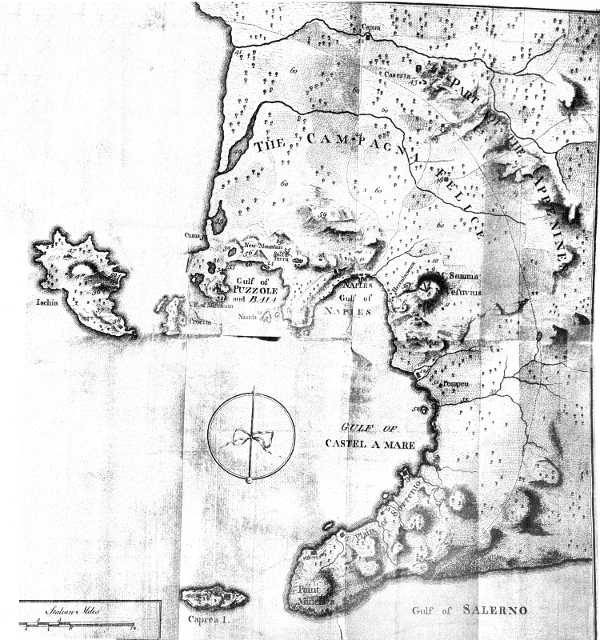
References to the Map,
[Plate VI.]
- 1. Naples.
- 2. Portici.
- 3. Resina, under which Herculaneum is buried.
- 4. Torre del Greco.
- 5. Hermitage, at which travellers usually rest, in their way up
Mount Vesuvius.
- 6. St. Angelo, a convent of Calmaldolese, situated upon a cone of a
mountain formed by an ancient explosion.
- 7. Cones formed by the eruption of 1760, and lava that ran from them
almost into the sea.
- 8. Mount Vesuvius and Somma.
- 9. Village of Somma.
- 10. The convent of the Madona del Arco, under which lavas have been
found at 300 feet depth, and which must have proceeded from
the mountain of Somma, when an active Volcano.
- 11. Ottaiano.
- 12. Torre del Annunziata.
- 13. Castel a Mare, near which the ancient town of Stabia is buried,
and where Pliny the elder lost his life.
- 14. Vico.
- 15. Sorrento, and the plain formed evidently by subterraneous fire.
- 16. Massa.
- 17. Island of Caprea.
- 18. The Grotto of Pausilipo, cut through the mountain anciently, to
make a road from Naples to Puzzole.
- 19. Point of Pausilipo.
- 20. The Gaiola, where there are ruins of ancient buildings, supposed
to have belonged to Lucullus.
- 21. The island of Nisida, evidently formed by explosion.
- 22. The Lazaret.
- 23. The Bagnoli.
- 24. Puzzole, or Pozzuolo.
- 25. The Solfaterra, anciently called Forum Vulcani: between the
Solfaterra and the lake of Agnano, are the boiling waters of the
Pisciarelli.
- 26. The New Mountain, formed by explosion in the year 1538; the sand
of the sea shore at its basis burning hot.
- 27. The lake of Agnano, supposed the crater of an ancient Volcano:
here are the baths called St. Germano, and the famous Grotto del
Cane.
- 28. Astruni, which has been evidently a Volcano, and is now a Royal
Chace, the crater being surrounded with a wall.
- 29. The Monte Gauro or Barbaro, anciently a Volcano.
- 30. The lake of Avernus, evidently the crater of an ancient Volcano.
- 31. Lake of Fusaro.
- 32. Point of Misenum, from whence Pliny the elder discovered the
eruption of Vesuvius that proved fatal to him; near this place,
in a vault of an ancient building, is a constant vapour, or
mofete, of the same quality with that of the Grotto del Cane.
- 33. The Mare Morto, the ancient Roman Harbour.
- 34. Baïa; behind the castle are two evident craters of ancient
Volcanos.
- 35. Island of Procita.
- 36. A perfect cone and crater of a Volcano near Castiglione in the
island of Ischia.
- 37. Lava that ran into the sea in the last eruption on this island,
in the year 1301, or 1302: the place now called Le Cremate.
- 38. Town of Ischia and castle.
- 39. Lake of Licola.
- 40. Lake of Patria.
- 41. The river Volturnus.
- 42. Capua.
- 43. Caserta.
- 44. Aversa.
- 45. Mataloni.
- 46. Acerra.
- 47. Island of Ischia, anciently called Ænaria, Inarime, and
Pithecusa.
- 48. The mountain of St. Nicola, anciently called Mons Epomeus,
supposed the remains of the principal Volcano of the island.
- 49. Castiglione, near which are the baths of Gurgitelli.
- 50. Lacco, near which is that very cold vapour called by the natives
ventarole.
- 51. Ancient city of Pompeii, where his Sicilian Majesty's
excavations are carrying on at present.
- 52. Rovigliano.
- 53. River of Sarno.
- 54. Cuma.
- 55. Hot sands and sudatory, called Nero's baths.
- 56. The Lucrine lake, supposed to have been here, and of which there
is still some little remain.
- 57. Villa Angelica, Sir William Hamilton's villa, from whence he has
made many of his observations upon Mount Vesuvius.
- 58. Cones formed by an ancient eruption called viuli; here are
likewise cold vapours called ventaroli.
- 59. High grounds, probably sections of cones of ancient Volcanos,
being all composed of tufa and strata of loose pumice and
burnt matter.
- 60. Plain of the Campagna Felice, four or five feet of excellent
soil, under which are strata of burnt and erupted matter.
- ...... Marks the boundary of Sir William Hamilton's observations.


