When on the 4th of March 1628/9, Charles, “by the
grace of God, Kinge of England, Scotland, Fraunce,
and Ireland, Defender of the Fayth, &c. in the fourth
yeare of our raigne” did by letters patent grant unto
Sir Henry Rosewell and his twenty-five associates,
their heirs and assigns forever, all that certain part of
the grant of New England which his “deare and royall
father, Kinge James of blessed memory ... hath
given and graunted vnto the Counsell established at
Plymouth in the County of Devon” and which the
said Council by deed dated the 19th of March, 1627/8,
had “given, graunted, bargained, soulde, enfeoffed,
aliened and confirmed” to Sir Henry Rosewell, Sir
John Young, Knightes, Thomas Southcott, John
Humphrey, John Endecott and Symon Whetcombe,
their heirs and associates forever, “To be houlden of vs
our heires and successors, as of our manor of Eastgreenewich,
in the County of Kent, within our realme
of England,” under the name of the “Governor and
Company of the Mattachusetts Bay in Newe England,
13one bodie politique and corporate in deede, fact, and
name, ... and that by that name they shall have
perpetuall succession,”—may acquire lands, &c. have
a common seal; and that there shall be one Governor,
one Deputy Governor, and eighteen assistants to be
chosen out of the freemen. He went farther, and
constituted “our welbeloved Mathewe Cradocke to be
the first and present Governor; Thomas Goffe to be
Deputy Governor, and eighteen of the other associates
to be Assistants, who before they undertake the
execution of their offices and places shall respectively
take their corporal oaths for the faithful performance
of their duties.” The Oath for Matthew Craddock, as
Governor, to be administered by a Master of the
Chancery, the Governor was then empowered to
administer the oaths to the Deputy Governor and
Assistants nominated in the Charter. Oaths to subsequent
officers being arranged: the new Governor to
take the Oath before the old Deputy Governor, or
two Assistants; and the new Deputy Governor,
Assistants and all other officers hereafter chosen to
take the oath before the Governor for the time being.
They were empowered to transport any of our loving
subjects, or any strangers willing to become our loving
subjects, and any seven at least of their number had
“full power and authoritie to choose, nominate, and
appointe such and soe many others as they shall thinke
fitt, and that shall be willing to accept the same, to be
free of the said Company and Body, and Them into
the same to admitt.” All subjects inhabiting the
lands granted, and their children “which shall happen
to be borne there, or on the seas in goeing thither, or
retorning from thence shall have and enjoy all liberties
and immunities of free and natural subjects, ... as
yf they and everie of them were borne within the realme
of England.” And the Governor and Deputy Governor,
and any two or more of the Assistants, at any of
their Courts or Assemblys shall and may at all times
have full power to give the Oath of Office and Oaths of
14Supremacy and Allegiance, or either of them, to every
person who may go to New England to inhabit in the
same. They were also authorized to make “the
formes of such Oathes warrantable by the lawes and
statutes of this our realme of England as shalbe respectivelie
ministered vnto them, for the execuc̄on of
the said severall offices and places ... and ministring
the said oathes to the newe elected officers.”
At the end of the Charter appeared the Oath of
Governor:
PRÆDICT, Matthaeus Cradocke Juratus est de Fide et
Obedientiâ Regi et Successoribus suis, et de Debitâ Exequutione
Officij Gubernatoris iuxta Tenorem Pr sentium, 18o Martij,
1628. Coram me, Carola Cæsare, Milite, in Cancellariâ Mr̃o.
By this Charter, under the privy seal of Cardinal
Wolseley, was, unwittingly, planted the seed of the
fairest flower that ever bloomed in the garden of
colonization since Eden.
Up to August, 1630, the business of the Massachusetts-Bay
Company was transacted in London.
But the business of the Massachusetts-Bay Colony
may be said to have really begun in May, 1631.
At “A Genrall Court holden att Boston, the 18th
day of May, 1631. John Winthrop, Esq̃ was chosen
Gounr for a whole yeare nexte ensueinge by the
genrall consent of the Court, according to the meaneing
of the pattent, and did accordingly take an oathe to
the place of Goun̄r belonginge.”
“Tho: Dudley, Esq̃, is also chosen Deputy
Gouñr for this yeare nexte ensuing, & did in prsence of
the Court take an oath to his place belonginge.”
And “to the end the body of the com̄ons may be
prserued of honest & good men, it was likewise ordered
and agreed that for time to come noe man shalbe
admitted to the freedome of this body polliticke, but
such as are members of some of the churches within
the lymitts of the same.”
15The Law that all freemen must be church members,
while assented to in Salem in 1631, was modified in
1632, probably for local reasons, that no civil magistrate
could be an elder in the church.
To give force to this law an Oath of Freemen was
required, and this service the newly appointed
Governor and the Deputy Governor elected to perform.
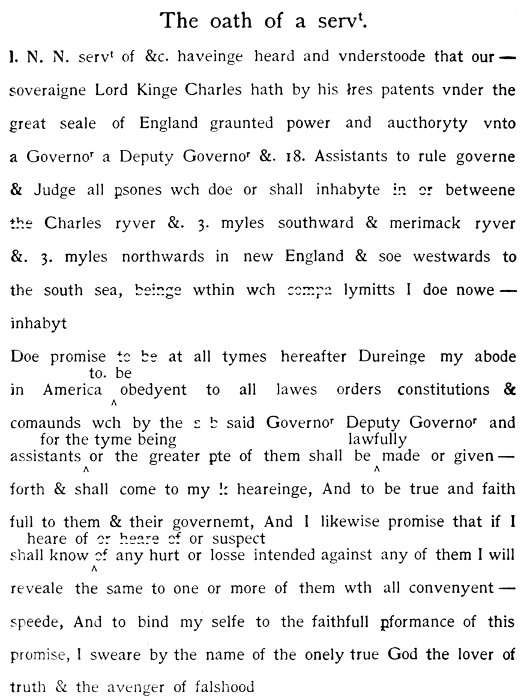
The result of their labors, the original draft
of the Oath of a Freeman, in the handwriting of the
first and greatest of the Governors of the Commonwealth
of Massachusetts, and the Oath of a Servant,
in the handwriting of the second Governor—a document
perhaps only surpassed in historical interest and
importance by, and worthy to rank with, the Declaration
of Independence—is now, appropriately, in the
possession of the Public Library of the City of Boston,
and its preservation assured.
Through the courtesy of the Trustees, this Society is
permitted again to give publicity to the excellent facsimiles
of these interesting documents, together with
transcriptions of the somewhat obscure handwriting,
with interlineations and cancelled words showing, line
for line, the changes made by the authors, which first
appeared in the Bulletin of the Library for July, 1894.
I, A. B. &c. being, by the Almighties most wise disposic̄on, become
a membr of this body, consisting of the Goūnr, Deputy
Goūnr, Assistants, & a comnlty of the Mattachusets in Newe
England, doe, freely & sincerely acknowledge that I am iustly &
lawfully subject to the goūmt of the same, & doe accordingly submitt
my pson & estate to be ptected, ordered, & goūned by the
lawes & constituc̄ons thereof, & doe faithfully pmise to be from
time to time obedient & conformeable therevnto, & to the
authie of the said Goūnr & Assistants & their successrs, & to all
such lawes, orders, sentences, & decrees as shalbe lawfully made
& published by them or their successors; and I will alwaies indeavr
(as in dutie I am bound) to advance the peace & wellfaire
of this bodie or com̄onwealth to my vtmost skill & abilitie;
& I will, to my best power & meanes, seeke to devert & prevent
whatsoeuer may tend to the ruyne or damage thereof, or of any
the said Goūnr, Deputy Goūnr, or Assistants, or any of them, or
their successrs, and will giue speedy notice to them, or some of
them, of any sedic̄on, violence, treachery, or other hurt or euill
which I shall knowe, heare, or vehemtly suspecte to be plotted
or intended against the said com̄onwealth, or the said goumt
established; and I will not att any time suffer or giue consent to
any counsell or attempt that shalbe offered giuen, or attempted
for the impeachmt of the said goūmt, or makeing any change or
alterac̄on of the same, contrary to the lawes & ordinances thereof,
but shall doe my vtmost endeavr to discover, oppose, &
hinder, all & eūy such counsell & attempts. Soe helpe me
God. [1631.]
16
Fac-simile of the Freemen’s Oath
The oath of a servt.
I. N. N. servt of &c. haveinge heard and vnderstoode that our—soveraigne Lord Kinge Charles hath by his łres patents vnder the great seale of England graunted power and aucthoryty vnto a Governor a Deputy Governor &. 18. Assistants to rule governe & Judge all ꝑsones wch doe or shall inhabyte in or betweene the Charles ryver &. 3. myles southward & merimack ryver &. 3. myles northwards in new England & soe westwards to the south sea, beinge wthin wch compa lymitts I doe nowe—inhabyt
Doe promise to be at all tymes hereafter Dureinge my abode in America to be obedyent to all lawes orders constitutions & comaunds wch by the s b said Governor Deputy Governor and assistants for the tyme being or the greater ꝑte of them shall be lawfully made or given—forth & shall come to my k heareinge, And to be true and faith full to them & their governemt, And I likewise promise that if I shall know heare of or heare of or suspect of any hurt or losse intended against any of them I will reveale the same to one or more of them wth all convenyent—speede, And to bind my selfe to the faithfull ꝑformance of this promise, I sweare by the name of the onely true God the lover of truth & the avenger of falshood
17
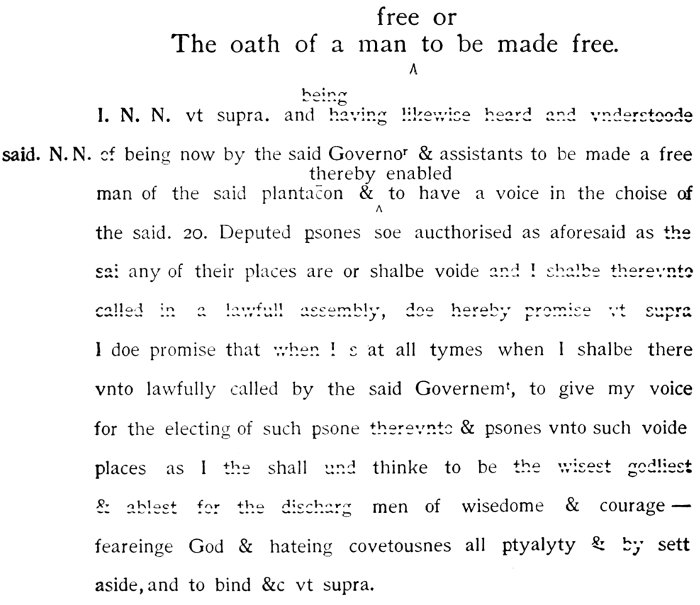
The oath of a man free or to be made free.
I. N. N. vt supra. and being having likewise heard and vnderstoode said. N.N. of being now by the said Governor & assistants to be made a free man of the said plantac̄on & thereby enabled to have a voice in the choise of the said. 20. Deputed ꝑsones soe aucthorised as aforesaid as the sai any of their places are or shalbe voide and I shalbe therevnto called in a lawfull assembly, doe hereby promise vt supra I doe promise that when I s at all tymes when I shalbe there vnto lawfully called by the said Governemt, to give my voice for the electing of such ꝑsone therevnto & ꝑsones vnto such voide places as I the shall und thinke to be the wisest godliest & ablest for the discharg men of wisedome & courage—feareinge God & hateing covetousnes all ꝑtyalyty & by sett aside, and to bind &c vt supra.
18
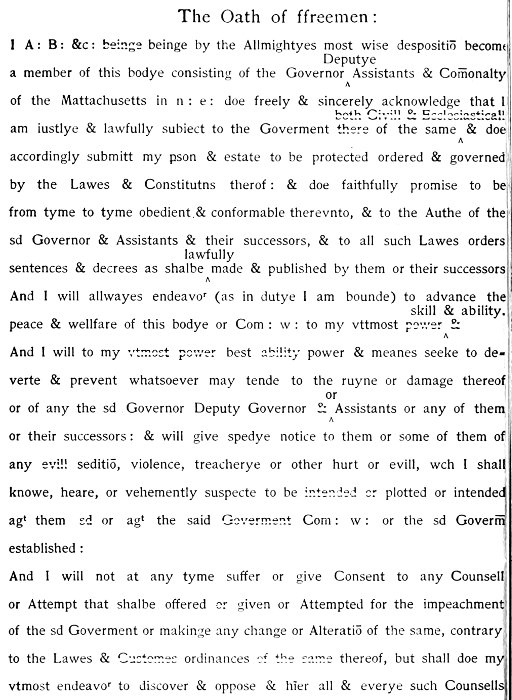
The Oath of ffreemen:
I A: B: &c: beinge beinge by the Allmightyes most wise despositiō become a member of this bodye consisting of the Governor Deputye Assistants & Com̄onalty of the Mattachusetts in n: e: doe freely & sincerely acknowledge that I am iustlye & lawfully subiect to the Goverment there of the same both Civill & Ecclesiasticall & doe accordingly submitt my ꝑson & estate to be protected ordered & governed by the Lawes & Constitutns therof: & doe faithfully promise to be from tyme to tyme obedient & conformable therevnto, & to the Authe of the sd Governor & Assistants & their successors, & to all such Lawes orders sentences & decrees as shalbe lawfully made & published by them or their successors. And I will allwayes endeavor (as in dutye I am bounde) to advance the peace & wellfare of this bodye or Com: w: to my vttmost power skill & ability. & And I will to my vtmost power best ability power & meanes seeke to deverte & prevent whatsoever may tende to the ruyne or damage thereof or of any the sd Governor Deputy Governor & or Assistants or any of them or their successors: & will give spedye notice to them or some of them of any evill seditiō, violence, treacherye or other hurt or evill, wch I shall knowe, heare, or vehemently suspecte to be intended or plotted or intended agt them sd or agt the said Goverment Com: w: or the sd Goverm̄ established:
And I will not at any tyme suffer or give Consent to any Counsell or Attempt that shalbe offered or given or Attempted for the impeachment of the sd Goverment or makinge any change or Alteratiō of the same, contrary to the Lawes & Customes ordinances of the same thereof, but shall doe my vtmost endeavor to discover & oppose & hīer all & everye such Counsells
19Att a Genrall Court, holden att Newe Towne [Cambridge].
March 4th, 1634.
It is further ordered that eūy man of or above the age of sixteene
yeares, whoe hath bene, or shall hereafter be, resident
within this iurisdicc̄on by the space of sixe monethes, (as well
servants as others,) & not infranchized, shall take the oath of
residents before the Goūnr, Deputy Goūnr, or two of the nexte
Assistants, whoe shall haue power to convent him for that purpose,
& vpon his refuseall, to binde him ouer to the nexte
Court of Assistants, & vpon his refuseall the second tyme, to
be punished att the discrec̄on of the Court.
It is ordered that the ffreemens oath shalbe gyven to eūy man
of or above the age of 16 yeares, the clause for the elecc̄on of
magistrates onely excepted.
At A Court holden att Boston, Aprill 1th, 1634.
It was further ordered, that eūy man of or above the age
of twenty yeares, whoe hath bene or shall hereafter be resident
within this jurisdicc̄on by the space of sixe monethes, as an
householder or soiorner, and not infranchised, shall take the
oath herevnder written, before the Goūnr, or Deputy Goūnr, or
some two of the nexte Assistants, whoe shall haue power to
convent him for that purpose, and vpon his refuseall, to binde
him ouer to the nexte Court of Assistants; and vpon his refuseall
the second tyme, hee shalbe banished, except the Court shall see
cause to giue him further respite.
I doe heare sweare, and call God to witnes, that, being nowe
an inhabitant within the lymitts of this juridicc̄on of the Massachusetts,
I doe acknowledge myselfe lawfully subject to the aucthoritie
and gouermt there established, and doe accordingly
submitt my pson, family, and estate, to be ptected, ordered, &
gouerned by the lawes & constituc̄ons thereof, and doe faithfully
pmise to be from time to time obedient and conformeable
20therevnto, and to the aucthoritie of the Goūnr, and all other the
Magistrates there, and their successrs, and to all such lawes,
orders, sentences, & decrees, as nowe are or hereafter shalbe lawfully
made, decreed, & published by them or their successrs.
And I will alwayes indeavr (as in duty I am bound) to advance
the peace & wellfaire of this body pollitique, and I will (to my
best power & meanes) seeke to devert & prevent whatsoeuer may
tende to the ruine or damage thereof, or of ye Goūnr, Deputy
Goūnr, or Assistants, or any of them or their successrs, and will
giue speedy notice to them, or some of them, of any sedic̄on,
violence, treacherie, or othr hurte or euill wch I shall knowe,
heare, or vehemently suspect to be plotted or intended against
them or any of them, or against the said Com̄on-wealth or
goumt established. Soe helpe mee God. [1634.]
Att a Genrall Courte, holden att Boston, May 14th, 1634.
It was agreed & ordered, that the former oath of ffreemen
shalbe revoked, soe farr as it is dissonant from the oath of ffreemen
herevnder written, & that those that receaved the former
oath shall stand bound noe further thereby, to any intent or purpose,
then this newe oath tyes those that nowe takes ye same.
I, A. B., being, by Gods providence, an inhabitant & ffreeman
within the jurisdicc̄on of this com̄onweale, doe freely acknowledge
my selfe to be subiect to the govermt thereof, & therefore
doe heere sweare, by the greate & dreadfull name of the euerlyveing
God, that I wilbe true & faithfull to the same, & will
accordingly yeilde assistance & support therevnto, with my
pson & estate, as in equity I am bound, & will also truely
indeavr to mainetaine & preserue all the libertyes & previlidges
thereof, submitting my selfe to the wholesome lawes & orders
made & established by the same; and furthr, that I will not
plott nor practise any evill against it, nor consent to any that
shall soe doe, but will timely discover & reveale the same to
lawfull aucthority nowe here established, for the speedy preventing
thereof. Moreouer, I doe solemnely binde myselfe,
in the sight of God, that when I shalbe called to giue my voice
touching any such matter of this state, wherein ffreemen are
to deale I will giue my vote & suffrage, as I shall iudge in myne
owne conscience may best conduce & tend to the publique
weale of the body, without respect of psons, or favr of any man.
Soe helpe mee God in the Lord Jesus Christ. [1634.]
Further, it is agreed that none but the Gen̄ all Court hath
power to chuse and admitt freemen.
21
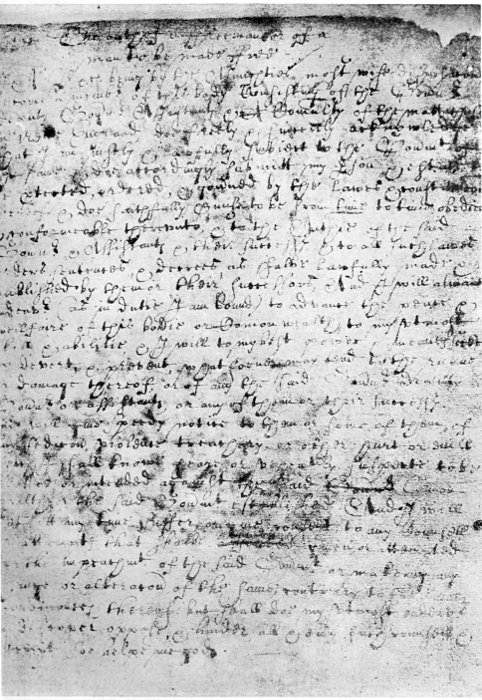
Fac-simile of Original Manuscript Record
In the Handwriting of Secretary Simon Bradstreet
last Colonial Governor of Massachusetts Bay
22The text of the Oath given above is that given in the
body of the Colony Records, in the handwriting of
Simon Bradstreet, the Secretary, and differs only in
the spelling of words from that of the transcriber (who
may have been Secretary Bradstreet himself) of the
copy in the Miscellaneous Records, which were transferred
by the Compiler from their regular order to the
end of the first volume of the Records at page 354.
I (A. B.) being by Gods providence an Inhabitant, and
Freeman, within the Jurisdiction of this Commonwealth; do
freely acknowledge my self to be subject to the Government
thereof: And therefore do here swear by the great and dreadful
Name of the Ever-living God, that I will be true and faithfull
to the same, and will accordingly yield assistance & support
thereunto, with my person and estate, as in equity I am bound;
and will also truly endeavour to maintain and preserve all the
liberties and priviledges thereof, submitting my self to the
wholesome Lawes & Orders made and established by the same.
And further that I will not plot or practice any evill against
it, or consent to any that shall so do; but will timely discover
and reveal the same to lawfull Authority now here established,
for the speedy preventing thereof. Moreover, I doe solemnly
bind my self in the sight of God, that when I shal be called to
give my voyce touching any such matter of this State, in which
Freemen are to deal, I will give my vote and suffrage as I shall
judge in mine own conscience may best conduce and tend to the
publike weal of the body, without respect of persons, or
favour of any man. So help me God in the Lord Jesus Christ.
[1634.] From the copy given in John Childe’s “New-Englands
Jonas cast up at London.” (London, 1647), which the preface
states was printed in Massachusetts-Bay, by itself.
To this form of The Oath of a Free man attaches the
great additional interest of being the first work printed
in the United States of America.
Under date of Mo. 1. (March, 1638/9) John Winthrop’s
Journal states: “A printing house was begun
at Cambridge by one Daye, at the charge of Mr.
Glover, who died on sea hitherward. The first thing
which was printed was the freemen’s oath; the next
was an almanac made for New England by Mr.
23William Peirce, mariner; the next was the Psalms
newly turned into metre.”
For nearly three hundred years no copy of this
printed paper has been known to be extant. The
ceaseless search for a copy in this country by antiquarians,
bibliographers and historians would long ago
have been successful, if even a single copy had been
preserved in either the institutions of the State, or
Nation, or in individual or family possession.
It would be difficult to exaggerate the patriotic
feeling of our people, if it were known that a copy of
this interesting and valuable state paper, the first fruit
of the printing-press in this country, whose ringing
sentences of freedom preceded by nearly a century
and a half the Declaration of Independence, had been
discovered at this late day.
Fully a quarter of a century ago, while engaged in
making a search for early printed American publications
in the Catalogue of printed books in the British
Museum—a great and monumental work, worthy in
its scholarly completeness of the Government which
fostered its publication, and of inestimable importance
and benefit to scholars in every land—the following
entry under the heading “Freeman” seemed to me to
warrant more than passing observation and curiosity
which the intervening years have failed to satisfy:
—The Oath of a Freeman. B. L.
[London, 1645?] s. sh. 12º. 11,626. aa. (1, 2.)
An analysis of this entry seems to show points of
resemblance following closely the known facts regarding
the first work printed in this country.
The title is the one given by John Childe presumably
from the earliest printed copy in his possession. The
abbreviated title, freemen’s oath, as given by John
Winthrop, first appearing in the Code of 1648, which
seems to justify the belief that Winthrop wrote his
Journal some years after the press was established.
24The letters B. L. indicate that the printed text is in
black-letter. While there is no evidence of the number
and kinds of fonts of type purchased for the first
press by Joseph Glover, there is an itemized statement
of the number and names of the fonts of type for the
second press sent over later by the Society for Propagating
the Gospel among the Indians in New England,
for printing the Bible in the Indian language, and
among them is a small font of “blacks,” i.e. black-letter,
which would indicate that a small font of that
letter was generally considered a part of the equipment
of a printing-office of the period. Even if this was not
so, on the good authority of Isaiah Thomas, the type
used in printing the Bay Psalm Book, of 1640, was
“small bodied English,” a type commonly used for
works in quarto and folio, which approximates in size
to black-letter, but without the ceriphs, or fine projecting
points of that letter. It is not unreasonable to
suppose that a cataloguer might, hastily, consider the
thickly inked, heavy press-work we find in the Bay
Psalm Book, under the same conditions in a somewhat
crudely printed sheet, to be black-letter printing.
The brackets enclosing the imprint indicate that the
place and date given do not appear on the printed
sheet, but are the personal judgment of the cataloguer
regarding them. Having already determined the
printing to be in black-letter English, it naturally
follows in his judgment that the place of printing is
London. His guess of the year, 1645, which he
queries, is a close one; but is open to the criticism that
an Oath of a Freeman could never have been printed
or exacted in England during the reign of Charles the
First. Ten years later, under Cromwellian rule, it
might have been done. But the only place on earth
it could have been printed and exacted without
imprisonment, in 1645, was in the freemen’s Colony of
Massachusetts-Bay.
In this connection it may be well to observe, as a
further illustration that Governor Winthrop wrote his
25Journal years later than the events he records, that
his date of 1638/9, should be one year later, for the date
of the half-sheet almanac by William Peirce, mariner.
Following Winthrop, if the almanac was calculated for
the year beginning in March, 1639, it would suppose
its printing sometime before the 25th of March, or in
the Julian year 1638. This would leave nearly a
whole year during which no other printing was done.
If the almanac was calculated for the year beginning in
March, 1640—the year the Bay Psalm Book is
dated—then it would suppose the Oath, and the
Almanac, printed in the eleventh or twelfth months of
the Julian year 1639, which is more probable. Isaiah
Thomas, writing in 1810, leaves this question in doubt
by not stating whether his January, 1639, refers to the
Julian, or the Gregorian Calendar.
To continue our analysis: The format, and size,
agrees with the known facts that the Oath was printed
“on the face of a half sheet of small paper.” The
shelf-mark indicates the permanent place on the
shelves of the Library.
The singular appearance of the only known copy of
this important and interesting document in the Colonial
history of New England, nearly three hundred
years after its printing, so far from its place of publication,
calls for explanation, which is apparently furnished
in a work published in London, in April, 1647,
entitled: “New-Englands Jonas cast up at London.”
On the title-page it purports to be written by Major
John Childe, a brother of Doctor Robert Childe, of
Hingham, who was detained by order of the General
Court of Massachusetts-Bay; but according to William
Hubbard, in his History, and affirmed by John Winthrop,
in his Journal, the real author of everything,
except the Preface, was William Vassall.
26
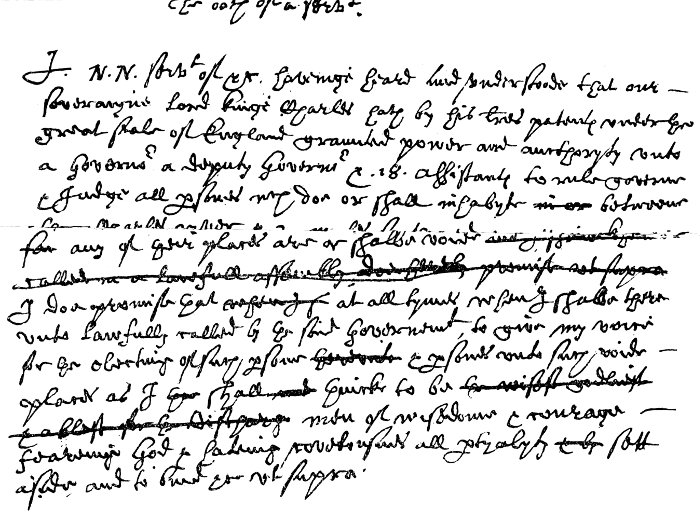
Fac-Simile of Original Manuscript
in the Handwriting of Thomas Dudley,
in the Public Library of the City of Boston
Issued with Bulletin, July, 1894
27
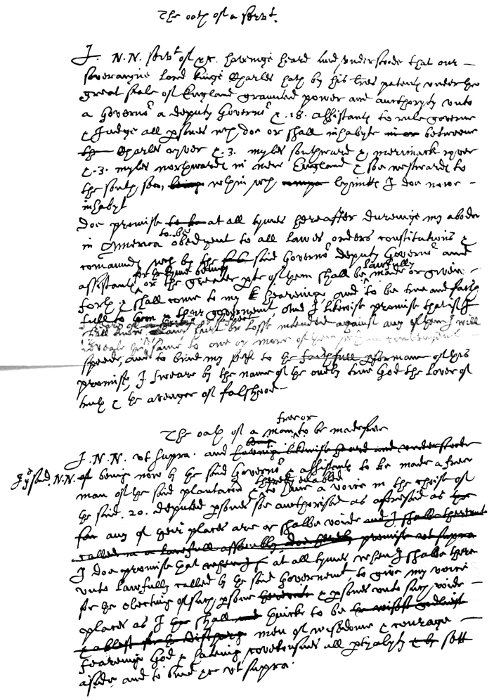
Fac-Simile of Original Manuscript
in the Handwriting of Thomas Dudley,
in the Public Library of the City of Boston
Issued with Bulletin, July, 1894
28
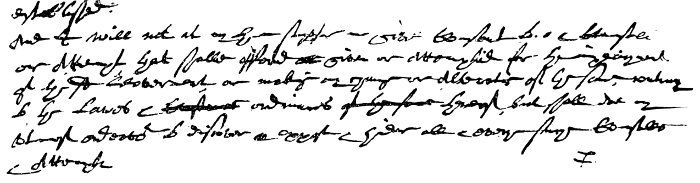
Fac-Simile of Original Manuscript
in the Handwriting of John Winthrop,
in the Public Library of the City of Boston
Issued with Bulletin, July, 1894
29Its odd title was suggested by a remark made by
the Reverend John Cotton, in a Thursday-Lecture,
preached November 5, 1646, just previous to the
departure of the vessel which was carrying back to
England some of the dissatisfied signers of a Petition
to the General Court, who rumor gave were taking
with them this and other incriminating documents
against the Government of the Colony. The learned
preacher took for his text, Canticles, II: 15. “Take
us the foxes, the little foxes, which destroy the vines,”
and made pointed allusions to the current rumors, and
the punishment which their acts would receive in a
stormy voyage, and how it could be averted. But
later we shall let Vassall tell the story in his own
words. The effect upon his hearers was so great that
some who had engaged passage withdrew rather than
risk the dangers of a stormy voyage in the winter
season.
After a brief summary of the reasons for publication
the Preface states that the Relation is made up of the
following particulars:
First, the Petition of the greater part of the Inhabitants of
Hingham, and the proceedings therein.
Secondly, a Petition of Doctor Child and others delivered
to the General Court at Boston with some passages thereon.
Thirdly, the Capital Laws of the Massachusetts Bay, with
the Freemans Oath, as they are printed there by themselves.
The italics are mine. Here, then, we have direct
proof confirming the statement of John Winthrop that
the Freeman’s Oath was printed at Cambridge in 1639,
and, in the body of the work, is given the full text of
The Oath of a Free man as printed. It is probable
that only the number of copies necessary for officials
authorized to administer the Oath were printed, and
the copy taken to England was surreptitiously obtained
from some member of the Government. Its
importance lay in the fact that it afforded printed
evidence that nowhere in it is any reference made to
the King’s Majesty, or of allegiance to any power on
earth save that of their own Government as constituted.
30
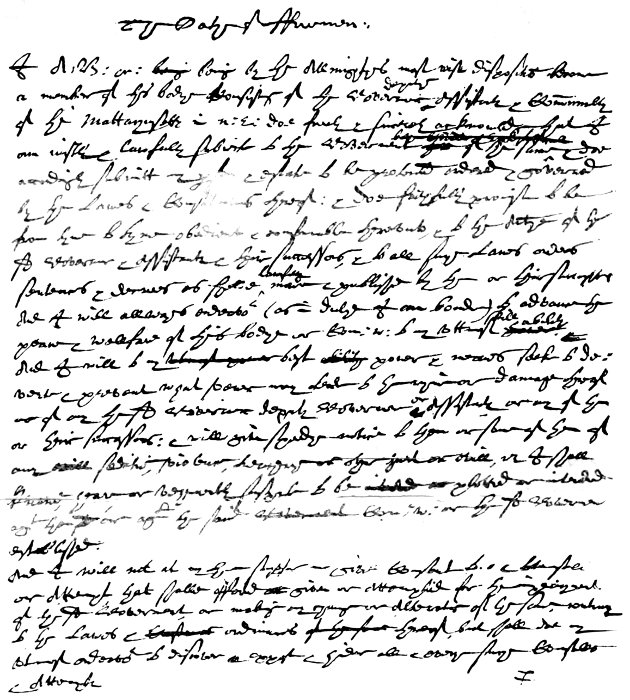
Fac-Simile of Original Manuscript
in the Handwriting of John Winthrop,
in the Public Library of the City of Boston
Issued with Bulletin, July, 1894
31The Capital Laws were printed at Cambridge in
1642, probably under the same restriction, as to number;
and, as printed evidence, open to the same
construction as the Oath. Whatever the purpose,
however, it had been forestalled some four years
earlier when the Capital Laws were re-printed in London
in a folio broadside. The copy in the British
Museum bears the Colophon: “Printed first in New-England,
and re-printed in London for Ben. Allen in
Popes-Head Allen [sic] 1643.”
Fourthly, a relation of that story of Jonas verbatim as it
was delivered to me in writing by a Gentleman that was then
a passenger in the ship.
“When the first ship that came this year 1646 from New-England,
was almost ready to come from thence; Mr.
Cotton in his Thursday-Lecture at Boston, preached out of
that Scripture, Cant. 2, 15. Take us the little Foxes, &c.
In his uses took occasion to say, That if any shall carry any
Writings, Complaints against the people of God in that
Country it would be a Jonas in the ship. * * He also
advised the Ship-Master, that if storms did arise, to search if
they had not in any Chest or Trunk any such Jonas aboard,
which if you find (said he) I do not advise you to throw the
persons over-board, but the Writings; or words to that effect.
Whereupon, having great storms (as could not be otherwise
expected) some of the Passengers remembering Mr. Cotton’s
Sermon, it seems were much affected with what he had said;
and a woman amongst them came up from between the decks
about Midnight, or after, in a distracted passionate manner to
Mr. William Vassall who lay in the great Cabin, but for the
present was in the Sterage-door-way looking abroad: she
earnestly desired him, if there were any Jonas in the ship, that
as Mr. Cotton had directed it might be thrown over-board,
with many broken expressions to that purpose. He asked
her why she came to him? and she said because it was thought
that he had some Writings against the people of God: but
he answered her, He had nothing but a Petition to the
Parliament that they might enjoy the liberty of English subjects,
and that could be no Jonas; and that if the best of New-Englands
friends could shew him any evil in that, he would not
prefer it. After this she went into the great Cabin to Mr.
Tho. Fowle in like distracted manner; who told her he had
nothing but the Copy of Petition which himself and others had
presented to the Court at Boston; and showed, and read it to
her, and then told her, That if she and others thought that to
be the cause of the storm, she and they might do what they
32would with it; but he professed that he saw no evil in it, neither
was his Conscience troubled with it. So she took it and
carried it between Decks to them from whom she came, and
they agreed to throw it over-board and it was thrown over-board:
but the storm did not leave us upon the throwing of the
Paper over-board as it is reported; for they had many great
storms after that; much lesse was the great and wonderfull
deliverance which by Gods mercy he gave unto them from
shipwrack and drowning at the Isles of Silly, upon the throwing
of that Writing over-board; for that was thrown over long
before, at least 14 dayes. Also the error is the more in this,
That the report is that it was the petition to the Parliament
that was thrown over-board; and it was only a Copy of a
Petition to their own Court at Boston, and the Petition to
the Parliament was still in the ship, together with another
copy of that which was thrown over-board, and other writings
of that nature, some of which are printed in this book, and
were as well saved as their lives and other goods, and are here
in London to be seen and made use of in convenient time.”
It is true that at any time in the intervening years of
a quarter of a century I could have written to the
British Museum authorities and been sure of a
courteous reply; but the matter seemed too important
to be settled in so prosaic a way. This, and the hope
that sometime I might be able to determine the matter
personally, and achieve the honor that would attach
to its discovery, deterred me.
I suppose that men of all professions, in their callings,
feel an unwonted glow in the achievement of
some object; but I know of no greater joy than that
which fills the lover of books when his long search for a
rare book is rewarded. Then it is that you seem to
enter into the holy of holies of delight, when the whole
body thrills with suppressed emotions, the eyes
moisten, and the trembling hand stretched out to take
the volume does so with a touch which is almost a
caress. The feeling, I think, must be somewhat akin
to the “buck fever” of the deer hunter, whose mind
and shaking limbs refuse to function, as he looks into
the luminous eyes, and notes the startled look, and
graceful beauty of his prey, until it has bounded into
safety in the forest. Why, I reasoned with myself,
33should I give to another the pleasure of these emotions
which were mine by right of discovery.
The opportunity of voyaging to England, which I
had so long looked forward to, did not come to me
until the Spring of the present year, and the pleasant
anticipations with which I set out were comparable
in my own mind with those which must have animated
the Knights of Arthur’s Round Table in their quest
for the holy grail. The morning after my arrival in
London found me an early visitor at the British
Museum. The preliminaries of admittance to the
Reading-Room are not difficult, and are soon over with,
and I found myself within the great rotunda, its walls
lined in tiers with what is best in the literatures of the
world, and from which has gone out so much that is
worth while in English literature. From the Catalogue
I filled out slips for some half dozen works,
artfully to conceal the one uppermost in my mind,
handed them in at the desk, and returned to my
chosen seat to await with such calmness as I could
command the culmination of years of desire. Heeding
the legend that when the grail was approached by any
one not perfectly pure it vanished from sight; and that
to be qualified to discover it one must be perfectly
chaste in thought and act, I endeavored to prepare
myself for its appearance. Somewhere I have read of
an Oriental visionary who attained a high degree of
saintly perfection by fixing his gaze steadfastly for
hours upon his navel, which a growing embonpoint
made an easy thing to do, and I sought for holiness in
the same way.
In time the white slips of my wants came fluttering
back to me by messengers, all marked, very properly
for security on account of rarity, that they
could only be consulted in the North Library,
until all were in but the one most desired. Then
followed a much longer wait and then—the slip was
handed back to me with a notation that I had given a
wrong shelf-mark! Gone in an instant were all the
34perfectly pure and chaste thoughts with which I had
been regaling myself while I was apparently looking
at the wrong button on my vest. I think I could have
stood the blow better if it had been that hoary old
fiction of careless assistants that it was “out”, but this
is a boon denied to any assistant in the British
Museum, where nothing is allowed to go out. A comparison
with the printed Catalogue showed an exact
correspondence, and I sought the Superintendent of
the Reading-Room, who assured me that the matter
would have his personal attention; and for the rest of
the day I busied myself with my other wants in the
North Library without any word of the missing
broadside reaching me. That evening, in communion
with myself, I determined to throw off the mask of
secrecy and frankly confide the importance of my
quest to the Keeper of the Printed Books—the somewhat
expressive and imposing title of the Librarian
of the British Museum.
Before calling upon him I sought as an introducer
Henry N. Stevens—the worthy son of an illustrious
father who follows closely in his footsteps as the
best authority on early printed American books in
Europe—at his shop across the street from the
imposing Museum building, and to him I told my
story. As I proceeded his interest grew, and before I
had finished he excitedly grasped my arm with one
hand and his hat with the other, exclaiming: “Come
with me. This is not a subject for underlings,” and
rushed me across the street without pause until we
were in the sanctum sanctorum of the learned and
accomplished Keeper, Alfred W. Pollard. And to
him I told my simple tale, and asked his assistance.
Mr. Pollard is himself a bibliographer of note in his
special field, and my story was not without interest to
him, but he refused to share my belief that the missing
broadside was what I supposed it to be, laying much
stress upon the black-letter feature as proof of its
English origin. The unsuccessful search for the
35missing broadside had evidently been called to his
notice, and the failure to produce anything in the
millions of books catalogued in that vast collection,
he considered a challenge to the efficiency of himself
and his staff of assistants. A few days later, he
acknowledged failure; but gave me the interesting
information that in tracing the broadside back to its
accession he had found that it was acquired by the
Museum in the year 1865, and formed part of a
bundle of miscellaneous matter, being considered of so
little importance as not even to have been mentioned
in the contents of the bundle. Printing of the letter F
of the Catalogue was completed in 1888, and since
that time an expansion of the classification of books
upon the shelves had been made, from which dated
its disappearance. He would not, however, discontinue
his efforts to find it. After apologizing for giving
him a “bad half-hour,” which only the importance of
the broadside excused, our second interview ended.
On my last day in London, I went again with Mr.
Stevens to call on Mr. Pollard about the matter,
and told him that I had made my arrangements
to fly from London to Paris on the morrow, and
asked him if these old eyes of mine were never to behold
the holy grail. “In black-letter?” he queried,
touching the weak spot in my armor. “In duodecimo!”
I countered, pointing to the rent in his own.
And the third interview ended with his assurance that
the search would go on until the missing broadside was
found.
And there the matter rests, very much in the condition
of the story of the cook who asked the skipper:
“Is any thing lost when you know where it is?”
And to the skipper’s gruff response, “Of course not,”
he pleasantly replied: “I am glad to know that our
only iron soup kettle wasn’t lost when it fell over-board
into the Bay.”
Through the courtesy of our fellow-members, Henry
Edwards Huntington, Esquire, and the accomplished
36bibliographer and librarian of his unrivaled collection
of books and art, George Watson Cole, the Society is
permitted to give a reproduction from the only known
copy of “The Book of General Lawes and Libertyes
concerning the Inhabitants of the Massachusetts”—the
long-lost Code of 1648. No copy or fragment of a
copy was known to be extant for over two hundred
and fifty years, when, in 1906, this copy was discovered
in a small private library in England, and was
sold to the late Edmund Dwight Church for the
highest price ever paid for an American printed book—a
record which is not likely to be surpassed. The
almost miraculous recovery of this volume, will, I
have given my reasons to hope, sometime have a
counterpart in the recovery of the only known copy of
the first work printed in the United States of
America—The Oath of a Free man. From the year
1641, this bore the abbreviated title of the
I (A. B.) being by Gods providence an Inhabitant within the
Jurisdiction of this Common-wealth, and now to be made free;
doe heer freely acknowledge my self to be subject to the
Government therof: and therfore do heer swear by the great
and dreadfull Name of the Ever-living God, that I will be true
and faithfull to the same, & will accordingly yeild assistance &
support therunto, with my person and estate, as in equitie I am
bound, and will also truly indeavour to maintein & preserve
all the Liberties and Priviledges therof, submitting my self
unto the wholsom Laws made and established by the same.
And farther, that I will not plot or practice any evil against
it, or consent to any that shall so doe; but will timely discover
& reveal the same to lawfull authoritie now heer established,
for the speedy prevention therof.
Moreover, I do solemnly binde my self in the sight of God,
that when I shall be called to give my voice touching any such
matter of this State, wherin Free-men are to deal; I will give
my vote and suffrage as I shall in mine own conscience judge
best to conduce and tend to the publick weal of the Body,
without respect of persons, or favour of any man. So help me
God in our Lord Jesus Christ. [1641.] From Code of 1648.
37
I [A. B.] being by Gods providence an inhabitant within the
Jurisdiction of this Common-wealth, and now to be made free;
doe here freely acknowledg my self to be subject to the Government
thereof: And therefore do here Swear by the great and
dreadfull Name of the Ever-living God, that I will be true and
faithfull to the same, and will accordingly yeild assistance and
support thereunto, with my person and estate, as in equity I
am bound, and will also truely indeavour to maintain and preserve
all the Liberties and Priviledges thereof, submitting
my self unto the wholsom Laws made and established by the
same. And farther, that I will not plot or practice an evill
against it, or consent to any that shall so doe; but will timely
discover and reveal the same to lawfull Authority now here
established, for the speedy prevention thereof.
Moreover, I do solemnly bind my self in the sight of God,
that when I shall be called to give my voice touching any such
matter of this State, wherein Free-men are to deal; I will give
my vote and suffrage as I shall in mine own conscience judg
best to conduce and tend to the publick weal of the Body,
without respect of persons, or favour of any man. So help
me God &c. [1641.] From Code of 1660.
It is Ordered and by this Court declared, that no man shall
be urged to take any Oath or subscribe to any Articles,
Covenants or Remonstrances, of publick and Civil nature, but
such as the Generall Court hath Considered, allowed and
required, and no Oath of any Magistrate or of any Officer, shall
bind him any further or longer, then he is Resident or Reputed
an Inhabitant of this Jurisdiction. [1641.]
Every Court in this Jurisdiction, where two Magistrates are
present, may admitt any church members that are fitt, to be
Freemen, giving them the Oath, and the Clerke of each Court,
shall certify their names to the Secretary at the next General
Court. [1641 [2]].
38
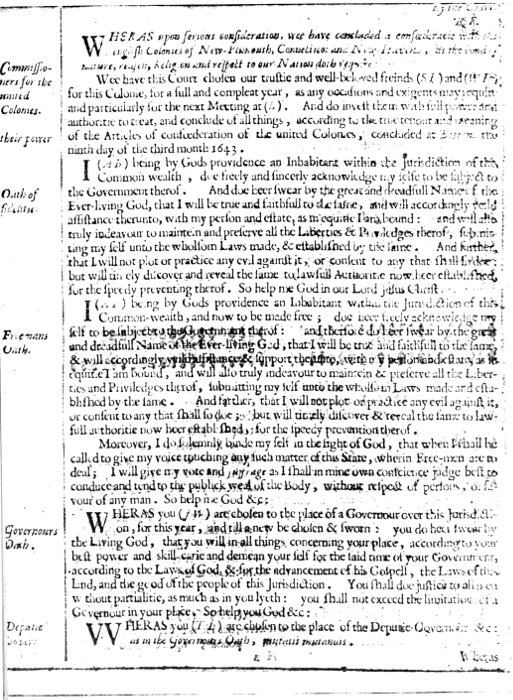
Freeman’s Oath
Reproduced from “The Book of General Lawes and Libertyes concerning the Inhabitants of the Massachusetts”-–1648
By the courtesy of Henry Edwards Huntington
39In 1643, the Colonies of Massachusetts-Bay, New
Plymouth, Connecticut, and New Haven, concluded a
Confederacy by which they entered into a solemn
compact to afford each other mutual advice and assistance
on all necessary occasions, whether offensive,
defensive, or prudential. Among the reasons assigned
for this Union were the dependent condition of the
colonists; the vicinity of the French and Dutch, who
were inclined to make encroachments; the warlike
attitude of the neighboring Indians; the commencement
of civil war in England, and impracticability of
aid from thence in any emergency; and the sacred ties
of religion which already bound them. The Province
of Maine was not included because it was subject to
rulers of Episcopal tenets, and was infrequently an
asylum for excommunicants. This Union lasted for
forty years without any general Oath of Allegiance
being required from the inhabitants of the several
Colonies.
I (A B) being by Gods providence an Inhabitant within the
Jurisdiction of this Common-wealth, doe freely and sincerely
acknowledge my selfe to be subject to the Government thereof.
And doe heer swear by the great and dreadful name of the Everliving
God, that I will be true and faithfull to the same, and will
accordingly yeild assistance therunto, with my person and
estate, as in equitie I am bound: and will also truly indeavour
to maintein and preseve all the Liberties & Priviledges thereof,
submitting my self unto the wholsom Laws made, & established
by the same. And farther, that I will not plot or practice any
evil against it, or consent to any that shall so doe: but will timely
discover and reveal the same to lawfull Authoritie now heer
established, for the speedy preventing thereof. So help me
God in our Lord Jesus Christ. [1646.] From Code of 1648.
I [A. B.] being by Gods providence an inhabitant within the
Jurisdiction of the Commonwealth, do freely and sincerely
acknowledge my selfe to be subject to the Government thereof.
And do here Swear by the great and dreadful name of the everliving
God, that I will be true & faithfull to the same, and will
accordingly yeild assistance thereunto, with my person and
estate, as in equity I am bound: And will also truely endeavour
to Maintain and preserve all the Liberties & Priviledges thereof
submitting my self unto the wholesom Laws made, and established
by the same.
And farther that I will not plot or practice any evill against
it, or consent to any that shall so do: but will timely discover
and reveal the same to lawfull Authority now here established,
for the speedy preventing thereof. So help me God in our Lord
Jesus Christ. [1646.] From Code of 1660.
40To the end the body of the freemen may be preserved of honest
and good men, It is Ordered, That henceforth no man shall be
admitted to the freedome of this Common-wealth, but such as
are members of some of the Churches, within the limits of this
Iurisdiction; And whereas many members of Churches to exempt
themselves from Publick Service, will not come in to be made freemen,
It is Ordered, That no members of Churches within this
Iurisidiction, shall be exempt from any publick service, they
shall be chosen to, by the Inhabitants of the severall Townes,
as Constables, Iurors, Select men, surveiors of the High-wayes.
And if any such person shall refuse to serve in, or to take upon
him any such Office, being legally chosen therunto, he shall
pay for every such refusall, such fine, as the Town shall impose
not exceeding Twenty shillings for one Offence. [1647.]
Any non freemen, who have taken or shall take the Oath of
fidelity to this government could be jury men and vote in certain
matters, after he had attained the age of 24 years. [1647.]
For as much as divers Inhabitants of this Jurisdiction who
have long continued amongst us, receiving Protection, from this
Government, have as we are informed uttered Offencive speeches,
whereby their fidelity to this Government may justly be suspected,
and also that divers strangers of forreign parts do repaire to us of
whose fidelity we have not that Assurance which is Commonly required
of all Governments.
It is therefore Ordered by this Court and the Authority
thereof. That the County Courts or any one Magistrate out
of Court, shall have power and is hereby Authorized to Require
the Oath of fidelity of all settled Inhabitants amongst us who
have not already taken the same, as also to Require the Oath
under written, of all strangers, who after two months have
their abode here; And if any Person shall refuse to take the
Respective Oath, he or they shall be bound over to the next
County Court or Court of Assistants, where if he shall refuse,
he shall forfeit five pound a week for every week he shall Continue
in this Jurisdiction after his sayd Refusall, unles he can
give sufficient security to the satisfaction of the Court or
Magistrate for his fidelity, during his or their residence
amongst us.
You A. B. Do acknowledge your self subject to the Lawes of
this Jurisdiction during your Residence under this Government,
and do here Swear, by the Great Name of the Everliving GOD,
and engage your self to be true and faithfull to the same, and not to
plot, contrive, or conceal any thing that is to the hurt or detriment
thereof. [1652.].
41This was, apparently, aimed at the Quakers, whose
offensive attitude towards the Government was made
the subject of further drastic laws and orders by the
General Court, in October, 1656, and May, 1658.
This Court having considered of the proposals presented to this
Court by several of the inhabitants of the County of Middlesex;
Do Declare and Order, That no man whosoever, shall be
admitted to the Freedome of this Body Politick, but such as
are members of some Church of Christ and in full Communion,
which they declare to be the true intent of the ancient Law,
page the eighth of the second Book, Anno. 1631. [1660.]
This was construed as being directed against the
members of the Church of England, and was largely
responsible for the strained relations with his Majesty’s
Commission in 1665. It was repealed before the 1672
Revision of the Laws.
For causes already mentioned the publication of the
first Code of Laws, in 1648, was unnoticed in England;
but it was very different with the publication of the
second Code, in 1660. When it appeared its provisions
were subjected to critical scrutiny by enemies of
the Puritan Commonwealth, and the worst possible
constructions placed upon them. In particular, the
loyalty of the framers, who took an Oath of Fidelity
to their Government, and none to the King, was
questioned; and the provisions for the admission of
freemen which, practically, prohibited members of the
Church of England. By letter, his Majesty ordered a
redress of these grievances, and appointed a Commission
who proceeded, in a partisan manner, to execute
their powers. In 1665, the Commissioners presented
to the General Court a list of twenty-six changes which
they desired to have made in the Code of 1660.
The principal ones were the substitution of an acknowledgment
of the royal authority for all expressions of
the supremacy of the Commonwealth; a recognition of
the Church of England; and a repeal of the long-standing
limitation of citizenship to church members. To
one or two of their points the General Court gave consent.
42A comparison with the Code of 1672, shows that
while the recognition of his majesty’s supremacy was
allowed, in a score of instances the powers of the government
under their Charter were asserted. The right
of strangers to become citizens was nominally conceded,
but on conditions which afforded only a minimum
of relief to members of the Church of England.
On the 3 August, 1664 it was Ordered by the General Court:
In Answer to that part of his Majestyes Letter, of June 28,
1662, concerning admission of freemen. This Court doth
Declare, That the Law prohibiting all persons, except Members
of Churches, and, that also for allowance of them in any
County Court, are hereby Repealed, And do hereby also Order
and Enact That, from henceforth all English men presenting a
Certificate under the hand of the Ministers, or Minister of the
Place where they dwell, that they are Orthodox in Religion,
and not vicious in their Lives, and also a certificate under the
hands of the Select men of the place, or of the major Part of
them, that they are Free-holders: and are for their own propper
Estate (without heads of Persons) Rateable to the Country in
a single Country Rate, after the usuall manner of valuation in
the place where they live, to the full vallue of Ten Shillings, or
that they are in full Communion with some Church amongst
us; It shall be in the Liberty of all and every such Person or
Persons, being twenty-four yeares of age, Householders and
settled Inhabitants in this Jurisdiction, from time to time to
themselves and their desires to this Court, for their addmittance
to the freedome of this commonwealth, and shall be
allowed the priviledge, to have such their desire Propounded
and put to Vote in the General Court, for acceptance to the
freedome of the body pollitick, by the sufferage of the major
parte according to the Rules of our Patent. [1664.].
It was also Ordered by the General Court on the 19 October,
1664.
Forasmuch as several Persons who from time to time are to be
made freemen, live remote and are not able without great trouble
and charge to appear before this Court to take their respective
Oaths: It is therefore Ordered, that henceforth it shall be in
the power of any County Court, to administer the Oath of
Freedome to any persons approved of by the General Court
who shall desire the same, any Law or Custome to the contrary
notwithstanding. [1664.]
And, at the May, 1665, session, to conform to the criticism
of his Majesty’s Commission concerning the Oath of Allegiance:
43It is ordered by this Court, & the authority thereof, that the
following oath be annexed vnto the oathes of euery freeman &
oath of fidellity, & to the Gouernor, Dept-Gouernor, &
Assistants, & to all other publicke officers, as followeth:—
The oath of a freeman & fidelity to runne thus:—
Whereas I [A. B.] am an inhabitant within this Jurisdiction,
Considering how I stand Obliged to the Kings Majesty, his
heires and Successors by our Charter and the Government
established thereby; Do Swear accordingly by the great and
dreadfull Name of the Ever-Living God, that I will bear Faith
and true Allegiance to our Soveraingn Lord the King, his
Heires and Successors; and that I will be True and Faithfull
to this Government, and accordingly yeild Assistance thereunto,
with my person and estate, as in equity I am bound;
And will also truely endeavour to Maintain and Preserve all
the Liberties and Priviledges thereof, Submiting my self unto
the wholesom Laws made and established by the same.
And farther that I will not Plot or practice any evill against
it, or consent to any that shall so do: but will timely discover
and reveal the same to Lawfull Authority now here established,
for the speedy preventing thereof. So help me God in our
Lord Jesus Christ. [1665.]
Whereas I [A. B.] being an inhabitant of the Jurisdiction of
the Massachusets, and now to be made free. Do hereby
acknowledge my selfe to be subject to the Government thereof
(Considering how I stand obliged to the Kings Majesty, his
Heires and Successors, by our Charter and the Government
established thereby Do Swear accordingly, by the Great and
Dreadfull Name of the Ever-Living GOD, that I will bear
Faith and true Alegiance to our Soveraigne Lord the King, his
heires and Successors,) and that I will be true and Faithfull to
the same, and will accordingly yeild Assistance and Support
thereunto with my person and estate, as in equity I am bound;
And will also truely endeavour to maintain and preserve all
the Liberties and priviledges thereof, submitting my selfe to
the wolesome Laws made and established by the same.
And farther that I will not Plot nor Practice any Evill
against it, or consent to any that shall so do, but will timely
discover and reveal the same to Lawfull Authority now here
established, for the speedy prevention thereof.
Moreover I do Solemnly bind my selfe in the sight of God,
that when I shall be called to give my Voyce touching any such
44matter of this State wherein Freemen are to deal, I will give my
Vote and Suffrage as I shall in mine own Conscience judge best
to conduce and tend to the Publick Weale of the body, without
respect of persons or favour of any man. So help me God in
our Lord Jesus Christ. [1665.]
The oath of the Goūnor, Dept Goūnor, & other publicke
officers, to runne thus:—
Whereas I, A. B., am chosen Gouernor, &c., considering how
I stand obliged to the kings majesty, his heires & successors,
by our charter and the gouerment here established thereby,
doe sweare, &c, as aboue. [1665.]
In their demand for changes in the 1660 Book of the
General Laws and Liberties, the Commissioners in their
14th section proposed: “That, page 33, ‘none be
admitted freemen but such as are members of some
of the churches wth in the limitts of this jurisdiction’
may be explained, & comp̄hend such as are members
of ye church of England.”
At the General Court of 23 May, 1666.
It is ordered that the Secretary, at the request of all such as
are admitted to the freedome of this Colony or any in their
behalf, give a true copy out of this Courts Records, of their
names, by them to be delivered to the clerks or recorders of
those Courts in the severall Counties to which they do belong,
with a copy of the Oath of Freemen as it is now stated, that
they may there take their Oathes &c. [1666.]
At the General Court of 15 October, 1673:
As an addition to the Law, title Freemen, section the third,
it is ordered by this Court and the authority thereof that
henceforth the names of such as desire to be admitted to the
freedome of this Com̄on-wealth, not being members of churches
in full comunion, shall be entred wth the secretary, from tjme
to tjme, at the Court of election, and read ouer before the
whole Court sometime that sessions and shall not be put to vote
in the Court till the Court of election next followg. [1673.]
This order of Court was repealed 9 February 1682/3.
Att a Generall Court, held at Boston, 10th of October, 1677.
Whereas many secret attempts haue binn lately made by
euil minded persons to set fire in the toune of Boston and other
places, tending to the destruction of the whole, this Court
doeth account it their duty to vse all lawfull meanes to discouer
such persons and prevent the like for time to come.
45Bee it therefore ordered & enacted by this Court and the
Authority thereof, That the Law, title Oathes and Subscriptions,
page 120 sect. 2., requiring all persons, as well inhabitants
as strangers, (that have not taken it) to take the Oath of
Fidelity to the Country, be revived and put in practice through
this Jurisdiction. And for the more effectual execution thereof,
It is ordered by this Court; That the select men, Constables,
and Tithing-men, in every town do, once every quarter of a
year so proportion and divide the precincts of each town, and
go from house to house, and take an exact list of the Names,
quality and callings of every person, whether Inhabitant or
Stranger, that have not taken the said Oath, and cannot make
due proof thereof; and the Officers aforesaid are hereby required
forthwith to return the names of such persons unto the
next magistrate, or County Court, or chief military officer in
the town where no Magistrate is, who are required to give
such persons the said Oath prescribed in the Law, wherein
not only Fidelity to the Country, but Allegiance to our King, is
required; And all such as take the said oath shall be Recorded
and Enrolled in the County Records by the clerk of each County
Court. And all such as refuse to take the said Oath, they
shall be proceeded against as the said Law directs. And further,
this Court doth Declare; That all such refusers to take
the said Oath shall not have the benefit of our Laws to Implead,
Sue, or recover any Debt in any Court or Courts within
this Jurisdiction, nor have protection from this Government
whilest they continue in such obstinate refusal.
And furthermore, It is Ordered; That if any Officer intrusted
with the Execution of this Order, do, neglect, or omit his or
their duty therein, they shall be fined according to their
demerits, not exceeding five pounds for one offence, being
complained of, or presented to the County Courts or Court of
Assistants, And this Law to be forthwith Printed and Published,
and effectually executed from and after the last of
November next. And that all persons that administer the Oath
abovesaid, shall in like manner make return of the Names of
such persons so sworn to the respective Clerks of the County
Courts. Made October 10, 1677.
Att the second sessions of the Gen̄ll Court held at Boston,
2 October, 1678.
Whereas it hath pleased his most excellent Majesty, our
gracious king by his letter bearing date the twenty-seventh of
Aprill, 1678, to signifie his Royall pleasure, That the Authority
of this his Colony of Massachusetts in New-England, do give
forth Orders that the Oath of Allegiance, as it is by Law established
46within his Kingdome of England, be administred and taken by all
his subjects within this Colony who are of years to take an oath:
In Obedience whereunto, and as a demonstration of our
Loyalty; It is ordered and enacted by this Court and the
Authority thereof, that, as the members of this Court now
sitting have readily taken the Oath of Allegiance, so, by their
Example and Authority, they do require and command that
the same Oath be given and taken by all his Majesties subjects
within this Jurisdiction that are of sixteen years of age
and upwards. And to the end this Order be duely executed,
it is hereby Ordered, that a convenient number of printed
Copies of the said Oath of Allegiance, exactly agreeing with
the written copy inclosed in his majesties Letter, and signed
by the Secretary of State, to be sent forth unto every Magistrate
and Justice of peace, and to the Constable of every
town within this Jurisdiction.
And it is further Ordered that the Magistrates and Justices,
or such as are Commissioned with Magistratical Authority in
every County of this Colony do with all convenient speed repair
to the several Towns and Villages within this Jurisdiction,
at such time, and in such order as they best may, and accomplish
the same; giving forth their warrant to the Constables of
each Town to convene all the inhabitants of the Age abovesaid,
and taking their names in writing, administer the said Oath of
Allegiance to each of them, and return their Names to the
Recorder of each County Court to be enrolled. And if any
shall refuse to take the said Oath, or absent themselves unless
in case of sickness, the Names of such shall be returned to the
Recorder of the County, who are to be proceeded against by
the County Courts respectively, for the first offence whereof he
is legally convicted, to pay such a fine as the County Court
shall impose, not exceeding five pounds, or three Moneths
Imprisonment in the common prison or house of Correction:
And for the second offence whereof he shall be lawfully convicted,
what summe the County Court shall inflict, provided
it exceed not ten pounds, or six Moneths Imprisonment without
Baile, or Mainprise. [1678.]
The officials of the Government, ignoring the copy
of the Oath of Allegiance given them by the royal
commissioners, took the Oath in Court as it is given
in Michael Dalton’s “The Countrey Justice,”—a
work of much esteem in its time, which passed through
some ten or eleven editions, three of which are in the
valuable Library of this Society, and one of them,
47there is reason to believe, may have been the volume
used in this historical incident,—all of them declaring
that the same is to be understood as not infringing
the liberties and privileges granted in his Majesty’s
royal Charter to this Colony of the Massachusetts.
Regarding the manner of taking the Oath; the New
England custom was by holding up the right hand, as
opposed to the custom in England of holding, or
laying the hand on the Bible, or kissing it. This was
one of the irritating questions in dispute between the
Colonists and the Andros faction. Samuel Sewall,
in his Diary, under date of June 11, 1686, says: “I
read the Oath myself holding the book in my left hand,
and holding up my right hand to Heaven.” And, in
1687, Increase Mather discoursed on the “laying the
hand on and kissing the booke in swearing.” This
question continued to irritate, and was one of the predisposing
causes of the Revolutionary War in the
Province of New York. In 1772, a Bill was lost in
Council, “For Removing Doubts in the administration
of Oaths.” This Bill was designed to favor a
number of people, chiefly from Scotland and the
north of Ireland, who held conscientious scruples
against the present legal form of kissing the Bible;
and allow them to use the form in use in Scotland and
the New England Colonies of lifting up the right hand.
The weight of Episcopal authority denied them this
right.
In the colonization of New England the figure of
John Winthrop looms colossal. Given time, he would
have built an Empire whose only ruler would have been
the Lord of Hosts. He can hardly be called a Puritan—his
conversion came too late—but he was a
Congregationalist. His method was so simple as to be
open to the understanding of anyone, but it was a firm
principle of government. As an illustration: when
he was appealed to by a small group of settlers near
the border line of New Hampshire for information as
to how they could become freemen of the Colony of
48Massachusetts-Bay, his reply was: “Get a Minister.”
When they answered that they had no Minister, and
did not know where to get one, again came back his
uncompromising reply: “Get a Minister.” In this
reply rested his whole system of colonization. It was
simplicity itself. The English Government recognized
its power when, by Proclamation, they endeavored
to prevent the emigration of Puritan
Ministers from England. “Get a Minister!” Gather
about him! Build him a church, and homes for yourselves
and families. This done, you have a Plantation.
When you have thus qualified to become freemen,
and have taken the Oath of a Freeman, you will
be entitled to hold office; assist in framing laws, and
enforcing those already made; and, as members of the
Commonwealth, be assured that all your rights will be
protected. This principle of government was firm,
but not repellent. If you could not conform to it there
was no reason for remaining among them. The world
was wide enough for every one. And you could go to
Maine, or Rhode Island. Under it was formed a
government that has never been equalled in prosperity,
morality and all that makes for happiness. No less a
personage than Hugh Peters has declared that in the
six years of his residence in the Colony of Massachusetts-Bay,
he had never seen a drunken man or heard
a profane oath.
The limits of their territory they continually enlarged
by firmly insisting upon the border lines of
their Patent, and even stretching them when near
some natural boundary; by purchasing the rights of
New Plymouth in the Colony of Maine, for 400
pounds, they added a tract of seven hundred square
miles; by the purchase of the Gorges Patent, for 1,250
pounds sterling, they acquired a jurisdiction over the
rest of the Province of Maine which made it a District
of Massachusetts down to the year 1820. There has
been a good deal of sympathy, and many unnecessary
tears have been shed over the so-called banishment of
49Roger Williams to Rhode Island; but it was his friend,
John Winthrop, who whispered in his ear the desirability
of the location of the Providence Plantations. And
there was no reason why Roger Williams could not
have gone out from Salem with head erect, and with
his gaze fixed on the stars, as every good missionary
should go, knowing that the powers of the government
of Massachusetts-Bay was as much behind his settlement,
without an Oath, as it was behind the colonists
of Connecticut, and New Haven, who had gone out
from Cambridge, Watertown and Roxbury, carrying
with them the Oath of a Freeman as a principle of
their governments. In the Union of the Colonies of
Massachusetts-Bay, New Plymouth, Connecticut,
and New Haven, of which John Winthrop was the first
President, a new idea was advanced in his system of
government, which eventually attained greater results.
It cannot be said that John Winthrop accomplished
these things unaided. There were others who ably
assisted him, whose names, also, should be held in
honored remembrance. But through it all, can be
seen the firm, directing mind and purpose of a man
whose vision looked beyond his present to a future,
and a Republic that was to be.
And this is why our people should look upon The
Oath of a Freeman, which was his work, not alone as
the glorious first fruit of the Printing-Press in this
Country; but also as a great state paper which accomplished
without bloodshed, on a smaller scale it
is true, all that was achieved, one hundred and thirty-seven
years later, after seven years of warfare, through
the Declaration of Independence.