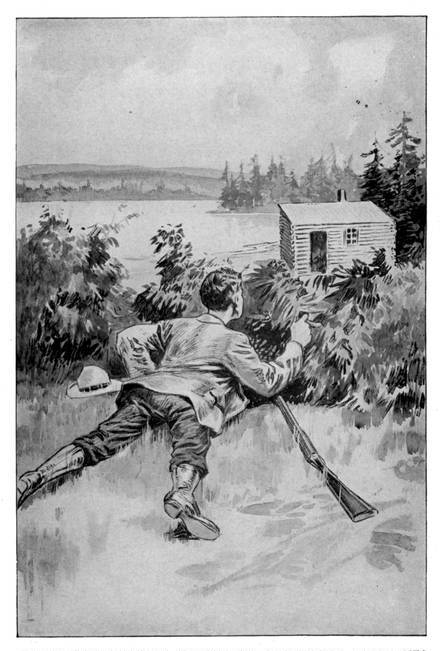
The afternoon of a lazy midsummer day was
waning as an old white horse drew a heavily
loaded, creaking, complaining farm wagon along
a crude, seldom used road which wound through
the depths of a silent stretch of timberland. A
sleepy looking, tow-headed boy with round apple
cheeks sat on the wagon-seat and held the reins.
Behind the wagon five more boys straggled
along on foot, stumbling over the rocks and
“cradle knolls.” The party, with the exception
of the drowsy driver, who had been engaged
to transport the camping outfit from Pemstock,
the nearest railroad station, was bound for Phantom
Lake, the objective point of the expedition.
As originally planned, the company had been
made up of four Oakdale lads, Phil Springer,
Sile Crane, Ben Stone and Rodney Grant; but,
listening to their talk of the sport they would
have on such an outing, Sleuth Piper had become
inspired by a longing to join them, and almost at
the last moment he had succeeded in securing
permission of his parents. The five mile jaunt
from Pemstock to Phantom Lake followed a
journey of twenty odd miles by rail; but, despite
the dust, heat and bad roads, the enthusiasm of
the boys showed no symptoms of waning.
Carrying a double barreled shotgun and wearing
an old leather-banded cowboy hat and a belt
supporting a sheathed hunting knife, Piper followed
close behind the writhing wagon, peering
with an exaggerated air of caution and keenness
into the timber and bushes on either hand. The
rustling of a running chipmunk, the distant
chatter of a red squirrel, or the cawing of a crow,
lazily wheeling overhead, was sufficient to cause
Piper to halt with quickly uplifted hand and the
pose of one who sensed an impending danger.
“Oh, what’s the matter with yeou naow?”
drawled Sile Crane in exasperation, as he finally
stumbled against Sleuth’s heels. “Yeou couldn’t
shoot anything if yeou saw it, and, anyhaow, the
old gun ain’t loaded.”
“Hush!” sibilated Sleuth. “We’re in the
enemy’s country, and peril menaces us on every
hand. Who knows that the chatter of yonder
squirrel or the sudden cry of the soaring crow
does not betoken the near presence of some
prowling varmint? There may be bloodthirsty
redskins lying in ambush for us, and, unless we
preserve extreme caution, perchance our scalps
tonight will dangle in the wigwams of the
Wampanoags.”
“Oh, go on with yeour dinged fol-de-rol,”
snorted Crane. “Yeou’ve read so many of them
cheap Injun stories that yeou’re half nutty. Between
them yarns and the detective stuff yeou
sop up, yeou’ll go clean off yeour base if yeou
don’t look aout. Come, pudge along.” He ended
by giving Sleuth a vigorous shove that nearly
sent the smaller lad sprawling.
“Careful, Sile,” begged Ben Stone. “Have
you forgotten that it was Sleuthy’s clever work
which practically saved me from the stigma of a
crime? If you have, I haven’t, and I’m not
liable to forget it.”
Piper gave his champion, a stocky, square
built, somewhat unprepossessing lad, a grateful
look.
“I guess I opened their eyes some that time,
didn’t I, Ben?” he grinned proudly. “I made
the fellers that had been poking fun at me sit up
and take notice. I had them all spellbound in
court when I told my story and gave my deductions.”
“Yes,” chuckled Phil Springer, who was wearing
a canvas suit that crinkled and rustled at
every step. “It was so still in the court room
that you might have heard a gum-drop.”
“A pun that’s right worthy of Chipper Cooper
himself,” observed Rodney Grant, who, although
a genuine Texan and the son of a cattleman, was
the most simply and practically dressed member
of the party. “We must be getting near the lake.
It’s sure a wonder to me that the Dutchman
hasn’t rolled off the wagon-seat before this and
broken his neck. Look at him! There he goes!
Oh, Dutchy, look out!”
The sleepy driver seemed to awaken and recover
barely in time to prevent himself from
bounding like a ball beneath the forward wheels
of the wagon.
“Vat’s der matter?” he gurgled, yanking at
the reins and turning to glare, red-faced, over his
shoulder. “Vy iss it you at me yell like dot undt
nearly make me off fall? Who vas you calling
Tutchman already now? I vould haff you understood
dot I peen a Cherman.”
His indignation brought a shout of laughter
from the boys.
“Pardon me for breaking in on your peaceful
slumbers,” entreated the Texan. “We were
reckoning the lake must be right near by this
time.”
The German lad rubbed his eyes, yawned, and
looked around.
“Yah,” he said, “der lake hass almost reached
us. It vill soon be here, I peliefe. Not much
more must we on go.”
“We’ll never reach the lul-lul-lake in the world
if you gug-gug-get twisted in gug-guiding as
much as you do in tut-talking,” said Springer.
“Vot iss?” cried the young German in derision.
“Anyvay, I do not up chop my vurds, der
vay you did. Ven dose vurds did out come your
mouth from, it iss mincemeats they vas already.”
This turned the laugh on Springer, who
sought in vain to make a sufficiently sarcastic retort,
and became so excited through the effort
that he stammered more than usual.
“Oh, start up your old nag again, Dutch,”
urged Crane. “Yeou and Springer both murder
language in a criminal fashion.”
“Maype dot peen so,” admitted the lad on the
wagon; “but it iss py our mouths we talk, undt
not our noses through.” With which solid shot
he chirruped to the old horse, and the wagon
creaked onward once more.
“It sure seems to me,” laughed Grant, “that
Mr. Carl Duckelstein isn’t near as sleepy as he
looks. As we’ve engaged him to bring us butter,
eggs and milk daily, he may provide some amusement
for us.”
In a few moments, the road taking a bend
through the trees, they set the woods ringing
with shouts of satisfaction, for before them they
caught a glimpse of the placid blue waters of
Phantom Lake. Soon the broad sweep of the
sheltered island-dotted lake, with a range of
mountainous hills rising directly from the shore
at the further side, opened out before them, the
prospect being one to make their youthful hearts
beat swiftly.
Eight miles in length and fully half as far
across at its widest point, the forest-surrounded,
mountain-sentineled strip of water was one of
the most picturesque sheets to be found in old
New England, remaining as yet unspoiled by too
many swarming campers and resorters, although
a newly opened hotel near the base of the highest
and most precipitous cliff of the range of hills
was attracting increasing numbers of the latter
class. From Pleasant Point, which the Oakdale
boys had now reached, the hotel far across the
lake could be glimpsed amid the green foliage at
the base of the purple cliff.
Springer capered like a colt, shouting again in
joyous abandon as he ran out on the point to get
a good view of his surroundings.
“It’s gug-great, fellows,” he cried—“simply
great! This is a corking place to camp. Why,
here’s deep water on one side right off the rocks,
and a cove with a sandy beach on the other sus-side.
Gee whiz! it’s fine.”
The enthusiasm of the others, excepting, of
course, the seemingly stolid German lad, was
scarcely less unrestrained.
“It certain is all right,” was the decision of
Rod Grant. “I’ll admit it beats anything to be
found in Rogers County, Texas.”
“Here’s a rippin’ place to go in swimmin’ right
off the rocks,” announced Crane, inspecting one
side of the point. “Looks like a feller can dive
off into ten foot of water. By glory! we sartain
ought to have fun here.”
“Come over here,” called Stone from the other
side. “Come on over, fellows. Here’s a place
where we can land with our canoe when we get
it over from Pemstock.”
With one foot crossed over the other, Sleuth
Piper leaned on the muzzle of the shotgun, in
imitation of the pictured pose of some scout or
trapper he had seen on the cover of such a lurid
yarn as pleased his fancy, calmly surveying the
prospect from the most sightly spot of the point.
“We should not forget,” he said, “that we’re
in the heart of the Dark and Bloody Ground, afar
from the nearest settlement. What seems so
peaceful and serene to the naked eye may hide a
thousand deadly dangers. Though the pizen redskin
may not be near, through these trackless
wilds prowl innumerable ferocious beasts that—”
“Wake up,” cried Crane. “Turn over; yeou’re
on yeour back.”
“Let’s get busy,” suggested Stone. “There’ll
be plenty of time to look around tomorrow, and
we’ve got to hustle to pitch that tent and get
supper before dark.”
“Sure,” agreed Grant. “Everybody get busy.
Come on.”
CHAPTER II.
MAKING CAMP.
Carl, the German boy, was dozing again upon
the wagon-seat. When they awoke him he
grumbled a little, but they did not ask him
to assist in unloading, knowing that he would
simply be in the way. It required only a few
minutes to remove the boxes, bales and bundles,
which were piled together promiscuously.
“Is there a spring near by, Carl?” asked Grant.
“Vot does a spring vant uf you?” returned the
German lad in surprise.
“We must have water to drink.”
“Vater? Goot cracious! Didt you oxpect to
up drink der whole lake right avay soon?”
“Not exactly, but we weren’t right sure it
was suitable for drinking purposes. It’s all right,
is it?”
“Vale, it vas vet, undt uf you drink it I don’t
peliefe it vill disagreement by you. Howefer, uf
it didt not like you, there vas a spring in der
voods pack somevhere. I could not say how near
it vas avay.”
“Well,” laughed Rod, “although that’s plenty
indefinite, I reckon we can find it. You’ll come
early in the morning with the butter, eggs and
milk, will you?”
“Yah, der putter, eggs undt milks vill pring
me early,” assured Carl.
“And then you are to hike to Pemstock and
tote our canoe in to us.”
“‘Hike’ and ‘tote’ didt not understood me,”
replied Carl; “but I vill go undt dot canoe get tomorrow
as soon as possibility.”
“That’s what I mean,” said Grant.
As the German boy gathered up the reins to
back the wagon round, Piper stepped forward
and checked him with an uplifted hand.
“Stay,” said Sleuth. “Pause a moment. Would
you inform us if there are any dangerous wild
beasts in this virgin forest? Are there likely to
be animals prowling about against whose attack
we should keep a nocturnal vigil?”
“Vot vas dot, a dog?” asked Carl wonderingly.
“Didt you mean vas you to keep a dog to out
vatch for vild animals? I didt not observation
dot you had a dog aroundt anyvhere. Maype,
howefer, you have vun your pocket in.”
Sleuth shook his head sadly. “It’s evident,”
he returned, “that you are not wise to the delicate
shadings of the English language. By a
nocturnal vigil I mean a night watch.”
“Oh, yah,” nodded Carl. “Now I understooded
it. You haf a night vatch your pocket in, in
order dot der time can see you ven it iss dark. I
peliefe maype it vas a goot kindt uf a vatch to
have.”
“You haven’t answered my interrogation concerning
the before-mentioned dangerous wild animals,”
persisted Piper, unheeding the half suppressed
merriment of his companions. “Are
there any around these parts?”
“Last vinter,” was the answer, “my oldt man
he didt see der feetprints uf a gouger, undt dot
gouger didt off carry vun uf our sheeps.”
“A gouger?” cried Sleuth. “What is that?”
“It vas a gouger; a vild peast mit four feets
undt claws undt two eyes undt teeth undt a goot
appetite for meat undt plood.”
“A-a-ah!” breathed Sleuth, with a long, shuddering
intake of his breath. “I knew there must
be such ferocious creatures in this wild and desolate
wilderness, but what a gouger can be has
got me guessing.”
“Perhaps,” suggested Grant, “he means a
cougar.”
“Dot peen vot I said already,” persisted the
German boy. “Vale, I must along go uf I vill
home get pefore dark. Goot py, undt don’t let
dot gouger catch you.”
Turning with some difficulty, he drove away
into the stilly woods, the bumping and creaking
of the old wagon drifting back to the ears of the
campers a long time after it had disappeared
from view. Ere those sounds fully died out Piper
brought forth his jack-knife, hastily cut open
one of the burlap-covered bundles, and extracted
a hatchet, with which he attacked one of the
smaller wooden boxes.
“Here, what are yeou tryin’ ter do?” cried
Crane. “Don’t go ter stavin’ up that box; we
may need it. What be yeou after?”
“The ammunition—the cartridges for the
gun,” palpitated Piper. “As a means of defense
against a ravenous cougar, the weapon is practically
null and void unless loaded.”
Stone seized the hatchet and wrested it from
the hand of the agitated youth. “When we’re
ready to open that box,” he said, “we’ll do so
without smashing it into kindling, for we’re going
to need it again when we pack up. Have
some sense, Sleuth. There are no cougars in
these parts.”
“Nun-never heard of one,” said Springer.
“There might be woodchucks or hedgehogs, or
even, sometimes, a wildcat; but I’ll bub-bub-bet
nobody ever saw a cougar around here.”
“Nevertheless,” declared Sleuth grimly, “I intend
to stand on guard tonight with this loaded
weapon. Many a foolish, reckless man has lost
his life by carelessness in the wild regions of an
unknown land.”
“As fur as I’m consarned,” said Crane, “yeou
can stand on guard if yeou want to; but when
it comes time to turn in, you’ll see me hittin’ the
blanket.”
“The first thing to be done,” said Grant, who
seemed to be the natural leader of the party, “is
to pitch our tent and prepare for supper. Let’s
choose a camping spot. I reckon it won’t be hard
to find a good one here.”
“What’s the mum-matter with this place right
where we are?” asked Springer. “It’s all cleared
up excepting a few rocks, and it’s pretty near
level.”
“I judge we can find a better place,” was the
opinion of the Texan. “This is too far back on
the point; we should get out where we can feel
more of the breeze, which will help to drive away
flies and winged insects. Furthermore, this is in
a slight hollow that would get mighty wet if it
rained hard. We must look out for drainage in
case of rain. I think I can see a good place.”
The spot he chose needed to be cleared of some
low bushes and a few small loose rocks that were
not difficult to remove. By using that location,
as Rod explained, not only would they get the
benefit of whatever breeze might be stirring and
have dry ground beneath them if it rained, but
the tent could be so pitched that the early morning
sun would shine full upon the front of it, and
some near-by trees would provide cool shelter
throughout the warm middle hours of the day.
Furthermore, two low, flat-topped rocks, at a
distance of some fifteen feet from where the tent
would stand, formed a sort of triangle, which,
partly closed in with some more stones that might
be found near by, could readily be made, with
the aid of the sheet-iron top they had brought,
into a combined cook-stove and fireplace. Four
or five feet from the rocks grew three stout saplings,
likewise in a triangle and close enough together
so that, by nailing cross-pieces to them
and spanning those cross-pieces with boards from
one of the boxes, a handy cook’s table might be
constructed in a few minutes.
The boys listened to Rodney with increasing
respect for his judgment and sound horse sense.
“Gall dinged if yeou don’t seem to know jest
haow to do these things, Texas,” drawled Crane.
“I guess we’ll foller yeour lead.”
“All right,” nodded Grant briskly. “Do you
know how to rustle firewood?”
“I was brung up on a farm, and I cal’late I
know as much abaout the different kinds of wood
as anybody here.”
“Then get the axe out of that bundle Piper cut
open and go foraging for wood. Stone, can you
cook any at all?”
“Not much,” confessed Ben; “but I suppose I
can fry bacon, and that’s about all the cooking
there’ll be to do tonight.”
“That’s right. We’ve bread and some canned
stuff. You can get out the stove top and cooking
utensils and build the fireplace, with the help of
Piper, who will bring such extra stones as you
may need. Springer, I reckon you and I had better
clear away here, unpack the tent and get it
ready for pitching. When we need the others we
can call them to give us a helping hand.”
In this manner he set them all at work, and, to
their credit, every fellow took hold with a will.
While Springer and Grant were ripping up the
small bushes by the roots, removing the loose
stones and smoothing out the ground for the tent
floor, Piper, red-faced and grunting, brought
rocks for Stone to build the fireplace, and, that
being done, aided him in constructing the cook’s
table. The ring of Crane’s axe resounded
through the near-by woods, and presently he appeared
with a huge armful of dry sugar maple
cut from a fallen tree.
“If this ain’t as good firewood as anybody can
find araound here,” he said, dropping it on the
ground near the fireplace, “I’ll eat every stick of
it.”
“Where’s the axe?” questioned Grant.
“I left her stickin’ in the log.”
“Get it. Cut a chopping block if you can find
anything suitable, and bring it along with the
axe, which we’ll need when we come to drive the
stakes for pitching the tent. I don’t reckon it’s a
good plan to leave an axe out in the woods away
from camp.”
Two minutes later the strokes of the axe were
again ringing through the woods, and in less than
quarter of an hour Crane reappeared with the
implement in his hand, rolling along the ground
before him a chopping block, which he had cut
from the small sugar maple.
By this time the fireplace was constructed and
a fire already started in it. Furthermore, the
cook’s table was almost ready for use. The tent
had been unpacked, shaken out and spread on the
ground with the ridgepole lying in position beneath
it. At each end of the tent lay the uprights,
ready to be raised into position. The axe and
the smaller hatchet were placed handy for use at
either end of the tent, after which the tent fly
was spread in its proper place, with the loops of
the long guys over the front and rear pole pins.
Stout stakes had been driven at both ends of the
tent, and to these the guy ropes were made fast.
The loops at the four corners of the tent were
likewise made fast to stakes, the pins of the uprights
were slipped through the ridgepole ends,
and Grant announced that everything was ready
for the raising.
It is probable that the fellow who has never
pitched a tent in the woods will not understand
the thrill of that moment which was experienced
by the young campers as, directed by Grant, they
placed themselves in position to hoist away. As
only four were required for this part of the work,
Piper stood back and awaited orders. The others,
two at each end, grasped the front and rear uprights
and lifted the ridgepole, bearing the tent
and fly. As soon as convenient, two of the boys
slipped inside and seized the poles to assist, after
which the uprights were hoisted into a vertical
position. Those within remained holding them
thus until the four corners were carried out and
made fast to the ground pins. After this, the
tent being thus temporarily secured, all went
about the work of setting the guy pins and making
the ropes fast to them.
The wall pins were next driven into place and
the walls roped down to them. Then the fly was
lifted to a proper height and guyed off, Piper
keeping busy assisting to make everything
staunch and taut.
“There she is, fellows,” said Grant proudly,
stepping away and running his fingers through
his damp hair, “and it sure is my opinion that for
a bunch of novices we’ve made a right good job
of it. She stands as square and true as anybody
could ask, and I opine she’ll provide shelter as
long as we want it, in any kind of weather.”
“You bub-bet,” exulted Springer. “Don’t it
look fine? It’s a dandy, fellows.”
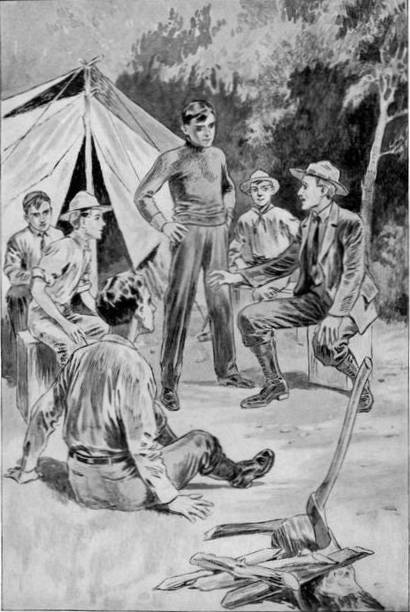
“The teepee is erected,” said Piper.
“What be we goin’ to call our camp?” asked
Crane.
“Let’s call it Camp Oakdale,” suggested Stone.
“That’s it; that’s the name,” cried the others.
“A cheer, then, for Camp Oakdale,” proposed
Grant.
They responded right lustily.
CHAPTER III.
EVENING AT PLEASANT POINT.
From the cooking kit the sheet-iron stove top,
having two holes with covers, was brought forth
and placed over the fire, each end resting on the
edges of the flat-topped rocks. In this manner
the cook stove was made ready for use, and
while Stone fried bacon, made coffee, opened a
tin of meat and carried forward all the preparations
for supper, the others unpacked and stowed
away the rest of the outfit.
The ground-cloth was smoothly spread over
the levelled tent floor and made fast, after which,
having decided on the positions of the beds, everything
to be kept beneath the tent was brought inside
and placed as conveniently as possible in the
most limited space close to one of the tent walls.
Of course there was some discussion over the
stowing of these articles, but in the end it was
Grant who decided how it should be done.
And it was the Texan who selected two tall,
straight young trees, each about six inches in
diameter, standing some distance from the tent,
and instructed Crane to cut them down and trim
them smoothly, that they might be used as “bed
rails.” Before these rails could be fully prepared,
however, Stone called them to supper.
“Ay-yi!” responded Crane, instantly dropping
the axe. “Yeou bet that saounds good ter me.
I’ve ketched a few whiffs of that sizzling bacon,
and it’s made me so ravenous I could eat an old
bootleg. Seems to me I never was so nigh famished
in all my life.”
The others were no less hungry, and they lost
little time in seating themselves, cross-legged,
upon the ground about a box cover which Stone
had brought into use as a temporary table top.
“We can put up a regular dining table tomorrow,”
said Ben; “but this will have to do tonight.”
He was pouring the coffee as he spoke.
“No milk, but plenty of sugar. Here’s the fried
bacon, the canned meat, and toast—burned a
little, perhaps—and cheese. Not much of a meal,
but it will have to do for the first one in camp.
Tomorrow we’ll have fresh eggs and butter and
milk and——”
“Fish,” put in Piper; “all kinds of ’em, right
out of the water. Wait till I get my fishing gear
together and start out after the finny denizens of
this landlocked deep.”
“I’ll bet you’re a great fuf-fuf-fisherman,
Sleuth,” grinned Springer, winking slyly at
Grant. “You know all about it, don’t you?”
“As a general all-round Nimrod,” replied
Piper, forking a piece of bacon and depositing it
on a slice of the blackened toast, “I’m simply a
wonder. The fish don’t have a ghost of a chance
when I get after them.”
“Hush!” cautioned Grant. “Speak low. There
may be some fish near this point, and, if they
should hear you and carry the news of your presence
to their relatives and friends, it might produce
a tremendous panic among the ‘finny denizens
of this landlocked deep;’ and we don’t want
to scare them all away.”
“I don’t know much abaout fishin’,” mumbled
Crane, his mouth full of food, “so I guess I’ll git
yeou to give me some lessons, Sleuth.”
“Piper,” said Stone, seating himself after
pouring the coffee, “must indeed be a past master
in woodcraft, hunting and fishing. He’s the only
fellow who has brought a sleeping bag. I say,
Sleuth, where did you get that thing?”
“Borrowed it of Jim Bailey, who outfitted to
go to the Klondike ten years ago and never went,”
answered Piper. “Oh, you fellows can have
your beds, but I propose to do this thing up in
style; and, while you’re tossing restlessly on
boughs and blankets, I’ll be snugly ensconced in
my cozy sleeping bag. They are great things
when you’re camping out; Bailey said so.”
Chattering and bantering in this manner, the
boys thoroughly enjoyed the meal, their faces
lighted by the soft, warm rays of the sun, that
was on the verge of sinking behind the wooded
range at the far side of the lake. Already the
white hotel could barely be discerned, and the
purplish shadows were creeping out from the
base of the hills. The lake lay like a mirror, with
no breath of air rippling its glassy surface. The
peace of evening in the solitudes was closing in.
“Let’s hustle up a bit, fellows,” urged Grant.
“We must cut some boughs for our beds before
it gets too dark. If we can only get some genuine
balsam boughs, it will be right fine.”
“There’s some balsam trees back beyond where
I cut the firewood,” announced Crane; “but now
that I’ve et I feel so lazy I don’t care much
abaout cuttin’ boughs. What’s the use to trouble
aourselves tonight; we’ve got blankets to roll up
in.”
“The blankets are all right,” returned Rodney;
“but anyone who tries to sleep in them with no
boughs beneath him is sure going to find it uncomfortable
before morning. The ground itself
gets mighty hard, as I know from experience,
and a chap who has been working and perspiring
will feel plenty cold before morning comes, no
matter how warm and easy he is when he first
rolls in. I propose to have some boughs under
me.”
“With my sleeping bag,” said Sleuth, “I need
nothing of the sort.”
“Then,” said Rod, “you can gather up the
dishes and wash them while the rest of us are
cutting boughs. Everyone must do something.”
Dish washing being especially abhorrent to
him, Piper groaned and grumbled, although he
did not refuse to perform the task to which he
had been assigned. The others, provided with
the axe, hatchet and strong knives, set forth,
Grant leading the way, in search of the necessary
boughs. Not far from the tent, in a little open
spot, Sile paused a moment to kick off the top of
an ants’ nest and watch the frantic creatures
which were exposed to view in that manner.
“To-morrer,” he said, “if we’ve got it to
spare, I’ll turn some kerosene over this ’ere colony,
and that’ll fix ’em. We don’t want any of
them things crawling into the tent to nip us at
night. I tell yeou they can bite some.”
“They must be almost as dangerous as Carl’s
‘gouger,’” laughed Rodney; “but we can’t fool
with them now.”
Crane had really located some trees of balsam
fir, and, with the shadows deepening, they
made haste to cut several huge armfuls, which
they carried back and piled in front of the tent.
This accomplished, the bed rails were cut off at
the proper length and smoothly trimmed of
branches and knots, after which they were placed
lengthwise in the tent, one being rolled up close
against the wall, while the other, each end
protruding from beneath the canvas so that
it could be pinned fast to the ground, was
laid parallel about four feet away. The space
between those logs was then filled with the
boughs, all carefully spread out, the softest tips
being reserved for the top. It was necessary to
light the lantern that they might see to spread
the blankets, but finally the beds were arranged
to their entire satisfaction.
Sleuth, having finished his task with the dishes,
removed the stove top and replenished the fire,
reclined in the light of the blaze and with a
superior air watched his laboring comrades, secure
in the belief that his sleeping bag would provide
luxury and comfort denied the others.
Grant had brought along a guitar, an instrument
presented to him by a cowboy on his father’s
ranch, and this he now produced and put in tune,
seated on the chopping block near the fire. The
rest found comfortable positions near at hand,
and, having strummed a while, Rod struck into
“The Spanish Cavalier.” He had a clear, melodious
voice, and he carried the air, the others joining,
with the exception of Piper, who could not
sing a note to save his life.
“The Spanish cavalier stood in his retreat,
And on his guitar played a tune, dear;
The music so sweet he oft would repeat——
The blessings of my country and you, dear.
Oh, say, darling, say, when I’m far away,
Sometimes you may think of me, dear;
The bright sunny day will soon fade away,
Remember what I say and be true, dear.”
The hushed and breathless trees seemed to be
listening. The melody of the song floated far
over the shrouded bosom of the lake, beyond
which the light of the hotel gleamed at the foot
of the cliff, on the highest crest of which a great
white cross had been planted. The waving firelight
flooded over the boys, seated or half reclining
upon the ground, with the tent standing out
snowy white against the black background of the
forest. There was no moon, and overhead a few
vapory stars peered through the haze which had
spread across the sky. At times the fire,
rising, flung a gilded gleam out upon the placid
water off Pleasant Point.
The glamor and poetry of the time and place
was distinctly felt by all those boys. It was a
splendid thing to be alive and to be there, a little
band of congenial friends and comrades granted
the ever-to-be-remembered delights of this midsummer
outing in the best days of enthusiastic,
unsatiated, golden youth. In years to come, when
the hard, cutting edges of life’s experiences and
cares had rasped away their fervor and left them,
perhaps, incapable of deep enjoyment of simple
things, they would sometimes recall this outing
with the mingled thrills of regret and pleasure
which memory so often yields.
They sang other old-fashioned songs: “Swanee
River,” “Aunt Dinah’s Quilting Party,” “Bring
Back My Bonny to Me;” and then, alone, strumming
the accompaniment on the guitar, Grant
rendered that doleful pastoral of the plains, “The
Cowboy’s Lament.”
The mood for singing passed, and they were
silent, even the Texan, having put aside his instrument,
leaned his elbows on his knees and
propped his chin with his hands to stare moodily
into the sinking fire. As the unreplenished flames
died down, the shadows crept nearer and the tent
seemed to beckon to the embrace of its shelter.
Finally Piper shook himself, sat up, stretched
his arms above his head and yawned.
“Me to the sleeping bag,” he said. “I’m going
to turn in.”
CHAPTER IV.
A BAD NIGHT FOR PIPER.
“Why, Sleuthy,” drawled Crane, in pretended
surprise, “I thought yeou was goin’ to stand
guard all night to keep off bloodthirsty redskins
and ‘gougers,’ or other wild animals. Is it possible
yeou’re goin’ to let us snooze unprotected—is
it possible?”
“Huh!” grunted Piper. “I guess there’s no
danger, and I’m mighty tired. There won’t anything
touch us.”
“Then,” laughed Grant, rousing from his
reverie and picking up the guitar, “you no longer
fear that tomorrow may see our scalps dangling
in the wigwams of the Wampanoags?”
“The progress of civilization,” returned Sleuth,
“the irresistible advance of the ruthless palefaces,
has driven the red men steadily toward the
setting sun, and I have a conviction that not many
Wampanoags remain in this region.”
“But,” said Springer, rising to his feet, “it
might be a good thing for somebody to kuk-kuk-keep
guard. The rest of us would sleep better.
Why don’t you do it, Pipe?”
“Why don’t you?” snapped Sleuth. “You
needn’t think you’re going to throw everything
on to me.”
“P’r’aps he’s afraid of the spook that’s said to
prowl around this lake,” suggested Crane mischievously.
“Yeou know folks claim the old lake
is haunted by the ghost of a hermit that used to
live on Spirit Island, and lots of people have heard
the ha’nt wailin’ in the night.”
“Bosh!” sneered Sleuth. “Nobody believes
such stuff these days. There ain’t any ghosts.”
Despite this assertion, his eyes were seen to roll
a bit nervously toward the near-by shadows.
“P’r’aps not,” admitted Sile; “but sometimes
some folks see and hear mighty peculiar things
that they can’t explain.”
“Well, I’m not going to stay up all night
watching for spooks,” retorted Piper; “and, as
far as wild animals are concerned, I’ll slip a
couple of shells into the gun and keep it right
near me, and if anything comes prowling round
I’ll fill it full of lead. I’m a light sleeper, anyhow,
and it’ll be easy for me to wake up.”
Stone had relighted the lantern and hung it in
the tent, that they might see to undress and retire.
Grant threw a few more sticks on the coals
and followed Ben into the camp, Piper at his
heels.
While Sleuth was loading the gun and getting
out the sleeping bag Crane, struck by a sudden
mischievous idea, whispered eagerly to Springer,
who clapped a hand over his mouth to suppress a
giggle.
“Git him away from the tent, Phil—git him
away somehaow,” urged Crane; “and keep him
till you hear me whistlin’.”
A few moments later Phil shouted from the
water’s edge far out at the extremity of the
point:
“Ho, Sleuth! Come on out here! Sleuth! I
say, Sleuth, hurry up!”
“Hey, what’s the matter?” Piper called back
from the tent door. “Where are you?”
“Out here on the pup-point; out close to the
water. There’s something jumping in the water,
and I think it must be fish. You know all about
fish, so cuc-come out and tell me if I’m right.”
Piper hesitated and grumbled, but the others
urged him to go.
“We want to know if there’s fish araound
here,” said Crane, “for if there is mebbe we can
ketch a mess for breakfast. Go on aout, Sleuth,
and see.”
His vanity thus appealed to, Piper issued forth,
crossed the patch of light made by the reawakened
fire and disappeared beyond, calling to
Springer. Barely had Sleuth disappeared when
Crane hastily found a lard pail in which various
articles had been brought along, dumped the contents,
warned the wondering Grant and Stone to
keep still, and passed round to the rear of the
tent, as the sound of his footsteps betokened. It
was not long ere he was back, bringing the pail
with the cover securely in place.
“Git holt of the mouth of that sleepin’ bag, you
fellers,” he hissed. “Hurry up, before Sleuthy
returns.”
“What are you up to, anyhow?” questioned
Stone cautiously.
“Never yeou mind. Don’t waste time askin’
questions naow. There’s going to be something
doing after Piper crawls into this old bag.”
They held the mouth open for him, and, removing
the cover from the pail, he dumped its
contents inside the sack, chuckling all the while.
“What the dickens——” began Stone.
“A good big dip right aout of the middle of
that ants’ nest,” snickered Sile. “Them little
black bugs can nip like sin, and they’ll have
Sleuthy squirmin’ some in no time. Shake ’em
daown to the bottom—that’s right. Naow spread
it aout jest as he left it. Don’t give it away to
him, but jest wait for the circus to commence
after he pokes himself away into that thing.”
He began undressing, whistling at the same
time, and soon Piper and Springer were heard returning
from the point, engaged in an argument
as to whether or not they had seen fish “breaking”
in the water.
“Never mind,” said Grant, as they entered; “I
reckon we’ll find out in the morning whether or
not there are fish around here. Hustle up, everybody,
and turn in. I’m all ready, and don’t
fancy having you gents fussing and growling
and keeping me awake.”
Ere Piper had undressed to his underclothes,
which were of the athletic variety and in which
he proposed to sleep, all save Crane had wrapped
themselves in blankets and rolled on to the bed of
balsam boughs, the fragrance of which pervaded
the entire tent.
“Git in, Sleuth, so I can put aout the light,”
urged Sile. “Got yeour old gun all ready, ain’t
ye? Be sure to keep off cougars, and don’t let
anything git into the tent to bite ye in the night.”
Piper somewhat laboriously and bungingly
stowed himself into the bag feet first, Crane
snickering in spite of himself as he watched the
performance, while more than one of the blanket-wrapped
bodies on the boughs quivered suspiciously.
“What are you laughing at?” demanded Sleuth
resentfully, as he pulled the top of the bag up
around his shoulders. “Perhaps you think this
isn’t comfortable, but I want you to understand
it is. I’ll get more real good solid satisfaction out
of this bag tonight than you will on your old
bough bed.”
“I was jest thinkin’,” returned Crane, “that it
might be kind of hot inside that thing this time
of year. When I git too hot in the night it sets
me to scratchin’ something awful—makes me
itch, like things was bitin’ me.”
“You’d better have your bed examined,”
sneered Sleuth pointedly. “I’m never troubled
that way.”
“Haow do you hitch this thing up raound yeour
neck?” asked Sile, examining the top of the bag.
“I should think yeou’d want it fastened, so yeour
shoulders wouldn’t stick aout. I see haow it’s
done, but it must be consarned awkward to fasten
it from the inside. I’ll do it for ye.”
In spite of Sleuth’s protest that he did not
want the top fastened too tightly, the joker slyly
drew it close and made it secure. This done, he
lost little time in folding his blanket round him,
extinguishing the light and rolling on to the
boughs, where, like the others, he eagerly awaited
developments.
Save for the mournful peeping of a tree-toad
in a near-by thicket and the occasional crackling
of the fire, the light of which flickered on the
tent and shone through the narrow opening in
front, a profound silence settled for a time over
the camp. It was not long, however, before the
waiting boys heard Piper moving a bit restlessly
in the bag, and in a short time the sound of these
movements became more distinct, seeming to indicate
that Sleuth was squirming about uneasily.
Springer turned a snicker into a poor imitation
of a snore, and Crane poked him sharply in the
ribs. Almost immediately Piper was heard
scratching himself vigorously.
“Drat it!” he whispered to himself; and
Springer’s body shook convulsively.
Following this, the boy in the bag began jumping
and twisting about, and several smothered
slaps were heard.
“Hey, what’s the matter with yeou, Sleuthy?”
mumbled Crane in a pretended tone of sleepiness.
“Why don’t yeou keep still? Haow do yeou
s’pose anybody is goin’ to sleep with yeou kickin’
up all that rumpus? Ain’t yeour old sleepin’ bag
comfortable?”
“Sure, it is,” answered Piper; “only there was
a hubble under me like a stone. Gee whiz! I
didn’t know it was so hot tonight.”
“Dud-dud-dry up!” growled Springer. “If you
keep talking you’ll gug-get me wide awake, and
I’ll never go to sleep. Lie still, Sleuth.”
“I’m comfortable now,” assured Piper. “It’s
all right.”
But barely had he uttered these words when he
gave a tremendous jerk and resumed his scratching
more vigorously than ever.
“Guess you were right, Sile,” he finally admitted;
“these sleeping bags are hot things. Don’t
know what makes me itch so. Oh, gee! feels
like something was nipping me.”
“Will you never keep still, Sleuth?” exclaimed
Grant.
“I’m sorry,” said Piper, struggling to sit up;
“but something is stinging me like a lot of nettles.
Oh, great smoke! it’s fierce. Say, Sile,
won’t you unfasten this old bag? I can’t seem
to get out of the thing.”
“No, I won’t unfasten it,” returned Crane in
pretended exasperation; “but if yeou don’t lay
daown and keep still I’ll hit yeou with a boot or
something.”
“I can’t lie down,” protested Sleuth, rapidly
becoming frantic. “I tell you something is chewing
me up to beat the band. I can feel things
crawling on me.”
“It must be all imagination,” put in Stone, who,
although he enjoyed the joke, really pitied the
victim. “Still, imagination is very painful sometimes.
Why don’t you let him out of the bag,
Sile?”
“Let him aout of the bag!” snapped Crane,
rising on his elbow. “Well, I guess not! Didn’t
he tell us haow comfortable them things was? He
wouldn’t lift a hand to cut boughs for a bed.”
Piper groaned. “But I washed the dishes,” he
almost wailed. “Say, unhook me, Sile, and let
me out, or I’ll have a fit. I tell you there’s things
crawling all over me, and they’re just chewing
me up alive.”
“You don’t suppose they’re ‘gougers,’ do you?”
snickered Springer.
“Sort of sus-seems that way to me,” admitted
Phil.
“Oh, say!” wailed the miserable fellow in the
sleeping bag. “If I don’t get out of this thing
I’ll go crazy. I tell you I’m being eaten up alive
by something.”
“Did you ever read a certain essay on the
‘Power of Imagination,’ Piper?” asked Stone.
“If you ever have, you should realize that a person
may make himself very miserable by conceiving
all sorts of foolish things.”
“No, I’ve never read your old essay,” howled
Sleuth, thrashing around in the bag. “But I tell
you this is no imagination; this is the real thing.
Light the lantern, somebody, for the love of
Mike! I’m burning up. I’m all afire.”
“But there ain’t no fire in the bag—there
can’t be,” asserted Crane relentlessly. “Just the
same, somebody ought to git a bucket of water
and souse him. P’r’aps that would keep him still.”
Springer could hold himself in check no longer,
and he burst into shrieks of laughter, during
which Piper, kicking and floundering, rolled over
and over until he was outside the tent.
At this point Stone sprang up and hastened
out to bend over the writhing victim, and the
others, eager to see all there was to be seen, also
rose and peered forth.
It was with no small difficulty that Ben prevailed
on Sleuth to keep quiet long enough for
the mouth of the bag to be unfastened. When
this was done, the boy inside scrambled forth,
fiercely kicking the thing from him, and by the
light of the fire he discovered a number of black
ants running wildly about upon his person.
“There they are!” he cried. “There’s what
bit me! I told you something was doing it. Oh,
murder! let me get out of my underclothes.”
Frantically he stripped off every rag and stood
stark naked in the firelight, still brushing and
slapping and scratching.
“Well, I swan to man!” said Crane, who had
also come out of the tent. “If them ain’t ants,
I’m a woodchuck. Haow do you s’pose they got
into the bag?”
“Must have been there a long tut-time,” said
Springer. “Seems to me I’ve heard that one of
the troubles with sleeping bags was that they
made fuf-fine nests for ants and all sorts of insects.
You’ll never gug-get me to sleep in one.”
“You never will me—again,” vowed Piper.
“Being eaten alive by ants is worse than being
burned to the stake by redskins.”
He was savagely shaking his underclothes as
he spoke, having turned the garments inside out.
Stone carried the sleeping bag some distance
from the camp and flung it over the low limb of
a tree, and the boys urged Piper to make sure
there were no ants remaining upon his person or
his underclothes before he re-entered the tent.
“There are two extra blankets,” said Grant.
“You can have them, Sleuth, and make yourself
comfortable as possible. We’ll light the lantern
and look around to make sure there are no ants
left in here.”
Apparently none had escaped from the bag, and
after a time Sleuth was permitted to return and
settle down with the blankets beside the bed of
boughs occupied by his companions. The lantern
was again extinguished, and finally, one by one,
the boys dropped off to sleep, although the occasional
chuckling of Springer was heard even
after some of the others were breathing regularly
and heavily.
Gradually Piper’s wounds ceased to smart, and,
with no suspicion of the fact that he had been
the victim of a rather painful joke, he sought to
compose himself for slumber. Nevertheless, the
experience through which he had passed made it
no easy matter for him to get to sleep, and he
lay there, turning now and then as the minutes
slipped away into hours and the hours lengthened.
At times the odor of the balsam boughs
mingled with the faint smell of smoke which a
fitful breath of rising wind brought into the tent
from the smoldering coals of the fire. The tree-toad
continued its mournful peeping, and away
in the woods a bird awoke and chirped. Once
something fell from a tree, making a swishing
sound as it cut through the leaves and struck the
ground with a soft thud.
Although he no longer suffered much from the
attack of the ants, Piper found his every sense
painfully alert. Through the opening at the
front of the tent he could see the faint, dull glow
of the coals, which grew dimmer until it finally
faded completely. At irregular intervals the
night seemed to breathe with puffs of air which
set the leaves rustling as if they were whispering
to one another. Off in the woods something
stirred, and there was the barely perceptible
cracking of a twig, as if it had been broken beneath
a soft and stealthy foot.
Imagination was vigorously at work with
Piper, and he fancied all sorts of creatures to
be prowling about in the vicinity. He was vexed
because close at hand his four comrades slept
peacefully, while he remained thus exasperatingly
wide awake.
Suddenly, far away from the bosom of the
lake, came a long, low moaning cry that thrilled
the wakeful lad from his toes to the roots of his
hair, for there was something weirdly doleful and
terrible in that sound. Instantly he thought of
the ghost of the dead hermit, which was said to
haunt Spirit Island, and his teeth began to chatter
a little. Never had he imagined that a night
in the woods could be so fraught with awesome
and terrible sounds. He was tempted to awaken
the others, but knew they would be angered and
scoff at him if he did so. Of a sudden he thought
of the gun, and, thrusting out his hand, touched
the cold barrel of the weapon, which he had
placed near by. Grasping it, he seemed to feel
his courage returning.
“If anything comes around here it’ll get hurt,”
he whispered to himself. “There won’t be any
fooling about it, either. I’ll shoot.”
As if applauding this courageous attitude on
his part, he heard a sudden clapping sound, which
seemed to come rushing toward the tent and
cease abruptly.
“Now what was that?” he speculated, sitting
up and holding the gun across his knees. “It was
something. I’d just like to know.”
Getting out of the blankets, he rose to a
crouching position and stepped toward the front
of the tent, the gun gripped fast in his fingers.
The darkness outside was not nearly as deep as
he had thought it would be, and he could plainly
perceive the outlines of tree trunks near at hand.
Holding his breath, he crouched at the tent opening,
gazing one way and another.
A fresh strong breath of air swept over the
point, moving the tree tops and picking up a
swirl of ashes from the fireplace, so that the last
remaining coals were uncovered and fanned into
a glow. And then, within ten feet of the fire,
close to the trunk of a tree, he saw what appeared
to be a black human-like body, above which rose
a ghastly white face with two huge burning eyes.
Those eyes of fire, seeming to glare upon him,
sent cold chills darting along his spine. Immovable
as a statue, he crouched, the gun in his hand
forgotten for the moment.
Once more from the vague and distant bosom
of the lake came that dreadful, doleful cry; and,
as if in answer, a hoarse voice, half human yet
demon-like, seemed to burst from the creature
with the glowing eyes.
Gasping, Piper pushed the catch of the hammerless
with his thumb, flung the butt of the gun
to his shoulder, levelled the weapon at that black
figure with the ghastly face and fiery eyes, and
pulled both triggers.
CHAPTER V.
WITH ROD AND REEL.
A great flash of fire burst from the double
muzzle of the gun, and a crashing report woke
the echoes of the woods and went reverberating
across the bosom of the lake. Although staggered
a bit by the recoil of the weapon, Sleuth
seemed to see the white head of the figure at
which he had fired fly off into space and go sailing
away, visible for a moment against the sky
ere it disappeared.
Needless to say, the sound of the shot brought
the sleeping campers off their bed of boughs uttering
exclamations of astonishment, alarm and
interrogation.
“Wha-wha-what’s the mum-matter?” spluttered
Springer.
“Great thutter!” gasped Crane. “Sleuth’s shot
at somethin’.”
“What was it, Piper?” asked Stone.
“Yes, what did you fire at?” demanded Grant,
reaching the agitated boy and grasping his
shoulder.
“Oh, it was the most horrible thing you ever
saw,” palpitated Piper. “It was right out there
under a tree, a big black creature with a face as
white as a sheet and fiery eyes as large as saucers.
It had a frightful voice that made my blood
run cold as ice.”
“Oh, come, Sleuth, what are you talking
about?” remonstrated Rodney. “You’ve been
dreaming.”
“Not on your life!” retorted the still trembling
lad. “Haven’t even closed my eyes. I couldn’t.
I heard all sorts of creatures prowling around in
the woods, and something wailing like a lost soul
out there on the lake in the direction of Spirit
Island. You fellows snoozed like a lot of dead
ones,” he continued resentfully. “You’d let Old
Nick himself get you before you’d wake up. I
never saw such a bunch of mummys.”
Crane’s fingers were not quite steady as he
struck a match and lighted the lantern.
“Think yeou hit the critter, Sleuthy?” he
asked.
“Hit it! You bet I did! Why, I just blew its
old white head right off its shoulders. I saw
that head go sailing through the air, too. You’ll
find out I hit it when you look around.”
“I reckon,” said Grant, “we’d better investigate.
Come on with the lantern, Sile. Where
did you say the thing was, Piper?”
“Right out there,” answered Sleuth—“right
out under that tree near the fireplace. Hadn’t I
better load the gun again before we go out?”
“Here, gug-give me that,” snapped Springer,
snatching the piece from Piper’s hands. “You’ll
be shooting the top of somebody’s head off yet.
Now let’s see what he fuf-fired at.”
Directed by Sleuth, who timorously held back
and permitted the others to precede him, they
went forth to investigate, Crane leading with the
lantern.
“Here ’tis,” said Sile, holding up the light with
one hand and pointing with the other. “I’ll bet
a dollar that’s what Sleuthy fired at; and, so help
me Bob, it’s his sleepin’ bag hangin’ over that
limb!”
Springer, his agitated nerves suddenly relaxing,
uttered a shout of laughter, in which the
others joined, with the exception of Piper himself,
who immediately began protesting that he
had not fired at the dangling sleeping bag.
“That’s not the thing,” he rasped furiously. “I
tell you what I shot at had a white head with big
fiery eyes. Do you think I’m an idiot?”
“Let’s see if he hit the bag,” suggested Grant.
“That will tell.”
It did tell, for the light of the lantern showed
them a ragged hole torn through the very center
of the sleeping bag by the two charges of shot,
and once more Sleuth’s companions gave vent to
unbridled merriment.
“Oh, this is the fuf-funniest thing yet,” howled
Springer, clinging to his sides. “Old Sleuthy
shot his own sus-sleeping bag. And it had a white
face with fiery eyes as big as saucers, and he
blew the head of the thing right off and saw it go
sus-sailing through the air! Oh, dear! oh, dear!
I’ll lose my breath!”
In sullen gloom Piper stood staring at the riddled
sleeping bag. “I don’t care what you say,”
he snarled; “it did have a white face with blazing
eyes. Laugh, you mutts—laugh your heads
off!”
“I won’t get over this for a week!” choked
Crane.
Even Stone was convulsed, and Rodney Grant
was compelled to lean against the tree for support.
“It had a terrible voice—don’t forget the
voice,” said Ben.
“And he heard something wailing like a lost
soul out toward Spirit Island,” put in Rod.
“Yes, I did; yes, I did!” rasped Piper repeatedly.
“There—there it is now! Hear it yourselves!
Now what do you think? Now what
have you got to say?”
Out of the distance came a repetition of the
cry which had contributed so much to the wakeful
boy’s alarm.
“Oh, dear! oh, dear!” came again from
Springer, as he rubbed his sides with both hands.
“It’s a loon—nothing but a loon. They always
holler lul-like that.”
“A loon!” muttered Sleuth, crestfallen. “It is?
Well, anyhow, I know what I saw, and I’ll stick
to it about the white face and the fiery eyes.”
Crane had placed the lantern on the ground
almost beneath the dangling sleeping bag, and
now Grant stooped and picked up something revealed
by the light.
“Here’s a white feather,” he said. “A stray
shot from Sleuth’s gun may have knocked it out
of some sort of a bird. That’s it, I reckon;
he saw a white owl that had lighted on the very
branch this bag hangs from. That accounts for
the big fiery eyes and the terrible voice.”
Piper was struck dumb; he tried to say something,
but the words choked in his throat and he
abandoned the effort. Mercilessly his companions
joshed him, and he realized that his exploits
on this first night in camp were destined to provide
a topic for raillery for some time to come.
With his head down, he turned and plunged into
the tent. They found him wrapped in the blankets
and stretched on the ground, and to their continued
badinage he would utter no word of retort.
With the first gray streaks of morning showing
in the eastern sky, Springer attempted to
arouse Piper and get him up.
“Come on, Sleuth,” he said. “You want to
fish, and this is the time to get at it.”
“Go on,” was the smothered retort. “I’m going
to get some sleep. Fish all you want to; I
don’t care.”
Grant was up in a moment. “I’m with you,
Phil,” he said. “Let’s take a plunge and a rub-down
to wake us up, then we can try the fishing,
and leave the others to start the fire and have
things ready for breakfast when we get back.”
Flinging off everything, they raced out to the
rocky side of the point, and Sleuth heard them
go plunging into the water, one after the other.
With a shivering sigh, for the damp coldness of
the earth had crept up through the ground-cloth
and blankets and seemed to pierce his bones,
Piper got upon his hands and knees, crawled to
the bed of boughs just deserted, pulled the blankets
of the others around him and again courted
slumber. Hazily he heard the early risers return,
rub down with coarse towels and get into
their clothes. They were putting their rods and
reels together when he drifted off for the first
time into sound and peaceful sleep.
Rod and Phil made their way slowly along the
lake shore toward the south, casting the flies as
they went, at which feat Springer, having had
more experience, was by far the most skilful.
“It’s the back-snap that does it, Rod,” he explained.
“Don’t swing your whole arm so hard;
use your wrist more. If you can get a good
sharp back-snap and time the forward movement
of your hand properly, you’ll catch on pup-pretty
soon. You don’t want to cast out as hard
as you bring the line back, for if you do you’ll
snap the fly like a crack of a whip, and you may
even snap it off. Watch me now.”
Rodney watched and saw his companion send
the fly soaring far out on the water with a double
movement of the wrist, sharp and then gentle,
and scarcely any movement whatever of the
shoulder.
“It sure looks right simple,” confessed the
Texan. “I can do it fairly well with a short bit
of line, but I get plenty balled up when I try to
let it out and make a longer cast.”
Phil reeled in and gave a demonstration of the
proper manner to whip a line out by repeated
casts, drawing off more and more from the reel
with the left hand and holding the slack until the
proper moment to let it run. Indeed, as Grant
had said, it seemed an extremely simple thing to
do, and Rodney, being an apt pupil, soon began
to get the knack of it, and was not discouraged,
although he repeatedly made a failure right on
the heels of a very praiseworthy effort.
“You’re getting it all right,” encouraged
Springer. “You’re doing sus-splendidly.”
“There I go into a bush,” said Rod, as his fly
caught in some shrubbery at a distance behind
him.
“Never mind that. You’ll need pup-plenty of
room at first, and you’ll keep forgetting every
little while to make your back cast good and
sharp and your forward cast easy. The two
movements must be tut-timed just right, too.”
“It must be right good sport when there are
fish to catch, but we don’t seem to get any bites.”
“There are fuf-fish enough in the lake,” declared
Phil. “Wait till we find them. It’s only
the real true fisherman who has plenty of pup-patience
and perseverance; the ordinary fellow
gets tired and quits after a short time. He seems
to think he ought to find fuf-fish anywhere and
everywhere. Perhaps the flies we have on are
not right, and we’ll try some others as we mum-move
along.”
In the east the pearly gray light was taking on
the tint of pink coral, and gradually this deepened,
until it displayed the tone of a red-cheeked
apple dangling from an orchard branch in
autumn. Presently the white cross marking the
cliff called “Lovers’ Leap” at the further side of
the lake gleamed out golden bright, like the spire
of a church. The morning air was clear and
sweet with the faint odors of the woods, and it
seemed to effect the boys like wine, filling their
bodies with vibrating energy and tingling enthusiasm.
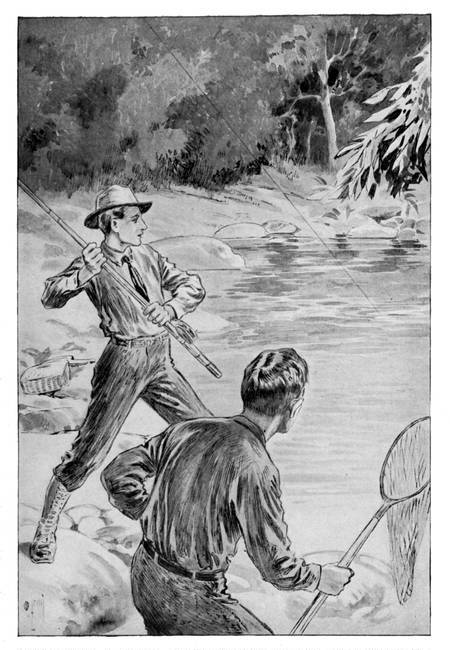
THERE WAS A SWIRL, A SNAP AT THE LINE, A SHARP BENDING OF THE ROD—THE FISH WAS HOOKED. —Page 63.
Although Springer paused to change his flies
as they moved along, trying in turn a “Morning
Glory,” “Parmacheenee Belle,” “Silver Doctor”
and “Brown Hackle,” it was not until he cast into
the shadow of some overhanging bushes at the
mouth of a brook that he had a strike. There,
almost as soon as the hackle sailed out and
dropped lightly upon the smooth surface of the
water, there was a swirl, a snap at the line, a
sharp bending of the delicate bamboo rod; and
the clear, buzzing whirr of the multiple reel told
that the fish was hooked and running with the
fly.
CHAPTER VI.
A MORNING’S SPORT.
Instantly both boys were athrob with excitement,
although Springer, handling the rod and
“playing” the fish, was somewhat less agitated
than Grant, who immediately dropped his own
tackle and seized the landing net, ready to render
such assistance as he might.
“He sure must be a dandy, Phil,” palpitated
the Texan, his cheeks flushed and his eyes glowing.
“Great Scott! see the rod bend. He hasn’t
jumped yet. Don’t they jump?”
“If it’s a sus-sus-salmon,” stuttered Phil,
swiftly winding in as the fish ceased its spurt and
yielded a little, “it will jump; and maybe it will
if it’s a bub-bass. It may not break water at all
if it’s a tut-trout.”
Heedless of wet feet, Phil waded out until the
water had reached to the knees of his canvas
trousers, and there he stood, displaying no small
amount of skill at the delightful task of baffling
and tiring the fighting fish. Whenever the finny
victim grew weary and permitted the line to
slacken the angler reeled in, keeping it fairly taut,
all the while prepared to let the reel run when it
was necessary. In this manner, following the
fish’s repeated breaks for liberty, the boy gradually
brought it closer, admonishing his companion,
who had likewise waded out and was
waiting near at hand, to be ready to dip with the
net when told to do so.
It was indeed exciting work, which kept them
keyed to the highest tension. Both knew
what it was to experience the fierce thrills of a
savage football clash and the triumphant elation
of brilliant and successful work upon the baseball
field, but in the sport of this midsummer
morning hour there was something different, yet
quite as intensely enjoyable and blood-stirring.
The reason, perhaps, lay in the fact that both
possessed the natural instincts of the sportsman
who finds the highest pleasure in a fair and
honorable battle where victory and defeat hang
in the balance until the last moment. For until
the net should lift the fish from its native element
they could not know how securely or how lightly
it was hooked, and it was possible that, through
a sudden swirling struggle of the creature itself
or an inopportune tautening of the line just when
it turned desperately to run away, it might tear
itself free and escape.
Three times Grant made ready to dip, and once
he sunk the net deep in the water; and three times
the weakening fish darted off, setting the reel
whirring. On the last occasion both lads obtained
a good view of the finny fellow, magnified
by the water, and therefore looking large indeed.
“He certain is a corker, Phil,” breathed Grant.
“Bring him up again. I’ll get him next time.”
“Sink the net as I reel him toward you,” instructed
Springer, “and be ready to make a quick
scoop under him. Here he comes now.”
Moving a bit heavily and slowly in protest
against the treatment it was receiving, the fish
was reeled in toward Grant, who obeyed directions
faithfully, accomplishing the final coup by
a swift forward and upward movement of the
sunken net.
“Ah-ha!” exulted Springer. “That’s the sus-stuff!
You did it fine, Rod.”
They waded ashore, and Phil, thrusting a
thumb and finger into the fish’s gills, lifted the
shining, spotted trout, flapping helplessly, from
amid the meshes.
“Look!” he cried proudly. “Just had him
caught by the corner of the lip. A pull an ounce
too hard would have lost him.”
“Say,” said the Texan approvingly, “I opine
you handled that baby right skilful. Jingoes!
but he’s a beaut. Must weight better than two
pounds.”
“Two and a-half, I should say,” nodded Phil,
regarding his catch with a self-satisfied air.
“He’ll go well for bub-breakfast.”
Rodney smacked his lips. “I should guess yes.
Two or three more like that will make a mess for
a hungry bunch.”
The creature was placed in the basket they had
brought for that purpose, and Grant, eager to
emulate his friend’s example, soon recovered his
abandoned rod and resumed casting. Springer
likewise lost little time in once more applying
himself to the task of whipping the pool at the
mouth of the brook.
By this time the sun was up, and in the near-by
dewy thickets they could occasionally hear the
flutter of a wing or the rustle of a running
squirrel. The morning was breathless, and the
surface of the lake reflected the sunlight like a
polished mirror; but under the bushes along the
shore were shadows in which trout might lie,
and the artificial flies at the ends of the silken
lines went dropping into those shadows and skimming
across them, propelled by gentle movements
of the rods that gave the luring baits the lifelike
appearance of swimming insects.
At intervals Grant caught his hook in the
bushes or tangled his line, but he could see that
he was really making some progress in the art of
casting, and he held his patience, despite these
annoying interruptions.
And it was Rodney who got the second strike.
He saw the swirl of the darting fish and gave the
rod a sharp jerk, after the manner of Springer,
instantly shot through by a thrill as he felt the
line tighten, saw the bamboo bend and heard his
reel humming.
“You’ve got him!” cried Phil. “Now pup-play
him—play him carefully. Don’t let him have the
slack when he stops. Be ready to reel in.”
In the excitement of the shifting of the rod
from one hand to the other and getting ready to
work the reel Grant gave the fish some slack,
but was relieved, when he wound in, to find the
creature had not broken away.
“Not too hard,” admonished Springer. “Don’t
hold him tut-too hard when he tries to run.”
“I must have hooked him in good shape, or
he’d sure freed himself right away,” said the
Texan. “Look at my rod bend. He must be a
whopper.”
The tugs and thrills of the vibrating rod
seemed to permeate his entire body, causing his
heart to leap and skip and his breath to come
quickly through his nostrils. It was characteristic
of the boy from Texas that in moments of stress
he always kept his teeth set and his lips pressed
together.
But Rod did not possess the angling skill of
Springer, and presently, with a sudden tremendous
swirl and splash, the fish caught him unprepared
and jerked the rod downward till the tip
almost touched the water. A moment later the
strain upon the line relaxed, the end of the rod
sprung back, and Phil uttered an exclamation of
dismay.
“You’ve lul-lost him!”
“I opine that’s right,” confessed Grant, reeling
in slowly, a comical expression of dejection upon
his face. “The way he pulled he must have been
a monster. It’s too bad, and I’m certain a
rotten fisherman.”
“It’s always the bub-biggest ones that get
away, you know,” laughed Phil cheerfully.
“Chirk up, Rod; nobody gets them all. There
ought to be more in here.”
But, although they continued to whip the
mouth of the brook for some time, not another
rise could they get.
“One isn’t enough for breakfast,” said Grant.
“We ought to have more.”
“Let’s work up the brook,” suggested Phil.
“You take one side, and I’ll follow the other.
Just watch me and cuc-creep along quietly, the
way I do. Don’t let your shadow fall on the
water, and try to drop your fly into the pools
without showing yourself to the fish that may lie
there.”
He forded the brook a short distance above its
mouth, and they began following it upward along
a sort of ravine that cut through the woods.
In a few moments, dropping the flies into a
quiet pool below the projecting end of a water-soaked
log, both got a strike at the same time,
and each one hooked his fish. Then there was
sport and excitement enough, it being no simple
matter to keep their lines from becoming tangled
in that small pool. Neither of the fish, however,
was nearly as large as the one already caught,
and, after dipping his own in a genuinely skilful
way, Phil used the net to secure Grant’s. Both
were trout, weighing, probably, three-fourths of
a pound each.
“There!” breathed Rod in deep satisfaction;
“I’m an angler now, for I really caught something
worth while with a fly-rod. Roping a steer
is a heap more dangerous and strenuous, but the
person who makes game of this sort of sport sure
doesn’t know what he’s talking about.”
Continuing to follow the brook, they found
sport enough to satisfy any genuine Nimrod, and
ere long the basket contained a catch numbering
at least a full dozen.
“I suppose it’s time we were getting back to
camp,” said Springer at last. “The others must
be up by this time, and hungry. They’ll wonder
what has become of us.”
“I hate to quit,” admitted Rodney. “I could
fish all day, I reckon.”
“You’re an angler all right,” laughed Phil.
“You’ve gug-got the fuf-fever. But you mustn’t
try to catch all the fish at once, you know. This
brook won’t run away, and we’ll try it again.”
“Let’s look; let’s see how many we have,”
urged Grant. “Open the basket, Phil.”
Springer had recrossed the brook, and he
paused to comply with his companion’s request.
The basket opened, they gazed with admiring
eyes at the spotted beauties within, some of which
were still breathing and moving. They were thus
engaged when a startling interruption caused
them to spring up swiftly and turn their heads.
“Here, you fellers!” rasped a harsh voice.
“What are you doing, fishing in this brook? It’s
private property.”
CHAPTER VII.
THE ENCOUNTER AT THE BROOK.
The head of the speaker, crowned by an old
straw hat, rose above a clump of alders on the
opposite bank of the stream. His coatless
shoulders, over one of which ran a single suspender,
likewise could be seen. He wore no
collar, and his shirt was open at the throat, exposing
a hairy bit of chest. A “peeled” fishing
pole, projecting upward beside him, betrayed the
purpose of his visit to the brook at that early
hour.
Somewhat less than twenty years of age, he
was not a prepossessing looking fellow as he
glared angrily at the surprised fishermen, who
returned his gaze in silence, seemingly stricken
dumb for the moment by his startling and unwelcome
appearance.
“Say, you fellers,” again called the stranger in
that challenging, threatening tone of anger,
“what business you got fishing in this here
brook? You’ll git into trouble, trespassin’ on
private property.”
“Jug-jug-jingoes!” breathed Springer. “He
gave me a start.”
“Is this brook private property?” asked Grant
coolly.
“Is it?” snapped the fellow on the opposite
side. “Of course ’tis. Everything’s private
property ’round here. S’pose this land ain’t
owned by nobody? You ought to know better’n
that. Who be you, anyhow?”
“We’re camping near by on the lake,” explained
Rod, maintaining his unruffled manner,
“and we were not told that the streams running
into this lake were closed by law.”
“They don’t haf to be closed by law, and I
guess you know it, too,” was the retort. “Any
man has got a right to keep trespassers off his
property.”
“Do you own this brook?”
“My old man owns it, and that’s the same
thing. We don’t ’low nobody but ourselves to
fish it.”
“Have you posted signs, warning trespassers
to keep off?” questioned Rodney. “We didn’t
see any.”
“Nun-nary one,” put in Phil.
“If you had,” flung back the angry fellow, “I
don’t s’pose you’d paid no ’tention to them, or
else you’d ripped ’em down.”
“But you haven’t put up any such signs?” persisted
Grant.
“That don’t make no difference at all,” declared
the stranger, coming out from behind the
alders and revealing a lean, muscular figure,
with slightly stooped shoulders. “You hadn’t no
right to fish here till you found out.”
“We were told we could fish anywhere on the
lake or around it.”
“Who told ye that?”
“Herman Duckelstein.”
“That thick-headed old Dutchman? He don’t
know nothin’. I’ve had to near punch the head
off his pie-faced boy to keep him in his place.”
With calm, keen eyes the Texan took the measure
of the arrogant stranger, betraying no symptom
of alarm, a fact which seemed to increase
the fellow’s irritation.
“So you near punched the head off Carl Duckelstein,
did you?” said Grant, with a touch of
scorn. “And I opine you’re two or three years
older than he, while it’s right plain you’re much
taller and stronger. You ought to be mighty
proud of that performance. What’s your
name?”
The eyes of the chap on the opposite bank
glared still more fiercely, and his lips, drawn back
a little, revealed some uneven snags in crying
need of a toothbrush.
“That ain’t none of your business,” he retorted;
“but I don’t mind tellin’ ye it’s Simpson—Jim
Simpson. My father, Hank Simpson, owns
this strip of land, sixty-three acres, running from
the lake back to the main road, and we don’t propose
to have no trespassers on it. Understand
that. What fish there is in this brook we want
for ourselves.”
“Where does your land begin? Where is the
boundary on this side toward Pleasant Point?”
“That ain’t none of your business, either.
Think I’m going to bother to tell you where the
bound’ries are? You’re on our property, and you
want to get off and stay off, I tell ye that. If ye
don’t——” He lifted his clenched fist in a threatening
gesture.
“Regular sus-scrapper, isn’t he?” chuckled
Springer, who, stimulated by his companion’s
example, had become outwardly cool and undisturbed.
As far as Rod was concerned, this calmness
was all outward seeming, for beneath the surface
his naturally belligerent disposition had been
aroused by the threatening truculence and insolence
of young Simpson.
“If you don’t tell us where your boundary line
is,” said Rod, in that quiet way which Simpson
mistook for timidity, “how are we going to know
when we’re trespassing? We’re camping on
Pleasant Point, and——”
“If you don’t come over this way you won’t do
no trespassin’, and you’ll be likely to save yourselves
a lot of trouble.”
“But what if we do come this way? What sort
of trouble will we get into?”
“You’ll get your heads everlastingly lammed
off your shoulders, that’s what,” snarled Jim
Simpson.
“You seem to consider it your specialty to lam
folks’ heads off their shoulders. I’ve seen a heap
of pugnacious parties like you before this, and
I’ve always observed that if they were persevering
enough they eventually succeeded in getting
a lamming themselves.”
“What’s that?” shouted the fellow, dropping
his fishing pole and starting forward into the
brook until the water rose round the ankles of
the long-legged boots into which his trousers
were tucked. “What’re you doin’, making fightin’
talk to me? If you be, by heck, I’ll come over
there and hand you one right on the kisser!”
“You’d better stay where you are, I reckon,”
returned Rodney in continued calmness. “I’m
not looking for a scrap, having learned by observation
that the gent who prances round with
a chip on his shoulder sure gets it knocked off by
a better chap some day.”
“Gee whiz!” hissed Springer. “He’s gug-going
to come over! It looks like a mix-up.”
“If he picks up a fight, leave him to me,” said
Rodney, in a low tone. “We’re not hunting
for trouble, but I admit this gent’s deportment is
right displeasing to me, and I don’t think it advisable
to let him browbeat us or drive us away like
frightened sheep.”
Picking the shallow places, Jim Simpson
waded the brook, maintaining a fierce and threatening
manner, though possibly he was somewhat
surprised by the lack of alarm evinced in the
bearing of the young campers.
“You’ll find there ain’t no fooling about this
business,” he declared, as he emerged from the
water and paused a few feet distant, beginning
to roll up his shirt sleeves. “You better skedaddle
before I pitch into ye. I don’t want to hurt ye,
but——”
“That’s right kind of you,” scoffed Rod. “I
opined by your remarks that you were yearning
to hand us a sample lamming. If we had been
properly warned in advance, or had seen ‘No
trespassing’ signs hereabouts, we might not have
fished in this brook.”
Simpson seemed to interpret this as a concession
or symptom of backing down, and it made
him still more arrogant in his manner.
“I told ye you’d better skedaddle, to start with,
but you was chumps enough to stand and argue
with me, and you even handed me some sass. I
won’t take sass from nobody like you, by heck!
Now you’ve got jest about ten seconds to pick
up and hiper. Dig, I tell ye—dig out!”
“We’re no diggers,” returned the Texan,
whose eyes had swiftly taken cognizance of the
immediate footing, that he might not stumble
over any obstruction upon the ground in the
encounter which seemed unavertible save by
retreat. He had passed his rod to Springer,
in order that his hands might be free.
“There’ll be some doings,” Phil whispered to
himself, “when Mr. Simpson attempts to put his
bub-brand on this Texas maverick.”
Phil knew Rod’s nature—knew that he was a
quiet, peaceful chap, who never sought trouble
and usually tried to avoid it when he could without
positive loss of self-respect. Furthermore,
Phil was aware by observation that, when
aroused through physical violence, the boy from
Texas, having a fiery temper, was a most formidable
and dangerous antagonist.
Well aware of his own volcanic nature when
provoked or aroused, since coming to Oakdale,
it had been Rodney Grant’s constant purpose to
hold himself in check and master the fighting
strain in his blood. In this he had succeeded at
first only by avoiding violent clashes of any sort,
which had, for the time being, given him among
the Oakdale lads the reputation of being something
of a coward. In the end, however, circumstances
and events had conspired to reveal their
mistake of judgment, and had led them to acknowledge
Rodney as a thoroughbred in whose
veins there was not one craven drop.
Feeling certain he knew quite well what would
happen to Simpson if the fellow attacked Rod,
Phil believed it a duty to give him fair warning.
“Sus-say, look a’ here,” he cried, pointing a
finger at the pugnacious rustic, “if you don’t
want to get the worst lul-licking you ever had,
you better keep away from this fellow. He’ll pup-punch
the packing out of you in just about two
jabs.”
“Ho! ho! Is that so!” mocked Simpson. “Why,
I can wallop the both of you, and not half try.
I’ll learn ye to fish in our brook! So that’s what
ye ketched, is it?” he went on, his eye falling on
the contents of the basket, at sight of which he
became still more enraged. “Well, you won’t
take any of them to your old camp.” With a
sudden swing of his heavy boot, he kicked the
basket over and sent the fish flying toward the
water, some of them falling into it.
A moment later, as Springer scrambled frantically
to recover as many of those fish as possible,
Grant, moving like lightning, seized Simpson by
the neck and a convenient part of his trousers
and pitched him sprawling into the brook.
CHAPTER VIII.
ONE FROM THE SHOULDER.
Spluttering, choking, snarling, the astonished
recipient of this summary treatment scrambled
to his feet, dripping and as enraged as a mad
bull. Brushing the water from his eyes with a
sweep of his hand, he beheld Grant, hands on his
hips, standing as if waiting, wholly unconcerned.
With a roar, Simpson splashed out of the
water, his boot-legs full and sloshing, and
charged at Rodney.
“Oh,” said Springer, recovering two of the
trout from the water and tossing them back into
the basket, “the performance is just beginning in
the big tut-tent; the circus has started.”
The performance, however, terminated quite
as suddenly as it had commenced. Stepping deftly
aside as the fellow rushed, Grant swung hard
and accurately, planting his fist against Simpson’s
jaw. Down with a crash went the pugnacious
rustic, dazed and wondering at a tremendous
display of fireworks, which seemed to be
celebrating a belated Fourth, in his upper story.
Indeed, for the time being the fellow had not
the slightest idea of what had happened to him.
It was a good thing for Jim Simpson that all
the fight had thus quickly been knocked out of
him, for Springer saw the old wild light of ungovernable
rage blaze in Grant’s eyes, and beheld
on the face of the Texan an expression which
seemed to threaten utter annihilation for his antagonist.
And, as Rod took a stride in the direction
of the chap who was weakly trying to lift
himself upon one elbow, Phil cried sharply:
“That’s enough, Rod! Dud-don’t hit him
again, or you will knock his bub-bub-block off.”
The Texan checked himself sharply, and the
fighting flare faded from his eyes, while his face
resumed its normal expression.
“You’ve whipped him a’ready,” asserted Phil,
still apprehensive. “You took the fuf-fight out
of him with the fuf-first wallop. If he’s got any
sense at all, he won’t want any more.”
Three times Simpson attempted to lift himself
before he was able to sit up, and when he succeeded
he was forced to hold his swimming head
in his hands. His appearance was so pitiful that
neither of the boys felt in the least inclined to
laugh.
“Why, he can’t fight at all,” said Grant. “I
wonder how he ever got the notion that he
could?”
“Knocking the block off such chaps as Carl
Duckelstein, I calculate,” said Phil.
“I reckon that’s right. Heaps of these self-judged
fighters get false notions of their scrapping
abilities through whipping fellows no way
their equals; and when that happens they’re
pretty sure to go prancing round in search of
other worlds to conquer, until somebody hands
them what’s coming to them.”
Slowly and weakly Simpson lifted his head and
stared around like one just beginning to comprehend.
There was still a ringing in his brain, but
the lights had ceased to flash, and he perceived
his own position and observed the fellow he had
sought to attack standing near at hand, untouched,
steady and now calm as ever. For the
first time he began to understand that this calmness
did not indicate timidity, and, understanding,
he was filled with awe bordering on fear.
“I reckon, stranger,” said Grant, “that you’re
not hurt much; but I hope you’ve tumbled to the
fact that you can’t fight any more than a gopher
with the croup. If this brook belongs to your
governor, and you’d been half decent about asking
us not to fish in it, I reckon we’d found plenty
of other places to enjoy the sport. But you chose
to come at us with spurs on, and you got bucked
a plenty when you tried your broncho busting.”
This caused Springer to laugh at last. “The
idiom of the West is certainly expressive,” he
observed. “And one time we thought you a fake
because you didn’t say ‘galoot’ and ‘varmint’ and
such bub-book lingo of supposed-to-be Westerners.”
Simpson made no retort, and, as he continued
to sit there, the boys gathered up their tackle
and the basket containing the trout and prepared
to depart.
“If, on further consideration,” said Grant,
turning to him, “you should hold to the notion
that you still have a grievance, you’ll find us over
at Pleasant Point.”
“So long, Simpy,” called Phil, unable to repress
a parting fling. “Hope your headache
don’t lul-last long.”
They were some distance away when they
heard him, his courage revived, shouting after
them:
“You better git! Come round this brook again,
and see what happens to you!”
“Well,” chuckled Springer, as they pushed
their way through the thickets, “this has been
a real lul-lively morning. We’ve had sport enough
for one day.”
“I’m glad you called to me just when you did,
Phil,” said Rodney. “I was getting a touch of
that old blazing rage that always makes me lose
my head complete.”
“A tut-touch of it! Great Caesar! I wish you
could have seen your own face. I thought you
were going to obliterate Mr. Simpson then and
there.”
At the camp Stone and Crane were waiting,
and the smoke of the brisk fire rose into the still
air. The sight of the white tent, the dancing
blaze and their waiting friends was good indeed
to the returning anglers, who gave a hail as they
approached. Sile answered the call with a question:
“Did you fellers ketch anything? I’ll bate yeou
ain’t had a bit of fun.”
“Oh, is that sus-so!” scoffed Phil hurrying
forward with the basket. “Fun! We’ve had
more than you could sus-shake a stick at.”
“But have you ketched anything?” persisted
Crane.
Springer waited until he could place the basket
before them and lift the cover. When this was
done they broke into exclamations of admiration
and delight.
“Jiminy cripes!” sputtered Sile. “Here’s a
breakfast fit for a king. Yeou must have had
fun, sure enough.”
“All sorts,” said Phil; and then he proceeded
in his whimsical faltering way, to tell of the encounter
with Jim Simpson.
“Just one cuc-crack, that’s all Rod had to hand
him,” he finished. “It cooked his goose quicker
than you could say Juj-Juj-Juj-Jack Rob-bib-bib-binson.”
“It sartain wasn’t so very quick,” returned
Sile, “unless it was done quicker than yeou can
say Jack Robinson. I’ll clean the fish. Ben, yeou
get ready to fry ’em.”
“Where’s Sleuth?” asked Grant.
“Oh, he isn’t up yet,” said Stone.
“Not up?” whooped Springer. “Then I’ll pup-pull
him out in a hurry.”
But Piper had heard them and was dressing.
Presently he came forth, looking grouchy
enough, and had no word of applause for the
success of the anglers.
Nevertheless, when the fish were cooked he ate
his share.
CHAPTER IX.
CARL DUCKELSTEIN FISHES.
That breakfast was, in truth, one not to be
soon forgotten. Such appetites as those boys
had, whetted and sharpened by bounding health
and the tonic of the great, clean, unpolluted outdoor
world! It was the tempting sight and delightful
odor of trout frying in a pan of deep fat
that really put the feather edge on their hunger.
Fortunately, they had bread enough, and, even
though Carl Duckelstein had not appeared with
milk for their coffee, never in the memory of one
there had food tasted so delicious.
“Um-mum!” mumbled Crane, his mouth full.
“I cal’lated I’d et fish before, but, by Jinks! I was
mistook; this is the fust time. Stoney, either
yeou’re a rip tearin’ cook, or them’s the sweetest
trout that ever swum.”
“I opine Ben is sure some cook,” said Grant;
“but, likewise, I reckon these trout must be pretty
good.”
“They ought to be,” grinned Springer, forking
another fish on to his tin plate. “We had to
fuf-fight for ’em. That is, Rod did.”
“It wasn’t really a fight,” said the Texan. “I
wonder if we’ll hear anything more from James
Simpson.”
“Don’t believe so,” said Phil. “It’s my opinion
he got enough to satisfy him. What’s the matter,
Sleuthy? You’re yawning. Didn’t you sus-sleep
well last night?”
“Bah!” mocked Piper. “You know I didn’t
sus-sus-sleep well. I feel like a fool this morning.”
“Sort of a natteral feelin’, hey?” laughed
Crane unsympathetically.
“Go to the ant, thou sluggard,” put in Stone,
by way of a thrust. “I really don’t wonder that
you shot a hole in that old sleeping bag, Pipe, for
it certainly was alive.”
“Is it possible,” said Grant, “that you failed
to acquire wisdom from the owl last night? If
you had listened attentively to its ‘frightful voice’
I’m sure the creature would have told you who’s
who around here.”
“Yah! I s’pose you think you’re funny, the
whole of you!” rasped Piper, whose sense of
humor, if he had any, was doubly dulled by the
fact that the joke was on him. “I s’pose you’ve
got to have somebody to pick on, but don’t rub
it in too hard. That’s all I’ve got to say: don’t
rub it in too hard. Many a man, driven desperate
by similar treatment, has risen in his wrath and
given his torturers just cause to rue their rashness.”
“Look aout for Sleuthy,” warned Crane.
“Don’t forget that we’re in the land of the bloodthirsty
Wampanoags, and if we drive him to desperation
mebbe he’ll turn renegade and betray us
into the hands of murderous redskins.”
“That,” observed the Texan soberly, “would be
right bad for us. I know,” he added reminiscently,
“for didn’t I have an experience with painted
Indians shortly after coming to Oakdale? Why,
they even tried to burn me to the stake.”
“And by sus-so doing,” declared Springer,
“they made a mistake, as they afterwards found
out. I ought to know, for I was one of those
redskins.”
Crane breathed a sigh, rubbed his hand over
his stomach and gazed regretfully at the remnants
of the fried fish.
“I declare,” he confessed, “I didn’t cal’late
when Stoney was cookin’ them that there’d be
half enough for us, but now I’m chock full, and
I’ll be switched if there ain’t goin’ to be some
scraps left.”
“Mighty small scraps,” laughed Grant. “I
think we’ve cleaned things up pretty well. But if
Phil and I hadn’t made this catch we’d fared
rather slim, with Duckelstein failing to bring the
provisions he promised to have here bright and
early.”
“I don’t sus-suppose that sleepyhead is awake
yet,” said Phil, moving back in a manner which
indicated that he had finished. “We’ll be lucky if
he gets our canoe over from Pemstock today.”
“With plenty of fish in these pellucid waters,”
said Piper, whose spirits seemed to be reviving,
“there’s no reason why we should perish of hunger,
even though the pack train of provisions
is delayed.”
“I guess that’s right,” chuckled Crane. “We
mustn’t forgit that we have in aour midst an
angler we can rely on when all others fail.
Sleuthy ain’t had a chance yet to demonstrate his
ability in that line.”
“I think I’ll do so right away,” said Piper. “I’ll
get out my tackle and try the fish without delay.”
“You’ve gug-got another guess coming,” said
Springer. “There’s dishes to wash and other
work to do around this camp, and we’re not going
to let you sus-sneak off to fish while the rest
of us do the work. You can’t pup-play that game
on us.”
Baffled, Piper, who abhorred work, reluctantly
abandoned his design, and again it became his
duty to wash the dishes, a task at which his soul
revolted.
There was still enough to do around the camp,
and when the breakfast dishes were cleared
away, the blankets brought forth and hung up
for an airing and the tent tidied, they decided to
build a dining table. This was located beneath a
tree that would afford cool shade in the middle
of the day. There four stakes were driven into
the ground for legs, to the tops of which, running
lengthwise, were nailed long, straight poles,
hewn flat on two sides with the axe. Then, taking
one of the larger boxes carefully to pieces
by drawing the nails, they obtained boards sufficient
to form the table top. Following this, a
bench on the same principle was made on each
side of the table.
“There,” said Stone in satisfaction, as he stood
back and surveyed the completed work, “that
looks pretty good to me. Now we can dine in
comfort, like civilized human beings.”
By this time the forenoon was advancing and
the sun blazing hotly from an unclouded sky.
However, a slight breeze had risen to ripple the
lake, and its tempering breath blew gratefully
across the point, proving that, considering the
season, the camping spot had been well chosen
for comfort.
“I wonder where that sleepy Dutchman can
be?” speculated Rodney.
As if in answer, the sound of wagon wheels
were heard, and in a few moments the old white
horse came into view, drawing a farm wagon on
which the canoe rested, bottom upward. Sitting
on the wagon, a dumpy figure held the reins and
nodded with every swaying movement, eyes
tightly closed. Even when the old horse came
to a full stop a short distance from the camp,
Carl Duckelstein slept on.
“What do you think of that, fellows?” laughed
Grant.
Awkwardly tiptoeing forward, Crane reached
the wagon, bent forward, placed his lips within
a foot of Carl’s head and gave utterance to an
ear-splitting yell. If he had expected to see the
Dutch boy awaken in a terrified manner, Sile was
much disappointed, for Carl slowly lifted one
hand, brushed at his ear, and thickly mumbled:
“Got avay, mosquito.”
The laughter that followed caused Carl to pry
his eyes open with considerable effort, following
which he surveyed the laughing lads with a
dumb, comical expression of perplexity.
“Vot it vas?” he yawned. “Vhere iss it I am
yet?”
“Why don’t you do yeour sleepin’ nights?”
snapped Crane disgustedly.
“Some of my sleeping does do me nights,” returned
the fat boy; “but enough of it couldt not
get me. Goot morning. Your canoes I haf
brought—undt der milks undt der eggs undt der
putter.”
“You certain took your time about it,” said
Grant. “You agreed to bring the milk and eggs
and butter early, and pack the canoe in to us
later on.”
“Yah,” acknowledged Carl complacently; “but
I out figured it dot I couldt vurk save by doing
him all at vunce. It iss now did; I haf with me
brought eferything, undt I vill not haf to dood
him twice.”
“Carl,” said Stone, “you’ve got a long head.”
“Yah,” returned the boy, with a touch of pride,
“I peliefe a long head hass got me.”
“But if we hadn’t cuc-caught plenty of fish,”
said Springer, “we might have starved for all
of you.”
“Nefer mind dot. Didt you some fish catch
already yet? Vhere didt dese fish get you?”
“Out of the brook over yonder, and I tell you
they were bub-beauties; handsomest trout you
ever saw. We run across a fuf-friend of yours
over there, a fellow by the name of Jim Simpson.”
“Chim Skimpson didn’t peen no friendship uf
mine,” cried Carl, with a surprising display of
spirit. “Efery time he sees me it iss a fight he
vants to up pick. Dot Chim Skimpson didt not
like me. Sometimes, ven der chance gets me, I
vill hit him mit a club.”
“It was right evident to us,” said Grant, “that
Mr. Simpson thought himself quite a scrapper,
but I opine he’s changed his mind some.”
“I gug-guess he has,” laughed Springer. “Say,
Dutchy, you should have seen this Texas longhorn
polish off Jim Simpson in double-quick
time. Simpson tut-tried to drive us away from
the brook, claiming it belonged to his old man;
but Grant pitched him into the water, and then,
when he came tearing out, frothing for a scrap,
Rod whipped him with a sus-single wallop on
the jaw.”
“Vot?” squawked Carl, in still greater excitement,
scrambling off the wagon. “Vot iss it you
didt told me? Iss it dot you didt vhip Chim
Skimpson? I couldt not peliefe it possibility.”
“It’s a fact,” declared Phil, “and it only took
one wallop from Grant’s fuf-fist to settle his
hash.”
Spluttering his delight over this piece of intelligence,
the Dutch boy rushed at Rodney and
clasped him in his arms.
“Mine gootness! I vill hug you for dot. Mine
cracious! I couldt kiss you for dot.”
“Don’t!” entreated Rod, pushing his overjoyed
admirer away with some difficulty. “I did it on
my own account, although I will confess it afforded
me additional satisfaction because of his
boast that he had thrashed you. Is that brook
on Simpson’s land?”
“His land didt begin der prook at.”
“And he doesn’t own any territory on this side
of the brook?”
“Nefer a foot uf territories owns him this side
uf der prook on.”
“Then anybody can fish the brook without
trespassing by following along the nearest
bank?”
“Yah,” nodded Carl. “Uf you fish along der
nearest side avay from us, you vill not trespass.
Undt you didt vallop Chim Skimpson! Dot inflamation
almost makes me cry for choy.”
“Come, fellers,” invited Crane, “let’s unload
the canoe and launch her. Git holt.”
Lifting the light craft, they bore it to the
water’s edge in the sandy cove, Sile expressing
his eagerness to try it out. The paddles were
produced, and soon Crane and Springer were
afloat in the canoe, propelling it with considerable
skill, the others watching them from the
point.
“Dot vas too much like vurk,” murmured the
Dutch boy, shaking his head. “It vould not like
me at all.”
“Still fishing would be the sport for you, I
judge,” said Grant.
“Yah, undt der stiller it vas der petter. I
vould like to try him now uf I had the outfits.”
“Where would you fish?”
“Der vater in, uf course. I vould like to haf
a goot mess uf fish to take me home for dinner.”
“We can provide you with tackle, but no bait
for still fishing. We have nothing but flies for
casting.”
“Dot kind uf bait didt not use me,” said Carl
solemnly; “but uf you vill let me haf the tackles,
I vill der bait get. Yah.”
Rodney brought forth a stout steel rod, which
he quickly put together and to which he attached
a line-wound reel. The line being run through
the eyelets, he bent on a leader and hook and
nipped some split shot into place, to serve as
sinkers.
“There you are,” he said, handing the outfit
over to Duckelstein. “Now go ahead and fish
as much as you like.”
“I vas much opliged,” grinned the Dutch boy.
“I vill get some bait undt fish der rocks off, undt
see what vill catch me. I hope it vas not an
eels. An eels iss a pad fish und I didt not like
him. An eels I vould not touch uf you vould a
hundred tollars gif me.”
“I don’t think you’re likely to catch an eel off
those rocks,” said Rod.
A short distance from the point was a bit of
wet shore, where Carl proceeded to search for
his bait, turning over a number of flat rocks and
capturing some wiggling creatures, which he
calmly put into his pocket. When he had secured
enough of these, he proceeded to the rocks, sat
down on one of them and baited his hook.
“He’ll never catch anything there,” declared
Piper. “If he does, it won’t amount to anything.”
“Never mind,” said Stone; “it will make him
happy to fish.”
In the meantime Springer and Crane had
paddled well out upon the lake, and presently
they turned back toward Pleasant Point. Approaching
the camp, they stared at the Dutch
boy, who had dropped his baited hook into the
water and then serenely fallen sound asleep.
There he sat, the rod drooping, his fat chin on
his breast, snoring distinctly.
“Look at that!” said Phil, as they silently
swept near. “He must sus-sleep pretty near all
the time.”
“By Jinks!” chuckled Sile. “He’d wake up
pretty sudden if he was to fall in.”
They landed in the sandy cove and hastened
to call the attention of the others to the snoozing
fisherman.
“We know it,” laughed Grant. “I rather wish
he’d get an eel on now. He’s right scared of
eels.”
“Oh, is he, hey?” snickered Crane. “Well,
mebbe I can pervide an eel for him. Jest wait,
fellers.”
Over to the marshy shore he hastened, where,
after some searching, he got hold of the end of
a root and tore it out of the muddy ground.
With this pliable, slimy root, which was nearly
five feet in length, Crane hastened to get into
the canoe and push off. Expectantly the others
watched Sile paddle round the point and get
close to Duckelstein’s dangling line. Without
awakening Carl, the joker drew up the line and
tied it fast to one end of the root, which he then
let down into the water. In a few moments he
was back on shore with his chuckling, expectant
companions.
“Naow,” he said, “jest yeou watch me wake
him up.”
Silently he sneaked up behind the sleeper,
reached over, got the line in his fingers, and
made a loop, which he slipped over the reel-handle
so that it would not run out. Then he
grabbed Carl by the shoulder and yelled into his
ear:
“Wake up! Yeou’ve got a bite! Yank him
in!”
Carl awoke and gave a mighty yank with the
rod, which, fortunately, did not break beneath
the strain. Out of the water sprang the old root,
seeming to writhe and squirm in a most lifelike
manner. Straight at the angler the thing came,
striking him in the face and whipping its cold,
clammy folds around his neck.
CHAPTER X.
AN EXPERIMENT WITH FLAPJACKS.
A wild yell of terror burst from the lips of
the horrified Dutch boy, who flung himself backward
upon the flat rock, kicking, flopping and
clawing at the slippery, clinging root.
“Eels!” he yelled chokingly. “Hellup! Took
him off quervick! Safe me, pefore I vas dead
already!”
The spectators were convulsed with laughter,
and Springer, clinging to his sides, collapsed
upon the ground.
“Oh! oh!” gasped Phil. “Did you ever see
anything so funny? It will kill me!”
“It vill kill me uf you don’t took him avay!”
screamed Carl, tearing frantically at the entwined
root, his eyes seeming ready to pop from
his head. “An eel hass got me! Hellup!”
Even Stone was shaken by laughter.
“Vot vas der matter?” wailed the floundering
Dutch boy. “Vhy didt you not assistance gif
me? Pimepy I vill pite dot eel, undt it vill poison
me!”
After a time he succeeded in tearing the root
away and flinging it aside, following which he
rolled over and over to escape from the thing he
feared so much. The whole affair was intensely
ludicrous.
Trembling and panting, Carl got upon his
feet and ran a short distance, only to trip and
fall with a crash that brought a puffing grunt
from his lips.
“It seems too bad,” said Stone; “but, still, I
can’t help laughing.”
“Oh, yah!” raged the frightened lad, sitting
up and glaring at Ben. “It peen funny to see
an eels choke somepody plack undt plue, ain’t it?
Go ahead undt laugh your sides split.”
“Why, that thing wouldn’t hurt you, Carl,”
said Grant, advancing and wiping his eyes, for
excessive laughter had brought the tears. “It
don’t look to me like an eel.”
“Iss dot so!” sneered Duckelstein scornfully.
“Maype you supposition it vas a catfish? Maype
you peliefe it peen a whales? I pet you I know
an eels vhen he sees me, undt uf dot vas not an
eels I vill alife svallow it.”
The Texan lifted the rod with the long root
dangling at the end of the line, causing Carl to
scramble away still further and once more get
upon his stubby legs, prepared to run.
“It’s not an eel at all,” said Rod; “it’s nothing
but an old root that must have caught upon your
line in some manner.”
“Vot?” squawked the Dutch boy, staring incredulously
at the thing. “It peen a roots? Vot
iss? It couldt not peen a roots, for didt I not
feel him aroundt my neck viggle undt choke me
almost der vind out of? Keep avay!” he howled,
as Rod started to advance. “Perhaps it didt like
a root look, but an eels can tell me efery time.”
“Look here,” invited Rodney, taking the thing
in his hands and detaching it from the line. “I
tell you it’s nothing but an old root.”
Even then Duckelstein found it almost impossible
to believe the evidence of his eyes.
Chagrined, he finally said:
“Vale, dot peen der first time I efer knew a
hook to pite a roots. It vas a most singular concurrence.”
“You see now,” said Stone, attempting to appear
quite grave, “why we laughed and didn’t go
to your assistance.”
“Didt you knew all der time it peen a roots?”
questioned Carl a bit suspiciously.
“Yes, we knew it all the time.”
“Vale, uf dot vas der case, I vill again say dot
it peen a strange concurrence, and I didt not
understood him. I couldt not comprehension how
dot root came on my line caught.”
“That’s the most natteral thing in the world,”
said Crane. “Yeou went to snoozin’ and let your
line sink to the bottom. The old root was down
there and got ketched on it.”
“Maype dot vas so,” admitted Carl, although
his suspicions were plainly unallayed; “but der
bottom of der vater off der rocks vas nothings
but gravel undt sand, undt I couldt not imachine
vot made dot roots svim there.”
“He’s on to you,” whispered Piper in Crane’s
ear. “Beware of the hour of vengeance.”
“Vhy didt you not out loud say it?” demanded
Duckelstein, giving Piper a look. “Vhy didt
you vhisper dot fashions? I oxpect you haf enchoyed
a great deal uf fun mit me already soon.
Maype sometimes der laugh vill out come der
other side your mouth of. I vill now home go.”
Overflowing with resentment, he started toward
the old white horse, which, with head
drooping and eyes closed, seemed, like Carl, to
have the sleeping habit.
“Don’t hike away mad in that fashion,” entreated
Grant, following. “You won’t forget
the stuff you’re to bring us every morning, will
you?”
“Oh, no,” assured Carl, “I vill not let it forget
me. I vill aroundt come, as agreement, undt
maype you vill some more fun haf py me—undt
maype you von’t.”
Grasping the horse’s bit, he compelled the animal
to back the heavy wagon round so that he
might drive away. Climbing upon the wagon,
he picked up the reins, but turned for a moment
before departing to say:
“You vant to out look for dot gouger. If dot
gouger shouldt aroundt come der night in, he
might pite you.” Then he gave the reins a slap,
chirped to the ancient nag and started.
“May I be eternally chawed up!” rasped Sleuth,
glaring at Carl’s receding back. “Is it possible
the fellow knows something about my terrible
experience last night? He hauled our dunnage
over here. You don’t suppose he found a way
to plant those confounded ants in my sleeping
bag, do you, comrades? If I thought so, I would
unhesitatingly shed his gore.”
Springer choked and coughed in the attempt
to suppress another shout of laughter, while
Crane, with admirable soberness, made answer
to Piper:
“I really don’t see haow he could have faound
the chance, Sleuthy. Yeou’ve got jest as much
reason to suspect that I done it myself, and yeou
know there wa’n’t no chance for that. I tell yeou
them sleepin’ bags always become infested if
they ain’t used reg’ler.”
“It will be a long time before I use one again,
regular or irregular,” asserted Piper. “I’ve had
my lesson.” The manner in which he uttered
these words made it impossible for Sile, even, to
keep his face straight.
“As I once before remarked,” observed Grant,
“I don’t reckon Carl Duckelstein is quite as
sleepy as he looks. It was plenty plain that he
suspected us of putting up that joke on him.”
After laughing and chatting a while longer,
they became aware that it was midday and time
for dinner.
“I’m hungry again,” announced Sleuth; “and
even taking up a hole in my belt, after the manner
of the bold pioneers of other days, will not
satisfy me. What are we to have for rations?”
“Perhaps the cuc-cook will suggest something,”
said Springer, looking at Stone.
“I’ve told you before,” reminded Ben, “that
I’m a mighty poor cook.”
This brought a chorus of remonstrance from
the others, and Grant remarked:
“I reckon you’re the best cook in the bunch,
and we can stand it if you can. Our bread must
be running low. Can you make bread?”
“Or flapjacks?” cried Sile. “Them’s the
things, flapjacks. We brought along a can of
molasses, and if yeou can knock together some
flapjacks, Ben, it’ll fix us all right.”
“The kind I’d make would be likely to fix you,”
agreed Stone. “Still, I’ve seen my mother make
them, and I’m willing to try.”
That was enough, and, encouraged by his
mates, he set about the task. First he measured
out a quart of flour, into which he rubbed dry
about two tablespoonfuls of lard, adding a teaspoonful
of salt, two of baking powder and two
of sugar, the latter to make the flapjacks brown.
With the addition of cold water and the vigorous
use of a spoon he produced a thin batter.
In the meantime a hot fire had been built beneath
the sheet-iron stove top and the frying pan
placed upon one of the uncovered holes. When
the pan was well heated Stone greased it with
a piece of fat pork that sizzled and spluttered.
“Now,” he said, as the boys, having set the
table, gathered around to watch him, “we’ll soon
find out what sort of things they will be.”
“I’m willing to take a ch-chance, anyhow,”
declared Springer courageously.
“Starving men in the wilderness have been
known to subsist on old moccasins,” said Piper,
licking his lips. “Your flapjacks can’t be much
worse, Ben.”
“I should hope not,” said the cook, using the
big spoon to ladle some of the batter into the
frying pan. “You fellows better get ready to
tackle them as they come hot from the skillet.”
“I’m going to watch,” said Sleuth, squatting
near, the heat of the fire having caused the perspiration
to start out on his face. “It’s well that
all adventurous characters who explore wild and
unknown lands should have at least a rudimentary
knowledge of the culinary art.”
With repeated dips of the spoon Stone had
poured enough batter to fill the hot pan within
half an inch of the rim, and this he now watched
closely as it began to cook. As soon as the cake
was full of bubbles and the edges had begun to
stiffen, he lifted the pan and shook it with a
rotary movement, which set the big flapjack free.
“Are you going to flip it?” questioned Sleuth
eagerly. “They always flip ’em, don’t they?”
“I’m going to try it,” said Ben, holding the
pan slantingly away from his body. “Look out.”
He gave a toss and a flip, and the hot cake
sailed into the air. In vain he sought to catch
it, and in vain Piper dodged.
The flapjack hit Sleuth fairly in the left eye,
and he fell over upon his back with a howl of
dismay.
Naturally, this incident was productive of considerable
merriment, in which, however, the victim
failed to join.
“Enjoy yourselves!” rasped Sleuth, gazing
ruefully at the lost flapjack as it lay on the
ground. “Laugh, while I perish of hunger, you
heartless brutes! Say, Ben, don’t try to flip the
next one; turn it with a knife or something. And
please hurry up, or in the throes of famine I’ll
eat that half-cooked thing that soaked me in the
blinker.”
Stone, however, persisted in the attempt to
flip the flapjacks, and, having learned something
through his first failure, succeeded quite well
with the next cake, although Piper took care to
keep well out of range. Having caught the
knack, the cook furnished flapjacks as fast as
the fire would brown them, and, urged by him,
the boys began devouring them almost as rapidly
as they came to the table. Adrip with molasses,
they were not so bad, either.
“I’ve sus-seen worse,” said Springer.
“Where?” laughed Ben.
“In the dictionary,” replied Phil, lifting a dripping
piece to his mouth.
“Come on, Stoney,” urged Crane. “Don’t yeou
dast to try ’em? Ain’t yeou goin’ to eat any?”
“When the rest of you begin to falter,” said
Ben, as he watched another one browning, “I’ll
take a venture. If they prove fatal we’ll all perish
together.”
Far from proving fatal, however, they fully
satisfied the hunger of those vigorous boys,
whose healthy digestions gave them not a single
pang. The last morsel was cleaned up, and Stone
was universally acclaimed as a wonderful cook.
“I reckon that settles it,” said Grant, when he
had finished. “You’ve got your job cut out for
you during this outing, Ben, and I shall vote that
you be given full charge of the commissary department.”
CHAPTER XI.
THE LEGEND OF LOVERS’ LEAP.
An hour or more after dinner, as the boys were
lounging about, a canoe containing a single occupant
was seen approaching the point. The
person who wielded the paddle headed for the
sandy beach of the little cove, upon which lay the
canoe of the campers, and, as he drew near, he
was seen to be a youngish man dressed in khaki.
A bamboo fishing rod projected upward over one
of the thwarts of the stranger’s canoe.
“I judge he’s coming to pay us a visit,” said
Grant, starting toward the beach.
Rod was right. Smiling pleasantly, the young
man, who had a small black moustache and
seemed somewhat in need of a shave, brought his
canoe on to the beach with a soft grating sound
and stepped out into the shallow water, his feet
being protected by water-tight boots.
“Hello,” he nodded in an agreeable manner.
“Saw your smoke and thought I’d come over.
Camping out here, I see.”
“Yes,” answered Rod, equally affable and a
bit curious. “Are you from the hotel?”
“No. My name is Granger—Charles Granger,
and I’m stopping in an old log cabin about two
miles from the hotel. How’s the fishing over this
way?”
“Pretty good, I reckon. We’ve tried it only
once, but we had good luck. You see we got here
last night barely soon enough to make camp.”
“I didn’t think you’d been here long,” said
Granger, “for if you had I’d been likely to have
seen you before. How long do you plan to stay?”
“A week or so; perhaps two; if everything goes
all right. My name is Grant. Won’t you come
up and meet the rest of the fellows?”
“Sure,” beamed Granger; “I’d like to.”
He followed Rod, who presented him to the
others. Apparently he was a languid sort of a
chap with a dreamy eye, and, for all of his seeming
frankness, it was not long before the boys
fancied they could perceive something mysterious
in his manner. He told them he was occupying
the old log cabin quite alone, his doctor having
advised him to spend as much of the summer
as possible in the open air. Nevertheless, although
he was somewhat slender of build, he did
not have the appearance of a person in poor
health. Springer, seeking to draw him out, soon
discovered that he knew very little about fishing
and fishing tackle.
“Oh, I’m a greenhorn,” laughed Granger; “but
I enjoy the sport just the same. It’s about all I
have to do besides read, and a man gets tired of
reading after a while. I have amused myself,
however, by picking up some information concerning
the legends hereabouts. You know this
is really a most romantic spot, as well as one of
the prettiest sheets of water to be found in all
New England. If people looking for a summer’s
outing just knew about it, they’d pack the Cliff
House over there until it would be necessary to
build an addition.”
“The lake would soon be spoiled if rusticators
overran it,” was Grant’s opinion.
“Oh, I don’t know about that,” retorted the
visitor. “In one way, perhaps you’re right, but
it would mean tremendous business and a lot of
money for the hotel people. They took a big
chance when they put up that house over there
and sunk so much money in it. You see there’s
a certain disadvantage in the fact that they’re so
far from the nearest railroad point, although to
many people that would seem like an advantage.
The first two years they lost money hand over
fist, although they advertised extensively in the
regular manner. This is the first season that
they have really done a fair sort of business, and
I understand the business is increasing.”
“You sus-seem to be interested in the hotel,”
said Springer.
“Oh, not at all, not at all,” returned Granger.
“I’m simply telling you what I’ve heard, and it’s
by the way of gossip, you know. We must have
something to talk about.”
“Sir,” said Piper, “I reckon maybe you’ll pardon
me if I inform you that we’re not much interested
in the affairs of other people who have
rashly ventured into the remote regions of these
virgin wilds. It is only their ignorance or their
foolish bravado that has led them thus to expose
their lives to the perils of the primeval forests,
and were the Wampanoags to take to the warpath,
it is not at all improbable that the foolhardy
palefaces over yonder would be butchered to the
last man, woman and child.”
Mr. Granger looked at Sleuth in a puzzled way.
“What’s he talking about?” he asked.
“Injuns!” hissed Piper, unabashed. “We pioneers
know full well the perils that menace us in
this redskin haunted land, but years of experience
amid such dangers have taught us to baffle the
varmints. Those who lack our knowledge should
cling close to the settlements, where they may
seek the protection of the block houses whenever
the pizen warriors go on a rampage.”
The visitor turned from Sleuth to Grant.
“Anything the matter with him up here?” he
asked, touching his forehead.
“Nothing but illuminated literature,” answered
Rod, laughing. “At home Piper has
Sherlock Holmes and Old Sleuth backed against
the ropes, and groggy. He’s the greatest detective
that ever solved the mystery of a dark and
terrible crime. Here in the woods he is the emulator
of Daniel Boone, Simon Kenton and ‘Deadeye
Dick, the Boy Scout of the Border.’ That’s
all.”
“Oh, I see,” laughed Granger. “It’s the effect
of a vivid imagination, spurred by a line of reading
that some fussy people call pernicious. I
fancy he’ll get over it in time and be none the
worse for it.”
Which caused Sleuth to snort disgustedly.
“Speaking of Indians,” pursued the visitor,
“I suppose you’ve heard the story of Lovers’
Leap? That’s the cliff over behind the hotel, the
top of which is marked by that white cross which
you can faintly discern against the sky.”
“It’s a most romantic legend,” said Granger
glibly. “In the days before the invading whites
drove them out, two small, warlike tribes of Indians,
the Passagonquays and the Mattagamons,
were almost constantly at war over this particular
territory, which was coveted by both. Even
in times of peace these tribes had little in common
and shunned each other as far as possible. According
to the story, Lolokana was a beautiful
princess of the Passagonquays, and Agamenthan,
a young brave of that tribe, desired her to
brighten his wigwam. But, for some reason,
Lolokana had no use for Agamenthan and steadily
repulsed his wooing. One day while Lolokana
wandered alone in the forest she was attacked
by a panther.”
“Who says there are no cougars hereabouts?”
muttered Piper.
“The princess would have been slain,” continued
the narrator, “only for the prompt and
fortunate appearance of a tall, handsome young
brave, who rushed to her rescue and slew the
panther with his knife. The young Indian was
wounded, but not seriously. His name was
Woganock, and he was a Mattagamon. Nevertheless,
in spite of the hostility between the two
tribes, Lolokana promptly fell in love with Woganock.
Of course they knew their love-making
would not meet with the sanction of their people,
and therefore it was carried on in secret through
clandestine meetings in the woods.
“But Agamenthan was keeping a jealous and
watchful eye upon Lolokana, and one day he followed
her and saw the lovers meet in the forest.
Without hesitation he rushed upon Woganock,
shouting for him to defend himself. Armed only
with their knives, the two young braves fought a
bloody battle, in which both were badly chopped
up. Woganock conquered, however, and Agamenthan
was left apparently dying upon the
ground.
“Supported and aided by Lolokana, Woganock,
though desperately wounded, made his way back
to his tribe. But when he told the story of the
battle and confessed his love for Lolokana his
father, a chief, rose in wrath and drove the
princess away, vowing that no Passagonquay
should ever take a Mattagamon for his squaw.
Weak and helpless, Woganock could not lift a
hand in remonstrance, and doubtless it would
have availed him little had he been able to do so.
“Lolokana returned to her people and learned,
to her astonishment, that Agamenthan had been
found by some warriors, who had bound up his
injuries and brought him back, alive, to the village.
He must have been a tough one, this redskin,
for he did not die. However, he told the
story of the duel with Woganock, and thenceforth
Lolokana was held practically a captive by
her father, who promised Agamenthan that she
should become his squaw. When the wounded
brave recovered his strength and health he was
to have her, whether she wished it or not.
“Now, as it affects every girl of spirit, this attempt
to coerce her against her will made Lolokana
only the more determined that she would
never belong to Agamenthan. If she had lost
Woganock, if she was to see him no more this
side of the Happy Hunting Grounds, she was resolved
that she would die the squaw of no man.
A prisoner, watched vigilantly by night and by
day, she dreamed splendid dreams of a reunion
with the lover who had saved her from the
panther and defeated the warlike Agamenthan
in a fair and even battle. For, even as she had
been driven away by the angry Mattagamons,
although he could make no effort to shield her
and could scarcely whisper a remonstrance, Woganock
had cast her a look from his dark eyes that
was a pledge and a promise. So she waited for
him to come, confident that sometime he would
do so and take her away.
“At last, however, she began to fear that she
had waited in vain, for Agamenthan, bearing
many terrible scars upon his person, had recovered
his strength and was asking of her father
that the time should be set when he could lead her
to his wigwam. Though she knew of these
councils and of the impatience of the young
brave, Lolokana kept her lips sealed—kept her
dark lashes always lowered, that Agamenthan
might not read in her eyes the resolve to die
rather than submit. A knife, which she had
found, was hidden upon her person, and this, if
nothing else, would enable her to escape at the
last moment. One strong, swift thrust deep into
her bosom would set her free.
“At last the day was named, and the chief of
the Passagonquays told his daughter that on the
morrow she was to become the squaw of Agamenthan.
That night she did not close her eyes
in sleep, although, lying quite still, without a
single movement to arouse suspicion, she led her
vigilant guard to believe she slumbered. It was
her purpose to try to creep forth from the teepee
in the darkest hours and take flight.
“As she lay thus she heard something—the
faintest rustle, like the movements of a toad in
the leaves; yet something told her it was not a
toad, and, with her heart pounding, she listened
and listened. Presently she heard her name
whispered almost in her ear, and she knew it had
been breathed by the lips of Woganock. She
knew her lover had come at last. With all the
skill and stealth of his race he had crept into the
village, not even disturbing a sleeping dog. He
was outside the teepee; only the thin wall divided
them.
“Lulled by her apparent submission to the decree
of her father, the chief, the guard dozed.
Woganock’s hands found his throat and
strangled him with scarcely a sound. Then, with
the same caution, he led Lolokana out of the
village and away into the black depths of the forest.
“What had happened was not discovered by
the Passagonquays until morning dawned. Then,
as you may believe, there was something doing.
The old chief called upon Agamenthan to bring
the princess back, and Agamenthan promised to
do so. With a dozen young warriors at his heels,
he took up the trail. Three days and three nights
they pursued the fleeing lovers with the tenacity
of bloodhounds. Early on the fourth day the
pursuers closed in upon Woganock and Lolokana,
for the princess was weary. The moccasins
were gone from her bleeding feet, and even
Woganock’s great strength had been terribly
taxed through bearing the maiden in his arms
over many of the rough places. They were
trapped in the mountains yonder. No matter
which way they sought to flee, they found themselves
cut off, and eventually, with the pursuers
closing in, they were driven out upon the very
brink of that great cliff where the cross now
stands. They could not descend, and to turn
back into the forest from which they had come
meant nothing save final capture, even though
they were to slip through the cordon of pursuers.
“There upon the cliff, with half his followers
at his heels, Agamenthan found them. His eyes
blazing with triumph, the Passagonquay advanced,
shouting exultantly that this time the dog
of a Mattagamon should surely die.
“With their hands clasped, Woganock and
Lolokana looked into each other’s eyes and spoke
a few low words. When Agamenthan was less
than forty feet distant Woganock laughed at him
and cried, ‘Fool! idiot! warrior with the heart of
a rabbit! spawn of a crawling snake! creature
that I have conquered and spit upon! if you would
take Lolokana from me, follow.’
“In a twinkling he had caught the princess up
in his arms, and her arms were around his neck.
In another twinkling, before the eyes of the horrified
Agamenthan, he leaped far out from the
brink of the precipice. No sound, no cry did the
lovers make as they fell. Even the ragged rocks
at the foot of the cliff could not tear them apart.
They were found among those rocks, dead, but
still locked fast in each other’s arms.
“That’s the legend of Lovers’ Leap. The hotel
people have put up the cross to mark the spot
from which Woganock sprang. There is a path,
passing round the cliff, which may be climbed by
anyone who wishes to visit the cross and has the
energy and perseverance. Each day several of
the guests at the hotel climb that path.”
CHAPTER XII.
THE STORY OF THE HERMIT.
The boys had listened with deep interest to
this story, told by Granger in a manner which
seemed to indicate that he had it well by heart.
After the tale was ended there was silence for
a moment or two, broken by Piper, who observed
with no small amount of sarcasm:
“Talk about imagination! I call that going
some! Who ever polished up that gem of a yarn
certainly put in some fancy touches.”
“The story is said to be true,” said the visitor,
with a touch of warmth.
“Perhaps it is,” returned Sleuth; “as true as
the illuminated fiction someone politely sneered
at a short time ago. If I had read it in a book,
I’d taken it for just what it doubtless is, pure
romance. To romance I have no objection whatever,
but I certainly hate for anyone to try to
cram it down my throat as truth.”
“Evidently you’re a doubting Thomas,” said
the narrator of the legend, who was greatly surprised
that, of them all, Piper should be the one
promptly to brand the tale as fiction.
“No,” said Sleuth, “I’m a doubting William;
Billy is my first name. It’s scarcely necessary
for me to bring my penetrating and deductive faculties
to bear upon that yarn in order to point out
the ragged holes with which it is riddled. Who
recorded this wonderful legend? Who knew all
about the very thoughts of the beautiful Indian
princess as she lay a captive in the lodge of the
great war chief, her father? I haven’t anywhere
read that the North American Indians could record
things by any other method than that of
picture writing of the crudest sort. And the old
guy of a brave who recorded thoughts in that
manner would be obliged to hump himself some.
I wonder who faked up that yarn?”
“You seem inclined to take everything too
literally,” said Granger, seeking to repress his
resentment over Sleuth’s attitude. “Perhaps it
has been touched up a bit and filled out in complete
narrative form, but doubtless, in the main,
the story is true.”
But Billy shrugged his shoulders and elevated
his eyebrows significantly.
“It makes little difference whether you believe
the story or not,” said the annoyed visitor. “A
great many people do believe it.”
“There are always suckers ready to swallow
anything,” retorted Sleuth. “Why, I suppose
there are some people who actually believe this
lake, or that island out yonder, in particular, to
be haunted.”
A queer look passed over Granger’s face, and
for a few moments he scrutinized Piper in a perplexed
manner. At first he had imagined that of
the young campers this lad would be the most
ready and eager to accept such fanciful tales as
truthful, or as containing a certain amount of
truth, at least. It now seemed that this sentimental,
imaginative boy was the most skeptical
fellow among them.
“You may believe as much as you like,” he
finally said; “or as little; it makes no difference
to me. The story of Lovers’ Leap, as a story,
sounds very well.”
“And you tell it fluently,” murmured Piper.
Disdaining this remark, Granger went on.
“As for the other matter, it is scarcely strange
that some superstitious people should fancy the
lake haunted. I believe it got its name in the first
place through the tale that regularly, once a year,
upon the anniversary of the tragedy, the spirits
of the Indian lovers appear upon the cliff, from
which they leaped, clasped in each other’s arms.”
Sleuth smothered a snicker, upon which, unable
longer to keep still, Crane, who had been
deeply absorbed in the legend as related, turned
upon him savagely, snapping:
“What’s the matter with yeou, anyhaow?
Can’t yeou be half perlite if yeou try? Yeou
don’t haf to listen; yeou can go off somewhere
all by your lonesome.”
The visitor flashed Sile a glance of thanks.
“There’s another reason,” he stated, “why the
lake is supposed to be haunted. Almost everyone
around here has heard the story of Old Lonely,
the hermit whose deserted hut still stands on
Spirit Island.”
“Yep,” nodded Crane eagerly, “I know abaout
that yarn.”
“Perhaps the rest of us have never heard it in
full,” said Grant. “I’m right sure I haven’t.”
It immediately became apparent that Granger
was fully as ready to tell this story as he had
been to relate the Indian legend.
“In midwinter some ten years ago,” he began,
“it was reported that there was an old man living
on Spirit Island. First his smoke was seen rising
from the island, and then some men who came
here to fish through the ice saw the recluse himself.
Their curiosity aroused by the sight of the
smoke, they approached the island. But when
they drew near a bearded, bare-headed man in
tattered garments appeared on the shore with a
gun in his hands and a growling dog at his heels,
and ordered them away. They attempted to talk
with him, but, save to warn them of personal
violence if they persisted in intruding, he would
make no conversation. All that winter he remained
on the island, seen at rare intervals,
though the ringing of his axe and the report of
his gun were sometimes heard. Naturally, people
wondered who the stranger could be, and when
the spring fishing came on some sportsmen made
a second attempt to land on the island.
“Again the hermit made his appearance with
the vicious looking dog as his companion, and
warned them to keep off. They attempted to parley
with him, but the effort was discouraged, as
that of the winter fishermen had been.
“For almost five years Old Lonely, as he was
dubbed for want of another name, lived there
with his dog on Spirit Island. Two or three
times a year, silent and unapproachable, he appeared
in Pemstock and bought certain absolutely
necessary essentials of life that could be
obtained in no other manner. Clothing, ammunition
for his gun, fishing tackle, a little hardware
and a few simple cooking utensils, together
with salt, sugar, coffee, flour and tobacco made
up, in the main, all of his purchases, which were
paid for with spot cash. Where he got it no one
could surmise, but the hermit always seemed to
have enough money in his pocket to pay for
what he bought. He engaged a man regularly
to deliver the stuff at the foot of the lake, where
Old Lonely received it, loaded it into his crude
flat-bottomed boat and rowed away.
“Upon every occasion when seen he was accompanied
by his dog, a snarling, tooth-threatening
creature, who seemed even less friendly
toward human beings in general than did
his master. There were fake stories and surmises
afloat concerning the hermit of Spirit
Island, but none of these hints or tales when followed
up seemed to have any real foundation of
truth. All were apparently the figments of some
speculative or imaginative mind.”
At this point Piper smothered a cough, but the
narrator did not even glance in Sleuth’s direction.
Absorbed in the story he was relating, he
continued without a break.
“Naturally, some of these speculative ones
were inclined to picture Old Lonely as having a
dark and terrible past. Others said he was a
man who had been betrayed by a friend and deserted
by his wife. The latter declared that, having
watched him when he came into Pemstock,
they had observed that he always turned his eyes
away whenever a woman drew near. At any
rate, living that lonely life, the man swiftly aged.
When first seen there had been no sign of gray
in his long hair or his ragged beard, but soon the
white began to show, and on his last visit to town
both hair and beard would have been almost
snowy white only for the fact that they seemed
soiled and dirty through the general negligence
which marked his entire person. His clothing
he wore patched again and again, until it almost
dropped from his body.
“Once, having watched the island a long time
and finally seen Old Lonely leave it in his boat,
two men went on and saw his crude clay-chinked
log hut; but, fearing his return and believing he
might make good his threat to shoot any who
trespassed, they did not linger long.
“Late in the autumn, something like five years
ago, some hunters heard Old Lonely’s dog howling
dolefully on Spirit Island. The howling continued
for two full days, although it grew less
frequent in its outbreaks and seemed to become
weaker, as if the dog was losing strength. And
during those two days not a sign of smoke was
perceived rising from the island. That something
had happened to Old Lonely became the
conviction of the hunters, but the man’s reputation
prevented them from making haste to investigate.
Finally, however, they ventured to
put out and land upon the island. The hermit did
not put in an appearance to oppose them.
“Approaching the hut by way of a path made
by the feet of the recluse, they beheld the door
standing ajar. About the dismal place there was
a silence and desolation that bespoke tragedy.
When they peered in at the door two gleaming
eyes met their gaze, and the warning snarl of a
dog greeted their ears. In that inner gloom they
saw the animal, gaunt and weak, lift itself upon
its trembling legs to stand glaring at them, its
teeth exposed. More than that, upon a dirty
bunk they perceived the silent figure of Old
Lonely, his ghastly, stony face framed in a
tangle of white hair and whiskers. They called
to him repeatedly, but he did not answer and
he made no move. Then they knew he was dead.
“The dog, however, weak and starving though
he was, would not let them enter the hut, and
finally, in order to perform what they believed to
be their duty to the dead, they shot the creature.
In its dying throes it howled once in such a terrible
manner that the listeners shuddered and
turned cold.”
“Ge wilikens!” breathed Crane. “I’ve heard
the story before, but yeou sartainly can put in
the fancy touches and thrills.”
“The dog,” pursued Granger, “was buried on
the island. The body of Old Lonely was taken
to the pauper’s plot in Pemstock cemetery. In
an old leather pocketbook upon the hermit’s person
were found some newspaper clippings and
other papers, which revealed the identity of the
man. In that pocketbook there was also a small,
faded photograph of a woman, and this, it was
eventually learned, was the likeness of the hermit’s
wife. Old Lonely’s true name was John
Calvert. Years before, in a distant state, he had
plundered a bank, for which crime he had been
arrested, tried, convicted and sent to prison for
twenty years. Within twelve months of his conviction
his wife died of a broken heart. How he
secured a picture of her after breaking prison, as
he eventually did, can only be surmised.
“As an escaped convict he was hunted relentlessly,
until the body of a man believed to be that
of John Calvert was cast ashore by the waters of
Lake Michigan. Thinking the bank looter and
prison breaker dead, the authorities quite naturally
gave over the hunt. How he came to Spirit
Island and why he chose to make his home there
for the remainder of his desolate days is likewise
a matter of speculation.
“And now comes the strange, and, doubtless
you will say, the improbable, part of the story.
The island is said to be haunted by the ghosts of
Old Lonely and his dog. Venturesome ones, entertaining
the belief that Calvert had, ere his arrest,
hidden a portion of his plunder, which he
recovered after escaping from prison, have
searched for the loot on Spirit Island, and half
a hundred holes that they have dug in the ground
may be seen by anyone who cares to take the
trouble and has the courage to do so.”
“Courage!” scoffed Piper, with a laugh,
“Who’s afraid? Of course no sensible person
believes the island is really haunted.”
Granger smiled. “You’re a brave young chap,
I perceive,” he said sarcastically. “I don’t presume
you fear ghosts or anything else?”
“Nothing but cuc-cougars,” chuckled Phil
Springer. “Brave as he is, Sleuthy has a certain
amount of respect for cuc-cougars.”
“I’m not advertising myself as one who believes
in spooks,” smiled the entertaining visitor;
“but, nevertheless, even though you may feel inclined
to ridicule me, I will say that I’ve seen and
heard some strange things around Spirit Island,
and I’m not the only one, either. Many people
have seen vanishing lights flashing there at night.
They have heard the weird howling of a dog.
They’ve even seen white, ghostly figures upon
the shores of the island. When Calvert’s body
was found a small eight day clock sat ticking
upon a shelf above the man’s bunk, and some of
the loot hunters, venturing by day into that desolate
hut, have vowed that they plainly heard the
ticking of a clock coming from some unknown
place. They have likewise heard strange
tappings, like the knocking of ghostly fingers.
Every little while people from the hotel visit the
island, but they always do so in numbers, and it
would be a nervy person who would go there
alone, especially at night. Perhaps our brave
friend, the doubter, would not hesitate to make
such a visit, even after nightfall.”
The bare idea, however, was enough to cause
the other boys to laugh heartily, whereupon
Piper rose to his feet, crying:
“I’m not chump enough to go prowling around
anywhere alone at night; but I’ll tell you what,
I’d just like to visit that old island in the daytime,
and I don’t take any stock in this fine, well
polished ghost story.”
CHAPTER XIII.
QUEER SLEUTH.
The visitor also rose to his feet, repressing admirably
such annoyance as he may have felt.
“I’ve simply given you the story as I’ve heard
it,” he said. “That it’s true in the main there is
sufficient evidence to prove. As to the matter of
the island being haunted, I will reiterate that I
have seen flashing lights upon it at night, and
once or twice I’ve heard the howling of a dog,
which seemed to come from the island itself. I
think you’ll all admit that the story is interesting,
at least.”
“It sure is,” agreed Grant, “and we’re much
obliged to you for telling it. It ought to make a
right good newspaper yarn.”
Granger nodded. “It has appeared in several
newspapers this year.”
“The newspapers will print anything,” said
Piper.
The visitor shrugged his shoulders.
“Well, boys,” he said, “I think I’ll be going.
I hope you enjoy yourselves and have plenty of
sport. Perhaps I’ll see you again.”
“Cuc-come over any time,” Springer hastened
to invite. “You’ve helped liven up a rather hot
and dull afternoon.”
“Yes, come again,” said Stone.
“Perhaps,” suggested Grant, “after we’ve
been here a while we might be able to put you
wise to the good fishing places. Our friend,
Piper, although he hasn’t yet tried his hand at
it, is a right wonderful angler.”
“When the fish hear that he’s araound,”
grinned Crane, “they crawl right aout on dry
land and hide themselves.”
Somehow, this seemed to amuse Mr. Granger
greatly, for he continued to laugh as he made his
way toward his canoe. Piper glared at the young
man’s back and muttered; unlike the others, he
did not go down to the shore to see the visitor
off.
“Queer chap, that chum of yours, boys,” said
Granger, ere getting into the canoe. “Anything
wrong with him in his garret?”
“Nothing except the sus-stuff he reads,”
answered Springer. “Some folks might think
Sleuthy a bit queer, but he’s no fool, as he’s
demonstrated more than once.”
“I should say not,” agreed Stone. “I surely
have reasons to feel mighty grateful toward
Piper. Naturally, people laugh at him on account
of his poses in imitation of the great detectives
of fiction; but less than a year ago, when
I was arrested on a false charge, he turned the
laugh and materially aided in clearing me
through some genuine detective work that was
really clever.”
“I can hardly believe such a thing possible,”
murmured Granger.
“It’s a fact,” asserted Ben.
“And I’ll swear to it,” supported Phil, “for I
was in the courtroom when he told his sus-story
that upset the case against you and astonished
everybody who heard it. Sleuth may be queer,
but it’s a fact that he’s no fuf-fool.”
“Well, so long, boys,” said Granger, pushing
off and dipping his paddle into the water.
They watched until he was some distance
away, heading for the further shore to the south
of the hotel.
“A right agreeable chap,” commented Grant,
“though he didn’t seem inclined to tell a heap
about himself.”
“He was too busy telling us about Lovers’
Leap and the old hermit,” said Stone, as they
made their way toward the shade in the vicinity
of the tent. “Those yarns were very interesting
and very well told.”
“That’s a fact,” agreed Piper, “and that’s the
reason why the brand of fiction was so plain upon
them.”
“Naow yeou look here, Sleuthy,” cried Crane.
“Mebbe there ain’t no proofs to back up the Injun
story, but everybody knows the principal
features of the other yarn are true. The old hermit
did live on Spirit Island, and after he was
faound dead folks said there was evidence to
show that he was an escaped convict.”
“That much may possibly be true,” admitted
Piper, with evident reluctance; “but think of
claiming that the spirits of the Indian lovers appear
on the cliff once a year and leap off clasped
in each other’s arms! Piffle! And all that stuff
about the ticking of an unseen clock in the hermit’s
hut, and mysterious rappings, and ghostly
lights, and the howling of a dog, and white figures
seen vaguely on the island! Bah! Rot!”
With those final explosive ejaculations he
burned the brand of condemnation upon such
preposterous moonshine.
“Oh, of course we didn’t really believe them
things,” protested Crane, although his manner
seemed to indicate that he would have found a
certain amount of satisfaction in believing them.
“You must recall,” said Grant, “that Granger
did not make the assertion that such things really
happened; he simply claimed that some people
believed or told that they happened.”
“No, sir,” denied Piper promptly; “he declared
that he himself had seen mysterious lights on the
island, and had likewise heard the doleful howling
of a dog. I’ll admit that he was clever in
avoiding assertions that might be disproved by
investigation or the light of reason’s torch, which
must illuminate the minds of all intelligent men;
but, nevertheless, in a subtle, crafty manner, he
sought by every possible device to inveigle us
into accepting as truth the fanciful chimeras of
his, or some other person’s, imaginative mind.”
“Oh, wow!” whooped Sile. “Yeou hit the
English language an awful wallop that time.
Yeou had the dictionary backed up against the
ropes and gaspin’.”
“Nobody’s eager to swallow it all, Pipe,” said
Grant. “All the same, I’ll admit that Mr.
Granger has made me curious to pay a visit to
Spirit Island. I’d like to see the holes people have
dug searching for the loot John Calvert is supposed
to have buried there.”
“Me, too,” nodded Crane. “It’s too hot to
paddle araound much naow, but we’ll have to go
over to the island fust chance we get.”
“I wouldn’t mind that myself,” said Sleuth.
“It will give us something to do.”
“You’ve got sus-something to do,” reminded
Springer, “unless you want to sleep on a mighty
hard bed tonight. Why don’t you cut some
boughs?”
“Seems to me,” returned Sleuth, “you fellows
cut enough yesterday. You might give me
some of your boughs.”
“Not on yeour life, you lazy tyke!” returned
Crane. “If yeou want boughs you’ll cut ’em.”
“Oh, all right,” snapped Piper. “Where’s the
hatchet? I’ll do it now.” He found the hatchet
and stalked away into the woods in search of
boughs.
“Queer old Sleuthy,” laughed Springer, as
they heard him chopping a short distance from
the camp. “I’m glad he came along with us, for
he’s certainly provided some amusement.”
After a time Piper reappeared with an armful
of boughs, dripping perspiration from every pore
and looking weary and disgusted. He would
have flung the boughs down carelessly in the
tent, but Grant compelled him to put them in the
proper place and arrange them for his bed.
“I never dreamed camping out was such hard
work,” grumbled Sleuth.
“Work!” returned Rod. “Why, we haven’t
worked, any of us; it’s nothing but play. Hurry
up, Pipe, for we’re going in swimming pretty
soon.”
“And me all hot and reeking like this? Now
that’s a pretty trick to play on a fellow, get him
overheated and then announce that you’re going
in swimming.”
“We’ll wait till you cuc-cool off some,” promised
Springer.
Half an hour later, feeling secure from observation,
they stripped off their clothes and
went plumping, one after another, into the cool,
inviting water off the bold rocks of the point.
The delight of it set them tingling and shouting
joyously as they disported themselves like porpoises.
“It’s great!” cried Crane. “Warm! I never
saw the water so warm. Somebody get a white
stone. Let’s dive.”
A white rock twice the size of a hen’s egg was
found and tossed into the water, and one after
another they took turns diving for it, casting it
each time, when recovered, a little further
from the shore. Grant proved himself the most
expert at this diversion, for he brought up the
stone, after all the others had failed to find it, in
particularly deep water. In impromptu races,
also, the Texan was able to defeat any one of
them, although Springer pushed him hard.
“I took swimming lessons at school,” he explained.
“After a fellow gets so he reckons he
can swim about as well as anybody he will usually
learn a lot by taking lessons from a good instructor.”
They were loath to come out, but presently
Rodney urged them to do so, and, after a vigorous
rubbing with rough towels, they dressed and
found themselves bubbling with fresh vigor, like
a lot of young colts.
As the sun declined and the afternoon waned
Springer mentioned the fact that the time for
evening fishing was approaching.
“We really ought to have two canoes,” he
said, “so four of us could go out. I suppose it
will be a good pup-plan for one of us to be at
camp all the time.”
Promptly Piper announced:
“I’m going fishing myself tonight, and I’m
going in the canoe, if I have to fight for the
chance.”
“Dinged if I ain’t with ye, Sleuthy,” cried
Sile. “Rod and Phil had all the fun this morning,
and naow it’s aour turn.”
“But we didn’t go fuf-fishing in the canoe,”
reminded Springer.
“Because you couldn’t, that’s why,” said
Sleuth. “It wasn’t here.”
“We had to foot it along the shore and up that
brook, you know,” put in Grant.
“But that was fun,” snickered Piper. “No
work about it; nothing but fun. That’s all there
is to camping out.”
“Look a’ here, yeou bold pioneer of the wilderness,”
said Crane, “if yeou come with me in
the canoe yeou don’t want to git a notion that I’m
goin’ to do all the paddlin’. Not on your life.
Yeou’ll have to do yeour part of it.”
“Depend on me, comrade,” said Piper
promptly. “I’ll be with you, even to the death.”
So, as the others good-naturedly yielded, it
was Piper and Crane who put forth in the canoe
with their rods and gear to lure the finny denizens
of the lake with artificial flies.
CHAPTER XIV.
THE HAUNTED ISLAND.
Luck did not seem to favor the anglers, for,
though they paddled along the shores, casting into
the shadows, and varied this by trying deeper water,
the sun had set before they got a single rise.
At last, however, there was a swirl as Crane
lightly dropped a “Morning Glory” as far as he
could send it from the canoe, and the buzz of the
reel made the hearts of both lads jump.
“You haven’t got him yet,” said Sleuth. “He’s
hooked, but you can’t be sure of him until we
dip him into the canoe.”
“Ginger! see him go,” cried Crane. “He must
be a bouncer. Grab the paddle, Pipe, and follow
up.”
Having reeled in, Sleuth did as directed, and
at the first dip of his blade the boys saw the fish
leap clear of the water, with a tremendous slap,
as it tried to shake the hook free. With a splash,
he fell back and took to running again.
“Shades of the Pilgrim Fathers!” gasped
Sleuth in envious admiration. “He’s a monster.
He’s the father of them all. Why didn’t I have
the luck to hook him?”
“It’s a salmon, and a peach,” fluttered Crane,
reeling in as the fish yielded. “Have that net
ready, Pipe.”
“No hurry,” returned Sleuth wisely. “Don’t
you get the idea that that fellow is going to let
us dip him in a hurry. You’ve got your work
cut out for you for some time, old man.”
He was quite right about this, for the gamey
fish fought like a shark, resorting to all the devices
and stratagems of its kind. Time after
time the salmon leaped high out of the water, and
whenever it did so both boys were filled with
apprehension until the tautening of the line again
told them that the creature had not broken away.
At least twenty minutes were consumed in the
delightful, nerve-racking task of playing that
fish, and Crane repeatedly brought him close to
the canoe, only to have him turn and run with a
fresh burst of strength and a persistence that
threatened to leave the reel bare of line. At last,
however, with the soft twilight thickening, the
salmon betrayed unmistakable evidence of weariness.
Slowly and resentfully it permitted itself
to be brought closer, its efforts to run becoming
shorter and weaker. Grasping the bamboo handle
of the landing net, Piper awaited the proper moment,
ready to dip.
“Work easy, Sile—work easy,” entreated
Piper. “Don’t let him fool you. He may be playing
possum.”
“Jest yeou be ready to do yeour part of the
job,” advised Crane. “That’s all I want of yeou.”
To Sleuth’s credit, he did his part well, and
the very first dip of the net secured the salmon,
who came out of the water writhing in the
meshes and shining beautifully, despite the semi-darkness.
“Bate he weighs five paounds,” exulted the
triumphant angler, removing the capture from
the net. “Oh, say, Sleuth, what do you think of
that! Them fellers that ketched a little mess of
brook traout this morning are beat to death.”
Sleuth had nothing to say. He sat there in
the bottom of the canoe gazing dejectedly at the
beautiful fish, his heart heavy with chagrin because
his was not the glory of the capture.
“But there may be others around here,” he
suddenly exclaimed. “Perhaps I’ll get the next
one.”
“Do you realize that it’s dark and we’re clean
over on the side of the lake opposite aour camp?”
asked Sile. “It’s too late to fish any more tonight,
old feller, and we’d better be hikin’ for
Pleasant Point.”
“That’s it!” rasped Sleuth. “That’s the way
of it! You don’t want me to catch anything.
You want to hustle back with this big fellow, so
that you can crow over me.”
“Oh, flumydiddle!” retorted the other boy.
“Yeou can see for yourself that it’s gettin’ too
dark, and we’ve got a long distance to go. The
fellers will be worried abaout us if we don’t git
in pretty soon. Yeou’ve got some sense; anyway,
we told Granger that you had.”
Piper yielded with poor grace, and when the
canoe was headed toward Pleasant Point there
was little vigor in his strokes. He had boasted
of his skill as an angler, and, returning empty-handed
with a companion crowned with victory,
he seemed even now in fancy to hear the jibes of
the three lads who were waiting at Camp Oakdale.
Crane made no complaint, even though he realized
that the canoe was being propelled almost
wholly by his paddle; really generous, although
inclined to practical jokes, Sile was sorry for
Sleuth.
The rekindled fire was blazing on Pleasant
Point, and this light guided them. Presently,
near at hand and only a short distance away, a
wooded island loomed in the darkness.
“Gee!” said Crane in a suppressed voice.
“That’s Spirit Island. We’re pretty close.”
“No, I ain’t,” denied the other boy stoutly. “I
didn’t take no more stock in the ghost part of
Granger’s yarn than yeou did, not a bit. Say, if
we had time I’d jest as lief land on that island
right naow.”
“I dare you!” challenged Sleuth. “Come on.”
“But yeou know we ain’t got time.”
“We can just step ashore for a minute, and
then we’ll have the satisfaction of telling the
fellows at camp what we did. It won’t take more
than a jiffy or two.”
Crane, however, continued to protest, which
seemed to make his canoe-mate all the more set
upon the project. They had paused a moment in
their paddling, and Piper, dipping his blade,
swung the frail craft toward the near-by shore,
beyond which the dark, gloomy pines could be
seen standing thickly a rod or more from the
water’s edge.
“I’m going to put my foot on that island tonight,”
declared Sleuth. “The rest of you had
lots of fun with me last night, but I’ll show you
that I ain’t afraid of——”
He stopped suddenly, the paddle upheld and
dripping. Seemingly from the midst of the
black pines came the long-drawn, mournful howling
of a dog, and that sound, so doleful, so eerie,
sent a shivering thrill through both lads.
“Great Jehosaphat!” gasped Crane.
“Did you hear it?” whispered Piper.
“Think I’m deef? Course I heard it.”
“It was a dog.”
“Mebbe it was.”
“Of course it was. Don’t you know the howling
of a dog when you hear it?”
“I know the howlin’ of any ordinary dog, but
somehaow that saounded different to me.”
“Different? What do you mean?”
“Why,” faltered Sile, “it—it was—was sort of
spooky, yeou know. Didn’t saound just like the
howlin’ of any real live dog I ever heard.”
“But,” protested Piper, “it had to be a live dog,
you know; it couldn’t be anything else.”
“Perhaps,” suggested the other boy, with a
touch of mischief, “it was a cougar.”
“This is a fine time to try to crack any stale
chestnuts,” flung back Sleuth. “I’d really give
something to know just what it was we heard.”
“Perhaps,” returned Crane, confident now that
his companion had lost all desire to make an immediate
landing on the island, “we might find
aout by goin’ ashore and prowlin’ araound in
them dark woods. Come on.”
But now it was Sleuth who objected. “There
isn’t time, you chump; we’ve got to get back to
the camp. Only for that, I’d be willing to——”
He was interrupted again by a repetition of
that protracted, mournful howling, which seemed
to echo through the black pines and apparently
proceeded from a point much nearer than before.
The sound of a real flesh-and-blood dog howling
mournfully in the night and in a lonely place is
enough to give the least superstitious person a
creepy feeling, and, with the tragic story of the
hermit and his faithful dog fresh in their minds,
it was not at all remarkable that the two lads
should now feel themselves shivering and find it
no simple matter to keep their teeth from chattering.
“The confaounded critter is coming this way!”
whispered Sile excitedly.
“We’re pretty near the island, aren’t we?” returned
Sleuth. “Let’s be getting along toward
camp.”
With the usual perverseness of human nature,
even though he fancied he could feel his hair
rising, Crane proposed to linger a while longer.
“If we do,” he said, “mebbe we’ll see something.”
“Lot of good that will do us,” hissed Sleuth.
“And there’s a big chance of seeing anything in
this darkness, isn’t there? I thought you wanted
to get to the camp?”
“And I thought yeou wanted to land on the
island. Yeou don’t believe in spooks, yeou
know.”
“What’s that got to do with it? Think I want
to be chewed up by a hungry, vicious dog? I’m
no fool.”
“Mebbe not,” admitted Crane, in a manner not
at all intended to soothe the other boy. “Public
opinion is sometimes mistaken abaout folks.”
Sleuth dipped his paddle nervously into the
water.
“I’m hungry, anyhow,” he declared. “They’ll
have supper waiting for us. It will spoil.”
“Look!” sibilated Sile, crouching a bit and lifting
his arm to point toward the island. “I can
see something! There’s something movin’! See
it, Pipe—see it?”
Out from the edge of the pines, faintly discernible
through the darkness, came something
white which plainly resembled a dog. As both
lads stared, motionless, at this thing, it seemed
to squat upon its haunches, and, with lifted muzzle,
it sent out across the water a repetition of
that fearsome howling.
“It’s the spirit of Old Lonely’s dog!” panted
Crane. “Sure as shootin’ it is, and we’ve both
seen and heard it.”
“See! See!” fluttered Piper in a perfect panic.
“There’s something else coming out of the
woods! It’s a man!”
Slowly, like a thing materializing from thin
air, a white figure resembling a human being
appeared before their staring eyes. It remained
standing close to the border of the dark pines,
motionless, but seeming to become more and
more distinct as they stared at it in stony silence.
And now their teeth were chattering, beyond
question.
“I guess you’re right, Sleuth,” Crane finally
gulped; “that supper will spile if we don’t get to
camp as soon as we can.”
With something like frantic haste and vigor
they wielded the paddles.
CHAPTER XV.
THE MYSTERIOUS LIGHT.
When they ventured again to look toward the
island the white figures had disappeared; but
presently they heard, for the fourth time, the
blood-chilling howling of the dog, which ended
in a sinking, quavering wail that, to their overwrought
imagination, resembled a dying moan of
agony.
Not until they were approaching the camp and
the cheerful fire which gleamed welcomingly
across the water did they exchange further
words. The firelight shone on the snowy tent,
and they could see their friends moving about.
Then it was that Piper dogmatically asserted:
“There are no such things as ghosts.”
“Perhaps that’s so,” admitted Sile, with a
touch of resentment; “but I’d certainly like to
know what it was we heard and saw.”
“Think we’d better say anything about it?”
“If yeou’ve got the idee that I ain’t goin’ to tell
the other fellers, there’s another guess comin’ to
yeou.”
“They’ll chaff us.”
“I don’t give a hoot for that. I’m goin’ to tell
’em the plain, straight truth, and they can chaff
as much as they please.”
One of the boys came out to the extremity of
the point, cupped his hands to his mouth and sent
a halloo across the water. His figure made a
black silhouette against the firelight.
“That’s Grant,” said Crane. “They’re gettin’
nervous abaout us. Oh! ho! Here we are! We’re
comin’!”
“Well, it’s time you were,” flung back the Texan.
“Hike along some.”
Grant and Springer met them as the prow of
the canoe grounded on the sandy beach.
“Wha-what luck?” asked Phil.
“I got one,” answered Sile.
“Only one? Well, what the dickens kept you
so long?”
“Only one,” returned the successful angler
defiantly; “but yeou wait till yeou see him. He’s
a baby. Come on to the fire and look him over.
We’ve got a heap to tell ye, too.”
Silently Piper followed them to the fire, where
Crane proudly displayed his catch, swelling with
importance as he listened to the admiring comments
of the three lads who had remained behind.
“What did you get, Sleuth?” asked Stone,
after stooping to turn a big brown loaf of frying
pan bread, which had been placed on edge and
propped up before a glowing bed of coals.
“Nothing,” answered Piper, who had flung
himself wearily upon the ground. “We only had
one strike all the time we were out, and it was
just Crane’s luck to get that and land his fish.”
“I’m sus-surprised,” said Springer. “Why, I
thought you——”
“Now cut that out!” snapped Piper sharply.
“Can it! If there are no fish to be caught, how
is anyone going to catch them?”
“There must be plenty of fish in the lake,” said
Grant.
“Oh, yes, likely there is,” returned the disgruntled
angler; “but they weren’t swarming around
us. It was after sunset when Crane hooked that
one, and it was pretty near pitch dark before
we dipped him. No time to fish after that.”
“Alas! it’s true,” sighed Springer—“it’s
true that the finny denizens of the water take to
dry land when they learn that Pipe is after
them.”
“Think up something original and new,” advised
Sleuth. “You’ve worn that gag out.”
“Anyway,” said Ben pacifyingly, “if we don’t
get any more, this big fellow should provide a
bite for us all. You didn’t return skunked, fellows;
you had some excitement.”
“Excitement!” said Crane, eager to tell of
their remarkable experience. “I should say we
did! Didn’t yeou fellers hear a dog howlin’ in
the direction of Spirit Island a while ago?”
“In the direction of Spirit Island?” said Grant
quickly. “Yes, we heard it, but we reckoned the
creature was over on the opposite shore.”
“Well, it wasn’t,” asserted Sile; “it was right
aout there on that island. Guess we know, for
we was nigh enough to jump ashore.”
“On the island!” cried the boys who had remained
at the camp, looking at one another questioningly.
“Are you sus-sure, Sile?” asked Springer.
“Yeou bet I be. Sleuth knows. Ask him.”
Piper nodded. “There’s no doubt about it,”
he declared solemnly.
“That wasn’t all, either,” added Crane. “We
saw something.”
While they listened in wonderment, he told
of the two white figures resembling a dog and
a man.
“Oh, say, what do you tut-take us for?”
snapped Phil. “You and Sleuth have been fuf-faking
up a fine story, haven’t you?”
“I told you, Crane,” said Piper, with a shake
of his head—“I told you they wouldn’t believe it.”
“Don’t care whether they do or not. It’s the
straight goods, by jinks! We was goin’ to land
on that island for a minute when we fust heard
that critter howl, but afterwards Sleuthy didn’t
have no stomach for landin’. Scat! Say, his
teeth rattled jest like dice in a box.”
“Now,” flung back Piper in hot resentment,
“I knew you’d say that, and you were the one
that was scared in the first place.”
“If your story is true,” said Grant, “I opine
you were both some disturbed; and this adds interest
to the yarn of the fanciful Mr. Granger.
What do you think about that now, Sleuth?”
“Piffle,” pronounced Piper. “Anyone knows
there are no such things as spooks.”
“Then what did you see on the island?”
“We saw two white things that resembled a
dog and a man. What they were I’m not ready
to assert at this time.”
“Whatever they were,” said Rodney, “I’m for
visiting Spirit Island tomorrow.”
The boys had plenty to talk about all through
supper, at which Piper and Crane demonstrated
that their unusual experience had not dulled the
edge of their appetites.
After supper Crane cleaned the salmon, and
for a time they sat around chatting in the soft,
warm darkness. Of them all, Piper was the only
one who seemed moody and thoughtful, ignoring
the efforts of the others to rally him.
Finally, growing drowsy, Grant rose, yawned
and stretched his arms above his head, announcing
that he intended to turn in. Suddenly his
arms came down with a snap and he leaned forward
a little, staring out upon the lake.
“Look here, fellows,” he said, a touch of suppressed
excitement in his voice, “what’s this?
Tell me what you see away yonder in the direction
of Spirit Island?” He had lifted his arm
and was pointing.
They sprang to his side and stood in a group,
staring over the placid, night-shrouded waters of
Phantom Lake, every one of them feeling his
nerves tingle and thrill.
“It’s a lul-light!” cried Springer. “See it?
There it is!”
They had all seen the light, which seemed to
stare at them like a huge fiery eye that suddenly
winked and vanished. Breathless and in dead
silence, they waited, and in a moment or two the
glaring eye shone forth again for a twinkling and
vanished. A dozen times this was repeated before
the light disappeared and was seen no more,
although they continued to watch for it for a
full half hour.
“Well,” said Piper at last, “perhaps you’ll believe
what we told you, now.”
“A howling dog, ghostly figures and a mysterious
vanishing light,” muttered the Texan. “This
sure is all very fine and interesting. Yes, fellows,
we’ll visit that island tomorrow.”
Presently, when they went to bed and tried to
sleep, Piper was not the most restless one among
them. On the previous night, after disposing
of the sleeping bag, he had rolled and groaned
while his companions snoozed comfortably and
serenely, but now he heard first one and then
another stirring on the bough beds, and it was
a long time before the breathing of any boy indicated
that he had succeeded in cajoling slumber.
Even after he was asleep Crane tossed and
muttered incoherently. Piper was just drifting
off when Sile uttered a sudden yell, which was
followed by a tremendous commotion.
“I’ve got ye!” cried Crane wildly. “I’ve got
ye!”
“Lemme go! Take your hooks off my windpipe!”
wheezed the voice of Springer. “Help,
fellows! Sile has gone loony! He’s ch-choking
me!”
In the darkness there was a scramble to separate
the struggling bed-fellows, and, with remarkable
forethought, Piper, keeping away from
the mix-up, struck a match and lighted the lantern.
The light revealed Grant clutching Crane
and struggling to hold him, while Stone had
a grip on Springer. The latter was protesting.
“Let up!” he entreated. “I’m not dud-doing
anything; it was Sile. He gave a yell right in my
ear that near sus-split the drum, and then he
straddled me and began shutting my wind off.”
Crane seemed a bit dazed. “I’m all right
naow,” he protested in evident shame. “I guess
I was dreaming. Confaound them things on
Spirit Island, anyhaow!”
Piper leered at his late angling companion.
“You’re a brave one!” he scoffed. “You wanted
to land on the island, didn’t you? You wasn’t a
bit afraid, were you?”
“Shut up,” growled Crane. “Put that lantern
aout, and we’ll go to sleep.”
“Oh, yes, we’ll have a nice time going to sleep,
with you cutting up. I was just snoozing beautifully
when you yelled like a wild Indian.”
After a time the boys quieted down again, and,
with the lantern extinguished, they fell asleep,
one by one, until only Sleuth, still resentful because
he had been awakened, was denied the relaxation
of slumber. A long time he lay
seeking it, with the others breathing heavily and
regularly, and some of them snoring. Once more
his ears were acute to all the mysterious night
sounds of the woods, and, though he succeeded
in dozing a little, he awoke again and again, until
it seemed that the night had stretched itself
to the length of a year and morning had somehow
become side-tracked.
At last in a period of wakefulness he was possessed
by a great desire to take another look toward
Spirit Island, and, making as little noise as
possible, he crept out of his blankets and stole to
the front of the tent, which had been left open to
admit air.
The moon, rising in the east, shed a pale light
upon the bosom of the lake. By this light he
could see the distant mountains outlined against
the sky, and it was not impossible, even, to perceive
a dark spot in the midst of the lake, where
lay the haunted island. There it was, black and
silent and soundless, with no mystic light flashing
from its shores and no howling dog to disturb the
serenity of the tranquil night. Nevertheless,
there seemed to be something eerie and awesome
pervading the very atmosphere and made doubly
acute by the absence of any unusual sight or
sound.
“If it isn’t really haunted,” whispered Sleuth
to himself, “it ought to be. A commonplace solution
of the mystery would be a great disappointment
to me.”
Then he returned to his bed and once more besought
sleep.
CHAPTER XVI.
ANOTHER ENCOUNTER.
In the morning Grant was the first to awaken,
but, although he got up as quietly as possible,
Springer heard him and also crept out of the
blankets.
“Needn’t think you’re going to sus-sneak off
by your lonesome, you old Texas Ranger,”
chuckled Phil, following Rod from the tent.
“Like one of Sleuthy’s Wampanoags, I’m on your
trail.”
They were surprised to hear a low voice behind
them: “I’m watching you both. Nothing but
cooking on a camping expedition is becoming
somewhat monotonous, and I propose to get into
the real sport this morning.”
It was Stone, and they grinned at him welcomingly.
“Come on, Ben,” invited Rod. “You’ve sure
performed your share of the work, and you’ve a
right to get in some fun. After a plunge, we’ll
dress and hike out.”
They took a dip and a rub-down in the soft
purple light of the breathless, balmy dawn, after
which little time was lost in dressing and getting
out the fishing tackle.
In the shadowy tent Sleuth and Sile slept on,
the latter muttering and groaning occasionally,
the former at last bound in peaceful slumber.
“They’re sure exhausted complete,” said
Grant, as he brought the fishing outfit from the
tent.
They paused near the canoe upon the sandy
beach.
“Which way shall we go?” questioned Rod.
“I’ve got a feeling that I’d like to tut-try that
brook again,” said Phil. “It’s handy, and we can
feel pretty sure of catching something.”
“I was thinking the same thing,” admitted
Grant. “Forbidden fruit is always the most attractive.
Besides, three of us would crowd the
canoe so that there would be little comfort in
fishing. What do you say, Stone?”
“I’m ready for anything,” agreed Ben. “And
if we keep to the near side of the brook, we know
we’ll not be trespassing. Jim Simpson will have
no grounds for raising a row.”
“And if he doesn’t raise a row,” laughed Phil,
“we’ll all be sus-sorely disappointed. Come on.”
As they made their way along the shore they
cast occasional glances toward Spirit Island,
which seemed to crouch in the midst of the lake,
dark, silent and mysterious, and therefore intensely
fascinating to their youthful minds. In
the broad light of day they might show a disposition
to laugh at superstitious fancies, but, scarcely
less than complete darkness, the shadowy,
silent approach of dawn is conducive to sensations
of awe and a pronounced inclination to
credit the seemingly supernatural. And it is indeed
a wholly unimaginative person who has
never experienced a thrill over the apparently
uncanny and weird.
At the mouth of the brook they were granted
nothing but disappointment; the test of various
flies failed to lure a single fish to rise to their
hooks.
“It seems,” said Springer, “that we made a
fearful mistake in bringing Piper with us, or, at
least, in permitting him to try his hand at
angling. Having frightened all the fish out of
the water to hide in the woods, isn’t it pup-possible
that, in their extreme terror, they may have
lingered too long in their places of concealment
and perished miserably?”
“I heard of a man once,” said Grant, “who
taught a trout to live out of the water.”
“Easy! easy!” warned Phil.
“This gent I’m speaking of,” continued Rod, a
twinkle in his eyes, “was an expert fisherman and
hunter and lived alone in the woods. One day he
caught a trout, and the minute he saw the creature
he knew it sure was an unusually intelligent
fish, for it was wide between the eyes and had
a high, bold forehead. Fortunately, that trout
had not been much hurt by the hook, and the
hunter proceeded at once to place it in a tub filled
with water. All day long he sat around watching
the trout in that tub, becoming more and
more convinced that he had secured an unusually
intelligent specimen. Swimming around, the
trout would occasionally look up at him and wink
with such a knowing look in its eye that the man
laughed outright.
“In the night, the hunter, still thinking of the
fish, conceived a brilliant idea. Getting up quietly,
in order that the fish might not hear him, he
secured an auger, crept close to the tub, in the
side of which, close to the bottom, he stealthily
bored a hole that let out all the water without
the trout ever becoming aware of it. The experiment
proved to be a mighty big success, for there
in the tub the following morning the hunter
found his trout as lively and chipper as ever.
“After this, having convinced the fish that it
could live on dry land as well as in the water,
the hunter set about training it, and in a short
time that trout would follow him around the
camp like a faithful dog. It sure was a right
queer sight to see the fish paddling around on its
fins in the wake of its master, and it is said to
be a solemn fact that the man spent a heap of
time trying to teach Trouty to sit up and bark;
but as to his success in this there is considerable
doubt and more or less disagreement.
“As the warm summer passed, the autumn
faded and winter came hiking on, the trout’s
master perceived that his pet was beginning to
suffer more or less discomfort from cold whenever
it went outside the camp; and, having a
naturally tender heart, the man manufactured
a sweater for the fish, made out of an old sock.
He cut holes in this sweater for the trout’s fins,
so that it could locomote pretty nearly as well as
usual, and the little fellow was right comfortable.
“But one day a sad tragedy occurred. It was
one of those warm, balmy days of Indian summer,
and the trout, probably feeling the need of
exercise, followed his master to a stream, over
which he attempted to cross on a slippery log.
Losing his balance on the log, the fish fell off
into the water and was drowned. In this manner,
doubtless, perished one of the most remarkable——”
“Help!” cried Springer, clinging to the bole of
a tree and gasping as if in great distress, while
Stone, laughing heartily, had sunk upon the
ground. “That’s the bub-biggest whopper I ever
heard, and you sure told some beauts when you
fuf-first hit Oakdale, Rod.”
The Texan regarded his companions with gentle
reproof.
“You’ll observe,” he reminded, “that, like our
interesting friend, Mr. Granger, I was careful to
give the story as purely a matter of hearsay.”
“And, in spite of howling dogs, flashing lights,
and ghostly figures,” said Ben, “there may be as
much truth in one story as there is in the other.
A hermit once lived on Spirit Island; doubtless
a hunter once caught a trout and put it in a tub.”
“Nevertheless,” sighed Springer, “I’m almost
tut-too weak to proceed on this little fishing expedition.”
He led the way along the nearest bank, exercising
due caution in order not to frighten the
fish in the pools; but, to the wonderment and
perplexity of the young anglers, their efforts continued
futile. Annoyed, they watched their flies
bob in the little eddies or skim across the placid
places, untroubled and untouched. This lack of
success served to spur them on, and they followed
the brook further and further into the woods,
Springer still leading.
Finally Stone reached a broad, deep pool,
spanned at its lower edge by an old limbless tree
that had fallen from bank to bank. If there were
trout anywhere, it seemed that they must be here,
and Ben crept up toward the near end of the pool
and made a cast. Over his head a red squirrel
scolded at him from a limb, and he could hear
the flute-like notes of the hermit thrush sounding
from various parts of the woods. Suddenly there
was a whirling movement on the surface of the
water and a jerk at Ben’s line.
“I’ve got one!” he exclaimed, quickly stepping
out upon the old tree in order to have plenty of
elbow room for the task before him.
“And I’ll get you if you don’t skedaddle!”
roared a hoarse voice, following which a grizzled,
bewhiskered man crashed forth from the bushes
on the opposite bank and sprang on to the log,
a pitchfork in his calloused hands.
Of course Ben was startled, and, failing to
give proper attention to his reel, he permitted the
fish to dart under a projecting root near the bank,
where it broke away.
“There, you made me lose him!” he exclaimed
resentfully.
“But I won’t lose you, if you don’t hiper in a
hurry!” retorted the man, advancing upon the
fallen tree with the pitchfork threateningly
poised.
“That’s right, dad!” cried another voice, and
Jim Simpson rose from a place of concealment on
the opposite bank somewhat further down the
stream. In his hands he held an old muzzle-loading
gun.
“What right have you to trouble me?” demanded
Ben. “I’m not on your land.”
“But you’re fishing in my brook,” declared the
man. “I’ll show you sassy young cubs that you
can’t fish in this brook!”
He had reached the middle of the log, from
which Ben now stepped back to the ground without
showing a disposition immediately to retreat
further.
Springer, above, had heard Stone’s exclamation
when the fish struck, and, hurrying back,
he reached the upper end of the pool as the man
with the pitchfork balanced himself precariously
upon the fallen tree. Instantly Phil lifted his
fly-rod and made a skillful cast, which sent the
hook sailing through the air to strike the collar
of the man’s coat and cling there. Reaching out
hurriedly, Springer grasped the line beyond the
tip of the rod and gave it a pull.
It needed no more than this slight tug to cause
Hank Simpson to lose his balance, and backward
into the water he fell with a tremendous splash.
At the same moment Grant, who a short time
before had detected young Simpson hiding behind
the bushes, which led Rod to ford the stream
unperceived, sprang forward and landed fairly
upon the fellow’s back. Seizing the gun, Rodney
wrested it from Jim’s hands.
“I don’t opine you’ll do any shooting this morning
with this blunderbuss,” said the Texan.
The young fellow, who had been knocked
floundering to the ground, recognized his antagonist
of the previous morning and began to
scramble away on all fours in ludicrous haste.
Puffing and gulping, old man Simpson rose
from the pool and stood up with the water rising
to his waist. The sharp tug given by Springer
had torn the hook loose, and now Phil, without
pausing to reel in, hurried to Stone’s side.
“You confounded rascals! You young whelps!”
spluttered Hank Simpson, shaking his dripping
fist at the two boys. “I’ll smash ye!”
“If I were in your place, sir,” said Grant, holding
the gun, “I reckon I wouldn’t try any smashing.
We were careful to keep on the side of the
brook that you do not own, and we give due
notice now that we’ll fish here whenever we
please.”
“What be you doing on that side then?” demanded
Simpson.
“Oh, I just came over to interview your worthy
offspring. That’s him back yonder in the woods
calling to you.”
“Dad—hey, dad!” Jim Simpson was crying.
“They’ve got the gun.”
It must be recorded that Simpson senior gave
utterance to language that would not look well
in print.
“I’ll have the law on ’em!” he fumed, as he
recovered his pitchfork and retreated toward his
own land.
“Go as far as you please,” said Grant, who
had inspected the gun. “Why, this thing isn’t
even loaded, and I don’t believe it could be fired
if it was.”
With which he pitched the old musket toward
Simpson and calmly recrossed the brook.
CHAPTER XVII.
WHAT CARL’S PAIL CONTAINED.
Approaching the camp on their return, the
three boys became aware that at least one of their
companions was up and stirring, for the clear,
ringing strokes of an axe were echoing through
the woods in the vicinity of Pleasant Point.
Now there is in the sound of an axe, when
heard in timberland, something strangely cheerful
and enlivening, especially if the hour be early
morning and the sun is in the sky. In a subtle
way it seems suggestive of that mysterious time
in the practically unknown Dark Ages when
man, newly awakened to the knowledge of his
superiority over all other animals, came forth
from his black cave and built himself a house of
wood. There is a joy, too, in the wielding of an
axe by strong hands, in swinging it lightly and
deftly and driving the blade home, and in the
thrill of the yielding shock which passes with
each blow from the handle to the fingers that
grip it. And as a healthy, strength building,
body invigorating exercise, the use of an axe in
the open air makes tame by comparison the
swinging of Indian clubs, tossing of dumb-bells
or yanking at chest weights. As a tonic and a
builder of strength and vigor, no doctor’s prescription
can equal the use of the axe.
Gray smoke, rising from the point, told that a
fire had been started, and near this fire, feeding
it, sat Sleuth Piper. Crane appeared with an
armful of wood, which he cast upon the ground.
Then, perceiving the returning boys, he glowered
upon them reproachfully.
“Think yeou’re smart, don’t ye?” he cried.
“Think yeou’re smart, sneakin’ off without wakin’
a feller up. Well, what’d ye ketch?”
Sleuth, putting another stick on the fire, did
not deign to look around.
“Nothing dud-doing,” confessed Springer,
coming up and dropping the empty basket. “I’m
afraid grim starvation stares us in the optic. And
Piper is to blame for it.”
Still Sleuth did not turn.
“Piper is to blame for it,” repeated Phil, with
pretended condemnation. “Even in the tributaries
of this lake, the streams which flow into it,
the fish have heard of his arrival and——”
At last Piper turned. “Oh, go off somewhere
by yourself and lie down,” he snarled. “You make
me sick!”
“Dud-dear me!” grinned Phil. “The great detective,
the bold pioneer, the marvelous angler,
is extremely touchy this morning.”
“Joshing before breakfast sometimes produces
unpleasant feelings,” laughed Grant. “We’ll all
feel better, I opine, after we eat.”
“And, fortunately,” said Stone, “there’s a good
supply in the larder.”
“You fellers didn’t have no luck at all, did
ye?” chuckled Crane, evidently finding some satisfaction
in this. “Up to date I’m the top-notch
fisherman, and yeou’ll have to go some to beat
me.”
“Oh, but we sure did have fun,” returned
Rodney.
“You bet,” eagerly agreed Phil; “regular circus.
Wait till I tut-tell you about it.” Stuttering
somewhat more than usual in his eagerness, he
related the amusing story of the encounter with
the Simpsons, and his ludicrous description of
the elder man’s plunge into the pool caused even
Sleuth to crack a smile.
They were still laughing over this affair when,
to their great surprise, Carl Duckelstein appeared
upon the scene.
“Whoa! Stop!” cried the Dutch boy to the old
white horse, that was now attached to a light
but rickety wagon. “It iss no further you vill
haf to go py this direction. Pack up undt around
turn.”
Before getting out he headed the horse away
from the camp. This accomplished, he gave the
animal some unnecessary advice about standing
still and not running away, after which he turned
cheerfully to greet the campers.
“It peen again a goot morning,” he beamed.
“You vas glad to see me, I oxpect.”
“We sure are,” returned Grant, “though you
near gave us heart failure by your early arrival.
How did you ever succeed in waking up at such
an unearthly hour?”
“Oh, sometimes I up vake when you didt not
oxpect me,” replied Carl, getting the can of milk
and at the same time carefully removing from the
wagon a sizeable tin pail with a cover, the latter
being held securely in place with a leather strap
that passed the longest way round the pail.
Watching him, the boys noted that he handled
that pail carefully, placing it gently on the
ground some distance from the wagon, after
which he delivered the milk.
“What yeou got in there?” asked Crane, pointing
at the pail.
“Oh, nefer you mindt about dot,” was the mysterious
answer. “Vot I haf in der pail got is
somethings my own amusements for. Yah.”
He could not have chosen a better way to
stimulate the curiosity of the boys.
“Show us what it is, won’t you?” urged
Springer.
The Dutch boy shook his head. “I couldt not
so do. It vould not be safety.”
“Oh, come on,” entreated Sile. “Jest give us a
peek.”
“Maype vot I haf got vould out come.”
“It must be something mighty dangerous, considering
the way you’ve got it sus-strapped up,”
said Springer.
Piper rose to his feet. “I scent a mystery,”
he declared in a low, sibilant tone, his eyes fixed
on the pail as if they would bore it through.
Crane stepped forward, whereupon, with evident
great excitement, Duckelstein hastened to
intercept him.
“Don’t let it touch you!” cried Carl. “Maype
it vill bite you.”
“Get aout!” retorted Sile. “There can’t be
nothing in that pail big enough to hurt if it did
bite.”
“I varn you to avay keep.”
“Then yeou’ve got to tell us what it is. If
yeou don’t tell, I’ll open the thing anyhaow.”
“Maype you vould not peliefe uf I should toldt
you.”
“Oh, go on. Course we will.”
Eagerly the boys gathered near while Carl
seemed hesitating, and all urged him to tell what
the pail contained. After shaking his head again
and again, he repeated: “Maype you vould not
peliefe.”
They assured him of their absolute faith in his
veracity.
“Tell us quick, or open she comes,” threatened
Sile.
“Vale, listen,” said the Dutch boy, with a sigh
of resignation. “Didt you efer catch a young
gougers?”
“Cougars!” exclaimed Rodney, regarding Carl
suspiciously. “Do you mean to say you have
young cougars in that pail?”
“Some young gougers hass me in dot pail,”
solemnly asserted the fat boy. “It vas not easiness
to catch does gougers.”
Crane suppressed a burst of incredulous
laughter.
“What sort of a mare’s nest is this?” he
scoffed.
“It vas a mare’s nest not,” snapped Carl; “it
vas a gouger’s nest. I seen dot nest yesterday
der voods in, but when it vas daylights dose gougers
vill pite, undt I avay kept. Vhen it dark got
I up crept undt der gougers caught. I haf them
der pail in. Yah.”
“Tell it to Sus-Sweeney,” jeered Springer.
“Sweeney didt not know me,” answered Carl
soberly, “undt so he couldt not tell it to me. You
didt consist to know vot vas der pail in, undt now
you haf out found.”
“Who do yeou s’pose is goin’ to believe such
ridiculous stuff?” demanded Crane.
“I couldt not help him,” asserted Carl sadly,
“uf it didt not peliefe you.”
“Take off that strap. Take off the kiver and
let us see.”
“I vould not do dot uf one thousand tollars
vould gif you to me!” excitedly cried the fat boy.
“Money couldt not inducement me. Der minute
dot cofer peen off took der gougers vould out
pop.”
“Aw, say, that’s silly. Yeou jest watch me
take it off.”
Duckelstein grabbed at Sile’s arm.
“You vill avay let my gougers get!” he shouted
frantically. “It vas not right vhen so much
troubles has made me to catch them.”
Grinning, Crane pushed the anxious lad away.
“I’ll be keerful,” he promised. “I’ll jest unbuckle
the strap and lift the kiver a bit, so we can
take a peek without lettin’ the critters get aout.”
“Eferypody get avay off!” shouted Carl, as
Sile advanced upon the pail. “Uf one of dose
gougers does out come, he vill chump at you.
Uf one of dose gougers should pite you, you vill
knew it.”
Apparently very much alarmed himself, he
backed behind the tent, round which he peered
at Sile.
“Somehow, Ben,” said Grant, speaking to
Stone in a low tone, “I’ve got a notion that it may
be a right good plan to keep at a safe distance.
That Dutch boy doesn’t seem as sleepy as usual
this morning.”
Standing a rod or more from Crane, Piper
and Springer eagerly watched the proceedings
of removing the strap and opening the pail. On
his knees, Sile performed this action, gently lifting
one edge of the cover and leaning forward to
peer through the crack. Suddenly something
like a bullet seemed to leap forth from that opening,
striking the inquisitive boy squarely between
his eyes.
Over upon his back went Crane, giving utterance
to a yell of astonishment and pain. One of
his feet, flung out, struck the pail, which upset,
the cover flying off. Instantly a swarming, buzzing
mass of angry hornets rose from the nest
that rolled out of the pail.
“Ow! Wow!” howled Crane, scrambling to his
feet and frantically waving his arms around his
head. “Jumpin’ Jehosaphat! Ow! Murder!
Help! Confaound the——Ouch! Yeow!”
Attracted by his frantic gyrations, the hornets
swarmed upon him in a mass, all of them as mad
as hornets can be, and eager to do their duty.
They plugged him on the jaw, back of the ear,
on the wrist, and they got into his hair, and
sought to bore through his clothing. Yelling like
an Indian, he danced and thrashed about, while
the others, without an exception, made haste to
retreat from the zone of danger.
“I toldt you dose gougers vould pite!” shouted
Carl. “You couldt not plame me when a varnings
I gafe you.”
“Run for the water, Crane!” cried Stone.
“That’s the only way to get rid of them. Run!”
For a moment or two the tortured lad stumbled
round in a circle, and then, still uttering wild
howls, he ran toward the lake, into which he
plunged and disappeared. The hornets trailed
after him and hummed angrily over the water,
beneath which, encumbered by his clothing, Sile
was swimming in a desperate effort to get as far
away as possible before he rose for a breath.
“Lie low and keep still, everybody,” warned
Stone, as a few stray hornets buzzed and circled
around the point. “If we find it necessary to
pull Sile out to save him from drowning we will
do so, but he’s a good swimmer.”
All the way round to the end of the point
Crane swam, rising eventually in the deep water
close to the bold rocks. In this manner he succeeded
in eluding his vicious little pursuers, and
they soon turned back to circle and buzz around
the nest that lay on the ground near the overturned
pail.
“Are you hurt mum-much, Sile?” asked
Springer, cautiously creeping toward the rocks,
behind which Crane remained with only his head
showing above the surface of the water.
“Hurt!” was the wild retort. “I’m killed! Bate
them critters plunked me in more than twenty
places. I’m dying! Wait till I get my hands on
that infernal Dutchman! I’ll wring his neck!
Can yeou see any of the critters araound here?”
“They’ve gone back to their nest, I guess. You
can cuc-come out.”
Cautiously Sile lifted himself and crept out upon
the rocks, to which he clung with some
difficulty. One eye was almost closed, there was
a huge lump on his jaw, and he was marked in
various other places. His friends gathered near
to condole with him.
“Yeou wait!” he moaned——“yeou wait and
see what I do to the scalawag that played this
miserable trick on me! Where is he?”
They looked around for Duckelstein, but he
was gone, and the absence of the old horse and
the wagon indicated that he had taken the precaution
to depart in a manner that would not
make it necessary for him to return immediately.
CHAPTER XVIII.
DISPOSING OF UNWELCOME NEIGHBORS.
“To begin with,” said Grant, “I told you that I
didn’t think the Dutchman was as sleepy as he
looked, but I’ll confess I never reckoned him capable
of putting up a joke of this sort.”
“Joke!” rasped Crane, shaking with mingled
pain and wrath. “I don’t see no joke abaout it.”
“You cuc-can’t see very well, anyhow,” reminded
Springer. “One of your eyes is plumb
buttoned up. You’re a spectacle.”
“Yeou don’t have to tell me. Say, ain’t there
nothing I can put on to stop the smarting? What
are you all standin’ around for? Want to see
me perish in horrible agony right before yeour
eyes? Why don’t yeou do something?”
It is always advisable for campers, when planning
to spend some time in the woods, to include
in their outfit a medicine case containing such
simple remedies as may be needed; but, unfortunately,
the Oakdale boys had failed to provide
anything of the sort. Therefore they were now
at a loss to know what could be done to alleviate
Crane’s sufferings, but presently Grant thought
of something, and, taking care not to attract the
still whirling and whirring hornets, he went back
into the shadows of the woods and procured two
heaping handfuls of soft, moist earth, which, as
well as possible, was presently bound or plastered
upon Crane’s wounds.
“Wait till I ketch that Dutchman!” Sile kept
muttering through his set teeth.
“Keep still,” advised Rod. “The bandage will
hold those dirt poultices over your eye and behind
your ear, but you’ll shake off the dabs I’ve stuck
to your jaw and in other places, if you keep on
talking.”
So Sile relapsed into silence, save for an occasional
bitter groan, and the others took into consideration
the problem of getting rid of the hornets.
“We’ll have to destroy the nest somehow,” said
Rod, “for as long as that remains where it is
those pests will give us trouble.”
“We’ll find a way to fix them after breakfast,”
said Stone. “As long as we don’t go near them
and fail to attract their attention by our movements,
there’s little probability that they will give
us much annoyance.”
“This cuc-camping expedition is certainly
proving rather sus-strenuous and exciting,” observed
Springer.
For some reason Piper seemed to find it difficult
to suppress a show of satisfaction, but this
he tried to do, even though he could not forget
with what glee his companions had joshed him
about his unpleasant experience with the sleeping
bag. Had Sleuth known that the victim of Carl
Duckelstein’s “gougers” was responsible for that
first night adventure, he must surely have regarded
Crane’s misfortune as a piece of retributive
justice. Unsuspecting, however, he refrained
from gloating and pretended to commiserate
with the wretched chap.
With the fire replenished, Stone put on a kettle
of water, and, while that was rising to the boiling
point, he peeled and sliced some potatoes from the
small supply they had brought. Bacon, fried out,
provided fat in which to fry the sliced potatoes,
and the salmon Crane had caught was put into
the kettle to boil. There was a supply of bread
left over from the loaves baked upon the previous
day; and, for variety, Stone made hot chocolate
instead of coffee.
Now at home chocolate, although occasionally
enjoyable, is liable to seem rather flat, insipid
and tame; but for breakfast in camp, made with
milk, either fresh or condensed, and served piping
hot, there is nothing better or more satisfying.
And so, when the fish was properly boiled, the
potatoes fried and the chocolate ready, their appetites
being by that time keen and demanding,
they sat down to a meal which seemed to all,
with the exception of Crane, the best they had yet
tasted. Even in spite of his still burning wounds,
Sile ate with apparent relish. Once they all
ducked as a passing hornet whizzed overhead
with a humming sound like that of a tiny gas
motor turning up at full speed. Crane was the
only one who did not laugh; he growled.
Breakfast over and everything cleared away,
they resumed consideration of their new and
unwelcome neighbors, a few of which, apparently
on guard, hovered around the nest.
“With a long pole we might smash the sus-stuffing
out of that nest,” declared Springer.
“And probably get ourselves well stung while
we were about it,” said Stone. “A smudge is the
thing to cook them. A good, heavy smudge,
started as close as possible to the nest opening,
would smother them as they came out.”
“How close is as close as possible?” questioned
Crane.
“Right up against the nest if we can put it
there; not over six or eight inches away, at
most.”
“Well,” drawled Sile, with a returning touch
of whimsicality, “I’d sartainly like to see some of
yeou fellers make that smudge and start it goin’.”
“Misery loves company,” laughed Rod. “I
don’t judge there’s enough wealth in this outfit
to tempt me to try that.”
“Perhaps we can work it without getting near
enough to be stung,” said Ben.
“How? how?” they cried.
“If we can find a pole long enough to enable
me to reach the nest and remain hidden behind
the end of the tent, I’ll show you.”
Some time was spent in securing the pole, but
eventually, some rods from the camp, a tall,
straight, slender sapling was selected, cut and
trimmed. Then Stone searched about for the
material to make his smudge, stripping the bark,
both wet and dry, from cedar tree trunks. He
also secured a huge dry toadstool as large as his
two fists.
With these things the boys returned to the
smoldering campfire, where, placing the toadstool
in the center, Ben wound and twisted and tied the
strips of cedar bark about it, with plenty of the
dry bark on the outside and numerous strips running
through the elongated ball. The end of the
pole, whittled sharp, was then carefully thrust
into this ball, after which Ben set it afire and
fanned it until it was sending forth a surprisingly
heavy, rank cloud of smoke.
“Now,” he said, “to see what can be done with
our friends, the enemy.”
His movements were watched by the others as,
with the butt of the pole in his hands, he slipped
swiftly round behind the tent. From his place of
concealment he thrust the reeking smudge forth
toward the hornets’ nest, where a few of the creatures,
seemingly on guard, still circled with much
angry grumbling. Up against the end of the
nest that contained the opening, the smudge was
pushed, and the nest itself was practically enveloped
in smoke.
“Naow come aout, consarn ye, come aout!”
cried Crane revengefully. “Mebbe that will cure
yeour asthmy and stop yeou from wheezin’.”
It was impossible to see whether or not the hornets
came forth, but certain it was that, did they
attempt to do so, they were promptly overcome
by the smoke, for the few that darted and circled
in the vicinity were not augmented in number.
Some of these, even, apparently making a desperate
and reckless charge toward their threatened
home, were seen to drop, overcome by the rank
smoke.
Lowering the butt of the pole to the ground,
Stone left the smudge burning against the hornets’
nest and rejoined his watching friends.
“We’d better keep watch to see that it doesn’t
set fire to the woods,” he said. “By the time it
burns out there will not be many hornets left
to bother us.”
“You’ve got a great head on your shoulders,
Stoney, old scout,” complimented Piper.
“I wish,” said Crane revengefully, “that I
could hold that Dutchman’s nose in that smoke
for abaout one minute. I guess he’d cough
some.”
It was a long time before the smoke of the
smudge died down to a tiny, wavering spindle of
blueish gray; but when this took place the nest
lay there, burned a bit and blackened at one end,
a deserted looking thing indeed. If any of the
hornets had survived, it seemed that they had
departed in desperation or despair.
“Who is going to see if there are any left?”
asked Sleuth.
“I think Sile would be a good one to do that.”
“What?” shouted Crane, glaring at the speaker
with his unbandaged eye. “What d’yeou
mean?”
“Why,” said Sleuth innocently, “if there
should be any, and you happen to get stung two
or three times more, it wouldn’t make much difference.
You couldn’t feel a great deal worse.”
“Bah!” snarled Sile. “That’s sense, ain’t it?
If you get me monkeyin’ round that thing yeou’ll
know it, by jinks!”
It was Stone who picked up the pole and poked
the nest around with it. Although he mutilated
that nest, no hornets appeared, and, thrusting the
charred, pointed end of the pole into the thing,
he carried it away into the woods and left it.
“There,” he said, returning triumphantly,
“we’re at peace once more.”
CHAPTER XIX.
THE HERMIT’S CABIN.
Not until an hour or more after dinner did any
of the boys set out to visit Spirit Island. With
the exception of Crane, all showed some eagerness
to go; with the stingers extracted from his
wounds, Sile was much more comfortable, but he
made his condition an excuse for remaining at
the camp. And, as the canoe was not large
enough comfortably to carry more than three,
Stone also self-sacrificingly agreed to remain
behind.
The day was hot and muggy and still, and
there were some masses of clouds bulking up
along the western horizon as the canoe put forth
bearing the three investigators. The two who
remained behind watched them from the shore
and wished them luck.
“Bring back that dog with ye, Sleuthy,” called
Sile. “Yeou’ve got lots of courage in the daytime,
even if yeou be rather chicken-hearted after
dark.”
“Bah!” flung back Piper from the waist of the
canoe. “Anything we’ll find isn’t liable to make
me run half as fast as you did this morning. As
a sprinter, Craney, you could cop the blue ribbon
if you happened to be chased by a ‘gouger’ or
two.”
“Thinks he’s smart, don’t he?” muttered Sile,
turning to Ben. “Why, he’s the biggest coward
I ever saw. He’d run from his own shadder.”
In the full light of day Spirit Island wore a
harmless, peaceful look, and the cool shadows of
its pines seemed genuinely inviting to the perspiring
lads who wielded the paddles. As they
drew near the island Grant cast a glance toward
the heavy black clouds, which were steadily
mounting higher in the sky.
“Think there’s going to be a shower, Phil?” he
asked.
“Wouldn’t wonder,” answered Springer.
“Those look like thunderheads, though we
haven’t heard any thunder yet.”
At this very moment, however, a low, muttering,
distant grumble came to their ears, as if far
away beyond the mountains the storm was getting
into action.
“I think, comrades,” said Piper, “it will be
wise for us to make all possible haste to conclude
our investigations and return to the security of
our tent. Without sufficient shelter, I’d scarcely
find pleasure in being caught upon this island by
a thunderstorm.”
“There’s the hermit’s hut, you know,” suggested
Rod.
“I hadn’t thought of that,” returned Sleuth.
“And, at any rate, it’s quite possible that the roof
is rotten and leaky.”
Again the thunder was heard, somewhat more
distinctly this time, and the clouds seemed to
increase in blackness and density as they rose.
Choosing a place to land, the boys brought the
canoe to the shore, got out and pulled it up safely.
There they paused for a moment before seeking
a way through the pines, thrilled a bit in spite of
themselves by the fact that their feet were at
last upon the haunted island.
“Come on,” said Rod. “I agree that it will be
a right good plan to hurry some.”
He led the way into the deep shadows of the
pines, which seemed strangely hushed and silent
in the hot, breathless air. In those woods no
bird was heard chirping and no squirrel chattering.
It gave them a feeling that flesh-and-blood
creatures of all kinds had for some reason
learned to avoid the mysterious island.
Presently they came to a small opening or
glade amid the pines, and there before their eyes
were several deep excavations in the ground.
“Look!” said the Texan in a surprised voice.
“There are the holes Granger told us about—the
holes made by people seeking to recover some of
the plunder Old Lonely was supposed to have
buried.”
Only a few moments did they linger there. The
thunder was growing louder, and they hurried on
until they came into what apparently had once
been a well-beaten path. Following this path,
they reached another and much larger tree-surrounded
open spot, which seemed to be located
near the center of the island. And there before
them they saw the hut of the old hermit.
It stood at one side of the opening, close beneath
the shadows of a thick cluster of pines
which were taller than the other trees upon the
island. Indeed, so close to these tall trees had the
cabin been built that, having sagged and lurched
like a person overcome by age and disease, it was
now supported by the very largest tree of the
group, against which it leaned. Only for this
tree, the crude, ill constructed building must have
long ago fallen to the ground. A part of the
roof had caved in, leaving a ragged hole, and the
remainder seemed likely to drop at the slightest
provocation. In one side of the cabin there was
a small square window, in which remained no
fragment of glass or sash. In the front of the
cabin the remnants of a stout door made from
hewn timbers still hung upon heavy rusty hinges.
So lonely, wretched and repellant was the
appearance of this ruin that the three boys, who
stood gazing upon it in silence, were all deeply
moved, and they wondered that a human being
could have lived in such a place for five long
years with no friends or neighbors and only a
dog as his companion. Truly, it seemed that no
one save a hunted criminal, in constant dread of
the prison from which he had escaped, would
have chosen to dwell there, aloof from other
human beings and shut in by the somber pines
which protected him from inquisitive eyes.
The silence and gloom of the island, the sight
of the old hut, the distant mutterings of thunder,
and a subtle, electrical tension in the air combined
to give the young investigators a most unpleasant
sensation of nervousness, which was revealed
by the sudden cackling burst of laughter that
came from Springer’s lips—laughter that was
suppressed almost as suddenly as it began.
Now it is in strange and silent places that the
echo, once believed to be a mocking elf, chooses
always to linger, mischievously waiting to make
itself heard. And in the depths of the pines beyond
the hut the taunting elf awoke in mockery
of Springer. The laughter flung back from those
recesses, like that of the perturbed boy, yet
strangely and weirdly dissimilar, caused Phil to
gasp a bit and clutch at Grant’s arm.
“Hear that!” he whispered.
“Nothing but an echo,” said Rodney in a low,
even tone, although he realized that his own
nerves were unusually tense.
“Gee! that’s right,” breathed Phil in relief;
“but it gug-gug-gave me a jump.”
“It must be evident, comrades,” said Piper
hurriedly, “that yonder hut can scarce afford us
shelter from the storm which is advancing
apace.”
The dark clouds had now shut out the sun, and
the shadows beneath the pines were swiftly becoming
so dense that the eye could pierce them
for a short distance only, save when a flash of
lightning made every object stand forth with
great distinctness. The thunder which followed
these electrical discharges was of the snappy,
crackling kind, but the protracted space of time
between each flash and report made Grant confident
that the heart of the storm was yet miles
away.
“You’re right, Sleuth,” agreed Springer eagerly;
“we cuc-can’t get away from the rain in
that old sh-shack.”
“Let’s take a look inside the hut, anyhow,”
suggested Grant. “I hate to hike away without
doing that much.”
Starting forward as he spoke, he stepped into
a shallow excavation, which he would have observed
before him under different circumstances.
Annoyed, he scrambled up from his knees, to
which he had plunged.
“Look out, fellows,” he warned, noticing for
the first time that there were many similar excavations
in the glade. “The treasure hunters
sure have near dug up the whole place.”
With some reluctance Phil and Sleuth followed
Rodney. At the open door of the hut the Texan
stopped to look inside, and his companions peered
over his shoulder. But the gloom was now so
intense that little of the hut’s interior could be
made out.
“Nun-nothing there, anyhow,” said Phil.
“Nothing that anybody need be afraid of,”
declared Piper. But his teeth clicked, and his
voice was filled with an odd vibration that betrayed
the agitation he sought to conceal.
“I’m going in,” said Rodney. “Let’s all go in,
so that at least we can say we’ve done so.”
“Lot of good that will dud-do us,” muttered
Springer.
“Here goes,” said Grant, stepping inside.
Moved by a sudden desperate impulse, Piper
pushed Springer aside and followed Rodney.
“If you’re afraid,” he flung back at Phil, “you
don’t have to come; you can stay out.”
“Who’s afraid?” indignantly snapped
Springer. “I guess I’ve gug-got as much nerve
as you have.”
He entered also, and the three boys stood there
in the hut of the old hermit. Their feet were on
the bare ground, for there had never been a floor.
Dimly, at one side of the hut, they could see
the framework of a bunk, on which, doubtless,
Old Lonely had drawn his last breath, with the
faithful dog watching at his side. A chimney,
made of stones and clay mortar, had, with the
lurching of the hut, broken in two halfway to the
roof, and it now seemed ready to come tumbling
down in one mass. The stones of the fireplace
had been torn up, and doubtless this was the work
of those who had fancied it possible some of the
man’s plunder might be found beneath them.
“Looks to me lul-like the old shanty is liable
to tut-tumble down almost any minute,” whispered
Springer chokingly. “I don’t want it to
dud-drop on my head.”
Grant lifted his hand. “Listen!” he urged.
With lips parted, they did not breathe for a
few moments, and their ears were strained to
hear any unusual sound. What they heard seemed
to be the dull, muffled regular ticking of a clock
coming from some hidden spot which they could
not locate.
In the semi-darkness the whites of their eyes
shone distinctly as they turned significant glances
upon one another. Granger had told them of this
mysterious ticking, and it brought vividly to their
minds his description of the finding of the dead
man with his clock beating off the seconds upon
a shelf above the bunk. Perhaps it was the electricity
in the atmosphere that produced a tugging
sensation at the roots of their hair. Springer’s
eyes rolled toward the open doorway, through
which he longed to dash, being restrained only
by fear that such an action would subject him
to the joshing of his campmates. Piper was
scarcely less eager to depart.
Such dim light as sifted into the old hut came
through the small window and the ragged hole
in the roof, above which black clouds were now
outspread. Suddenly athwart these clouds
streamed a writhing streak of lightning, which
illumined the entire interior of the cabin, causing
Piper to crouch and cringe, his mouth and throat
dry, his heart beating like a hammer.
“By Jinks!” said Rodney. “That was a good
one. I reckon it struck somewhere.”
It seemed that it must have struck among the
mountainous hills to the westward, for suddenly
they echoed and re-echoed with a tremendous
crashing, rumbling, earth-jarring roar that gradually
and reluctantly died away. Following this
a light rush of wind passed through the tops
of the tallest pines, dying out quickly and seeming
to make the silence still more profound.
And in that silence the three boys distinctly
heard a faint tapping, as of ghostly fingers beating
feebly against the cabin wall. This was
accompanied by a sound still more disturbing,
resembling a low, half-whining wail.
“Gug-good by!” choked Springer, as he
dashed from the hut.
CHAPTER XX.
GRANT TO THE RESCUE.
Piper’s trembling hands clutched Grant and
clung to him.
“I’m going too,” said Sleuth huskily. “It’s
ten to one this old hut comes down in the storm.
I wouldn’t stay here, anyhow.”
“I don’t reckon I would myself,” acknowledged
Rod.
“Then,” said Piper, tugging at him, “we’d
better hustle. If I know Springer, he won’t stop
this side of Camp Oakdale, and we don’t want to
be left on this island with no way of getting off.”
“That wouldn’t be pleasant,” confessed Rod,
“though I don’t opine Phil would desert us. He’ll
wait for us.”
“Don’t you believe it,” spluttered Sleuth as
they reached the open air. “If we want to stop
him before he gets away with the canoe, we’ve
got to make tracks.”
Stumbling across the glade, they found the
path, along which they dashed, Piper in advance.
Reaching branches whipped them across their
faces, and it seemed that the black thickets on
every hand contained a thousand menacing terrors.
True, Grant was not as frightened as
Piper, but the moment he began running he was
overcome to some degree by that fear-compelling
sensation known to every boy who has fled in the
dark from a menacing creation of his fancy.
Occasional flashes of lightning served only
to blind them and make the ensuing gloom seem
deeper and blacker. The thunder-shocks beat
upon their ears, but as yet no rain fell.
Panting heavily, they came out suddenly upon
the shore and realized they were some distance
from the place where the canoe had been left. In
his confusion and excitement Sleuth turned in
the wrong direction, but Grant checked him by
calling sharply:
“This way, Piper—the canoe is this way!”
“No,” said Sleuth, “you’re wrong; it’s this
way.”
But, fearing to be left alone on that terrible
island, he turned and followed Rod.
In a few moments they discovered Springer in
the act of launching the canoe, and Grant shouted
at him angrily.
“What do you reckon you’re doing?” cried
the exasperated Texan. “Are you trying to run
away and leave us, you coward?”
Phil’s face was almost ghastly, but he paused
and waited for them. “I wasn’t gug-going
away,” he declared.
“It sure didn’t look like it!” retorted Rodney
sarcastically.
“I was just gug-going to get the canoe into
the water and wait for you,” explained Springer.
“I’m gug-glad you’ve come. It isn’t raining yet,
and——”
“But it will be right soon. We’re due to get a
drenching if we start out.”
“We’ll get a dud-drenching if we stay here.”
“We might,” suggested Sleuth, with pretended
bravado, “succeed in finding poor shelter beneath
the thickest pines.”
“And a sus-soaking on the water won’t be any
worse than one on land,” argued Phil.
“I was not thinking of the rain,” said Rod,
casting a glance toward the black, lightning-torn
clouds; “it’s the wind we’ve got to reckon on.
We don’t want to be swamped out in the middle
of the lake.”
But now Piper joined Springer in urging him
away, and, yielding, he got into the canoe and
seized one of the paddles.
“Lively!” he ordered. “Get in and push off.
Show what you’ve got in your arms, Phil.”
“You bet I will,” promised Springer.
Away from the island shot the canoe, propelled
by all the vigor they could muster. Only
a few rods had they paddled when there arose
from the depths of the pines the mournful howling
of a dog, which was drowned by another
tremendous peal of thunder. Even this, however,
could not spur them to put more strength
into the paddle strokes, for already they were
doing their best.
Their one object, now, was to do their utmost
to reach Pleasant Point before the storm should
come upon them in all its fury, or at least to get
as near the point as possible; for they knew that
to be caught far from shore in the canoe while
the open lake was being swept by such a burst of
wind as often accompanies severe thunderstorms
would be not only most uncomfortable,
but, in all probability, extremely perilous.
Between the thunder-claps they could hear
afar in the mountains a low and ominous moaning,
but even Sleuth turned no backward glance
toward the black sky that seemed to shut down
perpendicularly not far beyond the white cross
that marked Lovers’ Leap. As yet, although the
surface of the lake was broken and dark, there
seemed little wind, save occasional puffing blasts
of short duration.
So intent were they upon their own business
that it was some time before they perceived the
small white sail of a boat somewhat to the right
of their course. With each wind gust the sail
filled and dipped, but between the puffs it was
barely taut, and the boat, a tiny, punt-like affair,
was moving slowly. Only one person could be
seen, and he sat in the stern of the boat, steering.
“That gent sure better hustle some,” observed
Grant, “unless he’s anxious to get a proper ducking.
If he has oars, he’s foolish not to use them.
We’re traveling twice as fast as he is, and we’ll
soon be passing him.”
“A fellow might think him dud-deaf and dud-dumb
and blind,” said Springer. “If he hears
or sees the storm, he’s a chump not to get a move
on.”
Piper opened his lips to make a remark, but a
jagged, hissing spurt of lightning caused him to
duck involuntarily and hold his breath, awaiting
the thunder that must follow. It came, crashing
and flung back in reverberations from the mountains,
and Sleuth shrugged his shoulders and
shook his head.
“Next time I visit Spirit Island,” he declared,
“I shall take special pains to make sure there’s
no thunderstorm on tap.”
“Nun-next time!” scoffed Phil. “I’ll bet there
isn’t money enough to hire you to go there
again.”
“Speak for yourself, my friend,” retorted
Sleuth, “and judge not the courage of others by
your own cowardice.”
“Cowardice! Bah! You were sus-scared almost
stiff.”
“But I didn’t run away.”
The moaning sound was growing louder and
more distinct, changing gradually but swiftly to
a suppressed, smothered roar. The black sky
seemed to close over Lovers’ Leap and blot it out.
The rain was coming, a few drops of the advance
guard pattering around the canoe, in which the
two paddle-wielders continued to exercise the
full strength of their arms.
They had been seen by Crane and Stone, both
of whom were now standing well out upon the
point, watching them with no small anxiety.
Like the trio returning from Spirit Island, the
person in the sail-driven boat seemed to be making
for Pleasant Point, and they were now so
near that they recognized him as he, looking
round, appeared to discover them for the first
time.
“Well, I’ll be dud-dished!” exclaimed Springer.
“It’s our friend, James Simpson, Esquire. Seems
to me he’s planning to make a cuc-call at our
camp.”
“A right good time for him to come around if
he intends to provoke further trouble,” muttered
Rodney. “I’d advise him to lower that sail and
use his oars. I opine there’s going to be something
doing in the hurricane line directly.”
“You bet,” agreed Piper, as the roaring sound
increased with surprising rapidity. “Here she
comes now.”
“Hold the canoe steady, Phil,” admonished the
Texan.
With a shriek the wind swept over them, tearing
the surrounding water into foam. In a
twinkling, almost, it struck the sail of Simpson’s
boat, and in another twinkling the tiny craft
upset, pitching its occupant into the lake.
“I knew it, the chump!” cried Grant above the
screaming of the wind. “He’s got his ducking
ahead of the rainstorm.”
“Wonder if he can sus-swim?” shouted Phil
apprehensively. “Don’t want to see the pup-poor
feller drowned.”
“He sure ought to know how to swim, living
near this lake,” returned Rodney. “Where is
he, anyhow?”
“There! there!” cried Sleuth, pointing, as a
head appeared some distance from the capsized
boat. “Look at the idiot! See him throw up his
hands! Stone and Crane are shouting to us.
Great marvels! He can’t swim!”
Already, with a sweep of his paddle, Grant had
pointed the canoe toward the overturned boat
and the youth who, splashing wildly only a short
distance from it, seemed quite unable to reach
and grasp it for support.
“Pull, Springer—pull for all you’re worth!”
he commanded.
The driving blast of wind aided in speeding
them toward the imperiled fellow.
“If he gets hold of this canoe he’ll upset it!”
palpitated Piper.
Simpson’s head disappeared from view and
was not seen again for several moments, after
which his frantic efforts shot his body above the
surface halfway to the waist line. Gulping, gasping,
terrified by the experience through which he
was passing, the fellow turned his blanched face
and appealing eyes toward the three boys who
were now bearing down upon him.
Almost invariably persons who find themselves
in deep water and cannot swim strive desperately
to lift their bodies as high as possible
and thus aid in their own undoing, and this
was precisely what Jim Simpson did. Had he
simply paddled gently with his hands and held
his breath whenever his head went under, lacking
in a rudimentary knowledge of swimming
though he was, he might have kept afloat for
some moments; by his tremendous struggles,
however, he baffled himself and made it imperative
that his would-be rescuers should reach him
quickly.
“He’s gone—he’s gone again!” screamed
Sleuth, as Grant once more slightly altered the
course of the canoe.
“Keep down! Keep low in the canoe and sit
steady!” commanded Rodney. Then, rising, he
did a difficult thing to do under the most favorable
circumstances; he dove headlong from the
canoe without upsetting it. With three strong
strokes beneath the water he reached Simpson,
whose collar he grasped with one hand at the
back of the neck. They rose together, the Texan
holding the other off and striking out as well as
he could for the capsized boat.
HE DOVE HEADLONG FROM THE CANOE WITHOUT UPSETTING IT. —Page 230.
The excited boys watching from the point uttered
a cheer. Then the rain swept over the lake
in a tremendous blinding cloud, shutting from
their view the canoe, its occupants, and the two
fellows in the water.
CHAPTER XXI.
ESTABLISHING FRIENDLY RELATIONS.
Heedless of the blazing lightning, the crashing
thunder and the drenching downpour, Stone
and Crane remained exposed upon the shore and
besieged by anxiety concerning what was taking
place a short distance away upon the lake.
Through the blinding rain swirl they finally perceived
a dark object approaching, and, running
swiftly, they reached the beach just as the wind
and waves hurled upon it the canoe containing
Springer and Piper.
“Where’s Grant?” cried Stone, aghast. “What
made you desert him?”
“Yes, why didn’t yeou stick by, confaound
ye?” snarled Crane, snatching the paddle as Phil
staggered up beyond the reach of the water.
“Yeou’ve got a lot of sand, ain’t ye?”
Sleuth floundered forth, gasping, and he
grabbed Sile’s arm as the latter seemed about to
put off in the canoe in the face of that terrific
gale.
“What are you going to do?” asked Piper.
“Leggo!” rasped the excited fellow. “I’m
goin’ aout there after Rod.”
“No need of it,” was the assurance. “He’s
all right.”
“Grant’s all right,” substantiated Springer.
“He got Simpson to the boat, and they’re both
hanging fuf-fast to it. Rod told us to get ashore
as quick as we could before the canoe swamped.
We cuc-couldn’t hold the old thing against the
wind, and she was taking in water.”
It was no easy matter, however, to satisfy
Crane; but finally, by their united efforts, Phil
and Sleuth succeeded in preventing him from attempting
to put out in the canoe, which was now
more than half full of water.
“You couldn’t do it, anyhow,” declared Piper.
“Look how the waves beat in here. You’d be
swamped in half a minute.”
“What are we goin’ to do?” demanded Sile
feverishly. “Be we goin’ to stand araound here
and let them hang to that upsot bo’t?”
“The wind should drive them right in here,”
said Stone. “There they are—there they are
now!”
Like the canoe, the drifting boat was first seen
through the blanketing rain as a black splotch on
the water. In a few moments, however, they
could discern the heads of the two lads who clung
to it, and their shouts were answered by a reassuring
call from Grant.
When the boat had drifted nearer Rod came
wading forth from the lake, assisting Simpson,
who seemed rather weak and limp. Heedless of
lightning or thunder, the waiting boys stood in
that downpour of rain and cheered heartily. The
canoe had been carried beyond the clutch of the
waves, and the beach was left free for the reception
of the drifting boat, which was also drawn
up securely as soon as it floated within reach.
Speechless, Simpson stumbled at Rodney’s
heels as the Texan made for the tent, the front
flaps of which, with commendable foresight, had
been closed and buttoned by Stone and Crane.
So well had the tent been pitched and guyed that
it had withstood the sweep of the wind practically
unmoved, and, releasing the lower button of
the flap, the boys crawled inside, one after another.
With the exception of Simpson, who
stretched himself out, exhausted, they sat around
upon the ground, a sorry-looking but triumphant
bunch.
The wind howled around the tent and crashed
together the limbs of the trees; through the
woods it roared, with a sound scarcely less awesome
than that of the almost incessant volleying
of the thunder. Upon the canvas shelter the rain
beat in torrents, but the structure demonstrated
its quality by shedding the downfall in a wonderfully
effective manner. The good judgment of
Rodney in locating the camp-site upon a spot
where the water would flow away in all directions
was made evident by the fact that no trickling
rivulets seeped into the tent.
Until the thunder and lightning began perceptibly
to abate the boys wasted few words in
conversation. After a time, however, to the satisfaction
of all, it became evident that the storm
was passing.
Simpson sat up and surveyed Rodney. “I
guess,” he said slowly, “I’d sartain been drowned
if you hadn’t give me a hand.”
“You don’t swim?”
“Nope; never learned how.”
“You should. Every fellow ought to know
how to swim.”
“Guess that’s right, but I never had no chance.”
“Chance? What do you want? Here’s a
whole lake of water to learn in.”
“But how’s a feller goin’ to learn if he ain’t
got nobody to show him?”
“So that’s the trouble. Well, look here; if
you want to learn and you’ll take the trouble to
come around every day while we’re camping here,
I’ll agree to do my best to teach you.”
“That’s generous, considerin’ our fuss about
you fellers fishin’ in that brook,” said Simpson.
“You must be the right sort, arter all.”
“What the dud-dickens were you doing out
there in that boat?” questioned Springer. “That’s
what I’d like to know.”
He was not the only one who felt curiosity
concerning that point.
“Why,” answered Simpson, “I was comin’
back after deliverin’ some pertaters, onions and
other truck to Mr. Granger. We keep him supplied
with garden stuff. He’s good pay, and
prompt.”
“Oh, I see,” nodded Rodney. “But you seemed
to be making for this camp.”
“I was. I saw the storm comin’, and this was
the nearest shelter; so, for all of our row, I
thought I’d take a chance that you’d let me crawl
under kiver here. Kinder nervy, wasn’t it?” he
concluded, with a grin.
“Oh, I think we’d let you in,” said Stone.
“But why didn’t you dud-douse your sail when
you saw the wind coming?” asked Phil. “If
you’d pulled it down and used your oars, you’d
bub-been all right.”
“Didn’t have any oars, nothing but a paddle,
and I was using that to steer with. This is the
first time I ever tried a sail. You see, it was
pretty hard work paddlin’ that punt across the
lake and back, so I decided to rig up a sail to
help along. I thought I’d make shore before the
wind hit me hard enough to do any damage. Bad
judgment, I own up.”
“It was,” agreed the Texan. “How often do
you carry garden stuff across to Granger?”
“Oh, two or three times a week.”
“What do you know about him?” questioned
Piper, his interest seeming suddenly sharpened.
“He was over here to call on us yesterday.
What’s he doing around here?”
“Rusticating for his health, and writing.”
“Writing?”
“Yep.”
“What’s he writing?”
“Stories. Don’t you know about it? He’s one
of them fellers that write stories for the papers
and magazines. Funny sort of business to get
paid for, ain’t it? But he says he gets paid, and
he always has plenty of money.”
“Ah!” breathed Sleuth. “The mystery of Mr.
Granger is solved. Now I understand why it is
that he possesses such a vivid imagination and is
so remarkably clever in spinning yarns and filling
in the little details and touches. A writer of
fiction, eh? Ha, ha, Mr. Granger; you’re found
out.”
“But,” reminded Springer, suddenly recalling
their experience upon Spirit Island, which had
temporarily been forgotten because of the exciting
adventure that had followed, “it doesn’t seem
to me that there was much fiction abub-bout some
of the stuff he tut-told us. Say, Simp, do people
around here say that Spirit Island is haunted?”
“Oh, they tell such things,” answered the
farmer’s son; “but I guess it’s all bosh. Granger
has talked to me about it some. He seems to have
an idee in his noddle that there’s really ghosts
on that island. One day I saw some of the stuff
he’d writ about it. Say, you know he don’t do
his writin’ with a pen; no, sir, he has one of them
new-fangled thingamajigs that prints the words
jest as fast as he can pound ’em off with his
fingers. Did you fellers ever know that folks
got paid for makin’ up lies and writin’ ’em off
for the papers? Don’t seem right, when other
people have to work to get their money.” There
was something like resentment in his manner.
“Every man to his trade,” laughed Grant.
“The old shower is practically over, fellows. I
hope the sun comes out good and warm, so we
can dry our clothes comfortably.”
The thunder was still grumbling in the east,
like the muttering of a fractious giant gradually
falling asleep, and a few raindrops mingled with
the dripping from the trees that continued to
patter upon the tent. Beyond the mountains the
sky was brightening, and soon a ray of sunshine
burst through the dispersing clouds.
In a few minutes, the rain having ceased entirely,
the boys opened the front of the tent and
came forth to find the world looking bright and
beautiful after its invigorating bath. Once more
the lake was smiling in the sunlight, and the
woods seemed to have taken on a fresher green,
while the air, that had been heavy and humid before
the storm, was clear and light and warm,
without being depressing.
Their wet, clinging clothing was uncomfortable,
but, fortunately, all of the campers had
brought extra underclothes, and it would not be
so difficult upon this sunny afternoon to dry their
outer garments.
Simpson’s boat lay unharmed upon the sandy
beach, and the paddle was found not far away,
where it had been tossed by the waves. They
helped him unstep the mast, for the sail would
be of little use to him in making his way along
that shore; and, besides, as he somewhat sheepishly
confessed, he was practically cured of a desire
to seek further experience in the art of sailing
such a craft.
“I’ve got enough,” he admitted. “This kind
of a rig ain’t no good against the wind, and it’s
rather dangerous sailing her with the wind, when
there is any wind to speak of.”
“Look here,” proposed Crane, “why can’t yeou
bring us garden truck, same as you do Granger?
We’ve made arrangements for that Dutchman,
Duckelstein, to send us milk, butter and aigs, but
there ain’t no need to give him a monopoly of all
aour business. Besides, I’ve got a score to settle
with his fat-headed boy, and mebbe after that’s
over we won’t even get the stuff we’ve contracted
for.” As he spoke he involuntarily touched his
eye, which was still swollen, although the bandage
had been removed.
“Cal’late I can fetch ye anything you want,”
answered Simpson promptly. “And, considerin’
what you’ve done for me, I’ll furnish truck at a
rock-bottom figger; won’t charge ye a cent more
for the stuff than we can get by haulin’ it into
town.”
“That sure is generous,” laughed Grant,
though the farmer’s son could not comprehend
why he seemed amused. “We brought only a few
vegetables, and they are already practically used
up. We need potatoes, onions and beans.”
“We’ve got some rippin’ good green peas,”
said Simpson. “I guess some of them wouldn’t
go bad.”
“Bring us a mess.”
“And beans—don’t yeou forget the beans,”
cautioned Crane. “By hokey! I’m hungry for
good baked beans.”
“We haven’t a pot to bake them in,” reminded
Stone.
But Simpson immediately assured them that
he felt certain he could supply them with a beanpot,
which they might return when they were
through with it.
“Leave it to me,” he said; “I’ll fetch what you
want, and mebbe I’ll be able to get round with
the stuff tonight. So long.”
After pushing out from the shore he paused
and turned, apparently struck by a thought.
“Say,” he grinned, “jest you fellers go ahead
and fish the brook over yonder all you blame
please. I don’t cal’late nobody will bother ye no
more.”
“Much obliged,” laughed Grant.
CHAPTER XXII.
PIPER GROWS SECRETIVE.
Dressed only in underclothes while their other
garments were drying, the boys really suffered
no discomfort whatever. They amused themselves
in various ways, and in camp the least ingenious
person may keep himself occupied and
entertained without much trouble. For Crane
and Stone the account of the adventure of the
others upon the mysterious island proved deeply
interesting, and much time was spent in discussion
and speculation. It was observed that of the
trio who had visited the island Piper had the
least to say about it, being much absorbed in
meditation.
“Look at Sleuthy,” whispered Sile, nudging
Springer. “His analytical mind is at work, and
I cal’late he’s tryin’ to form a few deductions.”
As if he had caught the remark, Piper looked
up and gave Crane a hard stare that was doubtless
intended to be piercing.
“Next time I visit that island,” he declared,
“I’m going to take the shotgun along, and it will
be loaded, too.”
Springer whooped derisively. “Oh, yes, next
tut-time you visit the island you’ll tut-take the
shotgun!”
“What,” questioned Grant, “would you have
done with a shotgun if you’d had one with you
today, Pipe?”
“He’d dropped it when he ran,” asserted
Springer.
Piper promptly turned on Phil. “If I were in
your place, I’d be ashamed to mention running.
Like Crane, pursued by hornets, you demonstrated
that the wings of Mercury or the seven
league boots would be of little aid to you in covering
ground when you’re thoroughly frightened.”
“I’m willing to admit,” said Grant, “that the
sounds we heard on the island and the conditions
under which we made our visit of investigation
gave me a few unpleasant and awesome sensations.
Nevertheless, sitting here at this moment,
I’m much disinclined to admit that I believe in
haunts. I reckon it was the approach of the
storm, more than anything else, that upset us
complete.”
“How about the tut-ticking of the unseen
clock?” asked Phil.
“A woodtick, perhaps, boring into the rotten
timbers of the hut.”
“And the ghostly knockings?”
“There is no person who has not at some time
heard seemingly mysterious rappings, which
were afterward found to be of the most commonplace
origin.”
“Well, there was that mum-moaning cry. You
heard it, didn’t you?”
Rodney admitted that he had. “With more
time at my disposal,” he asserted, “I opine I
would have looked around for the cause of it.”
“Bub-but the howling of the dog?”
“Most dogs are given to howling.”
“How about the white figures Crane and I saw
on the island?”
“Imagination sometimes plays right peculiar
tricks with the eyesight.”
“But we saw them. Yes, we did,” corroborated
Sile earnestly. “I’ll swear to that.”
Piper listened to this colloquy, his eyes bright,
his manner that of one keenly interested.
“Comrades,” he announced, rising to his feet
and posing, “I shall remain forever unsatisfied
if we leave Phantom Lake with this mystery unsolved.
I propose to find the solution.”
“Oh, yeou’ll do a lot in that line!” sneered
Crane. “Yeou’ve had a swelled head ever since
yeou was called to give testimony in court at
Stone’s trial. Before that you never done anything
but talk, and yeou ain’t done nothing since
then. That was an accident.”
Sleuth’s lips curled scornfully. “Envy! Jealousy!”
he declared. “The opportunity has not
since presented itself until the present occasion
for the full exercise of my acumen.”
“Wow!” whooped Springer. “Ac-cac-caccumen!
That’s going some. Gee! Pipe, when
you’re at home you must sit up nights to study
the dictionary.”
“In command of English pure and undefiled,”
retorted Sleuth, “you are plainly extremely limited.”
Then he strolled off by himself and spent
at least a full hour in deep thought.
Some time before sunset Jim Simpson reappeared
in the punt and landed at the Point.
“Told ye I’d get round if I could,” he said,
stepping ashore. “Didn’t know but the old man
would raise objections and have something else
for me to do, but when I told him what had happened
to me, he give me a good dressin’ down
for being keerless, and then said that you chaps
could have any blessed thing you wanted that he
owned. Say, the old gent ain’t sech a bad feller,
though he nigh works me to death sometimes.
Soon’s I come of age, you bet I’m goin’
to hit out for myself. Livin’ on a farm ain’t
what it’s cracked up to be, I tell ye that. I’ve got
the truck for ye here in the bo’t.”
He had brought a peck of new potatoes and a
bountiful supply of green peas, as well as onions,
beans for baking and a pot to bake them in. But
that was not all; he proudly passed over something
wrapped in brown paper, announcing:
“Here’s some lambsteak for ye. The old gent
killed a lamb yesterday, and, thinkin’ mebbe you
might like some meat, he cut this for ye and sent
it as a present.”
“Lambsteak, green peas and new pertaters,”
spluttered Crane. “Gee whiz! We’ll sartain
have a feast. Say, Simp, yeou’re right abaout
yeour old man; he ain’t a bad feller. Get busy,
Stoney, and start the repast to cookin’.”
Ben was willing enough to do this, for his appetite,
like that of the others, had been keenly
aroused by camp life.
He set his companions shelling the peas and
preparing the potatoes, while he started up a good
fire.
“You fellers seem to be havin’ a pretty good
time,” observed Simpson, as he sat watching
them. “Guess you’re enjoying it all right.”
“Sure we are,” answered Rodney. “Ever
camp out?”
“Shucks, no; never had no time for that.
Guess if you’d ever lived on a farm you’d know
how ’twas. Don’t s’pose you’re much used to
real work.”
Grant smiled. “I was brought up on a ranch,
and I reckon I know something about work.”
“A ranch!” cried the farmer’s son, his eyes
widening. “Where?”
“In Texas.”
“Sho! You don’t say! Well, I snum!” He
suddenly regarded Rodney with an amazing increased
amount of respect. “Never saw nobody
before that ever lived on a ranch,” he confessed.
“Was you a real cowboy?”
“In a way, yes; I’ve punched cattle.”
“I do declare!” breathed Simpson. “That must
be great fun. I’ve always thought I’d like to be
a cowboy.”
“Have you?”
“You bate! I say it must be rippin’ fun to be
a real cowboy and jest ride ’round on a horse and
do nothing but tend cattle that don’t have to be
milked and cleaned and fed in a tieup and fussed
over, the way farmer’s critters are. I’ve read
about cowboy life, and it sartainly is the kind for
me.”
The Texan laughed outright. “Not if you
are adverse to hard work,” he asserted. “Likely
the stories you’ve read about cowboy life have
given you the impression that it consists principally
of adventure and romance and very little
work. But let me tell you straight, partner,
there’s no harder work a fellow can do, and
there’s mighty little romance connected with it.”
But Simpson shook his head incredulously.
“Can’t be so,” he doubted. “Sometime mebbe I’ll
go West and be a cowboy.”
“If you carry out that design,” returned Grant,
still smiling, “you’ll soon come to realize the fact
that, in the way of work, Eastern farm life is almost
play compared with cow-punching. One experience
upon the range in a Texas norther
would knock all the romance out of your noddle,
to say nothing of the lesson you’d get during a
good dry, blistering summer, when you’d have to
be on the hike day after day from an hour or
more before the first peep of dawn until long
after nightfall.”
Still Jim Simpson was not convinced, for, like
many a mistaken Eastern youth, he had come to
regard the life of a cowboy as a most enviable
existence, and nothing but a test of its hardships
could convince him otherwise.
“Why, right now,” he said, rising, stretching
and yawning, “I’ve got to hustle back to the farm
and putter around till it’s dark and time for supper.
S’pose I’d better be goin’.”
But ere he departed Sleuth mysteriously drew
him aside and talked with him for some time in
low tones that carried no distinguishable word to
the rest of the campers. Naturally, Piper’s
friends speculated over this, and when Simpson
was gone they sought in vain to quiz Sleuth. He
rebuffed them flatly.
“It’s told that curiosity once killed a cat,” he
said, “and I can aver that it got a certain party
badly stung by ‘gougers.’ When I’m ready to
make known my private business, I’ll do so without
being coaxed or badgered.”
CHAPTER XXIII.
CRANE RELENTS.
The supper was indeed a genuine feast. The
vegetables, being well cooked, tasted delicious to
the hungry boys, and Crane declared that never
before had he “stuck a tooth into such snappin’
good lambsteak.” Their wet clothing had dried
out completely, and, properly dressed, they were
inclined to lounge about after eating, their well
filled stomachs making them comfortably torpid
and lazy.
But Stone would not let them loaf until the
work of starting the beans baking was performed.
Slightly more than a full pint of beans
were placed in a kettle of boiling water to which
one-fourth of a teaspoonful of baking soda had
been added. Two of the boys cut and brought
a big supply of dry hardwood, while the other
two were digging a deep hole in the ground a
short distance from the regular fireplace; and
when the hole was dug to the cook’s satisfaction
he filled it with plenty of light kindling and built
above it a high pile of crossed hardwood sticks,
cob-house fashion. A blaze was then started in
the kindling, and soon the whole mass was roaring
like a bonfire.
While the fire was burning down and filling
the hole with a mass of red-hot, glowing coals,
Ben completed the preparation of the beans, which
had been permitted to boil a full half hour. A
sizeable piece of salt pork was cut in two pieces,
each of which was gashed with a knife. One
piece was placed in the bottom of the kettle, and
then the beans, with the water fully drained off,
were poured in upon the pork, the second piece
of which was placed on top of them. Salt, pepper
and a tablespoonful of molasses were added, and
the cover of the pot put on securely.
Next the coals were carefully raked out of the
hole, into which the beanpot was placed. This
done, the coals were pushed back around the pot,
packing it on every side and covering it from
view. Lastly these glowing coals were covered
by a few inches of earth, and then Ben announced
that the work was done.
“Huh!” grunted Springer skeptically. “Do you
mum-mean to tell us that beans will cook pup-properly
that way? Why, they won’t get half
done before those coals will all be dead.”
“We’ll see about that in the morning,” said
Ben, with a faint smile. “I admit this is the first
time I’ve ever cooked them in this fashion, but I
once saw beans baked in a hole at a Grand Army
encampment, and I don’t believe I’ve bungled
much.”
The evening passed quickly and pleasantly
enough. For a time Grant strummed on his
guitar; but, somehow, they were not in the mood
for singing, and when they finally grew weary
of story-telling and chatting they went to bed.
And for the first time since coming to Pleasant
Point all slept soundly the night through.
It must be confessed that Stone arose in the
morning with a slight feeling of anxiety about
the beans, although he successfully disguised
this fact, taking the regular plunge with the
others and dressing as deliberately as any of
them. No one suggested fishing this morning,
but all seemed eager for breakfast.
“Bub-bub-baked beans would go first-rate,”
said Springer; “but I’m afraid we’ll feed on
something else.”
The table laid, they watched Ben open the bake-hole
and lift out the beanpot. To their surprise,
in that hole there were still coals which gleamed
the moment the air reached them, and the pot
was so hot that it was handled with some caution
and difficulty. When the embers were fully removed
from the cover, Stone opened the pot, and
immediately an aroma rose that brought exclamations
of delight from everyone. The beans were
smooth and full and brown and perfectly baked.
“I tut-take it all back,” cried Springer. “I
offer a humble apology, chef. Say, you’re a wizard.”
“The greatest cook that ever came daown the
pike, that’s what he is,” pronounced Crane. “Oh
gimme a dip at them beans before I expire.”
Now for breakfast, under ordinary conditions,
beans are a hearty food indeed; but the short
time they had been in camp had prepared the
lads to relish just such heavy food, and digest
it, too. Therefore, like the supper of the previous
night, this breakfast was voted a tremendous
success.
Shortly after breakfast Crane suddenly started
up in a listening attitude, and, observing him, the
others also listened, hearing the sound of wagon-wheels
a short distance away in the woods. A
look of almost savage joy contorted Sile’s features
as he hissed:
“Here comes that confaounded Dutch boy!
Yeou watch me! I’ll scare him into fits.”
But when he hurried forward, eager to put his
hands on Carl, he met with a surprise. Drawing
the wagon, the old white horse came into view,
but the person on the wagon-seat was not Carl.
Instead, it was a fat, placid, moon-faced man,
who was smoking a huge crooked pipe.
“Hang it!” growled Sile, halting abruptly.
“It’s the old Dutchman himself!”
“How you vas, poys?” gurgled Herman Duckelstein,
without offering to step down from the
wagon. “You can took dose thing vot I haf
prought; undt I vill aroundt turn. A crate hurry
I vas in.”
“Huh!” exploded Sile. “Where’s that boy of
yourn?”
“My poy? He didn’t not came.”
“Yes, I notice it. Why didn’t he come?”
“Maype he vas busy py something else. Yah.
Vas it disappointment dot he didt not come?”
“Yes, a great disappointment,” rasped Sile.
“I’m mighty sorry not to see him this morning.”
“You seem to like my poy, Carl, ain’t it? You
seem to enchoy his companies vhen he comes to
seen you, no? Vot vas der matter py your face?”
Sile ignored the question. “I kinder hope
you’ll send Carl tomorrer morning, Mr. Duckelstein,”
he said. “Yeou’re right abaout aour enjoyin’
his company.”
“Carl toldt me dot an eel didt catch him here,”
said Duckelstein, a suspicious twinkle in his eyes.
“Didt you at him laugh undt good sports have
vhen dot eel caught him?”
“Well,” admitted Sile, grinning a little, “yeou
see we couldn’t help laffin’, considerin’ the fact
that it wa’n’t no eel, only an old root that got
ketched on his line.”
“Vas dot correction?” said Duckelstein soberly.
“Maype dot poy didt not toldt me dot. Maype
he toldt me dot he peen afraidt der eels vas vaiting
in der voods aroundt here to chump at him
undt give him a pites. Didt you nefer see anythings
around here dot at you chumped undt gafe
you a pite, no?”
In spite of his efforts to refrain, Springer suddenly
giggled outright, which caused Sile to flush
painfully and frown in a forbidding way.
“Yeou’ve got a purty smart boy, mister,”
growled Crane. “Anyhaow, I s’pose he thinks
he’s smart.”
“Vale, maype,” beamed the Dutch farmer, “he
iss not a fool so pig as somepody took him to be.
Sometimes he peen carelessness undt forgetful.
I peliefe vhen he vas here der last times a tin
pail forgot him, mit a cover undt a strap to holdt
on dot cover vhen dere vas in der pail somethings
dot Carl didt not vant to out come. Uf you didt
not objections, I vill avay took dot pail, pecause
maype Carl vould like to use him again. Yah.”
And now Grant laughed aloud. “There’s the
pail and strap yonder on the ground, Mr. Duckelstein,”
he said. “We sure don’t want any property
that doesn’t belong to us.”
“That’s right,” said Crane. “Take yeour dratted
old pail.”
“Maype you didt not a choke enchoy vhen it
vas yourself on,” said Duckelstein, in a manner
of mild reproof. “Dot is der vay uf some peoples.
It is crate fun vhen der choke vas somepody else
on, but vhen it home comes dot makes a tifference.
Over think dot a little, my poy. Uf you
couldt not a choke stood yourself on, don’t play
him somepody else on, pecause you couldt not tell
vhen dot other feller vill pack get at you a choke
vot iss petter as der vun you didt up think yourself.”
Silenced, Crane retreated to think it over. He
was still thinking some time after Mr. Duckelstein
had departed. Finally he looked up, a slow
grin creeping over his face.
“I guess that old Dutchman is abaout right,”
he nodded; “a feller that can’t take a joke hadn’t
better be playin’ ’em on other folks. Furthermore,
yeou can’t never be sure that the dumb
duffer yeou’re havin’ fun with ain’t got a knockout
come-back hid up his sleeve. Guess I’ll forgit
it and try to show that I ain’t a squealer. Maybe
I won’t hug that Dutch boy when I see him, but,
anyhaow, I’ll agree not to hand him a wallopin’.”
CHAPTER XXIV.
STRANGE BEHAVIOR OF SLEUTH.
Before long Piper grew restless, and his uneasiness
was noticed by the others.
“What’s the mum-matter with you, Sleuth?”
questioned Springer. “You’re as fidgety as a
dog with fleas.”
Piper was stalking up and down in front of the
tent. Without answering Springer’s question,
he turned to Grant and asked the time.
“Nine o’clock,” said Rodney, after looking at
his watch.
“I feel,” said Sleuth—“I feel the call of the
wild. The wilderness is beckoning me to its
bosom.”
“He’s got ’em again,” declared Crane.
“I must respond to the call. I must fare forth
into the solitudes. I’m going away from here.”
“He’s going away from here,” repeated Grant
solemnly.
“Well, I fuf-feel like doing something myself,”
confessed Springer. “I’m with you, Sleuthy.”
“You are not,” retorted Piper positively. “I
desire not your society nor that of anyone here.
Alone I shall tread the dim trails of the forest.”
“I cal’late he’s goin’ after Injun scalps,” said
Sile.
Piper turned a piercing look on the lanky
fellow. “Of late,” he said, “although my mind
has been greatly occupied with other matters, I
have given a little thought to a most peculiar
occurrence which transpired on the first night
after we pitched our camp in the wilderness. The
party from whom I obtained the sleeping bag
that I brought with me had been keeping that
bag in the attic of his settlement home, and it is
not often that common black ants penetrate to the
attic of a house and make their nests there. I
likewise recall that, ere I sought to occupy the
bag for the night, someone made remarks about
the probability that it would be hot to sleep in
and would cause me to itch. Furthermore, in
summing up, I remember a certain individual
who, after I had gotten into the bag, took great
pains to tie it up securely around my neck, so
that I could not get out without assistance. Although
I may not lift the scalp of some bloodthirsty
Wampanoag, I will confess that these
meditations of which I speak have led me to
thirst for the topknot of a certain paleface who
thinks himself very smart—and was smart, in a
certain sense, on an occasion not far remote.”
Piper held up his hand. “Don’t convict yourself
by unnecessary protestations. Even now I
am loath to believe that a comrade could be so
perfidious. The sadness which the bare suspicion
brings to me adds to my longings to be alone.
Perhaps the solitudes will cleanse my heart of
resentment. Farewell until I return.”
“But when do you expect to return?” asked
Stone, as Piper started away.
“That I can’t tell; it may be hours before you
again look upon my countenance. However long
the time is, I bid you not to worry. I shall return
in due course, even though, ere my return, the
sun may linger low in the western sky.” Then,
with the stealthy step of a trapper, he slipped
into the woods and was gone.
“He’s on to you, Craney,” laughed Springer.
“You bub-better watch out.”
“Oh, Sleuth’s harmless,” laughed Sile; “and,
anyhaow, I can’t help thinkin’ it’s more than a
desire for solitude that’s sent him pikin’ off into
the woods all by his lonesome.”
Whatever the reason for Piper’s action, and
despite the fact that he had told them hours
might pass before his return, they finally began
to wonder over the matter, with the afternoon
on the wane and no sign of their absent companion.
They had occupied themselves in various
ways, but at last whatever task or game they took
up was broken and interrupted by frequent
pauses to look for Piper and to seek one another’s
opinions concerning this “new freak” of his.
“Perhaps,” suggested Grant, as at last they
lounged before the tent, “he has gone alone to
solve the mystery of Spirit Island.”
Springer immediately scoffed at this. “Dud-don’t
you believe anything of the sort. There
isn’t money enough to hire him to go on to that
island alone.”
“Besides,” said Crane, “haow could he get
there? He didn’t take the canoe.”
“He must be hungry,” said Stone. “He hasn’t
had any dinner.”
Five minutes later some distance away on the
lake they perceived a small white rowboat that
seemed to be heading for their camp. In the boat
a single person plied the oars industriously.
“We’re going to have a visitor” said Stone.
“Wonder who it is?”
“Cuc-can’t be Mr. Granger,” was Springer’s
immediate decision. “He came in a canoe t’other
time.”
“It doesn’t look like Granger,” said Grant,
stepping out from the trees and shading his eyes
with his hand. “Great Caesar! fellows, I believe
it’s Piper!”
“Piper! No, no; you must be mistaken.”
But, as they watched the boat draw nearer and
were able to get a better view of its occupant,
they were compelled to acknowledge that he
looked like Sleuth. And Sleuth it was who came
rowing serenely into the cove and beached the
boat.
“Ho, comrades!” he hailed, stepping out. “I
have returned. I am with you once again.”
They surrounded him.
“Where have you been?”
“What kept you so long?”
“Wh-where did you get that boat?”
“What sort of a rinktum be yeou cuttin’ up
naow?”
“Restrain your impatience, I beseech you,”
said Piper, pulling the boat up securely. “In good
time I will reveal all. Just now, if you’ve any
cold snack in the larder, I would satiate the cravings
of the inner man.”
Nor could they induce him to relieve their curiosity
until he had eaten. When, presently, he
wiped a few crumbs from his mouth with the
back of his hand and leaned with a sigh of satisfaction
against the trunk of a tree, they again
insisted on an explanation.
“Friends and fellow citizens,” began Sleuth.
“This ain’t no stump speech,” interrupted
Crane. “Come daown to earth and get it aout of
yeour system as quick as yeou can.”
“Well, then, I’ve been visiting.”
“Visiting?”
“Yes.”
“Who?”
“The gentleman who called on us and entertained
us with such beautiful, well-polished and
interesting tales.”
“Granger,” said Grant.
Sleuth nodded. “Yes, I was seized by a consuming
desire to visit Mr. Granger in his cabin
retreat.”
“But how did you gug-gug-get across there?”
asked Springer. “Did you tut-tramp it all the
way round the lake?”
“If you will kindly permit me to recount my
doings in my own way, you will become informed
in a manner regular and satisfactory. I did not
walk around the lake shore. I have never seen
a fiction writer in the throes of composition, and
always I have longed to know how they do it.
Therefore, it didn’t take me long to decide that I
would casually drop in upon Mr. Charles
Granger with the design of discovering him at
his labors. With this in my mind, I made arrangements
with Simpson to take me across the lake
in his boat at ten o’clock today.”
“Why didn’t you tut-tell us what you was going
to do?” questioned Phil, a bit resentfully.
“Because I feared that some of you would
insist on accompanying me, and it was not at all
likely that Granger would be pleased to have several
of us come in upon him. Furthermore, I
wished to ask him some questions concerning his
labors and his methods of writing stories, and it
is said that some authors are much disinclined to
talk about their business. I fancied that, alone,
I could obtain much more satisfaction. It was
necessary for Simpson to show me where
Granger was to be found.”
“And you found him?” said Grant.
“I found him. Simpson left me, that he might
return to his arduous labors upon his father’s
farm. Alone, I approached the log cabin, which
is temporarily occupied by Charles Granger. As
I drew near, the clicking of a typewriter came
to my ears, and I perceived that the cabin door
was standing open to admit air and sunshine.
With the stealthy tread of a redskin I slipped
up to that door and peered in. There was the
author, hard at work, his typewriter mounted on
a little table and sheets of manuscript scattered
all about. He was so absorbed that he did not
hear me, and for some moments I watched him
in silence. Presently he lifted his head and sat
back to meditate, without doubt, upon the clever
construction of some involved sentence. Chancing
to turn his eyes in my direction, he perceived
me and jumped to his feet as if shot.
“I will not pretend,” proceeded Piper, “that
Granger was pleased on beholding me. In fact,
he seemed much annoyed, and in fervid language
he desired to know what I was doing there.
Beaming on him in a friendly fashion, I entered
and explained that I had heard he was a writer
of fiction, and that, therefore, my curiosity had
been awakened and spurred to a two-minute clip.
After a time, perceiving perhaps no token of
guile in my demeanor, Granger cooled down and
laughed over the start I had given him. He was
genuinely pleasant and friendly, and we chatted
for some time. He even showed me one or two
of his stories in a publication, but he admitted
that far more came back than were accepted and
paid for.”
“Well, did yeou hang araound there all the
afternoon?” asked Crane.
“Indeed, no, comrade—indeed, no,” replied
Piper. “I will admit that my call was more or
less protracted, but, on perceiving that the genial
host was becoming aweary, I took the hint and
departed. Having for some time felt the desire
to visit the hotel, I seized the opportunity. It is
a splendid establishment for the entertainment of
the summer vacationist with a long purse and a
yearning desire to be separated from his good
money, and it seems to be prospering. Why
should it not, having near at hand such attractions
as Lovers’ Leap and the haunted island?”
“But the bub-boat,” said Springer—“where did
you get the bub-boat?”
“At the boathouse connected with the hotel.
They have boats of various kinds for the pleasure
of the guests, and, for my own special use, I hired
the one in which you saw me returning. Had to
plank down four dollars a week for its use, and
pay the first four bones in advance.”
“Yeou extravagant boob!” cried Sile. “I
didn’t knew yeou had four whole dollars to yeour
name.”
“Indeed,” said Sleuth loftily, “I have much
more than that; but a man of wealth seldom
boasts of his possessions.”
“It was right thoughtful of you to hire a boat,”
said Grant. “One canoe was not sufficient for
the whole of us, but now we can all go fishing on
the lake at the same time, if we wish.”
“You failed to observe, I think,” returned
Sleuth, “that I stated I secured that boat for my
own special use.”
“Hang it!” exploded Springer. “You don’t
mean to sus-say that you’re not going to let the
rest of us use it at all? That would be downright
hoggish.”
“If I desire company in the boat,” retorted
Piper, “I’ll extend an invitation. Otherwise, I,
alone, will use it.”
“Kick me,” exclaimed Crane in disgust, “if I
ever figgered it aout that yeou was that kind of a
narrer-contracted, selfish critter! Sleuthy,
yeou’re showin’ a side of your nater that makes
me plumb ashamed of yeou.”
“He’s joking,” said Stone.
“I never was more serious in my life,” averred
Piper.
Nor did their scorn and ridicule seem to have
the least effect upon him; in spite of it he continued
to caution them not to trespass. Their
indignation turned to coldness, but still he was
unmoved.
“I have my reasons,” he declared, “and, until
I see fit to reveal them, it will be a waste of time
to pester me.” After a few moments of silence
he added: “Do you know, comrades, I believe I
can write stories myself.”
This remark was received with an outburst of
amused derision, and Piper shut up like a clam.
CHAPTER XXV.
A TERRIBLE PREDICAMENT.
During the days that followed the behavior
of Piper was even more inexplicable and annoying;
for each day, refusing to let anyone accompany
him, he set forth alone in his boat, sometimes
leaving the camp before noon, and usually
remaining away until near nightfall. Nor would
he offer any explanation, compelling his perplexed
and offended friends to remain as content
as possible with his promise that he would “reveal
all in due time.”
“I’d give tut-ten dollars to know what he’s up
to,” said Springer.
“So’d I—if I had ten dollars,” declared Crane.
Once Phil and Sile attempted to follow Piper
with the canoe, but when he detected them he
promptly turned about and rowed straight back
to Pleasant Point.
“Think yeou’re smart, don’t ye?” sneered
Crane, when he and Phil had also returned.
“Yeou make me sick at the stomach.”
“It’s plain,” retorted Piper grimly, “that you
need another lesson to cure you of your overweening
curiosity.”
After that they ceased their efforts, Sile and
Phil treating Piper with the utmost disdain, although
Grant appeared to be more or less
amused; and, in his quiet way, Stone accepted it
all as an entertaining joke.
One day the boys saw Piper come swiftly forth
from the tent and make for his boat, bearing the
shotgun. Immediately Sile shouted:
“Hey, there! Yeou leave that gun! Yeou’ve
got a crust, takin’ it without askin’ leave. Drop
it!”
But Sleuth hurried on, placed the gun in the
boat and pushed off, paying not the slightest heed
to Crane’s commands. They watched him rowing
steadily away across the lake, heading somewhat
to the south of Spirit Island, and finally he
passed from view beyond a wooded point of the
farther shore.
Keeping close to the shore after rounding the
point, Sleuth plied his oars in a gentle way, as
if trying to make as little noise as possible. Presently
he ran into the narrow mouth of a sluggish,
boggy brook and made a landing amid some
overhanging bushes, where were to be seen
marks which seemed to indicate that this was not
the first time a boat had touched there. Stepping
ashore, he pulled the little boat up until it was
well hidden by the bushes, after which he took
the gun and turned away. His manner, as he
stole cautiously through the woods with the gun
in his hands, was that of one bent upon a stealthy
and dangerous manœuvre. No scout or trapper
of colonial days had ever attempted to preserve
more caution in a region possibly infested by redskins.
For something like a quarter of a mile the boy
made his way through the thickets, maintaining
that air of extreme caution. Indeed, if possible,
he became even more careful, and finally he took
to creeping forward on all fours, ending with a
snake-like squirm flat upon his stomach, which
brought him to a thick cluster of bushes on the
edge of a small clearing near the lake shore.
Parting the bushes gently, he thrust his head into
them and looked forth through a filmy veil of
ferns into the clearing.
PARTING THE BUSHES GENTLY, HE THRUST HIS HEAD INTO THEM AND LOOKED FORTH INTO THE CLEARING. —Page 277.
Near the shore, where there was a landing
place, lay an overturned canoe, and from the
landing a path ran up to the open door of a small
log cabin. That there was someone within the
cabin this open door seemed to denote, but from
his place of concealment Piper could perceive no
person. Nevertheless, with amazing patience,
Sleuth remained hidden there, watching and waiting,
his chin upon his hands and the shotgun beside
him. Nearly an hour had passed in this
manner when from the cabin there came a spasmodic
clicking sound, which caused the concealed
youth to breathe a sigh of satisfaction.
“He’s there,” whispered Sleuth to himself. “I
knew he must be, for the door is open and the
canoe is in sight. He’s hammering at his old
typewriter. It’s about time he did something
else.”
But it seemed that Sleuth waited in vain for
Charles Granger to do anything else. The dozy
afternoon hours crept on. At times the sound of
the typewriter would cease, only to be heard after
an interval. A kingfisher, swooping along the
shore, uttered a shriek and went careening away
with a burst of mocking laughter. A chipmunk,
scurrying through the underbrush, stopped suddenly
within three feet of Piper and challenged
him with a sharp chatter. The lad remaining
motionless, the little ground squirrel seemed both
perplexed and offended, for he continued to
squeak and chitter and flit his tail in a desperate
effort to make the silent figure stir. Wearying
of this at last, Sleuth turned his head a bit and
gave a sharp hiss, whereupon, with a scream of
delighted dismay, the squirrel fled.
The afternoon was passing. In spite of himself,
Piper’s eyelids drooped. Suddenly they
snapped wide open, and there before him in the
doorway, leaning indolently against the casing
and smoking a corncob pipe, was Mr. Granger,
minus coat, vest and hat, and wearing an old pair
of slippers upon his feet. For nearly ten minutes
he lounged there, gazing dreamily toward the
landing, and then he turned back into the cabin
and disappeared.
“Piffle!” whispered Sleuth. “He’s not going
out. Another day wasted, but I’ll foil him yet.”
He was about to retreat when a faint, far-away
sound caused him to prick up his ears and remain
concealed in the bushes. Someone was whistling
in the distant woods, and gradually the sound
drew nearer. It was a rollicking jumble of popular
tunes, and after a time the whistler, a boy
about Sleuth’s age—possibly a little younger—came
out by a path that led away from the cabin.
Straight to the door the boy advanced, and there
he was met by Granger, who, like Piper, had
heard the whistling.
“Here’s something for you, Mr. Granger,”
said the strange boy as he drew a sealed envelope
from his pocket and handed it over to the man.
“Thanks, Jack,” said Granger. “How is everything?”
“First-rate,” was the cheerful reply. “I’ve got
to hustle back. So long.”
He was off as quickly as he had come, again
making the woods ring with his whistling.
With the sealed envelope in his hand, Granger
retired into the cabin.
“Piffle!” said Sleuth once more. “A returned
manuscript, I suppose. I guess this story writing
is poor business, all right. No use for me to
watch any more today; I’m baffled again.”
Withdrawing from the bushes, he crept away
until he could rise to his feet and retreat fully
hidden in the thickets. He seemed to be not a
little disappointed and downcast, and while returning
to the boat he failed to maintain the
caution that had marked his movements at an
earlier hour.
Putting the gun back into the boat, he pushed
off and was soon out upon the lake. The sun
was just touching the crest of the mountains,
but its full light still fell upon the dark, pine-covered
body of Spirit Island. Involuntarily
Piper rowed toward the island.
“I’d just like to land there alone and look it
over again,” he muttered. “Springer thinks I
wouldn’t dare. Huh! I’ve got a loaded gun, and
I’d like to see a ghost that could make me run
now. By smoke! I’ve half a mind to do it!”
This temptation persisted even when he had
rowed close to the island, for all of the fact that
he could again feel more than a touch of the awesome,
scarey sensation that he had experienced
during his previous visit to that haunted spot.
“I’ll do it!” he suddenly decided, choking down
the unmanning fears with a strong hand. “I’ll
just land and look around a few minutes before
it gets dark.”
Selecting a landing place on the eastern shore
of the island, he beached the boat and drew it up
safely. Then, with the gun in his hands and a
quiver in his veins, he sought for the path that
led to the hermit’s hut.
Despite the fact that the sun had not yet set,
that path was amazingly gloomy and dark.
Piper’s hands gripped the gun almost fiercely as,
with parted lips, he followed the path.
Again he took note of the seeming utter absence
of life and movement upon the island, and
several times he paused to listen and to peer into
the shadows on either side.
At last, however, he reached the clearing and
saw the old hut standing lurch-wise beneath the
taller pines. And now the sunlight just touched
the tops of those pines, telling that the sun was
dropping behind the mountains. Twilight would
follow in a few moments, and then darkness
would gather over Spirit Island.
Piper sprang the catch of the hammerless, set
his teeth and advanced, his finger on the trigger.
Up to the very door of the hut he went, halting
there with one ear half turned and listening, although
he kept his slantwise gaze fixed on the
dim interior. He could hear it again, faint,
muffled, yet regular and distinct enough—the
ticking of the unseen clock!
He had even thought of stepping, alone, inside
that hut, but his resolution had been drawn upon
to the limit, and he found it impossible to carry
out the design. The shadows seemed to be thickening
with amazing swiftness, and, shaken by the
sudden dreadful thought of night upon that awesome
island, Sleuth beat a precipitate retreat.
“What’s the use?” he whispered huskily, as he
retrod the path. “I can’t find out anything this
way, and I’ve done more than any other fellow
of our bunch has dared to do. If I tell them,
they’ll think I’m lying.”
The sun was gone when he reached the shore,
and, arriving at the spot where he had left his
boat, he made the disconcerting discovery that
that likewise was gone. In the sand he could see
the marks he had made when he drew the boat
up, but, to his horror, it was not there, nor could
it be seen afloat anywhere upon the lake.
CHAPTER XXVI.
PIPER MEETS THE GHOST.
Trembling violently, Piper looked in vain for
the missing boat. For a moment or two he
thought it possible he had made a mistake, and
that this was not the place where he had landed;
but further investigation convinced him against
his will that the boat had been left there. The
cause of its disappearance he could not understand,
and for the time being he was too excited
to reason about it. Had he been calmer, he might
have become convinced that it had not drifted
away of its own accord.
Twilight was enfolding the eastern shore of
the lake, and, gazing yearningly in that direction,
Sleuth saw the gleam of a light, which he felt certain
came from the campfire on Pleasant Point.
Doubtless his companions were there, all unaware
of his frightful predicament, and even if he were
to shout they might not respond. Hearing wild
cries coming faintly across the lake, was it not
possible, nay probable, that they would consider
it in the nature of another “manifestation” from
the haunted island? And should he fire his gun,
would that bring them? At once he remembered,
with a sensation of reprehension over his own
neglect, that he had failed to take a supply of
loaded cartridges, the two in the gun being the
only ones in his possession. Were he to discharge
them, he would be left practically unarmed upon
the island.
“I can’t do that,” he whispered tremulously. “I
can’t fire even one shot, for, if I should have to
shoot at anything with the other barrel and I
missed, I’d be in a dreadful fix. Oh, what’s become
of that boat? What a fool I was to land
here alone!”
In a feverish, unreasoning way he began hurrying
pantingly along the shore, looking for the
boat. This was a silly thing to do, but in a time
of great excitement or distraction he is a remarkably
self-possessed person who does not lose his
head and do something foolish.
In order to follow the shore line of the island,
Piper was compelled, at one spot where a low
bluff rose directly from the water’s edge, to enter
the border of the stunted pines which crowded
close to the very brink of the bluff. He hesitated
for a moment and drew back, shuddering; but
almost immediately, holding the gun ready for
use, he went forward, crouching low beneath the
thick trees.
A sigh of relief was on his lips, and he was
about to step forth again upon the open beach
when, with a sudden tremendous jerk of every
nerve in his body, he stopped. Barely more than
thirty feet away he beheld a canoe that was raising
scarcely a ripple on the lake as it glided slowly
and silently toward the island. And it was not
at all remarkable that the sight of the occupants
of that canoe should mightily startle the boy who
crouched in the pines.
In the prow of the canoe, apparently waiting
to spring ashore, stood a huge, shaggy, gray dog.
A man wielded the paddle—a man whose face
was almost hidden by a long white beard, and
whose garments, from the hat upon his head to
the shoes he wore, were in color snowy white.
In that moment it must have seemed to Piper that
he surely beheld the ghosts of Old Lonely and
his faithful dog.
Gently the canoe touched the gravelly beach,
the dog leaping out at once. The man followed
and turned to grasp a thwart, with the evident
intention of pulling the canoe up.
A twig snapped beneath Piper’s feet as he
stepped out of the pines and straightened up, the
gun lifted to his shoulder and levelled, although it
trembled and wavered in his grasp. Both man
and dog heard that faint snapping sound. The
former whirled quickly, while the latter bristled
and growled.
“Stand still!” cried Sleuth chokingly. “Stand
where you are, or I’ll shoot! Keep your dog off,
if you don’t want him riddled!”
Growling, with its teeth exposed, the dog
seemed ready to spring at the boy, but instantly
the creature’s master spoke.
“Here, Bob,” he said sharply. “Steady, sir!
Down! down!”
The creature obeying its master’s commands,
Sleuth felt his courage rise with a sudden bound,
although his tremendous excitement was not in
the least abated. With an air of perplexed dismay
the man remained standing at the water’s
edge, his eyes fastened on the threatening figure
of the boy. In that manner they gazed at each
other for a few moments of intense, nerve-tingling
silence. Presently the man spoke.
“Put down that gun,” he said. “If it’s loaded,
you’re liable to make a mistake and shoot me.”
Exultantly Piper retorted:
“If you’re a ghost, it won’t hurt you to be shot;
and if you’re not a ghost, you’d better explain
your actions mighty quick.”
“Put down the gun,” repeated the man angrily.
“I’m no ghost.”
“Ah!” breathed Sleuth in tremendous satisfaction;
and he lowered the gun.
“What are you doing here?” questioned the
person in white.
“Perhaps I was looking for you,” was the
answer.
Beneath his breath the man muttered a word
or two, smothered, but expressive of great annoyance
and anger. The dog whined questioningly.
Master of the situation, Piper waited, all
the chill having gone from his body.
“I suspected you, you young rascal—I suspected
you when you came prowling around my
cabin,” said the man. “You were rather clever
with your excuses and your pretence of great
interest in my literary work, but I couldn’t help
feeling that you had a hidden design.”
“Your premonition was correct, Mr. Granger,”
said Sleuth. “Your glibness, when you visited us
at Pleasant Point, in spinning the romantic story
of Lovers’ Leap and the fantastic tale of the
haunted island aroused my suspicions. You told
those yarns altogether too well. That’s a beautiful
Santa Claus set of whiskers you’re wearing.”
The man stroked his beard and laughed shortly,
in spite of himself.
“Up to date they have served my purpose very
well,” he returned; “but henceforth, as your remarkable
cleverness has led you to catch on to
the little game, I suppose I’ll have little use for
them.”
“Your dog,” declared the triumphant boy,
“was a dead give-away. You must have kept
him tied up the most of the time, but when I saw
him and noted his color, on the occasion of my
friendly call upon you, I decided instantly that
he would appear very well as a spook dog if seen
in the darkness or through the twilight of evening.
I’ve watched you every day since then, waiting
for you to come here. At last my vigilance
has been fully rewarded.”
“Well, now,” said Mr. Granger, for the man in
white was indeed the somewhat seclusive young
author, “you might come down here and give me
a hand with the canoe. It’s light, and I can pull
it up alone, as I have many times, but I’m not adverse
to your assistance.”
“The dog——”
“He won’t touch you. He’s the most harmless
creature in the world.”
Piper descended at once, and together the man
and boy lifted the light canoe, bore it across the
narrow strip of beach and slid it into the shelter
of some bushes, where it was entirely hidden
from sight.
“Now,” said Granger, “if you wish a little
amusement, I’ll show you how easy it is to make
intelligent people believe in ghosts. It’s about
time for a party from the hotel to come off in a
boat with the keen desire of beholding the spirits
of Old Lonely and his dog. They will approach
the western side of the island. Come on.”
His nerves no longer quivering, Piper followed
the man and the dog, chuckling to himself. All
his fears of the black and gloomy pines had been
dispelled, and it was with real difficulty that he
kept from dancing and shouting. What would
his friends say when he told them? He swelled
tremendously with pride and self-importance as
he pictured the manner in which he would unfold
to them the story of his amazing discernment and
sagacity. Surely, it would be an hour of triumph.
By the easiest available course Granger led the
way to the western side of the island, pausing
well within the shelter of the trees, yet selecting a
place where he could command a view of the open
lake in the immediate vicinity. The lights of the
hotel shone brightly at the base of Lovers’ Leap.
A gentle purple dusk was thickening upon the
face of the water.
“They ought to appear within ten minutes,”
said Granger in a low tone. “I want you to keep
out of sight all the time, and I hope you’ll promise
not to let them know by word or sign that you
are here.”
“Go ahead,” said Sleuth. “I won’t expose you
to them, and I’m really eager to watch the sport.
But how do you know anyone is coming?”
“I received a message from the hotel, telling
me that some of the guests would come out tonight
to look for Old Lonely’s spirit. One of the
bell hops brought me the message.”
“Oh, yes,” giggled Sleuth; “I saw him. I was
watching your sylvan retreat when he brought
that message, but I thought it was one of your
stories returned from a publisher.”
“You’ve certainly put yourself to a lot of
trouble,” muttered Granger. “As a doubting
Thomas or Billy, you’re the real thing.”
In a few moments they heard the distant sound
of oars and the low murmur of voices, and it was
not long before, in the midst of the gloom, they
beheld a dark object slowly drawing near, and
knew it was the boat from the hotel.
“Now,” said Granger softly, “keep perfectly
still and watch me materialize.”
He waited until the boat seemed to pause some
rods from the shore. It contained a number of
persons, whose words could be distinctly heard.
One man was laughing in a boasting way as he
told the others that it was all a ridiculous piece
of folly, but a nervous, excited woman was begging
him to keep still.
Crouching, Granger put his hand on the dog,
whispering a command:
“Sing, Bob—sing.”
Immediately the animal lifted its muzzle and
gave vent to the most doleful howling imaginable.
Within four feet of the creature, Piper felt
a momentary symptom of the emotion that had
possessed him on the occasion when his ears were
first greeted by that awesome sound.
From the boat there came sudden little exclamations
and screams, both masculine and feminine.
“I told you!” one of the ladies was heard repeating
triumphantly. “I’ve heard it before. Now
watch; you’ll see something more.”
Very deliberately and very slowly he stepped
forth from the darkness of the pines. In truth,
he moved so slowly that at a distance, seen
through the darkness, it might have seemed that
he simply appeared, without taking any steps at
all. Imitating his master, the dog likewise advanced
until both stood out in view, with the
dark trees as a background.
Still more excited exclamations rose from the
party in the boat.
“There he is—there’s Old Lonely’s ghost!” palpitated
the lady’s voice. “There’s his dog, too!
See! see!”
“Let’s get nearer. Let’s land,” suggested a
man. But, somehow, there was a false note in his
words, which seemed to betray that he was not as
eager to put his feet on the island as he wished
the others to think him.
“I wouldn’t do it for all the money in the
world,” declared the lady. “We’re near enough.
Don’t move another inch toward that island.”
For thirty seconds, perhaps, Granger stood
quite still; and then, stepping backward, he retreated
as slowly, silently and deliberately as he
had advanced; and in this manner he must have
made it seem to the occupants of the boat that he
actually faded and vanished from their view like
a wraith. The dog also retreated slowly, although
it turned about to do so.
“Great work,” chuckled Piper, as Granger
crouched beside him. “But what if they do land?”
“They won’t,” was the whispered assurance.
“They’ll go away directly.”
He was right. After lingering a few minutes,
as if desiring again to see the “ghost,” the party
in the boat rowed away, their oars clanking in the
locks.
CHAPTER XXVII.
THE SECRET.
“I wish you’d tell me one or two things that I
don’t quite understand, Mr. Granger,” said
Sleuth, as they retraced their steps through the
woods. “For instance, there’s the mysterious
ticking of the unseen clock in the hermit’s hut.”
Granger chuckled a bit. “I’ve got a clock hidden
there,” he said. “I took pains to hide it well,
too.”
“Very clever,” said Sleuth. “But how about
the mysterious rappings?”
“You observed that the old hut has fallen
over until it touches one of those tall pines. When
the wind blows, I fancy two of the limbs of that
tree must knock together, and the sound, communicated
along the trunk of the tree, is like that
made by someone knocking.”
“Um,” said Piper; “simple. But when we were
in the old ranch the day of the thunder-shower,
we heard a low moaning following those knocking
sounds.”
“I have heard that likewise when there was
enough wind to move the door of the hut on its
rusty hinges. It’s really a shame that you should
catch me at this job, my boy, for it’s liable to deprive
me of a steady remuneration, and my story
writing scarcely provides a satisfactory income.”
“The hotel people have been paying you,” declared
Piper. “That’s it, eh?”
“Sure. As I told you boys when I visited your
camp, this hotel, being located some distance from
a convenient railway station, didn’t succeed very
well at first. Its methods of advertising were
strictly conventional, and it was I who suggested
something better in that line. Having heard the
fable of Lovers’ Leap and the story of Old Lonely,
I placed before the hotel proprietors a scheme
through which I felt confident their place could
be made very popular and attractive. It was I
who advised them to place the white cross upon
the cliff, and I wrote for them the story of the
Indian lovers, which they are now using in their
printed advertising. I urged them furthermore
to make the most of the superstitious belief of
some people that this island was haunted, and I
agreed to do a few ghost stunts. You can see
how easy it was for me, in collaboration with the
hotel people, to carry this thing through. Two of
the men from the hotel boathouse were rowing
that boat, and, had the others insisted on landing
upon the island, they would have pretended they
were too frightened to do so. But it’s all over
now. My lucrative profession as a spook is
busted.”
“Now, really, that’s too bad,” said Sleuth, feeling
sorry for the man. “If I don’t tell——”
“But you will. You can’t keep it to yourself.
I never saw a boy who could keep such a secret.”
“Is that so?” exclaimed Sleuth resentfully.
“Perhaps, Mr. Granger, you haven’t got boys
thoroughly sized up. There may be some who
can’t keep their traps closed, but I want you to
understand that I’m different.”
The man stopped and grasped Piper by the
shoulder.
“Will you promise not to expose me—at least,
not for a year?” he asked eagerly. “That would
give me time enough. Another season at this
ghost game ought to pack that hotel full, and I
can get a regular monthly salary to do my part
of the work.”
“I’ve always wanted to write stories,” said
Sleuth shrewdly. “You seem to know something
about that sort of business, and if you’ll put me
wise to the game I’ll remain as dumb as an oyster
about this spook trick.”
“You won’t tell your friends even?”
“Not a living soul,” vowed Piper.
“Well, I’m not sure that I can instruct you in
the art of writing stories; I’ve a lot to learn myself.
Nevertheless, I’ll do my best. If you have
some natural ability in that line, it may be possible
that you can write, but I can’t promise you
any degree of success without knowing more of
your talents.”
“It’s a bargain, Mr. Granger,” said Piper, putting
out his hand in the darkness. “If you’ll do
that, I’ll keep mum for a year or more, in case
you ask it.”
They shook hands, sealing the pledge.
They had reached the canoe and were about to
launch it when distant voices were heard calling:
“Sleuth—oh, Sleuth! Piper! Where are you?”
“Well, I’ll be hanged!” muttered the boy.
“That’s some of my bunch. They’re over yonder
somewhere. Confound their hides! Now I know
who took my boat. Now I understand how I
happened to be left here on this old island.”
The boys were still calling.
“You’d better answer them,” said Granger
quickly. “Go to meet them. I’ll keep out of sight.
Good by.”
“Good by, Mr. Granger. I’ll see you tomorrow
about two o’clock at your cabin, if that’s
agreeable.”
“That’s agreeable to me. Hustle now. Answer
them quick.”
Piper hurried away, shouting a response to his
friends, and when he reached the place where he
had left his boat he saw them a short distance
away upon the water. There were three of them.
Two were in the canoe, while one occupied the
boat Sleuth had hired.
“Well, it’s about time you fellows came back
for me,” rasped Piper. “Thought you were playing
a fine old game, didn’t you? You were having
a lot of fun with me, weren’t you? Rather
clever to sneak up and take my boat away, wasn’t
it?”
“Gee!” said Springer, who was sitting in the
boat. “Old Sleuthy is mighty hot under the cuc-collar.”
“Yes,” sneered Crane from the canoe; “I’ll
bate he’s pretty nigh scat to death.”
“Oh, you will, will you?” scoffed Piper. “Well,
don’t bet too much on it, for you’ll lose your
money. You haven’t got nerve enough to come
here even with somebody, but I’ve been all over
the island alone.”
“Go ashore and take him off in the boat,
Springer,” directed Grant. “He sure doesn’t seem
very much frightened.”
Piper got into the boat as soon as Phil brought
it to the shore.
“Just because you fellows are scarecrows yourselves,”
he sneered, “you mustn’t get the idea that
everyone else is a coward. Come on now, Springer,
you can do the rowing as long as you have
the oars. Let’s get to camp. I’m hungry for
supper.”
“Sus-seen anything of the ghost?” asked Phil,
with a laugh.
“Oh, piffle!” retorted Sleuth. “Ghosts don’t
frighten me. Why, I’d be willing to stay alone
all night on this island.”
“Yes, you would!” scoffed Springer, although
he wondered that Sleuth betrayed no symptoms
of perturbation other than those caused by resentment
at the trick they had perpetrated upon
him. “We’ve been waiting for you to holler. We
took the boat and went round the little point yonder,
where we’d be out of sight, and waited
there.”
“Say,” called Crane from the canoe, “we heard
a dog howlin’, and it seemed to be on the island,
too. Did yeou hear it, Sleuth?”
“Sure,” was the careless answer; “I heard it.
It was on the island, all right.”
“Pipe,” said Grant, “you’re really a wonder.
I confess that I’ve never had you sized up just
right. For pure, unadulterated nerve, you seem
to have the rest of us roped and thrown.”
Sleuth’s chest expanded tremendously.
“You never can tell,” he retorted.
They were some distance from the island,
making for the camp, in the vicinity of which the
fire, tended by Stone, could be seen gleaming
cheerfully, when suddenly, behind them, rose the
long drawn howling of a dog, hearing which,
Springer jerked nervously at the oars and put
greater energy into his stroke.
“There it is!” he cried. “Great Scott! it mum-makes
my blood run cuc-cold!”
“Your blood,” scoffed Sleuth—“your blood is
about as thick as water.”
“Look!” said Phil.
They looked back. In the border of the pines
a light like a gleaming eye winked at them several
times and vanished. Piper was the only one
who knew that it must be a strong electric torch
with a reflector, operated by Mr. Charles
Granger.
Sleuth kept his word to Granger; not even a
hint of the real solution of the mystery did he
breathe to his campmates. They wondered at his
surprising courage, for, accepting their challenge
to do so, he permitted them to place him on the
island and leave him there alone late one afternoon,
and there he remained until they came to
take him off an hour before midnight.
“Spooks,” said Piper, “are really sociable and
friendly when you come to know them well. You
never heard of one of them actually hurting a
live person. As far as Old Lonely was concerned,
I think he must have been a pretty decent sort
when he was alive, even though he was tempted
to rob a bank, and I haven’t the slightest notion
that he’d harm anyone now he’s dead.”
Every afternoon during the remainder of the
outing Piper visited Mr. Granger at the latter’s
cabin. He explained to his friends that the young
author was teaching him to write stories, and
their newly acquired respect for Sleuth’s courage
prevented them from joshing him much about
this. Indeed, he was permitted to do practically
as he pleased around the camp, taking advantage
of which, he allowed his companions to perform
all the labor, while he lounged around and dreamed
of the day when he would write a detective
yarn that should make the fascinating tales of
“Old Sleuth” seem tame and feeble by comparison.
Twice Granger came to the boys’ camp and
spent a sociable hour with them. He and Piper
seemed to be on the most friendly terms, and once
they were detected laughing slyly over a joke
that was not explained at that time to the rest of
the boys.
Jim Simpson also came frequently with supplies
from the farm, and sometimes he talked
with Grant about cowboy life, for he still clung
to the hope that he would follow such a career
when he became his own master.
Peace was formally declared between Sile
Crane and Carl Duckelstein, and more than once
the Dutch boy fished unmolested from the point.
At last the end of the outing came, as the end
to all pleasant things must come, and the boys
pulled down their tent, packed up, and their outfit
was transported to Pemstock by Carl. Ere leaving
the camping ground, they paused to give a
rousing cheer. And as they marched away
Springer cast a regretful look over his shoulder
in the direction of Spirit Island.
“Too bad,” he said. “You’ve got plenty of
nerve, Sleuth, but it’s too bad you couldn’t solve
the mystery of that old island.”
Piper simply smiled.
These experiences, of course, only increased
Piper’s interest in solving mysteries and his belief
in his own genius in that line. During the fall
immediately following his adventures in the summer
camp, the Sleuth scented a secret nearer
home. With his usual caution he followed the
scent and made deductions, and the results surprised
even him. The story is all told in “The
Great Oakdale Mystery,” the fifth volume of the
Oakdale Academy Series.
THE END.
Transcriber’s Notes:
Punctuation has been standardized. Minor spelling and typographic errors
have been corrected silently, except as noted below. Hyphenated
words have been retained as they appear in the original text,
except as noted below.
On page 271, "at" (second one in sentence) was changed to "as". The
original text was "having near at hand such attractions
at Lovers’ Leap and the haunted island".
Two uses of "adverse" were left as is, although its usage
implies it should be "averse".
Several pairs of words were used in both a hyphenated form
and an unhyphenated form. In each case,
the less frequently used form was changed to the more
frequently used form. These pairs were:
"to-morrow" and "tomorrow" - unhyphenated form used