By ANNA M. DRAKE, R. N.
Head Nurse, Policlinic Dispensary of the Municipal Tuberculosis
Sanitarium.
BALTIMORE
In 1903, the first visiting tuberculosis nurse was assigned in Baltimore
to follow up patients of the Johns Hopkins Hospital Out-patient
Department. Her duties were varied as are the duties of the present day
tuberculosis nurse. She was to instruct patients in the use of sunlight
and fresh air and was allowed to furnish them with special diet in the
shape of milk and eggs. She investigated home conditions and helped
improve sleeping quarters. She placed patients in sanatoria, or brought
them back to the dispensary for treatment. She gave bedside care to
advanced cases, if she could not get them into hospitals, and applied to
relief organizations for help in solving the problems of the family. From
time to time other nurses of the Baltimore Visiting Nurse Association were
assigned to the work, other dispensaries and agencies began referring
cases to be followed up, and the work grew to such proportions as to be
almost unmanageable for a private organization.
In 1910, the Tuberculosis Division of the Baltimore Health Department was
organized. It began its activities with a corps of fifteen nurses and a
visiting list of 1,617 patients turned over to it by the Baltimore
Visiting Nurse Association. The object of the Tuberculosis Division was to
bring under the supervision of the Health Department all persons in the
city suffering with pulmonary tuberculosis. Ambulatory cases were to be
given advice and instruction; advanced cases, bedside care, if needed, or
hospital care, if available. At present, it is upon the advanced cases, as
well as those who are in contact with them, that the nurses of the
Tuberculosis Division concentrate their efforts. The Staff at present
consists of a Superintendent and sixteen Field Nurses. The city is
divided
into sixteen districts, a nurse being assigned to each district.
Each nurse is responsible for the care of all cases of tuberculosis in her
district.
In 1912, the Tuberculosis Division opened two municipal tuberculosis
dispensaries. These dispensaries receive patients on alternate days from 3
to 5 p. m., nurses in districts nearest the dispensaries alternating for
clinic duty. Other dispensaries are the Phipps Tuberculosis Dispensary at
Johns Hopkins' Hospital, and the University of Maryland Hospital
Tuberculosis Dispensary.
The problems which chiefly concern the Tuberculosis Division in its
efforts to control the spread of tuberculosis in Baltimore are the failure
of physicians to report cases to the Department of Health until the
patient is in a dying condition, and the inadequate provision for hospital
care of advanced cases. These conditions are particularly marked in the
case of colored patients, who are found going in and out of homes,
restaurants, and laundries, as cooks, waitresses and servants of various
kinds, as long as they are able to drag themselves about.
The nurses of the Tuberculosis Division are graduate nurses and are
registered. They are paid $75 a month, with car fare and telephone
expenses, and are allowed two weeks' vacation with pay. They are not
required to take a Civil Service examination, but are carefully selected
with a view to obtaining women of a high grade of efficiency. They wear
uniforms of blue denim with simple hats and coats, but not of uniform
design. Each nurse wears under the lapel of her coat a badge reading
"Nurse—Baltimore Health Department," which she uses on occasions. The
nurses report to the Superintendent each morning at 8:30 to hand in
reports of the previous day's work, to stock their bags, and to receive
new work for the day. At noon each nurse reports at her branch office, of
which there are seven, each situated on border lines of adjoining
districts. An hour is spent at the branch office for lunch and rest, for
receiving telephone calls and for restocking the bags for afternoon
rounds. The nurse leaves her district at four o'clock to attend to about
an hour's clerical work, which is usually done at home.
The average number of patients per nurse is 212, about four per cent of
whom are bed cases. These bed patients are visited two or three times a
week, while ambulatory cases are visited on an average of twice a month.
During the year 1912 the sixteen nurses made 72,058 visits for instruction
and nursing care.
NEW YORK
The oldest tuberculosis clinic in New York City is connected with the New
York Nose, Throat and Lung Hospital; it was established in
1894. In 1895,
the Presbyterian Hospital established a special tuberculosis clinic. In
1902, the Vanderbilt Clinic organized a special class for the treatment of
tuberculosis. In 1903, Gouverneur and Bellevue Hospitals and, in 1904,
Harlem Hospital added Tuberculosis Clinics. These were followed during the
next few years by the establishment of many others. In 1906, when the
Tuberculosis Relief Committee of the New York Charity Organization Society
began its work among the tuberculous poor of the city, it met at every
turn instances of overlapping and duplication in the work done by the
various clinics. This lack of co-operation, with the resulting
difficulties encountered by the Committee in its endeavor to efficiently
administer its special tuberculosis fund, demonstrated the advisability of
forming an organization having as its object the co-ordination of the work
of the various tuberculosis clinics. In 1908, nine of these clinics and
several allied philanthropic agencies were organized into the Association
of Tuberculosis Clinics. Today there are 29 clinics, 14 philanthropic
institutions and organizations, five departments of municipal and state
government, six tuberculosis institutions, and numerous other institutions
and organizations having special interest in tuberculosis work. Of the 29
clinics, eleven are under the supervision of the Department of Health,
three are connected with city hospitals, and the remainder are operated by
private institutions. This voluntary association of private and municipal
dispensaries, sharing equal responsibilities and acknowledging equal
obligations, is a striking feature of tuberculosis work in New York and
presents a unique example of co-operation.
The task of standardizing the clinics was a difficult one. One clinic had
ten rooms with every convenience. Another had one room and no
conveniences. Some clinics made no provision for sputum beyond a cuspidor;
others provided gauze or paper napkins when patients entered the room. Two
clinics provided no drinking water; two had a metal water cooler in the
waiting room; one provided sanitary drinking cups; and another had two
enamel drinking cups chained to the wall. Some clinics had sanitary
fountains; in others the nurse kept a glass on hand for the patients.
Neither was there any uniformity in matters of dress. Nurses and doctors
at some clinics wore ordinary street clothes. At other clinics, gowns or
aprons, with or without sleeves, were worn. Three clinics occupied
separate buildings of their own. Four clinics provided separate
waiting-rooms for tuberculous patients. At one dispensary the tuberculous
patients had the use of the general waiting room, there being no other
clinics held at that time; other clinics made no distinction, tuberculous
patients using the general waiting room in company with patients attending
other clinics. After studying the conditions existing in the various
clinics, it was decided that to belong to the association each clinic must
subscribe to and comply with the following regulations:
a. Tuberculous patients must be segregated in a separate class.
b. Home supervision of all cases by a graduate nurse especially
assigned for this purpose must be maintained.
c. Each dispensary must serve a certain district, and all cases
living outside of this district must be transferred to the
clinic serving the district within which they live.
Early in the history of the Association objection was made to this last
rule by teachers of medicine, who held that it tended to deprive them of
teaching material; but they soon fell in line with the other dispensaries
when they saw the advantage it afforded them of improving their methods
without loss of teaching material, and the further opportunity of securing
home supervision.
From time to time it has been necessary for the Association to adopt
certain methods of procedure in the administration of the various clinics.
The general policy of the Association is as follows:
(1) Each clinic should arrange for a physician to visit and
treat in their homes patients who are too ill to attend clinic,
for whom hospital care cannot be provided.
(2) Special children's clinics should be established wherever
the size of the clinic warrants it.
(3) Sputum of every patient should be examined once a month;
patients should be re-examined once a month, and the results
entered on the records.
(4) The physician should use the nurse's report of home
conditions as a basis for advising patients.
(5) Patients refusing to attend the proper dispensary shall be
dismissed as delinquent and reported to the Health Department.
(6) All supervising nurses should be affiliated with some local
relief organization in order to better organize the relief work
of the clinic.
(7) The home of every patient should be visited at least once a
month.
(8) The classification of the National Association for the Study
and Prevention of Tuberculosis should be followed for recording
stages of disease and condition on discharge.
(9) A uniform system of record keeping should be used by nurses
in order to facilitate the compiling of monthly reports.
(10) The staff of physicians should be sufficient to allow at
least fifteen minutes for the examination of every new case, and
at least six minutes for every old case.
(11) There should be at least one nurse for every 100 patients
on the clinic register.
(12) Sputum cups, or a proper substitute, should be furnished to
patients to take home.
(13) Paper or gauze handkerchiefs should be given to each
patient on entrance to the clinic.
(14) No cuspidors should be used.
(15) Sanitary fountains or sanitary drinking cups should be
provided.
(16) Gowns with sleeves should be worn by physicians. Nurses
should wear gowns with sleeves or washable uniforms while on
duty in the dispensary.
That the Association found it necessary to make so many recommendations
for the administration of the various clinics is evidence of the diverse
systems, and in some instances, the entire lack of system, in vogue in
some dispensaries. The salary of nurses in privately operated tuberculosis
dispensaries averages about $75 per month; no standard uniform is in use.
The first tuberculosis visiting nurse of the New York Department of Health
was appointed March 1st, 1903. By January, 1910, the staff had grown to
158, the Health Department becoming practically responsible for the home
supervision of every registered case of tuberculosis in New York not under
the care of a private physician or in an institution.
The organization of the work of the new Health Department tuberculosis
nurses has been based upon the district system in force among the
Associated Clinics. In each clinic district a staff of Health Department
nurses is maintained, charged with the sanitary supervision of cases of
pulmonary tuberculosis in that district. They visit at least once a month
all "at home" cases; that is, cases not regularly attending clinics, not
in an institution, or not under a private physician's care. These nurses
report daily at the tuberculosis clinic, which is used as a district
headquarters, and there receive assignments. One nurse is detailed as
Captain, or supervising nurse of the district, and acts as official
intermediary between the clinic and the Department of Health. Each morning
the nurse telephones to the Department of Health the daily report of her
staff and of
the clinic, and obtains information received at the
Department regarding cases in the district. In case of death or removal of
tuberculous patients from a home the district nurses order disinfection of
the premises and bedding; they make arrangements for admission of patients
to hospitals or sanatoria, investigate complaints made by citizens, see
that regulations of the Department of Health regarding expectoration are
observed, and use their authority to induce delinquent cases to resume
attendance at the proper clinic. They also visit families of patients in
hospitals at intervals. Each nurse keeps a complete index of all cases of
pulmonary tuberculosis in her district, which is at all times accessible
to nurses and physicians at the clinic.
In the Department of Health clinics, the plan is as follows: a supervising
nurse who does no district work, and several field nurses, each assigned
to special duties on clinic days, such as registration room, throat room,
examining rooms, etc. Field nurses are also responsible for the care of
patients in their sub-districts, each nurse carrying an average of about
125 patients on her visiting list at one time.
BOSTON
A staff of twenty-five nurses, working from the Out-patient Department of
the Boston Consumptives' Hospital, has the supervision of all tuberculosis
cases in their homes, and the follow-up work on all discharged sanatorium
and hospital cases in the city of Boston.
All cases of tuberculosis reported to the Health Department, whether under
the care of a private physician or not, are visited at least once by a
nurse from this staff, to see that they are carrying out a proper plan of
isolation.
The Boston Consumptives' Hospital Dispensary, centrally located, is open
every morning and one or two evenings a week. Three or four nurses are on
duty in the clinic each morning, taking histories, attending nose and
throat room and preparing patients for examination. At the dispensary only
a medical history of new patients is taken, the social history being
obtained by the nurse on her first visit to the home. Pulse, temperature
and weight are also taken at the dispensary, after which the patient waits
his turn for examination. Each new patient is given an examination in the
nose and throat room; old patients also, if necessary. After examination
or treatment, all patients return to the general waiting room. From here
each patient is called before the Chief of Clinic, who notes the general
progress of the patient, the results of the last examination or
any
remarks recorded by the physician, and the report of home conditions as
reported by the nurse. The Chief of Clinic advises the patient in
accordance with the needs indicated. He makes no examinations, but sees
each patient every time he comes to the clinic and is thus able to follow
very carefully the progress of each patient and to advise such changes in
treatment as may seem necessary.
The city is divided into twenty-two districts, each nurse being
responsible for the care of all tuberculous patients in her district. The
number of patients cared for by each nurse is from 100 to 180. A very
small percentage of bedside care is given; far advanced patients as a rule
are sent to hospitals.
Boston tuberculosis nurses do not wear uniforms. They are paid $900 a
year, with no increase for length of service or efficiency.
BUFFALO
The purpose of the Buffalo Association for the Relief and Control of
Tuberculosis has been to stimulate progress in fighting tuberculosis. It
very modestly shares with the city officials and with private charities
the credit for the work accomplished. All it claims for itself is that it
has been able, and will continue, to "point the way." How thoroughly it
has succeeded in this may be seen by the progress made since 1909 when the
Buffalo Association made its first appeal for funds. At that time Buffalo
had:
(1) A dispensary maintained by the Buffalo Charity Organization
Society.
(2) The Erie County Hospital for advanced cases.
(3) A day camp, with a capacity of thirty patients, supported by
a group of women.
(4) One visiting nurse supplied by the District Nursing
Association.
The present facilities are:
(1) A dispensary, open every day and one evening a week, with a
nose and throat clinic, and a dental clinic with a paid dentist
in attendance.
(2) The J. N. Adam Memorial Hospital for early cases, capacity
125, supported by the city.
(3) The Municipal Hospital for the care of advanced cases,
supported by the city.
(4) The Erie County Hospital, as before.
(5) Tuberculosis Division of the Department of Health with two
tuberculosis inspectors and six visiting tuberculosis nurses.
(6) An Open Air Camp, with a capacity of from seventy to one
hundred patients, with a special department for children.
Patients are kept day and night. The camp has three resident
trained nurses and one interne, and is visited daily by the
Association's paid medical director.
(7) Two open air schools, with another promised.
(8) A City Hospital Commission, with a plan for the erection of
a pavilion for 500 advanced cases as the first of a general
hospital scheme.
(9) Teachers soon to be appointed for the education of
tuberculous children.
(10) The trades unions organized to promote the campaign among
their own members in a unique organization.
(11) The whole community alert to the menace of tuberculosis,
willing to shoulder the community burden and to assume the
community responsibility.
The Dispensary is now operated by the Association for the Relief and
Control of Tuberculosis, and the nurses are supplied by the Health
Department. The nursing staff consists of a supervising nurse and six
field nurses, the latter receiving $720 per year. They wear no uniform.
They give a limited amount of bedside care, some member of the family
being taught to properly care for the patient, if he cannot be sent to a
hospital. Recently an additional nurse was engaged by the Association to
follow up cases on whom no diagnosis has been made and who have not
returned to the dispensary for re-examination. Since the Dispensary was
opened in 1909, there have been over one thousand such cases. Many of
these had suspicious signs when examined, but there has hitherto been no
means of keeping in touch with them, as the nurses have been obliged to
confine their attention to positive cases. One of the chief difficulties
of the Buffalo campaign, as elsewhere, has been the fact that more than
half of the cases have probably already infected others. This latest
movement of the Association should anticipate this condition to a certain
extent, and is one more means by which it is "blazing the trail" toward
its goal,—"No uncared for tuberculosis in Buffalo in 1915."
PHILADELPHIA AND PENNSYLVANIA
In the General Appropriations Act of 1907 the Legislature of Pennsylvania
granted to the State Department of Health, in addition to its regular
budget, the sum of $400,000, "to establish and maintain, in such places in
the State as may be deemed necessary, dispensaries for the free treatment
of indigent persons affected with
tuberculosis, for the study of social
and occupational conditions that predispose to its development, and for
continuing research experiments for the establishment of possible immunity
and cure of said disease."
Immediately after securing the above appropriation, the State Department
of Health began to establish dispensaries throughout the state, one or
more in each county. The staff of each dispensary consists of a chief, who
is also county medical inspector, and a corps of assistant physicians and
visiting nurses. There is a supervising nurse with one assistant at
Harrisburg, who oversee and inspect the work of the staff nurses.
The number of nurses in the dispensaries throughout the state varies from
a nurse shared by another organization or a practical nurse giving part
time, to from four to seven nurses in one dispensary. There are now more
than 115 State Department Tuberculosis Dispensaries in Pennsylvania,
Philadelphia having three.
An idea of the general plan of the work may be gained from a description
given of the State Department Dispensary No. 21, located in Philadelphia,
by Dr. Francine:
"There are at present five nurses employed at Dispensary No. 21,
two of whom give their whole time to following up the return
cases from the State Sanatoria. As soon as the case is
discharged from the sanatorium, that information, with other
data regarding the condition on discharge, etc., is sent to us
at once. At the end of a stated period, if that case has not
been returned, the nurse looks it up, and gets it to come in.
The nurses make out detailed reports on all cases discharged
from the sanatoria, at periods of six months, whether our own
patients or not. These will be and are valuable for statistical
data. Practically all the data for reports as to subsequent
results in cases discharged from the sanatoria, which have
appeared in this country at least, have been made up from
information gleaned by writing the discharged patient and having
him fill out his own report. It does not tax the imagination
unduly to conclude which is the more accurate, the answers to
questioning by a trained worker (we have selected for this work
the two nurses who have been with us longest) who in addition
takes the temperature, pulse, etc., herself, and usually
succeeds in getting the patient back to the dispensary for at
least one re-examination; or such answers as a patient may see
fit to make to a printed questionnaire.
For the purpose of regular dispensary and inspection work, the
dispensary limits itself to receiving patients from certain
districts of the city, though as a state institution it is
impossible for the dispensary to refuse any case, no matter
where they live, if they insist upon treatment. Usually by a
little persuasion, however, we can get the patients to go to the
dispensary in their district, co-operating in this way with the
Phipps Institute of the University of Pennsylvania, the Gray's
Ferry State Dispensary, the Kensington Tuberculosis Dispensary
and the Frankford State Dispensary. The section of the city from
which we draw our cases is divided, for purposes of inspection
and Social Service Work, into three districts with a nurse
assigned to each, and this gives each of our nurses, roughly
speaking, about seventy-five patients per month to take care of.
These patients must
be visited regularly every two weeks, which
gives the nurse at least one hundred and fifty visits a month to
pay, not including the visits to new cases.
Every new case which is admitted to the dispensary must be
visited within one week of the day of admission. The nurses come
in from their visiting work and report daily at 12:30 o'clock,
for one hour in the dispensary office, and new cases, according
to the district in which they live, are assigned to the nurse
having charge of that district. The advantage of having a nurse
report daily to the dispensary at a time when all the doctors
are there, lies in the fact that the doctor has thus the
opportunity of talking over with the nurse the new cases which
she is to visit and of making any suggestions which he has
gleaned from the history and examination of the patient. It is
thus possible for the nurses to visit the new cases in the
afternoon of the same day. The advantage of this close
co-operation between doctor and nurse must be at once apparent.
Further, each nurse is required to report to every physician one
morning a month, with the histories in hand of all the patients
of that particular doctor which are on her list. This is
valuable, because in no other way can the doctor get so thorough
an understanding of the home conditions and social problems of a
given patient as by talking the situation over directly and
personally with the nurse in charge."
A similar plan is in operation at the other two State Department Clinics
in Philadelphia.
The best known tuberculosis dispensary in Philadelphia, conducted by a
private organization, is the dispensary connected with the Henry Phipps
Institute. This dispensary during the eleven years of its existence has
contributed greatly to the standardization of tuberculosis dispensary
work, not only in Philadelphia, but throughout the entire country.
Connected with a scientifically conducted hospital for advanced cases,
with its laboratories and other improved medical facilities, the
Dispensary of the Henry Phipps Institute occupies a high place among the
similar institutions of this country. The nursing staff of the Henry
Phipps Dispensary consists of three visiting tuberculosis nurses, aided by
two additional nurses (both colored) assigned by other organizations to
work on the Phipps Dispensary staff, one by the Whittier Centre, and the
other by the Pennsylvania Society for the Prevention of Tuberculosis. Some
of the important features of the work of this dispensary in its relation
to nurses are as follows:
(1) An efficient training school for tuberculosis nurses,
affording the opportunity of hospital and dispensary training.
(2) A course of lectures on tuberculosis given to the nursing
profession at large.
(3) Intensive home work among tuberculous families.
Visiting tuberculosis work in Philadelphia is also done in connection with
the Presbyterian Hospital Tuberculosis Clinic, St. Stevens Church
Tuberculosis Clinic, and by the Visiting Nurse Society of Philadelphia.
PITTSBURGH
The Tuberculosis League Hospital of Pittsburgh was opened in 1907 for
incipient and advanced cases, with a capacity of eighty beds. The League
conducts at present a night camp, an open air school, a farm colony, a
post-graduate course for nurses and tuberculosis clinics for medical
students at its dispensary. There is also a post-graduate course in
tuberculosis for nurses. The course requires eight months and nurses
receive during that time $25 a month. Only registered nurses are accepted.
The training is along the following lines: nursing advanced cases in
hospital, open air school work, sanatorium care of early cases, service in
dental, nose and throat clinics, and in the dispensary for ambulant cases,
district nursing, service in baby clinics, educational work, and
laboratory work. Patients discharged from the hospital, families of
patients in the hospital, and cases reporting at various tuberculosis
dispensaries, are given complete follow-up care by the nurses taking the
course, thus giving them excellent training in public health work,
especially that phase of public health nursing dealing with tuberculosis.
At present there are nine nurses taking the course. The Dispensary of the
Tuberculosis League employs six nurses.
Pittsburgh has also a State Department of Health Tuberculosis Clinic, with
ten nurses, each caring for from 90 to 100 patients per month. These
nurses give a small percentage of bedside care and are not in uniform,
except when on duty in the dispensary. They are paid $70 per month. The
plan of work is similar to that of the Philadelphia State Dispensary.
The Department of Public Health of Pittsburgh employs four visiting
nurses, who investigate home conditions and instruct patients reported to
the department who are not under the close supervision of a private
physician, the State Department Clinic, or the Tuberculosis League Clinic.
The nurses are able to correlate, in a way, the work of the two
dispensaries by assigning patients to the clinic in the district in which
they live. They receive $75 per month and are not in uniform.
Pittsburgh, then, has in all twenty visiting tuberculosis nurses, under
three separate and distinct organizations.
CLEVELAND
In Cleveland, as in nearly every other city, the work of organizing the
fight against tuberculosis was accomplished by private organizations, the
Anti-Tuberculosis League and the Visiting Nurse Association. For a number
of years the Health Department confined itself
to keeping a card
catalogue of reported cases. In 1910 sufficient funds were voted by the
City Council to enable the establishment of a separate Bureau of
Tuberculosis, whose duty should be the development of municipal
tuberculosis work. This Bureau has taken over and gradually developed five
dispensaries, with a staff of twenty-four visiting tuberculosis nurses,
and paid physicians, besides the director and office force. The work in
Cleveland is centralized in its Health Department.
General dispensaries are required to refer all cases of tuberculosis to
the tuberculosis dispensaries, and physicians are required to report all
cases to the Health Department. On report cards and sputum blanks is the
statement: "All cases of tuberculosis reported to the department will be
visited by a nurse from this department unless otherwise requested by the
physician." With very few exceptions the physicians are glad to have a
nurse call, and every effort is made to co-operate with the physicians in
handling the case.
The city is divided into five districts, with a dispensary located in each
district. Patients are treated only at the dispensary serving the district
in which they live. "This plan prevents cases wandering from one clinic to
another and enables the nursing force to do more intensive work in each
district."
Once a week the chief of the Bureau of Tuberculosis and the Superintendent
of Nurses meet with each separate dispensary staff, and cases are
carefully considered and work discussed. In addition, meetings of the
active nursing staff are held, informal talks on tuberculosis being given,
or the work of allied organizations studied, speakers coming from the
Associated Charities, Department of Health, Settlement Houses, etc. Each
nurse is held responsible for the handling of every individual case in her
district. By thus making the nurse responsible, the interest in her work
is increased and much better results are obtained. If the problem
presented is one that will take more time and energy than the busy
dispensary nurse can give, it is referred to a Special Case Committee.
All dispensary cases are visited in the home within twenty-four hours
after the first visit to the dispensary, where a complete history of the
case is taken. The patient and family are instructed and each member urged
to come to the clinic for examination. Homes where a death from
tuberculosis has occurred are visited immediately, with the consent of the
physician. The family is carefully instructed as to disinfection, and
advised to go to the physician or dispensary for examination.
Cleveland nurses wear uniforms. Each nurse carries about three hundred
patients, a very small percentage being bed cases, usually not more than
two patients at a time. Nurses receive $60 for each of the first three
months; $65 for each of the next nine; $70 a month for the second year;
the third year $80; and the fourth year $85.
DETROIT
The Detroit Board of Health maintains a staff of ten visiting tuberculosis
nurses. They give a small percentage of bedside care, wear a uniform, and
receive $1,000 per year. They work in connection with the Board of Health
Dispensary and have the same general follow-up plan as other cities.
MILWAUKEE
The head of the Division of Tuberculosis of the Milwaukee Health
Department is a trained nurse. She has six field nurses under her, each
handling about 100 patients. Nurses are in uniform, give bedside care when
necessary, and receive $900 per year. The dispensaries are operated
jointly by the Health Department and private charities. Each case of
tuberculosis reported to the Department is turned over to a nurse, who
visits the physician to see whether or not he wishes the help of the
Department. If he does, the nurse instructs the patient and family,
arranges for the patient's removal to a sanatorium upon the physician's
advice, attends to disinfection of premises and examination of remaining
members of family. If the family is in need of material relief she
arranges for a pension. All returned sanatorium cases are kept under the
supervision of this staff.
ST. LOUIS
The St. Louis Society for the Relief and Prevention of Tuberculosis has a
staff of seven nurses, a social service department, a relief department,
and an employment bureau. Conferences of nurses and workers are held three
times a week, the social workers assuming the various problems met by the
nurses in their daily work. St. Louis nurses carry on an average 100
patients each, about 25% being bed cases. Nurses are in uniform, and
receive from $60 to $75 per month. Patients report to the City Dispensary
or to the Washington University Dispensary, and the usual plan of home
supervision is in force.
ATLANTA
Atlanta, Ga., has a staff of four nurses and a dispensary under the
Atlanta Anti-Tuberculosis and Visiting Nurse Association. They seem
to
have a particularly well organized plan of work, very hearty co-operation
from the entire city (although the city government has appropriated
nothing for the work), and are doing much good along lines of prevention,
with dental, and nose and throat clinics, and open air schools. They have
had difficulty in obtaining nurses with social training, and have been at
some pains to arrange a social service training school, the program of
which seems very admirable.
According to the latest report of the National Association for the Study
and Prevention of Tuberculosis, there are 4,000 visiting tuberculosis
nurses in the United States. There are more than 400 special tuberculosis
clinics as compared with 222 in 1909. This paper deals with only a few of
the larger cities.
There are many other cities and small towns having tuberculosis nurses
doing work well worthy of mention. Several states have adopted the plan of
carrying on the work by visiting nurses in each county. These nurses have
a wide field, and are accomplishing much along educational lines, the
territory which they have to cover making any great amount of actual
nursing impossible. It is interesting to note their varied experiences. We
read of patients prepared and sent to sanatoria and hospitals, the family
and neighborhood protesting against every step; of county agents,
churches, lodges or communities called upon to assist in caring for
families; of long drives into the country to inspect and practically
reorganize some home where several members have died, or are dying with
tuberculosis; of repeated admonitions to keep windows open in rural
communities, "where the air is pure because all the bad air is kept closed
up in the homes and school houses." When the city tuberculosis nurse reads
of all this, she feels like taking off her hat to the rural tuberculosis
visiting nurse and wishing her success and fair weather.
CHICAGO
The history of the present comprehensive tuberculosis work in Chicago is
closely interwoven with the history of the Chicago Tuberculosis Institute,
which was organized in January, 1906. The Institute succeeded the
Committee on Tuberculosis of the Visiting Nurses' Association (the pioneer
Tuberculosis Committee in Chicago).
The Chicago Tuberculosis Institute gives the following as its chief aim:
"The collection and dissemination of exact knowledge in regard to the
causes, prevention and cure of tuberculosis." The progress
made in the
tuberculosis situation of this city in the last seven years is directly
due to the systematic campaign of the Institute. By exhibits, lectures,
literature, stereopticon views and moving picture films, the Institute was
energetically spreading during these years the knowledge concerning
tuberculosis and its proper methods of prevention.
In the winter of 1906-07 a small and unpretentious sanatorium called "Camp
Norwood" was built on the grounds of the Cook County Institutions at
Dunning, with a total capacity of 20 beds. The Edward Sanatorium at
Naperville, made possible by the munificence of Mrs. Keith Spalding, was
under construction at the same time and was later made a department of the
Chicago Tuberculosis Institute. The Edward Sanatorium was the chief factor
in demonstrating and convincing this community that tuberculosis can be
successfully treated in our climate.
In 1907, the Chicago Tuberculosis Institute established a system of
dispensaries with a corps of attending physicians and nurses. The purpose
was given as follows:
(a) Early diagnosis of tuberculosis.
(b) Control of tuberculosis by means of personal instruction and
home visits.
(c) Education of the community in the necessity of further
development of the dispensary and nursing systems.
(d) Spread of the gospel of fresh air and "right living."
Dispensaries were opened during the latter part of 1907 as follows:
(1) Jewish Aid Society Tuberculosis Clinic in existence since
1900; joined the Chicago Tuberculosis Institute, December 13th,
1907.
(2) Olivet Dispensary, May 15, 1907; transferred to Policlinic
in December of same year.
(3) Central Free Dispensary at Rush Medical College, November
16th.
(4) Northwestern Tuberculosis Dispensary, November 21st.
(5) Hahnemann Tuberculosis Dispensary, December 9th.
(6) Policlinic Tuberculosis Dispensary, December 13th.
(7) West Side Dispensary at the College of Physicians and
Surgeons, December 17th.
The South West Dispensary was opened in August, 1909.
The underlying and controlling belief of the Chicago Tuberculosis
Institute has always been that no great progress can be made in the
campaign against tuberculosis, or in any other reform movement, until the
soil is sufficiently prepared. The soundness of this policy
may be seen
in the fact that the activities of the Institute, its exhibits, more
especially the success of the Edward Sanatorium, and also the work of the
dispensaries, led finally to the adoption by the City of Chicago of the
Glackin Municipal Sanitarium Law and made possible the Municipal
Tuberculosis Sanitarium now nearing completion.
The maintenance of the seven dispensaries having become a source of
considerable expense to the Institute, they were turned over to the city
and became a part of the Municipal Tuberculosis Sanitarium in September,
1910.
The Institute continued its activities as "an educational institution for
the collection and dissemination of exact knowledge in regard to the
causes, prevention and cure of tuberculosis." It concerns itself also with
keeping before the minds of the public the proper standard of care for the
tuberculous in public and private institutions. Through its Committee on
Factories, the Institute conducted during the last three years a vigorous
campaign for the adoption of the principle of medical examination of
employes. The Robert Koch Society, an organization of physicians, is the
outgrowth of the Institute. In brief, the Institute for years has led the
fight against tuberculosis in this city.
The dispensary system of the Municipal Sanitarium, organized as above
stated, has gradually developed into ten dispensaries with a
superintendent of nurses, ten head nurses and fifty field nurses. A staff
of thirty-one paid physicians are a part of the organization. The ten
dispensaries hold twenty-six clinics a week. In 1913, the attendance at
the Municipal Tuberculosis Sanitarium clinics was 43,989 patients. Nurses
made in all 39,737 visits to the homes of the tuberculous patients. The
system of visiting tuberculosis nursing in Chicago is steadily moving
toward greater efficiency in coping with the existing situation. The chief
features of the Chicago arrangement are as follows:
(1) Nurses are classified into:
Grade II. Field Nurse
Group C: $900.00
Group B (At least one year's service in lower group): $960.00
Group A (At least one year's service in next lower group): $1080.00
Grade III. Head Nurse
Group B: $1200.00
Group A (At least one year's service in lower group): $1320.00
Supervising Nurse
Group B: $1440.00
Group A (At least one year's service in lower group): $1560.00
Grade IV. Superintendent of Nurses
Group D: $1920.00
Group C (At least one year's service in lower group): $2100.00
Group B (At least one year's service in next lower group): $2280.00
Group A (At least one year's service in next lower group): $2400.00
(2) Civil Service examinations for all of the above positions render
possible the selection of the best candidates.
(3) Efficiency of the nursing force is stimulated by conferences
of various groups of nurses:
(a) Weekly conferences of junior nurses.
(b) Weekly conferences of head nurses.
(c) Conferences of the entire nursing force twice a
month.
(d) A well organized system of lectures on various
phases of tuberculosis by authorities.
(e) Bi-monthly meetings of the Nurses' Tuberculosis
Study Circle, the proceedings of which are published
in this pamphlet.
(4) A centralized system of administration, with brief medical and
social records of all dispensary cases for the purpose of
clearing and information, in the office of the Superintendent
of Nurses located in the down town General Offices
of the Sanitarium.
(5) Nurses wear uniforms beginning with the middle of October of
this year (1914).
(6) Before January, 1915, all tuberculosis cases in their homes will
be cared for by the Municipal Tuberculosis Sanitarium.
This includes both far advanced and surgical cases.
The Chicago Anti-tuberculosis movement has been more fortunate in its
development than that in other cities where the dispensaries are under one
organization and the nurses under another. Here the dispensaries and their
nursing and medical staffs have steadily developed under the same
direction, the advantages of such an arrangement being clearly evident.
We look into the future with confidence. The Chicago Municipal
Tuberculosis Sanitarium, with its 900 beds and its comprehensive medical
and laboratory facilities for the study and treatment of cases, is to open
before the year 1914 expires. The County Tuberculosis Hospitals for
advanced cases are undergoing a revolutionary change in the direction of
administrative and medical efficiency. The Dispensary Department of the
Municipal Tuberculosis Sanitarium is extending sanatorium care to the
homes of tuberculous patients by building and remodelling porches and
supplying, if necessary, all equipment required for outdoor sleeping. We
have eighteen open air schools. We have an effective tuberculosis exhibit.
The principle of early detection of illness is being adopted by many
business concerns and the sanitary conditions are gradually improving. The
future is full of promise.

| CITY | POPULATION 1910 CENSUS | PRIVATE OR PUBLIC FUNDS | NUMBER OF NURSES | AVERAGE NUMBER OF PATIENTS PER NURSE | BEDSIDE CARE | UNIFORMS | YEARLY SALARY |
| New York | 4,767,000 | Public (city) | 158 | About 125 | Yes | No | $900.00 average |
| | Private | 102 | | | | |
| Chicago | 2,185,000 | Public (city) | 50 | 135 | Yes | Yes | $900.00 to $1,320 |
| Philadelphia | 1,549,000 | Public (state) | 12 | Varies | Yes | Yes | $900.00 |
| | Private | 4 | 150 | No | No | $720.00 to $900.00 |
| St. Louis | 687,000 | Private | 7 | 100 | Yes | Yes |
| Boston | 671,000 | Public (city) | 25 | 100 to 180 | Yes | No | $900.00 |
| Cleveland | 561,000 | Public (city) | 24 | 300 | Yes | Yes | $720.00 to $1,020.00 |
| Baltimore | 558,000 | Public (city) | 16 | 212 | Yes | Yes | $900.00 |
| Pittsburgh | 534,000 | Public (city) | 4 | | No | No | $900.00 |
| | State | 10 | 100 | No | No | $840.00 |
| | Private | 6 | Yes | Yes | $300.00 |
| Detroit | 466,000 | Public (city) | 10 | 100 | Yes | Yes | $1,000 |
| Buffalo | 424,000 | Public (city) | 6 | 125 | Yes | No | $720.00 |
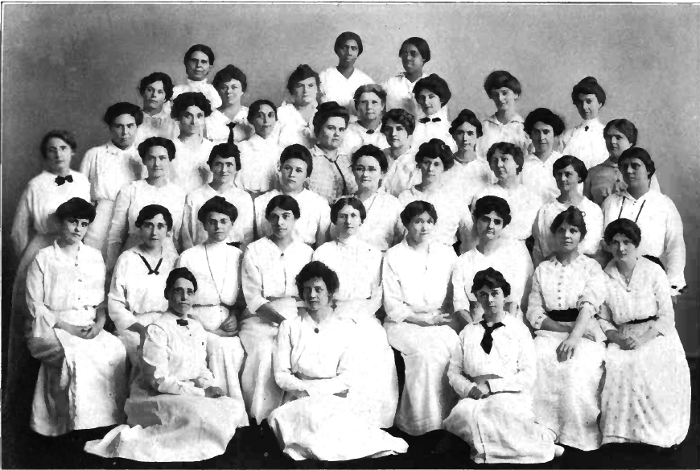 FIELD NURSES, DISPENSARY DEPARTMENT
CHICAGO MUNICIPAL TUBERCULOSIS
SANITARIUM
FIELD NURSES, DISPENSARY DEPARTMENT
CHICAGO MUNICIPAL TUBERCULOSIS
SANITARIUM