Father Ignatius calls himself a Benedictine monk, and his
nuns belong to the same order. One would have supposed
that though he imitated Rome in the worship of the wafer
and of the Virgin, he would still have hesitated to go the full
length of Romish superstition by obliging his nuns to put
their trust in such questionable characters as Gregory VII.,
Thomas à Becket, etc. Yet on page 185 of the above book
they are required to ask Gregory VII. to pray for them, and
on the following page Thomas à Becket is invoked in the
same manner. Who and what these two Romish saints were,
truthful English history abundantly proves.
As the title of the book shows, it is intended to foster
devotion to St. Benedict, to his sister Scholastica, and to
all the other canonized saints of the Benedictine Order.
Now, who canonized these supposed saints? Was it not
Rome?
The first part is entirely devoted to the honouring and invoking
of St. Benedict. Throughout this part we frequently
meet with the verse, “Pray for us, O holy Father St. Benedict.”
There are also a number of litanies, in which he is
called upon as being now “placed over the choirs of monks,”
as “the star of the world,” as “the equal of the prophets,”
as “protector of his order,” as “the scourge of devils,” as the
“Abraham of the New Testament,” and is entreated with the
cry, “We beseech thee to hear us.” On page 47 the following
invocation occurs: “Beseeching thee (holy Father St.
Benedict) to be so faithfully present to me at the hour of my
death, as to oppose thyself on every side where thou shalt
see the assaults of the enemy most violently raging against
me, that, being defended by thy presence, I may securely
escape the snares of the enemy, and arrive at the joys of
heaven.”
Similar impieties occur throughout this and the other
parts. Thus, in the part devoted to St. Scholastica, on page
131, we find the following collect: “Mercifully look down
upon Thy family, we beseech Thee, O Lord, through the
merits of Thy blessed Virgin, St. Scholastica; and as by her
prayers Thou didst cause the rain to descend from heaven
deign, through her supplications,” etc. A number of litanies
also occur, in which she is addressed in the most gushing
way, and asked to pray for those who thus address her.
Moreover, this book introduces prayers for the dead.
Thus, on page 165, the versicle, “May the souls of the faithful
departed, through the mercy of God, rest in peace.”
There are many other superstitious practices contained in
the book, notably the medal of St. Benedict, the wearing of
which is declared on page 223 to be “a constant silent prayer
to God, … that He would have regard to the merits
of our holy Father, and for his sake would extend His own
protection,” etc.
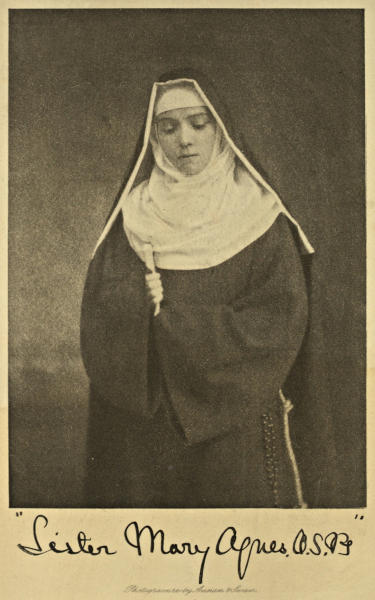
Sister Mary Agnes says that the whole of this book, with
the exception of the part on Indulgences, was in constant
use by the nuns under Father Ignatius.
Must not then monasticism be a fostering garden of superstition,
since even those who claim to reject Rome resort
to the same subterfuges as Rome does to fill the void that
must necessarily exist in the aching hearts of all the deluded
followers of monasticism?
The next book, under Appendix B, will appear, if possible,
even more grossly superstitious than the former.—(Editor.)
In the preface a short account is given of the life of St.
Gertrude, which is chiefly a legendary history, and made up
of some of the most absurd and ridiculous tales.
“Once, when she was pouring out her whole heart in love
to its Divine Spouse, it received the impression of the five
wounds of the Divine Redeemer, and Gertrude felt them
continually to the moment of her death with an ever-increasing
anguish and love.”
Again, “On another occasion, on the Feast of Annunciation,
the Mother of God fastened on her breast a heavenly
jewel, wherein were seven precious stones.”
Again, we have another still more extraordinary miracle
vouchsafed to her; for “once she received in her heart the
Divine Infant, who sprang from his crib to attach himself
to her.”
Must not such teaching as this be in the highest degree
degrading? And must not those who can swallow such
stuff be spiritually demented?
It is almost needless to point out that Saint Gertrude is
said to have been devoted to the worship of the Virgin
Mary. We find the following most blasphemous words on
the subject: “The love of Gertrude towards Mary was in
proportion to the tenderness with which the Mother of God
regarded the dearest of the Spouses of her Son. Gertrude
has bequeathed to us the expression of her devotion to the
glorious Queen of heaven in that exquisite prayer which so
expressively reveals the deep and touching character of her
piety: ‘Hail, fair lily of the effulgent and ever-glorious
Trinity! Hail, radiant rose of heavenly fragrance, of whom
the King of heaven willed to be born, and with thy milk to
be fed, feed our soul with thy Divine insinuations!’” I will
only give the last prayer in the book to show how the invocation
of supposed saints is inculcated, as in the other book
so commonly used in monastic and conventual institutions.
“O God, who hast prepared for Thyself a dwelling-place
of delights in the most pure heart of the blessed Virgin
Gertrude, deign, we beseech Thee, through her merits and
intercession, to wipe away all stains from our hearts, that
they may become meet abodes of Thy Divine Majesty,
through Jesus Christ our Lord. Amen!”—(Editor.)
This book was sent to me by Sister Agnes, who wrote
as follows when forwarding it:
“I send the book which we used daily. It was my constant
friend for years; my troubles and sorrows I confided
to it. The hymns with the word ‘Ignatius’ at the end
are his, but not the others; the writing in the first part
of the book, written in MS. on foreign note paper, is
taken from St. Alphonsus Liguori, and was approved of by
Ignatius, except the part I have covered over: that he did
not approve of. It treats of sinful obedience. I cannot quite
make it out. The book it is culled from is, I think, entitled
‘The Religious Life.’”
Before reviewing the book itself, I purpose to place before
you a part of the matter “written on foreign note paper,”
and stuck carefully into the book, acting as a kind of preface
to it, as we may say.
I would urge my readers to stay a moment and mark
carefully, and inwardly digest this description of a nun’s
life. Where is the liberty that is so vainly spoken of? Are
we not here told that a nun by her profession has her
liberty absolutely consumed; that is to say, she is a prisoner
for life?
Notice, I pray you, the words “it is a true holocaust.” In
fact, the sin of the children of Israel, who “caused their sons
to pass through the fire,” is committed over again. As king
Manasseh “caused his children to pass through the fire in
the valley of the son of Hinnom,” so under the pretence of
offering the nuns to the service of God, the Roman Catholics,
and alas! members of the Church of England, “sacrifice
their sons and daughters to devils” (Ps. cvi. 37). It is
nothing but Moloch worship over again. But to proceed
with Liguori’s description of the life of the religious:
“The violation of the vows is then a very grievous sin
against the virtue of religion—(it is) the crime of sacrilege.
Man, consecrated to God and to His service, becomes something
divine; he owes himself, therefore, a religious respect,
which rebounds ever to God; and if ever he should dishonour
by mortal sin the virtues of poverty, obedience, and virginity,
of which he has made profession, he would commit an outrage
against the Divine honour, he would be guilty of sacrilege.
What rashness! what crime! what impiety would it
not be then in you to violate your vows!
“The infidelity of consecrated persons is more awful than
the sacrilege committed against holy places, Eucharist
vessels, holy pictures, or relics. Your soul would shudder
at the mere thought of a desecrated temple, a dishonoured
ciborium, a broken crucifix, or of a saint’s body cast into the
flames: would it then consent to far more horrible crimes,
or to more infamous violations? Virginity derives not its
nobility and worth from itself, but rather because it is an
offering to the Lord, inspired and preserved by prudence
and piety of the soul.
“If it should happen that a religious, in drawing comparison
between his life and that of Christians in the world,
should be seized with a holy fear lest he be less zealous, less
pure, or less fervent than many of them, he may still find
a legitimate reassurance in the thought that his actions,
though they may be apparently less virtuous and brilliant,
derive, notwithstanding, greater value and more real devotion
than theirs from the virtue of religion, which is their
chief source, and which has so high a place amongst the
more virtuous.”
Do we not see here how a nun is taught to meet what
must be an oft-recurring thought—that her life is utterly
useless, and that she is unable to devote herself actively to
the service of God, and that misery and unhappiness surround
her, and that she cannot be so pure as many who,
living in the world, are not shut up, so to speak, with only
their own heart’s corruptions to brood over. She is taught
that all these serious failings are more than atoned for by
the mere fact that she has made a solemn profession of
poverty, chastity, and obedience. But to proceed.
“He may be consoled that he has eternally consecrated
to the Lord the root of his actions in such a way that they
all bear the threefold character of a profound religion, ardent
generosity (?), and eternal attachment to that which is good.
We may reasonably suppose that on its entrance into religion,
by making profession of the vows, the Christian soul
obtains remission of all its sins. Not that the religious profession,
considered in itself, possesses a sacramental virtue,
operating by its own intrinsic and independent office, or that
it can, like baptism and penance, blot out the stain of sin;
but if it be sincere, it is a most excellent act of perfect
charity, which unites us very closely to God, by an effectual
outpouring of His sanctifying grace, and by an abundant
remission of those temporal punishments which remain due
to sin after its guilt has been forgiven.
“Before dismissing this noble subject of religious profession
let us not omit to observe that the vow of obedience is its chief
feature. That which is done by obedience is more agreeable
to God than that which is performed by one’s own will.
Your Superior is like a sacred vessel wherein God has placed
for us all His desires and graces, and the true proof of
religious sanctity, the sure token of perfection, is the perfection
of obedience to all Superiors.
“Need we add that obedience has its limits. There are,
firstly, things forbidden by the law of God, which a Superior
cannot prescribe without injustice, since, being then no longer
subordinate to the Divine will, he can no longer serve as a
medium between him and his subject. They are without
the pale of obedience, and the Superior has no authority to
enforce them. The subject, therefore, is not to act contrary
to the law of God, or to the rule which they profess to
follow; in such obedience would be illicit.”
I must make a few observations on this matter of obedience.
Notice how, by such an obedience, a professed nun
(or monk) transfers to an erring mortal the whole responsibility
of her actions. She has to find out God’s will through
the Superior’s. The Superior is to her in the place of God,
and practically his law and order becomes for her God’s law
and order. How can she remonstrate, when the Superior
commands what is against the law of God, when she has
been taught that she can only learn what is God’s law
through the medium of the Superior? And if she dared to
resist her Superior’s will because she felt it to be leading her
astray, do you suppose that the Superior would ever acknowledge
himself or herself to be in the wrong? And is it
likely that the poor nun would escape some terrible penance
for daring to doubt the propriety of any behest?
But the last paragraph, commencing “Need we add that
obedience has its limits,” and closing with “Such obedience
would be illicit,” was carefully hidden, for Father Ignatius
had told his nuns to paste a piece of paper over it, since he
could not agree with the Romish doctor! He required an
absolute and unconditional obedience, and believed it impossible
for a Superior to prescribe any law that was against
the law of God.
St. Alphonsus Liguori has always been considered an
extreme exponent of Romish doctrines; but now we find a
man holding orders in the Church of England going even
beyond Liguori. I beg my readers to make a special note
of this. I will now finish my extracts from the writing on
foreign note-paper inserted in the book I am about to
review.
(This is enough to frighten a poor, timid girl, and to bind
her in chains to her prison.)
“The spiritual dangers of the religious life are not to be
attributed to the vows, but rather to the fault, of him who, by
changing his mind, transgresses those vows. Do not then,
under the pressure of most cruel temptations”—(who makes
them cruel? Read the experiences of Miss Povey or any
other nun who has had the good fortune to escape, or to be
turned out of her prison, and you will find out)—“regret the
profession you have made in the fulness of liberty”—(remember
that previous to profession the Superiors have cunningly
woven their entangling web around the nun, and the
profession may be compared to the spider, after he has
secured his prey, carrying the poor helpless fly into the inner
precincts of his home)—“but rather behave the more diligently
to subject your impatient nature to so salutary a
yoke.” Mark the word “salutary.” Is it not a well-attested
fact that many nuns go mad from the unnatural confinement
within convent walls?
I can only hope to give a very short review of this book,
which was placed in the hands of a nun who was a member
of the Church of England. I have not time for an elaborate
or lengthy account of its contents. I do not think that it
was only at Llanthony that this book was used, and it is to
be feared that whilst the Feltham convent is now no longer
under the wing of Father Ignatius, yet that, with the exception
of unconditional obedience, the teaching there is as
extreme and as Romish as at Llanthony, and yet I believe
a clergyman, holding a licence to officiate in the diocese of
London, acts as chaplain there. How long our bishops
are going to allow and wink at this state of things, I know
not! May God raise up many faithful men who will
demand that the laws of our Protestant Church be complied
with!
The above work is one of the so-called devotional books
prescribed by Father Ignatius, to be used by the nuns under
his control.
It is a Roman Catholic publication, in constant use in all
the monastic and other institutions of that Church; was
composed in Italian by Liguori, the founder of the Redemptorist
Order, translated into English by the Rev. R. A. Coffin,
a member of that order, and published by Burns & Oates,
the leading Romish publishers in Great Britain.
The nature of this book may be readily ascertained from
the fact that it presupposes the consecrated wafer to be
really and truly Christ himself, and that it insists upon the
Virgin Mary as being the Saviour of every one that is
saved. For, in the beginning of the introduction, Liguori
says:
“Our holy faith teaches us, and we are bound to believe,
that in the consecrated host Jesus Christ is really present
under the species of bread”; and, further on, speaking of
the visits to the Virgin, he says:
“The opinion of St. Bernard is well known and generally
believed. It is that God dispenses no graces otherwise than
through the hands of Mary.… Hence, Father Suarez
declares that it is now the sentiment of the universal Church
that ‘the intercession of Mary is not only useful, but even
necessary to obtain graces,’” and he concludes:
“Do you then be also careful to always join to your daily
visit to the most blessed Sacrament a visit to the most holy
Virgin Mary in some church, or at least before a devout
image of her in your own house.”
“Most holy immaculate Virgin, and my mother ‘Mary,’”
in which she is styled the “queen of the world,” “the hope,
the refuge of sinners,” and the following blasphemous expressions
are used:
“I worship thee, O great queen, and I thank thee for all
the graces which thou hast hitherto granted me; and especially
I thank thee for having delivered me from hell,
which I have so often deserved.… I place all my
hopes in thee, and I confide my salvation to thy care, etc.”
“Sole refuge of sinners, have mercy on me.” “O Mary,
grant me the grace always to have recourse to thee.” “Hail,
our hope.” “My hope, help me.” “Therefore, my lady,
and my hope, if thou dost not help me, I am lost.” “All
who are saved obtain salvation through thee; thou then, O
Mary, hast to save me,” and the like.
Extracts might be piled upon extracts, but enough have
been given to show the nature and tendency of the book.
Yet this book the nuns, under Father Ignatius’s jurisdiction,
are induced to keep as a constant companion.
It does not seem necessary to say anything further on the
head of this book: for its antichristian nature must be
apparent to all students of the pure word of God. In Christ
alone is salvation, and He alone is our Mediator between
God and man.—(Editor.)
FOOTNOTES
27, Paternoster Row,
London.
HODDER & STOUGHTON’S
New and Recent Publications.
THE CHRISTIAN MINISTRY: Its Origin, Constitution,
Nature, and Work. The Donnellan Lectures for 1888,
together with Notes and Appendices.
By the Very Rev. William Lefroy, D.D., Dean of Norwich
(sometime Incumbent of St. Andrew’s, Liverpool; Honorary Canon
of Liverpool Cathedral, and Archdeacon of Warrington). In one
volume, 8vo, price 14s.
STUDIES ON THE EPISTLES. By the Rev.
Professor F. Godet, D.D. Translated by Mrs. Annie Harwood
Holmden. Crown 8vo, cloth, 7s. 6d.
PERSONAL AND FAMILY GLIMPSES OF
REMARKABLE PEOPLE.
By the Venerable Archdeacon E. W. Whately, M.A., late
Chancellor of St. Patrick’s and Rector of Werbergh, Dublin.
Crown 8vo, cloth, price 6s. 6d.
IMAGO CHRISTI: The Example of Jesus Christ.
By the Rev. James Stalker, M.A., Author of “The Life of
Jesus Christ,” “The Life of St. Paul,” etc. Crown 8vo, cloth,
price 5s.
IRELAND AND THE ANGLO-NORMAN
CHURCH: A History of Ireland and Irish Christianity from the
Anglo-Norman Conquest to the Dawn of the Reformation.
By the Rev. G. T. Stokes, D.D., Professor of Ecclesiastical
History in the University of Dublin, and Vicar of All Saints’,
Blackrock; Author of “Ireland and the Celtic Church,” etc.
Crown 8vo, cloth, price 9s.
BENJAMIN HELLIER: His Life and Teaching.
A Biographical Sketch, with Extracts from his Letters, Sermons,
and Addresses. Edited by His Children. With Portrait and
Illustrations. Crown 8vo, cloth, price 7s. 6d.
ALONE WITH THE WORD: Devotional Notes
on the Whole of the New Testament. By G. Stringer Rowe,
Governor of Headingley College, Leeds. 8vo, cloth, price 6s. 6d.
WORKS BY CANON WYNNE, D.D.
I.
FRAGMENTARY RECORDS OF JESUS OF
NAZARETH. From the Letters of a Contemporary. By
Frederick R. Wynne, D.D., Canon of Christ Church, and
Incumbent of St. Matthias’, Dublin. In crown 8vo, price 3s. 6d.
“Simple and yet forcible in style, the little volume is likely to lead the
wavering to a firmer faith.”—Nonconformist.
“This volume will be read with profit for its wisdom, excellent spirit,
thorough fairness, and delightfully reverent tone.”—Christian Advocate.
II.
THE JOY OF THE MINISTRY. An Endeavour
to Increase the Efficiency and Deepen the Happiness of Pastoral
Work. In crown 8vo, price 3s. 6d. Second Edition.
“There is no clergyman of any Church, old or young, who will not be
moved, and there must be very few who will not be healthily stimulated, by
the perusal of a work based on the purest Christian principles, and embodying
in graceful language the results of wide observation and personal practice.”—Scotsman.
III.
PLAIN PROOFS OF THE GREAT FACTS
OF CHRISTIANITY. For the Help of Minds Perplexed with
Difficulties. Cheap Edition. Cloth, price 1s. 6d.
IV.
SPENT IN THE SERVICE. A Memoir of the
Very Rev. Achilles Daunt, D.D., Dean of Cork. With selections
from his Letters, Diaries, and Sermons. Third Edition. With
Portrait, price 5s.
“We feel grateful to Mr. Wynne for giving us so lifelike a sketch of a very
beautiful character.”—Literary Churchman.
“A most interesting memoir. Mr. Daunt appears to have been not only an
eloquent and fervent preacher, but a most holy man, singularly true and
thorough in all relations of life. The memoir is unusually well written, and
readable.”—Guardian.
CHRISTIAN THEISM: A Popular Survey of the
Evidence on which it rests, and the Objections urged against it
Considered and Refuted. By the Rev. Prebendary C. A. Row,
M.A., D.D. Crown 8vo, cloth, price 5s.
THE HALLOWING OF CRITICISM: Nine
Cathedral Sermons on Elijah. By the Rev. Prof. T. K. Cheyne,
D.D., Canon of Rochester. Crown 8vo, cloth, price 5s.
PALESTINE IN THE TIME OF CHRIST.
By Edmond Stapfer, D.D., Professor in the Protestant Theological
Faculty of Paris. Translated by Annie Harwood
Holmden. With Map. Crown 8vo, price 9s.
“The book, as a whole, is of great interest, and will prove, we believe, a
great help to those who desire to reach for themselves the actual meaning of
the Gospels. It will be a valuable addition to the apparatus criticus of the
Biblical student, and will help to give colour and vividness to the preacher’s
description of scenes and incidents from which he would draw forth moral and
spiritual lessons for his hearers.”—Nonconformist.
THE TRINITY OF EVIL. I. Infidelity.—II.
Impurity.—III. Intemperance. By Rev. Canon Wilberforce,
M.A. New and Cheaper Edition. Crown 8vo, cloth,
price 1s. 6d.
“One of the most sonorous and telling trumpet-blasts against infidelity,
impurity, and intemperance we have ever heard. Every page of the Canon’s
not only throbs with passionate earnestness in the cause of truth and
righteousness, but is full of point and fine literary power.”—Literary World.
DANIEL’S PROPHECIES NOW BEING
FULFILLED. With a Harmony in the Words of the Revised
Version. By the Rev. E. P. Cachemaille, M.A. In Crown
8vo, cloth, price 2s. 6d.
LIGHT AND COLOUR EMBLEMATIC OF
REVEALED TRUTH. By the late Major R. W. D. Nickle.
Edited by Sarah Sharp. With Diagrams. Crown 8vo, cloth,
price 7s. 6d.
“The work is highly edifying, and will be found by lovers of Holy Scripture
to contain much that is fresh and instructive. The diagrams are choice, and
tend greatly to the elucidation of the subject. By the help of this work a
new domain of knowledge is opened, and many passages of Holy Writ re-illumined.”—Christian.
SOME CENTRAL POINTS OF OUR LORD’S
MINISTRY. By the Rev. Henry Wace, D.D., Principal of
King’s Coll., London, and Hon. Chaplain-in-Ordinary to the
Queen; Author of “The Foundation of Faith,” “Christianity and
Morality,” etc. Crown 8vo, cloth.
WORKS BY THE REV. CANON BELL, D.D., Rector of Cheltenham.
OUR DAILY LIFE: Its Duties and its Dangers.
Crown 8vo, cloth, price 3s. 6d.
“The subjects selected are admirably handled. It is a very excellent, most
useful book.”—Church Bells.
HENRY MARTYN. Cheap Edition. Crown 8vo,
cloth, price 1s.
“A worthy record of a noble life.”—Whitehall Review.
“In every way a most delightful volume.”—Rock.
THE VALLEY OF WEEPING A PLACE
OF SPRINGS. A Practical Exposition of the Thirty-second
Psalm. Crown 8vo, cloth, price 3s. 6d.
“The whole volume is delightful in every way. As a meditative work, it
is one which will be profoundly enjoyed by those who can obtain a copy of it.”—Clergyman’s
Magazine.
A WINTER ON THE NILE, IN EGYPT,
AND IN NUBIA. Second Edition. Artistically bound, Eau
de Nil cloth, price 6s. With Map.
“He is an excellent traveller, making friends with everybody, receiving
invitations from Egyptian authorities, foreign consuls, and Coptic clergy, and
the native peasantry, all alike opening their hearts and homes to him. The
result is an insight into Egypt as it is, and very much as it has been for a
thousand years. The Canon’s descriptions of manners and customs are lifelike,
and sometimes not a little amusing.”—Times.
GLEANINGS FROM A TOUR IN PALESTINE
AND IN THE EAST. Second Edition. Crown 8vo,
price 6s. With Map and Illustrations.
“Canon Bell is a scholar and something of a poet; and the reader may be
sure that anything which proceeds from his hand is written with care,
reverence, and polished skill.… It is a pleasant duty to recognise the
admirable spirit in which Canon Bell has treated the more important part of
his work. The reflections upon a visit to such spots as the Mount of Olives,
the Garden of Gethsemane, or the place of the Crucifixion, are conceived in a
truly reverent and majestic vein. The verses written in contemplation of
these sacred spots are marked by great beauty and devotion. They read like
some of the Church’s glorious hymns of the Passion set anew, in fresh strains
and varied metre.”—Morning Post.
CHRIST AND HIS PEOPLE. In crown 8vo,
cloth, price 5s.
Thirteen Addresses by
- The Bishop of Liverpool,
- The Dean of Ripon,
- Archdeacon Richardson,
- Canon Hoare,
- Prebendary Edmonds,
- H. C. G. Moule,
- Canon J. W. Bardsley,
- Sir Emilius Laurie, and
- George Everard.
THE REVELATION OF JOHN: An Exposition.
By P. W. Grant, Author of “The Bible Record of Creation
True for Every Age,” “The Great Memorial Name,” etc. Crown
8vo, cloth, price 6s.
THE SAINT AND HIS SAVIOUR. By C. H
Spurgeon. A New Edition, set up and printed from new type.
With Portrait. Crown 8vo, cloth, price 3s. 6d.
THE WOMEN FRIENDS OF JESUS; or,
Lives and Characters of the Holy Women of Gospel History. By
Henry C. Mccook, D.D. In crown 8vo, cloth, price 5s.
“Dr. McCook describes in felicitous and flowery language the lives and
characters of famous women of Gospel history.”—Scotsman.
“Rich in Biblical and historical knowledge, and graphic and picturesque in
style.”—Glasgow Herald.
“It will be no difficult task to write many a paragraph in praise of the
exquisite pathos, the insight into womanly character, which these pages
breathe.”—Methodist Recorder.
THE STORY OF THE LIFE OF JESUS
Told in Words Easy to Read and Understand. By the Author of
“The Story of the Bible,” etc. With Forty Illustrations. Handsomely
bound, fcap. 4to, cloth, price 2s.
“An excellent Sunday book for children; the story is tenderly and brightly
told, the pictures of Eastern life and Jewish manners form an effective running
commentary on the text, which is interspersed besides with graphic views of
the sacred cities, sites, and scenery.”—Times.
TOILERS IN LONDON; or, Enquiries Concerning
Female Labour in the Metropolis. By the “British Weekly”
Commissioner. Crown 8vo, cloth, price 3s. 6d.
NEWLY ENLISTED. A Series of Talks with
Young Converts. By the Rev. Theodore Cuyler, D.D. Square
16mo, 160 pp., cloth, price 1s. 6d.
“Clear, bright, forcible, these talks are full of wisdom. The book must
rouse as well as teach many.”—Methodist Recorder.
“This is a beautiful little volume, replete with sound thought, practical
instruction, and earnest evangelical truth.”—Christian News.
THE GROWTH OF CHURCH INSTITUTIONS.
By Rev. Edwin Hatch, D.D., Reader in Ecclesiastical
History, Oxford. Second Edition. In crown 8vo, price 5s.
“Dr. Hatch’s vast learning, his comprehensive grasp of his subject down
to its minutest details, his lucid style, and his remarkable candour, are equally
conspicuous, and we strongly commend the study and the mastery of this
volume to all who are anxious to set the ecclesiastical problems of our day
in their true light, and to resist the persistent claims of an arrogant priesthood.”—Freeman.
THE ANGLICAN PULPIT OF TO-DAY.
Forty Short Biographies and Forty Sermons of Distinguished
Preachers of the Church of England. In crown 8vo, price 7s. 6d.
Handsomely bound in cloth.
DR. GODET’S BIBLICAL STUDIES.
I.
STUDIES ON THE NEW TESTAMENT.
By F. Godet, D.D., Professor of Theology, Neuchâtel. Edited
by the Hon. and Rev. W. H. Lyttelton, M.A., Canon of
Gloucester. Seventh Edition. Crown 8vo, price 7s. 6d.
II.
STUDIES ON THE OLD TESTAMENT.
Fourth Edition. Crown 8vo, price 7s. 6d.
“Unquestionably M. Godet is one of the first, if not the very first, of contemporary
commentators. We have no hesitation in advising all students of
the Scripture to procure and to read with careful attention these luminous
essays.”—Literary Churchman.
WORKS BY PRINCIPAL FAIRBAIRN, D.D.
STUDIES IN THE LIFE OF CHRIST. By
A. M. Fairbairn, D.D., Mansfield College, Oxford. Fifth
Edition. 8vo, price 9s.
“These studies are full of spiritual penetration, profound philosophy of
moral life, and literary beauty. Devout in feeling, and evangelical in theological
view, they are yet characterised by great freedom and independence of
thought.”—British Quarterly Review.
THE CITY OF GOD. A Series of Discussions in
Religion. Third Edition. Price 7s. 6d.
“We have read many of the truly brilliant passages of this volume with
thrilling delight. The theology is orthodox, the logic is accurate, and the
learning profound.”—Ecclesiastical Gazette.
RELIGION IN HISTORY AND IN THE
LIFE OF TO-DAY. Fourth Thousand. Cloth, price 1s. 6d.
“His clear and closely-reasoned thought finds utterance in clear and well-knit
speech.”—Academy.
THE MIRACLES OF OUR LORD. By the Rev.
Professor J. Laidlaw, D.D., Author of “The Bible Doctrine of
Man,” etc. Crown 8vo, cloth, price 7s. 6d.
ROMANCE OF PSALTER AND HYMNAL:
Authors and Composers. By the Rev. R. E. Welsh, M.A., and
F. G. Edwards, Author of “United Praise.” Crown 8vo, cloth,
price 6s.
TROPICAL AFRICA. By Henry Drummond,
F.R.S.E., F.G.S. Fifteenth Thousand. With Six Maps and
Illustrations, price 6s.
“Professor Drummond is a clear and accurate observer, and as he has had
a sound scientific training, and has a real interest in the human side of African
life, he is able to present us with pictures of a distinctness and originality not
often met with in books of African travel.”—Times.
NATURAL LAW IN THE SPIRITUAL
WORLD. By Prof. Henry Drummond, F.R.S.E., F.G.S.
Twenty-fifth Edition, completing Ninety-second Thousand. In
crown 8vo, price 3s. 6d.
“This is one of the most impressive and suggestive books on religion that
we have read for a long time. Indeed, with the exception of Dr. Mozeley’s
‘University Sermons,’ we can recall no book of our time which showed such
a power of re-stating the moral and practical truths of religion so as to make
them take fresh hold of the mind and vividly impress the imagination.”—Spectator.
THE GREATEST THING IN THE WORLD.
An Address on 1 Corinthians xiii. Crown 8vo, leatherette,
price 1s.; cloth, 2s. 6d.
LECTURES ON THE HISTORY OF PREACHING.
By the late Rev. John Ker, D.D. Second Edition.
Crown 8vo, price 7s. 6d.
“A valuable legacy to the Church of Christ. We know no better book than
this to place in the hands of candidates for the ministry, and we should gladly
see it used by the bishops of our own Church as an indispensable text-book
for all who are studying for holy orders.”—English Churchman.
JAMES MACDONELL OF “THE TIMES”:
A Story of Self-Help. By W. Robertson Nicoll, M.A. With
Etched Portrait by H. Manesse. 8vo, price 12s.
MODERN SCIENCE IN BIBLE LANDS.
By Sir J. William Dawson, F.R.S. With Maps and Illustrations.
In crown 8vo, price 9s.
“The result of a tour through Italy, Egypt, and Syria, collected by a geological
observer of such eminence as Sir William Dawson has shown himself
to be, cannot but be of great value. Such are his knowledge and grasp of the
subject, his perfect fairness and impartiality, and his close and careful reasoning,
that it is not too much to say that he has summed the present extent of
our knowledge of Bible lands.”—Pall Mall Gazette.
BY THE SAME AUTHOR.
I.
THE STORY OF THE EARTH AND MAN.
With Twenty Illustrations. Ninth Edition. Crown 8vo, cloth,
price 7s. 6d.
II.
FOSSIL MEN AND THEIR MODERN REPRESENTATIVES.
An attempt to illustrate the Characters and
Condition of Pre-Historic Men in Europe by those of the American
Races. With Forty-four Illustrations. Third Thousand. Crown
8vo, cloth, price 7s. 6d.
III.
THE ORIGIN OF THE WORLD, according to
Revelation and Science. Fifth Edition. Crown 8vo, cloth, price
7s. 6d.
“We heartily commend the book to all those who are interested in this most
important question. Dr. Dawson is a man well known in the ranks of science
for great breadth and grasp of knowledge; he has been a pioneer in geological
discovery: he is also a considerable Hebrew scholar, well read in the Bible,
and especially those parts which treat of nature.… It is a valuable addition
to Bible criticism from a point of view higher scientifically than we have yet
had.”—Spectator.
WORKS BY DR. R. W. DALE, Birmingham.
IMPRESSIONS OF AUSTRALIA. Crown 8vo,
cloth, price 5s.
LAWS OF CHRIST FOR COMMON LIFE.
Fourth Thousand. Crown 8vo, price 6s.
“Sound sense and wholesome Christian teaching conveyed in pure, idiomatic,
and forcible English.”—Scotsman.
“This book excellently well bears out its title. The author gives wise and
manly counsel.”—Literary Churchman.
THE EPISTLE TO THE EPHESIANS. Its
Doctrines and Ethics. Fourth Thousand. Crown 8vo, price 7s. 6d.
In his first sermon as Vicar of Leeds, Dr. Talbot said: “I believe that the
thought of speaking of God’s purpose in Christ was suggested to me by reading
whilst abroad just now the impressive words about it in Dr. Dale’s noble
book upon the Epistle to the Ephesians. It is only a single but superlative
instance of what we owe to Nonconformist faith and goodness.”
THE NEW EVANGELICALISM AND THE
OLD. Crown 8vo, cloth, price 1s.
THE JEWISH TEMPLE AND THE
CHRISTIAN CHURCH. A Series of Discourses on the Epistle
to the Hebrews. Seventh Edition. Crown 8vo, price 6s.
“Wholesomer sermons than these it is almost impossible to conceive. Mr.
Dale’s preaching has always been remarkable for moral energy and fervour,
but here this characteristic rises to its highest power.”—Expositor.
WEEK-DAY SERMONS. Fifth Edition. Crown
8vo, price 3s. 6d.
“Dr. Dale is certainly an admirable teacher of Christian ethics. He is,
perhaps, the greatest living successor of the Apostle James. In this volume
he appears at his best.”—Christian.
THE TEN COMMANDMENTS. Fifth Edition.
Crown 8vo, price 5s.
“Full of thought and vigour.”—Spectator.
“The manly, fearless honesty of Mr. Dale’s Expositions demands the very
highest eulogy.”—British Quarterly Review.
NINE LECTURES ON PREACHING. Fifth
Edition. Crown 8vo, price 6s.
“Admirable lectures, briefly written, earnest and practical, the work of an
able man.”—Literary Churchman.
THE EVANGELICAL REVIVAL and other
Sermons. Crown 8vo, cloth, price 6s.
PROFESSOR KURTZ’S CHURCH HISTORY.
Authorised Translation from the latest revised edition, by the Rev.
John Macpherson, M.A. In three volumes. Price 7s. 6d. each.
“The complete work of Professor Kurtz is now translated, and it
really shows itself so improved in form, so much fuller in substance,
in fact, so much changed in mind, body, and state, that it may claim
to be a new history altogether. No one who has tried to peruse the
original compilation will deny that this is an unspeakable advantage
in a once unreadable manual; and, indeed, a ‘manual,’ by its very
name, signifies a work that is meant to hold in the hand and not to
enter the head. The author has carried on his history into the most
recent days. Nothing has escaped his all-seeing eye and his all-recording
pen—neither the Theosophism of Madame Blavatsky, nor
the microscopic heresies of Mr. David Macrae in the United Presbyterian
Church, neither the doings of the Berlin treaty nor of Dr.
Robertson Smith. The annals of the last fifty years on the Continent
are given with considerable fulness, and ecclesiastical events in
Germany are given with an especial amount of detail.”—Scotsman.
DR. FISHER’S NEW CHURCH HISTORY.
A HISTORY OF THE CHRISTIAN CHURCH.
By George P. Fisher, D.D., LL.D., Professor of Ecclesiastical
History in Yale University. In large 8vo, 712 pages, price 12s.
With Seven coloured Maps.
“This very valuable and exhaustive history.”—English Churchman.
“It is a book as remarkable for fairness and breadth of sympathy
as it is for learning and power; and if its popularity should be as
great as its value, its success is assured.”—Nonconformist.
THE CATACOMBS OF ROME, AND THEIR
TESTIMONY RELATIVE TO PRIMITIVE CHRISTIANITY.
By Rev. W. H. Withrow, M.A. Crown 8vo, cloth,
price 6s. 560 pages, 134 Illustrations.
“An exceedingly painstaking and thorough-going work, and
whether or not the writer may be correct in all his inferences, they
have evidently been founded upon diligent information. He could
not have very much that was absolutely new to tell on the subject;
but as a convenient account of the most remarkable and interesting
monuments of primitive Christianity, of those excavations which
furnished the persecuted Church with refuges during life and in
death, which formed her places of worship in times of peril, and
received the remains of martyrs, the present volume is perhaps
inferior to none of its predecessors.”—Saturday Review.
THE PHILANTHROPY OF GOD. By the Rev.
Hugh Price Hughes, M.A. Crown 8vo, cloth, price 3s. 6d.
SOCIAL CHRISTIANITY. Sermons delivered in
St. James’s Hall, London. By Rev. Hugh Price Hughes,
M.A. Third Edition. In crown 8vo, cloth, price 3s. 6d.
Press Notices.
“If all sermons were as fresh and unconventional, as simple,
practical, and unaffected as those which he (Rev. Hugh Price
Hughes) has put together under the appropriate title of ‘Social
Christianity,’ there would perhaps be less grumbling from the pew
than is at present the case.”—Scotsman.
“Wise, strong, wholesome, and thoughtful.”—British Weekly.
“It is not difficult, after reading these fervid, brave, and genial
addresses, to understand the secret of such a preacher’s spell. Mr.
Price Hughes does not mince matters in dealing with the lawlessness,
the Mammon-Worship, and the social disorders of the times; and the
tones in which he speaks are far-reaching and persuasive, because
they are brotherly and full of faith and hope.”—Leeds Mercury.
“These vigorous sermons are an attempt to show that what must
be called the social failure of Christianity is not the fault of
Christianity or of Christ, but rather the result of Christians having
been selfishly individualistic. The great evils of our day, and
especially those of our own country, are brought to view with much
directness, and the duties and responsibilities of disciples of Christ
are enforced with plainness and power. Whether the subject be
social distress, the administration of justice, Christ’s authority, or the
problem of unbelief, we find these pages uniformly practical and in a
high degree instructive.”—Christian.
“These sermons are full of good, manly, vigorous teaching of a
stout, practical kind.”—Star.
“While the ordinary volume of sermons sends people to sleep,
this will assuredly keep them awake; and it will, moreover,
keep them awake by perfectly legitimate expedients.”—Manchester
Examiner.
THE ATHEIST SHOEMAKER: A Story of the
West End Mission. By the Rev. Hugh Price Hughes, M.A.
Crown 8vo, cloth, price 1s. 6d.
JOHN G. PATON: An Autobiography. Second Part.
Edited by his Brother, the Rev. James Paton, B.A. Sixth
Thousand. Crown 8vo, cloth, price 6s.
JOHN G. PATON, Missionary to the New Hebrides.
An Autobiography. Edited by His Brother. With Portrait.
Fifth Edition, completing Eleventh Thousand. Crown 8vo, cloth,
price 6s.
The Rev. Dr. Pierson, author of “The Crisis of Missions,” says: “I consider
it unsurpassed in missionary biography. In the whole course of my
extensive reading on these topics, a more stimulating, inspiring, and every
way first-class book has not fallen into my hands. Everybody ought to read it.”
Opinions of the Press.
“A more fascinating and thrilling bit of Missionary history has seldom been
given to the public.”—Christian.
“Intensely interesting; indeed, often quite fascinating.”—Christian Leader.
“Let the people who tell us that the romance of missions is passed, read
this manly and thrilling narrative.… No fiction can exercise a stronger
spell than the story of this brave Cameronian missionary’s life.”—Baptist
Magazine.
“The story of Mr. Paton’s years of residence among the Tannese, amid
many perils and great discouragements, is quite as fascinating in some parts
as many a romance. The author, indeed, seems to have passed through
dangers and difficulties which it would be hard to believe were the veracity of
the writer not beyond question.… An autobiography recording the life and
work of a missionary in some respects not unlike his great prototype—David
Livingstone.”—Scotsman.
“He has a story to tell that is well worth hearing, and that at not a few
stages will compare handsomely with most books of adventure.”—Scottish
Leader.
“We recommend it to all our missionary societies as a most convincing
testimony to the value of Gospel work among the heathen.”—Methodist Times.
“Simplicity and godly sincerity are stamped on every page.”—Leeds
Mercury.
“This is a book far beyond our praise. It will take its place with the
classics of missions—with the Lives of Brainerd and Martyn, and the other
records which will endure as long as Christ is preached. Great as has been
the missionary work accomplished by the author, we believe it will be found
in the end that his greatest work has been the writing of this volume. It is a
book which cannot be read without indescribable emotion.… It must surely,
now and in days to come, kindle in many souls something of the writer’s own
lofty and fervent love. More than any argument it will silence the faithless
clamour against missions; and no one, Christian or sceptic, will peruse it
without feeling that there is amongst us still at least one truly Apostolic man.”—British
Weekly.
CHARLES STANFORD, D.D.: Memories and
Letters. Edited by His Wife. With Etched Portrait by
Manesse. Crown 8vo, cloth, price 5s.
THE PREACHER’S COMMENTARY ON
THE GOSPEL OF ST. JOHN. A Series of One Hundred
and Thirty Homiletic Sketches. By the Rev. George Calthrop,
M.A., Vicar of St. Augustine, Highbury. In crown 8vo, cloth,
price 3s. 6d.
“His general method of describing and drawing lessons from the events of
our Lord’s life is vivid and interesting.”—Guardian.
“A very suitable handbook for suggestions in a course of sermons or
lectures on the fourth Gospel.”—Ecclesiastical Gazette.
THE BRITISH WEEKLY PULPIT. Vol. I.
624 pages, 8vo, handsomely bound in cloth, red edges, price 6s.
Contains only first-rate matter, having regard not to quantity, but quality,
and includes Sermons, etc., from the Provinces, Wales and Scotland, as
well as from Ireland; and numerous articles of varied interest and importance,
and sermons by the following and many other preachers:—
Revs. J. B. Meharry, C. H. Spurgeon, G. Matheson, D.D., Principal
Fairbairn, D.D., A. Martin, M.A., Professor Godet, D.D., Dr. Oswald
Dykes, A. Mursell, Prof. R. Flint, D.D., Dr. Dallinger, T. Champness,
A. Whyte, D.D., Prof. Knight, LL.D., Joseph Parker, D.D., A. Maclaren,
D.D., Principal T. C. Edwards, D.D., Jno. Pulsford, D.D., Bishop
Alexander, D.D., John McNeill, Adolph Saphir, D.D., W. C. Smith, D.D.,
John Watson, M.A., Dr. MacGregor, Prof. Elmslie, D.D., J. Culross, D.D.,
W. B. Robertson, D.D., R. W. Dale, LL.D., C. A. Berry.
THE INDUSTRIES OF JAPAN. Together with
an account of its Agriculture, Forestry, Mining, Arts, and Commerce.
By Prof. J. J. Rein, University of Bonn. Illustrated by
Woodcuts, Lithographs, and Native Fabrics. In one Handsome
Volume. Royal 8vo, price 30s. With Forty-four Illustrations and
Three Maps.
“Professor Rein is equally exhaustive whatever subject or branch of a
subject may be under review, and his book is a perfect mine of information of
a most valuable and interesting kind.”—Scotsman.
JAPAN. Travels and Researches undertaken at the cost
of the Prussian Government. With Twenty Illustrations and Two
Maps. By the Same Author. Second Edition. Uniform in
Size and Type. Price 25s.
“No existing work on Japan can pretend to vie with the present one in the
fulness and accuracy with which the physiography, natural history, and topography
of the country—subjects which Dr. Rein has made specially his own—are
treated; and for a long time to come it must rank as the standard authority
in such matters.”—Spectator.
“It is the most important and exhaustive work that has yet appeared on
the physiography of that interesting land. The work of translation is excellently
done under the supervision of the author.”—Westminster Review.
WORKS BY THE REV. PROF. A. B. BRUCE, D.D.
I.
THE MIRACULOUS ELEMENT IN THE
GOSPELS. In 8vo, cloth, price 12s.
“It displays minute acquaintance with the modern literature of the subject,
and all forms of attack to which Christian belief in the supernatural has been
subjected. The defence is able all round; and the closing chapters—in which
the miracle implied in the character of Jesus is dwelt on, and where the
defence is for a moment changed into attack—are full of spirit and fire.”—Methodist
Recorder.
II.
THE CHIEF END OF REVELATION.
Third Thousand. In crown 8vo, cloth, price 6s.
“Dr. Bruce has given us a contribution of very great value. Like everything
else that has come from his pen, this series of lectures has the
conspicuous excellence of boldness, vigour, breadth, and moral elevation.”—Professor
Salmond.
III.
THE PARABOLIC TEACHING OF CHRIST:
A Systematic and Critical Study of the Parables of our Lord.
Second Edition. 8vo, cloth, price 12s.
“Professor Bruce brings to his task the learning and the liberal and finely
sympathetic spirit which are the best gifts of an expositor of Scripture. His
treatment of his subject is vigorous and original.”—Spectator.
IV.
THE LIFE OF WILLIAM DENNY, Shipbuilder,
Dumbarton. With Portrait. Second Edition. 8vo, cloth, price
12s.
“A most interesting biography.”—Academy.
“Dr. Bruce could not have found a worthier subject for his first essay in
biography, and William Denny could not have had a more congenial biographer.”—British
Weekly.
“Professor Bruce has shown remarkable skill … this admirable ‘Life.’”—Scotsman.
CHRISTIAN CONDUCT. Sermons delivered in the
Chapel of Mill Hill School by the Headmaster, C. A. Vince, M.A.
Crown 8vo, cloth, price 5s.
PRECIOUS SEED SOWN IN MANY
LANDS. Sermons by the Rev. A. N. Somerville, D.D.
With a Biographical Sketch and Portrait. Crown 8vo, cloth,
price 5s.
IRELAND AND THE CELTIC CHURCH.
A History of Ireland from St. Patrick to the English Conquest in
1172. By Rev. G. T. Stokes, M.A., Professor of Ecclesiastical
History in the University of Dublin, and Rector of All Saints,
Blackrock. Second Edition. Crown 8vo, cloth, price 9s.
“Any one who can make the dry bones of ancient Irish history live again
may feel sure of finding an audience, sympathetic, intelligent, and ever-growing.
Dr. Stokes has this faculty in a high degree. This book will be a
boon to that large and growing number of persons who desire to have a trustworthy
account of the beginning of Irish history, and cannot study it for
themselves in the great but often dull works of the original investigators. It
collects the scattered and often apparently insignificant results of original
workers in this field, interprets them for us, and brings them into relation
with the broader and better known facts of European history.”—Westminster
Review.
FORESHADOWINGS OF CHRISTIANITY.
By Josephine Peckover. With Preface by Anne W. Richardson,
B.A. In crown 8vo, cloth, price 5s.
RAYS OF MESSIAH’S GLORY; or, Christ in
the Old Testament. By David Baron. Second Edition. Crown
8vo, cloth, price 3s. 6d.
HUMAN DESTINY. By Robert Anderson, LL.D.,
Barrister-at-Law, Assistant Commissioner of Police of the Metropolis.
Second and Cheaper Edition. Price 3s. 6d.
“It is seldom that we take up a book of which we wish that it had been
longer, but Dr. Anderson’s is such a book. It summarises the conflict through
which the writer passed in studying the question of the destiny of the lost.
It is refreshing to read a work which goes fairly to the very root of each
theory in turn, and so states the issues involved in it that the reader can
easily form his own conclusions. His book contains much that is valuable,
and is loyal throughout to the teachings of Scripture.”—Record.
THE COMING PRINCE: The Last Great Monarch
of Christendom. By the Same Author. Third Edition. Crown
8vo, price 5s.
“The clearest exposition of the Seventy Weeks of Daniel that we have ever
read.”—Gospel Watchman.
“Deeply interesting from the first page to the last.”—Home Words.
WORKS BY REV. MARCUS DODS, D.D.
I.
MOHAMMED, BUDDHA, AND CHRIST.
Fifth Thousand. Crown 8vo, cloth, price 3s. 6d.
“His materials have been carefully collected from the best sources, have
been thoroughly digested in his own mind, and are here given forth to his
readers in well-arranged, clear, and precise language.”—Scotsman.
“Its general truth few reflecting Christians will doubt, and its elevating
tendency nobody, Christian or unbeliever, will deny. To us this book is
specially welcome, as an evidence, in addition to many others, of a new outburst
of earnest religious thought and sentiment.”—Spectator.
II.
ISRAEL’S IRON AGE: Sketches from the Period
of the Judges. Fourth Edition. Crown 8vo, cloth, price 5s.
“Powerful lectures. This is a noble volume, full of strength. Young men
especially will find in it a rich storehouse of prevailing incentive to a godly
life. Dr. Dods searches with a masterly hand.”—Nonconformist.
III.
THE PRAYER THAT TEACHES TO PRAY.
Sixth Edition. Crown 8vo, price 2s. 6d.
“A warm welcome will be given by many to this little book. It is a book
to be read in the closet, and from the perusal of which no one can rise without
a quickened spiritual life. Unquestionably it will add to the author’s reputation.”—Literary
World.
“It is highly instructive, singularly lucid, and unmistakably for quiet
personal use.”—Clergyman’s Magazine.
WORKS BY REV. DR. W. M. TAYLOR, New York.
THE PARABLES OF OUR SAVIOUR EXPOUNDED
AND ILLUSTRATED. In crown 8vo, cloth,
price 7s. 6d.
“We have many books on the parables of our Lord, but few which so
thoroughly as this condense within their covers the best teaching contained in
the various commentaries written to elucidate their meaning. Dr. Taylor is
not, however, a slavish imitator of any master in Israel; he has thought out
his subject for himself, and gives us a real exposition in eloquent language, such
as will be valued by Bible students.”—English Churchman.
THE LIMITATIONS OF LIFE, AND OTHER
SERMONS. Second Edition. Crown 8vo, cloth, price 7s. 6d.
“Dr. Taylor’s sermons are full of spiritual earnestness and power.”—London
Quarterly Review.
CONTRARY WINDS, AND OTHER SERMONS.
Crown 8vo, price 7s. 6d.
JOHN KNOX. Price 1s.
“A short biography, which has two great merits—it presents in short compass,
and yet in their true proportions, all the important events of the
Reformer’s life; and the warm appreciation of Knox’s character and achievements
by which it is pervaded is never allowed to descend to the level of mere
undiscriminating eulogy.”—Scotsman.
VENI CREATOR: Thoughts on the Holy Spirit of
Promise. By the Rev. H. C. G. Moule, M.A., Principal of
Ridley Hall, Cambridge, Author of “Outlines of Christian
Doctrine,” etc. Crown 8vo, cloth, price 5s.
THE VOICES OF THE PSALMS. By the Right
Rev. W. Pakenham Walsh, D.D., Lord Bishop of Ossory,
Author of “The Moabite Stone,” etc. Crown 8vo, cloth, price 5s.
CONTENTS—Introductory—Voices of Praise—Voices of
Prayer—Voices of Instruction—Voices of Creation—Voices of
History—Voices of Immortality—Voices of the Sanctuary—Voices
of Music—Voices of the Shepherd, the Warrior, and
the Outlaw—Voices of the Monarch, the Penitent, and the
Pilgrim—Voices of the Messiah, the King, the Prophet and
Priest—Voices of Redemption—Voices of the Church—Voices
of the Mission Field—Voices of the Spiritual Life—Voices of
Benediction.
JOINTS IN OUR SOCIAL ARMOUR. By
James Runciman, Author of “A Dream of the North Sea,”
etc. Crown 8vo, cloth, price 5s.
CONTENTS—The Ethics of the Drink Question—Voyaging
at Sea—War—Drink—Concerning People who Know they are
Going Wrong—The Social Influence of the “Bar”—Friendship—Disasters
at Sea—A Rhapsody of Summer—Lost Days—Midsummer
Days and Nights—Dandies—Genius and Respectability—Slang—Pets—The
Ethics of the Turf, etc.—Discipline—Bad
Company—Good Company—Going a-Walking—“Sport”—Degraded
Men—A Refinement of “Sporting” Cruelty.
MEMORIALS OF EDWIN HATCH, D.D.,
sometime Reader in Ecclesiastical History in the University of
Oxford, and Rector of Purleigh. Edited by His Brother. With
Portrait. Crown 8vo, cloth, 7s. 6d.
TOWARDS FIELDS OF LIGHT: Sacred Poems.
By the late Rev. Edwin Hatch, D.D. Crown 8vo, cloth, gilt
edges, 2s. 6d.
“The high level of merit sustained throughout will insure a deep
interest among lovers of devotional verse. These poems maintain
the traditions of the best English religious poetry.”—Scotsman.
“They are exquisitely beautiful.”—Church Review.
“These delicate and thoughtful poems breathe the very spirit of
their author, broad, simple, and sincere.”—Pall Mall Gazette.
THE MAKERS OF MODERN ENGLISH.
By the Rev. W. J. Dawson, Author of “The Threshold of
Manhood,” etc. Crown 8vo, cloth, price 5s.
CONTENTS—Introductory—The Interval before the Dawn—Robert
Burns—Lord Byron—Percy Bysshe Shelley—John
Keats—Sir Walter Scott—Coleridge—Robert Southey—William
Wordsworth—Wordsworth’s Life and Poetry—Some
Characteristics of his Poetry, etc.—The Humanitarian Movement
in Poetry: Thomas Hood and Mrs. Browning—Lord
Tennyson: General Characteristics—Treatment of Nature—Love
and Woman, etc.—Robert Browning—Browning’s Philosophy
of Life—The Spirit of Browning’s Religion, etc.—Matthew
Arnold—D. G. Rossetti—A. C. Swinburne—William
Morris.
PROFESSOR W. G. ELMSLIE, D.D.: Memoir
and Remains. Edited by W. Robertson Nicoll, M.A., LL.D.,
Editor of The Expositor. With Portrait, crown 8vo, cloth,
price 6s.
RESCUERS AND RESCUED: Experiences among
our City Poor. By the Rev. James Wells, M.A., Glasgow,
Author of “Christ and the Heroes of Christendom,” etc. Crown
8vo, cloth, price 3s. 6d.
UNTIL THE DAY BREAK, and Other Hymns
and Poems. By the late Rev. Horatius Bonar, D.D. Crown
8vo, price 5s.
CONTENTS—General Hymns—Christmas and New Years’
Hymns—Hymns of Israel—Fragments.
A VALUABLE TEXT BOOK.
OUTLINES OF CHRISTIAN DOCTRINE.
By the Rev. H. C. G. Moule, M.A., Principal of Ridley Hall,
Cambridge. Third Edition, with new Indexes. Fcap. 8vo.
Price 2s. 6d.
The Guardian says: “Mr. Moule has attempted a very difficult task, and has at
least succeeded in condensing an immense mass of information into a small compass.
It is perhaps superfluous to say that his work is characterized by great reverence
from the first page to the last. At every point the reader feels that he is reading a
statement of theology which is the life of the writer. In the more strictly theological
part the summary is, as a rule, arranged and expressed excellently.”
Crown 8vo, cloth, price 7s. 6d.
LIFE INSIDE THE CHURCH OF ROME.
By M. F. Clare Cusack, “The Nun of Kenmare.”
NOTICES OF THE PRESS.
“Miss Cusack has a great deal to reveal, and she speaks with no
hesitating sound. The book before us is something more than a
revelation to the Protestant world; it is also a controversial treatise,
in popular form, in which the doctrinal errors of the Papacy are
considered from the highest standpoint—the written Word of God.
It is a book which should find a place on every Protestant family’s
bookshelves.”—English Churchman.
“Deserves to receive the earnest consideration of all who have any
care whatever for the welfare of their country. More than anything
else its pages ought to open the eyes of the ritualists.”—City Press.
“We are not aware that there has been published any work which
has exposed the inner life and working of the Roman Church as does
the present volume. It is surprising to see what a keen insight Miss
Cusack has into the whole Romish system—political, social, and
literary.”—Rock.
“This most interesting, important, and even sensational book.…
We heartily commend it, and thank most heartily the talented authoress
for her faithfulness in revealing the hidden evils of Romanism.”—Protestant Observer.
“Some of the instances related by Miss Cusack are heartrending.
The Romish Church to-day, as ever, is built on lies, forgeries, shameless
misrepresentations of history and the positions of opponents, and
suppressions of the truth.”—Christian World.
“If there be any belated Protestant in the present day who thinks
that the Papal Apostasy is a branch of the true Church of Christ, and
that it is capable of being used by God as an instrument for the elevation
of mankind, we would advise him to read the Nun of Kenmare’s
new book. Miss Cusack, like many others, was beguiled for a season,
but painful experience opened her eyes to the true nature of this
cleverly devised, but corrupt and tyrannical organisation. It is clear
from her recital that the continued existence of Popery as a religious
(or rather, irreligious) system, rests on the dense ignorance of its
votaries. Even a slight knowledge of revealed truth would be fatal
to the pretensions of the Papacy. The author tells us that the best
educated of Roman Catholics are entirely ignorant of the Bible. The
great duty of the hour is to enlighten these unhappy people as to the
true nature of the system that enslaves them. Under the circumstances,
that is no easy task, but we are hopeful that it is being
gradually accomplished; and Miss Cusack’s book would go far to
bring it about if the mass of Romanists could have the opportunity
of reading it.”—Christian.
 Only