The pattern on the Cover and End-papers of this book is based on a
design from a picture by Orcagna (No. 569) in the National Gallery.
It is taken from a plate in “Fifteenth-Century Italian Ornament,”
by Sydney Vacher, and is reproduced by kind permission of Messrs.
Bernard Quaritch.
The coloured wrapper is designed by Alec Buckels.
NUMBER TWO JOY STREET
❦
1
Once upon a time there was a King who had no
children. Sometimes he would say to the Queen,
“If only we had a son!” and the Queen would answer,
“If only we had!” And then on
another day he would say, “If only we
had a daughter!” and the Queen
would sigh and answer, “Yes, even if
we had a daughter, that would be
something.” But they had no children
at all.
As the years went on, and there
were still no children in the Royal
Palace, the people began to ask each
other who would be the next King to
reign over them. And some said that
perhaps it would be the Chancellor,
which was a pity, as nobody liked him
very much; and others said that there would be no King
at all, but that everybody would be equal. Those who
were lowest of all thought that this would be a satisfactory
ending of the matter; but those who were higher
2up felt that, though in some respects it would be a good
thing, yet in other respects it would be an ill-advised state
of affairs; and they hoped, therefore, that a young Prince
would be born in the Palace. But no Prince was born.
One day, when the Chancellor was in audience with the
King, it seemed well to him to speak what was in the
people’s minds.
“Your Majesty,” he said; and then stopped, wondering
how best to put it.
“Well?” said the King.
“Have I your Majesty’s permission to speak my mind?”
“So far; yes,” said the King.
Encouraged by this, the Chancellor resolved to put the
matter plainly.
“In the event of your Majesty’s death——” He coughed
and began again. “If your Majesty ever should die,” he
said, “which in any case will not be for many years—if
ever—as, I need hardly say, your Majesty’s loyal subjects
earnestly hope—I mean they hope it will be never. But assuming
for the moment—making the sad assumption——”
“You said you wanted to speak your mind,” interrupted
the King. “Is this it?”
“Yes, your Majesty.”
“Then I don’t think much of it.”
“Thank you, your Majesty.”
“What you are trying to say is, Who will be the next
King?”
“Quite so, your Majesty.”
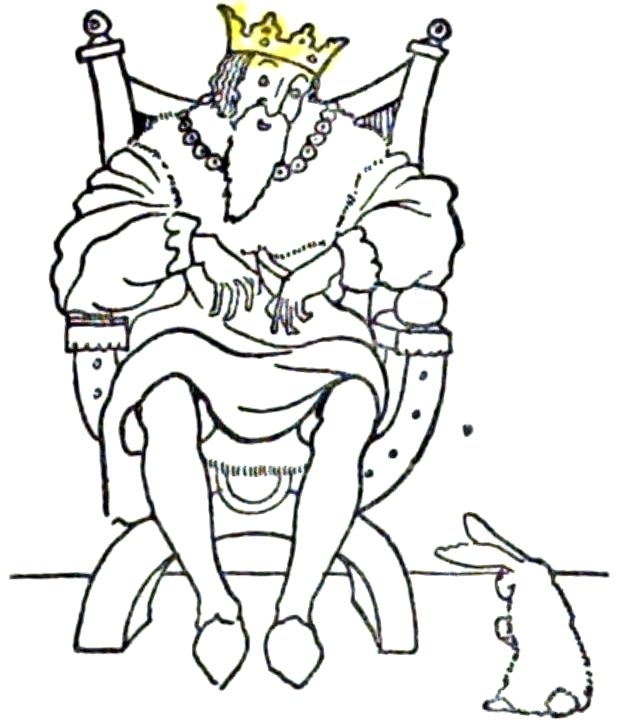
“Ah!” The King was silent for a little. Then he said,
“I can tell you who won’t be.”
The Chancellor did not seek for information on this
3point, feeling that in the circumstances the answer was
obvious.
“What do you suggest yourself?”
“That your Majesty choose a successor from among the
young and the highly-born of the country, putting him to
whatever test seems good to your Majesty.”
The King pulled at his beard and frowned.
“There must be not one test, but many tests. Let all,
who will, offer themselves, provided only that they are
under the age of twenty and are well-born. See to it.”
He waved his hand in dismissal, and with an accuracy
established by long practice the Chancellor retired backwards
out of the Palace.
On the following morning, therefore, it was announced
that all those who were ambitious to be appointed the
King’s successor, and who were of high birth and not yet
come to the age of twenty, should present themselves a
week later for the tests to which His Majesty desired to
put them, the first of which was to be a running race.
Whereat the people rejoiced, for they wished to be ruled
by one to whom they could look up, and running was much
esteemed in that country.
On the appointed day the excitement was great. All
along the course, which was once round the castle, large
crowds were massed, and at the finishing point the King
and Queen themselves were seated in a specially erected
pavilion. And to this pavilion the competitors were
brought to be introduced to their Majesties. And there
were nine young nobles, well-built, and handsome, and (it
was thought) intelligent, who were competitors. And
there was also one Rabbit.
4The Chancellor had first noticed the Rabbit when he was
lining up the competitors, pinning numbers on their backs
so that the people should identify them, and giving them
such instructions as seemed necessary to him. “Now,
now, be off with you,” he had said. “Competitors only,
this way.” And he had made a motion of impatient dismissal
with his foot.
“I am a competitor,” said the Rabbit. “And I don’t
think it is usual,” he added with dignity, “for the starter
to kick one of the competitors just at the beginning of an
important foot-race. It looks like
favouritism.”
“You can’t be a competitor,”
laughed all the young nobles.
“Why not? Read the rules.”
The Chancellor, feeling rather
hot suddenly, read the rules. The
Rabbit was certainly under
twenty; he had a pedigree which
showed that he was of the highest
birth; and——
“And,” said the Rabbit, “I am
ambitious to be appointed the
King’s successor. Those were all the conditions. Now
let’s get on with the race.”
But first came the introduction to the King. One by
one the competitors came up ... and at the end——
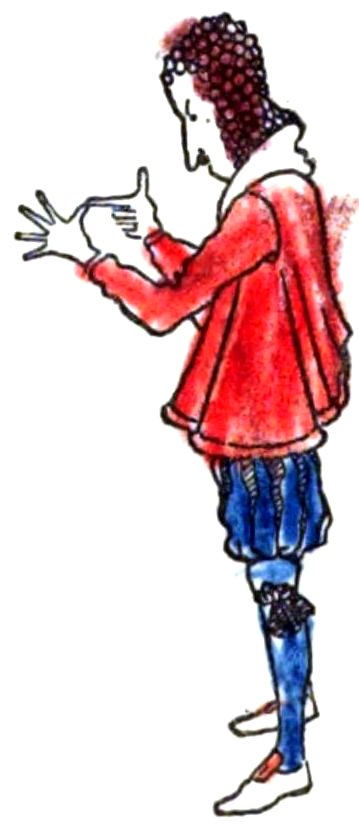
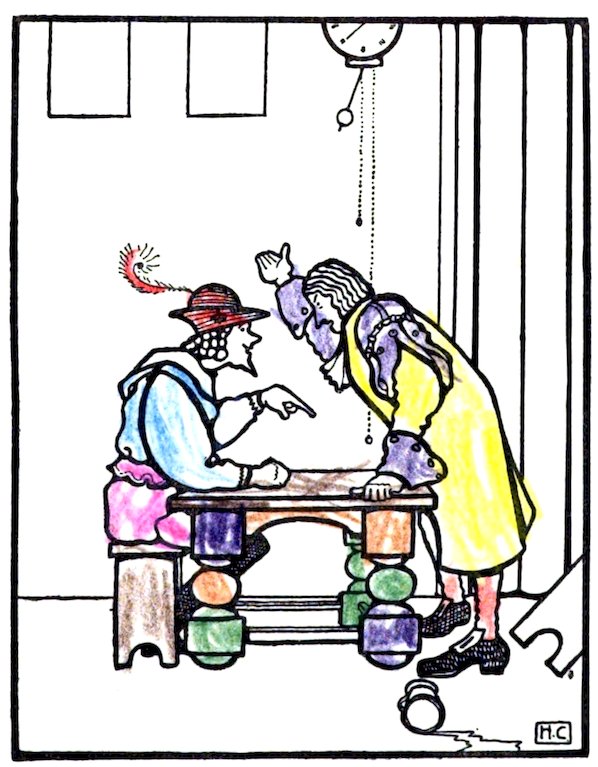
“This,” said the Chancellor, as airily as he could, “is
Rabbit.”
Rabbit bowed in the most graceful manner possible;
first to the King and then to the Queen. But the King
5only stared at him. Then he turned to the Chancellor.
“Well?”
The Chancellor shrugged his shoulders.
“His entry does not appear to lack validity,” he said.
“He means, your Majesty, that it is all right,” explained
Rabbit.
The King laughed suddenly. “Go on,” he said. “We
can always have a race for a new Chancellor afterwards.”
So the race was started. And the young Lord Calomel
was much cheered on coming in second; not only by their
Majesties, but also by Rabbit, who had finished the course
some time before, and was now lounging in the Royal
Pavilion.
“A very good style, your Majesty,” said Rabbit, turning
to the King. “Altogether he seems to be a most promising
youth.”
“Most,” said the King grimly. “So much so that I do
not propose to trouble the rest of the competitors. The
next test shall take place between you and him.”
“Not racing again, please, your Majesty. That would
hardly be fair to his lordship.”
“No, not racing; fighting.”
“Ah! What sort of fighting?”
“With swords,” said the King.
“I am a little rusty with swords, but I daresay in a day
or two——”
“It will be now,” said the King.
“You mean, your Majesty, as soon as Lord Calomel has
recovered his breath?”
The King answered nothing, but turned to his
Chancellor.
6“Tell the young Lord Calomel that in half an hour I
desire him to fight with this Rabbit——”
“The young Lord Rabbit,” murmured the other competitor
to the Chancellor.
“To fight with him for my kingdom.”
“And borrow me a sword, will you?” said Rabbit.
“Quite a small one. I don’t want to hurt him.”
So, half an hour later, on a level patch of grass in front
of the pavilion, the fight began. It was a short, but exciting,
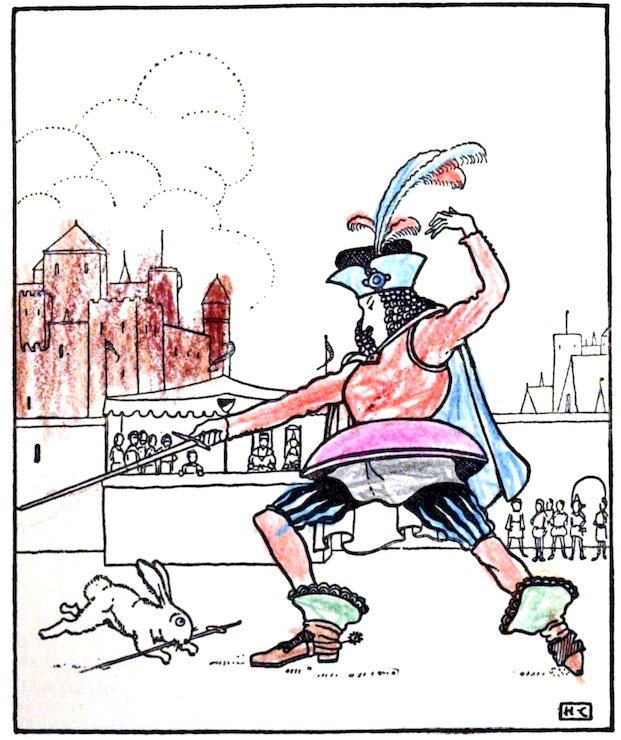
struggle. Calomel, whirling his long sword in his
strong right arm, dashed upon Rabbit, and Rabbit, carrying
his short sword in his teeth, dodged between Calomel’s
legs and brought him toppling. And when it was seen
that the young Lord rose from the ground with a broken
arm, and that with the utmost gallantry he had now taken
his sword in his left hand, the people cheered. And Rabbit,
dropping his sword for a moment, cheered too; and then he
picked it up and got it entangled in his adversary’s legs
again, so that again the young Lord Calomel crashed to the
ground, this time with a sprained ankle. And there he lay.
Rabbit trotted into the Royal Pavilion, and dropped his
sword in the Chancellor’s lap.
“Thank you so much,” he said. “Have I won?”
And the King frowned and pulled at his beard.
“There are other tests,” he muttered.
But what were they to be? It was plain that Lord
Calomel was in no condition for another physical test.
What, then, of an intellectual test?
“After all,” said the King to the Queen that night, “intelligence
is a quality not without value to a ruler.”
“Is it?” asked the Queen doubtfully.
7
Calomel dashed upon Rabbit.
8“I have found it so,” said the King, a little haughtily.
“Oh,” said the Queen.
“There is a riddle, of which my father was fond, the
answer to which has never been revealed save to the Royal
House. We might make this the final test between them.”
“What is the riddle?”
“I fancy it goes like this.” He thought for a moment,
and then recited it, beating time with his hand.
“My first I do for your delight,
Although ’tis neither black nor white.
My second looks the other way,
Yet always goes to bed by day.
My whole can fly, and climb a tree,
And sometimes swims upon the sea.”
“What is the answer?” asked the Queen.
“As far as I remember,” said His Majesty, “it is either
Dormouse or Raspberry.”
“‘Dormouse’ doesn’t make sense,” objected the Queen.
“Neither does ‘raspberry,’” pointed out the King.
“Then how can they guess it?”
“They can’t. But my idea is that young Calomel should
be secretly told beforehand what the answer is, so that he
may win the competition.”
“Is that fair?” asked the Queen doubtfully.
“Yes,” said the King. “Certainly. Or I wouldn’t have
suggested it.”
So it was duly announced by the Chancellor that the
final test between the young Lord Calomel and Rabbit
would be the solving of an ancient riddle-me-ree, which
9in the past had baffled all save those of Royal blood. Copies
of the riddle had been sent to the competitors, and in a
week from that day they would be called upon to give
their answers before their Majesties and the full Court.
And with Lord Calomel’s copy went a message, which
said this:
“From a Friend. The answer is Dormouse. Burn
this.”
The day came round; and Calomel and Rabbit were
brought before their Majesties; and they bowed to their
Majesties, and were ordered to be seated, for Calomel’s
ankle was still painful to him. And when the Chancellor
had called for silence, the King addressed those present,
explaining the conditions of the test to them.
“And the answer to the riddle,” he said, “is in this
sealed paper, which I now hand to my Chancellor, in order
that he shall open it, as soon as the competitors have told
us what they know of the matter.”
The people, being uncertain what else to do, cheered
slightly.
“I will ask Lord Calomel first,” His Majesty went on.
He looked at his lordship, and his lordship nodded slightly.
And Rabbit, noticing that nod, smiled suddenly to
himself.
“Lord Calomel,” said the King, “what do you consider
to be the best answer to this riddle-me-ree?”
The young Lord Calomel tried to look very wise, and
he said:
“There are many possible answers to this riddle-me-ree,
but the best answer seems to me to be Dormouse.”
10“Let someone take a note of that answer,” said the
King; whereupon the Chief Secretary wrote down:
“Lord Calomel—Dormouse.”
“Now,” said the King to Rabbit, “what suggestion have
you to make in this matter?”
Rabbit, who had spent an anxious week inventing
answers each more impossible than the last, looked down
modestly.
“Well?” said the King.
“Your Majesty,” said Rabbit with some apparent hesitation,
“I have a great respect for the intelligence of the
young Lord Calomel, but I think that in this matter he is
mistaken. The answer is not, as he suggests, wood-louse,
but dormouse.”
“I said ‘dormouse,’” cried Calomel indignantly.
“I thought you said ‘wood-louse,’” said Rabbit in surprise.
“He certainly said ‘dormouse,’” said the King coldly.
“‘Wood-louse,’ I think,” said Rabbit.
“Lord Calomel—‘Dormouse,’” read out the Chief Secretary.
“There you are,” said Calomel. “I did say ‘dormouse.’”
“My apologies,” said Rabbit, with a bow. “Then we
are both right, for dormouse it certainly is.”
The Chancellor broke open the sealed paper, and to the
amazement of nearly all present read out “Dormouse.”
“Apparently, your Majesty,” he said in some surprise,
“they are both equally correct.”
The King scowled. In some way, which he didn’t quite
understand, he had been tricked.
“May I suggest, your Majesty,” the Chancellor went on,
“that they be asked now some question of a different order,
11such as can be answered, after not more than a few minutes’
thought, here in your Majesty’s presence. Some
problem in the higher mathematics, for instance, such as
might be profitable for a future King to know.”
“What question?” asked His Majesty, a little nervously.
“Well, as an example—what is seven times six?” And,
behind his hand, he whispered to the King, “Forty-two.”
Not a muscle of the King’s face moved,
but he looked thoughtfully at the Lord
Calomel. Supposing his lordship did not
know!
“Well?” he said reluctantly. “What is
the answer?”
The young Lord Calomel thought for
some time, and then said, “Fifty-four.”
“And you?” said the King to Rabbit.
Rabbit wondered what to say. As long
as he gave the same answers as Calomel,
he could not lose in the encounter, yet in this
case “Forty-two” was the right answer.
But the King, who could do no wrong, even
in arithmetic might decide, for the purposes
of the competition, that “fifty-four” was an answer
more becoming to the future ruler of the country.
Was it, then, safe to say “Forty-two”?
“Your Majesty,” he said, “there are several possible
answers to this extraordinarily novel conundrum. At
first sight the obvious solution would appear to be ‘forty-two.’
The objection to this solution is that it lacks
originality. I have long felt that a progressive country
such as ours might well strike out a new line in the matter.
12Let us agree that in future seven sixes are fifty-four. In
that case the answer, as Lord Calomel has pointed out, is
‘fifty-four.’ But if your Majesty would prefer to cling to
the old style of counting, then your Majesty and your
Majesty’s Chancellor would make the answer ‘forty-two.’”
After saying which, Rabbit bowed gracefully, both to
their Majesties and to his opponent, and sat down again.
The King scratched his head in a puzzled sort of way.
“The correct answer,” he said, “is, or
will be in the future, ‘fifty-four.’”
“Make a note of that,” whispered the
Chancellor to the Chief Secretary.
“Lord Calomel guessed this at his first
attempt; Rabbit at his second attempt. I
therefore declare Lord Calomel the winner.”
“Shame!” said Rabbit.
“Who said that?” cried the King furiously.
Rabbit looked over his shoulder, with the object of
identifying the culprit, but was apparently unsuccessful.
“However,” went on the King, “in order that there
should be no doubt in the minds of my people as to the
absolute fairness with which this competition is being conducted,
there will be one further test. It happens that a
King is often called upon to make speeches and exhortations
to his people, and for this purpose the ability to stand
evenly upon two legs for a considerable length of time is of
much value to him. The next test, therefore, will be——”
But at this point Lord Calomel cleared his throat so
loudly that the King had to stop and listen to him.
13“Quite so,” said the King. “The next test, therefore,
will be held in a month’s time, when his lordship’s ankle
is healed, and it will be a test to see who can balance himself
longest upon two legs only.”
Rabbit lolloped back to his home in the wood, pondering
deeply.
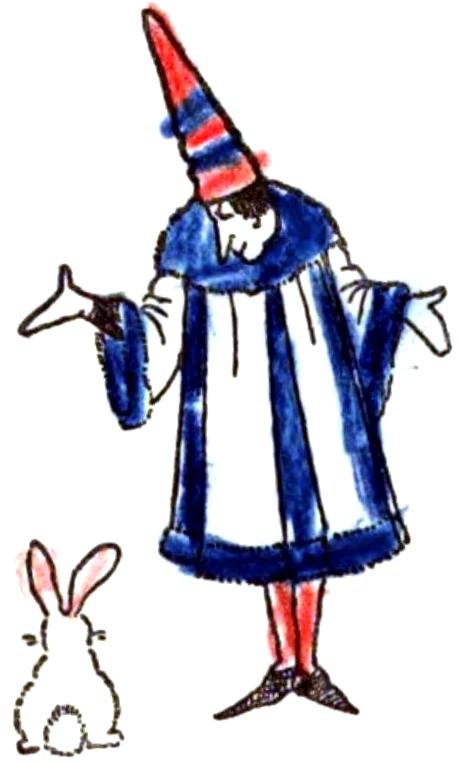
Now there was an enchanter who lived in the wood, a
man of many magical gifts. He could (it was averred
by the countryside) extract coloured
ribbons from his mouth, cook plum-puddings
in a hat, and produce as
many as ten silk handkerchiefs,
knotted together, from a twist of paper.
And that night, after a simple dinner
of salad, Rabbit called upon him.
“Can you,” he said, “turn a rabbit
into a man?”
The enchanter considered this carefully.
“I can,” he said at last, “turn a
plum-pudding into a rabbit.”
“That,” said Rabbit, “to be quite frank, would not be
a helpful operation.”
“I can turn almost anything into a rabbit,” said the
enchanter with growing enthusiasm. “In fact, I like doing
it.”
Then Rabbit had an idea.
“Can you turn a man into a rabbit?”
“I did once. At least I turned a baby into a baby
rabbit.”
“When was that?”
14“Eighteen years ago. At the court of King Nicodemus.
I was giving an exhibition of my powers to him and his
good Queen. I asked one of the company to lend me a
baby, never thinking for a moment that——The young
Prince was handed up. I put a red silk handkerchief over
him, and waved my hands. Then I took the handkerchief
away.... The Queen was very much distressed.
I tried everything I could, but it was useless. The King
was most generous about it. He said that I could keep
the rabbit. I carried it about with me for some weeks,
but one day it escaped. Dear, dear!” He wiped his eyes
gently with a red silk handkerchief.
“Most interesting,” said Rabbit. “Well, this is what I
want you to do.” And they discussed the matter from the
beginning.
A month later the great Standing Competition was to
take place. When all was ready, the King rose to make
his opening remarks.
“We are now,” he began, “to make one of the most interesting
tests between our two candidates for the throne.
At the word ‘Go!’ they will——” And then he stopped
suddenly. “Why, what’s this?” he said, putting on
his spectacles. “Where is the young Lord Calomel?
And what is that second rabbit doing? There was no
need to bring your brother,” he added severely to
Rabbit.
“I am Lord Calomel,” said the second rabbit meekly.
“Oh!” said the King.
“Go!” said the Chancellor, who was a little deaf.
Rabbit, who had been practising for a month, jumped
on his back paws and remained there. Lord Calomel, who
15had no practice at all, remained on all fours. In the crowd
at the back the enchanter chuckled to himself.
“How long do I stay like this?” asked Rabbit.
“This is all very awkward and distressing,” said the
King.
“May I get down?” said Rabbit.
“There is no doubt that the Rabbit has won,” said the
Chancellor.
“Which rabbit?” cried the King crossly. “They’re both
rabbits.”
“The one with the white spots behind the ears,” said
Rabbit helpfully. “May I get down?”
There was a sudden cry from the back of the hall.
“Your Majesty?”
“Well, well, what is it?”
The enchanter pushed his way forward.
“May I look, your Majesty?” he said in a trembling
voice. “White spots behind the ears? Dear, dear! Allow
me!” He seized Rabbit’s ears, and bent them this way
and that.
“Ow!” said Rabbit.
“It is! Your Majesty, it is!”
“Is what?”
“The son of the late King Nicodemus, whose country is
now joined to your own. Prince Silvio.”
“Quite so,” said Rabbit airily, hiding his surprise.
“Didn’t any of you recognize me?”
“Nicodemus only had one son,” said the Chancellor,
“and he died as a baby.”
“Not died,” said the enchanter, and forthwith explained
the whole sad story.
16“I see,” said the King, when the story was ended. “But
of course that is neither here nor there. A competition like
this must be conducted with absolute impartiality.” He
turned to the Chancellor. “Which of them won that last
test?”
“Prince Silvio,” said the Chancellor.
“Then, my dear Prince Silvio——”
“One moment,” interrupted the enchanter excitedly.
“I’ve just thought of the words. I knew there were some
words you had to say.”
He threw his red silk handkerchief over Rabbit, and
cried “Hey presto!”
And the handkerchief rose and rose and rose....
And there was Prince Silvio!
You can imagine how loudly the people cheered. But
the King appeared not to notice that anything surprising
had happened.
“Then, my dear Prince Silvio,” he went on, “as the
winner of this most interesting series of contests, you are
appointed successor to our throne.”
“Your Majesty,” said Silvio, “this is too much.” And
he turned to the enchanter and said, “May I borrow your
handkerchief for a moment? My emotion has overcome
me.”
So on the following day, Prince Rabbit was duly proclaimed
heir to the throne before all the people. But not
until the ceremony was over did he return the enchanter’s
red handkerchief.
“And now,” he said to the enchanter, “you may restore
Lord Calomel to his proper shape.”
And the enchanter placed his handkerchief on Lord
17Calomel’s head, and said “Hey presto!” and Lord Calomel
stretched himself and said “Thanks very much.” But he
said it rather coldly, as if he were not really very grateful.
So they all lived happily for a long time. And Prince
Rabbit married the most beautiful Princess of those parts;
and when a son was born to them there was much feasting
and jollification. And the King gave a great party,
whereat minstrels, tumblers, jugglers and suchlike were
present in large quantities to give pleasure to the company.
But in spite of a suggestion made by the Princess,
the enchanter was not present.
“But I hear he is so clever,” said the Princess to her
husband.
“He has many amusing inventions,” replied the Prince,
“but some of them are not in the best of taste.”
“Very well, dear,” said the Princess.
AUTUMN WIND By MARIAN ALLEN
18
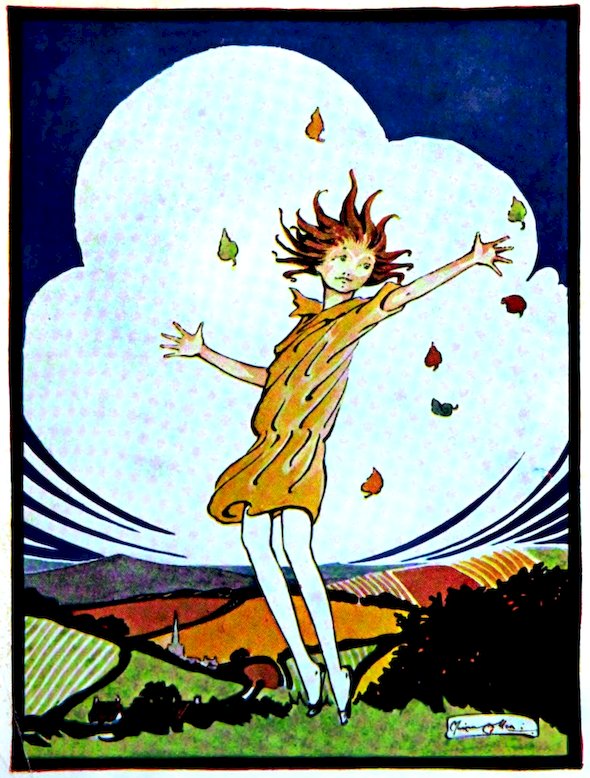
The Autumn Wind I hear it say,
“Over the hills and far away—
The folded hills that are hedged and green
Where warm little villages huddle between—
Where peeps the spire of a half-hid town—
Over the hills that are furrowed and brown
To the distant hills that are blue and thin
Where the land must end and the sea begin—
Light as a leaf from the wind-blown tree—
Over the hills to the dancing sea—
Chasing your shadow across the sun—
Up little Playfellow! Up and run!”
SINGING FEVER By MABEL MARLOWE
19
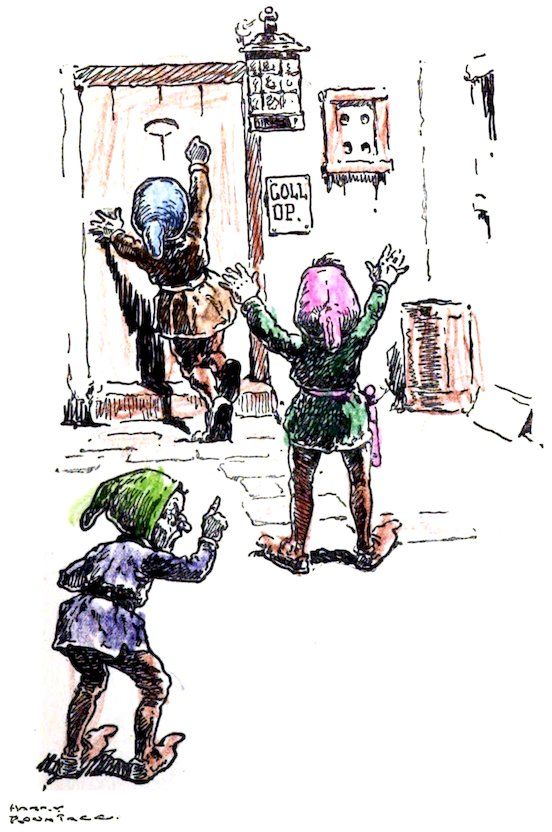
One midsummer eve, Gollop the gnome went into his
little house, shut the door, and began to sing. He
began to sing softly at first, as if he had a baby in a
cradle; but after a while his song grew louder, and louder,
and louder still.
“Stop that noise, Gollop,” shouted the other gnomes,
standing outside in the lane.
“I can’t!” answered Gollop, and he went on singing
more lustily than ever. (The worst of it was, his voice
was cracked.)
Then the other gnomes began to frown and to grumble
and to stop their ears. They banged on Gollop’s door, and
shouted out, “Stop that noise, Gollop!”
“I’ve tried, but I can’t,” replied Gollop, and he drew a
long breath and began on his eighteenth song. Oh, such
a noise he made! Then all the lady gnomes went into
their houses and shut the doors and went to bed and refused
to get up.
But Gollop went on singing. All through the night he
sang, and every moment the sound of it grew louder.
When morning came all the other gnomes had headache.
All of them had ear-ache, and all of them were as vexed
as they could be. They went to milk the cows, but the
cows would give no milk. They went to collect the eggs,
but the hens had laid none.
Then the gnomes grew most annoyed with Gollop.
They banged on his door with their fists and they said,
20“Oh, Gollop, for goodness’ sake stop that noise. The cows
have gone dry and the hens have laid no eggs, and our
wives have gone under the bedclothes and refused to get
up. And all through you. Stop that noise at once!”
But Gollop answered, “Oh, friends, I am very sorry, but
I simply can’t stop singing. I have got singing fever.”
Then all the gnomes looked very startled and very worried
in their minds, and one of them said, “Oh, Gollop, if
you really have got singing fever I suppose you must sing.
But you need not do it here, right in the middle of the village.
Get up. Put on your hat and go right away. Go
miles away, where we cannot hear you.”
“It might be catching!” said the other gnomes, looking
fearfully at one another.
Gollop the gnome opened his door and strode out, singing
all the time. Up the village street he went, and across
the open moor, and away through the woodlands—and
away—and away. The sound of his singing grew softer
and softer, and at last faded altogether.
Then the wives got up, and the cows began to moo.
The hens each laid an egg, and all the village was at peace.
Gollop the gnome went singing on his way, and by
evening he was twenty miles away from home, right on
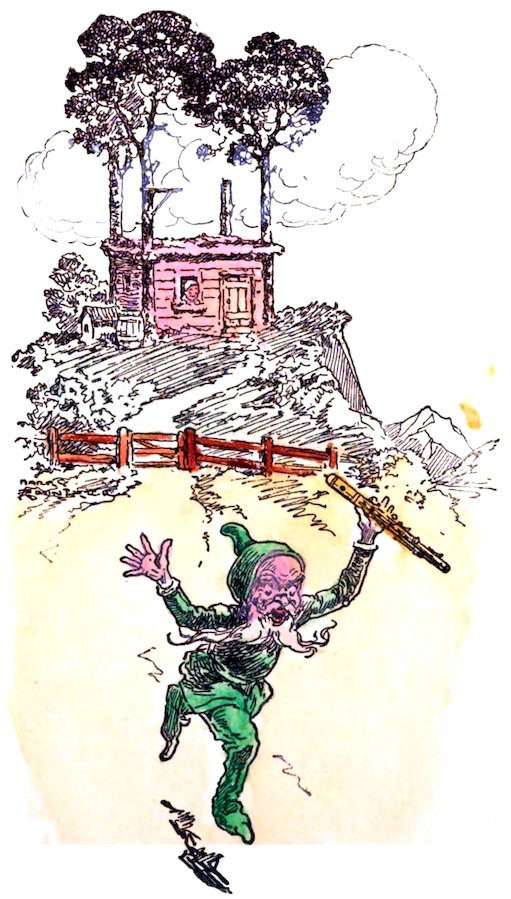
the top of a pine-covered hill. A little man lived here, in
a house made of pine-trees, and when he heard Gollop
coming he called out, “Stop that noise!”
“I can’t!” said Gollop.
“Why not?”
“Because I’ve got singing fever.”
“Dear me, that is very serious,” said the little man.
“Have you tried a cure?”
21
“Stop that noise, Gollop!”
22“I didn’t know there was a cure,” said Gollop (singing
all the time).
“Oh yes, there is a cure. You simply have to do some
fiddling. Then all the fever goes out of your voice into
the fiddle.”
“I haven’t got a fiddle,” said Gollop.
“Never mind. I will lend you mine. But be sure you
don’t lose it,” said the little man, and he went into his house
and fetched a little fiddle and a little bow.
“There! That will cure your singing fever,” he said.
Gollop put out his hand and took the fiddle, and immediately
he touched it his singing stopped.
“Keep it for three days,” said the little man, “and be
sure you don’t lose it.”
“Oh, thank you!” cried Gollop, and he kissed the little
man on both cheeks. Then he turned and ran down the
hill. Very quickly he hurried through the woodland and
back across the moor, and he ran into the village just as
the gnomes were saying “Good-night.”
“Hallo, Gollop! Are you cured?” they said. And when
he told them that he was cured they all shook hands with
him, and patted him on the back and called him “mate.”
But no sooner had Gollop gone into his house and
closed the door than a weird noise was heard—a thin,
screamy kind of noise, with a grunt here and there, and
then a screech, and then a long, long wail.
“Stop treading on the dog, Gollop!” shouted the
gnomes.
“I’m not treading on the dog,” replied Gollop.
“Stop teasing the cat!”
“I’m not teasing the cat.”
23“Well, whatever you are doing, stop it! Stop it at
once!”
“I can’t!” cried poor Gollop. “I’ve tried, but I can’t.
I do believe I’ve got fiddle fever!”
Then all the other gnomes grew most annoyed with
poor Gollop, They banged on his door with their fists,
and they said:
“Oh, Gollop, stop that noise at once! It is worse than
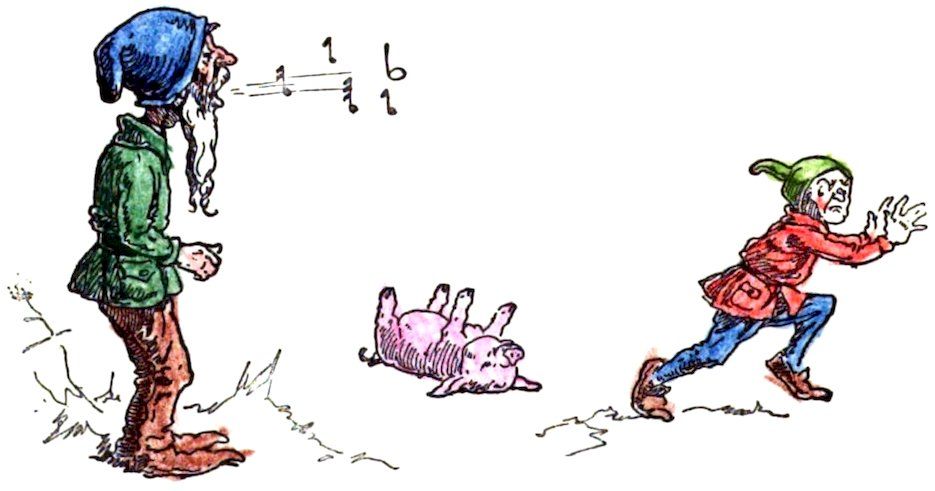
singing fever. It is making all the pigs lie on their backs
with their feet in the air. Open this door at once!”
So Gollop opened the door. Then one gnome said, “If
he has no fiddle he can’t have fiddle fever. Take his fiddle
away!” So they took his fiddle away from him. One
gnome gave it to another. “Pass it on,” he said. That
gnome gave it to another. “Pass it on,” he said. And the
fiddle was passed on and on and on, all the way round the
world.
“There! That’s soon settled! That has cured you of
fiddle fever,” said the gnomes, feeling very satisfied with
themselves.
“Yes,” replied Gollop sadly. “Yes, that is true, BUT—but—I
do believe the singing fever is coming back again.”
Then he began to sing once more, and the noise of it
was like the shaking of pebbles in a can.
“Quick! Give him back his fiddle,” cried the gnomes.
But the fiddle was gone.
And Gollop went on singing.
Then all the gnomes began to get into a state, and they
said, “Oh, Gollop, if you’ve got singing fever we suppose
you must sing. But please don’t do it here. Our wives will
go under the bedclothes and refuse to get up. The cows
24will go dry, and the hens will not lay, and all the pigs will
lie on their backs with their feet up in the air. So please
go away. Go miles away, where we cannot hear you.”
So Gollop the gnome came out, singing all the time.
Along the village street he went, all in the glistening starlight.
He crossed the open moor, and went through the
shadowy woodlands, away and away. The sound of his
singing grew softer and softer, and at last faded altogether.
Through the dark night Gollop travelled, singing all the
way, and at dawn he came to the hill where the pines
grew.
The little old man was just getting up. He put his head
out of the window and shouted, “Stop that noise!”
“I can’t! I’ve got singing fever!” said Gollop.
“What? Again? I thought I cured you! What have
you done with my fiddle?”
“It has gone round the world!”
“How very tiresome!” said the little old man. “It might
be weeks before it gets back
to me again. As for you, I
will lend you my flute. I can’t
let you go about the world
25making that noise. I will lend you my flute, but be sure
you don’t lose it.”
“Will it cure my singing fever?” asked Gollop the
gnome.
“Yes, to be sure! But be sure you don’t lose it.” Then
the little old man drew in his head from the window, and
in a few moments he came out at the door, bringing a tortoise-shell
flute, with silver stops to it. Gollop put out his
hand and took the flute, and immediately he touched it his
singing stopped.
Then Gollop turned and ran down the hill. Quickly he
sped through the woodlands and across the moor, and
ran into the village just as the gnomes were going off to
work.
“Hallo, Gollop! Are you cured?” they said. And when
he said “Yes” they all shook hands with him once more,
and patted him on the back and called him “pal.”
But no sooner had Gollop got into his house and closed
the door, than an eerie, wailing sound was heard. Then
there came a sound like a choke, and then a long, long
squeal.
“Stop hurting the pig, Gollop!” cried the gnomes.
“I’m not touching the pig.”
“Stop teasing the parrot!”
“I’m not touching the parrot.”
“Well, whatever you are doing, stop it at once!”
“I can’t!” cried poor Gollop. “I’ve tried, but I can’t.
I do believe I’ve got flute fever!”
Then all the gnomes grew most dreadfully annoyed
with Gollop. They knocked on his door with their sticks,
and they said:
26
Gollop turned and ran down the hill.
27“Oh, Gollop, stop that noise at once! It is worse than
singing fever. It is worse than fiddle fever. It is making
the goat stand on his hind legs like a circus pony. Open
this door at once!”
So Gollop opened the door. Then one gnome said, “If
he has no flute he cannot have flute fever. Take his flute
away.” So they took his flute away from him. One
gnome gave it to another. “Pass it on,” he said. That
gnome gave it to another. “Pass it on,” he said. And
the flute was passed on and on and on, all the way round
the world.
“There! That’s settled! That has soon cured you of
flute fever,” said the gnomes, feeling very proud and satisfied
with themselves.
“Yes,” replied Gollop sadly. “Yes, dear friends, that is
true. But—but—I’m afraid the singing fever is coming
back again.”
Then he began to sing.
“Give him back his flute,” cried the gnomes, tearing at
their hair. But the flute was gone.
Then the gnomes began to get into a fluster, and they
said, “Oh, Gollop, if you really have got singing fever we
suppose you must sing. But pray don’t do it here. Our
wives will go to bed, and the hens will refuse to lay, and
all the cows in the meadows will go dry. So please go
away. Go a long way away. Go miles away, where we
can’t hear you.”
“It’s all very fine! I’m getting tired,” said Gollop. But
he went away all the same, singing as he went. The sun
was shining as he passed through the village. Cocks were
crowing in the farmyards and larks were singing in the sky.
28On through the awakening woodland Gollop travelled,
and at last he reached the little house on the hill-top once
more.
The little old man was sitting on a gate, swinging idly
to and fro.
“What? Again? I thought I cured you! What have
you done with my flute?”
“It has gone round the world.”
“How very tiresome! It might be weeks before it gets
back to me again. As for you, I will lend you my musical
box. I can’t let you go about the world making that terrible
noise. I will lend you my musical box. But be sure
you don’t lose it.”
Then the little old man felt in his coat pocket, and took
out a small, round musical box, with a picture on the top
of it and a handle in the middle.
“Take it, and be sure you don’t lose it,” he said. So
Gollop took the musical box into his hand, and immediately
he touched it the singing stopped.
“Oh, thank you,” said Gollop, and he turned and ran
down the hill. All through the sunny afternoon he trudged
homewards, and he reached the village just as the gnomes
were coming back from work.
“Hallo, Gollop! Are you cured?” they said, and when
he answered “Yes” they patted him on the back and shook
hands with him and called him “chum.”
But no sooner had Gollop got into his house and closed
the door, than a faint, tinkly, fairy-like sound came floating
through the window. It was like silver bells shaking in
29the wind. It was
like the laughter of
fairies. It was
sweeter than choir
boys singing in the
little gnome choir.
“Have you got
a fairy in there?”
asked the gnomes.
“No, dear friends.
But I’m afraid I’ve
got musical-box
fever!” said Gollop.
Then the gnomes
looked at one another
with big, slow
smiles, and delightful
twinklings of
merry eyes.
“If you’ve got
musical-box fever,”
they said, “we all
think you had better
keep it.”
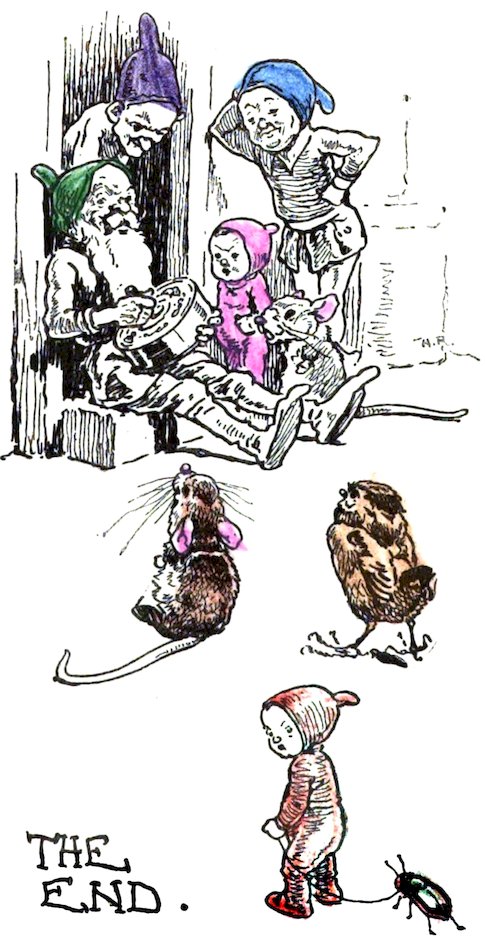
And he did.
THE RAM AND THE LEOPARD By VALERY CARRICK — An African Tale
30
Once upon a time a ram thought he would build himself
a house in the forest. So he went into the forest
and made a clearing.
“That’s done now,” he said; “to-morrow I’ll have a rest,
and after that I’ll start building my house.”
Then he went back to his home.
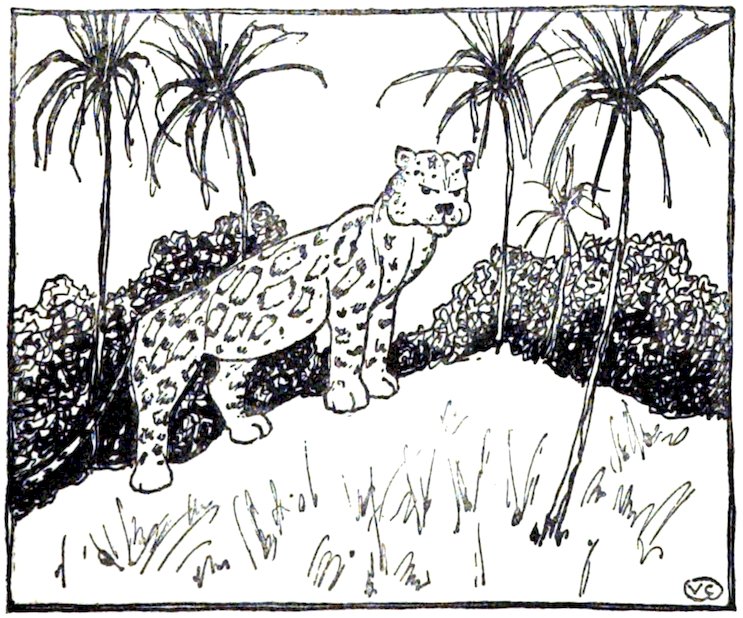
But at the same time a leopard thought he would build
himself a house in the forest. So he went there and began
to look for a likely place, when suddenly he saw that a
clearing had already been made, as though on purpose for
a house to be built there.
“That’s splendid!” he thought. “I’ll begin to build my
house here!”
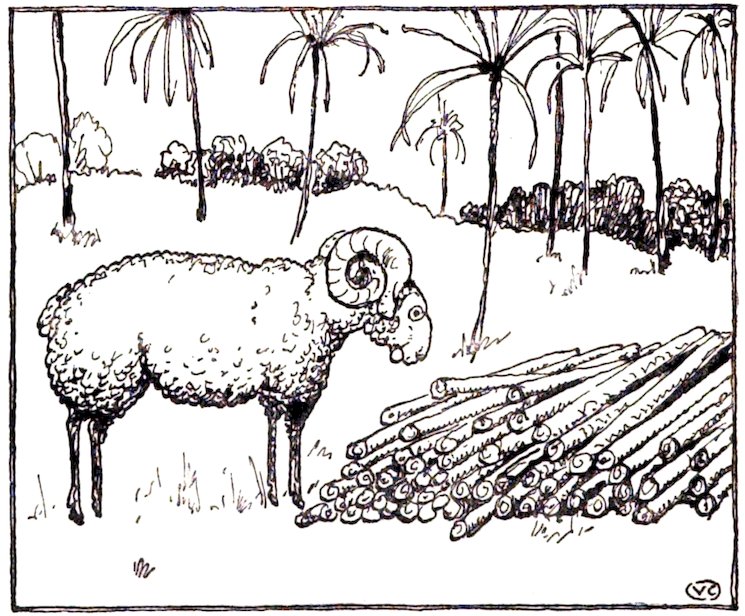
And he started dragging sticks and stakes and logs
along; he worked all day, and got very tired, and then he
said:
“Well, the beginning is always the hardest part! To-morrow
I’ll rest, and then start work again!”
The next day the ram came along, and saw all the sticks
and stakes and logs gathered there: all he had to do was to
put them together! And he was very much surprised,
and he thought:
“This must be the fairies helping me!”
31And then he began putting the walls up. And he got
half way, and then felt very tired, so he went away to rest.
The next day the leopard came along again, and saw
that the walls had been half built, and he thought:
“There, isn’t that splendid! I had a rest yesterday, and
the fairies meantime helped me!”
And he started to work and finished building the walls,
and got very tired, and thought:
“That’s all right! All to-morrow I’ll rest, and then I’ll
finish it off!”
The next day the ram came along, and saw that it was
32all done but for the roof. And he set to work and put the
roof on. Then he thought:
“Well, to-morrow I’ll just have a good rest, and then I
can start moving in!”
The next day the leopard came along again, and when
he saw what had happened he thought:
“There now, would you believe it, the work’s finished!
The roof is on! To-morrow I’ll move in!”
The next day the ram started moving into his new
house, and the leopard also started moving into HIS new
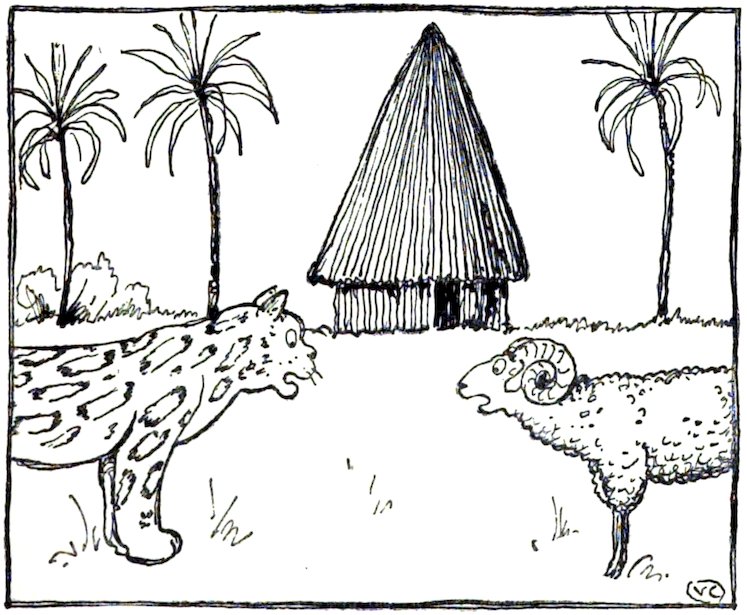
house, and they both came along and met, and the ram
said:
33“This house is for ME to live in! I built it, and the
fairies helped me!”
But the leopard said:
“No! This house is for ME to live in! It was I who
built it, and it was ME whom the fairies helped!”
And they argued about it for a long time, and couldn’t
settle who was to live in the house, or whom the fairies
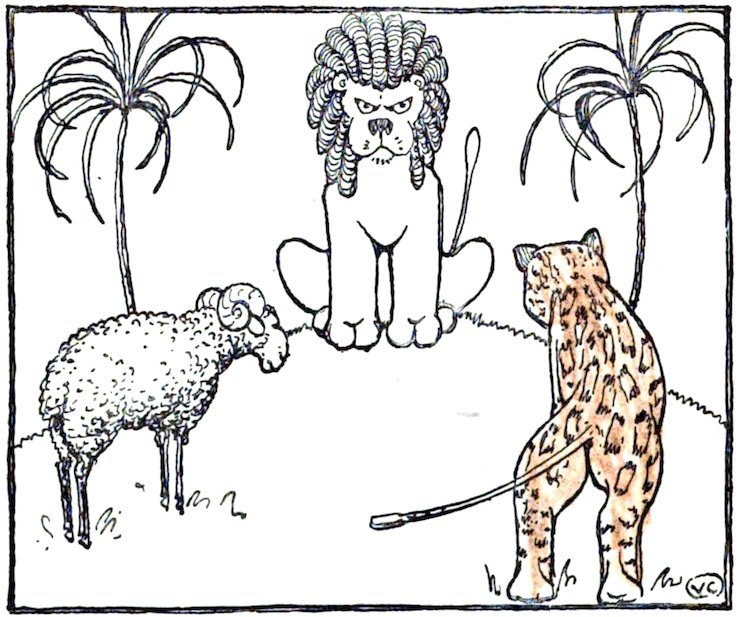
had helped. And in the end they went for judgment to the
lion, and said to him:
“Please will YOU decide the question: Who built the
house, whom did the fairies help, and who is to live in it?”
34And the lion replied:
“Both of you built the house, and the fairies helped you
both, and so both of you go and live in it, and don’t quarrel!”
So both the leopard and the ram started living in the
house, and they got on all right and didn’t quarrel. The
leopard would go off hunting, bring back his prey, and
eat it. And the ram just kept on walking about round the
house, nibbling the grass and getting quite satisfied with
that. And the leopard began to wonder how it was: the
ram had no sharp teeth, had no claws, and besides that he
was lazy, so how did he manage to get plenty to eat and
35keep fat? How did HE catch his prey? So he asked him
one day, and said:
“How do YOU catch your prey, Mr. Ram?”
And the ram answered:
“How do I catch my prey? First of all you show me
how YOU catch your prey!”
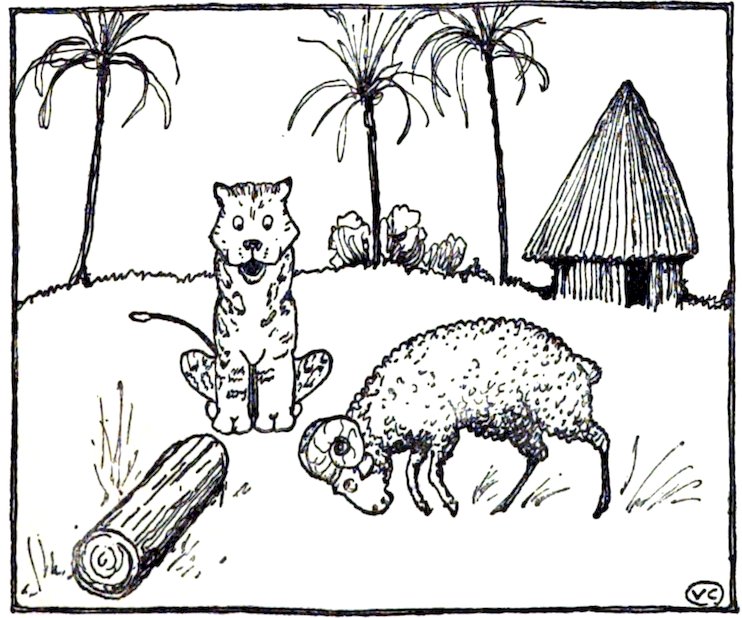
Then the leopard put a log of wood on the ground, and
began to approach it as if he were hunting: first he’d come
up from one side, crouch down on the earth and creep
along; then he’d come up from the other side, crouch down
on the earth and creep along. Then all at once he’d spring
right on to the log and start gnawing it with his teeth, hitting
36it with his paws, and tearing it with his claws. And
the ram watched him, and then said:
“Well, now I’ll show you how I catch my prey.”
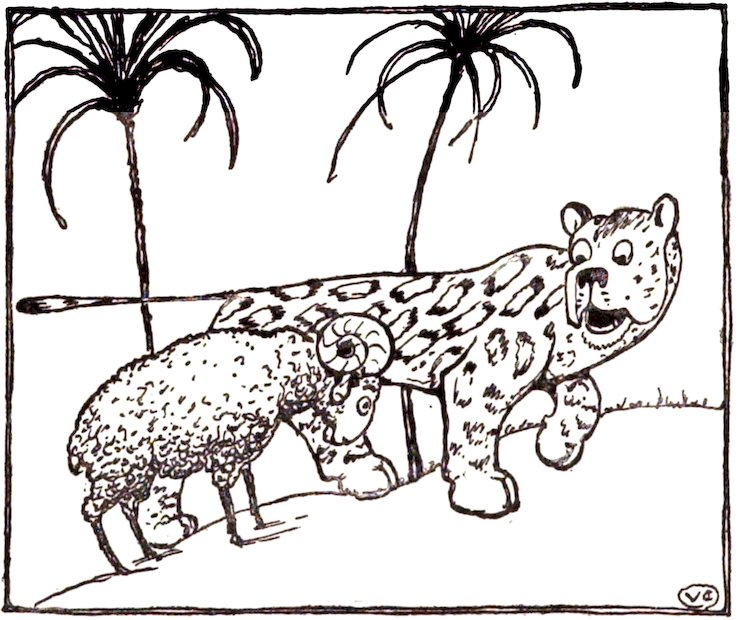
And he went and stood in front of the log, and then began
to back. And he backed and backed, till all at once he
ran forward at the log and butted it hard with his horns,
and the log simply went spinning away like a top. So the
leopard saw that the ram was very strong, and he thought
to himself:
“The ram’s a dangerous beast! I must be on the look-out,
or he’ll do for me. But there’s one good thing: I know
he’s got to go back before he comes forward!”
37And after that they went on living happily, the leopard
going off hunting and bringing back his prey, and the ram
walking round the house and nibbling the grass. But the
leopard kept a sharp look-out and watched to see if the
ram hadn’t started backing.
Then came the rains, and the earth got wet and slippery.
And one day the leopard and the ram were standing together
when suddenly the ram slipped, and he slipped so
much that he went quite a long way back. And when the
leopard saw this he got a terrible fright, and thought:
“Oh dear, oh dear! My end has come!”
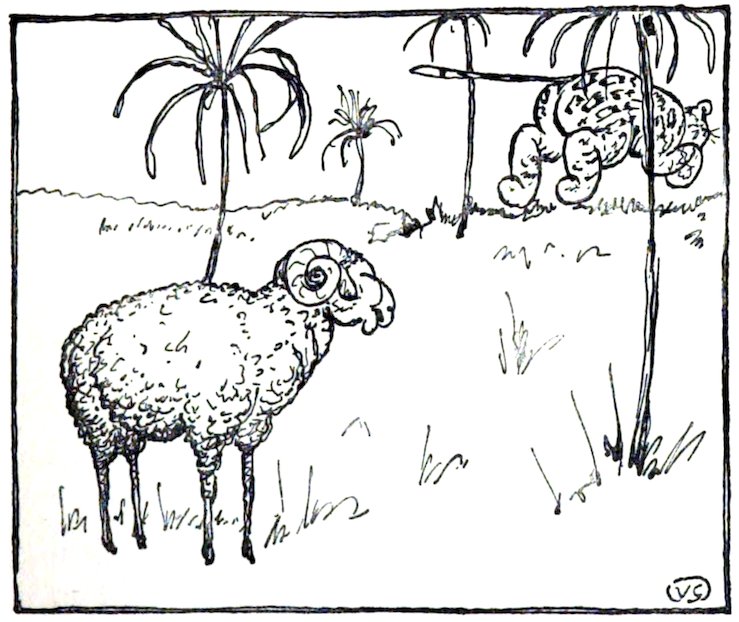
And with that he dashed off into the forest. And ever
since then the ram has been sole master of the house.
38
THE DRAGON AT HIDE-AND-SEEK By G. K. CHESTERTON
39
Once upon a time there was a knight who was an
outlaw, that is a man hiding from the king and everybody
else; and one who lived so wild and lawless a
life, in being hunted from one hiding-place to another, that
he had great difficulty in going to church every Sunday.
Although his ordinary way of life was full of fighting, and
burning, and breaking down doors, and therefore looked a
little careless, he had been very carefully brought up, and
it was obviously a very serious thing that he should be late
for church. But he was so clever and daring in his way of
getting from one place to another without being caught,
that he generally managed it somehow. And it was often
a considerable disturbance to the congregation when he
came with a great crash flying in through the big stained-glass
window and smashing it to atoms, having been
patiently hanging on a gargoyle outside for half an hour;
or, when he dropped suddenly out of the belfry, where he
40had been hiding in one of the big bells, and alighted almost
on the heads of the worshippers. Nor were they better
pleased when he preferred to dig a hole in the churchyard
and crawl under the church-wall, coming up suddenly
under a lifted paving-stone in the middle of the nave or the
chancel. They were too well-behaved, of course, to notice
the incident during the service; and the more just among
them admitted that even outlaws must get to church somehow;
but it caused a certain amount of talk in the town,
and the history of the knight and his wonderful way of
hiding everywhere and anywhere was
by this time familiar to the whole
countryside. At last this knight, who
was called Sir Laverok, began to feel so
sure of his power of escaping and hiding,
whenever he wanted to, that he
would come into the market-place in
the most impudent manner when any
great business was being transacted,
such as the elections of the guilds, or
even to the coronation of the king, to
whom he addressed some well-chosen
words of advice about his public duties,
in a loud voice from the chimney-pot of
an adjoining house. Often when the king and his lords
were out hunting, or even when they were in camp during
a great war, they would look up and see Sir Laverok
perched like a bird on a tree above their heads, and ever
ready with friendly counsels and almost fatherly good
wishes. But though they pursued him with emotions of
uninterrupted rage, lasting over several months, they were
never able to discover what were the holes and corners in
which he hid himself. They were forced to admit that his
talent for disappearing into undiscovered places was of
the highest order, and that in a children’s game of Hide-and-Seek
he would have covered himself with everlasting
glory; but they all felt that a fugitive from justice should
be strictly forbidden to cultivate genius of this kind.
41Now it was just about this time that there fell upon the
whole of that country an enormous calamity far worse than
any war or pestilence. It was of a kind which we have very
few chances of experiencing nowadays; though in the
other matter of wars and diseases our opportunities are
still wide and varied. There had appeared in the wilderness,
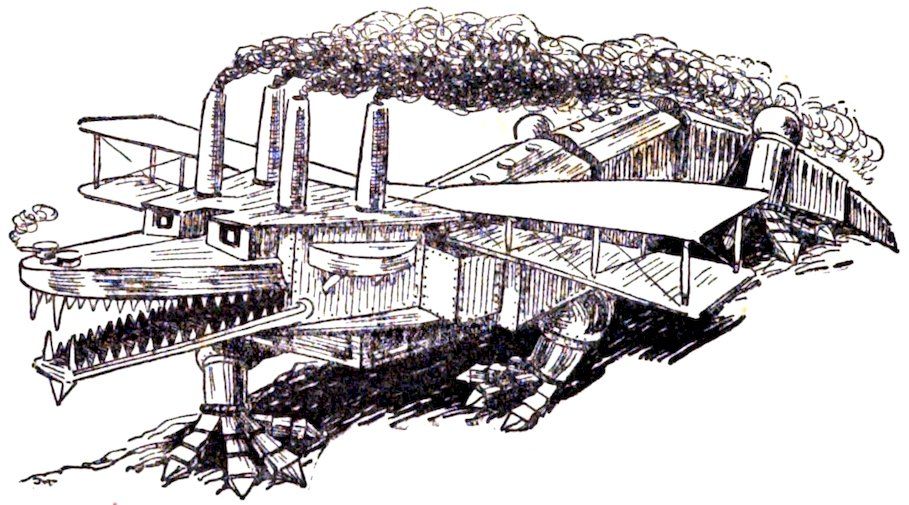
to the north of that country, a monster of huge size
and horrible habits and disposition; a monster who might
have been called for the sake of simplicity, a dragon, only
he had feet like an elephant, but a hundred times bigger,
with which he used to stamp and crush everything to a flat
and fine paste before he licked it up with a tongue as long
and large as the Great Sea Serpent; and his great jaws
opened wide like a whale’s, only that they could have
swallowed a shoal of whales as if they were whitebait. No
weapons or missiles seemed to be of any avail against him;
for his skin was plated with iron of incredible thickness.
42Indeed, some declared that he was entirely composed of
iron, and that he had been made out of that material by a
magician who lived beyond the wilderness, where such
crafts and spells were more seriously studied. Indeed, it
was hinted by some that the land of the magicians was in
every way in advance of their own, and well worthy of
emulation; and that if anyone objected that this marvellous
machinery had no apparent effect except in killing people
and destroying beautiful things, he should be rebuked as
one lacking in enterprise and a larger outlook upon the
future. But those who said this, commonly said it before
they had actually met the new animal; and it was noticed
that after meeting him they seldom uttered these thoughts,
or, indeed, any other.
43
The monster may have been made of iron, and his nerves
and muscles may have been, as some said, made like an
arrangement of wheels and wires, but he was most unmistakably
alive; and proved it by having a hearty appetite
and an evident enjoyment of life. He trampled and devoured
first, all the fortifications of the frontier, and then
the castles and the larger towns of the interior; and by the
time that he was marching towards the capital, the king
and his courtiers were all climbing to the tops of towers,
and everybody else to the tops of trees. These precautions
proved inadequate in practical experience; in very practical
experience. So long as the monster could be seen
twenty miles away like a marching mountain, already
fantastic in outline, but still blue or purple with distance,
and there was no other sign of him except a slight shaking
of the houses as in a mild earthquake, these conjectures
and expedients could be debated copiously, if not always
calmly. But when the creature came near enough for his
habits to be closely studied, it was clear that he could tread
down trees like grass, and flatten out castles like houses of
cards. It became more and more the fashion to seek out
less showy and more secluded country resorts; the whole
population, led by magistrates, merchants, and all its
natural leaders, fleeing with startling rapidity to the mountains
and concealing themselves in holes and caverns,
which they blocked behind them with big rocks. Even
this was not very successful; the monster proceeded to
scale the mountains with the gaiety of a goat, to kick the
rocky barricades to pieces, letting in daylight on the cowering
company within; and many of them were able to
recognise the familiar shape of the long and curling tongue
of the intelligent creature, exploring their retreat and coiling
and twisting and darting about in a very playful and
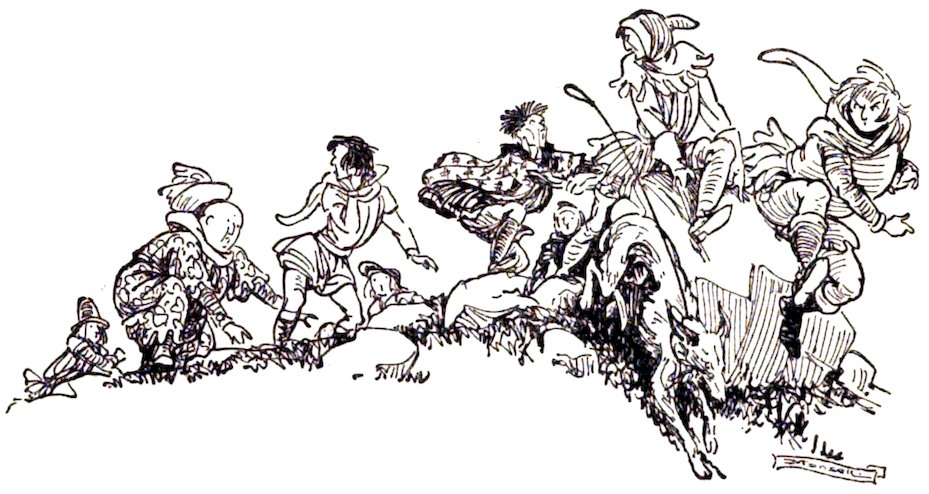
sportive manner. Those who had not found any hole to
44crawl into, and who were clinging in crowds to the crags
higher up the hill, were at this moment, however, surprised
with a sight that almost took their thoughts for an instant
off the universal peril. On the highest crag of all, above
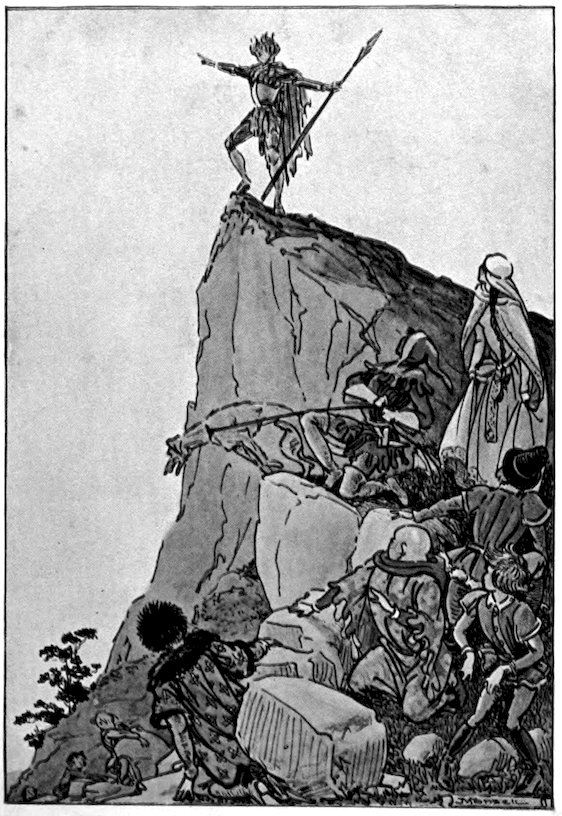
their heads, had appeared suddenly the figure of Sir
Laverok with his old spear in his hand, with his sword girt
around his ragged armour, and the wind waving about his
wild hair that was the colour of flame. In all that huddling
crowd it was only the man in hiding who stood out
conspicuous; and only the man fleeing from justice who
did not flee.
“I am not afraid,” he said in answer to their wild cries.
“You know I have a trick of finding my way to places of
safety. And as it happens, I know a castle to which I shall
retreat, and to which the dragon can never come.”
“But my good Sir,” said the Chancellor, pausing in the
act of trying to creep into a rabbit-burrow, “the dragon can
grind castles to powder with his heel. I regret to say that
he showed not the least embarrassment even in approaching
the Law Courts.”
“I know of a castle which he cannot reach,” said Sir
Laverok.
“The offensive animal,” said the Lord Chamberlain,
poking his head for a moment out of a hole in the ground,
“actually entered the king’s private chamber without
knocking.”
“I know of a private chamber that he cannot enter,”
replied the outlaw knight.
“It is very doubtful,” came the muffled voice of the Lord
High Admiral from somewhere underground, “whether
we shall even be safe in any of the caverns.”
45“I know a cavern where I shall
be safe,” said Sir Laverok.
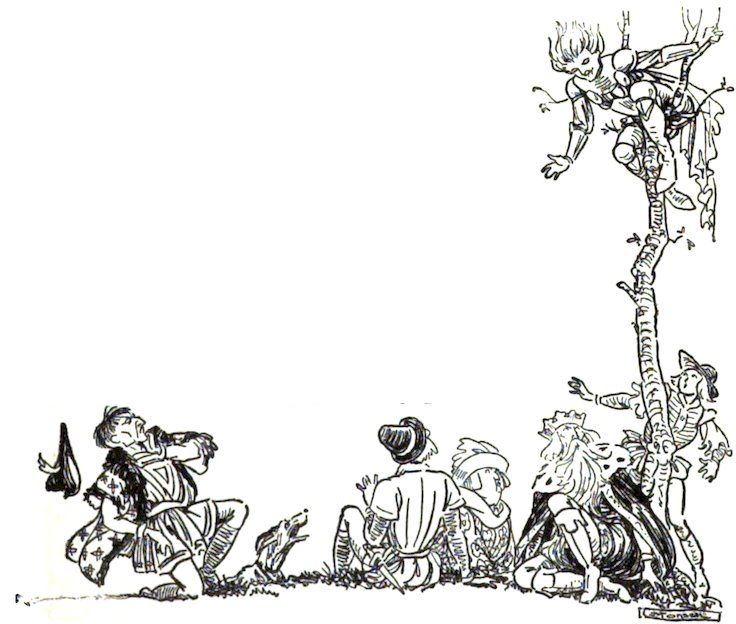
At the foot of the steep slope to
which they clung spread a large
plateau like a plain; and over this
bare tableland, at the moment, the
monster was prowling up and down
like a polar bear, considering what he
would destroy next. Every time he
turned his head towards them, the
crowds clambered a little higher up
the hill; but they soon saw, to their
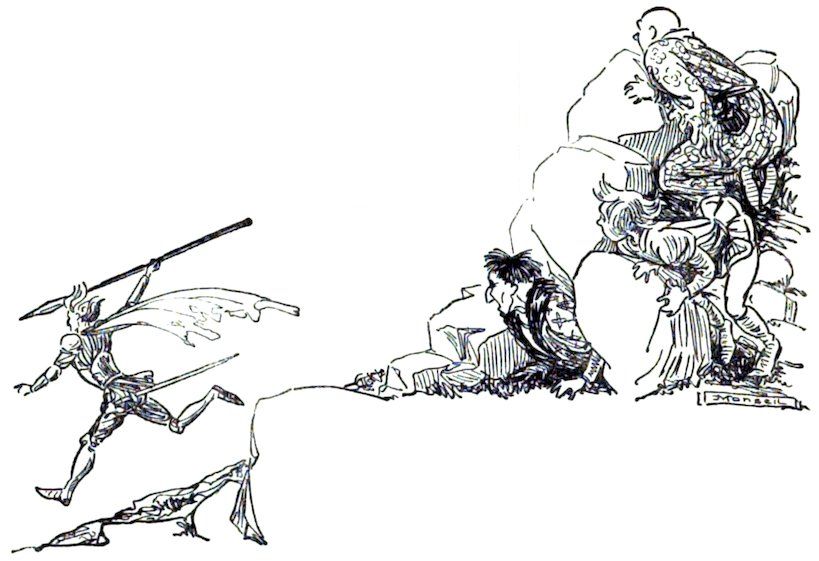
astonishment, that Sir Laverok was not climbing up, but
climbing down. He dropped from the last overhanging
rock, and rushed out upon the plain against the monster;
when he came within a short distance, the knight gave
one wild leap and threw his spear like a thunderbolt.
What happened in the flash of that thunderbolt nobody
in the crowd seemed to know. Those who knew them best
were of opinion that they all shut their eyes tight, and most
probably fell flat on their faces. Others say that the
monster stamped his foot upon his enemy with so stunning
a shock that a cloud of dust rolled up to the clouds of
heaven, and for a moment hid the whole scene. Others,
46again, explained that the vast immeasurable bulk of the
monster had come between them and the victim. Anyhow,
it is certain that when that vast bulk turned once
more and began swaying and lurching backwards and
forwards on its lonely prowl, no sign of the victim could be
seen. Probably he had been stamped to mire as everything
else had been. But if it were conceivable that he had indeed
escaped, as he had boasted, it was hard to say where;
as there did not seem to be anywhere for him to escape to.
And the authorities in the holes and caves could not but
regret that they had not condemned him to be burned as a
wizard instead of hanged as a rebel, whenever they should
have put the final touch to the sentence by carrying it into
effect. They comforted themselves in the cave by the reflection
that at least no hasty capture or premature execution
had yet put it out of their power to rectify the mistake;
but for the moment it seemed clear that their chances either
of hanging or burning the gentleman were further off than
ever.
Just at that moment, however, there was a new interruption.
It so happened that the king’s third daughter was
standing in the crowd on the slope; for all the elder members
of the royal family were enjoying a temporary and
semi-official retirement from the cares of state at the bottom
of a dry well on the other side of the mountain range.
But she had been unable or unwilling to travel with the
extreme rapidity which they had had the presence of mind
to exhibit; for she was rather an absent-minded person,
wholly without aptitude for practical politics. She was
called the Princess Philomel, and was a dreamy sort of
person, with long hair and blue eyes that were like the blue
47of distant horizons, and she was commonly
very silent; but she had watched the adventure
of the vanishing outlaw with more
interest than she commonly showed in anything;
and she startled everybody at this
stage by breaking her silence
and calling out in a clear voice:
“Yes; he has found his fairy
castle where no dragon can
come.”
The more dignified Councillors of
State were just venturing to put their
noses above ground in order to remonstrate
respectfully against the breach
of etiquette, when everybody’s attention was again distracted
to the monster, who was behaving in an even more
extraordinary way than usual. Instead of pacing backwards
and forwards with a certain pomposity as he had
done before, he was bounding to and fro, taking totally
unnecessary leaps into the air and clawing in a most uncomfortable
and inconsequent fashion.
“What is the matter with him now?” enquired the Master
of the Buckhounds, who was something of a student of
animal life, and would, under other circumstances, have
been much interested in the phenomenon.
“The monster is angry,” replied the Princess Philomel in
48the same absolute if abstracted fashion. “He is angry because
the knight has reached the magic chamber and cannot
be found.”
If the monster was indeed exhibiting anger, it would
seem that his anger had an element of self-reproach. For
he was evidently clawing and scratching at himself rather
in the manner of a dog hunting a flea, but much more
savagely.
“Can he be killing himself?” asked the Lord Chancellor
hopefully. “I am the keeper of the King’s conscience, and
not, of course, the keeper of the dragon’s. But it seems
possible that his conscience, if once aroused, would find in
retrospect some legitimate ground for remorse.”
“Nonsense,” said the Chamberlain, “why should he kill
himself?”
“If it comes to that,” answered the other, “why should
he fight himself, as he seems to be doing?”
“Because,” answered the Princess, “Sir Laverok has at
last reached the cavern where he is safe.”
But even as she spoke, a further and final change seemed
to pass over the monster. For a moment it looked as if he
had turned into two or three different monsters, for the
different parts of him were behaving in different ways.
One hind leg rested as calmly on the earth as the column of
a temple, while the other was kicking wildly up behind and
thrashing the air like the sail of a windmill. One eye was
standing out of the head in hideous prominence, and rolling
round and round like a catherine-wheel of fury, while the
other was already closed with the placid expression of a
cow who had gone to sleep. Then the next moment both
eyes were closed, and both feet stationary, and the whole
49monster, with a deprecating expression, turned his back
and began to retreat towards the plains at an amiable and
ambling trot.
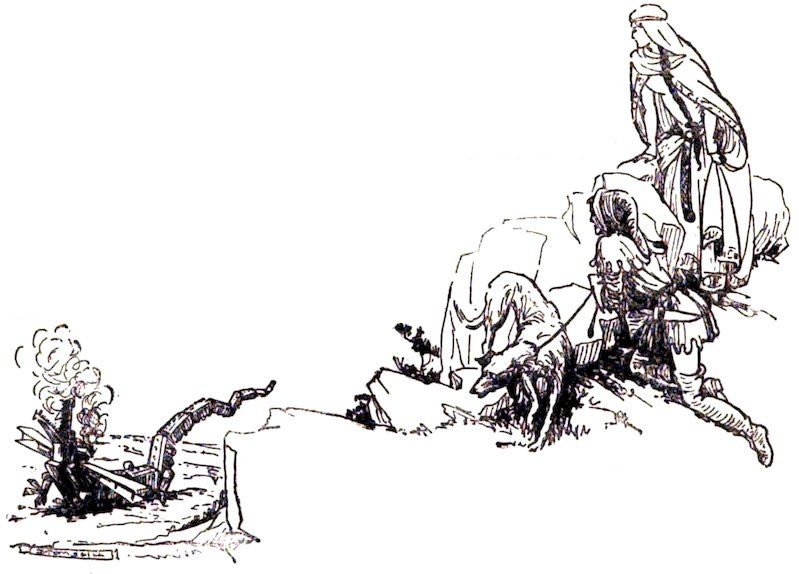
The Princess surprised them by walking inside.
50Thus began the last phase of the celebrated Dragon of
the Wilderness, which was more of a mystery than his
wildest massacres and deeds of destruction. He interfered
with nobody; he stood politely on one side for people to
pass; he even succeeded, with some signs of reluctance, in
becoming a vegetarian and subsisting entirely upon grass.
But when the ultimate goal of his pilgrimage was discovered,
the surprise was even more general. The wondering
and still doubtful crowds that followed him across that
country became gradually convinced of the incredible idea
that he intended to go to church. Moreover, he approached
the sacred edifice in a far more tactful and unobtrusive and
respectful way than Sir Laverok had done in the old days,
when he broke windows and tore up pavements in his indiscriminating
excess of punctuality. Finally, the monster
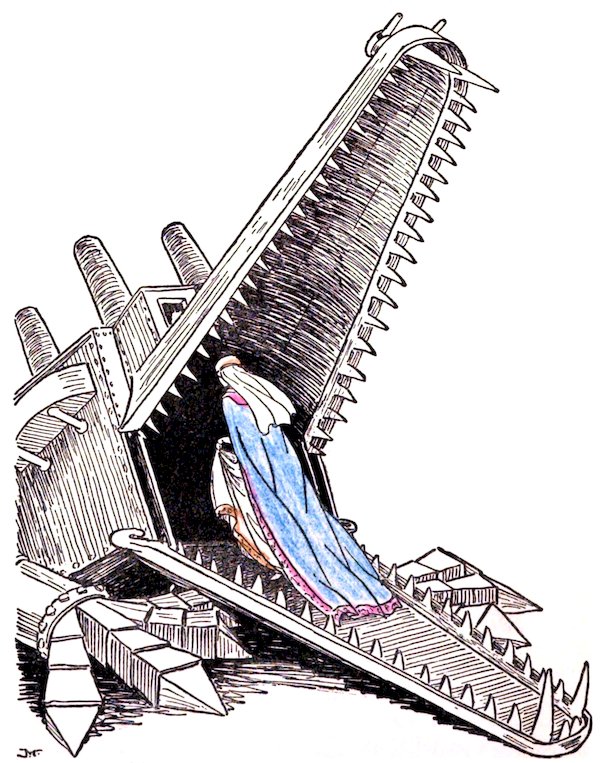
surprised them most of all by kneeling down and opening
his mouth very wide with an ingratiating expression; and
the Princess surprised them still more by walking inside.
Something in the way in which she did it revealed to the
more thoughtful among them the fact that Sir Laverok had
been inside the animal all the time. It is unnecessary to
repeat here the explanations which gradually enlightened
them about the inner truth of the story or the inner machinery
of the dragon. This exact and scientific narrative
is also addressed only to the thoughtful. And these will
have no difficulty in guessing that a magnificent marriage
ceremony took place in the interior of the dragon, which
was treated as a temporary chapel while within the precincts
51of the consecrated building. They may even form
some notion of what was meant when the Princess, who
was given to oracular remarks, said, “The whole world
will behave differently when heroes find their hiding-place
in the world.” But it must be confessed that those learned
men, the Chancellor and the Chamberlain, could make very
little of it.
THE CRINOLINE By B. K. PYKE
52
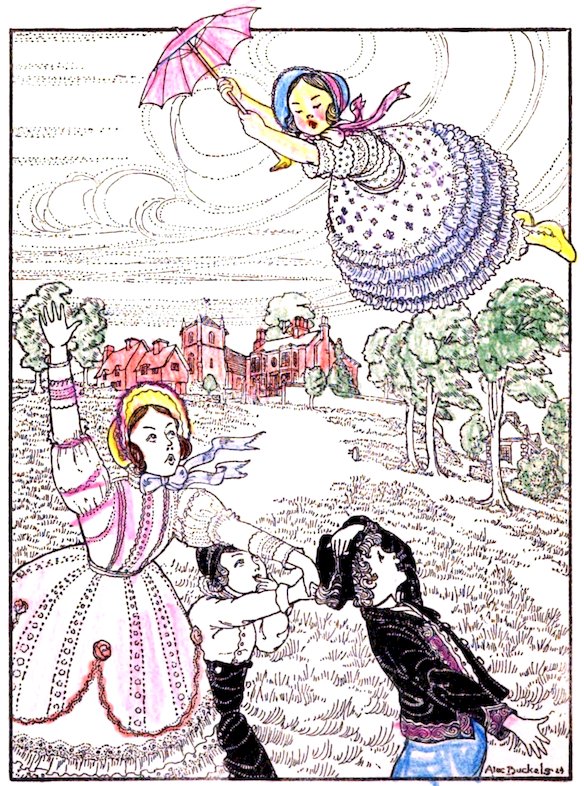
Charlotte all in hoop and frill
Was blown away
On Strawberry Hill;
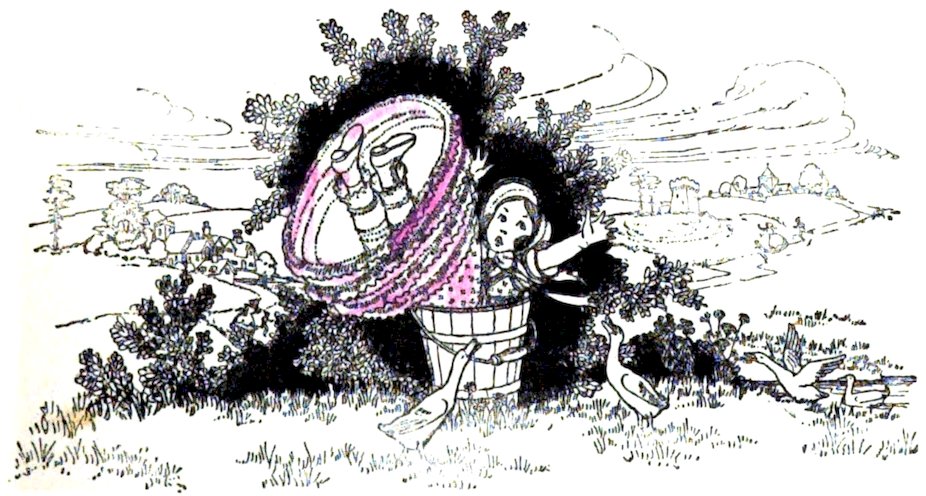
Searched in every town and vale
She was found
In a milking pail!
53
Charlotte all in hoop and frill Was blown away....
54
RED PEPPER By THOMAS QUAYLE
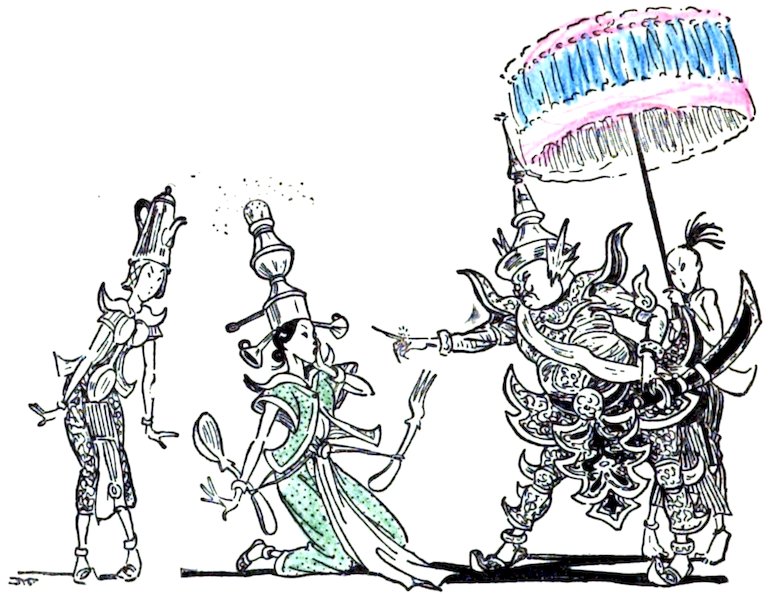
It was the day before the Prince’s wedding. All was
hurry and bustle in the kitchen. Suddenly the Cook
exclaimed: “I have lost the pepper!” The King replied:
“If that be so, then woe is me! For is it not written in the
Great Book that my father brought from the Isles of the
West, that all the bridal dishes must be sprinkled with red
pepper? Otherwise sad troubles and misfortunes shall follow
my son and his bride all the days of their life. Therefore,
O Cook, I tell thee that the pepper-castor must be
found, and if it be not found before the shadow of the Great
Mosque falls athwart the orange-grove, thou shalt surely
die the death.” And putting on his crown and his purple
robes, he walked sadly away, followed in slow procession
by his seven pages, his cup-bearer and his favourite minstrel.
55
At the words of the great King, the Cook wept sadly,
and made much lamentation. And all the maids, too, lifted
their voices and wept. The Chief Butler and his twenty-three
assistants, likewise moaned and tore their hair, for
you must know that red pepper was an exceedingly scarce
commodity throughout that land, and full well feared they,
that none could by any good hap be procured before the
shadow of the Great Mosque fell athwart the orange-grove.
And so, weeping altogether, they led the Cook gently to
her marbled kitchen, with its great copper cauldrons, its
gleaming ovens and fire-irons, its porcelain pie-dishes and
pewter pots, over which she had reigned for long years,
and there they left her for a while, that she might commune
with herself, and make her peace with the gods.
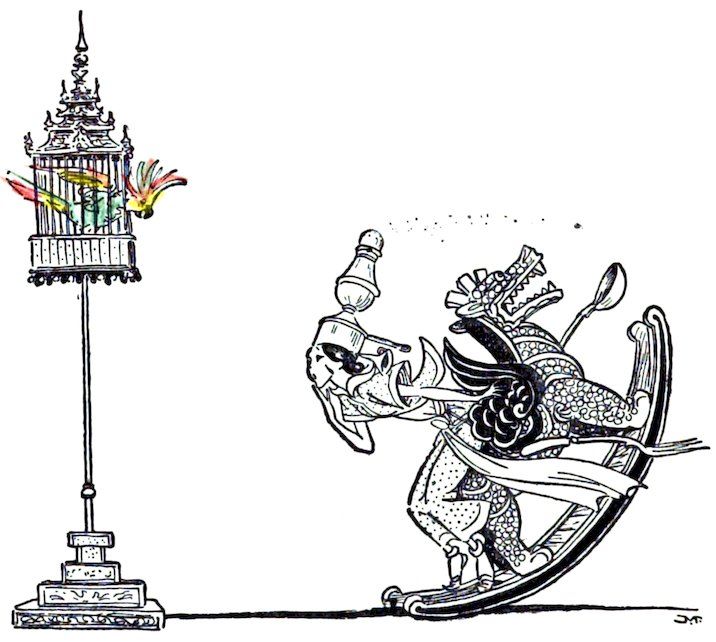
56So the Cook sat her down sadly in the big rocking-chair,
the very chair in which her own mother had rocked and
dangled her. She gazed at the little tender beams of sunlight
as they flashed through the diamond-paned window.
Outside the thrushes sang gaily in the lilac bushes, and
from the far corners of the Palace Gardens, she could hear
the soft twitterings of tomtits and robins. And as she saw
and heard all these sights and sounds, just as if she had
before her all the friends and companions of her girlhood
days, she rocked herself to and fro, and keened bitterly, and
in her grief spoke forty curses on the castor, and on the
thieves who had purloined the precious treasure.
Now it happened that just in front of the half-opened
and diamond-paned window, there was a golden cage in
which fluttered a little cockatoo. The King’s mother, herself,
had brought it from far-away lands as a present for
the Cook, and it was indeed her greatest pet. Many a dainty
did she keep for it, and many a lump of sugar, even in the
days of dearth, when queues and coupons troubled the
heart of the people. Red and purple was its plumage, with
little tufts of faint sea-green. Keen and sparkling were its
eyes, and often, when the golden sunbeams flooded the
Cook’s kitchen, these eyes seemed to gaze out very fiercely,
as if the many-coloured bird could see its far-away home,
there across the wide, wide seas, the little palm-fringed isle
with the surf dashing in glistening white up to its yellow
sands, to fall back to the main-sea deep with soft, sad music.
And as the Cook made her moan the little cockatoo
cocked its head on one side, as if listening eagerly. For
you must know that the isle where the bird was born and
57bred was famed throughout the world for
its rare, rich, red pepper. Kings and
Queens eagerly sought for it, and merchants
from Arabia, from Persia and
from a far-away island called Britain,
came often to barter for it. And as the
Cook keened softly, and bewept the loss of the castor, you
would have thought that the little cockatoo was going mad
with excitement, for it fluttered wildly around its golden
cage, and beat its wings against the bars, as if some wonderful
scheme were whirling through its little brain.
And then, to the amazement of the Cook, the cockatoo
put its pert head through the bars of the golden cage and
spoke in this wise: “O Cook, be not afraid, for I tell thee
58that before the shadow of the Great Mosque falls athwart
the orange-grove, there shall be brought to thee from my
home far, far across the seas rich, rare, red pepper, such as
Kings and Queens and great merchants delight in. Only
open the door of my golden cage, and thou wilt be saved!”
Something spoke in the heart of the Cook, and told her
that the bird could save her. So, opening the door of the
golden cage, she let the cockatoo go free. For a moment
it flew up and down the kitchen in the full beams of the
morning sun, flashing and sparkling like a little bundle of
diamonds and pearls, and amethysts and rubies. Then
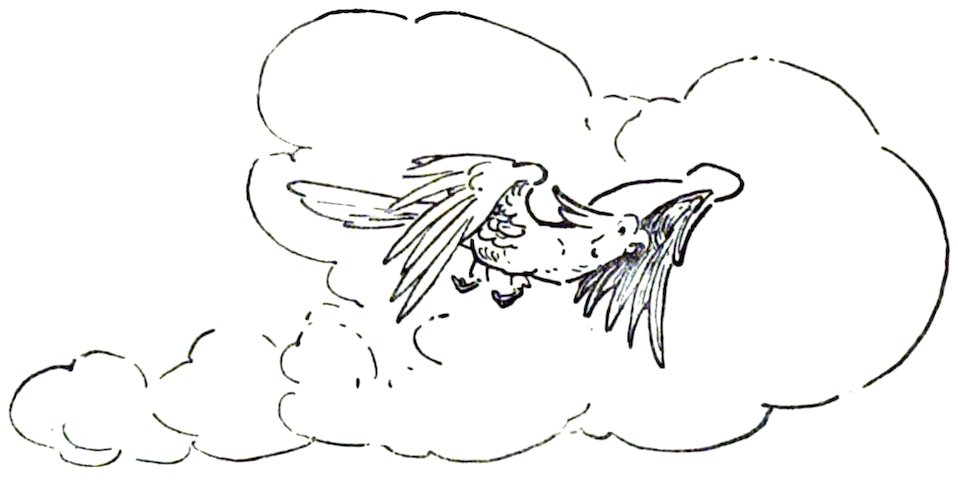
with a shrill cry it darted out of the window, and soon all
that the Cook could see was a tiny speck mounting up the
pathway of the sun.
Away flew the little bird, as if for its very life. Now it
is skimming over the silvery surface of the sun-sprinkled
sea, bright and glittering as a polished mirror. Now it is
high up among the clouds, lost in fleecy folds of pearly
white. On and on and on it flew, until at last it could
glimpse the palm-fringed, surf-beaten shore where it had
spent its youngest and happiest days.
Meantime the dread hour drew near, for the shadow of
the Great Mosque was soon to fall athwart the orange-grove.
The Ten Executioners, with their heavy swords
were ready, and the priests sang a sad song as they moved
slowly to the place of execution. All the household wept,
but the Cook herself wept not. She sat in silence gazing
steadily through the diamond-paned window up the golden
pathway of the sun. And the people in pity said: “Her
59mind has given away! Alas! she is distracted!” Yet they
crowded around her to say farewell, but she spake not a
word, only gazed steadily at the fleecy clouds.
And now, indeed, but few moments were left before the
shadow of the Great Mosque should fall athwart the
orange-grove, and all things were ready, and lamentations
arose on every side. But just as the Lord High Executioner
moved to the Cook’s side to pinion her arms, and
cover her eyes, she uttered a great cry, and pointed to a
little speck up, far up, in the sky. It flashed like a dewdrop
of the morn, and sparkled like jewels of great price, and
ever it came nearer and nearer,
until the astonished people saw
that it was the little cockatoo,
gleaming in the sunlit glory of its
red and purple, and faint sea-green.
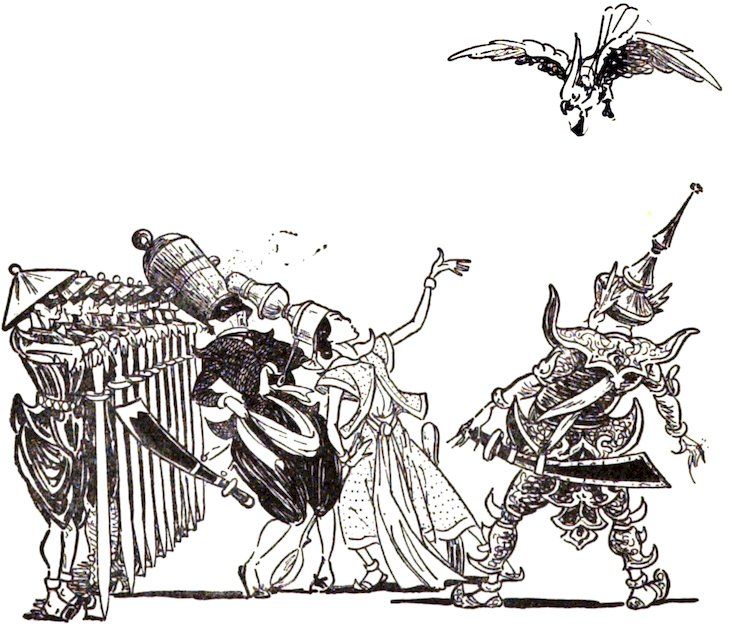
Through the window it
flew as if it had travelled down the
60pathway of the sun. Once, and once only, it flew around
the marbled kitchen, and then, with a shrill cry, it alighted
gently on the shoulder of the Cook. And all the women
gave a great shout, for fastened to the back of the little
bird was a packet of the rich, rare, red pepper beloved of
Kings and Queens, and sought for by rich merchants. And
seeing it, the people rejoiced exceedingly, even the King
himself, and sang songs of joy, and raised their voices in
exultation, but the little cockatoo, fluttering feebly, fell
dead on the floor of the marbled kitchen.
Thus was the Cook saved, and joyous was the revelry
at the marriage-feast, and cunningly were the bridal dishes
sprinkled with rich, rare, red pepper. And the little cockatoo
was buried with honour, in the centre of the Palace
Gardens, near the orange-grove, just where the shadow
of the Great Mosque falls athwart it. And if you do not
believe this tale, ask the robin redbreast, or the thrush, for
all the birds know it well.
MISHY THE SURF-BABY By MABEL MARLOWE
61
Mishy the surf-baby had twenty brothers and twenty
sisters, and ever so many other relations. But the
one he loved best was Benny-whisper, who was the
youngest of all the surf-babies.
Benny-whisper was as tall as a banana, and so golden-yellow
that when he lay on the sand he could scarcely be
seen. But Mishy was as tall as a cucumber, and the face
of him was always covered with smiles.
Now one morning Mishy awoke with a big noise in his
ears. All the surf-babies were running to and fro, making
such a commotion, and the Mother of all the surf-children
was making more noise than anyone.
“Whatever is the matter?” said Mishy.
“Benny-whisper is lost! Oh, Mishy, Benny-whisper is
lost!”
“Where is he lost?” said Mishy.
“If we knew that, he wouldn’t be lost,” said the Mother
of all the surf-babies. “Oh, Mishy, do help us to find him.”
Then Mishy jumped out of his bed and ran down to the
edge of the water, where the waves were making rims of
froth on the yellow sand. He stood with his toes in the
ripples, and he called out, “Oh waves of the sea, Benny-whisper
is lost. Have you got him?”
62But the waves of the sea splashed up and down in the
sunlight, and they answered, “No. We haven’t got him.”
Then Mishy the surf-baby ran and stood upon a high
rock, where the wind went whistling through his hair.
He spread his arms out and called, “Oh wind, Benny-whisper
is lost. Have you got him?”
But the wind puffed with his breath and answered, “No.
I haven’t got him.”
Then Mishy the surf-baby dashed into the surf, and
splashed his way through the shallow water until he
reached the path of the sunbeams. He raised his wet arms
above the waves and he called out, “Oh, beautiful sun,
Benny-whisper is lost. Pray help me to find him, for I
love him so.”
So the golden sun opened his big eye very wide and sent
his beams searching all through the daylight. But there
was no sign of Benny-whisper.
Mishy the surf-baby went slowly home. All the twinkles
were gone out of his eyes, and the smile on his face was a
sad little smile. He sat down in the doorway, nursing his
knees, and all his brothers and sisters came and sat beside
him. Not a word did they say. But they all rocked to
and fro, looking very sad.
At last Mishy jumped to his feet, and he said, “Benny-whisper
must be somewhere. He is in a place where the
sea does not reach. He is in a place where the wind does
not blow, and where the beams of the sun cannot shine.
He is in a corner somewhere. But I will find him. I will
find him if I have to search until bedtime.”
So he went down among the rocks, where the little crabs
were scuttling in the wet sand. He turned each rock over,
63and hunted in the dark shadows beneath it. But Benny-whisper
was not there.
Then Mishy went among the seaweed, and lifted each
heavy strand that trailed about the cliffs, and peeped into
each little crevice and corner. But Benny-whisper was not
there.
Then Mishy said to himself, “I will climb the face of the
cliff. Perhaps Benny-whisper is high up on a ledge, and
cannot get down.”
So he clambered up the face of the cliff, holding on by
the sea-lavender bushes that grew there, and calling out,
“Benny-whisper! Benny-whisper, where are you? Mishy
wants you! Mishy is looking for you! Oh, Benny-whisper,
call out to me, and tell me where you are!”
But there was no answer.
Then Mishy climbed higher and higher. His little arms
began to ache. His little toes began to throb. He reached
a ledge at last, overhung by the top of the cliff and half
hidden with samphire.
“I must rest here for a little,” said Mishy with a yawn.
So he curled himself up in a corner and closed his tired eyes.
In ten minutes he was asleep.
Mishy the surf-baby awoke with a queer, warm, cosy
kind of feeling that he had never known before. Something
airy and soft and warm was spread above him. It
was very dark, and the only sound to be heard was a throb,
throb, throb.
64
She looked at Mishy.
Mishy wriggled. Mishy kicked with his feet and pushed
with his hands and parted the softness that was covering
65him, so that the daylight shone into his eyes. Then he
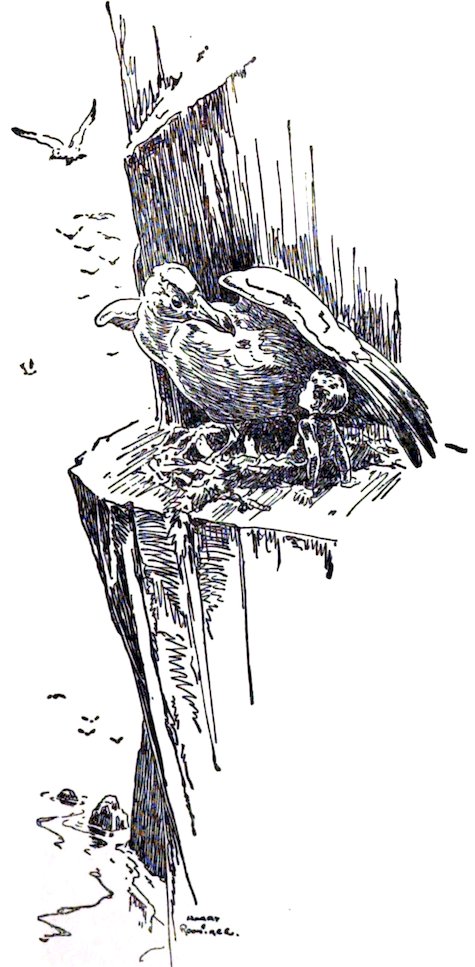
saw, to his amazement, that a seagull was sitting upon
him—sitting so softly that she felt like warm snow, and
the beat of her heart throbbed like the tick of a velvet
clock.
Mishy wriggled again. Mishy made a little squeaking
noise with his throat.
“The egg is hatching,” said the gull.
“Get off it, and let me see,” said another gull (it was
the father one). Then the gull made a cooing kind of
noise, and stood up on her feet.
She looked at Mishy, and she said not a word.
He looked at Mishy, and he said not a word.
They looked again. They shut their eyes, and opened
them and looked again. They turned round three times,
and looked at Mishy again.
Mishy began to laugh. He sat up, nursing his knees.
His hair was all rumply, and his little cheeks were all rosy
and warm. “This is a grand adventure,” he said to himself,
and he combed his hair back from his face with his
fingers and laughed, showing glistening white teeth.
“That’s an odd kind of gull,” said the mother gull.
“A very odd kind of gull,” said the father gull.
“It has no wings.”
“It has no beak.”
“It has no tail.”
“It has toes on its feet.”
“I don’t know if I like it,” said the mother gull.
“I don’t know if I like it,” said the father gull.
66
The gull swooped down.
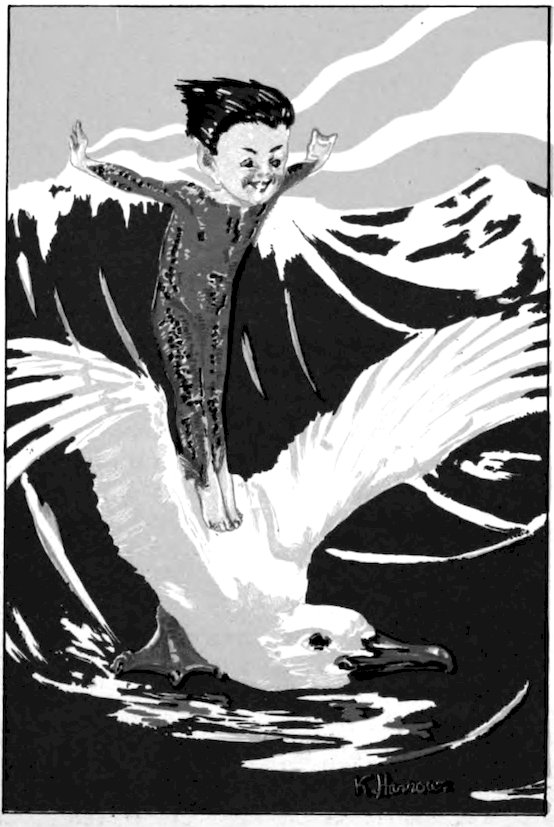
Then Mishy laughed aloud, and he stood up on his toes,
and flung his arms wide. “I am a gull’s baby,” he cried.
67“Hurrah, I am a gull’s baby. I can’t think how it happened,
but it’s true.” He danced about on the ledge like a
sunshine-sprite, and he dimpled his lips and whistled like
a canary.
“I believe I rather like him,” said the father gull.
“So do I,” said the mother gull. “Anyway, he is a most
uncommon baby for a gull to have. No other gull has a
baby like him. I think I am rather proud about it.”
“So am I,” said the father gull. “It is a pity he has no
wings, but perhaps they will grow.”
“I can ride on your back,” said Mishy, and he ran and
jumped upon the back of the father gull. “See, I am so
light that you scarcely feel me,” he said.
“You will fall off when I begin to fly.”
“Try me,” said Mishy.
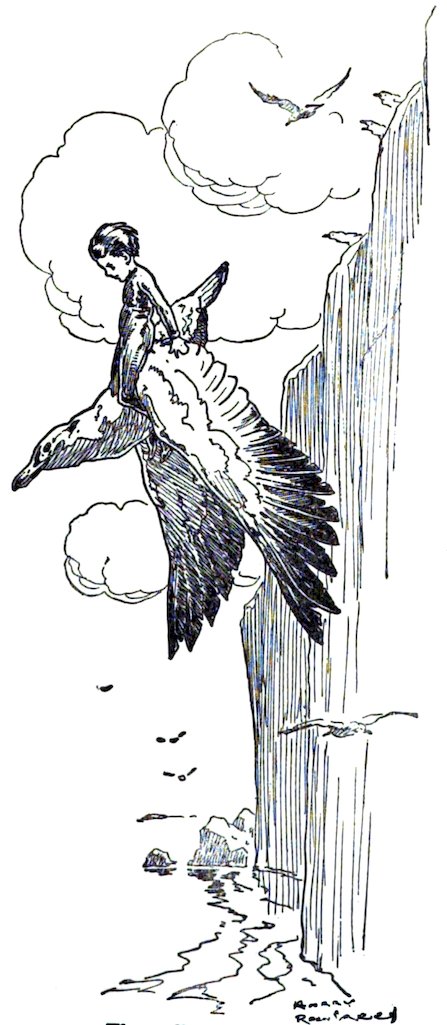
Then the great bird laughed, and spread his beautiful
white wings, and leaped from the ledge with a cry. The
wind whistled past Mishy’s ears as the gull swooped down
towards the water. His brown hair blew back from his
laughing face. He flung out his arms. He stood a-tiptoe
with his little pink feet. Never before had he enjoyed such
a wonderful ride.
But all of a sudden he remembered Benny-whisper.
“Oh, take me to the breakers,” cried Mishy. So the gull
swooped along the edge of the ripples, where the surf-babies
were washing in the foam.
“Is Benny-whisper found?” shouted Mishy, and all the
surf-babies answered, “No!”
Then Mishy cried out to the gull, and he said, “Oh,
father gull, take me for a ride across the ocean.” So the
beautiful bird beat at the air with his wings, and rose, and
68sped right away across the blue water, where the tips of
the waves were crested with white.
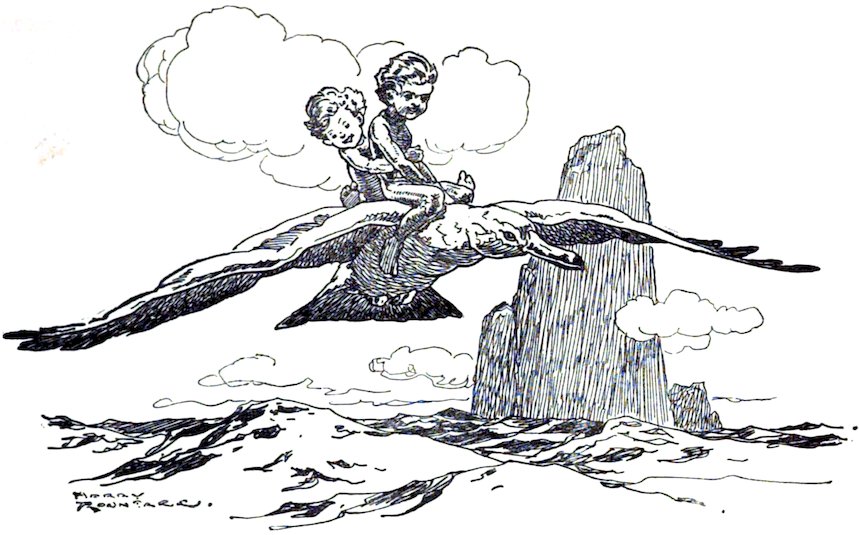
So the gull flew back with two surf-babies.
69But Mishy was not smiling now. He was looking
around him with anxious eyes, and all the while he was
calling out, “Benny-whisper, where are you?”
“Mishy! Mishy! Mishy!” came a little voice.
Mishy looked down. There, far below him on the billows,
was a green rock, all glistening in the sunlight—and
standing on the edge of it was Benny-whisper.
“Oh, take me to that rock,” cried Mishy. So the gull
swerved and sailed down to the rock, and Mishy jumped
off and caught Benny-whisper in his arms.
“However did you get here?” he said, between kisses.
“The tide brought me. I was sailing in my little cockle
boat.”
“The waves of the sea did not tell me.”
“The sea did not know. I kept in the bottom of the boat
and went to sleep.”
“The wind did not tell me.”
“I pulled some seaweed over me before I went to sleep.”
“The sun did not tell me.”
“I kept in the shade.”
Then Mishy the surf-baby laughed more gaily than he
had ever laughed before. He picked Benny-whisper into
his arms, and leaped upon the back of the gull, and cried
out, “Oh, dear father gull, fly back as quickly as you can.
Fly back to the breakers, where the ripples of the sea are
making froth on the golden sand.”
So the gull flew back, with two surf-babies nestling
among his feathers.
70“What have you done with that strange baby?” said the
mother gull.
“I left him with the surf-babies.”
“That is very lucky,” said the mother gull. “When you
were gone I found my egg, still in the nest, not hatched at
all.”
“Then he was not a gull’s baby, after all.”
“No. But I rather liked him.”
“So did I.”
Mishy the surf-baby often climbs the face of the cliff to
the ledge behind the samphire bush. He climbs up, but he
doesn’t climb down again. He comes down on the back
of his friend the gull, in the loveliest, swiftest joy-ride that
there could ever be.
THE PRINCESS OF KENSINGTON By MADELEINE NIGHTINGALE
71
When, very long ago, Oberon held his court in Kensington
Gardens, the King of this Island had a son
named Albion. Now, as everyone knows, fairies
have a dreadful habit of stealing mortal babies and leaving
small elfin changelings in their stead. This is just what
happened to Albion, and he was brought up in Fairyland.
When he was nineteen years old (according to human
countings) he fell in love with Oberon’s daughter; but
since no fairy may marry a mortal, Oberon was very angry
and banished the young man from his fairy empire. So
dearly, however, did Albion love the Princess that, rather
than give her up, he sought the help of Neptune, and was
slain by the elves in the great battle that followed. In
revenge, Neptune destroyed Oberon’s kingdom, driving
out the elves so that they live now only in the hills and the
dales and the sea-caves and the rivers and the woods. The
Princess remained and sought to bring her lover back to
life by means of a magic herb. It is said that no sooner did
the juice of it touch Albion’s body than it changed into a
snowdrop. But we are afraid that, in her love and sorrow,
the poor little Princess has forgotten.
72
The Princess of Kensington
Goes down the cobbled street;
Listen to the patter
Of her small brocaded feet.
Her peacock, her page-boy,
And maids-of-honour two,
From dawn to dusk they follow her
London through.
The fairies of Kensington
Are driven out and gone.
From Hyde Park to Holland Park
There’s left but only one;
And she—she’s lost her lover
And searches up and down
The highways and byways
Of London town.
73The night-watch of Kensington
A-calling on his round,
“Two o’ the clock and starlight!”
—It is a pleasant sound.
But, ah, the little Princess,
How softly whispers she,
“Albion! Albion!
Where can—where can he be?”
The children of Kensington
Lazily they lie,
Fast and warm within their beds,
And hear her passing by.
But not a child will draw his blind
And shout, “Oh, don’t you know?
He’s hiding in the Green Park
Where the snowdrops grow.”
74
THOMAS THE RHYMER By MADELEINE NIGHTINGALE THE CHOOSING
As I was fishing by Huntlie Bank
True Thomas he passed by.
“Thomas the Rhymer!” I called his name;
He turned and he looked and back he came.
“And how may I serve you, my pretty child,
Sitting so meek and sitting so mild,
A-fishing the pool where the sedge is rank
Round and about of Huntlie Bank?”
And, oh, but the strangest face had he,
75His coat was as green as the greenest sea,
And it seemed, as he stood and stared at me,
There was magic in his eye.
He held me an apple in his right hand
—The half of a fairy-man was he—
But up I got me and curtsied low,
Staid as a duchess and twice as slow;
And all my petticoats flounced as neat
As a daisy’s petals about my feet.
“Nay, prithee,” said I, “good sir, if you
Be going to Elfland, why, take me too.”
He clippered a clap of his velvet shoon
And a little white road fell out of the moon.
Quoth he, “If we’re starting we’d best start soon
Or we’ll never be home for tea.”
THE PIRATE SHIP By MARIAN ALLEN
76
I wish I was the Pirate King
Who sailed the seas in days of old;
I’d drink my wine and loudly sing,
And capture great ships packed with gold
And fling my captives in the hold
And sail away across the night
Beyond the moon so round and white.
The ships who sail the ocean now
Just wireless all they want to say,
Like “How d’you do,” before they bow
And pass politely on their way;
All sorts of rules they must obey.
I think, when all is said and done,
The Pirate King had much more fun.
77
A STRANGER By HUGH WALPOLE
A Story Told by
“Uncle” Edward to Charles and Rosalind
You asked me yesterday afternoon, when we were out
for a walk, to tell you what was the most exciting
thing that ever happened to me. People are excited
in such different ways, you know, and it’s quite possible
that this won’t seem exciting to you at all, but you asked
me, and I’ll do my best to tell you. I am now ever so old,
as I heard Rosalind saying to Miss Banbury when she was
trying to teach you French verbs the other morning, and
when you are as old as I am, you’ll find that the things that
78you remember best are the things that happened years and
years ago. For instance, I remember nothing about last
Christmas, except that we had a tree, and that Charlie was
sick on Boxing Day, but if you ask me to tell you every
little thing that happened to me before I was fourteen, I
fancy that I can; mind you, I say fancy, as it is possible
that I am making the whole thing up, but what’s the real
difference between making things up and remembering
things that once happened to you, it will need a cleverer
man than your uncle to tell you.
Now I come to the point. This adventure began with
reading a book in a farmhouse. I know that both of you
would rather go to Shawmill Farm than anywhere else in
the world. You are always telling me so, and that month
in the summer doesn’t seem nearly to content you, and apparently
you expect me to take you off there any time at
a moment’s notice on a kind of magic carpet like the one
I told you about the other day. Well, my farm was every
bit as good as yours; in fact, if you don’t mind my saying
so it was, I think, a little bit better, but everybody has their
favourite farm and the longer it is since you’ve been there
the more favourite it is. I loved mine so much partly because
I think, it was my first one, and I have never had all
the good times that both of you are so accustomed to that
you don’t know they are good times at all. For one thing,
I had no brothers or sisters, and for another thing, my
mother died when I was so small that I can scarcely remember
her. Then my father wasn’t like your father;
the only things he cared for were books, and those are very
good things to care about, but if you care for them too
much, you forget about people, and think that books are
79more important than people, which they are not, and never
can be, and don’t you forget it.
Mind you, my father was very kind to me when he remembered
me, but he had to leave me a great deal in the
hands of other people. We lived in London in a very large
house, so large that when you were in the top part of it it
was like being in another house altogether. I had lots of
room to move about in, plenty of toys, and anything I
wanted so long as the grown-ups thought it was good for
me, but what I wanted most was other children to play
with, and that I never had. One day I was ill. I had one
of those terrible headaches that you get, Charlie, sometimes
from eating too much, but that I got, I think, from being
by myself and thinking too much. I don’t mean that you
haven’t got to do your work properly; it is a silly thing to
be lazy, so that when you grow up everyone thinks how
stupid you are, and wonders why you never learnt anything.
But my thinking was done all by myself, and I
formed a very bad habit of talking to myself, and I think it
was because I talked so much to myself that I got the headache
of which I was telling you. Well, I was put to bed,
and the doctor came to see me, and poked me in the chest,
and put a thermometer in my mouth, and looked at my
tongue, and went away and didn’t say a word, and they
kept me in bed so long that I got very tired of it and wondered
if they were ever going to let me get up again. Then
at last a wonderful day arrived when I put on my clothes
again, and although my legs were very shaky and I was
as weak as a kitten I was so proud at being out of bed that
I could have danced all round the schoolroom. Then I
was told that Father wanted to see me, so I went all the
80way down to the library, and there he was, as he always
was, sitting at a large table covered with books, and looking
at me when I came in with a puzzled expression that
people have when they have been reading a great deal.
Although he was so kind to me I was a little afraid of my
father; although he wanted to, I don’t think he knew how
to make children easy and comfortable. I went and stood
beside him, and he put his arm around me and asked me
whether I was feeling quite well now, and I said yes, which
wasn’t quite true I’m afraid, and then he said how would
I like to go into the country? I hadn’t very much idea
what the country really was. I had been once to the seaside
but I hadn’t enjoyed it because I was never allowed to
go about by myself, and I was rather afraid of the country
to tell you the truth, but I wasn’t going to show anybody
that I was afraid, and I said that I would like to go. Then
he gave a great sigh and I always remember that sigh because
it was the first time that I realised that he had
troubles just as I had them. I’d like to have asked him
what his troubles were but I hadn’t the courage. Then
he kissed me and told me to go upstairs again and upstairs
I went. I was excited all day at this thought of the country,
but I didn’t like to ask anybody any questions because
I might be thought foolish and I tell you both here and
now always ask questions if you want to ask them; never
mind how foolish people will think you; that’s the only
way to learn anything.
I was put to bed.
82
You know what it is like waking up on the first morning at your farm.
Next morning I was wrapped up so warmly that I looked
like a little polar bear. I came downstairs again; my
father was in the hall and kissed me; then I was put into
a carriage with my governess who was called Miss Somerset,
83whom, between you and me and the bedpost, I didn’t
like at all. She was always telling me not to do things,
but never suggesting things that I might do or, at any rate,
never suggesting interesting things. However, I was so
terribly excited that I didn’t mind about Miss Somerset
or anyone else. We came to the station and got into the
train, and I am afraid I can’t remember anything about the
journey. I think I must have slept most of the time because
I seem to remember that when the train started it
was in the morning, and the sun was shining, and a minute
later it was quite dark outside the windows and there
was a light in the carriage. Directly after that, Miss
Somerset said, “Here we are,” and that she had a terrible
headache. I remember about her headache, because I
asked her whether it was the same as mine, and she told
me not to ask silly questions, but I didn’t care what she
said because now we were out on the platform and the
wind was blowing so strongly that it nearly took me off
my feet. There had been a wind at the sea but this was
different; there was something exciting about it. I remember
last year when we were on the hill above the farm,
Rosalind saying what an exciting wind it was. This was
just the same sort of wind, friendly, as though it had come
to the station to meet you and wanted to carry you off with
it to some fine place that it knew of. All Miss Somerset
said was, “Bother the wind.” She hurried me into a cab
that was waiting outside the station. We drove for a long
time in the dark, and although I couldn’t see anything I
had a feeling that it was different from any other place
that I had ever been to. There was a kind of smell about
it that was quite new to me, and it was all so quiet after
84London that I felt as though it were waiting to get me
away from Miss Somerset, and then tell me something
very important. We got out of the cab at last, and then
I was so sleepy that I fell right into somebody’s arms and
was taken up to bed without noticing anything at all.
You know what it is like waking up on the first morning
at your farm, how first you smell the difference of the
house, the scent of the bacon that you’re going to eat in
half-an-hour’s time is coming up the wrong staircase;
through the window which if you’re wise, you’ve had open
all night, there are all sorts of new smells; the air smells
differently and it’s as though you’d had your bed planted
in the very middle of a field all night, so close do you seem
to the scent of the soil, and then, almost at once, smells are
connected with noises. The first thing you were conscious
of waking in London was the toot of a cab or the rattle of
a tram, and now it’s a dog and a horse, and above all, a
cock strutting about conceitedly on the top of a wall just
under your window. Then, although you’ve scarcely
raised your head from the pillow, the sounds and the smells
together carry your imagination—the most useful part of
you by a long run—across the fields, out of the gate up the
hill behind the farm to the Downs, and your feet are already
dancing on that turf that is so alive that you can
almost feel it moving under you.
That’s what happens on your farm, how much more was
it the case on mine? Remember, I had never been away
from a town before, and when I rather timidly looked out
of my window and saw first a yard with chickens and a
large black dog, a pond blue in the morning sun at the end
of it and ducks paddling there, and then beyond it fields
85greener than I had believed it possible for grass to be, and
beyond them a mysterious dark wood that seemed to be
begging me to step into it, you can imagine whether I
was excited or not. But I tell you the honest truth, I don’t,
on looking back, think that this was ideally the place for
a boy’s first farm; only you see, I couldn’t criticise it,
because I had never been to another one. Now, you would,
both of you, be very severe critics of farms, because you
happen to have for yours one of the brightest and most
beautiful that ever was made, and yet I said just now that
my farm was better than yours, and I said that because
you are both a little spoilt about things. When I was small
children didn’t have any of the fun and excitement that
you both have every minute of the day. People weren’t
always thinking about the best way to amuse children,
how to keep them happy and give them fun, and so, when
any fun did come our way, it meant a terrible lot to us, but
I can see now on looking back that this was an odd farm
to send a small boy all by himself to. There was, of course,
Miss Somerset, but I hardly count her, because she was
unwell, all the month we were there, sitting up in her room
most of the time with that terrible headache of hers. I
believe that really she had determined to hate the country
before ever she got to it, being one of those people who get
more happiness out of being miserable than out of being
happy, and the result of this was that I was left a great
deal to myself.
You know how you all love the Tuttles at your farm,
and I tell you in confidence that I think that they are very
nearly the nicest family in England. The man who ran
my farm was called Mr. Andrew. He was a big, black,
86silent man. I daresay that he meant to be friendly, but I
don’t think that he had much more idea about the way in
which little boys are made comfortable than my father
had, and then I discovered afterwards that his wife had
died some five years before I arrived, and that made him
melancholy. His sister, Miss Andrew, looked after the
domestic part of the farm, and was as silent as her brother,
so you can fancy that I hadn’t very much company, but I
didn’t mind. I was thoroughly used to being by myself,
and what I liked to do was to imagine myself somebody
else and run it on for weeks and weeks, with fresh adventures
every day. Rosalind told me the other day that she
would like to write stories when she grew up just like me,
but I was writing stories in my head almost from the moment
I was born, I think. Perhaps Rosalind is doing the
same, but if she is, she keeps it very dark. I hadn’t been
about the place for more than a day or two before I had
decided that I was a prince in disguise, and owned all the
country around me.
This country was called Cumberland, and the great feature
about Cumberland is that it is made up for the most
part of mountains and lakes. Now, you’ll find that the
very clever people who have travelled all over the world
will tell you that the Cumberland mountains are nothing
at all, that they are so small compared with other mountains,
that they are only little hills, and that once you’ve
been to Switzerland you’ll never look at the English mountains
again. Don’t you believe them. I am very delighted
for everybody to have their own opinion, but I also have
travelled all over the world, and I tell you that there is
something about the Cumberland Hills that no other hills
87have got, and that they always look a great deal bigger
than they are. I think that’s because they are all in such
beautiful proportion, and seem just as big as the Swiss
mountains when you are in the middle of them. However
that may be when you’re grown up, they of course seem
gigantic to a boy who has never seen any others. As a
matter of fact, from my farm you could only see one mountain
and that was a long way off, but that was quite
enough for me; I filled it at once with every kind of treasure
because I was prince of the whole country and could
do as I liked with it, and at once put a secret door at the
bottom of it, just where there was a little wood that looked
from my window like a tooth-brush, and from this door
there was a passage that led all the way through the mountain
and had on every side of it large rooms filled with
every kind of treasure, heaps and heaps of rubies, and piles
of diamonds, and ropes and ropes of pearls. There was,
of course, an enemy prince in the neighbouring country
who wanted to take this mountain, and he would send spies
and try to discover the way through the door, and one day
even went there himself, but my right-hand man, Black
Jack, was waiting for him and in spite of all his troubles
succeeded in imprisoning him in a cave all by himself on
the side of the mountain. That was a very great day for
me when I heard that he had been captured.
88
She said in Farmer Somebody’s barn.
I was allowed to go a great deal about by myself, very
much more I fancy than my father would have approved
had he known it but Miss Somerset, because of her headaches
and because the weather was never what she
thought it ought to be, and because there was so much mud
about that she was afraid of getting her feet wet, kept
89more and more in her room, and deputed her job of looking
after me to the maid-of-all-work in the house, who was a
girl from the village near by, and was called Nellie. Nellie
was a good girl, and a kindly, but she had so much work to
do, poor thing, that she couldn’t do more than give me a
look every once and again, to see that I was all right. I
was very quiet and never gave anyone any trouble, and
seemed to amuse myself very easily. Very soon they all
ceased to bother about me. So the days went by, and very
wonderful days they were to me. Then came the adventure
of which I am going to tell you.
It was, of course, summer time when all this happened,
and there came a day called midsummer’s eve. That is
the day when, as soon as the sun sets, all the fairies are
supposed to come out and dance in rings on the grass, and
run up and down the house, and play jokes on everybody
and have a wonderful time. I knew about the fairies, because
Nellie had told me, and I waited with great excitement
determined that, however sleepy I might be, I would
keep awake and watch all the fun. I wasn’t frightened in
the least, because I had known all about the fairies ever
since I could remember, and many of them were my very
good friends. I was tremendously pleased that at last I
should have a chance of meeting some of them. That was
a very beautiful day, and when the evening came everything
was bathed in golden light, and the colours of the
fields, and the wood, and the distant mountain were as
clear as though they had been painted on glass. Mr. Andrew
and his sister went out early in the evening to somebody’s
house and I was left alone with Miss Somerset and
Nellie. There was a midsummer night’s dance in the village
90which Nellie, poor dear, was very anxious to go to,
and she confided to me that it was a great shame that
everybody else should have such great fun and that she
shouldn’t be able to share in it.
I was very sorry for Nellie; she had been so kind to me
that I was very anxious to help her. I asked her how far
away it was that they were dancing, she said in Farmer
Somebody’s barn at the bottom of the hill, and then I suggested
that she should go down for an hour, that I would
be quite all right. To tell the truth, I was in the very middle
of a story called “Redgauntlet” that was written by one
of the greatest men who ever lived. The same man
wrote “Ivanhoe,” that you told me was very long, Charlie,
the other day when I wanted to read it to you. I don’t
want to shove books down your throats, but if you try to
read “Redgauntlet,” and find that too long for you, I am in
despair of both of you. Well, in any case I was in the very
middle of this book and Nellie, who was not herself fond
of reading—indeed, I doubt whether she could read at all—had
never learnt the great gift of “letting reading dogs
lie.” She would interrupt me every second, with an exclamation,
or a wonder, or a surprise, so I was rather glad
to get rid of her, and saw myself having a whole glorious
hour perched on a very high chair by the window, and although
I was reading so intensely that I never would lift
my eyes from the page, at the same time I would be conscious
of the light gradually fading from the sky, and
green fields turning to silk, and of the birds slowly wheeling
home. I loved all these things because, you see, I had
always lived in streets. I think that it was really during
that month that I grew to love space so deeply; I liked to
91be able to look on and on and on, and to feel that I had
only to order my snow-white charger to be brought to the
door, and so go flying off through the dusk to my mountain
fastnesses. Then the kitchen behind me was very wonderful,
so large, that at this hour before the light had faded,
before the candles were lit you could not see into its farthest
corners, and all the plates in rows on the old dresser
were like friendly faces smiling. It must have been nearly
nine o’clock by now, and I was supposed to go to bed at
nine, so that Nellie’s obvious suggestion was, that I should
go to bed, and then she should creep off for a little time.
Mr. Andrew and his sister would not return till after ten,
and Miss Somerset was fast asleep with her headache
tucked quietly under her arm. But I begged Nellie to let
me stay for a little while; I promised most faithfully to go
up to bed exactly when the kitchen clock struck half-past
nine. She had by that time so complete a faith in my keeping
my word, and was so sure that I could come to no
harm, that after one longing look through the open window
at the lovely summer evening (we could hear very
faintly coming up the hill strains of the rustic band) she
nodded her head and said she would go. She slipped on
her coat and hat, gave me a kiss and was off.
92
How I loved it when she was gone! If I sat at the right
of my window, I could see the rounded top of my mountain
quite black against a sky that was now very pale like an
evening primrose. I remember the look of that sky so
well because, when I look back, everything that was to
happen in a minute seemed to be bathed in that light. If
it had happened half an hour later I would have been
frightened, because it would have been so dark, and it
couldn’t have happened half an hour earlier,
because Nellie would have been there.
It all occurred at just the right moment, as
things so often do in life. Well, I sat there
reading, and everything grew quieter and
quieter, so that I could hear the stream
running over the pebbles at the bottom of
the field, with a little tinkly sound of the fiddle coming up
from the barn and even, I fancied, Miss Somerset’s snores
from upstairs. But for some reason or another I couldn’t
read; my own imaginations were stronger than the book,
splendid though the book was. I was using my magic
powers, I was holding my hand up to order the evening to
stay still just as it was, as evening stayed still, you will
93remember in “The Sleeping Beauty.” There, they would
all be for one thousand years, Nellie half way down the
hill towards the dance, Miss Somerset snoring, the cows
lying in the byre, the sheep in their pen, and two birds
transfixed for ever in that primrose sky. I was feeling
very powerful and very grand when in a moment the spell
was broken, and a man appeared on the grass just outside
the window, so close to me that if I had put out my hand
I would have touched him.
94
They stood me in the middle of the floor.
The strange thing was that I wasn’t frightened at all,
although his appearance would have frightened many a
grown-up person. He seemed very large in that evening
light, he had been running and was breathing hard, his
clothes were ragged and torn, and he had no hat on his
head. He didn’t say a word, but climbed over the window
into the kitchen in a second of time. He didn’t seem surprised
to see me, but bent down very close to me (he was
a very tall man indeed) so that his face was right up
against mine, put his hand on my shoulder with such a
grip that he almost lifted me off my chair, and said “Don’t
speak a word, or you’ll be the worse for it!” The odd thing
was, that I liked his face, it was odd because he can’t have
been beautiful to look at; his cheeks were rough and hairy,
and his eyes were fierce, but it doesn’t matter, everyone is
either a friend or not a friend from the first moment you
see them and I hadn’t any doubt at all about him. “Of
course, I won’t tell anybody,” I said getting off my chair,
and I remember that I was so little frightened that I put
the book down carefully on the window-sill so that it
should come to no harm. He was, I think, astonished at
my taking it so quietly, but he was too desperately alarmed
95to think of anything but his own danger. He stood lost
and bewildered in the kitchen, looking about him as though
he couldn’t pull himself together and make up his mind.
Now, looking back, I should imagine that he wasn’t very
old, quite a young fellow, but he seemed to me, of course,
extraordinarily big and strong. His clothes had been torn
partly off his back, and his shoulder was bare and bleeding,
and I remember that he kept trying to pull up his rent coat
over the shoulder, as though he would like to appear more
decent and respectable. I expect it was only a nervous
movement, and he didn’t know what he was doing. He
realised, I suppose, that he must take me into his confidence,
and that whatever happened he must reassure me,
so he sat down in the big wooden arm-chair, and drew me
towards him, and stood me between his knees. I remember
as though it had happened only yesterday, that his
trousers were torn, and his knees bare like his shoulder.
He spoke to me then, very quietly (wonderfully quietly for
a man pressed as he was) he told me that he was a stranger,
this he impressed upon me over and over again. What
kind of a stranger he was, he didn’t tell me, but I realised
that his voice wasn’t like the voice of my father and my
friends, and that although I could understand everything
he said there was a curious twist once and again, that was
like nothing I had ever heard before; but the point was that
he was a stranger, and that he meant nobody any harm,
but that they laughed at him, and that he stood as long
as he could, and then they laughed at his country; that he
could not stand, and so he had hit somebody. After that
there had been a fight, and that he didn’t know what had
happened, but he was terrible when his anger was roused,
96and that after all he was a stranger, that they were pursuing
him now, all of them, with sticks and forks, and
that if they caught him they would shut him up, and that
he wasn’t going to be shut up, that he meant nobody any
harm, and if they tried to shut him up he would kill them,
so they had better look out, and that after all he was a
stranger; that was what was the matter, and that if he
hadn’t been a stranger they would never have touched
him.
All the time that he was talking to me, he was looking
into my eyes, and I was looking in his. He had his hands
on my shoulders, and his bare knees pressed against my
body, but he wasn’t hurting me, and his eyes asked me to
help him, and my eyes answered that I would without my
speaking a word. Indeed I think I would have gone with
him anywhere; it is odd when I look back, but I believe
that this man with the rough hair and the torn clothes, in
his terrible state of fear and haste was the first person in
all the world who had talked to me in that kind of way.
Perhaps what drew us together, although I was too young
to understand it, was the fact that I was a stranger in my
own way too, a stranger to Miss Somerset and a stranger
to my father and to many another who didn’t understand
me nor what they called my funny ways. He took me on
to his knee and held me close against him, as though I
were the only safeguard he had in all the world, but I
didn’t say a word but just waited for him to tell me what
to do.
However, I hadn’t long to hesitate. We hadn’t been
there for more than five minutes I suppose, when we heard
the sound of voices. In another moment he was on his
97feet, gazing desperately
about him. It
had become suddenly
dark, and all the voices
seemed to swirl up on
the grass plot outside
the window. We
stood in the shadow of
the kitchen, and as
though I had been a
hundred years old,
moving by instinct, I
suppose, I had shown
him a large empty
cupboard in the farthest
corner of the
kitchen, and he was in
it and the door closed,
and it was as though
he had never been.
I had the sense then
(and I don’t know now
where I got it from)
to go quietly to the
window and pick up my book. They all came rushing
into the kitchen; the kitchen was filled with them. Mr.
Andrew was there, and his sister, but they were mostly
men all shouting and crying out and waving their sticks.
At first they didn’t see me and then Mr. Andrew suddenly
called out “Why, there’s the child.” I wasn’t frightened
even then (this was all so much less than so many of my
98own imagined adventures) but they stood me in the middle
of the floor, held up their lanterns to look at me, and
began asking all kinds of questions. The point was that
the fugitive, if he had come into the house, must have been
heard by me. Had I heard anybody? I shook my head.
Where had I been all the time? I had been sitting there
by the window reading my book. Had I been there all the
time? Yes, I had been there all the time. There was no
entrance to the house, save through the kitchen or the
front door just beside the window. In any case, he couldn’t
be in the kitchen, he might be upstairs, so all of them
rushed up to see. I could hear them hunting about upstairs,
they even, I fancy, broke into Miss Somerset’s bedroom,
then down they came again and, after a little more
discussion, rushed out and up the road.
Mr. Andrew went with them. Nellie had, fortunately
for her, joined the crowd with a number of the dancers,
and now she and Miss Andrew were left alone with me.
They were both of them tremendously excited; what
exactly the stranger had done, I could not understand,
but it was something very terrible. Forgetting me
for a moment, they went upstairs to reassure Miss
Somerset, and to see whether any damage had been done.
In a moment I was at the cupboard door, and the stranger
and I were alone in the room again, as though all those
people had never been. He was quieter now he had been
given time to breathe, he seemed to have made up his mind
what he would do. I am ashamed to say that I robbed Miss
Andrew, because I gave him half a loaf of bread and a
piece of cold bacon, and all the time I never spoke to him
and he didn’t say anything to me but just before he went,
99he caught me up in his arms, held me very tight, kissed me
and, as he put me down, said in his funny broken voice
some words in a foreign language that I didn’t understand
at all, of course, but that meant that he approved of me.
Then he was over the window-sill, on the grass, away
under the stars, vanished. I hope he reached my mountain
and that Black Jack looked after him until all pursuit was
over. I don’t know; I never heard of him again, but I have
a kind of idea that if I met him anywhere, even now, after
all these years, I should recognise him. I hope, wherever
he is, he is a stranger no longer. Many things that other
people would call exciting, have happened to me since
then, but to myself, that will always be the most exciting
of all, and it is an adventure to tell you the truth, that isn’t
yet ended.
POEMS By HUGH CHESTERMAN — PROUD SIR PIM — KNOWLEDGE
100
Sir Pim was proud, uncommon proud;
His friends and relatives allowed
That Proud Sir Pim displayed more pride
Than any other knight beside.
And nought there was could dull or dim
Or tarnish
The splendour of this proud Sir Pim:
His waist was slim, his harness trim,
His helmet shone from tip to brim
Like varnish.
And when he walked or rode abroad
The passers-by were overawed
And little boys and girls would stammer
(With slight regard for English grammar),
“That’s him—
That’s Proud Sir Pim!”
101
I remember ...
Twenty shillings in a pound,
Seven days in every week,
And once a year the earth goes round
The staring sun, and Chesapeake
Is not a mountain but a bay
Whereto the Susquehanna flows,
And Potomac, and goodness knows
What other streams in U. S. A.!
And twenty quires make a ream,
And grouse, in plural, is not “grice,”
And Watt revealed the use of steam,
And John of Gaunt was married twice,
Canute and Charlemagne were kings,
And Martinmas is mid-November.
· · · · ·
But there are lots and lots of things
I can’t remember.
102
Knowledge.
MAGIC CASEMENTS By MADELEINE NIGHTINGALE
103
From Tony’s house the ground slopes north,
east, and south, for the house stands upon
the spur of a ridge, and away on the left
the long range of the Downs shoulder the
sky, whilst on the right, miles northward,
you can see Blackdown and Hascombe and
on a clear day even Leith Hill and Newlands
Corner. But due east a little steep
hill road wanders away by gorse-strewn
commons and under great spreading Sussex oaks, where
you meet no one save perhaps a milch goat, trailing its
long chain amongst the wayside bushes, or a cow or two
wandered from their pasturage and “feeding their way
home,” as the natives say. And this is, perhaps, Tony’s
favourite walk. I am not quite sure why he so especially
loves it, but I think, maybe, it is because that way lies the
Silver Wood. For in the Silver Wood there once befell
him a great and wonderful adventure; and the happening
of it was in this wise:
It was early May, but the May of a backward year, and
only the larches were in “proper green” (as Tony put it),
though here and there a silver birch was shaking out her
smallest crumpled leaves, and all about the commons and
104in the roadside hedges white bushes of blackthorn shone,
and the old mushroom man had told Tony this was “blackthorn
winter.” Then came two blazing days of unexpected
summer, and on the second night, just as the clock
in the hall struck one, Tony had wakened suddenly into
moonlight bright as day and a world become, as it seemed,
half Heaven by reason of the music with which it was filled.
“What is it? Oh, what is it?” he whispered, and for an
hour lay quivering with the wonder of it, until at last he
could bear no longer the loveliness all alone, and, slipping
out of bed, crept along the dark passage and scratched
softly at his mother’s door. This scratching was an invention
of his own, because, as he once explained, “The
mice scratch and it doesn’t wake them, so if they are really
asleep I won’t disturb them, and if they aren’t, why, they’ll
know it’s me.” To-night, his father’s voice answered,
prompt and wide awake. “That you, Tony? Come
along!” He had crouched down under an eiderdown, and
all three had listened until at last the chorus died down into
silence, a cock from the valley crew welcome to the coming
dawn, and a cow in the byre at the back of the house lowed
as if in answer. Then Tony’s father had picked him up by
the scruff of his pyjamas like a kitten, gathered him in his
arms, and carried him back to bed.
“It’s the nightingales, old man,” said he, “and now to
sleep and I’ll tell you all about them in the morning.”
Accordingly, next day, seated in his father’s study, whilst
outside the sun shone and beckoned with long beams
through the wafting curtains, he heard how Philomel, the
nightingale, had come back from his winter quarters in
Egypt or Syria or Northern Africa, and was last night
105voicing his return; how he loves dense coverts, and how
skilfully he hides his nest; how the eggs are five in number,
and of a brownish shade; and how, as he grows busy
with the feeding and rearing of his young, his song decreases
until at the end of the season, just before he leaves
our shores, so hoarse has his voice become that he cannot
sing at all, but only croak. And lastly, how he sings by
day as well as night; only, because a thousand other birds
are singing too, one scarcely recognizes him.
Tony had listened, interested and attentive; but when
the instruction was over, a book had been taken down from
its shelf, and verses more wonderful than Tony had ever
heard before—as wonderful, indeed, as the nightingale’s
songs themselves—were read to him in the wonderful way
and wonderful voice which only his father had. “And
that’s what John Keats thought about ’em, Tony, my son.
Some day you shall tell me what you think. But, there,
off with you into the sunshine, and perhaps they’ll sing for
you again to-night.” So did his father finish.
And Tony had gone, but now all the careful facts of the
bird’s self and habits had drifted from his mind, and there
remained to him only snatches of the poem John Keats had
written and some dim realization of its glory and its joy.
In the afternoon he had borrowed the volume, going
through the poem stanza by stanza, finding great portions
which he in no way understood, but fastening, nevertheless,
on the lines that most fascinated him, reading them
again and again, until they were unmistakably his own.
“The same that oft-times hath
Charm’d magic casements, opening on the foam
Of perilous seas, in faery lands forlorn.”
106
It was a fortnight later when the adventure happened.
After the few hot days, the wind had swung anew into the
north, and there had followed an extraordinarily cold week,
at the end of which Summer asserted herself firmly, and
upon this particular afternoon the air was quite sleepily
warm.
The blackthorn had all blown away, and on the wayside
banks only here and there a last primrose peeped out lonelily
from its clump of green leaves, a little sorrowful it
seemed, for the many brothers and sisters drooped and
faded on their stalks at its side. The gorse was blazing
though, all the oak-trees were green, and down in the
woods there would be bluebells. Five or six larks carolled
noisily overhead and Tony, too, was singing as he walked.
He had his bow-and-arrow in case he saw buffalo, and
over his back was slung a scout’s bag. For after tea the
prairie nights got chilly, and he needed wood-chips for a
fire in his wigwam at the bottom of the garden. He strode
with large strides, but silently as befitted an Apache brave
(though, for that matter, he cared little that over by Blackdown
107the Sioux were encamped. Were not the young men
of his own tribe within call, should he need them, which
was unlikely? Trust an Apache to keep or at any rate
extricate himself from danger).
At the bottom of the hill he left the road and struck
across the common. A large white goat was cropping grass
down in the dip, and he paused to watch it critically.
“A strayed broncho!” said he. “And a fine one, too. I
wish I had my lariat.” Then he slid his head through his
bow, dropped the arrow in its quiver, climbed the stile of
the Silver Wood, and promptly forgetting all about Indians,
became himself again. For in the woods the flowers,
shut out somewhat from the sun, are often weeks later
than those of the hedgerows and open fields, and here
everywhere was carpeted with primroses and dog violets,
and the white stars of the wood anemone.
Tony gave a little crow of delight.
“Oh, I do like it!” he said aloud.
108Then he threw back his head and stared up into the
trees, for somewhere above him he thought he heard a
voice say, “So do I.” Nor was he mistaken. Astride a
big branch that spread out half-way up the oak-trunk sat
a small grey man, and Tony recognized him at once. It
was the Woodcutter.
“Hello,” said Tony.
“Hello,” said the Woodcutter, and went on with his
work, chopping away with his axe at the bough on which
he was perched. But as he chopped at wood between the
tree-stem and himself, Tony felt a little anxious.
“You mustn’t do that, Woodcutter,” he said. “When
the bough breaks——”
“The cradle will fall,” finished the Woodcutter; and even
as he spoke the branch cracked loudly. “’Ware heads!”
he shouted; and down it came, he with it, almost at Tony’s
feet.
Tony sprang back in some alarm. He stepped forward
again, however, almost immediately, to help the little man
to his feet; but the Woodcutter, rather pettishly, motioned
him away and proceeded leisurely to brush from his
clothes the dirt, grass ends, and dried leaves which clung
to them.
“Did it hurt you?” Tony asked, with much feeling.
The little man snorted.
“Try it yourself,” he said tartly.
“Well, I did warn you not to cut between the trunk and
you,” Tony said presently, a little nettled by the other’s
ungraciousness.
“It makes no difference where I cut,” the Woodcutter
returned rather dolefully. “I fall just the same. Look at
109my head.” He turned sideways, and Tony saw that the
back of it bulged in two enormous bumps.
“That’s why I can’t wear a hat. You see, they never
quite go down before the next bump bumps them.”
“I’m so sorry,” Tony said gently. “But I can’t help
thinking that if only you didn’t cut——”
“Oh, don’t say it all over again,” the Woodcutter cried
irritably. “If you’re behind, you fall after; if you’re before
you fall with. And after all, it’s soonest over if you fall
with.”
Tony looked a little bewildered.
“I don’t see why you should fall after,” he said at last.
“You must if you haven’t fallen before,” retorted the
other.
Tony considered awhile.
“But that’s a joke,” he remarked at last.
“Oh, is it!” said the Woodcutter indignantly. “Try it.
You’ll soon see.”
Tony shook his head. “No, thank you,” he said, and
then, “I didn’t mean that kind of joke.”
The little man grunted.
“I don’t think it’s any kind of joke,” he said huffily, and
Tony, hopeless of explaining, changed the subject.
“Why did you cut such a beautiful branch?” He fingered
the bright green leaves regretfully.
“It’s for my windows—wood-windows you know.
Every wood has windows.”
“Windows?” Tony spoke doubtfully, but he pricked
his ears as the little man went on.
“Yes. Windows. Magic casements.”
Tony’s heart began to beat faster.
110
“For the nightingale? Their magic casements, I
mean?”
The Woodcutter stared at him.
“Yes, of course,” he said. “Whose else?”
“I didn’t understand ... that you make them for yourself,
I mean,” Tony said slowly. “Can I come and
watch?”
The Woodcutter motioned him to shoulder one end of
the bough, and raising the other himself, started off down
the slope.
“You don’t altogether,” he said.
“Don’t altogether what?”
“Make them yourself. The material is there. You only
need to use it.”
“Yes,” returned Tony after a pause, “I think I see that.”
“And that’s why it had to be specially beautiful,” he went
on; “to fit in with the music, I suppose.”
The Woodcutter grunted assent and then plodded on in
silence.
111Now when you have climbed the stile of the Silver
Wood, the path, all grass and primroses and violets, runs
steeply down for 100 yards or so, and crosses in the dip a
little brushwood bridge that spans the boggy bed of a
small stream. On the other side you rise again, and almost
at once on the left a lane turns at right angles, leading
straightly through a plantation of silver birches. If you
follow this, you come shortly into meadows, for the wood
is narrow here. Fifty yards farther is another lane, cut
through great oaks, and one trunk, topped and lonely, lies
right across the way. Both these the Woodcutter passed
by. The third lane is narrower, and the branches of the
trees on either hand spread and so intermingle that, when
they are in full summer foliage, the path beneath is dim
and cool like the tunnels through the corn and bracken
that the rabbits use. To-day, however, since the oak-buds
had only just uncurled their crinkly leaves, the sun lay all
along it, flecking and dappling it in a pattern of light and
shade. And above was the same pattern, but fashioned of
the leaves themselves against the sky. The Woodcutter
halted for a moment. “Listen!” he said, and far away
ahead, very faint and muffled, Tony heard a whistle, thin
and sweet and repeated several times. Then came a little
burst of gurgling song that set his shoulders wriggling
with delight. And then all was still again.
“It’s a nightingale!” he cried.
The Woodcutter nodded.
“They love the quiet and lonely places, where no one
goes. But we’ll go, you and I, Tony o’ Dreams, and we’ll
build a window there for them to charm.”
Tony stared, for it seemed to him odd that a little rough-clothed,
112rough-handed Woodcutter should be speaking in
the language of a poet. “Do you know Keats, then?” he
asked, and paused, ashamed of his astonishment.
The Woodcutter smiled.
“That’s not just John Keats,” he said, “it’s everyone,
boy—everyone, that is, who looks and feels.”
“But John Keats wrote it,” Tony persisted.
“Yes, but Keats only gathered what grows for all of us;
gathered and thought on it and put it into words. It’s ours
as well as his. That’s why we love it so.”
Tony pondered this very seriously.
“Suppose”—he said—“suppose I gathered something
and thought on it; could I ever put it into words—into
words, I mean, like those?”
The Woodcutter did not answer at once, and Tony
waited patiently, listening as he walked to the soft pad of
their feet on the grass, the pipe of an occasional chaffinch,
113the coo of a wood-pigeon, the quiet stir of the trees and the
rustle of a rabbit here and there amongst the undergrowth.
“I dare say,” the little man said at last. “Maybe, they’d
come to you somewhere, somehow, as they came to him.
I cannot tell.” He lowered his end of the branch and suddenly
flung his arms wide.
“Listen!” he cried. “Can you hear?”
Tony regarded the strange little figure wonderingly.
“I can hear. Yes. Lots of things,” he answered after
a while. “The trees and the wind, and the birds and the
rabbits; and ... sometimes I think I can hear the clouds
and the flowers and the sunshine. But I can’t quite tell
what they say.”
“Listen then,” said the Woodcutter again; “listen to
them, and one day perhaps you will understand the language,
so that their words shall come to be your own.”
He raised the bough again and trudged off, and Tony,
absorbed in his own thoughts, followed in silence until the
whistle of another nightingale, quite near at hand, roused
him.
114The lane now had dwindled to a narrow path, and on
either hand all tangled round the grey lichened trunks of
the trees was so dense an undergrowth of bramble, honeysuckle,
and little springing birches that he and his companion
seemed shut out from all the world. But far ahead,
at the path’s end, a little patch of white gleamed like a pool
in a green field.
The Woodcutter pointed to it.
“See!” he cried. “A magic casement! I must frame
the sky.”
In a moment he had his branch flat upon the ground and
was chopping vigorously, measuring, tenoning, fitting,
until—so swiftly as to seem indeed magical—the magic
casement was complete. Tony laid hands upon one side of
its square frame to help bear it to its destination, but the
Woodcutter shook his head.
“The nightingales know me,” he said, “but I must go
115alone. When it is fixed, perhaps for you also the charm
will charm. Wait.”
And so Tony waited, sitting by the side of the path on a
mat of new white wood-chips with his back against a tree.
Then quite suddenly the nightingales called him.
Springing to his feet, and flinging away his bow and
quiver because they hindered him, he raced down the path
as fast as his legs could carry him.
At the end of it, round the little patch of sky, was the
magic casement exactly as the Woodcutter had made it;
but the Woodcutter was gone. There was no one here now
but himself and the nightingales; and the nightingales, as
they had sung that night when he heard them first, were
singing all together, so that the very air was quivering
with music. For fully a minute Tony stood quiet, quivering
too, his hand on the window-sill, almost afraid to look.
And then he looked, and knew that it was all right. For
him also the charm had charmed. For in front of him
stretched long, shining sands and beyond them a great
sea. And the sea was all spangled with wave crests that
116the moonlight caught. And across both sands and sea a
silver way ran, broad and straight, to the horizon and then
onward endlessly into the beyond. But sometimes as he
looked the bright silver of it blurred for a moment as the
spray-scud drove across it like a cloud. Some of the spray
drove inland too, for Tony’s face grew moist with it, and
when he touched his lips and fingers with his tongue the
taste of them was like salt.
“The same that oft-times hath
Charm’d magic casements, opening on the foam
Of perilous seas, in faery lands forlorn.”
he chanted softly.
Then he clambered upon the sill, balanced for a moment
or two with his legs dangling, dropped through, and set off
slowly across the lonely sands. Far ahead he could see, in
the moonlight, line after line of breakers and, a little nearer,
the ebbing, flowing ripple of their fringe. Here and there
about the shore were strewn great rocks, which, as he approached,
towered jet black against the violet sky and
threw shadows as black as themselves upon the sands below.
Some had little pools around their base, and at one
of them he stopped, doffed shoes and stockings, and, standing
with his tired feet cool in the soft water, stared thoughtfully
across this new and wonderful sea that he had found.
“Perilous?” he said at last. “The billows don’t roar very
angrily, and it’s too beautiful to be perilous, I think.”
“Ah, but you’re thinking backwards way, Master Tony;
it’s perilous just because it is so beautiful.”
Tony jumped. He had felt himself so utterly alone, and
yet the voice sounded at his very elbow. Then he stared
117in amazement, for at his side stood a little old woman in a
mob cap and a long grey cloak, half dusty, half sheeny, as
cobwebs are. In her hand she carried a kind of wand with
a bright end to it which shone just like a star.
“Are you the Queen Moon?” he asked her, remembering
his Keats; but she burst into a laugh and began to dance
with most astonishing agility, wetting him all over as she
splashed the water with her long, sharp-toed shoes.
“Queen Moon, indeed!” cried she, and pointed to the
sky. “Not I! Don’t you see? The Queen Moon is on
her throne, clustered about with all her starry fays.” She
shook her wand in his face. “As for this! Did you think
it was a star? Look! It’s an elf-stone! Turn your coat,
Tony, turn your coat! I’m a fairy.”
Tony had often heard of elf-stones, and once his father
had seen one. A cow had been found dead in the pasture,
and the old cowman had brought up to the house a little
118bright piece of flint, triangular and barbed on each side
like an arrow head. “’Tis elf-shot she be, surely, and
never a mark on her to show,” he had said. “But there
’twas, alongside—the fairies’ arrow-point.” And the old
fellow had begged that he might keep it, hanging it round
his neck as an amulet against a like fate falling on himself.
Here, sure enough, was the flint just as Tony had pictured
it. He took the wand rather gingerly and examined it, giving
it back to her at last, with a little laugh. “I’m not
afraid of fairies,” he said stoutly. “So I won’t need to
turn my coat. But who are you, then? Queen Mab?”
“No, nor yet Queen Mab,” she retorted, mimicking his
accent; “just Mistress Mab, an it please you.”
She dropped a little curtsey and her grey cloak spread
out all about the water and dripped a hundred tiny silver
rivulets as she rose again to her small height.
“But everyone says Queen,” he persisted.
“Everyone is wrong, then,” she answered, and paused
and heaved a sigh.
“And yet,” she went on, “Queen Mab it is, perhaps—Queen
by courtesy. But Queen only of men’s dreams.”
Tony made a low bow, stepped out of his pool and
dropped upon one knee.
“Then,” said he, “at least you are my Queen.”
“And why?”
“Because,” he said, rather red and shy, “because of my
name, you see. Tony o’ Dreams, they call me. So I must
be your knight, mustn’t I?”
“I see,” she said gently, and both were silent, she as
well as he, gazing seaward to the fringe of foam. Suddenly
she laid her hand upon his shoulder.
119“Well then, small knight,” she cried, “and what of the
perilous seas?”
Tony shivered. “I’m not afraid,” he said, “only ...
they are so beautiful. Must all that’s beautiful be perilous
too?”
“But of course! Perilous—to be adventured—to be tried
and made your own!”
“Oh but perilous? Does perilous mean that?” he asked
quickly.
“Why, yes—what else?”
Tony pondered.
“I thought quite differently,” he said at last. “I thought
it meant dangerous.”
She caught him up almost before the words were out
of his mouth. “Ah, no! Not dangerous. Beauty—real
beauty is safer, surer than all other things in all the world.
Remember that, Tony, now and always. Come, will you
sail these perilous seas with me for faery lands, so lost, so
lost—for faery lands forlorn?”
He looked at her without speaking, and suddenly she
began to sing:
“Away, away and away we go,
Away by ourselves, away!
For it’s somewhere hid ’twixt the sea and sky
That the long-lost lands of faery lie,
And I know if we sail there, you and I,
We shall find them one fine day.”
As she ended, the moon slid behind a cloud, and in the
sudden darkness she tugged his hand.
120“Fly, Tony! Spread your wings and fly!” she cried,
“lest we grow old and tired before we come there.”
Eagerly he stretched out his arms, straining up on tiptoe.
In a moment the ground was gone from beneath his
feet and, lightly as a bird, he was gliding onward through
the air, the scud wet upon his face again and the sweet
salt smell of the sea growing stronger and stronger as he
breathed.
He shut his eyes the better to enjoy the delight of it, and
it seemed quite a long time later when Queen Mab pulled
his arm again to rouse him.
“Now you can hear the billows,” she said.
Listening, he caught the rhythmic roar of them deep
down below, and clutched her hand more tightly for the
thoughts they raised.
“You’re frightened!” she jeered.
“No,” he answered simply. “I love it. That’s all.”
“Come, then, and we’ll sail.”
They began to drop rapidly, and just as Tony’s feet
touched ground the moon came out again and showed him
the foam-fringe of the sea curling and glistening round
his ankles. A yard or so away, quivering in water almost
deep enough to float her, lay a little boat in which Queen
Mab already sat.
“Push off, Sir Tony Knight,” she said, “and spring
aboard.”
He pushed and clambered, falling perhaps rather
clumsily over the gunwale, but picking himself up without
so much as a rub of his bruised elbows and settling the
oars in the rowlocks neatly, as a Cornishman’s son should.
“That’s right, Tony! Pull! Pull hard!” his companion
121whispered. “For on these faery seas, most often whilst we
strive it is that the winds blow us where we will.”
Tony looked back at her over his shoulder.
“I am pulling,” he said. “But only a very little, I think.
The boat moves of itself.”
She leaned forward and pinched his cheek.
“And what is the wind but your spirit,” she demanded,
“decked in a lovelier name?”
He shook his head.
“I don’t understand, Queen Mab,” he said, but went on
pulling long even strokes as his father had taught him,
until the soft creak-creak of the rowlocks and the drip of
the water from the blades made a sleepy music, and he fell
to humming softly to keep himself awake. Even this, it
seemed, began to fail, and shipping his oars, he turned at
last to his companion to tell her how tired he was and to
ask whether it would be unknightly if for two minutes he
should curl up at the bottom of the boat and sleep his
sleepiness away.
And then he rubbed his eyes in amazement and all his
sleepiness passed as completely as the spray scud passed
across the moonshine, for her seat was empty and he was
all alone.
“Queen Mab!” he shouted. “Queen Mab! Ahoy!”
But there was no answer except the roar of the surf far
behind him, and the lap of the water against the sides of
the boat. A little tremor took him, and clambering to the
bows he knelt there, staring ahead. Then he stretched out
both his hands and spoke:
“Oh, faery lands—faery lands forlorn. It wasn’t I that
lost you, was it? If it was, I’m sorry, but I’ve come to find
122you now. Don’t hide yourselves away from me too
long.”
And all in a moment it was day again and the sun was
shining. And when he stared—out of the horizon, it
seemed—rose a long low bank of green. At first he thought
it was faery land itself coming towards him in answer to
his call. Then he realized it was a great wave, and with a
rush came back the memory of a certain day last year. He
was in his uncle’s yacht. A storm had overtaken them and,
huddled behind a hatch, he had sat with his father, listening
to the shrieks of the wind and the deafening rattle of
every stay and rope the little vessel carried, and wondering
whether it was really he who sat there, or some boy in a
book. And how, poking his head round the hatch, he had
seen just such a wall of green water rushing down upon
him then. The yacht had buried her nose in it and the
green had sluiced along the deck on either side, churning
as it went, and poured over the stern. In just such a way
did his own little boat now bury her nose, only not her
nose merely, but the boat and he and all went in. And the
water parted itself into a square opening, and as he tumbled
through—lo and behold, it was the magic casement;
and here was the wood again, and it wasn’t the bottom of
the sea at all, but just his heap of wood-chips from which
he picked himself up, a little dazed and confused. And
the magic casement slid away from him along its “verdurous
glooms and winding mossy way,” until it was once
more only a pale patch of light where the path’s end touched
the sky.
His bow and quiver hung in a bramble just where he
had flung them when he raced away, and he gazed at them
123a long while before he gathered and slung them on his
back.
A nightingale whistled somewhere to the left. He
waited for its burst of song, standing listening with his
head flung back. Up the path the magic casement seemed
to beckon him, but as the music ended he knew suddenly
that he was tired and hungry.
“Oh, nightingales!” he cried, “I know! I know! And
beyond, the seas are very perilous. I shall come again.
But, you see, I’m not a very valiant knight. Even as it
was, I failed. I was so tired, I stopped rowing and almost
fell asleep. And now I’m tireder than ever. And perhaps
I was nearly there.”
He blinked furiously because his tiredness made his eyes
blur a little, and he was afraid he might think he was crying.
“I—I shall shoot buffalo on my way home,” he said.
Then he filled his scout’s bag with the white wood-chips
and set off.
POEMS By HUGH CHESTERMAN — SETTING THE THAMES ON FIRE — THE WANDERER — THE WRANGLERS
124
You’ve heard of Tovey Trant, Esquire,
Who tried to set the Thames on fire
And would not be dissuaded
From dropping lighted matches in,
With candle-ends and paraffin
And all the things that servants use
For lighting fires that refuse
To burn unaided?
He started his experiment
At Erith on the coast of Kent,
And when it wouldn’t burn he tried
At Purfleet on the Essex side
(For Tovey was a trier).
He tried at Cleeve (near Nettlebed),
And then again at Maidenhead,
But all the people watching said,
“Go higher, Trant, go higher!”
So up he moved to Hurley Mill
And then to Caversham, and still
The stupid stream would not ignite;
Although he tried with all his might
He could not set the Thames alight,
And that there’s no denying.
125He tried at Stoke, and then a spot
Near Wallingford, and Wolvercot,
Again at Bablock, and so up
To Shifford, Rushy Lock and Thrupp,
And Inglesham. At Water Hay
He neared the source, and there, they say,
Poor Tovey’s still a-trying.
Hugh Chesterman
126
Setting the Thames on fire.
127
What open ways before him lie!
High hills where Earth with Heav’n meets,
And shining downs where plovers cry,
Or idle towns with crooked streets.
But vain to ask which way have gone
Those vagrant feet—for no one knows
What urgent star compels him on,
Nor whence he came—nor where he goes.
Hugh Chesterman
128
The Wanderer.
129
There was a man of Languedoc
Who had a friend in Wapping;
For seven hours by the clock
They’d argue without stopping;
They’d talk of this and tell of that,
And contradict each other flat
On any given topic.
And if the one did introduce
A subject deep or too abstruse,
The other fell to sharp abuse,
And tempers would grow “tropic.”
“I’d sooner argue with a block!”
Protested he from Languedoc.
“For all I care, my friend, you can,”
Replied the wrathful Wapping man.
Hugh Chesterman
130
The Wranglers.
131
MOTHER CHRISTMAS By ROSE FYLEMAN
“My dear,” said Mother Christmas, “it’s no use.
You can’t go.”
“Nonsense,” said Father Christmas. “Of course I shall
go. I’ve never missed yet. The children would never get
over it.”
“Then let me go,” said Mother Christmas. “It’s absurd
for you to think of it with a cold like that on you. I
can manage perfectly. After all, it was I who packed
up all the presents and I know exactly where to take
them.”
“And how are you going to manage the reindeer, I’d like
to know, with all those telegraph wires about?” said her
husband. “No, my dear, it’s a man’s job. I shall be all
right. Mix me a hot drink and I’ll have a five minutes’
snooze by the fire before I start.”
132
It made him very sleepy.
Mother Christmas said no more, but there was an odd
gleam in her eye as she mixed Father Christmas’s glass
of hot lemon and water. It’s my belief she put something
133more than lemon into the hot water; however that may
be, it certainly made him very sleepy. The five minutes’
snooze lengthened into ten—fifteen—twenty. Mother
Christmas was moving about the room very quietly and
softly. She wrapped herself up in all manner of woollies,
and at last put on her husband’s great red coat and hood
all trimmed with white fur, and stole quietly out of the
door.
Plup, plup, plup—there was a noise of light hoofs flying
over the snow.
Plup, plup, plup—softer and softer it grew. At last it
died away.
Father Christmas still slept by the fire.
When he woke up it was quite dark, and it didn’t take
him many minutes to realize what had happened. He
hurried to the reindeer shed—empty.
The snow was falling thickly. He was terribly upset.
What was to be done? He had no other sleigh and no
other reindeer, and of course it was impossible to follow
his wife down to earth on foot.
Finally he decided to ring up the Fairy Queen. She was
always so kind and helpful.
“Please, your Majesty,” he said when he had got
through, “I’m nearly distracted. My wife insisted upon
taking out the Christmas presents because I had such a
cold, and I’m so afraid she may get lost, or stick somewhere.”
“Dear, dear,” said the Queen. “Hold the line a minute
while I tell the head of the look-out department to put on
his million-horse-power-wireless-radio-telescope-spectacles
134in order to see where she is.” In a minute or two
came news.
“She’s caught on some telegraph wires.”
135“She’s caught on some telegraph wires and the reindeer
and the sleigh are all tangled up in them. He can see them
quite plainly. What would you like me to do?”
“Oh dear, oh dear,” said poor Father Christmas. “I’m
afraid the only thing to do is to cut the wires, and the wire-cutter
is in the tool-box under the seat of the sledge. She’ll
never think of that.”
“Would you like me to send her a message?” said the
Queen.
“Oh, your Majesty, if you would ...” said Father
Christmas.
So the Queen sent down a messenger at once with instructions
about the wire-cutter.
Mother Christmas was in a dreadful tangle. She simply
could not get out, and the reindeer were kicking and plunging
in a most troublesome way.
Large snowflakes were falling. They fell on to Mother
Christmas’s hair and nose and spectacles.
She put up her hand to brush one off her ear.
“Hi,” said a tiny voice. “You mustn’t treat me like
that. I’m a Queen’s Messenger.”
Mother Christmas took off her spectacles and wiped
them and put them on again.
A tiny dapper little person sat on the rail of the sleigh.
He really did look rather like a snowflake in his snug white
cap and ulster, but he was very much alive.
“The wire-cutter’s in the tool-box under the seat,” he
said, and was off like a flash. He wanted to get home to
136bed I expect. And so Mother Christmas got back safely
after all, and she had delivered all the presents too. You
may guess what a welcome she received from her husband
and what a lot the reindeer had to talk about to one another
before they went to sleep.
“There must have been a terrible gale last night,” people
said on Christmas morning. “Quite a lot of telegraph
wires are down.”
The head of the listening department in Fairyland heard
them and told the Queen what they said. How she
laughed!
FUNNY LOO By EDITH SITWELL
137
“Whose tears are running
Down the window-pane?”
“Never mind,” said funny Loo—
“It is the King of Spain
Who is weeping tears of gold
To wake the crocus cold” ...
Then, running like bunnies in the warm spring rain
My thoughts go lumping out to Timbuctoo,
They steal gold cherries from a pirate crew,
They steal golden wool from the trees for you—
Then through the green fields of corn go running home to Loo.
138
“Whose tears are running Down the window-pane?”
A THING TO BE EXPLAINED By LAURENCE HOUSMAN
139
When Professor Braintree and his granddaughter
Elfrida took a walk together, there was only one
thing in which they were alike: they both took short
steps. But even when they thus agreed, they did it for
different reasons: he because he was so old, she because
she was so small. And in that point of likeness, which had
two such different reasons at the back of it, you get a picture
of their characters—they were as different as different
could be, and yet they got on together. It may have been
that each had a way of appearing to pay attention while
the other talked, and so made good company together; or
it may simply have been that Elfrida liked him because he
was so old, and that he liked Elfrida because she was so
young; it is a great relief, at times, to get away from yourself
by being with something quite different.
As they walked together Elfrida’s voice seemed to come
up to him out of the ground, and his voice seemed to her
to come from the trees; yet it was really just the other way,
for he had his mind in the ground, and she had her mind in
the trees; and his words were pebbles of wisdom, dug up
by long experience and worth a great deal, and hers were
like loose fluttering leaves blown down from the trees, and
worth nothing because they meant nothing, except that
she was happy at being alive. The Professor wasn’t
happy at being alive; but he didn’t want to die, all the same.
140And all this time they had been taking short steps together,
going through the wood, and each looking at things
in their own way, and having their own names for them.
“Oh, Grandpapa!” cried Elfrida suddenly. “Did you
see? That was a fairy!”
“No, it wasn’t, my dear, it was a tiger-moth. Its proper
name is—you wouldn’t remember its proper name if I told
you.”
“Does it have babies?” inquired Elfrida.
“No, my dear, it has eggs; but we don’t eat them.”
But Elfrida had seen something which seemed to her
much bigger than a tiger-moth, and the thought of eggs
disappointed her.
“Do fairies only have eggs?” she asked anxiously.
“Fairies don’t have anything,” replied her grandfather:
“they don’t exist. They only live in story-books. When
you come back to London you shall begin to learn natural
history; then you won’t think about fairies any more.”
“But Grandpapa,” said Elfrida, “how do you know there
are no fairies?”
“Because,” said he, “if there were fairies I should have
discovered them.”
From which remark the reader will perceive that though
a very wise and learned, he was also a very conceited old
man.
Perhaps he had a right to be, for he was one of the most
celebrated living scientists of his day, though his day is
now over; and he had discovered a great many things
about nature—animal nature, and bird nature, and insect
nature—that had never been discovered before. He was
141so great that correspondents, writing to him from all over
the world, had to put after his name the magic letters
O.M., which is the Buddhist word for God, I believe, but
in our language means something a little different.
He was rich, and he lived in a large house on the borders
of Richmond Park, where his study looked out upon trees.
And in it he had microscopes and spectrographs, and dictaphones,
and a lot of other instruments which, if I tried to
name them, I should get wrong. But they helped him to
hear things, and see things, and know things more minutely
than they had ever been heard or seen or known before.
It was said that he was the only man in the world
as yet who had been able to see an atom, and hear the
sound of an electron; and as these are about a million times
smaller than anything you or I have ever seen, and make
less noise than the smallest flea when it is dead, it is no
wonder he should have thought that, if there were fairies,
he would have discovered them.
All the same, if this is a true story, Professor Braintree
was wrong. But it does not follow that he was mad,
though to his dying day he believed that if it was true mad
he must have been.
And now, having taken all these short steps to be in the
Professor’s whereabouts, we can get on with the story.
The next day he went back to his house at Richmond, leaving
Elfrida with her relatives. She was to return three
days later. And grandfather and grandchild, being parted,
each made the best of their time; but they no longer kept
step together, as news from Elfrida will presently tell.
The Professor, from the moment of his return, was kept
very busy with his correspondence, which had got into
142arrears—so busy, in fact, that when on the evening of the
second day a letter arrived from Elfrida he had not time
to open it, and so it came about that he did not read it till
the morning of her arrival.
The Professor was working at his microscope when his
secretary, Miss Tuckey, came in with the letters, last
night’s and this morning’s. He had been seeing wonderful
things in it; but when he looked up he saw nothing distinctly,
for his eyes were feeble, and a large glass case of
stuffed birds standing in the window appeared only as a
haze of colour until he put on one of his two pairs of spectacles,
those which he used for looking at things from a
distance. Then he saw that Miss Tuckey had a smut on
her nose, and told her so; for he very much liked being on
the spot himself and correcting others, and did not mind
being rude about it.
Miss Tuckey wiped the smut off her nose, and giving
him his letters waited to receive instructions. For that he
had to put on his reading-glasses; and once more Miss
Tuckey became a blur, and could have had as many smuts
as she liked on her nose without his seeing one of them.
This changing of glasses always took up a great deal of
his day; but to-day it was going to matter rather more
than usual, which is why I mention it.
Having, in about half an hour, disposed of all his business
letters, he came at last to Elfrida’s. It was in a pink
envelope, and it had a scent of violets; and as he opened
it and unfolded the letter, a green leaf dropped out—just
an ordinary green leaf from a tree. He took it up and
examined it, and knew it at once. “What is she sending
me this botanical specimen for, I wonder?” he said. “A
143leaf of the hornbeam, Carpinus betulus, if I am not
mistaken.”
Then he looked at the letter, but Elfrida’s handwriting,
which at the best of times was bad, when she was excited
became almost unreadable—by him, at any rate.
Handing it over to Miss Tuckey, he told her to read it
to him, and this is what she read:
“Dearest Grandpapa,
“I am coming back to-morrow. I have had a lovely
time. So did Benjy; we went everywhere together, but he
always would go into the water, and I had to stay out.
[“Benjy is the dog, I believe,” explained the Professor.]
“That was wrong of him, wasn’t it? To-day in the
wood I saw a tree full of fairies; it was wonderful. Benjy
was barking at them, and they didn’t mind. But when I
came they all climbed up and hid behind the leaves; and
I waited till one came out again—quite close I was then.
If I’d had a butterfly net I could have caught him easily.
And I send you a leaf off the tree, so as to show you it was
a real one, and not what you call my ‘imagination.’
[The Professor made a dry noise; it couldn’t be called
a laugh. “Oh!” said he, “so that’s what the botanical
specimen is for.... Yes?” Miss Tuckey went on
reading.]
“Please keep it till I come, then I will tell you all about
it.”
144
“I saw a tree full of fairies.”
145The Professor gave an uncomfortable wriggle, and
rubbed the back of his neck.
“Miss Tuckey,” he said, “I wish you would not leave
that door open! There’s a dreadful draught at my
back.”
“It isn’t open, sir,” replied Miss Tuckey.
“Well, there’s a draught somewhere—quite a wind! It
seemed to come all of a sudden. And there! it has blown
Miss Elfrida’s leaf away, that was here only a moment
ago. Put the screen round me; then perhaps I shan’t feel
it.”
Miss Tuckey went and arranged the screen, and while
she did so he drew out his writing materials and began to
settle to his morning’s work. “Is that all the letter?” he
asked.
“Yes, sir, except she sends her love.”
Then for a moment he remembered the leaf, and looked
to see where it had fallen. But it was nowhere in sight,
and being of no importance, in another moment he had
forgotten it.
Miss Tuckey made final arrangements for his comfort:
she put his papers in order and within reach, then made up
the fire, and because the sun was shining drew down the
green venetian blinds, so that the room remained in pleasant
gloom. Then she put the electric reading-lamp and the
telephone by his side, and having switched on the light,
which he preferred, left him to his work.
This so absorbed him that he was entirely unaware of
being looked at. Some people feel it instinctively, others
don’t. But perhaps it needs to be the eye of a human being.
We should not, perhaps, know that a cow was looking at
146us; and if a flea looked at us, still less; a queen very likely
would not know that she was being looked at by a cat.
But this wasn’t a cat, or a cow, or a flea; it was something
quite different. Those who have seen anything like
it before will, perhaps, recognize it from my description:
and how could I describe it if I had not seen it myself?
If we sat where the Professor was sitting, this is how it
would appear to us: first, over the far end of the writing-table,
a pair of strange eyes rather prominent, polished,
shining. Dark and bird-like they stared at him out of a
small green face, that looked funny but wasn’t human.
Out of the head sprouted two long horns that curved and
waved like feelers, this way and that, and the rest was all
of a piece. The creature was a curious mixture of beetle,
bird, and grasshopper; it had a cover, but it did not wear
clothes; its colour from head to foot was bright green.
With great interest and curiosity it stood looking at the
Professor, but apparently without understanding; and
presently, as if to get a nearer view of him, it moved slowly
round the writing-table till it stood opposite to him.
The Professor, seeing nothing, hearing nothing, paid no
attention. The only noise in the room was the soft scratching
of a quill pen.
Presently the creature smacked its lips, and began making
a soft jabber to itself, not much louder than the whip
of leaves on a window-pane. If you have heard a starling
nibbling its beak on a fine spring day—that is the sort of
sound the creature made.
The Professor, thinking that he heard something he
ought not to hear, looked up through his reading-glasses,
and could not believe his eyes.
147This, of course, must be the fault of the glasses, for it
was quite impossible that he should see in front of him a
small green figure with eyes in its head, which appeared
to be resting claw-like fingers upon his writing-table,
while dancing up and down upon its toes, and looking altogether
rather pleased with itself and rather puzzled at
him.
So in great haste the Professor changed his glasses, and
looked again. To his horror and consternation the creature
was still there.
The Professor at once took up the scientific attitude.
Though it was a great shock to him for his eyes to be
seeing something which could not be there, it was still
capable of explanation.
“Dear me, now!” he said to himself. “This is most
extraordinary. Let me think! How many cups of green
tea did I have this morning?”
And hardly had he put the question than the creature
spoke—made a noise, that is to say:
“Sik-sik-sik-sik-sik-sik-sik!”
It sounded like a blackbird flying away through the
trees.
“Six, I believe it was,” said the Professor; then he
started. “Did that thing speak?”
And immediately, if speaking it can be called, the thing
spoke again, and having begun, went on, paying very little
attention to him:
This persistence of the hallucination made the Professor
realize that the situation was serious. “I must be ill!” he
148said to himself, made a dive for the telephone, and rang up
without pause, till the exchange heard him.
“Station 1228, please—yes, 1, double 2, 8!”
And as he said it, that creature, that figment of his imagination,
took up and repeated the sound.
This was not like a blackbird, it was like a nightingale.
The Professor was getting more and more frightened; to
be in such a state of health was terrible. Then, to his
relief, a voice came down the telephone.
“Is Doctor Locum——?” he began. “Oh, is that you,
Doctor? Will you come and see me at once?... Braintree,
Professor Braintree. Yes—most urgent. I’m afraid
I’ve—broken down.”
The Doctor had not quite caught him. “No, no, not a
blood-vessel—worse! Do come at once! Don’t lose a
moment.... What?”
But the Doctor had already gone, presumably was upon
his way.
“What? what? what? what? what?”
It was that thing talking again! The Professor fixed
it with a stare which tried to be sensible. He knew that it
did not exist. Why, then, must he go on seeing it, hearing
it? He made a great effort of will: shut it out of his sight,
diverted his attention, went back to his writing. He
dipped his pen.
The horrible little creature watched him, imitated him,
leaned over, dipped its finger in the inkpot, and flipped the
ink over his paper.
149In his terror, to avoid thinking himself mad, the Professor
was magnanimous. “There! I did that!” he said.
He looked across; the creature had disappeared. Willpower
was having its effect.
But scarcely had he begun to congratulate himself on
that fact, when over his shoulder came the horned head.
He started away from it in irrepressible disgust. “Get
out!” he cried.
The creature made a dive, and disappeared again. Once
more he began to feel relief, when suddenly from a corner
of the room he heard it tapping at the typewriter, and as it
tapped it imitated the sound. It sounded almost, but not
quite, like: “Peter Piper picked a peck of pickled peppercorns.”
But it couldn’t be actually those words: words,
no! If he began actually hearing it say words—sentences
with a meaning—the state of his mind would be worse
than ever.
The Professor picked up his penwiper and threw it; and
sportively, as though it were playing a game with him,
the green imp ducked and disappeared.
A moment later it had hold of him by the toe. The
Professor gave a despairing howl, and sprang up into his
chair. Another of his senses was gone; not only did he
see and hear this thing which did not exist—he had felt
it as well. “If this goes on much longer,” he said to himself,
“I shall go stark, staring mad.”
But even as he spoke the imp’s active and ever-shifting
interest had gone elsewhere. Twisting and pirouetting
across the room, it came suddenly on the case of stuffed
birds standing in the window, and stopped, transfixed with
astonishment.
150
Net in hand, the Professor advanced.
151Then it tapped upon the glass case, and after a close
scrutiny began trying, with bird-like sounds and a flapping
motion of the hands, to coax the occupants back to life.
The Professor stood and listened spellbound; this was
getting worse and worse, for now the creature was showing
sympathy; it was saying things that meant something.
This advance of the green imp in the direction of speech
had upon the Professor only the effect of making his own
mind descend into the depth. The more sane, the more
understanding this creature of his imagination appeared
to be, the more obviously was he himself the victim of a
delusion. He knew, he knew for certain, that such a thing
could not really exist. And yet by the evidence of all his
senses it did.
And then, all at once, he got a bright idea; granted that
it was an illusion, of which momentarily he was the victim,
then, perhaps, all that was necessary was to adapt
himself to the fantasy, while its power was upon him; to
play up to it, to behave as though it were real, to do as he
would do if a hornet, or a beetle, or a butterfly, or a bat had
got into the room; to catch it and kill it, and make a specimen
of it. If he could only reduce it to the condition of a
specimen, he left quite sure that the hallucination would
go and the scientific balance of his mind be restored.
And there, close at hand, lay the means, the instrument
with which to experiment—a large green butterfly net on
a bamboo cane, standing in the corner rack behind him.
152The creature was still looking into the case of stuffed
birds; it had its back to him. Net in hand, the Professor
advanced cautiously, intent on capture. Catching sight
of his reflection in the glass the imp turned and fled; it
jumped on to the writing-table, jumped on to the back of
his chair, jumped over the screen and vanished.
There came a knock at the door. Miss Tuckey entered.
“I beg your pardon,” she said. “I thought I heard—something.
Did you call, sir?”
The Professor stood, butterfly net in hand, rather at a
loss how to account for himself. He was not going to tell
Miss Tuckey that he was mad, whatever he might have
to tell the Doctor.
“No, no,” he said, giving the net a flourish as he spoke.
“I was only just practising. As a matter of fact, a butterfly
has got into the room—a rare one, I think—and I was
trying to catch it. I fancy that now it has gone behind
that screen—will you look, Miss Tuckey?... Will you
drive it out? Don’t be afraid; it won’t bite you.”
Miss Tuckey smiled to herself at the idea of being afraid
of a butterfly; the Professor did say curious things sometimes,
old age had made him a little eccentric.
She went behind the screen; the Professor stood expectant,
very much interested. Miss Tuckey had pulled out
her handkerchief, and was flapping it. “No,” she said, “I
don’t think anything’s here.”
“Oh, thank you, it doesn’t matter, then,” said the Professor.
“By the way, I’m expecting the Doctor. Will you
send him up when he comes?”
Miss Tuckey departed, and he was alone again—alone
with his hallucination. Clearly, she had seen nothing. He
153wondered whether it was still there, waiting for him to
treat it as though it were real.
He advanced cautiously, and peeped. Then suddenly
at his back he heard the cry of the spring peewit. “Peweet!
Peweet! Just-look-at-me! Just-look-at-me!” And there
was the green imp bounding and tumbling, as ready for a
game of catch-as-catch-can as a young flea on the first of
March; and if you have ever tried to catch one on that day
you know the difficulty.
The Professor never had, so knew nothing about it; but
now was his opportunity: a weapon was in his hand, and
the net of it was large and the handle of it was long. And
so for a few moments you have the degrading spectacle of
an eminent scientist, and an O.M., pursuing on the material
plane something which he did not really believe to
exist.
But the pursuit was soon over. The imp was too agile,
the pace too killing; and the Professor in his stumbling
course managed to knock over a great many things he
did not intend to. He stopped exhausted, put down the
net, and began to pick up his scattered papers.
The imp, imitative, seeing him thus occupied, made a
playful addition to his task by scattering more.
At this the Professor thoroughly lost his temper. “Hallucination,”
he cried, “you are a perfect nuisance!”
As he spoke he opened a small chest and, to get them
out of harm’s way, began bundling the papers into it.
With a sportive dive, the imp plunged into the chest and
scattered them out again. It was clear that he regarded
this merely as a game; and the green butterfly net had
given him his excuse.
154
The imp made a playful addition to his task.
155But it gave him nothing else; for on this last bit of exasperating
frivolity the Professor slammed down the lid and
locked it. And there was the Tree-imp safely boxed inside.
It took him a minute or two to realize his triumph; it
was, indeed, a little difficult to know on what lines to take
it. Had the locking of the box, with the hallucination inside,
disposed of the hallucination? Or was it still there?
His doubt was solved almost at once, for from the inside
of the chest the hallucination had once more become
audible.
“What? What? Oh, I say! Let it out! Let it out!
Quick, quick! Oh, why?” The voice was a little plaintive,
a little anxious, but it had not yet begun seriously to
complain. Then followed a pause.
The Professor stood considering; he had the key; going
across to his writing-table, he laid it down. The chest continued
to give forth sound: first a tapping on the lid, then
a renewed chatter, which gradually grew faint.
The Professor drew a firm breath, and with a big effort
of will took up his pen and tried to resume his writing: but
the interest of the thing held him. The little secluded voice
took on a more lamentable accent, but faint like a kettle
trying to sing under a tea-cosy.
“I say! I say! Pick it out! Pick it out! What?
What? Oh, why?... What?... Oh, why?...
Oh!... Oh!... Oh!”
The sound was now so faint the Professor himself could
no longer hear it; but for a little while it still went on.
Once more from inside the chest came audibly that question
so often repeated, “Oh, why?” Then all was still.
The Professor sat resolutely holding his pen, collecting
156his thoughts, trying not to listen, but listening still. And
though he assured himself that his mind really had recovered
its balance at last, he gave a sharp start when
there came a knock at the door and the Doctor entered.
The Doctor, with an encouraging smile, greeted him in
the correct tone of professional optimism. “How are you,
Professor? Nothing very serious, I hope?”
The Professor, in no hurry to give himself away, held
himself in. He was now feeling a little aggrieved at the
shock he had experienced.
“Doctor, before I say anything, I want you to examine
me,” he said.
The Doctor examined him, questioned him as to diet
and sleep, felt his pulse, took his temperature, looked at his
tongue, and then assured him that he found nothing the
matter with him except old age.
“Am I mad?” inquired the Professor.
“Certainly not,” said the Doctor.
“You won’t send me to a lunatic asylum, if I tell you
something you can’t believe?”
“I will not, I promise you,” replied the Doctor.
“I can’t believe it myself,” said the Professor.
“Then why talk about it?” said the Doctor.
“Because——” The Professor looked at the locked
chest, then he said:
“I was sitting here writing, Doctor, and suddenly I
glanced up, and there I saw a horrid little green thing looking
at me—with eyes.”
“Yes, it would have eyes, if it was looking at you,” said
the Doctor.
“Very curious eyes, Doctor—like a young bird’s and it
157had horns, and—well, there it was, you know. At first I
didn’t believe it, I thought it was green tea.”
So the story started, and so, up to a certain point, it went
on, as we know it: the Professor telling quite truthfully all
that had happened, till he came to the point where he had
upset his papers. “I was still picking them up,” he said,
“when you came in.”
“Well?” said the Doctor, “and then——”
The Professor looked at the key, and he looked at the
chest. No, he could not risk it: he could not risk having it
proved that the thing he could not believe was really true.
“Then,” he said, “it disappeared.”
“And you haven’t seen it since?”
“No.”
“Nor heard it?”
“I have not——. That is, no.”
“Well, then, that is all right,” said the Doctor encouragingly.
But the Professor wasn’t happy. “I hope so,” he said
doubtfully, and then, in more detail, began to explain himself.
“Doctor, I haven’t explained to you the shock it was to
me. It was that terrible moment when I thought there
might be something in it after all. At that moment I saw
all my life’s work disappear. All my science, all my
philosophy gone! Everything I had written—worth
nothing! It was terrible. If it were true,” he said after a
pause, “I think I should have to kill myself.”
The Doctor soothed him: told him to work less, take
walks, go early to bed, drink less green tea, and then, after
writing him a prescription, took his comfortable leave.
158The Doctor’s visit had undoubtedly done the Professor
good; but no sooner was the Doctor’s back turned than
he went and stood by the chest and listened.
He listened for a long time and heard nothing. Then he
stooped and tapped.
“Is anyone——? Is anything there?” he said.
There was no answer.
Much relieved, he went back to his work-table, and was
just settling down again when his eye fell upon the key.
Twice he took hold of it, and twice laid it down
again.
“No, I will not,” he said.
And that being decided, his mind recovered its accustomed
balance, and he fell to work again.
The clock had just struck twelve, when the door quietly
opened and in came Elfrida.
Now it so happened that, that day, Elfrida was dressed
all in green—even the cap on her head was green, and it
had a green feather in it, sticking out. And so, as Elfrida
came softly up to him, seeing something green moving it
gave him a dreadful start, till a second look at her over the
top of his glasses reassured him.
“Effie! Why Effie, my dear,” he cried, “what a start
you gave me!”
Elfrida nodded and laughed, and, wise in her way, said,
“You thought I was a fairy.”
“No, I didn’t,” cried the Professor. “I thought you were
an hallucination.”
“What’s that?” inquired Elfrida.
“Something that’s not real, my dear.”
Then Elfrida kissed him. “I’m real!” she said, and the
159Professor thanked God for it, feeling that an uncomfortable
incident was well over.
All at once Elfrida began, very excited.
“Oh! you got my letter, Grandpapa, didn’t you? And
you got my present, too?”
“I got your letter, my dear. What present?”
“Why, the leaf that came off the tree that had fairies in
it.”
“Oh, yes, I got it, my dear; but I’m afraid I’ve lost it.”
Elfrida didn’t mind his losing the leaf; but she was very
excited about the fairies.
“And you do believe what I told you,” she cried, “don’t
you, Grandpapa? It was true; I saw them. You must
believe that!”
“Well, I don’t know,” said the Professor wisely. “One
isn’t sure of everything one sees. At least, I’m not
now.”
But Elfrida was now only attending to herself, for she
had much to say.
“Grandpapa, if you could only make people know there
are fairies, wouldn’t it be wonderful?”
“I suppose it would, my dear.”
“And Grandpapa, if you were able to find one for them,
wouldn’t that be the wonderfullest thing of all?”
“Would it, my dear?”
The Professor was listening; he was almost beginning
to think.
“Why, yes; for then they’d think you ever such a great
person—much greater than you are now. To make the
whole world think differently—just think of that!”
“But, my dear, if people—people who’ve read all my
160books—were told that Professor Braintree believed in
fairies, they would laugh.”
“You’d laugh too: but you could laugh longer than they
would—because you’d have discovered it. Why, it would
be like a miracle, Grandpapa. People would begin to love
fairies again then.”
The Professor was really thinking now, thinking hard;
but all he said was: “Well, perhaps. Green isn’t my
favourite colour, though.”
This caused Elfrida to pay attention. “It’s funny your
saying that,” she remarked. “The fairy I saw was green.”
“Was it, my dear?”
“And it had long horns, and its mouth and eyes were
like a young bird’s; and when I tried to catch it, it made a
noise at me—just like a bird—a nice bird.”
The Professor was now having shocks again, but all he
said was: “Did it say, ‘Sick, sick, sick, sick’?”
“No,” replied Elfrida, and then, giving a vivid imitation
of the very sound he had heard, “It just went ‘Chewee!
chewee!’—like that.”
The Professor sat with his eyes staring out of his head:
then he hadn’t been so mad after all! But not to be was
almost worse.
Elfrida looked at him in great surprise. “But, Grandpapa,”
she cried, “if you found one, you wouldn’t be afraid
of it, would you? I wasn’t!”
That was a wise word of Elfrida’s; it came a little late,
but it converted him.
“My dear,” he said, “would you like to see that—that
thing again?”
“Why, yes!” cried Elfrida.
161“Green, and with horns and eyes? Hear it again?”
Elfrida was joyfully prepared even for that.
“Well,” he said, giving her the key, “there’s no accounting
for tastes!”
He had quite made up his mind now, and did not wait
to let himself think again.
“You see that chest?” he went on. “Well, that is the
key to it. Go and open it, and tell me what you find.”
Elfrida took the key; she was rather solemn about it, for
the Professor’s manner impressed her. She crossed the
room, opened the chest, and looked in. While she did so,
there was much more excitement in the Professor’s demeanour
than in hers.
For a while she stood looking in, seeing nothing. Then
she uttered a little cry, and stooped, and picked up something.
She held it out in her hand. “Why, it’s the leaf,”
she cried, “the leaf of that tree what I sent you! Oh, dear!”
This was quite unexpected to both of them.
“The leaf, you say?” replied the Professor. “Bring it
here.”
Elfrida brought it.
“And it’s all withered and dead!” she cried, holding it
up for his inspection.
The Professor looked at it with curious eyes, and was no
longer afraid.
“So it is, to be sure!” he said. “Quite withered and dead.
Well, put it down, my dear, and be off with you. I must
get on with my work.”
“Where shall I put it?” inquired Elfrida.
“Put it in the waste-paper basket, my dear. That’s
right. Now run away!”
162
Coming through the palings was a long string of little figures.
163And so the dead leaf dropped to its repose on a bed of
scrapped science-siftings. And though Elfrida did not
quite know what she had done, she felt sad about it, and
with head bent and hands straight down, as though convicted
of some act of deep disgrace, she turned and walked
softly out of the room.
As the door closed behind her, the Professor stooped
down, and took a good long look into the waste-paper
basket. Then, with a deep sigh of relief, he took up his
pen and went on with his work.
But that night—no, it was the night after—something
happened.
Quite suddenly Elfrida woke and sat up; in her sleep
she had remembered something. She remembered how,
that morning, she had seen the maid emptying her pan on
the dust-heap in a corner of the garden behind the house, a
pan full of torn papers, and litter, and sweepings—the sort
of things which were emptied there every day.
Why Elfrida should so suddenly remember it, and be
woken up by it, she did not know.
She was quite awake, quite dreadfully awake. The
moon was shining through the blind. She got up, went
across and lifted it, and looked out.
There was the garden, softly paved with the silver
of moonlight, so silver that it looked like frost. And
out beyond, over the wooden palings, lay Richmond
Park.
And there, coming through the palings were little figures,
a long string of them, crossing the garden and going
in the direction of the dust-heap.
164
They were searching the dust-heap.
Presently she saw that they were searching it, turning it
165over this way and that. And then it seemed as if they had
found something.
What she saw next, she never told anybody but me; and
she only told me because she knew that I would believe it.
“It was like a funeral!” she said. “They had all put on
black, and as they walked they flapped with their hands,
and swung their heads from side to side as if they were so
sorry about something. And in the middle they had something
that they carried, like the thing that carries dead
people. And they brought it to the palings, and pushed it
through, and then got through themselves; and after that
they took it right away into Richmond Park, over the grass
and through the trees, till I couldn’t see them any more.”
“Do you think,” she asked, when she had quite finished
her story, “do you think it could have been—that leaf?”
I did think—that it was possible.
“And that it had a fairy in it?”
“Well, yes, that would account for it, wouldn’t it? That
would explain.”
“Then the fairy must have been dead,” she said sadly.
Yes, I had to own that it seemed like it.
“Did I kill the fairy, by sending it in the letter, do you
think?”
“No, I don’t think you did, my dear,” I replied. “Fairies
don’t die like that; they die of shock.”
“What kind of shock?” she asked. “When I shock
Auntie, she doesn’t die of it.”
“When people don’t believe in them,” I said.
LUCY By WALTER DE LA MARE
166
Once upon a time there were three sisters, the Misses
MacKnackery—or, better still, the Miss MacKnackeries.
They lived in a large, white, square mansion
called Stoneyhouse; and their names were Euphemia,
Tabitha, and Jean Elspeth. They were known over Scotland
for miles and miles, from the Tay to the Grampians—from
the Tay to the Grumpy Ones, as a cousin who did
not like Euphemia and Tabitha used to say.
Stoneyhouse had been built by the Miss MacKnackeries’s
grandfather, Mr. Angus MacKnackery, who, from
being a poor boy with scarcely a bawbee in his breeches
pocket, had risen up to be a wealthy manufacturer of the
best Scotch burlap, which is a kind of sacking. He made
twine, too, for tying up parcels. He would have made
almost anything to make money. But at last, when he
was sixty-six, he felt he would like to be a gentleman living
in the country with a large garden to walk about in,
flowers in beds, cucumbers in frames, and one or two cows
for milk, cream, and butter.
So he sold his huge, smoky works and warehouse, and
all the twine and burlap, hemp, jute, and whalebone still
in it, for £80,000. With this £80,000 he built Stoneyhouse,
purchased some fine furniture and some carriages and
horses, and invested what was over.
Jean Elspeth, when she was learning sums, and when
167she had come to Interest—having sometimes heard her
father and mother speak of her grandfather and of his fortune,
and how he had invested it—just to please her governess,
Miss Gimp, thought she would make a sum of it.
So she wrote down in her rather straggly figures in an
exercise book:
£80,000 @ £4 per centum per annum
= £80,000 × 4 ÷ 100 = £52,000.
It was the first really enjoyable sum she had ever done.
And yet Miss Gimp was a little put about when Jean
Elspeth showed it to her father. Still, Mr. MacKnackery,
senior, had been a really rich man, and regretted that the
gentleman who bought his factory never could afterwards
make such fine burlap as himself, nor even such admirable
twine.
He lived to be eighty, and then he died, leaving his money
to his son, Robert Duncan Donald David, Jean Elspeth’s
father. And when he died, his dear wife Euphemia
Tabitha being dead too, he left all that was over of the
£80,000 (for, alas and alas! he had lost a good part of it)
to his three daughters: Euphemia, Tabitha, and Jean
Elspeth.
When Jean Elspeth was old enough to breakfast with
the family in the big dining-room with the four immense
windows, she used to sit opposite the portraits of her grandfather,
her father, and her mother. They hung in heavy
handsome gilt frames on the wall opposite the windows.
And while in her high chair she gobbled up her porridge—and
gobbled it up quickly, not so much because she liked
168it as because she hated being put in the corner for not eating
it—she would sit and look at them.
Her grandfather’s was by far the largest of the three
portraits, and it hung in the very middle of the lofty wall,
under the moulded ceiling. He was a stout and imposing
man, with bushy whiskers and cold bright blue eyes. The
thumb and first finger of his right hand held a fine thick
Albert watch-chain, which the painter had painted so
skilfully that you could see it was eighteen-carat gold at a
single glance. So he hung, for ever boldly gazing.
What was more, her grandfather always looked exactly
as if he was on the point of taking out his watch to see the
time; and Jean Elspeth had the odd notion that, if he ever
did succeed in so doing, its hands would undoubtedly point
to a quarter to twelve. But she could no more have told
you why, than she could tell you why she used to count
each spoonful of her porridge, or why she felt happier when
the last spoonful was an odd number.
The portrait of her father was that of a man much less
stout and imposing than her grandfather. He was dark,
and smiling, and he had no whiskers. But Jean Elspeth
had loved him dearly, and each morning when she had finished
her breakfast (and if nobody was looking) she would
give a tiny little secret wave of the spoon towards him, as
if he might be pleased at seeing her empty plate.
On the other side of her grandfather’s portrait hung a
picture of her mother. And the odd thing about this picture
was that, if you looked long enough, you could not
help seeing—as if it were almost the ghost of Jean Elspeth—her
very own small face, peeping out of the paint at
you, just like a tiny little green marmoset out of a cage all
169to itself in the Zoo. Jean Elspeth had discovered this when
she was only seven; but Euphemia and Tabitha had never
noticed it at all.
They knew they were far less like their mother (who had
been a Miss Reeks MacGillicuddy of Kelso) than their
grandfather, and they were exceedingly proud of that. As
for Jean Elspeth, they didn’t think she was like any of the
family at all. Indeed, Euphemia had more than once remarked
that Jean Elspeth had “no deegnity,” and Tabitha
that “she micht just as weel ha’ been a changeling.” Even
170now, when they were elderly ladies, they always treated
her as if she were still not very far from being a child,
though, after all, Jean Elspeth was only five years younger
than Tabitha.
But then, how different she was in looks! For while
Tabitha had a long pale face a little like a horse, with
mouse-colored hair and green-grey eyes, Jean Elspeth was
dark and small, with red in her cheek and a tip to her nose.
And while Tabitha’s face changed very little, Jean
Elspeth’s was like a dark little glancing pool on an April
morning. Sometimes it looked almost centuries older than
either of her sisters’, and then, again, sometimes it looked
simply no age at all.
It depended on what she was doing—whether she was
sitting at seven o’clock dinner on Great Occasions, when
the Bults and the McGaskins, and Dr. Menzies were guests,
or merely basking idly in the sunshine at her bedroom window.
Jean Elspeth would sometimes, too, go wandering
off by herself over the hills a mile or two away from the
house. And then she looked not a minute older than looks
an elf-child, or a whinchat, perched with his white eyebrow
on a fuzz-bush near a lichenous half-hidden rock among
the heather.
However sad, too, she looked, she never looked grim.
And even though (at dinner parties) she parted her hair
straight down the middle, and smoothed the sides over as
sleek as satin, she simply could not look what is called
“superior.” Besides, she had lips that were the colour of
cherries, and curious quick hands that she was sometimes
compelled to clasp together lest they should talk even more
rapidly than her tongue.
171Now in Stoneyhouse nobody—except perhaps the
tweeny-maid and the scullery-maid, Sally and Nancy
McGullie, who were cousins—ever talked much. It was
difficult even to tell exactly how wise and sagacious and
full of useful knowledge Euphemia and Tabitha were,
simply because they so seldom opened their mouths, except
at meals. And never to sing.
This, maybe, was because it is impossible to keep order
if everybody’s tongue keeps wagging. It wastes time, too,
for only very few people can work hard and talk hard both
at the same time. And in Stoneyhouse everything was in
apple-pie order (except the beds), and nobody ever wasted
any time.
And yet, although time was never wasted, nobody
seemed to be very much the better off for any that was actually
“saved.” Nobody had ever managed to pack some
of it up in neat brown-paper parcels, or to put it in a bank as
Mr. MacKnackery, senior, had put his money, or to pour
it into jars like home-made jam. It just went. And in
Stoneyhouse (until, at least, Euphemia one morning received
a certain letter) it went very very slowly. The big
hands of its clocks seemed to be envious of the little ones.
They crept like shadows. And between their “tick” and
their “tock” at times yawned a huge hole, as dark as a
cellar. So, at least, Jean Elspeth fancied.
172
Jean Elspeth would sometimes go wandering off by herself over the hills.
One glance at Stoneyhouse, even from the outside, would
tell you how orderly it was. The four high white walls,
with their large square slate roof fixed firmly on top of
them, stood stiff as bombardiers on extremely solid foundations,
and they on even solider rock. No tree dared cast a
shadow upon them, no creeper crept. The glossy windows,
173with their straight lines of curtains behind them, just stared
down on you as if they said, “Find the faintest speck or
smear or flaw in us if you can!” And you hadn’t the
courage even to try.
It was just so inside. Everything was in its place. Not
only the great solid pieces of substantial furniture which
Mr. MacKnackery had purchased with his burlap money—wardrobes,
coffers, presses, four-posters, chests-of-drawers,
sideboards, tables, sofas, chairs—but even all the
little things, bead-mats, footstools, candle-snuffers, boottrees,
174ornaments, knick-knacks, Euphemia’s silks and
Tabitha’s water-colours. There was a place for everything,
and everything was in its place. Yes, and kept
there.
Except in Jean Elspeth’s room. She could never learn
to be tidy, not even in her sums. She was constantly taking
things out, and either forgetting to put them away again,
or putting them away again in their wrong places. And
do you suppose she blamed herself for this? Not at all.
When she lost anything and had been looking for it for
hours and hours—a book, or a brooch, or a ribbon, or a
shoe—she would say to herself, laughing all over, “Well
now, there! That Lucy must have hidden it!” And
presently there it would be, right in the middle of her dressing-table
or under a chair, as if it had been put back there
just for fun.
And who was this “Lucy”? There couldn’t be a more
difficult question; and Jean Elspeth had never attempted
to answer it. It was one of those questions she never even
asked herself, at least, not out loud. This, perhaps, was
because she hated the thought of hurting anybody’s feelings.
As if Lucy—but, never mind!
It was Lucy, at any rate, who so unfortunately came into
that dreadful talk over the porridge on the morning when
the fatal letter came to Euphemia. It arrived just like any
other letter. The butler, with his mouth as closely shut as
usual, laid it beside Euphemia’s plate. Judging from its
large white envelope, nobody could possibly have thought
it was as deadly as a poison and sharper than a serpent’s
tooth. Euphemia opened it, too, just as usual—with her
long, lean forefinger, and her eyebrows lifted a little under
175her grey front of hair. And then she read it, and turned to
ice.
It was from her lawyer, or rather from her Four
Lawyers, for they all shared the same office, and at the
foot of the letter one of them had signed all their four
names. It was a pitch-black letter—a thunderbolt.
It said at the beginning that the Miss MacKnackeries
must expect in future to be less well off than they had
been in the past, and it said at the end that they were
ruined.
You see, Euphemia’s grandfather had lent what remained
of his £80,000 (after building Stoneyhouse and
buying furniture, cucumber-seed, horses, cows, and so on)
to the British Government, for the use of the British nation.
The British Government of that day put the money into
what were called the Consolidated Funds. And to show
how much obliged they were to Mr. MacKnackery for the
loan of it, they used every year to pay him interest on it—so
many shillings for every hundred pounds. Not so much
as £4 per centum, as Jean Elspeth had put down in her
sum, but as much as they could afford—and that was at
least 1,000,000 bawbees. There couldn’t have been a safer
money-box; nor could Mr. MacKnackery’s income have
“come in” more regularly if it had come in by clockwork.
So far the British Government resembled Stoneyhouse
itself.
But the Miss MacKnackeries’s father was not only a
less imposing man than their grandfather, he had been
much less careful of his money. He delighted in buying
things and giving presents, and the more he spent the more
he wanted to spend. So he had gradually asked for his
176money back from the British Government, using some of
it and lending the rest to persons making railways and gasworks
in foreign parts, and digging up gold and diamonds,
and making scent out of tar, and paint which they said
would never wear off or change colour, and everything
like that.
These persons paid him for helping them like this a good
deal more than the Consolidated Funds could pay. But
then gasworks are not always so safe as the British nation.
It is what is called a speculation to lend gentlemen money
to help them to dig up diamonds or to make waterworks in
Armenia, which means that you cannot be perfectly sure
of getting it back again. Often and often, indeed, the
Miss MacKnackeries’s father had not got his money
back.
And now—these long years after his death—the worst
had befallen. The Four Lawyers had been suddenly compelled
to tell the Miss MacKnackeries that nearly every bit
left of their grandfather’s savings was gone; that their
bright gold had vanished like the glinting mists of a June
morning. They had for some time been accustomed to
growing less and less rich; but that’s a very different thing
from becoming desperately poor. It is the difference between
a mouse with a fat slice of cheese and a mouse without
a crumb.
Euphemia, before opening the letter, had put on her
pince-nez. As she read, the very life seemed to ebb out of
her countenance, leaving it cold and grey. She finished
it to the last word, then with a trembling hand took the
glasses off her nose and passed the letter to Tabitha.
Tabitha could still read without spectacles. Her light
177eyes passed rapidly to and fro across the letter, then she,
too, put it down, her face not pale, but red and a little
swollen. “It is the end, Euphemia,” she said.
Jean Elspeth was sitting that morning with her back to
the portraits, and at the moment was gently munching a
slice of dry toast and Scotch marmalade (made by the Miss
MacKnackeries’s cook, Mrs. O’Phrump). She had been
watching a pied wagtail flitting after flies across the
smooth shorn lawn on the white stone terrace. Then her
gaze had wandered off to the blue outline of the lovely
distant hills, the Grumpy Ones, and her mind had slid into
a kind of day-dream.
Into the very middle of this day-dream had broken the
sound of Tabitha’s words, “It is the end, Euphemia”; and
it was as if a trumpet had uttered them.
She looked round in dismay, and saw her sisters,
Euphemia and Tabitha, sitting there in their chairs at the
table, as stiff and cold as statues of stone. Not only this,
which was not so very unusual, but they both of them
looked extremely unwell. Then she noticed the letter. And
she knew at once that this must be the serpent that had
suddenly bitten her sisters’ minds. The blood rushed up
into her cheeks, and she said—feeling more intensely sorry
for them both than she could possibly express—“Is there
anything wrong, Euphemia?”
And Euphemia, in a voice Jean Elspeth would certainly
not have recognized if she had heard it from outside the
door, replied, “You may well ask it.” And then in a rush
Jean Elspeth remembered her strange dream of the night
before, and at once went blundering on: “Well, you know,
Euphemia, I had a dream last night, all dark and awful,
178and, in it, there was Lucy looking out of a crooked window
over some water. And she said to me——”
She knew that Lucy was somewhere close beside her.
179But Tabitha interrupted her: “I think, Elspeth, neither
myself nor Euphemia at this moment wish to hear what
Lucy, as you call her, said in your dream. We have received
exceedingly bad news this morning, that intimately
concerns not only Tabitha and me, but even yourself also.
And this is no time for frivolity.” And it sounded even
more tragic in her Scots tongue.
Jean Elspeth had not meant to be frivolous. She had
hoped merely, and if but for a moment, to turn her sisters’
minds away from this dreadful news that had come with
the postman, and to explain what her dream had seemed
to promise. But no. It was just her way. Whenever she
said anything to her sisters, anything that came from the
very bottom of her heart, she always made a muddle of it.
It sounded as small and meaningless as the echo of a grasshopper’s
chirrup against a bare stone wall. They would
look at her out of their green-grey eyes, down their long
pale noses, with an expression either grim or superior, or
both. Of course, too, at such a moment, any mention of
Lucy was a dreadfully silly mistake. Even at the best
of times they despised Jean Elspeth for such “childishness,”
and now it must seem like a hideous joke.
For there never was and there never could be any real
Lucy. It was only a name. And yet Jean Elspeth still
longed to find any word of hope or comfort that would
bring back a little colour into poor Euphemia’s cheeks,
and make her look a little less like an image in marble.
But no word came. She had even failed to hear what her
sisters were saying. At last she could bear herself no longer.
180
She would sometimes sit on one flower-pot, and she would put another flower-pot for Lucy.
181“I am sure, Euphemia, that you would like to talk the
letter over with Tabitha in quiet, and that you will tell me
if I can be of any help, I think I will go out into the
garden.”
Euphemia bowed her head. And though, by trying to
move it with as little noise as possible, Jean Elspeth made
her heavy chair give a loud screech on the polished floor,
she managed to escape at last.
It was a cold, clear spring morning, and the trees in the
distance were just tipped with their new green buds. The
gardeners were already mapping out their rows of plants
in the herbaceous borders, in preparation for the summer.
There never was a garden “kept” so well. The angles of
the flower-beds on the lawn—diamonds and lozenges,
octagons, squares, and oblongs—were as sharp as if they
had been cut out of cardboard with a pair of scissors. Not
a blade of grass was out of place.
If even one little round pebble pushed up a shoulder in
the gravel path, up came an immense heavy roller and
ground him back into his place. As for a weed, let but one
poke her blunt green nose above the black mould, she
would soon see what happened.
The bright light from the sky streamed down upon the
house, and every single window in the high white wall of
it seemed to be scornfully watching Jean Elspeth as she
made her way down to a little straight green seat under
the terrace. Here, at least, she was out of their sight.
She sat down, folded her hands in her lap, and looked
straight in front of her. She always so sat when she was
in trouble. In vain she tried to compose and fix her mind
and to think. It was impossible. For she had not been
182there more than a moment or two before she knew that
Lucy was haunting somewhere close beside her. So close
and so much on purpose, as it were, that it was almost as
if she wanted to whisper something in her ear.
She was sitting in a corner by the large cupboard.
183Now it has been said that Lucy was only a name. Yet,
after all, she was a little more than that. Years and years
ago, when Jean Elspeth was only seven, she “sort of”
made Lucy up. It was simply because there was no one
else to play with, for Tabitha was five years older, and at
least fifty-five times more sensible and intelligent and
grown-up. So Jean Elspeth had just pretended.
In those days she would sometimes sit on one flower-pot
on the long hot or windy terrace, and she would put
another flower-pot for Lucy. And they would talk, or
rather she would talk, and Lucy would look. Or sometimes
they sat together in a corner of the great bare nursery.
And sometimes Jean Elspeth would pretend she was holding
Lucy’s hand when she fell asleep.
And the really odd thing was that the less in those days
she tried to “pretend,” the more Lucy came. And though
Jean Elspeth had never seen her with what is called her
naked eye, she must have seen her with some other kind of
eye, for she knew that her hair and skin were fairer than
the fairest of flax, and that she was dressed in very light
and old-fashioned clothes, though she could not say how
old-fashioned.
Another queer thing was that Lucy always seemed to
come and appear entirely out of nothing, and entirely of
herself, when anything very odd or unexpected or sad or
very beautiful happened, and sometimes just before they
happened. That had been why she had told Euphemia her
184dream of the night before. For though everything else in
the dream had been dark and dismal, and the water had
roared furiously over its rocks, breaking into foam like
snow, and Jean Elspeth had been shaken with terror, Lucy
herself appearing at the window had been more beautiful
than moonlight and comforting as a star.
It was a pity, of course, that Jean Elspeth had ever so
much as mentioned Lucy at all. But that had been years
and years ago and then she could not really help doing so.
For Tabitha had crept up behind her one morning—it was
on her eighth birthday—while she was sitting in a corner
by the large cupboard, with her back to the nursery door,
and had overheard her talking to someone.
“Aha! little Miss Toad-in-the-hole; and who are you
talking to?” Tabitha had asked.
Jean Elspeth had turned cold all over. “Nobody,” she
said.
“Oh, Nobody is it? Then you just tell me Nobody’s
name,” said Tabitha.
And Jean Elspeth had refused. Unfortunately, she had
been wearing that morning a high-waisted frock, with
sleeves that came down only to the elbow, and though
Tabitha, with nips and pinches of her bare skinny arm
could not make Jean Elspeth cry, she had at least made
her tell.
“Oh, so its name’s Lucy, is it?” said Tabitha. “You
horrid little frump. Then you tell her from me that if I
catch her anywhere about, I’ll scratch her eyes out.”
After another pinch or two, and a good “ring-of-the-bells”
at Jean Elspeth’s plait, Tabitha had gone downstairs
to her father.
185“Papa,” she said, “I am sorry to interrupt you, but I
think poor Elspeth must be ill or in a fever. She is
‘rambling.’ Had we better give her some Gregory’s powder,
or some castor-oil, do you think?”
Mr. MacKnackery had been worried that morning by
a letter about a gold mine, something like that which poor
Euphemia so many years afterwards was to receive from
the Four Lawyers, though it was less worrying than that.
But when he was worried he at once tried to forget his
worry. Indeed, even at sight of what looked like an ugly
letter, he would begin softly whistling and smiling. So it
was almost with a sigh of relief that he pushed the uncomfortable
letter into a drawer and climbed the stairs to the
nursery.
And when Jean Elspeth, after crying a little as she sat
on his knee, had told him about Lucy, he merely smiled
out of his dark eyes, and, poking his finger and thumb into
a waistcoat pocket, had pulled out, just as if it had been
waiting there especially for this occasion, a tiny little gold
locket with a picture of a moss-rose inside, which he asked
Jean Elspeth to give to Lucy the very next time she came
again. “My dear,” he had said, “I have my Lucy, too,
though I never, never talk about her. I keep her ‘for best.’”
As for Tabitha, he thanked her most gratefully that
morning at luncheon for having been so thoughtful about
her sister. “But I fear, my child,” he said, “you must be
fretting yourself without need. And for fretting there is
nothing so good as Gregory’s powder. So I have asked
Alison to mix a good dose for you at bedtime, and if you
are very generous, perhaps Jenny would like to lick the
spoon.”
186The very moment he turned his face away, with as
dreadful a grimace as she could manage, Tabitha had put
out her long pale tongue at Jean Elspeth—which was about
as much use as it would have been to put out her tongue for
their old doctor—Dr. Menzies—after he had gone out of
the room.
Whenever Jean Elspeth thought of those far-away years
she always began to day-dream. And whenever she began
to day-dream Lucy was sure to seem more real to her than
at any other time. The gravel path, the green lawn, the
distant hills vanished away before her eyes. She was lost
as if in a region of light and happiness. There she was
happy awhile. But cold spattering rain-drops on her
cheeks soon called her back to herself. A dark cloud had
come over the world, and for the first time a dark dread
came into her mind of what Euphemia’s letter might mean.
She turned sharply on the little green seat almost as if
she had been caught trespassing. And at that instant she
could have vowed that she actually saw—this time with
her real naked eye—a child standing and looking at her a
few paces beyond. It was mere make-believe, of course;
but what most surprised Jean Elspeth was that there should
be such a peculiar smile on the child’s face—as if she was
saying: “Never mind, my dear; whatever happens, whatever
they say, I am going to be with you more than ever
before. You just see!”
And then, not for the first time in her life Jean Elspeth
felt almost ashamed of having a phantom friend. When
they were all in such trouble, was it quite fair to Euphemia
and Tabitha? Was it even quite right? She actually went
so far as to turn away in the opposite direction, and would
187have hastened straight back to the house if, at that moment,
she had not heard a small, curious fluttering behind
her. She turned her head on her shoulder, but it was to
find only that a robin had stolen in on her to share her
company, and was now eyeing her with his bead-black eye
from his perch on the green seat which she had but just
vacated.
For lunch that day the butler brought in a small soup-tureen
of porridge. When he had attended to each of the
ladies, and had withdrawn, Euphemia explained to Jean
Elspeth precisely what the lawyer’s letter meant. It was a
long letter, not only about the gentlemen who had failed to
find water enough for their waterworks in Armenia, but
also about some other gentlemen in Madagascar whose
crops of manioc and caoutchouc had almost as suddenly
failed. Jean Elspeth did not quite grasp the details: she
did not quite understand why the lawyers had ever taken
such a fancy to caoutchouc: but she did perfectly understand
Euphemia’s last sentence: “So you see, Elspeth, we
are ruined!”
And would you believe it? Once more Jean Elspeth said
the wrong thing. Or rather it was her voice that was
wrong. Far away in it was the sound as of a bugle bugling
at break of day. “And does that mean, Euphemia, that we
shall have to leave Stoneyhouse?”
“It means,” said Tabitha tartly, “that Stoneyhouse may
have to leave us.”
“In either case we are powerless,” added Euphemia.
And the tone in which Euphemia uttered these words—sitting
there straight and erect, with her long white face,
in her sleek grey silk morning gown with its pattern of tiny
188mauve flowers—brought tears, not to Jean Elspeth’s eyes,
but to somewhere deep down inside her. It was as if somebody
was drawing water out of the very well of her heart.
“It is the disgrace,” said Tabitha. “To have to turn our
backs, to run away. We shall be the talk, the laughingstock
of the county.”
“Laugh at us because we are ruined!” cried Jean
Elspeth.
But this time Tabitha ignored her. “This is the house,”
she said, “our noble grandfather built for us. And here
I will die, unless I am positively driven out of it by these
systematic blood-suckers.”
“Tabitha!” cried Euphemia. “Surely we should not
demean ourselves so far even as to call them by their right
name.”
“Systematic blood-suckers,” cried Tabitha fiercely. “I
will sell the very rings off my fingers rather than be an
exile from the house where I was born. And he—he at
least shall never witness the ruin into which our father’s
folly has betrayed us.”
She rose from her seat, and mounting on one of the
maroon damask chairs that, unless guests were present,
were accustomed to stand in a demure row along the wall,
she succeeded, after one or two vain attempts, in turning
the immense gilt portrait of her grandfather with its face
to the wall.
Then tears really came into Jean Elspeth’s eyes. But
they were tears of anger rather than of pity. “I think,” she
said, “that is being intensely unkind to father.”
“By this time,” said Tabitha sternly, “I should have supposed
that you would have given up the notion that you
189are capable of thinking. What right have you to defend
your father, pray, simply because you take after him?”
Jean Elspeth made no answer. Her father continued to
smile down at her from his nail—though it was not a very
good portrait, because the painter had been unable to get
the hair and the waistcoat quite right. And if—even at this
unhappy moment—Jean Elspeth had had her porridge
spoon in her hand, she would certainly have given it a little
secret wave in his direction.
But he was not to smile down for very long. The Miss
MacKnackeries’s grandfather continued to hang with his
face to the wall. But the two other portraits, together with
the wardrobes, coffers, presses, sideboards, bead-mats,
bureaus, and even the Indian work-boxes, were all taken
off in a few weeks, to be sold for what they would fetch.
And Euphemia now, instead of five, wore but one ring, and
that of turquoises.
In a month all the servants, from the butler to Sally McGullie,
and all the gardeners were gone. Mrs. O’Phrump
alone remained—first because she was too stout to be likely
to be comfortable in any new place, and next, because she
was not greedy about wages. That was all. Just Mrs.
O’Phrump and the gardener’s boy, Tom Piper, whose
mother lived in the village, and who slept at home. But
he was a lazy boy, was Tom Piper, and when he was not
fast asleep in the tool-shed, he was dreaming in the deserted
orchard.
It was extraordinary to be alive and to be living in so
empty a house. The echoes! Why, if you but walked
alone down a corridor, you heard your own footsteps tap-tapping
after you all the way down. If by yourself, in
190“your ain, ain company,” you but laughed out in a room,
it was like being the silver clapper of a huge hollow bell.
All Stoneyhouse seemed empty now; and yet perhaps the
emptiest place of all was the coach-house.
And then the stables. It was simply astonishing how
quickly stray oats, that had fallen by chance into the crannies,
sprang up green among the cobblestones in front of
their walls. And if for a little while you actually stood in
the stables beside one of the empty mangers, the note of
a bird was like the sound of a hundred. And you could
almost see ghostly horses with their dark eyes looking
round at you out of their long narrow heads, as if to say:
“So this is what you have done with us!”
Not that Jean Elspeth had very much time to linger over
such experiences. Somehow, she seemed to have grown
even smaller in the empty house. But she was ten times
more active. And, though she tried not to be selfish by
showing it, she was more than ten times happier. Between
Jean Elspeth herself and the eagle-surmounted gateposts,
indeed, she now secretly confessed that she had always
hated Stoneyhouse. How very odd, then, that the moment
it ceased to be a place in which any fine personage would
care to stay a moment, she began to be friends with it.
She began to pity it.
No doubt Tabitha was right. Their grandfather would
assuredly have “turned in his grave,” in her own words, at
the sound of those enormous vans, those hideous pantechnicons,
as their wheels ground down the gravel in the
lingering twilight evenings. And yet, after all, that grandfather
had been born—a fact that very much shocked
Tabitha, whenever her father had smilingly related it—that
191grandfather had been born in a two-roomed cottage so
minute that, if only you could have got it through the windows,
it would have fitted quite comfortably into the great
dining-room at Stoneyhouse.
There was not a single bawbee then in his breeches
pocket, and having been such a good man, as both Euphemia
and Tabitha agreed, he did not need a bawbee now.
Would he then—once the pantechnicons were out of the
way—would he, thought Jean Elspeth, have been so very
miserable to see all this light in the house and to hear all
these charming echoes?
There were other advantages, too. It was easy to sweep
the dining-room now; and much easier to dust it. There
was peace in its vacancy, and it was not stagnant. And
one day, more out of kindness than curiosity, after busily
whisking over its gilt frame with her feather cornice-broom,
Jean Elspeth climbed on to a chair, and, tilting it,
looked in at the portrait. A spider had spun its web in one
corner, but otherwise (it was almost disappointing) the
picture was unchanged. Nor had Mr. MacKnackery yet
taken his watch out of his pocket even though (for his
three granddaughters at any rate) the time was now, so to
speak, long past twelve.
Jean Elspeth had had ridiculous thoughts like these as
long as she could remember. But now they came swarming
into her mind like midsummer bees into a hive. Try
as she might, she could not keep them all to herself, and
though on this account alone Tabitha seemed to dislike her
more than ever, Euphemia seemed sometimes to wish for
her company. But then, Euphemia was by no means well.
She had begun to stoop a little, and sometimes did not hear
192what was said to her. To watch her visibly grow older
like this gave Jean Elspeth dreadful anxiety. Still, in most
things she confessed to herself almost every dawn, looking
down from her upper window, she was far far happier
than when Stoneyhouse stood in all its glory.
Indeed, there was no time to be anything else; and even
if there had been a complete cupboard full of neat packages
of time saved, she would have used them all up in a week.
Euphemia, being so poorly, did very little. She helped to
make the beds and to do the mending. Only the mending,
for, fortunately, the making of any new clothes would be
unnecessary for years and years to come; they had so many
old ones. Tabitha did what she could manage of the
lighter work, but although she had a quick tongue, she
had slow, clumsy hands. And it is quite certain, though
nobody, of course, would have been so unkind as to say
so, that she would never have got even as low wages as
Sally McGullie, if she had been in need of a place.
Mrs. O’Phrump did the cooking; but sat on one chair
in the kitchen for so many hours together that she became
almost like a piece of furniture—the heaviest piece in the
house. For the cooking of water-porridge and potatoes
does not require very much time, and that was pretty much
all that the Miss MacKnackeries had to eat, except for the
eggs from Jean Elspeth’s three Cochin-Chinas. And Mrs.
O’Phrump needed most of these, as there was so much of
her to sustain. As for the apples and pears in the orchard,
since Mrs. O’Phrump was too stout to stoop to make dumplings,
Jean Elspeth, having two wonderful rows of small
sharp teeth, shared these with Tom Piper—though he had
all the stomach-aches.
193All the rest of the work fell to Jean Elspeth. She slaved
from morning till night. And to slave the more merrily,
she had taught herself to whistle. She never asked herself
why she was so happy. And no doubt it was chiefly by
contrast of having been so cramped-in, and kept-under, and
miserable in days gone by.
Still, certain things did now happen in Stoneyhouse that
had not happened before, and some of these may have
helped. For one thing, Jean Elspeth had always dreaded
“company.” Dressing-up made her feel awkward. The
simplest stranger made her shy. She would have much
preferred to say Boh to a goose. None came now, except
Dr. Menzies, who of his kindness sometimes called to feel
Euphemia’s pulse and look at her tongue.
Jean Elspeth, too, had never liked servants, not because
they were servants, but because Euphemia and Tabitha
seemed to think that they oughtn’t to be talked to much.
Just given their orders. Now Jean Elspeth could easily
have given everything else in the world: but not orders.
And if there ever had been an interesting creature in
Stoneyhouse, even though she was so stupid in some things,
it was Sally McGullie.
Then, again, Jean Elspeth, being by nature desperately
untidy, never showed it now. For it’s all but impossible to
be untidy in a room that contains only a table and three
chairs!
194
There hung within it a marvellous bush of Traveller’s Joy.
Then, yet again, Jean Elspeth, before the gentlemen in
Armenia and Madagascar had been disappointed in their
waterworks and caoutchouc, had had very little to do. She
was scarcely even allowed to read. For Tabitha was convinced
that most reading was a waste of time, if not worse.
195And somehow, improving books had never the least bit
improved Jean Elspeth. But now she had so many things
to do that it was a perfect joy to fit them all in (like the
pieces of a puzzle). And the perfectest joy of all was to
scramble into her truckle bed, which had formerly been
Sally McGullie’s bed, and, with a tallow candle stuck by
its own grease to the left hand knob, to read and read and
read.
The hours she spent like this, with no living company
but mice and moths and bats and scritch-owls! When her
upper parts in the winter were cold, she put her skirt over
the quilt. One thin blanket, indeed, is not much comfort
on cold nights, when one is lying up North there, almost
in positive view of the Grumpy Ones. And for her feet, she
used to boil some water in a kettle and fill a wine bottle.
This, of course, broke a good many bottles; and it was
an odd thing that until there was only one left, Tabitha
(whose feet were like slabs of ice) refused to think of such
a vulgarity. And then she changed her mind. And medicine-bottles
are too small.
Apart from all this, queer things now happened in
Stoneyhouse. Little things, but entrancing. The pantechnicon
men, for example, had broken a window on a
lower staircase as they were heaving down old Mr. MacKnackery’s
best wardrobe. A pair of robins in the springtime
noticed this hole, and decided to build their nest in a
nook of the cornice. Jean Elspeth (with her tiny whistling)
was accepted as the bosom friend of the whole family.
There was too a boot cupboard, one too far from the
kitchen for Mrs. O’Phrump to use. Its window had been
left open. And when, by chance, Jean Elspeth looked in
196one sunny afternoon, there hung within it a marvellous
bush of Traveller’s Joy, rather pale in leaf, but actually
flowering there; and even a butterfly sipping of its nectar.
After that, not a day passed more but she would peep in
at this delicate green visitor, and kiss her hand. It was,
too, an immense relief to Jean Elspeth to have said goodbye
for ever to lots of things in the house that seemed to
her to have been her enemies ever since she was a child.
She wandered up into rooms she had never seen before,
and looked out of windows whose views had never before
lain under her eyes. Nor did she cease to day-dream, but
indulged in just tiny ones, that may come and go, like
swifts, between two ticks of a clock. And although, of
course, Tabitha strongly disapproved of much that delighted
Jean Elspeth now, there was not nearly so much
time in which to tell her so.
Besides, Jean Elspeth was more useful in that great barracks
of a place than ten superior parlourmaids would have
been. She was more like a little steam-engine than a
maiden lady. And, like a steam-engine, she refused to be
angry; she refused to sulk; and she usually refused to answer
back. But when nowadays she did answer back, her
tongue had a sting to it at least as sharp (though never so
venomous) as that of the busy bee.
And last, but not least, there was the outside of the
house. As soon as ever Mr. McPhizz and his undergardeners
had departed with their shears and knives and
edging-irons and mowing-machines, wildness had begun
to creep into the garden. Wind and bird carried in seeds
from the wilderness, and after but two summers, the trim
barbered lawns sprang up into a marvellous meadow of
197daisies and buttercups, dandelions, meadowsweet and
fools’ parsley, and then seeding dock and thistle and
feathery grasses. Toadflax, bindweed, convolvulus crept
across the terrace; Hosts of the Tiny blossomed between
the stones. Moss, too, in mats and cushions of a green
livelier than the emerald, or even than a one-night-old
beech-leaf. Rain stains now softly coloured the white
walls, as if a stranger had come in the night and begun to
paint pictures there. And the roses, in their now hidden
beds, rushed back as fast as ever they could to bloom like
their wild-briar sisters again.
And not only green things growing. Jean Elspeth would
tiptoe out to see complete little families of rabbits nibbling
their breakfast or supper of dandelion leaves on the very
flagstones under the windows. Squirrels nutted; moles
burrowed; hedgehogs came beetle-hunting; mice of every
tiny size scampered and twinkled and danced and made
merry.
As for the birds—birds numberless! And of so many
kinds and colours and notes that she had to sit up half the
night looking out their names in the huge bird-book her
father had given her on her eleventh Christmas. This was
the one treasure she had saved from the pantechnicon men.
She had wrapped it up in two copies of The Scotsman, and
hidden it in the chimney. She felt a little guilty over it at
times, but none the less determined that the Four Lawyers
should never hear of that.
It was strange, exceedingly strange, to be so happy; and
Jean Elspeth sometimes could hardly contain herself, she
was so much ashamed of it in the presence of her sisters.
Still, she drew the line, as they say, at Lucy.
198And that was the strangest, most curious thing of all.
After the dreadful shock of the Four Lawyers’ letter, after
the torment and anxiety and horror, the pantechnicons and
the tradespeople, poor Tabitha and Euphemia—however
brave their faces and stiff their backs—had drooped within,
like flowers in autumn nipped by frost. In their pride, too,
they had renounced even the friends who would have been
faithful to them in their trouble.
They shut themselves up in themselves more than ever,
like birds in cages. They scarcely ever even looked from
the windows. It was only on Sundays they went out of
doors. Euphemia, too, had sometimes to keep to her bed.
And Jean Elspeth would cry to herself, “Oh, my dear, oh,
my dear!” at sight of Tabitha trailing about the house
with a large duster and so little to dust. To see her sipping
at her water-porridge as if she were not in the least
hungry, and as if it was the daintiest dish in Christendom,
was like having a knife stuck in one’s very breast.
Yet, such was Tabitha’s “strength of mind” and hardihood,
Jean Elspeth never dared to comfort her, to cheer
her up, to wave her spoon by so much as a quarter of an
inch in her direction.
In these circumstances it had seemed to Jean Elspeth it
would be utterly unfair to share Lucy’s company, even in
her hidden mind. It would be like stealing a march, as they
say. It would be cheating. At any rate, it might hurt
their feelings. They would see, more stark than ever before,
how desolate they were. They would look up and
realize by the very light in her eyes that her old playmate
had not deserted her. No. She could wait. There was
plenty of time. She would keep her wishes down. And
199the little secret door of her mind should be left, not, as it
once was, wide open, but just ajar.
How, she could not exactly say. And yet, in spite of all
this, Lucy herself, just as if she were a real live ghost,
seemed to be everywhere. If in her scrubbing Jean Elspeth
happened to glance up out of the window, as like as not
that fair gentle face would be stealthily smiling in. If
some moonlight night she leaned for a few precious sweet
cold moments over her bedroom sill, as like as not that pale
phantom would be seen wandering, shadowless, amid the
tall whispering weeds and grasses of the lawn.
Spectres and ghosts, of course, may be the most forbidding
company. But Lucy was nothing but gaiety and
grace. The least little glimpse of her was like hearing a
wild bird singing—even the Southern nightingale, though
without those long, bubbling, grievous notes, that seem to
darken the darkness. Having this ghost, then, for company,
how ever much she tried not to heed it, all that Jean
Elspeth had to do in order just to play fair—and she did it
with all her might—was not to look for Lucy, and not to
show that she saw her, when there she was, plain to be
seen, before her very eyes. And when at last she realized
her plot was succeeding, that Lucy was gone from her, her
very heart seemed to come into her mouth.
And so the years went by. And the sisters became older
and older, and Stoneyhouse older and older too. Walls,
fences, stables, coach-house, hen-house, and little lodge
crept on steadily to rack and ruin. Tabitha kept more and
more to herself, and the sisters scarcely spoke at mealtimes.
Then at last Euphemia fell really ill; and everything
else for a while went completely out of Jean Elspeth’s life
200and remembrance. She hadn’t a moment even to lean
from her window or to read in her bed. It was unfortunate,
of course, that Euphemia’s bedroom was three stair-flights
up. Jean Elspeth’s legs grew very tired of climbing those
long ladders, and Tabitha could do little else than sit at the
window and knit—knit the wool of worn-out shawls and
stockings into new ones. So she would stay for hours
together, never raising her eyes to glance over the pair of
horn-rimmed spectacles that had belonged to her grandfather,
and now straddled her own lean nose. Dr. Menzies,
too, was an old man now, and could visit them but
seldom.
Jean Elspeth seldom even went to bed. She sat on a
chair in Euphemia’s room and snatched morsels of sleep,
as a hungry dog snatches at bits of meat on a butcher’s
tray. It was on such a night as this, nodding there in her
chair, that, after having seemed to fall into a long narrow
nightmare hole of utter cold and darkness, and to have
stayed there for centuries without light or sound, she was
suddenly roused by Euphemia’s voice.
It was not Euphemia’s usual voice, and the words were
following one another much more rapidly than usual, like
sheep and lambs running through a gate. Daybreak was
at the window. And in this first chill eastern light Euphemia
was sitting up in bed—a thing she had been unable to
do for weeks. And she was asking Jean Elspeth to tell her
who the child was that was now standing at the end of her
bed.
Euphemia described her, too—“A fair child with
straight hair. And she is carrying a bundle of gorse, with
its prickles and flowers wide open. I can smell the almond
201smell. And she keeps on looking and smiling first at me,
and then at you. Don’t you see, Elspeth? Tell her, please,
to go away. Tell her I don’t want to be happy like that.
She is making me afraid. Tell her to go away at once,
please.”
Jean Elspeth sat there shivering, like a snail in its shell.
The awful thing was to know this visitor must be Lucy,
and yet not to be able to see her—not a vestige, nothing but
the iron bed and the bedpost, and Euphemia sitting there,
gazing. How, then, could she tell Lucy to go away?
She hastened across the room, and took Euphemia’s cold
hands in hers. “You are dreaming, Euphemia. I see
nothing. And if it is a pleasant dream, why banish it
away?”
“No,” said Euphemia, in the same strange, low, clear
voice. “It is not a dream. You are deceiving me, Elspeth.
She has come only to mock at me. Send her away!”
And Jean Elspeth, gazing into her sister’s wide light
eyes, that now seemed deeper than the deepest well that
ever was on earth, was compelled to answer her.
“Please, please Euphemia, do not think of it any more.
There is nothing to fear—nothing at all. Why, it sounds
like Lucy—that old silly story; do you remember? But I
have not seen her myself for ever so long. I couldn’t while
you were ill.”
The lids closed gently down over the wide eyes, but
Euphemia still held tight to Jean Elspeth’s work-roughened
hand. “Never mind, then,” she whispered, “if that
is all. I had no wish to take her away from you, Elspeth.
Keep close to me. One thing, we are happier now, you
and I.”
202
A fair child with straight hair.
203“Oh, Euphemia, do you mean that?” said Jean Elspeth,
peering closer.
“Well,” Euphemia replied; and it was as if there were
now two voices speaking: the old Euphemia’s and the low,
even, dreamlike voice. “I mean it. There is plenty of air
now—a different place. And I hope your friend will come
as often as she pleases. There’s room for us all.”
And with that word “room,” and the grim smile that
accompanied it, all the old Euphemia seemed to have come
back again, though a moment after she had dropped back
upon her pillow and appeared to be asleep.
Seeing her thus still once more, Jean Elspeth very, very
cautiously turned her head. The first rays of the sun were
on the window. Not the faintest scent of almond was
borne to her nostrils on the air. There was no sign at all
of any company. A crooked frown had settled on her forehead.
She was cold through and through, and her body
ached, but she tried to smile, and almost imperceptibly
lifted a finger just as if it held a teaspoon, and she was
waving it in her own old secret childish way to her father’s
portrait on the wall.
Now and again after that Jean Elspeth watched the
same absent far-away look steal over Euphemia’s face,
and the same smile, dour and grim, and yet happy—like
still, deep water under waves. It was almost as if Euphemia
were amused at having stolen Lucy away.
“You see, my dear,” she said suddenly to Jean Elspeth
one morning, as if after a long talk, “it only proves that we
all go the same way home.”
“Euphemia, please do not say that,” whispered Jean
Elspeth.
204“But why not?” said Euphemia. “So it is. And she
almost laughing out loud at me. The hussy!”...
None of their old friends knew when Euphemia died,
so it was only Dr. Menzies and his sister who came to
Stoneyhouse for the funeral. And though Jean Elspeth
would now have been contented to do all the work in the
house and to take care of Tabitha and her knitting into the
bargain, they persuaded her at last that this would be impossible.
And so, one blazing hot morning, having given
a little parting gift to Tom Piper and wept a moment or
two on Mrs. O’Phrump’s ample shoulder, Jean Elspeth
climbed with Tabitha into a cab, and that evening found
herself hundreds of miles away from Stoneyhouse, in the
two upper rooms set apart for the two ladies by Sally McGullie,
who had married a fisherman and was now Mrs.
John Jones.
Jean Elspeth could not have imagined a life so different.
It was as if she had simply been pulled up by the roots.
Whenever Tabitha could spare her—and that was seldom
now—she would sit at her window looking on the square
stone harbour and the sea, or in a glass shelter on its narrow
front. But now that time stretched vacantly before
her, and she was at liberty if she pleased to “pretend”
whenever she wished, and to fall into day-dreams one after
another, just as they might happen to come, it was just
life’s queer way that she could scarcely picture Lucy now,
even with her inward eye, and never with her naked
one.
It was, too, just the way of this odd world that she should
pine and long for Stoneyhouse beyond words to tell. She
felt sometimes she must die—suffocate—of homesickness,
205and would frown at the grey moving sea, as if that alone
were the enemy who was keeping her away from it. Not
only this, but she saved up in a tin money-box every bawbee
which she could spare of the little money the Four
Lawyers had managed to save from the caoutchouc. And
all for one distant purpose.
And at length, years and years afterwards, she told Mrs.
Jones that she could bear herself no longer, that—like the
cat in the fairy-tale—she must pay a visit, and must go
alone....
It was on an autumn afternoon, about five o’clock, and
long shadows were creeping across the grasses of the forsaken
garden, when Jean Elspeth came into sight again of
Stoneyhouse, and found herself standing some little distance
from the gaunt familiar walls by a small pond that
had formed itself in a hollow of the garden. Her father
had delighted in water, and, making use of a tiny stream
that coursed near by, had made a jetting fountain and a
fishpond. The fountain having long ceased to flow and
the pond having become choked with water-weeds, the
stream had pushed its way out across the hollows, and had
made itself this dank dark resting-place. You might almost
have thought it was trying to copy Jean Elspeth’s
life in Sally Jones’s seaside cottage. On the other hand,
the windows of the great house did not stare so fiercely
now; they were blurred and empty, like the eyes of a man
walking in his sleep. One of the chimney-stacks had
toppled down, and creepers had rambled all over the wide
expanse of the walls.
Jean Elspeth, little old woman that she now was, in her
small black bonnet and a beaded mantle that had belonged
206to Euphemia, stood there drinking the great still scene in,
as a dry sponge drinks salt water.
And after hesitating for some little time, she decided to
venture nearer. She pushed her way through the matted
wilderness of the garden, crossed the terrace, and presently
peered in through one of the dingy dining-room windows.
Half a shutter had by chance been left unclosed. When her
eyes were grown accustomed to the gloom within, she discovered
that the opposite wall was now quite empty. The
portrait of her grandfather must have slowly ravelled
through its cord. It had fallen face upwards on to the
boards beneath.
It saddened her to see this. She had left the picture
hanging there simply because she felt sure that Euphemia
would so have wished it to hang. But though she wearied
herself out seeking to find entry into the house, in order,
at least, to lean her grandfather up again against the wall,
it was in vain. The doors were rustily bolted; the lower
windows tight shut. And it was beginning to be twilight
when she found herself once more beside the dark-watered
pond.
All this while she had been utterly alone. It had been
a dreadful and sorrowful sight to see the great house thus
decaying, and all this neglect. Yet she was not unhappy,
for it seemed with its trees and greenery in this solitude to
be uncomplaining and at peace. And so, too, was she. It
was as if her whole life had just vanished and flitted away
like a dream leaving merely her body standing there in
the evening light under the boughs of the heavy chestnut-tree
overhead.
And then by chance, in that still hush, her eyes wandered
207to the surface of the water at her feet, and there fixed themselves,
her whole mind in a sudden confusion. For by
some strange freak of the cheating dusk, she saw gazing
back at her from under a squat old crape bonnet, with
Euphemia’s cast-off beaded mantle on the shoulders beneath
it, a face not in the least like that of the little old
woman inside them, but a face, fair and smiling, as of one
eternally young and happy and blessed—Lucy’s. She
gazed and gazed, in the darkening evening. A peace beyond
understanding enwrapt her spirit. It was by far the
oddest thing that had ever happened to Jean Elspeth in all
the eighty years of her odd, long life on earth.
208
ON WHINNEY MOOR By BLANCHE WINDER
On the bracken hill
Whinney Moor way
You may see a strange sight
Any time o’ day.
A green tall man
With a crooked knee
Goes trot-trot-trot
Unceasingly.
209He lifts each foot
High on the hill,
He steps and he steps,
Yet he stays quite still.
From his either ear
A ring hangs down
In a silver disc
Like a big half-crown.
Long ribbons float
Round his crooked knee
Green as the leaves
Of an alder-tree.
Green are his breeches,
Green is his hat,
With a great gold buckle
Wide and flat.
His puffing breath
And his quick loud feet
Sound like a farmer
Threshing wheat.
On a bending stalk
A pipit stares
And forgets to sing.
The rough brown hares
That squat so flat
In the long deep grass
Wonder why he takes
Such a while to pass.
But the still grey sheep,
That look like stones,
Never lift a head
210From the sunburnt downs
As this green tall man,
With the crooked knee,
Goes trot-trot-trot
Unceasingly.
211His goblin feet
As they strike the ground
Are turning the big world
Round and round!
Round goes Stony Hill
And wide Merrow Down,
Stately Windsor Castle
Noisy London town!
Round goes England
From Deeside to Penzance,
Round goes Scotland
And round goes France,
Turned and turned
As fast as can be
By the green tall man
With the crooked knee
And the goblin feet
You may see any day
You happen to pass
Whinney Moor way.
The rough brown hares That squat so flat.
THE BLACKSMITH By B. K. PYKE
212
All the night
And all day long
I hark to the sound
Of the blacksmith’s song.
Red his fire—
The bright sparks fly
To dance with stars
In the joyous sky.
213
The bright sparks fly.
SARAH BYNG Who Could Not Read and was Tossed into a Thorny Hedge by a Bull By HILAIRE BELLOC
214
Some years ago you heard me sing
My doubts on Alexander Byng.
His sister Sarah now inspires
My jaded Muse, my failing fires.
Of Sarah Byng the tale is told
How though the child was twelve years old
She could not read or write a line.
Her sister Jane, though barely nine,
215Could spout the Catechism through
And parts of Matthew Arnold too,
While little Bill, who came between
Was quite unnaturally keen
On Athalie, by Jean Racine.
216
But not so Sarah! Not so Sal!
She was a most uncultured girl
Who didn’t care a pinch of snuff
For any literary stuff
And gave the classics all a miss.
Observe the consequence of this!
217As she was walking home one day,
Upon the fields across her way
A gate, securely padlocked, stood,
And by its side a piece of wood
On which was painted plain and full
218
219
Alas! The young illiterate
Went blindly forward to her fate,
And ignorantly climbed the gate!
· · · · ·
Now happily the Bull that day
Was rather in a mood for play
220Than goring people through and through
As Bulls so very often do;
221
He tossed her lightly with his horns
222Into a prickly hedge of thorns,
And stood by laughing while she strode
And pushed and struggled to the road.
· · · · ·
The lesson was not lost upon
The child, who, since, has always gone
A long way round to keep away
From signs, whatever they may say,
And leaves a padlocked gate alone.
Moreover she has wisely grown
Confirmed in her instinctive guess
That letters always bring distress.
223
224
THE END
225
TRANSCRIBER’S NOTES
Fixed typos; non-standard spelling and dialect retained.