Number Three Joy Street A Medley of Prose & Verse for Boys and Girls
Transcriber’s Note:
New original cover art included with this eBook is granted to the public domain.
NUMBER THREE JOY STREET
DEDICATION
TO
ALL FREQUENTERS OF JOY STREET
IN THE HOPE THAT THEY MAY FIND
NUMBER THREE
A JOY FOR EVER
vTHE ARISTOCRATS
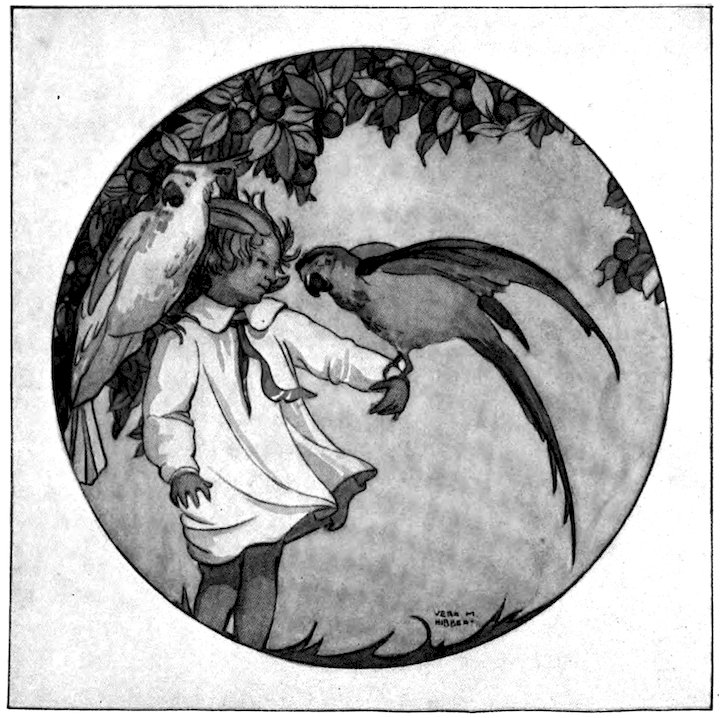
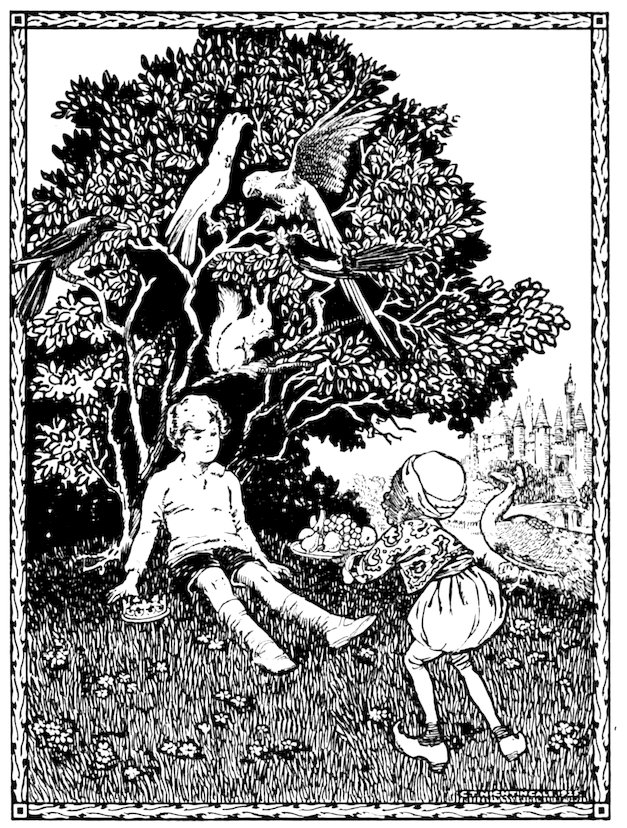
Two friends have I, so grand, so gay,
A finer pair you never knew,
A prouder pair you never saw;
And one of them is Lord Macaw
And one is Lady Cockatoo.
And she is dressed in white and gold
And he is dressed in gold and blue,
Yet will they deign to shake a claw—
The great and stately Lord Macaw,
The handsome Lady Cockatoo.
Rose Fyleman.
By
WALTER DE LA MARE
G. K. CHESTERTON
A. A. MILNE
LAURENCE HOUSMAN
COMPTON MACKENZIE
HILAIRE BELLOC
HUGH CHESTERMAN
KATHARINE TYNAN
MAXWELL ARMFIELD
ELEANOR FARJEON
MABEL MARLOWE
VALERY CARRICK
MADELEINE NIGHTINGALE
ROY MELDRUM
ROSE FYLEMAN
BASIL BLACKWELL
Broad Street, Oxford
Printed in Great Britain
CONTENTS
xi
LIST OF COLOURED PLATES
❦
The pattern on the Cover and End-papers of this book is based on a
design from a picture by Orcagna (No. 569) in the National Gallery.
It is taken from a plate in “Fifteenth-Century Italian Ornament,”
by Sydney Vacher, and is reproduced by kind permission of Messrs.
Bernard Quaritch.
The coloured wrapper is designed by Alec Buckels.
NUMBER THREE JOY STREET
THE WONDERFUL KNIGHT By ELEANOR FARJEON — Twelve O'Clock — One O'Clock — Two O'Clock — Three O'Clock — Four O'Clock — Five O'Clock — Six O'Clock — Seven O'Clock
1
There was once the most wonderful Knight in Sussex,
which is as much as to say in the world. He came of
a race of knights, as a man might come of a race of
farmers, or of fools. And as of such a one you would say,
“He is a born farmer” or “He is a born fool,” so of my hero
you would say, “He is a born knight.”
His name was Sir John-o'-Dreams, and he was such a
great knight that he spent his life in dreaming of the greatest
adventure in the world, an adventure which should be the
2very top of all that is meant by knighthood. Several times
a day he polished his shield for the adventure to come; for he
would never, he said, undertake it until his shield was bright
enough. He knew that this adventure, when it came, would
claim not only the strength of his arm and the swiftness of
his eye: it would be a call upon his life, which was the
lamp of honour, and on his spirit, which was the light in the
lamp.
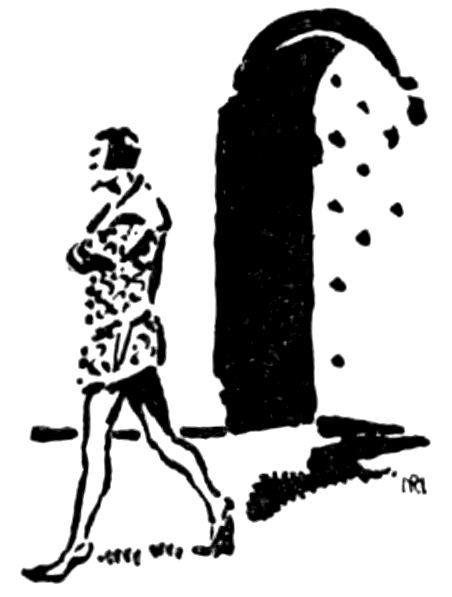
One morning in May Sir John walked forth to see the world,
and to see it the better he walked on the top of a wall. As
he walked he looked up at the sun till the air was bedazzled.
Through the dazzle he presently heard the flutiest whistle
that ever came from a blackbird in Spring. Suddenly the
whistle stopped, and a voice said, “Take care, sir, you'll
fall.” Even as it was said, Sir John stumbled, and kicked
over a bucket of mortar that was on the top of the wall; and if
his ankle had not been gripped at the same moment he would
have fallen after it. But by a great effort he righted himself,
and then he saw that his foot was held by a boy who was
straddling the wall.
The fall of the bucket had caused some commotion on the
ground, where a little black pig with a belly like a ball and a
tail like a corkscrew, and a handsome young pullet of the
Light Sussex breed, had been wallowing and picking in the
earth at great peace. The boy himself had carroty hair and
blue eyes.
Sir John recovered his balance, and said kindly, “I've
disturbed you.”
“That's all right, sir,” said the boy, “I can get on with
my job when you're by.”
“What are you doing?” asked Sir John.
3“Holding your foot, begging your pardon, sir.”
“What were you doing?” asked Sir John.
“Mending the wall, sir, and shall be again.”
“What is your name?” asked Sir John.
“Dick Dowett,” said the boy.
“And what is your business?”
“I clean out the pigs and the chickens.”
“It is good work,” said Sir John.
“Well, it's got to be done,” said Dick. And he began
once more to out-whistle the blackbirds.
“You're happy,” said the Knight.
“As the day is long, sir,” said the boy.
“You sleep at night?”
“Like a top.”
“And dream?”
“Never a wink.”
“I wonder,” said Sir John musingly, “whether I would
change my state for yours?”
“Mine, sir!” said Dick. “What for?”
“I don't know,” said the Knight. And he walked on.
He soon reached the end of the wall, and while he was
considering whether to stay up or to jump down, he heard the
ringing of a bell in the countryside. At the sound of it, the
folk came running with all their might from every quarter, and
by the time a great crowd had gathered the Town-Crier had
come up. With his right hand he swung his big bell to and
fro, with his left he led by the wrist a girl in tears. She was a
splendid lass in a blue cotton frock, sixteen years old, but tall
for her age. She had a thick plait of brown hair, and the eyes
which she constantly wiped with her apron were browner still.
4The Town-Crier stood the girl in full view of the crowd,
rang his bell three times, and cried:
“Oyez! oyez! oyez! This is Audrey of Picketty, who
has lost her ball. To him who will recover it, she offers all
she has.”
“And what is that?” cried the crowd in one breath.
“Herself in the gown she stands up in,” said the Town-Crier.
Then the women in the crowd tossed their heads, and said
with one accord, “We must get back to our duties!” And
they turned on their heels and went to where they had come
from.
But the men stayed where they were, and looked at Audrey
of Picketty in her faded blue gown, and thought she was no
bad reward for a ball. So they asked:
“What is her ball like?”
The Town-Crier rang his bell again, and said to Audrey:
“What is your ball like?”
Audrey wiped her eyes once more with her apron, and said:
“My ball is a blue-and-green ball with pictures on it—stars
and flowers, and cherubs, and children, as pretty as life.
It was given me in my cradle by my godmother; I grew up
playing with it, and it is the only toy I ever had.”
Then the men asked:
“Where did she lose her ball?”
And the Town-Crier rang his bell, and said to Audrey:
“Where did you lose your ball?”
And Audrey said: “I was playing with it in Picketty, and
I tossed it higher and higher, till the wind took it, and I couldn't
5see where it fell. It may have blown a hundred miles, and
rolled another hundred.”
Then the men asked:
“When did she lose her ball?”
The Town-Crier rang his bell, and said:
“When did you lose your ball?”
And Audrey said, “Ten years ago, when I was six years
old.”
“Bless me!” cried Sir John, from the top of the wall,
“and have you been weeping for it ever since?”
“Oh no, sir,” said Audrey, curtseying. “I forgot all
about it till a week ago, and then for seven nights running I
dreamed that it had fallen in the Murray River.”
“What river is that?” asked Sir John.
“I do not know, sir. But I dreamed it was the biggest
river in Sussex, and full of dangers from beginning to end,
and haunted by a sprite.”
Sir John looked down from left to right on the crowd in the
meadows, but no man said a word. Then Sir John cried so
clearly that every man could hear him: “I undertake this
adventure. Go home, good folk.”
When the meadow was empty, Audrey of Picketty looked
lovingly at Sir John, and said, “Sir, if you will let me, I will
follow you to the Murray River, and through all the dangers
too.”
She spoke with such sweetness and courage that Sir John
reached down his hand to her, saying, “Come, you brave
child.” With one nimble leap she stood beside him on the
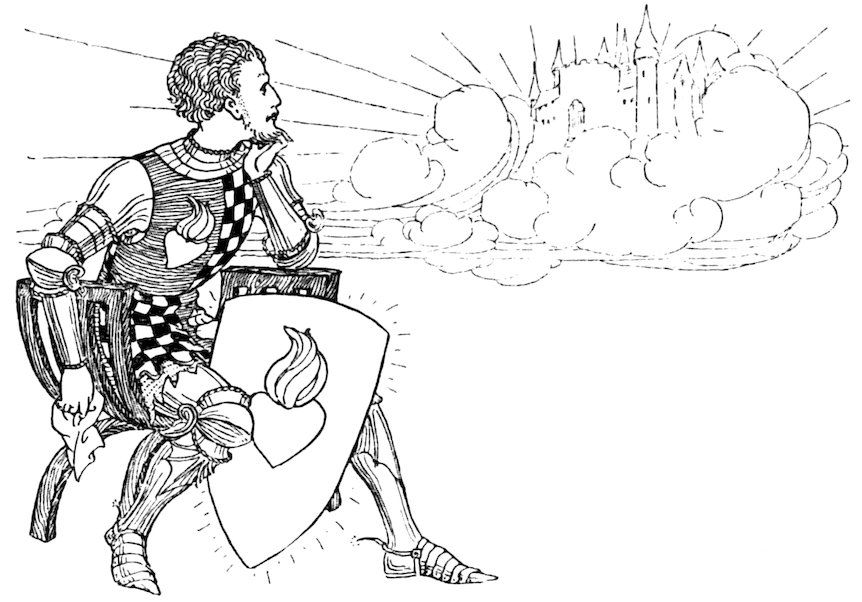
wall. Then Sir John flung up his head, like a spirited horse,
6and strode back along the middle of the wall, looking neither to
the right nor the left, but only at the bright blue sky.
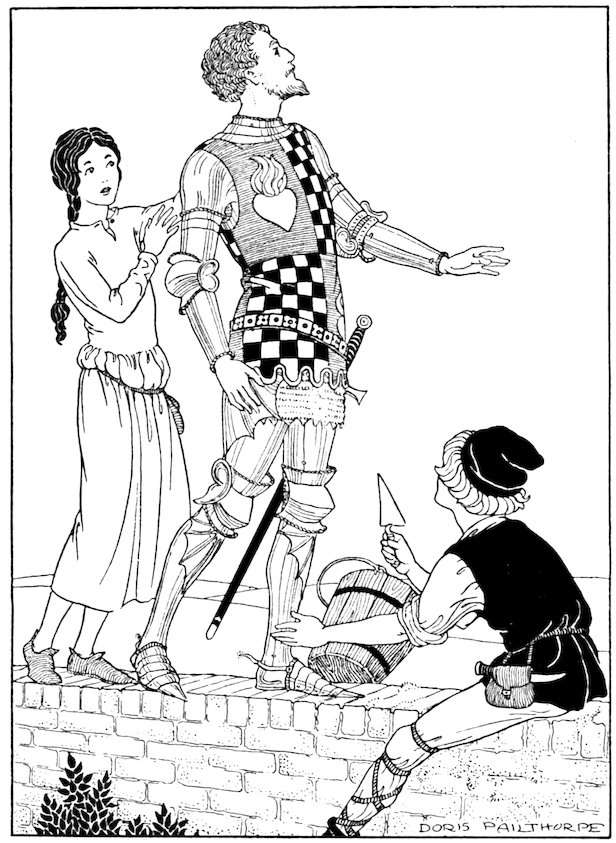
Suddenly he felt his shoulders seized by two soft hands,
and his ankle gripped by one strong one, and looking first
behind him and then before him he saw both Audrey and Dick
holding him fast, and regarding him with affection and anxiety.
The mortar-bucket was on the ground again.
“What's the matter with you, children?” said the Knight.
“What's the matter with you, sir?” said Dick; for Sir
John's cheeks were wet with tears. “Are you hurt or in
trouble?”
“I am well and in joy, Dick,” said the Knight, “for I
am about to follow my heart through a wonderful adventure.”
“Then why do you weep, sir?”
“With looking on the sun,” said the Knight.
“What did you see, sir?”
“I saw danger, and myself going to meet it.”
“Danger, Sir John?”
“Yes, Dick.”
Dick looked bothered, whistled a note or two, and then
said, “If you please, sir, might I go too?”
The Knight's eye kindled, and he laid his hand on the
boy's head. “Do you also hanker for danger?” he asked.
“Not a bit, sir,” said Dick.
“Then why do you wish to come?”
Dick got rather red, cleared his throat once or twice, and
said, “To catch hold of your foot, sir.”
“Yes?” said Sir John inquiringly.
“Yes, if you please, sir. I've finished my job, and I expect
we'll be home in time to feed the pigs and coop up the hens.”
7
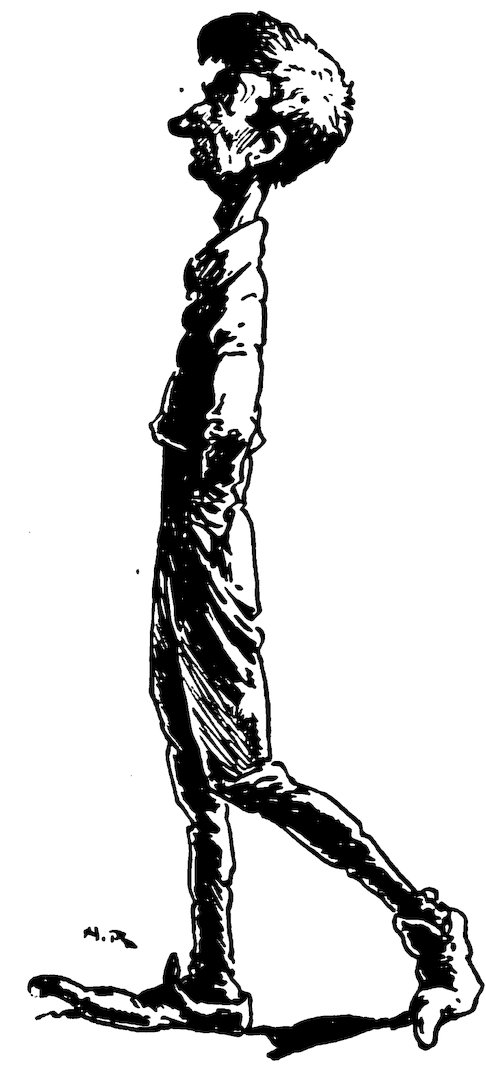
He strode back along the middle of the wall.
8“I do not know when we shall be home,” said Sir John.
“Perhaps never.”
“Just as you please, sir,” said Dick. “Mind where you
step.”
“Yes,” said Audrey from the rear, “do be careful, dear
Knight.”
“Come, children,” said Sir John.
And he stepped over the boy and passed along the wall,
leaving Dick and Audrey face to face. And Dick, who had
not been aware of her until he heard her clear voice and almost
immediately after beheld her rosy face, scratched his head and
said, “Oh dear me!” But Audrey looked after her Knight
with something of the happy care which a young mother
feels for her baby the first time it toddles, and said:
“Will he fall?”
“Not if I can help it,” said Dick.
“Thank you, you good boy,” said she.
Then Dick picked up his bucket and went after Sir John,
and Audrey went after Dick; and the round black pig, whose
name was Paul, and the Light Sussex pullet, whose name was
Emily, ran below them beside the wall until they reached the
end of it and had to jump off.
Now here follows the tale of their adventures, hour by hour.
The sun was lazing in a blue-and-white sky bathed in his
own gold steam; but the men and the girl stepped briskly,
and as for the pig and the hen, they gambolled on the road.
It happened, however, that Sir John's eagerness carried him
a few steps in advance of his companions, who thus had all the
9talk to themselves. Presently, they came to Chiltington, the
prettiest village in England, as, in fact, every second village in
the West of Sussex is. But for all its prettiness it was like
a fiddle without its strings, for not a living soul was to be
seen there, indoors or out.
“A strange place,” said Sir John, pausing. “Time,
children, is like a lamplighter who comes at night to kindle
his lamps, and comes by day to put them out again. Once this
dumb blind village was full of life.”
“And not long since, sir,” said Dick, “for there's a spud
and a rake in that garden, and a packet of dwarf beans spilled
where somebody has dropped 'em to be off in a hurry.”
“A hundred years ago, perhaps,” said Sir John dreamily,
“and his hurry is ended.”
“The earth's fresh turned, sir,” said Dick. As he spoke
the silence was broken by a small weeping and whimpering
at the back of the cottage.
“Someone is unhappy,” said Audrey.
“I'll just go and see,” said Dick.
So, followed by the others, he went round to the back,
and found a very Old Man chopping down a bed of mustard-and-cress
with an axe. The mustard-and-cress was planted
in the name of
BARBIE
and as he chopped the Old Man whimpered and wept.
“Do you want that cut down, gaffer?” asked Dick.
“Yes, boy.”
“All of it, gaffer?”
“Yes, boy.”
“There's more than you'll need to your salad,” said Dick,
taking out his penknife.
10“I do like mustard-and-cress,” said Audrey.
“You're welcome to it all, pretty. No more salads for
me.”
“Thank you, gaffer,” said Dick. “We'll take a bunch,
then, for it goes down nicely for supper.” And he put a
handful into his bucket.
Audrey said, “What are you crying for?” and wiped the
Old Man's eyes with her pocket-handkerchief.
“Her,” said the Old Man, and pointed to the name.
“Let cress go, since she be gone.”
“I'm so sorry,” said Audrey, and wiped her own eyes with
her pocket-handkerchief.
“Heaven's a good place they say,” said Dick, and wiped
his eyes with the back of his hand.
“Ay, if 'twere heaven,” sobbed the Old Man, “instead
of betwixt and between.”
“Where's that?” said Dick.
“Top of windmill sail,” said the Old Man, “and never
a stir in the air. All the folk is gone to blow her down, but I
misdoubt me they'll do it.”
“We've come in the nick of time,” said Sir John. “Dick,
here's work to be done!” And he sat down on a chopping
block and began to polish his shield with great energy.
“We'll just go along, sir,” said Dick; but the Knight was
already lost in the adventure to come, and did not hear him.
So Dick and Audrey went through the village and came to
the windmill, where the villagers were assembled, hissing and
blowing with all their might. Their chests panted and their
cheeks puffed as though they would burst. But they could not
budge the sails, to the topmost of which clung a little girl,
11whose silky hair flew out all round her head like bubbles of
sunlight. With one arm she squeezed to her breast an orange
cat with golden eyes.
“Oh Dick!” said Audrey, and clasped her hands.
“You stay here,” said Dick, and ran into the mill; but
she followed at his heels. They mounted the stairs, and when
they were come to the top Audrey caught his sleeve, and said
again, “Oh Dick!”
“Well, it's got to be done,” said Dick. “There's no call
to be frightened, lass.” For her cheeks had turned as white
as linen laid to bleach on the grass in the sun.
Dick clambered out to the sails, and all the people below
began to cheer, and Audrey watched him with her heart in
her mouth. When he brought them in, the child was frowning
and the cat mewing. But Audrey held out her arms and
took them both to her, and then the child began to smile and
the cat to purr.
“Oh, Barbie!” said Audrey, “what did you get up there
for?”
“I wanted to see,” said the child.
“Did you see?” said Dick.
“Yes,” said Barbie, “I saw the Murray River.”
“That's where we're going,” said Audrey, with joy in her
face.
“Then I will come too,” said Barbie, “and so will Rufus.”
They went down the stairs, and as they came out of the
mill the people cheered more than ever, and a woman ran to
meet them.
“Mother,” said Barbie, “I'm going to the Murray River
with the big boy and girl.”
12“Very well, pet,” said the woman, “but be back by bedtime.”
“She shall be, ma'am,” said Audrey.
Sir John, who at this moment arrived, stepped forward
with his bright shield, looked earnestly at the child, and said,
“Do you then know the way to the Murray River?”
“Yes, I do,” said Barbie, “as far as the Round-House;
and then it was tea-time. But I'm going all the way to-day,
if it's tea-time or not.”
“Dick,” said the Knight, his eyes shining, “heaven has
sent us an angel. Come, children.”
The child kissed her mother farewell, and away strode
Sir John, and Dick, and Audrey after him, with Barbie skipping
between them; and Paul the pig, and Emily the hen, and
Rufus the cat brought up the rear.
“What a bright shield he's got,” said Barbie.
“Yes,” said Dick, “it's as bright as a new shilling. There's
no man in Sussex with a shield so bright, is there?” He looked
at Audrey, and she looked tenderly after her Knight, and said,
“No man.”
The child pointed the way over a hot, open common,
where the sun had already, as it seemed, begun to drop a shower
of golden sparks among the gorse.
Then under her guidance they crossed a warren and a
highroad, and suddenly entered a cool wood, where sparkles
of sunlight could only be seen here and there when the leaves
shook, and the trees stood in a shimmer of green dreams.
And their steps grew slower and their voices lower, as it must
always be in woods. At the end of it they entered a sunlit
13lane with another wood beyond. The unexpected light made
their sight dance, so that at first they could not see properly,
but they could hear, at a little distance, the sound of young owls
hooting, “Tu-wick! tu-wick!” and their mother answering,
“Tu-whoo-whoo-oo!” And then they saw that the hooting
came from a small circular building on the edge of the forest.
The building was of stone, and had one door in its wall, and a
very small, barred window above it. Here Barbie stopped.
“I don't know which way now,” said she. “This is the
Round-House, and I didn't get farther than that.”
“Perhaps the owls know,” said Audrey, “for they're
wiser than most. Owlets!” cried she, “tell us which way to
the Murray River.”
“Tu-wick! tu-wick! tu-wick!” answered the owlets,
like a merry taunt.
“Let's go in and see the little owls,” said Barbie.
Dick tried the door. “It's locked,” said he, “and too
thick to break down. We must look for help to others than
owlets.”
So they went a little way up the road, and soon stumbled
on Sir John, who had gone ahead as usual, and was standing
motionless with one hand upheld as though bidding them to
listen. And what they now heard was husky calls of “Heave-O!
heave!” uttered every half-minute; but the calls were broken
by great gulpings and chokings. The sounds came from
behind a little farm which stood half in the lane, half in the
wood; its doorways were open back and front, and a tunnel
of air and light ran through the farmhouse. You could look
straight through from the sunny lane on this side to the greenwood
trees on that.
14“See, children,” said Sir John, “how brief is the passage
through the house of life; from the light of our coming to the
twilight of our going it is but a dozen steps, no more. And
the end is lovelier than the beginning. Shall we pass through?”
“I think we'd better, sir,” said Dick; “there seems to be
some bother out there, doesn't there?”
For by this time the choking and gulping had got the upper
hand of the calling, and the “Heave-Os!” were almost drowned
in sobs.
“Oh hurry!” said Audrey.
They hurried; and in a strip of kitchen-garden that lay
between the farmyard and the trees they found a middle-aged
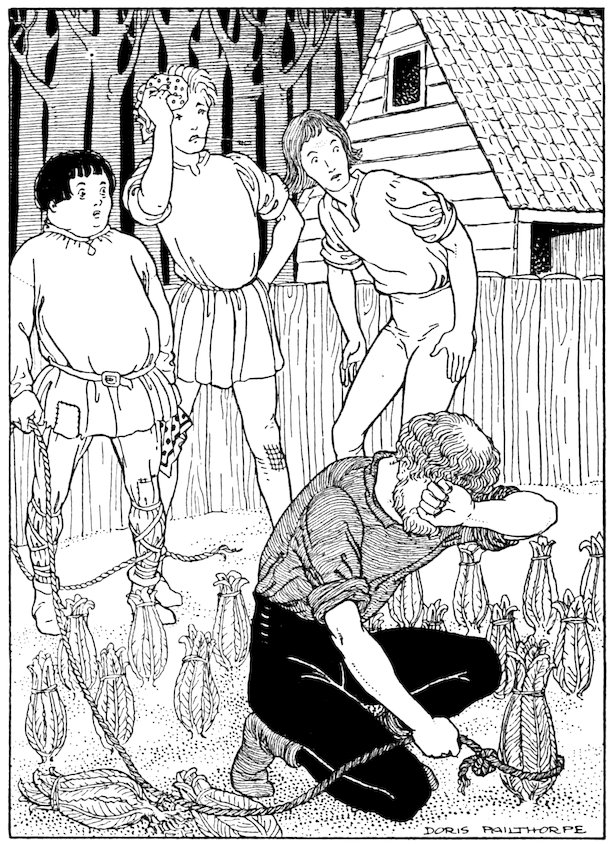
Farmer and his men hauling on a lettuce with a rope. The
Farmer stood gripping at the nearest lettuce, and his three
men stood behind him. When he cried “Heave!” they set
their jaws and hove, and the lettuce came up and they fell
down. Then they picked themselves up and dusted their
breeches and noosed another lettuce and hung on to the rope,
awaiting the Farmer's signal. But as often as not they had to
guess at it, because of the choke in his throat.
When the men saw the little procession troop through the
doorway they paused in their labour, wiping the sweat from
their brows with red-and-white handkerchiefs.
“Can I help you pull your lettuces, Farmer?” said Dick.
“You can, young man,” groaned the Farmer.
“Every man Jack of them?”
“Every man Jack of them.”
“You'll have a rare feed,” said Dick, beginning to pull
up the lettuces, of which there were quite eighty, with his
two hands.
15
... they paused in their labour.
16“Lettuces are delicious,” remarked Audrey.
“Take what you please, young lass. They'd but stick in
my throat.”
“We're much obliged to you, Farmer,” said Dick, “for
a lettuce suits well with a salad of cress.” And he popped
three fat-hearted lettuces into his bucket, while the Farmer
gulped and choked.
“What makes you so unhappy?” asked Audrey.
“Because I shall see my little daughter Christie no more
in this life. And now the sight of these lettuces, which she
planted, is more than I can bear.”
“Alas!” said Audrey, and turned her head away.
Dick stood first on one foot and then on the other
to show his sympathy, and asked, “When did it happen,
Farmer?”
“An hour ago,” said he, “and the fault was mine. For
nothing would content her but she must be away to the Murray
River, where time and again I've told her she'd catch her death
of cold. But it's as though that water were fire to the blood
of all young things, and when they will go they will go. So at
last I locked her up in the Round-House in the wood, and for
safety I tied the key to the handle of the well-bucket; but when
next I went to draw water I forgot it was there, and, as luck
would have it, the bucket slipped from its buckle, and is now
swimming underground, as you can see for yourself.” And he
kicked the cover from the well, and there, on the dark water,
swam the tilted bucket, forty feet down.
Sir John had listened attentively to the Farmer's tale,
and now his eyes kindled with their fine fire. “Dick,” said
he, “here's an adventure ready to my hand.”
17“Yes, sir,” said Dick, “The key must be got, for the
door can't be broken; I've tried it already.”
But Sir John did not heed him, for he was already polishing
his shield with might and main.
Then Dick took the well-rope in his hand and tested it
carefully, and found it sound; and next he fastened the swivel
of the buckle to his leather belt.
“Oh Dick!” exclaimed Audrey, and clutched his shoulders
with all the strength of her two hands.
“It's got to be done,” said he. “There's no call to be
frightened, Audrey.” For her face was as blanched as skim
milk when it foams one way from the separator, while the
yellow cream slides another.
He signed to the men, and they came forward and slowly
lowered him into the well, while he gripped the rope above his
head; and Audrey shut her eyes and counted a hundred-and-fifty.
Then she opened them and leaned over the well, and
hers were the first hands to help him as he came to the top,
key, bucket, and all; though when he saw her stooping above
him he cried, “Go back, silly!” for fear she should fall. However,
in another moment he stood beside her in the yard; but
her knees shook so that she went down on them under pretence
of unfastening the buckle from his belt.
“Now we'll let out the little girl,” said Dick; and they
hastened to the Round-House where the young owls were
“Tu-wicking!” louder than ever.
“Owlet!” cried Audrey again, “we're come to let you
fly, if only you will tell us the way to the Murray River!”
At that a lovely little fair face, full of dreamy mischief,
with soft, short hair falling loose about its ears, peeped through
the bars.
18“Tu-wick!” said she. “I won't come out, and I won't
tell, unless you let me and Mike come too.”
“I'll answer for that,” said Dick, and he turned the key
in the lock; and the child came running out with a wiry Irish
terrier at her heels; a lean, excitable dog with loving eyes.
Her father caught her to his heart and kissed her repeatedly,
and she returned his kisses, saying, “Good-bye, father, because
I'm going now. I'm going to the Murray River with these
people and animals.”
“Ay, so you shall, you shall!” said the Farmer; “but
do not be home after dark.”
“I'll see to it, sir,” said Audrey.
By this time Sir John had joined them with his gleaming
shield, and, looking gravely at Christie, he said, “It is you, dear
child, that can lead us to the Murray River?”
“Oh yes,” said Christie, looking as gravely at him; “as
far as the garden in the wood. But I've never been right down
the river yet.”
“Dick,” said the Knight, “the fairies are guiding us.
Come, children.”
And he strode the way Christie pointed her finger, and she
and Barbie ran after him, and Dick and Audrey kept close
behind them; and Paul the pig, and Emily the hen, and Rufus
the cat, and Mike the dog brought up the rear.
“How well you do owls,” said Barbie to Christie.
“Yes,” said Christie; “and what a beautiful shield your
father's got.”
She looked from Barbie to Audrey as she spoke, but Dick
said: “He isn't their father, but his shield is as bright as the
full moon. There's not a man in all England with such a
19beautiful shield, is there?” And he turned to Audrey, who
looked wistfully after her Knight, and then on the ground, and
said, “Not in all England.”
The sun was beginning to get tangled in a smear of cloud
as they turned out of the white lane into a green one. At the
end of it was an old gate, opening into a garden in the middle
of the wood, as pretty as the Garden of Eden. But this Eden
also had its sorrows, for from somewhere inside it a sturdy
hullabalooing greeted their ears, interrupted with the sound of
small explosions.
“See, children,” said Sir John, “how deceptive is even
the earthly paradise in its promise of eternal joy. For of what
more blessed and lovely surroundings than these could any
man dream? Yet he who dwells here is the prey of grief.
Let us look into this man's trouble.”
“Yes, sir,” said Dick, as a louder explosion than usual
rent the air, “for I doubt he's up to some mischief.”
So they went round a hedge of flowers, and found the
miserable Adam of this Eden seated in the middle of a small
square of earth filled with one of everything that could be
thought of in a little space by a little mind: such as one sweet
pea and one spring onion, one lupin, one potato, one broad
bean, one double daisy, and one of whatever else you fancy.
But its four sides were framed in radishes, red and white,
which an extremely small boy, with the darkest brown eyes
that ever smudged a dark brown face with tears, was endeavouring
to blow up with paper caps full of gunpowder.
“Do you want those radishes up, sonny?” said Dick.
“'Ss!” hissed the little boy through his tears.
20“What, all the lot?”
“'Ss!”
“You'll have a pain,” said Dick, beginning to pull up the
radishes.
“Sha'n't eat 'em!” said the little boy.
“Don't you like radishes?” said Audrey. “I do.”
“Then you eat 'em!” said the little boy.
“Thank you, sonny,” said Dick, “so we will; for radishes
look pretty in a red-and-white ring round a lettuce on a
garland of cress.”
Saying which, he dropped a couple of handfuls in his
bucket.
“Why were you blowing the radishes up?” asked Audrey
tenderly, taking the baby on her knee and drying his dirty face.
“'Cause they're Hers!” shouted the little boy, pointing
suddenly at the plank at the foot of the garden. “And she
won't let me paddle without grown-ups.”
And then he stuck his finger in his mouth, and stared from
Dick to Audrey, and abruptly rolled out of her lap and tumbled
down the garden, crying, “Sylvia! they've come! so may I
paddle now?”
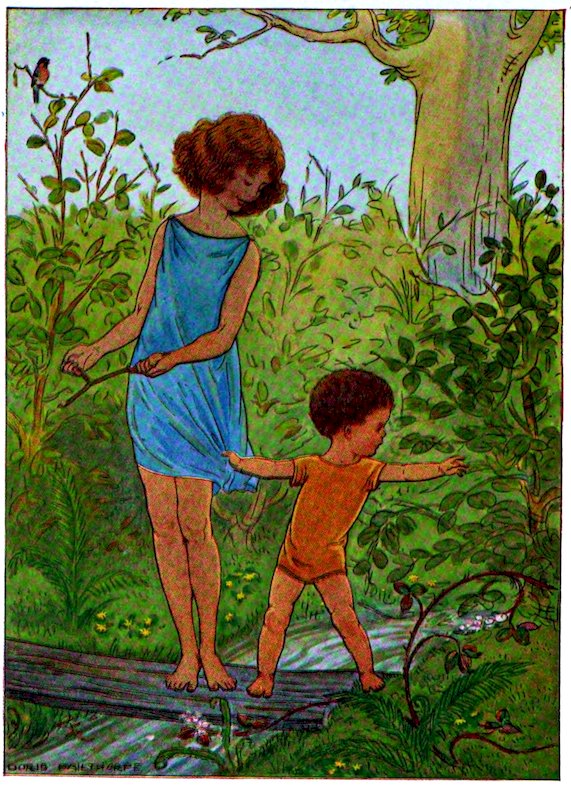
Down the garden the company trooped after him; and
standing on the plank that lay over the brook, they saw the
loveliest little creature in all the kingdoms of the young;
though whether she was sprung from the kingdom of angels,
of fairies, or of children none of them knew. For her eyes
were as merry as fairies and as sweet as angels, and the odd
little smiles that sat on her cheeks and in the corners of her
mouth were both tricksy and tender; and she had a lovely
little body, clad in a single blue-green garment that left her
slender brown limbs bare to shoulder and knee. She was
standing with her feet close together and her head bent, and
her elbows lay straight by her sides, but her hands were
outstretched, palm uppermost, clasping the two ends of a hazel-fork,
which she held over the brook.
21“Wilf! Wilf!” said she. “How do I know if you can
paddle till I know if there's water here?”
And she fixed her eyes on the prong of the hazel-fork, and
it began to turn downwards, until at last it pointed directly
at the brook flowing under the plank. Then this child, for a
child she was as well as a sprite, glanced swiftly from the dark
baby tugging her garment to the people standing on the bank,
and said, very seriously, but as though her little mouth were
pinching back some secret laughter, “Yes, there is water
here, and you may paddle if they will too.”
“Of course we will!” said Audrey, clapping her hands.
“Hurrah!” said Dick, swinging his bucket.
“Oh!” said Christie and
“Oh!” said Barbie, jumping for joy.
“It's very, very dangerous,” said Sylvia. “There are
rapids and rocks, and jungles that grow from bank to bank
where you must crawl in the water; and there are wrecks and
whales and alligators and sea-serpents and sirens and midges.
You'll get bitten and drowned and dashed to pieces and eaten
up and put under a spell for ever and ever unless——”
“Unless what?” cried everybody.
“Unless I like,” said Sylvia, with her funny little smile.
By this time they were all barefoot, with their stockings
and shoes slung round their necks.
“Who's afraid?” cried Dick.
22“Not me!” cried Audrey, Barbie, Christie and Wilf.
And Paul said “Umph!” and Emily “Cluck!” and
Rufus “Miaow!” and Mike “Wough! wough!”
“Follow me then!” cried the elfin Sylvia with a shrill
sweet laugh; and she dropped from the plank into the stony
channel of the brook that was sunk so deep between its banks
of hazel and alder, with all their tangle of undergrowth between,
that it could scarcely be seen from the garden. And after her
splashed Wilf, and after him Barbie clutching Rufus, and then
Christie dragging Mike, followed by Audrey carrying Emily,
with Dick last of all and Paul tucked under his arm. They
were all shouting with glee.
The sun was like a golden boat afloat upon a blue sky
speckled with white waves when they came out at the source,
scratched and tattered and soaked to the waist. They were still
shouting with glee.
Christie had lost her ribbon, and Barbie had a cut on her
ankle, and Wilf had bumped his head, and Audrey's plait was
all astray, and a fragment of bramble, caught in the web of
her hair, still hung at her neck; and Dick's shirt was torn at
the shoulder. But Sylvia came out as whole as she went in.
The first thing they saw when they scrambled up the
bank was Sir John, sitting under an oak-tree rubbing his shield.
He had walked along the bank by the meadow and wood through
which the brook ran, and here he awaited their coming.
“Well, children,” said he, with his gentle smile, “has none
of you perished?”
“Neither man, woman, nor child, sir,” said Dick.
23“It was because of Dick,” said Sylvia. “He's the cunningest
mariner I ever knew. He overcame all the dangers and
protected the others.”
“It was because of Sylvia,” said Dick. “She's the kindliest
water-sprite that ever guarded poor mortals in peril. She
wouldn't let harm touch us. Though, to be sure, Mother'll
have to put a patch on my shirt, all along of the sharks.”
“And the sirens stole my ribbon!” said Christie eagerly.
“And the dragons bit my foot!” said Barbie proudly.
“And the giants bumped my head!” muttered Wilf darkly.
“And the witches caught me by the hair!” said Audrey
excitedly.
“And Emily laid an egg,” said Sylvia. “And Dick saved
them all, and the egg too.”
“Hard-boiled egg looks nice on a salad,” said Dick, “cut
into quarters like white-and-gold canoes a-sail on a green
lettuce sea, did we but know where to boil it.”
“The Hermit of Hardham will boil it,” said Sylvia, “for
he lives on eggs and onions.”
“Where does the Hermit dwell?” asked Sir John.
“In a curl of the river,” said Sylvia.
“Then his way lies our way,” said the Knight. “Come,
children.”
And he went ahead where Sylvia pointed; and she, turning
him with a touch now to the left, now to the right, tripped at
his heels, and Wilf toddled at hers, with Christie and Barbie
in line like follow-my-leader, Dick and Audrey coming abreast;
and Rufus, wet and dejected, and Mike, wet and in ecstasy,
and Paul, wet and phlegmatic, and Emily, wet and in a perfect
panic of triumph, brought up the rear.
24“Hasn't your grandfather got a grand shield?” said
Sylvia over her shoulder.
The children laughed, and Dick answered: “He has
neither child nor grandchild, but his shield is as bright as his
own dreams. Why, there isn't a man in the world with so
splendid a shield, is there?” And he smiled at Audrey, but
she looked sorrowfully after her Knight, and then she looked at
Dick, and shook her head.
Led by Sylvia, the little company came out upon the road,
which, after all their little forest ways and lanes and by-paths
seemed like the very highroad of the world; and soon after they
reached a great bridge with a broad river flowing under it.
Sir John's face lit up as though it had been a cloud through
which the sun had passed, and he cried “Ha!” and stood
stock still in the middle of the bridge.
“Is this the river, child, at last?” he said to Sylvia.
“Yes,” said she, “and the Hermit is over there behind
the old canal bed.”
“There let him bide,” said Sir John, “for now my heart
dances in the very shadow of its adventure.” And taking
Audrey's hand, he added, “For your sake, dear child, to
whom I am pledged, I will follow this water till I find the
ball!”
She looked at him steadily, and said in her clear voice:
“And I too have given you my word. So marry me when
you will.”
“I will marry you,” said Sir John, “as soon as we can
find one to wed us.”
25“The Hermit of Hardham will do that,” said Sylvia, “for
he sits all the year round hoping for a wedding, and he has
never wed anyone yet.”
“It is a pity to disappoint him,” said Sir John; “yet I
will not lose my river for a thousand hermits.”
“You won't lose it,” said Sylvia, “if you go by Hardham
you'll find it again at Pulborough Bridge as the crow flies.”
“So be it,” said the Knight. “Come, children.”
They went forward swiftly through the high, narrow path
by the sunken bed of the old canal, and at the other end climbed
up the grassy hillocks where the hermit of Hardham sat hoping
for a wedding in a little chapel of stone archways, with neither
roof nor doors nor windows, but with the bright air of heaven
to serve him as all three. Within the chapel was an altar
decked with flowers, and flowers hung in garlands and posies
about the old stone-work, so that the chapel blossomed like
a bride's bower. And the Hermit sat on a boulder in the
evening sunlight, clad in a white robe, with a golden ring on
either hand, and a bowlful of crumbs on his left, and a dish
of cabbage leaves on his right, and a saucer of sugar and water
at his sandalled feet. And all about him were small rabbits
at play, whom he fed with green leaves from his right, and
amongst them hopped a multitude of birds picking up the
crumbs he scattered with his left, some of the birds sitting on
his wrist and his knee to pick the crumbs from his hand and
robe. And a chaffinch was even clinging to the long, white beard
on his breast where a few crumbs had fallen, and before she flew
off she pulled out three hairs for her nest, and he suffered her,
looking after her with his gentle eyes. And a host of tiny insects
hummed and hovered and sipped at the saucer of sweet water.
And a very small calf had got into the chapel and had knocked
26down the Hermit's pitcher of supper milk, and was licking
it up. And this too he suffered with a loving look from his
blue eyes. And the tender sunshine bathed him from the crown
of his head to the sole of his foot.
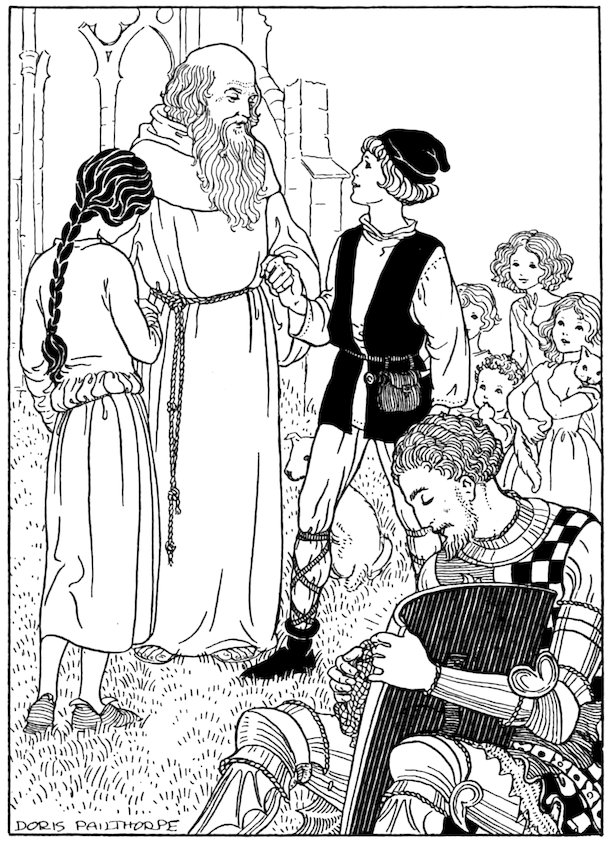
But when he saw the company mounting the slope he said,
“Friends, here come brothers and sisters.” And he rose up so
softly in his place that not a bird or beast or insect was fluttered,
and he stepped forward with his old hands outstretched, and
took Audrey's in his right, saying, “Welcome, sweet bride.”
Then he turned to Dick, and taking him by the left hand said,
“And you, young groom, welcome! to the loveliest adventure
in life.”
Audrey hung down her head, while Dick threw up his, and
looked to Sir John to speak. But at the word adventure
Sir John had sat down and begun to polish his shield.
There was a very long pause, in which nothing happened,
and nobody except Sir John knew what to do.
And then Audrey, in great confusion, whispered, “Oh Dick!”
Dick scratched his head, looked once more at Sir John,
and said, “Well, it's got to be done. There's no call to be
frightened, dear.” For her cheeks had turned as pale as wild
roses before they are about to fall.
So Dick and Audrey went into the chapel with the Hermit of
Hardham, and the children and the animals went too. There the
Hermit took from his own hands the two gold rings, and wedded
Dick and Audrey.
When Dick and Audrey were wedded, they came out of the
chapel amid the singing of birds and the humming of insects,
and the cheeping and laughing of animals and children, who
played together in the grass.
27
Sir John began to polish his shield.
28And Sir John looked up from his shield, which shone
less brightly than their eyes, and said, “How happy you look!”
So they explained why. And he looked thoughtfully at Audrey,
and said, “Who then will find you your ball?” And she said
she didn't mind about it any more. “Yet,” said Sir John,
“I must seek it still, for to find that ball of stars and flowers
at the end of the Murray River is still my dream, dear child,
if it is no longer yours.”
He rose to go, but Dick said wouldn't he stay to the wedding-party
first? And they made a green bowl of lettuce-leaves,
and lined it with a nest of cress, and set the radishes in a circle
of scarlet and snow upon the nest, and hard-boiled Emily's
egg, and laid it in gold and silver boats upon the lettuce-leaves.
And the Hermit of Hardham fetched a butterfly-net, and with
it caught the globe of a great Spanish onion that was dangling
among many others from a cornice of the chapel, and with a
knife he divided it star-wise into eight points of the compass,
and he opened back the points till the onion lay unfolded like
a water-lily, and he set it in the centre of the salad within the
crown of radishes. As he did it he wept, for neither joy nor
sorrow.
This beautiful salad was the wedding-party, and they all
had some.
The sun was almost asleep and the moon very nearly awake
when the feast was ended, and Dick and Audrey said it was
time to take the children home. But Sir John said he must go
his own way by himself. He kissed the children and Audrey
farewell, and, taking Dick's hand, said, “Do your best to look
after her without me.”
“I'll try, sir,” said Dick Dowett.
29“I would stay and help you,” said Sir John-o'-Dreams,
“but my shield is bright enough at last, and I must find and
follow the Murray River.”
He strode away in the evening light up the road to Pulborough
where a river runs under a bridge. And as they
watched his glittering shield out of sight, Christie murmured
to Barbie, “But we found and followed the Murray River.”
And Barbie whispered, “Yes, that's the Arun over there.
He's going the wrong way.” And Sylvia smiled her little
screwed-up smile, and Wilf was fast asleep, and nobody else
heard.
When the children were all safe in their homes, and Dick
and Audrey were walking back to theirs, he took something
from his pocket and put it in her hand.
“What's this?” said Audrey.
“It's a wedding-present,” said Dick. “I found it in the
brook when we were paddling.”
And Audrey laughed for joy and said: “Why, it's my
ball! Look! there are the flowers and children on the green
side, and the stars and cherubs on the blue side, as fresh as
when my godmother gave it me. Who would have thought it
would keep so fresh and beautiful?”
She tossed it in the air, caught it, kissed it on the green
side and the blue side, and put it in her pocket.
30
THE SPOTTED DOG By ROSE FYLEMAN
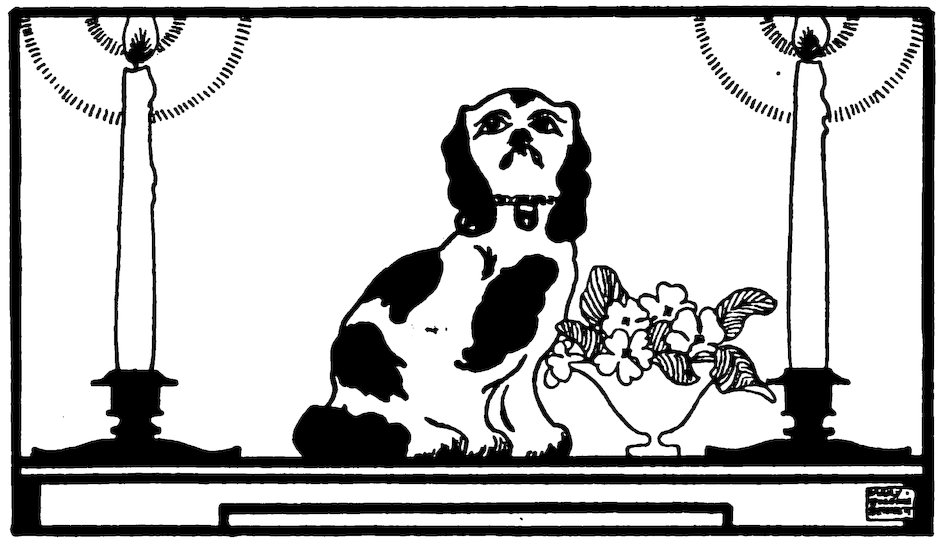
He sits upon the chimney-shelf,
His nose is in the air,
And people look at him and smile;
He seems so haughty all the while,
I hope he doesn't care.
He wears a little chain of gold.
The other day I found
There isn't any chain at all
Where he is turned towards the wall;
It doesn't go all round.
His spots are big and shining black,
His eyes are black as well;
I often think that he may mind
The way his chain leaves off behind,
But I shall never tell.
THE FIVE KNIGHTS By HUGH CHESTERMAN — SIR TUSH: THE INDISCREET KNIGHT — SIR BRUIN BYPH: THE FOOLISH KNIGHT — SIR BEVILLE BLEYDE: THE AUDACIOUS KNIGHT — SIR TIVOLI TRAIL: THE INDOLENT KNIGHT — SIR MUNGO MYNGS: THE TIMID KNIGHT
31
Three gay Crusaders rode to war,
Sir Twist and stout Sir Tarrymore.
Of better men you've never heard.
(Sir Tush of Tooting made the third.)
They sallied forth in brave array—
O passing fierce and fleet were they!
“Our duty's plain,” they said, “we've got
To show the Saracen What's What.”
And when they'd gone, fair ladies sighed
For news of them at every tide,
And naught their tears could stay or stem,
For never more came news of them.
Alack! the first upon my list
To fall in fight was great Sir Twist,
And stout Sir Tarrymore was vexed
(And rightly) when his turn came next.
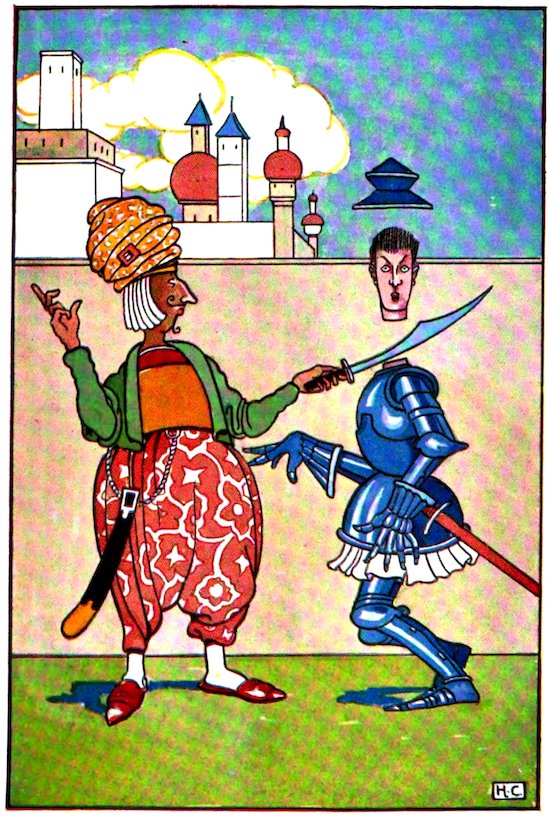
Sir Tush lived on, till once at Sceeva
He called a Turk an unbeliever.
The Paynim, with a whispered “Hush!”
Decapitated rash Sir Tush.
32
Sir Bruin Byph, a witless peer,
To Palestine went riding,
A foolish knight—you see him here
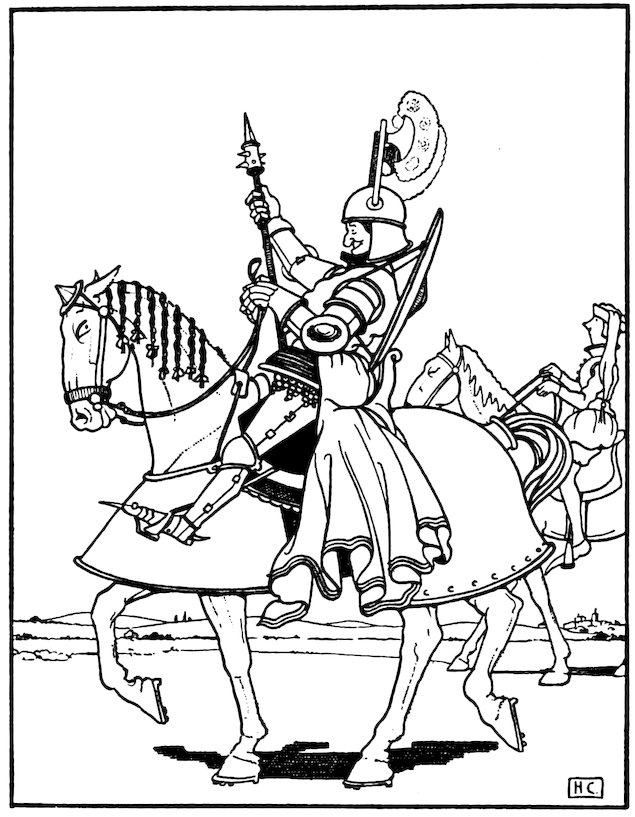
His mettled steed bestriding.
His squire was a personage
Of very few pretensions;
A pensive, inoffensive page,
A youth of no dimensions.
And when Sir Bruin smiled and smirked
The page would raise no laughter;
And if Sir Bruin quipped and quirked
The page came silent after:
And silent kept till fond Sir Byph
Was slaughtered by a Paynim,
O then he laughed, and laughed, as if
No power could restrain him!
33
A Foolish Knight (you see him here).
34
Of all the knights of Southern France
Who measured sword or broke a lance
In tilt or tourney,
Count Beville Bleyde would bow to none:
No matter how—he always won.
And he would journey,
On bellicose adventure bent,
To places on the Continent.
He knew the Lowlands, Russia, Spain,
Made war in Flanders, and had slain
A hundred knights of Acquitaine—
And single-handed.
And once he kept, at Tinchebrai,
A Norman regiment at bay:
You could not count his blows, they say,
So fast they landed.
O he was brave; but rumour hints
(And as he has been dead long since
I may be candid)
That there was one whose temper made
The bold Sir Beville sore afraid—
It was his Countess, Madam Bleyde.
35
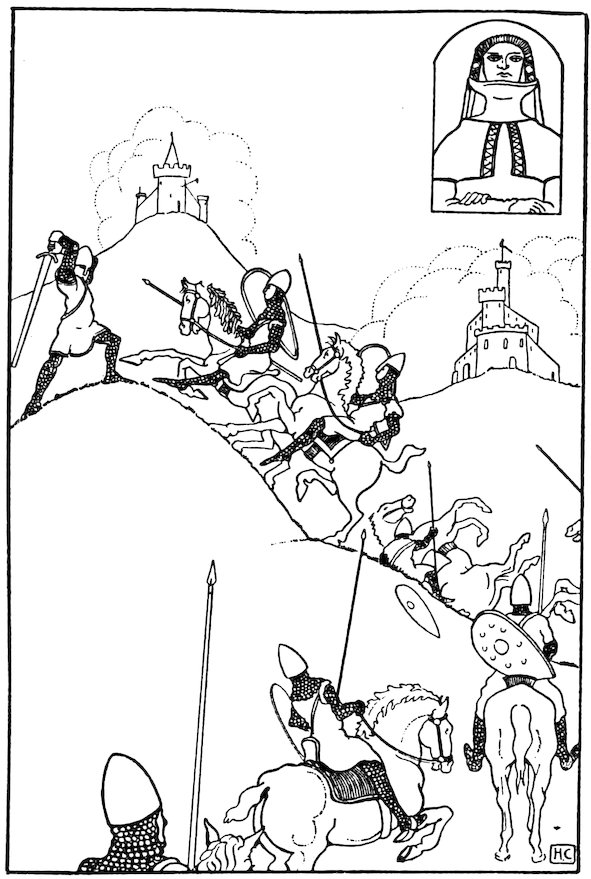
A Norman regiment at bay.
36
Slack is the snail and most sluggish the sloth;
As a slow-motion picture the tortoise beats both;
But worse than the tortoise, the sloth, or the snail
Was that indolent warrior, Tivoli Trail.
Late for his breakfast, his tea, and his dinner,
At hustling or bustling—well, any beginner
Would put to the blush this unpunctual sinner.
His sundial was broken, his watch wouldn't go,
The clocks in his castle were half an hour slow:
In battle his slackness in no way diminished;
By the time he arrived the whole business was finished.
And damsels in danger of dragons, who privily
Hoped to be rescued and then treated civilly,
Could never rely on this torpid Sir Tivoli.
37
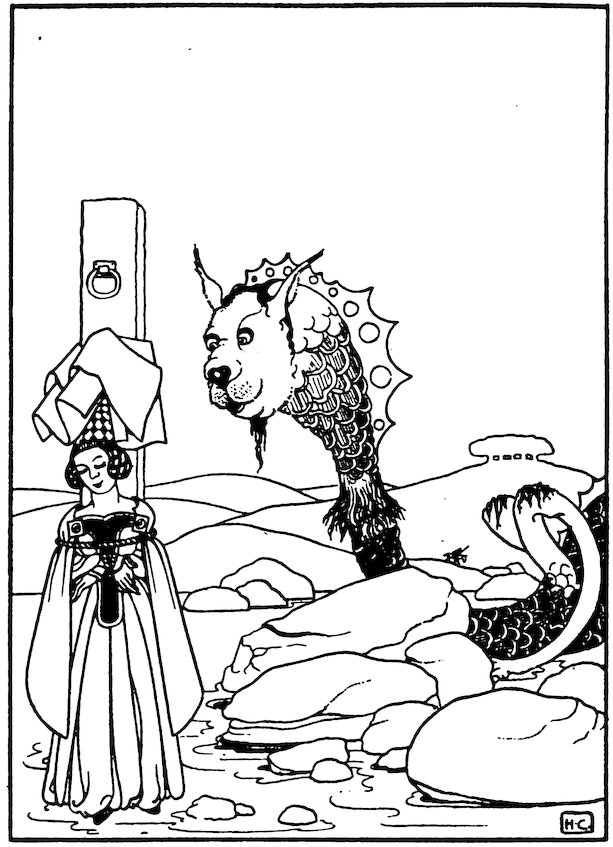
Damsels in danger of Dragons.
38
This is the rhyme of Mungo Myngs,
Lean of limb and lily-livered:
Shook and shivered,
Did Mungo Myngs,
At lots and lots and lots of things.
Powder and shot
He minded not,
(At least not much);
But I'll tell you what
He couldn't abide—
The slightest touch
Of sword or lance;
And if perchance
A battle was fought on the Myngs estate
He wouldn't come out and risk his skin,
But, sheltered behind his castle gate,
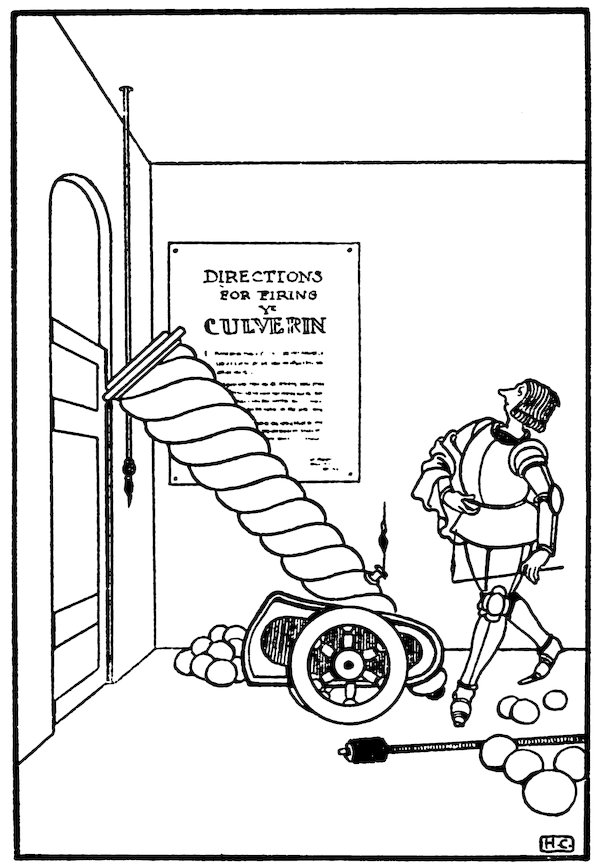
He'd fire at the foe with a culverin.
39
Fire at the foe with a culverin.
40
THE SILVER SHIP By ROY MELDRUM
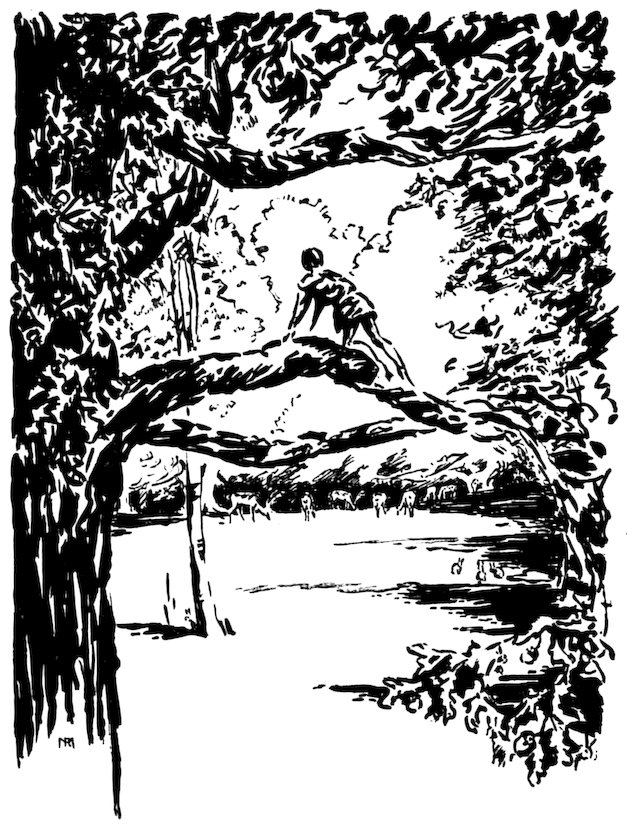
On a September day—many hundred years ago—a
boy, named Robin, was playing alone in the great
forest of Stoke and Sayes. He was perched on a long
branch of an oak tree, and balanced on his hands and knees
so still that not a leaf trembled. He looked like a large green
squirrel which had lost its tail; and, like a squirrel, he was
listening, as if his life depended on it, for every sound he
could hear in the still depths of the forest. Close above his
head he heard the sound of a jay's wing, as she wandered from
one tree to another; and below, the rustle of deer as they
cropped the grass in a sunny glade near by. From far away,
echoing under the leaves, he heard the faint murmur of bird
and beast, broken now and again by the quick tap of a woodpecker
on some distant hollow trunk, and beyond all these
sounds he seemed to hear for a moment one unlike all the
rest—one which puzzled and troubled him. The next moment
it had gone. But he still crouched, waiting to hear it again.
41Meanwhile, the deer were coming slowly into sight, one
after another, step by step, eating their way nearer to his tree;
and sometimes one, sometimes another would throw up its
head, listening like Robin for the same strange sound. But
after a while they seemed to think no more of it, and then,
when they were all grazing peacefully, and the nearest was
some fifty yards away, he played his first trick on them. He
lowered himself slowly from the branch, until he hung at arm's
length, and then just as slowly raised himself again, and then
inch by inch crawled along the branch, until he was hidden
from the deer by the trunk. There he lowered himself again,
and this time dropped to the ground, and peering round the
trunk, saw that not one of the deer had raised its head, and he
smiled with sudden pleasure. He smiled, because he was sure
that, if the deer could not see or hear him, no man, not even
the cleverest, could track him down or find out the secret
that was hidden in that oak tree.
42
But he still crouched, waiting to hear it again.
To him it was a most important secret. For though he
was still a boy, scarce fourteen years old, and as light of heart
as he was light of foot, already in his life he had seen strong
castles set on fire, and soldiers without pity rob peaceful
towns, and drive men, women, and children out to die in winter
snows. And so, though he was the son of an Earl and page
to the rich Baron of Sayes, he did not trust himself to them;
and he took great care that nobody at all knew where he went
as often as he slipped through the shadows of the forest;
and on these journeys sometimes he would carry with him
a coil of rope, sometimes a saw, sometimes a sheepskin, or a
crock, or a knife, and many other things besides; and he took
them all to that great oak tree against which he was now
leaning; for above in the broad fork of its branches he had
43made himself a hiding-place where he could sleep and, if
need be, store his food and live in perilous seasons. That was
his forest secret.
The deer came still closer, and again he played a trick on
them. This time he laughed like a yaffle, and this time one
or two heads rose in quick suspicion, and he knew that his
laugh was not as much like a bird's as it should be, and he
frowned, and for a long time he stood leaning by the tree,
thinking over the mistake he had made; and all the while the
deer were glancing round them anxiously. Then of a sudden
in the dark stillness beyond the sunny glade a twig snapped
with a sharp echo, and before the echo had gone, the deer one
and all bounded past him in full flight, and he crouched against
the roots of the tree, to watch.
The next minute a man came out from the shadows beyond
the glade, and after looking carefully round about him, began
to run towards the tree.
“A poor runner for all he is a big man and wears a red
beard,” thought Robin, as he watched him lumbering over
the grass. Nearer and nearer he came, until at length he was
44close behind the tree. Then there was a soft thud on the
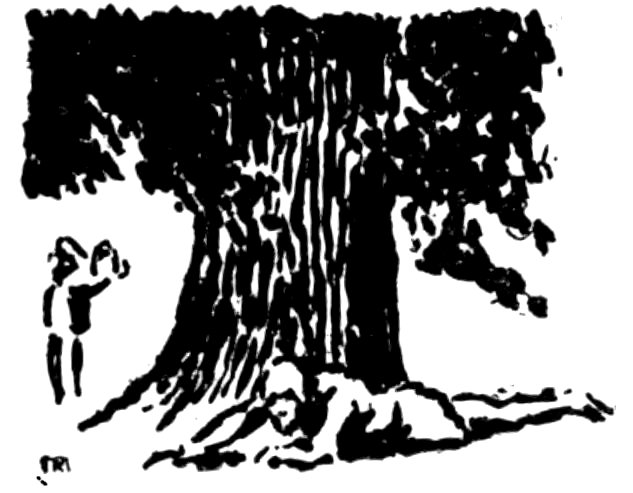
ground, and Robin, gliding a little way round the trunk, saw
the runner lying on his face, his big shoulders rising and falling
as he struggled for breath. Robin waited, suspiciously watching
every deep shadow round the glade.
Presently the man raised himself on his elbow, and sighed
in weariness, as though he was speaking to the ground, “I
cannot go further. They must take me.”
When he heard those words, Robin stepped forward,
burning with a boyish pity for one who was being pursued.
“By your grace, Sir,” he said
defiantly, “they must take me too
then.”
The man stared, as dazed as if
the oak itself had spoken aloud.
“How far are they behind?”
asked Robin eagerly.
The man shook his head.
“Have they hounds with
them?”
“I am not certain,” said the man, laying one hand on the
knotted trunk and rising slowly to his feet.
“Follow me then,” said Robin; “I can save you.”
The man smiled, and shook his head at this confident boy;
but for all that he followed him. Listening for every sound
upon the air, Robin glided away from his oak tree, and past
another of great girth, whose branches spread into those of the
first, until he came to a little bank, at the bottom of which
under an archway of branches ran a stream. Into this he
stepped up to his knees.
45“Come down to me and climb on my back,” he said,
setting his arms against the bank, as if he were playing leapfrog.
The man obeyed in silence. “And now swing up to the
third branch above your head. Quick!”
The man looked up into the tree, and shook his head once
again, but once again he could not resist the eager boy who was
trying to help him, and praying that his strength would hold out
yet a little while, he planted his dripping foot on Robin's
shoulders, and with much labour and snapping of twigs hoisted
himself into the tree. Robin waited, listening impatiently
to the noise, until the man had reached the third thick bough,
and then swung himself up too in his turn, and being nimbler
of foot and much lighter in weight, quickly took the lead.
First they climbed up and up, and then, when at last they
reached a main stem, the man saw what cunning was in the
boy's plan. High above the lower branches it was as though
a pathway had been made from one tree to the other, and along
this they passed cautiously, listening lest at any moment they
might hear the sound of voices through the leaves below.
So they moved, foot by foot, towards the fork of that first big
oak tree where Robin had his forest home, and at length
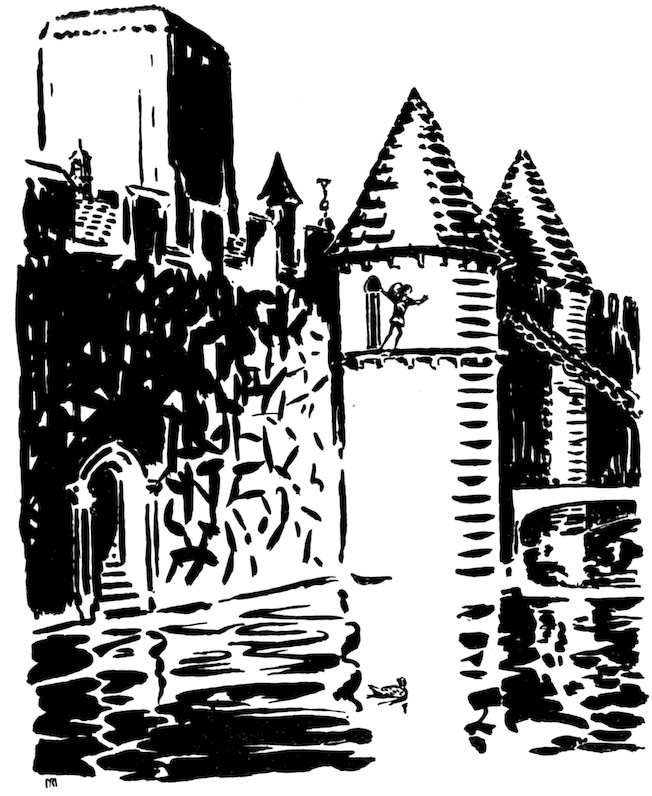
reached it, before the pursuers had come in sight. There the
stranger sank down, and nodding as if to say, “I thank you,”
closed his eyes in utter weariness. For three days and three
nights he had not slept, and his strength was spent.
46
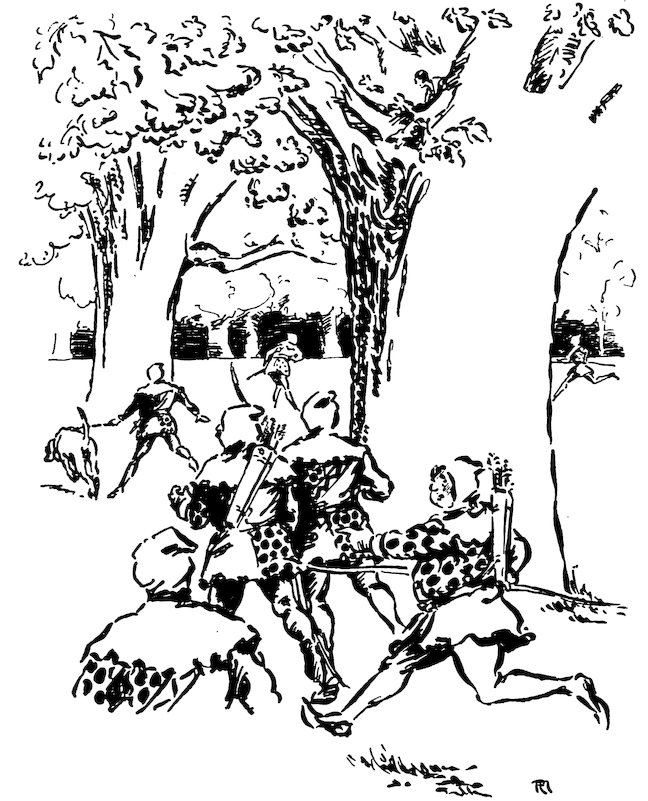
Hurrying along behind a large hound.
Meanwhile, Robin was peering through the branches,
and as he caught sight of a flash of red and silver, he quivered
with a new excitement. These were serving-men of the
proud Abbot of Dore, nearly a dozen, armed with swords and
bows, hurrying along behind a large hound, which ran close
to the earth straight towards the oak tree. There for a moment
47it seemed to hesitate, and then, with a low cry, it headed fast
for the stream. What an age it seemed to Robin, as he heard
the voices arguing and shouting to one another round the
shadows of the next tree, and what a relief when he heard
the sound of splashing water, and at length the voices dying
away into the forest! After much wrangling, the pursuers
had decided that the fugitive had gone along the stream to
put them off his scent, and get back into his old tracks again,
and that way they went
also.
So once again stillness came
over the great woodland. But
now Robin's secret was no
longer his own. At first, as he
watched the stranger soundly
sleeping among his own sheepskins,
he felt rather jealous of
him; but then he remembered
that it had all been his own
plan, and he became ashamed
that he should grudge help to
anyone, who was in danger
from the Abbot of Dore; for of the Abbot's evil ways he had heard
many a poor man tell. Then he grew inquisitive. For what had
this stranger run away? And at last, eager to know this
mysterious thing, he crept over to him, and tried to waken him;
but the man only opened his eyes and smiled sleepily and shut
them again. He then looked at the slant of the sunbeams
through the trees, and knew he must go, if he would reach
the Castle in time to put on his livery and wait at supper; for
waiting at meals was one of his duties as a page, and supper
in those days was at five o'clock.
48
So, making up his mind to come back at daybreak and
question the stranger then, he laid what little food he had left
by his hand, and stole away back across the stream, and thence
through a mile of dense trees, and came at length to open spaces
on the brow of a hill, and from there across the plain he could
see, far down to the left, the three towers of the Abbey of Dore,
and three miles away to the right the grey Castle keep of Sayes,
guarding the long bridge that crossed the river Ley.
Down the hill he began to run, skipping over fallen trunks
and through the high, golden bracken, until the woods ended,
and he came on the king's highroad, and along its wide green
border he took his way to the Castle.
He crossed the drawbridge over the moat. All was quiet
within the great courtyard, for messengers had come with the
news that the Baron would not arrive before sundown. Robin
had even hoped that his master might be kept at the King's
Council for yet another day or more, for when he returned
the Castle would be filled again with guests, and then there
was little time for running away to the forest. But guest or
no guest, as he strode into the hall, where the servants were
already making the first preparations for a feast that evening,
he made an oath with himself that nothing would keep him at
daybreak from the stranger he had left in the forest.
Then he went up the hall, past the dais, and through a door
leading to the Baron's retiring room. There he found the
49chamberlain. The chamberlain, who was old and fussy, and
almost overcome with the thought of his master's return, bade
him straight begone to the kitchens and learn his duties from
the steward. So he went back the way he had come. Serving
in the kitchens was not one of his duties; he served only at
the high table, where he attended on his master or his guests,
and carved the trenchers and even now was allowed to carve
the simpler meats, each according to rule; and at times he
played the harp also, but this not often, for not even the threat
of flogging would ever make him practise enough in his leisure
time. Still, he was ready enough now to go to the kitchens for
many reasons. He was hungry; he loved its bustle, as much
as he disliked the tedious ceremonies of the hall; and, more
than all, he wanted to gather a store of food for the morrow.
As he came singing to the passage that led from the hall
to the kitchens, he met coming from them the Baron's young
niece, a girl of twelve, named Marian. Gaily dressed she was,
with scarlet gown and white silk sleeves; and Robin, thinking
that her nose was tipped too high with pride, tweaked one of
her long black plaits in tune to his singing; and before she
could scold him, had darted along the passage to the kitchens.
Here, under the high roof all the noise in the Castle was
gathered. There was the roar of the big fires, the clatter of
pots and pans, the hissing of the spits, as they turned roasting
their many meats, partridge, goose, and mallard, mutton,
chickens, and venison. Everywhere was heat and hurry and
the pungent fumes of cookery. At the thick wooden benches
the cooks were preparing dish upon dish, and all about them
lay a plenty of materials: wines and spices, flour and butter,
almonds and nuts, saffron and ginger, eggs and onions, dates
and raisins, milk and vinegar, and countless other things.
50
Had darted along the passage to the kitchens.
51As he roved about among all this plenty, keeping out of the
way of the steward, Robin gathered a store of food, and finding
an empty crock, he filled it, and setting it in a cupboard asked
his favourite cook to take great care that it was not touched that
night.
At sundown the Baron and his company returned, and after
he had washed off the dust of the journey and arrayed himself
in soft raiment, the minstrels welcomed him to the hall, and the
feast began. But it lasted no longer than two hours, for the
long journey had wearied the new-comers, and so the Baron
retired early to his chamber. Robin crept up to the gallery
over the hall, where in a little recess by the door of the Baron's
sleeping room he had his own couch, and there putting off
his gold and silver livery, and praying that the Saints would
waken him before the sun, he stretched himself on his mattress
and fell asleep.
It was a sharp, frosty night, and the cold air, pouring through
the draughty gallery, made him restless long before the dawn;
and while it was yet a grey twilight, he woke, and taking a
bag and a length of rope from the chest in which he kept his
clothes, he felt his way along the gallery, and down the stairs into
the hall. Here upon the rush-strewn floor lay groups of
sleeping servants, and such a snoring they set up, that he was
glad when he had threaded his way over their sprawling
bodies and out into the kitchens. There he filled his bag
with the food he had gathered the evening before, and then
climbed through a window out into the courtyard, and stole
like a shadow along the dark buttresses of the wall to the
gatehouse. There, opening a door in one of its thick towers
he listened. The gatekeeper was breathing in a deep sleep,
and his dog tapped its tail once or twice gently, as a lazy sign of
52friendship. So Robin tiptoed past them to a staircase leading
up the tower itself. Ten steps up he went and there came to a
window, narrowing to a slit, through which he could just
squeeze his body. From this window ran a ledge round the
outside of the tower to the outside of the gateway itself, and
many a time had he used this ledge to pass in and out, when the
great gates were locked, and the bridge was not drawn up.
If the bridge was drawn up, it meant swimming the moat also,
and for that he had no mind in the bitter cold of the early
morning. To his joy, when he had come through the window,
he saw the outline of the bridge suspended across the water,
and hanging the bag over his shoulder, he quickly worked his
way along the ledge, and came to the side of the bridge, and
then sprang down, and a minute after he was lost in the white
mist of the meadows by the river.
He quickly worked his way along the ledge.
53The bag of food he knew would be too heavy to carry as
fast as he wanted to go to the forest, and so he had brought
the length of rope with him; for somewhere in the meadows
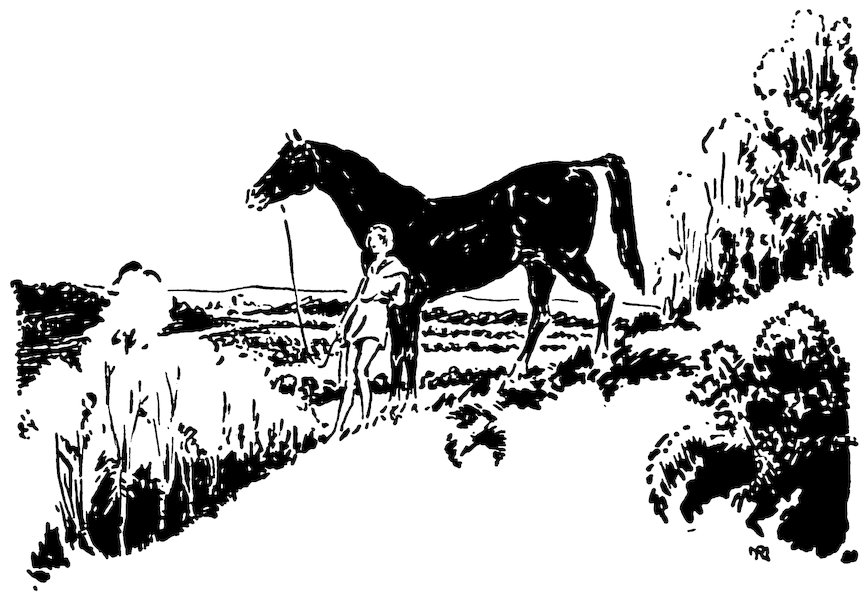
grazed a horse called Saracen, that he often rode and for whom
he had made with his own hands a leathern headstall. He
would have whistled, but already he heard sounds of voices
through the mists. It was the swineherds driving the
long-legged village pigs to feed in the woods. So, keeping
silence, he wandered unseen over the drenching grass until
he came upon his horse. He fastened the rope to its headstall,
leapt on its back, and after picking up the bag he had left
by the moat, he was away to the forest, as the first beams of
the sun broke crimson through the silver clouds.
54
But for all his care he had not gone unseen. High in the
keep slept Marian with the two daughters of her uncle, the
Baron of Sayes; and at the time when Robin was down in the
meadows, an owl had perched on the sill of their window
and hooted and startled them from their beds. And after it
was driven away, and the other two had fallen asleep again,
Marian still lingered by the window, wondering and downcast
about many things, which she did not understand. She
wondered, why for many months no news had come from her
mother in the North; why her aunt never spoke of her mother
now; why her uncle no longer spoke of her
father, who had gone to the wars in France;
and she was troubled too by the stern look
he had fixed on her when he was talking to
his wife in their private chamber that very
night. She knew by his look that it must
be herself they were speaking of, but she had
heard nothing, except once or twice the
words “the Lord Abbot of Dore.” It
was all a mystery to her; and only one thing she knew
for certain, and that was, that she wished she were riding
fast to her home in the North.
And, as the wish was in her heart, and her eyes looked down
on the bank of mist that lay below round the river sides, she
saw a tiny horse move through it like a ghost, and then suddenly
spring out into the dim golden sunlight. That horse and
rider, her eyes told her, could be no other than Saracen
and Robin. And with an angry sigh she left the window.
Why couldn't she too go free like a boy? Why should Robin
torment her thus again? She had not forgiven him for
catching hold of her plait that evening. He deserved to have
55all his tricks and escapades told to her uncle. But she could
not punish him even in that way. For then she would be
telling tales herself. Truly, she sighed, it was all very tiresome.
Meanwhile, suspecting nothing, Robin had tethered his
horse far within the forest, and was tramping with his bag,
as hot now as he had been cold, down the deeply-wooded side
of the hill, beyond which lay his secret oak tree; and at last
he came down to the stream near by it, his heart beating with
excitement. His quick eye glanced to the second trunk, and
saw something move in the branches above it. The stranger
was still there.
In less time than it would take to tell, Robin was in the tree,
and the stranger was making a meal; and as he ate, he glanced
with an admiring eye at the boy, who had thus helped him;
and ever and anon he questioned him. Robin, on his side,
met his eye with a steady gaze. He liked the man's rugged,
bearded face, and answered him frankly. At last the man
seemed to be satisfied with his questioning, and putting his
hand into his tunic, he drew out the end of a chain, on which
hung a little silver ornament shaped like a ship, and he said
simply:
“I am called Brian of the Bow.”—Robin started with
surprise, for he had heard foresters speak of that name with
awe.—“You have once given me my life to keep, if I can,
and right glad I am, for I hope to teach my son to loose a
shaft better than his father before I die.”
“How old may he be?” said Robin.
“Sixteen years, and six feet high already, and he can shoot
as straight as I can,” said Brian of the Bow, with a proud nod
of his head. Robin's countenance fell; and he set his chin.
56He had himself shot with a man's long bow, but the Baron's
archers had laughed, as his arrow flew short and wide of the
mark. Even a stag would sit on his haunches and laugh
aloud, they had told him, if it saw the flight of such an arrow;
and here was news of one, but two years older, already a man
in skill. He was downcast.
“I shall teach him, too, one other thing,” said Brian, seeing
the shadow on Robin's face, “to remember that he would
never have been John of the Bow if his father had perished
yesterday,” and then, knitting his
brows, he went on: “You have
saved my life once. I shall put it
once again in your hands, and, it
may be, the life of another also.
You see this silver ship. That was
entrusted to me by the lady I serve
and her name you will have heard
many a time, if you have been long
at yonder Castle. She is Catharine
of Arlington, and her husband is
the brother of your master.”
“Marian——” said Robin.
“Her mother,” said Brian. “It is now many months
since she had news of her daughter, and all her messengers
have been driven back and cruelly used, and she is sick almost
to death with fear that some evil may be hanging over this
same Marian. You saw the men who followed me yesterday,
and whose men they were. My mistress fears that their
master, the Lord Abbot, intends to trap her daughter into his
power. Many are his plottings, and time is too short to tell
you them now. You will know enough if I tell you but this:
57I was sent to carry this silver ship to my lady's daughter.
This ship says 'return'!” and he took it off the chain, and held
it up for Robin to see closely. “If I could give it my lady's
daughter this forenoon, she would be far into the forest by
nightfall, and six leagues to the north I know a woodman
who would give us rest and shelter, and again six leagues and
we should be in a friendlier country, by the forest of Barnwood.”
“Give it to me,” said Robin impetuously, holding out his
hand, “and by noon, if it be as you say, she will be here by
this tree, and perchance two horses with her.”
“Never make too high a promise,” said Brian, and Robin's
cheeks flamed at the rebuke; “but this I know,” he went on,
“you may succeed now where I am like to fail,” and with
these words he gave Robin the silver ship, and commended him
to God. Robin had already swung out on a branch, and
58dropped to the ground, when Brian called after him in a low
voice, “Do this for me, and in days to come I will teach you
to loose a shaft as well as any man.” Cheered by these words,
Robin set off hot-foot for his horse Saracen, and when he came
to him, where he was still peaceably grazing, he stood leaning
by his shoulder and thought awhile, until Saracen in his turn
stopped grazing, and stood and seemed to think also. Thus
they stood and stared together into space, while Robin tried to
imagine what was likely to happen at the Castle of Sayes that day.
At length he seemed to make a decision, and
jumping on Saracen, rode back towards the
Castle; but when he came to the wide
common land that lay by the bridge, he
dismounted, and turning Saracen loose,
made the rest of the way on foot.
As he came to the gatehouse, a rider in
the Abbot's livery thundered out over the
wooden planks of the drawbridge.
“Good day,” said Robin, with a
twinkling eye, and wanting very much to
flourish the silver ship in front of his face. The man passed
him without answering.
Then through the gateway Robin saw the Baron striding
up and down the narrow lawn that lay under the shadow of
the hall, and he saw, too, that there was deep anger on his brow,
and he trembled, as he drew near, trying to swagger along with
a bold step. Still the Baron strode to and fro, and all the time
watched Robin with a stern eye. Once that morning already
he had called for him to prepare his bath, and there had been
no answer. But still, as he strode to and fro, he did not speak.
Dark and gloomy secret thoughts were vexing his heart and
59making his tongue silent. For he had just heard that the sister
of the Abbot of Dore was coming that day to go a-hawking,
and he knew that she would return that night with his niece
Marian a captive in her train. He knew that it had been planned
that while Marian was out with the hawking party, she should
be drawn into the woods, in order that the Abbot's serving-men
might seem to rescue her, and carry her off for safety to the
Abbey. All this he knew, and yet he could do nothing; for he
had consented to the plot, unhappy man, afraid that the Abbot
would ruin him in the King's Councils. So without speaking,
and with the least twist of a bitter smile on his lips, he watched
his truant page swagger past him to the great hall door.
A deep sigh of relief came from Robin's heart as he swung
the heavy door of the hall back to its socket. But he was
happy too soon. For, as he shut the door, a small, commanding
voice bade him open it again, and he turned to meet Marian
and one of the Baron's daughters, dressed for riding. And
worse still, they began to laugh at him, as though they had a
secret about him that amused them. Two girls foolishly
laughing, and Brian of the Bow waiting in desperate suspense!
For a moment he lost temper, and was tempted to swing
the door open again, and let them go. Instead, he stood
fidgeting against it, and at last he stammered with downcast
eye:
“I have seen a silver ship this morning.”
Marian's lip fell, and the dimples fled from her cheek.
Then the latch of the door clattered and the Baron entered
brushing Robin aside.
“Father,” cried his daughter, stepping forward to him with
a mocking laugh, “have you seen the silver ship this morning?”
The Baron stopped suddenly in his stride.
60“Who has?” he growled.
“Robin,” faltered his daughter, frightened by the harsh
change in his voice.
The Baron for a moment stared at Robin, his face set as
hard as stone, and then he abruptly walked away. “Get
them their ponies,” he called over his shoulder, and again,
in a still sterner tone, “Let me never hear those words again.”
Scared by her mistake, his daughter hastened out into the
courtyard, calling Marian after her; but Marian did not move,
for Robin had caught her by the sleeve. He watched the
Baron disappear through the further end of the hall, and then
whispering, “Brian of the Bow gave me that,” he pushed the
silver ship into her hand. For a moment she stood speechless
and amazed, as though she saw her mother actually standing
before her. Then her eyes turned from the ship to Robin's face,
and from his face to the ship. “Where is he? Tell me,” she
begged.
“I'll tell you, as we saddle the ponies. Can you get some
food, for it will be a long journey?”
“A long journey! He is waiting!” she cried joyously,
so joyously that Robin's heart grew light too, as though all
this serious adventure was turning into a mischievous game
of hide-and-seek.
It was then close upon nine, and at ten dinner would be served,
and in less than an hour the Abbot's sister would be coming
into the hall with her retainers. So the two rushed away to the
pantry, and while for a few breathless minutes they ate, Robin
stuffed a pie into the fold of his tunic and another into his
hood, and then they fled after the Baron's daughter, and a fine
excuse it made for hurrying past the surly and suspicious
61gatekeeper. As they crossed the moat, the Baron's daughter,
sauntering ahead, was already close to the long, level strip of
turf where the girls daily exercised their ponies under the eye
of the watchman on the walls. But Robin did not mean that
Marian should follow her there. Instead, he beckoned her
after him into the main stables, which stood across the highroad
opposite the gatehouse. There the ponies were quickly
saddled, and Marian mounting hers, Robin took its bridle,
and bidding a groom lead the other before them, he and Marian
followed so slowly that when they came out on the highway,
they were already some way behind. There he stopped, and
calling to the others that he wanted to fetch his own horse
Saracen from the common land over the bridge, he turned that
way.
“I can come with you,” called Marian, in a voice that all
who wished to hear might hear, and when she saw the groom
bow his head in consent to her call, she turned her pony slowly
after Robin; and so the two passed to the bridge, and still
slowly moved out of sight.
As soon, as he saw their heads appear above the parapet,
Saracen had pricked up his ears, and with two or three flourishes
with his heels, and two or three boisterous circlings, he pranced
up to them. Straightway Robin unknotted the rope from his
headstall, and the next moment Marian and he were racing
to the nearest point in the forest.
“How lovely!” she cried breathless, as they plunged under
the sun-dappled trees. “Robin, I'm free!”
62
Next moment Marian and he were racing to the nearest point in the forest.
“Not yet,” he said soberly, his eyes looking eagerly for
familiar marks by which to guide their path. Steadily they
moved up towards the crest of the hills, and then threaded
their way along just beneath it, catching glimpses of the Castle,
63as it grew smaller and smaller in the distance. And still they
saw nobody setting out in pursuit. And thus at length they
came near the secret oak, and the only trouble Robin had was
to stop Marian startling everything around with her laughing
voice. The serious-eyed quiet Marian had gone, and a new,
merry, jolly, light-hearted Marian had appeared in her place.
He was filled with wonder. Her laughter was so gay that he
felt that even the rabbits would forget their cares, and all their
holes would shake with silent jokes.
As they crossed the stream, Brian of the Bow rushed from
his hiding-place, and to Saracen's surprise threw himself on
his knees before them, tears of joy coursing down his brown
cheeks, now that the long suspense was over.
“The saints be praised, my little mistress!” he cried, and
Marian jumped from her pony and flung herself into his great
arms, while Robin rescued the pies, that had danced to many
pieces in the folds of his tunic.
There was little time for all that they wished to say then.
Every minute they waited made their course more dangerous,
and so all was soon hurriedly prepared for setting out. All
the stores that were of use from the oak tree were put into
two bundles and slung on a rope over Saracen's back; for
Robin, though it cost him a pang, bade Brian ride him as far
as the woodman's hut six leagues through the forest, and then
set him loose to find his own way back.
“God thank you always,” said Brian solemnly, before he
mounted; “and when we meet again I will string a bow for
you.”
“Robin,” said Marian shyly in her turn, “I like you very
much to-day,” and he beamed at her with pleasure as she
turned to ride away.
64
So they started, and as he watched them disappear Robin
wished that he also had been starting with them on this new
adventure, over the hills and far away. But he had to bide his
time; and all the way, as he returned through the woods back
towards the highway and kept watch against the coming of the
hawking party, lest he should be seen, he was trying to plan
how that good time might come to him.
There was hue and cry both in the Castle and in the Abbey
that night. Riders galloped this way and that. Rumours
flew. But when midnight came, only Saracen was on his way
back through the dark trees; and Marian and Brian, after a few
hour's sleep in the woodman's hut were already starting on the
second stage of their journey, and no servant of the Abbot had
either seen or heard of them. And in the Castle at the same
time Robin was preparing his master's bed, so drowsy that
sometimes for a moment he dreamed that he was tossing in a
silver ship, and sometimes that he was riding in the forest
under the stars. Suddenly a voice smote his ears.
“I will do that for myself,” it said, and Robin, blinking in
the candlelight, saw the Baron standing in front of him.
65“Go and rest, go and rest,” the Baron said, laying his hand
in a kindly way on his shoulder. “You have served me well
enough already for one day. Go and rest.”
Years after Robin came to understand how he had served
the Baron well that day; how he had done for the Baron what
he could not do for himself, and saved him from a mean and
treacherous act; and years after he used the bow as skilfully
as Brian's great son, Little John. But that was when men
called him Robin Hood, the outlaw of Sherwood, and Marian
had become Maid Marian.
“THE ORDER OF THE BATH” By MABEL MARLOWE
66
Every Saturday night the gnomes all went down to
the river to bathe. They used the archway under
the wooden bridge for a dressing-room, putting their
clothes in little heaps on the stones.
The gnomes that could swim wore red bathing drawers,
and were very proud of them, too. Those who could take
one foot off the bottom wore blue bathing drawers; and those
who could only paddle and splash, wore white ones.
At seven o'clock they all went into the water, where it
was shallow at the edge, and grew deep (but not too deep).
For half an hour they splashed and swam, and dived, and
kicked. Then Humpy the Weather-gnome, who was the
Master-of-the-Bath, stood up, and clapped his hands.
“Ready,” he called, and he ran under the bridge and
fetched a piece of soap from his pocket. For “batheing” night
was also bath night.
Then the gnomes all stood in a row in the water, where
it was deep (but not too deep). They stood in a row, with the
tallest at the back, and the shortest at the front, and all the
others in their right places according to size. Then Humpy
gave the piece of soap to Lanky Tom, who was always at the
back, and scuttled to his place in front of Toby.
“All ready?” he said.
67“Yes. All ready.”
“Then—Soap!”
Then Lanky Tom dipped the soap in the water to make it
froth. He soaped the back of Toby. Then Toby took the
soap and soaped the back of Humpy. Humpy soaped Sut.
Sut soaped Barney. Barney soaped Lob. And Lob soaped
Dump the dwarf, who was always in the front. Then all the
gnomes dipped.
Fizz! went the froth. The river sounded like sherbet,
and grew the colour of milk. The little wafer of soap that
was left went floating away down stream. After that, the
gnomes all ran under the bridge, and dried and dressed,
chatting all the time.
But one Saturday night a fuss began. Lanky Tom, the
ladder-gnome, commenced to grumble.
“It isn't fair,” he said.
“What isn't fair?” asked Humpy.
“It isn't fair that I am always at the back. I never get
any soap.”
“Why, you get the soap first of all.”
“Yes, I know. But I soap Toby, and Toby soaps Humpy—but
nobody ever soaps me. For twelve years I have had
no soap. It isn't fair.”
“H'm! No, it doesn't seem fair,” mumbled Humpy.
“It certainly is not fair. But I do not see how we can help it.
It isn't our fault that you are the tallest one.”
“No, you can't blame us,” said the other gnomes, all
talking at once. Then they began to argue—and they grew
so hot about it that they all steamed dry.
68At last Dump the dwarf (who was always in the front)
raised his voice.
“Listen to me,” he cried. “I may be the littlest one here,
but I have got the most sense. Let's all go into the water
again—but let's go the other
way round, with the tallest in
the front.”
“Of course!” said Humpy.
“That is a very bright idea.
Line up! Quick March! Left,
Right! Now, RIGHT-ABOUT-FACE!”
Solemnly the gnomes
marched into the stream in
their usual order, and then
faced about, so that Lanky Tom
was in the front, and Dump
the dwarf was at the back.
Then Humpy took another
tablet of soap and gave it to
Dump.
Dump soaped Lob. Lob soaped Barney. Barney soaped
Sut. Sut soaped Humpy. Humpy soaped Toby. And Toby
soaped Lanky Tom. He lathered his shoulders, and rubbed
his back, and gave him such a frothing that when he dipped
the whole river boiled and sizzled like a steam engine.
All the willows shook in the breeze, and the fishes gave
their tails a mighty flick, and were off.
Back scuttled the gnomes to the bridge, and began to
dress.
69“Well, are you satisfied now?” asked Humpy, towelling
his head.
“Yes,” replied Lanky Tom. “Yes, I am satisfied now.
I have had a good wash at last.”
“So that's settled,” said Humpy, and he began to pull
his socks on.
“No, indeed! It isn't settled! It isn't fair!” cried
Dump the dwarf, getting red in the face.
“What isn't fair?” asked all the others in chorus.
“I have only had one soaping, and the rest of you have
had two.”
“I have only had one, and I am quite satisfied,” said
Lanky Tom.
“One is quite enough,” said Barney.
“That's not the point,” cried Dump, growing excited.
“The point is this. One gnome was being treated unfairly
before. We all admit that. But now TWO gnomes have been
treated unfairly. Matters are worse than they were before.”
“It's your own fault. You suggested it. You have got
us into a fine muddle with your interference,” said Humpy.
“Yes, indeed!” said Lob. “I've got a complaint to make,
too. I've been washed twice.”
“So have all the rest of us,” cried the others, all speaking
at once.
“What a waste of soap. Two pieces used instead of one!”
“H'm! That's a serious thing about the soap,” said
Humpy. “If we use two tablets each time the soap will only
last for half a year, and we shall have to stop grimy for six
months at a time.”
“Let's bath once a fortnight,” said Sut.
70
“No! I don't like that idea at all,” said Barney. “There
is no sense in that—to have two washes in one day, and then
none for two weeks.”
“We've done it to-day,” said
Sut. “I've been washed when I
was perfectly clean.”
“I may be the littlest one
here,” shouted Dump, “BUT THAT
IS NO REASON WHY I SHOULD BE
TREATED WORSE THAN ANYONE ELSE.”
“Tut-ut-tut!” said Toby.
“What a fuss! What a silly commotion!
And all about nothing!
I suggest that we go on the same
way as we used to do. We have
done it for twelve years. We can
do it for twelve years more.”
“Oh! can we?” said Lanky
Tom, in an awful voice. “Can
we INDEED!” And he stumped up
the bank and went off in a huff.
Oh, the consternation under
that wooden bridge! The water
chattered over the stones; the rushes
whispered together, and all the
echoes of that dim archway sounded
like the moans of a gathering storm.
“Dear, dear! What shall we do?”
“Let's bath by ourselves.”
“No. We can't reach our own backs. Our arms are too
short.”
71
“I shall resign,”
said Humpy, shaking
his beard. “For
twelve years I have
been Master-of-the-Bath,
but now I shall
resign.”
Gloomily, with
many sighs, the
gnomes dressed and
went away. One by one
they disappeared along
the lane, and at last
Humpy was left alone.
He sat on a stone
in the shadows, watching
the water as it
lapped at the pebbly
banks. Twilight
settled over the land.
Stars began to glimmer
in the sky. But
Humpy sat under the
bridge, and did not
move.
He felt very sad,
and very old.
Suddenly he heard a voice calling his name.
“Humpy! Humpy! Where are you?”
Mrs. Humpy came running down the bank, peering
anxiously under the arch of the bridge.
72“I'm here.”
“Oh, I thought you must be drowned. I watched the
other gnomes coming home—and they looked very grave—no
smiles or anything—and it made me feel afraid that something
had happened.”
73“Something has happened,” said Humpy, and he drew her
down beside him, and told her all about it.
She listened to the end without a sound. Then—she
laughed aloud.
“Oh, you silly, foolish Humpy,” she cried. “You need
not resign at all. There is a much simpler way than that.
Next week, when the gnomes come down to bath—make them
stand in a ring.”
“Of course!” said Humpy slowly.
If you should pass by the stream on a Saturday evening,
you will see a happy sight. A ring of gnomes will be standing
in the water, like a clump of rushes, where it is deep, but not
too deep.
Listen, and you will hear Humpy, the Master-of-the-Bath,
give a loud, clear order.
“Soap!”
Then Lanky will soap Toby, and Toby will soap Humpy,
and Humpy will soap Sut, and all round the ring the soap will
go. Each gnome will be soaped fairly and well, and when they
dip you will hear a fizzling, and see a frothing. The stream
will sputter, and the edges of the water will cream and hump
as if with snow. Rainbow bubbles will go sailing along under
the willows, like a fairy fleet, and the silver fish will hide in
the pools, keeping very still.
Not a word will there be of unfairness. Not a grumble.
Not a single complaint.
And Humpy the Weather-gnome is still the Master-of-the-Bath.
THE SHIP-BOY'S SONG ( Fourteenth Century ) By DOROTHY MARGARET STUART
The house in which old Mr. Bolsover lived was of a
faded primrose colour, and, apart from a high gable
in which showed the windows of the guest-room and
an attic, it was long and low. Its other back windows looked
out across meadows which now lay spreading out before them
into the distance, bright green beneath a merry morning sun.
A narrow terrace skirted the house. At either end of this was a
worn, grey stone pedestal on which stood two dancing fauns,
for ever piping one to another above the wallflowers and the
pinks. And it was the pinks that were now in full bloom,
filling the air with their fragrance.
Along the terrace leaning down from the house wall was a
canopy made of copper, and painted green; and this was
supported by slim pillars, around which clematis and jessamine
clambered. It was just after breakfast-time, and old Mr.
80Bolsover at this very moment was coming out at the French
windows of the breakfast-room with his small niece, Letitia.
She had a nimble way of walking and a quick way of turning
her head that was like a bird, and she was chattering away to
her old uncle as she stepped along beside him. They came to
a standstill together, looking out across the meadows.
“Oh, Uncle Tim, what a perfectly lovely morning!” said she.
“A lovely morning,” repeated Uncle Tim. “One of the
most beautiful I can remember, simply because a small person
of the name of Letitia is here to share it with me.”
“Oh, Uncle Tim,” said Letitia; “that's flattery.”
“No, my dear, not exactly flattery,” replied Uncle Tim,
squinnying at her from under the glasses of his spectacles;
“but just the plain, beautiful, solemn truth.”
“Ah, I know all about that!” said she.... “And to
think, Uncle Tim, it's exactly a year since I was here before.
Why, you wouldn't believe a single flower was different. And
there,” she went on hastily, twisting her head on her slender
neck—“why there's that curious old Guy Fawkes thing still,
over there by the willows.”
“Why, yes, so it is,” said Uncle Tim.
Letitia continued to gaze at it. “You know, he is a little
alarming, Uncle Tim, if you look at him long enough. And
you don't seem to remember,” she went on solemnly, “that
the very last morning I was here you promised faithfully to
tell me what it's there for. And then you didn't, because
Mother came in just when I was asking you, and you forgot
all about it.”
“Well, so I did,” said Uncle Tim. “That's just what
comes of the piecrust which promises are made of. It melts
81in your mouth.... That's Old Joe right enough. Old
Joe indeed, poor soul, for he must be at least as old as I am.
Ninety-nine, Letitia, if he's a day!”
“You're please not to say that, Uncle Tim. You are the
youngest, kindest Uncle Tim there ever was. So there!
But what is Old Joe? Where did he come from? What is
he for? Isn't there a tune about an Old Joe, Uncle Tim?
Is that him? Tell me now,” cried Letitia. “Let's sit down
here comfily on the stones—they're as warm as toast in the
sun. And now go straight on. Please.”
Down sat old Mr. Bolsover; down sat Letitia—side by side
like an ancient Pharaoh and his bride. And this is his story
of Old Joe:
“I must tell you first, Letitia,” he began, “that when I
was about your age I used frequently to stay with an old friend
of my mother's—your grandmother's, that is—whose name
was Mrs. Lumb. She was a stout woman, and used, I remember,
to wear an amethyst-coloured velvet cap flat over
her ears, and a lace thingummy over her shoulders. I can see
her now: her wide face all creased up in smiles, and her fat
fingers with the emeralds and the sapphires; and even the
cameo brooch at her neck. She wasn't even so much as my
godmother, but she was immensely kind to me. She had a
cook, too, that could make every sort of prime rich cake there
is. Jams, jellies, raspberry-fool, apple charlotte, tipsy-cake—they
were the best I've ever tasted. So were her stuffed eggs.”
“Oh, Uncle Tim,” said Letitia, “you greedy thing!”
82
“You shall see for yourself at lunch,” said her uncle;
“for if I'm not an unprophetic Dutchman, I can smell apple
charlotte. But never mind about that. You'll agree, at any
rate, that my friend Mrs. Lumb was the right kind of person
to stay with. It was always during the holidays, and in those
days, while there was plenty of honest hard tack at school—impots,
ferrules, bread-and-scrape and what-not—there was
no such thing as a holiday task. You hadn't, I mean, to sit
and hate reading a book you'd have loved to read for its own
sake if you had never been told to. But never mind about
that either. At Mrs. Lumb's I did just what I liked. Hers
was an old, roaming house; a good deal older than this, and
twice the size; and there was beautiful country all around it.
Wide sweeping hills with ploughed fields stretching down their
sunny slopes; little woods and copses, too, on the crests and in
the folds and valleys; and a stream meandering its way along
and actually brawling over stones at the foot of our long, sloping
83garden. If ever I go to heaven, my dear, I hope to see that
house and garden again.”
“But isn't it here still?” said Letitia. “I mean wherever
in the world it used to be?”
“Alas, my dear, no,” said old Mr. Bolsover. “The house
was destroyed by fire—burned clean to the ground—forty
years ago. But not, I am thankful to say, before Mrs. Lumb
had left it and had gone out to live with her younger brother
in Ceylon—where the strong tea comes from.
“In those days I was uncommonly fond of birds; too fond
of them to carry a catapult, but not too fond of them to set
traps and try to catch and keep them, poor creatures, for pets.
How would you like to be a linnet or a starling or a blackbird
84barred up inside a cage by an oaf of a boy like me when I was
nine or thereabouts?”
“Not at all,” said Letitia; “though I would sooner be
kept by you than by any other boy.”
“Thank you, my dear,” said Mr. Bolsover; “that's a
bargain. Still, caging wild birds is usually very poor fun for
the wild birds. But I was a boy and I did as boys do, bless
their hearts. My traps were scattered everywhere, sometimes
in places where they had no business to be. What I was after
was rare birds, and deep down my one desire was for a bird
unspeakably marvellous in colour and appearance and song,
and one that nobody had ever seen. Which means I was a
little cracked on the subject. There was a particular place
that I had in mind for a trap for a long time before I ventured
to make the attempt. It was at the edge of a field where I
used to notice a great many birds were accustomed to visit,
and that in spite of Old Joe there.”
“That Old Joe there?” enquired Letitia, pointing with
her finger at the queer, stooping figure with its head and old
hat on one side which stood blankly gazing at them from
under the willow where she had noticed him before.
“Yes, that same Old Joe there,” said Uncle Tim. “Between
you and me, my dear—though please not to look his way
for a minute, as I shouldn't like to hurt his feelings—Old Joe
is a Scarecrow, an antiquated hodmadod. And he has never
been anything else; though, after all these years he and I have
been together, of course he's now a kind of twin brother.
He's Joseph, you see (in the coat), and I'm Benjamin; and as
you see, my dear, we are much alike.”
“How can you say such things, Uncle Tim,” cried Letitia,
pushing her hand in under his arm. “You know quite
85well that's a kind of flattery, too—of yourself, you bad
thing!”
“No,” said Uncle Tim, “but of Old Joe. But never
mind about that. The first time I saw him, he gave me a real
fright. I had come creeping along on the other side of the
hedge, keeping a wary eye open for anybody that might be
in the field; even though there was very little likelihood of this,
for, unless the field was being ploughed or harrowed or sown
or hoed, there never was anybody. The field belonged to a
farmer called Jones. It was a good-sized, sloping, forty-acre
field, with a plantation of spruce down along all one side of it.
“That particular morning was in March; and the field
was just waiting—and on a morning rather like this, but much
86colder—for its crops to come up. I was skirting along the
hedge, as I say, carrying the snare I had with me under my
jacket, and hardly able to breathe for excitement. For, thought
I to myself as I peered through the hedge in which the thornbuds
were just breaking, that's the place for me. I could just
see across to the lower edge of it, where lay a ditch and another
hedge that had been allowed to sprout. It was truly a little
paradise of birds, my dear. There seemed to be hundreds
busying and disporting and delighting themselves there in the
early sunshine.
“As bold as paint I turned the corner by the old gate, and at
that precise moment caught sight of what I supposed was
either Farmer Jones himself or one of his men staring at me
across the field not thirty yards away. I fairly jumped in my
clodhoppers at sight of him, turned hot, then cold, and waited,
staring back. It seemed almost as if I could see his very eyeballs
moving. But not he! No common human he! It was
Old Joe. My Old Joe—that Old Joe there!
“I have seen a good many scarecrows in my time, but
never one at which you must look longer before you can be
perfectly sure he is not real—alive. After all, what is life,
Letitia?”
“That's perfectly true, Uncle Tim,” whispered Letitia,
edging a little closer. “He might be alive at this very moment.”
“You must remember, too,” went on Mr. Bolsover, “all
this was in Old Joe's better days. He was young then. He
has been peacocked up in many a new suit of old clothes
since then, and more hats than I could count on my fingers.
But then he was in his heyday—in the very bloom of his youth,
the glass of fashion and the Knave of Trumps! But still, even
as he stands now under his old willow there, I wouldn't part
87with him not for a bulging fat bag of guineas. Not for twenty
bags. Chiefly for his own sake; but in part, my dear Letitia—in
part because one doesn't too often actually see fairies in
this world.”
88Letitia burst out laughing. “Fairies, Uncle Tim!” she
cried, dragging in her amusement her skirts tight over her
knees. “Why, you don't mean to say, you poor thing, that
Old Joe's a fairy?”
“No, I don't mean to say quite that,” said Mr. Bolsover.
“Then, as now, Old Joe was the scaringest of scaring scarecrows
I have ever set eyes on. But like the primrose in the
poem he was nothing more. No, indeed, it wasn't Old Joe
was the fairy. But he was all but next best, for he was one of
her rendez-vouses, as the old word goes. That morning he
was wearing immense loose great trousers and a greenish-black
coat very wide on the shoulders. Apart from the stick for his
arms, another had been pushed up one of his coat-sleeves
for a cudgel. Another with a lump at the top made his head,
and on that was a high, hard, battered, square hat like the hats
old-fashioned farmers and churchwardens used to wear. He
was stooping forward, cudgel in hand. And the eyes from
under the penthouse brim of the shadowy battered hat seemed
to be fixedly staring straight towards the corner by the gate and
at me.
“I hugged the wire snare closer and stared back. And
whether it was due to the hot air coming up from the flinty soil,
or some cheating effect of the light on the white field, I can't
say, Letitia. But even while I watched him, his head seemed
to be ever so gently turning on his shoulders, as if for all the
world he were furtively endeavouring to get a better view of
me without my noticing it.
89
“I was still pretty well startled, I can tell you, my dear.
For in those days young trespassers on seedling fields might
find themselves in for a smart walloping, if not for something
worse. The amusing thing is that this Old Joe was alarming
me a great deal more than he was alarming the birds. They
seemed to be perfectly used to him. A couple of tits were
positively playing hide-and-seek, with him for goal. And there
were rooks in their black coats pacing up and down and preening
themselves in the sunshine not more than a few paces away
from where he stood.
“Well, at last, after confronting him like this for a minute
or two together—at last I became sure he was not an angry
farmer, but merely Old Joe. Yet, something in the look of
him was different from any other scarecrow I had seen up to
that moment. Even from where I stood I could spy a few
90wild flowers already blooming at his feet, and I felt, too, that even
if there were no real eyes in his head, somebody or something
was actually looking at me from under that hat or from out of
his sleeve—from somewhere.
“Already the birds were becoming accustomed to me being
there, simply because I stood so still. I squatted on my
haunches and began to set the trap, but the whole time I was
thinking of that queer old creature half-way up the field, and
knew I was being watched. And whenever I stooped, I took
a little secret look at him either over my shoulder or between
my legs. And then I sat down on the grass of the bank under
the hedge and steadily fixed my eyes on him for I should think
a full half-hour.
“Nothing happened, however. The sun climbed a little
higher into the sky; the shadows cast by the trees shifted a
91little on the wide-stretching field, and at last I turned back
home again. At the corner under an old thorn-tree I stooped
down for yet another moment and had yet another look. And
at that very instant I was perfectly sure I had caught a glimpse
of something moving there. It was as if a face had peered
out and had as swiftly been withdrawn again into hiding.
“All the rest of that day I could think of nothing else but
Old Joe, assuring myself that my eyes had deceived me, or
that perhaps a bird had fluttered down, or that a little breeze
had moved his sleeve—something of that kind. And yet I
knew inside me that this wasn't true.”
“It might,” said Letitia—“it might, you know, of course,
have been not a bird but a little animal you saw, mightn't it,
Uncle Tim? I once saw a hare skipping about in the middle
of a field. Or mightn't a bird have been building its nest in
him? Robins, you know, will build their nests even in an
old boot. And look! There's a bird actually sitting on
Old Joe's shoulder now.”
92“Well, you shall hear,” said Uncle Tim. “I am sure,
my dear, if you had seen Old Joe that morning you would have
agreed that there was something different about him from what
he looks like now. I can't quite explain, except that it was the
difference between an empty house and one with people living
in it. The difference between a pond with fish in it and one
with none. The difference between you yourself when you
are really asleep and when you are only foxing and pretending
to be. And sure enough, I was right.
“I had my bedtime at Mrs. Lumb's, and always an apple
and a glass of milk. But she was not one of those Uncle Tims
who want everything done exactly at the right moment. She
didn't wait till the clock struck eight and them come peeping
in to see if one was safe in bed.”
“Why, you know very well,” said Letitia, “you don't
do that yourself.”
“Ha, ha! Never mind,” said Mr. Bolsover. “That
evening, about seven o'clock, I made my way down to the field
again, just creeping from bush to bush, tree to tree as cautiously
as I could—so cautiously that I actually nearly trod on a bunny's
tail that happened to be enjoying a dandelion on the other side
of a bramble. And when I reached my hawthorn, I sat down
by its root very low to the ground, having made up my mind
I would watch until it really began to grow dark. It was
towards the end of April, you will remember, so the evenings
were a good deal shorter and duskier than they are now.
And as it began to be twilight, it seemed almost that Old Joe
was steadily moving nearer. And then at the very instant
when I noticed the first star in the sky, I saw—well, what do
you think I saw?”
“Why, the fairy, of course,” said Letitia, and sighed.
93
“Full marks, my dear,” cried Mr. Bolsover. “The fairy.
The odd thing is that I can't really describe her. Maybe the
light was not very good; maybe my young eyes were strained
with watching. But it was not only that. For I seemed to be
looking at her partly as if I was imagining her, though I knew
she was really there. She was leaning a little forward, and
reached, I should say, about up to what you might call Old
Joe's waist. Her face was rather long and narrow, and there
was fair hair hanging down from side to side, something
between gold and grey, rather like the colour you see on a
phosphorescent fish in the dark, only more golden. She stood
unearthly still, looking out towards my thorn. And the very
sight of her filled me with a sensation I simply cannot describe.
“It was as if I was in the middle of a dream in another
world, and cold prickles went down my back just as if unawares
94I had heard the sound of enchanted music. There was not a
breath stirring, everything about me seemed suddenly to grow
sharp and clear, even though the light was dim. The flowers
were different; the trees; the birds. Like that old story of the
Cap of Invisibility, it was as if I knew deep down what the
flowers were feeling, what it was like to be a tendril of ivy
creeping up a tree-stem, or to have feathers all over me, and to
be looking with a bright small eye at my own bird-world. I
can't explain it, my dear, but I am sure you will understand.”
Letitia gave two solemn nods. “I think so, Uncle Tim—a
little.”
“Now I believe,” Uncle Tim went on, “that the fairy
knew I was there, but that she could not delay what she wanted
to do any longer. For presently—after a minute or two—she
drew back and began to hasten away over the field towards
the utmost corner furthest away from me, keeping all the time
so that Old Joe stood in between us and prevented me from
seeing her clearly, however much I dodged my head from side
to side. Now that, you will agree, was a difficult thing to do,
and I don't know how she did it. Only a fairy could—without
once looking back.”
“And what was she like from behind?” said Letitia.
“She was like wood-smoke going up from a bonfire; she
was like a puff of wind over snow; or a silver cloud in the sky.
She moved, I mean, my dear, as if she were hovering on her
way, and yet she never left the ground. Far, far lighter than a
gazelle, and so lovely to watch it fairly took my breath away.
And me only a clodhopping boy of ten.”
Mr. Bolsover took a large coloured silk handkerchief out
of his pocket and blew his nose. “I ought to say, at once,”
95he continued, pushing the handkerchief back into his pocket,
“that this is not really a story at all.”
“Well, I think, Uncle Tim, it's a lovely story,” said Letitia.
“Please go on.”
“Well, you see, Letitia, a story ought to be like a piece of
embroidery: it ought to have a beginning and a middle and an
end. It ought to be like a whiting with its tail in its mouth.
But this one just goes off into nothing.”
“I think I understand,” said Letitia once more. “But
please go on with the fairy, Uncle Tim.”
“Well,” continued Uncle Tim, “as soon as the fairy was
out of sight my one desire was to steal into the field and take a
look at Old Joe at close quarters. And yet I hadn't the
courage. He was her dwelling; her hiding-place; her habitation—that
was certain. Now that she was absent, had hied
away, the very look of him had changed. He was empty,
vacant, a husk.
“I fear, Letitia, you must be thinking I was a remarkably
stupid boy. Indeed I was. And, anyhow, I must confess that
I simply could not make up my mind to go any nearer. Old
Joe was quite empty now, but after what I had seen I felt a
dreadful strangeness all about me. I felt I had been a spy,
and that every living thing around me knew it, and hated my
company. I didn't even go to my trap—and when I went
again it had disappeared.
“I talked about fairies next morning to my old friend
Mrs. Lumb at breakfast, just to see if she knew anything about
them. She believed in them right enough, but she had never
seen one. I asked her what she thought a fairy would be like
if she ever did see one, and I can see her now as she sat there
96in her chair, looking out of the window munching her toast.
'Well, between you and me, my dear Tim,' she said—crunch,
crunch—'I never have cared much about those little flibbety-gibbety
creatures that are supposed to find a water-lily as big
as we human beings find a four-post bed. And I don't believe
myself that they'd pay much attention to me. I expect'—crunch,
crunch—'there are not very many of them left now—not
in these parts. Mr. Lumb, as you know was an entomologist.
He'd have been able to tell you more about it. And
he—had once seen a ghost.'”
“A ghost, Uncle Tim?”
“That's what Mrs. Lumb said, my dear. And I asked her
what that was like. 'Well, it was like,' she said (and I can
remember her very words), 'it was like'—crunch, crunch—'seeing
something with your eyes shut. It made him feel very
cold; the room grew darker, but he was not frightened.'”
Letitia sidled yet a little closer to her uncle. “Between
you and me, Uncle Tim,” she said, “I think that ghost would
have given me the shudders. But please let's go back to the
fairy. Did you tell Mrs. Lumb about that?”
“I never breathed so much as a syllable; though, if you
were to ask me why, I couldn't say. It's just like small boys,
I suppose, and small girls too, eh?”
“I think I'd have told you, Uncle Tim,” said Letitia.
“And what happened then?”
“Two whole days went by before I went near the field
again, though I doubt if an hour went by without my thinking
about it. I forgot about my bird-traps and everything else,
and just loafed about wondering if perhaps all that I had seen
had not been a dream or a trick of fancy. And then on the
97third afternoon, I was so ashamed of myself that I determined
to go down to the field and keep watch again.
98“This time I made my way to its upper corner by the
plantation where I had seen the fairy disappear. I crept down
under some bushes, and had taken with me a little pocket
telescope that my father had given me. Through this I could
see everything that happened near Old Joe as clearly as if I
was at the bottom of the field. It was later in the evening
than before, and already the sun had set. But my legs and arms
were cramped and my left eye tired out with being kept shut
long before anything unusual occurred.
“And then suddenly I knew not only that the fairy was
preparing to take her walks abroad, but that she knew also
I was there. She had stolen out of her hiding-place, though
I had seen no actual movement, and was openly and steadily
gazing across the faint green of the sprouting wheat of the
field in my direction. After a while she advanced a few paces
towards the corner of the field in which I was lying hid.
“Then in a breath she hesitated; turned and sped away,
just as she had done on that first evening, towards the very
thorn-tree from which I had first spied out on her. And
somehow the conviction that she was doing this in order to
avoid coming near me awakened my curiosity more than ever,
and gave me courage. She was setting her wits against mine,
and I determined to try and meet her face to face. Even then,
I confess, the thought of what I should do if we did so meet
was not very pleasant. I lay there till it was almost dark, in
the hope of seeing her come back, and then made my way to
the house and crept in at a side door a good two hours after
my bedtime.
99“It was a warm still evening for the time of year, and while
I was undressing a full-moon began to rise. I could see it
shining through my bedroom blind, for I had not lit my candle.
I drew up the blind and looked out of the window, and the whole
world looked as if it was enchanted. There was not a sound
in the air, and though here I was in Mrs. Lumb's house, it seemed
as if no human being had ever been there before. And, what
is more, Letitia, the same queer feeling came over me as when
I first caught sight of Old Joe, and I knew in my very bones,
as they say, that the fairy was concealing herself somewhere
not very far from the house, and was watching my window.”
“Oh, Uncle Tim,” said Letitia, “and did you go out?”
“No, my dear, I didn't dare. But not from fear. No;
I stood steadily watching until presently a bird began to sing,
a bird which I can't think was a nightingale. It was not too
early in the year for nightingales, mind you; and there was a
hurst or thicket near the house to which they always resorted.
The song was as sweet and sorrowful, too, as theirs; but it
was more shrill, more human, than a nightingale's, and there
seemed to be more tune in it—more melody, you know. And a
curious sadness came over me at the sound of it, and even
when I got to bed it was hours before the echo of it had died
away in my mind and I was able to fall asleep.
“It was just my stupidity, perhaps, to persist in persecuting
the fairy. But then I had become used to persecuting birds,
and perhaps I didn't quite realize that my company in her
field was as disquieting as hers would be to us if she came to
afternoon tea.”
“Oh, Uncle Tim, if only she would!”
“Well, Letitia,” said her uncle, “it's no good denying it:
they don't. We ourselves may pine for them; but not they,
100alas, for us. She didn't want me there. Old Joe was company
enough. And her own world's solitude. But I met her face
to face, none the less. It was the day before I had to go home
again, and two or three visits to the field had been quite in
vain. I could tell by now almost at first glance at Old Joe
whether she was there or not. Just as you could tell at one
glance at me if I was here or not. Not just my body and bones,
I mean, eyes and nose and mouth and so on, but the spirit of
me which is really and truly, I hope, your Uncle Tim.”
“Yes,” said Letitia.
“This particular evening I was in just as morose and sulky
a temper as a small boy can be. My legs were aching because,
I suppose, the ground was damp on which I had been lying,
and night after night had been so crowded with dreams that
I had had little real sleep. It seemed that the fairy had
deserted the field. It seemed that all my hope and longing
and watching had been in vain. I scowled at Old Joe as if
he were to blame. Just vanity and fretfulness. Besides, Mrs.
Lumb had found out that I was creeping into the house while
she was at dinner. And though she never scolded me, she had
a tart tongue, and could smile at you with her handsome face
and be uncommonly sarcastic at the same time.”
“There's a mistress at school, Miss Jennings, just like
that,” cried Letitia. “And then ... you saw her?”
“Yes, I saw her, face to face. I was on my way back
through the copse at the upper corner where two hedges met
at the end of a little lane. And as I came stumping along, I
suddenly went cold all over, and I really believe my cap got
pushed up a little on top of my head, for certainly my hair
seemed to stand up beneath it. And yet I was not really
frightened. Startled, but not frightened. It was the loveliness
101of that face. I can't even tell you, Letitia, what clothes she
was wearing, but, as I recall her, it was as if she were surrounded
with a haze like that of wood-smoke. She was the colour of a
drift of bluebells in the distance. That may or may not be,
but I did see her face, for I was staring steadily into her eyes.
They were blue, like the blue of flames in a wood-fire, and they
were gazing at me out of a face all pale and wan, the hair on
either side hanging in one long strand down to the narrow
sloping shoulder.
“All else then in the world was completely forgotten.
Just me, a small, uncouth human animal, looking as if into
another world into those set unearthly eyes. There was no
movement between us; not the least stir of recognition or
reproach or apprehension on her face. But as I looked—how
can I describe it, my dear?—there came a faint far-away
change in her eyes. It was as if, while you were looking out to
sea some summer's evening, a flight of distant sea-birds
appeared in the blue and vanished. We poor mortals can smile
with our eyes alone, but not like that. That was her way of
smiling at me. It told me in my heart of hearts that she was
not unfriendly to me, and yet that she was entreating me to
trespass no more near her lair. There was what she must do
in the world to consider, she was assuring me, though I hadn't
then, nor have now, the least notion of what it was. And those
eyes were telling me also as best she could—for she had no
language she could share with my dull wits—that though she
wished me no harm, all she asked me was not to keep a watch
upon her, not to spy, not to intrude. And then she was
gone.
“It was easy to take hiding in the evening dusk of the woods,
and the copse and the hedges grew dense just there. She was
102gone, my dear, and I have never seen her since—nor her like....
But you can't call that a story,” added Uncle Tim,
vigorously polishing his spectacles with his silk handkerchief
and blinking at his small niece rather like an owl in the morning
sun.
Letitia remained silent. “I do call it a story, Uncle Tim,”
she said at last. “And oh, how I wish.... But then what
about Old Joe?”
“Ah, Old Joe, the rascal! Look at him there. You
see, my dear, I never forgot that evening. Years and years
afterwards—I suppose I must have been then in my early
twenties—I stayed a night or two with my old friend Mrs.
Lumb again. She was very much older then, alas—and the
first walk I took was to my field.
“Would you believe it? There was Old Joe in his
customary place, though the barley-crop he was guarding
that particular summer was now well above his knees. And
whether I myself was changed or had gone a little blind in
some respects; or whether, as I think, the fairy had long since
given up her hiding-place; or whether perhaps this had always
been merely her way of getting into and out of our world, I
don't know. Old Joe in any case looked, well, just as he
looks now, absolutely empty—forsaken, abandoned. He had
brand-new old clothes on, of course, and a rare old wide-brimmed
hat, green as a robin's back. And what do you
think I did?”
“No, Letitia; I purchased him; I bought him,” said
Uncle Tim. “But 'ssh! I went to the old farmer—old
Farmer Jones—and asked him how many guineas he'd take
103for his hodmadod as a curiosity. Just told him I knew Old
Joe when I was a boy, and had a sentimental affection for him.
“Farmer Jones was as fat as a porpoise, with a large mulberry
red face and eyes like bits of agate. He laughed at me.
And what do you think he charged?”
Letitia pondered rapidly, blinking her eyes. “I suppose
£5 would be a good deal, wouldn't it, Uncle Tim? Even for
Old Joe. Though, of course,” she added in a slightly louder
voice, in case the old creature should hear, “it would be
'strordinarily cheap, too.”
“Guess again, my dear! Nothing like £5—nothing like
even tuppence. 'Give me a pipe of that plug tobacco of
yours,' said the farmer, 'and he's yours for ever.'
“So mine he was; and I am glad it wasn't money.”
104
“I set her on my pacing steed....”
105“And so am I,” said Letitia. “A pipe of tobacco was much
better than money. It doesn't hurt your feelings, Uncle Tim.
And you never saw the fairy again?”
“In a manner of speaking,” said Uncle Tim in a rather
solemn voice, “I don't think, Letitia, I have ever really seen
anything else. Nothing—even in the dreams that flock into
my old head nowadays—nothing ever resembles in loveliness
that face, those deep-dark, unsmiling eyes. I set her on my
pacing steed, and nothing else saw all day long.... You
know how it goes, my child; but I dare say in your dreams....”
Letitia shook her head violently. “Oh no! Oh, how I
wish,” she cried; then fell silent. “You know, I believe, Uncle
Tim,” she went on in a low ruminative voice—“I believe it
was almost as if you must have fallen in love with that fairy.
Was it that, Uncle Tim?”
“Ah, my dear!” replied old Mr. Bolsover. “But if
you don't think the long grass under the willows over there is
still too wet with the night's dew, we might venture across and
ask Old Joe.”
THE DRAGONS By MAXWELL ARMFIELD — RICHARD — TIMOTHY — MIRANDOLA — PAUL
106
Within my black and scarlet hall
Four golden dragons live.
Their names are Richard, Timothy,
Mirandola and Paul
(These I myself did give).
Their real names no one ever says,
They are so very grand.
Their real names if you would pronounce
You must fast forty days,
With your mouth full of sand;
Then, with the names all written out,
Climb to the topmost hills,
Where you unwind from rock to rock,
With a triumphant shout,
Their strange disyllables.
107
Richard will meet you when you come;
He is the dearest thing.
At first you might think that he was dumb,
But if you stroke his golden tail
From left to right with your finger-nail,
Richard will silently sing.
He sings of the moon and shooting stars,
And “how I wonder what you ares,”
And all that kind of thing.
108
Timothy guards the electric light,
Criss-crossed like a Harlequin;
They say he is only a dragon at night,
And by day a Pandolin;
But he always looks the same to me,
At breakfast, luncheon, dinner or tea,
So I guess he’s a dragon all right.
109
Mirandola, Mirandolore,
She comes from where you’ve been before:
She comes from Caithness to the Nore,
Mirandola, Mirandolore.
Slowly, slowly, and very pale
(I think her cousin was a snail),
She lives beside the bathroom door.
She bathes in summer, in winter more:
She LOVES the cold tiles on the floor,
Mirandola, Mirandolore.
110
When mostly all are gone to bed,
And YOU sit up talking-and-talking instead,
And you’re both of you one large vacant YAWL,
From the crown of your head to your feet on the floor—
If you want to pass the kitchen door,
Then FIRST you must pass the place of Paul.
There he circles round and round,
Chasing a tail that is never found,
Guarding the kitchen without a sound.
And if you want to make friends with Paul
You had better start in right now, with ALL
The gumption you can commandeer....
For the ways of Paul are decidedly queer!
MABEL IN QUEER STREET By COMPTON MACKENZIE
111
“Will you walk on the pavement like a little lady,
Miss Mabel, and not keep on bobbing up and down
in and out of the gutter as if I hadn’t have told you
thirteen times to the dozen every day of your life how to walk
properly.”
Nurse was feeling very cross this morning, because the
strings of her bonnet would keep blowing about, and Baby
would keep throwing his rattle out of the perambulator, and
Robert would keep shuffling his feet, and she had had an argument
with Cook about the way Cook had burnt a milk-pudding;
and her sister had written to say that she could not come to
see her, after all, this week, but she hoped she’d be able to come
next week, but she wasn’t sure, and she couldn’t come the week
after, what’s more, because the family was going down into
the country.
Mabel made matters worse by being argumentative:
“Well, a dozen is the same as twelve, Nannie,” she pointed
out, “so I don’t think you could have told me thirteen times
to twelve.”
“Will you not be so argumentative, Miss Mabel! I’m
sure, ever since you won that blessed prize for writing a letter
to that blessed paper there’s been no doing anything with you,
such a dictatorial, domineering, proctorising little girl as it’s
made you.”
112
“Will you walk on the pavement!”
113But Mabel liked to be called all these long words. It
made her feel years older and yards taller to be so many long
words that she didn’t know how to spell, and was pretty sure
Nannie didn’t know how to spell either; because she had asked
her once how to spell “dictatorial” and Nannie had said,
“Hush, what’s that?” which was what she always said when
she didn’t want to answer an uncomfortable question.
“Well, you couldn’t,” Mabel obstinately repeated.
“Now, that’s quite enough, Miss! One more word from
you and straight up to bed you go the very moment we get
home.”
Mabel was bursting to say that she couldn’t go straight up
to bed, because she had to turn round and walk along two
landings before she could reach her bedroom. However,
Nannie was in such an unpleasant humour that she held her
tongue. To tell the truth, before coming out this afternoon,
Mabel had caught a glimpse in the pantry of a particularly
pleasant-looking pink cake, which was likely to appear at tea,
but most unlikely to appear in her bedroom.
“What’s the harm in hopping up and down from the
gutter?” she asked.
“Why, before you know where you are, you’ll be getting
your foot stuck in a drain, and there you’ll be till doomsday,
and that’ll be a nice state of affairs.”
114
A big crowd would collect.
As a matter of fact, it would be rather nice, Mabel thought;
and she walked along, imagining what a big crowd would
collect to watch a little girl with her foot stuck in a drain till
doomsday, and making up in her head all sorts of remarks
that the people would be saying about her when they saw her
plight. By this time they had reached the place where they
115always crossed the road to go into Kensington Gardens.
Robert was picked up and plumped down into the perambulator
opposite Baby; and when Nurse had looked first to the right
and then to the left, and then behind her, and then in front of
her, she called out in a voice trembling with excitement,
“Come along now and mind how you step or we shall all be
run over.” Mabel was always thrilled by this crossing. It
made her think of the “Charge of the Light Brigade” which the
Vicar had read aloud last Christmas at the children’s party
in the Parish Hall, and which she had read lots of times since
to herself.
“Half-a-league! Half-a-league! Half-a-league onward,”
Mabel murmured as they swept on toward the greenness and
the safety of the Gardens.
“Don’t chatter,” Nurse snapped, panting on across the
wide road while a most enormous policeman held up the
traffic for them.
“Suppose he fell right down dead at this moment?”
Mabel asked herself. “Then all the buses would come
charging on, and there’d be nothing left of the pram, or of
Baby, or of Nannie, or of Robert, or of me.”
“Will you not dawdle, you bad girl!” Nurse was gasping
irritably. And just then with a bump the perambulator
landed safely on the opposite pavement.
“Charge for the guns, Nolan said,” Mabel dreamily
murmured.
“What are you muttering to yourself now?” Nurse asked.
“Poetry,” Mabel replied loftily. Then she returned to
the subject of the gutter. “But suppose I didn’t hop up and
down, Nannie?” she asked. “Suppose I just walked all the
116time in the gutter and didn’t ever walk on the pavement at
all? What would happen then?”
“What would happen then? Why, you’d precious soon
find yourself in Queer Street,” Nurse told her. But before
Mabel had time to ask any more questions about Queer Street
Nannie’s attention was occupied by Robert, who had put in
his mouth a broken piece of shell that he had picked up from
the path.
“You dare do such a thing ever again, you naughty boy,”
she exclaimed, “and in the pram you’ll stay for the rest of the
afternoon.”
Robert scowled; but he spat out the piece of shell, and he
did nothing more that was naughty until he began to stroke
the tyres of the perambulator-wheels.
Mabel gazed longingly at some little ragged children who
were climbing up the railings beside the path and jumping off
them, and balancing themselves on the top of them, and rolling
over and over in the grass on the other side.
“Do those children live in Queer Street?” she asked.
“They live anywhere,” said Nurse. “And if I’ve told you
once, Miss Mabel, not to turn round and stare after common
children I’ve told you twenty times.”
Mabel yawned.
“Well, will you tell me a story, Nannie?”
“I’ll tell you a story about good Queen Victoria when she
was a little girl and lived in Kensington Palace.”
Mabel yawned again.
“If you’ve told me that story once, you’ve told me twenty
times,” she ventured to say.
117
Mabel had an idea that she was being rather rude in thus
mimicking Nannie’s way of talking; but she was really astonished
to find quite how angry it did make her. Nannie’s
face turned such a bright purple that Mabel backed away from
her in alarm, because she thought that she was going to be
picked up as Robert was picked up and plumped down in the
perambulator opposite Baby. And that would have been a
most terrible disgrace. Luckily at that moment two large dogs
began to fight close by. Nurse who was
always afraid of dogs picked up Robert
instead and, turning the perambulator
quickly round, hurried away from the
noise and confusion.
Mabel never knew just how it happened,
but all of a sudden she was lost.
The last thing she remembered was
hurrying after Nannie away from the
confusion and crashing into a lot of
other people that were running towards
it. And then, when all was quiet again she
found herself standing in the middle of
the Broad Walk completely alone. Her heart began to beat very
fast, and an uneasy lump came into her throat and she found that
she was making a strange little noise that wasn’t exactly crying,
but was rather like it. She twirled round and round in despair;
but Nurse and Robert and Baby and the perambulator had
utterly vanished. Crowds of most enormous trees stared
down at her until she felt smaller and smaller and more and
more frightened. Crowds of strange nurses and crowds of
strange children went walking past. And then she saw coming
towards her a KEEPER.
118“A keeper,” she whispered in horror. Oh, where could
Nurse have gone? A KEEPER!
She turned and fled.
Now, of course, if Mabel had been a sensible little girl, she
would have waited for the keeper and told him that she was
lost. Unfortunately she had often been so naughty during
walks in Kensington Gardens that Nannie had threatened
her more than once that, if she could
not behave herself better, the keeper
would come and lock her up in his
little green house. She had no reason
to believe that the keeper was not
a savage and brutal man, because
several times she had heard him shout
in a very loud and angry voice at boys
who were misbehaving themselves.
She had seen him shake his stick, and
once she had actually dared to peep
into his little green house and had
seen inside it a live baby. Ugh!
My goodness, how fast Mabel did
run, and when she stopped running
she was more lost than ever. At least, that was the way
she felt she ought to feel, though as a matter of fact,
after she had got over her first fright she found that she
had reached one of the gates of the Gardens and began to
say to herself that if the worst did come to the worst she could
find her way home alone.
“My name is Mabel Evangeline Marjorie Deane, and I
live at Forty-three Cherrington Gardens, and my father is
Doctor Deane, and I’m seven and a half years old.”
119It sounded extremely grand when she repeated all that
quickly over to herself.
“And it wasn’t my fault,” she went on, “it was Nannie who ran
away from the dogs. It wasn’t me who ran away from Nannie.”
While she was trying to make up her mind to take the
plunge out of the quiet green Gardens and set out home along
the noisy street, a ragged boy came by, playing a tune on a
penny whistle. Naturally, Mabel took advantage of being
lost to stare at him as hard as she could. The ragged boy did
not appear to pay much attention to her; but when he had
passed her he turned right round and came marching by again,
still playing his jolly tune. This time he did look at her and
deliberately winked one of his blue eyes. Mabel turned
rather pink and felt inclined to rush off. She had never in all
her life been able to stare long enough at a ragged boy to be
winked at, and really she did not quite know what she ought to
do. Perhaps if she had been able to wink well she might have
winked back; but Uncle Tom had laughed at her so much the
last time she had tried to wink for his benefit that Mabel had
decided to be content with being able to make a noise like a
cork by putting her forefinger in her cheek and letting it go
with a pop. Uncle Tom had told her that she did this splendidly.
So, while the ragged boy walked up and down before
her, whistling and winking, Mabel could only stand still and
look pink and uncomfortable.
“What’s the matter, kid?” said the ragged boy at last.
“Lost your mammy?”
“No, she’s at home; but I’ve lost my nurse.”
The ragged boy went off into another tune that made his
listener want to go dancing along beside him anywhere he
chose to play her on.
120“What are you going to do about it, kid?”
“Well, I’m going to walk home by myself,” Mabel announced.
The ragged boy piped a long trill on his whistle that seemed
to say better than any words could have done how very much
astonished he was to hear this.
“Ain’t you afraid the copper’ll nab you?” he asked.
Mabel, who had never before heard a policeman called a
copper and had not the least idea what “nab” meant, but had
no intention of admitting to a ragged boy that she could be
frightened of anything, shook her head.
“Coo! You’re a plucky kid. I’ll walk along with you a
bit of the way if you like. My name’s Bill Hawkins. Only
mostly they calls me Piping Billie.”
Mabel hesitated a moment before she accepted this offer.
She was really most anxious to enjoy the ragged boy’s company,
but she felt rather afraid of meeting any of her little girl friends
in case they should fancy that he was a relation of hers. It
would be terrible if it went round the dolls’ tea-parties of
Kensington that Mabel Evangeline Marjorie Deane had such a
very ragged relation. Still, there was that crossing to be
managed, and she did not feel quite so much as if she was
riding at the head of the Light Brigade, now that she might
have to cross the road all by herself.
“You can come with me to the pavement over there, if
you like,” she told him.
121
... a red coat and cocked hat.
The ragged boy struck up the jolliest tune that she had
ever heard and led the way. Mabel wondered if the policeman
who was holding back the great grumbling buses and the
irritable taxis supposed that she was a princess. It was a
122pity that Bill Hawkins was not wearing a red coat and a cocked
hat and white gaiters. She wished that next Christmas she
could have enough money in her money-box to buy him such a
dress. If she could, she would ask if she might not keep
him always to march before her and play these jolly tunes.
Where would he sleep, though? There were only two spare-rooms,
and they were nearly always full of uncles and aunts.
To be sure, as he was dressed at present, he might easily sleep
in the coal-cellar; but if he ever had that lovely uniform he
could hardly sleep there. The larder was too small, and
besides he might get smeared with bacon fat. The pantry
would do, if Mary didn’t mind. But Mary was a bit fussy
about her china, as she called it. Why shouldn’t he sleep
outside her own little room? No need then to be afraid of
fire, or of witches, or of burglars, or of cats, or even of murderers.
Mabel walked on toward Cherrington Gardens, dreaming
away to the tunes that Bill Hawkins was piping on his whistle.
Once she nearly grazed her forehead on an old gentleman’s
watch-chain, and once she had to take a step to the right
and then a step to the left and then another to the right and
then another to the left, while a lady in a great hurry coming
from the other direction did just the opposite until at last she
and Mabel discovered that if both of them stepped to the right
at the same time they could pass each other quite easily.
Apart from these two small accidents Mabel threaded her way
along the busy pavements as easily as if there was nobody in
all the world except herself and the ragged boy. She did not
want to talk to him. Just to walk along behind his playing
was as good as the most interesting talk that was ever known.
Once he stopped for a moment and asked Mabel where she
123lived, and when she told him he nodded his head and started to
play Cherry Ripe.
The pavements were not so crowded now that they had
passed the big shops, and presently they turned off the main
road into an old-fashioned square. Mabel found that she was
once more beginning to hop up and down from the gutter as
she walked along. And then she began to take two steps in
the gutter for one she took on the pavement. And then she
began to take only one step on the pavement for half-a-dozen
in the gutter. And then Bill Hawkins began to play a jollier
tune than any he had yet played so far. And then Mabel
forgot to step back on the pavement at all, but went walking
along all the time in the gutter. And then the most extraordinary
thing happened, because she suddenly heard a
tremendous argument going on, and when she looked up to
see who it was she saw that all the railings of the square
were quarrelling with each other.
“I don’t care,” one rusty old railing was saying to another
very smart railing who had just been painted a rich peacock
blue, “beauty’s only paint deep, and if you rail at me I’ll rail
at you.”
“Old iron! Old iron!” retorted the painted railing.
“Don’t you speak in that ironical tone of voice to me.”
Mabel didn’t at all like the voices of these quarrelsome
railings, which grated on her ears horribly.
“Don’t you stare at me, little girl,” one of them creaked.
“Pooh!” said Mabel. “You want a good oiling, you
disagreeable, rusty old thing.”
At this the railings turned palings, and Mabel wondered
if railings objected to being given oil as much as she objected
124to being given castor-oil when she would go on being naughty.
But she had no time to go into this question, because she
suddenly realized that she was once
more quite alone. She began to wish
that she had not spoken so rudely to
the railings, and she crossed the road
to the side of the Square where the
houses lived. But now another extraordinary
thing happened. When
she tried to step up on the opposite
pavement her foot
at once came back
into the gutter.
She tried jumping
on it with both
feet, but the pavement
might have
been made of indiarubber
the way
she bounded off
again back into
the gutter.
“Oh, well,”
said Mabel aloud,
trying to appear
calm. “I may as
well be phisolophical.”
This was what her mother said when Mary came in to tell
her that the cat had broken one of the best glasses.
Mabel had practised the word in bed, but this was the
125first time she had ventured to say
it right out in broad daylight.
“If I can’t walk on the pavement,
I’ll just have to walk in the gutter,”
she went on.
And then she gave her shoulders
a most tremendous shrug. After all,
there was something to be said for
being lost. At any rate, you could
shrug your shoulders without being
lectured for doing so.
Mabel walked on in the direction
of Cherrington Gardens, hoping
every moment to hear the sound of
Billie Hawkins’ piping. In spite of
her philosophical shrugs she was
beginning to feel just a little bit
uneasy. Somehow or other the
square did not look the same as
usual, and when she saw one of the
front-doors suddenly leave its
hinges and come walking down the
little front garden, its letter-box
stretched in a wide grin, and wave
its handle at her, she started to run.
But the faster she ran, the faster the
door bolted after her, and if Mabel
had not found a funny little passage
too narrow for the door to follow
her it would soon have caught her.
126“Slam!” the door ejaculated angrily, when it perceived
that Mabel had escaped.
Mabel, however, did not stop to listen to its exclamations
of baffled rage, but hurried along the narrow passage until she
came out in a street that she had never seen before in all her
walks, and looking up to find out what its name was, she saw
a huge pointed finger write QUEER STREET on a signpost.
And it certainly was.
All the houses were a different colour and they had the
most extraordinary shapes; but Mabel could not see anybody
about who might tell her how to reach Cherrington Gardens
and when she got to the other end of Queer Street she found
that there was no way out and that a bright red house as round
and nearly as tall as a lighthouse took up all the space. Mabel
did not feel at all inclined to venture back by the small passage
down which she had run to escape from the door. However,
when she found that she could not get out of Queer Street at the
far end she went back cautiously to see if she could somehow
muster up enough courage to discover if the door was still
hanging about. But things were getting queerer every minute.
The passage was gone now. There was nothing but an
immense blank wall on which was written in gigantic letters:
NO ADMITTANCE EXCEPT ON OMNIBUSINESSES.
Mabel really was frightened now. There was nobody to
be seen at any of the windows of these strange-coloured houses,
and she simply did not know what to do next. It had sounded
rather exciting when Nannie had told her that she would one
day find herself in Queer Street. Now that she really was in
Queer Street it was horrid. At last she collected enough
courage to make up her mind to ring the bell of one of the
houses and, if anybody answered it, to ask the way out of
127Queer Street. She finally decided to try the tall red house,
which at first she had thought was rather like a lighthouse,
but which now that she examined it more closely was apparently
an enormous pillar-box. The door was painted
white and covered with sums. There was only one window
that she could see; and that was very high up and shaped like
the hole up to which she used often to be lifted to post the
letters when she was quite a little girl. Mabel could not find
any sign of a bell or a knocker, but after she had walked
round the red house several times she found a white plate on
which was printed LICK AND STAMP.
“Yes, but what am I to lick?” Mabel asked herself.
“The licker’s broken,” came a gruff voice from what
seemed miles above, where she was standing. Mabel stepped
back to look up and see who it was speaking; but she had only
just time to catch sight of a head disappearing inside as the
flap of the window shut with a clang.
“Bother!” Mabel exclaimed.
She wasn’t allowed to say “bother” at home, but being in
Queer Street she did not care how much she let herself go.
No sooner had she stepped back to the door than the gruff
voice was heard again from above.
“As the licker’s broken, half a stamp will bring an
answer.”
“But I haven’t got a stamp,” Mabel shouted.
“You’ve got feet, haven’t you?” the gruff voice called
down.
Once more Mabel stepped back to try to catch sight of the
owner; but once more the flap of the window dropped with a
clang.
128“You’ve got feet, haven’t you,” the gruff voice repeated
when Mabel was once more outside the door.
“Yes, I’ve got feet.”
“Then you’ve got a stamp. And if you’ve got a stamp
you’ve got half a stamp.”
“Do you mean I ought to stamp with one foot?” Mabel
shouted.
“Certainly not. That’s a whole stamp. Of course, if
you like to waste shoe-leather you can use a whole stamp,
but you won’t get the answer any quicker if you do. You
may just as well stamp with the sole only. Don’t bother about
putting on your gum-boots.”
Mabel was anxious to get an answer as soon as possible, so
she stamped as hard as she could. Whereupon the door flew
back and she saw standing in the entrance behind a cage, a
lump of wood dressed in dark blue and wearing a cap peaked
in front and behind.
“Yes, good-morning. I’m the Postman. What can I
do for you?”
“I want to find the way home to Cherrington Gardens,
please,” said Mabel very politely.
“You’ll have to address yourself first,” the Postman
snapped.
“But how can I address myself?”
“You can dress yourself, can’t you?”
“Well, nearly everything,” said Mabel. “Only, my nurse
helps me with my frock.”
“You can undress yourself, can’t you?”
“Oh, yes,” said Mabel eagerly. “At least I can if Nurse
undoes the buttons at the back and if there aren’t any knots.”
129
“Good-morning. I’m the Postman....”
130She rather wished that she had kept off the subject of knots,
because the Postman’s face was full of them. However, he
did not seem to mind the allusion.
“Then you ought to be able to address yourself,” he told
her severely. “Addressing is twice as easy as dressing or
undressing. Can you undress an envelope?”
“No, I don’t think I could.”
“Can you dress an envelope?”
“No, I’m sure I couldn’t.”
“You can address one, can’t you?”
“Yes, if the lines are ruled,” Mabel said.
“There you are,” the Postman cried triumphantly. “So
the sooner you set about addressing yourself the sooner you’ll
get home. In fact, if you can address yourself in another
minute, you’ll get home by the first delivery to-morrow
morning.”
“But where shall I be all night?” Mabel gasped.
“You’ll be addressed and put to bed.”
“Yes, but where?” Mabel persisted.
“In my pillow-box.”
“But I thought it was a pillar-box.”
“It’s a pillar-box by day, stupid, but by night it’s a pillow-box,
of course. Why, I knew that long before I was your age.
I knew that when I was quite a twig. There’s only one thing
you want to look out for. Sleep well up in the corner of the
pillow-box, otherwise you’ll be getting woken up all the time
by parcels coming back late and tumbling down on top of you.”
“Yes, but Mother will be anxious if I don’t come home
all night,” said Mabel, who didn’t at all relish the idea of
131going to bed with a lot of parcels. “Couldn’t you tell me
the way to walk home?”
“... parcels tumbling down.”
132The Postman shook his wooden head so vigorously that his
neck squeaked.
“Well, I think I’ll ask at another house first if you don’t
mind, because really Mother will be terribly anxious....”
But Mabel need not have bothered
herself about being polite, for the
Postman shut the door abruptly and
vanished.
A moment afterwards she heard his
gruff voice again from above:
“This was a letter-box,” he called
down angrily. “But since you won’t
be sensible, as far as you’re concerned,
in future it’s a don’t-letter-box.”
Mabel turned round and decided
to try another house. She chose a
green one. This was much more like
an ordinary house than the Postman’s,
and, indeed, except that it was green
all over and that the windows were like
cucumber-frames it might not have
been situated in Queer Street. She rang
the bell, and presently the door was opened by a bulbous-nosed
man in a mouldy suit with lawn sleeves, and an apron of green
bays. There was only one thing that was very queer about him
which was that he had a grass moustache.
“Please, could you tell me the way to Cherrington
Gardens?” Mabel asked.
133“I could,” said the Greengrocer, for that was who it
was, of course.
“Oh, thank you!” Mabel exclaimed.
“But it’s a very heavy weigh from here. It’s a good three
pecks, and perhaps a pint or two over. You take the second
turnip to the right and the first turnip to the left beyond that,
and then if you’re lucky you’ll find a taxi-cabbage or a motor-carrot
to lift you the rest of the weigh. It’ll be quite a nice
little spinach for you.”
“But, please....” Mabel began.
“Do you mean ‘peas’?” the Greengrocer interrupted.
“Well, I didn’t exactly,” said Mabel.
The Greengrocer shook his head.
“Politeness weighs nothing, you know,” he said severely.
“Didn’t your nurse ever tell you that?”
“But I did say ‘please.’”
“You ought to have said ‘peas.’”
Mabel thought she would be wise to humour him.
“Peas, Mr. Greengrocer....” she began again.
“Do you mean ‘peas, Mr. Greengrow, sir?’”
Poor Mabel was getting so fussed by all these interruptions
that she could have cried.
“Peas, Mr. Greengrow, sir, I can’t find any turnings—I
mean turnips—anywhere.”
“Well, of course, if you can’t find them, you can’t take
them, can you?”
“No, I couldn’t, could I?”
“And that’s that?”
She nodded her head dolefully.
134“Well, we all have our disappointments,” said the Greengrocer.
“I’ve tried for years to find a future for beans. But
there isn’t one. So there it is, and we’ll leave it at that.”
With which the Greengrocer retired into his house and shut
the door in Mabel’s face. She waited for a moment or two
outside in the hope that he would come out again; but a shower
of brussels-sprouts came tumbling down on her from one of
the upper windows and drove her away from the green-house.
Once more Mabel walked up and down Queer Street
trying to find a way out. But the great blank wall was still
there, and she began to think that she should have to spend all
the rest of her life looking vainly at these strange-coloured
houses. The tears rolled down poor Mabel’s pink cheeks,
and there’s no knowing how much she would have cried if
she had not discovered that she had lost her pocket-handkerchief.
So she even had to stop crying, which made her feel
terribly sad. At last, after another long examination of the
various houses, she decided to try a white house with a zinc
door and curious glass windows which instead of having
curtains were half full of milk. When Mabel rang the bell
she heard the most tremendous jangling you can imagine, such
a jangling that she was afraid she had broken something inside,
and she was just going to turn round and run away when the
door was opened by a very tall, thin man in a long white
coat and a face that looked exactly as if it was made of cheese,
which in fact it was.
“Please, I can’t....” Mabel began.
“My business is ‘cans,’” he sang. “I’ve nothing to do
with ‘can’ts.’ And just mind where you’re treading. You’re
trampling down all my buttercups and dairies.”
135“I beg your pardon,” said Mabel, moving quickly to one
side.
“You can borrow my pardon,” sang the Milkman. “Or
if you’re quick enough you can steal my pardon. But don’t
start begging it, if you don’t want the Policeman in the blue
house next door to jug you on the spot.”
“Please, can you tell me the way out of Queer Street?”
“Which way? The milky way, the buttery way, or the
curds and way?”
“Oh, any way,” Mabel sighed in desperation.
“Then you’d better take the buttery one. You can slip
out more easily that way,” he sang in a very high voice.
“Well, which is the way to the buttery way?”
“Take the first churning to the left or the first churning
to the right, whichever you cheese. Then skim the ground and
tell the first person you meet the cream of the joke.”
“Yes, but supposing I don’t meet anybody?” poor Mabel
asked.
“Why, if it’s a question of meat, you’d better enquire from
the Butcher who lives at the flesh-coloured house two doors
down. You can’t mistake it. The garden is full of cowslips,
bullrushes, and ox-eyed daisies. But mind he doesn’t chop
you up when he’s chopping them down.”
The zinc door closed behind him with a rattle and jangle.
“Well, wherever I ask,” Mabel decided, “I won’t ask the
Butcher anything. Or the Policeman either.”
Accordingly, she walked past the flesh-coloured house and
the blue house without lingering for a moment. The next
house was a brown one shaped like a cottage loaf. There was
136a breakfast Rolls-Royce
car outside the gate, which
was much more like a
fender than a gate. Mabel
was on the point of asking
at the oven-door if the car
could drive her home
when the oven-door
opened and a woman with
her hair done in a hot
cross bun puffed out,
followed by such a terribly
crusty old man that Mabel
was afraid to make any
enquiries here, and determined
to give the Baker
and his wife as wide a berth as the Butcher and the Policeman.
The next house she came to was the silver house of the Fishmonger.
He was leaning over his gate,
and as he looked fairly pleasant Mabel
asked him to tell her the way out of Queer
Street.
“You might row out,” he suggested in
a strange gurgling kind of a voice like water
running out of a bath. “But it’s not at
all a soft row, you know. Oh no, it’s a
very hard row. Yes, Queer Street is a
very fishy plaice to row out of.”
“But couldn’t I walk out?”
“Oh, you could. But you’ll wear out
your soles and your eels long before you
137walk out of Queer Street. Take my advice, young lady, for
I wouldn’t cod you, and trust to boats not boots if you want
to get out of Queer Street. Still, if you insist on walking,
why, take the first turbot to the right, and the second turbot
to the....”
But Mabel put her hands up to her ears and ran away.
“I think all these people must be mad,” she said to herself.
“Oh dear, I wish I hadn’t ever walked in the gutter. Nannie
always says so many things that don’t come true, but this did
come true.”
While Mabel was talking to herself, she suddenly became
aware that it was growing dark, and just as she settled to risk
being jugged (whatever that might mean) by the Policeman
for begging the Greengrocer’s pardon and ask him to take
her home, she heard close behind her a horrible voice that
sounded like somebody being sick. A moment later she was
popped into a large black bag, swung up in the air, and carried
off.
“Help! Help!” Mabel shrieked, but the louder she
shrieked the more her mouth was filled with some kind of
dust. And then she turned perfectly black with fright, for
she suddenly realized that it must be the Sweep who had caught
her up like this and popped her in his bag. She was on the
point of fainting right away, when she was hauled out of the
bag by the scruff of the neck and found herself (at least, she
didn’t exactly find herself because it was too dark to find
anything) in a black room.
“So you want to find your way home, do you?” the horrible
voice demanded.
“Yes, please, Mr. Sweep,” she whispered.
138“Then up the chimney you’ll go,” the voice whooped.
“Oh, please, I’d rather not go up a chimney,” Mabel
screamed.
“Up the chimney you’ll go,” the voice whooped. “We
don’t want inquisitive little girls like you in Queer Street.”
“I won’t ever be inquisitive again, Mr. Sweep, if only
you’ll show me another way home.”
But it was no use for Mabel to beg for mercy. She felt a
pair of bony arms seize her and gasping for breath she found
herself being pushed further and further up the chimney by a
long pole. Up and up she was pushed, and the further up she
got the narrower the chimney became, and then just as she
felt she simply must burst she heard the sound of Billie Hawkins’
whistle. The sound seemed to be tumbling down on her
like delicious drops of water and looking up she found herself
lying on the grass under a great big tree. There was Nannie
bending over her with a cup in her hand, and beyond her
a little ragged boy was playing a penny whistle, and beyond
him a lot of other little ragged boys and girls were staring
at her.
“Why ever don’t you look where you’re going?” Nannie
was saying. “You gave me a terrible turn when you bumped
into that tree and knocked yourself insensible for I don’t know
how long.”
“I’m sorry I gave you such a terrible turbot, Nannie,
I mean turnip, Nannie.”
“Pore little mite, she’s still feeling queer,” a woman in the
crowd said.
“Oh, shan’t I ever get out of Queer Street?” Mabel cried,
bursting into tears.
139
The dolls’ tea-parties in Kensington.
140“Why, you silly girl, you’re in Kensington Gardens.”
“Was I quite insensible, Nannie?” she asked.
And I really can’t tell you how proud Mabel was of having
been knocked insensible and how jealous all her little girl
friends were when Mabel used to boast at the dolls’ tea-parties
in Kensington about her exciting adventures in Queer Street.
KING OF THE CASTLE By MADELEINE NIGHTINGALE
141
Under the bushes by the gate
Is where I live in royal state,
And lovelier my palace stands
Than any palace made with hands;
For houses made with hands, you see,
Must be what hands can make them be,
But those you build inside your head
Can be just what you like instead.
And so, because to be a king
Is such a very pleasant thing,
Beneath the biggest bush I sit
And rear a palace out of it.
The walls with arras-cloth are hung
And all the woven scenes among
Are magic trees that wave about,
And magic birds hop in and out.
And though the ceiling’s chiefly green,
Magic the spaces in between,
Which, as you watch, all through the day
Are changing—white and blue and grey—
Whilst on the floor are neatly laid
Carpets of brown and gold brocade;
And golden velvet cloths are strewn
To keep quite clean my ivory throne.
142
King of the castle.
143And, oh, no king has anywhere
More courtiers than I have there;
Indeed, so many at my call
There are I cannot count them all.
In hose and doublet, silk and lace,
Grandly they move about the place,
Till lawns and paths are gayer far
Than all the gardener’s flower-beds are.
And yet (it’s very strange but true!)
The gardener and the postman too
And milk-boys clattering to and fro
Across my courtyard never know
What splendid folk they walk among,
But pass them as they go along,
For all the world as though there were
Just no one walking, talking there.
Nor do they know—’tis plain to see—
That this small boy who looks like me
Is really King of all the land
And could, did he but lift a hand,
Cast them in deepest dungeons or
Hang, draw and quarter them in four.
Or they’d not dare to shout “Good-day!”
In such a very casual way.
THE BIRD-BATH By MADELEINE NIGHTINGALE
144
Under the quince-tree’s shade, away
From garden-paths—half-green, half-grey—
The bird-bath stands, and dipping in it
Sparrow and blackbird, thrush and linnet,
So fierce they flutter wide and far
Scattered the silver splashes are;
You’d hardly think there left could be
One single drop of little me.
And yet when every bird that will
Has dipped and splashed and drunk his fill,
Never I go, with either hand
To hold the bowl and tip-toe stand
And peep, but there with leaves and sky
All mixed—there always still am I.
145
The bird-bath.
CARAWAY CAKE By MABEL MARLOWE
146
Biddy the Brownie-cook stood in her little garden,
talking over the fence to her neighbour.
“I am going to make a cake for my husband,” she said.
“What kind of cake?”
“A caraway cake.”
“I shouldn’t if I were you,” said the neighbour. “Never
make a caraway cake for your husband on Midsummer Eve.
The cookery book tells you not to.”
“Oh, I never bother about a cookery book,” said Biddy the
Brownie-cook. “I cannot fuss with all the rules, and all the
weights and measures. I simply go to the larder and take
out all the things that I have, and mix them in a basin, and
make a cake—and it is always a nice cake, too.”
She gave her neighbour a smile, and went into her house.
She looked in the larder, and found some flour, some butter,
some sugar, some spice, and a little packet of caraway seeds.
She put all the things on the table, beside her wooden
pastry bowl. Then she looked on the shelf for an egg, but the
only egg to be seen was a greenish one, which she had once
found in a deserted nest by the mulberry tree.
“Never mind, I must make this do. An egg is an egg
all the world over,” said Biddy the Brownie-cook. She took
the egg between her finger and thumb, held it over the bowl,
and gave it a smart tap with a fork.
147
“Never make a caraway cake on Midsummer Eve....”
148Pop! The egg flew into a thousand pieces, and out
fluttered a tiny yellow bird.
“Tweet! I see some butter,” said the bird, and it flew
down to the table and began to peck at the butter.
“Stop that at once! It is my butter,” cried Biddy the
Brownie-cook, clapping her hands at the bird.
“Never make caraway cake on Midsummer Eve,” said the
bird. It dropped a yellow feather from its tail, then it went
on eating the butter. It pecked and it pecked! It ate and it
ate! It grew and it grew until it was the size of a missel-thrush.
“Dear, dear! How shall I make my cake now, with no
egg and no butter?” said Biddy the Brownie-cook.
“Swee-eet! I see some flour,” said the thrush, and it hopped
on to the flour bag, and began to eat up the flour.
“Stop that at once! It is my flour,” cried Biddy, reaching
for the rolling-pin, and holding it up like a stick.
“Never make caraway cake on Midsummer Eve,” said the
thrush. It dropped a nut-brown feather from its tail, then it
went on eating the flour. It pecked and it pecked! It ate and
it ate! It grew and it grew, until it was the size of a pigeon.
“Dear dear! How shall I make my cake now, with no
egg, no butter, and no flour?” said Biddy the Brownie-cook.
“Coo-ooo! I see some sugar,” said the pigeon, and it
hopped upon the sugar bag, and began to eat the sugar.
“Stop that at once! Stop it this moment! It is my
sugar. Don’t you dare to touch it, you bothersome bird!”
cried Biddy, waving the rolling-pin about.
“Never make caraway cake on Midsummer Eve,” cooed
the pigeon, and it steadily set to work to eat up all the sugar.
149It dropped a grey-green feather from its tail. It pecked and
it pecked! It ate and it ate! It grew and it grew until it
was the size of a peacock.
“Dear dear! How shall I make my cake now, with no egg,
no butter, no flour, and no sugar?” wailed poor Biddy the
Brownie-cook.
“Cluck-a-cluck-a-clickety! I see some spice,” said the
peacock, dipping its beak into the spice box.
“Stop that at once! Stop it this moment! It is my
spice. Don’t you dare to touch it, you good-for-nothing,
bothersome bird!” cried Biddy, banging on the table with the
rolling-pin. “Don’t you dare to eat my spice, or I will crack
you over the head with my rolling-pin.”
“Never make caraway cake on Midsummer Eve,” mumbled
the peacock, with his beak half full of spice. It dropped a
beautiful peacock’s feather from its tail, then it went on eating
the spice. It pecked and it pecked! It ate and it ate! It
grew and it grew, until it was the size of an ostrich.
“Dear dear! How shall I make my cake now, with no egg,
no butter, no flour, no sugar, and no spice?” cried poor Biddy,
wiping her eyes.
“Hallo-ullo-ullo-ullo! I see some caraway seeds,” said
the ostrich.
“Don’t you dare to touch them! They are my caraway
seeds. You have eaten my butter. You have eaten my flour.
You have swallowed my sugar and gobbled up my spice. But
you shall not have my caraway seeds, indeed you shall not!”
cried Biddy the Brownie-cook.
“Never make caraway cake on Midsummer Eve,” clucked
the ostrich. He dropped a trailing tail-feather upon the
150table. Then he picked up the bag of caraway seeds, and
swallowed them at one gulp.
“Hullo ... I see some caraway seeds.”
“You thieving, bothersome, good-for-nothing rascal!”
cried Biddy. “How shall I make my cake now, I wonder,
with no egg, no butter, no flour, no sugar, no spice, and no
caraway seeds? What will my hungry husband say when he
comes home?”
“Better make some oat-scones,” said the ostrich.
151Then Biddy the Brownie-cook went into the larder, dropping
tears as she went. She reached a bag of oatmeal down from
the shelf, and came back into the kitchen.
The ostrich was gone.
The caraway seeds, the spice, the sugar, the flour, and the
butter were lying on the table beside the wooden pastry bowl.
The shell of the little greenish egg was in the bottom of the
bowl cracked neatly in half, quite empty.
“Goodness me! I must have been dreaming,” said Biddy
the Brownie-cook.
But lying beside the caraway seeds were five feathers: a
yellow one, a nut-brown one, a greenish-grey one, a peacock’s
one, and a beautiful drooping, ostrich feather.
THE WITCH By ROSE FYLEMAN
152
She has a little funny house
Beside a little stream;
It really, truly seems to me
It’s half a house and half a tree,
Like something in a dream.
She has a pointy, pokey nose,
A pokey, pointy chin;
Her little door is open wide—
I do not dare to peep inside,
Lest she should be within;
Lest she should smile and nod and say,
“Good-day, my pretty daughter,”
And then unhook her wicked broom
And chase me quickly from the room
And push me in the water.
153
THE PRINCESS WHO COULD NOT LAUGH By A. A. MILNE
154
There was once a King who had an only daughter, the
pride of his heart. She was sweet, she was good, she
was beautiful, and the King would have said that she
was perfection itself, but for one thing. She never laughed.
Nothing seemed to amuse her.
Her father, the King, was often amused. The court fool
had only to open his mouth, and His Majesty was leaning back
in his throne roaring with laughter. Nobody was so quick
as His Majesty to see the point of a good story or a clever riddle.
But the Princess would listen gravely, and then say “Fancy!”
or “Did he really?” or “Well, what happened next?” when
the end of the joke had been reached. “My darling,” the
King would say, wiping away the tears of laughter which had
come into his eyes, “don’t you understand? It’s a joke!”
And the Princess would answer, “Yes, I see it’s a joke, Father,
but why do you make that noise about it?”
For Her Royal Highness always said that she saw a joke
as well as anybody. What made her different from the King
was that when His Majesty saw a joke he had to make a loud
roaring noise, whereas when she saw one, she didn’t want to
make any noise at all. Did that matter very much?
“My darling,” said the King, “it isn’t a question of
wanting to. If you have a sense of humour, you have to laugh.”
“I don’t,” said the Princess.
155“I know,” sighed the King; “you don’t.”
And this made him very miserable. Nothing is so pleasant
as to tell a funny story to somebody whom you love, to watch
the smile coming on her face, and to hear her sudden laughter,
and then to linger with her, your
laughter catching new life from
hers, in happy enjoyment of the
joke. And this pleasure the
King did not have.
He did his best. He read
straight through to her, from
beginning to end, that amusing
book One Thousand Merrie Jestes
collected from Manye Sources,
pausing for a moment at the
end of each story so that her
laughter should not run over
on to the next story. But she
never laughed once. He then
read it through again; still she
did not laugh. He gave her
to read for herself, Diverting
Tales from Divers Lands, and
watched her face anxiously.
She did not smile. Nothing
that he could say or do, nothing
that the court fool could
say or do, changed the gravity of her face. She was sweet,
she was good, she was beautiful—but she could not laugh.
A time came when the King could not bear it any longer,
and he felt that somehow or other the young Princess must be
156moved to laughter. In his difficulty he consulted his Chancellor,
than whom there was supposed to be no wiser man in
His Majesty’s kingdom. Now the Chancellor had a son, the
young Count Hoppo, a fellow of no great learning, nor beauty,
nor bravery—a fellow, indeed, of no personal attraction whatsoever,
but a young man esteemed in his family as a jester.
The Chancellor therefore spoke as follows:
“I would suggest Your Majesty, that it be announced to
Your Majesty’s faithful people that he who is first able to move
Her Royal Highness to laughter be rewarded by the hand
of Her Royal Highness and half your Majesty’s kingdom.”
“What do you say, my love?” said the King to his daughter.
“As you please,” said the Princess. “I shall not laugh,
for it seems that I have no wish to laugh, nor do I greatly desire
to marry. But as you please.”
The King turned to his Chancellor.
“Let it be so announced,” he commanded. “At noon
henceforward, for the space of one half-hour, those with
humorous riddles or merry jests to tell shall have audience
before the whole court, and he who first moves Her Royal
Highness to laughter shall be rewarded by her hand in marriage.”
“And half the kingdom?” said the Chancellor anxiously.
“Is that usual?” asked the King.
“Entirely, Your Majesty.”
“Very well. So be it. To-morrow at noon we shall
await the competitors.”
At noon, then, all those with good stories to tell, or merry
riddles to propound, attended at the Palace, and foremost
amongst them was the young Count Hoppo. So one by one
157they put their riddles or told their stories, and Her Royal
Highness listened to them.
“Why does a dragon cross the road?”
158“Tell me, Your Royal Highness,” said Count Hoppo,
“why does a dragon cross the road?”
The King, who knew this one, began to chuckle to himself.
“I suppose,” said the Princess, “that he crosses the road
in order to get to the other side.”
“Y-yes,” said Hoppo, a little annoyed. “Yes, exactly.”
“Well?” said the Princess.
“That’s all,” said Hoppo crossly.
“Was it funny?” she said, turning to the King.
“My dear,” said her father, “you missed the point of the
joke. The point of the joke was that if you said—I mean, what
he expected you to say—then he would have said—only you
didn’t.”
“But why else should a dragon cross the road?”
“Quite so,” said the King quickly. “Next competitor.”
Another young man stepped forward and enquired of Her
Royal Highness why a silver bowl was like a wasp’s nest.
“It isn’t,” said the Princess. She turned to the King.
“Is it, father?”
“It’s a riddle, dear,” explained His Majesty, and he
murmured to himself, “Why is a silver bowl like a wasp’s
nest—like a wasp’s nest.”
“I still think it isn’t,” said the Princess.
“Well?” said the King to the questioner. “Why is a
silver bowl like a wasp’s nest?”
“Because there’s a ‘B’ in ‘Both,’ Your Majesty.”
His Majesty roared with laughter.
159“Not in a wasp’s nest,” said the Princess, “surely!”
The King explained that the letter “B” was in the word
“Both.”
“Then why drag in the wasps’
nest?”
The King explained that that
was the joke.
“I see,” said the Princess, but
she did not laugh.
Then a third young man came
forward, and this was the Count
Rollo. Tall and handsome he was,
and of a pleasant smiling countenance,
so that the Princess thought
to herself: “If only he would win,
and not that horrid Count Hoppo.”
Count Rollo, it seemed, desired to
know the difference between a fly
and a bird.
“A fly and a bird,” murmured
the King to himself, “a fly and a
bird, a fly and a bird, a fly and a bird.”
The Princess hastened to tell
him.
“A bird,” she said, “has feathers on its wings, but a fly
has not. A bird lays eggs, and a fly—no, that’s wrong, because
flies do lay eggs. But a fly hasn’t got a beak. And it doesn’t
build a nest. Oh, and it’s much smaller than a bird.”
“All this is true!” smiled Rollo, “but there is another
difference, Your Royal Highness.”
160“Well?” said the King.
“A bird can fly, Your Majesty, but a fly cannot bird.”
“Ha-ha-ha!” went the King. “Ha-ha-ha-ha-ha!
Ha-ha!”
“Cannot what?” asked the Princess.
“Cannot bird, Your Royal Highness.”
“But what is ‘birding’?”
“That is what the poor fly never knew, Your Royal Highness,
and often wondered. It seems so unfair, does it not,
that if a bird can fly whenever it likes, the fly
can never bird, however much it wants to.”
“It does seem rather unfair,” said the
Princess, nodding to him in a friendly way.
But she did not laugh.
So, in their turn, all the young men of the
country put their riddles and told their stories,
not only on that day, but on many other days.
And, one by one, they grew tired of trying to
make laugh a Princess who could not laugh, and they came no
more to the court at the hour of noon. But Count Hoppo
and Count Rollo came always, for that Hoppo wished mightily
for the half of His Majesty’s kingdom, and Rollo loved and was
loved by the Princess. So in the end they two stood there
alone.
Now this was to be the last trial between them, wherefore
each had spent the night in anxious preparation for the morrow,
Rollo wondering which of the few stories he had left untold
would be most likely to amuse the Princess, and Hoppo
bethinking him of a plan whereby at the same time he might
win the Princess and discomfort his rival.
161
162On the morrow, then, before the whole court Count Hoppo
and Count Rollo made final trial for the hand of the Princess.
And the Princess looked at them as they stood there before
her, and wished with all her heart that it might be Count Rollo
who should make her laugh. So Count Rollo came forward
to tell her his story.
“There was,” he said, “a stranger who came into a far
country, and he desired to know the way to the King’s palace,
for he had a present to lay before the King. So he stopped
one whom he met on the road, and said to him: ‘Pray, sir,
do you know the way to the King’s palace?’ Whereupon
the man, wishing to be thought humorous, replied, ‘Yes, I do,’
and walked on. But a moment later, fearing lest his joke
should be mistaken for rudeness, he hurried after the stranger,
and said, ‘I beg your pardon, sir, but do you wish to know
the way to the palace?’ ‘No,’ said the stranger, ‘I don’t,’
and left him there.”
To the King this seemed such a delightfully silly joke that
it was some minutes before he could recover his gravity, but
the Princess could only look sadly and wistfully at Count Rollo.
“Well, well,” said the King, “you shall have one more
turn later. Now it is for Count Hoppo to try.”
Now Count Hoppo was minded to try a trick with which
he had often amused the members of his own family. For it
had long been a habit of his, when some unwelcome guest
was arriving at his father’s door, to prepare a butter-slide in
the hall, so that, treading unwarily upon it, the visitor should
slip, and his feet should fly into the air, and he should fall
heavily to the ground, to the great enjoyment of those of the
family who were looking on. So for this occasion he had
prepared a most amusing butter-slide a few paces from where
163he and Count Rollo stood, and had warned his father, the
Chancellor, to take care that no members of the court trod
upon it before the trial began. So now he stepped forward,
feeling well assured that in one and the same moment he would
win the hand of the Princess and put to shame and laughter
the hated Count Rollo.
He had prepared a most amusing butter-slide.
164
“I propose,” he said, “to show Your Royal Highness a
small humorous joke of a
practical nature, which cannot
fail to move Your Royal
Highness to loud and hearty
laughter. Perhaps, before I
begin, the Count Rollo would
oblige me by moving a little
farther away, so as to give me
more room for my joke.” He
turned to Rollo. “If you
would be so good as to withdraw
a few paces towards the
window——”
He indicated with a careless
gesture the necessary
direction, and bowed to Rollo.
Rollo bowed to him in reply;
bowed gracefully to the King and still more gracefully to the
Princess. Then, still bowing with the utmost ease and elegance,
he retired a few paces backwards and stepped gracefully upon
the butter-slide. There was a loud crash.
“Oh!” gasped the Princess. “Oh-ho-ho-ho-ho-ho!
Oh-ha-ha-ha-ha-ha! Oh-he-he-he-he-he!” It was as if
somebody had suddenly pressed a button inside her. Her
165laughter pealed round the palace walls. She laughed up and
up and up and up, and she laughed down and down and down
and down. She trilled and gurgled and choked, and choked
and gurgled and trilled. It seemed that
there was no end to her laughter.
The King too was laughing, the
Chancellor was laughing, Count Hoppo
was laughing. Save for one man the
whole court was laughing.
Count Rollo did not laugh. Feeling
ashamed and miserable and angry, he
picked himself up and gave the Princess
one reproachful look.
“I’m s-s-sorry,” gasped the Princess.
“I didn’t mean to laugh, I don’t know
why I did laugh, I don’t want to laugh,
I——” And then she trilled and gurgled
and choked, and choked and gurgled and
trilled all over again.
As soon as quiet was restored, the
Chancellor stepped forward.
“Your Majesty,” he said, “on behalf
of the young Count Hoppo I claim the
promised reward.”
“Count Hoppo?” said the King in surprise. “But it
was just an accident, was it not?”
“Not so, Your Majesty,” replied Hoppo proudly. And he
explained how, with great cleverness, he had prepared the
butter-slide, and how, with great cunning, he had arranged
for Count Rollo to step upon it. And all the court said
166“Well, well, well!” and “Fancy that now!” And the King
frowned and considered the matter.
“Ah, well, in that case,” said His Majesty, “you may
fairly claim to have succeeded in moving Her Royal Highness
to laughter.” He turned to Count Rollo. “You agree that
that is so, Count Rollo?”
Rollo looked at the Princess, and she looked back at him,
and their eyes spoke to each other. As plainly as if she were
speaking her eyes cried to him, “Save me from this Count
Hoppo!” And Rollo smiled back at her, and gave a little
nod, as if he would say, “It will be all right.” For an idea
had come to him.
So he turned like one in thought, and walked a few paces
off. Then, turning again to the King, he said:
“Your Majesty, since I have seen Her Royal Highness
day by day, these many days, I have dared to love her. If
Your Majesty says now that she is to be wedded to the Count
Hoppo, it will be better that I should not look upon her again.
But I venture to make this last request of her. I ask her to
come down from her throne and say farewell to me here, not
as Princess to subject, but as maid to man.”
And he went down on one knee and waited for her.
“I will come,” said the Princess softly.
So she came to him; and, as she drew near, she stepped
suddenly upon the butter-slide, and her feet shot into the air,
and she fell heavily upon the floor.
There was a cry of anger from the Princess, followed by a
cry of horror from all the court. A dozen hands helped her
to her feet, and supported her again to the side of her father,
the King, who comforted her with royal words.
167“But this is passing strange!” said Rollo loudly. “How
comes it that Her Royal Highness does not laugh? Was it
not a funny jest?”
The King looked at him with sudden suspicion.
“What does this mean?” said the
King sternly. “This talk of saying
farewell, was it just a plot to make
Her Royal Highness fall?”
“Certainly, Your Majesty,” said
Rollo pleasantly. “I hoped that
Count Hoppo’s delightful jest would
amuse us all again.” He turned to
the Princess. “Was Your Royal
Highness not amused?”
“We were not amused,” said Her
Royal Highness coldly.
“Certainly not,” said the King
with dignity.
“But Your Royal Highness was
amused before,” said Rollo gently.
“That was altogether different,”
said the King.
Then Count Rollo smiled at them
all. “In that case, Your Majesty, it was
not Count Hoppo’s butter-slide which
made Her Royal Highness laugh, but my extremely humorous
way of kicking my feet in the air and falling to the
ground.”
Then it was the turn of the Princess to smile, as she saw
what Rollo would be at.
168
Dropped twenty feet below, splash! into the royal fish pond!
169“Why, yes,” said the King in surprise. “That had not
occurred to me, but indeed it would seem to be so. What do
you say, my dear?”
“Of course it is, father!” said the Princess quickly. “It
was Count Rollo who made me laugh, not Count Hoppo.”
But now Count Hoppo, seeing how things were going
against him, cried out suddenly:
“It was me, Your Majesty, it was me! If I had fallen
down, I would have made the Princess laugh, just as loudly
as Count Rollo did! I’ll make her laugh now! Watch me!”
And with these words, he ran across the butter-slide so swiftly
that his feet leapt in the air, and he shot heavily through the
window and dropped twenty feet below, splash! into the royal
fishpond!
“How vulgar!” said the Princess, with her nose in the air.
So young Count Rollo married the Princess, and they lived
and loved and laughed happily together for more years than
I can remember. But what happened to Count Hoppo when
they had dragged him out of the fishpond, I never heard;
nor, indeed, does it matter very much.
“WISH TO GOODNESS!” By LAURENCE HOUSMAN
170
In spite of his name, Mr. Peter Comely was a very ordinary-looking
person; and but for one initial circumstance his
life had not contained any event worth recording. The
initial circumstance took place upon the day of his birth:
though the son of poor but honest parents, he managed by
accident to get a fairy-godmother.
This is how it came about. His mother, having previously
had eleven daughters, in pairs or in triplets, remarked at
the moment when she was most expecting him: “Well,
I hope to gracious goodness that this time they’ll bring
a boy.”
Now it so happened that the fairy Gracious Goodness
was passing by at the time—out of employment and looking
for something to do; and hearing her name thus invoked, she
stopped and gave the matter her attention.
Peter Comely was born a boy, and without accompaniments,
as his mother had desired; and the fairy, having seen him
into the world, in order that she might know him again when
necessary, made a neat finish of the matter by appearing before
the eyes of his astonished parents, to whom she announced
her name and calling. Then, having bestowed upon the
child a birthday gift suitable to his station in life, she vanished
into thin air, and seemed thenceforth to have washed her fairy
hands of him.
171The gift she left to him, though to his parents it seemed
humdrum and useless, to Peter himself was quite satisfactory.
She gave him contentment; and so through life contented he
remained though poor, and therefore—in spite of the efforts
of his parents to sow in him the seeds of a criminal ambition—honest,
meek, unassuming, and to most people rather uninteresting.
As he grew up, having few wants, he had also few ideas;
and though upon each of his birthdays, unknown to his
parents, his fairy-godmother paid him a private visit to ask
whether he wanted for anything, his answer always was that
he wanted nothing; nor did he even trouble to tell anybody
of the fairy’s visits, or give a thought himself to the brilliant
bargains he might have got out of life from the offers made to
him.
So when he came to man’s estate, though he might have
had anything for the asking, he turned to and worked for a
weaver’s wage, as his father had occasionally done before him,
and lived as all other poor men have to do—with only this
unfortunate difference, that he remained quite contented with
his lot; and though he worked well, and was worth much more
than his master paid him, he never asked for a rise; which,
while it mattered little to him, was bad for his master.
That, however, is only by the way; but I don’t want any
of my readers to think that contentment is everything, or good
under all circumstances. Disturbance is sometimes far better:
water, in a kettle that doesn’t boil over, makes bad tea.
Now one day—one of his birthdays—a certain young
person of the village, who had a sharp eye for the main chance,
happened to look in and see him over his loom, talking to a
beautiful lady with wings; and all of a sudden it came to her
172that a certain queer story she had heard told by his disreputable
parents, and had never believed, was true after all; and
that poor simple Peter Comely really had a fairy-godmother.
It seemed also—and this made the discovery more valuable—that
the fairy still took an interest in him.
Instantly she made up her mind to marry him; and Peter,
though he would have been quite content to remain a bachelor,
was equally content when, by the various ways available to
that end, the young woman managed to become first “his
young woman,” as the saying goes, and then his wife.
Having got him, Mrs. Comely lost no time in tackling him
on the subject of his fairy birthright. Peter was quite simple
and open about it; and his wife discovered that, having been
given a contented nature from his birth, he had made no further
use of it in spite of the opportunities which the fairy’s repeated
visits afforded him.
“I wish to goodness you’d told me sooner!” was her
complaining remark, when she found that it was only on his
birthday that the fairy visited him. For now there was nearly
a year to run; and with the knowledge that her married circumstances
could so easily have been altered for the better,
had only the right remedy been applied at the start, Mrs.
Comely became deeply discontented with her surroundings,
with Peter’s wages as a weaver, and with Peter himself as a
man. In fact, there was nothing now that pleased her;
and what pleased her least of all was her husband’s contentment
with things as they were.
The consequence was she was always in a bad temper;
and, as is the way with people when they are far from a state
of goodness themselves, “Wish to goodness!” became the
daily expression of her impatience against one who took everything
so patiently. But nothing she could do—though she
tried her best—ever made him discontented.
173Behind her back, friends—who saw what sort of a wife
he had become saddled with—would come to condole. “Your
wife’s a bit of a handful, isn’t she?” one would say. And
“Oh, aye!” Peter would answer; “a nice handful she is, for
sure—or would be, if you tried to hold her. But let her go
her own way, it’s no odds to me.”
“Hard to please, isn’t she? I’ve been told so.”
“I’ve never seen anything please her yet,” said Peter,
smiling, “except to tell me what a fool she thinks me! And
put it that way, you might say that I do manage always to
please her. Well, if that suits her, it suits me all right; gives
her something to talk about, and me something to listen to
that I can understand. For I’m not clever, you know, and if
I’d any doubt about it myself, I’ve got her word for it.”
“Peter, you are too easy,” said his friend. “You’ve got
your senses like all the rest of us. The mistake you make
is to think too little of yourself. The fact is your wife has got
a bad temper.”
“Oh yes,” said Peter, “her temper’s bad, I know. But
it’s beautifully bad; it suits her.”
And just then Mrs. Peter put her head in at the door, and
cried: “Wish to goodness, you wouldn’t have lazy giddygaddies
coming in talking and wasting your time all day, when
you ought to be at work. Goodness gracious! I might as
well have married a turnstile, the way you let folk in for the
asking, as ought to be stopped if they don’t know any better
themselves, coming in work-time.”
Before she had finished her commentary, Peter’s friend had
slunk away, having had enough of it.
174But Peter only said: “We were talking about you, my dear.”
“And what were you saying about me, I’d like to know?”
“I was saying that whatever you did suited you.”
“Did? Suited me? Like what?”
“Well, for instance—losing your temper.”
“If I ever lost my temper with a fool like you, there’d be
no finding it again.”
“No, my dear; but you never do. When you are with
me you are always in a temper.”
“And reason enough, too!”
“Yes, my dear; I’ve never denied it.”
“Better not. If you did there’d be trouble.”
“Yes, my dear; and I don’t like giving trouble, you see.”
“Giving, indeed!” she cried; “it’s I have to pay for it!”
and off she flounced. Try as she would, she could never
get at him. Peter always remained amiable and contented,
and also—which is what tried her most—slightly amused.
Whatever she did to make him do otherwise, Peter always
appreciated her qualities at their full worth. Once, losing all
patience with him, she gave him quite a hard knock over the
head with a rolling-pin.
Peter looked at her with admiration.
“Now I should never have thought you could hit me as
hard as that,” he said—“a little woman like you. I wonder if
I could hit you as hard?”
“You’d better not try!” she retorted.
“No, my dear: you mightn’t like it,” explained Peter,
smiling, as he put court sticking-plaster on his forehead, tied
a piece of string round it to keep it in place, and stuck it with
sealing-wax for a neat finish.
175Mrs. Comely was beaten, and knew it. “I don’t know
what’s the matter with him!” she would say to herself sometimes.
“It’s not human; it’s not reasonable. It’s that fairy
of his has gone and got into his blood, and made him into
something that’s more like a ball of wool or a piece of putty
than a man. And I wish to goodness his birthday would come
round quick, so that I could put things right for us!”
Poor woman! during that time of waiting she was sadly tried.
But at last his birthday did come round again.
Mrs. Comely was full of expectation and hope. She was
almost nice to him on the morning of the day, feeling her cares
so nearly at an end; for, of course, now, being his wife and
upon the spot, she meant to do the wishing, and had instructed
him accordingly. When the fairy came he was to be sure to
call for her before doing anything.
But it so happened that Peter, being short of yarn for his
weaving, had to go out and buy more.
Mrs. Comely let him go, for she could not bear to see him
not working; but she called after him to be quick home again,
being afraid that the fairy might come while he was out.
Unfortunately he met the fairy before he had got back
from his errand. Just as he was coming through the wood,
she slid down the tree on which she had been waiting for him,
and standing before him, radiant with gracious goodness, cried:
“Many happy returns of the day, Peter. Is there anything
you want?”
Peter stood considering: “No,” he said, “there’s nothing I
want for myself; but my wife wants me to be quick home again.”
And scarcely had he said it, when home he was, and the
fairy—having done her duty by him—nowhere to be seen
for the whole of another year.
176
“... My wife wants me to be quick home again,”
177
and scarcely had he said it, when home he was.
178“Gracious goodness! you have been quick!” cried his
wife, as he came in. “I’ll say that for you.”
“Yes, I have rather,” said Peter, as he moved off to his
work. Then he bethought him, and stopped to explain. “You
see, it happened like this: while I was out I met godmother.
She said, Did I want anything? I said I didn’t, but you
wanted me quick home again. So here I am. Very kind of
her, wasn’t it?”
What Mrs. Comely said then, cannot be set down upon the
printed page. And what she continued to say, for a whole
year whenever she thought of it, was so similar that the only
thing one can do in decency is to leave it at that, and let the
year go by unrecorded till it bring us to the morning of Peter’s
next birthday.
Peter was in bed with a cold, an extremely bad cold—the
sort of cold that is called double pneumonia, which, though
it sounds like the name of a flower, is really something much
more ugly and dangerous and hard to get rid of. And only
the night before, the Doctor had come and told Mrs. Comely
that he was very much afraid Peter was going to die.
Mrs. Comely was much put out by the news. “Can’t
you make him live just for another day, Doctor?” she enquired
complainingly; and the Doctor said he would do his best.
“You see, he hasn’t made his will,” said Mrs. Comely
by way of explanation, not wishing to let more be known about
her actual expectations than was necessary.
To Peter, also, she said much the same thing. “I do really
think,” she exclaimed, “after all I’ve had to put up with,
marrying you, and only finding out after what a fool you are,
that you might at least do that for me—keep alive till your
179godmother has come to make it more worth while to me than
it’s ever been yet.”
The Doctor thought he would die....
180“What exactly is it you want this time?” enquired Peter.
“You’d better let me know so that I don’t make any mistake.”
“Well, I want you to keep alive,” she replied; “you do
that, and I’ll see to the rest.”
And having him there in bed, and she being herself on the
spot to answer the door, she made sure that this time at all
events the situation was fool-proof, and that all would be
right.
But things did not happen quite as she had expected, she
not being accustomed to the ways of fairies, who can, if they
like, be quite independent of such gradual methods of approach
as front-doors with door-mats, and door-bells with some one
to answer them; a fairy who really knows her job is right in
the middle of things before you know that she is there at all.
And so, when Mrs. Comely went down to make some beef-tea
for her husband, the fairy arrived, this time not down a
tree but down the chimney; and very sorry to find him so ill,
wished Peter much happier returns of the day than could be
said of the present one. “And what,” she then enquired,
“can I do for you?”
Peter said he didn’t know that there was anything she could
do for him. He had got double pneumonia, and had got it
so well that the Doctor—so his wife told him—thought he
would die of it.
“And I don’t know,” he added, “whether she wants me
not to die of it. All she has said she does want is that I may
live for another day.”
181“You shall live for another day,” said the fairy, “and for
many another day too. Here’s life to you! Take your own
time, and get well! A year hence I will come again and see
how you are doing.”
Scarcely had the fairy departed when Mrs. Comely
returned with the beef-tea. Her husband, though with the
fairy’s word for it he might now be said to be on the mend,
showed so little sign of a change for the better that she would
not have noticed it, had he not himself told her.
“You have got your wish, my dear,” he said. “I am not
going to die to-day. She has just been and promised that
I shan’t—that I am going to get well.”
Mrs. Peter was so amazed and so angry to think that she
had again missed meeting the fairy through her husband’s
stupidity, that with a flounce and a bounce she upset the soup
over him.
“Well, that’s an easy way of taking it, isn’t it?” he remarked,
as he watched it slide over the bed-clothes in a large
shifting pattern of brownish yellow. “I suppose if you leave it
it’ll soak in all right.”
“It’s my belief,” snapped his wife, ignoring the discomfort
she had caused him, “that you haven’t got a fairy godmother at
all, and that what I saw was only a young woman out of the circus,
and one no better than she should be—with wings stuck on
for her to act with; and that you’ve been deceiving me all this
time!”
“Very well, my dear,” replied Peter, “believe what you
like to believe, if it makes you happier. But you’ll have to
believe your eyes presently, when you see me get well. Only
yesterday, you told me, the Doctor said I was dying.”
182“Doctors make mistakes,” she retorted. “I almost
wish you were going to die!”
“Now what a pity,” said Peter, “that I didn’t know that
sooner, and then I might have asked for it. But what you told
me, you know, my dear, was just the contrary. You wanted
me to live, you said.”
“Only a day!” said his wife. “And now I’ve got to
have another year of you, and then perhaps find out that it’s
all a lie, and that fairy-godmother of yours just straw and
moonshine, like all the rest of you. Goodness gracious! I
wish I’d never married you!”
She had now got it so fixed in her head that he had only
been deceiving her, that she said the same thing several times—most
days, in fact—during the year. And especially she would
say it whenever he was in a state not of doing anything that
she could find fault with, but just being himself. It was his
quiet, contented character which most infuriated her. For,
as she said to herself when she considered him in this sure
setting which Heaven had bestowed on him: “There’s no
getting at him! He’s so made you’ve just got to lump it
or leave it.”
So when for the third time his birthday came round, and
Mrs. Comely, waking as the alarm-clock went off, sat up in
bed and looked at him still peacefully sleeping, in spite of the
racket which her friend the alarm-clock was making—so like
herself in its way, yet only doing its duty—as she sat up and
looked at him lying there undisturbed by the noise, all her
stored-up resentment against him broke out once more, and,
“Goodness gracious!” she cried, “I wish I weren’t married to
him!”
183Now it so happened that on this particular birthday
Goodness Gracious had come early, having a good many other
things in the day that she wanted to do. So there she was
already in the room when the alarm-clock sounded, sitting on
the foot of the bed where Mrs. Comely’s hot-water bottle had
not yet got cold, and Peter’s feet, which had no hot-water
bottle to comfort them, were sticking out from under the
coverlet.
So sitting there, unnoticed as yet by Mrs. Comely, who was
too much occupied looking at her husband and hating him,
she gave a sharp pinch to one of Peter’s toes which made him
wake up.
“Yes, yes, my dear!” said Peter, thinking it was his wife
giving him his birthday greeting. “The same to you, and more
of them!”
“Peter,” said the fairy—and Mrs. Peter, starting up, stared
at her in sudden hope and astonishment—“Peter, your wife
says she wishes she wasn’t married to you. Do you wish it
too?”
“I’ve no wish in the matter for myself,” said Peter. “It’s
not for me to decide. But if she wishes it, then I do.”
“Then you shall have your wish, both of you,” said the
fairy, while Mrs. Comely, seeing too late the mistake she had
made, started screaming and protesting that that was not the
thing she wished most, or first, or indeed at all, if the fairy
would only wait and let her think a minute.
But fairies don’t wait, or only when it suits them in order
to drive home a moral. And here the fairy was going to drive
home a moral simply by not waiting—having it already up
her sleeve, as you shall now hear.
184“Very well, Mrs. Comely,” she said; “then as you wish it
you shall not be married to him any longer. And as there are
only three ways in which that can possibly be brought about I
now give you your choice of them. Either he must die, or
you must die, or you must have been married to somebody else
before you married him, somebody about whom you may have
entirely forgotten.”
“I never was married to anybody else!” exclaimed Mrs.
Peter, fastening upon the last alternative with great indignation.
“Of what wickedness are you accusing me?”
“Of none,” said the Fairy; “as I say, you may have
entirely forgotten it.”
But this did not appease Mrs. Peter. “I’m not likely to
forget a thing like that,” she protested. “I’m no fool like
him; and if you think so, you’re the same, and nothing to choose
between you! Goodness gracious! if you haven’t more sense
than that, and you a fairy, I wish I’d never set waking eyes
on you!”
“Have your wish!” said the fairy. “You never have.”
And so saying, she vanished.
Mrs. Peter rubbed her eyes. It was hard to believe, but
it was true. The meeting with the fairy had been a dream.
And now she was gone—or the dream had gone—and there
was nothing to be done for another year.
Mrs. Comely turned in bewilderment to her husband.
“I’ve been having a dream,” she said.
“Have you, my dear?” replied Peter cautiously. “I hope
it has done you good. What was it about?”
“It was about that fairy of yours. I don’t believe in her.
She’s only a dream. I had my suspicions about it before;
and now I know.”
185“Very well then, my dear, we must do without,” said
Peter. “It’s much easier to be contented with life if you
don’t expect anything. Your believing that I had a fairy-godmother
who could do things for me has made you discontented.
Now you’ll feel better.”
Mrs. Peter would not admit it; but as a matter of fact it
did. Having nothing miraculous to look forward to in her
married life, she became resigned to it; and for a year was just
an ordinary wife as other people’s wives are, only complaining
of Peter twice as often as she had cause, which was not often,
he being such a very easily contented and accommodating
character.
And on Peter’s next birthday, having no curiosity or expectation
left about the fairy, whom she no longer believed in,
she left Peter, without instructions, to see the fairy alone.
And alone he was when the fairy called on him.
“Well, Peter,” said the fairy, “is there anything you
want this time?”
“Not that I want,” said Peter; “but last year you gave my
wife a disappointment. She doesn’t believe in you any more,
she thinks you are only a dream. She’s been very good hiding
it; but I can’t help thinking she feels it.”
“Well, what do you want for her?” enquired the fairy.
“If it isn’t too much to ask,” said Peter, “and if it isn’t
too much trouble, can’t you make her contented like you’ve
made me?”
“Of course I can,” said the fairy. “Why didn’t you ask
that before.”
Peter thought awhile.
186“She didn’t want it,” he said. “She’d got other ideas.
Now that she’s got none left, I can think for her.”
“Very well,” said Goodness Gracious, “then from this
moment your wife shall be as contented as you are.”
And just then, from outside came Mrs. Peter’s voice calling
to him, as she mopped the kitchen floor.
“Goodness gracious, Peter, who’s that you’re talking to?”
The question embarrassed him. He felt it was so much
better to let sleeping dogs lie.
“Never you mind!” he said roguishly.
“Oh, all right!” replied his wife, and went on with her
mopping.
THE HARE AND THE LIONS A Tibetan Tale By VALERY CARRICK
One day a lion met a hare, and was just going to eat him,
when the hare began to beg and implore, saying:
“Now what good would I do you, I’m so small
and so frail! If you are hungry, I’ll show you the way to
a great big fat beast. Only, he has such terrible strength, you
might get the worst of it!”
At that the lion got very angry, and said:
“What?Me get the worst of it? Is there ANY beast
stronger than I? Show me this beast at once!”
200
“Oh, I do BEG you to take care!” said the hare. “Don’t go
and get killed! You don’t know what a fearsome beast he is!
And he lives in a WELL!”
“Take me to him at once!” answered the lion.
So the hare led the lion to the well, and the lion began to
look down into the well, and his own face looked out at him
from the water, and the hare said:
“You see what a fearsome beast he is! You had really
better stop where you are. Don’t jump into the well, or he’ll
tear you in pieces!”
201
“What?” said the lion. “Do you think I’m afraid of him?
Then I just will jump!”
“Oh no! Don’t! Please!” begged the hare. And
almost before he had done speaking the lion had jumped down
the well, and there he stopped.
And, meanwhile, at home the lioness was waiting and
waiting in vain for the return of her husband. Every now and
202then she would come out of her cave and have a look round,
but could see no sign of him.
All at once the hare appeared in front of the cave, and said:
“How do you do! I’ve brought you a message of greeting
from your husband. He himself is ill and can’t get up. He
and I had a bit of an argument, and in the end it came to blows.
To put the matter in two words: I gave him a thorough good
hiding.”
203
At that the lioness got very angry and said:
“You wretched, miserable little boaster!” and was just
going to catch hold of him, when off he ran.
Now the hare knew of a place in the rock where it was
broad on the outside and easy to get in, but narrow on the
inside and very hard to get out of, and he dashed straight off
there, with the lioness at his heels. And when they got to
this cleft in the rock he jumped in.
204
The lioness, without further thought, jumped in after him,
and got stuck in the narrow place. And she could neither move
forward nor backward, and there
she
is
to
this
very
day.
205
THE COLOURED LANDS By G. K. CHESTERTON
Once upon a time there was a little boy whose name was
Tommy. As a matter of fact, his name was Tobias
Theodore; the former because it was an old name in
the family, and the latter because it was an entirely new name
in the neighbourhood. It is to be hoped that the parents
who called him Tobias Theodore, moved by a natural desire
to keep it quiet, agreed to call him Tommy; and anyhow we
will agree to call him Tommy. It is always assumed in stories
that Tommy is a common name for a boy; just as it is always
assumed that Tomkins is a common name for a man. I do
not really know very many boys named Tommy. I do not
know any man named Tomkins. Do you? Does anybody?
But this enquiry would lead us far.
206Anyhow, Tommy was sitting one very hot afternoon on a
green lawn outside the cottage that his father and mother had
taken in the country. The cottage had a bare white-washed
wall; and at that moment it seemed to Tommy very bare.
The summer sky was of a blank blue, which at that moment
seemed to him very blank. The dull yellow thatch looked
very dull and rather dusty; and the row of flower-pots in front
of him, with red flowers in them, looked irritatingly straight,
so that he wanted to knock some of them over like ninepins.
Even the grass around him moved him only to pluck it up in a
vicious way; almost as if he were wicked enough to wish it was
his sister’s hair. Only he had no sister and, indeed, no
brothers. He was an only child and at that moment rather a
lonely child, which is not necessarily the same thing. For
Tommy, on that hot and empty afternoon, was in that state of
mind in which grown-up people go away and write books
about their view of the whole world, and stories about what it is
like to be married, and plays about the important problems
of modern times. Tommy, being only ten years old, was not
able to do harm on this large and handsome scale. So he
continued to pull out the grass like the green hair of an imaginary
and irritating sister, when he was surprised to hear a stir
and a step behind him, on the side of the garden far away from
the garden gate.
He saw walking towards him a rather strange-looking
young man wearing blue spectacles. He was clad in a suit
of such very light grey that it looked almost white in the strong
sunlight; and he had long loose hair of such very light or faint
yellow that the hair might almost have been white as well as
the clothes. He had a large limp straw hat to shade him from
the sun; and, presumably for the same purpose, he flourished
in his left hand a Japanese parasol of a bright peacock green.
207Tommy had no idea of how he had come on to that side of the
garden; but it appeared most probable that he had jumped over
the hedge.
208All that he said was, with the most casual and familiar
accent, “Got the blues?”
Tommy did not answer and perhaps did not understand;
but the strange young man proceeded with great composure
to take off his blue spectacles.
“Blue spectacles are a queer cure for the blues,” he said
cheerfully; “but you just look through these for a minute.”
Tommy was moved to a mild curiosity and peered through
the glasses; there certainly was something weird and quaint
about the discoloration of everything—the red roses black
and the white wall blue, and the grass a bluish green like the
plumes of a peacock.
“Looks like a new world, doesn’t it?” said the stranger.
“Wouldn’t you like to go wandering in a blue world once in a
blue moon?”
“Yes,” said Tommy, and put the spectacles down with a
rather puzzled air. Then his expression changed to surprise;
for the extraordinary young man had put on another pair of
spectacles, and this time they were red.
“Try these,” he said affably. “These, I suppose, are
revolutionary glasses. Some people call it looking through
rose-coloured spectacles. Others call it seeing red.”
Tommy tried the spectacles, and was quite startled by the
effect; it looked as if the whole world were on fire. The sky
was of a glowing or rather glaring purple, and the roses were
not so much red as red-hot. He took off the glasses almost
in alarm, only to note that the young man’s immovable countenance
209was now adorned with yellow spectacles. By the time
that these had been followed by green spectacles, Tommy
thought he had been looking at four totally different landscapes.
210“And so,” said the young man, “you would like to travel
in a country of your favourite colour. I did it once myself.”
Tommy was staring up at him with round eyes.
“Who are you?” he asked suddenly.
“I’m not sure,” replied the other. “I rather think I am
your long-lost brother.”
“But I haven’t got a brother,” objected Tommy.
“It only shows how very long-lost I was,” replied his
remarkable relative. “But I assure you that, before they
managed to long-lose me, I used to live in this house myself.”
“When you were a little boy like me?” asked Tommy
with some reviving interest.
“Yes,” said the stranger gravely. “When I was a little
boy and very like you. I also used to sit on the grass and wonder
what to do with myself. I also got tired of the blank white
wall. I also got tired even of the beautiful blue sky. I also
thought the thatch was just thatch and wished the roses did
not stand in a row.”
“Why, how do you know I felt like that?” asked the little
boy, who was rather frightened.
“Why, because I felt like that myself,” said the other
with a smile.
Then after a pause he went on:
“And I also thought that everything might look different
if the colours were different; if I could wander about on blue
roads between blue fields and go on wandering till all was
blue. And a wizard who was a friend of mine actually granted
211my wish; and I found myself walking in forests of great blue
flowers like gigantic lupins and larkspurs, with only glimpses
now and then of pale blue skies over a dark blue sea. The
trees were inhabited by blue jays and bright blue kingfishers.
Unfortunately they were also inhabited by blue baboons.”
“Were there any people in that country?” enquired
Tommy.
The traveller had to reflect for a moment; then he nodded
and said:
“Yes; but, of course, wherever there are people there are
troubles. You couldn’t expect all the people in the Blue
Country to get on with each other very well. Naturally
there was a crack regiment called the Prussian Blues. Unfortunately
there was also a very energetic semi-naval brigade
called French Ultramarines. You can imagine the consequence.”
He paused again for a moment and then said:
“I met one person who made rather an impression on me. I
came upon him in a place of great gardens shaped in a crescent
like the moon, and in the centre above a fringe of blue-gum
trees there rose a great blue lustrous dome, like the Mosque of
Omar. And I heard a great and terrible voice that seemed to
toss the trees to and fro, and there came out between them a
tremendously tall man, with a crown of huge sapphires round
his turban, and his beard was quite blue. I need not explain
that he was Bluebeard.”
“You must have been frightened,” said the little boy.
“At first perhaps,” replied the stranger, “but I came to
the conclusion that Bluebeard is not so black—or perhaps so
blue—as he is painted. I had a little confidential talk with
him, and really there was something to be said on his side of
212the case. Living where he did, he
naturally married wives who were all
blue-stockings.”
“What are blue-stockings?” asked
Tommy.
“Naturally you don’t know,”
replied the other; “if you did you
would sympathize more with Bluebeard.
They were ladies who were always reading books.
They even read them aloud.”
“What sort of books were they?”
213
“Blue books, of course,” replied the traveller. “They
are the only kind of book allowed there. That is why I decided
to leave. With the assistance of my friend the Wizard, I
obtained a passport to cross the frontier, which was a very
vague and shadowy one, like the fine shade between two tints
214of the rainbow. I only felt that I was passing over peacockcoloured
seas and meadows, and the world was growing greener
and greener, till I knew I was in a Green Country. You would
think that was more restful, and so it was, up to a point. The
point was when I met the celebrated Green Man, who has
given his name for so many excellent public houses. And
then there is always a certain amount of limitation in the work
and trade of these beautiful harmonious landscapes. Have
you ever lived in a country where all the people were greengrocers?
I think not. After all, I asked myself, why should
all grocers be green? I felt myself longing to look at a yellow
grocer. I saw rise up before me the glowing image of a red
grocer. It was just about this time that I floated insensibly
into the Yellow Country; but I did not stay there very long.
At first it was very splendid, a radiant scene of sunflowers
and golden crowns; but I soon found it was almost entirely
filled with Yellow Fever and the Yellow Press discussing the
Yellow Peril. Of the three I preferred the Yellow Fever;
but I could not get any real peace or happiness even out of
that. So I faded through an orange haze until I came to the
Red Country, and it was there that I really found out the truth
of the matter.”
“What did you find out?” asked Tommy, who was beginning
to listen much more attentively.
215
“You may have heard,” said the young man, “a very vulgar
expression about painting the town red. It is more probable
that you have heard the same thought put in a more refined form
by a very scholarly poet who wrote about a rose-red city, half as
old as time. Well, do you know, it is a curious fact that in a rose-red
city you cannot really see any roses. Everything is a great deal
too red. Your eyes are tired until it might just as well all be
216brown. After I had been walking for ten minutes on scarlet
grass under a scarlet sky and scarlet trees, I called out in a
loud voice, ‘Oh, this is all a mistake.’ And the moment I
had said that the whole red vision vanished, and I found
myself standing in quite a different sort of place; and opposite
me was my old friend the Wizard, whose face and long rolling
beard were all one sort of colourless colour like ivory, but his
eyes of a colourless blinding brilliance like diamonds.
“‘Well,’ he said, ‘you don’t seem very easy to please. If
you can’t put up with any of these countries of any of these
colours, you shall jolly well make a country of your own.’
“And then I looked round me at the place to which he had
brought me; and a very curious place it was. It lay in great
ranges of mountains, in layers of different colours; and it
looked something like sunset clouds turned solid and something
like those maps that mark geological soils grown gigantic. And
all along the terraces of the hills, they were trenched and
hollowed into great quarries; and I think I understood without
being told that this was the great original place from which all
the colours came, like the paint-box of creation. But the most
curious thing of all was that right in front of me there was a
huge chasm in the hills that opened into sheer blank daylight.
At least, sometimes I thought it was a blank and sometimes a
sort of wall made of frozen light or air and sometimes a sort
of tank or tower of clear water; but anyhow the curious thing
about it was that if you splashed some of the coloured earths
upon it they remained where you had thrown them, as a bird
hangs in the air. And there the Wizard told me, rather
impatiently, to make what sort of world I liked for myself,
for he was sick of my grumbling at everything.
217“So I set to work very carefully; first blocking in a great
deal of blue, because I thought it would throw up a sort of
square of white in the middle; and then I thought a fringe
of a sort of dead gold would look well along the top of the
white; and I spilt some green at the bottom of it. As for red,
I had already found out the secret about red. You have to
have a very little of it to make a lot of it. So I just made a
row of little blobs of bright red on the white just above the
green; and as I went on working at the details, I slowly discovered
what I was doing; which is what very few people
ever discover in this world. I found I had put back, bit by
bit, the whole of that picture over there in front of us. I had
made that white cottage with the thatch and that summer sky
behind it and that green lawn below, and the row of the red
flowers just as you see them now. That is how they come to
be there. I thought you might be interested to know it.”
And with that he turned so sharply that Tommy had not
time to turn and see him jump over the hedge; for Tommy
remained staring at the cottage, with a new look in his eyes.
EVENSONG By KATHARINE TYNAN
218
When sweet day is over
I creep into bed
Under my rosy cover,
My prayers all said.
My nice bath taken,
I lie cool and sweet,
Wrapped in sweet-smelling linen
From head to feet.
I watch Nanna’s candle
Through a chink in the door,—
Nanna, sitting and sewing,
Her shadow on the floor.
The Moon comes to see me
And the Evening Star;
All night long the Corncrake
Croaks near and far.
I think I’ve been sleeping
Just a minute or two
Before Cuckoo shouts beside me—
Wake up! Cuckoo!
PRINTED IN GREAT BRITAIN BY
BILLING AND SONS, LIMITED,
GUILDFORD AND ESHER
TRANSCRIBER’S NOTES
Fixed typos; non-standard spelling and dialect retained.