Copyright, 1898, by Little Brown & Co.Goupil & Co. Paris
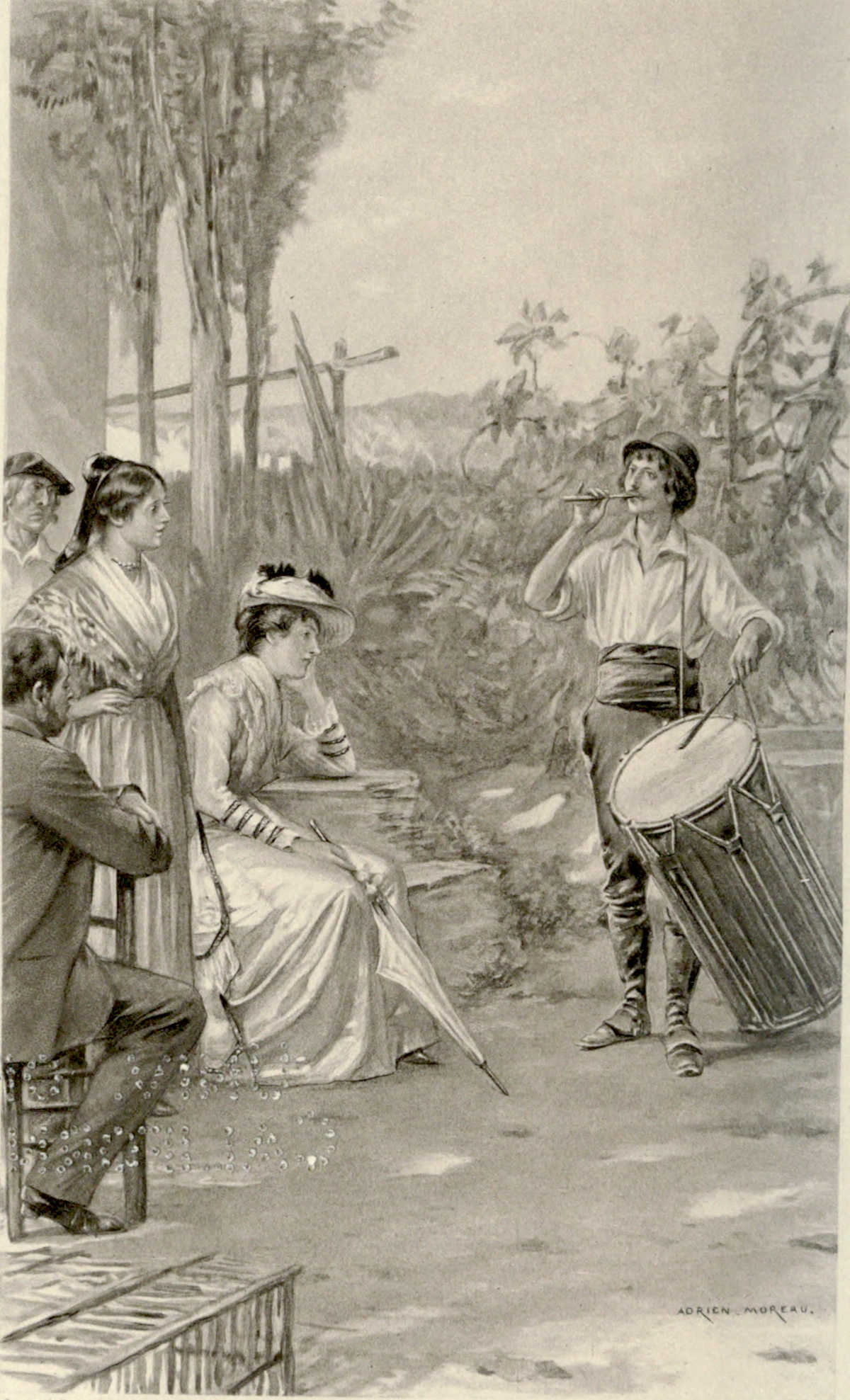
“‘Qué, Valmajour! suppose you play something for
the pleasure of the pretty lady.’”
Drawn by Adrien Moreau. Photogravured by Goupil & Co.
Numa Roumestan.Frontispiece.
BY
ALPHONSE DAUDET
TRANSLATED BY
CHARLES DE KAY
BOSTON
LITTLE, BROWN & COMPANY PUBLISHERS
Copyright, 1899, 1900,
By Little, Brown, and Company.
All rights reserved.
University Press: John Wilson and Son, Cambridge, U.S.A.
NUMA ROUMESTAN.
CHAPTER I. TO THE ARENA!
That Sunday—it was a scorching hot Sunday
in July at the time of the yearly competitions for
the department—there was a great open-air festival
held in the ancient amphitheatre of Aps in
Provence. All the town was there—the weavers
from the New Road, the aristocrats of the Calade
quarter, and some people even came all the way
from Beaucaire.
“Fifty thousand persons at the lowest estimate,”
said the Forum in its account the next day; but
then we must allow for Provençal puffing.
The truth was that an enormous crowd was
crushed together upon the sun-baked stone
benches of the old amphitheatre, just as in the
palmy days of the Antonines, and it was evident
that the meet of the Society of Agriculture was
far from being the main attraction to this overflow
of the folk. Something more than the Landes
horse-races was needed, or the prize-fights for men
and “half men,” the athletic games of “strangle
the cat” and “jump the swineskin,” or the contests
for fifers and tabor-players, as old a story to the
townspeople as the ancient red stones of the Arena;
something more was needed to keep this multitude
standing for two hours under that blinding, murderous
sun, upon those burning flags, breathing in an
atmosphere of flame and dust flavored with gunpowder,
risking blindness, sunstroke, fevers and all
the other dangers and tortures attendant on what
is called down there in Provence an open-air
festival.
The grand attraction of the annual competitions
was Numa Roumestan.
Ah, well; the proverb “No man is a prophet”
etc. is certainly true when applied to painters and
poets, whose fellow-countrymen in fact are always
the last to acknowledge their claims to superiority
for whatever is ideal and lacking in tangible results;
but it does not apply to statesmen, to political
or industrial celebrities, those mighty advertised
fames whose currency consists of favors and influence,
fames that reflect their glory on city and
townsmen in the form of benefits of every sort
and kind.
For the last ten years Numa, the great Numa,
leader and Deputy representing all the professions,
has been the prophet of Provence; for ten years
the town of Aps has shown toward her illustrious son
the tender care and effusiveness of a mother, one
of those mothers of the South quick in her expressions,
lively in her exclamations and gesticulatory
caresses.
When he comes each summer during the vacation
of the Chamber of Deputies, the ovation begins
as soon as he appears at the station! There
are the Orpheons swelling out their embroidered
banners as they intone their heroic choral songs.
The railway porters are in waiting, seated on the
steps until the ancient family coach which always
comes for the “leader” has made a few turns of its
big wheels down the alley of big plane-trees on the
Avenue Berchère; then they take the horses out
and put themselves into the shafts and draw the great
man with their own hands, amid the shouts of the
populace and the waving of hats, as far as the Portal
mansion, where he gets out. This enthusiasm has
so completely passed into the stage of tradition in
the rites of his arrival that the horses now stop of
themselves, like a team in a post-chaise, at the exact
corner where they are accustomed to be taken out
by the porters; no amount of beating could induce
them to go a step farther.
From the first day the whole city has changed
its appearance. Here is no longer that melancholy
palace of the prefect where long siestas are
lulled by the strident note of the locusts in the
parched trees on the Cours. Even in the hottest
part of the day the esplanade is alive and the
streets are filled with hurrying people arrayed in
solemn black suits and hats of ceremony, all
sharply defined in the brilliant sunlight, the shadows
of their epileptic gestures cut in black against
the white walls.
The carriages of the Bishop and the President
shake the highroad; then delegations arrive from
the aristocratic Faubourg where Roumestan is
adored because of his royalist convictions; next
deputations from the women warpers march in
bands the width of the street, their heads held
high under their Arlesian caps.
The inns overflow with the country people,
farmers from the Camargue or the Crau, whose
unhitched wagons crowd the small squares and
streets as on a market day. In the evening the
cafés crowded with people remain open well on
into the night, and the windows of the club of the
“Whites,” lighted up until an impossible hour,
vibrate with the peals of a voice that belongs to
the popular god.
Not a prophet in his own country? ’Twas only
necessary to look at the Arena under the intense
blue sky of that Sunday of July 1875, note the
indifference of the crowd to the games going on
in the circus below, and all the faces turned in the
same direction, toward the municipal platform,
where Roumestan was seated surrounded by braided
coats and sunshades for festivals and gay dresses
of many-colored silks. ’Twas only necessary to
listen to the talk and cries of ecstasy and the
simple words of admiration coming in loud voices
from this good people of Aps, some expressed in
Provençal and some in a barbarous kind of French
well rubbed with garlic, but all uttered with an
accent as implacable as is the sun down there,
an accent which cuts out and gives its own to
every syllable and will not so much as spare us
the dot over an “i.”
“Diou! qu’es bèou! God! how beautiful he is!”
“He is a bit stouter than he was last year.”
“That makes him look all the more imposing.”
“Don’t push so! there is room for everybody!”
“Look at him, my son; there’s our Numa.
When you are grown up you can say that you
have seen him, qué!”
“His Bourbon nose is all there! and not one of
his teeth missing!”
“Not a single gray hair, either!”
“Té, I should say not! he is not so very old yet.
He was born in ’32—the year that Louis Philippe
pulled down the mission crosses, pecaïré!”
“That scoundrel of a Philippe!”
“They scarcely show, those forty-three years
of his.”
“Sure enough, they certainly don’t.... Té!
here, great star—”
And with a bold gesture a big girl with burning
eyes throws a kiss toward him from afar that resounds
through the air like the cry of a bird.
“Take care, Zette—suppose his wife should
see you.”
“The one in blue, is that his wife?”
No, the lady in blue was his sister-in-law, Mlle.
Hortense, a pretty girl just out of the convent, but
one, they say, who already straddled a horse just as
well as a dragoon. Mme. Roumestan was more dignified,
more thoroughbred in appearance, but she
looked much haughtier. These Parisian ladies think
so much of themselves! And so, with the picturesque
impudence of their half-Latin language, the
women, standing and shading their eyes with their
hands, proceeded in loud voices deliberately to
pick the two Parisians to pieces—their simple
little travelling hats, their close-fitting dresses
worn without jewelry, which were so great a contrast
to the local toilettes, in which gold chains
and red and green skirts puffed out by enormous
bustles prevailed.
The men talked of the services rendered by Numa
to the good cause, of his letter to the Emperor,
and his speeches for the White Flag. Oh, if we
had only a dozen men in the Chamber like him,
Henry V would have been on his throne long ago!
Intoxicated by this circumambient enthusiasm
and wrought up by these remarks, Numa could not
remain quiet in one spot. He threw himself back
in his great arm-chair, his eyes shut, his expression
ecstatic, and swayed himself restlessly back
and forth; then, rising, he strode up and down the
platform and leaned over toward the arena to
breathe in as it were all the light and cries, and
then returned to his seat. Jovial and unceremonious,
his necktie loose, he knelt on his chair, his
back and his boot-soles turned to the crowd, and
conversed with his Paris ladies seated above and
behind him, trying to inoculate them with his
own joy and satisfaction.
Mme. Roumestan was bored—that was evident
from the expression of abstracted indifference on
her face, which though beautiful in lines seemed
cold and a little haughty when not enlivened by
the light of two gray eyes, two eyes like pearls,
true Parisian eyes, and by the dazzling effect of
the smile on her slightly open mouth.
All this southern gayety, made up of turbulence
and familiarity, and this wordy race all on the
outside and the surface, whose nature was so much
the opposite of her own, which was serious and
self-contained, grated on her perhaps unconsciously,
because she saw in them multiplied and
vulgarized the same type as that of the man at
whose side she had lived ten years, whom she
had learned to know to her cost. The glaring hot
blue sky, so excessively brilliant and vibrating
with heat, was also not to her liking. How could
these people breathe? Where did they find breath
enough to shout so? She took it into her head
to speak her thought aloud, how delightful a nice
gray misty sky of Paris would be, and how a fresh
spring shower would cool the pavements and make
them glisten!
“Oh, Rosalie, how can you talk so!”
Her husband and sister were quite indignant,
especially her sister, a tall young girl in the full
bloom of youth and health, who, the better to see
everything, was making herself as tall as possible.
It was her first visit to Provence, and yet one
might have thought that these shouts and gestures
beneath the burning Italian sky had stirred within
her some secret fibre, some dormant instinct, her
southern origin, in fact, which was revealed in the
heavy eyebrows meeting over her houri-like eyes,
and her pale complexion, on which the fierce
summer sun left not one red mark.
“Do, please, Rosalie!” pleaded Roumestan, who
was determined to persuade his wife. “Get up
and look at that. Did Paris ever show you anything
like that?”
In the vast theatre widening into an ellipse
that made a great jag in the blue sky, thousands
of faces were packed together on the many rows
of benches rising in terraces; bright eyes made
luminous points, while bright colored and picturesque
costumes spangled the whole mass with
butterfly tints. Thence, as from a huge caldron,
rose a chorus of joyous shouts, the ringing of
voices and the blare of trumpets volatilized, as it
were, by the intense light of the sun. Hardly
audible on the lower stories, where dust, sand and
human breath formed a floating cloud, this din
grew louder as it rose and became more distinct
and unveiled itself in the purer air. Above all
rang out the cry of the milk-roll venders, who bore
from tier to tier their baskets draped with white
linen: “Li pan ou la, li pan ou la!” (Here’s
your milk bread, here’s your milk bread!) The
sellers of drinking-water, cleverly balancing their
green glazed pitchers, made one thirsty just to
hear them cry: “L’aigo es fresco! Quau voù
beùre?” (The water’s fresh! Who will drink?)
Up on the highest brim of the amphitheatre,
high up, groups of children playing and running
noisily added a crown of sharp calls to the mass
of noise below, much like a flock of martins soaring
high above the other birds.
And over all of it, how wonderful was the play
of light and shadow, as with the advance of day
the sun turned slowly in the hollow of the vast
amphitheatre as it might on the disk of a sundial,
driving the crowd along, and grouping it in
the zone of shade, leaving empty those parts of
the vast structure exposed to a terrible heat—broad
stretches of red flags fringed with dry grass
where successive conflagrations have left their
mark in black.
At times a stone would detach itself in the topmost
tier of the ancient monument, and, rolling
down from story to story, cause cries of terror
and much crowding among the people below, as
if the whole edifice were about to crumble; then
on the tiers there was a movement like the assault of
a raging sea on the dunes, for with this exuberant
race the effect of a thing never has any relation to
its cause, enlarged as it is by dreams and perceptions
that lack all sense of proportion.
Thus peopled and thus animated once more, the
ancient ruin seemed to live again, and no longer
retain its appearance of a showplace for tourists.
Looking thereon, it gave one the sensation of a
poem by Pindar recited by a modern Greek, which
means a dead language come to life again, having
lost its cold scholarly look. The clear sky, the
sun like silver turned to vapor, these Latin intonations
still preserved in the Provençal idiom, and
here and there, particularly in the cheap seats, the
poses of the people in the opening of a vaulted
passage—motionless attitudes made antique and
almost sculptural by the vibration of the air, local
types, profiles standing out like those on ancient
coins, with the short aquiline nose, broad shaven
cheeks and upturned chin that Numa showed; all
this filled out the idea of a Roman festival—even
to the lowing of the cows from the Landes which
echoed through the vaults below—those vaults
whence in olden days lions and elephants were
wont to issue to the combat. Thus, when the
great black hole of the podium, closed by a grating,
stood open to the arena all empty and yellow
with sand, one almost expected to see wild beasts
spring out instead of the peaceful bucolic procession
of men and of the animals that had received
prizes in the competitions.
At the moment it was the turn of the mules led
along in harness, sumptuously arrayed in rich Provençal
trappings, carrying proudly their slender
little heads adorned with silver bells, rosettes,
ribbons and feathers, not in the least alarmed at the
fierce cracking of whips clear and sharply cut,
swung serpent-like or in volleys by the muleteers,
each one standing up full length upon his beast.
In the crowd each village recognized its champions
and named each one aloud:
“There’s Cavaillon! There’s Maussane!”
The long, richly-colored file rolled its slow
length around the arena to the sound of musical
bells and jingling, glittering harness, and stopped
before the municipal platform and saluted Numa
with a serenade of whip-crackings and bells; then
passed along on its circular course under the leadership
of a fine-looking horseman in white tights and
high top-boots, one of the gentlemen of the local
club who had planned the function and quite unconsciously
had struck a false note in its harmony,
mixing provincialism with Provençal things and
thus giving to this curious local festival a vague
flavor of a procession of riders at Franconi’s circus.
However, apart from a few country people, no one
paid much attention to him. No one had eyes for
anything but the grand stand, crowded just then
with persons who wished to shake hands with
Numa—friends, clients, old college chums, who
were proud of their relations with the great man
and wished all the world to see them conversing
with him and proposed to show themselves there
on the benches, well in sight.
Flood of visitors succeeded flood without a break.
There were old men and young men, country gentlemen
dressed all in gray from their gaiters to their
little hats, managers of shops in their best clothes
creased from much lying away in presses, ménagers
or farmers from the district of Aps in their round
jackets, a pilot from Port St. Louis twirling his big
prisoner’s cap in his hands—all bearing their
“South” stamped upon their faces, whether covered
to the eyes with those purple-black beards
which the Oriental pallor of their complexion
accentuates, or closely shaven after the ancient
French fashion, short-necked ruddy people sweating
like terra cotta water coolers; all of them with
flaming black eyes sticking well out from the face,
gesticulating in a familiar way and calling each
other “thee” and “thou”!
And how Roumestan did receive them, without
distinction of birth or class or fortune, all with the
same unquenchable effusiveness! It was: “Té,
Monsieur d’Espalion! and how are you, Marquis?”
“Hé bé! old Cabantous, how goes the
piloting?” “Delighted to see you, President
Bédarride!”
Then came shaking of hands, embraces, solid
taps on the shoulder that give double value to
words spoken, which are always too cold for the
intense feeling of the Provençal. To be sure, the
conversations were of short duration. Their
“leader” gave but a divided attention, and as he
chatted he waved how-d’ye-do with his hand to
the new-comers. But nobody resented this unceremonious
way of dismissing people with a few
kind words: “Yes, yes, I won’t forget—send in
your claim—I will take it with me.”
There were promises of government tobacco
shops and collectors’ offices; what they did not
ask for he seemed to divine; he encouraged timid
ambitions and provoked them with kindly words:
“What, no medal yet, my old Cabantous, after
you have saved twenty lives? Send me your
papers. They adore me at the Navy Department.
We must repair this injustice.”
His voice rang out warm and metallic, stamping
and separating each word. One would have said that
each one was a gold piece rolling out fresh from
the mint. And every one went away delighted
with this shining coin, leaving the platform with the
beaming look of the pupil who has been awarded
a prize. The most wonderful thing about this devil
of a man was his prodigious suppleness in assuming
the air and manner of the person to whom he was
speaking, and perfectly naturally, too, apparently in
the most unconscious way in the world.
With President Bédarride he was unctuous,
smooth in gestures, his mouth fixed affectedly and
his arm stretched forth in a magisterial fashion as
if he were tossing aside his lawyer’s toga before the
judge’s seat. When talking to Colonel Rochemaure
he assumed a soldierly bearing, his hat
slapped on one side; while with Cabantous he
thrust his hands into his pockets, bowed his legs
and rolled his shoulders as he walked, just like an
old sea-dog. From time to time, between two
embraces as it were, he turned to his Parisian
guests, beaming and wiping his steaming brow.
“But, my dear Numa!” cried Hortense in a low
voice with her pretty laugh, “where will you find
all these tobacco shops you have been promising
them?”
Roumestan bent his large head with its crop of
close curling hair slightly thinned at the top and
whispered: “They are promised, little sister, not
given.”
And, fancying a reproach in his wife’s silence, he
added:
“Do not forget that we are in Provence, where
we understand each other’s language. All these
good fellows understand what a promise is worth.
They don’t expect to get the shops any more
positively than I count on giving them. But they
chatter about them—which amuses them—and
their imaginations are at work: why deprive them
of that pleasure? Besides, you must know that
among us Southerners words have only a relative
meaning. It is merely putting things in their
proper focus.” The phrase seemed to please him,
for he repeated several times the final words, “in
their proper focus—in their proper focus—”
“I like these people,” said Hortense, who really
seemed to be amusing herself immensely; but
Rosalie was not to be convinced. “Still, words do
signify something,” she murmured very seriously,
as if communing with her own soul.
“My dear, it is a simple question of latitude.”
Roumestan accompanied his paradox with a jerk of
the shoulder peculiar to him, like that of a peddler
putting up his pack. The great orator of the
aristocracy retained several personal tricks of this
kind, of which he had never been able to break
himself—tricks that might have caused him in
another political party to seem a representative of
the common folk; but it was a proof of power and
of singular originality in those aristocratic heights
where he sat enthroned between the Prince of
Anhalt and the Duc de la Rochetaillade. The
Faubourg St. Germain went wild over this shoulder-jerk
coming from the broad stalwart back that
carried the hopes of the French monarchy.
If Mme. Roumestan had ever shared the
illusions of the Faubourg she did so no longer,
judging from her look of disenchantment and the
little smile with which she listened to her husband’s
words, a smile paler with melancholy than with disdain.
But he left them suddenly, attracted by the
sound of some peculiar music that came to them
from the arena below. The crowd in great excitement
was on its feet shouting “Valmajour!
Valmajour!”
Having taken the musicians’ prize the day before,
the famous Valmajour, the greatest taborist
of Provence, had come to honor Numa with his
finest airs. In truth he was a handsome youth,
this same Valmajour, as he stood in the centre of
the arena, his coat of yellow wool hanging from
one shoulder and a scarlet belt standing out against
the white linen of his shirt. Suspended from his
left arm he carried his long light tabor by a strap
and with his left hand held a small fife to his lips,
while with his right hand and his right leg held
forward he played on his tabor with a brave and
gallant air. The fife, though but small, filled the
whole place like a chorus of locusts; appropriate
music in this limpid crystalline atmosphere in
which all sounds vibrate, while the deep notes of
the tabor supported this peculiar singing and its
many variations.
The sound of the wild, sharp music brought
back his childhood to Numa more vividly than
anything else that he had seen that day; he saw
himself a little Provence boy running about to
country fairs, dancing under the leafy shadow of
the plane-trees, on village squares, in the white dust
of the highroads, or over the lavender flowers of
sun-parched hillsides. A delicious emotion passed
through his eyes, for, notwithstanding his forty
years and the parching effects of political life, he
still retained a good portion of imagination, thanks
to the kindliness of nature, a surface-sensibility
that is so deceptive to those who do not know the
true bottom of a man’s character.
And besides, Valmajour was not an everyday
taborist, one of those common minstrels who pick
up music-hall catches and odds and ends of music
at country fairs, degrading their instrument by
trying to cater to modern taste. Son and grandson
of taborists, he played only the songs of his
native land, songs crooned during night watches over
cradles by grandmothers; and these he did know;
he never wearied of them. After playing some
of Saboly’s rhythmical Christmas carols arranged
as minuets and quadrilles, he started the “March
of the Kings,” to the tune of which, during the
grand epoch, Turenne conquered and burned the
Palatinate. Along the benches where but a moment
before one heard the humming of popular airs like
the swarming of bees, the delighted crowd began
keeping time with their arms and heads, following
the splendid rhythm which surged along through
the grand silences of the theatre like mistral, that
mighty wind; silences only broken by the mad
twittering of swallows that flew about hither and
thither in the bluish green vault above, disquieted,
and as it were crazy, as if trying to discover what
unseen bird it was that gave forth these wonderfully
high and sharp notes.
When Valmajour had finished, wild shouts of
applause burst forth. Hats and handkerchiefs
flew into the air. Numa called the musician up to
the platform, and throwing his arms around his
neck exclaimed: “You have made me weep, my
boy.” And he showed his big golden-brown eyes
all swimming in tears.
Very proud to find himself in such exalted company,
among embroidered coats and the mother-of-pearl
handles of official swords, the musician
accepted these praises and embraces without any
great embarrassment. He was a good-looking
fellow with a well shaped head, broad forehead,
beard and moustache of lustrous black against a
swarthy skin, one of those proud peasants from
the valley of the Rhône who have none of the
artful humility of the peasants of central France.
Hortense had noticed at once how delicately
formed were his hands under their covering of sunburn.
She examined the tabor with its ivory-tipped
drum-stick and was astonished at the lightness of the
old instrument, which had been in his family for two
hundred years, and whose case curiously carved in
walnut wood, decked with light carvings, polished,
thin and sonorous, seemed to have grown pliable
under the patina time had lent it. They admired
above all the little old fife, that simple rustic flute
with three stops only, such as the ancient taborists
used, to which Valmajour had returned out of respect
for tradition and the management of which
he had conquered after infinite pains and patience.
Nothing more touching than to hear the little tale of
his struggles and victory in an odd sort of French.
“It come to me in the night,” he said, “as I
listened me to the nightingawles. Thought I in
meself—look there, Valmajour, there’s a little
birrd o’ God whose throat alone is equal to all the
trills. Now, what he can do with one stop, can’t
you accomplish with the three holes in your little
flute?”
He talked quietly, with a perfectly confident
tone of voice, without a suspicion of being ridiculous.
No one indeed would have dared to smile
in the face of Numa’s enthusiasm, for he was
throwing up his arms and stamping so that he
almost went through the platform. “How handsome
he is! What an artist!” And after him the
Mayor and President Bédarride and the General
and M. Roumavage, the big brewer from Beaucaire,
vice-consul of Peru, tightly buttoned into
a carnival costume all over silver, echoed the sentiments
of the leader, repeating in convinced tones:
“What a great artist!”
Hortense agreed with them, and in her usual impulsive
manner expressed her sentiments: “Oh,
yes, a great artist indeed” while Mme. Roumestan
murmured “You will turn his head, poor fellow.”
But there seemed to be no fear of this for Valmajour,
to judge by his tranquil air; he was not
even in the least excited on hearing Numa suddenly
exclaim:
“Come to Paris, my boy, your fortune is
assured!”
“Oh, my sister never would let me go,” he
explained with a quiet smile.
His mother was dead and he lived with his
father and sister on a farm that bore the family
name some three leagues distant from Aps on
the Cordova mountain. Numa swore he would go
to see him before he returned to Paris; he would
talk to his relations—he was sure to make it
a go.
“And I will help you, Numa,” said a girlish
voice behind him.
Valmajour bowed without speaking, turned on
his heel and walked down the broad carpet of the
platform, his tabor under his arm, his head held
high and in his gait that light, swaying motion of
the hips common to the Provençal, a lover of
dancing and rhythm. Down below his comrades
were waiting for him and shook him by the hand.
Suddenly a cry arose, “The farandole, the farandole,”
a shout without end doubled by the echoes
of the stone passages and corridors from which the
shadows and freshness seemed to come which were
now invading the arena and ever diminishing the
zone of sunlight. In a moment the arena was
crowded, crammed to suffocation with merry
dancers, a regular village crowd of girls in white
neckscarfs and bright dresses, velvet ribbons nodding
on lace caps, and of men in braided blouses
and colored waistcoats.
At the signal from the tabor that mob fell into
line and filed off in bands, holding each other’s
hands, their legs all eager for the steps. A prolonged
trill from the fife made the whole circus
undulate, and led by a man from Barbantane, a
district famous for its dancers, the farandole slowly
began its march, unwinding its rings, executing its
figures almost on one spot, filling with its confused
noise of rustling garments and heavy breathing the
huge vaulted passage of the outlet in which, bit by
bit, it was swallowed up.
Valmajour followed them with even steps,
solemnly, managing his long tabor with his knee,
while he played louder and louder upon the fife,
as the closely packed crowd in the arena, already
plunged in the bluish gray of the twilight, unwound
itself like a bobbin filled with silk and gold
thread.
“Look up there!” said Roumestan all of a
sudden.
It was the head of the line of dancers pouring
in through the arches of the second tier, while the
musician and the last line of dancers were still
stepping about in the arena. As it proceeded the
farandole took up in its folds everybody whom the
rhythm forced to join in the dance. What Provençal
could have resisted the magic flute of Valmajour?
Upborne and shot forward by the
rebounding undernote of the tabor, his music
seemed to be playing on every tier at the same
time, passing the gratings and the open donjons,
overtopping the cries of the crowd. So the farandole
climbed higher and higher, and reached at
last the uppermost tier, where the sun was yet
glowing with a tawny light. The outlines of the
long procession of dancers, bounding in their
solemn dance, etched themselves against the high
panelled bays of the upper tier in the hot vibration
of that July afternoon, like a row of fine silhouettes
or a series of bas-reliefs in antique stone on the
sculptured pediment of some ruined temple.
Down below on the deserted platform—for
people were beginning to leave and the lower
tiers were empty—Numa said to his wife as he
wrapped a lace shawl about her to protect her
from the evening chill:
“Now, really, is it not beautiful?”
“Very beautiful,” answered the Parisian, moved
this time to the depths of her artistic nature.
And the great man of Aps seemed prouder of
this simple word of approbation than of all the
noisy homage with which he had been surfeited
for the last two hours.
CHAPTER II. THE SEAMY SIDE OF A GREAT MAN.
Numa Roumestan was twenty-two years old
when he came to Paris to complete the law studies
which he had begun at Aix. At that time he
was a good enough kind of a fellow, light-hearted,
boisterous, full-blooded, with big, handsome, prominent
eyes of a golden-brown color and somewhat
frog-like, and a heavy mop of naturally curling
hair which grew low on his forehead like a woollen
cap without a visor. There was not the shadow of
an idea, not the ghost of an ambition beneath that
encroaching thatch of his. He was a typical Aix
student, a good billiard and card player, without a
rival in his capacity for drinking champagne and
“going on the cat-hunt with torches” until three
o’clock in the morning through the wide streets of
the old aristocratic and Parliamentary town. But
he was interested in absolutely nothing. He never
read a book nor even a newspaper, and was deep
in the mire of that provincial folly which shrugs its
shoulders at everything and hides its ignorance
under a pretence of plain common-sense.
Arrived in Paris, the Quartier Latin woke him up
a little, although there was small reason for it.
Like all his compatriots Numa installed himself
as soon as he arrived at the Café Malmus, a tall
and noisy barrack of a place with three stories of
tall windows, as high as those in a department
shop, on the corner of the Rue Four Saint Germain.
It filled the street with the noise of billiard
playing and the vociferations of its clients, a
regular horde of savages. The entire South of
France loomed and spread itself there; every
shade of it! Specimens of the southern French
Gascon, the Provençal, the Bordeaux man, the
Toulousian and Marseilles man, samples of the
Auvergnat and Perigordian Southerner, him of
Ariège, of the Ardèche and the Pyrenees, all
with names ending in “as,” “us” and “ac,” resounding,
sonorous and barbarous, such as Etcheverry,
Terminarias, Bentaboulech, Laboulbène—names
that sounded as if hurled from the mouth
of a blunderbuss or exploded as from a powder
mine, so fierce were the ejaculations. And what
shouts and wasted breath merely to call for a cup
of coffee; what resounding laughter, like the noise
of a load of stones shunted from a cart; what
gigantic beards, too stiff, too black, with a bluish
tinge, beards that defied the razor, growing up into
the eyes and joining on to the eyebrows, sprouted
in little tufts in the broad equine nostrils and ears,
but never able utterly to conceal the youth and innocence
of these good honest faces hidden beneath
such tropical growths.
When not at their lectures, which they attended
conscientiously, these students passed their entire
time at Malmus’s, falling naturally into groups
according to their provinces or even their parishes,
seated around the same old tables handed down to
them by tradition, which might have retained the
twang of their patois in the echoes of their marble
tops, just as the desks of school-rooms retain the
initials carved on them by school-boys.
Women in that company were few and far between,
scarcely two or three to a story, poor girls
whom their lovers brought there in a shamefaced
way only to pass an evening beside them behind a
glass of beer, looking over the illustrated papers,
silent and feeling very out of place among these
Southern youths who had been brought up to despise
lou fémélan—females. Mistresses? Té!
By Jove, they knew where to get them whenever
they wanted them for an hour or a night; but
never for long. Bullier’s ball and the “howlers”
did not tempt them, nor the late suppers of the
rôtisseuse. They much preferred to stay at Malmus’s,
talk patois, and roll leisurely from the café
to the schools and then to the table d’hôte.
If they ever crossed the Seine it was to go to
the Théâtre Français to a performance of one of
the old plays; for the Southerner always has the classic
thing in his blood. They would go in a crowd,
talking and laughing loudly in the street, though
in reality feeling rather timid, and then return
silent and subdued, their eyes dazed by the dust
of the tragic scenes they had just witnessed, and
with closed blinds and gas turned low would have
another game before they went to bed.
Sometimes, on the occasion of the graduation
of one of their number, an impromptu feed would
make the whole house redolent of garlic stews and
mountain cheeses smelling strong and rotting nicely
in their blue paper wrappers. After his farewell
dinner the new owner of a sheepskin would take
down from the rack the pipe that bore his initials
and sally forth to be notary or deputy in some far-away
hole beyond the Loire, there to talk to his
friends in the provinces about Paris—Paris which
he thought he knew, but in which really he had
never set his foot!
In this narrow local circle Numa readily assumed
the eagle’s place. To begin with, he shouted louder
than the others, and then his music was looked
upon as a sign of superiority; at any rate there was
some originality in his very lively taste for music.
Two or three times a week he treated himself to a
stall at the opera and when he came back he overflowed
with recitatives and arias, which he sang
quite agreeably in a pretty good throaty voice
that rebelled against all cultivation. When he
strode into the Café Malmus in a theatrical manner,
singing some bit of Italian music as he passed
the tables, peals of admiration welcomed him:
“Hello, old artist!” the boys would shout from
every gang. It was just like a club of ordinary
citizens in this respect: owing to his reputation
as a musical artist all the women gave him a warm
look, but the men would use the term enviously
and with a suggestion of irony. This artistic fame
did him good service later when he came to power
and entered public life. Even now the name of
Roumestan figures high on the list of all artistic
commissions, plans for popular operas, reforms in
exhibitions of paintings proposed in the Chamber
of Deputies. All that was the result of evenings
spent in haunting the music-halls. He learned
there self-confidence, the actor’s pose, and a certain
way of taking up a position three-quarters
front when talking to the lady at the cashier’s
desk; then his wonder-struck comrades would exclaim:
“Oh! de ce Numa, pas moins!” (Oh, that
Numa! what a fellow he is!)
In his studies he had the same easy victory; he
was lazy and hated study and solitude, but he
managed to pass his examination with no little
success through sheer audacity and Southern slyness,
the slyness which made him discover the weak
spot in his professor’s vanity and work it for all it
was worth. Then his pleasant, frank expression and
his amiability were also in his favor, and it seemed
as if a lucky star lighted the pathway before him.
As soon as he obtained his lawyer’s diploma his
parents sent for him to return home, because the
slender pocket money which he cost them meant
privations they could no longer bear. But the
prospect of burying himself alive in the old dead
town of Aps crumbling to dust with its ancient
ruins, an existence composed of a humdrum round
of visits and nothing more exciting than a few lawsuits
over a parcel of party-walls, held out no
inducements to that undefined ambition that the
southern youth vaguely felt underlying his love for
the stir and intellectual life of Paris.
With great difficulty he obtained an extension
of two years more, in which to complete his studies,
and just as these two years had expired and
the irrevocable summons home had come, at the
house of the Duchesse de San Donnino he met
Sagnier during a musical function to which he
had been asked on account of his pretty voice—Sagnier,
the great Sagnier, the Legitimist lawyer,
brother of the duchess and a musical monomaniac.
Numa’s youthful enthusiasm appearing in the
monotonous round of society and his craze for
Mozart’s music carried Sagnier off his feet. He
offered him the position of fourth secretary in his
office. The salary was merely nominal, but it was
being admitted into the employment of the
greatest law office in Paris, having close relations
with the Faubourg Saint Germain and also with the
Chamber of Deputies. Unluckily old Roumestan
insisted on cutting off his allowance, hoping to
force him to return when hunger stared him in the
face. Was he not twenty-six, a notary, and fit to
earn his own bread? Then it was that landlord
Malmus came to the front.
A regular type was this Malmus; a large, pale-faced,
asthmatic man, who from being a mere waiter
had become the proprietor of one of the largest
restaurants in Paris, partly by having credit, partly
by usury. It had been his custom in early days to
advance money to the students when they were
in need of it, and then when their ships came in,
allow himself to be repaid threefold. He could
hardly read and could not write at all; his accounts
were kept by means of notches cut in a piece of
wood, as he had seen the baker boys do in his
native town of Lyon; but he was so accurate that
he never made a mistake in his accounts, and, more
than all, he never placed his money badly. Later,
when he had become rich and the proprietor of the
house in which he had been a servant for fifteen
years, he established his business, and placed it
entirely upon a credit basis, an unlimited credit
that left the money-drawer empty at the close of the
day but filled his queerly kept books with endless
lines of orders for food and drink jotted down with
those celebrated five-nibbed pens which are held in
such sovereign honor in the world of Paris trade.
And the honest fellow’s system was simplicity
itself. A student kept all his pocket money, all
his allowance from home. All had full credit for
meals and drinks and favorites were even allowed
a room in his house. He did not ask for a penny
during term time, letting the interest mount up on
very high sums. But he did not do this carelessly
or without circumspection. Malmus passed two
months every year, his vacation, in the provinces,
making secret inquiry into the health and wealth
of the families of his debtors. His asthma was terrible
as he mounted the peaks of the Cévennes and
descended the low ranges of Languedoc. He was
to be seen, gouty and mysterious, prowling about
among forgotten villages, with suspicious eyes
lowering under the heavy lids that are peculiar to
waiters in all-night restaurants. He would remain
a few days in each place, interview the notary and
the sheriff, inspect secretly the farm or factory of
his debtor’s father, and then nothing was heard of
him more.
What he learned at Aps gave him full confidence
in Numa. The latter’s father, formerly a
weaver, had ruined himself with inventions and
speculations and lived now in modest circumstances
as an insurance agent, but his aunt,
Mme. Portal, the childless widow of a rich town
councillor, would doubtless leave all her property
to her nephew; so, naturally, Malmus wished
Numa to remain in Paris.
“Go into Sagnier’s office; I will help you.”
As a secretary of a man in Sagnier’s position he
could not live in the Quartier Latin, so Malmus
furnished a set of bachelor chambers for him on the
Quai Voltaire, on the courts, paying the rent and
giving him his allowance on credit. Thus did the
future leader face his destiny, everything on the
surface seemingly easy and comfortable, but in
reality in the direst need; lacking pin and pocket
money. The friendship of Sagnier helped him to
fine acquaintances. The Faubourg welcomed him.
But this social success, the invitations in Paris and
to country houses in summer, where he had to
arrive in perfect fashionable outfit, only added to
his expense. After repeated prayers his Aunt
Portal helped him a little, but with great caution
and stinginess, always accompanying her gifts
with long flighty stupidities and Bible denunciations
against “that ruinous Paris.” The situation
was untenable.
At the end of a year he looked for other employment.
Besides, Sagnier required pioneers,
regular navvies for hard work, and Roumestan
was not that sort of man. The Provençal’s indolence
was ineradicable, and above all things he had
a loathing for office work or any hard and continuous
labor. The faculty of attention, which is nothing
if not deep, was absolutely wanting to this
volatile Southerner. That was because his imagination
was too vivid, his ideas too jumbled-up
beneath his dark brows, his mind too fickle, as
even his writing showed; it was never twice the
same. He was all on the surface, all voice, gestures,
like a tenor at the opera.
“When I am not speaking I cannot think,” he
said naïvely, and it was true. Words with him
never rushed forth propelled by the force of his
thought; on the contrary, at the mechanical
sound of his own words the thoughts formed
themselves in advance. He was astonished and
amused at chance meetings of words and ideas in
his mind which had been lost in some corner of his
memory, thoughts which speech would discover,
pick up and marshal into arguments. Whilst he
held forth he would suddenly discover emotions of
which he had been unconscious; the vibrations of
his own voice moved him to such a degree that there
were certain intonations which touched his heart
and affected him to tears. These were the qualities
of an orator, to be sure, but he did not recognize
them, as his duties at Sagnier’s had hardly been
such as to give him a chance to practise them.
Nevertheless, the year spent with the great Legitimist
lawyer had a decisive effect upon his after
life. He acquired convictions and a political party,
the taste for politics and a longing for fortune and
glory.
Glory came to him first.
A few months after he left his master, that title
of “Secretary to Sagnier,” which he clung to as an
actor who has appeared once on the boards of
the Comédie Française forever calls himself “of the
Comédie Française,” was the means of getting
him his first case, the defence of a little Legitimist
newspaper called “The Ferret,” much patronized
in the best society. His defence was cleverly and
brilliantly made. Coming into court without the
slightest preparation, his hands in his pockets, he
talked for two hours with such an insolent “go”
to him, and so much good-natured sarcasm, that
the judges were forced to listen to him to the end.
His dreadful southern accent, with its rolling “r’s,”
which he had always been too indolent to correct,
seemed to make his irony only bite the deeper.
It had a power of its own, this eloquence with its
very Southern swing, theatrical and yet familiar,
but above all lucid and full of that broad light
which is found in the works of people down South,
as in their landscapes, limpid to their remotest
parts.
Of course the paper was non-suited; Numa’s
success was paid for by costs and imprisonment.
So from the ashes of many a play that has ruined
manager and author one actor may snatch a reputation.
Old Sagnier, who had come to hear Numa
plead, embraced his pupil before the assembled
crowd. “Count yourself from this day on a great
man, my dear Numa!” said he, and seemed surprised
that he had hatched such a falcon’s egg.
But the most surprised man was Numa himself, as
with the echo of his own words still sounding in his
ears he descended the broad railless staircase of the
Palais de Justice, quite stunned, as if in a dream.
After this success and this ovation, after showers
of eulogistic letters and the jaundiced smiles of his
brethren, the coming lawyer naturally felt he was
indeed launched upon a triumphal career. He sat
patiently waiting in his office looking out on the
courtyard, before his scanty little fire; but nothing
came save a few more invitations to dinner, and a
pretty bronze from the foundry of Barbédienne,
a donation from the staff of Le Furet.
The new great man found himself still facing the
same difficulties, the same uncertain future. Oh!
these professions called liberal, which cannot decoy
and entrap their clients, how hard are their
beginnings, before serious and paying customers
come to sit in rows in their little rooms furnished
on credit with dilapidated furniture and the symbolical
clock on the chimney-piece flanked by
tottering candelabra! Numa was driven to giving
lessons in law among his Catholic and Legitimist
acquaintances; but he considered work like this
beneath the dignity of the man whose name had
been so covered with glory by the party newspapers.
What mortified him most of all and made him
feel his wretched plight was to be obliged to go
and dine at Malmus’s when he had no invitation
elsewhere, and no money for a dinner at a fashionable
restaurant. Nothing had changed at Malmus’s;
the same cashier’s lady was enthroned among the
punch-bowls as of old; the same pottery stove
rumbled away near the old pipe-rack; the same
shouts and accents, the same black beards from
every section of the South prevailed; but his generation
had passed, and he looked on the new
generation with the disfavor which a man at maturity,
but without a position, feels for the youths who
make him seem old.
How could he have existed in so brainless a set?
Surely the students of his day could not have been
such fools! Even their admiration, their fawning
round him like a lot of good-natured dogs, was
insupportable to him.
While he ate, Malmus, proud of his guest, came
and sat on the little red sofa which shook under
his fits of asthma, and talked to him, while at a
table near by a tall, thin woman took her place, the
only relic of the old days left—a bony creature
destitute of age known in the quarter as “everyone’s
old girl.” Some kind-hearted student now
married and settled far away had opened a credit
for her at Malmus’s before he went. Confined for
so many years to this one pasture, the poor creature
knew nothing of what was going on in the
outside world; she had not even heard of Numa’s
triumph, and spoke to him pityingly as to one
whom fortune had passed by, and in the same rank
and category as herself.
“Well, poor old chum, how are things a-getting
on? You know Pompon is married, and Laboulbène
has passed his deputy at Caen.”
Roumestan hardly answered a word, hurried
through his dinner and rushed away through the
streets, noisy with many beershops and fruit stalls,
feeling the bitterness of a life of failure and a general
impression of bankruptcy.
Several years passed thus, during which his
name became better known and more firmly established,
but with little profit to himself, except for
an occasional gift of a copy of some statuette in
Barbédienne bronze. Then he was called upon to
defend a manufacturer of Avignon, who had made
seditious silk handkerchiefs. There was some sort
of a deputation pictured on them standing about
the Comte de Chambord, but very confusedly
done in the printing, only with great imprudence
he had allowed the initials “H. V.” (Henry Fifth)
to be left, surrounded by a coat of arms.
Here was Numa’s chance for a good bit of comedy.
He thundered against the stupidity that
could see the slightest political allusion in that
H. V.! Why, that meant Horace Vernet—there
he was, presiding over a meeting of the French
Institute!
This “tarasconade” had a great local success
that did him more service than any advertisement
won in Paris could; above all, it gained him the
active approbation of his Aunt Portal. At first
this was expressed by presents of olive oil and
white melons, followed by a lot of other articles of
food—figs, peppers, potted ducks from Aix, caviar
from Martigues, jujubes, elderberry jam and
St. John’s-bread, a lot of boyish goodies of which
the old lady herself was very fond, but which her
nephew threw into a cupboard to spoil.
Shortly after arrived a letter, written with a quill
in a large handwriting, which displayed the brusque
accents and absurd phrases customary with his
aunt, and betrayed her puzzle-headed mind by its
absolute freedom from punctuation and by the
lively way in which she jumped from one subject
to the other.
Still, Numa was able to discover the fact that
the good woman desired to marry him off to the
daughter of a Councillor in the Court of Appeals
in Paris, one M. Le Quesnoy, whose wife, a Mlle.
Soustelle from Aps, had gone to school with her
at the Convent of la Calade—big fortune—the
girl handsome, good morals, somewhat cool and
haughty—but marriage would soon warm that up.
And if the marriage took place, what would his old
Aunt Portal give her Numa? One hundred thousand
francs in good clinking tin—on the day of
the wedding!
Under its provincialisms the letter contained a
serious proposition, so serious indeed that the
next day but one Numa received an invitation to
dine with the Le Quesnoys. He accepted, though
with some trepidation.
The Councillor, whom he had often seen at the
Palais de Justice, was one of those men who had
always impressed him most. Tall, slender, with a
haughty face and a mortal paleness, sharp, searching
eyes, a thin-lipped, tightly-closed mouth—the
old magistrate, who originally came from Valenciennes,
seemed like that town to be surrounded by
an impregnable wall and fortified by Vauban. His
cool Northern manner was most disconcerting to
Numa. His high position, gained by his exhaustive
study of the Penal Code, his wealth and his
spotless life would have given him a yet higher
position had it not been for the independence of
his views and a morose withdrawal from the world
and its gayeties ever since the death of his only
son, a lad of twenty. All these circumstances
passed before Numa’s mental vision as he mounted
the broad stone steps with their carved hand-rail
of the Le Quesnoy residence, one of the oldest
houses on the Place Royale.
The great drawing-room into which he was
shown, with its lofty ceiling reaching down to the
doors to meet the delicate paintings of its piers, the
straight hangings with stripes in brown and gold-colored
Chinese silk framing the long windows
that opened upon an antique balcony, and also on
one of the rose-colored corners of brick buildings
on the square—all this was not calculated to
change his first impressions.
But the welcome given him by Mme. Le Quesnoy
soon put him at his ease.
This fragile little woman with her sad sweet
smile, wrapped in many shawls and crippled by
rheumatism, from which she had suffered ever since
she came to live in Paris, still preserved the accent
and habits of her dear South, and she loved anything
that reminded her of it. She invited Numa
to sit down by her side, and looking affectionately
at him in the dim light, she murmured: “The
very picture of Evelina!” This pet name of his
aunt, so long unheard by him, touched his quick
sensibility like an echo of his childhood. It appeared
that Mme. Le Quesnoy had long wished
to know the nephew of her old friend, but her
house had been so mournful since her son’s death,
and they had been so entirely out of the world, that
she had never sought him out. Now they had
decided to entertain a little, not because their
sorrow was less keen, but on account of their two
daughters, the eldest of whom was almost twenty
years old; and turning toward the balcony whence
they could hear peals of girlish laughter, she
called, “Rosalie, Hortense, come in—here is
Monsieur Roumestan!”
Ten years after that visit Numa remembered the
calm and smiling picture that appeared, framed
by the long window in the tender light of the sunset,
of that beautiful young girl, and the absence
of all affected embarrassment as she came towards
him, smoothing the bands of her hair that her
little sister’s play had ruffled—her clear eyes and
direct gaze.
He felt an instant confidence in and sympathy
with her.
Once or twice during dinner, nevertheless, when
he was in the full flow of animated conversation he
was conscious that a ripple as of disdain passed
over the clear-cut profile and pure complexion
of the face beside him—without question that
“cool and haughty” air which Aunt Portal had
mentioned, and which Rosalie got through her
striking resemblance to her father. But the little
grimace of her pretty mouth and the cold blue
of her look softened quickly to a kindly attention,
and she was again under the charm of a surprise
she did not try to conceal. Born and brought up
in Paris, Rosalie had always felt a fixed aversion
to the South; its accent, its manners, even the
country itself as she saw it in the vacations she
occasionally spent at Aps—everything was antipathetic
to her. It seemed to be an instinct of
race, and was the cause of many gentle disputes
with her mother.
“Nothing would induce me to marry a Southerner,”
Rosalie had laughingly declared, and she
arranged in her own mind a type—a coarse,
noisy, vacant fellow, combining an opera tenor and
a drummer for Bordeaux wines, but with a fine
head and well-cut features. Roumestan came
pretty near to this clear-cut vision of the mocking
little Parisian, but his ardent musical speech, taking
on that evening an irresistible force by reason of
the sympathy of those around him, inspired and
aroused him, seeming even to make his face more
refined. After the usual talk in low voices between
neighbors at the table, those hors-d’œuvres of conversation
that circulate with caviar and anchovy,
the Emperor’s hunting parties at Compiègne became
the general topic of conversation; those
hunts in costume at which the invited guests appeared
as grandees and grand ladies of the Court
of Louis XV. Knowing M. Le Quesnoy to be
a Liberal, Numa launched forth into a magnificent
diatribe, almost a prophetic one. He drew
a picture of the Court as a set of circus riders,
women performers, grooms and jockeys riding
hard under a threatening sky, pursuing the stag to
its death to the accompaniment of lightning-flash
and distant claps of thunder, and then—in the
midst of all this revelry—the deluge, the hunting
horns drowned, all this monarchical harlequinade
ending in a morass of blood and mire!
Perhaps this piece was not entirely impromptu;
probably he had got it off before at the committee
meeting; but never before had his brilliant speech
and tone of candor in revolt roused anywhere such
enthusiasm and sympathy as he suddenly saw reflected
in one sweet, serious countenance, that he
felt turning toward him, while the gentle face of
Mme. Le Quesnoy lit up with a ray of fun and
seemed to ask her daughter: “Well, how do you
like my Southerner now?”
Rosalie was captivated. Deep in her inmost
heart she bowed to the power of that voice and to
generous thoughts that accorded so well with
all her youthful enthusiasms, her passion for liberty
and justice. As women at a play will confound
the singer with his song, the actor with his rôle, so
she forgot to make allowances for the artist’s
imagination. Oh, if she could but have known
what an abyss of nothing lay below these professional
phrases, how little he troubled himself about
the hunting-parties at Compiègne! She did not
know that he merely needed an invitation with the
imperial crest on it, and he would have joined these
self-same parties, in which his vanity, his tastes as
actor and pleasure-seeker, would have found complete
satisfaction. But she was under the charm.
As he talked, it seemed to her the table grew larger,
the dull, sleepy faces of the few guests, a certain
President of the Chamber and an old physician,
were transfigured; and when they returned to the
drawing-room, the chandelier, lighted for the first
time since her brother’s death, had almost the
dazzling effect upon her of the sun itself.
The sun was Roumestan.
He woke up the majestic old house, drove away
mourning and the gloom that was piled in all
the corners, the particles of sadness that accumulate
in old dwellings; he seemed to make the
facets of the mirrors glisten and give new life to
the delightful panel paintings on the walls, which
had been scarce visible for a hundred years.
“Are you fond of painting, Monsieur?”
“Fond of it, Mademoiselle? Oh, I should think
so!”
The truth was that he knew absolutely nothing
about it, but he had a stock of words and phrases
ready for use on that subject as on all others, and
while the servants were arranging the card tables
he made the paintings on the well-preserved Louis
XIII walls the pretext for a quiet talk very near to
the young girl.
Of the two, Rosalie knew much the more about
art. Having lived always in an atmosphere of cultivation
and good taste, the sight of a fine bit of
sculpture or a great painting thrilled her with a
special vibratory emotion which she felt rather
than expressed, because of her reserved character
and because the false emotions in the world are
apt to keep down the real ones. At sight of
them a superficial observer, however, noting the
eloquent assurance with which the lawyer talked
and the wide professional gestures he used, as well
as the rapt attention of Rosalie, might have taken
him for some great master giving a lesson to a
pupil.
“Mamma, can we go into your room? I want
to show Monsieur Roumestan the hunting panel.”
At the whist table Mme. Le Quesnoy gave a
quick inquiring glance at him whom she always
called, with a peculiar tone of renunciation and
humility in her voice, “Monsieur Le Quesnoy,”
and, receiving an affirmative nod from him which
meant that the thing was in order, gave the desired
permission.
They crossed a passage lined with books and
found themselves in the old people’s chamber, an
immense room as majestic and antique as the drawing-room.
The panel was above a small door
beautifully carved.
“It is too dark to see it well,” said Rosalie.
As she spoke she held up a double candlestick
she had taken from a card table, and with her arm
raised, her graceful figure in fine relief, she threw
the light upon the picture which showed Diana,
the crescent on her brow, among her huntress
maidens in the landscape of a pagan Paradise. But
at this gesture of a Greek torch-bearer the light
from the double candles fell upon her own head with
its simple coiffure and sparkled in her clear eyes
with their high-bred smile and on the virginal
curves of her slender yet stately bust. She seemed
more of a Diana than the pictured goddess herself.
Roumestan looked at her; carried away by her
charm of youthful innocence and candid chastity,
he forgot who she was and what his purpose had
been in coming, yes, all his dreams of fortune and
ambition! He felt an insane desire to clasp this
supple form in his arms, to shower kisses on her
fine hair, the delicate fragrance of which intoxicated
him, to carry off this enchanting being to be the
safeguard and joy of his whole life; and something
told him that if he attempted it she would permit
it, and that she was his, his entirely, conquered,
vanquished at the first sight.
Fire and wind of the South, you are irresistible!
CHAPTER III. THE SEAMY SIDE OF A GREAT MAN ( continued ).
If ever people were unsuited for life side by
side it was these two. Opposites by instinct, by
education and temperament, thinking alike on no
one subject, they were the North and the South
face to face without the slightest chance of fusion.
Love feeds on contrasts like this and laughs when
they are pointed out, so powerful does it feel
itself. But later, when everyday life sets in, during
the monotony of days and nights passed
beneath the same roof, that mist which constitutes
love disappears; the veil is lifted; they begin to
see each other, and, what is worse, to judge each
other!
It was some time before the awakening came
to these young people; at least with Rosalie the
illusion lasted. Clear-sighted and clever on all
other subjects, for a long while she remained blind
to Numa’s faults and could not see how far in many
ways she was his superior. It had not taken him
long to relapse into his old self again. Passion
in the South is short-lived because of its very
violence. And then the Southerner is so perfectly
assured of the inferiority of women that, once
married and sure of his happiness, he installs himself
like a bashaw in his home, receiving love as
homage due and not of much importance; for,
after all, it takes up a good deal of time to be
loved, and Numa was much preoccupied just then
arranging the new life which his marriage, his
wealth and the high position in the law courts
as son-in-law to M. Le Quesnoy necessitated.
The one hundred thousand francs given him by
Aunt Portal sufficed to pay his debts to Malmus and
the furnisher and to wipe out forever the dreary
record of his straitened bachelor days. It was a
delightful change from the humble frichti (lunch)
at Malmus’s on the old sofa with its worn red velvet,
in company of “every one’s old girl,” to the
dining-room in his new house in the Rue Scribe
where, opposite his dainty little Parisian wife, he
presided over the sumptuous dinners that he offered
to the magnates of the law and of music.
The Provençal loved a life of eating, luxury and
display, but he liked it best in his own house, without
any trouble or ceremony, where a certain
looseness was possible over a cigar and risky
stories might be told. Rosalie resigned herself to
keeping open house, the table always set, ten or
fifteen guests every evening, and never anybody
but men, among whose black coats her evening
dress made the only point of color. There she
stayed until with the serving of the coffee and the
opening of cigar boxes she would slip away, leaving
them to their politics and the coarse roars of
laughter that accompany the close of bachelor
dinners.
Only the mistress of a house knows what
domestic complications arise when such constant
and unusual services are required every day of the
servants. Rosalie struggled uncomplainingly with
this problem and tried to bring some order out of
chaos, carried away as she was by the whirlwind
of her terrible genius of a husband, who did not
spare her the turbulence of his own nature, yet
between two storms had a smile of approbation for
his little wife. Her only regret was that she never
had him enough to herself. Even at breakfast,
that hasty morning’s meal for a busy lawyer, there
was always a guest between them, namely that
male comrade without whom the man of the South
could not exist, that inevitable some one to answer
a bright remark and call forth a flash from his own
wits, the arm on which condescendingly to lean,
some henchman to catch his handkerchief as he
sallied forth to the Palace of Justice!
Ah, how she longed to accompany him across
the Seine, how glad she would have been to call
for him on rainy days, wait, and bring him home in
her carriage, nestled up to him behind the windows
blurred with raindrops! She did not dare to
suggest such things any more, so sure was she of
some excuse, an appointment in the Lawyers’ Hall
with some one of three hundred intimate friends
of whom the Provençal would say with deep
emotion:
“He adores me! He would go through fire and
water for me!”
That was his idea of friendship. But in other
respects, no selection whatever as to his friends!
His easy good-nature and lively capriciousness
caused him to throw himself into the arms of
each man he met, but made him as easily drop
him. Every week there was a new craze for someone
whose name came up incessantly, a name
which Rosalie wrote down conscientiously on the
little menu card, but which presently disappeared
as suddenly as if the new favorite’s personality had
been as flimsy and as easily burned as the little
colored card itself.
Among these birds of passage one alone remained
stationary, more from force of childish
habit than from anything else, for Bompard and
Roumestan were born in the same street at Aps.
Bompard was an institution in the house, found
there in a place of honor when the bride came
home. He was a cadaverous creature with Don
Quixote’s head and a big eagle’s nose and eyes like
balls of agate set in a pitted, saffron-colored complexion
that looked like Cordova leather; it was
lined and seamed with the wrinkles one sees only
in the faces of clowns and jesters which are forced
constantly into contortions.
Bompard had never been a comedian, however.
Numa had found him again in the chorus of the
opera where he had sung for a short time. Beyond
this, it was impossible to say what was real
in the shifting sands of that career. He had been
everywhere, seen everything and practised all
trades. No great man or great event could be
mentioned without his saying: “He is a friend of
mine,” or “I was present at the time,” and then
would follow a long story to prove his assertion.
In piecing together these fragments of his history
most astonishing chronological conclusions
were arrived at; thus, at the same date Bompard
led a company of Polish and Caucasian deserters
at the siege of Sebastopol and was choir-master to
the King of Holland and very close to the king’s
sister, for which latter indiscretion he was imprisoned
for six months in the fortress at The
Hague—which did not prevent him at the same
time from making a forced march from Laghouat
to Gadamès through the great African desert.
He told these wonderful tales with rare gestures,
in a solemn tone, using a strong Southern accent,
but with a continual twitching and contortion of
his features as trying to the eyes as the shifting of
the bits of glass in a kaleidoscope.
The present life of Bompard was as mysterious
as his past. How and where did he live? And
on what? He was forever talking of wonderful
schemes for making money, such as a new and
cheap manner of asphalting one corner of Paris, or,
all of a sudden, he was deep in the discovery of an
infallible remedy for the phylloxera and was only
waiting for a letter from the Minister to receive the
prize of one hundred thousand francs in order to be
in funds to pay his bill at the little dairy where he
took his meals, whose managers he had almost
driven insane with his false hopes and extravagant
dreams.
This crazy Southerner was Roumestan’s delight.
He took him about, making a butt of him, egging
him on, warming him up and exciting his folly. If
Numa stopped in the street to speak to any one,
Bompard stepped aside with a dignified air as if
about to light a cigar. At funerals or first nights he
was always turning up to ask every one in the most
impressive haste: “Have you seen Roumestan
anywhere?” He came to be as well known as
Numa himself. This type of parasite is not uncommon
in Paris; each great man has a Bompard
dragging at his heels, who walks on in his shadow
and comes to have a kind of personality reflected
from that of his patron. It was a mere chance
that Roumestan’s Bompard really had a personality
of his own, not a reflection of his master.
Rosalie detested this intruder on her happiness,
always between her and her husband, appropriating
to himself the few precious moments that
might have been hers alone. The two old friends
always talked a patois that seemed to set her
apart and laughed uproariously at untranslatable
local jokes. What she particularly disliked about
him was the necessity he was under of telling lies.
At first she had believed these inventions, so unsuspicious
was her true and candid nature, whose
greatest charm was its harmony in word and
thought, a combination that was audible in the
crystalline clearness and steadiness of her musical
voice.
“I do not like him—he tells lies,” she said in
deep disgust to Roumestan, who only laughed.
To defend his friend, he said:
“No, he’s not a liar; he’s only gifted with a
vivid imagination. He is a sleeper awake who
talks out his dreams. My country is full of just
such people. It is the effect of the sun and the
accent. There is my Aunt Portal—and even I
myself—if I did not have myself well in hand—”
She placed her little hand over his mouth:
“Hush, hush! I could not love you if you
came from that side of Provence!”
The sad fact was that he did come from that
very countryside. His assumed Paris manners
and the veneer of society restrained him somewhat,
but she was soon to see that terrible South appear
in him after all, commonplace, brutal, illogical.
The first time that she realized it was in regard
to religion, about which, as about everything else,
Numa was entirely in line with the traditions of
his province.
Numa was the Provençal Roman Catholic who
never goes to communion, never confesses himself
except in cholera times, never goes to church
except to bring his wife home after mass, and then
stands in the vestibule near the holy-water basin
with the superior air of a father who has taken his
children to a show of Chinese shadows—yet a
man who would let himself be drawn and quartered
in defence of a faith he does not feel, which
in no way controls his passions or his vices.
When he married he knew that his wife was of
the same church as himself and that at the wedding
in St. Paul’s the priest had eulogized them in
due form as befitted all the candles and carpets
and gorgeous flowers that go with a first-class
wedding. He had never worried further about it.
All the women whom he knew—his mother, his
cousins, his aunt, the Duchesse de San Donnino,
were devout Catholics; so he was much surprised
after several months of marriage to observe that
his wife never went to church. He spoke of it:
“Do you never go to confession?”
“No, my dear,” she answered quietly, “nor you
either, so far as I can see.”
“Oh, I—that is quite different!”
“Why so?”
She looked at him with such a sincerely puzzled
expression—she seemed so far from understanding
her own inferiority as a woman, that he made
no reply and waited for her to explain.
No, she was not a free-thinker, nor a strong-minded
woman. Educated in Paris at a good
school, she had had for confessor a priest of Saint-Laurent
up to seventeen; when she left school,
and even for some time after, she had fulfilled all
her religious duties at the side of her mother, who
was a bigoted Southerner. Then, one day, something
within her seemed suddenly to give way, and
she declared to her parents that she felt an insuperable
repulsion for the confessional. Her
pious mother would have tried to overcome what
she looked upon as a whim, but her father had
interfered:
“Let her alone; it took hold of me just as it has
seized her and at the same age.”
And since then she had consulted only her own
pure young conscience in regard to her actions.
Otherwise she was a Parisian, a woman of the
world to her finger-tips, and disliked the bad taste
in displays of independence. If Numa wished to
go to church she would go with him, as for a long
while she had gone with her mother; but at the
same time she would not lie or pretend to believe
that in which she had lost all faith.
Numa listened to her in speechless amazement,
alarmed to hear such sentiments expressed with a
firmness and conviction in her own moral being
that dissipated all his Southern ideas about the
dependency of women.
“Then you don’t believe in God?” he asked
in his best forensic manner, his raised finger
pointed solemnly toward the moldings of the ceiling.
She gave a cry of astonishment: “Is it
possible to do so?”—so spontaneously and with
such conviction that it was as good as a confession
of faith. Then he fell back on what the world
would say, on social conventions, on the intimate
connection between religion and monarchy. All
the ladies whom they knew went to church, the
duchess and Mme. d’Escarbès; they had their
confessors to dine and at evening parties. Her
strange views would have a bad effect upon them
socially, were they known. He suddenly ceased
speaking, feeling that he was floundering about in
commonplaces, and the discussion ended there.
For several Sundays in succession he went through
a grand and hollow form of taking his wife to mass,
whereby Rosalie gained the boon of a pleasant
walk on her husband’s arm; but he soon wearied
of the business, pleaded important engagements
and let the religious question drop.
This first misunderstanding made no breach between
them. As if seeking pardon, the young
wife redoubled her devotion to her husband and
her usual clever, smiling deference to his wishes.
No longer so blind as in the earlier days, perchance
she sometimes felt a vague premonition
of things that she would not admit even to herself;
but she was happy still, because she wished
to be so, and because she lived in that dreamlike
atmosphere enveloping the new life of a young
married woman still surrounded by the dreams
and uncertainty which are like the clouds of white
tulle of the wedding dress that drape the form of
a bride. The awakening was bound to come; to
her it was sudden and frightful.
One summer day—they were staying at Orsay,
a country seat belonging to the Le Quesnoys—her
father and husband had already gone up to
Paris, as they did every morning, when Rosalie
discovered that the pattern for a little garment
she was making was not to be found. The garment
was part of the outfit for the expected heir.
It is true there are beautiful things to be bought
ready-made at the shops, but real mothers, the
women who feel the mother-love in advance, like
to plan and cut and sew; and as the pile of little
clothes increases in the box, as each garment is
finished, feel that they are hastening the matter
and each object is bringing the advent of the
longed-for birth one step nearer. Rosalie would
not for worlds have allowed any other hand
to touch this tremendous work which had been
begun five months before—as soon as she was
sure of her coming happiness. On the bench where
she sat under the big catalpa tree down there at
Orsay were spread out dainty little caps that were
only big enough to be tried on one’s fist, little
flannel skirts and dresses, the straight sleeves suggesting
the stiff gestures of the tiny form for which
they were designed—and now, here she was without
this most important pattern!
“Send your maid up town for it,” suggested her
mother.
A maid, indeed! What should she know about
it? “No, no, I shall go myself. I will have finished
my shopping by noon, and then I shall go
and surprise Numa and eat up half his luncheon.”
It was a beautiful idea, this bachelor luncheon
with her husband, alone in the half-darkened house
in the Rue Scribe, with the curtains all gone and
the furniture covered up; it would be a regular
spree! She laughed to herself as all alone she ran
up the steps, her errands done, and put her key
softly in the lock so that she might surprise him.
“It is pretty late, he has probably finished.”
Indeed, she did find only the remnants of a dainty
meal for two upon the table in the dining room,
and the footman in his checked jacket hard at it
emptying all the bottles and dishes. She thought
of nothing at first but that her want of punctuality
had spoiled her little plan. If only she had not
loafed so long in that shop over those adorable
little garments, all lace and embroideries!
“Has your master gone out?”
The slowness of the servant in answering, the
sudden pallor that overspread his big impudent
face framed in long whiskers, did not at first strike
her. She only saw a servant embarrassed at being
caught helping himself to his master’s wines and
good things. Still it was absolutely necessary to
say that his master was still there, but that he was
very much occupied and would be occupied for
quite a while. But it took him some time to
stammer out this information. How the fellow’s
hands trembled as he cleared off the table and
began to rearrange it for his mistress’s luncheon!
“Has he been lunching alone?”
“Yes, Madame; at least, only Monsieur Bompard.”
She had suddenly caught sight of a black lace
scarf lying on a chair. The foolish fellow saw it
at the same moment, and as their eyes were fixed
on the same object the whole thing stood before
her in a flash. Quickly, without a word, she
crossed the little waiting room, went straight to
the door of the library, opened it wide, and fell
flat on the floor. They had not even troubled
themselves to lock the door!
And if you had seen the woman! Forty years
old, a washed-out blonde with a pimply complexion,
thin lips and eyelids wrinkled like an old
glove! Under her eyes were purple scars, signs
of her evil life; her shoulders were bony and her
voice harsh. But—she was high-born, the Marquise
d’Escarbès! which to the Southerner means
everything. The escutcheon concealed her defects
as a woman. Separated from her husband through
an unsavory divorce suit, disowned by her family
and no longer received in the great houses of the
Faubourg, Mme. d’Escarbès had gone over to the
Empire and had opened a political diplomatic
salon, one of those which are for the police rather
than politicians, where one could find the most
notorious persons of the day—without their wives.
Then, after two years of intrigues, having gathered
together quite a following, she determined to appeal
her law case. Roumestan, who had been her
lawyer in the first suit, could not very well refuse
to take up the second. He hesitated, nevertheless,
for public opinion was very strong against her.
But the entreaties of the Marquise took such convincing
steps and the lawyer’s vanity was so flattered
by the steps themselves that he had yielded.
Now that the case was soon to be on, they saw
each other every day, either at her house or his
own, pushing the affair vigorously and from two
standpoints.
This terrible discovery nearly killed Rosalie;
it struck her doubly in her sensibility to pain
as a woman with child, bearing as she did two
hearts within her, two spots for suffering. The
child was killed, but the mother lived. But after
three days of unconsciousness, when she regained
memory and the power of suffering, her tears
poured forth in a torrent, a bitter flood that nothing
could stem. When she had wept her heart
out over the faithlessness of her husband, the
empty cradle and the dainty little garments resting
useless under the transparent blue curtains caused
her anguish to break forth again in tears—but
without a cry or lament!
Poor Numa was in almost as deep despair as she
was. The hope of a little Roumestan, “the eldest,”
who is always a great personage in Provençal
families, was gone forever, destroyed by his own
fault. The pale face of his wife with its resigned
expression, her compressed lips and smothered
sobs, nearly broke his heart—her grief was so different
from his way of acting, from the coarse,
superficial sensibility that he showed as he sat at
the foot of his victim’s bed, saying at intervals with
swimming eyes and trembling lips, “Come now,
Rosalie, come now!” That was all he could find
to say; but what vanity in that “Come now,” uttered
with the Southern accent that so easily takes
on a sympathetic tone; yet beneath it all one
seemed to hear: “Don’t let it worry you, my
darling little pet! Is it really worth while? Does
it keep me from loving you just the same?”
It is true that he did love her just as much as
his shallow nature was capable of loving constantly
any one. He could not bear to think of any one
else presiding over his house, caring for him, or
petting him.
“I must have devotion about me,” he said naïvely,
and he well knew that the devotion she had to
give was the perfection of everything that a man
could desire; so the idea of losing her was horrible
to him. If that is not love, what is?
Rosalie, alas, was thinking on quite another line.
Her life was wrecked, her idol fallen, her confidence
in him forever lost. And yet she had forgiven
him. She had forgiven him, however, as a
mother yields to the child that cries and begs
for her pardon; also for the sake of their name,
her father’s honored name that the scandal of a
separation would have tarnished, and because
every one believed her happy and she could not
let them know the truth.
But let him beware! After this pardon so
generously accorded, she warned him, a repetition
of such an outrage would not find the same
clemency. Let him never try it again, or their
lives would be separated cruelly and forever under
the eyes of the whole world. There was a firmness
in her tone and look as she said this, which
showed her capable of revenging her wounded
woman’s pride upon a society that held her imprisoned
in its bonds.
Numa understood; he swore in perfect good
faith that he would sin no more. He was still
upset at the risk he had run of losing his happiness
and that repose which was so necessary to
him, all for an intrigue which had only appealed to
his vanity. It was an immense relief to be rid of
his great lady, his bony marquise, who but for her
noble coat-of-arms was hardly more desirable than
poor “every one’s old girl” at the Café Malmus; to
have no more love-letters to write and rendezvous
to make and keep. The knowledge that this silly
sentimental nonsense which had so tried his ease-loving
nature was over and done with enchanted
him as much as his wife’s forgiveness and the
restored peace of his household.
He was as happy as before all this had happened.
No apparent change took place in their
mode of life—the table always laid, the same
crowd of guests, the same round of entertainments
and receptions at which Numa sang and declaimed
and strutted, unconscious that at his side sat one
whose beautiful eyes were evermore open and
aware of facts under their veil of actual tears.
She understood her great man now: all words and
gestures, kind-hearted and generous at times, but
kind only a little while, made up of caprice, a
love of showing off and a desire to please like
a coquette. She realized the shallowness of such a
nature, undecided in his beliefs as in his dislikes;
above all she feared for both their sakes the weakness
hidden under his swelling words and resounding
voice, a weakness which angered and yet
endeared him to her, because, now that her wifely
love had vanished, she felt the yearning towards him
that a mother feels to a wayward child. Always
ready to sacrifice herself and to be devoted in spite
of treachery, the secret fear haunted her still: “If
only he does not wear out my patience!”
Clear-sighted as she was, Rosalie quickly observed
a change in her husband’s political opinions.
His relations with the Faubourg St. Germain had
begun to cool. The nankin waistcoat and fleur-de-lis
pin of old Sagnier no longer awed him. Sagnier’s
mind, he said, was not what it had been.
It was his shadow alone that presided at the Palace,
a sleepy ghost that recalled far too well the epoch
of the Legitimacy and its morbid inactivity, the
next thing to death.
So it was that Numa slowly, gently developed towards
the Empire, opening his doors to notable
men among the Imperialists whom he had met at
the house of Mme. d’Escarbès, whose influence
had prepared him for this very change.
“Look out for your great man; I am afraid he
is going to moult,” said the councillor to his
daughter at dinner one day, when the lawyer had
been letting his coarse satire loose regarding the
affair of Froschdorf, which he compared to the
wooden horse of Don Quixote, stationary and
nailed down, while his rider with bandaged eyes
believed he was careering far through heavenly
space.
She did not have to ask many questions. Deceitful
as he might be, his lies, which he scorned
to cover with complications or with finesse, were
so careless that they betrayed him at once.
Going into the library one morning she found
him absorbed in writing a letter, and leaning over
him with her head near his she inquired:
“To whom are you writing?”
He stammered, tried to invent something, but
the clear eyes searched him through and through
like a conscience; he had an impulse to be frank
because he could not help it.
It was a letter to the emperor accepting the
position of councillor of state, written in the dry
but emphatic style, that style at the bar which he
employed when addressing the Bench whilst he
gesticulated with his long sleeves. It began thus:
“A Vendean of the South, raised in the belief in
the monarchy and a respectful reverence for the
past, I feel that I shall not do violence to my
honor or to my conscience—”
“You must not send that!” said she quickly.
He flew into a rage, talked loudly and brutally
like a shopman at Aps laying down the law in his
own household. What business was it of hers,
after all was said and done? What did she mean
by it? Did he interfere with her about the shape
of her bonnets or the models of her gowns? He
stormed and thundered as if he had a public
audience, but Rosalie maintained a tranquil, almost
disdainful silence at such violence as this,
mere remnant of a will already broken, sure of her
victory in the end. These crises which weaken
and disarm them are themselves the ruin of exuberant
natures.
“You must not send that letter. It would give
the lie to your whole life, to all your obligations—”
“My obligations! and to whom?”
“To me. Remember how we first knew each
other, how you won my heart by your protestations
and disgust at the emperor’s masquerades. It
was not so much the sentiments that I admired in
you as the fixed purpose that you showed to uphold
a righteous cause once adopted—your steady
manly will!”
But he defended his conduct. Ought he eat his
heart out all his life long in a party frozen stiff,
without springs of action, a camp deserted and
abandoned under the snow? Besides, it was not he
who went to the Empire, it was the Empire that
came to him. The emperor was an excellent man,
full of ideas, much superior to his court—in fine,
he brought to bear all the good arguments for
playing the traitor. But Rosalie would accept
none of them, and tried to show him that his
conduct would not only be treacherous but short-sighted:
“Do you not see how uneasy these people are,
how they feel that the earth is mined and hollow
beneath their feet? The slightest jar from a rolling
stone and the whole thing will crumble! And
into what a gulf!”
She talked with perfect clearness, gave details,
repeated many things that she, always a silent
person, had picked up after dinner from the talks
when the men would leave the women, intelligent
or not, to languish over toilets and worldly scandal
in conversation that even such topics could
not enliven.
“Odd little woman!” thought Roumestan. Where
had she learned all that she was saying? He
could not get over the fact that she was so clever;
and, following one of those sudden changes that
make these gusty natures so lovable, he took this
reasoning little head, so charming with youth and
yet so intelligent, between his hands and covered
it with a passion of tender kisses.
“You are right, a thousand times right! I ought
to write just the opposite!”
He was going to tear up the rough copy, but he
noted that in the opening sentence there was a
phrase that pleased him, one that might still serve
his turn if it were changed a bit, somewhat in this
way:
“A Vendean of the South, raised in the belief
in the monarchy and a respectful reverence for
the past, I feel that I should do violence to my
honor and conscience, if I accepted the post which
your Majesty—” etc.
This polite but firm refusal published in all the
Legitimist papers raised Roumestan to a very different
place in public opinion; it made his name a
synonym for incorruptibility. “Cannot be rent,”
wrote the Charivari under an amusing cartoon
which represented the toga of the great jurist
resisting the violent tugging of the several political
parties.
Shortly after this the Empire went to pieces and
when the Assembly of Bordeaux met Numa had
the choice between three departments which had
elected him their Deputy to the House, entirely on
account of his letter to the emperor. His first
speeches, delivered with a somewhat forced and
turgid eloquence, soon made him leader of all the
parties of the Right.
He was only the small change of old Sagnier,
but in these days of middle-class races, blue blood
rarely came to the front, and so the new leader
triumphed on the benches of the Chamber as
easily as on the old red divans at Father Malmus’s
café.
Councillor-general in his own department, the
idol of the entire South, and raised still higher by
the position of his father-in-law, who after the fall
of the Empire had become first president of
the court of appeals, Numa without doubt was
marked out to become sooner or later a cabinet
minister. In the meantime a great man in the
eyes of every one but his own wife, he carried his
fresh glories about, from Paris to Versailles and
down to Provence, amiable, familiar, jolly and unconventional,
bringing his aureola with him, it is
true, but only too willing to leave it in its band-box,
like an opera hat when no ceremony calls for
its presence.
CHAPTER IV. A SOUTHERN AUNT—REMINISCENCES OF CHILDHOOD.
The Portal mansion in which the great man dwells
when he is in Provence is one of the show-places
of Aps. It is mentioned by the Joanne guide-book
in the same category as the temple of Juno, the
amphitheatre, the old theatre and the tower of the
Antonines, relics of the old Roman days of which
the town is very proud and always keeps well furbished
up. But it is not the heavy ancient arched
gate of the old provincial residence itself, embossed
with immense nails, nor the high windows, bristling
with iron bars, spikes and pike-heads of a threatening
sort, that they point out to the stranger who
comes to see the town. It is only a little balcony
with its black iron props on the first floor, corbelled
out above the porch. For it is here that
Numa shows himself to the crowd when he arrives
and it is from here that he speaks. The whole
town is witness that the iron balcony, which was
once as straight as a rule, has been hammered
into such an original shape, into such capricious
curves, by the blows showered upon it by the
powerful fist of the orator.
“Té, vé! our Numa has molded the iron!”
This they will say with bulging eyes and so
much earnestness as to leave no room for doubt—say
it with that imposing rolling of the “r” thus:
pétrrri le ferrr!
They are a proud race, these good people of
Aps, and kindly withal, but vivid in their impressions
and most exaggerated in their language, of
which Aunt Portal, a true type of the local citizenry,
gave a very fair idea.
Immensely fat, apoplectic, her blood rushing to
her pendulous cheeks purple like the lees of wine
in fine contrast with her pale complexion, the skin
of a former blonde. So far as one saw it the throat
was very white, and her neat handsome iron-gray
curls showed from beneath a cap decorated with
lilac ribbon. Her bodice was hooked awry, but
she was imposing nevertheless, having a majestic
air and a pleasant smile and manner. It was thus
that she appeared in the half-light of her drawing-room,
always kept hermetically sealed after the
Southern custom. You would say she looked like
an old family portrait, or one of Mirabeau’s old
marquises, and very appropriate to her old house,
built a hundred years ago by Gonzague Portal,
chief councillor of the Parliament of Aix.
It is not uncommon to find people and houses
in Provence that seem as if they belong to olden
times, as if the last century, while passing out
through those high panelled doors, had let a bit of
her gown full of furbelows stick in the crack of the
door.
But if in conversing with Aunt Portal you should
be so unlucky as to hint that Protestants are as
good as Catholics, or that Henry V may not
ascend the throne at any moment, the old portrait
will spring headlong out of its frame, and with the
veins on its neck swelling and the hands tearing
at the neatly hanging curls, will fly into an ungovernable
passion, swear, threaten and curse!
These outbursts have passed into tradition in the
town and many wonderful tales are told upon the
subject. At an evening party in her house a
servant let fall a tray of wineglasses; Aunt Portal
fell into one of her fits of rage, shouting and exciting
herself with cries, reproaches and lamentations;
finally her voice failed, and almost choking in her
frenzy, unable to beat the unlucky servant, who
had promptly fled, she raised the skirt of her dress
and wrapped it about her head and face to conceal
her groans and her visage disfigured by rage,
quite regardless of the voluminous display of a
portly, white-fleshed lady to which she was treating
her guests.
In any other part of the country she would have
been considered mad, but in Aps, the land of hot
brains and explosive natures, they were satisfied
to say that she “rode a high horse.” It is true
that passers-by on the quiet square before her
doors on restful afternoons, when the cloistral
stillness of the town is only broken by the chirping
of the locusts or a few notes on a piano, are
wont to hear such words as “monster,” “thief,”
“assassin,” “stealers of priests’ property,” “I’ll
cut your arm off,” “I’ll rip the skin off your
stomach!” Then doors would slam and stairways
tremble beneath the vaults of whitewashed stone;
windows would open noisily, as though the mutilated
bodies of the unhappy servants were to be
thrown from them! But nothing happens; the
servants placidly continue their work, accustomed
to these tempests, knowing perfectly that they are
mere habits of speech.
An excellent person, all things considered,
ardent, generous, with a great desire to please
and to sacrifice herself—a noble trait in these
impulsive people, and one by which Numa had
profited. Since he had been chosen deputy the
house on the Place Cavalerie belonged to him, his
aunt only reserving the right to remain there the
rest of her life. And then, what a delight it was
to her when the party from Paris arrived, with the
receptions, the visits, the morning music and the
serenades which the presence of the great man
brought into that lonely life of hers, eager for
excitement! Besides, she adored her niece Rosalie,
partly because they were so entirely the opposite
of each other and also because of the respect
she felt for the daughter of the chief magistrate
of France.
It really needed a world of patience on Rosalie’s
part and all the love of family inculcated in her by
her parents to endure for two whole months the
whims and tiresome caprices of this disordered
imagination, always over-excited and as restless in
mind as she was indolent in her big body. Seated
in the large vestibule, as cool as a Moorish court, but
yet close and musty from the exclusion of air and
sunshine, Rosalie, holding a bit of embroidery in
her hands—for like a true Parisian she never could
be idle—was obliged to listen for hours at a time to
her surprising confidences. The enormous lady sat
before her in an arm-chair, with her hands free in
order to gesticulate, and recapitulated breathlessly
the chronicles of the whole town. She sometimes
depicted her maid-servants and coachman as monsters,
sometimes as angels, according to the caprice
of the moment. She would select some one against
whom she apparently had some grudge, and cover
the detested one with the foulest, bloodiest, most
venomous abuse, relating stories like those in the
Annals of the Propagation of the Faith. Rosalie,
who had lived with Numa, had luckily become
accustomed to these frantic objurgations. She listened
abstractedly; for the most part they passed
in at one ear and out at the other; hardly did she
stop to wonder how it came about that she, so
reserved and discreet, could ever have entered
such a family of theatrical persons who draped
themselves with phrases and overflowed with gestures.
It had to be a very strong bit of gossip to
make her hold up Aunt Portal with an “Oh, my
dear aunt!” thrown out with a far-away air.
“Perhaps you are right, my dear, perhaps I do
exaggerate a little.”
But Aunt Portal’s tumultuous imagination was
soon off again, recounting some comic or tragic
tale with so much mimicry and dramatic effect
that she gave one the impression of wearing alternately
the two masks borne by ancient actors of
tragedy and of comedy. She only calmed down
when she described her one visit to Paris and related
the wonders of the arrival in the “Passage
Somon,” where she had stopped at a small hotel
patronized by all the travelling salesmen of her
native province, where they “took the air” in a
glass-covered passage as stuffy and hot as a melon-frame.
Of all her remarkable stories of Paris this
place was the central point from which everything
else evolved—it was the elegant, fashionable spot
beyond all others.
These tiresome, empty tirades had at least the
spice of being uttered in the strangest and most
amusing kind of language, in which an old-school
stilted French, the French of books of rhetoric,
was mixed with the oddest provincialisms. Aunt
Portal detested the Provençal tongue, that dialect
so admirable in color and sonorousness, which only
the peasants and people talk, which contains an
echo of Latin vibrating across the deep blue sea.
She belonged to the burgher class of Provence
who translate pécaïré by péchère (sinner) and fancy
they talk correctly.
When her coachman Ménicle (Dominick) in his
frank way said to her in Provençal:
“Voù baia de civado au chivaou” (I am going
to give the horses oats)—she would assume an
austere air and say:
“I do not understand you—speak French, my
good fellow!”
Then Ménicle, like a docile schoolboy, would
say:
“Je vais bayer dé civade au chivau.”
“That is right, now I understand you!”—and he
would go away thinking that he had been speaking
the language. It is a fact that most of the people
in the South below Valence only know this hybrid
kind of French.
But besides all this Aunt Portal played upon
her words by no means according to her fancy but
in accordance with the rules of some local grammar.
Thus she said déligence for diligence, achéter
for acheter, anédote for anecdote, régitre for régistre.
She called a pillow-slip (taie d’oreiller) a coussinière,
an umbrella was an ombrette, the foot-warmer
which she used at all seasons of the year
was a banquette. She did not cry, she “fell to
tears;” and though very “overweighted” she
never took more than “half hour” for her round of
the city. All this twaddle was larded with those
little words and expressions without precise meaning
which Provençals scatter through their speech,
those verbal snips which they stuff between sentences
to lessen their stress or increase their
strength, or keep up the multifold character of
the accent, such as
“Aie, ouie, avai, açavai, au moins, pas moins,
différemment, allons!”
This contempt of Mme. Portal for the language
of her province extended to its usages and its traditions
and even to its costume. Just as she did
not permit her coachman to lapse into Provençal,
in the same way she never would have allowed a
servant to enter her house wearing the head-dress
and neck-kerchief of Arles.
“My house is neither a mas (farm) nor a
weaver’s loft,” said she. Nor would she let them
wear a chapo either. To wear a bonnet is the
distinctive hieratic sign of the ascendancy of the
citizen in the provinces. The title of “madame”
is one of its attributes, a title refused to any of the
baser sort. It is amusing to see the condescension
of the wife of a retired officer or municipal employee
who earns eight hundred francs a year,
doing her own marketing in an enormous bonnet,
when she speaks to the wife of an immensely rich
farmer from the Crau, in her picturesque headgear
trimmed with real old thread lace. In the
Portal mansion the ladies had worn bonnets for
over a century. This made Mme. Portal very
arrogant toward poor people and was the cause
of a terrible scene between her and Roumestan a
few days after the festival in the amphitheatre.
It was a Friday morning at breakfast, a regular
Provençal breakfast, pretty and attractive to the
eye although strictly a fast-day meal, for Aunt
Portal was very keen about her orders. On the
white cloth in picturesque array were big green
peppers, alternating with blood-red figs, almonds
and carved water-melons, that looked like big rose-colored
magnolias, anchovy patties and little white
rolls such as are to be found nowhere else—all
very light dishes set among decanters of fresh
water and bottles of light home-made wine. Outside
in the sun the locusts and rays were chirping
and glittering, and a broad band of golden light
slid through a crevice into the great dining-room,
vaulted and resounding like the refectory of a
convent.
In the middle of the table on a chafing dish
were two large cutlets designed for Numa. Notwithstanding
that his name was uttered in all the
prayers, perhaps because of it, the great man of
Aps, alone of all the family, had obtained a dispensation
from fasting from the cardinal. So there
he sat feasting and carving his juicy cutlets, while
his aunt and his wife and sister-in-law breakfasted
on figs and watermelon.
Rosalie was used to it. The two days’ fast every
week was but a part of her yearly burden, as much
a matter of course as the sunshine, the dust, the
hot mistral wind, the mosquitoes, her aunt’s gossip
and the Sunday services at the church of St. Perpétue.
But the youthful appetite of Hortense
revolted against this continual fasting and it took
all the gentle authority of the elder sister to prevent
an outburst from the spoiled child, which
would have shocked all Aunt Portal’s ideas of the
conduct becoming to a young person of refinement
and education. So Hortense had to content herself
with her husks, revenging herself by making
the most awful grimaces, rolling up her eyes, snuffing
up the smell of the cutlets and murmuring
under her breath for Rosalie’s benefit alone:
“It always happens so. I took a long ride this
morning. I am as hungry as a tramp!”
She still wore her habit, which was as becoming
to her tall, slim figure as was the straight, high
collar to her irregular saucy little face, still flushed
by her exercise in the open air. Her ride had
given her an idea.
“Oh Numa, how about Valmajour? When are
we going to see him?”
“Who is Valmajour?” answered Numa, whose
fickle brain had already discarded all memory of
the taborist. “Té, that’s a fact, Valmajour! I had
forgotten all about him. What a genius he is!”
It all came back to him—the arches of the amphitheatre
echoing to the farandole with the dull
vibration of the tabor; it fired his memory and so
excited him that he called out decisively:
“Aunt Portal, do lend us the landau; we will
set off directly after breakfast.”
His aunt’s brow darkened above her big eyes,
flaming like those of a Japanese idol.
“The landau? Avai! What for? At least
you’re not going to take your wife and sister to
see that player of the tutu-panpan!”
This word “tutu-panpan” so perfectly mimicked
the sound of the fife and tabor that Roumestan
burst out laughing, but Hortense took up the
defence of the old Provençal tabor with much
earnestness. Nothing that she had seen in the
South had impressed her so much. Besides, it
would not be honest to break one’s word to the
nice boy.
“He is a great artist! Numa, you said so
yourself.”
“Yes, yes, little sister, you are right; we must
certainly go.”
Aunt Portal in a towering rage said that she
could not understand how a man like her nephew,
a deputy, could put himself out for peasants, farmers,
whose people from father to son had made
music for the villages. Then, in her usual spirit
of mimicry, she stuck out a disdainful lip and
played with the fingers of one hand on an imaginary
fife, while with the other she beat upon the
table to represent the tabor, taking off the tabor-player’s
gestures.
“Nice people to take ladies to see! No one but
Numa would dream of doing such a thing. Calling
on the Valmajours! Holy mother of angels!”
And becoming more and more excited, she accused
them of crimes enough to make them out a brood
of monsters as bloody and dreadful as the Trestaillon
family, when suddenly across the table she
caught the eye of her butler Ménicle, who came
from the same village as the Valmajours and was
listening to her lies, every feature strained in
astonishment. At once she shouted to him in a
terrible voice to “go and change himself quickly”
and have the landau at the door at “two o’clock
a quarter off.” All the rages of Aunt Portal ended
in this fashion.
Hortense threw down her napkin and ran and
kissed the old lady rapturously on her fat cheeks.
She was in a tumult of gayety and bounded for
joy:
“Come, Rosalie, let us hurry!”
Aunt Portal looked at her niece:
“Well, I hope, Rosalie, that you are not going
to vagabondize with these feather-heads!”
“No, no, aunt, I will stay with you” answered
Rosalie, amused at the character of elderly relative
that her unvarying amiability and resignation had
created for her in that house.
At the right moment the carriage came promptly
to the door, but they sent it on ahead, telling Ménicle
to wait for them at the amphitheatre square, and
Roumestan set out on foot with his little sister on
his arm, full of curiosity and pride at seeing Aps
in his company, to visit the house in which he was
born and to retrace with him the streets through
which he had so often walked when a child.
It was the hour of the midday rest. The whole
town slept, silent and deserted, rocked by the south
wind blowing in great fanlike gusts, cooling and
freshening the fierce Provençal summer heat, but
making walking difficult, especially along the
Corso, which offered no resistance to it, where it
roared round the little city with the bellowings
of a loosened bull. Hortense, with her head down,
her hands tightly clasped about her brother’s arm,
out of breath and bewildered, enjoyed the sensation
of being raised and borne along by the gusts
which were like resistless waves, noisy and complaining,
white with foamlike dust. Sometimes
they had to stop and cling to the ropes stretched
along the ramparts for use on windy days. Owing
to the whirlwinds in which bits of bark and plane-tree
seeds spun round, and owing to its solitude
the Corso had an air of distress in its wide desolation,
still soiled as it was with the remains of the
recent market, strewn with melon-rinds, straw litters,
empty casks, as if the mistral alone had charge of
the street cleaning.
Roumestan was anxious to reach the carriage as
soon as possible, but Hortense enjoyed this battle
with the hurricane and insisted on walking farther,
panting and overborne by the gust that curled her
blue veil three times around her hat and molded
her short walking skirt against her figure as she
walked. She was saying:
“It is queer how different people are! Rosalie,
now, hates the wind. She says it blows away all
her ideas, keeps her from thinking. Now me the
wind excites, intoxicates!”
“So it does me!” said Numa, clinging on to his
hat, his eyes full of water, and then suddenly, as
they turned a corner:
“Ah, here is my street—I was born here.”
The wind was going down, at least they felt it
less; it was blowing farther away with a sound as
of billows breaking on a beach, as one hears them
from the quiet inner bay. The street was a largish
one, paved with pointed stones, without sidewalks,
and the house an insignificant little gray structure
standing between an Ursuline convent shaded with
big plane-trees and a fine old seignorial mansion
on which was carved a coat of arms and the inscription
“Hôtel de Rochemaure.” Opposite stood
a very old and characterless building with broken
columns, defaced statues and grave-stones with
Roman inscriptions carved on them; it had the
word “Academy” in faded gilt letters over a
green door.
In that little gray house the great orator first
saw the light on the 15th of July, 1832; it was
easy to draw more than one parallel between his
narrow, classical talent and his education as a
Catholic and a Legitimist, and that little house of
needy citizens with a convent on one side and a
seignorial residence on the other, and a provincial
academy in front of it.
Roumestan was filled with emotion, as he always
was over anything concerning himself. He had
not visited this spot for perhaps thirty years; it
needed the whim of this young girl to bring him
here. He was much struck with the immutability
of things. He recognized in the wall a shutter-catch
that his childish hand had turned and played
with every morning as he passed on his way up
the street. The columns and precious torsos of
the academy threw their shadows on the same spot
as of old. The rose-laurel bushes had the same
spicy odor and he showed Hortense the narrow
window where his mother had sat and signed
to him to hurry when he came from the friars’
school:
“Come up quickly, father has come in!” His
father did not like to be kept waiting.
“Tell me, Numa, is it really true? were you
really educated by the friars?”
“Yes, little sister, until I was twelve years old,
and then Aunt Portal sent me to the Assumption,
the most fashionable boarding-school in the town;
but it was the Ignorantins over there in that big
barrack with yellow shutters who taught me to
read.”
As he called to mind the pail of brine under the
Brother’s chair in which were soaked the straps
with which they beat the boys, to make the pain
greater, he shuddered; he remembered the large
paved class-room where they were made to say
their lessons on their knees and had to crawl up
holding out their hands to be punished on the
slightest pretext; he recalled how the Brother in
his shabby black gown stood stiff and rigid, with
his habit rolled up beneath his arm, the better to
strike his pitiless blows—Brother Crust-to-cook,
as he was called, because he was the cook. He
remembered how the dear Brother cried “ha!”
and how his little inky fingers tingled with the pain
as if ants were biting them. As Hortense cried
aloud in dismay at the brutality of such punishments,
he related others still more dreadful; for
example, they were obliged to clean the freshly
watered pavements with their tongues, the dust
and water making a muddy substance that injured
the tender palates of the naughty children.
“It is shameful! and you defend such people
and speak in their favor in the Chamber?”
“Ah, my dear, that is politics!” said Roumestan
calmly.
As they talked they were threading a labyrinth
of small, dingy streets, almost oriental in their character,
where old women lay asleep on their doorsteps,
and other streets, though not so sombre,
where long pieces of printed calicoes fluttered in
explanation of signboards on which were painted:
“Haberdashery,” “Shoes,” “Silks.”
Thence they came out on what was called in
Aps the “Little Square,” with its asphalt melting
in the hot sun and surrounded by shops, at this
hour closed and silent, in the narrow shadow of
whose walls boot-blacks slept peacefully, their
heads resting on their boxes, their limbs stretched
out like those of drowned people, wrecks of the
tempest that has just swept over the town. An
unfinished monument occupied the centre of the
little square. Hortense wished to know what was
ultimately to be the statue placed upon it and
Roumestan smiled in an embarrassed way.
“It is a long story!” he answered, hurrying on.
The town of Aps had voted a statue to Numa,
but the Liberals of the “Vanguard” had strongly
disapproved of this apotheosis of a living man and
so his friends had not dared to go on with it. The
statue was all ready, but now probably they would
wait for his death before raising it. Surely it’s a
glorious thought that after your funeral you will
have civic recognition and that you die only to
rise again in bronze or marble; but this empty
pedestal shining in the sun seemed to Roumestan,
whenever he passed it, as gloomy as a majestic
family vault; it was not until they had reached
the amphitheatre that he could dispel his funereal
thoughts.
The old structure, divested of its Sunday cheerfulness
and returned to its solemnity of a great and
useless ruin, seemed damp and cheerless as it
loomed darkly against the rays of the setting sun,
with its dark corridors and floors caved in here and
there and stones crumbling beneath the footsteps
of the centuries.
“How dreadfully sad it is!” said Hortense, regretting
the music of Valmajour’s fife; but to
Numa it did not seem sad. His happiest days had
been passed there—his childish days with all their
pleasures and longings. Oh, the Sundays at the
bull-fights, prowling around the gates with other
poor children who lacked ten sous to pay for their
tickets! In the hot afternoon sun they crawled
into some corner where a glimpse of the arena
could be obtained. What pleasures of forbidden
fruits!—the red-stockinged legs of the bull-fighters,
the wrathful hoofs of the bull, the dust of the combat
rising from the arena amid the cries of “Bravo!”
and the bellowings and the roar of the multitude!
The yearning to get inside was not to be resisted.
While the sentinel’s back was turned the bravest
of them would wriggle through the iron bars with
a little effort.
“I always got through!” said Roumestan in
ecstasy. The history of his whole life was expressed
in those few words. By chance or by
cleverness—no matter how close were the bars—the
Southerner always wriggled through.
“I was thinner in those days, all the same,” he
said with a sigh and he looked with comic regret
at the narrow bars of the grille and then at his big
white waistcoat, within which lay the solid sign of
his forty years.
Behind the enormous amphitheatre they found
the carriage, safely harbored from wind and
sun. They had to wake up Ménicle, who was
sleeping peacefully on the box between two large
baskets of provisions, wrapped in his heavy cloak
of royal blue. But before getting in Numa pointed
out to Hortense an old inn at a distance whose sign
read: “To the Little St. John, coach and express
office,” the whitewashed front and large open sheds
of which took up one whole corner of the square.
In these sheds were ancient stage-coaches and
rural chaises long unused, covered with dust,
their shafts raised high in air from beneath their
gray covers.
“Look there, little sister,” he cried with emotion.
“It was from this spot that I set out for Paris one-and-twenty
years ago. There was no railway then;
we went by coach as far as Montélimar, then up
the Rhône. Heavens, how happy I was! and how
your big Paris frightened me! It was evening—I
remember it so well....”
He spoke quickly, reminiscences crowding each
other in his mind.
“The evening, ten o’clock, in November, beautiful
moonlight. The guard’s name was Fouque, a
great person! While he was harnessing we walked
about with Bompard—yes, Bompard—you know
we were already great friends. He was, or thought
he was, studying for a druggist and meant to join
me in Paris. We made many plans for living
together and helping each other along in the world
to get ahead quicker—in the meantime he encouraged
me, gave me good advice—he was
older than I. My great bugbear was the fear of
being ridiculous—Aunt Portal had ordered for
me a travelling wrap called a Raglan; I was a
little dubious about that Raglan, so Bompard made
me put it on and walk before him in it. Té! I
can see yet my shadow beside me as I walked, and
gravely, with that knowing air he has, he said:
‘That is all right, old boy; you don’t look ridiculous.’—Ah,
youth, youth!”
Hortense, who was beginning to fear that they
should never get away from this town where every
stone was eloquent of reminiscences for the great
man, led the way gently towards the carriage.
“Let us get in, Numa. We can talk just as well
as we drive along.”
CHAPTER V. VALMAJOUR.
It takes hardly more than two hours to drive
from Aps to Cordova Mountain provided the wind
is astern. Drawn by the two old horses from
the Camargue, the carriage went almost by itself,
propelled by the mistral which shook and rattled
it, beating on its leather hood and curtains or
blowing them out like sails.
Out here it did not bellow any more as it did
round the ramparts and through the vaulted passages
of the town; but, free of all obstacles, driving
before it the great plain itself, where a solitary
farm and some peasant manses here and there,
forming gray spots in the green landscape, seemed
the scattering of a village by the storm, the wind
passed in the form of smoke before the sky, and
like sudden dashes of surf over the tall wheat and
olive orchards, whose silvery leaves it made to
flutter like a swarm of butterflies. Then with sudden
rebounds that raised in blond masses the dust
that crackled under the wheels it fell upon the
files of closely pressed cypresses and the Spanish
reeds with their long rustling leaves, which made
one feel that there was a river flowing beside the
road. When for one moment it stopped, as if
short of breath, one felt all the weight of summer;
then a truly African heat rose from the earth,
which was soon driven off by the wholesome, revivifying
hurricane, extending its jovial dance to the
very farthest point on the horizon, to those little
dull, grayish mounds which are seen on the horizon
in all Provençal landscapes, but which the sunset
turns to iridescent tints of fairyland.
They did not meet many people. An occasional
huge wagon from the quarries filled with hewn
stones, blinding in the sunlight; an old peasant
woman from Ville-des-Baux bending under a great
couffin or basket of sweet-smelling herbs; the robe
of a mendicant friar with a sack on his back and a
rosary round his waist, his hard, tonsured head
sweating and shining like a Durance pebble; or
else a group of people returning from a pilgrimage,
a wagon-load of women and girls in holiday attire,
with fine black eyes, big chignons and bright-colored
ribbons, coming from Sainte Baume or
Notre-Dame-de-Lumière. Well, the mistral gave
to all these people, to hard labor, to wretchedness
and to superstition the same flow of health and
good spirits, gathering up and scattering again
during its rushes the hymn of the monk, the
shrill canticles of the pilgrims, the bells and jingling
blue glass beads of the horses and the “Dia!
hue!” of the carters, as well as the popular refrain
that Numa, intoxicated by the breeze of his native
land, poured forth with all the power of his lungs
and with wide gesticulations that were waved from
both the carriage doors at once:
“Beau soleil de la Provence,
Gai compère du mistral!”
(Splendid sun of old Provence,
Of the mistral comrade gay!)
Suddenly he cried to the coachman: “Here!
Ménicle, Ménicle!”
“Monsieur Numa?”
“What is that stone building on the other side
of the Rhône?”
“That, Monsieur Numa, is the jonjon of Queen
Jeanne.”
“Oh, yes, that’s so—I remember; poor jonjon!
Its name is as much of a ruin as the tower
itself!”
And then he told Hortense the story of the
royal dungeon, for he was thoroughly grounded in
his native legends.
That ruined and rusty tower up there dated
from the time of the Saracen invasion, although
more modern than the ruin of the abbey near it, a
bit of whose half crumbled wall still remained
standing near at hand, with its row of narrow windows
showing against the sky and its big ogival
doorway. He showed her, against the rocky slope,
a worn pathway leading to a pond that shone like
a cup of crystal, where the monks used to go to
fish for eels and carp for the table of the abbot.
As they looked at the lovely spot Numa remarked
that the men of God had always known how to
select the choicest spots in which to pass their comfortable,
restful lives, generally choosing the summits
where they might soar and dream, but whence
they descended upon the quiet valleys and levied
their toll on all the good things from the surrounding
villages.
Oh, Provence in the Middle Ages! land of the
troubadours and courts of beauty!
Now briers dislocate the stones of the terraces
erstwhile swept by the trains of courtly beauties—Stephenettes
or Azalaïses—while ospreys and
owls scream at night in the place where the dead
and gone troubadours used to sing! But was
there not still a perfume of delicate beauty, a
charming Italian coquetry pervading this landscape
of the Alpilles, like the quiver of a lute or viol
floating through the pure, still air?
Numa grew excited, forgetting that he had only
his sister-in-law and old Ménicle’s blue cloak for
audience, and, after a few commonplaces fit for
local banquets and meetings of the Academy,
broke forth into one of those ingenious and brilliant
impromptus that proved him to be indeed the
descendant of the light Provençal troubadours.
“There is Valmajour!” said Ménicle all at once,
pointing upwards with his whip as he leaned round
on the box.
They had left the highroad and were climbing a
zigzag path up the side of Cordova Mountain,
narrow and slippery with the lavender whose fragrance
filled the air with a smell of burnt incense
as the carriage wheels passed. On a plateau half
way up, at the foot of a black, dilapidated tower,
the roofs of the farmstead could be seen. Here it
was that for years and years the Valmajours had
lived, from father to son, on the site of the old
château whose name abided with them. And who
knows? perhaps these peasants really were the
descendants of the princes of Valmajour, related
to the counts of Provence and to the house of
Baux. This idea, imprudently expressed by Roumestan,
was eagerly taken up by Hortense, who
thus accounted to herself for the really high-bred
manners of the taborist.
As they conversed in the carriage on the subject
Ménicle listened to their talk in amazement from
his box. The name of Valmajour was common
enough in the province; there were mountain Valmajours
and Valmajours of the valley, according
as they dwelt on upland or on plain. “So they
are all noblemen!” he wondered. But the astute
Provençal kept his thoughts on the subject to
himself.
As they advanced further into this desolate but
beautiful landscape the imagination of the young
girl, excited by Numa’s animated conversation, gave
free vent to its romantic impressions, stimulated
by the brightly-colored fantasies of the past; and
looking upward and seeing a peasant woman sitting
on a buttress of the ruined tower, watching
the approach of the strangers, her face in profile,
her hand shading her eyes from the sun, she
imagined she saw some princess wearing the
mediæval wimple gazing down upon them from
her feudal tower—like an illustration in an old
book.
The illusion was hardly dispelled when, on leaving
the carriage, they saw before them the sister of
the taborist, who was making willow screens for
silk worms. She did not rise, although Ménicle
had shouted to her from a distance: “Vé! Audiberte,
here are visitors for your brother!” Her
face with its delicate, regular features, long and
green as an unripe olive, expressed neither pleasure
nor surprise, but kept the concentrated look
that brought the heavy black eyebrows together in
front and seemed to tie a knot below her obstinate
brows, as if with a hard, fixed line. Numa, somewhat
taken aback by this frigid reception, said
hastily: “I am Numa Roumestan, the deputy—”
“Oh, I know who you are well enough,” she
answered gravely, and throwing down her work in
a heap by her side: “Come in a moment, my
brother will be here presently.”
When she stood up their hostess lost her imposing
appearance; short of stature, with a large bust,
she walked with an ungraceful waddle that spoiled
the effect of her pretty head charmingly set off by
the little Arles head-dress and the picturesque fichu
of white muslin with its bluish shadow in every
fold which she wore over her shoulders. She led
her guests into the house. This peasant’s cottage,
leaning up against its ruined tower, seemed to
have imbibed a distinguished air, with its coat-of-arms
in stone over a door shaded by an awning of
reeds cracked by the heat of the sun and its big
curtain of checked muslin stretched across the
door to keep out the mosquitoes. The old guard-room,
with its ceiling riddled by cracks, its tall,
ancient chimneypiece and its white walls, was
lighted only by small green-glass windows and the
curtain stretched across the door.
In the dim light could be seen the black wooden
kneading-trough, shaped like a sarcophagus, carved
with designs of wheat and flowers; over it hung
the open-work wicker bread-basket, ornamented
with little Moorish bells, in which the bread is kept
fresh in Provençal farm-houses. Two or three
sacred images, the Virgin, Saint Martha and the
tarasque, a small red copper lamp of antique form
hanging from the beak of a mocking-bird carved
in white wood by one of the shepherds, and on
each side of the fireplace the salt and the flour
boxes, completed the furniture of the big room,
not forgetting a large sea-shell, with which they
called the cattle home, glittering on the mantelpiece
above the hearth.
A long table ran lengthwise through the hall,
on each side of which were benches and stools.
From the ceiling hung strings of onions black with
flies, that buzzed loudly whenever the door curtain
was raised.
“Take a seat, sir—a seat, madame; you must
share the grand boire with us.”
The grand boire or “big drink” is the lunch partaken
of wherever the peasants are working—out
in the fields, under the trees, in the shade of a mill,
or in a roadside ditch. But the Valmajours took
theirs in the house, as they were at work near by.
The table was already laid with little yellow
earthen dishes in which were pickled olives and
romaine salad shining with oil. In the willow
stand where the bottles and glasses are kept Numa
thought he saw some wine.
“So you still have vineyards up here?” he asked
smilingly, trying to ingratiate himself with this
queer little savage. But at the word “vineyards”
she sprang to her feet like a goat bitten by an asp,
and in a moment her voice struck the full note of
indignation. Vines! oh, yes! nice luck they had
had with their vineyards! Out of five only one
was left to them—the smallest one, too, and that
they had to keep under water half the year,—water
from the roubine at that, costing them their
last sou! And all that—who was to blame for it?
the Reds, those swine, those monsters, the Reds
and their godless republic, that had let loose all
the devils of hell upon the country!
As she spoke in this passionate manner her eyes
grew blacker with the murky look of an assassin;
her pretty face was all convulsed and disfigured,
her mouth was distorted and her black eyebrows
made with their knot a big lump in the middle of
her brow. The strangest of all was that in spite
of her fury she continued her peaceful avocations,
making the coffee, blowing the fire, coming and
going, gesticulating with whatever was in her
hand, the bellows or the coffee-pot, or a blazing
brand of vine-wood from the fire, which she brandished
like the torch of a Fury. Suddenly she
calmed down.
“Here is my brother,” she said.
The rustic curtain, brushed aside, let in a flood of
white sunlight against which appeared the tall form
of Valmajour, followed by a little old man with a
smooth face, sunburned until it was as black and
gnarled as the root of a diseased vine. Neither
father nor son showed any more excitement at the
sight of the visitors than Audiberte.
The first greeting over, they seated themselves
at the table, on which had been spread the contents
of the two baskets that Roumestan had
brought in the carriage, at sight of which the eyes
of old Valmajour shone with little joyous sparkles.
Roumestan, who could not recover from the want
of enthusiasm about himself shown by these peasants,
began at once to speak of the great success
on the Sunday at the amphitheatre. That must
have made him proud of his son!
“Yes, yes,” mumbled the old man, spearing his
olives with his knife. “But I too in my time used
to get prizes myself for my tabor-playing”—and
he smiled the same wicked smile that had played
on his daughter’s lips in her recent gust of temper.
Very peaceful just now, Audiberte sat upon the
hearthstone with her plate upon her knees; for,
although she was the mistress of the house and a
very tyrannical one at that, she still obeyed the ancient
Provençal custom that did not allow the
women to sit at the table and eat with their men.
But from that humble spot she listened attentively
all the while to what they were saying and shook
her head when they spoke of the festival at the
amphitheatre. She did not care for the tabor, herself—nani!
no indeed! Her mother had been
killed by the bad blood her father’s love for it had
occasioned. It was a profession, look you, fit for
drunkards; it kept people from profitable work
and cost more money than it made.
“Well then, let him come to Paris,” said Roumestan.
“Take my word for it, his tabor will coin
money for him there....”
Spurred on by the utter incredulity of the country
girl, he tried to make her understand how capricious
Paris was and how the city would pay
almost anything to gratify its whims. He told her
of the success of old Mathurin, who used to play
the bagpipes at the “Closerie des Genets,” and
how inferior were the Breton bagpipes, coarse and
shrieking, fit only for Esquimaux in the Polar Circle
to dance to, when compared with the tabor of
Provence, so pretty, so delicate and high-bred!
He could tell them that all the Parisian women
would go wild over it and all wish to dance the
farandole. Hortense also grew excited and put in
her oar, while the taborist smiled vaguely and
twirled his brown moustache with the fatuous air
of a lady-killer.
“Well now, come! Give me an idea what he
would earn by his music!” cried the peasant girl.
Roumestan thought a moment. He could not say
precisely. One hundred and fifty to two hundred
francs—
“A month?” quoth the old man excitedly.
“Heavens! no—a day!”
The three peasants started and then looked at
each other. From any one else but M. Numa
the deputy, member of the General Council, they
would have suspected a joke, a galéjade! But
with him of course the matter was serious. Two
hundred francs a day—foutré! The musician
himself wished to go at once, but his more prudent
sister would have liked to draw up a paper for
Roumestan to sign; and then quietly, with lowered
eyelids, that the money greed in her eyes might
not be seen, she began to canvass the matter in
her hypocritical voice.
Valmajour was so much needed at home, pécaïré!
He took care of the property, ploughed,
dressed the vines, his father being too old now for
such work. What should they do if her brother
went away? And he—he would be sure to be
homesick alone in Paris, and his money, his two
hundred francs a day, who would take care of it in
that awful great city? And her voice hardened
as she spoke of money that she could not take
care of and stow carefully away in her most secret
drawer.
“Well,” said Roumestan, “come to Paris with
him.”
“And the house?”
“Leave it or sell it. You can buy a much better
one when you come back.”
He hesitated as Hortense glanced warningly at
him, and, as if remorseful for disturbing the quiet
life of these simple people, he said:
“After all, there is a great deal besides money
in this life. You are lucky enough as you are.”
Audiberte interrupted him sharply: “Lucky?
Existence is a struggle; things are not as they
used to be!”—and she began again to whine about
the vineyards, the silk-worms, the madder, the
vermilion and all the other vanished riches of the
country. Nowadays one had to work in the sun
like cart-horses. It is true that they expected to
inherit the fortune of Cousin Puyfourcat, the colonist
in Algiers, but Algeria is so far away; and
then the astute little peasant, in order to warm
Numa up, whom she reproached herself for causing
to lose some of his enthusiasm on the subject,
turned in a catty way to her brother and said in
her coaxing, singsong voice:
“Qué, Valmajour! suppose you play something
for the pleasure of the pretty young lady.”
Ah, clever girl! she was not mistaken. At the
first blow of the stick, at the first pearly notes of
the fife Roumestan was trapped once more and
went into raptures.
The musician leaned against the curb of an old
well in front of the farmhouse door. Over the
well was an iron frame, round which a wild fig-tree
had wound itself and made a marvellously
picturesque background for his handsome figure
and swarthy face. With his bare arms, his dusty,
toil-worn garments, his uncovered sun-browned
breast, he looked nobler and prouder than he had
appeared when in the arena, where his natural grace
had a somewhat tawdry touch through a certain
striving after theatrical effect. The old airs that
he played on his rustic instrument, made poetic by
the solitude and silence of the mountains and waking
the ancient golden ruins from their slumbers
in stone, floated like skylarks round the slopes all
gray with lavender or checkered with wheat and
dead vines and mulberry-trees with their broad
leaves casting longer but lighter shadows on the
grass at their feet. The wind had gone down.
The setting sun played upon the violet line of the
Alpilles and poured into the hollows of the rocks
a very mirage of lakes, of liquid porphyry and of
molten gold.
All along the horizon there seemed as it were
a luminous vibration, like the stretched cords of a
lyre, to which the song of the crickets and the
hum of the tabor furnished the sonorous base.
Silent and delighted, Hortense, seated on the parapet
of the old tower, leaning her elbow on the
fragment of a broken column near which a pomegranate
grew, listened and admired while she let
her romantic little mind wander, filled with the
legends and stories that Roumestan had told her
on the way to the farm.
She pictured to herself the old château rising
from its ruins, its towers rebuilt, its gates renewed,
its cloister-like arches peopled with lovely women
in long-bodiced gowns, with those pale, clear complexions
that the sun cannot injure. She herself
was a princess of the house of Baux with a pretty
name of some saint in a missal and the musician
who was giving her a morning greeting was also a
prince, the last of the Valmajours, dressed in the
costume of a peasant.
“Of a certes, ywis, the song once finished,” as
the chroniclers of the courts of love of old used
to say, she broke from the tree above her a bunch
of pomegranate blossoms and held it out to the
musician as the prize won by his playing. He
received it with gallantry and wound it round the
strings of his tabor.
CHAPTER VI. CABINET MINISTER!
Three months have passed since that expedition
to Mount Cordova.
Parliament had met at Versailles in a deluge of
November rain, which brought the low cloudy
sky down to the lakes in the parks, enveloped
everything in mist and wrapped the two Chambers
in a dreary dampness and darkness; but it had
done nothing to cool the heat of political hatreds.
The opening was stormy and threatening. Train
after train filled with deputies and senators followed
and crossed each other, hissing, whistling, spluttering,
blowing defiant smoke at each other as if
animated by the same passions and intrigues
they were carrying through the torrents of rain.
During this hour in the train, discussion and loud-voiced
conversation prevail above all the tumult
of rushing wheels in the different carriages, as
violently and furiously as if they were in the
Chamber.
The noisiest, the most excited of all is Roumestan.
He has already delivered himself of two
speeches since Parliament met. He addresses
committees, talks in the corridors, in the railway
station, in the café, and makes the windows tremble
in the photographer’s shop where all the Rights
assemble. Little else is seen but that restless outline
and heavy form, his big head always in
motion, the roll of his broad shoulders, so formidable
in the eyes of the Ministry, which he is
about to “down” according to all the rules, like one
of the stoutest and most supple of his native
Southern wrestlers.
Ah! the blue sky, the tabors, the cicadas, all the
bright pleasures of his vacation days—how far
away they seem, how utterly dislocated and
vanished! Numa never gives them a moment’s
thought nowadays, entirely carried away as he is
by the whirl of his double life as politician and
man of the law. Like his old master Sagnier,
when he went into politics he did not renounce the
law, and every evening from six o’clock to eight his
office in the Rue Scribe is thronged with clients.
It looked like a legation, this office managed
by Roumestan. The first secretary, his right-hand
man, his counsellor and friend, was a very
good legal man of business named Méjean, a
Southerner, as were all Numa’s following; but
from the Cévennes, the rocky region of the South,
which is more like Spain than Italy, where the
inhabitants have retained in their manners and
speech the prudent reserve and level-headed
common-sense of the renowned Sancho.
Vigorous, robust, already a little bald, with the
sallow complexion of sedentary workers, Méjean
alone did all the work of the office, clearing away
papers, preparing speeches, trying to reconcile
facts with his friend’s sonorous phrases—some
say his future brother-in-law’s. The other secretaries,
Messieurs de Rochemaure and de Lappara,
two young graduates related to the noblest families
in the province, are only there for show,
in training for political life under Roumestan’s
guidance.
Lappara, a handsome tall fellow with a neat leg,
a ruddy complexion and a blond beard, son of the
old Marquis de Lappara, chief of the Right in the
Bordeaux district, is a fair type of that Creole
South; he is a gabbler and adventurer, with a
love for duels and prodigalities (escampatives).
Five years of life in Paris, one hundred thousand
francs gone in “bucking the tiger” at the clubs,
paid for with his mother’s diamonds, had sufficed
to give him a good boulevard accent and a fine
crusty tone of gold on his manners.
Viscount Charlexis de Rochemaure, a compatriot
of Numa, is of a very different kind.
Educated by the Fathers of the Assumption, he
had made his law studies at home under the
superintendence of his mother and an abbé; he
still retained from that early education a candid
look and the timid manners of a theological student
that contrasted vividly with his goatee in the style
of Louis XIII, the combination making him seem
at one and the same time foxy and a muff.
Big Lappara tries hard to initiate this young
Tony Lumpkin into the mysteries of Parisian life.
He teaches him how to dress himself, what is chic
and what is not chic, to walk with his neck forward
and his mouth drawn down and to seat himself all
of a piece, as it were, with his legs extended in
order not to wrinkle his trousers at the knees. He
would like to shake his simple faith in men and
things, to cure him of that love of superstitions
which simply classes him among the quill-drivers.
Not a bit of it! the viscount likes his work and
when he is not at the Palace or the Chamber with
Roumestan, as to-day for instance, he sits for
hours at the secretaries’ table in the office next to
the chief’s and practises engrossing. The Bordeaux
man, on the contrary, has drawn an arm-chair
up to the window, and in the twilight, with a cigar
in his mouth and his legs stretched out, lazily
watches through the falling rain and the steaming
asphalt the long procession of carriages driving up
to the doors with every whip in the air; for to-day
is Mme. Roumestan’s Thursday.
What a lot of people! and still they come; more
and more carriages! Lappara, who boasts of
knowing thoroughly the liveries of the great
people in Paris, calls out the names as he recognizes
them: “Duchesse de San Donnino, Marquis
de Bellegarde—hello! the Mauconseils, too!
Now I’d like to know what that means?” and
turning towards a tall, thin person who stands by
the mantelpiece drying his worsted gloves and his
light-colored trousers, too thin for the season,
carefully turned up over his cloth shoes: “Have
you heard anything, Bompard?”
“Heard anythink? Sartainly I have,” was the
answer in a broad accent.
Bompard, Roumestan’s mameluke, has the
honorary position of a fourth secretary who does
outside business, goes to look for news and sings
his patron’s praises about the streets. This occupation
does not seem to be a lucrative one, judging
from his appearance, but that is really not Numa’s
fault. Aside from the midday meal and an occasional
half-louis, this singular kind of parasite could
never be induced to accept anything; and how he
supported existence remained as great a mystery
as ever to his best friends. To ask him if he knows
anything, to doubt the imagination of Bompard,
is to show a fine simplicity of soul!
“Yes, gentlemen, and somethink vary serious.”
“What is it?”
“The Marshal has just been shot at.” For
one moment consternation reigns; the young men
look at each other. Then Lappara stretches himself
in his chair and asks languidly:
“How about your asphalt affair, old man—how
is it getting on?”
“Vai! the asphalt—I have something much
better than that.”
Not at all surprised that his news of the
attempted assassination of the Marshal had produced
so little effect, he now proceeded to unfold to
them his new scheme. A wonderful thing, and so
simple! It was to scoop the prizes of one hundred
and twenty thousand francs that the Swiss governments
offers yearly at the Federal shooting-matches.
He had been a crack shot at larks in
his day; with a little practice he could easily get
his hand in again and secure a hundred and twenty
thousand francs annually to the end of his life.
Such an easy way to do it, au moins! Traversing
Switzerland by short marches, going slowly, from
canton to canton, rifle on showlder.
The man of schemes grew warm with his subject,
climbed mountains, crossed glaciers, descended
vales and torrents and shook down
avalanches before his astonished young listeners.
Of all the imaginings of that disordered brain
this was certainly the most astonishing, delivered
with an air of perfect conviction, with a fire and
flame that, burning inwardly, covered his brow
with corrugated wrinkles.
His ravings were only hushed by the breathless
arrival of Méjean, who came rushing in much
excited:
“Great news!” he said throwing his bag upon
the table. “The Ministry is fallen!”
“It can’t be possible!”
“Roumestan takes the Ministry of Public
Instruction....”
“I knew that,” said Bompard; and as they
smiled, he added: “Par-fait-emain, gentlemen!
I was there; I have just come from there.”
“And you didn’t mention it before!”
“Why should I? No one ever believes me. I
think it is my agsent,” he added resignedly and
with a candid air, the fun of which was lost in the
prevailing excitement.
Roumestan a Cabinet Minister!
“Ah, my boys, what a shifty, smart fellow the
chief is!” Lappara kept saying, throwing himself
back in his chair with his legs near the ceiling.
“Hasn’t he played his cards well!”
Rochemaure looked up indignant:
“Don’t talk of smartness and shiftiness, my
friend; Roumestan is conscientiousness itself.
He goes straight ahead like a bullet—”
“In the first place, there are no bullets nowadays,
my child—only shells; and shells do
this—” and with the tip of his boot he indicated
the curving course of a trajectory:
“Scandal-monger!”
“Idiot!”
“Gentlemen, gentlemen!”
Méjean wondered to himself over this extraordinary
man Roumestan, this complicated nature
whom even those who knew him most intimately
could judge so differently.
“A shifty fellow!—conscientiousness itself!”
The public judged of him in the same double
way. He who knew him thoroughly was conscious
of the shallowness and indolence that
modified his tireless ambition and made him at
the same time better and worse than his reputation.
But was it really true, this news of his Ministerial
portfolio? Anxious to know the truth,
Méjean glanced in the glass to see if he was in
proper shape, and, stepping across the hall, entered
the apartments of Mme. Roumestan.
From the antechamber where the footmen waited
with their ladies’ wraps could be heard the hum of
many voices deadened by the heavy, luxurious
hangings and high ceilings. Rosalie generally
received in her little drawing-room, furnished as
a winter garden with cane seats and pretty little
tables, the light just filtering in between the green
leaves of the plants that filled the windows. That
had always sufficed her in her lowly position as
a simple lady overshadowed by her husband’s
greatness, perfectly without social ambition and
passing among those who did not know her superiority
for a good-enough person of no great
importance. But to-day the two large drawing-rooms
were humming and crowded to overflowing;
new people were constantly arriving, friends
to the remotest degree, even to the slightest acquaintanceship,
people to whose faces it would
have puzzled Rosalie to attach a name.
Dressed very simply in a gown of violet, most
becoming to her slender figure and the whole
harmonious personality of her being, she received
every one alike with her gentle little smile, her
manner somewhat haughty—her réfréjon, or “uppish”
air, as Aunt Portal had once expressed it.
Not the slightest elation at her new position—rather
a little surprise and uneasiness, but her feelings
kept well concealed!
She went from group to group as the daylight
faded rapidly in the lower story of the city house
and the servants brought lamps and lighted the
candles. The rooms assumed their festal air as
at their evening receptions, the rich shining hangings
and oriental rugs and tapestries glittering
like colored stones in the light.
“Ah, Monsieur Méjean!” and Rosalie came up
to him, glad to feel an intimate friend near her in
this crowd of strangers. They understood each
other perfectly. This Southerner who had learned
to be cool and the emotional Parisian had similar
ways of seeing and judging things, and together
they acted as counterweights to the weaknesses
and extravagances of Numa.
“I came in to see if the news were true. But
there is no doubt about it,” said he, glancing at
the crowded rooms. She handed him the telegram
she had received from her husband and said
in a low voice:
“What do you think of it?”
“It is a great responsibility, but you will be
there.”
“And you too,” she answered, pressing his
hand, and then turned away to meet other new-comers.
The fact was that more people kept arriving but
no one went away. They were waiting for Roumestan;
they wished to hear all the particulars of
the affair from his own lips—how with one lift of
his shoulder he had managed to upset them all.
Some of the new arrivals who had just come
from the Chamber were already bringing with
them bits of news and scraps of conversations.
Every one crowded about them in pleasurable
excitement. The women especially were wildly
interested. Under the big hats which came into
fashion that winter their pretty cheeks flushed
with that fine rosy tint, that fever one sees in the
players round the tables at the gambling house
at Monte Carlo. The fashion of hats this year
was a revival of the days of the Fronde, soft felt
hats with long feathers; perhaps it was this that
made their wearers so interested in politics. But
all these ladies appeared well up in such matters;
they talked in purest parliamentary language,
emphasizing their remarks with blows from their
little muffs; all of them sang the praises of the
leader. In fact this exclamation could be heard
on every side: “What a man! what a man!”
In a corner sat old Béchut, a professor at the
Collège de France, a very ugly man all nose—an
immense scientist’s nose that seemed to have
elongated itself from poking into books. He was
taking the success of Roumestan as the text for
one of his favorite theories—that all the weakness
in the modern world comes from the too prominent
place in it given to women and children.
Ignorance and toilets, caprice and brainlessness!
“You see, sir, that is where Roumestan is so
strong! He has no children and he has known
how to escape the influence of woman. So he
has followed one straight, firm path; no turning
aside, no deviation!” The solemn personage
whom he was addressing, councillor at the Court
of Cassation, a simple-looking, round-headed little
man whose ideas rattled about in his empty skull
like corn in a gourd, drew himself up approvingly
in a magisterial way, as who should say: “I also
am a superior man, sir! I also have escaped from
the influences to which you refer.”
Seeing that people were listening, the professor
spoke louder and cited the great names of history,
Cæsar, Richelieu, Frederick, Napoleon, scientifically
proving at the same time that in the scale of
thinking creatures woman was on a much lower
grade than man. “And, as a matter of fact, if we
examine the cellular tissues....”
But what was much more amusing to examine was
the expression on the faces of the wives of these two
gentlemen, who were sitting side by side, all attention,
taking a cup of tea—which genial meal, with
its goodies hot from the oven, its steaming samovar
and rattle of spoons on costly china, was just
being served to the guests. The younger lady,
Mme. de Boë, had made of her gourd-headed husband,
a used-up nobleman with nothing but debts,
a magistrate in the Court of Cassation through
the influence of her family; people shuddered to
think of this spendthrift, who had quickly wasted
all his wife’s fortune and his own, having the
public moneys in his control. Mme. Béchut, a
former beauty and still beautiful, with long-lidded,
intelligent eyes and delicate features, showed only
by a contraction of her mouth that she had been at
war with the world for years and was consumed
with a tireless and unscrupulous ambition. Her
sole effort had been to push into the front rank
her very commonplace professor. By means that
unfortunately were only too well known she had
compelled the doors of the Institute and the Collège
de France to open to him. There was a
whole world of meaning in the grim smile that
these two women exchanged over their teacups—and
perhaps, if one were to search carefully
among the gentlemen, there were a good many
other men in the throng who had not been exactly
injured by feminine influence.
Suddenly Roumestan appeared. Disregarding
the shouts of welcome and congratulations of the
guests, he crossed the room quickly, went straight
to his wife and kissed her on both cheeks before
she could prevent this rather trying demonstration
before the public. But what could have better
disproved the assertion of the professor? All the
ladies cried “bravo!” Much hand-shaking and
embracing ensued and then an attentive silence as
Numa, leaning against the chimney-piece, began
to relate briefly the results of the day.
The great blow arranged a week ago to be
struck to-day, the plots and counter-plots, the
wild rage of the Left at its defeat, his own overwhelming
triumph, his rush to the tribune, even
to the very intonation he had used to the Marshal
when he replied: “That depends on you, Mr.
President”—he told everything, forgot nothing,
with a gayety and warmth that were contagious.
Then, becoming grave, he enumerated the great
responsibilities of his position; the reform of
the University with its crowd of youths to be
brought up hoping for the realization of better
things—this allusion was understood and greeted
with loud applause; but he meant to surround
himself with enlightened men, to beg for the good
will and devotion of all. With moist eyes he
mustered the groups about him. “I call on you,
friend Béchut, and you, my dear De Boë—”
They were all so in earnest that no one stopped
to ask in what manner the dull wits of the councillor
at the Court of Cassation could aid in the
reform of the University. But then the number
of persons of that sort whom Roumestan had
urged that afternoon to aid him in his tremendous
duties of the Public Instruction was really incalculable.
As regards the fine arts, however, he felt
more at ease, so he said; there they would not
refuse help! A flattering murmur of laughter and
exclamations stopped his further words.
As to that department there was but one voice
in all Paris, even among his worst enemies—Numa
was the man for the work. Now at last there
would be a jury for art, a lyric theatre, an official
art! But the Minister cut these dithyrambics off
and remarked in a gay and familiar tone that the
new Cabinet was composed almost exclusively of
Southerners. Out of eight members Provence,
Bordeaux, Périgord and Languedoc had supplied
six; and then, growing excited: “Aha, the South
is climbing, the South is climbing! Paris is ours.
We have everything. It rests with you, gentlemen,
to profit by it. For the second time the Latins
have conquered Gaul!”
He looked indeed like a Latin of the conquest,
his head like a medallion with broad flat surfaces
on the cheeks, with his dark complexion and
unceremonious ways, his carelessness, so out of
place in this Parisian drawing-room. In the midst
of the cheers and laughter greeting his last speech
Numa, always a good actor, knowing well how to
leave as soon as he had shot his bolt, suddenly
quitted the fireplace and signing to Méjean to follow
him passed from the room by one of the
smaller doors, leaving Rosalie to make his excuses
for him. He was to dine at Versailles with the
Marshal; he had hardly the time to dress and sign
a few papers.
“Come and help me dress,” said he to a servant
who was laying the table with three plates, for
Roumestan, Madame and Bompard, around that
basket of flowers which Rosalie had fresh at every
meal. He felt a thrill of delight that he was not
to dine there; the tumult of enthusiasm that he
had left behind him in the drawing-room excited
in him the desire for more gayety and more brilliant
company. Besides, a Southerner is never a domestic
man. The Northern nations alone have invented
to meet their wretched climate the word
“home,” that intimate family circle to which the
Provençal and the Italian prefer the gardens of
cafés and the noise and excitement of the streets.
Between the dining-room and the office was a
small reception room, usually full of people at this
hour, anxiously watching the clock and looking
abstractedly at the illustrated papers, but quite
preoccupied by their legal woes. Méjean had
sent them all away to-day, for he did not think
Numa could attend to them. One, however, had
refused to go: a big fellow in ready-made garments
and awkward as a corporal in citizen’s dress.
“Ah, God be with ye, Monsieur Roumestan;
how are things? I have been hoping so long that
you would come!”
The accent, the swarthy face, that jaunty air—Numa
had seen them somewhere before, but
where?
“You have forgotten me?” said the stranger.
“Valmajour, the taborist.”
“Oh yes, yes, of course.”
He was about to pass on, but Valmajour planted
himself before him and informed him that he had
arrived the day before yesterday. “I couldn’t get
here before, because when one moves a whole
family, it takes a little time to get installed.”
“A whole family?” said Numa with bulging
eyes.
“Bé! yes; my father and my sister. We have
done as you advised.”
Roumestan looked distressed and embarrassed,
as he always did when called upon to redeem notes
like this or fulfil a promise, lightly given in order
to make himself agreeable, but with little idea of
future acceptance. Dear me, he was only too glad
to be of use to Valmajour! He would consider
it and see what he could do. But this evening he
was very much hurried—exceptional circumstances—the
invitation of the President. But as the
peasant made no sign of going: “Come in here,”
said he, and they went into the study.
As Numa sat at his desk reading over and signing
several papers Valmajour glanced about the
handsome room, richly furnished and carpeted, with
book-shelves covering all the walls, surmounted by
bronzes, busts and works of art, reminiscences
each one of glorious causes—a portrait of the king
signed by his own royal hand. And he was much
impressed by the solemnity of it all—the stiffness
of the carved chairs, the rows of books, above all
the presence of the servant, correct in his severe
black costume, coming and going and arranging
quickly on chairs his master’s evening clothes and
immaculate linen. But over there in the light of
the lamps the big kind face and familiar profile of
Roumestan that he knew so well reassured him.
His letters finished, Roumestan began to dress, and
while the servant drew off his master’s trousers and
shoes he asked Valmajour questions and learned
to his dismay that before leaving home they had
sold everything that they owned in the world—mulberry-trees,
vineyards, farm, everything!
“You sold your farm, foolish fellow?”
“Well, my sister was somewhat afraid, but my
father and I insisted upon it. I said to them,
‘What risk is it when we are going to Numa and
when he is getting us to come?’”
It needed all the taborist’s naïveté to dare talk
in that free and easy way before a Minister. It
was not Valmajour’s simplicity that struck Numa
most; it was the thought of the great crowd of
enemies that he had made for himself by this
incorrigible mania for promises. Now I ask you—what
need was there to go and disturb the quiet
life of these poor people? and he went over in
his memory all the details of his visit to Mount
Cordova, the scruples of the peasant girl and the
pains that he took to overcome them. What for?
what devil tempted him? He, this peasant, was
dreadful. And as to his talent, he did not remember
much about it, concerned as he was at
having this whole family on his shoulders. He
knew beforehand how his wife would reproach
him—remembered her cold look as she said:
“Still, words must mean something!” And now,
in his new position at the source and spring of
favors, what a lot of trouble he was going to
create for himself as a result of his own fatal
benevolence!
But the gladsome thought that he was a Minister
and the consciousness of his power restored his
spirits almost at once. On such pinnacles as his,
why should such small things worry him? Master
of all the fine arts, with all the theatres and places
of amusement under his thumb, it would be a trifle
to make the fortune of these luckless people.
Restored to his own self-complacency, he changed
his tone and in order to keep the peasant in his
place told him solemnly and from a lofty place
to what important distinction he had been that
day appointed. Unhappily he was at that moment
only half dressed, his feet in silk stockings
rested on the floor and his portly form was arrayed
in white flannel underclothes trimmed with pink
ribbons. Valmajour could not connect the word
“Minister” in his mind with a fat man in his shirt-sleeves,
so he continued to call him Moussu Numa,
to talk to him about his own “music” and the
new songs that he had learned. Ah, he feared no
tabor-player in all Paris now!
“Listen, I will show you.”
He flew toward the next room to get his tabor
but Roumestan stopped him.
“I tell you I am in a great hurry, deuce take
you!”
“All right, all right, another time then,” said
the peasant good-naturedly.
And seeing Méjean approaching he thought it
necessary to begin to tell him the story of the
fife with three stops.
“It come to me right in the middle of the
night, listening to the singing of the nightingoyle;
thought I to meself: ‘How is it, Valmajour—’”
It was the same little story that he had told
them in the amphitheatre: having found it successful,
he cleverly clung to it, repeating it word
for word. But this time his manner became less
assured, a certain embarrassment gaining from
moment to moment as Roumestan finished his
toilet and stood before him in all the severity of
his black evening clothes and enormous shirt-front
of fine linen with its studs of Oriental pearls, which
the valet handed him piece by piece.
Moussu Numa seemed to him to have grown
taller, his head, held stiffly, solemnly, for fear of
disarranging his immaculate white muslin tie,
seemed lighted up by the pale beams radiating
from the cross of Saint Anne around his neck and
the big order of Isabella the Catholic, like a sun,
pinned upon his breast. And suddenly the peasant,
seized by a wave of respect and fright, realized
that he stood in the presence of one of those privileged
beings of the earth, that strange, almost
superhuman creature, the powerful god to whom
the prayers and desires and supplications of his
worshippers are sent only on large stamped paper,
so high up, indeed, that humbler devotees are never
privileged to see him, so haughty that they only
whisper his name with fear and trembling, in a
sort of restrained fear and ignorant emphasis—the
Minister!
Poor Valmajour! He was so upset by this idea
that he hardly heard Roumestan’s kind words of
farewell, asking him to come again in a fortnight
when he would be installed in his new quarters at
the Ministry.
“All right, all right, your Excellency.”
He backed towards the door, still dazzled by
the orders and extraordinary expression of his
transfigured compatriot. Numa was delighted at
this sudden timidity, which was a tribute to what
he henceforward called his “ministerial air,” his
curling lip, his frowning brow and his severe,
reserved manner.
A few moments later his Excellency was rolling
towards the railway station, forgetting this tiresome
episode and lulled by the gentle motion of
the coupé with its bright lamps as he flew to
meet his new and exalted engagements. He was
already preparing the telling points in his first
speech, composing his plan of campaign, his famous
letter to the rectors and thinking of the excitement
caused all over Europe when they should
read his nomination in to-morrow’s papers, when,
at the turn of the boulevard, in the light of a gas-lamp
reflected in the wet asphalt, he caught sight
of the taborist, his tabor hanging from his arm,
deafened and frightened, waiting for an opportunity
to cross the street which was at that hour, as
all Paris hastened to re-enter its gates, a moving
mass of carriages and wagons, while crowded
omnibuses jolted swaying along and the horns of
the tramway conductors sounded at intervals. In
the falling shades of night and the steam of dampness
which the rain threw up from the hurrying
crowd, in this great jostling crowd the poor boy
seemed so lost, exiled and overwhelmed by the
tall, unfriendly buildings around him—he seemed
so pitifully unlike the handsome Valmajour at the
door of his mas, giving the rhythm to the locusts
with his tabor, that Roumestan turned away his
head and, for a few moments, a feeling of remorse
threw a cloud over the radiant pathway of his
triumph.
CHAPTER VII. THE PASSAGE DU SAUMON.
While awaiting a more complete settling than
was possible before the arrival of their furniture,
which was coming by slow freight, the Valmajours
had taken rooms temporarily at the famous Passage
du Saumon, where from time immemorial
teachers from Aps and its district have stopped,
and of which Aunt Portal still retained such astonishing
recollections. There, up under the roof, they
had two small rooms, one of which was without
light or air, a kind of wood-closet which was occupied
by the men; the other was not much larger
but seemed to them fine in comparison, with its
worm-pierced black walnut furniture, its moth-eaten
ragged carpet on the worn wooden floor
and the dormer windows that let in only a bit of a
sky as lowering and yellow as the long donkey-backed
skylight over the Passage.
In these poor quarters they kept up the memory
of home with a strong smell of garlic and fried
onions, which foreign food they cooked for themselves
on a little stove. Old Valmajour, who loved
good eating and was also fond of company, would
have liked to dine at the hotel table, where the
white linen and plated salt-cellars and service
seemed very handsome to him, and also to have
joined in the noisy conversations and mingled with
shouts of laughter of the commercial gentlemen
who at meal times filled the house to the very top
floor with their noise and jollity. But Audiberte
opposed this flatly.
Amazed not to find at once on their arrival the
promises of Numa fulfilled and the two hundred
francs an evening which had filled her little head
with piles of money ever since the visit of the
Parisians; horrified at the high price of everything,
from the first day she had been seized with
the craze that the Parisians call “fear of wanting.”
For herself she could get along with anchovies
and olives as in Lent—té, pardi! but her
men were perfect wolves, worse than in their own
country because it is colder in Paris, and she was
obliged to be constantly opening her saquette, a
large calico pocket made by her own hands, in
which she carried the three thousand francs that
they had received for their farm and chattels.
Each coin that she spent was a struggle, a pang,
as if she were handing over the stones of her farmhouse
or the last vines of her vineyard. Her
peasant greed and her suspiciousness, that fear
of being cheated by a tenant which caused her to
sell her farm instead of letting it, were redoubled
in this gloomy, unknown Paris, this city which from
her garret she heard roaring with a sound that did
not cease day or night at this noisy corner of the
city market, causing the glasses near the hotel
water-bottle on the table to rattle at every hour.
No traveller lost in a wood of sinister repute
ever clung more convulsively to his baggage than
did Audiberte to her saquette as she walked
through the streets in her green skirt and her
Arles head-dress, which the passers-by turned to
stare at. When she entered a shop with her countrywoman’s
gait, the way she had of calling things
by a lot of outlandish names, saying api for celery,
mérinjanes for aubergines, made her, a woman
from the south of France, as much a stranger in
her country’s capital as if she had been a Russian
from Nijni Novgorod or a Swede from Stockholm.
Sweet and humble of manner at first, if she detected
a smile on the face of a clerk or received a
rough answer on account of her mania for bargaining,
she would suddenly fly into a gust of
rage; her pretty virginal brown face twitching
with frantic gesticulations she would pour forth
a torrent of noisy, vainglorious words. Then
she would tell about the expected legacy from
Cousin Puyfourcat, the two hundred francs a night
to be earned by her brother, the friendship that
Roumestan had for them—sometimes calling him
Numa, sometimes the Menister—all this with an
emphasis more grotesque than her familiarity.
Everything was jumbled together in a flood of
gibberish composed of the langue d’oil tinged
with French.
Then her habitual caution would return to her;
she would fear that she had talked imprudently,
and, seized by a superstitious terror at her own
gossip, she would stop, suddenly mute, and close
her lips as tightly as the strings of her saquette.
At the end of a week she had become a legendary
character in the quarter of the Rue Montmartre,
a street of shops where, at their ever-open
doors, the vendors of meats, green-groceries and
colonial wares discussed the affairs and secrets of
all the inhabitants of the neighborhood. The constant
teasing of these people, the saucy questions
with which they plied her as she made her frugal
purchases each morning—as to why her brother’s
appearance was delayed and when the legacy was
coming from the Arab—all these insults to her
self-respect, more than the fear of poverty staring
them in the face, exasperated Audiberte against
Numa, against those promises which at first she
had suspected, true child of the South that she
was, knowing well that the promises of her country-people
down South vanish easier than those of
other folks—all because of the lightness of the
air.
“Oh, if we had only made him sign a paper!”
This idea became a fixture in her mind and she
felt daily in her brother’s pockets for the stamped
document when Valmajour set out for the Ministry,
in order to be sure it was there.
But Roumestan was engaged in signing another
kind of paper and had many things to think of
more important than the taborist. He was settling
down in his new office with the generous
ardor and enthusiasm, with the fever of a man who
comes to his own. Everything was a novelty to
him—the enormous rooms of the Ministry as well
as the large ideas necessitated by his position.
To arrive at the top, to “reconquer Gaul,” as he
had said, that was not so difficult; but to sustain
himself satisfactorily, to justify his elevation by
intelligent reforms and attempts at progress!
Full of zeal, he studied, questioned, consulted,
literally surrounded himself with shining lights.
With Béchut, that great professor, he studied the
evils of the college system and the means to
extirpate the spirit of free-thinking in the schools.
He employed the experience of his chief in the
fine arts, M. de la Calmette, who had behind
him twenty-nine years of office, and of Cadaillac,
the manager of the grand opera, who was still
erect after three failures, in order to remodel the
Conservatory, the Salon and the Academy of
Music in accordance with brand-new plans.
The trouble was that he never listened to these
counsellors, but talked himself for hours at a time
and then, suddenly glancing at his watch, would
rise and hastily dismiss them: “Bad luck to it—I
had forgotten the council meeting! What a
life, not a moment to oneself! I understand—just
send me your memorial right off!”
Memorials were piling up on Méjean’s desk, who,
notwithstanding his good intentions and intelligence,
had none too much time for current work
and so permitted these grand reforms to slumber
in their dust. Like all Ministers when they arrive
at a portfolio, Roumestan had brought with him
all his clerks from the Rue Scribe—Baron de
Lappara and Viscount de Rochemaure, who gave
a flavor of aristocracy to the new Ministry, but
who were otherwise perfectly incompetent and
ignorant of their duties.
The first time that Valmajour came there he
was received by Lappara, who occupied himself
by preference with the fine arts and whose duties
consisted principally in sending invitations in large
official envelopes at all hours by staff officers,
dragoons or cuirassiers to the young ladies of the
minor theatres, asking them to supper. Sometimes
the envelope was empty, being merely a
pretext to display in front of the lady’s door that
reassuring orderly from the Ministry the day
before some debt came due.
Lappara received him with a kindly, easy air, a
bit top-loftical, like that of a feudal lord receiving
one of his vassals. His legs outstretched, so as
not to crease his gray-blue trousers, he talked
mincingly without stopping a moment the polishing
of his nails.
“Not easy just now—the Minister is busy—perhaps
in a few days. We’ll let you know, my
good fellow!”
And when in his simplicity the musician ventured
to say that his matter was somewhat urgent,
that they only had enough for a short time left,
the baron, carefully placing his file upon the edge
of the desk with his most serious air, suggested to
him to have a crank attached to his tabor.
“A crank attached to my tabor?—for what
purpose?”
“Why, my dear fellow, so as to use it as a box
for plaisirs (cakes) while you are out of work.”
The next time Valmajour came to see Roumestan
he was received by Rochemaure. The viscount
raised his head of hair frizzed with hot
irons from the dusty ledger over which he was
bending and in his conscientious manner asked
to have the mechanism of the fife explained to
him, took notes, tried to understand and said
finally that he was not there for art matters, but
more especially for religious questions.
After that the unhappy peasant never could
find any one—they had all betaken themselves to
that inaccessible retreat where His Excellency
had hidden himself. Still he did not lose calmness
or heart and always responded to the evasive
answers and shrugging shoulders of the attendants
with the surprised but steady look and shrewd
half-smile peculiar to the Provençal.
“All right, I will come again.”
And he did come again. But for his high gaiters
and the tabor hanging on his arm, he might
have been taken for an employee of the house,
he came so regularly. But each time he came it
was harder than the last.
Now the mere sight of the great arched door
made his heart beat. Beyond the arch was the
old Hôtel Augereau with its large courtyard where
they were already stacking wood for the winter
and the double staircase so hard to ascend under
the mocking gaze of the servants. Everything
combined to harass him—the silver chains of the
porters, the gold-laced caps, the endless gorgeous
things that made him feel the distance that separated
him from his patron. But he dreaded more
than all this the dreadful scenes that he went
through at home, the terrible frowning brows of
Audiberte; that is why he still desperately insisted
on coming. At last the hall porter took pity upon
him and gave him the advice to waylay the Minister
at the Saint-Lazare station when he was going
down to Versailles.
He took his advice and did sentry work in the
big lively waiting room on the first story at the
hour of the Parliament train when it took on a
very special look of its own. Deputies, senators,
journalists, members of the Left, of the Right and
all the parties jostled each other there, forming as
variegated a throng as the blue, red and green
placards that covered the walls. They watched
each other, talked, screamed, whispered, some sitting
apart rehearsing their next speech, others,
the orators of the lobbies, making the windows
rattle with loud voices that the Chamber was never
destined to hear. Northern accents and Southern
accents, divers opinions and sentiments, swarming
ambitions and intrigues, the noisy tramp of the
restless crowd—this waiting-room with its delays
and uncertainties was an appropriate theatre for
politics, this tumult of a journey at a fixed hour
which would soon, at bid of the whistle, be speeding
over the rails down a perspective of tracks, disks
and locomotives, over a country full of accidents
and surprises.
Five minutes later he saw Numa enter, leaning
on the arm of one of his secretaries who carried
his portfolio. His coat was flung open, his face
beaming just as he had looked that day on the
platform in the amphitheatre and at a distance
he recognized the facile voice, the warm words,
his protestations of friendship: “Count on me,—put
yourself in my hands,—it is as good as
granted....”
The Minister just then was in the honey-moon
of prosperity. Except for political enmities—not
always as bitter as they are supposed to be, simply
the result of rivalry between public speakers or
quarrels of lawyers on opposite sides of a case—Numa
had no enemies, not having been in power
long enough to discourage those who sought his
services. His credit was still good. Only a few
had begun to be impatient and dog his footsteps.
To these he threw a loud, hasty “How are
you, friend?” that anticipated their reproaches
and in a way denied their arguments, while his
familiar manner flattered the baffled office-seekers
and yet kept their demands at a distance. It was
a great idea, was this “How are you?” It sprang
from instinctive duplicity.
At sight of Valmajour, who came swinging
towards him, his smile showing his white teeth,
Numa felt inclined to throw him his fatal, careless
“How are you, friend?”—but how could he
treat this peasant lad in a little felt hat as a friend
as he stood there in his gray jacket, from the
sleeves of which his brown hands protruded like
those in a cheap village photograph? He preferred
to pass him by without a word, with his
“Ministerial air,” leaving the poor boy amazed,
crushed and knocked about by the crowd that was
following the great man. Still Valmajour returned
to his station the next day and several days thereafter,
but he did not dare approach the Minister;
he sat on the edge of a bench with that touching
air of sorrowful resignation that one so often sees
in a railway station on the faces of soldiers and
emigrants, who are going to a strange country, prepared
to meet all the chances of their evil destiny.
Roumestan could not evade that silent figure
on his path with its dumb appeal. He might
pretend not to see it, turn aside his glance, talk
louder as he passed; the smile on his victim’s
face was there and remained there until the train
had gone. Of a certainty he would have preferred
a noisy demand and a row, when he could have
called a policeman and given the disturber of
his complacency in charge and so got rid of him.
He, the Minister, went so far as to take a different
station on the left bank of the Seine to avoid this
trouble of his conscience. Thus in many instances
is the greatest man’s life made wretched by some
little thing of no account, like a pebble in the
seven-league boots.
But Valmajour would not despair.
“He must be ill,” he said to himself and stuck
obstinately to his post. At home his sister watched
for his coming in a fever of impatience.
“Well, bé! have you seen the Menister? Has
he signed that paper?”
His eternal “No, not yet!” exasperated her,
but more his calmness as he threw into a corner
his tabor whose strap left a dent on his shoulder—it
was the calmness of indolence and shiftlessness,
as common as vivacity among Southern
nations. Then the queer little creature would
fall into one of her furious fits. What had he
in his veins in place of blood?—was there to
be no end to this?—“Look out, or I will attend
to it myself!” Very calm, he made no answer,
but let the storm blow over, took his instruments
from their cases, his fife and mouth-piece with
its ivory tip, and rubbed them well with a bit of
cloth for fear of dampness and promised to try
at the Ministry again to-morrow, and, if he could
not see Numa, ask to see Mme. Roumestan.
“O, vaï! Mme. Roumestan! You know she
does not like your music—but the young lady,
though—she will be sure to help you; yes indeed!”
And she tossed her head.
“Madame or Mademoiselle, they don’t either
of them care anything about you,” said the old
man, who was cowering over a turf fire that his
daughter had economically covered with ashes,
a fire about which they were eternally quarrelling.
In the bottom of his heart the old man was not
displeased at his son’s want of success, from professional
jealousy. All these complications and
the uprooting of their lives had been most welcome
to the Bohemian tastes of the old wandering
minstrel; he was delighted at first with the journey
and the idea of seeing Paris, that “Paradise of
females and purgatory of hosses,” as the carters
of his country put it, imagining that in Paris one
would see women like houris arrayed in transparent
garments and horses distorted, leaping
about in the midst of flames.
Instead he had found cold, privations and rain.
From fear of Audiberte and respect for Roumestan
he had contented himself with grumbling and
shivering in a corner, only an occasional word or
wink hinting at his dissatisfaction. But Numa’s
treachery and his daughter’s fits of wrath gave
him also an excuse for opening hostilities. He
revenged himself for all the blows to his vanity
that his son’s musical proficiency had inflicted on
him for ten years and shrugged his shoulders as
he heard him trying his fife.
“Music, music, oh, yes—much good your
music is going to do you!”
And then in a loud voice he asked if it wasn’t
a sin to bring an old man like him so far—into
this Sibelia, this wilderness, to let him perish of
cold and hunger. He called on the memory of
his sainted wife, whom, by the way, he had killed
with unhappiness—“made a goat of her,” as
Audiberte put it. He would whine for hours at
a time, his head in the fire, red-faced and sullen,
until his daughter, wearied with his lamentations,
gave him a few pennies and sent him out to get
a glass of country wine for himself. In the wine-shop
his sorrows fled away. It was comfortable
by the roaring stove; in the warmth the old
wretch soon recovered his low vein of an actor
in Italian comedy, which his grotesque figure, big
nose and thin lips made more apparent, taken in
connection with his little wiry body, like Punch
in the show.
He was soon the delight of the customers in
the wine-shop with his buffooneries and his boasting.
He jeered his son’s tabor and told them how
much trouble it gave them at the hotel; for in
order to be ready for his coming out Valmajour,
kept at tension by the delay of hopes, persisted
in practising up to midnight; but the other tenants
objected to the continual thunder of the tabor and
the ear-piercing cry of the fife—the very stairs
shook with the sound, as if an engine were in
motion on the fifth floor.
“Go ahead,” Audiberte would say to her brother
when the proprietor came to them with complaints.
It was pretty queer if one hadn’t the right to make
music in this Paris that makes so much noise one
cannot sleep at night! So he continued to practise.
Then the proprietor demanded their rooms.
But when they left the Passage du Saumon, the
hostelry so well known in their native province,
one that recalled their native land, they felt as if
their exile were heavier to bear and that they had
journeyed still a bit farther North.
The night before they left, after another long,
unfruitful journey taken by Valmajour, Audiberte
hurried her men through dinner without speaking
a word, but with the light of firm resolution
shining in her eyes. When it was over she threw
her long brown cloak over her shoulders and went
out, leaving the washing of the dishes to the men.
“Two months, almost two months since we came
to Paris,” she muttered through her clenched teeth.
“I’ve had enough, I am going to speak to this
Menister myself—”
She arranged the ribbon of her head-dress, that,
perched over her wavy hair in high bows, stood up
like a helmet, and rushed violently from the room,
her well-blacked boot-heels kicking at every step
the heavy material of her gown. Father and son
stared at each other alarmed, but did not dare to
restrain her; they knew that any interference
would but exasperate her anger. They passed
the afternoon alone together, hardly speaking as
the rain battered against the windows, the one
polishing his bag and fife, the other cooking the
stew for supper over a good, big fire that he took
advantage of Audiberte’s absence to kindle, and
over which he was for once getting thoroughly
warm.
Finally her quick steps, the short steps of a
dwarf, were heard in the corridor. She entered
beaming.
“Too bad our windows do not look out upon
the street,” she said, removing her cloak, which
was perfectly dry. “You might have seen the
beautiful carriage in which I came home.”
“A carriage! you are joking!”
“And two servants, and liveries—it is making a
great stir in the hotel!”
Then in a wondering silence she described and
acted out her adventure. In the first place and
to start with—instead of going to the Minister,
who would not have received her, she found out
the address—one can get anything if one talks
politely—of the sister of Mme. Roumestan, the
tall young lady who came to see them at Valmajour.
She did not live at the Ministry but with
her parents in a quarter full of little, badly-paved
streets that smelt of drugs and reminded Audiberte
of her own province. It was ever so far away and
she was obliged to walk. She found the place at
last in a little square surrounded with arcades like
the placette at Aps.
The dear young lady—how well she had received
her, without any haughtiness, although everything
looked very rich and handsome in the house, much
gilding, and many silken curtains hung round on
this side and that, in every direction:
“Ah, God be with you! So you have come to
Paris? Where from? Since when?”
Then, when she heard how Numa had disappointed
them, she rang for her governess, she too
a lady in a bonnet, and all three set off for the
Ministry. It was something to see the bows and
reverences made to them by all those old beadles
who ran ahead of them to open the doors.
“So you have seen him, then, the Minister?”
timidly ventured Valmajour as his sister stopped
to breathe.
“Seen him! I certainly have; what did I tell
you, you poor bédigas (calf), that you must get
the young lady on your side! She arranged the
whole thing in no time. There is to be a great
musical function next week at the Minister’s and
you are to play before the directors of the Conservatory
of Music. And after that, cra-cra! the
contract drawn up and signed!”
But the best of all was that the young lady had
driven her home in the carriage of the Minister.
“And she was very anxious to come upstairs with
me,” added the peasant girl, winking at her father
and distorting her pretty face with a meaning
grimace. The father’s old face, with its complexion
like a dried fig, wrinkled up in a look of slyness
which meant: “I understand; not a word!” He
no longer taunted the taborist. Valmajour himself,
very quiet, did not understand his sister’s perfidious
meaning; he could think only of his coming
appearance, and, taking down his instruments, he
passed all his pieces in review, sending the notes
as a farewell all over the house and down the
glass-covered passage in floods of trills on rolling
cadences.
CHAPTER VIII. RENEWAL OF YOUTH.
The Minister and his wife had finished breakfast
in their dining-room on the first floor, a room much
too big and showy, that never could be thoroughly
thawed out, even with heavy curtains and the heat
of a furnace that warmed the whole house, and
the steam from the hot dishes of a copious repast.
By some chance that morning they were alone
together. On the table amidst the dessert, always
a great feature in the Southerner’s meal, lay a box
of cigars and a cup of vervain, which is the tea of
the Provençal, and large boxes filled with cards of
invitation to a series of concerts to be given by
the Minister. They were addressed to senators,
deputies, clergymen, professors, academicians,
people of society—all the motley crowd that is
generally bidden to public receptions; and some
larger boxes for the cards to the privileged guests
asked to the first series of “little concerts.”
Mme. Roumestan was running them over, occasionally
pausing at some name, watched by her
husband out of the corner of his eye as he pretended
to be absorbed in selecting a cigar, while
really his furtive glance was noting the disapprobation
and reserve on her quiet face at the promiscuous
way this first batch of invitations had been
selected.
But Rosalie asked no questions; all these preparations
did not interest her. Since their installation
at the Ministry she had felt herself farther off
than ever from her husband, separated by his many
engagements, too many guests and a public way
of living that had destroyed all intimacy. To this
was added the ever-bitter sorrow of childlessness;
never to hear about her the pattering of tireless
little feet, nor any of those peals of baby laughter
that would have banished from their dining-room
that icy look as if a hotel where they were stopping
for a day or two, with its impersonal air on tablecloth,
furniture, silver and all the sumptuous things
to be found in any public place.
In the embarrassing silence could be heard the
distant sound of hammers interspersed with music
and singing. The musicians were rehearsing, while
carpenters were busy putting up and hanging the
stage on which the concert was to take place.
The door opened; Méjean entered, his hands full
of papers.
“Still more petitions!”
Roumestan flew into a rage: No, it was really
too bad!—if it were the Pope himself there would
be no place to give him. Méjean calmly placed
before him the heap of letters, cards and scented
notes:
“It is very difficult to refuse—you promised
them, you know—”
“I promised? I haven’t spoken to one of
them!”
“Listen a moment: ‘My dear Minister—I beg
to remind you of your kind speech,’ and this one,
‘The General informs me that you were so kind
as to offer him,’ and this, ‘Reminding the Minister
of his promise.’”
“I must be a somnambulist, then!” said Roumestan
in astonishment.
The fact was that as soon as the day for the
concert was decided upon Numa had said to every
one whom he met in the Senate or Chamber: “I
count on you for the 10th, you know,” and as he
added “Quite a private affair,” no one had failed
to accept the flattering invitation.
Embarrassed at being caught in the act by
his wife, he vented his irritability upon her as
usual.
“It’s the fault of your sister with her taborist.
What need have I of all this fuss? I did not intend
to give our concerts until much later—but that
girl, such an impatient little person! ‘No, no,
right away;’ and you were in as much of a hurry
as she was! L’azé me fiche if I don’t believe this
taborist has turned your heads.”
“O no, not mine,” answered Rosalie gayly.
“Indeed I am dreadfully afraid that this foreign
music may not be understood by the Parisians.
We ought to have brought the atmosphere of
Provence, the costumes, the farandole—but first
of all,” she added seriously, “it is necessary that
you must keep your promise.”
“Promise, promise? It will be impossible to
talk at all very soon!”
Turning towards his secretary, who was smiling,
he added:
“By Jove, all Southerners are not like you,
Méjean, cold and calculating and taciturn. You
are a false one, a renegade Southerner, a Franciot,
as they say with us. A Southerner?—you? A
man who has never lied and who does not like
vervain tea!” he added with a comically indignant
tone.
“I am not so franciot as I seem, sir,” answered
Méjean calmly. “When I first came to Paris
twenty years ago I was a terrible Southerner—impudence,
gesticulations, assurance—as talkative
and inventive as—”
“As Bompard,” prompted Roumestan, who never
liked other people to ridicule his dearest friend,
but did not deny himself the privilege.
“Yes, really, almost as bad as Bompard. A
kind of instinct urged me never to tell the truth.
One day I began to feel ashamed of this and
resolved to correct it. Outward exaggeration
could be mastered at least by speaking in a low
voice and keeping my arms pressed tightly against
my sides; but the inward—the boiling, bubbling
torrent—that was more difficult. Then I
made an heroic resolution. Every time I caught
myself in an untruth I punished myself by not
speaking for the rest of the day; that is how I was
able to reform my nature. Nevertheless the instinct
is there under all my coolness. Sometimes
I have broken off short in the middle of a sentence—it
isn’t the words I lack, quite the contrary—I
hold myself in check because I feel that
I am going to lie.”
“The terrible South—there is no way of escaping
from it!” said the genial Numa, philosophically,
blowing a cloud of smoke from his cigar up to the
ceiling. “The South holds me through the mania
I have to make promises, that craziness of throwing
myself at people’s heads and insisting on their happiness
whether they want it or not—”
A footman interrupted him, opened the door
and announced with a knowing and confidential
air:
“M. Béchut is here.”
The Minister was furious at once. “Tell him I
am at breakfast! I wish people would let me
alone.”
The footman asked pardon, but said M. Béchut
claimed that he had an appointment with his Excellency.
Roumestan softened visibly:
“Well, well, I will come. Let him wait in the
library.”
“Not in the library,” said Méjean, “it is occupied;
there’s the Superior Council! You appointed
this hour to see them.”
“Well, in M. de Lappara’s room, then—”
“I have put the Bishop of Tulle in there,” said
the footman timidly; “your Excellency said—”
Every place was occupied with office-seekers
whom he had confidentially told that the breakfast
hour was the time when they would be sure to find
him—and most of them were personages that
could not be made to “do antechamber” like the
ordinary herd.
“Go into my morning room,” said Rosalie as
she rose. “I am going out.”
And while the secretary and the footman went
to reassure and quiet the waiting petitioners Numa
hastily swallowed his cup of vervain, scalding himself
badly, exclaiming: “I am at my wits’ end,
overwhelmed.”
“What can that sorry fellow Béchut be after
now?” asked Rosalie, instinctively lowering her
voice in that crowded house where a stranger was
lurking behind every door.
“What is he after? After the manager’s position
of course. Té! he is Dansaert’s shark—he
expects him to be thrown overboard for him to
devour.”
She approached him hastily:
“Is M. Dansaert to be dropped from the Cabinet?”
“Do you know him?”
“My father often spoke of him—he was a compatriot
and old friend of his. He considers him an
upright man and very clever.”
Roumestan stammered out his reasons: “Bad
tendencies—free-thinker—it was necessary to
make reforms, and then, he was a very old man.”
“And you will put Béchut in his place?”
“O, I know the poor man lacks the gift of
pleasing the ladies.”
She smiled a fine scornful smile.
“His impertinences are as indifferent to me as
his compliments would be. What I cannot forgive
in him is his assumption of clerical learning and
piety. I respect all forms of religion—but if there
is one thing more detestable in this world than another,
it is hypocrisy and deceit.”
Unconsciously her voice rose warm and vibrating;
her rather cold features beamed with a glow
of honesty and rectitude and flushed with righteous
indignation.
“Hush, hush,” said Numa pointing towards the
door. Perhaps it was not perfectly just; he allowed
that old Dansaert had rendered good service to
his country; but what was to be done? He had
given his word.
“Take it back,” said Rosalie. “Come, Numa,
for my sake—I implore you!”
The tender request was emphasized by the
gentle pressure of her little hand upon his shoulder.
He was much touched. His wife had not seemed
interested in his affairs of late; she had given
only an indulgent but silent attention to his plans,
which were ever changing their direction. This
urgent request was flattering to him.
“Can any one resist you, my darling?”
He pressed upon her finger tips a kiss so fervid
that she felt it all up her narrow sleeve. She had
such beautiful arms! It was most painful, however,
to say anything disagreeable to a man’s face and
he rose reluctantly:
“I will be here, listening!” she said with a
pretty threatening gesture.
He went into the next room, leaving the door
ajar to give himself courage and so that she might
hear all that was said. Oh, the beginning was
firm and to the point!
“I am in despair, my dear Béchut—but it is
utterly impossible for me to do for you as I
promised—”
The answer of the professor was inaudible, but
rendered in a tearful, supplicating voice through
his huge tapir-like nose. To her surprise Roumestan
did not waver, but began to sound the praises
of Dansaert with a surprising accent of conviction
for a man to whom all his arguments had only
just been suggested. True, it was very hard for
him to take back a promise once given, but was it
not better than to do an act of injustice? It was
his wife’s thought modulated and put to music
and uttered with wide, heartfelt gestures that made
the hangings vibrate.
“Of course I will make up to you in some way
this little misunderstanding,” he added, changing
his tone hastily.
“Oh, good Lord!” cried Rosalie under her
breath. Then came a shower of new promises—the
cross of commander in the Legion of Honor on the
first of January next, the next vacancy in the Superior
Council, the—the—Béchut tried to protest,
just for decency’s sake, but said Numa: “Permit
me, permit me, it’s only an act of justice—such
men as you are too uncommon—”
Intoxicated with his own benevolence, stammering
from sheer affectionateness—if Béchut had
not gone Numa would have offered him his own
portfolio next. But suddenly remembering the
concert, he called to him from the door:
“I count on seeing you next Sunday, my dear
professor; we are starting a series of little concerts,
very unceremonious you know—the very ‘top of
the basket’—”
Then returning to Rosalie, he said:
“Well, what do you think of it? I hope I have
been firm enough!”
It was really so amusing that she burst into a
peal of laughter. When he understood her amusement
and that he had made a number of new
promises, he seemed alarmed.
“Well, well, people are grateful to one all the
same.”
She left him, smiling one of her old smiles, quite
gay from her kind deed and perhaps above all
delighted to find a feeling for him reviving in her
heart that she had long thought dead.
“Angel that you are!” said Numa to himself as
he watched her go, tears of tenderness in his eyes;
and when Méjean came in to remind him of the
waiting council:
“My friend, listen: when one has the luck to
possess a wife like mine—marriage is an earthly
Paradise. Hurry up and marry!”
Méjean shook his head without answering.
“How now? Isn’t your affair prospering?”
“I fear not. Mme. Roumestan promised to
sound her sister for me, but as she has never said
anything more—”
“Don’t you want me to manage it for you? I
get on splendidly with my little sister-in-law.... I
bet you I can make her decide....”
There was still a little vervain left in the teapot,
and as he poured out a fresh cup Roumestan overflowed
with protestations to his first secretary.
“Ah! no, success had not altered him; as always,
Méjean was his best, his chosen friend! Between
him and Rosalie he indeed felt himself stronger
and more complete....
“O, my friend, that woman, that woman—if you
only knew what her goodness is! how noble and
forgiving! When I think that I was capable of—”
Positively it was with difficulty that he restrained
himself from launching the confidence that rose to
his lips along with a heavy sigh. “If I did not
love her, I should be guilty indeed.”
Baron de Lappara came in quickly and whispered
with a mysterious air:
“Mlle. Bachellery is here.”
Numa turned scarlet and a flash dried the tenderness
from his eyes in a moment.
“Where is she? In your room?”
“Monsignor Lipmann was there already,” said
Lappara, smiling a little at the idea of the possible
meeting. “I put her downstairs in the large
drawing-room. The rehearsal is over.”
“Very well; I will go.”
“Don’t forget the Council,” Méjean tried to say,
but Roumestan did not hear and sprang down the
steep stairway leading to the Minister’s private
apartments on the reception floor.
He had steered clear of serious entanglements
since the trouble over Mme. d’Escarbès, avoiding
adventures of the heart or of vanity, because
he feared an open rupture that might ruin his
household forever. He was not a model husband,
certainly, but the marriage contract, though soiled
and full of holes, was still intact. Though once
well warned, Rosalie was much too honest and
high-minded to spy jealously upon her husband,
and although she was always anxious, never sought
for proofs. Even at that moment, if Numa had
had any idea of the influence this new fancy of
his was to have upon his life, he would have hastened
to ascend the stairs much more quickly
than he had come down them; but our destiny
delights to come to us in mask and domino,
doubling the pleasure of the first meeting with
the touch of mystery. How could Numa divine
that any danger threatened from the pretty little
girl whom he had seen from his carriage window
crossing the courtyard several days before, jumping
over the puddles, holding her umbrella in one
hand and her coquettish skirts gathered up in the
other, with all the smartness of a true Parisian
woman, her long lashes curving above a saucy,
turned-up nose, her blond hair, twisted in an
American knot behind, which the moist air had
turned to curls at the ends, and her shapely, finely-curved
leg quite at ease above her high-heeled
boot—that was all he had seen of her. So during
the evening he had said to De Lappara as if it
were a matter of very little importance:
“I will wager, that little charmer I met in the
courtyard this morning was on her way to see
you.”
“Yes, your Excellency, she came to see me,
but it was on your account she came.”
And then he had named little Bachellery.
“What! the débutante at the Bouffes? How old
is she? Why, she’s hardly more than a child!”
The papers were talking a great deal that winter
about this Alice Bachellery, whom a fashionable
impresario had discovered in a small theatre in
the provinces, whom all the world was crowding
to hear when she sang the “Little Baker’s Boy,”
the chorus to which—
“Hot, hot, little oat-cakes”—
she gave with an irresistible drollery. She was
one of those divas half a dozen of whom the
boulevard devours each season, paper reputations
inflated by gas and puffery, which make one think
of the little rose-colored balloons that live their
single day of sunshine and dust in the public
gardens. And what think you she had come to
ask for at the Minister’s? Permission to appear
on the programme at his first concert! Little
Bachellery and the Department of Public Instruction!
It was so amusing and so crazy that Numa
wanted to hear her ask it himself; so by a Ministerial
letter that smelt of the leather and gloves
of the orderly who took it he gave her to understand
that he would receive her next day. But
the next day Mlle. Bachellery did not appear.
“She must have changed her mind,” said Lappara,
“she is such a child!”
But Roumestan felt piqued, did not mention the
subject for two days and on the third sent for her.
And now she was awaiting him in the great
drawing-room for official functions, all in gold and
red, so imposing with its long windows opening
into the garden now bereft of flowers, its Gobelin
tapestries and its marble statue of Molière sitting
in a dreamy posture in the background. A
grand piano, a few music-stands used at the rehearsal,
scarcely filled one corner of the big room
whose dreary air, like an empty museum, would
have disconcerted any one but little Bachellery;
but then she was such a child!
Tempted by the broad floor, all waxed and
shiny, here she was, amusing herself by taking
slides from one end of the room to the other,
wrapped in her furs, her hands in a muff too small
for them, her little nose upraised under her jaunty
pork-pie hat, looking like one of the dancers of
the “ice ballet” in The Prophet. Roumestan
caught her at the game.
“Oh! Your Excellency!”
She was dreadfully embarrassed, her eyelashes
quivering, all out of breath. He had come in
with his head up and a solemn step in order to
give some point to a somewhat irregular interview
and put this impertinent huzzy, who had kept
Ministers waiting, in her proper place. But the
sight of her quite disarmed him. What could you
expect?
She laid her simple ambition so cleverly before
him as an idea that had come to her suddenly, to
appear at the concerts which every one was talking
about so much—it would be of so much advantage
to her to be heard otherwise than in
comic opera and music hall extravaganzas, which
bored her to death! But then, on reflection, a
panic had seized her: “Oh, I tell you, a regular
panic! Wasn’t it, Mamma?”
Then for the first time Roumestan perceived
a stout woman in a velvet cloak and a much
beplumed bonnet advancing toward him with
regular reverences every three steps. Mme.
Bachellery, the mother, had been a singer in a
concert-garden. She had the Bordeaux accent,
a little nose like her daughter’s sunk in a large
face like a dish—one of those terrible mothers,
who, in the company of their daughters, seem
the hideous prophecy of what their beauty will
come to! But Numa was not engaged in a philosophical
study. He was too much engrossed by
the grace of this hoyden that shone from a finished
body, a body adorably finished, as well as
by her theatrical slang mingled with her childlike
laugh, “her sixteen-year-old laugh,” as the
ladies of her acquaintance called it.
“Sixteen! then how old could she have been
when she went on the stage?”
“She was born there, your Excellency. Her
father, now retired, was the manager of the Folies
Bordelaises.”
“A daughter of the regiment,” said Alice, showing
thirty-two sparkling teeth, as close and evenly
ranked as soldiers on parade.
“Alice, Alice, you forget yourself in the presence
of his Excellency.”
“Let her alone—she is only a child!”
He made her sit down by him on the sofa in a
kindly, almost paternal manner, complimented her
on her ambition and her sentiment for real art,
her desire to escape from the easy and demoralizing
successes of comic opera; but then she
would have to work hard and study seriously.
“O, as for that,” she answered, brandishing a
roll of music, “I study two hours every day with
Mme. Vauters.”
“Mme. Vauters? Yes, hers is an excellent
method,” and he opened the roll of music and
examined its contents with a knowing air.
“What are we singing now? Aha! The waltz
of Mireille, the song of Magali. Why, they are
the songs of my part of the country!”
He half closed his eyes and keeping time with
his head he began softly to hum:
“O Magali, ma bien-aimée,
Fuyons tous deux sous la ramée
Au fond du bois silencieux....”
And she took it up:
“La nuit sur nous étend ses voiles
Et tes beaux yeux—”
And Roumestan sang out loud:
“Vont faire pâlir les étoiles....”
“Do wait a moment,” she cried, “Mamma will
play us the accompaniment.”
Pushing aside the music-stands and opening
the piano, she led her reluctant mother to the
piano-stool. Ah, she was such a determined little
person! The Minister hesitated a moment with
his finger on the page of the duet—what if any
one should hear them? Never mind; there had
been rehearsals going on every day in the big
salon.... They began.
They were singing together from the same sheet
of music as they stood, while Mme. Bachellery
played from memory. Their heads were almost
touching, their breaths mingled together with
caressing modulations of the music. Numa got
excited and dramatic, raising his arms to bring
out the high notes. For many years now, ever
since his political life had absorbed him, he had
done more talking than singing. His voice had
become heavy like his figure, but he still loved to
sing, especially with this child.
He had completely forgotten the Bishop of
Tulle and the Superior Council which was wearily
awaiting him round the big green table. Several
times the pallid face of the chamberlain on duty,
his official silver chain clanking, peered into the
room but quickly disappeared again, terrified
lest he should be caught gazing at the Minister
of Public Instruction and Religions singing a duet
with an actress from one of the minor theatres.
But a Minister Numa was no longer, only Vincent
the basket-maker pursuing the unapproachable
Magali through all her coquettish transformations.
And how well she fled! how well, with childish
malice, she did make her escape, her ringing
laughter clear as pearls rippling over her sharp
little teeth, until at last, overcome, she yields and
her mad little head, made dizzy by her rapid
course, sinks on her lover’s shoulder!...
Mme. Bachellery broke the charm and recalled
them to their senses as soon as the song was
finished. Turning round, she cried:
“What a voice, Excellency! What a noble
voice!”
“Yes, I used to sing when I was young” he
said, somewhat fatuously.
“But you still sing maganifisuntly! Say, Baby,
what a contrast to M. de Lappara!”
Baby, who was rolling up her music, shrugged
her shoulders as much as to say, that was too
much of a truism to be discussed or to need further
answer. A little anxious, Roumestan asked:
“Indeed? M. de Lappara?”
“O, he sometimes comes to eat bouillabaise
with us; then after dinner Baby and he sing duets
together.”
Hearing the music no longer, the chamberlain
ventured at last into the room, as cautiously as a
lion-tamer going into a cage of lions.
“Yes, yes, I am coming,” said Roumestan, and
addressing the little actress with his best “Excellency
air” in order to make her feel the difference
in position between him and his secretary:
“I am very much pleased with your singing,
Mademoiselle; you have a great deal of talent, a
great deal! And if you care to sing for us on
Sunday next, I gladly grant you that favor.”
She gave a joyful, childlike cry: “Really? O,
how lovely of you!”—and in an instant flung her
arms about his neck.
“Alice! Alice! Well, I declare!” cried her
mother.
But she was gone; she had taken flight through
the great rooms where she looked so tiny in the
long perspective—a child! O, such a perfect
child!
Much agitated by her caress, Roumestan paused
a few moments before he went upstairs. Outside
in the wintry garden one pale sun-ray shone on
the withered lawn and seemed to warm and revive
the winter. He felt penetrated to the heart by a
similar warmth as if the contact with this supple
youthful form communicated some of its spring-like
vitality to him. “Ah! how charming is
youth!”
Instinctively he glanced at himself in the mirror;
a mournfulness came over him that he had not felt
for years. How changed things were, boun Diou!
He had grown very stout from want of exercise,
much sitting at his desk and the too constant use
of his carriage; his complexion was injured by
staying up late at night, his hair thin and grizzled
at the temples; he was even more horrified at the
fatness of his cheeks and the vast flat expanse between
his nose and his ears. “I have a mind to
grow a beard to cover that.” But then the beard
would be white—and yet he was only forty-five.
Alas, politics age one so!
He was suffering there, in those few moments,
the frightful anguish a woman feels when she realizes
that all is over—her power of inspiring love
is gone, while her own power to love still remains.
His reddened lids swelled with tears; there in the
midst of his masterful place this sorrow profoundly
human, in which ambition had no part, seemed to
him bitter almost beyond endurance. But with
his usual versatility of feeling he consoled himself
quickly by thinking of his talents, his fame and
his high position. Were they not just as strong
as beauty or as youth in order to make him loved?
“Come, come!”
He quite despised himself for his folly, and, driving
off his troubles with the customary jerk of his
shoulder, went upstairs to dismiss the Council, for
he had no time left to preside to-day.
“What has happened to you, my dear Excellency,
you seem to have renewed your youth?”
This question was asked him a dozen times in
the lobby of the Chambers, where his good humor
was remarked upon and where he caught himself
humming, “O Magali, my well-beloved.” Sitting
on the Bench he listened with an attention
most flattering to the speaker during a long-winded
discourse about the tariff, smiling beatifically beneath
his lowered eyelids.
So the Left, whom his character for astuteness
held in awe, said timidly one to the other: “Let
us hold fast, Roumestan is preparing a coup!”
In reality he was engaged in bringing before his
mental vision, through the empty hum of the
wearying discourse, the outlines of little Bachellery,
trotting her out, as it were, before the Ministerial
Bench, passing her attractions in review, her
hair waving like a golden net across her brow, her
wild-rose complexion, her bewitching air of a girl
who was already a woman!
Nevertheless, that evening he had another attack
of moodiness on the train returning from Versailles
with some of his colleagues of the Cabinet. In
the heated carriage where every one was smoking
they were discussing, in the free and easy manner
that Numa always carried about with him, a certain
orange-colored velvet bonnet in the diplomats’
gallery that framed a pale Creole face; it
had proved an agreeable diversion from the tariff
question and caused all the honorable noses to
rise, just as the sudden appearance of a butterfly
in a school-room will fix the attention of the class
in the middle of a Greek lesson. Who was she?
No one knew.
“You must ask the General,” said Numa gayly,
turning to the Marquis d’Espaillon d’Aubord, Minister
of War, an old rake, tireless in love. “That’s
all right—do not try to get out of it—she
never looked at any one but you.”
The General cut a sinister grimace that caused
his old yellow goat’s moustache to fly up under
his nose as if it were moved by springs.
“It is a good while since women have bothered
themselves about me—they only care for bucks
like that!”
In this extremely choice language peculiar to
noblemen and soldiers he indicated young De
Lappara, sitting modestly in a corner of the carriage
with Numa’s portfolio on his lap, respectfully
silent in the company of the big-wigs.
Roumestan felt piqued, he did not know exactly
why, and replied hotly. In his opinion there were
many other things that women preferred to youth
in a man.
“They tell you that, of course.”
“I ask the opinion of these gentlemen.”
These gentlemen were all elderly, some so fat
that their coats would hardly meet across their
stomachs, some thin and dried up, bald or quite
white, with defective teeth and ugly mouths, many
of them in failing health—these Ministers and
Under-secretaries of State all agreed with Numa.
The discussion became very animated as the Parliamentary
train rushed along with its noise of
wheels and loud talk.
“Our Ministers are having a great row,” said
the people in the neighboring compartments.
Several newspaper reporters tried to hear through
the partitions what they were saying.
“The well-known man, the man in power!”
thundered Numa, “that is what they like. To know
that the man who is kneeling before them with his
head on their knees is a great man, a powerful man,
one who moves the world—that works them up!”
“Yes, indeed!”
“You are right, quite right.”
“I am of your opinion, my dear colleague.”
“Well, as for me, I tell you that when I was
only a poor little lieutenant on the staff and went
out on my Sunday leave, dressed in my best, with
my five and twenty years and my new shoulder-straps,
I used to get many long, fond glances from
the women whom I met, those glances like a whip
that make your whole body tingle from head to foot,
looks that cannot be got by a big epaulette of my
age. And so, now, when I want to feel the warmth
and sincerity in looks of that sort from lovely eyes,
silent declarations in the open street, do you know
what I do? I take one of my aides-de-camp, young,
cocky, with a fine figure and—get them by promenading
by his side, S—d—m—s—!”
Roumestan did not speak again until they reached
Paris. As in the morning, he was again plunged
in gloom, but furious also against those fools of
women who could be so blind as to go crazy over
boobies and fops.
What was there particularly fascinating about
De Lappara he would like to know? Throughout
the discussion he had sat fingering his beard with
a fatuous air, looking conceited in his perfect
clothes and low-cut shirt collar, and not saying
a word. He would have liked to slap him. Probably
it was that air he took when he sang Mireille
with little Bachellery—who was probably his mistress.
The idea was horrible to him—but still
he would have liked to know the truth about it
and convince himself.
As soon as they were alone and driving to the
Ministry in the coupé he said to Lappara suddenly,
brutally, without looking at him:
“Have you known these women long?”
“Which women, your Excellency?”
“The Bachellerys, of course; O, come!”
He had been thinking of them so constantly
himself that he felt as if every one else must be
doing the same thing. Lappara laughed.
O, yes—he had known them a long time; they
were countrywomen of his. The Bachellery family
and the Folies Bordelaises were part of the
jolliest souvenirs of his youth. He had been desperately
enough in love with the mother when
he was a lad to make all his school-boy buttons
split.
“And to-day in love with the daughter?” asked
Roumestan playfully, rubbing the misty window
with his glove to look out into the dark rainy
street.
“Ah!—the daughter is a horse of another color.
Although she seems to be so light and frisky, she
is really a very serious and cool young person.
I don’t know what she is aiming at, but I feel that
it is something that I can never have the chance
to offer her.”
Numa felt comforted: “Really—and yet you
continue to go there!”
“O, yes, they are so amusing, the Bachellery
family. The father, the retired manager, writes
comic songs for the concert-gardens. The mother
sings and acts them while frying eels in oil and
making a bouillabaise that Roubion’s own isn’t
a patch on. Noise, disorder, bits of music, rows—there
you have the Folies Bordelaises at home.
Alice rules the roost, rushes about like mad, runs
the supper, sings; but never loses her head for
one moment.”
“Well, gay boy, you expect her to lose it some
day, do you not? and in your favor!” Suddenly
becoming very serious the Minister added: “It
is not a good place for you to go to, young man.
The devil! You must learn to take life more seriously
than you do. The Bordelaise folly cannot
last all your life.”
He took his hand: “Do you never think of
marrying?”
“No, indeed, Excellency. I am perfectly content
as I am—unless, indeed, I should find some
uncommon bonanza.”
“We could find you the bonanza—with your
name, your connections ... what would you say to
Mlle. Le Quesnoy?”
“O, Excellency—I never should have dared....”
Notwithstanding all his boldness, the Bordeaux
man grew pale with joy and astonishment.
“Why not? You must, you must—you know
how highly I esteem you, my dear boy; I should
like to have you as a member of my family—I
should feel stronger, more rounded out—”
He stopped suddenly, remembering that he
had used these same words to Méjean that same
morning.
“Well, I can’t help it—it’s done now.”
He jerked his shoulder and sank into a corner
of the coupé.
“After all, Hortense is free to choose for herself;
she can decide. I shall have saved this boy
anyhow from spending his time in bad company.”
And in fact Roumestan really thought that this
motive alone had made him act as he did.
CHAPTER IX. AN EVENING PARTY AT THE MINISTRY.
There was an unusual look to the Faubourg St.
Germain that evening. Quiet little streets that
were sleeping peacefully at an early hour were
awakened by the jolting of omnibuses turned from
their usual course; while other streets, where
usually the uninterrupted stream and roar of great
Parisian arteries prevail, were like a river-bed
from which the water has been drained. Silent,
empty, apparently enlarged, the entrance was
guarded by the outline of a mounted policeman
or by the sombre shadows across the asphalt of a
line of civic guards, with hoods drawn up over
their caps and hands muffled in their long sleeves,
saying by a gesture to carriages as they approached:
“No one can pass.”
“Is it a fire?” asked a frightened man, putting
his head out of the carriage window.
“No, sir; it is the evening party of the Public
Instruction.”
The sentry passed on and the coachman drove
off, swearing at being obliged to go so far out of
his way on that left bank of the Seine, where the
little streets planned without system are still somewhat
confusing, after the fashion of old Paris.
At a distance, sure enough, the brilliant lights
from the two fronts of the Ministry, the bonfires
lighted in the middle of the streets because of
the cold, the gleam from lines of lanterns on the
carriages converging to one spot, threw a halo
round the whole quarter like the reflection of a
great conflagration, made more brilliant by the
limpid blueness of the sky and the frosty dryness
of the air. On approaching the house, however,
one was reassured by the perfect arrangements of
the party; for the conflagration was but the glare
of the even white light rising to the eaves of the
nearer houses, that rendered visible, as distinctly
as by day, the names in gold upon the different
public buildings—“Mayory of the Seventh
District,” “Ministry of Posts and Telegraphs,”
fading off in Bengal flames and fairylike illumination
among the branches of some big and leafless
trees.
Among those who lingered notwithstanding the
chill wind and formed a hedge of curious gazers
near the hotel gates was a little pale shadow with
awkward, ducklike gait, wrapped from head to foot
in a long peasant’s cloak, which allowed nothing
of her but two piercing eyes to be visible. She
walked up and down, bent with the cold, her teeth
chattering, but insensible to the biting frost in the
fever and intoxication of her excitement. Occasionally
she would rush at some carriage in the
row advancing slowly up the Rue de Grenelle
with a luxurious noise of jingling harness and
champing bits of impatient horses, where dainty
forms clad in white were dimly seen behind the
misty carriage windows. Then she would return
to the entrance where the privilege of a special
ticket allowed the carriage of some dignitary to
break the line and enter. She pushed the people
aside: “Excuse me—just let me look a
moment.” Under the blaze from the lamp-stands
built in the form of yew trees, under the striped
awning of the marquees, the carriage doors, opening
with a bang, discharged upon the carpets their
freight of rustling satin, billowy tulle and glowing
flowers.
The little figure leaned eagerly forward and
hardly withdrew herself quickly enough to avoid
being crushed by the next carriage to come on.
Audiberte was determined to see for herself
how such an entertainment was managed. How
proudly she gazed on this crowd and these lights,
the soldiers ahorse and afoot, the police and these
brilliant goings-on, all this part of Paris turned
topsy-turvy in honor of Valmajour’s tabor! For
it was being given in his honor and she was sure
that his name was on the lips of all these fine and
beautiful gentlemen and ladies. From the front
entrance on Grenelle Street she rushed to that on
Bellechasse Street, through which the empty carriages
drove out; there she mingled with the civic
guards and the coachmen in immense coats with
capes round a brasero flaming in the middle of the
street, and was astonished to hear these people talking
of every-day matters, the sharp cold of that
winter, potatoes freezing in the cellars, of things
absolutely foreign to the function and her brother.
The slowness of the crawling line of carriages
particularly irritated her; she longed to see the
last one drive up and be able to say: “Ready at
last! Now it will begin. This time it is really
commencing.”
But with the deepening of the night the cold
became more penetrating; she could have cried
with the pain of her nearly frozen feet; but it
is pretty rough to cry when one’s heart is so
happy!
At last she made up her mind to go home,
after taking in all this gorgeousness in one last
look and carrying it off in her poor, savage little
head as she passed along the dismal streets
through the icy night. Her temples throbbed
with the fever of ambition and almost burst with
dreams and hopes, whilst her eyes were forever
dazzled and, as it were, blinded by that illumination
to the honor and glory of the Valmajours.
But what would she have said, had she gone in,
had she seen all those drawing-rooms in white
and gold unfolding themselves in perspective beneath
their arcaded doorways, enlarged by mirrors
on which fell the flames of the chandeliers, the
wall decorations, the dazzling glitter of diamonds
and military trappings, the orders of all kinds—palm-shaped,
in tufted form, broochlike, or big as
Catherine wheels, or small as watch-charms, or
else fastened about the neck with those broad
red ribbons which make one think of bloody
decapitations!
Pell-mell among great names belonging to the
Faubourg St. Germain there were present ministers,
generals, ambassadors, members of the Institute
and the Superior Council of the University.
Never in the arena at Aps, no, not even at
the tabor matches in Marseilles, had Valmajour
had such an audience. To tell the truth, his name
did not occupy much space at this festival which
was given in his honor. The programme was
decorated with marvellous borders from the pen of
Dalys, and certainly mentioned “Various Airs on
the Tabor” with the name of Valmajour in combination
with that of several lyrical pieces; but
people did not look at the programme. Only the
intimate friends, only those people who are acquainted
with everything that is going on, said to
the Minister as he stood to receive at the entrance
to the first drawing-room:
“So you have a tabor-player?” And he answered,
with his thoughts elsewhere:
“Yes, a whim of the ladies.”
He was not thinking much of poor Valmajour
that evening, but of another appearance much
more important to him. What would people say?
Would she be a success? Had not the interest
he had taken in the child made him exaggerate
her talent? And, very much in love, although he
would not have owned it yet to himself, bitten to
the bone by the absorbing passion of an elderly
man, he felt all the anxiety of the father, husband,
lover or milliner of a débutante, one of those
sorrowful anxieties such as one often sees in somebody
restlessly wandering behind the scenes on
the night of a first representation. That did not
prevent him from being amiable, warm and meeting
his guests with both hands outstretched; and
what guests, boun Diou! nor from simpering,
smiling, neighing, prancing, throwing back his
body, twisting and bending with unfailing if somewhat
monotonous effusion—but with shades of
difference, nevertheless.
Suddenly quitting, almost pushing aside, the
guest to whom he was speaking in a low voice
and promising endless favors, he flew to meet a
stately lady with crimson cheeks and authoritative
manner: “Ah, Madame la Maréchale,” and
placing in his own the august arm encased in
a twenty-button glove, he led his noble guest
through the rooms between a double row of
obsequious black coats to the concert room,
where Mme. Roumestan presided, assisted by
her sister.
As he passed through the rooms on his return
he scattered kind words and hand-shakes right
and left. “Count on me! It’s a settled thing!”—or
else he threw rapidly his “How are you,
friend?”—or again, in order to warm up the
reception and put a sympathetic current flowing
through all this solemn society crowd, he would
present people to each other, throwing them
without warning into each other’s arms: “What!
you do not know each other? The Prince of
Anhalt!—M. Bos, Senator!” and never noticed
that the two men, their names hardly uttered, after
a hasty duck of the head and a “Sir”—“Sir,”
merely waited till he was gone to turn their backs
on each other with a ferocious look.
Like the greater number of political antagonists,
our good Numa had relaxed and let himself out
when he had won the fight and come to power.
Without ceasing to belong to the party of moral
order, this Vendean from the South had lost his
fine ardor for the Cause, permitted his grand
hopes to slumber, and began to find that things
were not so bad after all. Why should these
savage hatreds exist between nice people? He
yearned for peace and a general indulgence. He
counted on music to operate a fusion among the
parties, his little fortnightly concerts becoming a
neutral ground for artistic and sociable enjoyment,
where the most bitterly hostile people might meet
each other and learn to esteem one another in a
spot apart from the passions and torments of
politics.
That was why there was such a queer mixture
in the invitations; thence also the embarrassment
and lack of ease among the guests; therefore also
colloquies in low tones suddenly interrupted and
that curious going and coming of black coats, the
assumed interest seen in looks raised to the ceiling,
examining the gilded fluting of the panels,
the decorations of the time of the Directory, half
Louis XVI, half Empire, with bronze heads on
the upright lines of the marble chimneypieces.
People were hot and at the same time cold, as
if, one might believe, the terrible frost outside,
changed by the thick walls and the wadding of
the hangings, had been converted into moral cold.
From time to time the rushing about of De Lappara
and De Rochemaure to find seats for the
ladies broke in upon the monotonous strolling
about of bored men, or else a stir was made by
the sensational entrance of the beautiful Mme.
Hubler, her hair dressed with feathers, her profile
dry like that of an indestructible doll, with a
smile like a stamped coin drawn up to her very
eyebrows—a wax doll in a hair-dresser’s window.
But the cold soon returned again.
“It is the very devil to thaw out these rooms of
the Public Instruction. I am sure the ghost of
Frayssinous walks here at night.”
This remark in a loud tone was made by one of
a group of young musicians gathered obsequiously
round Cadaillac, the manager of the opera, who
was sitting philosophically on a velvet couch with
his back against the statue of Molière. Very fat,
half deaf, with a bristling white moustache, his
face puffy and impenetrable, it was hard to find in
him the natty and politic young impresario under
whose care the “Nabob” had given his entertainments;
his eyes alone told of the Parisian joker,
his ferocious science of life, his spirit, hard as a
blackthorn with an iron ferule, toughened in the
fire of the footlights. But full and sated and content
with his place and fearful of losing it at the
end of his contract, he sheathed his claws and
talked little and especially little here; his only
criticism on this official and social comedy being
a laugh as silent and inscrutable as that of Leather-Stocking.
“Boissaric, my good fellow,” he asked in a low
voice of an ambitious young Toulousian who had
just had a ballet accepted at the opera after only
ten years of waiting—a thing nobody could believe—“you
who know everything, tell me who that
solemn-looking man with a big moustache is who
talks familiarly to every one and walks behind his
nose with as thoughtful an air as if he were going
to the funeral of that feature: he must belong to
the shop, for he talked theatre to me as one having
authority.”
“I don’t think he is an actor, master, I think he
is a diplomat. I just heard him say to the Belgian
Minister that he had been his colleague a long
time.”
“You are mistaken, Boissaric. He must be a
foreign general; only a moment ago I heard him
perorating in a crowd of big epaulettes and he
was saying: ‘Unless one has commanded a large
body of men—’”
“Strange!”
They asked Lappara, who happened to pass;
he laughed.
“Why, it’s Bompard!”
“Quès aco Bompard?” (Who is this Bompard?)
“A friend of Roumestan’s. How is it you have
never met him?”
“Is he from the South?”
“Té! I should say so!”
In truth, Bompard, buttoned tightly into a grand
new suit with a velvet collar, his gloves thrust into
his waistcoat, was really trying to help his friend
in the entertainment of his guests by a varied but
continuous conversation. Quite unknown in the
official world, where he appeared to-day for the first
time, he may be said to have made a sensation as
he carried his faculty for invention from group to
group, telling his marvellous visions, his stories of
royal love affairs, adventures and combats, triumphs
at the Federal shooting-matches in Switzerland,
all of which produced the same effects upon
his audience—astonishment, embarrassment and
disquiet. Here at least there was an element of
gayety, but it was only for a few intimates who
knew him. Nothing could dispel the cloud of
ennui that penetrated even into the concert room,
a large and very picturesque apartment with its two
tiers of galleries and its glass ceiling that gave the
impression of being under the open sky.
A decoration of green palms and banana-trees,
whose long leaves hung motionless in the light
of the chandeliers, made a fresh background to
the toilettes of the women sitting on numberless
rows of chairs placed close together. It was a
wave of white moving necks, arms and shoulders
rising from their bodices like half-opened flowers,
heads dressed with jewelled stars, diamonds flashing
against the blue depths of black tresses or
waves of gold from the locks of blondes; a mass
of lovely figures in profile, full of health, with
lines of beauty from waist to throat, or fine slender
forms, from a narrow waist clasped by a little jewelled
buckle up to a long neck circled with velvet.
Fans of all colors, bright with spangles, shot with
hues, danced in butterfly lightness over all and
mingled the perfumes of “white rose” or opoponax
with the feeble breath of white lilacs and
natural fresh violets.
The bored expression on the faces of the guests
was deeper here as they reflected that for two mortal
hours they must sit thus before the platform on
which was spread out in a semicircular row the
chorus, the men in black coats, the women in
white muslin, impassive as if sitting in front of a
camera, while the orchestra was concealed behind
copses of green leaves and roses, out of which the
arms of the bass-viols reared themselves like instruments
of torture. Oh, the torment of the
“music stocks”! All of them knew it, for it was
one of the cruelest fatigues of the season and of
their worldly burden. That is why, looking everywhere,
the only happy, smiling face to be found in
the immense room was that of Mme. Roumestan—not
that ballet-dancer’s smile, common to professional
hostesses, which so easily changes to a look
of angry fatigue when no one is watching. Hers
was the face of a happy woman, a woman loved,
just starting on a new life.
O, the endless tenderness of an honest soul which
has never throbbed but for one person! She had
begun to believe again in her Numa; he had been
so kind and tender for some time back. It was
like a return; it seemed as if their two hearts were
closely knit again after a long parting. Without
asking whence came this renewal of affection in
her husband, she found him loverlike and young
once more, as he was the night that she showed
him the panel of the hunt; and she herself was
still the same fair young Diana, supple and charming
in her frock of white brocade, her fair hair
simply banded on her brow, so pure and without
an evil thought, looking five years younger than
her thirty summers!
Hortense was very pretty to-night also; all in
blue—blue tulle that enveloped her slender figure
like a cloud and lent a soft shade to her brunette
face. She was much preoccupied with the début
of her musician. She wondered how the spoiled
Parisians would like this music from the provinces
and whether, as Rosalie had said, the tabor-player
ought not to be framed in a landscape of gray
olive-trees and hills that look like lace. Silently,
though very anxious in the rustle of fans, conversations
in low voice and the tuning of the instruments,
she counted the pieces that must come
before Valmajour appeared.
A blow from the leader with his bow on his
desk, a rustling of paper on the platform as the
chorus rises, music in hand, a long look of the victims
toward the high doorway clogged with black
coats, as if yearning to flee, and the first notes of
a choral by Glück ring through the room and soar
upward to the glassy ceiling where the winter’s
night lays its blue sheets of cold.
“Ah, dans ce bois funeste et sombre....”
The concert has begun.
The taste for music has increased greatly in
France within the last few years. Particularly in
Paris, the Sunday concerts and those given during
Holy Week, and the numberless musical clubs,
have aroused the public taste and made the works
of the great masters known to all, making a musical
education the fashion. But at bottom Paris is
too full of life, too given over to intellect, really to
love music, that absorbing goddess who holds you
motionless without voice or thought in a floating
web of harmony, and hypnotizes you like the
ocean; in Paris the follies that are done in her
name are like those committed by a fop for a
mistress who is the fashion; it is a passion of chic,
played to the gallery, commonplace and hollow to
the point of ennui!
Ennui!
Yes, boredom was the prevailing note of this
concert at the Ministry of Public Instruction.
Beneath that forced admiration, that expression of
simulated ecstasy which belongs to the worldly
side of the sincerest woman, the look of boredom
rose higher and higher; there soon appeared unmistakable
signs that dimmed the brilliant smile
and shining eyes and changed completely their
charming, languishing poses, like the motion of
birds upon the branches or when sipping water
drop by drop. On the long rows of endless chairs
these fine ladies, one woman after the other, would
make their fight, trying to reanimate themselves
with cries of “Bravo! Divine! Delicious!” and
then, one after another, would succumb to the rising
torpor which ascended like the mists above a
sounding sea, driving far away into the distance
of indifference all the artists who defiled before
them one by one.
And yet the most famous and illustrious artists
of Paris were there, interpreting classical music
with all the scientific exactness it demands, which,
alas, cannot be acquired save at the expense of
years. Why, it is thirty years now that Mme.
Vauters has been singing that beautiful romanza
of Beethoven “L’Apaisement,” and yet never has
she done it with more passion than this evening.
But it seems as if strings were lacking to the
instrument; one can hear the bow scraping on the
violin. And behold! of the great singer of former
days and of that famous classical beauty there
remains nothing else but well studied attitudes, an
irreproachable method and that long white hand
which at the last stanza brushes aside a tear from
the corner of her eye, made deep with charcoal—a
tear that translates a sob which her voice can no
longer render.
What singer save Mayol, handsome Mayol, has
ever sighed forth the serenade from “Don Juan”
with such ethereal delicacy—that passion which is
like the love of a dragon-fly? Unfortunately people
don’t hear it any longer. There is no use for
him to rise atiptoe with outstretched neck and
draw out the note to its very end, while accompanying
it with the easy gesture of a yarn-spinner
seizing her wool with two fingers—nothing comes
out, nothing! Paris is grateful for pleasures which
are past and applauds all the same; but these
used-up voices, these withered and too well-known
faces, medals whose design has been gradually
eaten away by passing from hand to hand, can
never dissipate the heavy fog which infests the
Minister’s party. No, notwithstanding every effort
which Roumestan makes to enliven it, notwithstanding
the enthusiastic bravos which he hurls
in his loudest voice into the phalanx of black
coats, nor the “Hush!” with which he frightens
people who attempt to converse two apartments
away, and who thereafter prowl about silent as
spectres in that strong illumination and change
their places with every precaution in the hopes of
finding some distraction, their backs rounded and
their arms swinging—or fall completely crushed
upon the low arm-chairs, their opera hats suspended
between their legs—idiotic and with faces empty
of expression!
At one time, it is true, the appearance of Alice
Bachellery on the stage wakes up and enlivens the
audience; a struggling bunch of curious people
assails each of the two doors of the hall in order to
see the little diva in her short skirt on the platform,
her mouth half open and her long lashes quivering
as if with surprise at seeing all this multitude.
“Chaud! chaud! les p’tits pains d’ gruau!”
hum the young club-men as they imitate the low-lived
gesture that accompanies the end of her
refrain. Old gentlemen belonging to the University
approach, trembling all over, and turning their
good ear toward her, in order not to lose a bit
of the fashionable vulgarity. So there is a disappointment
when, in her somewhat shrill and
limited voice, the little pastry-cook’s boy begins
to produce one of the grand airs from “Alceste,”
prompted by Mme. Vauters, who is encouraging
her from the flies. Then the faces fall and the
black coats disperse and begin once more their
wandering with all the more freedom, now that the
Minister is not watching them; for he has slipped
off to the end of the last drawing-room on the arm
of M. de Boë, who is quite stunned by the honor
accorded him.
Eternal infancy of Love! What though you may
have twenty years of law at the Palace of Justice
behind you and fifteen years on the Bench; what
though you may be sufficiently master of yourself
to preserve in the midst of the most agitated
assemblies and most ferocious interruptions the
fixed idea and the cold-bloodedness of a gull that
is fishing in the heart of a storm—nevertheless, if
passion shall once enter into your life, you will find
yourself the feeblest among the feeble, trembling
and cowardly to the point of hanging desperately
to the arm of some fool, rather than listen bravely
to the slightest criticism of your idol.
“Excuse me—I must leave you—here is the
entr’acte—” and the Minister hurries away, casting
the young maître des requêtes back into that
original obscurity of his from which he shall
never emerge again. The crowd struggles toward
the sideboards; the relieved expression on the
faces of all these unfortunate listeners, who have at
last regained the right to move and speak, is sufficient
to make Numa believe that his little protégée
has just won a tremendous success. People press
about him and felicitate him—“Divine! Delicious!”
But there is nobody to talk positively to
him about the thing that interests him, so that at
last he grabs hold of Cadaillac, who is passing near
him, walking sidewise and splitting the human
stream with his enormous shoulder as a lever.
“Well? well? How did you like her?”
“Why, whom do you mean?”
“The little girl,” said Numa in a tone which he
tries to make perfectly indifferent. The other man,
who is good enough at fencing, comprehends at
once and says without blenching:
“A revelation!”
The lover flushes up as if he were twenty years
old—as when, at the Café Malmus, “everybody’s
old girl” pressed his foot under the table.
“Then—you think that at the opera—?”
“No sort of question!—but she would have to
have a good one to put her on the stage,” said
Cadaillac with his silent laugh. And while the
Minister rushes off to congratulate Mlle. Alice,
the “good one to put her on the stage” continues
his march in the direction of the buffet
which can be seen, framed by an enormous mirror
without a border, at the end of a drawing-room which
is all brown and gilded woodwork. Notwithstanding
the severity of the hangings and the impudent
and pompous air of the butlers, who are certainly
chosen from University men who have missed
their examination, at this spot the nasty tempers
and boredom have disappeared in front of the
enormous counter crammed with delicate glasses,
fruits and pyramids of sandwiches; humanity has
regained its rights and these evil looks give way to
attitudes of desire and voracity. Through the
narrowest space that remains open between two
busts or between two heads bending over toward
the bit of salmon or chicken wing on their little
plate, an arm intrudes, attempting to seize a
tumbler or fork or roll of bread, scraping off rice
powder on shoulders or on a black sleeve or a
brilliant, crude uniform. People chatter and grow
animated, eyes glitter, laughter rises under the
influence of the foaming wines. A thousand bits
of speech cross each other—interrupted remarks,
answers to questions already forgotten. In one
corner one hears little screams of indignation:
“What a brute! How disgusting!” about the
scientist Béchut, that enemy of women, who is
going on reviling the weaker sex. Then a quarrel
among musicians. “But, my dear fellow, beware—you
are denying altogether the increase of the
quinte.”
“Is it really true she is only sixteen?”
“Sixteen years of the cask and some few extra
years of the bottle.”
“Mayol!—O, come now! Mayol!—finished,
empty! and to think that the opera gives two
thousand francs every night to that thing!”
“Yes, but he has to spend a thousand francs of
seats to get his auditorium warm, and then, on the
sly, Cadaillac gets all the rest of it away from him
playing écarté.”
“Bordeaux!—chocolate!—champagne!—”
“—will have to come and explain himself before
the commission.”
“—by raising the ruche a little with bows of
white satin.”
In another part of the house Mlle. Le Quesnoy,
closely surrounded by friends, recommends
her tabor player to a foreign correspondent with
an impudent head as flat as that of a choumacre
and begs him not to leave before the end of the
play; she scolds Méjean, who is not supporting
her properly, and calls him a false Southerner, a
franciot and a renegade. In the group near by a
political discussion has started. One mouth opens
in a hateful way with foam about the teeth and says,
chewing on the words as if they were musket balls
and he would like to poison them:
“Whatever exists in the most destructive of
demagogies—”
“—Marat the conservative!” said a voice—but
the rest of the sentence was lost in a confused
noise of conversations mixed with clattering of
plates and glasses, which the coppery tones of
Roumestan’s voice all of a sudden dominated:
“Ladies! hurry, ladies!—or you will miss the
sonata in fa!”
There is a silence as of the dead. Then the long
procession of trailing trains begins to cross the
drawing-room and settle itself once more into the
rows of chairs. The women have that despairing
face one sees on captives who are returned to prison
after an hour’s walk in the open fields. And so
the concertos and symphonies follow each other,
note after note. Handsome Mayol begins again
to draw out that intangible note of his and Mme.
Vauters to touch again the loosened cords of her
voice. All of a sudden a sign of life appears, a movement
of curiosity, just as it was a little while ago
when the small Mlle. Bachellery made her entrance.
It is the tabor-player Valmajour, the apparition of
that proud peasant, his soft felt hat over one ear, his
red belt around his waist and his plainsman’s jacket
on one shoulder. It was an idea of Audiberte’s,
an instinct in her natural feminine taste, to dress
him in this way in order to give him greater effect
in the midst of all the black coats. Well, well, at
last, this at least is new and unexpected—this long
tabor which hangs to the arm of the musician, the
little fife on which his fingers move hither and yon,
and the charming airs to the double music whose
movement, rousing and lively, gives a moire-like
shiver of awakening to the satin of those lovely
shoulders! That worn-out public is delighted with
these songs of morning, so fresh and embalmed
with country fragrances—these ballads of Old
France.
“Bravo! Bravo! Encore!”
And when, with a large and victorious rhythm
which the orchestra accompanies in a low note, he
attacks the “March of Turenne,” deepening and
supporting his somewhat shrill instrument, the success
is wild. He has to come back twice, ten times,
being applauded first of all by Numa, whom this
solitary success has warmed completely and who
now takes credit to himself for this “fancy of the
ladies.” He tells them how he discovered this
genius, explains the great mystery of the fife with
three holes and gives various details concerning
the ancient castle of the Valmajours.
“Then he really is called Valmajour?”
“Certainly—belongs to the Princes des Baux—he
is the last of the line.”
And so this legend starts, scatters, expands,
enlarges and becomes at last a regular novel by
George Sand.
“I have the parshemints at my house,” corroborates
Bompard in a tone which permits of no
question.
But in the midst of all this worldly enthusiasm
more or less fabricated there is one little heart
which is moved, one young head which is completely
intoxicated and takes all these bravos and fables
seriously. Without speaking a word, without even
applauding, her eyes fixed and lost, her long, supple
figure following in the balancing motion of a dream
the bars of the heroic march, Hortense finds herself
once more down there in Provence on the high
terrace overlooking the sun-baked plain, whilst her
musician plays for her a morning greeting, as if to
one of those ladies in the Courts of Love, and then
sticks her pomegranate flower on his tabor with a
savage grace. This recollection moves her delightfully,
and leaning her head on her sister’s
shoulder she murmurs very low: “O, how happy
I am!” uttering it with a deep and true accent
which Rosalie does not notice at once, but which
later on shall become more definite in her memory
and shall haunt her like the stammered news of
some misfortune.
“Eh! bé! My good Valmajour, didn’t I tell
you? What a success!—eh?” cried Roumestan
in the little drawing-room where a stand-up
supper was being served for the performers. As
to this success, the other stars of the concert considered
it a bit exaggerated. Mme. Vauters, who
was seated in readiness to leave while she waited
for her carriage, concealed her spite in a great big
cape of lace filled with violent perfumes, while
handsome Mayol, standing in front of the buffet,
showing in his back his slack nerves and weariness
by a peculiar gesture, tore to pieces with the greatest
ferocity a poor little plover and imagined that
he had the tabor-player under his knife. But little
Bachellery did not stoop to any such bad temper.
In the midst of a group of young fops, laughing, fluttering
and digging her little white teeth into a ham
sandwich, like a schoolboy assailed by the hunger
of a growing child, she played her game of infancy.
She tried to make music on Valmajour’s fife.
“Just see, M’sieur le ministre!”
Then, noticing Cadaillac behind his Excellency,
with a sharp twirl of her feet she advanced her
forehead like that of a little girl for him to kiss.
“Howdy, uncle!—”
It was a relationship purely fantastic such as they
adopt behind the scenes.
“What a make-believe madcap!” grunted the
“right man to put one on the stage” behind his
white moustache, but not in too loud a voice, because
in all probability she was going to become
one of his pensioners and a most influential pensioner.
Valmajour stood erect before the chimneypiece
with a fatuous air, surrounded by a crowd of women
and journalists. The foreign correspondent put
his questions to him brutally, not at all in that
hypocritical tone he used when interrogating
ministers in special audiences; but, without being
troubled in the least thereby, the peasant answered
him with the stereotyped account his lips were
used to: “It all come to me in the night while I
listened me to the nightingawles singin’—”
He was interrupted by Mlle. Le Quesnoy, who
offered him a glass of wine and a plate heaped up
with good things especially for him.
“How do you do? You see this time I myself
am bringing you the grand-boire.” She had made
her speech for a purpose, but he answered her
with a slight nod of the head, and, pointing to the
chimneypiece, said “All right, all right, put it
down there,” and went on with his story.
“So, what the birrud of the Lord could do with
one hole....” Without being discouraged, Hortense
waited to the end and then spoke to him
about his father and his sister.
“She will be very much delighted, will she
not?”
“O, yes; it has gone pretty well.”
With a silly smile he stroked his moustache
while looking about him with restless eyes. He
had been told that the director of the opera desired
to make him an offer and he was on the watch
for him afar, feeling even at this early moment
the jealousy of an actor and astonished that anybody
could spend so much time with that good-for-nothing
little singing-girl. Filled with his own
thoughts, he took no trouble to answer the beautiful
young girl standing before him, her fan in her
hand, in that pretty, half-audacious attitude which
the habit of society gives. But she loved him better
as he was, disdainful and cold toward everything
which was not his art; she admired him for accepting
loftily the compliments which Cadaillac poured
upon him with his off-hand roundness:
“Yes, I tell you ... yes, indeed!... I tell
you exactly what I mean ... great deal of talent ... very
original, very new; I hope no other
theatre save the Opera shall have your first appearance.... I
must find some occasion to bring you
forward. From to-day on, consider yourself as
one of the House!”
Valmajour thought of the paper with the government
stamp on it which he had in the pocket
of his jacket; but the other man, just as if he
divined the thought that possessed him, stretched
out his supple hand: “There, that engages us
both, my dear fellow;” and pointing out Mayol
and Mme. Vauters—who were luckily occupied
elsewhere, for they would have laughed too loud—he
continued:
“Ask your comrades what the given word of
Cadaillac means!” At this he turned on his heel
and went back into the ball.
Now it had become a party which had spread
into less crowded but more animated rooms, and
the fine orchestra was taking its revenge for three
hours of classical music by giving waltzes of the
purest Viennese variety. The lofty personages
and solemn people having left, the floors now belonged
to the young people, those maniacs of
pleasure who dance for the love of dancing and for
the intoxication of flying hair and swimming eyes
and trains whipped round about their feet. But
even then politics could not lose its rights and the
fusion dreamt of by Roumestan did not take place.
Even of the two rooms where they danced one of
them belonged to the Left Centre and the other
to the White, a flower de luce White without a
stain, in spite of the efforts Hortense made to
bind the two camps together! Much sought out
as the sister-in-law of the Minister and daughter of
the Chief Judge, she saw about her big marriage
portion and her influential connections a perfect
flock of waistcoats with their hearts outside.
While dancing with her, Lappara, greatly excited,
declared that His Excellency had permitted
him—but just there the waltz ended and she left
him without listening to the rest and came toward
Méjean, who did not dance and yet could not make
up his mind to leave.
“What a face you make, most solemn man,
man most reasonable!”
He took her by the hand: “Sit down here; I
have something to say to you—by the authority
of my Minister—”
Very much overcome, he smiled, and while
noting the trembling of his lips Hortense understood
and rose very quickly.
“No, no, not this evening—I can listen to
nothing—I am dancing—”
She flew away on the arm of Rochemaure, who
had just come to fetch her for the cotillion. He
too was very much taken; just in order to imitate
Lappara, the good young fellow ventured to pronounce
a word which caused her to break out in a
gale of gayety that went whirling with her round
the entire room, and when the shawl figure was
finished she went over toward her sister and whispered
in her ear:
“Here we are in a nice mess! Here is Numa,
who has promised me to each of his three secretaries!”
“Which one are you going to take?”
Her answer was cut short by the rolling of the
tabor.
“The farandole! The farandole!”
It was a surprise for his guests from the Minister—the
farandole to close the cotillion—the
South to the last go! and so—zou! But how do
people dance it? Hands meet each other and
join and the two dancing-rooms come together
this time. Bompard gravely explains: “This is
the way, young ladies,” and he cuts a caper.
And then, with Hortense at its head, the farandole
unrolls itself across the long rows of rooms,
followed by Valmajour playing with a superb
solemnity, proud of his success and of the looks
which his masculine and robust figure in that original
costume earn for him.
“Isn’t he beautiful!” cried Roumestan, “isn’t
he handsome! a regular Greek shepherd!”
From room to room the rustic dance, more and
more crowded and lively, follows and chases the
spectre of Frayssinous. Reawakened to life by
these airs from the ancient time, the figures on
the great tapestries, copied from the pictures of
Boucher and Lancret, agitate themselves and the
little naked backs of the cupids who are rolling
about along the frieze take on a movement in the
eyes of the dancers as of a rushing hunt as wild
and crazy as their own.
Away down there at the end of the vista Cadaillac
has edged up to the buffet with a plate and a
glass of wine in his hand; he listens, eats and
drinks, penetrated to the very centre of his scepticism
by that sudden heat of joy:
“Just remember this, my boy,” said he to Boissaric,
“you must always remain to the end at a
ball. The women are prettier in their moist
pallor, which does not reach the point of fatigue
any more than that little white line there at the
windows has reached the point of being daylight.
There is a little music in the air, some dust that
smells nicely, a semi-intoxication which refines a
sensation and which one ought to savor as one
eats a hot chicken wing washed down with champagne
frappé.—There! just look at that, will
you.”
Behind the big mirror without a frame the farandole
was lengthening out, with all arms stretched,
into a chain alternate of black and light notes softened
by the disorder of the toilets and hair and the
mussiness that comes from two hours’ dancing.
“Isn’t that pretty, eh?—And the bully boy
at the end there, isn’t he smart!” Then he
added coldly, as he put down his glass:
“All the same, he will never make a cent.”
CHAPTER X. THE NORTH AND THE SOUTH.
There never had been any great sympathy between
President Le Quesnoy and his son-in-law.
The lapse of time, frequent intercourse and the
bonds of relationship had not been able to narrow
the gap between these two natures, or to vanquish
the intimidating coolness which the Provençal felt
in the presence of this big, silent man, with his pale
and haughty face, from whose height a steely-gray
look, which was the look of Rosalie without her
tenderness and indulgence, fell upon his lively
nature with freezing effect. Numa, with his mobile
and floating nature, always overwhelmed by his
own conversation, at one and the same time a fiery
and a complicated nature, was in a state of constant
revolt against the logic, the uprightness, the
rigidity of his father-in-law. And while he envied
him these qualities, he placed them to the credit
of the coldness of nature in this man of the North,
that extreme North which the President represented
to him.
“Beyond him, there’s the wild polar bear—beyond
that, nothing at all—the north pole and
death.”
All the same he flattered the President, endeavored
to cajole him with adroit, feline tricks, which
were his baits to catch the Gaul. But the Gaul,
subtler than he was himself, would not permit
himself to be taken in, and on Sunday, in the
dining-room at the Place Royale, at the moment
when politics were discussed, whenever Numa,
softened by the good dinner, attempted to make
old Le Quesnoy believe that in reality the two
were very close to an understanding, because both
wanted the same thing, namely, liberty—it was
a sight to see the indignant toss of the head with
which the President penetrated his armor.
“Oh! Not at all, not the same by any means!”
In half-a-dozen clear-cut, hard arguments, he
established the distances between them, unmasked
fine phrases and showed that he was not the man
to be taken in by their humbuggery. Then the
lawyer got out of the affair by joking, though
extremely angry at bottom and particularly on
account of his wife, who looked on and listened
without ever mixing herself up with political talk.
But then in the evening, while going home in the
carriage, he took great pains to prove to her that
her father was lacking in common-sense. Ah!
if it had not been for her presence, how finely he
would have put the President to his trumps! In
order not to irritate him, Rosalie avoided taking
part with either.
“Yes, it is unfortunate—you don’t understand
each other....” But in her own heart she agreed
with the President.
When Roumestan arrived at a Minister’s portfolio
the coolness between the two men only became
greater. M. Le Quesnoy refused to show
himself at his son-in-law’s receptions in the Rue
de Grenelle and he explained the matter very
precisely to his daughter.
“Now, please tell your husband this—let him
continue to visit me here, and as often as possible;
I shall be most delighted. But you must not
expect ever to see me at the Ministry. I know
well enough what those people are preparing for
us: I don’t want to have the appearance of being
an accomplice.”
After all, the situation between them was saved
in the eyes of society by that heartfelt sorrow,
that mourning of the heart, which had imprisoned
the Le Quesnoys in their own home for so many
years. Probably the Minister of Public Instruction
would have been very much embarrassed to
feel the presence in his drawing-room of that
sturdy old contradictor, in whose presence he
always remained a little boy. Still, he made
believe to appear wounded by that decision; he
struck an attitude on account of it, a thing which
is very precious to an actor, and he found a pretext
for not coming to the Sunday dinners except
very irregularly, making as a plea one of those
thousand excuses, engagements, meetings, political
banquets, which offer so wide a liberty to husbands
in politics.
Rosalie, on the contrary, never missed a Sunday,
arriving early in the afternoon, delighted to find
again in the home circle of her parents that taste
of the family which her official life hardly permitted
her the leisure to satisfy. Mme. Le Quesnoy
being still at vespers and Hortense at church with
her mother, or carried off to some musical matinée
by friends, she was always certain to find her father
in his library, a long room crammed from top to
bottom with books. There he was, shut in with his
silent friends, his intellectual intimates, the only
ones with whom his sorrow had never found fault.
The President did not seat himself to read; he
passed the shelves in review, stopping in front of
some finely bound books; standing there, unconscious
what he did, he would read for an hour at
a time without recognizing the passage of time or
that he was weary. When he saw his eldest daughter
enter, he would give a pale smile. After a few
words were exchanged, because neither one nor the
other was exactly garrulous, she also passed in
review her beloved authors, choosing and turning
over the leaves of some book in his immediate
neighborhood in that somewhat dusky light of the
big courtyard in the Marais, where the bells, sounding
vespers near by, fell in heavy notes amidst the
stillness that Sunday brings to the commercial
quarters of a city. Sometimes he gave her an
open book:
“Read that!” and put his finger under a passage;
and when she had read it:
“That’s fine, is it not?”
There was no greater pleasure for that young
woman, to whom life was offering whatever there
was of brilliant and luxuriant things, than the hour
passed beside that mournful and aged father in
whom her daughterly adoration was raised to a
double power by other and intimate bonds altogether
intellectual.
It was to him she owed the uprightness of her
thought and that feeling for justice which made
her so courageous; to him also her taste for the
fine arts, her love of painting and of fine poetry—because
with Le Quesnoy the continuous pettifoggery
of the law had not succeeded in ossifying
the man in him.
Rosalie loved her mother and venerated her, not
without some little revolt against a nature which
was too simple, too gentle, annihilated as it were
in her own home; a nature which sorrow, that
elevates certain souls, had crushed to the earth
and forced into the most ordinary feminine occupations—into
practical piety, into housekeeping
in its smallest details. Although she was younger
than her husband, she appeared to be the elder of
the two, judged by her old woman’s talk; she was
like one rendered old and sorrowful, who searched
all the warm corners of her memory and all the
souvenirs of her infancy in a land hot with the sun
of Provence. But above all things the church had
taken possession of her; since the death of her
son she was in the habit of going to church in
order to put her sorrow to slumber in the silent
freshness and half-light and half-noise of the lofty
naves, as though it were in the peace of a cloister
barred by heavy double gates against the roar
of the outer life. This she did with that devout
and cowardly egotism of sorrows which kneel upon
a prie-Dieu and are released from all anxieties and
duties.
Rosalie, who was a young girl already at the
moment of their mishap, had been struck by the
very different way in which her parents suffered.
Mme. Le Quesnoy, renouncing everything, was
steeped in a tearful religion, but Le Quesnoy set
out to obtain strength from daily work accomplished.
Her tender preference for her father arose
in her through the exercise of her reason. Marriage,
life in common with all the exaggerations, lies and
lunacies of her Southerner, caused her to feel the
shelter of the silent library all the more pleasantly
because it was a change from the grandiose, cold
and official interior of the Ministry. In the midst
of their quiet chat, the noise of a door was heard, a
rustling of silk, and Hortense would enter.
“Ah, ha! I knew I should find you here!”
She did not love to read, Hortense did not.
Even novels bored her; they were never romantic
enough to suit her exalted frame of mind. After
running up and down for about five minutes with
her bonnet on, she would cry:
“How these old books and papers do smell
stuffy! Don’t you find it so, Rosalie? Come on,
come a little with me! Papa has had you long
enough. Now it’s my turn.”
And so she would carry her off to her bedroom,
their bedroom; for Rosalie also had used it until
she was twenty years old.
There, during an hour of delightful chat, she
saw about her all those things which had been a
part of herself—her bed with cretonne curtains,
her desk, her étagère, her library, where a bit of
her childhood still lingered about the titles of the
volumes and about the thousand childish things
preserved with all due devotion. Here she found
again her old thoughts lying about the corners
of that young girl’s bedroom, more coquettish and
ornamented, it is true, than it was in her time.
There was a rug on the floor; a night lamp in the
shape of a flower hung from the ceiling and fragile
little tables stood about for sewing or writing,
against which one knocked at every step; there
was more elegance and less order. Two or three
pieces of work begun were hanging over the backs
of the chairs and the open desk showed a windy
scattering of note-paper with monograms. When
you entered there was always a minute or two of
trouble.
“O, it’s the wind,” said Hortense with a peal
of laughter. “The wind knows I adore him; he
must have come to see if I was at home.”
“They must have left the window open,” answered
Rosalie quietly. “How can you live in
such an interior? For my part I am not able to
think if anything is out of place.”
She rose to straighten the frame of a picture
fastened to the wall; it irritated her eyes, which
were as exact as her nature.
“O, well! it’s just the contrary with me. It
puts me in form. It seems to me that I am
travelling.”
This difference in their natures was reflected
on the faces of the two sisters. Rosalie had regular
features with great purity in their lines, calm
eyes of a color changing constantly like that of a
deep lake; the other’s features were very irregular,
her expression clever, her complexion the pale tint
of a Creole woman. There were the North and
the South in the father and the mother, two very
different temperaments which had united without
merging together; each was perpetuating its own
race in one of the children, and all this, notwithstanding
the life in common, the similar education
in a great boarding-school for young girls, where,
under the same masters, and only a few years later,
Hortense was taking up the scholastic tradition
which had made of her sister an attentive, serious
woman, always ready to the minute, absorbed in
her smallest acts. That same education had left
her tumultuous, fantastic, unsteady of soul and
always in a hurry. Sometimes, when she saw her
so agitated, Rosalie cried out:
“I must say I am very lucky; I have no
imagination.”
“As for me, I haven’t anything else,” said
Hortense; and she reminded her how at boarding
school, when M. Baudouy was given the task of
teaching them style and the development of
thought, during that course which he pompously
termed his imagination class, Rosalie had never
had any success, because she expressed everything
in a few concise words, whereas she, on the
other hand, given an idea as big as your nail, was
able to blacken whole volumes with print.
“That’s the only prize I ever got—the imagination
prize!”
Despite it all they were a tenderly united couple,
bound to each other by one of those affections
between an elder and a younger sister into which
an element of the filial and maternal enters. Rosalie
took her about with her everywhere, to balls,
to her friends’ houses, on her shopping trips in
which the taste of Parisian women is exercised;
even after leaving the boarding-school she remained
her younger sister’s little mother. And
now she is occupying herself with getting her
married, with finding for her some quiet and trustworthy
companion, indispensable for such a madcap
as she is, the powerful arm which is needed
to offset her enthusiasms.
It was plain that the man she meant was
Méjean; but Hortense, who at first did not say
no, suddenly showed an evident antipathy. They
had a long talk about it the day following the
ministerial reception, when Rosalie had detected
the emotion and trouble of her sister.
“O, he is kind and I like him well enough,”
said Hortense, “he is one of those loyal friends
such as one would like to have about one all one’s
life; but that is not the sort of husband that will
do for me.”
“Why?”
“You will laugh at me. He does not appeal to
my imagination enough; there it is! A marriage
with him—why it makes me think of the house of
a burgher, right-angled and stiff, at the end of an
alley of trees which stand as straight as the letter
I; and you know well enough that I love something
else—the unexpected, surprises—”
“Well, who then? M. de Lappara?”
“Thank you! In order that I should be just
a wee bit preferred to his tailor?”
“M. de Rochemaure?”
“What, that model red-tapist?—and I who have
a perfect horror of red tape!”
And when the disquiet which Rosalie showed
pushed her to the wall, for she wished to know
everything and interrogated her closely:
“What I should like to do,” said the young
girl, while a faint flame like a fire in straw rose
into the pallor of her complexion, “what I should
like to do—” Then in a changed voice and
with an expression of fun:
“I should like to marry Bompard! Yes, Bompard;
he is the husband of my dreams—at any
rate he has imagination, that fellow, and some
resources against deadly dulness!”
She rose to her feet and passed up and down
the room with that gait, a little inclined over,
which made her seem even taller than her figure
warranted. People did not recognize Bompard’s
worth; but what pride and what dignity of existence
were his, and, with all his craziness, what
logic!
“Numa wanted to give him a place in the office
close to him; but he would not take it, he preferred
to live in honor of his chimera. And
people actually accuse the South of France of
being practical and industrious!—but there is the
man to give that legend the lie. Why, look
here—he was telling me this the other night at
the ball—he is going to brood out ostrich eggs—an
artificial brood machine—he is positive
that he will make millions,—and he is far more
happy than if he had those millions! Why, it
is a perpetual life in fairy-land with a man of that
sort. Let them give me Bompard; I want nobody
but Bompard!”
“Well, well, I see I shall learn nothing more
to-day either,” said the big sister to herself, who
divined underneath these lively sallies something
deep down below.
One Sunday when she reached her old home
Rosalie found Mme. Le Quesnoy awaiting her in
the vestibule, who told her with an air of mystery:
“There’s somebody in the drawing-room—a
lady from the South.”
“Aunt Portal?”
“You shall see—”
It was not Mme. Portal, but a saucy Provençal
girl whose deep curtsy in the rustic way came to
an end in a peal of laughter.
“Hortense!”
Her skirt reaching to the tops of her black
shoes, her waist increased by the folds of tulle
belonging to the big scarf, her face framed among
the falling waves of hair kept in place by a little
bonnet made of cut velvet and embroidered with
butterflies in jet, Hortense looked very like the
chatos whom one sees on Sunday practising their
coquetries on the Tilting Field at Arles, or else
walking, two and two, with lowered lashes, through
the pretty columns of St. Trophyme cloisters,
whose denticulated architecture goes very well
with those ruddy Saracen reds and with the ivory
color of the church in which a flame of a consecrated
candle trembles in the full daylight.
“Just see how pretty she is!” said her mother,
standing in ecstasy before that lively personification
of the land of her youthful days. Rosalie,
on the other hand, shuddered with an inexplicable
sadness, as if that costume had taken her sister
far, far away from her.
“Well, that is a fantastic idea! It is very becoming
to you, but I like you far better as a
Parisian girl. And who dressed you so well?”
“Audiberte Valmajour. She has just gone out.”
“How often she comes here!” said Rosalie,
going into their room to take off her bonnet.
“What a friendship it is! I shall begin to get
jealous.”
Hortense excused herself, a little bit embarrassed;
this head-dress from Provence gave so
much pleasure to their mother in the sober
house.
“Is it not true, mother?” cried she, going from
one room into the other. “Besides, that poor girl
feels so outlandish in Paris and is so interesting
with her blind devotion to the genius of her
brother.”
“Oh! Genius, is it?” said the big sister, tossing
her head a bit.
“What! You saw it yourself the other night
at your house, the effect it produced—everywhere
just the same thing!”
And when Rosalie answered that one must estimate
at their real value these successes won in
the world of society and due to politeness, a caprice
of an evening, the last fad:
“Well, I don’t care, he is in the opera!”
The velvet band on the little head-dress bristled
up in sign of revolt, as if it were really covering
one of those enthusiastic heads above whose profile
it floats, down there in Provence. Besides, the
Valmajours were not peasants like others, but the
last remnants of a reduced family of nobles.
Rosalie, standing in front of the tall mirror,
turned about laughing:
“What! You believe in that legend?”
“Why, of course I do. They descend in direct
line from the Princes des Baux. There are the
parchments and there are the coats of arms at
their rustic doorway. Any day that they should
wish—”
Rosalie shuddered. Behind the peasant who
played the flute there was the prince besides.
Given a strong imagination—and that might
become dangerous.
“None of that story is true,” and this time she
did not laugh any more. “In the district of Aps
there are ten families bearing that so-called princely
name. Anybody who told you otherwise told a
falsehood through vanity or through—”
“But it was Numa—it was your husband. The
other night at the Ministry he gave us all sorts of
details.”
“O! You know how it is with him—you have
got to consider the focus, as he says himself.”
Hortense was not listening. She had gone back
into the drawing-room, and, seated at the piano,
she began in a loud voice:
“Mount’ as passa ta matinado,
Mourbieù, Marioun....”
It was an old popular ballad of Provence, sung
to an air as grave as a church recitative, that Numa
had taught his sister-in-law; one that he enjoyed
hearing her sing with her Parisian accent, which,
sliding over the Southern articulations, made one
think of Italian spoken by an Englishwoman.
“Où as-tu passé ta matinée, morbleu, Marion?
A la fontaine chercher de l’eau, mon Dieu, mon ami.
Quel est celui qui te parlait, morbleu, Marion?
C’est une de mes camarades, mon Dieu, mon ami.
Les femmes ne portent pas les brayes, morbleu, Marion.
C’est sa robe entortillée, mon Dieu, mon ami.
Les femmes ne portent pas l’épée, morbleu, Marion.
C’est sa quenouille qui pendait, mon Dieu, mon ami.
Les femmes ne portent pas les moustaches, morbleu, Marion.
C’est des mûres qu’elle mangeait, mon Dieu, mon ami.
Le mois de mai ne porte pas de mûres, morbleu, Marion.
C’était une branche de l’automne, mon Dieu, mon ami.
Va m’en chercher une assiettée, morbleu, Marion.
Les petits oiseaux les ont toutes mangées, mon Dieu, mon ami.
Marion! ... je te couperai ta tête, morbleu, Marion.
Et puis que ferez-vous du reste, mon Dieu, mon ami?
Je le jetterai par la fenêtre, morbleu, Marion,
Les chiens, les chats en feront fête....”
She interrupted herself in order to fling out his
words with the gesture and intonation that Numa
used when he got excited. “There, look you, me
children! ’tis as foine as Shakespeare.”
“Yes, a picture of manners and customs,” said
Rosalie, coming up to her, “the husband gross
and brutal, the wife catlike and mendacious—a
true household in Provence!”
“Oh, my dear child,” said Mme. Le Quesnoy, in
a tone of gentle reproof, the tone that is used
when ancient quarrels have become the habit.
The piano-stool whisked quickly around and
brought face to face with Rosalie the cap of the
furious little Provence girl.
“’Tis really too much! what harm has it ever
done to you, our South? as for me, I adore it!
I did not know it at the time, but that voyage you
made me take revealed to me my real country.
It is no use to have been baptized at St. Paul’s;
I belong down there, I do—I am a child of the
‘little square.’ Do you know, Mamma, some one
of these days we will just leave these cold Northerners
planted right here, and we two will go down
to live in our beautiful South, where people sing
and dance—the South of the winds, of the sun, of
the mirage, of everything that makes one poetic
and widens one’s life—
‘It is there I would wish to dw-e-e-ll.’”
Her two agile hands fell back upon the piano,
scattering the end of her dream in a tumult of
resounding notes.
“And not one word about the tabor-player!”
thought Rosalie. “That’s a serious thing!”
It was a good deal more serious than she
imagined.
From the day when Audiberte had seen Mlle.
Le Quesnoy fasten a flower on the tabor of her
brother, from that very moment there arose in
her ambitious soul a splendid vision of the future,
which had not been without its effect on their
transplantation to Paris. The reception which
Hortense gave her, when she came to complain
about her brother’s obstination in running after
Numa, defined and strengthened her in her still
vague hope. And since then, gradually, without
opening her mind to her men-folks otherwise than
through half words, she prepared the path with the
duplicity of the peasant woman who is nearly an
Italian, gliding and crawling forward. From her
seat in the kitchen in the Place Royale, where she
began by waiting timidly in a corner on the edge
of a chair, she crept into the drawing-room and
installed herself, always neat and trig, in the position
of a poor relation.
Hortense was crazy about her, showed her to
her friends as if she were a pretty piece of bric-à-brac
brought from that land of Provence which
she always spoke of with enthusiasm. And the
other girl played herself off as more simple than
nature allows, exaggerated her savage rages, her
tirades of wrath with clenched fist against the
muddy sky of Paris, and would often use a charming
little exclamation, Boudiou, the effect of which
she arranged and watched like a kittenish girl on
the stage. The President himself had smiled at
this Boudiou, and just to think of having made the
President smile!
But it was in the young girl’s bedroom, when
they were alone, that she put all her tricks in
play. All of a sudden she would kneel at her
feet, would seize her hand, go into ecstasies over
the smallest points of her toilet, her way of making
a bow in a ribbon, her manner of dressing her
hair, letting slip those heavy compliments directly
in her face, which give great pleasure all the
same, so spontaneous and naïve do they appear.
Oh, when the young lady stepped out of the
carriage in front of the mas [the farm-house],
she thought she saw the queen of the angels in
person! and she was for a time speechless at the
sight, and her brother, pécaïré, when he heard
on the stones of the descending road the noise of
the carriage which took back the little Parisian,
he said it was as if those stones, one by one, were
falling on his heart. She played a great rôle with
regard to this brother, his pride and his anxieties—his
anxieties, now why? I just ask you why—since
that reception at the “Menistry” he was
being talked about in all the papers and his portrait
was seen everywhere and such invitations as
he got in the Faubourg Saint-Germoine—why he
couldn’t meet them all! Duchesses, countesses,
wrote him notes on splendid paper—they had
coronets on their letters just like those on the
carriages which they sent to bring him in; and
still—well, no, he wasn’t happy, the “pore” man!
All these things whispered in Hortense’s ear gave
her some share of the fever and magnetic will-power
of the peasant girl. Then, without looking
at Audiberte, she asked if perhaps Valmajour did
not have down there in Provence a betrothed who
was waiting for him.
“He a betrothed?—avaï! you do not know
him—he has much too much belief in himself to
desire a peasant girl. The richest girls have been
on his track, the Des Combette girl, and then still
another, and a lot of gay ladies—you know what
I mean! He did not even look at them. Who
knows what it is he is revolving in his head? Oh,
these artists—”
And that word, a new one for her, assumed on
her ignorant lips an expression hard to define,
somewhat like the Latin spoken at mass, or some
cabalistic formula picked up in a book of magic.
The heritage which would come from Cousin Puyfourcat
returned again and again during the course
of this adroit gossip.
There are very few families in the South of
France, whether artisans or burghers, who do not
possess a Cousin Puyfourcat, an adventurer who
has departed in early youth in search of fortune
and has never written since, whom they love to
imagine enormously rich. He is like a lottery
ticket running for an indefinite time, a chimerical
vista opening up fortune and hope in the distance,
which at last they end by taking for a fact. Audiberte
believed firmly in the fortune of that cousin
and she talked about it to the young girl, less for
the purpose of dazzling her than in order to diminish
the social gap which separated them. When
Puyfourcat should die, her brother was to buy
Valmajour back again, cause the castle to be rebuilt
and his patent of nobility acknowledged, because
everybody said that the necessary papers
were extant.
At the close of such chats as these, which were
sometimes prolonged deep into the twilight, Hortense
remained for a long time silent, her forehead
pressed against the pane, and saw the high towers
of that reconstructed castle as they lifted themselves
in the rose-colored winter sunset, the terrace
shining with torches and resounding with concerts
in honor of the chatelaine.
“Boudiou, how late it is,” cried the peasant girl,
seeing that she had brought her to the point where
she desired, “and the dinner for my men is not
ready yet! I must fly!”
Very often Valmajour came and waited for her
downstairs; but she never allowed him to come
upstairs. She felt that he was so awkward and
coarse, and cold, besides, toward any idea of flattering.
She had no use for him yet.
Somebody who was very much in her way, too,
but difficult to escape, was Rosalie, with whom her
feline ways and her false innocency did not take at
all. In her presence Audiberte, her terrible
black brows knit across her forehead, did not say a
single word; and in that Southern silence there
rose up along with the racial hatred that anger of
the weak person, underhand and vindictive, which
turns against the obstacle most dangerous to its
projects. Her real grievance was Rosalie, but she
talked about quite other ones to her little sister.
For example, Rosalie did not like tabor-playing;
then “she did not do her religious duties—and a
woman who does not do her religion, you know....”
Audiberte did her religion and in the most tremendous
way; she never missed a single mass and
she went to communion on the proper days. But
all that did not hinder in any way her actions;
intriguer, liar and hypocrite as she was, violent to
the verge of crime, she drew from the Bible texts
nothing but excuses for vengeance and hatred.
Only she kept her honor in the feminine sense of
the word. With her twenty-eight years and her
pretty face, in those low quarters where the Valmajours
were moving nowadays, she preserved the
severe chastity of her thick peasant’s scarf, bound
about a heart which had never beat with any emotion
beside ambition for her brother.
“Hortense makes me anxious—look at her
there.”
Rosalie, to whom her mother whispered this
confidentially in a corner of the drawing-room at
the Ministry, thought that Mme. Le Quesnoy shared
her own anxiety, but the observation made by the
mother referred merely to the physical condition
of Hortense, who had not been able to cure herself
of a bad cold. Rosalie looked at her sister;
always the same dazzling complexion, liveliness
and gayety; she coughed a little, but what of that?
only as all Parisian girls do after the ball season!
The summer would certainly put her back again
in good shape very quickly.
“And have you spoken to Jarras about her?”
Jarras was a friend of Roumestan, one of the
old boys of the Café Malmus. He assured her
that it was nothing and suggested a course at the
waters of Arvillard.
“All right, then; you must get off quickly,” said
Rosalie with vivacity, delighted with this pretext
of getting Hortense away.
“Yes, but there is your father, who would be
alone—”
“I will go and see him every day—”
Then, sobbing, the poor mother acknowledged
the horror which such a trip with her daughter
caused her. During an entire year it had been
necessary for her to run from one watering place
to another for the sake of the child they had already
lost. Was it possible that she would have
to begin again the same pilgrimage, with the same
frightful results in prospect? And the other, too,—the
disease had seized him at the age of twenty,
in his full health, in his full powers—
“Oh Mamma, do be quiet!”
And Rosalie scolded her gently: Come, now;
Hortense was not ill; the doctor said that the
trip would only be a pleasure party; Arvillard,
in the Alps of Dauphiny, was a marvellous country;
she herself would like nothing better than
to accompany Hortense in her mother’s place;
unfortunately, she could not do it. Reasons most
serious—
“Yes, yes. I understand—your husband, the
Ministry—”
“O, no. It isn’t that at all!”
And to her mother, in that nearness of heart
which they so seldom found affecting them: “Listen,
then, but for you alone—nobody knows it,
not even Numa ...” she acknowledged a still very
fragile hope of a great happiness which she had
quite despaired of, the happiness which made her
wild with joy and fear, the entirely new hope of a
baby who might perhaps be born to them.
CHAPTER XI. A WATERING-PLACE.
ARVILLARD LES BAINS,
2d August, ’76.
“Well, it is queer enough, this place from which
I am writing to you. Imagine a square hall, very
lofty, paved with stones, done in stucco work—a
sonorous hall, where the daylight falling through
two enormous windows is veiled down to the lowest
pane with blue curtains and further obscured
by a sort of floating vapor, having a taste of sulphur
in it, which clings to one’s clothes and tarnishes
one’s gold ornaments. In this hall are
people seated near the walls, on benches, chairs
and stools round little tables—people who look at
their watches every minute, get up and go out,
leaving their seats to others, letting one see each
time through the half-open door a mob of bathers
moving about in the brightly lit vestibule and the
flowing white aprons of the serving women who
dash here and there. In spite of all this movement,
no noise, but a continual murmur of conversation
in low voices, newspapers being unfolded,
badly oxidized pens scratching on paper, a solemnity
as in a church—the whole place bathed and
refreshed by the big stream of mineral water
arranged in the middle of the hall, the rush of
which breaks itself against a disk of metal, is
crushed to pieces, separates in jets and turns to
powder above the great basins placed one upon
the other and all dripping with moisture. This is
the inhalation hall.
“I must let you know, my dear girl, that everybody
does not inhale in the same way. For instance,
the old gentleman who sits in front of me
at this moment follows the prescriptions of the
doctor to the letter, for I recognize them all. Our
feet placed upon a stool and our chest pushed
forward, let us pull in our elbows and keep our
mouth open all the time to make the inspiration
easy. Poor, dear man! How he does inhale, with
what a confidence in the result! What little round
eyes he has, credulous and devout, which seem to
be saying to the spring:
“‘O spring of Arvillard, cure me well; see how
I inhale you, see what faith I have in you—’
“Then we have the skeptic, who inhales without
inhaling, his back bent, shrugging his shoulders
and rolling up his eyes. Then there are the discouraged
ones, the people who are really sick and
feel the uselessness and nothingness of all this.
One poor lady, my neighbor, I see putting her
finger quickly to her mouth every little while
to see if her glove is not stained at the tip with
a red blot. But, all the same, people find some
means to be gay. Ladies who belong in the same
hotel push their chairs near to each other, form
groups, do their embroidery, gossip in a low voice,
discuss the newspaper of the baths and the list
of strangers just arrived. Young persons bring
out their English novels in red covers, priests
read their breviaries—there are a great many
priests at Arvillard, particularly missionaries with
big beards, yellow faces, voices hoarse from having
preached so long the word of God. As to me,
you know I don’t care about novels, particularly
those novels of to-day in which everything happens
just like things in everyday life. So for my part
I take up my correspondence with two or three
designated victims—Marie Tournier, Aurélie Dansaert
and you, great big sister whom I adore!
Look out for regular journals! Just think, two
hours of inhalation in four times, and that every
day! Nobody here inhales as much as I do,
which is as much as saying that I am a real phenomenon.
People look at me a good deal for this
reason and I have no little pride in it.
“As to the rest of the treatment—nothing else
except the glass of mineral water which I go and
drink at the spring in the morning and evening,
and which ought to triumph over the obstinate
veil which this horrid cold has thrown over my
voice. There is the special point of the Arvillard
waters and for that reason the singers and songstresses
make this place their rendezvous. Handsome
Mayol has just left us, with his vocal cords
entirely renewed. Mlle. Bachellery, whom you
remember—the little diva at your reception—has
found herself so well in consequence of the
treatment that after having finished three regular
weeks she has begun three more, wherefore doth
the newspaper of the baths bestow upon her great
praise. We have the honor of dwelling in the
same hotel with that young and illustrious person,
adorned with a tender Bordeaux mother, who at
the table d’hôte advertises ‘good appetites’ in the
salad and talks of the one-hundred-and-forty-franc
bonnet which her young lady wore at the last
Longchamps races—a delicious couple, and greatly
admired among us all! We go into ecstasies over
the childish graces of Bébé, as her mother calls
her, over her laughter, her trills, the tossings of
her short skirt. We crowd together in front of
the sanded courtyard of the hotel in order to see
her do her game of croquet with the little girls
and little boys—she will play with none but
the little ones—to see her run and jump and
send her ball like a real street boy.
“‘Look out, I’m going to roquet you, Master
Paul!’
“Everybody says of her, ‘What a child she is!’
As for me, I believe that those false childish ways
are a part of a rôle which she is playing, just like
her skirts with big bows on them and her hair
looped up postillon-style. Then she has such an
extraordinary way of kissing that great big Bordeaux
woman, of suspending herself to her neck,
of allowing herself to be cradled and held in her
lap before all the world! You know well enough
how caressing I am—well, honor bright! it makes
me feel embarrassed when I kiss mamma.
“A very singular family, too, but less amusing,
consists of the Prince and Princess of Anhalt, of
Mademoiselle their daughter, and the governess,
chamber-women and suite, who occupy the entire
first floor of the hotel and are the grand personages
thereof. I often meet the princess on the
stair going up step by step on the arm of her husband—a
handsome gallant, bursting with health
under his military hat turned up with blue. She
never goes to the bathing-hall except in a sedan
chair and it is heartrending to see that wrinkled
and pale face behind the little pane of the chair;
father and child walk at the side, the child very
wretched-looking, with all the features of her
mother and very likely also all of her malady.
This little creature, eight years old, who is not
allowed to play with the other children and who
looks down sadly from the balcony on the games
of croquet and the riding-parties at the hotel,
bores herself to death. They think that her blood
is too blue for such common joys and prefer to
keep her in the gloomy atmosphere of that dying
mother, by the side of that father who shows his
sick wife to the public with an impudent and worn-out
face, or give the child over to the servants.
“But heavens, it’s a kind of pest, it’s an
infectious disease, this nobility business! These
people take their meals by themselves in a little
dining-room; they inhale by themselves—because
there are separate halls for families—and you can
imagine the mournfulness of that companionship—that
woman and the little girl together in a
great silent vault!
“The other evening we were together in considerable
number in the big room on the ground
floor where the guests unite to play little games,
sing and even occasionally to dance. Mamma
Bachellery had just accompanied Bébé in a
cavatina from an opera—you know ‘we’ want
to enter the opera; in fact, we have come to
Arvillard to ‘cure up our voice for that’ according
to the elegant expression of the mother. All
of a sudden the door opened and the princess
made her appearance, with that grand air which is
her own—near her end but elegant, wrapped in
the lace mantle which hides the terrible and significant
narrowness of her shoulders. The little girl
and the father followed.
“‘Go on, I beg of you—’ coughed the poor
woman.
“And would you believe it? that idiot of a little
singer must choose out of all her repertory the
most harrowing, the most sentimental ballad
‘Vorrei morir,’ something like our ‘Dying
Leaves’ in Italian, a ballad of a sick woman who
fixes the date of her death in autumn, in order to
give herself the illusion that all nature will die
along with her, enveloped in the first autumnal
fog as in a winding sheet!
“‘Vorrei morir nella stagion dell’ anno.’
(Oh! let me pass away when dies the year.)
“It is a graceful air, but with a sadness in it
which is increased by the caressing sound of the
Italian words; and there in the middle of that big
drawing-room, into which penetrated all sorts of
perfumes through the open window, the little
breezes, too, and the freshness of a fine summer
night, this longing to live on until autumn, this
truce and surcease asked of the malady took on
something too poignant to bear. Without saying
a word, the princess stood up and quickly left the
room. In the shadows of the garden I heard a
sob, one long sob, then the voice of a man scolding,
and then those tearful complaints which a
child makes when it sees its mother sorrowing.
“That is the mournfulness of such watering-places:
these miseries concerning health which meet
one everywhere, these persistent coughs scarcely
deadened by the hotel partitions, these precautions
taken with handkerchiefs pressed upon the mouth
in order to keep off the air, these chats and confidences,
the miserable meaning of which one
divines from the hand moving toward the chest or
toward the back near the shoulder-blade, from
the sleepy manner, the dragging gait and the
fixed idea of misfortune.
“Mamma, poor mamma, who knows the stages in
sickness of the lungs, says that at Eaux-Bonnes
or at Mont Dore it is a very different thing
from what it is here. To Arvillard people send
only convalescents like myself or else desperate
cases for which nothing can do any more good.
Luckily at our hotel Alpes Dauphinoises we have
only three sick persons of that sort, the princess
and two young Lyon people, brother and sister,
orphans and very rich, they say, who
appear to be on their last legs; especially the
sister, with that pallid complexion of the Lyon
women, as if seen under water; she’s wound up in
morning gowns and knit shawls, without one jewel
or ribbon—not a single glimpse of coquetry about
her!
“She looks poverty-stricken, that rich girl; she is
certainly lost and she knows it; she is in despair
and abandons herself to despair. On the other
hand, in the bent figure of the young man, tightly
squeezed into a fashionable jacket, there is a certain
terrible determination to live, an incredible
force of resistance to the malady.
“‘My sister has no spring in her—but I have
plenty!’ said he the other day at the table d’hôte,
in a voice quite eaten away, which is as difficult to
hear as the ut note of Vauters the diva when she
sings. And the fact is, he does have springs in the
most surprising way; he is the make-fun of the
hotel, the organizer of games, card-parties and
excursions; he goes out riding and driving in sleds,
that kind of little sled laden with fagots on which
the mountaineers of this country toboggan you
down the steepest slopes; he waltzes and fences,
shaken with the terrible spasms of coughing which
never stop him for a moment.
“We have, beside, a medical luminary here—you
remember him—Dr. Bouchereau, the man
whom mamma went to consult about our poor
Andrew. I do not know whether he has recognized
us, but he never bowed—a regular old
bear!
“I have just come from drinking my half-glass
of water at the spring. This precious spring is
ten minutes away, as one ascends in the direction
of the high peak, in a gorge where a torrent all
feathery with foam rolls and thunders, having
come from the glacier which closes the view, a
glacier shining and clear between the blue Alps
that seems to be forever crumbling and dissolving
its invisible and snowy base into that white mass
of beaten water. Great black rocks dripping constantly
among the ferns and lichens, the groves of
pine and a dark green foliage, a soil in which
spicules of mica glitter in the coal dust—that is
the place; but something that I cannot express to
you is the tremendous noise of the torrent
tearing among the stones and of the steam-hammer
of a lumber mill, which the water sets in action;
and then, besides, in this narrow gorge, on its
single road, which is always crowded, there are coal-carts,
long files of mules, riding parties of excursionists
and the water drinkers going and coming.
I forgot to mention the apparition at the doors of
wretched dwellings of some horrible male or female
cretin, displaying a hideous goitre, a great big
idiotic face with an open and grumbling mouth!
Cretinism is one of the products of the country;
it seems that Nature here is too strong for human
beings and that the minerals and the rest—copper,
iron and sulphur—seize, strangle and suffocate
them; that that water flowing from the peaks
chills them as it does those wretched trees which
one sees growing all dwarfed between two crags.
There’s another of those impressions made upon
a new arrival, the mournfulness and horror of
which disappear in the course of a few days.
“For now, instead of flying from them, I have
my special pet sufferers from goitre, one in particular,
a frightful little monster, perched on the
border of the road in a chair fit for a child of
three years old; but he is sixteen, exactly the
age of Mlle. Bachellery. When I near him,
he dodders about his head, as heavy as a stone,
and gives forth a hoarse cry, a crushed cry without
understanding and without style; and as soon as
he has received his piece of silver, he raises it in
triumph toward a charcoal-woman, who is watching
him from the corner of a window. He is a piece
of good fortune envied by a great many mothers,
for this hideous creature takes in, by himself alone,
more than his three brothers do, who are at work
at the furnaces of La Debout. His father does
nothing at all; afflicted with consumption, he
passes the winter by his poor man’s hearth and in
summer installs himself on a bench with other
unhappy ones in the warm mist which the hot
springs create as they pour forth.
“The young lady of the springs, in her white
apron and with dripping hands, fills the glasses
which are held out to her, as they come along,
while in the courtyard near by, separated from the
road by a low wall, heads are seen, the bodies of
which one cannot perceive, heads thrown backward,
contorted with their efforts, grinning in the
sunshine, their mouths wide open; ’tis an illustration
for the Inferno of Dante: the sinners
damned to gargling!
“Sometimes, when we leave, we go the big
round while returning to the establishment and
descend by the country way. Mamma, whom the
noise of the hotel fatigues and who particularly
fears lest I should dance too much in the drawing-room,
had indulged the dream of hiring a little
house in Arvillard, where there is plenty of choice
at every door; on every story there are bills,
which flutter among the potted plants between
the fresh and tempting curtains. One asks oneself
what on earth becomes of the inhabitants during
the season; do they camp in bands on the
surrounding mountains, or do they go and live in
the hotel at fifty francs a day? It would surprise
me if it were so, for that magnet which they carry
in their eye when they look at the bather seems to
me terribly rapacious—there is something in it
which glitters and catches hold.
“Yes, that same shining something, that sudden
gleam on the forehead of my little boy with the
goitre, reflected from his piece of silver—I find it
everywhere; on the spectacles of the little nervous
doctor who auscults me every morning, in the
eyes of the good sugarly-sweet ladies who ask you
in to examine their houses, their most convenient
little gardens, crammed with holes full of water and
kitchens on the ground floor to serve the apartments
in the third story; in the eyes of carmen
with their short blouses and lacquered hats decked
with big ribbons, who make signs to you from the
boxes of their carryalls; in the look cast by the
donkey-boy standing in front of the wide-open
barn in which long ears switch to and fro; yes, even
in the glances of these donkeys, in their long look
of obstinacy and gentleness, I have seen that metallic
hardness which the love of money gives; I
have seen it, it exists.
“After all, their houses are frightful, huddled
together and mournful, having no outlook, full of
disagreeable points of all kinds which are impossible
to ignore, because your attention has been
drawn to them in the house next door. Decidedly
we shall stick to our caravansary, the Alpes Dauphinoises,
which lies hot in the sun on its height
and steeps its red bricks and uncountable green
shutters in the middle of an English park not yet
of age, a park with hedges, labyrinth and sanded
roads, the enjoyment of which it shares with five
or six other overgrown hotels of the country—La
Chevrette, La Laita, Le Bréda, La Planta.
“All these hotels with Savoy names are in a
state of ferocious rivalry; they spy upon each
other, watch each other across the copses, and
there is a merry war as to which shall put on the
most style with its bells, its pianos, the whip-cracking
of its postilions, its expenditure of fireworks;
or which one shall throw its windows widest open
in order that the animation there, the laughter,
songs and dances shall appeal to the visitors
lodged in the opposite hotel and make them say:
“‘How they do amuse themselves down there!
What a lot of people they must have!’
“But the place where the hottest battle goes on
between the rival taverns is in the columns of the
Bathers’ Gazette, where those lists of new arrivals
are printed, which the little sheet gives with minute
exactness, twice a week.
“What envious rage at the Laita or the Planta
when, for example, they read:
“‘Prince and Princess of Anhalt and their suite, ... Alpes
Dauphinoises.’
“Everything becomes colorless in the light of
that crushing line. What response can there be?
They rack their brains; they try their wits; if you
are possessed of a de or some title, they drag it
out and flaunt it. Why, here’s La Chevrette has
been serving us up the very same Inspector of
Forests three times under as many different species,
as Inspector, as Marquis, and as Chevalier of Saints
Maurice and Lazarus; but the Alpes Dauphinoises
is still wearing the cockade, though you may be
sure it is not on our account. Great heavens! You
know how retiring mamma always is, and afraid of
her shadow; well, she took good care to forbid
Fanny saying who we were, because the position
of papa and that of your husband might have
drawn about us too much idle curiosity and social
riffraff. The newspaper said merely Mesdames
Le Quesnoy de Paris, ... Alpes Dauphinoises; and
as Parisians are few and far between our incognito
has not been unveiled.
“We are very simply arranged, but comfortably
enough—two rooms on the second floor, the whole
valley lying before us, an amphitheatre of mountains
black with pine woods far below—mountains
which show various shades and get lighter and
lighter as they rise with their streaks of eternal
snow; barren steeps close upon little farms which
look like squares in green and yellow and rose,
among which the haycocks look no larger than
bee-hives.
“But this beautiful landscape does little to keep
us in our rooms. In the evening there is the drawing-room,
in the day time we wander through the
park to carry out the treatment. In connection with
an existence so full and yet so empty, the treatment
takes hold of and absorbs you. The amusing
hour is the one after breakfast, when groups are
formed about the little tables for coffee under the
big lime-tree at the entrance of the garden; this is
the hour for arrivals and departures. People exchange
good-byes and shake hands about the carriage
which is taking off the bathers; the hotel
people press forward, their eyes brilliant with that
shiny look, that famous sheen of the Savoyard;
we kiss people whom we hardly know; handkerchiefs
are waved; the horse-bells jangle, and then
the heavy and crowded wagon disappears, swaying
along the narrow road on the side of the hill, carrying
off with it those names and faces which for a
moment have made a part of our life in common,
those faces unknown yesterday and to-morrow
forgot.
“Others come and install themselves after their
own fashion. I imagine that this is like the monotony
of packet-ships, with the change of faces at
every port. All this going and coming amuses me,
but poor dear mamma continues to be very sorrowful,
very much absorbed, in spite of the smile which
she tries to give when I look at her. I can guess
that every detail of our lives brings with it for her
a heartrending souvenir, a memory of the gloomiest
images. Poor thing, she saw so many of those
caravansaries of sick people during that year when
she followed her poor dying boy from stage to stage,
in the lowlands or on the mountains, beneath the
pines or at the edge of the sea, with hope always
deceived and that eternal resignation which she was
ever obliged to show during her martyrdom.
“I do think that Jarras might have arranged to
save her from the memory of this sorrow; for as
for me, I am not sick, I cough hardly at all, and
with the exception of my disgusting huskiness,
which leaves me with a voice fit for crying vegetables
in the street, I have never been so well in
my life. A real devilish appetite, would you
believe it? fits of hunger so terrible that I can
hardly wait for a meal! Yesterday, after a breakfast
with thirty dishes, with a menu more involved
than the Chinese alphabet, I saw a woman stemming
raspberries before our door. All of a sudden
a desire seized me; two bowls full, my dear girl,
two bowls full of the great big fresh raspberries,
‘the fruit of the country,’ as our waiter calls
them, and there you have my appetite!
“All the same, my dear, how lucky it is that
neither you nor I have taken the malady of that
poor brother of ours, whom I hardly knew and
whose discouraged expression, which is shown on
his portrait in our parents’ chamber, comes back
to me here, when I see other faces with their drawn
features! And what an odd fish is this doctor who
formerly took care of him, this famous Bouchereau!
The other day mamma wanted to present
me to him; in order to obtain a consultation with
him we prowled around the park in the neighborhood
of the old, long-legged fellow with his brutal
and harsh face. But he was very much surrounded
by the Arvillard doctors, who were listening to
him with all the humbleness of pupils. Then we
waited for him at the close of the inhalation; all
our labor in vain! The fellow set off walking at
such a pace that it seemed as if he wished to avoid
us. You know with mamma one does not get over
ground fast; so we missed him again this time.
Finally, yesterday morning, Fanny went on our
part to ask of his housekeeper if he could receive
us; he sent back word that he was at the baths to
care for his own health and not to give medical
advice! There’s a boor for you! It is quite true
that I have never seen such a pallor as he presents;
it is like wax; papa is a highly-colored
gentleman by the side of him. He lives only upon
milk, never comes down to the dining-room and
still less to the drawing-room. Our little nervous
doctor, the one whom I call M. That’s-what-you-need,
will have it that he is the victim of a very
dangerous heart malady and it is only the waters
of Arvillard which have for the past three years
permitted him to stay alive.
“‘That’s what you need! That’s what you
need!’
“That is all that one can make out in the babble
of this funny little man, as vain as he is garrulous,
who whirls round our apartments every
morning.
“‘Doctor, I don’t sleep—I believe this treatment
agitates me’.... ‘That’s what you need!’
‘Doctor, I am always so sleepy—I think it must
be that mineral water.’... ‘That’s what you
need!’
“What he seems to need more than anything
else is that his tour of visits should be made quickly,
in order that he may be at his consultation office
before ten o’clock, in that little fly-box where the
patients are crammed together as far out as the
stairs and down the steps as far as the curb-stone.
And I can tell you he doesn’t loaf much, but whips
you off a prescription without stopping for one
moment his jumping and prancing, like a bather
who is trying to get his ‘reaction.’
“O, yes, that reaction! That’s another story,
too. As for me, I shall take neither baths nor
douches, so I don’t make my reaction, but I
remain sometimes a quarter of an hour under
the lindens of the park, looking at the march up
and down of all these people who walk with long,
regular steps and a deeply absorbed look, passing
each other without saying one word. My old
gentleman of the inhalation hall, the man who
tries to propitiate the springs, carries on this exercise
with the same punctuality and conscientiousness.
At the entrance to the shaded walk he
comes to a full stop, shuts his white umbrella, turns
down the collar of his coat, looks at his watch,
and—forward, march! Each leg stiff, elbows to
his side, one, two! one, two! as far as the long
pencil of white light which the absence of a tree,
forming there an opening, throws across the alley at
that point. He never goes farther than that, raises
his arms three times as if he had dumb-bells in his
hands, then returns in the same fashion, brandishes
dumb-bells once more, and does this for fifteen
turns, one after the other. I have an idea that the
department for the crazy people at Charenton
must have somewhat the same features that
my alley presents about eleven o’clock in the
morning.”
6 August.
“So it is true, after all, Numa is coming to
see us? O, how delighted I am! how delighted
I am! Your letter has just come by the one
o’clock mail which is distributed at the office of
the hotel. It is a solemn moment which is decisive
of the hue and color of the entire day. The
office is crammed and people arrange themselves
in a semicircle around fat Mme. Laugeron, who is
very imposing in her morning gown of blue flannel,
whilst in her authoritative voice with a bit of manner
in it, the voice of a former lady’s companion, she
reads off the many-colored addresses of the mail.
At the call each one advances, and it is my duty
to tell you that we put a certain amount of personal
pride in having a big mail. In what does one not
show some personal pride, for the matter of that,
during this perpetual rubbing shoulders of vanities
and of follies? Just to think that I should reach
the point of being proud of my two hours of
inhalation!
“‘The Prince of Anhalt—M. Vasseur—Mlle. Le
Quesnoy—’ Deceived again! it is only my fashion
journal. ‘Mlle. Le Quesnoy—’ I give a
glance to see if there is nothing more for me and
skip with your dear letter away down to the end
of the garden, where there is a bench surrounded
by big walnuts.
“Here it is—this is my own bench, the corner
where I go to be alone in order to dream and build
my Spanish castles; for it is a singular thing that
in order to invent well and to develop oneself
intellectually according to the precepts laid down
by M. Baudouy, I do not need very wide horizons.
If my landscape is too big, I lose myself in it, I
scatter myself, ’tis all up with me. The only bore
about my bench is the neighborhood of the swing,
where that little Bachellery girl passes half her day
in letting herself be swung into space by the young
man who believes in having springs. I should
think he must have plenty of spring in order to
push her that way by the hour together; at every
moment come babyish cries and musical roulades:
‘Higher, higher yet, a little more—’
“Heavens! How that girl does get on my
nerves! I wish that swing would pass her off and
up into a cloud and that she would never come
back again!
“Things are so nice upon my bench, so far away,
when she is not there! I have thoroughly enjoyed
your letter, the postscript of which made me utter
a cry of delight.
“O, blessed be Chambéry and its new college
and that corner-stone to be laid, which brings the
Minister of Public Instruction into our district.
He will be very comfortable here for the preparation
of his speech, either walking about our shady
alley, the ‘reaction alley,’ (come, that wasn’t bad
for a pun!) or else beneath my walnuts, when Miss
Bachellery is not scaring them with her cries. My
dear Numa! I get on so well with him; he is so
lively, so gay! How we shall chat together about
our Rosalie and the serious motive which prevents
her from travelling at this time—O great Heavens,
that was a secret!—and poor mamma, who has
made me swear so often about it! she is the one
who will be glad enough to see dear Numa again.
On this occasion she quite lost every sort of
timidity or modesty; you ought to have seen the
majesty with which she entered the office of the
hotel in order to take an apartment for her son-in-law,
the Minister! O, what fun, the face of our
landlady hearing this news!
“‘Why—what—my ladies, you are—you were—?’
“‘Yes, we were—yes, we are—’
“Her broad face turned lilac and poppy-colored—a
very palette for an impressionist painter. And
so with M. Laugeron and the entire hotel service.
Since our arrival we have been demanding an extra
candlestick in vain; now there are five on the
chimneypiece. I can promise you that Numa will
be well served and installed; they will give him
the first story, occupied by the Prince of Anhalt,
which will be vacant in three days. It appears
that the waters of Arvillard are bad for the princess;
and even the little doctor himself believes it
is better that she should leave as quickly as possible.
That is what is best—because if a tragedy
should occur the Alpes Dauphinoises would never
recover from the blow.
“It is really pitiable, the hurry there is about
the departure of these wretched people, the way
they edge them off, the way they shove them along
in consequence of that magnetic hostility which
places seem to exhale where a person is no longer
wanted. Poor Princess of Anhalt, whose arrival
here was made such a festival! a little more and
they would have her conducted to the borders of
the department between two policemen—that is
the hospitality of watering places!
“And by the way, how about Bompard? You
haven’t told me whether he is coming too or not.
Dangerous Bompard! If he should come I am
quite capable of eloping with him on some glacier.
What intellectual development might we not discover
between us, as we approached the snowy
peaks! I laugh, I am so delighted—and I go on
inhaling, a little embarrassed, it is true, by the
neighborhood of that terrible Bouchereau, who has
just come in and seated himself two seats away
from me.
“What an obdurate air he has, that man, to be
sure! His hands crossed on the knob of his cane
and chin resting on his hands, he talks away in a
high voice, looking straight ahead, without really
speaking to anybody. Do you suppose that I
must take it as a lesson for me, what he says of the
lack of prudence among the ladies who bathe,
about their gowns of thin linen, about the folly of
going out of doors after dinner in a country where
the evenings are mortally cold? Horrid man, one
would believe he is aware that I propose this evening
to beg for charities at the Arvillard church
in aid of the work of the propaganda! Father
Olivieri is to describe from the pulpit his missionary
trips into Thibet, his captivity and martyrdom,
while Mlle. Bachellery will sing the ‘Ave Maria’
of Gounod, and I am going to have the greatest
fun on our return to the hotel, marching through
all the little dark streets by lantern-light, just like
a regular ‘retreat’ with torches.
“If that is a consultation on my health which
M. Bouchereau was giving me, I don’t want it;
it is too late. In the first place, my very dear
sir! I have full permission from my little doctor,
who is far more amiable than you are and has
even allowed me to take a turn at a waltz in the
drawing-room at the close. Oh, only a little one,
of course; besides, if I dance a little too much,
everybody goes for me! They do not understand
that I am robust, notwithstanding a figure like a
long lead-pencil and that a Parisian girl never gets
ill from dancing too much. ‘Look out now—don’t
tire yourself too much.’ This woman will
bring me up my shawl, that man will close the
window at my back for fear that I should catch
cold; but the most interested of all is the youth
with springs, because he has discovered that I
have a devilish deal more springs than his sister.
“Poor girl, that would not be difficult! Between
you and me, I believe that, rendered desperate by
the frigidity of Alice Bachellery, this young gentleman
has retired upon me and proposes to make
love to me—but alas, how he loses his labor; for
my heart is taken, it is all Bompard’s!—O, well,
after all, no, it is not Bompard’s, and you know
that too. The personage in my romance is not
Bompard, it is—it is—ha, ha! so much the worse
for you! my hour is up; I will tell you some other
day, Miss Haughtiness!”
CHAPTER XII. A WATERING-PLACE ( continued ).
The morning on which the Bathers’ Gazette announced
that his Excellency, the Minister of Public
Instruction, with his secretary Bompard and staff,
had taken quarters in the Alpes Dauphinoises,
great was the demoralization in the surrounding
hotels. It just happened that La Laita had been
keeping dark for two days a Catholic bishop from
Geneva in order to produce him at the proper
moment, as well as a Councillor-General from the
Department of the Isère, a Lieutenant-Judge from
Tahiti, an architect from Boston—in fact, a whole
cargo; La Chevrette was on the point of receiving
also a “Deputy from the Rhône and family.” But
the Deputy, the Lieutenant-Judge and all disappeared,
lost in the illustrious mass of flame, the
flame of glory, which followed Numa Roumestan
everywhere!
People talked only of him, occupied themselves
about him only. Any pretext was good enough
to introduce oneself into the Alpes Dauphinoises
in order to pass before the little drawing-room
on the ground floor looking into the garden where
the Minister took his meals with his ladies and his
secretary; to see him taking a hand in a game of
bowls, dear to Southern Frenchmen, with Father
Olivieri of the Missions, a holy man and terribly
hairy, who, along of having lived among savages,
had taken unto himself their manners and customs,
uttering terrible cries when taking aim and brandishing
the balls above his head when letting fly as
if they were tomahawks.
The Minister’s handsome features, the oiliness
of his manners, won him all hearts, but more
especially his sympathy for the poor. The day
after his arrival the two waiters who served on the
first floor announced at the hotel office that the
Minister was going to take them to Paris for his
personal servants. Now, as they were good workmen,
Mme. Laugeron pulled a very wry face, but
allowed nothing to be seen by his Excellency,
whose presence was of such great importance and
honor to her hotel. The prefect and the rector
made their appearance from Grenoble in full fig to
present their respects to Roumestan. The Abbot
of La Grande Chartreuse—for Roumestan made a
pleading on their side against the Prémontrés and
their liqueur—sent him with the greatest pomp a
case of extra-fine chartreuse; and finally the Prefect
of Chambéry came to get his orders for the
laying of the corner-stone for the new college, a
good occasion for a manifesto in a speech and for
a revolution in the methods at the universities.
But the Minister asked for a little rest. The
labors of the session had wearied him; he wanted
to have a chance to get a breath, to live quietly in
the midst of his family and prepare at leisure this
Chambéry speech, which had such a considerable
importance. And the prefect understood that perfectly
well; he only asked to be notified forty-eight
hours before in order that he might give the
necessary brilliancy to the ceremony. The corner-stone
had been waiting for two months and would
naturally wait longer for the good-will of the illustrious
orator.
As a matter of fact, what kept Roumestan at
Arvillard was neither the necessity for rest nor the
leisure needed by that marvellous improvisator—upon
whom time and reflection had the same effect
as humidity upon phosphorus—but the presence
of Alice Bachellery. After five months of an impassioned
flirtation, Numa had got no further with his
little one than he was on the day of their first
meeting. He haunted the house, enjoyed the
savory bouillabaisse cooked by Mme. Bachellery,
listened to the songs of the former director of the
Folies Bordelaises, and repaid these slight favors
with a flood of presents, bouquets, Ministerial
theatre boxes, tickets to meetings of the Institute
and the Chamber of Deputies, and even with the
diploma of Officer of Academy for the song-writer—all
this without getting his love affair one bit
ahead.
Nevertheless, he was not one of those fresh hands
who are ready to go fishing at every hour without
having tried the water beforehand and thoroughly
baited it; only he was engaged in an affair with
the cleverest kind of trout, who amused herself
with his precautions, now and then nibbled at the
bait and sometimes gave him the impression that
she was caught; but then, all of a sudden, with
one of her bounds she would skip away, leaving
him with his mouth dry with longing and his heart
shaken by the motions of her undulating, subtle
and tempting spine.
Nothing was more enervating than this little
game. Numa could have caused it to stop at any
minute by giving the little girl what she demanded,
namely, a nomination as prima donna at the opera,
a contract for five years, large extras, allowance
for fire, the right to have her name displayed—all
that stipulated on paper bearing the government
stamp, and not merely by a simple clasp of the
hand, or by Cadaillac’s “Here’s my hand on it!”
She believed no more in that than she did in the
expressions, “You may depend upon me for it”—“It’s
just the same as if you had it”—phrases with
which for the past five months Roumestan had
been trying to dupe her.
Roumestan found himself between two pressing
demands. “Yes,” said Cadaillac, “all right—if
you will renew my own lease.” Now Cadaillac was
used up and done with; his presence at the head
of the first musical theatre was a scandal, a blot, a
rotten heritage from the Imperial administration.
The press would certainly raise an outcry against
a gambler who had failed three times and was not
allowed to wear his officer’s cross, against a cynical
poseur who dissipated the public money without
any shame.
Finally, wearied out with not being able to allow
herself to be captured, Alice broke the fish-line and
skipped away, carrying the fish-hook with her.
One day the Minister arrived at the Bachellery
house and found it empty, except for the father,
who, in order to console him, sang his last popular
refrain for his benefit:
(Gimme a bite o’ yourn, my boy, I’ll gi’ you a bite o’ mine.)
He forced himself to be patient for a month,
and then went to see the fertile song-writer again,
who was good enough to sing him his new song
beginning—
“Quand le saucisson va, tout va,”
(Sausage gone, all is gone,)—
and let him know that the ladies, finding themselves
delightfully situated at the baths, had announced
their intention to double the term of
their sojourn.
Then it was that Roumestan remembered that
he was expected for the laying of the corner-stone
of the college at Chambéry, a promise he had
made off-hand and which probably would have remained
off-hand if Chambéry had not been in the
neighborhood of Arvillard, whither, by a providential
piece of chance, Jarras, the doctor and
friend of the Minister, had just sent Mlle. Le
Quesnoy.
Immediately upon his arrival they met each
other in the garden of the hotel. She was tremendously
surprised to see him, just as if that
very morning she had not read the pompous
announcement of his coming in the daily gazette,
just as if for eight days past, through the thousand
voices of its forests, its fountains, its innumerable
echoes, the whole valley had not been announcing
the arrival of his Excellency.
“What! you here?”
Roumestan, with his Ministerial air, imposing
and stiff:
“I am here to see my sister-in-law.”
Moreover he was surprised to find that Miss
Bachellery was still at Arvillard; he had thought
her gone this long while.
“Well, come now, I have got to take care of
myself, haven’t I? since Cadaillac pretends that
my voice is so sick!”
Then she gave him a little Parisian nod with
the ends of her eyelashes and waltzed off, uttering
a clear roulade, a delicious undersong like the
note of a blackbird, which one hears long after
one loses the bird from sight.
Only from that day on she changed her manner.
It was no longer the precocious child forever
bouncing about the hotel, roqueting Master Paul,
playing with the swing and other innocent games;
it was no longer the girl who was only happy with
the children, disarmed the most severe mammas
and most morose ecclesiastics by the ingenuousness
of her laugh and her promptness at the
sacred services. In place of that appeared Alice
Bachellery, the diva of the Bouffes, the pretty
tomboy, lively in manners and setting the pace,
who surrounded herself with young whipper-snappers,
got up impromptu festivities, picnics
and suppers, whose doubtful reputation her mother,
who was always present, only partly succeeded in
making respectable.
Every morning a basket-wagon with a white
canopy bordered with fringed curtains drew up to
the front door an hour before these fine ladies
came downstairs in their light-toned gowns. Meanwhile
about them pranced and caracoled a jolly
cavalcade consisting of everybody in the way of
a free and unmarried person in the Alpes Dauphinoises
and the neighboring hotels—the Assistant
Justice, the American architect and more
especially the young man on springs, whom the
young diva seemed no longer to be driving to
despair by her innocent infantilities. The carriage
well-crammed with cloaks against their
return, a big basket of provisions on the box,
they swept through the country at a sharp rate
on the road for the Chartreuse of St. Hugon.
Three hours were spent on the mountain along
zigzag, precipitous roads on a level with the
black tops of pines that scramble down precipices
toward torrents all white with foam; or else in
the direction of Brame-farine, where one breakfasts
on mountain cheese washed down by a little
claret very lively in its nature, which makes the
Alps dance before one’s eyes—Mont Blanc and
all that marvellous horizon of glaciers and blue
peaks which one discovers up there, together with
little lakes, fragments shining at the foot of the
crags like so many broken pieces of sky.
Then they came down “à la ramasse,” seated
upon sledges of branches without any backs to
lean against, which made it necessary to grasp
the branches frantically, launched headlong as
they were down the declivities, steered by a mountaineer
who goes straight ahead over the velvet
of the upland pastures and the pebbly bed of dry
torrents, and passing with the same swiftness a
section of rock or the big gap of a river. At last
it lands you down below overwhelmed, bruised
and suffocated, your whole body in a quiver and
your eyes rolling with the sensation of having
survived a most horrible earthquake.
And the day’s trip was not complete unless the
entire cavalcade had been drenched on the way
by one of those mountain storms, bright with lightning
flashes and streaks of hail, which frighten the
horses, make the landscape dramatic and prepare
a sensational return. Little Bachellery would be
seated on the box in some man’s overcoat, the
tassel of her cap decorated with a feather of the
Pyrennean partridge. She would hold the reins,
whip the horses hard in order to warm herself
and, when once landed from the coach, recount
all the dangers of the excursion with the greatest
vivacity, a high sharp voice and brilliant eyes,
showing the lively reaction of her youthful body
against the cold downpour—all with a little
shudder of fear.
It would have been well if then at least she had
felt the need of a good sleep, one of those leaden
slumbers which trips in the mountains produce.
Not at all; till early morning, in the rooms of
these women, there were goings on without end—laughter,
songs, popping bottles, meals brought
up at improper hours, card-tables pushed around
for baccarat—and all this over the head of the
Minister, whose room happened to be just underneath.
Several times he complained of it to Mme.
Laugeron, who was very much torn between her
desire to be agreeable to his Excellency and fear
of causing clients with such good paying qualities
discontent. And besides, has any one the right
to be very exacting in these hotels at the baths
which are always being turned upside down by
departures and arrivals in the midst of the night,
by trunks that are dragged about, by big boots
and iron-bound Alpine sticks of mountain climbers,
who are engaged in making ready for the ascent
long before daybreak? And then, besides, the fits
of coughing of the sick people, those horrible,
incessant coughs which seem to tear people in
spasms, appearing to combine the elements of a
sob, a death rattle and the crowing of a husky
cock.
These giddy nights, heavy July nights, which
Roumestan passed turning and twisting on his
bed, filled with pressing thoughts, while upstairs
sounded clear in the night the laughter of his
neighbors, broken by single notes and snatches of
song—these nights he might have employed writing
his speech for Chambéry; but he was too
much agitated and too angry. He had to control
himself not to run upstairs to the next floor and
drive off at the tips of his boots the young man
on springs, the American and that shameless
Assistant Justice, that dishonor to French jurisprudence
in the colonies, so as to be able to seize
that naughty little scoundrel by the neck, by her
turtle-dove’s neck puffed out with roulades, and at
the same time say to her just once for all:
“Isn’t it about time that you ceased making
me suffer in this way?”
In order to quiet himself and drive off these
dreams and other visions even more vivid and
painful he lit his candle again, called to Bompard,
asleep in the adjoining room—his comrade,
his echo, always ready at command—and then
the two would talk about the girl. It was for that
very purpose he had brought him along, having
torn him away with no little trouble from the business
of establishing his artificial hatcher. Bompard
consoled himself by talking of his venture
to Father Olivieri, who was thoroughly acquainted
with the raising of ostriches, having lived at Cape
Town a long while. The tales told by the priest
interested the imaginative Bompard very much
more than Numa’s affair with little Bachellery—the
Father’s voyages, his martyrdom, the different
ways in which the robust body of the man
had been tortured in different countries—that
buccaneer’s body burnt and sawed and stretched
on the wheel, a sort of sample card of refinements
in human cruelty—and all that along with the
cool fan of silky and tickly ostrich plumes dreamt
of by the promoter. But Bompard was so well
trained to his business of shadow that even at that
time of night Numa found him ready to warm up
and be indignant in sympathy with him and to
express, with his magnificent head under the silken
ends of a night scarf, the emotions of anger, irony
or sorrow, according as the talk fell upon the false
eyelashes of the artificial little girl, on her sixteen
years, which certainly were equal to twenty-four,
or on the immorality of a mother who could take
part in such scandalous orgies. Finally, when
Roumestan, having declaimed and gesticulated
well and laid bare the weakness of his amorous
heart, put out his candle, saying “Let’s try to
sleep, come on,” then Bompard would use the
advantage of the darkness to say to him before
going to bed:
“Well, in your place, I know well enough what
I would do.”
“What?”
“I would renew the contract with Cadaillac.”
“Never!”
And then he would plunge violently under the
bed-clothes in order to protect himself from the
rowdy-dow overhead.
One afternoon at the time for music, that hour
during life at the baths which is given over to
coquetry and gossip, whilst all the bathers, crowded
in front of the establishment as if on the poop of
a ship, came and went, slowly circled about, or
took their seats on the camp-chairs arranged in
three rows, the Minister had darted into an empty
alley in order to avoid Mlle. Bachellery, whom he
saw coming clad in a stunning toilet of blue and
red, escorted by her staff. There, all alone, seated
in the corner of a bench and with his pre-occupation
strong upon him, infected by the melancholy
of the hour and that distant music, he was mechanically
stirring about with his umbrella the spots of
fire with which the alley was strewn by the setting
sun, when a slow shade passing across his sunlight
made him raise his eyes. It was Bouchereau, the
celebrated doctor, very pale and puffy, dragging
his feet after him. They knew each other in the
way that all Parisians at a certain height of society
know each other. It chanced that Bouchereau,
who had not been out for several days, felt in
a sociable frame of mind; he took a seat; they
fell to talking: “Is it true that you are ill,
Doctor?”
“Very ill,” said the other with his manner of
a wild boar, “a hereditary disease—a hypertrophy
of the heart. My mother died of it and my
sisters also. Only, I shall last less long than they,
because of my horrible business; I have about a
year to live—or two years at the most.”
There was nothing except useless phrases with
which to answer this great scientist, this infallible
diagnoser who was talking of his death with such
quiet assurance. Roumestan understood it, as in
silence he pondered that there indeed were sorrows
a good deal more serious than his own.
Bouchereau went on without looking at him, having
that vague eye and that relentless sequence of
ideas which the habit of the professorial chair and
his lectures give to a professor:
“We physicians, you see, are supposed not to
feel anything because we have such an air with
us. They think that in the sick person we are taking
care of the sickness only, never the being, the
human creature suffering pain. What an error!
I have seen my master Dupuytren, who was supposed
to be a pretty tough chicken, weeping hot
tears before a poor little sufferer from diphtheria
who told him very quietly that it was an awful bore
to die ... and then those heart-breaking appeals
from anguished mothers, those passionate hands
which clasp your arm: ‘My child, save my child!’ ... and
then the fathers who stiffen themselves up
and say to you in a very masculine voice, but with
great big tears running down their cheeks: ‘You
will pull him through, won’t you, Doctor?’ It
is all very well to harden oneself, but such despairs
break your heart, and that is a nice thing, isn’t
it, when one’s own heart is already attacked?
Forty years of practice and every day becoming
more nervous and sensitive—it is my patients
who have killed me! I am dying from the sufferings
of other people!”
“But I thought you did not accept patients any
more, Doctor,” said the Minister, who was deeply
moved.
“Oh, no; never any more, for nobody’s sake!
I might see a man fall dead to the ground there
in front of me and I wouldn’t even bend down.
You understand? It is enough to turn one’s blood
at last, this sickness of mine, which I have increased
by all the sicknesses of others! Why, I
want to live; there is nothing else but life!”
With all his pallor he excited himself and his
nostrils, pinched with a look of morbidness, drank
in the light air filled with lukewarm aromas,
vibrating musical instruments and cries of birds.
He continued with a heart-broken sigh:
“I do not practise any more, but I always
remain the doctor. I preserve that fatal gift of
diagnosis, that horrible second sight for the latent
symptom, for suffering which the sufferer hopes
to conceal, and which at a mere glance at the
passer-by I perceive in the person who walks and
talks and acts in the full force of his being, showing
me the man about to die to-morrow, the
motionless corpse. And all that just as clearly
as I see it advancing towards me, the fit which is
going to do for me, that last fainting-fit from which
nothing can ever bring me back.”
“It is frightful!” murmured Numa, who felt himself
turning pale. A poltroon in the face of sickness
and death, like all Provençal people, those
people so crazy to live, he turned his face away
from the redoubtable scientist and did not dare
look him in the face for fear he might read on
his own rubicund features the warning signs of
his, Numa’s, approaching end.
“Oh! this terrible skill at diagnosis, which they
all envy me, how sad it makes me, how it ruins the
little remnant of life which remains to me! Why,
look here: I know a luckless woman here whose
son died of laryngeal consumption ten or twelve
years ago. I had seen him twice and I alone
among all the physicians gave warning of the
seriousness of the malady. Well, to-day I come
across that same mother with her young daughter;
and I may say that the presence of those unfortunate
ones destroys the good of my sojourn
at the baths and does me more harm than my
treatment will ever do me good. They pursue
me, they wish to consult me, and as for me I
absolutely refuse to do it. No good of auscultating
that child in order to read her condemnation!
It was enough the other day to have seen her
voracity while seizing a bowl of raspberries, and
during the inhalation to have seen her hand lying
on her knees, a thin hand, the nails of which are
puffed up and rise above the fingers as if they
were ready to detach themselves. That girl has
the consumption her brother had; she will die
before the year is out. But let other people tell
them that; I have given enough of those dagger-stabs
which have turned again to stab me. I want
no more.”
Roumestan had got up, very much frightened.
“Do you know the name of those ladies,
Doctor?”
“No; they sent me their card and I would not
even see them. I only know that they are at our
hotel.”
And all of a sudden, looking down the alley,
he cried:
“By George, there they are!—I am off—”
Away down there at the end of the alley, on the
little gravelled circle whence the band was sending
its last note, there was a movement of umbrellas
and light-colored gowns among the foliage, just
as the first strokes of the dinner bells were heard
from the hotels. The ladies Le Quesnoy detached
themselves from a group of lively, chatting
people, Hortense tall and slender in the sunlight,
in a toilet of muslin and valenciennes, a hat
trimmed with roses and in her hand a bouquet of
the same kind of rose bought in the park.
“With whom were you talking just now, Numa?
We thought it was Dr. Bouchereau.”
There she was before him, dazzling in her youth
and so brilliant, on that happy day, that her
mother herself began to lose her fears and allowed
a little of that infectious gayety to be reflected on
her ancient face.
“Yes, it was Bouchereau, who was recounting
to me his miseries; he’s pretty low, poor fellow!”
And Numa, looking at her, reassured himself.
“The man is crazy; it is not possible; it’s his
own death he is dragging about with him and
prognosticates everywhere.”
At that moment Bompard appeared, walking
very quickly and brandishing a newspaper.
“What is up?” asked the Minister.
“Great news! The tabor-player has made his
début—”
They heard Hortense murmur: “At last!” and
Numa was radiant.
“Success, was it not?”
“Do you think so? I have not read the
article; but here are three columns on the front
sheet of the Messenger!”
“There’s one more whom I discovered!” said
the Minister, who had seated himself again with
his thumbs in the armholes of his waist-coat.
“Come on, read it to us.”
Mme. Le Quesnoy having called attention to
the fact that the dinner-bell had sounded, Hortense
hastily answered that it was only the first
bell, and, her cheek resting on her hand, she
listened in a pretty attitude of smiling expectancy.
Bompard read:
“Is it due to the Minister of the Fine Arts or
to the Director of the Opera that the Parisian
public suffered such a grotesque mystification as
that with which it was victimized last night?—”
They all started, with the exception of Bompard,
who, under the impetus of his gait as a fine reader,
lulled by the sonorous sound of his own voice and
without taking in what he was reading, looked from
one to the other, surprised at their astonishment.
“Well,” said Numa, “go on, go on!”
“In any case, it is the Honorable Roumestan
who must shoulder the responsibility. He it is
who has lugged up from his province this savage
and odd-looking piper, this goat-whistler—”
“Well, there certainly are some people who are
very mean,” interrupted the young girl, who had
turned quite pale under her roses. The reader
continued, with eyes staring in horror at the dreadful
things he saw coming:
“—this goat whistler; to him is due that our
Academy of Music appeared for the space of an
evening like the return from the fair at Saint
Cloud. In truth it would take a very crack fifer
indeed to believe that Paris—”
The Minister rudely dragged the newspaper
from his hand.
“I hope you don’t intend to read us that idiocy
to the bitter end, do you? it is quite enough to
have brought it to us at all.”
He ran down the article with his eye, with one
of those quick glances of the public man who is
used to reading the invectives of the daily press.
“A provincial Minister—a pretty clog-dancer—Valmajour’s
own Roumestan—hissed the Ministry
and smashed his tabor—”
He had enough of it, thrust the virulent paper
down into the bottom of his pocket, then rose,
puffing with the rage that swelled his face, and
taking Mme. Le Quesnoy by the arm:
“Come, let’s go to dinner, Mamma—this should
teach me not to fret myself for the sake of a parcel
of nobodies.”
All four marched along together, Hortense with
her eyes upon the ground in a state of consternation.
“This is a matter concerning an artist of great
talent,” said she, trying to strengthen her voice, a
little veiled in its tone. “One ought not to hold
him responsible for the injustice done him by the
public nor for the irony of the newspapers.”
Roumestan came to a dead stop.
“Talent—talent!—bé, yes—I don’t deny that—but
much too exotic—” and, raising his
umbrella:
“Let us beware of the South, little sister, let’s
beware of the South—don’t work it too hard—Paris
will grow weary.”
And he resumed his walk with measured steps,
quiet and cool as if he were a citizen of Copenhagen.
The silence was unbroken save for the
crackling of the gravel under his feet, which in
certain circumstances seems to indicate the crushing
or crumbling effect of a fit of rage or of a
dream.
When they reached the front of the hotel, from
the ten windows of whose enormous dining-room
there came the noise of hungry spoons clattering
on bottoms of plates, Hortense stopped, and, raising
her head:
“So then, this poor boy—you’re going to
abandon him?”
“What is to be done?—there is no use fighting
against it—since Paris doesn’t care for him.”
She gave him an indignant glance which was
almost one of disdain.
“Oh, it is horrible, what you are saying; well,
as for me, I am prouder than you are; I am true
to my enthusiasms!”
She crossed the porch of the hotel with two
skips.
“Hortense, the second bell has sounded!”
“Yes, yes, I know—I am coming down.”
She ran up to her room and locked the door in
order not to be interfered with. Opening her
desk, one of those natty trifles by the aid of which
a Parisian woman can make personal to herself even
the chamber of an inn, she pulled out one of the
photographs of herself which she had had taken
in the head-dress and scarf of an Arles woman,
wrote a line underneath it and affixed her name.
Whilst she was putting on the address the bell in
the tower of Arvillard sounded the hour across the
sombre violet that filled the valley, as if to give
solemnity to what she had dared to do.
“Six o’clock.”
From the torrent the mist was rising in wandering
and flaky masses of white. In the amphitheatre
of forests and mountains and the silver
plume of the glacier, in the rose-colored evening,
she took note of the smallest details of that silent
and reposeful moment, just as on the calendar one
marks some single date among all others; just as
in a book one underscores a passage which has
caused one emotion; dreaming aloud she said:
“It is my life, my entire life I am risking at
this moment.”
She took as witness the solemnity of the evening,
the majesty of nature, the tremendous repose
of everything about her.
Her entire life that she was engaging? Poor
little girl! if she had only known how little that
was!
A few days after this the Le Quesnoy ladies left
the hotel, Hortense’s treatment having ended.
Although reassured by the healthy look of her
child and by what the little doctor said concerning
the miracle performed by the nymph of the
waters, her mother was only too glad to have
done with that life, which in its smallest details
recalled to her a past martyrdom.
“And how about you, Numa?”
O, as for him, he intended to stay a week or
two longer, finish a bit of medical treatment and
take advantage of the quiet which their departure
would afford him in order to write that famous
speech. It would make a tremendous row, the
news of which they would get at Paris. By George!
Le Quesnoy would not like it much!
Then all of a sudden, Hortense, though ready to
leave, and notwithstanding she was happy at returning
home to see the beloved absent ones whom
distance made even more dear to her—for her
imagination reached even to her heart—Hortense
suddenly felt sorrow at leaving this beautiful country
and all the hotel society and her friends of
three weeks, to whom she had no idea she had
become so much attached. Ah, ye loving natures!
how you give yourselves out! how everything
grasps you and then what pain ensues when
breaking these invisible yet sensitive threads!
People had been so kind to her, so full of attention;
and at the last hour so many outstretched
hands pressed about the carriage, so many tender
expressions! Young girls would kiss her:
“We shall have no more fun without you.” Then
they promised to write to each other and exchanged
mementos, sweet-smelling boxes and
paper-cutters made of mother-of-pearl with this
inscription in a shimmering blue like the lakes:
“Arvillard, 1876.” And while M. Laugeron
slipped a bottle of superfine Chartreuse into her
travelling-sack, she saw, up there behind the pane
of her chamber window, the mountaineer’s wife
who had been her servant dabbing her eyes with
an enormous handkerchief of the color of wine-lees
and heard a husky voice murmur in her ear:
“Plenty of spring, my dear young lady, always
plenty of spring!” It was her friend the consumptive,
who, having jumped up on the wheel,
poured out upon her a look of good-bye from two
haggard and feverish eyes, but eyes sparkling with
energy, will and a bit of emotion besides. O,
what kind people! what kind people!...
Hortense could not speak for fear of crying.
“Good-bye, good-bye, all!”
The Minister accompanied the ladies as far as
the distant railway station and took his seat in
front of them. Crack goes the whip, jingle go the
bells! All of a sudden Hortense cries out:
“Oh, my umbrella!” She had had it in her
hand not a moment before. Twenty people rush
off to find it: “The umbrella, the umbrella”—not
in the bedroom, not in the drawing-room;
doors slam; the hotel is searched from top to
bottom.
“Don’t look for it; I know where it is.”
Always lively, the young girl jumps out of the
carriage and runs to the garden, toward the grove
of walnuts, where even that morning she had been
adding several chapters to the romance that was
being written in her crazy little head. There lay
the umbrella, thrown across the bench, a bit of
herself left in that favorite spot, something which
was very like her. What delicious hours had
been passed in this nook of rich verdure! what
confidences had gone off on the wings of the bees
and butterflies! Without a doubt she would
never return thither again. This thought caused
her heart to contract and kept her there. At
that moment she found everything charming, even
the long grinding sound of the swing.
“Get out! you make me weary—”
It was the voice of Mlle. Bachellery who was
furious at being left because of this departure
and, believing herself alone with her mother, was
talking to her in her habitual tongue. Hortense
thought of the filial flatteries which had so often
jarred upon her nerves and laughed to herself
while returning to the carriage. Then, at the
turn of an alley, she found herself face to face
with Bouchereau. She stepped aside, but he laid
hold of her arm.
“So you are going to leave us, my child?”
“Why, yes, sir.”
She hardly knew what to answer, startled by
this meeting and surprised because it was the first
time that he had ever spoken to her. Then he
took her two hands in his own and held her that
way in front of him, his arms wide apart, and gazed
upon her fixedly from his piercing eyes under
their brushy white brows. Then his lips and
hands, his whole body trembled, while a rush of
blood colored deeply his pallid face.
“Well, then, good-bye, happy journey!” And
without another word he drew her to him and
pressed her to his breast with the tenderness of
a grandfather and then hastened away with both
hands pressed against his heart, which seemed
about to break.
CHAPTER XIII. THE SPEECH AT CHAMBÉRY.
“Non, non, je me fais hironde—e—elle
Et je m’envo—o—le à tire d’ai—le—”
The little Bachellery girl, clad in a fantastic cloak
with a blue silk capuchon, to go with a little toque
wound round with a great big veil, sang before her
glass while finishing the buttoning of her gloves;
her clear, sharp voice had risen that morning in
full limpidity and in the best of humors. Spick
and span for the excursion, the gay little body of
her had a pleasant fragrance of fresh toilet and
new gown, very neat and trig in contrast with the
sloppy state of the hotel bedroom, where the remainder
of a late supper was to be seen on the
table, higgledy-piggledy with poker chips, cards
and candles—all this close to the tumbled bed
and a big bath-tub full of that gleaming “little
milk” of Arvillard, so fine for calming the nerves
and making the skin of the ladies bathing there
as smooth as satin. Downstairs the basket-wagon
was waiting, the horses shaking their bells and a
full escort of youths caracoling in front of the
porch.
Just as the toilet was finished a knock came at
the door.
“Come in!”
Roumestan came in, much excited, and held out
to her a large envelope:
“There, Mlle—O! read—read—”
It was her engagement at the opera for five
years, with all the appointments she had wished,
with the right of having her name printed big, and
everything. When she had read it, article by article,
coldly and with perfect poise, down to the
great coarse signature of Cadaillac, then and only
then she took one step towards the Minister, and,
raising her veil, which was drawn closely about her
face to keep out the dust on the trip, standing very
close to him, her rosy beak in the air:
“You are very good—I love you—”
Nothing more than that was needed to make the
man of the public forget all the embarrassments
which this engagement was going to cause him.
He restrained himself, however, and remained stiff,
cold and frowning like a crag.
“Now, I have kept my promise and I withdraw—I
do not care to disarrange your picnic
party—”
“My picnic? Oh, yes, that’s so—we’re going
to Château Bayard.”
And then, casting both her arms around his neck,
she said in a wheedling voice:
“You’ve got to come with us; yes—O, yes, I
tell you.”
She brushed her long pencilled eyelashes across
his cheek and even nibbled a little at his statuesque
chin, but not very hard, with the ends of her little
teeth.
“What! with those young people? Why, it is
impossible. You cannot dream of it?”
“Those young people? Much do I care for
those young people! I will just let them rip—Mamma
will let them know—oh, they are used
to it!—You hear, Mamma?”
“I’m going,” said Mme. Bachellery, whom one
could see in the next chamber with her foot on
a chair, trying to force over her red stockings
a pair of cloth gaiters much too small for her.
She made the Minister one of her famous courtesies
from the Folies Bordelaises and hurried downstairs
to send the young gentlemen flying.
“Keep a horse for Bompard; he will come with
us,” cried the little girl after her; and Numa,
touched by this attention, enjoyed the delicious
pleasure of holding this pretty girl in his arms and
hearing all that impertinent gang of young people
walk off at a funeral pace with their ears drooping.
Many a time had their jumpings and skippings
caused his heart a lively time. One kiss applied
for a long moment on a smile which promised
everything—then she disengaged herself.
“Hurry up and dress yourself; I’m in haste to
be on the way.”
What a buzz of curiosity through the hotel, what
a movement behind the green blinds, when it was
known that the Minister had joined the picnic at
Château Bayard and that his big white waistcoat
and the Panama hat shading his Roman face were
seen displayed in the basket-wagon in front of the
little singer! After all, just as Father Olivieri who
had learned a lot during his voyages remarked,
what harm was there in it, anyhow? Didn’t her
mother accompany them, and Château Bayard, a
historical monument, did it or did it not belong to
the public buildings under Ministerial control?
So let us not be so intolerant, great Heavens!
especially in regard to men who give up their
entire life to the defence of the right doctrines and
our holy religion!
“Bompard is not coming—what’s the matter
with him?” murmured Roumestan, impatient at
having to wait there before the hotel exposed to
all those plunging glances which volleyed upon
him notwithstanding the canopy of the carriage.
At a window in the first story an extraordinary
something appeared, a something white and round
and exotic, which spake in the voice of the former
chieftain of Circassians, “Go on ahead, I’ll rejine
you!”
Just as if they had only been waiting for the
word, the two mules, low in shoulder but solid in
hoof, got away shaking their travelling-bells,
crossed the park in three jumps and whirled
past the bathing establishment.
“Ware! ware!”
The frightened bathers and sedan-chairs hurried
to one side; the bathing-maids, the big pockets of
their aprons full of money and colored tickets,
appeared at the entrance of the galleries; the
massage men, as naked as Bedoweens under their
woollen blankets, showed themselves up to the waist
on the stairway of the furnaces; the blue shades of
the inhalation halls were thrust aside; everybody
wished to see the Minister and the diva pass.
But already they are far away, whirled at railway
speed through the intersecting labyrinth of
Arvillard’s little black streets, over the sharp cobblestones,
close together and veined with sulphur and
fire, out of which the carriage strikes sparks as it
bounds along, shaking the low walls of the leprous-colored
houses and causing heads to appear at
the windows decked with placards. At the thresholds
of the shops where they sell iron-pointed
canes, parasols, climbing-irons, chalk stones, minerals,
crystals and other catch-penny things for
bathers appear heads which bow and brows that
uncover at the sight of the Minister. The very
people affected with goitre recognize him and
salute with their foolish and raucous cries the
grand master of the University of France, while
the good ladies seated with him proudly draw
themselves up stiff and most worshipful opposite,
feeling well the honor which is being done
them. They only lounge at their ease when they
are quite clear of the village lands, on the fine
turnpike toward Pontcharra, where the mules stop
to blow at the foot of the tower of Le Truil, which
Bompard had fixed upon as a trysting-place.
The minutes pass, but no Bompard! They
know he is a good horseman because he has so
often boasted of it; they are astonished and irritated—particularly
Numa—who is impatient to
get on down that even white road which seems
absolutely without an end, and get farther into
that day which seems to open up like a life full of
hopes and adventures. Finally, from a cloud of
dust out of which rises a frightened voice that
pants out Ho! la! Ho! la! emerges the head
of Bompard, covered by one of those pith helmets
spread with white cloth, having a vague look of a
life-boat, like those used by the British army in
India, which the Provençal had brought along
with the intention of dramatizing and making imposing
his trip to the baths, having allowed his
hatter to believe that he was off for Bombay or
Calcutta.
“Come on, my dear boy!”
Bompard tosses his head with a tragical air.
Evidently at his departure things had taken place;
the Circassian must have been giving the people
of the hotel a very queer idea of his powers of
equilibrium, because his back and arms are soiled
with large spots of dust.
“Wretched horse!” said he, bowing to the
ladies, while the basket-wagon started once more,
“wretched horse! but I have forced him to a
walk!”
He had forced him so well to a walk that now
the strange beast would not go ahead at all, prancing
and turning about on one spot like a sick cat,
notwithstanding all the efforts made by his rider.
The carriage was already far away.
“Are you coming, Bompard?”
“Go on ahead, I’ll rejine you!” cried he once
more in his finest Marseilles twang; then he made
a despairing gesture and they saw him rushing off
in the direction of Arvillard in a furious whirl of
hoofs. Everybody thought: “He must have forgotten
something,” and nobody thought about him
further.
The turnpike curved about the hills, a broad
highroad of France set with walnut-trees, having
to the left forests of chestnut and pines growing on
terraces and on the right tremendous slopes rolling
down as far as one could see, down to the
plain where villages appear crowded together in
the hollows of the landscape. There were the
vineyards, fields of wheat and corn, mulberries,
almond-trees and dazzling carpets of Spanish
broom, the seeds of which, exploding in the heat,
kept up a constant popping as if the very soil were
crackling and all on fire. One could readily suppose
it were so, considering the heavy air and the
furnace heat that did not seem to come from the
sun—which was almost invisible, having retired
behind a sort of haze—but appeared to emanate
from burning vapors of the earth; it made the
sight of Glayzin and its top, surmounted with
snows which one might touch, as it seemed, with
the end of one’s umbrella, look deliciously refreshing
to the sight.
Roumestan could not remember ever to have
seen a landscape to be compared with that one;
no, not even in his dear Provence; and he could
not imagine happiness more complete than his
own. No anxiety, no remorse. His wife faithful
and believing, the hope of a child, the prediction
Bouchereau had uttered concerning Hortense, the
ruinous effect which the appearance in the Journal
Officiel of the decree as to Cadaillac would produce—none
of these had any existence so far as
he was concerned. His entire destiny was wrapt up
in that beautiful girl whose eyes reflected his own,
whose knees touched his, and who, beneath her
blue veil turned to a rose-color by her blond
flesh, sang to him while pressing his hand:
“Maintenant je me sens aimée,
Fuyons tous deux sous la ramée.”
(Now I trust my lover’s vows,
Let us fly beneath the boughs.)
While they were rapidly whirling away in the
breeze made by their motion, the turnpike, gradually
becoming lonelier, widened out their horizons
little by little, permitting them to see an immense
plain in a semicircle with its lakes and villages
and then mountains differing in shade according
to their distance; it was Savoy beginning.
“O! how beautiful! O! how beautiful!” said
the little singer; and he answered in a low voice:
“How I do love you!”
At the last halt Bompard came up to them once
more, but very piteously, on foot, dragging his
horse after him by the bridle.
“This brute is most extraordinary,” said he without
further explanation, and when the ladies asked
him if he had fallen: “No—it’s my old wound
which has opened again.”
Wounded! where and when? He had never
spoken of it before. But with Bompard one had
to expect any surprise. They made him get into
the carriage; and with his very mild-mannered
horse quietly fastened behind they set off toward
Château Bayard, whose two pepper-box towers,
wretchedly restored, could be seen on a high piece
of ground.
A maid servant came to meet them, a quick-witted
mountaineer’s woman in the service of an
old priest formerly in charge of parishes in the
neighborhood, who dwells in Château Bayard with
the proviso that tourists may enter freely. When
a visitor is announced the priest goes up to his
bed-chamber in a very dignified way, unless indeed
it is a question of personages of note; but the
Minister, sly fellow, took good care not to give his
title, so that it was in the guise of ordinary visitors
that they were shown by the servant—with her
phrases learned by heart and the canting tone of
people of this sort—all that is left of the old manor
of the chevalier sans peur et sans reproche, whilst
the driver laid out breakfast under an arbor in the
little garden.
“Here you have the antique chapel where our
good chevalier morning and evening.... Ladies
and gentlemen will kindly notice the thickness of
the walls.”
But they didn’t notice anything at all. It was
very dark and they stumbled against the broken
bits of wall which were dimly lit from a loophole,
the light of which fell through a hay-loft established
above the beams of the ceiling. Numa, his
little girl’s arm under his own, made some fun of
the Chevalier Bayard and of “his worthy mother,”
dame Hélène des Allemans. The odor of ancient
things bored them to death, and actually, at one
time, in order to try the echo of the vaulted ceiling
in the kitchen, Mme. Bachellery started to sing
the last ballad composed by her husband, but
really a very naughty one—
J’tiens ça a’papa ... j’tiens ça d’maman....
(That’s me legacy from Popper ... that’s me legacy from Mommer....)
and yet nobody was scandalized; quite the contrary.
But outside, when breakfast was served on a
massive stone table, and after their first hunger had
been appeased, the valley of the Graisivaudan, Les
Bauges, the severe buttresses of the Grande-Chartreuse
and the contrast made by that landscape
full of tremendous lines with the little terrace
grass-plot where this solitary old man dwelt—given
up entirely to prayer, to his tulip-trees and to his
bees—affected little by little their spirits with something
sweet and grave which was akin to reflection.
At dessert the Minister, opening his guide-book
to refresh his memory, spoke about Bayard “and
of his poor dame mother who did tenderly weep”
on that day when the child, setting out for Chambéry
to be page at the Court of the Duke of Savoy,
caused his little bay nag to prance in front of the
north gate, on that very place where the shadow
of the great tower was lengthening itself, slender
but majestic, like the phantom of the old vanished
castle.
And Numa, exciting himself, read to them the
fine sentiments of Madame Hélène to her son at
the moment of his departure:
“Pierre, my friend, I recommend to thee that
before everything else thou shalt love, fear and
serve God without in any wise doing Him offence,
if that be possible.”
Standing there on the terrace, sweeping off a
gesture which carried as far as Chambéry:
“That is what should be said to children, that is
what all parents, that is what all schoolmasters—”
He stopped short and struck his brow with his
hand:
“My speech!—why, that is my speech!—I
have it! splendid! the Château Bayard, a local
legend—for fifteen days have I been looking for
it—and here it is!”
“Why, it is pure Providence,” cried Mme.
Bachellery, full of admiration, but thinking all the
same that the breakfast was ending rather solemnly.
“What a man! What a man!”
The little girl seemed also very much excited,
but of this impression Roumestan took no heed;
the orator was boiling in him, behind his brow
and in his breast; so, completely absorbed with his
idea:
“The fine thing,” said he, casting his eyes about
him, “the fine thing would be to date the speech
from Château Bayard—”
“O, if Mr. Lawyer should want a little corner
in which to write—”
“Why, yes, only to jot down a few notes.
You’ll excuse me, ladies, just for the time that
will do to drink your coffee, and I will be back.
It’s merely to be able to put the date to my speech
without telling a lie.”
The servant placed him in a little room on the
ground floor, most ancient in appearance, whose
domelike, vaulted ceiling still carries traces of
gilding; an ancient room which they pretend was
Bayard’s oratory, just as they present to you as his
bedroom the big hall to one side in which an
enormous peasant’s bed, with a canopy and dark
blue curtains, is set up.
It was very nice to write between those thick
walls into which the heavy atmosphere of the day
could not penetrate, behind that half-open shutter
which threw a pencil of light across the page and
allowed the perfumes from the little garden to
enter. At first the orator’s pen was not quick
enough to keep pace with the flow of his ideas;
he poured out his phrases headlong, in a mass—well
worn but eloquent phrases of a Provençal
lawyer, filled with a hidden heat and the sputtering
of sparks here and there, like the outflow
of molten metal. Suddenly he stopped, his head
emptied of words or rendered heavy by the fatigue
of the journey and the weight of the breakfast.
Then he marched up and down from the oratory
to the bedroom, talking in a high voice, lashing
himself, listening to his footsteps under the sonorous
vaults as if they were those of some illustrious
revenant, and then he set himself down again without
the thoughts to put down a line. Everything
swam about him, the walls brilliantly white-washed
and that pencil of sunlight which seemed to hypnotize
him. He heard the noise of plates and
laughter in the garden, far, far away, and presently,
with his nose on the paper, he had fallen fast
asleep.
A tremendous thunder-clap made him start to his
feet. How long had he been there? His head a
little confused, he stepped out into the deserted
and motionless garden. The fragrance of the
tulip-trees made the air heavy. Under the vacant
arbor wasps were heavily flying about the heeltaps
in the champagne glasses and the bits of sugar left
in the cups, which the mountaineer’s woman was
hurriedly clearing off, seized by the nervous fear
of an animal at the approach of a thunder-storm
and making the sign of the cross each time the
lightning flashed. She informed Numa that the
young lady had found herself with a bad headache
after breakfast and so she had taken her to Bayard’s
chamber to sleep a little, closing the door “vary
gently” in order not to bother the gentleman at
his work. The two others, the fat lady and the
man with the white hat, had gone down toward the
valley and without any doubt they would catch it,
because there was going to be a terrible ... “just
look!”
In the direction she indicated, on the choppy
crest of Les Bauges and the chalky peaks of the
Grande-Chartreuse, which were enveloped in lightning
flashes like some mysterious Mount Sinai, the
sky was darkened by an enormous blot of ink
that grew larger every instant, under which the
whole valley took on an extraordinary luminous
value, like the light from a white and oblique reflector,
according as this sombre and growling
threat continued to advance. All the valley shared
in the change, the reflux of wind in the tops of the
green trees, the golden masses of grain, the highways
indicated by feathery clouds of white dust
raised by the wind and the silver surface of the
river Isère. In the far distance Roumestan perceived
the canvas pith helmet of Bompard, which
shone like a lighthouse reflector.
He went in again but could not take hold of his
work. For the moment sleep no longer paralyzed
his pen; on the contrary he felt himself strangely
excited by the presence of Alice Bachellery in the
next chamber. By the way, was she still there?
He opened the door a little and did not dare to
shut it again for fear of disturbing the charming
slumber of the singer, who had thrown herself with
loosened clothes on the bed in a troubling disorder
of tumbled hair, open corset and white, half-seen
curves.
“Come, come, Numa, beware! it is the bedroom
of Bayard; what the deuce!”
Positively he seized himself by the collar like a
malefactor, dragged himself back and forcibly
seated himself at the table. He put his head between
his hands, closing his eyes and his ears in
order to absorb himself completely in the last
phrase, which he repeated in a low voice:
“Yes, gentlemen, the sublime advice of the
mother of Bayard, which has come down to us in
that mellifluous tongue of the middle ages—would
that the University of France....”
The storm was so heavy and depleting, like the
shade of certain trees in the tropics, it took away
his nerve. His head was swimming, intoxicated
by the exquisite perfumes given forth by the bitter
flowers of the tulip-trees or else by that armful of
blond hair scattered over the bed not far off.
Wretched Minister! It was all very well to cling
to his speech and to invoke the aid of the chevalier
sans peur et sans reproche, public instruction, religious
culture, the rector of Chambéry—nothing
was of any use. He had to return into Bayard’s
bedchamber, and this time so close to the sleeping
girl that he could hear her gentle breathing
and touch with his hand the tassel stuff of the curtains
which framed this provoking slumber, this
mother-of-pearl flesh with the shadows and the
rosy undercolor of a naughty drawing in red chalk
by Fragonard.
But even there, on the brink of temptation, the
Minister still fought with himself and in a mechanical
murmur his lips continued to mumble that sublime
advice which the University of France—when
a sudden roll of thunder, whose claps came nearer
and nearer, woke the singer all of a jump.
“Oh, what a fear I was in—hello! is it you?”
She recognized him with a smile, with those clear
eyes of a child which wakes up without the slightest
embarrassment at its own disorder; and there
they remained motionless and affected by the
silence and growing flame of their desire. But the
bedroom was suddenly plunged in a big dark
shadow by the clapping-to of the tall shutters,
which the wind banged shut one after the other.
They heard the doors slam, a key fall, the whirling
of leaves and flowers over the sand as far as the
lintel of the door through which the hurricane
plaintively moaned.
“What a storm!” said she in a very low voice,
taking hold of his burning hand and almost dragging
him beneath the curtains—
“Yes, gentlemen, this sublime advice of Bayard’s
mother, which has come down to us in that mellifluous
tongue of the middle ages—”
It was at Chambéry this time, in sight of the old
Château of Savoy and of that marvellous amphitheatre
formed of green hills and snowy mountains
which Châteaubriand remembered when he saw
Mount Taygetus, that the grand master of the University
was speaking, thickly surrounded by embroidered
coats, by palm decorations, by orders
with ermine, by epaulettes decked with big tassels;
there he was, dominating an enormous crowd
excited by the power of his will and the gesture
of his strong hand that still grasped a little ivory-handled
trowel with which he had just spread the
mortar for the first stone of the new Lyceum.
“Would that the University of France might
speak those words to every one of its boys: ‘Pierre,
my friend, I recommend to thee before everything
else that....’”
And whilst he quoted those touching words
emotion caused his hand, his voice and his broad
cheeks to tremble at the memory of that great
perfumed room in which, during the agitation
caused by a most memorable thunder-storm, the
Chambéry speech had been composed.
CHAPTER XIV. THE VICTIMS.
A morning at ten o’clock. The antechamber at
the Ministry of Public Instruction; a long corridor
badly lighted, with dark hangings and an
oaken wainscot. The gallery is full of a crowd of
office-seekers, seated or sauntering about, who
from minute to minute become more numerous;
each new arrival gives his card to the solemn clerk
wearing his chain of office, who receives it, examines
and without a word deposits it by his side
on the slab of the little table where he is writing;
all this in the haggard light from a window dripping
from a gentle October rain.
One of the last arrivals, however, has the honor
of stirring the august impassiveness of this clerk.
He is a great big man, weather-beaten, sunburned
and of a tarry aspect, with two little silver anchors
in his ears for rings and with the voice of a seal
that has caught a cold—just such a voice as one
hears in the transparent early morning mists in
the seaports of Provence.
“Let him know that it is Cabantous, the pilot—he
knows what is up; he expects me.”
“You are not the only one,” answers the clerk,
who smiles discreetly at his own joke.
Cabantous does not appreciate the delicacy of
the joke; but he laughs in good humor, his mouth
opening back as far as the silver anchors; and,
making use of his shoulders, he pushes through
the crowd, which falls aside before his wet umbrella,
and installs himself on a bench alongside
a sufferer who is almost as weather-beaten as
himself.
“Té! vé!—why, it is Cabantous. Hello,
how are you?”
The pilot begs his pardon—cannot recall who
it is.
“Valmajour, you remember; we used to know
each other down there in the arena.”
“That is true, by gad.—Bé, my good fellow,
you at least can say that Paris has changed
you—”
The tabor-player has now become a gentleman
with very long black hair pushed behind his ears
in the manner of the musical person, and that,
along with his swarthy complexion and his blue-black
moustache, at which he is constantly pulling,
makes him look like one of the gypsies at the
Ginger-bread Fair. On top of all this a constant
look of the village cock with its crest up, a conceit
like that of village beau and musician combined,
in which the exaggeration of his Southern
origin betrays itself and slops over, notwithstanding
his tranquil and ungarrulous appearance.
His lack of success at the opera has not frightened
him off; like all actors in such cases he
attributes his failure to a cabal, and for his sister
and himself that word “cabal” has taken on
barbaric and extraordinary proportions, and moreover
a Sanscrit spelling—the khabbala—a mysterious
monster which combines the traits of the
rattlesnake and the pale horse of the Apocalypse.
And so he relates to Cabantous that he is about
to appear in a few days at a great variety show in
a café on the boulevard—“An eskating-rink I
would have you understand!” where he is to
figure in some living pictures, at two hundred
francs the evening.
“Two hundred francs an evening!” The eyes
of the pilot roll in his head.
“And besides that, they will cry my bography
in the street and my portrait in life size will be on
all the walls of Paris, wid my costume of a troubadour
of the old times, which I shall put on
every evening when I do my music.”
What flatters him most in all of this is the costume.
What a bore that he is not able to put on his
crenelated cap and his long-pointed shoes in order
that he might show the Minister what a splendid
engagement he has, and this time on good government
stamped paper which was signed without
Roumestan’s aid! Cabantous looks at the stamped
paper, smudged on both its faces, and sighs.
“You are mighty lucky; why, look at me—it’s
more than a year that I am ’oping for my medal.
Numa told me to send my papers on here and I
did send my papers here—after that I never heard
anything more about the medal, nor about the
papers, nor about anything else. I wrote to the
Ministry of Marine; they don’t know me at
the Marine. I wrote to the Minister himself; the
Minister did not answer. And what beats me is
this, that now, when I haven’t my papers with
me and a discussion arises among the mercantile
captains as to pilotage, the port councilmen won’t
listen to my arguments. So, finding that was the
way of it, I put my ship in dry dock and says I
to myself: Come, let’s go and see Numa.”
He was almost in tears about it, was this
wretched pilot. Valmajour consoles and reassures
him and promises to speak for him with the
Minister; he does this in an assured tone, his
finger on his moustache, like a man to whom
people can refuse nothing. But after all the
haughty attitude is not peculiar to him; all these
people who are waiting for an audience—old
priests of pious manners in their visiting cloaks;
methodical and authoritative professors; dudish
painters with their hair cut Russian fashion; thick-set
sculptors with broad ends to their fingers—they
all have this same triumphant air—special
friends of the Minister and sure of their business.
All of them, as they came in, have said to the
clerk: “He expects me.”
Each one is filled with a conviction that if only
Roumestan knew that he was there!—This it is
that gives a very particular physiognomy to the
antechamber of the Ministry of Public Instruction,
without a trace of those feverish pallors, of those
trembling anxieties, which one perceives in the
waiting-rooms at other Ministries.
“Who is he engaged with?” asks Valmajour in
a loud voice, going up to the little table.
“The Director of the Opera.”
“Cadaillac—all right, I know—it is about my
business!”
After the failure made by the tabor-player in
his theatre Cadaillac had refused to let him appear
again. Valmajour wished to bring suit, but the
Minister, who was afraid of the lawyers and the
little newspapers, had begged the musician to
withdraw his plea, guaranteeing him a round sum
as damages. There is no doubt whatever with
Valmajour that they are at this moment discussing
these damages and not without a certain
animation, too, for every few moments the clarion
voice of Numa penetrates the double door of
his sitting room, which at last is rudely torn
open.
“She is not my protegée, she is yours!”
Big fat Cadaillac leaves the room, hurling this
taunt, crosses the antechamber with an angry gait
and passes the clerk who is coming up between
two lines of solicitors.
“You have only to give my name.”
“Let him only know that I am here.”
“Tell ’im it’s Cabantous.”
The clerk listens to nobody, but marches very
solemnly on with a few visiting cards in his hand
and the door which he leaves partly open behind
him shows the Minister’s sitting-room filled with
light from its three windows overlooking the
garden, all of one panel of the wall covered by
the cloak turned up with ermine of M. de Fontanes,
painted standing at full length.
A trace of astonishment showing on his cadaverous
face, the clerk comes back and calls:
“Monsieur Valmajour.”
The musician is not at all astonished at passing
in this way over the heads of the others.
Since early morning his portrait has appeared
placarded on all the walls of Paris. Now he is a
personage and hereafter the Minister will no
longer cause him to languish among the draughts
in a railway station. Conceited and smiling, there
he stands in the centre of the luxurious bureau
where secretaries are occupied in pulling out
drawers and cardboard pigeon-holes in a frantic
search for something. Roumestan in a terrible
rage scolds, thunders and curses, both hands in
his pockets:
“Come now, be done with it! those papers,
what the devil!—So they have been lost, have
they, that pilot’s papers?... Really, gentlemen,
there is an absence of order here!...”
He catches sight of Valmajour: “Ha, it’s you,
is it?” and he springs upon him with one leap, the
while the backs of the secretaries are disappearing
by the side doors in a state of terror, each carrying
off an armful of boxes.
“Now look here, are you never going to stop
persecuting me with your dog-at-the-fair music?
Haven’t you had enough with one chance at it?
How many do you require? Now they tell me
that there you are on all the walls in your hybrid
costume. And what is all this bosh that they
have brought me here?—that your biography?
A mass of blunders and lies. You know perfectly
well that you are no more a Prince than I am and
that those parchments which are talked about
here have never existed save in your own imagination!”
With the brutal gesture of the man who loves
argument he grabbed the wretched fellow by the
flap of his jacket with both hands and as he talked
kept shaking him. In the first place this “eskating-rink”
didn’t have a penny—perfect fakirs!
They would never pay him and all he would get
would be the shame of this dirty advertisement
on the strength of his name, the name of his
protector. Now the newspapers could begin their
jokes again—Roumestan and Valmajour the fifer
for the Ministry; and, growing excited at the
memory of these attacks, his big cheeks quivering
with the anger hereditary in his family, with a fit of
rage like those of Aunt Portal, more scaring in the
solemn surroundings of an office where the personality
of a man should disappear before the
public situation, he screamed at the top of his
voice:
“But for God’s sake get out of here, you
wretched creature, get out of here! We have
had enough of your shepherd’s fife!”
Stunned and silly, Valmajour let the flood go
on, stuttering, “All right, all right,” and appealed
to the pitying face of Méjean, the only man whom
the Master’s rage had not sent into headlong flight,
and then gazed piteously on the big portrait of
Fontanes, who looked scandalized at excesses of
this sort and seemed to accentuate his grand Ministerial
air the more, in proportion as Roumestan
lost his own dignity. At last, escaping from the
powerful fist which clutched him, the musician was
able to reach the door and fly half-crazed with
his tickets for the “eskating.”
“Cabantous, pilot!” said Numa, reading the
name which the impassive clerk presented to him,
“There’s another Valmajour! But no, I won’t
have it; I have had enough of being their tool—enough
for to-day—I am no longer in....”
He continued to march up and down his office,
trying to get rid of what remained of that furious
rage, the shock of which Valmajour had very
unfairly received. That Cadaillac, what impudence!
daring to come and reproach him about
the little girl, in his own office, in the Ministry
itself, and before Méjean, before Rochemaure!
“Well, certainly, I am too weak; the nomination
of that man to the directorship of the opera
was a terrible blunder!”
His chief clerk was entirely of that opinion but
he would have taken good care not to say so;
for Numa was no longer the good fellow he used
to be, who was the first to laugh at his own
embarrassments and took railleries and remonstrances
in good part. Having become the practical
chief of the cabinet in consequence of his
speech at Chambéry and a few other oratorical
triumphs, the intoxication that comes with heights
gained, that royal atmosphere where the strongest
heads are turned, had changed him quite, had
made him nervous, splenetic and irritable.
A door beneath a curtain opened and Mme.
Roumestan appeared, ready to go out, her hair
fashionably dressed and a long cloak concealing
her figure. With that serene air which for five
months back lit up her pretty face: “Have you
your council to-day, my dear? Good-morning,
Monsieur Méjean.”
“Why, yes, council—a meeting—everything!”
“I wanted to ask you to come as far as
Mamma’s house; I am breakfasting there; Hortense
would have been so glad!”
“But you see it is impossible.” He looked at
his watch: “I ought to be at Versailles at noon.”
“Then I will wait for you and take you to the
station.”
He hesitated a second, not more than a second:
“All right, I will put my signature here and
then we will go.”
While he was writing Rosalie was giving Méjean
news of her sister in a low tone. The coming of
winter affected her spirits; she was forbidden to
go out. Why did he not call upon her? She
had need of all her friends. Méjean gave a gesture
of discouragement and woe: “Oh, so far as I
am concerned....”
“But I tell you yes, there is a good deal more
chance for you. It is only caprice on her part;
I am sure that it cannot last.”
She saw everything in a rosy light and wanted
to have all the world about her as happy as she
was—O, how happy! and glad with so perfect a
joy that she indulged in a certain superstition
never to acknowledge the fulness of her joy to herself.
As for Roumestan, he talked about his affair
everywhere with a comical sort of pride, to indifferent
people as well as to his intimates:
“We are going to call it the child of the
Ministry!” and then he would laugh at his joke
till the tears came.
And of a truth those who knew about his
existence outside, the household in the city impudently
established with receptions and an open
table, this husband who was so sensitive and
tender and who talked of his coming fatherhood
with tears in his eyes, appeared a character not to
be defined, perfectly at peace in his lies, sincere
in his expansiveness, putting to the rout the conclusions
of those who did not understand the
dangerous complications of Southern natures.
“Certainly, I will take you there,” said he to
his wife as they got into the carriage.
“But if they are waiting for you?”
“Well, so much the worse for them; let them
wait for me—we shall be together all the longer.”
He took Rosalie’s arm under his own and pressing
against her as if he were a child:
“Té! do you know that I am happy only in this
place? Your gentleness rests me, your coolness
comforts me. That Cadaillac put me into such a
state of rage! He’s a fellow without any conscience,
he’s a fellow without any morality—”
“You didn’t know his character, then?”
“The way he is carrying on that theatre is a
burning shame!”
“It is true that the engagement of that Mlle.
Bachellery ... why did you let him do it? A
girl who is false in everything, her youth, her
voice, even her eyelashes.”
Numa felt his cheeks reddening; it was he
himself who fastened them on, now, with his own
great big fingers, those eyelashes! The little girl’s
mamma had taught him how to do it.
“Whom does this little good-for-nothing belong
to, anyhow? The Messenger was talking the
other day of influences in high circles, of some
mysterious protection—”
“I don’t know; to Cadaillac, undoubtedly.”
He turned away in order to conceal his embarrassment
and suddenly threw himself back
horrified.
“What is it?” asked Rosalie, looking out of
the window too.
There was the placard of the skating-rink, enormous,
printed in crying colors which showed out
under the rainy and gray sky, repeating itself at
every street corner, on every vacant space of a
naked wall and on the planks of temporary fences.
It showed a gigantic troubadour encircled with
living pictures as a border—all blotches in yellow,
green and blue, with the ochre color of the
tabor placed across the figure. The long hoarding
which surrounded the new building of the city
hall, past which their carriage was going at the
moment, was covered with this coarse and noisy
advertisement, which was stupefying even to Parisian
idiocy.
“My executioner!” said Roumestan with an
expression of comic dismay. Rosalie found fault
with him gently.
“No—your victim! and would that he were
the only one! But somebody else has caught fire
from your enthusiasm—”
“Who can that be?”
“Hortense.”
Then she told him what she had finally proved
to be a certainty, notwithstanding the mysteries
made by the young girl—namely, her affection for
this peasant, a thing which at first she had believed
a mere fancy, but which worried her now
like a moral aberration in her sister.
The Minister was in a state of indignation.
“How can it be possible? That hobnail, that
bog-trotter!”
“She sees him with her imagination, and especially
in the light of your legends and inventions
which she has not been able to put in the right focus.
That is why this advertisement and grotesque
coloring which enrage you fill me on the contrary
with joy. I believe that her hero will appear
so ridiculous to her that she will no longer dare to
love him. If it were not for that, I hardly know
what would become of us. Can you imagine the
despair of my father; can you imagine yourself
the brother-in-law of Valmajour?—oh, Numa,
Numa! poor involuntary maker of dupes.”
He did not put up any defence, but indulged
in anger against himself, against his “cussed
Southernism” which he was not able to overcome.
“Look here, you ought to stay always just as
you are, right up against my side as my beloved
councillor and my holy protection. You alone
are good and indulgent, you alone understand
and love me.”
He held her little gloved hand to his lips and
said this with such a firm conviction that tears,
real tears, reddened his eyelids: then, warmed up
and refreshed by this effusion, he felt better; and
so, when they reached the Place Royale and with a
thousand tender precautions he had helped his
wife out of the carriage, it was with a joyous tone
and one free of all remorse that he threw the
address to his coachman: “London Street, hurry,
quick!”
Moving slowly, Rosalie vaguely caught this
address and it gave her pain. Not that she had
the slightest suspicion; but he had just said that
he was going to the Saint-Lazare station. Why
was it that his acts were never in accordance with
his words?
In her sister’s bedroom another cause for anxiety
met her: she felt on entering that there
had been a sudden stoppage of a discussion
between Hortense and Audiberte, who still kept
the traces of fury on her face while her peasant’s
head-dress still quivered on her hair bristling with
rage. Rosalie’s presence kept her in bounds, that
was clear enough from her lips and eyebrows
viciously drawn together. Still, as the young wife
asked her how she did, she was forced to answer
and so began to talk feverishly of the eskating,
of the advantageous terms which were offered
them, and then, surprised at Rosalie’s calm, demanded
in an almost insolent tone:
“Aren’t you coming to hear my brother? It is
something that is at least worth while, if for
nothing more than to see him in his costume!”
This ridiculous costume as it was described by
her in her peasant dialect, from the dents in the
cap down to the high curving points of the shoes,
put poor Hortense in a state of agony; she did
not dare raise her eyes to her sister’s face. Rosalie
asked to be excused from going; the state of
her health did not permit her to visit the theatre.
Besides, in Paris there were certain places of entertainment
where all women could not go. The
peasant woman stopped her short at the first
suggestion.
“Beg your pardon, I go perfectly well and I
hope I am as good as anybody else—I have
never done any wrong, I have not; I have always
fulfilled my religious duties.”
She raised her voice without a trace of her
old bashfulness, just as if she had acquired rights
in the house. But Rosalie was much too kind
and far too superior to this poor ignorant thing
to cause her humiliation, particularly as she was
thinking about the responsibility that rested on
Numa. So, with the entire intelligence of her heart
and revealing as usual the uncommon delicacy of
her mind, in those truthful words that heal although
they may sting a little, she endeavored to make
Audiberte understand that her brother had not
succeeded and never would succeed in Paris, the
implacable city, and that rather than obstinately
continue a humiliating struggle, falling into the
mire and mud of artistic existence, it would be far
better for them to return to their Provence and buy
their farm back again, the means to accomplish
which would be furnished them, and so, in their
laborious life surrounded by nature, forget the
unhappy results of their trip to Paris.
The peasant girl let her talk to the very end
without interrupting her a single moment, merely
darting at Hortense a look of irony from her
wicked eyes as though to challenge her to make
some reply. At last, seeing that the young girl
did not wish to say anything more, she coldly
declared that they would not go, because her
brother had all kinds of engagements in Paris—all
kinds which it was impossible for him to
break. Upon that she threw over her arm the
heavy wet cloak which had been lying on the
back of a chair, made a hypocritical curtsy to
Rosalie, “Wishing you a very good day, Madame,
and thanking you very much, I am sure,” and left
the room, followed by Hortense.
In the antechamber, lowering her voice on
account of the servants:
“Sunday evening, qué? half past ten without
fail!” And in a pressing, authoritative voice:
“Come now, you certainly owe that to your pore
friend! Just to give him a little heart ... and to
start with, what do you risk, anyhow? I am
coming to get you and I am going to bring you
back!”
Seeing that Hortense still hesitated, she added
almost aloud in a tone of menace: “Come now,
I would like to know: are you his betrothed or
not?”
“I’ll come, I’ll come,” said the young girl
greatly alarmed.
When she returned to the room, seeing that she
looked worried and sad, Rosalie asked her:
“What are you thinking about, my dear girl?
are you still dreaming the continuation of your
novel? It ought to be getting pretty well forward
in all these months,” added she, taking her gayly
around the waist.
“Oh, yes, pretty well forward—”
After a silence Hortense continued in an
obscure tone of melancholy: “But the trouble is,
I can’t see my way to the close of the novel.”
She didn’t care for him any more: it may be
that she never had loved him. Under the transforming
power of absence and that “tender
glory” which misfortune gave to the Moor Abencerage
he had appeared to her from a distance
as her man of destiny. It seemed a proud act on
her part to knit her own existence with that of one
who was abandoned by everything, success and
protectors together. But when she got back to
Paris, what a pitiless clearness of things! What
a terror to perceive how absolutely she had made
a mistake!
To start with, Audiberte’s first visit had shocked
her because of the new manners of the girl, too familiar
and free and easy, and because of the look
of an accomplice which she gave when telling her
in whispers: “Hush, don’t say anything! he’s
coming to get me....”
That kind of action seemed to her rather hasty
and rather bold, more especially the idea of presenting
this young man to her parents. But the
peasant girl wanted to hurry things. And then,
all at once, Hortense perceived her error when she
looked upon this artist of the variety stage with
his long hair behind his ears, full of stage movements,
denting in and shifting his sombrero of
Provence on his characteristic head—always
handsome, of course, but full of a plain preoccupation
to appear so.
Instead of taking a lowly manner in order to
make her forgive him for that generous spirit of
interest which she had felt for him, he preserved his
air of a conqueror, his silly look of the victor, and
without saying a word—for he would hardly have
known what to say—he treated this finely organized
Parisian girl just as he would in similar conditions
have treated her, the Des Combette girl—took
her by the waist with the motion of a soldier
and troubadour and wanted to press her to his
breast. She disengaged herself with a sudden
repulsion and a letting go of all her nerves, leaving
him there looking foolish and astonished, while
Audiberte quickly intervened and scolded her
brother violently. What kind of manners had he,
anyhow? It must have been in Paris that he
learned such manners, in the Faubourg Saint
Germoyne, without a doubt, among his duchesses?
“Come now, wait at least until she is your
wife!”
And turning to Hortense:
“O, he is so in love with you; his blood is
parching with his love, pécaïré!”
From that time on, when Valmajour came to get
his sister he considered it necessary to assume the
sombre and desperate air of an illustration to a
ballad: “‘The ocean waits for me,’ the Knight
hadjured.” In other conditions the young girl
might have been touched, but really the poor fellow
seemed too much of a nullity. All he knew
how to do was to smooth the nap of his soft hat
while reciting the list of his successes in the faubourg
of the nobles, or else the rivalries of the
stage. One day he talked to her for a whole hour
about the vulgarity of handsome Mayol, who had
refrained from congratulating him at the end of a
concert; and all the while he kept repeating:
“There you are with your Mayol!... Bé!
he is not very polite, your Mayol isn’t!”
And all this was accompanied by Audiberte’s
attitudes of watchfulness, her severity of a policeman
of morals, and this in the face of these very
cold lovers! O, if she had been able to divine
what a terror possessed the soul of Hortense, what
a loathing for her frightful mistake!
“Ho! what a capon—what a capon of a
girl—” she would sometimes say to her, trying to
laugh, with her eyes brimming with rage, because
she considered that this love-affair was dragging
too much and believed that the young girl was
hesitating for fear of meeting the reproaches and
anger of her parents. Just as if that would have
weighed a straw in the balance for such a free and
proud nature, had there been a real love in her
heart; but how can one say: “I love him,” and
buckle on one’s armor, rouse one’s spirits and fight,
when one does not love at all?
However, she had promised, and every day she
was harassed by new demands. For instance
there was that first night at the skating-rink, to
which the peasant girl insisted upon taking her,
whether or no, counting upon the singer’s success
and the sympathy of the applause to break down
the last objections. After a long resistance the
poor little girl ended by consenting to skip out
secretly for that one night behind the back of her
mother, making use of lies and humiliating complications.
She had given way through fear and
weakness, perhaps also with the hope of getting
her first impression back again at the theatre—that
mirage which had vanished; of lighting up
again, in fact, that flame of love which was so
desperately quenched.
CHAPTER XV. THE SKATING-RINK.
Where was it? Whither was she being taken?
The cab had been going for a long, long time;
seated at her side, Audiberte had been holding her
hands, reassuring her and talking to her with a feverish
violence. She did not look at anything,
she did not hear anything; the noise of the wheels,
the sharp tones of that shrill little voice had no
sense for her mind whatever; nor did the streets
and boulevards and house-fronts seem to her to
wear their usual aspect, but were discolored by the
lively emotion within, as if she were looking at
them out of the carriage in a funeral or marriage
procession.
Finally they brought up with a jerk and stopped
before a wide pavement inundated by white light
which carved the crowd of people swarming here
into black sharp-cut shadows. At the entrance
of the large corridor was a wicket for the tickets,
then a double door of red velvet, and right upon
that a hall, an enormous hall, which with its nave
and its side aisles and the stucco on its high walls,
recalled to her an Anglican church which she had
once visited on the occasion of a marriage. Only
in this case the walls were covered with placards
and advertisements in every color, setting forth the
virtues of pith helmets, shirts made to measure for
four francs and a half and announcements of clothing-shops,
alternating with the portrait of the tabor-player,
whose biography one could hear cried in
that voice of a steam-valve used by programme-sellers.
They were in the midst of a stunning
noise in which the murmur of the circulating
mob, the humming of the tops on the cloth of the
English billiard tables, calls for drinks, snatches
of music broken by patriotic gunshots coming
from the back of the hall, were dominated by a
constant noise of roller skates going and coming
across a broad asphalted space surrounded by
balustrades, the centre of a perfect storm of crush
hats and bonnets of the time of the Directory.
Hortense walked behind the Provençal girl,
anxious and frightened, now turning pale and now
turning red beneath her veil, following her with
difficulty through a perfect labyrinth of little round
tables at which women were seated two and two
drinking, their elbows on the table, cigarettes in
their mouths and their knees up, overwhelmed with
a look of boredom. Against the wall from point to
point stood crowded counters and behind each was
a girl standing erect, her eyes blackened with kohl,
her mouth red as blood and little flashes of steel
coming from a bang of black or russet hair plastered
over her brow. And this white and black of
painted skin, this smile with its painted vermilion-point,
were to be found on all the women, as if it
were a livery belonging to nocturnal and pallid
apparitions which all were forced to wear.
Sinister also was the slow strolling of the men
who elbowed their way in an insolent and brutal
manner between the tables, puffing the smoke of
their thick cigars right and left with the insult of
their marketing as they pushed about to look as
closely as possible at the wares. And what gave
it still more the impression of a market was the
cosmopolite public talking all kinds of French, a
hotel public which had just arrived and run into
the place in their travelling clothes—Scotch bonnets,
striped jackets, tweeds still full of the fog of
the Channel and Muscovite furs thawing fast in the
Paris air. And there were the long black beards
and insolent airs of people from the banks of the
Spree covering satyr grins and Tartar mugs; there
too were Turkish fezzes surmounting coats without
any collars, negroes in full evening dress gleaming
like the silk of their tall hats and little Japanese
men dressed like Europeans, dapper and correct,
like tailors’ advertisements fallen into the fire.
“Bou Diou! How ugly he is,” said Audiberte
suddenly, as they passed a very solemn Chinaman
with his long pigtail hanging down the back of
his blue gown; or else she would stop and, nudging
her companion with her elbow, cry “Vé! vé!
see the bride!” and show her some woman dressed
entirely in white lounging on two chairs—one of
which supported her white satin shoes with silver
heels—the waist of her dress wide open, the train
of her gown all which-way, and orange flowers fastening
the lace of a short mantilla in her hair.
Then, suddenly scandalized by certain words which
gave her the clue to these very chance bridal
flowers, the Provençal girl would add in a mysterious
manner: “A regular snake, you know!”
Then suddenly, in order to drag Hortense away
from a bad example, she would hurry her toward
the central part of the building where a theatre
rose far in the back, occupying the same place as
the choir in a church. The stage was there under
electric flames which came and went in two big
glass spheres away up in the ceiling, like two
gleaming, starry eyes of an Eternal Father in a
book of holy images.
Here they could compose themselves after the
tumultuous wickedness of the lobbies. Families
of little citizens, the shopkeepers of the quarter,
filled the orchestra stalls. There were few women.
It might have been possible to believe oneself in
some kind of an auditorium, were it not for the
horrible noise all about, which was always being
overborne by the regular rolling of the skaters on
the asphalt floor, drowning even the brass instruments
and the drums of the orchestra, so that
really on the boards all that was possible was
the dumb-show of living pictures.
As they seated themselves the curtain went
down on a patriotic scene: an enormous Belfort
lion made of cardboard, surrounded by soldiers in
triumphant poses on crumbling ramparts, their
military caps stuck on the ends of their guns,
gesticulating to the measure of the Marseillaise,
which nobody could hear. This performance and
this wild excitement stimulated the Provençal
girl; her eyes were bulging in her head; as she
found a place for Hortense she exclaimed:
“Qué! we are nice here, qué! But do haul
up your veil—don’t tremble so, there is no danger
wid me!”
The young girl did not answer, still overwhelmed
by the impression of that slow, insulting
crowd of strollers where she had been confounded
with the rest, among all those livid masks of
women. And behold, right in front of her, she
found those horrible masks once more, with their
blood-stained lips—found them in the grimacing
faces of two clowns in tights who were dislocating
all their joints, a bell in each hand with which they
were sounding out, whilst they frolicked about, an
air from “Martha”—a veritable music of the
gnomes, formless and stuttering, very much in its
place in the musical babel of the skating-rink.
Then the curtain fell again, and for the tenth time
the peasant girl stood up and sat down again,
fussed about, fixed her head-dress anew and suddenly
exclaimed, as she looked down the programme:
“There, the Cordova Mount—the
summer locusts, the farandole—there, there, it is
beginning, vé, vé!”
Rising once more, the curtain displayed upon
the background of the scenery a lilac mountain,
up which mounted buildings of stone most weird
in construction, partly castle, partly mosque,
here a minaret and there a terrace; they rose in
ogival arches, crenelations and Moorish work, with
aloes and palm-trees of zinc rising at the foot of
towers sharply cut against the indigo blue of a
very crude sky. One may see just such absurd
architecture in the suburbs of Paris among villas
inhabited by newly enriched merchants. In spite
of all, in spite of the crying tones of the slopes
blossoming with thyme and exotic plants placed
there by mistake because of the word “Cordova,”
Hortense was rather embarrassed at sight of that
landscape which held for her the most delightful
recollections. And that palace of the Turk perched
upon the mountain all rose-colored porphyry, and
that reconstructed castle, really did seem to her
the realization of her dreams, but quite grotesque
and overdone, as it happens when one’s dream is
about to slip into the oppression of a nightmare.
At a signal from the orchestra and from an
electric jet, long devil’s-darning-needles, personated
by girls in an undress of tightly-fitting silks,
a sort of emerald-green tights, rushed upon the
stage waving their long membranous wings and
whirling their wooden rattles.
“What! those are locusts? Not much!” said
the Provençal girl indignantly.
Already they had arranged themselves in a half
circle, like a crescent-shaped mass of seaweed, all
the time whirling their rattles, which sounded very
distinctly now, because the row made by the
parlor skates was softened and for a moment the
noise of the lobby was hushed in a close wall of
heads leaning toward the stage, their eyes glaring
under every kind of head-dress in the world.
The wretchedness which tore Hortense’s heart
grew deeper when she heard coming, at first from
afar and gradually increasing, the low sound of
the tabor.
She would have liked to flee in order not to
have seen what was coming. In its turn the
shepherd’s pipe sounded out its high notes and
the farandole, raising under the cadence of its
regular steps a thick dust the color of the earth,
unrolled itself with all the fantastic costumes imaginable,
short skirts meant to lure the eye, red
stockings with gold borders, spangled waists, head-dresses
of Arab coins, of Indian scarfs, of Italian
kerchiefs or those from Brittany or Caux, all worn
with a fine Parisian disdain of truth to locality.
Behind them, pushing forward on his knee a
tabor covered with gold paper, came the great
troubadour of the placards—his legs incased
in tights, one leg yellow with a blue shoe on
and one leg blue shod in yellow, with his satin
waistcoat covered with puffs and his crenelated
velvet cap overshadowing a countenance which
remained quite brown despite cosmetics, and of
which nothing could be seen well except a big
moustache stiffened with Hungarian pomade.
“Ah!” said Audiberte in perfect ecstasy.
When the farandole had taken up its place on
the two sides of the stage in front of the locusts
with their big wings, the troubadour, standing
alone in the centre, saluted with an air of assurance
and victory under the glaring eyes of the
Eternal Father whose rays poured a luminous
hoarfrost upon his coat.
The aubade began, rustic and shrill, yet it went
forward into the halls hardly farther than the footlights;
there it lived a very short life, fighting for a
moment with the flamboyant banners on the ceiling
and the columns of the enormous interior, and then
fell flat into a great and bored silence. The public
looked on without the slightest comprehension.
Valmajour began another piece, which at the first
sounds was received with laughter, murmurs and
cat-calls. Audiberte took Hortense’s hand:
“Listen! that’s the cabal!”
At this point the cabal consisted merely of a few
“Heh! louder!” and of jokes of this sort, which
were called out by a husky voice belonging to
some low woman on seeing the complicated dumb-show
that Valmajour employed: “Oh, give us a
rest, you chump!”
Then the rink took up again its sound of parlor
skates and of English billiards and its ambulatory
marketing, overwhelming the shepherd’s pipe and
the tabor which the musician insisted upon using
until the very end of the aubade. After this he
saluted again, marched forward toward the footlights,
always accompanied by that mysterious
grand air which never quitted him. His lips
could be seen moving and a few words came here
and there into ear-shot: “It came to me all of a
sudden ... one hole ... three holes ... the
good God’s birrd....”
His despairing gesture was understood by the
orchestra and gave the signal for a ballet in which
the locusts twined themselves about the odalisques
from Caux and formed plastic poses, undulatory
and lascivious dances beneath Bengal flames
which threw their rainbow light as far as the
pointed shoes of the troubadour, who continued
his dumb-show with the tabor in front of the
castle of his ancestors in a great glory and
apotheosis.
There lay the romance of poor little Hortense!
That is what Paris had made of it.
The clear bell of the old clock hanging on
the wall of her chamber sounded one as Hortense
roused herself from the arm-chair into which
she had fallen utterly crushed when she entered.
She looked around her gentle maiden’s nest,
warm with the reassuring gleams of a dying fire
and of an expiring night-lamp.
“What am I doing here? Why did I not go
to bed?”
She could not remember at first what had happened,
only feeling a complete sickness through
her entire being and in her head a noise which
made it ache. She stood up and walked a step
or two before she perceived that she still wore
her hat and mantle; then all came back to her.
She remembered then their departure after the
curtain fell, their return through the hideous
market, more brilliantly illumined than before,
among drunken book-makers fighting with each
other in front of a counter, through cynical voices
whispering a sum of money as she passed—and
then the scene at the exit, with Audiberte who
wished her to come and felicitate her brother;
then Audiberte’s wrath in the coach, the abuse
which the creature heaped upon her, only ended
by Audiberte humiliating herself before her, and
kissing her hands for pardon; all that and still
other things danced through her memory along
with the horrible faces of the clowns, harsh noises
of bells, cymbals and rattles, and the rising up of
many-colored flames about that ridiculous troubadour
to whom she had given her heart! A terror
that was physical roused her at that idea:
“No, no; never! I’d far rather die!”
All of a sudden, in the looking-glass in front of
her, she caught sight of a ghost with hollow
cheeks and narrow shoulders drawn together in
front with the gesture of a person shuddering with
cold. The spectre looked a little like her, but much
more like that poor Princess of Anhalt who had so
roused her curiosity and pity at Arvillard that she
had described her sad symptoms in a letter. The
princess had just died at the opening of winter.
“Why, look—look!” She bent forward, came
nearer to the glass and recalled the inexplicable
kindness that everybody down there had shown
her, the fright her mother evinced, the tenderness
of old Bouchereau at her departure—and understood!
Now at last she knew what it was, she
knew the end of the game! It was here without
any one to aid it. Surely it was long enough she
had been looking for its coming.
CHAPTER XVI. “AT THE PRODUCTS OF THE SOUTH.”
“Mlle. Hortense is very ill. Madame will
receive nobody.”
For the tenth time during the ten days that had
passed Audiberte had received the same answer,
motionless before that heavy-timbered door with
its knocker, the like of which can scarcely be
found except beneath the arcades of the Place
Royale, a door which once shut seemed to her to
refuse forever an entrance to the old house of the
Le Quesnoys.
“Very well,” said she, “I am not coming back;
it must be they now who shall call me back.”
In great agitation she set out again through the
lively turmoil of that commercial quarter, where
drays laden with cases and barrels and iron bars,
noisy and flexible, were forever passing the pushcarts
that rolled under the porches and back into
the courtyards where the coopers were nailing up
the cases for export. But the peasant girl was
not aware of this infernal row and of the rumbling
of labor which shook the high houses to
their very topmost floors; in her venomous head
a very different kind of row was going on, a
clashing of brutal thoughts and a terrible clangor
of foiled wishes. So she set forth, feeling no
fatigue, and in order to economize the ’bus fare
crossed on foot the entire distance from the Marais
to Abbaye-Montmartre Street.
After a fierce and lively peregrination from one
lodging to the other, hotels and furnished apartments
of all kinds, from which they were expelled
each time on account of the tabor-playing, they
had just recently made shipwreck in that quarter.
It was a new house which had allured, at the
cheap prices for housewarmers, a temporary horde
of girls, Bohemians and business agents, and those
families of adventurers such as one sees at the
seaports, a floating population which shows its
lack of work on the balconies, watching arrivals
and departures in hopes that there may be something
to be gained for them in the flood. Fortune
is here the flood on which they cast their watchful
eyes.
The rent was very high for them to pay, especially
now that the skating-rink had failed and it
was necessary to sue upon government stamped
paper for the price of Valmajour’s few appearances.
But the tabor did not bother anybody in
that freshly-painted barrack whose door was open
at every hour of the night for the different crooked
businesses of the tenants—not to speak of all the
quarrels and rows that were going on. On the
contrary, it was the tabor-player who was bothered.
The advertising on placards, the many-colored
tights and his fine moustaches had aroused
perilous interest among the ladies of the skating-rink
less coy than that prude of a girl down there
in the Marais. He was acquainted with actors
at the Batignolles, all that sweet-scented crowd
which met in a pot-house on the Boulevard Rochechouart
called the Straw-Lair. This same Straw-Lair,
where people passed their time in loafing
fatly, playing cards, drinking lager beer and passing
from one to the other the scandal of the little
theatres and the lowest class of gallantry, was the
enemy and the horror of Audiberte. It was the
cause of savage rages, under the stormy blows of
which the two Southerners bent their backs as under
a tempest in the tropics, merely revenging themselves
by cursing their tyrant in a green skirt and
talking about her in that mysterious and hateful
tone which schoolboys and servants use: “What
did she say? how much did she give you?” and
playing into each other’s hands in order to slip
away behind her back. Audiberte knew this well
and watched them; she did her business outside
quickly, impatient to get home; and particularly
was it so that day, because she had left them
early in the morning. As she ascended the stairs
she stopped a moment, hearing neither tabor nor
shepherd’s pipe.
“Oh, the beggarly wretch, he’s off again to his
Straw-Lair!”
But as she came in at the door her father ran
up to her and headed the explosion off.
“Now don’t squeal, somebody’s come to visit
you; a gentleman from the Munistry!”
The gentleman was waiting in the drawing-room;
for, as it always happens in these buildings,
cheaply built and made by machinery, with
every room on each floor exactly the same, one
above the other, they too had a drawing-room
hung with a cheap paper, creamy and waffled into
patterns till it looked like a dish of beaten eggs,
a drawing-room which made the peasant girl a
very proud woman. Méjean was passing in review
most compassionately the Provençal furniture
scattered about this dentist’s waiting-room,
full of the crude light from two windows guiltless
of curtains—the coco and the moco (tumbler-holder
and lamp-holder), the kneading-trough,
the bread-basket much banged about by house-movings
and by travel—these showed their rural
rustiness alongside of the cheap gilding and wall
paintings. The haughty profile of Audiberte,
very pure in its lines, surmounted by her Sunday
head-dress, which seemed just as out-of-place in
the fifth story of a Parisian apartment house,
completed the feeling of pity which he had concerning
these victims of Roumestan; and so he
introduced very gently the cause of his visit.
The Minister, wishing to spare the Valmajours
new misfortunes, for which up to a certain point
he felt himself responsible, sent them five thousand
francs to pay for their losses in having
changed their home and to carry them back again
to their own place. He took the bills from his
purse and laid them on the old dark kneading-trough
of nutwood.
“So, then, we’ll have to leave?” asked the
peasant girl without budging an inch and pondering
a while.
“The Minister desires that you should go as
soon as possible; he is anxious to know that you
have returned to your home as happy as you were
before.”
Old Valmajour cast his eye around at the bank-notes:
“As for me, that seems reasonable enough—de
qué n’en disés?”
But she would not say anything and waited for
the sequel, which Méjean introduced by twisting
and turning his purse:
“And to those five thousand francs we will add
five thousand more which are here, in order to
get back again—to get back again—”
His emotion choked him. Cruel was the commission
which Rosalie had given him. Ah, how
often it costs a lot to be considered a quiet-loving,
strong man; much more is demanded
of such a one than of other people! Then he
added very rapidly—“the photograph of Mlle.
Le Quesnoy.”
“At last! now we have got to it. The photograph—didn’t
I know it, by heavens?” At every
word she bounded up like a goat. “And so you
really believe that you can make us come from
the other end of France, that you can promise
everything to us—to us who never asked for
anything—and then that you can put us out
of doors like so many dogs who have done their
worst and left their dirt everywhere? Take
back your money, gentleman! You can be dead
sure that we sha’n’t leave, and you can say
so there, and also that the photograph won’t
be returned to them! That’s a paper and a
proof, that is. I keep it safe in my little bag;
it never leaves me and I shall show it about
through Paris and what is written upon it, so that
all the world may know that all those Roumestans
are no better than a family of liars—of
liars—”
She was foaming with rage.
“Mlle. Le Quesnoy is very, very ill,” said
Méjean, with great solemnity.
“Avaï!”
“She is leaving Paris, and in all probability
will never return—alive!”
Audiberte said not a word, but the silent laugh
of her eyes, the implacable no which was written
upon her classic brow, on which the hair grew
low beneath the little lace head-dress, were sufficient
to warrant the firmness of her refusal. Then
a temptation seized Méjean to throw himself upon
her, tear the little Indian bag from her girdle and
fly with it; still, he restrained himself, attempted
a few useless expostulations, and then, quivering
with rage likewise, he said, “You will repent of
this,” and to the great regret of Father Valmajour,
left the house.
“Look out, little girl, you are going to bring
us into some misfortune!”
“Not much! It’s them that we’ll give trouble
to; I am going to ask the advice of Guilloche.”
Guilloche, contentieux.
Behind the yellow card bearing those two
words, fastened on the door which was opposite
their own, was one of those terrible business men
whose entire instalment consists of an enormous
leather portfolio containing the minutes and
notes of rancid lawsuits, sheets of white paper for
secret denunciations and begging letters, bits of
pie-crust, a false beard and sometimes even a
hammer with which to strike milkwomen dead,
as was seen recently in a famous lawsuit. This
type of man, of whom many exist in Paris, would
not be worthy of a single line if said Guilloche,
a name which was as good as a signboard when
one considered his countenance divided up into
a thousand little symmetrical wrinkles, had not
added to his profession an entirely new and characteristic
department.
Guilloche did the business of penalties for
schoolboys and collegians. A poor devil of an
usher, when the classes came out from recitation,
went about collecting the penalties in the way of
copies to be turned in. He stayed awake far into
the night copying lines of the Æneid or the
various forms of the Greek verb luo. When there
was lack of regular business Guilloche, who was a
graduate of college, harnessed himself up for this
original work, which he found fairly profitable.
Audiberte’s matter having been explained to
him, he declared that it was excellent. The
Minister might be legally held up and the newspapers
might be made to come down; the photograph
alone was worth a mine of gold; only it
was necessary to use time to go hither and thither
and he must have advances of money which must
be paid down in good coin; as for the Puyfourcat
inheritance, that seemed to him a pure Fata Morgana,
a dictum which mortified terribly the peasant
girl’s love of lucre already so terribly tried, all
the more because Valmajour, who had been much
asked to swell drawing-rooms during the first
winter, no longer set foot in a single house of the
Faubourg St. Germoyne.
“So much the worse! I will work the harder,
I will economize—zou!”
That energetic little Arlesian head-dress flew
about in the great new building, ran up and down
stairs, carrying from story to story her tale of
adventure wid the Menister. She excited herself,
squealed, pounced about, and then in a mysterious
voice would say: “And thin there’s the
photograph,” and with a furtive and sidelong
glance, such as the sellers of photographs in the
arcades employ when old libertines call for tights,
she would show the picture:
“A pretty girl, at any rate! And you have read
what is written there underneath?”
This kind of thing happened in the bosom of
the temporary families and with the roller-skating
ladies of the rink or at the Straw-Lair—ladies
whom she pompously called Mme. Malvina
or Mme. Éloïse, being deeply impressed by their
velvet skirts, their chemises edged with holes for
ribbons and all the implements of their business,
without bothering herself otherwise as to what
that business might be. And thus the picture of
this lovely creature, so distinguished and delicate,
passed through these critical and curious
defilements; they picked her to pieces; they
read laughing the silly avowal of love, until
the Provençal girl took her treasure back again
and thrust it into the mouth of her money-bag
with a furious gesture and in a strangled voice
exclaimed:
“Well, I guess we have got them with that!”
Zou! off she flew to the bailiff—the bailiff for
the affair of the skating-rink, the bailiff used to
hunt Cadaillac, the bailiff for Roumestan. And as
if that were not sufficient for her quarrelsome disposition,
she had a host of troubles with janitors,
the unending fight about the tabor-playing, which
ended this time in the exile of Valmajour to one
of those basements leased by a wine merchant
where the sounding of hunting-horns alternate
with lessons in kicking and boxing. From that
time forth it was in this cellar, by the light of
a gas jet which cost them so much per hour, and
while looking about at the vests and fencing-gloves
and copper horns hung on the wall, that
the tabor-player passed his hours of exercise, pale
and lonely like a captive, sending forth from
below the pavement all kinds of variations on the
shepherd’s pipe, not at all unlike the mournful
and piercing notes of a baker’s cricket.
One day Audiberte received an invitation to
call upon the Commissary of Police in her quarter.
She ran thither quickly, quite certain that
it referred to her cousin Puyfourcat, and entered
smiling with her head-dress tossing; but after a
quarter of an hour she crept out, overwhelmed
by a very peasant-like horror of the policeman,
who, at his very first word, had forced her to
deliver up the photograph and sign a receipt for
ten thousand francs in which she absolutely renounced
all and any suits at law. All the same
she obstinately refused to leave, insisted upon
believing in the genius of her brother and kept
always alive in the depths of her memory the
delicious astonishment caused one winter evening
by that long file of carriages passing through
the courtyard of the Ministry, where all the
windows were alight.
When she came back she notified her two men,
who were much more frightened than she was,
that not another word was to be spoken about that
business; but she never piped a word about the
money. Guilloche, who suspected that there was
some money, employed every means in his power
to get a portion of it, and having obtained only
the slenderest commission, felt a frightful rancor
in regard to the Valmajours.
“Well,” said he one morning to Audiberte
while she was brushing on the staircase the finest
clothes belonging to the musician, who was still
in bed, “well, I hope you are satisfied at last.
He is dead!”
“Who is dead?”
“Why, Puyfourcat, your cousin; it is in the
paper.”
She gave a screech, rushed into the apartment,
calling aloud and almost in tears:
“Father! Brother! Hurry quick, the inheritance!”
As all of them clustered terribly moved and
panting in a circle about that infernal fellow
Guilloche, the latter slowly unfolded the Journal
Officiel and in a very leisurely manner read to
them as follows:
“‘On this first day of October 1876, the Court
at Mostaganem has ordered the publication and
advertisement of the following inheritances at the
order of the Ministry of the Interior.—Popelino
(Louis), day-laborer—’ No, it isn’t that one—‘Puyfourcat
(Dosithée)—’”
“Yes, that’s him,” said Audiberte.
The old bird thought it was necessary to wipe
his eyes a bit.
“Pécaïré! Poor Dosithée—!”
“——died at Mostaganem the 14th of January,
1874, born at Valmajour in the commune of
Aps—”
In her eagerness and impatience the peasant
girl asked:
“How much is it?”
“Three francs, thirty-five cintimes!” cried
Guilloche in the voice of a fruit-peddler; and
leaving in their hands the paper, in order that
they might thoroughly verify the disappointment
which had come to them, he flew off with a roar of
laughter which seemed infectious, for it rang
from story to story down into the street and
delighted all that great big village called Montmartre,
where the legend of the Valmajours’
inheritance had been widely circulated.
The inheritance from Puyfourcat, only three
francs thirty-five! Audiberte pretended to laugh
at it harder than the others, but the frightful
desire for vengeance upon the Roumestans, who
were in her eyes responsible for all their troubles,
burned within her and now only increased in
fury and looked about for some pretext or means,
for the first weapon that lay to hand.
Most singular was the countenance of papa
during this disaster. The while his daughter
pined away with weariness and fury, and the
captive musician became paler with every day
passed in his cellar, papa, expanding like a rose,
careless of what happened, did not even show his
old professional envy and jealousy; he seemed to
have arranged some quiet existence for himself
outside and away from his family. Hardly had
he stowed away the last mouthful of breakfast than
off he went; and sometimes in the morning, when
she was brushing his clothes, she noticed that a
dried fig or a prune or some preserve or other
would fall out of his pockets, and when she asked
how they came there, the old fellow had one story
or another for an explanation.
He had met a peasant woman from their country
in the street, or he had run across a man from
down there who was coming to see them.
Audiberte tossed her head: “Avaï! Wait
till I follow you once!”
The truth was that while strolling about Paris
the old man had discovered in the St. Denis
quarter a big shop of food-stuffs, where he had
entered, lured by the sign and by the temptations
of the exotic shop-front, which was full of colored
fruits and of silver and painted papers; it made
a brilliant bit of color in the foggy, populous
street. This shop, where he had ended by becoming
a crony and friend of the family, was well
known to Southerners quartered in Paris and had
for its sign:
Aux Produits du Midi.
“At the products of the South”—never was a
sign more truthful. Everything in that shop was
the product of the South, from the shopkeepers,
M. and Mme. Mèfre, who were two products
of the Fat South, having the prominent nose
of Roumestan, the flaring eyes, the accent, the
phrases and demonstrative welcome of Provence,
down to their shop-boys, who were familiar and
called people by their first names and did not
hesitate in their guttural voices to call out to
the desk: “I say, Mèfre, where did youse put the
sausages?”—yes, down to the little Mèfre children,
whining and dirty, who passed their lives
amid a constant menace of being disembowelled or
scalped or made into soup, but who nevertheless
kept right on sticking their little dirty fingers
into all the open barrels; nay, even to the buyers,
gesticulating and gossiping by the hour together
in order at last to buy a barquette (boat shaped
cake) for two cents, or taking their seats on chairs
in a circle in order to discuss the merits of garlic
sausage or of pepper sausage. Here one might
listen to the “none the less, at least, come now,
other ways”—the whole vocabulary, in fact, belonging
to Aunt Portal, exchanged in the most
noisy voices, whilst the “dear brother” in a dyed-over
black coat, a friend of the family, haggled
over some salt fish, and the flies, the vast horde
of flies, drawn hither by all the sugar of these
fruits and the candies and the almost Oriental
pastries, buzzed and boomed right in the middle
of the winter, kept alive by that steady heat.
And when some busy Parisian grew impatient at
the attendants all down at heel and the sublime
indifference these shop people showed, continuing
their gossip from one counter to the other whilst
weighing and doing up things all wrong, it was
a sight to see how that Parisian was put in his
place by some remark uttered in the strongest
country accent:
“Té! vé! if you are in a hurry the door is
always open, you know, and the tram-cars are
passing in front of the shop.”
Father Valmajour was received with open arms
by this gang of compatriots. M. and Mme.
Mèfre remembered that they had seen him in
the old time at the Fair of Beaucaire in a competition
of tabor-players.
Between old people from the South that Fair at
Beaucaire, now no more and existing merely as a
name, has remained like a Masonic bond of
brotherhood. In our Southern provinces it was
the fairy-tale for the whole year, the one distraction
for all those narrow lives; people got ready
for it a long time in advance, and for a long time
after they talked about it. It formed a reward
which could be promised to wife and children, and
if it was not possible to take them along, one
might bring them a bit of Spanish lace or a toy,
which took little place in one’s bag. The Beaucaire
Fair, moreover, under pretext of business,
meant a whole month or a fortnight at least of the
free, exuberant and unexpected life of a camp of
gypsies. One got a bed here or there from the
citizens or in the shops or on top of desks, or else
in the open street under the canvas hood of
wagons or even below the warm light of the July
stars.
O, for the business without the boredom of the
shop, matters treated while one dines, or at the
door in shirt sleeves, or at the booths ranged
along the Pré, on the banks of the Rhône! The
river itself was nothing but a moving fair-ground,
supporting its boats of all shapes, its lahuts, lute
shaped boats with lateen sails which came from
Arles, Marseilles, Barcelona, the Balearic Islands,
filled with wines, anchovies, oranges and cork,
decorated with banners and standards and streamers
which sounded in the fresh wind and reflected
their colors in the swiftly flowing water. And
what a clamor there was in that variegated crowd
of Spaniards, Sardinians, Greeks in long tunics
and embroidered slippers, Armenians with their
furred hats and Turks with their befrogged
jackets, their fans and wide trousers of gray
linen! All these were jammed together in the
open-air restaurants, the booths for children’s
toys and canes and umbrellas, for jewelry and
Oriental pastils and caps. And then to think of
what was called the “fine Sunday,” that is to say,
the first Sunday after the opening of the fair—the
orgies on the quays and the boats and in the
famous restaurants, such as La Vignasse or the
Grand Jardin or the Café Thibaut! Those who
have once seen that fair have always felt a home-sickness
for it to the end of their days.
One felt free and easy at the shop of the Mèfre
couple, somewhat as at the Beaucaire Fair. And
as a matter of fact, in its picturesque disorder
the shop did resemble an improvised grand fair
for the sale of foreign and southern products.
Here all full and bending were sacks of meal in
a golden powder, dried peas as big and hard as
buck-shot and big chestnuts all wrinkled and
dusty looking, like little faces of old female
charcoal-burners; there stood jars of black and
green olives preserved in the Picholini manner,
tin cans of red oil with the taste of fruit, barrels
of preserves from Apt made of melon rinds, of
figs, of quinces and of apricots—all the remains
of fruit from a fair dropped into molasses. Up
there on the shelves among the salted goods and
preserves, in a thousand bottles and a thousand
tin boxes, were the special relishes belonging to
each city—the shells and little ships of Nîmes,
the nougat of Montélimar, the ducklings and biscuits
of Aix—all in gilded envelopes ticketed
and signed.
Then there were the early vegetables, an outpouring
of Southern gardens without shadows, in
which the fruits hanging in slender green foliage
have a factitious look of jewels—firm looking jujubes
with a fine sheen of newly lacquered walnut
side by side with pale azeroles, figs of every sort,
sweet lemons, green or scarlet peppers, great big
swelling melons, enormous onions with flowerlike
hearts, muscat grapes with long berries so transparent
that the flesh of them trembles like wine in
a flask, rows of bananas striped black and yellow,
regular landslides of oranges and pomegranates
with their red gold tones, like little bombs made of
red copper with their fuses issuing from a small
crenelated crown. And finally, everywhere, on
the walls and ceilings, on both sides of the door,
in the tangle of burnt palms, chaplets of leeks and
onions and dried carobs, packages of sausages,
bunches of corn on the cob, there was a constant
stream of warm hues, there was the entire summer,
there was the Southern sunshine fastened up
in boxes, sacks and jars radiating color out to
the very sidewalk through the muddiness of the
windows.
Old Valmajour would enter this shop with his
nostrils dilated, quivering and most excited. This
man, who refused the slightest work in the presence
of his children and would wipe his brow for
hours over a single button that he had to sew on
his waistcoat, boasting of having accomplished a
labor like one of “Caesar’s,” in this shop was
always ready to lend a helping hand, throw off his
coat to nail up or open cases, picking up here and
there an olive or a bit of berlingot candy and
lightening the labor with his monkey tricks and
stories. On one day in the week, indeed, the day
of the arrival of codfish à la brandade, he stayed
very late at the store in order to aid them in
sending out the orders.
Among them all this particular Southern dish,
codfish à la brandade, could hardly be found elsewhere
in Paris except at the Produits du Midi;
but it was the true article, white, carded fine,
creamy, with just a touch of garlic, the way it is
done at Nîmes, from which city indeed the Mèfres
had it forwarded. On Thursday evening it
reaches Paris at seven o’clock by the lightning
express and Friday morning it is distributed
throughout the city to all the good customers
whose names are on the big book of the store.
Nay, it is on that very commercial ledger with its
tumbled leaves, smelling of spices and soiled with
oil, that is inscribed the history of the conquest of
Paris by the Southerners; there appear one after
the other all the big fortunes, political and industrial
posts, names of celebrated lawyers, deputies,
ministers, and among them all especially that of
Numa Roumestan, the Vendean of the South, the
pillar of the altar and the throne.
For the sake of that single line on which Roumestan’s
name is written the Mèfres would toss
the whole book into the fire. He it is who represents
best their ideas in religion, politics and
everything. It is just as Mme. Mèfre says, and
she is more enthusiastic than her husband:
“For that man, I tell you, anybody would imperil
their eternal soul.”
They are very fond of recalling the period when
Numa, already on the road to fame, did not disdain
to come there himself to buy his stores. And
how he did understand the way of choosing by the
touch a pasty! or a sausage that sweats nicely
under the knife! Then such kind-heartedness!
and that imposing, handsome face! and always a
compliment for Madame, a pleasant word for his
“dear brother,” a caressing touch for the little
Mèfres who accompanied him as far as the carriage
bearing his parcels. Since his elevation to
the Ministry, since those scoundrels of Reds had
given him so much bother in the two Chambers,
they did not see anything more of him, pécaïré!
but he always remained faithful to the Produits, and
it was always he who got the first distribution.
One Thursday evening about ten o’clock, when
all the pots of codfish à la brandade had been
wrapped and tied and placed in fine alignment on
the counter, the whole Mèfre family, the shop
boys, old Valmajour and all the products of the
South were in full number on hand, perspiring
and blowing. They were taking a rest with the
peculiar air of people who have accomplished a
difficult task and were “dipping a bit” with ladyfingers
and biscuits steeped in thick wine or orgeat
syrup—“Come now, just something mild”—for
as to anything strong, Southerners do not care
for that at all. Among the townspeople as in the
country parts drunkenness from alcohol is almost
unknown. Instinctively this race has a fear and
horror of it; it feels itself intoxicated from its
birth—drunk without drinking.
For it is most certainly true that the wind and
the sun distil for them a terrible kind of natural alcohol
whose effect is felt more or less by all those
born down there. Some of them have only that
little drop too much which loosens the tongue and
gestures and causes one to see life rosy in color
and discover sympathetic souls everywhere, which
brightens the eye, widens the streets, sweeps away
obstacles, doubles audacity and strengthens the
timid; others who are violently affected, like the
little Valmajour girl or Aunt Portal, reach at any
minute the limits of a stuttering, stammering and
blind delirium. To understand it one must have
seen our festivals in Provence with the peasants
standing up on the tables yelling and pounding
with their big yellow shoes, screaming: “Waiter,
dé gazeuse!” (lemon soda)—an entire village raving
drunk over a few bottles of lemonade. And
where is the Southerner who has not experienced
those sudden prostrations of the intoxicated, those
breakings-down of the whole being, right on the
heels of wrath or of enthusiasm—changes as sudden
as a sunburst or a shadow across a March sky?
Without possessing the delirious Southern quality
of his daughter, Father Valmajour was born
with a pretty lively case of it. And that evening
his ladyfingers dipped in orgeat affected him with
a crazy jollity which made him reel off, standing
with his glass in his hand and his mouth all twisted
in the middle of the shop, all the farcical performances
of an old sponge who pays his scot without
money. The Mèfres and their shopmen were rolling
around on the flour sacks with delight:
“Oh! de ce Valmajour, pas moins!” (O! that
Valmajour, what a fellow he is!)
Suddenly the liveliness of the old fellow stopped
short and his gesture, like that of a jumping-jack,
was brought to a dead pause by the apparition
before him of a Provençal head-dress trembling
with rage.
“What are you doing here, father?”
Madame Mèfre raised her arms toward the sausages
suspended from the ceiling:
“What! this is your young lady? And you
have never told us about her! Well, how teeny-weeny
she is! but a good girl, I’ll be bound.
Take a seat Miss, do!”
Owing as much to his habit of lying as to a
desire to keep himself free, the old man had never
spoken about his children, but had given himself
out as an old bachelor who lived on his income;
but among Southern people nobody is at a
loss for one invention or another; if an entire
caravan of little Valmajours had marched in on
the heels of Audiberte the welcome would have
been just the same, just as warm and demonstrative;
they rushed forward and made a place for
her.
“Différemment, you must eat some dipped ladyfingers
with us, too.”
The Provençal girl stood embarrassed. She had
just come from outside, from the cold and blackness
of the night, a hard night of December,
where the feverish life of Paris continued to pulsate
in spite of the late hour and could be felt
through the heavy fog torn in every direction by
swiftly moving shadows, the colored lanterns of
the omnibuses and the hoarse horns of the street
cars; she arrived from the North, she arrived from
winter, and then all of a sudden, without transition,
she found herself in the midst of Italian
Provence, in this shop of the Mèfres glowing just
previous to Christmas with all kinds of toothsome
and sun-filled articles, in the midst of the well-known
accents and fragrances of home! It was
her own country suddenly found again, a return to
the motherland after a year of exile, of struggles and
trials far away among the barbarians. A warmth
gradually invaded her and slackened her nerves,
the while she broke her barquette cake in a thimbleful
of Carthagène and answered the questions
of all this kindly set of people, as much at ease
and familiar with her as if everybody had known
each other for twenty years or more. She felt a
return to her life and usual habits; tears rose to
her eyes—those hard eyes with veins of fire which
never wept.
The name “Roumestan” uttered at her side
dried up this emotion suddenly. It came from
Mme. Mèfre, who was looking over the addresses
of her clients and was warning her shop-boys not
to make any mistake and especially not to take
the codfish à la brandade for Numa to Grenelle
Street, but to the Rue de Londres.
“Seems as if codfish is not in the odor of
sanctity in the Rue de Grenelle,” remarked one of
the cronies at the Products.
“Yes, indeed,” said M. Mèfre. “The lady belongs
up North—just as northerly as possible—uses
nothing but butter in her kitchen, eh?—while
in the Rue de Londres there’s the nicest
kind of South, jollity, singing and everything
cooked in oil—I understand why Numa enjoys
himself most there.”
So they were talking in the lightest of tones of
this second household established by the Minister
in a very convenient little house quite close to the
railway station where he could repose after the
fatigues of the Chamber, free from visitors and
the greater botherations. You may be sure that
the excitable Mme. Mèfre would have uttered
fine screeches if just the same sort of thing had
occurred in her family; but for Numa there was
something very attractive and natural in it.
He loved the tender passion; but didn’t all
our kings, Charles X and Henry IV, play the gay
Lothario? Té! pardi! He got that from his
Bourbon nose.
And mixed in with this light tone, this air of
delight in spicy talk with which the South treats
all affairs of the heart, there was a race hatred, the
antipathy they felt against the woman of the North,
the strange woman and her food cooked with
butter. They grew excited, they went into a
variety of anédotes, the charms of little Alice and
her successes in grand opera.
“Why, I knew Mother Bachellery in the old
time of the Fair at Beaucaire,” said old Valmajour.
“She used to sing ballads at the Café Thibaut.”
Audiberte listened without breathing, never
losing a single word and engraving in her mind
names and addresses; her little eyes glittered with
a diabolical intoxication in which the Carthagène
wine had no part.
CHAPTER XVII. THE BABY CLOTHES.
At the light knock heard on her chamber door
Mme. Roumestan trembled as if she had been
caught in a crime, and pushing in again the gracefully
moulded drawer of her Louis XV bureau
over which she had been leaning almost on her
knees, she cried:
“Who’s there? What do you want, Polly?”
“A letter for Madame; there is great haste,”
answered the Englishwoman.
Rosalie took the letter and closed the door
sharply. The writing was unknown and coarse,
traced upon wretched paper, and there was the
“urgent and personal” which accompanies begging
letters. A Parisian chambermaid would
never have disturbed her for such a little thing as
that. She pitched it on the bureau, postponing
the reading of it till later, and returned quickly
to her drawer which contained the marvels of
the baby’s old layette. For the last eight years,
ever since the tragedy, she had not opened it,
fearing to find her tears there again; nor even
since her new happiness had she done so owing
to a very maternal superstition, fearing lest she
should come to grief once more by means of a
premature caress given by way of its little layette
to the child that was yet to come.
This courageous lady had all the nervous feelings
of the woman, all her tremblings, all the
shivery drawing-together of the mimosa. The
world, which judges without understanding anything,
found her cold, just as the dull and stupid
suppose that flowers are not endowed with life.
But now, her happiness having endured for six
months, she must make up her mind to bring all
these little articles out from their mourning and
enclosure, shake out their pleats, go over and
perhaps change them; for even in the case of
baby clothes fashion changes and the ribbons are
adjusted differently at different times. It was for
this most intimate work that Rosalie had carefully
locked herself in; throughout that big bustling
Ministry, rustling with papers and humming with
reports and the feverish flitting hither and thither
from offices to departments, there was assuredly
nothing quite so serious, nothing quite so moving
as that woman on her knees before an
open drawer, her heart beating and her hands
trembling.
She took up the laces somewhat yellow with
time which preserved along with the perfume all
this white mass of innocent clothes—baby caps
and undershirts arranged according to age and
size, the gown for baptism, the robe full of little
pleats and the doll stockings. She recalled her life
down there at Orsay, gently languid and at work
for hours together in the shadow of the big catalpa
whose white petals dropped into her work-basket
among her spools and delicate embroidery scissors,
her entire thought concentrated upon some
one point of tailoring which gave her the measure
of her dreams and the passage of time. What
illusions she had then had, what belief and trust!
What a delicious murmuring throughout the
foliage above her head and what a rising up of
tender and novel sensations in herself! In a
single day life had suddenly taken all that from
her. And so despair flowed back again to her
heart as little by little she pulled forth the layette—the
treason of her husband, the loss of her
child.
The appearance of the first little dress all ready
to be pulled on, that which is laid on the cradle
at the moment of birth, the sleeves pushed one
within the other, the arms spread apart, the
little caps blown up to a round shape, made
her burst into tears. It seemed to her that her
child had lived and that she had known it and
held it to her heart. A son, O, certainly it was
a boy, a strong and beautiful one, and from his
very birth he had the mysterious and deep eyes
of his grandfather! To-day he would have been
eight years old and have had long curls falling
round his shoulders; at that age they still belong
to the mother, who takes them walking, dresses
them, makes them work. Ah, cruel, cruel life!
But after a while, as she pulled out and twitched
into shape these little objects tied together with
microscopic bows, with their embroidered flowers
and snowy laces, she began to be calm. Well,
no; after all, life is not so evil, and while it lasts
one must keep up one’s courage. At that terrible
turn of her life she had lost all of hers, imagining
that the end had come, so far as she was concerned,
for believing, loving, being wife and
mother; thinking in fact that there only remained
for her the pleasure of looking back upon the
shining past and watching it disappear in the
distance like some shore which one regrets to
leave. Then after gloomy years the spring had
shot out its fruits slowly beneath the cold snow of
her heart; lo and behold, it flowered again in this
little creature who was about to live and whom
she felt was already vigorous from the terrible
little kicks which it gave her during the night.
And then her Numa, so changed, so good, quite
cured of his brutality and violence! To be sure
he still showed weaknesses which she did not like,
those roundabout Italian ways which he could
not help having, but, even as he said—“O, that?—that
is politics!” Besides that, she was no
longer the victim of the illusions of her early
years; she knew that in order to live happily
one must be contented with coming near to what
one desires in everything and that complete happiness
can only be quarried from the half-happinesses
which existence affords us.
A new knock at the door. It is M. Méjean
who would like to speak to Madame.
“Very good, I’m coming.”
She found him in the little drawing-room which
he was measuring from end to end with excited
steps.
“I have a confession to make to you,” said he,
using a somewhat brusque tone of familiarity which
their old friendship authorized and which both of
them would have liked to have turned into a
relationship of brother and sister. “Some days
ago I put an end to this wretched affair—and did
not withhold the statement from you for the sake
of keeping this longer in my possession—”
He held out to her the portrait of Hortense
obtained from Audiberte.
“Well, at last! O, how happy she is going
to be, poor dear!”
She softened at the sight of her sister’s pretty
face, her sister sparkling with health and youth
in that Provençal disguise, and read at the bottom
of the picture in her fine and very firm writing:
“I believe in you and I love you—Hortense Le
Quesnoy.” Then, remembering that the wretched
lover had also read it and that he must have been
intrusted with a very sorrowful commission in
procuring it, she grasped his hand affectionately:
“Thank you.”
“No, do not thank me, Madame.—Yes, it was
hard—but for the last eight days I have lived
with that ‘I believe in you and I love you,’ and
at times I could imagine that it was meant for
me.” And then very low and timidly: “How
is she getting on?”
“Oh, not well at all—Mamma is taking her
South. Now she is willing to do whatever anybody
wishes—it is just as if a spring had broken
in her.”
“Altered?”
Rosalie made a gesture: “Ah!”
“Till we meet again, Madame,” said Méjean
very quickly, moving away with hurried steps; he
turned back again at the door and squaring his
solid shoulders beneath the half-raised curtain:
“It is the luckiest thing in the world that I
have no imagination. I should be altogether too
unhappy!”
Rosalie returned to her room deeply dejected.
There was no use in fighting against it by recalling
her sister’s youth and the encouraging words
of Jarras, who persisted in looking upon it merely
as a crisis which it was necessary to cross; black
thoughts invaded her which would not tally with
the festive white in the baby’s layette. She hastened
to tie up, lay in order and turn the key upon
these little scattered articles, and as she got up
she perceived the letter lying on the bureau, took
and read it mechanically, expecting to find the
commonplace begging statement which she received
every day from so many different hands,
and which would have come at a lucky moment
during one of those spells of superstition, when
charity seems a bringer of good luck. That was
why she did not understand it at first and was
obliged to read again these lines, which had been
written out as a copy by the ignorant pen of a
schoolboy, the boy employed by Guilloche:
“If you are fond of codfish à la brandade,
delicious is that which is eaten to-night at the
house of Mme. Bachellery in the Rue de Londres.
Your husband pays for the supper. Ring three
times and enter straight ahead.”
From these foolish phrases, from this slimy and
perfidious abyss, the truth arose and appeared to
her, helped by coincidences and recollections—that
name “Bachellery” pronounced so often during
the past year, enigmatical articles in the papers
concerning her engagement at the opera, that
address which she had heard Numa himself give,
and the long stay at Arvillard. In a second,
doubt crystallized itself in her to certainty. And
besides, did not the past throw a light for her upon
this present and all its actual horror? Lies and
grimace—he was not and could not be anything
but that. Why should this eternal maker of dupes
spare her? It was her fault; she had been the
fool to allow herself to be caught by his lying
voice and vulgar caresses. And in the same
second certain details came to her mind which
made her red and pale by turns.
This time it was no longer despair showing
itself with heavy, pure tears as in the early deceptions,
but anger against herself for having been so
feeble and cowardly as to have been able to
pardon him, and against him who had duped her
in contempt of the promises and oaths in connection
with the former crime. She would like to
have convicted him of his villainy there, on the
moment, but he was at Versailles in the Chamber
of Deputies. It occurred to her to call Méjean,
but then she felt a repugnance to force that honest
fellow to lie. And being thus reduced to crushing
down a swarm of contrary feelings, prevent herself
from crying out and surrendering to the
terrible nerve-crisis which she felt rising in her,
she strode to and fro on the carpet, her hands
with a familiar action resting against the loosened
waist of her dressing-gown. All of a sudden she
stopped and shuddered, seized by a crazy fear.
Her child!
He was suffering too and he was calling to his
mother with all the power of a life which is
struggling to exist. Oh, my God, if he also, if he
was going to die like the other one at the same
age, and under exactly similar conditions! Destiny,
which people call blind, has sometimes savage
combinations, and she began to reason with herself
in half-broken words and tender exclamations.
“Dear little fellow!—poor little fellow!—” and
attempted to look upon everything coldly as it
exists, in order to conduct herself in a dignified
way and above all not to destroy that solitary
good thing which remained to her. She even
took in hand some work, that embroidery of
Penelope which the Parisian woman keeps about
her, being always in action; for it was necessary
to wait for Numa’s return and have an explanation
with him, or rather to discover in his attitude
a conviction of his crime, before it came to the
irremediable scandal of a separation.
O, those brilliant wools and that regular and
colorless canvas—what confidences may they not
receive, what regrets, joys and desires form the
complicated and knotted reverse of the canvas
full of broken threads in these feminine products,
with their flowers peacefully interwoven!
Coming back from the Chamber of Deputies,
Numa Roumestan found his wife embroidering
beneath the narrow gleam of a single lighted
lamp, and this quiet picture, her lovely profile
softened by her chestnut-colored hair, in that
luxurious shade of cushioned furniture where the
lacquer screens and old bronzes, the ivories and
potteries, caught the warm and shooting rays from
a wood fire, overcame him by contrast with the
noise of the Assembly, where the brilliantly
lighted ceilings are swathed in a dust full of
movement that floats above the hall of debate like
the smoke from powder above a field where
military are manœuvring.
“How do you do, Mamma; it’s pleasant here
with you.”
The day’s meeting had been a hot one; always
that wretched appropriation bill, and the Left
fastened for five hours on the coat tails of that poor
General d’Espaillon, who didn’t know enough
to put two ideas together when he wasn’t saying
g—d—, etc., etc. Well, anyhow, the Cabinet
would get through this time; but after the vacation
at New Year’s, when the Assembly would
reach the question of the Fine Arts—then was
the time to look out!
“They are counting very much on the Cadaillac
business to upset me!... Rougeot is the one
who will talk.... He’s no chicken, that Rougeot;
he has a backbone!”
Then with his famous jerk of the shoulder:
“Rougeot against Roumestan—the North against
the South—all the better! It will amuse me. It
will be a hand-to-hand fight.”
Excited by his political matters, he talked on in
a monologue without noticing how silent Rosalie
was. Then he approached her and, sitting very
near her on a footstool, made her stop her work
by trying to kiss her hand.
“You seem to be in a terrible hurry with what
you are embroidering. Is it for my New Year’s
present? I have bought yours. Just guess what
it is!”
She pulled her hand gently away and looked
him steadily in the face in an embarrassing manner
without answering him. His features were
drawn and weary from his days of work in the
Assembly, showing that loosened look of the face
and revealing in the corners of the eyes and the
mouth a character at once weak and violent—all
the passions and nothing to resist them. Faces
down south are like the Southern landscape. It
is better not to look at them unless the sun is
shining.
“Are you dining at home?” asked Rosalie.
“No, I’m sorry to say—I’m expected at
Durand’s—a tiresome dinner—té! I’m already
late,” added he as he rose. “Luckily it is not
necessary to dress there.”
That fixed look in his wife’s face followed
him. “Dine with me, I beg of you—” and her
harmonious voice hardened into insistence and
sounded threatening and implacable.
But Roumestan was no observer. “And besides,
business is business, is it not so? O, this life of
a public man cannot be arranged as one would
wish!”
“Well then, goodbye,” said she gravely, completing
that farewell within her own mind with a
“since it is our destiny.”
She listened to the coupé roll off beneath the
vaulted passage and then, having carefully folded
up her work, she rang.
“A carriage, right away—a hackney-coach—and
you, Polly, give me my mantle and bonnet—I’m
going out.”
Quickly ready to start, she embraced in one
look the chamber she was quitting, where she
neither regretted anything nor left behind her any
part of herself, for it was merely the room of a furnished
apartment-house despite all the pomp of
its cold yellow brocades.
“See that the big cardboard box is put in the
carriage.”
Of what belonged to both, the baby’s layette
was all that she carried off.
Standing at the door of the coach the mystified
Englishwoman asked if Madame was not going
to dine at home. No, she will dine at her father’s
where probably she will also pass the night.
On the way a doubt overcame her, or rather
a scruple. Suppose nothing of all this were
true? Suppose that Bachellery girl did not live
in the Rue de Londres. She gave the coachman
the address, but without much hope; still, she
must have certainty on this point.
The carriage stopped before a little house two
stories high, crowned by a terrace for a summer
garden; it was the old home in Paris of a Cairo
man who had just died a bankrupt. There was
about it the look of a little house with shutters
closed and curtains drawn; a strong odor of the
kitchen rose from the brightly lit and noisy basement.
Rosalie understood what it was just from
noting how the front door obeyed three strokes of
the bell and of itself seemed to turn upon its hinges.
A Persian tapestry caught up by heavy cords in the
centre of the antechamber allowed a glimpse of
the stair with its soft carpet and its lamps in which
the gas was burning at the highest point. She
heard laughter, took two steps forward and saw
what never more in her life she could forget.
At the turn of the stairs on the first floor Numa
was leaning over the banisters red and excited,
in his shirt sleeves, with his arm round the waist
of that girl, who was also very much excited, her
hair loosened and falling down her back upon the
frills of a rose-colored silk morning-gown. And
there he was, calling out in his violent way:
“Bompard, bring up the brandade!”
That was where he could be seen as he really
was, the Minister of Public Instruction and Religion,
the great proclaimer of religious morality,
the defender of sound doctrines! It was there he
showed himself without mask or hypocritical
grimace—all his South turned outside for inspection!—at
ease and in his shirt-sleeves as if at the
Fair of Beaucaire.
“Bompard, bring up the brandade!” repeated
the giddy girl, intentionally exaggerating Numa’s
Provençal accent. Without a question that was
Bompard, the improvised cookshop boy who
came up from the kitchen, a napkin over his
shoulder and his arms surrounding a great big
dish. It was he who caused the sounding wing of
the door to turn on its hinges.
CHAPTER XVIII. NEW YEAR’S DAY.
“Gentlemen of the Central Administration!”
“Directors of the Academy of the Fine Arts!”
“Gentlemen of the Academy of Medicine!”
In grand gala dress, with his short hose and
sword by his side, the chamberlain was announcing
the arrivals in a mournful voice that resounded
through the solemn drawing-rooms. As he called
out, lines of black coats crossed the immense hall
all red and gold and ranged themselves in a half-circle
before the Minister, who stood with his back
to the chimneypiece, having near him his Under-Secretary
of State, M. de la Calmette, and his chief
of cabinet, his foppish attachés and a few directors
belonging to the Ministry such as Dansaert and
Béchut. His Excellency addressed compliments
and congratulations for the decorations and academic
palms granted to some of those present,
according as each organization arrived and was
presented by its dean or president; then the organization
turned right about and gave way to
another set, some bodies retiring whilst others
arrived, causing no little confusion at the doors of
the hall.
For it was late; it was past one o’clock and
each man was thinking of the breakfast which was
waiting for him at home. In the concert hall
which had been turned into a vestiary, impatient
groups were looking at their watches, buttoning
their gloves, adjusting their white cravats below
their drawn faces; gaping and weariness, bad temper
and hunger were on every side. Roumestan
himself felt the weariness of this important day.
He had lost his fine warmth of spirit shown at the
same time last year, his faith in the future and in
reform, and he let his little speeches off slowly,
pierced through to his very marrow by the cold,
despite the radiators and the enormous flaming
wood fire; indeed, that little flaky snow which
whirled about the panes of the windows seemed to
fall upon his light heart and congeal it even as it
fell upon the greensward of the garden.
“Gentlemen of the Comédie-Française!”
Closely shaved and solemn, distributing bows
just as the fashion was in the grand epoch, they
posed themselves in majestic attitudes about their
dean, who in a cavernous voice presented the company,
talked about the endeavors and vows the
company had made—“the” company, without
any epithet or qualifying word, just as we say
“God” or as we say “the” Bible—exactly as if
no other company existed in the world except
that alone! And it must be said that poor Roumestan
needs be very much enfeebled if this same
company could not excite his eloquence and grand
theatrical phrases, this company to which he himself
seemed to belong with his bluish chin, his jowls
and his distinguished but most conventional poses!
The fact was that for the last eight days, since
the departure of Rosalie, he was like a gambler
who has lost his mascot; he was frightened and
suddenly felt himself inferior to his fortune and
thus ready to be crushed. Mediocrities who have
been favored by chance have such panics and
nervous crises and they were increased in him by
the terrible scandal which was about to break
out, the scandal of a lawsuit for separation which
the young wife insisted upon absolutely, notwithstanding
all his letters and visits, his grovelling
prayers and oaths. To keep up appearances it
was said at the Ministry that Mme. Roumestan
had gone to live with her father because of the
near departure of Mme. Le Quesnoy and Hortense.
But nobody was taken in by that, and the
luckless man saw his adventure reflected in pity or
curiosity or sarcasm from all these faces which
were defiling before him, as well as from certain
broadly marked smiles and from various shakes
of the hand, a little more energetic than usual.
There was not a single one of the lowest employees
who had come to the reception in jacket
and overcoat who was not thoroughly posted in
this matter. Among the offices couplets were circulating
from mouth to mouth in which Chambéry
rhymed with Bachellery; more than one porter
discontented with his pay was humming one of
these couplets within himself whilst making a
deep bow to his supreme chief.
Two o’clock! Still the organized bodies kept
presenting themselves and the snow kept deepening
whilst the man with the chains over his uniform
introduced pell-mell and without any kind of
order:
“Gentlemen of the School of Laws!”
“Gentlemen of the Conservatory of Music!”
“Directors of the Subsidized Theatres!”
By favor of seniority and his three failures
Cadaillac arrived at the head of this delegation.
Roumestan longed far more to fall with fist and
foot upon the cynical impresario whose nomination
had occasioned such serious embarrassment to
him than to listen to the fine speech to which the
ferocious insolence of his look gave the lie and to
answer him with a forced compliment, half of which
stuck in the big folds of his cravat:
“Greatly touched, gentlemen ... mn mn mn ... progress
of art ... mn mn mn ... still
better in the future....”
And the impresario as he moved off:
“Poor old Numa—he’s got a charge of lead in
his wing this time!”
When these had left, the Minister and his comrades
did honor to the usual breakfast; but this
meal which had been so gay and full of effusion
the year before was weighted down by the gloom
of the chief and bad temper on the part of his intimates,
who were all of them enraged with him
on account of their own situations which he had
already begun to compromise. This scandalous
lawsuit coming just in the midst of the debate over
Cadaillac would be sure to make Roumestan impossible
as a member of the cabinet. That very
morning at the reception in the Palace of the
Élysées the Marshal had said two words about it
with the laconic and brutal eloquence natural to
an old cavalryman: “A dirty business!”
Without precisely having heard this speech from
an august mouth, which was murmured in Numa’s
ear in an alcove, the gentlemen round him saw
very clearly their own fall coming behind that of
their chief.
“Oh, women, women!” grunted the learned
Béchut over his plate. M. de la Calmette with his
thirty years of official life grew melancholy as he
pondered over a retiring from office like unto
Tircis, and below his breath the long-legged Lappara
amused himself by frightening Rochemaure
out of his wits:
“Viscount, we must look out for ourselves; we
shall be decapitated before eight days are over!”
After a toast had been given by the Minister to
the New Year and his dear collaborators, uttered
with a shaky voice in which one heard the tears, they
separated. Méjean, who stayed to the last, walked
two or three times up and down beside his friend
without having the courage to say a single word;
then he too left. Notwithstanding his wish to keep
by his side during that day a man like Méjean
whose straightforward nature forced his respect
like a reproach uttered by his own conscience, but
at the same time sustained and reassured him,
Numa could not stand in the way of Méjean’s duty,
which was to run his round of visits and distribute
good wishes and presents for the New Year, any
more than he could prevent his chamberlain from
going back to his family and unburdening himself
of his sword and short-clothes.
What a howling solitude was that Ministry! It
was like Sunday in a factory with the boiler cold
and silent. In all the departments upstairs and
downstairs, in his own cabinet, where he vainly
attempted to write, in his bed-chamber, which he
began once more to fill with his sobs, everywhere
that little January snow was whirling about the big
windows, veiling the horizon and increasing the
silence which was like that of the Eastern steppes.
Oh, the misery of men in lofty positions!
A clock struck four and then another answered
and then still others replied through the vast
desert of the palace until it seemed as if there was
nothing alive there except the hour. The idea of
remaining there till evening face to face with his
wretchedness frightened him. He felt that he
must thaw himself a little with a bit of friendship
and tenderness. Steam radiators and warm-air
registers and half trees flaming in the chimneypiece
did not constitute a hearth; for a moment
he thought of the Rue de Londres. But he had
sworn to his lawyer—for the lawyers were already
at work—to keep quiet until the suit was decided.
All of a sudden a name flashed across his mind:
“Bompard! Why had he not come?” Generally
he was observed to arrive the first on mornings of
feast-days, his arms full of bouquets and paper
sacks with candies for Rosalie, Hortense and
Mme. Le Quesnoy, wearing on his lips a smile
which expressed his character of grandpapa or of
Santa Claus. Of course Roumestan paid the bill
of these surprises, but friend Bompard was possessed
of imagination enough to forget that fact,
and, notwithstanding her antipathy, Rosalie could
not help being touched when she thought of the
privations which the poor devil must have undergone
in order to be so generous.
“Suppose I go and get him and we dine
together.”
He was reduced to that. He rang, took off his
evening dress, all his medals and orders and went
out on foot by the Rue Bellechasse.
The quays and bridges were all white; but when
he had crossed the courtyard of the Carrousel
neither ground nor air betrayed a trace of snow.
It disappeared under the wheels that crowded the
street, in the swarming myriads of the mob covering
the sidewalks at the shop-fronts and pushing
round the offices of the omnibus lines. This tumult
of a feast-day evening, the calls of the coachmen,
the shrill cries of peddlers in the luminous
confusion of the shop-fronts, where the lilac-colored
jets from the Jablochkoff burners extinguished
the twinkling yellow of the gas and the
last reflections from the pale afternoon, lulled the
despair of Roumestan and dissolved it, as it were,
by means of the agitation of the street. Meantime
he directed his steps toward the Boulevard
Poissonnière where the old Circassian, very sedentary
like all men of imagination, had lived for the
last twenty years, in fact since his arrival in Paris.
Nobody had ever seen the interior of Bompard’s
home, of which nevertheless he talked a good
deal, as well as of his garden and his artistic furniture,
to complete which he haunted all the
auctions at the Hôtel Drouot.
“Do come to breakfast one of these days and
eat a chop with me!”
That was the regular form of invitation which
he scattered right and left, but any one who took
him at his word never found anybody at home; he
came up standing against signs left by the janitor,
against bells wrapped in paper or deprived of
their wire. During an entire year Lappara and
Rochemaure obstinately continued to try to reach
Bompard’s rooms and overcome the extraordinary
stratagems of the Provençal who was
guarding the mystery of his apartment—but all
in vain. One day he even took out some of the
bricks near the front door in order to be able to
say across this species of barricade to the friends
he had invited:
“Awfully sorry, dear boys—we have had
an escape of gas—everything blown up last
night!”
After having mounted numberless stories and
wandered through long corridors, tumbled over
invisible steps and intruded upon veritable assemblies
of witches among the servants’ bedrooms,
Roumestan, quite blown from that arduous ascent,
to which his legs of an illustrious man were no
longer equal, tumbled against a great big washbowl
fastened to the wall.
“Who’s there?” spoke out a well-known voice
coming from far down the throat.
The door opened slowly, weighed down by a
clothes-rack upon which hung the entire wardrobe
of the lodger for winter and summer; the
room was small and Bompard did not lose the
benefit of an eighth of an inch and was compelled
to keep his toilet table in the corridor. His
friend found him lying on a little iron bed, his
brow decorated with a scarlet head-dress, a sort
of Dantesque cap which rose up in astonishment
at sight of the distinguished visitor.
“It can’t be you!”
“Are you ill?” said Roumestan.
“Ill? not much!”
“Then what are you doing here?”
“You see I am taking stock of things,” and
then he added, to explain his thought: “I have
so many plans in my head, so many inventions!
Now and then I get dispersed and lose myself; it
is only when I lie abed that I can gather myself
together a little.”
Roumestan looked about for a chair, but none
was there except the single one in use as a night
table; it was covered with books and newspapers
and had a candlestick wobbling on top of them all.
He sat down on the foot of the bed.
“Why do we never see anything more of
you?”
“Pshaw! you must be joking. After what
happened I could not meet your wife face to face.
Just think a little! There I was right before her,
the codfish à la brandade in my hand. It took a
mighty lot of coolness, I can tell you, not to let
everything drop.”
“Rosalie is no longer at the Ministry,” said
Numa quite overwhelmed.
“You astonish me; do you mean to say that it
has not been arranged?”
And indeed it did not seem possible to him
that Madame Numa, a person of so much good
sense ... for after all, what was all this business
anyhow? “Come now, just a mere fancy!”
The other interrupted him:
“You don’t understand her—she is an implacable
woman—the perfect image of her father—Northern
race, my dear fellow—with them it
is not as it is with us, where the greatest anger
evaporates in gesticulations and threats and then
there is nothing left and we face about. But
they keep everything in mind; it is terrible.”
He did not say that she had already forgiven
him once before; and then, in order to escape
from his sorrowful thoughts:
“Get your clothes on; you must come and dine
with me.”
While Bompard was making his toilet out in
the corridor the Minister looked about the mansard
room lit by a little window like a tobacco-box,
over which the melting snow was running. Pity
seized him face to face with this penury, these
damp rags, the whitewashed paper and little stove
worn with rust and fireless notwithstanding the
cold. And he asked himself, used as he was to
the sumptuousness of his palace, how people
could live in such a place?
“Have you seen the gardeen?” cried Bompard
joyfully from his basin.
His garden was the leafless tops of three plane-trees
which could not be seen unless one stood
upon the solitary chair in the room.
“And my little museum?”
His museum he called a few ticketed knick-knacks
upon a board, a brick, a short pipe in
brierwood, a rusty knife-blade and an ostrich
egg—but the brick came from the Alhambra,
the sword had been used in the vendettas of a
famous Corsican bandit, the short pipe bore an
inscription, “Pipe of a Morocco criminal,” and
finally the ostrich egg represented the vanishing
of a beautiful dream, all that remained—along
with a few laths and bits of plaster heaped in a
corner—of the famous Bompard Incubator and
the scheme for artificial hatching. But now,
my dear boy, there is something much better
on hand—a marvellous scheme—millions in
it—which he was not at liberty to explain at
present.
“What is it you are looking at? That?—That
is my brevet of membership—bé, yes,
membership in the Aïoli.”
This club of the Aïoli had for its purpose the
bringing together once a month of all the Southerners
living in Paris, in order to eat a dinner
cooked with garlic, a way of never losing either
the fragrance or the accent of home. It was a
tremendous organization—a President of Honor,
Presidents, Vice-Presidents, Seniors, Questors,
Treasurers, all furnished with their diplomas as
members brave with silver streamers, and the
flower of the leek as decoration upon rose-colored
paper. This precious document was displayed
on the wall alongside of advertisements of every
sort of color, sales of houses, railway placards and
so forth, which Bompard liked to have always
under his nose, in order, as he ingenuously remarked,
“to do his liver good.” There might
one read: “Château to sell, one hundred and
fifty hectares, meadows, hunting, river, pond full
of fish.... Lovely little property in Touraine,
vineyards, luzernes, mill-on-the-Cize.... Round
trip through Switzerland, through Italy, to Lago
Maggiore, to the Borromean Islands....” These
things excited him just as much as if he had
had fine landscapes in oil hanging on the wall.
He believed he was in these places—and he was
there!
“By Jove!” said Roumestan with a shade of
envy of this wretched believer in chimeras, so
happy in his rags—“You have a tremendous
imagination. Come, are you ready? Let’s get
down. It is frightfully cold up here.”
After a few turns through the brilliant streets
across the jolly mob of the boulevards the two
friends settled themselves down in the heady,
radiating warmth of a little room in a big restaurant,
in front of oysters and a bottle of Château-Yquem
very carefully uncorked.
“To your health, my comrade—I pray that it
may be good and happy forever.”
“Té! why it’s a fact,” said Bompard; “we
haven’t kissed each other yet.”
Across the table they gave each other a hug
with moistened eyes and Roumestan felt himself
quite gay again, despite the wrinkled and swarthy
hide of the Circassian. Ever since morning he
had wanted to kiss somebody. Besides, think of
all the years they had known each other—thirty
years of their life in front of them on that tablecloth—and
through the vapor rising from delicate
dishes and over the straw wrappers of delicious
wines they recalled their days of youth, their fraternal
recollections, races and picnics, saw once
more their own boyish faces and interlarded their
effusions with words in dialect which brought them
still closer together.
“T’en souvénès, digo?” (I say, do you remember?)
In a room near by could be heard a noise of
high laughter and little screams.
“To the devil with females,” said Roumestan;
“there is nothing worth while but friendship!”
And then they drank to each other once more;
nevertheless their talk turned in another direction:
“And how about the little girl?” asked Bompard,
winking his eye. “How is she getting on?”
“O, of course, I have not seen her again, you
know.”
“Of course not, of course not,” said the other
turning suddenly very serious and putting on a
solemn face.
Presently a piano behind the partition began
to play scraps of waltzes, fashionable quadrilles
and bars of music from operettas, now crazy and
now languid. They stopped talking in order to
listen, pulling off the withered grapes, and Numa,
all of whose sensations appeared to have two
faces and to be swung upon a pivot, began to
think about his wife and his child and his lost
happiness. So he must needs unbosom himself
at the top of his voice with his elbows on the
table.
“Eleven years of intimacy, trust and tenderness—all
that flashed away and vanished in
a minute! how can it be possible? ah, Rosalie,
Rosalie—”
No one could ever know what she had been to
him, and he himself had not thoroughly understood
it until after her departure. Such an upright
spirit, such a straightforward heart! And
what shoulders and what arms! No little gingerbread
doll like little Bachellery; something full
and amber-tinted and delicate—
“Besides, don’t you see, my dear comrade,
there’s no denying that when we are young we
need surprises and adventures—meetings in a
hurry, sharpened by the fear of being caught,
staircases one comes down on all fours with one’s
boots in one’s arms—all that is part of love.
But at our age what we desire above everything
else is peace and what the philosophers call
security in pleasure. It is only marriage which
can give you that.”
He jumped up all of a sudden, threw down his
napkin: “Off with us, té!”
“And we are going—?” asked the impassible
Bompard.
“To walk by under her window just as I did
twelve years ago—to this, my dear boy, is he
reduced, the grand Master of the University—”
Under the arcaded way of the Place Royale,
whose square garden covered with snow formed
a white quadrilateral within its iron fence, these
two friends walked up and down for a long while,
spying out in the broken sky-line formed by the
Louis XIII roofs, chimneys and balconies the
lofty windows of the Hôtel Le Quesnoy.
“To think that she is over there,” sighed
Roumestan, “so near to me, and yet I may not
see her!”
Bompard was shivering with his feet in the mud
and did not appreciate very greatly this sentimental
excursion; in order to bring it to a close
he used strategy, and knowing well that Numa was
a soft one, in deadly fear of the slightest illness:
“I’m afraid you’ll catch cold, Numa,” insinuated
he like the traitor he was.
The Southerner was struck with fear, and they
quickly returned to the carriage.
She was there indeed, in that same drawing-room
where he had seen her for the first time.
The furniture was just the same and held the
same place, having reached that age when furniture,
like temperaments, cannot be renewed.
Scarcely were there a few more faded folds in the
fawn-colored hangings and a film over the dull
reflections from the mirrors like that one sees on
deserted ponds which nothing ever touches. The
faces of the two old people under the two-branched
candlesticks at the card-table in company
with their usual partners showed likewise a
little of the wear and tear of life. Madame Le
Quesnoy’s features were puffy and drooping as
if the fibre had been taken out of them, and the
President’s pallor was still more pallid and still
prouder was the revolt that he preserved in the
bitter blue of his eyes. Seated near a big arm-chair,
the cushions of which were still crushed
down by a light weight, her sister having gone to
bed, Rosalie continued in a low voice that reading
aloud which she had been giving a moment
before for the benefit of her sister, reading on
in a low voice through the silence of whist broken
by the half-words and interjections of the
players.
It was a book belonging to her youth, one of
those poets of nature whom her father had taught
her to love. And she perceived the whole past of
her life as a young girl rising up from the pure
white of the stanzas as well as the fresh and penetrating
impression of the books one has read first
in life.
La belle aurait pu sans souci
Manger ses fraises loin d’ici
Au bord d’une claire fontaine
Avec un joyeux moissonneur
Qui l’aurait prise sur son cœur,
Elle aurait eu bien moins de peine.
(In happy ease that damsel fair
Her berries might have eaten where
A fountain plashes o’er a stone;
Some harvester at noontide rest
Had clasped her to his stalwart breast—
Ah! far less woe would she have known.)
The book slipped from her hands upon her
knees, the last two lines re-echoing their mournful
song to the very depths of her being, recalling to
her the wretchedness which for one moment she
had forgot. There lies the cruelty that poets
exercise; they lull and appease you, but then with
one word they envenom again the wound which
they were by way of healing.
She saw herself as she was in that same place
twelve years before when Numa paid his addresses
to her with great big bouquets of roses; when,
clothed with her twenty years and the wish to be
beautiful for his sake, from that very window
she watched him coming, just as one watches one’s
own destiny. In every corner of the house there
remained echoes of his warm and tender voice, so
ready to lie. If one looked a moment among the
music scattered about the piano one would find
the duos which they sang together; everything
which surrounded her seemed accomplices of the
disaster in her failure of a life. She thought of
what that life might have been by the side of
an honest man and loyal comrade, not brilliant
and ambitious, but enjoying a simple and hidden
existence in which they would have courageously
borne all bitternesses and all sorrow to the very
end of their days.
“Elle aurait eu bien moins de peine.” (Ah, far
less woe would she have known.)
She had plunged so deep into her dream that
when the whist party ended and her parents’ old
friends had left, almost without her remarking it,
answering mechanically the friendly and pitying
farewells that each one gave her, she failed to perceive
that the President, instead of conducting his
friends to the front door as had been his habit
every evening, no matter what the time or season,
was marching up and down the drawing-room.
At last he stopped before her and put a question
to her in a voice which caused her all of a sudden
to tremble:
“Well, my child, where are you in this matter?
have you made up your mind?”
“Why, dear father, I am exactly where I was
before.”
He seated himself beside her, took her hand and
attempted to do the persuasive:
“I have been to see your husband ... he consents
to everything ... you can live here with me
the entire time that your mother and sister shall
be away, and even afterwards if your anger against
him still continues. But I tell you again, this
suit for separation is impossible! I do hope that
you will not insist upon it.”
Rosalie tossed her head.
“My dear father, you do not understand that
man. He will employ all his cunning to surround
me and get me back again, make me his
dupe, a voluntary dupe, who has accepted an undignified
and degraded existence. Your daughter
is not a woman of that sort. I demand a
complete and irreparable rupture, openly announced
to all the world.”
From the card-table where she sat ranging the
cards and markers Mme. Le Quesnoy, without
turning round, gently interposed:
“Forgive, my child, forgive.”
“O yes, that is easy to say when one has a
husband as upright and loyal as yours, when one
never has known the suffocating effect of lies and
treason, drawing their plots about one. He is a
hypocrite, I tell you. He has his Chambéry
morality and his morality of the Rue de Londres.
His words and his acts are never in accord—two
ways of speech, two faces—all the seductive and
catlike nature of his race—in a word, the man of
the South!”
And then, losing her head as her anger exploded,
she said:
“Besides, I had already forgiven him once.
Yes, two years after my marriage. I never told
you about it, I have never spoken to a single person.
I was very unhappy; and then we only
remained together because of an oath he made
me.—But he only lives on perjuries! And now
it is completely at an end, completely at an
end!”
The President did not insist further, but slowly
rose and went over to his wife. There was a
whispering together and something like a debate,
surprising enough between that authoritative man
and this humble, annihilated creature: “You
must tell her.... Yes, yes, I want you to tell
her....” Without adding another word M. Le
Quesnoy left the room and his sonorous regular
step, his step of every evening, could be heard
mounting the solitary vaulted stairs, through all
the solemn spaces of the grand drawing-room.
“Come here,” said her mother to the daughter
with a tender gesture, “nearer to me, still nearer.”
She would never dare to tell her aloud; and
even when they were so close and heart was beating
against heart, she still hesitated:
“Listen, dear; it is he who demands it—he
wants me to tell you that your destiny is the destiny
of all women, and that even your mother has
not escaped it.”
Rosalie was overwhelmed with that secret confided
to her which she had divined in a flash at the
first words of her mother, whilst her old and very
dear voice broken with tears could hardly articulate
the very sorrowful, very sorrowful story, similar
in every way to her own—the crime of her husband
from the earliest years of their housekeeping,
just as if the motto of these wretched coupled beings
must be “Deceive me or else I deceive thee!”—the
man hastening to begin the evil in order to
maintain his superior rank.
“Enough, enough, Mamma. Oh, how you are
hurting me!”
This father whom she so admired, whom she
placed far above any other man, this sterlingly
honest and firm magistrate! But what kind of
creatures were men, anyhow? At the North and
down South, all were alike, traitors and perjurers.
She who had not wept a tear because of the
treason of her husband now felt herself invaded by
a flood of hot tears because of this humiliation of
her father.... And so they were counting upon
this, were they? to make her yield! No, a
hundred times no; she would never forgive. Ha,
ha! so that was marriage, was it? Very well; dishonor
and disdain upon marriage then! What
cared she for fear of scandal and the proprieties of
the world, since it was a rivalry as to who should
treat them with the most contempt?
Her mother, taking her in her arms and pressing
her against her heart, endeavored to soften the revolt
of this young conscience wounded in all its
beliefs, in its dearest superstitions; she caressed
her gently as if she were rocking a child:
“Yes, yes, you will forgive. You will do as
I did—you see it is our destiny. Ah, I also
had a terrible bitterness in me during the first
moments and a great longing to throw myself out
of the window. But I thought of my child, my
poor little Andrew who was just coming to life,
who since then grew up and died, loving and respecting
all his family. So you too will pardon in
order that your child shall have the same happy
tranquillity which my own courage secured to you,
so that he shall not be one of those half-orphans
whom parents share between them, whom they
bring up in hatred and disdain to one and the
other. You will also remember that your father
and mother have already suffered tremendously
and that other bitter sorrows are menacing them
now—”
She stopped short, suffocated by feeling, and
then in a solemn accent:
“My daughter, all sorrows become softened and
all wounds are capable of being cured. There
is only one sorrow which is irreparable and that is
the death of the person we love.”
In the failure of her agitated forces that followed
these last words Rosalie felt the figure of her
mother grow in grandeur by as much as her father
had lost greatness in her eyes. She even reproached
herself for having so long misunderstood
the sublime and resigned self-abnegation concealed
beneath that apparent feebleness which was
the result of bitter blows. Thus it came about
that for her mother’s sake, for her mother’s sake
alone, she renounced the lawsuit in revenge of her
outraged rights, and renounced it in gentle words,
almost as if asking pardon: “Only do not insist
that I go back to him—I should be too ashamed.
I will accompany my sister to the South. Afterwards,
later, we shall see.”
The President came back again, and when he saw
the enthusiasm with which the old mother was
throwing her arms about the neck of her child he
understood that their cause was won.
“Thank you, my daughter,” he murmured, very
much touched. Then after a little hesitation he
approached Rosalie for the usual kiss of good-night.
But the brow which ordinarily was so tenderly
offered moved aside and his kiss lost itself in
her hair.
“Good-night, father.”
He said nothing in return, but went away hanging
his head with a convulsive shudder in his high
shoulders. He who during his life had accused so
many people, had condemned so many—he, the
First Magistrate of France, had found a judge in
his turn.
CHAPTER XIX. HORTENSE LE QUESNOY.
Through one of those sudden shiftings of the
scenery which are so frequent in the comedy of
Parliamentary government, the meeting of January
8th, during which it was to be expected that the
good luck of Roumestan would go all to pieces,
procured for him on the contrary a striking success.
When he marched up the steps of the platform in
order to answer the cruel sarcasms that Rougeot
had been getting off concerning the management of
the opera, the mess that the department of the
fine arts had got into, the emptiness of those reforms
which had been trumpeted abroad by the
supporters of the clerical Ministry, Numa had just
learned that his wife had left Paris, having renounced
her lawsuit.
This happy news, which was known to him alone,
filled his answer with a confidence that radiated
from his whole being. He took a haughty air,
then a confidential, then a solemn one; he alluded
to calumnies which are whispered in people’s ears
and to some scandal that was expected:
“Gentlemen, there will be no scandal!”
The tone with which he said this threw a lively
disappointment over the galleries crammed with
all the sensation-loving, pretty women, mad for
strong emotions, who had come there in charming
costumes to see the conqueror devoured. The interpellation
by Rougeot was torn to bits, the South
seduced once more the North, Gaul for yet another
time was conquered!—and when Roumestan ran
down the steps again, worn out, perspiring and
almost without voice, he had the proud satisfaction
of seeing his party—but a moment ago so cold
and even hostile—and his colleagues in the Cabinet,
who had been accusing him of having compromised
them, surround him with acclamations
and enthusiastic flatteries. And in the intoxication
of his success the relinquishment of her vengeance
on the part of his wife kept returning to him
always in the light of a supreme salvation.
He felt himself relieved and gay and expansive,
so much so that on returning to the city the
thought passed through his mind to run around to
the Rue de Londres. O, of course, entirely as a
friend! in order to reassure that poor little girl who
had been as anxious as he over the results of the
interpellation, who bore their common exile with
so much bravery, sending him in her unformed
writing, dryed with face-powder, delightful little
letters in which she related her existence day by
day and exhorted him to patience and prudence.
“No, no; do not come here, poor darling—write
to me and think of me—I shall be brave.”
It happened that the Opera was not open that
evening, and during the short passage from the
station to the little house in the Rue de Londres
Numa was thinking, while he clutched in his hand
that little key which had been a temptation to him
more than once for the last fortnight:
“How happy she is going to be!”
Having opened the door and shut it noiselessly,
he suddenly found himself in deep obscurity, for
the gas had not been lit. This neglect gave to the
little house an appearance of mourning and widowhood
which flattered him. The thick carpet on
the stair softening his tread as he ran up, he
reached without being in any way announced the
drawing-room hung with Japanese stuffs of the
most deliciously false shades just suited to the artificial
gold in the tresses of the little girl.
“Who is there?” asked a pretty voice but an
angry one from the divan.
“It is I, by Jove!—”
He heard a cry and a sudden springing up, and
in the uncertain light of the evening by the white
light of her skirts, the little singing girl stood up
straight in the greatest fright, whilst handsome
Lappara in a crushed but motionless position
stood there looking hard at the flowers in the
carpet to avoid the eyes of his master. There was
no denying the situation.
“Gutter-snipes!” roared Roumestan hoarsely,
seized by one of those suffocating rages during
which the beast growls inside the man with a
desire to tear in pieces and to bite far more than to
strike.
Without knowing how it was he found himself
outside the house, hurried away by fear of his own
frightful wrath. In that very place and at that
very hour some days before, his wife, just like himself,
had received the blow of treachery, the vulgar
and the outrageous wound, but a far more cruel
and utterly unmerited one. But he never thought
of that for a moment, filled as he was with indignation
at the personal injury. No, never had such a
villainy been seen beneath the sun! This Lappara
whom he loved like a child! This scoundrel of a
girl for whose sake he had gone the length of compromising
his entire political fortune!
“Gutter-snipes!—gutter-snipes!” he repeated
aloud in the empty street as he hurried through a
fine, penetrating rain, which in fact calmed him far
better than the finest logic.
“Té! why, I am all wet—”
He hurried to the cab-stand on the Rue d’Amsterdam,
and in the crowd which collects in that place
owing to the constant arrival of trains at the station
he came up against the hard and tightly buttoned
uniform of General the Marquis d’Espaillon.
“Bravo, my dear colleague! I was not in the
Chamber; but they tell me that you charged the
enemy like a —— and routed him, horse and foot.”
As he stood as straight as a lath under his
umbrella, the old fellow had a devilish lively eye
and moustaches gallantly twisted to the correct
angle for the evening of a lucky love adventure.
“G— d— m— s—!” he went on, leaning over
toward Numa’s ear with a tone of confidence in
gallantry, “you at least can boast of understanding
women, by Jove!”
And as the other looked at him sharply, supposing
that he was speaking sarcastically:
“Why yes, don’t you remember our discussion
about love? You were perfectly right. It is not only
the fops and dudes that please the women—I’ve got
one now on the string. Never swallowed a better
than this one—G— d— m— s—, not even when I
was twenty-five and had just left the Academy.”
Roumestan listened to him with his hand on the
door of his cab and thought that he was smiling at
the old lovesick fool, but what he produced was
nothing more than a horrible grimace. His
theories about women were just then so extraordinarily
upset.—Glory? genius? O, come now!
Those are not the things that make them care for
you. He felt himself outwitted and disgusted,
and had a desire to weep and then a longing to
sleep in order not to think any more, especially
not to recall further the frightened laugh of that
little rascally girl standing straight before him with
her waist in disorder and all her neck red and
trembling from the interrupted kisses.
But in the agitated course of our life, hours and
events link themselves together and follow each
other like waves. In place of the nice rest which
he hoped to obtain on returning home a new blow
was awaiting him at the Ministry, a telegraphic
despatch which Méjean had opened in his absence
and now handed him, deeply moved:
Hortense dying. She wishes to see you. Come
quickly.
Widow Portal.
The whole of his frightful egotism broke from
him with the dismayed exclamation:
“Oh, what devoted fidelity am I losing in
her!”
Then he thought of his wife who was present at
that death-bed and had allowed Aunt Portal to
send the despatch. Her wrath had not yielded
and probably never would give way. Nevertheless,
if she had been willing, how thoroughly would
he not have recommenced life at her side, giving up
all his imprudent follies and becoming a straightforward
and almost austere family man! And
then, never giving a thought to the harm that he
had done, he reproached Rosalie for her hardness
of heart, as if she were treating him unjustly.
He passed the night correcting the proofs of his
speech and interrupting work every now and then
to write bits of letters to that little scoundrel of an
Alice Bachellery, letters either raging or sarcastic,
scolding or abusive. Méjean was also up all night
in the Secretary’s office; overwhelmed with bitter
sorrow, he tried to find forgetfulness in unremitting
toil, and Numa, who was pleased with his
company, experienced a veritable pain because he
could not pour out to him in confidence the deception
he had met with. But then he would
have been forced to acknowledge that he had
gone back to her and stand the ridicule of the
situation.
Nevertheless, he was not able to hold out, and
in the morning whilst his chief of cabinet was accompanying
him to the station he committed to
him amongst other orders the charge of giving
Lappara his walking-papers. “O, he is expecting
it, you may be sure! I caught him in the
very act of committing the blackest piece of ingratitude.—And
when I think how kind I have
been to him, to the point of intending to make
him—” he stopped short; would it be believed
that he was on the point of telling the man in
love with Hortense that he had promised the
girl’s hand to another person? Without going
further into details, he declared that he did not
wish to find on his return such a wretchedly
immoral person at the Ministry. But on general
principles he was heart-broken at the duplicity of
the world—all was ingratitude and egotism. It
was so bad, he would like to toss them into the
street, all his honors and business matters, in order
to quit Paris and become the keeper of a lighthouse
on a horrible crag in the midst of the
ocean.
“You have slept badly, my dear Master,” said
Méjean with his tranquil air.
“No, no, it is exactly as I tell you—Paris
makes me sick at my stomach....”
Standing on the platform near the cars, he
turned about with a gesture of supreme disgust
aimed at that great city into which the provinces
pour all their ambitions and concupiscences, all
their boiling and sordid overflow—and then
accuse it of degeneracy and moral taint. He interrupted
his tirade and then, with a bitter laugh,
pointing to a wall:
“How he does dog me everywhere, that fellow
over there!”
On a vast gray wall pierced with hideous little
windows at the angle of the Rue de Lyon, there
was the picture of a wretched troubadour.
Washed out by all the moisture of the winter and
the filth from a barrack of poor people, the advertisement
showed on the second story a frightful
mess of blue, yellow and green through which
one could still see the pretentious and victorious
gesture of the tabor-player. In Parisian advertisements
placards succeed each other quickly,
one concealing the other; but when they are of
enormous dimensions, some bit or end will stick
out; wherefore it happened that in every corner
of Paris during the last fortnight the Minister had
found before his eyes either a leg or an arm, or a
bit of the Provençal cap, or an end of the laced
peasant’s boots of Valmajour. These remnants
threatened him even as in that Provençal legend
the victim of a murder with his various limbs
hacked and separated cries out against his murderer
from all the separate bits of his body. But
in this case he was there entire, and the horrible
coloring seen through the chill morning air,
forced as it was to receive unflinchingly all kinds
of filth before it dropped away and disappeared
under a final rush of wind, represented very well
the destiny of the unfortunate troubadour, driven
forever from pillar to post through the slums of
that Paris which he could no longer quit, and
conducting the farandole for a mob recruited from
the unclassed and exiled ones and the fools, those
persons thirsting for notoriety whose end is the
hospital, the dissection table and the potter’s field.
Roumestan got into his coach frozen to the very
bone by that morning apparition and by the cold
of his sleepless night, shivering at sight through
the car windows of those mournful vistas in the
suburbs, those iron bridges across streets that shone
with rain, those tall houses, barracks of wretchedness
whose numberless windows were stuffed with
rags, and then those early morning figures, hollow
cheeked, sorrowful and sordid, those rounded backs
and arms clutching breasts in order to conceal
something or warm themselves, those taverns with
signs in endless variety and the thick forest of
factory chimneys vomiting smoke that falls at once
to earth. After that came the first gardens of the
outer suburb, black of soil, the coarse mortar in
the low farm buildings, villas closely shuttered in
the midst of their little gardens reduced by the
winter to copses as dry as the bare wood of the
kiosks and arbors, and then, farther on, the country
roads broken up by puddles, where one saw
files of overflowing tanks—a horizon the color
of rust, and flights of crows over the deserted
fields.
He closed his eyes to keep out this sorrowful
Northern winter through which the whistle of the
locomotive passed with long wails of distress, but
his own thoughts under his lowered eyelids were
in no respect happier. So near again to that fool
of a girl—for the bond that held him to her
still contracted his heart though it had broken!—he
pondered over all the different things he had
done for her and what the support of an operatic
star had cost him for the last six months.
In that life of the boards everything is false, but
especially success, which is only worth as much as
one buys. The demands of the claque, cost of
tickets at the office, of dinners, receptions, presents
to reporters, publicity in all its varying forms,
all these have their price; then the magnificent
bouquets at sight of which the singer grows red
and shows emotion, gathering them up against
her arms and nude neck and the shining satin of her
gown; and then the ovations prepared beforehand
for the provincial tour, enthusiastic processions to
the hotel, serenades to the diva’s balcony and all
the other things calculated to dispel the gloomy
indifference of the public—ah, all these must not
only be paid for but paid high!
For six months he had gone along with open
pocketbook, never begrudging the triumphs arranged
for the little girl. He was present at negotiations
with the chief of the claque and the
advertising agents of the newspapers, as well as
the flower-woman whose bouquets the diva and
her mother worked off on him three times without
his knowledge merely by decking them out with
fresh ribbons; for these Bordeaux Jewesses were
possessed of a vulgar rapacity and a love of trickery
and expedients which caused them at times to
remain at home for entire days, clad in rags, old
jackets over flowing skirts, with their feet in ancient
ball slippers. In fact it was thus that Numa found
them oftenest, passing their time playing cards
and reviling each other as if they were in a van of
acrobats at a fair. For a good many months past
they had no longer put on any restraint in his
presence. He knew all the tricks and grimaces of
the diva and the coarseness natural to an affected
and unneat woman of the South: also that she
was ten years older than her age on the boards
and that in order to fix upon her face that eternal
smile in a Cupid’s bow she went to sleep each
night with her lips pulled up at the corners and
streaked with coral lip-paint.
At this point at last he himself fell asleep—but
I can assure you that his mouth was not like a
Cupid’s bow; on the contrary his every feature
was haggard from disgust and fatigue, while his
entire body was shaken by the bumps and swayings
to and fro and by the shocks of the express
train whirled under full steam over the metals.
“Valeïnce!—Valeïnce!”
He opened his eyes like a child called by his
mother. The South had already begun to appear;
between the clouds, which the wind was
driving apart, deep blue abysses were dug, and
there was the sky! A ray of sunlight warmed
the car window and among the roadside pines
one saw the grayness of a few thin olive-trees.
This produced a feeling of rest throughout the
sensitive nature of the Southerner and a complete
polar change of ideas. He was sorry that he had
been so harsh to Lappara. Think of having destroyed
the future of that poor boy and plunged a
whole family in grief—and for what? A “foutaise,
allons!” as Bompard said. There was only one
way of repairing it and correcting its look of dismissal
from the Ministry, and that was the Cross
of the Legion of Honor. And the Minister began
to laugh at the idea of Lappara’s name appearing
in the Officiel with this addition, “Exceptional
services.” But after all it was an exceptional service
to have delivered his chief from that degrading
connection.
Orange!... Montelimar and its nougat!...
Voices were already full of vibration and words
reinforced by lively gestures. Waiters from the
restaurant, paper sellers and station guards rushed
upon the train with their eyes sticking out of their
heads. Certainly this was quite a different people
from that which one met thirty leagues farther
North, and the Rhône, the broad Rhône, with its
waves like a sea, glistened under the sunshine that
turned to gold the crenelated ramparts of Avignon,
whose bells—which have never stopped
ringing since the days of Rabelais—saluted the
big political man of Provence with their clear-cut
chimes. Numa took possession of a seat at
the buffet in front of a little white roll, a pasty
and a bottle of the well known wine from the
Nerte that had ripened between the rocks and
was capable of inoculating even a Parisian with the
accent of dwellers among the scrub-oak barrens.
But his natal atmosphere rejoiced his heart the
most—when he was able to leave the main line at
Tarascon and take a seat in a coach on the small
patriarchal railway with a single track which
pushes its way into the heart of Provence between
the branches of mulberries and olive-trees, while
tufts of wild rose scrape against the side doors.
People were singing in the coaches; at every
moment the train stopped in order to allow a
flock of sheep to pass or to pick up a belated
traveller or to ship some parcel which a boy from
a mas brought up at a full run. And then what
salutations and nice little bits of gossip between
the train hands and the peasant women in their
Arles head-dresses standing at their doors or
washing clothes on the stone near the well! At
the station what cries and hustlings—an entire
village turning out to conduct to the cars some
conscript or some girl who was off to the town
for service.
“Té! vé! not good-bye, dear lass, ... but be
very good, au moins!”
Then they weep and embrace each other without
taking any notice of the hermit in his cowl asking
alms as he leans against the station fence and
mumbles his pater-noster; then, enraged at receiving
nothing, turns to go as he throws his sack upon
his back.
“Well, there’s another pater gone to pot!”
That phrase catches and is understood, all tears
are dried and the whole company roars with
laughter, the begging monk harder than the rest.
Hidden away in his coach in order to escape
ovations, Roumestan enjoyed immensely all this
jollity, pleased with the sight of these countenances
all brown and hooked-nosed and alive with emotion
and sarcasm, these big fellows with their
smart air, these chatos as amber-colored as the long
berries of the muscat grape, who as they grow
older will turn into these crones, black and
dried by the sun, who seem to scatter a dust as
from the tomb every time they make one of their
habitual gestures. So zou then! and allons! and
all the en avants in the world! Here he found
once more his own people, his changeable and
nervous Provence, that race of brown crickets
always at the door and always singing!
But he himself was certainly a type of them,
already recovered from his terrible despair of that
morning, from his disgust and his love—all swept
away at the first puff of the mistral which was
growling in a lively fashion through the valley of the
Rhône. It met the train midway, retarding its advance
and driving everything before it, the trees
bent over in an attitude of flight as well as the far-away
Alpilles, the sun shaken by the sudden
eclipses, whilst in the distance under a rapid gleam
of sunshine the town of Aps grouped its monuments
about the ancient tower of the Antonines,
just as a herd of cattle huddles on the wide plain
of the Camargue about the oldest bull in order to
break the force of the wind.
So it was that Numa made his entrance into the
station to the sound of that magnificent trumpeting
of the mistral.
The family had kept his arrival secret through a
feeling of delicacy like his own, in order to avoid
the Orpheons and banners and solemn deputations.
Aunt Portal alone awaited him, majestically installed
in the arm-chair belonging to the keeper
of the station, with a warmer under her feet. As
soon as she perceived her nephew the big rosy face
of the stout lady, which had expanded in her
reposeful position, took on a despairing expression
and swelled up under the white lace cap, and
stretching out her arms she burst into sobs and
lamentations:
“Aie de nous, what a misfortune!... Such a
pretty little thing, péchère!... and so good!... and
so gentle!... you would take your bread
from your mouth for her sake....”
“Great Heavens, is it all over?” thought Roumestan
as he reverted quickly to the real purpose
of his journey.
His aunt suddenly interrupted her vociferations
and said coldly and in a hard tone to the servant
who had forgotten the foot-warmer:
“Ménicle, the banquette!” then she took up
again on the pitch of a frenzy of grief the story of
the virtues of Mlle. Le Quesnoy, calling with loud
cries upon heaven and its angels to know why
they had not taken her in place of that child and
shaking Numa’s arm with her explosions of sorrow;
for she was leaning on him in order to reach her
old coach at the slow gait of a funeral procession.
The horses advanced slowly under the leafless
trees of the Avenue Berchère in a whirlwind of
branches and dry bits of bark which the mistral
was scattering as a poor sort of welcome before the
illustrious traveller. At the end of the road
where the porters had formed the habit of taking
the horses out Ménicle was obliged to crack his
whip many times, so surprised at this indifference
for the great man did the horses seem to be. As
for Roumestan, he was only thinking of the horrible
news which he had just learned, and holding the
two doll hands of his aunt, who kept constantly
drying her eyes, he gently asked: “When did it
happen?”
“What happen?”
“When did she die, the poor little dear?”
Aunt Portal bounced up on her thick cushions:
“Die?—Bou Diou!—who ever told you that
she was dead?”
Then she added at once with a deep sigh:
“Only, péchère, she will not be here for long.”
Ah, no, not for very long, for now she no longer
got up, never leaving the lace-covered pillows, on
which from day to day her little thin head became
less and less recognizable, painted as it was on the
cheek-bones with a burning red cosmetic, whilst
the eyes and nostrils were outlined in blue. With
her ivory-white hands lying on the linen of the bed-clothes
and a little hand-glass and comb near her
to arrange from time to time her beautiful brown
hair, she lay for hours without a word because
of the wretched roughness that had invaded her
voice, her look lost off there on the tips of the
trees and in the brilliant sky over the old garden
of the Portal mansion.
That evening her dreamy immobility lasted so
long while the flames of the setting sun reddened
all the chamber that her sister grew anxious:
“Are you asleep?”
Hortense shook her head as if she wished to
drive something away:
“No, I was not asleep, and yet I was dreaming—I
was dreaming that I am going to die. I was
just on the borders of this world and leaning
over into the other. Yes, leaning over enough to
fall. I could see you still and some parts of my
room, but all the same I was quite over on the other
side, and what struck me most was the silence of
this life in comparison with the tremendous sound
that the dead were making. A sound of a beehive,
of flapping wings and the low rustling of an
ant-heap—the murmur which the sea leaves in
the heart of its shells. It was just as if the realms
of death were far more thickly peopled and encumbered
than life. And all this noise was so intense
that it seemed to me my ears heard for the first time
and that I had discovered in me a new sense.”
She talked slowly in her rough and hissing
voice. After a silence she employed whatever
there was left in the way of strength in that broken
and wretched instrument:
“O! my head is always on the journey.—First
prize for imagination—Hortense Le Quesnoy of
Paris.” A sob was heard which was drowned in
the noise of a shutting door.
“You see,” said Rosalie, “Mamma had to leave
the room. You hurt her feelings so.”
“On purpose—every day a little—so that
she shall have less to suffer at the last,” answered
the young girl in a whisper. The mistral was
galloping through the big corridors of the old
Provençal mansion, groaning under the doorways
and shaking them with furious blows. Hortense
smiled.
“Do you hear that? O, I love that, it makes
me feel as if I were far away—off in the country.
Poor darling,” added she, taking her sister’s hand
and carrying it with a weary gesture as far as
her mouth, “what a mean trick I have played
you without intending to—here is your little one
coming who’ll be a Southerner all through my
fault—and you will never forgive me for it, Franciote!”
Through the clamor of the wind the whistle
of a locomotive reached her and made her shiver.
“Ah, ha, the seven o’clock train!”
Like all sick people and prisoners, she knew
what the slightest sounds about her meant and
mingled them with her motionless existence, just
as she did the horizon before her, the grove of
pines and the old weather-beaten Roman tower on
the slope. From that moment on she became anxious
and agitated, watching the door at which at
last a servant appeared.
“That’s right,” said Hortense, in a lively way,
and smiling at her big sister: “Just a minute, will
you?—I will call you again.”
Rosalie thought it was a visit from the priest
bringing his parochial Latin and his terrifying consolations,
so she went down into the garden, which
was a truly Southern enclosure without any flowers,
but with alleys of box sheltered by high cypresses
that withstood the wind. Ever since she had been
sick-nurse she had gone thither to get a breath of
air and to conceal her tears and to slacken a little
all the nervous contractions of her sorrow. Oh,
how well she understood that speech made by her
mother:
“There is no sorrow which is irreparable but
one, and that is the loss of the person we love.”
Her other sorrow, her happiness as a woman
all destroyed, was quite in the background; she
thought of nothing except that horrible and inevitable
thing which was approaching day by day.
Was it the evening hour, that red and deepening sun
which left all the garden in shadow and yet lingered
on the panes of the house, or that mournful wind
blowing high up which she could hear without
feeling it? At that moment she felt a melancholy,
an anguish which could not be expressed in words.
Hortense! her Hortense! more than a sister for
her, almost a daughter ... she had in Hortense the
first happiness of a premature mother’s love.
Sobs oppressed her, sobs without tears; she
would have liked to cry aloud and call for help, but
on whom? The sky, toward which the despairing
raise their eyes, was so high, so far, so cold; it was
as if polished off by the hurricane. Through that
sky a flight of migrating birds was hurrying, but
neither their cries nor their wings which made
as much noise as flapping sails could be heard
below. How then could a single voice from
earth reach and attain those silent and indifferent
abysses?
Nevertheless she made a trial and with her face
turned toward the light which moved ever upward
and was passing from the roof of the old house,
she made her prayer to Him who has thought fit to
conceal Himself and protect Himself from our
sorrows and lamentations—Him whom some adore
confidentially with their brows against the earth,
but others forlornly search for with their arms
wide apart, while others finally threaten Him with
their fists and revolt against Him, denying Him in
order to be able to forgive His cruelties.
And denial of this sort, blasphemy of this kind—that
also is prayer.
She was called to the house and ran in trembling
with fear because she had reached that nervous
terror when the slightest noise re-echoes from the
very depth of one’s being. The sick girl drew her
near to her bed with her smile, for she had neither
strength nor voice, as if she had just been talking
a long time.
“I have a favor to ask of you, my darling—you
know what I mean, that final favor which people
grant to one who is condemned to die—forgive
your husband! He has been very wicked and
unworthy of you, but be indulgent and return to
his side. Do this for me, dear sister, and for our
parents, whom your separation grieves to death
and who will soon need greatly that all should close
round about them and surround them with tender
care. Numa is so lively, there is no one like him
for putting a little spirit into them.... It is all
over, is it not? You forgive?”
Rosalie answered, “Yes, I give you my promise.”
Of what value was this sacrifice of her pride beside
this irreparable disaster? Standing straight
beside the bed she closed her eyes a moment,
keeping back her tears—a hand which trembled
rested upon hers. There he was in front of her,
trembling, wretched and overwhelmed by an effusion
of heart which he dared not show.
“Kiss each other,” said Hortense.
Rosalie bent her brow forward and Numa kissed
it timidly. “No, no, not that way—both arms,
the way one does when one really loves.”
Numa seized his wife and clasped her with one
long sob, whilst the twilight fell in the great chamber
as an act of pity for the girl who had thrown
them one upon the other’s heart.
This was her last manifestation of life. From
that moment she remained absorbed, indifferent
and unaware of what passed about her, never
answering those disconsolate appeals of farewell to
which there is no answer, but still keeping upon
her young face that expression of haughty underlying
anger which those show who die too early
for the ardor of the life that is in them—those to
whom the disillusions of existence have not had
time to speak their last word.
CHAPTER XX. THE BAPTISM.
The important day at Aps is Monday because it is
market day.
Long before daylight the roads that lead to the
city, the great solitary turnpikes from Arles and
Avignon, where the white dust lies as quiet as a
fall of snow, are enlivened by the slow grinding
noise of the carts and the squawking of chickens in
their osier crates and the barking of dogs running
alongside; or by that rustling sound of a shower
which the passage of a flock of sheep produces,
accompanied by the long blouse of the shepherd
which one perceives as he is carried along by the
bounding wave of his beasts. Then there are cries
of the cow-boys panting in the rear of their cattle
and the dull sound of sticks falling upon humpy
backs and outlines of horsemen armed with cowpunches
in trident form. Slowly and gropingly
all these phantoms are swallowed up by the dark
gateways whose crenelations are seen in festoons
against the starry sky; thence it spreads wide
again into the corso which surrounds the sleepy
city.
At that hour the town takes on itself again its
character of an old Roman and Saracen city, with
its irregular roofs and pointed moucharabies above
the broken and dangerous stairways. This confused
murmur of men and sleepy beasts penetrates
with but little noise between the silvery trunks of
the big plane-trees, overflows upon the avenue and
even into the courtyards of the houses and stirs
up warm odors of litters and fragrances of herbs
and ripe fruit. When it wakes, therefore, the town
discovers that it has been captured in every quarter
by an enormous, lively and noisy market, just as if
the entire agricultural part of Provence, men and
beasts, fruits and seeds, had roused up and come
together in one great nocturnal inundation.
In truth it is a magnificent sight, a pouring forth
of rustic wealth that changes with the seasons. In
certain places set apart by immemorial usage the
oranges and pomegranates, golden colored quinces,
sorbs, green and yellow melons, are piled up near
the booths in rows and in heaps by the thousand;
peaches, figs and grapes destroy themselves by
their own weight in their baskets of transportation
side by side with vegetables in sacks. Sheep and
silky pigs and little cabris (kids) show airs of
weariness within the palisades of their small reservations.
Oxen fastened to the yoke stride along
before the buyer, while bulls with smoking nostrils
drag at the iron ring which holds them to the wall.
And farther on, quantities of horses, the little
horses from the Camargue—dwarf Arabs—prance
about mingling their brown, white or russet manes;
upon being called by name, “Té! Lucifer—Té!
l’Esterel—” they run up to eat oats from the
hands of their keepers, veritable Gauchos of the
pampas with boots above the knee. Then come
the poultry two by two, red and fastened by the
legs, guinea fowl and chickens lying, not without
much banging of the earth with their wings, at the
feet of their mistresses who are drawn up in a line.
Then there is the fish market, with eels alive on
fennel and trout from the Sorgue and the Durance,
mixing their shining scales in rainbow agonies with
all the rest of the color. And last of all, at the very
end, in a sort of dry winter forest are the wooden
spades and hay-forks and rakes, new and very
white, which rise between the plows and harrows.
On the other side of the corso against the rampart
the unhitched wagons stand in line, with
their canopies and linen covers and high curtains
and dusty wheels, and all through the space left
vacant the noisy crowd circulates with difficulty,
with calls and discussions and chattering in all
kinds of dialects and accents—the Provençal
accent, which is refined and full of airs and graces
and requires certain movements of the head and
shoulder and a bold sort of mimicry, while that
of Languedoc is harder and heavier and almost
Spanish in its articulation. From time to time
this mass of felt hats and head-dresses from Arles
or the Comté, this difficult circulation of a mob of
buyers and sellers, splits in two at the cries from
some lagging cart which comes slowly forward
with great difficulty at a snail’s pace.
The burgesses of the city hardly appear, so full
of scorn are they at this invasion from the country,
which nevertheless is the occasion of its
originality and the source of its wealth. From
morning to night the peasants are walking through
the streets, stopping at the booths, at the harness-makers,
shoemakers and watchmakers, staring
at the metal figures of the clock on the City Hall
and into the shop windows, dazzled by the gilding
and mirrors of the restaurants, just as the rustics
in Theocritus stood and stared at the Palace of the
Ptolemies. Some issue from the drug shops laden
with parcels and big bottles; others, and they
form a wedding procession, enter the jeweller’s to
choose, after long and cunning bargains, ear-rings
with long pendent pieces and the necklace for the
coming bride. And these coarse gowns, these
brown and wild-looking faces and their eager,
businesslike manner make one think of some town
in La Vendée taken by the Chouans at the time of
the great wars.
That morning, the third Monday of February,
animation was very lively; the crowd was as thick
as on the finest summer days, which indeed it
suggested through its cloudless sky warmed by a
golden sun. People were talking and gesticulating
in groups, but what agitated them was
less the buying and selling than a certain event
which caused all traffic to cease and turned all
looks and heads and even the broad eyes of the
oxen and the twitching ears of the little Camargue
horses toward the Church of Sainte Perpétue.
The fact was that a rumor had just spread through
the market, where it occasioned an emotion that
ran to extraordinary height, to the effect that
to-day the son of Numa would be baptized—that
same little Roumestan whose birth three
weeks before had been received with transports
of joy in Aps and the entire Provençal South.
Unfortunately this baptism, which had been delayed
because of the deep mourning the family
was in, had to preserve the appearance of incognito
for the very same reason, and it is probable
that the ceremony would have passed unperceived
had it not been for certain old sorceresses belonging
to the country about Les Baux who every
Monday install upon the front steps of Sainte
Perpétue a little market of aromatic herbs and
dried and perfumed simples culled among the
Alpilles. Seeing the coach of Aunt Portal stopping
in front of the church, the old herb-sellers
gave the alarm to the women who sell aïets (garlic),
who move about pretty much everywhere
from one end of the corso to the other with their
arms crammed with the shining wreaths of their
wares. The garlic women notified the fish dames
and very soon the little street which leads to the
church poured forth upon the little square all the
gossip and excitement of the market-place. They
pressed about Ménicle, who sat erect on the box
in deep mourning with crape on his arm and hat
and merely answered all questions with a silent
and indifferent play of his shoulders. Spite of
everything, they insisted upon waiting, and in the
mercer’s street beneath the bands of calico the
crowd piled itself up to suffocation while the bolder
spirits mounted the well-curb—all eyes fixed on the
grand portal of the church, which at last opened.
There was a murmur of “ah!” as when fireworks
are let off, a triumphant and modulated
sound which was cut short by the sight of a tall
old man dressed in black, very much overwhelmed
and very melancholy, who gave his arm to
Madame Portal, who as far as she was concerned
was very proud to have served as godmother
along with the First President, proud of their two
names side by side on the parish register; but
she was saddened by the recent mourning and
the sorrowful impressions which she had just
renewed once more in the church. The crowd
had a feeling of severe deception at sight of this
austere couple, who were followed by the great
man of Aps, also entirely in black and with gloves
on—Numa, penetrated by the solitude and cold
of this baptism performed in the midst of four
candles without any other music than the wailing
of the little child, upon whom the Latin of the
function and the baptismal water dropping on a
tender little head like that of an unfledged bird
had caused the most disagreeable impression.
But the appearance of a richly fed nurse, large,
heavy and decked with ribbons like a prize at an
agricultural meet, and the sparkling little parcel of
laces and white embroidery which she carried like
a sash, dissipated the melancholy of the spectators
and roused a new cry that sounded like a
mounting rocket, a joy scattered into a thousand
enthusiastic exclamations:
“Lou vaqui!—there he is! Vé! vé!”
Surprised and dazzled, winking in the bright
sunlight, Numa stopped a moment on the high
porch in order to look at these Moorish faces,
this closely packed herding together of a black
flock from which a crazy tenderness mounted up
to where he stood. And although tired of ovations,
at that moment he had one of the most lively
emotions in his existence as a public man, a proud
intoxication which an entirely new and already
very lively sentiment of paternity ennobled. He
was about to speak and then remembered that this
platform in front of the church was not the place
for it.
“Get in, nurse,” said he to the tranquil wet-nurse
from Bourgogne, whose eyes, like those of a
milch cow, were staring wide open in amazement.
And while she was bestowing herself with her
light burden in the coach he advised Ménicle to
return quickly by the cross streets. But a tremendous
clamor answered him:
“No, no, the grand round—the grand round!”
They meant that he should pass the entire
length of the market place.
“Well then, the grand round be it!” said
Roumestan after having consulted his father-in-law
with a look; for he wished to spare him this
joyful procession; and so the coach, starting with
many crackings of its ancient and heavy carcass,
entered the little street and debouched upon the
corso in the midst of vivas from the crowd, which
grew excited over its own cries and culminated in
a whirl of enthusiasm so as to block the way of
horses and wheels at every moment. With the
windows open they marched slowly on through
these acclamations, raised hats, fluttering handkerchiefs
and all the odors and hot breaths which the
market exhaled as they passed. The women stuck
their ardent bronzed heads forward right into the
carriage and at seeing no more than the cap of
the little baby would exclaim:
“Diou! lou bèu drôle!” (My God! what a
lovely child!)
“He looks just like his father—qué?”
“Already has his Bourbon nose and his fine
manners!”
“Show it to us, my darling, show us your beautiful
man’s face.”
“He is as lovely as an egg!”
“You could drink him in a glass of water!”
“Té! my treasure!”
“My little quail!”
“My lambkin—my guinea-hen!”
“My lovely pearl!”
And these women wrapped and licked him with
the brown flame from their eyes. But he, a child
but one month old, was not scared in the least.
Waked up by all this noise and leaning back on
the cushion with its bows of pink ribbon, he regarded
everything with his little cat eyes, the
pupils dilated and fixed, with two drops of milk
at the corners of his lips. And there he lay, calm
and evidently pleased at these apparitions of heads
at the windows and these growing noises with
which soon mingled the baaing, mooing and
braying of the cattle, seized as they were by
a formidable nervous imitation, all their necks
stretched out and mouths open and jaws yawning
to the glory of Roumestan and his offspring!
Even then, at a time when everybody else in the
carriage was holding their stunned ears with both
hands, the little man remained perfectly impassible,
so that his coolness even broke up the
solemn features of the old President, who said:
“Well, if that fellow was not born for the
forum!”
On leaving the market they hoped to be rid of
all this, but the crowd followed them, being joined
as they went by the weavers on the Chemin-neuf,
the yarn-makers in womanly bands and the porters
from the Avenue Berchère. The shopmen ran to
the threshold of their stores, the balcony of the
Club of the Whites was flooded with people and
presently with their banners the Orphéons debouched
from all the streets singing their choral
songs and giving musical bursts, just as if Numa
had arrived; but along with it all there went
something gayer and more unhackneyed, something
beyond the habitual merry-making.
In the finest room belonging to the Portal Mansion,
whose white wainscots and rich silks belonged
to the last century, Rosalie was stretched upon an
invalid’s chair, turning her eyes now upon the
empty cradle and then upon the deserted and sunny
street; she grew impatient as she waited for the
return of her child. On her fine features, pale
and creased with fatigue and tears, one might see
nevertheless something like a happy restfulness;
yet one could read there the whole history of her
existence throughout the last two months, her anxieties
and tortures, her rupture with Numa, the
death of her dear Hortense and at last the
birth of the child, which swept everything else
into insignificance.
When this great happiness really came to her
she did not believe it possible; broken by so many
blows, she did not believe herself capable of giving
life to anything. During the last days she even
imagined that she no longer felt the impatient
movements of the little captive, and although
cradle and layette were all ready she hid them,
moved by a superstitious fear, and merely notified
the Englishwoman who took care of her:
“If child’s clothes are asked for, you will know
where to find them.”
It is nothing to abandon oneself to a bed of torture
with closed eyes and clenched teeth for many,
many long hours, interrupted every five minutes
by a terrible cry that tears and compels one; it is
nothing to undergo one’s destiny as a victim all of
whose happy moments must be dearly bought—if
there is hope at the end of it all. But what
horrible martyrdom in the final pain when, struck
by a supreme disillusionment, the almost animal
lamentations of the woman are mingled with the
deeper sobs of deceived maternity! Half dead
and bleeding, she kept repeating from the bottom
of her annihilation: “He is dead—he is dead!”—when
she heard that trial of a voice, that
respiration and cry in one, that appeal for light
which the newborn infant makes. Ah, with what
overflowing tenderness did she not respond!
“My little one!”
He lived and they brought him to her. So this
was hers after all, this little creature short of
breath, dazzled and startled—almost blind! This
small affair in the flesh connected her again with
life, and merely by pressing it against her all the
feverishness of her body was drowned by a sensation
of comfortable coolness. No more mourning,
no more wretchedness! Here was her son, that
desire and regret which she had endured for ten
years and had burnt her eyes with tears whenever
she saw the children of other people, that very
same baby which she had kissed so often beforehand
upon so many other lovely little rosy cheeks!
There he was, and he caused her a new ravishment
and surprise every time that she leaned from
her bed over his cradle and swept aside the
covers that hid a slumber that could hardly be
heard and the shivery and contracted positions of
a newly born child. She wanted to have him
always near her. When he went out she was anxious
and counted every minute. But never had
she experienced quite so much anguish as upon
this morning of the baptism.
“What time is it?” asked she every minute.
“How long they are! Heavens, what a time
they take!”
Mme. Le Quesnoy, who had remained behind
with her daughter, reassured her, although she was
herself a little anxious; for this grandson, the first
and only one, was very close to the heart of his
grandparents and lighted up their mourning with a
hope. A distant clamor which grew deeper as it
approached increased the trouble of the two
women. Running to the window they listened—choral
songs, gunshots, clamors, bells ringing like
mad! And all of a sudden the Englishwoman
who is looking out on the street cries: “Madame,
it is the baptism!”
And so it was the baptism, this noise like a riot
and these howlings as of cannibals around the
stake.
“Oh, this South, this South!” repeated the
young mother, now very much frightened, for she
feared that her little one would be suffocated in
the press.
But not at all; here he was, very alive indeed,
in splendid case, waving his short little arms with
his eyes wide open, wearing the long baptismal
robe whose decorations Rosalie herself had embroidered
and whose laces she herself had sewed
on; it was the robe meant for the other; and so it
is her two sons in one, the dead and the living
one, whom she owns to-day.
“He did not make a cry, or ask for milk a
single time the whole journey!” Aunt Portal affirms,
and then goes on to relate in her picturesque
way the triumphal tour of the town, whilst in the
old hotel, which has suddenly become the old
house for ovations, all the doors slam and the servants
rush out into the porch where the musicians
are being regaled with gazeuse. The musical
bursts resound and the panes tremble in every
window. The old Le Quesnoys have gone out
into the garden to get away from this jollity which
overwhelms them with grief, and since Roumestan
is about to make a speech from the balcony, Aunt
Portal and Polly the Englishwoman run quickly
into the drawing-room to listen.
“If Madame would be so kind as to hold the
baby?” asks the wet-nurse, as consumed with
curiosity as a wild woman. And Rosalie is only
too happy to remain behind with her child upon
her knees. From her window she can see the
banners glittering in the wind and the crowd
densely crushed together and spellbound by the
words of her great man. Phrases from his speech
reach her now and then, but more than all else
she hears the tone of that captivating and moving
voice, and a sorrowful shudder passes through her
at thought of all the evil which has come to her
by way of that eloquence, so ready to lie and to
dupe others.
At last it is all over; she feels that she has
reached a point where deceptions and wounds can
hurt her no more; she has a child, and that sums
up all her happiness, all her dreams! And holding
him up like a buckler she hugs the dear little
creature to her breast and questions him very low
and very near by, as if she were looking for some
response, or some resemblance in the sketchy
features of this unformed little countenance, these
dainty lineaments which seem to have been impressed
by a caress in wax and already show a
sensual, violent mouth, a nose curved in search of
adventures and a soft and square chin.
“And will you also be a liar? Will you pass
your life betraying others and yourself, breaking
those innocent hearts who have never done you
other evil than to believe in and love you? Will
you be possessed of a light and cruel inconstancy,
taking life like an amateur and a singer of cavatinas?
Will you make a merchandise of words
without bothering yourself as to their real value
and their connection with your thought, so long as
they are brilliant and resounding?”
And putting her lips in a kiss upon that little
ear which the light strands of hair surround:
“Tell me, are you going to be a Roumestan?”
The orator on the balcony had lashed himself
up and had reached the moment of effusiveness
when nothing could be heard except the final
chords, accentuated in the Southern manner—“my
soul”—“my blood”—“morals”—“religion”—“our
country”—punctuated by the applause
of that audience which was made according
to his image and which he summed up in his own
self both in his qualities and his vices—an effervescing
South, mobile and tumultuous like a sea
with many currents, each of which spoke of him!
There was a final viva and then the crowd was
heard slowly passing away. Roumestan came
into the room mopping his brow; intoxicated by
his triumph and warmed by this endless tenderness
of the whole people, he approached his wife
and kissed her with a sincere effusion of sentiment.
He felt himself very kind to her and as tender as
on the first day of their marriage; never a bit of
remorse and never a bit of rancor!
“Bé! just see how they make much of him!
How they applaud your son!” Kneeling before
the sofa the grand personage of Aps played with
his child and touched the little fingers that seized
upon everything and the little feet that kicked out
into the air.
With a wrinkle on her brow Rosalie looked at
him, trying to define his contradictory and inexplicable
nature. Then suddenly, as if she had
found something:
“Numa, what was that proverb you people use
which Aunt Portal repeated the other day? ‘Joie
de rue’—how was it?”
“Oh yes, I remember: ‘Gau de carriero, doulou
d’oustau.’” (Happiness of the street, sorrow
of the home.)
“That is it,” said she with an expression of
deep thought. And, letting the words fall one by
one as you drop stones into an abyss, she slowly
repeated, putting the while the sorrow of her life
into it, this proverb, in which an entire race has
drawn its own portrait and formulated its own
being:
“Happiness of the street, sorrow of the home.”
THE END.
THE READABLE BOOKS — Transcriber's Note
“WORTHY THE READING AND THE WORLD’S DELIGHT.”
A Series of 12mo volumes by the best authors, handsomely printed in clear
and legible type, upon paper of excellent quality, illustrated with frontispieces
in photogravure and half tone, neatly and strongly bound in cloth,
extra, gilt top, with gold lettering on back and sides, issued at the popular
price of $1.00 per volume.
1. Adam Bede. By George Eliot.
2. Alice. By Bulwer.
3. Andronike. By Prof. Edwin A.
Grosvenor.
4. Annals of the Parish. By Galt.
5. Arthur O’Leary. By Lever.
6. Antonia. By George Sand.
7. Ascanio. By Dumas.
11. Bacon’s Essays.
12. Ball of Snow, and Sultanetta.
By Dumas.
13. Barrington. By Lever.
14. Bismarck, Life of. By Lowe.
15. Black, the Story of a Dog. By
Dumas.
16. Black Tulip. By Dumas.
17. Brigand. By Dumas.
18. Bulwer’s Dramas and Poems.
19. Bramleighs of Bishop’s Folly.
By Lever.
20. Barnaby Rudge. By Dickens.
25. Chauvelin’s Will, and the Velvet
Necklace. By Dumas.
26. Chevalier d’Harmental. By
Dumas.
27. Chevalier de Maison Rouge.
By Dumas.
28. Child’s History of England. By
Dickens.
29. Christmas Books. By Dickens.
30. Confessions of Con Cregan. By
Lever.
31. Cosette. (Les Misérables, Part
2.) By Hugo.
36. Dame de Monsoreau. By Dumas.
37. David Copperfield. By Dickens.
38. Devereux. By Bulwer.
45. Effie Hetherington. By Buchanan.
46. Emma. By Jane Austen.
47. Epictetus, Discourses and Enchiridion
of.
48. Ernest Maltravers. By Bulwer.
49. Eugene Aram. By Bulwer.
54. Fated to be Free. By Ingelow.
55. Fantine. (Les Misérables, Part
1.) By Hugo.
56. Felix Holt. By George Eliot.
57. File No. 113. By Gaboriau.
58. Fortunes of Glencore. By
Lever.
59. Forty-Five. By Dumas.
60. Fromont and Risler. By Daudet.
65. Gladstone, Life of. By Lucy.
66. Godolphin. By Bulwer.
67. Great Expectations. By Dickens.
71. Harry Lorrequer. By Lever.
72. Horoscope. By Dumas.
73. Hunchback of Notre Dame. By
Hugo.
74. Hypatia. By Kingsley.
80. Idyll and the Epic. (Les Misérables,
Part 4.) By Hugo.
81. Intellectual Life. By Hamerton.
82. Ivanhoe. By Scott.
83. Invisible Links. By Selma
Lagerlöf.
87. Jack Hinton, the Guardsman.
By Lever.
88. Jane Eyre. By Charlotte Bronte.
89. Jean Valjean. (Les Misérables,
Part 5.) By Hugo.
90. John Halifax. By Mulock.
95. Keats’ Poetical Works.
96. Kings in Exile. By Daudet.
98. Lamb’s Essays.
99. Last Days of Pompeii. By
Bulwer.
100. Leila, and Calderon. By Bulwer.
101. Light of Asia. By Arnold.
102. Lorna Doone. By Blackmore.
104. Letters from my Mill. By
Daudet.
105. Lord Kilgobbin. By Lever.
106. Lucretia. By Bulwer.
110. Man who Laughs. By Hugo.
111. Mansfield Park. By Jane Austen.
112. Marcus Aurelius Antoninus,
Thoughts of.
113. Marguerite de Valois. By Dumas.
114. Marius. (Les Misérables, Part
3.) By Hugo.
115. Marriage. By Ferrier.
116. Mauprat. By George Sand.
117. Mill on the Floss. By George
Eliot.
118. Monte Cristo, 3 vols. By Dumas.
119. Miracles of Antichrist. By
Selma Lagerlöf.
120. Monday Tales. By Daudet.
125. Ninety-Three. By Hugo.
126. Northanger Abbey. By Jane
Austen.
127. Nanon. By George Sand.
128. Numa Roumestan. By Daudet.
130. O’Donoghue. By Lever.
131. Old Curiosity Shop. By Dickens.
132. Oliver Twist. By Dickens.
133. Oregon Trail. By Parkman.
134. Off the Skelligs. By Jean
Ingelow.
138. Persuasion. By Jane Austen.
139. Pickwick Papers. By Dickens.
140. Pilgrims of the Rhine. By
Bulwer.
141. Pilgrim’s Progress. By Bunyan.
142. Pillar of Fire. By Ingraham.
143. Pride and Prejudice. By Jane
Austen.
144. Prince of the House of David.
By Ingraham.
145. Prince Otto. By Stevenson.
146. Pelham. By Bulwer.
150. Queen’s Necklace. By Dumas.
155. Regent’s Daughter. By Dumas.
156. Religio Medici. By Sir Thomas
Browne.
157. Rienzi. By Bulwer.
158. Romola. By George Eliot.
165. Sappho. By Daudet.
166. Sarah de Berenger. By Ingelow.
167. Sense and Sensibility. By Jane
Austen.
168. Sir Jasper Carew. By Lever.
169. Sylvandire. By Dumas.
170. Swiss Family Robinson.
171. Scenes of Clerical Life. By
George Eliot.
172. Silas Marner. By George Eliot.
173. Sir Brook Fossbrooke. By
Lever.
180. Tale of Two Cities. By Dickens.
181. Tales of Mean Streets. By
Morrison.
182. Three Musketeers. By Dumas.
183. Throne of David. By Ingraham.
184. Toilers of the Sea. By Hugo.
185. Treasure Island. By Stevenson.
186. Twenty Years After. By
Dumas.
187. Tartarin of Tarascon, and Tartarin
on the Alps. By Daudet.
188. Tony Butler. By Lever.
190. Vanity Fair. By Thackeray.
191. Verdant Green. By Cuthbert
Bede.
192. Vicar’s Daughter. By George
MacDonald.
199. Westward Ho! By Kingsley.
200. Walton’s Angler.
201. Zanoni. By Bulwer.
Uniform with THE READABLE BOOKS:—
THE ROMANCES OF SIENKIEWICZ. Popular Edition.
With Fire and Sword. 75 cents.
“Quo Vadis.” 75 cents.
Pan Michael. 75 cents.
Hania. 75 cents.
The following apparent errors have been corrected:
p. 24 "who had been bought up" changed to "who had been brought up"
p. 34 "Wall, poor old chum" changed to "Well, poor old chum"
p. 70 "to lesson their stress" changed to "to lessen their stress"
p. 78 "a muddy subtance" changed to "a muddy substance"
p. 84 "a medicant friar" changed to "a mendicant friar"
p. 139 "“Take it back”" changed to "“Take it back,”"
p. 163 "unfailing if some what" changed to "unfailing if somewhat"
p. 196 "to day either" changed to "to-day either"
p. 200 "cold Northeners" changed to "cold Northerners"
p. 213 "choose out all of" changed to "choose out of all"
p. 224 "trys to propitiate" changed to "tries to propitiate"
p. 226 "tis all up" changed to "’tis all up"
p. 260 "which the Provencal" changed to "which the Provençal"
Inconsistent or archaic language has otherwise been kept as printed.