The greatest achievement of the “plumbologists” has
been the calculation of the age of the earth, first proposed
by Houtermans, a German physicist, and independently by
Arthur Holmes, a British geologist, in 1946 and finally
perfected by C. C. Patterson in 1953. It is actually a rather
simple calculation, although the way to discovering it was
far from easy. Before we look at it in detail, however, let’s
consider some basic assumptions and explain what is
meant by “the age of the earth”.
From studying the mechanics of the solar system,
scientists have become reasonably certain that the earth
and the other planets and their satellites all were formed
in a common process in a relatively short period of time,
geologically speaking. Perhaps it took a dozen million
28
years or so, but compared to the time that has elapsed
since, that is a twinkling. At some time soon afterwards,
the earth became molten, or at any rate fluid enough to
allow much of its iron to settle toward the center to form
the earth’s core. Similar cores presumably formed in
other planets. As the iron went down, it took some lead
with it, and as the silica went up, uranium followed it
toward the surface, because of the chemical affinity between
these kinds of elements. In the present earth, we
have found, almost all the uranium is concentrated in the
top layer, or crust, which is only about 25 miles thick
under the continents and even thinner under the oceans.
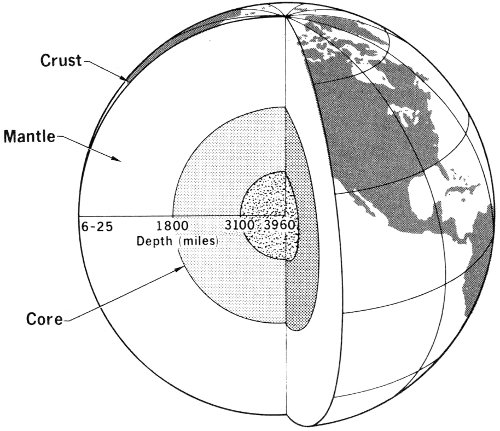
Internal structure of the earth. The central core is probably an alloy of iron and nickel, surrounded by a mantle of less dense silicate material, with a thin crust of still lighter silicates.
The time of this early and relatively rapid separation of
uranium and lead on a worldwide scale is the event that
plumbologists can determine, and the period since then is
what they mean by “the age of the earth”. When Houtermans
first wrote about it, he called it “the age of uranium”.
How is this done? We have said that one of the isotopes
of uranium, ²³⁵U, decays faster—about 6.3 times faster—than
the other, ²³⁸U. They decay into two different isotopes
of lead. Therefore, if we can determine the isotopic composition
of average ordinary lead in the earth’s crust
today, and if we can somehow obtain a sample of the kind
of lead that is locked in the earth’s core, we can calculate
29
how long it took to change the PRIMORDIAL lead (like that
in the core) into present-day lead in the crust by the
gradual addition of radiogenic lead—lead that has resulted
from the decay of uranium. Now, someone might logically
ask, “Isn’t it necessary to know also the actual amount
of uranium involved in the process, and isn’t this difficult
to determine?” It turns out to be a remarkable aspect
of the Holmes-Houtermans calculation that the uranium-concentration
terms cancel out in the equations and only
the ratio of the isotopes and their decay constants need be
considered. These are all known accurately.
Next, we must decide just what is average present-day
lead? It isn’t enough to go to a lead mine and get a sample,
because, unfortunately, leads from different mines have
widely varied isotopic composition—that is, a different
mixture of four natural isotopes, ²⁰⁴Pb, ²⁰⁶Pb, ²⁰⁷Pb, and
²⁰⁸Pb—as a result of their geologic histories. No, lead
samples from a mine won’t do. However, geologists have
been able to separate lead from recent marine sediments,
obtained from the ocean bottom, far from land. These are
of uniform composition, and are good samples of what the
world’s rivers bring into the ocean. Other useful samples
can be found in plateau basalts, which are enormous bodies
of dark volcanic rock that make up the bedrock in many
parts of the world. The lead from these basalts is isotopically
very much like the lead in the oceans.
Very well, but how about the lead from the core? Where
can we hope to find a sample of it? It turns out to be easier
than you might think. Astronomers believe it highly probable
that most meteorites are fragments of a former planet
that broke up for reasons that are not entirely clear. It is
pretty definite, however, that this protoplanet (or these
protoplanets, for there may have been more than one) had
an iron core, and this core (or these cores) is the source
of the iron meteorites sailing around in space. A large
meteorite hit the earth not too long ago (geologically
speaking) and caused the Meteor Crater near Canyon
Diablo in Arizona.
30
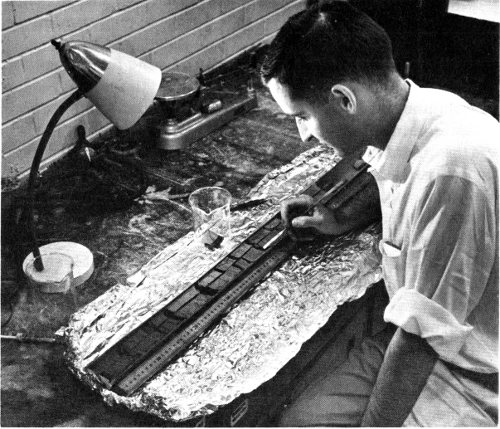
Examining ocean-bottom sediments obtained by lowering a tube-like instrument that brings up a long rod-shaped “core”, prior to nuclear age determination of the sample.
Many fragments of the meteorite iron have been found
around the crater, and it is reasonable to assume that this
is the kind of iron we would expect to find in the core of
the earth. Like the core iron, it is mixed with a little lead,
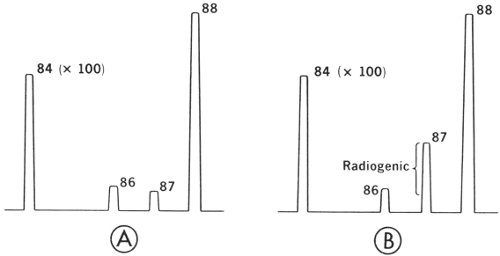
which can be isolated and analyzed in a mass spectrometer
for its isotopic composition. This lead is found to be much
less contaminated with radiogenic lead, and hence is much
more primitive than the oldest leads found on earth. Thus,
meteorites presumably are as close as we can get to true
primordial lead—the lead of the time when the earth (and
the protoplanet) first formed.
Once these measurements were available, it was easy to
write the Houtermans equation for present-day and primordial
leads in this way:
| () present - () primordial |
| () present - () primordial |
31
The present ratio of ²³⁸U to ²³⁵U is 137.7.
- e = the base of natural logarithms
- λ = the DECAY CONSTANT of each isotope of uranium
- t = the age of the earth.
Substituting the best experimental lead isotope ratios
into the equation and solving for t, Patterson was able to
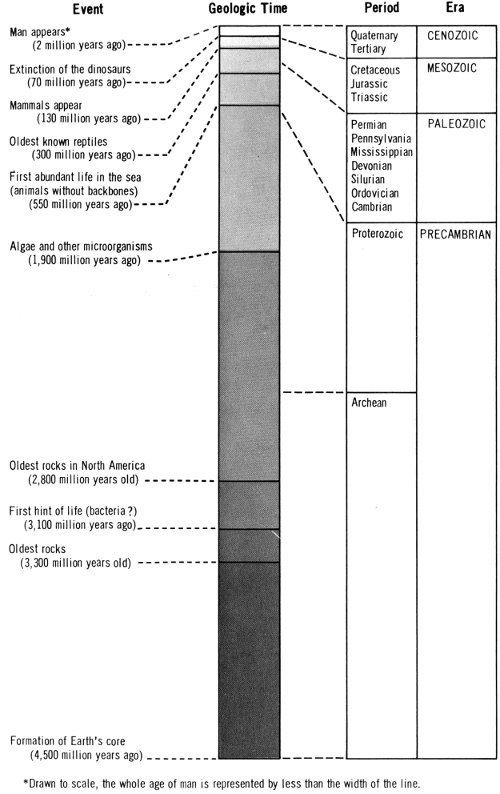
calculate that the earth is 4550 million years (4.55 aeons)
old. Subsequent calculations based on other procedures
generally have confirmed that result.
Each method of nuclear age determination involves a
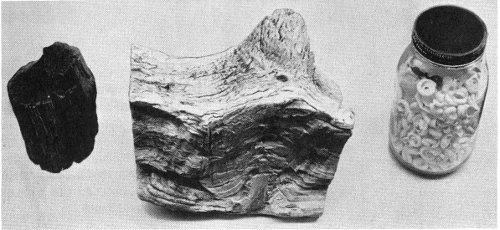
different sequence of sample preparation. Wood, peat,
charcoal, bones, or shells are cleaned for carbon-14
dating in order to remove every trace of possible contamination
by modern carbon as well as extraneous old
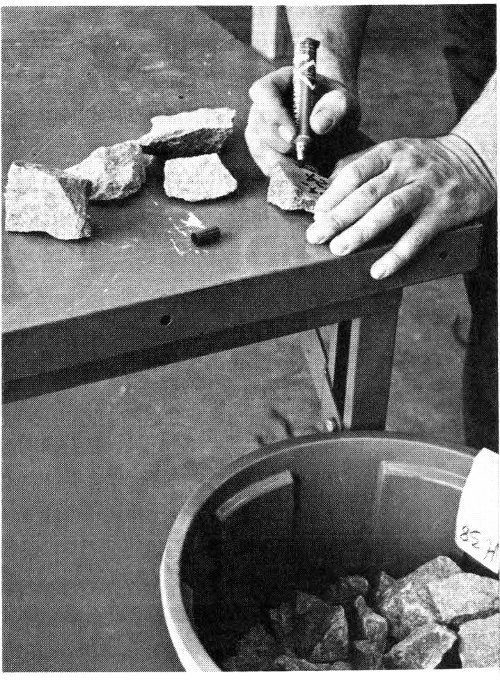
carbon. Rocks are crushed and ground, minerals are
separated according to what is needed in any particular
study, and the desired elements are extracted and separated
by chemical procedures. Often there may be several
different ways of doing the same thing; different laboratories
use different procedures. In every case, however,
long and complicated procedures must be followed before
results are obtained from which an age can be calculated.
There is no such thing as a black box into which you can
throw a rock and read its age on a dial!
Of all the elements that are part of the useful parent-daughter
systems, only potassium is common enough to be
analyzed by conventional chemical techniques. All the
other elements, especially the radiogenic ones, are present
in such small quantities that special processes had to be
developed to measure them. The most valuable and generally
used process is called ISOTOPE DILUTION.
This is a process for analyzing an unknown material by
incorporating uniformly into it a small amount of a radioactive
test substance and determining how much the tracer
radioactivity is altered by dilution in the original material.
32
It works like this: Let’s say that we have an unknown
number of atoms, x, of a given element. The normal
isotopic composition of this element is accurately known,
as it is for most elements, and the ratio of two of its
isotopes can be expressed as A/B. We now add to x a
known (but usually smaller) amount, c, of the same element.
This quantity has a drastically different isotopic
ratio, A′/B′. We mix x and c thoroughly together. The
ratio A′/B′ can have almost any value, but must be different
from A/B and we must know exactly what it is. (There
are many ways of determining this chemically, or we can
use a sample isotope of known composition obtained from
the U. S. Atomic Energy Commission’s Oak Ridge National
Laboratory at Oak Ridge, Tennessee.) The substance added
is known colloquially as the SPIKE.
After the original material and the spike are thoroughly
mixed we have:
x(A/B) + c(A′/B′) = (x + c) (A″B″)
in which A″/B″ will be the ratio of the two isotopes in the
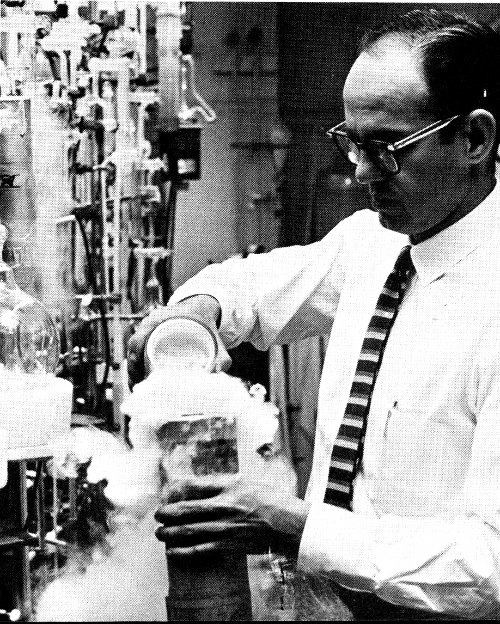
mixture. With this information in hand, we can perform
any chemical purification or transfer process with the
material (see photo on page 22), without having to worry
about loss. (Even if 90% of the material should be lost in
some operation, the isotopic composition would not be
changed, and that is all we are interested in.) Now we can
place the material containing the isotopic mixture in a
MASS SPECTROMETER, which will determine the ratio
A″/B″. When we have that, we may substitute the value of
A″/B″ in the equation and quickly calculate
x, the unknown
concentration of atoms in the original sample.
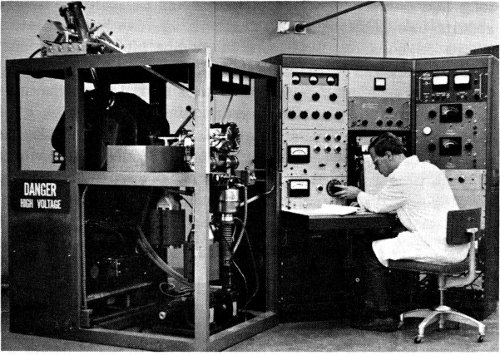
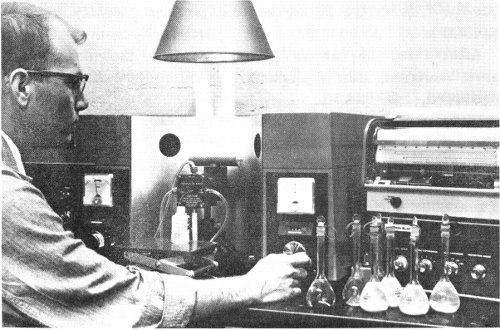
A large (12-inch) mass spectrometer (at left) in use. Electronic equipment (right) charts results (see page 21).
33
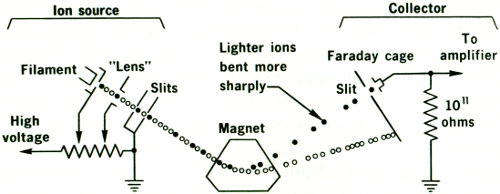
Essential parts of a mass spectrometer. Atoms to be analyzed are changed to ions in the source. Then the ions are accelerated by high voltage, deflected in a magnetic field according to their mass, and the intensity of the separated beams is measured in the collector.
The mass spectrometer measures isotopic abundances
using a magnetic field to sort electrically charged particles
into groups according to their masses. It works this
way: A small drop of material to be analyzed is placed on a
metal filament and dried. The filament, in its holder, is
placed inside the mass spectrometer, and heated electrically
in a vacuum, like the filament in a light bulb. As
the wire begins to glow, some of the sample begins to
radiate, or “boil off”, losing an electron or two in the
process. In other words, some of the atoms will be changed
into positive IONS.
An alternative method is to introduce the sample material
into the vacuum chamber in the form of a gas (like
argon, for example), and then bombard the gas with electrons
34
streaming from a hot filament. The electron stream
will knock some electrons off the gas molecules and this
also will produce positive ions. Either process of ion production
is satisfactory, depending on the problem to be
tackled, but the mass spectrometers for the two methods
are naturally quite different.
Whichever way the ions were produced, they are next
exposed to a strong electric field, accelerated, and electrostatically
focused into a beam. These charged particles
are directed into a magnetic field between the pole faces
of an electromagnet. The magnet does the analyzing by the
principle of magnetic deflection that was known to André
Ampere and Michael Faraday more than a century ago.
Any moving electric charge has a magnetic field associated
with it. This field interacts with the field of the analyzing
magnet to impress a deflecting force on the charge. The
force acts at right angles to the direction the charge
travels and also at right angles to the direction of the
impressed magnetic field. The pull of this force depends
only on the electric charge and the speed of each particle:
A light single-charged particle will be deflected more than
a heavier particle with the same charge. In this way, the
ions in the beam are sorted out into a number of separate
beams, each made up of particles of the same charge/mass
ratio. Each beam contains one isotope of the original
material, because isotopes differ on the basis of their
mass. By adjusting the current in the electromagnet we
can direct these separate beams into a “collector” and
electrically measure their intensity one by one. This gives
the relative abundance of the separate isotopes in the
sample.
Measuring age by one of the long-lived radioisotopes
requires a closed system. Usually this is some kind of
crystal formed in a period of time that is short, compared
to the time that has elapsed since, and that has remained
unchanged since it formed. Specifically, neither the parent
isotopes can have been added nor the daughter isotopes
removed by any process other than radioactive decay.
35
The earth is a dynamic system, however. Things are
always changing and moving—not very rapidly, perhaps,
but fast enough, in geologic time, to raise mountains and
shift oceans. Solutions are moving around, dissolving
something here and depositing it again somewhere else.
Temperatures are changing as one place is denuded by
erosion and another area buried under layers of sediment.
Under such conditions, few systems remain closed. It is
perhaps surprising that we find any closed systems at all.
Let us look at a few that are known to be reliable. (They
are listed in Table I on page 4.)
In the early 1950s, when the potassium-argon (parent-daughter)
method was being developed by scientists at the
University of Chicago, it was thought that the potash-bearing
variety of the mineral feldspar would be an ideal
closed system, because it was usually optically clear and
free of flaws. This widely shared, logical, and perfectly
scientific deduction soon turned out to be quite wrong.
The scientific workers discovered that when feldspar and
mica from the same rock (and thus of the same age) were
analyzed side by side, the mica always came out older!
Investigation showed that feldspar “leaked” argon (lost
some of its radiogenic argon) even at room temperature,
but the mica retained all or nearly all of the argon that
had been generated in it.
With the development of the rubidium-strontium (parent-daughter)
method by L. T. Aldrich and his co-workers at
the Carnegie Institution of Washington, came the realization
that mica was also very useful for this analysis, for it
usually contains ample rubidium and not much original
strontium that would mask the presence of the radiogenic
strontium. As a result, mica, especially black mica (the
mineral biotite), has enjoyed great popularity as a good and
easy-to-find closed system.
36
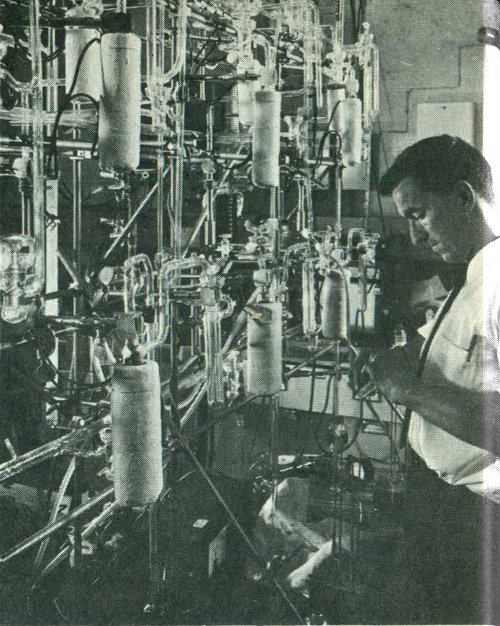
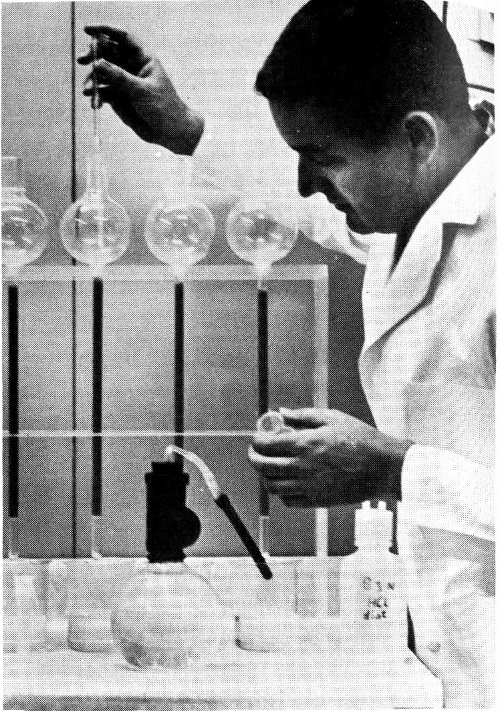
A scientist making adjustments on an “argon train”, a maze of glass tubing in which argon is released from minerals and purified for analysis.
Everything has its limits, and mica is no exception:
Even mica tends to leak argon at elevated, but still
relatively low (geologically speaking), temperatures. These
effects also depend on pressure and other factors, not all
of which are well known; these elevated temperatures,
pressures and other conditions of course act to some extent
on all rocks buried in the earth’s crust. It is known
that at only about 300°C at moderate pressures argon is
leaked from mica faster than it is being generated in it by
the decay of radioactive potassium. The temperature
needed to cause the rapid loss of strontium from mica is
not much higher. Mica, especially biotite, will recrystallize
and lose all its radiogenic constituents (argon and strontium)
at temperatures where many other minerals show
little or no change.
That means that we cannot always rely on mica to give
the date of the original crystallization of a rock—the time
when it cooled from a molten state. Instead, mica will tell
us when the rock last cooled from, say, several hundred
degrees centigrade, regardless of what may have happened
to the rock before that. The mica may have been reheated
as a result of being buried under a few miles of sediment,
for example. The mica will show when the rock last
cooled—in other words, when it came up again.
37
In spite of early disappointments with potash feldspar for
argon dating, some of it is useful for rubidium-strontium
procedures. It all depends on how much original strontium
the potash feldspar contains. Most feldspars, unfortunately,
contain far too much, but rapid screening by X-ray fluorescence
or flame photometry methods can weed these out
and identify specimens low enough in original strontium to
be useful. Otherwise, feldspar is an excellent closed system
for rubidium and strontium; it remains closed even at
temperatures high enough to melt many other minerals. It
is not affected at all by the same degree of heating that will
drive argon out of biotite. The rubidium-strontium age of
feldspar usually comes close to the time of original
crystallization of the rock.
Obviously, here is a geologically important tool. If we
find feldspar and biotite in one rock, and if feldspar, tested
by the rubidium-strontium method gives the same age as
biotite tested by potassium-argon decay, then we can say
with confidence that the rock has not been reheated since
shortly after it crystallized. Conversely, if the biotite
comes out much younger than the feldspar, we can be sure
that something has happened to this rock long after it first
crystallized. Such information is not only valuable to pure
science—it can also be useful in locating areas favorable
for ore prospecting and in other practical ways.
Another very interesting mineral is zircon (a silicate of
zirconium), one of the accessory minerals found in small
quantities in many crystalline rocks. Zircon usually occurs
in very small grains and is heavy and hard, so that it
can be separated from the other rock without much difficulty,
even though it may take 100 pounds of rock to supply
a gram of zircon.
Zircon usually contains a fair amount of uranium and
very little lead. It holds radiogenically produced lead well,
even at relatively high temperatures. But that is not all.
Even if some of the lead is lost, there is a mathematical
way of correcting for it. This technique is called CONCORDIA ANALYSIS
38
and was developed by G. W. Wetherill,
a physicist then at the Carnegie Institution of Washington.
It is based, again, on the fact that natural uranium has two
long-lived isotopes—²³⁸U and ²³⁵U—and that the lighter
one, ²³⁵U, decays faster than the heavier. The daughter
products of both uranium decay processes are isotopes of
the same element, lead—²⁰⁸Pb and ²⁰⁷Pb, respectively.
Heavy isotopes are not separated to any significant degree
by chemical processes, so that if radiogenic lead has been
lost from a system for any reason, the other lead isotopes
also will have been lost in whatever proportion they were
present originally.
If we plot a graph of the radiogenic ²⁰⁶Pb/²³⁸U ratio
against the radiogenic ²⁰⁷Pb/²³⁵U ratio for concordant
(closed) systems of all ages, we obtain the curved line
shown in the figure below. The curve is the locus of all
concordant U-Pb ages and is called Concordia. Then if
we test two or more particular zircons of the same age
that have lost different amounts of lead, at about the same
time, the plot of their ²⁰⁶Pb/²³⁸U
ratios against their ²⁰⁷Pb/²³⁵U
ratios will fall on a straight line that is a chord of the
Concordia curve. The upper intersection of this chord with
the curve then will mark the true age of the zircons. This
is an elaborate technique utilizing difficult chemical procedures,
but it has proved invaluable in solving some
important geologic problems.
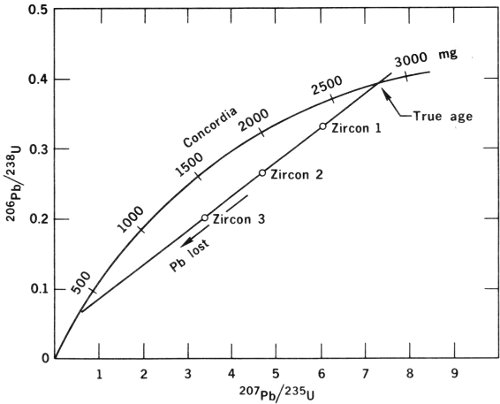
The Concordia curve offers a useful way of analyzing results of age determinations on the mineral zircon.
39
The mineral hornblende provides another useful system.
Hornblende is a complex silicate of sodium, calcium, iron,
magnesium, and aluminum, and usually contains a few
tenths of 1% of potassium. It is unusual in that it tenaciously
retains its radiogenic argon, even at relatively high
temperatures.
Still another good system is the rare feldspar, sanidine,
which is excellent for both potassium-argon and rubidium-strontium
age determination. Sanidine usually is found in
volcanic ash falls and has been important in the establishment
of the geologic time scale, as we shall see.
Finally there is still another way of obtaining a closed
system by using the whole rock, not just a crystal of a
single mineral within it. A large body of granite or similar
rock may contain a number of minerals, some or none of
which may be closed systems. Yet as long as this body of
rock remains impermeable to solutions (which in nature
means mostly to water), no substance will be able to move
very far in it because diffusion in solids is so slow. Consequently
it will remain a closed system, as a whole, regardless
of what happens to the individual mineral grains.
If we take a piece from near the middle of this body of
rock and if this piece is much larger than the largest
constituent grain in it, then we have a fair sample of a
closed system—the whole rock. The only difficulty arises
from the fact that few rocks are sufficiently impermeable
to solutions to retain argon, and many rocks contain so
much common strontium that rubidium-strontium analysis
40
is impractical. Still, we can use the rapid survey methods
as for feldspar, selecting the few rocks that would be
useful. This work has been done frequently, and the results
have been fruitful for rubidium-strontium analysis.
The whole-rock rubidium-strontium age dates the time
when the rock became impermeable.