MY FRIENDS,
IT has been often observed by me, and it cannot be too often
repeated, that colonization is casus omissus at common law. There
is no such title known in that law. By common law, I mean that system
of customs, written and unwritten, which was known and in force in
England, in the time of king Richard 1st. This continued to be the
case, down to the reign of Elizabeth, and king James 1st. In all that
time, the laws of England were confined to the realm, and within the
four seas. There was no provision made in this law for governing
colonies beyond the Atlantic, or beyond the four seas, by authority
of parliament, no nor for the king to grant charters to subjects
to settle in foreign countries. It was the king's prerogative to
prohibit the emigration of any of his subjects, by issuing his writ
ne exeat regno. And therefore it was in the king's power to permit
his subjects to leave the kingdom. 1 Hawk. P.C. c. 22. § 4. "It is a
high crime to disobey the king's lawful commands, or prohibitions,
as not returning from beyond sea, upon the king's letters to that
purpose; for which the offender's lands shall be seized until he
return; and when he does return, he shall be fined, &c. or going
beyond sea, against the king's will, expressly signified, either
by the writ ne exeat regno, or under the great or privy seal, or
signet, or by proclamation." When a subject left the kingdom, by the
king's permission, and if the nation did not remonstrate against
it, by the nation's permission too, at least connivance, he carried
with him, as a man, all the rights of nature. His allegiance bound
him to the king, and entitled him to protection. But how? not in
France; the king of England was not bound to protect him in France,
nor in America; not in the dominions of Lewis, nor of Passachus, or
Massachusetts. He had a right to protection, and the liberties of
England upon his return there, not otherwise. How then do we, New
Englandmen, derive our laws? I say, not from parliament, not from
common law, but from the law of nature, and the compact made with the
king in our charters. Our ancestors were entitled to the common law
of England, when they emigrated, that is, to just so much of it as
they pleased to adopt, and no more. They were not bound or obliged to
submit to it, unless they chose it. By a positive principle of the
common law, they were bound, let them be in what part of the world
they would, to do nothing against the allegiance of the king. But
no kind of provision was ever made by common law, for punishing or
trying any man, even for treason, committed out of the realm. He must
be tried in some county of the realm, by that law, the county where
the overt-act was done, or he could not be tried at all. Nor was
any provision ever made, until the reign of Henry VIII. for trying
treasons committed abroad, and the acts of that reign were made on
purpose to catch cardinal Pole.
So that our ancestors, when they emigrated, having obtained
permission of the king to come here, and being never commanded to
return into the realm, had a clear right to have erected in this
wilderness a British constitution, or a perfect democracy, or any
other form of government they saw fit. They indeed, while they lived,
could not have taken arms against the king of England, without
violating their allegiance, but their children would not have been
born within the king's allegiance, would not have been natural
subjects, and consequently not entitled to protection, or bound to
the king.
Massachusettensis, Jan. 16, seems possessed of these ideas, and
attempts in the most aukward manner, to get rid of them. He is
conscious that America must be a part of the realm, before it can
be bound by the authority of parliament; and therefore is obliged
to suggest, that we are annexed to the realm, and to endeavour to
confuse himself and his readers, by confounding the realm, with the
empire and dominions.
But will any man soberly contend, that America was ever annexed to
the realm? to what realm? When New England was settled, there was a
realm of England, a realm of Scotland, and a realm of Ireland. To
which of these three realms was New England annexed? To the realm
of England, it will be said. But by what law? no territory could be
annexed to the realm of England, but by an act of parliament. Acts
of parliament have been passed to annex Wales, &c. &c. to the realm.
But none ever passed to annex America. But if New-England was annexed
to the realm of England, how came she annexed to the realm of, or
kingdom of Great Britain? The two realms of England and Scotland
were, by the act of union, incorporated into one kingdom by the name
of Great Britain: but there is not one word about America in that act.
Besides, if America was annexed to the realm, or a part of the
kingdom, every act of parliament that is made, would extend to
it, named or not named. But every body knows that every act of
parliament, and every other record, constantly distinguishes between
this kingdom, and his majesty's other dominions. Will it be said
that Ireland is annexed to the realm, or a part of the kingdom of
Great Britain? Ireland is a distinct kingdom, or realm, by itself,
notwithstanding British parliament claims a right of binding it in
all cases, and exercises it in some. And even so the Massachusetts
is a realm, New York is a realm, Pennsylvania another realm, to all
intents and purposes, as much as Ireland is, or England or Scotland
ever were. The king of Great Britain is the sovereign of all these
realms.
This writer says, "that in denying that the Colonies are annexed to
the realm, and subject to the authority of parliament, individuals
and bodies of men subvert the fundamentals of government, deprive us
of British liberties, and build up absolute monarchy in the colonies."
This is the first time that I ever heard or read that the colonies
are annexed to the realm. It is utterly denied that they are, and
that it is possible they should be, without an act of parliament, and
acts of the colonies. Such an act of parliament cannot be produced,
nor any such law of any one colony. Therefore as this writer builds
the whole authority of parliament upon this fact, viz: That the
colonies are annexed to the realm, and as it is certain they never
were so annexed, the consequence is, that his whole superstructure
falls.
When he says, that they subvert the fundamentals of government,
he begs the question. We say that the contrary doctrines subvert
the fundamentals of government. When he says that they deprive us
of British liberties, he begs the question again. We say that the
contrary doctrine deprives us of English liberties; as to British
liberties, we scarcely know what they are, as the liberties of
England and Scotland are not precisely the same to this day. English
liberties are but certain rights of nature, reserved to the citizen,
by the English constitution, which rights cleaved to our ancestors,
when they crossed the Atlantic, and would have inhered in them, if
instead of coming to New-England they had gone to Outaheite, or
Patagonia, even although they had taken no patent or charter from
the king at all. These rights did not adhere to them the less, for
their purchasing patents and charters, in which the king expressly
stipulates with them, that they and their posterity should forever
enjoy all those rights and liberties.
The human mind is not naturally the clearest atmosphere; but the
clouds and vapours which have been raised in it, by the artifices
of temporal and spiritual tyrants, have made it impossible to see
objects in it distinctly. Scarcely any thing is involved in more
systematical obscurity, than the rights of our ancestors, when they
arrived in America. How, in common sense, came the dominions of king
Philip, king Massachusetts, and twenty other sovereigns, independent
princes here, to be within the allegiance of the kings of England,
James and Charles? America was no more within the allegiance of those
princes, by the common law of England, or by the law of nature, than
France and Spain were. Discovery, if that was incontestible, could
give no title to the English king, by common law, or by the law of
nature, to the lands, tenements, and hereditaments of the native
Indians here. Our ancestors were sensible of this, and therefore
honestly purchased their lands of the natives. They might have bought
them to hold allodially, if they would.
But there were two ideas, which confused them, and have continued
to confuse their posterity, one derived from the feudal, the other
from the canon law. By the former of these systems, the prince,
the general, was supposed to be sovereign lord of all the lands,
conquered by the soldiers in his army; and upon this principle, the
king of England was considered in law as sovereign lord of all the
land within the realm. If he had sent an army here to conquer king
Massachusetts, and it had succeeded, he would have been sovereign
lord of the land here upon these principles; but there was no rule of
the common law, that made the discovery of a country by a subject,
a title to that country in the prince. But conquest would not have
annexed the country to the realm, nor have given any authority to
the parliament. But there was another mist cast before the eyes of
the English nation from another source. The pope claimed a sovereign
propriety in, as well as authority over the whole earth. As head of
the christian church, and vicar of God, he claimed this authority
over all Christendom; and, in the same character, he claimed a right
to all the countries and possessions of heathens and infidels; a
right divine to exterminate and destroy them at his discretion, in
order to propagate the catholic faith. When king Henry VIII. and
his parliament, threw off the authority of the pope, stripped his
holiness of his supremacy, and invested it in himself by an act of
parliament, he and his courtiers seemed to think that all the rights
of the holy see were transferred to him; and it was a union of these
two, the most impertinent and fantastical ideas that ever got into an
human pericranium, viz: that as feudal sovereign and supreme head of
the church together, a king of England had a right to all the land
their subjects could find, not possessed by any christian state,
or prince, though possessed by heathen or infidel nations, which
seems to have deluded the nation about the time of the settlement
of the colonies. But none of these ideas gave or inferred any right
in parliament, over the new countries conquered or discovered; and
therefore denying that the colonies are a part of the realm, and
that as such they are subject to parliament, by no means deprives
us of English liberties. Nor does it "build up absolute monarchy in
the colonies." For admitting these notions of the common and feudal
law to have been in full force, and that the king was absolute in
America, when it was settled; yet he had a right to enter into a
contract with his subjects, and stipulate that they should enjoy all
the rights and liberties of Englishmen forever, in consideration of
their undertaking to clear the wilderness, propagate christianity,
pay a fifth part of ore, &c. Such a contract as this has been
made with all the colonies; royal governments, as well as charter
ones. For the commissions to the governors contain the plan of the
government, and the contract between the king and subject, in the
former, as much as the charters in the latter.
Indeed this was the reasoning, and upon these feudal and
catholic principles in the time of some of the predecessors of
Massachusettensis. This was the meaning of Dudley, when he asked, "Do
you think that English liberties will follow you to the ends of the
earth?" His meaning was, that English liberties were confined to the
realm, and out of that the king was absolute. But this was not true;
for an English king had no right to be absolute over Englishmen, out
of the realm, any more than in it, and they were released from their
allegiance, as soon as he deprived them of their liberties.
But "our charters suppose regal authority in the grantor." True
they suppose it, whether there was any or not. "If that authority
be derived from the British (he should have said English) crown,
it presupposes this territory to have been a part of the British
(he should have said English) dominion, and as such subject to the
imperial sovereign." How can this writer shew this authority to be
derived from the English crown, including in the idea of it lords
and commons? Is there the least color for such an authority but in
the popish and feudal ideas before mentioned? And do these popish
and feudal ideas include parliament? Was parliament, were lords and
commons parts of the head of the church, or was parliament, that
is, lords and commons, part of the sovereign feudatory? Never. But
why was this authority derived from the English, any more than the
Scottish or Irish crown? It is true the land was to be held in
soccage, like the manor of East Greenwich; but this was compact, and
it might have been as well to hold, as they held in Glasgow or Dublin.
But, says this writer, "if that authority was vested in the person
of the king in a different capacity, the British constitution and
laws are out of the question, and the king must be absolute as to us,
as his prerogatives have never been limited." Not the prerogatives
limited in our charters, when in every one of them all the rights
of Englishmen are secured to us! Are not the rights of Englishmen
sufficiently known, and are not the prerogatives of the king among
those rights?
As to those colonies which are destitute of charters, the commissions
to their governors have ever been considered as equivalent
securities, both for property, jurisdiction, and privileges, with
charters; and as to the power of the crown being absolute in those
colonies, it is absolute no where. There is no fundamental or other
law, that makes a king of England absolute any where, except in
conquered countries; and an attempt to assume such a power, by the
fundamental laws, forfeits the prince's right even to the limited
crown.
As to "the charter governments reverting to absolute monarchy, as
their charters may happen to be forfeited, by the grantees not
fulfilling the conditions of them;" I answer, if they could be
forfeited, and were actually forfeited, the only consequence would
be, that the king would have no power over them at all. He would
not be bound to protect the people, nor, that I can see, would the
people here, who were born here, be, by any principle of common law,
bound even to allegiance to the king. The connection would be broken
between the crown and the natives of the country.
It has been a great dispute whether charters granted within the
realm, can be forfeited at all. It was a question debated with
infinite learning, in the case of the charter of London: it was
adjudged forfeited, in an arbitrary reign: but afterwards, after
the revolution, it was declared in parliament, not forfeited, and
by an act of parliament made incapable of forfeiture. The charter
of Massachusetts was declared forfeited too. So were other American
charters. The Massachusetts alone, were tame enough to give it up.
But no American charter will ever be decreed forfeited again, or if
any should, the decree will be regarded no more, than a vote of the
lower house of the robinhood society. The court of chancery has no
authority without the realm; by common law, surely it has none in
America. What! the privileges of millions of Americans depend on the
discretion of a lord chancellor? God forbid! The passivity of this
colony in receiving the present charter, in lieu of the first, is,
in the opinion of some, the deepest stain upon its character. There
is less to be said in excuse for it, than the witchcraft, or hanging
the Quakers. A vast party in the province were against it at the
time, and thought themselves betrayed by their agent. It has been a
warning to their posterity, and one principal motive with the people,
never to trust any agent with power to concede away their privileges
again. It may as well be pretended that the people of Great Britain
can forfeit their privileges, as the people of this province. If the
contract of state is broken, the people and king of England must
recur to nature. It is the same in this province. We shall never more
submit to decrees in chancery, or acts of parliament, annihilating
charters, or abridging English liberties.
Whether Massachusettensis was born as a politician, in the year
1764, I knew not: but he often writes as if he know
nothing of that period. In his attempt to trace the
denial of the supreme authority of the parliament, he commits such
mistakes, as a man of age, at that time, ought to blush at. He says,
that "when the stamp act was made, the authority of parliament to
impose external taxes, or, in other words, to lay duties upon goods
and merchandize was admitted," and that when the tea act was made, "a
new distinction was set up, that parliament had a right to lay duties
upon merchandize, for the purpose of regulating trade, but not for
the purpose of raising a revenue." This is a total misapprehension
of the declared opinions of people at those times. The authority
of parliament to lay taxes for a revenue has been always generally
denied. And their right to lay duties to regulate trade, has been
denied by many, who have ever contended that trade should be
regulated only by prohibitions.
The act of parliament of the 4th George 3d, passed in the year
1764, was the first act of the British parliament that ever was
passed, in which the design of raising a revenue was expressed. Let
Massachusettensis name any statute before that, in which the word
revenue is used, or the thought of raising a revenue is expressed.
This act is entitled, "an act for granting certain duties in the
British colonies, and plantations in America," &c. The word revenue,
in the preamble of this act, instantly ran through the colonies, and
rang an alarm, almost as much as if the design of forging chains
for the colonists had been expressed in words. I have now before me
a pamphlet, written and printed in the year 1764, entitled, "The
sentiments of a British American," upon this act. How the idea of a
revenue, though from an acknowledged external tax, was relished in
that time, may be read in the frontispiece of that pamphlet.
Ergo quid refert mea
Cui serviam? clitellas dum portem meas.
Phaedrus.
|
The first objection to this act, which was made in that pamphlet,
by its worthy author, Oxenbridge Thacher, Esq. who died a
martyr to that amity for his country, which the
conduct of the junto gave him, is this, "The first objection is,
that a tax is thereby laid on several commodities, to be raised
and levied in the plantations, and to be remitted home to England.
This is esteemed a grievance, inasmuch as the same are laid, without
the consent of the representatives of the colonists. It is esteemed
an essential British right, that no person shall be subject to any
tax; but what in person, or by his representative, he hath a voice
in laying." Here is a tax unquestionably external, in the sense in
which that word is used, in the distinction that is made by some
between external and internal taxes, and unquestionably laid in part
for the regulation of trade; yet called a grievance, and a violation
of an essential British right, in the year 1764, by one who was then
at the head of the popular branch of our constitution, and as well
acquainted with the sense of his constituents, as any man living. And
it is indisputable, that in those words he wrote the almost universal
sense of this colony.
There are so many egregious errors in point of fact, and respecting
the opinions of the people in this writer, which it is difficult to
impute to wilful misrepresentation, that I sometimes think he is some
smart young gentleman, come up into life since this great controversy
was opened; if not, he must have conversed wholly with the junto, and
they must have deceived him, respecting their own sentiments.
This writer sneers at the distinction between a right to lay the
former duty of a shilling on the pound of tea, and the right to
lay the three pence. But is there not a real difference between
laying a duty to be paid in England upon exportation, and to be
paid in America upon importation? Is there not a difference between
parliament's laying on duties within their own realm, where they have
undoubtedly jurisdiction, and laying them out of their realm, nay
laying them on in our realm, where we say they have no jurisdiction?
Let them lay on what duties they please in England, we have nothing
to say against that.
"Our patriots most heroically resolved to become independent states,
and flatly denied that parliament had a right to make any laws
whatever that should be binding upon the colonies."
Our scribbler, more heroically still, is determined to shew the
world, that he has courage superior to all regard to modesty,
justice, or truth. Our patriots have never determined, or desired to
be independent states, if a voluntary cession of a right to regulate
their trade can make them dependent even on parliament, though
they are clear in theory, that by the common law, and the English
constitution, parliament has no authority over them. None of the
patriots of this province, of the present age, have ever denied that
parliament has a right, from our voluntary cession, to make laws
which shall bind the colonies, as far as their commerce extends.
"There is no possible medium between absolute independence and
subjection to the authority of parliament." If this is true, it may
be depended upon, that all North America are as fully convinced of
their independence, their absolute independence, as they are of their
own existence, and as fully determined to defend it at all hazards,
as Great Britain is to defend her independence against foreign
nations. But it is not true. An absolute independence of parliament,
in all internal concerns and cases of taxation, is very compatible
with an absolute dependence on it, in all cases of external commerce.
"He must be blind indeed that cannot see our dearest interest in
the latter, (that is in an absolute subjection to the authority
of parliament,) notwithstanding many pant after the former" (that
is absolute independence.) The man who is capable of writing, in
cool blood, that our interest lies in an absolute subjection to
parliament, is capable of writing, or saying any thing for the
sake of his pension: a legislature that has so often discovered a
want of information concerning us and our country; a legislature
interested to lay burdens upon us; a legislature, two branches of
which, I mean the lords and commons, neither love nor fear us! Every
American of fortune and common sense, must look upon his property to
be sunk downright one half of its value, the moment such an absolute
subjection to parliament is established.
That there are any who pant after "independence," (meaning by this
word a new plan of government over all America, unconnected with the
crown of England, or meaning by it an exemption from the power of
parliament to regulate trade) is as great a slander upon the province
as ever was committed to writing. The patriots of this province
desire nothing new; they wish only to keep their old privileges.
They were for 150 years allowed to tax themselves, and govern
their internal concerns, as they thought best. Parliament governed
their trade as they thought fit. This plan, they wish may continue
forever. But it is honestly confessed, rather than become subject to
the absolute authority of parliament, in all cases of taxation and
internal polity, they will be driven to throw off that of regulating
trade.
"To deny the supreme authority of the state, is a high misdemeanor;
to oppose it by force, an overt act of treason." True: and therefore
Massachusettensis, who denies the king represented by his governor,
his majesty's council, by charter, and house of representatives, to
be the supreme authority of this province, has been guilty of a high
misdemeanour: and those ministers, governors, and their instruments,
who have brought a military force here, and employed it against that
supreme authority, are guilty of ——, and ought to be punished with
——. I will be more mannerly than Massachusettensis.
"The realm of England is an appropriate term for the ancient realm of
England, in contradistinction to Wales and other territories, that
have been annexed to it."
There are so many particulars in the case of Wales analogous to the
case of America, that I must beg leave to enlarge upon it.
Wales was a little portion of the island of Great Britain, which the
Saxons were never able to conquer. The Britons had reserved this
tract of land to themselves, and subsisted wholly by pasturage,
among their mountains. Their princes, however, during the Norman
period, and until the reign of king Edward the first, did homage to
the crown of England, as their feudal sovereign, in the same manner
as the prince of one independent state in Europe frequently did to
the sovereign of another. This little principality of shepherds and
cowherds, had however maintained their independence, through long
and bloody wars against the omnipotence of England, for 800 years.
It is needless to enumerate the causes of the war between Lewellyn
and Edward the first. It is sufficient to say that the Welch prince
refused to go to England to do homage, and Edward obtained a new aid
of a fifteenth from his parliament, to march with a strong force
into Wales. Edward was joined by David and Roderic, two brothers of
Lewellyn, who made a strong party among the Welch themselves, to
assist and second the attempts to enslave their native country. The
English monarch, however, with all these advantages, was afraid to
put the valor of his enemies to a trial, and trusted to the slow
effects of famine to subdue them. Their pasturage, with such an
enemy in their country, could not subsist them, and Lewellyn, Nov.
19, 1277, at last submitted, and bound himself to pay a reparation
of damages, to do homage to the crown of England, and almost to
surrender his independence as a prince, by permitting all the other
Barons of Wales, excepting four, to swear fealty to the same crown.
But fresh complaints soon arose. The English grew insolent on their
bloodless victory, and oppressed the inhabitants; many insults were
offered, which at last raised the indignation of the Welch, so that
they determined again to take arms, rather than bear any longer the
oppression of the haughty victors. The war raged sometime, until
Edward summoned all his military tenants, and advanced with an army
too powerful for the Welch to resist. Lewellyn was at last surprized,
by Edward's general Mortimer, and fighting at a great disadvantage,
was slain, with two thousand of his men. David, who succeeded in
the principality, maintained the war for some time, but at last was
betrayed to the enemy, sent in chains to Shrewsbury, brought to a
formal trial before the peers of England, and although a sovereign
prince, ordered by Edward to be hanged, drawn and quartered, as a
traitor, for defending by arms the liberties of his native country!
All the Welch nobility submitted to the conqueror. The laws of
England, sheriffs, and other ministers of justice, were established
in that principality, which had maintained its liberties and
independency, 800 years.
Now Wales was always part of the dominions of England. "Wales was
always feudatory to the kingdom of England." It was always held of
the crown of England, or the kingdom of England: that is, whoever
was king of England, had a right to homage, &c. from the prince
of Wales. But yet Wales was not parcel of the realm or kingdom,
nor bound by the laws of England. I mention, and insist upon this,
because it shews, that although the colonies are bound to the crown
of England, or, in other words, owe allegiance to whomsoever is king
of England; yet it does not follow that the colonies are parcel of
the realm or kingdom, and bound by its laws. As this is a point of
great importance, I must beg pardon, however unentertaining it may
be, to produce my authorities.
Comyns digest, v. 5. page 626. Wales was always feudatory to the
kingdom of England.
Held of the crown, but not parcel. Per Cook. 1 Roll. 247. 2 Roll. 29.
And therefore the kings of Wales did homage, and swore fealty to H.
2. and John and H. 3.
And 11 Ed. 1. Upon the conquest of Lewellyn, prince or king of
Wales, that principality became a part of the dominion of the realm
of England. And by the statute Walliae 12 Ed. 1. It was annexed and
united to the crown of England, tanquam partem corporis ejusdem,
&c. Yet if the statute Walliae, made at Rutland 12 Ed. 1. was not
an act of parliament (as it seems that it was not) the incorporation
made thereby was only an union "jure feudali, et non jure
proprietatis."
"Wales, before the union with England, was governed by its proper
laws," &c.
By these authorities it appears, that Wales was subject, by the
feudal law, to the crown of England, before the conquest of Lewellyn;
but not subject to the laws of England; and indeed after this
conquest, Edward and his nobles, did not seem to think it subject to
the English parliament, but to the will of the king as a conqueror
of it in war. Accordingly that instrument which is called Statutum
Walliae, and to be found in the appendix to the statutes p. 3,
although it was made by the advice of the peers, or officers of the
army more properly, yet it never was passed as an act of parliament,
but as an edict of the king. It begins not in the stile of an act
of parliament. Edwardus Dei gratia Rex Angliae, Dominus Hyberniae,
et Dux Aquitaniae, omnibus fidelibus suis, &c. in Wallia. Divina
providentia, quae in sui dispositione, says he, non fallitur, inter
alia dispensationis suae munera, quibus nos et Regnum nostrum Angliae
decorare dignata est, terram Walliae, cum, incolis suis, prius,
nobis, jure feudali subjectam, jam sui gratia, in proprietatis
nostrae dominium, obstaculis quibuscumque cessantibus, totaliter,
et cum integritate convertit, et coronae regni praedicti, tanquam
partem corporis ejusdem annexuit et univit.
Here is the most certain evidence that Wales was subject to the kings
of England by the feudal law before the conquest, though not bound by
any laws but their own. 2d. That the conquest was considered, in that
day, as conferring the property, as well as jurisdiction of Wales
to the English crown. 3. The conquest was considered as annexing
and uniting Wales to the English crown, both in point of property
and jurisdiction, as a part of one body. Yet notwithstanding all
this, parliament was not considered as acquiring any share in the
government of Wales by this conquest. If, then, it should be admitted
that the colonies are all annexed and united to the crown of England,
it will not follow that lords and commons have any authority over
them.
This statutum Walliae, as well as the whole case and history of
that principality, is well worthy of the attention and study of
Americans, because it abounds with evidence, that a country may be
subject to the crown of England, without being subject to the lords
and commons of that realm, which entirely overthrows the whole
argument of Gov. Hutchinson, and of Massachusettensis, in support of
the supreme authority of parliament, over all the dominions of the
imperial crown. "Nos itaque, &c. says King Edward 1.
"volentes predictam terram, &c. sicut et caeteras ditioni nostrae subjectas,
&c. subdebito regimine gubernari, et incolas seu habitatores terrarum
illaram, qui alto et basso, se submiserunt voluntati nostrae,
et quos sic ad nostram recepimus voluntatem, certis legibus et
consuetudinibus, &c. tractari leges, et consuetudines, partum
illarum hactenus usitatas coram nobis et proceribus regni nostri
fecimus recitari, quibus diligenter auditis, et plenus intellectis,
quasdam ipsarum de concilio procerum predictorum delevimus, quasdam
permisimus, et quasdam correximus, et etiam quasdam alias adjungendas
et statuendas decrevimus, et eas, &c. observari volumus in forma
subscripta."
And then goes on to prescribe and establish a whole code of laws for
the principality, in the style of a sole legislature, and concludes,
Et ideo vobis mandamus, quod premissa de cetero in omnibus firmiter
observatis. Ita tamen quod quotiescunque, et quandocunque, et
ubicunque, nobis placuerit, possimus predicta statuta et coram partes
singulas declarare, interpretari, addere sive diminuere, pro nostro
libito voluntatis, et prout securitati nostrae et terrae nostrae
predictae viderimus expedire.
Here is then a conquered people submitting to a system of laws
framed by the mere will of the conqueror, and agreeing to be forever
governed by his mere will. This absolute monarch, then, might
afterwards govern this country, with or without the advice of his
English lords and commons.
To shew that Wales was held before the conquest of Lewellyn, of the
king of England, although governed by its own laws, hear lord Coke,
Inst. 194, in his commentary on the statute of Westminster. "At this
time, viz. in 3 Ed. 1. Lewellyn was a prince or king of Wales, who
held the same of the king of England, as his superior lord, and owed
him liege homage and fealty; and this is proved by our act, viz:
that the king of England was superior dominus, i. e. sovereign lord
of the kingdom, or principality of Wales."
Lord Coke, in 4 Inst. 239, says "Wales was sometime a realm, or
kingdom, (realm from the French word royaume, and both a regno) and
governed per suas regulas," and afterwards, "but jure feudali,
the kingdom of Wales was holden of the crown of England, and
thereby, as Bracton saith, was sub potestate regis. And so it
continued until the 11th year of king Edward 1st. when he subdued the
prince of Wales, rising against him, and executed him for treason."
"The next year, viz. in the 12th year of king Edward 1. by authority
of parliament, it is declared thus, speaking in the person of the
king, as ancient statutes were wont to do, divina providentia,"
&c. as in the statute Walliae, before recited. But here is an
inaccuracy, for the statutum Walliae was not an act of parliament,
but made by the king with the advice of his officers of the army, by
his sole authority, as the statute itself sufficiently shews. "Note,"
says lord Coke, "diverse monarchs hold their kingdoms of others jure
feudali, as the duke of Lombardy, Cicill, Naples, and Bohemia of the
empire, Granado, Leons of Aragon, Navarre, Portugal of Castile; and
so others."
After this the Welch seem to have been fond of the English laws, and
desirous of being incorporated into the realm, to be represented in
parliament, and enjoy all the rights of Englishmen, as well as to
be bound by the English laws. But kings were so fond of governing
this principality by their discretion alone, that they never could
obtain these blessings until the reign of Henry 8th. and then they
only could obtain a statute, which enabled the king to alter their
laws at his pleasure. They did indeed obtain in the 15 Ed. 2. a writ
to call twenty-four members to the parliament at York from South
Wales, and twenty-four from North Wales; and again in the 20 Ed. 2.
the like number of forty-eight members for Wales, at the parliament
of Westminster. But lord Coke tells us "that this wise and warlike
nation was long after the statutum Walliae not satisfied nor
contented, and especially, for that they truly and constantly took
part with their rightful sovereign and liege lord, king Richard 2d.;
in revenge whereof they had many severe and invective laws made
against them in the reigns of Henry 4th. Henry 5th. &c. all which as
unjust are repealed and abrogated. And to say the truth, this nation
was never in quiet, until king Henry 7th. their own countryman,
obtained the crown. And yet not so really reduced in his time, as in
the reign of his son, Henry 8th. in whose time certain just laws,
made at the humble suit of the subjects of Wales, the principality
and dominion of Wales was incorporated and united to the realm of
England; and enacted that every one born in Wales should enjoy the
liberties, rights and laws of this realm, as any subjects naturally
born within this realm should have and inherit, and that they should
have knights of shires, and burgesses of parliament." Yet we see
they could not obtain any security for their liberties, for lord
Coke tells us, "in the act of 34 Henry 8th. it was enacted, that the
king's most royal majesty should, from time to time change, &c. all
manner of things in that act rehearsed, as to his most excellent
wisdom and discretion should be thought convenient, and also to make
laws and ordinances for the commonwealth of his said dominion of
Wales at his majesty's pleasure. But for that, the subjects of the
dominion of Wales, &c. had lived in all dutiful subjection to the
crown of England, &c. the said branch of the said statute of 34 Henry
8th. is repealed, and made void by 21 Jac. c. 10."
But if we look into the statute itself of 27, Henry 8th. c. 26, we
shall find the clearest proof, that being subject to the imperial
crown of England, did not entitle Welchmen to the liberties of
England, nor make them subject to the laws of England. "Albeit the
dominion, principality and country of Wales, justly and righteously
is, and ever hath been incorporated, annexed, united, and subject
to and under the imperial crown of this realm, as a very member and
joint of the same; wherefore, the king's most royal majesty of
mere droit, and very right, is very head, king, lord and ruler; yet
notwithstanding, because that, in the same country, principality
and dominion, diverse rights, usages, laws and customs be far
discrepant from the laws and customs of this realm, &c. Wherefore it
is enacted, by king, lords and commons, "that his" (i. e. the king's)
said country or dominion of Wales shall be, stand and continue
forever from henceforth, incorporated, united, and annexed to and
with this, his realm of England; and that all and singular person and
persons, born or to be born, in the said principality, country, or
dominion of Wales, shall have, enjoy, and inherit, all and singular
freedoms, liberties, rights, privileges, and laws within this his
realm, and other the king's dominions, as other the king's subjects
naturally born within the same, have, enjoy, and inherit." § 2.
Enacts that the laws of England shall be introduced and established
in Wales: and that the laws, ordinances and statutes of this realm of
England forever, and none other shall be used and practised forever
thereafter, in the said dominion of Wales. The 27th § of this long
statute enacts, that commissioners shall inquire into the laws and
customs of Wales, and report to the king, who with his privy council,
are empowered to establish such of them as they should think proper.
§ 28 Enacts that in all future parliaments for this realm, two
knights for the shire of Monmouth, and one burgess for the town,
shall be chosen and allowed such fees as other knights and burgesses
of parliament were allowed. § 29 Enacts that one knight shall be
elected for every shire within the country or dominion of Wales, and
one burgess for every shire town, to serve in that and every future
parliament to be holden for this realm. But by § 36 the king is
empowered to revoke, repeal and abrogate that whole act, or any part
of it, at any time within three years.
Upon this statute let it be observed, 1. That the language of
Massachusettensis "imperial crown" is used in it: and Wales is
affirmed to have ever been annexed, and united to that imperial
crown, as a very member and joint: which shews that being annexed to
the imperial crown, does not annex a country to the realm, or make
it subject to the authority of parliament: because Wales certainly,
before the conquest of Lewellyn, never was pretended to be so
subject, nor afterwards ever pretended to be annexed to the realm
at all, nor subject to the authority of parliament, any otherwise
than as the king claimed to be absolute in Wales, and therefore to
make laws for it, by his mere will, either with the advice of his
proceres, or without. 2. That Wales never was incorporated with
the realm of England, until this statute was made, nor subject to
any authority of English lords and commons. 3. That the king was
so tenacious of his exclusive power over Wales, that he would not
consent to this statute, without a clause in it, to retain the power
in his own hands, of giving it what system of law he pleased. 4.
That knights and burgesses, i. e. representatives, were considered
as essential and fundamental in the constitution of the new
legislature, which was to govern Wales. 5. That since this statute,
the distinction between the realm of England and the realm of Wales,
has been abolished, and the realm of England, now, and ever since,
comprehends both; so that Massachusettensis is mistaken, when he
says, that the realm of England is an appropriate term for the
ancient realm of England, in contradistinction from Wales, &c. 6.
That this union and incorporation was made by the consent, and upon
the supplication of the people of Wales, as lord Coke and many other
authors inform us, so that here was an express contract between
the two bodies of people. To these observations let me add a few
questions.
Was there ever any act of parliament, annexing, uniting, and
consolidating any one of all the colonies to and with the realm
of England or the kingdom of Great Britain? 2. If such an act of
parliament should be made, would it upon any principles of English
laws and government, have any validity, without the consent,
petition, or supplication of the colonies? 3. Can such an union
and incorporation, ever be made, upon any principles of English
laws and government, without admitting representatives for the
colonies in the house of commons, and American lords into the house
of peers? 4. Would not representatives in the house of commons,
unless they were numerous in proportion to the numbers of people in
America, be a snare rather than a blessing? 5. Would Britain ever
agree to a proportionable number of American members, and if she
would, could America support the expense of them? 6. Could American
representatives possibly know the sense, the exigencies, &c. of their
constituents, at such a distance, so perfectly as it is absolutely
necessary legislators should know? 7. Could Americans ever come to
the knowledge of the behaviour of their members, so as to dismiss the
unworthy? 8. Would Americans, in general, ever submit to septennial
elections? 9. Have we not sufficient evidence, in the general
frailty and depravity of human nature, and especially the experience
we have had of Massachusettensis and the junto, that a deep,
treacherous, plausible, corrupt minister, would be able to seduce our
members to betray us, as fast as we could send them?
To return to Wales. In the statute of 34 and 35 of Henry 8th. c. 26.
we find a more complete system of laws and regulations for Wales.
But the king is still tenacious of his absolute authority over it.
It begins, "our sovereign lord the king, of his tender zeal and
affection, &c. to his obedient subjects, &c. of Wales, &c. hath
devised and made divers sundry good and necessary ordinances, which
his majesty of his most abundant goodness, at the humble suit and
petition of his said subjects of Wales, is pleased and contented to
be enacted by the assent of the lords spiritual and temporal, and the
commons," &c.
Nevertheless, the king would not yet give up his unlimited power
over Wales, for by the 119 § of this statute, the king, &c. may at
all times, hereafter, from time to time, change, add, alter, order,
minish, and reform all manner of things afore rehearsed, as to his
most excellent wisdom and discretion, shall be thought convenient;
and also to make laws and ordinances for the commonwealth and good
quiet of his said dominion of Wales, and his subjects of the same,
from time to time, at his majesty's pleasure.
And this last section was never repealed, until the 21 Jac. 1. c. 10.
§ 4.
From the conquest of Lewellyn to this statute of James is near 350
years, during all which time the Welch were very fond of being
incorporated and enjoying the English laws; the English were desirous
that they should be, yet the crown would never suffer it to be
completely done, because it claimed an authority to rule it by
discretion. It is conceived, therefore, that there cannot be a more
complete and decisive proof of any thing, than this instance is, that
a country may be subject to the crown of England, the imperial crown;
and yet not annexed to the realm, or subject to the authority of
parliament.
The word crown, like the word throne, is used in various figurative
senses; sometimes it means the kingly office, the head of the
commonwealth, but it does not always mean the political capacity
of the king; much less does it include in the idea of it lords and
commons. It may as well be pretended that the house of commons
includes or implies a king. Nay, it may as well be pretended that the
mace includes the three branches of the legislature.
By the feudal law, a person or a country might be subject to a king,
a feudal sovereign, three several ways.
1. It might be subject to his person, and in this case, it would
continue so subject, let him be where he would, in his dominions
or without. 2. To his crown, and in this case subjection was due,
to whatsoever person or family wore that crown, and would follow
it, whatever revolutions it underwent. 3. To his crown and realm of
state, and in this case, it was incorporated as one body with the
principal kingdom; and if that was bound by a parliament, diet, or
cortes, so was the other.
It is humbly conceived, that the subjection of the colonies by
compact, and law is of the second sort.
Suffer me, my friends, to conclude by making my most respectful
compliments to the gentlemen of the regiment of royal Welch
fusileers.[1]
In the celebration of their late festival, they discovered that they
are not insensible of the feelings of a man for his native country.
The most generous minds are the most exquisitely capable of this
sentiment. Let me entreat them to recollect the history of their
brave and intrepid countrymen, who struggled at least 1100 years
for liberty. Let them compare the case of Wales with the case of
America, and then lay their hands upon their hearts and say, whether
we can in justice be bound by all acts of parliament, without being
incorporated with the kingdom.
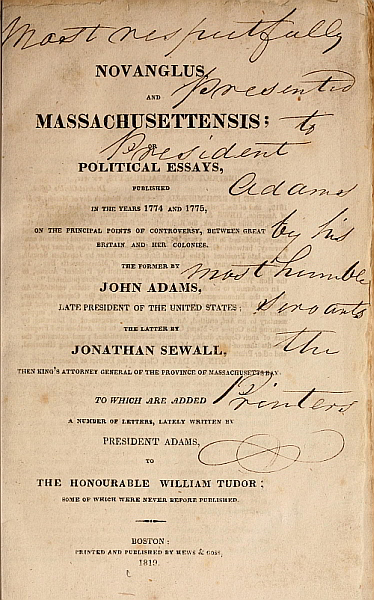
NOVANGLUS.