NOTES TAKEN DURING TRAVELS IN AFRIC A, BY THE LATE JOHN DAVIDSON, F.R.S. F.S.A., &c.
Large-size versions of illustrations are available by clicking on them.
NOTES TAKEN DURING TRAVELS IN
AFRICA.
Drawn by J. G. Wilkinson
Esqre. from a Sketch taken by the late John
Davidson.
Drawn on Stone & Printed by P.
Gauci, 9, North Crest. Bedford Sqre.
VIEW OF WADNOON.
From the roof of Sheik Beyrook’s House
PRINTED FOR PRIVATE CIRCULATION
ONLY.
LONDON:
PRINTED BY J. L. COX AND SONS, 75, GREAT QUEEN STREET, LINCOLN’S-INN FIELDS.
1839.
ADVERTISEMEN T.
To gratify the earnest desire expressed by the Friends of the
late Mr. Davidson to possess some memorial
of him, his Brother has been induced to print, for private
distribution merely, the following pages, drawn up from his MS.
Journal.
It will be seen that they are only rough and brief notes penned
at the moment, and under circumstances the most trying to an active
mind, and with a presentiment of failure, which has been too truly
realized.
For the generally correct manner in which the names of persons
and places are here given, and which in the MS. were decyphered
with difficulty, Mr. Davidson’s Brother has to offer his best
thanks to the Rev. G. Renouard and Capt. Washington, of the Royal
Geographical Society of London.
CONTENT S.
Page
Mr. Davidson’s Notes, kept in the form of a
Journal
NOTES TAKEN DURING TRAVELS IN AFRIC A. — Various detached Notes at the end of Mr. Davidson’s Journal. [126] — Extracts from Mr. Davidson’s Letters .
On Saturday, August 29, 1835, we left
London by the mail, and arrived the morning following at Exeter,
where we went to the cathedral, which Abou called one of the
bishops’ churches. We proceeded the same evening to Falmouth, which
we reached on Monday 31st. During the journey, Abou’s remarks were
highly creditable to him; he expressed himself quite astonished at
the rate of travelling, which he had ascertained by comparing the
mile-stones we had passed with the time, as indicated by a watch;
nor was he less struck with the quickness of changing horses, the
punctuality in the arrival of the mail, and the manner in which one
bag is delivered, and another received, while the coach is going
on. In the whole country, he said very prettily, no place for more
than a mile could be seen without a settlement; all is
productive: no misery. He wound up his reflections with the
words,—‘Good king! good people!—African people all blind: not know
their own good, else they would ask Englishmen to come and teach
them.’
On Tuesday, Sept. 1, I went with Abou to see the Castle, where
the officer on duty put some men through the manual and platoon
exercise, and light infantry movements, much to the amusement of
Abou, who was not less gratified with the feats of horsemanship
exhibited by a company that performed the same evening at the
theatre.
On Thursday, Sept.
3d, we went on board the Sarah Nigritia, and got off at
one P.M., with the wind a-head and a
considerable swell, which produced its usual effect upon many of
the passengers, and myself among the number, but poor Abou was the
worst of all; during the whole voyage he was absolutely wretched,
and quite unable to rally,—a rather bad omen of his power to bear
up, should greater difficulties present themselves on land.
On Monday, Sept. 7, we passed Cape Finisterre, running along the
shore in comparatively smooth water, but with a heavy swell; and on
the 9th we made Cape St. Vincent, and saw, at six P.M. on the morning following, Cadiz rising from the
dark blue wave; and at half-past seven anchored in the bay. Some
time before the boat came off to give us pratique I had
gone ashore with Abou. After a good breakfast at the Posada
Inglaterra, I proceeded to the Franciscan convent and chapel,
and from thence to the cathedral. The last is a very beautiful
building, but rather too gaudy, and in not the best taste of
architecture. I returned to an omelette and a segar, and
water and rien de plus; strolled afterwards through the
town, celebrated alike for mostachas and
mantillas, for playful fans, bronze faces, and pretty
feet.
At one P.M., we were on board again for
Gibraltar. Towards Seville there is a fine view of mountain
scenery. But the country itself is in a wretched state, the natural
consequence of the numerous revolutions it has been its fate to
undergo, and where each province not only declares itself
independent of the government, but of one another. How all this is
to end, heaven only knows.
At ten P.M., we were called from the
dinner-table by hearing that a brig had been capsized. Went on
deck, and found the report to be too true. We sent our boats and
took off some of the crew, and after crossing Trafalgar Bay,
reached Gibraltar at a quarter past ten.
Friday, Sept. 11.—I went to the library, club, and court. All
things seem to work well; but I much fear that I shall have some
trouble about Abou: he has been made too much of; the Moors are all
on the alert respecting him. I must beware of the French, too, for
I foresee they will be
intriguing against me. While some of our party are gone to visit
the rock and the galleries, I am confined to my room on matters of
business, which is not quite so pleasant a way of passing one’s
time, although my window overlooks the bay of Algesiras,—a view
that would form not a bad subject for a panorama.
Saturday, Sept. 12.—The Governor, Sir A. Woodford, sent Col.
Fuller early to take me over the galleries, &c. Much as I had
heard of them, they surpassed all my expectations. On my return, I
received a visit from Sadi Abdallah, who wanted to take me to his
house, and made the offer of his best services, which, I suspect,
will exceed all the official ones. From him I heard that the king
of Timbuctoo had gone on a pilgrimage to Mecca, taking Gibraltar in
his way; so that I hope he may be returning to his capital when I
am going thither. What a fortunate thing it would be if I could get
the appointment of his Majesty’s hakeem (physician). Mr.
Hay likewise paid me a visit: he is the British Consul at Tangier.
As the subjects discussed during the interview were of an official
and confidential nature, I cannot disclose them. I fear, however,
that I am not to expect much assistance from him, although his
offers are very kind. There is evidently something wrong on the
other side of the Straits. I shall be guided rather by the
intelligence and advice I receive from Benoliel,[1]
whom I am to meet again to-day at the Governor’s, whose kindness
and urbanity I shall never forget.
The weather is very hot, although the wind is easterly. The
vessels of war sailed this morning for Cadiz. Spain is in a sad
state. After dinner I went to St. Nicholas’ Cave. It was lighted up
with blue lights. The band, the company, the soldiers, all added to
the natural grandeur of the scene. The more I see of this place,
the more I am delighted with it.
Sunday, Sept. 13.—The air much cooler. Staid at home and read
the psalms and lessons. Mr. Hay called, and, after a long
conference with him, I felt still disposed to adhere to my original
resolution, of being
guided rather by Benoliel. Towards evening the wind got up, and at
night increased to a gale. The dust was dreadful. A Sunday at
Gibraltar is more remarkable than at any other place. Jews, Turks,
Moors, Protestants, and Catholics, all keep it in their own way,
and each in a different one.
Monday, Sept. 14.—The wind still very high, and the dust quite
distressing. I waited on the Governor as soon as he came from the
convent, and afterwards visited Benoliel. His Excellency
recommended my going, and he was backed by Benoliel, but opposed by
Mr. Hay.[2] Dined again at the Governor’s, where I met his
chaplain, Dr. Burrows, a gentleman of great learning.
Tuesday, Sept. 15.—Started early for the market. This is a
curious and interesting scene. Moors, Jews, Spaniards, and lizards
in abundance are to be found there, together with a few Englishmen.
I met there with a Mr. Hodgson from Virginia: he is a fine
specimen, I calculate, of an United States’ diplomatist,
and the most gentleman-like American I have ever seen. I have
written to Mr. Hay, to request he will make arrangements for my
departure; let us see what the result will be.
Wednesday, Sept. 16.—Mr. Hodgson improves much upon
acquaintance. He is going to Morocco, and I shall lose a fine
chance should I not be able to get off with him. Everybody says the
detention is too bad, and it perfectly unhinges me. The
air is much cooler, although the thermometer is still at 75°. I
received a long dispatch from Mr. Hay, which ended by his stating
that he would write on Friday.
Thursday, Sept. 17.—Talked over matters with Mr. Hay, which are
more satisfactory than I anticipated. Visited Benoliel, who is
still disposed to assist me. Heard from him, that the son of the
king of Jemma was here, on his return from Mecca, and I am not
without hopes of being able to go with him. Walked out to the
neutral ground; looked at the stock and slaughter-houses, and did
some shopping. Feasted my eyes with a view of the blue Mediterranean, and
the fine line of the mountains of Spain, as seen from the eastern
side of the rock.
Friday, Sept. 18.—Went out to breakfast with Capt. Sheriff, and
took Abou with me. The spot where he lives is very beautiful. There
is a large garden, in which almost every variety of plants and
fruits is to be found. He shewed me the use of Kater’s circle, and
offered me his own instrument; but I fear I shall make a sorry hand
at it. Visited Dr. Burrows, and accompanied him to the library: it
contains a good selection of books. I ran my eyes over some travels
in Africa.
Saturday, Sept. 19.—The air much cooler. Paraded the town, and
passed the afternoon in the library. Begin to feel tired of the
place; and as I have to remain here a fortnight longer, I know not
how I shall get through it. I am at little expense, except for
coach-hire; but this makes invitations rather expensive. Hagee
Assalam came with a dress for Abou; but it did not please me,
besides it was far too dear; I have, therefore, ordered one from
Tetuan. The musquitos are a real plague.
Sunday, Sept. 20. Went to the ‘Ecclesia Nova,’ and heard, as
well as I could do in a building ill-suited for hearing, an
excellent sermon from Dr. Burrows.
Sunday, Sept. 27.—[The journal of the week, from the 20th to the
27th, contains only an account of dinner parties; and though Mr. D.
complains of dyspeptic and dysenteric symptoms, he was sufficiently
recovered to go to church on the 27th.]
Monday, Sept. 28.—Walked to Alamada; afterwards attended the
opening of the session, when a true bill was found against a Mr.
Shervill, for dealing feloniously in slaves.
Tuesday, Sept. 29.—In the morning the weather was beautiful, but
at night it rained tremendously. Called on Benoliel, to know about
the presents [it would be necessary to take with me into Africa,
for the purpose of gaining the good-will of the native chiefs].
Wednesday, Sept. 30.—The rain came slick through the
house, and the weather was very cold.
Thursday, Oct. 1.—Attended the whole day, during which there was
a great deal of rain, at the trial of Mr. Shervill, who was
sentenced to an
imprisonment for three years, and to hard labour. [Upon the
question of the slave trade, Mr. D. says that Abou gave his
opinion, but which side he took is not told.]
Monday, Oct. 5.—Ascended the rock. Went to the Signal-house, and
then to O’Hara’s Tower; saw the monkies; descended the
Mediterranean steps, and returned by St. Michael’s Cave.
Wednesday, Oct. 7.—Rode to Europa Point. Saw the Governor upon
the subject of a letter from Morocco.
Thursday, Oct. 8.—The feast of tabernacles. All the shops
shut.
Saturday, Oct. 10.—Went with a party of thirteen to see the
convent in the Cork wood, and to Castillar. The last was once a
fine large and strong fortification, but is now in ruins. The
scenery magnificent. As we returned by the Bocca Leonie,
it made our ride about forty miles,—a pretty long excursion for a
summer’s day.
Sunday, Oct. 11.—Three packets arrived from England;—as yet no
letters; hoped to receive some by the Governor’s bag. Went to St.
Roques’. Was disappointed.
Monday, Oct. 12.—Breakfasted at Major Rose’s, where I met Mr.
Woolfe, who had arrived by the packet from England. He lectured
afterwards in the Methodists’ chapel, and gave me a hit or two. As
young Mr. Hay is arrived I shall go next week. Received three
letters to-day. Heard a lecture at the library. The
Jasseim sailed.[3]
Tuesday, Oct. 13.—Mr. Woolfe gave another lecture: it was nearly
a repetition of the former one. I feel most anxious to be off.
Friday, Oct. 16.—Heard bad news, which was, however, not
confirmed. [To what circumstance Mr. D. alludes, it is impossible
to glean from his journal.] Saw Benoliel, who was very kind; he
brought with him a lot of presents.
Monday, Oct. 19.—Attended the meeting at Dr. Burrows, and was
admitted the first honorary member of the Gibraltar Society.
Wednesday, Oct. 21.—Received a dispatch from Mr. Hay, inclosing
a letter from the
Sultan. I shall have to go to Mogadore; but I must not suffer such
trifles to turn me aside from my purpose. I shall prepare to start,
if possible, on Monday next. Wrote to Tetuan for Abou’s clothes.
The Philosophical Meeting went off extremely well to-day, and it is
arranged for me to give a lecture before the Governor and the
Society on Friday next.
Friday, Oct. 23.—The lecture went off, I hope, pretty well.
Saturday, Oct. 24.—Passed the morning in receiving visits of
congratulation. I fear I am in for a second lecture, which, I
suspect, will prove a bore.
Thursday, Oct. 29.—Gave the second lecture, and then went to St.
Michael’s cave.
Friday, Oct. 30.—At length I have made up my mind to start for
Tangier. Saw Benoliel, and made some purchases.
Saturday, Oct. 31.—Began arranging the means of going to Tetuan
incog. with some fellow-travellers, who are to start the
day after to-morrow.
Monday, Nov. 2.—Went on board with the party, but the wind
blowing a gale from the East, caused the party to change their
destination. I now mean to go to Tangier.
Tuesday, Nov. 3.—The first meeting of the Philosophical Society
took place in the ball-room of the convent, and went off very
well.
Thursday, Nov. 5.—A gale of wind, followed by rain, which comes
down here with a vengeance.
Sunday, Nov. 8.—The weather still boisterous; but, as the
Jasseim has arrived, I must now think of starting in good
earnest.
Wednesday, Nov. 11.—Hazy and cold. Went round taking leave. Hope
to be off to-morrow, and to get on shore on Friday, which is
considered a lucky day amongst the Turks.
Thursday, Nov. 12.—Bought presents; packed up, and sailed at
twelve in the Jasseim. Met with baffling winds, and did
not get in till twelve P.M.
Friday, Nov. 13.—The weather cold. The gates shut. Went to
Mr. Hay’s, who was
particularly kind; he has got me a beautiful Moorish horse. We paid
our first visit to the Governor, which was a very satisfactory
one.
Saturday, Nov. 14.—Got up early, and breakfasted with Mr. Hay.
The day cold but fine. We visited the castle and outskirts of the
town and prison. Saw the armour, the town fountains, and
Socco.[4] After lunch we went to the Kaid, to whom we made
our presents, and received in return mona—one sheep,
twelve fowls, and one hundred eggs; we then visited the tombs of
the Sheiks, and returned by Vally.
Sunday, Nov. 15.—We intended to start for Tetuan at six
A.M.; but as usual, the first start is a
jib. We got off, however, at seven. The road was very heavy over a
stiff clay. The first village we reached was Marranna. It is
situated upon a hill, but presented nothing to interest us, except
its numerous aloes, which were in full blossom; we counted not less
than sixty in a space not larger than Grosvenor-square. The soil is
very rich and the cattle are splendid. We then passed on to
Djedoéédi, through a most beautiful country, with every variety of
hill and dale, of mountain and valley, and of wood and water. We
took our meal at a well, and I contrasted the simple food of the
sturdy Moors—their thin bread, dates, and water, with our own meat,
eggs, and wine. In the neighbourhood are the ruins of a large
castle. After resting half-an-hour, we continued our journey
through a defile flanked by a wood, and having something like a
road, near which was a Fantasia,[5] which our kaid wanted us to
see, and to bivouack there: but this we declined to do, and pushed
on to El Bab, where, after frequent examination of our persons, and
a lengthened palaver, we were admitted. The whole city was gone to
bed. After groping our way, we reached at length the house of one
Cohen, the interpreter to the Consul, Mr. Butler, who, in a most
polite manner, got up to receive us. The thermometer at midnight
stood at 40°, and we felt the cold very sensibly.
Monday, Nov. 16.—We sent our letters to Mr. Solomon, and
made arrangements to
visit the Báshá, a fine fat man, of the name of Hashásh. Our
reception was most flattering. Fifty soldiers, ten under arms,
together with his horses and a white mule saddled, were turned out
to salute us in the court-yard. He received us in his kiosk,
situated in a fine garden and enlivened by a fountain. He had a
heap of clothes of various hues before him. We were presented with
tea flavoured with ambergris, and other cups with verbenum in it,
&c. &c. There was likewise a mountain of dates, a
Popocatepetl[6] of biscuit, and an Ossa of sugared almonds. The
tea was actually poisoned with the quantity of sugar. We
complimented him to his heart’s content, and made our presents. He
talked of his ladies “rárá,”[7]
and, after going over the palace, we went away much gratified. We
then paid a visit to Ersíní, the principal Moor of the place, whose
house is very beautiful, and afterwards went to Mr. Levy’s, which
is very comfortable, and saw the dresses and ornaments of his lady,
which were truly magnificent. We then paraded the town. It is a
large one, but, as usual, wretchedly dirty, and filled with dogs,
&c. that act the part of scavengers. Of the bázárs, the
Algerine is the most interesting, where we bought a few things,
and, after dining, drank tea with Mr. Levy. The town is well
situated, is surrounded with beautiful gardens, and protected by
very respectable fortifications; its population is about forty
thousand, of which the Jews form a fourth part.
Tuesday, Nov. 17.—We got up early, having felt very cold during
the night, when the thermometer was at 40°; received our present of
sheep, fowls, and eggs, which we sent to Mr. Butler, who would have
us dine with him. We then visited the gardens of the Sulṭán and of
the káïd, where we had a view of the country to the east; inspected
the excavations and the pot-making; we afterwards forded the river.
I cannot say I am fond of this fun. We then proceeded, through
dreadful roads, to the Marína, the port, and returned home too late
to see more of the town. After dining with Mr. Butler we took our
leave, much delighted: the civilities of Mr. Levy and Mr. Butler I shall
never forget. My expenses at this place were, one dollar a-day for
bed and board; one dollar a-day to the soldiers who escorted us
about the town and country; four to the one who took us from
Tangier: two for each of the mules; half-dollar a-day for the
beasts required for the promenade in the town and suburbs; two to
the deputy-governor; one to his favourite soldier; one to his
master of the horse; half-dollar to each of the negroes, and one
peseta to each of the fifty soldiers.
Wednesday, Nov. 18.—Up at four A.M.
Therm. 32°. A great deal of ice. The cold of this winter is
unusually severe. We did not get out of the city till six. Halted
at the same well as before. The journey requires from ten to eleven
hours. We got in at five P.M., when we
dined with Mr. Hay, who was exceedingly kind.
Thursday, Nov. 19.—The weather a little warmer, as the
thermometer has got up to 42°. This place may be called the garden
of the Tomans, the Ampelusian.[8] Dined with Mr. Hay, where I
met Mr. Hodgson. Although my letters have been despatched,
accompanied by one to the minister at Morocco, I must say, I have
little hopes of getting on.
Friday, Nov. 20.—Therm. 55°; much rain, and weather very
unpleasant. Received a visit from the Táleb Hasan, who is a learned
man. The letter sent to the Sulṭán was enveloped in a silk
handkerchief, and put into a tin case that cost two dollars; that
to the minister, with similar appendages, cost one dollar. I paid,
likewise, three dollars for the translation. On the day previous
there was much lightning, which continued through the night.
Saturday, Nov. 21.—The wind has veered round to the west. My
fellow-travellers think of returning. Not feeling very well, I have
employed the day in writing and receiving visits; afterwards I
walked out to the ruins of the old bridge. Paraded the town of
Tangier, which is no great things. I like Tetuan much better. I
have been annoyed all the day with the noise of a wedding
celebrated after the fashion of the country. Pipes of the most
horrid kind, compared with which the bagpipe is music
itself, have an
accompaniment of six drums; a calf was killed at the door of the
cage where the bride is kept, like a hen in a coop. The noise of
what they called singing continued through the whole night.
Sunday, Nov. 22.—Up at daybreak; the weather delightful. Went to
see the party off. Every one wanting something, although the word
bahkshísh[9] was not heard; after much quarrelling and
grumbling they got to their boat, and we said adieu! Afterwards I
went to the church, where I heard a good sermon, but found the
congregation consisted of only two or three persons besides the
family of the Consul-general. Saw the game of powder[10]
(la’b-el-báród) played, myself on horseback and the
Doctor[11] on foot. Fell in with the procession of the
marriage, the wild Ríf[12] and his long gun, the
bride in her cage. The dancing and howling of the party, the
horses, &c. &c. presented a most amusing, though somewhat
fearful sight. Amongst many slighter accidents they almost blew up
my house. I gave them some tea and sugar. During the revelry I saw
many very pretty girls, who were ready enough to shew their faces
when the Moors were not looking; many signs, too, were made, but to
me they were quite unintelligible. How these people contrive to
keep up their physical strength during two days and nights of
continued exertion, I cannot understand. At a little after
midnight, a black slave proclaimed that the bride was a virgin, in
a manner that would frighten our ladies. The announcement was
received by vollies of musquetry. It is now all over, and glad I
am, as I shall get a little rest.
Monday, Nov. 23.—Therm. 60°. A brig has just arrived from
Alexandria with two hundred Hájís; I am going to see them pass the
officer of health. Such jumping, and such putting out of tongues
here and there, such beatings and misery on many a countenance,
while the contents of a living charnel-house are poured out. The
báshá, the sheïkh, and the beggar, are all upon an equality, and
all looking equally wretched. As the tide had flowed up while we were
inspecting these poor wretches, we got permission to pass through
the batteries, which are but poor things. They are mounted with
guns of every calibre and all kinds of metal; some are, however,
very beautiful. There are two fine mortars, and the beds for two
others. I walked out with Mr. Hay and the captain of the port, the
Doctor, the interpreter, Ibn Súr, and his highness the Sheïkh. The
strong lines of contrast which the scene presented afforded us no
little amusement. There have been more Hájís this year than were
ever known. They are allowed to pass free through the different
countries, and are permitted to carry with them an investment, up
to three hundred dollars; but for any sum beyond this a tax is
levied, according to the means of the party. The Jews are compelled
to take off their slippers when passing a street in which there is
a mosque; they must not ride an ass through this town; they are,
however, the general merchants, and act as interpreters. The
Muëddins[13] here are a better class of people than those
who perform the same office in Egypt and Syria. The fountain is
pretty, but going to decay. The castle is weak, and its whole
appearance wretched. I purchased a dress, not a very handsome one,
but it was cheap. I got my háik for five dollars, slippers
for one and a-half dollar, and boots for two dollars. The
zulham here answers to the bornus of Egypt; the
jelábíyah are merely coarse sacks, with holes in them for
the arms to pass through.
Tuesday, Nov. 24.—Saw the rest of the Hájís, and consulted with
Mr. Levy about proceeding on my journey.
Wednesday, Nov. 25.—Therm. 62°. Took my first lesson in Arabic;
afterwards walked to the ruins of the castle of the old
government-house. Another wedding in the evening, but, thank
Heaven! it was a little further off.
Friday, Nov. 27.—Therm. 62°. Heavy rains the whole day. The
atmosphere is such as frequently precedes an earthquake.
Saturday, Nov. 28.—Weather fine and clear. Walked much
about; went to the
Arsenal, called the ruins of old Tangier. Received two or three
patients. Abú tells me, that a white Sheríf has been making
inquiries about my character, religion, &c. Visited the sacred
parts of the city, the tombs and the sanctuaries, near each of
which is a tree of refuge.
Sunday, Nov. 29.—Went to church, and afterwards walked to the
market, and then to the káïd’s. At night there was a severe storm.
Therm. 66°.
Monday, Nov. 30.—Therm. 66°. Heavy rains, with thunder and
lightning. I had a little dealing for a Ríf gun, but the fellow,
after having sold it, would not let the Christian have it; and yet
the mountaineer offers me his children as hostage, if I will
advance him eight dollars to purchase a better one. I took him at
his word; he is to return in five days. Some symptoms of the
cholera have made their appearance; and, as the death-cry has been
often heard, I am very anxious to get away. These rains are very
unfortunate for me.
Tuesday, Dec. 1.—Therm. 62°. It is still wet, but very
seasonable weather, for it will wash away the cholera. Not feeling
quite well, I walked out towards P.M. As
the question of payment is coming on again, the visit will prove
very expensive; but the travelling must make up for it.
Wednesday, Dec. 2.—Therm. 58°. The Americans do not go up to
Morocco. I am still waiting for an answer to my letters, but hope,
nevertheless, to start on Friday, should the rain hold off.
Thursday, Dec. 3.—Start to-morrow for the Autsét.[14]
I find I am getting into good training. Visited the Portuguese
Consul-general. Found there a good party of Europeans, who were
dancing in Africa, and playing at cards and drinking punch.
Friday, Dec. 4.—Rose early, hoping to start for the Autsét; but
as the rain had continued all night, deferred my departure till
to-morrow.
Saturday, Dec. 5.—Started at eight, after the usual
quarrelling, which
almost came to blows. Mounted Mr. Hay’s fine grey Dukkálah horse.
Mr. J. Hay rode on horseback with me. We were accompanied by a
soldier, who would have made a fine picture. “Poco negro;
cavalo blanco; abito de nada! ningun color.” Ben Káyed and
Susa were on the sumpter mules. In this style we wended our way to
the Fez gate. We passed various collections of huts, dignified with
the title of villages, and bearing names composed of high-sounding
words. We fell in with the Sheïkh of Arzilla; he was a fine-looking
fellow and very civil, and asked us to a wedding at a neighbouring
village, where he promised us a good deal of amusement. Declining
his offers of hospitality, we proceeded on our journey through a
very fine country, but much neglected, and bearing marks of misery
everywhere. We passed by two large stones placed on the brow of a
hill; they are said to be the bodies of a man and his wife, who
were turned into stones for attempting to shorten the ceremony of
marriage. When opposite to Jebel Habíb (beloved mountain), we
struck off to the right to see some large ruins. The original
buildings were the work of Christians, for the purpose of
commanding a pass. Two villages have been formed out of the ruins.
We stopped at a well for a few minutes, and, after passing through
several Dawárs,[15] we halted for the night at an Arab
encampment on the top of a hill, at five P.M. We had traversed a very rich country, intersected
with various rivers, which we found it no pleasant thing to ford,
and were hardly ever off our horses. As soon as it was known that I
was a doctor, I was requested to go to an Arab tent, a quarter of
a-mile off, to see a little girl. This was an event of distressing
interest, as few Christians have ever been inside the tent of an
Arab. There I saw the mother and grandmother of a fine little girl;
she was past all human aid. To allay the severity of the
convulsions, I gave some doses of calomel and James’s powders, but
without the least benefit, as she died at midnight. The failure,
however, did not lessen their confidence in my skill. In the
morning I had a host of patients; it seemed as if the whole people
were sick. A singular instance of Nyctalopia occurred in the case
of a fine little boy, who could see most distinctly in the night,
but was stone blind during the day. I told the father to bring him to Tangier, and I
would see what I could do for him. Having picketed our horses, we
got up our tent, and went early to our carpet, which is the
travelling bed in the East.
Sunday, Dec. 6.—We felt very cold, though the therm. was 40°. We
found the hoar-frost outside the tent. After a ride of two hours
over a beautifully undulating country, we arrived at Emsorah,[16]
or, as the modern village is called, the Autsét, from whence we had
a fine view of the lesser Atlas. At the foot of the rising ground,
where we had pitched our tent, was a magnificent plain, and on the
side of the hill is situated El Uted, or the peg-rock. The people
here were looking very sickly. I had a patient in the Sheïkh, a
great fat man, to whom I gave a large dose of wine and cayenne, to
produce the effect for which the application was so general. The
population amounts to only two hundred, or thereabouts; they never
taste flesh, but live entirely on bread and water, vegetables, and
miserable kuskusú.[17] Coming round the side of a
hill, you perceive several stones forming a circle,[18]
of which one, called the Peg, is much higher than the rest; there
is, likewise, a second circle, but a third is never to be seen. The
whole neighbourhood is full of similar circles of stones, but
smaller. Many of the latter have been worked artificially. The
entrance to the circle, which is fifteen feet wide, faces the west;
on the north and south of the Peg are two other openings at equal
distances. At about the distance of two hundred feet, there is a
stone placed at an angle of 45°, intended it is said to mark the
opening; it is six feet high, and by lying on the back, one can see
directly through the circle. From this stone a shelving road leads
to a well called ’Aïn tayyeb (good spring). But the chief
tradition of the place relates to the gold-treasure said to be
concealed here. The poor creatures sleep upon this stone in all
weathers, and they were delighted to see the compass going round
while we were taking
the bearings of the place, for they fancied that the gold turned as
the needle did. One old woman patted me on the back, and said, “Now
make us rich,—now find the gold.” It would be cruel to undeceive
them. I offered money for all the iron and copper they brought me,
and I told them they were welcome to all the gold and silver they
could find. I purchased two coins: an old piece of the handle of a
bucket was brought me, together with a nail; of course they were
not worth a farthing. One account attributes the erection of the
stones to Pharaoh; by others it is said that there was once a large
city there, subsequently buried, and that what remains is only the
top. I think it has been a large place, and I would willingly pay
for exploring it. The people say, it was the city of a giant race,
who were of such a size that the shin-bone of a woman formed a
bridge over the stream. The elk horn in Ireland.[19]
The ’Arákín on the E.S.E. are five large stones, one of which is
like a coffin; but I think it is too solid to have ever answered
that purpose. On the W.N.W. there are five others, each forming a
sort of vestibule to the side entrances mentioned above. At the
centre entrance the stones lie flat on the ground. It appears to
have been a great place of resort for religious purposes, and the
various circles to have been the various spots selected for the
performance of religious rites. The circle is 630 feet; the Peg 16½
feet high, and 6½ in circumference; the larger entrance is 15 feet
wide; at the distance of 112 feet on the E.S.E. and W.N.W. sides
are two other entrances, 5 feet wide, and the semi-diameter of the
circle is 74 feet. We walked through the village and made friends
of the ladies, by giving them and their children each a small piece
of money. In this way we expended three or four more dollars than
the place possessed previously. We had the whole village following
us, and were obliged to use our whips to keep off the people and
dogs. Our own dinner, and the supper of the attendants, the two
tents, with the soldier mentioned above and his white horse, our
own horses and mules, together with the miserable population in the
background, would have made an interesting group for a picture.
Monday, Dec. 7.—Therm. 50°. The rain commenced about nine
last night, and got
through our tents at half-past eleven, which made us very
miserable. Our guard was drenched to the skin. A hawk, a large
toad, hundreds of spiders, and thousands of small vermin, took
refuge under our tents; and under myself crept a beetle, and a toad
under the head of my companion. Finding ourselves so much the worse
for the rain, we determined upon returning to Tangier, and to
abandon our intended visit to Arzilla, and the wedding. The road we
took presented scenery more beautiful than the other. We saw the
encampment of the Bedouins, who used to conduct the pilgrims to
Mecca: they now go by sea to Egypt. Could I not make these people
of service to me? The soldier who came from the
dawárét,[20] to collect the money for the feast, has
returned. We got off before light, and crossed one river, although
we had some doubts of being able to get over; at the second, our
horses were nearly swimming. I was much wetted, as my legs were too
long. The weather, however, cleared up as we proceeded; and when we
reached Tangier, at half-past three, a good dinner and a bottle of
sherry, under the hospitable roof of our kind friend, brought us
all round again, after an excursion of three days spent very
pleasantly.
Wednesday, Dec. 9.—Therm. 54°. Day very fine. Walked with Mr.
Hay by the Wád Bú Bárah, called also Jews’-river, along the ruins
of the aqueduct, called El Kanṭarah, and by the bridge up to Mount
Washington. The road lay through a stiff clay, containing a large
quantity of iron, of an ore-like[21] incrustation. The house
and garden at Mount Washington must have been at one time very
beautiful; but the house is now a sad ruin, and the garden is
overrun with weeds. We returned home through the worst road I ever
essayed.
Thursday, Dec. 10.—A lovely day. The weather seems to have
become settled again. Therm. 51°.
Friday, Dec. 11.—The air cold, but clear. Therm. 47°. The
Rífman, whose gun, he said, would kill a Christian, even if he were
in heaven, brought a white zulham for six dollars, and a
Rífí gun for eight and a-half dollars. Walked out to the Moorish
burial-ground to see the women. They have a strange custom here of
putting two circular pieces of red leather, dotted with black
spots, upon each cheek. It produces, however, not a bad effect. The
present is the period for Moorish weddings. A Moorish lady of the
highest class never leaves her house for twelve months after her
marriage; those of the middling not till six months; and even those
of the lowest confine themselves for three months. The Jewess never
leaves the sleeping-room for a week, and then only to dine with the
family: she keeps the house for three months.
Saturday, Dec. 12.—Therm. 50°. The wind east, and with signs of
rain. I am getting tired of stopping. On Monday, it will be four
weeks since I sent my letter to the Sulṭán. I do not feel very well
myself, but my patient is better. We had a Moorish concert in the
evening; it was a sad noise, but very characteristic of the people.
At night there was a heavy storm.
Sunday, Dec. 13.—Therm. 48°. Went to church at the consul’s.
Received an answer from the Sulṭán. It was accompanied by one to El
Hájj Es-sídí, the governor, who was required to send me forward on
my journey with all marks of respect; to apprize the other
governors and káïds that they were to receive me with all respect
and hospitality; to furnish an escort of ten horsemen, under the
command of a káïd, for whom he had sent money; that the escort was
to be under my orders, and to take care that my wishes were
complied with; that I was to take my own time, and that every thing
was to be done to my satisfaction.
Monday, Dec. 14.—Therm. 50°. Heavy rains, with but little chance
of clearing up.
Tuesday, Dec. 15.—Therm. 56°. Continued rain and high wind. No
boat would venture out. Had a patient with bad eyes.
Wednesday, Dec. 16.—Therm. 56°. Still wet. My hand again in my
pocket to pay the Sulṭán’s escort. Mr. Hay has promised me his
tent, and his son and Mr. Crusentolphe accompany me to Rabáṭ. Heavy
gale, and a boat from Gibraltar lost; crew saved.
Thursday, Dec. 17.—Therm. 50°. Clearing up a little. The new
Sardinian consul has
arrived; lots of saluting; the Moors did it quite as well as the
little cutter that brought his Excellency. Went out and pitched the
marquee. It will do, but it is no great things. Saw the father of
the porters: his sons carry burthens, his daughters men.[22]
The blue-eyed one appears before the governor once an hour, or she
would charge him with her destruction. I am now preparing to start
in good earnest, although I do not feel very well.
Friday, Dec. 18.—Therm. 50°. The rain has passed off. A young
chevalier, who came with the new Sardinian consul, is anxious to
join our party. I shall endeavour to avoid this, as our tent is
small, and my wish is to make as little show, and to incur as small
expense as possible.
Saturday, Dec. 19.—Therm. 50°. The rain still holds off, as the
wind is veering to the north. Visited the castle: the rooms are a
good specimen of the Saracenic style of architecture. Rain again at
one P.M. The chevalier I find to be a very
intelligent person. It will be a hard matter to refuse him;
besides, he might be of some service to me at his own court. But
though I am much pleased with him, I have determined to say no.
Sunday, Dec. 20.—Therm. 50°. More rain has fallen during the
night than we have yet had. There is little chance of getting the
mules from Tetuan, and no sign of a boat from Gibraltar. Went to
church; perhaps for the last time for some period.
Monday, Dec. 21.—The rain still tremendous. The weather is
becoming colder. Therm. 48°. The whole appearance of the day
unfavourable. Went to see some serpent-eaters and charmers. The
reptiles are very fine; they neither eat[23]
nor are they eaten. This was the first night of Ramadan.
Tuesday, Dec. 22.—Therm. 47°. Weather beautiful, sky clear, and
air cold. Waiting in great anxiety for Cohen and the mules from
Tetuan. Saw a Jewish
wedding. The poor bride was painted up to her eyes, which she kept
closed, as she was led through the streets with torches and screams
to the house of her husband.
Wednesday, Dec. 23.—Therm. 40°. The air very cold. At length I
paid the káïd a visit: he was very civil. I then went to the
castle, and procured three shields and two helmets, which I packed
up, together with the guns.[24] Ordered the escort to be
ready for starting to-morrow. Received a letter from Cohen, stating
that he should leave Tetuan on this day, while we are to be off
to-morrow. How provoking?
Thursday, Dec. 24.—Therm. 40°. Up at six. All ready; but no
mules. I heard, however, that they would be here at ten
A.M. To-morrow, then, must be the day. It
will be, indeed, a good Friday.
Friday, Dec. 25.—Christmas-day. I had hoped to be at Tumbuktú by
this time; and I am now only beginning my journey. Even now, the
mules cannot be got ready. Nunquam meus. The weather very
beautiful. Therm. 50°. Made all my arrangements. Advanced seventy
dollars to the muleteers; gave Cohen twenty dollars on account.
Attended the service at the English consul’s: an excellent sermon.
All very agreeable; and we are to start to-morrow at nine
A.M. Many of the consular corps are to
accompany us.
Saturday, Dec. 26.—Up early. The morning cloudy. Therm. 50°.
After much delay and wrangling, first with one káïd and then
another, and declining the honours of the grand Hajj[25]As-sídí, we got fairly off, after taking leave of our most
hospitable friend. I had carved my name on Mrs. Hay’s tree, and the
young ladies are to plant one to-day. At ten P.M. we started. My cortège consisted of the
káïd and the soldiers, together with the different European consuls
and their suites; in all thirty persons. We went the same road as
from El Autsét. At twelve they all left but Mr. and Miss Hay. At
half-past one we halted for our baggage, and then they too left us.
We reached ’Aïn Dáliyha (the well of grapes) at two P.M., where we encamped for the night: a
poor day’s journey of
not more than ten miles. Our course was S.S.E. The road was very
heavy. Our encampment appeared very picturesque, with the four
tents, thirty animals, and the same number of men, Moors, Jews, and
Christians. At Tagnánt my monnah came, consisting of two
sheep, a large calf, eighteen fowls, three hundred eggs, two pounds
of butter, four ardebs[26] of barley, and four
men’s-loads of kuskasù; all of which, excepting the calf, which I
ordered to be sent back, was devoured. I am happy to hear that the
káïd is anxious to reach Morocco before the end of the Ramadán.
When I sent back the calf, the Sheïkh came and brought with him a
jug of cow’s milk, saying that he was only obeying his master’s
orders, to ask if I was satisfied. The country presented the same
features as we found in the journey to El Autsét. We met with ice,
and crowds of men and jackals. Our position was a fine one, just
above a village, containing about two hundred inhabitants. The snow
was on the lesser Atlas. At one spot we saw the two seas.
Sunday, Dec. 27.—Therm. 47°. The weather rather cold. After much
quarrelling with the muleteers, whom I have been obliged to
threaten, we got off at half-past eight. We crossed the Maharah at
half-past nine, and passing through Meshra’ el Howeïd, arrived at
the site of some extensive ruins, where we discovered a perfect
amphitheatre.[27] From this spot, which we reached at half-past
twelve, we proceeded to our halt for the day at two P.M., at Hádd el Charbí Arbea (the western limit). Our
monnah soon began to make its appearance; it consisted of
two sheep, a large steer, eighteen fowls, one hundred eggs, two
jars of butter, milk, barley, and straw. As this is the allowance
for five persons, it will give you some idea of their appetites;
for the soldiers have three monnah of kuskasú in addition.
I have two men with me, who can each eat a sheep. The káïd came out
to meet us. The night was very cold.
Monday, Dec.
28.—Therm. 47°. Tried to get off early; but found it impossible to
do so. I passed but a bad night. We started at eight A.M. Traversed a country more varied than before.
Passed through several villages, to which gardens were attached;
the Valley of Myrtles Fahs-arríhán, and after crossing the
grinding-river, (Wád el ’Áyéshah[28])
between the two mills on its banks, we halted at one P.M. Had the luxury of a good bath, which has
refreshed us more than all the sleep. I have determined to be off
early to-morrow, in order to reach El ’Aráïsh (Fahs-arrihan) by
mid-day, and see the town. Our monnah to-day consisted of
a cow, two sheep, twelve fowls, two hundred eggs, some oranges, and
flowers, barley, straw, and kuskasú. The view here is very fine.
The dawár is called Ammah. The Sheïkh came down and pitched his
tent. We were surrounded by a guard of Arabs, and had a party
attached to us, making up six tents.
Tuesday, Dec. 29.—Therm. 47°. Heard from Cohen of a load of
kuskasú, which required four men to carry it. Many of the soldiers
ill, in consequence of their fasting and feasting during the
Ramadán.[29] After much squabbling, we got off by seven
A.M. Our road was much more varied and
beautiful. We traversed the large forest of Sáhel, which took up
nearly three hours. The principal trees are the cork, the locust,
and oleanders. We met with many traces of the wild-boar. We found
likewise the gum cistus, and the kars, a pretty blue flower. At
half-past ten we came in sight of El ’Aráïsh, which, at this
distance, looks very beautiful; the river Ulkos was seen winding
with a majestic sweep. About mid-day we arrived at the ferry. Here
we saw two of the Sulṭán’s brigs of war, and the place where the
Austrians landed. After some delay we got across, and went to our
wretched abode: it was quite horrible. After bathing we visited the
governor, who played the great man; and, after keeping us waiting
some time, requested us to return in an hour, when he should have
come back from the mosque. He gave us an escort of a portion of three soldiers to
accompany us through the town; which is more than in ruins. Its
population is not above four thousand. Most of the people have an
African tinge. We visited the gardens, and the market (which is
rather a good one), and inspected the fortifications, a part of
which is very fine; we saw likewise the Christian burial-ground. We
then returned to the governor’s; but as he felt disposed to keep us
standing, we agreed to leave him without making the visit of
ceremony. We then sent Cohen with a message, which brought a very
submissive answer, and a hope that we could come to-morrow. Our
monnah was very poor; and the káïd sent back to say that
it was not half of what it ought to be. This remonstrance produced
us additional sheep and fowls, and some wax candles; but we could
get nothing to eat. During the evening, a poor fellow, half-Jew,
half-Catholic, came to crave our protection. He and Cohen, who had
taken a drop too much, had been quarrelling, and the latter had
been to the governor; who, to curry favour with us, intends to
punish the poor fellow. Our door was almost forced by the soldiers.
We came to high words; and we have sent one of them to prison, and
are determined to complain to-morrow. My mule having broken down, I
was compelled to change her.
Wednesday, Dec. 29.—Therm. 50°. Up early. Paid a visit to
Torredano, who had a large breakfast party. After consulting me
about his wife and sister, I gave him a prescription. We then rode
to the governor’s. Great coolness on both sides. I was, however,
determined to enforce my right. This little fracas has
done some good. As I have begun, I will go on. We passed through a
very fine country. The road was good, and the land well cultivated.
We encamped at half-past two, at a large dawár on the plains of
Águila, through which the river Sewír flows. It is inhabited by the
powerful tribe of the Oudaia, who rebelled against the Sulṭán at
Fez. They are principally black. Our monnah came late, and
by driblets. Six black fowls, one hundred eggs, some bread made of
the bishnah, which is a small seed resembling carraway.
The road hitherto was covered with large quantities of el
kelakh, a plant resembling fennel, from which the gum
ammoniacum is extracted. We then came upon the extensive plains of Ma’mórah, which
were covered with immense herds of cattle. The Arab encampments
here change their roving character, and appear more like fixed
habitations. After some time, we received two sheep, twelve more
fowls, four mule-loads of barley, and four men’s-loads of kuskasú.
The night was excessively cold.
Thursday, Dec. 31.—Therm. 38°, and has been down to
freezing-point. The ground is covered with hoar frost, and some ice
has been found in one of our pails. We were up at five A.M., but did not get off till seven. Our road lay
along the coast, and was very dull. The sea is here kept out by
sand-hills. At ten A.M. we came to four
fine kubbahs, buried almost in the sand. They are called
the tombs of Múléï ’Abd-es-salám. On the north side is an arm of
the sea, called Zirgah: on the opposite bank are two more
kubbahs. We got well across the ford; but our baggage
mules falling into a quick-sand, our things were all wetted, and we
were obliged to dismount the soldiers, and to send their horses to
bring over the baggage. We passed a lake with a winding head: on it
were innumerable water-fowls, of which we could not learn the exact
name. We then pushed on, after the sun had gone down, and arrived
at a large encampment of one hundred Arab tents. As our black
conductor, who came from El ’Aráïsh, had not ordered our
monnah, some squabbling arose as to who was the Sheïkh.
That point being settled, he gave us a mat, and told us we were
welcome. There then arose another question, as to whether they
would give us the mat from the mosque. The place is called Reïyah;
and the tribe, Aulád el Bergal, looked horrid.
Friday, Jan. 1, 1836.—Up early, and saw the sun rise; a most
beautiful sight. Called for the schoolmaster, and gave him ten
ounces. I had lost a day;[30] but this was beginning the
year well. Received the blessings of these people, and took with us
a remembrance of them in a host of vermin. Our monnah had
been small; but for this a very reasonable apology was given.
Therm. 50°. Off at half-past seven, and at twelve reached the river
Sebú, on our way to Mehedíyah. We bought some shibbel,
which we saw caught. It is a finer fish than our salmon, and is sold at about 1d.
per lb. We likewise saw here the bishnah seed, of which
the bread of the country is made. We found it a sad job to cross
the river; and a tremendous storm of rain came on, which nearly
wetted us through. We were received on the opposite bank by the
káïd of Mehedíyah, who took us a ride to his gardens from whence
there is a beautiful view, while a room was preparing in his house
to receive us. The place is a miserable one, although it presents
some remains of its former grandeur: the gateway in particular is
very beautiful. The káïd of the place gave us some of his soup, and
a dish of mutton and limes. Our káïd had sent in the Sulṭán’s
letter; but as the other refused the monnah for the
soldiers and muleteers, I would not receive mine; which caused a
little disagreement. I hear that six hundred horse are to accompany
me from Rabát: but this I doubt. We saw a good deal of colocynth
growing by the road. The káïd here is a superior man; he showed us
great hospitality and no little civility; but would not yield a jot
on the point of the demand made by our káïd, who had not his order
with him. He exhibited the character of the Moor in perfection. No
sooner had he done all this, than, in our hearing, he pronounced
the Súraṭ el Nás.[31] There was a little grumbling, as both men
and animals were without food. Our káïd says, he is like a man who
has lost his head.
Saturday, Jan. 2.—Therm. 50°. Symptoms of rain. The káïd still
civil, but very firm. He gave us an escort of fifteen foot
soldiers, armed with guns. The pass through which our road lay was
most beautiful. There were three fine lakes, with two palm trees.
On a circular hill there was a kubbah; and on each side
the sloping hills were covered with different shrubs. The whole
scenery was very picturesque. On the road there was much traffic,
and we again heard of the soldiers who were to accompany us. We saw
the town, and the Sma’[32] (Sauma’ah) of the mosque
of Hasan. At about one mile from the city, we made a halt at a
grand aqueduct, to enable the baggage to come up. We passed outside
the walls of Sallee,
a fine large place, once the terror of the Mediterranean, but now
in ruins: its walls are still imposing, and the gate beautiful. We
then arrived at the river which separates Salé from Rabáṭ, and
crossed it, at three P.M., with much
greater ease and comfort than we did the last one. Here again we
had some trouble from the non-arrival of our letters. We found,
however, Ben Braham, the British agent, waiting to receive us, and
to conduct us to his house, where we took up our quarters.
Sunday, Jan. 3.—Therm. 50°. Morning fine. The view from our
window beautiful. We went to the sók,[33]
where we saw the finest piece of acting I ever witnessed. The
performers were two improvisatori from Sús. Their action
was so well suited to the subject, that I could understand them
perfectly. Their dresses were purely the old Roman; and such ease
and power I never beheld. They began by one charging the other with
having tricked him in the sale of a camel; for this he would have
him judged; he cursed his five senses, and appealed to Heaven; and
then, by a series of expressive gestures and magnificent language,
he extolled the good and cursed the bad. Being much delighted, we
threw him some three or four ounces. This substantial proof of our
approbation had a powerful effect in quickening his imagination;
but in exciting the feelings of the one, it damped somewhat those
of the other; and after the former had launched forth in praise of
the Christians, the latter sung the praises of the Sulṭán and the
beauty of the mosques, finishing with some verses that induced us
to open our purse-strings wider. We then left them for the bázár,
where we found much business going on. The streets were wider, the
people better-looking and happier, than we had seen elsewhere.
There were many fine mosques, and numerous kubbah. We
proceeded then to the governor’s and administrador’s. The former
was a great beast. We told him we would not stand, and he then got
chairs for us. He was at first disposed to be sulky; but our káïd
told him it would not do with me. He then stated, that we must wait
till Tuesday; as he supposed I should like a little rest, and hoped
I should be pleased with the city; that he would then collect from four to five
hundred horse, to start at any time I might appoint; but when I
asked to go to Shellah, I was told there was a prohibition against
it. We then went to Isma’íl Es-sumbul, who gave us a splendid
luncheon and some excellent wine, accompanied by many offers of
civility. We now begin to find that we are state-prisoners. There
is a soldier on the landing-place, another at the door, and three
billeted in the house. We are asked where we want to go, as it is
necessary to obtain the governor’s permission previously. We went
to the Millah,[34] to see the Jews’ quarters. There are some fine
houses, and beautiful women. The soldiers would not, however, allow
us to go outside the walls, although we were at the very gates. We
came home, dined, read the English service, and entered upon some
discussions on religious questions. Abú has been sent for by the
governor, who made him a small present of tea and sugar. During the
day I had several patients with maladies, some real, some
imaginary. Accompanied Mr. John Hay to see a very pretty Jewess,
for whom he had brought forty ducats, paid for a breach of promise
of marriage. From all I hear of the man, a very fine and good girl
has had a lucky escape.
Monday, Jan. 4.—Therm. 56°. Very fine. Up early, and went to
Salé, to see the administrador. Few Christians now visit this
place, although many have been there, whose hard fate made them its
forced inhabitants. Salé is a large town, but thinly peopled. The
house of the administrador is a very good one. He gave us tea,
&c. I had a long consultation about seeing a child of a friend
of his. From thence I went to the Millah, where I found lots of
patients. The principal prescription required of me was something
to cure barrenness, and to ensure a large family. Returned to
Rabát, and began arrangements for prosecuting my journey. The
muleteers were very sorry for their behaviour; but I have turned
them off, and I shall now be better served. Troops are collecting
through the fear of the Zairi, who are close to the town in great
numbers. They extend to Enzileh dhé Bú Sinákah. We shall have a
fine lot of troops, and I hope equal lots of fun. The
monnah was sent as usual; sheep, fowls, beef, eggs, bread, fruit,
&c., and candles. I am, however, getting tired of this, as I
find that the monnah is an inducement to spin out the time
of travelling. In spite of all I can do or say, my room is filled
with patients. I have taken care, however, to employ all my hands
in compounding medicines. My host, Samuel Ben Dilac, is suffering
from a rupture and hydrocele. Most of the people have some disorder
in the eyes. I am stuffed with food; and I cannot lift up my hand
without being asked the reason for doing so. Some of Abú’s
countrymen came with a present of fowls, to ask his blessing. The
people here cannot make us out. I rather expect a breeze to-morrow;
but it will be seen that I am not to be daunted. I have ordered a
saddle and bridle, and hope to be off early to-morrow.
Tuesday, Jan. 5.—Therm. 56°. Morning fine. Began the
arrangements for the mules at half-past four A.M., but could not get off till nearly nine. Our
cavalcade consisted of Mr. John Hay, Mr. Crusentholpe, the British
agent, my discarded muleteers, the káïd and his ten soldiers, and
about ten of the governor’s; one of whom galloped off to say that I
had started. Many a pretty face was peeping through the narrow
windows and cracked doors. We met the governor, and exchanged
compliments at the end of the grand street. He preceded myself out
of the city, to a place where about two hundred cavalry were drawn
up, and formed a line through which we rode. The beauty of the Barb
horses, and the rich Moorish dresses, presented a sight pleasing
and picturesque to the eye of an European. When we had reached
about the centre of the line, the leading squadron halted, and made
an open space through which we rode, while about thirty, galloping
up on each side, formed the wings. In this order we continued along
the side of an aqueduct, till we reached the house of the Sulṭán;
here the aqueduct crossed the road, but continued visible for many
miles. At the distance of a two-hours’ march from the city, the
governor and my friends took their leave, and I was put under the
care of two káïds, one of whom was to conduct me to the governor of
the district, and the other to take me to the Sulṭán’s son. I here
began this portion of my journey under the most
favourable
circumstances. The whole party halted if I stopped; and two
soldiers were ordered to attend upon Abú, some of whose countrymen
were amongst the troops of the escort, and came to receive his
blessing. He, poor fellow, is more helpless than ever. At noon the
party took up an offensive position. We closed our front, then sent
out scouts, and then a signal was made on the right wing; and after
much noise and confusion we captured one of the Zairi, whose
rebellion had made the escort necessary. The fellow was found
concealed in the bushes. No sooner was he taken, than he made a
sign to the Audaya’ that he had been seized by the people of Rabáṭ,
and claimed the protection of his own tribe. A signal was made, and
the Audaya’ separated from the party. Others taking their place
began to prepare their guns for action. I was highly delighted with
the bustle of the scene, and hoped to see something of a fight; but
my káïd rode into the midst of them, and, after appealing to me,
and asking what account I should give to the Sulṭán, allayed the
rising spirit of quarrel, to my great disappointment. We met a
celebrated saint on horseback, followed by sixty people. All
stopped to ask his blessing, and even I came in for the performance
of a similar act. With two saints in company we picked up Hasan and
some women on the road; and I was now told that the escort sent
with me to-day was all a humbug. A little after one, while rounding
a beautiful bay, upon one side of which we saw about two hundred
cavalry drawn up,[35] we met a caravan going to Rabáṭ. The
change of escort was beautiful. I rode up to the commander of the
troops on the hill, who had his banner flying, and gave and
received the usual compliments. He tried to humbug me by saying
that he had come on purpose to add about sixty to our escort, as I
was a friend of the Sulṭán’s. After giving some private directions
to my káïd I took leave; but I was scarcely a mile off, when two
horsemen came galloping up to ask me for a small present, just to
wash the governor’s clothes.[36] I gave them two dollars; but I was
disgusted with the man, although he certainly drew up his troops in
a ring, and made them cry out for the Sulṭán. We then crossed a
small stream. The country is diversified with low and beautiful
shrubs. On all the heights around troops were stationed, who
constantly relieved our escort. We next arrived at a river, the
Sherádi,[37] which we forded. Two blackguards, however,
demanded a toll for each biped and quadruped, but me and mine.
There was here a large dawár, where we changed entirely our escort,
taking the troops of the Audaya’—a change much for the worse. Our
road lay along the coast until we halted, at half-past five, at a
large dawar, of which I could not learn the name. Our encampment
formed a pretty picture. My own marquee was first pitched; on the
right of it the káïd’s, on the left those of the soldiers, in front
Hasan’s black tent, and in the rear the large tent of the
muleteers, with the baggage and the animals, forming a circle. The
camels and caravan were put in the inside of the dawar. One of the
soldiers rode down a leveret, and picking it up with his gun,
brought it to me alive. It was my intention to have fasted, but as
this would have hurt the feelings of the donor, I had it cooked. A
monnah was brought, with an apology for its being so
small; the poor fellows stating that they had been driven from
their homes. This was the first day in which I felt somewhat
lonely.
Wednesday, Jan. 6.—Therm. 50°, with symptoms of rain. We found
many traces of the wild boar. The road was covered with
durú, which has replaced the kelakh, now becoming
more rare. We started a wolf. We were hardly well on the road when
it began to pour torrents of rain, which lasted for three hours.
All our things were soaked through and through. We passed over two
streams, along a large causeway, through the ruins of
Mansoríyah[38] and the town of Feḍáh, where a road turns off
for Morocco, and continued our route to Dár el Beïḍá (the white
house), where we pitched our tents outside the town, at the
recommendation of our káïd. No sooner, however, were our tents up,
than I was summoned to visit the prince, who compelled us to strike
the tents and to come into the town for our better protection,
owing to the unsafe state of the country. He pointed out a spot opposite the
palace. Múléï Hámed,[39] the son of the Emperor of Morocco, is a
poor puny boy. I was received with all the honours. The guard was
picked and well mounted. Abú was sent for, and our monnah
was extravagant: it included a camel. I felt rather the worse for
the wetting.
Thursday, Jan. 6.—Therm. 45°. Late in getting off. We left this
ruin of a town, and part of our monnah, which the soldiers
had sold. We passed through a level and uninteresting country, till
eleven A.M., when we halted for a few
minutes on a most beautiful plot of ground, carpeted with wild
flowers. We then entered a large forest of durú; and then
halted a second time at an old well of bad water, full of small
tortoises. We continued our route through the wood, but finding we
could not reach our station before dark, we took up our quarters
for the night amongst some Arab tents placed as a guard. As we had
nothing to eat, both men and cattle were compelled to keep Ramaḍán.
The whole party sulky, and out of spirits. I sent some soldiers to
levy contributions on the neighbourhood. A mysterious lady was here
riding an immense camel; I could not, however, get a peep at her
face. At this place we saw a camel and an ox harnessed to the same
plough. Finding persuasions of no avail, I tried another tack, and
tied up six of the poor Arabs, to force them to tell where they
kept their barley. We got a little for the horses and mules. My
soldiers will not pitch their tents, having to keep guard all
night. There appear some symptoms of a quarrel. Our encampment was
curious, but the situation beautiful. Several Jewish families are
claiming my protection, and all sleep is out of the question.
Friday, Jan. 7.—Therm. 50°. All my people grumbling, and the
soldiers very ill. The rain came down in torrents, and at two
A.M. found its way through the tents. My
misery commenced at four. My great object was to keep myself dry,
and to save my zulham and carpet. We did not get off till
seven: it was too dark to proceed earlier. Passed through a wooded
country similar to that of yesterday. At half-past nine a
hurricane came on
from the sea, which nearly blew our mules over. We were obliged to
get under the bushes for shelter. We were all wetted to the skin.
At eleven A.M. it cleared up, when we came
upon an immense extent of ruins and a burial-ground, that took us
half an hour to pass through. There were the tombs of seven
sheikhs, two of which were very beautiful. At half-past twelve we
saw Azamór in the distance, and soon arrived at the river Omm rabí’
(the mother of herbage). The stream was running very fast, and was
nearly as wide as the Thames at London. It was highly coloured with
red earth, and abounds with shibbel. After some time we
contrived to cross it. No sooner was I fairly landed on the
opposite bank, than I was pestered to death to go up to the
governor’s; but, being in a sulky humour, doggedly refused. Rode
round the town, which, externally, is rather pretty, but within,
the dirtiest place I have ever seen. This, I understand, arises
from the immense number of cattle kept in the neighbourhood, all of
which are driven into the streets of the city at night, and a
perfect Augean stable they make of it. The governor was for
squeezing presents out of me. I was very cool. He began by the
usual compliments, and stated that he had given directions for the
encampment. I told him that I expected a house. This he then
offered; but I determined to encamp outside the town. The soldier
who went for the baggage has called for a present. This I refused,
and sent a message to the governor, to say that I have been badly
received, and shall mention this to the Sulṭán. Upon hearing this,
the governor sent for Cohen in a great hurry. I am determined to
have my way, and if Cohen plays his cards well he may gain a bribe.
He returned with an immense monnah of sheep, fowls, eggs,
butter, sugar, sweetmeats, candles, &c. The surprise of these
people that a Christian can do what I have done for Abú exceeds all
conception.[40] The governor wishes me to remain here
to-morrow; after which he is going up and will accompany me to
Morocco. We are all knocked up, and I must therefore consent. The tent is wet
through and through, and my situation miserable in the extreme.
Saturday, Jan. 8.—Therm. 51°. Learned the difference between a
wretched and comfortable night. The morning beautiful, with every
sign of a fine day. Busy in drying our things. Went to see the
governor in the sainted suburb, which is quite another place from
the city. Here is the kubbah or záwiyah of the famed Sídi
Múléï Abú Shu’eïb.[41] The governor improves upon acquaintance.
Four Europeans came to pay a visit while I was there: luckily they
are not Englishmen, although one is the English agent. All took off
their boots and shoes, and one beast crawled on his knees to kiss
the káïd’s hands. It is such humiliating conduct that lowers us in
the eyes of this people. Had I seen Mr. Garcia take off his hat, I
should have remonstrated with him. Cohen tells me that he did so. I
would have a chair, and I moved my hat both on entering and
leaving. The governor asked me to go and see his son, who was very
ill, and far advanced in a dropsy. I ordered him some medicine, but
it will be of little use, as I cannot stop to attend to him, and
the people here are not to be trusted with two doses of any thing
[for fear, it would seem, of their giving both at once]. The
gardens are beautiful, and there is a good deal of manual labour
expended on their cultivation. I kept myself confined to my tent
for two hours, before I could get the people to send for the
medicine I had prescribed for a man who was nearly dying. The
governor received a visit from Mr. Garcia, Hámed and two other
Nasáras, together with one Don Pedro, the principal merchant at
Mazagan. Therm. in the sun stood at 70°, and at one P.M. touched upon 80°. The governor has sent to know
at what time I should like to start to-morrow, and the four
Europeans want me to come round by Mazagan. The history of the
governor’s life is a curious one. He was originally a fisherman on
the Umm rabí’, and can neither read nor write. Before the Sulṭán
came to the throne he was in great distress for a small sum of
money. The fisherman possessed the finest horse in the country:
this he sold, and
carried the money to ’Abd-er-rahmán Ben Háshem, and thus relieved
him from his difficulties. No sooner was he Sulṭán of Morocco than
he made the fisherman governor of Azamór; and the latter has
continued ever since a great favourite. He is very rich, and
greatly beloved. Azamór, possessing the sacred fauxbourg
with the tombs of Múléï Bú Shú’eïb, swarms with impostors in the
shape of saints, fakírs, &c. I received a visit from one of
these fellows, who said that he came to see his son, and brought
with him a handful of bad dates; but I soon sent him off. This,
however, did not prevent a swarm of them from pestering me. But I
bade my soldiers tell them that I would give them nothing: they
could and should work, or go to those who believed in them. The
school-boys next came with their boards: to these I gave a few
ounces, and begged to be left alone. Patients then, out of number,
with diseases that were never heard of, next besieged my quarters;
these were followed by the ladies, the hardest of all to satisfy.
The rear was brought up by the minstrels, whose music was as noisy
as their words were nonsensical. Tired of Azamór, I could have
performed the journey to Morocco on foot in three days; but I had
twenty-seven animals and thirty people to feed, and one can stop
only where provisions are to be found. To these must be added the
governor’s party, which, men and beasts together, exceeded two
hundred head. To-morrow we enter the province of Dukkálah. Towards
night-fall there was a great squabble outside the tent, and I was
obliged to go to Cohen’s rescue. The káïd of Azamór wished me to
take a present, consisting of fowls, sugar, and wax-candles, for my
attendance on his son: this my káïd and soldiers said would be
deducted from their monnah. Upon this there arose a good
deal of contention. As the monnah was for myself alone, I
find I have done wrong in giving them any of it, for they now claim
the whole. I will be a match for them yet. There has been already a
great deal of chaffing about the sale of a sheep-skin this morning,
which fetched seven-pence, and the soldiers could not agree about
the division of the money. Through the fear of being devoured by
the dogs, that are
more fierce and numerous here than in any other place, I packed up
again, hoping to start by day-break; and though I do not like
travelling on a Sunday, any thing is better than remaining
here.
Sunday, Jan. 9.—Therm. 47°. The weather cold. Tried hard to get
off before the Mazazan[42] party and the governor,
but failed to do so. I had got rid of the first, when a soldier of
the governor came to see why we were not en route. We
found him on a hill that overlooks Mazazan, with an escort of sixty
horse, his camels and baggage having gone before. We rode through
his gardens, the soil of which was very rich, and, after exchanging
compliments, he took the lead. The road there leaves the sea, and
runs E.S.E. to Morocco. It was lined with people desirous to shew
respect to him; the women screaming, their scarfs and kerchiefs
tied to reeds by way of banners; the school-boys, with their
boards, and the saints seated along the side of the road; a man
riding by the side of the governor, distributing money. We reached
our place of encampment at two P.M.,
having been met by the Sheïkh and some of his people from the
dawár, at which we are to stop. The encampment looked very
beautiful. The governor’s tent, with his red and green standard,
and twenty other tents; mine with four; and as fresh parties were
continually arriving till it was dark, the whole number could not
have been less than from two to three hundred. My own people are
anxious not to continue with the governor. I had a great row with
them, and threatened to send them off. They will, however, return
to their senses, as they like the monnah and their ease;
but to-night I have kept it all to myself, and they have become
very good. Read the evening service and 10th chapter of the Acts.
Received lots of patients, and a visit from two of the descendants
of the famed Múléï Bú Shú’eïb.
Monday, Jan. 10.—Therm. 50°. Signs of rain. Tried hard, but
failed to get off before the governor. Our caravan is now above
three hundred. The road was lined the same as yesterday. The soil
was one of great fertility. By a gradual ascent we entered
Dukkálah, celebrated for its breed of horses. Indeed both men and
cattle are finer here than in any other part of the empire. At 10 A.M. we saw Jebel Khadr, rising from an almost
boundless plain. At 11 we halted for a few minutes at a lovely
spot, where there were palm-trees and a spring of water. We then,
by a steep ascent, came upon a second plateau, from which we had a
magnificent view of Mount Atlas covered with snow. We halted for
the night at the mesallá of Bú’ Sanawerer, who was a great saint.
The wind was so high that we were in great fear lest the tent
should be carried away. The monnah was very late in
coming, and I was obliged to turn story-teller to keep the people
in good humour, and afterwards threatened the Sheïkh of the
dawár. The weather cold.
Tuesday, Jan. 11.—Therm. 47°. At day-break I was surrounded by
patients, men, women, and children; compelled to use sticks to keep
them off. There was a large market in the open air. Could it be
believed that my party allowed the whole caravan to move off while
I was engaged with my patients. They lost their way in the immense
plain, which is within a few days’ journey of Morocco. I went on to
Gherando; from a village at the foot of which the governor came out
to meet the káïd of Azamór. Quantities of powder wasted, and no
little hallooing and screaming. We encamped outside the town; here
tea was sent with three different sets of china, fire, &c.
&c.; thin bread and butter; then hot victuals, and then the
monnah. I was never so sick of the sight of food. Received
many patients; amongst them the governor, who came early.
Wednesday, Jan. 12.—Therm. 50°. Up as soon as the moon rose,
with the view of getting to Suwaïníyah this evening. Dispatched two
soldiers to Morocco, to inform the Sulṭán of my arrival, and to
learn where I was to lodge. From four to seven tried in vain to get
off. It is plain that my káïd wants to make another day of it. To
prevent this, I started, and took my baggage mules, to spite them;
found I knocked myself up by walking very fast for four hours. I
have, however, frightened them, and we halted at Suwaïníyah, where
I looked at a fine aqueduct cut through a limestone rock, for which
the poor fellows got nothing. Water beautiful, but a little warm.
We reached Suwaïníyah about 5 P.M.; a
large encampment was here before us, and the káïd of Azamór had
still to come up. We
pitched our tents near the aqueduct and tank, with some tents from
Fez, and at about 100 yards from the káïd of Azamór. The same
immense plain as the one mentioned before was covered with agates
and jaspers; there were no trees, but a great quantity of a strong
shrub. I felt a presentiment that something would happen; I
therefore took down my sword and looked at my pistols, and turned
in early, although not sleepy.
Thursday, Jan. 13.—Therm. 50°. I was right in my conjecture. At
half-past twelve, the soldier who rode the white horse, and whom I
had always suspected, gave an alarm of thieves. We got up in haste,
and a fellow called ’Abd el Kerím stated that he saw a man run
between them. We turned in again, and at four A.M. poor Abú came to me and said that he had been
robbed of his jacket, which he always put under his head for a
pillow, in the pocket of which was my gold watch, which I had given
him to carry for safety. The káïd, in whose tent he had been
sleeping as usual, could not account for the loss, and all wanted
me to start. This I refused, and stated that I should wait till
daybreak. I then dispatched all but three mules, and determined to
go to the káïd of Azamór; but as the people assured me they had
already told him, I started, leaving behind my káïd, the soldier on
the white horse, and ’Abd el Kerím. Another káïd, who had the
command of five soldiers, agreed with me in my suspicions that all
was not right. After an interval of two hours, up came the
remainder of the party with Abú’s jacket, but no watch in it. They
said they had found it near the tank, and my káïd asked, with great
effrontery, if I did not mean to let the matter drop, as it was
God’s will that I should lose the watch. I replied, by bidding him
come immediately to the káïd of Azamór, whom we had overtaken, and
told him he should answer for the loss with his head. I then passed
on, the fellow crying, and we shortly arrived at a fine mountain
pass, on issuing from which we had a view of Morocco. As soon as we
reached the date-grove, we found the Sulṭán and his troops ready to
receive us with all honours. We passed the Tensif by el Kantarah, a
bridge of eighteen arches, and stopped, according to custom, to
wash ourselves. I observed my káïd and ’Abd el Kerím in company
with the Rifman who had the charge of the mules. They passed on without saying a
word, when up came a soldier with a lad, who had confessed to the
robbery, and stated that he had concealed the watch under the
bridge. A pardon was promised him if he would point out the spot;
but when he was let go, I felt sure that he was not the culprit,
and sent after him. Upon his return, I told him that he would lose
his hand, and perhaps his head, and I requested the person who was
sent by the Sulṭán to bid me welcome and to conduct me to his
garden, to inquire of the lad where he had found the watch, and
what he had done with the waistcoat. The lad replied he never saw
the waistcoat. All of them, however, admitted that they had seen
Abú put the watch into the pocket of the waistcoat, and both under
his head, and that he had so slept during the whole journey. The
boy likewise added, he had put the watch into a tree, while ’Abd el
Kerím said, he found the waistcoat under the bridge. This convinced
me that the lad had nothing to do with the robbery, and I bade them
let the boy go, saying that he was not the thief. On this the blood
of the soldier rose up, and he muttered a threat. I told him I
cared nothing for his threats. They then charged him with having
stolen other things, and pretended to put him under confinement. I
arrived at the gardens of Múláï Músá at four P.M., after making the circuit of the city, and was
ushered into the ruins of a palace. I was hardly off my mule, when
the soldiers who accompanied me came first to demand a present,
then the káïd, who had conducted me, and, lastly, the cleaners of
the place I was to inhabit. The Sheïkh of the Jews likewise made
his appearance to receive orders for what I wanted; and as I am
unfortunately to live at the Sulṭan’s expense, it will cost me
about four times as much as if I had to buy every thing. I
continued to pay, however, till my pockets were empty. In my way to
this place I had passed the village of lepers, and a sad sight it
was. I then got rid of all the people, and laid down on the still
wet floor of my large room, and was soon asleep, sadly disappointed
with my first night at Morocco.
Friday, Jan. 14.—Here in the ruined palace of Múláï Músá,
situated in a garden on the south side of the city of Morocco, but
within the walls, am I a sort of state prisoner. My large
audience-chamber has two hutches in it, like the cabouses of a Dutch
galiot; these are intended for sleeping places. I have, however,
taken up my quarters in the middle of the room, from which there is
a view of a large court-yard. The room has once been very splendid.
It is 38 feet by 17, and 30 high. The roof and sides were highly
ornamented. At the east end is the kiblah,[43]
the Moorish arch, and at the west a small chamber, but without any
window, occupied by Abú as a bed-room. In the centre of the
court-yard, which is about twice the size of the room, is an
immense vase for water. On each side of my room are large chambers,
occupied by my two káïds and soldiers, and a large kitchen,
&c.; and at the corners are the sleeping-places for the
servants, forming a kind of fanál,[44]
from which run rooms overlooking the garden, which is now overgrown
with weeds. I saw there a great quantity of gold fish, a grove of
orange, date, and olive trees, a small mosque, and a splendid tank
well supplied with water, which, as it overflows, is carried
through the garden in channels that are bounded by trellised walks
covered with vines. Outside of the garden is a grand building with
gates, strong enough for a fortress. Got up early. Therm. 50°; the
day fine. Paid my soldiers. The poor fellow who had been charged
with the theft was brought out and bastinadoed. I received a visit
from a female saint, who was dressed in green, as being a relation
of the Sulṭán, and of an old family; she wanted and received a
trifling present. The soldiers have expressed themselves
dissatisfied, although I have paid them as much as the Sulṭán does.
Wrote to Mr. Hay, and received a visit from the Sheïkh of the Jews,
who is to provide for me, and the expense is to be deducted from
their tax, which is only 1,000 dollars a-year, paid according to
the means of the people. There are here about 5,000 Jews, exclusive
of the children, who are very numerous. I was visited by lots of
patients; among the rest was the court eunuch, and the son of Levi
Yákoút, the British agent; the former of whom was affected with a
disorder in his feet, and the latter in his eyes.
Saturday, Jan. 15. Therm. 51°.—Received a message from the báshá
of the district, to
know if I was comfortable. Amongst the visitors to-day were several
saints, but they could not squeeze a drop from me. Visited the
Millah or Jew’s quarter; it was filthy to a degree. Had far more
patients than I could attend to. Returned home, and got rid of the
vermin I had picked up by way of fees. This is a great day with the
Moslems; it is the 27th of Ramadán, when free license is given to
men and women. Received a present of cold food from Yákút, whose
family I am attending. I had a long and interesting conversation
with him. It appears that I am the only Christian in the place,
with the exception of four French prisoners, who have assumed the
Moorish dress. I went to a large house in the Millah, where I had a
fine view of the city, with its palace, mosques, and granaries. I
have been pestered by more saints, and my soldiers are quite
horror-struck at the manner in which I treat these impostors.
Another disturbance amongst the soldiers about the watch. Káïd ’Alí
thinks I shall not be safe unless I take some precautions; I have,
therefore, placed his bed across my door, which he requests may be
securely fastened.
Sunday, Jan. 17.[45]—Therm. 51°. Cohen was sent for by the
minister before I was up. The interview was very satisfactory, with
great offers of kindness. I went again to the Millah to see my
patients. The lad who was said to be implicated in the theft was
brought again to be bastinadoed, but I prevented it, and threatened
to go to the minister. At this the soldiers were frightened, and,
after loading my pistols, I threatened to shoot any man who
presumed to come into my rooms. I then read the service of the day,
and, after making up my medicines, I received an order to visit the
minister. As soon as it was dark a guard was sent for me; when,
wrapped up in my zulham, I was led through the crowded
bázár, and after turning and turning again, that I might not know
the way, came to an enclosure, where several horsemen were waiting.
I then went from door to door, till at last I reached one strongly
nailed and barred, where my guide having knocked, a negro’s head
popped out, and after hearing the words el Hájí, whispers were
exchanged, and Cohen and myself were led up a dark passage. The
four Moors to whom the horses belonged were then let out, and the minister came into
the passage and ushered me into his room. Sídí Mohammed Ben Alí is
a middle-aged man, of low stature, and dirty in his dress; his room
was filled with papers. After bringing in a chair for me, he seated
himself in his alcove, with Cohen on his left. He then ordered tea,
and began to converse with great freedom, expressed his pleasure at
seeing me, assured me of the Sultán’s favour, and begged I would
command his best services. He questioned me on all points of
medicine and surgery, of which he knows something. He referred to
several medical works, and spoke of the practice of other
countries, and was much better informed than I expected. He asked
me to examine his two black women; for, said he, we take as great
care of our slaves as you have done of Abú. While we were with the
females, the clerk of the market came in and the ladies ran away,
and I was left with this porpoise for a patient; I remained about
an hour, during which I had continually tea, tea, tea. I was told
that the Sultán had given orders for me to see his palaces
to-morrow, and that he would see me himself if business permitted,
and that I was to be in readiness for the guard at seven
A.M.
Monday, Jan. 18.—Therm. 46°. The weather very cold. I was up
early, to be ready for the visit. It was already past nine, when
the Lieut.-Governor of the Meshwá arrived, accompanied by an escort
of soldiers, with the Sultán’s orders to conduct me to his palaces
and gardens. The mules and horses were got ready, and off went the
cavalcade—poor Cohen on his ten toes—through heaps of ruins. We
passed the finest arch I have yet seen, and the horse on which my
hader[46] rides is the most splendid animal I have yet
met with. Arrived at the palace, I found court after court filled
with soldiers. The Sultán had stationed himself at a window to see
us as we passed. We dismounted at the house of the minister, of the
court jester, and of the commander of the forces, and then mounted
again, and proceeded by the lateral squares, which were filled in
like manner with soldiers, to the saluting battery, where we saw
guns of all shapes and sizes, but without carriages, whose place
was supplied by pieces of wood. We then visited several kiosks,
very beautifully painted, and afterwards the garden of[47]: from thence to Dar el
Beidá, which is rather pretty, and then to the new palace, which is
the most tasteful of all. Our route lay afterwards through a series
of orange and olive groves to the ruined palace of Múláï Músa with
its immense tank, and we went out at the gate, from whence we had a
fine view of Mount Atlas. We then proceeded along a covered walk of
laris,[48] extending above half a mile, and passing a fine
aqueduct, entered a second walk formed of a wood of dates, and a
third of pine, which was at the back of the palace, and from thence
we returned home. After this I visited my patients at the Millah,
where I found a whole host of fresh ones, ready to devour me. I
received also a visit from the Hakím Bashi (the chief physician),
who came to examine me; but I posed the old fellow by my long names
and hard words. He had brought with him a quantity of leaves of
plants, of woods, &c. to ask me their names and uses. I
humbugged him considerably. He has promised to bring me all their
works on medicine and surgery, and, after saying a great deal about
my talents, &c. he seemed to expect a present; whereupon I told
him plainly that I would give him nothing. I suspect, however, that
I did him an injustice, for he asserted that he came merely for
information respecting one of his patients who is frightened at his
own danger. The most curious part of my practice is, that I am
compelled to taste my own medicines, to prove that they are not
poisons. Two of the Frenchmen who were taken at Telemsán called
upon me to state their case. They complained of their hardship, in
being duped to change their religion. I gave each of them a dollar;
but I cannot interfere in their behalf. I am to have an interview
with the Sultán as soon as the fast finishes. The small-pox has
broken out in the Millah, and I have been attending the sick until
I am sick myself.
Tuesday, Jan. 19.—Therm. 50°. Not very well. My door is actually
besieged with patients. The father-in-law and the brother-in-law of
the Sultán, the Sherríf, all are ill, or fancy themselves so. The
son of the physician who visited me yesterday called to-day; by all
these I was detained
at home till 4 P.M.; I then went to the
Millah. I find it is quite impossible to attend to all the
patients; while I am in one house the inmates of the whole street
collect at the door. The diseases that puzzle me most are disorders
of the eye and sterility; and scarcely less perplexing is the
complaint of the Moorish men. I must really shut up shop, or I
shall be knocked up. In the evening there was a deafening roar of
guns, trumpets, &c., as the moon is visible and the fast over.
I suppose this will confine me at home to-morrow, although I have
promised to go early to the Millah, where I have two very pretty
but very troublesome patients. After to-morrow I shall see the
Sultán, and this will decide my future movements.
Wednesday, Jan. 20.—Therm. 51°. The house crowded with patients.
I am quite tired of my trade. The garden is swarming with soldiers,
as it is the first day of the feast. After dispensing medicines all
the morning, I went to the Millah, where I found lots of lady
patients, whose chief complaint was the want of children. Saw some
very bad cases, and returned home, where I was pestered till dark.
Received presents of cold fish. Feel not very well. Had a message
from the Sultán to say that I was to go to-morrow to see the city,
upon one of its grand market-days.
Thursday, Jan. 21.—Therm. 50°. It has been very cold during the
night. During the whole morning the house was crowded with
patients. At noon, El Hájí came to take me to the Sultán’s garden
in the city. Having first paid a visit to the Káïd of Azamór, where
there was a large party at tea and talk, I proceeded to the garden
of the Sultán, where I found the Minister, the chief Taleb, the
Clerk of the market, and the tenant of the gardens, Múláï Ben Ali
Ben Musúl, a great friend of the Sultán. Here I had to take tea
again, and was then asked to dine. The conversation was entirely on
medical subjects, and, as all said they were ill, I had to
prescribe for them all. I was then taken into the garden, and asked
if I could procure abortion, and how it was effected. I told them
it was death by the English law to make even the attempt, at which
they expressed their surprise. I was then asked, as I would not
eat, to continue my walk in the gardens, where I felt certain the
Sultán was [although I did not see him]. After he was gone, I was
shewn the ladies of
all colours and ages, who were more pleased with me than I with
them. I was detained there till four P.M.,
when I was told that the city gates were closed, as this was the
day of the great feast. I then went to the Jewry to visit my
patients. In the evening I received a message from the Sultán to
say that all the city would be closed on Sunday, but that I had
permission to go when and where I pleased, and that I should always
take soldiers with me, to command respect. I have been asked to
visit the governor of the Meshwá to-morrow, to see what was his
complaint. Retired to rest, quite done up, and unable to write any
letters.
Friday, Jan. 22.—Therm. 51°. El Hájí came to take me to Kaid
Jelábí Ben Boaza, governor of the Meshwá. There was little the
matter with him, except that he felt cold in some parts of his body
and had bad eyes. His wife was in a very indifferent state of
health. I promised to make up some medicines, and received a
present of twenty fowls. Patients are increasing till I am ill
myself. Went to the Millah and found more people ill, and so am I.
On my return home, I was ordered to attend the minister this
evening, but stated I could not do so, and went to my carpet very
unwell.
Saturday, Jan. 23.—Therm. 50°. Tried hard to write a few lines,
but found it impossible to do so. Passed a very bad night, and was
obliged to send away all my patients. Kept my carpet till two
P.M. Went to the Jewry to dine with the
British agent; found all my patients worse. Had a visit from Múláï
Hijází, the court jester, who is the second person in the empire;
but I make no presents, and he gives no help without them. Our
dinner was a curiosity. A Jew must not light a fire from Friday
evening to Saturday evening; hence their whole food for the Sabbath
is put upon the fire and kept there for twenty-four hours, a large
quantity of fuel having been previously placed there for that
purpose. The dinner is rather curious than palateable. On my return
home received a message to go to Sídí Mohammed Ben Alí, where I had
tea, &c., and was questioned for two hours on medical points,
with the view of making a physician of him. I quite tired out the
Moorish doctor, whose materia medica was a
certificate,[49] that Abú, had he been quick, might have copied out; but he has
become slower and slower. It took the Moorish doctor half an hour
to learn how to take two pills every other night. My hypochondriac
patient worries me to death, and I shall make an excuse and get
away, if possible, next week. I mean to go to the Kaïseríyah
(bazar) to-morrow, and shall afterwards lose no time in asking
permission to depart. I fear I have little chance of getting on by
this route; but I will bring matters to a crisis speedily.
Sunday, Jan. 24.—Therm. 47°. It feels rather cold. Patients out
of number; I was called out of bed to attend three: continued
actively engaged till half-past eleven P.M., when I began to sink, and was obliged to order
the door to be shut. Visited the Kaïseríyah; a very poor thing: was
sadly disappointed with the city. The Sultán would hardly believe
that I gave advice and medicine gratis. The people here
are very insolent. Went home and read the Bible. Visited my
patients in Jewry, where I found several new and bad cases. I fear
I shall lose one patient to-night, as I cannot obtain permission
for the gates of the Millah to be opened for me after dark.
Returned home; but did not get my meal in peace. Cohen was sent for
by the minister, who was surprised at my pieces of the Korán.[50]
I mean to go to the Moorish part of the town no more; have a great
quantity of work to do to-morrow.
Monday, Jan. 25.—Therm. 47°. Up at break of day to see my
patients; kept hard at work till half-past eleven A.M. Got my breakfast, and had a visit from the
minister. Went to see the Sultán’s father-in-law, and then to the
Millah; was so tired, that I determined to give up all my patients.
Cohen went in the evening to the minister.
Tuesday, Jan. 26.—Therm. 50°, and rising to 80° at noon. Up at
day-break again. Heartily sick of medicine, and threaten to throw
physic to the dogs and burn my chest. Received a message from
the Sultán,
requesting me to go and see his friend the Báshá Ben Ibráhím; found
him with at least one hundred men; then to the Sultán’s barber and
bed-maker. After these, a Kaid came with twenty people. He was the
first person who wanted to pay me. Afterwards I saw much of the
city, the tomb of Sídí Ben ’Abbás with its green roof and sides.
The rats were crossing the road continually. The bashaw had fallen
from his horse three months ago, when he received some bruises, for
which he had been cupped and was covered with charms; but I think
my physic will do more than all. He spat upon his arm and hand
before I was allowed to touch him. Upon my making some inquiries as
to the state of his bowels, he was completely at loss; nor could he
understand what the stomach had to do with the pulse. I explained
to him that there was the same connexion between the heart and
other parts of the body, as there is between the root and branches
of a tree, and between the spring and the works of a watch. I am to
see him every day. I have been obliged to beg to be excused from
waiting on the minister, as I am quite knocked up and ill.
Wednesday, Jan. 27.—Therm. 54°. Evident symptoms of a change of
weather. I got up early to visit the bashaw; while I was out of the
room, he told Cohen that I should be well paid if I cured him, and
expressed no little surprise when he heard I would not take any
thing. Returned home, and received another message from the Sultán,
to go to see the Káid of Shragna. Feel very ill. I have now two
great out-door patients, and at home I found such a crowd that I
could hardly get into the house. Amongst the rest were four very
finely-dressed Moorish women, one of whom would conceal nothing. I
fear I cannot do much for them, and but little for the Jewesses,
who came in shoals. My stock of medicines is diminishing fast. Went
in the evening to the minister, by whom I was complimented highly.
He had seen Grenade and his son, who had come to witness the art
and mystery of compounding medicines. The minister told me I was to
go when and where I pleased. He requested also to know whether I
preferred riding on a mule or a horse, as his master wished to make
me a present. I told him that I had always found a mule the most
useful in my journey. I then offered to have the Physician’s Vade Mecum
translated. He next asked me if I would settle at Marocco, and
proposed my bringing my wife and family there; said that the Sultán
would like me to remain for ten months; that I should go every
where, see every thing, and that I might have two months to return
to England. I replied that it was impossible for me to do so, as I
was to be absent from England eighteen months, six of which had
already elapsed, and the rest was to be devoted to further
travelling. I then went to the Káïd of Magodor. He was pumping me;
so I gave him some clear water and stopped him.[51]
I find he is a bit of a diplomatist, and has been set on to worm
out my design in coming here. He talked much of Mr. Willshire, so I
must be on my guard.
Thursday, Jan. 28.—Therm. 54°. Up early to see my patients, all
of whom are doing well. Have been obliged to order my doors to be
closed. I cannot endure it any longer. I have not even time to take
refreshment, and my head too is overworked. Went to see Ben Idris.
There were four other persons there besides the minister; neither
the conversation nor inquiries could be put with propriety on
paper. My answers, however, were such as not to make them my
friends. Heard again from Mr. Willshire. I have some suspicions of
the Káïd of Mogador.
Friday, Jan. 29.—Therm. 57°. Up early to visit my patients. I
have quite won the bashaw’s heart. I had this morning to examine
all his ladies; Zara, Ayishah, Embrica, Henia, Mirima, Bettoula,
Iemola, &c. &c. They were more pleased than I was. They
were of all sizes, colours, and dresses. I was kept there two
hours, and was nearly sick and somewhat excited. There were above
two hundred of them. Went home and found there Káïd Músa;
afterwards visited Káïd Abdallah, from whom I heard much of the
high favour I was in with the Sultán. Went in the evening to see
Káïd Jelábí, and on my return home found poor Abú very ill, with
symptoms of dysentery.
Saturday, Jan.
30.—Therm. 55°. Went early to Káïd Abdallah, and thence to Káïd
Músa, and then to El ’Arabí, while three persons carried the
medicines. Returned home, and found a message from the palace.
Dressed, and after a row with my Káïd, I went to the Meshwá, and
was then summoned to the palace. Passing through court after court,
I came into the presence of the Sultán, who was seated in an
arm-chair in the blazing sun. Approaching respectfully, I tendered
him my thanks for the kindness shewn to me. After making some
inquires about me, he requested me to feel his pulse; and he then
ordered his people to take me round his garden, after which I was
called back, and found that all his ladies were to be gratified
with a sight of us. During the promenade we met some slaves
carrying dishes along the shady side of the garden, that had been
sent from the Sultán; another with sweetmeats; others with flowers:
and at the gate there was a fine gold-coloured horse, the Sultán’s
present to myself, and a mule to take me home. Congratulations came
thick upon me, while my Káïd was sadly in the dumps, to be at the
palace to-morrow at ten A.M. I had no
sooner reached home than fresh slaves were sent with fruits, and
one with a china jar of dates, and an order for all the money that
I had given away to be returned to me, and that if any one took
money from me, his hand should be cut off, and if any one insulted
me, his teeth should be drawn; and that I was to have one or a
hundred soldiers, as I liked, and might go where I pleased.
Sunday, Jan. 31.—Therm. 54°. My patient, the Káïd, getting
better, I went at ten P.M. to visit the
Sultán, where I had to make a dose for his taster. Remained there
some time, and left my bottle and one of my best handkerchiefs. Had
my dinner sent home with me from the palace. Saw the chief eunuch
and Jelábí: prescribed for both. Met with some patients, who nearly
drove me mad. They have a strange idea that women can keep dead
children in the womb for years. Went again to Káïd Jelábí, and
heard the same disgusting application. The news of the fall of
Tlemsin was brought in seven days, which was considered quite
wonderful. A telegraph would have done it in seven minutes. I had
scarcely finished reading the service, when I was driven almost mad by the music
sent to do me honour, and which I was compelled to endure till past
midnight. The Sheik of the Jews, and others, were however highly
delighted, and the beasts will remain continuing the noise till
morning. I took up a fellow who had insulted me; I believe they
would have cut out his tongue had I persisted. Grovelling wretched
curs, they come to kiss my knees. Oh! that I could get away. Never
was I so sick of any place as this. I am literally worn out. I hear
there are some letters for me, which have gone by this place.
Sunday, alas! no day of rest to me, and the noise greater than on
any other day.
Monday, Feb. 1.—Therm. 56°. Before I was up, Hájí Hassan, the
Sultán’s tea-maker, was here from the palace with mules to take me
to Ben Ibráhím, called the Sultán’s Heart. I found him on the eve
of departure; prescribed some medicines; gave directions about his
diet. He would make me accept a haik and a
sulham, the fabric of Dukálah, of which place he is the
Káid. I then went to the Káid of El ’Arabí, who was not so well.
From thence to Sídí Mohammed, the Sultán’s father-in-law, who gave
Cohen three dollars as a fee. I then went off to the Sultán’s,
where I remained two hours to set about making some syrup of
violets, which I am to finish to-morrow. I ordered a saddle and
bridle, and gave Káid ’Alí half a-dollar a-day to break-in my
horse, who is very unmanageable. Have been hard at work all the
afternoon in preparing a plaster for the Káid of El ’Arabí’s arm
and shoulder. It is a sad business. He is really very bad. But at
the palace they will all have physic. Saw the chief eunuch, a very
old man; had lots of fun with him. I shall have to examine the
second eunuch to-morrow. I was asked to look at the gate-keeper’s
foot: it was in a state of mortification. The cold in the
[52]
I have refused to attempt to touch, and have made many enemies by
it; but I have some little character to lose. Every body here is
sadly dispirited by the fall of Tlemsán.[53]
How I contrive to stand all this work I know not. I am extremely
anxious to be off again.
Tuesday, Feb. 2.—Saw to-day more of the city than ever; the
gunpowder manufactory, and the leather-dressing. The powder is made
in the open air. Within four large mounds of earth, all kinds of
offal, the carcases of camels, dogs, &c. are left to putrify,
for the purpose of yielding the nitre. Their process is a very
simple one, and the powder not bad. Some of the fair sex look very
comely in the street. My soldiers got a dollar a-piece for carrying
the medicine. Went after Adáj to see Sádik, Abú’s namesake. Such a
set of beasts I have never seen as I met at his house: he would
have me take a sulham from him, which I gave to Cohen. Saw
lots of the fair sex, and one poor devil of a renegade, for whom,
however, I could do nothing but give him some pezetas.
Went to the palace, where I found many patients. One of the
Sultán’s children was sent to me with a message from its mother;
but I will not prescribe without seeing her. I remained at the
palace four hours, working at a syrup of violets and preparing
things for the Sultán. Was asked to eat and drink, but refused
every thing, except water. When I returned home three different
cargoes of food were sent; but I have been worked too much to have
any appetite. Thank heaven, many of the Sultán’s friends are going
away. For some days past I have been compelled to neglect the poor
Jews.
Wednesday, Feb. 3.—Therm. 57°. Went early to Adáj. Not so well.
Pilula et haustus.[54] Returned home, and found a
greater crowd than ever; mostly women. The story of the dead child
was repeated by some dozen of them. A very pretty creature from
Tangier was afflicted with a strange complaint. My examination of
the women is a bitter pill for the Moors; the women, however, are
highly delighted. I am much puzzled with the pretty Jewess and her
husband; it is the seventh year of her marriage, and he can put her
away if she has no child. I gave them each something to take: it
satisfies them and can do no harm; and I have buoyed up the man
with hopes, although, by all accounts, the fault lies with him. Too
tired to write my letters, which is the more provoking, as couriers are going daily:
have seen above sixty patients to-day. My own health, I find, is
suffering from having too much to think of; I hope, however, that I
have done some good. The case, or rather the result of the
diagnostic by the egg and blood is obtained by the process
following:—take an egg laid on a Thursday, write upon it ü
ϋ 99̂9 oo
8999 ξχρσγ[55]ta a; put the egg in the moon and dew;
break it in the morning: if you find blood in it, the patient will
die; if no blood, he will recover; and if he does, he must write
upon the ceiling a verse of the Korán, which is not to be carved
previously, nor is he to use any light to write it by, &c.
Thursday, Feb. 4.—Therm. 54°. Felt rather ill, worse, indeed,
than most of my patients; suffering from want of rest: am pestered
with the same host of people, and puzzled with their extraordinary
complaints. Went to the palace, where I was tired out with
questions; returned home, too ill to sleep.
Friday, Feb. 5.—Therm. 52°. Much rain during the night. Adaj
getting well: I am longing to be off. Prepared medicines for the
Sultán. Am sick of the folly and ignorance of these people. Have
sent to ask permission to see the Sultán to-morrow.
Saturday, Feb. 6.—Therm. 57°. Found the bashaw so much better,
that I sent to Ben Alí to request an interview, in the hope of
being able to get away next week; my patients, to-day, have
exceeded all that I have as yet experienced. I have now made a
serious complaint, and have determined to shut up shop. Went to the
Millah, and saw two Jews’ weddings; at one of them the bride was
not twelve years old. Received a letter from Mr. Willshire.
Sunday, Feb. 7.—Therm. 50°. Felt too ill to go to Adaj. Cohen
brought good accounts. Read the prayers, and afterwards went to the
palace. Saw the Bó-áb, who will die; had some differences
with the Sheríf, and sent a message to the Sultán: saw Sídí Ben
Alí, who promised to pay me a visit this evening, but as he did not
come, I took a light dinner at 7, afterwards wrote some letters,
and retired early to
rest. Very cold. To a message from the Sultán, requiring to know if
I had every thing I wanted, I sent an answer in writing.
Monday, Feb. 8.—Therm. 54°. Went to Jelábí; saw a few patients.
Felt by no means well; returned home, when I received the two
decalogues[56] for the head and arm; three turns above the
elbow, and seven between the elbow and wrist, thus making the ten
commandments; tyed on the second finger of the left hand in hopes
of getting a Saffir.[57] I feel very desirous to be off: received
letters from Mr. Hay, &c., and sent an order for the
medicines[58].
Tuesday, Feb. 9.—Therm. 54°. Up early, and went to see Muley
’Abḍ el Wáḥed (the servant of the Only One), the uncle to the
Sultan. No contrast could be greater than that presented by the two
residences. Abd el Wahed preserved, nevertheless, his commanding
aspect and smiling face. He was seated in a yard, with a water-skin
lying in the middle of it; his room was without even a mat. The
fine old man, who was well dressed, was reclining upon the remains
of a carpet, with a small green velvet cushion to lean against, the
last remnant of his former greatness. He requested me to feel his
pulse and order some medicine, and afterwards to visit his
sister-in-law. On my consenting to do so, I was ushered into a
side-room, where there was no mat or carpet, and only a small pot
of charcoal, at which sate a woman who would have made a mother of
Coriolanus. She was in rags; but here and there was seen a jewel to
mark her former state. Covered with a few blankets, the sick woman
was lying on the ground; she was very ill. I promised to pay her
every attention. I then asked for some bottles for the medicines,
but they had not one; I then gave them directions about taking
them, when the poor suffering creature said, “If it must be, make
the time of taking them the time of prayer, as we have no watch—no
anything.” I promised to send them a bottle, and asked for a cup to
shew the quantity in each dose. A small teacup was brought, all
that remained for the
use of the party. This was the only house where I entered without a
soldier. I did not see a child. It was the very personification of
misery; I hope I may be of some service to the poor creature. I
shall never forget the scene; the woman at the fire, who might have
been seventy years old, had a look which cannot be forgotten; and
the words “God will reward you,” were pronounced in a tone that
still rings in my ears. Went in the evening to the Jew’s wedding:
first to the house of the bride’s father. Here I found the poor
creature seated on a raised chair, at the upper end of the long
narrow room, which was filled with Jews, who were eating before her
to the sound of timbrels and music, and around her the women were
screaming. Her dress was beautiful and jewels fine; but her face
was bedaubed with paint, and her whole person covered with a thin
veil. She had been kept about an hour waiting my arrival: she was
then carried out of the house, preceded by the timbrels, the Rabbis
taking the lead and chaunting; all the persons, but myself and my
soldiers, carried a light. In this way she was led to the Sók,
where the friends of her husband claimed her, and she was carried
to his house, where he had been undergoing a similar ceremony.
Descending from his chair she was placed in it; the Rabbi then
chaunted the service, and taking a glass of wine, he tasted it,
blessed it, and gave it to the bride and bridegroom; he then put
the ring into the hand of the husband, who placed it on the finger
of the wife. The contract of marriage was then read, a psalm sung,
and the bride was carried to the nuptial chamber, where she must
remain seven complete days, nor leave home for a month; and then
only to dine with her father. Slept in the Millah.
Wednesday, Feb. 10.—Therm. 56°. Visited Adáj, who is doing well;
and then went to the káïd Sídí Mohamed Ben el ’Arabí Assoon or
Rhabah: he is a fine old man, but was very poorly. I remained there
some time; afterwards I visited Múlláï ’Abḍ el Wáḥed, who was
better, but still very ill. Returned home; went afterwards to the
palace, where I saw Jelábí and the old eunuch, who shewed me the
bracelets of the ladies, each weighing about one pound: there were
about one hundred of
them. A remarkably fine and young Towáshí[59]
has become a patient. The court-yard of the palace presented a
strange appearance to-day: there was a young lion as playful as a
dog, several gazelles, and a large eagle. As the camels were loaded
with muskets for Fez, I saw there were some signs of preparations
for moving northwards. Felt to-day a slight touch of a coup de
soleil: the sun was excessively hot. Called on Jelábí, and saw
the little black.[60] Began making my preparations for
departure, as I hope to be off next week.
Thursday, Feb. 11.—Therm. 58°, and rose to 102°. At eleven
A.M. it stood at 97°. At three
P.M. the heat rather oppressive; and yet
there is a fine view from the garden of the snow-crowned Atlas. At
six P.M. the Therm. was 60°: at nine
P.M. it had sunk to 57°. Went early to see
my patient at Abd el Wahed’s: found her better, but still very
poorly. It is heart-rending to witness such a change in her
fortune, yet as the poor sufferer appears to be soothed by my
visits, I go there most willingly. Her blessing to-day was
pronounced with a fervour I shall never forget. Saw one of the
horses of the desert: these animals are used to hunt the ostrich;
they can perform immense journeys; they are fed only once in three
days; I had this from the mouth of the groom; its allowance is a
large jar of camel’s milk every third day; its colour was
iron-grey, with rather heavy legs, but a spare carcase; it was very
docile. The groom was highly gratified with the notice I took of
it. Returned home, and found the Káïd’s táleb[61]
waiting for me. I am heartily tired of my diploma, and medicines
are beginning to fail, while patients are on the increase. Abú was
sent for by the chief eunuch, and has returned with a story rather
too flaming about myself: but I must bear with it. Poor fellow! he
is more helpless than ever. I could not have got on at all without
Cohen, who is most attentive: he has received some very promising
offers, if he will settle here as a doctor; and if he remains with
me twelve months, I think I should be able to recommend him. I
wish, however, he would take less brandy: it is true that he is
never tipsy, but no man can stand what he takes for any length of
time. Had a striped
wild boar brought, to see if I would buy it, and then a fine
turkey, a rare bird in this country. Sent Cohen to the Meshwá: the
heat is too great for me, under the excitement I suffer from
overworking. I told him to ask permission for us to depart: I doubt
it will not be granted on the first application. The second eunuch
is much better. I find that medicines have a more powerful effect
upon such persons than even upon women: three grains of calomel,
&c. produced thirteen motions.
Friday, Feb. 12.—From the variation of temperature yesterday, I
determined to watch the thermometer every hour. At five
A.M. it stood at 42°; at six it rose to
47°, but at seven it fell to 44°; at eight it got up to 48°; at
nine the sun reached it, when it rose to 80°; at ten it was 91°; at
eleven it had sunk to 90°, but rose again at noon to 91°; at one
P.M. it was 94°; at two it had reached
102°, but at three it sunk to 80; at four to 73°; and at five to
69°; giving a variation of 62°, and a mean temperature of 74°,
during twelve hours; at six it was 60°. I discovered to-day that
five cannot be pronounced before the Sultán: one must say four and
one. His daughter had been sent for me to see: when I had called
her a beautiful child, the person who brought her immediately put
up his hand, and pronounced the word kamsa (five), which
prevents the effects of the evil eye: for a similar purpose the
Jews place a hand over the doors of their houses. Went to Adáj to
take leave: I saw he had a sum of money tied up in a piece of rag,
and this led me to refuse, before he offered it. He said he knew he
was doing wrong; and after some time he gave it to Cohen. I was
sorry he took it, and yet I wished to know what he intended to
give: found, on my coming home, fifty ducats, a sum that Cohen now
regrets he has taken, and means to return it this evening. Went to
káïd Jelábí; dressed his hand; thence to ’Abḍ el Wáḥed’s; found the
good woman much worse. Although I told them she was dying, she had
been eating raw turnips: I now refused to give her any more
medicine. Returned home very ill, and quite sick and tired with the
place, and disgusted with the behaviour of the people. Sent Cohen
to Sídí Ben Alí, to say that I must go away, else my health would
suffer. The worst of these people is, that if one sends them upon a
business that requires only a few minutes, they take as many hours
about it: besides, the system of giving presents from the Sultán
downwards has a bad effect. But as the people are ordered to wait,
I cannot help myself. Tired of presents: they cost too dear. Went
to bed without dinner or tea.
Saturday, Feb. 13.—Therm. at each hour from 7 A.M. to P.M., both inclusive,
stood as follows:—56°. 58°. 67°. 85°. 86°. 91°. 91°. 96°. 75°. 68°.
65°. Lots of work at the palace and at Jelábís. Began to prepare
stocks. Saw Sídí Ben Alí, and obtained permission to make
arrangements for my departure. I am happy to hear that I am to get
rid of my soldiers and to take others. Cohen went back with the
money to Adáj; but he compelled him to keep it. Passed some time
with Ben Alí. The old boy has fallen in love with my watch. He says
he will have it, if he sells himself for it: he offered two
negroes. I have promised to give it him, if he will obtain for me
one of the Sultánah’s dresses. He has acceded to my terms. As I
shall be sure to lose my watch, I may as well get a dress[62]
for it. Abu was sent for twice to-day: there are some symptoms of a
wish to keep him here, of which he is sadly afraid. Prescribed for
Ben Zoar (the pearl): he is a curious specimen of a nondescript
animal, and more like a woman than a man.
Sunday, Feb. 14.—Therm. 67°. The variation to-day not so great.
Went and took leave of Adáj: found him in a great rage; he had been
beating his women. Returned home and saw a few patients. Received a
visit from the minister; read prayers, and then went out on the
terrace of the house, to take a view of the country. The mountain
range presented a very beautiful boundary to the prospect. Dined
early, that I might go to Sídí Ben Alí in the evening. Every thing
is now arranged: I intend sending a part of the baggage direct to
Mogador to-morrow, and to start on Wednesday.
Inshá-llah.
Monday, Feb. 15.—Therm. 47°; rose to 99° at 1 P.M., then fell to 60° at 6 P.M. Had a great squabble, and almost a fight, in my
room: refused to see
any one to-day. Began paying and arranging; found it a difficult
task to get away. Was visited by a pretty Jewess, she was brought
to be examined for some complaint in the back; it was evidently the
consequence of a miscarriage, but the Moorish and Jewish women will
have it that it arises from carrying, what they say happens
frequently, a dead child in the womb. The poor Jewish patient was
willing to undergo a rigid examination, but I dared not; there were
many conjectures about the reason for her coming. I find that I
have offended the Shereéff, and am glad of it. Wrote to Mr.
Willshire, and am now only waiting for the mules, which arrived
from Teródánt this day; and as soon as they have sufficiently
rested I shall start: every thing goes well. A severe thunder-storm
was seen in the direction of Mount Atlas, but it did not reach
here.
Tuesday, Feb. 16.—Therm. 56°. Up early, and sent off the
baggage; although I fear I shall not get away to-morrow: bought two
mules, with saddles and bridles, for about five dollars, but
without stirrups. Had Abd el Kerim brought to trial; both he and
the Káïd were very much frightened. Received back my bottles and
handkerchiefs from the Sultán: went to the palace. Find it does not
do to have one’s servant a man of business, as Cohen is; he is too
much occupied in his own affairs to attend to mine. Had a good deal
of fun with Ben Ali and the ladies; making lots of friends: I am to
see him again this evening. Received another present from the
Sultán, and have been requested to pass the palace in my way out of
Marocco. I find the money going very fast, and have been sadly
disappointed with my spurs,[63] bit, and buckles. I expect
a little disturbance to-morrow: turned sadler, to the great
amusement of the soldiers. The ladies of the harem expressed their
thanks for my amusing them with an acchordion. Ben Alí and myself
have made a bet against my return. Saw old Hijází basking in the
sun, had a long talk with him; he sent for me in the evening to see
his wife, but I could not go. I am now to have only five soldiers,
according to my own request, and shall get on much better. It is
now six o’clock, and the mules are not yet ready: they are now killing
the fowls which I am to dine on in half an hour; but as they did
not make their appearance, I was obliged to be contented with some
bad bread and butter. Went to the minister again with physic, and
gave him a case of Seidlitz powders. Every thing is now prepared,
and I am to be at the palace to-morrow.
Wednesday, Feb. 17.—Therm. 60°. I was off to the Sultán’s, and
saw him start on horseback. I was ordered to go to the Máníyah,
where I had my audience of leave: this is by far the most beautiful
spot here. I had a row with the Sheïkh. Sent off my last present of
dates and brandy—a token of sweetness and of my parting in the
garden. I found a great difficulty in getting away: at last, I left
at one P.M. the gates of Marocco, with
five fresh soldiers, and attended by ten others. For the first two
hours the route was over a plain, in a S.E. direction, and
afterwards more east. After crossing the river Tensift, the Wád
Zitt, and the Wád Aghmát, we came to a douar, where we
slept, having received a good monah. The situation was
splendid.
Thursday, Feb. 18.—Therm. 40°. Started for the house of the Káïd
Ibráhím, who came to meet us with forty horse and his standard. He
received me with all the honours of a salute; during which, one man
was thrown from his horse. We remained there three hours, and then
commenced ascending Mount Atlas. The first place we arrived at was
Trasermoot,[64] where I learned that a tax had been levied for
me of 300 fowls and ten sheep. I went up to see the ruins: they
occupy a circle of three miles, with walls, gates, baths, and
arches: the last, however, have no key-stone. There are five walls,
and the whole place exhibits signs of having been a strong
position—in fact, a Gibraltar in miniature. I went in the evening
to dine with the Jews—here called the sons of Yehúdi: they are a
most extraordinary people. I never met with such hospitality, or
such freedom of manner in any Jews. They had dancing and music, and
the ladies mixed in society without the least restraint. I bought
here several things. A great squabble took place, when the Sheïkh
Berbo played the part of a scoundrel. These are the Jews who have
each a berber-master. I have almost a mind to go back to Marocco to complain: the affair
will, however, be not without its use, as it will furnish a good
excuse for not stopping on the road. The elevation of the place is
......... feet.[65]
I have determined to make the best of my way to Mogador, after
seeing Waríkah.
Friday, Feb. 19.—The therm. 47°, although the place is much
nearer the snow and is at a considerable elevation. I am in great
doubts about the city: it is built of unhewn stone, and the arches
are very rudely formed. I could learn nothing in the way of
tradition. The Jews here puzzle me sadly: they have an air of
freedom and defiance. I was rather the worse for their fare last
night. On my telling them the tradition I had heard respecting
them, they said, “It is true, and we have it so.” They have no
certain knowledge of the time when they came here, but they think
that the lost brethren are to be found probably at Tafilelt; where,
as at Elion, they dug twelve wells, and planted seventy-two
palm-trees. The Rabbi here sung a sort of Psalm, which he had
written to compliment me, and they all joined in the last
sentence—“Blessed is he that cometh in the name of the Lord.” I
went to the synagogue, and returned to my tent to prepare for
starting. What a changeable being is man! I got up, and went to the
Sheïkh of the Berbers to make a complaint, and I have now to write
to Abd-Salám to say that I am perfectly satisfied. I wish I could
always get the pure pronunciation and etymology of the names of
towns and other places. Thus, for example, the Misfywah, as it is
called in the maps, is Oom Sievra (mother of Sievra),[66]
the name of the first tribe who settled here. Again, Trasermoot is
in reality tras (head), and ermoot (valley). At
noon we started, accompanied by the whole population. We passed
through a beautiful olive-grove. In descending a steep dip, I
observed some people, and a pile of something, which turned out to
be my dinner. It had been cooked on the spot: no four persons could
have carried it: I
could not eat a mouthful; but the soldiers played their parts in
high style, and to their heart’s content. Our road then became most
beautiful, and after crossing a river made a tremendous ascent. We
were now joined by another party. I had chosen this road, rather
than return to Káïd Abd-Salám, who had sent to say he would give me
an escort of sixty horse: but I fell from the frying-pan into the
fire. We arrived at a large millah, where persons came out with
wine and milk. I had to touch each, and put a drop on my horse’s
mane: I was too ill to drink any myself, while the women saluted me
with a terrible screaming. We then proceeded to a second river,
where we were met by a Sheïkh, with two Shilḥahs[67]
on foot, who disappeared in the twinkling of an eye in a ravine;
and on descending, I found forty of them with their guns all
levelled at, and waiting for, me; while some twenty more were on
the large stones on the sides of the ravine, together with ten on
horseback, headed by the Sheïkh, who was beautifully mounted. As
soon as I came on the level he went forward some little distance;
then wheeling suddenly his horse, he came at the top of its speed
towards me. Knowing it would be best to keep myself as I was,
moving on, he placed his gun on my hat, stopping his horse at the
same moment. Such a halt I had never seen: this made my own horse
nearly mad. The whole then commenced firing, and so close to me,
that I got the powder in my face, and the report almost cracked my
ears. We then turned from the road to see a fine cave, which was
said to pass through the mountain called Gulgál. At this point we
had a view of Marocco. Skirting the mountain, which overlooked a
river, and a country with enclosures like an English farm, we got
into the district of Waríkah, where we had more firing. Arriving at
the house of the Káïd, I tried to walk, but found myself too much
exhausted. I received a visit from some Jews, who stated that they
have here the tombs of two rabbis who escaped from the second
destruction of Jerusalem; that their nation has resided here ever
since that event. We had some talk about some books connected with
this tradition, but they will not shew them, nor can they go
with me to-morrow, as
it is their Sabbath, to the burial-ground. They are generally very
ignorant, although they can manufacture, in a rude way, silver
rings and bracelets.[68] Over the mountain opposite there is a
valley equal to the plain of Marocco, where dwell, say the Jews
here, those who escaped from Nebuchadnezzar, from whose time they
have preserved their national records. There is, however, too much
snow at present to enable us to reach the place whose name is
Kibla. In Waríkah there are sixty heads of families, and some of
the douars[69] are more numerous. At Trasermoot every
Jew has his master; but here they have only one. On the mountain
there are two; in other places there are three; and so on. The
annual tax is a ducat for the head of each family; but they have to
entertain and provide for all who come in the Sultán’s name: they
are the most intelligent I have met with.
Saturday, Feb. 20.—Therm. 50°. Our road is more beautiful as we
proceed. We passed more than twelve millahs, at which we had milk,
&c. We halted half an hour at a fine stream, where I got some
specimens,[70] and then came to Gurgal, a fine-looking place,
where there are many gardens, plenty of water, and a curious tower.
We arrived here at two P.M. The Káïd came
out to meet us with twenty horse: we had to remain here, although
distant only twelve miles from Waríkah. Our course had been S.W.
and S.S.W.,[71] and Marocco now bears N.W.[72]
We saw many traces of the wild boar. The Shulúh came out with their
dogs, and started some hares and flushed some partridges, but
caught nothing. We walked down to the river, which runs at the foot
of the hill on which this place stands: I collected a few
specimens, and found many boulders of granite, generally a speckled
stone: the water was slightly ferrugineous. The Jews here can give
no information: they have not resided here more than eleven years.
We are to go to-morrow to Almishmish.
Sunday, Feb. 21.—Therm. 47°. The Sheïkh’s brother was brought
to me: he had been
shot by somebody while he was in the mosque: the ball had entered
the left breast, passed through the ribs, and came out at the
shoulder: it was a bad case. We could not get off till half-past
nine A.M. We crossed the river, and after
losing our way, and passing more than thirty villages, the people
wanted to stop, but I insisted on proceeding. Our road was very
beautiful, but trying, as we continued to ascend. Some of the
ravines surpass any thing I have ever seen. We passed several
tanks, built along the route, for the convenience of travellers:
the water was fine: I picked up many curious specimens. At three
P.M. we crossed the river Nefísah, a noble
stream; above which stands the town of El-Arján, where we saw the
women’s heads dressed fantastically with flowers, and some fakirs
adorned with curious ornaments. We did not reach Almishmish[73]
till just before dark. The Sheïkh Sídí Mohamed Ben Aḥmed is a great
Káïd, who sent us lots of presents. This, which I hoped would be an
easy day, turned out the hardest of any we had travelled. My horse
is so knocked up, that I find we must remain here the whole of
to-morrow.
Monday, Feb. 22.—Therm. 50°. There was a little rain during the
night. I have been so bitten by fleas, that I look like a person
with the small-pox. Our journey yesterday was twenty miles, W. by
S. and W.S.W.; we went a part of the way up the dry bed of a river.
I found here some varieties of mixed stones, and a spring nearly
equal to that at Vaucluse: there were numerous mills scattered
through the country, which was very beautiful. We went to breakfast
with the Káïd in his garden; it was done in great style. Received
lots of presents, and had many patients, especially some old women;
amongst the rest, there was brought to me a man who had been
attacked when employed in the fields, and had both of his arms
broken and half of his nose cut off: I replaced the piece of the
latter and set the arms, for which I had to manufacture splints.
These are a strange people; when I had finished, the fellow did not
even say ‘thank you.’ Many of the ladies here are ill, but I have
no remedy for them. The chief of the Jews sent for me, to shew his
hospitality; but I have no appetite, and they are
miserable unless one
eats and drinks to repletion. I must, however, pay him and his
household a visit, although their filth is dreadful; and I am
covered with vermin that have emigrated from my patients. Long—very
long, will it be before I forget this visit. The Káïd’s brother,
and one Hají Hámed,[74] are great drunkards; the man’s wife is
half naked, but loaded with ornaments. I was struck equally with
the profusion of the viands devoured and the quantity of brandy
gulped down: the room was covered with filth and kelp, in which
there is a great trade carried on here. It was impossible, however,
not to be pleased with their hospitality and good-humour, despite
the lice, which was an honour I could well dispense with. Returned
home about eleven, P.M.; it was very
cold.
Tuesday, Feb. 23.—Therm. 50°. It turned very cold. I remarked on
the road the strange manner of keeping their corn in large baskets,
plastered over, and set on the roofs of the house, where they
present a very odd appearance. Received presents again before
starting, which did not take place till nine, A.M. We met with three old women, who could have
played the witches in Macbeth admirably: our road was beautiful,
but my horse very unmanageable. Our course was W. by S. for two
hours, and then W.N.W. After skirting the mountain, we halted at
one, P.M., in a fine brush-wood, where
there was a fine cover for a quantity of game; we then started
again, our course being W. by S., and made about twenty-six miles,
and rested for the night at Káïd Sídí Ben Mohammed’s Mikád; the
place is called Seifel Mál, on which he has laid out much money. No
sooner were we in the house than I had a host of patients. The Káïd
himself, a man of seventy years old, wants to take some medicines,
for the purpose of knowing what kind of stuff it is, and how he
shall feel after it, having heard all the people talk of my physic:
he shewed me his harem, consisting of ten or twelve ladies. Our
room, which is very ruinous, is fifty feet long, and only six wide.
I confess I was pleased with the candour of mine host, who said,
when taking away his
carpet, that it was full of fleas, and he supposed I should prefer
my own fleas to his. I wish, with all my heart, he had taken his
mats also; we never had so bad a night—almost devoured by vermin.
We are now promised to be at Mogador to-morrow evening.
Wednesday, Feb. 24.—Therm. 56°. Much rain during the night, but
we have fortunately had fine weather during the day. In our ride
yesterday we passed many excavations in the side of the ravine
which forms the bed of the river; in these the shepherds and their
cattle herd together. The people here are said to be very
Háramís.[75] Our course was W.N.W. for two hours; then W. by
S. for two; then W.N.W. to N.W.: we passed several douars.
The people here have evidently never seen a Christian. The Káïd,
his wife, and whole family, came to see me last night; and this
morning she has sent to ask me to mount my horse before her: a
pretty woman, too, has brought me a dagger.[76]
The country is flat, but little cultivated: we here met with the
Klágh again. At one, P.M., we
came to a large and fine head of water, called Ras el ’Ain, where
we halted to take some refreshment; we then passed three large
douars. At Auled es Sibá my horse threw me; he was quite
done up, and I had to walk for more than two hours: at last, after
a day of thirteen hours, we came to some habitations, and put up at
the house of Hájí Abú. During the day we passed through a district
with a river called Kihira; there were large herds of cattle,
particularly camels, which are kept here for breeding: the ground
was covered with flowering-shrubs, amongst which I discovered a
great quantity of old man, thyme, wild mint, the marygold, &c.
I cannot say I much liked the looks of my host, nor, indeed, of the
place, into which the soldiers were not permitted to enter. Allah
hátebek, habábek, was pronounced very frequently, as there was
nothing to eat; a sheep was killed for the soldiers, but before it
was ready we had all fallen asleep. In the morning I had
to doctor all the
women; they had never seen a Christian, but, by some means, the
chieftain’s lady had procured the button belonging to a naval
uniform, which she considered her principal ornament.
Thursday, Feb. 25.—Therm. 57°. Off at seven, P.M.; much rain had fallen during the night: we were
compelled by the country hills to vary the direction of our course
to W. by N.; we passed by many villages, and many ruins. At noon we
entered a large wood of the argan,[77] from which an oil is
extracted; it is a low and bushy, but fine tree; there was also a
good deal of carraway, &c. Through a country not so well
cultivated, we entered Háhá, through which we continued our journey
till four P.M., when we fell in with the
great road leading from Marocco. We then entered an immense wood,
which took us two hours to traverse, and came out upon the most
extraordinary sand-hills I ever saw; from their tops Mogadór was
visible, but as night was coming on we dispatched a soldier at
eight P.M. When we arrived at the city, we
found that Mr. Willshire was with the governor. The former took me
to his house, where I made myself comfortable with a glass of
porter: I remained there till midnight, and then threw myself on
his bed.
Friday, Feb. 26.—Therm. 58°. Heavy rains. Had not much sleep:
the porter too strong for me. Occupied the whole day in unpacking
and removing to my own house: found some difficulty with the
soldiers. Saw the agent of the Sheïkh of Wád Nún, and in the
afternoon the brother of the Sheïkh; they fear the Sultán will stop
me, and that I shall have to go back; but I shall make the
acquaintance of the Sheïkh, and though I am prepared to go back, if
necessary, still, I shall endeavour to get away, and go down to Wád
Nún, and take my chance. Rained the whole day: returned home, and
went early to rest.
Saturday, Feb. 27.—Therm. 56°. Heavy rain, with a high sea, and
much swell. As this is an idle day, I went to look at the horse,
and in the afternoon walked round and outside the town, accompanied
by Mr. Willshire; it is a finer one than any I have yet seen in
Marocco: there is an
air of comfort and business about it quite uncommon; it has a good
market. Met the people coming in from hunting the live Dil.
Sunday, Feb. 28.—Therm. 50°. Feels cold; wind from the N. Read
prayers, and then paid a visit to the governor, who was very civil:
I fear, however, that matters do not go on quite so smooth as I
could wish. Prepared medicines for the people on the road. Retired
to rest early, not very well.
Monday, Feb. 29.—Therm. 60°. at eight; 80°. at nine; 102°. at
ten; 100°. at eleven; 106°. at twelve; and at one rose to 116°.,
the hottest weather I have felt as yet in Barbary. Saw Ombark[78]
of Nún, the brother of Sheïkh Beïrúk: matters are going on well. I
had a look at the Kobbah of Sídí Mogodúl, which the Christians have
converted into Mogadór: the Moors call it Suweïrah (picture); it
is, certainly, the handsomest city in the empire. Went to the
auction-mart: the night cold.
Tuesday, March 1.—Therm. 60°., but rose to 116°. at one
P.M.; the weather beautiful. Walked over
the town; saw several patients, but not being very well, retired
early to rest.
Wednesday, Mar. 2.—Therm. 62°. Weather heavy, with damp-heat.
Visited the káïd of Shavviyah, his brother, and father; the first
was afflicted with a kind of scabies, the second with the a cold
and the third with old age, but with an extraordinary conformation,
which made him look like an hermaphrodite. Walked round the
fortifications, which are good, and have several batteries mounted:
it is not only the strongest, but the best kept town in the
empire.
Thursday, Mar. 3.—Therm. 60°. Up early, and went on board the
Mauritania: got nearly swamped through the breakers, and a
considerable swell from the Atlantic. The boats of the ships were
all in readiness, expecting every moment that we should require
their assistance. There is a small island, on which is the
state-prison, together with a small mosque, and a few houses: from
this place the town presents a fine view. To-day is a great feast
with the Jews, and is the first on which they make their passover cakes: called
at many of their houses. The Jewish population here, Mr. Willshire
thinks, is nearly equal to that of Marocco; they are certainly
better housed, and in better circumstances. Saw some beautiful
women: many of the men are dressed in European cloths, and even
speak English. As I got wet through in coming here, and was
suffering from sea-sickness, I did not leave home the whole
evening. Massers, whose name has been converted into Moses, though
his people call him Oman, brought me the prices of all the things
in the market; every article is now scarce and dear, owing to the
proximity of the army to the city. Meat, whether beef or mutton, is
two-pence per pound; bread, twenty loaves for a peseta, the usual
number is thirty; Eggs, three dozen for a peseta, at other times
there are eight dozen for the same sum; wheat and barley, four
pesetas per cwt., which is just double the usual price. The people
have been crying out for rain, and they have now got it with a
vengeance. I expect my courier will reach Wád Nún to-day, and to
have an answer by to-morrow week.
Friday, Mar. 4.—Therm. 65°. Fine. Had many visits, and lots of
patients. Felt rather poorly.
Saturday, Mar. 5.—Therm. 60°. Got up late: went to the Jews’
town, and saw my patients. Rode out with Mr. Willshire; hurt
myself, and had to lie by.
Sunday, Mar. 6.—Therm. 57°. Weather very boisterous. Abou ill;
the cold and wet disagree with him. Read prayers: Saturday is kept
here as the Sabbath, hence our Sunday is their busiest day.
Monday, Mar. 7.—Therm. 60°. Still cold, and very wet: heavy sea,
and no boats able to come ashore. Kept the house the greater part
of the day.
Tuesday, Mar. 8.—Therm. 57°. Very wet, the rain comes down in
torrents. Received letters from Tangier: visited my patients; wrote
to England. I am told that I may expect an answer from Wád Nún at
the end of the week.
Wednesday, Mar. 9.—Therm, 60°. The weather brightening up: the
people all busy. Ransacked shops, but found very little. Feel not
very well: began with my vocabulary.
Thursday, Mar.
10.—Therm. 65°. Very fine. Paid a visit to Sídí Ben Idris. I learnt
from him some particulars respecting the Khunthas. He tells me it
is Herami for their native doctors to examine these people; that
when this is necessary, as in the case of (an expected) death, it
must be done by means of a glass, that they who have the parts of
the male prominent, are set down as men who are destined to have a
double portion of prosperity; while those in which the female organ
is more developed, are, like the other sex, less fortunate. They
are called Khunthá and Khanáth; the most perfect are found at Fez.
Received my answer from the Sheïkh of Wád Nún; it is perfectly
satisfactory, he will protect me beyond Tumbuktú, if necessary; it
only remains for me to know the terms. Made my round of
patients.
Friday, Mar. 11.—Therm. 65°. Weather beautiful. Went to the káïd
of Shedmah, whom I found better: have had many applications. Mr.
Willshire went to Ben Idris, who will offer no opposition; all
therefore goes on well. Got out the tent preparatory to departure.
The brother of the Sheïkh of Wád Nún is to accompany me as far as
that place. I find some difficulty about money matters, and must
therefore send to London. Cohen is not doing so well; he finds I
can dispense with his services, and I shall be glad to get rid of
him entirely.
Saturday, March 12.—Therm. 66°. Walked with Mr. Willshire to see
Reis Múden’s wife, and other patients. The ladies opposite are very
merry: made arrangements for the letter to the Sultán.
Sunday, March 13.—Therm. 60°. Weather very boisterous. Read the
prayers; my patients are improving: had a visit from Hájí Omar, who
lately had some hot pepper rubbed in his mouth for telling a lie:
the punishment ought to be repeated, as he has made up a fine story
about me. I begin to feel an anxiety to get off: but any hurry on
my part would mar all my prospects. Took the tent to pieces, and
have several Jews at work; for as the holidays of these people and
the Moors are at hand, I must get every thing done before their
commencement.
Monday, March 14.—Therm. 66°. Weather hot and muggy. Went to
dine in the Jews’ town: such a dinner! I heard a long account of
the cabbalists, the
talkers with God, and the angels. Returned home, and arranged to
start this day week for Teródánt, to quiet the talk about us. I do
not feel quite contented with Cohen: his son has the bocca
larga. During the afternoon we were visited by the hot wind:
it was very oppressive: began my letter-writing, and hope soon to
get off.
Tuesday, March 15.—Therm. 66°. Some rain fell during the night.
Received the names of Hámed Libbú, king of Tumbuktú; Fehedier, king
of Hausah; Woled Mansa Ensilú, king of Bambarrah; all of them are
well known to Abú. Preparing to start.
Wednesday, March 16.—Therm. 70°. Fine, but with signs of rain in
the distance. Went to the governor to say that I intended leaving
next week: sent off letters to the Sultán. Was hard at work with my
patients, all of whom are doing well.
Thursday, March 17.—Therm. 66°. The weather is brightening up;
busy in preparing; wrote letters to send by the Milford; heard the
history of the man who found the camels in the sand, and made his
fortune by it. This happened at two days’ journey from Wád Nún:
employed in preparations for starting.
Friday, March 18.—Therm. 66. Wind S.; got very warm towards
mid-day; had my marquee altered to a tent, at an expense of ten
dollars; determined to leave my horse, and made preparations for
mule-travelling. The most extraordinary reports are in circulation
about me; first, that I am going all over the country to see where
it can be best attacked, and conquered; next, that I have turned
merchant, and am going to Súdán to buy up the gold; and queries are
asked as to the quantity of salt I shall have to carry for that
purpose. Of this last article, the price is extravagantly high. A
human being is given for as much as two feet can cover, and the
whole of a woman’s jewels have been asked for as much as she could
cover with her body. Had three of the famed serpent-stones brought
me to purchase: they fetch very high prices, as they are a remedy
for the bite of the reptile, and are used as a most costly
medicine. I made several offers; the men had refused twenty-two
ducats for the three; a large sum for a Moor to give, and an
Arab to refuse. They
are generally brought from Sùdàn: these, however, were taken from
the M’hor, which is a kind of antelope, and are called
selsí in the Mandingo language: they are used as an
antidote in cases of poison, and are applied also to pains and
bruises: I bought the three for eight dollars. The moon was visible
and clear; a sign of fine weather. This evening the Sultan is to
receive my application: it is therefore a moment of great
anxiety.
Saturday, March 19.—Therm. 67. Weather beautiful: the Milford
about to sail. At half-past one the Therm. in the sun was 114°. Did
not rise at all to-day: rather the worse for the copper[79]
of yesterday.
Sunday, March 20.—Therm. 65°. Read the prayers. This is the
great day of business here; there are symptoms of rebellion in the
north; the Sultan is to move to-day; a large arrival from Wád Nún.
I hope to buy some pieces of gold to-morrow: several were brought
to-day, but none were very good. The mithkal or mazar is equal in
value to two dollars and a-half; a dollar, by weight, contains six
mithkals, one sora of gold. The ordinary lot in which it is sold is
equal to fifteen dollars and a quarter in weight, and in value 225
dollars. The rate of purchase is at thirty-five to forty ounces the
ducat. It is brought mostly in the shape of ornaments.
Monday, March 21.—Therm. 66°. I took the best observations I
could without a barometer, which is not to be found here; and
considering too that the day was very unfavourable. Arranged for my
mules: got every thing ready: am very anxious to hear from Marocco.
A vessel has arrived from Gibraltar.
Tuesday, March 22.—Therm. 66°. Went to the governor, and took
leave; saw four men, who lived only six days’ journey from
Tumbuktú. The tent is but barely dry. I had no time to write to the
Astronomical Society; I kept the paper; took leave of my patients;
glad to get off.
Wednesday, March 23.—Therm. 66°. Up early; commenced
arrangements for loading the mules; did not get off, however, till
ten P.M., and was then detained a half hour at the gate.
Mr. Willshire and other friends accompanied me for the first two
hours and half. The road was over sand-hills, covered with a sort
of vegetation. We halted at one P.M., took
a lunch, and then my friends left me. The country now became more
beautiful, and we entered a fine forest of argan: the day was
beautiful; the wind behind us; the people all gay; my mule wanting
no goad. As I am rather superstitious, I took the following event
for a good omen. At a turn in the wood three boys came up to bid me
Muhabbah-bik, and brought upon their slate
نصر من الله و فتح
قريب و بسرالمومنين
nasr mini-llahi wa fat-hu karibu wa basre-l
múminína—“Help from God, and victory is near at hand, and good
tidings for the faithful in God.” We continued our route, meeting a
great number of people; the ground was carpeted with flowers.
Arrived at the foot of a mountain, and crossing a stream, we came
to our halt at half-past six, at Edvvisán or Smemo,[80]
where we were well received, and liked the people. I was very
tired, and having no appetite, took a draught of sour milk, and
laying myself down, was soon fast asleep.
Thursday, March 24.—Therm. 62°. Up early, but did not start till
eight A.M. The country here is well
cultivated, and the barley has already attained its full height:
the land is fertile. At an hour’s distance from this place there
are two large salt-mines: we visited one of them: the salt floats
upon the surface of a brine lake, highly impregnated. The trees
here begin to be finer. There is a hill of sand in the
neighbourhood, where it is said that the Christians used to bring
their horses to roll themselves. The water is fine, and tanks have
been built along the whole road from Mogadór, distant from each
other about a two hours’ journey. We halted at noon; the ground was
covered with wild mignionette; the cuckoo was heard the whole day,
and a shepherd, with a shrill pipe, accompanied each flock: the
scenery to-day charming. We did not reach our intended halt; for
the heat was tremendous; and yet, strange to say, I was the only
person who did not suffer by it. The thermometer on my saddle stood at 114° for
some hours together: in the shade even it was 90°. The place called
Edujwilil is a miserable one. We are to have a longer day
to-morrow, as I wish to arrive before the feast: dined on leben,
(sour milk), and after taking tea went to bed.
Friday, March 25.—Therm. 66°. The noise I made last night has
done some good. We had yesterday a fine view of the snowy peaks of
Atlas. I never had such a night as at this place. Edujwilil outdoes
in vermin Safilmel: I could not bear to be in the room, and sat
outside of the house all the night; I will have my own way this
evening. The whole road was rendered very beautiful by large
plantations of the almond-tree. Some of the fruit was nearly ripe;
the corn was high, and the soil richer. We came again upon the
Atlas range; where it reaches to the sea; it has fine sloping
hills, and round-capped chalk mountains. We entered a magnificent
pass, that took us an hour to get through it: the scenery here was
very striking. A great deal of our route lay through the road cut
by Muley Suleiman. My soldier rode his white horse, which he made
to kneel down at the tombs. Arrived at Hájí Mohamed’s at Beni
Tamer: this village is called Ait Isak, where we received presents,
Mr. Willshire having told him to take care of us. We put up in a
shed, where we had a fine view of the sea.
Saturday, March 26.—Therm. 70°. I am so much burnt by
yesterday’s sun, that I can scarcely move my hands. We came to
Fernit, where the road turns off to Agadir: we, however, kept down
towards the sea, following a track: we had lots of lāb el
barod.[81] At ten A.M. we rounded
the end of a chain, which slopes down to the sea. The strata here,
as in yesterday’s route, were of lime-stone and sand-stone of every
shade, and assumed a variety of forms. There were numerous caverns,
and large masses of pudding-stone. We passed a fishing station,
where we found many boats, and the poles for drying the fish were
placed horizontally from tree to tree. The ground was covered with
the euphorbium, wild lavender and stocks; and we saw a great
quantity of partridges, pigeons, and birds of prey. We met likewise
with an aqueduct to supply the tanks with water, that occur at
about two leagues apart: they are generally from twelve to fourteen
feet deep, and about half filled with water. We halted at mid-day
in a large grove of rhododendrons in full blossom: the water was
bad. In the strata here are quantities of fossil remains. From the
shelving coast we ascended a very steep mountain, and continued
rising to about one thousand feet. Here we found immense rocks of
shells, some of the masses would have weighed tons. While I was
collecting a few specimens, Abú remarked that the same kind of
shells are to be met with at Súdán. Continuing our route, we
descended again towards the sea, and went along the sands till
dark, and then climbing a kind of Gibraltar rock, reached our
resting place, Tamaraet; where, however, we could get nothing, nor
find even a place for pitching the tent: and as we were not
permitted to enter a house, we were compelled to sleep in the open
air, while a heavy dew was falling.
Sunday, Mar. 27.—Therm. 65°. Up early; walked out and enjoyed
the view, from a considerable elevation. Read a part of the morning
service. Did not get off till eight, P.M.:
had a most splendid ride of two hours to Agadír, which exhibits the
remains of great strength, and of some splendour. We had the upper
part of the fortress allotted to us, from which the view was
magnificent, but the heat excessive: we are to remain here to-day
and to-morrow. Read the prayers, and washed some clothes. Walked
through the ruins; there was scarcely a house; some five or six
buildings, resembling shops, supplied the wants of a population not
exceeding one hundred souls including Jews and children; I have
since heard that there are but thirty. The walls are very good, and
the Káïd has been building a new fort. Below it, and about half a
mile off is Fontí,[82] where there is a very fine spring, which
supplies this place with water. The governor was particularly
civil, in fact he over-did the thing, for every two hours he
brought us food. The moon rose beautifully; the night was fine, but
cold: I walked on the battery till nine P.M.
Monday, Mar.
28.—Therm. 60°. Air cold, weather hazy. This is the grand feast of
the Mussulmans; the last day of Dhí-l Hajjah, and the end of the
year. All my people are so changed by washing themselves, that I
hardly know them again. We went through the ceremony of kissing
each other, and giving blessings; I had my blessing sent me as soon
as day broke. On this day the gates of the Ka’abah are opened; nor
do the Mussulmans go to the mosque, but say their prayers outside
of the town. When these are finished, either at the Masallá[83]
or in the circle, a sheep is slaughtered and placed immediately
before a man upon a fleet horse; if it reaches the town alive, the
year will be an abundant one, and vice versa. Walked out to
Fontí, when I was overtaken by a courier from Mogadór, who brought
letters to the Káïd here, and the Káïd of my own soldiers, and one
from Mr. Willshire to myself; by which I find I am now to go to
Teródánt. A cry of danger has been set up, and hints given me to
leave the country. The governor of Mogadór is to give me three
bullocks, and I am to be allowed to ship haikes and leopard skins,
which is considered a great privilege, but I have refused; and have
sent again to his highness, to ask definitively whether I am to go
or not to Súdán. The fear is that something may happen to me, for
which he will get the blame, as that is the province which barely
acknowledges his power. For my own part, I am better pleased with
the people here than any I have seen in his dominions. The cousin
of Sídí Mabárik Benbey has this day paid me a visit, and requested
me to send a letter for him to London. All the people here are my
friends; and I am sure I could get on if the Sultán would leave me
to myself. I have to wait here a fortnight, imprisoned in the
castle of Agadír, Mashallah!
Tuesday, Mar. 29.—Therm. 66°. As I was going to bed I heard the
din of preparation; my soldiers were moving into the court, and
others placed above, and one in the door-way with his gun. On
asking the reason, I was told a fine story about some bad people
outside, who were determined to lay hold of me, and that they would
not allow me to proceed. I am thus completely a prisoner, and with
little chance of getting away; but I have made up my mind to bear all.
The night, however, passed away without any disturbance. Two
soldiers started for Mogadór, and I went out attended by the Káïd
and the four soldiers here, to Fontí. The whole town turned out to
see me. On our way down I found the same kind of shells occurring,
as those we had seen on the road: they run through the mountain,
but take a different direction to the strata; the latter run N.E.,
and are cut by the shells at right angles; I collected several
specimens. At Fontí the population is considerable; the people were
quite delighted to see me, as they hoped I had come in the
character of a merchant, to re-open a channel of commerce, that had
been diverted elsewhere: formerly this was the great depôt of
trade. There is a fine bay here, and good anchorage; and every
article of commerce is to be had twenty per cent. cheaper than at
Mogadór. We returned by the road leading to Tildee: the people here
say they could find freight for two hundred vessels, as all the
produce of Súdán, and the oil, almonds, and gum of Sús, could be
shipped here; and that they could take in return all kinds of
English produce, in cloth, iron, &c., for which there would be
a ready sale. Returned home, when one of my soldiers, an Issówi,
was seized with the devil: it took four men to hold him down, and
prevent him from jumping over the battlements. He then broke away
from us, and throwing himself upon the ground began tearing
himself: I never saw anything so explanatory of the account in
Scripture. The cure is as curious as the disease. They burn some
benzoin under the nose of the patient, which quiets him for a time,
but as soon as the fumes cease, he breaks out again, and lays hold
of every thing within his reach; in some cases he has been known to
destroy children. This poor creature ate several pieces of paper,
bits of lime and dirt; but when the words “Sídí Benel Abbás, Sídí
Abd-el Kádir,” &c.,[84] were pronounced, his
hands, which had been firmly closed, were opened: his companions
then called upon Abú to say the Fátihah,[85]
in which all joined; when he came to himself, although
he appeared and
talked like a child for some minutes, after which he quite
recovered. The weather beautiful. Visited the ruins, and bought a
dagger. Ordered one of their shirts, which the natives work very
prettily: paid and discharged my muleteers, who are sadly
disappointed at my not going on. Passed an hour with the governor
upon the terrace, talking upon politics and physic.
Wednesday, Mar. 30.—Therm. 70°. Very close; a slight fall of
rain. Not feeling very well, I kept my room. Received a second
courier: wrote answers, and likewise letters to Lord Glenelg, his
Royal Highness (the Duke of Sussex), to Colonel Fitzclarence (Earl
of Munster), soliciting a letter to Hámed Libbú, King of Tumbuktú.
A caravan has been robbed: an extra guard was put on me, six above,
and ten below. There are great fears about me on the part of the
people of Agadír.
Thursday, Mar. 31.—Therm. 72°. Finished my letters, and ordered
the courier to start at day-break; did not retire to rest till
midnight. During the night there were symptoms of the Sumúm; we
were covered with the dust, and almost suffocated by it: the heat
this morning is beyond all conception, the air literally burns
one’s face. The therm. rose in the sun at half-past ten to 128°.,
and the one in the bomb-proof battery to 75°., while that, but in
the shade, out of doors, stood at 86°. There is, however, a
moderate breeze, (from the sea), but it is quite overpowering to
pass from one side of the battery to the other. At one P.M. therm. in the sun reached 133°., that in the
battery was steady at 90°. Purchased two gold coins, found in
rather a curious manner: a boy was pursuing a young pigeon through
some ruined tombs, in the neighbourhood, and while he was grubbing
out the hole into which the bird had fled, he found three coins;
continuing his search, he threw up several human bones, and came at
last to a perfect skeleton. The Káïd tells me they do find, at
times, coins in the tombs; but these gold Moorish ones are of
uncommon occurrence. Not feeling very well I took some
zemítaah:[86] I like this much, this is the Mogús of Súdán.
The heat has been so overpowering that none of us could move about,
not even Abú. At nine
A.M. the therm. was 80°. A large fire is
seen blazing towards the river. Went to rest early.
Good Friday, Apr. 1.—Therm. 72°. No hot-cross buns here. Read
the service. Visited the tomb of Mogonadel, the patron saint of the
place; afterwards took a round at Fontí: went thence towards the
sea, and from thence to what they call their silver mine, which
contains nothing but a few ruins of quartz in the lime-stone and
sand-stone. Dispatched a man to the copper mines for specimens.
Wind E., and much cooler to-day. Started some hares and a snake. It
is said it never rains here, although it does all round. Cohen, and
his boy, are gone to keep the Passover with the Jews.
Saturday, Apr. 2.—Therm. 80°. The heat was so oppressive to-day
I could not stir out: the therm. in the sun 132°., and remained so
for many hours. All of us were done up. We are working in the house
in reducing the baggage, and getting every thing in order to start
at a moment’s notice. Sad accounts are daily coming in of the
people about here; every person who ventures out is robbed and
beaten: several people are waiting here for an escort. I cannot so
much blame the Shilhahs and Súsís;[87] they have been sadly
oppressed by the Sultán’s army; and now it is gone, they are
repaying themselves. They acknowledge no law but that of force, and
exhibit but little trace of any religion: their tribes extend, with
intervals, to the Gambia. This has been a dies non.
Sunday, Apr. 3.—Therm. 72°.—A large wolf stole up to the battery
during the night, which roused us all. To-day the wind feels cold,
and there is such a heavy fog that we cannot see the sea; the sun
rarely broke through. There is, at least, a difference of 40°.
between the temperature of to-day and yesterday out of doors, and
of 8 to 10 within. Felt not all well, and kept all day to my
carpet: beginning to get tired of Agadír. An arrival from Teródánt,
but it brought no news.
Monday, Apr. 4.—Therm. 65°. Very cold, and a mist equal to rain.
All hard at work in making leather bottles, &c., for the water.
Received a large present of fish. A large Káfilah[88]
passed this morning for Teródánt. Did not leave the battery all
day.
Tuesday, Apr.
5.—Therm. 72°. The mist continues heavy, and quite darkening the
air. Not very well; kept within the battery. Alas! all our bread is
gone, and these people eat none; and as it is the feast of
unleavened bread, the Jews cannot make any for me, a deprivation
which I feel not a little. The man was seized again by the devil.
Heard the history of the enchanted castle, and the black woman, who
lives at three days’ ride from this place. Heard likewise of the
Jews, and of the tombs. I must see them on my way to Wád Nún.
Wednesday, Apr. 6.—Therm. 72°. Heavy mist, with rain in the N.W.
A dies non.
Thursday, Apr. 7.—Therm. 76°. Beginning to look out for news: my
man returned from the mines; the specimens he brought were very
bad; he found great difficulty in getting any at all. There was a
market to-day, where I bought nothing but a few carrots. Quite
tired of Agadír. Hope two or three days will decide whether I can
go on or not.
Friday, April 8.—Therm. 60°. Very cold. My fingers were so
chilled, that I could not dress myself. At noon a courier arrived;
all is right; wrote my letters, and after detaining the man an
hour, dispatched him again to Mogadór, to say that we should be
ready to start at an hour’s notice. The feast of the Passover
finishes to-day: it has been very cold, with a strong breeze from
the N.E.
Saturday, April 9.—Therm. 70°. Day beautiful; but a stiff gale
from the E. This is the clearest day we have yet had here. The
mountains can be seen distinctly: hard at work in arranging bags,
&c.
Sunday, April 10.—Therm. 74°. Weather beautiful. Read the
service. A large káfilah is now passing from Sús; the mountains
very visible; in the afternoon there was a repetition of the
easterly wind, accompanied with the dust, which was very
distressing.
Monday, April 11.—Therm. 68°. Wind strong from the E.
Disappointed again, as Hájí Majíibí[89] will not start for some
days. Our horses are to leave Mogadór to-morrow, in order that they
may be fresh for the start (‘Inshállah’) on Saturday
next.
Tuesday, April
12.—Therm. 68°. The wind has got more to the N. with weather very
clear. This delay makes me very fidgetty: besides, I am so well
known here, that various reports have been circulated about me,
which rather annoy me. In the evening, thermometer fell to 56°,
when it became very cold. The horses and mules are to leave Mogadór
to-day.
Wednesday, April 13.—Therm. 60°. A dies non. Felt very
poorly: had a touch of the lumbago. Weather variable. Thirst
excessive.
Thursday, April 14.—Therm. 70°. Looking out for the arrival of
the horses, as Hájí Majíibí is to start to-day. The people here are
rather too inquisitive, and I am getting rather alarmed. Evening
came, but brought no tidings of my horses, nor has a courier
arrived. I am very uneasy, and all the people here full of
conjectures. The Hájí is thinking only of himself. If he would only
consider for one moment what an object of suspicion I am, while I
remain here, he would hurry on; but no, it is all self in this
country. I cannot bite, and therefore I had better not shew my
teeth. Wind got round to the E. The thermometer fell 11°., when it
became very cold. Went to my carpet rather sulky.
Friday, April 15.—Therm. 70°. This is the first day of the
Mohammedan year 1252. The horses, &c. have arrived. I made my
present to the Sheïkh; got the Sultán’s letter, and one for Sheïkh
Mobarik. A report has reached Mógador, that a party is waiting for
me, who have determined to murder me. The governor here is very
desirous not to let me go. I question, however, if there are any
real grounds for these fears. At half-past seven there came on one
of the severest gales of wind I ever experienced; it threatened the
very fortress: a heavy sea, with lightning in the S.E. The gale
from the N.W. continued to blow hard till half-past nine. This
change of weather may go much against me. I find that I am an
object of great suspicion. A party have sent to ask me to prescribe
for a man who has been bewitched, and is now in a decline. I
promised to see him on Monday, although he lives twenty miles off.
This may, however, do me some good. The people of his tribe
offered to bring him
here, but I pointed out the danger of removing him, and hope to
gain their good-will by going so far to visit a Muselmán. Tired,
but not sleepy: no appetite, and out of spirits.
Saturday, April 16.—Therm. 72°. Day beautiful; the gale passed
off without doing any damage. There was one about six weeks ago,
which threatened destruction to the whole place. Despite all I said
about the sick man, they have brought him to-day to Fontí. I had
promised to go down and see him, when the sun was a little lower; I
was scarcely half way down the rock, when I met him on the road; he
was attended by eight of his people, who took it by turns to hold
him on his horse, a splendid animal; the poor Sheïkh, Hájí Ibráhím,
was seriously ill. As he was so far up, I ordered him to the
governor’s, and told his attendants to lay him down, and let him
obtain some rest, previous to my examination of him. I found him in
a sad state, nearly dying to all appearance; he had been
frightened, as they call it, by some spirit, whom, as usual, they
had burned out: he had been fired all over his stomach, which had
now lost all its powers. I gave him a saline draught with tartar
acid in effervescence, and made him a good basin of arrow-root. He
no sooner tasted it, than he put the bowl to his mouth, and nearly
emptied it, telling the crowd, that had now collected to see the
holy man, that he had got at last what his stomach was craving for.
I promised to make him a breakfast on the morrow, and to give him
some medicines. By my treatment of him, I got no little credit; for
which I can obtain some help from him in return. Am heartily sick
of this place; although it has lost all its commerce, it has still
a considerable revenue; it may be considered a frontier town, and
is capable of being well defended; it receives one ducat a-head for
all slaves that pass through it, two ounces for each camel, half a
peseta for each mule, and two blanquillas for each donkey; and as
it is in the great road to Sús and Súdán, these imposts produce a
large income.
Sunday, April 17.—Therm. 74°. Had hardly returned from my
patient, when Hájí Majíibí arrived. I repaired immediately to the
governor. All is now arranged for my departure to-morrow, at break
of day: hard at work
in packing up. Wrote my letters: dispatched Cohen and his boy:
received a blessing in the synagogue yesterday, which cost four
dollars. I have to part with most of my things, as I shall be
allowed only two mules; the sharks are therefore looking out for
what they can get. I am quite sick at heart at these Moors: poor
ignorant creatures. I have just this moment learned that there is a
town E. of Teródánt, called Tazelt, where there is a Christian
church, in perfect preservation, well finished and painted, but
shut up: it is held in some veneration by the natives, who can only
look into it through the windows. There are also Christian villages
in the neighbourhood of the church. Went down to Fontí; every thing
works well; I am to start as a soldier, accompanying some mules:
took leave of my patient, who is to go with me; but not a soul has
an idea of this. Cohen is very anxious to go on. I have, at his own
request, given him a letter to Lord Glenelg: have packed up every
thing: am in a great bustle. I fear, however, there will be some
detention to-morrow. I suspect the courier has been stopped, as no
escort was visible at sun-set. Laid down to rest, but with no
chance of sleeping, as I am to be up at the earliest dawn, to
start, if possible, to-morrow.
Monday, April 18.—Therm. 70°. Up at four A.M., but did not get away till seven. I was
accompanied as far as the river by the governor, and four soldiers,
Hájí Ibráhím, and our own party; in all sixteen souls. At half-past
eight we came to the boundary of the district, where a prayer was
offered up for the Sultán; after which, the governor and his party
returned. In defiance of all I said about Hájí Ibráhím’s state of
health, he would go on, or rather his tribe compelled him, to his
own house, distant a ride of four hours. Here we stopped, and had
kuskusú and barley-cakes with butter, and some leben (sour milk).
Ibráhím was, indeed, in a sad state of health.[90]
I gave him the medicines I thought best. The perfect indifference
shewn by Hájí Majíbí towards a fellow-creature quite disgusted me.
Had my horse shod, and proceeded S. to Stúka, attended by a strange semi-devil
from the Hájí (Ibráhím), who told me that I need be under no alarm,
as he could bring one hundred horse into the field, and had
promised to protect me. Crossed the Sús river, which is here a
considerable stream, although twenty miles from the sea. We arrived
at a little before six P.M., at the house
of Sheïkh Hamed, who is a fine young man: he and the people of his
town were all out at prayers. The country is fine, with large
plantations of figs and almonds. During the time that our food was
preparing, I was amused with some good ball-firing, the party
standing on one leg or lying down: they are a merry people. We
commenced with bread and butter and honey; then came kuskusú; then
tea till midnight. Abú here received from one of his countrymen
some account of his friends. The pocket-handkerchief is used for
the towel generally, and the corner of the mat lifted up for wiping
the nose: the belching is quite beastly. Passed but a bad
night.
Tuesday, April 19.—Therm. 72°. Up at four A.M. and got off at six. Just before starting, I had
the place half-full of patients. I had been bored to death the
night before with questions. One man was brought to me with a ball
in his foot; and by way of assisting me to cure him, the gun was
brought from which the ball had been discharged. Accompanied by the
brother of the Sheïkh and four of his people, and Hájí Ibráhím’s
semi-devil, we reached the Mésah, a finer river here than at Sús.
Its course was S.S.W. We rode along its banks through a fine and
populous district, called Assa, and crossed it at the great Sók
(Tlátah.) Here we met the Sheïkh of ’Akúlí, with twenty horsemen.
Our party stopped; it was a trying moment for me: the two parties
held a council, and after some ten minutes, the muhabbah-bik[91]
(welcome) was pronounced. Here Hájí Ibráhím’s semi-devil was sent
back, and one of the other party took his place, and conducted us
to the house of Sheïkh ’Alí at Tamasert, in the populous district
of ’Akúlí, from which the sea is distant about a half mile. The
people here are said to be very bad characters, and their looks
confirm the tale. We had tea and kuskusú. The Sheïkh was ill, and I
was required to cure him, and a dozen others; but I pretended to be
unwell, and with this view I went without food, for the second day.
Some of Abú’s countrymen came to play and sing to him; and thus
kept me awake till midnight: afterwards the vermin, which were a
worse plague than last night, prevented me from sleeping.
Wednesday, April 20.—Therm. 70°. Heavy rain. Up at five
A.M. After eating and drinking, the people
took me out to find a spring; they had water enough, and so I
pretended to point out the spot where they are to dig. We got off
at nine, accompanied by Sheïkh ’Alí. Owing to the rain, we
travelled very slowly. I fear that I have had to pay dear for
passing this place. We arrived at the residence of a great saint.
This humbug has the power of taking me any where through Sús. I
bought him for dollars.
At this point the Sheïkh left us to return home. The country is
completely cultivated: it is backed by four regular rows of
limestone-hills, which serve as a kind of embankment against the
desert. They are now cutting the corn, which produces more than one
hundred fold, most of the seeds throwing out four stems, and some
five. I am not over-pleased with my conductor, Hájí Majíbí, who, I
see plainly, is making a job out of my journey. We passed the tomb
of a great saint, El Ab, where all the party, but the Káfri
(myself) offered up their prayers. We then entered a pass, which
required some hard climbing. My horse became so lame, that I was
compelled to walk the rest of the journey, a distance of three
hours; when we reached the residence of another great saint. Here
they have to prepare a room for myself, as I cannot be permitted to
enter his apartment. My grumbling to-day has been of service. I
have some Tumbucktú quilts laid over my carpet to serve for a bed.
Received some barley-cakes and honey, but could not eat them;
afterwards butter and honey, and leben (sour milk); but it will not
do: a biscuit is the only food I have taken this day, although I
have fasted for three. The Moors, and Hájí Majíbí amongst them, who
had taken some refuse kuskusú from some labourers on the road, were
eating and drinking till midnight. Not being allowed to enter the
room of the saint, I was put into the garden, until one was prepared. This is the
district of Eit Bamáram. The water is here both bad and scarce.
Thursday, April 21.—Therm. 74°. Weather muggy, with much rain. I
had been promised that I should reach Wád Nún to-day; but after
travelling two hours, having waited till past nine for the Moors to
eat three times, we met a courier from Wád Nún, and we were then
taken out of our road to a house, where we are to stop all day.
This, I am convinced, is owing to Hájí Majíbí not having sent word
in proper time. I am most grievously disappointed, but must bear it
as well as I can; the day hangs very heavy on my hands. A lot of
these beasts came as usual for physic; called me káfrí, and all the
rest of it, but could get nothing to eat. I would not advise any
other traveller to come through Sús: they ask for every thing, but
will neither give, nor even shew any thing. They affect much on the
score of religion; never going in or out, sitting up or standing,
without the Bismillah. At eight P.M. got
four eggs, and had some biscuit. I received a message from the
Sheïkh, stating that we are to arrive to-morrow. This place is
Tisseret, famed for its copper mines.
Friday, April 22.—Up at four, A.M., or
rather up all night. Vermin in myriads. Hurried away; and after one
hour’s march, stopped for two more to eat. At length we reached
Ifran Ochran, the last town in Eit Bamáram. Passed the range of
mountains in Lower Sús, and entered Wád Nún. During the route, saw
people reaping corn, with arms by their side. Wád Nún is a large
town, with several small clusters of buildings: it derives its
name[92] from a Portuguese Queen, Núnah. Hence Wád Nún
is the valley of Núnah: the place is distant from the sea a journey
of five or six hours. Our first halt was on the banks of a
magnificent stream of water. When we came to the spring (Agusa), we
washed and drank, while the people prayed. A fine line of hills
protects it from the Sahra. We found here the Sheïkh waiting for
us, who took us at once into his house: at half-past five he gave
us a good dinner, which set me all right. I am much pleased with
him. After tea, all
the great folks of the place came to see me: as soon as he had read
the Sultán’s letter, he sent for Hájí Majíbí: when he came back at
nine, he said he wanted three double-barrelled guns,
silver-mounted, and the barrels damascened in gold, together with
an air-gun; to which I am to add my brace of pistols. I talked over
all the wonders of England, and then wrote to Mr. Willshire to tell
him what I had done. The Sheïkh assures me, he will send me without
the least danger. I like him much: he has a large and fine family.
I have brought him a handsome present, and I fear he expects that I
shall return this way back: but this is not in the bond. Abú is
very helpless. Here one begins to see slavery again: the house
swarms with slaves, who form a large item of property. This Berúk
is a person of great wealth: he possesses forty thousand head of
cattle, and has never less than one thousand camels, working
between here and Súdán. His eldest son is a fine young man. Went to
bed at midnight, quite done up.
Saturday, April 23.—Therm. 76°. Symptoms of heat. Had my sour
milk, and then unpacked my things. The Sheïkh highly amused with
the pillow, and the little globe firing the guns: he was smoking
and laughing alternately. All goes on well. I was kept up to write
my letters, and they are not yet sent off: these people are so very
dilatory, where they are not immediately interested. Patients are
beginning to come in. The fellows, who were so free on the road,
have come a little to their senses. Lots of patients, and amongst
them a man, who had been wounded sadly. Had the whole of the
Sheïkh’s family with me: gave each of his little children a
bracelet. In the afternoon walked about and round the town: went to
the Abú Sebah’s tents; from thence to the garden, where I saw a
fine crop of apples: saw likewise several heïries, both of
dromedaries and horses. As the Sheïkh’s cattle were coming in, I
perceived that what looked like a river, was a very small stream of
water: it is the Assaka. The view from the heights is rather pretty
over fields of tobacco and plantations of date-trees; here and
there a garden, and many fine wells: saw a part of my companions,
who are to be fasting to-day, but we hope we shall have some
supper, although I am
sick at the sight of my sable attendants, who have the itch very
bad. I shall have to remain here at least three weeks, although I
should be glad to shorten the time.
Sunday, April 24.—Therm. 76°. I was kept up till midnight
grinding a small barrel-organ; and fainting with hunger, I took at
last to the kuskusú, and got some sleep. This morning my patients
have increased, so that I am obliged to say “hold.” Here the people
are really ill; but so stupid or stubborn, that it is impossible to
do them any good. Gorged to their throats, they sleep half their
time away, and then wonder they are ill. The houses here are better
than any in Marocco, and look like casts[93]
in plaster, being built piece by piece in moulds. These people have
no idea of taking a draught, and they sip the most nauseous
medicines. As soon as all are asleep, I take the opportunity of
writing up the journal, and reading the prayers. This is Sók-day,
and no little bustle. I do not feel very well, the heat is so
excessive. We had a capital supper of meat, mixed with grapes and
butter; a strange mixture, but a good dish. A man, who has got a
gold mine here, has come to ask me about it. Great doings may be
expected here to-morrow, as I have given to twenty persons strong
doses of medicine. But they are such fools.
Monday, April 25.—Therm. 70°. Very close; heavy dew through the
night, during which I was called up twice to visit patients, some
of whom are very ill; but I am expected to cure them by merely
looking at them; a most disheartening business. Up early and went
to the garden; returned home, and visited patients. All my cigars
are gone, and I am now manufacturing a pipe. Have the prospect of
being here a month; but I must bear it all, as I am quite in the
power of these people. Walked round the town, which is a large one:
went to the millah; looked about for springs. Am sadly bored. They
will not give me a moment’s rest.
Tuesday, April 26.—Therm. 76°. Very hot, and towards mid-day the
sun was oppressive beyond description. Had a strange request
from Hájí Majíbí,
whom I hate: he had the impudence to ask me for one of my gold
watches, although he knows they are worth here five hundred
dollars. I shall put him in the hands of Mr. Willshire, to whom I
shall write strongly on the whole subject. The Sheïkh had a
conversation with Abú and myself this evening, and promised us
every thing we could desire; he assured me that he both could and
would protect us. I felt quite satisfied with this: but later in
the evening, that scoundrel, Majíbí, came and started difficulties;
that there was danger here, and much to be arranged there: he was
not aware of the conversation I had had with the Sheïkh. I was
sadly annoyed, and determined to give him a set-down in the
morning.
Drawn by J. G. Wilkinson
Esqre. from a Sketch taken by the late John
Davidson.
Drawn on Stone & Printed by P.
Gauci, 9, North Crest. Bedford Sqre.
Style of Buildings of Wadnoon.
Wednesday, April 27.—Therm. 70°. Made Abú write, for he cannot
talk, to this Majíbí, to ask if he meant to say that his party did
not wish me to go on: if so, that I would return, as I cared little
upon the subject, and had a ship waiting for me. He was taken
somewhat aback at this, and admitted that the observations came
from himself, and not from the Sheïkh. I shall write to Mr.
Willshire, and give him my candid opinion of this scoundrel, whose
object is to induce me to give him a bribe for his assistance. I
will see him d———d first. Went out to see my patients, when I was
stopped by a marabout, who humbugged me out of a dollar. ’Tis well
to keep on good terms with these impostors, who possess
considerable influence. This journey will ruin me, and I fear I
shall break down. No person can be more kind than the Sheïkh has
been; and but for this blackguard I should do very well. I must,
however, put up with him, and patiently wait to see how matters
will turn out. The people here are a fine race; they wear their
hair generally curled, and are not at all dark; they are tall in
figure, ride upon spare horses without a bit, and with only a mere
rope put round the nose and neck of the animal; they have fine eyes
and beautiful teeth. The majority of those in better circumstances
have one or more of the desert-horses, which are fed entirely on
camel’s milk, and this only every fourth or fifth day. It is very
strange that they know nothing of the Jebel Khal, the black
mountain; Sók Assa is
distant only one day’s journey; Tatta four; Akka five; Tódeny
twenty; from this to Arowán is another twenty; and thence to
Tumbuktú seven. There is another route to Tumbuktú. From hence to
Woden or Weddán, the name better known, twenty days; then to Tishít
ten; and to Tumbuktú ten more. Caravans frequently go to Jennah
from Tishít; from thence to Gwalátah, they say often; thence to
Drah in ten days; to Táfilelt in fifteen, &c. Some of my
patients are improving; others giving up medicines altogether.
There is a Muselmán-fast to-day, which is slept away. The weather
has become very cold. The thermometer has fallen 12°.
Thursday, April 28.—Therm. 68°. Some rain has fallen in the
night. I was called up to give the Sheïkh his medicines. It is
perfectly useless doing any thing for people who take five meals
a-day, and pass the rest of their time in sleep; with no exercise
and no employment, but sitting outside their doors or inside their
walls, to see on whom they can pounce. It is really sad to look
upon the two sides of the picture, which this place presents; the
one, the possessors of the soil, the daring, hardy, and commanding
inhabitants reduced to the level of the brute by his indulgence in
food and sleep, with the past forgotten, the future uncertain: the
other subject to slavery in its most abject form. A large káfilah
is expected from Mogadór to-day or to-morrow, and one from Súdán in
a few days. These will enliven us; but I hardly dare venture out.
The Christian is still upon me. The population may amount to two or
three hundred families, together with twelve Jewish, who are the
working classes, and manufacture good guns and daggers, ornaments
in silver, brass, &c. They are also the tailors and shoemakers,
and do the iron-work. The Muselmáns are the intermediate merchants,
or cultivators or breeders of cattle, which are very fine. There
are some Talebs here, and one has written for me a few prayers most
beautifully. Four káfilahs leave this place annually, consisting
each of slaves varying from three hundred to one thousand. At that
time a large encampment is formed outside of the town, where they
collect and prepare for the journey. I have been used most
rascally by Majíbí: I
wish I dared kick him. Went out again to look for water: had a
conversation to-day about Christians, whom these people conceive to
have no idea of any religion. I tried, but in vain, to explain the
matter to them. I have evidently some foes here, because I will not
submit to be plucked unmercifully. I should be left without a penny
or a rag, were I to give all, or even half of what they endeavour
to extort from me. I am fairly tired out. The weather feels very
cold. The thermometer is down to 60°. We have had some rain to-day.
I am anxious to get out; but fear I am in for at least another
month, and must bear it.
Friday, April 29.—Therm. 58°. The wind is still east, and all
are suffering from the cold: I feel the effect of it, being but
thinly clad. It tells pretty sharply to a man with bare arms, legs,
and feet. It is a sad state of existence, where no one cares for
his fellow, and throws off a person the moment he ceases to be
useful. As soon as they have got what they want, they care not what
becomes of you. I hope this is not the case with the Sheïkh, who is
certainly a very superior person; but I find I shall have great
difficulty in managing my affairs here. Abú is not competent for
this. To-day we are to have a private conference with the Sheïkh,
as soon as all the persons are gone to the mosque, which is here a
mere circle of large stones. The kiblah is not quite due east, but
rather to the south of it. I wish the Sheïkh was quite well: but it
is impossible to do him, or any of these people here any good, with
their five or six meals a-day, and without exercise of body or
mind, except a constant craving after sensual enjoyments and for
gold, gold, which is always uppermost in their thoughts. The
subject of Beïrúk’s[94] communication was to have an English
consul resident at his port,[95] and to open a trade direct
with England; that for this purpose he would send one of his sons
to London to manage his affairs; that by these means the route to
Súdán would be opened at once; the whole distance be performed in forty or forty-four
days, and a large trade be carried on; that a courier would perform
the journey to Súdán in fifteen or twenty days, according to the
heat—more wonderful for the man than the beast; that England would
receive in exchange gum, almonds, wool, hides, ostrich feathers,
ivory, and all the produce of Súdán, which would find its way to
Wád Nún rather than by a lengthened journey to Marocco. I wrote to
Lord Glenelg on the subject.
Saturday, April 30.—Therm. 60°. Wind still east. The Sheïkh now
thinks it will be impossible for me to cross the desert for the
next four months, owing to the great heat. The last caravan-kafilah
left only a fortnight before I arrived, and none go during the
summer. I told him that I ought to be sent on to overtake it. This
he promised to do, if I wished it; but he warned me of the danger
of all the party perishing from the want of water, as all the
springs are then dried up, and the camels cannot carry heavy loads
during the hot months. I have written to Mr. Willshire, and a
courier has been dispatched to Tumbuktú to say that a Christian is
coming, accompanied by the cousin of the King, Hámed Libbú. Hájí
Majíbí now finds that I am too canine for him to be in the
same apartment, and thank Heaven he has removed. I have the utmost
contempt for this beast. The population of this place rather
exceeds six hundred, with great capabilities for increase. The
Sheïkh has about four hundred horse that he could bring into the
field. Went to the Millah, where I saw a very beautiful woman
anxious to get away. Her husband is one of the principal workmen
here. Provisions are cheaper than in any other place. A good
bullock may be purchased for 20s. to 30s.;
heifers, 15s.; a sheep, 2s. to 4s.;
fowls vary: I paid ½d. each; bread, ¼d. per lb.;
wheat, 5 to 6 pesetas; barley, 3 to 4 do. A camel varies in price
from 20 to 30 dollars; a slave from 20 to 100. All accounts are
kept in mitcalls.
Sunday, May 1.—Therm. 50°. The people are half killed with the
cold. Read the prayers. Received newspapers from England through
Mr. Willshire, and walked round the garden. The cold was so intense
this evening, that I was compelled to put on two cloaks. The
Sheïkh is still
harping upon his favourite project, and complaining that all his
profits go into the hands of the Sultán of Marocco by the trade
through Mogadór.
Monday, May 2.—Therm. 60°. Symptoms of the weather becoming
warmer. This will be a great comfort to me: bare feet and arms feel
the cold too severely. Fasted all yesterday; hope to get something
to eat to-day, as there is a savoury smell of kabábs. It is
wonderful to witness the fear the children have of a Christian. The
itch has broken out with violence amongst the people: I suppose I
shall have my turn. There is one comfort in the cold; it drives
away all the vermin, to which the people here are quite
indifferent, as their skin is so thick, that neither lice or fleas
can penetrate it. The káfilah from Súdán is expected in twenty
days. The cold felt here is not unusual at this time of the year,
as our winter is their hottest season. Am extremely anxious to hear
from Mogadór.
Wednesday, May 4.—Therm. 60°. Weather warmer; but I still feel
the cold: went only to the gardens. A part of the káfilah is just
arrived; it made its journey in haste: it brings accounts of a war
between the Fellátahs and Bambári. This will make it rather awkward
for me, should hostilities continue, although I do not pass in the
immediate vicinity of the people of Bambári.
Thursday, May 5.—Therm. 60°. Suffering from a severe cold
to-day, did not go out.
Friday, May 6.—Therm. 68°. It got very warm towards noon. I have
now been a fortnight here, and with every prospect of being
detained a month longer. I am bored to death by the people, of whom
the more I see the worse I like them. Had a visit from Sheïkh ’Ali,
and a part of his tribe: I was obliged to be civil, lest I should
have to return to Suweïrah; as in that case he would protect me.
Health but indifferent, as I can get no peace or quiet from the
importunities of the people here. Three persons have just come
sixty miles to ask me to tell them where the silver is to be found,
that they know is in great plenty about Tamenart. The old mines are
not worked; but the nokrah is in the field (ground). I told them it
was impossible to give an answer without visiting the spot, or seeing
some of the stones from it. If I am to stop to make them all rich,
Heaven knows when I shall come back. As I have the character of a
magician, every dirty devil in and about the place claims a
prescriptive right to the entré, and the beasts come
loaded with vermin. Took a short walk, and retired to rest.
Saturday, May 7.—Therm. 70°. Weather beautiful. Feeling myself
much better, I strolled to the water, which is not a river, but a
kind of lake. Met with rhododendrons in full flower, and saw a
great variety of odoriferous shrubs, with an abundance of
tortoises. I was followed by one of the Sherí beggars for money. A
nephew of the Sultán has got off under[96]
.........[97] order. The river Assaka is to the south of the
mountains that enclose Wád Nún; but I can gain no information about
it. Sick at heart with my evening parties, which occur
quotidie (daily). Received letters from Mr. Willshire. It
is lucky that we are here: we have done the big wigs.
Sunday, May 8.—Therm. 70°. Weather is becoming quite warm; was
up early, and read the prayers: sent Abú to the Sók, and tried to
purchase a dagger, but it was too dear. The Sheïkh’s son bought one
at night, but it was not equal to the one I had seen. Found a
document relating to the Auléd Deleim, one of the Arab tribes: took
a walk with Sheïkh Ali, whose people returned to a sheep-killing,
&c. I have no chance of sleeping, as they are to leave at
day-break.
Monday, May 9.—Therm. 72°. Weather beautiful. The camels are
collecting for the Sók: the best will not fetch more than thirty
mitcals, and good ones are to be bought for twenty. This animal
changes its name every year for the first nine years; but after
that time, it is the jemál. In the first year, and while suckling,
it is el howar; in the second, el ben áshar; in the third, el
bellibún; in the fourth, el hak; in the fifth, el zoa; in the
sixth, el thání; in the seventh, el erba’; in the eighth, el siasí;
and in the ninth, el jemál: the female is called nákah: it has been known to work
for thirty years; after which they are turned out. The Heïri horse
does not cost more than from sixty to one hundred dollars. All
kinds of cattle and food are cheap to a fault. With regard to their
buildings, the rooms are long and narrow, but without windows, as
the doors answer for that purpose; and there they keep their guns,
swords, saddles, powder-horns, &c. Driven out of the room by
vermin. At four, A.M., I commenced washing
my clothes.[98] The Jewish gentleman was offended, that I did
not pay him a visit on the Sabbath: after this, I helped to cut up
the sheep, and set about preparing my own food; but as these people
think I dislike what they cook for me, I ate a little by way of
training, and I shall now have a daily dose of it. Abú gets more
helpless daily. I fear he has become religiously crazy. Walked to
the water, and then had a large party in the evening, which kept me
up till midnight.
Tuesday, May 10.—Therm. 76°. The heat is returning again; very
sultry at noon. Saw the Sheïkh’s three wives, and his numerous
family of sons and daughters; they were more pleased with me than I
with them; there were two pretty girls amongst them, but very
dirty: the Sheïkh’s forty slaves, and all the family, were out to
see one of the ladies off. Walked round the whole place, which is
larger than I thought: ascended a hill that commands all the
approaches to the town; it formerly had a fort upon it, and should
have it now. On the east of the town there is a large enclosure,
surrounded with walls, where the great Sók is held. There are
twenty large public ovens for cooking meat and bread; ten smaller
ones for fritters, made of honey and butter; and some for sphynge
and kuskusú, and many matmórs for corn; and a good supply of
water.
All are in expectation of this great day, or rather of these
three days. Sidi Hasan, and all the people from the neighbourhood,
will be here. Beyond the enclosure is a very neat tomb of the
Sheïkh’s predecessor, from which there is a good view of the
country. On the plain are many scattered villages, and four
extraordinary hills, distant from each other about one thousand yards. By the last is
meant the mountains which shut in a part of Wád Nún: in the back
ground is a fine range of hills, about one thousand feet high. I am
now in my third week here, with every chance of detention for three
or four weeks longer. I got rid of my evening party by pretending
to be ill.
Wednesday, May 11.—Therm. 76°. Weather most favourable for
acclimatizing me for the Sahrá. Went to the house of ’Omar to see
Banna; had two ladies to examine. There was too great
fastidiousness on the part of some, and too little on the part of
others: from this I went to the Millah. My pretty patient is better
to-day, but is very stupid, as they all are: the Jewesses bear away
the palm of beauty; and dirty as they proverbially are, they are
cleanliness itself, as compared with the Arab ladies, whose filth,
dirt, and misery, are dreadful. A consul lives here, which is quite
absurd. Received many blessings. Had some disturbance about my
horse: the people are beginning to find fault, and my food is
falling off; nor do they give the same hearty welcome as formerly:
the fact is, one must be always giving to get on with these people.
I took to my haik, and like it much better than the sulham. I am
nearly devoured by flies by day, and fleas by night. Am pleased
more and more with Hájí El Khirefí, who is to take us, I hear, to
Súdán, where he has been twenty times. My evening party was much
better behaved than usual.
Thursday, May 12.—Therm. 75°. Went to breakfast with Solomon the
Jew, whose wife is making up my shirts, and mother washing my
clothes; but such is the fashion of the place. Went some distance
up the bed of the river, which is now quite dry. Nothing is talked
of but Sidi El Rásí and the Moutardi, or the forthcoming great Sók.
Food is very bad, and the meat stinking. Saw a beautiful gun that
was made here; the Sheïkh promises to get me one[99]
before I go. Some rain fell before noon, and it became quite cold,
as evening came on. To-day I had many more lady-patients, as Abú
calls them; their complaints are curious. One is to be fattened up
to thrice her present size. Several wish to know how they are to become
mothers: many want me to give them the powder which Christians have
to make people love them. Eyes to be cured out of number; and as
they are far too many for me to attend to all, I have selected two,
who are very ill, and whom I think I can cure, and I have put the
rest away as incurable. Rain has fallen all round, but has not yet
reached here. The husband of the pretty Jewess has sent to say,
that he shall feel hurt, if I do not breakfast with him, as I had
breakfasted with Solomon. I promised to go to-morrow.
Friday, May 13.—Therm. 78°. Went to breakfast with the pretty
Jewess; her husband is a man of some information. We had too much
to eat: afterwards walked about two miles up the bed of the river,
which, when full, must contain a large body of water. Visited the
Arab tents; on returning, saw some very fine women, but they were
beastly dirty. Morality is here at a very low ebb; the husband
prostitutes his wife, and the father his child; and this is
considered no disgrace, if it is done for a valuable consideration,
and not for love. Witnessed a very disgusting scene with the
Sheïkh; he has three wives all living, but he still likes his
slaves: his fourth wife died lately; she was an Arab of great
beauty, for whom he gave two hundred camels, twelve slaves, and a
great quantity of produce. His eldest son is a chip of the old
block, and is running after every woman he takes a fancy to, the
pretty Jewess excepted, whose person is considered sacred. Three
Moors have destroyed themselves for her in a fit of love, and all
come to see her. As she is a patient, I can visit her daily. I am
becoming very impatient, and the people tell me I have a quick
temper: but the fact is, time is no object to the people here;
their care is merely how to waste it; as soon as one meal is
finished, they want to sleep till the time for the next arrives. It
is quite dreadful to see the sad state to which human nature is
degraded in this place. The small-pox has broken out with great
violence, and I have to run the gauntlet without the least chance
of escaping from it. A slave was brought in, charged with
attempting to run
away; it appears to have been a little love affair: he was punished
by having a fifty-six pound-weight fastened to his leg.
Saturday, May 14.—Therm. 74°. The poor creature is still
chained, and has not a drop of water, although it is now mid-day.
The Sheïkh should have clean hands before he thus punished others.
Went out again to the bed of the river, and made the round of the
Khiesin: met many beautiful women, if they were only clean. Their
husbands are all gone to Súdán; had to prescribe for some fifty of
them; they wanted me to make their faces of the same colour as my
legs and arms. My watch, rings, &c. were a great object of
curiosity with them: had a little difficulty in making some of them
shew their tongues, which they consider a mark of impudence; they
all like to be closely examined; their figures are perfectly
beautiful; most of them were at work. I had prayers and thanks in
abundance. One very merry lass had on her neck a curious
collection: it embraced a little bag of spices and scents; the nail
of a horse-shoe; a leather charm, called horse; a broken shell; a
large glass bead; another horse; a shell again (habha); a small
habha, consisting of a circular piece of agate, and a large horse
at the centre, from which was suspended the horn of a young ram;
and the same things were repeated, forming the circle. Some of the
women work beautiful háïks, blankets, and carpets. In the large
tents are two beds raised on feet, with a cradle, the canopy for
the bride. There are two tents in each inclosure of thorns or
prickly pears. Visited the Millah, and then home.
Sunday, May 15.—Therm. 76°. Had a long conversation with Zeïn,
who was at Tumbuktú when Major Laing was killed.[100] It appears that Hámed Libbú gave all the
protection he could; but that the Sheïkh, to whose care the Major
was entrusted, expected to gain a large plunder by his destruction.
Zeïn had seen also Caillié[101] several times during his
stay there. Things have now changed. The government is
now Fulání. Hámed
Libbú killed four thousand of the Tawáriks in one day, and has
quite reduced that tribe to subjection. These marauders are,
however, still in force between Tumbuktú and Sakatú. A large
portion of the former place, inhabited by the Tawáriks, has been
burnt down. Zeïn tells me there is no chance of my getting to
Sakatú. The Wád and the river are both beset by the Tawáriks. The
distance by land is forty days to Jennah, which is distant from
Tumbuktú eight days; from thence to Sansanding and Ségó four or
five days; and from thence twenty days to the source of the river.
To Kóng he did not know how long the journey was; but it is very
distressing, and is all performed on foot. Read the prayers. Day
very hot towards noon. There is a little quiet to-day, as all the
people are out at the Sók; which has been but badly attended, as
there is no arrival from Suweïrah, and the káfilah will not be here
for some days. Walked out and looked at Wesnúnah, which is about
six miles south, and to As-sérir about four east. The Sheïkh has
about forty villages, containing a population, they say, of
twenty-five thousand. My spirits are much depressed to-day. My
position is truly miserable: I am bored to death, and obliged to
submit, through the fear of making enemies amongst savages. I have
scarcely a book to while away the time, and no means of improving
myself, or getting information from others. I have at last learnt
the name of the river; it is the Bontkonman, or, as some call it,
Buatkuman: it is called also Mulasar. The large river that is laid
down in the maps, as the Akassa, runs nearly due east and west,
flowing through the south of Wád Nún to the sea. The river here
comes from Eít-Bamáran, and runs towards the mountains east, and is
lost in the sand. At present there are only a few patches of water,
the stream having failed to a mere dropping spring, which the Arab
tribes consume. I have been much amused with the Arab ladies; their
frankness is quite extraordinary. I shall give away about twenty
dollars to them, as soon as I arrive at Sídí el Rasí: it will be
money well laid out. Had a very pleasant hour with the Sheïkh,
giving him a description of the battle of Waterloo: he said the joy
here was universal, when they heard that the French had been beaten; for they are
detested in these parts. He said that the price of ostrich feathers
had declined terribly; the very same quantity which could once
fetch twenty and thirty mithkáls, could now be bought for three or
four.
Monday, May 16.—Therm. 72°. The day beautiful; all have been
busily occupied for some days past in carrying the corn; the crops
are very heavy; they are now treading it out; camels, horses,
mules, donkeys, and boys, are all employed indiscriminately. I am
feeling severely the effect of hunger: I have now been two days
without food, except some bad bread and eggs. If these people think
I am going to beg for every thing, they will find themselves
mistaken. I shall wait two hours longer, and then send Abú to see
if any thing is to be bought. I had ordered some food yesterday,
but I could not get it cooked. To-day I have received a present of
meat, and the Sheïkh has asked me to drink tea with the party. I am
afraid, however, of being too much with these people. Three-fourths
of the whole population have been inoculated in the left ankle for
the small-pox: how they will manage at the large Sók, I know not. I
have been here nearly a month, and there has not been a single
death; this, in so large a population, speaks much in favour of the
healthiness of the spot. I am anxious for the Sók to take place;
for I shall then know how long I am to stay here.
Tuesday, May 17.—Therm. 72°. Weather close, and air heavy, and
feels very sirocco-ish. A host of people are under a course of
physic. The Sheïkh’s sons have taken up their position in the
garden for the day. Received letters from Mr. Willshire, and some
for the Sheïkh, which I hope will decide the question. I have been
here a month all but two days. Preparations are making for the
Sók.
Wednesday, May 18.—Therm. °. The heat is coming on with great
power. Some of the Damání have arrived from Tagakánth, and the
Súdán caravan is expected to-morrow. I walked out to the four hills
leading to the sea. Mashulí is gone to the Sók at Tinzí. From Wád
Nún to As-serír three hours; to Tergezít one day; to Tínzert one day; to Oúfren two
short days; to Tazerwelt, the residence of Sídí Hasan, two days; to
Tinzí three or four days. This line is often taken from hence to
the desert. Visited all the gardens to-day; but there is not a
single vegetable cultivated here, with the exception of a few
onions; fruits, however, such as grapes, figs, dates, pomegranates,
and prickly pears, are in abundance. In some of the gardens I found
one or two apple-trees: but they never wait for the fruit to ripen.
The Sheïkh is rather fidgety, but has said nothing.
Thursday, May 19.—Therm. 76°. It was very cold during the night,
notwithstanding the doors that have been put to my room. There is
an evident change for the better in our treatment: but I am more
anxious about a change of place, and the permission to let us be
moving to the south. Something was said, but not to me, of our
going in about a month. The Sheïkh has evidently something on his
mind, but is afraid to speak out. He is an extraordinary person; I
have never seen such a combination of opposites in any individual:
at one time proud, arrogant, austere, despotic, and occasionally
savage; he then changes his character, and becomes low and
grovelling, or else full of kindness, frank and open-hearted: now
severely punishing his slaves, and now taking the meanest and
dirtiest to his arms, passing at once from finery to filth.
Although he thinks nothing of cooking three or four sheep a-day,
yet he will ask for the refuse of my tobacco-leaves to fill his own
pipe. He is much led by others, and in constant fear about his
money. He has a numerous family, four wives, forty female slaves,
and hosts of children in all the tents, as he is an universal
lover. The wretched state of many of his children is beyond all
belief; they are covered with filth and vermin, and clothed in
rags. His hoards of treasure must be very great; and as much of it
is buried, it will be lost, perhaps for ever, should the owner die
without disclosing the place of concealment. The people are all in
a great bustle, preparing for the Sók. The place has great
capabilities, and would yield, were the people of industrious
habits, an immense revenue; but all are afraid of each other. I am
now so changed in
appearance, that I hardly know myself. I cannot master the
language. The electrical horse has lost its power since its arrival
here. There is a Sók to-day at Tinzí, from whence the people come
here: none are more anxious for it than I am, and none will be more
pleased at returning home than I shall be at going on. I have at
last resolved, if a delay of more than a month is proposed, to
retrace my steps to Fez, and start afresh In-shá-llah! I
have written my journal up to noon; at which period all were
looking out for the káfilah. At two P.M.,
eight camels and twenty individuals of the Damání tribe arrived
here from Súdán, bringing with them gold, cloths, and twenty
slaves, whose looks were savage in the extreme: they had a
profusion of long black hair, and were half naked; their lips were
remarkably thin, and their teeth looked like ivory; both themselves
and their animals looked sadly haggard, and the whole affair tended
rather to throw a damp upon my feelings and future movements. I
have now told the Sheïkh that I would take no further excuse: he
painted in strong colours the dangers and privations I must suffer,
if I started except with a káfilah; but as none will move for four
months, I determined to commit myself to the care of Providence,
and take merely my guides, our guns and pistols being our escort,
and not to take the road by Taudení and ’Arrawán, but to strike at
once across the desert, and make for our point. Only one man is
said to know the track, and I am to have him. All will be settled
to-morrow, and I shall start one way or the other, after the Sók.
News has been brought of the defeat of the Felláṭehs by the people
of Bambárah, and that Hámed Libbú has come down to Hamdu-li-llah,
which is about 250 miles south of Tumbuktú.
Friday, May 20.—Therm. 65°. It feels very cold, with a strong
wind from the N.W., and heavy clouds. News has been brought by a
second party, that the crops in Súdán have failed; that the
Tawáriks have assembled on the east of Tumbuktú, and that most of
the inhabitants have quitted the city, partly through fear, and
partly to seek subsistence elsewhere. This morning we have heard
more bad news: the Fulání are said to have been again beaten, with
immense loss: some
of the female captives have been brought to the Sheïkh; four as a
present: they look well, and are well dressed, and do not seem to
have suffered as much by the journey as their inhuman traffickers.
This is a trying scene for poor Abú, as most of the captives are
from the neighbourhood of the place where his family reside. The
expedition for the slave-market has not been so fortunate, although
the war has furnished an immense number for the people of Bambárah.
My heart sickens at the sight of this horrid practice. In another
lot of these unfortunate beings were six women, one of whom had
given birth to a child on the road, which was thrown into the
bargain. There was an old wretch who had come from Suweïrah to
purchase female slaves: his examination was carried on in the most
disgusting manner. I could not refrain from calling down the curse
of Heaven on these inhuman wretches: in many but little feeling is
shewn for the poor blacks; and they seemed to think less of their
own fate than I did, who was merely a looker-on. One poor creature,
however, who was a finer woman and less black than the rest, shed
tears: I could have given her my dagger to have plunged it in the
breast of the villain who was examining her: and yet these people
pray four times a day, and think themselves superior to all God’s
creatures. More than ever do I wish to get away from this den of
hell-hounds. Each of the grown persons were in the prime of life,
and had once possessed a home, and were more to be pitied than the
children, who had never known the liberty of thought and act. To
each of the ten slaves was given a lunch of bread; while both the
inhuman buyers and sellers, after chuckling over their bargains,
went to offer up their prayers to Heaven, before they took their
daily meal. Can such unhallowed doings be permitted to endure
longer? Oh! spirit of civilization, hither turn your eyes, and
punish the purchasers, who ought to know better; for thus only will
the sale be stopt. At length something has been settled
definitively with the Sheïkh: I am not to wait for the káfilah, but
to proceed with a few camels and five guides, the whole of whom I
am to pay for; and we are to take the courier’s track, by which we
shall reach Tumbuktú in forty days from starting. I am to leave
this place ten days after the Sók. So far so good.
Saturday, May
21.—Therm. 66°. Wind still very strong. Parties are coming in for
the Sók. Another small portion of the káfilah has arrived: the main
body is expected here on Monday. Walked the entire circuit of the
town, and visited the burial-ground, which is the prettiest I have
seen in this country. Most of the graves are planted with flowers,
and all are kept in good order. The tomb of Sídí El Kádí is very
neat. Coming round by the gardens, I met some of the Damánís, who
are anxious to take me on. Had a visit from a Sheïkh, who has just
returned from Tumbuktú, where he has resided many years: he has
been two months on the road, his camel being a weak one. Feel in
much better spirits to-day.
Sunday, May 22.—Therm. 70°. Weather beautiful. Read the prayers,
and kept the house till three P.M. Another
arrival from Tumbuktú: they were two persons of consequence upon
white camels, and four others on their eshreb el ríhhs;[102] all were in good condition. They say that the
káfilah will be here to-morrow. I am half-famished.
Monday, May 23.—Therm. 72°. The heat is increasing. Parties are
arriving from all quarters for the Sók. News was brought this day,
that the káfilah had been attacked by the tribe of Erdebát. The
people of Tagakánth went out against them, and have taken from them
one thousand camels, five hundred horses, thirty slaves, and all
their arms, and have driven them towards the sea: this will make
the káfilah one day later in its arrival here. Took my walk towards
Agadír, and went afterwards to the Arab tents. Felt not very well.
Am anxiously looking for the káfilah from Mogadór, which ought to
have been here to-day, and is now looked for shortly after sun-set
to-morrow.
Tuesday, May 24.—Therm. 76°. Weather melting towards the middle
of the day. Went to look at the preparations: they are well
arranged, and upon a large scale. The Sók are our fairs; the road
exhibits one line of camels, horses, mules, and donkeys, the
Sheïkhs vying with each other in the number of their attendants.
The bulk of the Súdán caravan is not yet arrived, but expected at
day-break. All here
are very civil to the Súdán people; and all are anxious for me to
go on. The Moors are just as jealous of hearing the name of Súdán
mentioned. I sat on the ground, first with one party, and then with
another, and heard from both the same story about their gold and
silver mines: the brass, they talk of here, is iron pyrites and
copper pyrites. I have received many invitations. The slaughter of
cattle for to-morrow is immense: we have five sheep killed for the
consumption of one day at this house; the public kitchen is all
busied in preparing kuskusú and other eatables. The noise is beyond
every thing I ever heard; nor must I expect any rest for the next
three days and nights: the thing is really worth seeing. Of the
whole mass of people collected together, I am the only individual
not personally interested in it.
Wednesday, May 25.—Therm. 76°. The great gathering for the Sók
still going on. I was kept up nearly the whole night by a strange
creature from Dar’ah, whose wife had run away from him. He is
convinced, from what he has heard, that I am a magician, and can
give him a charm, that will not only bring the lady back, but will
make her love him. Nothing I could say would persuade him to the
contrary. I gave him one of my verses from the Koran, of which Abú
wrote an explanation, and which I finished by ..................... and some figures;
this he carried to the Sók, and I had lots of applicants: the man
is perfectly satisfied, and says that he now cares little about
buying or selling. The Sók is a scene highly interesting: here are
to be seen tribes from all parts, and individuals from all places.
The great káfilah from Súdán has not arrived, but yet there are
above twenty thousand men and animals, and many more will be here
by the opening. To-morrow ten sheep will be killed for this house,
which is like a booth at a race; my own room not excepted. I have
here thirty guns, ten of the best saddles and bridles,
powder-flasks and bags out of number. Abú was employed for two
hours in making tea for my visitors. Not the least chance of sleep:
all are in good humour.
Thursday, May 26.—Therm. 72°. During the whole night the house
has been like a bear-garden. My patience was quite exhausted by
the number of
patients. Went to the Sók; it was a curious sight; but finding that
I took off the attention of the buyers too much, I was returning
home, when I met the great Fakír Sídí Mohammed. The influence of
this man is quite extraordinary: he took me to every stall through
the mart for the camels and horses; then to the kitchens; the crowd
that followed us was immense. I had been grossly insulted in the
morning, and threatened to shoot a fellow; and had given tongue, as
far as I could, to six others, when a man forced his way through
the crowd, and after kissing the Fakír, and whispering something in
his ear, I was immediately hurried home; when I was there, I was
told that my life was in danger, and advised upon no account to
stir out again to-day. I observed two or three ill-looking fellows,
who, I believe, were only kept in check by the Fakír, who told me
that many a hand was on the kummiyah.[103] So much for the great Sheïkh Beïrúk’s power. I
will give him a pill to-night. The Sók is considered a poor
one.
The káfilah from Súdán having been attacked, and driven out of
its route, has not arrived. The people of Tagakánth are not here,
and others, from ten other places, are absent; while the people of
Erdebat dare not come. Had they all arrived, they would have made
the Sók twice as large. I have made up my mind to be contented with
what I have seen, and I shall not go out to-morrow. This is a poor
return for the trouble I have been at amongst these people. I am
sick at heart with them all. I have been most outrageously insulted
this afternoon, and which has been repeated with interest. In the
evening I wrote to Mr. Willshire, to tell him I must abandon the
thing. I have also told Sheïkh Mohammed my mind pretty freely, and
I shall wait till Saturday, and then take my steps one way or the
other: bear the thing any longer I cannot. It was curious to see
slaves dressed up, and placed amongst the goods. The
Marabouts[104] were very numerous; one strange figure on
horseback especially collected a good deal of money from the gazing
fools.
Friday, May
27.—Therm. 78°. Kept my word as to going out; took some bread and
tobacco, and went off to the bed of the river, where I found a snug
hole, surrounded by Oleanders, into which I crept, and passed there
three hours very pleasantly in reading five of the satires of
Horace. Saw persons passing and repassing; came out, and
reconnoitring, could easily perceive that they were looking for me;
there were three sets on horseback, and four and five in pairs, on
foot. As soon as all was clear, I crept away to the part they had
left, and was nearly suffering from it: the sun was intensely hot;
suffocation came on, the pulse rising to 140°, or scarcely
perceptible. I had no lancet, or on recovery should have bled
myself. As I found myself sinking, I became alarmed, and bent my
way towards home: on my arrival I found the Sheïkh was in a great
stew, and had sent persons in every direction to find and bring me
back. I was very ill, and driven nearly mad. Abú makes so bad an
interpreter, and is so fearful of speaking out, that I am in a sad
position. Did not go near the Sók. I have determined to make an
example of one or two, and that will make the rest quiet. Starved
myself the whole of the day, and took some medicine.
Saturday, May 28.—Therm. 76°. Morning cloudy, and appearance of
rain. Find all the people more on the alert this morning, except
poor Abú, whom I have been scolding to get rid of a little of my
own bad temper. Feel very poorly to-day, and shall adopt the
starving system again. The Sók finished to-day at noon; and all the
roads are now crowded with persons returning home. Upon the whole
it has been a failure, as the káfilah from Súdán did not arrive,
and many of the tribes kept away through the fear of the small-pox.
Sídí Hasan, the great star, did not make his appearance; and his
brother came with very little style. I have written very strongly
to the Sheïkh, complaining of the treatment I have received, and
have determined to go on or back; I care not which: no common stock
of patience could alone bear what I have had to suffer. These are
without exception the most strange and savage people I have yet
seen; they are without government, laws, or honour, and with no trace of
feeling, except on matters connected with money-making, eating and
sleeping. Any man may, and often does, shoot another out of mere
caprice. The only persons not exposed to the dread of this fate,
are the Marábuts and Saints: the Sheïkh, rich and powerful as he
is, dares not shut his door against the dirtiest beast who thinks
proper to enter. The kuskusú or tea-pot is a general invitation,
and any and all may come in and feed. The Sheïkh is sadly annoyed
at my letter: and my carrying matters with so high a hand will do
some good: much, however, as I grumble and threaten, I must bear
all. To return is impossible, and the danger of getting again
through Sús is worse than all that the desert can present. A party,
as usual, to drink tea in my rooms. Abú is quite disgusted, and
poor Mahmúd and Seïd are in tears: they are the only two persons in
the place who have a grain of feeling.
Sunday, May 29.—Therm. 78°. Got up very ill, and in bad spirits,
and worse humour; took physic again, as my head is very bad. In
consequence of having so many patients, who are returning from the
fair, I have taken my Bible and Prayer-book to the garden, and
locked myself in, where I read the service, and afterwards got a
good sleep, and returned home in the evening much better. Abú tells
me that the Sheïkh is very uneasy that I am ill, and am so
dissatisfied, and that my conduct has cut him to the quick. A large
arrival from Súdán of ivory and gum: one fair is hardly over before
another begins. The people of Súdán are better than those of Wád
Nún: their haggard looks belie their feelings; all of them are my
friends, and I only wish that they and we were moving southwards: I
would give any thing to get away. A party again to tea.
Monday, May 30.—Therm. 72°. We have had a bad night; a violent
wind from the N.W. has given us all the rheumatism and lumbago,
which the people are working off. Preparations are making for the
káfilah, which is to start to-morrow for Suweïrah: all the guests
are, thank God, gone. During the time of feasting all our best
crockery was brought out: the highest guests were served in a
wash-hand basin,
and a certain other utensil was considered one of the most useful
pieces of ware, from its having a handle: they could scarcely
believe me, when I told them its use in Europe, and that
extravagance had led some people to have it made of silver. Abú
told them that the King had one of gold. I was not so much
astonished at its use here, as we had our wine out of the same kind
of vase at the house of the British agent in Marocco. A Jew was
brought up for theft. The Sheïkh at length tells me that he has
written to Tagakánth; this has raised my spirits, and I feel
better; have starved for three whole days. The whole place is so
full of ivory, feathers, gum, and wool, that it is difficult to get
about: the natives are much surprised that I am not preparing to go
back: I have, indeed, a difficult game to play. Five hundred sheep
and goats were slaughtered for the fair; and the quantity of
kuskusú and other eatables was immense.
Tuesday, May 31.—Therm. 78°. A quiet day, and a day’s quiet is
quite a rarity. Did not leave the house; had some conversation with
the Sheïkh, who seems to waver; still talks of the danger of the
journey, and is desirous to detain me here. I have determined that
he shall write to Tagakánth; if the expense is now to be
exorbitant, I must wait for the kafilah, and go with Zeïn. Had I
gone at first to him, I might have saved five hundred dollars. A
young camel was killed for a feast to-night: I was so sickened at
seeing some of the Arabs, and amongst them a relation of the
Sheïkh’s, who took a large piece of the hump, and ate it raw, that
all my appetite was gone for the night.
Wednesday, June 1.—Therm. 78°. It became excessively hot towards
noon. At half-past two P.M. the
thermometer in the sun stood at 120°. Walked out and visited some
Arab women; one of them had been brought a ten day’s journey across
the desert, merely for me to look at her. The people of her tribe
told her that I had given away all my medicines; but I could still
look at her, and order some change in her diet; and she, poor
thing, fancies she shall still recover. They would have me eat some
dates, the largest and finest I have ever seen. Took my usual walk.
The Sheïkh and I get on much better, although there is but little chance of my
proceeding, as the people of Tagakánth are carrying on a fierce war
with those of Erdebát: but as the Sheïkh’s káfilah is detained in
the Sahrá, I hope he will have to send for it; and this may be the
means of helping me off. Got all right again, thinking of Horace’s
expression—
“Qui semel aspexit, quantum dimissa
petitis
Præstent, mature redeat repetatque
relicta.”
This is nearly my case.
Thursday, June 2.—Therm. 76°. Strong wind N.W. Went out to the
mountains, and saw the bed of the Sey yad, which takes the name of
Assaká, after passing the town of Asserír. The man who accompanied
me said, that the Wád Dar’ah run into the sea at two day’s journey
S. of Wád Nún; and four days beyond this, there was another river
running from the Sahra into the sea. The town is now quite quiet. I
feel anxious for the Sók Molud, which will take place in a few
days, and then the Damánís will come here. No account of the
káfilah.
Friday, June 3.—Therm. 80°. Dies non. I was hardly in
bed, when one of the slave-boys fell from the roof of the house:
they were going, I believe, to let him lie and die. I got him
washed, when I found that he had broken his right arm and lower
jaw; had knocked his teeth out, and his lower lip half off; the
right knee, too, was dreadfully cut. I could hardly get these
savages to point out a place where to lay him; all seemed to think
he would not be saleable, if he recovered. I set his arm, bound up
the jaw, and sewed up the laceration in his knee, and took off a
part of the lip. I fear they will not pay the least attention to
the poor little creature, who has been the most useful and hardest
worked of the whole lot. I could hardly get warm water to wash and
examine him. What my fate would be in the event of an accident, I
may judge from this. I heartily wish I had never come near the
wretches.
Saturday, June 4.—Therm. 80° and got up to 90°, at two
P.M. when it was 123° in the sun. This is
the hottest day we have had; for though the solar heat was greater
at Agadír, we had not near so great a degree of heat in the shade. The poor boy is
very bad: it appears that he was literally beaten off the roof by
the beast Sudy Salaam. One of their own doctors has taken off my
bandage, and displaced the bones. I have now done with him; yet
poor creature he could be left to die even for a drop of cold
water, but for Abú and myself. I wish some of the people to meet
with a similar accident, and they should have taunts enough from
me. Went out to see the La’b El Bárúd. There were but few riding,
except Arabs; who rode very well. Returned home looking anxiously
for the post to-morrow.
Sunday, June 5.—Therm. 84°. Read the prayers; and afterwards
cleaned out my room, this being the only day when I can venture to
do it, as the people are all at market. The heat has increased
excessively. At half-past two P.M. the
thermometer was 95° under the corridor. The solar heat is
unbearable. The poor boy is suffering much. The person who came
from Marocco, calling upon the tribes to arm, is already returning.
Foolish people. I recommended the Sheïk to have nothing to do with
the matter, but to send his produce to Suweïrah, as soon as
possible, as I feared the port would be blockaded.
Monday, June 6.—Therm. 88°. We were to have started this
morning; but there is now no chance till the káfilah departs. How I
am to exist here for two months longer I know not. The heat is
excessive. Thermometer in the shade 100°: the very water is warm.
Wrote to Mr. Willshire, to send me a courier by express, on whose
arrival I may ground my application to the Sheïkh for some definite
arrangement.
Tuesday, June 7.—Therm. 86° up to 100°, in the corridor. Too hot
to move out: wrote all day. In the evening a set of niggers arrived
from Tumbuktú; they kept the whole town alive and awake through the
whole night with their music and singing: we had a picked lot here,
and some Arabs, who sung with great effect, beating the ground with
their hands by way of accompaniment: one lad had a very fine voice.
All their songs were extemporaneous: one was made to suit me and my
situation, and their opinion of my chance of success. As I cannot
see to write till day-break, I have determined to try if I can get
some sleep, despite the great noise. These people know nothing of hours; they
eat, sleep and pray, when it suits them: they only regard the
number of times each of these acts are performed in one light and
one dark, as they call the day.
Wednesday, June 8th.—Therm. 85°. The whole place has got so
baked by the heat of the three days, that they say it will not feel
cool again for the next three months; that every day will be hotter
and hotter till the houses and ground crack, when there will be a
change. Too hot to stir out: I am getting very dissatisfied.
Thursday, June 9th.—Therm. 88°, at midnight 95°. Walked out to
the lime-stone mountains: from this spot a pretty picture might be
made of the town with the gardens; to the east the tomb of Sídí El
Rází, and before it the Sók; the game of La’b el Bárúd at the back
of Mes’úd’s house; on the west the heaps of corn with camels,
mules, donkeys, and boys treading it out, and others winnowing with
a shovel. Four black ladies have visited me to obtain a charm: the
first wants something to make every one love her; the second that
her piccaninnies may live; the third to know who ever has spoken
ill of her; and the fourth to be made happy. The medicines have not
yet arrived, but are to come next week. The heat is excessive. Some
arrivals from the desert; but no hopes of our getting away.
Friday, June 10.—Therm. 85°. To-day our kuskusú was enlivened by
a pumpkin, the only vegetable we have now had for seven weeks,
except our daily onion: the pumpkin was a present, and had
travelled far. Things are improving, if these hogs would only let
Nature take her course. Last week they stripped the only apple tree
in the place of the fruit, which was just formed, and to-day they
have done the same to two apricots, because the heat of the few
last days had just begun to turn them yellow. The grapes are eaten
when they are as hard as stones, because each is afraid that
another may get them. The heat is more oppressive than ever. The
Sheïkh and all our party are in high spirits, in consequence of the
arrival of some good news from Senegal.
Saturday, June 11.—Therm. 86°. Heat very trying through the
whole day. I was asked whether the sun shone in England, and
whether we had the
moon and stars like those seen here? They would not believe me when
I told them that the same stars they saw me looking at last night
where just over the house in which I lived in London, and that we
called them the Great Bear, and spoke of its tail, head and legs. I
surprised them much by pointing out several constellations to them.
Went only to the garden. Cannot get my letters taken to Suweïrah.
Am most anxious to have matters put into a train.
Sunday, June 12.—Therm. 86°. Read the prayers, and finished poor
Bruce: was much struck with many points of resemblance in our
cases. Felt not very well, and did not leave the house: witnessed a
sad scene in the evening. Some money had been stolen, and the
slaves in the town were charged with the theft: one poor creature
was tied up by his heels, his head bleeding profusely from a blow
he had received whilst being brought here. In this position he was
stripped and flogged with some plaited cow-hide over his legs and
back: after hanging for half an hour, he was let down; when others
were brought in to undergo a similar punishment. But my nerves
could not stand it. The heartless wretches seemed, however, to
enjoy the writhings of the poor creatures, whose misfortune it is
to be black. Sick of the scene, I retired to my hole, and did not
go out again. At night Abú told me they were released, lest the
people here should be disturbed by their cries for water. The poor
creatures had been under torture for some time, and stated they had
not had their food, when they were brought here; and what is more
horrible, some women were amongst the number. No regard, however,
is paid to sex. The poor blacks are all káfirs in the wise judgment
of these chosen people.
Monday, June 13.—Therm. 80°. It felt cold during the night, and
this morning it is cloudy and oppressive. I feel hardly recovered
from the disgraceful scene of last night. The Tagakánth people have
at last arrived. I wish I had got my letters from Suweïrah, as this
would be a good opportunity for speaking on the subject; although I
would now rather wait for Zeïn and the káfilah, which would be
better on the score of safety; besides the rains would be nearer
their close. The unfortunate delay at Gibraltar has done all the mischief. These
people were the van of the great Súdán káfilah, which has now
arrived with more than three hundred camels: the rest have remained
at ’Akká, Tagakánth, &c. About eighty persons have arrived with
it. Never did I meet with any people who gave me so complete an
idea of savages. Their bodies are a mass of dirt, and their wan
eyes are sunk in their heads; their teeth of pearly hue seem
starting from their gums. They wear the hair long and in large
quantities, some curled and others plaited. Half-dyed blue with the
khoart, and half famished, they present a revolting exterior. But
never did any people improve so much upon acquaintance. I had seen
the Pindarí horseman in India, the Leoni savage in Arabia Felix,
the Wahhábí in Yemen, the ’Abábdeh and Bisháré in Arabia, Petræa
and Egypt; but all these have a great advantage in appearance over
my friends the Damánís. The káfilah brought large quantities of
ivory packed in skins; about four, six, or eight teeth on each
camel ............ looking
like small canoes; many loads of reïsh ostrich feathers; one
hundred camels laden with gum, packed in hides, through which
sticks are passed, and they are then slung like panniers on the
back of the camel. Several Tamar[105] dates and a few bales of
Súdán cloth: the camels that carry the gold have each a man riding
to take charge of it. As soon as the animals were unloaded, the
twenty Damánís came to the Sheïkh’s house, where they devoured a
sheep with nearly half-hundred weight of kuskusú, and a camel-load
of ripe mashmash (apricots), and then all lay down to sleep: in
about an hour they got up and shook themselves, and then came in a
body to see the Nazarene. I had some difficulty to keep myself from
being smothered by them. The Sheïkh Kheisfer came to drive them
away; when one, who seemed to have some command, said, “Nazarene,
we are wild Arabs; none of us have ever seen a Christian; we know
you are a great man; if our coming thus to you offends you, we will
go; if not, astonish us. You are a magician; shew us some fire.” I
lighted some tinder from the sun with my glass; and then shewed
them my small globe, telescope, watch, pistols, &c. afterwards
a lucifer-match; and, lastly, I set fire to my finger, dipping it
in spirits of terebinth. This was too much for them: they
became alarmed; I
then got my sword, &c. afterwards gave them snuff: they all
smoked my pipe, and when that was finished, and I had examined all
their eyes, and given many of them medicines, and would not take
money for it, I was told I had only to say ‘Resúlí Mohammed,’[106] and go any where. This was the general wind
up, and La’b el Báród finished the day: and as the evening saw my
rooms filled again with these wild men, I was fairly tired out.
Tuesday, June 14.—Therm. 76°. It felt so cold in the night, that
I was obliged to put my cloak over me. Day had hardly dawned, when
Abú called me up to write to Mogador: my door was instantly beset
by my Damání friends, all asking for He jjám (Physician). The
intense curiosity of these people forms a striking contrast to the
apathy of the Moors. They, however, overdid the thing, and I was
compelled to order them all out. The Sheïkhs ’Alí and Hámed then
visited me: they said they were the sons of the great Sheïkh of
Taghakánth, and hoped I would allow them to come in, and they would
not sit upon the carpet. From both of these intelligent persons I
learnt many particulars respecting the route to Tumbuktú. They said
they had been fifty days coming from Jennah, but they had often
done it in less: the last time they were only forty-four days,
allowing for halts; they say there are three roads to Tumbuktú;
from hence to Waddán twenty-five days; but it can be done in
twenty-two with light loads; from thence to Tishíṭ in thirty-five,
if a person were a good traveller, and would go direct to that
place, but by Waden he would want rest; from thence to Walátah ten
days, and fifteen from thence to Jennah. The time will be the same
by the other route to Tumbuktú; from hence to Taudenní twenty-five
days, where one must halt; thence to ’Arrowán ten days, and stop
again; from thence to Tumbucktú, five or six days; but the whole
distance is sometimes performed without stopping: and this the
Sheïkh Beïrúk says I must do for safety. The situation of Tumbuktú,
as far as I can understand the account given by the Sheïkh’s sons,
is very different to what is laid down on the map. They gave a
flattering account of Hámed Libbó; that he has recovered from all
his losses, and has an army of 100,000 men, in good order,
and that one of his
hands is stronger than both of the Sultán of Marocco: I have made
great friends with these people. In the afternoon I was honoured
with a La’b el Báród. I find I am obliged to keep myself somewhat
like a prisoner, through the fear of some Moors here. I have a bad
foot, and besides am suffering from a disappointment. My party have
not refused, but are afraid of proceeding. My expenses too have
been and are still very great, and with little chance of their
being lessened: should the money from England not arrive, I am a
lost man; hence, I feel no little anxiety for the letters by the
packet. The great Sók (Sók el Múlíd)[107] commences to-morrow; it is called Sók Aksa in
the map, is distant twenty-two miles E. from hence, consequently
the town of Nún is given incorrectly, for it is twenty-five miles
E. of the sea. The river flows to the S. of it, the Búkukmán runs
E.S.E., and then turns S., and joins the large Sayád, which flowing
W. past Assaká, there takes that name, and empties itself into the
sea. Three days S. of the Assaká is the river of Dar’ah, which is
said to run into the sea, at a point, three days distant from this
place, and that all the country on the N. bank, and a slip on the
S., is brought into cultivation. From the Sheïkh’s sons I learnt
also that each ostrich yields from five to ten pounds of feathers;
the young ones produce the least quantity: hence the birds average
about seven pounds. The usual number of eggs found in a nest is
fifteen, although most of the birds lay twenty. The Shérb el
Ríh[108] (drinker of the wind) generally comes up with
the birds on the second morning after being put upon the track;
they kill them with short heavy sticks, about two feet long, and in
most cases skin the birds, many of which arrived here quite
perfect; the feathers are packed in bundles, secured by pieces of
the neck of the skin of the bird.
Wednesday, June 15.—Therm. 76°. Weather much cooler. The Damánís
are beginning to feel the difference of food. The slaves were
astonished that I did not drink hot water (tea) to-day, as well as
the others. Foot very sore.
Thursday, June
16.—Therm. 75°. All employed in putting a lock upon my door, as my
room had been robbed. There has been a fight among the Jews: it
arose from my giving the preference to the chief Jew for making
some bread: his mother-in-law has been cruelly beaten: all are in
arms and in a great passion. The people with the small-pox are
walking about, sad figures; the only remedy used here is a small
piece of stick, one end of which is covered with common tar, and
occasionally forced up the nostrils.[109] I have now been here two months, and there has
not been a single death out of a population of seven hundred grown
persons, with hosts of children. The weather has become much
cooler. Had another row about my food. I am almost starved. Mahmúd
cut his stick[110] to-day. The sick are increasing, and I
am heartily tired of them. Not over well myself.
Friday, June 17.—Therm. 72°. The change of temperature has been
felt severely. I learnt this morning that the Jews’ quarrel arose
from the jealousy of making my bread, and washing my clothes. A
strange sort of justice is administered here; the beaten has been
fined seven ducats, and the beater eight, because he was the richer
person. I dare not intercede for my beaten friend; and were I to
pay the money for him, he would be compelled to pay it again when I
leave this place. All gone to the Jennah, but the Sheïkh, who is
again demeaning himself with the poor and much to be pitied slaves.
Would to God I could get away from this den of infamy and villainy:
I see, however, but little chance of doing so. The Arabs, who the
Moors call savages, are a superior race of beings to the wretches
here. The son of the Sheïkh of the Damání told me plainly this
morning that he would not ask Beïrúk even for bread to make a
poultice, which I have recommended him to apply. I have no bread
myself or I would give him some; and after this row amongst the Jews, I shall be
worse off for food than ever. I received a dinner, but it cost me a
dollar; which is rather dear living. Sheïkh Mohammed has rather
offended me.
Saturday, June 18.—Therm. 75°. Morning hazy, and feels
scirocco-like; it became very hot towards the middle of the day. It
is the glorious anniversary; how will it go off in London after a
peace of twenty-one years. Hámed Damání is quite recovered, and the
Sheïkh’s eyes are better: the latter cannot understand how some
small pills should make his mouth sore. Patients out of number, and
myself out of temper, looking most anxiously for letters from Mr.
Willshire, which now must be on the road. Under any circumstances,
I cannot expect to get off in less than a month; but only let that
be certain, and I shall be satisfied. Hope my letters from England
will arrive at the end of this month. I try but in vain to study.
The house is a perfect bear-garden; the room very dirty, and I dare
not venture to clean it: my things, once out of doors, would all go
to rack. These people and the Arabs from the desert, have no sort
of idea of time, nor have they any thing to distinguish night from
day: the only regularity is respecting the number of the times of
prayer, ablution and eating: they sleep, eat and drink, as nature
prompts them; and are always ready, if an extra bowl of food is
brought. I am tired to death.
Sunday, June 19.—Therm. 80°. All are hard at work in packing up
for the Sók Múlíd (Sok Assa), to which they go to-morrow. Another
disgusting scene took place in the court-yard this morning. A fine
woman was pulled about, and exposed amidst the jeers of all these
beasts: as she was handsome, the price asked was 150 mithkáls; but
none would offer more than 130. As the bargain was being concluded
for some Aj and Reïsh, there was a short deficiency to make up;
which, after much cavilling, was settled by throwing in a little
boy. This was, indeed, a sad scene for a Sunday morning. Went to my
den in disgust, where I read the prayers, and kept out of sight the
rest of the day. The place is crowded with strangers. Spoke very
strongly to the Sheïkh about my detention; he assured me that he
was only consulting
my safety; that in eight or ten days all arrangements would be
completed, and begs of me to be patient.
Monday, June 20.—Therm. 76°. The house is comparatively quiet:
most of the party are gone to Sók Múlíd. Had a quiet day,
throughout the whole of which there was a cool breeze from the N.W.
The sun set in a heavy bank running along the whole of the
horizon.
Tuesday, June 21.—Therm. 68°. Up at one A.M. to take observations, &c.; the night was very
clear, and the bank disappeared in the W.; the wind was N.W., with
heavy clouds in the S.; the mist lowered to the tops of the houses:
a heavy rain in the S.W. by W., but clear towards the N. At nine
A.M. all the place was in commotion, and
the Sheïkh and his people were off on horseback in different
directions, to look for a thief, who got into the yard of the house
last night, and stole the Sheïkh’s favourite white horse. The
Sheïkh’s son has returned, but the Damánís and others are in full
chase. The stolen horse was one of great speed, and the thief had
eight hours start. It will be interesting to know when the Damánís
will come up with him; they have got their Shérb el Ríh; have
looked at the print of the horse’s feet and his dung, and they will
be sure to trace him by either sight or scent: like the B’híls in
India, if they once see the track they never lose it. At ten
P.M. one man returned, who stated that the
Damánís said the horse had stopped, and they would now find him
before morning. The man who brought this intelligence had ridden
sixty miles, without intermission, on a mere bag of bones. The
horses from here are not like the Shérb el Ríh; they are knocked up
after five hours’ work: but the animals were all fresh when this
man left them. My horse was to have gone with the rest; but as the
brute of a son of the Sheïkh Mahmúd had thrown him down, being a
very bad rider, and had broken both his knees, I would not let the
poor creature go. The Sheïkh Beïrúk says, he would have kept up
with the best of them; and I know that those of Hámed Damání, of
Hájí Ibráhím, of Sídí ’Alí, of Zeïn, and of Habíb, can go for three
days. I should certainly have liked mine to be tried. But his
state was not such
as to warrant the experiment; although the people said that he
would go just as well with broken knees as sound ones. No post
arrived.
Wednesday, June 22.—Therm. 70°. Heavy and lowering; got cold
towards the afternoon. Feeling unwell kept the house. No post.
Thursday, June 23.—Therm. 80°. The Damánís returned late
yesterday, and without the horse, which they say is concealed
somewhere. It had not gone beyond the place they reached; they
supposed it had its shoes changed, and was taken to Sók Múlíd,
where a party was dispatched this morning. The lock of the door of
the Sheïkh’s house was picked by means of some hard paste of flour
and water. The locks are all of wood, and the fastening consists of
three or four small pegs of wood, which fall into corresponding
holes. By forcing in the paste, the pegs were thrown up, and the
door opened without any noise, and the horse stolen. The Sheïkh was
more vexed at its happening during my stay here, than at the loss
of the animal. I am out of health, spirits and temper. Kept my room
the whole day.
Friday, June 24.—Therm. 80°. In the evening, after an uneasy
day, the post arrived, bringing a letter from Mr. Willshire, which
astonished me. I have been robbed right and left by the villain
Majíbí, who states that he paid 320 ducats for me in Sús, or I
should have been taken and sold; that Sheïkh ’Alí called me his
prize, and he would have 500 for me. This fellow is the prince of
scoundrels. The people from Taghakánth, for whom the Sheïkh had
written, arrived in the course of the day, and I hope to-morrow to
know what they mean to do.
Saturday, June 25.—Therm. 82°. Very hot and close; a melting day
before us. Had a long conference with the Damánís; but nothing was
said on the subject of my going. They made repeated attacks on the
creed of the Christians, and spoke of the impossibility of our
going to heaven without the aid of the prophet. I was strongly
urged to turn Mohammedan: they would give me camels, nákahs,
slaves, &c. I was at length obliged to silence them. After this
came the newspapers, out of which I made some extracts, which Abú
read to them in Arabic, and with which they were highly pleased. They
hoped the Sultán would persist in attacking the French: they said
that these districts could furnish, mount, and arm fifty thousand
men; but though they are fond of exaggeration, I think that twenty
thousand might be raised in this quarter. A man has come this day
to say, that he knows of two Christian slaves in the desert; they
are Spaniards. He wishes to know if I would buy them, or if the
consul at Suweïrah or Tangier would. After this, he asked me for
some medicines. I gave him a settler, by asking how he could come
to me a Christian, and ask for medicines, when he had taken these
poor Christians, and meant to sell them? Upon this, some words
ensued; to which the arrival of the Sheïkh put a stop. I told him
to go to Suweïrah, and asked how could he expect mercy, who shewed
so little to others? The heat very oppressive to-day. The Damánís
were right: the stolen horse did not go beyond the place they
pointed out. They have this day returned, having taken the thief,
and his brother, who had stolen three cows: they had ridden the
horse to death. The two brothers have made a pretty disclosure.
They were sent by the son of Sídí Hasan to murder Billah, a
confidential servant of the Sheïkh, who had left the service of
Sídí Hasan, because the son of the latter had violated the wife of
Billah. If they could not kill Billah, they were to seize and carry
away his present wife, who is a pretty woman; and, failing in that,
they were to steal the Sheïkh’s favourite horse, as a punishment
for protecting Billah, who, with his wife, escaped both the murder
and abduction, and the Sheïkh’s horse fell the sacrifice. For this
pretty job the fellows were to have about three shillings each. I
hope the Sheikh will shoot them. At length the Damánís have been to
my rooms, and told me, that if no káfilah is to go for some time,
they will proceed with me. I like them much; they are fine
specimens of wild men, but not savages. A large party of them came
in the evening, and staid till one A.M.,
and only left me to go and eat.
Saturday, June 26.—Therm. 82°. Symptoms of heat by the haze over
the mountains; spoke to the Sheïkh, and all appears to be settled,
but the main point
is the money. If this is to be exorbitant, I shall give up the
thing at once. This question is to be arranged, when Hájí Majíbí
comes home. I fear I shall have a quarrel with that fellow before I
get off. The Sheïkh recommends the káfilah: I am aware it would be
the safer course, but I could not so well make notes and
observations, and should be bored to death for advice and medicines
during the whole road. If it goes soon, however, I shall join it;
if not, I shall proceed with my five or six people. Read the
prayers; most of the people here come to listen, although they
could not understand a word. The tribe of Ergebát[111] has sent a deputation to the Sheïkh, and have
this day been heard, and have explained the cause of their attack
upon the Taghakánths. The Sheïkh decided in favour of the Ergebáts,
and there is to be a reconciliation and friendship. I must try to
profit by this event, and get past the Ergebáts before hostilities
are renewed, which will be soon the case. The heat has been
oppressive to-day; I am rather glad of it, as it helps to season me
for the desert. Hope my party will not come this evening. This is
one of the great feasts amongst the Muselmáns; but it is not kept
here. The 12th of Safer is Mohammed’s birth-day. Went to rest
early, fearing my party would come.
Monday, June 27.—Therm. 86°. The heat has become very
oppressive. An express has arrived from Taghakánth, with a report
that the place has been attacked by the Ergebáts, who mustered nine
hundred men; while the Taghakánths, who were taken by surprise,
could bring together only three hundred to meet the enemy: these,
however, were sufficient to defeat their assailants, after killing
ninety of them, with a very trifling loss on their own part. This
is bad news for me, as we shall assuredly be attacked when passing
the district of the Ergebáts. The Damánís have set off in haste for
their place. Hájí Majíbí has returned; he is brought down
considerably, and came in a very humble manner to pay his respects:
he is a consummate scoundrel. Had a visit from Mas’úd, who wished
to give me a Tumbuktú quilt; but I can take no presents, and he
left me in dudgeon at my refusal. I dislike this man more and more.
Things are at last in a train; but I had a threatener this morning, having nearly
fallen two or three times, in consequence of the great heat and
excitement, and the immoderate use of tobacco. I shall try to leave
off the pipe, and begin reducing the quantity of fluid. Very weak
tea and water have been my only drink for more than three months;
and I must now leave off the tea. Attended the unpacking of the
ivory: some of the teeth are immense. Abú tells me, that I shall
see some as large rotting on dunghills; that the people about Kong
live entirely upon elephants, and are constantly employed in
hunting them. The small tusks are used for music; but from the want
of means of transport, the large ones are thrown away. Hámed has
just been here to take leave: he is a most grateful creature, and
promises that wherever I meet any people of his tribe, they will
respect Ján and Yaghá. He then said he had one more favour to ask:
I had cured him, and had given him too many things; but as he knew
I could do any thing, “I love,” said he, “the daughter of the
brother of my father; she is the prettiest woman in our tribe; I am
dying for her; but she does not love me, although I am the Sheïkh’s
son, and shall be the Sheïkh myself; give me such a charm, as shall
force her to love me.” It was in vain that I told him, I had no
love-charm. He said that I had given one to the son of the Sheïkh
of Dar’ah, and that his wife had come back to him. I had then to
make up a story that I must see the lady, and, as she is unmarried,
fold the charm, while she looked on. This he is convinced will
prove effectual; and when I get to Taghakánth I am to make him
happy. I don’t know what he has promised to do for me. My two
guides remain here to make the necessary arrangements about our
start. I have been asked, if I will fight, should we be attacked,
and have had to give a specimen of my ability to use a sword and
pistols. My powder and ball, and every thing else was approved of,
and I am promised that all will be well; but that I must make up my
mind to some suffering; that they will carry extra water for me,
but one Samúm[112] may drink it all up. The die is cast,
and I must run the hazard.
Tuesday, June 28.—Mekkí died yesterday. This is the first
death since I have
been here; and even this man might have been saved, had he followed
my advice. A large arrival of poor female slaves: I was astonished
at their spirits, especially when I saw the parting of two sisters;
they certainly have not the same feelings as the whites. I am sorry
to admit a point, which I have often strongly contested. During the
evening I was taken very ill, and compelled to lie down.
Wednesday, June 29.—Therm. 82°. Took calomel, Hunt’s pills,
&c., last night. Fainted away this morning, and had a great
swimming in the head, but wanted courage to bleed myself. I mean to
try what medicines and abstemiousness will do. Was very ill all
day: took my carpet to the garden, where I passed a few quiet
hours; went early to bed. The heat very oppressive.
Thursday, June 30.—Therm. 82°. Hazy and lowering. This morning
another arrival from Taghakánth. A small party from Súdán has
likewise been attacked. This last party confirms the news of the
attack on Taghakánth, and brings intelligence that many of the
Taghakánths have been killed. My room has been stormed by these
fresh arrivals. I am sick to death of them, and have been poisoned
by their stench. It is impossible to help myself, and the Sheïkh
dare not say a word to them. The courier has arrived, and brought
most satisfactory letters from Lord Glenelg, Mr. Hay, Mr.
Willshire, &c. Had a party in the evening. All were anxious to
see the King’s letter. Being much delighted, I staid up till two
A.M. writing.
Friday, July 1.—Therm. 84°. The Damání crowd is off, and now
comes the settling question. I saw at once that extortion was
intended; but I cannot get Abú to act or speak with any force. They
want two months to prepare. Asked at first 2,300 dollars; after
much wrangling they came down to 1,500: this, added to the
extravagant sum demanded by the Sheïkh, is more than I can venture
to give, without the sanction of Mr. Willshire. I have written to
him to know how I am to act. That same villain, Majíbí, who has
already robbed me of 320 ducats, is at the bottom of all this. I
hold a threat over them, that I have another way open. I now learn,
that a report has got abroad of my being one of the royal family of England;
that I have plenty of money, and that the people of Sús intend
making me pay a larger sum for permission to return. We have
counted too much on the Sheïkh. This has quite upset me.
Saturday, July 2.—Therm. 84°. Lots of wounded. The trouble I
have in persuading these people that all cannot bear the same
quantity of medicine, is quite provoking. I have made up some
bread-pills to complete the number, where one would require three,
and another only two. The Damánís have dropt to one thousand
dollars, but I have refused to give an answer till I hear from Mr.
Willshire. I sent to inquire about the two Christian Spaniards, who
are in the desert. Wrote to Lord Palmerston, at Sheïkh Beïrúk’s
request, and to Lord Glenelg, Thom, and G. Dodd. Sat up till
day-light, having to dispatch my courier early. Laid down just as
the sun was rising.
Sunday, July 3.—Therm. 82°. The Sheïkh came to me as soon as I
had laid myself down. He told me that the Damánís were under an
idea that I was a person of great consequence, and have large sums
at my command; and that they have only to ask and receive. He said
that as I should be obliged to pay the one thousand dollars to get
on either way, I had better make up my mind to it; that he must
admit his own agent had played the rascal, for he had not expended
the sum he claims; but as he has received the money from the
consul, there is, I fear, little chance of getting any of it back
again. Wrote to his Royal Highness, Lord Glenelg, Mr. Hay, &c.
Sent for my double-barrelled pistols, but forgot the spectacles.
Sent to Mr. Hay for some knives and other things from Gibraltar.
Read the prayers, and took to my carpet early, as I had been up two
nights.
Monday, July 4.—Therm. 84°. Symptoms of great heat. Received a
large present of Kermesú Nasárá, (fig of the Christians) and the
prickly pear, (called Tagharnúp by the Berbers); they came very
acceptably: there were also a few half-ripe pears and some
apricots; I am afraid of fruit, but ate some of the first. The
Damánís are very anxious for my answer. The Sheïkh Mohammed Múlid
tells him, he will make an oath AHAD .................. that he will conduct
me in safety to Tumbuktú and Jennah, and that he will obtain for me
whatever I want from Hámed Libbú. I like this man; but have been so
often disappointed, that I have some fear of eventually changing my
opinion. He is more frank and open, and more like the man of his
word, than any I have seen since I set my foot in Africa. Had great
fun with the Taghakánth people, giving them some imitations of
character. We are all friends. I was struck with the quiet and
happy state of the slaves lately arrived here, who say they would
not accept their liberty on condition of having to cross again the
desert. This gives me a fearful idea of it; but I will try it.
Tuesday, July 5.—Therm. 84°. The Sheïkh Mohammed Múlid came to
make his AHAD oath, that he would protect me, and do all in his
power for me. Wrote to Mr. Willshire all particulars (of the
information I had received), and likewise told him that Mons.
Anthoine D’Abbadie intended to start from Tunis. Four slaves are
here from Kóng, who have told Abú that his cousin and school-fellow
Kutúk the warrior, is now the king of Kóng, and that his power
extends to Ashantí. An Arab from some distance came in to-day with
some savage-looking wretches: I was sitting or rather lying on the
ground writing: I sent them off in a hurry; but was afterwards told
that the Arab was a great Sheïkh, who, having heard of the arrival
of a great Christian Sheïkh, had come to pay me a visit. On his
return I told him that he ought to have taken off his slippers; he
made a fair apology: I then asked him to sit down; when he said
that he had heard of a Christian who could tell by a little magic
thing, where any place in the world lay; but that he could not
believe the story, and had therefore come to ask me about it. I
humoured the man, and got out my pocket compass, and told him to
question me; when I told him where each place was, and the number
of days, which I had already learnt, between any two or more
places. He then stated, that he had heard that I walked half the
day and half the night, and was never tired. Is that true? said he;
to which when I replied in the affirmative, he asked to inspect my
feet, and after counting my toes, he told his companions that I had
only five on each foot: he then examined the knee-pan and cried out
Wáhed aëdá, ‘only one;’ then taking me by the hand, he
praised the prophet. From this, as usual, he asked to see every
thing, when I had to open boxes, &c., and could hardly get him
and his party away: he then asked for a present; a little tobacco
did here, but as he is coming again to-morrow, (it will not be so
easy to satisfy him). I learnt a good deal from Tayyeb about
Tumbuktú; he says that it contains sixteen mosques, of which Sídí
’Alís is the largest; that it takes two hours to go round the city,
which now reaches to Kabrah; and that has a village contiguous to
it on the north; that in these countries people walk but little:
that its markets are now better than those of Jennah; and that
people come to it from all quarters. He states also that Lamdo
Lillahi[113] stands on the river, whereas the map makes it
appear twenty miles to the east. He lived till he was thirteen
years old at Tumbuktú, and has been here more than two years: he
knows more than most persons of his age; but is a great scamp. His
mother is one of Hámed Libbú’s family, and I therefore put up with
many of his rogueries. The heat has been very trying to-day.
Wednesday, July 6.—Therm. 84°. At eleven A.M. the town was alarmed by the report that all the
Sheïkh’s camels had been stolen. All the people mounted, and set
off armed: even the women went out of the town on the road to
Agadír, to see what was going on. At two P.M. most of the people returned: the report was only
partially true. A few had been stolen, but the direction they had
taken was known. Mohammed Sierra mounted my horse, and with two
others went to get a reinforcement on the road. The reports about
the great power of the Sheïkh, are all moonshine: it is in reality
nothing. During my stay here, I have seen much of the African
Arabs; they differ greatly from the Asiatic: they are more wild in
their appearance, but far more cultivated: nearly all of them can
read, and a great many can write. I have been much pressed about
giving my answer as to going on. I must wait one week more;
although I fear that the two months will have elapsed from the time
of deciding. Am very anxious for the villain Majíbí and his
party to leave me;
I cannot bear the sight of that fellow, ever since I was convinced
of his roguery. Am in some anxiety about my gold watch, as the
Thillahs have stripped the last couriers that passed through Sús.
This Majíbí’s villainy is capable of any thing. I gave him a rub
this morning, and if I had only protection here, I would give him
the stick.
Thursday, July 7.—Therm. 76°. Had a large party to dinner to
day, as the Sheïkh had killed a cow. These beasts have come to
feast on the entrails, which they prefer to the meat; on being
asked what we did with them, I told them to their utter dismay,
that we gave them to the common dogs, as well-bred ones would not
touch them. Had some of the meat sent me, but it was not very
palatable. I received likewise a present of unripe pears; for these
people will not permit the fruit to ripen. At one P.M. about thirty of the tribe of Assereit Terjmert
arrived here: they are worse than any I have seen as yet: had a row
with them. The Sheïkh and all his people, who are evidently afraid
of being asked for something by all new-comers, slink away, and
leave me alone with every fresh batch of vagabonds: I told them my
mind as well as I could, and then scolded them in English. At night
the Aboudah Ich Saabi came, as it was expected, on a conference
relative to this quarrel; but as it turned out, they only came to
gorge: a cow is not killed every day. There is a report, that two
hundred horse will be here to-morrow, with what truth, time will
show. Am happy to hear that the beasts from Mogador are to go back
on Monday next.
Friday, July 8.—Therm. 82°. Felt poorly all day. Dies
non.
Saturday, July 9.—Therm. 82°. All are busy to-day in preparing
for the káfilah, which is to start for Suweïrah on Monday. Feel far
from well. Went to the medicine chest: but find that the least dose
disagrees with me. Renewed rumours of wars. The Damánís are anxious
for my answer, and I am equally anxious to give one. I know not how
things will go on. Am sick of the whole affair, and feel a
presentiment that it will be a failure.
Sunday, July 10°.—Therm. 82. Read prayers. The weather is heavy
and sultry. This has proved one of the most trying days for
the constitution,
as the excessive heat has been succeeded by a very cold wind in the
evening, and this followed by a most sultry night. All the people
are fully occupied in preparing for the káfilah, which is to start
to-morrow morning with ivory, gum, &c.; I find that the ivory
sells here at seventy mitcal the canter, while at Mogador it brings
sixty dollars: the quantity of it is enormous. Felt very poorly all
day, and did not go out.
Monday, July 11.—Therm. 84°. All has been bustle to-day. The
káfilah had hardly started, when the two hundred horse arrived.
They came to hold a conference about going to war with a
neighbouring tribe, as one of the Sheïkh’s friends had been killed
by a Marabout of that people: after a long consultation, it was
agreed, that as the Marabout was non compos, there could
be no intention of an insult, and thus instead of a fight we had a
feast. The Damánís are preparing to be off, as my answer is
expected to-morrow. I fear I must give all the money: it is an
anxious time for me. There is a great talk about my long stay, and
some of the Shilhah[114] people are not over civil. The Sheïkh,
poor man, is desirous to pay me every attention; but he is fearful
of enforcing a proper authority over these people. Money is his
curse, and he is avarice personified. The heat is excessive.
Tuesday, July 12.—Therm. 84°. The heat is beyond every thing
to-day; the sun literally scorches: all are gasping. The slaves are
lying about. The Arabs say, that in the Sahrá on such a day, twenty
draughts of water would not quench the thirst. It is one of the hot
winds. I have been walking for more than two hours to the
astonishment of the natives. Evening came, but no post. The heat
still tremendous. I have been drinking tea for more than an hour,
and am still thirsty. Sent out again respecting the Spanish slaves:
hope to get the poor fellows. There has been a slight quarrel
between the Sheïkh and his son; but matters are, I suppose, now
made up, as the son came to pray in his father’s room. Some ostrich
marrow was sent to me to purchase, but I will not buy it without
some eggs. Patients are beginning to be troublesome again. I feel
myself somewhat better than yesterday.
Wednesday, July
13.—Therm. 86°. Symptoms of summer. Am looking most anxiously for
the post. The Damánís have all left, except Mohammed and Hámed, who
are waiting for Mr. Willshire’s answer. I gave them a present which
cost me thirty-nine ducats: they were highly pleased, and so was
the Sheïkh. At three P.M. the thermometer
under the colonnade was at 100°, and though there is a breeze, the
sun is scorching. All are done up. As there was no post, I was in
very bad spirits, and went early to rest: hope to get a little
sleep.
Thursday, July 14.—Therm. 84°. To-day all are done up and out of
temper, with the exception of Abú. The heat is excessive; we are
all stripped to our shirts. Evening brought a cooling breeze, and
this brought back our spirits. I was obliged to lie down early,
oozing at every pore. Despite my little food, and the great heat,
have picked up most of my lost flesh. Am in great anxiety for the
post; it has not arrived to-day; if it does not come to-morrow, I
shall suspect something has gone wrong.
Friday, July 15.—Therm. 84°. Dies non. Out of health,
spirits and temper. No post.
Saturday, July 16.—Therm. 84°. Felt very poorly; kept my bed.
Getting out of all patience, as no post has arrived. Am in great
anxiety about my watch and letters from England. All this is owing
to the villain Majíbí.
Sunday, July 17.—Therm. 86°. Passed a bad night: was up early
and went out to bathe. Read the prayers. Was in hopes of the post
arriving at the usual time: disappointed. Sent Abú to the market,
who brought nothing I could eat; there was no fruit or vegetables.
I cannot manage the kuskusú. Received a present of six bunches of
grapes from a poor slave boy, to whom I had given some medicines;
he had walked out to meet the people coming to market, and had
bought all they had. Sent a present of a loaf of sugar to the
beautiful Jewess by Abú, together with three bunches of the grapes,
to ask if she could make me a pie; for which there is no name in
Arabic. I cannot go to the Leïlá myself, but have been promised
something as near to Abú’s directions as she can make it. I would
have done it at home, but Abú is a bad cook. As the grapes were
very sour, I mashed up two bunches with milk and sugar, and fancied
it gooseberry-fool; contrived, however, to make a meal of it; the
only one I have had for many days. I intended to take a ride, but
the heat was greater than I had ever felt. At two P.M. the thermometer in the sun was at 141°. It fell
one degree at a quarter-past three P.M.
and did not sink below 138° till half-past five P.M. I was obliged to cover the stirrups and
kummiyahs,[115] and all metal articles, with pieces of
háïk: the stirrups were too hot to be handled. The horses and
cattle are all suffering; yet there is a strong wind from the N.W.,
but it is blowing fire. Mohammed tells me that on the E. of the
mountains, which shut out this wind, it is impossible to face the
hot wind. All here are astonished at my being able to stand it;
there is no fear of me; I am living too low to take any harm. My
fear is not that my stomach will go, but my head. Still no post.
All are in anxiety. A cold current of air is passing over us. At
nine P.M. the moon and stars are shooting
with a peculiar glare, such as I have often witnessed here after
great heat. At ten P.M. the heat returned,
and nearly suffocated us. I dread the night—being half destroyed by
the vermin. Am very anxious for to-morrow.
Monday, July 18.—Therm. 86°. Rose early and went out. There was
more wind than yesterday. It feels cooler, but promises to be a hot
day. Conceiving I might be mistaken, while reading “Hints on
various Sciences,” p. 166, I took three thermometers, and suspended
one six feet from the ground, but exposed to the air and sun, at
the distance of six feet from the wall, into which a pole had been
driven, from which it hung perpendicularly. At twelve this had
reached to 115° Fahrenheit. I then laid a second on a mat, exposed
to the sun; and this rose to 138°. The third I placed erect on the
box of the thermometer, which rested on the sand, and was propped
up by a piece of
stick. This last rose to 126°. After they had been exposed about a
quarter of an hour, the three gave the following results:—
At half-past five, the wind freshened again. During the whole of
this period the wind was very strong from N.W. to N.N.W., and
carried a cambric handkerchief, in which was placed a stone of one
pound, at the rate of four knots an hour. The Arabs, who took the
greatest interest in any thing that I was doing, wanted to know
what I was about, and whether it had any reference to the country.
As I always had a story ready to excite their wonder or a laugh, I
told them that I expected a letter from England, and I was
endeavouring to ascertain how fast the ship was sailing; that the
little glasses were to tell me the heat of the sun, and the
handkerchief the force of the wind; that if when the sun was so
hot, the wind had a certain power; I knew how much greater would be
the power of the wind, when the sun was less hot; and by the
velocity of the wind, I could tell the rate of the ship’s sailing;
the sun and the wind being enemies to each other. Upon this they
cried out “Tayyabek Allah:” after this came the usual finale, by my
taking some fire from the sun by the burning glass; and what
astonished them more than any thing else, was that they could do it
themselves as well as I could. At five P.M. I received my grape-pie from the Jewess; but it
was a sad failure, as it was the third day in which I had gone
without a dinner.
It is now evident the post has been stopped on purpose. I am in a
nest of villains, and know not how to extricate myself. The heat
continued of the most distressing kind: at midnight the thermometer
was 100°.
Tuesday, July 19.—Therm. 95°. The heat is beyond endurance. No
sleep. All are lying down and panting. The long-wished-for post has
at last arrived: and this morning every thing was settled for our
starting without fail on September 15. All travelling now is quite
impossible, as the camels are dying on the route from the north, in
consequence of the heat, which is greater than usual. Every body is
suffering, and yet they say it is cool here, compared with the
temperature on the south side of the mountains. I have nothing on,
but what decency requires. The consumption of water is immense.
Wednesday, July 20.—Therm. 95°. The heat is terrific. No sleep,
no rest. The stream that passes the Sheïkh’s garden was this
morning at 75°. Mashaba (Majíbí) and his gang left us at three
P.M. Went out a little this afternoon, as
I felt poorly, and procured some eggs from the Arabs in the tents,
but many of them were rotten. I have now had no food for a week.
Would give a dollar for a draught of beer. Thirst distressing, and
am pouring with perspiration. The walls of the house are cracking
with the heat and the ground is distressing to the feet. Wrote to
Mr. Willshire. The Damánís are preparing to start to-morrow.
Thursday, July 21.—Therm. 95°. This morning I exposed about a
quart of water in a tea-kettle, on the roof of the house, to the
action of the sun. The water was brought from a small rill that
passes the Sheïkh’s garden, and was 75° when about fifty yards from
the spring. At twelve the water in the kettle had risen to 112°; at
three P.M. it was taken away to be used as
hot water; this happened a few minutes before I got up to try its
temperature. The heat decreased much towards the evening. Have been
very poorly all day, and must have recourse to a blue pill at
night.
Friday, July 22.—Therm. 82°, and has been lower. This sudden
fall of 15° has been felt severely. At no period has the glass
reached within 15°
of what it was yesterday. It has made me quite ill, and unable to
go out to a fantasía in the afternoon. A káfilah is now preparing
for Suweïrah.
Saturday, July 23.—Therm. 83°. There was a heavy mist early this
morning. Thank God, the heat is lessened. The trees and fruit were
parched up by the heat of the three last days. The cattle are dying
in the roads, and the very slaves suffering. Feel very poorly; and
have now starved for a week, and been obliged to go often to the
medicine-chest. Had to send to the Jews for brandy to keep me up. I
am expecting some fruit to-morrow, and hope to get a fowl also, and
make some broth. Obliged to shut up books.
Sunday, July 24.—Therm. 85°. The weather fine and pleasant, and
the house quiet. Read the prayers. Received a present of two fine
quinces, called here ................ Their flavour is
exceedingly fine; they came from Tamazert; those that are grown
here are not near ripe; the others have a thin yellow rind, and
their flavour is like that of ripe raspberries. Being far from
well, I did not leave the house. Abú went to market, and bought
some eggs, and dispatched Seulïmán to Tamazert to buy more,
together with half-a-dozen of fowls; the latter being very dear
here, about threepence each. I have agreed to purchase a cow in
partnership with Seulïmán, whose child is sick, and wants more
milk, &c., than he can get. I am to be supplied with fresh
butter every day. The cost of the animal, which has just had a
calf, is ten mitcals, about twenty-five shillings. This is a sore
subject for the Sheïkh,[117] who has had a quarrel
with his women, and they will not supply me. I really pity the
man.
Monday, July 25.—Therm. 86°. Felt a little better; but as I was
still poorly, kept to the house. No incident.
Tuesday, July 26.—Therm. 78°. Day cold and cloudy. There was a
large arrival from Bamara. Felt very poorly to-day; these
sudden changes
almost kill me. Got at last a fowl to-day, and ate a little.
Complained strongly to the Sheïkh.
Wednesday, July 27.—Therm. 80°. Health improving. There was an
addition to our party. Did not go out. House the best place. Had a
new dish to-day; stewed quinces and meat: it was not bad, but I had
no appetite.
Thursday, July 28.—Therm. 78°. Not so well to-day; kept to the
house. In the evening a party from Taghakánth brought intelligence
of the war still raging.
Friday, July 29.—Therm. 77°. Day fine; went out a little: am
much better, thank God.
Saturday, July 30.—Therm. 75°. The night has been cool, and very
pleasant. Went out a little this morning: towards the middle of the
day the heat returned with great power. A simúm is blowing in the
desert; we are all covered with dust, and the houses are perfectly
obscured. I tried the water again to-day: a quart was exposed from
one to three P.M. in a tea-pot, on the top
of the house; it rose to 112°; at four P.M. it had reached 125°, when it came into service,
being half-boiled, to fill up the tea-kettle. We are to have three
or four oppressive days again. Spirits very low. Took a half pint
of the Jews’ brandy, having a very cholera-feel.
Sunday, July 31.—Therm. 80°. Passed a very bad night. Walked out
a little. Read the prayers, and mean to fast to-day. In the
afternoon we felt the simúm again, and the night was oppressive in
the extreme.
Monday, Aug. 1.—Therm. 86°. The whole horizon buried in a cloud
of dust. The mountains to the S. and S.E. were not visible; the
cattle exhibit a disinclination to go to their pastures. We are to
have a sweltering day, by all appearance. We are looking out for
the post, which, we suppose, was stopt yesterday by the excessive
heat, and will not now reach us before to-morrow. Felt very poorly
this evening.
Tuesday, Aug. 2.—Therm. 80°. Very poorly, and kept to the
house.
Wednesday, Aug. 3.—Therm. 75°. Much cooler. There is a
strong breeze, but
the dust still comes from the desert. For the three last nights we
have been annoyed with the jackalls, who have been driven in from
the Sahrá. Felt a little better to-day, and went out for an hour.
No appetite. This confinement is very sad. Received large presents
of unripe fruit. These people will leave nothing to ripen; they are
perfect hogs. A host of jackalls have made their appearance. Gave
Abú a lesson in medicine; made him number the bottles in the chest,
for fear of being too ill to go to it myself, and he should poison
me. We have some misgivings about the post, which is three days
behind its time. Persons have been dispatched to look after the
postman.
Thursday, Aug. 4.—Therm. 76°. A high wind, with dust, which
nearly blinded us all. Feel rather better to-day. Still no post,
and all in anxiety.
Friday, Aug. 5.—Therm. 76°. Weather much pleasanter. The night
cool, and not so many vermin. Received a fine present of grapes.
This evening the post came in, but brought no letters. The Sheïkh
is in a great rage about a letter, which that rascal, Majíbí, has
written; who now that he has been blown upon, is trying to make
mischief. Affairs are rather ticklish. I have a hard game to play
to keep all matters right. There is some unpleasant talk about the
length of my stay, and some not very pleasing hints to the Sheïkh
about his treatment of me. I have tried to put every thing in a
correct light.
Saturday, Aug. 6.—Therm. 78°. Fine day. Feel somewhat better.
There has been another fight between the Jews about my food and
washing. I fear the Sheïkh leans to the scoundrel, whose wife is
more free-looking than Fehedia, whom he cannot seduce: the case is
to be heard to-morrow.
Sunday, Aug. 7.—Therm. 76°. Early this morning Sídí Mohammed El
Fakír arrived from Suweïrah, bringing me a letter, together with
tea, sugar, and coffee, from Mr. Willshire, and a present of fruit
from himself. By the letter I learnt that the Sheïkh had written to
Mr. Willshire for the money for the journey, which the Sheïkh said
he had paid the Damánís. I do not, nor does Mr. Willshire, like
this paying before
hand. Had a large party at breakfast; there was one Múléï ’Alí, and
some hogs of Berbers. Read the prayers, and prepared to catch the
Sheïkh. He promises to give me an acknowledgment, that I shall have
nothing to pay on my arrival at Tumbuktú, and that all shall be
right. There are no signs of my tent coming back. Sídí Mohammed,
who is anxious that I should not go on, brought his son, the only
really learned man here, who is to write privately to Mr.
Willshire, should any thing happen to me. I am more than ever
pleased with the Fakír, and feel great satisfaction in having a
person who can communicate, if necessary, with Suweïrah, unknown to
the Sheïkh. I am not over easy that all is quite safe: these are a
thankless people, and are now very angry that I have complained so
much of the bad treatment I have experienced. I shall make friends
with this young man, and try what can be done through him, in case
of need. Feel much better to-day.
Monday, Aug. 8.—Therm. 78°. The house is full of visitors again,
and my pest, the Sheïkh Hammó, has returned. Abú was puzzled to-day
in some questions about Hájí Majíbí. Gave him a lesson to-night;
but he is a very dull scholar: he has no idea of position,[118] nor can I make him understand the drawing of
the ka’bah. Some mischief is at work from that rascal, Majíbí, who
has gone back to Suweïrah. I will catch him yet. Feel better
to-day, and am beginning to be myself again.
Tuesday, Aug. 9.—Therm. 78°. Up early, and out to breakfast. The
post arrived with letters from Mr. Willshire, who says that he has
sent half the money for the journey; but that no pesetas were to be
procured, and therefore the remaining half would be sent by Hájí
’Abíb, whom Mr. W. insists upon coming here to see me off—an event
which now seems doubtful. I do not like this payment of all the
money before hand, as I may be left on the road, although I have
great faith in the Damánís. I had some high words with the Sheïkh.
His people owe Mr. Willshire five thousand dollars, and would not
take a credit for
the one thousand. My good opinion of the Sheïkh all oozing away. He
is a beastly miser. Wrote to Mr. W. Felt done up again by this
business.
Wednesday, Aug. 10.—Therm. 66°. The night was so cold, that I
had to get up, and put on some clothes; and this morning the glass
shews a fall of 10°. Felt this change very sensibly, and the more
so as I have been out of temper since yesterday’s row with the
Sheïkh. As there were symptoms of heat, I tried the thermometer,
and found that it stood
At
10
A.M. in the shade
80°
in the sun
110°.
—
12
M.
82°
124°.
—
2
P.M.
82°
120°.
—
6
76°
85°.
—
10
in doors
75°
out of doors
70°.
I feel rather uneasy about the arrangements. Heard
of a party going to Tumbuktú in ten days. I have been told not to
pay all the money before hand. Am determined to speak again to the
Sheïkh, even if I am to give up the thing. All parties here are
agreed as to my having been ill treated. I fear this man is now
bent on plunder. I mean to dispatch a courier privately to Mr.
Willshire to-morrow. I cannot allow myself to be robbed with
impunity. My treatment is now as bad as ever, and if the money be
once paid, I shall never get on.
Thursday, Aug. 11.—Therm. 70°. It begins to feel very cold. All
the people have taken to their Sulhams. A man was shot through the
ankle, and they came to me for some camphor, their sovereign
remedy. I told them that all mine was gone, and desired them to go
to Mes’úd. This strange fellow was born a Jew, and is now a
Muselmán. He is much looked up to. He too said that all his camphor
was gone; but was sure that I had some; for he had seen a great
many Jinns[119] about at this place, and one or two big ones
at Agader, where I go sometimes, and he was sure that they came for
my camphor; that they stole a great deal of his, and were very fond
of it, and would come a long way to get it. Finding, however, the
applicant, who was the father of the boy, to be greatly distressed for the want of
the camphor, I give him a little and some plasters. Mes’úd told him
how to tie it up, and Abú had to write a charm to keep away the
Jinns, and prevent them attacking the boy on the road, which Mes’úd
said they would be sure to do unless he took the spell with him.
Abú wrote two extra charms for the Táleb, on the condition that he
would shew me his book of magic to-morrow.
Friday, Aug. 12.—Therm. 70°. Had a great row with the Sheïkh,
who has over-shot the mark; I fear we shall quarrel yet, and the
thing fail entirely. Got the book on magic, but had to pay a
mithkál for looking at it.
Saturday, Aug. 13.—Therm. 70°. Weather cloudy and wind cold.
Towards noon, I had a great row with Sídí Salám, and threatened to
leave the house; I have frightened them a little, but made myself
ill again.
Sunday, Aug. 14.—Therm. 63°. It feels quite cold; I have taken
to clothe again. The people are preparing to go to the Múlíd at
Muwah, which takes place on Wednesday. Read the prayers. A sand
wind from the desert, which nearly blinded us: at five P.M. the glare was so vivid as to distress the eyes;
one could see the doors of the houses, and the faces of all the
people in the Sók. It had also the effect of the mirage in giving a
gigantic appearance to all persons; we could distinguish even the
tracks on the mountains, which were some miles distant: it lasted
above an hour. A Jew lad, who has been in the habit of bringing me
food, came with his schoolmaster, the Rabbi, to take leave; he can
repeat the whole of the Pentateuch, although he is unable to read a
letter: his schoolmaster told me he had been teaching him to be a
tradesman, not a scholar. The lad got a dollar from me to pay his
expenses on the road. The Sheïkh is not yet returned.
Monday, Aug. 15.—Therm. 72°. Wind strong. A large káfilah is
starting for Suweïrah. The Sheïkh is to come back this evening. I
am sick at heart. Fasted to-day, partly out of spite to these
people, and partly by way of medicine.
Tuesday, Aug.
16.—Therm. 72°. This was rather an interesting morning. The Arabs
who are about to return to the Sahrá, came for the Mazkát Allah.
This is a kind of tithe given of the barley, only to those people
whose land will not produce any, and whose occupation as guides to
the káfilahs prevent them from tilling the ground. It is not
however the unjust tithe on the industry and capital of the English
farmer; but is a tenth of the actual increase—in the scriptural
meaning. The seed-corn is deducted, together with the quantity
requisite for the wages of the labourers, and the cost of tillage,
and gathering the produce; of which one tenth of the actual
increase is given. There was a great variety of character
(deportment), and a blessing was given to, and by each person as he
came for and went away with his share. In this manner they obtain
corn enough for nearly all their wants. A few presents were brought
for the Sheïkh, who I could see, gave grudgingly, and in return
asked very anxiously, if they wanted to buy any thing. I had a
great row with Sheïkh Hammód, and nearly came to blows. This fellow
is the greatest hog I have ever seen. I am very anxious to hear
again from Suweïrah; had Kádí ’Alí been here, I would have left the
house this morning. To-day was the ceremony of swearing faith to
the Sheïkh, and of protection to the káfilahs to and from Wad Nún.
Portions of the Koran were read; the Ahdah[120] taken, and faith pledged, accompanied by the
ceremony of stepping over a stone. I have frightened the Sheïkh,
and I hope to some purpose: but matters are hard to arrange.
Wednesday, Aug. 17.—Therm. 74. These Arabs of the Sahrá are
certainly the men in Belzoni’s tomb, with their curls standing out,
and dresses close to their necks, and feathers in their heads; none
of them ever wear turbans. Some have a string of pearls (islik);
some a cord; but the generality are content with their thick woolly
curls, that make the head look like a mop, or the hair upon a
poodle dog. They are a slim race, but very hardy and courageous.
Two large wolves were killed this morning. We are looking out for
the post. The wind is high, but with the haze over the mountains,
the fore-runner of a return of the heat. At eleven A.M. it blew a perfect hurricane. The Simúm[121] felt like the blast of a furnace. The
thermometer rose suddenly from eighty-five degrees to ninety-five
degrees. The heat was terribly oppressive; we all felt it, and the
people were lying about and panting, and all work was suspended.
This lasted till one P.M. and has so
heated the air, that there is no moving. The Sheïkh says there will
be two or three such days: that we are lucky in not having started;
but that the weather will then become settled. This is the approach
of their second summer. I have this day had a proper explanation.
The Jew has been sent for, and ordered to purchase every thing
requisite on pain of banishment, and to bring in a weekly bill of
my expenses. The poor fellow at first thought I had been making a
complaint; but has gone away quite satisfied. There are symptoms, I
am sorry to see, of further detention. At half-past two
P.M. the hurricane returned; when the
whole air was loaded with dust that made the sun look red. The
thermometer, was, in the sun, one hundred and twenty-one degrees,
and at three P.M. one hundred and
twenty-six degrees; in the shade, one hundred degrees and one
hundred and one degrees respectively; with a very trying wind,
E.S.E. This has been a thirty-drink day. The heat at night was
excessive. I am to go to the Jew’s to-morrow with the Sheïkh. A great change has
taken place: I have frightened these people in right earnest, and I
am determined to keep the vantage ground.
Thursday, Aug. 18.—Therm. 86°. Very hot outside the door. Went
to the Millah with the Sheïkh to breakfast, at the chief Jew’s,
Soleïmán. Every thing was very good, indeed, of a rather superior
kind: but what a place to live in! We went on foot, the Sheïkh
carrying a loaded pistol in one hand, and with the other on his
kummiyah.[122] After eating for two hours, the Muselmán party
went home to sleep. I remained with the sons and daughters of
Israel, who had come to the Millah, which is seldom honoured by a
visit from the Sheïkh, and still less frequently to eat there. The
Jew’s wife is one of the most beautiful creatures I have ever seen:
she is much respected, and possesses some property of her own. The
Rabbi, at my request, read the first five chapters of Genesis, and
then a portion of Exodus. I hoped to find some other books; but
there were only Sepher Kodesh.[123] Returned home, and found a great change for
the better in the establishment. The heat was excessive: the
thermometer at 101° in the colonnade. The moon looked pale and
sickly. At midnight the thermometer stood at 101°: every body was
fainting from the oppressiveness of the heat.
Friday, Aug. 19.—Therm. 89°. The heat suffocating: went out a
little to accustom myself to it. At two P.M. the thermometer was at 110° in the shade. This is
the second summer here: it lasts for twenty or thirty days. All
nature parched up. Kept to the house the greater part of the
day.
Saturday, Aug. 20.—Therm. 90°. There has been a difference of
twenty degrees between to-day and last Saturday, and of twenty-four
degrees between the 10th and 20th of this month. I am regularly
steaming. Am going to the Jew’s again: it is their Sabbath feast.
Their olla podrida does not agree with me very well. It is
put into the oven on Friday just before sunset, and remains till it
is wanted, stewing from twelve to twenty hours in a river of oil.
The day was, however, a change from my imprisonment. The Rabbi read
a part of Genesis.
Walked to the Millah, the heat excessive; returned home, and had
some pleasant talk with the Sheïkh: was right glad to get away from
the smell of the Jews, and from nose-blowing, &c.
Sunday, Aug. 21.—Therm. 88°. Day fine. The hot wind has ceased.
Read the prayers, and passed all day in the house with the Greek
Testament.
Monday, Aug. 22.—Therm. 76°. A great fall in the glass. Felt
very cold in the night; morning cloudy, with appearance of rain in
the west. Mohammed Serren brought one of his sahabi[124] for me to prescribe something for him; the
poor fellow was very ill, and came with lots of commissions from
others; but not being able to explain himself very well, he mounted
his horse, and went to some tents in the neighbourhood, and brought
me a louse, telling me that the chief of the tribe, a great friend
of his, had them all over his body; and that as his skin bred them,
he wished to know how he was to get rid of them. He then detailed
his own domestic disease. He had the prettiest woman in the tribe
for his wife; but she did not like him. He therefore wanted me to
give him a charm to compel her to love him. Hearing a rattling of
chains below, I went out to inquire the cause of it, and asked if
they were intended for an elephant; but received for answer, that
they were for the poor devils who had stolen the Sheïkh’s horse:
they are to be chained up for God knows how long. The Arab returned
for his medicines; and when I was about to give him some directions
about his diet, he said it was of no use, for they had but two
kinds of food, milk and ’eïsh (barley-bread). There has been a
great commotion amongst the Jews. Poor Eïsh Ben Músa came crying to
me, having heard that the Sheïkh had made me promise to go and eat
at Suleïmán’s, who is a great rascal, and whom I dislike. The beast
came, and wanted to explain away his rascality. I find I cannot go
there, but fighting follows.
Tuesday, Aug. 23.—Therm. 84°. Walked out. An arrival from the
desert here from Suweïrah, but with no news either way. The
Jews are boring me
to death. Do not feel very well. Towards night it turned cold.
Wednesday, Aug. 24.—Therm. 72°. Had some talk with the Sheïkh.
It appears that all will be ready in about ten days. The place was
alarmed this morning by a heavy firing heard in the direction of
Eït Bamárah, and it was known how the people of As-sírer had gone
out to punish some Harámís[125] in that direction. We
went out, but could see nothing: the news was brought by a horse,
whose rider is supposed to have been shot. The animal, it was
known, would, if he were started, make as hard as he could to the
Sheïkh’s stable. All mounted, and were off to the scene of action;
it proved, however, a false alarm; no great mischief done; the
place in an uproar. All the parties who started after P.M. are now returning. Weather much cooler.
Thursday, Aug. 25.—Therm. 78°. Day beautiful. The post is
arrived at last. More money is asked by the Sheïkh, who now refuses
to give me a letter of credit. I fear I am in the hands of a
rascal. I have had a bit of a row with him, and have threatened to
go back.
Friday, Aug. 26.—Therm. 68°. There has been a fall of ten
degrees. This morning the son of Mohammed ’Abád arrived, bringing
news that his father will be here in a day or two. This looks like
a beginning; although he admits that they will not start for
fifteen days of their month equal to eleven of ours. The place is
crowded with persons, who have come from the south, who had heard
of an attack intended to be made on the town. Am quite sick of my
Jew visitors, who, under the pretence of bringing me food, stop
here half the day. Hámed tells me to get every thing ready; for as
soon as his father arrives, we are to start.
Saturday, Aug. 27.—Therm. 70°. Hámed has let out much of the
Sheïkh’s rascality. There is a conference taking place about a war
with Bamárah: this is a very anxious time for me. Had my dinner at
the Millah, and afterwards went to the synagogue.
Sunday, Aug. 28.—Therm. 70°. The cold was so great last
night, that I was
forced to have recourse to my háïk. Read the prayers, and kept my
room all the day.
Monday, Aug. 29.—Therm. 70°. A party, with about sixty camels,
started this morning to wait for me on the confines of the desert.
Kept up a long conversation, to the great amusement of the people.
There has been a large arrival of Shilhahs, who have again put off
our excursion. Cold to-night.
Tuesday, Aug. 30.—Therm. 70°. Some little rain has fallen during
the night. The place is swarming with people, partly owing to the
war, and partly to the Sók at Hámed Omonsa. A flock of the same
kind of green, brown, and red birds, with long beaks, and a shrill
note, that are so common on the coast of Arabia Felix, made their
appearance here. Wrote to Mr. Wilkinson.
Wednesday, Aug. 31.—Therm. 68°. Went off to the sea, accompanied
by the Sheïkh and eleven persons, including two slaves. We
travelled very slowly the first hour W. by N., and then three miles
due N. In about half an hour arrived at one of the Sheïkh’s houses,
having passed the ruins of a town with tombs: then turning S., rode
till twelve, when we came to about fifty tents, which were so low,
that they were covered by the bushes, nor did I see them till the
dogs were on us. The whole plain through which we had ridden, is
capable of cultivation. We found in it large flocks of sheep and
goats, and herds of camels. At half-past twelve, turned W.S.W., and
then S.W., and rode till four P.M., when
we came to a large and powerful spring of salt and bitter water.
Here the Sheïkh divided three loaves among the party, and being
thirsty, we took a little draught. The sea was distant about one
mile, but not visible, as it lay just under Cape Nún. We had
crossed the Búkukmán, which was dry, and the Sayyad, which had but
little water, and the As-saká, whose water was little and bad:
these three, after their junction, form a fine body of water that
falls into the sea. We now turned due S., and crossed a chain of
hills, and started several herds of gazelles, and came, at seven
P.M., to a large encampment on a fine
plain. Poor Abú was knocked up, and was near falling twice from his horse. After the
tent was pitched, all went to prayers. At nine, the Sheïkh of this,
and an adjoining encampment, came to make their feast on the heart,
liver, and entrails of the sheep, thrown upon hot charcoal, and
then taken off, and wrapped up in the caul and the mesenteric
gland, roasted on ramrods, and then handed round; the Sheïkh
pushing each piece at the end of the ramrod. At midnight the whole
body was brought, and made into kuskusú. I did not eat any thing,
but had merely some camel’s milk for drink, and then went to
sleep.
Thursday, Sept. 1.—Therm. 64°. Cloudy, and with a mist equal to
rain. Up at five A.M. to prayers; then
came kuskusú. I got a part of one of my loaves: the people of all
the tents came to pay their respects, and brought with them lots of
vermin. I was greatly annoyed; they are sad savages. The appearance
of the place last night was very grand; there were fifty large
fires burning, throwing their light upon immense herds of cattle,
and on the savage countenances of men and women. Abú was very ill,
but would eat. We did not start till one P.M., as the Sheïkh had some business to transact. We
kept along the valley S.S.W. for an hour, and then turning N.W.,
crossed a chain of mountains, called Abú-l’Asel, from the quantity
of honey they produced, the bees hiving in the Euphorbium plant. At
six P.M. we arrived at the large
encampment of El Báshá. There are here above one hundred tents, one
thousand camels, with sheep, and goats out of number: there are
also regular workmen, &c. here, and the encampment has the look
of a town. Supper came, as last night, when I took my milk, but ate
nothing: then came the story-teller, who gave a genealogical
history of the Arabs from the time of Abraham, and of the
patriarchs from Noah; then of the Koreïsh; and, lastly, of the
Tagakánths, who are certainly the men alluded to in Belzoni’s tomb;
they have passed by several names, that of Ansár is the one they
held the longest; the story-teller finished with some verses
complimentary to the Sheïkh and the Christian. He
improvised with great fluency.
Friday, Sept. 2.—Therm. 70°. We had thunder and rain during
the night. This
place is called El Fyeshabd (............). At seven A.M. we saddled our horses to send them to water; they
had none to drink, except from salt springs, for this the third
day: the people, however, were unwilling to let them go, and they
have therefore sent for water, although not a drop is to be
obtained within some miles. While the others were feasting on their
kuskusú, I took my milk. There then ensued a long argument about
the antiquity of the Ergebat and Tagakánth genealogies, &c. To
prevent a quarrel, the bard recited a poem. The people here are
undoubtedly a happy race. With a firm conviction in the truth of
their religion, and feeling none of the artificial wants of
civilized life, they are satisfied with what nature produces, and
bear the inconveniences to which they are exposed with resignation.
I amused them with some matches, percussion-caps, &c. They then
went to prayers, and heard a sermon. The day was hazy and cold
towards the evening. We started at six P.M., and rode an hour and half W. to another
encampment; but there was no milk for me, although the same kind of
feast for others, which I cannot touch; while the water was worse
than would be Harrogate and sea-water mixed together. Of course I
could not swallow a mouthful.
Saturday, Sept. 3.—Very cold during the night. Thermometer in
tent was 70° at eight A.M. We did not get
off till nine A.M. Impossible to keep to
the road, as we had to turn every five minutes to visit different
encampments. At half-past ten we saw the sea. Turned W. by N. and
rode for an hour up the dry bed of a river, of which the people do
not even know the name; it is, however, said to have water in it
near the sea. We came to three large wells, where there were many
flocks watering; they were very salt; but luckily I got some milk
for myself. Rode S.S.W. for three hours without the Sheïkh seeming
to know where he was going. We took up our position for the night
at two wretched tents. There was the usual supper; but I could eat
nothing, and was compelled to have recourse to tea, with salt water
and dry bread. Hope we are going to turn back, as I find it hard
work to travel
without food. Passed an high sand-hill, and saw many snakes and
covies of birds. I have now learnt that we are to be out ten
days.
Sunday, Sept. 4.—Therm. 72°. This threatens to be a very hot
day. Up at five A.M. but did not start
till ten, as people were constantly coming to the Sheïkh. Our
course was S.S.W. and then W. At half-past twelve we started a very
large boar, who gave us a good chase for an hour, when we killed
him. His tusks were four inches and a half long, and the upper one
six inches in curl; he took four balls to bring him down. We killed
likewise a couple of snakes. At half-past two we reached Frou el
Wád Draha: this river, and not Akessa, should have been in the map:
it has but little water. The tide runs high up; the bed is very
salt: this is the place where the Sheïkh wants to have a port, but
it is too exposed, the surf great, and the water shallow. We
encamped at some tents close by the sea, where I bathed. Begin to
feel the want of food. The water was very bad and I could get no
milk. Some fishermen had gone out in the morning; we waited for the
return of their boat, when I got a fish; the first morsel of food I
have had. Could find, however, nothing to drink but salt water.
During the day a quarrel arose about killing the boar. The tents
were wretched.
Monday, Sept. 5.—Therm. 65°. Cold. Up at five to prayers. Got a
draught of milk, and a piece of bread, which is now becoming hard;
then went off to the sea, and bathed, and took soundings. Waited
two hours on the beach for the Sheïkh and his people, whom I met on
the road, when I was returning. Arrived at home, I dried my
clothes, which I had washed. Had a visit from all the ladies of the
place; they had buttons, beads and needles. I was much distressed
at their not having any milk or food that I could eat. It was
amusing to witness the pleasure these people feel in having a talk
with a Christian. Went down to the sea and saw the boat nearly
swamped. My mule got away, and it cost us two hours’ hard work to
catch her. The coast to the north all bluff and rocky, to the south
sand-hills, and shallow water. After being half-starved, got at
length some milk at midnight.
Drawn by J. G. Wilkinson
Esqre. from a Sketch taken by the late John
Davidson.
Drawn on Stone & Printed by P.
Gauci, 9, North Crest. Bedford Sqre.
THE RIVER DRAHA.
48 Miles W.S.W. of Wadnoon.
Tuesday, Sept.
6.—Therm. 60°. Had a row with the Sheïkh. Some of the people had
stolen my horse’s corn. A cool wind from the N.E. Abú upset the
milk I had saved for breakfast. We started at half-past nine, and
rode fast for fourteen miles E.N.E., and then due N. Crossed
several sand-hills, and saw many gazelles, boars and serpents. At
five P.M. came to a small spring of fresh
water. My horse has been three days without any, and has had only
salt water since the day before he left Wad Nún. We came almost to
blows to get a mouthful for him; I was obliged to go without any
myself; for as the quantity is so small, it is the law to keep it
for human beings alone. We halted for an hour, and then turning a
little west, crossed a high range, and came again to El Bushra,
where I got a belly-full of milk and of bread which was now
mouldy.
Wednesday, Sept. 7.—Therm. 60°. It was arranged for us to return
home this evening; but a dispute arose about a spring, and some
salt-beds, and the question of war with the Tagakánths and Ergebats
detained us the whole day. This conference was one of the most
interesting scenes I ever witnessed. Upon one of the poles of the
tent were suspended the guns, on the other the sword and cuneas;
the Sheïkh stood in the centre, myself at his right hand, and the
Kadí on his left; the charges and questions, the animated
pleadings, the powerful appeals, &c. together with the noise of
those siding with each party, all presented a striking picture.
There was some difficulty in settling matters; but all differences
were eventually brought to a close by a feast, when I got my milk
and laid down.
Thursday, Sept. 8.—Therm. 62°. Off at half-past six. Rode very
fast till half-past one, when we halted at the Sheïkh’s garden. We
had crossed the Assaka, and came to the Syod, which is here only a
ditch. We then lighted a fire, and got some good tea made with
fresh water; there was plenty of figs to give a relish to the
remainder of the musty bread. I had now travelled hard for ten
days, and had eaten nothing but a small piece of fish, dry bread
and camel’s milk. I perfectly astonished these people, ............... but was much benefitted
and pleased by the trip. Got home at six P.M. when I had coffee and a wash.
Here ends Mr. Davidson’s Journal, from which the notes
have been extracted; and the three following letters, addressed to
Mr. Willshire, will tell all that his friends have to communicate
up to the period of his lamented decease.
“Wad Nún, October 7th 1836.
“Being still in this horrible place, and with little chance of
getting away, I should not have written this to-day, had I not been
anxious to take advantage of any opportunity of giving you a piece
of information which will astonish you. The Tagakánths,
notwithstanding all that the Sheïkh ’Abíb and Hámed promised, have
not arrived here. Another express has been sent to them; but even
after their arrival there is to be a stop: should this prove to be
the case, I will give up the project, content to lose all the money
I have paid. In twelve days from this, I shall have completed six
calendar months here, and during a great part of the time I have
been treated worse than a dog. I have told Hámed, and as soon as I
can get the Sheïkh and ’Abíb together, I shall tell them likewise,
that if I do not start by to-morrow week, I shall insist upon their
returning the money they have had; at all events, that Hájí ’Abíb
must give me the five hundred dollars he brought, and the camels
which have been purchased with my funds; and I must make up my mind
to be robbed of the rest. This I have often threatened to do; but
now I will act up to my resolves, let what will happen. Zain came
yesterday and told me he would wait no longer; that he had engaged
some sixty of the Ben Alí tribe, who take twenty-seven men mounted
on horses as a flying guard, and who are determined to fight their
way through, if necessary; he says he can send me on with the
greatest confidence; that unless he was certain of accomplishing
the object, he would not risk his brother’s property; but that I
must go at once. I shewed him every thing packed up, ready to start
at a moment’s notice, and that I was only waiting for some bread
that I expected. He asked me how I was situated? I told him of
every thing, and that one hundred and ten dollars, including the present premium
on the pesettas, had been paid to the Sheïkh for the Tagakánths. He
lifted up his hands and said, it ought not to have been more than
half that sum. Besides I have brought him, said I, a present
amounting to one hundred and eighty dollars, and that he has asked
for guns, which will cost him from six to seven hundred dollars
more. Moreover, I have promised, if I am satisfied with his
conduct, to send him pistols, powder, &c.; that I had left the
money in your hands. He got up, and said, it was too bad; but as I
had paid the money, it was no use to say anything more; it was gone
without the chance of recovery. He thinks, and so do I, that the
Sheïkh and his party will give themselves no further trouble about
the matter. Zain and his friends are the people, who, as I told you
some time since, offered to carry me to Tumbuktú for five hundred
dollars, and not to receive any money until they had delivered me
there in safety. The third and principal matter I have to
communicate is, that Sídí Alí Ben Ilft is gone to join the caravan
going to Tumbuktú; he came here last night to tell me so. No
sooner, however, was it known in the Sheïkh’s room that he was
there, than they sent Hájí ’Abíb to bring him to them. At first he
refused to go; but afterwards he went, and then came back and staid
with me till late. He says that he will go through all Súdan with
me, and even back to England, if I wish it. He begged me to visit
him this morning, and I have just left him. He wants me not to
hurry the káfilah; and from what I could collect from his
conversation with Hámed, he is disposed to give a large sum to
delay the káfilah one month longer, and a good sum to delay it
twenty days. This he says, is to give him time to arrange his
affairs, but I know too well it is to get further instructions from
Fez. I have stated decidedly that I will not wait twenty days. This
Sídí Alí would be of great use as a protector, but I want none. My
mind is made up, I am sorry to say, to leave my bones in Súdán, and
it is as firmly made up to make a severe example before I fall. I
am determined, on the least treachery I see here or on the road, to
fire first, and my pistols never miss. I feel that I am in bad
hands here. Close and Moor-like as Sídí Alí is, I wormed out of
him that there was
some fear lest I should divert a most lucrative trade into another
channel. Sídí Alí will not believe that I have paid the sum I
stated; so trifling is the hire of camels to Tumbuktú, that they
leave it to chance, and even with the salt they are glad to obtain
ten mithkáls, not of gold; but merely the ten ............ a camel-load for the salt,
including cost and carriage; as it is the back carriage that pays.
All here are in great commotion, since they have learnt about Sídí
Alí, and they know not what to do. I am sorry for Hájí ’Abíb, who
is really concerned about this bad treatment. He complains sadly of
the food; and his servant, who has been four times to Tumbuktú,
says the dogs there live better than the Sheïkh here. He cannot eat
the food, and means to cook for himself. He is preparing a little
meat for me, but I cannot buy a pot to put it into. I stated in my
last that I was not going to put on any disguise. I have been so
accustomed to the dirt and filth in which I have been living for
some time past, that it has become quite natural to me. You,
perhaps, know more about Khovut than any other person, and when I
tell you I have been living in Khotu, sleeping on it for nearly
three months, you can form a pretty good idea of my disguise. I
never expect to become white again. My beard is very long, my hair
is cut close to the head, leaving one long tuft over the left ear,
my bare legs and arms are covered with the bites of vermin; my
cheek bones are very prominent, and teeth very sharp from having
little or nothing to do.
“I have told you a great deal about Sheïkh Berúk, but the
finishing stroke was put to it this morning. I yesterday purchased
two sheep, to prepare a little meat to serve me either to go or
return. After cutting what meat I could off the bones, and putting
this aside, one of the slaves was sent from the house to bring them
away, there being enough for the dinner, and the small pieces were
of no use to me. I asked the girl why she was taking them away? She
replied, ‘the Sheïkh had sent her for them.’ This conduct was
strongly contrasted with that of Sídí Alí, who sent for Abú, and
told him that he had heard I was buying meat, but he would not
allow it; there were plenty of people to buy and cook meat for me, if necessary; and
he would not have it said, that a stranger was buying his food
while he was in their country.
“I am daily at the tents of the Tagakánths, and the ladies, not
one, but several, have openly asked me to pass the night with them;
an arrangement to which their husbands make not the least
objection. The Sheïkh alone, who is no great favourite, is jealous
of the little attention shewn to others. Hájí ’Abíb says, he does
not know how to manage these people. He is too close-fisted for
them.
“Hámed has just been here (Saturday P.M.). I asked him to sit down; he said he was
ashamed, and would not sit in my room, till his father came or sent
a letter, bidding him to bring me on.
“I wrote a hasty P. S. about the medicines for the Sultán. My
friend, G. D———d, tells me that two such chests were never sent
from any house: besides the medicines, ............ of silver, glass and
copper, mortars of glass and slabs for pills and ointments, I
ordered the best work on medicine, the latest on diseases of the
eye, and the paper of anatomical figures made at Paris, which are
taken to pieces by leaves, and through which the medical schools in
Egypt and Persia are taught anatomy, as religious prejudices in
those countries do not permit persons to make use of dead subjects
for dissection. I likewise ordered several cases of bottles of
Seidlitz and other powders for Sídí Ben Alí. All these I know have
been sent, and I have paid for them: their non-arrival is owing
probably to the want of proper directions to the Káïd of Tangier to
forward them on: the matter should be really looked into for the
national credit.
“Sunday.—Some observations have been made about my bones, and I
was this morning told they were taken to make soup for the Sheïkh’s
party in the garden, to which they all thought I should go; but I
am too poorly to stir out. At length there is news from the tents,
ordering all to be ready on Friday next to leave on Saturday or
Sunday. I shall not believe it, till I am really on my camel. I
have got no bread as yet.
“Wednesday Evening.—Your welcome letter, with the parcel,
reached this place
yesterday evening: the messenger wanted to return this day; but I
was totally unable to hold a pen yesterday, and can but ill manage
writing to-day. Ever since Sunday I have been upon my carpet
alarmingly ill. This it appears is the sickly season of Wád Nún: my
first attack was ophthalmia. From this the disorder went to the
throat, and I had what they call a falling of the palate, and to
such an extent, that, after finding no relief from strong blisters
and gargling, and fearing suffocation, I was about to cut a hole in
my throat to admit of breathing; but Hájí ’Abíb, the Sheïkh, the
Jews, &c. all begged me to try the remedy of the country; and
for the last two days I have had a stick covered with tar poked
down my throat, and have inhaled the fumes of boiled tar twice or
thrice a-day. I am now wonderfully better, and am able to speak and
swallow hot liquids, though I cannot the saliva. The quantity of
this secretion has quite astonished me: there has been a continued
discharge for hours together, and amounting during the night to
above a quart. Hámed has been particularly attentive, and so have
all; and all have been frightened not a little. To-day I have had
some severe palpitations, for which, if they return, I shall bleed
myself till I faint, and repeat this as often as nature will allow.
I do, perhaps, wrong in writing, but I know your kindness and good
feeling would make you more anxious, should you hear of my illness
through any other channel.
“I am sorry I cannot answer your questions. Nobody knows when we
are to go: Hámed says, it is not the Sheïkh’s fault; that the times
are difficult. His father will be here to-morrow or the day after;
and we shall start the next day. If he comes to-night, we shall be
off to-morrow. I have sent Abú to see about some cakes from the
Jews. The letters to England must have miscarried, as there were
some private ones of mine that would certainly have been
answered.
“I have been obliged to coin an answer to the Sheïkh, and
telling him that it will be time enough to think of commercial
intercourse, as soon as he should have performed his engagements
with me, and for the execution of which he had been paid before
hand. He begins to feel alarmed, and is half ashamed of himself. I
cannot write now what he has disclosed; but I shall be at him again
before the messenger departs.
“Friday night.—I am much better, although I do not consider
myself quite out of danger. I was obliged to make four incisions in
the throat by the knife, before I could obtain relief. I will go
to-morrow, if the people come, of which there appears but little
chance. I would readily step into the grave to get away from this
place; the thought of dying here, to be plundered by the Sheïkh and
his crew of vagabonds, annoys me more than my bodily sufferings.
Abú is quite useless: his fear makes him totally helpless; but this
only serves to rouse me. Hájí Abíb’s servant, Fahir, has certainly
saved me for the present. This strange fellow wants to leave his
master, and come to me. I do not think this would be fair on my
part; I shall, however, sound his master on the subject, who first
made the offer for me to take him: but I believe the wretches here
do not wish the boy to go back to Súdán, as he knows too many of
their dirty tricks. One circumstance alone keeps up my spirits; all
my predecessors started in good health and failed. Bruce, in whose
career and my own are many singular coincidences, started in nearly
the same shattered state of health, after a detention in Abyssinia
of six months, as I do now, and yet he succeeded; and so, perhaps,
may I; but my hopes are very faint.
“Saturday, four P.M.—I have this day
spoken again to the Sheïkh; but he fights shy of every question. I
shall, therefore, tell Abíb to-night, that I cannot stand this
trifling any longer, and that on Monday I expect to have my money
returned. It is all nonsense that I cannot get through Súdán before
the rainy season commences, and it would be certain death in my
state of health to think of braving them out. I have been
shamefully used. The Sheïkh and Majíbí have played this game to
suit their own views, without caring a straw for you or me: the
former came snivelling about his expectation of a ship arriving,
and that traders would be glad to come here. I told him that nobody
believed in his power, and that the best proof of his weakness was
his inability to send me on. I perceive that you have a great idea
of his influence; but a week’s residence here would convince you,
that with the exception of his own immediate dependants, not a soul
would go out of the way to serve him; he is a mean, low,
avaricious, and crafty savage; an arrant coward, and one who
grudges even the barley that is daily served out for brute and
beast. There is often more disturbance about overfilling the
measure, than would take place in England if the Bank had failed.
You seem to think there is some danger in his taking offence: you
need not fear on that head, as he knows that he would then have to
give the money back again.
“Sunday, P.M.—I have told the Sheïkh,
that as the 15th October is now past, my orders were to wait no
longer; and that as the Taghakánths had not made their appearance,
I expected he would either return the money, or send me on, or let
me take my own steps for proceeding to Tumbuktú. I had just laid
down, after having read the prayers, and while Abú was at the
market, when I heard some high words outside of the door, and in
came the Sheïkh, Abíb, and Hámed. The first was foaming with rage;
the second blushing up to his turban; while Hámed was sinking to
the ground, like one doomed to die. All were talking, and in my
weak state it was too much for me: being, however, an old soldier
in argument, and finding all the party in anger, I kept myself more
than ordinary cool. As soon as I could get them to speak one at a
time, I found that some reports from Suweïrah had reached this
place, accusing the Sheïkh of having played the rogue, and of
having kept half the money of the Taghakánths for himself; and that
the scandal had even extended to Fez. The Sheïkh asked, in a
threatening manner, if Hámed had told me so. Perceiving that the
doom of the poor lad would be fixed, if I told the truth, I was
obliged to deny it. Had I not done so, the Sheïkh, I am certain,
would have killed the lad on the spot. The Sheïkh then broke out in
no measured terms against all of us; and though he confessed I had
good reason to complain, he swore he had not taken a single morznum
for himself; and that he would not allow his character to be
trifled with. He said tauntingly, that all he had of mine was a
gun, a caftan, and three suílhams; and he would give them back, and I might make out
my bill for the other things, and he would pay for them. At this
juncture Abú returned, and I requested him to tell the Sheïkh, that
I was not a merchant, and knew nothing about bills; that if he
found any difficulty in fulfilling his engagements, my bill was a
very simple one; he had only to return the 1,000 dollars in
pesetas, and the 350 paid to Hámed, and to send me back to the
place from whence he brought me; that I did not care to go on, as
it was plain he could not insure my safety. This quite cooled him;
and he turned round to poor Hámed, and bade him get his horse; ride
to the tents; bring his father and people, and let them answer me.
The poor fellow was shipped off by Abíb, who now took up the
subject, and stated that the Sheïkh’s character had been injured by
a report, said to have come from you, that he has taken the
Taghakánths’ money, and was now unwilling to send me on. Upon this
there was lots of swearing, &c., and the Sheïkh became so warm,
that he drank about a gallon of water, and left us, saying that, if
the Taghakánths did not come in ten or fifteen days at farthest, he
would take me back to Agadír. As soon as he was gone, I told Abíb
that, from the size of the parcels given me to keep by Mohammed El
Abd and Hámed Mulid, I did believe they had received one-half of
the amount, and that you were to send the second half to me and not
to the Sheïkh, and I would pay it over to the Taghakánths, or to
him, if they stated they had received the whole sum. At this moment
the Sheïkh returned, and muttered something about the Taghakánths
owing him money, and that if he had paid himself, it was the same
as paying it to them. This is probably what led Hámed to believe
and say that the Sheïkh had paid only half, and had kept the
remainder for himself. Hámed was now left alone with us. He said
the Sheïkh would murder him, if he knew that it was he who had
spread the report. He then left me to get his horse; but the order
was countermanded, and he is now with me eating some bread, and
watering it with his tears. Abíb says, he does not know what to do;
but hopes that I will wait the fifteen days. Sídí Alí Ben Ilft told
Abú in the market to-day, that if we get away in less than a month, he would give me
leave to cut off his head. There is certainly some by-play here.
This Sídí Alí has been using every means to dissuade me, and there
is no doubt that his going is connected with my movements. I am
sorry I can give you no certain news about the Spanish slaves. The
man left here nearly a month ago, and seemed very careless about
the matter, when he found that he was not to have a present or
money before starting. I am making Abú collect whatever information
he can pick up. News has just been brought that the Taghakánths are
moving their tents, as the Ergebats have threatened to fall upon
the káfilah as soon as it starts, to wreak their vengeance for the
last attack. I am happy to tell you I am much better; but this blow
of the Simúm, with which, it appears, I have been struck, has been
very serious. I have a low ague; but feel too much pain in the
chest when I cough to venture upon quinine. Between ourselves I
have reason to be glad of this delay. I have had a little cake made
by the Jews, but very indifferent and dear; I hope I shall now get
the bread.”
The next letter, which is the last that was written from Wád
Nún, relates some of the circumstances to which allusion is made by
Mr. Willshire, and which have been already printed in the Journal
of the Geographical Society. It is dated
“Saturday, Nov. 5, 1836.
“My pen almost refuses to write Wád Nún. Your kind letter
reached me this morning, and I can answer it in better spirits,
because I am happy to say my health is improving fast; but I cannot
say much about my confidence in the success of the enterprize. The
start is to be on Monday; although I do not go on that day. Every
thing is now packed up, and ready to be placed upon the camels,
with which Abú starts at day-break on Monday. I am to be left here,
as if I had sent him on; Mohammed El Abd remains behind. On
Wednesday or Thursday, according to the distance made by the camels
the first day, we start on horseback, accompanied by the Sheïkh
Berúk, and about a half-dozen horsemen, and we are to make Yeist,
if possible, in one day. There I leave the district of Wád Nún; and
to that place is a three days’ journey for loaded camels. I there
leave my horse, and mount my camel, and we push on to the tents. It
has been positively stated to the Sheïkh, that we are to stop only
the night at the tents; but this is false: I have become so used to
the language of the Taghakánths, that I understand more than they
think; and I heard that we should be there two or three days at
least, if not more. The journey is to be made in the shortest time
possible. Berúk says thirty days; my conductor, however, adds five
or six; to this, he says, that we shall go as a post, and form a
party of only five, including Abú and myself.
“Mohammed El Abd came again at night, and there was again a sort
of grumbling about the expense. I asked why I was to pay 230
mithkáls for a camel, when the usual hire for a káfilah was only
from ten to twelve? This was a silencer. Instead of being the lions
of the desert, they are only the jackals, and pay tribute to even a
single Arab, who happens to cross them on the route. The Woobd
Allah (Zeïn’s people) are the persons with whom I ought to have
gone: they are still waiting here, and Zeïn has started this
morning for Akka, to know the reason. I have at last got the
account of the things I have purchased here, and which I have
signed, requesting you to pay the amount to Abíb. It is fifty-one
and a-half dollars, to which will be added the price of a thick
haïk, if one can be procured.
“Night.—Mohammed El Abd has been here again, and I have read to
him what I have written to you, and added, that all will now look
to him, not only to protect me, but to send me on. He shewed me his
letters to the two principal persons, and one of them is the great
Marabout, whose word alone is enough to protect me. His letters
state, that I am an Englishman; that the English have been always
the friends of the Mussulman; that they are all their support; for
they buy all the produce, and furnish all the things that are
consumed in this country.
“Berúk is so proud of the very idea of a ship coming to his
territory, that he has ordered Hájí Abíb to write to every body who
can assist us in the least. He brings me new milk with his own
hand; he is here ever and anon, and by keeping a jog upon his
responsibility, all may yet be well. I have quite frightened
Mohammed El Abd, by telling him of our power to stop the trade, and
to make him personally responsible, if I am detained even at
Tumbuktú.
“Midnight.—My party remained here very late; I feel that after
the dressing I gave my conductor this morning, I have got once more
the upper hand of all the party, and will now keep it. To-day I
have parted with all my hair, the last remains but one of Christian
appearance, and taken up the Tisbeah. On Monday I shall have to do
without an interpreter, and on Wednesday, it is now said, we are to
put on the turban and start. You shall hear from the tents, if
possible; but this is not a very easy matter, as there are four
tribes at war on the route, and no man dares go singly: as much as
eleven mithkáls have been refused to carry a letter; but I suppose
that for his own sake, the Sheïkh will arrange this. Abú is quite
well, but not in the highest spirits. Let me assure you once more
how grateful I am for all the trouble and anxiety you have taken in
this matter. May Heaven bless and reward you and yours, and may we
meet again in good old England, and there over our honest glass
talk over the difficulties we have conquered. I do not wish to
boast too much; but I do feel that few men would have gone through
even what I have suffered already, and God knows I have much before
me yet: but a merciful Providence has hitherto preserved me through
many and great dangers, and on this I firmly rely.”
At last, after a delay of nearly seven months, Mr. D. was fairly
en route for the goal of his travels—Tumbuktú. But he had
scarcely entered the desert, when he perished by the hand of the
assassin. His last letter is the following, dated
“Yeist, Tuesday, November 15th, 1836.
“This is the fourth day since my arrival here, and as yet I am
uncertain about getting on. Having a spare hour to myself, for all
the town have gone out in the expectation of an attack, I take the
opportunity of writing up my journal. We did not actually start on
Monday, as I stated, but all was in readiness, and we began by
moving our things on that day. I had long predicted that there would
be no rain, till I was allowed to depart; a prediction that turned
out true to the letter. On Tuesday, scarcely had the remainder of
the baggage been moved to the tents, and the horses saddled, when
it rained in such torrents as to make it impossible to set out. It
was, therefore, arranged for myself to start at midnight with the
horse party, and for Abú to follow at break of day with the camels
and baggage. The whole night was, however, passed in discussing
what route we should take, and day had fairly dawned before all
preparations were completed. We all started about seven
A.M., but took different routes out of the
town. I was accompanied by the Sheïkh Berúk and Hájí Abíb to the
hill outside the town, where they took leave of me, and I was then
committed to the care of the Sheïkh Mohammed El Abd, and Hámed
Mulid. The superior conduct and character of these persons as
compared with that of Berúk, his son and escort, was greatly in
favour of the Taghakánths. But now let me give you a little
pleasing information. At the eleventh hour nothing could exceed the
attention and assurances of the Sheïkh and Hájí Abíb. The former in
giving me into the hands of the Taghakánths, said, ‘He placed me in
their hands as his own flesh and blood; if any thing happened to
me, it would happen to him; I had done much for them. He counted
upon making a name through me. I had waited long; and that now
there was to be no delay, but to go on at once to the journey’s
end, and that Mohammed El Abd was to return post haste with a
letter, informing them of my safe arrival.’ I heard from his
conversation here last night, that if he gets back to Wád Nún in
three months, Berúk is to give him one hundred mithkáls of gold.
Hájí Abíb wrote all the letters, and helped to pack up, and was
much more nervous than I should be if I were going to the scaffold.
I found that Abú had packed up my Suilham; but as it was said that
I must have one, although I had three Haìks, Hájí Abíb
took off his own, which he compelled me to accept. I told him I
should write to you to get him another, which I pray you will have
the goodness to do.
“I shall not say one word about our journey to Tinzerat, which
were two days of
misery and annoyance, owing to my companions, who thank God,
returned on Friday morning. I was then given in charge to Sheïkh
Hammó, and a party of twenty horse came from Yeist to Tinzerat to
bring us here. Sheïkh Berúk’s horse was sent back, and I was
mounted on one of Hammó’s, with a long gun placed in my hand, and
haíked up to the mouth. We were off at eight A.M. On the road we were joined by twelve more, making
our party, including the Taghakánths and self thirty-six, who were
whooping, firing and galloping, to frighten the Haràmis,
the road being very dangerous. A beautiful ride of eight hours
brought us in sight of this place. Hammó, with twenty horsemen,
pushed into the town. On entering it accompanied by Sheïkh Bel
Aide, and another person, he rode up towards myself and fired off
his gun at my horse’s feet. The whole place was out under arms. I
rode up between two files of men with their arms; and on entering
the gate leading to his house, two men mounted, with their guns
crossed, made their appearance. Here he halted, and called for
powder, when a grand volley was fired, which was followed by the
screams of the ladies on the house-tops; and then turning to me
said, ‘Well, Christian, is this the proper way to receive and treat
you?’ I was then taken to his house, where with his own hands he
swept the court-yard and spread a carpet, and told me I was
welcome, and bade me ask for whatever I wanted. Milk, and dates
fresh from the trees, were then brought me, and all to my perfect
satisfaction. Early on Saturday he came to say, that a camel was
ready for me, if I wished to start. I found Zein here, who had been
unable to get his people on, although they swore that nothing
should stop them. They allege that the state of the roads is so
bad, as all the tribes are at war; and though the different
caravans are said to amount to near five hundred men and three
thousand camels, they cannot get on. Zeïn left yesterday for Akka
to bring his people here to accompany me, if possible, as it is now
settled that I am not to go to the tents at all, but make direct
for the Sahrá, and proceed to Tumbuktú without seeing even a tent
or a single person. We have just finished a consultation, when it
was determined to start on Thursday night. The journey will be accomplished in a very
short time, as the camels are to drink only six times. How we are
to manage I know not, as we can carry but little of any thing, and
from all appearances I fear there will be no káfilah this year. All
are in great alarm. Mohammed El Abd has learned that people are on
the look-out at the tents for my arrival, and it has been told them
that I am coming for certain with the káfilah; which is accordingly
to be delayed here for three or four days, so that we shall be a
good week on the road before it is known that we have got off. I am
happy to say that I have picked up amazingly, and have now no fears
about my health. I should have liked your glass of wine, but it did
not reach me. Hájí Abíb will bring back the horse and my gun, of
which the latter is to be sent to England; but unless you can do it
easily, not till you hear from me at Tumbuktú. Mohammed El Abd says
he wants to go to Suweïrah, and shall carry my letter to you
himself and say, there is the letter from Yel Yayha: the
Taghakánths have kept their word; God grant that he may.
“Evening. The people have returned. One man was killed, and
another shot through the arm on the road we passed on Friday.
“Wednesday, 16.—The answer from the Woobed Allah, which was
expected this morning, has not arrived. Mohammed El Abd says, that
if they do not come here as written for, he will start to-morrow
night or Friday morning without them. They were intended to form an
escort for the three first days. The attention and civilities of my
host continue unabated. I suspect, however, that the Taghakánths
live so poorly in their own quarters, that they are loath to leave
any place where there is good food and no paying for it. By our
present arrangements we shall save nearly six days, as the tents
are not in the direct route. It is, however, impossible to get any
certain answers or information to be depended upon. Changes take
place every hour not only in places, but in persons; and the man,
who at one time was as true as the sun, and to be trusted with any
thing, is at another a thief and haràmi.”
“P.M.—The son of the Marabout Sheïkh has arrived with a party of
horse, who are to escort us across the Wad Draha, and one day
beyond.
“You must, my
kind friend, excuse me for again adverting to one of my former
letters. But the great interest you have taken in the success of my
enterprise, and the immense trouble you have had, demands every
possible return on my part. I am still in the district of Wád Nún,
where I can assure Sheïkh Berúk is scouted and laughed at by all.
Every body thinks with me, that he is worth nothing: that he is
speculating with the property of others; his whole tribe, excepting
Hájí Abíb, are bad, low and disreputable. Do not let him overdraw
too much, or you will be a loser. His life is not a good one, and
as to his sons they are the greatest rips I ever saw. Every step we
have taken from his cursed place, we have found the people
improved, far more liberal and hospitable, and although they are
rather savage, they exhibit a nobleness of character, of which
there is not a particle in the family of Berúk. If I mistake not,
Seyd Boazer will open your eyes as to this crew.
“Night.—All is at length settled, and we start to-morrow morning
at the break of day. I believe the káfilah will be allowed to
proceed, although one mithcal a head is to be paid, and we have
fifty persons and one hundred camels. I am unable to tell you for
certain the route we are to take, as it will depend upon
circumstances. Only two persons beside Mohammed El Abd accompany
us, so that after all the talk at Wád Nún, I shall go in my
original party of five, including Abú and myself. I fear there is
much suffering before us, as no preparation has been made for any
kind of food by the Taghakánths. Berúk put up for us one canter of
rice, and one of barley; but El Abd can eat about six pounds a day.
There are no milk camels here; and as we do not go to the tents, I
fear I shall be deprived of this luxury. It is said, however, that
one has been sent for, and is to meet us, I hope in good time. I
knew from the first my route was the most difficult and dangerous;
but it has far exceeded my expectations.”
In a postscript Mr. D. adds—“All are in bustle and all in fear,
but Abú and myself;” and yet in a letter dated Wád Nún, October 7th
1836, he says—“My mind is made up to the certainty that I shall
leave my bones in Sudán.” Still with all these misgivings his zeal
in the cause of science never abated one jot. “Before this reaches
you,” he says, “I
shall be wending my way over Africa’s burning sands to a sort of
fame, or the sad ‘bourne from which no traveller returns;’ if to
the former, truly happy shall I be to renew your valued friendship;
but if to the latter, think sometimes of the poor lost
wanderer.”
The laurel of fame to which Mr. D. aspired, was he feared
reserved for a more successful adventurer in the person of Monsr.
Antoine D’Abbadie, who said in the rooms of the Royal Society, that
he should give Mr. D. the go-by in Sudán, that he had been ten
years preparing himself for the trip, and had come to London to get
an English passport, as he intended to travel à
l’Anglaise, for the French were in bad odour amongst the
natives of Africa, in consequence of their forcible occupation of
the country. “He was,” says Mr. D. “a good naturalist, and
astronomer, and had ample means at his command, insomuch that he
purposed, like Monsr. le Baron Taylor, to travel en Prince
with his servants in hose and doublet, &c. But think you that I
who wear the sword-belt of his Britannic Majesty’s Agent and Consul
General, high and exalted in fame and dignity, will allow myself to
be beaten by a Frenchman! If I do I’ll— No, I never swear. Abú
shall make kuskasu of me first.” To the preceding specimen of the
liveliness of Mr. D.’s mind, may be added the following. “Your
Excellency’s writing and mine remind me of the old proverb—‘Tel
Padron, tel Secretoire.’ I will, however, back yours to be the
most difficult. This is as it should be. The disciple must not be
above his master. You will say I write hard scratches. I
know it—I have only steel pens.” So too when speaking of
some extract of camomile sent from Gibraltar, he remarks that “the
druggist ought to present it to the Society of Antiquarians, and
accompany it with a paper to prove that it was some of the
veritable remains of the medicine chest, that Noah carried with him
into the Ark. Its antiquity would give a fair colour for the
assertion.”
Mr. D., however, could at times act the philosopher as well as
the punster. At the conclusion of the account of his trip to Wád
Draha, he says,—“I am in better health than ever, and never was in
better condition. The Sheïkh backs me to win. I worked
harder than any
man, and never once touched meat; out-walked all, out-rode some,
slept less than any, and never but once lost my temper. The people
in this district are between the Moors and the Arabs, and the
hardest to manage. I cannot tell half the pleasure and profit I
have derived from this excursion. I have visited a large track of
country, quite unknown to Europeans, and have seen much of Arab
life; heard their discussions on politics, and the stories of their
bards, who are wont to beguile away an hour or two of the night
together, with a history of the migrations of the various tribes. I
can now compare the Western Arab with his brother of the East. I
have for some time made up my mind that happiness is ideal; that to
too many of us it is ‘the gay to-morrow of the mind, which never
comes.’ If any people, however, can be justly called happy, the
Arabs on the borders of the Sahara are so. Confident in the power
of their religion to gain them Paradise; creating for themselves no
artificial wants, and perfectly satisfied with what nature provides
for them, they calmly resign themselves to the will of Providence,
and are strangers to all care. I am neither a missionary nor a
cobler, and have nothing to do with the care of souls or soles; but
I really feel that any attempt to alter the course of these
people’s lives might be fairly met with the observation of the
Satirist, who knew human nature so well.
Pol me occidistis, amici,
Non servastis, ait; cui sic extorta
voluptas
Et demptus per vim menti gratissimus
error.”
In allusion to the few wants of the Arab Mr. D. says in a loose
memorandum, “His camels not only carry his wives, children, and
tent, but feed them; his cows enable him to sell two or three jars
of butter, and his fowls a basket of eggs weekly; his sheep will
give him twenty-five lambs annually beyond what he consumes; the
wool from them gives him from four to six haicks and a
carpet; his barley feeds his cattle while vegetation ceases, and
some of it is sown to re-produce and make his kuskasu.”
The Mazzabibs’ dwelling between Tangier and Algiers at Wady
Mezzal, are called Moaterzelites, i.e. dissenters. They
refuse to pay reverence to the companions of the prophet. Their
language is Berber. All the people in the desert are familiar with
the art of making gunpowder; they collect the earth and mortar of
ruined towns. From this they make a ley, which is boiled until it
acquires consistency: with one pound of it are mixed four pounds of
sulphur, and four pounds of charcoal made from the oleander-wood.
These ingredients are kept together for three hours, and the powder
is fit for use. In D’jebel Eesay they find a considerable quantity
of lead.
The word sibkah is used for salt plots (pits), of which there
are many.
In the Wady Souf, between Tibat and Ghadames, many meherries,
i.e. swift dromedaries, are bred.
In Ghadames there are many ulemmas and talebs, i.e.
writers.
In Matemater, Coptic is said to be the language in use.
In Terjgiert, there is a people called Medjehrah, of Jewish
extraction, who, to escape death, embraced Islamism. They have the
peculiar Jewish features, and the Arabs say, their houses have the
Jewish smell. They live in quarters set apart for themselves; but
they do not intermarry: they are scribes and merchants, but are
never raised to the office of káid or imaum: they do not observe
Friday as the Sabbath. The great drink here is made from the
date.
In both Rife and Suse, the Jews go armed: they are, however, the
property of the Moors, who arm, and send them out as a sort of
substitute, and by whom they are supported, and allowed a greater
liberty than at Tangiers. In the mountains in the neighbourhood of
Tangiers, the Jews act as guards to conduct the Moors. They have
all a master, whose shoe they carry, which serves as a protection.
They pay tribute, not in money, but in work, the Moors finding the
former. The principal trade is in grain and oil: the masters are
Berbers, all of whom ride mules. Every douar has its sheïkh and
káid, who are Moors, and possessing each a jurisdiction, but not
the power of punishing in all cases. Their religious worship is the
same as the other, but little cared about. In the whole valley
there may be about five hundred. They have their sacred books,
synagogue, and rabbi; and they make a pilgrimage to the tombs,
distant two and three days’ journey. All the douars have large
vineyards, and manufactories of haicks, carpets, &c. which are
sent to Tangier. They do not speak Arabic, but Berber or
Shelluh.
The Arabs evidently borrowed their letters and their power in
pronunciation, and numerical value, from the Hebrews. But the
arrangement of the two differs entirely. From the circumstance of
the Shelluh or Berber having a greater affinity to the Hebrew than
the Arabic, I am led to believe the Shelluh more ancient than the
Arabic. The Berbers are the aborigines of Barbary: they extend over
an immense space. They have a settlement at Wadan, another at
Sausaceding (Susee-dan), and Yamina: they are to be found likewise
in Houssa. I presume that Berbera on the eastern coast must contain
the same people. During my visit there, I had an opportunity at
getting at their language, of which there are several dialects,
between the northern and southern range of the Atlas. That of
Marocco and the north is very different from that of the Sahara and
Súdán, which is very pure. There is, however, a greater difficulty
in writing and reading the latter, where the diacritical points are
often transposed or omitted.
The washing of the dead is performed thus: a large sheet is
thrown over the body, a man then wraps his right arm and hand in a
napkin, water is then poured on the sheet, through which it passes
to the body; the right side is first washed, then the left, next
the back, and then the front; sticks are laid under and over the
body to prevent the earth from touching it.
Ablutions are performed with sand in the desert, and sometimes
even in the house to save the trouble of fetching water. This sand
bath has given rise to the saying, that “sand is useless where
water is plentiful.”
The Fash-hook
which produces the Ammoniacum does not extend in any quantity
beyond Agadeer, nor is there much below Suweïrrah, the Derjmuse, or
Euphorbium occupying its place.
The urine taken from camels which are giving suck, and drunk
warm, is used as a purgative, and to increase the appetite.
Of the serpents the Busk-ah (black serpent) is most dreaded;
although the poison of the Ef-ah (the yellow spotted one) is the
most active in operation. The former is, however, very irritable
and quick in its movements. I saw one June 8th.
The Camelion (Tatta) is very common about Wad Nún, and is called
the serpent’s enemy.
One of those strange animals between a bull and a female ass was
seen at Wád Nún: it is called jemmel. There is likewise a breed
between the bull and mare.
The falling sickness, and the being possessed by a spirit, are
diseases not known at Wád Nún.
The Tigghi, a small fish, like the sand-eel is found in most of
the rivers of Súdán. The effect produced by this on the system is
very curious. Like the torpedo or gymnotus lumbricus it paralizes
the whole body, and takes away the senses for nearly half-an-hour.
It is about eight inches long, and is much dreaded by the people.
The common mode of taking fish is to put into the water a quantity
of the Yeghan Touno, a small tree about five feet high. This
intoxicates the fish, and renders them blind, when they are easily
caught.
There are great quantities of Crocodiles of a large size, and
hosts of Alligators. The gall of the former is always taken out and
burnt, as it is supposed to poison the water. The Kaaux has a
smooth skin but is in other respects like the Crocodile. The
Kooroom lives entirely on land, and is similar to the Guana.
Hippopotami abound in the rivers of Kong, and are called Máleh or
D’jero Máleh. Their flesh, which is eaten, is considered a
delicacy: they come out of the water about four P.M., and are easily taken. Darquey, the animal
between the bull and mare, is likewise eaten: it is large as a
horse and is very fleet. There is an animal about the size of a
large dray-horse,
red with white stripes and two horns turning back, called the
Daramah, or Sukotelly: they go in large herds, and are very good
eating. There are also elephants, called m’hoor-do, out of number.
Of the Sinsi the meat is not eaten; it is hunted chiefly for its
eggs. The Tange is somewhat of the same species, but much larger:
others called Song are like small red heifers; but they never leave
the banks of rivers. The hyenas, called Minna, are in great
numbers. The Japp is like a small goat. There is a very beautiful
species of Antelope, jet black, called Tuba. The Giraffe is seen
frequently, but it does not come near the towns; they are, however,
much sought after by the rich (Congo Yomee). Buffaloes, called
Siggi, are found here together with musk-rats, &c. Of birds
there are bustards, wild turkies, eagles and vultures. The kites
will take the meat out of the people’s hands.
The direction of the Letter to
Hámed Libbú.
Please the high God, it will reach the hand of the great King,
who now possesses high authority and high fame, exalted in person
and rank:—the Sultán Hámed Libbú, the lord of the city Tumbuktú,
renowned in Africa. May God continue his assistance, and comfort
him. Amen.
[The following letter was addressed
to Lieut. Holland, commanding H.M.S. Scorpion, which
vessel was sent to carry dispatches and presents to Mr. Davidson:
but owing to the very rough weather, and the state of the bar at
the entrance of the river, they were unable to land on the coast
near Wad Nún. It is inserted here, as it helps to shew the great
interest felt in the geography of the country which Mr. Davidson
was so anxious to explore.]
“Sir:
“Royal Geographical Society of
London,
11th November 1837.
“I am directed by Sir John Barrow, as President of the
Geographical
Society, to call your attention to our want of information relating
to the lower part of Sús, in the empire of Marocco; especially with
regard to the rivers Wad Nún, Wad Soleïman, or Asaka, Wad Mesah,
&c.; as your visit to Wad Nún, in order to communicate with Mr.
Davidson, may enable you to obtain some knowledge of them, I take
the liberty of sending you the following questions and suggestions,
which may be found useful in collecting geographical
information:
“I have also the pleasure to enclose to you our latest map of
Marocco, an account of Lieut. Arlett’s recent survey of that coast,
and an extract from Mr. Davidson’s letter from Wad Nún—if you read
over these papers, it will enable you the better to judge of what
we want:
“1. In sailing down the coast of Marocco, should you be near
enough to distinguish the various small towns on the coast, notice
especially those between Cape Blanco (north) and Cape Cantín, as
the ruined town of Walidíyah is said there to exist in about 33° or
33° 15′ N. lat.—describe the situation of the towns, and if there
be any appearance of an opening to a bay three miles in diameter
said to exist—the opening, if any, must be very small.
“2. Four miles southward of Cape Gír, the Wád Sús falls into the
sea; from fifteen to twenty miles further south another stream
flows to the sea; describe its appearance, and endeavour to obtain
its name—Is it Wád Mésah?
“3. About twenty miles further south another stream falls into
the sea; also describe its appearance, and endeavour to obtain its
name.
“4. In lat. 29° S., a river, said to be called Wad-e-stá, falls
into the Atlantic; describe its appearance, and ascertain its
name.
“5. A few miles south of Cape Nún, a large river has its outlet;
what is its name?—Is it Wad Nún, Wad Soleïman, Wad Asaka or Wad
Akassa, or Wád el Aksá, or none of them?
“6. The same difficulty as to name, applies to the river about
twenty-five miles south of the last-mentioned?
“7. Does any river, called Wád Dar’ah, fall into the sea?
according to our maps it loses itself in the interior.
“8. The town of Wad Nún will probably be found at about
forty miles from
the sea; should you ascend to it in your boats, pay great attention
to the windings of the river, its breadth, height of banks, rate of
current, and depth of water, especially on the bar.
“9. Determine, if possible, the lat. and long. of the place, its
height above the sea; describe its position, estimate its
population, &c.
“10. Does it stand on the banks of a river?—if so, what is its
name—where does it flow from—is it said to be dry in the summer
season—and is it at other times navigable for boats?
“11. Take the bearings, and estimate the distance of all
mountain-peaks in sight from the town; and give the general
direction of the range, or ranges, of Atlas seen from it.
“12. Ascertain how many days’ journey from Wad Nún (town) to
Akkah, to Sók-Assah, to Talent, and to ’Agadír; and, if possible,
obtain itineraries from natives.
“13. In sailing down the coast, note all the snowy peaks seen of
the Atlas range, which must be in sight from Cape Cantín southward,
and give their bearings. As from the latter Cape, till you reach
the parallel of Mogadór, there is no object in keeping close in
shore, it would be better to run down at such an offing as will
enable you to see the distant peaks, which otherwise the high land
of the coast may conceal.
“14. From a little experience among the Moors, I may venture to
suggest that firmness, united with conciliatory manners, will soon
make them your friends. A very trifling present of gunpowder, snuff
or tea, but especially of the former, will obtain you all you want.
It must be given with judgment, not too lavishly, nor before many
persons. With respect to astronomical observations, if you persuade
them that you are only regulating your watch, and at the same time
offer to correct theirs, they will not interrupt you. Whether their
watches keep time or not, is of no importance.
“15. By all means take with you a chronometer, an artificial
horizon, a sextant or circle, a prismatic compass for taking
bearings, and a mountain barometer, and direct that a register of
the barometer, left on board, be kept while you are up the
country.
“16. It will be very advisable to take with you your
Assistant-Surgeon,
if he can be spared, as medical advice, and a little medicine go
further with the Moors than any other knowledge—besides he may also
have leisure to pay some attention to the natural history of the
country; or at least to collect a few plants and some geological
specimens: if you can also take with you a draughtsman it will be
very desirable.
“17. In conclusion, all geographical information will be
valuable; note it immediately in a journal as fully as possible;
and be so good as to preserve your original notes and
observations, and mark hear-say information with the name of the
informant. I need hardly add it is absolutely necessary that you
should have a good interpreter, who will probably be procured at
Mogadór (or according to your instructions from the Admiralty); and
you must be provided with a few trifling presents as
beforementioned, gunpowder, snuff, tea, gaudily printed cotton
handkerchiefs, which are valued in the order I have placed
them.
“Begging you to excuse the freedom with which I have offered
these suggestions, and heartily wishing you success,
“I have the honour to be, &c.
“To Lieut. Holland, H.M.S. Scorpion.”
“John Washington.”
“Sir:
“Royal Geographical Society of
London,
26th October 1836.
“I have the pleasure to acknowledge the receipt of your letter,
dated Wad Nún the 22d May; and am much more gratified to hear that
you have arrived thus far without any serious accident, and
sincerely hope it may be an earnest of future success. As an
opportunity offers of sending you a letter direct, and as it may
possibly still find you at Wad Nún, I write to say that any details
relating to the topography of your immediate neighbourhood will be
very acceptable to the Geographical Society, as we know nothing of
it, and but little of the country you have lately traversed,
between Mogadór and Wad Nún.
“To save you trouble I have drawn up a few questions, requesting
you, when you do not reply to them from personal knowledge, to
state on what authority you give the answer, and whether you think
it may be relied on or not.
“1. Does a river
called Wad Dar’ah pass through the town of Wad Nún, and does it
flow to the sea?
“2. Do you know Wad Tegréwelt, and where is its outlet?
“3. Is Wad-el Gas [?] the same as Wad Mésah, and where is its
embouchure?
“4. Is the town of Mésah on its banks, and how far from the
coast?
“5. How far south of the river Sús does the river Mésah flow
into the sea?
“6. Does a river Assa exist? if so, where is its outlet?
“7. How far is Mésah from ’Agúlú?
“8. How far is the town of Tárúdánt from the mouth of the river
Sús? or from Santa Cruz?
“9. Our latest maps represent a branch of the river Sús, named
Rás-el-Wad, rising thirty-five miles E.S.E. of Tárúdánt, running
fifty miles to the S.W. circling round Mount Elálah, then flowing
north fifty miles to join the river Sús, can you ascertain if this
is correct?
“10. How far is Tedsí from Tárúdánt?
“11. Riley mentions Wád-e-Stá, between Istúkah and Santa Cruz,
does it exist, and where?
“12. Are the towns of Istúkah and Talent on the river Assah or
Mésah, and if so, how far from Mésah or from each other?
“13. Does a place called Gueder or Port Hillsborough exist, or
is it the river Reguela of Arlett’s chart?
“14. Is the river Nún also called the river Akása?
“15. Is the river Soleïman, or the river immediately to the
southward, of Cape Nún, of any extent and where is its source? Is
any town situated on it?
“16. Is there any large town between Istúkah and Nún?
“17. Can you give a tolerable estimate of the population of any
of the places above-mentioned?
“19. You state Adrar to be fifty miles south of the position
assigned in our maps. Is not Adrar the name of a range of
mountains, not of a town?
“Pray excuse
these detailed questions, but seeing the confusion in our maps, and
knowing your zeal in the cause of geography, I venture to trouble
you with them; let me recommend you, if possible to send duplicates
of your information at every opportunity, for while travelling, in
a wild and uncivilized country especially, it is difficult to
ensure the safety of your papers.
“Mr. Renouard is well, and thanks Abú Bekr for his remembrances:
he desires his kind regards to you and to him.
“Accept, dear Sir, our best and warmest wishes for your success;
yet let me entreat you not to endanger unnecessarily your life even
with the hope of accomplishing your journey to Tumbúktú; for
however desirable it may be to reach that place, it is not worth
risking life to obtain it.
“I am, very faithfully yours,
“(Signed)John
Washington.
“John Davidson, Esq., Wad Nún.”
[The following letter was addressed to Mr.
Vice-Consul Willshire at Mogadór, but forwarded by that gentleman
to Mr. Davidson, who endorsed upon it the annexed answers to the
questions contained in it.]
“Dear
Sir:
“United Service Club, Charles Street,
St. James’s,
London, 1st March 1836.
“From your kindness and civility towards my friend, Lieut.
Arlett, who visited Mogadór, in command of H.M.S. Etna,
and your readiness to give him all the information in your power, I
feel no hesitation, although an entire stranger, in writing to you,
to beg more information relating to the southern part of the empire
of Marocco; as, in consequence of Arlett’s late survey having cut
off a large slice from our maps between Santa Cruz and Cape Nún,
several towns, such as Istúkah, Nún, &c. must be wrongly
placed; if you can supply any notes on the subject, I shall feel
much obliged to you, and shall gladly make use of them to correct
our maps.
“I may mention
that I feel the more interested in this country, having accompanied
Mr. Drummond Hay in his visit to the city of Marocco, in 1830, and
thus having had the opportunity of correcting the map of the more
northern parts of the empire.
“I have the pleasure to enclose for your acceptance, the best
map hitherto published of Marocco, that of Count Grăberg af Hemsö,
and to beg you will point out all the errors that you may be
enabled to detect. In order to save you some trouble, I have drawn
up a few questions, begging you, when you do not give the answer
from personal knowledge, to state on what authority it is given,
and whether you think it may be relied on.
“1. How far south of the river Sús does the river of Mésah flow
into the sea; and is it known by that name to the natives, or by
what?
“2. How far from its mouth is the town of Mésah situated?
“3. Is it a place of any importance now, and what may be its
population?
“4. Does a river Assah exist? if so, where is its outlet? or are
Assah and Mésah the same river? is either known by the name of
Tesset?
“5. How far is the town of Mésah from ’Agulú?
“6. How far is the city of Tárúdánt from the mouth of the river
Sús, or from Santa Cruz?
“7. What is the name of the stream just south of Mogadór? is it
Wad al Ghored? and is it a stream of any size or extent? where is
its source?
“8. The map represents a branch of the river Sús, named
Ras-el-Wad, winding round Mount Elalah, and joining the Sús at
Tárúdánt; does such a river exist, and is this any thing like its
course?
“9. How far is Tedsi from Tárúdánt?
“10. Riley mentions Wad-e-stá, between Istúkah and Santa Cruz;
is it rightly named, and where is its outlet?
“11. Are the towns of Istúkah and Talent on the Assah or Mésah;
and if so, how far from Mésah, or from each other?
“12. Does a place called Gueder, or Port Hillsborough, exist? or
is it the Wad Reguela of Arlett’s Chart?
“13. Does a town
called Wad Nún exist? or is it the name of a river, or of the
country?
“14. How far is the town of Nún from the mouth of the river Nún,
or from Cape Nún? and is it situated on the river Nún?
“15. Has the river Nún any other name? either Akassa or
Wad-el-aksa?
“16. Is the river Soleïman, or the river immediately to the
southward of Cape Nún, of any extent, and where is its source? is
any town situated on it?
“17. Is there any town between Istúkah and Nún? how far is
Ufaran from Talent?
“18. Can you give a tolerable guess at the population of any of
the towns mentioned? and especially of Mogadór, Santa Cruz,
&c., and the number of Jews they contain?
“Any other geographical information, towards correcting our maps
will be thankfully received. May I beg you to take as early an
opportunity as you conveniently can to answer these questions, and
with every apology for the trouble I am giving
“Believe me, my dear Sir, faithfully
yours,
(Signed)“John
Washington.”
[The following replies were
written by Mr. Davidson.]
“Question 1. About fifty-four miles—it is known by the name of
Wad Mesah, and also called Wholgrass [?]
“2. The town is Assah, distant about two miles—a few scattered
houses on each side to within half a mile of the sea.
“3. Of no importance; famed only for having near it a Tuesday
market, to which many people resort—its population may be one
hundred persons.
“4. Assah is the name of the district through which the river
Mesah flows: neither is known by the name of Tesset.
“5. From ’Agulú fifteen miles; large town with a population of
about six hundred.
“6. Equidistant; about thirty miles from each; and visible from
both.
“8. The Rás el
Wad comes directly from the mountains, and passes by Tárúdánt where
it takes the name of Sús.
“9. Tedsi is about twenty miles E.N.E. of Tárúdánt.
“10. I can learn nothing of Wad-e-Stá.
“11. There is no town called Stuka, it is a district; none that
I can find, called Talent, there is Tilin; the Mesah flows
through Stuka, in which district are twenty settlements, or towns
if you like, some of them are large; they are known in general by
the name of the Sheïkhs who inhabit them, I stopped at Sheïkh
Hamed’s; Tilin was distant from this spot a day’s journey in the
mountains towards the source of the river.
“12. This place is called Isgueder but not known by the
name of Port Hillsborough; the people called the small river here
Edaoguma; on this stream are twenty-five mills.
“13. Wad Nún is a large district having many clusters of
habitations; the town where the Sheïkh resides is of a good size;
has a Millah and a good market; it stands on the river (such as it
is), distant twenty-two miles from the sea.
“15. Wad el Aisa comes from the mountains above Sok
Aisa, and as it passes through the district of Wad Nún, it
takes the name of Assaka.
“16. I have not yet been beyond two miles south of Wad Nún.
“17. There are at least twenty villages between Stuka and Wad
Nún. If by Talent, Tissert is meant. Oferen is distant six
miles.
“18. Population of Agadir forty-seven Mohammedans; Jews thirteen
heads of families, and with their children amount to sixty-two. At
Fonte, which is the port, about two hundred—no Jews.”
The following extracts are given with the view of explaining some
allusions made in the Journal.
In a letter to Mr. G. D———d, Mr. Davidson says, “after
endeavouring to enter Africa in forma pauperis, I tried
another tack, and got up a staff of six officers in field-day
regimentals, and embarking in a brig of war the ‘Jasséen,’ landed at
Tangier under a salute of eleven guns. This stamped me at once as a
great man; and though I have been somewhat accustomed to such kind
of greatness, I find it not very pleasant here, for I have Messúd,
my Jewish interpreter, and Ben Hayed, my Moorish interpreter, and I
can hardly stir without both being on the alert, the one watching
my mouth, the other my eye.”
Speaking of the feelings of the natives towards a foreigner he
says, “the people here are worse than any I have yet seen; they
hate me because I am a Christian, although they are ready to praise
me for my kindness to Abú, who is half-anxious and half afraid to
proceed. His health is bad and spirits worse, and his powers quite
unequal to what we shall have to go through. We certainly run some
risk: I am very careful what he eats, and much fear that the
threats thrown out against his getting back will prove too true. As
for myself, I pass the time in riding with the Taurick, chatting
with the Jews, and taking snuff with the Moors.”
Speaking of the Mona he observes, “I had to pay for a sheep,
fowls, eggs, bread, and preserves, but being neither butcher,
poulterer, baker or confectioner, the things were of little use to
me. They call the present Mona, which may mean
Manna; and as these vagabonds call themselves the image of
God upon earth, they think it enough if they give only food.”
In allusion to the Lob el Barool he says, “It is
literally ‘the game of smoke,’ and played by soldiers on horseback,
who fire off their guns with only blank cartridges; but sometimes
they put in a ball, which is sure to strike, of course by mere
accident, a Christian.”
With regard to the ruins near the outset, Mr. D. seems to think
they are Druidical, and he compares them with the remains of
Stonehenge in Wiltshire.
Speaking of his medical life in Africa, he says, “all whom I
cure come to be paid for allowing me to improve myself in my
profession, and demand a piece of coin for every dose they have
been taking; while
those I fail to cure abuse me for want of skill, and threaten to
shorten my life for not prolonging theirs.”
The allusion to the electrical horse will be best explained by
the following letter, written by Mr. D. to Professor Faraday, and
by whom it was read at the Royal Institution.
“The great interest you take in all matters relating to
electricity, and the great advantages which have resulted from your
researches in that science, induce me to call your attention to a
circumstance, perhaps not new to you, but which has recently fallen
under my own observation. I received from the Sultan of Marocco the
present of a horse of a peculiar breed, and as every person in this
country is his own groom, I observed a peculiar tingling sensation
in the hand on dressing the neck of the animal; this I attributed
at first to the dirt and vermin with which the poor animals here
are infested, and then thought no more of it. On leaving Marocco I
proceeded towards the Atlas; and whenever I had occasion to consult
my compass I found it extremely difficult, nay, impossible to keep
it steady. I supposed this was owing to my sword and pistol; but as
I wore these, when walking, without observing the same deflection,
I dismounted, and holding the compass, I still perceived the same
effect as long as I held it near the horse’s head; but when I left
the animal, and put the instrument on the ground, the needle
settled to its point. After a little reflection, the effect
produced on my hand by rubbing the horse’s neck on the near side
occurred to me; when repeating the experiment, I could perceive
several distinct intimations of the same tingling sensation. We
proceeded to our halt; and as soon as the party had sat down to
their evening meal, I began to examine into the matter more
closely. It was now dusk; on passing my hand down the neck, not
only could I hear distinctly the electrical detonation, but
perceive a quantity of sparks; both were such as would be produced
by rubbing the large plate machine at the Royal Institution.
Thinking the effect might still have been produced by animalculæ,
and intending to visit the following day the ruins of Trassermant,
I ordered the horse to be well washed in the morning. On pouring water over his
neck, I found a peculiar spasmodic action produced, which did not
take place when it was poured upon any other part of the body, not
even on the off-side of the neck, on which fell the mane. Ascending
the lower part of the mountain chain toward the snow, the effect
was scarcely visible; but on returning to the valley, it was
considerably increased, and especially after the animal had been
well washed and dried. Approaching the sea, it became more
powerful, and at Mogadór I got several persons to witness the
phenomenon. I was here told by the kaid, who had accompanied me
from Marocco, to take great care of the animal; that there were
very few of them in the country, and that the Sultán seldom gave
them away; that it was not only a horse of high blood but of fire,
and it would never tire. It has done a great deal of hard work, and
fully bears out the character given of him. I have moreover
observed, on touching him with the spur, or when he is excited by
the firing of a gun, or the sight of other horses, that a violent
action is produced on this side of the neck. Upon entering the
desert, the effect nearly disappeared, and at the same time a great
portion of his courage, although he continued to do his work well.
The difference may, however, be owing to the great change from an
abundant to a spare diet, and to his sympathising with his master
by shewing more bone than flesh, as our meals are reduced to one
a-day. Can the colour have any thing to do with it? He is golden
dun, with a black mane and tail. I have seen but three of the same
hue, two in the stables of the Sultán, and the third in the
possession of the Sheïkh of Stuka; but I could not obtain
permission to examine them. I am very anxious to send him to
England; but I fear it will be impossible, as the whole of the
persons in power in Marocco are so incensed against me for having
eluded their vigilance, and succeeded in getting out of the empire
upon the direct track of the gold district, that I am told that no
favour would now be granted, and that if I come back, I shall rue
what I have done in passing to this place. The road is now open to
me: my intention is not to follow the caravan route, but to proceed
with a small escort and a few camels by the road the couriers take,
and thus obtain a new line and bearing to establish the position of
Tumbuktú. I had made a collection for the Royal Institution of some
mineralogical and fossil specimens; amongst which were many of
copper, antimony and lead, and what they here call brass (nhas
asfer). The last was obtained, but with difficulty, for
Professor Berzelius, at the request of the consul-general at
Tangiers. But having to lighten my baggage, when passing through
Lower Suse, the mule-load of stones had to be sent away, with a
promise that they should be forwarded to Mogadór. They were
addressed to yourself, with a request to send the duplicates to the
professor at Stockholm. I fear much they will never reach you, as a
Berber told me the people will be sure to think they contain gold,
and they will all be sent to the furnace.”
It appears, however, by a letter to Mr. Drummond Hay, that
Sheïkh Alí subsequently told Mr. Davidson, that finding they were
only stones, he, the Sheïkh, had thrown them away, but had kept the
baskets.
In allusion to the project of making Agadeer the port for
sending goods into the interior of Africa, he says, that the people
there asserted that the story circulated of the insecure state of
property in that country was unfounded; that such reports were
spread by the people of Mogadór, who feared that foreigners would
come and settle there, if it was thought that trade could be
carried on with Suse better by that route than the old one. It was
this very dread of the trade being directed into a new channel,
that seems to have thrown such impediments in the way of Mr. D.’s
journey to Tumbuktú.
FOOTNOTES:
[1]This was the agent of the Emperor of Morocco,
then residing, as a merchant, at Gibraltar. He died lately, leaving
a fortune of 3,000,000 dollars.
[2]The opposition of Mr. Hay arose from his
fears of the perilous nature of Mr. Davidson’s enterprize, and his
unwillingness, therefore, to take upon himself any responsibility.
This is distinctly shewn by Mr. Hay’s letter, given in the
Appendix.
[3]This is the name of a vessel whose arrival is
noted on Nov. 8. It had probably carried Mr. Hay from Gibraltar to
Tangier, and then returned for the purpose of conveying Mr. Hay’s
son thither, on his arrival from England.
[12]This is the name of a province of Morocco.
Two of the Ríf guns were sent to London and are in the possession
of Mr. D.’s brother.
[13]Persons attached to a mosque, whose business
is to call the faithful to prayers. The word is pronounced
Mu-edkdhin by the Arabs, and Mu-ezzin by the Turks, Persians, and
Indians.
[14]This was a place so called by its modern
name: its former one was Emsórah, as stated a little farther on. It
is properly Autád (pegs or stakes), but the Moors often confound
t and th, which latter they generally pronounce
ts. The long á has often the sound of é,
and the final d becomes t.
[15]Adwár, or dawár; it is
used to signify a village; it is properly a circular
encampment.
[17]This is a dish of grain, rice, &c.
prepared as food for the common people, which they eat in immense
quantities. It appears to be not unlike the piláú, the
favourite dish of the Turks.
[18]The following account cannot fail to strike
those who have seen or heard of the circles at Stonehenge.
[19]Mr. D. seems to allude here to a similar
tradition in some part of Ireland.
[21]Specimens of the ore were sent to the Royal
Institution.
[22]Perhaps Mr. D. had in his mind the passage
in Shakspeare, where Catherine says, “Asses were made to bear, and
so shall you;” to which Petruchio replies, “Women were made to
bear, and so shall you.”
[26]An Ardeb, equal to about 3½ bushels, is a
common measure in Egypt; and as Mr. Davidson had travelled in that
country, he might easily suppose they spoke of Ardebs, when he
heard them mention Arrobas (Alrob’ah, a quart.)
[27]So, too, the French have lately discovered
some Roman ruins at Setif in Africa. A triumphal arch, erected in
honour of Caracalla, has been also found at Jemmílah, together with
a Roman causeway, that unites those two places.—See Times,
Feb. 4, 1839.
[28]Wád el Áyéshah (the cheering river) is
crossed before the traveller reaches Fahs-el-ríhán. See map (Geogr.
Journ. i. 124.)
[29]During the Ramadán, the Muselmán takes
nothing between sun-rise and sun-set; but afterwards makes up for
his abstinence by eating voraciously.
[30]This will be understood by comparing the
dates of the three preceding days.
[34]The Millah is the part of a Moorish town
where the Jews reside.
[35]It is probable that, as the news of Mr. D.’s
journey to Morocco had preceded him, the chief, who met him on this
occasion, had, like many others, come with the view of extorting a
present in return for the civility shown to an English
traveller.
[36]This is probably a Moorish expression, to
denote a trifling present.
[37]So in the map; in the MS. ‘Sheivra or
Sheraga.’
[39]For Ahmed a transposition of letters common
among the Moors, who say Embárek, for Mobárek; Imhammed for
Mohammed, &c.
[40]All travellers in Morocco agree in stating
that Christians are held there in the greatest detestation; nor
could the Moors understand the motives that led Mr. D. to act the
kindly part he did towards Abú, who had been at once a Musulman, a
negro, and a slave.
[41]“Azammór of Sheïkh Shu’eïb,” says Abú-l-Fedá
in his Geography of Africa, page 4.
[50]Pieces of the Korán are used by the Moorish
doctors as charms—a superstition that Mr. D. probably adopted to
humour his patients, but which the minister was surprised to find
an English physician resorting to. Knowing how acceptable verses
from the Korán are to Mussulmans, Mr. Davidson had a selection
printed on slips of coloured paper before he left London.
[51]Mr. D. is here speaking metaphorically. He
conceived that the Kaid of Mogador wished to get at his motive for
visiting Timbuctoo; he therefore gave him no clue, by saying
nothing on the subject. It is a slang metaphor.
[65]The number of feet is not given in the
journal; but as this place was also visited in January 1830, by Mr.
Drummond Hay and his party, who carried a good barometer with them,
we know that it is elevated about 1,800 feet above the city of
Marocco, and 3,000 feet above the sea. See London Geographical
Journal, vol. i. p. 150.
[80]Places in Africa have frequently two
names—one Buber, and the other Arabic. (Zemima?)
[81]This is a kind of sham-fight, in which the
parties charge each other at full gallop, and after firing their
pistols at the horses’ feet wheel round. It is a favourite
amusement with the Moors and Arabs.
[85]First chapter of the Korán, used as the
Lord’s Prayer is by Christians.
[86]This is a preparation of grain, or rather
grits, and forms, like oatmeal in Scotland, the food of the common
people in Súdán, where it is called Mogús.
[89]This person was the agent to the Sheïkh of
Wád Nún.
[90]His illness had commenced by his having had
some of his ribs broken; to cure which, he had been hung up by his
hands: but this had been carried too far.
[107]Properly Maúlid, i.e. Mohammed’s
birth-day kept on the 12th of Safer.
[108]This is the name of the horse of the
desert, which is said to have been fed on camels’ milk. So too
Xenophon, in his Anabasis, speaks of the ostriches in Mesopotamia,
that are run down by fleet horses. Sháribu-r-ríh, pronounced Shérb
by the Moors.
[109]This is probably done partly to allay the
itching, and partly to prevent the matter from collecting in the
nose; from whence it would discharge itself into the mouth, and
passing from thence into the stomach produce a most horrible
nausea.
[110]This is a cant phrase for going away; for
it appears that Mr. D. was offended with him.
[116]By S is probably meant Shade. The
point at which the thermometer stood at one P.M. is omitted; because Mr. D. did not then think of
noticing the difference between the sun and the shade.
[117]Because it was a proof of the Sheïkh’s want
of hospitality, in compelling Mr. D. to purchase his food.
[118]Mr. D. perhaps meant to say, that Abú had
no idea of the relative bearings of places.
[120]This is the same engagement as that taken
by Mohammed Múlid.
[121]Amongst the papers of Mr. D. was found the
following description of the Simúm, written while it was
passing:—“To describe the awful scourge of the desert defies all
the powers of language. The pencil assisted by the pen might
perhaps afford a faint idea of it. Winged with the whirlwind, and
chariotted in thunder, it urged its fiery course, blasting all
nature with its death-fraught breath. It was accompanied by a line
of vivid light, that looked like a train of fire, whose murky smoke
filled the whole wide expanse, and made its horrors only the more
vivid. The eye of man, and voice of beast were both raised to
heaven, and both then fell upon the earth. Against this
sand-tempest, all the fortitude of man fails, and all his efforts
are vain. To Providence alone must he look. It passed us, burying
one of my camels. As soon as we rose from the earth, with uplifted
hands to heaven for its preservation, we awoke to fresh horrors.
Its parching tongue had lapped the water from our water-skins, and
having escaped the fiery hour we had to fear the still more awful
death from thirst.”
[126]The spellings of several proper names in
these Notes are very doubtful.
APPENDI X. — Extracts from the Correspondence of the late Mr. Davidson, during his residence in Morocco; with an Account of his further progress in the Desert. [127]
[From the Journalof theRoyal Geographical SocietyofLondon, vol. vii., p.
144—172.]
The much-lamented close of Mr.
Davidson’s life, an event which every member of the Geographical
Society will unite in deploring, has made it the melancholy duty of
that body to preserve some record of his latest exertions in
pursuit of geographical knowledge. For that purpose his various
friends and correspondents were requested to place in the hands of
the Secretary such of his letters as contained any observations of
moment; to this request they readily acceded, and the
acknowledgments of the Society are more particularly due to his
Royal Highness the Duke of Sussex, to whose gracious encouragement
Mr. Davidson was mainly indebted for his favourable reception in
Morocco, and who, with his wonted liberality, has allowed the
transcription of the most interesting communications received from
that enterprising traveller. To the extracts from Mr. Davidson’s
own letters, are added such accounts as have been at different
times forwarded respecting his further progress and the fatal
determination of his journey, the particulars of which are still
involved in some doubt, though concerning the main point, the loss
of his valuable life, there is unhappily no place for hope.
It would have been highly gratifying had it been possible to
introduce these extracts to the reader, by a detailed memoir of Mr.
Davidson’s extensive travels in every quarter of the globe; but the
materials furnished by such various and remote journeys could not
have been collected and arranged in the short period which has
elapsed since the sad intelligence of his end has been
authenticated. Those journeys were also performed before their
author was in correspondence with this Society, and for that reason
are not necessarily connected with its Journal. His instructive
lecture on the site of Jerusalem and the movements of the investing
armies, the manuscript of which, had it received its author’s last corrections,
would have formed a suitable counterpart to his description of a
mummy which he opened and described after his return from Egypt,
might have been inserted in this collection, had it not been too
closely confined to topography and history to be properly placed
among geographical disquisitions.
In the summer of 1835, Mr. Davidson, whose ardour was not
checked by the many hazards and difficulties he had already
experienced, formed the adventurous project of a journey into the
heart of Africa, by what may be termed the most direct route. He
therefore embarked in September, 1835, for Gibraltar, on his way to
Morocco, from which country he hoped to reach Tumbuktú by the route
of Tâfilêlt, the road by which Réné Caillé travelled from that city
northwards. To the almost insurmountable obstacles which would meet
him at every step, Mr. Davidson was no stranger. His personal
courage, however, his power of enduring fatigue and change of
climate, readiness at finding expedients to obviate difficulties,
and, above all, his peculiar urbanity, which could not fail to
prepossess even strangers in his favour, gave his friends, and
still more perhaps himself, a confidence which even those excellent
qualifications could hardly justify. To many other accomplishments
particularly valuable in such an undertaking he added a
considerable knowledge of medicine, to which, indeed, he was in the
main indebted for the accomplishment of that part of his journey
which he did execute; and should his papers have escaped the notice
of the savages who assassinated him, they may hereafter add another
leaf to the laurels with which his brow is already graced.
The only person by whom Mr. Davidson was accompanied was a negro
baptized in the West Indies by the appellation of Edward Donnelan,
but better known in this country by his Muselmán name of Abú Bekr,
of whom some account has been given in this Journal.[128] He is occasionally mentioned in the following
letters by the name of Abou, and should he not have sunk under the
privations and fatigues of the desert, may possibly hereafter
supply us with a more authentic account of his lamented employer’s
end than any which we have hitherto received.
Mr. Davidson, as was before remarked, was well aware of the
difficulties which awaited him, and at Gibraltar, where he was
detained nearly three months by the impossibility of clearing his
way into the empire of Morocco, he met Mr. Hay, his Britannic
Majesty’s Consul-General in Barbary, who “seems to think” (he says
in a letter to Dr. Lee, dated 13th September, 1835) “that we shall
not be able to get on.” His resolution was not so easily to be
shaken; he proceeded to Tangier,[129] and after waiting there
a considerable time, had at length the satisfaction of informing
his brother, Mr. T. Davidson, on the 13th December, that he had
“that morning received a most kind and flattering letter from the
Sultán of Morocco, accompanied by a few lines from his minister,” commanding him
to repair to the court, where he should experience nothing but what
would be agreeable to him. This letter was accompanied by another
to “El’ Arbi Essaidi, the káïd of Tangier, directing him to provide
everything for his safe conduct, and enclosing letters to all the
governors by whom he had to pass, that they should pay him respect,
honour, and hospitality, inasmuch as he was travelling to benefit
his fellow-creatures; that the governor [al-káïd] should provide
him a guard of ten horsemen, commanded by a káïd [captain], who
would enforce respect and ensure the due performance of the Sultan,
their master’s orders, which were that he should be treated with
respect and consideration; and that his Majesty enclosed for him,
the governor [of Tanjah], money for the soldiers, and extra pay for
the káïd, who were to act under his orders, and be guided by his
discretion.” “Such,” he adds, “is the manner, after a delay of
three months, that I commence my arduous undertaking. I almost fear
it is of too flattering a character, but must only use the more
discretion.”
Antecedently to the receipt of these gracious orders from the
Sultán, Mr. Davidson’s residence at Tanjah had not been either
agreeable or encouraging, as appears from the following extract
from a letter to Dr. Lee, written (10th December) only three days
before the last:—“My good and grateful companion [Abú Bekr] begs me
to forward the few lines he has this morning written to you, and I
wish I could send you any particulars as to our journey, or any new
observations on the small portion of this country which we have
seen. With the exception of two or three excursions, [at] the
utmost under fifty miles, I have been confined to the walls of this
place, waiting the Sultán’s permission to proceed into the
interior. The jealousy of this people exceeds all belief; their
insults [are] innumerable, and I fear their determination is not to
allow us to proceed. I have, however, by means of a few presents,
bought the interest of the governor of this place and of Tetuan,
and have been allowed to visit the places in the neighbourhood, but
never without a soldier, from whose view I cannot proceed one step.
I have examined some of the neighbouring mountains, most rich in
iron, and specimens of jaspar and large masses of fossils. I have
also passed some hours at the various douars,[130] or Arab encampments, have taken measurements
of the ruins of the Outset,[131] or Pharaoh’s Peg, as it
is called; some observations on which I hope shortly to send to
England. I propose next week, should I not receive my permission to
proceed south, [to] go from hence to the Divarretts, amongst whose
hills are some Bedouins. One large tribe, who used to escort the
hadjis from this to Mecca, still remain in the neighbourhood; and I
think some of them would for a good consideration take me to
Mourzouk, from whence I could get upon the caravan-track for
Soudan. I have had
some conversation with the Sheïk of Wadnoon[132] here, on his return from Mecca; but he states
he cannot take me through Morocco, but will protect me, should I
get to his dominions. The second rains have commenced with more
than usual violence, and part of the country is impassable, which
may account in some degree for [my] not receiving my answer from
Morocco. I shall lose no time as soon as I receive this, nor shall
I delay more than this month, and if this fail, I shall commence
the year by a new route. My health, thank God, is very good; but I
am sorry to say that Abou has had his sight much affected; and I
fear he is very unequal to the journey. I am taking every care of
him by nursing him; and he is too, I grieve to say, an object of
great suspicion.”
Secure under such a protection, Mr. Davidson lost no time in
proceeding to the capital, and had the satisfaction of giving his
brother an account of his progress in the following letter:—
“The Garden of Mulai Moussa,
Morocco, 18th Jan. 1836.
“My dear Brother,—I fear from what has accidentally transpired,
that it is the Emperor’s intention to detain me here for some time.
I have little cause for regret, this not being the season for me to
cross the chain of Atlas, and any hurry on my part would only lead
to suspicion, which might prove highly injurious to my projects.
According to the Sultan’s directions, I started from Tangier with
my caid [káïd, or captain] and his ten soldiers, accompanied, [for]
the first two hours, by thirty of the consular corps: the good
wishes of all, I believe, I possess—Mr. John Hay, the Consul’s son,
and M. Crusentolphe, the Swedish Vice-Consul, accompanying me on to
Rabat,[133]—eight days’ journey. I found much benefit, and
derived great pleasure from the company of these gentlemen, the
former of whom is a perfect master of Arabic. I have been also most
fortunate in procuring an excellent dragoman,[134] who holds the office of interpreter to the
British Consulate at Tetuan, and who has obtained three months’
leave of absence, and is now my paid servant. He has twice attended
the English medical men who have been sent for to attend the
Sultán, with whom he is a great favourite. To Rabat, the country
presents little worthy of observation; a fine fertile plain, rich
valleys, with numerous streams, and a succession of mountain ranges
reaching as far as the eye will carry one. A little circumstance
had nearly deprived me of the great source of safety, and the main
stay on which I have to rely. Crossing an arm of the sea, at the
Coubba of Mulai Ben Absolam,[135] my mules got into a
quicksand, and I
was obliged to dismount my soldiers, who had to wade the ford,
their horses accompanying the baggage, the ropes being passed round
the mules’ necks and haunches to draw them out. Most of my clothes
[were] spoiled, and many of my little luxuries destroyed. Our
weather, fortunately, was fine, and this induced us to stop and dry
our clothes, which keeping us too late to reach our place appointed
for encampment, we sent on the Sultán’s letter to have a mona and
house prepared at Mehidia.[136] The man mistook the
road; and on our arrival, the Governor refused to give anything to
either the soldiers, muleteers, or the animals. He had been told
all his directions were in the letter, and his only verbal orders
were to pay me every respect and hospitality. He took me and my
party out to his gardens, got ready a part of his house, provided
most amply for the three and my servants, but left both men and
beasts starving, they not having had any food, this being Ramadan,
for eighteen hours. Starting me in the morning, he gave me an
additional escort of thirty men, to take me to Sallee,[137] opposite to Rabat. Arrived there, we were
again without our letter; but the Emperor’s son had sent orders
about me. I had to make some disturbance here; was detained two
days, to wait for an escort of two hundred horse, to be relieved by
other two hundred, owing to an insurrection which has just broken
out amongst the Zaire, who, it appears, expecting I was coming
richly laden, had determined to take me. They had plundered all the
parties who had, for the last three days, passed their district. My
letter arriving, the Governor altered his tone towards me. I had
refused to pay him a second visit, because I was not treated with
sufficient respect, and informed him I should appeal to the Sultán
on my arrival at this place [Morocco]. He now comes to say my guard
is ready, and he intends to accompany me the first two hours, when
the Lieutenant-Governor is to take me on to the Commander of the
Forces, who is posted at midway between this and the Douar at which
I am to sleep. This sight was most beautiful: the variety of dress
and arms, the beauty of the Barb horse, and the meeting of sixty of
the Oudaia,[138] who, added to my first escort, swelled our
party to above three hundred. We had a slight row on the road,
[and] took one man, which had nearly set the escort at war. The
poor fellow claimed the protection of the Oudaia by a sign which
they must acknowledge, and these, with some of their comrades
amongst the party who accompanied me from Rabat, separating from
the main body, prepared their guns for action. I had some
difficulty, with the assistance of my caid, who appealed to their
conduct before the person they had to escort. One man [was]
severely wounded, and many [were the] losses of turbans, caps,
&c. At our halt, having been joined by a large caravan on the
road, we covered a considerable space.
“I encamped in the centre: my marquee, my caid’s tent, two tents
for my soldiers;
Hassan, a sort of consular agent, going to Mazagan, with a little
black tent between mine and the caid’s; our muleteers in the rear;
our horses and mules in a circle, and surrounded by about sixty
soldiers: outside of this, the camels and the rest of the party. We
[were] disturbed in the night by a large wolf, who had prowled in
amongst us. Of these and the wild boar [there are] many traces. [We
were] off early, and at eleven experienced a hurricane, which
obliged us all to stop. Our animals [were] unable to face it, and
we obliged for safety to dismount. Here our guard left us. All
drenched to the skin, [we] proceeded to Dar-el-Beida,[139] and had no sooner got our tents up, than I
received a message from Mulai Abdrahman,[140] the Emperor’s second son, to say he had
prepared a place for me in the court of the palace, and that it was
too dangerous to sleep outside the walls. I went, praying to be
excused the fatigue of striking the tents uselessly.
“On entering the town I was received by his guard, who galloping
close to me, fired their guns so near my face that I was nearly
blinded. [The Prince is] a poor, puny boy, but having a very
intelligent, wary Mentor. He had the orders of his father to bid me
welcome. From this to Azamor,[141] on the Omer Begh,[142] where I met with the best of all receptions;
the Governor accompanied me to Morocco with sixty horse. We
ascended the three steps to the plain of Morocco. On the last
night, at a place called Swynia, I was robbed of your gold watch
and part of Abou’s clothes. They have since been returned. On
crossing a kantarah[143] over the Tensift, I was met by a party
of soldiers commanded by a caid, to bid me welcome in the Emperor’s
name, his Majesty being out reviewing his cavalry. They were to
conduct me to the ruins I now inhabit. I was taken round the walls
by Haha, the place of the lepers, who have not the privilege of
entering the city. This added above six miles to my already long
journey. I found this place greatly in ruins: it must have been
splendid. My room, which is bed-room and parlour and all, is
thirty-eight feet long, eighteen wide, twenty-six high, richly
ornamented, but without the slightest article of furniture. This
forms one room of a square, the other parts [being] occupied by my
servants, the caid, his soldiers, &c. And I have this day an
accession of fifty persons, with the Emperor’s father-in-law, who
has come to pay his respects, this being the season of the feast
after Ramadan.[144] The old Moor, Seedy Mulai Ben Alee
Abdrahan, has paid me a visit, and has become a patient. This
evening I had to see his ladies, all fancying they were ill, [and
eager] to see the Christian after two days’ quiet (as they call
it), that is, not travelling. I was ordered to be in readiness as
soon as it became dark, to go and see the Minister. A
person would come
for me, and I was to put on a cloak, and follow with a dragoman. At
seven, an old Moor, with two soldiers carrying lanthorns, came for
me. I was surrounded, as soon as I was out of my gate, by soldiers,
and taken, as well as I could judge, about two miles, through large
masses of ruins, crowded bazaar,[145] (the people giving way,)
and numerous narrow streets. Not a word; but at each gate my guard
pronounced the word El Hadge, and we passed. Arrived at a low
door-way, a black slave asked for the word—this was pronounced—and
then my dragoman and I were ushered into a narrow passage in total
darkness. Through the court-yard into which this opened we observed
several persons pass out; when a small door opening behind us, the
Minister (whom we had seen at the palace in the morning) was
waiting to receive us. Tea was brought, and in the centre of this
room stood a single chair, on which I was to sit. I was then bade
welcome in the name of the Sultán, [and was told] that I was to
consider myself his guest; that I had only to wish, and it should
be granted; that his master was only waiting for the fast to
terminate, when he would see me. A host of fulsome compliments!
“I was then shown the vegetable productions of the country used
as medicines; requested to report upon them; and questioned as to
the progress of medical science. I spoke of the countries I had
visited, and was assured that I should find more to be pleased with
in my reception here. I was then asked to feel the Minister’s
pulse, and report on his health; then to know if I would examine
his black ladies, two of whom were but so-so,—a pretty job! I
played my part well. Orders were given that no one be admitted. I
was then told that the Lieutenant-Governor of the Meshwar[146] would come in the morning, and take me to all
the Sultan’s palaces and gardens, and that a guard would be at my
command whenever I wished to go out. I shall describe all these to
you when I get home. I am under a strict espionage, and worried to
death with patients. I saw the Sultan whilst passing through his
palace, and have received his orders to visit him on Friday. His
favourite wife is ill, and the difficulty is how to let me see her.
I have refused to prescribe for her, without. The court physician
is here twice a-day, and I have assisted him in one or two cases,
and he thinks there never was such a doctor. A Seidlitz powder
astonished him beyond all belief. I go next week to Atlas to visit
some strange cities inhabited by Jews. Of these I shall write to
his Royal Highness. El Hadge is here again, to say the Sultán has
sent him to say that five of his guard will be here in the morning
to conduct me to the great markets, and after this to an inspection
of the cavalry, and to ask if anything can be done to make me more
comfortable.”
Notwithstanding
his incessant and wearisome occupation as both physician and
apothecary to the Maroquine Court, Mr. Davidson found leisure for
scientific inquiries, not forgetting those to which his attention
had been particularly directed by H. R. H. the President of the
Royal Society, who with his well-known condescension had desired
this enterprising traveller to correspond with him. The result of
his first inquiries was communicated in these terms:—
“Morocco, 3d February,
1836.
“Sir,—I have deferred taking advantage
of your Royal Highness’s condescension in permitting me to address
you, hoping that I should ’ere this have made my excursion to the
five villages in the valley of the Southern Atlas inhabited by
Jews, who differ much from any I have yet met with. Hitherto I have
been able to glean but little from the few who visit the city,
which is principally supplied by them with charcoal; but having
this day received the Sultan’s permission to proceed and to
continue my journey to Wadnoon (from which place I hope to join a
caravan now collecting, to proceed to Soudan), should I succeed in
this, I should not have an opportunity of addressing your Royal
Highness; an honour of which I shall ever feel most proud.
“The Jews of Atlas are far superior, both physically and
morally, to their brethren residing among the Moors. Their families
are numerous, and each of these is under the immediate protection
of a Berber (the aboriginal inhabitants of North Africa), patron,
or master. They have, however, their own Sheik, a Jew, to whose
jurisdiction all matters are referred. Differing from the Jews
residing amongst the Moors, who are punished by the Mussulman laws,
they are not in the same state of debasement or servitude; their
case is one of patron and client, and all enjoy equal privileges,
and the Berber is bound to take up the cause of the Jew upon all
emergencies. They all carry arms, and serve by turns with their
patrons. They state [that] they did not go to the Babylonish
captivity; that they possess many writings; that they have a city
cut out of the solid rock, with rooms above rooms, in which they
dwelt upon [their] first coming to this country; and that there are
some writings carved in these rocks which they attribute to some
early Christians who came and drove them into the valley [which]
they now inhabit. As I purpose making some few days’ stay amongst
them, under the plea of searching for medicinal plants, I hope to
be able to furnish your Royal Highness with some interesting
particulars respecting these people, and to discover if these
reports be true. I have received an invitation from their
patriarch, who wishes to be informed the day before I visit them;
it being his intention (having heard I had paid some attention to
the sick Jews residing here) to come out to meet me. Your Royal
Highness will scarcely credit the ignorance and debasement of the
Jews of Morocco. The chief of the Millah, their quarter, was
astonished to hear that the Bible used by the Christians contained
the Psalms of David; and much more so, to hear that the Psalms were sung daily in our
churches. I have endeavoured in vain to learn anything from them on
your Royal Highness’s question as to the change of their time. I
have been detained above a month in this city, owing to the
indisposition of the Sultan, and the sickness of many of his
favourites, and have been appointed court-physician. My stock of
medicines is nearly exhausted, and having to see, upon an average,
fifty patients a day, and compound the whole of the medicines
myself, my own health has begun to suffer. Although I am fed from
the royal table, I have no time to take my food; my patients coming
at break of day, and remaining till dark; and I am seldom able to
prepare the necessary medicines before midnight.
“I have a respite, if it may be so called, having to go to the
Sultan every morning, but then all his ladies have something to ask
for; and before I see his Highness I have to write from the mouths
of the eunuchs all the ladies’ complaints, and bring them something
the next day. This is unknown to his Highness, to whom I have
respectfully refused to prescribe, unless I can [see] my patients.
The head-physician has been ordered to spend two hours a-day in my
room, to learn my treatment, and his son is to come in the evening,
and see the mode of compounding medicines. The common Moorish
doctors, who have but one remedy, firing, have been sent to perform
their cures before me; I have had to make a report upon the state
of medical science in all the countries I have visited, and to
examine the few medicines they use, and state my opinions. Having
accidentally stated [that] I believed many of their complaints
arose from the manner of preparing their food, I have had to taste
all the Sultan’s dishes, to mix simple drinks for him, and to look
at the soil in which his vegetables are cultivated. But all to no
purpose; they prefer their own plan to any recommendation of mine.
I am happy, however, to inform your Royal Highness, that by
strictly complying with their wishes, and having been more than
[ordinarily] fortunate in my practice, I have made many friends,
succeeded in removing suspicion, and obtained from the Sultán the
promise of every assistance. He has presented me with a fine horse,
given me a guard of ten soldiers, and promised me one hundred to
escort me to Wadnoon, where his territory finishes. I am in treaty
with the Sheik of Wadnoon, having offered him one thousand dollars
if he will ensure my life to Timbuctoo; and the only difference now
is between accident or climate. But as I well know that every
accident will be construed into climate, I will not pay the sum
till he places me in the city. I beg now most respectfully to
present my humble duty to your Royal Highness, and with my fervent
prayers that your Royal Highness’s health may be perfectly
established,
“I have the honour to remain,
“Your Royal Highness’s very obedient, humble servant,
“John
Davidson.”
Early in March,
1836, the Emperor’s health having been restored, his English
physician was at length permitted to travel, not, as he wished, to
the S.E., but to the S.W.; the route by Tâfilêlt being interdicted
by the good-will or jealousy of the Sultán. Mr. Davidson, however,
was prepared for this disappointment, and had already taken steps
to secure a good reception among the Arabs of Wád Nún, on the
north-western border of the Sahrá. On the 7th of March, 1836, he
announced his arrival at Agadir, or Santa Cruz, in a letter to his
brother, which has furnished the following extracts:—
“I was detained by the snow after leaving Morocco. . . . My
reception and stay at court has surprised everybody. I have the
most favourable promises of support and assistance, but do not
believe quite all that is said, the Sultán having made me promise
to return to his empire, and pass some months at Fez, or Mequinez,
to instruct his people in the practice of medicine. Leaving
Morocco, I attempted the ascent of Atlas, at Trasremoot, but at the
elevation of five thousand feet was compelled by the snow to
descend. This led me to visit a line of country as yet unseen by
Europeans. I inspected more than one hundred villages of Jews and
Berbers, was well treated, and orders had been given that at each
principal place the governor should come out to meet me with his
people under arms; that the principal towns should furnish three
hundred fowls, ten sheep, and ten ducats for my maintenance, and
provide barley for my horses and mules, and those of my soldiers.
At the places where I only passed, the chief of the Jews were to
come and make offerings of milk and wine; the former being changed
from the primitive or patriarchal offering of bread. These I had to
touch and pour a little of each on my horse’s mane. This done,
food, both raw and dressed, was offered; and after a sort of song,
I was suffered to proceed. At all the valleys they were desired to
bring me the productions, and to show me any and all plants used as
food or medicines; and on these I had to pronounce an opinion.
“My practice as a medical man has been so fortunate, and my
distribution of medicines so general, that I have had work to
answer even the questions. During my stay in Morocco, twelve
hundred persons passed through my hands, and I had, at one time,
the Sultán, several of his Ladies, the whole of the Ministry, the
Cadi and Judicial Corps, the Commander of the Forces, and the Four
Great Saints, Seedy Ben Abbas, Seedy Abdel Kader, Seedy Bush Eid,
and Seedy Omberak,[147] under my care. The Zaire, of whom I
wrote to you, and who intended to make me their prisoner, have
broken into open warfare, and the people here are only waiting for
the Sultán’s departure for the north to commence a disturbance.
These people are all favourable to letting me pass, and the Suses
and the Waled Abusebas,[148] whom I had been told to
fear, have sent to
beg of me to come on. My present difficulty is to get out of this
empire. I have the Sultán’s order to remain at Terodant,[149] he having no power to protect me beyond this;
but Sheik Beirock, of Wadnoon, informs he will; and had I not
applied to the Sultán for a letter of protection, he would have
taken me and passed me across the Desert, provided I would pay him
a consideration.
“He will send me by a route used only by his couriers; but for
this, at this season, I must take water and provision for two
months, and send on some dromedaries, which will be posted about
midway, where I have to halt; and by leaving my tired ones, and
proceeding without a stop, I shall be able to pass before the
Tuaricks have knowledge of my arrival. All this I feel I can do;
but my companion, Abou, is, I am afraid, quite unequal to it. Sheik
Beirock’s brother, who is with me, tells me Abou will be a safe
passport for me, as soon as I arrive in Soudan: that one of his
family is the present Sheik of Timbuctoo, and that his cousin, the
son of Abou’s uncle, from whom he was stolen, is now the king of
Houssa. He was fully acknowledged at Morocco, and my dragoman had
orders from the palace to treat him with respect, as he was a Muley
(prince). How we shall get on, I know not. I shall write one letter
after I know the Sultán’s intention, but if you should not hear for
some months, you may rest satisfied [that] I have passed Wadnoon. I
feel that the same Providence which has hitherto preserved and
protected me, will guard me through all the difficulties and
dangers I am about to encounter. Should I not get on, I shall make
a virtue of necessity, return to the Sultán at Fez, and make the
best excuse to get to Tâfilêlt. I am, thank God, quite well, and
have commenced training, taking two spare meals a-day, living
principally on bread, rice, eggs, and weak tea; no wine, and very
rarely meat; exposing myself much to the sun, and sleeping in the
air.”
The Sultán had commanded Mr. Davidson to wait at Téródánt, the
capital of Sús el aksá, about forty miles south-east of Santa Cruz,
till he should be able to afford him a secure protection in his
progress southwards: but a correspondence already established by
the traveller with the Arab chief of Wád Nún, who is in name only
subject to the emperor, and has the power of securing a passage
across the desert, and impatience of further detention after so
long a delay, made him anxiously entreat permission to advance as
far as Wád Nún, and instead of remaining at Téródánt,[150] he repaired to Suweïrah or Mogador, about seventy miles
due north of Santa Cruz, where he had the advantage of enjoying the
society of Mr. Willshire, British Vice-Consul, on whose aid in
promoting his views he knew he could rely. From that place he had
again an opportunity of addressing the Duke of Sussex.
“Mogador, March 18th,
1836.
“Sir,—After a fruitless attempt to cross
the western branch of Mount Atlas, owing to the unusual quantity of
snow, I have been obliged to come to this place, which affords me
another opportunity of taking advantage of your Royal Highness’s
condescension in permitting me to address you. Having received the
Sultán’s consent to cross the mountains for the purpose of visiting
the Jews, I left Morocco for Mesfywa, and taking the route by
Trasremoot, reached an elevation of 5,000 feet; but here the loose
character of the snow, and the uncertainty of the track, obliged me
to abandon my project. I was accompanied in this journey by a
Rabbi, from the district of Coubba or Cobba, to which place it was
my intention to have proceeded. From this man I received much
curious information, and have yet great hopes of reaching the
people of whom he spoke, and to whom he belongs, before I return to
England. He informed me that in this place, nearly as extensive as
that in which the city of Morocco is situated, there are not less
than 3,000 or 4,000 Jews living in perfect freedom, and following
every variety of occupation; that they have mines and quarries
which they work, possess large gardens and extensive vineyards, and
cultivate more corn than they can possibly consume; that they have
a form of government, and have possessed this soil from the time of
Solomon; in proof of which he stated [that] they possess a record
bearing the signet and sign of Joab, who came to collect tribute
from them in the time of the son of David; that the tradition of
their arrival here runs thus:—‘Crossing the Great Sea to avoid the
land of Egypt, they came to a head of land with a river; that here
they landed, and following the course of this leading westward, but
going toward the south, they came to a spot where they found twelve
wells and seventy palm-trees. This at first led them to suppose
that they had by some means got to Elim; but finding the mountains
on the west, they were satisfied that they had reached a new
country: finding a passage over the mountains, they crossed and
took up their dwelling in this valley, first in caves, which exist
in great numbers, then in others which they excavated, and after
this began to build towns; that at a distant period, they were
driven across the mountains by a people that would not acknowledge
them, and that some remained at Diminet, Mesfywa, and other places
on the western side of the range.’ Looking at the map, and
following this man’s observations, it is perfectly easy to trace
them. They must have reached the gulf of Tremesen, and taking the
river Muluwia, or Mahala, have reached Tâfilêlt, where, to this
day, are twelve wells planted round with seventy palm-trees,
and which many of
the Jews call Elim; and from this they [must] have taken the pass
to which I attempted to get. Knowing the interest your Royal
Highness takes in all that refers to the history of the Jews, I
have offered this man fifty dollars to obtain a copy of the record
upon a skin of the same size and pattern as that which contains it,
and ten dollars for the copy of two tombstones to which the Jews
make their pilgrimages, and these he promises to send to the Jew
agent in Morocco in six months, provided I do not in the mean time
visit Coubba. On asking him, if at any period they had a great
accession to their number, or if he knew anything of the breaking
off of the tribes, he seemed anxious to drop the subject, and told
me that the more learned men whom I should see at Coubba could
better inform me; that from time to time, Jews came to them, but
that these tombs and the writings they possess contain all their
history. This man returned with me. I was most anxious to know the
meaning of the names of some of the towns: he told me what the
Moors call Mesfywa is Oom Siwá, the Mother of Siwá,[151] one of their families which crossed [the
mountains]; that Ourïka[152] of the Moors, distant
thirty miles, was ’Rebka, founded by one of their daughters, and
that most of these places had originally Hebrew names. At Ourïka he
left me. I continued for eight days to visit the towns inhabited by
the Jews, to the number of above one hundred, and I should say that
on this side there are more Jews dwelling with the Berbers in the
mountains than resident in Morocco. They have all the same account
of Coubba, and have a great belief in the Cabāllists, who they say
still exist, and who receive direct communication from Heaven. I
here send your Royal Highness a few of the names of the principal
towns, but having lost my Rabbi interpreter, cannot procure the
meaning of them: Argum, Rōōsempt, Towra, Towright, Ai Tattab,
Tamazert, Zowisiderhald, Tedēēli, Tisgin (very large, two hundred
families), A Mismish (one hundred and fifty families), Sefélmal, to
the town on the Wad el Fis.”
The remainder of this letter is taken up with an account of a
singular physiological phenomenon, if Mr. Davidson was not misled
by erroneous information. He says that he had been told
hermaphrodites are found in great numbers in the empire of Morocco,
that they are avoided as impure, and specially mentioned in the
Muselman law; that the Sultán’s minister, Sídí Ibn Idrís, one of
the best-informed persons in the empire, assured him that there are
numbers of them at Fez. The only individual called a khunthá, or
hermaphrodite, whom Mr. Davidson had an opportunity of examining,
was one of those cases of imperfect formation which are
occasionally met with in Europe.
At the close of
the above letter he adds, “I am happy to inform your Royal Highness
that I have the greatest support from Ben Dríss in favour of my
proceeding to Soudan; and he hopes the Sultán will order my return
by Tâfilêlt to Fez. I have completed my arrangements with the Sheik
of Wád Nún, who undertakes, for a sum which I deposit in the hands
of the consul here, Mr. Willshire, who has managed the matter with
great judgment, to place me safely in Timbuctoo, provided the
Sultán of Morocco does not object. I only wait the answer to the
letters sent to make this request. My companion Abou’s family is
still on the throne of Timbuctoo; Hamed Libboo, the present king,
being one of his cousins, and Fehidier, king of Houssa, another of
his relations, and Woled Munsor Enēēloo, king of Bambara, is well
known to him.”
In the month of April, 1836, Mr. Willshire, H. B. Majesty’s
vice-consul in the empire of Morocco, received the emperor’s royal
passport for Davidson and his companion to proceed from Agadeer to
Wád Nún, in consequence of which they immediately set out, and
reached that place on the 22nd of April,[153] but as no caravan was then likely to be
assembled, they were long detained in that sultry region. During
this interval Mr. Davidson again addressed the Duke of Sussex.
“Tekínecou. Wadnoon, 3d July,
1836.
“Sir,—Presenting my humble duty to your
Royal Highness, I beg leave to offer my most grateful thanks for
the letter and its enclosures, and for which I shall ever feel
indebted to your Royal Highness’s condescension. This, with other
letters, found me returned to this place, after several ineffectual
attempts to prevail upon any of the tribes to escort me across the
Sahara,[154] on the confines of which I have been for the
last three months, with the prospect of a further detention to the
commencement of September. The objection of the Sultán of Morocco
to my entering the district of Suse is owing, as he stated, to the
dangerous and unsettled state of the country. The difficulties and
delays with which I had to contend in passing through the numerous
tribes now settled in the countries of Upper and Lower Suse, having
no semblance of government and acknowledging no power, brought me
to Wád Nún, too late for the spring Cafilas,[155] and at a period when the intense heat deterred
even the Arabs from attempting the Sahara. Money, that all-powerful
engine, prevailed upon five of the best of the Dummanees, who came
with the van of the great Cafila from Soudan, to undertake with
Sheiks Mohammed and Khiafee (who have each made the journey twenty
times) to conduct me in safety to Timbuctoo, provided they were
guaranteed a certain sum of money; but this only at the request of Sheik
Beyrock, under whose protection I have been for the last three
months, and for whose permission to pass I have already paid very
heavily. All our arrangements were completed the 6th of June, the
day appointed for starting. On the 4th of this month the Great
Cafila, which was twenty days behind its time, reached the
encampment from which I was to have started: this brought sad news.
It had been attacked twice on the route; the last time only four
days’ journey from this place, thirteen persons killed, much
property taken, and many slaves set at liberty. The Dummanees had
charge at this time, and were bound to avenge this. They attacked a
large encampment of the tribe Erdghebat, the assailants of the
Cafila, carried off one thousand camels, three hundred horses, and
twenty-eight of the choicest slaves. This at once sounded the
tocsin. All the tribes were in arms, each calling upon the other to
take their parts. The Erdghebat attacked the town of Tajacanth, two
days’ journey (forty-six miles) from this, but were repulsed by the
Dummanees, in whose district the town is, with the loss of forty
killed and one hundred wounded, most of whom have been brought to
me for attendance, the Dummanees losing but four men, and having
sixty wounded, many of whom also are here. Sheik Beyrock is almost
the only person whose people are not involved in this quarrel. He
is the great arbiter and the most powerful of them all. They have
all sent deputations to him, which has afforded me an opportunity
of seeing portions of most of the tribes. My position is far from
enviable; the jealousy and amour propre of these people is
beyond all belief. I am charged with favouring one whose large arm
requires two splints to support the fractured bone, or looking down
upon another as puny, because I give him but two pills, whilst
others less daring than himself take three. I have, however,
managed to keep pretty good friends with all of them. This place
offers but little of interest on which to address your Royal
Highness. I hope I shall be enabled during my stay to correct some
trifling geographical errors, particularly as to the course of two
rivers passing through the district, and the Wad Draha,[156] which finds its way to the sea. I have,
however, the satisfaction of informing your Royal Highness that I
have positively arranged my departure, under a heavy forfeiture and
disgrace for non-compliance on the part of the Dummanees, for the
21st of Jumád Awwal, our 1st of September, to halt three days at
Tajacanth, and to perform the journey to Timbuctoo within forty
days: for this, however, I have to pay very heavily. The
arrangement has been made since I commenced this letter, which I
have the honour of addressing to your Royal Highness, discussing
the matter two days; since when many of the chiefs of the tribes
were here, by express order of Sheik Beyrock. I told them at once
that I wanted to go to Soudan; they knew it, and had been sent for
the purpose; that the two Sheiks, Mohammed and Ali, of the Dummanees,
were to take me, and that I had already given Sheik Beyrock what he
asked to ensure my safety, and now wanted to know what they would
require for their camels and escort; the sum demanded was so
exorbitant that I said at once I would give the matter up, go back
to Fez, and request the Sultán to send me on. Upon this, the
Deleïm[157] said, ‘You don’t go back without giving me
five hundred dollars to pass my district.’ The Abousebah,[158] a day’s journey to the north of him, said, ‘If
the Deleïm gets this, so will I.’ I appealed to the Sheik, who said
he was as much astonished as I was. Seeing this, one of the party,
who was the constant referee, said, ‘Christian, we are all pledged
to protect your person: no one will harm a hair of your head; stop
where you like; your person is safe; we all know your name—Ben
Daoud.[159] We have promised this to Sheik Beyrock. One
from each tribe will be with you, but pay you shall. We said
nothing about your money; all we were asked was to protect your
person, to swear none should harm you. Depend upon us; we keep our
word, but go which way you will, you shall pay.’ The Sheik begged
me to leave it in his hands: he admits he has drawn a great expense
upon me, and has told me, under the circumstances, to write to the
vice-consul at Mogador, who knows all these people, [in order to]
get him to say what I ought to give, and he will make up the rest.
Seeing my position, and recollecting the sibyl’s books, I offered
one-half the amount asked to take me to Timbuctoo, which within the
last hour has been accepted, and we have eaten some salt since.
“I find here still the Jews. The same precise account of their
arrival and taking up their residence in the valleys of Atlas. One
is here from Jerusalem begging alms, unusual amongst the Jews. He
is advanced in years, quite blind, and has kept constant pace with
me, taking advantage of my escorts from Tangier to this place: is
anxious to get to Arowan,[160] where there is a very
learned Rabbi. I cannot help him; my means will not allow me. They
ask nearly as much for his passage as my own; having a greater fear
of the Jews getting to Soudan than the Christians. I trust by this
time your Royal Highness has recovered your perfect sight, hoping
that about the period of this letter’s reaching England, your Royal
Highness will have received the copies of the inscriptions from the
tombs of the district of Mesfywa. I can hardly expect the copy of
the record from Couba or Kobba will reach Morocco till the end of
the autumn, when the Rabbi told me he should be returning, and
would deliver it to the Consular Agent, the Jew Courkoss, to whom I
have several times written. My companion begs most respectfully to
present his duty, and hopes your Royal Highness will deign to
receive the few lines from his pen, which he begs me to enclose. I
am sorry to say I have great fears for his health; he cannot bear
fatigue, and has been attacked with ophthalmia. The whole of the
Soudan people know him, and tell me he will prove a certain
passport; that he is a cousin of Hamed Libboo; and another of his
cousins, Ali, called Koutouk, the warrior, is now king of Kong, and
that many of his family are at Kong, all rich and in power.
“Hoping this will find your Royal Highness in the enjoyment of
perfect health, and trusting shortly to have the honour of
addressing your Royal Highness from Soudan,
“I have the honour to be, &c.
&c.
“John
Davidson.”
In the territory of Wád Nún the traveller’s patience was
severely put to the test. He was detained there from April till
November. From Glamiz he wrote to his brother, on the 25th
September, as follows:—
“Since my last letter, I have made three ineffectual attempts at
getting on, although I now begin to feel somewhat confident that
Sheik Beyrock, with whom I still am, never intended sending me till
the end of this month, he being so fully pledged for my safety and
due arrival, that fearing the heat and the unsettled, nay warring,
state of the tribes, did not choose to run these double additional
risks. On the 25th of this month there is, by mutual consent, a
general cessation of hostilities, to enable the tribes to attend
the great Socco[161] of El Shig, held at ten hours’ ride from
this place, and at which the Arabs dispose of the produce of their
flocks and tents, and lay in their provisions for the whole year.
The armistice lasts for six days, to give time for going and
returning, the market occurring on the 28th and 29th. Of this it is
intended I should take advantage, and as my people do not purchase
anything, but merely come as a cloak and take me off, we shall get
full three days’ start, and be nearly out of the reach of danger. I
am now going on in a very different style from that mentioned in my
last, partly by taunting the Tajacanths as being cowards, and more
perhaps by holding out to them the rich harvest they may gain by
having the whole market for salt, purchased at Toudeyny, which
supplies Soudan, to themselves. Paying, as I am, an enormous sum to
go on, and advancing money for the purchase of salt, to be repaid
on arrival at Timbuctoo, or, in the event of an accident, to be
returned to Sheik Beyrock, who is to replace it in the hands of the
Vice-Consul at Mogador, I now take the whole of this portion of the
Tajacanths, to the number of two hundred men and six hundred
camels. Our arrangement is as follows: On the 25th, when the Sheiks
with two hundred camels and sixty men start, as if to visit the
Socco, two hundred camels with corn and water will proceed direct
to the Sahara; thirty camels will be detached from those
accompanying the two Sheiks, and come here for my baggage, which by
this, you will say, is no trifle, the presents I am obliged to carry and the
money (the cowries), ten camel-loads of which does not amount to
one hundred pounds sterling, being all bulky. After shewing
themselves at the Socco, they will join me on the road; we shall
proceed to the tents, where we shall arrive on the 28th. A second
two hundred camels with sixty men will proceed immediately. We
remain two days to pack up our tents and grind zimeta,[162] the food eaten on the road, and carrying
nothing with us but my baggage, which will now be divided between
fifty and sixty camels, and make all speed to overtake the two
former divisions. We shall materially lessen the load of the first,
by giving drink and food to our own beasts, and loading those who
for three or four days have carried nothing; and in this way push
on to the first division, making no stop, with but very short
nights, till we arrive at Towdeyny; there all will be loaded with
salt, and this will require from eight to ten days. I hope,
however, to find Hamed Libboo’s nephew there, and who no sooner
hears there will be no regular Cafilá this year than he will be off
with the news. I shall join him, provided poor Abou, about whom I
have great fears, as you shall presently hear, can bear the
journey. All are in great spirits, the people here believing that I
have suffered so much on my last trip, from which I returned four
days ago, that I have abandoned the idea of going on, and am now
only waiting till I see El Shig, and go back to Fez. This is all
very good, and I keep up this story: ’tis a very unsavoury one for
me, as I cannot make the least preparation in the way of food for
the journey, and forty-five days’ hard travelling, and barley and
dates ground up together and mixed with milk or water, is but poor
food. Meat is given but twice, at Toudeyny and Arowan, at both
which places the Cafilas rest. I have had a task of ten days’ hard
work on dry bread, and that not the sweetest at the end of the
time, and one piece of fish, but am better in health for it, but
not much fattened by it. My two first excursions were productive of
little information or amusement; not so my last, which was replete
with incident, and afforded me both pleasure and information. We
started from this place, accompanied by the Sheik, and about a
dozen friends and house slaves, under the impression that we could
have reached the tents of the Tajacanths, to which, if we got, my
things were to have been immediately forwarded. The first day
convinced us of the impossibility of this, and not wishing to
appear foiled or disappointed, we proceeded to the river
Draha,[163] passing a beautiful country as far as scenery,
but wholly without drinkable water, and came to the sea where this
river empties itself. I had not for some weeks past eaten any of
the food cooked in the Sheik’s house, but had been living on some
stuff furnished by the Jews residing here: they received orders to
prepare a bag of bread for the Christians, with which we started,
the Sheik carrying tea and sugar; after a ride of eight hours, we
halted at a very
powerful spring of water, but so salt, that neither the Sheik’s
horse nor mine would drink, and by a sort of law here, horses are
neither allowed food nor water for twelve hours before they
commence a journey: four small loaves were divided among the party,
and those who liked took a saline draught, not an effervescent one.
We remained half an hour, and proceeded, crossing a fine chain of
hills, starting many herds of gazelles, and after two hours arrived
at a large encampment, where we slept. Tea was made, but of the
same water we had passed, and the boiling had far from improved its
saltness. The preparation for dinner was too disgusting, and I will
spare it you. We started the following day before day-break: the
heat being excessive, we were obliged to cover the stirrups,
&c. with our haiks.[164] At one P.M., going S.E., the thermometer was 140°—112° in our
tents at night. Reached the wells, and found much cattle, but water
salt. Here we got plenty of camels’ milk. Rode till six; halted,
and killed two large wolves and many snakes. Off early, and crossed
the mountains of Ab-el-Assel,[165] at the foot of which we
found Bahra, one of Sheik Beyrock’s sons-in-law, with 1,000 camels.
Here I saw much of Arab life—the settlement of points of law,
marriages, and divorces. Here the story-teller and the bard divided
the night between them. The wild Arab girl danced and sung the
praises of the Sheik, and the poor Christian had a ditty composed
in his favour. Next day we turned towards the sea; killed some wild
boars; at the sea, got some fish;—and turned homewards, taking a
different route: but no water except salt. I was ten days on this
journey, and travelled, on an average, ten hours a day. Before this
reaches you I shall be on my way to Timbuctoo. An express will be
sent on my arrival.
“Faithfully yours,
“John
Davidson.”
On the 2d day of November, he says, in addressing Lord
Palmerston,—
“Since my letter to your lordship I have visited Sheik Beyrock.
The map is but an indifferent guide; there is no such river as the
Akassa; it is the Assaka, running near to this place: between this
and Glamiz there are two other rivers, not laid down at all, the
Boukoukmar and Syad. The point at which Sheik Beyrock wishes to
form his port is the mouth of the river Draha (from El Wad
Draha),[166] which, according to my reckoning, is 32 miles
S.W. of Cape Noon, and should occupy the place marked on the map
Akassa.
“I fear Sheik Beyrock has far overstated his means, but not at
all the capabilities of the country. I am confident much may be
done, in a commercial point of view, with these people, but he
wants a better port than the Wad Draha—shallow water,
heavy surf, and
many sand-banks: he has, however, shown much judgment in the
selection of his position.
“The Wad Draha, rising a little S.W. of Tâfilêlt, runs through
the productive districts of Draha and El Harib,[167] passing near to Tatta and Akka, skirting lower
Suse, finds its way through the fertile country possessed by the
tribes of Errub, Draha, Maraibait, Tajacanth, and Ergebat. These
people can furnish large quantities of produce, and could,
according to their own account, be great consumers, could they
purchase goods on more reasonable terms. These people have in their
hands the largest portion of the Soudan trade in gold, gum, ivory,
and ostrich feathers; they rear large quantities of wool and skins,
and in the districts N. and E. of this, immense quantities of oil,
wax, hides, and almonds.”
On the 11th of that month, Mr. Vice-Consul Willshire informed
the Secretary of the Royal Geographical Society that on the 3d Mr.
Davidson, at whose patience and high courage he expresses his
astonishment, wrote in spirits at the prospect of leaving a place
where he had suffered so many annoyances, vexations, and
disappointments:—
“‘Even now,’ he adds, ‘after waiting for the Cafila, which will
be immense, near 400 men, and, they say, 2,000 camels, I am not
even going with it. I should, by all accounts, as a Christian and a
doctor, be worried to death. I go straight from this to Arowan,
never touching the Cafila route at all; we shall not see a single
tent. There are some wells, known only to two or three of the
guides. We take five naggas (she camels) for milk, the five men,
and Mohammed El Abd, some zimēta (barley meal). I take the biscuit
for Abou and self; each carries a skin of water, to be touched only
if the milk fails: thirty days to bring us to Arowan, and five more
to Timbuctoo.’
“I have made the above extracts to assure you that the
arrangements were made, and Mr. Davidson ready to start at a
moment’s notice, and that in the course of two or three days I hope
to have the pleasure to acquaint you of his having proceeded on his
journey. Once away from Wád Nún, and I have every and the fullest
confidence of his efforts being crowned with success.
“I have the honour to be, Sir,
“Your most obedient servant,
“Wm.
Willshire.”
“P.S.—I open this letter to add, I have received a letter from
Mr. Davidson, dated Saturday, the 5th inst., who appears in high
spirits, and writes,—
“‘The start is to be on Monday, although I do not go on that
day; everything is now packed up, and placed ready to be put on the
camels, with which Abou starts at day-break on Monday. I am to be
left here, as if having sent him on. Mohammed El Abd remains behind. On Wednesday or
Thursday, according to the distance made by the camels on the first
day, we start on horseback, accompanied by Beyrock and about six
horsemen, and are to make Yeisst, if possible, in one day. Here I
leave the district of Wadnoon. And to this place is three days’
journey for loaded camels. I here leave my horse and mount my
camel, and we push on to the tents.’
“Mr. Davidson did not start on a sudden, on the 3d inst., as
stated to me by a courier, who brought me a letter from him of that
date, and which I reported in a letter I had the honour to address
to his Majesty’s secretary of state, Viscount Palmerston, on the
8th inst., and which you will oblige me by correcting and making
known to his lordship.
“Your most obedient servant,
“W. W.”
The following extracts from Mr. Willshire’s letters will give
all the intelligence received respecting the sequel of Mr.
Davidson’s expedition:—
“Mogadore, 13th Dec.,
1836.
“Sir,—I had the pleasure on the 28th
ultimo of announcing the departure of Mr. Davidson from Wadnoon, on
his route to Timbuctoo, and I beg to acquaint you, I have since had
the satisfaction to receive a letter from him, dated Yeisst,
15-16th ult., from whence he writes to me,—‘All is at length
settled, and we start to-morrow morning at first-day. I believe
also the Cafila will be allowed to proceed, although one mitcal
a-head is to be paid by all who pass; we have here above fifty
persons, and one hundred camels. I am unable to tell you for
certain the route I take; this is to depend upon circumstances. But
two persons besides Mohammed El Abd accompany us; so that after all
the talk of Wadnoon, I am going in my original way, of a party of
only five, including Abou and self.’
“Yeisst is three days’ journey south of Wadnoon, from Temzirst,
(which place Mr. Davidson describes as a beautiful ride of eight
hours, and speaks in high terms of the attentions and civilities of
Sheik Hammo, who, with a party of twenty horse, accompanied him
from Temzirst to Yeisst.) Mr. Davidson remarks,—‘Every step we have
taken from Wadnoon we have found the people better, more liberal,
more hospitable, and although somewhat savage, having yet a little
mildness of character, of which there is none at Wadnoon.’
“At the date of the latest letters received from Sheik Beyrock,
Mr. Davidson had been gone from Yeisst eighteen days, without there
being any intelligence of him, which argues favourably for his
safety: the greatest danger being upon the borders of the Desert,
where there are many wandering and warlike tribes.
“I have reason to believe Mr. Davidson and party have pushed on
as fast as possible: the journey was to be done in a very short
time, as the camels were only to drink six times; and by not
visiting the tents of the Tajacanths, nearly six days’ journey
would be saved.
“Mr. Davidson, in the concluding paragraph of his letter,
writes—‘I am happy to say I have picked up amazingly, and have now
no fears about my health; and I beg to assure you I flatter myself
with the hope, that the intrepid traveller may pass a merry
new-year’s day at the famed city of Timbuctoo—which event I trust
to have the high pleasure of announcing to you in about three
months, Sheik Mohammed El Abd having promised to be the bearer of a
letter, which he is to deliver for me, and say—There is a letter
from Yahya Ben Daoud;[168] the Tajacanths have kept
their word.’—God grant he may, is the hearty and sincere prayer of,
Sir, your most obedient servant,
“Wm.
Willshire.”
“To Capt. Maconochie, R.N.”
Translation of a letter from Sheik Beyrock,
dated Wadnoon, 1st day of the month Dual Caada[169] (answering to the 7th instant), received at
Mogadore 13th February, 1837.
“To our friend, Merchant Willshire, English
Vice-Consul, salám,[170] &c.
“We received your letter by the courier, which we have read and
understand, about the news of the Tibbib[171] John Davidson; his death is certain—the Harib
met him—death is the lot of all. We had arranged with all the
tribes of Arabs who are known to plunder and commit robberies on
the road; we had ensured his safety with them. The Tibbib did not
leave our house until we had previously received security from
Eborria (of the tribe of Idowlet), that he might pass through his
district of El Harib; we had no fear, because they are traders, and
convey and pass the merchants of Tâfilêlt, and receive hire. El
Harib did not go that route but to kill him (the Tibbib),
and we have heard that the merchants of Tâfilêlt had given money to
El Harib to murder him. Tâfilêlt is only distant one or two days’
journey from the usual place of abode of the tribe of El Harib. As
to the property of the Tibbib, nothing has found its way to this
quarter; but should it, I will send it to you. His property will
get to Tâfilêlt, where it will be sold, and you had better write to
the Sultan Mulai Abderrahman, to give orders to his Viceroy to seek
after his books, writings, and property.
“We inform you we have sent a friend to the Tajacanths, ordering
a person to be despatched to Timbuctoo, to bring us Abou, who is
gone there; and have given the strictest orders for every
information and news how it happened, to be sent us.
“As to the envy,
like that of Wold Isheme[172] and others we have heard
of, you know better than any one what money the Tibbib had. The
truth of all the news will be known when the horsemen return from
the Tajacanths. We will send it to you, and point out to you the
spot or place where he (the Tibbib) was met, and the day he was
murdered. His death would be first known at Tâfilêlt, from whence
it would reach Fas, as many of the El Harib go to that city. We are
far off, which is the cause of the intelligence being so long
before it reached us. The station of the Tajacanths is twelve days’
journey from this place, and it is three months that no one has
come to us from thence, except this news, which came from Yeisst.
The money which he (the Tibbib) lent to Mohammed El Abd make
yourself easy about it; the day the caravan returns, we will get
repaid, and remit it to you.—Inshalla[173]—Salam.”
Translation of a letter from Sheik Beyrock, dated Wad Nún, 1st
day of Dual Caada, (answering the 7th inst.), received at Mogadore,
13th February, 1837.
“As to what you write about the Tibbib John Davidson, the party
of the Harib found (or met) him and killed him, plundering him of
all his property, and that of Mohammed El Abd,[175] which he had with him of long-cloths and
hamburgas. On the day they killed the Tibbib they seized his
companion Abou, and swore to him by the most solemn oath, if he did
not show and tell of the property belonging to the Christian, they
would take his life, upon which he discovered and told them of
everything, which they took and went away with; and the reason why
I did not write to you before now, I had doubts of the truth.
“How comes it that you listen to the words of Wold Isheme, who
writes to the Jew his friend, and tells him the Tibbib had
deposited with us the sum you mention in your letter? why did you
not answer Willshire on the point, as you saw the money he
delivered over to Mohammed El Abd? God be praised, we are known not
to be traitors, like Wold Isheme: however, if his companion Abou
comes, he will relate all the news with his own mouth.
“Be informed we have written to the heads of the Tajacanths,
Sidi Mohammed Dumanee, Sidi Mohammed Ben Annish, and Hamed
Moolud,[176] to send persons like themselves to bring to us
his companion Abou, from wherever he can be found; at all events,
if he be alive, you will see him, Inshalla, and if dead, God’s will
be done.
“The words you report, that we had arranged with the Harib to
betray him (the Tibbib), such doings are not our ways, nor could we
degrade ourselves to do so; everyone God will reckon with for the
words he utters.
“For four days
we neither ate nor drank, and have sworn by all that is sacred to
be revenged. Whenever the Harib are to be found, in their tents or
on the road, our tribe shall plunder and kill them.
“As regards the property of the Tibbib, if any articles remain
in the hands of the Tajacanths, they will reach you. God knows how
much we have grieved about him, but, God be praised, we did not
leave anything undone for the safety of the Tibbib. We did not
think the Harib would turn traitors to any person sent by us. This
has been done by the traders of Tâfilêlt, who had bribed the Harib
to kill him. God’s will be done: the facts will be known when the
two horsemen return, whom we have despatched to Tajacanth, and
which will be sent to you.—Peace.”
“Mogadore, 14th February,
1837.
“Sir,—I had the melancholy duty, on the
1st instant, to make you acquainted with the distressing
intelligence which had reached me regarding Mr. Davidson. I am
grieved at heart to inform you that all the accounts I have
received since confirm the melancholy tidings.
“The most circumstantial account I have heard, I derived from a
Jew trader of the name of Jacob Ben Cohen, who arrived here from
Draha on the 2d instant, and reported to me that Mr. Davidson had
been robbed on the 29th or 30th of Shaban[177] (thirty-two or thirty-three days after Mr.
Davidson started from Wadnoon), by the tribes of Idowlet and Ait
Atta, in the district of Hameda, four days’ journey from Tatta,
who, receiving from Mr. Davidson eight doubloons and one hundred
dollars, and a loaded camel, allowed the party, consisting of
eighteen persons, to proceed on their route towards Timbuctoo; Wold
Hamdan[178] and Eborria, of Idowlet, and Wold Henna and
Wold Aboo, of the tribe of Ait Atta,[179] he mentioned as the names of the robbers. My
informant stated, that, eight or ten days after, a marauding party
of 100 horsemen of the tribe of El Harib, who were returning from
plundering a place called Bousbeyah,[180] met Mr. Davidson’s party a little to the south
of Egueda, whom they immediately robbed, and shot Mr. Davidson, who
received eight balls, and when dead, every one discharged their
muskets at his body as a meritorious act. At El
Mehamdee,[181] a town distant six days from
Tatta,[182] where my informant was living, he saw in the
possession of the Arabs and Jews various articles which had
belonged to Mr. Davidson, which he described, and left no doubt on my
mind as to his fate. Among the articles which he had seen, he named
a silver watch, a pocket-compass, sword, three books, a box of
medicines, Japan tea-caddy, beads, and cowries, all of which he
must have seen, or he could not have described them so
correctly as he did. My informant could not give a certain account
of the fate of poor Abou, the companion of Mr. Davidson, but
understood he had gone on with the caravan, in which he is partly
borne out by the letter received from Sheik Beyrock yesterday.
“Other accounts state Mr. Davidson and party were travelling
some distance in a parallel route, but rather behind the caravan,
which was first met by the party of El Harib, who were disappointed
not to find Mr. Davidson, for whom they inquired. The
caravan was stopped; and afterwards Mr. Davidson came up, when he
was instantly shot. Another report inclines me to believe the Harib
at first appeared friendly, and afterwards seized an opportunity
treacherously to murder him at a place called Sheh’ Keyah,[183] twenty days’ journey from Wadnoon, and about
twenty-seven days distant from Timbuctoo.
“I have been much disappointed that the information received by
the return of the courier I despatched to Wadnoon with letters to
Sheik Beyrock is very meagre and inconclusive. In his letters no
allusion is made to the robbery and murder of Mr. Davidson, as
having occurred at different places, nor is the account of Jacob
Ben Cohen supported in this point by any of the reports which have
come to my knowledge, except the one received by my agent from his
son at Morocco, which states that Mr. Davidson had been robbed, and
afterwards allowed to proceed on his journey. I have no reason to
suspect treachery on the part of Sheik Beyrock, although the
reports set afloat by Wold Isheme are intended to create
such a suspicion. The falsity of the report that Mr. Davidson had
deposited a large sum of money with the Sheik is evident.
“Considering there was a great probability Abou might have been
taken by the tribe of El Harib, and detained as a slave, I directed
the Sheik to procure his release, and to send him to me. By the
answer he has returned, he appears to believe that Abou had gone on
with the caravan, in which case there is not much likelihood of the
horsemen despatched from the station of the Tajacanths overtaking
it.
“I beg to acquaint you I have not yet determined upon what steps
to take to collect further information, having only yesterday
received the letters from Sheik Beyrock. It is my wish to despatch
a Moor to proceed to Draha, to recover if possible everything
belonging to Mr. Davidson; the great difficulty is to select a
person well acquainted with the country, and in whom every
confidence can be placed. I attach considerable value to the notes
Mr. Davidson may have made on the route from Wadnoon up to the
moment he met his untimely fate. I have in view a Moorish trader
who has travelled
in many parts of the Desert, and if I can come to an arrangement
with him, I shall despatch him to Draha, with directions to proceed
to the very spot; and everything I can do towards elucidating this
melancholy affair, be assured, will be done. I mourn for my
friend.
“I remain, &c.
(Signed)
“W.
Willshire.”
“P.S.—I have omitted to state, that by the report of Jacob Ben
Cohen, Mr. Davidson met his fate on the 8th day of Ramadan,[184] answering to the 17th or 18th of December
last. Sheh Keya, near the southern confines of the district of
Eguedee,[185] sixteen days from Tatta, and ten days from
Toudeyny.
“E. W. A. Drummond Hay, Esq.”
“Mogadore, March 7, 1837.
“The answer I have been looking so many days for from Sheik
Beyrock, in reply to a long letter I wrote to him, only reached me
this morning. In it he gives rather a different version from former
reports. At Eguedee, on the 18th day of Ramadan, Mr. Davidson and a
party of Tajacanths, twelve in number, were at a watering-place,
when a party of seventeen of the tribe of El Harib came up. It is
stated, more as a surmise than on certain information, that some of
Mr. Davidson’s party having gone to drink, leaving their muskets
behind, some of the Harib cut off the party thus divided, when two
of them immediately shot Mr. Davidson, and plundered the camels,
tearing and destroying all his books and papers. The Tajacanths,
who were plundered, and afterwards, with Abou, allowed to proceed
on their journey, and are gone on to Timbuctoo, do not appear to
have offered any resistance. The Sheik recalls the assertion made
in a former letter, that the traders of Tâfilêlt had bribed the
Harib to waylay and murder Mr. Davidson.
(Signed)
“Wm.
Willshire.”
“E. W. A. Drummond Hay, Esq.”
“Mogadore, March 14, 1837.
“Sir,—A trader of Wadnoon, named Sidi
Ali Wold Ifkee, with whom Mr. Davidson was on intimate terms during
his stay at that place, arrived two days from thence yesterday,
called and gave me the following relation of the melancholy fate of
that gentleman, which I believe can be depended upon, and is
deserving of more credit than any other. The substance is as
follows:—
“Mr. Davidson and party were first met by some of the tribes of
Ilowbet and Ait Atta, who took from him some money, and allowed the
party to proceed. The party reached Swekeya,[186] where they rested to wait for the caravan to
come up. On the third day, a party of fifteen, or more, of the
tribe of El Harib arrived at the resting-place, and after the usual
salutations, inquired of Mohammed El Abd who he was travelling
with? when he replied, a shereef, who was going to Gualata[187] on business. After some little conversation,
the head of the party of El Harib requested Mohammed El Abd to show
him the watering-place, who, leaving his musket behind, and the
rest of the Harib sitting down, accompanied him over the
sand-hills, and when out of sight, hearing a report of a musket,
Mohammed El Abd asked what had been done, when the Harib replied,
his party had shot the Christian; he complained bitterly, and said
he would rather they had murdered him. It is stated, that when
Mohammed El Abd went away, one of the Harib pretended to examine
his gun, and seized the opportunity to take aim, and shot Mr.
Davidson, who was sitting on the ground a short distance from the
party, who immediately began to plunder and seize everything
belonging to Mr. Davidson, allowing Mohammed El Abd to keep
possession of what property belonged to him, obliging him first to
make oath on the Koran. That the caravan was not met by the Harib,
but has gone on to Timbuctoo, with which Abou, the companion of Mr.
Davidson, travelled.
“Sidi Ali added, that he had reason to believe that the first
robbers gave intelligence of Mr. Davidson’s route to the tribe of
El Harib; and that had not Mr. Davidson stopped, he would have
reached Toudeyny before they could have overtaken him.
“I am most sorry to observe, that I do not entertain a hope of
receiving further or more correct particulars regarding the fate of
Mr. Davidson than what I have communicated. He was aware of the
perils and dangers of the journey; nothing could shake his
determination, and his valuable life has paid the forfeit; but his
name will be handed down to posterity, as one of the many victims
who have nobly fallen in the cause of science.
“I am, &c.
(Signed)
“Wm.
Willshire.”
“E. W. A. Drummond Hay, Esq.”
[Extracted from the
Journal of the Royal
Geographical Society of London:—
pp. 100—110. Vol. 6th.]
“My name is Abú Bekr es siddík: my birth
place is Tumbut. I was educated in the town of Jenneh (Genneh), and
fully instructed in reading and construing the Koran,—but in the
interpretation of it by the help of commentaries. This was [done]
in the city of Ghónah, where there are many learned men [’ulemá],
who are not natives of one place, but each of them, having quitted
his own country, has come and settled there. The names of these
sayyids who dwelt in the city of Ghónah were as follows:—’Abd-Allah
ibn-al Hájj; Mohammed Wataráwí; Mohammed al Mustafá; Fatík, the
white [man] [al abyad]; Sheïkh ’Abdäl-kádir, Sankarí, from the land
of Fútah Jálló; Ibráhim ibn Yúsuf, from the land of Fútah Tóró;
Ibráhím ibn Abí-l Hásan, from Sillá by descent, but born at Járrah.
These men used to meet together to hear the instructions of
’Abd-Allah ibn-al Hájji Mohammed Tafsír.
“My father’s name was Karah Músá, the Sherif,[188] Weteráwí, Tassír, i.e. of the royal
family.[189] His brothers were named Idrís [Enoch],
’Abdu-r-rahmán, Mahmúd, and Abú Bekr. Their father’s name was
Már,[190] al Káïd, O’mar ibn Sháhidu-l-muluk [son of the
King’s witness or chief law officer] in the cities of Tumbut and
Jenneh. He[191] was also called Ibn Abú Ibrahím (may his grave
be visited!) was of this country. He was their father’s first-born,
and for that reason my name was called by the name of his brother
Bekr.
“After their father’s death, there was a dissention between them
and their families, and they separated, and went into different
countries of the blacks.[192]Idrís went to
Járrah, and married a daughter of Már, al-káïd Abú Bekr:
her name was Ummuyu,—and he dwelt there. ’Abdu-r-rahmán
travelled as far as Kong. He married the daughter of Abú
Thaúmá ’Alí, lord of that country, and dwelt there. The name of his
wife was Sárah. Mahmúd [travelled] to the city of
Ghónah, and settled there. His wife’s name was Zuhrá.
Abú Bekr remained at Tumbut with the rest of the
family.[193] He was not married at the time I left our
country.
“Before all these things happened my father used to travel about
[continually.] He went into the land of Kashinah and Bernú. There
he married my mother, and then returned to Tumbut, to which place
my mother followed him. It came to pass after this, that he
remembered his brethren, repented on account of them, and wept
bitterly. He then ordered his slaves to make ready for their
departure with him [on a journey] to visit his brethren, [and see]
whether they were in [good] health or not. They, therefore, obeyed
their master’s orders, and did so; and went to the town of Jenneh,
and from thence to Kong, and afterwards to Ghónah. There they abode
and continued to serve their master, collecting much gold for him
there. In that country much gold is found in the plains, banks of
rivers, rocks, and stones. They break the stones, and grind them,
and reduce them to dust. This is then put into vessels, and washed
with water till the gold is all collected under the water in the
vessels, and the dust lies above it. They then pour out this mud
upon the ground, and the gold remains in the vessels; and they
spread it out to dry. After that, they try it [on a touchstone],
and make such things as they are able. For money or exchange they
use shells, called al woda’,[194] gold and silver; they
also barter goods for goods, according to the measure of their
value.
“My father collected much gold in that country, and sent much to
his father-in-law; together with horses, asses, mules, and very
valuable silk garments brought from Misr, with much wealth, as a
present to him. He was my mother’s father; his name was Al Háij
Mohammed Tafsír, of the countries of Bernú and Kashínah, both
inhabited by his family.
“After this my father fell ill of a fever, and died in the city
of Ghónah. He was buried there, and his brothers went and made a
great lamentation for him. At that time I was a child; I knew
nothing of this, but all these things were told me by some of our
old men. They [my father’s brothers] returned afterwards to their
own dwellings, and Mahmúd [alone] was left in the city of
Ghónah.
“My mother’s name was Nághódí, that is, in the Haúsá tongue; but
her real name was Hafsah.[195] Her brothers were named
’Abd-allah Tafsír, As-sifá, Ya’kúb, Yahyà, Sa’ad, Hámid Bábá, Múmin, ’Othmán, and
’Abdu-lkerim. Her sisters were Habíbah, Fátimah, Maryam, and
Maïmúnah. Their father was named Al Hájji Mohammed Tafsír, of the
cities of Kashínah and Bernú. With respect to my mother, she was
born in the city of Bernú. Her father, when he went to perform the
pilgrimage [to Mecca], left her mother suckling her, on which
account her name was called Nághódí.
“My brothers were named ’Omar, Sálih, Sa’íd, Músá Bábà, Múmin,
’Abd-allah, Suleïmán, Mustafá, Yúsuf, and ’Abdu-r-rahmán; but my
mother’s side, Sálih only. My sisters were ’A’yishah, Aminah,
Selímah, Hawái [Eve], and Keltum; but Aminah only on my mother’s
side. These men and these women issued, all of them, from the stock
of the Sheïkh ’Abdu-l-kádir, the sheríf, and their family name is
Mór.
“About five years after my father’s death, I asked my
instructor, who taught me the Koran, to go with me to the city of
Ghónah to visit my father’s grave. He answered, ‘Yea, Abú Bekr
assiddík, if it please God, I will do that thou dost desire.’ He
then prepared himself, and sought for provision for the road; and
he was followed by a large company of his disciples,[196] who bewailed him. We reached the city of Kong,
and afterwards went on to the city of Ghónah; and abode there a
long time, reckoning that country as our own. We found
protection[197] in that country. Two years after our arrival
in Ghónah, it entered into my teacher’s heart to set out on the
pilgrimage; and while he was making diligent enquiries from people
who were going to perform the pilgrimage, some men told him of the
business of Mohammed Keshín and his brother ’Omar, and Adam, of the
land of Buntukhú. He then began to make inquiries of the people of
Buntukkú, and they told him that Omar and Mohammed Keshín had
departed, and had left Adam behind; that he was not [now] going,
but wished to go. My master made haste to seek for him in some of
the towns, and left me in the city of Ghónah with my uncle
Mahmúd.
“At this time we heard the news of the business of Adingharah,
Sultán of Buntukkú, after the Sultán of Bandah, or Inkoransá, who
was named Afwá, had been killed. They say Adinkarah wished to kill
Kujóh, governor of Kolongzhwí, a town belonging to the Sultán of
Ghónah. He wished to kill him, because of what happened between him
and Dikkì, his deputy [who had been killed by Kujóh]. Adinkarah,
therefore wished to put the latter to death by way of retaliation.
Adinkarah, Sultán of Buntukkú, sent to Kujóh, requiring him to pay
a great deal of gold as a ransom for his life,[198] and Kujóh sent what he required; but he
refused to accept it, and said to Kujóh’s messenger, ‘Return to thy master, and say
to him, “Unless thou increase it by 200 times as much, I will not
accept it; but my sword shall take his head from off his neck; thou
shalt die a swift death.” When this messenger came to his master,
and told him these words, Kujóh stretched out his hand, took back
the gold, and kept it; and likewise sent a messenger to the Sultán
of Ghónah to tell him what had happened.
“Then was Adinkarah very wroth; and he ordered all his captains
to gather all their soldiers together, and follow him to make war
against Kujóh, and to kill him, that they might avenge the death of
his servant Dikkí. When the Sultán of Ghónah heard that Adinkarah,
Sultán to Buntukkú, and his army, had come against them to kill
them, he and all his host, together with Kujóh, rose up to meet
them, and marched against them as far as the town of Bolóh,
choosing to attack them there; and there they fought from mid-day
till evening. Then they separated, and returned to their own
places. Seven days afterwards, they again gathered themselves
together, and engaged in battle, at the town of Amvighóh. It was a
hard fought battle, and many souls perished on that day. Thus did
Adinkarah overcome the King of Ghónah, and take the town of
Amvighóh. The people of Ghónah fled, and some of them passed on [as
far as] to the city of Kong.
“On that day was I made a slave. They tore off my cloths, bound
me with ropes, laid on me a heavy burden, and carried me to the
town of Buntukkú, and from thence to the town of Kumásí, the King
of Ashantí’s town. From thence through Askumá and Ajimmakúh, in the
land of Fantí, to Daghóh, near the salt sea.
“There they sold me to the Christians, and I was bought by a
certain captain of a ship of that town. He sent me to a boat, and
delivered me to the people of the ship. We continued on board ship,
at sea, for three months, and then came on shore in the land of
Jamaica. This was the beginning of my slavery until this day. I
tasted the bitterness of slavery from them,[199] and its oppressiveness; but praise be to God,
under whose power are all things, He doth whatsoever he willeth! No
one can turn aside that which he hath ordained, nor can any one
withhold that which He hath given! As God Almighty himself hath
said:—Nothing can befal us unless it be written for us (in his
book)! He is our master: in God, therefore, let all the faithful
put their trust!
“The faith of our families is the faith of Islám. They
circumcise the foreskin; say the five prayers;[200] fast every year in the month of Ramadán; give
alms as ordained in the law; marry [only] four free women—a fifth
is forbidden to them except she be their slave; they fight for the faith of
God; perform the pilgrimage [to Mecca]—i.e. such as are able
so to do; eat the flesh of no beast but what they have slain for
themselves; drink no wine—for whatever intoxicates is forbidden
unto them; they do not keep company with those whose faith is
contrary to theirs,—such as worshippers of idols, men who swear
falsely by the name of the Lord, who dishonour their parents,
commit murder or robbery, bear false witness, are covetous, proud,
insolent, hypocrites, unclean in their discourse, or do any thing
that is forbidden: they teach their children to read, and [instruct
them in] the different parts of knowledge; their minds are perfect
and blameless according to the measure of their faith.
“Verily I have erred and done wickedly, but I entreat God to
guide my heart in the right path, for he knoweth what is in my
heart, and whatever [can be pleaded] in my behalf.
“Finished in the month of August, on the 29th day, in the year
of the Messiah
1834 [1835].”
From this narrative we collect that the
writer of it was born at Tumbuktú, about the year 1794; that his
grandfather ’Omar was an al-káïd, or magistrate, in that city and
in Jenneh on the Jálibá or Niger, and son of the king’s witness,
one of the principal law-officers of the state. Kong, where his
uncle Abdu-r-rahmán settled, is the place in the chain of mountains
running parallel with the southern coast of Africa, the position of
which was pointed out to Mungo Park. Its distance and bearing with
respect to Jenneh, as far as Abú Bekr could give any notion of
them, appear to agree nearly with the position assigned to it in
Mr. J. Arrowsmith’s Map of Africa. Ghónah, the residence of Mahmúd,
another of Abú Bekr’s uncles, is about eight days’ journey east or
south-east of Kong. That place he believed to be mid-way between
Jenneh and Ashantí. But as the distance between Ghónah and Ashantí
is twelve days’ journey, that capital, the position of which is
known, must be about twenty days’ journey distant from Kong, and
forty from Jenneh. Abúr Bekr was two months on his way from Jenneh
to Kong, but he thought the journey might be completed in fifteen
days; twenty days, therefore, gives a fair mean, and confirms his
supposition that Kong is just midway between the Jálibá and
Ashantí.
When only two years old, his father removed to Jenneh from
Tumbuktú, or, as Abú Bekr generally called it, Tumbuttú, or
Tumbut;[201] of that place, therefore, he had no
recollection. When only four years old he lost his father; and five
years afterwards, when he was in the tenth year, he went to Ghónah
to visit his father’s burial-place, stopping one year at Kong on
the way. On the supposition, therefore, that he remained three years at
Ghónah, he was in his fourteenth year when he fell into the hands
of the Ashantís, and was sent as a slave to the West Indies either
in 1807 or 1808. Amvíkoh, the place where he was seized by the
people of Buntukkú, is fifteen or twenty miles to the south of
Ghónah, and nine days’ journey south of Kumásí, the capital of
Ashantí. Daghó, the place on the coast where he was put on board
ship, is mentioned by Protten, the Danish missionary, as not far
from Winnebá, one of the British forts. (Adelung, Mithrid., iii.
188.) From Daghó, or rather Cape Coast, Abú Bekr was carried to
Jamaica, in which island he passed about twenty-seven years of his
life, first as the slave of a stone-mason named Donellan,
subsequently on the estate of Mr. Haynes, and finally as the
property of Mr. Anderson. Donellan was a very kind master, and when
he told his slaves, about a year after Abú Bekr was purchased by
him, that, as his mother wished to see him, he must return to
England, after selling his property in Jamaica, they all shed
tears. Mr. Haynes, it appears, was not himself resident on the
island; and it was by his order that Abú Bekr, and the rest of the
slaves on his estate, were baptised. In what manner they were
prepared for baptism, it was difficult to ascertain; certain it is,
as we learn from Dr. Madden, that the Mohammedans still retained
their faith in the divine mission of Mahomet. It was at his baptism
that Abú Bekr was named Edward Donellan. Mr. Haynes’s benevolent
intentions cannot be doubted; but, as is too often the case where
the planters are not residing on their property, his overseers and
agents did not faithfully execute his orders, for “it was then,”
says Abú Bekr, in a paper written on his voyage home, “that I
tasted all the bitterness of slavery.” On the 6th of September,
1823, Mr. Haynes’s property was sold, and Abú Bekr was purchased by
Mr. Anderson, who, having discovered his steadiness and honesty,
employed him to take an account of all that came or was issued from
his slave yard. He put down everything in negro English and in the
Arabic character, (for he never had an opportunity of learning to
read or write English,) and read it off to the overseer in the
evening. His cyphers they perhaps could read themselves, and
therefore prove his sums; but as he is well acquainted with the
first rules of arithmetic, and very careful, they were probably
satisfied with the sum total that he gave in. After his liberation
he continued in the same employment, but his condition could hardly
be said to be improved, as his employer merely gave him his board,
and appears to have withdrawn most of the former indulgences,
without substituting wages in their stead. Nor, but for the kind
and determined assistance of Capt. Oldrey, would he have been
suffered to come to this country, or indeed to leave Jamaica.
Of the kindness of his present master he speaks in terms of the
warmest gratitude; and Mr. Davidson, on his part, fully appreciates
his merits. Should that enterprising traveller be so fortunate as to reach
Tumbuktú in safety, he will find—independently of the rank which,
it seems, Abú Bekr’s relations there hold—that so faithful,
affectionate, and intelligent an interpreter is a treasure, the
value of which cannot be too highly estimated.
As the veracity of Abú Bekr’s narrative has received an
unexpected corroboration from the testimony of persons whom Mr.
Davidson saw in Morocco, it may appear superfluous to enlarge upon
the circumstances which justify our reliance on the truth of his
statements; but a brief mention of a few will perhaps be considered
as an appropriate conclusion to this paper.
We may say, then, that his general good character, his years as
indicated by his face, and the cessation of the slave-trade in
March, 1808, are all so many evidences in favour of his statements
respecting the age at which he was carried to the West Indies. His
knowledge of the Arabic language is another very cogent proof of
the truth of his statements. Though far from being able to write it
with strict grammatical accuracy, or possessing the command of an
abundant stock of words and phrases, his power of expressing
himself in that copious and difficult tongue, and the clearness and
facility with which he writes its characters, are truly surprising
when his peculiar circumstances are taken into account. He could
scarcely have completed his fifteenth year when taken away from
Africa; was two years in the West Indies before he could obtain the
use of pen, ink, and paper; and, with the exception of two or three
negroes,—one fortunately on board the slaver which carried him
off,—had no means of reviving his remembrance of what he had
learned, till a very late period.
Some time before he left Jamaica, a benevolent stranger, who
found that he could read Arabic, sent him, from England, a copy of
the New Testament in that language; and he had also read parts of
the Old Testament with attention, as is evident from some texts
quoted in the narrative written on his voyage from New York to
England. On seeing the plates in Mr. Bowdich’s Travels, he
immediately recognised a street in Kumásí, and the magical
ceremonies of the Ashantí soothsayers; in Mr. Dupuis’s book also
the passage of the Basomprá. He mentioned many of the names of
king’s and chiefs, of whom those writers speak. At the British
Museum, instantly he recognized many old acquaintances;
particularly the hippopotamus, who, he said, always came out of the
water at certain hours, and did a great deal of mischief. With the
plants and seeds he seemed equally well acquainted; particularly
the nittah, a species of acacia, and the palms,—most of which he
could never have seen in the West Indies. His acquaintance with the
Korán was no less remarkable. “What became of that wicked king,
Fróna?” said he, to one of his friends from whom he had already
received some information.—“I never heard of Fróna,” said his
friend.—“Oh, yes,” replied Abú Bekr, “you know him,—he is spoken of in the Bible; he
was King of Misr,—he is mentioned in many places in the
Kóran.”—“Write down his name, then,” returned his friend; and he
wrote “Fir’aum,” i.e. Pharaoh, very correctly spelt. It was
too late to look for the Korán that night; but the next morning, he
in a few minutes found out almost all the places where Pharaoh is
mentioned—scattered, as need hardly be said, all over the book. In
the summer, he chaunted the call to prayer—given by the Muedhdhins
from the minarets of the mosque—with the exact pronunciation,
intonation, and rhythm, that is used from Cairo to Constantinople,
and from Belgrade to Dehlí.
The Kóran he must have known almost by heart, as he declared he
had never seen a copy of it from the time he left Ghónah till one
was put into his hand by the writer of this paper. He was not old
enough, he said, when captured, to enter on a course of logic and
rhetoric, or to study the commentaries on the Korán; but he knew
the names of the most celebrated commentators. This is a plain
proof of the superior civilization of the negroes in the interior
over those near the coast; and, however incredible at first sight,
it is confirmed by Burckhardt’s account of the Shaïkìyah Arabs in
Meroë, and the well-written Arabic despatches from Bello’s court,
now in the records of the Foreign Office.
In justice to Mr. E. Drummond Hay, the British
Consul at Tangiers, to whom Mr. Davidson once felt disposed to
attribute the difficulties thrown in his way and his protracted
stay at Gibraltar, it has been thought fit to put in the Appendix
the letters following:—
“Gibraltar, Sept. 16,
1835.
“My Dear Sir,—The advice I thought it my
duty to give you was undoubtedly dictated by political reasons,
which, although they may not in European States interfere with
projects purely scientific, such as that of your gallant
enterprize, appear to be of a widely different kind in Marocco.
“I gave the advice after mature consideration, and with an
ardent desire for the success of your undertaking, in which I take
a peculiar interest.
“I told you, I believe—but if not, I may now assure you—that I
should probably save myself considerable trouble by taking
immediately the step you wish, notwithstanding my advice and the
reasons for it which I laid open to you in unreserved confidence,
which I considered due to you as the bearer of a letter from his
Majesty in furtherance of your object. I felt also the full weight
of the responsibility I took upon myself in proposing some delay
previous to your setting out upon the journey, and I was well aware how much I
should expose myself to the obloquy of society in general, and to
the injurious criticism in particular of the literary world, of
which, although I can hardly presume to consider myself a member,
there is not an individual more zealous than I am, and ever have
been, in the cause of geographical enquiry. I felt that it is
impossible, and would remain for a long time impossible, to
exculpate myself, by publishing reasons that I am not at liberty to
divulge, and which cannot, without going into long and difficult
details, be rendered intelligible, except to the very few
intimately acquainted with all the circumstances of my official
position, the relations of our government with that of Marocco, and
the peculiar character of the latter.
“But since you tell me that you are still decided in your own
views of the matter, not only after duly considering the advice I
gave, and the conversation you had with his Excellency the
Governor, but after what you heard from Mr. Judah Benoliel, the
agent for the Sultán of Marocco; and as you give me the distinct
assurance that you take all the responsibility of failure upon your
own shoulders, I shall not lose a day in complying with your
request for me to write to the Court of Marocco, for permission to
present in person to the Sultán the royal letter, of which you are
the bearer, when and where his Imperial Majesty shall think fit to
appoint.
“I leave Gibraltar, if the wind is fair, the day after
to-morrow, and would go sooner if I could; and before I have been
twenty-four hours in Tangier, I hope to have a letter dispatched to
the effect you suggest.
“I beg to repeat, my dear sir, that you will be a welcome guest
in my house at any time; and whenever you do come, nothing shall be
wanting on my part to promote your brave purpose, as far as my
sense of what is politic may allow.
“I may get an answer within a fortnight from the date of my
letter to the court; three weeks may, however, elapse before I
receive a reply. On the very day it comes to hand I will, if you
wish it, dispatch a boat express, in case there are no
other means of communicating the answer, which will be sent to you
in the original Arabic.
“With renewed assurances of my admiration for your enterprize,
and of cordial wishes for its success,
“I remain, dear sir, your’s
faithfully,
“E. D.
Hay.”
“P.S.—Before I seal this letter I shall read it to his
Excellency Sir Alexander Woodford and Mr. Judah Benoliel.”
To the preceding
Mr. Davidson gave the reply following:—
“Gibraltar, Sept. 16,
1835.
“My Dear Sir,—Pray accept my best thanks
for your letter, which I have just had the honor of receiving, and
allow me to assure you that I shall ever most gratefully appreciate
the kindness with which it teems.
“I presume you are aware that a Mr. Hodgson, who leaves this
place to-morrow, is on his way to Morocco on a mission from the
United States. He has kindly offered, should I obtain the
wished-for permission, to wait a few days here ere he proceeds. I
think it right, and I hope you will not think it intrusive on my
part to inform you, that Mr. Hodgson was three years at
Constantinople, has visited Egypt, and published a biographical
sketch of Mehemet Ali; he is well versed in Arabic, and has a great
knowledge of the Mussulman character. Once again offering you my
thanks for your kindness, and assuring you of my respect, believe
me,
“My dear sir, your truly obliged,
“John
Davidson.”
As a specimen of the style in which a correspondence is kept up
by the Court of Morocco with strangers, the letters from and to Mr.
Hay relating to Mr. Davidson’s entrance into the Sultan’s
dominions, and his obtaining a personal interview with the Prince,
are herewith subjoined.
“To the Noble Prince, exalted by the Lord, Mulai
Abd Errachnan ben Hussein, whom God protect.
“An English gentleman having arrived at Gibraltar within a few
days past, as bearer of a letter, which he is charged to deliver to
his Imperial Majesty, from the King my most gracious sovereign, may
it please your Imperial Majesty to deign to cause me to be informed
when and where it may be convenient for your Imperial Majesty to
receive the bearer of the royal letter.
“Peace—this 20th day of September, in the year of Christ 1835
(26th Joomad the 1st, 1251).
“Edw. Drummond
Hay,
“H. B. M.’s Agent and Consul-General in
Morocco.”
“In the name of
the merciful God, and there is no power or strength but in God the
high and excellent.
“To the faithful employed Drummond Hay, Consul
for the English nation—this premised—
“Your letter has reached our presence, exalted of God, regarding
the gentleman who arrived at Gibraltar with a letter from the
Pre-eminent of your nation; in consequence whereof, if he please to
deliver the letter to our employed, the kaid ............[202] Essedy, for the purpose of being forwarded to
our presence, exalted of God, he may do so; but if he wish to bear
it himself, he is to proceed to Swerrah by sea, and thence he may
come to our high presence, since the voyage by sea is more
convenient than that by land, and the journey from the said port to
our presence is short.
“Peace—11th Joomad the 2d, 1251 (4th October, 1835).
THE END.
LONDON:
Printed by J. L. Cox and Sons, 75, Great Queen Street,
Lincoln’s-Inn Fields.
FOOTNOTES:
[127]For the notes at the foot of the page, the
Foreign Secretary is answerable.
[128]Vol. vi. p. 102, and which is reprinted at
page 208 of this volume.
[150]May we be allowed to lament the impetuosity
of our lamented traveller’s zeal. At Téródánt he would, for a
considerable time, have had ample occupation for every leisure
moment. In a country known only by name, abounding with vegetables
and fossils never yet examined, and in the midst of the Berbers,
whose history and habits so few have been able to study, supported
also by the favour of the Court, how largely might Mr. Davidson
have increased our stores of knowledge, had he been willing to
yield to the Sultán’s precautions!
[151]This is doubtless a mistake, unless the
Jews call the place Umm-Síwah. The man did not understand the
meaning of the name, and therefore said this to screen his
ignorance.
[152]This is Aghmát Waríkah of the Arabs, so
named from a Berber tribe, to distinguish it from Aghmát Aïlán.—F.
S.
[153]Mr. Davidson’s Letter, Journ. of Geogr.
Soc., vol. vi. p. 430.
[154]Sahrá is a large level area, a plain, but
applied peculiarly to the Great African Desert.
[155]Káfilah, the Arab word answering to the
Persian Kár-raván.
[182]The situation of Tátá has been determined
with great probability by M. D’Avezac, in his Etudes de Géographie
sur l’Afrique Septentrionale. See also Bullétin de la Société de
Géographie, vii. 112.
[183]Afterwards Swekeya, which is probably more
correct.
[184]Ramadán, the Mohammedan Lent, is the ninth
month; A.H. 1252, 8 Ramadán = A.D. 1836, 17th Dec.
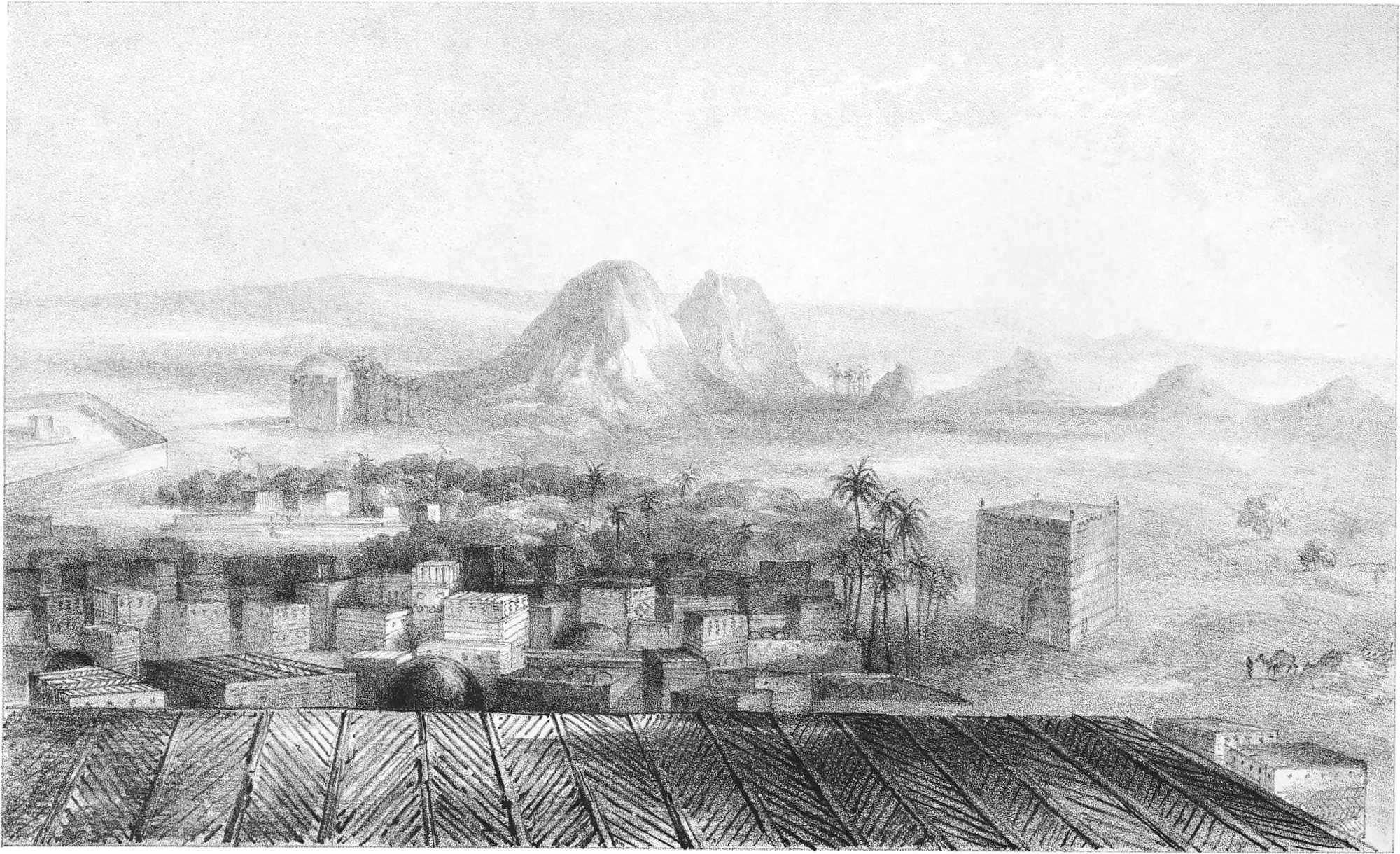

 oo
8999 ξχρσγ