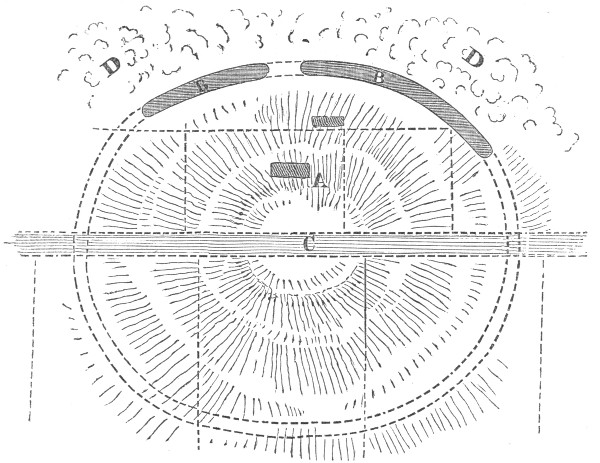
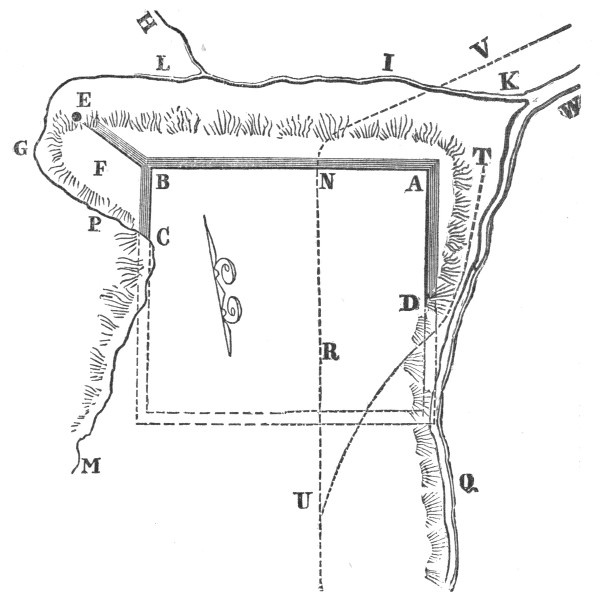
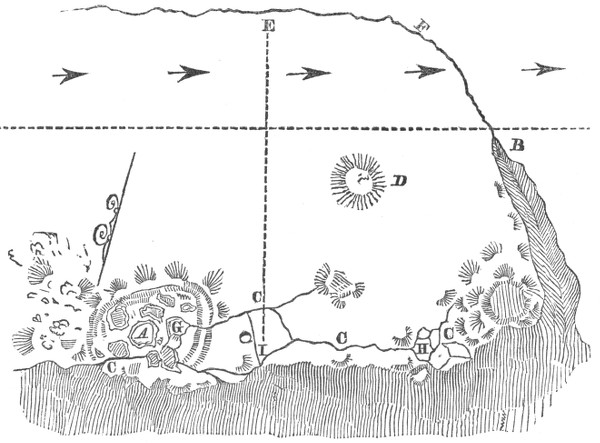
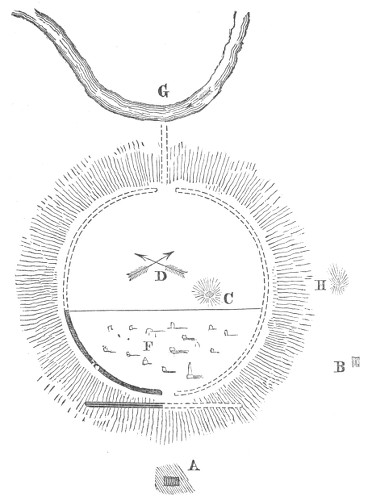
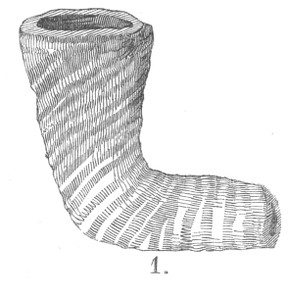
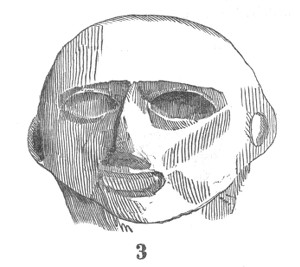
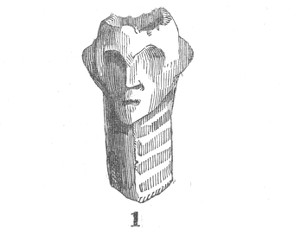
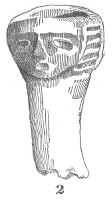
Localities to be examined, namely:
| 1. |
Pompey, Onondaga. |
|
Vestiges of a town, 500 acres. |
|
Three circular walls, or elliptical forts, 8 miles apart. |
|
These formed a triangle, enclosing the town. |
| 2. |
Camillus, Onondaga. |
|
Two forts. |
|
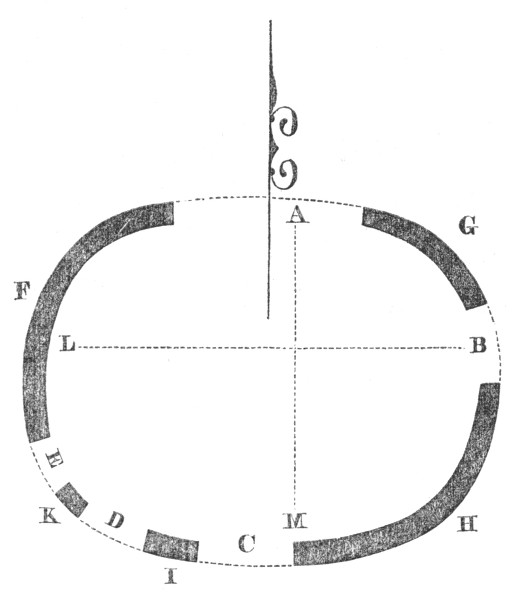
One 3 acres on a high hill. |
|
East, a gate, west, spring 10 rods off. |
|
Shape elliptical. |
|
Ditch deep. |
|
Wall 10 feet high. |
|
Second fort, half a mile distant. |
|
Lower ground. |
|
Constructed like the other. |
|
About half as large. |
|
Shells, testaceous animals—plenty. |
|
Fragments, pottery. |
|
Pieces of brick. |
|
“Other signs” of ancient settlement, found by first settlers.
[Clinton.] |
| 3.1 |
East bank of Seneca River. |
|
Six miles south of Cross and Salt lakes. |
|
Forty miles south of Oswego. |
|
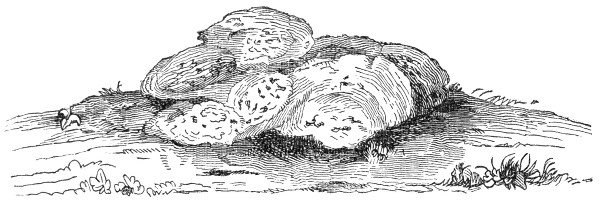
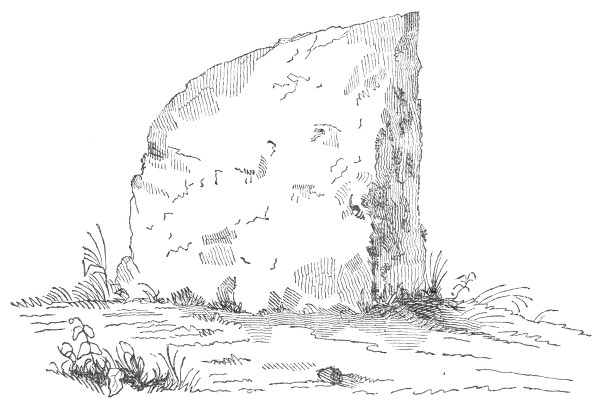
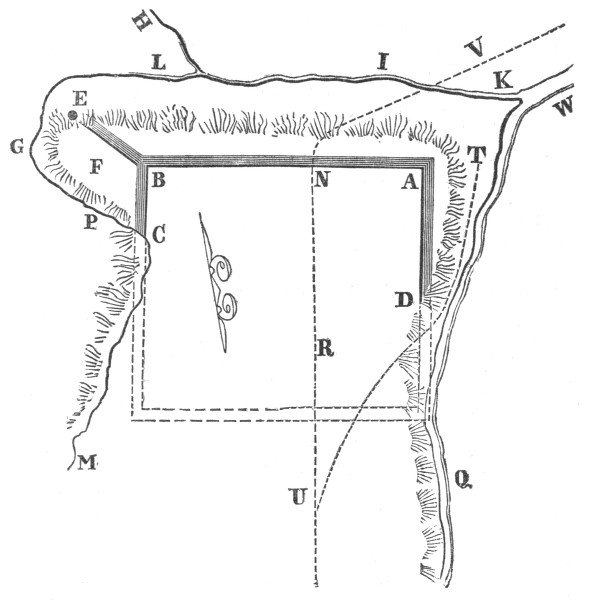
Discovered 1791, New-York Magazine, 1792 with picture writing, on a stone 5 feet by 3½, and 6 inches thick, evidently sepulchral. |
|
Two hundred and twenty yards length. |
|
Fifty-five yards breadth. |
|
Bank and ditch entire. |
|
Two apertures middle of parallelogram, one towards the water, other land. |
|
Second work, half a mile south. |
|
Half-moon. |
|
Outwork. |
|
Singularity, extremities of the crescent from larger fort. |
|
Bank and ditch of both, large old trees. |
|
Pottery well burned, red, indented. |
|
East, these works traced 18 miles east of Manlius square. |
| 4.1 |
Oxford, Chenango county. |
|
East banks Chenango river. |
|
Great antiquity. |
|
North to Sandy creek, 14 miles from Sacketts Harbor, near one which covers 50 acres. |
|
Fragments of pottery. |
|
West in great numbers. |
| 5. |
Onondaga Town. |
| 6. |
Scipio. |
| 7. |
Auburn, two forts. |
| 8. |
Canandaigua, three forts. |
| 9. |
Between Seneca and Cayuga lakes—several. |
| 10. |
Ridgeway, Genesee: |
|
Several forts and places of burial. |
| 11. |
Allen’s Residence, 1788. |
|
Two miles west. |
|
A flat. |
|
Deserted Indian village. |
|
Junction of Allen’s creek with Genesee. |
|
Eight miles north of Kanawageas. |
|
Five miles north of Magic Spring. |
|
Six acres. |
|
Six gates. |
|
Ditch eight feet wide. |
|
Six feet deep. |
|
Circular on three sides. |
|
Fourth side, a high bank. |
|
A covered way, near two hundred years old. |
|
Second, half a mile south, on a greater eminence. |
|
Less dimensions. |
|
But deeper ditch. |
|
More lofty and commanding. |
| 12. |
Joaika: |
|
Twenty-six miles west of Kanawageas. |
|
Six miles further. |
|
Tegatainedaghgwe, or double-fortified town. |
|
A fort at each end. |
|
First about four acres. |
|
Two miles distant another. |
|
Eight acres. |
|
Ditch about first five or six feet deep. |
|
Small stream one side. |
|
Traces of six gates. |
|
Dug way to the water. |
|
Large oaks two hundred years old or more. |
|
Remains of a funeral pile—bones. |
|
Mound six feet by twenty—thirty diameter—(sixty to ninety.) |
| 13. |
Path To Buffalo Creek: |
|
Heights—fortified. |
| 14. |
West of Tonawanda: |
|
Still another. |
| 15. |
On Branch of the Delaware: |
|
A fort one thousand years old, by trees. |
| 16. |
South side of Erie: |
|
Cattaraugus creek to Pennsylvania line, fifty miles. |
|
Two to four miles apart—some half a mile. |
|
Some contain five acres. |
|
Wall and breast-works of earth. |
|
Appearance of ancient beds of creeks. |
|
[Note the geological change.] |
|
Lake Erie retired from two to five miles. |
| 17. |
Further South: |
|
A chain of parallel forts. |
|
Two table grounds. |
|
Recession of lake. |
All these vestiges denote long periods of time, and probably different
eras of occupation. Who preceded the Iroquois? Who preceded
their predecessors? Do these vestiges tell the story? How
shall we study them? By antiquities; by language; by comparison
with other races of America, Asia, Africa, Europe.
Albany, July 5th.—Examine the site of ancient Mohawk residence
in 1609, on the island and its vicinity at the mouth of Norman’s
Kill. Look for their ancient burial places. Bones, pieces of pottery,
and other objects of art may tell something bearing on their history.
Is the Oasis opposite the turnpike gate, the site of their ancient
burial-ground? Is this the spot denoted by their name of Tawasentha,
or is it to be sought in other places, at the mouth, or up the valley
of this stream?
Utica.—The Mohawk valley appears to have no monumental, or
other evidences of its having been occupied by races prior to the
Mohawks.
Vernon.—Who were the original race that first set foot in Oneida
county? When did the Oneidas come? Where did they originate,
and how? They are said to be the youngest of the Six Nations.
L. Hitchcock Esq. says that he was present, when a boy, some
forty years ago, when the last executions for witchcraft among the
Oneidas took place. The suspected persons were two females. The
executioner was Hon Yost. They were dispatched unawares, by the
tomahawk.
Sachan, a strong wind, or tempest, was the Oneida name for Col.
L. S.
The principal tributary to the Oneida creek which traverses this
rich grazing town, is called after the noted chief, (to adopt the common
pronunciation,) Scanado. It means a deer. The old orthography,
for this word is Skenandoah.
Mr. Tracy, of Utica, whose authority on this point is good, gives
Tegesoken, as the Indian name of Fish creek. It means, between the
months.
Cowassalon creek, i. e., bushes hanging over the water.
Canastota. One pitch pine tree.
Aontagillon. Brook of the pointed rock.
Kunyonskota. White creek (on Dean’s patent.)
Kanaghtarageara. Place of washing the penis. This is a dark
ravine. This word appears to be Mohawk.
Sa-da-quoit. Smooth pebbles in the bed of the stream—creek at
New-Hartford. All these are in Oneida county.
Ot, Judge J. says, means water in the Oneida tongue.
Otsego, he adds, is from Ot, water, and Sago, hail, welcome, how
d’ye do? This I don’t believe. It is not in accordance with the
Indian principles of combination.
| The Oneidas call |
a man, Lon gwee. |
| “ |
a woman, Yon gwee. |
| “ |
God, Lonee. |
| “ |
Evil Spirit, Kluneolux. |
Some of their words are very musical, as Ostia, a bone; ahta, a
shoe; kiowilla, an arrow; awiali, a heart; loainil, a supreme ruler.
The French priests, who filled the orthography of this language
with the letter R, committed one of the greatest blunders. There is
no sound of R, in the language; by this letter, they constantly represent
the sound of L.
Oneida Castle, July.
In a conference with Abraham Denne, an aged Oneida, he stated
that Brandt was brought up by his (Denne’s) grandfather, at Canajoharie;
that he was a bastard, his mother Mohawk, and did not come
of a line of chiefs. Says, that Scanado was a Tory in the war, notwithstanding
his high name; that he acted against us at the siege of
Fort Stanwix. The anecdote of an Indian firing from a tree, he
places, while they were repairing the fort; says that after the man
got up, he drew up loaded rifles with a cord; that both Scanado and
Brant were present.
Says Scanado was adopted by the nation, when quite young; came
from the west; does not know of what tribe, but showed himself
smart, and rose to the chieftaincy by his bravery and conduct. Says,
that the (syenite) stone on the hill, is the true Oneida stone, and not
the white stone at the spring; was so pronounced by Moses Schuyler,
son of Hon Yost, who knew it forty years ago; that the elevation
gave a view of the whole valley, so that they could descry their enemies
at a distance by the smoke of their fires; no smoke, he said,
without fire. They could notify also, from this elevation, by a beacon
fire. The name of the stone is O-ne-a-ta; auk, added, renders
it personal, and means an Oneida. The word Oneida is an English
corruption of the Indian.
Abraham Schuyler, an Oneida, says that the Oneidas originated in
two men, who separated themselves from the Onondagas. They first
dwelt at the outlet of Oneida lake. Next removed to the outlet of
Oneida creek, on the lake, where they fortified. Williams says he
was born there, and is well acquainted with the old fort. They then
went to the head of the valley at the Oneida stone, from which they
were named. Their fourth remove was to the present site of Oneida
Castle, called a skull on a pole, where they lived at the time of the
discovery of the country and settlement of the colony by the Dutch,
(i. e. 1609 to ’14.)
Site of the Oneida Stone, Stockbridge.
Asked several Oneidas to pronounce the name for the Oneida
stone. They gave it as follows:
O-ni-o-ta-aug.
O-ne-u-ta-aug.
O-ne-yo-ta-aug.
The terminal syllable, aug, seems to be a local particle, but carries
also with its antecedent ta, the idea of life or existence, people or
inhabitants.
Onia is a stone. The meaning clearly is, People of the (or who
have sprung from the) Place of the Stone.
Adirondack, Jourdain, pronounces Lod-a-lon-dak, putting l’s for r’s
and a’s. It means a people who eat trees—an expression ironically
used for those who eat bark of trees.
For Cherokees, he gives We-au-dah.
For Delawares, Lu-na-to-gun.
What a mass of fog philologists are fighting with, who mistake,
as the eminent Vater and Adelung have, in some cases done, the different
names of the same tribes of American Indians for different
tribes.
Counted one hundred cortical layers in a black walnut—centre
broke so as to prevent counting the whole number, but by measuring
estimated one hundred and forty more. If so, the field was deserted
in 1605.
The present proprietor of the farm comprising the Oneida stone,
spring, butternut grove, &c. is Job Francis. He first hired the land
of Hendrick’s widow; afterwards he and Gregg were confirmed by
the State.
The white stone at the spring, a carbonate of lime, is not the true
Oneida stone.
The Oneida stone is a syenite—a boulder.
Abraham Le Fort says, that Ondiaka was the great chronicler of
his tribe. He had often heard him speak of the traditions of his
father. On his last journey to Oneida he accompanied him. As
they passed south by Jamesville and Pompey, Ondiaka told him that in
ancient times, and before they fixed down at Onondaga, they lived at
these spots. That it was before the Five Nations had confederated;
but while they kept up a separate existence, and fought with each
other. They kept fighting and moving their villages often. This
reduced their numbers, and kept them poor and in fear. When they
had experienced much sickness in a place, they thought it best to quit
it and seek some new spot where it was hoped they should have better
luck. At length they confederated, and then the fortifications were
no longer necessary, and fell into disuse. This is the origin, he believes,
of these old works, which are not of foreign origin.
Ondiaka told Le Fort that the Onondagas were created by Ha-wä-ne-o,
in the country where they lived. That he made this entire
“island” Ha-who-nao, for the red race, and meant it for them alone.
He did not allude to, or acknowledge any migrations from foreign
lands.
Their plan, after the confederation was to adopt prisoners and
captives, that fragments of tribes who were parted amongst
them and thus lost. They used the term We-hait-wa-tsha,
in a figurative sense, in relation to such tribes. This term
means a body cut and quartered and scattered around. So they
aimed to scatter their prisoners among the other nations. There is
still blood of the Cherokees in Onondaga. A boy of this nation
became a chief among the Cherokees.
I called Le Fort’s attention to the residence of the Moravian missionary,
Zœisberger. He said there was no tradition of such residence—that
the oldest men remembered no such mission; that they were ever
strongly opposed to all missionaries after the expulsion of the Jesuits,
and he felt confident no such person, or any person in the character
of a preacher, had lived at Onondaga Castle; that there must be
some mistake in the matter.
Ondiaka told Le Fort that the Onondagas formerly wandered
about, without being long fixed at a place, frequently changing their
villages from slight causes, such as sickness, &c. They were at war
with the other Iroquois bands. They were also at war with other
tribes. Hence forts were necessary, but after they confederated, such
defensive works fell into disuse. They lived in the present areas of
De Witt, Lafayette, Pompey and Manlius, along Butternut creek, &c.
Here the French visited them, and built a fort, after their confederation.
Ephraim Webster stated that the Indians were never as numerous
as appearances led men to think. This appearance of a heavy population
happened from their frequent removals, leaving their old villages,
which soon assumed the appearance of ancient populous settlements.
He told Jas. Gould, that being once on a visit to Canada, he became
acquainted with a very aged Indian, who, one day, beginning to talk
of the Onondaga country, told him that he was born near the old
church, near Jamesville, where there was a very populous village.
One evening, he said, he stepped out of his lodge, and immediately
sank in the earth, and found himself in a large room, surrounded by
three hundred witches and wizzards. Next morning he went to the
council, and told the chiefs of this extraordinary fact. They asked
him whether he could not identify them. He said he could. They
then accompanied him on a visit to all the lodges, when he pointed
out this and that one, who were immediately killed. Before this inquiry
ended, and the delusion was stayed, he says that three hundred
persons were killed.
Nothing is more distinct or better settled in the existing traditions of
the Iroquois, than their wars with the Cherokees. I found this alluded
to at Oneida, Onondaga, &c., in the course of their traditions, but
have not been able to trace a cause for the war. They seemed to
have been deeply and mutually exasperated by perfidy and horrid
treachery in the course of these wars, such as the breaking of a peace
pledge, and murder of deputies, &c. Their great object was, as
soon as young men grew up, to go war against the Cherokees. This
long journey was performed without provisions, or any other preparation
than bows, clubs, spears and arrows. They relied on the
forest for food. Thousands of miles were not sufficient to dampen
their ardor, and no time could blot out their hatred. The Oneidas
call them We au dah.
Jeremiah Gould went with me to view the twin mounds. They
exhibit numerous pits or holes, which made me at once think of the
Assenjigun, or hiding pit of the western Indians. Gould, in answer
to my inquiry, said that it was a tradition which he did not know how
much value it was worth, that the Tuscaroras were brought from the
south by the Oneidas, and first settled in this county. They warred
against the Onondagas. The latter, to save their corn, buried it in
these mounds or hills, then hid by the forest. In one of these excavations,
dug into forty years ago, they found a human skull and other
bones belonging to the human frame.
James Gould went with me over the stream (Butternut) to show
me a mound. It is apparently of geological formation, and not artificial.
Its sides were covered with large trees, the stumps of which
remain. There was a level space at the top, some four or five paces
in diameter, trees and bushes around. The apex, as paced, measures
one way 17, the other 12 paces; is elongated. It seemed to have
been the site of the prophet’s lodge. Near it is the old burying
ground, on an elongated ridge, where the graves were ranged in lines.
Pottery.—Webster gives the Indian tradition of this ancient art
thus. The women made the kettles. They took clay and tempered
it with some siliceous or coarse stone. This they first burnt thoroughly,
so as to make it friable, (probably they plunged it while hot
into water,) and then pounded it, and mixed it with blood.
Charred corn, &c.—In Ellisburgh is found much charred corn beneath
the soil, and numerous remains of occupancy by the natives.
Is this the evidence of Col. Van Schaack’s expedition into the Onondaga
country during the revolutionary war? His battle with the
Indians, tradition here says, took place near Syracuse. Bones, supposed
to be of this era, were discovered, in ditching the swamp near
Cortland House.
Mr. I. Keeler says that he cut a large oak tree, near the site of the
old fort, two and a half feet through. In re-cutting it, at his door,
a bullet was found, covered by 143 cortical layers. It was still some
distance to the centre. If this tree was cut in 1810, the bullet was
fired in 1667. Consult “Paris Documents,” 1666, treaty with the
Onondaga Iroquois.
The Goulds say that the fort was a square, with bastions, and had
streets within it. It was set round with cedar pickets, which had
been burnt down to the ground. Stumps of them were found by the
plough.
Nearly every article belonging to the iron tools of a blacksmith
shop have been ploughed up at various times—an anvil, horn, vice
screw, &c.; Indian axes, a horse shoe, hinges, the strap hinge. A
pair of these hangs the wicket gate to his house.
A radius of five to six miles around the old fort would cover all
the striking remains of ancient occupancy in the towns of De Witt,
Lafayette and Pompey.
Webster told the Goulds that the French who occupied this fort,
and had the nucleus of a colony around it, excited the jealousy and
ire of the Onondagas by the hostility of some western tribes in their
influence. Against these the Onondaga warriors marched. The
French then attacked the red men, &c. This led to their expulsion
and massacre. All were killed but a priest who lived between the
present towns of Salina and Liverpool. He refused to quit peaceably.
They then put a chain around a ploughshare, and heating it, hung it
about his neck; he was thus, with the symbol of agriculture, tortured
to death. His hut was standing when the county was settled.
The attempt to settle western New-York by the French was in the
age of chivalry, (the 16th century,) and was truly Quixotic.
Pompey and its precincts were regarded by the Indians as the
ground of blood, and it brought up to their minds many dark reminiscences,
as they passed it. Some twenty years ago, there lived an
aged Onondaga, who said that many moons before his father’s days,
there came a party of white men from the east in search of silver.
From the heights of the Onondaga hills, they descried the white foam
of Onondaga lake, and this was all the semblance they ever found of silver.
One of the men died, and was buried on Pompey hill, and his grave
was marked by a stone.109 The others built a fort on the noted ground,
about a mile east of Jamesville, where they cultivated the land; but at
length the Indians came in the night, and put them all to death. But
there was a fearful and bloody strife, in which the Indians fell like
leaves before the autumn wind. This spot is the field of blood.
L. Birdseye.
Aurora: August. See Rev. Mr. Mattoon.
Vestiges of the Cayugas—villages—orchards—old forts. Get a
vocabulary of their language from Canada. Get diagram of forts.
Karistagea, or Steeltrap, thought to have been unfairly dealt with
at his death. Buried in the road.
Fish Carrier’s Reserve at the bridge. Four miles square.
Red Jacket born on the opposite banks of the lake at Canoga.
Historical reminiscences of Mr. Burnham. Letter stating the first
settlements on the Military Tract at Aurora.
Address before the G. O. I. Folly of keeping the society secret.
Horticultural meeting. Dr. Thompson. Mr. Thomas.
Anniversary of Academy. Salem Town.
Intelligence, moral tone, hospitality of the place.
Cars at Cayuga bridge.
Logan was the son of a Cayuga.
Did the Cayugas conquer the Tutelos of Virginia, and adopt the
remnant?
Cayugas scattered among the Senecas, in Canada and west of the
Mississippi. How many left? What annuities.
Geneva: Ancient site of the Senecas. Origin of the word Seneca.
Is it Indian or not Indian?
Examine old forts said to exist in this area. Are there any vestiges
of Indian occupancy at the “Old Castle”—at Cashong—Painted-Post—Catherinestown—Appletown?
Canandaigua: In visiting Fort-hill on the lake, see what vestiges.
Another site bearing this name, exists to the north of Blossom’s.
What antiquities? What traditions? Ask old residents. Enquire
of Senecas west.
Rochester: Nothing left here of the footprints of the race—all
covered deep and high with brick and stone. Whole valley of the
Genesee worthy examination, in all its length and branches. Wants
the means of an antiquarian society to do this.
Truly the Iroquois have had visited upon them the fate with which
they visited others. They destroyed and scattered, and have, in turn,
been destroyed and scattered. But their crime was the least. They
destroyed as heathens, but we as Christians. In any view, the antiquarian
interest is the same—the moral interest, the same.
The Iroquois had noble hearts. They sighed for fame. They took
hold of the tomahawk as the only mode of distinction. They brought
up their young men to the war dance. They carefully taught them
the arts of war. We have other avenues to distinction. Let us now
direct their manly energies to other channels. The hand that drew a
bow, can be taught to guide a plough. Civilization has a thousand
attractions. The hunter state had but one. The same skill once
devoted to war would enable them to shine in the arts of peace.
Why can not their bright men be made sachems of the pen, of
the press, of the pulpit, of the lyre?
Batavia, July.—There are still traces of a mound on Knowlton’s
farm, a mile from Batavia, up the Tonewanda. Bones and glass
beads, have been ploughed out of it. Other traces of former aboriginal
occupancy exist in the vicinity, a stone pestle, axes, &c. having
been found.
The Indian name of Batavia is Ge-ne-un-dah-sais-ka, meaning
musquito. This was the name by which they knew the late Mr.
Ellicott.
The Tonewanda falls 40 feet at a single place, within the Indian
reservation. It heads on high ground about 40 miles above Batavia.
On the theory of the former elevation of lake Erie, Buffalo itself
would be the highest ground, between Batavia and the lake, in a direct
line. Attica, is perhaps more elevated in that direction.
The Senecas call themselves Nun-do-waw-gaw, or people of the
hill. The term Seneca is taken from the lake, on the banks of which
they formerly lived, and had their castle. It is not a name of Indian
origin. They are called Nun-do-waw-gaw, from the eminence
called Fort-Hill, near Canandaguia lake. [Ho-ho-ee-yuh, or J. A.
Sanford.]
They call the Cherokees O-yau-dah, which means a people who
live in caves. Their enmity against this people, the tradition of which
is so strong and clear, is stated to have originated from the contact
of war and hunting parties, in the plains of the southwest.
The Senecas affirm that the Cherokees robbed and plundered a
Seneca party and took away their skins. Retaliation ensued.
Tragic scenes of treachery and surprise followed. The Five
Nations took up the matter in all their strength, and raised large
and strong war parties, who marched through the country to the
Cherokee borders, and fought and plundered the villages, and brought
away scalps and prisoners. There are now, (1845) descendants of
Cherokees in the third degree, living on the Tonewanda reservation.
[Ho-ho-ee-yuh.] Some years ago, a chief of this blood, pure by
father and mother, lived among them, who had been carried off captive
when a boy. The fact being revealed to him, after he had
obtained the chieftaincy, he went south to seek his relations and live
and die among them, but he was unable to find them. He came back
to the Senecas, and died among them. [Le Fort.]
The most curious trait, of which we know but little, is that respecting
Totems.
Asked the chief called Blacksmith, his name in Seneca. He replied,
De-o-ne-hoh-gah-wah, that is, a door perforated, or violently
broken through, not opened. Says he was born on the Tonewonda
reservation, and wishes to die there; will be 60 years old, if he lives
till next winter, 1846.
Says the Senecas call the Fort Stanwix or Rome summit, De-o-wain-sta,
meaning the place where canoes are carried across the land
from stream to stream; that is, a carrying place.
Says, Te-to-yoah, or Wm. Jones of Cattaraugus, can relate valuable
Seneca traditions.
He says there are eight Seneca clans; they are the Wolf, Bear,
Turtle, Deer, Plover, Beaver, Hawk and Crane. He is of the Wolf clan.
This was also Red Jacket’s clan.
These clans may be supposed to have arisen from persons who had
greatly distinguished themselves at an early period as founders, or benefactors,
or they may have held some such relation to the original
nation, as the Curiatii and Horatii, in Roman history. It is not only
the Iroquois, who ascribed this honor to the clans of the Bear, the
Turtle and the Wolf. They are equally honored among most of the
Algonquin tribes.
In the town of Cambria, six miles west of Lockport, (1824,) a Mr.
Hammon, who was employed with his boy in hoeing corn, observed
some bones of a child, exhumed. No farther thought was bestowed
upon the subject for some time, for the plain on the ridge was supposed
to have been the site of an Indian village, and this was supposed
the remains of some child, who had been buried there. Eli Bruce,
hearing of the circumstance, proposed to Mr. H. that they should repair
to the spot, with suitable instruments, and endeavor to find some
relics. The soil was a light loam, which would be dry and preserve
bones for centuries without decay. A search enabled them to come
to a pit, but a slight distance from the surface. The top of the pit
was covered with small slabs of the Medina sandstone, and was
twenty-four feet square, by four and a half in depth—the planes
agreeing with the four cardinal points. It was filled with human
bones of both sexes and all ages. They dug down at one extremity
and found the same layers to extend to the bottom, which was the
same dry loam, and from their calculations, they deduced that at
least four thousand souls had perished in one great massacre. In one
skull, two flint arrow heads were found, and many had the appearance
of having been fractured and cleft open, by a sudden blow.
They were piled in regular layers, but with no regard to size or sex.
Pieces of pottery were picked up in the pit, and had also been
ploughed up in the field adjacent. Traces of a log council house
were plainly discernable. For, in an oblong square, the soil was
poor, as if it had never been cultivated, till the whites broke it up;
and where the logs of the house had decayed, was a strip of rich
mould. A maple tree, over the pit, being cut down, two hundred
and fifty concentric circles were counted, making the mound to be
anterior to as many years. It has been supposed by the villagers that
the bones were deposited there before the discovery of America, but
the finding of some metal tools with a French stamp, places the date
within our period. One hundred and fifty persons a day visited this
spot the first season, and carried off the bones. They are now nearly
all gone, and the pit ploughed over. Will any antiquarian inform us,
if possible, why these bones were placed here? To what tribe do
they belong? When did such a massacre occur?
None of the bones of the men were below middle size, but some
of them were very large. The teeth were in a perfectly sound state.
1. Rent of land from twelve shillings to three dollars per acre.
2. Sale of timber, fire wood, hemlock bark, staves, saw-logs.
3. Fishing and hunting. Very little now.
4. Raise corn, cattle, horses, hogs, some wheat, &c. &c., cut hay.
Young men hire themselves out in harvest time.
At Barnegat is an ancient ridge, or narrow raised path, leading
from the river some miles, through low grounds; it is an ancient burial
ground, on an island, in a swamp.
Bones of the human frame, bone needles, and other ancient remains,
are ploughed up at an ancient station, fort or line, in Shelby.
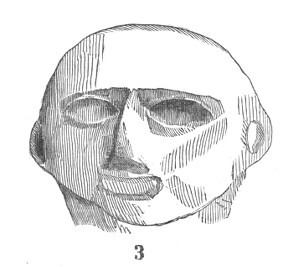
A human head, petrified, was ploughed up by Carrington, sen.,
in a field in Alabama, Genesee county, and is now in the possession
of Mr. Grant, at Barnegat.
Petrified tortoises are said to be ploughed up in many places.
De-o-ne-ho-ga-wa is the most influential chief of the Tonewandas.
He is of the Wolf tribe—born on the forks of the Tonewanda, and is
59 years old. Being interrogated as to the Seneca history, he says,
that the tradition of the tribe is clear—that they lived on the banks
of the Seneca and Canandaigua lakes. They were called Nun-do-wau-onuh,
or People of the Hill, from an eminence now called Fort
Hill, at the head of Canandaigua lake. They are now called, or,
rather, call themselves, Nun-do-wau-gau. The inflection onuh, in
former times, denoted residence, at a hill; the particle agau, in the
latter, is a more enlarged term for locality, corresponding to their
present dispersed condition.
The word Seneca, he affirms, is not of Indian origin. While they
lived in Ontario, there was a white man called Seneca, who lived on
the banks of the lake of that name. Who he was, where he came
from, and to what nation he belonged, he does not know. But
wherever he originated, he was noted for his bravery, wisdom and
strength. He became so proverbial for these noble qualities, that it
was usual to say of such, and such a one, among themselves, he is
as brave as Seneca, as wise as Seneca, as noble as Seneca. Whether
the lake was called after him, or he took his name from the lake, is
not known. But the name itself is of European origin. The tribe
were eventually called Senecas from their local residence. The idea,
he says, was pleasing to them, for they thought themselves the most
brave and indomitable of men. Of all the races of the Ongwe-Hon-we,
they esteemed themselves the most superior in courage, endurance
and enterprize.
He refers to Te-to-yoah of Cattaraugus for further information.
On reference to Te-to-yoah, some time afterwards, he had no tradition
on this particular subject. The probability is, that Blacksmith
meant only to say, that the name was not Seneca. So far is
true. What he says of a great man living on Seneca lake, &c., in
older times, is probably a reproduction, in his mind, of an account of
Seneca, the moralist, which has been told him, or some Indian from
whom he had it, in days by-gone.
As the name of Seneca is one of the earliest we hear, after 1609,
it was probably a Mohawk term for that people. It is spelt with a
k in old French authors.
The Tuscarora clans are the following:
The Turtle.
The Wolf.
The Bear.
The Beaver.
The Snipe, or Plover.
The Eel. This is not an Iroquois totem.
The Land Tortoise.
They have lost the Falcon, Deer and Crane, perhaps in their disastrous
wars of 1713. By this it appears they have lost one clan
entirely—probably in their defeat on the Taw river, in N. Carolina.
Two others of the clans are changed, namely, the Falcon and Deer,
for which they have substituted the Land Tortoise and Eel.
Descent is by the chief’s mother and her clan, her daughter or
nearest kin, to be settled in council. The adoption of chiefs was
allowed, where there was failure of descent.
Curious barrow, or mound, on Dr. Scovill’s place—to be examined.
Two others, near the old mill and orchard.
Old fort of Kienuka, to be visited.
Get vocabulary of Tuscarora, to compare.
This tribe has gone through a severe ordeal, their history is full of
incident. The following list shews their number in North Carolina,
and all other Indians of that colony in 1708.
| Tuscaroras, living in 15 towns, |
1,200 |
men. |
| Waccons, in 2 towns, |
120 |
|
| Maramiskeets, |
30 |
|
| Bear Rivers, |
50 |
|
| Hatteras, |
16 |
|
| Neuse, in 2 towns, |
15 |
|
| Pamlico, |
15 |
|
| Meherrin, |
50 |
|
| Chowan, |
15 |
|
| Paspatank, |
10 |
|
| Poteskeets of Carrituk, |
30 |
|
| Nottoways, |
30 |
|
| Connamox, in 2 towns, |
25 |
|
| Jaupim, |
2 |
|
|
1,608 |
|
Visited James Cusick, the brother of David, the Indian archæologist,
preacher to the Tusks, pictures in the house, old deeds from
Carolina.
Sunday. Attended Mr. Rockwood’s meeting, admirable behavior
of all, dress well, good singing. W. Chew interprets.
Females, however, adhere to their ancient costume.
Women more pertinacious in their social habits and customs than
men.
Tuscaroras raise much wheat, cattle, horses, quite in advance of
the other tribes in agriculture.
They own the fee simple of about 5,000 acres, besides their reservation,
which they purchased from the Holland Company.
This name is Mohawk. It means, according to Mrs. Kerr, the
Neck, the term being first applied to the portage, or neck of land,
between lakes Erie and Ontario.
Whence this name? The Indian term is Te-ho-so-ro-ro in Mohawk,
and De-o-se-o-wa in Seneca. Ellicott writes it Tu-she-way.
Others, in other forms. In all, it is admitted to mean the place of the
linden, or bass-wood tree.
There is an old story of buffaloes being killed here. Some say a
horse was killed by hungry Frenchmen, and palmed off for buffalo
meat at the camp. How came a horse here?
A curious bone needle was dug up this year, in some excavations
made in Fort Niagara, which is, clearly, of the age prior to the discovery.
Bones and relics must stand for the chronology of American antiquity.
America is the tomb of the red man. All the interest of its anti-Columbian
history, arises from this fact.
By Father Le Moyne’s letter of 1653, [vide Relacions,] the war
with the nation of the Cat or Eries was then newly broke out. He
thanks the Onondagas, Senecas, Cayugas and Oneidas, for their union
in this war.
On the 9th August, 1653, we heard a dismal shout, among the
Iroquois, caused by the news, that three of their men had been killed
by the Eries.
He condoles with the Seneca nation, on the capture of their great
chief, Au-ren-cra-os, by the Eries.
He exhorts them to strengthen their “defences” or forts, to paint
their warriors for battle, to be united in council.
He required them never to lay in ambush for the Algonquin or
Huron nations, who might be on their way to visit the French.
We learn, from this, that the Eries or Cat nation, were not of the
Wyandot or Huron, nor of the Algonquin nations. It would seem
that these Eries were not friends of the French, and that by exciting
them to this new war, they were shielding their friends, the Algons
and Hurons, from the Iroquois club and scalping knife. That
they were the same people called the “Neuter Nation,” who occupied
the banks of the Niagara, there is but little reason to believe. The
Senecas called them Gawgwa or Kah-Kwah.
Cusick states that the Senecas fought against a people, west of the
Genesee river, called Squakihaw, i. e. Kah-Kwah, whom they beat,
and after a long siege took their principal fort, and put their chief to
death. Those who recovered were made vassals and adopted into
the tribe.
He states that the banks of the Niagara river were possessed by
the Twa-kenkahor, or Missasages, who, in time, gave it up to the
Iroquois peaceably. Were not these latter the Neuter Nation?
To discuss the question of the war with the Eries, it is necessary
to advert to the geographical position of the parties. The Senecas,
in 1653, as appears by French authorities, lived in the area between
the Seneca lake and the Genesee river. The original stock of the
Five Nations appears to have entered the area of western New-York
in its central portions; and, at all events, they extended west of the
Genesee, after the Erie war, and possessed the land conquered from
the latter.
Seventy-four Seneca chiefs attended the general council held here.
Putting their gross population at 2,500, this gives one chief to every
thirty-three souls. This makes them “captains of tens.”
The Seneca language has been somewhat cultivated. Mr. Wright,
the missionary, who has mastered the language, has printed a spelling
book of 112 pages, also a periodical tract for reading, called the
“Mental Elevator.” Both valuable philological data.
The Senecas of this reservation are on the move for Cattaraugus
and Alleghany, having sold out, finally, to the Ogden company.
They leave their old homes and cemetery, however, with “longing,
lingering looks.”
Here lie the bones of Red Jacket and Mary Jemison.
Curious and interesting reminiscences the Senecas have. Jot down
their traditions of all sorts. Can’t separate fiction from fact. They
must go together; for often, if the fiction or allegory be pulled up,
the fact has no roots to sustain itself.
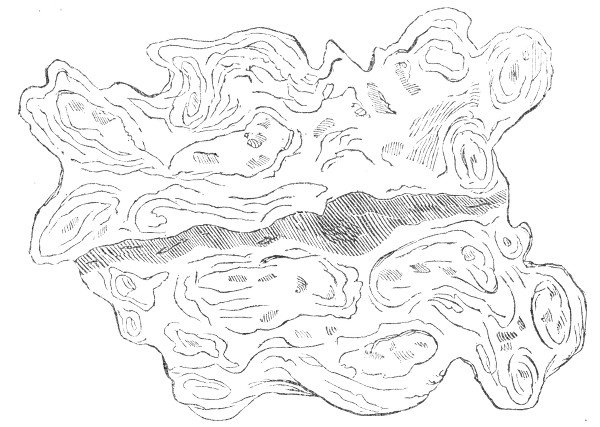
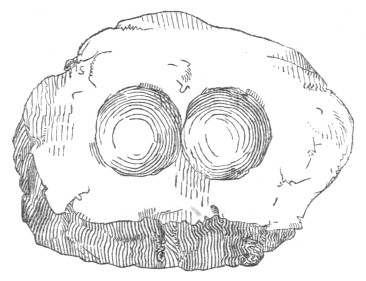
Mr. Wright showed me an ancient triturating stone of the Indians,
in the circular depressions of which they reduced the siliceous material
of their ancient pottery.
The Seneca language has a masculine, feminine and neuter gender.
It has also an animate and inanimate gender, making five genders.
It has a general and dual plural.
It abounds in compound descriptive and derivative terms, like the
Algonquin.
They count by the decimal mode. There are names for the digits
to ten. Twenty is a compound of two and ten, and thirty of three and
ten, &c.
The comparison of adjectives is effected by prefixes, not by inflections,
or by changes of the words, as in English.
Nouns have adjective inflections as in the Algonquin. Thus o-a-deh
is a road, o-a-i-yu a good road. The inflection, in this last word,
is from wi-yu, good.
It is a maxim with the Iroquois, that a chief’s skin should be thicker
than that of the thorn locust, that it may not be penetrated by the
thorns.
Indian speakers never impugn each other’s motives when speaking
in public council. In this, they offer an example.
Mr. Strong says, Silversmith of Onondaga, has the tradition of the
war with the Eries.
It is observed by a report of the Canadian Parliament, that the
number of Indians now in Canada is 12,000. Of these, 3,301 are
residing in Lower Canada, and the remainder 8,862, in Canada West.
The number of Indians is stated to be on the increase, partly from the
access of births over the deaths, and partly from a numerous immigration
of tribes from the United States. This report must be taken
with allowances. It is, at best, but an estimate, and in this respect,
the Canadians, like ourselves, are apt to over estimate.
The Indian is a man who has certainly some fine points of character;
one would think a man of genius could turn him to account.
Why then are Indian tales and poems failures? They fail in exciting
deep sympathy. We do not feel that he has a heart.
The Indian must be humanized before he can be loved. This is
the defect in the attempts of poets and novelists. They do not show
the reader that the red man has a feeling, sympathising heart, and feeling
and sympathies like his own, and consequently he is not interested
in the tale. It is a tale of a statue, cold, exact, stiff, but without life.
It is not a man with man’s ordinary loves and hopes and hates.
Hence the failure of our Yamoydens, and Ontwas, and Escatlas, and a
dozen of poems, which, although having merits, slumber in type and
sheepskin, on the bookseller’s shelf.
One seems here, as if he had suddenly been pitched into some of
the deep gorges of the Alps, surrounded with cliffs and rocks and
woods, in all imaginable wildness.
Reached the Indian village on the reservation at this place, at 9
o’clock in the morning.
Indians call the place Te-o-ni-gon-o, or De-o-ni-gon-o, which means
Cold Spring.
Locality of the farmer employed by Quakers, at the mouth of a
creek, called Tunasassa; means a clear stream with a pebbly bed.
Allegany river they call Oheo, making no difference between it,
and the stream after the inlet of the Monongahela.
Gov. Blacksnake absent; other chiefs, with his son Jacob meet in
council; business adjusted with readiness.
Allegany river low; very different in its volume of water and
appearance from what it was 27 years before, when I descended it,
on my way to the West.
Lumbering region; banks lined with shingles, boards, saw logs.
Indians act as guides and lumbermen.
Not a favorable location for the improvement of the Senecas.
Steal their timber; cheat them in bargains; sell whiskey to them.
Had the imaginative Greeks lived in Allegany county, they would
have pictured the Genesee and Allegany rivers, as two girls, who
having shaken hands, parted, the one to skip and leap and run eastward
to find the St. Lawrence, and the other to laugh through the
Ohio valley, until she gradually melted into the ocean in the gulf of
Mexico.
The counties of Cattaraugus, Chautauque and Allegany, and part of
Wyoming and Steuben, constitute a kind of Switzerland. The surface
of the country resembles a piece of rumpled calico, full of knobs and
ridges and vallies, in all possible shapes and directions. It is on the average
elevated. Innkeepers and farmers encountered on two trips over it,
say that there is considerably more moisture in the shape of rain and
dews and fogs, than in the Genesee country. It is less valuable for
wheat, but good for corn, grass, and raising stock. Nothing can be more
picturesque. The hills are often cultivated to their very tops. It is
healthy. Such a region is a treasure in a State so level and placid as
much of western New-York; and had it the means of ready access
to markets, and to the Atlantic, it would, in a few years, be spotted
with gentlemen’s seats from the seaboard. There are some remarkable
examples of the east and west, and north and south fissures of
rocks (a trait also noted at Auburn,) in these counties. At one place, the
fissures are so wide, and the blocks of rock between so large, that
the spot is sometimes called CITY OF ROCKS. The rock here is conglomerate,
i. e. the bed of the coal formation; a fact which denotes
the elevation of the country. It is to be hoped, when this country is
further subdivided into counties and towns, that some of the characteristic
and descriptive names of the aborigines will be retained.
This bright, busy, thriving place, is a curiosity from the fact, that
the Cattaraugus creek, (a river it should be called) splits in exactly,
or nearly so, in two parts, the one being in Erie, the other in Cattaraugus.
Efforts to get a new county, and a county seat, have heretofore
been made. These conflict with similar efforts, to have a county
seat located at Irving, at the mouth of the creek.
This is a fine natural harbor and port of refuge. Its neglect appears
strange, but it is to be attributed to the influence of capitalists at
Silver-Creek, Dunkirk, Barcelona, &c.
Here are vestiges of the Indians old forts, town sites, &c. Time
and scrutiny are alone necessary to bring out its antiquities.
The Chief, Capt. Cole.—The noted Onondaga Chief, Capt. Cole,
died at his residence, among his people, a few days since, aged about
seventy-five years. This Indian was well known here, having, for
many years, made his home upon the reservation adjoining the city.
He took the field, in defence of the country, during the last war,
under the late Gen. Porter, who was often heard to speak of his
bravery and usefulness, in the various battles along the Niagara
frontier.
Cole was of the “old school” of his race—a primitive, unadulterated
Indian, equally uncontaminated in mind as in habits, by intercourse
with the whites. Probity and justice were the leading features
of his character; and to direct these he had an intellect which
won for him a high control and extended influence among his tribe.
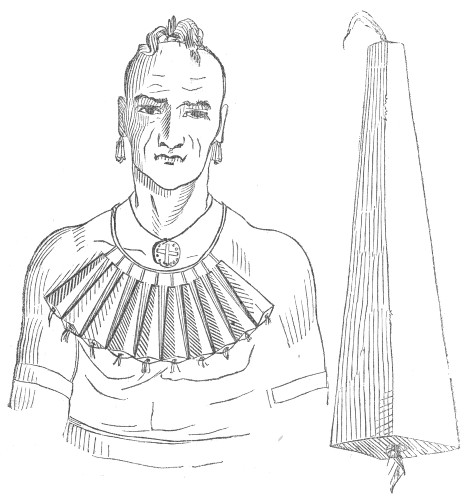
Some years since Cole was selected by our townsman, young
Wilgus, as the finest specimen he had ever met, of the race to which
he belonged; and he immediately took means to secure him as a
sitter. The result was the half length portrait of the Chief which
Wilgus executed, and which has been so often seen and admired
alike by our citizens and by strangers.
An incident connected with the history of this piece, seems appropriate
here, as illustrative of its excellence. When Wilgus left for
Porto Rico, where he now is, he took the portrait of Cole with him.
It was seen, upon that island, by a gentleman from Amsterdam, who
declared it the first piece he had seen which gave him the slightest
ideas of the peculiar characteristics of the Indian race; and he became
so interested in the picture that he asked and obtained permission
to take it with him, to Europe, for the inspection of his friends.
The piece was, by him, carried to Amsterdam, where the admiration
of it was universal, and where it would have been retained, at almost
any price, had it been for sale. But it was not: the gentleman had
promised to return the painting safe to Buffalo; and he has done so,
it having arrived here this spring; and it now stands, unostentatiously
enough, in the bookstore of the artist’s father, upon Main-street.
The Tonewandas at length consent to have their census taken.
Go with Mr. Goodwin to visit Oswaco lake—Gov. Throop’s
place—Old Dutch Church overlooking the lake, &c.
Fort-Hill.—Extensive vestiges of an elliptical work—Curious rectangular
fissures of the limestone rock on the Owasco outlet—north
and south.
The Indian name of the place, as told by an Onondaga chief—Osco;
first called Hardenburgh’s Corners, finally named after Goldsmith’s
“Deserted Village”—so that the poet may be said to have
had a hand in supplying names for a land to which he once purposed
to migrate.
It would have pleased “poor Goldsmith” could he have known
that he was the parent of the name for so fine a town—a town thriving
somewhat on the principle laid down in the concluding lines of
the poem—
“While self-dependent power can time defy,
As rocks resist the billows and the sky.”
Pity a better name could not have been found for so fine, central,
capital a site. The associations are now all wrong. What had Dionysius
or Archimedes to do here? It was Atotarho Garangula, Dekanifora,
Ontiyaka, and their kindred, who made the place famous.
Onondaga would have been a far better appellation. The Indians
called the lake and its basin of country together Gan-on-do-a. Salt
Point, or the Saline, sounded to me as if, abating syllibants, it might
be written Ka-ji-ka-do.
There was a ford in the Mohawk here. It was the site of Fort
Schuyler—a fort named after Major Schuyler, a man of note and military
prowess in the olden time, long before the days of General Philip
Schuyler. Some philological goose, writing from the Canadas, makes
Utica an Indian name!
Mr. Brayton says, that in digging the turnpike road, in ascending
Kiddenhook hill, on the road to Bethlehem, many human bones, supposed
to be Indian, were found. They were so numerous that they
were put in a box and buried. This ancient burial ground, which
I visited, was at a spot where the soil is light and sandy. On the
hill, above his house, is a level field, where arrow-heads have been
found in large numbers.
Mr. B., who has lived here sixteen years, does not know that the
isolated high ground, east of the turnpike gate, contains ancient
bones—has not examined it with that view. Says Mr. Russell, in
the neighborhood, has lived there fifty years, and will ask him.
Nothing could be more likely, than that this oasis on the low land
should have served as the cemetery for the Mohawks, who inhabited
the island, where the Dutch first landed and built a fort in 1614.
The occupancy of this island by the Indians could never have been
any thing but a summer residence, for it is subject to be inundated
every year by the breaking up of the river. This was probably the
cause why the Dutch almost immediately abandoned it, and went a
little higher, to the main land, where Albany now stands. The city,
however, such are the present signs of its wealth and progress, has
extended down quite half way to the parallel of the original site of
“Het Casteel” under Christians, and should these signs continue,
within twenty years South Pearl-street will present lines of compact
dwellings and stores to the bridge over the Tawasentha, and Kiddenhook
be adorned with country seats.
Whatever else can be done for the red race, it is yet my opinion,
that nothing would be as permanently beneficial, in their exaltation
and preservation, as their admission to the rights and immunities of
citizens.
At a council of the Six Nations of Indians, held upon the Tonawanda
Reservation, on Wednesday, Oct. 1st, there were present the
Mohawks, Onondagas and Senecas, confederate brothers on the one
part, and the Oneidas, Cayugas and Tuscaroras, brothers on the other
part.
The Masters of the grand ceremonies were Deatgahdos, Hahsant
(Onondagas) and Oahgwashah, (Cayuga.) The speakers were
Hahsauthat, (Onondaga,) Shosheowaah, (Seneca,) and Oaghwashah,
(Cayuga.)
After the grand ceremonies were performed, the following were
appointed Grand Sachems, Sachems and Chiefs.
Desha-go-gaah-neh was appointed Grand Sachem, in place of Ga-noh-gaith-da-wih,
deceased.
Ga-noh-la-dah-laoh was appointed Grand Sachem, in place of Gah-no-gaih,
deceased.
Deyawa-dah-oh was appointed Grand Sachem in place of Ganyo-daiyuh,
deposed.
The above are Seneca Indians.
Of the Onondagas—O-jih-ja-do-gah was appointed Grand Sachem
in place of Hononiwedoh, (Col. Silversmith, an Onondaga resident
among the Senecas) deposed.
So-dye-a-dolik was appointed Chief of the Onondagas, in place of
Sha-go-ga-eh, (Button George,) deposed.
Deyushahkda was appointed Sachem of the Tuscaroras, and
Ga-yah-jih-go-wa was appointed a Chief as runner for De-yus-hahkdo.—Buff.
Pilot.
W.
A grand council of the confederate Iroquois was held last week, at
the Indian Council House on the Tonawanda Reservation, in the
county of Genesee. Its proceedings occupied three days—closing
on the 3d instant. It embraced representatives from all the Six Nations—the
Mohawk, the Onondaga, the Seneca; and the Oneida, the
Cayuga and the Tuscarora. It is the only one of the kind which
has been held for a number of years, and is, probably, the last which
will ever be assembled with a full representation of all the confederate
nations.
With the expectation that the council would commence on Tuesday,
two or three of us had left Rochester so as to arrive at the Council
House Monday evening; but owing to some unsettled preliminaries,
it had been postponed till Wednesday. The Indians from
abroad, however, had arrived at the Council Grounds, or in their immediate
vicinity, on Monday; and one of the most interesting spectacles
of the occasion, was the entry of the different nations upon the
domain and hospitality of the Senecas, on whose ground the council
was to be held. The representation of Mohawks, coming as they
did, from Canada, was necessarily small. The Onondagas, with the
acting Tod-o-dah-hoh of the confederacy, and his two counsellors,
made an exceedingly creditable appearance. Nor was the array of
Tuscaroras, in point of numbers at least, deficient in attractive and
imposing features.
Monday evening we called upon and were presented to Blacksmith,
the most influential and authoritative of the Seneca sachems. He is
about 60 years old—is somewhat portly, is easy enough in his manners,
and is well disposed and even kindly towards all who convince
him that they have no sinister designs in coming among his people.
Jemmy Johnson is the Great High Priest of the confederacy.
Though now 69 years old, he is yet an erect, fine looking, and energetic
Indian, and is both hospitable and intelligent. He is in possession
of the medal presented by Washington to Red Jacket in 1792,
which, among other things of interest, he showed us.
It would be incompatible with the present purpose to describe all
the interesting men who there assembled, among whom were Capt.
Frost, Messrs. Le Fort, Hill, John Jacket, Dr. Wilson and others.
We spent most of Tuesday, and indeed much of the time during the
other days of the week in conversation with the chiefs and most intelligent
Indians of the different nations, and gleaned from them much
information of the highest interest in relation to the organization,
government and laws, religion, customs of the people, and characteristics
of the great men, of the old and once powerful confederacy.
It is a singular fact, that the peculiar government and national characteristics
of the Iroquois is a most interesting field for research and
inquiry, which has never been very thoroughly, if at all, investigated,
although the historic events which marked the proud career of
the confederacy, have been perseveringly sought and treasured up in
the writings of Stone, Schoolcraft, Hosmer, Yates and others.
Many of the Indians speak English readily; but with the aid and
interpretations of Mr. Ely S. Parker, a young Seneca of no ordinary
degree of attainment, in both scholarship and general intelligence,
and who, with Le Fort, the Onondaga, is well versed in old Iroquois
matters, we had no difficulty in conversing with any and all we
chose to.
About mid-day on Wednesday, the council commenced. The
ceremonies with which it was opened and conducted were certainly
unique—almost indescribable; and as its proceedings were in the
Seneca tongue, they were in a great measure unintelligible, and in fact
profoundly mysterious to the pale faces. One of the chief objects
for which the council had been convoked, as has been heretofore editorially
stated in the American, was to fill two vacancies in the sachemships
of the Senecas, which had been made by the death of the
former incumbents; and preceding the installation of the candidates
for the succession, there was a general and dolorous lament for the
deceased sachems, the utterance of which, together with the repetition
of the laws of the confederacy—the installation of the new
sachems—the impeachment and deposition of three unfaithful sachems—the
elevation of others in their stead, and the performance of
the various ceremonies attendant upon these proceedings, consumed
the principal part of the afternoon.
At the setting of the sun, a bountiful repast, consisting of an innumerable
number of rather formidable looking chunks of boiled fresh
beef, and an abundance of bread and succotash, was brought into the
council house. The manner of saying grace on this occasion was
indeed peculiar. A kettle being brought, hot and smoking from the
fire, and placed in the centre of the council house, there proceeded
from a single person, in a high shrill key, a prolonged and monotonous
sound, resembling that of the syllable wah or yah. This was
immediately followed by a response from the whole multitude, uttering
in a low and profoundly guttural but protracted tone, the syllable
whe or swe, and this concluded grace. It was impossible not to be
somewhat mirthfully affected at the first hearing of grace said in this
novel manner. It is, however, pleasurable to reflect that the Indian
recognizes the duty of rendering thanks to the Divine Being in some
formal way, for the bounties and enjoyments which He bestows; and
were an Indian to attend a public feast among his pale faced brethren,
he would be affected, perhaps to a greater degree of marvel, at witnessing
a total neglect of this ceremony, than we were at his singular
way of performing it.
After supper, commenced the dances. All day Tuesday, and on
Wednesday, up to the time that the places of the deceased sachems
had been filled, every thing like undue joyfulness had been restrained.
This was required by the respect customarily due to the distinguished
dead. But now, the bereaved sachemships being again filled, all were
to give utterance to gladness and joy. A short speech from Capt.
Frost, introductory to the enjoyments of the evening, was received
with acclamatory approbation; and soon eighty or ninety of these
sons and daughters of the forest—the old men and the young, the
maidens and matrons—were engaged in the dance. It was indeed a
rare sight.
Only two varieties of dancing were introduced the first evening—the
trotting dance and the fish dance. The figures of either are exceedingly
simple, and but slightly different from each other. In the
first named, the dancers all move round a circle, in a single file, and
keeping time in a sort of trotting step to an Indian song of yo-ho-ha,
or yo-ho-ha-ha-ho, as sung by the leaders, or occasionally by all conjoined.
In the other, there is the same movement in single file round
a circle, but every two persons, a man and a woman, or two men,
face each other, the one moving forward, the other backward, and all
keeping step to the music of the singers, who are now, however,
aided by a couple of tortoise or turtle shell rattles, or an aboriginal
drum. At regular intervals, there is a sort of cadence in the music,
during which a change of position by all the couples takes place, the
one who had been moving backward taking the place of the one moving
forward, when all again move onward, one-half of the whole, of
course, being obliged to follow on by advancing backwards!
One peculiarity in Indian dancing would probably strongly commend
itself to that class among pale faced beaux and belles denominated
the bashful; though perhaps it would not suit others as well.
The men, or a number of them, usually begin the dance alone; and
the women, or each of them, selecting the one with whom she would
like to dance, presents herself at his side as he approaches, and is
immediately received into the circle. Consequently, the young Indian
beau knows nothing of the tact required to handsomely invite
and gallantly lead a lady to the dance; and the young Indian maiden,
unannoyed by obnoxious offers, at her own convenience, gracefully
presents her personage to the one she designs to favor, and thus quietly
engages herself in the dance. And moreover, while an Indian
beau is not necessarily obliged to exhibit any gallantry as towards a
belle, till she has herself manifested her own good pleasure in the
matter, so, therefore, the belle cannot indulge herself in vascillant
flirtations with any considerable number of beaux, without being at
once detected!
On Thursday the religious ceremonies commenced; and the council
from the time it assembled, which was about 11 o’clock, A. M.,
till 3 or 4 o’clock, P. M., gave the most serious attention to the
preaching of Jemmy Johnson, the Great High Priest, and the second
in the succession under the new revelation. Though there are some
evangelical believers among the Indians, the greater portion of them
cherish the religion of their fathers. This, as they say, has been
somewhat changed by the new revelation, which the Great Spirit
made to one of their prophets about 47 years ago, and which, as they
also believe, was approved by Washington. The profound regard
and veneration which the Indian has ever retained towards the name
and memory of Washington, is most interesting evidence of his universally
appreciated worth; and the fact that the red men regard him
not merely as one of the best, but as the very best man that ever has
existed, or that will ever exist, is beautifully illustrated in a singular
credence which they maintain even to this day, viz: that Washington
is the only white man who has ever entered Heaven, and is the only
one who will enter there, till the end of the world.
Among the Senecas, public religious exercises take place but once
a year. At these times, Jemmy Johnson preaches hour after hour,
for three days; and then rests from any public discharge of ecclesiastical
offices the remaining 362 days of the year. On this, an unusual
occasion, he restricted himself to a few hours in each of the last
two days of the council. We were told by young Parker, who took
notes of his preaching, that his subject matter on Thursday abounded
with good teachings, enforced by appropriate and happy illustrations
and striking imagery. After he had finished, the council took a short
respite. Soon, however, a company of warriors ready and eager to
engage in the celebrated “corn dance,” made their appearance.
They were differently attired. While some were completely enveloped
in a closely fitting and gaudy colored garb; others, though perhaps
without intending it, had made wonderfully close approaches to
an imitation of the costume said to have been so fashionable in many
parts of the State of Georgia during the last hot summer, and which
is also said to have consisted simply of a shirt collar and a pair of spurs.
But in truth, these warriors, with shoulders and limbs in a state of
nudity, with faces bestreaked with paints, with jingling trinkets
dangling at their knees, and with feathered war-caps waving above
them, presented a truly picturesque and romantic appearance. When
the center of the council house had been cleared, and the musicians
with the shell rattles had taken their places, the dance commenced;
and for an hour and a half, perhaps two hours, it proceeded with surprising
spirit and energy. Almost every posture of which the human
frame is susceptible, without absolutely making the feet to be uppermost,
and the head for once, to assume the place of the understanding,
was exhibited. Some of the attitudes of the dancers, were really
imposing, and the dance as a whole, could be got up and conducted
only by Indians! The women in the performance of the corn dance,
are quite by themselves—keeping time to the beat of the shells, and
gliding along sideways, without scarcely lifting their feet from the
floor.
It would probably be well, if the Indian every where, could be
inclined to refrain at least from the more grotesque and boisterous
peculiarities of this dance. The influence of these cannot be productive
of any good; and it is questionable whether it will be possible,
so long as they are retained, to assimilate them to any greater degree
of civilization or to more refined methods of living and enjoyment,
than they now possess. The same may be said of certain characteristics
of the still more vandalic war dance. This, however, was not
introduced at the council.
A part of the proceedings of Friday—the last day of the council, bore
resemblance to those of the preceding day. Jemmy Johnson resumed
his preaching; at the close of which the corn dance was again performed,
though with far more spirit and enthusiasm than at the first.
Double the numbers that then appeared—all hardy and sinewy men,
attired in original and fantastic style, among whom was one of the
chiefs of the confederacy, together with 40 or 50 women of the different
nations—now engaged and for two hours persevered in the performance
of the various, complicated and fatiguing movements of this
dance. The appearance of the dusky throng, with its increased numbers,
and, of course proportionably increased resources for the production
of shrill whoops and noisy stamping, and for the exhibition
of striking attitudes and rampant motions, was altogether strange,
wonderful and seemingly super-human.
After the dance had ceased, another kind of “sport,” a well contested
foot race, claimed attention. In the evening, after another supper
in the Council House, the more social dances,—the trotting, the
fish—and one in which the women alone participated, were resumed.
The fish dance seemed to be the favorite; and being invited to join
it by one of the chiefs, we at once accepted the invitation, and followed
in mirthful chase of pleasure, with a hundred forest children.
Occasionally the dances are characterised with ebullitions of merriment
and flashes of real fun; but generally a singular sobriety and
decorum are observed. Frequently, when gazing at a throng of 60
or perhaps an hundred dancers, we have been scarcely able to decide
which was the most remarkable, the staid and imperturbable gravity
of the old men and women, or the complete absence of levity and
frolicsomeness in the young.
The social dances of the evening—with occasional speeches from
the Sachems and Chiefs, were the final and concluding ceremonies of
this singular but interesting affair. Saturday morning witnessed the
separation of the various nations, and the departure of each to their
respective homes.
The writer would like to have said a word or two in relation to the
present condition and prospects of the Indians, but the original design
in regard to both the topics and brevity of this writing having been
already greatly transcended, it must be deferred. The once powerful
confederacy of the Six Nations, occupying in its palmy days the greater
portion of New-York State, now number only a little over 3,000.110
Even this remnant will soon be gone. In view of this, as well as of
the known fact that the Indian race is every where gradually diminishing
in number, the writer cannot close without invoking for this
unfortunate people, renewed kindliness and sympathy and benevolent
attention. It is true, that with some few exceptions, they possess
habits and characteristics which render them difficult to approach;
but still, they are only what the Creator of us all has made them.
And, let it be remembered, it must be a large measure of kindliness
and benevolence, that will repay the injustice and wrong that have
been inflicted upon them.
R. S. G.
Rochester, Oct. 7, 1845.