Nor do we find any constant succession in the fauna and flora in the
sections in the Fens any more than we find a uniform distribution of
plants and animals over the surface to-day. The most numerous and
largest specimens of the Urus I have obtained from near Isleham: the
best preserved Beaver bones from Burwell. Modern changes of conditions
have limited the district in which the fen fern (Thelypteris) or
the swallow-tailed butterfly may now be seen; but nature in old times
produced as great changes in local conditions as those now due to human
agency.
When we compare the fauna of the Areniferous Series with that of the
Turbiferous, although there is not an entire sweeping away of the older
vertebrate and invertebrate forms of life and an introduction of newer,
there is a marked change in the whole facies.
There is plenty of evidence about Cambridge of the gradual
extermination of species still going on. Indeed, I feel inclined to say
that there is no such thing as a Holocene age. I remember land shells
being common of which it is difficult now to find live specimens, and
my wife[6] has shown how the mollusca are being differentiated in
isolated ponds left here and there along the ancient river courses
above the town.
But we have not in older beds of the Turbiferous or newer beds of the
Areniferous Series any suggestion of continuity between the two. There
must have been between them an unrepresented period of considerable
duration in which very important changes were brought about. Perhaps it
was then that England became an island and unsuitable for most of the
life of the Areniferous age.
Not only have we in the Turbiferous as compared with the Areniferous
Series a change of facies but we have many "representative forms," a
point to which that keen naturalist, Edward Forbes, always attached
great importance.
We have for instance in the Fen Beds the Brown Bear (Ursus
arctos) with his flat pig-like skull, instead of the Grizzly
(Ursus ferox) of the Gravels with his broad skull and front
bombé.
If we turn to the horned cattle we shall find a confirmation of the
view that there was not an entire break between the Turbiferous and
Areniferous fauna for the Urus (Bos primigenius) occurs in both.
This species became extinct in Britain in the Turbiferous period and
before the coming of the Romans, for no trace of it seems to have been
found with Roman remains in this country; and indeed when we remember
the numerous tribes, the dense population and high civilisation of the
natives of Britain in Roman times it seems improbable that they can
have tolerated such a formidable beast as this wild bull around their
cultivated land.
Some confusion has arisen as to the description and the names of the
Urus and the Bison. Caesar, who was not a big game hunter and probably
never saw either, has given under the name Urus a description which
evidently mixes up the characters of both. Both existed on the
continent down to quite recent times and the Bison is still found in
Poland, but later writers also have evidently confounded them. For
instance, the Augsburg picture of the Urus is correct, but
Herberstein's, which also is said to represent the Urus, is obviously
that of a Bison. I have gone into this question more fully
elsewhere[7].
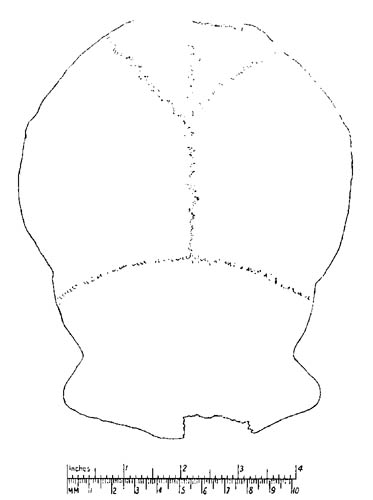
The Urus (Bos primigenius) is common in the Fen Beds and is of
special importance for our present enquiry, as there is in the Sedgwick
Museum a skull of this species found in Burwell Fen with a Neolithic
flint implement sticking in it. The implement is thin, nearly parallel
sided, rough dressed, except on the front edge which is ground, and it
is made of the black south-country flint. It is very different in every
respect from the thick bulging implements with curved outlines, which
being made of the mottled grey north-country flint or of felstone or
greenstone suggest importation from a different and probably more
northerly source.
This gives us a useful synchronism of peat, a Neolithic implement of a
special well-marked type, and the Urus.
The Bison is the characteristic ox of the Gravels and never occurs in
the Fen Beds; while the Urus, as I have pointed out above, occurs in
both the Turbiferous and Areniferous deposits.
Bos longifrons is the characteristic ox of the Fen Beds and
never occurs in the Gravels. It is the breed which the Romans found
here, and we dig up its bones almost wherever we find Roman remains. I
cannot adduce any satisfactory evidence that it was wild, that is to
say more wild than the Welsh cattle or ponies or sheep which roam
freely over wide tracts of almost uninhabited country. This species,
like the Urus, has horns pointing forward, but the cattle introduced by
the Romans had upturned lyre-shaped horns, as in the modern Italian,
the Chillingham or our typical uncrossed Ayrshire breed, and soon we
notice the effect of crossing the small native cattle (Bos
longifrons) with the larger Roman breed.
The Horse appears to have lived continuously throughout Pleistocene
times down to the present day and to have been always used for food.
Unfortunately the skull of a horse is thin and fragile and therefore it
has been difficult to obtain a series sufficiently complete to found
any considerable generalisations upon it. The animal found in the peat
and alluvium appears to have been a small sized, long faced pony.
The appearances and reappearances of the different kinds of deer is a
very interesting question, but it will be more easily treated when I
come to speak of the Gravels of East Anglia. I will only point out now
that neither of the deer with palmated antlers properly belongs to the
Turbiferous series. The great Irish Elk (Cervus megacerus) has
not been found in the Fen Beds. Indeed it is not clear that in Ireland
it occurs in the peat. The most careful and trustworthy descriptions
seem to show that its bones lie either in or on top of the clays on
which the peat grew.
The other and smaller deer with palmated antlers, namely, the Fallow
deer (Cervus dama), were reintroduced, probably by the Romans,
and although some of them have got buried in the alluvium or newer peat
in the course of the 1500 years or so that they have been hunted in
royal warrens in East Anglia, they cannot be regarded as indigenous or
indicative of climate or other local conditions.
Remains of the Red deer (Cervus elaphus) and of the Roe deer
(Cervus capreolus) are common in the Fen Beds; both occur in the
Gravels also; and both are still wild in the British Isles. Unlike the
Red deer, which lives on the open moorland, the Roe deer lives in woods
and forests. And this is an interesting fact in its bearing upon our
inferences as to the character of the country before the reclamation of
the Fens and the destruction of the plateau forest. The open downs and
the spurs and islands of the fenlands offered the Red deer a congenial
feeding ground, while the thickets on the edge of the upland forest and
the bosky patches along the margins of the lowland swamps provided
covert for the Roe deer. Sheep and goat are found in the peat and the
alluvium, but it is not easy to tell the age of the bones. They do
generally appear to be of that lighter brown colour which is
characteristic of remains from newer peat as compared with the black
bones which seem to belong to the older and more decomposed peat. The
sheep is probably a late introduction and is never found in the Terrace
Gravel (see Geol. Mag. Decade 2, Vol. X, No. 10, p.
454).
The Wild Boar (Sus scrofa) is fairly common.
It is remarkable that we get very few remains of Wolf, although it is
not much more than 200 years since the last was killed. There is in the
Sedgwick Museum one fairly complete skeleton, found a long time ago in
Burwell Fen and I have recently obtained another from the same
locality. There do not seem to be any obvious and constant characters
by which we can distinguish a wolf from a dog, and Britain was
celebrated for its large and fierce dogs. The bones of the Eskimo dogs
are very wolf-like, but they are frequently crossed with wolf.
Perhaps the most interesting animal whose remains are found in the Fens
is the Beaver. Why do we not find here and there a beaver dam? Perhaps
it is because we have not been on the look-out for it, and the
peat-cutters would not have seen anything remarkable in the occurrence
of a quantity of timber anywhere in the Fens. We must suppose that the
peat which often contains whole forests of trees and even canoes would
have preserved the timber of the beaver dam. It is an animal too which
might have contributed largely towards the formation of the Fens by
holding up and diverting meandering streams. Perhaps it did not make
dams down in the Fens, and the skeletons we find are those of stray
individuals or of dead animals which have floated down from dams near
Trumpington or Chesterford; very suitable places for them. We want more
evidence about the fen beaver.
I have heard that there are beavers in the Danube which do not make
dams, but among those introduced into this country in recent years the
dam building instinct seems to have survived the change. The beavers on
the Marquis of Bute's property in Scotland cut down trees and built
dams as did the beavers in Sir Edmund Loder's park in Sussex, and even
in the Zoological Gardens they recently constructed a "lodge." We have
not found the beaver in the Gravels.
Part of the skull of a Walrus was brought to us a long time ago and
said to have been found in the peat. But it is a very suspicious case.
It does not look like a bone that had been long entombed in peat, and
we are not so far from the coast as to make it improbable that it was
carried there by some sailor returning home from northern seas.
Bones of Cetaceans are thrown up on the shore near Hunstanton, and
Seals are still not uncommon in the Wash, so that we need not attach
much importance to the occurrence in marine silt of Whale, Grampus,
Porpoise, and such like.