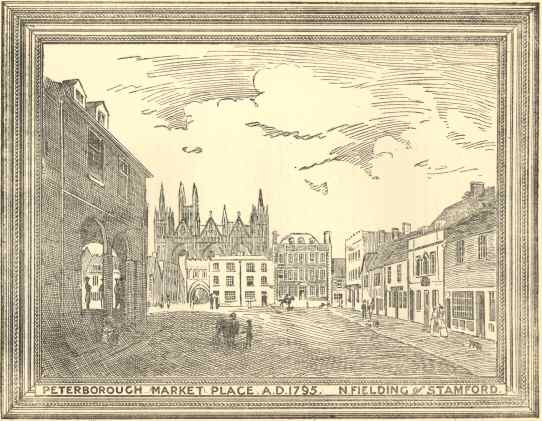
An Oasis in the
Desert.—Old System of Castor
Farming.—A Lighted
Beacon.—The Fen Around
Us.—Draining the Great
Level.—The Mill System of
Draining.—Snatched From the
Sea.—How Land Improved in
Value.—“Intelligent
Fenmen.”—Old Town
Bridge.—Old-time Jaunt through
the City.—Poor House and New
Gaol.—Thorpe Road
Hostelry.—Newtown.—The Great
Breweries and the Ponds.—Cabbage
Row.—Burial at Cross
Roads.—Frog
Hall.—Gas Works
Started.—Old
Market.—Ladies and the
Cattle.—Wednesday
Market.—A Curiosity
Market.—God’s
Acre.
The great point which strikes us
all, and which strikes everyone considering the history of the
last seventy years in the City of Peterborough is the very great
increase in the population, and when one began to think how it
came about we used to say “it is owing to the
railways.” But that is like telling you that the
world, as the Indians say, is supported on the back of a
tortoise! You want to know why the railways were wanted,
what the tortoise stands upon, because if you look into
statistics seventy years ago, before the railways, the population
of Peterborough was considerably increasing, and the populations
of agricultural districts altogether were very much increasing,
and when you go a little further, if you look at all into the
history of the land around Peterborough, or the country
altogether, you will find within a century there had been a great
change. Now, take for instance the immediate neighbourhood
of Peterborough. My recollection of it begins, as I have
said, at the latter end of 1833, at the commencement of the last
century. I think the only parish, if I except Fletton, the
only enclosed parish within some few miles of this place
was the parish of Paston.
There you will rind the church, surrounded by old trees, and
the parish differed very much from others. If you look into
the Churchyard there you will find a great many names of the
inhabitants of Peterborough and other parishes outside
Paston. If you look into the Paston register you will find
marriages solemnised between inhabitants not belonging to Paston,
the undoubted fact being that the enclosed parish of Paston led
people to desire they should be married and buried there.
Paston was a kind of oasis in the desert.
Most of the parishes around here were in the position and
character of Castor, which until recently was the only open field
parish within many miles of this place. I was riding
through Castor field some years ago, before it was enclosed, with
a few farmers, when one turned round and said: “How should
you like to farm this parish?” “Not at
all,” was the reply. A man in the parish who had a
farm of a hundred acres would have to go to his farm in four
different parts of the parish—some against Ailsworth,
Milton Park, Alwalton, and so on, perhaps scattered in pieces of
one acre, two roods, and so forth. So that with a large
farm a man would have to go to a farm of a hundred acres to as
many different places two or three miles apart. The pieces
were so narrow that they were like ribbons; you could plough
lengthways but not crossways. As soon as you turned, you
got on to your neighbour’s land, which was frequently a
subject of dispute. Conceive the state of the cultivation
of the country generally when that was the system not only in one
parish, but in the general bulk, at all events, in this part of
the kingdom.
Peterborough was open. All the parishes, to my
knowledge, from Peterborough to Deeping, and east to west, have
been enclosed since 1812. There was a beacon lighted at
night to light the passengers over the weary waste, since brought
into cultivation. Just conceive, if you can, the state in
which this part of the country was then, and in what it is now,
and consider the great increase of corn that can be grown, and
not only
corn that can be grown, but the stock that can be fed by the
cultivation of roots and the introduction of bone manure, and
then you get some idea of the increased production of the
country, that rendered improved roads, terminating in railroads,
necessary. For the same reason, the marvellous increase in
the manufacturing districts has been kept pace with in the
agricultural production of the country, another feature in our
neighbourhood.
If you begin at Cambridge and draw a line along the high land
by St. Ives, east of Peterborough, by Spalding and Boston, down
to the Humber, you will find the tract of land known as the Fen
Country. That country has undergone within the last seventy
or eighty years, or a great part of it, a change even more
striking than that which has passed over the uplands. At
first you would be inclined to doubt whether there were any such
places as the Fens at all. If you say to anybody
“Don’t you live in the Fens”? the reply will be
“Oh, no.” At Peterborough we are not in the
Fens. Of course not! There is Flag Fen, and there is
Borough Fen, but we are on high ground, and not in the Fen, and
you will find, even if you go east of Wisbech, where the land is
called marsh land, which sounds rather funny, that the farmers
and graziers there will say they don’t live in the
Fens. And walking towards the sea you will always be told
you have come to the wrong place, you must go a little further,
and then you will find the Fen country! But still, take the
Fens as we know them, extending from Peterborough to Cambridge,
and down by Boston nearly to the Humber.
I will confine my observations to that which most comes within
my own knowledge, that district of the Fens known as the Bedford
Level, called the South, the Middle, and the North Level.
From the beginning of Crowland on the North, down to, say, the
Middle by March and Lynn, and the South down to Cambridge.
In the year 1637 a Charter was passed by Charles I. for the
improvement of that country, and we form some notion of what it
must have been—the weary waste of waters it must have
been—from the preamble of the Charter of Incorporation.
It is described as being generally covered with water, of little
advantage to mankind, except yielding some few river fish and
water fowl, that is when you may catch them, and on lucky days
you may shoot wild ducks. Adventurers had endeavoured to
make lines of meadows, which had made such progress that it was
hoped this place, which had lately presented nothing to the eye
but waters and a few reeds thinly scattered here and there,
might, under Divine mercy, become some of it pleasant pasture for
cattle, with many houses belonging to the inhabitants. That
seemed to have been the extreme notion of what could be made of
that country in the way of production. Going on to the year
1830, when the last history of the Bedford Level was written by
Mr. Samuel Wells, well known as the Register of the Corporation,
he speaks of it seventy-five years ago as a matter of
congratulation that at that time, when they had improved it
sufficiently to grow oats and cole seed, that the cultivation of
wheat had begun to extend itself into the Fen country. He
spoke of it almost as a novelty, and says that the Corporation,
soon after its formation, had interfered to prevent the
inhabitants, occupiers, and owners of property from improving and
draining by mills. He says that the system of drainage by
mills was abandoned in consequence of the result of the suit to
prevent it being favourable to the Corporation.
However, in a short time, after many struggles, the Level
becoming so inundated by the choking of interior drains, the
defective state of the rivers, and neglected improvement of
outfalls, the Corporation found it impossible to resist the
importunity of the country to resort to artificial drainage, and
therefore waived their objection, and allowed a return of the
mill system. The mill system up to 1830 consisted simply of
working a machine by wind to lift the water out of some embanked
portion of the Fens into a drain at a higher level, to conduct it
to one of the main drains of the Corporation to the outfall in
the sea. Seventy years ago, Mr. Wells tells us, in the whole
district of the Bedford Level—350,000 acres—there
were only five steam engines, one being in the parish of
Newboro’, put up on the enclosuse. He says there was
a general opinion that steam drainage would be further
prosecuted, but this depended upon the finances of the district,
and he goes on to say many intelligent Fenmen indulged the hope
of acquiring a natural drainage, when the result of the work now
undertaken, in a greater or a less degree on all three levels,
can be fully understood and ascertained. The author,
however, says he cannot rank himself amongst the number of those
sanguine persons. He thought it great progress to get five
steam engines, and hoping they would get more, he, as an
intelligent Fenman, thought it was as much as he could
anticipate.
I think in the year 1827 or 1828 one of those works, the Nene
outfall, had been undertaken, the object of which was to make the
channel to the sea through the high and shifting sands, which
were at the entrance of the Wash, through which the waters of the
Nene found their way to the sea. It was carried out.
I think Mr. Tycho Wing was the great inaugurator and Sir Jno.
Rennie the engineer. It was so thoroughly successful that
it at once allowed the interior drainage of the country to be
vastly improved, and not only so, but up to the present time, by
the operation of the Nene Outfall Act, no less than 5,800 acres
of land have been actually reclaimed from the sea, the value of
which is at least from £40 to £50 per acre. Not
only was the Fen district materially improved, but a tract of
country equal to a large parish was obtained, the value of which
alone would, in a measure, repay all the expense of the
undertaking. Then they went on, following the success of
that, to get the North Level Act in 1830. The effect of
that was that water mills and steam mills disappeared, and they
now have natural drainage by the water finding its way by
gravitation to the sea.
In 1840 a similar work was begun in the Middle Level, and they
now have natural drainage in nearly the whole of that
Level. The only exception is about Whittlesey Mere, where
they have a steam pump and a steam water-wheel to carry away the
floods. What was the effect of that? In the first
place a tax was put on. In the Middle Level and North Level
the yearly tax may be taken at about 8s. 6d. or 9s. per acre
altogether. It sounds a very large sum where the land
itself, in many instances, was worth next to nothing before, but
the effect has been that in that district, I am not exaggerating
when I say, leaving the tax out of the question, that is, after
putting the tax on the land and comparing it to what it was
before, the land is worth double, and, in many instances, treble,
and where land without the tax was worth £10 an acre, it is
now worth £20 or £30. I have had through my
hands deeds of an estate in the Fen. It contained 200
acres. In 1824 it was sold for £1,155; in 1829 for
£1,880. In 1882, notwithstanding the time of
depression, it was sold for £5,000, without any special
bargain. Just think of the increase in the value of the
country in consequence of what has been done, and I think you
will see at once why the district has required railway
accommodation.
Mr. Wells speaks of the “Intelligent
Fenmen.” I believe in their intelligence! In
their Parliamentary battles they are as warlike as people can be
in protecting the valuable interests of which they are the
custodians, and counsel in Parliamentary committees have often
said: “How well those men understand their business; how
ready they are, and what talent they show in stating and
maintaining their cause.” That is rather a
digression, but it accounts very much, I think, for the great
changes in this part of the country to which we belong.
Now let me endeavour to show the changes in Peterborough
proper. I will supply an omission, with an apology to my
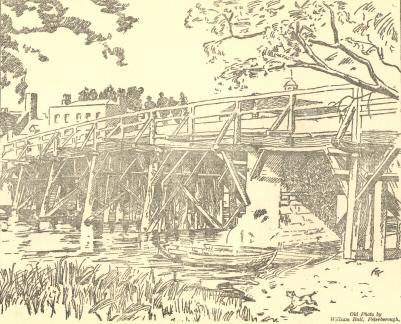
old friend, the old Town Bridge. I am ashamed to find that
in my previous notes I had omitted to say anything about
it. That was rather extraordinary, because I had my mind on
it, and when I first came from Northampton my first acquaintance
with Peterborough must have been “over that
bridge.” There is an old proverb which says
“Find no fault with the bridge which carries you
over.” With every disposition to be charitable, that
is the only good thing I can say of the old Bridge. It
carried me over, and there was no instance that it ever fell in,
but there was always a fear that it would fall, and everybody
thought it ought to fall, but it did not, and I mention this
because I think our new Bridge is a striking instance of the
public spirit of the inhabitants of Peterborough and the
neighbourhood in subscribing the cost of one-half of it, and also
of the fairness and liberality which the county authorities
displayed in meeting the inhabitants in assisting to get a new
bridge—a credit to the district—rather than patch up
that shabby, ramshackle concern, which, patched from time to
time, might have outlived another hundred years, and a suspicion
that it would fall, but never actually falling.
We will walk up Bridge Street and take a turn round the
outskirts of the town as I knew it years ago. Going past
the toll-bar in Cowgate we come to the building known as Sexton
Barns; probably some of you recollect it, a fine old building; it
was an object that vanished when the railways were made, because
now it is the site of the G.N. Station. There was a
handsome tree near the Crescent, where Peterborough began to
stray into the country; the Crescent had been erected four or
five years before. Opposite was the house where Mrs. Cattel
lived, and then the house where Dr. Skrimshire lived (now Dr.
Keeton’s). Walking a little further, we came to the
Town Mill; very much like the Town Bridge, it had seen better
days and, like the Bridge, it had had a history. It had
been the property of the Dean and Chapter, and, without the
smallest doubt, it came down to them from the Abbot and Convent,
who were the Lords of this district. These town mills were
mills which the largest landowners kept for the accommodation of
their tenants, who were thereby provided with the means of
grinding their corn at a small cost, but were compelled to use
them and pay grist to the millers, and the old law books contain
much on the subject. Its need passed away, the mill got into
private hands; it seems to have become worse and worse, and at
last it was burnt down, and we know it no more, the very site
having been utilised in an exchange of property for the erection
of the present King’s School in Park Road.
On the opposite side is the Union Workhouse, built about 1834
or 1835. It has been very much beautified, but it is not a
handsome building now. It has had a new front or
facing. I may mention in passing that I recollect at one
time there was a persistent cry made by some portion of the Press
against the new Poor Law, against the hardship of separating man
and wife, and so on, but never was so persistent an attempt made
in that part of a portion of the Press with such signal failure
at the time, although since come to pass where desirable.
The new Poor Law took the place of one that was probably ruining
the country, and is, in these later days, itself under
review.
We then walk along the road back towards Peterborough, and we
find the Gaol and Sessions House. This Gaol was built in
1840. There was a fight between the Dean and Chapter, and
their Lessee, and the Magistrates about the enormous price asked
for it, and a jury was appointed, but a price of two or three
times more than was paid at that time for the land has been paid
since for land. If anyone had it to sell now at the same
price he would be very happy.
Between the Gaol and the Workhouse there is a nice
quiet-looking residence (Mr. Noble’s). It was, till
recently, devoted to the supply of milk, but it was built as a
public house, put up by a brewery in order to supply
accommodation for people who resorted to the Sessions House at
the weekly meetings of the Magistrates, and at the Quarter
Sessions. There was a temperance wit of the day who said,
“No, it is put there to show the close and intimate
connection between the gin shop, the gaol, and the
workhouse.” We will go back to the town, the whole of
that known as Newtown, long before the railways, between 1815 and
1833, had been erected, so that it was, strictly and literally,
“Newtown.”
We then
pass Squire’s Brewery at the entrance to Lincoln Road,
where the Liberal Club and Masonic Hall now stand, and we go to
Boroughbury; all beyond the malting formed part of Squire’s
Brewery, going past what is known as the “Square
Pond.” The houses there, including a large part of
the Catholic Church and other buildings, are actually built upon
that which was, in 1833 (and many years afterwards), covered with
water. I was intimate with Mr. Buckle, who succeeded Mr.
Squire in that brewery, and I was permitted to fish in the pond
as often as I pleased. I have stood upon that spot which is
now a public road and have caught pike and eels, and used to have
very capital sport there. In the winter time it was a
favourite resort, not thrown open to the public altogether, but
still, with great liberality, it was allowed to be used for
skating. I was very unlucky one day. It was just
after a gentleman had bought the house, afterwards Mrs.
Willoughby’s (now shops erected by Mr. W. D. Nichols), and
the grounds about it, was walking in his grounds, when he saw me
pull out a large pike, and he was so enchanted with it, he
thought it would be a great benefit to his property, and to my
disgust, but the pleasure of Mr. Buckle, he bought the pond and
merged it into his private grounds. I never caught any pike
there again!
Passing the outskirts of the town, we pass the great Tithe
Barn, Boroughbury, an interesting and attractive specimen of
antiquity and a good specimen of that kind of barn. You go
up that junction of Lincoln Road to Dogsthorpe, and there past
the last house until you come to two or three cottages, then
belonging to a retired tailor, named Mitchell, and people had
been profane enough to christen those cottages “Cabbage
Row.” What connection there is between a tailor and
cabbage, I don’t know.
Crossing the fields now laid out by the great roads of the
Land Company, and which at that time were the most secluded
fields around Peterborough, and going down Crawthorne Lane you
came to a junction—a little lane at the back of
Boroughbury, now a wide street behind St. Mark’s Villas,
which runs up to Park Road, and there four roads met, where there
was a little tombstone which was known as the “Girls’
Grave.” A girl was buried there, with a stake through
her body, without Christian burial. The place was very well
known, and for long remained in the midst of a potato garden
belonging to one of the cottages there.
You go as the crow flies to a place called Frog Hall, in front
of St. Mary’s Vicarage, one of the cottages remained till
1904, and the place had a very unsavoury reputation. It was
inhabited by squatters, gipsies, and travellers, and was one of
the least desirable parts in that neighbourhood. Then came
a row of cottages known as Burton’s Row, where Peterborough
attempted to travel past its boundaries and get into the
country.
Going back, we come to the Cemetery, but at that time all were
grass fields let out as accommodation ground, and quite
secluded. A little further on were the Gas Works. Now
they ARE Gas Works. When I
came they were, as compared with the present, in about the same
proportion as a small kettle to a large steam engine
boiler. A gentleman named Malam—a Hull man—used
to supply all the little towns in the country, and used to
contract with the inhabitants to supply gas for them. There
was no Act of Parliament, or anything of that sort, but
permission from the Local Authorities to break up the streets and
roads was all that was required, and he chanced it. I think
Mr. Sawyer used to give as much time as he could spare from his
own business, until he became, as the town increased, by
purchase, the owner of the works, and he then gave his whole time
and attention to them, and a very nice property it developed into
by the time the present company took it off Mr. Sawyer’s
hands.
That is the history of gas in Peterborough. This brings
us back to the Long Causeway and the Market Place. Not the
market now, as I recollect it! Up to the year 1848 the
farmers attending the market used to cool their heels in the open air in
front of the Town Hall, hot or cold, wet or dry, rain or snow,
blowing or still, there they stood, till the Theatre, now the
Corn Exchange (since largely added to), became vacant, and it
occurred to some agricultural gentleman that they could be much
more comfortable in every way if they could form a company, and
they did so, and I think no one will doubt that is an
improvement. On the Long Causeway, the Cattle Market was
the principal institution of the place, and I will tell you
why. On Saturdays that place was wholly given up to
them. There they were; nobody paid anything; anybody who
had cows or horses to sell brought them there. They became
the proprietors of the street for that day.
Our widest and best street was spoilt; because if there is one
thing more certain than another it is that the female mind most
intensely abhors anything approaching contact with horned
animals. Somehow or other, it seems to disturb that
equanimity which appears to be utterly indispensable to a lady
when she is going what she calls “shopping,” and it
would take away all her ideas to think she was going to meet a
restless-looking cow or a doubtful looking ox. It takes
away all notion of colour, shape, and measure, or whether the
thing will wash or not. The consequence was, the Long
Causeway was practically abandoned on market days, and it was not
much more used on other days for shopping purposes, because in
anything like changeable or damp weather the atmosphere of the
street was what I have heard ladies describe (not meaning to be
complimentary) as “smelly.” Therefore,
naturally, there was great rejoicing among the inhabitants
generally when that street was restored to a cleanly wholesome
state by the construction of the Cattle Market.
The Wednesday Cattle Market had a very peculiar growth.
It was set up without the smallest authority about 1845 or 1846
by an old gentleman named Dean, who was a retired farmer, and an
enterprising auctioneer named Dowse, who kept the
“Greyhound.” They suggested that fat stock
should be brought, and it came more and more, until
it grew into that excellent stock market, which became one of the
best in the Kingdom. There was no foundation for it but
that of custom. When the new market was proposed, the
farmers invited the then authorities, the Improvement
Commissioners, to construct it for them, but they made their bow
and said, “If you want a market, make it for
yourselves.” It was made by a limited company, and it
has since fallen into the hands of the authorities, and Broadway
constructed through it.
We have another market which has grown up, and that is the
present Wednesday Market on the Market Place, which I think is
one of the greatest curiosities that ever comes under one’s
notice. It does no harm to anyone. I went there
recently, and I saw an extraordinary medley of things exposed for
sale. I wondered at first if they were to be given
away! I could understand anybody wishing to sell them, but
wondered who could wish to buy them. It is one of the
things no one can understand. But it affords the means of
getting rid of most undesirable things, call them furniture, or
anything else! It puts me in mind of a shop in the Market
Place at Great Yarmouth, where they say you may buy
anything. A visitor, a clergyman, was told he could get
anything he wanted. He said, “I want a
pulpit.” “Well,” his friend said,
“go in and try.” He went in and said, “Do
you happen to have a pulpit?” and they said, “Well,
we do happen to have a pulpit.” And I think I have
seen everything in our Wednesday’s Market except
that. I have not seen anything so useful as a pulpit!
I have spoken of our accommodation for the living. What
do we do for the dead? We have the Cemetery, which has been
considerably enlarged since it was first formed in 1852 or 1853,
and the rapid increase of the Cemetery suggests the difficulty of
the disposal of the dead in a creditable and satisfactory manner
with our increasing population. The old burial ground was
opened in the year 1802, and it is one of the peculiarities of
this peculiar place, and of the old jurisdictions here, that the
old Parish Church appears to have had in ancient times no
burial ground belonging to it, a thing that very seldom happens,
for the burial ground of the Parish of St. John the Baptist was
outside the Minster, which is an extra parochial district.
This remained up to 1802, when the burial ground in Cowgate was
formed. If you go into it sometime (I am very fond of
looking at the tombstones), you will find the oddest
peculiarities of language and literature as inscriptions on the
tombstones, but I cannot say I have ever found much to
admire. You will find a collection of legends which are
common all over the country, commencing with
Affliction sore, long time he bore,
Physicians WAS in vain.
Next to it:
Pale consumption gave the silent BELOW, etc.
In our graveyard in Cowgate there is an epitaph upon old Mrs.
Thomas, by which you are informed, that
Making carpets and beds she did pursue
With care and industry is very true,
The established religion she did profess
In hopes, through Christ, of Heaven to possess.
Such rubbish as that, under the veto of the present Cemetery
Commissioners, will, I hope, soon disappear. But there is
one in the Cathedral graveyard (the existence of which is not
generally known), on the tombstone memorial of an old family of
this place, and I trust it will not be allowed to
disappear. It is very superior to what they generally
are. It is on the right just as you go through the Arch by
the Deanery, and is to the memory of one of the Richardson
family:
Stranger pass by nor idly waste your time
In bad biography or bitter rhyme;
For what I am, this cumbrous clay ensures,
And what I was, is no affair of yours.
The old gentleman, as you see, has carried his cynical humour
to the grave with him. It was quoted in an article in
“Blackwood’s Magazine” on “Monumental
Inscriptions” a few years since.