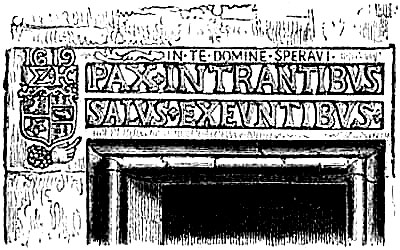
In the Old Town, where the population of a village or a fashionable square
is constantly crammed into the six or seven storeys of one house,
room-to-room visitation, for it is nothing else, affords a visitor in
one morning a glimpse of a state of things without a parallel. In no other
city could tenements be found without gas, without water-pipes,
water-closet, or sink, or temporary receptacle for ashes, and entered only
by one long dark stone stair, which return such enormous profits to their
owners as from 45 to 60 per cent. Scarcely elsewhere does one roof cover a
population of 290, 248, 240 persons, living in dens, honeycombed out of
larger rooms, without ventilation, without privacy, and often without
direct light. In no other city is the respectable mechanic compelled, for
want of house accommodation of a proper kind, to bring up his family in a
tenement which deserves indictment as a nuisance, or to pay £5, £6, or £8
a year for a den swarming with vermin, with only a wooden partition to
keep off the sights and admit all the sounds of haunts of the most
degraded vice. In Edinburgh, which, in more respects than one, is set on a
hill and cannot be hid, there are 13,209 families, comprising not only the
vicious and abject, but large numbers of the poorer labouring class,
living in houses of but one room, and of these single rooms, 1530 are
inhabited by from six to fifteen persons! Further, by the last census, 120
of these shelters, for they are not houses, were reported as without
windows, and 900 were cellars, nearly all of them dark, and many damp.
These figures give the astounding result that the families living in one
room, and often herding together in closer proximity than animals would
endure, comprehend 66,000 persons, or considerably more than one-third of
the population of Edinburgh![1]
The notes which follow are merely a commentary upon the above facts. My
room-to-room visitation on a single day included thirty-seven families
residing in a close south of the High Street and ten families in a close
south of the Cowgate. I do not give the names of either, in deference to
the feelings of respectable persons who are compelled by various causes to
reside in them.
The entrance of the close which we selected is long and narrow, and so low
as to compel a man of average height to stoop. It is paved with round
stones, and from the slime in which they were embedded, and from a grating
on one side almost choked up with fish heads and insides, and other offal,
a pungent and disgusting effluvium was emitted. The width of this close is
four feet at the bottom, but the projecting storeys of the upper houses
leave only a narrow strip of quiet sky to give light below. A gutter ran
along one side of the close against the wall, and this, though so early in
the day, was in a state of loathsomeness not to be described. Very ragged
children, infinitely more ragged and dirty than those which offend our
eyes in the open street, were sitting on the edge of this gutter, sitting
as if they meant to sit there all day; not playing, not even quarrelling,
just stupefying. Foul air, little light, and bad food had already done
their work on most of them. Blear eyes, sore faces, and sore feet were
almost universal. Their matted hair and filthy rags were full of vermin.
Their faces were thin, pinched, and precocious. Many of them had been
locked out in the morning when their mothers went to their hawking,
washing, and other occupations, and might be locked out till midnight, or
later, as we found on the following night. There they sat, letting the
slow, vile stream in the gutter run over their feet, and there they were
sitting three hours later. They were from three to ten years old. It is
all the same if the rain or snow is falling, except that they leave the
gutters to huddle together in the foul shelter of the stair-foot. Some of
these will die, many will be educated into the hardened criminality of the
often-imprisoned street boy, many will slide naturally into a life of
shame, and a fortunate few will be sentenced to reformatories, from whence
they come out decent members of society at the rate of 70 per cent. “God
help them!” exclaimed a mother, so drunk that her own babe seemed in peril
in her arms. Ay, God help them! But our Father which is in heaven charges
the responsibility of their destiny on the respectable men and women of
Edinburgh.
We entered the first room by descending two steps. It seemed to be an old
coal-cellar, with an earthen floor, shining in many places from damp, and
from a greenish ooze which drained through the wall from a noxious
collection of garbage outside, upon which a small window could have looked
had it not been filled up with brown paper and rags. There was no grate,
but a small fire smouldered on the floor, surrounded by heaps of ashes.
The roof was unceiled, the walls were rough and broken, the only light
came in from the open door, which let in unwholesome smells and sounds. No
cow or horse could thrive in such a hole. It was abominable. It measured
eleven feet by six feet, and the rent was 10d. per week, paid in advance.
It was nearly dark at noon, even with the door open; but as my eyes became
accustomed to the dimness, I saw that the plenishings consisted of an old
bed, a barrel with a flagstone on the top of it for a table, a
three-legged stool, and an iron pot. A very ragged girl, sorely afflicted
with ophthalmia, stood among the ashes doing nothing. She had never been
inside a school or church. She did not know how to do anything, but “did
for her father and brother.” On a heap of straw, partly covered with
sacking, which was the bed in which father, son, and daughter slept, the
brother, ill with rheumatism and sore legs, was lying moaning from under a
heap of filthy rags. He had been a baker “over in the New Town,” but
seemed not very likely to recover. It looked as if the sick man had crept
into his dark, damp lair, just to die of hopelessness. The father was past
work, but “sometimes got an odd job to do.” The sick man had supported the
three. It was hard to be godly, impossible to be cleanly, impossible to be
healthy in such circumstances.
The next room was entered by a low, dark, impeded passage about twelve
feet long, too filthy to be traversed without a light. At the extremity of
this was a dark winding stair which led up to four superincumbent storeys
of crowded subdivided rooms; and beyond this, to the right, a pitch-dark
passage with a “room” on either side. It was not possible to believe that
the most grinding greed could extort money from human beings for the
tenancy of such dens as those to which this passage led. They were lairs
into which a starving dog might creep to die, but nothing more. Opening a
dilapidated door, we found ourselves in a recess nearly 6 feet high, and 9
feet in length by 5 in breadth. It was not absolutely dark, yet matches
aided our investigations even at noon-day. There was an earthen floor
full of holes, in some of which water had collected. The walls were black
and rotten, and alive with wood-lice. There was no grate. The rent paid
for this evil den, which was only ventilated by the chimney, is 1s. per
week, or £2, 12s. annually! The occupier was a mason’s labourer, with a
wife and three children. He had come to Edinburgh in search of work, and
could not afford a “higher rent.” The wife said that her husband took the
“wee drap.” So would the President of the Temperance League himself if he
were hidden away in such a hole. The contents of this lair on our first
visit were a great heap of ashes and other refuse in one corner, some damp
musty straw in another, a broken box in the third, with a battered tin
pannikin upon it, and nothing else of any kind, saving two small children,
nearly nude, covered with running sores, and pitiable from some eye
disease. Their hair was not long, but felted into wisps, and alive with
vermin. When we went in they were sitting among the ashes of an extinct
fire, and blinked at the light from our matches. Here a neighbour said
they sat all day, unless their mother was merciful enough to turn them
into the gutter. We were there at eleven the following night, and found
the mother, a decent, tidy body, at “hame.” There was a small fire then,
but no other light. She complained of little besides the darkness of the
house, and said, in a tone of dull discontent, she supposed it was “as
good as such as they could expect in Edinburgh.” The two children we had
seen before were crouching near the embers, blinking at a light we
carried, and on the musty straw in the corner a third, about ten years
old, was doubled up. This child had not a particle of clothing, but was
partially covered with a rag of carpet. She was ill of scrofula, and the
straw she lay on seemed to be considered a luxury. Three adults (including
a respectable-looking grandmother) and three children slept on that
unwholesome floor, in a room, be it remembered, 9 by 5, and under 6 feet
high. We allow each convict 500 cubic feet of air in his cell. “We
consider him as one to be washed, clothed, covered, ventilated; secularly,
technically, and religiously taught, regularly exercised, and profitably
employed. We do not fling him into a dark hole, even when he misbehaves
himself, and we do not leave him there for years to fester in
filth.”—Daily Telegraph, April 3, 1868. This reads like a bitter satire
on what we do to such families as these. On the other side of the dark
passage there was a room somewhat larger, for which a rent of 1s. 6d.
per week was obtained. This had no window or outer wall, and its sole
ventilation was by means of a hole in the door.
These two lairs were the worst specimens of basement-storey rooms in that
close, but the rest were not much better, and their occupiers (all Scotch)
were equally poor. Medical men, with that noble spirit of philanthropy
which adorns the profession in Edinburgh, know these dens, and the city
and parochial missionaries, wearied and discouraged, still speak to the
dwellers in them of One who is mighty to save. But they have long cried to
the rich, to the men and women of leisure, to the Churches, “Come over and
help us.” They ask people to throw aside their theories, to cease
wrangling over the cause, and try a rational cure; to give the poor not
what the rich and benevolent like, but what the poor know they
need—and that is, houses to dwell in, not dens to rot and perish in,
morally and physically. Blissful ignorance of the abyss of preventible
misery which exists in Edinburgh is impossible now. There are many divers
at work, and not one returns to the surface without bringing some
cumulative proof of the wreck and ruin below. No person, stranger or
citizen, who believes the facts can shirk an individual responsibility
concerning them. If sanitary reforms and city improvement schemes come too
late to save a lapsed generation of adults, kindly contact with the rich,
discriminating charity, houses in which cleanliness and decency are
possible, may redeem the children. It was with a little hope for them, at
least, that we turned from the close that day; a little hope, I say, for
the dawn of the day which is to save them has not yet appeared. After the
many diseased dismal infants crouching in their dark dens on the sunny
day, the children of the gutters seemed almost happy, for they could see
above the lofty houses a blue strip of sky, beyond which, they might have
heard, dwells their Father. But hideous blasphemies all around came forth
from infant lips, and of that stinted, joyless, loveless, misused
childhood, if left to itself, an impure, unholy manhood and womanhood can
be the only end. Did the Master declare of these, and the legion of these,
“of such is the kingdom of heaven?” What then?
Leaving these basement dens we entered another close, whose lofty houses,
with overhanging wooden fronts, give a certain amount of picturesqueness,
while they exclude light to such a degree that it is never much more than
twilight below, even on a sunny day. It is said that these projecting
fronts were built of wood from Boroughmuir, presented by a devout King
wherewith to provide oratories for the inhabitants of this close—so that
every one of them might be in circumstances to obey the command, “But
thou, when thou prayest, enter into thy closet, and when thou hast shut
thy door, pray to thy Father which is in secret.” If the tradition be
true, it renders the use to which these oratories are now applied, and the
condition of the occupants of these dwellings, more sad and revolting by
contrast. Though the light in the close was little better than twilight,
several women were standing outside the houses mending and patching. They
said they could not see to do a stitch indoors. There were many children
sitting in the gutters, very dirty, ragged, and sore-eyed. These, the
women said, were the children of parents too poor to provide them with
clothes fit to go into the street. Out of sixty-two children of families
visited in this close, twenty only are reported as attending school. This
statement, probably, is above the real number, as among the thirty-two
families visited by myself, there was only one child reported as attending
school. So these children, who don’t go to school, and are too ragged to
be sent to disport themselves in the street, spend their time between
their crowded dens upstairs and the narrow, filthy close—for filthy it
was, even at midday, although it was paved, and the scavengers had not
finished their work more than five hours before. These children have never
known cleanliness or decency. The happiness which comes from chasing
butterflies, rooting up pig-nuts, and making daisy wreaths, has never come
their way; or even the less Arcadian jollities of trundling hoops, playing
at marbles, and making dirt-pies, in which city children delight
themselves elsewhere. But these are “cribbed, cabined, and confined” by
the high black walls, and, as a mother said, “they are learning the
devil’s lessons well.” It is no exaggeration to add that many of them are
as absolutely ignorant of love as they are of cleanliness, decency, and
happiness. Locked out into the cold or wet, scantily clad, meanly fed,
kicked about in the morning, kicked about at night, cursed instead of
kissed, utterly neglected in body and soul, they grow up attaching no
meaning whatever to the words love and home. The wynds and closes are
swarming with them, the ragged and industrial schools, when they get hold
of them, are fain to withdraw them by night as well as by day from what in
mockery are called their homes, if they are to do anything with them. As
long as these are suffered to be born and reared in dens, so long must
we build prisons, reformatories, and Magdalene asylums to teach them, at
enormous cost, the decencies they have never known. In going through this
close, and several of the poorer districts, I have become aware that a
very large number of the parents of these forlorn infants are literally
and consciously “lapsed.” By their willing and frequently regretful
admission they were “well-doing before they came to Edinburgh,” or they
were once better off in Edinburgh, and “have come down in the world;” they
were Church members, and had the friendly recognition of ministers and
elders; they “paid their way,” etc. etc. From one and all of these they
have “lapsed,” some by drink, others by misfortune; and this was the case
with a large proportion of the inhabitants of this “land,” in whose deep
wretchedness and degradation they are wallowing, and on whose threshold
the reader is being detained. But be it solemnly remembered, the children
who “are learning the devil’s lessons” in the gutter start not from the
platform of well-doing from which many of the parents fell, but from the
platform of vice, intemperance, godlessness, recklessness, and filth to
which the parents have fallen.
Of such as these, one who claims a hearing for their woes and their
helplessness (Dr. Guthrie), writes—“I know the lapsed and wretched
classes well. I believe if I was as poor as they I should be as deceitful.
Circumstances make people what they are much more than many suppose. There
is not a wretched child in this town but if my children had been born and
bred up in its unhappy circumstances they might have been as bad.”
The smell of this close was intolerable. How can it be otherwise when all
the solid and liquid refuse which has been accumulating in the densely
packed habitations during the day, lies in the narrow close from ten at
night, in such quantities that the scavengers not unfrequently remove
nearly a ton of it at seven in the morning, and the ground and the
foundations of the houses are saturated with the liquid refuse and
drainage?[2]
I only give a sketch of the general conformation and circumstances of the
lands in this close, premising that the description—often very much
darkened in tint, however—applies to a majority of the Old Town abodes
which, in Edinburgh, are considered good property, and fit for the stowage
of human beings, in Murdoch’s Close, Hume’s Close, Skinner’s Close,
Hyndford’s Close, South Foulis’ Close, Cant’s Close, Blackfriars Wynd,
Todrick’s Wynd, Plainstone Close, Campbell’s Close, Brown’s Close, etc.,
to which citizens who take an interest in this painful subject can add
various other closes on both sides of the High Street and Canongate, many
stairs in the Cowgate, and various entries and closes in the Grassmarket
and West Port. It is supposed that not fewer than 40,000 people live in
habitations not superior to, and often much inferior to, the lands
hereafter described.
The entrance to the first “land” visited was by a very long, narrow,
winding stair, with steps so worn as to be unsafe. The stair was as dark
by day as by night until near the top, and there was nothing to assist an
unsteady walker in his ascent or descent. The wall was broken, and, as we
found on striking a light, the cracks swarmed with bugs and other vermin,
as, indeed, does every fissure and cranny of the dilapidated tenements
above. We had not gone far before the stench which assailed us was worse
than that from the worst-kept pigstye, and we found the state of the stair
too disgusting for description. It is disgraceful, degrading, shameful;
and who is to blame? A stranger at once supposes that it is due partly to
the filthy habits of the people, and also to the crime of the landlords in
not lighting the stairs. This last is a criminal act as regards
cleanliness, morals, and safety, and its continuance ought not to be
permitted for another month. The regulation concerning the cleaning of
stairs cannot be carried out in the dark, even if the people had brooms,
which most of them have not, and if they had a “spigot” in the close
instead of having to haul every drop of water from a public well at some
distance. There is an infinite injustice and degradation in such a mode of
access and egress for frail old age, and infancy scarcely less frail, for
females heavily laden with water or refuse-buckets, for young girls, and
for men savagely or boisterously drunk, in many cases for a population
over 200.
On each landing there was a passage branching into several smaller ones,
very much like the galleries in a coal-pit, burrowing in and out among
endlessly subdivided rooms, measuring from 18 feet by 10 feet to 9 feet by
5 feet, separated by skeleton partitions filled up with plaster, through
which any man can put his foot. In this case the long passage was
outside the congeries of habitations, and was lighted on two floors by
the windows of the recesses before alluded to as having been the oratories
of past generations. They had served the greed of late proprietors, for a
great number of the rooms partitioned off from the passage were dimly
lighted by windows looking upon it. Ventilated they could not be, for the
smell in this passage was poisonous. Nothing shows more forcibly the
lapsing of houses, as well as of human beings, than the fact that these
recesses, once prized as places for prayer, are now highly valued for
another purpose, being receptacles during the day for multitudes of
battered pails, containing the ashes and refuse hourly accumulating in the
rooms. Those persons consider themselves well off who have any such public
recesses or corners which can be used for this purpose. In general, in
these tenements, the inhabitants are compelled to keep the pail and
“backet,” containing the unwholesome accumulations of the day, under the
bed, if there be one, and, failing that, in any corner, from seven in the
morning till ten at night. In large young families, and in sickness and
old age, the result may be imagined, when these accumulations of refuse of
all descriptions are shut up in rooms without ventilation, along with the
steam of half-washed clothes, in air contaminated by the respiration of
several persons. In this land the average size of the rooms is 12 feet by
7 feet. If, on the one hand, drink brings people into these abodes, on the
other, the foul, vile, depressing air, joined to the want of light and
water, drives them in thousands to the dram-shop. There was scarcely a
woman whose face did not testify, by its depression, yellowness, and
emaciation, to the air she is compelled to breathe by day and night.
Besides that the absence of temporary receptacles for refuse is utterly
disgusting and injurious to health, it inflicts sore toil on the women,
who are more than sufficiently burdened with drawing water from the public
wells. It is not a small thing for the mother of a family, or a frail old
wife, to come down the dark filthy stair late at night with the
“ashbacket,” even if there be a window half-way down from which she may
discharge the contents on the pavement below.
All along the passages there were thin partitions stuffed with rags, where
the plaster had fallen out, or had been kicked through in some drunken
frenzy—doors so broken all round that privacy even from the gaze of
passing strangers is impossible—a roof, in part, nothing better than old
boards, strengthened with pieces of iron and tin, which, like everything
else here, had “seen better days”—floors rotten—so rotten as to require
big stones to fill up holes larger than a man’s head—windows with hardly
any glass left in them—wind and rain coming in in many places—the whole
pile apparently little more than just holding together by sheer force of
habit, utterly unfit for human habitation as it is—a disgrace which
public opinion ought to be strong enough to condemn. But it is one of a
legion of similar disgraces; it is a lucrative sin, a paying shame; in
politer language, it is “a good investment!” Ay, a good investment! For
these cabins, which, by a pernicious fiction, are called “houses,” are
rack-rented at from £2, 10s. to £5 each, and pay the fortunate
proprietors from 40 to 60 per cent. Here are “vested interests” with a
vengeance!