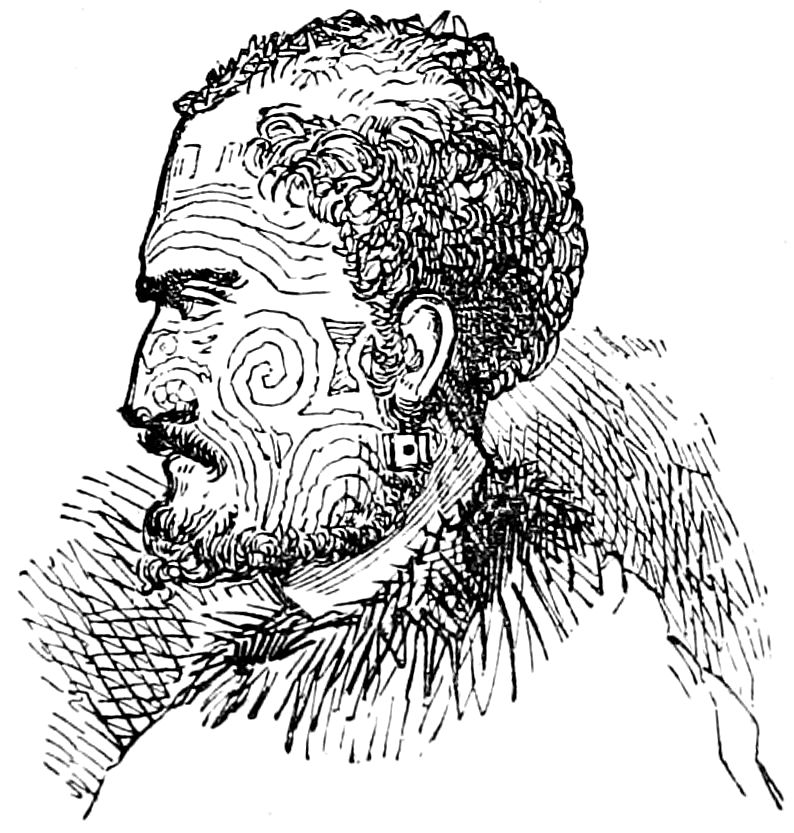
The reader will probably have been led from the
nomenclature to inquire whether the assertion that certain
forms of Nose are justly named after certain nations
might not be extended further? and whether every nation
has not a characteristic Nose?
The reply to these questionings would be in the affirmative.
Every nation has a characteristic Nose; and the
less advanced the nation is in civilization, the more
general and perceptible is the characteristic form. While
nations are in their infancy, and the mass of the people
are uninformed, the features receiving no impressions
from within, take the form impressed from without, and
follow the national type. If one uniform state of things—of
government, climate, and habits—continue, without
education, generation may succeed generation, and the
original facial type of the race will remain. If, however,
the national circumstances alter (still without general
education) the national features follow the type impressed
by those circumstances. We have appealed to many
instances of these simultaneous national changes when
describing the different forms of Noses prevalent at different
periods of English history.
The existence of such typical features has always been
recognized, and ethnologists have founded classifications
of the Human Race on their peculiarities.
121It is an additional general proof of the truth of Nasology,
that the most highly-organized and intellectual races possess
the highest forms of Noses, and those which are more
barbarous and uncivilized possess Noses proportionately
Snub and depressed, approaching the form of the snouts
of the lower animals, which seldom or ever project beyond
the jaws. Thus the Caucasian races, denominated by Dr.
Prichard Oval-headed, which comprise decidedly the most
perfect specimens of the human race, are characterized by
a Nose Roman or Greek; while the lower divisions, the
Mongolian or Pyramidal-headed, and the Negro or Prognathous
(protruding-jawed)—than among which no lower
and more debased specimens of humanity subsist—have
Noses Celestial or Snub, as in the Tartar and Chinese,
the Negro and Hottentot nations.
In the Caucasian, or Elliptical-headed, types of the
Human Race, the Nose averages one-third of the faces.
In the Mongolian, or Pyramidal-headed, the Nose averages
from one-fourth to one-fifth of the face.
In the Negro, or Prognathous-jawed, it is the same, and
the nostrils are conspicuous, as in brutes.
When hypotheses thus assist and strengthen each
other, we gain an assurance of their truth and accuracy
which is wanting where they are seemingly contradictory,
and which would have been wanting to Nasology, had it
contradicted the observations of philosophers so careful
and able as Dr. Prichard and his fellow-labourers in the
field of ethnology. Happily this is not the case, and
Nasology may claim to stand as the handmaid of ethnologists
striving to discover the characteristics of nations.
Among the more highly-organized races more deviations
from the original typical patterns occur than among the
lower-organized—because the minds of civilized men are
more impressible than those of savages. Travellers have
always observed that nothing struck them more on
visiting a savage nation than the great uniformity of feature,
presenting so great a contrast to the diversities
among civilized nations; so that while a superficial observer
would suppose it to be impossible to characterize
122the latter by any uniform description, he finds no difficulty
in expressing the characteristics of the former.
Various degrees of culture and occupation produce the
greatest possible variations among the individuals of civilized
nations, while the uniform absence of education and
the uniformity of pursuits among savages perpetuate, and
perhaps confer, an uniform national physiognomy.
When education becomes general, nations lose their
national typical features; for the physiognomy becomes
so variously impressed from within, according to the
different bias and affections of men’s minds, that it
ceases to receive those impressions from without, which
generate national types. At present, however, there is so
little generally diffused education that the typical features
of most nations may yet be defined.
These are not always the original types of the race.
Numerous circumstances have among the more civilized
nations contributed to produce changes of greater or less
magnitude. The various Caucasian nations, for instance,
though all descended from one stock, have varied from
their original type in their divers migrations from the
plains of Asia, and received such typical form as varying
circumstances have since impressed. Hence the various
Caucasian nations of Europe and Western Asia differ
considerably from each other in mental and bodily organization.
These variations from the original type took place,
however, at so early a period, even in the ante-historical
period, that historians are apt to regard them as original
and innate; and perhaps it is most convenient for them
to do so. But this is not sufficient for the inquirer into
the Races of Men. He goes back to ages far beyond the
historical, or even the mythic, period; and, finding these
nations are descended from one family, perceives that the
present variations must have taken place after the dispersion
of the family into distant localities under leaders
of very various temperament and views of social happiness.
It would lead us too far to inquire whether the tendency
of Nature to break up certain types into varieties,
123and form new races—perhaps even new species and
genera—was not originally greater than it has been at
any period within the knowledge of man. We see no
changes take place now, such as long before even the
mythic period, produced from one stock the wild urus,
the domestic ox, and the hunched bull of India. Neither
do we see new races of men spring up; such as in the
very earliest times produced from one common ancestor
the various diverse races of men; white, black, yellow,
and red.
It is a singular proof both of the tendency of the human
race to break into varieties at a very early period, and of
the permanency of those varieties in later ages—that the
four races into which Blumenbach and the best writers
have agreed to divide the races of the old world are distinctly
recorded and separated in like manner on some
of the most ancient monuments of Egypt. On the tomb
of Osirei, father of the Great Rameses, are represented the
“dwellers upon earth as well those of Egypt as those of
foreign countries.” Four figures are given in each group, and
are coloured to represent the Tawny, the Yellow, the Black,
and the White Races, respectively, with features corresponding
to those of the same races in the present day.
Such facts should teach us that the laws which regulate
the generation and production of species and races are
very different from those which regulate reproduction and
succession, and that while we endeavour to explain the
laws of origination by the laws of reproduction, we shall
never arrive at the true solution of the origination of types.
It is no poetical fancy that Nature’s infancy was
more active than its later years; that “Nature wantoned
in her prime,” and produced more gigantic effects
than now. Not that the powers of nature are weakened:
but the purpose having been accomplished, its workings
are stayed by the fiat of the Almighty God, and are
employed in sustaining and reproducing, instead of generating
anew and creating. When those powers are
wanted again, they will spring into undecayed operation;
let a new continent rise from the deep and the new world
have to be people, and Nature will again resume the
124gigantic forces of its infancy, and become young to fill
with life and activity a young world.
But at whatever period impressed, certain it is that
many nations have a typical form of Nose, together with
other peculiar distinctive features; and it concerns us now
rather to regard the fact as it exists than to inquire how it
happened.
The Roman, the Greek, and the Syrian forms of Nose
have been already descanted upon, as forming three bases
of our nomenclature. The present European nations are
the Gothic, the Celtic, the Sclavonic, and the Finnish.
The Gothic has been subjected to so many varying
circumstances that it is now perhaps impossible to assert,
with confidence, its original natural form. Where a uniform
dull system of despotism, political and religious, has for
centuries bound down these nations in abject servitude, the
Nose is sharp, devoid of Cogitativeness, and Romano-Greek
in profile.
This is the case with the Spanish Goths and with those
of France and Italy. These nations were so long held in
mental thraldom that they ceased to cultivate cogitative
powers which it was dangerous to use. Where espionage
and Lettres de Cachet, the Inquisition and Monachism dog
and punish men’s secret thoughts, and forbid the expression
of any sentiment breathing a spirit opposed to the powers
that be, or demonstrative of a disposition to inquire into
the why and wherefore of political and religious dogmas,
the mind, by an instinct of self-preservation, must cease to
think. Where to think is a death-warrant, where a look
of reflection or an aspect of discontent may be followed by
the axe of the executioner, or the more fearful incarceration
by the gaoler, the mind has no alternative but to forget
itself and live in bestial oblivion, to “sit down to eat and
drink and rise up to play.” With the cessation of the
Cogitative powers, the Cogitativeness of the features will
disappear, and the Nose will become defective in breadth,
thin and sharp. To this want of reflection succeeds, in
the naturally higher and more energetic nations, animal
passion; and if ever the pressure is removed from the
national mind and it obtain the upper hand of its keepers,
125fearful retribution and sanguinary revenge inevitably ensue.
They who lived the animal life of a caged wild beast in
apparent ease and quietude, well fed and perhaps, sensually,
better provided for than if left to their native freedom,
will, when let loose from confinement, fearfully
vindicate the natural law of liberty, and with an insane
instinct tear in pieces the keepers who have fed them for
their own purposes and nurtured them for their own
pleasure and profit, reckless of the natural social rights of
man.
It is for this reason that the sharp, thin unthinking
Nose appears symbolical likewise of cruelty; not so much
because the natural disposition is cruel, as because the
mind, when unchained, acts from animal impulse and not
from sage reflection; and animal revenge is always wild
and cruel.
We say this of nations which, like the Gothic and
other Caucasian races, were originally well organized and
endowed with higher capacities. This higher organization
exhibits itself—whatever the degrees of Cogitativeness
which incidental circumstances may have added, or
adeemed—in a profile, Roman, or Greek, or compounded
of both; and which may therefore be called nationally
Romano-Greek. The profile not being so subject to
variation from the pressure of external circumstances as
the breadth, remains still pretty uniformly the same in all
the Caucasian races in Europe, which might be written
I
II. Other races there are which, either naturally of less
penetrable stuff, and a lower and more obtuse organization,
or longer ground down beneath a more crushing and
uniform despotism, remain contented slaves and willing
bondmen. This degradation, as we shall see when we
come to speak of the Asiatic nations, appears also in their
Noses.
France, Spain, and Italy have been depressed, not only
beneath a political despotism till within a very recent
period, but under the still more soul-crushing despotism
of a gross superstition and corrupt religion—the latter
even more than the former has repressed Cogitativeness
in those nations. If there is one subject which more than
126another interests the human mind and occupies the
thoughts, it is its religion—its eternal prospects—for Man
is essentially a religious animal. Debarred from exercising
thought upon its most natural and interesting
topics—and all other subjects being dragged within the
jealous circle of a religious despotism—so stern a barrier
is opposed to thought that the mind rarely dare overleap
it. While a political despotism may be well pleased to
see its subjects occupied in scientific or metaphysical
researches, in order to wean them from too critical an
examination of itself, a religious despotism forbids any
such researches unless made within the small circle it has
prescribed. Death or imprisonment awaits a Galileo or a
Copernicus, as it would under a similar rule, even now,
await a Buckland or a Lyell.
At present, we lament that we can see nothing in the
recent revolutionary movements in France and Italy, to
indicate the existence of those Cogitative powers, the
want of which has always hitherto checked their advancement
towards true liberty and self-government.
Now, as in 1793, there seems “equally a want of books
and men; without which, after a few years of bloodshed
and anarchy, those countries must again submit to a
despotic form of government. No country can be governed
without intellect; and if that is not to be found in
the many, the few who possess it must become the ruler.
“By the Soul
Only, the Nations shall be great and free.”
This country has never long needed such a despotism.
Germany, too, though hardly yet freed from a political
despotism, has through a large portion of its area long
thrown off the despotism of Rome, and embraced the
more elevating and life-giving doctrines of the Reformation.
In those provinces where this blessed change has
taken place, Germany is starting rapidly into that career of
intellectuality which England commenced three hundred
years ago. The Germans and the English are preeminently
deep-thinking nations; and in both of them is
127the Nose more decidedly and more generally of a Cogitative
form than in any other Gothic nations.
The Cogitative may therefore, perhaps, be said to be
one of the characteristic forms of the Noses of those
Gothic branches, and might be expressed thus, (I + II)/III.
Nevertheless, various degrees of education and various
pursuits, with (in England) free institutions, have so diversified
their features that they exhibit a much less uniform
character than the features of most other nations.
The Anglo-Americans afford a further corroborative
proof that the Cogitative Nose is dependent on the cultivation
of a Cogitative mind. They present a striking
contrast to their puritan forefathers,—men who abandoned
home, country and friends for the sake of religious and
political opinions; men to whom conscience was dearer
than life, and freedom more precious than worldly advantage;
men of the strictest integrity, the most
scrupulous honesty, and the sternest firmness, sullied only
by an excess of over-wrought feeling—fanaticism. All
these virtues, and this vice (itself a virtue gone mad) are
wanting to the American character. That there are happy
exceptions, it is true; but a nation which boasts smartness
as its most prominent virtue, must not complain if it is
accused of want of principle. The circumstances of
young America have contributed to render hers an unthinking
people. The wild life to which so large a portion
have been subjected, cut off from all neighbourhood,
debarred from communication with cultivated minds,
thrown entirely on the active business of the day for
mental food, they have necessarily degenerated from the
thinking men to whom they are indebted for their origin.
So far from the American Nose inheriting the Cogitative
form of their ancestors’, it is thin and sharp; and, as a
national nose, the most unthinking of any of the Gothic
stock. America is, however, a fast-growing nation; it
has had no infancy, but started at once into life, a full-grown
youth. There is hope, therefore—of which already
some assurance has been given—that it will yet furnish
its quota of thinkers to the history of the human mind.
Strange as the assertion may appear, it is susceptible of
128many proofs, that the now degraded and dwindled Celts
were originally the most powerful and widely dispersed
people of the earth, boasting simultaneously a geographical
extent and political importance, which have been achieved
only by successive generations of the Gothic branches of
the Indo-Germanic nations.
The Aborigines, Autochthones, Gigantes, Titanides (all
which names signify earth-born), Atlantides, Cyclopeans,
Pelasgi, Umbri, Etrusci and Sikeli, the Iotuns in Scandinavia,
Pali in India, Kaous in Persia, Hycsos in Egypt,
may all equally, by plausible and unanswerable facts, be
surmised to have been Celts, with whom the immigrators
of other races waged continual wars for possession of the
earth. All the myths—so universal—of the wars of the
gods and the giants, relate to wars between the invading
conquerors and the primitive inhabitants, who are everywhere
to be traced by their gigantic works of unhewn stone,
cromlechs, stone circles, &c., not referable to any historic
period, because the conquerors destroyed all records of
their architects, and then, in idiotic wonder at their vast
dimensions, referred them to gigantic first possessors of
the earth.
Whether the original stature of the Celts was greater
than that of the Gothic nations, may be doubted; but it is
a curious fact that nearly all the modern European giants
have been Celts, and immense stature was a common property
of the wild Irish of former generations.
The existing Celtic races call for more extended observation.
As an un-Gothicized nation, the Irish is the only
remnant of a people which probably was at one time thinly
spread over the whole of Europe. Nearly related to, if not
originally identical with, the Goths, yet naturally of a less
vigorous constitution and lower habit of mind, the Celts
rapidly gave way before, or irretrievably amalgamated themselves
with, their Pelasgian invaders in Greece and Italy,
and their Gothic invaders in Trans-Alpine Europe.
Thus, at one time losing themselves in the overwhelming
flood of their invaders, like the waters of a lake inundated
by the sea; at another, retreating westerly before the oncoming
torrent, the Celtic nations have gradually almost
129disappeared from continental Europe, and alone find a
miserable home and wretched abiding-place on the most
eastern shores of the Atlantic, and the most western
corners of the Old World.
If the Atlantic could have afforded them a footing upon
its turbulent waters, they would long since have been
driven into it by their rapacious invaders. The complaint
of the unhappy Celts has, ever since they were hunted to
the extreme west of Europe, been the same, “Our
enemies drive us into the sea; and the sea drives us back
upon our enemies.”
Saxon ingenuity has, however, at last endeavoured to
circumvent the sea. If it cannot receive into its bosom
the last wreck of the Celts, it can carry them upon it to
lands still further west, there to pine, and dwindle away
and die; out of sight, and therefore out of the mind, of
the haughty invader, who turns with well-feigned horror
and disgust from the ruin and degradation which he has
wrought.
To make room for himself, he expatriates the ancient
owners of the soil, not only without remorse or compunction,
but with much self-laudation and pharisaical
pride that he has not extirpated them, and has not—only
because he could not—adopted the ingenious idea of
temporarily sinking an island to purify it for his own
undisputed use and enjoyment.[44]
130Naturally, however, the Celtic is not a low-class race.
It may not have been originally so highly organized, or so
mentally gifted as the Gothic; but in its infancy it had
virtues which long thraldom has exterminated.
It is no fiction that Cæsar found the Gaulish and British
youth more apt than the Goths at acquiring the arts and
language of Rome, and that, in a few years, Roman civilization,
more efficient than Saxon, had converted Britain
into one of the most fertile and well-ordered provinces of
the empire. It is no fiction that Rome found in Britain
one of the most determined opposers of its claim to
universal dominion, and that if it were to be
“Asked, why from Britain Cæsar did retreat?
Cæsar himself might whisper—he was beat.”
[45]
It is no fiction that after British Christianity had been
driven by Saxon Paganism from Britain into Ireland, the
Irish Celts furnished the best schools for literature, and
the ablest scholars in Europe—and it is no fiction that
ever since the Saxon has set foot in Ireland it has continued
131to droop and decay, until it is now a foul bog of
iniquity; a wretched irreclaimable sink of inhuman vice
and monstrous infamy.
Its Cogitativeness has been repressed till it cannot reflect
nor appreciate any but physical modes of escape from
thraldom. This is but the caged wild beast gnawing at its
chain, and snapping at its keeper, whether his hand
approaches to feed or to beat it.
It may be said, escape lies open to it in self-elevation,
in moral rectitude, and industrious exertion; but it is too
late for it to see and understand that. We might as well
say to the broken leg, walk now, you walked once; or to
the encaged madman, calm yourself and be free, you were
calm and free once.
We need no better proof of the non-cogitativeness of
Ireland than the facile manner in which it throws itself
beneath the Juggernautic car of every demagogue, and
sacrifices itself to his avaricious cruelty. We need no
better proof of the truth of our theory, than that the Nose
of the same nation is deficient in Cogitativeness, and is for
132the most part thin and sharp. It has not, however, lost
the Romano-Greek profile, usual among the Caucasian
races.
This is true in the main; but unhappily more recent
information compels us to modify it, and add another proof
of Nasology from degradation of physical structure simultaneously
with mental degradation. “There are certain
districts in Leitrim, Sligo, and Mayo” (as pointed out by
an intelligent writer in the Dublin University Magazine,
No. 48), chiefly inhabited by descendants of the native
Irish driven by the British from Armagh and the south of
Down, about two centuries ago. These people, whose
ancestors were well-grown, able-bodied, and comely, are
now reduced to an average stature of five feet two inches,
are pot-bellied, bow-legged, and abortively featured, and
are especially remarkable for “open projecting mouths,
with prominent teeth, and exposed gums, (i. e. prognathous-jawed—the
Negro type), their advancing cheekbones,
and depressed noses, bearing barbarism on their very
front.” In other words, within so short a period, they seem
to have acquired a prognathous type of skull, like the
savages of Australia, “thus giving such an example of
deterioration from known causes, as almost compensates by
its value to future ages, for the sufferings and debasement
which past generations have endured in perfecting its
appalling lesson.”[46]
The study of the British Legislature should be “How to
get” Ireland a Cogitative Nose; not by any surgical
process, such as that of the
“Learned Taliacotius, who from
The brawny part of porter’s bum,
Cut supplemental Noses.”—Hudibras.
for phlebotomizing is the worst mode of legislation—but
by cultivating in her people a Cogitative mind; well
assured that whether or not the attempt succeed in developing
their probosces, it will be well repaid by other and
more important improvements in their condition. How
this is to be effected would afford matter for an interesting
essay; but it would be out of place here, though we have
133our nostrums on the subject like every other political
doctor, and cannot resist saying that it will never be done
by “Constitutional” Legislation, which is only fitted for
the Teutonic races. The Irish, like the cognate race, the
French, must be governed by an enlightened despotism;
they must be gently pushed on by their leaders to their
own good, while the Teutonic races may be safely left to
push on their leaders—treading, not always too gently, on
their heels, by way of hint to get on. It is a most fatal
error in legislation to disregard the psychonomic differences
in races, and under a philanthropic pretence of the
natural equality of man, to endeavour to govern all by the
same laws and institutions.
It was the sad misfortune of Ireland to be conquered
after the downfall of the feudal system, and to be at once
inducted—with sanguinary and therefore ineffective restrictions
on their use—into free forms of government.
The feudal system, in its original integrity—without its
on-grafted abuses, as fines, heriots, &c. &c.—is almost the
only system on which a naturally high-class but barbarous
race can be held down, while they are being elevated in
the scale of humanity; and if for three or four generations
Ireland could be subjected to pure and beneficent feudality—whereby
every man would be linked to a superior, and
be compelled to exert himself to retain his feud—together
with the Alfredic tithing-man system—to prevent or detect
and punish crime—it might be gradually placed on such
an equality with England, as to enable it to be safely
governed on the same constitutional principles. Perhaps,
however, it is rather to be wished that this had been done
in past times, than to attempt it now: it might be dangerous
to the liberties of England to retrograde; for it must
be admitted that a return to feudality is retrogression, and
the state of external peace to which it would bring Ireland
might afford an argument to future English Legislatures,
to tie down the turbulent liberties of England with the
same bonds—which God forbid! better live in a storm
than rot in a calm.
It is the unhappy fate of Ireland that its evils are past
remedy. Her woes are the executioners of God’s judgments
against England for the latter’s crimes towards her.
134Ireland suffers that she may be a sharp thorn in the side—perhaps
a dagger in the heart—of England. No nation
sins without retribution from the quarter against which the
crime has been committed, and much more evil must
England suffer from Ireland ere an equivalent punishment
has been inflicted. Nevertheless Ireland is not wretched
only because England must suffer; she is wretched for her
own crimes, and her wretchedness is over-ruled to be the
punishment of her oppressor likewise.
This is by no means an isolated instance of the duality
of purposes in the Divine judgments. The crimes of a
nation have ofttimes been made the punishment of itself
and another; so likewise, among individuals, the visitation
of one man’s sins frequently extends to punish the faults, or
try the virtue, of his friends and relations.
The ambitious pride of Babylon punished the idolatry
of the Israelites, but at the same time brought down ruin
on itself. The conquest of America punished the gross
vices and savage idolatries of the natives, and at the same
time retributed the cruelties and crimes of their punishers
by inundating Spain with the gold and silver which has
wrought her present degradation. May we not add that
England’s punishment of the revolutionary crimes of
France, is now retributing her own commercial jealousy,
and wild interference in Continental politics, by clogging
her with debt, and raising a host of European rivals to her
claim for universal commerce.
The lowest organized race of any consequence in
Europe is the Sclavonic.
The Sclavones came into contact with Roman civilization
earlier than the Goths; but, unlike the latter, they retired
to their settlements without carrying away any portion of
the manners and habits of the people whom they invaded.
Even yet they are but little advanced, since that early
epoch. At least till within the present century, the
Russian noble, as well as his serf, led the life of a pig,
eating, and drinking, and sleeping. Wallowing in filth,
insensate with brandy, and degraded by lust, the Russians
of various ranks differ only in the size and splendour of
their respective styes. To enter with minuteness into the
daily habits of all classes of both sexes would be to present
135a picture which we should revolt from drawing, and the
reader from beholding.
The Snubbo-Celestial form of the Sclavonic Nose stamps
its character irretrievably, and accords remarkably with
the description of the Sclavonic mind given by Kohl and
other recent writers:—“Inconsistent and unstable—wanting
in the creative faculty; but we cannot deny them
a marvellous aptitude for all kinds of work, and an extreme
facility of imitation.”[47] This is just the description a
farmer might give of his horse, or a fine lady of her
monkey. “The hope of Europe,” says the same author,
“from Russian power consists in its total want of vigorous
characters, mighty minds, and moral energy.” The pictures
which the lively writer Kohl gives of the Russians—their
‘small shrewdness and fox-like common sense,’ their
impudent acknowledgment of their shameless cheating
and pedlaring dishonesty—accord literally with the indications
which we have ascribed to the Celestial Nose; but
we must refer the reader to his work on Russia for endless
confirmations of our assertion.
Russia may rise above its present animal degradation,
but it will never take a high place in the history of civilization.
It may be doubted whether it will ever take any
station there at all, except when in some future and long
distant age, it is recorded, that, like Asia and Africa,
Europe fell from its palmy state, and became a heap of
ruins before the furious desolation of barbarous swarms
from the north.
Napoleon said, with the prophetic vision of old experience,
for
“Old experience doth attain
To somewhat of prophetic strain,”
that in fifty years Europe would be Republican or Cossack.
He only erred in using the disjunctive; for it does not
require much penetration to foresee that, at no very distant
period, Europe will be both—first Republican, and then,
when thus prostrated at the foot of the first powerful
despot—Cossack.
For this purpose, it is probable the Sclavonian nations,
136with hordes of Mongolian Calmucks, and Tartars—the
σιμοὶ, or flat-nosed nations of Herodotus—are gathering
force and increasing in their vast plains and desolate
forests. The scourge of Europe—once the scourge of
Asia—is being prepared slowly but surely; and when
civilization shall have taken a firm hold of America and
the new continents gradually being built up in the Pacific,
Europe, having fulfilled its part in the world’s history, will
be swept away, and become a byword and a scorn among
the nations—‘Ichabod’ will be written on its temples, and
the bittern and the owl shall inhabit it; the wild beast of
the desert shall lie there, and the dragons in its pleasant
palaces.
The Finnish race presents a remarkable proof of the
variation in physiognomy attendant on variation in mental
capacity, occasioned by change of circumstances—as
government, climate, and habits. The ancient Huns, the
modern Hungarians, and the northern Finns and Lapps of
the shores of the Bothnian Gulf and the White Sea, are
all of the same race; and yet differ widely from each
other in physiognomy and psychonomy.
“Few races exhibit greater or more remarkable differences
in mental cultivation, and in the direction of their
passions, according as they have been determined by the
degeneration of servitude, warlike ferocity, or a continual
striving for political freedom, than the Finns. In evidence
of this we need only refer to the now peaceful Finns of
the north, to the Huns, once celebrated for conquests that
disturbed the then existing order of things, and lastly, to a
great and noble people—the Magyars.”[48]
The differences between those races took place within
the historic period, and afford a striking instance of the
effect of external circumstances in modifying the mental
and corporeal features.
The fierce and savage Huns, who overran a portion of
the Roman Empire under Attila in the fifth century,
differed wholly from the Finns now existing in Europe.
So misshapen were their features, and so hideous their
aspect, so savage and demoniacal their warfare, that the
terrified Goths could not believe them to be born of
137woman, but asserted them to be the unnatural offspring of
demons and witches in the fearful solitudes of the icy
north. One of their distinctive features was a flat depressed
nose, plainly indicating their low organization.
Although the Finns and Lapps retain the flat nose—never
having emerged from barbarism—they are a mild,
gentle, meek-spirited race, presenting few features which
seem capable of amelioration.
The Hungarians, on the other hand—in whom, however,
we must suspect a large infusion of Gothic blood—are
a bold, independent, noble-minded, and highly intellectual
people; characteristics which exhibit themselves
in a noble Roman Nose, and a countenance bespeaking the
independence of their minds.
We may next advert to the characteristic features of a
few of the Asiatic nations.
Perhaps no nation displays a more universal dead level
and general sameness of feature than the Snub-nosed
Chinese. Notwithstanding the great varieties in climate
and soil which prevail in that extensive Empire, and the
correspondent variations which must be made in domestic
habits and style of living, a remarkable identity of feature
prevails among all classes of every province. The faces
may be said to be all cast in the same mould; and one
could wish that Nature, when she made the first cast, had—as
she is reported to have done when she made a certain
beautiful female, whose name we forget—broken the
mould before she produced any more casts from it.
Perhaps, however, we belie the good old dame in attributing
the production of this, or any other equally ugly
countenance, to her. It is rather the degraded form into
which a despotism of unknown duration and unexampled
soul-depressive powers has converted the original type.
A form of government more admirably arranged to keep
the people in a state of childhood has never been modelled
than that of China. The wisdom of its arrangements for
securing the permanent despotism of the ruler is undeniably
proved by its long and peaceable subsistence.
To rebel in China is the heinous crime of filial disobedience:
it is not, as in Europe, a political crime merely,
it is also a moral crime of the same class as murder or
theft. Unless we can imagine a nation by universal
138assent throwing off the bonds of morality, and living in
confessedly gross crime, we can form no conception of
the Chinese rebelling. It would present the unnatural and
inconceivable state of a nation of parricides and disobedient
children.
Every superior in China, from the Emperor to the
military officer or civil Mandarin, is “a father;” all under
him are his “children,” and as such must obey him without
question or demur. “Filial disobedience,” whether to
parents or governors, is the highest crime. Filial disobedience
is thus defined:—“In our general conduct not
to be orderly, is to fail in filial duty; in a Magistrate
not to be faithful, is to fail in filial duty: among friends,
not to be sincere, is to fail in filial duty: in arms and war,
not to be brave, is to fail in filial duty.” A people thus
treated as children, must ever remain in a state of childhood;
and though education is general among the Chinese,
it is an education which, like the bandages on their
women’s feet, binds their minds from growing, and
restricts them to the size and calibre of infancy.
Education in China consists solely in social and political
training for the purposes of despotism. The studies are
confined to one unvaried routine, and no deviation from
the prescribed track is permitted. Within this circle all
are, and must be, educated. Hence an uniformity of
mind prevails, and has prevailed for ages throughout
China, and has extended itself to the national features;
betraying itself in Snub Noses and a dull, stolid expression
of countenance. So much for compulsory education!
It is impossible that it should be otherwise.
A nation whose minds are all reduced to the same
level; whose thoughts are prescribed; whose daily conduct
is measured out; whose very amusements are dictated
by an imperial will, must necessarily soon become
uniform, both mentally and physically. This uniformity
will be the waveless level of the Dead Sea. Storms
may agitate the upper sky, winds may rage, and floods
descend; but the waves are too heavy to rise from
their death-like repose. They sleep the calm sleep, not
of peace, but of death. The last trumpet alone can
arouse their torpor. The benignant mind of the Christian
may nourish sweet hopes of evangelizing a nation so sunk.
139but the hopes are vain. Christianity came not till the
human mind was fitted and prepared to receive and understand
its divine precepts. It came not to the infancy of
the world, but to its old age and matured judgment. A
nation, therefore, steeped in the irreclaimable dotage of a
childhood which has endured throughout its whole life,
cannot receive it. Both the Hindoos and the Chinese have
forfeited by their long-lived puerility the blessed message.
The first and every subsequent step of Christianity, as
of civilization, has been Westward. Neither can they
ever return to the East. The Apostle of the Gentiles
preached from Judea to Pamphylia and Galatia, but was
forbidden of the Holy Ghost to preach the Word in Asia;[49]
and when he assayed to go Eastward into Bithynia, the
spirit suffered him not, but compelled him westerly into
Macedonia. From Macedonia to Rome; from Rome to
Gaul; from Gaul to Britain; from Britain to America and
Polynesia, the course has still ever been uniformly westward.[50]
A few isolated Christians may be made in Asia;
but it will never be Christianized. Asia has performed
its part on the world’s stage. It is dead out, and cannot
be resuscitated. When Christianity is entertained by “all
nations,” Asia will be no more. It will not be reckonable
among the nations, even as a dead man is not among the
living. This may seem a harsh judgment. But is it
harsher that nations whose own degradation unfits them
for Christianity, shall remain ignorant of it during the
brief remainder of the world, than that they have been
ignorant of it for nearly two thousand years?
It is not for man to judge God, and to say that his ways
are unjust. We must not deny the fact because we
cannot comprehend it. We cannot tell by what crimes
Asia has forfeited her part in the New Covenant of Grace.
It may be because she rejected the first dispensation, and
flagrantly violated the Old Covenant of Works. To Asia,
the mother of mankind, the blissful seat of our first
parents, the nurse of the renovated human race, were
given the first pure, simple precepts by which Man was
taught to obey his God as a child obeys his parent. How
140soon she flung off this obedience and rejected her Great
Teacher let history, both sacred and profane, attest. Long
ere Asia sent forth peoples and nations to replenish other
quarters of the earth, these original precepts had been obscured
and obliterated by idolatry and polytheism. A
lesser crime, therefore, attached to these mis-instructed
offsprings than to the misteaching mother. A second dispensation
was therefore revealed to them, but forbidden to
her. So far man might think he comprehended the
divine purposes without impugning God’s wisdom and
justice; yet he may err, and his frail musings be but the
cogitations of the flea which reasons on the movements of
the elephant, whose back is his universe. This should be
the humble reflection of all who strive to justify the ways
of God to man. We know but in part, and we see but in
part, and therefore cannot judge of Him who sees and
knows the whole.
We have incidentally mentioned the Hindoos as partaking
in the mental degradation of the Chinese. But,
nevertheless, they are not nearly so degraded a race, nor
have they so general an uniformity in their features, nor
so low a formation of their Noses. India has been subjected
to less uniformity of despotism than China. While
to the dominant system of the latter we can assign no
limit, we find in that of the former numerous epochs when
important changes have taken place.
Fierce religious wars, frequent foreign invasions, domestic
feuds and intestine warfare have kept the Hindoo
mind more on the alert than that of China. Assyria,
Egypt, Scythia, Greece, Persia, and Britain have at different
epochs overwhelmed India. Idolatrous Monotheism,
Polytheism, Mahometanism and Christianity have, in turn,
violated its shrines, and endeavoured to overwhelm both
Buddha and Brahma. Buddha and Brahma, Vishnu and
Siva, have striven to overthrow each other; but while the
country has been desolated, the people have been saved
from sinking into the uniform degradation of the Chinese.
Nevertheless, under each and every system, despotism has
prevailed in India; no free institution has ever flourished
on its plains; and, therefore, despite the stirring events
which have excited it, it has never risen again to that
141high station which its people must have held among their
contemporaries when they sculptured the caves of Elephanta
and Ellora, and raised the pyramidal pagodas of
Tanjore and Deogur.
These gigantic works sufficiently attest that the inhabitants
of India are not naturally of a low-class race.
Forty thousand men labouring incessantly for forty years
would hardly suffice to excavate and sculpture the cavern-temples
of Salsette alone. Yet those form but a small
portion of similar gigantic works of the same age.
No mean-minded men raised fanes such as these to the
Deity. Energy of the most vigorous character, talent of
the highest rank, and devotion of the noblest nature, could
alone have dictated and executed structures which outvie
in magnitude the boldest efforts of modern genius. In
comparing them with the latter, we should moreover
recollect that they were the first efforts of the human race;
made without pattern, designed without exemplar, and
commenced and carried out without experience.
How different must those men have been from the soft
and effeminate Hindoo who has forgotten in the mist of
ages these shrines of his fathers, and abandoned them to
ruin and decay; and who, conscious of his own utter
inability to achieve or conceive their equals, ascribes their
formation to giants and demigods. And they were different.
The same race, but different men, different in
features as in minds. While the profile of the modern
Hindoo is soft and effeminate, and the Nose short and
rounded (parabolic), the ancient sculptures demonstrate
that the profile of their earliest progenitors was manly and
decided, and identical with that of their descendants, the
Indo-Germanic nations, in Europe. One well-known
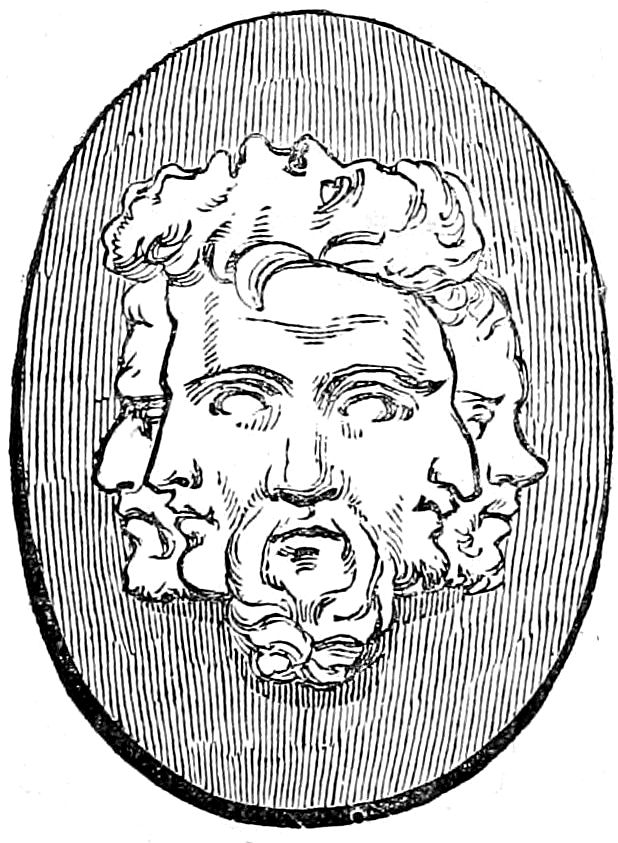
instance will suffice. The Trimurti or three-headed deity
in the caves of Elephanta.
This is a sculpture of the most remote antiquity, but the
dress, the beads, the sacred cord and other religious symbols
declare it to be the work of Hindoos. In anthropomorphising
the Deity, men always adopt their own typical
countenance for that of their God. Hence their idols
betray the national features. Now, observe the profiles of
Vishnu and Siva in this Trimurti. The face of the former,
142the good and beneficent “Preserver,” the friend and
mediator for man, is a purely Greek face; the Nose
straight and well-defined. It has none of the air of the
modern Hindoo countenance. Much less has that of the
energetic and terrible Siva, “the Destroyer.” The Nose
is of the most energetic form; it is a fine Roman Nose,
aquiline and rugose. If phrenologists are permitted from
similar facts to say that the Greeks—who were but children
to these Hindoo artists—were phrenologists, surely
we may venture to say that even at this very early period
the Hindoos were Nasologists.
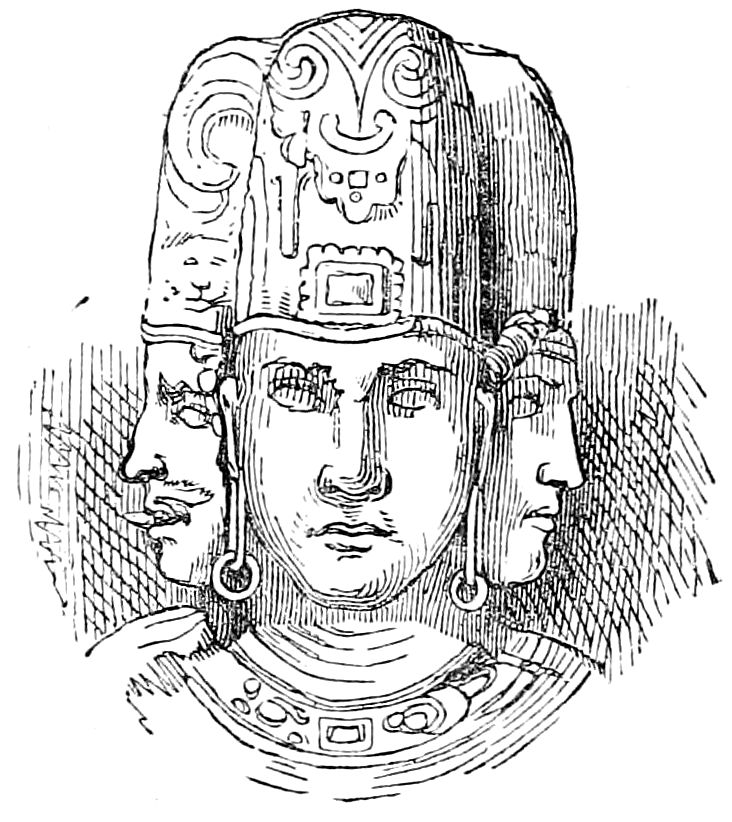
But in the wide nostril of Brahma we also perceive the
Cogitative form of Nose, so necessary to indicate the
wisdom of Brahma, “the Creator:” who, though now he
rests, having consigned the inferior office of Preservation
to Vishnu, was the first emanation from the supreme
Brahmè, and by whom and from whom all creation proceeded.
With the exception of the head in this Trimurti,
Brahma has no idolatrous representations, for it is said in
the Vedas, “Of Him whose glory is so great, there is no
image. He is the incomprehensible Being which illumines
all, delights all, and whence all proceed.”
Sir William Jones mentions, in one of his discourses
published in the Asiatic Researches, the existence of a
small nation in India which appears distinct from the
143Hindoo race. The people comprising it he describes as
shrewd, clever tradesmen, enterprising merchants, acute
money-lenders, and notorious in India for their aptitude
for commerce. Their countenances, he adds, are what are
called Jewish, and hence he concludes that they constitute
a portion of Jews, who either at the dispersion of the
Ten Tribes, or at some other very early period, settled in
India. It is surprising that the acute President should
have so hastily jumped to such a conclusion from the foregoing
premises; for he adds a fact which seems most
decidedly to negative it. This people, he tells us, have
not the slightest trace of any Jewish traditions, belief, or
customs among them. Now it is a familiar fact that the
Jews, wherever dispersed, or however long separated from
their brethren, have invariably retained a very large proportion
of the inspired precepts revealed to regulate their
religious, moral, and social conduct; and it must demand
the most precise and indisputable evidence to justify the
classing any people as Jews, who have lost all traces of
the manners and customs of that singular nation.
For these reasons we do not hesitate to say that the two
facts on which Sir W. Jones founded his hasty hypothesis,
viz. the commercial character and the Jewish physiognomy
of this Asiatic tribe, afford by their coincidence only a
remarkable and curious confirmation of our Nasological
theory, and as such, we here gladly insert it.
We have said that the Jewish Nose should more properly
be called the Syrian Nose; but have reserved, until
this place, some of the corroborative illustrations.
The Syrian Arabs, as descendants of Abraham, through
the wild son of Hagar, inherit the physical, and many of
the metaphysical, features of the Hebrew nation.
Destined, by the promise of God, to become a great
nation, the Arabs founded one of the most extensive kingdoms
of the earth, and for many centuries swayed an
empire more extensive than that of Rome in her fullest
prosperity. For twelve hundred years, a larger proportion
of the inhabitants of the earth have devoutly obeyed the
precepts of the Arabian prophet, than have knelt at the
altar of any other individual creed; and, though Mahometanism
is perhaps doomed to fall before Christianity, it
144cannot be regarded in any other light than as a minor dispensation,
and an inferior blessing conferred by Providence
on a very large proportion of His people.
Christians who yet recognize the finger of God in every
sublunary affair, would shrink with horror if asked to
recognize in Mahometanism a Providential dispensation;
yet, whether we regard it as a religion which annihilated
the grossest idolatries, abolished human sacrifices, exterminated
the vilest obscenities, and substituted a nearly
spiritual worship of One God, over the largest and fairest
portion of the earth,—or as the religion of a nation, whose
ancestor God blessed, and promised to “make a great
nation,” and “to multiply exceedingly, that it should not
be numbered for multitude;” and who, in token thereof,
received the seal of circumcision—to this day retained, as
among the Jews—it is difficult not to see in it the finger
of God, or to deny that the pseudo-prophet of the sons of
Ishmael was an unconscious instrument for good in His
hands.
But this is a topic not needful for us here to enter fully
upon. It is more to our purpose to remark upon the
psychonomic features of the Arabs, while in the zenith of
their promised glory as a nation;[51] when the Caliphs of the
East ruled as Priest and Potentate over more than two-thirds
of the known globe.
During this glorious period of their power, the Arab
character shone out uncontrolled in its true features, and
exhibited itself as it had never done before, nor since.
True to its parentage, but unshackled by the stringent
laws and anti-social ceremonies of its more favoured
brother, it rioted in all those tastes and pursuits which the
latter delighted in, but was restrained from; and became
celebrated for a splendour which was rivalled by that of
Solomon alone, and a traffic which far outvied that of all
145contemporaries or predecessors—except, perhaps, the cognate
nation—the Phœnicians.
Rich in barbaric pearls and gold, and boasting all the
wealth of Ormuz and of Ind, the court of the Caliphs
verified the visions of the “Arabian Nights;” which, if
true, were true here only. All the gauds and trinkets,
the golden palaces, the jewelled walls, the glittering roofs,
in which the other branch[52] of the Hebrew nation displayed
their highest ideas of magnificence, shone resplendent
in the halls of the Caliphs.
But as to the boasted literature of the Arabs, it resolves
itself into an ardent pursuit of physical science—astronomy,
chemistry, and the mechanical arts, for nearly all the
more important of which we are indebted to the Arabs;
not, however, as inventors, but as carriers, like the
Phœnicians. In the higher departments of literature, the
Arabs made no progress. Metaphysical disquisitions and
intellectual pursuits were repugnant to their tastes, which
rather delighted in the physics of Aristotle than the metaphysics
of Plato.
Nor were they less true to their nasal development in
their success and skill in commercial pursuits. The commerce
of Arabia, for several centuries, encircled the whole
known world. From the frigid shores of Scandinavia,
from the torrid sands of Africa, from silken Cathay, from
jewelled Ceylon, from vine-clad Europe, from spicy Araby,
flowed the rich streams of produce. The amber of the
north was exchanged for the gold of the south; the wines
of Spain for the silks of China; the pearls of Ceylon for
the slaves and gold-dust of Africa; and a commerce now
excelled only by that of England, carried arts and literature
from one end of the Old World to the other, and was
mainly instrumental in raising the more highly-organized
nations of Europe from barbarism to a physical and intellectual
splendour hitherto unknown.
But from this glorious reality, the Arab has sunk into a
wretched, irretrievable lethargy. Like the Jew, he has
been weighed in the balance and found wanting; the cup
146of promise has been held to his lips, and he has refused, or
polluted the blessed draught. They have been called, but
would not come, they would have been gathered together
as tender chickens under the wings of the hen, but they
would not; and “behold, their house is left unto them
desolate.”
Neither Arab nor Jew shall ever again revive, till they
join with the whole earth in one universal cry, “Blessed
is He that cometh in the name of the Lord!”
It has been said that Christian intolerance has driven
the Jew into the mart, and sunk his soul in barter. But
this is not true—Commerce and money-getting are the
psychonomic features of both the Hebrew races. The
Israelitish branch is vehemently charged with its usury
and extortion, by all its prophets. The severe laws which
Moses made against usury shew the character of the people
for whom they were necessary; yet those laws were ineffectual
to check this inherent vice. Ezekiel (ch. xxii. 12)
exclaims, “Thou hast taken usury and increase, and thou hast
greedily gained of thy neighbours by extortion, and hast
forgotten me, saith the Lord God;” so all the prophets.
The Arab and the Jew are both now equally sunk in
the same degradation, (Heu! quantum mutati!) and both
exhibit, through this degradation, their love of gold,
though in a different manner. The Arab still haunting
his native soil, from which legitimate commerce is almost
excluded, betrays his ruling passion in extortion from
travellers, in skilful chicanery in horse-dealing—the only
commerce left to him—or in impudent incessant demands
on strangers for bacsheesh.
All travellers agree, that when the Arab, degraded as he
is, has an opportunity, there is no shrewder or more
skilful bargain-maker, nor any one more competent to
extract by ingenious chaffering, the full equivalent for his
services. He has been designated by fleeced and angry
travellers—little thinking how near the mark they were—the
Jew of the desert. The modern Jew, driven from
the land of his birth into a wider sphere, exercises his
commercial propensities in similar pursuits, and under
every clime; and amidst every race, out-manœuvres and
surpasses his less shrewd antagonist.
147Other Asiatic nations might seem to call for observation;
but so little is known of their mental characteristics, that
it would be improper to endeavour to substantiate our
cause by them.
It is unnecessary to do more than remind the reader of
the low development of the Negro mind and his miserable
nasal conformation—they are worthy of each other.
However humane may be the attempts to elevate the
Negro, it can never be done till his Nose is more elongated;
but as its present form has subsisted without alteration for
three or four thousand years, there does not seem much
hope of its being improved now. The Negro race, as old
as the earliest Egyptian sculptures, has never risen to an
equality with any of the other races; and, though we
would not willingly condemn any nation to hopeless degradation,
yet the history of the Past will reveal somewhat
of the secrets of the Future, and he is a fool who
cannot, and a coward who dare not, read them.
As among individuals, so among nations there are
orders and degrees of mind, and it is only the blind who
cannot see that the equality of the one is as wild a dream
as the equality of the other.
No well-informed writer, however warm his sympathies
towards the Negro race as his relation by the same “blood
of which God made all the dwellers upon earth,” has anticipated
a destiny for it equal to that of the Caucasian or
elliptical-headed and aquiline-nosed races. Channing, the
most enthusiastic friend of the blacks, in all the fervour of
his ardent mind and vivid imagination, attributes to them
a capacity only for the milder graces of Christianity, and
accords to them a destiny precisely such as is indicated by
their nasal formation when elevated and sanctified by religion.
“I should expect,” he says, “from the African
race, if civilized, less energy, less courage, less intellectual
originality, than in ours; but more amiableness, tranquillity,
gentleness, and content. They might not rise to
an equality in outward condition, but would probably be a
much happier race.” Essentially a feminine character is
that which he assigns the negro; a character very loveable,
notwithstanding the deformity of its facial indicator.
In the new Islands of the Pacific, we behold a constant
148succession of new worlds emerging from the deep by means
of the same process which, in the pre-Adamite world,
formed and elevated the islands and continents of the
northern hemisphere. Minute polypi are secreting from
the waters, and fixing on the summits of submarine volcanoes
the solid and durable limestone which now forms
their protection from the waves, and which will hereafter
form the foundations on which accumulated detritus will
heap up fertile soils and habitable lands.[53] Earthquakes
are continually pushing up these horizontal surfaces, and
breaking them up into mountains which, arresting the
clouds in their progress, draw down into the valleys and
plains the fertilizing rain. This smooths down the asperities
of the earthquake-broken surface, and softens and
harmonizes into that sweet variety which gives birth to
“The pleasure situate in hill and dale.”
To people these new lands, Nature has branched off
from the old stock, new races of men of various degrees of
physical development and mental endowments. While
those nearest the old continent of Asia, and therefore
nearest to the old blood, are of the lowest possible mental
and physical organization, little elevated above the low-class
animals—the kangaroo and the ornithorynchus[54]—of
the Australian plains, those at a greater distance—the
New Zealander and the Otaheitan—exhibit a development
which may vie with that of the Caucasian nations: and
which has proved its equality by not sinking before them,
149but maintaining against Saxon invaders equal rights and
equal privileges.
We have a striking instance of this before us at the
present time. The British Legislature having, in ignorance
of the determined character and clever good sense of
the New Zealanders, endeavoured to force upon them a
Constitution which deprived them of legislative privileges
equal with those of the colonists, and which gave to the
latter the power of taxing the former without their consent,
the natives have resisted the injustice so firmly, but
hitherto peaceably, that the Governor, Sir George Grey,
has been compelled to suspend this so-called Constitution,
lest it should foment a war of the most deadly character.
It is worthy of observation that the injustice attempted to
be done this shrewd and spirited people, is not one of an
evident physical character, such as any savage can appreciate,
but one of a purely theoretical and political nature,
the importance of which is even yet hardly sufficiently
understood and appreciated in any country besides England.
Sir George Grey writes to the Home Government
as follows:
“By the introduction of the proposed Constitution into
the provinces of New Zealand, her Majesty’s Ministers
would not confer, as it was intended, upon her subjects
the blessings of self-government, but would be giving
power to a small minority (the colonists). She would not
be giving to her subjects the right to manage their affairs
as they might think proper, but would be giving to a small
minority a power to raise taxes from the great majority (the
aborigines). There was no reason to think that the majority
of the aboriginal inhabitants would be satisfied with
the rule of the minority; while there are many reasons
for believing that they would resist to the uttermost.
They were people of strong natural sense and ability, but by
nature jealous and suspicious. Many of them were owners
150of vessels, horses, and cattle, and had considerable sums of
money at their disposal, and there was no people he was
acquainted with less likely to sit down quietly under what
they might regard as an injustice.”
“For these and other reasons, the Governor announced
that he should not proclaim the constitution before receiving
fresh instructions from the Colonial Office.
“The tone of the most trustworthy correspondence from
New Zealand, proves that this exercise of independent
authority on the part of Governor Grey has saved the
colony from disastrous consequences. Ministers acknowledge
his superior competency to judge in a matter of this
kind, and a bill has accordingly been introduced into the
House of Commons by Mr. Labouchere, ‘for suspending,
during a limited time (viz., for five years), the operation
of part of the Act for making further provision for the
government of the New Zealand Islands.’”[55]
Thus has this noble people, with a strong natural sense
and ability not hitherto supposed to belong innately to
“savages,” opposed more successfully the first step in
tyranny—the power of unrepresented taxation—than any
other nation (except the Saxon), which has ever existed,
civilized or uncivilized.
This has been done within twenty years after their
actual beneficial contact with civilization; but it was more
than six hundred years after the Norman conquest, before
the Saxon roused himself to enforce the same right of self-taxation.
There could be but one better evidence than
this of the high-class mind of this people; and it has
furnished this one better, and best, evidence—its speedy
and conscientious reception of Christianity; for “in no
country, similarly circumstanced, has the Gospel made
such rapid progress, since the days of the Apostles.”[56]
While for several centuries missionaries of every denomination
have laboured in Asia in vain, no sooner was
Christianity efficiently made known to the New Zealanders,
than, catching at once with a remarkable aptitude its
leading characteristics, and appreciating immediately its
beneficent doctrines, they accepted it; and now, together
151with other Polynesian islands, New Zealand affords the
proudest conquest and the richest harvest of the soldier of
Christ.
Yet, apparently, for no nation could Christianity be less
adapted, and no nation could be expected to afford less
hope of speedy conversion. The pagan New Zealander
was a fierce, blood-thirsty monster, spending his whole
life, and finding all his pleasures, in the most savage warfare.
Not content with slaying his enemies in combat, he
sat down afterwards, with a joyous enthusiasm worthy of
a fiend, to make a feast on their carcasses. Human sacrifices
stained his altars, and hideously deformed images
pourtrayed his debased notions of a God.
On the other hand, the peaceable and mild Hindoos,
whose religion forbids bloody sacrifices of any kind, and
enjoins the careful preservation of the spirit of life, even
in the meanest forms; whose singular traditions of the
incarnate Chreeshna seem to point distinctly to a Messiah,
and whose remarkable Trimurti, “three in one, and one
in three,” seems to open a way to the facile reception of
the mysterious doctrine of a Trinity in Unity, have never,
as a nation, a province, or even a small village, embraced
Christianity.[57] China, which has its similar traditions,
whose sages have taught that “The true Holy One is to
be found in the West,” and that “Eternal reason (λόγος)
produced One, One produced Two, Two produced Three,
and Three produced all things,” and whose calm stoicism
and severe morality are so accordant with the external
symptoms of a Christian mind, has hardly furnished a
single convert, and apparently feels no curiosity about the
religion of the Fanqui (white devils).
If history is the past teaching lessons to the future,
surely our Missionary Societies might take a lesson from
these facts, and withdraw their exertions from so hopeless
152a field as Asia, and expend them on the hopeful soil of
Polynesia. Surely if the great Apostle of the Gentiles,
who was specially appointed to bring into the fold of
Christ “all nations,” was forbidden to preach the Word to
the effete nations of Asia, it is not given to his successors
to contravene the inspired mandate.
Other injunctions of Scripture to the apostolic Church
are rightly interpreted as applicable, and to be obeyed by
the Church in all future ages; and it is a strange inconsistency,
arising from a too warm and enthusiastic desire
to promote the kingdom of Christ, fruitlessly to strive, in
this instance, against the mandate of the Holy Spirit.
Thus much have we said, to contrast the New Zealand
mind with the Hindoo and the Chinese, because the same
contrast is manifest in their respective physiognomies.
Compare the bold energetic Roman Nose, the manly and
commanding profile of the New Zealander, with the soft
and rounded features of the Hindoo, and the flat monotonous
surface of the Chinese visage. You perceive at a
glance that the first is the face of a man of strong, straight-forward,
common sense, and intense energy. He may not
be an acute and subtle reasoner; but he catches at once
the leading points of a subject, instantly decides, and
instantly acts upon his decision.
153While the two latter remain in imperturbable absorption,
and while the subtle “Greek” would be thinking too precisely
on the event,
“A thought which, quartered, hath but one part wisdom,
And ever three parts coward,”
the “Roman” has been, and seen, and conquered. He is
come back, at home, resting after his successful toil; while
the “Snub” is thinking about getting out of bed, and the
“Greek” is making up his mind whether it is “worth
while” to go out.
Thus we have, from divers sources, brought together,
briefly and succinctly, a few of the universal proofs which
establish Nasology as a science. From individuals and
from nations we have gathered the basis of our nasological
laws; and we trust we have produced conviction in some
minds that “the Nose is an index to Character;” if not,
we shall not say to the reader, as phrenologists do to their
incredulous auditors, that it arises from his defective organization,
but rather attribute it to our own defective mode
of argumentation; for we shall not willingly admit the
erroneousness of a system which has been built up upon
many years of personal observation both among the dead
and among the living.
LONDON
PRINTED BY SPOTTISWOODE AND CO.
NEW-STREET SQUARE
- P. 7, changed “This a drawback which we feel greatly” to “This is a drawback
which we feel greatly”.
- P. 73, changed “they turn their tales round” to “they turn their tails round”.
- P. 149, changed “lest in should foment a war” to “lest it should foment a war”.
- Silently corrected typographical errors and variations in spelling.
- Archaic, non-standard, and uncertain spellings retained as printed.
- Footnotes were re-indexed using numbers and collected together at the end of the last
chapter.
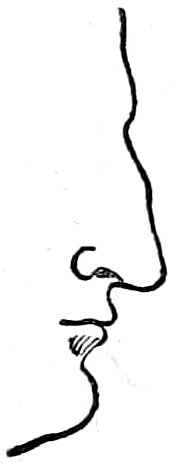
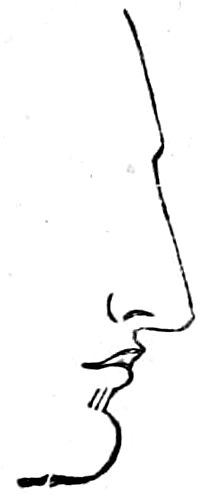
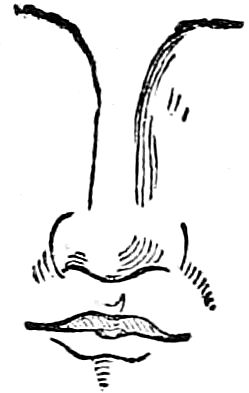
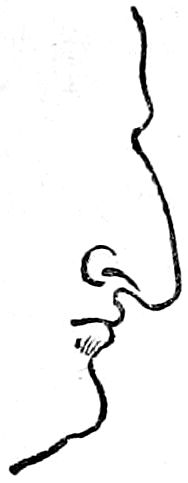
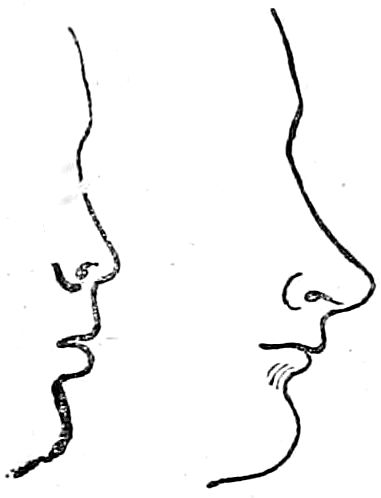
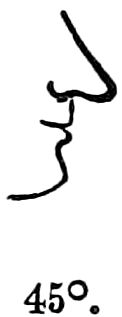
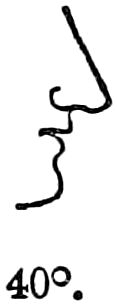
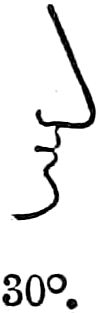 —less than
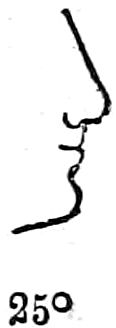 becomes a snub.
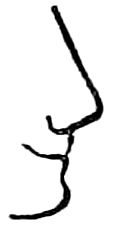 ,
the consequent abbreviation
of the Nose (for a long Nose has always more Power
than a short one) weakens the character, but the temperament
is cheerful, gay, and lively; if on the other hand the
angle is acute, as thus
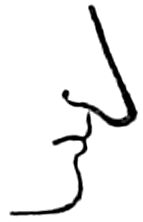 ,
the elongation of the
Nose adds much to the intensity of the character indicated
by the profile; but the disposition is generally melancholy,
and, if a very acute angle, desponding and fond of
gloomy thoughts. Fox (the Martyrologist), John Knox,