NOTES ON DISEASES OF CATTLE CAUSE, SYMPTOMS AND TREATMENT
Transcriber’s Note:
The cover image was created by the transcriber and is placed in the public domain.
VETERINARY SCIENCE ASSOCIATION OF AMERICA
BY
CHARLES J. KORINEK, V.S.
Graduate of the Ontario Veterinary College, in affiliation with the University of Toronto, Canada. Hon. Member of the Ontario Veterinary Medical Society. Ex. State Veterinarian for Oregon. Ex. President of the Oregon State Veterinary Medical Board of Examiners. Author of “The Veterinarian”. Principal of the Veterinary Science Association of America. Sixteen years of Practical Experience as a Veterinary Surgeon.
PUBLISHED BY THE
VETERINARY SCIENCE ASSOCIATION
OF AMERICA
COPYRIGHT 1917
by the
VETERINARY SCIENCE ASSOCIATION
OF AMERICA
DISEASES OF
CATTLE
CAUSE, SYMPTOMS AND TREATMENT
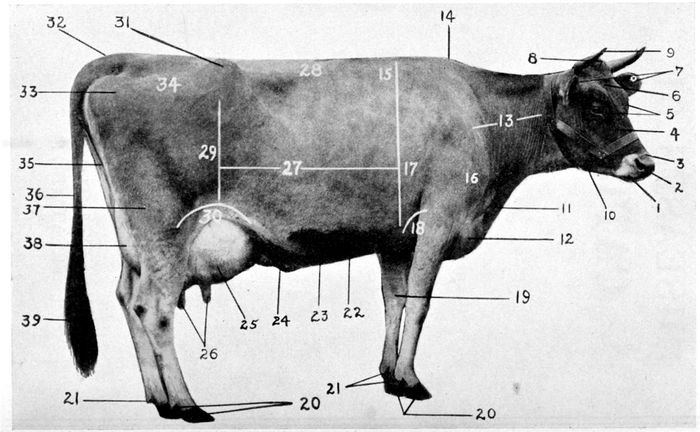
LOCATION OF PARTS OF DAIRY COW.
Location of Parts of Dairy Cow
1.
Mouth.
2.
Nostrils.
3.
Muzzle.
4.
Face.
5.
Eyes.
6.
Forehead.
7.
Ears.
8.
Poll.
9.
Horns.
10.
Jaws.
11.
Dewlap.
12.
Brisket.
13.
Neck.
14.
Withers.
15.
Crops.
16.
Shoulders.
17.
Heart girth.
18.
Fore flank.
19.
Legs.
20.
Feet.
21.
Dew claws.
22.
Belly.
23.
Milk wells.
24.
Milk veins.
25.
Fore udder.
26.
Teats.
27.
Barrel or ribs.
28.
Back.
29.
Coupling.
30.
Rear flanks.
31.
Hook points.
32.
Tail-head.
33.
Pin bones or thurls.
34.
Rump.
35.
Escutcheon.
36.
Tail.
37.
Thighs.
38.
Rear udder.
39.
Switch.
PREFACE
5
In offering this work to the consideration of Students
of Veterinary Science, as well as to the Veterinary
Profession and others who are interested in the study
and advancement of Veterinary Science, I feel it will
suffice to say that I have endeavored to the best of my
ability to render the matter contained in the following
pages of as great practical value as possible, to present
in the most plain and concise manner the nature, cause,
symptoms and treatment of each disease in the form
in which it most frequently occurs.
I wish to express a hope that this work will be favorably
welcomed by all into whose hands it may find
its way, more particularly by Students of Veterinary
Science.
Charles J. Korinek, V. S.
ABCESSES.
7
Cause.—Bruises and injuries. They are also seen in
complication with various other diseases, as Laryngitis,
Pharyngitis, Tuberculosis, Lump Jaw, Blood Poison or
Pyemia and Septicemia.
Symptoms.—Symptoms will vary according to the
nature of the disease or injury. It may not be noticed at
first, but upon careful examination swollen lines will be
observed running from the point of swelling. In many
cases a swelling is noticed which is hot, painful and
throbbing, which enlarges rapidly in two or three days.
The swelling and heat gradually disappear, but the
Abscess continues to grow. The hair falls from the
point of swelling and in a short time breaks and discharges
pus. The cavity gradually fills up and heals
by granulation.
Treatment.—In all cases hasten the ripening process
as much as possible by applying hot water packs or
hot bran, flaxseed or vegetable poultices. When opened,
do not squeeze the Abscess to any extent, but press gently
with clean hands or cloth to remove the core or clot.
After this, just simply keep the Abscess open by washing
with a three per cent Carbolic Acid solution, or
Bichloride of Mercury, one in one thousand solution.
Hyposulphite of Soda in ounce doses should be given two
or three times a day in their drinking water. This will
prevent the absorption of impurities from the abscess
into the blood circulation.
ABORTION.
8
(Non-Contagious)
Cause.—Injuries from slipping or falling on icy
roads, in box cars, and deep gutters; receiving blows
on the body, keeping the animal in insanitary stables,
eating poor food that may be irritating or poisonous,
etc. In such cases, the cow’s vitality is low so that the
foetus dies and is expelled as a result. Losing large
quantities of blood also produces Abortion, or a cow
heavy with calf, on being placed in the same quarters
with the cows that retain their afterbirth, is liable to
abort. Intestinal worms, lung worms, liver flukes, causing
an excessive drain upon the system or producing
irritation of the digestive organs, in consequence of
which cow gets very poor and emaciated. The above
mentioned are perhaps the most common causes of “Non-Contagious
Abortion.”
Symptoms.—The cow is uneasy, becomes separated
from the herd, the bag and vagina may be slightly inflamed
and perhaps the latter discharging. If a cow
heavy with calf craves the chewing and eating of dirt,
rags, nails, etc., this is a sign of a lack of iron or phosphorus
in her system and food containing these elements
should be provided.
Preventive Treatment.—Provide clean, warm,
comfortable quarters, good food, pure water to drink, do
not subject her to any injuries, do not permit her coming
in contact with cows retaining their afterbirth.
The above mentioned is very important, especially if
the cows are valuable and a large yield of milk is expected.
If they have worms, treat the same as under
their special heading. If they have a loss of blood or
a lack of mineral matter in their system, the following
is very efficient: Pulv. Ferri Sulphate, four ounces;
Pulv. Nux Vomica, two ounces; Pulv. Fenugreek Seed,
four ounces. Mix and make into sixteen powders. Give
9one powder two or three times a day in feed or place in
a gelatin capsule and give with capsule gun.
AMOUROSIS OF THE EYE.
Cause.—Paralysis of the optic nerve.
Symptoms.—Pupil fully dilated and of a glassy appearance.
This condition is sometimes called “Glass
Eye.” The cow carries the head high and steps high.
This condition is very uncommon in cattle.
Treatment.—Nothing can be done for a cow if she
is blind, but this condition may be prevented if detected
in its early stages of development by the proper feeding
of nourishing food, good clean surroundings and the administration
of nerve tonics, as Pulv. Nux Vomica, four
ounces; Pulv. Gentian Root, four ounces; Potassium
Iodide, three ounces. Make into twenty-four powders
and place one powder in feed two or three times daily;
or make into twenty-four capsules and give one capsule
two or three times a day with capsule gun.
ANTHRAX.
Anthrax is a very contagious disease and is communicable
to all warm blooded animals and man.
Cause.—Due to the presence of a germ called the
Bacillus of Anthrax and is one of the oldest diseases
attributed to germs. These Bacilli thrive in warm
climates, although found in cold countries. The infection
is carried to various parts of the world by box cars,
ships, hides, hoofs, horns, wool and hair taken from sick
or dead animals affected with Anthrax. This, perhaps,
is the most common method of spreading the disease.
Symptoms.—Loss of appetite, grinding of teeth
indicating great pain, trembling of the muscles, temperature
elevated to 104° or 106° F., breathing very
rapid, pulse fast and weak, hair rough. There are some
cases where the animals are seized quickly with the
10disease and die very suddenly. This form resembles
apoplexy. Carbuncles or Abscesses are seen on the surface
of the body in nearly all cases, also a bloody discharge
from the mouth and nose. The animal may
stamp the ground, rear in the air, run and finally go into
convulsions and die. This is termed “the furious form
of Anthrax.”
Treatment.—Prevention is the most important.
Fields or pastures that are infected with this disease
should be burned every summer if possible, to destroy
the germs. The animals that succumb to the disease
should be buried deeply and quicklime thrown upon
them, also any blood stains upon the ground should have
a strong disinfectant thrown upon them. The hide of
such an animal should not be used as the person removing
it is likely to contract the same disease, especially
if an abrasion is present on the hand, or such a hide or
any portion thereof is likely to spread the infection after
reaching the tannery, etc.
Medical Treatment or Serum Treatment.—This
is the only thorough method of eradicating the disease,
and when this disease once becomes prevalent in a
locality all animals should be inoculated with vaccine.
BARRENNESS.
(Failure to Breed)
Cause.—Wasting or Atrophy, chronic inflammation
of the mucous membrane lining the organs of generation,
Whites, absence or excessive secretions of the organs
of generation, contraction or displacement of the womb,
horns being telescoped or twisted, cysts or growths on
the ovaries, in-breeding or being a twin, are the predisposing
causes of Barrenness.
Treatment.—Unsuccessful as a rule. Unless the
cow is very valuable, treatment is not advisable. A careful
examination, however, is recommended. If due to
11contraction of the neck of the womb it can be readily dilated
by the use of the hand, which should be greased
with Carbolated Sweet Oil before attempting to perform
the operation.
BLACK LEG.
(Symptomatic Anthrax—Black Quarter)
Cause.—Due to germs. The Bacillus of Black Leg
perhaps gains entrance to the blood by wounds of the
skin or the mucous membranes lining the mouth and the
intestines. This disease principally affects cattle, although
sheep and goats may become affected with the
same disease.
Symptoms.—This disease affects cattle that are in
good condition between the ages of six months and two
years. In most cases death is very sudden, and perhaps
the animal is found dead. The first symptoms are high
temperatures from 104° to 108°F., loss of appetite, the
animal stops chewing the cud, breathing considerably
hurried, the joints of the limbs become swollen, also the
chest and shoulders. All the swellings are painful on
pressure and spread very rapidly over the body. The
affected animals move with great difficulty and lie down
frequently. If the hand is passed over the body, there
is a peculiar crackling sound due to the gas developing
under the skin. At the most distended portions of the
swellings the skin becomes dry and the animal apparently
has no sense of feeling. If the skin is punctured at
this place, there will be a dark red, frothy discharge
which has a very disagreeable odor. There will be a
shivering of the muscles and the animal dies in convulsions.
Treatment.—Remove non-affected animals to non-infected
pastures, and confine affected animals to as
small a territory as possible. The carcasses of the dead
animals should be buried deep and covered with lime or
burned, being very careful that all blood stains on the
ground where the animals have been skinned are thoroughly
12disinfected. Inoculation is necessary, and is the
best form of treatment in localities where Black Leg
exists. Inoculate or vaccinate the calves when six months
old or over, although after the animal reaches the age
of two years or over they generally become immune from
this disease.
BLEEDING.
(Hemorrhage)
Cause.—Sometimes bleeding follows dehorning, castration,
and wounds due to various other causes.
Treatment.—When bleeding from a large artery, it
should be tied with a clean silk or linen thread or twisted
with a pair of forceps or cauterized with a hot iron.
Sometimes compression by the use of tightly bound
bandages proves effective, although the former appliances
are more practical. Tincture Chloride of Iron applied
to small arteries or veins causes the blood to clot
in the arteries or veins and hence stops the hemorrhage.
It is very essential that all wounds should be treated
antiseptically and I cannot say that I favor washing a
wound with water only in cases where the wound is very
filthy, and I prefer powder applications in preference to
any other antiseptics. The following will be found very
effective in the treatment of the majority of wounds:
Boracic Acid, two ounces; Iodoform, two drams; Tannic
Acid, one-half ounce; Calomel, one dram. Powder
finely and mix well. Place in sifter top can and apply
two or three times daily.
BLOATING.
A very common disorder in cattle and characterized
by a puffed up appearance of the left flank. The cow
has four stomachs, of which the rumen is the largest,
its capacity being about fifty gallons in the average cow,
and it is this stomach which fills with gas when a cow
bloats.
13Cause.—Eating green clover or alfalfa; even when a
cow is accustomed to this diet, it may cause bloating if
wet with dew or rain; cured alfalfa, moldy or frozen
mangles will also produce bloating; the above mentioned
foods undergo a process of fermentation which causes
excessive formation of gas, and death may result very
quickly and may be due to rupture of the stomach or the
diaphragm (muscle separating the abdominal and lung
cavities), but is more often due to suffocation caused
by the distension of the stomach, which becomes so large
that it presses the diaphragm forward against the lungs
in such a manner as to stop their movement and the animal
smothers. When the cow falls, it indicates that one
of these possibilities has occurred and death follows
quickly.
Symptoms.—Cattle usually bloat suddenly and without
warning; the left flank becomes abnormally swollen,
back is arched, breathing labored; sometimes the tongue
hangs out and the animal bellows. When rupture or
suffocation occurs the animal reels, staggers and falls,
after which nothing more can be done.
Treatment.—No time should be lost. Where the
stomach is enormously distended with gas so as to cause
the animals to stagger and breathe very rapidly, they
should be gagged. This can be easily accomplished by
taking a piece of wood about two inches in diameter, and
eight inches to one foot long, placing it in their mouth
and retaining it in that position by tying a string on each
end and placing it back of the ears. If this does not give
relief immediately, puncture the left flank about five
inches downward and forward from the angle of hip
bone. However, puncturing should not be resorted to
only in cases where death threatens the animal, as abscesses,
infection and severe hemorrhage may follow.
A very reliable medical treatment for this condition
should be in the medicine chest of every veterinary, such
as Pulv. Asafetida, Oil of Turpentine, each one ounce.
Place in gelatin capsules. This is a very efficient remedy
14for the eradication of excessive fermentation of gases in
the stomach or intestines.
BLOOD POISON.
(Pyemia—Septicaemia)
Cause.—Due to a septic infection taken into the
blood, frequently found in cows with retained afterbirths,
following inflammation of the womb or intestines,
wounds and bruises of the skin and frequently found in
calves affected with Joint Ill.
Symptoms.—High temperature 103° to 107°F.,
pulse rapid and feeble, breathing increased, grinding of
the teeth, the animal refusing to eat in most cases and
ceasing to chew the cud, although there may be great
thirst present. Abscesses may form in various parts of
the body, the membranes of the eyes and mouth will be
injected with blood, giving them a dark red appearance,
although in the latter stages of Blood Poison this may
change to a yellowish tinge. Constipation or Diarrhoea
may be connected with the disease. The animal dies by
general emaciation from four to six days after the first
symptoms are noticed.
Treatment.—Unsuccessful, as when the infection
once becomes absorbed in the blood it is always certain
that death will follow. If due to injuries or wounds,
wash them with Bichloride solution, one part to one thousand
parts of water, but if due to retained afterbirth or
inflammation of the womb, inject one gallon of distilled
water containing five per cent Carbolic Acid. If in
young calves, treat the same as under the heading of
Joint Ill. If due to inflammation of the intestines, give
Hyposulphite of Soda, two ounces; Potassi Iodide, one
dram, two or three times a day in their drinking water.
When abscesses form, lance them with a clean, sharp
knife. If the animal is constipated, place two drams of
Aloin, two drams of Pulv. Gentian Root in a capsule
and give with capsule gun. If Diarrhoea is present, give
15Gum Catechu, two drams; Protan, three drams; Zinc
Sulphocarbolates, one grain. Place in gelatin capsule
and give with capsule gun. Feed warm wheat bran
mashes, steamed rolled oats, vegetables and green grass,
if possible.
BLOODY FLUX.
(Dysentery)
Cause.—Chilling of the outer surface of the body.
Improper feeding, as contaminated food or water, sometimes
connected with parasitic diseases of the intestines.
Symptoms.—Dysentery is a sign of some irritation
of the intestines terminating with increased contractions
of muscular fibers of the bowels. The fecal matter, if
frequently expelled, at first consists of a thick feces, but
as the disease progresses the fecal matter becomes very
thin and watery tinged with blood and very offensive.
When the first signs are noticed the animals
show no constitutional disturbances, but later they exhibit
abdominal pain by looking around to the flank. At
this stage they are very weak, throwing the feet well together,
giving the back an arched appearance, and are
very uneasy although they may lie down frequently.
Temperature elevated from one to three degrees. The
animal becomes emaciated and eventually dies.
Treatment.—Determine the cause and remove it if
possible. Keep the animal quiet. Give pure water to
drink in small quantities but often. If the animal will
eat, feed steamed rolled oats, etc. Flaxseed tea is very
beneficial, as it is soothing to the intestines and assists
in removing the irritations. Pour one quart of boiling
water on one-half pint of pure Flaxseed, allowing it to
cool, then compel the animal to drink it. The following
prescription will be found very effective in all forms
of Diarrhoea: Tannic Acid, one ounce; Protan, two
ounces; Gum Catechu, two ounces; Beechwood Creosote,
four scruples; Zinc Sulphocarbolates, eight grains. Make
16into eight capsules and give one capsule every three or
four hours with capsule gun.
BLOODY MILK.
Cause.—Bloody Milk may be the result of injury,
congestion, inflammation of the udder. Feeding on rich
milk-producing food suddenly may produce it. Bloody
Milk is also produced in a cow by excitement when in
heat or from eating resinous plants or shrubs.
Treatment.—It is advisable in most cases to give a
physic consisting of two drams of Aloin and Ginger
two drams. Also administer Potassium Nitrate, four
ounces; Potassium Chlorate, two ounces, made into eight
capsules and give one capsule twice daily with capsule
gun. If due to rich food, reduce it. If due to eating
resinous plants, remove them from the pasture containing
such shrubbery. Where congestion or inflammation
of the bag is thought to produce it, apply Hot Water
Packs, then dry and apply Blue Ointment and Zinc
Ointment, equal parts, two ounces. Mix well and rub
on thoroughly two or three times a day.
BLUE MILK.
Cause.—This condition is due to a germ (the Bacillus
Cyanogenes) which may occur in rich milk or cream
immediately after being drawn or the germ may find
its way into the opening of the teat.
Treatment.—Injections into the teat of a solution
composed of the following: Hyposulphite of Soda,
two drams; Boracic Acid, one dram, dissolved in one pint
of boiling water. Permit to cool and inject a small quantity
in each teat once or twice a day for three or four
days. This will destroy the Blue Milk producing germ
without any injuries to the cow udder, or teats.
BRONCHITIS.
17
Cause.—Inhaling irritating gases or foreign bodies.
It is commonly seen after drenching from liquid escaping
into the windpipe instead of going down the gullet.
Animals exposed to cold, wet weather when not accustomed
to it frequently develop Bronchitis.
Symptoms.—Loss of appetite, chilling, temperature
elevated two or three degrees above normal, ears and
legs cold, nose hot and dry, breathing short and labored,
painful coughing, slight discharge from the nostrils and
saliva oozing from the mouth. If the ear is placed
over the lower portion of the neck, a crepitating sound
can be heard.
Treatment.—Place the animal in a clean, comfortable
stall where there is pure air and light but no drafts.
Clothe the body if the weather is cold. Hand rub the
legs and bandage with woolen cloths. Give inhalations
of steam from Hot Water and Pine Tar for twenty minutes
two or three times a day. Also administer Nux
Vomica, four ounces; Ginger, four ounces; Nitrate of
Potash, four ounces. Make into sixteen capsules and
give one capsule every four hours. Applications of the
following liniment are of some value: Aqua Ammonia
Fort., three ounces; Oil of Turpentine, three ounces;
Sweet Oil, six ounces. Apply over the region of the
windpipe the full length of the neck.
CALF SCOURS.
(Cholera—White Scours—Bloody Flux)
Cause.—It is produced by a specific germ and is
communicated by direct or indirect contact with the germ
which may gain entrance into the blood by the umbilical
cord at or shortly after birth or through the digestive
canal by drinking milk or eating food contaminated with
the disease-producing germ. The more common means
18of spreading the disease is through pails, drinking
troughs, etc.
Symptoms.—One of the most deadly forms of Diarrhoea.
This usually appears a few days after birth, although
in some cases it takes several days for it to develop.
Every sign of Diarrhoea is present, as frequent
passages of feces of a yellowish-white color, frothy and
very offensive in odor. The calf is very dull, weak, back
arched, hair rough, eyes glassy and sunken back in their
sockets, belly retracted, breathing short and fast. The
calf finally lies flat on the side, head resting on the floor
or ground with a temperature generally below normal.
The calf finally becomes unconscious and death follows.
Treatment.—Give Protan, three ounces; Zinc Sulphocarbolates,
eight grains; Gum Catechu, powdered,
two ounces; Ginger, one ounce; Beechwood Creosote,
one dram. Make into eight capsules and give one capsule
every two hours until relieved. When the calf will take
its feed, if not nursing its mother, see that the milk is
pure and the utensil containing it thoroughly scalded
with hot water. Keep the animal in clean, sanitary
quarters, as quiet as possible for a few days, and if the
disease is not too far advanced a good recovery will follow.
CALVING.
Signs of Normal Calving are firmness and enlargement
of the udder, extending well forward following the
milk veins. The teats as a rule discharge a thin milky
fluid, relaxation of the muscles on each side of the croup
or the base of the tail. The outer surfaces of the womb
becomes swollen and inflamed, discharging sticky,
stringy, transparent mucus. The cow becomes uneasy,
stops eating, and if in a pasture becomes separated from
the rest of the herd; will lie down and get up alternately
as if in great agony. When birth pains start, the back
is arched, and a severe straining follows the contraction
19of the abdominal muscles. The membranes covering the
fœtus will be the first to make their appearance, engorged
with a fluid from the womb. This is commonly
known as the water bag, which eventually bursts and the
two fore feet can be seen, and, as the animal continues to
strain, the nose and head will be next to be seen. When
the calf’s shoulders are exposed, the cow as a rule rises
suddenly to her feet and the entire calf is expelled, also
the membranes surrounding it, but the membranes next
to the womb, as a general rule, remain longer and sometimes
require artificial assistance to remove them. (See
Retention of the Afterbirth.) Destroy the fœtal membranes
by burning or burying them deeply. Do not permit
the cow to eat them. Wash the calf’s navel with
Bichloride of Mercury, one part to one thousand parts
water, once or twice a day until the navel is thoroughly
dry, or an infection may follow, producing Joint Ill or
Scours, from which death may result.
Abnormal Calving.—This is a condition where the
fœtus is not normally presented, as that just described.
Their feet may be presented in a normal manner, but
the head and neck twisted back or to one side, or the
head and one fore foot may be presented normally, while
the other fore foot is doubled back, or there may be a
breech presentation as the rump of a fœtus with both
hind feet thrown close to its body. This is a very difficult
presentation, especially if in a young animal. A
fœtus abnormally presented requires good judgment
and cleanliness, also lubrication of the walls of the womb
with unsalted Lard, Cotton or Sweet Oil. Endeavor to
place the fœtus in as near a normal position as possible
before any force is used in its delivery, although
where both hind feet are presented, it is advisable to remove
it in this position. The hands and ropes should be
clean and washed with a five per cent solution of Carbolic
Acid. It is not only dangerous to the animal, but to the
operator as well, if proper antiseptic precautions are not
practiced.
Space does not permit me going into details on various
20fœtal presentations nor does it permit me to explain
the exact methods or operations I would use in each particular
case. Nevertheless, good judgment and cleanliness
are important. Do not hurry. Take your time, and
you will be successful in most cases.
When the fœtus is removed, and the afterbirth does
not come away within twelve or eighteen hours, remove
it. (See Retention of Afterbirth, which will describe its
means of attachment and its removal.)
CASTING THE WITHERS.
(Eversion of the Womb)
Cause.—Failure of the womb to contract after Calving.
If the womb contracts naturally and the afterbirth
expelled, the cavity of the womb is nearly closed and
the neck of the womb becomes so narrow that the hand
cannot be inserted. When the womb fails to contract,
one or both horns of the womb become so relaxed that
they fall into the cavity causing straining and contraction
of the abdominal muscles, forcing the womb out gradually
until the organ is turned inside out. The womb
can be easily distinguished from the other membranes
on account of the presence of sixty to eighty mushroom-like
bodies (cotyledons) two to four inches in diameter
attached to the walls of the womb by a narrow neck.
The womb when hanging out becomes engorged with
blood and inflamed until it is as large as a grain sack,
very dark in color, tears and bleeds with the slightest
touch. Later it becomes lacerated and gangrenous.
Symptoms.—At first, the general health is not very
much interfered with, but the inflammation which is
marked by an elevation in temperature becomes very
noticeable, accompanied by severe straining and exhaustion.
The animal lies down, but continues to strain until
death, unless relief is afforded the animal at once.
Treatment.—Great care must be exercised. The
parts of the womb coming in contact with the cow’s hips,
21tail or floors must be thoroughly washed with a five per
cent solution of Carbolic Acid, using a soft cloth or
sponge to remove dirt, clots, etc. Place the cow in a position
so as to have her hind quarters much higher than
the head, and then endeavor to replace the womb. After
washing as stated above, bandage the tail with a clean
cloth; have an assistant hold up the womb and the operator
use gentle manipulation and pressure with clean
hands; this perhaps is the best method of replacing the
womb. Then follow by flushing out the womb with a
weak Carbolic Acid solution and luke warm water. This
has a tendency to straighten out the horns of the uterus
and prevent infection. If the cow continues to strain,
give Potassium Bromide in ounce doses every two or
three hours in her drinking water, or place in capsule
and give with capsule gun.
Sometimes stimulants and tonics are necessary and
the following will be found very effective: Pulv. Nux
Vomica, four ounces; Pulv. Gentian Root, four ounces;
Pulv. Ferri Sulphate, four ounces. Make into sixteen
capsules and give one capsule every six hours with capsule
gun.
It is well to compel the animal to stand or lie with
the hind parts elevated, until the signs of straining have
ceased.
CATARACT OF THE EYE.
Cause.—Is due to deep seated inflammation of the
eye produced by an injury or weakened condition of the
optic nerve.
Symptoms.—If the pupil of one of the eyes appears
larger than the other it is well to make a careful examination,
as this is the first sign of Cataract. If such a
condition is neglected, partial or complete blindness will
follow and a white, pearly deposit can be seen on the
lens of the eye.
22Treatment.—Very unsatisfactory unless treated
carefully when the first signs are noticed. Place the animal
in a darkened stable. Feed clean, sloppy food and it
may be necessary to give a physic consisting of two
drams of Aloin, two drams of Pulv. Ginger, placed in a
capsule and given with capsule gun. The following ointment:
Yellow Oxide of Mercury, four grains; Lanolin,
one ounce, should be mixed well and applied to the eye
two or three times a day.
CATARRH.
Cause.—Ill ventilated stables, inhalations of irritating
gases or sudden exposure to cold, wet weather, after
being accustomed to warm stables. Most commonly seen
in the Spring or Fall.
Symptoms.—Chilling and temperature elevated one
or two degrees, pulse not much affected, breathing hurried
to some extent, sneezing, coughing, dullness and the
appetite is slightly impaired. In the first stages the nostrils
are very dry and considerably inflamed, but in the
course of a few days the fever subsides and a profuse
discharge from the nose is observed.
Treatment.—Place the animal in dry, well ventilated
stall, blanket well and supply a good quality and
quantity of bedding. Give inhalations from steam and
hot water and Pine Tar. If the animal is constipated,
give rectal injections of Soap and Warm Water two or
three times a day. Also administer Potassium Nitrate,
Pulv. Nux Vomica, each four ounces; Capsicum, two
ounces, and Pulv. Ginger two ounces. Make into twenty-four
capsules and give one capsule three or four times
a day. This should not be neglected, as neglected Catarrh
is liable to be followed by Laryngitis, Bronchitis,
Pneumonia, Pleurisy or other diseases of the organs of
breathing, which are very serious and sometimes cause
the death of the animal.
CHAPPED TEATS.
23
Cause.—Anything that tends to irritate them. A
sudden chilling of the teat in cold weather after the calf
has just let it go, or after the operation of milking with
wet hands or from an animal wading through deep water
or tall wet grass. Also filth or irritants coming in contact
with teats when lying down.
Treatment.—Remove the cause if possible and dry
the teats well after each milking and apply Zinc Oxide
ointment. Feed laxative food that is easily digested,
as it has a very good effect on the blood, consequently
it promotes the healing of wounds.
CHOKING.
(Obstruction of the Esophagus)
Cause.—An obstruction of the Esophagus (gullet)
produced by an animal attempting to swallow apples, potatoes,
roots, dry grain, etc.
Symptoms.—A stringy discharge of saliva from the
mouth, violent coughing, wrenching of the head and
neck. The animal will bloat very quickly if the Esophagus
or gullet is completely obstructed.
Treatment.—The obstruction as a rule is easily located,
and as quickly as possible withdraw the obstruction
by inserting the hand and extracting the object. Do
not attempt to push the object down into the stomach,
except as a last resort, as there is a great deal of danger
of rupturing the Esophagus or gullet. Push the object
upward by gentle manipulation from the outside. If this
fails, a smooth piece of hose about eight or nine feet
long, well greased with Lard, Butter or Oil, should be
passed down the Esophagus or gullet. A block of wood
24about two inches in diameter with a hole bored through
the center just a little larger than the hose, placed in the
mouth, will prevent the animal from biting the hose, and
make the operation easier.
When the animal is bloated severely, puncture with a
knife about four or five inches from the point of the hip
downward and forward.
CHRONIC DYSENTERY.
(Bacterial Dysentery—Johne’s Disease)
Cause.—Acid-fast Bacillus resembling the Tubercular
Bacillus that invade the intestines by the way of the
animal drinking water or eating food containing the
Acid-fast Bacteria.
Symptoms.—Diarrhoea, loss of flesh, although the
appetite is good, hair becomes dry and harsh, temperature
remains about normal. The Diarrhoea becomes persistent
and tinged with blood. The animal becomes emaciated
and anemic, exhausted, and death follows. This
disease may continue for a month or even a year before
death takes place. However this is very uncommon.
They generally die very shortly.
Treatment.—Separate the affected cattle from the
healthy ones. All fecal matter should be deeply buried
or burned, the stalls, barnyards, also thoroughly disinfected.
Administration of medicine thus far has been
unsatisfactory, although a treatment should be directed
toward the intestines with internal antiseptics such as
Zinc Sulphocarbolates, one and one-half grains; Protan,
three drams; Pulv. Nux Vomica, one dram; Bismuth
Subnitrate, one dram. Place in gelatin capsule and
give with capsule gun. This dose should be repeated
three or four times a day. Feed a good quality of food,
such as wheat bran mashes or steamed rolled oats and see
that the water supply is fresh and non-contaminated.
COLIC.
25
Cause.—Drinking large quantities of cold water
when overheated. However, this disorder is very uncommon
in cattle owing to the fact that they are not worked,
seldom overheated, and drink water very slowly.
Symptoms.—Kicking or raising of the feet to the
belly. Lying down and getting up alternately. Distention
of the stomach or paunch with gas. The animal
chills or shivers, etc.
Treatment.—Strong stimulants or tonics as the following
will give immediate results if administered in its
first stages: Pulv. Nux Vomica, two ounces; Pulv. Ginger,
two ounces; Pulv. Capsicum, two ounces. Make into
eight capsules and give one capsule every two hours
until relieved. Give the capsules with capsule gun. If
severe bloating accompanies a case of Colic in cattle
place one ounce dose of Oil of Turpentine in ounce capsules
and give with capsule gun.
CONGESTION OF THE LUNGS.
Cause.—Cattle permitted to stand in drafts when
warm after being driven, etc., irritating drugs escaping
into the lungs when drenching, as it is very difficult for
cattle to swallow when their heads are elevated.
Symptoms.—Dullness. The animal loses its spirits,
so to speak, usually shivers or trembles. When this
ceases, the temperature rises to perhaps 105° to 106° F.
The ears and legs grow cold, the nose hot and dry, pulse
rapid but firm, breathing short and labored, a short hacking
cough will be present. Such animals generally remain
standing.
Other symptoms are constipation, the feces covered
with mucus or a slime, great thirst. The eyes are inflamed
and look glassy. The secretions of milk are suppressed,
if these symptoms develop in milking cows.
26Treatment.—Place the animal in clean, warm, comfortable
quarters permitting light and as much pure air
as possible, but avoid drafts and blanket the animal if
chilly. Hand rub the legs and bandage with woolen
cloths. Administer Pulv. Carbonate of Ammonia, four
ounces; Pulv. Nux Vomica, three ounces; Quinine, two
ounces; Nitrate of Potash, two ounces; Potassium Iodide one
ounce. Make into twenty-four capsules and give one
capsule every four hours with capsule gun. Also apply
a paste made from Mustard and cold water over the lung
cavities just back of the fore legs. Apply once a day
and perhaps one or two applications will be sufficient.
If this disease is treated when the first symptoms develop,
a good recovery will follow. Feed easily digested
food as hot wheat bran mashes or steamed rolled oats,
vegetables and green grass if possible.
CONTAGIOUS ABORTION.
(Infectious Abortion)
Cause.—Due to germ (Bacollus Abortus) coming in
direct contact with the genital organs of a bull or cow
and can be indefinitely transmitted from one herd to another
by infected bulls serving healthy cows, or infected
cows when served transmit the infection to healthy bulls.
Healthy cows become infected by their genital organs
coming in contact with litter on floors when lying down
or rubbing against fences, walls or posts previously soiled
by aborting cows. Cattle licking one another is also a
prolific cause.
Symptoms.—The signs of calving are not so well
marked as in normal calving, especially where the aborting
animal is a heifer and the gestation period has not
exceeded three or four weeks. In cows, especially where
the gestation period has advanced to five or seven
months, the symptoms are easily detected as a rule by a
swelling of the udder, or what is commonly termed “making
bag,” the outer portions of the womb swollen and
27inflamed as in normal calving. As the period of abortion
approaches, there will be a discharge of mucus and
blood from the womb. Labor pains are not as severe as
in normal calving, owing to the absence of hair on the
foetus and being smaller; although the afterbirth (fœtal
membranes), may be retained the same as in normal
calving.
Preventive Treatment.—This perhaps is the
cheapest and best method of treating Contagious Abortion.
When purchasing bulls or cows, ascertain whether
the farm you purchased from has Contagious Abortion.
An investigation of this kind often saves labor, time and
money.
Medical Treatment.—When once Contagious
Abortion makes its appearance, separate infected from
non-infected animals, remove all litter, manure, etc.,
from barns, corrals, and burn or bury deeply. The conveyances
used should be tight so as to prevent scattering.
Scrub and disinfect floors, fences, walls and barns and
rubbing posts with a solution made from three pounds of
Copper Sulphate to ten gallons of water, permitting it
to thoroughly dissolve before using. Use an ordinary
barrel and cover so as to prevent any cattle drinking
same, as it is very poisonous. When a cow aborts, remove
the calf and afterbirth in a tight receptacle that
will prevent any portion from being scattered, and burn
or bury deeply; disinfect the floor and walls of stall
where the abortion took place as long as the cow is discharging
any fluids from the womb. A gallon of distilled
or boiled water containing about one per cent Carbolic
Acid should be injected into the womb with an ordinary
hose and funnel. This should be repeated once a day for
a week. Use a solution of the same strength for washing
the tail and parts around the outer part of the womb, or
in fact any part that the discharge of an aborting cow
may come in contact with.
Internally, give Methylen Blue in thirty grain doses,
every other day for two weeks. This is an exceptionally
28disagreeable drug to administer as it stains everything it
comes in contact with. Place it in a gelatin capsule or
have your druggist prepare six or seven capsules containing
thirty grains each. Then administer with capsule
gun. Insist on pure Methylen Blue, accept no substitute.
This treatment has proven very effective in
many localities where strict aseptic precautions were carried
out, as washing out the womb or any parts that the
discharge of an aborting cow may come in contact with
and proper cleanliness and disinfection of stables, etc.
Cows should not be bred for several weeks following
abortion or as long as there is a discharge present. Bulls
should be treated in much the same way, as administering
Methylen Blue in same size doses for the same length
of time as that of the cow. But in addition to this, use a
one per cent solution of Carbolic Acid for injecting into
the bull’s sheath, holding the end of the sheath while the
solution is being injected, until it is well distended; holding
the opening of the sheath allowing the solution to
remain as long as convenient. Also, wash belly, muzzle,
etc., with a solution of the same strength.
COUGH.
(Acute and Chronic)
As a cough is a symptom of various diseases, these
in addition to the cough should be treated.
Kinds of Cough.—Many writers give several different
varieties, but for the sake of convenience I will
divide them into two forms, namely: Acute and Chronic.
Cause.—Acute coughs are generally due to sudden
exposure of cold, drafts and are the forerunning symptom
of a disease of the organs of breathing.
Chronic Coughs are associated with, and are a result
of sore throat, lung fever, pleurisy, bronchitis, catarrh
and tuberculosis.
Treatment.—Under each disease, of which a cough
29is a symptom, I have also prescribed to include its supprice,
yet very effective in all forms of cough: Tannic
pression. The following prescription is reasonable in
Acid, one ounce; Potassi Chlorate, four ounces; Potassi
Nitrate, four ounces. Powder well and mix with Black
Strap Molasses, one pint, placing container with contents
in hot water, which assists in dissolving. When
this is thoroughly mixed, add Pine Tar, one pint, and
place one tablespoonful well back on the tongue with a
wooden paddle every three or four hours, according to
the severity of the cough.
Sometimes a liniment applied to the throat and windpipe
has a good effect, and I would recommend the following
on account of its penetrating qualities: Aqua
Ammonia Fort., two ounces; Turpentine, two ounces;
Raw Linseed Oil, four ounces. Mix and apply twice
daily, shaking the contents of the bottle well before
using.
COWPOX.
(Variola)
Cause.—Investigations lead us to believe that it is
due to protozoa. So far, the true micro-organism has
not been discovered. This disease is very contagious and
is transmitted by direct communication but not through
the air. Perhaps the most common way of transmitting
the disease is by the hands of the milker.
Symptoms.—A slight rise in the temperature, especially
that of the udder and teats. They are red, swollen
and tender and after three or four days small pimples
or pustules will appear on the teats, about the size of
a pea. The pimples or pustules become larger and within
a few days may attain the size of one-half inch in diameter.
At the end of the second week the pimples or pustules
burst and discharge an amber colored fluid leaving
raw sores, which cause the animal to suffer intensely
30when being milked. The supply of milk is also markedly
decreased in this condition.
Prevention.—A person should not milk both
healthy and diseased cows unless the hands are thoroughly
washed in a Carbolated Solution; the clothes that are
likely to come in contact with the udder, coat sleeves,
etc., changed.
Treatment.—It is advisable to give a physic as it
has a very good effect on the blood, such as Aloin, two
drams, and Ginger, two drams, which is easily prepared
and administered by placing in capsule and giving with
capsule gun.
Also, the application of Zinc Ointment two or three
times a day affords immediate relief and causes the
sores to heal rapidly. Good results are also obtained by
feeding food that is easily digested, as bran mashes,
steamed rolled oats and vegetables.
DIARRHOEA.
Cause.—Giving rich succulent foods after being fed
on stimulating diets for some time, and such a case may
be a benefit to the animal instead of an injury. Turnips,
carrots, etc., especially if frozen slightly, are apt to produce
it. Also impure and stagnant water which acts as
a poison or some irritant in the food, as sand, clay, etc.,
or it may result from excitement, as driving cattle or
shipping cattle in cars when not accustomed to it. Or,
it may be the result of an overdose of irritating medicines.
Diarrhoea as a rule is not fatal. It is often an
effort of nature to relieve the system of some disease, as
poison in the blood. The easiest way to get rid of it is
by way of the bowels.
Symptoms.—It is easily detected. An animal has
frequent passages which are of a liquid nature. At
first the pulse is but little affected, but after a day or
two it becomes weak and slightly increased. If it continues
for a few days the pulse increases, the ears and
31legs get colder than normal, there are slight gripping
pains in some cases due to slight irritation or perhaps
to slight spasm of the intestines. These pains may increase
and result in inflammation of the bowels, especially
if the cause is due to stagnant water or irritating
drugs.
Treatment.—In many cases all you have to do is to
change the food and clothe the body according to the
temperature. Do not let the animal drink large quantities
of water at one time. Give pure water in small quantities,
but often, and it may be necessary to give medicines.
Endeavor to find out the cause and if due to some
irritant in the intestines, prepare Flaxseed tea by pouring
a quart of boiling water on a half pint of pure Flaxseed,
allowing it to cool. Compel the animal to drink it.
This is very soothing to the bowels when irritated and
also beneficial in removing the irritant; in cases where the
Diarrhoea continues for some time, it is necessary to
stop it by administering Gum Catechu, two ounces; Protan,
two ounces; Zinc Sulphocarbolates, eight grains.
Mix and make into eight capsules and give one capsule
every four hours with capsule gun. Keep the animal as
quiet as possible and feed non-irritating food that is
easily digested, as steamed barley or oats.
DEHORNING.
Dehorning is not considered a cruelty as some people
hold it, as horns on cattle not only add discomfort to
themselves but add to the owner’s risk. It is much better,
safer and I think more humane to prevent the
growth of horns on calves after they are three or four
days old by rubbing the elevations where the horns make
their appearance with a pencil of Caustic Potash after
being moistened with cold water. Repeat this application
two or three times, which is generally sufficient.
When dehorning cattle with clippers or saw, it is well
to remove about one-half inch of the flesh with the horn.
This gives their head a much better appearance after the
32horns are removed and wounds healed. When a horn is
freshly amputated, apply Oil of Tar occasionally, as it
is an antiseptic and prevents infection and the annoyance
of flies. However, this should be performed during
the season when the flies are less numerous.
DROPSY.
(Ascities)
Cause.—Usually seen in aged cattle fed on poor
food where the blood becomes so poor, so to speak,
that Dropsy follows. The presence of worms frequently
stimulates excessive secretions of fluid, producing
Dropsy.
Symptoms.—The abdomen is abnormally increased
in size, flanks are gaunt, paleness of the membranes of
the mouth and eyes and a general weakness. Pressure
with the hand on the abdominal walls will produce a
splashing, watery sound.
Treatment.—The cause at first should be determined
and the disease treated accordingly. If due to
worms, withhold all food for twenty-four hours. Place
two ounces of Oil of Turpentine in gelatin capsules and
give with capsule gun. Follow this in six hours with two
drams of Aloin, three drams of Ginger in gelatin capsule
and give with capsule gun. Feed nourishing food as
wheat bran mashes and one cup of Flaxseed meal once a
day. In their drinking water place one dram of Potassium
Iodide two or three times a day. See that this water
is drunk and give no other until this is consumed by the
animal.
ECZEMA.
Cause.—Insanitary surroundings, as warm, damp
stables. Overfeeding, swills, decomposed vegetables.
Applying irrigating drugs to the skin.
33Symptoms.—Redness of the skin and the animal rubs
itself; is usually confined to a small area at first, but
eventually spreads. Considerable inflammation is present,
also eruptions of the skin which discharge white,
serous, sticky fluid, terminating in scabs and thickness
of the skin. Sometimes suppuration or formation of pustules
containing pus are present. These symptoms do not
always occur in regular succession; in some cases the
serums oozing from the skin will be more prominent than
in others.
Treatment.—Determine the cause and remove it.
If due to poor food, improve the quality. Also feed laxative
food, as hot bran mashes, steamed rolled oats. If
the bowels do not act freely, administer Aloin, two
drams, and Ginger, three drams. Place in gelatin capsule
and give with capsule gun. An ointment made from
the following is very effective as an application in this
condition: Blue Ointment, one ounce; Zinc Oxide, three
ounces. Mix well and apply two or three times a day.
A tonic usually has a very good effect in the treatment
of this disease, and I would recommend the use of the
following: Pulv. Gentian Root, four ounces; Potassium
Nitrate, four ounces; Ferri Sulphate, four ounces. Mix
and make into twelve capsules and give one capsule two
or three times a day with capsule gun.
ERGOT POISON.
(Ergotism)
Cause.—Ergotism is produced by cattle eating fungoid
growths which attack kernels and seeds of rye and
blue grass, etc. These kernels or seeds grow dark in
color and become abnormally large and curved in shape.
The infected grass or hay when eaten by cattle contract
the arteries, especially those of the legs, just above the
feet, although all the arteries in the body are contracted
to a certain extent. This disease is frequently seen in
Spring and Summer.
34Symptoms.—Ergot is prescribed in cases of bleeding,
because of its contracting effect upon the arteries (closing
or stopping the flow of blood) where the blood supply
is the weakest, as in the extremities. It is cut off and
this, of course, causes the skin just above the hoofs to
break or crack as though it were cut with a knife. This
shuts off the entire supply of blood to the foot, which
mummifies, and the lower portion becomes gangrenous
and eventually sloughs off. One of the first effects of
Ergot Poison in pregnant cattle is abortion, due to the
blood supply to the womb being shut off by its contracting
effect on the arteries. Cattle are particularly susceptible
to Ergotism.
Treatment.—When Ergotism is so advanced as to
produce sloughing of the feet it is best to destroy the
animal. If other animals are affected slightly, find out
the cause and remove it. Look to the hay or pasture as
the producer. Administer one-half ounce of Chloral
Hydrate, two or three times a day in their drinking water
or mix it with sufficient quantity of Flaxseed meal
to fill an ounce gelatin capsule and give with capsule gun.
If the skin is slightly broken above the foot, wash with
five per cent solution of Carbolic Acid. Where the feet
have become gangrenous amputation of the foot or feet
is necessary, which is not advisable unless the animal is
very valuable.
FLUKE.
(Liver and Lungs)
Cause.—This disease is contracted by cattle grazing
on marshy lands. There are two different species of
Fluke that affect the liver and lungs of cattle. They
are both flat, leaf-like worms. The Common Liver Fluke
is about one-half inch long, while the so-called American
Fluke is somewhat larger. In their life history these
Flukes depend on snails as intermediate hosts. At a
certain stage of development the young Flukes live on
35snails. They become encysted on stalks and blades of
grass which are finally swallowed by grazing cattle. This
disease is most frequently seen in young cattle.
Symptoms.—The animal shows no marked signs at
first, but eventually the appetite diminishes, rumination
or chewing of the cud becomes irregular, the animal becomes
dull, hide-bound, hair standing, the visible mucous
membranes of the mouth and eyes become pale and
bloodless, the eyes discharge watery fluids which ooze
down the face, temperature varies from two to three degrees
above normal and milk supply, if in aged cattle,
remarkably reduced. In all cases there is great thirst
and the animal becomes very much emaciated and refuses
to eat. Swellings about the belly and breast, etc. Diarrhoea
at first, alternating with constipation, but finally
becomes continuous. The diseased animal succumbs to
the malady in from two to six months.
Treatment.—Medical treatment is unsatisfactory.
The disease will be prevented to a considerable extent
by giving animals plenty of salt and in the marshes containing
pools of water introduce or plant carp, frogs and
toads into the infected tracts. These will destroy the
young parasites and feed upon the snails which serve as
their intermediate hosts. Or, prevent the cattle from
grazing upon swampy marshes by fencing them out.
FOOT AND MOUTH DISEASE.
(Infectious Aphtha—Epizootica Eczema)
Cause.—This disease is produced by a specific agent
or germ, the exact nature of which is not known. It will
pass through the Berkfelt filter, which is the most minute
filter known to science, and is therefore known as a filterable
virus. This is an eruptive fever and belongs to the
class of Exanthematous diseases such as smallpox,
measles, scarlet fever, etc. Every outbreak starts from
some pre-existing infection. The infection is distributed
by manure, pastures, barnyards, hay, drinking troughs,
36box cars, ships, boats which have been previously occupied
by animals affected with this disease, travel over
public highways or man may carry the infection of this
disease on his clothing and transmit it to healthy cattle,
etc. Foot and Mouth Disease not only affects cattle, but
attacks a variety of animals, as the horse, sheep, goat,
hog, dog, cat, also wild animals as buffalo, deer, antelope,
and man himself is not immune from this disease. Children
also suffer from Foot and Mouth Disease, resulting
from drinking unboiled milk from infected cattle. Therefore,
when purchasing cattle be very careful, as you may
be buying an infectious disease. Keep the newly purchased
animals to themselves for two or three weeks, if
possible. This will give ample time for the majority
of infectious diseases to develop.
Symptoms.—The disease usually makes its first appearance
in three to six days after being exposed, by
chilling, rise of temperature, and in a day or so pustules
varying in size from that of a pin head to that of a pea
appear. They appear upon the inner surface of the lips,
gums and upper surface of the tongue. The feet also become
affected between the digits. The udder usually becomes
affected, especially in milking cows. As soon as
this disease becomes well established the affected animal
evinces great pain when attempting to eat. The animal
generally refuses food. In many instances they shut and
open the mouth with a smacking sound owing to the
stringy saliva flowing from the mouth. The ulcers in
the mouth continue to enlarge until they attain the size
of one-half to two inches in diameter. The mucous membrane
covering these ulcers breaks and a watery discharge
escapes. In a few days the surface of the ulcers
takes on a whitish appearance. The same changes take
place in the feet and the animal becomes very lame and
the udder very much swollen, the ulcers discharge, etc.
Prevention.—When any of the above mentioned
symptoms are noticed, non-affected animals should immediately
be removed to non-affected quarters. This disease
37is not communicated through the atmosphere but by
the animal coming into direct contact with the infection
or virus; hence it is not necessary to move unaffected animals
any great distance but merely to clean, sanitary
quarters which have not been subjected to any possible
infection from the diseased animals. It must be borne in
mind that the attendant or helper cannot be too careful
in the matter of his own actions and dress as the infection
is easily carried through clothes, fecal matter, etc.,
adhering to shoes or any matter or articles, such as buckets,
brushes, rub-rags, blankets, etc.
The existence of this disease should at once be reported
to the State Veterinarian of your State or to the
United States Bureau of Animal Industry at Washington,
D. C.
Treatment.—I cannot recommend any treatment
as being satisfactory or a cure, for although under some
treatments the animal appears to make a good recovery,
in the majority of cases the feet are disfigured and crippled,
the udder permanently injured with growths, animal
unfit for milking purposes, and the mouth, tongue
and teeth left impaired; the mouth and tongue strictured
from wounds and the teeth loosened from the gums.
Furthermore, should an animal make apparent recovery,
it is not immune from a recurrence of the disease. In
treating the disease, there is not only danger of spreading
the disease to other animals, but to man. The flesh or
milk from animals apparently cured should never be
used unless first examined by a qualified meat inspector.
Without question, all animals showing severe symptoms
as above described should be at once slaughtered
and buried six feet or deeper, covering carcass with
Quicklime and then promptly filling grave, according to
the Government regulations, which should be followed
explicitly. Be careful to disinfect scene of slaughter, as
bloodstains, etc. The United States Bureau of Animal
Industry regulates the disinfectants to be used and the
strength thereof, and as these are subject to change from
38time to time, I must refer you in this matter to the proper
Government authorities.
Medical Treatment.—If permitted by Government
authorities, I would suggest the following treatment
as being beneficial: In mild attacks of Foot and
Mouth Disease benefits may be derived by cleanliness
and the applications of antiseptics as placing Boracic
Acid, one dram; Potassium Chlorate, two drams, in a
bucket of water, compelling the animal to drink it. Repeat
this dose two or three times a day. Also compel the
animals to stand in tubs or troughs containing a one in
one thousandth solution of Bichloride of Mercury for at
least five minutes, twice daily. When other parts of the
body become affected, as the cow’s udder, apply Carbolated
Vaseline twice daily. This treatment should be
continued until all ulcers have ceased to discharge. Always
keep in mind that this disease is contagious and is
transmitted to other animals, as well as to man. For disinfecting
corrals, barns, clothing, hands and anything
which the diseased animal might come in contact with,
I would recommend Coal Tar products, diluted one part
to fifty parts warm water. Spray, sprinkle or scrub.
FOOT ROT.
(Foul in Foot)
Cause.—Due to filth or from hard substances accumulating
between the two digits, producing irritation
and inflammation and suppuration.
Symptoms.—Lameness. On examination the foot is
swollen, hot and painful to the touch. When the case is
of long standing, suppuration occurs and pus will ooze
from between the digits, and is very offensive in smell.
This condition causes the digits to slough off, if no attempt
is made to relieve it.
Treatment.—Cleanliness. Where there is considerable
inflammation present, apply Hot Bran or Flaxseed
39poultices. Keep clean and treat as an ordinary wound.
The following prescription will be found very effective
in Foot Rot: Oil of Origanum, four ounces; Oil of Pisis,
four ounces; Oil of Turpentine, four ounces. Saturate
oakum or cotton with the above liniment placing between
the digits and bandage. Feed laxative food, as hot wheat
bran mashes and vegetables.
FOUNDER.
(Laminitis)
Inflammation of the internal, sensitive structure of
the foot.
Cause.—Overfeeding, overheating, driving on rough,
stony soil. Cattle compelled to stand on hard floors without
exercise frequently suffer from Founder.
Symptoms.—The animals lie down a great part of
the time. Feet hot and tender and if made to walk they
do so with great difficulty. One or all four feet may become
affected, although it is more frequently found in
the front feet. The temperature is somewhat elevated,
varying from 104° to 106° F., breathing very rapid, appetite
fairly good and there will be great thirst. Founder
in cows reduces the milk secretion, owing to the great
fever that is present.
Treatment.—Apply cold packs to the feet, ice
packs preferred. If the animal can be made to stand in a
stream of water having a soft bottom, it, perhaps, is the
best method of cooling off the feet. Give a physic of
Aloin, three drams; Pulv. Gentian Root, two drams.
Place in a gelatin capsule and give with capsule gun. To
their drinking water add two or three drams of Potassi
Nitrate three or four times daily. Animals suffering
with Founder should be provided with soft ground to
stand on, as their feet will be tender and subject to the
chronic form of the disease.
GARGET.
40
(Congestion of the Udder)
Cause.—Very common in heavy milkers before or
just after calving when the bag is very much enlarged
and very sensitive; exposure to chill or standing in
drafts or even neglected for too long a time in milking.
Injuries may also cause Garget.
Symptoms.—The bag is very much enlarged, showing
signs of inflammation. The swelling extends well
forward following the milk veins. The cow has great
difficulty in walking due to sensitiveness of the bag.
When milked for two or three days the swelling disappears
after the secretion is fully established, but as a rule
is tinged with blood. Sometimes small clots of milk or
cheese-like particles are ejected with the milk.
Treatment.—Give a physic consisting of Aloin,
two drams; Pulv. Ginger, three drams. Place in gelatin
capsule and give with capsule gun: Hyposulphite of
Soda, sixteen ounces; Nitrate of Potassi, four ounces.
Mix and make into sixteen powders. Give one powder
three times a day in drinking water or place in gelatin
capsule and give with capsule gun. Also dissolve Bichloride
of Mercury, two grains; Boracic Acid, two
drams, in one quart of boiling hot water. When this
solution cools to about blood temperature, after stripping
all milk fluid or pus from the affected teat or teats,
inject with an ordinary bulb injection syringe after
placing a teat tube into the end from which the air
escapes when the bulb is pressed. Now, place the end
of the syringe retaining the teat tube in the affected
teat, the other end place in a bottle or vessel containing
the solution and gently press the bulb and inject about
a pint of the solution in each affected quarter. Leave
the solution in the teat for only fifteen to twenty minutes
and milk out thoroughly. Repeat this treatment two or
three times a day.
41For an external application the following ointment
has given remarkably good results: Blue Ointment and
Zinc Ointment, equal parts. Mix well and apply two
or three times daily.
HARD MILKERS.
Cause.—A thickness or contraction of the mucous
membranes lining the teat, or growths inside the teat.
Treatment.—All antiseptic precautions should be
carried out in this operation, as boiling the instruments
and then covering them with Carbolated Vaseline. Then
with a hidden bistoury or a knife concealed in a tube,
force upward into the teat, then press out the little blade
and draw the instrument down the teat, making about
four incisions equal distance apart around the inner surface
of the teat. The use of self-retaining teat dilators
prevents the contraction of the cut surface. Permit
them to remain in the teat for two weeks, removing them
only when the milk is being stripped from the teat.
Always place them in boiling water and cover with Carbolated
Vaseline before inserting.
HOLLOW HORN.
Horns of the cattle tribe are normally hollow,
although a core extends well into the horn. This, however,
is merely a prolongation of a porous bone of the
head which affords a point for the horns’ attachment,
consequently when a cow is sick and the temperature is
elevated, the horns are naturally hot, it being the symptom
of a disease and not a disease of itself, should be
treated under its special heading.
The supposed disease “Hollow Horn” once upon a
time was treated by boring a hole into the horn with a
small gimlet and pouring Turpentine into the opening.
This treatment is useless and harmful. It produces inflammation
42of the frontal sinuses of the head and
chances are death of the animal will follow as a result of
the treatment and not of the disease.
INDIGESTION.
Cause.—Animals with a voracious appetite will overload
their stomachs with food that is hard to digest or is
decomposed, causing the organs of assimilation to become
weakened, sluggish and incapable of doing their
proper work.
Symptoms.—The animal ceases to ruminate (chew
its cud); stands quietly, hair rough, nose dry, temperature
elevated one to two degrees, breathing usually faster
than normal with slight grunts at each expiration of air
from the lungs. The secretions of milk are suddenly
diminished. If the hand is placed against the left side
and quickly removed, a marked depression or pit will
remain, which shows that the paunch is full of undigested
food. Bloating is also frequently accompanied by indigestion.
Treatment.—Administer Aloin, three drams; Ginger,
three drams. Place in capsule and give with capsule
gun. Permit the animal to drink all the water possible.
If bloating is present give two-ounce capsules filled with
Turpentine with capsule gun. A tonic is quite necessary
in this condition, and the following I am sure will be
followed by good results if the case is not of too long a
standing: Sodium Bicarbonate, eight ounces; Pulv. Nux
Vomica, four ounces; Pulv. Gentian Root, four ounces;
Pulv. Ginger, four ounces. Place two tablespoonfuls in
gelatin capsule and give with capsule gun every six
hours. Very good results are also obtained from rectal
injections of soap and warm water. Feed good nourishing
food sparingly, compelling the animal to exercise,
etc.
INFLAMMATION OF THE BAG.
43
(Simple Mammitis)
Cause.—Injuries, as blows, kicks, etc.; lying on cold,
rough ground or floor, standing in drafts, sudden change
of weather. Derangement of the system is likely to affect
the udder; poorly milked or stripped cows are often
victims of Mammitis. Infections in the teat from inserting
dirty instruments, as using a bicycle pump for the
treatment of Milk Fever. Cows with a retained afterbirth
are likely to infect the udder by switching their
tail. This condition is very common in heavy milkers
following calving.
Symptoms.—The animal chills, hair stands, temperature
elevated from one to three degrees above normal;
ears, horns and legs cold, which may suddenly become
very hot; pulse rapid, breathing hurried, bag hard and
swollen and very tender on pressure. When attempts are
made to milk, a watery substance comes away, almost
colorless at first, but later becomes tinged with blood and
pus and has a fetid color. The cow’s muzzle is dry, appetite
poor, but great thirst exists. This condition may
affect one or more quarters of the udder. Abscesses may
form and the udder break and a thick yellowish pus oozes
out or the milk glands may solidify and cause hard,
lumpy growths in the udder.
Treatment.—Prevention. If an animal is once
slightly affected with inflammation of the bag, it is likely
to develop a bad case of Mammitis from the slightest
injury or exposure as stated above, which depreciates
a cow considerably as a milk producer, especially on the
market. Great care should be exercised when purchasing
a cow for milking purposes. See that the teats and
udder are sound, free from lumps, etc.
Medical Treatment.—Hyposulphite of Soda, sixteen
ounces; Nitrate of Potassi, four ounces. Mix and
44make into sixteen powders. Give one powder three times
a day in drinking water or place in a gelatin capsule and
give with a capsule gun. Also, dissolve Bichloride of
Mercury, two grains; Boracic Acid, two drams, in one
quart of boiling hot water. When this solution cools to
about blood temperature, after stripping all milk fluid or
pus from the affected teat or teats, inject with an ordinary
bulb injection syringe after placing a teat tube
into the end from which the air escapes when the bulb is
pressed. Now, place this end of the syringe retaining
the teat tube in the affected teat; the other end place in
a bottle or vessel containing the solution and gently press
the bulb and inject about a pint of the solution into each
affected quarter. Leave the solution in the teat for only
fifteen to twenty minutes and milk out thoroughly. Repeat
this treatment two or three times a day.
For an external application, the following ointment
has given remarkably good results: Blue Ointment, two
ounces; Lard, two ounces. Mix well and apply twice
daily.
INFLAMMATION OF THE EYE.
(Conjunctivitis)
Cause.—Injuries, irritating gases, standing in dark
and poorly ventilated stables or foreign bodies in the
eye, as chaff, etc.
Symptoms.—A constant flow of tears from the eye
running down the animal’s face, which are due to the inflammation
of the lining membranes of the eye. The eye
is partially or completely closed.
Treatment.—If due to a foreign body, remove it.
In order to accomplish this, the animal must be placed in
a stanchion, the head twisted and the eyelid turned back.
Do not use burnt alum as this will only make the condition
worse. Use Boracic Acid, thirty grains; distilled
water, one ounce. Apply to the eye three or four times
daily, using an ordinary eye-dropper.
INFLAMMATION OF THE HEART SACK.
45
(Pericarditis)
Cause.—Cattle being ruminants, do not masticate
their food finely before swallowing; consequently
foreign bodies, such as nails, wire, etc., are picked up
with the food and taken into the rumen or paunch. These
sharp objects penetrate the walls of the paunch, rumen
or first stomach and pierce the membrane or sack surrounding
the heart, which produces an inflammation of
the heart sack, or Pericarditis.
Symptoms.—Symptoms develop very slowly or indications
of indigestion will be present as the appetite is
variable, temperature elevated, breathing labored, the
animal avoids walking down hill as it causes pain from
the stomach and intestines pressing the lungs against
the heart. The symptoms, however, are so slight that
they may easily escape the notice of a casual observer.
The animal eventually becomes poor, emaciated and dies.
If you open the heart sack, it will be found full of
watery pus.
Treatment.—Unsuccessful, as this disease is seldom
diagnosed correctly, and if it is an operation is necessary
and this does not prove successful in the majority
of cases.
INFLAMMATION OF THE KIDNEYS.
Cause.—Injuries in the region of the kidneys, exposure
to cold weather, especially in cows soon after calving.
Eating poisonous plants, decomposed food or drinking
stagnant water, irritating medicines given ignorantly
of their bad effects are frequently followed by inflammation
of the kidneys.
Symptoms.—The attack will first be noticed by
slight shivering or chilling followed by an increased temperature,
46breathing increased. The animal attempts to
urinate frequently and the amount passed is small and
of a dark amber color and may be flaked with blood.
There will be stiffness and straddling of the hind legs
which is always present during urinary disorders. There
may be slight swelling and tenderness over the kidneys.
As the disease progresses the animal grows weak and
finally dies if prompt relief is not afforded. Fortunately
this disease is not common among cattle.
Treatment.—Clothe the animal if the weather is
cold. Mild physics are beneficial, as Aloin, one and one-half
drams; Ginger, two drams; Nux Vomica, two
drams, placed in a gelatin capsule and given with capsule
gun. Also, the following, which is very soothing to the
urinary tract: Potassium Acetate, Potassium Bromide,
each four ounces, made into sixteen powders. Give one
powder every four hours in their drinking water. Feed
nitrogenous food as hot wheat bran mashes, steamed
rolled oats, and see that the animal has pure water to
drink.
INFLAMMATION OF THE PENIS.
Cause.—Injuries received from snags, walking
through underbrush, jumping fences, etc.
Symptoms.—Arched back, swelling of the sheath and
in some cases a discharge. It may be serious enough to
affect the appetite and cause fever.
Treatment.—Wash out the sheath two or three
times daily with a three per cent solution of Boracic Acid.
If the inflammation extends pretty well back in the
sheath, it is advisable to inject this solution with a syringe,
carefully, as far back as possible. Withdraw the
syringe, holding the opening of the sheath so as to retain
the solution for a few minutes before allowing it to
escape.
Feed laxative food and supply the animal with fresh
47water to drink. If there is considerable fever, administer
Potassium Nitrate, Pulv. Nux Vomica, each two ounces.
Make into eight capsules and give one capsule two or
three times a day.
INFLAMMATION OF THE WOMB.
Cause.—Injuries, as bruises, laceration, sustained
during calving, especially where the cow is assisted with
instruments or hands that are not thoroughly aseptic, an
animal retaining the afterbirth which undergoes putrefaction,
and consequently sets up an inflammation of the
womb, or perhaps the animal may become infected during
the act of removing the afterbirth if the operator is
neglectful about washing his hands or washing the womb
out thoroughly.
Symptoms.—The animal will chill, the temperature
elevated two or three degrees, the back will be arched,
stiffness of the hind parts, legs, ears and horns cold, nose
hot and dry, grinding of the teeth, the cow usually remains
standing, ceases to chew her cud, the secretions of
milk will be markedly reduced and a day or so after the
symptoms appear, there will be a discharge from the
womb of a reddish lumpy nature. This becomes thick
and yellow containing small particles of flesh, showing
that the inner lining of the womb is sloughing. This
discharge is very offensive in odor. A cow in this condition
requires the best of care or she will die as the decomposed
substance in the womb may be absorbed into
the circulation and produce Pyemia or Septicemia
(Blood Poison).
Treatment.—Give Aloin, two drams; Pulv. Ginger,
three drams, place in a gelatin capsule and give with
capsule gun. Flush out the womb thoroughly with a
tablespoonful of Carbolic Acid to one gallon of water
two or three times a day. A convenient instrument for
flushing out the womb can be made from an ordinary
48funnel and a clean hose about four feet long. This answers
the purpose of an injection syringe very well. In
their drinking water add the following: Hyposulphite
of Soda, sixteen ounces; Potassium Iodide, two ounces.
Make into sixteen powders and give one powder two or
three times a day.
In addition to the above treatment it is necessary to
give alteratives and bitter tonics to build up the condition
of the animal as soon as possible. The following
will be found very effective: Pulv. Gentian Root, four
ounces; Pulv. Ferri Sulphate, four ounces; Nitrate of
Potash, four ounces. Mix and make into sixteen powders
and give one powder three times a day. Place in a
gelatin capsule and administer with a capsule gun.
My reasons for giving animals medicine in capsules
are:
1. There is no danger of liquids escaping into the
lungs, as in drenching.
2. Any drug having any beneficial effects as a tonic
is very bitter, consequently the only way the animal will
take it is by placing in capsule.
JOINT ILL, NAVEL ILL.
(Umbilical Pyemia and Septicemia)
Cause.—This disease is produced by various germs
entering the navel cord of newly born calves when
dropped, the navel being freshly severed and coming
in contact with filth and manure where germs are numerous,
consequently germs adhere and enter the blood
stream. Calf Scours as a rule is associated with this
disease.
Symptoms.—Swelling of the joints which are very
hot and painful on pressure, and when the calf is made to
move it walks stiffly and slowly, does not care to nurse its
mother or take any food, temperature elevated from
49105° to 108° F., breathing hurried, pulse very weak and
quick. There will be an offensive discharge from the
navel cord of a yellowish color and swollen joints finally
break and also discharge a thick yellow pus. The calf
becomes emaciated and finally dies from exhaustion.
Treatment.—Prevention. Provide clean surroundings
for cows when calving, and in addition to this have a
one in one thousandth solution of Bichloride of Mercury
on hand. Wash the navel well in the solution once a day
until the cord is thoroughly dried.
Medical Treatment.—Unsuccessful. Sometimes
the calf recovers, but at best the calf is badly stunted and
is very seldom worth keeping. However, the following
method of treatment has been followed with fairly good
results: Wash the navel cord well in a one thousandth
solution of Bichloride of Mercury two or three times a
day and give Zinc Sulphocarbolates, one-fourth grain;
Potassi Iodide, five grains, in a little water or milk three
or four times a day. Feed them three or four eggs a day,
molasses, fresh milk. This will keep up the strength and
vitality and a good recovery may follow, although it is an
exception and not a rule.
LACERATION OF THE EYELID.
Cause.—An eyelid may be torn on the manger, rubbing
post or barb wire fence, etc.
Treatment.—Wash the lacerated portions of the
eye thoroughly with a five per cent solution of Carbolic
Acid. It may be necessary to take a few stitches in the
wound or the torn edges may be cut off with a pair of
sharp scissors. If stitches have been taken, they should
be removed after the parts have united and the eye kept
clean. A very convenient application for the eye in this
condition is Boracic Acid, one dram; Distilled Water,
four ounces. Apply liberally to the eye.
LEECHES.
50
(Blood Suckers)
Leeches which suck blood of cattle are sometimes taken
up by the animals when drinking water from ponds,
etc. The leeches attach themselves to the inner surface
of the mouth or nose, and sometimes reach the upper
part of windpipe or the gullet. Bleeding at the mouth or
nose may be noticed, the membranes where the leeches
attach themselves become congested and swollen, and as
a result of the loss of blood anemic condition follows.
Treatment.—If the leeches can be reached, they are
easily destroyed by cutting them in two with a pair of
scissors or they may be removed with a pair of forceps or
with the fingers after wrapping a piece of cloth around
them so as to prevent slipping.
Steam from boiling hot water containing Pine Tar or
Oil or Turpentine may cause leeches to release their hold
if they cannot be removed by other means. In ponds
where leeches are numerous, eels should be introduced
as they feed upon blood suckers of this species.
LUMPY JAW.
(Wooden Tongue, Big Head, Actinomycosis)
Cause.—The Ray Fungus. This organism which occurs
in the tissues in the form of russets is directly transmitted
from one animal to another. It seems apparent
that the fungus is conveyed into the tissues of the mouth
by various food stuff through slight wounds of the mucous
membranes of the mouth or an animal that has decayed
teeth or during the shedding of milk teeth. The
Ray Fungus is found naturally vegetated or clinging on
the awns of barley, the spears of oats and on other grains.
Quantities of fungi have been found between the vegetable
51fibers of barley which had penetrated the gums
of cattle and on the awns of grain imbedded in their
tongues.
Lumpy Jaw can also be transmitted by coming in
contact with or eating food over which lumpy jawed cattle
have slobbered. A healthy animal eating such food
with very slight bruises or abrasions of the mouth will
contract the disease very readily. This disease is misleading
as other organs are affected with the Ray Fungi
or the Bacillus of Actinomycosis, as the lungs and even
the digestive organs have been found to be affected with
this disease.
Symptoms.—External symptoms or signs are the
only means by which to ascertain the disease. Its exact
location is on the lower jaw bone near its angle. It may
also affect the upper jaw, but this is an exception and
not a rule. Internally it may affect the tongue, mouth,
throat or lungs, but rarely the intestines. This enlargement
continues to grow until it reaches the size of that of
a man’s head, breaks and discharges pus. The animal becomes
poor and emaciated, the hair takes on a dull roughened
appearance and in many cases it is very difficult
for it to eat, especially where the disease separates the
gums and bone from the teeth and causes them to become
very loose or to drop out. The animal in the latter stages
of this disease generally dies from starvation.
Treatment.—Successful in its first stages. Soft,
nitrogenous food should be fed, such as wheat bran
mashes, steamed rolled oats or barley, hay dampened
with clean water, so as to make it pliable. Hay containing
woody matter as stems, etc., should not be fed to an
animal affected with Lumpy Jaw as it tends to aggravate
the disease. Internally in their drinking water give
two drams of Potassium Iodide morning and night.
This treatment, however, should be omitted when the
animal’s skin becomes scaly or when an excessive watery
discharge flows from the eyes. On the outer surface
over the enlargement apply the following ointment:
52Red Iodide of Mercury, four drams; Lard, two ounces.
Mix well and rub in briskly for twenty minutes every
five or six days for three weeks. The cure can generally
be ascertained by the animal gaining in flesh, although
the lump may remain. Where Lumpy Jaw is of long
standing so as to impair the use of the animal’s tongue
or teeth, it is best to destroy the animal, as this lessens
the possibility of infecting healthy animals.
LUNG FEVER.
(Pneumonia)
Cause.—Generally follows congestion of the lungs.
It may be due to parasitic organisms or exposure to cold,
drafts when warm after being driven, etc. Drenching
perhaps is the most common cause as it is very difficult
for a cow to swallow when the head is elevated; inhaling
smoke, gases, etc., also tend to produce pneumonia.
Symptoms.—Chilling or shivering, temperature elevated
to 105° or 106° F., nose hot and dry, horns and
legs cold. Pulse rapid though strong, breathing fast and
the appetite very good in some cases. The animal urinates
small quantities of urine but often, of a dark amber
color. A discharge from the nose follows, also a cough.
If the ear is placed back of the fore leg, a dry crackling
sound can be heard something on the order of rubbing
hair between the fingers.
Treatment.—Place the animal in a dry, well lighted
and ventilated stable, but avoid drafts. Give Pulv. Iodide
of Ammonia, one ounce; Pulv. Potassium Nitrate,
four ounces; Pulv. Nux Vomica, four ounces; Pulv. Capsicum,
one ounce; Quinine, one ounce. Mix well and
make into thirty-two powders. Place one powder in
gelatin capsule and administer every three or four hours
with capsule gun. Supply the animal with fresh water
at all times. Feed laxative food as hot wheat bran
mashes or steamed rolled oats. Also feed vegetables,
such as potatoes, apples, carrots and kale. It is also advisable
53to apply the following over the region of the
lungs just back of the fore legs: Aqua Ammonia Fort.,
four ounces; Oil or Turpentine, four ounces; Raw Linseed
Oil, six ounces. Mix and shake well and apply two
or three times daily. It is also advisable to hand rub the
legs and bandage them with woolen cloths.
If the above treatment is properly carried out, the
animal will make a complete recovery in a week or ten
days.
LOSS OF CUD.
Cause.—This condition cannot always be traced to a
definite cause, as it is a symptom of all diseases where
the process of rumination is interfered with. The only
method by which a cow will again chew her cud is to restore
her to health by the proper medical treatment.
Artificial cuds are of no value and frequently are a detriment
to the animal. Other symptoms aside from those
of the animal not chewing cud will always make their
appearance, as constipation, diarrhoea, elevation of the
temperature, etc. The animal should be thoroughly examined
and the disease treated under its special heading.
MANGE.
(Scabies)
Cause.—There are four different parasites which
produce Mange or Scabies in cattle. However, three of
these parasites are rarely seen. The Symbotis Communis
is the parasite commonly seen in American cattle.
These parasites multiply very rapidly and are conveyed
from diseased animals to healthy ones by their
bodies coming in contact with one another and by healthy
animals rubbing against fences, walls, posts, etc., where
mangy cattle have previously rubbed.
Symptoms.—Scabs, loss of hair, intense itching, the
54animals are constantly rubbing or licking themselves.
The parts showing the first signs of Mange are those
about the croup, or the root of the tail, the neck and
withers, but as the disease progresses and no attempts
are offered for its eradication, it finally spreads and
covers the entire body. The scabs become ulcerated, the
animal becomes weakened, emaciated and eventually dies.
Treatment.—Dipping in wood or concrete vats is
the most satisfactory method of treating Mange. The
regular lime and sulphur dip as recommended by the
United States Bureau of Animal Industry is inexpensive
and effective.
MEASLY BEEF.
It is produced by a larva of common tapeworm of
man. These small tapeworm cysts (tænia saginata) are
about the size of a pea and found in the flesh of cattle,
which become infected by eating food or drinking water
which has been contaminated by the feces of persons
harboring adult tapeworms. Then again, the person becomes
infected by eating raw or rare flesh of cattle infected
with the larva stage of Measly Beef. Great care
should be exercised to prevent cattle from becoming infested
with this parasite. Persons’ feces should not be
placed where it will infect food or drinking water that
is consumed by cattle.
MILK FEVER.
(Parturient Apoplexy)
Cause.—Certain conditions predispose cows to Milk
Fever, as being heavy milk producers, cows having enormous
digestive power and being heavily fed on nitrogenous
food naturally are in a good condition, consequently
at the time of calving, or shortly after, they are
likely to develop a case of Milk Fever. It is more common
55during the summer months, although this condition
may develop at any time of the year in the type of cow
described above.
Symptoms.—At or a few days after calving, the cow
is noticed hanging back in the stall, dull, languid, with
an unsteady movement of the hind legs. If the cow is
made to walk, she steps unsteadily or staggers, pays no
attention to her calf; she finally becomes so paralyzed
that she falls and is unable to rise. The pupils of the
eyes are dilated and the membranes reddened or congested
with blood. The cow may lie on her breast or flat on
her side, but most likely upon her breast and her head
turned in the region of the flank. She apparently is
sound asleep. If the eyeball is touched with the fingers
she does not close the eye, nor will she evince any pain
when being pricked with a pin on any part of the body.
The nose is dry, the temperature is below normal in most
cases.
Treatment.—When the above signs are noticed,
whether the cow is standing or lying down in a paralyzed
condition, obtain an ordinary bulb injection syringe; insert
a tube in the end from which the air escapes. After
washing both syringe and teat tube in a five per cent solution
of Carbolic Acid, milk or strip out all the milk
possible from the bag, then insert the teat tube that is
connected to the syringe in each teat, filling them well
with air, and repeat this treatment every hour until the
cow stops staggering, or if lying down, stands on her
feet. It is necessary to strip the milk from the bag before
giving an injection of air. If the cow is lying flat
on her side, prop her up by placing bags of hay or straw
against her side, also make her as comfortable as possible.
If lying in the hot sun, provide shade by placing
a canopy over her made from burlap; if the weather is
chilly, blanket; if flies annoy her, use some fly repellant.
This disease is satisfactorily treated. Where ninety
per cent of the cows died at one time, ninety per cent
can be saved by the above treatment. It is a custom with
56some people to use an ordinary bicycle pump for treatment
of Milk Fever. This should not be practiced, as
there is great danger of infecting the bag and producing
serious complication.
Medical or After Treatment.—Never drench a
cow. Give physic consisting of Aloin, two drams; Ginger,
three drams. Place in a gelatin capsule and give
with a capsule gun. Also, give tonics as Pulv. Gentian
Root, two ounces; Pulv. Capsicum, one ounce; Pulv. Nux.
Vomica, two ounces. Mix and place into eight gelatin
capsules. Give one capsule every eight hours. This
tonic is quite necessary, as it stimulates their appetite,
braces up their nervous system and prevents any complications
that might otherwise follow.
PARALYSIS.
(Congestion of the Brain or Spinal Cord)
Cause.—May be due to a morbid condition of the
brain or spinal cord, concussion of the spinal cord, fractures
of the bones of the spinal column, or violent shocks
or jars of the brain, or pressure due to fractures of the
skull, or dilated or ruptured blood vessels. Paralysis
also occurs in poorly fed, weak cows when exposed to
cold or wet weather during the latter stages of pregnancy.
Sometimes the back portion of the bowels (the
rectum) becomes paralyzed so as to interfere with the
expulsion of the feces which becomes dry and more or
less impacted. This condition may also occur in connection
with Ergot, Forage or Lead Poisoning, Milk Fever
or Parturient Apoplexy.
Symptoms.—Appear very suddenly. The animal is
unable to stand, lies quietly and groans occasionally.
Constipation generally accompanies this condition.
Sometimes great pain is present, especially if due to
fracture or pressure, as above mentioned.
Treatment.—If just due to weakness; exposure to
57cold, wet weather; cows prior to calving; slight injuries
or mild effect of poisons, it is successfully treated by placing
the animal in a comfortable, well lighted stall, omitting
drafts, feeding nourishing food, as warm wheat bran
mashes, steamed rolled oats or barley and linseed meal;
tea to drink prepared as follows: Pour one quart of
boiling water on one-half pint of Pure Flaxseed, allowing
it to cool, compel the animal to drink it. Repeat
this once or twice daily, especially if the animal is pregnant.
A physic consisting of Aloin, two drams; Ginger,
two drams; prepared in capsule and given with a capsule
gun is very effective, but this, however, should not
be administered to heavily pregnant cows. Endeavor
to move their bowels by careful feeding of laxative food
and rectal injections of soda and water. Nerve stimulants
are necessary and I have derived good results from
the following: Pulv. Nux Vomica, four ounces; Pulv.
Ginger, four ounce; Pulv. Gentian Root, four ounces.
Make into sixteen capsules and give one capsule every
four to six hours. Also apply powdered mustard, moistened
with a sufficient quantity of water to make a paste,
and rub over the full length of the spine about eight
inches in width. This should be covered with paper
which will adhere readily to the mustard and water.
This application can be repeated every twenty-four hours
until satisfactory results have been obtained.
RED WATER.
(Hematuria)
Cause.—Marshy pastures, water from rich decomposed
soil. Vegetation also has a tendency to produce
it as cattle eating green shoots from oak, ash, hellebore,
hazel and other resinous plants, etc.
Symptoms.—Bloody urine containing no blood clots.
This condition is not noticed as a general rule until the
cow loses flesh and the production of milk is considerably
decreased. One particular symptom of this disease is
58the milk being exceptionally foamy and perhaps tinged
with blood. If the disease is left to run its course, the
cow will become emaciated and eventually dies.
Treatment.—Find out the cause and remove it if
possible. See that the water supply is clean, feed nitrogenous
food, as wheat bran mashes or steamed rolled oats.
Do not permit the animal to eat resinous plants as stated
above.
Administer Pulv. Gentian Root, four ounces; Pulv.
Nux Vomica, four ounces; Pulv. Ferri Sulphate, four
ounces. Mix and make into sixteen capsules and give
one capsule two or three times a day with capsule gun.
If the animal is constipated, give two drams of Aloin,
three drams of Ginger. Place in capsule and give with
capsule gun.
RETAINED AFTERBIRTH.
Cause.—Retained afterbirth may follow normal or
abnormal calving where there has been more or less inflammation
of the womb prior to giving birth, which
causes the afterbirth to adhere firmly to its attachments.
Cows in poor condition fed on poor food during cold
weather are very susceptible to this accident; also very
common in aged cows.
Symptoms.—Very easily detected by portions of the
membranes (afterbirth) protruding from the Womb or
Vulva, which becomes decomposed very shortly and offensive
in odor. This accident is very serious when absorption
is produced, ill health, drying up of the milk in
addition to producing inflammation of the womb,
Whites, etc. It may produce blood-poisoning and
chances are you will lose your animal.
Prevention.—Very important. Feed the cow on
food that is easily digested and supply her with fresh
water to drink that is not too cold. Flaxseed Tea is very
beneficial if given a day or so prior to calving and is
59prepared by pouring a quart of boiling hot water on one-half
pint of Flaxseed, permitting it to cool of its own accord.
Then compel the animal to drink it. This appears
to have a very good effect on separating the afterbirth
from the mushroom-like bodies of the womb to
which it is attached.
Medical Treatment.—The afterbirth should not
be pulled away by force, as it may tear, leaving small
portions unremoved that perhaps would result in Inflammation
of the Womb or Whites. To remove the
afterbirth insert the hand and carefully detach it from its
attachments, being very careful that the cotyledons are
not torn off. After this has been carefully removed,
wash out the womb with Carbolic Acid solution about
two and one-half per cent. An instrument can be made
for this purpose very easily from a clean piece of hose
about four feet long and an ordinary funnel. Sometimes
it is necessary to give physics, as Aloin, two drams; Ginger,
two drams. Place in a gelatin capsule and give with
a capsule gun.
In addition to the above, stimulants are also advisable
such as powdered Nux Vomica, powdered Capsicum,
powdered Ginger, powdered Nitrate of Potash,
equal parts four ounces. Make twenty-four capsules
and give one capsule three times a day.
RHEUMATISM.
Cause.—Exposure, especially when the animal is
permitted to lie on cold damp soils or floors. Another
common cause is an animal exposed to cold drafts after
perspiring or weakened after severe physical exercise.
Symptom.—Stiffness when walking, variable appetite,
constipation, hair unthrifty looking. Passage of
urine is scant and of an amber color, usually slight elevation
in temperature and the animal lies down a great
part of the time. There are two forms of rheumatism—muscular
and articular. The former affects the muscles
60of the body, while the latter affects the joints. There
will be swellings that are tender on pressure, which may
shift to different parts of the body.
Treatment.—Place the animal in warm dry quarters
with a sufficient quantity of clean bedding. Feed
foods that are easily digested, as wheat bran mashes and
steamed rolled oats and vegetables. Keep pure, cold
water within the animal’s reach at all times. The following
prescription has been found very effective in the
treatment of this disease: Sodium Salicylate, six ounces;
Nux Vomica, two ounces; Pulv. Gentian Root, two
ounces; Nitrate of Potash, two ounces. Mix and make
into sixteen capsules and give one capsule three times
daily with capsule gun. If the bowels are constipated
give Aloin, two drams; Ginger, three drams. Place in
capsule and give with capsule gun. When the joints or
muscles become swollen and inflamed, the following
liniment will be found very effective in reducing
the swellings: Aqua Ammonia Fort., two ounces; Oil
of Turpentine, three ounces; Sweet Oil, six ounces. Mix
and apply by rubbing in well two or three times a day.
RINGWORM.
Cause.—Due to a vegetable parasite. It affects the
hair and the outer layer of skin and is highly infectious,
being transmitted from one animal to another.
Symptoms.—The disease usually appears in the form
of circular patches of the skin, which soon become denuded
of hair. Sometimes a white sticky discharge and
the formation of scaly, brittle crusts on the patches appear,
silvery gray in color. They are generally confined
to the head and neck. It is a common disease among
young cattle in the Winter and Spring. This disease is
attended with more or less itching and is communicable
to man.
Treatment.—Remove the scabs or crusts with soap
and warm water. However, the surface of the body
61should be well dried after washing each time. Apply
Tincture of Iodine with a camel-hair brush to the spots
denuded of hair. It is quite necessary that the barn and
rubbing posts be disinfected by spraying or washing
them with a twenty-five per cent solution of Carbolic
Acid.
ROUND WORM.
Cause.—An animal swallowing the eggs of the parasite
in food or water which has been contaminated with
the feces of infected cattle. There are two species, the
large Roundworm measuring from five to fourteen
inches in length, the small Roundworm varying in
size from one-quarter of an inch to two inches in length.
Both the small and large Roundworms infest the intestines
of cattle and calves. These worms, especially small
Roundworms, irritate the mucous lining of the intestines,
which may cause severe inflammation.
Symptoms.—Anemia, appetite variable, diarrhoea,
general weakness, dullness and excessive thirst; also a
paleness of the visible membranes of the mouth, nose and
eye. Worms frequently pass with the feces and can be
readily seen by a close observer.
Preventive Treatment.—See prevention of
Twisted Stomach Worm.
Medical Treatment.—Withhold all food from
eighteen to twenty-four hours. To calves, two to eight
months old, give two teaspoonfuls of Turpentine in a
pint of milk; to yearlings, give one tablespoonful. Place
in gelatin capsule and give with capsule gun. To cattle
one year old and over place one ounce in a gelatin capsule
and give with capsule gun. This treatment is to be
repeated twice during the intervals of ten days or two
weeks, which insures the expulsion of the eggs of worms
that escaped the first treatment. Also keep salt where
cattle can lick frequently.
RUPTURE.
62
(Abdominal Hernia)
Cause.—This disease occasionally occurs in calves by
receiving blows from the cow’s horns on the right flank.
After such an accident a swelling forms near the last
ribs. This swelling may be either hot and painful or soft
to the touch. It can be made to disappear by careful
pressure when the sides of the rupture through which
it has passed can be felt. On removing the pressure the
rupture soon regains its swollen appearance. Similar
conditions may also occur in aged cattle, usually due
to injuries, such as being kicked by a horse, etc., or due
to a weakness of the muscles that are ruptured sometimes
during difficult birth.
Treatment.—Feed the animal on laxative food and
feed sparingly on bulky food such as hay, straw and
grass. Round the edges of a block of wood a little
smaller, but the same shape as the rupture. After wrapping
with cloth nicely, place it over the rupture, then
place bandage around the body. This permits the ruptured
muscles to grow together, providing the animal is
properly dieted as stated above.
Sometimes a rupture of long standing or a newly
produced rupture may be treated by injecting strong
solutions of Common Salt around the torn edges of the
muscles. This causes the swelling and inflammation,
which respectively forces the protruded intestines back
and closes the opening. There is some danger attached
to this method of treatment, and if attempted I would
advise that great care be exercised.
SCUM OVER THE EYE.
Cause.—See Inflammation of the Eye.
Symptoms.—The eye has a smoke-colored appearance.
63Treatment.—Silver Nitrate, two grains, thoroughly
dissolved in one ounce of Distilled Water. Apply
with dropper two or three times a day. Feed the animal
on food that is easily digested and confine the animal to
a cool, clean, dark stall.
SORE THROAT.
(Laryngitis and Pharyngitis)
Cause.—Sudden cooling of the surface of the body,
as when cattle are exposed to cold weather or cold rain
or the inhaling of irritating gases.
Symptoms.—The muzzle is dry, temperature slightly
elevated and saliva dribbles from the corners of the
mouth. The animal either does not swallow, or swallows
with great difficulty, and holds its head in a stiff, straight
position, moving it as little as possible. The eyelids are
half-closed and bloodshot, and the animal occasionally
grinds the teeth. After masticating the food the animal
drops it out of its mouth as if to avoid the pain of swallowing,
and also evinces great pain when pressure is
applied from the outside. In acute attacks of sore
throat, the animal coughs with great difficulty and
breathes very noisily. The nostrils are dilated and nose
extended.
Treatment.—Place the animal in as comfortable a
place as possible, permitting plenty of fresh air, but avoiding
drafts. Blanket the animal if the weather is chilly,
also hand rub the legs and bandage with woolen cloths.
Administer Chlorate of Potash, two ounces; Nitrate
of Potash, two ounces; Tannic Acid, one-half ounce;
Molasses, eight ounces. Mix well and place one tablespoonful
on the tongue every three or four hours. Feed
soft food, as wheat bran mashes and steamed rolled oats,
or boiled vegetables. Give drinking water with the chill
taken off.
It is always necessary to apply liniments to the
64throat, and I would advise the application of Aqua Ammonia
Fort., four ounces; Oil of Turpentine, four
ounces, and Sweet Oil, four ounces. Apply and rub in
well two or three times a day.
STRINGY MILK.
Cause.—Cows wading or standing in stagnant pools
of water. Frequently stringy milk results from fungi
entering the udder. This takes on an infectious form,
and several cows may become affected at one time.
Symptoms.—Although the milk appear perfectly
normal when first milked, it becomes stringy after standing
for a few hours. If a needle is inserted in the
milk and slowly withdrawn, the milk will adhere to the
point and have a stringy appearance. If the cow is examined
carefully, the temperature will be found to be
elevated a degree or two, the appetite poor and the nose
dry.
Treatment.—Feed laxative food and see that they
have fresh water to drink. Also place two drams of
Soda Bisulphite once or twice a day in a gelatin capsule
and give with capsule gun. Do not permit the cow to
come in contact with stagnant pools of water that carry
this infection. Perhaps the best plan is to fence out all
such stagnant pools of water.
SUPPRESSION OF MILK.
(Absence of Milk)
Cause.—Usually due to poor health, debility, emaciated,
chronic disease of the bag, or wasting of its
glands from various diseases or impure food. Sometimes
this condition is produced without any apparent
cause.
Treatment.—Determine the cause, if possible, and
remove it. Feed warm wheat bran mashes, steamed
65rolled oats or barley. Administer Pulv. Anise Seed, one-half
ounce, two or three times a day. This has a very
good effect in this particular condition. Also rub the
bag and strip the teats often, and apply Oil of Lavender.
The majority of cases respond to this treatment if not
due to chronic disease of the bag.
TAPEWORM.
Cause.—Small portions of tapeworms, consisting of
one or more segments, are occasionally seen in the droppings
of infected cattle. The infection is undoubtedly
taken in with the food or water, infection being spread
by the eggs of the parasite, and being expelled with the
feces of an infected animal. The eggs being swallowed
by insects, worms or snails, which act as an intermediate
host, and which when swallowed accidentally by cattle
while grazing or drinking carry with them into the animal’s
stomach the infectious stage of the tapeworm.
Aged cattle do not seem to suffer much from tapeworms,
but in calves these parasites cause scours and rapid
emaciation.
Symptoms.—Emaciation, diarrhoea, loss of flesh,
ravenous appetite, paleness of the mucous membranes of
the mouth and eyes, and the segments of the tapeworms
can occasionally be seen in the droppings.
Treatment.—Withhold all food from eighteen to
twenty-four hours, and to calves from two to eight
months old give two teaspoonfuls of gasolene in a pint
of milk. To yearlings, place one tablespoonful in a
gelatin capsule and give with capsule gun. To cattle
one year and over, place one ounce in capsule and give
with capsule gun. Repeat this treatment two or three
times during intervals of a week or two.
TEXAS FEVER.
Cause.—Due to a micro-organism (Pirophalasna Bigenium)
which imbeds itself in the red blood corpuscles.
66This disease is transmitted or scattered by means of a
tick which drops from the affected animal. The disease
has various names, according to the locality in which
it appears. Among them are: Spanish Fever, Red
Water, Black Water, Red Murrian, Australian Cattle
Tick Fever, etc.
Symptoms.—Loss of appetite. The animal ceases to
ruminate or does not chew the cud, and every sign of
unthriftiness is displayed; a high temperature, and when
the animal is standing the back is arched, but the animal
however, prefers to lie down most of the time and shows
desire for solitude. The urine is very dark in color,
hence the name “Red or Black Water.” The disease is
usually fatal, the animal dies within a few weeks.
Treatment.—My advice is, when this disease once
develops, or an animal shows any of the particular signs
that I have mentioned, examine carefully and immunize
by the use of serums, disinfectants, etc.
TICKS.
Ticks are very difficult to kill, on account of their
protected location, as ear ticks are not affected by dipping,
and remedies strong enough for this purpose are
liable to injure the animal, but these parasites may be
expelled by pouring into the ear Carbolated Cottonseed
Oil with favorable results.
TUBERCULOSIS.
Cause.—The bacilli of Tuberculosis thrive in animals,
especially those in a weakened condition, or when
exposed to atmospheric changes, unwholesome food,
dark and poorly ventilated stables. They gain entrance
into the body through the lungs or the intestinal canal.
They lodge in various portions of the lungs or intestines,
and multiply very rapidly, causing irritations and formations,
nodules, cysts or abcesses. They are the means
67of the bacillus entering the blood, which carries the
infection to other parts of the body, as the spleen, liver,
udder, womb, etc. Cows affected with generalized tuberculosis,
that is to say the infection being confined to
not only a small portion of the lungs, but also to any of
the above mentioned organs, etc., may give birth to a
calf having general tuberculosis at birth, or shortly after,
due to the cow’s blood circulating through the body of
the calf before birth.
Symptoms.—This disease may pass a casual observer
unnoticed, although in some instances we notice a
slight cough, unthriftiness, dullness. The coughing is
best marked after taking a drink of water in the morning
and then being exercised. Some animals keep up in good
condition and look perfectly healthy while some get
emaciated, have constipation, variable appetite, and
sometimes growths or abcesses can be felt or seen in the
udder or glands of the body and neck.
However, cattle showing any weakness, or the above
symptoms should be tested for tuberculosis by the administration
of tuberculin.
Treatment.—It is not advisable to treat tuberculosis.
Thus far, medicine has failed to relieve the affected
animal, or kill the bacillus of tuberculosis in a living animal.
The infected animals should be disposed of on account
of tubercular cows giving birth to tubercular
calves, the milk being unfit for human consumption, unless
it is thoroughly pasteurized. Infected cattle should
be separated from healthy ones, as the disease spreads
very rapidly. Drinking and feeding troughs are a
means of spreading the infection, therefore, suspected
cases of tuberculosis should be tested and if the animals
react, they should be slaughtered, and if the disease is
localized, passed for human consumption. The meat of
animals suspected of having tuberculosis, or reacting
from tuberculin test, should be well cooked.
TWISTED STOMACH WORM.
68
Cause.—Cattle become affected with this worm by
grazing in pastures in which infected cattle have grazed
and scattered their droppings. The worms in the stomach
produce a multitude of eggs of microscopic size,
which pass out of the body with the feces. In warm
weather, these eggs hatch in a few hours; if the temperature
remains about freezing point, they soon die. The
eggs are also destroyed by dryness, but, on the other
hand, moisture, if the weather is warm, favors their development.
The twisted worm measures one-half inch
to one and one-half inches in length.
Symptoms.—General weakness, loss of flesh, anemia,
dullness, capricious appetite, excessive thirst, paleness of
the skin and mucous membranes of the mouth and eyes,
and dropsical swelling, especially that of the lower jaw.
Diarrhoea always accompanies this condition and if the
feces is carefully examined the small worms may be seen
wriggling about like little snakes, or when the animal
dies, and the fourth stomach is opened, these worms can
be seen in large quantities.
Treatment.—Preventative measures are important,
as damp, marshy soil favors the development of the embryos.
High sloping ground is preferable for pasture.
If low ground is used it should be properly drained;
burning over the pasture will destroy most of the young
worms on the grass and on the ground. Cattle should
be supplied with water from flowing streams or wells
and not stagnant ponds.
Medical Treatment.—Withhold all food for
twenty-four hours, then administer Oil of Turpentine,
placing it in an ounce capsule and give with capsule gun.
Follow in six hours with a physic consisting of Aloin,
two drams; Ginger, two drams. Place in capsule and
give with capsule gun. When this worm develops in
calves, give as follows: One dram Turpentine to a calf
69three months old, four drams to a calf six months old,
six drams to a yearling. To cattle two years and over,
give equivalent dose, or an ounce. The physic should be
reduced in the same proportions as that of Turpentine.
VERMINOUS BRONCHITIS.
(Lung Worms)
Cause.—Due to worm or parasite called Strongylus
Micrurus, a small thread-like worm two to four inches
in length, found in the bronchial tubes, a portion of the
lungs. The life history of this parasite is not known,
but infection is apparently derived through the medium
of pastures where infested cattle have grazed. Young
cattle are more seriously affected than old animals. These
parasites are especially common in low marshy pastures.
Symptoms.—This form of bronchitis usually affects
the entire herd; the animals become poor, unthrifty,
hacking, coughing, especially at night, and sometimes
animals actually cough up worms.
Treatment.—Various treatments have been recommended
for Verminous Bronchitis, or Lung Worm, as
injecting Turpentine into the windpipe or fumigating
animals by placing them in a closed shed or barn and
burning sulphur, compelling the affected animals to
inhale the fumes. This treatment perhaps is the safest
and the most effective. A person should remain in the
enclosed shed and when the fumes become so strong
that there is danger of suffocation, open the doors and
windows. This treatment should be repeated every week
until coughing ceases.
WARBLES OR GRUBS.
Cause.—By the heel-fly or warble-fly. They deposit
their eggs on the legs of cattle during the fall. The
animal, licking the parts, takes the eggs into its mouth.
These eggs gradually migrate into the gullet, where they
70hatch and burrow through the tissues, and in the early
spring will be found in the region of the back in the form
of small lumps under the skin.
Symptoms.—Warbles are frequently seen under the
skin in the region of the back and over the loins, and
are very tender to the touch. When they are fully developed
they work their way through the skin, which
usually occurs in the early part of the summer. Examine
your cattle in the winter and spring for the presence
of grubs. They can be easily found by running
the hand over the loins, by abrupt swellings or bunches
on the skin. Pressure on the swelling will perhaps cause
the grubs to pop out.
Treatment.—Remove the grubs by making a small
incision with a clean, sharp knife in the center of the
swelling. Then press them out and into each cavity
from which the grub has been extracted, or squeezed
out, should be injected a five per cent solution of Carbolized
Sweet Oil to prevent any further development of
flies or grubs. Cattle sprayed with fly repellants during
the spring and summer are very seldom bothered with
warbles or grubs. However, this is not practical in range
cattle; dipping instead should be resorted to, and it is
surprising what results will be derived from fly repellants
in a year or two. They will practically exterminate
the pest, and consequently the cattle are thrifty and look
much better.
WARTS.
Cause.—Warts may appear on various parts of the
body, and are due to an abnormal growth of cells growing
upon the outer surface of healthy skin, or they may
grow upon skin that is deprived of the proper blood
supply.
Treatment.—If the wart is located where there is
hair surrounding it, cut away the hair, then wash the
71wart and surrounding parts with a five per cent solution
of Carbolic Acid and clip the wart off with a sharp pair
of scissors or knife. After the wart is removed, cauterize
the cut surface with a hot iron. Caustic Potash
or Silver Nitrate should be applied two or three times
at the intervals of two or three days to insure the entire
extermination of the wart. This treatment applies to all
classes of warts located in various places.
WHITES.
(Leucorrhea)
Cause.—Continual chronic inflammation of the
womb, or due to irritations from a retained afterbirth.
Injuries or wounds inflicted by hands or instruments in
difficult calving, diseases of the ovaries, etc.
Symptoms.—A garish, white discharge from the
womb. When cow is lying down it flows more abundantly,
soiling the tail, etc. The general health may not be
much affected at first, but if the discharge continues and
is putrid, the health fails, the milk shrinks, and there is a
great loss of flesh. In some cases heat is more frequent
or intense than natural, but the animal rarely conceives
when served, and if she does, is likely to abort.
Treatment.—Feed nitrogenous food. Wash the
womb out with a solution consisting of five grains of
Permanganate of Potash to one quart of water. This
should be repeated once or twice a day. If the animal is
constipated, give two drams of Aloin, three drams of
Ginger. Place in gelatin capsule and give with capsule
gun. Also place Potassium Iodide one dram, Hyposulphite
of Soda one ounce in the drinking water two or
three times a day. This not only diminishes the discharge,
but has a good effect on the blood, particularly
where there is more or less decomposition of the flesh.
WOLF IN THE TAIL.
72
This condition is imaginary, although the muscles of
the tail relax or soften, especially those of its extremity,
due to ill health; consequently the condition of the cow
should be treated, and not the tail.
Treatment.—Remove the cause. Perhaps the animal
has indigestion, or a cold, etc. Determine the malady
by careful examination and treat the disease under
its special heading.
It has been the custom among the so-called cow doctors
to split the tail with a sharp knife, then fill the
wound with salt and pepper and bandage with a cloth.
This is a fallacy, and should not be practiced.