The Turks had made three attacks on Velestinos on three different days,
and each time had been repulsed. A week later, on the 4th of May,
they came back again, to the number of ten thousand, and brought four
batteries with them, and the fighting continued for two more days.
This was called the second battle of Velestinos. In the afternoon of
the 5th the Crown Prince withdrew from Pharsala to take up a stronger
position at Domokos, and the Greeks under General Smolenski, the military
hero of the campaign, were forced to retreat, and the Turks came in, and,
according to their quaint custom, burned the village and marched on to
Volo. John Bass, the American correspondent, and myself were keeping
house in the village, in the home of the mayor. He had fled from the
town, as had nearly all the villagers; and as we liked the appearance of
his house, I gave Bass a leg up over the wall around his garden, and Bass
opened the gate, and we climbed in through his front window. It was
like the invasion of the home of the Dusantes by Mrs. Lecks and Mrs.
Aleshine, and, like them, we were constantly making discoveries of fresh
treasure-trove. Sometimes it was in the form of a cake of soap or a
tin of coffee, and once it was the mayor’s fluted petticoats, which
we tried on, and found very heavy. We could not discover what he did
for pockets. All of these things, and the house itself, were burned
to ashes, we were told, a few hours after we retreated, and we feel less
troubled now at having made such free use of them.
On the morning of the 4th we were awakened by the firing of cannon from
a hill just over our heads, and we met in the middle of the room and
solemnly shook hands. There was to be a battle, and we were the only
correspondents on the spot. As I represented the London Times,
Bass was the only representative of an American newspaper who saw this
fight from its beginning to its end.
We found all the hills to the left of the town topped with long lines of
men crouching in little trenches. There were four rows of
hills. If you had measured the distance from one hill-top to the
next, they would have been from one hundred to three hundred yards distant
from one another. In between the hills were gullies, or little
valleys, and the beds of streams that had dried up in the hot sun.
These valleys were filled with high grass that waved about in the breeze
and was occasionally torn up and tossed in the air by a shell. The
position of the Greek forces was very simple. On the top of each hill
was a trench two or three feet deep and some hundred yards long. The
earth that had been scooped out to make the trench was packed on the edge
facing the enemy, and on the top of that some of the men had piled stones,
through which they poked their rifles. When a shell struck the ridge
it would sometimes scatter these stones in among the men, and they did
quite as much damage as the shells. Back of these trenches, and down
that side of the hill which was farther from the enemy, were the reserves,
who sprawled at length in the long grass, and smoked and talked and watched
the shells dropping into the gully at their feet.
The battle, which lasted two days, opened in a sudden and terrific storm
of hail. But the storm passed as quickly as it came, leaving the
trenches running with water, like the gutters of a city street after a
spring shower; and the men soon sopped them up with their overcoats and
blankets, and in half an hour the sun had dried the wet uniforms, and the
field-birds had begun to chirp again, and the grass was warm and
fragrant. The sun was terribly hot. There was no other day
during that entire brief campaign when its glare was so intense or the heat
so suffocating. The men curled up in the trenches, with their heads
pressed against the damp earth, panting and breathing heavily, and the
heat-waves danced and quivered about them, making the plain below flicker
like a picture in a cinematograph.
From time to time an officer would rise and peer down into the great
plain, shading his eyes with his hands, and shout something at them, and
they would turn quickly in the trench and rise on one knee. And at
the shout that followed they would fire four or five rounds rapidly and
evenly, and then, at a sound from the officer’s whistle, would drop
back again and pick up the cigarettes they had placed in the grass and
begin leisurely to swab out their rifles with a piece of dirty rag on a
cleaning rod. Down in the plain below there was apparently nothing at
which they could shoot except the great shadows of the clouds drifting
across the vast checker-board of green and yellow fields, and disappearing
finally between the mountain passes beyond. In some places there were
square dark patches that might have been bushes, and nearer to us than
these were long lines of fresh earth, from which steam seemed to be
escaping in little wisps. What impressed us most of what we could see
of the battle then was the remarkable number of cartridges the Greek
soldiers wasted in firing into space, and the fact that they had begun to
fire at such long range that, in order to get the elevation, they had
placed the rifle butt under the armpit instead of against the
shoulder. Their sights were at the top notch. The cartridges
reminded one of corn-cobs jumping out of a corn-sheller, and it was
interesting when the bolts were shot back to see a hundred of them pop up
into the air at the same time, flashing in the sun as though they were glad
to have done their work and to get out again. They rolled by the
dozens underfoot, and twinkled in the grass, and when one shifted his
position in the narrow trench, or stretched his cramped legs, they tinkled
musically. It was like wading in a gutter filled with thimbles.
Then there began a concert which came from just overhead—a concert
of jarring sounds and little whispers. The “shrieking
shrapnel,” of which one reads in the description of every battle, did
not seem so much like a shriek as it did like the jarring sound of
telegraph wires when some one strikes the pole from which they hang, and
when they came very close the noise was like the rushing sound that rises
between two railroad trains when they pass each other in opposite
directions and at great speed. After a few hours we learned by
observation that when a shell sang overhead it had already struck somewhere
else, which was comforting, and which was explained, of course, by the fact
that the speed of the shell is so much greater than the rate at which sound
travels. The bullets were much more disturbing; they seemed to be
less open in their warfare, and to steal up and sneak by, leaving no sign,
and only to whisper as they passed. They moved under a cloak of
invisibility, and made one feel as though he were the blind man in a game
of blind-man’s-buff, where every one tapped him in passing, leaving
him puzzled and ignorant as to whither they had gone and from what point
they would come next. The bullets sounded like rustling silk, or like
humming-birds on a warm summer’s day, or like the wind as it is
imitated on the stage of a theatre. Any one who has stood behind the
scenes when a storm is progressing on the stage, knows the little wheel
wound with silk that brushes against another piece of silk, and which
produces the whistling effect of the wind. At Velestinos, when the
firing was very heavy, it was exactly as though some one were turning one
of these silk wheels, and so rapidly as to make the whistling
continuous.
When this concert opened, the officers shouted out new orders, and each
of the men shoved his sight nearer to the barrel, and when he fired again,
rubbed the butt of his gun snugly against his shoulder. The huge
green blotches on the plain had turned blue, and now we could distinguish
that they moved, and that they were moving steadily forward. Then
they would cease to move, and a little later would be hidden behind great
puffs of white smoke, which were followed by a flash of flame; and still
later there would come a dull report. At the same instant something
would hurl itself jarring through the air above our heads, and by turning
on one elbow we could see a sudden upheaval in the sunny landscape behind
us, a spurt of earth and stones like a miniature geyser, which was filled
with broken branches and tufts of grass and pieces of rock. As the
Turkish aim grew better these volcanoes appeared higher up the hill,
creeping nearer and nearer to the rampart of fresh earth on the second
trench until the shells hammered it at last again and again, sweeping it
away and cutting great gashes in it, through which we saw the figures of
men caught up and hurled to one side, and others flinging themselves face
downward as though they were diving into water; and at the same instant in
our own trench the men would gasp as though they had been struck too, and
then becoming conscious of having done this would turn and smile sheepishly
at each other, and crawl closer into the burrows they had made in the
earth.
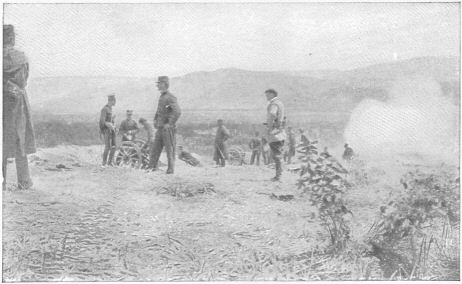
From where we sat on the edge of the trench, with our feet among the
cartridges, we could, by leaning forward, look over the piled-up earth into
the plain below, and soon, without any aid from field-glasses, we saw the
blocks of blue break up into groups of men. These men came across the
ploughed fields in long, widely opened lines, walking easily and leisurely,
as though they were playing golf or sowing seed in the furrows.
The Greek rifles crackled and flashed at the lines, but the men below
came on quite steadily, picking their way over the furrows and appearing
utterly unconscious of the seven thousand rifles that were calling on them
to halt. They were advancing directly toward a little sugar-loaf
hill, on the top of which was a mountain battery perched like a tiara on a
woman’s head. It was throwing one shell after another in the
very path of the men below, but the Turks still continued to pick their way
across the field, without showing any regard for the mountain
battery. It was worse than threatening; it seemed almost as though
they meant to insult us. If they had come up on a run they would not
have appeared so contemptuous, for it would have looked then as though they
were trying to escape the Greek fire, or that they were at least interested
in what was going forward. But the steady advance of so many men,
each plodding along by himself, with his head bowed and his gun on his
shoulder, was aggravating.
There was a little village at the foot of the hill. It was so
small that no one had considered it. It was more like a collection of
stables gathered round a residence than a town, and there was a wall
completely encircling it, with a gate in the wall that faced us.
Suddenly the doors of this gate were burst open from the inside, and a man
in a fez ran through them, followed by many more. The first man was
waving a sword, and a peasant in petticoats ran at his side and pointed up
with his hand at our trench. Until that moment the battle had lacked
all human interest; we might have been watching a fight against the stars
or the man in the moon, and, in spite of the noise and clatter of the Greek
rifles, and the ghostlike whispers and the rushing sounds in the air, there
was nothing to remind us of any other battle of which we had heard or
read. But we had seen pictures of officers waving swords, and we knew
that the fez was the sign of the Turk—of the enemy—of the men
who were invading Thessaly, who were at that moment planning to come up a
steep hill on which we happened to be sitting and attack the people on top
of it. And the spectacle at once became comprehensible, and took on
the human interest it had lacked. The men seemed to feel this, for
they sprang up and began cheering and shouting, and fired in an upright
position, and by so doing exposed themselves at full length to the fire
from the men below. The Turks in front of the village ran back into
it again, and those in the fields beyond turned and began to move away, but
in that same plodding, aggravating fashion. They moved so leisurely
that there was a pause in the noise along the line, while the men watched
them to make sure that they were really retreating. And then there
was a long cheer, after which they all sat down, breathing deeply, and
wiping the sweat and dust across their faces, and took long pulls at their
canteens.
The different trenches were not all engaged at the same time. They
acted according to the individual judgment of their commanding officer, but
always for the general good. Sometimes the fire of the enemy would be
directed on one particular trench, and it would be impossible for the men
in that trench to rise and reply without haying their heads carried away;
so they would lie hidden, and the men in the trenches flanking them would
act in their behalf, and rake the enemy from the front and from every side,
until the fire on that trench was silenced, or turned upon some other
point. The trenches stretched for over half a mile in a semicircle,
and the little hills over which they ran lay at so many different angles,
and rose to such different heights, that sometimes the men in one trench
fired directly over the heads of their own men. From many trenches in
the first line it was impossible to see any of the Greek soldiers except
those immediately beside you. If you looked back or beyond on either
hand there was nothing to be seen but high hills topped with fresh earth,
and the waving yellow grass, and the glaring blue sky.
General Smolenski directed the Greeks from the plain to the far right of
the town; and his presence there, although none of the men saw nor heard of
him directly throughout the entire day, was more potent for good than would
have been the presence of five thousand other men held in reserve. He
was a mile or two miles away from the trenches, but the fact that he was
there, and that it was Smolenski who was giving the orders, was
enough. Few had ever seen Smolenski, but his name was sufficient; it
was as effective as is Mr. Bowen’s name on a Bank of England
note. It gave one a pleasant feeling to know that he was somewhere
within call; you felt there would be no “routs” nor stampedes
while he was there. And so for two days those seven thousand men lay
in the trenches, repulsing attack after attack of the Turkish troops,
suffocated with the heat and chilled with sudden showers, and swept
unceasingly by shells and bullets—partly because they happened to be
good men and brave men, but largely because they knew that somewhere behind
them a stout, bull-necked soldier was sitting on a camp-stool, watching
them through a pair of field-glasses.
Toward mid-day you would see a man leave the trench with a
comrade’s arm around him, and start on the long walk to the town
where the hospital corps were waiting for him. These men did not wear
their wounds with either pride or braggadocio, but regarded the wet sleeves
and shapeless arms in a sort of wondering surprise. There was much
more of surprise than of pain in their faces, and they seemed to be
puzzling as to what they had done in the past to deserve such a
punishment.
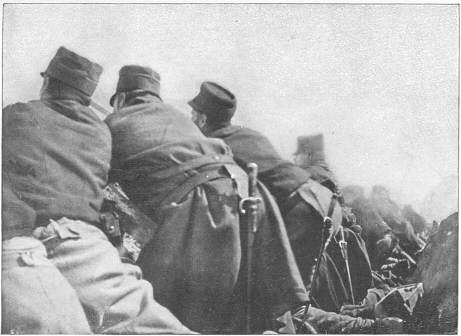
Other men were carried out of the trench and laid on their backs on the
high grass, staring up drunkenly at the glaring sun, and with their limbs
fallen into unfamiliar poses. They lay so still, and they were so
utterly oblivious of the roar and rattle and the anxious energy around them
that one grew rather afraid of them and of their superiority to their
surroundings. The sun beat on them, and the insects in the grass
waving above them buzzed and hummed, or burrowed in the warm moist earth
upon which they lay; over their heads the invisible carriers of death
jarred the air with shrill crescendoes, and near them a comrade sat hacking
with his bayonet at a lump of hard bread. He sprawled contentedly in
the hot sun, with humped shoulders and legs far apart, and with his cap
tipped far over his eyes. Every now and again he would pause, with a
piece of cheese balanced on the end of his knife-blade, and look at the
twisted figures by him on the grass, or he would dodge involuntarily as a
shell swung low above his head, and smile nervously at the still forms on
either side of him that had not moved. Then he brushed the crumbs
from his jacket and took a drink out of his hot canteen, and looking again
at the sleeping figures pressing down the long grass beside him, crawled
back on his hands and knees to the trench and picked up his waiting
rifle.
The dead gave dignity to what the other men were doing, and made it
noble, and, from another point of view, quite senseless. For their
dying had proved nothing. Men who could have been much better spared
than they, were still alive in the trenches, and for no reason but through
mere dumb chance. There was no selection of the unfittest; it seemed
to be ruled by unreasoning luck. A certain number of shells and
bullets passed through a certain area of space, and men of different bulks
blocked that space in different places. If a man happened to be
standing in the line of a bullet he was killed and passed into eternity,
leaving a wife and children, perhaps, to mourn him. “Father
died,” these children will say, “doing his duty.”
As a matter of fact, father died because he happened to stand up at the
wrong moment, or because he turned to ask the man on his right for a match,
instead of leaning toward the left, and he projected his bulk of two
hundred pounds where a bullet, fired by a man who did not know him and who
had not aimed at him, happened to want the right of way. One of the
two had to give it, and as the bullet would not, the soldier had his heart
torn out. The man who sat next to me happened to stoop to fill his
cartridge-box just as the bullet that wanted the space he had occupied
passed over his bent shoulder; and so he was not killed, but will live for
sixty years, perhaps, and will do much good or much evil. Another man
in the same trench sat up to clean his rifle, and had his arm in the air
driving the cleaning rod down the barrel, when a bullet passed through his
lungs, and the gun fell across his face, with the rod sticking in it, and
he pitched forward on his shoulder quite dead. If he had not cleaned
his gun at that moment he would probably be alive in Athens now, sitting in
front of a café and fighting the war over again. Viewed from
that point, and leaving out the fact that God ordered it all, the fortunes
of the game of war seemed as capricious as matching pennies, and as
impersonal as the wheel at Monte Carlo. In it the brave man did not
win because he was brave, but because he was lucky. A fool and a
philosopher are equal at a game of dice. And these men who threw dice
with death were interesting to watch, because, though they gambled for so
great a stake, they did so unconcernedly and without flinching, and without
apparently appreciating the seriousness of the game.
There was a red-headed, freckled peasant boy, in dirty petticoats, who
guided Bass and myself to the trenches. He was one of the few
peasants who had not run away, and as he had driven sheep over every foot
of the hills, he was able to guide the soldiers through those places where
they were best protected from the bullets of the enemy. He did this
all day, and was always, whether coming or going, under a heavy fire; but
he enjoyed that fact, and he seemed to regard the battle only as a
delightful change in the quiet routine of his life, as one of our own
country boys at home would regard the coming of the spring circus or the
burning of a neighbor’s barn. He ran dancing ahead of us,
pointing to where a ledge of rock offered a natural shelter, or showing us
a steep gully where the bullets could not fall. When they came very
near him he would jump high in the air, not because he was startled, but
out of pure animal joy in the excitement of it, and he would frown
importantly and shake his red curls at us, as though to say: “I told
you to be careful. Now, you see. Don’t let that happen
again.” We met him many times during the two days, escorting
different companies of soldiers from one point to another, as though they
were visitors to his estate. When a shell broke, he would pick up a
piece and present it to the officer in charge, as though it were a flower
he had plucked from his own garden, and which he wanted his guest to carry
away with him as a souvenir of his visit. Some one asked the boy if
his father and mother knew where he was, and he replied, with amusement,
that they had run away and deserted him, and that he had remained because
he wished to see what a Turkish army looked like. He was a much more
plucky boy than the overrated Casabianca, who may have stood on the burning
deck whence all but him had fled because he could not swim, and because it
was with him a choice of being either burned or drowned. This boy
stuck to the burning deck when it was possible for him at any time to have
walked away and left it burning. But he stayed on because he was
amused, and because he was able to help the soldiers from the city in
safety across his native heath. He was much the best part of the
show, and one of the bravest Greeks on the field. He will grow up to
be something fine, no doubt, and his spirit will rebel against having to
spend his life watching his father’s sheep. He may even win the
race from Marathon.
Another Greek who was a most interesting figure to us was a Lieutenant
Ambroise Frantzis. He was in command of the mountain battery on the
flat, round top of the high hill. On account of its height the place
seemed much nearer to the sun than any other part of the world, and the
heat there was three times as fierce as in the trenches below. When
you had climbed to the top of this hill it was like standing on a
roof-garden, or as though you were watching a naval battle from a fighting
top of one of the battleships. The top of the hill was not unlike an
immense circus ring in appearance. The piled-up earth around its
circular edge gave that impression, and the glaring yellow wheat that was
tramped into glaring yellow soil, and the blue ammunition-boxes scattered
about, helped out the illusion. It was an exceedingly busy place, and
the smoke drifted across it continually, hiding us from one another in a
curtain of flying yellow dust, while over our heads the Turkish shells
raced after each other so rapidly that they beat out the air like the
branches of a tree in a storm. On account of its height, and the
glaring heat, and the shells passing, and the Greek guns going off and then
turning somersaults, it was not a place suited for meditation; but Ambroise
Frantzis meditated there as though he were in his own study. He was a
very young man and very shy, and he was too busy to consider his own
safety, or to take time, as the others did, to show that he was not
considering it. Some of the other officers stood up on the
breastworks and called the attention of the men to what they were doing;
but as they did not wish the men to follow their example in this, it was
difficult to see what they expected to gain by their braggadocio.
Frantzis was as unconcerned as an artist painting a big picture in his
studio. The battle plain below him was his canvas, and his nine
mountain guns were his paint brushes. And he painted out Turks and
Turkish cannon with the same concentrated, serious expression of
countenance that you see on the face of an artist when he bites one brush
between his lips and with another wipes out a false line or a touch of the
wrong color. You have seen an artist cock his head on one side, and
shut one eye and frown at his canvas, and then select several brushes and
mix different colors and hit the canvas a bold stroke, and then lean back
to note the effect. Frantzis acted in just that way. He would
stand with his legs apart and his head on one side, pulling meditatively at
his pointed beard, and then taking a closer look through his field-glasses,
would select the three guns he had decided would give him the effect he
wanted to produce, and he would produce that effect. When the shot
struck plump in the Turkish lines, and we could see the earth leap up into
the air like geysers of muddy water, and each gunner would wave his cap and
cheer, Frantzis would only smile uncertainly, and begin again, with the aid
of his field-glasses, to puzzle out fresh combinations.
The battle that had begun in a storm of hail ended on the first day in a
storm of bullets that had been held in reserve by the Turks, and which let
off just after sundown. They came from a natural trench, formed by
the dried-up bed of a stream which lay just below the hill on which the
first Greek trench was situated. There were bushes growing on the
bank of the stream nearest to the Greek lines, and these hid the men who
occupied it. Throughout the day there had been an irritating fire
from this trench from what appeared to be not more than a dozen rifles, but
we could see that it was fed from time to time with many boxes of
ammunition, which were carried to it on the backs of mules from the Turkish
position a half mile farther to the rear. Bass and a corporal took a
great aversion to this little group of Turks, not because there were too
many of them to be disregarded, but because they were so near; and Bass
kept the corporal’s services engaged in firing into it, and in
discouraging the ammunition mules when they were being driven in that
direction. Our corporal was a sharp-shooter, and, accordingly, felt
his superiority to his comrades; and he had that cheerful contempt for his
officers that all true Greek soldiers enjoy; and so he never joined in the
volley-firing, but kept his ammunition exclusively for the dozen men behind
the bushes and for the mules. He waged, as it were, a little battle
on his own account. The other men rose as commanded and fired regular
volleys, and sank back again, but he fixed his sights to suit his own idea
of the range, and he rose when he was ready to do so, and fired whenever he
thought best. When his officer, who kept curled up in the hollow of
the trench, commanded him to lie down, he would frown and shake his head at
the interruption, and paid no further attention to the order. He was
as much alone as a hunter on a mountain peak stalking deer, and whenever he
fired at the men in the bushes he would swear softly, and when he fired at
the mules he would chuckle and laugh with delight and content. The
mules had to cross a ploughed field in order to reach the bushes, and so we
were able to mark where his bullets struck, and we could see them skip
across the field, kicking up the dirt as they advanced, until they stopped
the mule altogether, or frightened the man who was leading it into a
disorderly retreat.
It appeared later that instead of there being but twelve men in these
bushes there were six hundred, and that they were hiding there until the
sun set in order to make a final attack on the first trench. They had
probably argued that at sunset the strain of the day’s work would
have told on the Greek morale, that the men’s nerves would be
jerking and their stomachs aching for food, and that they would be ready
for darkness and sleep, and in no condition to repulse a fresh and vigorous
attack. So, just as the sun sank, and the officers were counting the
cost in dead and wounded, and the men were gathering up blankets and
overcoats, and the firing from the Greek lines had almost ceased, there
came a fierce rattle from the trench to the right of us, like a watch-dog
barking the alarm, and the others took it up from all over the hill, and
when we looked down into the plain below to learn what it meant, we saw it
blue with men, who seemed to have sprung from the earth. They were
clambering from the bed of the stream, breaking through the bushes, and
forming into a long line, which, as soon as formed, was at once hidden at
regular intervals by flashes of flame that seemed to leap from one
gun-barrel to the next, as you have seen a current of electricity run along
a line of gas-jets. In the dim twilight these flashes were much more
blinding than they had been in the glare of the sun, and the crash of the
artillery coming on top of the silence was the more fierce and terrible by
the contrast. The Turks were so close on us that the first trench
could do little to help itself, and the men huddled against it while their
comrades on the surrounding hills fought for them, their volleys passing
close above our heads, and meeting the rush of the Turkish bullets on the
way, so that there was now one continuous whistling shriek, like the roar
of the wind through the rigging of a ship in a storm. If a man had
raised his arm above his head his hand would have been torn off. It
had come up so suddenly that it was like two dogs, each springing at the
throat of the other, and in a greater degree it had something of the sound
of two wild animals struggling for life. Volley answered volley as
though with personal hate—one crashing in upon the roll of the other,
or beating it out of recognition with the bursting roar of heavy
cannon. At the same instant all of the Turkish batteries opened with
great, ponderous, booming explosions, and the little mountain guns barked
and snarled and shrieked back at them, and the rifle volleys crackled and
shot out blistering flames, while the air was filled with invisible express
trains that shook and jarred it and crashed into one another, bursting and
shrieking and groaning. It seemed as though you were lying in a
burning forest, with giant tree trunks that had withstood the storms of
centuries crashing and falling around your ears, and sending up great
showers of sparks and flame. This lasted for five minutes or less,
and then the death-grip seemed to relax, the volleys came brokenly, like a
man panting for breath, the bullets ceased to sound with the hiss of
escaping steam, and rustled aimlessly by, and from hill-top to hill-top the
officers’ whistles sounded as though a sportsman were calling off his
dogs. The Turks withdrew into the coming night, and the Greeks lay
back, panting and sweating, and stared open-eyed at one another, like men
who had looked for a moment into hell, and had come back to the world
again.
The next day was like the first, except that by five o’clock in
the afternoon the Turks appeared on our left flank, crawling across the
hills like an invasion of great ants, and the Greek army that at Velestinos
had made the two best and most dignified stands of the war withdrew upon
Halmyros, and the Turks poured into the village and burned it, leaving
nothing standing save two tall Turkish minarets that many years before,
when Thessaly belonged to the Sultan, the Turks themselves had placed
there.
On the day the American troops landed on the coast of Cuba, the Cubans
informed General Wheeler that the enemy were intrenched at Guasimas,
blocking the way to Santiago. Guasimas is not a village, nor even a
collection of houses; it is the meeting place of two trails which join at
the apex of a V, three miles from the seaport town of Siboney, and continue
merged in a single trail to Santiago. General Wheeler, guided by the
Cubans, reconnoitred this trail on the 23rd of June, and with the position
of the enemy fully explained to him, returned to Siboney and informed
General Young and Colonel Wood that on the following morning he would
attack the Spanish position at Guasimas. It has been stated that at
Guasimas, the Rough Riders were trapped in an ambush, but, as the plan was
discussed while I was present, I know that so far from any ones running
into an ambush, every one of the officers concerned had a full knowledge of
where he would find the enemy, and what he was to do when he found him.
That night no one slept, for until two o’clock in the morning,
troops were still being disembarked in the surf, and two ships of war had
their searchlights turned on the landing-place, and made Siboney as light
as a ball-room. Back of the searchlights was an ocean white with
moonlight, and on the shore red camp-fires, at which the half-drowned
troops were drying their uniforms, and the Rough Riders, who had just
marched in from Baiquiri, were cooking a late supper, or early breakfast of
coffee and bacon. Below the former home of the Spanish comandante,
which General Wheeler had made his head-quarters, lay the camp of the Rough
Riders, and through it Cuban officers were riding their half-starved
ponies, and scattering the ashes of the camp-fires. Below them was
the beach and the roaring surf, in which a thousand or so naked men were
assisting and impeding the progress shoreward of their comrades, in
pontoons and shore boats, which were being hurled at the beach like sleds
down a water chute.
It was one of the most weird and remarkable scenes of the war, probably
of any war. An army was being landed on an enemy’s coast at the
dead of night, but with the same cheers and shrieks and laughter that rise
from the bathers at Coney Island on a hot Sunday. It was a
pandemonium of noises. The men still to be landed from the
“prison hulks,” as they called the transports, were singing in
chorus, the men already on shore were dancing naked around the camp-fires
on the beach, or shouting with delight as they plunged into the first bath
that had offered in seven days, and those in the launches as they were
pitched head-first at the soil of Cuba, signalized their arrival by howls
of triumph. On either side rose black overhanging ridges, in the
lowland between were white tents and burning fires, and from the ocean came
the blazing, dazzling eyes of the search-lights shaming the quiet
moonlight.
After three hours’ troubled sleep in this tumult the Rough Riders
left camp at five in the morning. With the exception of half a dozen
officers they were dismounted, and carried their blanket rolls, haversacks,
ammunition, and carbines. General Young had already started toward
Guasimas the First and Tenth dismounted Cavalry, and according to the
agreement of the night before had taken the eastern trail to our right,
while the Rough Riders climbed the steep ridge above Siboney and started
toward the rendezvous along the trail to the west, which was on high ground
and a half mile to a mile distant from the trail along which General Young
and his regulars were marching. There was a valley between us, and
the bushes were so thick on both sides of our trail that it was not
possible at any time, until we met at Guasimas, to distinguish the other
column.
As soon as the Rough Riders had reached the top of the ridge, not twenty
minutes after they had left camp, which was the first opportunity that
presented itself, Colonel Wood ordered Captain Capron to proceed with his
troop in front of the column as an advance guard, and to choose a
“point” of five men skilled as scouts and trailers. Still
in advance of these he placed two Cuban scouts. The column then
continued along the trail in single file. The Cubans were at a
distance of two hundred and fifty yards; the “point” of five
picked men under Sergeant Byrne and duty-Sergeant Fish followed them at a
distance of a hundred yards, and then came Capron’s troop of sixty
men strung out in single file. No flankers were placed for the reason
that the dense undergrowth and the tangle of vines that stretched from the
branches of the trees to the bushes below made it a physical impossibility
for man or beast to move forward except along the single trail.
Colonel Wood rode at the head of the column, followed by two regular
army officers who were members of General Wheeler’s staff, a Cuban
officer, and Lieutenant-Colonel Roosevelt. They rode slowly in
consideration of the troopers on foot, who under a cruelly hot sun carried
heavy burdens. To those who did not have to walk, it was not unlike a
hunting excursion in our West; the scenery was beautiful and the view down
the valley one of luxuriant peace. Roosevelt had never been in the
tropics and Captain McCormick and I were talking back at him over our
shoulders and at each other, pointing out unfamiliar trees and birds.
Roosevelt thought it looked like a good deer country, as it once was; it
reminded McCormick of Southern California; it looked to me like the trails
in Central America. We advanced, talking in that fashion and in high
spirits, and congratulating ourselves in being shut of the transport and on
breathing fine mountain air again, and on the fact that we were on
horseback. We agreed it was impossible to appreciate that we were
really at war—that we were in the enemy’s country. We had
been riding in this pleasant fashion for an hour and a half with brief
halts for rest, when Wood stopped the head of the column, and rode down the
trail to meet Capron, who was coming back. Wood returned immediately,
leading his horse, and said to Roosevelt:
“Pass the word back to keep silence in the ranks.”
The place at which we had halted was where the trail narrowed, and
proceeded sharply downward. There was on one side of it a stout
barbed-wire fence of five strands. By some fortunate accident this
fence had been cut just where the head of the column halted. On the
left of the trail it shut off fields of high grass blocked at every fifty
yards with great barricades of undergrowth and tangled trees and
chapparal. On the other side of the trail there was not a foot of
free ground; the bushes seemed absolutely impenetrable, as indeed they were
later found to be.
When we halted, the men sat down beside the trail and chewed the long
blades of grass, or fanned the air with their hats. They had no
knowledge of the situation such as their leaders possessed, and their only
emotion was one of satisfaction at the chance the halt gave them to rest
and to shift their packs. Wood again walked down the trail with
Capron and disappeared, and one of the officers informed us that the scouts
had seen the outposts of the enemy. It did not seem reasonable that
the Spaniards, who had failed to attack us when we landed at Baiquiri,
would oppose us until they could do so in force, so, personally, I doubted
that there were any Spaniards nearer than Santiago. But we tied our
horses to the wire fence, and Capron’s troop knelt with carbines at
the “Ready,” peering into the bushes. We must have waited
there, while Wood reconnoitred, for over ten minutes. Then he
returned, and began deploying his troops out at either side of the
trail. Capron he sent on down the trail itself. G Troop was
ordered to beat into the bushes on the right, and K and A were sent over
the ridge on which we stood down into the hollow to connect with General
Young’s column on the opposite side of the valley. F and E
Troops were deployed in skirmish-line on the other side of the wire
fence. Wood had discovered the enemy a few hundred yards from where
he expected to find him, and so far from being “surprised,” he
had time, as I have just described, to get five of his troops into position
before a shot was fired. The firing, when it came, started suddenly
on our right. It sounded so close that—still believing we were
acting on a false alarm, and that there were no Spaniards ahead of
us—I guessed it was Capron’s men firing at random to disclose
the enemy’s position. I ran after G Troop under Captain
Llewellyn, and found them breaking their way through the bushes in the
direction from which the volleys came. It was like forcing the walls
of a maze. If each trooper had not kept in touch with the man on
either hand he would have been lost in the thicket. At one moment the
underbrush seemed swarming with our men, and the next, except that you
heard the twigs breaking, and heavy breathing or a crash as a vine pulled
some one down, there was not a sign of a human being anywhere. In a
few minutes we broke through into a little open place in front of a dark
curtain of vines, and the men fell on one knee and began returning the fire
that came from it.
The enemy’s fire was exceedingly heavy, and his aim was
excellent. We saw nothing of the Spaniards, except a few on the ridge
across the valley. I happened to be the only one present with field
glasses, and when I discovered this force on the ridge, and had made sure,
by the cockades in their sombreros, that they were Spaniards and not
Cubans, I showed them to Roosevelt. He calculated they were five
hundred yards from us, and ordered the men to fire on them at that
range. Through the two hours of fighting that followed, although men
were falling all around us, the Spaniards on the ridge were the only ones
that many of us saw. But the fire against us was not more than eighty
yards away, and so hot that our men could only lie flat in the grass and
return it in that position. It was at this moment that our men
believed they were being attacked by Capron’s troop, which they
imagined must have swung to the right, and having lost its bearings and
hearing them advancing through the underbrush, had mistaken them for the
enemy. They accordingly ceased firing and began shouting in order to
warn Capron that he was shooting at his friends. This is the
foundation for the statement that the Rough Riders had fired on each other,
which they did not do then or at any other time. Later we examined
the relative position of the trail which Capron held, and the position of G
Troop, and they were at right angles to one another.
Capron could not possibly have fired into us at any time, unless he had
turned directly around in his tracks and aimed up the very trail he had
just descended. Advancing, he could no more have hit us than he could
have seen us out of the back of his head. When we found many hundred
spent cartridges of the Spaniards a hundred yards in front of G
Troop’s position, the question as to who had fired on us was
answered.
It was an exceedingly hot corner. The whole troop was gathered in
the little open place blocked by the network of grape-vines and tangled
bushes before it. They could not see twenty feet on three sides of
them, but on the right hand lay the valley, and across it came the sound of
Young’s brigade, who were apparently heavily engaged. The
enemy’s fire was so close that the men could not hear the word of
command, and Captain Llewellyn and Lieutenant Greenway, unable to get their
attention, ran among them, batting them with their sombreros to make them
cease firing. Lieutenant-Colonel Roosevelt ran up just then, bringing
with him Lieutenant Woodbury Kane and ten troopers from K Troop.
Roosevelt lay down in the grass beside Llewellyn and consulted with him
eagerly. Kane was smiling with the charming content of a perfectly
happy man. When Captain Llewellyn told him his men were not needed,
and to rejoin his troop, he led his detail over the edge of the hill on
which we lay. As he disappeared below the crest he did not stoop to
avoid the bullets, but walked erect, still smiling. Roosevelt pointed
out that it was impossible to advance farther on account of the network of
wild grape-vines that masked the Spaniards from us, and that we must cross
the trail and make to the left. The shouts the men had raised to warn
Capron had established our position to the enemy, and the firing was now
fearfully accurate. Sergeant Russell, who in his day had been a
colonel on a governor’s staff, was killed, and the other sergeant was
shot through the wrist. In the space of three minutes nine men were
lying on their backs helpless. Before we got away, every third man
was killed, or wounded. We drew off slowly to the left, dragging the
wounded with us. Owing to the low aim of the enemy, we were forced to
move on our knees and crawl. Even then men were hit. One man
near me was shot through the head. Returning later to locate the body
and identify him, I found that the buzzards had torn off his lips and his
eyes. This mutilation by these hideous birds was, without doubt, what
Admiral Sampson mistook for the work of the Spaniards, when the bodies of
the marines at Guantanamo were found disfigured. K Troop meantime had
deployed into the valley under the fire from the enemy on the ridge.
It had been ordered to establish communication with General Young’s
column, and while advancing and firing on the ridge, Captain Jenkins sent
the guidon bearer back to climb the hill and wave his red and white banner
where Young’s men could see it. The guidon bearer had once run
for Congress on the gold ticket in Arizona, and, as some one said, was
naturally the man who should have been selected for a forlorn hope.
His flag brought him instantly under a heavy fire, but he continued waving
it until the Tenth Cavalry on the other side of the valley answered, and
the two columns were connected by a skirmish-line composed of K Troop and
A, under Captain “Bucky” O’Neill.
G Troop meanwhile had hurried over to the left, and passing through the
opening in the wire fence had spread out into open order. It followed
down after Captain Luna’s troop and D and E Troops, which were well
already in advance. Roosevelt ran forward and took command of the
extreme left of this line. Wood was walking up and down along it,
leading his horse, which he thought might be of use in case he had to move
quickly to alter his original formation. His plan, at present, was to
spread out his men so that they would join Young on the right, and on the
left swing around until they flanked the enemy. K and A Troops had
already succeeded in joining hands with Young’s column across the
valley, and as they were capable of taking care of themselves, Wood was
bending his efforts to keep his remaining four companies in a straight line
and revolving them around the enemy’s “end.” It was
in no way an easy thing to do. The men were at times wholly hidden
from each other, and from him; probably at no one time did he see more than
two of his troops together. It was only by the firing that he could
tell where his men lay, and that they were always advancing.
The advances were made in quick, desperate rushes—sometimes the
ground gained was no more than a man covers in sliding for a base. At
other times half a troop would rise and race forward and then burrow deep
in the hot grass and fire. On this side of the line there was an
occasional glimpse of the enemy. But for a great part of the time the
men shot at the places from where the enemy’s fire seemed to come,
aiming low and answering in steady volleys. The fire discipline was
excellent. The prophets of evil of the Tampa Bay Hotel had foretold
that the cowboys would shoot as they chose, and, in the field, would act
independently of their officers. As it turned out, the cowboys were
the very men who waited most patiently for the officers to give the word of
command. At all times the movement was without rest, breathless and
fierce, like a cane-rush, or a street fight. After the first three
minutes every man had stripped as though for a wrestling match, throwing
off all his impedimenta but his cartridge-belt and canteen. Even then
the sun handicapped their strength cruelly. The enemy was hidden in
the shade of the jungle, while they, for every thicket they gained, had to
fight in the open, crawling through grass which was as hot as a steam bath,
and with their flesh and clothing torn by thorns and the sword-like blade
of the Spanish “bayonet.” The glare of the sun was full
in their eyes and as fierce as a lime-light.
When G Troop passed on across the trail to the left I stopped at the
place where the column had first halted—it had been converted into a
dressing station and the wounded of G Troop were left there in the care of
the hospital stewards. A tall, gaunt young man with a cross on his
arm was just coming back up the trail. His head was bent, and by some
surgeon’s trick he was carrying a wounded man much heavier than
himself across his shoulders. As I stepped out of the trail he raised
his head, and smiled and nodded, and left me wondering where I had seen him
before, smiling in the same cheery, confident way and moving in that same
position. I knew it could not have been under the same conditions,
and yet he was certainly associated with another time of excitement and
rush and heat. Then I remembered him. As now he had been
covered with blood and dirt and perspiration, but then he wore a canvas
jacket and the man he carried on his shoulders was trying to hold him back
from a white-washed line. And I recognized the young doctor, with the
blood bathing his breeches, as “Bob” Church, of
Princeton. That was only one of four badly wounded men he carried
that day on his shoulders over a half-mile of trail that stretched from the
firing-line back to the dressing station and under an unceasing fire. [3] As
the senior surgeon was absent he had chief responsibility that day for all
the wounded, and that so few of them died is greatly due to this young man
who went down into the firing-line and pulled them from it, and bore them
out of danger. The comic paragraphers who wrote of the members of the
Knickerbocker Club and the college swells of the Rough Riders and of their
imaginary valets and golf clubs, should, in decency, since the fight at
Guasimas apologize. For the same spirit that once sent these men down
a white-washed field against their opponents’ rush line was the
spirit that sent Church, Channing, Devereux, Ronalds, Wrenn, Cash, Bull,
Lamed, Goodrich, Greenway, Dudley Dean, and a dozen others through the high
hot grass at Guasimas, not shouting, as their friends the cowboys did, but
each with his mouth tightly shut, with his eyes on the ball, and moving in
obedience to the captain’s signals.
Judging from the sound, our firing-line now seemed to be half a mile in
advance of the place where the head of the column had first halted.
This showed that the Spaniards had been driven back at least three hundred
yards from their original position. It was impossible to see any of
our men in the field, so I ran down the trail with the idea that it would
lead me back to the troop I had left when I had stopped at the dressing
station. The walk down that trail presented one of the most grewsome
pictures of the war. It narrowed as it descended; it was for that
reason the enemy had selected that part of it for the attack, and the vines
and bushes interlaced so closely above it that the sun could not come
through.
The rocks on either side were spattered with blood and the rank grass
was matted with it. Blanket rolls, haversacks, carbines, and canteens
had been abandoned all along its length. It looked as though a
retreating army had fled along it, rather than that one troop had fought
its way through it to the front. Except for the clatter of the
land-crabs, those hideous orchid-colored monsters that haunt the places of
the dead, and the whistling of the bullets in the trees, the place was as
silent as a grave. For the wounded lying along its length were as
still as the dead beside them. The noise of the loose stones rolling
under my feet brought a hospital steward out of the brush, and he called
after me:
“Lieutenant Thomas is badly wounded in here, and we can’t
move him. We want to carry him out of the sun some place, where there
is shade and a breeze.” Thomas was the first lieutenant of
Capron’s troop. He is a young man, large and powerfully
built. He was shot through the leg just below the trunk, and I found
him lying on a blanket half naked and covered with blood, and with his leg
bound in tourniquets made of twigs and pocket-handkerchiefs. It gave
one a thrill of awe and wonder to see how these cowboy surgeons, with a
stick that one would use to light a pipe and with the gaudy
‘kerchiefs they had taken from their necks, were holding death at
bay. The young officer was in great pain and tossing and raving
wildly. When we gathered up the corners of his blanket and lifted
him, he tried to sit upright, and cried out, “You’re taking me
to the front, aren’t you? You said you would.
They’ve killed my captain—do you understand?
They’ve killed Captain Capron. The --- Mexicans!
They’ve killed my captain.”
The troopers assured him they were carrying him to the firing-line, but
he was not satisfied. We stumbled over the stones and vines, bumping
his wounded body against the ground and leaving a black streak in the grass
behind us, but it seemed to hurt us more than it did him, for he sat up
again clutching at us imploringly with his bloody hands.
“For God’s sake, take me to the front,” he
begged. “Do you hear? I order you; damn you, I
order—We must give them hell; do you hear? we must give them
hell. They’ve killed Capron. They’ve killed my
captain.”
The loss of blood at last mercifully silenced him, and when we had
reached the trail he had fainted and I left them kneeling around him, their
grave boyish faces filled with sympathy and concern.
Only fifty feet from him and farther down the trail I passed his
captain, with his body propped against Church’s knee and with his
head fallen on the surgeon’s shoulder. Capron was always a
handsome, soldierly looking man—some said that he was the most
soldierly looking of any of the young officers in the army—and as I
saw him then death had given him a great dignity and nobleness. He
was only twenty-eight years old, the age when life has just begun, but he
rested his head on the surgeon’s shoulder like a man who knew he was
already through with it and that, though they might peck and mend at the
body, he had received his final orders. His breast and shoulders were
bare, and as the surgeon cut the tunic from him the sight of his great
chest and the skin, as white as a girl’s, and the black open wound
against it made the yellow stripes and the brass insignia on the tunic,
strangely mean and tawdry.
Fifty yards farther on, around a turn in the trail, behind a rock, a boy
was lying with a bullet wound between his eyes. His chest was heaving
with short, hoarse noises which I guessed were due to some muscular action
entirely, and that he was virtually dead. I lifted him and gave him
some water, but it would not pass through his fixed teeth. In the
pocket of his blouse was a New Testament with the name Fielder Dawson, Mo.,
scribbled in it in pencil. While I was writing it down for
identification, a boy as young as himself came from behind me down the
trail.
“It is no use,” he said; “the surgeon has seen him; he
says he is just the same as dead. He is my bunkie; we only met two
weeks ago at San Antonio; but he and me had got to be such good
friends—But there’s nothing I can do now.” He threw
himself down on the rock beside his bunkie, who was still breathing with
that hoarse inhuman rattle, and I left them, the one who had been spared
looking down helplessly with the tears creeping across his cheeks.
The firing was quite close now, and the trail was no longer filled with
blanket rolls and haversacks, nor did pitiful, prostrate figures lie in
wait behind each rock. I guessed this must mean that I now was well
in advance of the farthest point to which Capron’s troop had moved,
and I was running forward feeling confident that I must be close on our
men, when I saw the body of a sergeant blocking the trail and stretched at
full length across it. Its position was a hundred yards in advance of
that of any of the others—it was apparently the body of the first man
killed. After death the bodies of some men seem to shrink almost
instantly within themselves; they become limp and shapeless, and their
uniforms hang upon them strangely. But this man, who was a giant in
life, remained a giant in death—his very attitude was one of attack;
his fists were clinched, his jaw set, and his eyes, which were still human,
seemed fixed with resolve. He was dead, but he was not
defeated. And so Hamilton Fish died as he had lived—defiantly,
running into the very face of the enemy, standing squarely upright on his
legs instead of crouching, as the others called to him to do, until he fell
like a column across the trail. “God gives,” was the
motto on the watch I took from his blouse, and God could not have given him
a nobler end; to die, in the fore-front of the first fight of the war,
quickly, painlessly, with a bullet through the heart, with his regiment
behind him, and facing the enemies of his country.
The line at this time was divided by the trail into two wings. The
right wing, composed of K and A Troops, was advancing through the valley,
returning the fire from the ridge as it did so, and the left wing, which
was much the longer of the two, was swinging around on the enemy’s
right flank, with its own right resting on the barbed-wire fence. I
borrowed a carbine from a wounded man, and joined the remnant of L Troop
which was close to the trail.
This troop was then commanded by Second Lieutenant Day, who on account
of his conduct that morning and at the battle of San Juan later, when he
was shot through the arm, was promoted to be captain of L Troop, or, as it
was later officially designated, Capron’s troop. He was walking
up and down the line as unconcernedly as though we were at target practice,
and an Irish sergeant, Byrne, was assisting him by keeping up a continuous
flow of comments and criticisms that showed the keenest enjoyment of the
situation. Byrne was the only man I noticed who seemed to regard the
fight as in any way humorous. For at Guasimas, no one had time to be
flippant, or to exhibit any signs of braggadocio. It was for all of
them, from the moment it started, through the hot, exhausting hour and a
half that it lasted, a most serious proposition. The conditions were
exceptional. The men had made a night march the evening before, had
been given but three hours’ troubled sleep on the wet sand, and had
then been marched in full equipment uphill and under a cruelly hot sun,
directly into action. And eighty per cent. of them had never before
been under fire. Nor had one man in the regiment ever fired a
Krag-Jorgensen carbine until he fired it at a Spaniard, for their arms had
been issued to them so soon before sailing that they had only drilled with
them without using cartridges. To this handicap was also added the
nature of the ground and the fact that our men could not see their
opponents. Their own men fell or rolled over on every side, shot down
by an invisible enemy, with no one upon whom they could retaliate, with no
sign that the attack might not go on indefinitely. Yet they never
once took a step backward, but advanced grimly, cleaning a bush or thicket
of its occupants before charging it, and securing its cover for themselves,
and answering each volley with one that sounded like an echo of the
first. The men were panting for breath; the sweat ran so readily into
their eyes that they could not see the sights of their guns; their limbs
unused to such exertion after seven days of cramped idleness on the
troop-ship, trembled with weakness and the sun blinded and dazzled them;
but time after time they rose and staggered forward through the high grass,
or beat their way with their carbines against the tangle of vines and
creepers. A mile and a half of territory was gained foot by foot in
this fashion, the three Spanish positions carried in that distance being
marked by the thousands of Mauser cartridges that lay shining and
glittering in the grass and behind the barricades of bushes. But this
distance had not been gained without many losses, for every one in the
regiment was engaged. Even those who, on account of the heat, had
dropped out along the trail, as soon as the sound of the fight reached
them, came limping to the front—and plunged into the
firing-line. It was the only place they could go—there was no
other line. With the exception of Church’s dressing station and
its wounded there were no reserves.
Among the first to be wounded was the correspondent, Edward Marshall, of
the New York Journal, who was on the firing-line to the left.
He was shot through the body near the spine, and when I saw him he was
suffering the most terrible agonies, and passing through a succession of
convulsions. He nevertheless, in his brief moments of comparative
peace, bore himself with the utmost calm, and was so much a soldier to duty
that he continued writing his account of the fight until the fight itself
was ended. His courage was the admiration of all the troopers, and he
was highly commended by Colonel Wood in the official account of the
engagement.
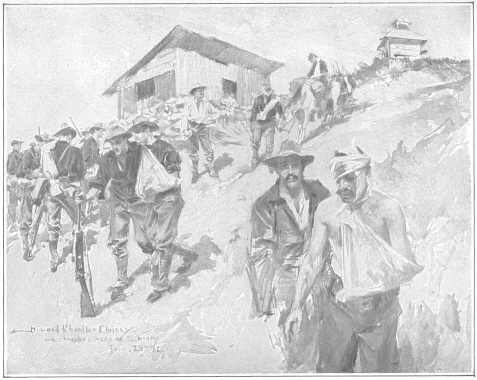
Nothing so well illustrated how desperately each man was needed, and how
little was his desire to withdraw, as the fact that the wounded lay where
they fell until the hospital stewards found them. Their comrades did
not use them as an excuse to go to leave the firing-line. I have
watched other fights, where the men engaged were quite willing to
unselfishly bear the wounded from the zone of danger.
The fight had now lasted an hour, and the line had reached a more open
country, with a slight incline upward toward a wood, on the edge of which
was a ruined house. This house was a former distillery for
aguardiente, and was now occupied in force by the enemy.
Lieutenant-Colonel Roosevelt on the far left was moving up his men with the
intention of taking this house on the flank; Wood, who was all over the
line, had the same objective point in his mind. The troop commanders
had a general idea that the distillery was the key to the enemy’s
position, and were all working in that direction. It was extremely
difficult for Wood and Roosevelt to communicate with the captains, and
after the first general orders had been given them they relied upon the
latter’s intelligence to pull them through. I do not suppose
Wood, out of the five hundred engaged, saw more than thirty of his men at
any one time. When he had passed one troop, except for the noise of
its volley firing, it was immediately lost to him in the brush, and it was
so with the next. Still, so excellent was the intelligence of the
officers, and so ready the spirit of the men, that they kept an almost
perfect alignment, as was shown when the final order came to charge in the
open fields. The advance upon the ruined building was made in
stubborn, short rushes, sometimes in silence, and sometimes firing as we
ran. The order to fire at will was seldom given, the men waiting
patiently for the officers’ signal, and then answering in
volleys. Some of the men who were twice Day’s age begged him to
let them take the enemy’s impromptu fort on the run, but he answered
them tolerantly like spoiled children, and held them down until there was a
lull in the enemy’s fire, when he would lead them forward, always
taking the advance himself. By the way they made these rushes, it was
easy to tell which men were used to hunting big game in the West and which
were not. The Eastern men broke at the word, and ran for the cover
they were directed to take like men trying to get out of the rain, and fell
panting on their faces, while the Western trappers and hunters slipped and
wriggled through the grass like Indians; dodging from tree trunk to tree
trunk, and from one bush to another. They fell into line at the same
time with the others, but while doing so they had not once exposed
themselves. Some of the escapes were little short of
miraculous. The man on my right, Champneys Marshall, of Washington,
had one bullet pass through his sleeve, and another pass through his shirt,
where it was pulled close to his spine. The holes where the ball
entered and went out again were clearly cut. Another man’s skin
was slightly burned by three bullets in three distinct lines, as though it
had been touched for an instant by the lighted end of a cigar.
Greenway was shot through this shirt across the breast, and Roosevelt was
so close to one bullet, when it struck a tree, that it filled his eyes and
ears with tiny splinters. Major Brodie and Lieutenant Thomas were
both wounded within a few feet of Colonel Wood, and his color-sergeant,
Wright, who followed close at his heels, was clipped three times in the
head and neck, and four bullets passed through the folds of the flag he
carried. One trooper, Rowland, of Deming, was shot through the lower
ribs; he was ordered by Roosevelt to fall back to the dressing station, but
there Church told him there was nothing he could do for him then, and
directed him to sit down until he could be taken to the hospital at
Siboney. Rowland sat still for a short time, and then remarked
restlessly, “I don’t seem to be doing much good here,”
and picking up his carbine, returned to the firing-line. There
Roosevelt found him.
“I thought I ordered you to the rear,” he demanded.
“Yes, sir, you did,” Rowland said, “but there
didn’t seem to be much doing back there.”
After the fight he was sent to Siboney with the rest of the wounded, but
two days later he appeared in camp. He had marched from Siboney, a
distance of six miles, and uphill all the way, carrying his carbine,
canteen, and cartridge-belt.
“I thought you were in hospital,” Wood said. “I
was,” Rowland answered sheepishly, “but I didn’t seem to
be doing any good there.”
They gave him up as hopeless, and he continued his duties and went into
the fight of the San Juan hills with the hole still through his ribs.
Another cowboy named Heffner, when shot through the body, asked to be
propped up against a tree with his canteen and cartridge-belt beside him,
and the last his troop saw of him he was seated alone grimly firing over
their heads in the direction of the enemy.
Early in the fight I came upon Church attending to a young cowboy, who
was shot through the chest. The entrance to his wound was so small
that Church could not insert enough of the gauze packing to stop the flow
of blood.
“I’m afraid I’ll have to make this hole larger,”
he said to the boy, “or you’ll bleed to death.”
“All right,” the trooper answered, “I guess you know
your business.” The boy stretched out on his back and lay
perfectly quiet while Church, with a pair of curved scissors, cut away the
edges of the wound. His patient neither whimpered nor swore, but
stared up at the sun in silence. The bullets were falling on every
side, and the operation was a hasty one, but the trooper made no comment
until Church said, “We’d better get out of this; can you stand
being carried?”
“Do you think you can carry me?” the trooper asked.
“Yes.”
“Well,” exclaimed the boy admiringly, “you certainly
know your business!”
Another of the Rough Riders was brought to the dressing station with a
shattered ankle, and Church, after bandaging it, gave him his choice of
riding down to Siboney on a mule, or of being carried, a day later, on a
litter.
“If you think you can manage to ride the mule with that broken
foot,” he said, “you can start at once, but if you wait until
to-morrow, when I can spare the men, you can be carried all the
way.”
The cowboy preferred to start at once, so six hospital stewards lifted
him and dropped him on the mule, and into a huge Mexican saddle.
He stuck his wounded ankle into one stirrup, and his untouched one into
the other, and gathered up the reins.
“Does it pain you? Can you stand it?” Church asked
anxiously. The cowboy turned and smiled down upon him with amused
disdain.
“Stand this?” he cried. “Why, this is
just like getting money from home.”
Toward the last, the firing from the enemy sounded less near, and the
bullets passed much higher. Roosevelt, who had picked up a carbine
and was firing to give the direction to the others, determined upon a
charge. Wood, at the other end of the line, decided at the same time
upon the same manoeuvre. It was called “Wood’s
bluff” afterward, for he had nothing to back it with; while to the
enemy it looked as though his whole force was but the skirmish-line in
advance of a regiment. The Spaniards naturally could not believe that
this thin line which suddenly broke out of the bushes and from behind trees
and came cheering out into the hot sunlight was the entire fighting force
against it. They supposed the regiment was coming close on its heels,
and as Spanish troops hate being rushed as a cat hates water, they fired a
few parting volleys and broke and ran. The cheering had the same
invigorating effect on our own side as a cold shower; it was what first
told half the men where the other half were, and it made every individual
man feel better. As we knew it was only a bluff, the first cheer was
wavering, but the sound of our own voices was so comforting that the second
cheer was a howl of triumph.
As it was, the Spaniards thought the Rough Riders had already
disregarded all the rules of war.
“When we fired a volley,” one of the prisoners said later,
“instead of falling back they came forward. That is not the way
to fight, to come closer at every volley.” And so, when instead
of retreating on each volley, the Rough Riders rushed at them, cheering and
filling the hot air with wild cowboy yells, the dismayed enemy retreated
upon Santiago, where he announced he had been attacked by the entire
American army.
One of the residents of Santiago asked one of the soldiers if those
Americans fought well.
“Well!” he replied, “they tried to catch us
with their hands!”
I have not attempted to give any account of General Young’s fight
on our right, which was equally desperate, and, owing to the courage of the
colored troops of the Tenth in storming a ridge, equally worthy of
praise. But it has seemed better not to try and tell of anything I
did not see, but to limit myself to the work of the Rough Riders, to whom,
after all, the victory was due, as it was owing to Colonel Wood’s
charge, which took the Spaniards in flank, that General Wheeler and General
Young were able to advance, their own stubborn attack in front having
failed to dislodge the enemy from his rifle-pits.
According to the statement of the enemy, who had every reason not to
exaggerate the size of his own force, 4,000 Spaniards were engaged in this
action. The Rough Riders numbered 534, and General Young’s
force numbered 464. The American troops accordingly attacked a force
over four times their own number intrenched behind rifle-pits and bushes in
a mountain pass. In spite of the smokeless powder used by the
Spaniards, which hid their position, the Rough Riders routed them out of
it, and drove them back from three different barricades until they made
their last stand in the ruined distillery, whence they finally drove them
by assault. The eager spirit in which this was accomplished is best
described in the Spanish soldier’s answer to the inquiring civilian,
“They tried to catch us with their hands.” The Rough
Riders should adopt it as their motto.
After the Guasimas fight on June 24, the army was advanced along the
single trail which leads from Siboney on the coast to Santiago. Two
streams of excellent water run parallel with this trail for short
distances, and some eight miles from the coast crossed it in two
places. Our outposts were stationed at the first of these fords, the
Cuban outposts a mile and a half farther on at the ford nearer Santiago,
where the stream made a sharp turn at a place called El Poso. Another
mile and a half of trail extended from El Poso to the trenches of San
Juan. The reader should remember El Poso, as it marked an important
starting-point against San Juan on the eventful first of July.
For six days the army was encamped on either side of the trail for three
miles back from the outposts. The regimental camps touched each
other, and all day long the pack-trains carrying the day’s rations
passed up and down between them. The trail was a sunken wagon road,
where it was possible, in a few places, for two wagons to pass at one time,
but the greater distances were so narrow that there was but just room for a
wagon, or a loaded mule-train, to make its way. The banks of the
trail were three or four feet high, and when it rained it was converted
into a huge gutter, with sides of mud, and with a liquid mud a foot deep
between them. The camps were pitched along the trail as near the
parallel stream as possible, and in the occasional places where there was
rich, high grass. At night the men slept in dog tents, open at the
front and back, and during the day spent their time under the shade of
trees along the trail, or on the banks of the stream. Sentries were
placed at every few feet along these streams to guard them from any
possible pollution. For six days the army rested in this way, for as
an army moves and acts only on its belly, and as the belly of this army was
three miles long, it could advance but slowly.
This week of rest, after the cramped life of the troop-ship, was not
ungrateful, although the rations were scarce and there was no tobacco,
which was as necessary to the health of the men as their food.
During this week of waiting, the chief excitement was to walk out a mile
and a half beyond the outposts to the hill of El Poso, and look across the
basin that lay in the great valley which leads to Santiago. The left
of the valley was the hills which hide the sea. The right of the
valley was the hills in which nestle the village of El Caney. Below
El Poso, in the basin, the dense green forest stretched a mile and a half
to the hills of San Juan. These hills looked so quiet and sunny and
well kept that they reminded one of a New England orchard. There was
a blue bungalow on a hill to the right, a red bungalow higher up on the
right, and in the centre the block-house of San Juan, which looked like a
Chinese pagoda. Three-quarters of a mile behind them, with a dip
between, were the long white walls of the hospital and barracks of
Santiago, wearing thirteen Red Cross flags, and, as was pointed out to the
foreign attachés later, two six-inch guns a hundred yards in advance
of the Red Cross flags.
It was so quiet, so fair, and so prosperous looking that it breathed of
peace. It seemed as though one might, without accident, walk in and
take dinner at the Venus Restaurant, or loll on the benches in the Plaza,
or rock in one of the great bent-wood chairs around the patio of the Don
Carlos Club.
But, on the 27th of June, a long, yellow pit opened in the hill-side of
San Juan, and in it we could see straw sombreros rising and bobbing up and
down, and under the shade of the block-house, blue-coated Spaniards
strolling leisurely about or riding forth on little white ponies to scamper
over the hills. Officers of every regiment, attachés of
foreign countries, correspondents, and staff officers daily reported the
fact that the rifle-pits were growing in length and in number, and that in
plain sight from the hill of El Poso the enemy was intrenching himself at
San Juan, and at the little village of El Caney to the right, where he was
marching through the streets. But no artillery was sent to El Poso
hill to drop a shell among the busy men at work among the trenches, or to
interrupt the street parades in El Caney. For four days before the
American soldiers captured the same rifle-pits at El Caney and San Juan,
with a loss of two thousand men, they watched these men diligently
preparing for their coming, and wondered why there was no order to
embarrass or to end these preparations.
On the afternoon of June 30, Captain Mills rode up to the tent of
Colonel Wood, and told him that on account of illness, General Wheeler and
General Young had relinquished their commands, and that General Sumner
would take charge of the Cavalry Division; that he, Colonel Wood, would
take command of General Young’s brigade, and Colonel Carroll, of
General Sumner’s brigade.
“You will break camp and move forward at four
o’clock,” he said. It was then three o’clock, and
apparently the order to move forward at four had been given to each
regiment at nearly the same time, for they all struck their tents and
stepped down into the trail together. It was as though fifteen
regiments were encamped along the sidewalks of Fifth Avenue and were all
ordered at the same moment to move into it and march downtown. If
Fifth Avenue were ten feet wide, one can imagine the confusion.
General Chaffee was at General Lawton’s head-quarters, and they
stood apart whispering together about the march they were to take to El
Caney. Just over their heads the balloon was ascending for the first
time and its great glistening bulk hung just above the tree tops, and the
men in different regiments, picking their way along the trail, gazed up at
it open-mouthed. The head-quarters camp was crowded. After a
week of inaction the army, at a moment’s notice, was moving forward,
and every one had ridden in haste to learn why.
There were attachés, in strange uniforms, self-important
Cuban generals, officers from the flagship New York, and an army of
photographers. At the side of the camp, double lines of soldiers
passed slowly along the two paths of the muddy road, while, between them,
aides dashed up and down, splashing them with dirty water, and shouting,
“You will come up at once, sir.” “You will not
attempt to enter the trail yet, sir.” “General
Sumner’s compliments, and why are you not in your place?”
Twelve thousand men, with their eyes fixed on a balloon, and treading on
each other’s heels in three inches of mud, move slowly, and after
three hours, it seemed as though every man in the United States was under
arms and stumbling and slipping down that trail. The lines passed
until the moon rose. They seemed endless, interminable; there were
cavalry mounted and dismounted, artillery with cracking whips and cursing
drivers, Rough Riders in brown, and regulars, both black and white, in
blue. Midnight came, and they were still stumbling and slipping
forward.
General Sumner’s head-quarters tent was pitched to the right of El
Poso hill. Below us lay the basin a mile and a half in length, and a
mile and a half wide, from which a white mist was rising. Near us,
drowned under the mist, seven thousand men were sleeping, and, farther to
the right, General Chaffee’s five thousand were lying under the
bushes along the trails to El Caney, waiting to march on it and eat it up
before breakfast.
The place hardly needs a map to explain it. The trails were like a
pitchfork, with its prongs touching the hills of San Juan. The long
handle of the pitchfork was the trail over which we had just come, the
joining of the handle and the prongs were El Poso. El Caney lay
half-way along the right prong, the left one was the trail down which, in
the morning, the troops were to be hurled upon San Juan. It was as
yet an utterly undiscovered country. Three miles away, across the
basin of mist, we could see the street lamps of Santiago shining over the
San Juan hills. Above us, the tropical moon hung white and clear in
the dark purple sky, pierced with millions of white stars. As we
turned in, there was just a little something in the air which made saying
“good-night” a gentle farce, for no one went to sleep
immediately, but lay looking up at the stars, and after a long silence, and
much restless turning on the blanket which we shared together, the second
lieutenant said: “So, if anything happens to me, to-morrow,
you’ll see she gets them, won’t you?” Before the
moon rose again, every sixth man who had slept in the mist that night was
either killed or wounded; but the second lieutenant was sitting on the edge
of a Spanish rifle-pit, dirty, sweaty, and weak for food, but victorious,
and the unknown she did not get them.
El Caney had not yet thrown off her blanket of mist before
Capron’s battery opened on it from a ridge two miles in the
rear. The plan for the day was that El Caney should fall in an
hour. The plan for the day is interesting chiefly because it is so
different from what happened. According to the plan the army was to
advance in two divisions along the two trails. Incidentally, General
Lawton’s division was to pick up El Caney, and when El Caney was
eliminated, his division was to continue forward and join hands on the
right with the divisions of General Sumner and General Kent. The army
was then to rest for that night in the woods, half a mile from San
Juan.
On the following morning it was to attack San Juan on the two flanks,
under cover of artillery. The objection to this plan, which did not
apparently suggest itself to General Shafter, was that an army of twelve
thousand men, sleeping within five hundred yards of the enemy’s
rifle-pits, might not unreasonably be expected to pass a bad night.
As we discovered the next day, not only the five hundred yards, but the
whole basin was covered by the fire from the rifle-pits. Even by
daylight, when it was possible to seek some slight shelter, the army could
not remain in the woods, but according to the plan it was expected to
bivouac for the night in those woods, and in the morning to manoeuvre and
deploy and march through them to the two flanks of San Juan. How the
enemy was to be hypnotized while this was going forward it is difficult to
understand.
According to this programme, Capron’s battery opened on El Caney
and Grimes’s battery opened on the pagoda-like block-house of San
Juan. The range from El Poso was exactly 2,400 yards, and the firing,
as was discovered later, was not very effective. The battery used
black powder, and, as a result, after each explosion the curtain of smoke
hung over the gun for fully a minute before the gunners could see the San
Juan trenches, which was chiefly important because for a full minute it
gave a mark to the enemy. The hill on which the battery stood was
like a sugar-loaf. Behind it was the farm-house of El Poso, the only
building in sight within a radius of a mile, and in it were Cuban soldiers
and other non-combatants. The Rough Riders had been ordered to halt
in the yard of the farm-house and the artillery horses were drawn up in it,
under the lee of the hill. The First and Tenth dismounted Cavalry
were encamped a hundred yards from the battery along the ridge. They
might as sensibly have been ordered to paint the rings in a target while a
company was firing at the bull’s-eye. To our first twenty shots
the enemy made no reply; when they did it was impossible, owing to their
using smokeless powder, to locate their guns. Their third shell fell
in among the Cubans in the block-house and among the Rough Riders and the
men of the First and Tenth Cavalry, killing some and wounding many.
These casualties were utterly unnecessary and were due to the stupidity of
whoever placed the men within fifty yards of guns in action.
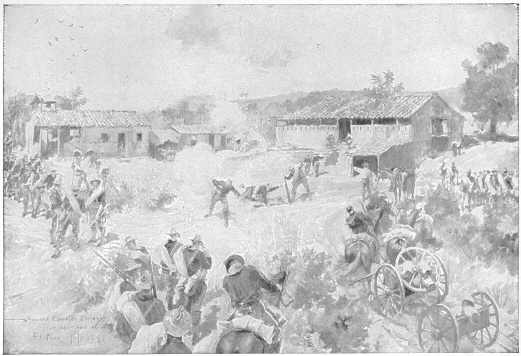
A quarter of an hour after the firing began from El Poso one of General
Shafter’s aides directed General Sumner to advance with his division
down the Santiago trail, and to halt at the edge of the woods.
“What am I to do then?” asked General Sumner.
“You are to await further orders,” the aide answered.
As a matter of fact and history this was probably the last order General
Sumner received from General Shafter, until the troops of his division had
taken the San Juan hills, as it became impossible to get word to General
Shafter, the trail leading to his head-quarters tent, three miles in the
rear, being blocked by the soldiers of the First and Tenth dismounted
Cavalry, and later, by Lawton’s division. General Sumner led
the Sixth, Third, and Ninth Cavalry and the Rough Riders down the trail,
with instructions for the First and Tenth to follow. The trail,
virgin as yet from the foot of an American soldier, was as wide as its
narrowest part, which was some ten feet across. At places it was as
wide as Broadway, but only for such short distances that it was necessary
for the men to advance in column, in double file. A maze of
underbrush and trees on either side was all but impenetrable, and when the
officers and men had once assembled into the basin, they could only guess
as to what lay before them, or on either flank. At the end of a mile
the country became more open, and General Sumner saw the Spaniards
intrenched a half-mile away on the sloping hills. A stream, called
the San Juan River, ran across the trail at this point, and another stream
crossed it again two hundred yards farther on. The troops were halted
at this first stream, some crossing it, and others deploying in single file
to the right. Some were on the banks of the stream, others at the
edge of the woods in the bushes. Others lay in the high grass which
was so high that it stopped the wind, and so hot that it almost choked and
suffocated those who lay in it.
The enemy saw the advance and began firing with pitiless accuracy into
the jammed and crowded trail and along the whole border of the woods.
There was not a single yard of ground for a mile to the rear which was not
inside the zone of fire. Our men were ordered not to return the fire
but to lie still and wait for further orders. Some of them could see
the rifle-pits of the enemy quite clearly and the men in them, but many saw
nothing but the bushes under which they lay, and the high grass which
seemed to burn when they pressed against it. It was during this
period of waiting that the greater number of our men were killed. For
one hour they lay on their rifles staring at the waving green stuff around
them, while the bullets drove past incessantly, with savage insistence,
cutting the grass again and again in hundreds of fresh places. Men in
line sprang from the ground and sank back again with a groan, or rolled to
one side clinging silently to an arm or shoulder. Behind the lines
hospital stewards passed continually, drawing the wounded back to the
streams, where they laid them in long rows, their feet touching the
water’s edge and their bodies supported by the muddy bank. Up
and down the lines, and through the fords of the streams, mounted aides
drove their horses at a gallop, as conspicuous a target as the steeple on a
church, and one after another paid the price of his position and fell from
his horse wounded or dead. Captain Mills fell as he was giving an
order, shot through the forehead behind both eyes; Captain O’Neill,
of the Rough Riders, as he said, “There is no Spanish bullet made
that can kill me.” Steel, Swift, Henry, each of them was shot
out of his saddle.
Hidden in the trees above the streams, and above the trail,
sharp-shooters and guerillas added a fresh terror to the wounded.
There was no hiding from them. Their bullets came from every
side. Their invisible smoke helped to keep their hiding-places
secret, and in the incessant shriek of shrapnel and the spit of the
Mausers, it was difficult to locate the reports of their rifles. They
spared neither the wounded nor recognized the Red Cross; they killed the
surgeons and the stewards carrying the litters, and killed the wounded men
on the litters. A guerilla in a tree above us shot one of the Rough
Riders in the breast while I was helping him carry Captain Morton Henry to
the dressing-station, the ball passing down through him, and a second shot,
from the same tree, barely missed Henry as he lay on the ground where we
had dropped him. He was already twice wounded and so covered with
blood that no one could have mistaken his condition. The surgeons at
work along the stream dressed the wounds with one eye cast aloft at the
trees. It was not the Mauser bullets they feared, though they passed
continuously, but too high to do their patients further harm, but the
bullets of the sharp-shooters which struck fairly in among them, splashing
in the water and scattering the pebbles. The sounds of the two
bullets were as different as is the sharp pop of a soda-water bottle from
the buzzing of an angry wasp.
For a time it seemed as though every second man was either killed or
wounded; one came upon them lying behind the bush, under which they had
crawled with some strange idea that it would protect them, or crouched
under the bank of the stream, or lying on their stomachs and lapping up the
water with the eagerness of thirsty dogs. As to their suffering, the
wounded were magnificently silent, they neither complained nor groaned nor
cursed.
“I’ve got a punctured tire,” was their grim answer to
inquiries. White men and colored men, veterans and recruits and
volunteers, each lay waiting for the battle to begin or to end so that he
might be carried away to safety, for the wounded were in as great danger
after they were hit as though they were in the firing line, but none
questioned nor complained.
I came across Lieutenant Roberts, of the Tenth Cavalry, lying under the
roots of a tree beside the stream with three of his colored troopers
stretched around him. He was shot through the intestines, and each of
the three men with him was shot in the arm or leg. They had been
overlooked or forgotten, and we stumbled upon them only by the accident of
losing our way. They had no knowledge as to how the battle was going
or where their comrades were or where the enemy was. At any moment,
for all they knew, the Spaniards might break through the bushes about
them. It was a most lonely picture, the young lieutenant, half naked,
and wet with his own blood, sitting upright beside the empty stream, and
his three followers crouching at his feet like three faithful watch-dogs,
each wearing his red badge of courage, with his black skin tanned to a
haggard gray, and with his eyes fixed patiently on the white lips of his
officer. When the white soldiers with me offered to carry him back to
the dressing-station, the negroes resented it stiffly. “If the
Lieutenant had been able to move, we would have carried him away long
ago,” said the sergeant, quite overlooking the fact that his arm was
shattered.
“Oh, don’t bother the surgeons about me,” Roberts
added, cheerfully. “They must be very busy. I can
wait.”
As yet, with all these killed and wounded, we had accomplished
nothing—except to obey orders—which was to await further
orders. The observation balloon hastened the end. It came
blundering down the trail, and stopped the advance of the First and Tenth
Cavalry, and was sent up directly over the heads of our men to observe what
should have been observed a week before by scouts and reconnoitring
parties. A balloon, two miles to the rear, and high enough in the air
to be out of range of the enemy’s fire may some day prove itself to
be of use and value. But a balloon on the advance line, and only
fifty feet above the tops of the trees, was merely an invitation to the
enemy to kill everything beneath it. And the enemy responded to the
invitation. A Spaniard might question if he could hit a man, or a
number of men, hidden in the bushes, but had no doubt at all as to his
ability to hit a mammoth glistening ball only six hundred yards distant,
and so all the trenches fired at it at once, and the men of the First and
Tenth, packed together directly behind it, received the full force of the
bullets. The men lying directly below it received the shrapnel which
was timed to hit it, and which at last, fortunately, did hit it. This
was endured for an hour, an hour of such hell of fire and heat, that the
heat in itself, had there been no bullets, would have been remembered for
its cruelty. Men gasped on their backs, like fishes in the bottom of
a boat, their heads burning inside and out, their limbs too heavy to
move. They had been rushed here and rushed there wet with sweat and
wet with fording the streams, under a sun that would have made moving a fan
an effort, and they lay prostrate, gasping at the hot air, with faces
aflame, and their tongues sticking out, and their eyes rolling. All
through this the volleys from the rifle-pits sputtered and rattled, and the
bullets sang continuously like the wind through the rigging in a gale,
shrapnel whined and broke, and still no order came from General
Shafter.
Captain Howse, of General Sumner’s staff, rode down the trail to
learn what had delayed the First and Tenth, and was hailed by Colonel
Derby, who was just descending from the shattered balloon.
“I saw men up there on those hills,” Colonel Derby shouted;
“they are firing at our troops.” That was part of the
information contributed by the balloon. Captain Howse’s reply
is lost to history.
General Kent’s division, which, according to the plan, was to have
been held in reserve, had been rushed up in the rear of the First and
Tenth, and the Tenth had deployed in skirmish order to the right. The
trail was now completely blocked by Kent’s division.
Lawton’s division, which was to have re-enforced on the right, had
not appeared, but incessant firing from the direction of El Caney showed
that he and Chaffee were fighting mightily. The situation was
desperate. Our troops could not retreat, as the trail for two miles
behind them was wedged with men. They could not remain where they
were, for they were being shot to pieces. There was only one thing
they could do—go forward and take the San Juan hills by
assault. It was as desperate as the situation itself. To charge
earthworks held by men with modern rifles, and using modern artillery,
until after the earthworks have been shaken by artillery, and to attack
them in advance and not in the flanks, are both impossible military
propositions. But this campaign had not been conducted according to
military rules, and a series of military blunders had brought seven
thousand American soldiers into a chute of death from which there was no
escape except by taking the enemy who held it by the throat and driving him
out and beating him down. So the generals of divisions and brigades
stepped back and relinquished their command to the regimental officers and
the enlisted men.
“We can do nothing more,” they virtually said.
“There is the enemy.”
Colonel Roosevelt, on horseback, broke from the woods behind the line of
the Ninth, and finding its men lying in his way, shouted: “If you
don’t wish to go forward, let my men pass.” The junior
officers of the Ninth, with their negroes, instantly sprang into line with
the Rough Riders, and charged at the blue block-house on the right.
I speak of Roosevelt first because, with General Hawkins, who led
Kent’s division, notably the Sixth and Sixteenth Regulars, he was,
without doubt, the most conspicuous figure in the charge. General
Hawkins, with hair as white as snow, and yet far in advance of men thirty
years his junior, was so noble a sight that you felt inclined to pray for
his safety; on the other hand, Roosevelt, mounted high on horseback, and
charging the rifle-pits at a gallop and quite alone, made you feel that you
would like to cheer. He wore on his sombrero a blue polka-dot
handkerchief, à la Havelock, which, as he advanced, floated out
straight behind his head, like a guidon. Afterward, the men of his
regiment who followed this flag, adopted a polka-dot handkerchief as the
badge of the Rough Riders. These two officers were notably
conspicuous in the charge, but no one can claim that any two men, or any
one man, was more brave or more daring, or showed greater courage in that
slow, stubborn advance, than did any of the others. Some one asked
one of the officers if he had any difficulty in making his men follow
him. “No,” he answered, “I had some difficulty in
keeping up with them.” As one of the brigade generals said:
“San Juan was won by the regimental officers and men. We had as
little to do as the referee at a prize-fight who calls
‘time.’ We called ‘time’ and they did the
fighting.”
I have seen many illustrations and pictures of this charge on the San
Juan hills, but none of them seem to show it just as I remember it.
In the picture-papers the men are running uphill swiftly and gallantly, in
regular formation, rank after rank, with flags flying, their eyes aflame,
and their hair streaming, their bayonets fixed, in long, brilliant lines,
an invincible, overpowering weight of numbers. Instead of which I
think the thing which impressed one the most, when our men started from
cover, was that they were so few. It seemed as if some one had made
an awful and terrible mistake. One’s instinct was to call to
them to come back. You felt that some one had blundered and that
these few men were blindly following out some madman’s mad
order. It was not heroic then, it seemed merely absurdly
pathetic. The pity of it, the folly of such a sacrifice was what held
you.
They had no glittering bayonets, they were not massed in regular
array. There were a few men in advance, bunched together, and
creeping up a steep, sunny hill, the tops of which roared and flashed with
flame. The men held their guns pressed across their chests and
stepped heavily as they climbed. Behind these first few, spreading
out like a fan, were single lines of men, slipping and scrambling in the
smooth grass, moving forward with difficulty, as though they were wading
waist high through water, moving slowly, carefully, with strenuous
effort. It was much more wonderful than any swinging charge could
have been. They walked to greet death at every step, many of them, as
they advanced, sinking suddenly or pitching forward and disappearing in the
high grass, but the others waded on, stubbornly, forming a thin blue line
that kept creeping higher and higher up the hill. It was as
inevitable as the rising tide. It was a miracle of self-sacrifice, a
triumph of bull-dog courage, which one watched breathless with
wonder. The fire of the Spanish riflemen, who still stuck bravely to
their posts, doubled and trebled in fierceness, the crests of the hills
crackled and burst in amazed roars, and rippled with waves of tiny
flame. But the blue line crept steadily up and on, and then, near the
top, the broken fragments gathered together with a sudden burst of speed,
the Spaniards appeared for a moment outlined against the sky and poised for
instant flight, fired a last volley, and fled before the swift-moving wave
that leaped and sprang after them.
The men of the Ninth and the Rough Riders rushed to the block-house
together, the men of the Sixth, of the Third, of the Tenth Cavalry, of the
Sixth and Sixteenth Infantry, fell on their faces along the crest of the
hills beyond, and opened upon the vanishing enemy. They drove the
yellow silk flags of the cavalry and the flag of their country into the
soft earth of the trenches, and then sank down and looked back at the road
they had climbed and swung their hats in the air. And from far
overhead, from these few figures perched on the Spanish rifle-pits, with
their flags planted among the empty cartridges of the enemy, and
overlooking the walls of Santiago, came, faintly, the sound of a tired,
broken cheer.
This is the inside story of the surrender, during the Spanish War, of
the town of Coamo. It is written by the man to whom the town
surrendered. Immediately after the surrender this same man became
Military Governor of Coamo. He held office for fully twenty
minutes.
Before beginning this story the reader must forget all he may happen to
know of this particular triumph of the Porto Rican Expedition. He
must forget that the taking of Coamo has always been credited to
Major-General James H. Wilson, who on that occasion commanded Captain
Anderson’s Battery, the Sixteenth Pennsylvania, Troop C of Brooklyn,
and under General Ernst, the Second and Third Wisconsin Volunteers.
He must forget that in the records of the War Department all the praise,
and it is of the highest, for this victory is bestowed upon General Wilson
and his four thousand soldiers. Even the writer of this, when he
cabled an account of the event to his paper, gave, with every one else, the
entire credit to General Wilson. And ever since his conscience has
upbraided him. His only claim for tolerance as a war correspondent
has been that he always has stuck to the facts, and now he feels that in
the sacred cause of history his friendship and admiration for General
Wilson, that veteran of the Civil, Philippine, and Chinese Wars, must no
longer stand in the way of his duty as an accurate reporter. He no
longer can tell a lie. He must at last own up that he himself
captured Coamo.
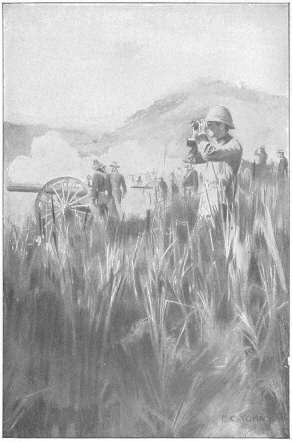
On the morning of the 9th of August, 1898, the Sixteenth Pennsylvania
Volunteers arrived on the outskirts of that town. In order to get
there they had spent the night in crawling over mountain trails and
scrambling through streams and ravines. It was General Wilson’s
plan that by this flanking night march the Sixteenth Pennsylvania would
reach the road leading from Coamo to San Juan in time to cut off the
retreat of the Spanish garrison, when General Wilson, with the main body,
attacked it from the opposite side.
At seven o’clock in the morning General Wilson began the frontal
attack by turning loose the artillery on a block-house, which threatened
his approach, and by advancing the Wisconsin Volunteers. The cavalry
he sent to the right to capture Los Baños. At eight
o’clock, from where the main body rested, two miles from Coamo, we
could hear the Sixteenth Pennsylvania open its attack and instantly become
hotly engaged. The enemy returned the fire fiercely, and the firing
from both sides at once became so severe that it was evident the
Pennsylvania Volunteers either would take the town without the main body,
or that they would greatly need its assistance. The artillery was
accordingly advanced one thousand yards and the infantry was hurried
forward. The Second Wisconsin approached Coamo along the main road
from Ponce, the Third Wisconsin through fields of grass to the right of the
road, until the two regiments met at the ford by which the Baños
road crosses the Coamo River. But before they met, from a position
near the artillery, I had watched through my glasses the Second Wisconsin
with General Ernst at its head advancing along the main road, and as, when
I saw them, they were near the river, I guessed they would continue across
the bridge and that they soon would be in the town.
As the firing from the Sixteenth still continued, it seemed obvious that
General Ernst would be the first general officer to enter Coamo, and to
receive its surrender. I had never seen five thousand people
surrender to one man, and it seemed that, if I were to witness that
ceremony, my best plan was to abandon the artillery and, as quickly as
possible, pursue the Second Wisconsin. I did not want to share the
spectacle of the surrender with my brother correspondents, so I tried to
steal away from the three who were present. They were Thomas F.
Millard, Walstein Root of the Sun, and Horace Thompson. By
dodging through a coffee central I came out a half mile from them
and in advance of the Third Wisconsin. There I encountered two
“boy officers,” Captain John C. Breckenridge and Lieutenant
Fred. S. Titus, who had temporarily abandoned their thankless duties in the
Commissariat Department in order to seek death or glory in the
skirmish-line. They wanted to know where I was going, and when I
explained, they declared that when Coamo surrendered they also were going
to be among those present.
So we slipped away from the main body and rode off as an independent
organization. But from the bald ridge, where the artillery was still
hammering the town, the three correspondents and Captain Alfred Paget, Her
Majesty’s naval attaché, observed our attempt to steal a march
on General Wilson’s forces, and pursued us and soon overtook us.
We now were seven, or to be exact, eight, for with Mr. Millard was
“Jimmy,” who in times of peace sells papers in Herald Square,
and in times of war carries Mr. Millard’s copy to the press
post. We were much nearer the ford than the bridge, so we waded the
“drift” and started on a gallop along the mile of military road
that lay between us and Coamo. The firing from the Sixteenth
Pennsylvania had slackened, but as we advanced it became sharper, more
insistent, and seemed to urge us to greater speed. Across the road
were dug rough rifle-pits which had the look of having been but that moment
abandoned. What had been intended for the breakfast of the enemy was
burning in pots over tiny fires, little heaps of cartridges lay in
readiness upon the edges of each pit, and an arm-chair, in which a sentry
had kept a comfortable lookout, lay sprawling in the middle of the
road. The huts that faced it were empty. The only living things
we saw were the chickens and pigs in the kitchen-gardens. On either
hand was every evidence of hasty and panic-stricken flight. We
rejoiced at these evidences of the fact that the Wisconsin Volunteers had
swept all before them. Our rejoicings were not entirely
unselfish. It was so quiet ahead that some one suggested the town had
already surrendered. But that would have been too bitter a
disappointment, and as the firing from the further side of Coamo still
continued, we refused to believe it, and whipped the ponies into greater
haste. We were now only a quarter of a mile distant from the built-up
portion of Coamo, where the road turned sharply into the main street of the
town.
Captain Paget, who in the absence of the British military attaché
on account of sickness, accompanied the army as a guest of General Wilson,
gave way to thoughts of etiquette.
“Will General Wilson think I should have waited for him?” he
shouted. The words were jolted out of him as he rose in the
saddle. The noise of the ponies’ hoofs made conversation
difficult. I shouted back that the presence of General Ernst in the
town made it quite proper for a foreign attaché to enter it.
“It must have surrendered by now,” I shouted.
“It’s been half an hour since Ernst crossed the
bridge.”
At these innocent words, all my companions tugged violently at their
bridles and shouted “Whoa!”
“Crossed the bridge?” they yelled. “There is no
bridge! The bridge is blown up! If he hasn’t crossed by
the ford, he isn’t in the town!”
Then, in my turn, I shouted “Whoa!”
But by now the Porto Rican ponies had decided that this was the race of
their lives, and each had made up his mind that, Mexican bit or no Mexican
bit, until he had carried his rider first into the town of Coamo, he would
not be halted. As I tugged helplessly at my Mexican bit, I saw how I
had made my mistake. The volunteers, on finding the bridge destroyed,
instead of marching upon Coamo had turned to the ford, the same ford which
we had crossed half an hour before they reached it. They now were
behind us. Instead of a town which had surrendered to a thousand
American soldiers, we, seven unarmed men and Jimmy, were being swept into a
hostile city as fast as the enemy’s ponies could take us there.
Breckenridge and Titus hastily put the blame upon me.
“If we get into trouble with the General for this,” they
shouted, “it will be your fault. You told us Ernst was in the
town with a thousand men.”
I shouted back that no one regretted the fact that he was not more
keenly than I did myself.
Titus and Breckenridge each glanced at a new, full-dress sword.
“We might as well go in,” they shouted, “and take it
anyway!” I decided that Titus and Breckenridge were wasted in
the Commissariat Department.
The three correspondents looked more comfortable.
“If you officers go in,” they cried, “the General
can’t blame us,” and they dug their spurs into the ponies.
“Wait!” shouted Her Majesty’s representative.
“That’s all very well for you chaps, but what protects me if
the Admiralty finds out I have led a charge on a Spanish
garrison?”
But Paget’s pony refused to consider the feelings of the Lords of
the Admiralty. As successfully Paget might have tried to pull back a
row-boat from the edge of Niagara. And, moreover, Millard, in order
that Jimmy might be the first to reach Ponce with despatches, had mounted
him on the fastest pony in the bunch, and he already was far in the
lead. His sporting instincts, nursed in the pool-rooms of the
Tenderloin and at Guttenburg, had sent him three lengths to the good.
It never would do to have a newsboy tell in New York that he had beaten the
correspondents of the papers he sold in the streets; nor to permit
commissioned officers to take the dust of one who never before had ridden
on anything but a cable car. So we all raced forward and, bunched
together, swept into the main street of Coamo. It was gratefully
empty. There were no American soldiers, but, then, neither were there
any Spanish soldiers. Across the street stretched more rifle-pits and
barricades of iron pipes, but in sight there was neither friend nor
foe. On the stones of the deserted street the galloping hoofs sounded
like the advance of a whole regiment of cavalry. Their clatter gave
us a most comfortable feeling. We almost could imagine the
townspeople believing us to be the Rough Riders themselves and fleeing
before us.
And then, the empty street seemed to threaten an ambush. We
thought hastily of sunken mines, of soldiers crouching behind the barriers,
behind the houses at the next corner, of Mausers covering us from the
latticed balconies overhead. Until at last, when the silence had
become alert and menacing, a lonely man dashed into the middle of the
street, hurled a white flag in front of us, and then dived headlong under
the porch of a house. The next instant, as though at a signal, a
hundred citizens, each with a white flag in both hands, ran from cover,
waving their banners, and gasping in weak and terror-shaken tones,
“Vivan los Americanos.”
We tried to pull up, but the ponies had not yet settled among themselves
which of us had won, and carried us to the extreme edge of the town, where
a precipice seemed to invite them to stop, and we fell off into the arms of
the Porto Ricans. They brought us wine in tin cans, cigars, borne in
the aprons and mantillas of their women-folk, and demijohns of native
rum. They were abject, trembling, tearful. They made one
instantly forget that the moment before he had been extremely
frightened.
One of them spoke to me the few words of Spanish with which I had an
acquaintance. He told me he was the Alcalde, and that he begged to
surrender into my hands the town of Coamo. I led him instantly to one
side. I was afraid that if I did not take him up he would surrender
to Paget or to Jimmy. I bade him conduct me to his official
residence. He did so, and gave me the key to the cartel, a
staff of office of gold and ebony, and the flag of the town, which he had
hidden behind his writing-desk. It was a fine Spanish flag with the
coat of arms embroidered in gold. I decided that, with whatever else
I might part, that flag would always be mine, that the chance of my again
receiving the surrender of a town of five thousand people was slender, and
that this token would be wrapped around me in my coffin. I
accordingly hid it in my poncho and strapped it to my saddle. Then I
appointed a hotel-keeper, who spoke a little English, as my official
interpreter, and told the Alcalde that I was now Military Governor, Mayor,
and Chief of Police, and that I wanted the seals of the town. He gave
me a rubber stamp with a coat of arms cut in it, and I wrote myself three
letters, which, to insure their safe arrival, I addressed to three
different places, and stamped them with the rubber seals. In time all
three reached me, and I now have them as documentary proof of the fact that
for twenty minutes I was Military Governor and Mayor of Coamo.
During that brief administration I detailed Titus and Breckenridge to
wigwag the Sixteenth Pennsylvania that we had taken the town, and that it
was now safe for them to enter. In order to compromise Paget they
used his red silk handkerchief. Root I detailed to conciliate the
inhabitants by drinking with every one of them. He tells me he
carried out my instructions to the letter. I also settled one assault
and battery case, and put the chief offender under arrest. At least,
I told the official interpreter to inform him that he was under arrest, but
as I had no one to guard him he grew tired of being under arrest and went
off to celebrate his emancipation from the rule of Spain.
My administration came to an end in twenty minutes, when General Wilson
rode into Coamo at the head of his staff and three thousand men. He
wore a white helmet, and he looked the part of the conquering hero so
satisfactorily that I forgot I was Mayor and ran out into the street to
snap a picture of him. He looked greatly surprised and asked me what
I was doing in his town. The tone in which he spoke caused me to
decide that, after all, I would not keep the flag of Coamo. I pulled
it off my saddle and said: “General, it’s too long a story to
tell you now, but here is the flag of the town. It’s the first
Spanish flag”—and it was—“that has been captured in
Porto Rico.”
General Wilson smiled again and accepted the flag. He and about
four thousand other soldiers think it belongs to them. But the truth
will out. Some day the bestowal on the proper persons of a vote of
thanks from Congress, a pension, or any other trifle, like prize-money,
will show the American people to whom that flag really belongs.
I know that in time the glorious deed of the seven heroes of Coamo, or
eight, if you include “Jimmy,” will be told in song and
story. Some one else will write the song. This is the
story.
When I was a boy I thought battles were fought in waste places selected
for the purpose. I argued from the fact that when our school nine
wished to play ball it was forced into the suburbs to search for a vacant
lot. I thought opposing armies also marched out of town until they
reached some desolate spot where there were no window panes, and where
their cannon-balls would hurt no one but themselves. Even later, when
I saw battles fought among villages, artillery galloping through a
cornfield, garden walls breached for rifle fire, and farm-houses in flames,
it always seemed as though the generals had elected to fight in such
surroundings through an inexcusable striving after theatrical
effect—as though they wished to furnish the war correspondents with a
chance for descriptive writing. With the horrors of war as horrible
as they are without any aid from these contrasts, their presence always
seemed not only sinful but bad art; as unnecessary as turning a red light
on the dying gladiator.
There are so many places which are scenes set apart for
battles—places that look as though Nature had condemned them for just
such sacrifices. Colenso, with its bare kopjes and great stretch of
veldt, is one of these, and so, also, is Spion Kop, and, in Manchuria, Nan
Shan Hill. The photographs have made all of us familiar with the
vast, desolate approaches to Port Arthur. These are among the waste
places of the earth—barren, deserted, fit meeting grounds only for
men whose object in life for the moment is to kill men. Were you
shown over one of these places, and told, “A battle was fought
here,” you would answer, “Why, of course!”
But down in Cuba, outside of Santiago, where the United States army
fought its solitary and modest battle with Spain, you might many times pass
by San Juan Hill and think of it, if you thought of it at all, as only a
pretty site for a bungalow, as a place obviously intended for orchards and
gardens.
On July 1st, twelve years ago, when the American army came upon it out
of the jungle the place wore a partial disguise. It still was an
irregular ridge of smiling, sunny hills with fat, comfortable curves, and
in some places a steep, straight front. But above the steepest,
highest front frowned an aggressive block-house, and on all the slopes and
along the sky-line were rows of yellow trenches, and at the base a cruel
cat’s cradle of barbed wire. It was like the face of a pretty
woman behind the bars of a visor. I find that on the day of the fight
twelve years ago I cabled my paper that San Juan Hill reminded the
Americans of “a sunny orchard in New England.” That was
how it may have looked when the regulars were climbing up the steep front
to capture the block-house, and when the cavalry and Rough Riders, having
taken Kettle Hill, were running down its opposite slope, past the lake, to
take that crest of San Juan Hill which lies to the right of the
block-house. It may then have looked like a sunny New England
orchard, but before night fell the intrenching tools had lent those sunny
slopes “a fierce and terrible aspect.” And after that,
hour after hour, and day after day, we saw the hill eaten up by our
trenches, hidden by a vast laundry of shelter tents, and torn apart by
bomb-proofs, their jutting roofs of logs and broken branches weighed down
by earth and stones and looking like the pit mouths to many mines.
That probably is how most of the American army last saw San Juan Hill, and
that probably is how it best remembers it—as a fortified camp.
That was twelve years ago. When I revisited it, San Juan Hill was
again a sunny, smiling farm land, the trenches planted with vegetables, the
roofs of the bomb-proofs fallen in and buried beneath creeping vines, and
the barbed-wire entanglements holding in check only the browsing
cattle.
San Juan Hill is not a solitary hill, but the most prominent of a ridge
of hills, with Kettle Hill a quarter of a mile away on the edge of the
jungle and separated from the ridge by a tiny lake. In the local
nomenclature Kettle Hill, which is the name given to it by the Rough
Riders, has always been known as San Juan Hill, with an added name to
distinguish it from the other San Juan Hill of greater renown.
The days we spent on those hills were so rich in incident and interest
and were filled with moments of such excitement, of such pride in
one’s fellow-countrymen, of pity for the hurt and dying, of laughter
and good-fellowship, that one supposed he might return after even twenty
years and recognize every detail of the ground. But a shorter time
has made startling and confusing changes. Now a visitor will find
that not until after several different visits, and by walking and riding
foot by foot over the hills, can he make them fall into line as he thinks
he once knew them. Immediately around San Juan Hill itself there has
been some attempt made to preserve the ground as a public park. A
barbed-wire fence, with a gateway, encircles the block-house, which has
been converted into a home for the caretaker of the park, and then,
skirting the road to Santiago to include the tree under which the surrender
was arranged, stretches to the left of the block-house to protect a
monument. This monument was erected by Americans to commemorate the
battle. It is now rapidly falling to pieces, but there still is
enough of it intact to show the pencilled scribblings and autographs of
tourists who did not take part in the battle, but who in this public manner
show that they approve of its results. The public park is less than a
quarter of a mile square. Except for it no other effort has been made
either by Cubans or Americans to designate the lines that once encircled
and menaced Santiago, and Nature, always at her best under a tropical sun,
has done all in her power to disguise and forever obliterate the scene of
the army’s one battle. Those features which still remain
unchanged are very few. The Treaty Tree, now surrounded by a tall
fence, is one, the block-house is another. The little lake in which,
even when the bullets were dropping, the men used to bathe and wash their
clothes, the big iron sugar kettle that gave a new name to Kettle Hill, and
here and there a trench hardly deeper than a ploughed furrow, and nearly
hidden by growing plants, are the few landmarks that remain.
Of the camps of Generals Chaffee, Lawton, Bates, Sumner, and Wheeler, of
Colonels Leonard Wood and Theodore Roosevelt, there are but the slightest
traces. The Bloody Bend, as some call it, in the San Juan River, as
some call that stream, seems to have entirely disappeared. At least,
it certainly was not where it should have been, and the place the hotel
guides point out to unsuspecting tourists bears not the slightest physical
resemblance to that ford. In twelve years, during one of which there
has been in Santiago the most severe rainfall in sixty years, the San Juan
stream has carried away its banks and the trees that lined them, and the
trails that should mark where the ford once crossed have so altered and so
many new ones have been added, that the exact location of the once famous
dressing station is now most difficult, if not impossible, to
determine. To establish the sites of the old camping grounds is but
little less difficult. The head-quarters of General Wheeler are easy
to recognize, for the reason that the place selected was in a hollow, and
the most unhealthy spot along the five miles of intrenchments. It is
about thirty yards from where the road turns to rise over the ridge to
Santiago, and all the water from the hill pours into it as into a rain
barrel. It was here that Troop G, Third Cavalry, under Major Hardee,
as it was Wheeler’s escort, was forced to bivouac, and where
one-third of its number came down with fever. The camp of General Sam
Sumner was some sixty yards to the right of the head-quarters of General
Wheeler, on the high shoulder of the hill just above the camp of the
engineers, who were on the side of the road opposite. The camps of
Generals Chaffee, Lawton, Hawkins, Ludlow, and the positions and trenches
taken and held by the different regiments under them one can place only
relatively. One reason for this is that before our army attacked the
hills all the underbrush and small trees that might conceal the advance of
our men had been cleared away by the Spaniards, leaving the hill, except
for the high crest, comparatively bare. To-day the hills are thick
with young trees and enormous bushes. The alteration in the landscape
is as marked as is the difference between ground cleared for golf and the
same spot planted with corn and fruit-trees.
Of all the camps, the one that to-day bears the strongest evidences of
its occupation is that of the Rough Riders. A part of the camp of
that regiment, which was situated on the ridge some hundred feet from the
Santiago road, was pitched under a clump of shade trees, and to-day, even
after seven years, the trunks of these trees bear the names and initials of
the men who camped beneath them. [4] These men will remember
that when they took this hill they found that the fortifications beneath
the trees were partly made from the foundations of an adobe house.
The red tiles from its roof still litter the ground. These tiles and
the names cut in the bark of the trees determine absolutely the site of
one-half of the camp, but the other half, where stood Tiffany’s
quick-firing gun and Parker’s Gatling, has been almost
obliterated. The tree under which Colonel pitched his tent I could
not discover, and the trenches in which he used to sit with his officers
and with the officers from the regiments of the regular army are now
levelled to make a kitchen-garden. Sometimes the ex-President is said
to have too generously given office and promotion to the friends he made in
Cuba. These men he met in the trenches were then not necessarily his
friends. To-day they are not necessarily his friends. They are
the men the free life of the rifle-pits enabled him to know and to
understand as the settled relations of home life and peace would never have
permitted. At that time none of them guessed that the “amateur
colonel,” to whom they talked freely as to a comrade, would be their
Commander-in-Chief. They did not suspect that he would become even
the next Governor of New York, certainly not that in a few years he would
be the President of the United States. So they showed themselves to
him frankly, unconsciously. They criticised, argued, disagreed, and
he became familiar with the views, character, and worth of each, and
remembered. The seeds planted in those half-obliterated trenches have
borne greater results than ever will the kitchen-garden.
The kitchen-garden is immediately on the crest of the hill, and near it
a Cuban farmer has built a shack of mud and twigs and cultivated several
acres of land. On Kettle Hill there are three more such shacks, and
over all the hills the new tenants have strung stout barbed-wire fences and
made new trails and reared wooden gateways. It was curious to find
how greatly these modern improvements confused one’s recollection of
the landscape, and it was interesting, also, to find how the presence on
the hills of 12,000 men and the excitement of the time magnified distances
and disarranged the landscape.
During the fight I walked along a portion of the Santiago road, and for
many years I always have thought of that walk as extending over immense
distances. It started from the top of San Juan Hill beside the
block-house, where I had climbed to watch our artillery in action. By
a mistake, the artillery had been sent there, and it remained exposed on
the crest only about three minutes. During that brief moment the
black powder it burned drew upon it the fire of every rifle in the Spanish
line. To load his piece, each of our men was forced to crawl to it on
his stomach, rise on one elbow in order to shove in the shell and lock the
breech, and then, still flat on the ground, wriggle below the crest.
In the three minutes three men were wounded and two killed; and the guns
were withdrawn. I also withdrew. I withdrew first.
Indeed, all that happened after the first three seconds of those three
minutes is hearsay, for I was in the Santiago road at the foot of the hill
and retreating briskly. This road also was under a cross-fire, which
made it stretch in either direction to an interminable distance. I
remember a government teamster driving a Studebaker wagon filled with
ammunition coming up at a gallop out of this interminable distance and
seeking shelter against the base of the hill. Seated beside him was a
small boy, freckled and sunburned, a stowaway from one of the
transports. He was grandly happy and excited, and his only fear was
that he was not “under fire.” From our coign of safety,
with our backs to the hill, the teamster and I assured him that, on that
point, he need feel no morbid doubt. But until a bullet embedded
itself in the blue board of the wagon he was not convinced. Then with
his jack-knife he dug it out and shouted with pleasure. “I
guess the folks will have to believe I was in a battle now,” he
said. That coign of safety ceasing to be a coign of safety caused us
to move on in search of another, and I came upon Sergeant Borrowe blocking
the road with his dynamite gun. He and his brother and three regulars
were busily correcting a hitch in its mechanism. An officer carrying
an order along the line halted his sweating horse and gazed at the strange
gun with professional knowledge.
“That must be the dynamite gun I have heard so much about,”
he shouted. Borrowe saluted and shouted assent. The officer,
greatly interested, forgot his errand.
“I’d like to see you fire it once,” he said
eagerly. Borrowe, delighted at the chance to exhibit his toy to a
professional soldier, beamed with equal eagerness.
“In just a moment, sir,” he said; “this shell seems to
have jammed a bit.” The officer, for the first time seeing the
shell stuck in the breech, hurriedly gathered up his reins. He seemed
to be losing interest. With elaborate carelessness I began to edge
off down the road.
“Wait,” Borrowe begged; “we’ll have it out in a
minute.”
Suddenly I heard the officer’s voice raised wildly.
“What—what,” he gasped, “is that man doing with
that axe?”
“He’s helping me to get out this shell,” said
Borrowe.
“Good God!” said the officer. Then he remembered his
errand.
Until last year, when I again met young Borrowe gayly disporting himself
at a lawn-tennis tournament at Mattapoisett, I did not know whether his
brother’s method of removing dynamite with an axe had been entirely
successful. He said it worked all right.
At the turn of the road I found Colonel Leonard Wood and a group of
Rough Riders, who were busily intrenching. At the same moment Stephen
Crane came up with “Jimmy” Hare, the man who has made the
Russian-Japanese War famous. Crane walked to the crest and stood
there as sharply outlined as a semaphore, observing the enemy’s
lines, and instantly bringing upon himself and us the fire of many
Mausers. With every one else, Wood was crouched below the crest and
shouted to Crane to lie down. Crane, still standing, as though to get
out of ear-shot, moved away, and Wood again ordered him to lie down.
“You’re drawing the fire on these men,” Wood
commanded. Although the heat—it was the 1st of July in the
tropics—was terrific, Crane wore a long India rubber rain-coat and
was smoking a pipe. He appeared as cool as though he were looking
down from a box at a theatre. I knew that to Crane, anything that
savored of a pose was hateful, so, as I did not want to see him killed, I
called, “You’re not impressing any one by doing that,
Crane.” As I hoped he would, he instantly dropped to his
knees. When he crawled over to where we lay, I explained, “I
knew that would fetch you,” and he grinned, and said, “Oh, was
that it?”
A captain of the cavalry came up to Wood and asked permission to
withdraw his troop from the top of the hill to a trench forty feet below
the one they were in. “They can’t possibly live where
they are now,” he explained, “and they’re doing no good
there, for they can’t raise their heads to fire. In that lower
trench they would be out of range themselves and would be able to fire
back.”
“Yes,” said Wood, “but all the other men in the first
trench would see them withdraw, and the moral effect would be bad.
They needn’t attempt to return the enemy’s fire, but they must
not retreat.”
The officer looked as though he would like to argue. He was a West
Point graduate and a full-fledged captain in the regular army. To
him, Wood, in spite of his volunteer rank of colonel, which that day, owing
to the illness of General Young, had placed him in command of a brigade,
was still a doctor. But discipline was strong in him, and though he
looked many things, he rose from his knees and grimly saluted. But at
that moment, without waiting for the permission of any one, the men leaped
out of the trench and ran. It looked as though they were going to run
all the way to the sea, and the sight was sickening. But they had no
intention of running to the sea. They ran only to the trench forty
feet farther down and jumped into it, and instantly turning, began pumping
lead at the enemy. Since five that morning Wood had been running
about on his feet, his clothes stuck to him with sweat and the mud and
water of forded streams, and as he rose he limped slightly.
“My, but I’m tired!” he said, in a tone of the most acute
surprise, and as though that fact was the only one that was weighing on his
mind. He limped over to the trench in which the men were now busily
firing off their rifles and waved a riding-crop he carried at the trench
they had abandoned. He was standing as Crane had been standing, in
silhouette against the sky-line. “Come back, boys,” we
heard him shouting. “The other men can’t withdraw, and so
you mustn’t. It looks bad. Come on, get out of
that!” What made it more amusing was that, although Wood had,
like every one else, discarded his coat and wore a strange uniform of gray
shirt, white riding-breeches, and a cowboy Stetson, with no insignia of
rank, not even straps pinned to his shirt, still the men instantly accepted
his authority. They looked at him on the crest of the hill, waving
his stick persuasively at the grave-like trench at his feet, and then with
a shout scampered back to it.
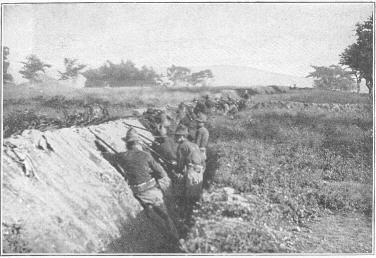
After that, as I had a bad attack of sciatica and no place to sleep and
nothing to eat, I accepted Crane’s offer of a blanket and coffee at
his bivouac near El Poso. On account of the sciatica I was not able
to walk fast, and, although for over a mile of the way the trail was under
fire, Crane and Hare each insisted on giving me an arm, and kept step with
my stumblings. Whenever I protested and refused their sacrifice and
pointed out the risk they were taking they smiled as at the ravings of a
naughty child, and when I lay down in the road and refused to budge unless
they left me, Crane called the attention of Hare to the effect of the
setting sun behind the palm-trees. To the reader all these little
things that one remembers seem very little indeed, but they were vivid at
the moment, and I have always thought of them as stretching over a long
extent of time and territory. Before I revisited San Juan I would
have said that the distance along the road from the point where I left the
artillery to where I joined Wood was three-quarters of a mile. When I
paced it later I found the distance was about seventy-five yards. I
do not urge my stupidity or my extreme terror as a proof that others would
be as greatly confused, but, if only for the sake of the stupid ones, it
seems a pity that the landmarks of San Juan should not be rescued from the
jungle, and a few sign-posts placed upon the hills. It is true that
the great battles of the Civil War and those of the one in Manchuria, where
the men killed and wounded in a day outnumber all those who fought on both
sides at San Juan, make that battle read like a skirmish. But the
Spanish War had its results. At least it made Cuba into a republic,
and so enriched or burdened us with colonies that our republic changed into
something like an empire. But I do not urge that. It will never
be because San Juan changed our foreign policy that people will visit the
spot, and will send from it picture postal cards. The human interest
alone will keep San Juan alive. The men who fought there came from
every State in our country and from every class of our social life.
We sent there the best of our regular army, and with them, cowboys, clerks,
bricklayers, foot-ball players, three future commanders of the greater army
that followed that war, the future Governor of Cuba, future commanders of
the Philippines, the commander of our forces in China, a future President
of the United States. And, whether these men, when they returned to
their homes again, became clerks and millionaires and dentists, or rose to
be presidents and mounted policemen, they all remember very kindly the days
they lay huddled together in the trenches on that hot and glaring
sky-line. And there must be many more besides who hold the place in
memory. There are few in the United States so poor in relatives and
friends who did not in his or her heart send a substitute to Cuba.
For these it seems as though San Juan might be better preserved, not as it
is, for already its aspect is too far changed to wish for that, but as it
was. The efforts already made to keep the place in memory and to
honor the Americans who died there are the public park which I have
mentioned, the monument on San Juan, and one other monument at Guasimas to
the regulars and Rough Riders who were killed there. To these
monuments the Society of Santiago will add four more, which will mark the
landing place of the army at Daiquairi and the fights at Guasimas, El
Caney, and San Juan Hill.
But I believe even more than this might be done to preserve to the place
its proper values. These values are sentimental, historical, and
possibly to the military student, educational. If to-day there were
erected at Daiquairi, Siboney, Guasimas, El Poso, El Caney, and on and
about San Juan a dozen iron or bronze tablets that would tell from where
certain regiments advanced, what posts they held, how many or how few were
the men who held those positions, how near they were to the trenches of the
enemy, and by whom these men were commanded, I am sure the place would
reconstruct itself and would breathe with interest, not only for the
returning volunteer, but for any casual tourist. As it is, the
history of the fight and the reputation of the men who fought is now at the
mercy of the caretaker of the park and the Cuban “guides” from
the hotel. The caretaker speaks only Spanish, and, considering the
amount of misinformation the guides disseminate, it is a pity when they are
talking to Americans, they are not forced to use the same language.
When last I visited it, Carlos Portuondo was the official guardian of San
Juan Hill. He is an aged Cuban, and he fought through the Ten
Years’ War, but during the last insurrection and the Spanish-American
War he not only was not near San Juan, but was not even on the Island of
Cuba. He is a charming old person, and so is his aged wife.
Their chief concern in life, when I saw them, was to sell me a pair of
breeches made of palm-fibre which Carlos had worn throughout the entire ten
years of battle. The vicissitudes of those trousers he recited to me
in great detail, and he very properly regarded them as of historic
value. But of what happened at San Juan he knew nothing, and when I
asked him why he held his present post and occupied the Block-House, he
said, “To keep the cows out of the park.” When I asked
him where the Americans had camped, he pointed carefully from the back door
of the Block-House to the foot of his kitchen-garden. I assured him
that under no stress of terror could the entire American army have been
driven into his back yard, and pointed out where it had stretched along the
ridge of hills for five miles. He politely but unmistakably showed
that he thought I was a liar. From the Venus Hotel there were two
guides, old Casanova and Jean Casanova, his languid and good-natured son, a
youth of sixteen years. Old Casanova, like most Cubans, is not
inclined to give much credit for what they did in Cuba to the
Americans. After all, he says, they came only just as the Cubans
themselves were about to conquer the Spaniards, and by a lucky chance
received the surrender and then claimed all the credit. As other
Cubans told me, “Had the Americans left us alone a few weeks longer,
we would have ended the war.” How they were to have taken
Havana, and sunk Cervera’s fleet, and why they were not among those
present when our men charged San Juan, I did not inquire. Old
Casanova, again like other Cubans, ranks the fighting qualities of the
Spaniard much higher than those of the American. This is only
human. It must be annoying to a Cuban to remember that after he had
for three years fought the Spaniard, the Yankee in eight weeks received his
surrender and began to ship him home. The way Casanova describes the
fight at El Caney is as follows:
“The Americans thought they could capture El Caney in one day, but
the brave General Toral fought so good that it was six days before the
Americans could make the Spaniards surrender.” The statement is
correct except as regards the length of time during which the fight
lasted. The Americans did make the mistake of thinking they could eat
up El Caney in an hour and then march through it to San Juan. Owing
to the splendid courage of Toral and his few troops our soldiers, under two
of our best generals, were held in check from seven in the morning until
two in the afternoon. But the difference between seven hours of one
day and six days is considerable. Still, at present at San Juan that
is the sort of information upon which the patriotic and puzzled American
tourist is fed.
Young Casanova, the only other authority in Santiago, is not so sure of
his facts as is his father, and is willing to learn. He went with me
to hold my pony while I took the photographs that accompany this article,
and I listened with great interest to his accounts of the battle.
Finally he made a statement that was correct. “How did you
happen to get that right?” I asked.
“Yesterday,” he said, “I guided Colonel Hayes here,
and while I guided him he explained it to me.”


