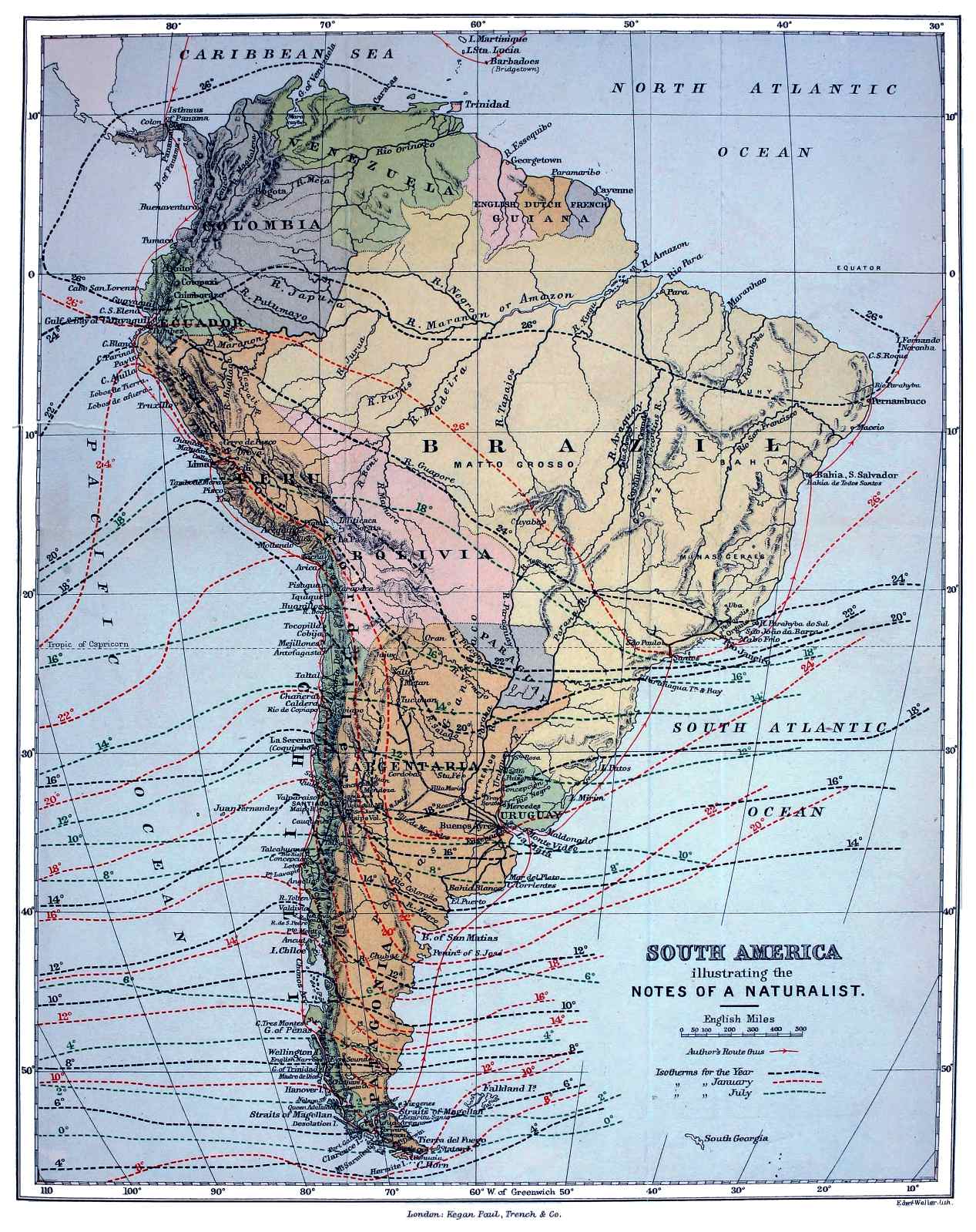
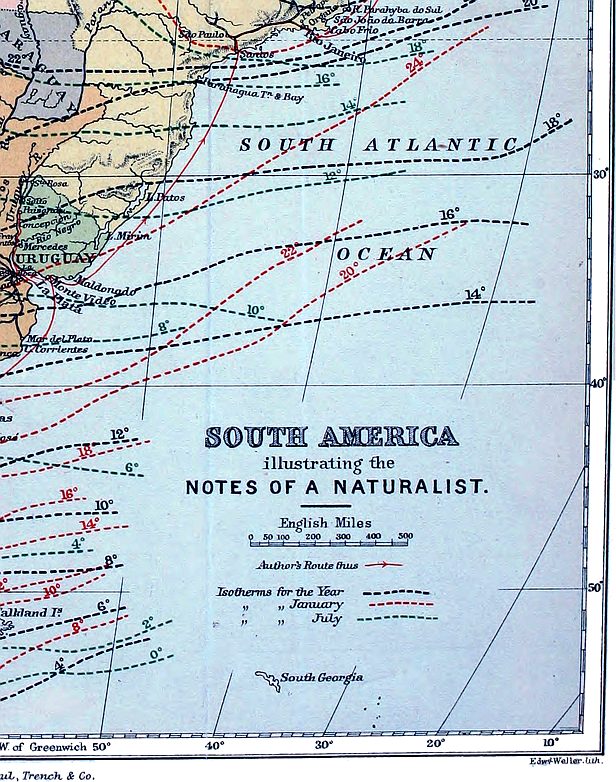
Voyage from Buenos Ayres to Santos—Tropical vegetation in
Brazil—Visit to San Paulo—Journey from San Paulo to
Rio Janeiro—Valley of the Parahyba do Sul—Ancient
mountains of Brazil—Rio Janeiro—Visit to Petropolis—Falls
of Itamariti—Struggle for existence in a tropical
forest—The hermit of Petropolis—Morning view over the
Bay of Rio—A gorgeous flowering shrub—Visit to Tijuca—Yellow
fever in Brazil—A giant of the forest—Voyage
to Bahia and Pernambuco—Equatorial rains—Fernando
Noronha—St. Vincent in the Cape de Verde Islands—Trade
winds of the North Atlantic—Lisbon—Return to
England.
EMBARCATION AT BUENOS AYRES.
About midday on June 30, I took my departure
from Buenos Ayres. The operation was not altogether
simple or to be quickly accomplished. Jolting heavily
over the ill-paved streets, a hackney coach carried me
and a fellow-traveller with our luggage to the riverbank.
The sight was very strange. It was a busy
day, and there were literally hundreds of high-wheeled
carts engaged in carrying passengers and goods out
to the boats, which lay fully half a mile from the
shore. When, after a delay that seemed excessive,
we were installed in a boat, this was pulled in a
leisurely fashion to the steam-tender, which lay more
than a mile farther out. When the hour fixed for the
departure of the tender was long past, we at length
got under way, and finally reached the Neva steamship
of the Royal Mail Company, about fourteen miles
below the city, at five o’clock.
With iron punctuality dinner was served at the
regular hour, although none of the passengers were
ready, and the luggage was not brought on board till
after dinner. There was, in truth, no reason for haste,
as we were appointed to call at Monte Video on the
following morning. My chief business at that place
was to recover possession of the chest containing my
botanical collections, which I had deposited at the
custom-house.
Impressed with the attractions of Brazil, and feeling
the strict limits of time to which I was bound, I asked
myself if I should not have done better to have omitted
a visit to the Plata region, and saved nine days by
proceeding direct to Brazil in the Iberia, which started
on the 22nd of June. I should certainly recommend
that course to any naturalist travelling under similar
circumstances at the same season; but I am sure that,
if I had done so, I should have felt regret at having
missed an opportunity, and should have fancied that
I had lost new and interesting experiences.
At four p.m. on the 1st of July the big ship began
to move from her moorings opposite Monte Video, and
for about sixty miles kept a due easterly course.
Somewhere near the port of Maldonado we passed a
bright light on an island which shows as a bold headland.
I was told that this is known as Cape Frio,
because of the cold often encountered here by those
arriving from Brazil. It may be supposed that the
force of the south-west wind which prevails in winter
is more felt as the wide opening of the great estuary
is reached. During my own short stay, the wind
never rose beyond a gentle breeze, and the temperature
on land was no more than agreeably cool, usually
between 55° and 60° Fahr. during the day.
VOYAGE TO SANTOS.
The distance from Monte Video to Santos, which is
reckoned at 970 sea miles, was accomplished in about
three days and eighteen hours. The voyage was
uneventful. On the 3rd we approached the Brazilian
coast, but the land lay low, and no objects could be
distinguished. The weather was all that could be
desired by the most delicate passengers, the barometer
remaining almost stationary at about 30·2 inches,42
and the temperature by day rising gradually from
57° at Monte Video to 62° in lat. 25° south. Before
sunrise on the morning of July 5, we entered the bay
through which the Santos river discharges itself into
the Atlantic, and found ourselves in a new region.
The richness of the green and the luxuriance of the
foliage recalled the aspect of the coast at Jacmel, in
Hayti, and as the morning advanced, while we slowly
steamed towards the head of the bay, I had no
difficulty in deciding on a course which had already
suggested itself to my mind. I knew that Santos is
connected by railway with São Paulo (better known
in the form San Paulo), the chief town of this part of
Brazil, and that the railway between that place and
the capital was also completed; and I accordingly
determined to leave the steamer, and find my way by
land to Rio Janeiro.
Santos is an ancient place which had long remained
obscure, until the great development of coffee-cultivation
in South Brazil, and the construction of a railway
to the interior, have made it the most advantageous
port for the shipment to Europe of that important
product. It lies at the mouth of an inconsiderable
stream that enters the head of the bay. Seen from
the sea, it appears to be backed by a range of lofty,
flat-topped hills, but, in truth, these are no more than
the seaward face of the great plateau which extends
through a considerable part of the province of San
Paulo. Although Santos is placed a few miles south
of the Tropic of Capricorn, the aspect of the vegetation
is completely tropical; and if a stranger were in
doubt, the fringe of cocoa-nut palms on the shores of
the bay would completely reassure him. Although
the thermometer on board ship did not rise above
67°, the air seemed to us, arriving from the south,
very warm, and we were surprised to hear the company’s
agent, when he came on board, complain that
he had found the water in his bath uncomfortably
chilly.
I landed with a young German fellow-traveller who,
like myself, intended to proceed to San Paulo; and,
as we found that the train was not to start for three
hours, we occupied the time in ascending the nearest
hill. It was now nearly three months since I had
enjoyed a glimpse of true tropical vegetation in the
forest of Buenaventura, and the interest and delight
of this renewed experience can never be forgotten.
It was clear that on the slopes about Santos the native
forests had been cleared, but on all the steeper parts,
not reclaimed for cultivation, the indigenous vegetation
had resumed the mastery. Trees and shrubs in
wonderful variety contended for the mastery, and
maintained, as they best could, a precarious struggle
for existence with a crowd of climbers and parasites.
So dense was the mass of vegetation that it was
impossible to penetrate in any direction farther than
a few yards, and there was no choice but to follow the
track that led to the summit of the slope, on which
stood a pretty house with an adjoining coffee-plantation.
Among the many new forms of vegetation here
seen, the most singular was that of the Tillandsia.43
Long, whitish, smooth cords hang from the branches
of the taller trees, and at eight or ten feet from the
ground abruptly produce a rosette of stiff leaves, like
those of a miniature pine-apple, with a central spike
of flowers. But the most brilliant ornament of this
season was a species of trumpet-flower (Bignonia
venusta, Ker = Pyrostegia ignea, Presl), which, partly
supporting itself, and partly climbing over the shrubs
and small trees, covered them with dense masses of
brilliant orange or flame-coloured flowers.
TROPICAL VEGETATION AT SANTOS.
Laden with specimens, I returned to the town just
in time for the afternoon train to San Paulo. The
railway was constructed by an English company, and
is so far remarkable that a somewhat difficult problem
has been solved in an efficient and probably economical
fashion. The object is, within a distance of a few
miles, to raise a railway train about 2500 feet. This
is done by four stationary engines. The line is laid
on four rather steep inclines, with nearly level intermediate
spaces, each ascending train being counterpoised
by one descending in the opposite direction,
and the loss of time in effecting the connections is
quite inconsiderable.
On every map of Brazil that I have seen, the Serra
do Mar, which we were here ascending, is represented
as a range of mountains running parallel to the coast,
and extending from near Rio Janeiro to the Bay of
Paranagua in South Brazil, apparently dividing the
strip of coast from the low country of the interior.
Most travellers would probably have expected, as I
did, that on reaching the summit we should descend
considerably before reaching San Paulo, and it was
with surprise that from the summit I saw before me
what appeared to be a vast level plain, with some
distant hills or mountains in the dim horizon. It is
true that the drainage of the whole tract is carried
westward and ultimately reaches the Paranà; but the
slope is quite insensible, and I do not think that, in
the space of about sixty miles that lay between us
and San Paulo, the descent can exceed two or three
hundred feet. There was a complete change in the
aspect of the vegetation, and open tracts of moorland
recalled scenes of Northern Germany.
Night had closed before we reached the station at
San Paulo. There was a difficulty about a carriage
to convey us to the hotel. Perhaps the demands
were unreasonable, or perhaps we were too unfamiliar
with the coinage of Brazil, which is that of the mother
country; but on hearing from the driver a demand
for several thousand rees, we indignantly resolved to
walk, and engaged a man to convey our luggage to
the hotel. We were favourably impressed by the
appearance of this provincial capital. In the space of
a mile we passed through several good streets, well
lighted with gas, and better paved than any I had
seen in South America. Many handsome houses
with adjoining gardens were passed on the way, and,
on reaching the Grand Hotel, nice clean rooms, and
good food provided for the evening meal, further
conduced to favourable first impressions of Brazil.
GERMAN COMMERCIAL TRAVELLERS.
My young German companion, a traveller for a commercial
house, was returning from a visit to the interior
of Brazil. By steamer on the Paranà and Paraguay
he had gone from Buenos Ayres to Cuyabà, the capital
of the province of Matto Grosso, a vast region with
undefined boundaries, probably larger than most of
the European states. I have often been struck by
the results of superior education among Germans
engaged in business, as compared with men of the
same class in other countries. It is not that they often
merit the designation of intellectual men, and still
more rarely do they show active interest in scientific
inquiry; but they retain a respect for the studies they
have abandoned, are ready to talk intelligently on
such subjects, and, as a rule, have a regard for
accuracy as to facts which is so uncommon in the
world, as much because the majority are too ignorant
to appreciate their importance as owing to deliberate
disregard of truth. I did not learn much as to the
progress of inner Brazil, but my fellow-traveller
mentioned a few particulars that had struck him as
singular. He found the civil population of Cuyabà
solicitous in their adherence to European fashions in
dress, and, as a special note of respectability, the men
always appearing in what are vulgarly called chimneypot
hats. The current coin in all but small transactions
consisted in English sovereigns, but he was
unable to explain how these have reached a region
which can have so few commercial relations with this
country. He departed on the following morning,
while I resolved to spend a day in visiting the neighbourhood
of the city.
Although San Paulo lies exactly on the southern
tropic, the winter climate is positively cool, and at
sunrise on July 6 the thermometer stood at 58° Fahr.
On a rough estimate from a single barometric observation
it stands about 2400 feet above the sea. Its
appearance was altogether unlike that of all the towns
seen in Spanish America. The somewhat wearisome
monotony of regular square blocks gave place to the
irregular arrangement of some of the provincial towns
in England, several streets running out into the
country and ending in detached villas. The general
impression was that of comfort and prosperity. Several
well-appointed private carriages were seen in the
streets, and the shops were as good as one commonly
sees in a European town of the same class.
I was much interested by the short country excursion,
which occupied most of the day, and by an
aspect of vegetation entirely new to me. The plants,
with scarcely an exception, belonged to genera prevailing
in tropical America, many of them now seen
by me for the first time; but the species were nearly
all different from those of the coast region, and the
general aspect of the flora still more markedly
different. There was no trace of that luxuriance
which we commonly expect in tropical vegetation;
monocotyledonous plants, except grasses, were very
few, and, in place of the large ferns that abounded at
Santos, I found but a single Gleichenia, allied to a
species that I had gathered in the Straits of Magellan.
FLORA OF THE BRAZILIAN PLATEAU.
Although a fair number of plants were still in
flower, I soon came to the conclusion that night frosts
must be not unfrequent at this season, and that a
considerable proportion of the vegetation must be
annually renewed. I found several groups of small
trees, chiefly of the laurel family, and for the first
time saw the Araucaria brasiliensis, possibly in a wild
state; but none of the trees attained considerable
height, and I doubt whether in a state of nature this
plateau has ever been a forest region. I was rejoiced
to see again, growing in some abundance, the splendid
Bignonia venusta, and was led to doubt whether its
real home may not be in the interior, and its appearance
at Santos due to introduction by man.
We possess a fair amount of information as to the
climate of the Brazilian coasts, but our knowledge of
the meteorology of the interior provinces is miserably
scanty. I was led to conjecture that, although the
district surrounding San Paulo is not divided by a
mountain range from the neighbouring coast region,
the climate must be very much drier, and that the
rainfall is mainly limited to the summer season.
In the course of my walk, I unexpectedly approached
a country house about three miles from the
town, and was somewhat surprised by meeting a
carriage with ladies on their way to the house. As
far as my experience has gone in the country parts
of Portugal or Spain, such an encounter would there
be regarded as a very unusual phenomenon.
The railway from San Paulo to Rio Janeiro appears
to be a well-managed and prosperous concern, paying
to its shareholders dividends of from ten to twelve
per cent. The distance is about 380 miles, and the
trains perform the distance in about thirteen and a
half hours. Leaving my hotel in the dark, I found
at the station a crowd of passengers contending for
tickets; but good order was maintained, and we
started punctually at six o’clock. For some way the
line is carried at an apparent level over the plain,
with occasional distant views of high hills to the
north, and crosses two or three inconsiderable streams,
whose waters run to the Paranà. A slight but continuous
ascent, scarcely noticed by the passing,
traveller, leads to the watershed which, in this direction,
limits the vast basin of the Paranà. After a
long but very gentle descent, we reached a stream
flowing westward. I at first supposed it, like those
already seen, to be a tributary of the Paranà which
made its way through some depression in the low
ridge over which we had passed; but I soon ascertained
that this was an error. Near the spot where
the railway crosses it, the stream makes a sharp turn,
and thenceforth proceeds in a direction little north of
east for about four hundred miles, till it falls into the
Atlantic at São João da Barra, north-east of Rio
Janeiro. This is the Rio Parahyba do Sul, not to be
confounded with the Rio Parahyba north of Pernambuco,
nor yet with the more important river
Paranahyba in the province of Piauhy.
GEOLOGY OF EASTERN BRAZIL.
For the greater part of the way to Rio the railway
runs parallel with the river. As laid down on the
maps, the valley lies between a mountain range called
the Serra da Mantiqueira on the left, and a minor
range, which divides the upper course of the river
from the middle part, where it flows in the opposite
direction. The appearance of the country through
which I now passed forcibly suggested to me views
respecting its geological history, which were confirmed
and extended by what I afterwards saw in the neighbourhood
of Rio, and by all that I have since been
able to learn on the subject.
I had already been struck by what little I had seen
of the plateau region of the province of San Paulo.
Beneath the superficial crust of vegetable soil, the
plateau appears to be formed of more or less red
arenaceous deposits, such as would result from the
erosion and decomposition of the gneiss or granite
which is the only rock I had seen in the country. In
the valley of the Parahyba, the connection was unmistakable.
Every section in the valley showed
thick beds of the same coarse-grained, red arenaceous
deposits, and on the slopes the same material lay at
the base of whatever masses of granite we approached.
But what especially struck me were the forms and
appearance of the mountains on either hand, if that
designation could properly be given to them. I saw
nothing that would elsewhere be called a mountain
range. The outlines were in most places rounded and
covered with vegetation, but at intervals occurred
steep conical masses, of the same general type as the
sugar-loaf peaks surrounding the Bay of Rio Janeiro.
However steep, the rocks nowhere showed angular
peaks or edges, these being always more or less
rounded.
It would be rash to generalize from the partial
observations of a passing traveller; but the broad
outlines of the geology of Brazil, or, at least, of the
eastern provinces, have now been well traced,44 and
some general conclusions may safely be drawn. It is
true that large districts of the interior have been but
partially explored, and remain blanks on the geological
map; but the eastern half of Brazil is undoubtedly
ancient land; presenting no trace of secondary strata
except in small detached areas near the coast, and
where more recent tertiary deposits are to be found
only in a portion of the great valley of the Amazons.
A mountain range, having various local designations,
but which may best be called the Serra da Mantiqueira,
extends from the neighbourhood of San Paulo
to the lower course of the Rio San Francisco, for a
distance of twelve hundred miles, and this is mainly
composed of gneiss, sometimes passing into true
granite, syenite, or mica schist; and the same may
be said of the Serra do Mar, a less considerable range
lying between the main chain and the coast. The
southern limits of the Serra do Mar do not appear to
be well-defined, but we may estimate its length at
from five to six hundred miles. The other mountain
systems of the empire are less well known; but I
believe that the ranges dividing the province of Minas
Geraes from Goyaz, and the so-called Cordillera
Grande of the province of Goyaz, lying between the
two main branches of the great river Tocantins, are
largely formed of ancient sedimentary rocks of the
Laurentian and Huronian groups.
DISINTEGRATION OF GRANITE.
The granite of the Serra da Mantiqueira and Serra
do Mar is coarse-grained, with large crystals of felspar,
and is therefore much exposed to disintegration. So
far as I know, the vast masses of detritus forming the
plateaux of this region show no other materials than
such as would be produced by the disintegration of
the crystalline rocks, and there is strong reason to
believe that these have never been overlaid by
sedimentary deposits.
Let us now consider what must have been the past
history of a region formed of such materials, exposed,
during a large part of the past history of the earth, to
the action of the elements. In such an inquiry one
of the chief points for consideration is the amount of
rainfall. The direct effect, both mechanical and
chemical, of rain falling on a rock surface is perhaps
not the most important. Still more essential is its
action in removing the disintegrated matter, and
thereby exposing a fresh surface to renewed action.
The difference in the absolute result due to abundant
or deficient rainfall would be found, if we could calculate
it accurately, to be enormous. In a nearly
rainless country, such as Egypt or Peru, we see a
slope covered with débris, and are apt to conclude
that the rock is being rapidly disintegrated; but, in
truth, what we see is the work of many, perhaps
many hundred, centuries, which remains in situ because
there is no agency to remove it. In a land of heavy
rainfall the débris is speedily carried to lower levels,
and the work of destruction is constantly renewed.
We have scarcely any observations of rainfall in
the mountain districts of Brazil. The only reliable
return that I have seen is that of one year’s rainfall
at Gongo Seco, in Goyaz, which amounted to more
than a hundred and thirty inches; but we may safely
conclude that it is everywhere very great. It is also
important to note that if, as most geologists now
believe, the Atlantic valley has existed since an early
period of the earth’s history, Eastern Brazil must
always have been a land of heavy rainfall. A great
mountain range on the eastern side of the continent
might have created a desert region in the interior,
but would have received in the past as much aqueous
precipitation as it does at the present time.
We have, therefore, to consider what must have
been the ancient condition of a region subjected
throughout vast periods of geological time to the
utmost force of disintegrating agencies applied to a
rock very liable to yield to them, and where, without
reckoning the large proportion which must have been
carried by rivers to the sea, we see such vast deposits
of the disintegrated materials formed out of the same
matrix. To my mind the conclusion is irresistible
that ancient Brazil was one of the greatest mountain
regions of the earth, and that its summits may very
probably have exceeded in height any now existing
in the world. What we now behold are the ruins of
the ancient mountains, and the singular conical peaks
are, as Liais has explained, the remains of some
harder masses of metamorphic gneiss, of which the
strata were tilted at a high angle. As the same
writer has remarked, although the crystalline rocks
are for the most part easily disintegrated, some portions
are formed of much more resisting materials,
and these have to some extent survived the incessant
action of destructive forces.
RUINS OF THE ANCIENT MOUNTAINS.
We are far from possessing the materials for a
rational estimate of the probable extent and elevation
of the ancient mountain ranges of Brazil. In the first
place, we have a plateau region occupying a large
part of the upper basin of the Paranà, with an area of
fully 100,000 square miles, covered with detritus to
an unknown, but certainly considerable, depth. In
addition to this, it cannot be doubted that the finer
constituents carried down by that river, and its
tributary the Paraguay, from the same original home,
have largely contributed to the formation of the
Argentine pampas and Paraguay, including the
northern portion of the Gran Chaco. Borings and
chemical analysis of the soil may hereafter give us
reliable data; but in the mean time we may safely
reckon that an area of 200,000 square miles has been
mainly formed from the materials derived from the
ancient mountains whose importance I endeavour to
point out. In addition to all this, we should further
reckon the soluble matter and fine silt carried to the
ocean during the long course of geological history,
and take into account that the same great mountain
region also furnished materials to streams which
flowed northward and eastward.
In attempting to speculate on the past history of
this region it is important to remark that, so far as
evidence is available, there is reason to believe that
Brazil has undergone less considerable changes of
level than most other parts of the earth’s surface.
Even if we go back to the period of the earlier
secondary rocks, there is no evidence to show that
movements of elevation or depression have exceeded
a few hundred feet.
I have attempted elsewhere45 to give a sketch of
the views which I hold as to the probable origin of
the chief types of phanerogamous vegetation. I there
pointed out that, at a period when physical conditions
in the lower regions of the earth’s surface were widely
different, and the proportion of carbonic acid gas
present in the atmosphere was very much greater
than it has been since the deposition of the coal
measures, it was only in the higher region of great
mountain countries that conditions prevailed at all
similar to those now existing. I further argued that,
if the early types of flowering plants were confined,
as I believe they were, to the high mountains, we
could not expect to find their remains in deposits
formed in shallow lakes and estuaries until after the
probably long period during which they were gradually
modified to adapt them to altered physical conditions.
VALLEY OF THE PARAHYBA.
A general survey of the South American flora
shows, along with elements derived from distant
regions, a large number of types either absolutely
peculiar to that continent, or which, in some cases,
appear to have spread from that centre to other areas.
Of these peculiar types some may probably have
originated in the Andean chain, but as to the majority,
it seems far more probable that their primitive home
was in Brazil; and it is precisely on the ancient
mountains of this region that I should look for the
ancestors of many forms of vegetation which have
stamped their character on the vegetation of the continent.
I should be the first to admit that the views here
expressed have no claim to rank as more than probable
conjectures; but I hold that these, when resting
on some positive basis of facts, are often serviceable
to the progress of science, by stimulating inquiry and
leading observers to co-ordinate facts whose connection
had not previously been apparent.
In following the valley, in places where the siliceous
soil supported only a scanty vegetation, I was struck
by the singular appearance of scattered piles, usually
about four feet in height, having much the appearance
of rude milestones, occurring here and there in some
abundance, but never very near each other. I was
often able to avail myself of the short halts of the
train at wayside stations to secure specimens of interesting
plants, but I was not able to approach near
to these unknown objects. I have no doubt, however,
that they were habitations of termites, or, as they
are commonly called, white ants. I have never been
able to conjecture the origin of the instinct that
induces so many species of termites in different parts
of the world to construct dwellings in this form, nor
what advantage they can derive from it.
As the Parahyba appeared to be a rapid-flowing
stream, it is probable that in following the valley the
railway descends considerably before it reaches the
point, about eighty miles north of Rio, where it abruptly
turns away from the river to make its way to the
capital. The appearance of the vegetation announced
a change of climate, but I did not notice any palms
by the way. The country between the Parahyba
valley and the coast appears to be an irregular mountain
tract, nowhere of any great height, with projecting
summits rising here and there of the same general
character as those already described, and the railway
follows a sinuous course so as to select the lowest
depressions between the neighbouring bosses of granite.
As we wound to and fro, constantly changing our
direction amid scenes of increasing loveliness, night
closed with that suddenness to which one becomes
accustomed in the tropics, and the last part of the
way was unfortunately passed in darkness. The
approach to Rio must be surpassingly beautiful, but,
beyond the fantastic outlines of the surrounding
mountains, little could be discerned save the lights of
the city, visible for many miles before we reached
the railway station.
After a long drive through paved streets, I reached
the English hotel (Carson’s), and was curtly informed
that the house was full. The next in rank is the
Fonda dos Estrangeiros, to which I proceeded, and
found quarters in a rather shabby room, not overclean.
The general style of the establishment and
the food provided answered the same description. It
is generally admitted that the accommodation for
strangers in the capital of Brazil does not come up to
the reasonable expectations of travellers.
THE BAY OF RIO JANEIRO.
By quitting the steamer at Santos, and travelling
to Rio by land, I had gained some slight acquaintance
with a new region, but I was well aware that I had
suffered a considerable loss. The view on first entering
the Bay of Rio Janeiro is one of those spectacles
that leave an ineffaceable impression even on persons
not very sensitive to natural beauty, and one on which
my fancy from early youth onwards had most often
dwelt. The pursuits of a naturalist, besides their own
fascination, offer additional rewards to all who worship
in the temple of Nature, but they also sometimes
exact a sacrifice. Sallying forth on the morning of
July 8, a little under the impression of the unattractive
quarters of the night, I had but very moderate
expectations as to what might be enjoyed of the
scenery in the midst of a large city and its surroundings,
but I was speedily disabused. Man has certainly
done little to set off the unequalled fascinations of the
place, but he has been powerless to conceal them. I
passed a delightful day, partly strolling much at
random on foot, and occasionally availing myself of
the street-cars, which are frequented by all classes, and
afford a stranger the best opportunity for seeing something
of the very mixed population.
The famous Bay of Rio Janeiro may properly be
described as a salt-water lake, so completely is it
landlocked and cut off from the open sea. About
thirty miles long and twenty in breadth, it is large
enough to allow of spacious views, yet not so large as
to lose in distance the marvellous background that is
presented in every direction by the fantastic peaks
that surround it. Numerous islands stud the surface,
the larger telling their history in piles of huge blocks,
either simulating rude Cyclopean architecture, or
lying in wild confusion—granite pinnacles, half-decayed
or fallen into utter ruin. The shores are
everywhere a maze of coves and inlets, in which land
and water are interlaced; and over all—the mainland
and the islands alike—the wild riot of tropical vegetation
holds its sway, defying the efforts of man to
tame it to trimness. Even within the limits of the
city, which stretches for about four miles along the
shore, four or five coves present a ceaseless variety of
outline. Of necessity the plan is completely irregular.
Where a space of level ground opens out between the
shore and the rocks, the city has spread out; where the
rocks approach the water’s edge, it is narrowed in
places to a single street. In architecture, since the
great era of Alcobaça and Batalha, the Portuguese
have not achieved much, and their descendants in
South America have done little to adorn the capital
of their great empire. The largest building, the
imperial palace, might easily be taken for a barrack.
Nature has undertaken the decoration of the city, and,
amid the palms, and under the shade of large-leaved
tropical trees in the public walks and gardens, the
absence of sightly buildings is not felt.
The suburb of Botafogo, which is the fashionable
quarter, lies on the shores of the most beautiful of the
coves round which the city has grown up. It mainly
consists of a range of handsome villas facing the sea,
each with a charming garden, and, in this season,
must be a delightful residence. But it is generally
admitted that the climate of Rio is debilitating to
European constitutions. As compared with most
coast stations in the tropics the heat is not excessive—the
mean temperature of the warmest month (February)
is not quite 80° Fahr., and that of the coldest
(July) about 70°; but most Europeans, and especially
those of Germanic stock, require to be braced by
intervals of cold, if they are to endure a hot climate
with impunity. The annual appearance of yellow
fever in the city supplies a still stronger motive to
many of the foreign residents for fixing their abode
amongst the hills. The chief resort, which in summer
is frequented by most of the wealthier classes, is the
well-known Petropolis, in the Organ Mountains, or
Serra dos Orgãos, that rise beyond the northern
shores of the bay.
THE AVENUE OF PALMS.
From Botafogo I directed my steps towards the
Botanic Garden, and, as usual among people of
Portuguese descent, found great readiness in giving
information to strangers. Following a road that
turned away from the shore, I seemed to have left the
city far behind, and be quite in the country; but presently
another beautiful dark blue cove opened out
before me, and again turning inland I reached the
garden. I must confess to a feeling of something
like disappointment at the famous avenue of palms.
It has been correctly described as reproducing the
effect of the aisle of a great Gothic cathedral, and the
defect, as it seemed to me, is that the reproduction is
too faithful. The trees of Oreodoxa regia, which are
about a hundred feet in height, are all exactly of the
same form and dimensions, so much alike that they
appear to have been cast in the same mould, and it is
difficult to persuade one’s self that they are not
artificial productions. It may not be easy to say why
the same uniformity which satisfies the eye in a construction
of stone, should fail to do so when similar
forms are represented by natural objects. I suppose
the fact to be that in all æsthetic judgments the mind
is unconsciously influenced by trains of association.
Our admiration is aroused not merely by given combinations
of colour or form—by the mere visual image
formed on the retina—but is controlled by our sense
of fitness. We should resent as a caprice of the
architect an irregularity in a vista of arches: among
objects endowed with life we expect some manifestation
of the universal tendency to variation.
With an intention, never fulfilled, to make a second
visit to the garden, and, under the guidance of the
director, Dr. Glaziou, to make nearer acquaintance
with some of the vegetable wonders there brought
together, I returned to my hotel. Before reaching
Rio, I had decided to devote most of my short remaining
time to a visit to the Organ Mountains, and
to make Petropolis my head-quarters. As there was
no especial reason for delay, I started for that place
on the morning of the following day, July 9.
I shall make no attempt to describe the beauties of
the bay as they were successively unfolded during the
short passage to and from Petropolis. From early
youth the Bay of Naples has ever appeared to me so
perfectly beautiful that I was very reluctant to admit
the pretensions of a rival. Even now I can well
understand that some may find the pictures presented
to the eye on the charmed coasts of our Mediterranean
bay more complete, and the tints of the shores and
sea and sky more harmonious; but there could be
no doubt as to the gorgeous vesture that everywhere
adorns this land. The vegetation of the Mediterranean
coasts seems but poor and homely after the eye has
dwelt on the luxuriance of tropical life, as though one
were to compare a garb of homespun with trappings
of velvet and embroidery. The islands of the bay
present a ceaseless variety. Some are mere rocks, on
which sea-birds of unknown aspect stood perched.
Many of the larger are inhabited, and one, as I heard,
has a population of thirteen hundred souls, and
several charming villas showed it to be a favourite
resort.
THE ORGAN MOUNTAINS.
In about an hour and a half from the city, the
little steamer ran alongside of a wooden jetty at a
spot on the northern side of the bay facing the bold
range of the Organ Mountains, which extend for over
twenty miles in an easterly direction. Between the
northern shore and the foot of the mountains is a
level swampy tract, evidently filled up by the detritus
borne down by the numerous streams, and beyond
this the mountain range rises very abruptly from the
plain. Somewhat to my disappointment, I ascertained
that Petropolis lies at a considerable distance
from the higher part of the Organ range to which
my attention had hitherto been directed. It is
towards its eastern extremity that the Serra shows
that remarkable series of granitic pinnacles of nearly
equal height, appearing vertical from a distance, that
suggested the likeness to the pipes of an organ
whence these mountains obtained their name. The
height of the loftier part has been estimated at 7500
feet above sea-level. I do not think that any of the
summits near Petropolis can surpass the level of
5000 feet.
A short train with a small locomotive carried passengers
for Petropolis across the low tract to the point
where the ascent abruptly commences, a distance of
nine or ten miles. The marshy plain is doubtless
fever-stricken, and we passed very few houses on the
way to the terminus, which is appropriately named
Raiz da Serra. The construction of a railway on the
slope leading thence to Petropolis, up which trains
should be drawn by a wire rope, had been commenced,
but at the time of my visit passengers were conveyed
in carriages, each drawn by six or eight mules. A
well-kept and well-engineered road—by far the best
mountain road that I have seen in any part of America—leads
to the pass or summit of the ridge that divides
Petropolis from the Bay of Rio. The views during
the ascent, especially in looking back over the bay,
were entrancing, and new and strange forms of vegetation
showed themselves at each turn of the road.
From the summit, a gentle descent of a couple of
miles leads to the main street of Petropolis.
The place lies about 2900 feet above the sea, in
a basin or depression amidst forest-covered hills.
The abundant rains of this region have carved the
surface into a multitude of little dells and recesses,
separated by hills and knolls of various size and
height, leaving in their midst one comparatively broad
space, where most of the buildings are grouped. The
streamlets that issue from every nook in the mountains
are finally united in two streams that flow in opposite
directions, but both, I believe, ultimately find their
way northward to the Parahyba. The streamlets
have been turned to account by the inhabitants, for
on each side of the main streets a rivulet of crystal
water serves to maintain the vigour of a line of trees
supplying the one need of the long summer—shelter
from the vertical midday sun. In the present season
(mid-winter) only one hotel was open; but in summer,
when all who can do so escape from the oppressive
heat of Rio, two or three others are generally crowded.
It is at once apparent that Petropolis is a place for
rest and enjoyment, not for business. The few shops
and hotels are all in the main street, Rua do Imperador;
the other streets, or roads, lie between
ranges of detached villas, each with a garden, and
here and there some more secluded habitation is withdrawn
into some nook on the margin of the forest.
ATTRACTIONS OF PETROPOLIS.
The large majority of the trees and shrubs of this
region have persistent leaves, but a few lose their
foliage annually in winter, and a few others, I believe,
during the heat of summer. The only prominent
reminder of the fact that we were in winter was the
appearance of the Bombax trees that line the main
street, now completely bare of foliage. The tree
commonly planted in this part of Brazil is, I believe,
the Bombax pubescens of botanists. The fruit, with its
copious silky appendage to the seeds, alone remained
at this season; but when covered with a mass of large
white flowers, it must have a gorgeous appearance.
I cannot feel sure that every naturalist will approve
of the resolution, which I very soon formed, to remain
as long as was possible at Petropolis. To reach the
higher summits of the Organ Mountains would have
required at least three or four days’ travel, and at
this season I could expect to see very little of the
vegetation of the higher zone. In the mean time, I
found in the immediate neighbourhood, within a radius
of four or five miles, an unexhausted variety of objects
of interest, and the attractions of the place were
doubtless heightened by the fortunate circumstances in
which I found myself. It is certain that the ten days
that I spent at this fascinating spot remain in my
memory as the nearest approach to a visit to the
terrestrial paradise that I can expect to realize.
Besides the British minister, Mr. Corbett, I was fortunate
enough to make the acquaintance of two
English families, whose constant kindness and hospitality
largely contributed to the enjoyment of my
stay. To find in the midst of the marvels of tropical
nature the charms of cultivated society, was a combination
that I had not ventured to promise to myself.
Although I never went farther than five or six
miles from my head-quarters, the variety of delightful
walks in every direction seemed to be inexhaustible;
go where one would, it seemed certain that one could
not go wrong. I soon ascertained, indeed, that it is
useless to attempt to penetrate the forests, except by
following a road or cleared path. My first lesson was
on the slope of a little hill some three hundred feet
in height that overlooks the town. I was told that
there was a path on the farther side, but, seeing the
ground partly open, with trees of small stature not
much crowded together, I resolved to follow the
straight course. The ascent cost me over two hours
of hard work, and I accomplished it only with the
help of a sharp knife, by which to cut through the
tangle of vegetation. In the midst of this I was
surprised to find tall fronds of our common English
bracken (Pteris aquilina), a fern that has been able to
adapt its constitution to all but the most extreme
climates of the world. The little hill that cost me so
much labour had been completely cleared ten years
before, so that all the trees and shrubs had grown up
since that time.
THE STRUGGLE FOR EXISTENCE.
The first excursion recommended to every stranger
at Petropolis is that to the Falls of Itamariti. I went
there twice, varying somewhat my course—the first
time with a horse, which I found quite unnecessary
and rather an incumbrance; the second time alone.
The falls are not very considerable. A stream so
slender that it can be passed by stepping-stones falls
over two ledges of granite rock, together about forty
feet in height; but, framed in a mass of the most
luxuriant tropical vegetation, the whole forms a lovely
picture. For some reason which I did not learn, the
forest on the slopes of the lower part of the glen
below the falls had been felled just before my visit,
and its beauty had vanished, but fortunately the arm
of the destroyer was arrested before reaching the falls.
As happens to every stranger in a tropical forest,
I was bewildered amidst the great variety of trees that
struggle for supremacy, the one condition for victory
being to get a full share of the glorious sunshine overhead.
By vigorous tugging at one of the lianes that
hung like a rope from a branch sixty feet above my
head, I succeeded in breaking off a fragment, and
identifying one of the larger trees as a species of fig,
with large, oval, leathery leaves somewhat like those
of a magnolia. It is needless to say that each tree is
invaded by a host of enemies—parasites that fatten on
its substance, comparatively harmless epiphytes that
cling to the branches, and hosts of climbing lianes
that mount to the topmost branches, robbing them of
their share of sunlight, and hang down, often twined
together, and in the deep shade are generally mere
bare flexible stems. It was strange to observe that
one of the deadliest enemies, a small parasite, fixing
itself near the ground on the trunks of the larger trees,
is a species of fig, belonging to the same genus as some
of the giants of the forest, and doubtless tracing its
descent from a common ancestor. It is in the tropical
forest that one feels the force of Darwin’s phrase
“struggle for existence,” as applied to the vegetable
world. In our latitudes it is by an effort of the
imagination that we realize the fact that in our fields
and woodlands there is a contest going on between
rival claimants for the necessary conditions of life.
Here we see ourselves in the midst of a scene of
savage warfare. The great climbers, like monstrous
boas, that twine round and strangle the branch, remind
one of the Laocoon; the obscure parasite that eats
into the trunk of a mighty tree till a great cavity
prepares its downfall, testifies to the destructive power
of an insidious enemy.
THE HERMIT OF PETROPOLIS.
It is only in the more open spots that a botanist is
able to make close acquaintance with the smaller
trees and shrubs. Near to the stream I was able to
hook down a branch and secure flowering specimens
of a Begonia that grew to a height of over twenty
feet. In such situations Melastomaceæ were everywhere
abundant, but for variety of forms the ferns
surpassed any of the families of flowering plants. I
was surprised to find that the beautiful tree ferns,
that add so much to the charm of the tropical flora,
were rarely to be found with fructification, and the
huge fronds being of quite unmanageable dimensions,
I did not attempt to collect specimens. Of the
smaller kinds, when I was able, with the kind assistance
of Mr. Baker, of Kew, to name my specimens,
I found that I had collected thirty-five species in the
neighbourhood of Petropolis.
During my stay here I visited a German gentleman
whose singular manner of life excites the interest and
curiosity of the European residents. I am ignorant
of the motives that have led Mr. Doer, evidently an
educated and cultivated man, to lead the life of a
hermit far from his native country. He has built for
himself a small house in the forest, on one of the hills
that enclose the basin of Petropolis, and lives quite
alone, except for the daily visit of a boy who carries
the provisions that satisfy his very moderate wants.
He seems to be entirely occupied in studying the
habits of the native animals of the country, and
especially those of the Lepidopterous insects—butterflies
and moths—that adorn this region. By attention
to the habitual food of the various species, he has
succeeded in keeping in his house the caterpillars that
in due time produce the perfect insect, and has preserved
in cabinets large collections of fine specimens.
At the suggestion of the friend who accompanied
me, Mr. Doer was good enough to introduce me to
the family of small monkeys which he has raised and
domesticated. The senior members had been brought
from some place in Northern Brazil, but they had
multiplied, some of the offspring being born in his
house, and now formed a rather numerous party. The
creatures habitually passed the day in the forest, never,
in Mr. Doer’s belief, wandering to a distance from the
house, and at night came in and nestled among the
rafters of the roof. The call was by a peculiar note,
somewhat resembling a low whistle, repeated two or
three times, and before a minute had elapsed the little
creatures came swarming about the open window.
They were decidedly pretty, their large black eyes
giving an impression of intelligence, but I did not
detect any indication of attachment to their master.
I cannot say to what species they belonged. They
had large ears like those of the marmoset, but differed
in having a prehensile tail. One of them hung with
his head downward, suspended by the tail from some
projection above the window. After receiving some
fragments of sweetmeat they soon departed, returning
to their favourite haunts among the trees of the forest.
Starting early one morning, and reaching the crest
of the range that divides Petropolis from the Bay of
Rio Janeiro, I enjoyed in great perfection a spectacle
that is commonly visible at this season when the
weather is clear and settled. Before sunrise a stratum
of mist extends over the bay and the low country
surrounding it. As I saw it, this may have been about
a thousand feet in thickness when the sun first reached
it, and the fantastic summits of the mountains rose
like islets from a sea of dazzling white. As the sun’s
rays began to act, the mist appeared to melt away
from above; the lower hills and the rocky islands of
the bay emerged in succession, and finally the veil
completely disappeared, and the whole wondrous view
was completely disclosed.
A SEA OF MIST.
The beautiful effects displayed in the gradual disappearance
of mist as seen from a height in early
morning must be familiar to every genuine mountaineer,
and may be enjoyed amongst the hills of the
British Islands. Among my own recollections, a
certain morning, when I stood alone at sunrise on the
highest peak of the Pilatus, near Lucerne, showed the
phenomenon in a most striking way, accompanied as
it was by the coloured halo that surrounds the shadow
of the observer thrown on the cloud-stratum below.
But in my previous experience the disappearance of
the mist was always accompanied by the upward
movement of some portions of the mass. The surface
appears to heave under the action of force acting from
below, and some masses are generally carried up so
as temporarily to envelope the observer. In the view
over the Bay of Rio I was much farther away from
the surface of the mist than in previous experiences
of the kind, and I may have been misled by distance
from the scene of action, but, though watching attentively,
I saw no appearance of heaving of the surface
or any break in its regular form. The waste seemed
to proceed altogether from the upper surface, and the
emergence of the prominent objects in regular succession
gave direct evidence to that effect.
During the first five days of my visit the weather
at Petropolis was perfectly enjoyable. The temperature
varied from about 60° Fahr. at sunrise to about
70° in the afternoon; but the effect of radiation must
have been intense, as in an exposed situation a
minimum thermometer descended on one night to
46°, and on the next to 44°, and the dew was heavier
than I have ever seen it elsewhere, so that in some
places the quantity fallen from the leaves of the trees
made the ground perfectly wet in the morning. The
barometer varied very little, even after the weather
changed, and stood as nearly as possible three inches
lower than at Rio, showing a difference of level of
about 2900 feet. On the 16th of July the sky became
overcast, and some rain fell in the afternoon, the thermometer
rising at two p.m. to 73° Fahr., and moderate
rain fell on each succeeding day until the evening of
the 19th, but scarcely any movement of the air was
perceptible. There is a remarkable difference in the
distribution of rainfall between the part of Brazil lying
within about fifteen degrees of the equator and the
region south of that limit. At Pernambuco (south
lat. 8° 4′), out of an annual rainfall of about a hundred
and ten inches, nearly ninety inches fall during the
six months from March to August, and at Bahia, with
less total rainfall, the proportion is nearly the same.
But at Rio Janeiro the rainy season falls in summer,
from November to March, and winter is the dry
season. Of an annual rainfall of forty-eight and a
half inches, only five and a half inches fall in the
winter months, June, July, and August, and less than
an inch and a half in July. No doubt the amount of
rain is greater at a mountain station such as Petropolis,
while the proportion falling in the different seasons
must be about the same.
THE DEVELOPMENT OF INDOLENCE.
At Petropolis, as well as elsewhere in South
America, I was struck by the fact that the children
of European parents born in the country speedily
acquire the indolent habits of the native population of
Spanish or Portuguese origin. The direct influence
of climate is doubtless one cause of the change of disposition,
but I suspect that the chief share is due to
the great difference in the conditions of life which are
the indirect results of climate. Where mere existence
is so enjoyable, where physical wants are so few and
so easily supplied, the chief stimulus to exertion is
wanting, and the natural distaste for labour prevails
over the hope of gain. A boy will prefer to pick up
a few pence by collecting flowers, or roots, or butterflies
in the forest near his home, to earning ten times
as much by walking to a distance, especially if expected
to carry a light weight. On my first visit to
Itamariti I took with me a German boy, whom I left
in charge of the superfluous horse that I had been
advised to take with me. Finding the occupation a
bore, and probably fearing that he would have to
carry back the portfolio and vasculum that I had
taken for plant-collecting, he fastened the bridle to a
tree and disappeared, never coming to claim the pay
promised for his unaccomplished day’s work.
All delightful times come to an end, and, as I
resolved to visit Tijuca before departing from Brazil,
I quitted Petropolis on the morning of July 20, and
made my return to Rio amid brilliant sunshine, in
which the glorious scenery of the bay renewed its
indelible impression on my memory. In passing over
the tract of low land between Raiz da Serra and the
shore, partly overgrown by shrubs or small trees ten
or twelve feet in height, I found them covered with
masses of large flowers of the most brilliant purple
hue, where ten days before not a single flower had
been visible. The train halted for half a minute at
a solitary half-way house, and I was able to break off
a branch from the nearest plant. It belonged, as I
suspected, to the family of Melastomaceæ, and is known
to botanists as Pleroma granulosum of Don; but one
seeing dried specimens in a European herbarium,
could form no conception of the gorgeous effect of
the masses of rich colour that were here displayed,
outshining the splendours of the Indian rhododendrons
now familiar to European eyes. I again found the
same species at Tijuca; but the soil and situation
were, I suppose, less favourable, and the show of
bloom was neither so rich nor so abundant.
I was told that the local name of this splendid
plant is quaresma, because it flowers in Lent, which
in Brazil falls in autumn; but I afterwards ascertained
that the same name is given to several other species
of Melastomaceæ having brilliant flowers, and it seems
improbable that the same species which I found
bursting into flower in mid-winter should have also
flowered three or four months before. The only
remains of fruit that I found were dry, empty capsules
that had apparently survived the preceding summer.
THE EMPEROR DOM PEDRO.
Although I reached Rio some time before midday,
so many matters required my attention that I found
it impossible to return for a fuller visit to the Botanic
Garden. Mr. Corbett had kindly offered to present
me to the emperor, and, if time had permitted, I
should have gladly taken the opportunity of making
the personal acquaintance of a sovereign who stands
alone among living rulers for the extent and variety
of his scientific attainments, and for the active interest
he has shown in the progress of natural knowledge.
Irrespective of the qualities that appeal to the
sympathies of men of science, Dom Pedro is evidently
one of the remarkable men of our time. His exceptional
energies, physical and mental, are incessantly
devoted to every branch of public affairs, and it is
said that he has even succeeded in inspiring some of
his subjects with a share of his own zeal. But, so far
as I could learn, he cannot be said to have achieved
popularity. Among indolent and listless people,
indefatigable industry produces an unpleasant effect.
Improvements may or may not be desirable, but they
are certain to give some trouble: it would be far
pleasanter to let things remain as they are. Perhaps,
whenever the time comes for Brazil to be deprived of
the guidance of the present emperor, its people will
become sensible of the loss they have sustained.
The steamer of the Royal Mail Company was to
depart on July 24, so that no time was to be lost in
making my visit to Tijuca. That place lies among
the hills north-west of the city, about nine hundred
feet above the sea, and the distance is quite inconsiderable;
but the arrangements for visitors are
inconvenient. A tramway runs over the flat country
to the foot of the hill, and from the terminus the
remainder of the way is accomplished by carriage or
omnibus. But no luggage is taken by the tramway,
and this has to be forwarded on the previous day.
When I reached the station, about eleven a.m. on the
21st, I had an unpleasant quarter of an hour, during
which it appeared that the case containing most of
my Petropolis collections was lost or mislaid. At
length it was found lying in an outhouse; no omnibus
was available, but I soon succeeded in hiring a carriage
to convey me to Tijuca.
The country between the city and the lower slopes
of the hills is covered with the villas of wealthy
natives, many of them large and handsome houses,
each surrounded by a garden or pleasure-ground. In
these grounds the mango, bread-fruit tree, and others,
with large thick leaves giving dense shade, were invariably
planted; and here and there palms, of which
I thought I could distinguish four or five species,
gave to the whole the aspect of completely tropical
vegetation. Amidst the mass of trees, it was rarely
possible to get a glimpse of the exquisite scenery
surrounding Rio on every side, and it was only towards
the top of the hill that I gained a view of the bay.
Tijuca lies on the farther, or westward, slope, nearly
surrounded by forest, and consists of only a few
houses, of which the chief is White’s Hotel. As I
afterwards learned, Mr. White, who is engaged in
business in the city, was in the habit of hospitably
entertaining his friends at a spot which naturally
attracted frequent visits, and at length judiciously
turned his house into an hotel, where a moderate
number of guests find charming scenery, comparative
coolness in the hot season, and far more of creature-comforts
than are to be had in the hotels of Rio.
TREATMENT OF YELLOW FEVER.
Time allowed me no more than a short stroll in the
immediate neighbourhood before the hour of dinner,
at which I met several intelligent and well-informed
gentlemen, and amongst them three English engineers,
from whom I received much information as to the
country which they have made their home.
Amongst other questions discussed was that, so
important to Europeans, regarding the annual visitation
of yellow fever and the best method of treatment.
I was especially struck by the experiences of the
youngest of the party, who had come out from England
a few years before to superintend some considerable
new works for the drainage of Rio. For two
years he lived altogether in the city, constantly requiring
to go below, and sometimes remaining for hours
in the main sewers. During that time he was never
attacked by the fever, and no fatal cases arose among
the workmen engaged in the same work. Since its
completion this gentleman had been engaged on other
works of a more ordinary character, and had habitually
slept in the country during the hot season; but, under
conditions apparently more favourable, he had been
twice stricken by the fever. The first attack, which
was probably slight, was at once cut short by a large
dose of castor oil and aconite administered by a
friend. In the following year he experienced a more
serious attack, and had been treated by a doctor of
good repute, mainly with tartar emetic. It appears
that professors of the healing art in Brazil regulate
their charges, not by the amount of time or labour
which they give, but by the estimated value of the
patient’s life. If he survives, it is considered that the
remuneration should be in the nature of salvage—a
considerable percentage on the amount of his income.
In the present case the young engineer had been
required to pay a fee of £180. In some cases, where
the doctor’s demand appeared utterly unreasonable,
foreigners have attempted to appeal to the tribunals,
but it appears that the results of litigation have not
encouraged others to resort to the protection of the
law.
In answer to my inquiries, most of my informants
made light of the difficulties of exploring the interior
of Brazil, but they agreed in the opinion that much
time must be given by any traveller wishing to break
new ground. Even in the more or less fully settled
provinces, the spaces to be traversed are so great, and
the means of communication so imperfect, that a
large margin must be left for unexpected delays.
One gentleman, who had travelled far in Goyaz and
Matto Grosso, assured me that he had never encountered
any difficulty as to provisions. Three
articles of European origin are to be found, so he
assured me, at every inhabited place in the interior—Huntley
and Palmer’s biscuits, French sardines, and
Bass’s pale ale.
VEGETATION OF TIJUCA.
July 22 was a day of great enjoyment, devoted to
the immediate neighbourhood of Tijuca, where objects
of interest were so abundant as to furnish ample
occupation for many days. I have said that the place
is almost surrounded by the forest which spreads over
the adjoining hills. I now learned that less than fifty
years before, at a time when coffee-planting in Brazil
became a mania, and was counted on as everywhere a
certain source of wealth, the aboriginal forest which
covered the country was completely cleared, and
coffee-planting commenced on the largest scale.
Experience soon proved that the conditions either of
soil or climate were unfavourable, and after a few
years the land was again abandoned to the native
vegetation. About thirty-five years had sufficed to
produce a new forest, which in other lands might be
supposed to be the growth of centuries. The trees
averaged from two to three feet in diameter, and
many were at least seventy feet in height. One of
the largest is locally called ipa; it belongs to the
leguminous family, has a trunk nearly quite bare, and
the upper branches bore masses of cream-coloured
flowers; but, finding it impossible to obtain flower or
fruit, I have been unable to identify it. The vegetation
here appeared to be even more luxuriant than
that of Petropolis, and to indicate a somewhat higher
mean temperature. The proportion of tree ferns was
decidedly greater, and a good many conspicuous
plants not seen there were here abundant. Some of
these, such as Bignonia venusta, Allamanda, etc., may
have strayed from the gardens; but many more appeared
to be certainly indigenous. Of flowering
plants the family of Melastomaceæ was decidedly
predominant, and within a small area I collected
fifteen species, eight of which belonged to the beautiful
genus Pleroma. One of these (P. arboreum of
Gardner) is a tree growing to a height of forty feet;
but the species of this family are more commonly
shrubs not exceeding ten or twelve feet in height.
I was unfortunately not acquainted at that time
with the observations made near Tijuca by Professor
Alexander Agassiz, which appear to him to give
evidence of glacial action in this part of Brazil. It
would be rash, especially for one who has not been
able to examine the deposits referred to, to controvert
conclusions resting on such high authority; but I
may remark that the evidence is confessedly very
imperfect, and that the characteristic striations, either
on the live rock or on the transported blocks, which
are commonly seen in the theatre of glacial action,
have not been observed. I lean to the opinion that
the deposits seen near Tijuca are of the same character
as those described by M. Liais46 as frequent in
Brazil. The crystalline rocks are of very unequal
hardness, and while some portions are rapidly disintegrated,
the harder parts resist. The disintegrated
matter is washed away, and the result is to leave a
pile of blocks of unequal dimensions lying in a
confused mass.
On the following day, my last in Brazil, one of my
new acquaintances was kind enough to guide me on
a short excursion in the forest, which enabled me to
approach one of the giants of the vegetable kingdom.
At the time of the clearing of the aboriginal forest
two great trees were spared. One of these had been
blown down some years before my visit, and but one
now remained. It was easily recognized from a
distance, as it presented a great dome of verdure that
rose high above the other trees of the forest. The
greater part of the way was perfectly easy. A broad
track, smooth enough to be passable in a carriage,
has been cleared for a distance of many miles over
the forest-covered hills.
A GIANT TREE.
Following this amid delightful scenery, we reached
a point scarcely two hundred yards distant from the
great tree. I had already learned that even two
hundred yards in a Brazilian forest are not very easily
accomplished, but I was assured that a path had been
cut a year or two before which allowed easy access to
the foot of the tree. We found the path, but it was
soon apparent that it had been neglected during the
past season, and in this country a few months suffice
to produce a tangle of vegetation not easily traversed.
When at length we effected our object, we found
ourselves at the base of a cylindrical column or tower,
with very smooth and uniform surface, tapering very
slightly up to the lowest branch, which was about
eighty feet over our heads. We measured the girth,
and found it just twenty-nine feet at five feet from
the ground. It is needless to say that I could form
no conjecture as to the species, or even the family,
to which this giant belongs, as I was quite unable to
make out the character of the foliage. While near
to it we could form no guess as to the height; but
my companion, whose profession made him used to
accurate estimates, and who had observed it from
many points of view, reckoned the height at between
180 and 200 feet. I had not then seen the giant
conifers of western North America, but, excluding the
two Sequoias, I have not found any single tree to
equal this. In the valleys of the Alleghany Mountains
in Tennessee, I have indeed beheld not unworthy
rivals. The Liriodendron there sends up a stem more
than seven feet in diameter, and frequently exceeds
150 feet in height.
To diminish my regret at quitting this beautiful
region, the morning of July 24 broke amid dark
clouds and heavy rain, which continued till the afternoon.
I had counted on enjoying a few hours in Rio
before my departure, but, that being impossible, I
went directly from Tijuca to the landing-place, and
thence on board the steamer of the Royal Mail Company,
which was to take me back to England. This
was the Tagus, and I had much pleasure in finding
her under the command of Captain Gillies, with
whom I had made the voyage from Southampton to
Colon. In the afternoon we slowly steamed out of
the bay. Its glories were veiled, heavy clouds rested
on the Organ Mountains; but the Corcovado and the
other nearer summits appeared from time to time,
and the last impression was that of fleeting images of
beauty the like of which I cannot hope again to
behold.
The course for steamers from Rio Janeiro to England
is as nearly as possible direct. The coast of
Brazil from Rio to Pernambuco runs from south-south-west
to north-north-east, in the same direction
that leads to Europe; and from the headland of Cabo
Frio to the entrance of the English Channel at
Ushant, a distance of about 72° of latitude and 38°
of longitude, the helm is scarcely varied from the
same course. It is somewhat remarkable that in so
long a voyage, in which one passes from the Tropic
of Capricorn to the region of the variable anti-trade-winds
of the northern hemisphere, it not very rarely
happens, as I was assured by our experienced captain,
that north-north-east winds are encountered throughout
the entire distance. This was nearly verified in
the present case. For comparatively short periods
the wind shifted occasionally to the north and north-west;
more rarely, and at brief intervals, light breezes
from the south and south-east were experienced; but
the north-east and north-north-east winds predominated,
even on the Brazilian coast, until we reached
the latitude of Lisbon.
WINDS OF THE ATLANTIC.
It is an admitted fact in meteorology, that the
trade-winds of the northern are—at least in the
Atlantic—stronger than those of the southern hemisphere;
but at the winter season of the south, the
south-east trade-winds prevail in the equatorial zone,
and are not rarely felt as far as eight or even ten
degrees north of the equator. But in investigating
the extremely complex causes that determine the
direction of air currents, and especially those slight
movements that make what is called a breeze,
it is difficult to trace the separate effect of each
agent. The neighbourhood of a coast constantly
brings local causes into play, and it may well be that
the rapid condensation of large masses of vapour,
such as occurs at each heavy fall of rain, may determine
temporary currents in the air in directions
opposed to the general and ordinary march of the
winds. Irrespective, however, of any such local
causes, we must bear in mind the general tendency
of air currents towards motion of a circular or spiral
character. When we meet a breeze blowing in a
direction contrary to that which ordinary experience
leads us to expect, we must not forget the possibility
that it may be a portion of the ordinary
current which has formed an eddy. The main facts
of meteorology are now well established, but the local
deviations may give room for prolonged study.
Although I knew that the delay at both places
would be short, I looked forward with much interest
to the prospect of landing at Bahia and Pernambuco.
The latter place especially is known to be the chief
mart for the natural productions of Equatorial
America. Skins of animals, birds living and dead,
gorgeous butterflies and shells, are easily procurable;
and a mere visit to the fish and vegetable markets is
sure to make a visitor acquainted with objects of
interest. But my expectations were doomed to disappointment.
We reached Bahia on the morning of July 27.
The city stands on a point of land north of the
entrance to an extensive bay, called by the Portuguese
Bahia de Todos Santos, and the proper name of the
city is São Salvador; but the concurrent practice of
foreigners has established the name now in general
use. The steamer lay in the roadstead nearly a mile
from the shore, and the heavy boats, carrying some
passengers for Europe, moved slowly as they pitched
to and fro in the swell of the sea. Just as they
came alongside, rain suddenly burst in a torrent from
the clouds, which had formed in the course of a few
minutes. For the first time in my journey, I regretted
the omission to have supplied myself with a waterproof
cloak. A thorough wetting in tropical countries
usually entails an attack of fever, and for that I was
not prepared; so, along with two or three other
passengers who wished to go ashore, I remained in
the main deck. The rain ceased, and there was an
interval of sunshine; but the torrential showers were
renewed two or three times before we resumed our
voyage in the afternoon.
COAST CLIMATE OF BRAZIL.
I have already noticed the contrast that exists
between the winter and summer climate of this part
of Brazil and that of Rio and the southern provinces.
In the latter the rainy season is in summer, while
nearer the equator, although no season can be called
dry, the chief rainfall occurs in winter—that is to say,
in the season when the sun is farthest from the zenith.
While passing through the equatorial zone, when
intervals of bright weather alternated with extremely
heavy rain, I frequently consulted the barometer, but
was unable to trace the slightest connection between
atmospheric pressure and rainfall, the slight oscillations
observed being due to the diurnal variation
everywhere sensible in the tropics.
The temperature on this part of the coast was only
moderately warm, varying from 76° to 78° Fahr. on
this and the following day, when we called at Maceio,
a place of increasing commercial importance. Our
stay was so short that no one attempted to go ashore,
although the weather was favourable. Several whales
were seen both on the 27th and 28th, but I failed to
ascertain to what species they belonged.
On the evening of the 28th we experienced a
decided rise of temperature; three hours after sunset
the thermometer still stood at 81° Fahr., and, with
two remarkable intervals, it did not fall below 80°
during the following eight days. During that time
my attention was often directed to the physiological
effects of heat on the human economy, and both my
own experience and the conflicting testimony of
travellers lead me to conclude that there are many
facts not yet satisfactorily explained.
On the enfeebling effect of moist tropical climates
there is a general agreement, both as to the fact and
the chief cause; but, as I have remarked in a preceding
page, the circumstance that this is little or
not at all experienced at sea is apparently anomalous.
With regard to the direct effect of the sun’s rays
on the surface of the body, and especially in the
production of sun-stroke, the evidence of scientific
travellers is conflicting, and the explanations offered
are by no means satisfactory. On the one hand, it is
asserted on good authority that in the equatorial zone
the direct effect of the sun is far greater than it is
in Europe at the same elevation above the horizon.
The rapid reddening and blistering of the skin where
exposed, and sun-stroke from exposure of the head,
are said to be the ordinary effects. Being extremely
sensitive to solar heat, I have always carefully protected
my head, and have avoided rash experiments.
Of the reddening and blistering of the skin I have
had very frequent experience in Europe, upon the
Alps and other mountains; but I observed none but
very slight effects of this kind in the tropics, even
with a nearly vertical sun, either on land or while at
sea. Dr. Hann47 cites many statements on the
subject. In the West Indies cases of sun-stroke are
rare, and the inhabitants expose themselves without
danger. In nearly all parts of British India, as is too
well known, the danger of exposing the head to the
sun is notorious, and the same is certainly true of
most parts of tropical Africa.
SUN-STROKE.
The most obvious suggestion is that, inasmuch as
dry air absorbs less of the solar heat than air
charged with aqueous vapour, the injurious effects
should be more felt in dry climates than in damp
ones. But, so far as what is called sun-stroke is concerned,
the balance of evidence is opposed to this
conclusion. Sir Joseph Fayrer, who has had wide
experience in India, expressly asserts that the hot
dry winds in Upper India induce less cases of sun-stroke
than the moist though cooler climate of Bengal
and Southern India. Dr. Hann quotes Borius for a
statement that in Senegambia the rainy season is that
in which sun-stroke commonly occurs, while he further
asserts that on the Loango coast, in very similar
climatal conditions, the affection is almost unknown,
and that Europeans even expose the head to the sun
with impunity.
My own conclusion, fortified by that of eminent
authorities, is that the phenomena here discussed are
of a very complex nature; that different physical
agencies are concerned in the various effects produced
on the body; and that most probably there are many
different pathological affections which have been
classed together, but which, when more fully studied,
will be recognized as distinct.
In the first place, I apprehend that the action of
the sun which causes discolouration and blistering of
the skin has no relation to that which causes sun-stroke.
It is a local effect confined to the surfaces
actually exposed, and, if it could be accurately
registered, would serve the purpose of an actinometer,
depending as it does on the amount of radiant heat
reaching the surface in a unit of time.
Sun-stroke proper is, I believe, an affection of the
cerebro-spinal system arising from the overheating of
those parts of the body. It is by no means confined
to the tropics, or to very hot countries, as many cases
occur annually in Europe, and still more frequently in
the eastern states of North America.
Nearly allied to sun-stroke, but perhaps sufficiently
different to deserve separate classification, are those
attacks which some writers style cases of thermic
fever, which arise mainly in places where the body is
for a continuance exposed to temperatures exceeding
the normal amount of the human body. In producing
thermic fever, it would appear that the depressing
effect of a hot moist climate acts powerfully as a
predisposing cause, and such cases not uncommonly
arise where there has been no exposure whatever to
the direct rays of the sun.
PERNAMBUCO.
It is easy to understand that, as a general rule,
seamen are less exposed than other classes to any of
the injurious effects of heat, but it is remarkable that
they should enjoy complete exemption. Cases are
not very uncommon among seamen going ashore in
hot countries, but I have not found a well-authenticated
case of sun-stroke arising on board ship; and cases of
thermic fever in the Red Sea usually arise in the
engine-room of a steamer rather than among the men
on deck.
On the morning of July 29 we reached Pernambuco,
to which I had looked forward as the last Brazilian
city that I was likely to see. It had been described
to me as the Venice of South America, and the comparison
is to a slight extent justified by its position
on a lagoon of smooth water, separated from the open
roadstead by a coral reef several miles in length. It
enjoys the further distinction, unusual in a place
within eight degrees of the equator, of being remarkably
healthy. But on this occasion fortune was
against me.
No doubt for some sufficient reason, we did not
enter the rather intricate passage leading inside the
reef, but lay to in rough water outside. For a short
time the scene was brilliant. The hot sun beat down
on the deep blue water, and lit up the foam on the
crests of the dancing waves, and the sky overhead
showed such a pure azure that one could not suppose
the air to be saturated with vapour. Before long
boats were seen approaching, tossed to and fro in the
broken water; but before they drew near, heavy
clouds had gathered in the course of a few minutes,
and a torrent of water was discharged such as I had
never experienced except in passing under a waterfall.
As each boat came alongside, a seat was let down
from the upper deck, and the passengers were hoisted
up in turn, those who had not efficient waterproofs
being as thoroughly drenched as if they had been
dipped in the sea. Four or five times during the day
the sky cleared, the blazing sun returned, and the
decks were nearly dry, when another downpour of
torrential rain drove us all to seek shelter, each
shower lasting only from ten to fifteen minutes.
During the hotter hours of the day a rather strong
breeze set in towards the shore, and I have no doubt
that it is to its full exposure to this ordinary sea-breeze
that the city owes its comparative healthiness.
It was interesting to watch the manœuvres of the
catamarans, in which the native fishermen were
pursuing their avocations. This most primitive of
sea-craft is formed of two or three logs well spliced
together, with some weight to serve as ballast fastened
underneath. In the forepart a stout stick some ten
feet long stands up as a mast and supports a small
sail, and amid-ships a short rail, supported on two
uprights, enabled the two men who form the crew to
hold on when much knocked about by the waves. A
single paddle seems to serve as a rudder, but it is not
easy to understand how such a rude substitute for a
boat is able to work out to sea against the breeze
which commonly sets towards the shore.
A large proportion of the steerage passengers who
came on board at Bahia and Pernambuco were
Portuguese returning to their native country after a
residence, either as artisans or as agricultural settlers,
in Brazil. My command of the language is unfortunately
so limited that I failed to extract from
these fellow-passengers any interesting information.
With scarcely an exception, each carried at least one
parrot, usually intended for sale at Lisbon, where it
appears that they are in some request. Comparatively
high prices are given for birds that freely simulate
human speech.
THE ANEROID BAROMETER.
We were under steam in the afternoon of the 29th,
and soon lost to view the South American continent.
On the following day the barometer for the first time
showed the diminution of pressure which is normally
found in the equatorial zone. Between nine a.m. and
four p.m. the ship’s mercurial barometer fell about a
quarter of an inch from 30·30 to 30·06 inches, and my
aneroid showed nearly the same amount of difference.
It must be remembered, however, that nearly one-half
of the effect (at least one-tenth of an inch) must
be set down to the daily oscillation of the height of
the barometer, which so constantly occurs within the
tropics, the highest pressures recurring at ten a.m. and
ten p.m., and the lowest about four p.m. and four a.m.
I carried with me on this journey only a single
aneroid barometer, an excellent instrument by Casella,
whose performance was very satisfactory, and which
in a very short time returned to its normal indication
after exposure to diminished pressure in the Andes;
but it had the defect, which, so far as I know, is
common to the aneroid instruments by the best
makers, that the temperature at which the scale is
originally laid down by comparison with a standard
mercurial barometer is not indicated on the face of
the instrument. Assuming that the aneroid is compensated
for variations of temperature, and I have
found this to be the case within ordinary limits in
good instruments, there remains the question to what
height of mercury at what temperature a given reading
of the aneroid corresponds. For scientific purposes
it is customary to reduce the reading of the
mercurial barometer to the temperature of the freezing-point
of water, and it is often supposed that the
aneroid reading corresponds to that figure. But we
may feel pretty confident that the maker, in laying
down the scale, did not work in a room at freezing-point.
I have been accustomed to assume 15° Cent.,
or 59° Fahr., as about the probable temperature with
instruments made in our climate.
In the present case, the barometer-reading of 30·06
inches at the temperature of 84° Fahr. would (neglecting
the small correction for capillarity) be reduced
by about fourteen-hundredths of an inch, in order to
give the correct figure at freezing-point; but for comparison
with an aneroid, supposed to have been laid
down at 59° Fahr., the correction would be a fraction
over seven-hundredths of an inch. As a matter of
fact, my aneroid marked at four p.m. 29·89 inches, or,
allowing for the correction, just one-tenth of an inch
less than the ship’s mercurial barometer, and, as I
believe, was more nearly correct.
As the sun was declining on the evening of July 30,
we sighted the remarkable island of Fernando
Noronha. It lies about four degrees south of the
equator, and more than two hundred miles from the
nearest point of the Brazilian coast. The outline is
singular, for the rough hills which cover most of the
surface terminate at the western end of the island in
a peak surmounted by a column, in the form of a
gigantic lighthouse, which must rise over a thousand
feet above the sea-level.48 Although Darwin passed
some hours on the island in 1832, it remains to the
present day one of the least known of the Atlantic
islands, so far as regards its natural productions. A
fellow-passenger who had landed there assured me
that he had found granite; but I have no doubt that
the island is exclusively of volcanic origin, for such
is the opinion of the few scientific men who have
visited it.
FERNANDO NORONHA.
The island has been converted by the Brazilian
Government into a convict station, and in consequence
access by strangers has become very difficult. Such
information as we possess is mainly to be found in
Professor Moseley’s account of the voyage of the
Challenger. On landing there with Sir G. Nares, he
at first obtained permission from the governor to visit
the island and to collect natural objects; but the
permission was very soon retracted, and he was unable
to obtain specimens of several singular shrubs that
abound and give the island the appearance of being
covered with forest.
Now that the attention of naturalists has been
directed to the especial interest attaching to the fauna
and flora of oceanic islands, and their liability to
extinction owing to competition from species introduced
by settlers, it may be hoped that the exploration
of this small but remarkable island will before
long be undertaken by a competent naturalist. For
that purpose it would be, in the first place, necessary
to obtain the permission of the Brazilian Government,
and to secure the means of existence during a stay of
ten or twelve days on the island. The most effectual
means would be through direct personal application
to the emperor, who is well known to take a lively
interest in all branches of natural science.
With the thermometer standing about 82°, the
passengers naturally preferred the upper deck to the
close air of the saloon, and were resting in their ship-chairs
between nine and ten p.m., when suddenly there
came an outburst of coughing and sneezing, followed
by demands for muffling of every kind. There was
no sensible movement in the air, but I found that the
thermometer had fallen to 79° Fahr., and there was a
feeling of chilliness which was not easily explained
by that slight fall of temperature.
The mystery was explained on consulting the chief
officer, who throughout the voyage paid much attention
to the temperature of the sea. Since leaving
Pernambuco, the thermometer in buckets brought up
from the surface had varied only between 82° and 83°.
On this evening we had abruptly encountered a
relatively cold current, with a temperature somewhat
below 76°, and the effect of being surrounded by a
body of cool water when the skin was in the condition
usual in the tropics was felt by nearly all the
passengers.
M. GEORGES CLARAZ.
With slight variation, this comparatively cool current
must have extended over a large area on both sides
of the equator, as the temperature of the water remained
nearly the same for about forty-eight hours.
Throughout the voyage from Brazil to Europe, I
was fortunate in enjoying the society of a man of
remarkable intelligence, who has been a diligent and
accurate observer of nature in a region still imperfectly
known. M. Georges Claraz, by birth a Swiss, belonging
to a family of small proprietors in the Canton of
Fribourg, had gone out as a young man to improve
his fortune in South America. He had received a
fair scientific education, having followed the lectures
of the eminent men who have adorned the Polytechnic
School at Zurich; but, what is much more rare, he
appeared to have retained everything that he had
ever learned, and to have had a clear perception of
the scientific value of the observations that a stranger
may make in a little-known region. After passing
some time in the state of Entrerios, he had settled
at Bahia Blanca, close to the northern border of
Patagonia. He had established friendly relations
with the Indians, and made frequent excursions in
the interior of Patagonia and southward as far as,
and even beyond, the river Chubat.
During the entire time, although engaged in the
work of a settler, M. Claraz seems to have made careful
notes of his observations—on the native Indians
and their customs; on the indigenous and the domestic
animals; on the plants and their uses; on the mineral
structure of the country, not omitting to take specimens
of the mud brought down by the different rivers; and
on general physics. Of his large collections I trust
that the greater part have safely reached Switzerland.
A considerable collection of dried plants, sent home
while he resided at Bahia Blanca, was unfortunately
lost. He was good enough, after his return, to send
me a smaller collection remaining in his hands, of
which I gave an account in the Journal of the Linnæan
Society for 1884.
As I trust that the great store of information collected
by M. Claraz will before long be given to the
world, I should not wish to anticipate the appearance
of his work, but I may say that among many interesting
particulars, several of which I noted at the
time, I was especially struck by the evidence collected
among the Indians, which seemed to prove that the
Glyptodon survived in Patagonia down to a comparatively
recent period, and that the tradition of its
presence is preserved in the stories and songs of the
natives.
Early on July 31 we passed the equator, but it was
not till ten p.m. on the following day that we escaped
from the area of cool water and found the ordinary
equatorial temperature of 82·5°. During the three
following days the weather was hot and relaxing, the
thermometer ranging by day between 84° and 85°.
For some hours on the 2nd of August the wind
came from south-south-east, but before evening it
backed to west, and blew from that point rather freshly
at night. On the following day we appeared to have
met the north-east trade-wind, which was, however,
a gentle breeze, and occasionally veered to the north-west.
ISLAND OF ST. VINCENT.
In the afternoon of August 4 we made out the
picturesque outline of the Cape Verde Islands, and
before sunset entered the channel between St. Vincent
and St. Antão, finally dropping anchor for the night
in the outer part of the fine harbour of St. Vincent.
Having been selected as a coaling station, this has
become the chief resort of steamers plying between
Europe and the Southern Atlantic, and we were led
to expect that the operation would take up great part
of the following day. Here a fresh disappointment
awaited me. I had confidently reckoned upon spending
several hours ashore, and seeing something of the
curious vegetation of the island, which includes a
scanty representation of tropical African types, with
several forms allied to the characteristic plants of the
Canary Islands.
I had not duly taken account of the perverse
temper of the officers of health, whose chief object in
life seems everywhere to be to make their authority
felt by the needless annoyance they cause to unoffending
fellow-creatures. We had left Rio with a
clean bill of health; not a single case of yellow fever
had occurred for months before our departure; but
Brazil is regarded as permanently “suspected,” and
quarantine regulations were strictly enforced in our
case.
I am far from believing that in certain conditions,
and as regards certain diseases, judicious quarantine
regulations may not be effective; but, reckoning up
all the loss and inconvenience, and the positive
damage to health, arising from the sanitary regulations
now enforced, I question whether it would not
be better for the world if the system were entirely
abolished.
The view of St. Vincent, backed by a bold and
stern mountain mass, on which scarcely a trace of
vegetation is visible from a distance, was for some
time sufficiently interesting; but as the day wore on,
and the sun beat down more fiercely, life on board
became less agreeable. To keep out the penetrating
coal dust all the ports were closed, and, with the
thermometer at 90°, the air below was stifling, and
the passengers generally preferred to remain on deck,
and breathe the hot air mixed with the coal dust that
arose from the open bunkers.
I offered two of the boatmen who hung about the
ship three milreis if they would land on an uninhabited
part of the bay, which I pointed out to
them, and collect for me every plant they found
growing, and I was well pleased when, after two or
three hours, they returned with a respectable bundle
of green foliage. Under the vigilant eyes of the
officers of health the specimens were hauled up to
the deck, while the three dollars were thrown into the
boat. It is remarkable that coin is nowhere supposed
to convey contagion.
When I came to examine it, I found to my disgust
that the bouquet included only the leaves of two
species, with no trace of flower or fruit. One was
most probably Nicotiana glauca, introduced from
tropical America; the other a leguminous shrub,
possibly a Cassia, but quite uncertain.
The rest of the passengers spent most of the day
in bargaining with the hucksters who flocked round
the ship. Ornaments made from palm leaves, sweetmeats
of very suspicious appearance, photographs,
and tobacco in various forms, were the chief articles
of traffic, and the main object seemed to be to prolong
the chaffering and bargaining over each article so as
to kill as much time as possible. More attractive in
appearance were the tropical fruits, of which those
suitable to a dry climate grow here in perfection. In
spite of persevering efforts, I have never developed
much appreciation of the banana as an article of diet,
but I thought those obtained here much the best that
I have anywhere eaten.
ATLANTIC TRADE WINDS.
General satisfaction was felt when, the work of
coaling being finished, the ship was again in motion,
with her head set towards Europe. On returning to
the channel between the islands, and still more when
we had got well out to sea, we encountered a rather
strong breeze right ahead, which with varying force
continued for the next four days. This was, of course,
the regular trade-wind of the North Atlantic, and had
the agreeable effect of lowering the temperature,
which at once fell to 78°. Along with the trade-wind,
the sea-current apparently travels in the same direction.
It is certain that the temperature of the water
was here much lower. Before reaching St. Vincent
we found it between 80° and 81° Fahr., while after
leaving the islands it had fallen to 74°. This temperature
remained nearly constant for three days, but
on the evening of the 9th, in about 27° north latitude,
we abruptly encountered another current of still cooler
water, in which the thermometer fell to 69°.
The force of the wind never, I think, exceeded
what seamen describe as a fresh breeze, but it sufficed
to cause at times considerable disturbance of the
surface; and on the afternoon of the 6th we shipped
some heavy seas, so that it was found expedient to
slacken speed for a time.
I have alluded in a former page to the ordinary
observation that in the track of the trade-winds the
breeze usually falls off about sunset. It is more
difficult to account for the opposite phenomenon,
which we experienced on three successive evenings
from the 7th to the 9th of August, when the force of
the wind increased in a marked degree after nightfall.
I was also struck by the fact that the temperature
of the air throughout the voyage from St. Vincent to
the mouth of the Tagus seemed to be unaffected
either by the varying force of the wind or by the fall
in surface-temperature of the sea, to which I have
above referred. On board ship in clear weather it is
very difficult to ascertain the true shade temperature
when the sun is much above the horizon, but the
observations made at sunrise and after nightfall from
the evening of the 5th to the morning of the 11th
varied very slightly, the utmost range being from
77·5° to 73°.
Some points in the Canary Islands are often visible
in the voyage from Brazil to Europe, especially the
lofty peak of Palma; but we passed this part of the
course at night, and nothing was seen. As we drew
near to Europe, the wind, through keeping the same
direction, gradually fell off to a gentle breeze, and the
surface of the water became glassy smooth, heaving
gently in long undulations. The relative effect of
smooth or rough water on the speed of steamers is
remarkable, and was shown by the fact that during
the twenty-four hours ending at noon on the 11th of
August the Tagus accomplished a run of 295 knots,
while three days before, with only a gentle breeze but
rougher water, the run to noon was only 240 knots.
THE TOWER OF BELEM.
Early in the afternoon of the 11th, the Rock of
Lisbon at the mouth of the Tagus was distinctly visible,
and we slowly entered the river and cast anchor at
the quarantine station below Belem. Our captain,
after the experience of St. Vincent, did not expect
to obtain pratique at Lisbon, and with more or less
grumbling the passengers had made up their minds
to remain on board, when, after a long deliberation,
the unexpected news, “admitted to pratique,” was
rapidly spread through the ship, and we moved up to
the anchorage opposite the picturesque old tower of
Belem, which the true mariner must always regard as
one of his holy places. It marks the spot wherefrom
Vasco de Gama and his companions, after a night
spent in prayer in the adjoining chapel, embarked on
their memorable voyage, and here, after years of
anxious uncertainty, King Manuel greeted the survivors
on their return to their country.
The sun was sinking when such passengers as
wished to see something of Lisbon took the opportunity
for going ashore, while others, like myself,
preferred to remain on board. Hoping to receive
letters at the post-office, I landed early next morning,
and found a tramcar to carry me to the centre of the
town. Early hours are not in much honour at Lisbon.
I found the post-office closed, and, after several vain
efforts, was informed that letters could not be delivered
until ten o’clock, the precise hour fixed for our departure
from the anchorage at Belem.
The voyage from Lisbon along the coasts of Portugal
and Galicia is usually enjoyed, even by fair-weather
sailors. The case is often otherwise with the Bay of
Biscay, but on this occasion there was nothing of which
the most fastidious could complain. I have sometimes
doubted whether injustice has not been done to that
much-abused bay, which, in truth, is not rightly so
called by those bound from the north to the coast of
Portugal. It is simply a part of the Atlantic Ocean,
adjoining the coast of Europe between latitudes
43° 46′ and 48° 28′. I have not been able to ascertain
that the wind blows harder, or that the sea runs
higher there than elsewhere in the same latitudes,
and am inclined to rank the prejudice against that
particular tract of sea-water among vulgar errors.
The adventurer who has attempted to open up a
trade with some distant region is accustomed, as he
returns home, to count up the profits of his expedition;
and in somewhat the same spirit the man who
pursues natural knowledge can scarcely fail to take
stock of the results of a journey. It is his happy
privilege to reckon up none but gains, and those of
a kind that bring abiding satisfaction. He may feel
some regret that outer circumstance or his own shortcoming
have allowed opportunities to escape, and
lessened the store that he has been able to accumulate;
but as for the positive drawbacks, which seemed
but trivial at the time, they absolutely disappear in
the recollection of his experiences. Thinking of these
things as the journey drew to a close, I could not
help feeling how great are the rewards that a traveller
reaps, even irrespective of anything he may learn, or
of the suggestions to thought that a voyage of this
kind cannot fail to bear with it. How much is life
made fuller and richer by the stock of images laid
up in the marvellous storehouse of the brain, to be
summoned, one knows not when or how, by some
hidden train of association—shifting scenes that serve
to beautify many a common and prosaic moment of
life!
PSEUDO-PESSIMISM.
Often during this return voyage my thoughts
recurred to an article in some periodical lent to me
by my kind friends at Petropolis, wherein the writer,
with seeming gravity, discussed the question whether
life is worth living. My first impression, as I well
remember, was somewhat contemptuous pity for the
man whose mind could be so profoundly diseased as
even to ask such a question, as for a soldier who, with
the trumpet-call sounding in his ear, should stop to
inquire whether the battle was worth fighting. When
one remembers how full life is of appeals to the active
faculties of man, and how the exertion of each of
these brings its correlative satisfaction; how the world,
in the first place, needs the daily labour of the majority
of our race; how much there is yet to be learned, and
how much to be taught to the ignorant; what constant
demand there is for the spirit of sympathy to alleviate
suffering in our fellows; how much beauty exists to
be enjoyed, and, it may be, to be brought home to
others;—one is tempted to ask if the man who halts
to discuss whether life is worth living can have a
mind to care for truth, or a heart to feel for others, or
a soul accessible to the sense of beauty.
Recurring to the subject, as I sometimes did during
the homeward voyage, it seemed to me that I had
perhaps treated the matter too seriously, and that the
article I had read was an elaborate hoax, by which
the writer, while in truth laughing at his readers,
sought merely to astonish and to gain repute as an
original thinker. However the fact may be, when
taken in connection with the shallow pessimism which,
through various channels, has of late filtered into
much modern literature, there does appear to be some
real danger that the disease may spread among the
weaker portion of the young generation. A new
fashion, however absurd or mischievous, is sure to
have attractions for the feebler forms of human vanity.
It is true that there is little danger that the genuine
doctrine will spread widely, but the mere masquerade
of pessimism may do unimagined mischief. The
better instincts of man’s nature are not so firmly rooted
that we should wish to see the spread of any influence
that directly allies itself with his selfish and cowardly
tendencies.
To any young man who has been touched by the
contagion of such doctrines, I should recommend a
journey long enough and distant enough to bring
him into contact with new and varied aspects of
nature and of human society. Removed from the
daily round of monotonous occupation, or, far worse,
of monotonous idleness, life is thus presented in larger
and truer proportions, and in a nature not quite
worthless some chord must be touched that will stir
the springs of healthy action. If there be in truth
such beings as genuine and incurable pessimists, the
stern believer in progress will be tempted to say that
the sooner they carry out their doctrine to its logical
result the better it will be for the race. Their continued
existence, where it is not merely useless, must
be altogether a mischief to their fellow-creatures.
RETURN TO ENGLAND.
On the morning of the 16th of August, all but completing
five months since I quitted her shores, the
coast of England was dimly descried amid gusts of
cold wind and showers of drizzling rain. My winter
experiences in the Straits of Magellan were forcibly
recalled to my mind, and I felt some partial satisfaction
in the seeming confirmation of the conclusion
which I had already reached—that the physical differences
between the conditions of life in the northern
and southern hemispheres are not nearly so great as
has generally been supposed.
The remarkable features of the climate of Western Peru referred
to in the text seem to me to admit of a partial explanation from
the local conditions affecting that region. The most important
of these are the prevalence of a relatively cold oceanic current,
and of accompanying southerly breezes along the Peruvian
coast. These not only directly affect the temperature of the
air and the soil in the coast-zone, but, by causing fogs throughout
a considerable part of the year, intercept a large share of solar
radiation. It has been found in Northern Chili, some fifteen
degrees farther south than Lima, but under similar climatal
conditions, that, although the land rises rather rapidly in
receding from the coast, the mean temperature increases with
increasing height for a considerable distance. It is stated on
good authority49 that at Potrero Grande, a place about fifty
miles distant, and 850 metres above the sea, the mean annual
temperature is higher by 2·5° C. than at Copiapò, or at the
adjoining port of Caldera. It is probable that in the valley of
the Rimac the mean temperature at a height of 1000 metres is
at least as high as it is at Lima. Taking the mean temperature
of the lower station at 19·2° C., and that of Chicla at 12·2° C.,
that would give a fall of 7° for a difference of level of 2724
metres, or an average fall of 1° for 387 metres, instead of 1° for
512 metres, as given in the text.
A further peculiarity in the climate, which tends to diminish
below the normal amount the rate of decrease of temperature,
is the comparative absence of strong winds, and the feebleness
of the sea-breezes which are usually so conspicuous in the
tropics. For reasons that will be further noticed, the fall in
temperature in ascending mountain ranges is largely due to
currents of air carried up from the lower region. In mountain
countries an air-current, encountering a range transverse to its
own direction, is mechanically forced to rise along the slopes,
and thus raises large masses of air to a higher level; the same
effect in a less degree occurs with isolated peaks. But in the
Peruvian Andes, as well as in many other parts of the great
range, although storms arise from local causes on the plateau,
westerly winds from the ocean are infrequent and feeble; and
the sea-breezes, due to the heating of the soil by day, much less
sensible than usual in warm countries.
Making full allowance for the operation of the two causes
here specified, it yet appears that the difference of temperature
between the coast and the higher slopes of the Peruvian Andes
is exceptionally small. It is not merely due to the abnormal
cooling of the coast-zone, but to the exceptionally high temperature
found in the zone ranging from 3500 to 4000 metres. I
should not have attached much importance to the few observations
of the thermometer that I was able to make during a
hurried visit, if the conclusion which they suggest had not been
strongly confirmed by the character and aspect of the vegetation.
When I found that the table given by Humboldt, which has
been copied and adopted by so many writers on physics, in
which the mean temperature at a height of 2000 toises, or 3898
metres, in the Andes of Ecuador, close to the equator, is set
down at 7°, while at Chicla, thirteen degrees of latitude south,
at a height less only by 174 metres, there is reason to believe
that we find a mean annual temperature of not less than 12°, I
was led to enter more fully into the subject.
The result of somewhat careful study has been to convince
me that, while the physical principles involved in the attempt to
discover the vertical distribution of temperature in the atmosphere
prove the problem to be one of extreme complexity, the
results hitherto obtained from observation are altogether insufficient
to guide us to an approximate law of distribution. I
may remark that the problem has not merely a general interest
in connection with the physics of the globe, but has a direct
bearing on two practical applications of science. The observations
of the astronomer and the surveyor require a knowledge
of the amount of atmospheric refraction, by which the apparent
positions of the heavenly bodies, or of distant terrestrial objects,
are made to differ from the true direction; and to determine
accurately the amount of refraction we should know the
temperature of the successive strata of air intervening between
the observer and the object. In determining heights by means
of the barometer, or any other instrument for measuring the
pressure of the air, it is equally necessary for accuracy to know
the variations of temperature in the space between the higher
and the lower station.
Three different opinions have prevailed among physicists as
to the law, or supposed law, of the rate of variation of temperature
in ascending from the sea-level. The simplest supposition,
and the most convenient in practice, is that the fall of temperature
is directly proportional to the height, and this has been
adopted in several physical treatises. In English works the
rate has been stated at a fall of 1° Fahr. for 300 feet of ascent,
and by French writers the not quite equivalent rate of 1° C.
for 170 metres has been adopted. The formula proposed by
Laplace for the determination of heights from barometric observations,
which has been very generally adopted by travellers
and men of science, implicitly assumes that the rate of decrease
of temperature is more rapid as we ascend to the higher regions
than it is near the sea-level, and this opinion was explicitly
affirmed by Biot in his memoirs on atmospheric refraction. A
third hypothesis may be said to have originated when, in 1862,
Mr. Glaisher made his report of the results of the famous
balloon ascents effected by him and Mr. Coxwell,50 and among
others exhibited a table showing the average decline of temperature
corresponding to each successive thousand feet increase of
elevation from the sea-level to a height of 29,000 English feet.
As Mr. Glaisher’s tables showed a gradual decline in the rate
of fall of temperature with increasing height, they clearly did
not accord with the ordinary assumption of an uniform rate,
and still less with the hypothesis of Laplace and Biot. In
February, 1864, Count Paul de St. Robert, of Turin, communicated
to the Philosophical Magazine a short paper, in which he
showed the incompatibility of Mr. Glaisher’s results with the
ordinary formulæ for the reduction of barometric observations,
and proposed a new formula based on a law of decrement of
heat based upon Mr. Glaisher’s tables. In the following June,
M. de St. Robert published in the same journal a further paper,
in which, still accepting Mr. Glaisher’s results as accurate, he
investigated the subject in a masterly manner, as well with
reference to the measurement of heights, as in its connection
with the determination of the amount of atmospheric refraction.
The formula proposed by M. de St. Robert, and the tables
subsequently published by him for its adaptation to use,
appearing to be at once the most accurate and the most
convenient, have been adopted by myself and by many other
travellers;51 but it is evident that their value depends on the
correctness of the results, above referred to, deduced by Mr.
Glaisher, and their conformity with observation in mountain
countries.
Before we inquire into the conclusions to be drawn from
observation, it may be well to point out how incomplete is our
knowledge of the physical agencies which regulate the distribution
of temperature in the atmosphere.
The primary source of temperature is solar radiation, and its
effect at any given point on the earth’s surface depends on the
absolute amount of heating power in the sun’s rays, irrespective
of absorption, commonly designated the solar constant, and on
the proportion of heat which is lost by absorption in passing
through the atmosphere. The temperature of the air at any
point will, in the first place, depend on the amount of solar
radiation and of heat radiated from terrestrial objects directly
absorbed, and next on the heating of the strata near the surface
by convection. The amount of heat received from the sun,
directly or indirectly, varies of course with the sun’s declination
at the time, and the length of the day at the place of observation.
When the sun is below the horizon the air loses heat by
radiation, and still more, in the strata near the surface, by
convection to surfaces cooled by radiation.
It was until lately believed that the experiments of Herschel
and Pouillet had given an approximate measure of the absolute
intensity of solar radiation, and that the proportion absorbed
by the atmosphere at the sea-level at a vertical incidence might
be estimated at about one-fourth of the whole. It is not too
much to say that the recent researches of Mr. Langley, especially
those detailed in his Report of the Mount Whitney expedition,52
have completely revolutionized this department of physics. It
now appears that the true value of the solar constant is not
much less than twice as great as the previous estimate, and that
rather more than one-third is absorbed by the atmosphere
before reaching the sea-level. Mr. Langley has further proved
that the absorptive action of the atmosphere varies with the
wave-length of the rays, and that, omitting the “cold bands”
which correspond to the dark bands in the visible spectrum, it
diminishes as the wave-length increases. It further appears
highly probable that the larger part of the absorptive action of
the atmosphere is due to the aqueous vapour, the carbonic acid
gas, and the minute floating particles of solid matter, which are
present in variable proportions. Allowing for the probable
extension of our knowledge by further research, it is yet evident
that, even if we had not to take into account the further elements
of the problem next to be specified, the distribution of heat in
the atmosphere, as dependent on solar radiation, is a question of
extreme complexity.
The action of winds has an important effect in modifying the
temperature of the air. It is not possible to draw a distinct line
between the great air-currents, which affect large areas, and
slight breezes, depending on local causes, and limited to the
lower strata of the atmosphere; but in relation to the present
subject it is necessary to distinguish between them. There is a
general circulation in the aërial envelope covering the earth,
caused by unequal heating of different parts of the surface.
Heated air rises in the equatorial zone, and its place is filled
by currents from the temperate and subtropical zones. The
heated air from the equator flows at first as an upper current
towards the poles, but as it gradually loses its high temperature,
it becomes mixed with the currents setting from the poles
towards the equator, causing the atmospheric disturbances and
variable winds characteristic of the cooler temperate zones.
As a rule, bodies of air of different temperatures do not very
quickly mix, but tend to arrange themselves in layers or strata
in which masses of unequal temperature are superposed. It is
obvious that in such a condition, where a layer of colder air lies
between two having a higher temperature, the whole cannot be
in a state of equilibrium. But in nature we constantly find that
equilibrium is never attained. There is a continual tendency
towards equilibrium, along with fresh disturbances which alter
the conditions.
As Professor Stokes remarks in a letter on this subject with
which he favoured me, “to know the temperature of the successive
strata as we ascend in a balloon, we should know the
biographies of the different strata.” Those which are now
superposed may have been hundreds of miles apart twenty-four
hours before. It follows that without a knowledge of the course
and velocity of the higher currents existing in the atmosphere,
we cannot expect to learn the vertical distribution of temperature.
Apart from the effects of the great movements of the air, there
is another effect of air-currents to be considered, which tends
especially to modify the temperature found at or near the
earth’s surface. The heating of the surface by day, and the
cooling by night, determine the existence of local currents of
ascending or descending air. In rising, the air encounters
diminished pressure, and therefore expands, and in so doing
overcomes resistance. The molecular work involved in dilatation
is performed at the expense of the other form of molecular work
which we call heat. In other words, the air in ascending loses
heat. It is found that the amount of decrement of temperature
due to the ascent of a body of air is nearly exactly 1° C. for 100
metres. As a general rule, ascending currents arise from the
surfaces exposed to the sun during the day, and must largely
contribute to produce the rapid decrement of heat which is
found in the lower strata near the surface, as compared with
the rate of change in the higher regions; but it will be obvious
that the amount of effect produced by this cause is subject to
continual variation from changes in local conditions. The
nature of the soil, the extent and character of the vegetation,
the form of the surface, are all elements which modify the
amount of disturbance in the equilibrium of the surrounding
atmosphere. As above remarked, in discussing the climate of
Western Peru, prevailing winds which impinge upon a range
of mountains may indirectly affect the temperature of the
higher region by mechanically forcing masses of air to rise
along the slopes, and ultimately, by expansion, to be cooled
much below the temperature which they possessed when they
originally flowed against the slopes.
One of the most important agencies affecting the distribution
of temperature in the atmosphere arises from the presence of
aqueous vapour. In its invisible condition it affects the absorptive
power of the air on the solar rays, and, when condensed in
the form of cloud, it acts as a screen, intercepting most of the
calorific rays which would otherwise reach the earth. But it is
especially through the large amount of heat consumed in converting
water into vapour, and set free when vapour returns to
the fluid state, that the temperature of the air is largely modified.
When we consider that in converting a given volume—say, one
cubic metre—of water into vapour, enough heat is consumed to
lower about 1,650,000 cubic metres of air by 1° C. in temperature,
and that the same amount of heat is liberated when the vapour
so produced returns to the liquid state, we perceive how powerfully
the ordinary processes of evaporation and condensation
must affect the temperature of the air.
It is needless to analyze further the several agencies which,
sometimes co-operating, and sometimes in mutual opposition,
determine the vertical distribution of temperature in the atmosphere.
It is but too obvious that no approach to uniformity
can be expected, and it might even be anticipated that any
approximation to a regular law of distribution that should be
found under one set of conditions—as, for instance, in serene
weather by day—would be altogether inapplicable under different
conditions, such as exist in stormy weather, or by night.
The need for practical application of some empirical rule, or
law, of vertical distribution has made it necessary to appeal to
the results of observation, and for this object the only existing
materials are to be found in the records of balloon ascents, and
in the observations made on high mountains. In balloon
ascents the temperature at any considerable height is free from
the disturbances caused by the vicinity of the earth’s surface,
and the results might be expected to contribute to the more
accurate determination of the amount of atmospheric refraction.
For the measurement of heights by the barometer, it would
appear safer to rely on such information as may be gleaned
from mountain observations.
Of balloon ascents by far the most important are those
achieved in 1862 by Messrs. Glaisher and Coxwell, to which I
have referred in a preceding page. Mr. Glaisher has given in
his report a full record of the actual observations made in the
course of his eight ascents, and has explained the processes by
which he constructed the successive tables, from which he
deduced as the final result a continuous decline (unbroken save
in a single instance) in the rate of decrement of temperature
found in passing through each successive zone of 1000 feet, in
ascending from the sea-level to a height of 29,000 English feet.
I am not aware that the processes employed by Mr. Glaisher
in obtaining these results have ever been subjected to such
close scrutiny as their importance demands, and as I have
found on careful examination that his results are not borne out
by the actual observations, I am forced to express my dissent from
his conclusions. The admiration due to the courage, skill,
and perseverance displayed by Mr. Glaisher throughout these
memorable ascents will not be lessened if we should find it
necessary to modify the inferences which he has drawn from
them.
The full discussion of Mr. Glaisher’s observations involves
an inconvenient amount of detail, and such readers as may
be disposed to enter more fully into the subject I must refer to
an article in the London, Edinburgh, and Dublin Philosophical
Magazine.
The general conclusions to which I have arrived from the
observations made under a clear or partially clear sky is, that
the average results show a rapid fall of temperature in the zone
extending to about 5000 feet, or 1500 metres, above the earth’s
surface, and that, within that limit, the rate of fall diminishes
as the height increases. Above the height specified the
observations prove that in each ascent the balloon passed
through successive strata of air whose temperature varied in a
completely irregular manner, the fall of temperature being
sometimes very rapid for an ascent of a few hundred feet, and
sometimes very slight in a much longer interval. In each of
the higher ascents we even find instances in which the thermometer
rose in ascending from a lower to a higher station,
reversing the ordinary progression. These alternations occurred
at various heights from 5000 to 25,000 or 26,000 feet above the
sea-level.53 It seems to me very doubtful whether any safe conclusions
can be drawn from averages deduced from separate
series of observations so discordant, but, in any case, I may
confidently assert that the results of actual observations do not
bear out the conclusions deduced by Mr. Glaisher.
I desire further to point out that these balloon ascents were
all executed by day, in summer, and in weather as serene as
can ordinarily be found in our climate. If they did authorize
us to derive from them an empirical law regulating the vertical
distribution of temperature, this might, at the best, serve to
approximate to the true amount of atmospheric refraction found
by day in geodetical observations, but would be no guide to the
conditions obtaining by night, which are those important to
the astronomer.
Mr. Glaisher has not failed to notice the great difference
shown by the observations made when the sky was overclouded
as compared with those under a clear or partially clear sky, and
has given a table showing that the mean results up to a height
of 4000 feet above the sea show a nearly uniform decline of 1°
Fahr. for each 244 feet at ascent. The numerical results of
observations made under, or amidst, cloud appear to me of no
practical value, as they depend upon conditions which are
subject to constant variation.
If it be true that observations in balloon ascents, which are
free from the disturbances caused by the vicinity of the earth’s
surface, have hitherto failed to lead to any general results
indicating a normal rate of decrease of temperature with increasing
elevation, it could scarcely be hoped that observations
on mountains should contribute farther to enlighten us. From
what has been already said, it is apparent that the fact that the
place of observation is close to the surface causes disturbances
the nature and amount of which must vary with each particular
spot, and with the season and the condition of the atmosphere
at the moment of observation.
The intensity of solar radiation increases rapidly with increasing
elevation,54 so that when the sky is clear surfaces
exposed to the sun are heated much above the normal temperature.
Owing to its slight absorptive power the free atmosphere
is little affected; but the strata nearest the surface are heated
by convection, while a contrary effect follows when the surface
is no longer exposed to the sun, and radiates freely to the sky.
The air in mountain countries is rarely at rest. Even when
there is no sensible breeze, the unequal heating of the surface
causes ascending and descending currents, which lose or gain
heat by expansion or contraction. More commonly winds are
experienced which, by impinging on the inclined surfaces, force
bodies of air to higher elevations, and thereby directly cause a
fall of temperature.
All these causes of disturbance are complicated by the action
of aqueous vapour, which, in most mountain countries, is supplied
from the surface, as well as borne upwards by ascending
currents. Besides the effect of raising the temperature where
condensation takes place, and lowering it where clouds are
dissolved in strata of dry air, the amount of aqueous vapour
present at a given place affects the intensity of solar radiation,
and the consequent amount of heating of the surface.
In spite of these obstacles to the attainment of accurate
numerical results from which to infer the distribution of
temperature in the atmosphere, we are yet, for the larger part
of the earth, forced to rely on mountain observations as the only
available source from which any indications of a law of distribution
can be gleaned. Balloon observations have hitherto, so
far as I know, been confined to a few places in Europe; and,
even if the results were more conclusive than they have hitherto
been, we should not be entitled to infer that they held good for
all parts of the earth. In countries where the course of the
seasons is more uniform, and the direction and force of the
winds less inconstant, it might be expected that the distribution
of temperature would exhibit some nearer approach to uniformity;
and the possibility of making observations at mountain
stations by night might enable us to form some conjecture as
to a condition of the atmosphere very different from that which
obtains when the influence of the sun is present.
It cannot be said that the observations hitherto made on
mountains have done as much as they might do, if properly
conducted, to contribute to our knowledge; but a few leading
facts may be derived from them, and it is worth while to point
them out.
The most important of these is, perhaps, the influence of
plateaux of elevated land in raising the temperature of the
adjacent air. This is established by observation in all parts of
the world, and it would appear that the rapid fall of temperature
in the strata near the surface which is found at or near the
level of the sea, is equally marked when we ascend from a
plateau to an isolated summit. Both these conclusions, however,
apply only to observations made in the summer of
temperate regions, or in the warmer parts of the earth. Apart
from this effect of a relatively heated surface which appears to
extend above the surface to a height of about 1500 metres, or,
in round numbers, 5000 English feet, mountain observations
give but slight confirmation to the belief that the rate of decrease
of temperature, in normal conditions of the atmosphere,
diminishes as the elevation increases.
In endeavouring to use the available materials one difficulty
arises from the fact that, in comparing the temperature of the
upper with the lower stations, observers have rarely been supplied
with simultaneous observations at the lower station, or that, when
these have been available, the distance has been so great that
the results throw little light on the probable condition of a
vertical column of air near the higher station. In parts of the
world where the daily range of temperature near the coast is
very slight, we may with small risk of error use the mean
temperature of the season at the lower station as the element
of comparison, and, in places near the equator, the mean
annual temperature. For this reason, observations in the Andes
of Ecuador, Peru, and Bolivia present great advantages, and I
think it may be useful to discuss the results so far as they are
now available.
It is scarcely necessary to examine critically the results of
the earlier explorations. Humboldt has given in the “Recueil
des Observations Astronomiques,” etc., and in the “Memoires de
la Société d’Arcueil,” vol. iii. p. 579, and elsewhere, the observations
made by himself in Mexico, Colombia, and Peru, and also
those of Caldas and Boussingault, and has derived from them
a table which, with more or less modification, has been adopted
in many physical treatises. It exhibits the mean differences of
temperature found in successive zones differing in height by
500 toises, the interval corresponding to 974·6 metres, or very
nearly 3000 English feet.
| Height in toises. | Mean
temperature. | Number of metres
corresponding to a
fall of 1°C. from
the sea-level. | Number of metres
corresponding to a
fall of 1°C. between
successive zones of
500 toises. |
|---|
| Sea-level |
27·5 |
— |
— |
| 500 |
21·8 |
171 |
171 |
| 1000 |
18·4 |
216 |
287 |
| 1500 |
14·3 |
221 |
238 |
| 2000 |
7·0 |
190 |
133 |
| 2500 |
1·5 |
187 |
177 |
The first remark to be made about this table is that the
observations on which it is founded are not properly comparable,
being partly single observations made during an ascent, and
partly the mean of numerous observations made at certain
places, such as Mexico, Quito, etc. It may further be remarked
that many of the heights determined by Humboldt have been
considerably modified by the results obtained by more recent
travellers, and cannot now be regarded as correct. The influence
of plateaux is, however, very apparent, as nearly all the observations
from which the estimated temperatures for 1000 and 1500
toises were derived were made at places situated on open
elevated valleys or plateaux. At the utmost, the results can be
regarded merely as rough approximations to the truth.
By far the most important available observations in the
Andes are those of Mr. Whymper, made during his remarkable
explorations in 1880; but, unfortunately, the details have not yet
been given to the world, and, in endeavouring to make use of
them, I have been forced to content myself with the brief
summary published in the Proceedings of the Royal Geographical
Society for 1881. Mr. Whymper was able to secure a register
of the temperatures observed at Guayaquil during his stay in
Ecuador, which will doubtless be published along with the
record of his own observations; but it does not appear that he
was able to obtain observations at Quito during his ascents to
the higher peaks; and it seems that, in comparing the temperatures
for the purpose of reducing his barometrical observations,
he was forced to assume for Quito a mean temperature of 57·9
Fahr., or 14·4 C., obtained from a series of thermometric observations
made during his stay at that place. There is reason to
believe that the daily range of the thermometer at Quito is very
moderate; and at the equator the differences of season are
comparatively slight; nevertheless, the absence of simultaneous
observations at that place diminishes the value of the results
shown in the following table, in which Mr. Whymper’s results
are reduced to metrical measure.
I have adopted the heights determined by Mr. Whymper as
those deserving most confidence. They agree very well with
those published by MM. Reiss and Stubel, so that the limits
of error from this cause are inconsiderable. I have also
adopted the height assigned to Quito—9350 feet, or 2848 metres.
Where Mr. Whymper remained long enough on any summit to
observe notable variations in the reading of the thermometer,
I have taken the mean of the observed temperatures; but I
have entered separately the results of the ascents of Chimborazo,
one being made in January, the other in July, and in a separate
line I have entered the mean results of the two.
In the following table I have entered in the first column the
names of the peaks ascended by Mr. Whymper; in the second,
the height of each as given by him; in the third, the observed
temperature in degrees Centigrade; in the fourth, the difference
between the observed temperature and 27° C.—that assumed for
Guayaquil; in the fifth, the average number of metres corresponding
to a fall of 1° C. in rising from the sea-level to the
higher station; in the sixth, the difference between the observed
temperatures and that assumed for Quito—14·4°; and in the
seventh, the average number of metres corresponding to a fall
of 1° C. in rising from Quito to the higher station. It is obvious
that the more rapid the fall the less will be the number in
columns 5 and 7.
| | Name of Mountain. | Height above
sea-level. | Observed
temperature. | Difference of
temperature
at sea-level. | Average number
of metres for
fall of 1° C.
from sea-level. | Difference of
temperature
at Quito. | Average number
of metres for
fall of 1° C.
from Quito. |
|---|
| 1 |
Chimborazo (Jan.) |
6253 |
-6·1 |
33·1 |
189 |
20·5 |
166 |
| 2 |
Chimborazo (July) |
6253 |
-8·06 |
35·06 |
178 |
22·46 |
151 |
| 3 |
Mean of (1) and (2) |
6253 |
-7·08 |
34·08 |
183·5 |
21·48 |
158·5 |
| 4 |
Cotopaxi |
5959 |
-8·4 |
35·4 |
168 |
22·8 |
136·5 |
| 5 |
Antisana |
5870 |
+11·1 |
15·9 |
369 |
3·3 |
916 |
| 6 |
Cayambe |
5852 |
+2·5 |
24·5 |
239 |
11·9 |
252 |
| 7 |
Cahihuairazo |
5035 |
+4·44 |
22·56 |
223 |
9·96 |
220 |
| 8 |
Cotocachi |
4965 |
+2·2 |
24·8 |
202 |
12·2 |
173·5 |
| 9 |
Pichincha |
4851 |
+7·77 |
19·23 |
255 |
6·63 |
302 |
| 10 |
Corazon |
4837 |
+4·44 |
22·56 |
214 |
9·96 |
200 |
| 11 |
Sara Urcu |
4718 |
+10·0 |
17·00 |
284 |
4·4 |
425 |
It will at once be seen that the temperatures observed on
Antisana, Pichincha, and Sara Urcu were altogether exceptional,
probably due to rapid condensation of vapour; and these may
best be excluded from any discussion of the general results.
The temperatures noted in the second ascent of Chimborazo
were probably below the mean, or at least below the mean for
the hours at which most of the other observations were made.
But, as opinions may differ on that point, I have also given below
the results of comparison with the mean for the two ascents of
Chimborazo. For a similar reason I regard the figures for
Cotopaxi, where Mr. Whymper remained for twenty-six hours
on the summit, as giving too low a temperature, while that
observed on Cayambe is certainly too high. The mean result
for these two summits is probably a near approximation to the
average for that height.
In attempting to draw conclusions from the above table, we
must first remark that, in consequence of its position on a
plateau, the temperature of Quito is considerably higher than it
would probably be if the higher peaks descended with an
uniform slope to the sea-level. The difference between the
means for that place and Guayaquil is only 12·6° C.; whereas,
on the supposition of an uniform decrease in ascending from
the sea-level, it should be 14·2°, and still greater if we supposed
that the rate of fall of temperature gradually diminishes as the
elevation increases. Omitting altogether the results for numbers
5, 9, and 11 in the above table, we perceive that the observations
fall into three groups: (1) those for Chimborazo, at 6253
metres; (2) those for Cotopaxi and Cayambe, with a mean
height of 5905 metres; (3) those for Cahihuairazo, Cotocachi,
and Corazon, whose mean height is 4950 metres. To these it
may be well to compare the mean of the results for the entire
series, and also the rate of decrease between the sea-level and
Quito. I shall designate observations included hereunder by
numbers corresponding to the lines in the preceding table.
The number of metres of ascent corresponding to a fall of 1° C.
gives the most convenient measure of the rate of decrease.
| | Mean height. | Difference of
temperature
at sea-level. | Metres for fall
of 1° C. from
sea-level. | Difference of
temperature
at Quito. | Metres for
fall of 1° C.
from Quito. |
|---|
| Quito |
2848 |
12·6 |
226 |
0 |
0 |
| Mean of 1, 4, 6, 7, 8, and 10 |
5483·5 |
27·19 |
201·5 |
14·59 |
180·6 |
| ” 3, 4, 6, 7, 8, and 10 |
5483·5 |
27·35 |
200·5 |
14·75 |
178·7 |
| ” 7, 8, and 10 |
4946 |
23·37 |
212 |
10·77 |
195 |
| ” 4 and 6 |
5905 |
29·95 |
197 |
17·35 |
176 |
We see from this table that, in ascending from the coast to
the highest peaks of Ecuador, the average fall of the thermometer
was, in round numbers, 1° C. for every 200 metres of
ascent, while in ascending from the sea-level to the plateau of
Quito the fall was proportionately less, being at the rate of 1° C.
for 226 metres. On the other hand, the fall of temperature was
more rapid in ascending from Quito to the higher peaks. On
an average of all the ascents, we may reckon the rate of 1° for
180 metres. But it is remarkable that, taking the average of
the three peaks which rise about 2000 metres above the level
of Quito, the temperature fell only at the rate of 1° for 195
metres, while in ascending to peaks higher by nearly 1000
metres, the rate of fall was 1° for 176 metres, and if we take
the still higher summit of Chimborazo we may reckon the rate
of fall at about 1° for 160 metres.
The apparent increase in the rate of decline of temperature in
the higher region is still more clearly shown if we compare the
mean of the three peaks whose average height is 4946 metres,
with that of the two whose average height is 5905. For a
difference in the mean height of 959 metres, we find an average
fall of 6·58° C., or a fall of 1° for 145 metres. Taking the first
ascent of Chimborazo as giving the most probable results, we
find that between this peak and the mean of the three lower
summits, with a difference in height of 1307 metres, the difference
of temperature is 9·73°, or a fall of 1° for 134 metres. Again,
comparing Chimborazo with the mean of Cotopaxi and Cayambe,
we find, for a difference of height of 348 metres, a difference of
temperature of 3·15°, or a fall of 1° for 110 metres.
I am fully aware that these observations are not numerous
enough to lead to any safe general conclusions; the comparatively
high temperatures found at the height of about 5000
metres may be due to exceptional local conditions, such, for
instance, as the ordinary formation of clouds at about that
level; but, so far as they go, the observations tend to negative
the supposition that in the tropics the rate of decrease of
temperature diminishes as we ascend to the higher regions of
the atmosphere.
MM. Reiss and Stubel made numerous observations in the
Andes of Ecuador and Peru, during a prolonged visit to that
region. Lists of heights obtained by reduction from their
observations have appeared in various German scientific
periodicals, and more fully in the American Journal of Science,
vol. ii. pp. 268, 269; but, so far as I can ascertain, the record of
their observations of the barometer and thermometer has never
been given to the world.
In “Copernicus,” vol. iii. p. 193, et seq., Mr. Ralph Copeland
has published a summary of the results of a series of meteorological
observations made by him at various stations on the
line of railway connecting Mollendo on the Pacific coast with
Puno in Bolivia, near the lake of Titicaca, and also at La Paz
and at Tacna. Two series of observations were made at
Vincocaya, the summit station of the railway, 4377 metres above
the sea. All the other stations are either on elevated plateaux,
or on open slopes inclining gently towards the coast. The
temperatures are partly derived from numerous observations
and partly by taking the mean of the maxima and minima, with
corrections for each station, the reasons for which are assigned
by Mr. Copeland. In most of these I am inclined to concur,
but there are two from which I am forced to dissent. In reducing
Mr. Copeland’s tables to metrical measure, I have therefore
ventured to make some corrections, which do not, however,
much alter the results.
I give below the heights above the sea, in metres, with the
corrected mean temperature for each place, and the dates for
each set of observations.
| Places. | Latitude. | Height. | Dates of observation. | Mean
temperature,
corrected. |
|---|
| Mollendo |
17° 2′ 54″ |
20 |
July 2 |
16·7° C. |
| Tacna |
18° 1′ 21″ |
560 |
July 7–10 |
14·2° |
| Arequipa Hotel |
16° 25′ 20″ |
2346 |
Feb. 2–8 |
16·2° |
| Arequipa railway station |
—— |
2300 |
June 29–30 |
9·0° |
| Vincocaya, I. |
15° 53′ 56″ |
4377 |
Feb. 28-March 4 |
2·83° |
| Vincocaya, II. |
—— |
— |
June 6–27 |
-2·2° |
| Puno, I. |
15° 50′ 2″ |
3840 |
March 20-April 4 |
9·2° |
| Puno, II. |
—— |
— |
April 15-June 2 |
7·8° |
| La Paz |
16° 27′ 0″ |
3645 |
Feb. 12–25 |
10·7° |
Without entering into minute details, or discussing the small
corrections for changes in the sun’s declination to be allowed
for latitude and for the dates of observation, we perceive that
on the western slope of the Cordillera the rate of decrease of
temperature in this region is much below the ordinary average.
Estimating the mean temperature of Mollendo at 22° at the
beginning of February, we find between Mollendo and Arequipa
a difference of 5·8° C., or a fall in summer of 1° for an ascent of
401 metres; while in mid-winter we obtain a difference of 7·7°,
showing that an ascent of 364 metres is necessary to cause
a fall of 1°. This abnormal condition is, no doubt, mainly due
to the exceptionally low temperature of the coast-zone. Between
Arequipa and Vincocaya we may reckon the fall of temperature
on the 1st of March at 14·2° for an ascent of 2031 metres,
giving the proportion of 1° to 143 metres; but in winter the
decrease is less rapid, as we have at the end of June a difference
of about 11·5° for an ascent of 2077 metres, or about 181 metres
for a fall of 1°.
A remarkable contrast is shown when we compare the
temperature at Vincocaya with that of places on the plateau
surrounding the great lake of Titicaca. From Mr. Copeland’s
observations we may estimate the mean annual temperature of
Vincocaya at 1° C., that of Puno at 8·5°, and that of La Paz at
8·8°. These figures would give a mean difference of 7·5° for a
difference in height of 537 metres between Vincocaya and Puno,
or a decrease of 1° for 72 metres. Between Vincocaya and La
Paz we have a difference of 7·8° for a difference in height of
732 metres, or a fall of 1° for 94 metres. The mean of the two
comparisons gives a fall of 1° for 83 metres, or about twice as
rapid a change as the average of the comparison between
Arequipa and Vincocaya. I am not disposed to attribute this
remarkable difference of atmospheric conditions exclusively to
the influence of plateaux in raising the mean temperature.
In my own slight experience in the Peruvian Andes, in
ascending from Chicla, at about 3700 metres, to Casapalta, at
about 4200 metres, I observed so complete and rapid a change
in the character and aspect of the vegetation as to satisfy me
that the difference in the annual mean temperature must be
even greater than that observed by Mr. Copeland for a somewhat
greater difference of height between Vincocaya and
Puno. It may be that, in this comparatively dry region of the
Andes, the higher stations receive more frequent, though not
copious, falls of rain or snow, the evaporation of which maintains
a constant low temperature in the surface and the surrounding
air.
In comparing observations in Peru, Bolivia, or Chili with
those made in the Andes of Ecuador, it must not be forgotten
that the climatal conditions are essentially different. Owing to
the fact that in the latter the range of the Andes is much narrower,
and on one side the main valleys descend in a nearly due
easterly direction, the hot, vapour-laden, easterly winds reach
the plateaux still charged with moisture, and at all seasons
rain is frequent and abundant. Farther south, the winds from
the Atlantic have deposited the greater part of their moisture
before they arrive at the western side of the main range, and the
annual rainfall must be comparatively trifling.
I have sought in vain in the records of mountain observations
in other parts of the world for materials from which any probable
inference may be drawn as to a law regulating the ratio
of decrease of temperature with increasing height above the
sea-level. There is reason to admit that isolated peaks of no
great height show a more rapid decrease as compared with the
plain than do considerable mountain masses. Of mountains
exceeding the height of 3000 metres in the tropics, the most
rapid rate of decrease is that recorded for Pangerango in Java,
being 1° for 178·5 metres.
The greater mountain masses in or near the tropics show
nearly the same rate of decrement, by comparison with the
sea-level, that I have been led to infer from the observations
in Ecuador. The average rate for the Himalayas is about 1°
for 194 metres of ascent, and for the less lofty peaks of Mexico
Humboldt’s observations show a decrease of 1° for 188 metres.
The great irregularities due to local conditions make it impossible
to derive any positive conclusions as to the comparative
rate of decrease in successive zones of elevation.
In Europe and North America comparisons between the
temperatures at mountain summits and the sea-level give rates
of decrease varying between 1° for 160 metres, and 1° for 170
metres; but it must be remarked that the averages are mainly
founded on observations made in summer, and it is certain
that the rate of decrease is much slower in winter. Where the
difference of height is not very great, it not uncommonly
happens that in winter the phenomenon is reversed, and that
we experience an increase of temperature in ascending above
the plain. The same result on a small scale may often be
remarked on clear cold nights, when the temperature rises for a
distance of some hundred feet in ascending isolated eminences,
the effect being due to the cooling effect of radiation from the
surface.
It seems most probable that in the winter of the temperate
and polar zones the distribution of temperature in the atmosphere
is subject to conditions widely different from those
prevailing in summer; and, if that be true, we should have
intermediate conditions in the spring and autumn; so that
even if we could arrive at comparatively accurate results for
one season of the year, these would not be applicable at other
periods.
The general result to which I have arrived is that to ascertain
the distribution of temperature in the atmosphere in successive
zones of elevation is a problem of extreme complexity, towards
which the existing materials do not furnish even an approximate
solution. I hold, however, that it ought to be possible to obtain
much more definite knowledge than we now possess by means of
properly conducted observations in various parts of the world.
Foremost of these I would suggest the importance of well-conducted
balloon ascents within the tropics. In selecting
stations for such ascents we are somewhat restricted by local
considerations, especially the extension of forests in many
regions, such as the greater part of tropical Brazil. In British
India there would be no difficulty in selecting suitable stations,
and there would be additional value in comparing the results
obtained from ascents in Bengal, and in the very different
climate of the North-west Provinces. Elsewhere in the tropics
we might expect valuable results from ascents in Queensland,
and from the llanos of Venezuela. It seems not impossible
that, with a considerably smaller outlay, useful results may hereafter
be obtained by means of improved self-recording instruments
sent up in captive balloons; but in most countries such
a record would be liable to interruption owing to storms.
The next desideratum is to obtain for a series of years simultaneous
observations at successive stations, at vertical intervals
of 500 or 600 metres, situated on the flanks and at the
summits of high mountains to be chosen for the purpose. Some
of these might with advantage be chosen on islands, and among
these the following may be suggested:—the Peak of Teneriffe,
Mauna Kea in the Sandwich Islands, Fusiyama in Japan, the
Piton de Neige in the island of Réunion, and Etna in Sicily. It
would add much to the value of these observations if in each
case there were a double series of stations, one series being on
the windward, the other on the leeward side of the mountain.
It would also be important to obtain observations at similar
series of stations in continental regions, removed from the immediate
influence of the sea. Pike’s Peak in Colorado, which
already possesses an observing station at the summit, and
Mount Whitney in California, which Mr. Langley has selected
as eminently suited for an observatory, both offer many advantages
for the desired purpose. Another desirable station might
easily be found in the Caucasus, or in Armenia, and one or
more could be selected on the southern declivity of the Himalayas.
In South America, where railways have been carried
to such great heights, it may be hoped that regular observations
may at some future time be secured at the successive railway
stations. It would be worthy of the enlightened governments
of Chili and Argentaria to make a commencement, by providing
for such a series being obtained at the stations on the railway
now in course of construction over the Uspallata Pass.
For the realization of most of these desires, as well as many
others affecting the progress of human knowledge, and the
general welfare of our race, we must be content to await the
advent of a happier era, when the fruits of industry, and
the efforts of rulers, shall no longer be mainly devoted to the
maintenance and development of the arts of destruction.
While awaiting such additional knowledge as may hereafter
be obtained, it is necessary in the mean time to form some
provisional hypothesis on which to base the formulæ for determining
the difference of heights of two stations, by barometric
observations, and for ascertaining the amount of atmospheric
refraction; and the subject might with advantage be discussed
at a congress of scientific men. I have no authority to decide
on a question of such difficulty, nor do I pretend to be
thoroughly versed in the somewhat voluminous literature of
the subject. I may remark, however, that in one of the
fullest and most elaborate works by recent writers, Dr. Rühlmann55
has proposed a formula for the reduction of barometric
observations which implicitly assumes that the rate of decrement
of temperature in ascending mountains is uniform, inasmuch
as he takes the mean of the temperatures observed at the
higher and lower stations as the value of the mean temperature
of the column of air between the two stations. It would
appear that his adoption of the hypothesis of an uniform rate of
decrease is merely due to the apparent impossibility of discovering
a more satisfactory hypothesis. Following on a line of
inquiry first suggested by the late M. Plantamour and M.
Charles Martins, Dr. Rühlmann has analyzed a series of two-hourly
observations of temperature made during six years at
the hospice of the Great St. Bernard and at the Geneva
Observatory. Treating the mean temperature of the column
of air between the levels of those places as the unknown
quantity, and neglecting, as unimportant, the corrections for the
tension of aqueous vapour and for gravity, he has deduced the
“true temperature,” as he styles it, of the intermediate column
from the equation of condition between the pressures, the
heights, and the temperatures of the two stations, for the average
of the two-hourly periods of observation for each month. He
has shown that, while on the average of the entire year the
mean “true temperature” of the intermediate column of air
agrees pretty well with the mean of the yearly observations at
the two extreme stations, the means for the separate hours and
those for the separate months usually differ widely from the so-called
“true temperatures” for the corresponding periods.
From this investigation Dr. Rühlmann has shown that during
the warm hours of the day, and the summer months, the “true
mean temperature” is lower than the mean of the observed
temperatures at the two extreme stations, while at night, and
during winter, it exceeds that mean to a rather greater extent.
It may be objected that the cause of the apparent discrepancy
lies in the fact that, in thermometric observations, we obtain,
not the true temperature of the surrounding air, but that of the
thermometer, and that, however carefully screened, the thermometer
cannot be completely freed from the effects of radiation
to and from surrounding objects. This remark applies especially
to the observations at the St. Bernard, which lies at a considerable
distance from Geneva, and where the temperature is
unduly depressed by surrounding masses of snow. I do not,
however, attach much importance to these sources of error;
and I have no doubt that under the most favourable conditions
the discrepancy shown by Rühlmann will be found to a greater
or less extent, but I differ from that writer in the inference that
he has drawn from the facts.
If I have not misunderstood his remarks, Dr. Rühlmann
concludes that the true temperature of the successive strata of
air in the zone between the base and the summit of a mountain
is but slightly affected by the diurnal changes that are exhibited
in the range of the thermometer, and to a moderate extent only
by the changes of season as shown by the range of the monthly
means. He has not adverted to the fact that the differences
disclosed in his tables may be the result of changes in the rate
of decrement of temperature in ascending from the lower to the
higher station. He shows that, on the mean of the July observations,
the mean temperature of the air between the levels of
Geneva and the St. Bernard is lower than the mean difference
of the temperatures observed at those places by 1·57° C. But
this is not inconsistent with the supposition that the thermometers
have recorded the true air temperature at each station,
but that the rate of decrement of temperature in ascending, at
that season, diminishes rapidly in the successive vertical zones.
In the same manner the fact that the true mean temperature in
January is higher than the mean of the observed thermometers
by 1·83° C., might be accounted for by supposing that in winter
the rate of decrement is smaller in the lower strata, and increases
in ascending above the surface. It is equally true that, in both
cases, the facts may be consistent with such an irregular distribution
of the atmosphere in successive layers, or strata, of
very unequal temperature as was apparent in most of Mr.
Glaisher’s balloon ascents. What is completely proved is that
it is only under exceptional conditions that the hypothesis of an
uniform rate of decrement of temperature, directly proportional
to height above the sea-level, is approximately correct for
observations in the temperate zone, where there is a considerable
diurnal and annual range of the thermometer.
My own impression, as the result of such study as I have been
able to give to the subject, is that, in the present state of our
knowledge, the reduction of barometric observations for the
height of mountains made by day, and in summer, in temperate
latitudes, may best be effected by the formula proposed by
M. de St. Robert; while for observations made at other seasons,
and in the tropics, I should prefer the formula proposed by
Mr. Rühlmann.
Before closing these remarks, I may refer to an ingenious
suggestion made by M. de St. Robert in a paper published in the
journal Les Mondes in Paris, in 1864, the substance of which is
to be found in the Atti dell’ Academia delle Scienze di Torino
for 1866, p. 193. Impressed with the difficulty of approximating
in practice to a correct knowledge of the distribution of temperature
in the air between the summit of a mountain and a lower
station, the author sought to escape from it by seeking a phenomenon,
susceptible of observation, which should give a direct
measure of the mean density of the air in the space between the
two stations. He pointed out that the velocity of sound supplies
such a measure, and that, given the barometric pressures at the
higher and lower stations, the angle of elevation of the former,
measured by a theodolite and corrected for refraction, and the
exact time required for sound to traverse the interval between
them, the height is given with a near approximation to accuracy
by a simple formula. The error arising from air currents, which
increase or diminish the velocity of transmission, would be
readily eliminated by discharging a fire-arm simultaneously at
both stations, observing the interval between the light reaching
the eye and the report becoming audible, and taking the mean
of the intervals observed at both stations.
M. de St. Robert does not disguise the practical difficulty of
measuring the time interval with the requisite accuracy, but
he thinks that it may be obtained within a fifth of a second.
The error in the result is inversely proportionate to the time
required to traverse the distance, and where the stations are as
distant as is compatible with the sound being audible, its amount
for an error of a fifth of a second is inconsiderable.
This suggestion has not received the attention which it seems
to deserve. It possesses the advantage that the observations
may readily be repeated with little trouble or cost, and that the
risk of error may be much diminished by taking the mean of
the observed intervals of time. A comparison between observations
between stations whose height is known, made under
different conditions, by day and night, and in different states of
weather, might, I think, contribute to diminish our ignorance as
to the variable conditions of the atmosphere at different heights
above the surface.
Most scientific readers are familiar with the theory respecting
the influence of changes in the eccentricity of the earth’s orbit
on the climate of the globe, which has been sustained with
remarkable ability by Mr. James Croll. The views originally
advanced in various scientific periodicals were presented to the
public in a connected form in the volume entitled “Climate and
Time,” wherein the author has brought a wide knowledge of the
principles of physics, and of the whole field of geological science,
to the support of his theory. Even those who have not given
especial attention to the subject are also acquainted with the
conclusions which Sir Charles Lyell drew from the discussion
of Mr. Croll’s arguments, and which are contained in the
thirteenth chapter of the tenth edition of his “Principles of
Geology,” and also with the more recent examination of the
subject which is to be found in Mr. Alfred Wallace’s important
work, “Island Life.”
I need not say that a theory so important in its bearing on
some of the most obscure problems of geology has been discussed,
in more or less detail, by many other writers. To most
of the objections presented to his theory, Mr. Croll has replied
with his usual ability; and I believe that at present the prevailing
tendency among geologists is towards a partial acceptance
of his views, subject to the limitations assigned by Mr. Wallace.
The latter author holds, in common with Sir Charles Lyell, that
geographical causes, arising from the varying distribution of
land and sea, have mainly controlled the distribution of temperature
over the earth’s surface; but he is disposed to go farther
than Lyell in admitting the influence of periods of high eccentricity
in causing those great accumulations of snow and ice
which were requisite to produce the phenomena of a glacial
period, whenever a sufficient area of elevated land in high
latitudes coincided with the period of high eccentricity.
It would probably be of little avail, even if I were to undertake
the task, that I should attempt any thorough discussion of
this vast and difficult problem; and it would certainly require
far more space than can here be given to it. I may, however,
venture to make a few remarks upon some points which have
not, to the best of my knowledge, been much noticed in the
discussion.
In reading Mr. Croll’s work, which charmed many an hour
during the voyage to and from South America, I found it very
difficult to discover any flaw in the chain of close reasoning by
which he supports his conclusions. Most of the facts on which
he relies are warranted by observation, and have been accepted
as well established by writers of the highest authority; and his
inferences as to the results of altered conditions appeared to be
in strict conformity with admitted physical principles. Nevertheless,
when I reflected on the anomalies which are found at
the present time in respect to the climate of many spots in the
world, and the complexity of the causes which determine its
actual condition, I felt a doubt whether, in his attempt to trace
the result of possible changes, Mr. Croll may not have overlooked
some of the elements of the problem.
Let me briefly state the leading propositions of Mr. Croll’s
theory in order to make intelligible the succeeding remarks.
Estimating approximately the mean distance of the earth
from the sun at ninety-one and a half millions of miles, and the
eccentricity56 of the sun’s place in the orbit at one and a half
million, it follows that at one period of the year, which happens
to be about the winter solstice of the northern hemisphere, the
earth receives from the sun a quantity of heat greater than that
which reaches it in the opposite part of its orbit, in the proportion
of 932 to 902, or about as 1000 to 936. Midsummer of the
southern hemisphere is the season when the earth is nearest to
the sun; the winter of the southern and the summer of the
northern hemisphere occur when the earth is farthest from the
source of heat. The conclusion seems inevitable—the southern
hemisphere must have hotter summers and colder winters than
our hemisphere, where the heat of summer is tempered by the
greater distance, and the cold of winter mitigated by the comparative
nearness, of the sun.
The next point to be considered is the effect of ocean-currents,
and especially of the Gulf-stream, in modifying the climatal
conditions of some parts of the earth. Following in the track
of the late Captain Maury and Principal Forbes, Mr. Croll has
especially insisted on the importance of the great current which,
issuing from the Gulf of Mexico, and flowing northward between
Florida and the Bahamas, extends across the Atlantic towards
the western shores of Europe. He calculates that by this
current alone an amount of heat equal to that received on the
entire surface of the earth in a zone thirty-two miles in breadth
on each side of the equator is carried from the tropics to the
cooler regions of the northern hemisphere. Mr. Croll has, I
think, victoriously replied to several of the objections opposed
to this portion of his argument. His estimate of the volume of
water transferred by the Gulf-stream from the tropics to the
northern part of the Atlantic, which he reckons at the annual
amount of about 166,000 cubic miles, is, I think, in no degree
exaggerated; and I also think that he is warranted in estimating
the mean initial temperature at about 65° Fahr. I am, however,
persuaded that in assuming 40° Fahr. as the temperature to
which, on an average, this vast body of water is reduced before
it returns to the equatorial zone, Mr. Croll has gone beyond the
probable limit. A large part of the stream is diverted eastward
about the latitude of the Azores, and is never cooled much
below 55° Fahr. before the waters enter the return current on
the eastern side of the Atlantic basin; and I believe that, if we
allow the water of the Gulf-stream to undergo an average loss
of temperature of 20° Fahr., we shall be more likely to exaggerate
than to underrate the amount of cooling.
In insisting on the importance of the Gulf-stream in modifying
the climate of Europe and the adjacent parts of the arctic
zone, Mr. Croll agrees with many preceding writers; but, so far
as I know, he was the first to suggest that in consequence of the
greater persistency of the south-east trade-winds, which ordinarily
extend up to, and, at some seasons, even north of, the equator,
the warm waters of the Northern Atlantic derive a large share of
the heat which is carried to the temperate and arctic zones from
the southern hemisphere. Applying the same reasoning to the
currents of the Pacific Ocean, Mr. Croll arrives at the general
conclusion (“Climate and Time,” p. 94) that “the amount of
heat transferred from the southern hemisphere to the northern
is equal to all the heat falling within fifty-two miles on each side
of the equator.”
I do not believe that the facts on which Mr. Croll bases this
essential portion of his theory are sufficiently established. With
regard to the Atlantic, I have expressed in the text (p. 344) an
opinion, derived from conversations with practical seamen, that
in the Atlantic the trade-winds of the northern are stronger
than those of the southern hemisphere. That opinion, I am
disposed, on further examination, to regard as incorrect. I
believe that the north-east trade-winds often blow with greater
force; but, taking the average of the entire year, I now think
there can be no doubt that the south-east trade-winds extend
over a wider area in the equatorial zone. However this may
be, our knowledge of the currents of the Atlantic does not, I
think, authorize us to conclude that the portion of heated water
carried from the southern to the northern hemisphere is nearly
so large as Mr. Croll has estimated. If the heat of the Gulf-stream
were mainly supplied, as Mr. Croll contends, from that
source, there should be a marked difference in the volume and
temperature of the current, between the season when the north-east
trade-winds approach the equator and that in which the
south-east trades prevail to the north of the line, for which there
is no evidence.
As regards the currents and winds of the Pacific, in spite of
one considerable exception, to which I shall further allude, I
think that the balance of evidence points to a greater prevalence
of the south-east trade-winds, and to the probable transference
of some portion of the equatorial waters from the southern to
the northern hemisphere.
For the present discussion it is best to accept Mr. Croll’s
estimate, and to compare the amount of heat which he supposes
to be transferred from one hemisphere to the other with the
total amount which is received annually from the sun on each
hemisphere. For this purpose I have taken the known areas
of the torrid, temperate, and frigid zones respectively, and,
following Mr. Croll, I have adopted Mr. Meech’s estimate of
the average amount of heat, per unit of surface, received from
the sun in each zone, irrespective of absorption by the atmosphere.
To estimate the proportion of heat which actually
reaches the surface, I have adopted Pouillet’s measure of the
proportion of solar radiation cut off at vertical incidence, which
is 24 per cent. I assume 28 per cent. to be the average loss in
the torrid zone, 50 per cent. in the temperate zone, and 75 per
cent. in the frigid zone.57 The resulting figures, showing the
proportional amount of heat annually received on the surface of
each zone, and on the entire hemisphere, are as follows:—
| Torrid zone |
3370 |
| Temperate zone |
2304 |
| Frigid zone |
112 |
| |
—— |
| Whole hemisphere |
5786 |
Calculating, on the same basis, the amount received on a
zone one mile wide at the equator, allowing a loss of 25 per
cent. from atmospheric absorption, and multiplying the result by
104, I obtain the number 233·1 or rather more than one twenty-fifth
part of the entire heat annually received from the sun by
each hemisphere.
To trace the results of such a transfer of heat from one
hemisphere to the other, I shall adopt a mode of reasoning,
sanctioned by the great authority of Sir John Herschel, to
which Mr. Croll frequently resorts. It is by solar heat that the
surface of the earth is raised above the temperature of space,
which is assumed to be 239 degrees below the zero of Fahrenheit’s
scale. Adopting Ferrel’s estimate, I take the mean temperature
of the northern hemisphere at 59·5° Fahr., or 298½ degrees above
the temperature of space. To maintain this temperature, it
receives one-half of the amount of solar radiation which reaches
the earth, and in addition, on Mr. Croll’s hypothesis, one twenty-fifth
part of that which reaches the southern hemisphere. It
follows that the heat available to raise the southern hemisphere
above the temperature of space stands to that which is received
by the northern hemisphere in the ratio of 24:26, and that the
mean temperature of the southern hemisphere should be
298·5 × 12/13, or 275·5° above the temperature of space; so that,
in ordinary language, the mean temperature of the southern
hemisphere should be 36·5° Fahr. If the fact corresponded with
this result of theory, it would not be necessary to invoke increased
eccentricity of the earth’s orbit to account for the
extreme cold of one hemisphere, seeing that the actual conditions
would suffice to completely alter their relative temperatures.
It occurs to me, however, that, on further consideration, Mr.
Croll would reduce his estimate of the volume of heated water
transferred from the southern to the northern hemisphere; but
even if that estimate were reduced by one-half, we ought to
find in the southern hemisphere a mean temperature of 47·8°
Fahr., or nearly 12 degrees lower than that of our hemisphere.
We have already seen that, so far as climate depends on the
relative position of the earth and the sun, we ought to find in
the southern hemisphere climates of a more extreme character,
with hotter summers and colder winters, than those to which
we are accustomed. If it be true that through the agency of
ocean-currents a considerable amount of heat is transferred to
the northern hemisphere, that circumstance might serve to
account for the fact that the summers of the southern are not
generally hotter than those of the northern hemisphere; but it
would, at the same time, tend to aggravate the severity of the
southern winters.
At the time of the publication of Mr. Croll’s earlier memoirs,
there existed a general belief that the southern hemisphere was
in fact notably cooler than our portion of the globe, and he
naturally referred to the supposed fact as harmonizing with the
general conclusions drawn by him from theory. But, imperfect
as our knowledge of the southern hemisphere still is, a good
deal of information has been obtained of late years. The only
stations south of the fiftieth degree of latitude from which we
possess continuous observations are those mentioned in the
text (p. 273); but we also know with sufficient accuracy the
climates of two widely separated islands lying about 50° south;
and from these we derive results widely different from those
to which we were led by theoretical considerations. The following
table gives approximately the mean temperatures, on
Fahrenheit’s scale, for the year and for the hottest and coldest
months of the places referred to in the southern hemisphere,
and the means for corresponding latitudes in the northern
hemisphere:—
| | S. latitude. | Temperature of
January. | Temperature
of July. | Mean of year. | N. hemisphere.
July. | N. hemisphere.
January. | N. hemisphere.
Yearly mean. |
|---|
| Kerguelen Land |
49° 17′ |
44·3° |
35·3° |
39·6° |
63·3° |
22·0° |
42·9° |
| Auckland Island |
50° 30′ |
50·2° |
35·6° |
44·6° |
62·3 |
19·0° |
41·1° |
| Falklands (Stanley) I.58 |
51° 41′ |
49·6° |
36·5° |
43·0° |
61·6° |
17·1° |
39·8° |
| Falklands II. |
52° 5′ |
55·9° |
37·4° |
47·3° |
61·3° |
16·4° |
39·3° |
| Falklands, mean of I. and II. |
|
52·7° |
37·0° |
45·1° |
61·5° |
16·7° |
39·6° |
| Punta Arenas |
53° 25′ |
51·4° |
34·7° |
43·0° |
60·6° |
14·2° |
37·7° |
| Ushuaia59 |
54° 53′ |
53·2° |
31·8° |
41·9° |
59·6° |
12·0° |
36·2° |
If we compare the mean results of these five stations with
those for corresponding latitudes in the northern hemisphere, we
find that the summers are cooler and the winters very much
milder, and that in the latitudes between 50° and 55° the mean
annual temperature is notably higher. In Kerguelen Land
alone the mean annual temperature is lower than the normal
for the same latitude north of the equator; but that island is
evidently exposed to exceptional conditions.
The differences between the mean results given above are
shown by the following table, in which the signs show the
excess or deficiency of the southern as compared with the
northern hemisphere:—
| Warmest month. | Coldest month. | Annual mean. |
|---|
| -11·1° Fahr. |
+18·1° Fahr. |
+4·2° Fahr. |
Dr. Hann has carefully discussed the question as to the comparative
mean temperatures of the two hemispheres in a paper
published in the proceedings of the Vienna Academy, the
substance of which is given in his Klimatologie, pp. 89, et seq.;
and it is difficult to refuse assent to his conclusion that so far
as the available evidence goes, it shows that the mean temperature
of both hemispheres is equal.
I find, then, that the same train of reasoning by which Mr.
Croll has sought to explain the occurrence of glacial periods by
changes in the eccentricity of the earth’s orbit, and the precession
of the equinoxes, leads us to conclusions respecting the
climatal condition of the different parts of the earth, at the
present amount of eccentricity, which are altogether opposed to
the results of observation; and I am driven to the conclusion
that the causes which he has adduced have not the predominant
influence which he has attributed to them, and that there must
be other agencies to which he has not assigned their due
importance, but which are adequate to counteract the efficiency
of those which, as observation proves, fail to achieve the effects
anticipated from them.
I am far from pretending to be able to analyze completely the
complex agencies which, by their mutual action, determine the
climate of different parts of the earth, but I may briefly refer to
two of them. Foremost of these is the relative distribution of
land and sea, for a due appreciation of which we are indebted
to the great work of Sir Charles Lyell. It is unnecessary here
to discuss how far his view of the probable amount of change
in past geological epochs may, in the present state of our
knowledge, be subject to limitation. Mr. Wallace, who is the
most strenuous supporter of the modern doctrine of the permanence
of the present continents and ocean basins, recognizes
the theoretical correctness of Lyell’s views, and admits that
changes of level great enough to cause profound modifications
of climate have actually occurred. Notwithstanding recent
objections, it appears to me that Darwin’s hypothesis as to the
subsidence of a great tract in the Southern Pacific is that which
best accounts for the existence of the countless coral islands in
that region; nor is the probability of a nearly continuous barrier
of volcanic islands across the Atlantic to be completely dismissed.
That such changes would have largely affected the
climate of the earth cannot, I think, be doubted.
If I may venture to express my own view on this difficult
subject, I must say that, although it has not been overlooked by
the able men who have discussed it, the paramount importance
of aqueous vapour as an agent for modifying climate has not
yet been fully recognized. Mr. Croll has constantly discussed
the phenomena of ocean-currents, as if their chief function were
to affect climate by heating or cooling the surrounding air,
which is thence diffused over the land surfaces, and he has
devoted little attention to the effects of evaporation from the
sea, and the subsequent condensation in some other region of
the vapour produced. When we remember that as much heat
is consumed in the conversion of one cubic mile of water into
vapour as would raise the temperature of nearly ninety-seven
cubic miles of water by 10° Fahr., we get some measure of the
vast power of vapour as a vehicle of heat. Admitting, as I am
disposed to do, that 166,000 cubic miles of water are annually
conveyed northward by the Gulf-stream, and suffer an average
loss of 20° Fahr. before returning to the torrid zone, I must
point out that the entire heat requisite to maintain this great
volume of water at the higher temperature would be consumed
in the conversion of 3433 cubic miles of water into vapour.
In point of fact, I believe that more than one-half of the
quantity specified is expended in evaporation, and that the
cooling of the waters of the Gulf-stream is mainly due to this
agency. To follow the vapour thus produced, to ascertain
where it is condensed, and where the heat disengaged in the
act of condensation becomes available to raise the temperature
of the air, is a task which is beyond our present resources; but
it is one which must be performed before we can reason with
any confidence as to the ultimate distribution of the heat carried
by the Gulf-stream or any other ocean-current. Whatever
part of the vapour produced by evaporation from the Gulf-stream
goes to supply the rainfall of Western Europe, or to form
snow in the arctic regions, acts as a vehicle to transfer heat
from the tropics to the temperate and frigid zones. But it is
more than probable that a large part of the vapour in question
is carried back to the torrid zone, and that some of it is even
restored to the southern hemisphere. The south-eastern branch
of the Gulf-stream flows, at least partially, into the area of the
north-east trade-winds. These winds reach the lower region as
cold and very dry winds. As they advance towards the equator,
and are gradually warmed, their capacity for aqueous vapour
constantly increases, and there can be no doubt that in both
hemispheres the trade-winds bear with them a large share of
the vapour which goes to supply the heavy rainfall of the
tropics.
In the Pacific region we have direct evidence to this effect, in
the fact that in Hawaii, and elsewhere, the side of the islands
exposed to the trade-winds is that of heavy rainfall, and is
generally covered with forest. No sufficient data exist for
estimating the amount of vapour thus carried back to the
tropics from high latitudes on both sides of the equator, nor the
amount of heat set free by its condensation; but we may form
some conception of its probable amount by considering that at
the moderate estimate of a mean annual rainfall of seventy-two
inches for the portion of the globe between the tropics, this
amounts to a yearly fall of 88,737 cubic miles, and that we can
scarcely reckon the share of this great volume of water supplied
by evaporation from the same part of the globe at more than
one-half. Still less is it possible to calculate the amount of
vapour annually transferred from the northern to the southern
hemisphere, which goes to neutralize the apparent effect of the
diversion of portions of the equatorial waters to the north side
of the line. In the Atlantic basin it is probable that the larger
part of the rainfall in the region including and surrounding the
Gulf of Mexico and the Caribbean Sea is supplied by vapour
carried from the temperate zone by the north-east trade-winds.
There is some reason to believe that a portion of the rainfall
of the great basin of the Amazons, south of the line, is also
supplied from the same source. Several travellers report that
during the rainy season the prevailing winds are from the west
and north-west, the latter being especially predominant at
Iquitos, about 4° S. latitude, and 1600 miles from the mouth of
the river.
In tropical Australia the rainy season falls during the prevalence
of the north-west monsoon, and we cannot doubt that
this is mainly supplied by vapour carried from the northern
hemisphere. Another region wherein the same phenomenon is
exhibited on a large scale is the central portion of Polynesia,
extending from the Feejee to the Society Islands over a space
of at least twenty degrees of longitude. Over that wide area,
as far as about twenty degrees south of the line, the regular
south-east trade-wind prevails only in the winter of the southern
hemisphere, while during the rest of the year, especially in
summer, north and north-east winds have the predominance.
Taking the mean of three stations in the Feejee Islands, of
which the returns are given by Dr. Hann, I find in round
numbers the very large amount of 150 inches for the mean
annual rainfall, of which 105 fall during the seven months from
October to April, while the five colder months from May to
September supply only forty-five inches of rain. There can be
little doubt that the larger part of the 105 inches falling during
the warm season is derived from the northern hemisphere.
I by no means seek to account fully for the apparent contradiction
between the results of theory, as developed by Dr.
Croll, and the actual distribution of heat over the earth as
proved by observation; but I venture to think that I have
shown reason to doubt the possibility of drawing absolute
conclusions as to the results of astronomical changes until we
shall have fuller knowledge than we now possess of all the
agencies that regulate climates.
Before concluding these remarks, I will notice one other
branch of the argument in regard to which I am unable to
concur with Mr. Croll. As we have seen, the essential point in
his theory as to the modus operandi of changes of eccentricity,
and the relative position of the poles, on the distribution of
temperature, is that the currents of the equatorial zone are
driven towards the pole which has the summer in aphelion, and
that the cause of this shifting of the currents depends on the
greater strength of the trade-winds in the hemisphere which
has the winter in aphelion; the strength of the trade-winds in
turn depending on the amount of difference of temperature
between the equatorial and the colder zones. Taking the
surface of the earth generally, the trade-winds of the southern
are probably stronger than those of the northern hemisphere,
and, if it were true that the south temperate and frigid zones were
colder than those of the other hemisphere, it would be allowable
to argue that the greater difference of temperature as compared
with the equatorial zone was the cause of the greater strength
of the trade-winds. But we now certainly know that the
southern hemisphere between latitudes 45° and 55° is considerably
warmer than the corresponding zone of the northern
hemisphere, and we have good grounds for believing that the
mean temperature of the whole hemisphere south of latitude 45°
is higher, and certainly not lower, than that of the same portion
of the northern hemisphere. We are therefore not justified in
explaining the greater strength of the southern trade-winds by
a greater inequality of temperature between the equator and
the pole.
In my opinion the cause of this predominance of the southern
trade-winds is to be sought in the fact that the southern is
mainly a water hemisphere, while the northern is in great part
a land hemisphere. In the south, the great currents of the
atmosphere flow with scarcely any interruption, except that
caused by Australia, where, in fact, the trade-winds are irregular,
and lose their force. In the northern hemisphere the various
winds originating in the unequal heating of the land surface
interfere with the normal force of the trade-winds, and weaken
their effect.
In connection with this branch of the subject, I may remark
that the belief in the greater cold of the southern hemisphere
mainly rests on the fact that all the land hitherto seen in
high latitudes has been mountainous, and is covered by great
accumulations of snow and ice. But this does not in itself
justify the conclusion that the mean temperature is extremely
low. It is true that the fogs which ordinarily rest on a snow-covered
surface much diminish the effect of solar radiation
during the summer in high latitudes, but this is compensated
by the great amount of heat liberated in the condensation of
vapour. The only part of the earth which is now believed to
be covered with an ice-sheet is Greenland, but the mean of the
observations in that country shows a temperature higher by at
least 10° Fahr. than that of Northern Asia, where the amount of
snowfall is very slight, and rapidly disappears during the short
arctic summer. If there be, as some persons believe, a large
tract of continental land surrounding the south pole, I should
expect to find that the great accumulations of snow and ice are
confined to the coast regions. In that case the mean temperature
of the region within the antarctic circle would probably be
lower than it would be in the supposition, which appears to me
more probable, that the lands hitherto seen belong to scattered
mountainous islands. If, from any combination of causes, one
pole of the earth has ever been brought to a mean temperature
much lower than that now experienced, I should expect to find
that the phenomena of glaciation would be exhibited towards
the equatorial limit of the cold zone, rather than in the portions
near the pole. The formation of land-ice depends on the
condensation of vapour, and before air-currents could reach the
centre of an area of extreme cold the contained vapour would
have been condensed. This consideration alone suffices, to my
mind, to make the supposition of a polar ice-cap in the highest
degree improbable.
Mr. Wallace (“Island Life,” p. 142) cites, as conclusive evidence
of the effect of winter in aphelion in producing glaciation, the
facts, to which attention was first directed by Darwin, as to the
depression of the line of perpetual snow, and the consequent
extension of great glaciers, on the west coast of Southern Chili.
I have adverted to this subject in the text (p. 229), and I may
further remark that if winter in aphelion be the cause of the
depression of the snow-line in latitude 41° S., it can scarcely
fail to produce some similar effect in latitude 34° S. Yet we
find on the southern limit the snow-line much lower, and at the
northern much higher, than it has ever been observed in
corresponding latitudes in the northern hemisphere, the line
being depressed by more than 8000 feet within a distance of
only seven degrees of latitude. The explanation, as I have
ventured to maintain, is altogether to be found in the extraordinary
rainfall of Southern Chili; and to the same cause we
must attribute the fact that, in spite of the greater distance of
the sun, the winter temperature is higher than in most places in
corresponding latitudes in the northern hemisphere. At Ancud
in Chiloe, in latitude 41° 46′, the temperature of the coldest
month is lower by less than three and a half degrees of Fahrenheit
than it is at Coimbra in Portugal, one and a half degree nearer
the equator, in the region which receives the full warming effect
of the Gulf-stream.
I should have expressed myself ill in the preceding pages if I
should be supposed to deny that, in his writings on this subject,
Mr. Croll has made an important contribution to the physics of
geology. He has, in my humble opinion, been the first to
recognize the full importance of one of the agencies which,
under possible conditions, may have profoundly affected the
climate of the globe during past epochs, although I do not
believe that, in the present state of our knowledge, we can
safely draw those positive inferences at which he has arrived.
Even those who are unable to accept any portion of his theory
as to the causes of past changes of climate must feel indebted
to his writings for numerous valuable suggestions, and for the
removal of many popular opinions which his acute criticism has
shown to be untenable.