 HE great mountain of Japan is well known to us all; its form appears on
countless screens and fans, and its foreign name, Fusiyama, is as
familiar as Mont Blanc or Pike’s Peak. By the Japanese it is called
Fuji, or Fujisan, or sometimes Fuji-noyama when speaking poetically: it
is difficult to understand how an s came to be substituted for the j
by foreigners, but under any name there is a peculiar fascination about
the mountain, and the first sight of it, from the hundred steps in
Yokohama, from Ueno in Tōkyō through a haze of telephone wires, or
across the waves of Suruga Bay from the deck of a steamer, is an event
which will be fixed in the traveller’s memory.
I can never see a high place without wishing to be on the top of it,
and Fuji looks obtrusively high. The long sweep with which it heaves its
twelve thousand feet above the shore, the absence of any competitive
mountains, and the exaggerated perspective of its broad base and narrow
summit, all add to this impression, and the ambitious soul longs to be
on such a superior eminence. And there is no better way of taking a
holiday than to climb a mountain. To go down a river leads to laziness;
things glide by which look as if they ought to be sketched, but to do so
would involve stopping the boat, and interfering with the forces of
nature which are gently furthering the traveller’s ends, and thus the
mind is tossed to and fro between the delight of seeing things and the
unpleasant feeling that it is a duty to work. Thinking is the one thing
to be especially avoided on a holiday, and there is too much time for
thinking on an ordinary river. The same objection holds against walking
on easy roads; in fact, the farther you walk the more you think; but in
climbing a really big hill all thought is killed for hours by the simple
physical exertion, and you become a mere machine, with a laboriously
pumping heart and very heavy legs. And what a sense of superiority comes
when the highest point is at last reached, when the world is all below
you, half cloud and half solid earth, lovely, mysterious, and absolutely
unpaintable. Even this sense fades from me in a few minutes, and I
become a nonentity, with only a vague feeling of the hugeness of the
universe and the infinitesimal smallness of the individual, and the
opening verse of Adam’s morning hymn always comes into my mind, as it
did years ago on the top of a Somersetshire hill overlooking the
Glastonbury flats, just after my first reading of “Paradise Lost.”
An artist often hears the remark, “You must find painting a great
resource,” as if it were an amusement like golf or trout-fishing; and no
doubt to many people a landscape-painter’s life seems like one long
holiday; but the struggle with ever-changing skies and fast-fading
flowers has its fatigues, and the mind gets wearied of constantly
thinking how this and that ought to be painted, so when a friend in
Yokohama suggested that we should go up Fuji together, I accepted his
proposal with alacrity, and we chose the first week in August for our
excursion, that being the time when there is the best chance of good
weather, and when most pilgrims are to be seen on the mountain. One of
the most boring things in life is to walk through new and interesting
country with a man who has no eyes for anything but his watch, and who
insists on telling you how many minutes the last mile has taken; but my
friend’s figure was a sufficient guarantee against any attempt at
“record-cutting,”
and I felt sure that his pace would give me plenty of time for looking
about.
The weather for our start was not promising—that damp summer heat of
which there is so much in Japan, heavy and depressing, shrouding the
mountains from morning till night in dense masses of cloud, which seem
to slowly drag themselves up from the valley, and never succeed in
getting clear of the hill-tops. From Miya-no-shita to the Hakone Lake we
were from time to time enveloped in these clouds, and a thin drizzling
rain prevented us from enjoying what in fine weather would be a very
lovely walk. The moor at the northern end of the lake, Sengoku-hara, is
dotted with herds of cattle, and is perhaps the only place in Japan
where this familiar sight can be seen. You may wander for miles over the
green hills and moorlands which cover so large a portion of its surface
without ever seeing a four-footed animal; perhaps because the tall,
coarse grasses and the leaves of the dwarf bamboos are unsuitable for
fodder; perhaps because the Japanese are not a meat-eating nation, and
do not need herds and flocks.
Our intention was to cross this moor, and join the road which leads from
Miya-no-shita by way of the Maiden’s Pass, Otome-no-toge, to Gotemba, a
village at the foot of Fuji, but our coolie assured us that he knew a
shorter road by the Nagao-toge, so we struggled up the hill-side on our
left, reached a post which marked the top of the pass, and then stopped
in the mist to consider which track we should follow. Suddenly appeared
to us an aged man, whose venerable face inspired us with confidence, and
by him we were led astray. He took us by the semblance of a path along
the hill-top, and for about half an hour we plunged through wet grass up
to our necks, the thick white mist hiding everything more than ten yards
distant; then he confessed that he had lost his way, that he had heard
of that road, but had never taken it before, and that it was all grown
over—an obvious fact; so there was nothing to be done but find our way
back to the post, and try the wider track from which he had beguiled us.
He was a cheerful old soul, seventy-four years of age, who had just
walked to some hot springs about twenty miles from his home to take the
baths for a couple of days because he suffered from rheumatism. Either
it was a very mild case or the baths were marvellously efficacious, for
he led us down the hill at a rattling pace, and went five or six miles
out of his way to atone for his error, and to put us in the right road
for Gotemba.
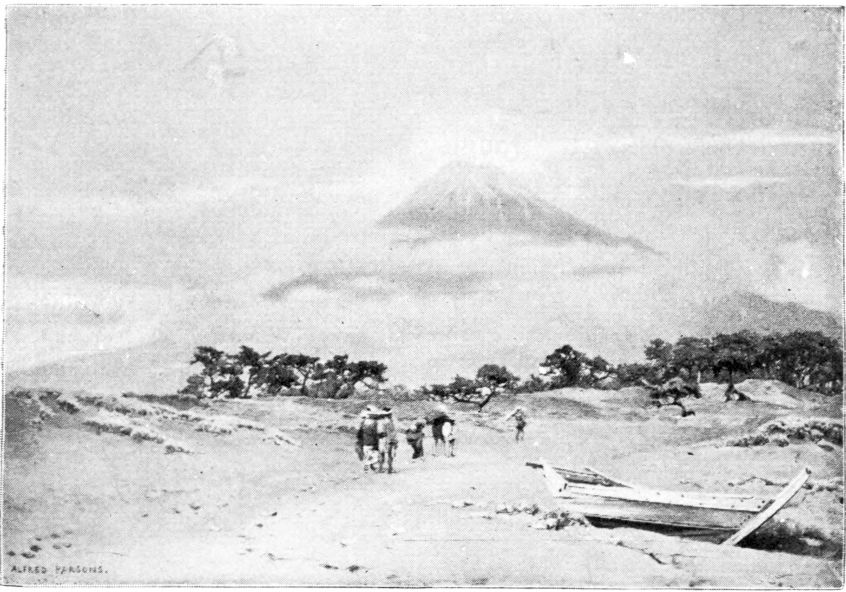
A CLOUDY EVENING, FROM THE SANDS OF TAGO-NO-URA
The mists reached far down the hill, and when we were at last free from
them we looked eagerly for Fuji. There was the sea below us, with the
great curve of sand, Tago-no-ura, bordering Suruga Bay, and the green
slopes rising from it showed where our mountain must be, but at the
height of about two thousand feet a straight bank of white cloud ruled
off the landscape, and of the summit we could see no sign. The path led
us along the hill-side, where men were cutting the rough grass, and
loading it on pack-horses; it wandered in and out of the dry gulleys,
and over the intervening ridges, and at last, descending to the
northward, brought us through cultivated fields to a tea-house near the
railway station, where our baggage and provisions were waiting for us.
Gotemba is on the Tōkaidō Railway, and is therefore a much-frequented
place during the six weeks or so when Fuji is considered to be “open.”
It has been ascended at all seasons, the laborious walking through soft
snow being the only difficulty, and the chance of bad weather the only
danger; but except from the latter part of July to the beginning of
September the numerous rest-houses are unoccupied, and the climber is
obliged to carry all provisions with him.
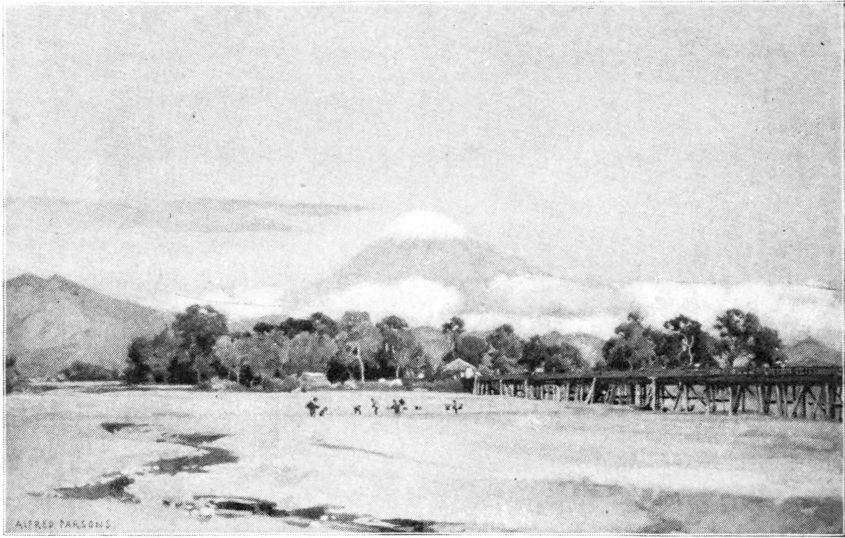
FUJI FROM THE ABEKAWA, AND THE TOKAIDO BRIDGE
There were plenty of pilgrims about, waiting to start on the morrow or
just returned from the mountain, some washing their weary feet, others
tying their big hats and long walking-sticks in bundles for the
luggage-van, and all chattering incessantly. After dinner a travelling
company entertained us in front of our tea-house with songs and dances.
The band consisted of two samisen, a bell tapped with a stick, and
bamboo castanets. The dancers were all little girls, from ten to fifteen
years old, dressed in the ordinary long-sleeved kimono, and the
movements of their bodies and slim little hands and limbs were full of
grace and variety. Each performance was a mixture of song, dance, and
dialogue, with instrumental accompaniment; the music was queer,
tuneless, and often harsh to the European ear, but with the
blood-stirring quality of all genuine national music.
Before daybreak next morning the whole house was stirring, and it was
useless to hope for more sleep. Most of the pilgrims start early in
order to get to the top by sunset, sleep there, and descend the
following day, but we had decided to sleep two nights on the mountain,
and were in no hurry. Our heavier baggage was sent by pack-horse to
Yoshida, on the north side of the mountain, and three coolies went with
us as guides and porters, carrying some extra clothing and the solid
food which seems necessary for European stomachs. In the village street
our strolling players were already wandering round, trying with some
preliminary chords on the samisen to attract an audience. Daylight did
not suit them, they looked draggled and discouraged, and it was
difficult to believe that those dirty little figures shuffling along in
the mud could ever have had any charm or grace of movement.
The path from Gotemba to the summit is one steady ascent over beds of
old ashes. At first it is a very gentle rise; the lanes wind through the
fields with various crops,

ON THE NORTHERN SLOPE OF FUJI—GRASS-CUTTERS RETURNING
and past cottages with hedges of pink and white hibiscus; but after a
few miles it begins to get steeper, the ashes are less disintegrated,
cultivation only appears in isolated spots, and there are large
stretches of gray moorland varied only with bushes and wild-flowers. The
mist still hung round us, there was no landscape to be seen in any
direction, and if it had not been for the flowers and the ever-new and
quaint figures on the road, this part of the walk would have been dull.
Besides the regular pilgrims there were many men and women leading
pack-horses, those on their way up carrying provisions and fuel for the
rest-houses, and those coming down bringing bundles of grass so large
that they looked like walking hay-stacks, and the wiry little ponies
that carried them were almost invisible. In front a misshapen head
peeped out, underneath were four thin little legs with enormous feet,
and as they passed, their narrow drooping quarters, cat-hammed and
cow-hocked, swayed at every step under the heavy load. Japanese drawings
of horses have risen in my estimation since I have seen the models the
artists have to work from; there never was a more ill-shaped beast than
the ordinary horse of the country. In this as in many other hill
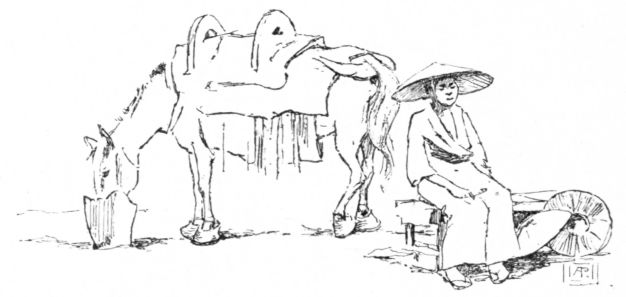
districts mares only are used; they are shod with big straw over-shoes,
which give a finishing touch to their ludicrous shape; under them is
slung a square of dark-blue cotton cloth to keep off the flies, and a
narrow strip of the same material, with a big crimson cord and tassel
printed on it for decoration, is draped across their quarters. Many of
the pilgrims ride up as far as the tea-house called Uma-gaeshi (horse
send back), and the ponies look almost as much eclipsed under the big
pack-saddle with its trappings, and the pilgrim with his, as they do
under the loads of grass.
When all cultivation had disappeared, and the road was a mere cinder
track over a moorland of ashes, the flowers and bushes still grew in
clusters here and there. The most abundant plant was a large bushy
knotweed covered with sprays of white blossoms, and this grew far up the
mountain-side. There were also clumps of tall bocconia, a campanula with
large pink or lavender flowers sprinkled in each bell with tiny
ink-spots, and various less showy flowers. The flora on this side of the
mountain, devastated by the last eruption, in 1706, is not so rich as
that on the northern slope. As the ascent became steeper we got into a
wood of dwarfed and scraggy pine-trees, which extended as far as Tarōbō,
a large tea-house with a little temple attached, and then suddenly
ceased; above this there was only an occasional dead stump to break the
monotonous surface of ashes. Here every pilgrim purchases a stick to
help him up the mountain—an octagonal staff of birch, about five feet
long, with an inscription burned on it, and for a few coppers the
priests on duty at the summit will add a red stamp to prove that the
owner has actually been there.
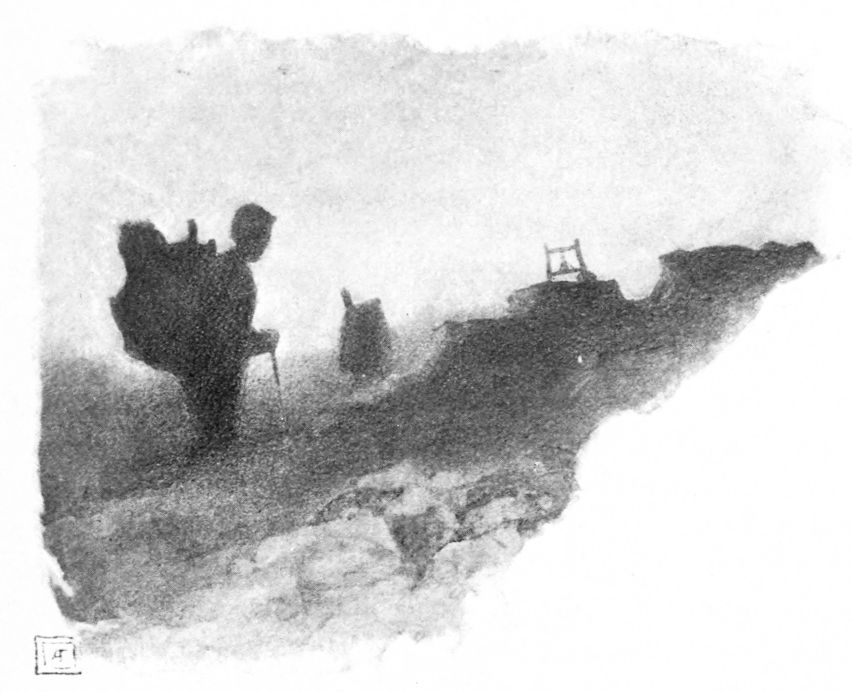
We reached the second shelter beyond Tarōbō quite early in the
afternoon; great masses of wet mist came constantly driving up the
mountain-side; there was plenty of room in the hut, and nothing to be
gained by going higher, so we decided to stay there for the night. All
the regular tracks up Fuji are divided into ten portions, and a
rest-house is supposed to mark the end of each division; but they vary
much in their accommodation for travellers, and often get destroyed
during the winter, so it is well to find out before starting which are
habitable and which are not. Number Two (Ni-go-me), on the Gotemba path,
was a roomy hut, built with blocks of lava; from below it looked like a
wall with a hole in it, from above it was not visible, for the ashes
covering its roof of rough planks were simply a continuation of the
mountain slope; there was no chimney, but a mass of snow was piled over
the fireplace, which dripped through the roof into a tub and supplied
the establishment with water. By each shelter a small white flag
fluttered on a pole to make its situation obvious.
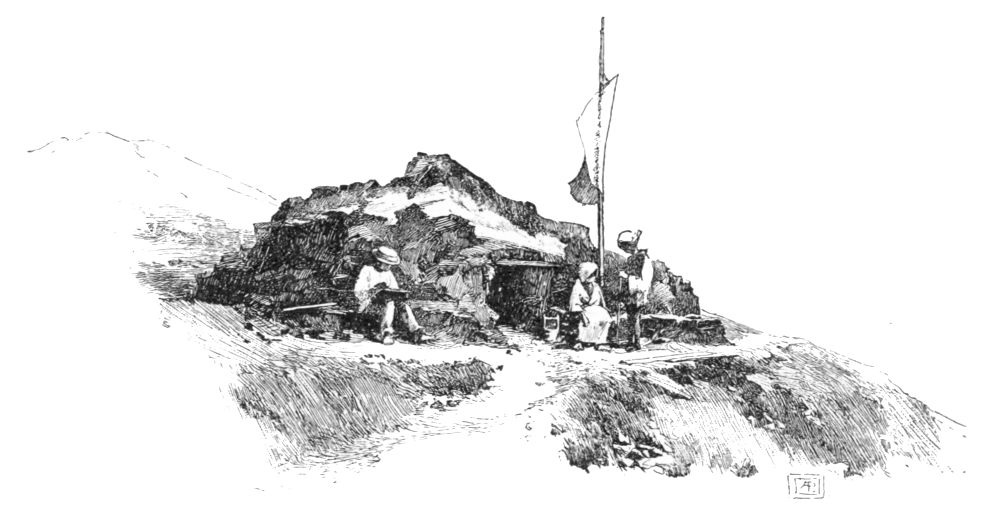
THE SECOND SHELTER IN THE GOTAMBA PATH
Nothing could be more dreary than this spot on such an afternoon: above,
below, and on each side the waste of purple-gray ashes, light-green
spots of knotweed and thistle, only enforcing the gloom of its color,
seemed to stretch interminably into the mist, and nothing broke the
monotony of the long oblique line except the little eminence of
Hoei-zan, sticking up like a pimple on the great slope of Fuji, which
occasionally showed its outline through the vague and formless clouds.
Inside it was, at any rate, warm; the raised floor was covered with
coarse matting, and on this quilts were spread, and soon after dark we
were all in bed. Some later arrivals had added to our numbers, and we
slept thirteen in that hut, including the host and hostess; but this was
nothing to the crowd at the top, where I think we were nineteen, perhaps
more, for in some parts of the floor there must have been two or three
under a quilt, and it was difficult to count them. Even here on Fuji you
do not escape the all-seeing eye of the Japanese police; your passport
is examined by the keepers of the hut, and is copied into a book which
gives every night the names and addresses of those who sleep under the
roof. About two o’clock in the morning we were wakened by our host, who
took us outside, and there at last was Fuji itself, straight over our
heads, every detail softened, but clearly visible, and the summit
looking ridiculously near in the brilliant moonlight. Below us was the
slope of ashes and the moorland over which we had walked; and in the
distance the Hakone Mountains, already far below our level, lay half
hidden by masses of moonlit cloud. More energetic men might have started
at once for the final climb, but after gazing and shivering for a few
minutes we turned into our hard beds again, and it was not till after
sunrise that we left our hut, our party increased by a dreary and
footsore young soldier in a soiled white uniform, and a cheerful coolie,
carrying about a hundred-weight of planks to repair one of the higher
shelters.
The path goes zigzagging up to one rest-house after another, and there
was not one of them which we failed to patronize; even Number Seven,
which was a heap of ruins with nothing in the way of drink but a tub of
melted snow, was an excuse for a few minutes’ halt. In the clear morning
sunlight Fuji looked small, as most mountains do when there are no
clouds to give mystery and suggest height; but it was a grand morning
for distant views, and the sunshine brought out vividly the strange and
brilliant colors of the various materials which form the mountain—gray
ashes, blue lava, and the reds and oranges of burned earth.

Above the seventh station the path turns to the left and passes behind
Hoei-zan; already bands of pilgrims, who had seen the sunrise from the
summit, were making their way back towards Gotemba, going at a great
pace down the glissade of loose sand and ashes on its side, while we
toiled on over harder cinders, with an occasional ridge of lava, on the
upward path. At this altitude the knotweed and thistles had disappeared,
and the only plants I saw were a dwarf sedge and a little starwort in
some of the sheltered nooks; higher still only a few lichens and mosses
can grow; there is no regular alpine flora on Fuji.
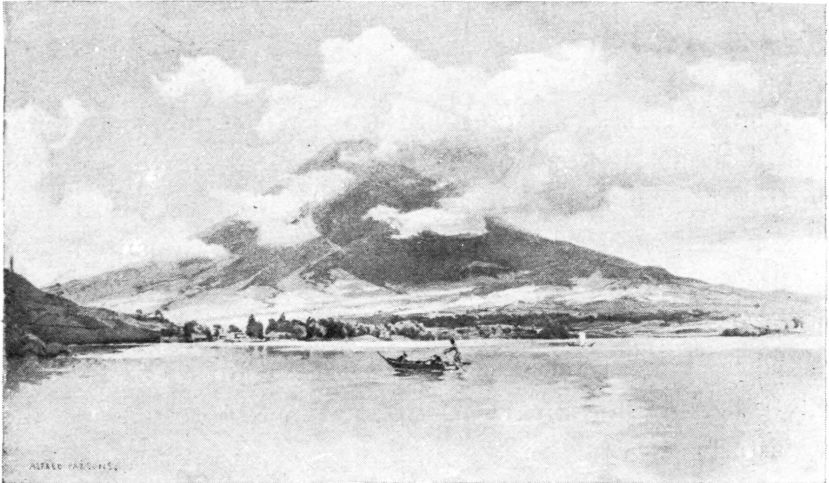
FUJI FROM THE KAWAGUCHI LAKE
A big gully full of snow lies just below Number Eight, and from this
point the ascent is steeper than ever, winding among a chaos of
shapeless blocks of lava; a sharp spur on our left crowned with them
made a most curious outline against the sky. In front of us was a
strange pilgrim, an old and feeble Buddhist priest in canonicals and a
big cane hat; two coolies were hauling him by a cord round his waist,
and another was pushing from behind, and even with this help he had to
stop every few minutes to get his wind. He smiled a sickly smile as we
went by; he was even slower than we were, and it seemed cruel to pass
him; but he got to the top finally.
A sharp pull up a rocky gully at last brought us to a little wooden
torii, and to the “Famous Silver Water,” a clear, cold spring on the
edge of the crater. The supply is not large, and the priest in charge
of the enclosure doles it out to pilgrims at the rate of one brass cash
for a small teacupful. The principal temple, and the cluster of huts
round it, form a little square on the south side of the crater, just at
the top of the Mura-yama path, and are reached from the Silver Water by
means of a couple of ladders and a small fee. At the top of the ladders
there is a tiny shrine, serving as stable to a toy model of a horse, and
in front of this the coppers are deposited. There are only three
entrances to the crater of Fuji, and each of these is marked by a small
torii, the sacred gateway of the Shinto religion; two of them I have
already mentioned, the third is on the north side, where the paths from
Yoshida and Subashiri, which meet at Number Eight station, reach the
summit.
Clouds had, as usual, begun to form about mid-day, and there were only
occasional peeps of distance, but the crater itself was worthy of the
journey, and occupied us until the bitterly cold wind drove us to
shelter. Here, as on other mountains, I noticed that the first object of
the native is to get under cover; all the kingdoms of the world and the
glory of them may be spread before his eyes, but if there is a little
smoky cabin, however rough and uncomfortable, the professional
mountaineer goes inside and stays there. This one was not luxurious;
near the doorway, the only aperture for admitting light, there was a
smouldering wood-fire, where our food was cooked before we lay down to
try and rest on the loose and creaky floor-boards; little blasts came
like squirts of cold water through the cracks of the unmortared walls,
and it was a relief when a general movement of the sleepers—for a
Japanese can apparently sleep anywhere—showed the approach of sunrise.
The morning was clear and bright, and we all crouched in nooks of the
rocks, wrapped in our quilts, and gazed at the straight gray line of the
Pacific and the gradually brightening line above it, watching for the
first sign of the approaching god. On the most prominent rock a priest
knelt, waving strips of paper tied to a stick and chanting prayers and
eulogies, and soon the sun rose, as he assuredly will every morning,
whether he is prayed to or not. There
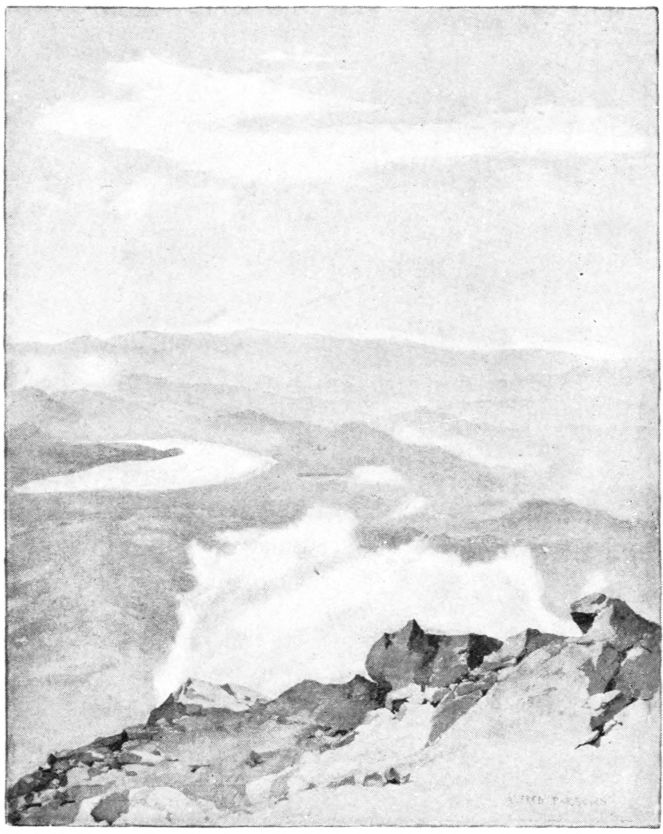
FROM THE TOP OF FUJI, LOOKING NORTH
was such a vast space of mysterious blue sea and distance below the
horizon that the big orange ball appeared to be already half-way up the
heavens when we first saw it. This daily occurrence seems ever new and
wonderful, always has something of the miraculous about it, and to most
minds it brings a sense of thankfulness, as the sunset gives that of
repose; though why we should feel grateful both that it is time to begin
to work and time to leave off is a puzzle to me. My thoughts turned to
an early morning near Plevna, and to an honest Turk, who, as the sun
rose over the bare Bulgarian hills, turned on his box-seat, and, gravely
touching his forehead, wished a good-day to his “little brothers” in the
carriage he was driving. There was a mixture of courteousness and
solemnity in his manner which seemed exactly suited to the important
moment.
When the orange glow had turned to a dazzling glare, we walked round to
the foot of Kenga-mine, the highest of the peaks encircling the crater,
and looked westward at the shadow of Fuji, a great pyramid of tender
blue stretching for miles across the country at its foot, darkening a
slice of the sunlit distant mountains, and towering above them into the
sky, clearly defined on the light mists and clouds of the horizon. So
sharp was the outline that it seemed as if our two shadows ought to show
on the distant sky; but though we waved our arms frantically there was
no visible movement on the edge; we were too small. When we returned to
get some breakfast many of the pilgrims were saying their morning
prayers at the little temple. “Sengen Sama” is the goddess of Fuji; a
prettier name for her is “Ko no hana saku ya Hime”—“the princess who
makes the blossoms of the trees to open.” There is another little temple
dedicated to her on the north side of the crater, and many more imposing
ones in various parts of Japan. On a banner which floated in front of
this second temple there was an inscription in Japanese, and under it
these words in English, “Place for worship the Heaven.” I suppose this
was an effort in the direction of civilization and rationalism, but I
resented it as an attempt to explain away the flower-loving princess,
and to dethrone her from the mountain-top where she has been worshipped
in peace for so many centuries. Close by the banner is another spring,
“The Famous Golden Water,” and a small shed, where bundles of chopsticks
and other mementos are sold, and where for ten sen you can buy a tin can
full of the famous water to take home to your friends. Most of the
descending pilgrims have one or two of these tins slung round them with
the rest of their travelling-kit. The regular Fuji pilgrim is dressed in
a white tunic with loose sleeves, close-fitting white cotton drawers,
white socks and gaiters, and a pair of straw sandals; he wears the usual
big hat, which serves as an umbrella, and slung round his shoulders he
has a light rush mat, which can be shifted to either side to keep off
sun or rain. Round his neck he has a string of beads, a little
incessantly tinkling bell, and a few pairs of extra sandals on a cord,
and fastened to his waistband is the small package containing his
personal baggage; he carries in his hand either the octagonal birch
staff or a
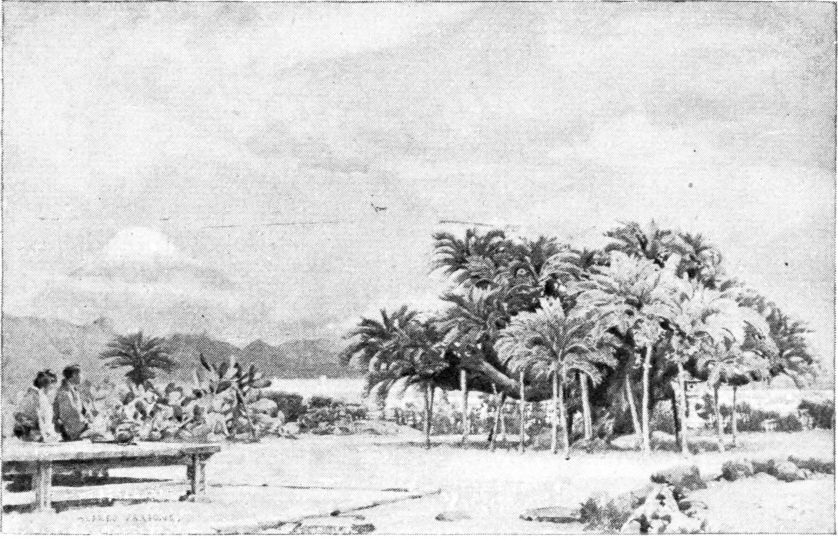
THE GREAT PALM AT RYUGEJI, FUJI IN THE DISTANCE
longer peeled wand, with some paper tied round the end of it. The dress
of the women is the same as that of the men, except that they wear a
short petticoat under the tunic, about as long as a Highlander’s kilt. I
saw none of them adorned with the bell and beads, so perhaps these are
reserved for the men. It is only of late years that women have been
allowed to climb the sacred mountain.
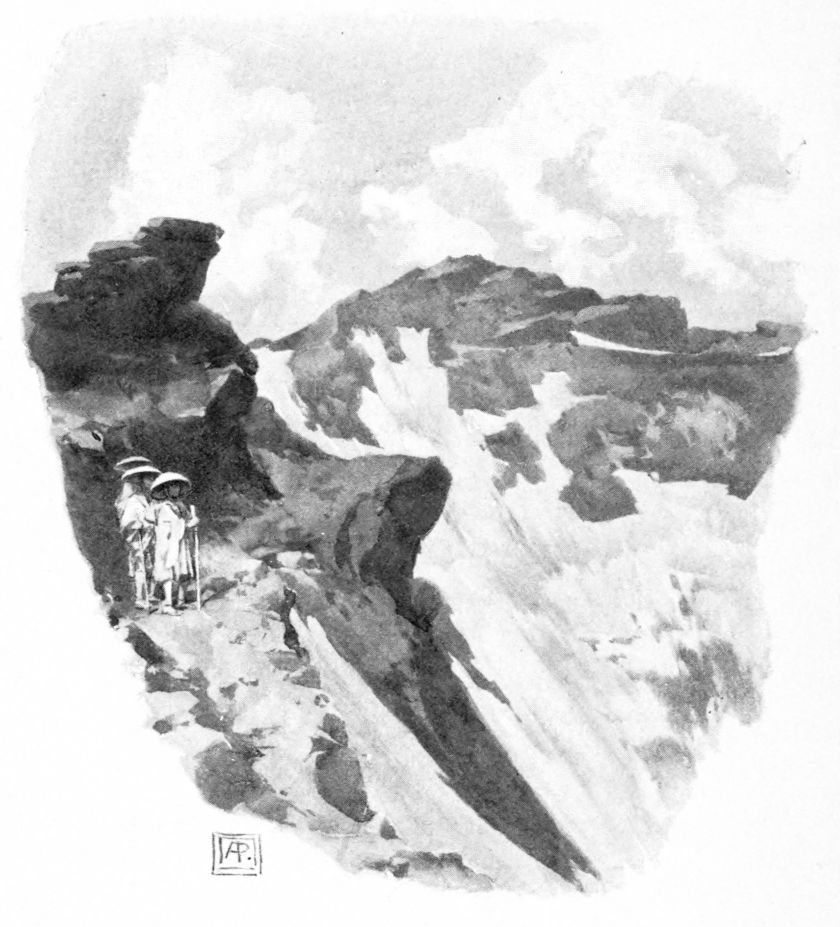
No one point of the crater’s edge is high enough to give a panorama; you
have to walk all round, about two miles, in order to see the view on
every side. Eastward is the country round Yokohama and Tōkyō, with the
Pacific beyond as horizon; southward, too, is the ocean, with the Izu
Peninsula jutting out into it, and the sweep of Suruga Bay bringing it
close under your feet; westward you get a glimpse of the Fujikawa River,
with range after range of mountains behind it; and to the northward a
chain of little lakes lies at the base of Fuji, these, too, backed up by
mountains, which rise, one behind another, as far as you can see.
In some places the outer wall descends abruptly into the crater; in
others, as by the Golden Water, there is a narrow plateau between the
two. The crater itself is four or five hundred feet deep, the north side
mostly precipitous rock, and the south side, under Kenga-mine, a steep
slope of snow and débris; all the peaks round it have names, and one of
them near the Silver Water is dotted with cairns raised in honor of
Jizó, the patron saint of travellers, who helps little children to cross
the Buddhist Styx. There is a rough path all round the crater, leading
over some of the peaks, inside some, and outside others, which is kept
in passable condition by men who collect a few coppers for their labor:
the pilgrim season is harvest-time for the dwellers round Fuji, and its
barren top pays well for cultivation.
It was after ten o’clock before we had made the circuit and seen all the
sights; we met our coolies by the long row of huts at the top of the
Yoshida path, and could see the village itself, our destination, lying
in the blue hollow below us. Groups of ascending and descending pilgrims
were visible for a long distance on the slope; as we looked down on them
we saw only big round hats with an arm sticking out, and two little feet
working underneath. After a final cup of tea at one of the guest-houses
we passed under the wooden torii, and began the descent, a very steep
and stony one, the loose cinders and lumps of lava requiring attention
at every footstep. At Number Nine station there is a little shrine
called “Sengen’s Welcome,” and at Number Eight there are six or eight
good-sized huts built on a spur of harder lava, making quite a little
village, which can be seen on a clear morning from the foot of the
mountain. Here the Subashiri route branches off to the right; ours to
Yoshida turned to the left, and we went sliding with long strides down
an incline of loose ashes and sand, into which our legs sank up to the
knee at every step. It was rapid but fatiguing, and required very high
stepping to avoid heavy and ignominious falls. The track is marked by
hundreds of cast-off “waraji”—straw sandals—a common object on all
Japanese roads, but here especially plentiful. My companion had provided
himself in Yokohama with a stock of them, specially made to fit over the
European boot; they were carefully adjusted and tied on by our servants
and porters, but I noticed that after the first hundred yards they had
always worked loose, and after a quarter of a mile they were hanging
gracefully round his ankles instead of protecting his feet. The
enjoyment of walking depends so much upon foot-gear that I am shy of
trying experiments, and I found that my stout boots with plenty of nails
served as well on Fuji as on any other mountain. Worn as Japanese wear
them, with a thong passing between the big toe and the next, the waraji
hold on well; they are soon worn out, or made useless by the breaking of
one of the strings of twisted grass which tie them to the ankles; but
this does not matter, for new ones can be bought for about a half-penny
at any road-side house. This part of Fuji was very desolate, the rocks
were formless blocks piled up without any arrangement of line, and the
débris was too loose for any plant to find a foothold; but after a few
thousand feet a ridge of more solid lava rose on each side of the gully
we were descending, and
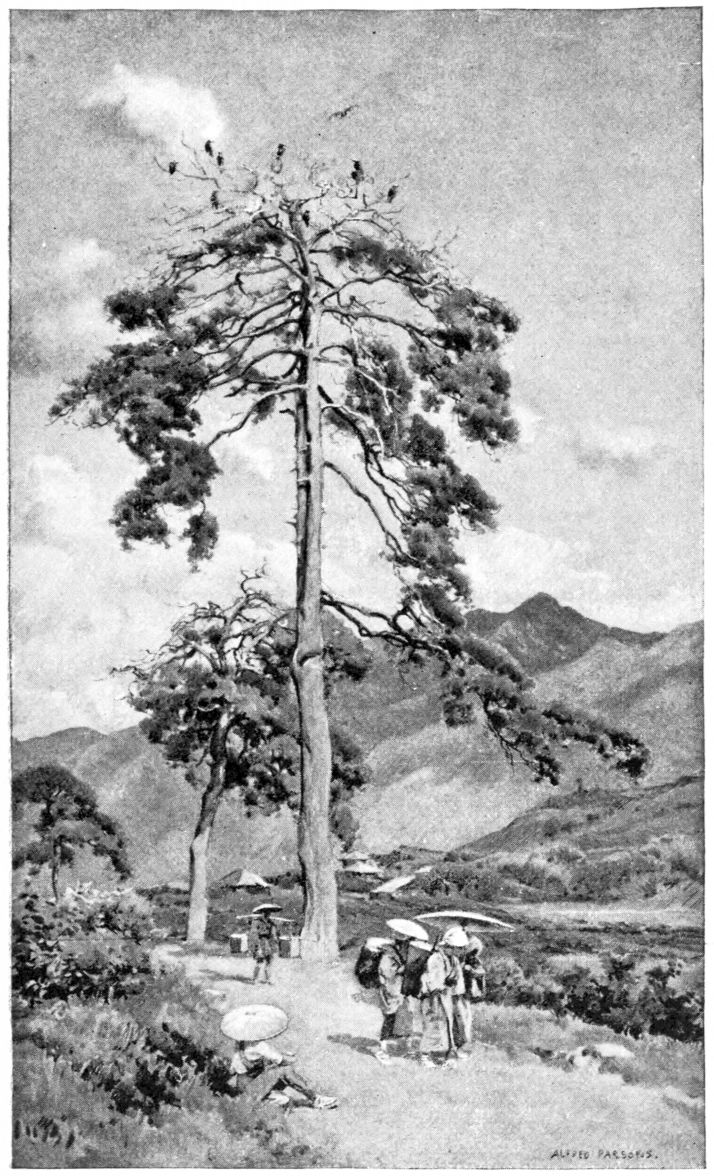
AN OLD RED PINE AT YOSHIDA
that on our left soon began to show some vegetation. There were pines
and larches, whose dwarfed and twisted forms showed the hardship of
their lives, and among them were some flowers too, clusters of a
delicate pink rhododendron, crimson wild roses, columbines, clematis,
golden-rod, and orange lilies.
The glissade of fine ashes brought us down as far as Number Five
station, and there we rejoined the upward path, for no one tries to
ascend over this loose stuff. High up in the gully we had seen men
digging out snow from under the ashes, and taking it across the flank of
the mountain to supply one of the rest-houses on the ridge to our right,
and troops of ascending pilgrims were visible now and then as a turn of
their path brought them in profile against the sky. Below Number Five
there is but one track; it plunges at once into a thick undergrowth of
bushes, and after this we had no more desolate wastes of ashes, but a
constant succession of trees and flowers, temples, and luxurious
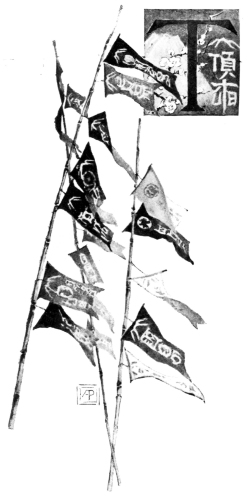
rest-houses, gay with the cotton flags presented to them by their
patrons. The forest through which this path leads covers a steep ridge
of lava; the trees are mostly pine and other conifers, often very fine
old specimens, and under them is a tangle of flowering shrubs and plants
and of fallen timber. The people we met coming up seemed to appear
suddenly under our feet out of the green gloom; one party had always to
draw aside while the other passed; at times the path was a stairway of
old roots, at others a ditch between high banks, and never wide enough
for two to walk abreast. We heard a sound of singing below us, and stood
on the bank while about twenty white-clad pilgrims filed by, men of all
ages, each with a little bell tinkling at his waist; the front ones
chanted a short strain, which those at the back took up and answered,
and their song was faintly audible in the woods above us long after the
last had disappeared up the winding path. The chant is called “Rokkon
shōjō”—the six senses purified—the six, according to the Buddhists,
being eyes, ears, nose, tongue, body, and heart, and it is only sung by
the Fuji pilgrims.
At Number Two station we made a long halt, emptied the ashes out of our
boots, and washed our feet in the tubs of water which the little
servants brought us. It was a very different kind of place from the
rough shelter on the Gotemba side; the path came down a few steps as it
emerged from the wood, passed under a torii by a small temple, and then
spread out into quite a wide space in front of a long tea-house crowded
with pilgrims. On the opposite side of this space were three or four
platforms, spread with blankets and shaded with matting; these too were
occupied by groups of guests, who smoked and drank tea as they rested,
and below them the tops of the trees were cut away to give a space of
open sky and a view of the distance. Hundreds of little flags were
fluttering from long bamboo poles, and at the other end of this lively
scene the path went down a few more steps, and became again a narrow
track through the dense forest. The flowers all the way were abundant
and beautiful, constantly varying as we descended from one zone to
another; at last the wood became thinner, and we could get glimpses of
the distance, and of the grassy ridges on each side of us, tinged with
pale mauve by masses of funkia in blossom; and when we reached the
temple and the large open square of the Uma-gaeshi we were at the end of
the trees, and before us was a great slope of moorland leading down for
miles and miles to the pine grove by Yoshida.
There is but one break in the long walk through flowers and grass—a
little tea-house called Naka-no-chaya, whose three pine-trees are
distinguishable for a long distance across the moor. All round it there
are monumental pillars covered
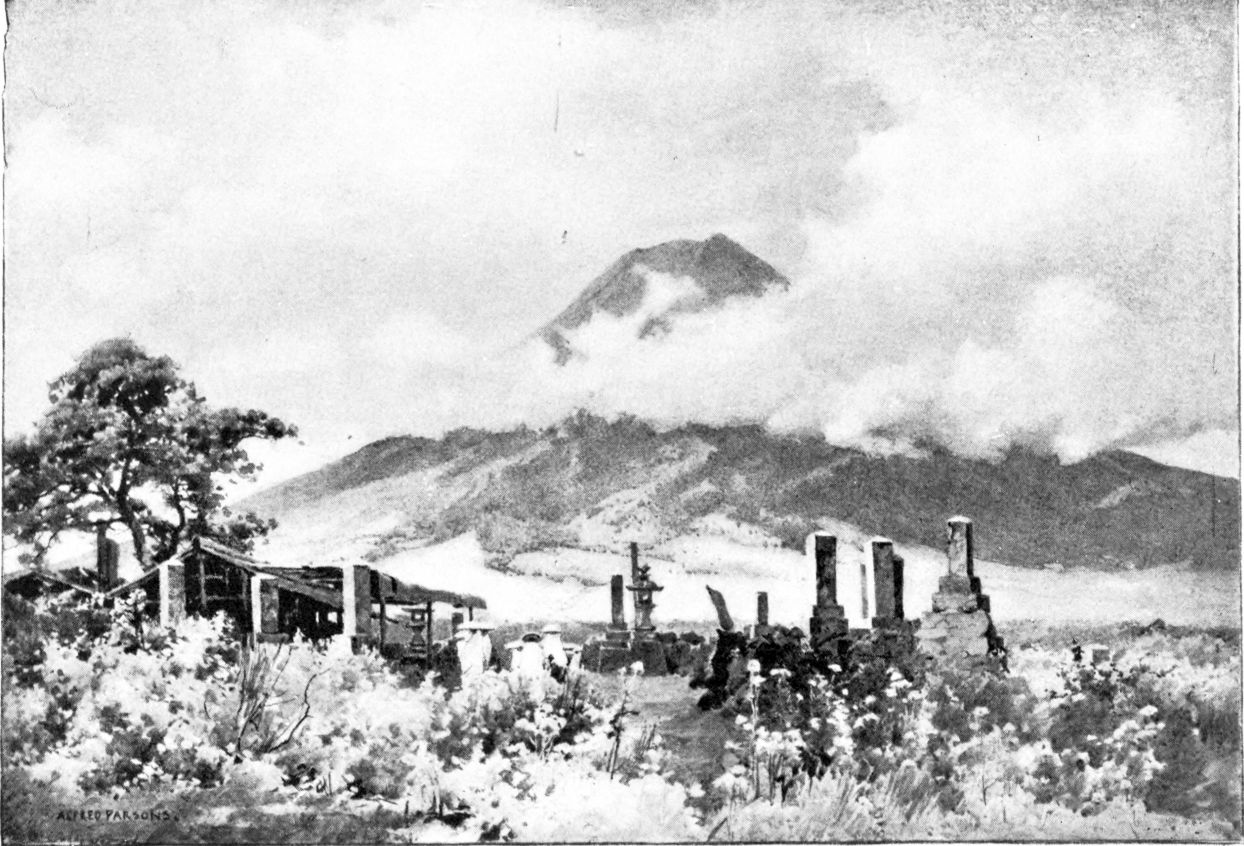
NAKA-NO-CHAYA, ON THE NORTHERN SLOPE
with inscriptions, which look like tombstones, but were really erected
by pilgrims to commemorate the number of ascents which they have made.
The variety of plants which grow and flourish on this slope of fine
cinders is truly remarkable. The most abundant flower was a pale mauve
scabious, which gave a prevailing tint to the whole moorland, but the
most conspicuous was a tall, slender day-lily
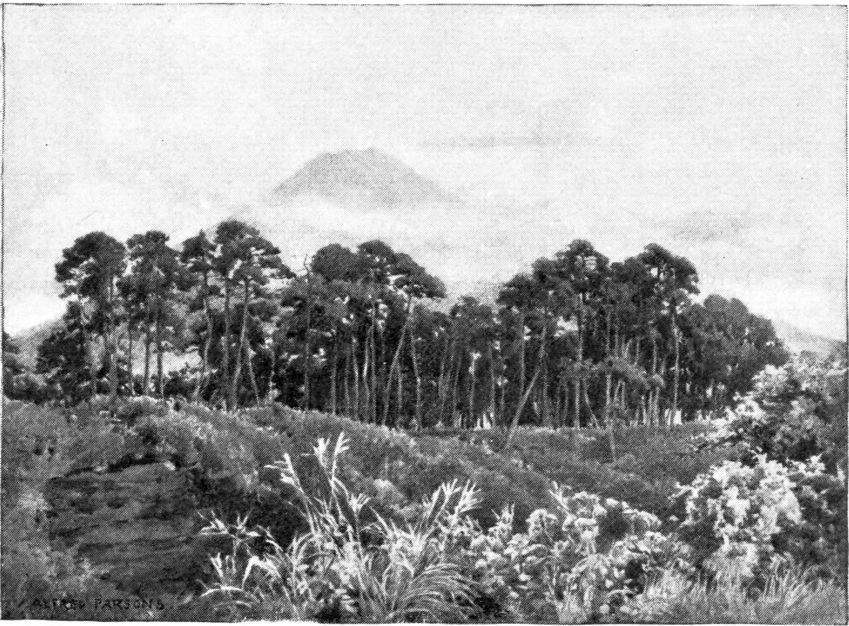
THE RED-PINE GROVE AT YOSHIDA
with a pale yellow flower, which shone like a star in the evening when
the color had gone from all the others. A dark purple-blue campanula
(Platycodon grandiflorum) was also very effective, and a bright
crimson pink (Dianthus superbus) with beautifully fringed petals. But
it would be hopeless to try and enumerate them. I find in a sketchbook a
list of fifty-seven which I noted on the way between Naka-no-chaya and
Yoshida. A little later in the year this mass of flowers and grass is
mown down and carried to the villages at the foot of the mountain.
The last part of our walk was through a grove of grand red pines, which
seem to do better on this volcanic soil than anywhere else in Japan, and
then across a few fields to the top of the long village street, where we
at last found our tea-house and our baggage, and comfortable rooms, and
settled down for a night of well-earned repose.
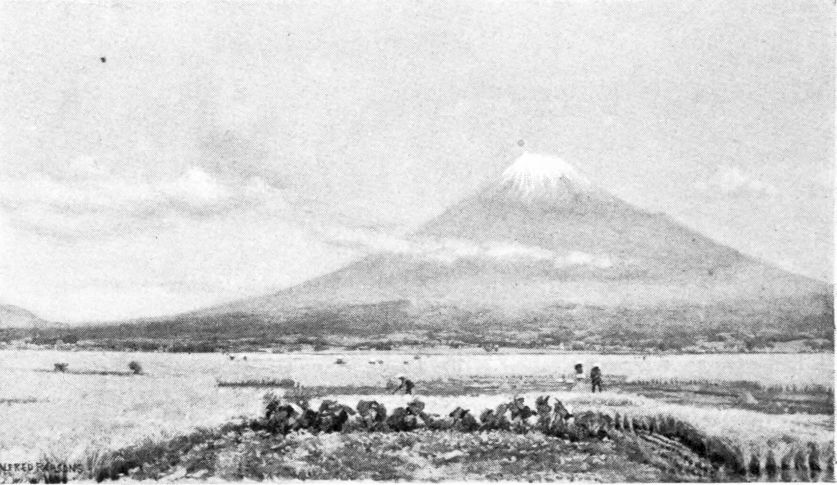
FUJI OVER THE RICE-FIELDS OF SUZUKAWA
Oct. 3, 1892.
Fuji is quite free from clouds this morning, and in the soft autumnal
sunshine every detail is clearly visible as I sit with the shutters wide
open and eat my breakfast. The foreground is a level plain of
rice-fields, which stretches away for three or four miles to where the
first gentle ascent is marked by a line of villages and trees, and in
some
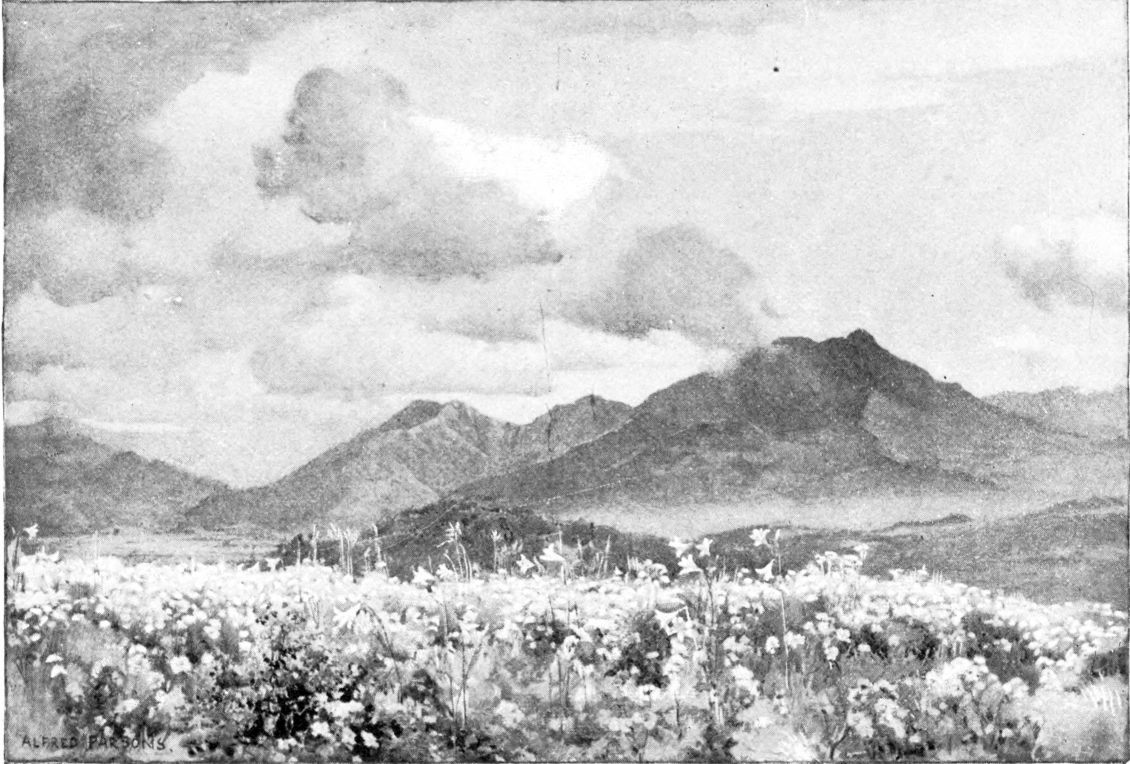
places, where irrigation is possible, the terraced fields climb a little
way up the mountain. Above them is a band of cultivated country, the
general effect of it dark green, varied by stripes of paler green
fields. At first the forms are sharply defined, but higher up the whole
becomes a blue-green mass. Next above this is a band of moorland with no
trees on it, lighter and warmer in color, the grasses and plants which
cover it tinged with yellow or orange by the autumn. As the morning sun
shines on it little blue shadows, in spots and waving lines, mark the
undulations of its surface. This belt of moorland reaches to the height
of about five thousand feet, and is very rich in flowers. Above it,
again, is a great band of forest; the warm color of the deciduous trees
at its lower edge gradually merges into the dark blue-green of the
pines, which mount a long way up on the summits of the ridges that at
this point seam the surface of the mountain. It is over this forest-land
that the morning clouds generally begin to form. As I write, a little
one, that looks like a puff of white steam, is beginning to float over
the trees, and this will grow until in an hour’s time the upper part of
Fuji will be invisible. The well-defined gullies are a light orange-red
tint, and the contrast between them and the dark pines on the dividing
ridges is the strongest opposition of color on Fuji, except that where
the snow and the black lava meet at its summit. As the gullies ascend
and the pines disappear the color again becomes more uniform, dark gray
with a tinge of Indian red, the red disappearing and the gray becoming a
rich purple as it runs up in irregular points and lines among the lower
snows. Only the very highest band is a solid white; on the left of the
truncated top is Kenga-mine, the highest point of the crater’s edge, and
next it a flat line shows where the Murayama path enters; to the right
of this a well-marked ridge of lava runs high up into the snow, and can
be traced down to the moorland, cutting off the Hōeizan portion from the
rest of the mountain. Beyond this ridge are two flatter curves—the
summits of Jizotaké and Kwannon-také—on the eastern side of the crater.
The general outline of the mountain on the left is one simple curve, the
almost level line where it begins to ascend from the Fujikawa River
becoming steeper and steeper towards the top. The most distinct
acceleration of grade is where the forests end and the ridges of lava
begin. The outline on the right is broken just above the pine-clad
ridges by the projection of Hōeizan, and again at the top of the
moorland by another smaller hill—Tsurugi-zan; and the effect on this
side is not so much a curve as two inclined planes, the first from
Kwannon-také to Hōeizan, the second from there to the moorland, after
which it becomes an undulating line of mounds leading away to the
Ashitaka range of older mountains. On this right side there is much less
variety of color, a sharp ridge of warm orange lava makes a crest to
Hōeizan, but the great cup-like hollow behind it and the treeless slope
below it are one uniform gray. Nearly two centuries have passed since
the eruption which altered this outline of Fuji and destroyed the
vegetation, and many more will have to elapse before the ashes are
sufficiently disintegrated to entice back the trees and flowers.