NOTES from CALAIS BASE AND PICTURES OF ITS MANY ACTIVITIES
Transcriber’s Note:
New original cover art included with this eBook is granted to the public domain.
By C. E. MONTAGUE
LONDON: T. FISHER UNWIN, Ltd.
1, ADELPHI TERRACE, W.C.
1918
Printed in Great Britain by
The Avenue Press
(L. Upcott Gill & Son, Ltd.),
London.
TRAINING IN FRANCE — Training Schools. — Trench Warfare. — No Idle Moments. — Defence against Gas. — Varied Lessons. — Sandbag-Filling. — Swedish Drill. — En Route.
5
Of course all our troops are trained
before they go to France,
whether the individual soldier
goes out with his battalion or in
a draft sent from its reserve battalion
at home to reinforce it.
But when reinforcements are landed in France they
are put through a further course of instruction,
before they go up to join their regiments at the
Front.
This final period of instruction is very short; it
is tightly packed with work; it assumes that the
men already know their work and only need to do
it with greater finish; and it is given by the best
experts the British Army possesses in trench warfare
as it is carried on to-day. That is, really
to-day, and not as it was carried on six or even
three months ago.
For these infantry training schools at the base
are in constant living contact with the Front.
The instructors come fresh from the trenches,
6and if the latest experience gained by the Army
on the Somme or before Cambrai leads to a
change in the recognised technique of bomb-throwing
or the cutting out of an unnecessary
movement in the bayonet exercise, the officers and
non-commissioned officers who instruct can show
the young soldier, from their own experience, just
how the improvement will help him at the crisis of
a scrimmage.
Thus the course may be compared with the short
final period of very exacting coaching in which
“racing polish” is put on a boat’s crew which has
already undergone a long training. Or it may be
compared with the “post-graduate courses” in
a university, at which the latest results of special
research are imparted by original researchers to
students whose previous ordinary training enables
them to profit by this higher teaching.
The men under instruction have to learn—or else
show that they know already—everything that a
soldier in trenches must know in order to protect
himself and endanger the enemy. They are “put
through it” in the ordinary parade movements in
close order, in open order work, in bayonet fighting,
musketry and bombing. There is not much
time for each subject, but none is wasted; the men
7are intensely keen to get up to their regiments, and
they know that they cannot go till they are
passed as qualified; the instructors teach with
the zest of veterans relating their own experiences
to recruits.
There is not a vacant moment in which to be
bored. Work is knocked off for an hour towards
mid-day to let the men eat the rations which the
drafts have brought in their haversacks from their
quarters at the base depôt camp of the division to
which their battalion belongs. But a band begins
to play from the moment of dismissing, and it also
gives priceless help in keeping up march discipline
and smartness on the few route marches for which
there is room in the course.
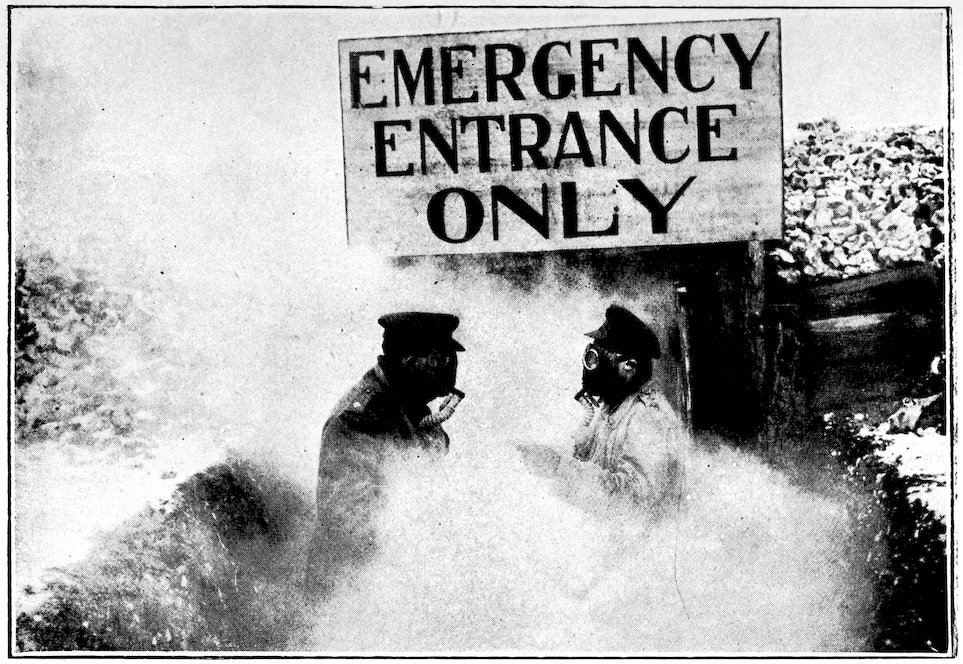
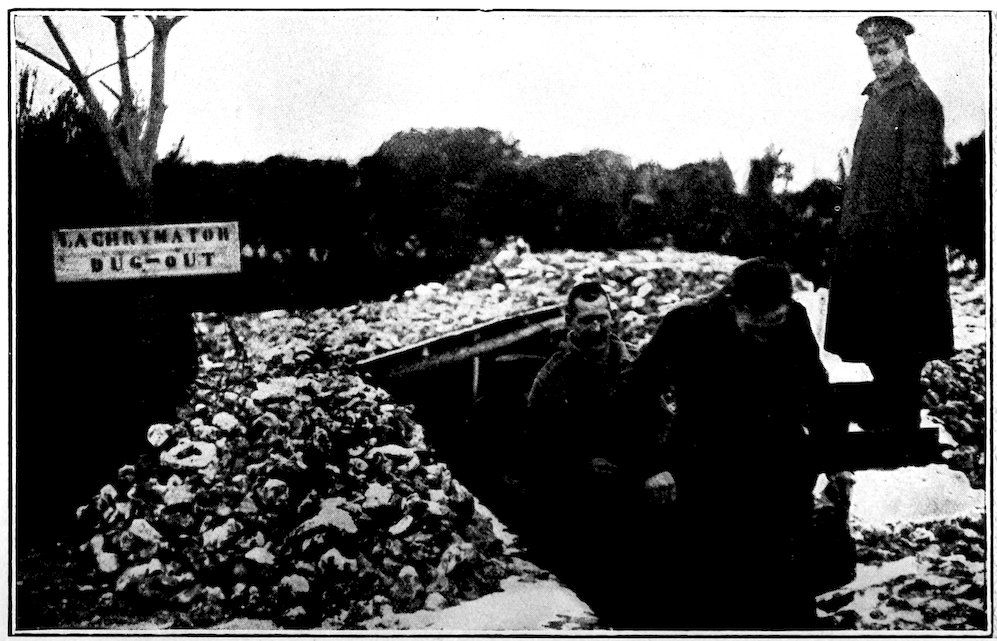
A detail, which needs care and gets it, is instruction
in self-defence against gas. Lachrymatory gas
is comparatively a trifle. The men are practised
in walking through an open trench full of the
heliotrope smell of the gas, and come out shedding
tears and laughing at the far end. The more
serious poison gas is let loose in a tunnel-like
chamber through which every officer and man
bound for the Front must pass. The foul stuff in
8the chamber is some hundred times as dense as any
gas to be met in actual warfare. But if the man’s
gas mask is in order, and he uses it as he has been
told, he suffers no inconvenience while passing
through or afterwards, and thenceforward no
German gas has any terrors for him.
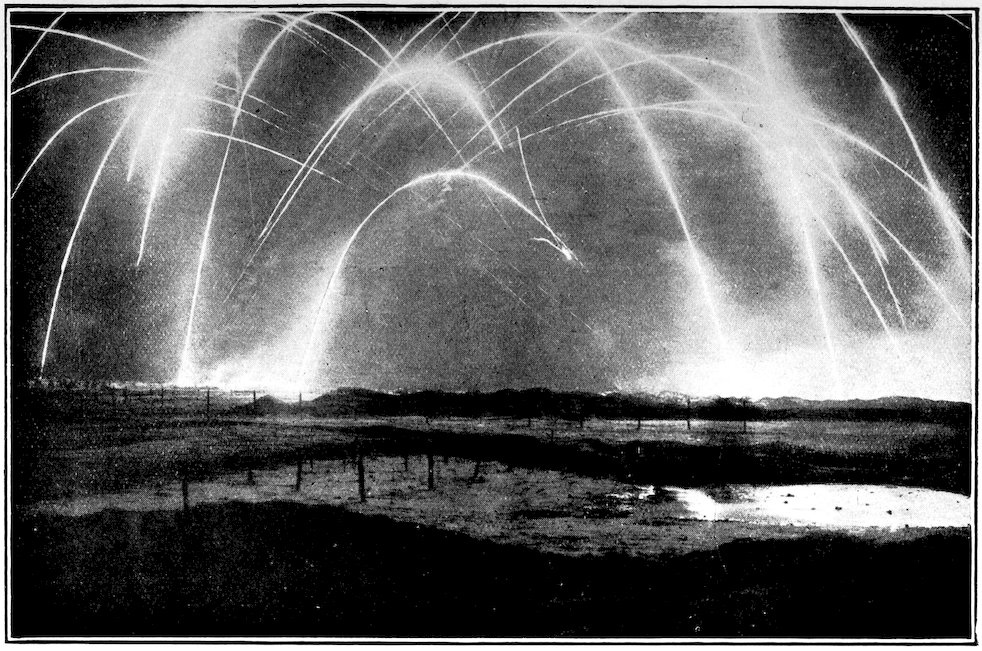
The photographs bring out many interesting
details in the training course. One of them shows,
in a night scene, how skilfully the general atmosphere
of the Front, as well as the details of
trenches and craters, is reproduced for purposes
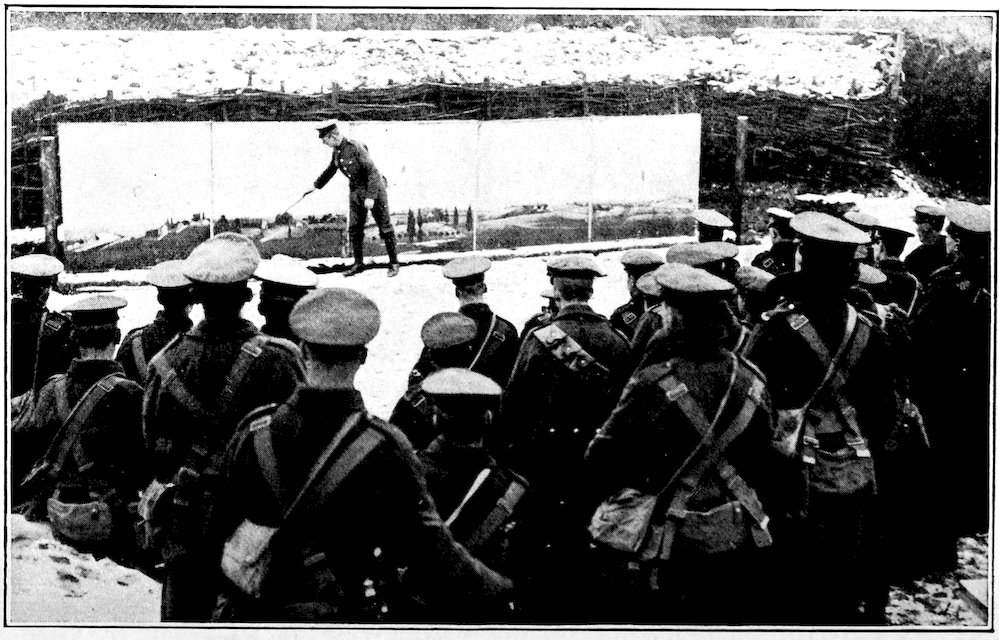
of instruction. Another shows non-commissioned
officers receiving instruction by the help of
“picture targets” in the indispensable art of
describing any point in a landscape exactly and
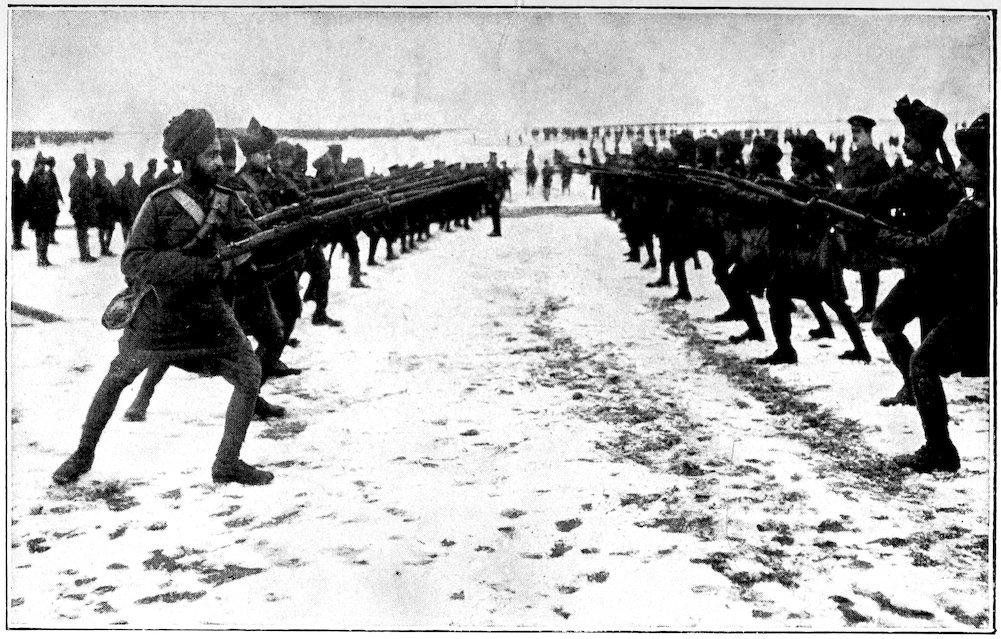
tersely. In a photograph of the bayonet fighting
course the Indian soldiers’ firm balance of the body
and excellent carriage of the head are noticeable.
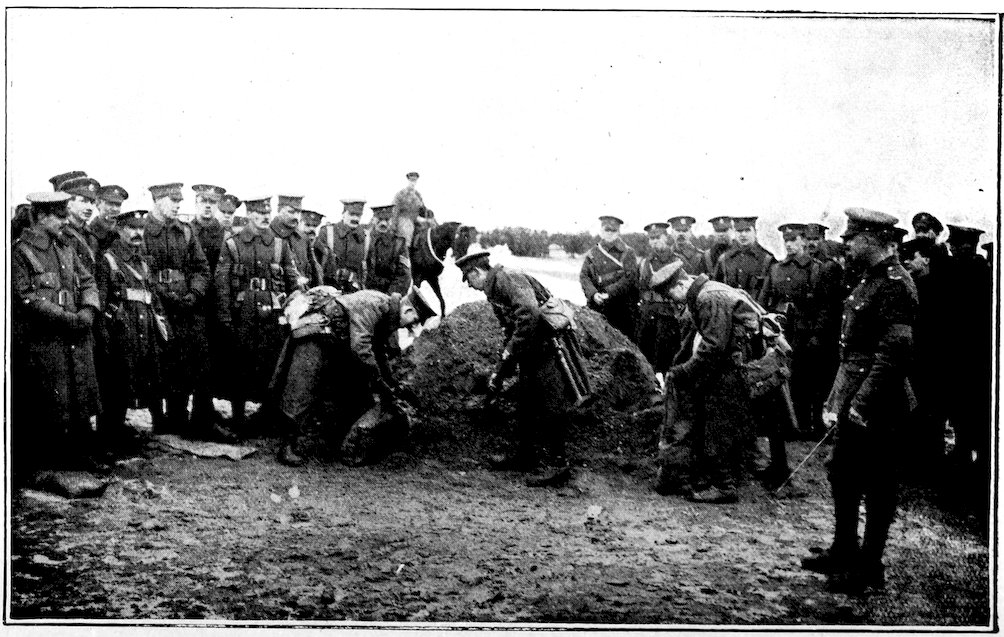
Speed in sandbag-filling, for trench fortification
purposes, is extremely important; in some
battalions it is encouraged by systematic competitions,
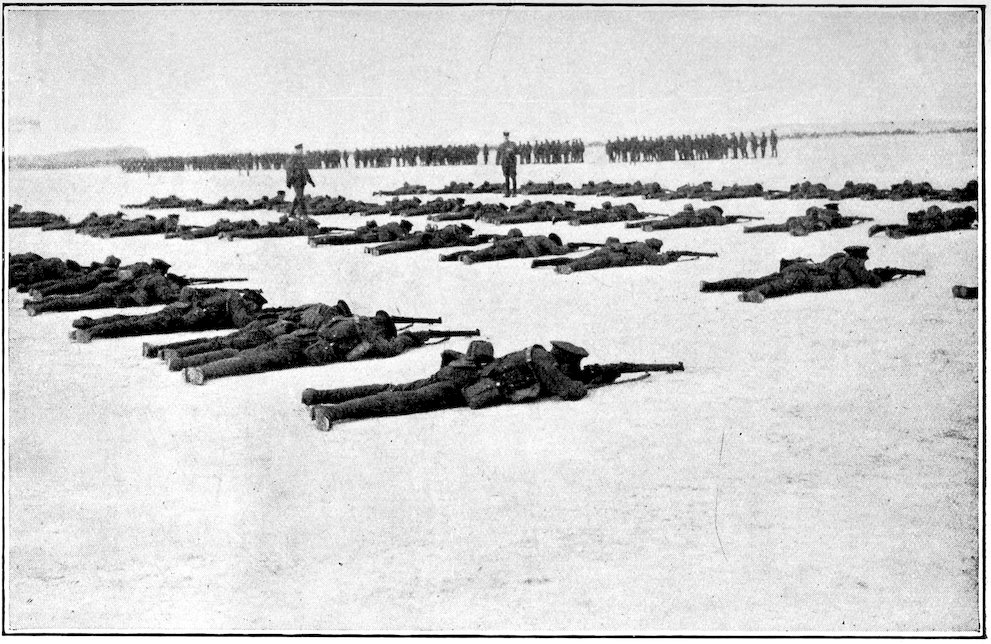
the competitors working in pairs. Note, in
the photograph of men aiming or loading, in a lying
position, the uniformity with which their heels are
9kept down. In a badly trained draft several heels
would be sticking up, inviting enemy bullets.
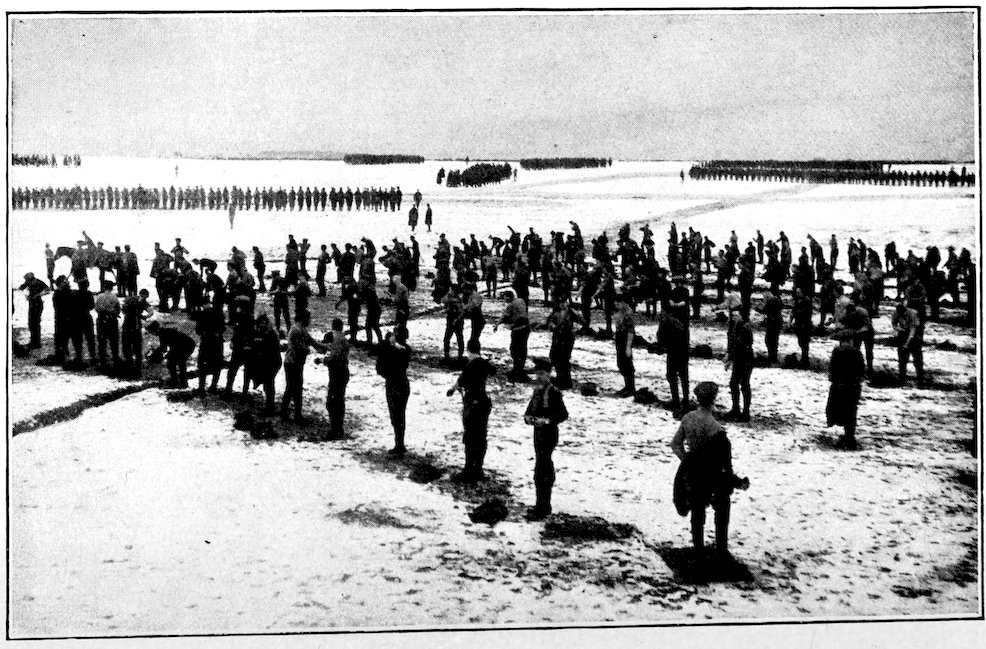
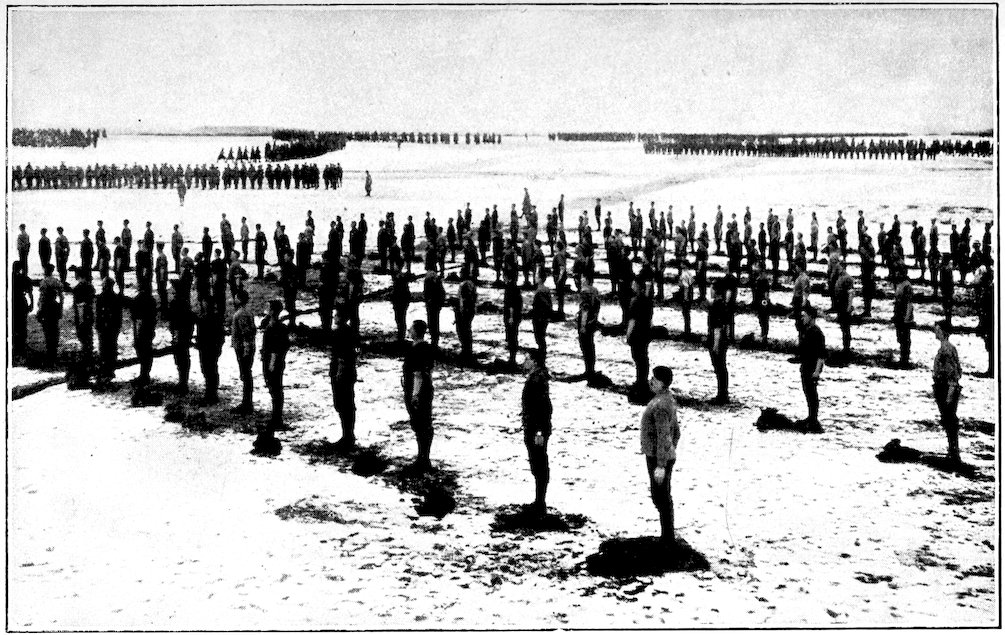
The photographs of Swedish drill or “physical
exercise”—as one out of a soldier’s many forms
of physical exercise is formally called—do less than
justice to that admirable part of our present
military training. Its object is not to produce a
rigid protrusion of the chest or a poker-like
straightness of figure, but to give every separate
muscle in the body its share of work and development,
and also to give a free, easy balance and
elasticity to the whole. There is still, in the New
Army, so much of the tradition, or instinct, of the
old one that the men will insist on “throwing
a chest” when confronted with a camera on a
parade ground. The value of Swedish drill is
realised later when sterner conditions demand the
“negotiation” of trenches, fences and breastworks.
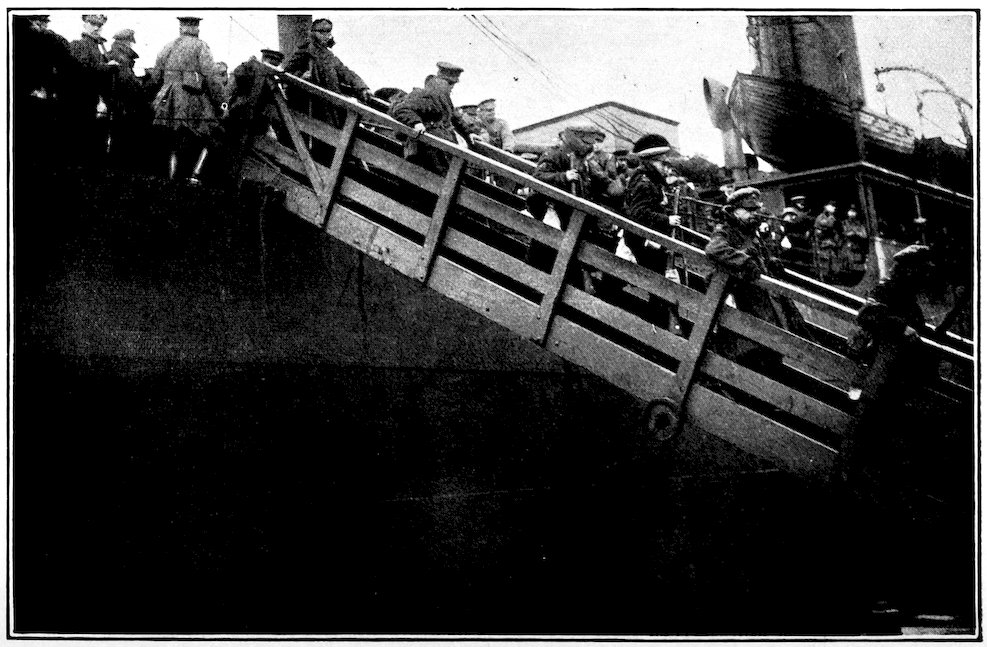
The photograph of troops disembarking in
France, prior to boarding the train for “Somewhere
in France,” needs no explanation. Railway
accommodation is not luxurious, but a good soldier
is generally a great boy, and it is an unfailing
10source of boyish pleasure to our troops in France to
be restrained by no railway bye-laws and to be
allowed to travel, in adventurous discomfort, in
or on every sort of closed or open truck except an
ordinary passenger carriage.
In the few cases where men who are not
sick or wounded travel by passenger train,
there is a noticeable tendency among the
gayer spirits to travel on the footboard or on the
roof. A genial array of smiling faces, indicative
of high spirits, may generally be observed among
the troops en route for the Front.
THE CARE OF THE WOUNDED — Removal from the Trench. — The Advanced Dressing-Station. — The Eye Hospital. — Ingenious Aids. — A Perfect Hospital. — Varied Conveyances. — Narrow-Gauge Railways. — Motor Ambulances. — Water Transport. — Red Cross Trains.
11
The first thing to do with a
wounded man is to “first-aid”
him. This, of course, is done
chiefly to check dangerous bleeding,
prevent the aggravation of
unset fractures, and, generally,
to enable the patient to travel with as little risk
and pain as possible to a place where his injuries
can be more completely dealt with.
The next thing to do is to get him out of the
trench. (If he has been wounded in No Man’s
Land, he must first be got back into the trench.)
If he can walk out, he does. During some of the
chief engagements on the Somme in 1916 many
seriously wounded men walked astonishing distances
to dressing-stations in order to leave the
ambulances and stretchers for others in still worse
case.
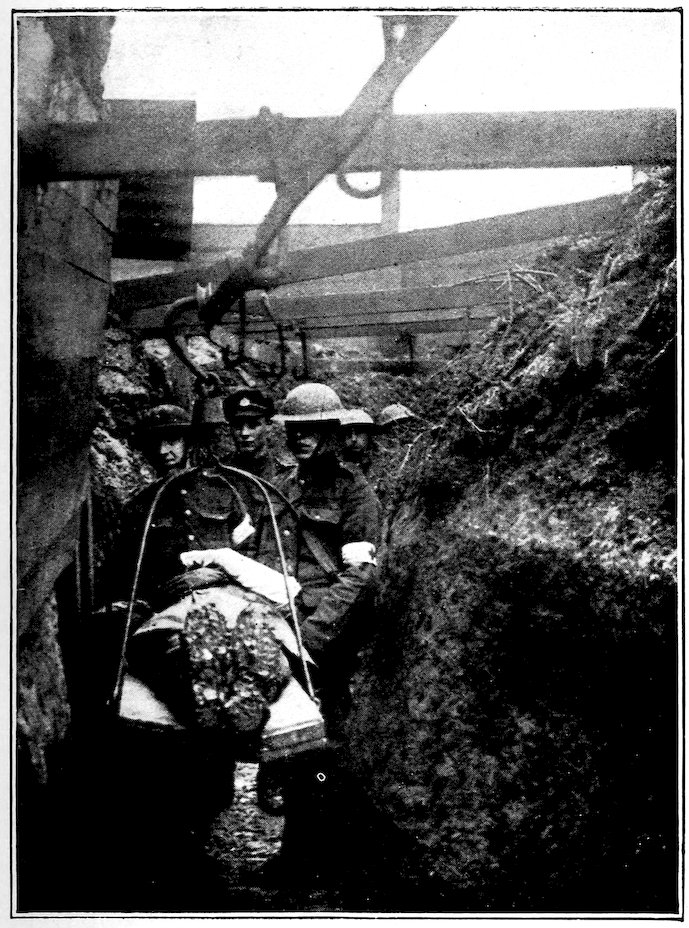
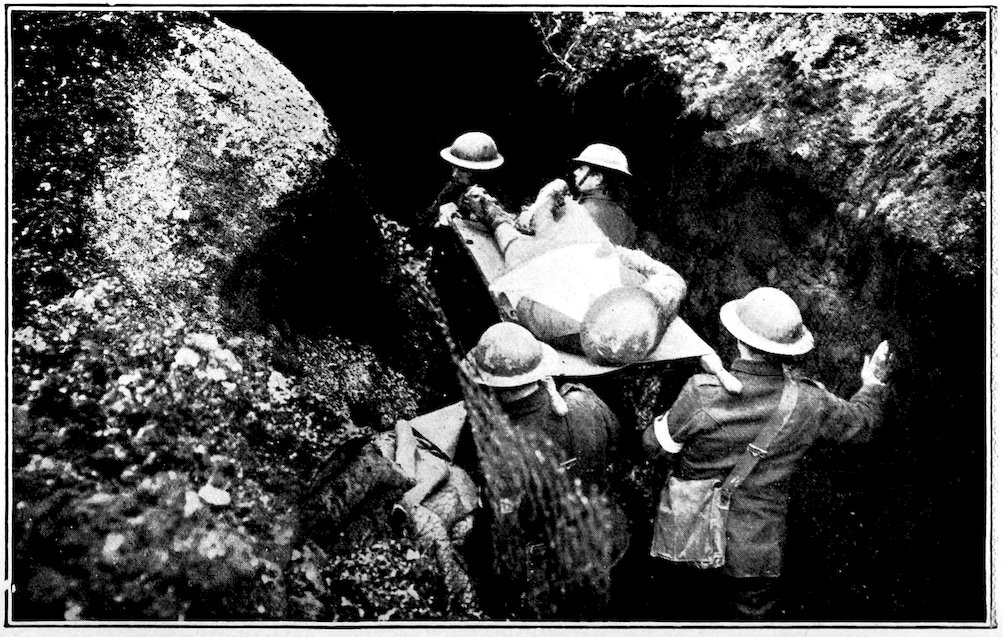
If a man wounded in or near the firing trench
cannot walk, he may have to be carried on a
stretcher for a mile or more along a deep, narrow
communication trench with scores of right-angled
12turns and a few more irregular incidental twists.
It may have an uneven and slippery floor, perhaps
a foot or two under water at its lower-lying parts.
Four strong men, used to the job, find it
extremely hard work to carry a stretcher case
along such a trench. They may repeatedly have
to raise the stretcher well above their heads, almost
at arm’s length, so as to clear the walls of the
trench at an awkward turning. To overcome this
difficulty a trolley stretcher, suspended from a
mono-rail running above the trench almost at the
surface level, is used in such trenches as permit of
its passage. It saves an immense amount of
tedious labour and much lessens the discomfort of
wounded men.
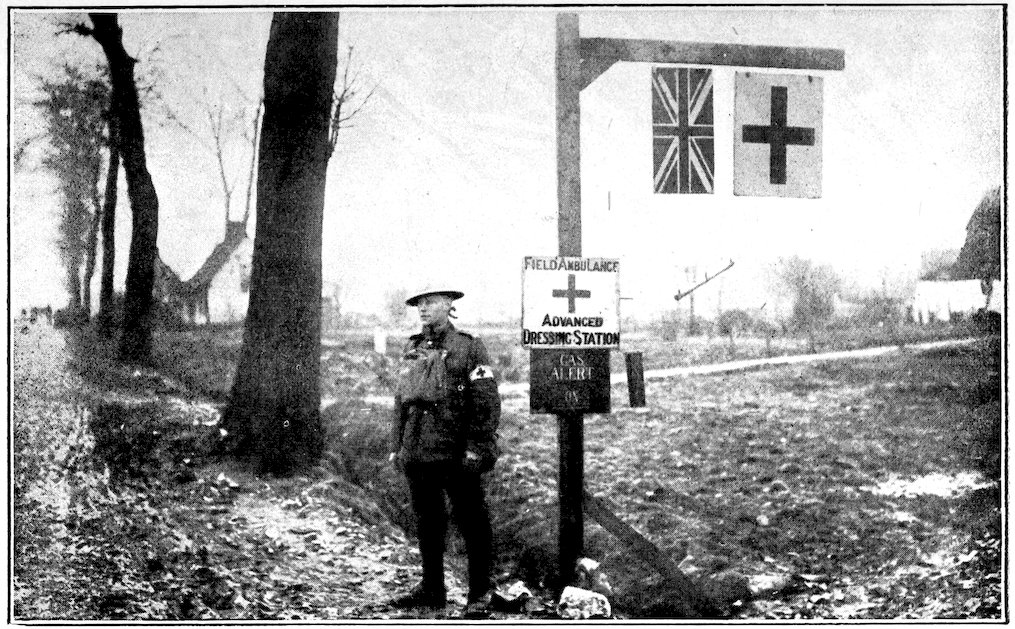
Arrived at an advanced dressing-station, a
patient can be immediately operated upon, if this
be necessary to save life. Or his wound may be
one of those which, though grave, are likely to do
better for some delay before operation. Just whatever
is necessary at the moment is done; the
recognised precautions against the states technically
known as shock and collapse are taken; and
then the patient is sent on at once to a casualty
clearing station, with its ampler space and larger
equipment. Probably he will ultimately pass from
13the C.C.S. to a general, or stationary, hospital
more remote from the Front, and perhaps to a
hospital in England.
If a case presents any special difficulty it will
be sent to a specially equipped ward or to a
specialist hospital. A typical hospital of the kind
is the Army Eye Hospital, near the coast, commanded
by a London oculist of distinction. Part
of its equipment is a magnet of great power, which
begins to draw out of the eye any fragments of
metal that are in it as soon as the patient enters
the room.
By combining the use of instruments with this
extricatory power of the magnet the sight of many
men with severe eye-wounds is saved; the hospital
possesses a remarkable collection of jagged fragments
and sharp splinters of metal thus cut and
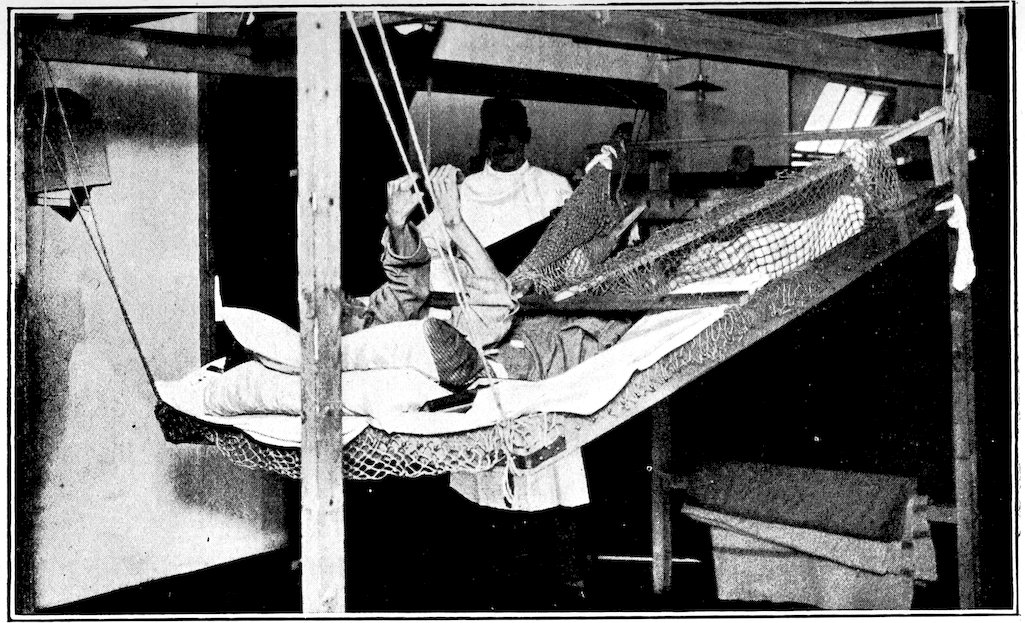
coaxed out of eyes. Or a man with a rather intractable
fracture of the thigh may be sent to one
of the special wards photographed here, where the
limb, and his whole body, can be slung at any angle
that is convenient.
In the British Hospital of St. John of Jerusalem,
near the French coast, there was lying, throughout
14last winter, an Australian soldier whose life, in the
opinion of the surgeons, had only just been saved
by the perfection of a special kind of bed which
someone had given to the hospital. The man had
been deeply and very dangerously wounded in the
back, in such a way that his wounds could not have
been dressed in an ordinary bed without such
changes of position as would themselves have been
injurious.
By an ingenious mechanism the special bed could
be hoisted, tilted and inclined till it was in any
desired plane and at any convenient height, and
any portion of the patient’s body could be reached
without turning him over.
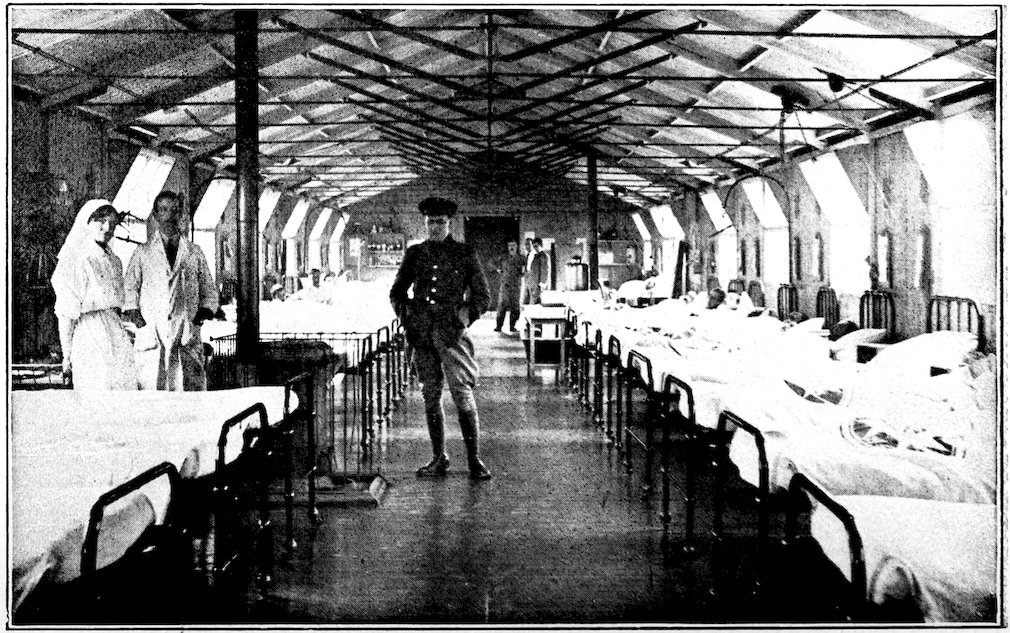
This Hospital of St. John is perhaps the most
perfect we have in France. It is housed in good
wooden huts, amply spaced out and admirably
planned for convenience in working and administration;
each wooden ward is light, airy, cheerful
in colour and provided with every imaginable aid
to cleanliness and good order. One of its special
belongings is a cardiograph, or apparatus for
recording on a chart, by the help of electricity, all
the movements of the heart, so that in cases of
irregular action of the heart the evenly serrated
15line produced on the paper by a normal heart action
is varied with spasmodic upward leaps or downward
collapses.
Between the front and the base a wounded man
may travel, for some part of the way, in any one
of a large variety of conveyances. The ordinary
stretcher and the overhead trolley have been mentioned.
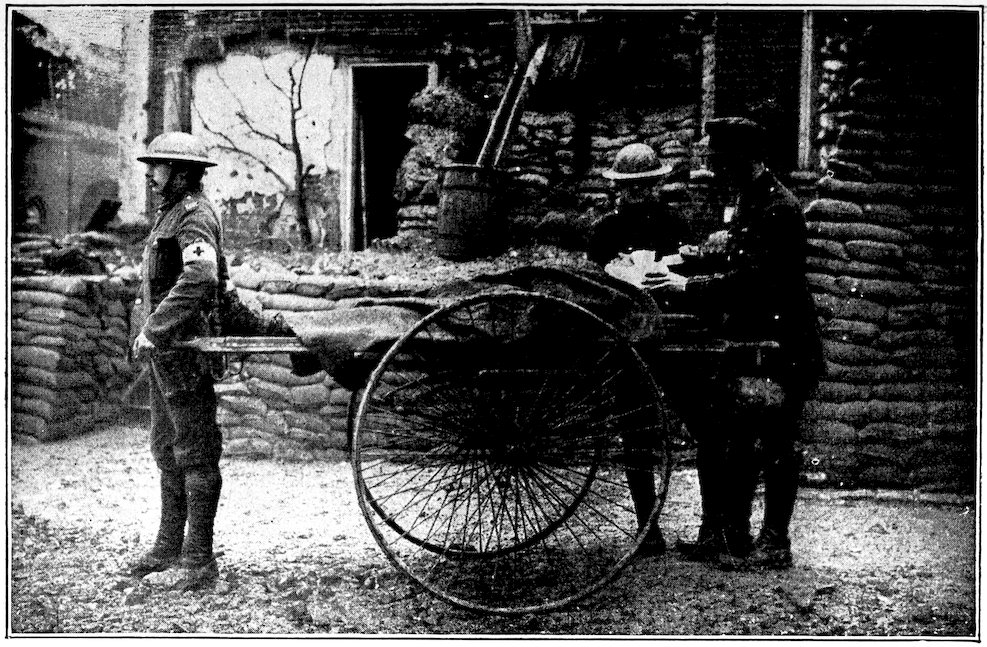
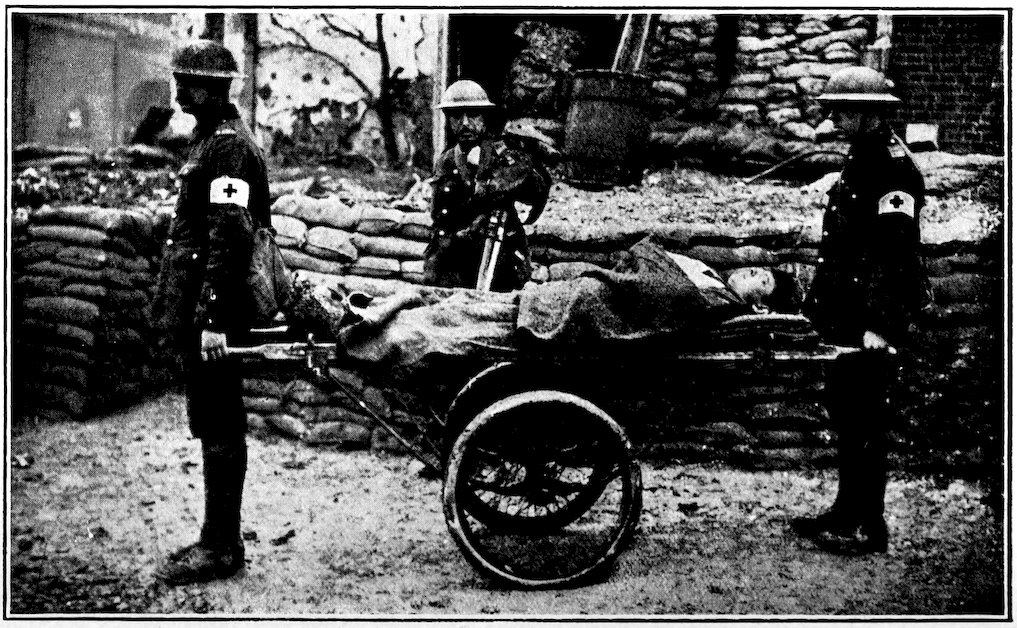
The wheeled stretcher, balancing like a
dog-cart between two large bicycle wheels, or
between two smaller ones with pneumatic tyres, is
extremely useful for saving jolts and labour. Its
chief sphere of action is between the rear ends of
communication trenches and the points, perhaps
a mile or two farther on, beyond which it is not
advisable for motor ambulances to go. But of
course it can only be used to advantage where
the ground to be traversed is not completely
broken up by shell fire, mines or bombs.
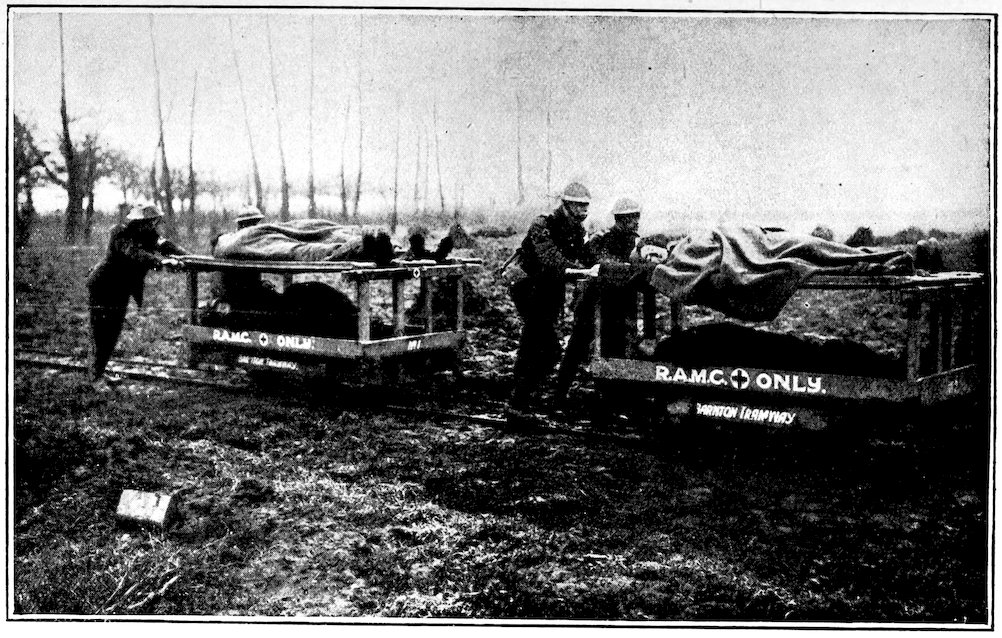
An excellent way of transporting casualties—where
it is available—is by the narrow-gauge
Decauville railways which now carry stores and
ammunition up from many of our full-gauge railheads
to the front line, or near it. A photograph
shows two ambulance trolleys accommodating
16four laden stretchers. A similar trolley is used at
some casualty clearing stations to convey patients
from the wards to the Red Cross train by which
they are to be evacuated. Such contrivances are
sometimes invented independently, in slightly
different forms, by the staffs of different clearing
stations or hospitals. Like the combatants, the
medical officers are constantly devising new
methods and new apparatus to meet the changing
needs of active service.
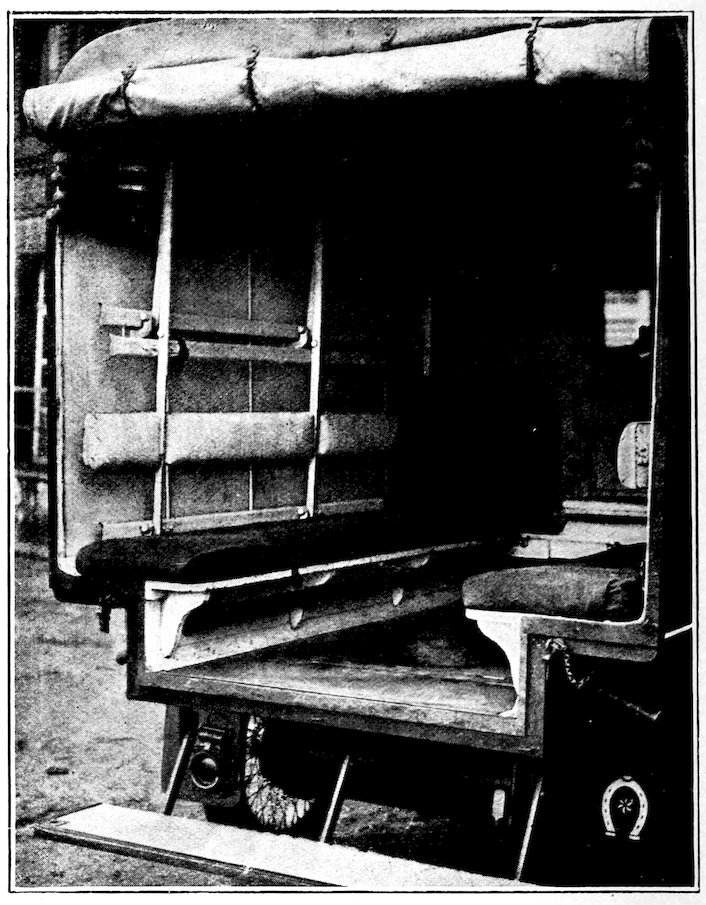
The motor ambulance, to carry four stretcher
patients, is the regular means of conveyance from
a few miles behind the front line to the casualty
clearing stations at the railheads. “Sitting
wounded” travel either in motor ambulances, with
the interior arranged to receive them, or in motor
lorries—usually in the former. From the casualty
clearing stations the wounded go to the base, as a
rule, either by train or by canal.
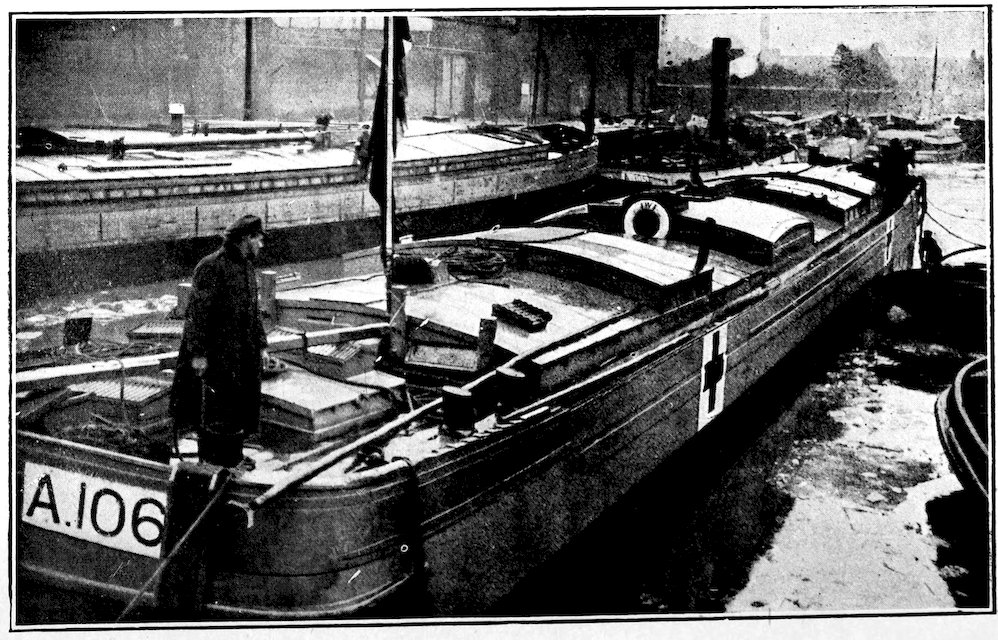
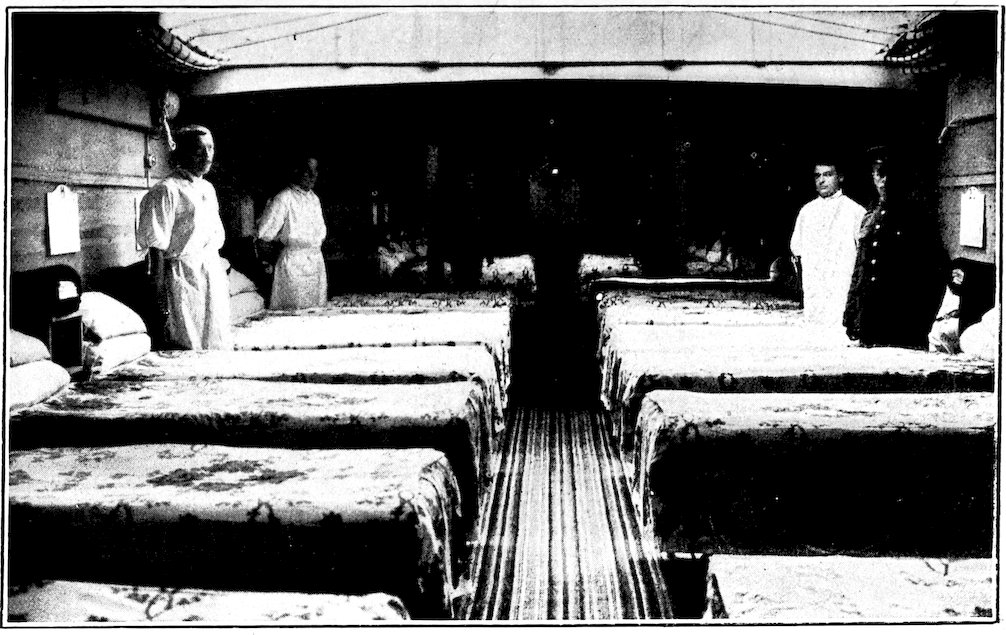
For cases requiring special ease of movement
and quiet the broad, square-built French canal
boats make excellent travelling hospitals. Nearly
all the rivers of Northern France are canalised, and
these waterways are kept up free of toll by the
17State, so that water transport is almost as available
as transport by rail. A photograph shows
what roomy wards the ordinary French canal boat
provides. The boats in British use are usually
towed in pairs by small tugs. During the battle
of 1916 the big red crosses on the boats’ sides were
to be seen everywhere on the Somme.
The equipment of Red Cross trains is more
generally known and several improvements have
been made in it during the war. With its operating
theatre, kitchen, store-room and staff accommodation,
a Red Cross train is now a travelling
hospital rather than a vehicle plying between one
hospital and another.
THE ARMY’S PETROL SUPPLY — Transplanting a Works. — Filling the Tins. — Packing. — Returned Empties. — Repairs.
19
In the early part of the war the
petrol needed for the motor
transport of the British Expeditionary
Force was shipped from
England in tins, ready for use.
When the growth of the Army
made more exacting demands on shipping, it was
decided to economise sea transport by making,
filling and packing the tins in France.
To do this, it was necessary to transplant the
existing works from England to France. But it
was also necessary not to interrupt the supply;
for, without petrol, a modern army would be like
a modern nation without coal. So one half of the
plant in England was dismantled and re-erected in
France, the other half undertaking the whole work
of supply until the first half was in working order
in France. Then the second half followed across
the Channel. The whole migration took twelve
weeks.
20Of course, the Army does not run the risks of
having only one base depôt of petrol. At each of
its depôts every process is carried out that is
needed for the transfer of a gallon of petrol from
a tank steamer lying at a port to the divisional
lorry or staff car by which it is used. The first
thing to do is to make receptacles for its conveyance.
At each depôt there is one factory for
making tins and another for making the cases or
boxes in which the tins are packed. A single
depôt employs more than 200 men and boys on
these two kinds of work.
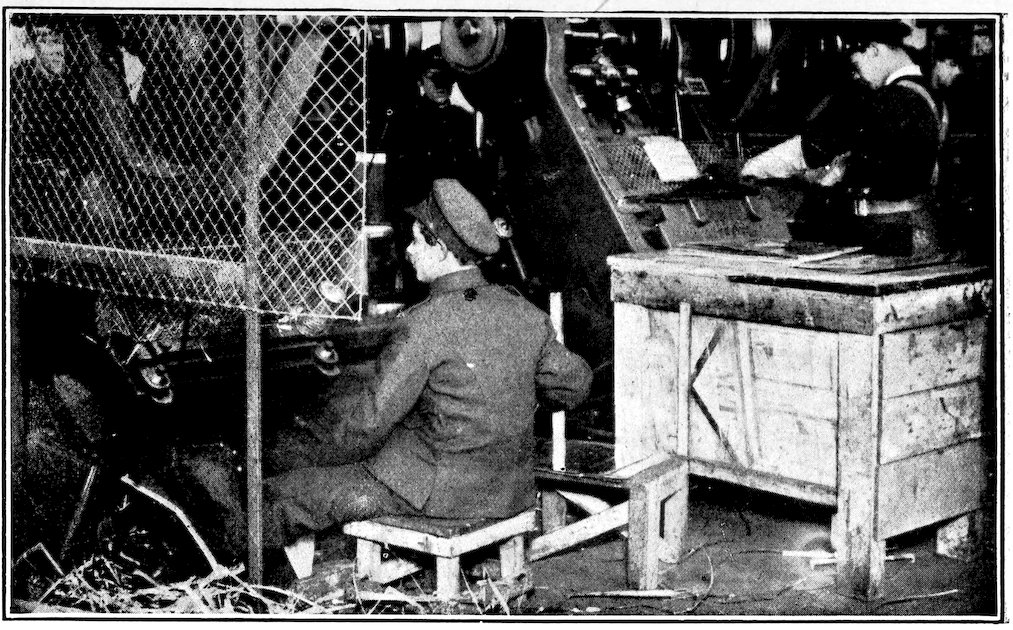
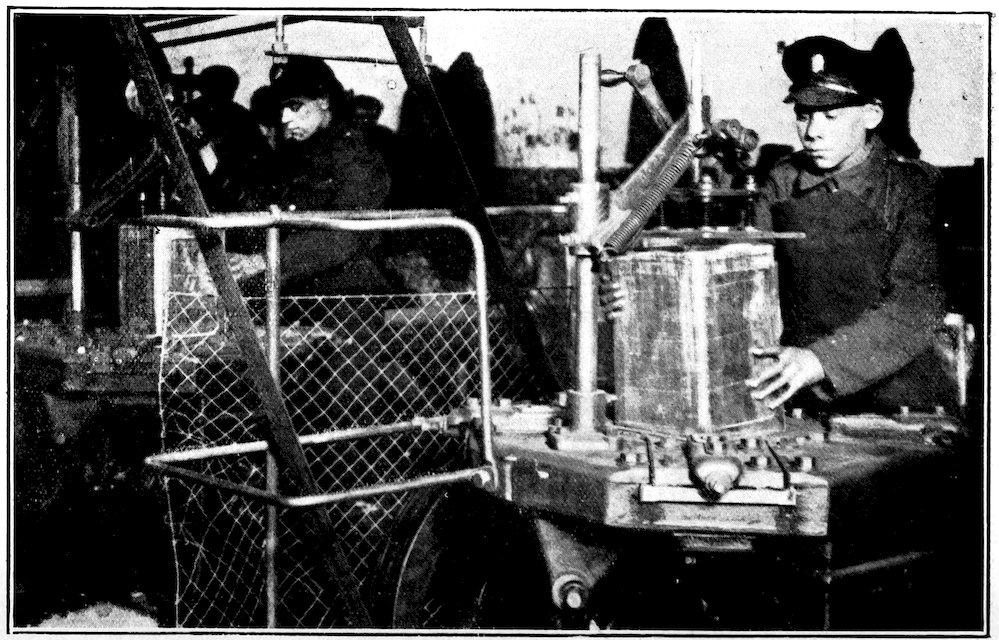
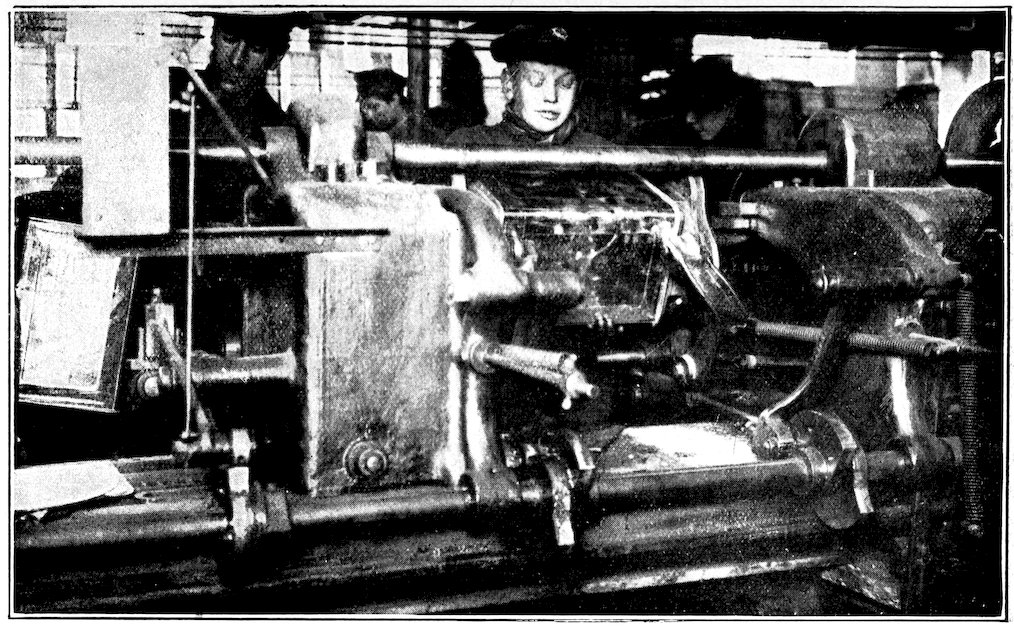
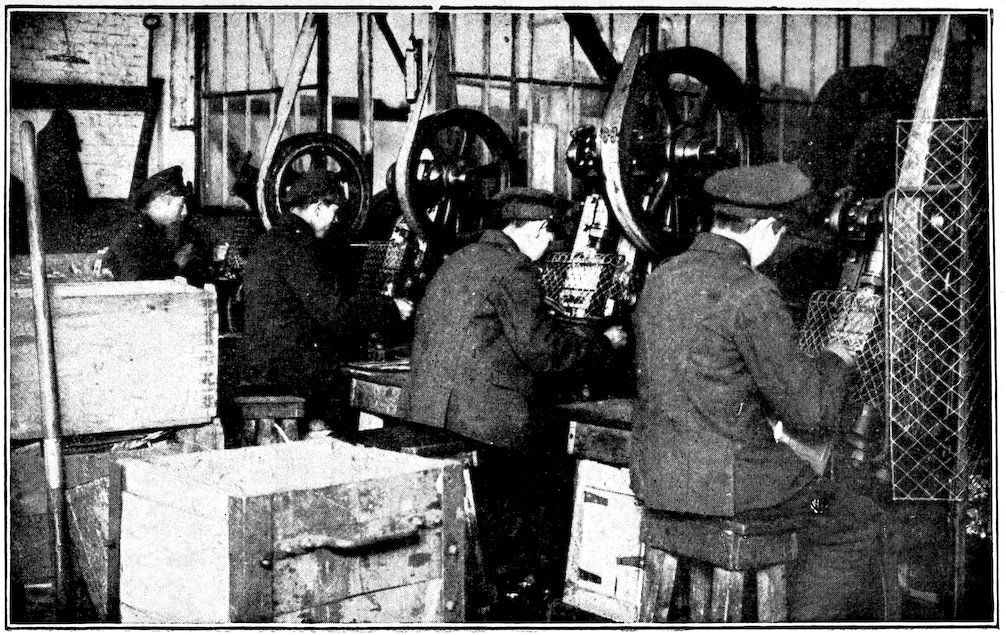
The photographs will suggest the power and precision
of the machinery which they use—one
machine for cutting out the tin, another for
shaping the cans, a third for rolling the edges on,
a fourth for soldering, a fifth for stamping, and so
on. A leaky tin is, of course, worse than useless,
so every can has to be tested by air.
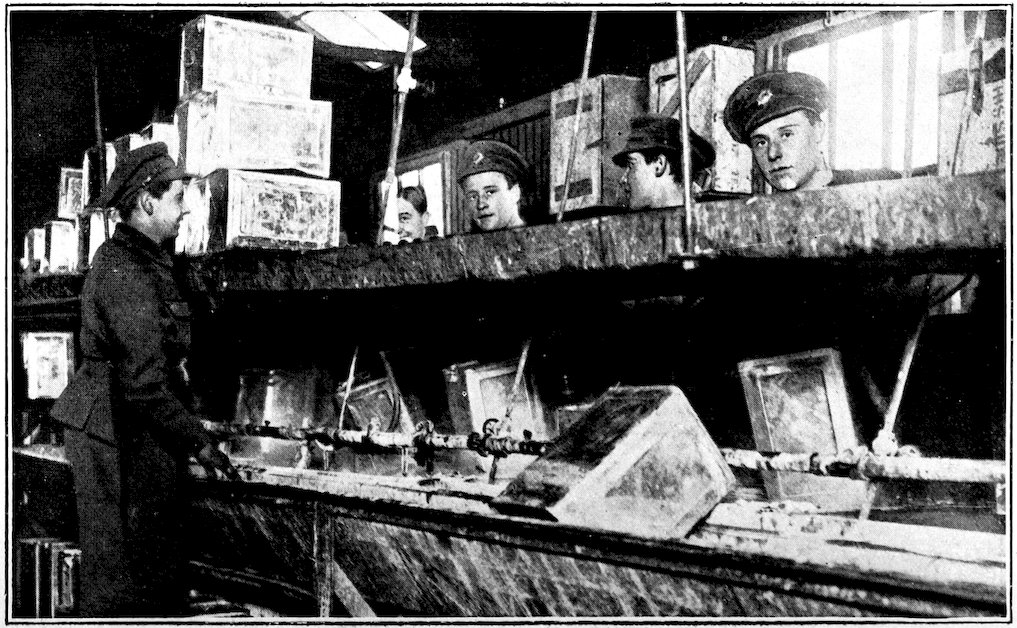
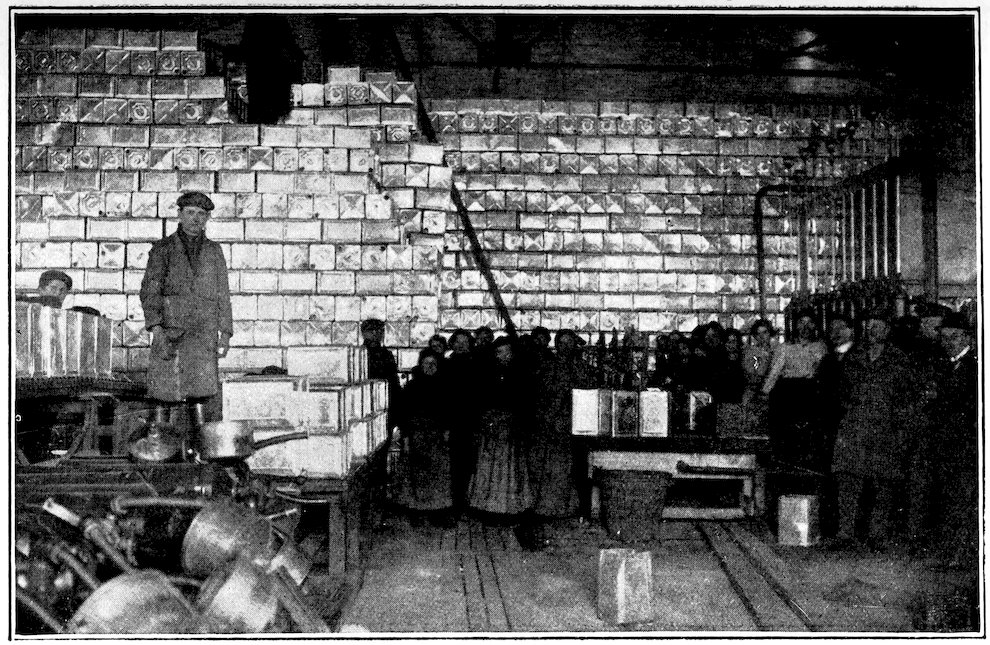
The finished and tested can is placed on an endless
belt at the factory, and travels upon the belt
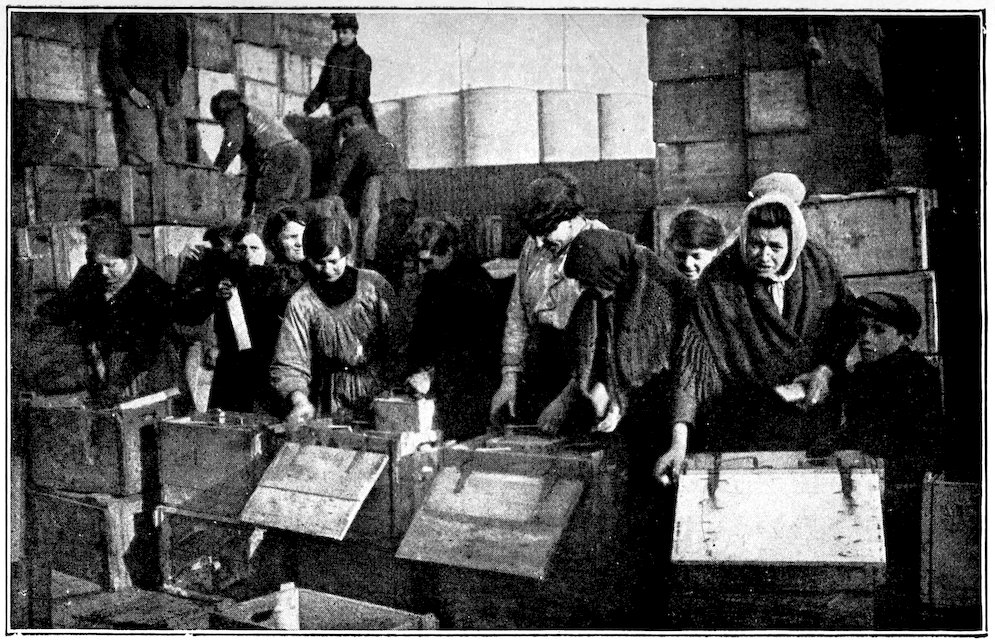
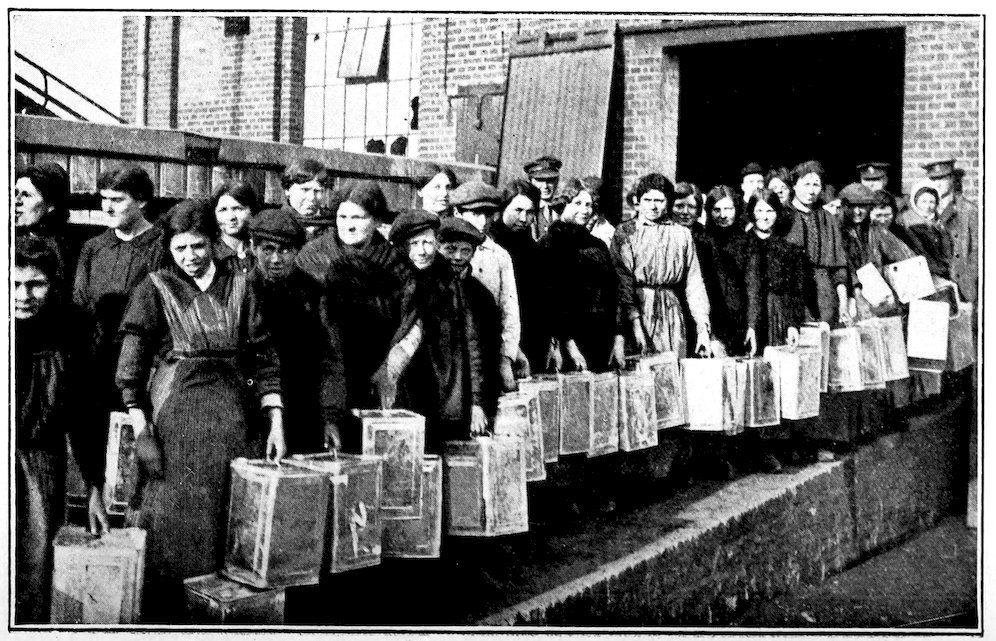
to the filling-house. A French woman, girl, or
boy takes a tin in each hand and fills them with
petrol, which has been conveyed in pipes from the
tanks at the port to the tanks at the depôt, and
21thence flows by gravitation to the filling-house.
These Frenchwomen are extremely industrious
and cheerful workers, and deserve the good
wages they get.
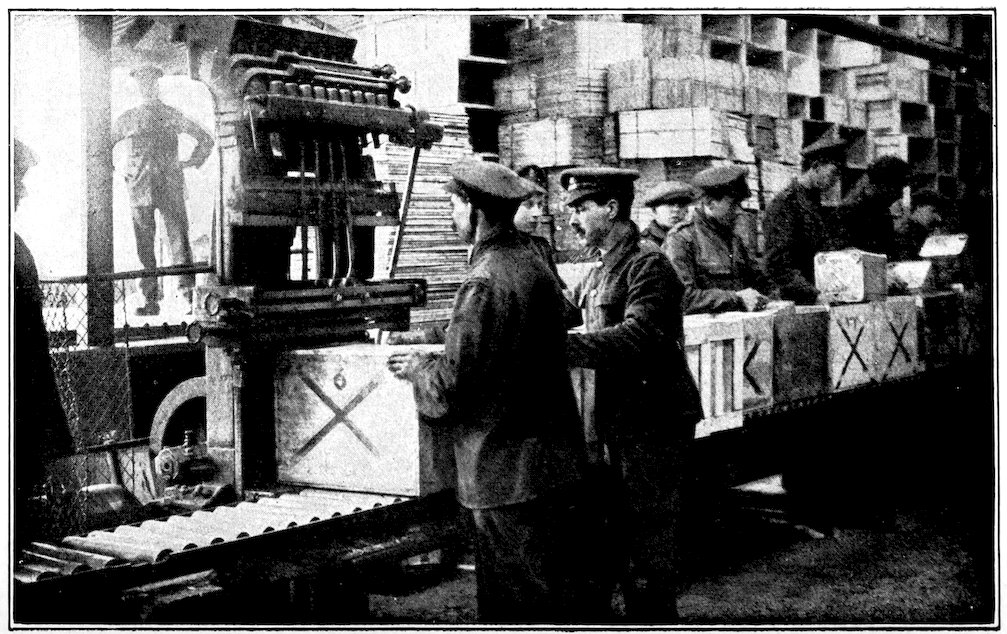
From their hands the filled tins pass to another
endless belt to be packed in wooden boxes.
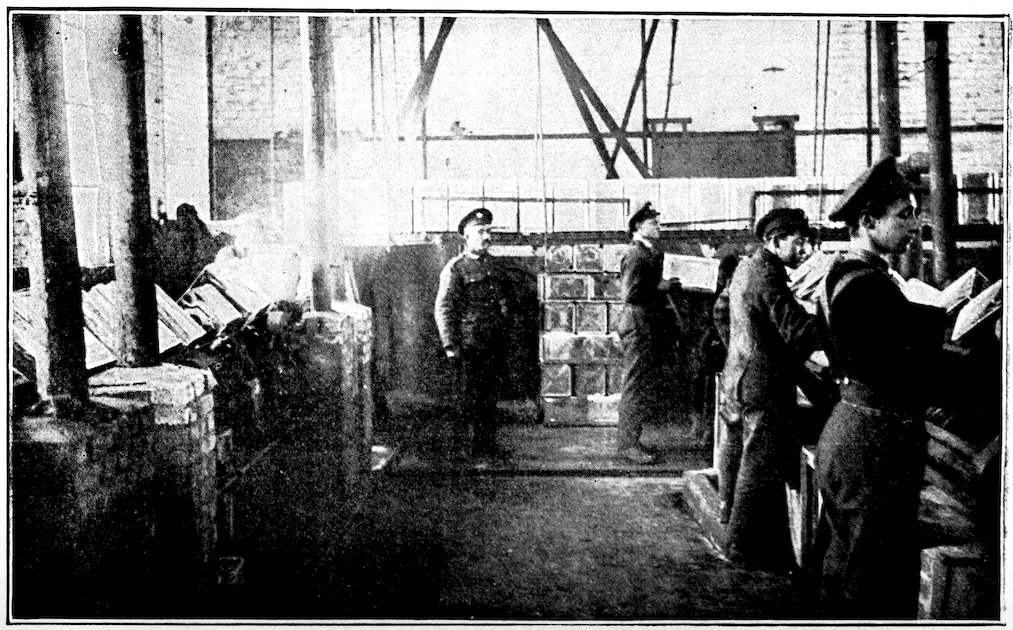
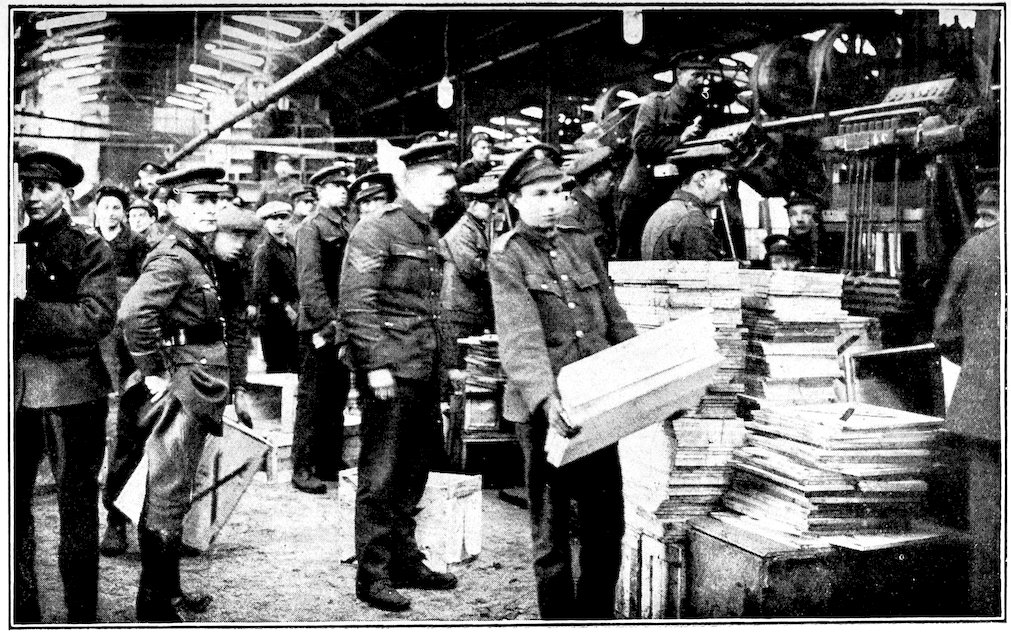
The photographs show some of the men and
machines employed in making these boxes. As
soon as the boxes are filled with tins the covers are
nailed down, an elevator transports the boxes to a
“gravity conveyor,” on which they descend to the
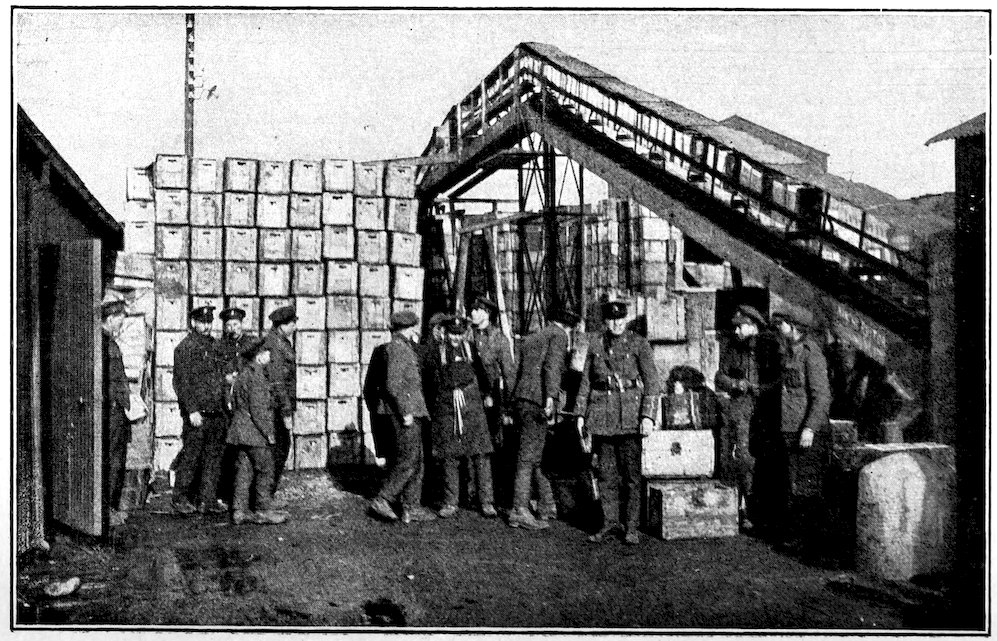
“loading platform.” Thence lorries take them
to the store, where they are stacked until their time
comes to go up by train to the front.
The rule is that every empty tin or case must be
returned to the depôt. About seven out of every
ten do return. Of the rest, a few may have been
lost or destroyed by accident; a few may have
become casualties of war; a few may have been
diverted by human frailty into some other service,
as company water-jars; and a few may have found
their way to some other part of the front and be
still serving the cause there.
Wherever they go, near the Front, the eye of
desire is cast on the wooden cases. Either as
22building material, as furniture, or as firewood,
they are treasures that would tempt a saint.
When a tin returns from the Front it is first
superficially inspected. If damaged past repair,
it has the brass screw in the opening removed, and
then the tin may be used for making paths or for
building up tiers of seats in an outdoor lecture
theatre at a training school, or in some other
secondary occupation. If apparently sound, it is
first cleaned by one more machine, and then filled
and stacked upside-down for 10 minutes, with
other returned tins, in order that small leaks may
be detected.
If it leaks it goes to the can-testing workshop,
is tested under pressure, has the defective
spot marked on it in white chalk, and goes
forward to the soldering shop. After repair here
it is tested again, and, when perfect, is issued for
re-filling. A typical can-repairing shop employs
26 men, 126 women, and 67 boys.
The men who do the box-making and tin-making
were, and still are, employees of the company who
supply the petrol. They have been enrolled in the
Army, and wear khaki, but are still paid piece
rates. The women who fill the tins are also
employees of the company.
23The line across which the petrol passes from the
company’s hands into those of the Army is just
outside the doors of the filling sheds. Here the
Army Service Corps men take the full cases over,
and give a receipt for each case, in the form of a
brass disc, to the company’s representatives.
Conversely, the Army Service Corps hand in the
empty cases and tins to the company’s men, and
receive similar receipts for them. A balance
between these two sets of receipts is struck at the
close of business by the officers on both sides.
A GIANT COBBLER’S SHOP — The Worn Boots’ Departure. — The Receiving Room. — Bootlaces. — Nothing Wasted. — Division of Labour. — Return of the Renewed Boots. — The Employees. — A Model Organisation.
25
The biggest cobbler’s shop in the
world is at one of the British
Army’s bases in France. It
mends the boots of about as many
persons as live in Liverpool or
Glasgow. But nearly all the
persons whose boots it mends are adult men living
in the open, most of them using their feet on wet
or rough ground for the greatest part of each day.
So it has to mend 2,800 boots a day.
It would be too much to ask that, after the
mending, every man should get his own boots back.
Even if that could be done, he would have to wear
strange boots meanwhile; for, unlike the soldiers
of some other countries, the British soldier does
not bring two pairs of boots into the field, and
does not want to, having enough weight to carry
without. So, when his boots need repair, he hands
them in to his company quartermaster-sergeant
and sees them no more.
They depart from him into the general stock of
26still serviceable, though not new, army clothing,
just as his shirt does when he comes out of
trenches, has a hot shower-bath, and puts on
somebody else’s shirt which has been disinfected
and washed at the Divisional Laundry.
The damaged boots go, higgledy-piggledy, into
a sack, with others. The sack goes to the rail-head,
with or without the help of a battalion
transport cart and a divisional motor lorry. From
the rail-head the sack goes, without trans-shipment,
to a siding outside the back door of the base
repair depôt, and the boots are emptied out on the
floor of what may be called the receiving room.
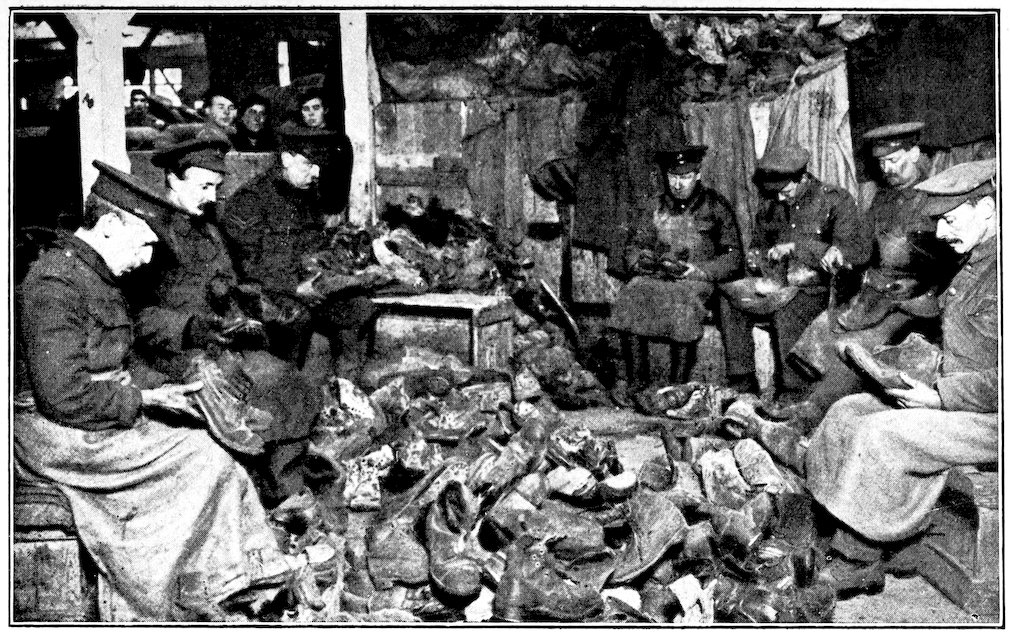
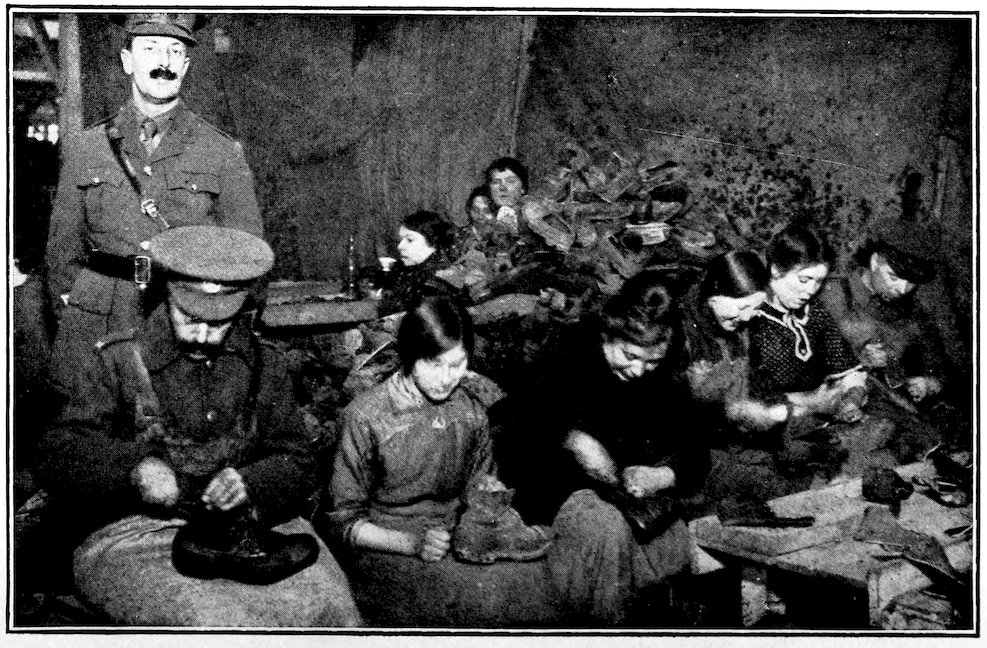
Here they are first roughly sorted out and
cleaned of the mud which often encases them.
This is done by women. Thence they are passed
on to an expert shoemaker, to be tried for their life.
He does nothing but diagnose the condition of boot
after boot. He picks up each boot, looks it over
for a couple of seconds with a swift, judicial glance
at sole, heel, uppers and welt, and throws it down
on his right or on his left.
The boots thrown on his right are not worth
repair. But even they are worth something. They
27go to another room where women cut out of each
boot two round pieces of the leather over ankle
bone on each side. The women do this all day.
Everybody here does some one special thing all
day. These discs of leather are passed on to
another sub-workshop, full of women, who lay
each disc on a board, stick a kind of awl through
its middle, put a very sharp knife to its edge, and
then make it revolve round the awl in such a way
that the knife cuts an excellent bootlace—a quite
straight one, too, strange to see—out of the circle
of leather, paring it down and down till nothing
of it is left.
Of what remains of the boot itself the softer
parts are combined with other ingredients to form
a useful manure. The more intractable and less
succulent heel is carried to the furnace room where
the power needed for the machinery is generated.
A boot heel has been found to make excellent fuel,
a large furnace not being particular about its food.
Thus no part, even of the most decrepit boots, goes
to waste. It is like the drowned man in the
Tempest—
Nothing of it that doth fade,
But all doth suffer a sea change
Into something rich and strange.
28From the judgment chamber those boots which
are not despaired of pass to a place where another
body of experts assess the amount of repair required
by each boot. To each boot one of them
attaches the kind and quantity of leather required
to mend it—perhaps a new sole, or a sole and a
heel, or what not. The boot, together with this
allowance of material, is then placed in a pigeon
hole, one out of a great case of pigeon holes. From
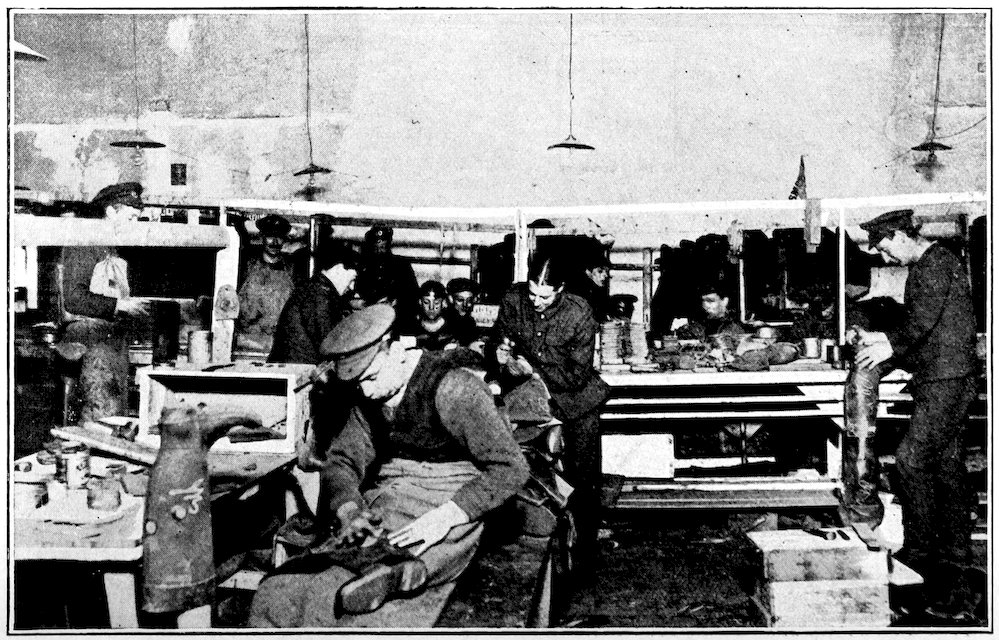
this it is taken, in its turn, by another shoemaker—a
soldier in khaki, like all the other men here—who
goes to work on it.
But he does not do the whole job. One man
pares down the new sole or heel to the dimensions
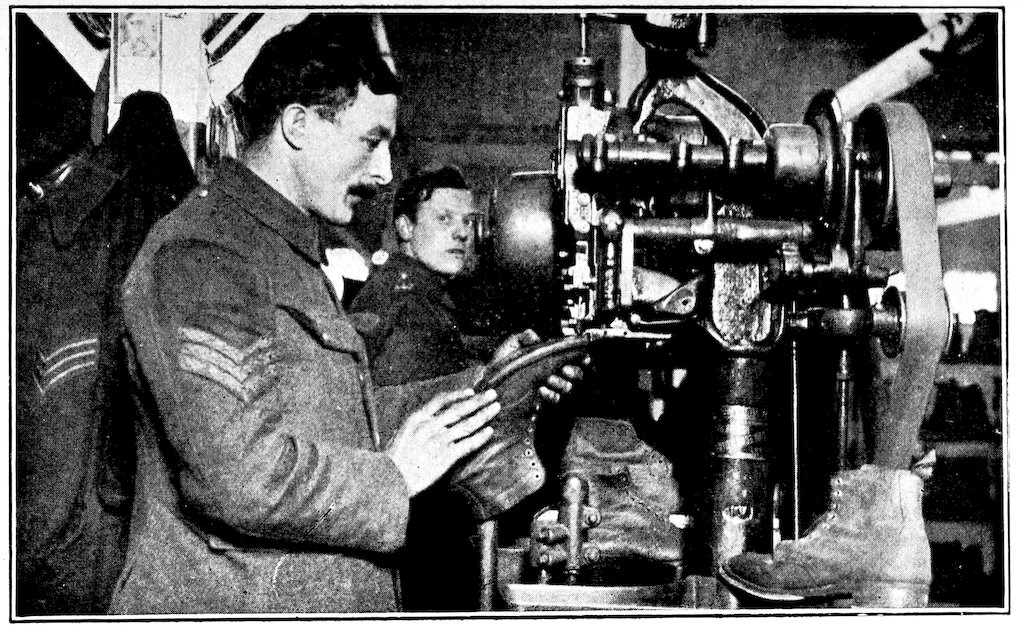
of the particular boot in hand. Another man,
or woman, holds the boot and the sole in contact
with a machine which sews on the sole in about the
time in which you could sprint 100 yards. Another
person and another machine drive in nails all
round the sole almost as fast as you could
draw your finger along the line of nail-heads
that they trace.
It would be tedious to go through all the other
stages of repair. But one may hark back to mention
29one which was forgotten in its place. Just
after leaving the seat of judgment where, as it
were, the sheep were separated from the goats,
each boot to be mended was handed over to an expert
who put it on a last and simply banged it back,
with a heavy hammer, into the original shape of
a new boot.
The effect of this skilful violence seems miraculous
to the layman. Boots which for months
have been taking a heavy list to port or starboard
emerge from the ordeal, to all appearance,
absolutely upright, although anyone who has
worn a boot down to one side until the lower part
of the upper is in contact on one side with the
ground knows how incorrigible the deformity
seems.
The end of it all is that the boots, completely
mended and re-shod with iron heels, go to a woman
who bathes them in oil till the leather has drunk
its fill. Thus they are both softened and re-armed
against the wet. They are now ready for reissue
to troops. They go again into a sack, are
carried back to the railway siding and make the
return journey to the Front, where the sack will be
opened by some quartermaster-sergeant, and an
30order will go round some company for any men
in need of new boots to report at the quartermaster’s
stores.
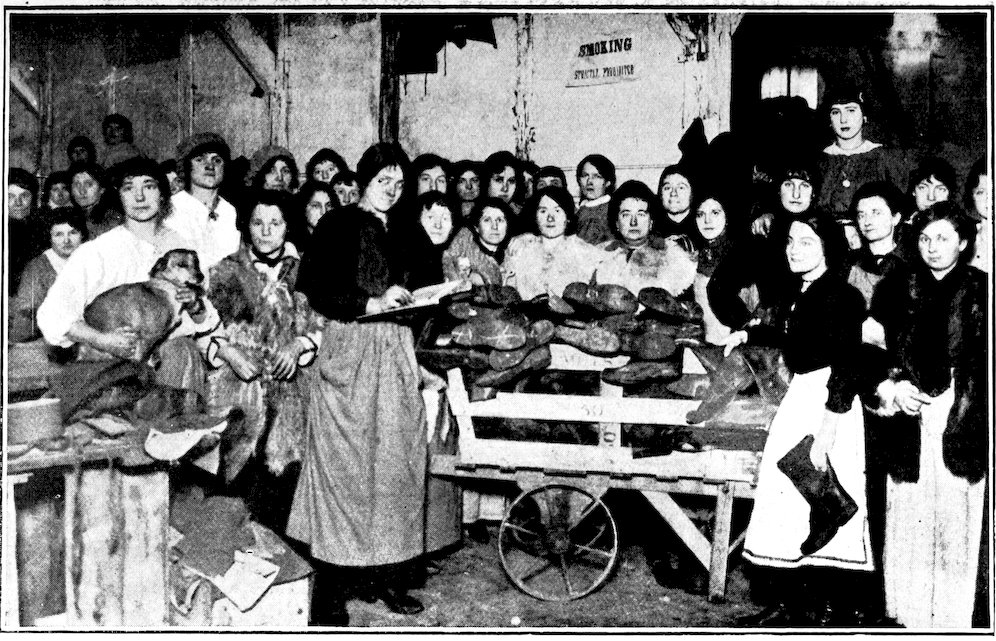
Of the 2,400 persons employed in this huge
cobbler’s shop, 1,500 are women and girls, all
French. It thus helps to absorb the labour displaced
in France by the derangement of the cotton,
linen and woollen industries at and near the seat
of war in the North. The women and girls earn
higher wages than they did before the war. They
are extremely cheerful workers, sing most of the
time, and look up at the occasional British visitors
to the place with amused curiosity. To each group
of them there is assigned as a friend and adviser
some educated and motherly Englishwoman, a
volunteer.
The workmen are all British and shoemakers by
trade. They have either enlisted specially for the
work or been combed out of ordinary battalions on
account of their special usefulness here. The
officers were experts in boot trade management
before joining the New Army. The whole place is
a model of industrial organisation. There is
nowhere in it any trace of the makeshift and rough-and-ready
31methods for which the difficulties of war
are sometimes made an excuse elsewhere. The
minute economies that are practised in all the
processes of repair are enough to put to shame any
visitor who has not done his very utmost to save
his country money.
The place described is not the only one of its
kind at the British bases in France. Great as it is,
it could not mend all the boots of more than two
million men. But in each of the Army’s giant
cobbler’s shops the same methods prevail.
TRAINING IN FRANCE
101
102AMIDST DEADLY FUMES OF GAS—ON
THE TRAINING GROUND
GOING THROUGH THE LACHRYMATORY
DUG-OUT
NIGHT DRILL UNDER FIRST LINE
CONDITIONS
AN INSTRUCTION CLASS AT THE
LANDSCAPE TARGET
INDIAN TROOPS AT BAYONET EXERCISE
A LESSON IN SANDBAG-FILLING
AT MUSKETRY PRACTICE—PRONE
POSITION
PREPARING FOR PHYSICAL EXERCISE
PHYSICAL EXERCISE
TROOPS DISEMBARKING
103
AMIDST DEADLY FUMES OF GAS—ON THE TRAINING GROUND
104
GOING THROUGH THE LACHRYMATORY DUG-OUT
105
NIGHT DRILL UNDER FIRST LINE CONDITIONS
106
AN INSTRUCTION CLASS AT THE LANDSCAPE TARGET
107
INDIAN TROOPS AT BAYONET EXERCISE
108
A LESSON IN SANDBAG-FILLING
109
AT MUSKETRY PRACTICE—PRONE POSITION
110
PREPARING FOR PHYSICAL EXERCISE
111
PHYSICAL EXERCISE
112
TROOPS DISEMBARKING
THE CARE OF THE WOUNDED
113
114THE OVERHEAD TROLLEY FOR BRINGING
WOUNDED THROUGH THE
TRENCHES
CARRYING WOUNDED IN A TRENCH:
A DIFFICULT TURN
OUTSIDE AN ADVANCED DRESSING-STATION
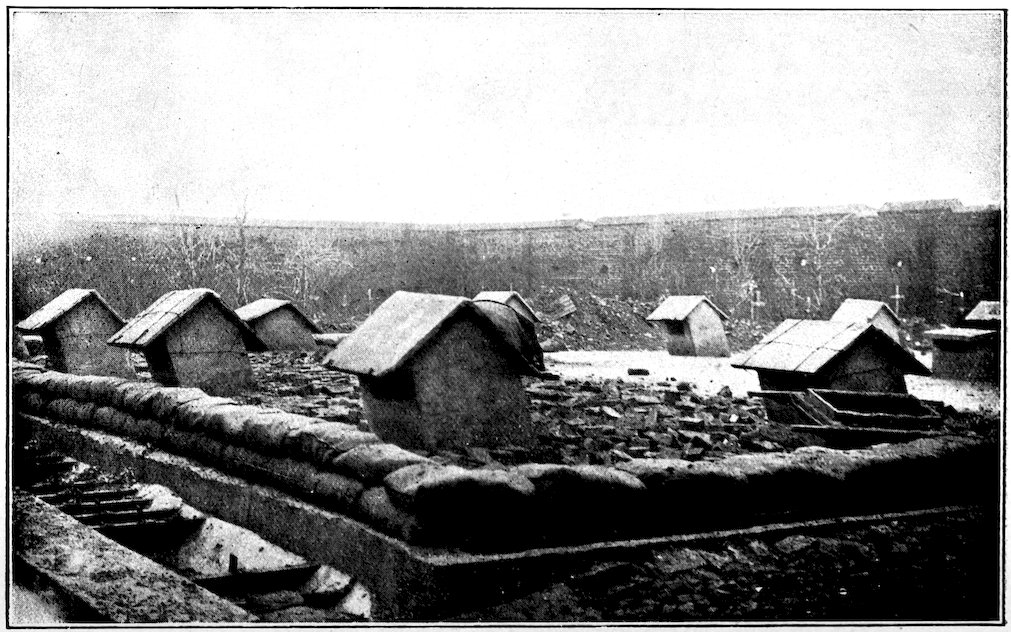
THE VENTILATING TUNNELS OF AN
ADVANCED DRESSING-STATION
SPECIAL WARD OF A HOSPITAL FOR
FRACTURES OF THE THIGH
A WARD OF ST. JOHN’S AMBULANCE
BRIGADE HOSPITAL
A WHEELED STRETCHER
A WHEELED STRETCHER WITH
PNEUMATIC TYRES
AMBULANCE TROLLEYS USED IN THE
OPEN
AN AMBULANCE BARGE FOR CONVEYANCE
OF VERY BADLY
WOUNDED TO THE COAST
INTERIOR OF A HOSPITAL BARGE
AN AMBULANCE WITH HEATING-PIPE
UNDER SEAT
115
THE OVERHEAD TROLLEY FOR BRINGING WOUNDED THROUGH THE TRENCHES
116
CARRYING WOUNDED IN A TRENCH: A DIFFICULT TURN
117
OUTSIDE AN ADVANCED DRESSING-STATION
118
THE VENTILATING TUNNELS OF AN ADVANCED DRESSING-STATION
119
SPECIAL WARD OF A HOSPITAL FOR FRACTURES OF THE THIGH
120
A WARD OF ST. JOHN’S AMBULANCE BRIGADE HOSPITAL
121
A WHEELED STRETCHER
122
A WHEELED STRETCHER WITH PNEUMATIC TYRES
123
AMBULANCE TROLLEYS USED IN THE OPEN
124
AMBULANCE BARGE FOR CONVEYANCE OF VERY BADLY WOUNDED TO THE COAST
125
INTERIOR OF A HOSPITAL BARGE
126
AN AMBULANCE WITH HEATING-PIPE UNDER SEAT
THE ARMY’S PETROL SUPPLY
127
128CUTTING SHEET TIN FOR MAKING
CONTAINERS
MAKING THE ROUGH TIN INTO CANS
ROLLING-ON THE EDGES
SOLDERING TINS BY MACHINERY
BUSY AT THE STAMPING MACHINES
TESTING THE CANS BY AIR
INTERIOR OF A FILLING-HOUSE
AN ENDLESS BELT CONVEYING THE
FILLED TINS
FRENCH WORKPEOPLE PACKING THE
PETROL TINS INTO BOXES
SOME FRENCH EMPLOYEES OUTSIDE
THE FILLING-HOUSE
MAKING BOXES BY MACHINERY
IN THE BOX-MAKING DEPARTMENT
129
CUTTING SHEET TIN FOR MAKING CONTAINERS
130
MAKING THE ROUGH TIN INTO CANS
131
ROLLING-ON THE EDGES
132
SOLDERING TINS BY MACHINERY
133
BUSY AT THE STAMPING MACHINES
134
TESTING THE CANS BY AIR
135
INTERIOR OF A FILLING-HOUSE
136
AN ENDLESS BELT CONVEYING THE FILLED TINS
137
FRENCH WORKPEOPLE PACKING THE PETROL TINS INTO BOXES
138
SOME FRENCH EMPLOYEES OUTSIDE THE FILLING-HOUSE
139
MAKING BOXES BY MACHINERY
140
IN THE BOX-MAKING DEPARTMENT
A GIANT COBBLER’S SHOP
141
142SORTING THE BOOTS
CUTTING OFF TOPS OF OLD BOOTS TO
MAKE INTO LACES
NAILING SOLES BY MACHINERY
REPAIRING RUBBER BOOTS
GIRLS IN THE RUBBER-BOOT REPAIRING
SHOP
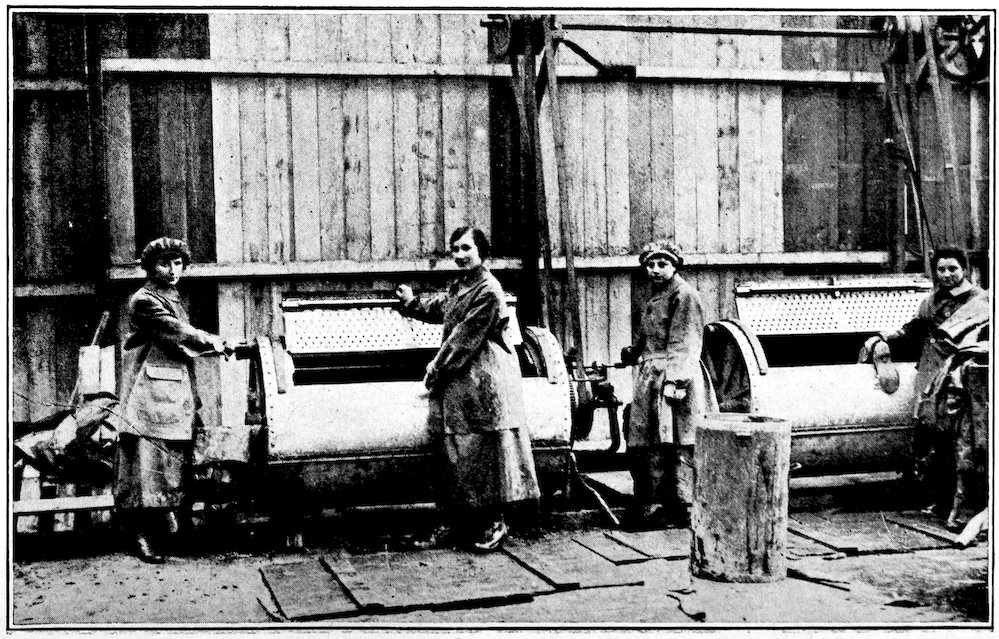
ROLLING-BOILERS FOR WASHING
WATERPROOF SHEETS
143
SORTING THE BOOTS
144
CUTTING OFF TOPS OF OLD BOOTS TO MAKE INTO LACES
145
NAILING SOLES BY MACHINERY
146
REPAIRING RUBBER BOOTS
147
GIRLS IN THE RUBBER-BOOT REPAIRING SHOP
148
ROLLING-BOILERS FOR WASHING WATERPROOF SHEETS
TRANSCRIBER’S NOTES
Typos fixed; non-standard spelling and dialect retained.