What every one learns from the almanac, over and above Easter and its
consequences for the current year, is that what happens this year is no
index at all to what will happen next year. And even those who preserve
their almanacs, and compare them in long series, never have been able,
so far as I know, to lay hands upon any law connecting the Easters of
different years, without having had recourse to the very complicated law
on which the whole calendar is constructed.
Nevertheless there does exist a simple relation which reduces the
uncertainty in the proportion of five to two; so that by means of one
past almanac, we may name two Sundays, one or the other of which must
be Easter Sunday. I have never seen this relation noticed, though I have
read much (for these days) on the calendar: has any one of your readers
ever met with it?
Let us make a cycle of the days on which Easter day can fall, so that
when we come to the last (April 25), we begin again at the first (March
22). Thus, six days in advance of April 23, comes March 25; seven days
behind March 24, comes April 21.
The following is the rule, after which come two cases of
exception:—
Take any year which is not leap year, then, by passing over eleven
years, we either leave Easter day unaltered, or throw it back a week;
and it is nearly three to one that we have to leave it unaltered. Thus
1941 is not leap year, and eleven years more give 1952; both have April
13 for Easter day; but of 1943 and 1954, the first gives April 25, the
second April 18.
Take any year which is leap year, then, by passing over eleven
years, we either throw Easter one day forward, or six days back; and it
is about three to two that it will be thrown forward. Thus 1852 (leap
year) gives April 11, but 1863 gives April 5.
But when, in passing over eleven years, we pass over 1700, 1800, or any
Gregorian omission of leap year, the common year takes the rule just
described for leap year; while, if we begin with leap year, the passage
over eleven years throws Easter two days forward, or five days back.
There is another class of single exceptions, occurring at long
intervals, which it is hardly worth while to examine. The only case
which occurs between 1582 and 2000, is when the first year is 1970.
Any number of instances may be taken from my Book of Almanacs, and the
general rule may be easily seen to belong also to the old style. Those
who understand the construction of the calendar will very easily find
the explanation of the whole.
A. DE MORGAN.
[By the great kindness of a correspondent who has placed at our
disposal two hitherto inedited letters written by Swift, we are
enabled to present the following literal copies of them to our
readers.
They are obviously addressed to Frances Lady Worsley, only
daughter of Thomas Lord Viscount Weymouth, and wife of Sir Robert
Worsley, Baronet, and the mother of Lady Carteret. In Sir Walter
Scott's edition of Swift's Works (vol. xvii. p. 302.) will be
found one letter from the Dean of St. Patrick to Lady Worsely;
and in vol. xviii. p. 26. is the letter from that lady to the
Dean which accompanied the escritoire alluded to in the second of
the two letters which we now print. This appears from Swift's
endorsement of it—"Lady Worsley, with a present of a writing-box
japanned by herself."]
"Madam,—It is now three years and a half since I had the Honor to see
Your Ladyship, and I take it very ill that You have not finished my Box
above a Month. But this is allways the way that You Ladyes treat your
adorers in their absence. However upon Mrs. Barber's account I will
pardon You, because she tells me it is the handsomest piece of work she
ever saw; and because you have accepted the honor to be one of her
protectors, and are determined to be one of her principall recommenders
and encouragers. I am in some doubt whether envy had not a great share
in your work, for you were I suppose informed that my Lady Carteret had
made for me with her own hands the finest box in Ireland; upon which you
grew jealous, and resolved to outdo her by making for me the finest box
in England; for so Mrs. Barber assures me. In short, I am quite
overloaden with favors from Your Ladyship and your Daughter; and what
is
worse, those loads will lye upon my Shoulders as long as I
live. But I confess my self a little ungrateful, because I cannot deny
Your Ladyship to have been the most constant of all my Goddesses, as I
am the most constant of all your Worshippers. I hope the Carterets and
the Worsleys are all happy and in health, and You are obliged to let Sir
Robert Worsley know that I am his most humble Servant; but You need say
nothing of my being so long his Rival. I hear my friend Harry is
returning from the fiery Zone, I hope with more money than he knows what
to do with; but whether his vagabond Spirit will ever fix is a question.
I beg your Ladyship will prevail on Sr Robert Worsley to give me a
Vicarage in the Isle of Wight; for I am weary of living at such a
distance from You. It need not be above forty pounds a year.
"As to Mrs. Barber, I can assure you she is but one of four Poetesses in
this town, and all Citizens' wives; but she has the vogue of being the
best: yet one of them is a Scholar, and hath published a new edition of
Tacitus, with a Latin dedication to My Lord Carteret.
"I require that Your Ladyship shall still preserve me some little corner
in your memory; and do not think to put me off onely with a Box, which I
can assure you will not contribute in the least to[1] ... my esteem and
regard for Your Ladyship.... I have been always, and shall ever remain,
"Madam,
"Your Lady ...
"Obedient and ... humble ... JON N....
"Dublin, May 1re, 1731."
[As Lady Worsley's letter serves to explain several
allusions in Swift's letters, and is obviously the one to which the
second letter we print is the reply, we here insert it.]
"August 6th, 1732.
"Sir,—I flatter myself, that if you had received my last letter,
you would have favoured me with an answer; therefore I take it
for granted it is lost.
"I was so proud of your commands, and so fearful of being
supplanted by my daughter, that I went to work immediately, that
her box might not keep her in your remembrance, while there was
nothing to put you in mind of an old friend and humble servant.
But Mrs. Barber's long stay here (who promised me to convey it to
you) has made me appear very negligent. I doubt not but you think
me unworthy of the share (you once told me) I had in your heart.
I am yet vain enough to think I deserve it better than all those
flirting girls you coquet with. I will not yield (even) to dirty
Patty, whom I was the most jealous of when you were last here.
What if I am a great-grandmother, I can still distinguish your
merit from all the rest of the world; but it is not consistent
with your good-breeding to put one in mind of it, therefore I am
determined not to use my interest with Sir Robert for a living in
the Isle of Wight,[2] though nothing else could reconcile me to
the place. But if I could make you Archbishop of Canterbury, I
should forget my resentments, for the sake of the flock, who very
much want a careful shepherd. Are we to have the honour of seeing
you, or not? I have fresh hopes given me; but I dare not please
myself too much with them, lest I should be again disappointed.
If I had it as much in my power as my inclination to serve Mrs.
Barber, she should not be kept thus long attending; but I hope
her next voyage may prove more successful. She is just come in,
and tells me you have sprained your foot, which will prevent your
journey till next summer; but assure yourself the Bath is the
only infallible cure for such an accident. If you have any regard
remaining for me, you will shew it by taking my advice; if not, I
will endeavour to forget you, if I can. But, till that doubt is
cleared, I am as much as ever, the Dean's
"Obedient humble Servant,
"F. WORSLEY."
"Madam,—I will never tell, but I will always remember how many years
have run out since I had first the honor and happiness to be known to
Your Ladyship, which however I have a thousand times wished to have
never happened, since it was followed by the misfortune of being
banished from You for ever. I believe you are the onely Lady in England
that for a thousand years past hath so long remembered a useless friend
in absence, which is too great a load of favor for me and all my
gratitude to support.
"I can faithfully assure your Ladyship that I never received from You
more than one letter since I saw you last; and that I sent you a long
answer. I often forget what I did yesterday, or what passed half an hour
ago; and yet I can well remember a hundred particulars in Your
Ladyship's company. This is the memory of those who grow old. I have no
room left for new Ideas. I am offended with one passage in Your
Ladyship's letter; but I will forgive You, because I do not believe the
fact, and all my acquaintance here joyn with me in my unbelief. You make
excuses for not sooner sending me the most agreeable present that ever
was made, whereas it is agreed by all the curious and skilfull of both
sexes among us, that such a piece of work could not be performed by the
most dextrous pair of hands and finest eyes in Christendom, in less than
a year and a half, at twelve hours a day. Yet Mrs. Barber, corrupted by
the obligations she hath to you, would pretend that I over reckon six
months, and six hours a day. Be that as it will,
our best
virtuosi are unanimous that the Invention exceeds, if possible, the work
itself. But to all these praises I coldly answer, that although what
they say be perfectly true, or indeed below the truth, yet if they had
ever seen or conversed with Your Ladyship as I have done, they would
have thought this escritoire a very poor performance from such hands,
such eyes, and such an imagination. To speak my own thoughts, the work
itself does not delight me more than the little cares you were pleased
to descend to in contriving ways to have it conveyed so far without
damage, whereof it received not the least from without; what there was
came from within; for one of the little rings that lifts a drawer for
wax, hath touched a part of one of the Pictures, and made a mark as
large as the head of a small pin; but it touches onely an end of a
cloud; and yet I have been carefull to twist a small thread of silk
round that wicked ring, who promiseth to do so no more.
"Your Ladyship wrongs me in saying that I twitted you with being a
great-grandmother. I was too prudent and carefull of my own credit to
offer the least hint upon that head, while I was conscious that I might
have been great-grandfather to you.
"I beg you, Madam, that there may be no quarrells of jealousy between
Your Ladyship and My Lady Carteret: I set her at work by the authority I
claymed over her as your daughter. The young woman showed her
readynesse, and performed very well for a new beginner, and deserves
encouragement. Besides, she filled the Chest with Tea, whereas you did
not send me a single pen, a stick of wax, or a drop of Ink; for all
which I must bear the charge out of my own pocket. And after all if Your
Ladyship were not by I would say that My Lady Carteret's Box (as you
disdainfully call it instead of a Tea-chest) is a most beautiful piece
of work, and is oftener used than yours, because it is brought down for
tea after dinner among Ladyes, whereas my escritoire never stirrs out of
my closet, but when it is brought for a sight. Therefore I again desire
there may be no family quarrells upon my account.
"As to Patty Blount, you wrong her very much. She was a neighbor's
child, a good Catholick, an honest Girl, and a tolerable Courtier at
Richmond. I deny she was dirty, but a little careless, and sometimes
wore a ragged gown, when she and I took long walks. She saved her money
in summer onely to be able to keep a Chair at London in winter: this is
the worst you can say; and she might have a whole coat to her back if
her good nature did not make her a fool to her mother and sanctifyed
sister Teresa. And she was the onely Girl I coquetted in the whole half
year that I lived with Mr. Pope in Twitenham, whatever evil tongues
might have informed your Ladyship, in hopes to set you against me. And
after this usage, if I accept the Archbishoprick of Canterbury from your
Ladyship's hands, I think you ought to acknowledge it as a favor.
"Are you not weary, Madam? Have you patience to read all this? I am
bringing back past times; I imagine myself talking with you as I used to
do; but on a sudden I recollect where I am sitting, banished to a
country of slaves and beggars; my blood soured, my spirits sunk,
fighting with Beasts like St. Paul, not at Ephesus, but in Ireland.
"I am not of your opinion, that the flocks (in either Kingdom) want
better Shepherds; for, as the French say, 'à tels brebis tel pasteur:'
and God be thanked that I have no flock at all, so that I neither can
corrupt nor be corrupted.
"I never saw any person so full of acknowledgment as Mrs. Barber is for
Your Ladyship's continued favors to her, nor have I known any person of
a more humble and gratefull spirit than her, or who knows better how to
distinguish the Persons by whom she is favored. But I will not honor
myself so far, or dishonor you so much, as to think I can add the least
weight to your own naturall goodness and generosity.
"You must, as occasion serves, Present my humble respects to My Lord and
Lady Carteret, and my Lady Dysert, and to Sr Robert Worsley.
"I am, and shall be ever, with the truest respect, esteem, and
gratitude,
"Madam,
"Your Ladyship's most obedient
and most humble Servant,
"JONATH. SWIFT.
"Dublin, Nov. 4re, 1732.
"I know not where my old friend Harry Worsley is, but I am his most
humble servant."
[On the back of the Letter is the following Postscript.]
"Madam,—I writ this Letter two months ago, and was to send it by Mrs.
Barber; but she falling ill of the gout, and I deferring from day to
day, expecting her to mend, I was at last out of patience. I have sent
it among others by a private hand.
"I wish Your Ladyship and all your family many happy new years.
"Jan. 8e, 1732."
The accumulation of these treasures in London and Paris, leads to the
belief that they will soon be decyphered. The following remarks are
offered in promotion of so desirable an object. It must be premised that
a printer, when requiring type from the type-founder for English books,
does not order the same quantity for each letter; but, according
to a scale adapted to the requirements of printing, he orders only so
many of each letter as he is likely to use. That scale may be nearly
represented in the following way: the letter z being the one least
used in English, he will require
|
Twice the number of letter z for letter x |
|
|
Twice also | —— j |
|
2½ times | —— q |
|
4 " | —— k |
|
6 " | —— v |
|
8 " | —— b |
|
8½ " | —— p |
|
8½ " | —— g |
|
10 " | —— y |
|
10 " | —— w |
|
15 " | —— m |
|
15 " | —— c |
|
17 " | —— u |
|
20½ " | —— l |
|
21 " | —— f |
|
22 " | —— d |
|
31 " | —— r |
|
32 " | —— h |
|
40 " | —— s |
|
40 " | —— n |
|
40 " | —— o |
|
41½ " | —— i |
|
42½ " | —— a |
|
45 " | —— t |
| 60 " | —— e |
Suppose now a person to write English in cypher, using unknown
characters for the well-known letters; it would be easy to decypher his
writing, if of sufficient length to make the general rule acted on in
the printing trade applicable. The decypherer, by selecting each
distinct unknown character, and numbering them respectively, would find
that the character oftenest occurring was e, the next oftenest t,
and so on to the character having the lowest number, being least used,
which would of course be z. Persons accustomed to decypher European
correspondence for diplomatic purposes, will pronounce best on the
practicability of this method for the decyphering of modern languages.
It is proposed then to apply the same method in the several languages
supposed nearest of kin to that of the Nineveh inscriptions. Without
entering into the reasons for that opinion, it may suffice, for the
present purpose of illustration, to assume that the language of these
inscriptions is Chaldee. To apply this method the numbers of each letter
occurring in the Targum of Onkelos on Genesis, or the whole Pentateuch,
should be taken. This enumeration has been made as regards the Hebrew
(see Bagster's Family Bible, at the end of Deuteronomy). The readiest
mode of effecting such enumeration would be to employ twenty-two persons
knowing the Chaldee letters, and to assign a letter to each, calling out
to them each letter as it occurred in Onkelos, whilst each person kept
count of his own letter on a tally, and summing up the total gave in the
result to the reader at the end of each chapter. This would be
necessary with a view to ascertain what quantity of unknown
inscription was required to evolve the rule, as the proposed method is
clearly inapplicable when the quantity of matter to be decyphered is
inconsiderable.
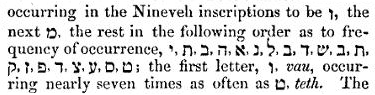
Having gone over sufficient ground to satisfy himself of the certainty
of the rule, the decypherer would next count the numbers of each
distinct character in all the cuneiform inscriptions accessible to him,
making allowance for final letters, also for vowel points which may be
attached to the character, as in Ethiopic. Assuming the rule in Chaldee
to be the same as in Hebrew (it is in fact very different), he would
find the character oftenest occurring in the Nineveh inscriptions to be
ו, the next מ,
the rest in the following order as to frequency of occurrence,
ט , ס ,
ע , צ ,
[?] ד , פ ,
ז , ק ,
[?] ח , [?] ב ,
ש , [?] ד ,
[?] ב , ל ,
נ , א ,
ה , כ ,
ת , י ,
the first letter, ו, vau,
occurring nearly seven times as often as
ט, teth. The order of the letters
would, in fact, vary much from this in
Chaldee; the servile letters being different would alone much disturb
the assumed order, actually ascertained nevertheless, as respects the
Hebrew letters, in the five books of Moses. One word as to the order in
which the several languages should be experimented on. The Chaldee would
be the first, and next in succession, (2) the Syriac, (3) the Ethiopic,
(4) the Arabic, (5) the Hebrew (die jungste Schwester),[3] and (6) the
Pehlvi. The Indo-European languages would, in case of failure in the
above, claim next attention: of these first the Zend, next (2) the
Sanscrit, then (3) the Armenian, &c. &c.
The resemblance of many of the characters on the Babylonian bricks, as
well as on the stones of Nineveh, is very great to the characters known
in our Bibles as Hebrew, but which are in fact not Hebrew but Chaldee,
and were introduced by the Jews subsequent to their Babylonish
captivity: the original Hebrew character was that still existing on
coins, and nearly approximates in many respects to the Samaritan
character. In some MSS. collated by Kennicott, he found the
tetragrammaton "Jehovah" written in this ancient character, whilst the
rest was Chaldee. The characteristic of the unknown letters is their
resemblance to nails, to arrow-heads, and to wedges, from which, indeed,
they are commonly designated. In the Chaldee (the Hebrew of our Bibles)
this is also strikingly visible, notwithstanding the effect of time in
wearing down the arridges: thus, in the oftenest recurring letter,
ו, in the left leg of
the ת,
in ע,
in צ,
in ט,
in נ,
in מ,
and especially in ש,
the
cuneiform type is most clearly
traceable. One of the unknown characters,

seems almost
identical with ש, allowance being made for the cursive
form which written characters assume after centuries of use.
The horn is very conspicuous on the heads of men in the Nineveh (Asshur)
sculptures, still, as a fashion, retained in Ethiopia (Cush,
Abyssinia[4]), the origin of the Chaldeans, through Nimrod the Cushite
(Gen. x. 8.), who probably derived their chief sustenance from the river
Tigris (Hiddekel). Subsistence from (1) fishing, (2) hunting (e.g.
Nimrod), (3) grazing, and (4) agriculture, seems to have succeeded in
the order named. The repeated appearance of fish on the same
sculptures, is in allusion, doubtless, to the name Nineveh (= fish +
habitation); and their worship of the half-man, half-fish (the fabulous
mermaid or merman), to which many of the Cetaceæ bear a close
resemblance (the sea-horse for example), common with them and the
Phœnicians (in the latter tongue named Dagon), is probably allusive,
in their symbolic style, to the abstract notion of fecundity, so
general an element of veneration in all the known mythological religions
of ancient and modern times. See Nahum passim.
From an attentive examination of these monuments in the British Museum,
it appears highly probable that the writing is from left to right, as in
the Ethiopic and Coptic, and in the Indo-European family generally, and
is the reverse of all the other Shemitic tongues. This inference is
derived from the fact that each line (with few exceptions) ranges with
those above and below, as in a printed book, perpendicularly on the
left, and breaks off on the right hand, as at the termination of a
sentence, whilst some of the characters seem to stretch beyond the usual
line of limit to the right, as if the sculptor had made the common error
of not having quite space enough for a word not divisible.
The daguerreotype might be advantageously used in copying all the
inscriptions yet discovered, of each of which three or four copies
should be taken, to obviate mistakes and accidents. These being brought
to England and carefully examined by the microscope, should be legibly
engraved and stereotyped, and sent to all the linguists of Europe and
elsewhere, and copies should also be deposited in all public libraries.
A comparison of the twelve cursive letters in Mr. Layard's Nineveh,
vol. ii. p. 166., with Büttner's tables at the end of the first volume
of Eichhorn's Einleitung in das Alte Testament (Leipzic, 1803), has
led to an unexpected result. The particular table with which the
comparison was instituted, is No. II. Class i. Phœnician, col. 2.,
headed "Palæstinæ in nummis;" any person therefore can verify it. This
result is the following reading in the proper Chaldee character:—
רבקלבנו-ושש-דן
RaBKaLBeNO—VeSheeSh—DiN.
The meaning is "Rabbi (Mr.) Kalbeno"—"And six"—"Judge."
Perhaps Kalbeno should be Albeno, the initial letter being obscure. The
above is put forth as a curious coincidence, not by any means with the
certainty which a much more extended examination than a dozen letters
can afford.
T. J. BUCKTON.
Lichfield.
[The circumstances which led to Alfieri's hasty retreat from
England in 1771, and to Lord Ligonier's successful application
for a divorce, are doubtless familiar to all who have read the
very amusing Autobiography of the Italian poet. At all events we
must presume so, as they are scarcely of a nature to be
reproduced in "NOTES AND QUERIES." Twenty years after that even,
when about to embark for the Continent with the Countess of
Albany, Alfieri, as he was stepping on board the packet, saw
again for the first time since 1771 Lady Ligonier, who was on the
quay. They recognised each other, but that was all.
Alfieri, after describing this event in the 21st chapter of his
Autobiography, proceeds:—"Si arrivo a Calais; di dove io molto
colpito di quella vista così inespettata le volli scrivere per
isfogo del cuore, e mandai la mia lettera al Banchiere de
Douvres, che glie la rimettesse in proprie mani, e me ne
trasmettesse poi la risposta a Bruxelles, dove sarei stato fra
pochi giorni. La mia lettera, di cui mi spiace di non aver
serbato copia era certamente piena d' affetti, non già d' amore,
ma di una vera e profonda commozione di vederla ancora menare una
vita errante e sì poco decorosa al suo stato e nascita, e di
dolore che io ne sentiva tanto più pensando di esserne io stato
ancorchè innocentement o la cagione o il pretesto."
The original letter of Alfieri (which we presume he would have
inserted in his Autobiography, had he kept a copy of it, seeing
that he has there printed Lady Ligonier's reply) is in the
possession of a nobleman, a relative of the unfortunate lady; and
we are enabled by the kindness of a correspondent to lay before
our readers the following copy of it.
How far it bears out the writer's description of it we do not
stop to ask; but certainly if the reader will take the trouble to
turn to the conclusion of the chapter
to which we have
referred, we think he cannot fail to be struck with the
difference between the terms in which the quondam lover writes
of the lady, and those which he addresses to her in the
following Epistle.[5]]
"Calais, Mercredi, 24 Aout, 1792.
"Madam,—Mon silence en vous revoyant après vingt années d'absence, a
été le fruit de l'étonnement, et non pas de l'indifférence. C'est un
sentiment qui m'est inconnu pour les personnes qui m'ont intéressé une
fois, et pour vous surtout, dont j'ai à me reprocher toute ma vie
d'avoir été la principale cause de toutes vos vicissitudes. Si j'avois
eu le courage de m'approcher de vous, ma langue n'auroit certainement
jamais retrouvé d'expression pour vous rendre tous les mouvemens
tumultueux de mon âme et de mon cœur à cette apparition si subite et
si momentanée. Je n'aurois trouvé que des larmes pour vous dire tout ce
que je sentais; et en vous le traçant confusement sur ce papier, elles
viennent encore m'interrompre. Ce n'est pourtant pas de l'amour qui me
parle pour vous, mais c'est un mélange de sentimens si tendres, de
souvenirs, de regrets, et d'inquiétude pour votre sort présent et
future, que vous pouvez seule comprendre ou diviner. Je n'ai dans le
cours de ces vingt ans jamais sçu au juste de vos nouvelles. Un mariage
d'inclination que j'appris que vous aviez fait, devoit faire votre
bonheur. J'apprends à présent que cela n'a pas rempli vos espérances: je
m'en afflige pour vous. Au nom de Dieu, faites-moi seulement sçavoir si
vous êtes heureuse au moins; c'est là l'objet de mes vœux les plus
ardents. Je ne vous parle point de moi; je ne sçais pas si mon sort peut
vous intéresser de même; je vous dirai seulement que l'âge ne me corrige
point du défaut de trop sentir; que, malgré cela, je suis aussi heureux
que je puis l'être, et que rien ne manqueroit à ma félicité, si je vous
sçavois contente et heureuse. Mais au cas que cela ne soit pas,
adoucissez-moi du moins l'amertume de cette nouvelle en me disant
expressément que ce n'est point moi qui en ai été la cause, et que vous
ne désespérez pas d'être encore heureuse et d'accord avec vous-même.
"Je finis, parce que j'aurois trop de choses à vous dire, et que ma
lettre deviendroit plustôt celle d'un père, que celle d'un ancien amant.
Mais la cause de mes paroles étant dans le sensibilité de mon cœur,
je ne doute point que la sensibilité du vôtre, dont j'ai été convaincu,
ne les reçoive avec indulgence, et avec un reste d'affection que je n'ai
pas mérité de perdre de votre part. Si vous voulez donc me dire quelque
chose de vous, et que ma lettre ne vous a point déplu, vous pouvez
addresser votre réponse à Bruxelles, poste restante. Si vous ne jugez
point à-propos de me répondre, faites seulement sçavoir à la personne
qui vous fera remettre celle-ci, que vous l'avez reçue. Cela me
consolera un peu de la douleur que m'a causé le rétracement subit de vos
infortunes, que votre vue a toute réveillées dans mon âme. Adieu, donc,
adieu.
"VITTORIO ALFIERI."
There is a famous passage in one of Lord Byron's most famous poems,
which I am ashamed to confess that, though I am English born, and a
constant reader of poetry, I cannot clearly understand. It seems to
present no difficulties to anybody else, for it has been quoted a
thousand times over and over, without any intimation that it is not as
clear as light. It is in the sublime Address to the Ocean at the end of
Canto IV. of Childe Harold, stanza 182.:
"Thy shores are empires, changed in all save thee—
Assyria, Greece, Rome, Carthage, what are they?
Thy waters wasted them while they were free,
And many a tyrant since; their shores obey
The stranger, slave, or savage; their decay
Has dried up realms to deserts:—not so thou,
Unchangeable save to thy wild waves' play—
Time writes no wrinkle on thine azure brow—
Such as creation's dawn beheld, thou rollest now."
I have copied out to the end of the stanza; for in fact it is not easy
to stop the pen when copying such stanzas as these: but my business is
with the fourth and fifth lines only. In the fourth line, as you will
observe, a semicolon is inserted after the word "since." I find it there
in the first edition of the fourth canto of Childe Harold, published
in 1818; it is there in the standard edition of Lord Byron's Works,
issued by Murray about 1832; it is there in the splendid illustrated
edition of Childe Harold published by Murray in 1841,—one of the
finest books of the kind, if not the finest, that has yet done honour to
the English press. This punctuation is found, therefore, in the earliest
edition that was issued, and in those on which the most care has been
bestowed. Yet what is the sense which the lines thus punctuated present?
"Thy waters wasted them [i. e. the empires] while they were free,
And many a tyrant since."
They waters wasted many a tyrant? How, in the name of wonder? What sort
of an occupation is this to assign to the majestic ocean? Does the poet
mean to assert that anciently it wasted empires, and now it only wastes
individuals. Absurd! Yet such is the only meaning, as far as
I see, that can be assigned to the lines as they stand.
If the punctuation be altered, that is, if the semicolon after "since"
be removed, and a comma placed at the end of the line, the whole becomes
luminous:
"Thy waters wasted them while they were free,
And many a tyrant since their shores obey."
That is (I beg pardon if I am unnecessarily explanatory), "The waters
wasted these empires while they were free, and since they have been
enslaved,"—an apt illustration of that indifference to human affairs
which the poet is attributing to the ocean. The words, "the stranger,
slave, or savage," which follow in the next line, are to be taken in
connexion with the phrase "many a tyrant," and as an enumeration of the
different sorts of tyrants to which these unhappy empires have been
subjected.
This is my view of the sense of this famous passage: if any of your
correspondents can point out a better, I can only say "candidus
imperti," &c.
There was a very elaborate article on Lord Byron's Address to the Ocean
in Blackwood's Magazine for October, 1848; but the writer, who
dissects it almost line by line, has somehow, as is the wont of
commentators, happened to pass over the difficulty which stands right in
his way. To make up for this, however, he contrives to find new
difficulties of his own. The following is a specimen:
"Recite," he says, "the stanza beginning,
'Thy shores are empires, changed in all save thee;'
and when the sonorous roll has subsided, try to understand it.
You will find some difficulty, if we mistake not, in knowing who
or what is the apostrophized subject. Unquestionably the world's
ocean, and not the Mediterranean. The very last verse we were far
in the Atlantic:
'Thy shores are empires.'
The shores of the world's ocean are empires. There are, or have
been, the British empire, the German empire, the Russian empire,
and the empire of the Great Mogul, the Chinese empire, the empire
of Morocco, the four great empires of antiquity, the French
empire, and some others. The poet does not intend names and
things in this very strict way, however," &c.
What empires the poet did mean there is surely no difficulty in
discovering, for those who wish to understand rather than to cavil. The
very next line to that quoted is—
"Assyria, Greece, Rome, Carthage, what are they?"
and it would require some hardihood to assert that these empires were
not on the shores of the Mediterranean.
After all, the best commentators are translators: they are obliged to
take the difficulties by the horns. I find, in a translation of Byron's
Works published at Pforzheim in 1842, the lines thus rendered by Dr.
Duttenhofer:
"Du bleibst, ob Reiche schwinden an den Küsten,—
Assyrien, Hellas, Rom, Carthago—schwand,
Die freien könnte Wasserfluth verwüsten
Wie die Tyrannen; es gehorcht der Strand
Dem Fremdling, Sclaven, Wilden," &c.
Duttenhofer has here taken the text as he found it, and has given it as
much meaning as he could; but alas for those who are compelled to take
their notion of the poetry of Childe Harold from his German, instead
of the original English! There is one passage in which the reader finds
this reflection driven hard upon him. Who is there that does not know
Byron's stanza on the Dying Gladiator, when, speaking of
"The inhuman shout which hail'd the wretch who won,"
he adds, in lines which will be read till Homer and Virgil are
forgotten:
"He heard it, but he heeded not—his eyes
Were with his heart, and that was far away;
He reck'd not of the life he lost nor prize,
But where his rude hut by the Danube lay,
There were his young barbarians all at play,
There was their Dacian mother—he, their sire,
Butcher'd to make a Roman holiday—
All this gush'd with his blood—shall he expire
And unavenged? Arise, ye Goths! and glut your ire!"
There are two phrases in this stanza which seem to me to have never been
surpassed: "young barbarians," and "all this gushed with his blood."
How inimitable is "young barbarians!" The "curiosa felicitas" of Horace
never carried him farther,—or perhaps so far. Herr Duttenhofer contents
himself by saying—
"fern am Donaustrand
Sind seine Kinder, freuend sich am Spiel."
"Afar on the shore of the Danube are his children, diverting
themselves at play." Good heavens! is this translation, and German
translation too, of which we have heard so much? Again:
"wie sein Blut
Hinfliesst, denkt er an dies."
"As his blood flows away, he thinks of this!" What could Herr
Duttenhofer be thinking of?
To my surprise, on turning to the passage this moment in Byron's poems,
I find it stands—
"All this rush'd with his blood,"
instead of "gush'd." It is so in the original edition, in the Works,
and in the splendid edition of 1841, all three. Can there be any doubt
of the superiority of "gush'd?" To me there seems none; and, singularly
enough, it so happens that twice in conversation with two of the most
distinguished writers of this age—one a prosaist and the other a poet,
whose names I wish I were at liberty to mention—I have had occasion to
quote this passage, and they both agreed with me in ascribing
the
highest degree of poetical excellence to the use of this very word. I
wish I could believe myself the author of such an improvement; but I
have certainly somewhere seen the line printed as I have given it; very
possibly in Ebenezer Elliott the Corn-law Rhymer's Lectures on Poetry,
in which I distinctly remember that he quoted the stanza.
T. W.
I send, with some explanation, a few Notes, taken from among others that
I had marked in my copy of the edition of Bishop Jewel's Works, issued
by the Oxford university press, 8 vols. 8vo. 1848.
Vol. ii. p. 352., l. 6., has, in Jewel's Reply to Harding's Answer,
Article v., "Of Real Presence," seventh division, the following: "And
therefore St. Paul saith, 'That I live now, I live in the flesh of the
Son of God.'" To this the following is appended by the Oxford editor:
"[Galatians ii. 20 '... And the life which I now live in the
flesh I live by the faith of the Son of God, who loved me, and
gave himself for me?' It cannot be denied that Jewel is here
guilty, to say the least, of very unjustifiable carelessness.]"
The true state of the case is, that Bishop Jewel, in the original Reply
to Harding, published in his lifetime, 1565, had given the text with
entire correctness—"That I live now in the flesh, I live in the faith
of the Son of God:" but this, long after the Bishop's death, was
misprinted in the editions of 1609 and 1611. The Oxford Jewel, moreover,
of 1848 does not even profess to follow the editions of 1609 and 1611;
and it is stated, vol. i. p. 130., that "this edition of the Reply in
passing through the press has been collated with the original one of
1565." Still in this vital case, where the very question was, what Jewel
himself had written, it is plain that the early edition of 1565 was
never consulted. The roughness of the censure might surely in any case
have been spared. It may be noted (vol. viii. p. 195. Oxf. edit.), that
Jewel in 1568 wrote to Archbishop Parker: "I beseech your grace to give
strait orders that the Latin Apology be not printed again in any case,
before either your grace or some other have well perused it. I am
afraid of printers: their tyranny is intolerable."
In vol. iv. p. 92., l. 1. et seq., in the Recapitulation of Jewel's
Apology, the words of the original Latin, "quid de Spiritu sancto,"
marked in the following extract by Italics, are omitted in the Oxford
edition "Exposuimus tibi universam rationem religionis nostræ, quid de
Deo Patre, quid de ejus unico Filio Jesu Christo, quid de Spiritu
sancto, quid de ecclesia, quid de sacramentis ... sentiamus." And in
vol. vi. p. 523., l. 6., where Bishop Jewel gives that passage as
rendered by Lady Bacon, namely: "We have declared at large unto you the
very whole manner of our religion, what our opinion is of God the
Father, and of his only Son Jesus Christ, of the Holy Ghost, of the
church, of the sacrament," the following is appended:—
"[In the Latin Apology no words occur here relating to the Third
Person of the Blessed Trinity.]"
A similar notice is also given in vol. viii. p. 385.—The fact is, that
the words "quid de Spiritu sancto" do occur in the Latin Apology, 1562,
which was the first edition of that work, and, so far as I am aware, the
only edition printed in Jewel's life, from which too the Oxford reprint
professes to be taken, and a copy of which any one can consult in the
British Museum. Those words will also be found, within six or eight
pages of the end, in the various later editions, as for example those of
Vautrollier, London, 1581; Forster, Amberg, 1606; Boler, London, 1637;
and Dring, London, 1692 (which are in my own possession); as also in the
editions of Bowier, 1584; Chard, 1591; and Hatfield, London, 1599. The
editions of Jewel's works printed in 1609 and 1611, edited by Fuller,
under the sanction of Archbishop Bancroft, did not contain the Latin
Apology. There is not a shadow of authority for the omission. All the
modern reprints too, with which I am acquainted, only excepting a small
edition printed at Cambridge, 1818, p. 140., give the words in question.
It would seem that the Oxford editor must have used the very inaccurate
reprint of 1818, for supplying copy for the printer;[6] and reference
either to that first edition of 1562, which the reprint of 1848
professes to follow, or to any early edition, even in this case, where
the context clearly requires the omitted words, was neglected.
I have said that the Oxford Jewel of 1848 professes to follow the Latin
Apology of 1562, as a copy of the Latin title, with the date 1562, is
prefixed to the Oxford edition, vol. iv. p. 1.: but the colophon
appended to that reprint, p. 95., is strangely dated 1567. Was there any
Latin edition of the Apology printed in that year? And, if so, why are
different dates given for the title and colophon of the Oxford reprint?
One can only conclude that the date 1567 is itself an error.
The following is printed in vol. viii. p. 290., l. 11., from Lady
Bacon's translation of Jewel's Apology, 1564, part ii. ch. 7. div. 5.:
"As touching the Bishop of Rome, for all his parasites state
and
ringly sing those words in his ears, 'To thee will I give the keys of
the kingdom of heaven,'" &c. This case is different from those mentioned
above, in the respect that the words "state and ringly" do occur in the
printed edition of 1564; but it scarcely need be observed that the words
"state & ringly" are a misprint for "flatteringly," when it is added
that Jewel himself, in his revised edition of Lady Bacon's translation,
in the Defence of the Apology, 1567 and 1570, reads: "for all that his
flattering parasites sing these words in his ears." The original Latin
is "quamvis illi suaviter cantilentur illa verba a parasitis suis."
There are also various errors and several omissions in the Oxford Jewel,
in the verification of the numerous references. Among various notes (I
would however add) which are inaccurate, and several that appear to me
superfluous, there are some which are most useful, as, for example, that
in vol. ii. p. 195., on the Gloss in the Canon Law, "Our Lord God the
Pope."
COLET.
You have now completed the third volume of "NOTES AND QUERIES," and, to
the no small surprise of all lovers of "jeux de mots," not a single
specimen of the genus Anagram has found its way into your columns. To
what are we to ascribe such a circumstance? The ancients were not
ashamed to indulge in this intellectual pastime, and their anagrams,
says Samuel Maunder, occasionally contained some happy allusion. The
moderns have given unequivocal proofs of their fecundity in the same
line, and the anagrammatic labours of the French nation alone would form
several volumes. Indeed, to that nation belongs the honour of having
introduced the anagram; and such is the estimation in which "the art"
was held by them at one time, that their kings were provided with a
salaried Anagrammatist, as ours are with a pensioned Laureate. How comes
it then that a species of composition, once so popular, has found no
representative among the many learned correspondents of your popular
periodical? Has the anagram become altogether extinct, or is it only
awaiting the advent of some competent genius to restore it to its proper
rank in the republic of letters?
To me it is clear that the real cause of the prevailing dearth of
anagrams is the great difficulty of producing good ones. Good anagrams
are, to say the least of it, quite as scarce as good epic poems; for, if
it be true that the utmost efforts of the human intellect have not given
birth to more than six good epic poems, it is no less true that the
utmost exertion of human ingenuity has not brought forth more than half
a dozen good anagrams. Some critics are of opinion that we do possess
six good epic poems. Now, where shall we find six good anagrams? If they
exist, let them be exhibited in the pages of "NOTES AND QUERIES."
Indeed, it may be said that the anagram and the epic poem are the alpha
and omega of literature. I am aware that by thus placing them in
juxtaposition the contrast may have the effect of disparaging the
anagram. The epic poem will naturally enough suggest the idea of the
sublime, and the anagram, as naturally, that of the ridiculous: and then
it will be said that between the two there is but a step. But let any
gentleman make the experiment, and he will find that, instead of a step,
the intermediate space will present to his astonished legs a surface
co-extensive with the wide field of modern mediocrity. As for myself, I
have ransacked in search of anagrams every hole and corner in ancient
and modern literature, and have found very few samples worthy of the
name. Reserving the ancients for future consideration, let us see what
the moderns have to boast of in this respect.
And first, what says Isaac Disraeli? Anagrams being literary
curiosities, one would naturally expect to meet with some respectable
samples of them in that writer's Curiosities of Literature. Yet, what
do we find? Among about a score which he quotes, there is not one that
can be reckoned a tolerable anagram, while by far the greater number are
no anagrams at all. An anagram is the change of a word or sentence into
another word or sentences by an exact transposition of the letters.
Where a single letter is either omitted or added, the anagram is
incomplete. Of this description are the following, cited by Disraeli:—
"Thomas Overburie,
"O! O! base murther."
"Charles James Stewart,
"Claims Arthur's Seat."
"Martha Nicholson,
"Soon calm at heart."
I next turned to Samuel Maunder and his Scientific and Literary
Treasury, little suspecting that, in a repertory bearing so ambitious a
title, I should fail to discover the object of my search. True, he
quotes the anagram made by Dr. Burney after the battle of the Nile:
"Horatio Nelson,
"Honor est a Nilo."
And this, it must be confessed, is one of the best on record. The
transposition is complete, and the allusion most apposite. But with that
exception, what does this pretended Treasury disclose? A silly attempt
to anagrammatise the name of our beloved queen; thus:
"Her most gracious Majesty Alexandrina Victoria,
"Ah! my extravagant joco-serious radical Minister!"
coupled with the admission that nothing can be more ridiculous or
inapplicable, and that one-half of the anagrams in existence are not a
whit less absurd. And yet, for this piece of absurdity, as well as for
another of the same calibre, on—
"His Grace the Duke of Wellington,
"Well fought, K—! no disgrace in thee,"
Mr. Maunder claims the merit of originality. In other words (which are
no other than his own), he claims merit for being "puerile,"
"ridiculous," and "absurd." Alas! for the credit of anagrams! Alas! for
the reputation of Galileo, Newton, and other philosophers, who could
make great discoveries, and resort to anagrams to announce them to the
world, but who were incapable of discovering that an anagram was an
absurdity!
Finding matters at so low an ebb in our own literature, and that English
anagrams are little better than Irish bulls, I directed my attention to
the literary records of the French, among whom the anagrammatic bump is
very prominent. From its character, and the process of its formation,
the anagram is peculiarly adapted to the genius of that people. It is
light and airy: so are they. It is conceited and fantastical: so are
they. It seems to be what it is not: so do they. Its very essence is
transposition, involution; what one might call a sort of
Jump-Jim-Crow-ism: and so is theirs. Hence the partiality which they
have always shown for the anagram: their Rebuses, Almanacs, Annuaires,
and collections of trifles are full of them. One-half of the disguises
adopted by their anonymous writers are in the shape of anagrams, formed
from their names; and one of them has gone the length of composing and
publishing a poem of 1200 lines, every line of which contains an
anagram. The name assumed by the author (Gabriel Antoine Joseph Hécart)
is L'Anagramme d'Archet; and the book bears the title of Anagramméana,
Poëme en VIII Chants, XCVe Edition, à Anagrammatopolis, l'An XIV de
l'Ere anagrammatique. But it so happens that out of the 1200 anagrams
not a single one is worth quoting. Quérard describes this poem, not
inaptly, as a "débauche d'esprit;" and the author himself calls it "une
ineptie;" to which I may add the opinion of Richelet, that "l'anagramme
est une des plus grandes inepties de l'esprit humain: il faut être sot
pour s'en amuser, et pis que sot pour en faire."
With such an appreciation of the value of anagrams, is it surprising
that the French should have produced so few good ones? M. de Pixérécourt
mentions two which he deems so unexceptionable, that they might induce
us to overlook the general worthlessness of that kind of composition.
They are as follows:
Now, the first is only true in France, where true liberty was never
understood: and the second is true nowhere. Benoist is merely a vulgar
name, and the adoption of it does not necessarily imply that the bearer
is a "sot." M. De Pixérécourt might have quoted some better samples; the
famous one, for instance, on the assassin of Henri III.:—
"Frère Jacques Clement,
"C'es l'enfer qui m'a créé."
Or the following Latin anagrams on the names of two of his most
distinguished countrymen:—
"De la Monnoi,
"A Delio nomen."
I was on the point of relinquishing in despair my search for anagrams,
when an accidental circumstance put me in possession of one of the best
specimens I have met with. Some time ago, in an idle mood, I took up a
newspaper for the purpose of glancing at its contents, and as I was
about to read, I discovered that I held the paper by the wrong end.
Among the remarkable headings of news there was one which I was desirous
of decyphering before I restored the paper to its proper position, and
this happened to be the word "[inverted]DNALERI".
![[inverted]DNALERI](https://openoldbooks.sgp1.digitaloceanspaces.com/books/notes-and-queries-vol-iv-no-100-saturday-september-27-1851/images/image01.jpg)
Instead, however, of
making out the name from letters thus inverted, I found the anagram—
My first impression, on ascertaining this result, was one of horror at
the treasonable "jeu de mots" I had so unwittingly perpetrated.
Remembering, however, that Daniel O'Connell is dead, and that Irish
loyalty has nothing to fear from Daniel the Second, I resolved to give
the public the benefit of the discovery by sending it to you for
"NOTES AND QUERIES."
HENRY H. BREEN.
St. Lucia, August, 1851.
—It is said by the inhabitants of the forest
of Bere, East Hants, that new milk drank out of a cup made of the wood
of the variegated holly is a cure for the hooping cough.
↗
—In the village of Drumcondra, about a mile
and half on the northern side of Dublin, there is an old churchyard,
remarkable as the burying-place of Gandon the architect, Grose the
antiquary, and Thomas Furlong the translator of Carolan's Remains. On
the borders of this churchyard there is a well of beautiful water, which
is resorted to by the folks of the village afflicted with toothache,
who, on their way across the graves pick up an old skull, which they
carry with them to drink from, the
doing of which they assert to
be an infallible cure. Others merely resort to the place for the purpose
of pulling a tooth from a skull, which they place on or over the hole or
stump of the grown tooth, and they affirm that by keeping it there for a
certain time the pain ceases altogether. There is a young woman at this
instant in the employment of my mother, who has practised these two
remedies, and who tells me she knows several others who have done the
same.
C. HOEY.
Near Drumcondra, County Dublin.
"Spirante columba
Suppositu pedibus, revocantur adima vapores."
"'They apply pigeons to draw the vapours from the head.'"—Dr.
Donne's "Devotions upon Emergent Occasions," Works, vol. iii.
p. 550. Lond. 1839.
Mr. Alford appends to the above-cited passage the following note:
"After a careful search in Pliny, Burton's Anatomy of
Melancholy, and Sir Thomas Browne's Vulgar Errors, I can find
no mention of this strange remedy."
I am inclined to suspect that the application of pigeons was by no means
an uncommon remedy in cases particularly of fever and delirium. To quote
one passage from Evelyn:
"Neither the cupping nor the pidgeons, those last of remedyes,
wrought any effect."—Life of Mr. Godolphin, p. 148. Lond.
1847.
Some of your correspondents may possibly be able to furnish additional
information respecting this custom; for I am confident of having seen it
alluded to, though at the moment I cannot remember by whom.
RT.
Warmington.
—In the Medical Times of 30th Sept. there is a case of a
woman who fancied herself under its influence, in which the name (in a
note) is derived from Obi, the town, district, or province in Africa
where it was first practised; and there is appended to it the following
description of one of the superstitions as given by a witness on a
trial:
"Do you know the prisoner to be an Obeah man?—Ees, massa; shadow
catcher true.
"What do you mean by shadow catcher?—Him hab coffin [a little
coffin was here produced]; him set to catch dem shadow.
"What shadow do you mean?—When him set Obeah for somebody him
catch dem shadow, and dem go dead."
The derivation of the name from a place is very different from the
supposition so cleverly argued in the Third Vol. connecting it with Ob;
but I cannot find in any gazetteer to which I at present have had
access, any place in Africa of the name, or a similar name. I do not
remember in the various descriptions I have read of the charms
practised, that one of catching the shadow mentioned.
E. N. W.
I resume the chain of evidence where I left off in my last
communication.
The account given by Pomerania's best and most trusty historian, Thomas
Kanzow, Kantzow, Kamzow, Kansow, Kahnsow, Kantzouw, or Cantzow[7] (born
1505; died 25th September, 1542), of Stralsund, in his Pomerania (ed.
Meden, p. 405., 1841, W. Dietze, Anclam.), of Wollin, only previously
alluded to by your correspondents, is as follows:
"Of Wollin.—Wollin was before, as it appears from heretofore
written histories, a powerful city; and one yet finds far about
the town foundations and tokens that the city was once very
great; but it has since been destroyed, and numbers now scarcely
300 to 400 citizens.[8] It has a parish church and nunnery
(jungfrauenkloster), and a ducal government. It lies on a piece
of marshland, on the Dievenow, called the Werder. The citizens
are customed like the other Pomeranians, but they are considered
somewhat awkwarder (unhandlicher = unhandier). It is a curious
custom of this land and city that generally more inhuman things
take place there than anywhere else; and that I may relate
something, I will tell of a dreadful occurrence that lately
happened there.[9] Of Wollyn there is nothing more to be written,
except that the revered Master Doctor Joannes Buggenhagen was
born in this city, who is no insignificant ornament both of the
holy New Testament and of his fatherland."
On Vineta he writes (High German Chronicle, ed. Meden, lib. ii. pp.
32-35.):—
"Not long after this Schwenotto threw off Christianity, and set
himself against his father Harald, king in Denmark, and drove him
from the kingdom. So Harald fled to Wollyn, in Pomerania. There
the Wends, notwithstanding that he was a Christian, and they
still of the ancient faith, received him kindly, and, together
with the other Wends and Pomeranians, fitted out ships and an
armament, and brought him with force back into his kingdom, and
fought the whole day with Schweno, so that it was uncertain who
had or had not won there. Then the next day they arose and made a
smiting,[10] and in the fray Harald was shot by a Dane, and
perhaps by his son's command. Then brought the Wollyners him to
their ships, and carried him away to their city that there they
might doctor (artzten) him. But he died of the wound, and was
buried there, after he had reigned about fifty years, about the
thousandth year after the birth of Christ. So writeth Saxo. But
Helmold writes, that he came
to Vineta: these holp him
into his kingdom again, and when he was shot in the skirmish,
they brought him back to their town, where he died[11] and was
buried. And that I myself believe; for though Wollyn was a mighty
state at that time, still Vineta was much mightier; and it is
therefore to be concluded that he fled to Vineta, rather than to
Wollyn, and that Vineta was on that account afterwards destroyed:
and as we are come to Vineta, we will say what Helmold writes
thereof, which is this:—
"Vineta has been a powerful city, with a good harbour for the
surrounding nations; and after so much has been told of the city
which is totally (schyr = sheerly) incredible, I will relate
this much. It is said to have been as great a city as any which
Europe contained at that time, and it was promiscuously inhabited
by Greeks, Slavonians, Wends, and other nations. The Saxons,
also, upon condition of not openly practising Christianity, were
permitted to inhabit with them; for all the citizens were
idolaters down to the final destruction and fall of the city. Yet
in customs, manners, and hospitality there is not a more worthy
nation, or so worthy a one, to be found. The city was full of all
sorts of merchandise (kaufwahr) from all countries, and had
everything which was curious, luxurious (lustig = lustful), and
necessary; and a king of Denmark destroyed them a great fleet of
war. The ruins and recollection of the town remain even to this
day, and the island on which it lay is flowed round by three
streams, of which one is of a green colour, the other greyish,
and the third dashes and rushes by reason of storm and wind. And
so far Helmold, who wrote about 400 years ago.
"And it is true that the remains exist at the present day: for
when one desires to go from Wolgast over the Pene, in the country
of Usedom, and comes by a village called Damerow, which is by
[about] two miles[12] from Wolgast, so sees one about a long
quarter way into the sea (for the ocean has encroached upon the
land so much since then), great stones and foundations. So have I
with others rowed thither, and have carefully looked at it. But
no brickwork is there now; for it is so many hundred years since
the destruction of the city, that it is impossible that it can
have remained so long in the stormy sea. Yet the great
foundation-stones are there still, and lie in a row, as they are
usually disposed under a house, one by the other; and in some
places others upon them. Among these stones are some so great, in
three or four places, that they reach ell high above the water;
so that it is conjectured that their churches or assembly-houses
stood there. But the other stones, as they still lie in the order
in which they lay under the buildings (geben), show also
manifestly how the streets went through the length and breadth
(in die lenge und übers quer) of the city. And the fishermen of
the place told us that still whole paving-stones of the streets
lay there, and were covered with moss[13] (übermoset), so that
they could not be seen; yet if one pricked therein with a
sharp-pointed pole or lance, they were easily to be felt. And the
stones lay somehow after that manner: and as we rowed backward
and forward over the foundations, and remarked the fashion of the
streets, saw we that the town was built lengthways from east to
west. But the sea deepens the farther we go, so that we could not
perceive the greatness of the city fully; but what we could see,
made us think that it was very probably of about the size of
Lübeck: for it was about a short quarter[14] long, and the
breadth broader than the city Lübeck. By this one may guess what
was the size of the part we could not see. And according to my
way of thinking, when this town was destroyed, Wisbu in Gottland
was restored."
Wisby, en passant, may be described as a merchant town of great
importance in the mediæval period, and whence we have derived our
navigation laws. It has now about 4000 inhabitants, and has many ruined
buildings and sculptured marble about it.
So far Kantzow in the High German Chronicle: in the Low German
Chronicle (ed. Böhmer, Greifswald, 1832), I find nothing bearing on the
subject.
Indistinct and wavering is Kantzow in his account, but thus much is to
be gathered from it.
1. That the soi-disant Vineta lay east and west; Julin or Wollin lies
north and south.
2. That the destruction of Wollin ensued on its aiding an enemy against
Denmark.
3. That in the mind of Kantzow the two towns were not confounded, and
that he had heard both legends, but had not sufficient critical sagacity
to disentangle the mess.
The oldest MSS. of Helmold have not this error. I have myself, as
previously stated, seen one uncorrupted. The closing words of Kantzow
seem to make it necessary to search for the date of the rebuilding of
Wisby, which I have not at present the means of doing, though I will
take an early opportunity of settling this, oddly enough, contested
point.
Von Raumer emphatically brands the legend of Vineta as a fable; as also
my friend M. de Kaiserling. And I myself am forcibly reminded of an old
Irish legend I read long ago somewhere or other, of the disappearance of
a city in the Lake of Killarney, of which, my authority stated, the
towers were occasionally to be perceived. Another legend, of which the
scene was laid in Mexico, I recollect, was to the same effect; and in
this I am confirmed by a friend, who has traveled much in that country.
I must myself totally deny the
existence of Vineta, except as the
capital city of the Veneti, when I would place it in Rügen.
I may as well add that M. de Kaiserling dug up his coins in the
north-western corner of Wollin, near the Rathhaus.
The Salmarks are in the neighbourhood of the town, the Greater one to
the north, the Lesser to the south.
I will now close the paper, already too long, and hope for elucidations
and remarks from abler pens.
KENNETH R. H. MACKENZIE.
September 25, 1851.
—The following inscription is
on the tombstone of one Margaret Scott, who died in the town of
Dalkeith, February 9, 1738, aged 125 years:—
"Stop passenger, until my life you read:
The living may get knowledge by the dead.
Five times five years I lived a virgin's life:
Ten times five years I was a virtuous wife:
Ten times five years I lived a widow chaste;
Now, weary'd of this mortal life, I rest.
Between my cradle and my grave have been
Eight mighty kings of Scotland and a queen.
Four times five years the Commonwealth I saw;
Ten times the subjects rose against the law.
Twice did I see old Prelacy pull'd down;
And twice the cloak was humbled by the gown.
An end of Stuart's race I saw: nay, more!
My native country sold for English ore.
Such desolations in my life have been,
I have an end of all perfection seen."
I thought that the above instance of what might be termed "historical
longevity" was worthy of a place in your pages, along with others
proving how "traditions from remote periods may come through few hands."
BLOWEN.
—However doubtful may be the derivation of our English
"Collar of Esses," there is a pretty explanation given of a similar
device granted to a Spanish nobleman.
It is said that Gatierre de Cardenas was the first person who announced
to the young Princess Isabella of Castile the approach of her future
husband, Ferdinand of Aragon (after his romantic journey to Valladolid
in 1469), exclaiming, "Esse es, esse es,"—"This is he!" He obtained
permission to add to his escutcheon the letters SS. to commemorate this
circumstance.
O. P. Q.
—Having seen in "NOTES AND QUERIES" a remark
about Lord Edward Fitzgerald, I wish to add the following.
The body of Lord Edward Fitzgerald has never been removed by his
relatives, but has lain in an outside vault or passage, under the parish
church of St. Werburgh, Dublin, until very lately, when (I believe
within the last year) Lady Campbell, widow of General Sir Guy Campbell,
Bart., and daughter of Pamela, caused it to be placed in an oak coffin,
the old one being greatly decayed. It is now removed into what is called
the chancel vault.
L. M. M.
—Why it is that here in England—
"—— by custom (right divine)
Geese are ordained to bleed at Michael's shrine,"
is a mystery still unsolved by English antiquaries. For, even if the
story that Queen Elizabeth was eating a goose on Michaelmas Day when she
received the news of the defeat of the Spanish Armada, rested on
unquestionable authority, it would not explain the origin of the custom,
since Brand has shown, by a reference to Blount's Jocular Tenures,
that it existed as early as the tenth year of Edward IV. If we seek an
illustration from the practice of our continental neighbours, we shall
fail; or only learn that we have transferred to the Feast of St. Michael
a practice which is observed abroad on that of St. Martin, the 11th
November: indeed, St. Martin's Bird is a name by which the goose is
known among many of the continental nations. In the Runic Calendar the
11th November is marked by a goose. In the old Bauern Practica (ed.
1567), Wintermonat or November boasts, in one of the Rhymes of the
Month,—
"Fat geese unto the rich I sell."
And in the curious old Story Book of Peter Leu, reprinted by von der
Hagen in his Narrenbuch, one of the adventures commences:
"It fell upon St. Martin's Day,
When folks are wont goose-feasts to keep."
A learned German, however, Nork (Festkalender, s. 567.), sees in our
Michaelmas Goose the last traces of the goose offered of old to
Proserpina, the infernal goddess of death (on which account it is that
the figure of this bird is so frequently seen on monumental remains);
and also of the offerings (among which the goose figured) formerly made
to Odin at this season, a pagan festival which on the introduction of
Christianity was not abolished, but transferred to St. Michael.
WILLIAM J. THOMS.
—In a letter from Sir Thomas
Heneage to Sir Christopher Hatton, dated 2nd May, 1585, given in
Nicolas's Memoir of the Life and Times of Sir Christopher Hatton (p.
426.), is this passage:
"Her Highness thinketh your house will shortly be like a
Gravesend barge, never without a knave, a priest, or a thief,"
&c.
"Her Highness" was Queen Elizabeth, and the purport of the letter was to
convey "her Highness's
pleasure" touching one Isaac Higgins, then
in the custody of Sir Christopher Hatton.
C. H. COOPER.
Cambridge, Sept. 19. 1851.
—There are so very few consecutive and methodical readers
left, that it is not surprising that Mr. Blackwell, the editor of Bohn's
Mallet, should have adopted the groundless charge of one Magnusen
against Olaus Wormius, who understood Ragnar's death-song much better
than certain ironical dilettanti of Cockneyland. Charlemagne's
secretary, Paul Warnefrid, the Lombard deacon of Aquileia, swears that,
about 200 years after the event, King Ratchis had shown him the cup
made out of Cunimund's skull, in which Queen Rosamund, his daughter,
refused to drink, in the year 574.[15] (Paul. Diac. ii. 8.) Open the
Acta Sanctorum for the 1st of May, and they will tell you that the
monks of Triers had enchased in silver the skull of St. Theodulf, out of
which they administered fever-drink to the sick. Moreover, when, in the
year 1465, Leo von Rozmital came to Neuss, he saw a costly tomb wherein
lay the blessed Saint Quirinus, and he drank out of his skull-cup. St.
Sebastian's skull at Ebersberg, and St. Ernhart's at Ratisbonne, had
also been converted into chalices.
I refer the reader to Jacob Grimm's Geschichte der Deutschen Sprache,
pp. 143. 146., for further details: he shows that to drink ale out of
buigvîdum hausa, can only mean out of "hollow skulls," literally
"vacuitas curva."
To prove the antiquity of the custom, Grimm alleges likewise a passage
of the Vilkinasaga, in which Völundr, the smith, our Belenger,[16] or
Will o' the Wisp, enchases in silver the amputated skulls of Nidads' two
boys.
GEORGE MÉTIVIER.